The Acquisitions Table: The Quarrel

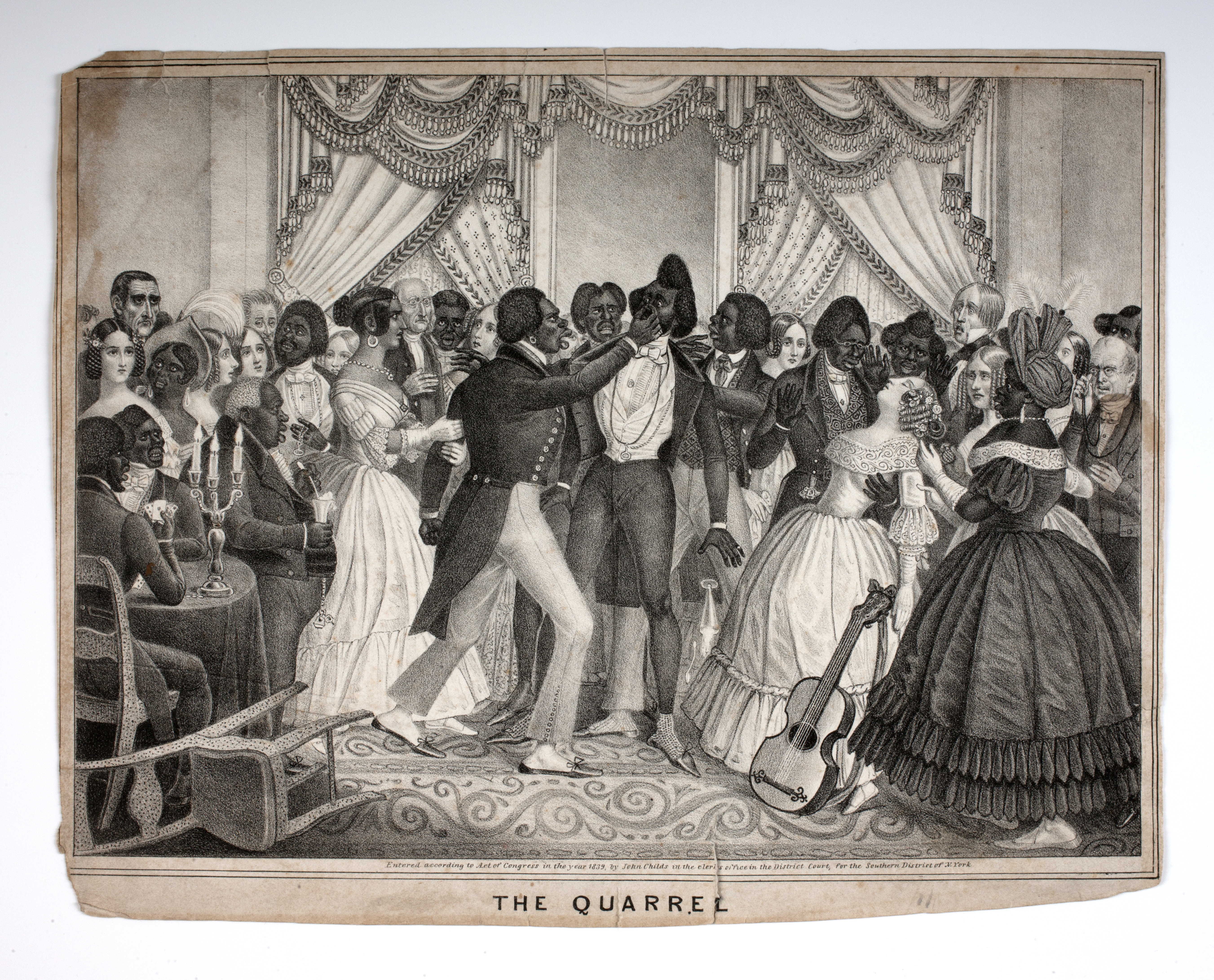
E.W. Clay, attr., The Quarrel, lithograph, NY: John Childs, 1839.

This previously unrecorded cartoon, published in New York, is one in a set of prints investigating the social implications of interaction between white citizens and African Americans.  The cartoon, which was probably designed by the artist Edward W. Clay for John Childs, depicts two African American men fighting on a dance floor, with one tweaking the nose of the other.

My Web AAS

Ever had your hand cramp up from filling out a whole stack of call slips? Or have you wondered, “What was that book I looked at last October? I’d love to see it again.” (This question actually came up earlier this week and a colleague and I had to go through stacks of call slips for those months to find the one requested, but you’d better believe we found it!)

Have you thought to yourself, as I did that day, “There has to be an easier way”?


Well that easier way is here and we’re calling it My Web AAS (or MWA for short). My Web AAS uses Aeon, an automated request system for special collections libraries, from the company Atlas Systems. You may even already be familiar with it, as other research libraries like Yale’s Beinecke Library and Harvard’s Houghton Library are using the Aeon system.

Starting today, any readers coming in to do research at AAS (including those who have been in before) will need to be registered in our new system, which we are calling My Web AAS. Your MWA account will allow you request items or order copies with a click of the button at the bottom of any record in the AAS Online Catalog. When you click on the “Request” link you will be prompted to log in to your MWA account. After entering your user name and password, you will be taken to a request form already filled out where you either schedule the date you want to look at the materials (which could be today), save the request for later, or cancel it.

What’s so great about the new system is that through it you can submit requests whenever inspiration strikes. From home, from the airport, from the coffee shop — anywhere there’s an internet connection. And you will always be able to login to your MWA account and see your current and completed requests. You’ll even be able to resubmit cancelled requests, or the one for that book you looked at last October without us having to wade through piles of call slips!

You may be asking, “How do I sign up?” You will be able to do so when you arrive at the library, but you can also get the process started by registering online from home.

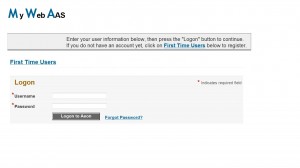
1. My Web AAS can be accessed from a link on the AAS homepage or by clicking on the “Request” button from any record. Either method will take you to the MWA login page (pictured at right).

2. If this is your first time using the system, click on “First Time Users.” You will be taken to a page listing our policies and links to Frequently Asked Questions (which includes the answer to the question “Why MWA?”). Please read through the information carefully. It will also be available to you in the future in the sidebar menu on your MWA homepage under “About”.

3. After you click on the button signaling you agree to abide by the library policies you will be taken to a form where you will be asked to provide your information and to select a username and password.

4. Click on “Submit information” and your MWA account will be created. You will be taken to your personal MWA homepage (or to a filled out form if you had clicked on “Request” from the online catalog).

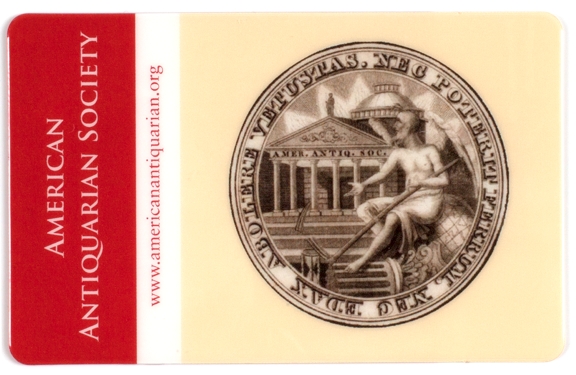
Please Note: You will still need to complete your registration in person at the library with a brief orientation, during which we will take your photo and issue you an AAS library card which you will use to be signed in to the system at the reception desk.

In case you ever get nostalgic for the old system, you can check out a previous Past is Present post on “Paper Rituals” that contains images of the call slips. But we hope the convenience of our new system will win you over — and to help those of us who like the tactile experience we have created AAS library cards, which have already become hot commodities. One undergraduate student came in last week to register in the new system (even though she was essentially done with her research) because another student was showing off the AAS library card in the lunchroom.

It’s the thing to have, and we’re holding one for you so come on down!

Talk about AAS Bicentennial History

Tomorrow, Thursday, April 19 – 7:30 p.m.
“Celebrating the American Antiquarian Society, 1812-2012”
Philip F. Gura

Philip Gura, William S. Newman Distinguished Professor of American Literature and Culture at the University of North Carolina at Chapel Hill, is the author of the just-published bicentennial history of the American Antiquarian Society. He will tell the story of the Society and its directors and librarians who have shaped and nurtured it into the twenty-first century.

The book is available for purchase from Oak Knoll Press and you can read about it on the website of the Antiquarian Booksellers Association of America.

Here is a quote from the blurb on the back of the book to whet your appetite:

The American Antiquarian Society-pride and joy of its founder Isaiah Thomas-holds the DNA of our shared national patrimony. On the occasion of its bicentennial, this uniquely American library has published a copiously illustrated history that is at once scholarly in purpose, rich in probing insight, and brimming with narrative detail. While keenly alert to the evolution of the Society, Philip F. Gura’s guiding approach has been more finely focused on its intellectual development as a cultural repository of extraordinary consequence, with careful attention given to the people who have shaped and nurtured it into the twenty-first century. The founding spirit of this remarkable institution-a bookman for the ages “touched early by the gentlest of infirmities, bibliomania”-would be mightily pleased, I am certain, with this magisterial tribute to his enduring legacy.

-Nicholas A. Basbanes, author of A World of Letters: Yale University Press, 1908-2008 and A Gentle Madness: Bibliophiles, Bibliomanes, and the Eternal Passion for Books.

Come hear all about it tomorrow night!

The Acquisitions Table: Tintypes and Ambrotype

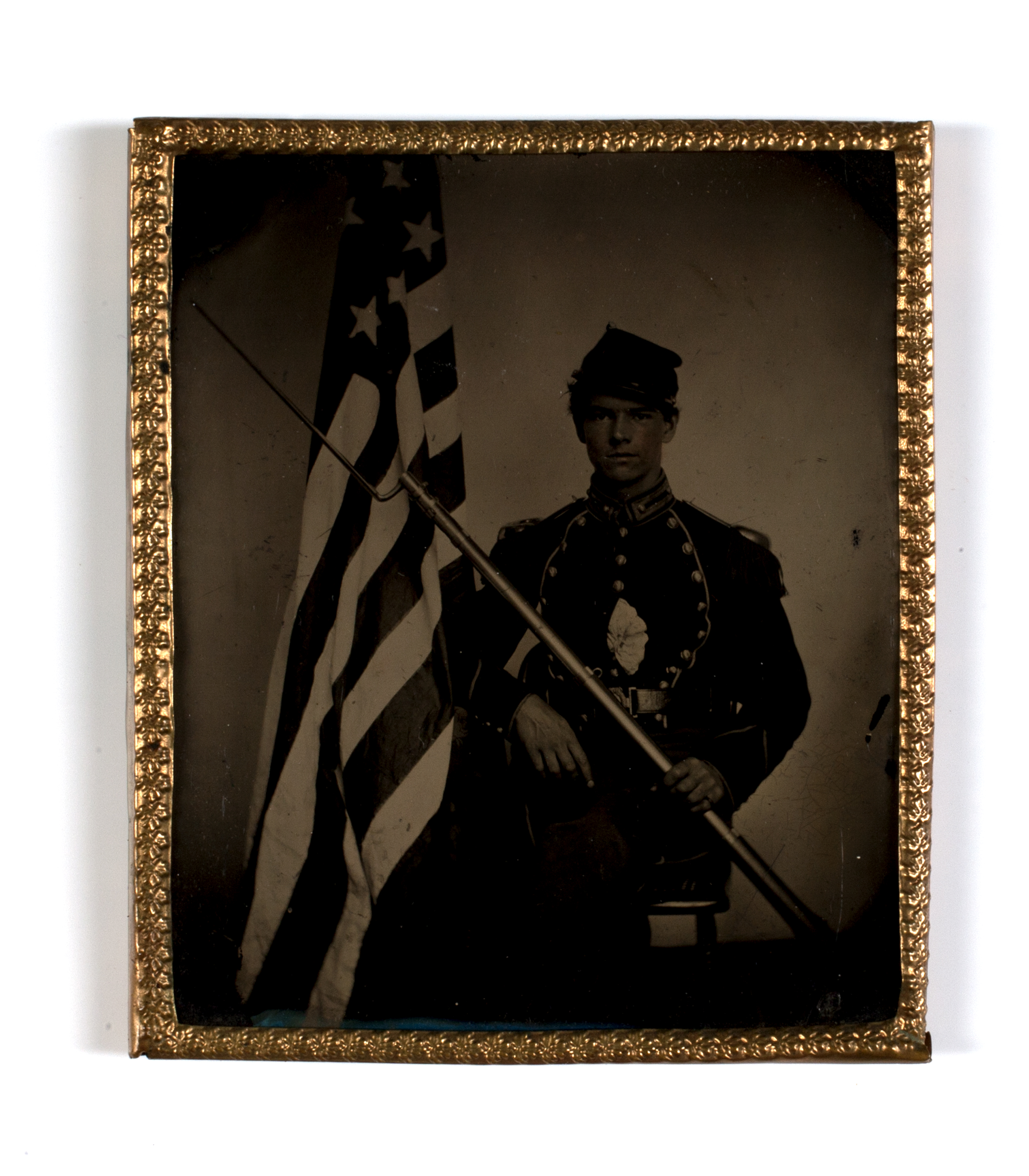
Hollis Jubal Haven with American flag, tintype, 1861; Unidentified Civil War soldier with bayonet, ambrotype; and Albertina Haven Revere, tintype.

Occasionally AAS visitors bring along objects they wish to donate to the Society. This autumn we had several visits from Dr. Christian W. Aussenheimer, a Worcester resident with connections to the Haven and Hoar families. Among his gifts to AAS were these three Civil War-era photographs. Hollis Jubal Haven (1835-1922), shown in front of an American flag, enlisted at Worcester in the Union Army in 1861, at the age of 26. He initially served in the Massachusetts 15th Infantry band as a drummer, but later joined the Brigade Band. Haven’s tintype was made in Alexandria, VA, and is stamped with the Neff Patent mark, which was first used by Peter Neff in 1856. The ambrotype of an unidentified man with a bayonet, and the tintype of Albertina Haven Revere (1831-1872), the sister of Hollis J. Haven, complete the gift.  Gift of Dr. Christian W. Aussenheimer.

The Acquisitions Table: Funeral Honors to the Memory of La Fayette

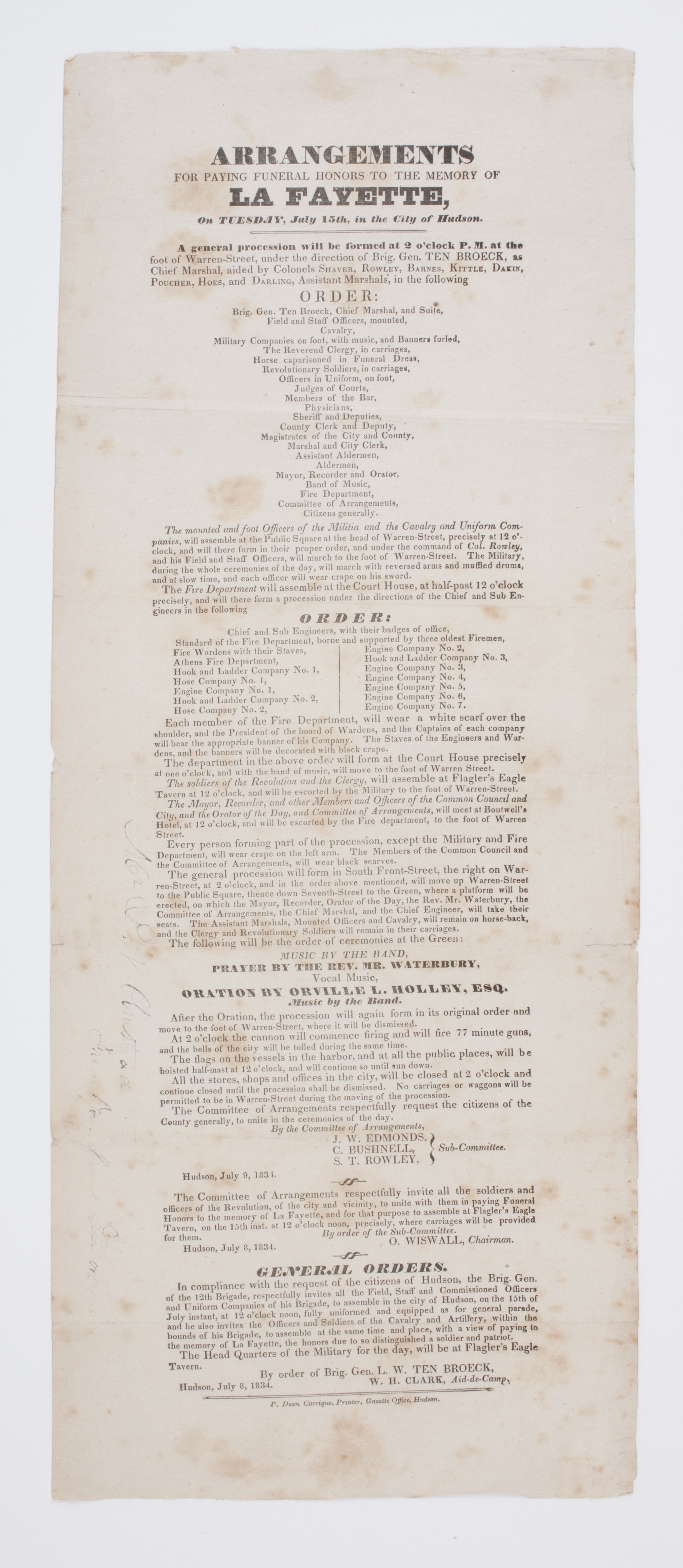
Arrangements for paying funeral honors to the memory of La Fayette, on Tuesday, July 15, in the city of Hudson. Hudson, NY: P. Dean Carrique, 1834.

When the Marquis de Lafayette died on May 20, 1834, Americans—who still closely identified the French general with the success of the American Revolutionary War—marked the occasion with solemn speeches, parades, sermons, commemorative prints and pamphlets. This broadside, issued less than two months after Lafayette’s death, announces an upcoming procession in Hudson, NY (population about 5,400). The parade included militia, cavalry, firemen, politicians, and Revolutionary War veterans. A decade earlier, during his much-celebrated 1824 visit to the United States, Lafayette stopped in Hudson on his way to Albany, and was greeted, according to the local papers, with “a reception the most heartfelt and joyous ever bestowed upon man.”

What’s in a Seal?, or A Seal for the Antiquarian

The Society has published two new books in this, its bicentennial year. The works are completely different and from the hands of different authors and designers, both of whom incorporated the Society’s seal on the back cover. With all this extra attention to this device, Abby Hutchinson, who edits the Society’s newsletter, Almanac, concluded that it was significantly historic to include a short piece in her publication. As only the broad contours of the story fit the space available in the AAS Heritage column, the editors of Past is Present welcomed a longer version.
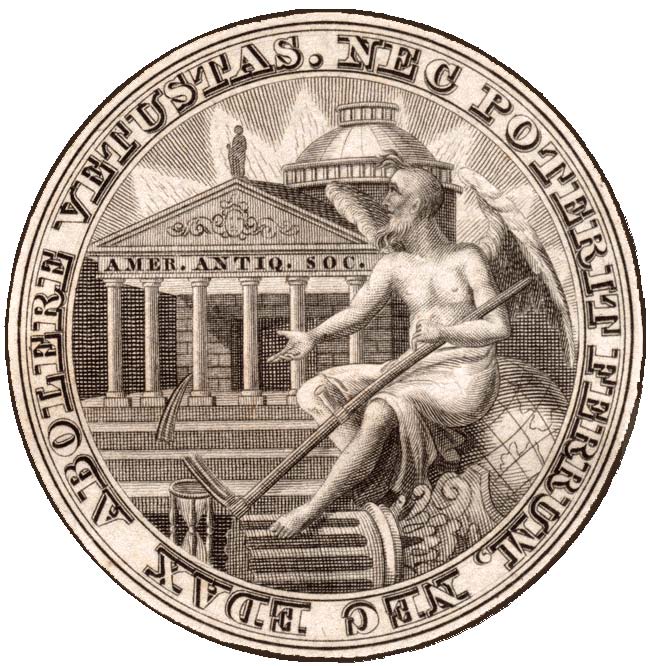
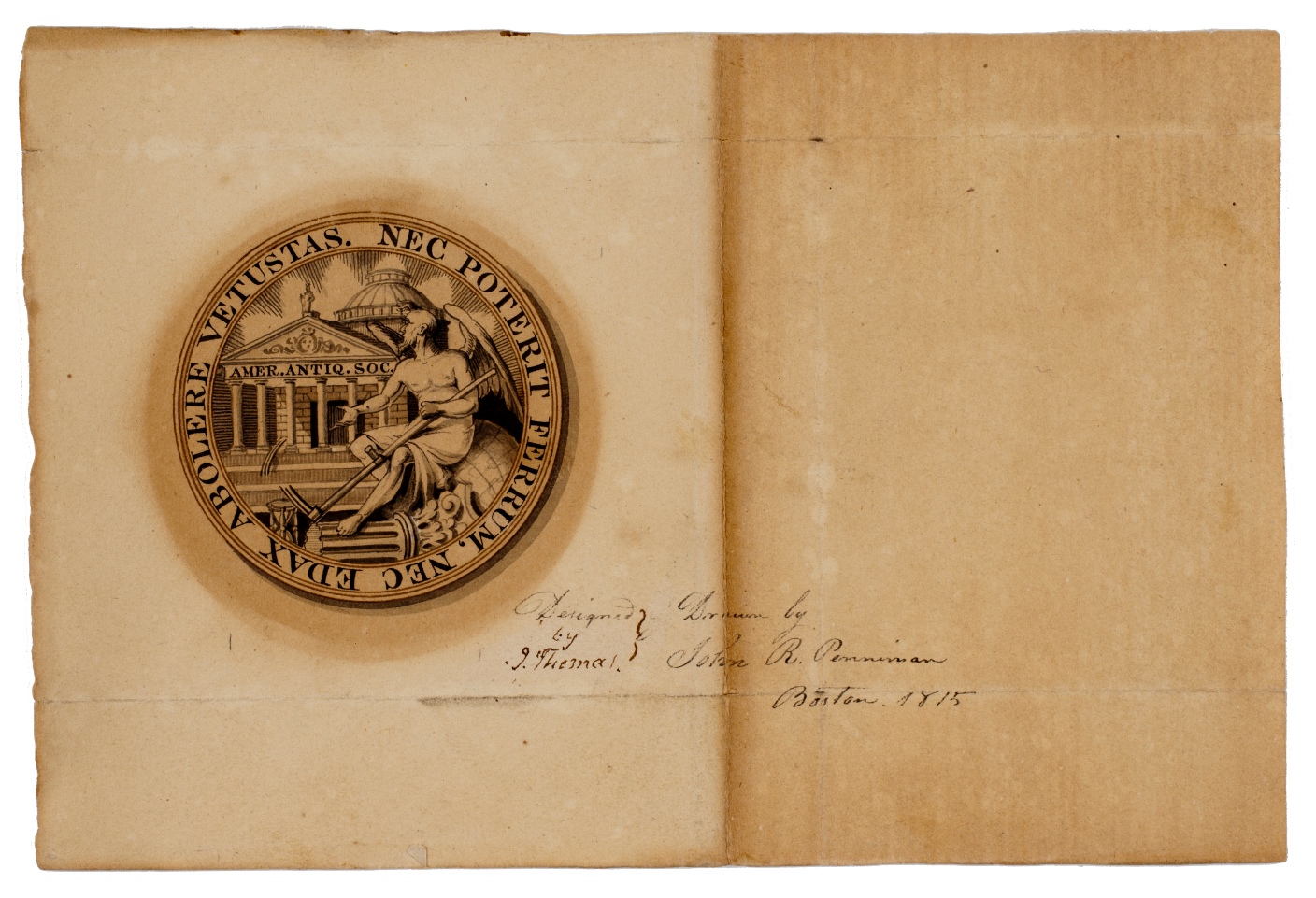
The Society’s seal was formally inaugurated in 1820. That year, in January, the Council, the Society’s governing board, voted to issue membership diplomas “to which the seal of the Society shall be affixed” to qualifying members. Later in the year, the seal was incorporated into the title page engraved by Abner Reed for the first issue of Archaeologia Americana, The Transactions and Collections of the American Antiquarian Society. Like so many other early initiatives of the Society, the seal — along with the charter, the founding collection, and even the first Antiquarian Hall — was the brainchild of Isaiah Thomas. The seal’s very existence sprang from Thomas’s vision and generous spirit. To be sure, he tried to engage other members as committees to make these ideas a reality, but the Society’s early records show that Thomas took the lead at critical moments.

The creation of the official stamp for the seal of the Society turned out to be a complicated affair. The committee appointed to complete the task got cold feet when it learned just how costly it was to sink the die and dragged its feet, rather than commit to that expenditure. The story was pieced together by Waldo Lincoln, then the Council President, at the Society’s centennial in 1912. He assembled the earliest records of the Society from disparate sources predating the regular and consecutive publication of annual meeting records that began in 1849. He also had historical notes compiled by Edmund M. Barton that were published in the Proceedings for October 1897 as part of his librarian’s report prompted by the Council’s vote (October 22, 1895) to consider revising the Society’s seal. The single-volume Proceedings of the American Antiquarian Society, 1812-1849 appeared with lengthy footnotes but without illustrations, leaving room for yet another review in time for the bicentennial.

Barton began his account of his historical exploration by noting that “the original drawing was not only preserved but framed by our founder.” (This accounts for the fold that centered the drawing in the frame even as it obscured part of Thomas’s note about its origin.) Barton then recounted what he had learned of the difficulties encountered in the effort to turn the art into a mechanical device. To the vote taken on October 24, 1814, to accept the “device for the seal of the Society” as reported by the committee for that purpose, was appended the names of members [Nathaniel G.] Snelling and Sam’l J. Prescott to the committee to “get the same engraven on steel for the use of the Society.” Later, when he went looking, Lincoln could not find the 1814 committee report — only one from the following year that was officially described as “progress.”
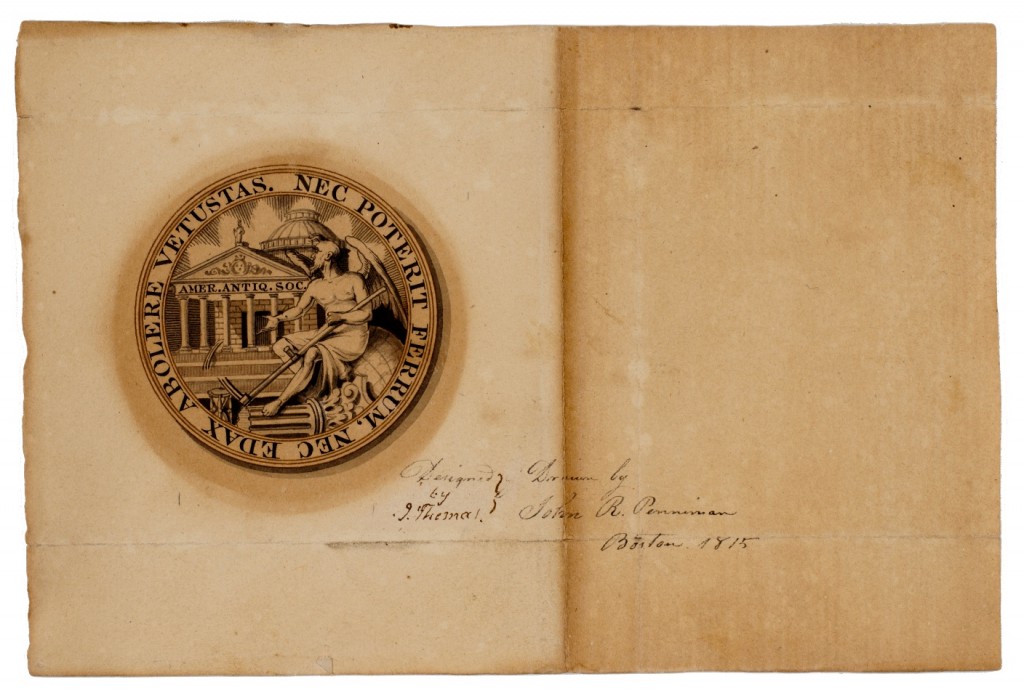
According to the summary, the 1814 report recorded the acceptance of John R. Penniman’s commission. The following year, perhaps motivated by the expense of transferring it to a die, the committee reported that “they have caused a drawing of the seal” to be made by Mr. Penniman “reduced from his original design.” This is confirmed by the treasurer’s receipted bill of May 22, 1815, in the Society’s archives:

Received of Mr. Isaiah Thomas, Jnr, eight dollars. Being in full for a Design & Drawing a Seal for the Antiquarian Society [signed} John R. Penniman.

The price quoted to the committee for the mechanical seal turned out to be higher than anticipated. The Boston engraver Aaron Merrill Peaslee “informed them that he could not undertake it for less than 50 dollars, if in brass and 100 dollars if in steel, exclusive of a case and screw, which will be a further expense of from 40 to 50 dollars.” No action appears to have been taken on Peaslee’s estimate and the committee was directed “to make further inquiries.”

This was slow going, and in a letter to Thomas (February 9, 1818), Snelling indicated that as the job could not be done in Boston, he suggested that as “in New York and Philadelphia there are many first-rate foreign artists to whom the process of dye-sinking is perfectly familiar,” the Boston-oriented committee should be disbanded. His formal report in April 1818, that “it was impossible to have it executed” recommended that the Society’s corresponding secretary, Samuel Burnside, transmit a copy of the drawing for engraving to a New York member with whom he was acquainted, John G. Bogert, or some other member there to have the seal engraved by the “first artist in the city, on brass, silver, or steel.” The next action was taken in October 1818, when Snelling complied with the vote of the April meeting by sending Thomas the original and duplicate drawings of the seal. Next, Thomas made a diary note on March 27, 1819, indicating that he had written to the Hartford engraver, Abner Reed, “respecting engraving the seal for the Am. Antiq’n So’y and sent him the drawing or devise.” Thomas paid Reed’s bill for $25 in June and the Sub Council noted in December that “a seal for the Society has been handsomely engraved and presented this evening to the Society by the President.” At the same time, Thomas also, at his own expense, had a membership diploma engraved by Reed. With a seal that could be embossed on a paper wafer and affixed to the diploma, the Society had a way to recognize eligible members (those who had paid their annual subscription of $6.00 per Article IX of the “Laws of the American Antiquarian Society).

For the next dozen years, there is no further word on the seal and the diploma. All seemed well, although the earliest group of diplomas in the Society’s collection indicate that the seal made at best a light impression when embossed on the round paper wafer that was affixed to the diploma. The seal made a stronger impression as part of Reed’s elaborate — and signed — engraving for the title page of the first volume of Archaeologia Americana (The Transactions of the American Antiquarian Society) published in 1820.

In 1832, the Council voted to obtain a smaller version of the seal. But when, in 1836, the second volume of the Transactions appeared, it was devoid of the engraved title page and without a seal. Three years later, in 1839, the Council returned to the subject of the seal, voting to have it adapted so that could be used “with common sealing presses.” Not until 1847 was the librarian authorized to “procure paper to be stamped for use.” If this is the coated paper with a light lavender hue that was used for the seal for Samuel Foster Haven’s membership diploma, it is clear that at last the problem of the ‘weak impression’ left by the earlier seal had been resolved.

The motto that appears on the seal, “nec poterit ferrum nec edax abolere vetustas,” is from Ovid’s Metamorphoses (Book 15, l.872), and when combined with line 871, reads “Now I have completed my work, which neither sword nor devouring Time will be able to destroy.” Thomas’s choice of a text seems to speak for itself—or does it? It can be considered a sign of his anticipation of a secure future for the Society, but these lines might also have held special resonance that might not have come from reading Ovid’s narrative poem.
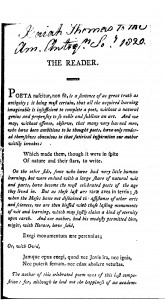
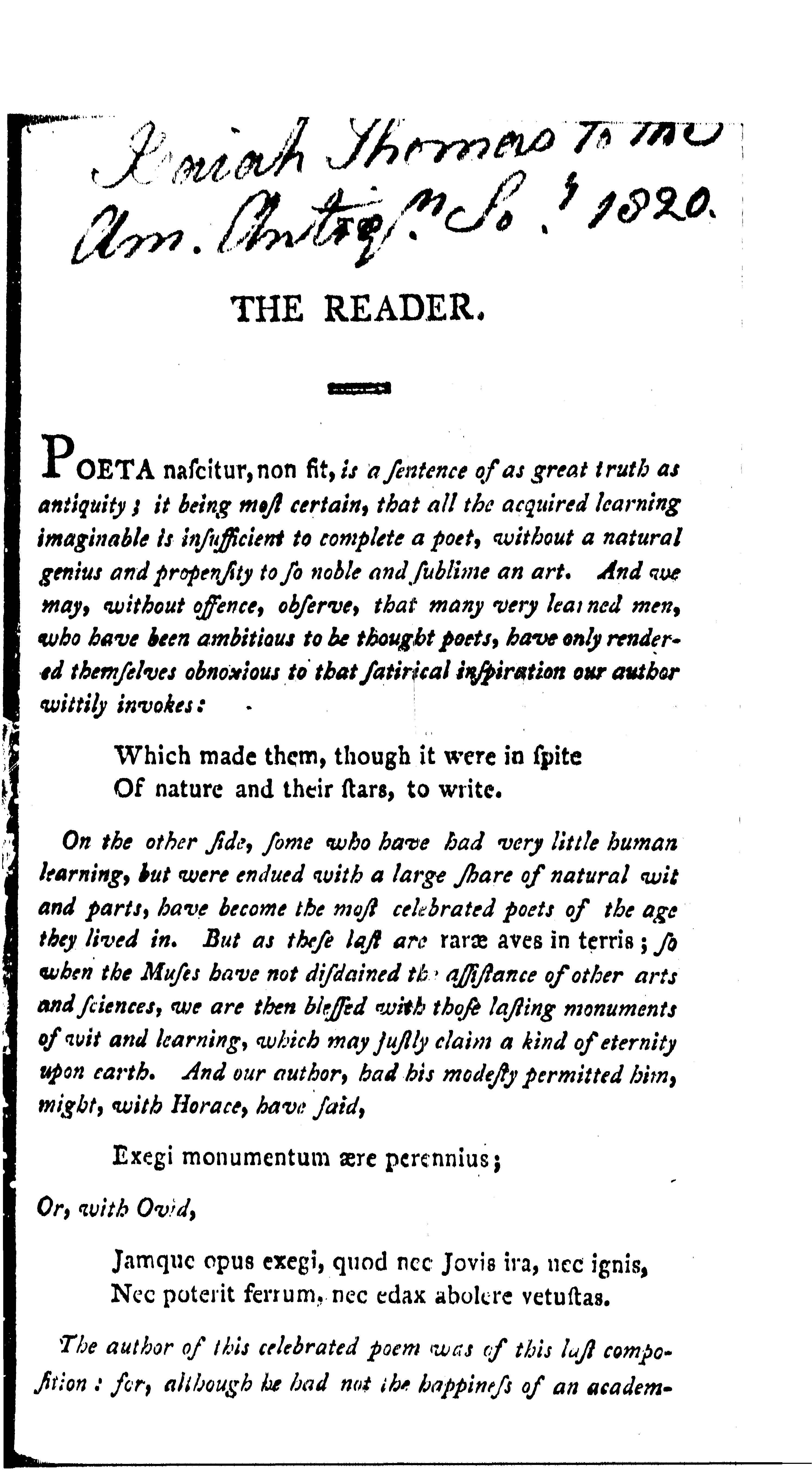
Thomas’s initial gift of books does not include a copy of Metamorphoses, but he was aware of these lines from their appearance in another volume in his possession. Thomas’s copy of Samuel Butler’s Hudibras (London, 1739; repr. Troy, New York, 1806) opens with a preface declaring that poets are born, not taught. The author then backpedaled in a way that would surely have appealed to Thomas: “some who have had very little human learning, but were endued with a large share of natural wit … have become the most celebrated poets of the age they lived in.” The two lines from Ovid are cited as proof that while “he had not had the happiness of an academical education, as some affirm, it may be perceived, throughout his whole poem, that he had read much and was very well accomplished in the most useful parts of human learning.” Is it surprising that the self-taught Thomas inscribed this page when he gave this volume to the Society in 1820?

And if after reading this, you would like copies of the seal for your own collection, please indulge us in a little shameless commerce. They may be found on the dust jackets of Joseph J. Felcone’s New Jersey Printing, 1754-1800: A Descriptive Bibliography and Phlip F. Gura’s The American Antiquarian Society, 1812-2012: A Bicentennial History. As with all of the Society’s books, they are available from Oak Knoll Press (http://www.oakknoll.com/).
History Lessons with Gordon Wood

Please join us for a special public lecture tomorrow night, Thursday, April 5, at 7:30 p.m.


“Does History Teach Lessons?”
Gordon S. Wood

Was George Santayana correct when he said that “those who cannot remember the past are condemned to repeat it?” Come and find out with Gordon Wood who is the Alva O. Way University Professor Emeritus at Brown University, the recipient of many awards including the Bancroft and Pulitzer Prizes and a regular contributor to The New Republic and The New York Review of Books.

Children’s books today, Adopt-a-Book event tomorrow!

We hope to see you in the library in person tomorrow, Tuesday, April 3, at 6 p.m.  AAS’s 5th annual Adopt-a-Book event will be an evening of food, drinks, original collection materials, and curatorial knowledge-sharing (although some of the preceeding are going to be kept separate from each other). You can browse the 2012 Adopt-A-Book Catalog to view the 150 items up for adoption ahead of time, but also remember 50 new items will be available that night.

Here are a few items from our children’s literature collection that may not yet have found the right adoptive parent (no guarantees, though, because they’re going fast!).

88. FANCY ADOPTING ME?
Adopt me for $500

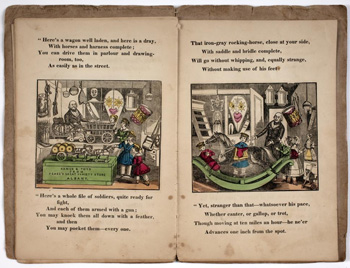
Grandmamma Easy’s Toy Shop. Albany: Richard H. Pease, ca. 1847-1852.

This folio picture book gives us a rare glimpse into the “Temple of Fancy” operated by picture book publisher Richard Pease. On display are all kinds of toys then in common use, including toy soldiers, kites, masks, and a grand dray “with horses and harness complete.”
~Laura Wasowicz

100. SNAKE!
Adopt me for $25

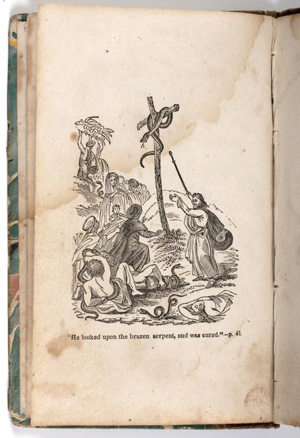
The Brazen Serpent. Philadelphia: American Sunday-School Union, ca. 1857-1860.

This story about faith is told as a conversation between a mother and her daughter about how Moses (in obedience to God) made a brazen serpent and ordered those bitten by the snakes to look upon the statue in order to be cured.
~Laura Wasowicz

April Fools: Adopt a Comic Newspaper

AAS’s fifth annual Adopt-A-Book event is only days away. We hope to see you in the library in person on Tuesday, April 3, at 6 p.m. In the meantime, you can browse the 2012 Adopt-A-Book Catalog to view the 150 items up for adoption, but remember 50 new items will be available that night. Here are some of the funniest still available for adoption.

Humor and comic newspapers and periodicals are quite scarce because of their content. Though many had good circulation numbers, they were not often saved by institutions. Yet today they are wanted by researchers for the political satire, depictions of society, and humorous literature contained in them. Here is a selection that showed up in the past year. ~ Vincent Golden

133. Adopt me for $100

image of item Comic Monthly (New York, NY) May 1862.

134. Adopt me for $400

image of item Frank Leslie’s Budget of Fun (New York, NY) 1861, 1865, 1866.

135. Adopt me for $100

image of item New York Pick (NY) Apr. 29, 1854.

136. Adopt me for $300

Wild Oats (New York, NY) 1873, 1875.

Calling all Newsies: NY Paps for Adoption Here!

Don’t let the name fool you — Adopt-a-Book is for newsies too. AAS’s fifth annual Adopt-A-Book event is coming up this Tuesday, April 3, at 6 p.m. Browse the 2012 Adopt-A-Book Catalog to view the 150 items up for adoption.  Here are a few highlights of New York newspapers still available for adoption. image of item

141. ALL THE NEWS THAT’S FIT TO ADOPT
Adopt me for $600

New York Illustrated News (NY) Nov. 1859-May 1860. Vol. 1.

This paper came out two years after the establishment of Harper’s Weekly (NY). While it had similar quality of illustrations, the writing was not as refined. Still it lasted until the beginning of 1864. Until AAS acquired this volume, it just has a few scattered issues from the first year.

~Vincent Golden, curator of newspapers

147. A MAJOR STORY PAPER
Adopt me for $500

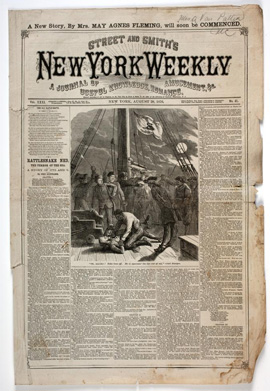
Street and Smith’s New York Weekly (NY) 1876. 21
image of item
One popular genre of the nineteenth century was the story paper. Often weekly, they would have a variety of stories, some illustrated with woodcuts. Some were very short and complete to the issue. Others ran for several issues with one or two chapters published each issue. Street and Smith’s New York Weekly was one of the more prominent cheap ones boasting a circulation of over 350,000 subscribers at one point. The stories were quite varied but tales of the West were becoming quite popular.

~Vincent Golden, curator of newspapers

An Old Union Man

“Did he say anything about politics?”
“Not a word. We talked mostly about books.”
“Books! What does he know about books?”
From Henry Adams, Democracy

One of the more enjoyable aspects of working with old books all day is having the chance to see what past owners have tucked away for safe-keeping in the leaves of those books. Just the other day, I was looking at an 1873 copy of William H. Seward’s Travels Around the World and noticed that someone had inserted several newspaper clippings about the author, William Seward, the Auburn, New York, monument dedicated to him, and the death of one of his family’s former house slaves, “Old Judge.”

It was on this day, March 30, in 1861, that news of Spanish annexation of St. Domingo broke, an event that urged Seward, Lincoln’s secretary of state, to write a famous memo to Lincoln. Spain had pushed for annexation, believing that internal dissension in the states would keep the U.S. from responding. Over the next few days, Seward prepared and sent to Lincoln his “Some Thoughts for the President’s Consideration.” “Thoughts” criticized Lincoln for having no clear foreign or domestic policy, promoted fortifying gulf ports like Pickens to prepare for a potential war with Spain — a war that would help solidify union of the states — and argued strongly for union. Seward wrote:

“We are at the end of a month’s Administration, and yet without a policy either domestic or foreign…. The policy at home…. My system is built on this idea, as a ruling one, namely: that we must change the question, before the public, from one upon Slavery, or about Slavery, for a question upon Union or Disunion. In other words, from what would be regarded as a party question to one of Patriotism or Union.”

In his reply to Seward, Lincoln defended himself against attacks on his lack of policy and presidential ineffectiveness. He also dismissed Seward’s efforts to defend Pickens which, Seward implied, was more about union than party or slavery.

Seward was not one to slight the issue of slavery. His family had been slaveholders in early nineteenth-century New York, and in his autobiography, Seward expressed his early discontent with slavery and slaveholding:

I early came to the conclusion that something was wrong, and the ‘gradual emancipation laws’ of the State, soon after coming into debate, enabled me to solve the mystery, and determined me, at an early age, to be an abolitionist.

But Seward was not forward-thinking enough to call for full integration of the races. The clippings, which showcase how well-behaved and submissive Seward’s valet and loyal servants were, indicate Seward’s contentment with the subordinate status of blacks. His Travels, which lauds the U.S for abolishing slavery, became one of D. Appleton & Co.’s bestsellers. Appleton published the book, which was probably authored by Seward’s adopted daughter, Olive Risley Seward, by subscription only in the months after Seward’s death in October of 1872 (click here for the AAS catalog record for the salesman’s sample). This was at a time when subscription publishing was making more and a greater variety of books available in the hinterland. It is unfortunate, or perhaps only inevitable, that Seward’s message of American freedom, so widely disseminated, was thought by at least one reader to be inseparable from the vestiges of American slavery.

The Acquisitions Table: The Queen of the Night

Update: This item has already been adopted, but you can browse the 2012 Adopt-A-Book Catalog to search among the 150 items up for adoption. Or join us for the fifth annual Adopt-A-Book event will be held on Tuesday, April 3, at 6 p.m. when there will be 50 new items up for adoption!

The Queen of the Night. A story of love, crime and intrigue in wicked New York. [New York]: Richmond and Co., [1871]     (Richmond’s novels, new series, no. 18)

This is one of several very rare titles from the “Richmond’s novels” series that AAS recently acquired. Apparently unrecorded, The Queen of the Night is rather archly credited to “the author of ‘One thousand popular tales’”—a reference to a book title, or to one of the ultra-prolific dime novel writers of the time? The Queen of the Night reveals for us the highs and lows of life in “wicked New York.” It begins at Sing-Sing, where remorseful convict Whiskie is breaking rocks, only to encounter his former partner in crime, the manipulative, cold-blooded gang leader Slippery Blacksmith. Whiskie resists Slippery’s unrefusable offer, only to die—or so Slippery thinks, before he breaks out of Sing-Sing. Months later, a freed Whiskie has reinvented himself as “Hugh Mortimer,” a gentleman in pursuit of Gretchen, a wealthy young resident of fashionable Fifth Avenue. But the “Queen of the Night,” who shines in the most select social circles as easily as she dominates the New York underworld, conspires with Slippery to turn Whiskie’s designs to their own advantage. Many lurid plot twists later, Whiskie casts his nemeses into a watery grave and marries the still-undefiled Gretchen.

Adopt-a-Graphic Art!

The fifth annual Adopt-A-Book event will be held on Tuesday, April 3, at 6 p.m. Browse the 2012 Adopt-A-Book Catalog to view the 150 items up for adoption.  Here are a few highlights still available for adoption from the Graphic Arts collections.

77. BIGGER IS BETTER!
Adopt me for $250

image of item A Mammoth newspaper! 10 Copies for $10. Philadelphia: Charles Alexander, 1837

At the end of 1837, the Philadelphia newspaper publisher Charles Alexander decided to make some changes to his popular paper, the American Weekly Messenger. He added more literary content, increased illustrations, and offered double edition premiums, such as the New Year’s offering described on this broadside. The proposed issue included a page of portraits of important figures in American history, such as George Washington and Lafayette, a list of solvent banks, and descriptions of counterfeit notes (information in great demand following the financial panic of 1837), and additional poems and stories designed to appeal to a wide audience.

145. ADOPTING ME IS WORTH WHILE. NO BULL
Adopt me for $35

image of item Imported Jersey Bull, Butter Stamp! Ravenna, Ohio, 1873

The American dairy business relied on a steady supply of quality breeding stock, with regular infusions of new blood to increase production and quality of milk. As farmers moved west, they often returned to reputable breeders on the East coast to procure bulls and cows to improve their herds. Once the railroads connected most major urban centers, it became less stressful on the animals to move them over distances, and it is likely that the bull Butter Stamp rode the rails to Ravenna, Ohio, after taking the blue ribbon at the New Jersey State Fair.

Your Newest Facebook Friend: Isaiah Thomas

It’s always a fun – and somewhat ahistorical – activity to wonder how historical figures would react to the technology of the twenty-first century. Nevertheless, it’s difficult not to wonder what our founder Isaiah Thomas, a man whose business was the printed word and the spreading of ideas and news, would have felt about new communication networks such as Facebook and Twitter.

In many ways, it’s very possible that he would have liked the idea of these types of communications. They spread news quickly and allow for the creation of a public image and self-promotion, all activities in which Thomas took part in his own lifetime. Thinking about it another way, you could make comparisons between Thomas’s influence on society and the technology giants of today. As our Director of Outreach, Jim Moran, likes to say, Thomas was like the Bill Gates of his day in that his work influenced all aspects of life for all classes.  Farmers planted by his almanacs, families prayed with his bibles, women read his novels, citizens became involved in politics with his newspapers, and so on. Although he would certainly bemoan the decrease in physical printing seen in the last few years, as a businessman and a communicator it’s very possible he would have taken advantage of the technology to spread his ideas, influence, and business.

Perhaps these types of “what ifs” and analogies are not entirely historically sound, but they do help us to try to understand the past and make it relevant to our own times. In that spirit we decided that Isaiah Thomas, since he is not here to do his own self-promotion, should have his own Facebook page to help spread his legacy and tell his story. Visit and like his page at http://www.facebook.com/pages/Isaiah-Thomas/299053830157602! There are images of Thomas, his printing press, his indenture papers, and so much more. We will also be posting excerpts from his journal, letting you know what he was doing on the same day over 200 years ago.