This handwritten textbook of geography is something of a mystery. Heavily illustrated with original drawings and images clipped from publications, the text is divided into lessons with topics such as “About Travelling,” “About the Surface of the Earth,” “About Animals,” and “About Trees and Plants.” The title, Fitch’s Geography… suggests that the text may have been written by George W. Fitch, author of several geography texts in the 1840s and 1850s. Is this a mockup made by Fitch? Or a work created by a teacher or student? It can be roughly dated by a map showing California (admitted 1850) as a state but Minnesota (admitted 1858) as a territory.
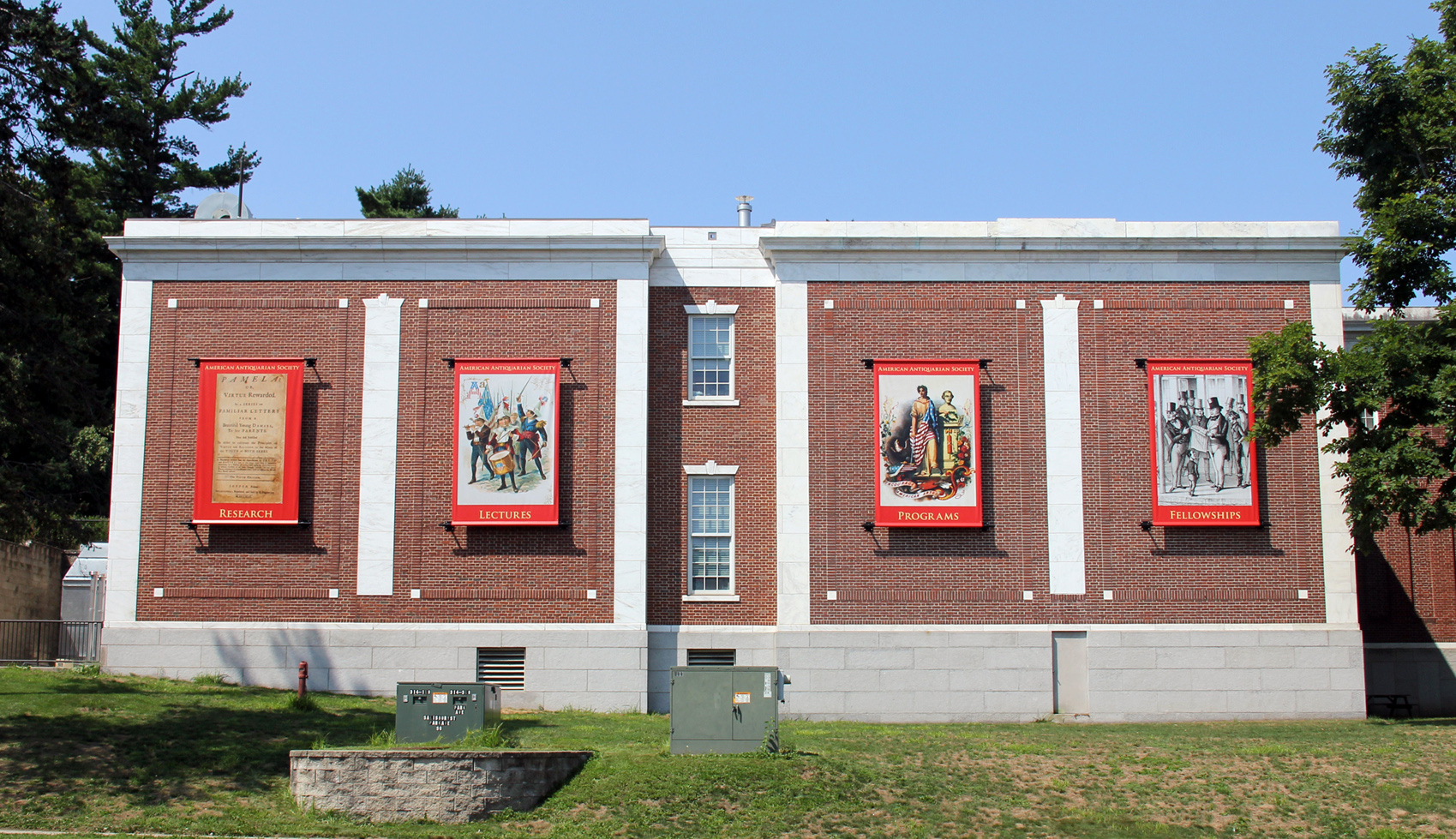
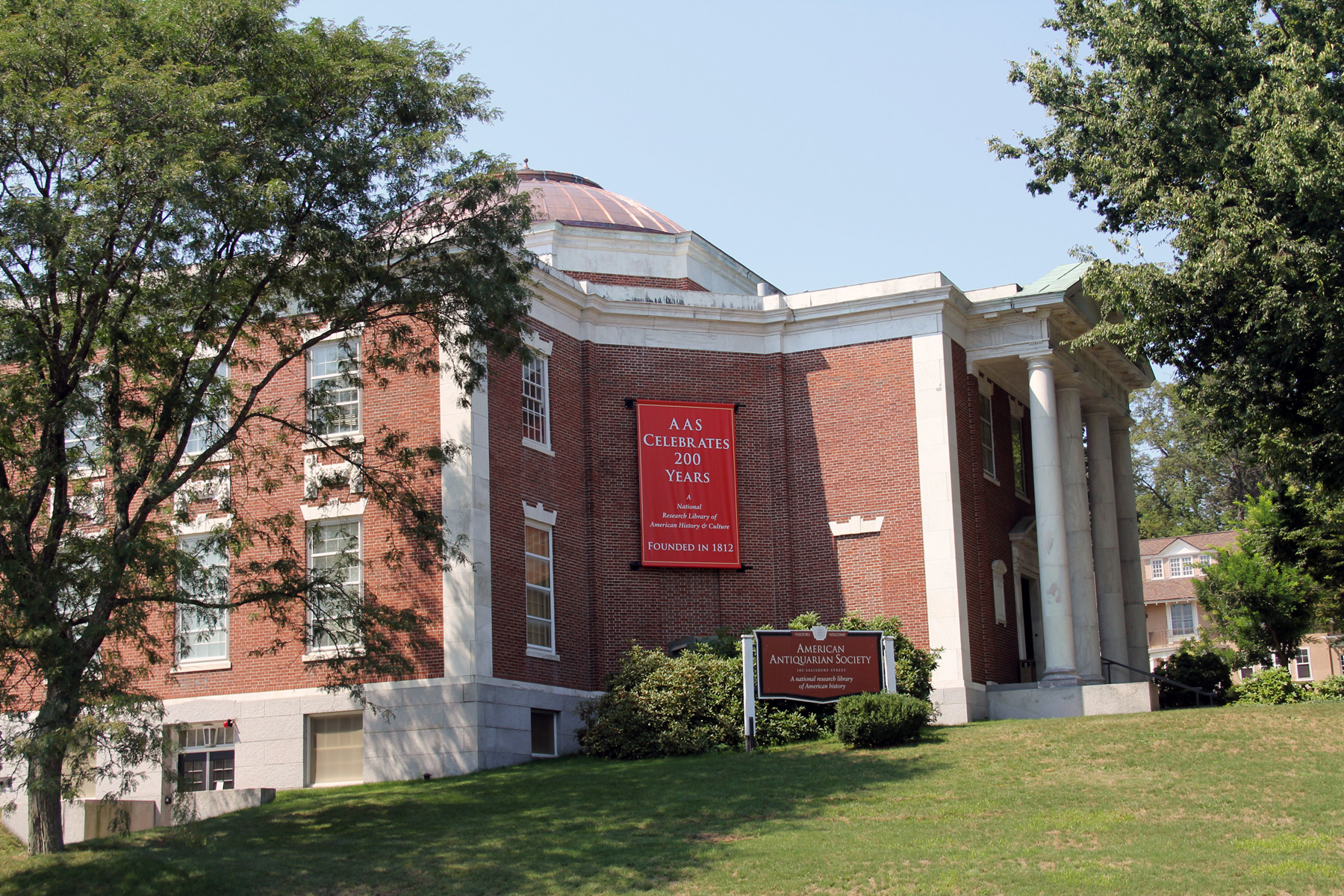
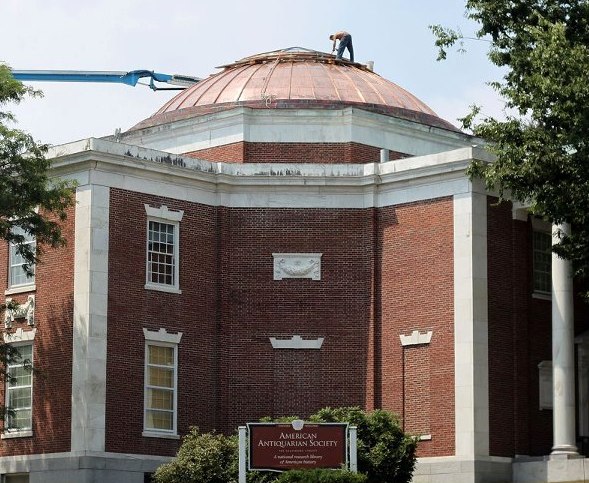
After Antiquarian Hall’s signature copper dome was renovated this summer, five bicentennial banners were installed on the Park Avenue and Salisbury Street facades. Custom-designed hardware will allow the banners to be changed in the future.
Four of the banners are on the library stacks, brick walls without windows that provide an excellent backdrop. Each features a collection item with a single word meant to convey – at a glance –priorities at AAS: Research, Lectures, Programs, and Fellowships.
The first banner shows the title page of Pamela: Or, Virtue Rewarded by Samuel Richardson. Initially published in London, this book was popular in both England and America. Benjamin Franklin printed this edition in 1742-1744 (AAS has the only known copy), making it the first novel published in America. Franklin started and stopped the job and, by the time he finished, had lost valuable time for selling the book. The London editions were widely available by then and Franklin swore never to print another novel. Pamela is a series of letters from a beautiful young woman to her parents, published “in order to cultivate the principles of virtue and religion in the minds of youths of both sexes.”
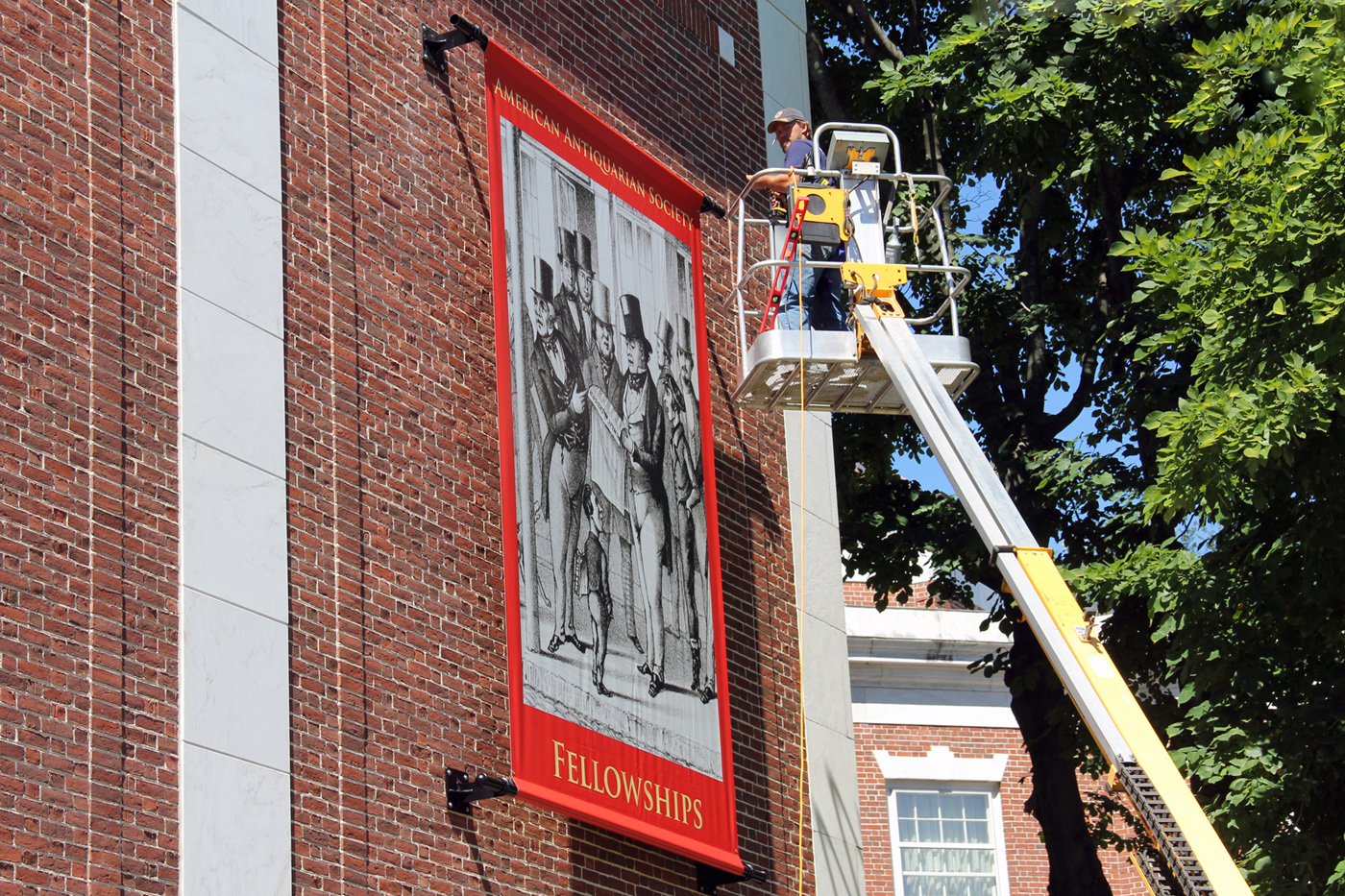
Installation of the banners.
The second banner features a group of young boys dressed up as soldiers with decorated hats, epaulets, fife, and drum. This is from the first page of an ABC book entitled Little Soldier Boys, published by McLoughlin Bros. in 1899. AAS has a superb collection of McLoughlin Bros. titles, a premier children’s book publisher in the mid- to late-nineteenth century. The firm was located in Springfield, Massachusetts and New York and is known for publishing beautiful books for children with rich, full-color chromolithographic illustrations.
The third banner is from an advertisement for Wagner & McGuigan’s Lithographic and Steam Power Printing Establishment, printed between 1851 and 1856. Patriotic symbols include the figure of Columbia, holding a sword and draped in the U.S. flag, and an eagle perched on a red, white, and blue shield. Since the purpose is advertising, it also includes a bust of Alois Senefelder, the inventor of lithography in 1798. The title “Encourage American Arts!” curves around rolls of paper and an artist’s palette. On the back side, the firm describes its “superior facilities” and a relief print shows more than forty presses.
The sidewalk scene in the fourth banner is from the title page of The Ledger Polka,sheet music published in 1849. AAS has approximately 60,000 examples of sheet music. This polka was “dedicated to the readers of the Public Ledger,” a newspaper that began publication in Philadelphia in 1836. The image by James Bellak shows a group of gentleman gathered outside of the newspaper’s office. The Ledger continued to be published until 1934, when it was absorbed by the Philadelphia Inquirer.
Banner to the left of the front entrance.
The fifth banner, to the left of the front entrance, announces the Society’s bicentennial: “AAS Celebrates 200 Years – A National Research Library of American History& Culture – Founded in 1812.” As bicentennial celebrations conclude at the end of 2012, this banner will be replaced, perhaps with one announcing AAS’s public programs and other special events.
Special exhibition to mark the Society’s bicentennial, at the Grolier Club, New York, September 12 through November 17, 2012.
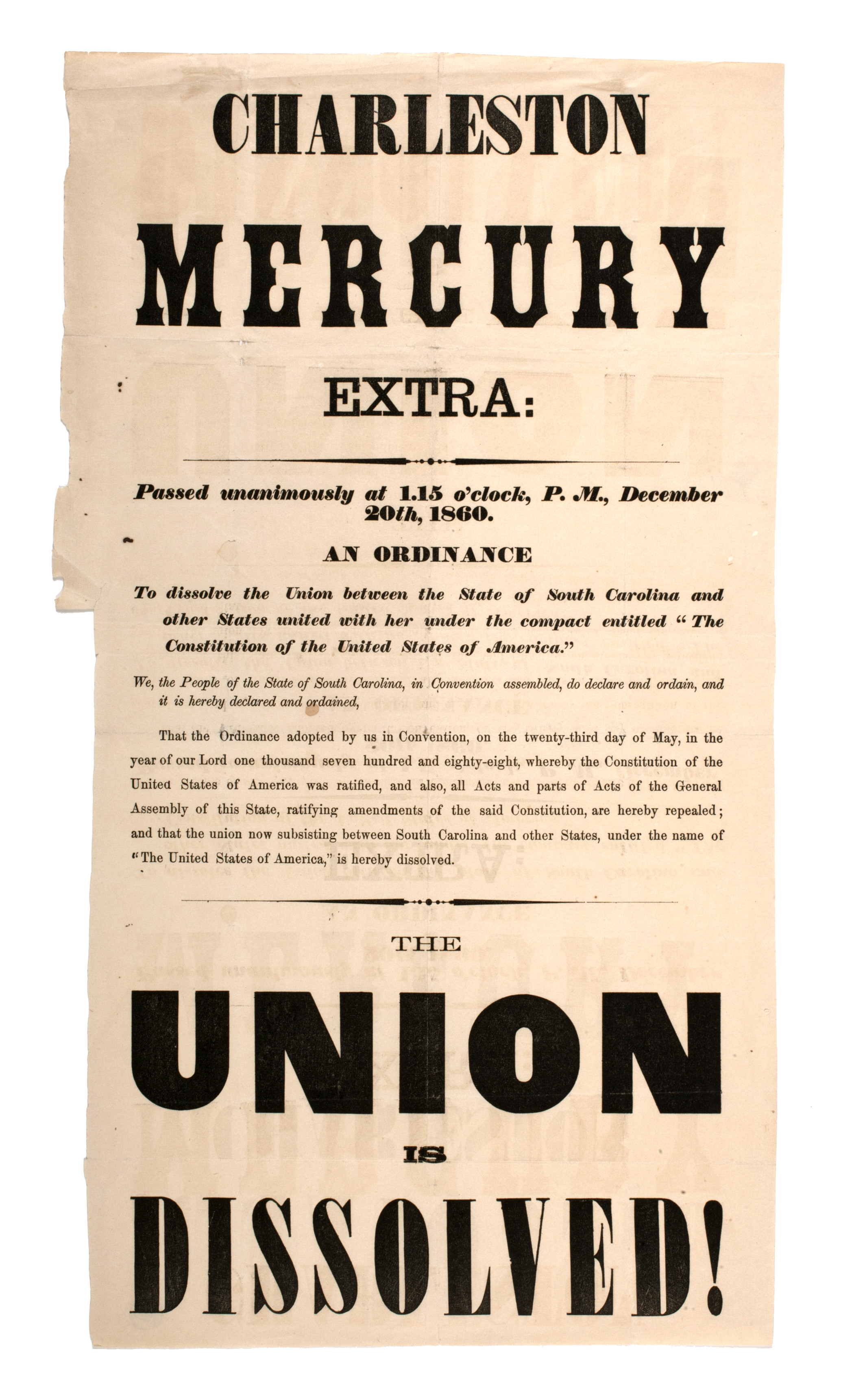
Considered to be the first Confederate imprint, this broadside announced to the public the declaration, on December 20, 1860, that South Carolina would secede from the United States. This sheet was removed from a wall in Charleston by the popular Boston-born author Caroline Howard Gilman (1794-1888).
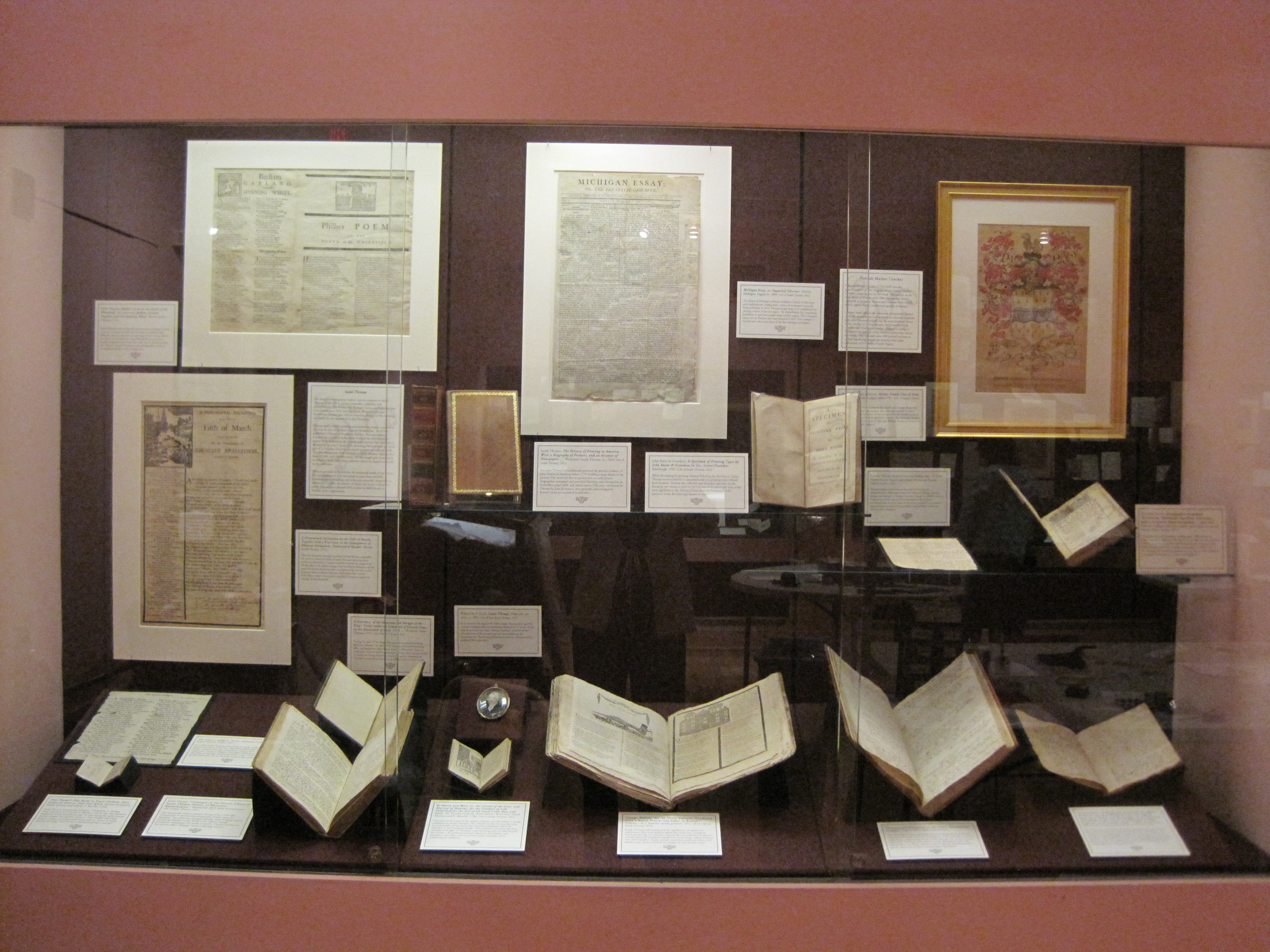
As most readers of this blog already know, the American Antiquarian Society was founded two hundred years ago, in 1812 in Worcester, Massachusetts, by the patriot, printer and publisher Isaiah Thomas. In fact, Thomas’s personal library forms the nucleus of the collection which today numbers four million items, over two million newspapers, and includes substantial holdings of periodicals, graphic arts, and manuscripts.
It would be difficult to truly represent the full breadth and depth of AAS collections in a single exhibition, so a different approach was taken by the Society’s curatorial team. We wanted to show that the creation of an institution like the Society depends on support from a large number of individual people. In Pursuit of a Vision introduces nearly thirty of the many librarians, philanthropic collectors, book dealers, members and scholars who have, over the past two hundred years, helped to build this independent institution into a national treasure. As aficionados and collectors well know, each acquisition, whether it is added to a public or personal collection, often comes with its own story. This exhibition and the generously illustrated catalog that accompanies it (order at Oak Knoll Books), chronicle the individual stories of almost two hundred objects, which have been arranged by theme: laying the foundation, late nineteenth-century benefactors, collecting in the twentieth century, bibliographic initiatives, specialized collecting, and responsible stewardship.
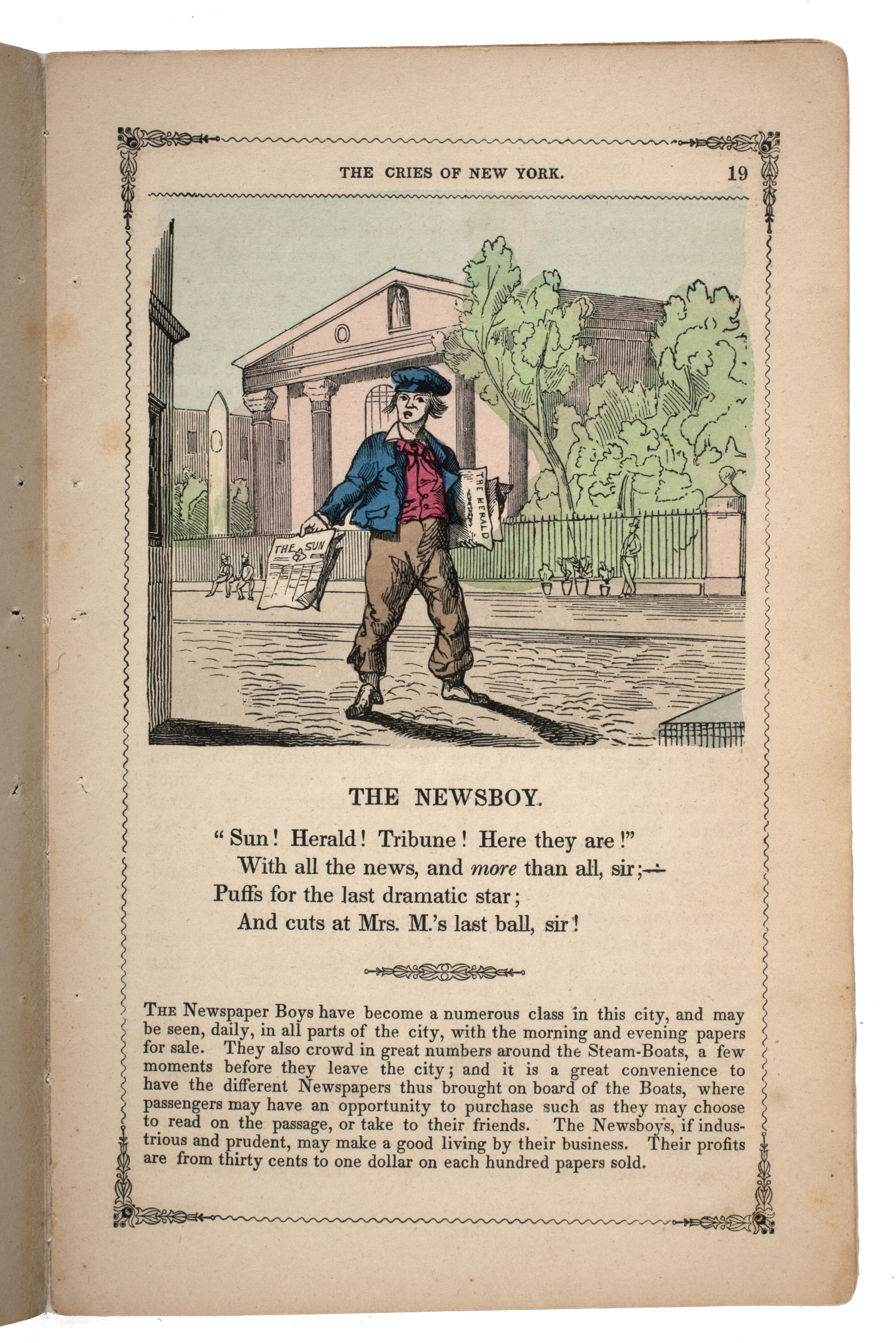
This mid-nineteenth century example of a children’s picture book depicting street vendors follows a long tradition of children’s literature about street vendors and their cries dating back to the late seventeenth century in London. The book was given to AAS by Charles Henry Taylor, head of the Boston Globe newspaper.
As the American Antiquarian Society begins its third century as a leading research library and a learned society, the institution’s success remains a collective achievement shared by many individuals, both past and present, whose commitment and generosity have made it a reality.
In the early days of the American Antiquarian Society, founder Isaiah Thomas asked members to send materials for preservation in the Society’s library at Worcester, Massachusetts. He explained, “We cannot obtain a knowledge of those who are to come after us, nor are we certain what will be the events of future times; as it is in our power, so it should be our duty to bestow on posterity that which they cannot give to us, but which they may enlarge and improve and transmit to those who shall succeed them.” Over the course of two hundred years, generations of the Society’s members, friends, and staff have ably answered Thomas’s call.
In Pursuit of a Vision celebrates the generosity and farsightedness of some of the many collectors, book dealers, and librarians who have, each in his or her own way, contributed to the greatness of the American Antiquarian Society.
Installed case at the exhibition.
LOCATION AND TIME: In Pursuit of a Vision will be on view at the Grolier Club, 47 East 60th Street, New York, from September 12 – November 17, 2012. The exhibit will be open to the public free of charge, Monday – Saturday, 10 a.m. to 5 p.m. Additional information and directions are available at www.grolierclub.org.
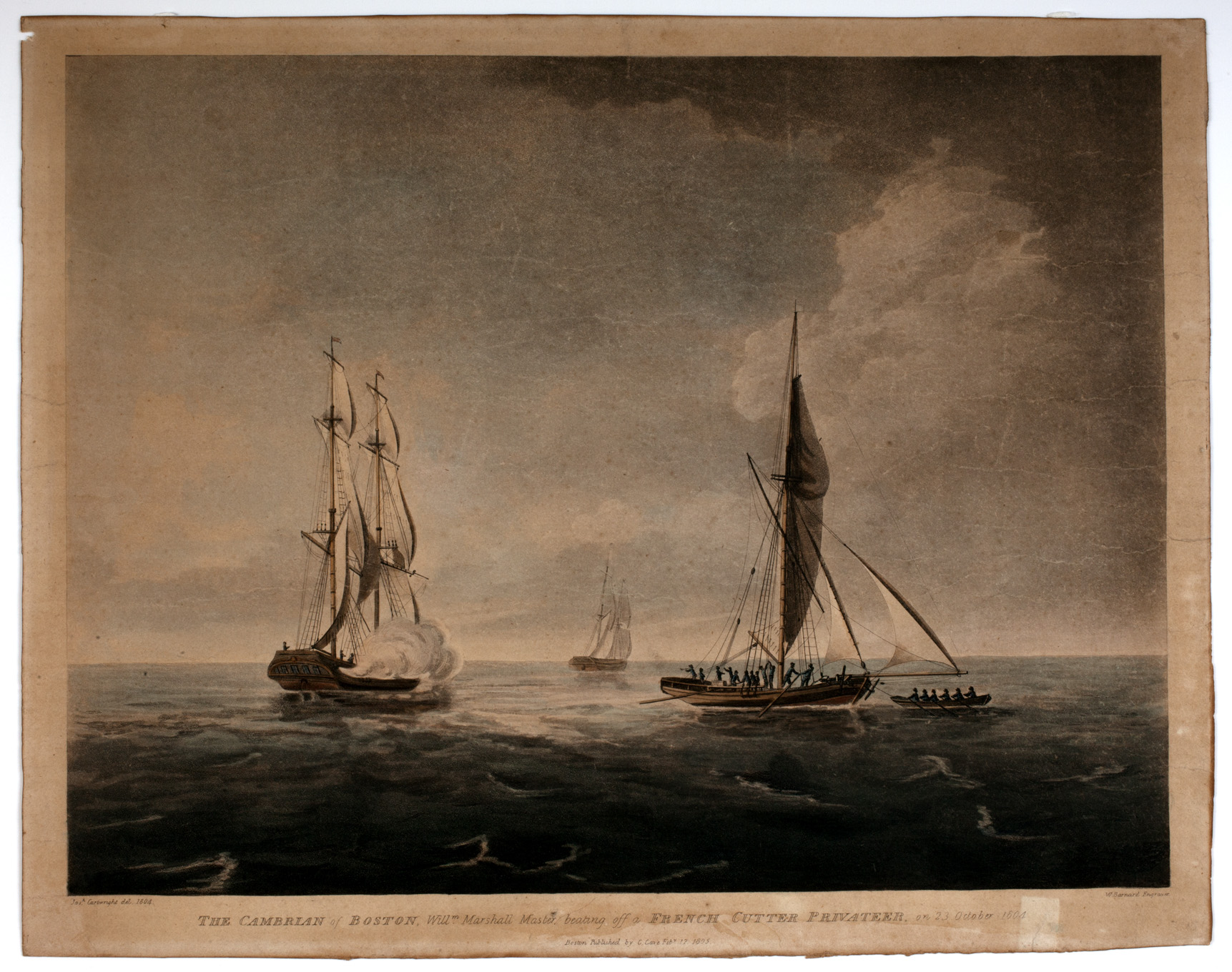
W. Barnard after Joshua Cartwright, The Cambrian of Boston, Willm. Marshall Master. Beating off a French Butter Privateer, on 23 October 1804. Boston, C. Cave, 1805.
In the fall of 1804, the British ship Cambrian was part of a blockade of New York Harbor. This print depicts the ship engaging a French cutter (several French ships were blocked in the harbor at the time) just outside of New York Harbor. The dispute was part of the Napoleonic Wars being fought in Europe and would help to raise American ire prior to the War of 1812, where the young United States of America would have to assert itself on the open seas to fight back against privateering and impressments. The Society’s holdings of pre-1820 engravings are exceptionally strong.
It’s funny (and a bit embarrassing for an organization that’s all about historical accuracy) when facts get obscured by the mists of time (and foggy memory) and then re-emerge with such clarity that one is left with only “Duh!” to say.
For some time now – through all the planning and the fundraising – we have been referring to our need to replace the original copper on the Society’s dome. Several times, in fact, I made reference to that copper as now being more than 100 years old, the current Antiquarian Hall having been built in 1910. But when the roofers began the replacement work this spring (they did great work – now completed), they started discovering things that surprised both them and me!
First, as they began to carefully remove the old copper they found that the flat roof areas that surround the dome were made of solid marble – huge blocks of it – although we had assumed that the marble was only a trim. They even discovered that the “wedding cake layers” leading up to the dome were also solid marble. Okay, I said to myself, so they built things solidly back in 1910. But when the roofers began to peel away the copper on the dome itself, we got even more puzzled. They found that the entire surface of the dome was constructed of flat sheets of a whitish stone (marble?), each cut into the shape of an isosceles trapezoid (yay for what we learned back in geometry!), and mortared, side by side, one to another. That seemed just totally weird. Why would they have gone to such trouble and expense to construct the dome entirely of stone, only to then cover it up with copper? But still I kept insisting to the roofer that the copper dated from the original 1910 construction. I was certain.
Certainly wrong, that is. Searching for answers, I went back to a set of my notes from the late 1990s (notes that were in a binder that was stashed not six inches from my computer monitor) in which I had traced the entire history of our buildings, back to our founding in 1812. Sure enough, there I found reference, in my own hand, to the fact that the copper cladding was added to the dome in 1920 to correct a decade of water seepage in the original stone roof. I even had taken note of the report of the October meeting for that year, which stated: “Under the authority granted by the Society at the April meeting the dome of the building has been covered with copper and the interior of the dome has been repainted at a cost of $4,389.30….” Boy, how times (and prices) have changed!
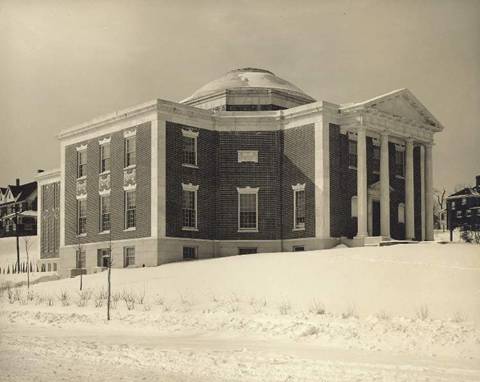
And so, with the benefit of hindsight, I started looking at the rest of evidence I had gathered over the years, right on my own computer. Judging from the size of the shrubbery, this photograph must have been taken during one of the first winters at 185 Salisbury (notice how smooth and white the surface of the stone dome appears):
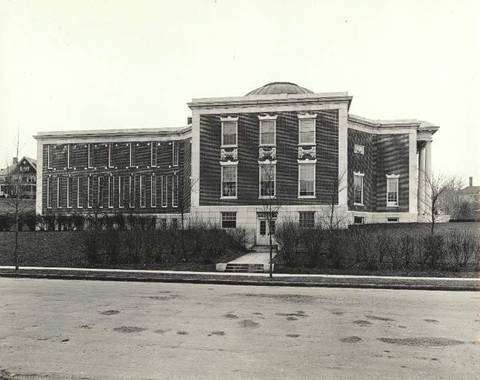
… and compare it to this next photo…. Not only has the shrubbery grown taller, but — lo and behold — the dome is no longer smooth but now has raised ribs (just like the copper roof we recently replaced).
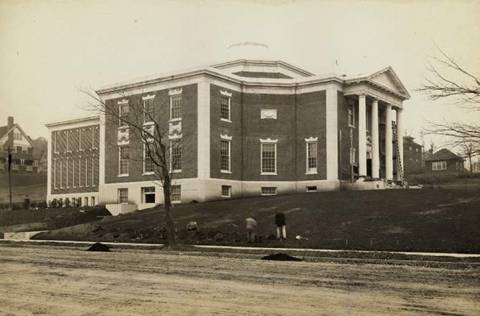
But it was these next two pictures that were “the smoking gun” for me. In the first one, the dome is clearly white and smooth…
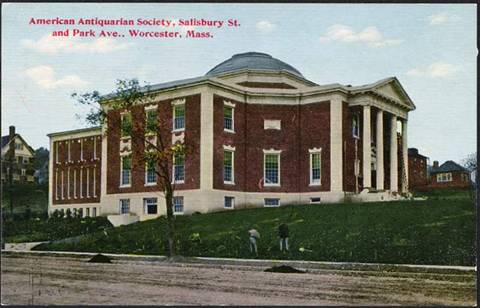
… and here is a post-1920 postcard that is – without any question – derived from that very same photograph (right down to the piles of dirt in the gutter). But look what the colorist has done: given the dome a greenish patina! Duh!! Copper had arrived (although apparently the guys planting the shrubs never left).
So the fact is that the old copper on the dome was only 92 years old. May the new serve us as well as the old did.
Check out this preview for the second segment featuring the American Antiquarian Society on C-SPAN3’s American Artifacts program. This segment is led by James David Moran, our Director of Outreach, and Philip Lampi, chief researcher on the “A New Nation Votes” project. It will showcase some of AAS’s political collections, including ballots, political cartoons and campaign newspapers. The preview below features a political print from the mid-term elections of 1862 called “Jeff. Sees the Elephant.”
The full segment will be aired this Sunday at 8 a.m., 7 p.m. and 10 p.m., Eastern Time.
You can also now view the entire first segment on C-Span’s website.
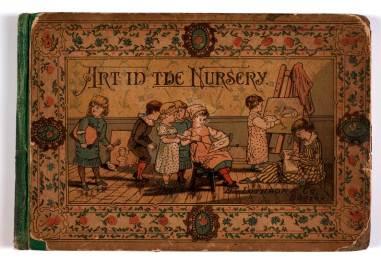
Art in the Nursery. Pictures for Baby to Draw. And Pictures for Baby to Laugh At. Boston: D. Lothrop & Co., ca. 1879.
This small oblong (5 ¼ x 7 ½ inch) book imitates in miniature the format of drawing books for older children and youth. The chromolithographed cover depicts boys and girls together creating artwork in their own nursery studio, reflecting the late nineteenth-century attitude toward childhood as a time devoted to wholesome play and learning through artistic creativity.
Purchased from Judith Richards. Linda & Julian Lapides Fund.
The American Artifacts program on C-Span 3 will air a 30-minute television program on the American Antiquarian Society this weekend. The program is a virtual tour of Antiquarian Hall showcasing some of the Society’s treasures with our president, Ellen Dunlap. A short segment featuring the Eliot Indian Bible can be seen here.
The full program will air this Sunday at 8:00 a.m., 7:00 p.m. and 10:00 p.m. It will also air again on Monday at 11:30 a.m. and 7:30 p.m. and Tuesday at 3:30 a.m. All times are Eastern Time.
Additional programs featuring AAS will appear in the coming months. Stay tuned!
This is the type of post which started out as an “In Memoriam.” Something lighthearted which included lines about the deceased card catalog’s birth in the 1970s, it being a ‘descendent of generations of particleboard furniture’ and that it ‘leaves behind grieving relations such as the filing cabinet, map drawer, etc.’ But the more I thought about the current standing of the card catalog, the clearer it became that it was not “In Memory” but “In Honor.” The card catalog is not dead – it is archived. A large portion of it is still among the living. So the tone started to change. But then things took another turn.
The American Antiquarian Society’s Facebook page posted a pretty provocative photograph this weekend. I felt the same way many viewers did when they first saw it. My jaw dropped. My heart hurt. And while it doesn’t tell the whole story, the response was strong. And anxious. Perhaps because it depicts the Antiquarian Society in the active process of disposing – incompatible bedfellows to say the least.
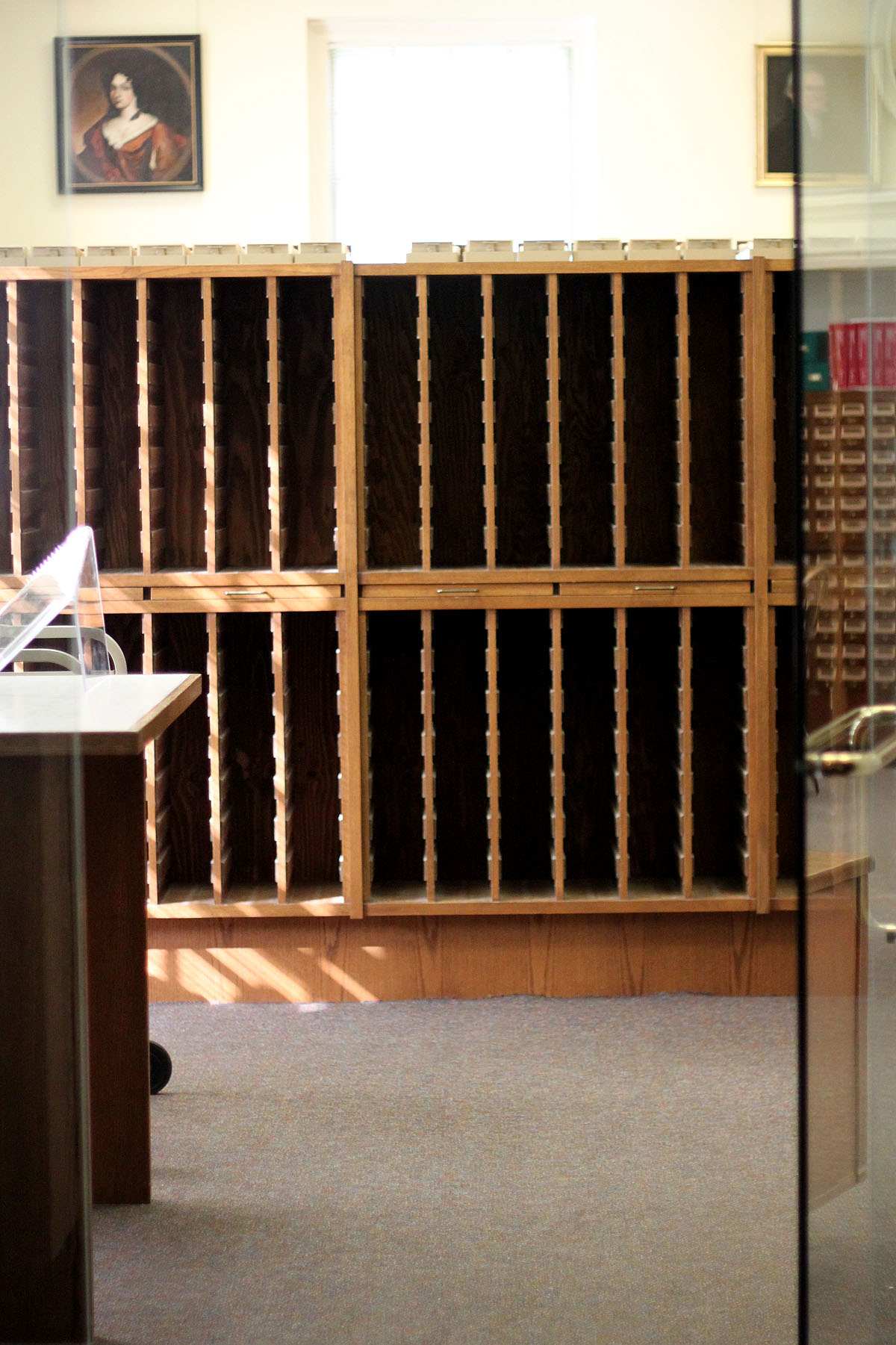
Emptied card catalog frame
I’ll be the first to state that card catalogs, at first, seem a crashing bore. Until you post a picture of it in a pile. In it, parts of the former card catalog from the AAS reading room were seen out of their context in the Great Outdoors. At first glance, it’s intense – but if you look closely you will see what’s missing: most of the card drawers and all of the cards.
Perhaps a bit of backstory. This September was the targeted date for the removal of most of the card catalogs from the AAS Reading Room. After all, cards have not been filed in the general catalog since 1995; but we had to keep most of its contents, as some cards date to the 1880s. The decision was one which has been on-the-table/off-the-table for over a decade – with bicentennial activities coming up for this October, the time seemed right to make A Move.
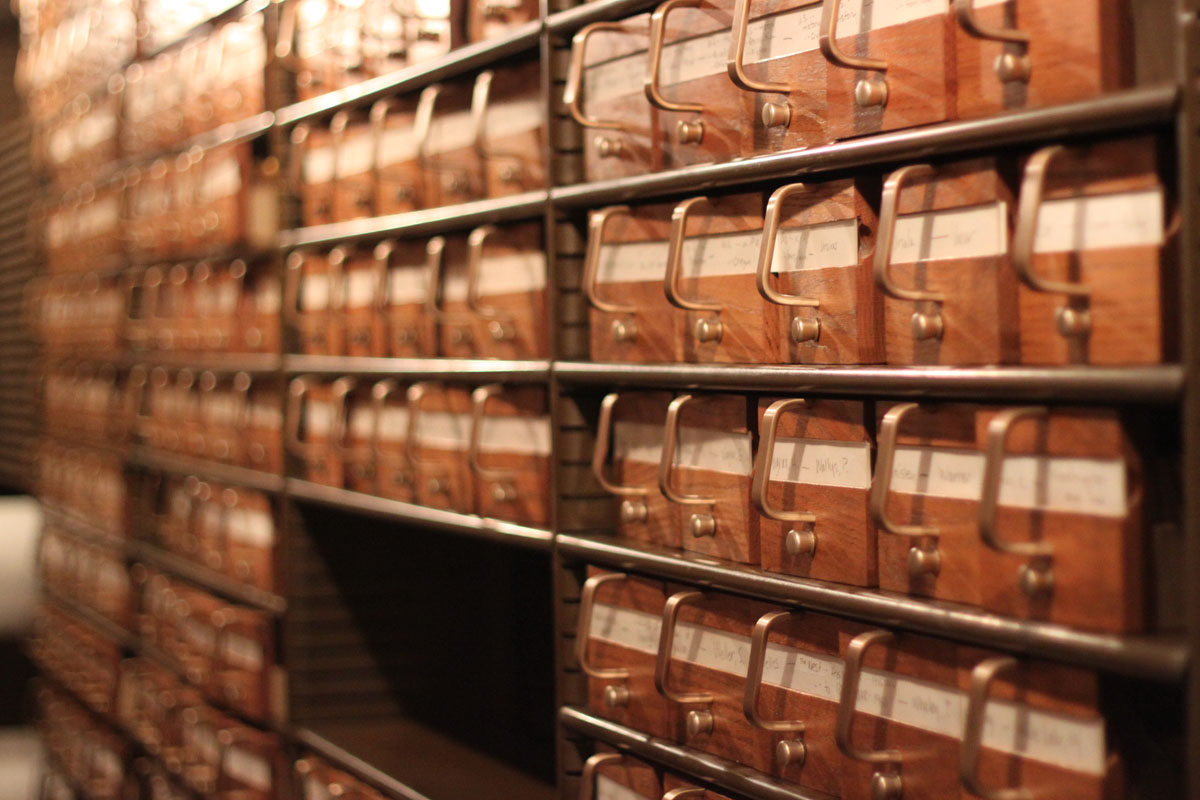
The catalogs still actively used (maps, sheet music, printers’ file and checklist drawers) are still in the reading room. The lion’s share was retained and moved on carts by staffers to the ground level – accessible yes, but in the stacks which are closed to readers. Contained here are the Imprints and first editions, the old general catalog and the newspaper catalog, and representative samples from the other catalogs. The remaining catalogs (and their furniture) were offered up as souvenirs and then recycled. In an email to the staff, the Marcus A.
Card catalog in new basement location
McCorison Librarian and Curator of Manuscripts Tom Knoles noted that the catalog has been:
a daily presence for as long as we’ve worked here… the card catalogs tell the history of AAS collections and cataloging over a period of more than a century. It will be a venerable and worthy part of the AAS archives.
In a fascinating article published last September, “Serving Higher Education’s Highest Goals: Assessment of the Academic Library as Place” authors Heather Lea Jackson and Trudi Bellardo Hahn consider the library space as one which has components (stacks, card catalogs, furniture, arrangement, etc.) which stimulate a desire for researchers to feel connected to a higher, abstract if you will, mission.[1] Beginning with Mircea Eliade’s classic The Sacred and the Profane, the authors consider how we experience “space, time, nature and life in religious and nonreligious ways.” (428). They further highlight that the library-as-space has been held in frequent conversation seeing that “the field faces a potential crisis related to technological progress and mass digitization” (430). This is, by no means, new. Former AAS Fellow Thomas Augst noted this connection in his essay “Faith in Reading: Public Libraries, Liberalism, and the Civil Religion”[2] but the resurfacing of this argument and the disposal of items continuously held in reverence is one underscored by our response to its absence and removal. The card catalog was a necessary component of nonreligious space which kindled an emotional response.
Part of what seems to have happened (and continues to happen) is a mourning for the card catalog – items which served as the nucleus for access to the materials. They have moved from a public space to an archival space. And that sudden change is visible. Most ‘archive’ items are enveloped in a weaning period – where items ended up sitting on dusty shelves, attics, basements, etc. prior to becoming fodder for the archive. In short, the card catalog was another way of serendipitously shelf-browsing in a place with closed stacks. And now that opportunity and form of access is gone. And so we remember it for what it was – in a place and in a time. Arrested. Which is not unlike all other items already archived which have become preserved, reformatted, recollected, assembled and integrated. So we’ve come full circle. Perhaps this piece is, as originally intended, an “In Memorium” for a staple of the Reading Room space which has made the Great Move On.
[1]College & Research Libraries. September 2011, Vol. 72 Issue 5, pages 428-442.
[2] In Institutions of Reading: The Social Life of Libraries in the United States, eds. Thomas Augst and Kenneth Carpenter (Amherst: University of Massachusetts Press, 2007).
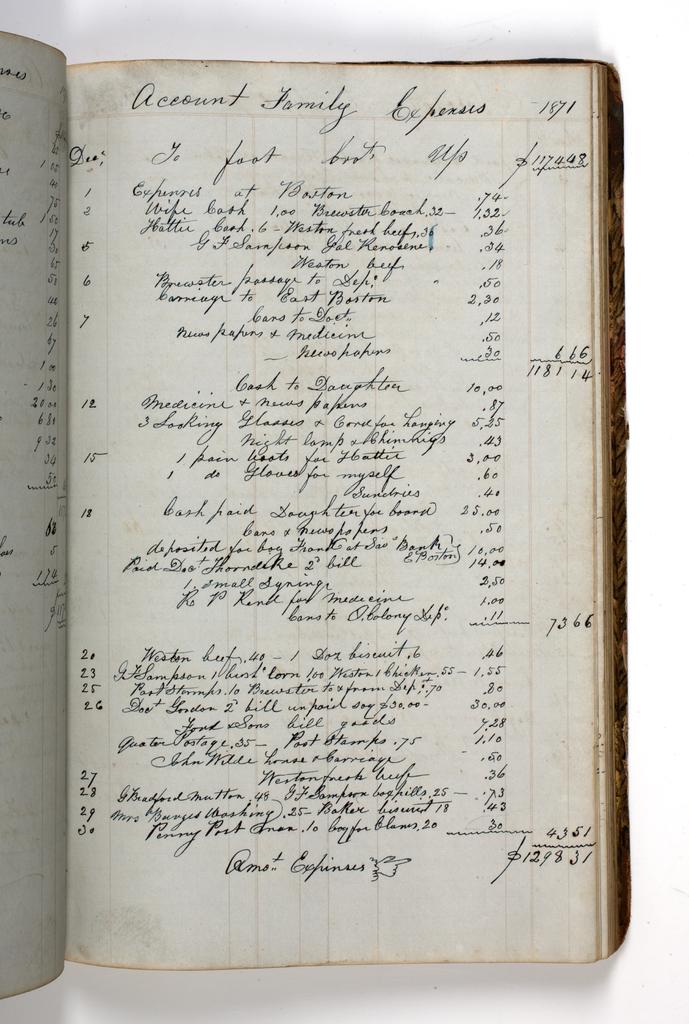
George Winsor, Jr. (1790-1880) lived in Duxbury, Massachusetts, and married Hannah Delano in 1817. Winsor was a captain of merchant vessels, including the Delano and the brig United States. This ledger begins in 1845 with the accounts of Enoch Train & Co. and Augustus Hemenway. These pages show entries such as money collected from passengers and money received or paid in New Orleans, Liverpool and Boston. The ledger then jumps to 1867 and follows family expenses through 1873. The ledger is filled with interesting expenses such as tickets for carriages and trips to Boston, medicine, lobster, “washer woman,” “Penny Post Man,” the Boston Herald newspaper, a school book for Hattie, tickets to a banquet in Weston, travel for daughter Frances, Geo. Peabody photograph, a parish tax paid to Josiah Moore, payment to J.S. Lorings for a deed, and a contribution to a soldiers’ monument in September of 1869.
Mortimer, Favell Lee. Iu Pitabun. Boston: American Board of Commissioners for Foreign Missions, 1844.
This is an extremely rare Chippewa language translation of Favell Lee Mortimer’s adaptation of Bible stories. It was formerly owned by renowned Americana collector George Brinley (1817-1875), whose collection was sold off in a series of auctions after his death. This copy will be joining nearly 300 Brinley titles that AAS acquired at the auctions with money provided by Brinley’s will. From Swann Auction House via Joseph Felcone.
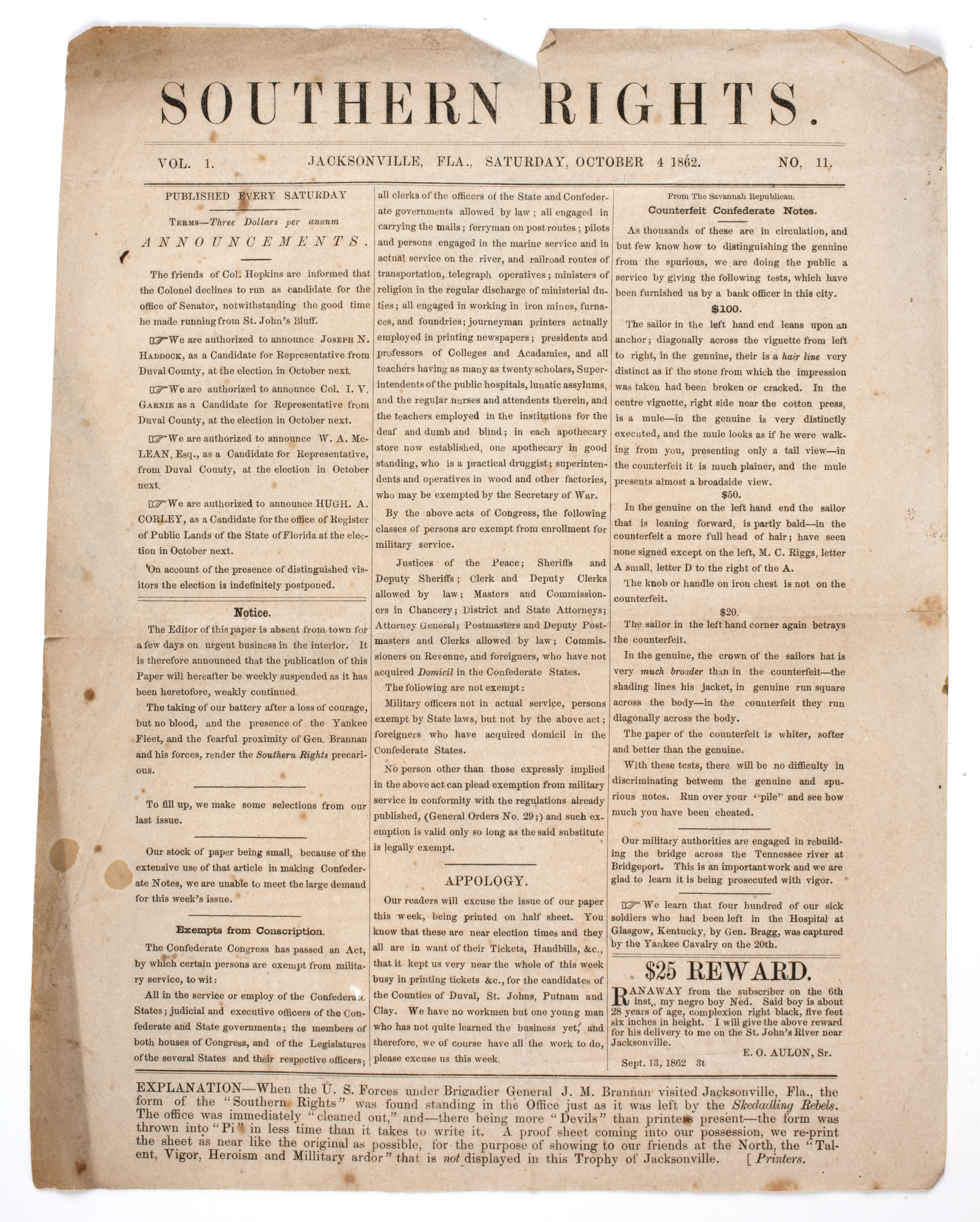
When Brigadier General J.M. Brannan took over Jacksonville, FL, his troops found standing type in the newspaper office and pied it. Later some of them took a proof sheet of the Oct. 4, 1862 copy and added an extra paragraph at the end and printed up some copies “for the purpose of showing to our friends at the North, the ‘Talent, Vigor, Heroism and Military Ardor’ that is not displayed in this Trophy of Jacksonville.” AAS has an original copy of this issue and is apparently the only institution with both original and Union-occupied reprinted issues.
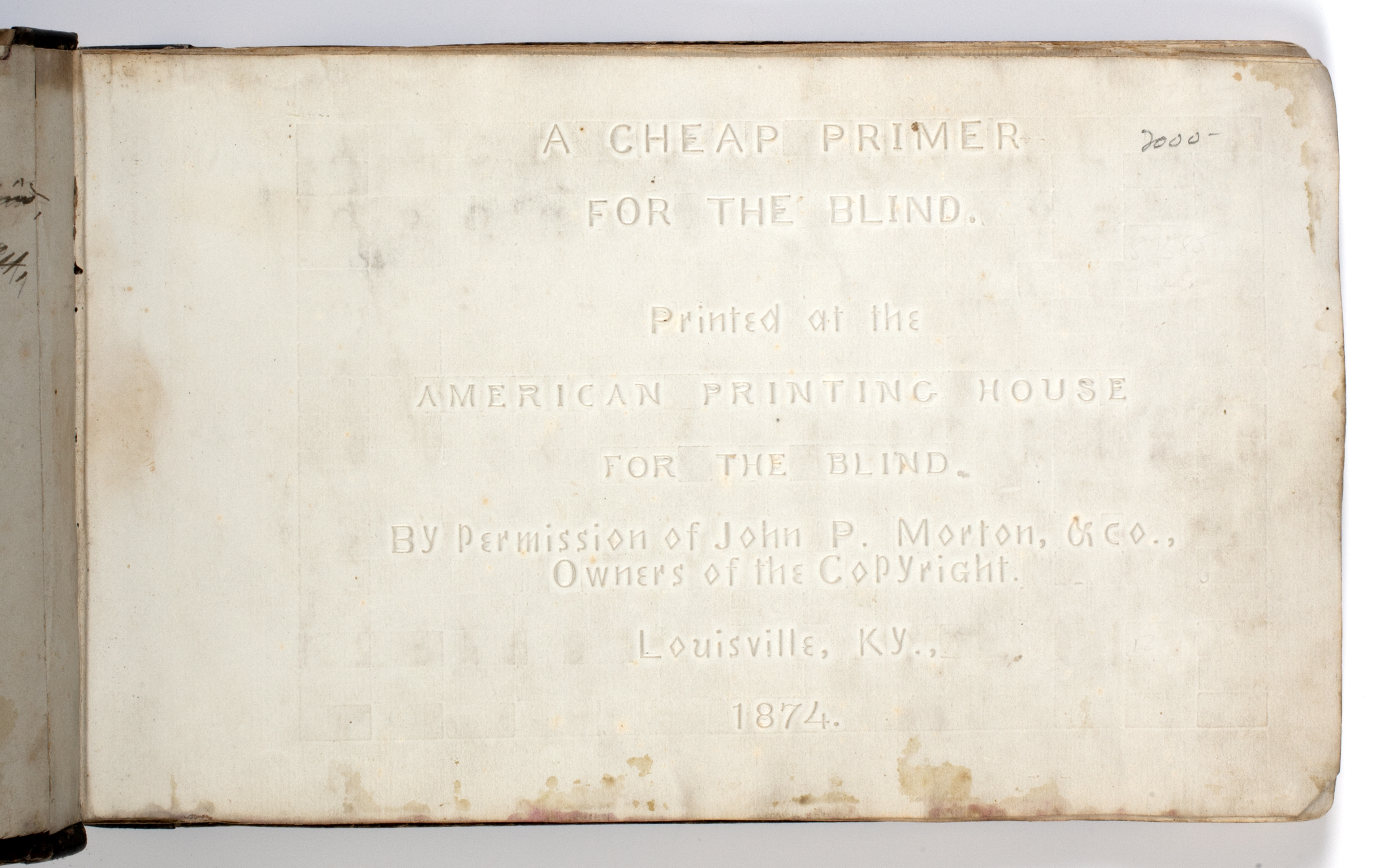
A Cheap Primer for the Blind. Louisville, Ky.: American Printing House for the Blind, 1874.
This primer is printed in large oblong format with raised-letter type known as Boston line. AAS has some thirty titles printed in Boston line; about half of which were actually published for the blind, as opposed to providing samples of the raised text for the seeing public, making this primer quite a find.
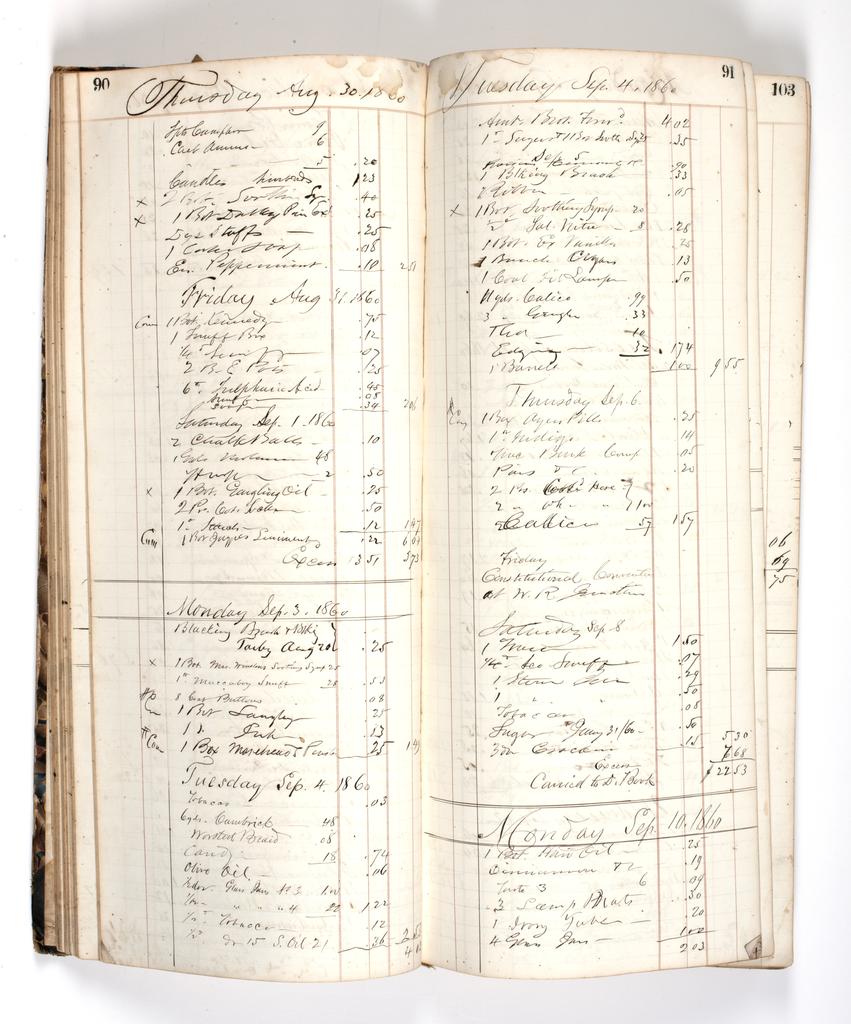
Apothecary and General Merchandise Ledger, 1859-1863
This ledger belonged to an unknown apothecary and general store owner in Vermont. The volume is arranged chronologically and lists daily notes and transactions for the business. A very active business is illustrated in this volume, with many transactions happening each day. Entries include items sold and prices, including many medications such as morphine, patent medicines, oils and ointment such as Russian salve. In addition to medications, as a general merchandiser the owner sold items such as soap, flour, snuff, tobacco, Shaker brooms, silk and cottons.
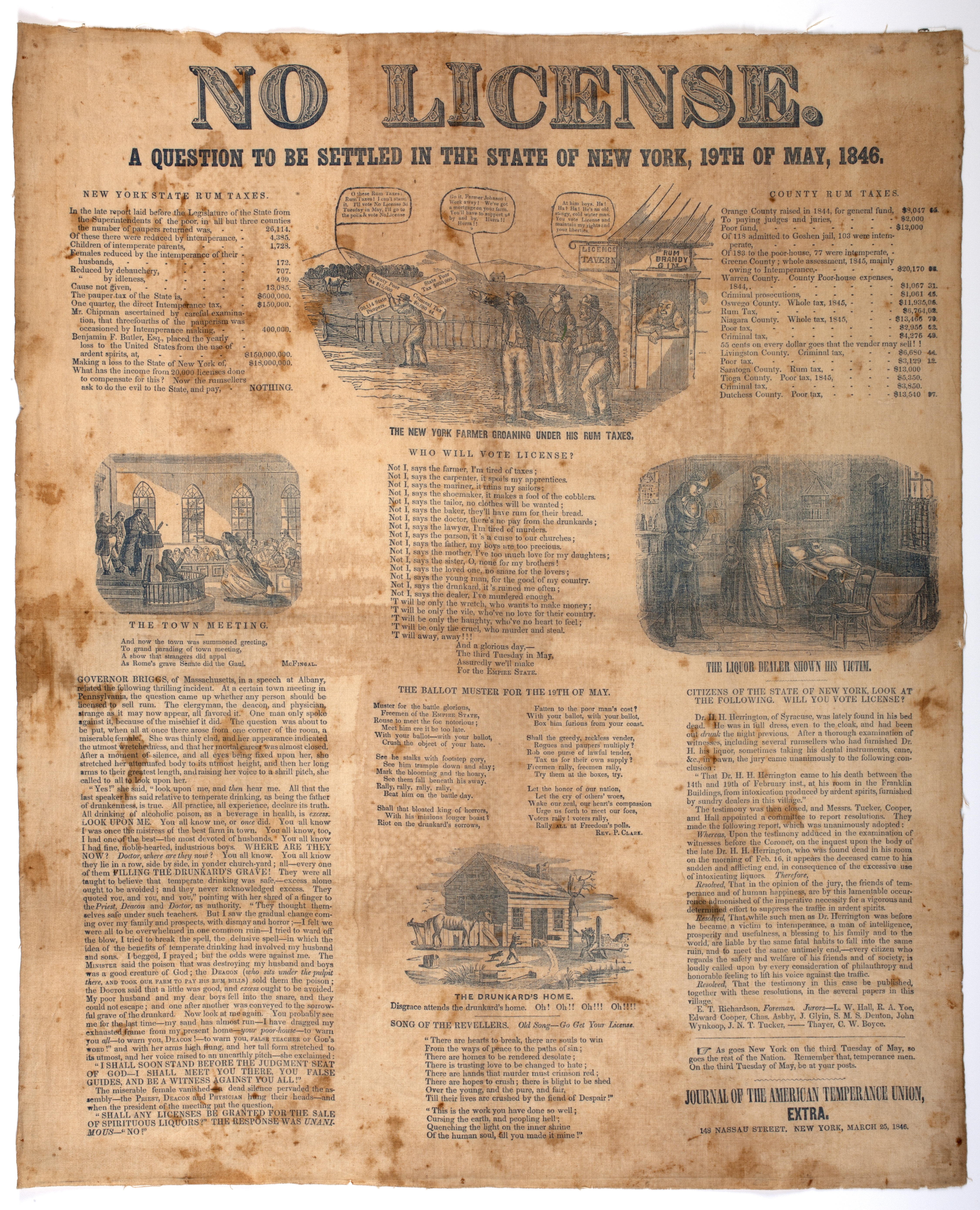
No license. A question to be settled in the State of New York. New York: Journal of the American Temperance Union, 1846. On linen.
This textile broadside was issued as an extra to the Journal of the American Temperance Union during the 1846 elections in New York State. That year, every one of the 800+ towns in the state (excepting New York City) was required to vote on whether they would require local merchants to have licenses to sell hard liquor. If the “No License” laws passed in a town, then local officials would not be permitted to issue permissions for the sale of alcohol. This broadside falls solidly on the “No License” side of the question and reprints several poems, lists of statistics, and stories all with a strong pro-temperance message.
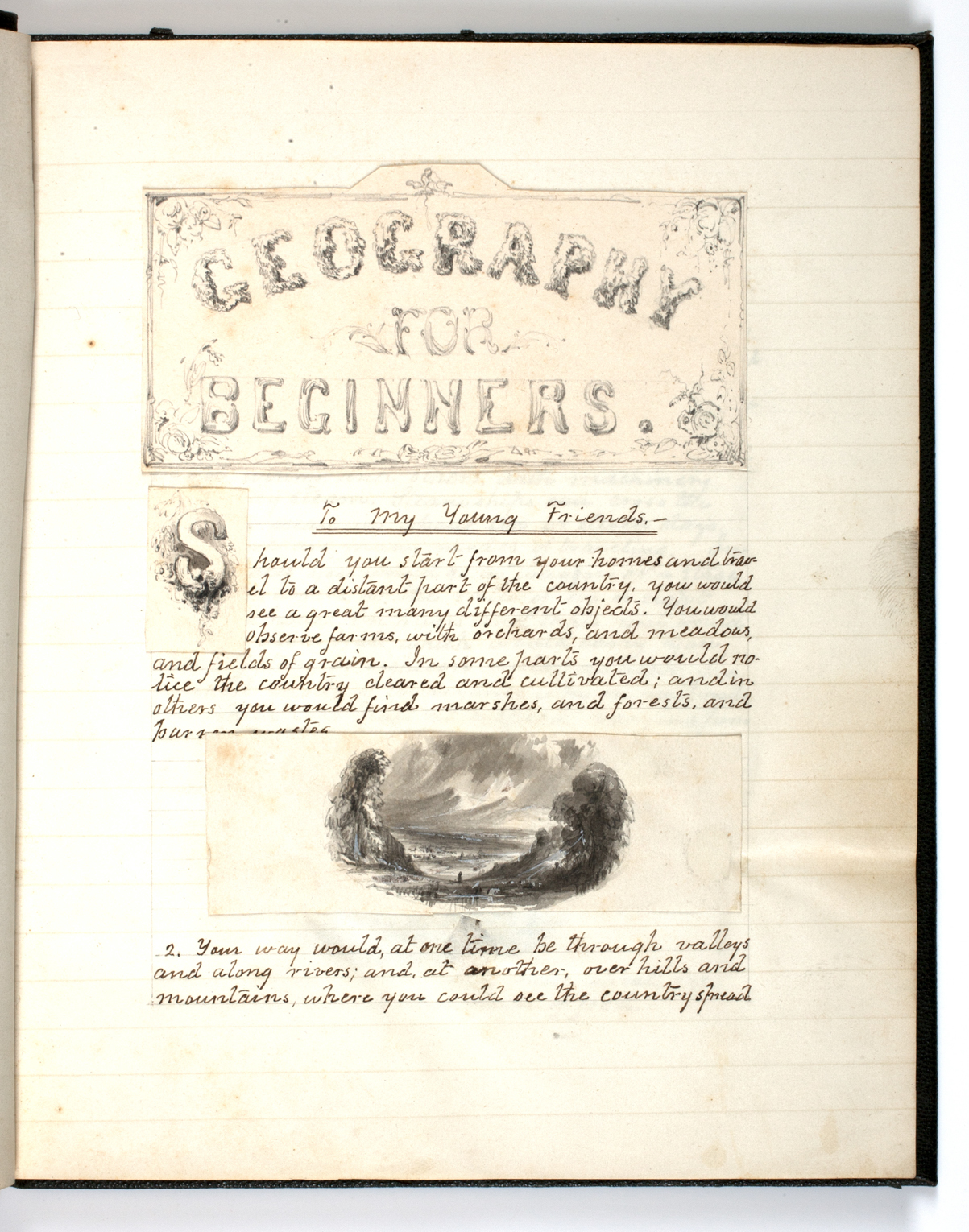 This handwritten textbook of geography is something of a mystery. Heavily illustrated with original drawings and images clipped from publications, the text is divided into lessons with topics such as “About Travelling,” “About the Surface of the Earth,” “About Animals,” and “About Trees and Plants.” The title, Fitch’s Geography… suggests that the text may have been written by George W. Fitch, author of several geography texts in the 1840s and 1850s. Is this a mockup made by Fitch? Or a work created by a teacher or student? It can be roughly dated by a map showing California (admitted 1850) as a state but Minnesota (admitted 1858) as a territory.