The First Publication for the AAS Bicentennial

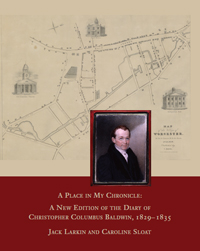
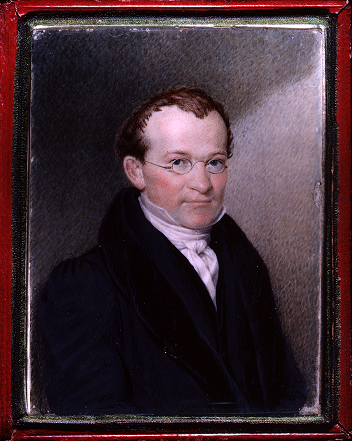
The first of the books about the history of the American Antiquarian Society to mark the 2012 bicentennial has arrived. It is A Place in My Chronicle: A New Edition of the Diary of Christopher Columbus Baldwin, 1829-1835, co-authored by Jack Larkin and Caroline Sloat. baldwinbook BaldwinWe always call it “diary” in the singular, but Baldwin (aka CCB) actually kept his diary in several volumes. The Society’s manuscript holdings list diaries for the period 1829 to 1835 (except from September 1832 to September 1833). The earliest were brief entries kept in almanacs to which he added extra pages; later, by his own admission, his diary keeping became a more self-conscious chronicle of the people he met in the course of his work as a lawyer and after 1832, as librarian of the American Antiquarian Society. Wherever he went, he remarked on his wide circle of friends and acquaintances and interesting features of the urban and rural landscapes he observed.

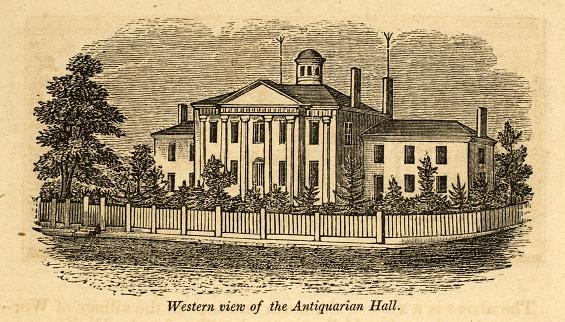
Jack and I had a lot of fun with the diary transcription, identifying the people that CCB recorded and finding illustrations (more than 160 of them) p.243AAS to bring his world to life. It was a world of work and of social occasions, one in which a Unitarian struggling with his faith could escape to the theater, and in which travelers journeyed by stagecoach, canal, and railroad—if they didn’t walk. Despite a lingering condition that left him lame for periods of time, Baldwin was an inveterate walker. And for CCB, it was a world of books. As AAS’s librarian, he was on the prowl for additions to the collections. Many of the books that he coveted and wheedled out of their owners and authors are illustrated in the volume.

Baldwin was trained as a lawyer by two future governors of Massachusetts—Levi Lincoln and John Davis—but despite having studied in such a prestigious Worcester law office, he was not able to establish a profitable practice in Worcester, or Barre, or Sutton. His sojourn in Barre was to pursue the lovely Mary James, but despite some romantic moments together, she was swept off her feet by her minister’s son, leaving Baldwin to make a quick sale of his practice and move on.

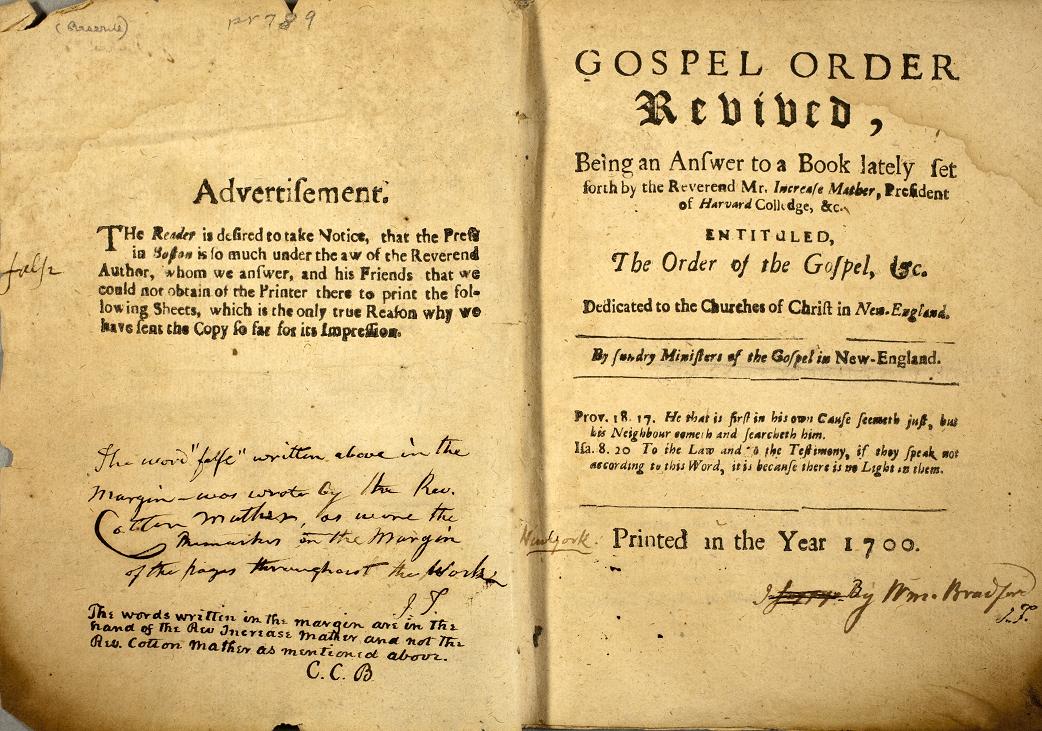
Baldwin took up his appointment as AAS librarian on April 1, 1832, and thereafter followed his passions for books, history, and collecting. p. 141GospelOrderHe admired scholars such as the young Jared Sparks who was embarking on an edition of George Washington’s papers. He happily labored in 90 degree temperatures in a smelly Boston oil warehouse to pack pamphlets and a missing volume of Cotton Mather’s diary that would fill a wagon, only to be deflated when he returned to Worcester by the dismissive reaction of the Council to his treasure. (They later changed their minds.) In a library filled with riches, CCB’s own writings are themselves a treasure. Jack Larkin and I are excited to add this edition to the Baldwin chronicle.

Purchase information is available on AAS’s website.

“Who did it? The Maine Question,” Part 2

Jennifer Burek Pierce, Assistant Professor at the University of Iowa’s School of Library and Information Science and recent AAS fellow, discusses the game “Who did it? The Maine Question” (described in an earlier Past is Present post) in the context of children’s games generally.

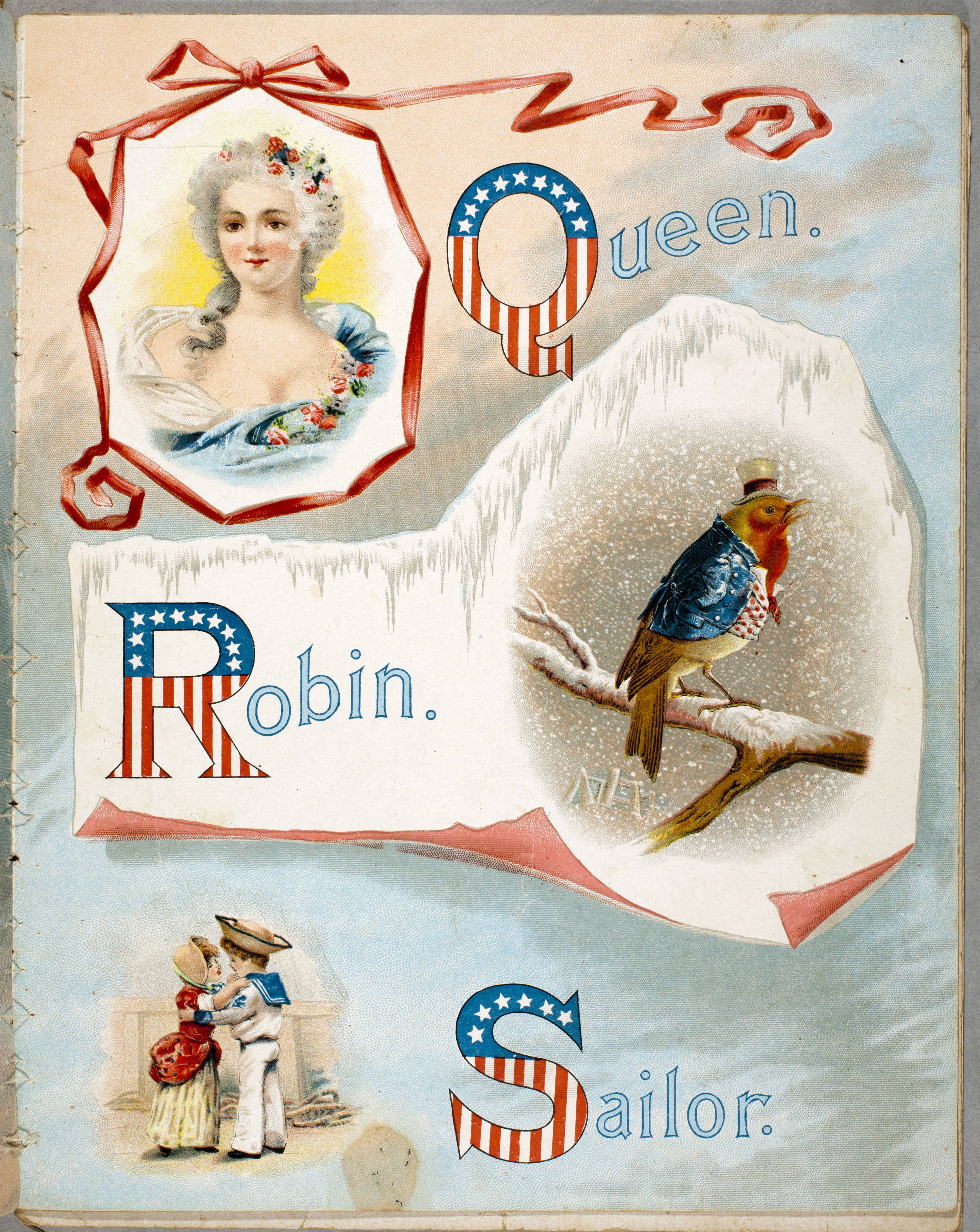
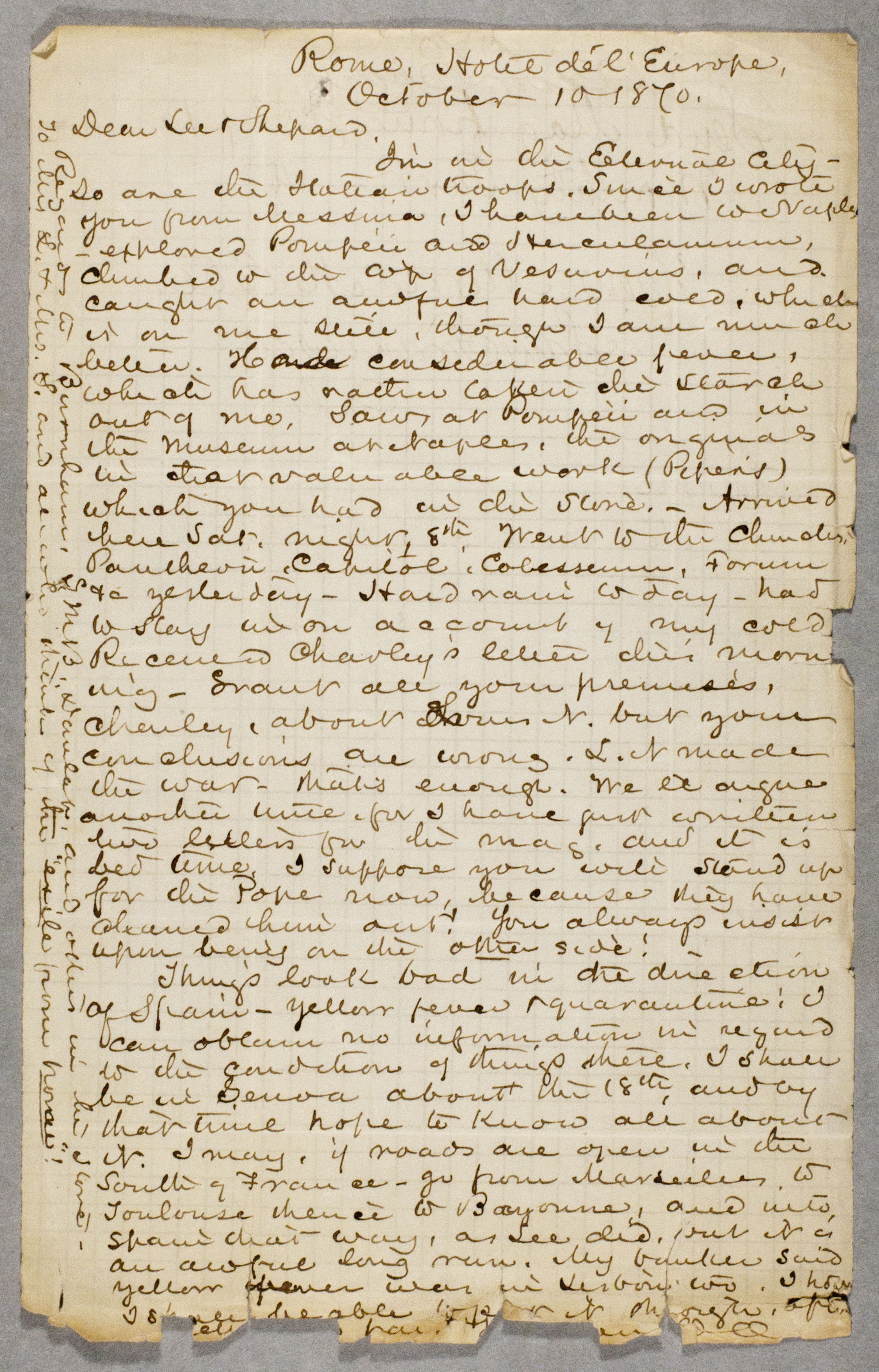
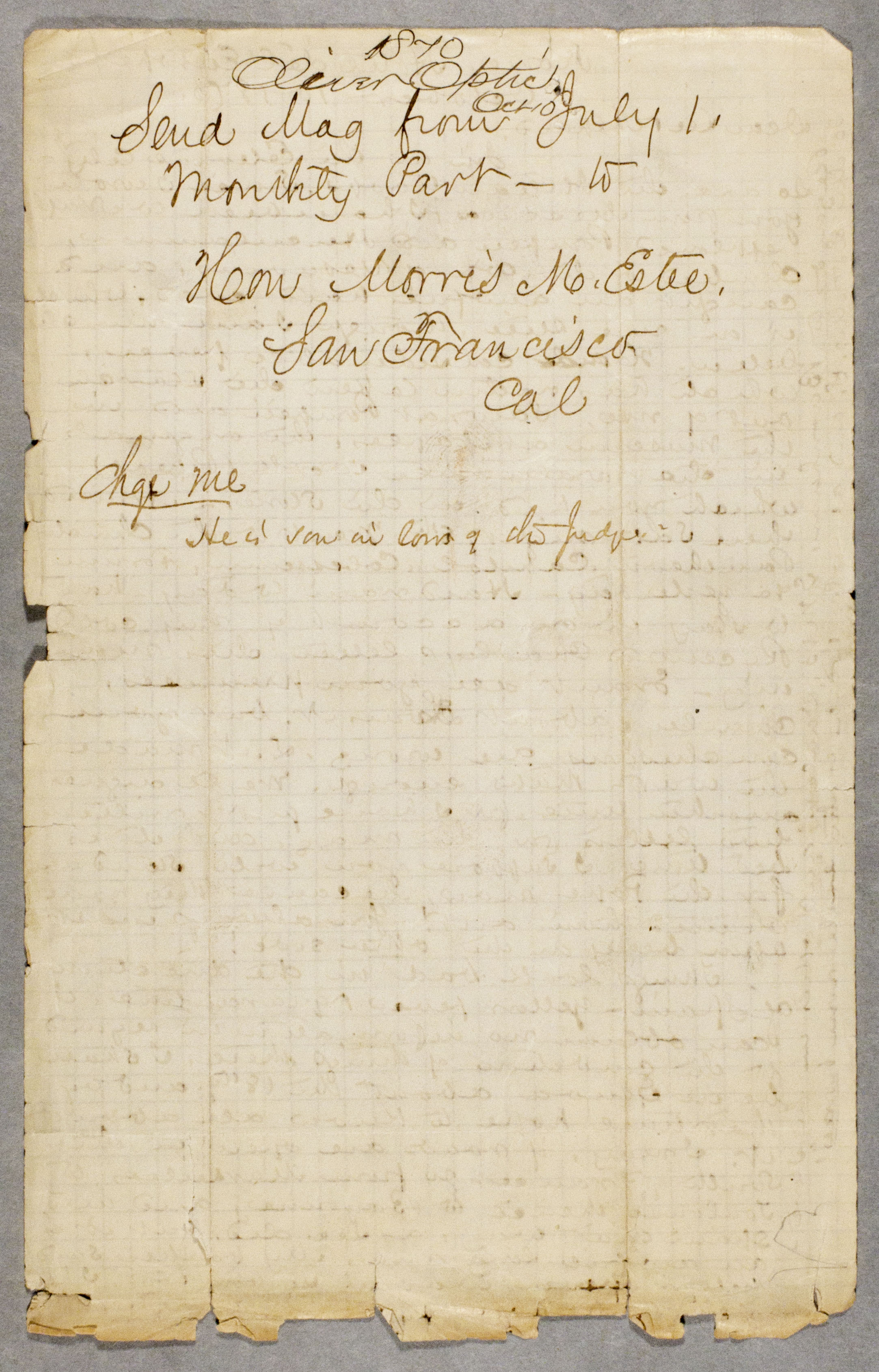
RobinIn the array of AAS materials about young people’s play and reading, I’ve found a large number that depict militaristic and patriotic themes. Some displays are charming, sentimental evocations of activities children must have witnessed as the adults around them became enmeshed in the Spanish-American war and other military themes. The bright and colorful chromolithography used by the McLoughlin Brothers company filled alphabet books and puzzles with proud, patriotic children. Other companies advertised paper doll soldiers and remembered the Civil War with games like “A Visit to Camp”. In terms of books, magazines, and short stories, Oliver Optics’ works portrayed historic moments from the Civil War in The Soldier Boy; or, Tom Somers in the Army (the text of which is available online) to the outbreak of the Franco-Prussian war, when author W.T. Adams was caught abroad as fighting began. Click on the manuscript letter below to read what Adams wrote to his publishers.

Image 3--1Image 3--2

Although it is popular to lament the passing of an era when children’s entertainments were far more innocent than they are today, the toys and games of this period were not free of risque and adult elements, despite what stereotypes of Victorian propriety and Progressive Era purity movements might suggest. From author's private collection
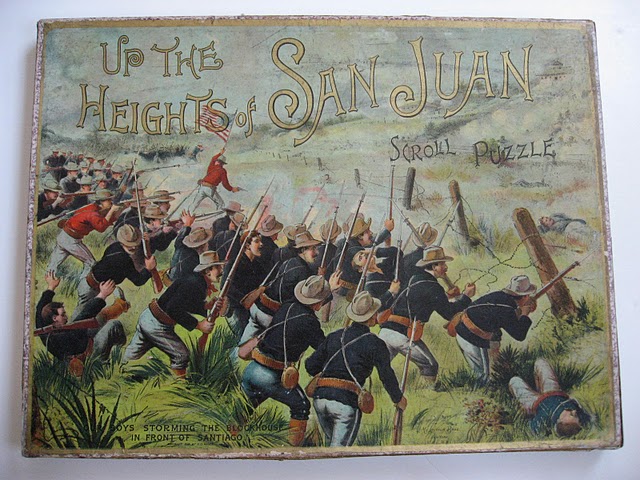
VivandiereThe McLoughlin Brothers’ puzzle, “Up the Heights of San Juan,” portrayed not only the Rough Riders’ charge but young men injured and dying in the grass. “A Visit to Camp” features both literal and metaphorical intoxication, as the characters visit the curvaceous Vivandier and experience her liquors and her charms. The didactic functions of games and literature –- intended to make learning enjoyable, through message-driven play — encapsulated multiple grown-up preoccupations of the day.

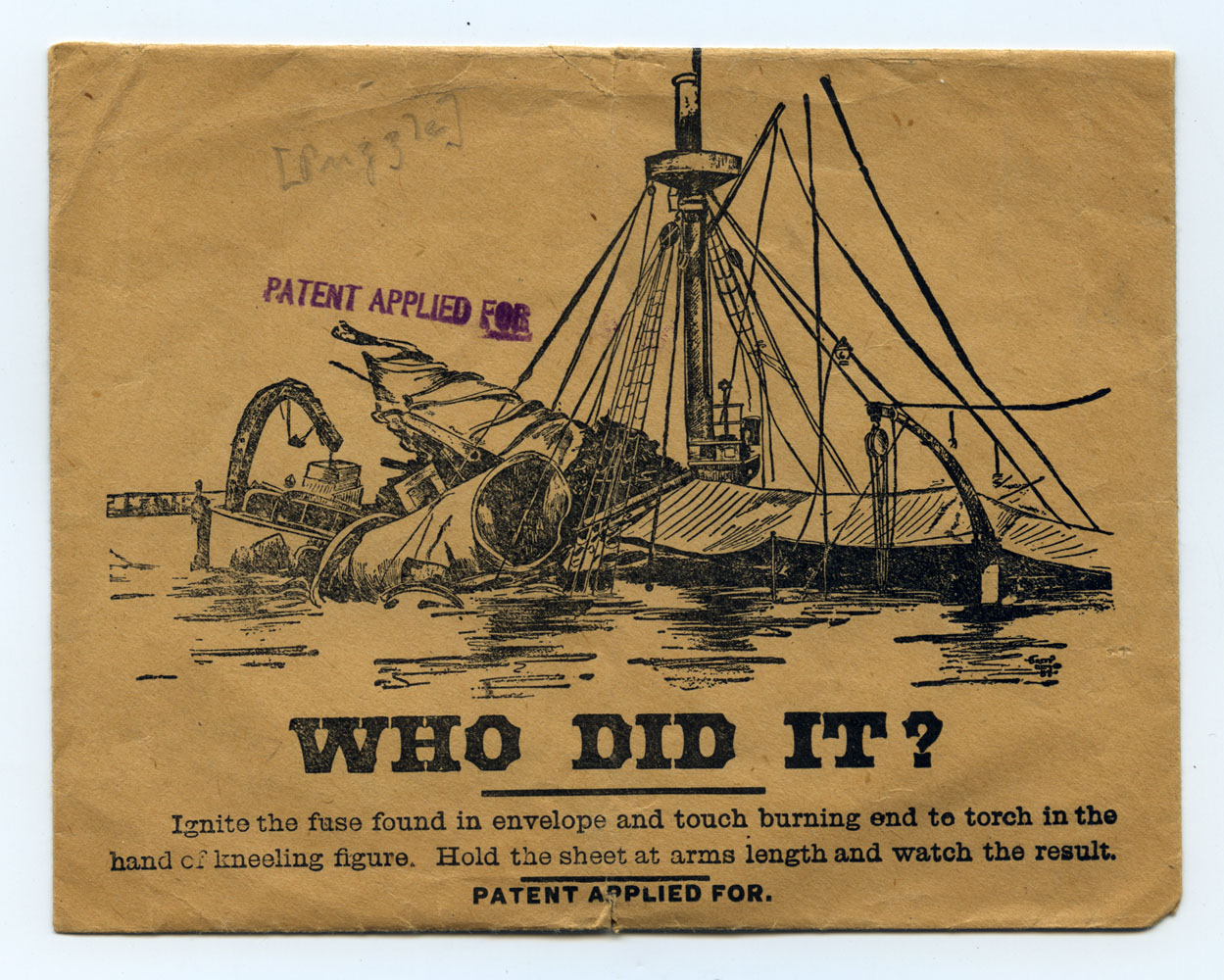
whodidit

In this context, though, “The Maine Question” stood out. With its sheaf of thin papers, fuse cord, and illustration of what might have been seen as a sinister Spaniard, who appeared to be caught in the act of destroying the U.S. ship, this game struck a different character than many of the other military-theme games, toys, and stories for young people.

”What Shall be Done with the Contrabands?”

It is an atmosphere both festive yet filled with curiosity. It is an arrangement of tables filled with the written word of America. The words and images spill out across the tables with humor, with poignancy, in rhyme and in the marketing jargon of the day, dressed in color or black and white, yet all share in the simple, yet powerful quality of revelation. None more than the item I selected at the 3rd annual “Adopt A Book” fundraiser for the American Antiquarian Society, now becoming a welcome tradition.
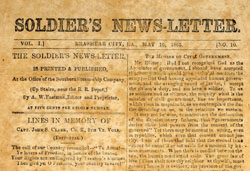
soldiersnewsletter

The item I adopted was a 4 page “Soldier?s Newsletter” published by the 8th Vermont Volunteer Regiment, dated May 16, 1863 from the deep south in Brashear City, Louisiana. The 8th Vermont was different from many regiments for it was raised, armed, and equipped under the direct authority of the United States government through General Benjamin Butler. It wintered at Camp Holbrook in Brattleboro, VT, then with sealed orders left for New York City and preceded by sail to the Gulf of Mexico and landed in New Orleans May 12, 1862. As viewed by Captain S.E. Howard in the writing of the regimental history in 1892, the people of the City of New Orleans were “in a state of ugliness and vindictiveness hardly to be expressed. Men and women seemed to be filled with the spirit of the Evil one.” (See the 8th Vermont Infantry Regimental History, 1892 Revised Roster, by Captain S. E. Howard available online at the website Vermont in the Civil War).

The 8th was active in establishing order in the La Fourche District, across the Bay from New Orleans, and in late October of 1862 began a campaign to open up the Opelousas Railroad all the way to Brashear City. By December of 1862, the 8th along with other units under the command of General Weitzel successfully completed their mission. They must have spent some time in Brashear City, for the issue of the “Soldier?s Newsletter” AAS has is Vo. 1, No. 10 indicating that there were nine previous issues. And this is typical of regimental news papers: troops staying in a specific location for some time, camp life having a mind-numbing impact on their morale, thus some enterprising soldier, perhaps with a printer background or a former teacher, begins publishing the equivalent of a home town newspaper. The newspaper is read and re-read, and often mailed home to the family, which according to Vince Golden, the news print guru of the AAS, is often how we still find well preserved copies of such valuable items.

On the first page of this “Soldier?s Newsletter” is a thoughtful and well written poem in seven stanzas very much in the Victorian tradition. It is entitled “Lines of Memory” and commemorates a highly regarded Captain of Company K named John S. Clark who died, not on the battlefield, but from disease. His loss was deeply mourned. This type of material is what we would have expected from such a newspaper, and while we can appreciate its sincerity and sense of loss of a gentleman leader, we would be fooled if we thought it contained no surprises….for there is far more to these Vermonters than meets the eye. And their “hometown newspaper” tells a far broader and deeper story of America?s Civil War than you could possibly imagine.

On page 3, the 1st column, the writer asks the question, “What shall be done with the Contrabands?”, ?contrabands of war? being term used to describe those formerly enslaved soldierwho made their way to freedom by escaping their masters servitude through the safety of the Union lines. The writer goes on to say that such a question:
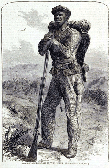
is losing its knottiness, as the nation loses its naughtiness, and as it is more clearly seen what they can do and are doing for us. They are bringing millions of dollars worth of cotton and sugar, which their own labor has produced, from the swamps, and sly corners where the treacherous rebels had hid them, within reach of our steamers, and so off to markets. An shall we act on the ?penny-wise and pound-foolish? plan of neglecting, starving and abusing these persons, rather than treat them as we should other unfortunate fellow citizens in the same circumstances? God forbid. (p.3)

Note the line, “unfortunate fellow citizens”. There is a distinct sense of equality in that phrase and it puts this Vermont Regiment into the same class as the Massachusetts regiments from the Worcester area (the 15th, 25th, 36th, 51st) with profound abolitionist feelings so well described in Dr. Janette Greenwood?s new book, First Fruits of Freedom: The Migration of Former Slaves and their Search for Equality in Worcester, Massachusetts, 1862-1900 (University of North Carolina Press, 2009).

The language employed in this “Soldier?s Newsletter” is instructional for us here of the 21st century for it is strong and as William Lloyd Garrison would say, “unequivocal”, as any language used to describe those formerly enslaved. The writer talks about the government “making soldiers of the able-bodied Contrabands here” and goes on to discuss the process of the formation of a state of “Home Colonization Society” where the formerly enslaved are assisted in the establishment of schools, churches, press and other means of community “with such supplies as may be necessary to the full and fair trial of the Free labor system, on a plan which recognizes the Manhood of the black, and his right to the proceeds of his own labor, in his native land, and also to more than an ?equal right with a rebel? to enjoy under the protection of the American flag the rights of an American citizen.” (p.3)
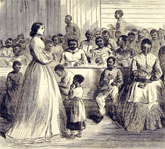
freedmenteachers
For more about recently freed African American’s education, see AAS’s online exhibition curated by Prof. Lucia Knoles called Northern Visions of Race, Region, & Reform in the press and letters of freedmen and freedmen’s teachers in the Civil War era.

The language employed in the “Soldier’s Newsletter” is a powerful instrument in gauging beliefs for it was not just “for the Union” that these men left their Green Mountain Valley?s and ventured forth into the deep south to wade through the mosquito infested waters of Louisiana or to stand shoulder to shoulder with comrades, firing at close range at their enemy. No, there was something else. These printed words provide us with the insight to better understand the motivation of these young men as they stood engaged in the nation?s defining conflict. The words, “the Manhood of the Black”, “…the rights of an American citizen” speak to a recognition and an awareness of these basic rights due these formerly enslaved men and women. There is also a recognition of personal conduct of these Vermont men turned warriors. Also included in the “Soldier’s Newsletter” is a speech by General Daniel Ullman to his officers when his brigade was temporarily being reassigned. Ullman  admonished them to act as “Christian gentleman” and those people who would soon become their  responsibility should be treated as men:

They were our equals in the line of sight of God who made us all -that the black man was quick to read character and would with almost preternatural instinct read whether we were men-gentlemen-or otherwise; adding that not from us, but from the evidence of those under our charge, would we be judged by our treatment of them. (p.4)

The leadership of this 8th Vermont asked their men to answer a higher calling, that the values they stood for would not be trampled by the fates and horrors of war, that somehow, they would persevere as honorable men.

As we turn our thoughts to our veterans following this Memorial Day 2010 and we recall the great sacrifices they and their families have made and continue to make, these words speak through the centuries to us today. For once again, our nation is at war, and once again the challenge to us as a people and as a nation is not that our bravery will be questioned, but rather we will be viewed by how well we treat those we are there to protect and to restore their basic rights. It is a challenge today in Afghanistan and Iraq as it was in 1863 along the bayous of Louisiana. The writer, quite possibly A. W. Eastman, Editor & Proprietor of the “Soldier’s Newsletter”, calls us through the ages as soldiers, as citizens, as a nation. Paraphrasing General Ullman, our Vermont editor writes, “…conjuring us by every high and holy feeling to act circumspectly, he wished us the best success in our labors.” (p.4)

We would do well to follow that advice.
Goodbye Blacksmith, Hello Schoolmarm!

When Diann Benti, former AAS assistant reference librarian, created our now (nearly) complete anonymous blacksmith blog, she was inspired to do so by the Massachusetts Historical Society’s tweeting John Quincy Adams.

Past is Present would never have a tweeting blacksmith, Diann informed us in her blog post when the blacksmith initially forged his way into the digital world. Instead, the blacksmith, and Diann, butted into the online world every day with blog entries, the closest they could get to a diary in digital form.

The identity of the blacksmith was a puzzle for us to solve, yet clues came slowly and erratically as the diary entries were posted at Past is Present and A Day in the Life of A Blacksmith (at http://blacksmithaday.wordpress.com/). One reader expressed uncertainty about the relationship between the blacksmith and his beloved Sara (Was she his wife? His betrothed? His beloved?). Most others ventured no guess about the identity of the blacksmith, his relatives, or his friends. The blacksmith has now been identified as Albert M. Stone, and interested readers can read a full update on his life at A Day in the Life of a Blacksmith. Once there you can learn all about his relationship with Sara, his California dreams, and his family.

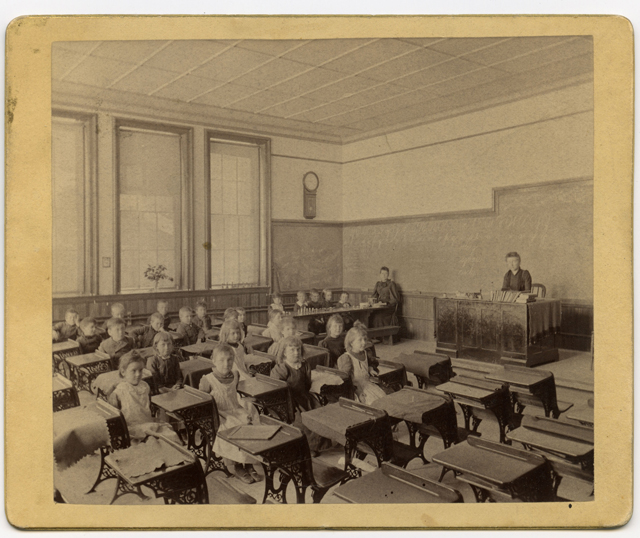
school

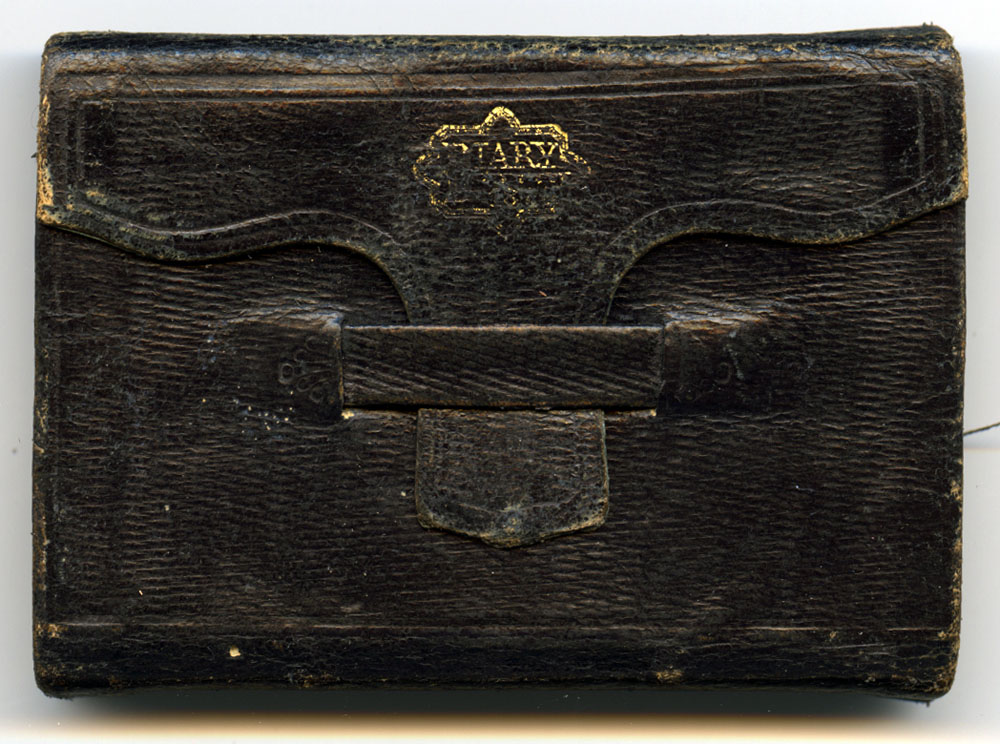
While we bid a fond goodbye to Albert the blacksmith, this summer Past is Present is introducing a new diarist to its family of bloggers. In keeping with our established “A Day in the Life of…” ritual, we’ll be importing entries from our new diarist’s own 1870 diary-blog. Mary L. Bowers was a schoolteacher in western Massachusetts who kept a tiny pocket diary throughout 1870. Every day, Bowers wrote in her 1870 pocket diary, and each day will post on her 2010 blog, allowing us twenty-first-century readers to gain access to her thoughts on teaching, family affairs, household matters, and, unfortunately, deteriorating romantic relationship. We have titled our blog of entries from Bowers’ diary A Day in the Life of a Schoolmarm (at http://schoolmarmbowers.wordpress.com/) You will now find entries from her diary as a header on Past is Present.

Bowers most likely never intended for her diary to be public in the way that our blog will make her private diary open to readers in the blogosphere. She expressed hesitancy about telling her diary, let alone the rest of us, her secrets: “I have a heavy weight of woe but I dare not tell it even to my most confidential friend (my diary) and the world must never know it” (May 30). Bowers’ diary was her only friend, her confidante, in what seems to have been a lonely world.

Diary of school teacher Bowers
1870 Diary of Mary L. Bowers

A blogging Bowers can post entries, but she must be mute when it comes to replying to readers’ comments. We can provide historical context for you, but Bowers is forced into silence on contemporary issues. The Bowers blog attempts to speak for Bowers by offering links to period-appropriate digital sources, clippings from Bowers’ weekly newspaper, and suggestions on broad historical trends. So be sure to check the blog every day for these resources.

Over sixty years after Bowers kept her pocket diary, another female diarist, Anaïs Nin, would tell her diary, “You have kept me alive as a human being. I created you because I needed a friend. And talking to this friend, I have, perhaps, wasted my life.” We have no indication that Bowers’ daily record of 1870 led to sentiments of a wasted life. We also have no indication that Bowers had aspirations of anything beyond teaching, marriage, and a quiet life in western Massachusetts. Her diary, her friend—a written work without readers—is now available for the reading pleasure of the rest of us bloggers and tweeters, who might sometimes find ourselves feeling the same emotions as Bowers about life and writing.

Consumed with Consuming

Even with a month under my belt in my new job at AAS, I’m still happening upon new areas in the stacks.  I’ve traveled through every main corridor many times over by this point, but am still learning about new collections down individual aisles.  Just last week I learned we had a separate section just for canals.  Who knew!

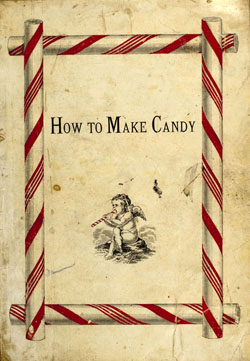
One of my favorite sections, however, has got to be the cookbooks. The cookbook described below was adopted by R.A. Graham Co. in honor of Ronald Ward howtomakecandy during AAS’s recent Adopt-A-Book event.

How to make candy: A manual of plain directions of the more popular forms of confectionery [1875].

The most recent addition to AAS’s unrivaled collection of early American cookbooks is this 168-page confectioner’s manual in its original (and delightful) illustrated wrappers. In addition to a wide range of candies, there are recipes for syrups and medicated lozenges, as well as extended discussions of flavorings and colorings. The preface states that “it is an entirely new work, written by a gentleman”—perhaps the Nathan F. Peck who copyrighted it. This is the second recorded copy of the first edition; there was also an equally rare 1876 reprinting, which AAS doesn’t have…yet.

~ David Whitesell, Curator of Books

The range of shelves devoted to the domestic art includes over 1,100 volumes, the oldest of which are foreign imprints predating American printing.  The collection also includes two volumes very important to the history of the genre in America.  The Compleat Housewife, published in 1742, was the first cookbook published in America, although it is a reprint of an earlier edition published in London.  Another famous first in the collection is Amelia Simmons’ American Cookery (1796), which is considered the first truly American cookbook.

In addition to traditional cookbooks filled with recipes, there are also books dedicated to the joys and philosophies of eating, as well as other muses on domesticity, for it truly was difficult to separate the act of cooking from all other areas of domestic life.  Hence there are wonderful books such as Modern family receipt book, containing, a great variety of valuable receipts, arranged under their respective heads, connected with the art of social and domestic life, including many valuable original communications, the result of long experience (1828).  Here one not only learns how to cook, but how to do it properly and elegantly.

Blog post 2 002

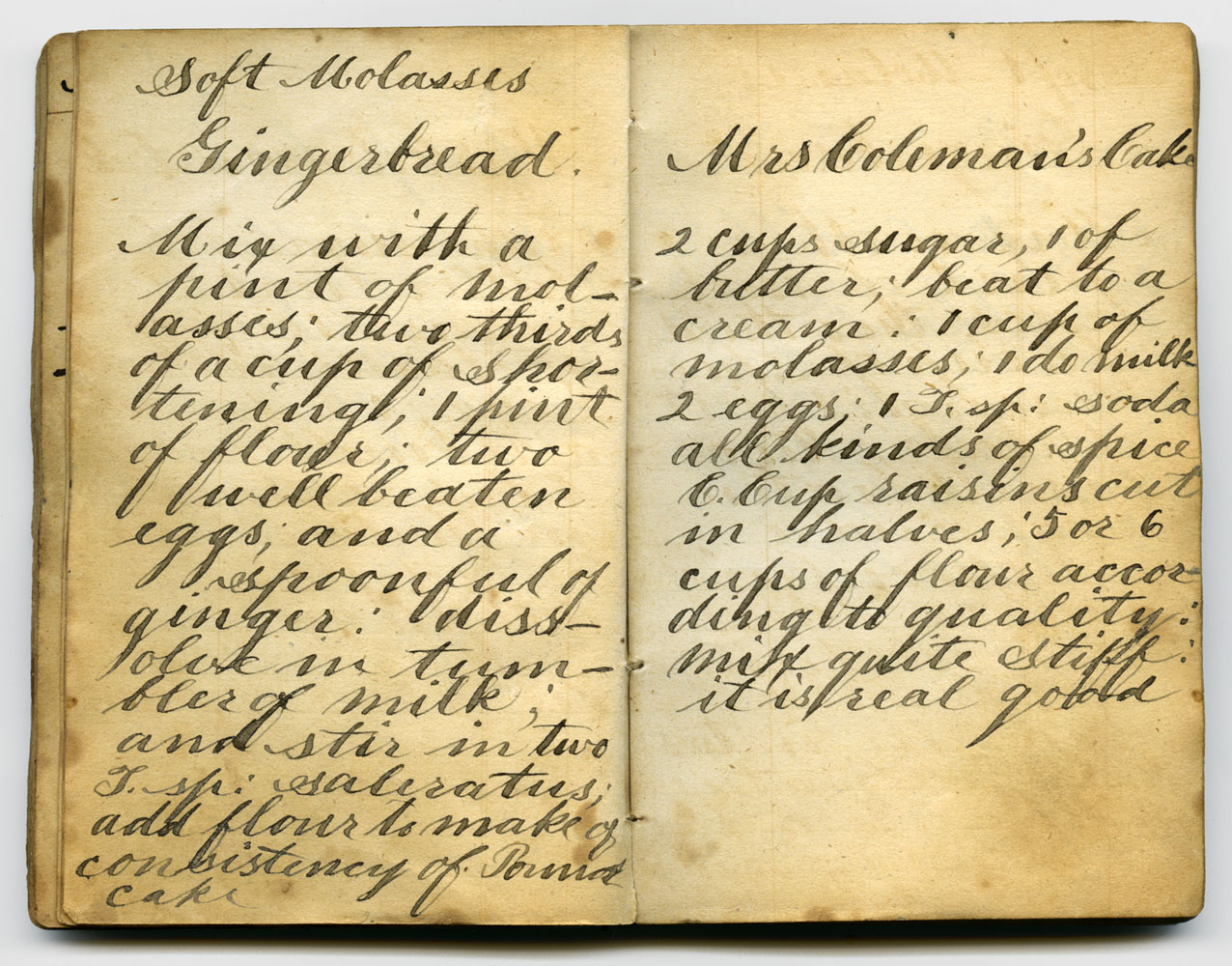
Cookbooks can be found not only in this range of published cookbooks, but also throughout other collections.  Of particular interest is a set of handwritten cookbooks located in the manuscript collection.  These manuscript volumes, dating from 1770–1899, by definition are one-of-a-kind.  While the recipes don’t differ much compared to what is seen in published cookbooks (because really, there is not a huge variety of combinations one can create with the kind of ingredients that could be both acquired and kept at the time), the manuscript cookbooks are fun because of their unique prose.  One can glean a feeling of community from the manuscripts recipes, especially when seeing recipes named after the women who shared them.  Eating has always been a communal act, bringing people together, making people happy.  It’s amazing seeing this sharing of recipes and the presumed sharing of the food that came from it.

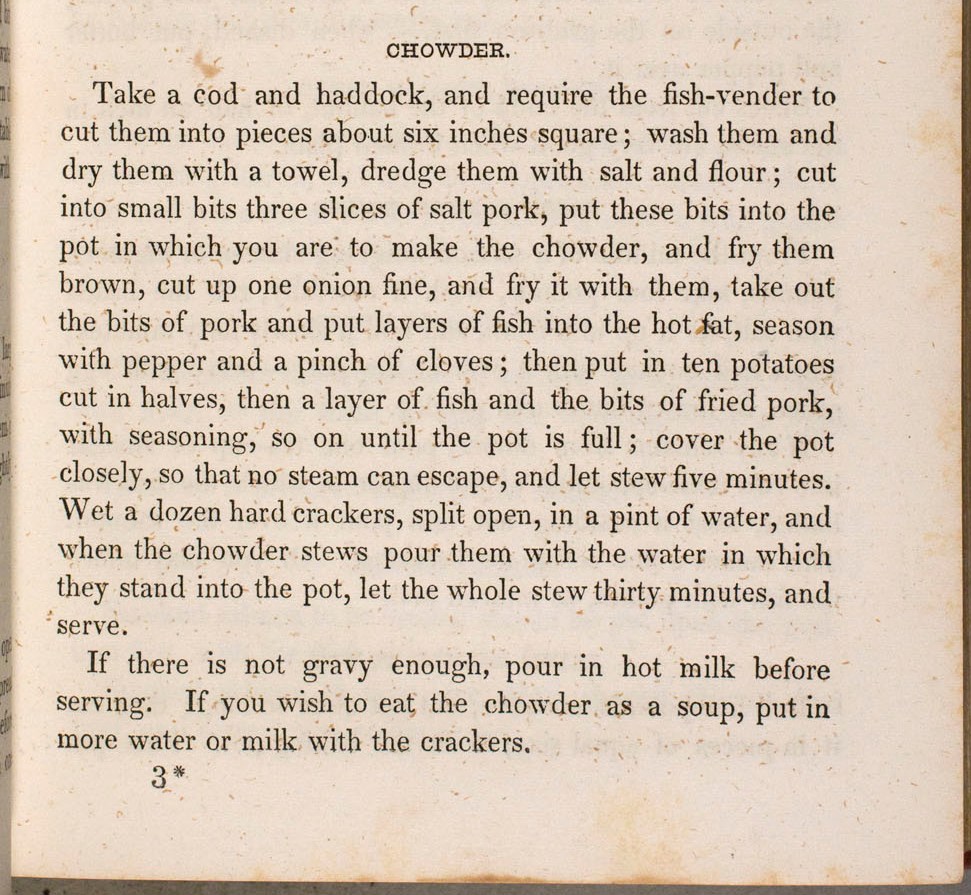
All of this recipe reading is making me hungry, so I’m going to give one a go.  In honor of the warm weather and the fast approaching summer season, I’m going to be trying out a recipe for fish chowder from Mrs. Bliss’ Practical Cook Book (1851).  If anyone would like to join in the fun, here is the recipe from the pages of Mrs. Bliss’ book:

Blog post 2 001 cropped
You can click on the chowder recipe to enlarge and print it.

I find the mushy crackers as the thickening agent the most interesting aspect of this recipe, and am excited to see if it turns out surprisingly well or expectedly disastrous.  I’ll be reporting soon on how the dish comes out.

So, one special section of the AAS stacks explored.  Anyone interested in canals?

On “Readies” and Fore-edge Painting

In a New York Times Book Review article last month, Jennifer Schuessler quoted Bob Brown, an early proponent of electronic reading devices.  In his prescient manifesto, “The Readies,” Brown declared: “The written word hasn’t kept up with the age….  Writing has been bottled up in books since the start.”  Brown called for no less than a reading revolution: “It is time to pull out the stopper” and begin “a bloody revolution of the word.”

Schuessler wants us twenty-first century readers to understand that the iPad (see Past is Present‘s earlier post), Kindle, and other electronic reading devices are not only not new but also that protests against them are nearly a century old.  But the comparisons that are often made between imagined mechanical devices like the Readies and today’s e-texts, or between e-texts and the eighteenth-century cheap novel, become even more relevant when we consider that pressures industrialization led Futurists and others like Brown to imagine devices like the Readies.  Users of the iPad, the Kindle, or the e-text are inspired not by a Futurist desire to subdue the natural world but to make it portable, accessible, and easy.

Book of Common Prayer.  New York D. Appleton & Co., 1845.  Gilt fore-edge.
Book of Common Prayer. New York D. Appleton & Co., 1845. Gilt fore-edge.

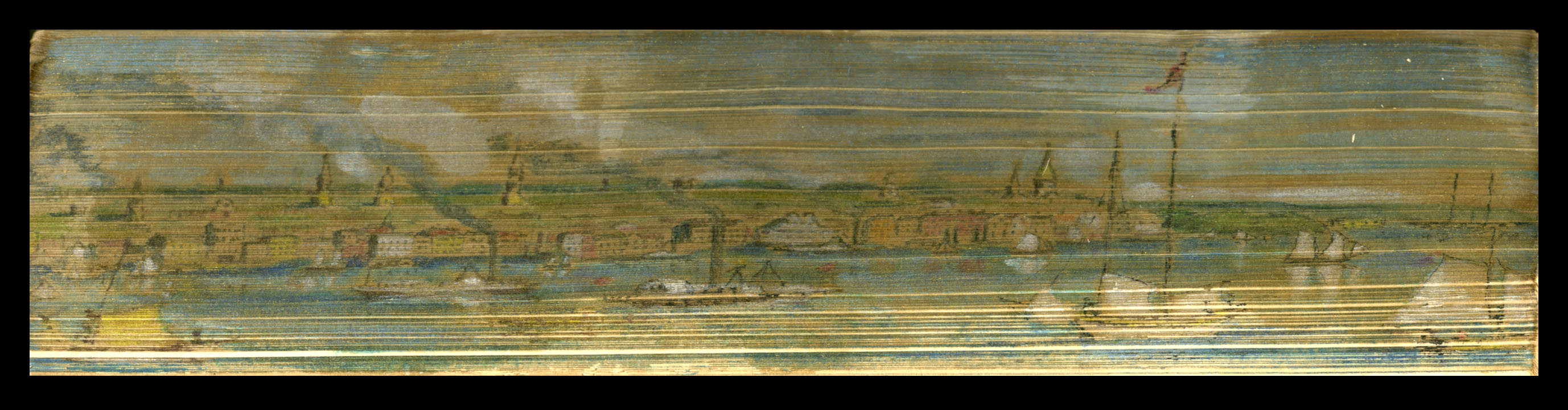
Book of Common Prayer.  New York D. Appleton & Co., 1845.  Fore-edge, with painting.

In the eighteenth and nineteenth centuries, artists like fore-edge painters fought against the new cheap novel by embellishing books. They painted detailed watercolors on the edges of pages in books they had often bound themselves. When the pages of these books are fanned, the painting on the outer edge (or fore-edge) of each page reveals a picture.

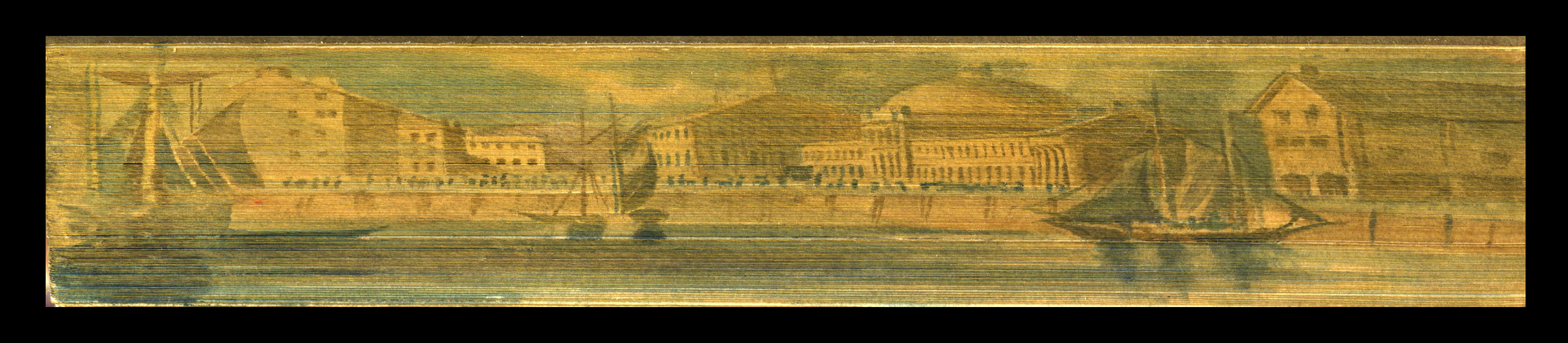
The origins of fore-edge painting on the American continent are most often traced to the shop of William Edwards, a bookbinder, seller, and publisher in Halifax. William Edwards decorated the fore-edge of many works in his Halifax shop, including that of a Reeves Bible in 1811. AAS has a Reeves Bible published in 1802 that is decorated with a fore-edge painting. Could it be the one done in Edwards’ shop?

Holy Bible. London Published for John Reeves, 1802.  Gilt fore-edge.
Holy Bible. London Published for John Reeves, 1802. Gilt fore-edge.

Holy Bible. London Published for John Reeves, 1802.  Fore-edge, with painting.

Unfortunately, we have no way of determining the artist who created this work. Lauren Hewes, Andrew W. Mellon Curator of Graphic Arts, checked the Catalog of American Engravings, just to see if any work in catalog might resemble one on the Bible. At least that way, we might have some sense if the work was reproduced from another image. No luck.

Another question, though, might be asked by an expert in bindings such as Mirjam Foot (whose book you will see below in suggestions for further reading): why do these elaborate paintings matter to us? Before perfecting the fore-edge technique, the Edwards family copyrighted a transparent vellum binding to protect paintings underneath in order to protect their work from the wear of everyday handling of their bound books. Was the Edwards family simply out of touch, selling fine bindings to an elite population? Or was the Edwards family looking to find a way to make their books unique, and copyright them to boot? Either way, one wonders how a blogger would respond to a twenty-first century Edwards.

As a side note, while preparing this blog post, AAS “lost” one of its fore-edge paintings. As David Whitesell, Curator of Books, and I looked at Amira Thompson’s The Lyre of Tioga, David realized that Thompson’s work, previously cataloged as having a fore-edge painting, did not actually have one. Doris O’Keefe, Senior Cataloger for Rare Books, swiftly corrected the book’s record in AAS’s online catalog, which now sadly bears no reference to a fore-edge painting. A basic search of our online catalog for the phrase “fore-edge painting” as a genre/form will pull up the records for the few examples we know we have.

You can read more about fore-edge painting at the Boston Public Library’s website and the Lilly Library’s has an index of examples from their library by subject or artist.  You may also want to check out the following books:

Conron, John. American Picturesque. University Park: Pennsylvania State University Library, 2000.

Foot, Mirjam. History of Bookbinding as a Mirror of Society. London: British Library, 1997.

Weber, Carl J. Thousand and One Fore-Edge Paintings: With Notes on the Artists, Bookbinders, Publishers, and Other Men and Women Connected with the History of a Curious Art. Waterville: Colby College Press, 1949.

The Acquisitions Table: Omnibus Editions

Collection of omnibus editions, ca. 1840-1855.

4P8V7422

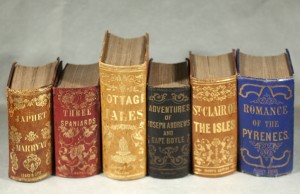
AAS has purchased from member Mark Craig an interesting and very unusual collection of 14 omnibus editions, all in fine condition in the original blind- and gilt-embossed publisher’s sheep bindings. These omnibus editions typically consist of 16mo stereotype reprints of popular and juvenile fiction, with three to four works bound together in one short, squat, gaudily decorated package—what Edwin Wolf 2d referred to as “bricks.” The Craig collection volumes were issued by such publishers as W. A. Leary and John B. Perry in Philadelphia, and Richard Marsh and Nafis & Cornish in New York; and there is tantalizing evidence of plate sharing and collaborative publishing as well as a marked uniformity of appearance. Little is yet known about these publishers’ series, in part because the volumes are quite rare today: a quick search of the AAS stacks turned up only a handful of similar volumes. Harry G. Stoddard Memorial Fund.

~ David Whitesell

“Listen my children and you will hear …”

RevereMassacre This past April, the state of Massachusetts marked the 235th anniversary of the famous ride of Paul Revere and the start of the American Revolution at the Battles of Lexington & Concord. As you might expect, AAS takes Patriot’s Day (April 19th) seriously. Like most Massachusetts residents, we have the day off (it is a state holiday here) and so our Reading Room was closed. But the week after Patriot’s Day, we were back at work and Babette Gehnrich, our chief conservator, began a conservation survey of our outstanding collection of engravings by Paul Revere. Some prints will be re-matted, others repaired and cleaned, if necessary. Some, if not all of the prints, will be digitized. The hope is to produce an illustrated box list or finding aid this summer which will provide an item level accounting of the Society’s holdings of Revere’s separately published prints. You can currently search for information (but not illustrations) on all of Revere’s engraved prints, including his engraved book illustrations, in the Catalogue of American Engravings (available online at http://catalog.mwa.org:7108/).

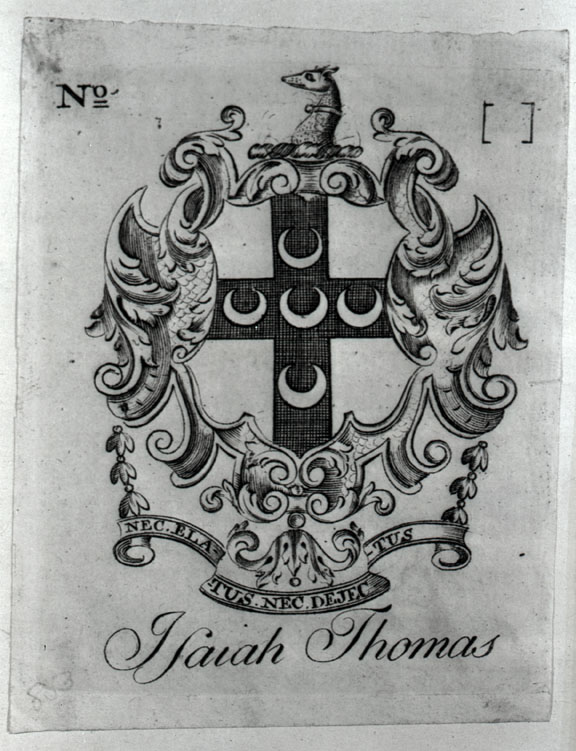
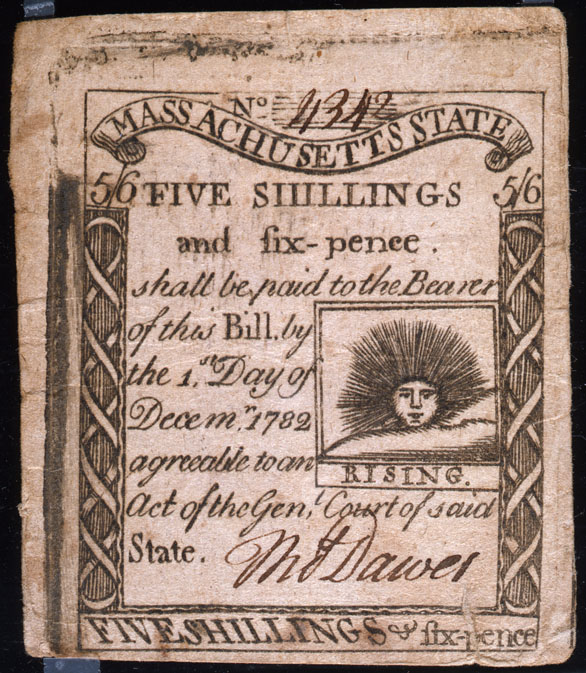
The inventory project and conservation survey are reminders of the absolutely stunning RevereBookplate depth of the Society’s collection of eighteenth-century American engravings. We hold an impression of nearly every print Revere created. The iconographic prints like The Bloody Massacre Perpetuated in King Street, Boston (shown above) and Boston, Ships Landing Their Troops, both from 1770, form the heart of the collection. However, we also have examples of Revere’s work in currency, bookplates (including the one at left he made for Society founder, Isaiah Thomas), clock labels, and trade cards. These prints were all documented by American Antiquarian Society’s third librarian Clarence Brigham in his seminal publication, Paul Revere’s Engravings, first RevereMoneypublished in 1958 (AAS also holds Brigham’s research notes for the book project, as well as a set of publisher’s dummies). This text remains the central resource for the study of Revere’s engraved work.

Because of AAS’s strong Revere holdings and the Brigham publication, we often get inquiries from students and picture researchers looking for eighteenth-century images depicting Revere’s April 18, 1775 ride, and they sometimes want the image to be by Revere. But, of course, there isn’t any such visual record. Most images of Revere on horseback galloping through the streets of Boston and its suburbs all date from after 1860, the year that Henry Wadsworth Longfellow (1807-1882) wrote his famous poem, “Paul Revere’s Ride.” First printed in the Boston Transcript in December of 1860, the poem was reprinted in the Atlantic Monthly in January 1861, with an added stanza, and later appeared in multiple editions of Longfellow’s compilation Tales of a Wayside Inn (1863). When Longfellow constructed the story of Revere in 1860 he was not trying to write a formal history, but rather a patriotic poem. He embellished a bit, heightened the drama, and wrote a darn good poem that was well received by a nation unraveling on the eve of the American Civil War. When people call us looking for images of the events of Paul Revere’s activities in April 1775, we often steer them to an illustrated Longfellow edition.

CHAViC Conference on Historical Prints: Fact & Fiction

Longfellow’s poetic riff on history occurred 85 years after the actual event . . . but it’s still historic, right? Does the poem tell us more about American in 1860 than it does about 1775? And just because there are no contemporaneous images of Revere riding through the darkness of April 1775, does not mean the event was unimportant in 1775, does it? These are the sorts of questions that will be debated at the upcoming CHAViC Conference on Historical Prints: Fact & Fiction, held this November 12th and 13th (more information is available online at http://www.chavic.org/Upcomingconferences.htm). Panels of historians will discuss all kinds of historic imagery and decide how it was used and what it reflects – fact or fiction. Images of Revere’s ride are not on the agenda for the conference, but Washington Crossing the Delaware will be discussed on one panel, and images of John Paul Jones on another. I am hopeful that the participants will be able to view some of the Society’s Revere engravings, including Bloody Massacre, which in itself, is rife with historical inaccuracies. If asked, I am even game for giving a recitation of Longfellow’s poem, the first stanza of which I had to memorize back in the third grade: “Listen my children and you shall hear of the midnight ride of Paul Revere / On the eighteenth of April, in Seventy-five; / Hardly a man is now alive who remembers that famous day and year.” Please come for the CHAViC conference and join the conversation around historic imagery. Registration materials will be posted in June.

“A very radical proposition”: Elizabeth Cady Stanton and the Meanings of the Vote

Tomorrow evening, Tuesday, May 18, at 7:30 p.m. Lori D. Ginzberg will be giving a lecture at AAS on “‘A very radical proposition’: Elizabeth Cady Stanton and the Meanings of the Vote.”
ginzberg

Brilliant, self-righteous, charismatic, intimidating, and charming, Elizabeth Cady Stanton was the founding philosopher of the American movement for woman’s rights. To many she was a dangerous radical, whose words threatened men’s exclusive control over politics, the stability of marriage, and the sanctity of religion. In advocating women’s right to vote at the Seneca Falls convention in 1848, she expressed the radical possibilities of American liberalism; at the same time, in her refusal to examine closely the racist and elitist implications of some of her most deeply held beliefs, she exposed the limitations of the feminism she would help make part of the very air we breathe. Lori Ginzberg, author of Elizabeth Cady Stanton: An American Life (Farrar, Straus, and Giroux, 2009), will explore some of these implications for our understanding of the vote, of individualism, and of Stanton herself.

Lori D. Ginzberg is professor of history and women’s studies at Penn State University with a longstanding interest in the intellectual and political history of American women. She is the author of several books, including Women and the Work of Benevolence: Morality, Politics, and Class in the 19th-century United States (Yale, 1990) and Untidy Origins: A Story of Woman’s Rights in Antebellum New York (UNC, 2005).

It doesn’t stop with “Antiquarian…” or, I’ll take what’s behind door number one!

Assistant Curator of Manuscripts and Assistant Reference Library Tracey Kry comments on her impressions of AAS as a newly-arrived employee.

A couple of months ago now, we had a post about creating an AAS Glossary that would talk about terms and collections unique to AAS (https://pastispresent.org/category/aas-glossary/ ).  The first post was about people’s confusion with the term Antiquarian, but there is so much more to discuss!

Having been employed by AAS for only three weeks now, I myself am more surprised than anyone at how quickly I’ve grown tired of aquarium jokes.  Every time I explain my new position to friends and family, it’s always the same.  Don’t get me wrong, I love a good pun, but often the explanation of AAS comes to an immediate halt when fish are mentioned.  Not only is there an incredible wealth of information, history and practices unique to AAS, there are innumerable pun opportunities if we just get beyond the fish.  So as a new employee of AAS, looking at its practices and oddities with fresh eyes, I’d like to give an inside look at AAS as an institution, and provide all of our readers with a glimpse behind the stack door and into a world with plenty more terms, labels, and practices that need a little explanation.

Blog post 1 001

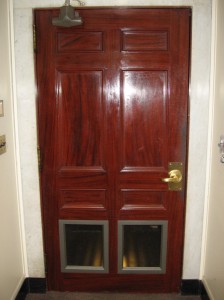
Let’s start with the stacks this week.  AAS is a closed-stacks library, which simply means our books are held behind closed doors so readers can’t just browse the shelves – all material needs to be paged by an AAS staff member.  There are numerous ways for staff to enter the stacks (I’m still finding new ways in and out) but the one most used by those paging for readers is the wooden door behind the Readers’ Services desk.  The door is surprisingly quiet and unassuming considering the wealth of information and knowledge just beyond it, but it is just as it should be.  AAS is about sharing that knowledge, not guarding it.  In fact, you may even catch a glimpse of what’s behind the door simply by looking through the glass on the bottom.

Why there is glass on the bottom of the door behind the desk was the first among many questions I had.  No, it’s not a doggy door, nor is it a poor, unmatched patch on a damaged door.  The glass on the bottom of the door is simply, and quite ingeniously, a way to see if all is clear on the other side before barreling through with a full cart of newspapers.  Think of the restaurant standby of yelling “corner!” as one dashes around a kitchen with arms full of dishes.  The glass method, fortunately, is much better suited to the environment of the reading room.  It works surprisingly well, and I’ve already learned to recognize people by their shoes.

Blog post 1 003

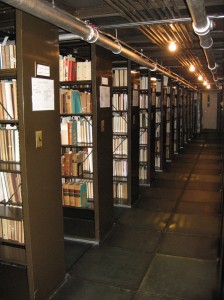
A small digression regarding glass – glass has shown up again on my radar while navigating the stacks, an area which is two times as large as I would have expected.  There are areas in the stacks with glass floors.  Very visually interesting, and just a tad creepy if you catch someone walking above you out of the corner of your eye.

Now in the stacks, let’s talk about classification.  Nothing against Dewey or LC, but given the nature AAS’s holdings, traditional classification systems would never do the collections justice.  While most classification systems attempt to cover all areas of knowledge, the collection at AAS is far too deep and detailed for traditional systems to work.  The collection has so much material on, for example, specific local histories, that the level of detail within this particular topic needs additional breakdowns. Additionally, whereas traditional classification systems need only worry about subject, we also need to worry about size, shape, and composition, and the coinciding care and storage.  How else are you going to differentiate Miscellaneous Pamphlets (call number: Misc Pams), an oversized engraving (call number: Engrfff) and a bound manuscript volume that is under 12 inches (call number: MSS Octavo)?  This combination of the depth of the topical information, and material distinction makes for a unique, somewhat complicated, but entirely practical classification system.

So the call number tells you what you’re looking for, but next is the matter of actually finding it!  There are 25 miles of shelving to navigate through, but maps, which are posted quite frequently throughout the stacks, are extremely helpful.  All of the floors are similar in their layout, shaped like a cross.  As long as you remember what collections are on which floor, and which part of that floor, you should be all set.  And most importantly, there are red arrows on the floor pointing to the exits!

And as a final note regarding the stacks and classification, all of this could be even more difficult (could it really get more difficult!?) if AAS did not refocus it collection policy to only include paper.  Up until the early 20th century AAS also collected objects, and I can only imagine how much more confusing that classification system would be (chime in museum people!).  So my burning question is, what kind of interesting objects does AAS still have stored in alcoves and the server room?  As I find out, so will you!

The Acquisitions Table: Quagga and Rhinoceros

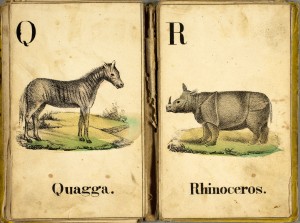
The quagga illustrated in this children’s book caught my eye because, possibly like you, dear reader, I had never heard of this animal.  And so I went to Wikipedia where I read an interesting article about the quagga’s relationship to the plains zebra and about efforts to breed them back into existence.  Curator of Children’s Literature Laura Wasowicz describes the book in which this image is found.

4P8V6651

Alphabet of Natural History. Hartford: D.W. Kellogg & Co., [ca. 1830-1842]

This fragile accordion-fold format picture book depicts exotic animals, many of which would have been described in African travel narratives that were published in the antebellum era.  The image presented here shows the rhinoceros familiar to modern readers, and the exotic quagga, a zebra-like animal that became extinct in the late nineteenth century.  The Kellogg brothers (Daniel Wright, Edmund Burke, and Elijah Chapman Kellogg) were prolific publishers of high quality lithographed prints and children’s books for nearly four decades.  Purchased from Michael Burstein.  General Library Acquisitions II Fund.

The Civil War, Courtesy of the American Antiquarian Society

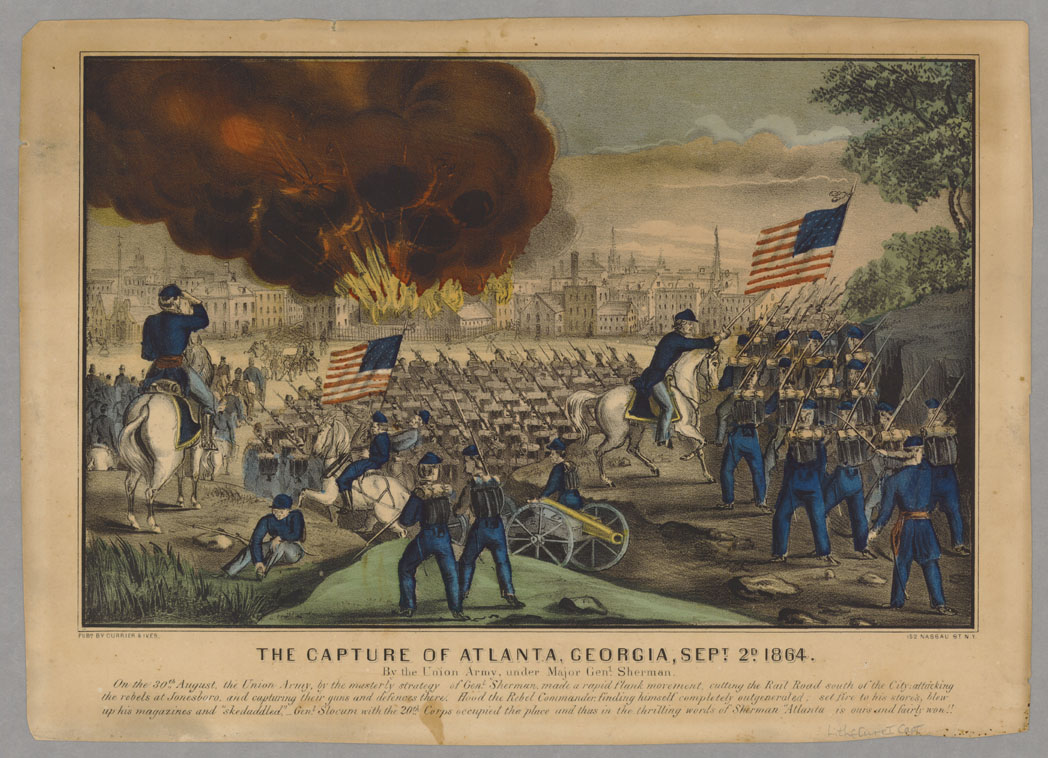
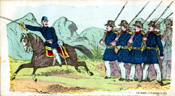
Currier & Ives lithograph of the capture of Atlanta, Georgia by Sherman's army

Next year marks the 150th anniversary of the start of the American Civil War. Many institutions are planning exhibitions, activities, and publications around the events which tore the United States apart between 1861 and 1865. Some organizations have already contacted AAS regarding the possibility of borrowing or reproducing material from our collections. The uptick in such requests has caused me to think about the vast Civil War holdings that fall under the auspices of the Society’s Graphic Arts department.

As one might expect, the Society has outstanding holdings in this area. No, really, I know I say this all the time, but really – they are outstanding. Our broadsides collection includes roster listings, military announcements, and calls for the return of deserters. Our ephemera collections feature decorated Civil War envelopes,

Civil War envelop from New York depicting a battle scene

menus from military events, and tickets to fund-raising events and Sanitary Fairs. Many of the broadsides and much of the ephemera can be searched in our online catalog and are included in the American Broadsides and Ephemera product. Portraits of military leaders, regimental groups, and depictions of battle actions and home life can be found in the Lithograph and Engravings collections and political cartoons skewering leaders of both the North and the South are part of the cartoon collection. There is even a separate collection of just Civil War cartoons cut out of a variety of newspapers and periodicals that has an online inventory. Maps of the Southern states showing troop placements and outlining military strategies are housed in the Society’s amazing geographic collections.

And then there are the photographs.

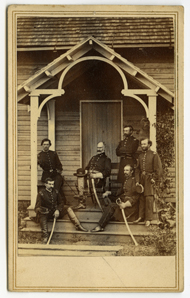
General Marsena Patrick and staff, c. 1865, photographed by Gardner, 7th & D Street, Washington, D.C.

The Civil War was really the first war captured by the camera from start to finish. From Generals to privates, the photographers took pictures of everyone. Some, like Mathew Brady, followed the action and introduced the world to the idea of photojournalism with photographs of the aftermath of fighting. The Society’s carte-de-visite collection was recently sorted to place all regimental photographs together so all the men of the Massachusetts 15th (a Worcester County regiment) are now boxed together. Stereographs of battlefields and military groups, as well as tintypes and large albumen prints are scattered across various photographic holdings, some in geographic classifications, others in historical groups. Let’s not forget the sheet music printed in Richmond, the confederate currency, ballads about campaigns and camp life – the list goes on and on.

Yes, some of the Society’s wonderful Graphic Arts holdings will be loaned or reproduced over the next four to five years. As you attend exhibitions or commemorative events, keep an eye out for our standard credit line, “Courtesy of the American Antiquarian Society,” on wall labels and in captions. If you yourself are hunting for a Civil War image, you can contact our Rights & Reproduction department. If it was created between 1861 and 1865, chances are pretty darn good that we have it!

What is in a title?

When I first saw the front page of our convict’s little excerpted diary (the one I wrote about in a previous post), I thought to myself, what a curious title. The title was, of course, one of the main things that encouraged me to poke my nose into it in the first place.  If our protagonist were to give the diary a slightly less literary title, he might have called it “A Prisoner’s Diary” or just “Selections from my Diary.”  Instead he has chosen “Promiscuous Leaves from my Diary.”  In other words, it might be called “Indiscriminate Pages from my Diary” or “Random Entries from my Diary.”

Why all the fuss about the title?  I’ve come to think that the title seems a little misleading to me.  Firstly, if there is a complete diary somewhere, there are obviously other entries which have been left out. Secondly, the order of the entries is not even chronological and instead they skip around.  Within the first 10 pages alone, the entries skip from 1863 to 1862 then back to 1863 again. I don’t think it would be too cynical to surmise that the excerpted diary is designed to cast its writer in as positive a light as possible.  Where this all inevitably leads me is that the entries have been carefully chosen and are not quite as promiscuous as the title might suggest.

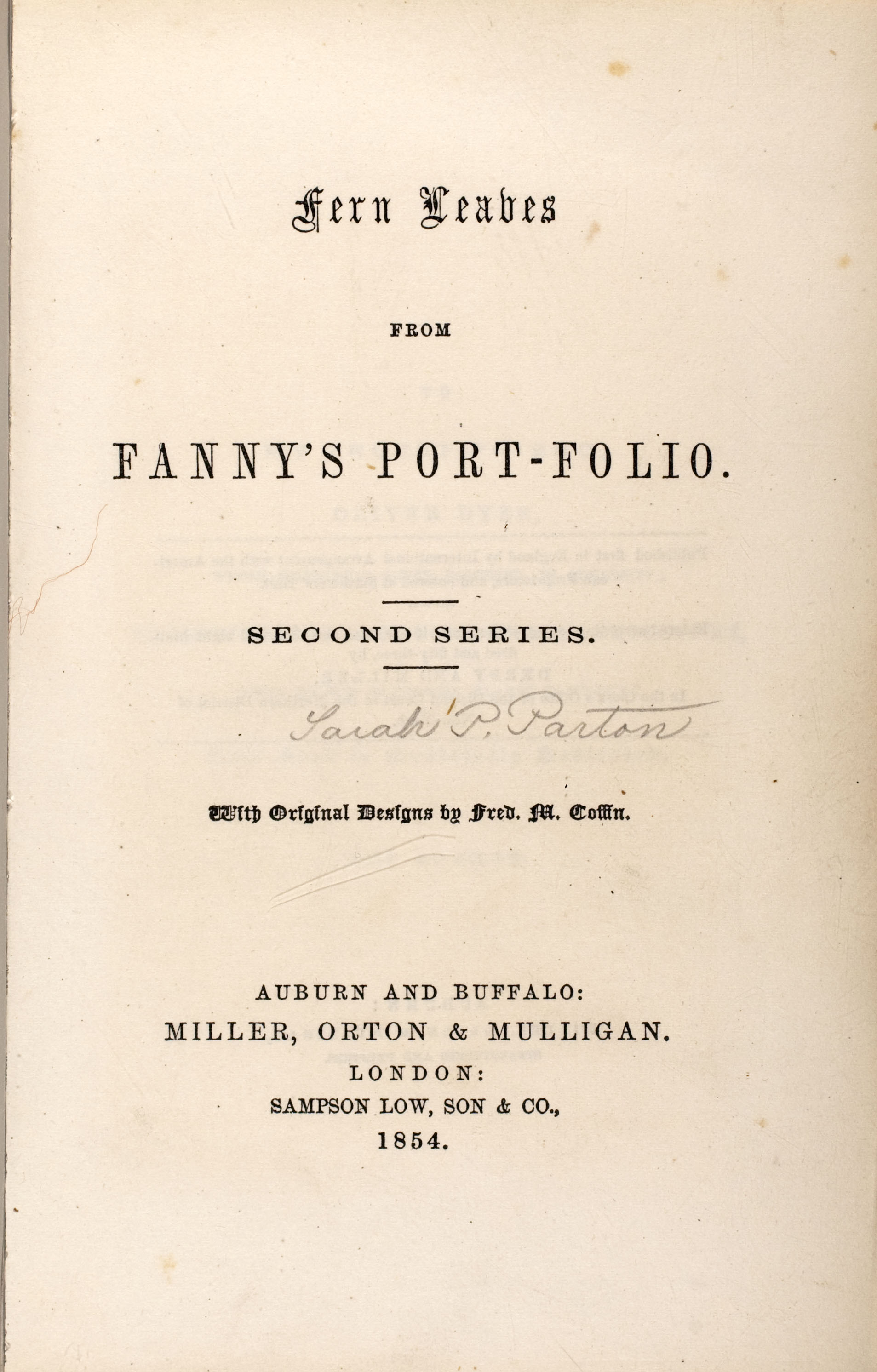
fernleaves Since we’re talking about titles, it might be an appropriate time for some other related thoughts.  One of our blog post readers commented on the similarity between the title of the diary and a series of books by a nineteenth century author Sara Willis Parton, or as she was better known by her pen name, Fanny Fern, that involve the use of the word “leaves.”  These books have such titles as Fern Leaves from Fanny’s Portfolio (1853), and Fresh Leaves (1857).  Always eager to dig a little deeper, I did a quick look in our electronic catalog, and came back with a number of titles that use the word “leaves” in a similar context that could also have potentially inspired the title given to our author’s work.

Aside from the photographs, some of the other titles among the many in our collection include:

  • Leaves from the Book of Life: or, Scripture Lessons for the Little Ones at Home
  • Gathered Leaves
  • Leaves for a Christmas Bough
  • Leaves from the Note Book of a Naturalist
  • Fresh Leaves from the Diary of a Broadway Dandy
  • Leaves from the Diary of a Dreamer: Found among his Papers.
  • Leaves of Grass
  • Leaves from an Invalid’s Journal

So many intriguing titles, and this is only a handful!  Join us next time for some more of our convict’s musings, and some prison poetry of his own composition.

In the meantime, here is the next gathering of leaves from our convict’s diary. If you want to read the beginning again, it is in the earlier post.

[book id=’14’ /]

[As an aside: if you read a few pages into this new section, I’m sure some of you will be as curious as I am about the nature of the stone monument he mentions. He gives enough detail that, if someone came across it, I think we could probably say it was his work. If someone does know of it’s existence, please let me know and we’ll see if we can get some pictures up here!]

Witches, Alchemists, and Occultists … Oh My!

Ever wish you could turn common, everyday household objects into gold? Well, now you can! This pitch may sound eerily similar, if in reverse, to the “Cash for Gold” ads flooding our TV airwaves today. In the early modern world, alchemists were the ones pursuing methods to turn common elements into gold. When Europeans settled across the Atlantic, many took their beliefs in alchemy and witchcraft with them. New England in the 1600s was a land of superstition and magical thinking as well as Puritan religious sermons.

Today (Tuesday, May 4) at 7:30 p.m. AAS will host a talk about one of early America’s alchemy proponents. Connecticut state historian and assistant professor of history at the University of Connecticut, Walt Woodward, will talk about “New England’s Other Witch Hunt: John Winthrop, Jr. and the Hartford Witch Hunt of the 1660s.”
woodward
Did you know that Connecticut, not Massachusetts, was New England’s most zealous prosecutor of witchcraft in the years before the famous Salem witch trials? Connecticut conducted the first witch hanging in New England. Connecticut also executed each of the first seven persons indicted for that crime.

Woodward will tell the fascinating story of the Hartford Witch hunt of the 1660s, focusing on John Winthrop, Jr. This alchemist, physician, political leader, and authority on the occult intervened to transform Connecticut from New England’s fiercest witch hunter into a colony that ended executions permanently a generation before Salem. Woodward’s talk is based on his new book, Prospero’s America: John Winthrop, Jr., Alchemy, and the Creation of New England Culture, 1606-1676 (University of North Carolina Press, 2010).

For more information, click here for AAS’s public programs page on our website.

What (some) cataloguers do on vacation…

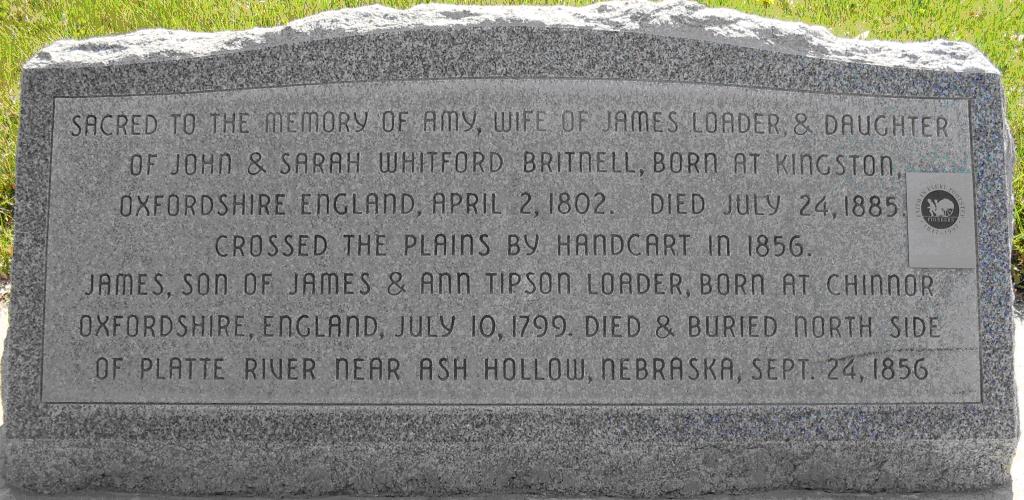
I recently spent a week in Salt Lake City on vacation. One of the sites I visited was the FamilySearch library at Temple Square, run by the Jesus Christ Church of Latter-Day Saints. I’ve found most of my family history with the genealogical resources at the AAS, but I thought it would be fun to see if maybe there was something else I could find. I know, it was kind of dorky, but my husband found the ship records for his great great-grandfather from Scotland, so I wasn’t the only one into it. With the information I had on my great great-grandfather (Frank Loader Heritage) on my father’s side, I decided to see if I could go further back than him. His family had been from Aston Rowant, England, and in tracing the UK census back, I found his mother (Eliza Loader Heritage) and then her parents, my fourth great grandparents Amy Britnell and James Loader.

Grave of Amy Britnell and James Loader, Pleasant Grove City Cemetery, Pleasant Grove, Utah.

Upon learning this, I now started looking up their names online and made some great discoveries. In the late 1840s or early 1850s, most of the Loader family converted to the LDS Church, through the numerous missionaries sent by Brigham Young to build up his city of Zion in Utah. In 1855, James, Amy, and nine of their thirteen children (my third great-grandmother Eliza refused to convert to the Church of LDS and stayed in England, breaking ties to her parents and siblings) emigrated to the United States and were part of the disastrous 1856 Willie and Martin handcart company tragedies. Approximately 200 of the 1000 or so emigrants died on the 1300 mile trek across the plains from Iowa City to Salt Lake City. At least two of the Loader children and their families wisely stayed in Iowa and did not make the trek in 1856.

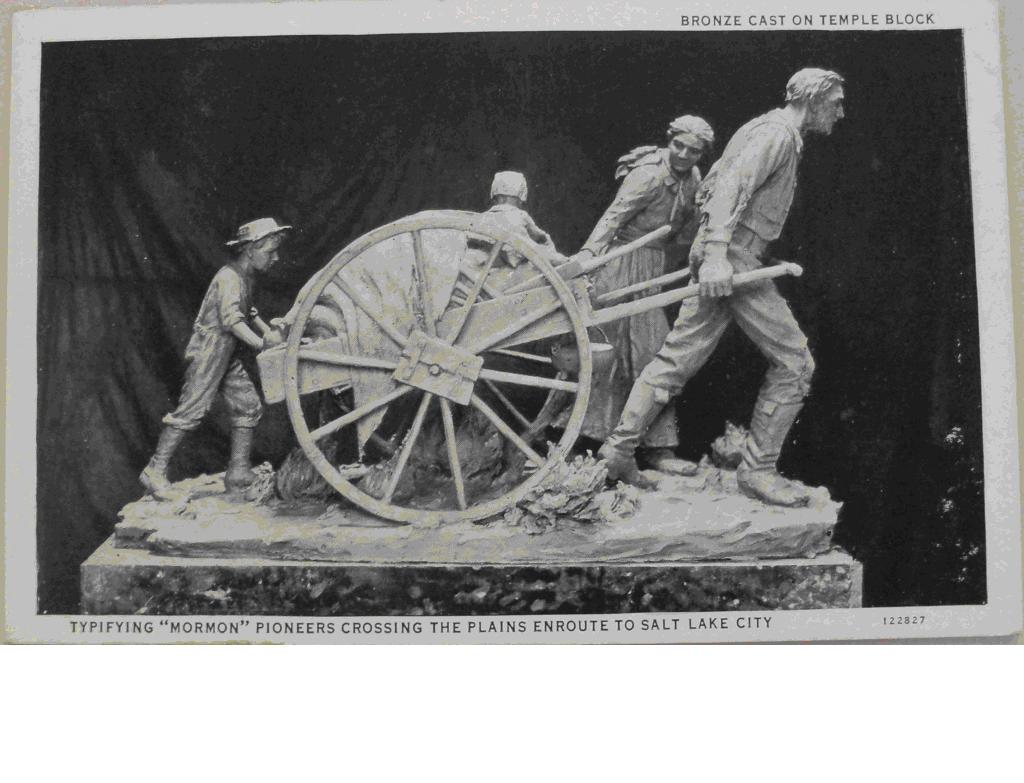
Postcard showing the memorial sculpture to the Pioneers by Torlief Knaphus located in Temple Square, Salt Lake City, Utah.

The Martin Company left Iowa in September 1856, a few days after the Willie Company headed west. All of the Loaders, except James Loader, who died near Ash Hollow, Nebraska in September 1856, arrived in Salt Lake City in November 1856. Amy lived until 1885 in Pleasant Grove, Utah, living lastly with her daughter Patience Loader Rozsa Archer, whose journal of the trek is the best known account of the Martin Company.

So, when I returned home, I thought, I need to know about this trek, preferably from sources in that time period. After all, it is considered the most disastrous trip of the westward migration in American history. The Society has a reasonable amount of Mormon literature and histories, and of course, anti-Mormon and anti-polygamy literature from the 1840s until the 1880s. I also found a fair number of items relating to the trans-Atlantic and cross-country trip made by thousands of European converts.

In chapter 37 of Rocky Mountain Saints, Thomas Stenhouse recalls the great hand cart plan through the narrative of John Chislett, a member of the Willie Company who emigrated from England. He says of Brigham Young’s hand-cart scheme:

Whether Brigham was influenced in his desire to get the poor of Europe more rapidly to Utah by his sympathy with their condition, by his well-known love of power, his glory in numbers, or his love of wealth, which an increased amount of subservient labour would enable him to acquire, is best known to himself. But the sad results of his Hand Cart scheme will call for a day of reckoning in the future which he cannot evade.

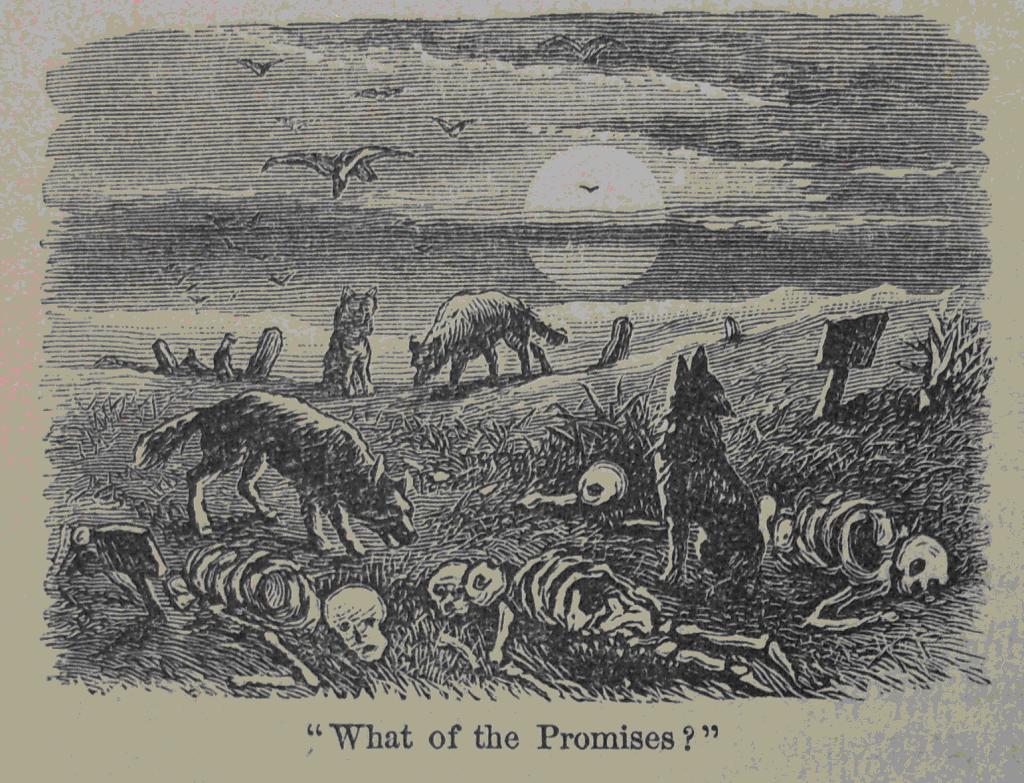
“What of the promises?” Each night, after the emigrants buried those who perished the day before, the wolves would quickly come to feast. From T. Stenhouse, The Rocky Mountain Saints, 1873.  Wood engraving.
Each night, after the emigrants buried those who perished the day before, the wolves would quickly come to feast. Wood engraving from T. Stenhouse, The Rocky Mountain Saints, 1873.

Another account in that chapter, from an unnamed man who rode behind the Martin company, recalled what he saw on the trail and even years later:

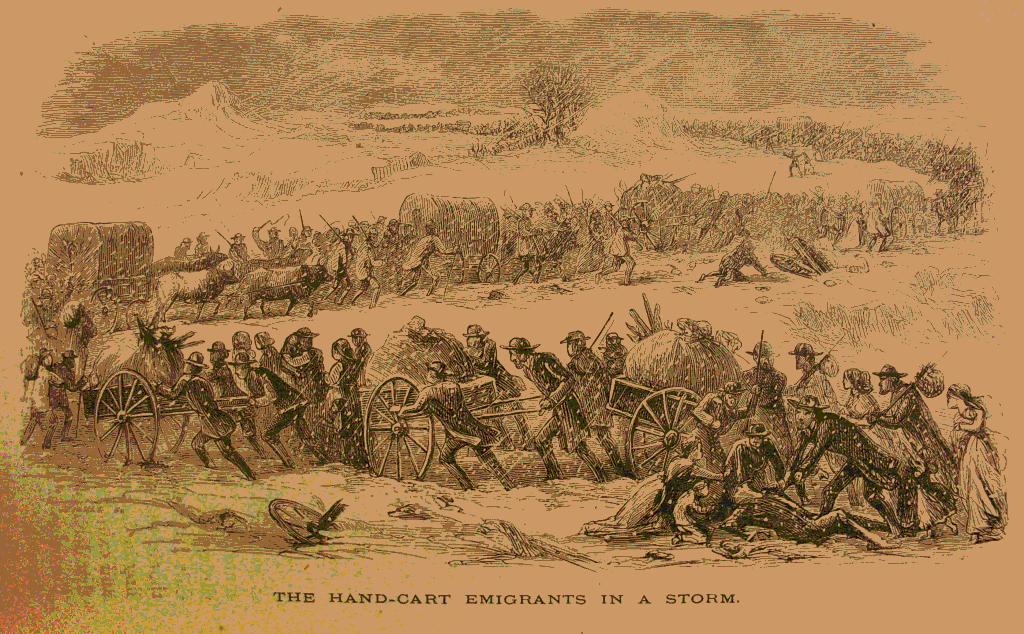
The track of the emigrants was marked by graves, and many of the living suffered almost worse than death. One sick man there, who was holding by the wagon bars to save himself from the jolting, had all of his fingers frozen off. Men may be seen to-day in Salt Lake City, who were boys then, hobbling around on their club-feet, all their toes having been frozen off in that fearful march.

Emigrants trudged through the early snowstorms in Wyoming, October, 1856.  Wood engraving from T. Stenhouse, The Rocky Mountain Saints, 1873.
Emigrants trudged through the early snowstorms in Wyoming, October, 1856. Wood engraving from T. Stenhouse, The Rocky Mountain Saints, 1873.

In October 1856, Brigham Young was informed of the deplorable conditions on the trail and decided to send help to the emigrants. Men were sent with food along the trail finding the Willie Company first, then the Martin Company. Even with the reinforcements, most of those who died on the trail died in the weeks after the rescue. Finally, after almost three months of walking across the plains, the Willie and Martin Saints arrived in Salt Lake City. Those who had families in the area were sent to live with them. Others, including my Loader family members, were divided amongst willing townspeople to be nursed back to health. Most of the Saints lived long lives in and around Salt Lake City, never regretting their decision to make the pilgrimage to the land of Zion.