Clerk and the City

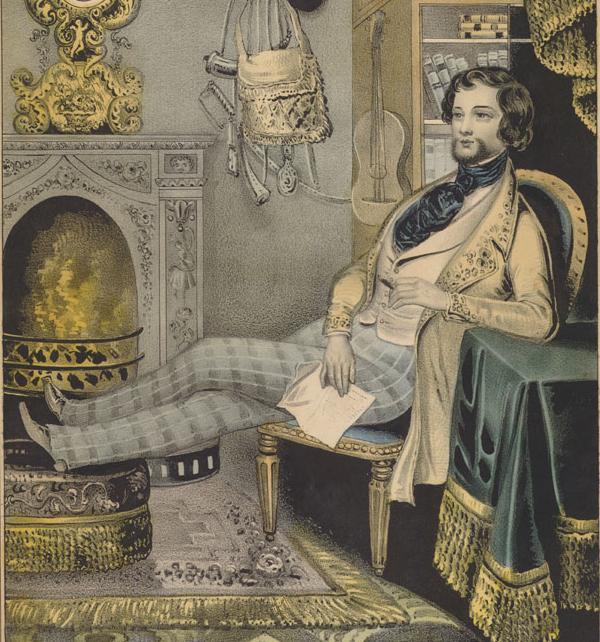
This lithograph titled “Single” and published by James Baillie (New York, 1848) doesn’t actually depict our man about town, Nathan Beekley, but we feel it captures his spirit — and Beekley did play the violin).

We began the new year with a teaser post on “Love and the Library” that introduced our new line-a-day subject, Nathan Beekley. We are now proud to debut the site based on Beekley’s diary for 1849, Clerk and the City .  Beekley’s daily blog posts will appear in the sidebar on Past is Present, but you can read up on the first two weeks (including extensive extra illustrations and historical commentary on Beekley’s original entries) by visiting https://clerkandthecity.wordpress.com/.

The Clerk and the City blog is based on the hard work of two amazing interns at the American Antiquarian Society. Chelsea White transcribed the entire diary from the original in AAS’s manuscript collections and wrote last week’s post. Maury Bouchard has done a tremendous amount of additional research on our clerk in an iron factory, including actually mapping Nathan Beekley’s world.

To whet your appetite, here is an excerpt from the biographical sketch of Beekley written by our AAS intern, Maury Bouchard:

Nathan Beekley kept a diary for the whole of 1849 in which he describes an active social life including frequent calls upon young ladies whose names are obscured for propriety’s sake, and a thirst for knowledge. This is typical of young clerks working in the big city in the 1840s according to Brian P. Luskey, author of On the Make: Clerks and the Quest for Capital in Nineteenth-Century America (New York University Press, 2010). In one key area, however, Beekley does not fit Luskey’s model of a city clerk. Nathan, for one, does not appear to be very interested in financial advancement. At least he does not discuss his work very often in his diary. There is very occasional mention of being in the Counting House (of Reeves, Buck and Co, 45 N Water Street, manufacturers of nails and railroad iron) and one mention of asking for and receiving a raise to $500 per annum.

Young Mr. Beekley, though, has much to say on the cultural events of the day. We learn much about the plays, concerts, operas and other performances in his city. He is not reluctant to give his opinion of performances, good or bad. He attends church regularly, often two or three times on a Sunday. He appears to relish the sermons and he makes a point of attending lectures when the opportunity arises. He makes frequent trips to Norristown (six miles distant) where he lately worked in the “type-sticking business” and where he has many friends.

Mostly though, Beekley is looking for a wife. His diary is replete with references to young ladies he calls upon almost every day. Who are E____h S__d__n and F__y C___t and how do they feel about Nathan’s attentions? There are also the Misses West and MacKay and young female friends who pose as cousins to avoid raised eyebrows as they gain entrance to his lodgings. The life and loves of a mid-19th century iron clerk are not exactly Melrose Place-material, but remain fascinating none the less. [Continue reading]


We hope you will enjoy the fruit of our labors, and that you all have as much fun as we have getting to know this engaging young man on the make as he pursues love and culture on the streets of Philadelphia.
The Acquistions Table: Handbill featuring illustration by David Claypool Johnston

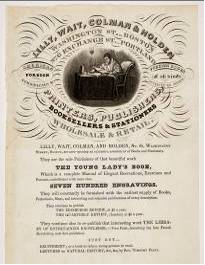
Lilly, Wait, Colman & Holden Printers, Publishers, Booksellers & Stationers. Handbill with illustration by David Claypool Johnston. Boston: Pendleton, 1833.

This small handbill advertising a new shop for a Boston book publisher arrived as part of a generous gift of David Claypool Johnston material from AAS member David Tatham. After checking the Society’s Johnston family archive, available online, Tatham suspected the handbill might duplicate an item in the trade card collection, but in fact it proved to be an earlier issue. The trade card is actually an 1834 bill head for the firm of Lilly, Wait, Colman & Holden, but Johnston’s name (engraved in very small letters just below the central image) has been effaced. The handbill dates from 1833, based on the two new publications announced therein.  D.C. Johnston did some other engraved work for Lilly, Wait, Colman & Holden in this period, including illustrations in an anti-slavery tract and a school geography text. We are very pleased to add this Johnston item, and the other material donated with it, to our holdings. Gift of David Tatham.

The Acquisitions Table: Ella Cameron

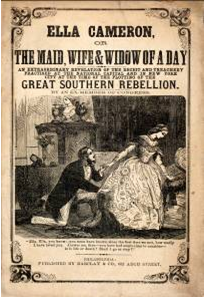
Ella Cameron, or The maid, wife & widow of a day. An extraordinary revelation, being a true picture of high life in Washington … By an ex-member of Congress. Philadelphia: Barclay & Co., 1861.

AAS owns nearly 80% of all pre-1877 titles listed in Lyle Wright’s bibliography of American fiction. Every quarter we add a few more—as well as various reprint editions of titles already here—but it is slow going. A fine copy in original wrappers of the anonymous novelette Ella Cameron recently fell into our dragnet. The daughter of an ex-governor of South Carolina, Ella is the toast of late 1850s Washington society, with Walter Moreland, “a young Texan of high birth but reduced fortune,” in hot pursuit. Stuffy old Colonel Leonard stands in the way, but Moreland strategically “wings” him in a duel, then replenishes the family fortune with $25,000 won at cards at “a magnificent gambling saloon” where “grave senators were seen in conversation with the well dressed roué and gambler.” Hastening off to New York’s dodgy Five Points district, Moreland hires a band of lowlifes to “kidnap” Leonard and his still-virginal bride, but the bumblers kill him instead. Crazed by greed, they demand Ella’s diamonds at gunpoint, but Moreland appears and now proves a surer shot. Still, both Ella and Moreland take bullets. “Their wounds were found to be quite serious but not necessarily mortal,” and following a respectable recuperation/courtship, they are finally wed. Purchased from Between the Covers. Henry F. DePuy Fund.

Fanny and Nathaniel: Love in the Library

Chelsea White, past AAS intern and present Simmons MLS student, has transcribed a diary from AAS’s collections that will become our newest Line-a-Day blog debuting with the new year.  Here is her introduction:

If you’ve enjoyed reading the A Day in the Life of a Blacksmith or the A Day in the Life of a Schoolmarm blog, then I think you’ll be excited to hear about AAS’s next blog project: Nathaniel Beekley’s Diary. Nathaniel Beekley was a young man who, in 1849, moved from his hometown of Norristown, Pennsylvania to Philadelphia to work as a bookkeeper for Reeves, Buck & Co., an iron manufacturer. He kept a diary during his first year in Philadelphia which illuminates the everyday life of a young clerk including social outings to the theater and exhibits at museums, courtships, trips back home to Norristown, and financial hardships.

One of the aspects that we at AAS are most interested in is Nathaniel’s romance with a librarian named Fanny C—t. After reading and transcribing the entire diary I have no illusions about Nathaniel being head over heals in love with Fanny exclusively, but he mentions her enough throughout his diary for the reader to infer that she may have held more of his affection than any of the other girls he courted. She is first mentioned in an entry dating 22 March 1849:

Delightful day—clear and fresh. In company with Miss F—y C. called on a young lady whom I had never met before—Miss L—a D—ds. Like most young ladies she was very talkative and exceedingly trifling and nonsensical, having but one idea—fun.

While he does not gush about Fanny’s good attributes, his negative comments on the other young lady he is with seem to be meant to contrast Fanny’s character. About a month later Nathaniel records that he “assisted [Fanny] in registering and numbering some books” in the Apprentices’ Library where she works. He assists her in cataloging again the next month.

Perhaps more telling than the accounts of Nathaniel’s actual meetings with Fanny is the frustration he records when he is unable to meet with her for some time. On 12 June he called on Fanny only to find that she was out. When this happens a second time on the 15th of the same month Nathaniel writes, “Called on Miss F—y C—t again but she was out as usual.”

Nathaniel’s final diary entry is sweet and sad. He records that he is “no nearer being married” than he was a year previously. We are not sure who Nathaniel ended up marrying, or even if he ever did marry, but his diary has entertained and amused us and we hope it will do the same for you in January.

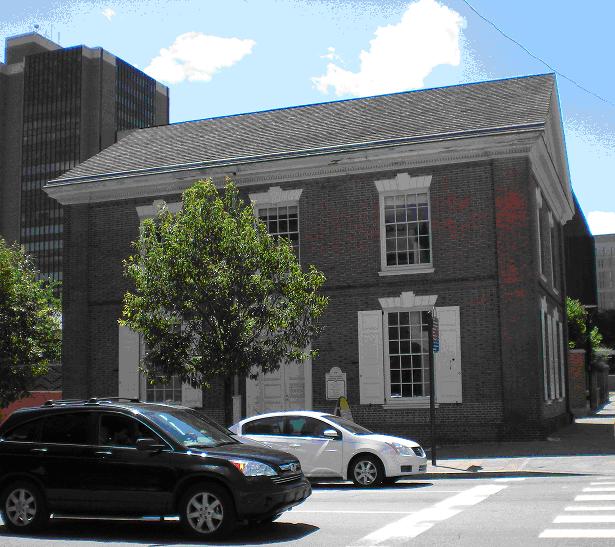
Incidentally if you’re ever in Philadelphia visit the Free Quaker Meeting House, the building that housed the Apprentices’ Library in 1849 when Fanny and Nathaniel met. I visited it in June and met a very friendly historian who was interested to hear about the Beekley blog.

Quaker meetinghouse

Free Quaker Meeting House (home of the Apprentices’ Library)

A New Year’s Address

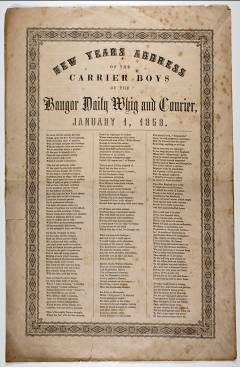
To mark the start of a new year, in the 18th and 19th centuries it was traditional for newspapers to issue new years’ addresses, or carrier’s addresses. (Click here to see AAS’s online catalog records for over 1,300 of these addresses.)  This extra supplement to the paper usually consisted of verses written in the voice of the newsboys who hawked their wares on street corners across America.  Here is an example of one which AAS recently acquired, as described by Lauren Hewes, curator of graphic arts:

New Year’s Address, of the Carrier Boys of the Bangor Daily Whig and Courier, January 1, 1858. Bangor, ME, 1857.
Purchased from James Arsenault. Harry G. Stoddard Memorial and Adopt-a-Book Funds.

This addition to our excellent holdings of carriers’ addresses comes from Bangor, and joins a second address for this paper from 1860 already in AAS’s broadside collection. At the time this address was printed, the Bangor Daily Whig and Courier was being edited by William H. Wheeler, who was born in Worcester, MA, in 1817 and had settled in Maine as a young man.  Well-known for his political writing, Wheeler was called the “strongest pen in the State” by his peers. As usual, the verse address tackles seminal news events from the previous year, in this case the Kansas question, international military conflicts, and the controversy over giving Native Americans the right to vote. The poet (presumably Wheeler) also addresses the financial panic of 1857, writing a stanza which could easily be reused by a newspaper editor to refer to recent years:

Not a word need I to utter
of the late financial crisis,
of the fearful crash of credit,
which, with force of a tornado
shook the land as with an earthquake,
whelming in its reckless ruin
thousands of our air-built castles
Lo!  Its wrecks are still all around us.
Let us not refuse the lessons
Which these sad reverses teach us.

Fortunately, things are looking up all around for our new year in 2011.  While we won’t break into verse, we do invite you to check back with us in the next few weeks.   Our blog will be debuting new features and undergoing a makeover to start the new year with a fresh new face.  In the meantime, please accept the best wishes of all of us at Past is Present and the American Antiquarian Society for a happy and healthy new year.

The Acquisitions Table: The Comical Boys

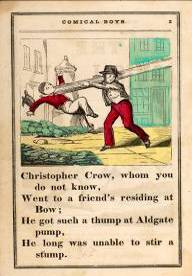
The Comical Boys. Philadelphia: J.B. Keller, [ca. 1852]

John B. Keller, like his New York counterparts Philip J. Cozans and Elton & Co., specialized in publishing cheap picture books with brashly hand-colored wood engravings. Comical Boys chronicles the misadventures of boys, as in the case of poor Christopher Crow, who ran into a pump handle. The back cover has advertisements for Keller’s picture books, Currier lithographs, and the “Colored ABC or Mile-End Alphabet, folding up in the form of a map, with stout fancy colors”—products that blur the lines between art, education, and fun. Purchased from Philadelphia Rare Books & Manuscripts Co. Harry G. Stoddard Memorial Fund.

Christmas trees!

As the cataloger for AAS’s Prints in the Parlor project, I’ve been working with gift books and annuals now for fifteen months. In that time, I’ve found few images that represent scenes of Christmas. This is surprising because many of the annuals were given as Christmas gifts and have titles that you would think have to do with Christmas: The Christmas Blossom, The Christmas Box, Christmas Tribute, etc. There are plenty of wintery scenes, and one scene that takes place on Christmas morning, but none with today’s staple of the holiday — a Christmas tree. Until now. I am nearing the end of the gift books in the collection that need to be cataloged and came across the first image I have seen (likely one of the earliest printed in the United States) of a Christmas tree! More about my find in a moment, but first, some background information.

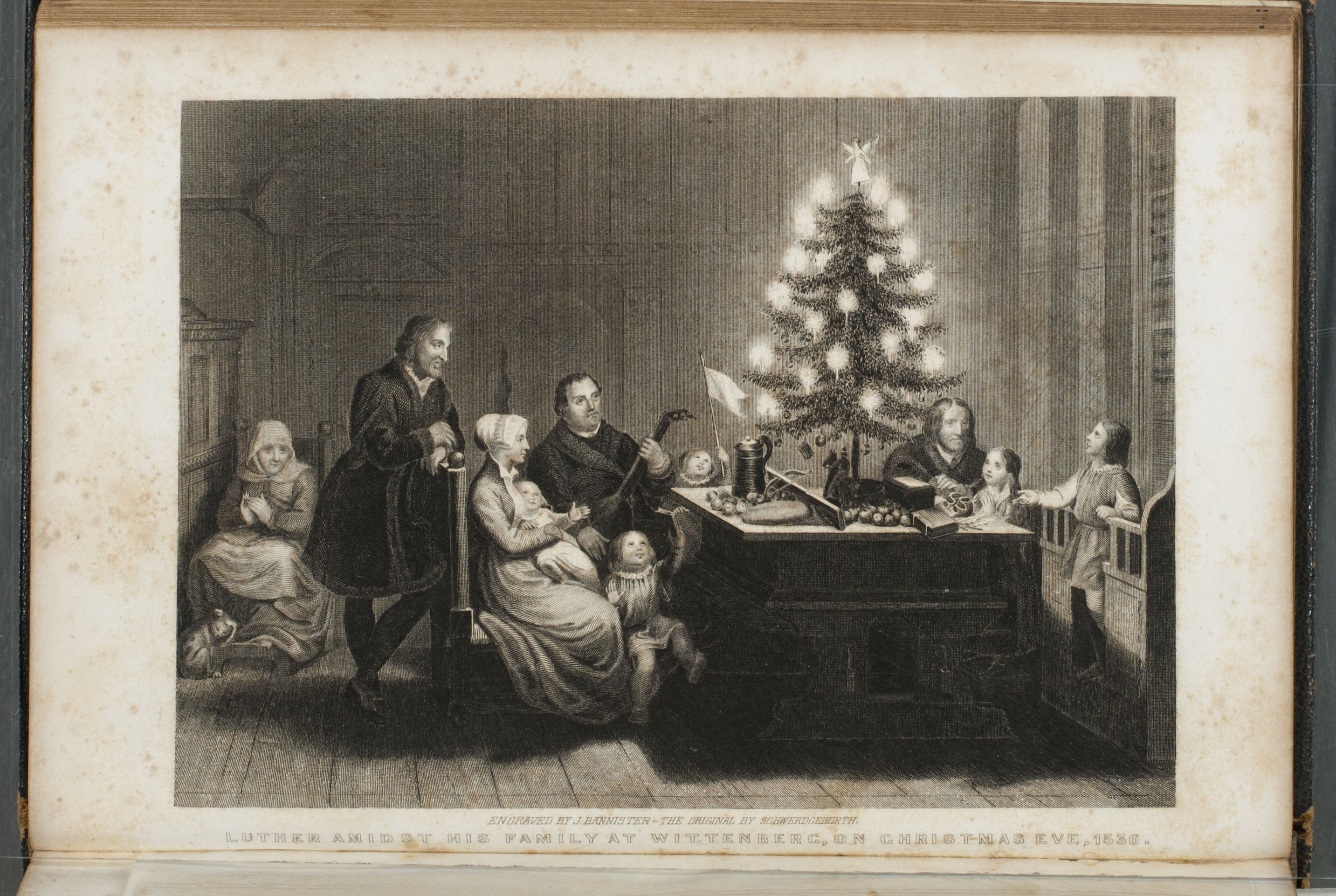
Luther Amidst His Family at Wittenberg on Christmas Eve, 1536 from Wheat Sheaf

Christmas trees were somewhat common in Pennsylvania German communities in the early 19th century, but not in the rest of the country until the 1850s and 1860s. In fact, in the same batch of books I have on my desk, there is another scene with a Christmas tree, but this is of Martin Luther and his family in 1536 from German artist C.A. Schwerdgeburth’s painting done in 1845. It was engraved in a gift book titled Wheat Sheaf from 1853 that was published in Philadelphia. Obviously, this isn’t an American scene, but it does showcase the tree. It also illustrates the popular myth that Luther was the first to light a tree with candles in order to express the “light of God” to his children.

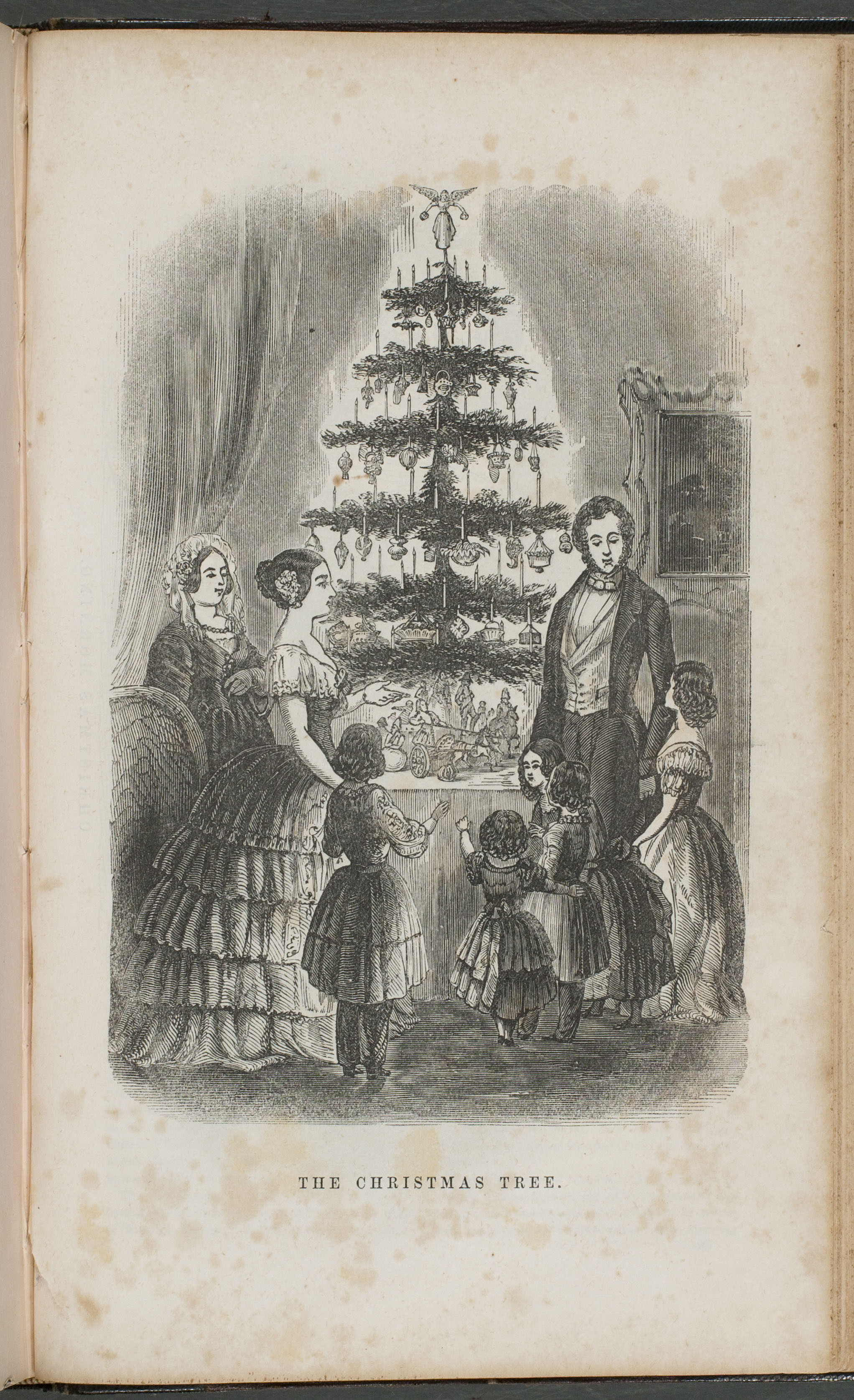
The Christmas Tree from Godey's Lady's Book

After doing a little more research on images of Christmas trees and I discovered that one of the earliest recognized images of an “American” Christmas scene with a decorated tree appeared in Godey’s Lady’s Book in 1850. The scene actually shows a modified version of the image of Queen Victoria and Prince Albert gathered around their Christmas tree in 1848. The engraver left out the Queen’s crown, and Prince Albert’s mustache. It is believed that this image, re-printed through the 1850s, gave housewives throughout the country the push to have decorated Christmas trees in their homes during the Victorian era.

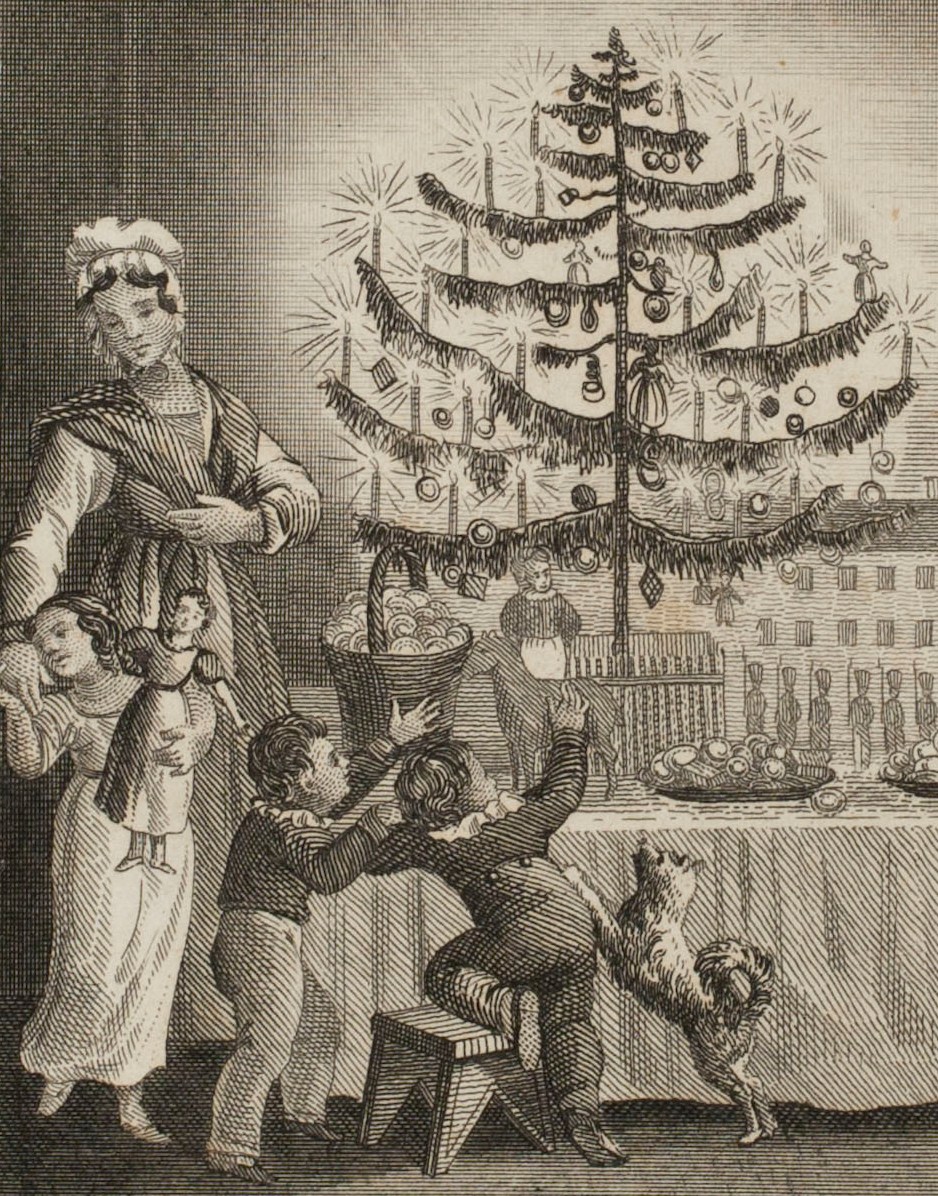
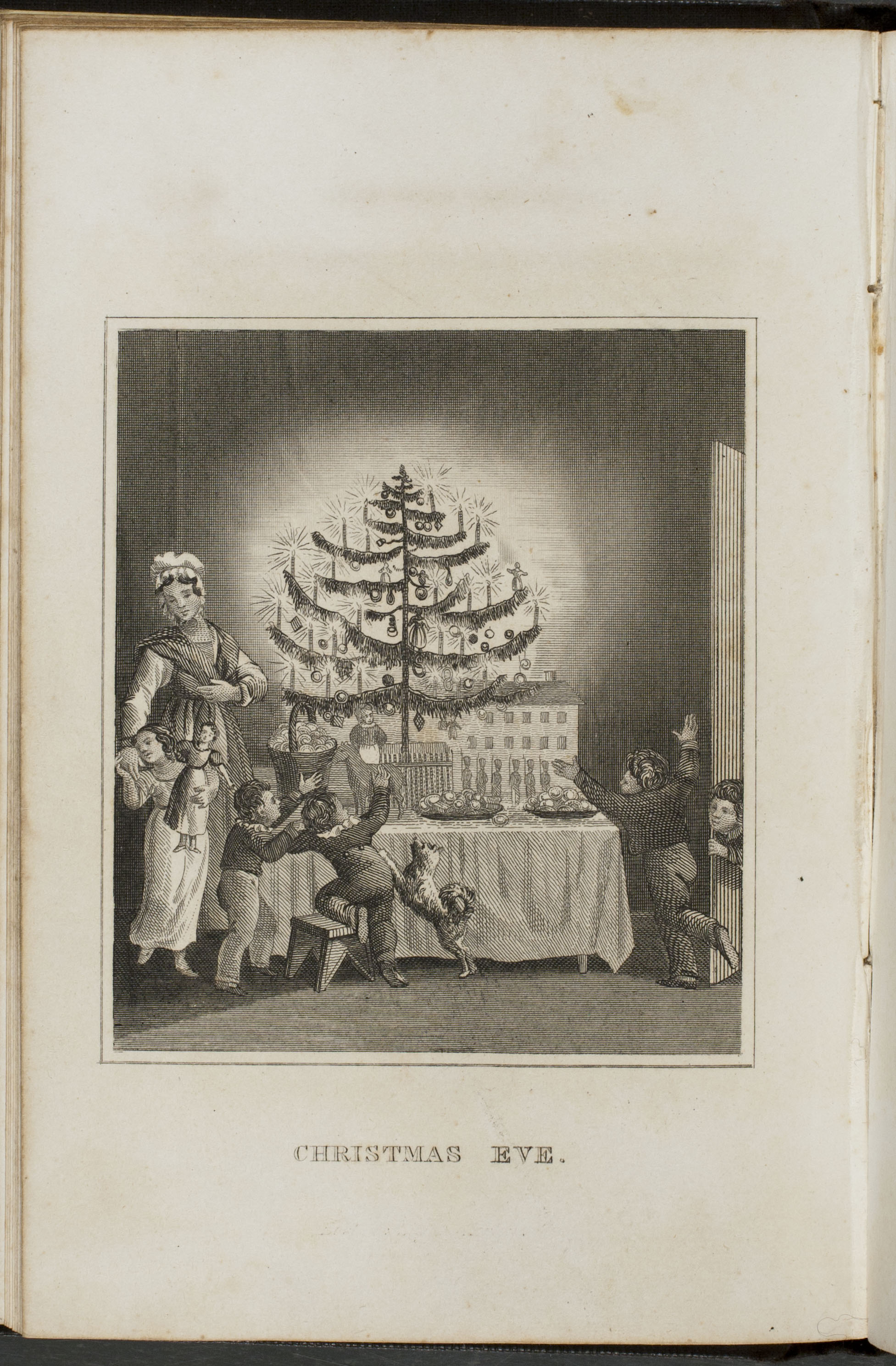
But if 19th-century publishers were anything like advertisers today, they knew not to only publish items directed to mothers, but to the most impressionable consumers — children. Like periodicals such as Godey’s Lady’s Book, gift books were also widely published. In one of those gift books aimed at children, the 1841 Youth’s Keepsake, A Christmas and New Year’s Gift, published in Boston, an image appears on p. 71 showing the quintessential Christmas scene, complete with a candle-lit and decorated Christmas tree. The text that accompanies the image tells the story.

Christmas Eve from Youth's Keepsake
A mother stands at left after calling her children down to the parlor with a bell, waiting for destruction of her decorated table. Five young children burst into the room and hurriedly take their gifts from the neatly arranged table. Little Bell has gotten a new doll and clutches it as she thanks her mother. Frank has gotten a large toy house, which he promises to “take it to pieces, and I shall be able to put it together again.” Little Bill peeks around the door to find a line of toy soldiers for himself. Even Dash, the family dog is excited to see if there are any treats for him on that table and jumps on one boy’s leg. Even the children’s father, not seen in this image, will find it hard not to get into the holiday spirit:

Papa, who has left his study … calls from the entry to beg they will be rather more quiet. When he gets fairly into the merry circle however, perhaps he will find himself soon joining in the riot himself.

What little girl wouldn’t like to see a sparkly tree on the table surrounded by dolls and toys and treats, and what little boy would turn down a set of blocks or a tree with candies hanging off of its branches? Surely this scene, almost ten years older than the image from Godey’s Lady’s Book, was shown to mothers and fathers by excited children who wanted the same pretty scene in their homes on Christmas Eve.

For further reading:
Snyder, Phillip V. The Christmas Tree Book.. New York, 1976.
Marling, Karal A. Merry Christmas! Cambridge, MA, 2000.

The Acquisitions Table: Joseph Dennie Papers

Dennie, Joseph. Papers, 1789-1790.

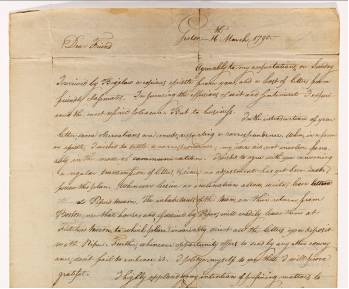
Joseph Dennie (1768-1812) was born in Boston. After graduating from Harvard College, Dennie studied law in Charlestown, NH. Two years later he began contributing essays to newspapers in New Hampshire and Vermont. In 1796 he became editor of Isaiah Thomas’s The Farmer’s Weekly Museum and continued writing essays. In 1799 Dennie moved to Philadelphia, where he continued his literary career.These letters were written to Dennie’s Harvard classmate Roger Vose. Most of them date from the six-month period beginning in December 1790 during which Dennie was rusticated from Harvard for insolence. When Laura G. Pedder published her edition of Dennie’s letters in 1936, she said that she did not have access to the letters to Vose; but she did include the text of typewritten transcriptions made by the genealogist Thomas Bellows Peck (1842-1915), probably in the 1880s. It will now be possible to compare those transcriptions against the original letters for accuracy and omissions. Purchase, Harry G. Stoddard Memorial Fund.

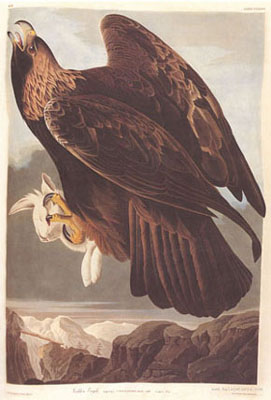
Audubon at the American Antiquarian Society

The record-breaking price for a double elephant folio edition of John James Audubon’s Birds of America in London on December 9, 2010, prompts the question: Does the Society own a copy. The short answer is no — not the double elephant folio edition — but the story is more interesting than that. Indeed, AAS came THAT close (note small capitals, not large, and certainly not bold). If AAS had been a subscriber, the sale would have been made by Audubon himself.

In December 1840, Audubon was on a tour to sell his work in the United States. The AAS Librarian at the time, Samuel Foster Haven, had already received a letter from the president of the Society’s Council, Thomas L. Winthrop, encouraging him to consider a purchase:

Mr. Audubon will call at the Society’s office and request you show him the Library. He will have with him a few copies of his celebrated Ornithology. I wish our Society could conveniently possess itself of his valuable works, having been disappointed in the ability of a considerable portion of his foreign subscribers to fulfill their engagements to pay him for his original work, he has been induced to publish it on a reduced scale, to consist of eighty-six numbers, at one dollar each.

Winthrop’s bibliographic reference was to a new, more affordable edition of Birds of America. Audubon had introduced an octavo edition (like the double elephant folio, it was also offered as fascicles) and was selling subscriptions to both. Audubon had also issued the text accompanying the illustrations in five volumes between 1831 and 1839 as Ornithological Biography: An Account of the Habits of the Birds of the United States of America, 5 vols. (Edinburgh, 1831-39), co-authored with the Scottish naturalist and ornithologist William MacGillivray.

While in Worcester, Audubon was hosted by the local bookseller, Clarendon Harris, who duly brought him to the library as part of the tour of Worcester people and places. Without talking turkey, Haven suggested that Audubon visit Elihu Burritt, the “learned blacksmith,” then residing in Worcester and studying in AAS collections, and return later. So Audubon and Harris continued on their way, visiting other prospects, and stopping for “2 glasses of good wine” with Attorney Isaac Davis. Audubon then returned to Antiquarian Hall to meet with Haven hoping to sell a subscription. But the library was already locked up! The librarian had departed for the weekend, and Audubon was scheduled to be on his way to Hartford, Connecticut, before the library would reopen.

AAS notwithstanding, Audubon made twelve sales in Worcester, all of the octavo edition. Not surprisingly, several were purchased by members of the American Antiquarian Society. While Haven left no statement on the matter, he might well have considered that one of these sets might one day reach the Society. If so, his surmise would have been correct, even if he could not have predicted which subscriber would be the donor. The complete copy now in the AAS collections has this provenance:

American Antiquarian Society copy the gift of Frances M. Lincoln, 1928. Inscribed: Frances M. Lincoln, Jan. 1866; ‘I give and bequeath to my granddaughter Frances Merrick Lincoln my copy of Audubon’s Birds of America, which is a subscription copy of that work and presented to me by my late husband; the same to be preserved by her as a token of remembrance.’ From the will of Mrs. Mary B. Merrick; M.B. Merrick.

This set had been purchased by F. T. Merrick. Stephen Salisbury bequeathed not his octavo edition, but his copy of the Ornithological Biography, and several other parts of the octavo edition are now in the collections as well.

As the guide to the Society’s collections indicates: “We have not yet obtained a set of that great book and we despair of ever again having the opportunity of doing so.” This leaves us to wonder, what if Audubon had not stayed at Worcester’s Temperance Hotel, where there was no wine in the cellar, and thereby passed up a tipple with Isaac Davis?; and would Haven have committed one hundred dollars for a subscription?

For further reading:
Gregory H. Nobles, “Ornithology and Enterprise: Making and Marketing John James Audubon’s The Birds of AmericaProceedings of the American Antiquarian Society (Oct. 2003): 267-302 (available for purchase on the AAS website as offprint number 1009).

John James Audubon’s double elephant folio edition of The Birds of America (4 vols., 1827-38), a massive work of natural history that offers the reader an innovative interplay between image and text, still stands as one of the most remarkable artistic and scientific achievements in the history of the book. For Audubon, though, producing this “Great Work” proved to be as much about entrepreneurship as ornithology. The changes in the popular perception of Audubon’s birds from his time to our own is the background for looking at the connection between the cultural and commercial significance of this big book about birds, which represents both an investigation of nature and an investment in art. The various ways people have valued Audubon’s work leads to the question of whether The Birds of America is — or should be — a book at all.

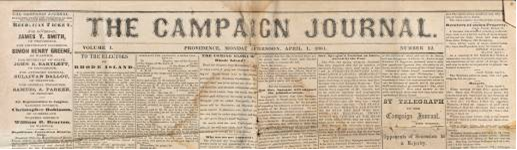
The Acquisitions Table: Campaign Journal

Campaign Journal. Providence, RI.  April 1, 1861.

This rare campaign newspaper, published by the Providence Journal, supported a slate of Republican candidates for state office. One of the candidates was Sullivan Ballou, a successful lawyer and up-and-coming politician in Rhode Island, and a strong supporter of Abraham Lincoln. During the Civil War he dropped all political aspirations and volunteered for service with the 2nd Rhode Island Infantry, only to be mortally wounded at the First Battle of Bull Run. Ken Burns immortalized him in his documentary, The Civil War, by highlighting the eloquent letter Ballou wrote to his wife from the battlefield two weeks before he died. Gift of Vincent Golden.

The Acquisitions Table: An die freyen Erwähler von Berks County

An die freyen Erwa?hler von Berks County. Reading, PA, [ca. 1823]

This German-language broadside from Berks County, PA, celebrates the life and achievements of Andrew Gregg (1755-1835). Gregg had served in the Delaware militia during the Revolutionary War and was elected a Congressman and Senator for Pennsylvania from 1807 to 1813. By 1823, Gregg had been away from Washington politics for a decade, working as a banker and serving as Secretary of State for Pennsylvania. He ran unsuccessfully for governor in 1823 and it is likely that this broadsheet, with its descriptions of past military gallantry and federal service, was intended to assist him during the campaign. Purchased from Jean’s Book Service. Adopt-a-Book Fund.

Recipe Squashed!

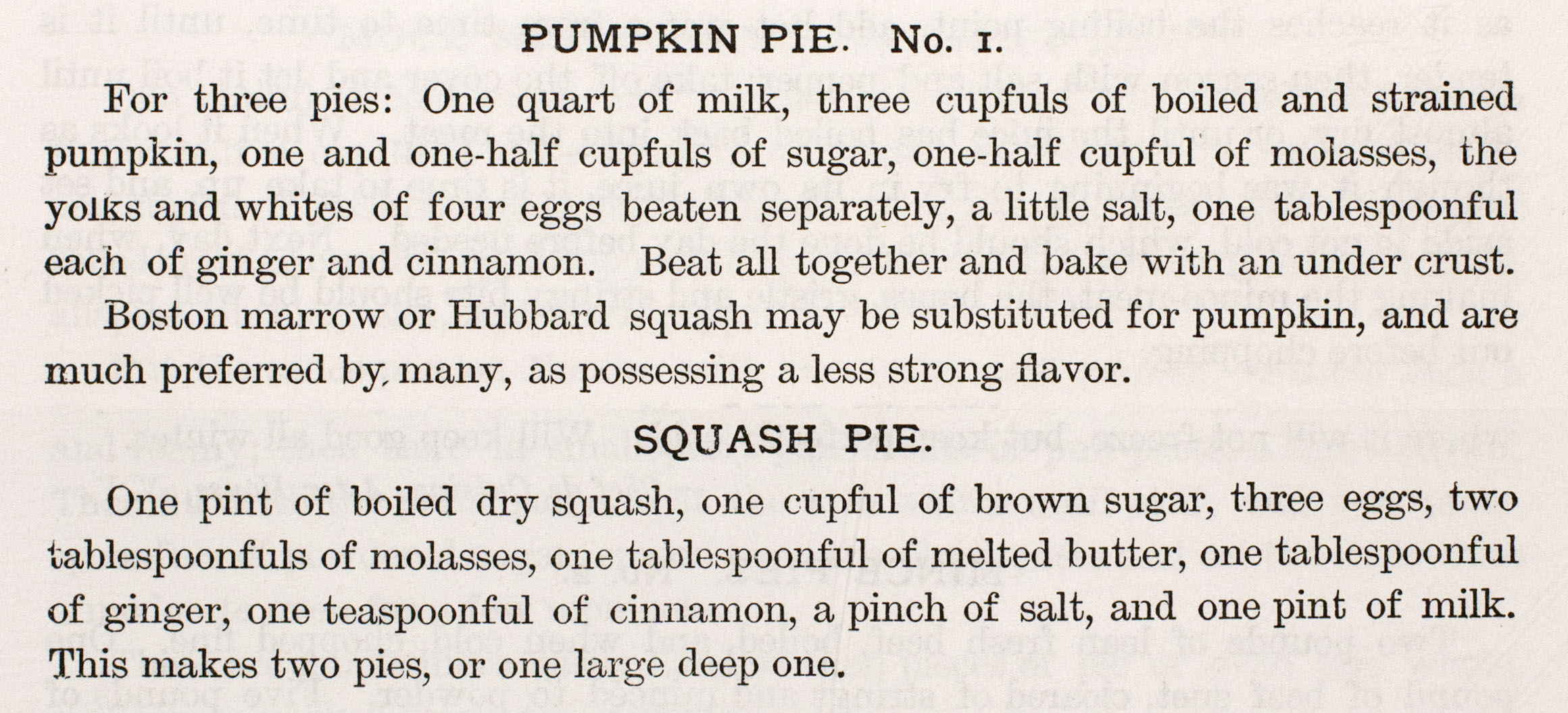
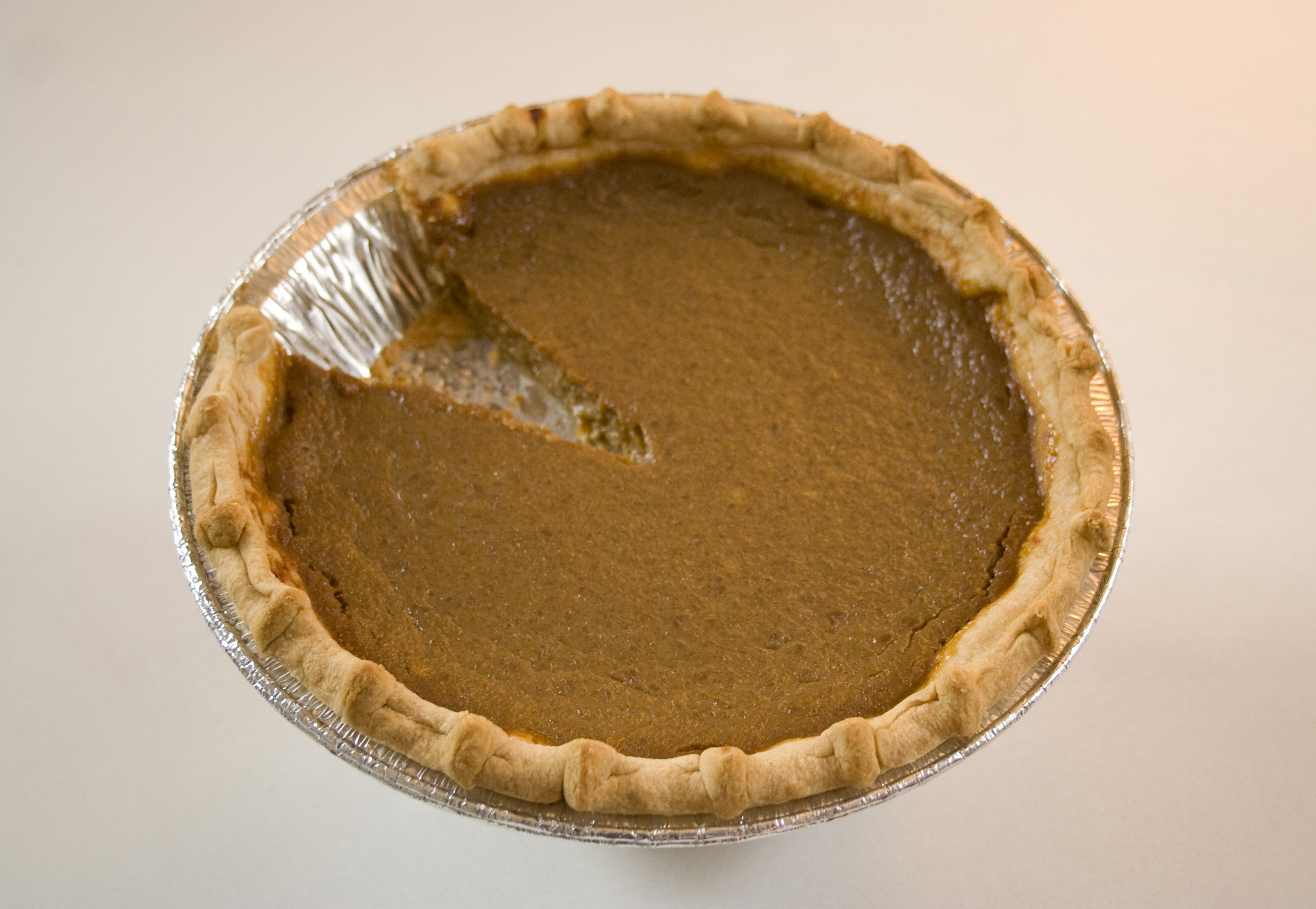
I hope you all enjoyed your Thanksgiving feasts!  Hopefully you didn’t overload too much on pumpkins, squash and sweet potatoes.  If you can still stomach thinking about food, read on about the results of my historical pie adventure.  I chose to follow the pumpkin pie recipe (from The White House Cookbook, 1877), but to mix it up a bit by swapping the pumpkin with squash, as was recommended at the end of the recipe.  The results?  This pie recipe will be filed away in my “interesting” category.  Better than disastrous, but not something I’d make for my next dinner party!

The toughest challenge I’ve found in translating these historic recipes to modern day is managing my expectations.  Making the squash pie definitely brought this to light.  I expected the squash pie to come together like a modern pumpkin pie, which I’ve made too many times to count.  But of course it didn’t, and why would it?  Not only are the ingredients and baking process different, but tastes and expectations are different now too. 

The best example of blown expectations with my squash pie was consistency.  I’m so accustomed to that wonderful pudding-like consistency of pumpkin pie filling, due in large part to the thickness of the pumpkin in a can.  While the freshness of the squash was a welcome change to the recipe, the texture was not.  I strained as much water as I could from the squash, but it still did not reach the cream-like texture of the pumpkin in a can.  And the recipe called for no other substantial dry ingredients aside from sugar!  Add in the fact the recipe called for more milk than any other ingredient, and I was left with a completely liquid filling.  I was sure it would never set, and gave up on the pie before it even went in the oven.

But lo and behold, it did set (1 ½ hours later!) and while the end product was still not the same as the pumpkin pie on our Thanksgiving dessert spread, it was entirely edible, flavorful, and a welcome change.  And that’s the important thing to remember when following old recipes – change, and welcoming it!  Understanding that historic dishes will not always resemble modern dishes is what makes the process so much fun.  I just need to be sure to let people know these dishes are from old recipes so they don’t think I can’t make a decent pumpkin pie, according to their expectations, of course! 

So all in all, the pie had a great freshness about it, the consistency was close enough to my expectations, but it was overwhelmingly sweet.  The amount of sugar could probably be cut in half because of the natural sweetness of the squash.  But then again, folks in the 19th century probably expected their squash pie to be that sweet!

A Small Masterpiece and Its Illustrator are Re-Discovered!

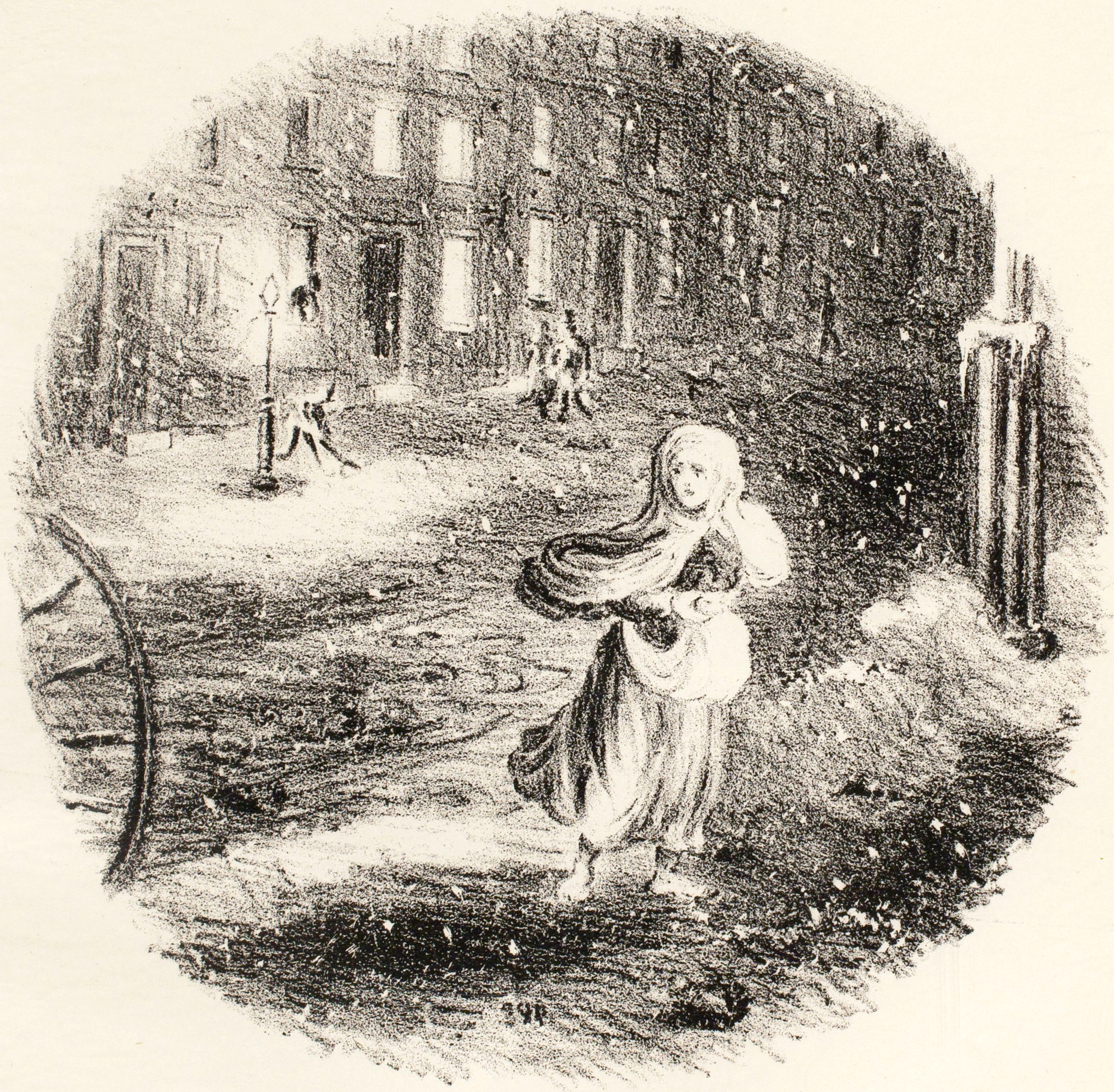
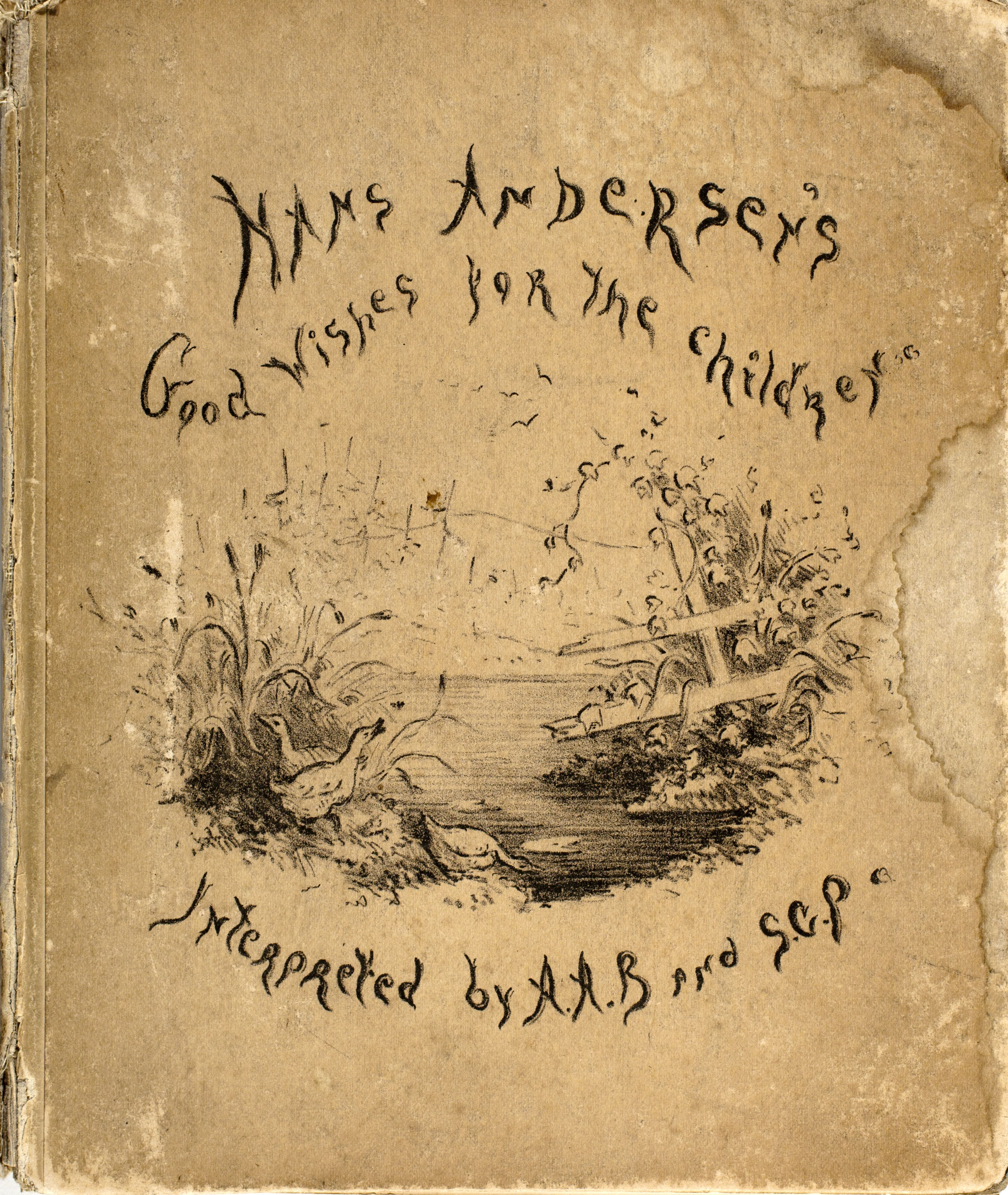
This haunting lithograph depicting Hans Christian Andersen’s Little Match-Girl is taken from the rare collection of Hans Andersen’s stories, Good Wishes for the Children, interpreted by A.A.B. and S.G.P., published by the famed Riverside Press in 1873. AAS acquired its copy from the illustrious bookman Benjamin Tighe in 1967, and up until now, the identity of the translator A.A.B. and the illustrator S.G.P. remained a mystery.

In a wonderful turn of serendipity, I recently received a phone call from an AAS member who was about to purchase a copy of this edition. As it turns out this copy had an inscription to “Mr. Mifflin” (George H. Mifflin of the Riverside Press) signed by Avis A. Bigelow and S.G. Putnam. My AAS friend wanted to know if I knew anything about either of them. This question took me to our copy of Who Was Who in American Art. I discovered that S.G. Putnam could have been either Stephen Greeley Putnam, a wood engraver born in 1852 who studied with American artists Henry Walker Herrick and Elias J. Whitney, or Sarah Gould Putnam, a portrait painter who was active in the late nineteenth/early twentieth centuries. Both artists exhibited in the late nineteenth century.

Fortunately for me, I searched Worldcat.org, and discovered that Massachusetts Historical Society has the diaries and papers of Boston portrait painter Sarah Gooll Putnam (1851-1912). Reading the thorough collection description, I found that MHS also has extensive holdings of Miss Putnam’s pencil sketches, a fact I found striking given the soft pencil quality of the lithographs in Good Wishes for the Children. It turns out that Sarah Gooll Putnam was a wealthy Boston socialite who spent most of her life in Boston’s Back Bay when she was not traveling in Europe and the American West. She exhibited successfully in Boston, Chicago, and New York, with the likes of John LaFarge. All of this information was promising, but not conclusive. I eagerly scanned the contents guide, and I discovered what I was hunting for: Miss Putnam’s photograph of Hans Christian Andersen with the caption, “Photograph sent to me through Mr. Horace Scudder, April 27th, 1874”–within a year of my book’s publication! Horace Scudder was the legendary children’s book author and long-time editor for the Riverside Press.

At this point, I delved into AAS’s truly first rate collection of secondary literature: I discovered that AAS has a copy of The Andersen-Scudder Letters, published in 1941. Sure enough, I found the following passage in a letter from Horace Scudder to Hans Christian Andersen, dated January 15, 1874:

I sent you … a little book which has a history. It is entitled Hans Andersen’s Good Wishes for Children, interpreted by A.A.B. and S.G.P. These two young ladies, Misses Bigelow and Putnam, of Boston, wished to contribute something in aid of the Children’s Hospital, a very worthy and humane institution in Boston. Accordingly, Miss Bigelow translated several of your stories anew from the German version and Miss Putnam drew on stone the accompanying illustrations. We printed the book for them and I begged them to let me send you a copy with their autographs. … it would give me very great pleasure if I might be the means of securing from them one of your valued letters with photographs. … they are not professional author and artist, but ladies in refined society.

Andersen responded by sending both young ladies his photograph.

In short, Hans Andersen’s Good Wishes for the Children deserves a second look, not just because of its rarity, but because of the clearly original illustrations by an artist whose work has been partially obscured by anonymity and her nineteenth-century status as a “lady” (read permanently amateur) artist. The time has come to enjoy her contribution to Hans Andersen’s Good Wishes for Children as the masterpiece that it is.

Now, if I only had the same success in uncovering the life and career of Avis A. Bigelow…

The Acquisitions Table: Egyptian Mummy

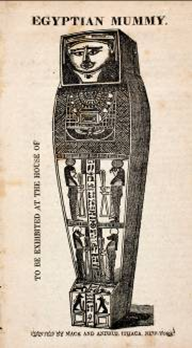
Egyptian mummy. To be exhibited at the house of [     ]. Ithaca, NY: Mack and Andrus, [between 1825 and 1828]

Only known copy, previously unrecorded, of this 8-page promotional pamphlet. Early in 1826, two Egyptian mummies cleared customs in New York on their way to Peale’s Museum and Gallery of Fine Arts on Broadway. One mummy proved sufficient, however, and the other was sold the next year to three men from upstate New York. Placed on exhibition at Ithaca, it was then trundled around New York, Vermont, and western Massachusetts for the next year and a half, drawing crowds wherever it stopped. Outside of Albany, however, the mummy was stolen by a group of over-zealous medical students, never to be seen again in whole or in part. This pamphlet, with full-page woodcut on the first page, was distributed by the promoters at each stop to drum up business—a blank space was left for the exhibition venue to be added in manuscript—and handed to paying customers. AAS has another Ithaca-printed pamphlet, with identical woodcut but partly variant text, which presumably predates this one. Purchased from Steve Finer. Henry F. DePuy Fund.

The Acquisitions Table: Lessons for Children

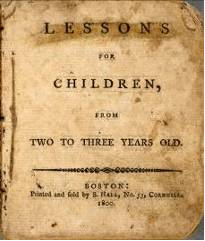
Barbauld, Anna Letitia. Lessons for Children, from Two to Three Years Old. Boston: S. Hall, 1800.

This is an unrecorded title, drawn from English writer Anna Letitia Barbauld’s series of Lessons for Children written for youngsters between the ages of two and six. They are written as a series of dialogs between a child (frequently a little boy) and a parent (usually a well-informed mama). Publisher Samuel Hall (1740-1807) notes on the last page that the title probably should have been changed to Lessons for Children from Three to Four Years Old, because in the opinion of “many judicious persons,” children do not learn to read much before age three or four. Purchased from James Visbeck. Ruth E. Adomeit and Harry G. Stoddard Memorial Funds.