It’s a lovely brew, farinaceous and balsamic without being overtly alcalous.

Making beer, hard cider, and other spirits at home has long been part of American culture. Most students of American history know this and know that both genders consumed alcohol and that children did as well. I was surprised though, to learn how much alcohol was consumed. According to Sarah Hand Meacham in her book Every Home a Distillery: Alcohol, Gender and Technology in the Colonial Chesapeake (Baltimore: Johns Hopkins Press, 2009), “[b]y 1770, the average white adult male had the equivalent of seven shots of rum per day, and an average white woman drank almost two pints of hard cider per day.” Apparently, consuming mass quantities did not start with the Coneheads.
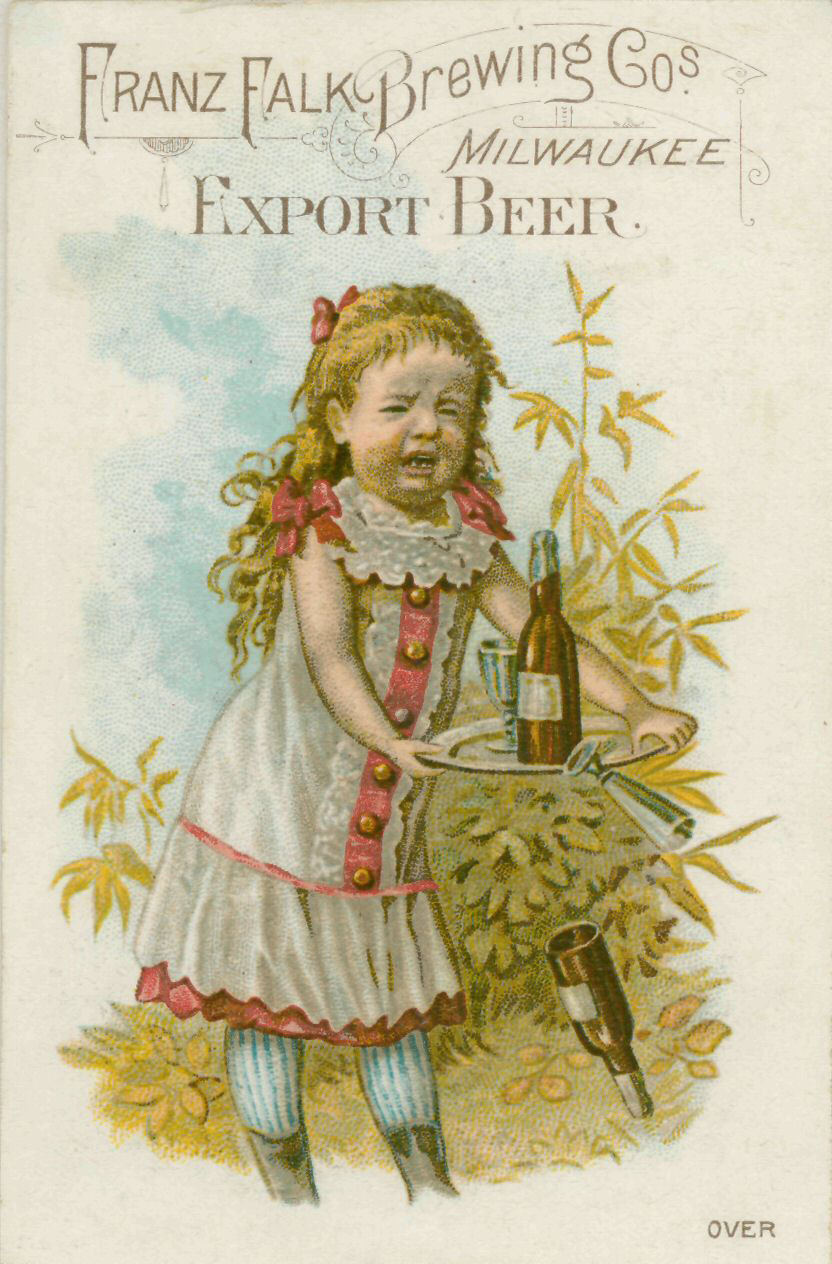
Once beer was available commercially, it also began to be advertised. This early beer ad has an image of a girl crying over spilled beer comes from an advertising trade card.
Given the importance of alcohol in the lives of early Americans, it makes sense the colonists would produce as much as possible at home. Of course, in colonial America, before manufacturing took hold, many things had to be made at home or not made at all. However, even after beer was available commercially, many families made it at home and for many of the same reasons people continue to concoct home brew: to save money and to specify the ingredients.

For anyone interested in early American brewing, from technique to recipes, from the economics to societal impacts, the American Antiquarian Society has some great resources. The collections include reference works like the aforementioned Meacham title, but also, naturally, the Society has 18th and 19th century works aimed at the home brewer. One great example is Every Man His Own Brewer, A Small Treatise, Explaining the Art and Mystery of Brewing Porter, Ale and Table-Beer, by Samuel Child (Philadelphia, 1796) (available digitally through Readex’s Early American Imprints, Series I: Evans, 1639-1800). This treatise was originally published in London but Philadelphia publisher Thomas Condie (1775?–1814) reprinted and edited it for the American audience. Evidently the recipe (called receipts in the pamphlet) for porter was a closely held secret in the late 18th century but Child, who opined “for celebrity, universal use and estimation Porter as not been equaled by any other liquor,” wanted to reveal the secret for the benefit of the lower classes.
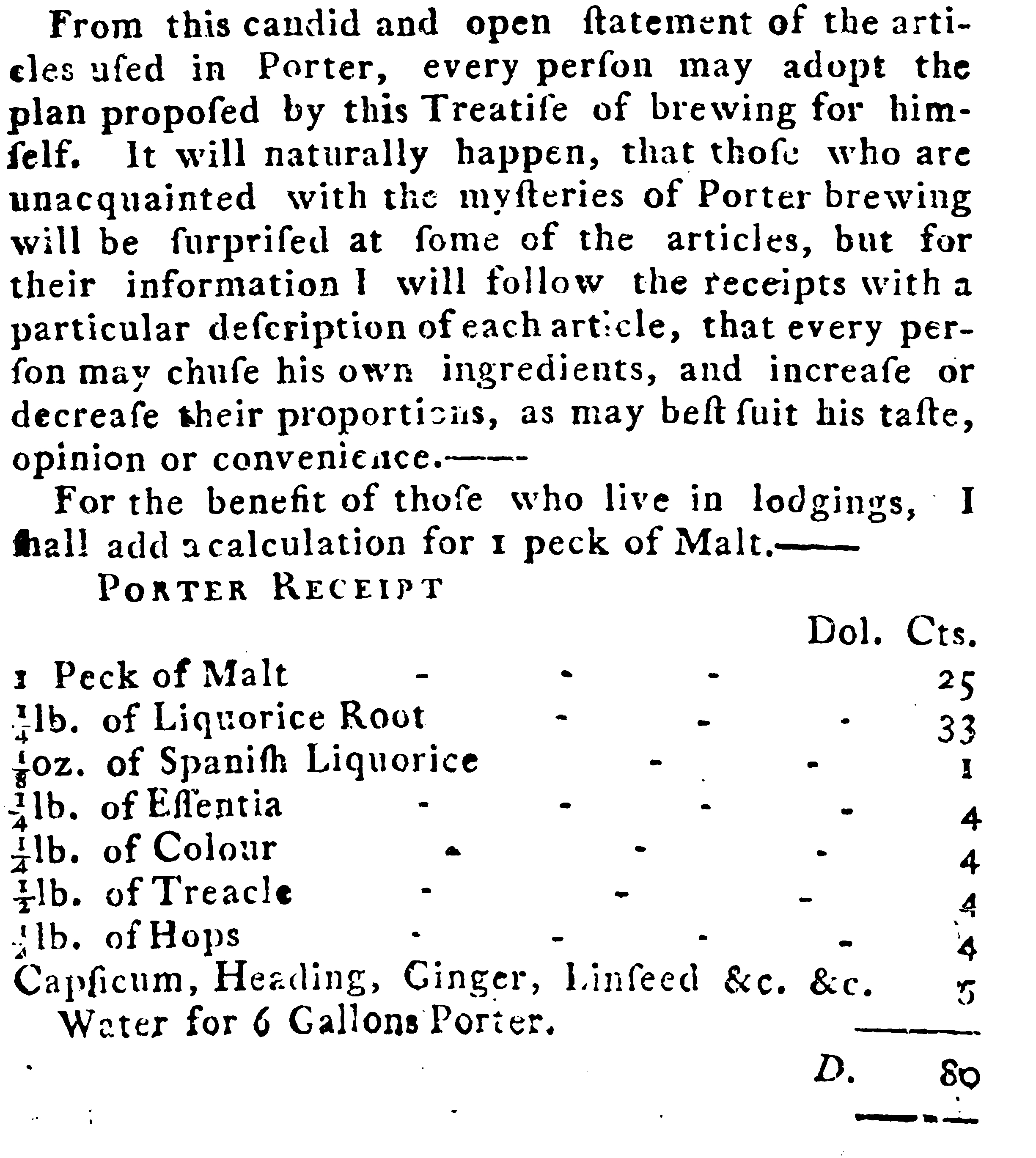
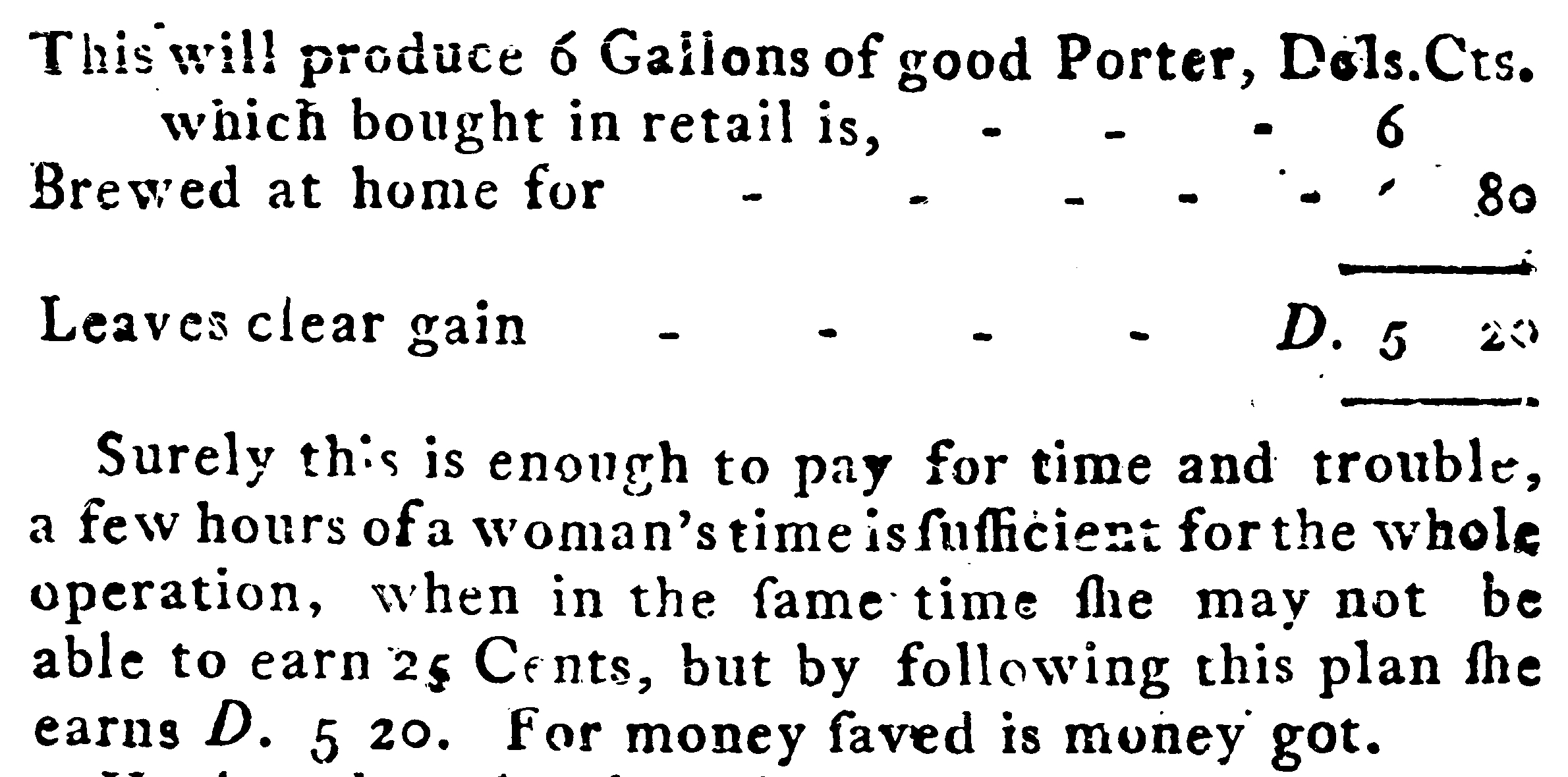
Notice how the calculations take into account the economic value of a woman's time even though the publication is called Every Man His Own Brewer, p.8-9.

Child’s recipes include prices (which Condie has edited to reflect American currency) and comparisons to equivalent portions purchased commercially. He calculates the savings for us so we can easily justify the effort expended. Child’s recipes include some exotic ingredients like cocculus indicus, coriander, and capsicum, the former two of which were banned by British Acts of Parliament for their “poisonous and stupefactive” qualities. Child, ever the iconoclast, tells us he uses them anyway (Condie tells us not to). Lastly, the treatise includes explanations of the techniques and equipment necessary to brew porter and the other recipes. With a little effort (Child’s play?) and a little research, one can see oneself making these 18th century brews.

Two other works from the AAS collection expound the health and economic benefits of brewing at home. The Complete Family Brewer; or The Best Method of Brewing or Making any Quantity of Good Strong Ale and Small Beer, In the Greatest Perfection, for the Use of Private Families; from a Peck of Malt to 60 Bushels (Philadelphia, Graves, 1805) appears nine years after the Condie title, and is much easier for the modern reader to comprehend (it is also available digitally through Readex’s Early American Imprints, Series II: Shaw-Shoemaker, 1800-1819).
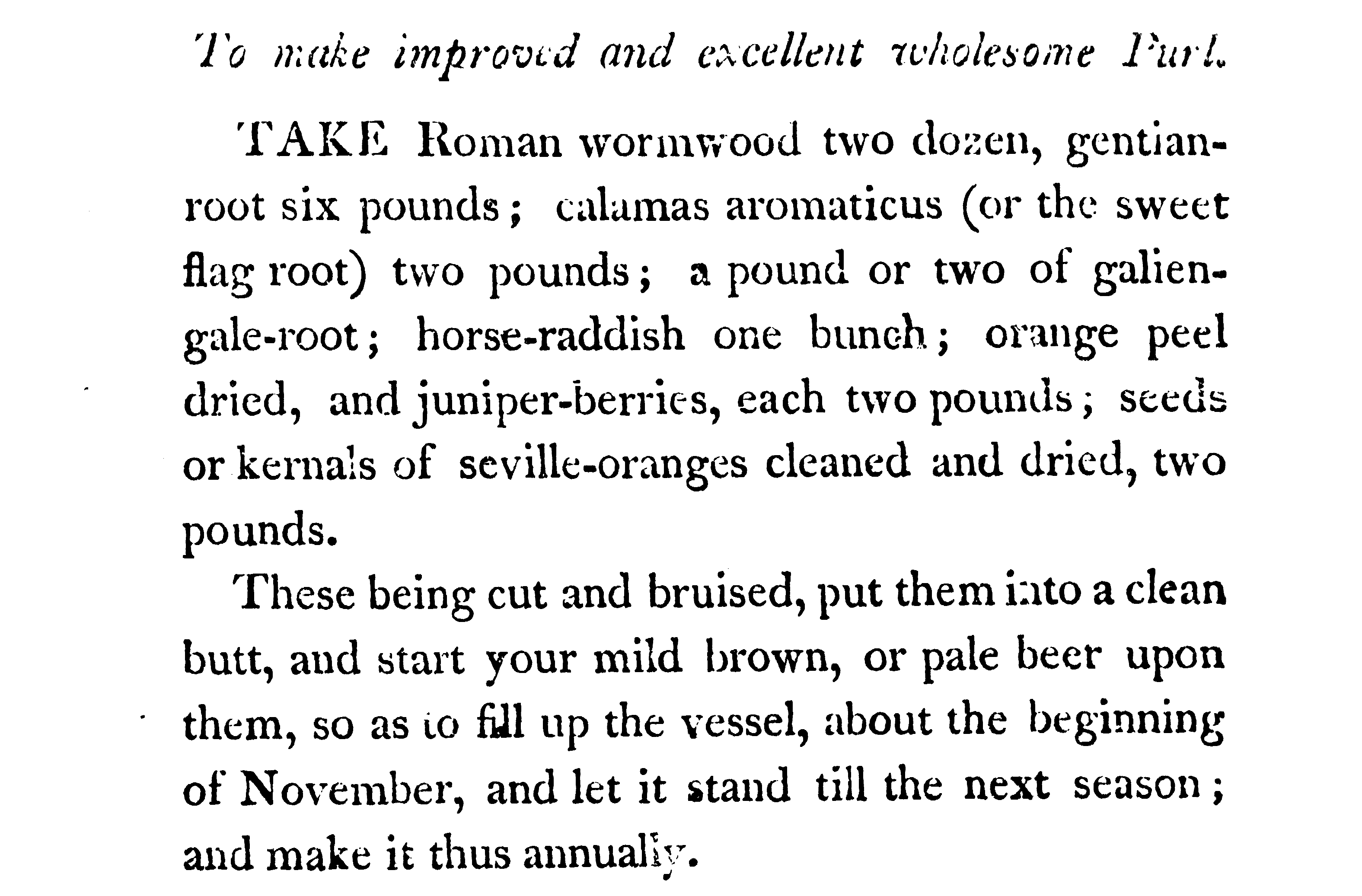
Purl recipe from The Complete Family Brewer, p.17.
The Complete Family Brewer covers some of the same ground as Child and Condie, (e.g., it gives similar economic justifications) but gives more recipes, including ones for China Ale, Elderberry Ale (aka ebulum) and purl (aka dog nose) which is beer infused with wormwood (yes, the main ingredient in absinthe). The anonymous author claims the recipes and techniques are so easy “that a Child of ten years of Age may learn to do it in five Minutes.” This work is especially helpful with technique and troubleshooting beer problems like sourness, staleness, and “beer tasting of the cask.” In fact, part of the very long subtitle of this pamphlet is “Cleansing and Sweetening Foul, Dirty, Musty, or Stinking Casks, Brewing-Vessels, &c…” which makes skunky beer seem not all that bad by comparison.

The third work is a book written by an M.D, Marcus Lafayette Byrn (1826–1903) lending credence, no doubt, to the salutary effects of consuming one’s own beer. The Complete Practical Brewer; or, Plain, accurate, and thorough instructions in the art of brewing ale, beer, and porter : including the process of making Bavarian beer; also, all the small beers … Adapted to the use of public brewers, and private families, or those who may wish to brew on a small scale : With numerous illustrations, by M.L. Byrn, M.D. (Philadelphia: Henry Carey Baird, 1852). It runs to nearly 200 pages and is therefore much more comprehensive than the pamphlets. This work, which had numerous editions, includes chapters for commercial operations (e.g., there are instructions with diagrams for building kilns to malt your own grain) but also includes chapters for “private families.” In addition to a great deal of advice on technique, Dr. Byrn (who also published a book on distilling spirits — I am not sure the AMA would approve) provides numerous and sundry recipes for potables such as Burton Ale, Welsh Ale, Reading Ale, Currant Wine, Mead, Ciders, Root Beer, Ginger Pop, and Scurvy-Grass Ale (“considered a rectifier of the blood” and “highly recommended by some medicinal men”).

These works and the many other brewing related materials at the AAS document the history of private beer making in America. They can edify. They can be used in scholarly works. Yes. But they can also be a source of justification for imbibing. If your rationale for purchasing your favorite micro-brew is wearing a bit thin, consider the words of Samuel Child:

The natural constitution of man, requires a portion of liquid aliment to assist digestion and nutrition; and the hard-working class of the Community, receive from it support, spirits and strength; it is no wonder then, that the ingenuity of man has been exerted to produce liquors at once pleasant to the palate, reviving to the spirits and productive of support.

Who can argue with that?
Sweet Potatoes, Pumpkins, and Squash … Oh My!

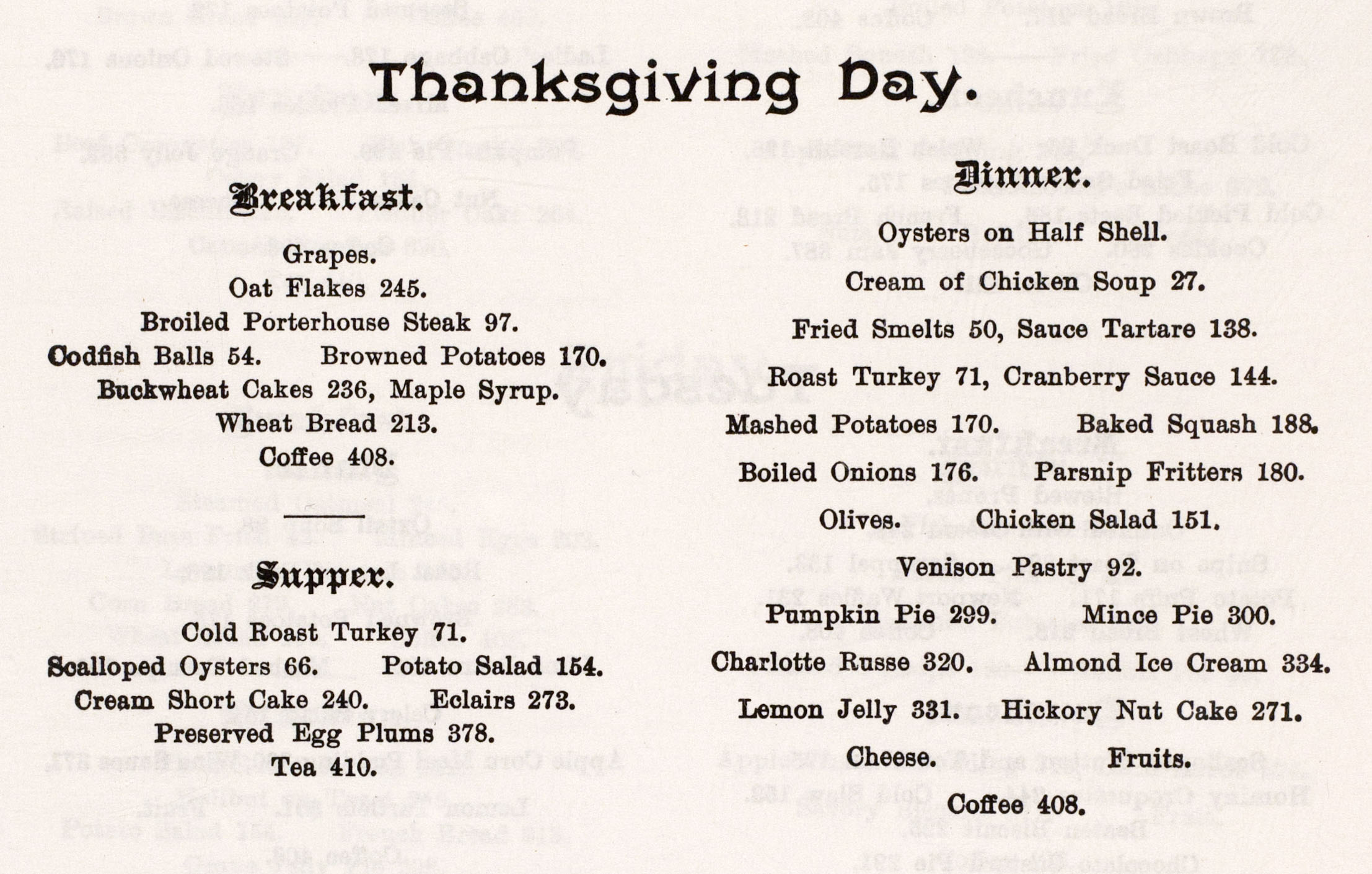
Believe it or not, Thanksgiving is less than a week away.  So for all of you hosts and hostesses out there, I thought I’d share a menu to make your worries seem a little less overwhelming.  Perhaps you, like me, are already stressing about the big day, planning and shopping and worrying about how to keep people out of the kitchen as you prepare dish upon dish. If so, take solace in the fact that you are not preparing a Thanksgiving dinner at the White House.  Below is a menu taken from The White House Cook Book: Cooking, Toilet and Household Recipes, Menus, Dinner-Giving, Table Etiquette, Care of the Sick, Health Suggestions, Facts Worth Knowing, Etc., Etc.  This cyclopedia, compiled by Mrs. F.L. Gillette and Hugo Ziemann, Steward of the White House, was published in 1887 (although the excerpts in this post are taken from a 2003 reprint of the original).  As you can see, Thanksgiving at the White House was (and I’m sure still is) quite the feast.

Since I am not brave enough to take on the challenge of recreating a complete White House Thanksgiving this year, I will only tackle one dish.  If anyone out there is brave enough, or would like to see the recipe for a dish featured on this menu, let me know and I’ll post the recipe. 

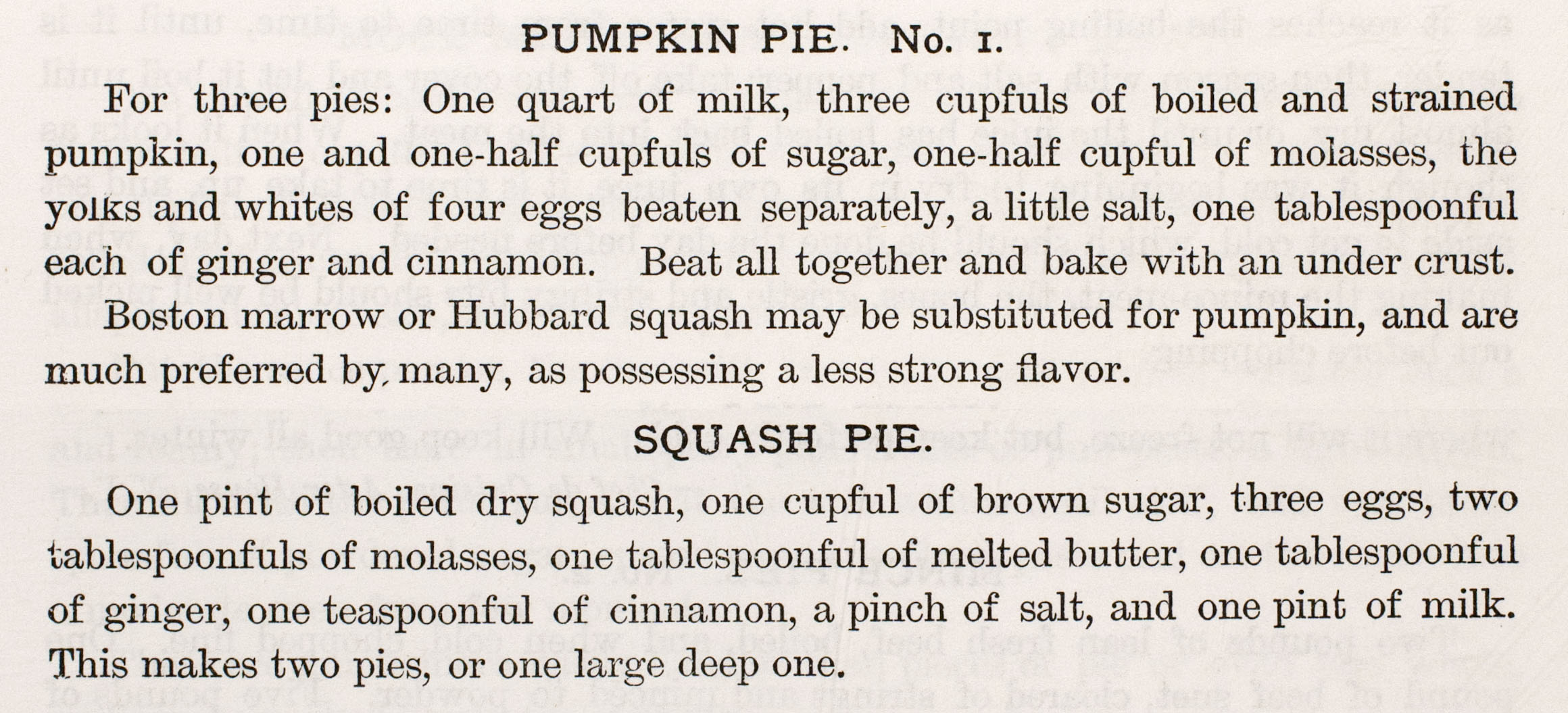
This time around, I’ll be doing dessert.  I will have a traditional, modern pumpkin pie at Thanksgiving (you know, one can of pumpkin, some eggs, Pillsbury crust…) but will feature alongside this pie a pie from the White House Cook Book.  Pumpkin pie is featured on the Thanksgiving menu, but in looking up the recipe, I saw there are also some very tempting recipes for squash pie and sweet potato pie as well.  Since they are all basically in the same family it remains to be seen which one I’ll make, but either one will pair well with the modern pumpkin pie and serve as a nice comparison.

To the left are recipes for both the pumpkin and squash pies.  The sweet potato pie recipe is the same as the squash pie, and only swaps title ingredients.  Although the recipes are not very complicated and do not deviate greatly from a modern recipe, it will be interesting to see what a difference fresh pumpkin/squash/sweet potato makes compared to the canned variety.  Also, having control over the seasonings may spice things up as well.  I’ll be sure to report back on the results, but in the meantime, happy Thanksgiving preparations to you all!

The Acquisitions Table: Ashtabula Telegraph

Ashtabula Telegraph. Record Book, 1849-1853.

The Ashtabula (OH) Telegraph was founded in 1846. The publisher was N. W. Thayer and the editor was W. E. Scarsdale. This ledger of nearly 300 pages covers the years 1849-1853 and details Thayer’s accounts with a large number of customers. Activities include subscriptions to and advertising in the Telegraph, job printing of cards and handbills, and printing materials imported by water from Buffalo. Purchased from Jean’s Book Service. Harry G. Stoddard Memorial Fund.

Join Us Tomorrow Night for “Random Notes from a Book History Bureaucrat”

This Tuesday, November 16, at 7:30 p.m., John B. Hench will be presenting the twenty-seventh Annual James Russell Wiggins Lecture in the Program in the History of the Book in American Culture at the American Antiquarian Society.

John B. Hench is the retired vice president for collections and programs at AAS. His talk, “Random Notes from a Book History Bureaucrat,” will combine elements of memoir, reflections on the development and influence of the Society’s Program in the History of the Book in American Culture, and notes on some of the themes in his recent scholarship on publishing in the World War II era.

John B. Hench worked at AAS for 33 years, beginning as editor of publications in 1973. He is the author of Books as Weapons: Propaganda, Publishing, and the Battle for Global Markets in the Era of World War II (2010). Additionally, he co-edited The Press and the American Revolution (1981) and Printing and Society in Early America (1983).

The Wiggins Lecture is named for James Russell Wiggins (1903-2000), chairman of the Society from 1970 to 1977. He was editor of the Washington Post and, until his death at the age of 96, editor of the Ellsworth (Maine) American. Wiggins also served as U.S. ambassador to the United Nations in 1968.

More information and directions are available on the AAS website by clicking here.

Lee & Shepard and the Great Fire

One of the most interesting aspects of the manuscript collection here at AAS is its collections focused on the book trade in America.  And one of the most interesting collections concerning the book trades is the business records of the Boston publishing firm, Lee & Shepard (for a PDF of the collection finding aid, click here). The 12 box collection features correspondence, book orders, and receipts from the founding of the business in 1860 until its incorporation with the Boston publishing house Lothrop & Company in 1906.  The collection has proved popular for researchers, especially those interested in finding letters from famous authors to the publishing firm.

But letters from authors are not the only exciting finds in the Lee & Shepard Collection.  While searching through the card file that indexes correspondences coming into the company, fellow AAS staff member Sally Talbot kept coming across letters that mentioned a fire.  A few Google searches later, and she discovered Lee & Shepard was a victim of the Great Boston Fire of 1872!  This “great” fire is said to be the worst in the city’s history, destroying much of downtown, hitting the financial district especially hard, where Lee & Shepard was located.  And if that discovery isn’t enough, how about this fun connection – the anniversary of the fire was just this past Tuesday, November 9th.  You can read a Boston Globe article about the fire here.

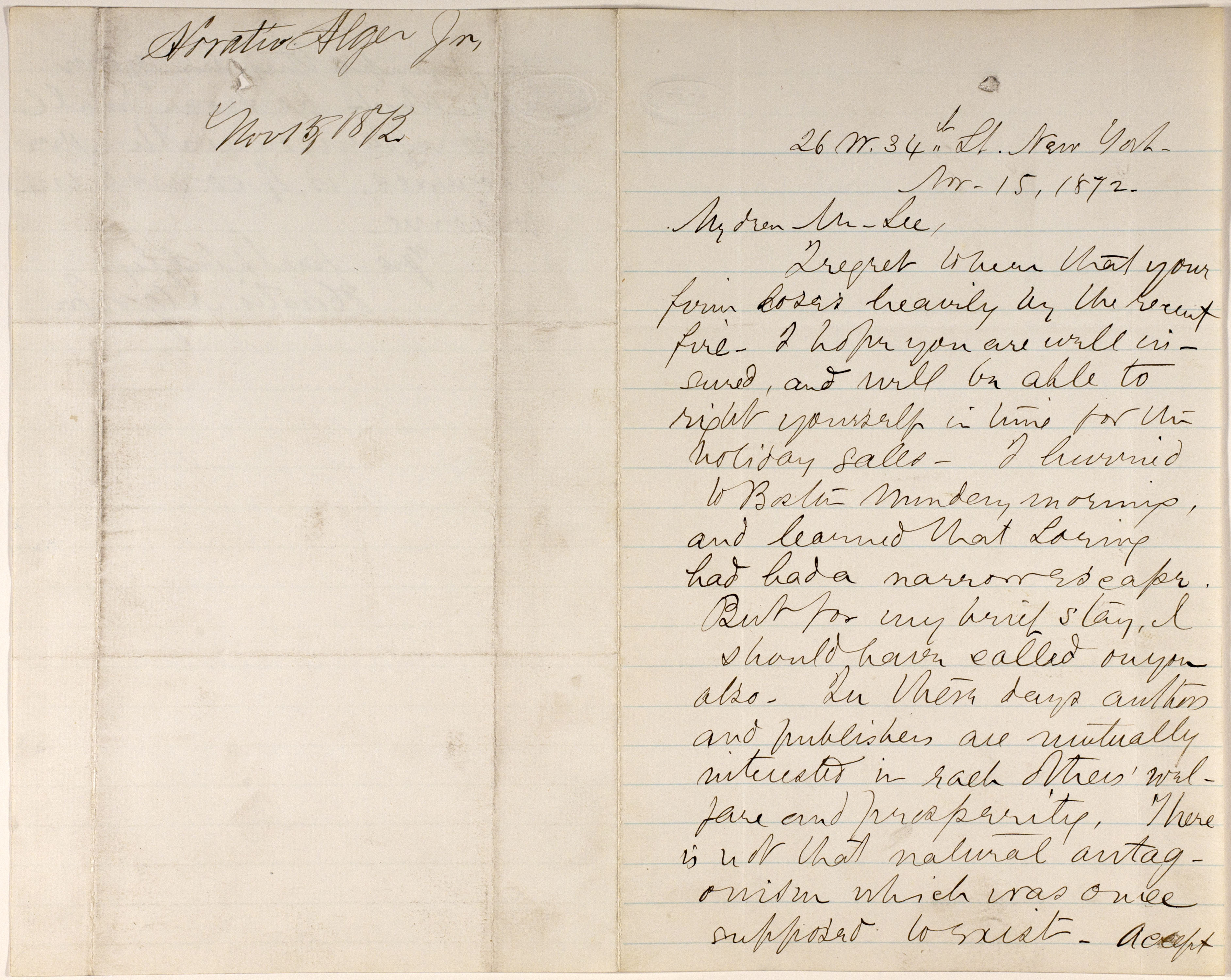
These letters show us how the fire impacted the company, and are an insightful look into how other companies were impacted as well.  Some folks were understanding – “Sorry you were burnt out,” sympathized Horatio Alger, Jr.  Others not so understanding, such as Mr. Armstrong, who reminded Lee & Shepard that they had already been given an extension, and will not be given another one – fire or no fire!

Many questions still remain.  How exactly did the fire physically and financially affect the company?  What buildings were burnt down?  Obviously they did not lose their records or paperwork, since we have this collection of papers.  However, perhaps the collection should be even larger, and some was indeed lost.  So what exactly did they lose, and how did they manage to recover?  And did Andrew Armstrong ever get his money?    More research is definitely in order!

The Acquisitions Table: Amateur Newspapers

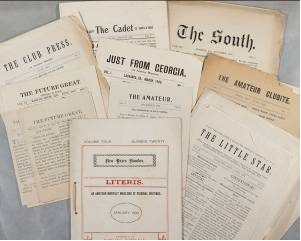
Collection of amateur newspapers.

One of our new members, Stan Oliner, is very active in the field of amateur journalism through collecting, writing articles, and serving in national organizations. A while ago, he mailed AAS a large gift of amateur newspapers that we are eagerly going through, selecting many issues for our collection.  Illustrated here is a sampling of what has been processed to date, including issues from Massachusetts, Illinois, Louisiana, Minnesota, Nebraska, and California. These were usually printed in very limited numbers, distributed locally, and exchanged with other amateur journalists. They offer an interesting sample of writings by teenagers of the late 19th century. Gift of Stan Oliner.

The Acquisitions Table: Abduction of Charlie Brewster Ross

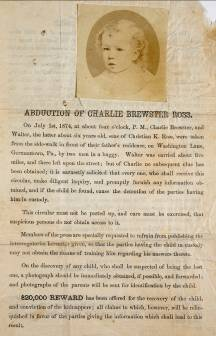
Abduction of Charlie Brewster Ross. Philadelphia: Wm. F. Murphy’s Sons, 1874.

This broadside is an early example of the use of photography on public posters. Allan Pinkerton, founder of the famous Pinkerton Detective Agency, invented the photographic mug shot; during the 1860s and early 1870s, he often used small albumen photos on wanted posters for train robbers and outlaws. The case of Charlie Brewster Ross gripped the Philadelphia/New York metro area for months in the summer of 1874. Charlie and his older brother, sons of a wealthy industrialist, were kidnapped by two men in a carriage while playing in front of their house. The men promised the boys, ages 6 and 4, candy and firecrackers.  The older boy was let go at the candy store, but the men ran off with Charlie and ransom letters soon began arriving at the Ross home.

 The story filled the popular and the flash press for weeks on end. Hired after the Philadelphia police ran out of leads, Pinkerton immediately printed up over 100,000 circular letters like this one, and distributed them nationwide at railroad stations, dockyards, schools and churches. The search continued throughout the summer with the kidnappers occasionally asking for money or attempting to arrange a swap. Reward money started at $20,000 but escalated to $50,000 and higher as Charlie’s parents became more desperate. In December the kidnappers were finally cornered in a closed up summer house outside of Brooklyn, NY, but both were shot and killed before they could reveal Charlie’s hiding place. No trace of the boy was ever found. Purchased on eBay. Harry G. Stoddard Memorial Fund.

Prices BATTED to Pieces

As the calendar turns to November, our thoughts naturally turn to baseball… What!? Really? Yes, this year it took until November first to crown a World Series champion. Each year it seems, the games are on later and later (in the day and in the year). Can the casual fan sustain his interest over the long season? Apparently not. Game Three of this series had the second lowest television ratings in Series history, and according to a recent New York Times article, Game Four this past Sunday night marked the first time a World Series game lost to an N.F.L. game in prime time.

Baseball is not the national craze it once was, dominating sports fandom when the major competition was pugilism and horse racing. Football, basketball, hockey and, [gulp], soccer now offer sports fans a panoply of choices. With the NFL, the NHL and the NBA seasons all underway, it is little wonder television is having some difficulty bringing viewers to baseball, even for the World Series. We are left to wonder if the poor ratings will tarnish the long love affair between advertisers and baseball.

From Dustin Pedroia selling tires to Mariano Rivera selling chalupas, from Ted Williams selling soft drinks, Joe DiMaggio selling cigarettes, and Babe Ruth selling, well, everything, advertisers have long used the image of popular baseball players and baseball teams to hock their wares. If you think it’s a 20th (or 21st) century phenomenon, think again. In the American Antiquarian Society’s collections there are many examples from the 19th century of advertisers associating themselves with baseball.

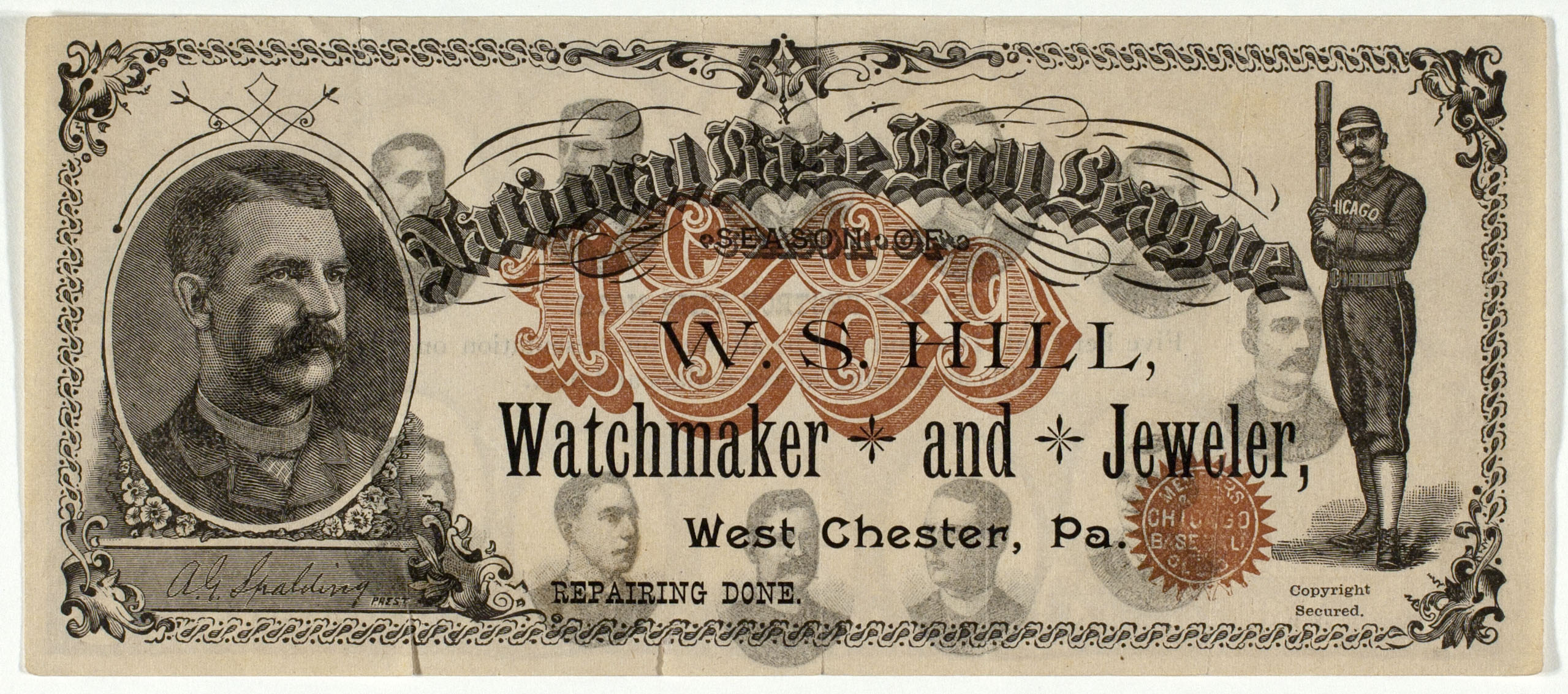
Front of W.S. Hill bank note advertisement (click to enlarge)

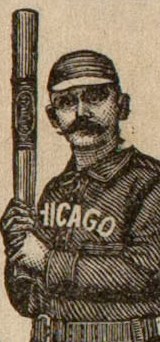
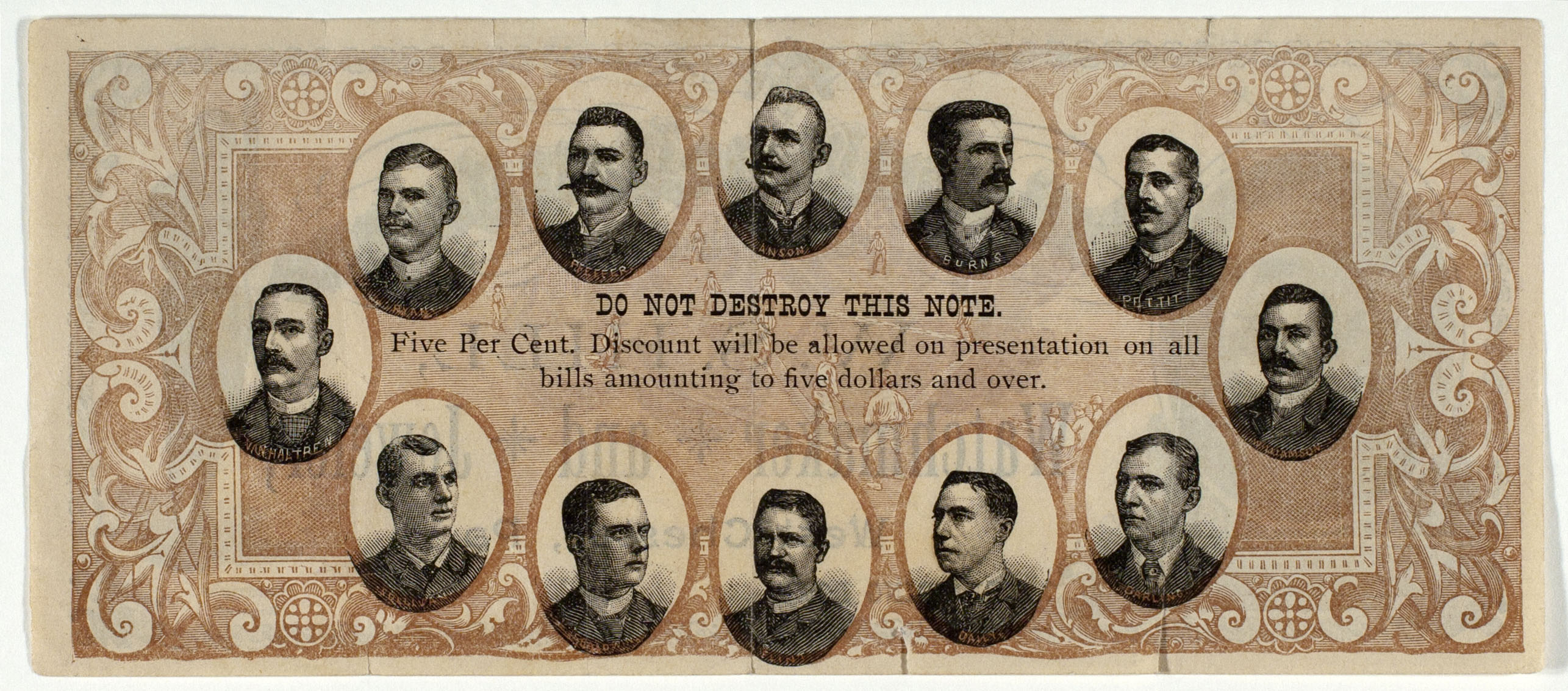
One nice example is a bank note advertisement from 1889. W.S. Hill, Watchmaker and Jeweler from West Chester, Pennsylvania issued a flyer, made to resemble currency, with an image of Albert Goodwill Spalding and a generic Chicago White Stocking player on the front and portraits of twelve members of the 1888 Chicago White Stockings on the reverse. The White Stockings, who would become the Cubs in 1903, did not win the National League pennant in 1888 (the first World Series was still 15 years away) and came in third in 1889 so we’re left to wonder why a Philadelphia area jeweler chose a team from Chicago in its advertising.

Back of W.S. Hill bank note advertisement (click to enlarge)

Spalding, a pitching standout for Boston and Chicago in the 1870s and by 1889 the president of the Chicago franchise, was very popular, though. He was a tireless promoter of the game (and the sporting goods company which still bears his name), bringing the champion Boston Red Stockings to England in 1874 (he would bring his White Stockings on a world tour later in 1889). Also on the White Stockings was future Hall-of-Famer Adrian Constantine Anson, known to teammates and fans as Cap. Anson played 27 seasons of major-league baseball, including 19 as a player-manager, and was the first member of the 3,000 hit club, but is now notorious for his refusal to play with African-American players then in the major-leagues. Anson’s face is prominently placed in the top center of W.S. Hill’s bank note advertisement, surrounded by his teammates.

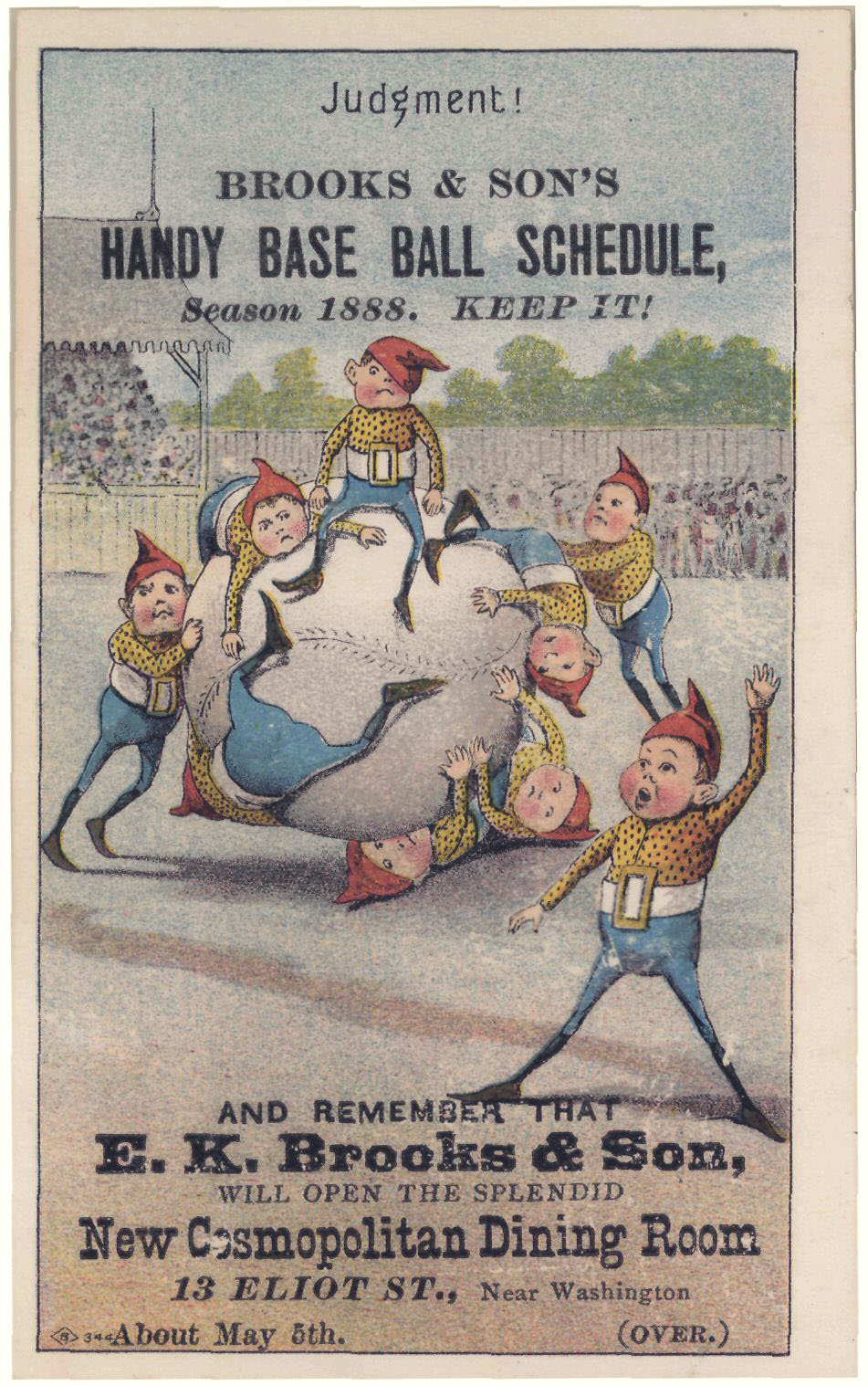
Another popular place to advertise which continues to the present day is on a team’s schedule. The advertisement has lasting value, the theory goes, because the owner will want to refer to it throughout the season. Each view is another impression for the advertiser. AAS has several examples from the late 1800s, but perhaps the finest (and certainly the most bizarre) is from E. K. Brooks & Son, Boston. The piece, entitled “Judgment!” has pixies (or fairies or brownies) climbing over a baseball with the chief pixie barking out directions (alternatively, the pixie-in-chief could be an umpire making a call, hence the title). What precisely is being implied a fairy-covered ball is lost to history (although, no doubt, readers of this blog will have something to say on the topic).

Front of Brooks & Sons trade card advertisement (click to enlarge)
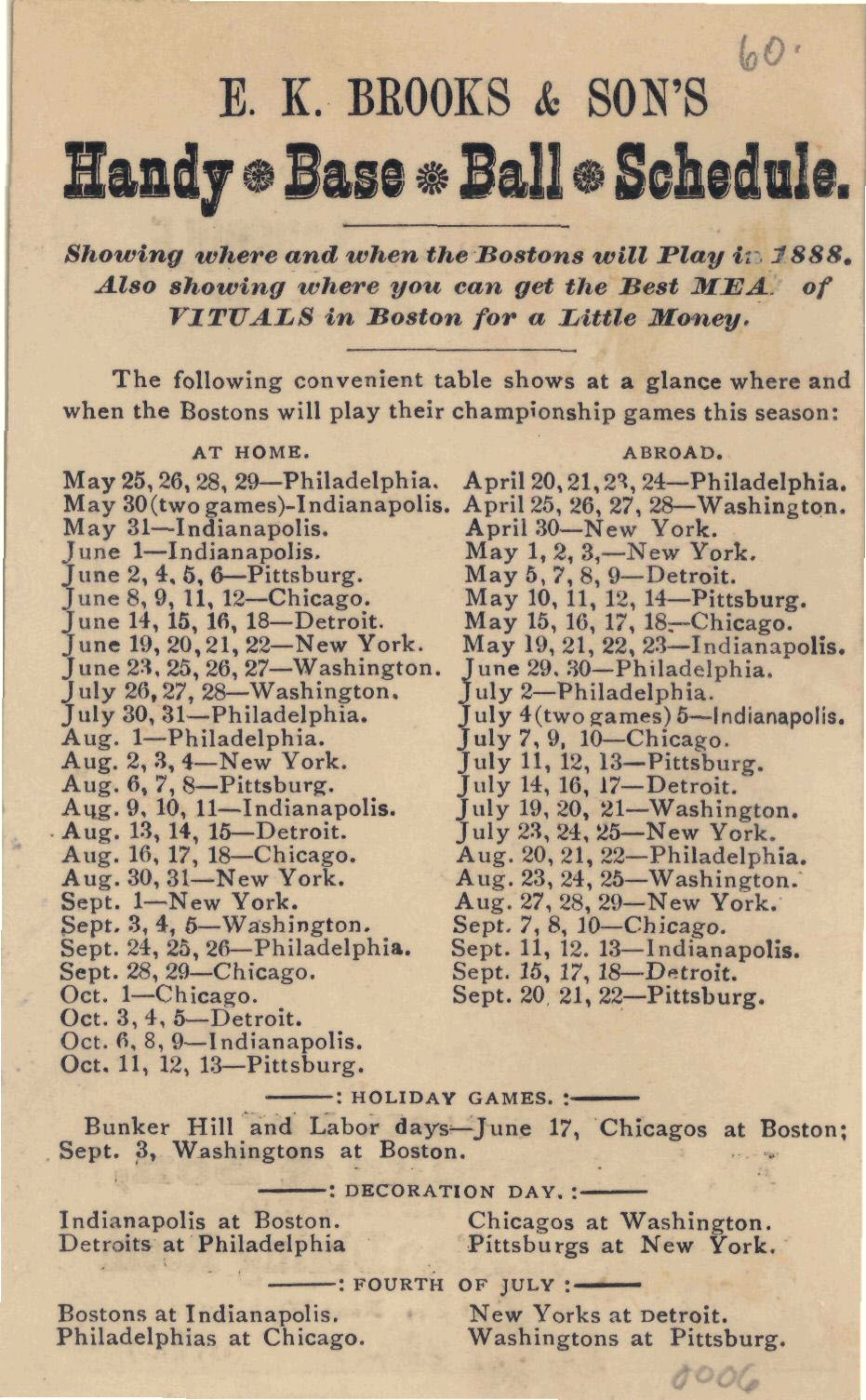
Back of Brooks & Sons trade card advertisement (click to enlarge)

On the back of Brooks & Sons Handy Base Ball Schedule is the 1888 schedule of the Boston Beaneaters (now the Atlanta Braves, via Milwaukee). The “convenient table” shows when the local nine will be home and “abroad” and of course, “where you can get the Best MEA[sure] of VI[c]TUALS in Boston for a Little Money.”

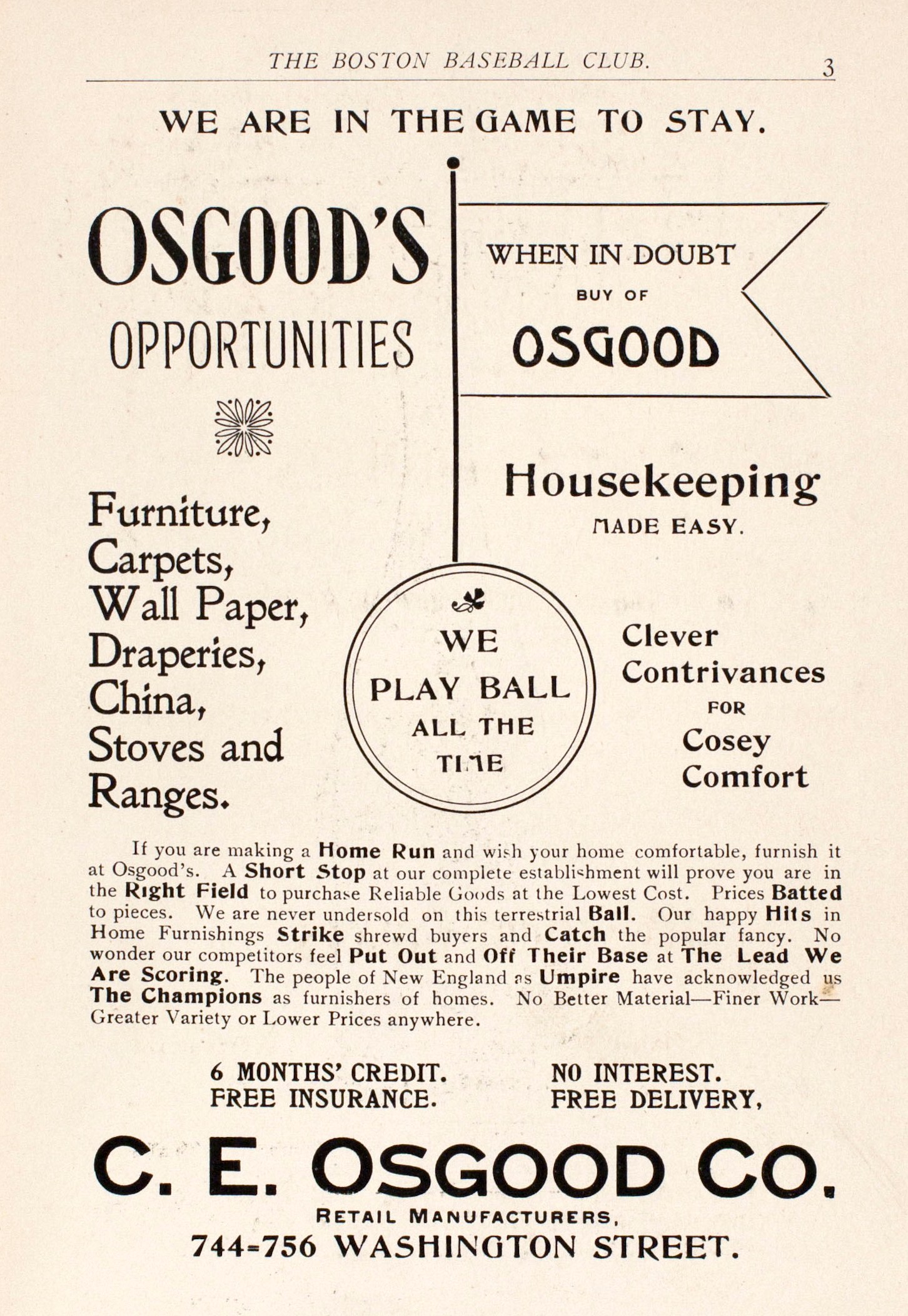
Osgood's advertisement (click to enlarge)
Another advertising ploy which continues to this day is an advertiser using baseball terminology to describe the workings of their business. We can all think of many, often tiresome, examples of these ads both on television and radio (discount furniture companies seem to be the most egregious offenders). This tactic also dates back to the 19th century. AAS’s book collections contain A History of the Boston Base Ball Club: a Concise and Accurate History of Base Ball Since its Inception compiled by George V. Tuohey. This 1897 publication includes many advertisements (the book was apparently a way for the Boston Beaneaters to raise some money in the off-season) one of which (on the first fly) is for C. E. Osgood, Co a Boston furniture company (what is it with furniture companies and bad baseball puns?). The ad is rife with baseball puns and plays on words. “We Are In The Game To Stay” is the headline. “We Play Ball All The Time” is prominently displayed in the center. The main text of the ad is one baseball pun after another, with the baseball terms in bold type (just so we won’t miss them). My favorite: “A Short Stop at our complete establishment will prove you are in the Right Field to purchase Reliable Goods at the Lowest Cost.”

Baseball and advertising have a long, intertwined, and entertaining history. It would be great to push the history back further and find earlier examples of advertisements with a baseball theme. Just how early did it all start? Is the earliest piece at the American Antiquarian Society? I don’t know but it will be fun trying to find out.

Ghosts in the Parlor?

As readers of Past is Present are already aware, the Society’s Graphic Arts department is currently immersed in cataloging illustrations in our collection of gift books for the Prints in the Parlor project. Because the season of ghosts and goblins is now upon us as we near the end of October, we have been making particular note of those illustrations that have some relation to Halloween.

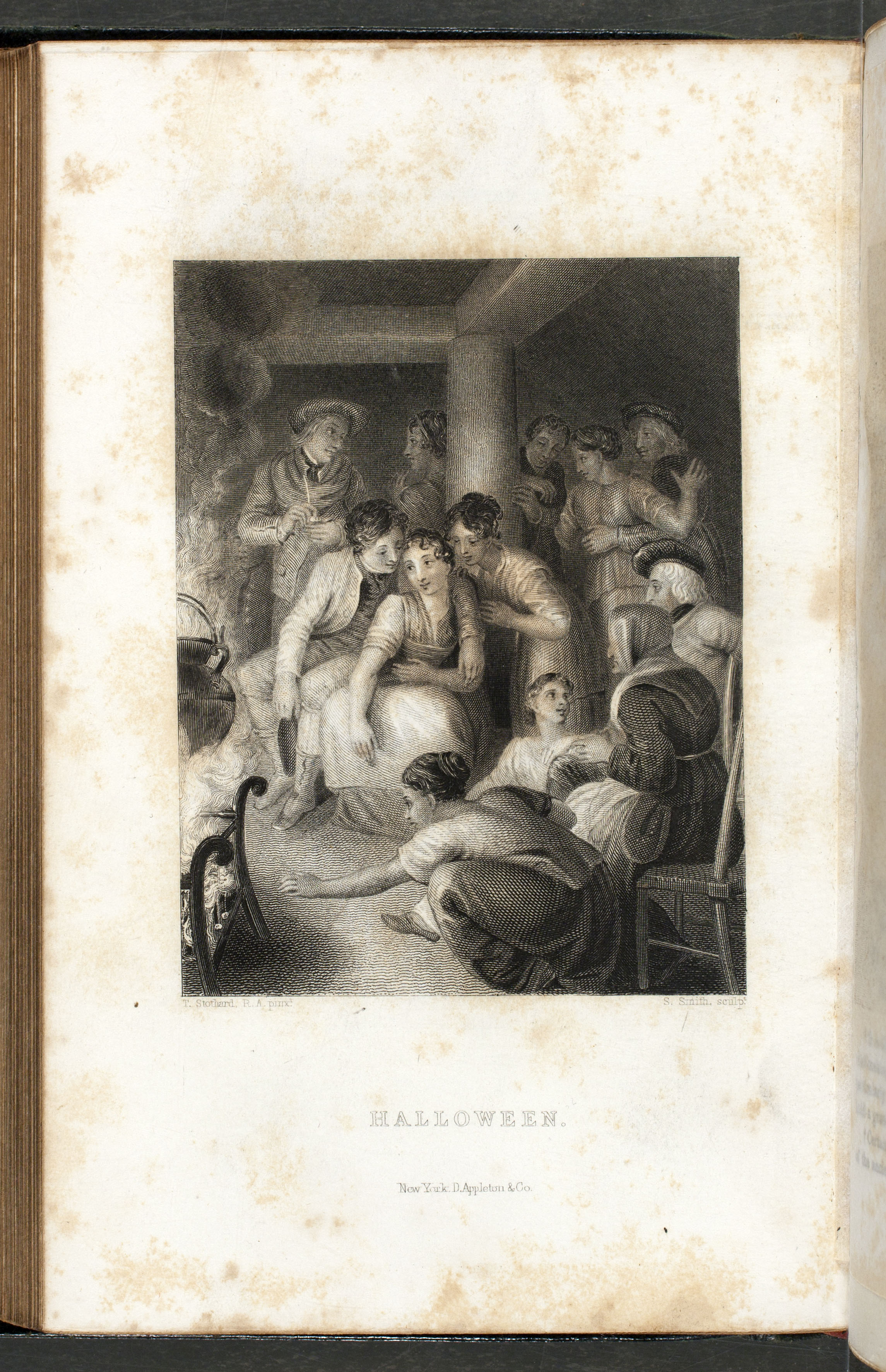
All Hallows Eve was not a particularly big holiday in America during the 1840s and 1850s, when most of the gift books were published, but there are a few mentions of the day. The illustration “Halloween” from The Mignonette (New York, c1856-57) is pretty typical of representations of the holiday. It depicts young people and an elderly couple gathered around a fire. The evening was more for young adults, and was one filled with roasted chestnuts and corn, storytelling, and sparking (flirtations with the opposite sex), and not costumes and candy or spook-tacular gore.

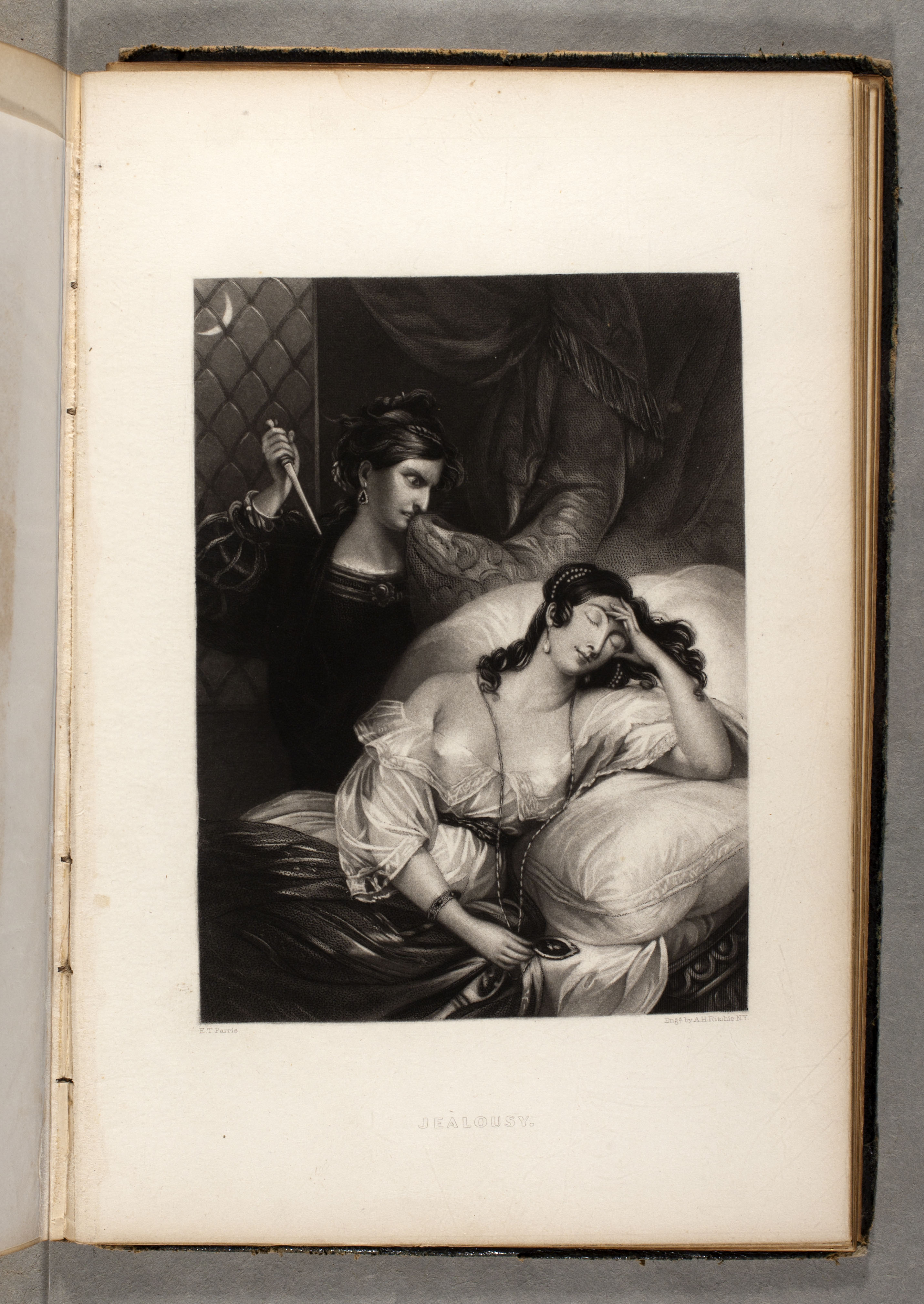
However, there are many other examples of frightening images in American gift books that are not related to Halloween but instead illustrate the Gothic-style prose and poetry of the era. These include dramatic pictures of murder, war, abuse, and revenge. An engraving of a woman with a knife entitled “Jealousy” from Gems of beauty (Boston, c1848) depicts a violent-looking woman about to stab her sleeping victim. Other illustrations include skeletons at parties, women buried alive, witches telling fortunes, and night scenes of shadowy city streets.

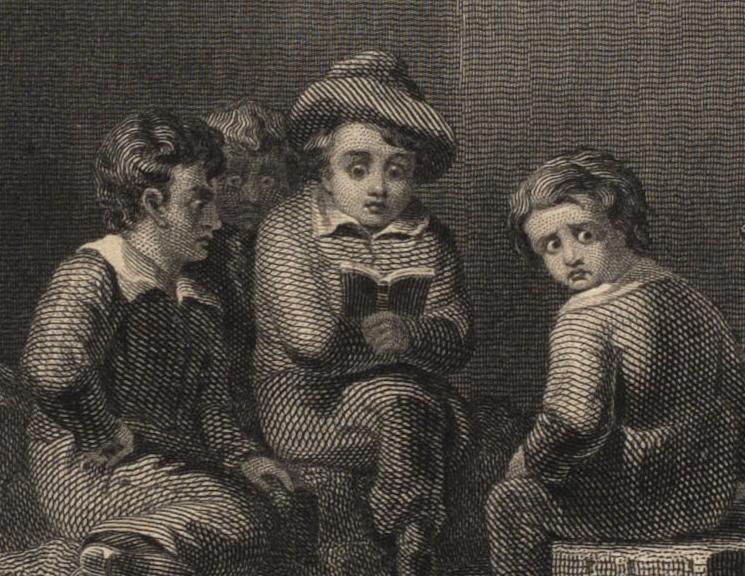
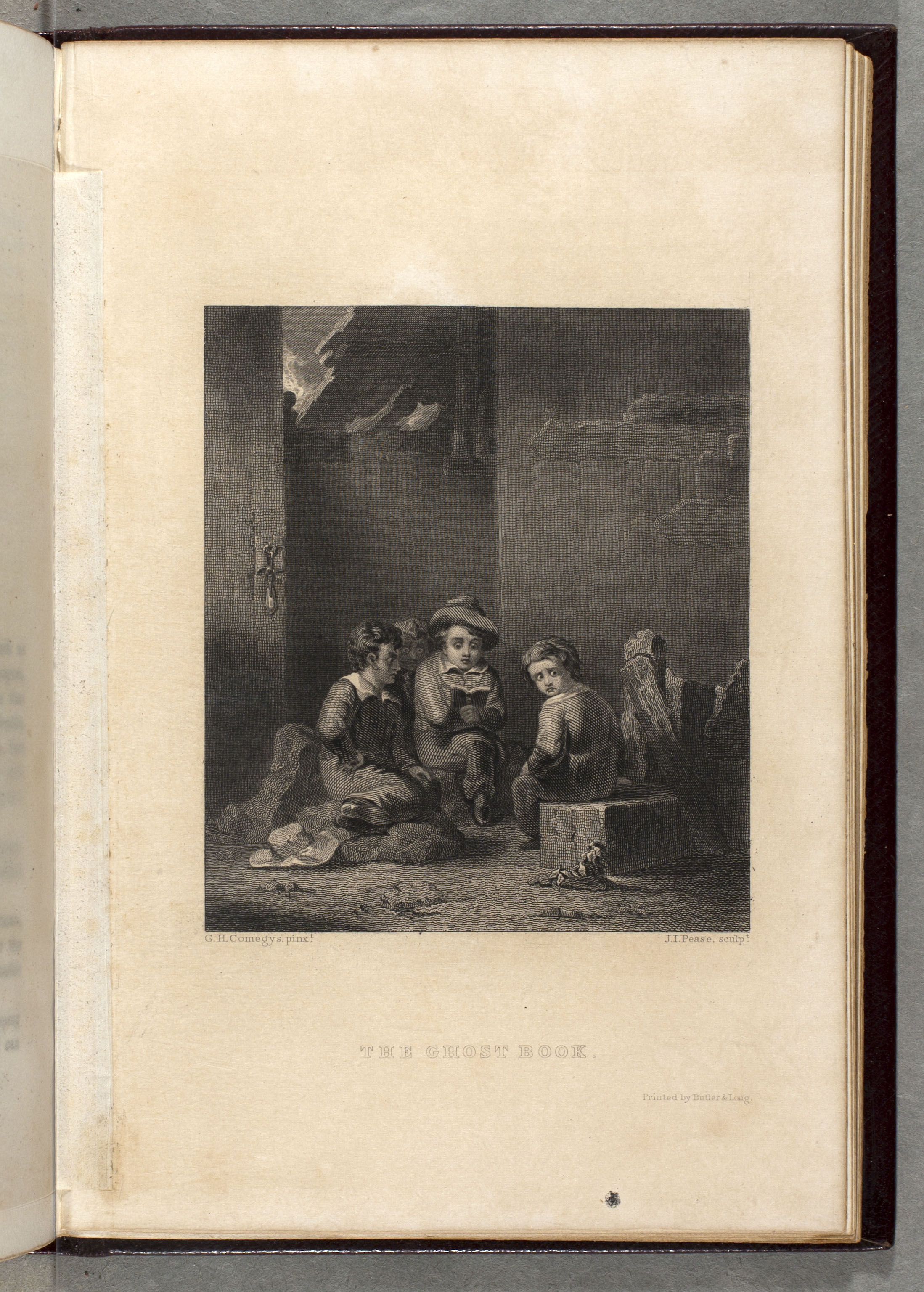
Finally, there is the wonderful image of “The Ghost Book,” which depicts a group of small boys gathered around a central child who is reading. Their eyes are wide with horror as they look around the shadowy yard. This image first appears in a Philadelphia annual The Gift (ca. 1839), and accompanies a story by Eliza Leslie about a diary kept by a traveler staying in a haunted bedroom. The boys have found the diary and are reading about spirits hiding in a dark closet under the eaves and pools of old blood from a murder committed long ago. In the end it turns out the diarist, an itinerant artist, was writing a rough draft of a story he hoped to have published in a “periodical of the day.” The boys are greatly relieved.

The image was re-used five years later in the 1844 Literary Souvenir, also published in Philadelphia, but the title was changed to “The Fright” in order to better illustrate a tale of the overactive imagination of boys written by George G. White. In White’s version, the central boy is described as

too strongly addicted to the marvelous. His brain was half turned from listening to the tales of an old nurse of the family, and reading romances and ballads.

This time the book the boys read is a cheaply printed text, purchased in town, Tales of Terror or the Mysteries of Magic. The story does not end well for the main character. He is so frightened by the words he reads aloud that

the shock had been too much for his reason. He had fallen victim to the follies of superstition, and remained an idiot for life.

Gads! What would he have made of the shrieking dementors in Harry Potter? All in all, the gift books provide us with evidence of nineteenth-century concepts of fear and darkness and ghosts and naughty boys – what more could we ask to mark the arrival of Halloween in 2010?

Scraps of the Past

Scrapbooking is quite the popular hobby today, but it’s hardly a new idea.  People have been compiling images, memorabilia, and the written word since these things existed.  While exploring yet another of the American Antiquarian Society’s hidden gems, I found we have a wonderfully rich scrapbook collection.

The collection of scrapbooks at AAS is currently at about 300 volumes, but this number is always growing, whether through new acquisitions or discovery in the stacks.  Initially scrapbooks were cataloged into the regular book collection.  However, over time, many have been pulled out and we are in the process of integrating all scrapbooks into our manuscript collection.  Why move them?  Technically, scrapbooks are not published works.  Many of them contain clippings from published works, or are sometimes even indeed published works, but with various items (photographs, letters, newspapers clippings, etc.) interfiled within the book’s pages.  Scrapbooks take on their own unique identity, unlike any other published work out there.  And this uniqueness is what defines a manuscript.  So into the manuscript collection they shall go!

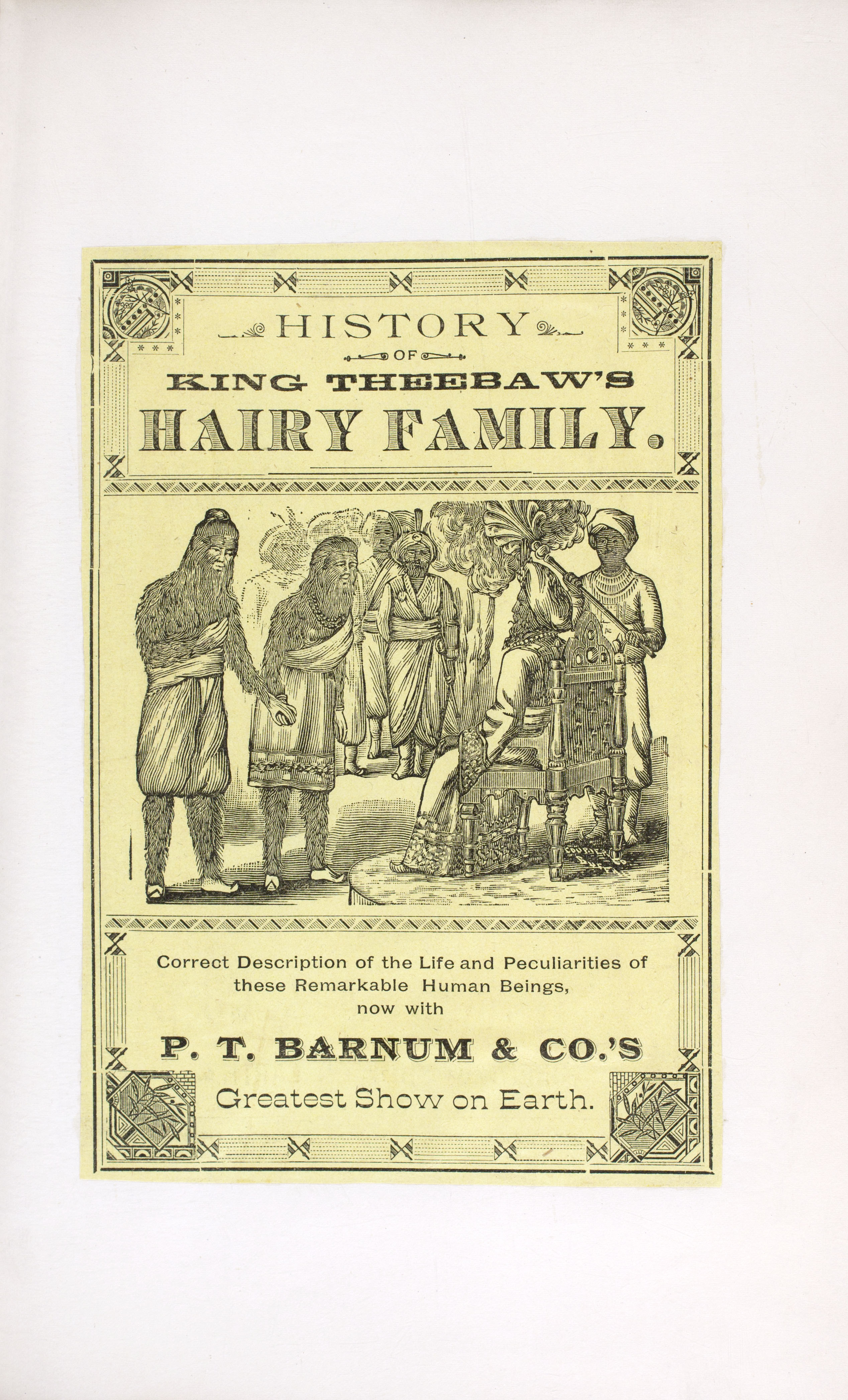
You never know what you’re going to find in a scrapbook, which is what makes them such amazing resources.  The contents, nature, and character of each scrapbook depends entirely on the creator. Topics can be anything from flowers, to local history, to simply random newspaper clippings someone found interesting.  Just the other day, a reader was looking for resources about P.T. Barnum, and amazingly, we have a scrapbook done by a person who was interested in what he termed “Freaks of Nature.”  Hence we were able to provide a scrapbook filled with various images, newspapers articles, fliers (like the one pictured to the left) and clippings from published works, many about P.T. Barnum’s circus.  On occasions such as this, a scrapbook can end up being one of the best resources for a project.

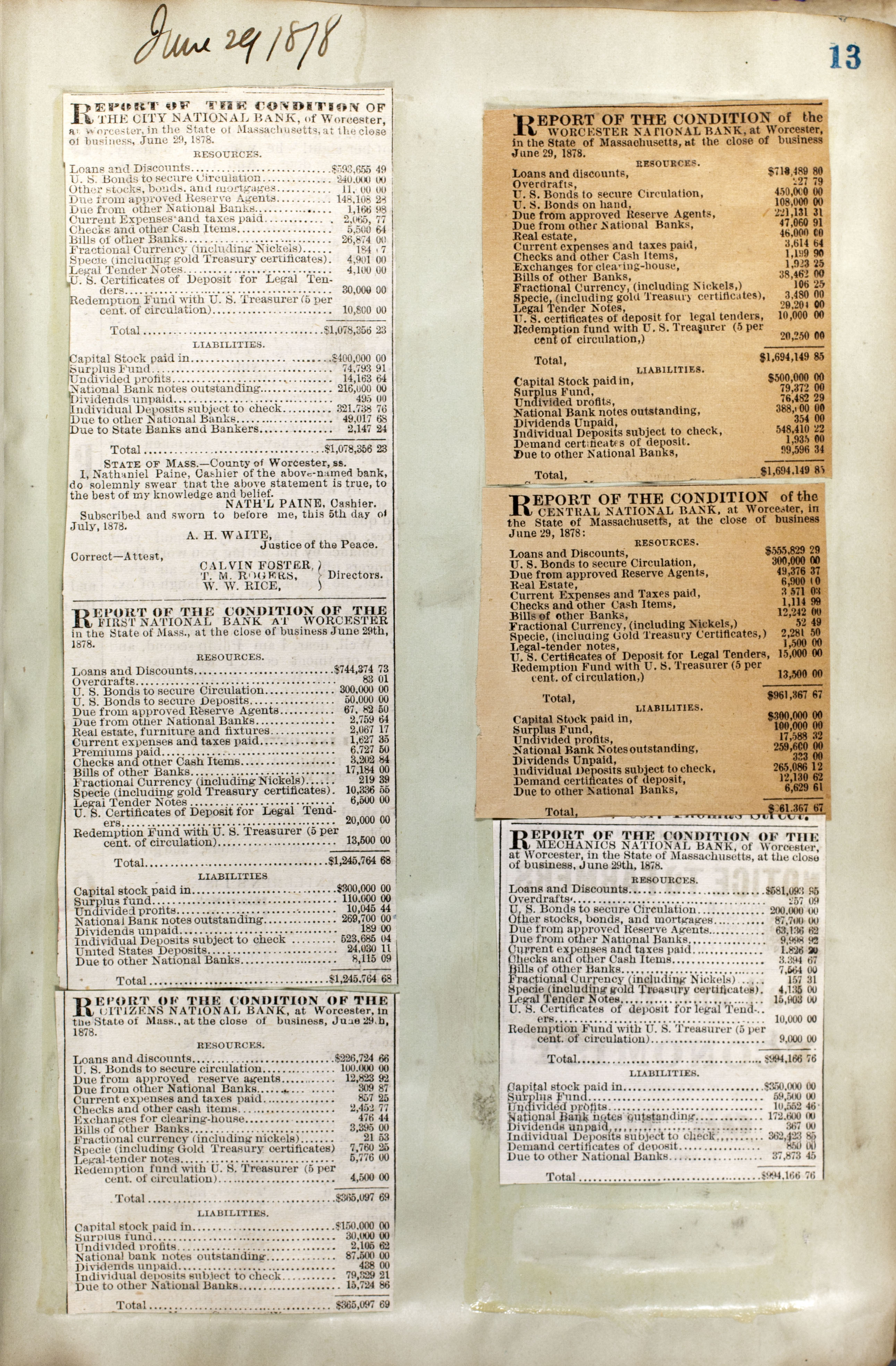
Another interesting scrapbook from our collection is a compilation of various Worcester banks’ dividend earnings in the late 19th century.  While certainly not as exciting or intriguing as the “Freaks of Nature” scrapbook, it’s a great way to get a localized glimpse into the economy and banking industry of the time.  Imagine the time it would take a modern day researcher to go through issue after issue of newspapers, looking for articles and statements from local banks.  But thanks to scrapbooks, if you happen to have the same random interest as a scrapbooker 100 years ago, you’re in luck!

So to all you scrapbookers out there – keep it up!  You could be compiling the great primary resources of tomorrow.

Oh, Alice…


As it says on the Statue of Liberty: “Give me your tired…your huddled masses yearning to breathe free…” and the newly-found abandoned line “…your unwanted editions, pages uncut, spines unopened, loathed by your authors and deemed unworthy cultural capital by your countrymen…”

Okay, maybe that isn’t exactly what it says. Perhaps the line’s lack of poetic cadence destined it for the chopping block. But the fact remains that Lady Liberty had her arms open for books too. One such prized text is in the collection of the American Antiquarian Society.

In particular, I’m talking about Lewis Carroll’s beloved Alice’s Adventures in Wonderland (1865).

Anachronistic, I know, as the Statue was given decades after Alice’s debut. But the point is this – British items, European prints, suppressed pamphlets – texts cast off and unwanted – have made their way into the American Antiquarian Society. And are here for the staying – and studying.

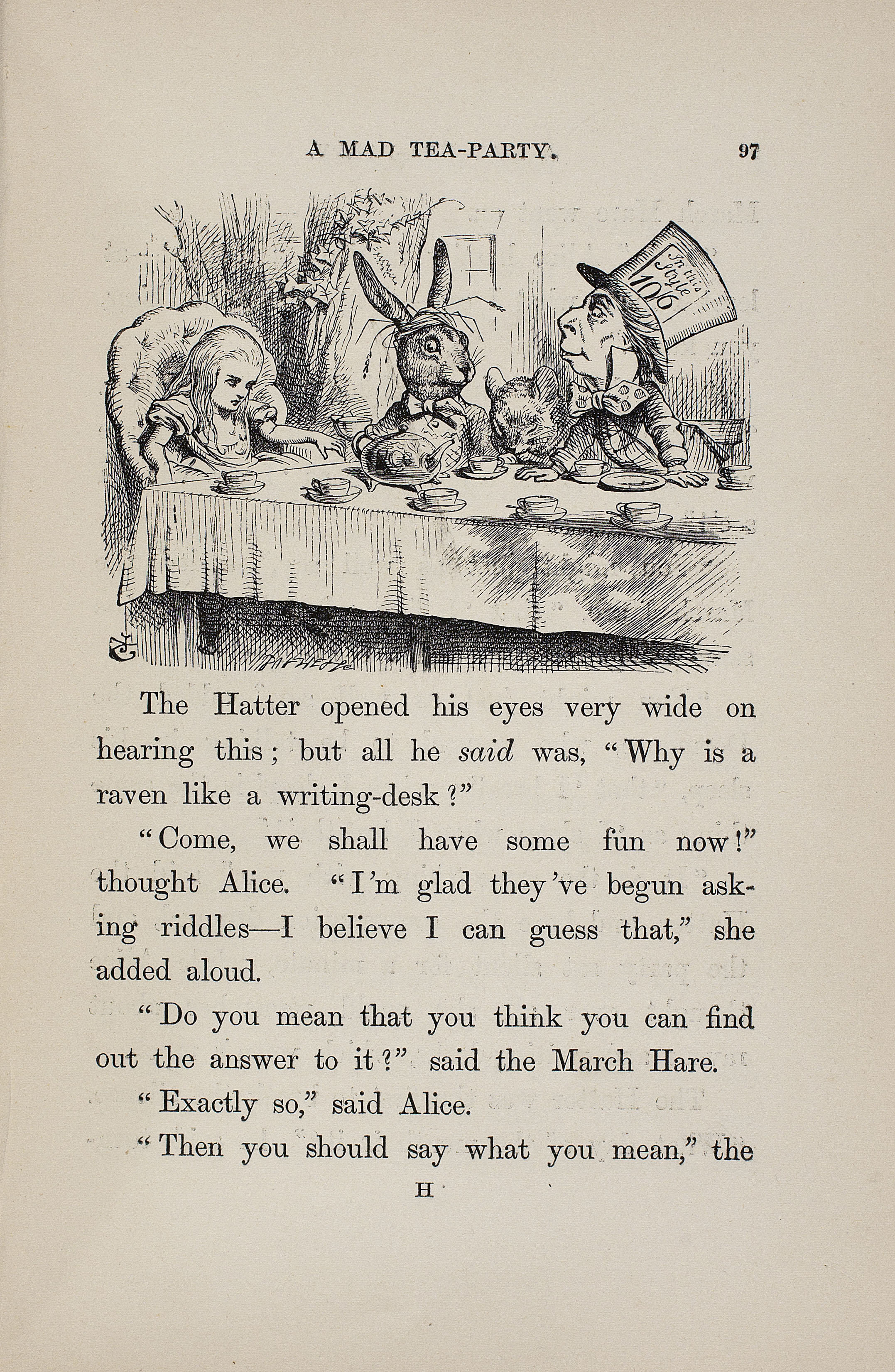
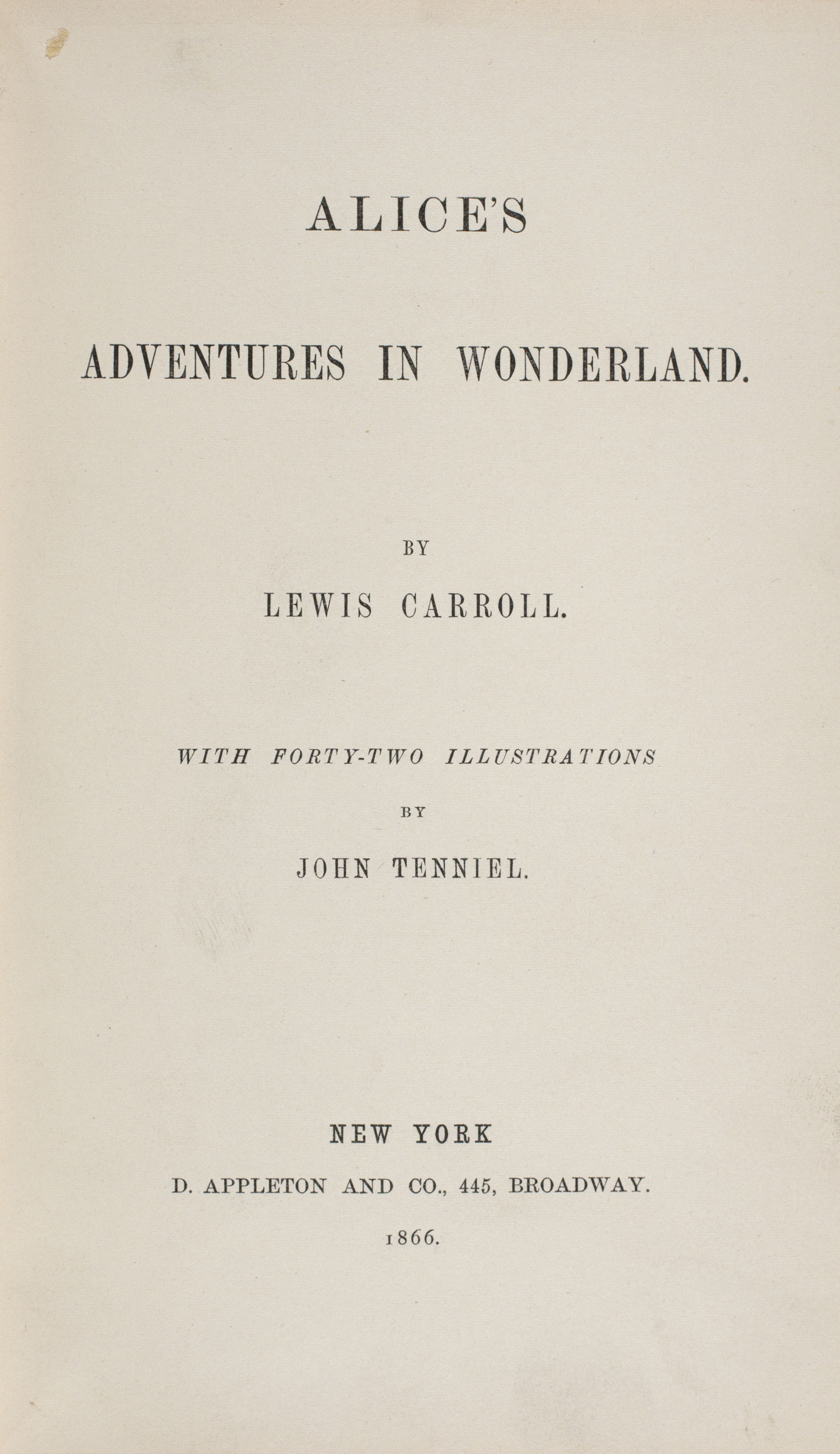
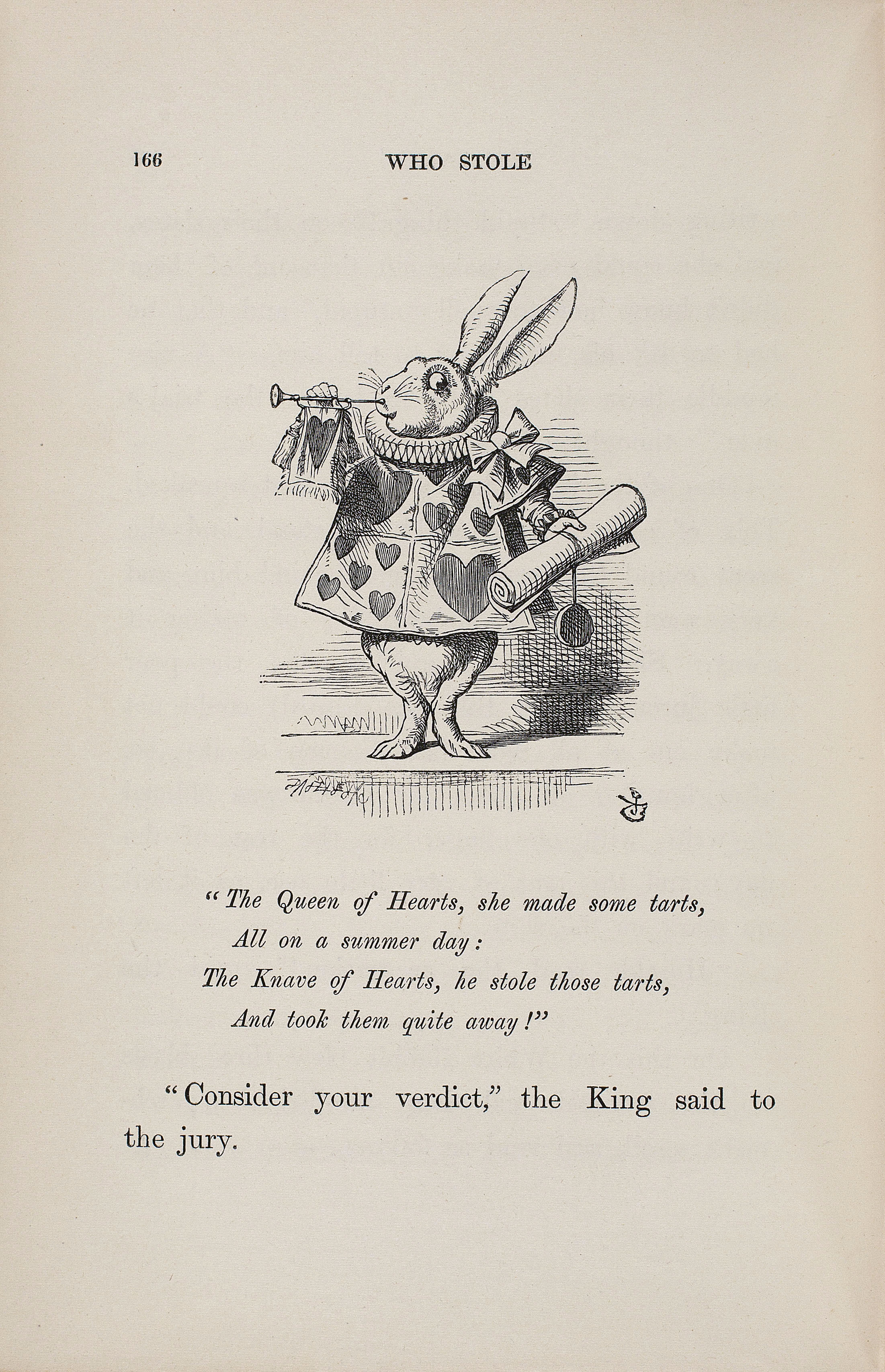
Lovers of Alice in Wonderland know the stormy, and at times formidable, relationship between illustrator John Tenniel (1820-1914) and author Lewis Carroll/Charles Lutwidge Dodgson (1832-1898) resulted in a book which – though conceived in 1862 – did not officially hit shelves until 1865. And immediately upon hitting said shelves was taken off for its printing imperfections. Tenniel, not Carroll, is responsible for the suppression of this first edition as he was very unhappy with the light printing of the pictures. Carroll, who had paid for the printing and was now in the red, decided to scrap it and please his illustrator. The official “accepted” edition was not published until late 1865 and bears an 1866 issue date. This leaves the 1865 edition as one of the most celebrated rarities of the book world.

So what happened to this ill-fated edition?

Enter New York harbor.

William D. Appleton of D. Appleton and Company of New York bought up the discarded copies of Alice, gave them a new title page and issued them as the first American edition in 1866. While debate still rages over which issue of the Appleton came first (there are two title pages), this copy is one of those rejected pieces – with light illustrations and all.
Why such a big deal? A couple copies where the blocks weren’t printed correctly? Who cares? Perhaps. But take a peek at Martin Gardner’s Annotated Alice to get an idea of much back and forth went into the illustrations between Carroll and Tenniel – how exacting and meticulous each artist was in his craft.

A light printing of something as subtle as a caricature or satirical illustration could make the difference between seeing and not seeing for viewers and readers. As Gardner highlights (and compiles), the text is exceedingly loaded and rich in its likenesses, parodies, and intricacies – and if you’re going to be the seminal subversive children’s literature text, you might as well get it right.

Other Carroll finds at the Society? Three other editions of Alice in Wonderland, several Through the Looking Glass-es, a version of the ‘Alice in Wonderland’ stage play, and The Hunting of the Snark. Oh, and what good nineteenth-century popular foreign text would be complete without its American-pirated counterpart? The serial Merryman’s Monthly is also in the Society’s holdings which printed the first pirated Alice in 1867 (interestingly, without its last five paragraphs).

Though this copy was not approved of by Tenniel, aren’t we glad he was such a perfectionist? After all, Alice has had numerous illustrators in her 145 years, both in print and on screen, and yet Tenniel’s version remains the most accepted visual for the text which is noteworthy for inspiring a ‘liberty of thought’ in children’s books.

Ever wonder what Lady Liberty is holding? Perhaps it’s a rejected copy of Alice.

Interested in Learning More?
See Flodden W. Heron, “The 1866 Appleton Alice,” Colophon 3:1 (Winter 1936), pp. 422-427 and Selwyn Goodacre, “The Nineteenth-Century American Alice” in Proceedings of the Second International Lewis Carroll Conference (NY: Lewis Carroll Society of North America, 1994), pp.68-74.

Tomorrow Night: A Midwife’s Tale, 20 years later

Thursday, October 21, at 7:30 p.m.
Reflections on A Midwife’s Tale by Laurel Thatcher Ulrich
The Seventh Annual Robert C. Baron Lecture

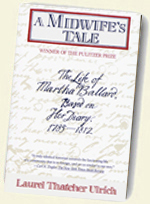
The book A Midwife’s Tale: The Life of Martha Ballard Based on Her Diary, 1785-1812 quickly became a model of social history when it was published in 1990. The book examines the life of one Maine midwife and provides a vivid examination of ordinary life in the early American republic, including the role of women in the household and local market economy, the nature of marriage, sexual relations, family life, aspects of medical practice, and the prevalence of crime and violence. The book won many awards including the Pulitzer Prize for History and the Bancroft Prize. A Midwife’s Tale was also developed into a film of the same name which aired on The American Experience television program.

The book even became the basis for a website called DoHistory (http://dohistory.org/). The site invites you to explore the process of piecing together the lives of ordinary people in the past. It is an experimental, interactive case study based on the research that went into the book and film A Midwife’s Tale. The website aims to help users learn basic skills and techniques for interpreting fragments that survive from any period in history, and to become inspired by Martha Ballard’s story to do original research on other “ordinary” people from the past.

In tomorrow night’s lecture, Professor Ulrich reflects upon some of the scholarly, popular, and political responses to the book and considers its impact on her own more recent work. Further information, including directions, can be found on the Public Programs page on the AAS website.

Please note:

  • This lecture is part of the Antiquarian Society’s annual meeting, and it is anticipated that this will be a well-attended event by both the general public and AAS members alike. Unfortunately, our seating is limited. Doors will open at 6:30 p.m., so please plan accordingly.
  • The library will close early at 4:30 to set up for the lecture and will remain closed to the public Friday, October 22, for the Antiquarian Society’s annual meeting.

Laurel Ulrich Laurel Thatcher Ulrich is 300th Anniversary University Professor at Harvard University, where she teaches in the History Department. She is also the author of Good Wives: Image and Reality in the Lives of Women in Early New England, 1650-1750 (1982); The Age of Homespun: Objects and Stories in the Creation of an American Myth (2001); and Well-behaved Women Seldom Make History (2007).

Named in honor of Robert C. Baron, past AAS chairman and president of Fulcrum Publishing, the annual Baron Lecture asks distinguished AAS members who have written seminal works of history to reflect on one book and the impact it has had on scholarship and society in the years since its first appearance.

Turkey Time!

While Thanksgiving is still more than a month away, it’s never too early to begin planning.  And since this year I will be hosting my first Thanksgiving, and cooking my very first bird, I thought I’d begin to look for some advice from the past.  We all have our passed down recipes from family members that become staples in our holiday dinners.  My family, for instance, has an amazing stuffing recipe from my grandfather, which is always the highlight of the meal.  This year, however, I’m going to look for some additional inspiration from the past from AAS’ cookbook collection.

As we already know, cooking is definitely a different art now than it was in the 19th century, especially where cooking meat was concerned.  Many of the turkey recipes from the 19th century include information on the keeping, picking and slaughtering of the turkey, something most of us need not worry about.  Take for example some advice from Mrs. Stephen J. Field’s Statemen’s Dishes and How to Cook Them, 1890 –

The turkey should be cooped up and fed some time before Christmas.  Three days before it is slaughtered, it should have an English walnut forced down its throat three times a day, and a glass of sherry once a day.  The meat will be deliciously tender, and have a fine nutty flavor.

Definitely a creative way to enhance the flavor, but I wonder how effective it really was.  And I wonder how difficult it was to wine and dine the turkey as Mrs. Field proposes!

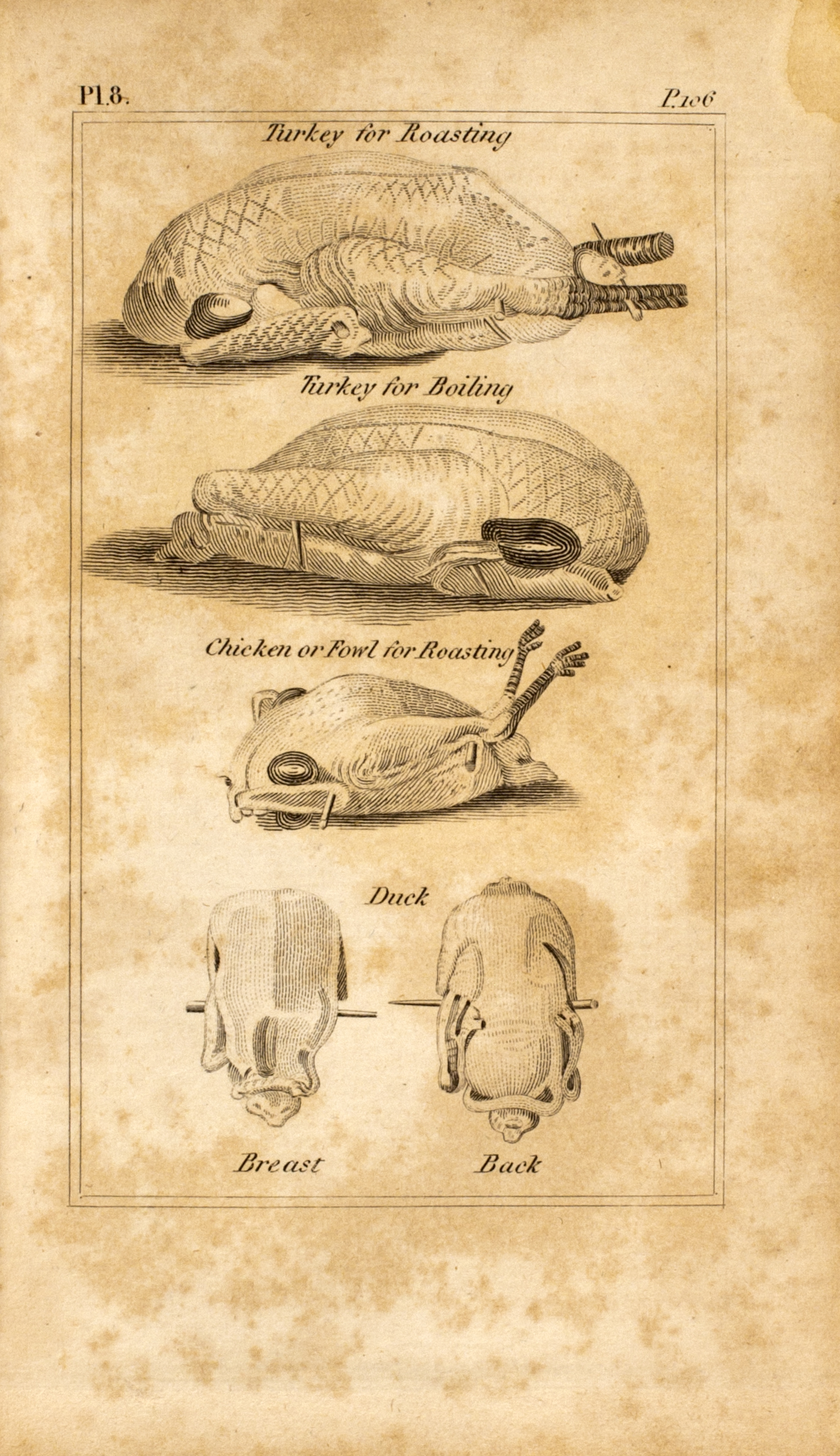
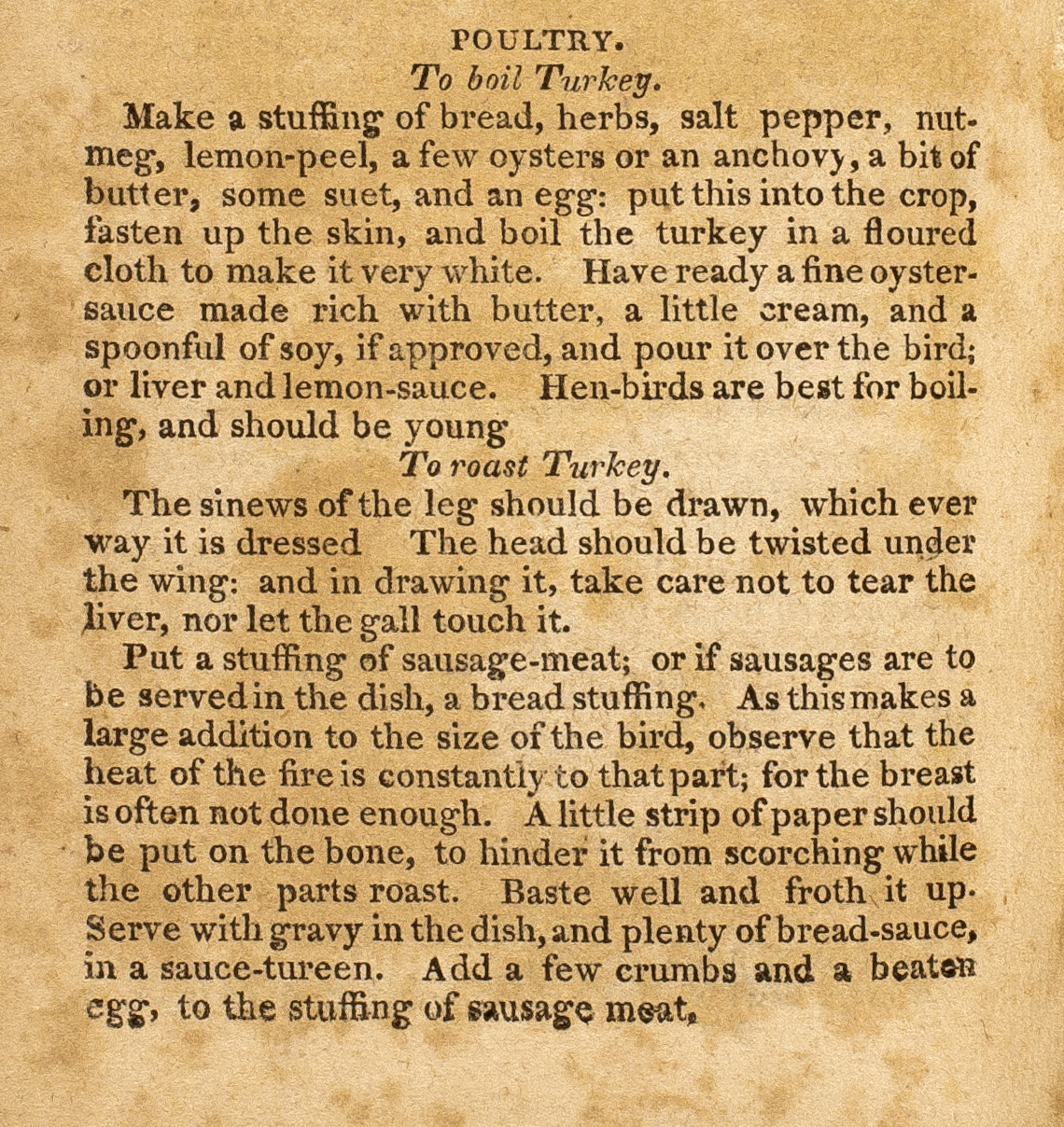
While there is only so much I can glean from the actual steps for roasting the bird itself, I found some interesting recipes for stuffing.  Many call for oysters or anchovies, and there’s always of course the staple of sausage.   The boling and roasting recipes are from Mrs. Marie Eliza Randall’s American Domestic Cookery, 1822.  I’ll likely skip the boiling option, although the stuffing for the boiled bird looks quite appetizing!

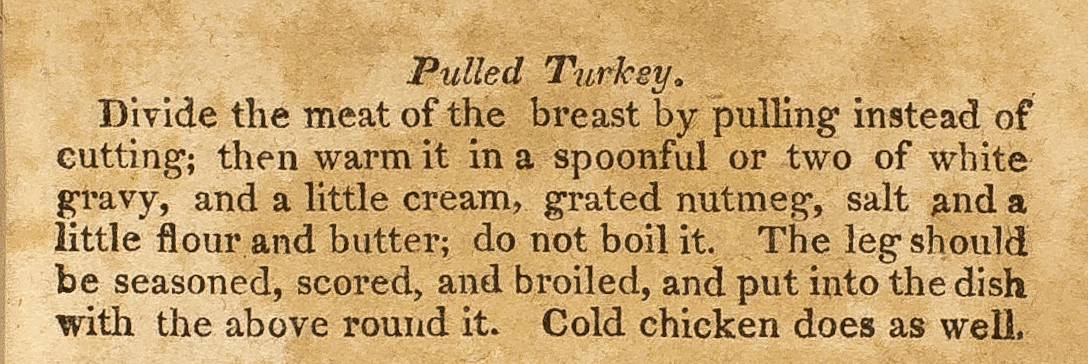
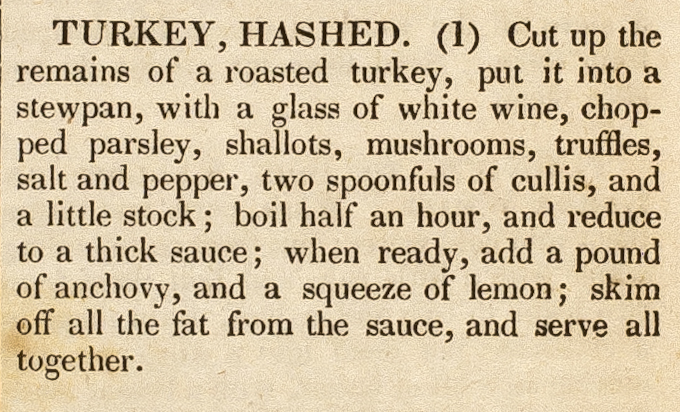
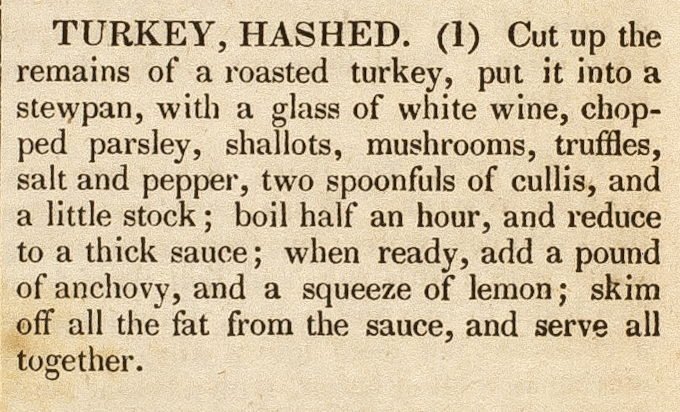
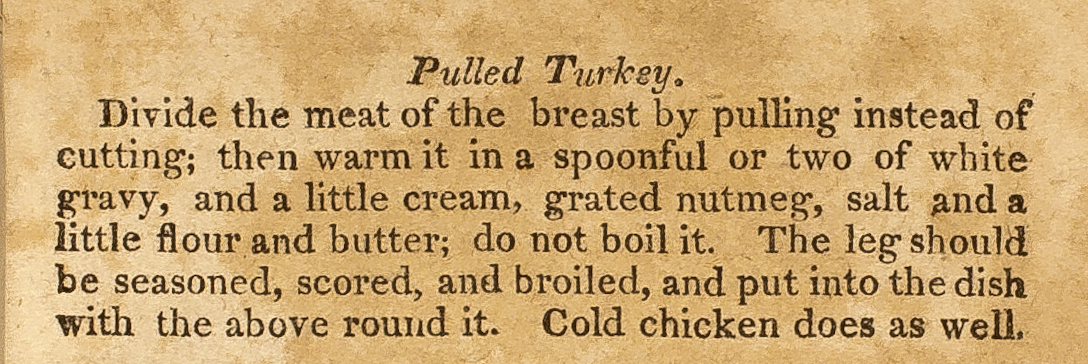
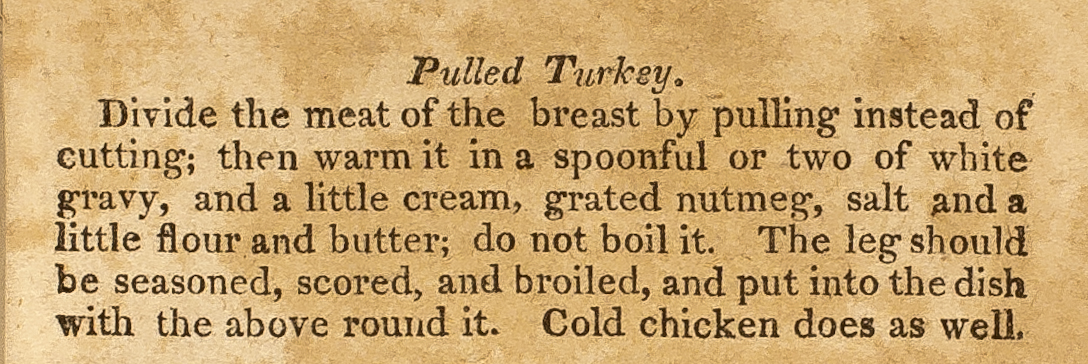
Finally, I’m always looking for creative ways to use up all those leftovers, and there are only so many turkey dinners and turkey sandwiches one can stomach.  So I’ve included Mrs. Randall’s recipe for pulled chicken, and a recipe for turkey hashed from Mrs. Lee’s The Cook’s Own Book, 1832.  Hopefully these will inspire new ways to prepare your leftover turkey.

If you have any great recipes that have been passed down through the generations, please share!  And happy cooking!

A little ditty about sheet music

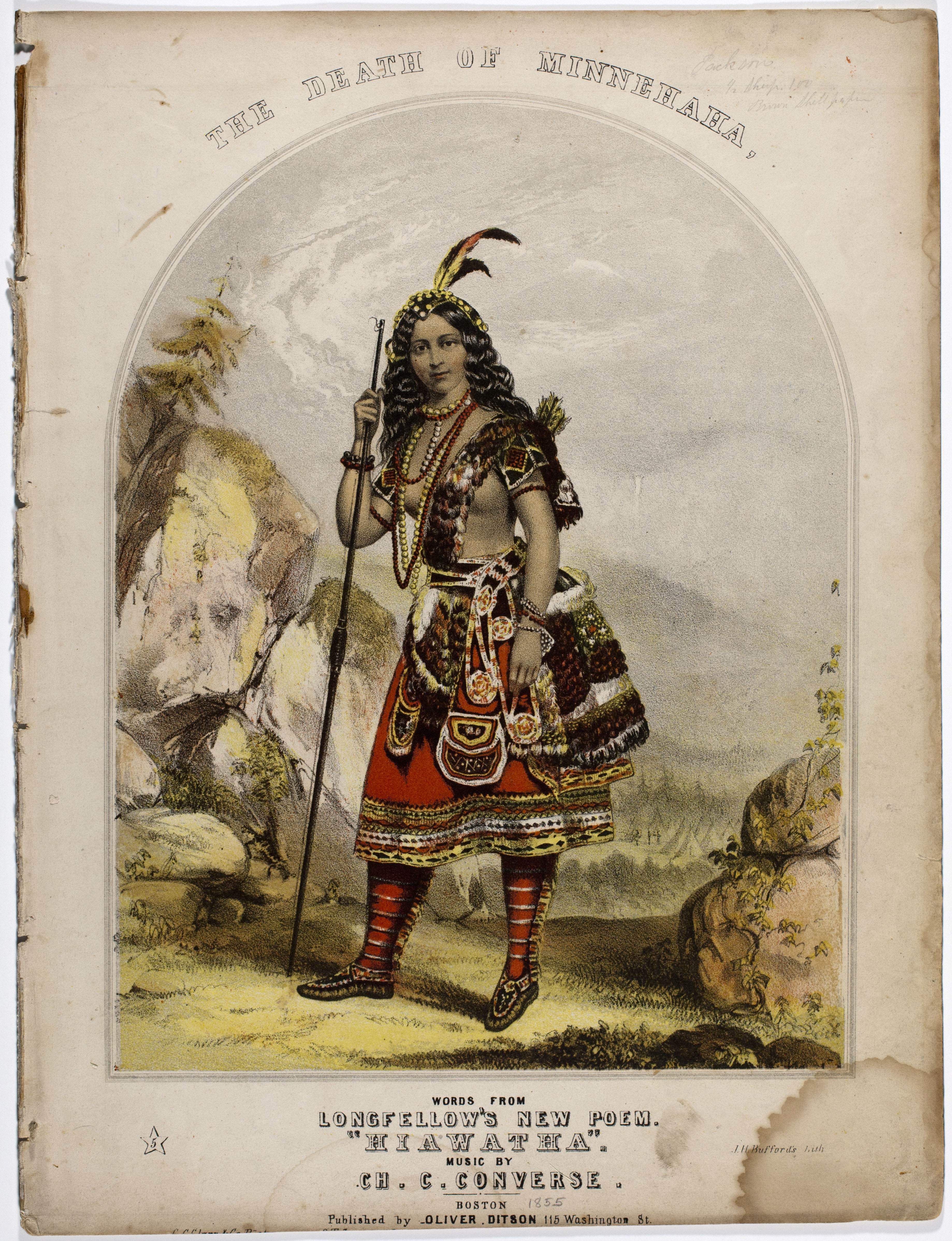
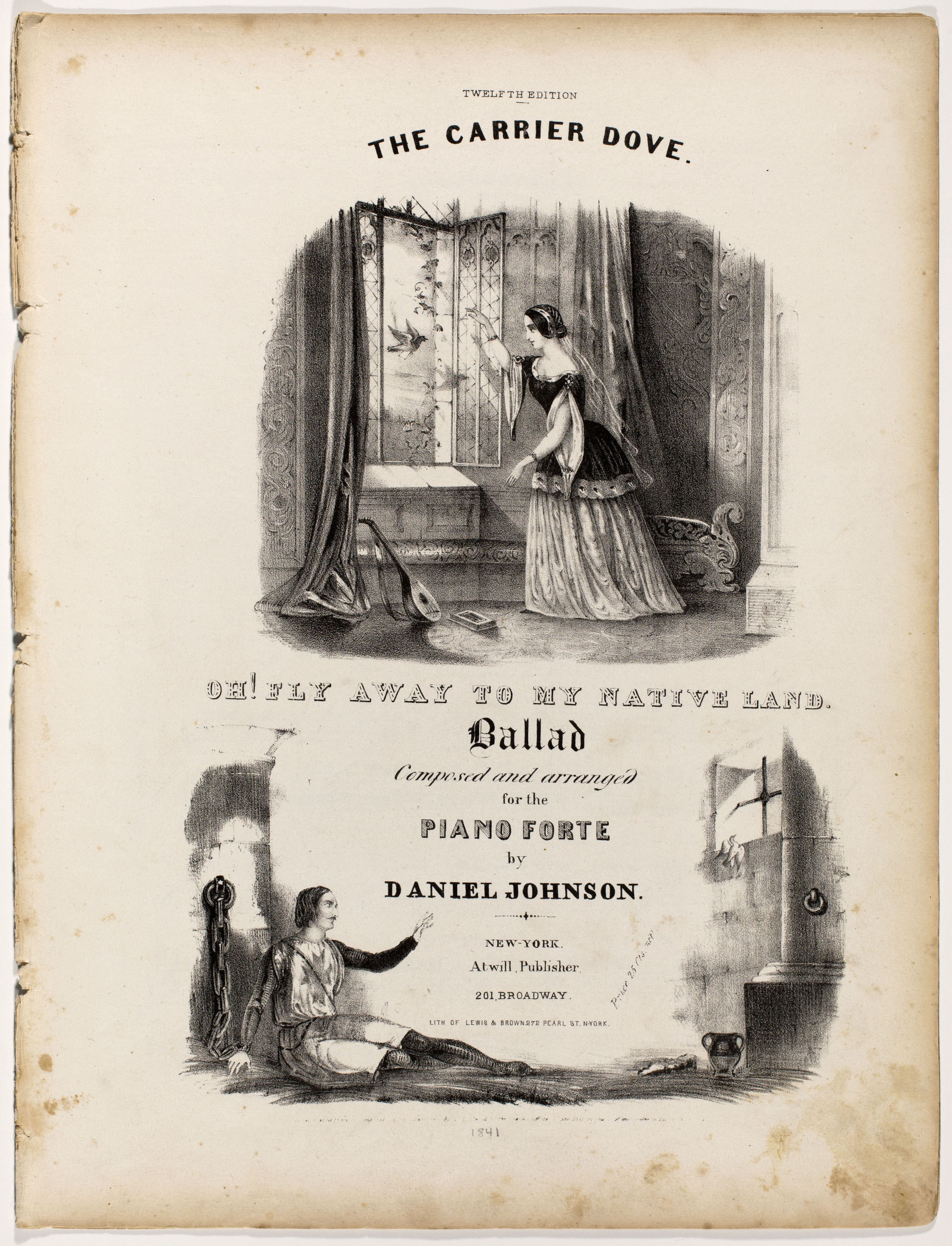
One of the hidden treasures at AAS is its sheet music collection.  The collection numbers about 60,000 pieces of music, all printed before 1880, including instrumental, vocal, secular and religious music, by both American and foreign composers.  You might be thinking, I can’t read music, what’s in it for me?  The sheet music collection is actually an amazing resource for research, not only for those lucky enough to be able to pick out a tune, but for anyone doing research at AAS. 

Glancing through sheet music is an interesting, and very entertaining way of learning about popular issues and ideas of the time.  What topics were important enough to compose a song for the general public for?  What were people singing about?  What ideas and morals were being instilled in people through music?  Temperance, women’s rights and slavery are but a few of the issues being discussed through music in the 18th and 19th centuries. 

Titles and lyrics say so much, and so do the images on the covers of the sheet music.  AAS has separately indexed sheet music with pictorial lithograph covers and pictorial engraved covers.  Covers can be found illustrated by some of the nation’s most famous artists, including Winslow Homer, David Claypool Johnston, and James McNeill Whistler.  These pieces are used extensively by readers and fellows, as the cover images in and of themselves make excellent research material. Click here to see the topical classification of the pictorial covers – http://www.americanantiquarian.org/sheetmusic1.htm

The sheet music collection is one of the few collections left at AAS that is only accessible through its card file, located in the card catalogs in the Reading Room.  The card file is organized as a title index for the general sheet music collection.  There is also a separate card file for the pictorial covers, organized by subject and by lithographer.  So if you’re ever at AAS and need to fill that final research gap, why not try looking at some sheet music!

Ballots at AAS

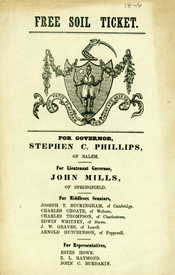
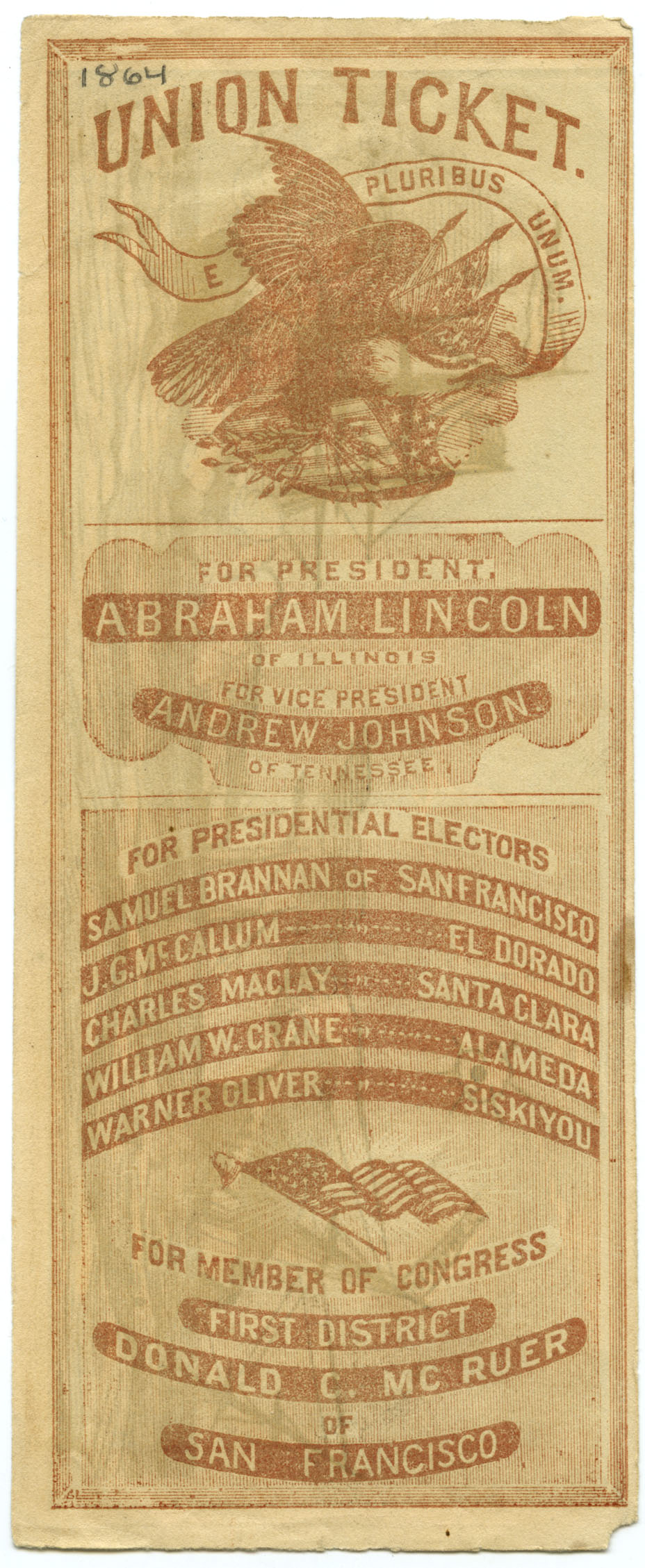
With Election Day fast approaching, it seemed like a good time to have a look at the Society’s holdings of American election ballots. This is a collection of around 700 mostly New England imprints, dating from about 1815 to the 1880s.  Most of the ballots are small in size and are arranged by political party, with candidates and offices listed on each sheet.  Some have national or state symbols, such as eagles, seals, and flags, while others feature no-nonsense design of lists of names and offices. For a brief inventory, click here http://www.americanantiquarian.org/Inventories/electionballots.htm

Election ballots have been used in political and other types of elections for centuries. Sometimes called a ticket, these ballots list the names of people who are hoping to be elected. In early American political elections, ballots were specific to a party, listing every person from that party who was running for office. The voter would turn in the party ballot to the voting station. By 1888, many states began instituting secret ballot voting by supplying voters with ballots that listed several parties in columns, allowing the voter to choose a particular party of individual. They could then drop the ballot in a general ballot box and keep their election choices secret.

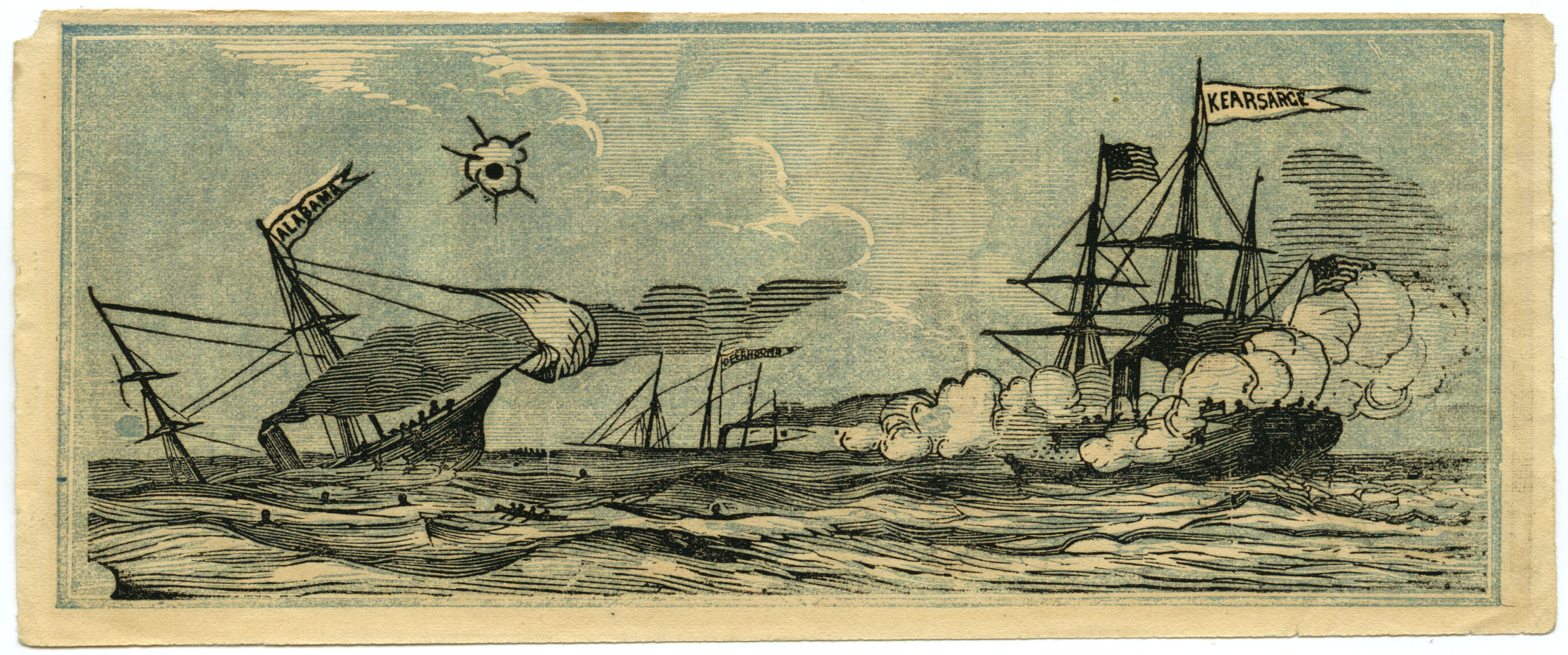
A recent research inquiry about a ballot for the 1864 Lincoln v. McClellan presidential campaign revealed that the Society holds a ticket for the race from San Francisco, California. The ballot is for the National Union Party, the party name under which Abraham Lincoln and Andrew Johnson ran.  The Union Party was the name used by the national Republican party from 1864 to 1868 (it was not used in state races). The national re-naming was both in reaction to a split in the Republican party itself (the supporters of John C. Frémont had formed the Radical Democracy Party in May of 1864), and an attempt to attract pro-war Democrats to the Republican candidates. The Society’s ticket, from November of 1864, is designed with elaborate borders and colored inks and includes the names of the candidates for local office at the bottom.  The verso of the ballot features a nautical view of the Union ship Kearsage attacking the Confederate ship Alabama, a Civil War battle which occurred in June of 1864.  Perhaps the renaming of the party worked . . . Lincoln won the election with a 400,000 vote majority.

Of course, the Society’s ballot collection does not begin to cover all the election races held in the United States.  For that, you should familiarize yourself with a wonderful digital resource, A New Nation Votes (http://elections.lib.tufts.edu/aas_portal/index.xq)  A New Nation Votes is a searchable collection of election returns from the earliest years of American democracy, 1787-1825. The American Antiquarian Society and Tufts University Digital Collections and Archives have mounted it online with funding from the National Endowment for the Humanities.  You can enter names of candidates, the state, or the name of office, and organize your results by year.  A quick search on “Hewes,” for example, revealed that one of my husband’s relatives ran for the State Auditor of Pennsylvania in 1822.  Alas, he did not get enough votes to win – it looks as if the seat went to the incumbent.