Fraud Week, Part 2: Will the Real George Washington Please Sign Here?

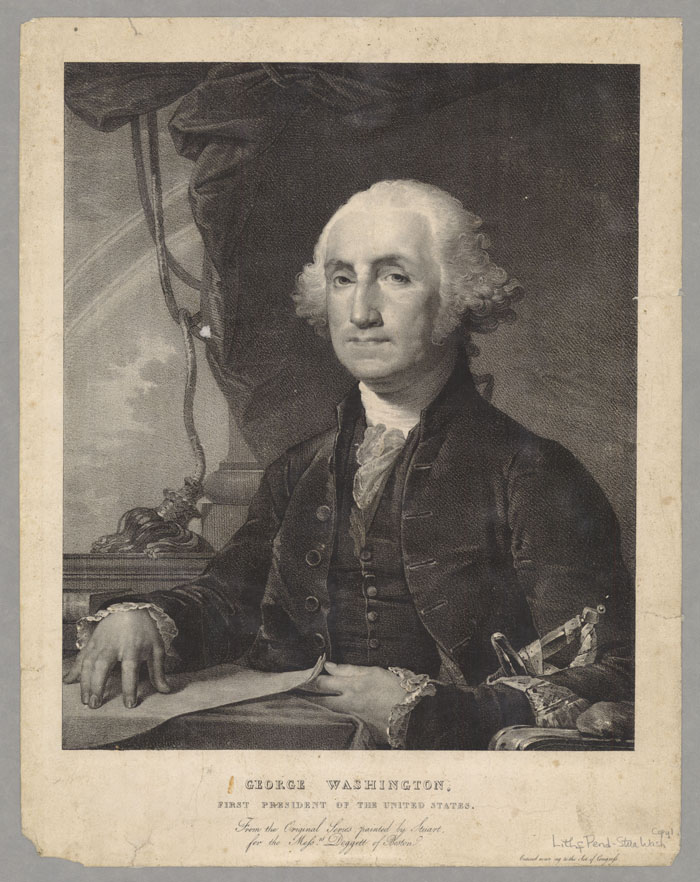
George Washington portrait

We are kicking off Fraud Week on Past is Present with a big one: forgeries of George Washington’s handwriting.  The choice of subject is particularly apropos since today is Washington’s birthday and, not surprisingly, the American Antiquarian Society has many Washington-related items, including:

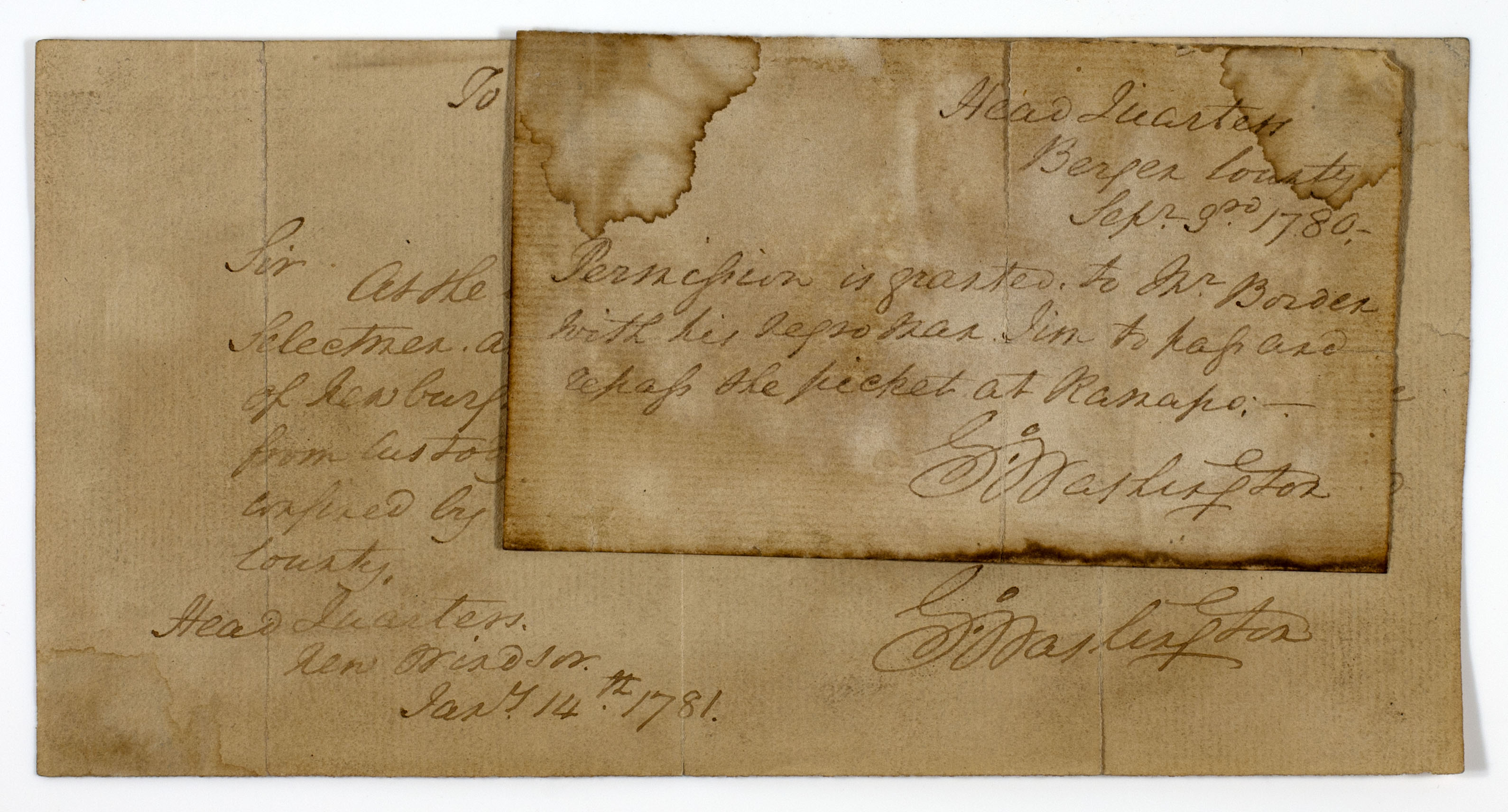
AAS has only a small manuscript collection of George Washington Papers, though, and two of the most interesting items in that manuscript collection were actually not written by George Washington.  They are forgeries, created by the most famous forger of Washington’s handwriting, Robert Spring.

Who was Robert Spring?

While nowhere near as well-known as the president whose signature he copied, Washington’s most famous forger was something of a notorious celebrity in his own right.  Robert Spring even merited an entry in Appleton’s Cyclopedia of American Biography, making him the  “only rogue — at least so labeled — in that six-volume work,” according Thomas Madigan’s book on autographs, Word Shadows of the Great.  Robert Spring’s rise (or rather, slide) to infamy is outlined in a newspaper article that originated in the Philadelphia Press and was picked up by The Trenton Evening Times on October 30, 1885.

According to the newspaper account published years after his death (apparently Spring was considered sensational news even posthumously!), Robert Spring was born in England in 1813 but moved to America in his youth:

He was industrious and pushing, and when about 23 years old, started on a tour as a book-peddler, selling “Binns Justice” a work just published and in great demand. Spring was in those days comparatively honest, and he traveled on horseback through Pennsylvania, Virginia, the Carolinas, Georgia, Kentucky and Tennessee meeting with great success in selling his books to justices and lawyers. It was while on this long tour that he became acquainted with a new business, the purchase and sale of rare books and autographs.

Spring’s early work as a book peddler not only gave him insider knowledge of the book and autograph market, but also may have helped him develop his own “confidence man” sales techniques that he later would use to pass off faked Washington letters.

What pushed Spring, a “comparatively honest” if “pushing” young man, into a life of crime?

The surprising answer is a cartload of foolscap (i.e. letter-sized) waste paper and an old-fashioned washstand.  As the newspaper account of Spring’s descent into a life of crime recounts it, the turning point in Spring’s life came in 1855:

At a sale in Baltimore of the accumulated paper of an old banking house, Spring bought a cartload of waste paper. In it he found a fortune in the shape of a quantity of checks of General Washington on the Alexandria bank… and also a large amount of blank foolscap, of English manufacture, such as was used in this country until after the revolution. … Had it not been for the suggestive presence of the old foolscap, possibly Spring would have been contented with their [i.e. the genuine Washington articles] legitimate sale.

At first Spring was content to sell the original checks and other business papers with Washington’s signature, but when these ran out, he began to forge Washington’s handwriting.

How did Spring actually create his forgeries?

Here is where the newspaper account of Spring’s life becomes so detailed it reads almost like a how-to guide to forgery:

Every one has seen the old-fashioned washstand, with a round hole in the top, in which the washbowl was placed. Spring took such a stand, placed a pane of glass over the hole, over this a genuine Washington signature, and over this a sheet of blank paper. Then beneath the glass he placed a lamp and darkened the room. Thus the signature was illuminated from beneath and could easily be traced on the blank paper. … He easily stained the paper to the color of age, and would crease it and give it a worn edge by wearing it between this stocking and the sole of his shoe.

Upon first read this account, I wondered: why Spring would have to stain the paper to age it?  After all, one of the reasons he even began this life of crime was the tempting possibilities of reams of old foolscap contemporaneous with the genuine Washington artifacts.  Yet unused paper that has been stored away from light and air will age quite differently than paper that has been out-and-about in circulation, so it makes sense Spring would have to “rough up” his paper supply, even if it was the right age.
Washington Forgeries
Spring's forged documents from the AAS collection of George Washington Papers, Folder 29 (click on image to enlarge)

The stained paper was one of the first things that stood out as odd when I first examined the two Spring forgeries at AAS in person.  It’s hard to describe exactly what seemed wrong with it: the staining is almost too perfectly irregular, perhaps?  The best way I can put it is that it reminded me of an elementary school history project for which I had to write a letter pretending to be from the eighteenth-century. I soaked my letter in tea in an attempt to make it look more authentic, although mine turned out a little spotty.  Did Spring resort to this same tea-staining method to artificially age his forgeries?  Were the examples that survive at AAS done on the original Revolutionary-War era foolscap that Spring purchased, or had his supply run out forcing him to substitute later 19th-century paper and more tea to achieve the effect?  Perhaps these are questions for the History Detectives!

How do we know the Washington documents at AAS are forgeries?

Even without being able to closely examine or test the paper and ink, there are a number of ways to tell that these two purported Washington documents are fake once you know where to look.  So here’s a crash-course in detecting Washington forgeries. (Just for fun, you may want to try to figure out which is the forgery and which is really Washington’s signature below before continuing to read; the images have been grayed out so you can try to focus on the pen strokes rather than variations in the paper and color.)
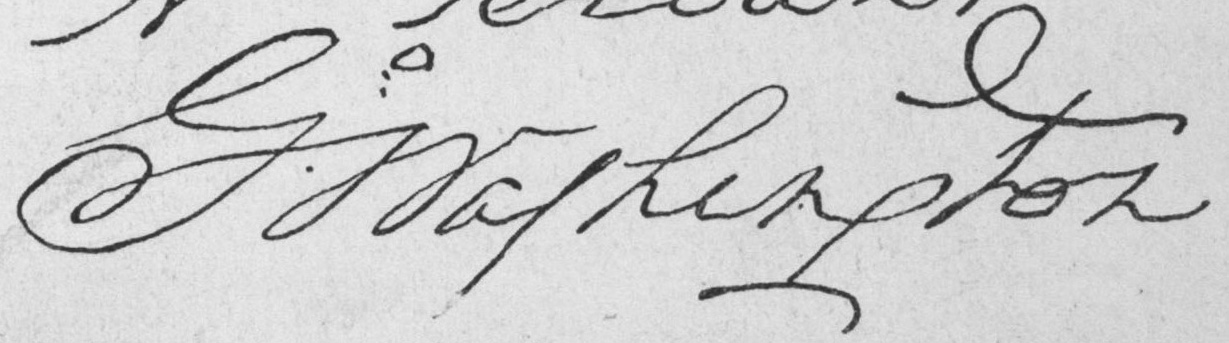
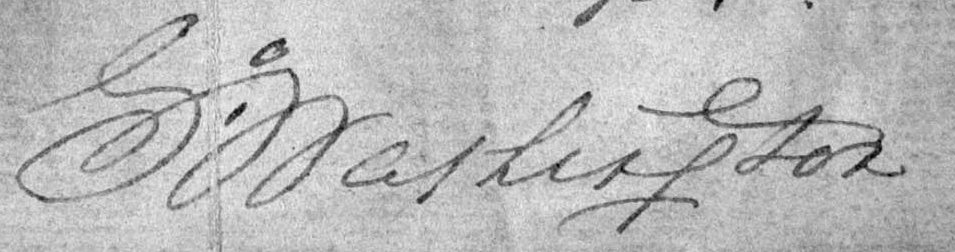
Washington Signature A
Signature A (click on image to enlarge)
Washington Signature B
Signature B (click on image to enlarge)

Looking at the signatures, focus on the “G” in particular.  The most obvious difference is that the real George Washington always signed his name “Go:” with the “o” as a superscript and two dots under it; for some reason, Spring would only put one dot.
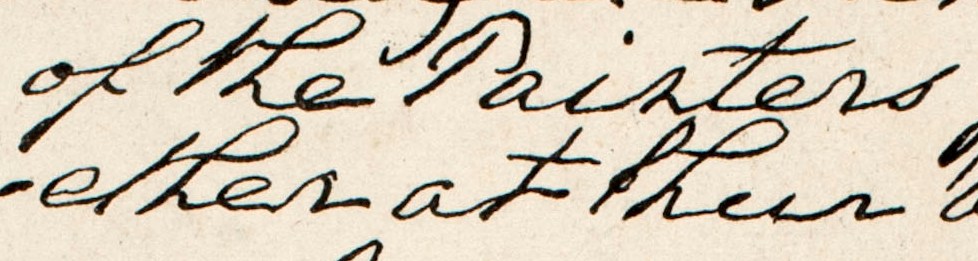
Close-up of Washington's real handwriting from facsimile, George Washington Papers, Folder 17
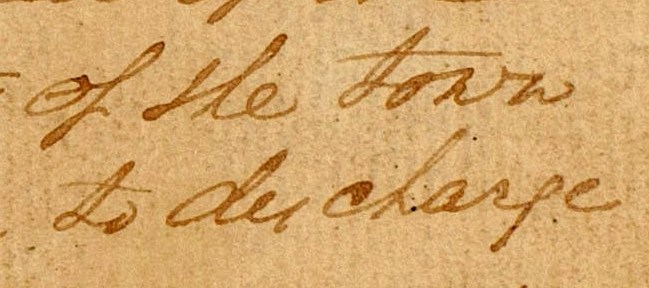
Close-up of Spring's forgery

In the close-ups of the text of the documents, notice how the real Washington’s handwriting is round and loopy, whereas in the forgery it is tighter and more perfectly angled. For instance, if you carefully examine the letter “h” in the word “the” in each close-up you will notice the real Washington’s handwriting has a very round loop at the top while in the forgery it is much narrower and looks more like a penmanship book.

Now that we have assured ourselves that these two documents are indeed forgeries, how do we determine that they were done by Spring?

In this case, Spring made it easy for himself and for us: he recycled only a few scripts over and over.  The documents at AAS follow two of Spring’s most common scripts line-by-line, as described by the editors of the George Washington Papers in an excellent article written by Dorothy Twohig, “George Washington: Forgeries and Facsimile.”  The most common script reads as follows:

To Jabez Huntington Esqr.
Sheriff of the County of Windham, Connt.
At the urgent solicitation of several of the Selectmen and respectable inhabitants of the town of Poughkeepsie, I hereby authorize you to discharge from custody Daniel Elliott now a prisoner and confined by Military Warrant to the Gaol of sd. County.
Go: Washington
Head Quarters
New Windsor
Jany 14th 1781

The name of the prisoner and the date vary with each document, but the script is otherwise exactly the same.  Similarly, in the other most common Spring forgery, the names may change, but the story stays the same:

Head Quarters
Valley Forge
Feby 5th 1778
Permission is granted to Mr. John Edwards with his Negro boy Jack to pass and repass this picket at Ramapo.
Go: Washington

In her article on Washington forgeries, Dorothy Twohig explains why Spring used so many different names:

The Papers of George Washington staff has acquired innumerable copies of this pass issued to Mr. Johnson and Sam, to Mr. Smith and Tim, to Mr. Carson and Henry, and so on… Since none of the passes unearthed so far bears the same name, it is evident that Spring changed the names on the document each time he encountered an affluent victim, simply making out a pass to order.

Spring’s penchant for repetition led the witty Thomas Madigan, whose book on autographs titled Word Shadows of the Great was mentioned earlier, to speculate:

Heaven knows how many times the indefatigable Spring caused “Mr. Ryerson and his negro man, Dick,” to pass the picket at Ramapo — so often, I am sure, that the two might have constituted the first important traffic jam in American history.

Spring’s lack of imagination finally caught up with him, though.  He was arrested in Philadelphia 1869, spent years in prison, and died in poverty 1878 — an appropriately moral ending to his story of fraud and forgery, all sparked by the “suggestive presence of the old foolscap.”

What about the afterlife of Spring’s handiwork?  How did his forgeries end up at AAS?

The good news is, we weren’t duped into purchasing the Spring forgeries.  The bad news is, someone else was.

By the turn of the twentieth century, our two “Washington” documents had found their way to a London bookshop of Walter T. Spencer.  In a fascinating twist, this bookseller wrote a memoir titled Forty Years in My Bookshop and he claims at the very end of that book that at about the turn of the century he had been offered forged documents, including Washington’s signature!  In his book, the bookseller claims he was smart enough to refuse them:

Fifteen or twenty years ago I had offered to me from time to time several letters and short manuscripts alleged to be in the autograph of great men, Thackeray and George Washington among them. .. I am glad to be able to recall I had sufficient knowledge of my business to pronounce them forgeries. (279-280)
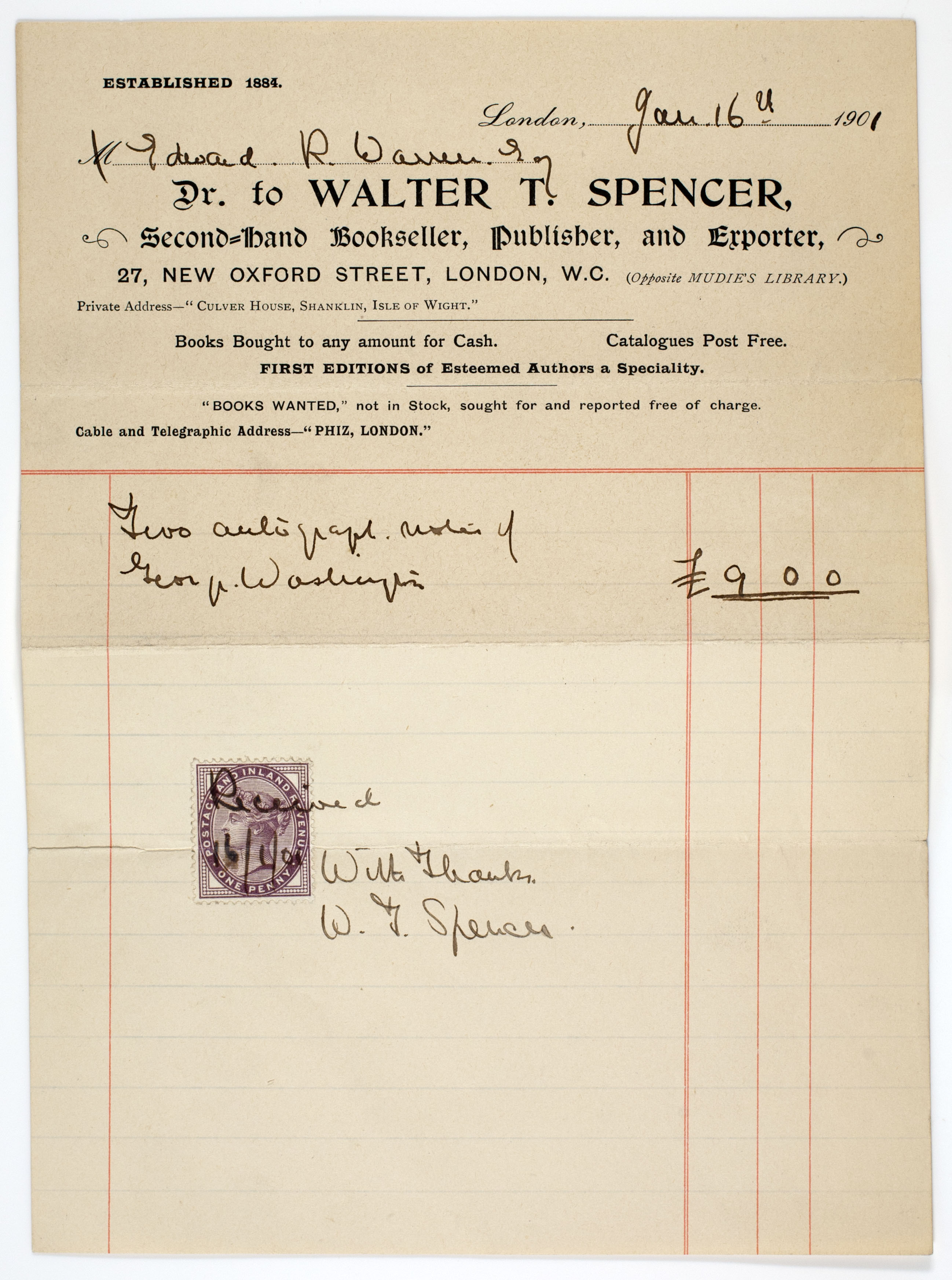
Receipt
Original bill from Walter T. Spencer's London bookshop for what he listed as "two autographed notes of George Washington"

Apparently, at least these two forgeries by Spring got past the bookseller’s expert detecting skills, because he sold them as the genuine to a Mr. Edward R. Warren on January 16, 1901 for €9. (According to the site Measuring Worth this would be approximately $1,000 in today’s money.)  Just imagine how Mr. Warren felt when he found out the documents he bought were forgeries!

Unfortunately, no letter from Mr. Warren explaining why he gave us these documents survives in the AAS archives.  There is a note on the envelope they came in that states the forged documents were the gift of Mr. Edward R. Warren, Dec. 18, 1934, along with the “original bill from the English dealer who sold the two documents as genuine.”  Perhaps Mr. Warren could no longer bear having to look at them once he realized he had been duped.  We certainly are glad he gave the documents to AAS rather than throwing them into a therapeutic bonfire.  In my opinion at least, the story of the fakes is much more interesting than if we really had a letter from Washington allowing passage through that fictionally well-traveled picket at Ramapo.

Further Reading:

Madigan, Thomas. Word Shadows of the Great. (New York, 1930)

Spencer, Walter T. Forty Years in My Bookshop. (Boston, 1923)

Twohig, Dorothy. “George Washington: Forgeries and Facsimile.” Originally appeared in The Journal of the Society of Georgia Archivists (Spring 1983, vol. 1, pp. 1-13).

And finally, if you’ve had enough of the forgeries and want to read some of Washington’s real writing, check out The Papers of George Washington, or visit a new website debuting today which includes transcriptions of many of Washington’s writings, First in Peace.
Fraud Week (like Shark Week, but in the archives)

Discovery Channel may have cornered the market on Shark Week, but here at Past is Present we are instituting our own Fraud Week to explore the seamier underside of the archive. Or perhaps we will discover that there is another side to fakes, forgeries, and frauds, in a similar manner to how Shark Week has helped those raised with the fear of Jaws in them to appreciate sharks in new ways — even if they’re not ready to swim with them.

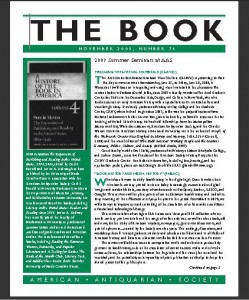
For another example of nineteenth-century fraud, click on the image above to read recent AAS fellow Lara Cohen's piece on the counterfeit gift book economy in the AAS publication, The Book (November 2008), p.3

Fakes can be fascinating historical documents in their own right. (Of course, it helps to have the perspective of at least hundred years between you and the fake. And it really helps if you didn’t shell out a ton of money to purchase what turns out not to be the genuine article!) But honestly assessing forgeries, counterfeits, and pirated copies reminds us of the value of the real thing.

We will spend this week bent over a light box examining bank notes with magnifying glass in hand on the trail of a counterfeiter.  We will pull pirated copies of books off our shelves and take to high seas of early copyright law (or lack thereof).  We will trace the path of a forged George Washington signature from its origination with a cartload of foolscap wastepaper bought at auction and an old-fashioned washstand that together tempted a young book peddler to become an expert forger; follow it through the hands of flattered collectors, a respected London bookseller, and a disappointed buyer; and see it ultimately deposited in its final resting place — the AAS vault.  We will learn what people in the nineteenth-century considered the most pernicious frauds of their time and get advice on how to protect ourselves from “confidence men” in all forms.

As we uncover these frauds in the archives, we hope you will join us in pondering the questions they raise:

  • Why are some people willing to spend thousands of dollars for just the signature of a famous man (or, less often, a famous woman)?  Is there something inherent valuable in paper we know George Washington’s hand touched and his pen bore down on?
  • What exactly is the difference between an authorized edition and a pirated copy of a book?  Between genuine and counterfeit money?  How is it determined that the authority behind these documents is legitimate?
  • What makes something worth faking?
  • How are people convinced to believe counterfeit items are genuine, and to pay good money for them?
  • And perhaps most importantly of all, will you be able to spot the fakes amidst the genuine, or will you too be fooled?

As the week goes on, please comment on our posts and let us know if you enjoy a themed week like this Fraud Week. We already have ideas for a follow-up Crime & Deception Week, and we’re always open to other suggestions.  So let us know what you’d like!

The Acquisitions Table: A Sketch of the Life and Public Services of William Henry Harrison

Jackson, Isaac R., d. 1843. A sketch of the life and public services of William Henry Harrison. Philadelphia, Jan. 1836.

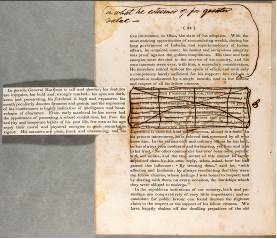
The Making of the President, 1840 style. By the 1824 presidential election, the printed campaign biography had become a key component of any serious presidential run. Hence when William Henry Harrison consented to run against Martin Van Buren in 1836, several biographies were cobbled together from existing sources and published. The leading account was penned by Isaac R. Jackson and printed in at least half a dozen editions. Jackson’s work proved so helpful in painting Harrison as a military hero and man of the people, in stark contrast to Van Buren, that for the 1840 campaign it was revised, considerably expanded, and printed in nearly two dozen full or abridged versions, usually with significant text alterations to suit the pamphlet’s intended audience.

This copy offers a unique window into the process of shaping a candidate’s public persona. A copy of one of the 1836 editions has been revised for the 1840 campaign through erasures, manuscript deletions and additions, and even printed sections cut from other 1840 revised editions (or different biographies!) and pasted where the new text should be inserted. The title and imprint have been altered (with added directions for the typesetter) to: “The Life of General Harrison of Ohio, the people’s candidate for the presidency … Philadelphia: 1840.” The revisions were not made by Jackson, but by an unknown Harrison supporter. No 1840 edition with this exact title is known, but various of the editions now at AAS contain some of the textual alterations and not others, and a few proposed alterations may not have seen print at all. In other words, the text of this particular campaign biography may exist in a dozen or more versions, depending on which edition(s) a Whig Party hack used as printer’s copy for the local edition he was charged with preparing. Purchased from David Lesser. Hugh Amory Memorial Fund.

Adventures of an American Classic

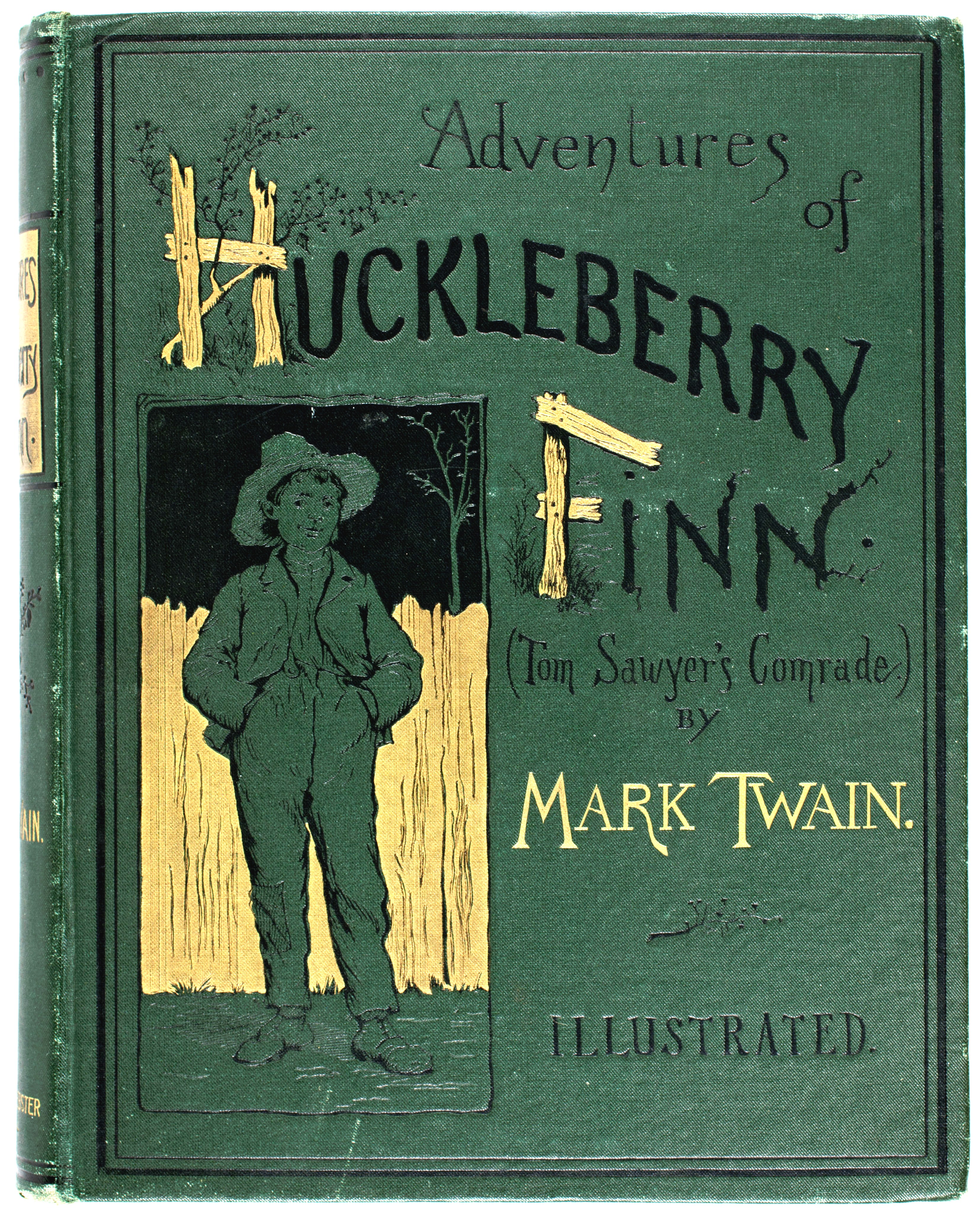
Historians of American life and culture have studied and argued about Mark Twain’s use of dialect in his Adventures of Huckleberry Finn since the novel’s U.S. publication on this date in February 1885.  Censors and bowdlerizers have made efforts to prevent students and others from reading the novel with its dialect intact.  From early attempts to ban the book in public libraries to the latest efforts by one professor to scrub the book clean of offensive language, the novel has had a long and controversial history.  Indeed, a recent New York Times article reported on new efforts to censor Twain.

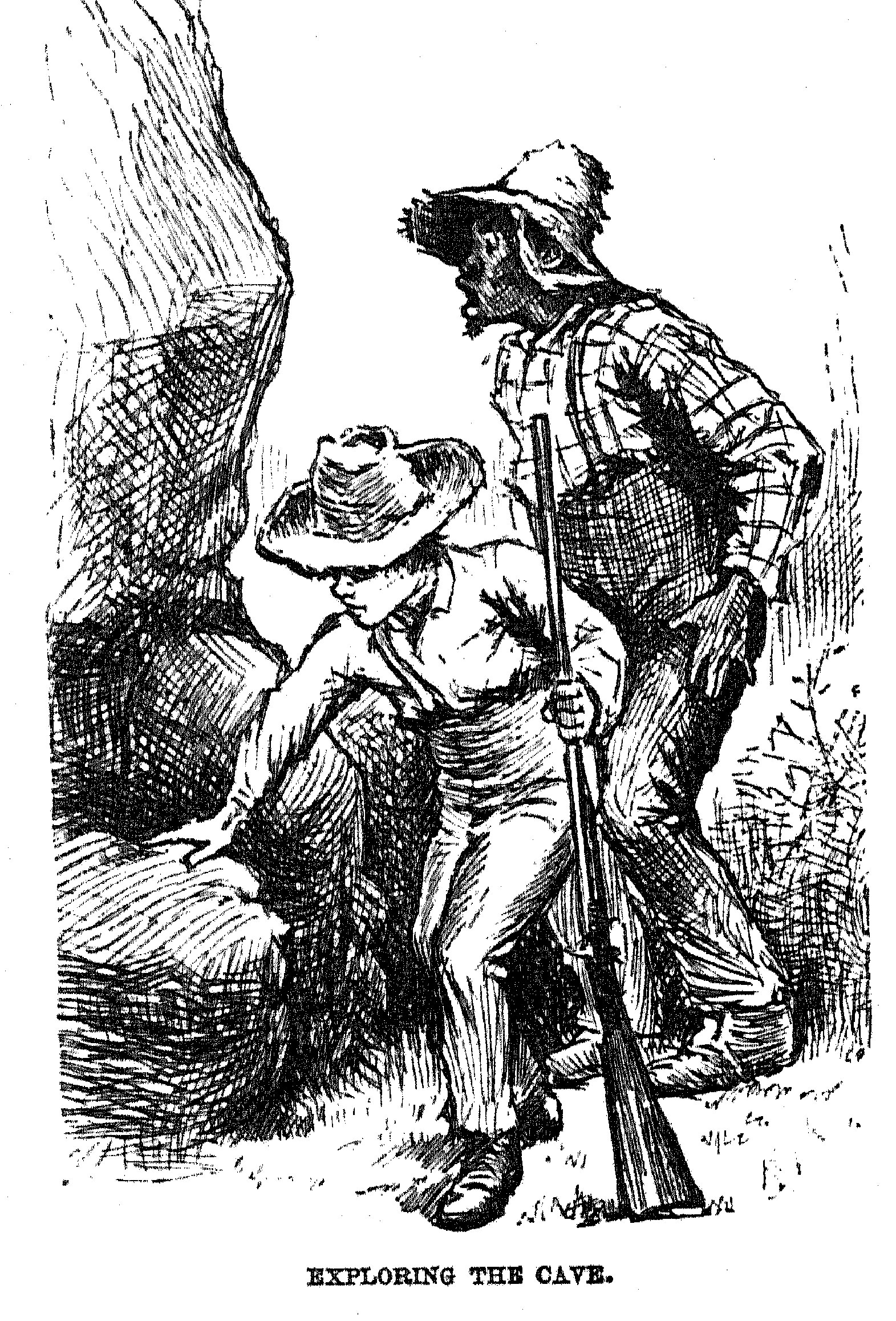
When Twain published his American edition of the Adventures of Huckleberry Finn on February 18, 1885, he commissioned Edward Windsor Kemble, son of California newsman Edward C. Kemble, to illustrate the work.  Twain had worked on the Alta California, a newspaper once owned by the elder Kemble (click here for an AAS catalog list of newspapers edited by E.C. Kemble).

Edward W. Kemble later reflected on his illustration process in “Illustrating Huckleberry Finn” which appeared in the February 1930 issue of The Colophon: A Book Collectors’ Quarterly. In the article, Kemble describes the beginning of his career as a time when he “was a budding cartoonist … and Thomas Nast reigned supreme as the master cartoonist of the country.” Illustrating Twain’s book, though, changed everything for Kemble. His images became so closely associated with Huckleberry Finn that when William D. Taylor directed the 1920 film version of the Adventures, he modeled his actors and set after Kemble’s illustrations.

E.W. Kemble’s illustrations have never received the same type of controversy or attention as Twain’s language, yet Kemble’s depictions of African-Americans were prominently featured in late-nineteenth-century periodicals, newspapers, and illustrated novels. Below is a sampling of records for other works featuring illustrations by Kemble and owned by AAS.

Newspapers and periodicals:

The Daily Graphic

Harper’s Magazine

Scribner’s Magazine

St. Nicholas

Century Magazine

Books:

Widow Guthrie by Richard Malcolm Johnston

The Primes and Their Neighbors by Richard Malcolm Johnston

The Tar Baby, and Other Rhymes of Uncle Remus by Joel Chandler Harris

Daddy Jake the Runaway by Joel Chandler Harris

Uncle Tom’s Cabin (1892) by Harriet Beecher Stowe

For a list of all the cataloged works illustrated by Kemble at AAS, click here.  And, of course, both the American first edition and the earlier London edition from 1884 of the Adventures of Huckleberry Finn, with their now-famous Kemble illustrations, are at AAS, too!

“The Truth of Sunlight:” When the Daguerreotype was the Technological Vanguard

When a new technology comes along, like the iPad or the Kindle, human consumers are naturally fascinated. We admire our colleague’s new-found technological abilities; we test the gadgets in the stores; we read about them in the press.  Some among us predict the end of older technologies.  Others scoff and stick with the tried and true.  Lest you think this is purely a twenty-first century phenomenon, we blog here today about a technology that took America by storm in the 1840s – the daguerreotype.

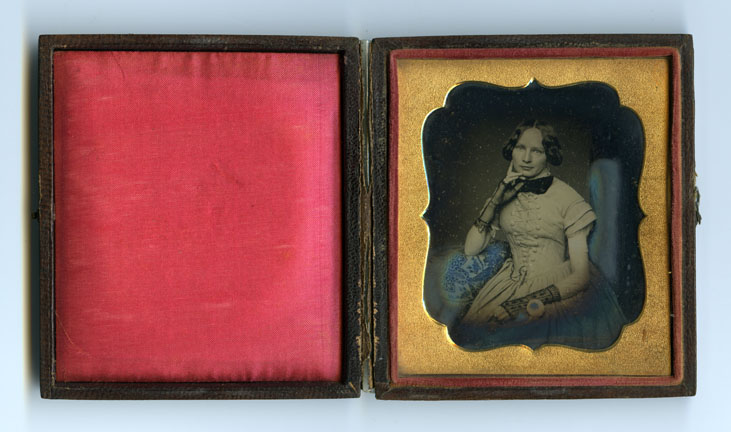
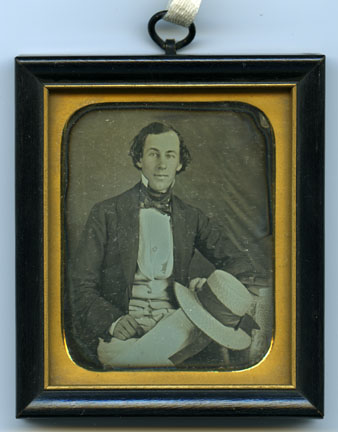
Two Examples from AAS Daguerreotype Collection
(see the online illustrated inventory for many more)

Woodward Daguerreotype
Above: Mrs. Samuel (L.E.R. Treadwell) Woodward (d. 1857), sixth plate daguerreotype, 1856;

Right: Luther Holman Hale (1823-1885), sixth plate daguerreotype, late 1840's

Luther Holman Hale

Click either image to enlarge.

We have blogged about photographs elsewhere, and, if you want more images, you can certainly link to any of the Society’s wonderful online photographic resources to see more. But today we are thinking about the first photograph, when the whole idea was new and the technology was completely mystical to most Americans.  We don’t necessarily want to look at images – but we have included a couple here for your viewing pleasure.  Mainly what we are interested in is how daguerreotypes were perceived by those early consumers of this new technology.  Often we rely on critical reviews in periodicals or newspapers for this sort of information, but every once in a while, we get a rare first-person account.

Washburn Papers
Item from the Emory Washburn Papers, which AAS acquired in 2009

Recently one of our valued volunteers, Jane Dewey, was helping us to process the Society’s Emory Washburn (1800-1877) Papers (you can read more about this recent acquisiton in our Fall 2009 Almanac). While working with the collection, Jane discovered an interesting quote about a daguerreotype. In 1841, just a few years after the technology was invented and made available in the U.S., the future Massachusetts governor sat for his portrait in Worcester or Boston. He sent the image by mail to his wife, who, with their three children, was visiting her parents in Walpole, New Hampshire.  Alas, the American Antiquarian Society does not have the 1841 daguerreotype, just a very important letter from Mrs. Washburn back to her husband, written upon receipt of the portrait.  This is what she wrote on July 29, 1841:

I thank you most sincerely for sending the daguerreotype – to me it is invaluable. The truth of sunlight cannot be questioned or criticized.  The dimness and indistinctness at first sight are pleasant to me in a miniature; you look at it, it seems like a shadow or a spirit; you turn it into a stronger light & the spirit becomes embodied.  The longer you look & the brighter the light; the more & more you find comes out & he seems to be yours only. He seems to be yours, bright, clear & distinct, but dim, unreal & shadowy to others – & this feeling of monopoly, love, in its selfishness, likes. Father and Mother were affected almost to tears.  Minnie declared it looked like Mr. Van Buren. Charlie said at first it was a little looking glass and then smiling said he “could see his Father, Mr. Washburn in it.” Emory said, “That is my Father.”

Later photograph of Emory Washburn

In 1841 Minnie Washburn was age 10, Charlie was 8, and little Emory was just 5.  One can almost picture the family gathered together in the parlor in New Hampshire passing around the small silvery daguerreotype and exclaiming over the surface, the image of Emory Washburn looking back at them.  It must have been a somewhat disconcerting feeling to see an image of a loved one, reduced in size, set in a small book-like case, knowing in reality that their father was miles away in Massachusetts.  This might be akin to our modern apps like FaceTime or Skype – where we can see people half way around the world and talk to them, too!  The delight we take in these new developments is exactly like the feeling captured in Mrs. Washburn’s letter.

If you think you might know where the original image of Emory Washburn lives, do let us know!  We have no idea who the photographer might be and would be delighted to learn more.  The Society has several images of Emory Washburn in his later years, and would love to see him at age 41, looking out of the mirrored surface of the daguerreotype, a confident lawyer and young father.

“Mother of the Valentine”: Esther Howland, Worcester, and the American Valentine Industry

Did you know that the American valentine industry started right here in Worcester in 1848?   That America’s first widely mass-produced valentines were designed by a woman named Esther Howland in her workshop on Summer Street?  That Victorians ate conversation hearts?  That Valentine’s Day greetings were part of a larger cultural debate in early America about love’s relationship to marriage?  The American Antiquarian Society has much to teach us by way of Valentine’s Day lore.  Among its collections are valentines designed by Esther Howland and secondary source material on the history of valentines in America.

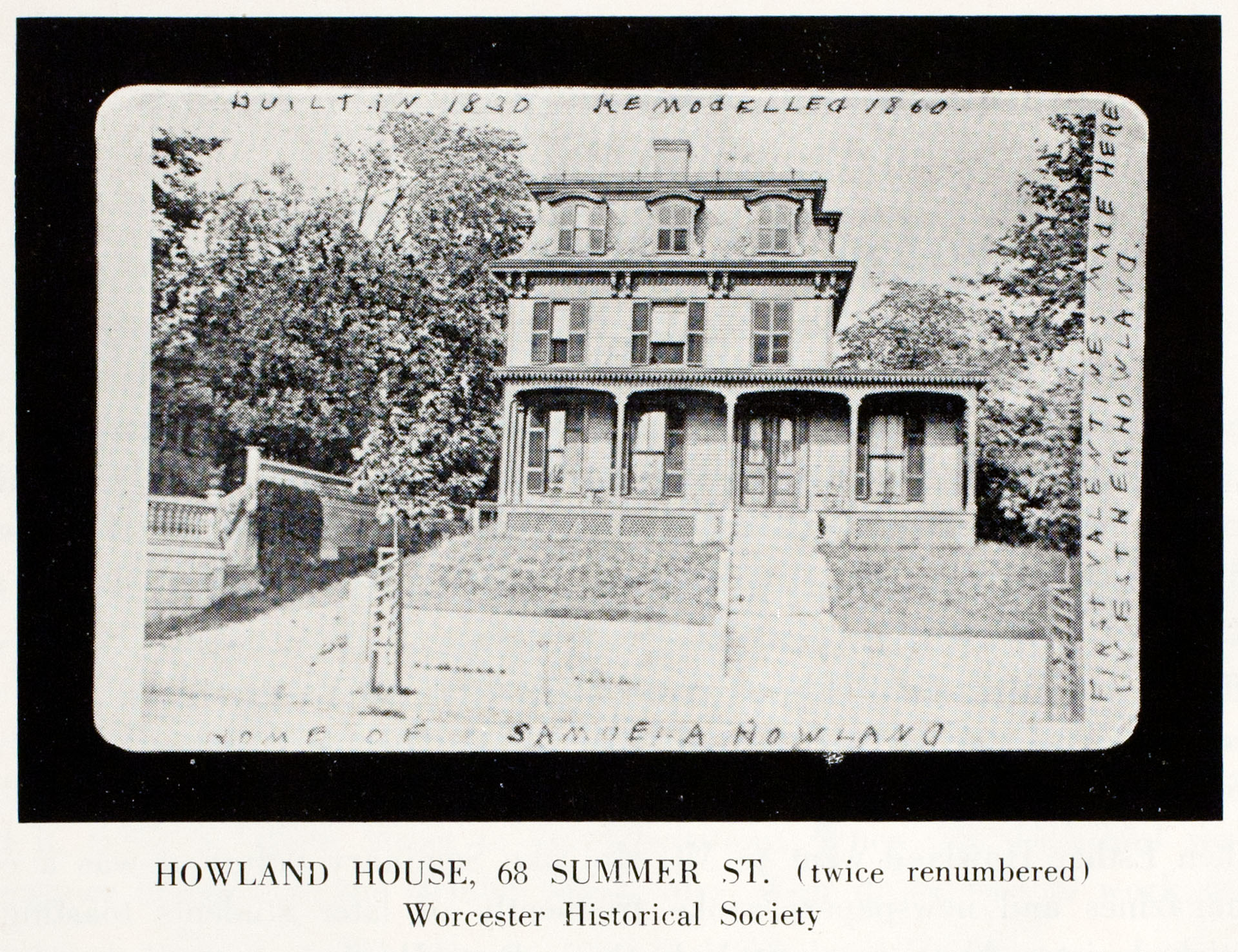
Esther Howland (1828-1904), a Mount Holyoke grad and Summer Street native, produced America’s first elaborate valentines here in Worcester in 1848, the same year that Worcester became a city.  The daughter of an affluent stationer, Howland first copied a Valentine’s Day greeting sent from England by her father’s colleague.  An astute businesswoman, Howland eventually opened a successful female-run valentine business combining the female world of the hearth and home with the world of commerce, at a time when valentines were becoming increasingly popular. She became known as the “Mother of the Valentine.”  Though never marrying herself, Howland united innumerable lovers through her valentines.

Exchanging valentines had become very popular in America by the early 1840s.  In 1846 over 30,000 valentines passed through the New York City post-office on the 14th.  In a February 14, 1849 letter to her cousin, Emily Dickinson commented on the widespread nature of the Victorian valentine craze:

The last week has been a merry one in Amherst, & notes have flown around like, snowflakes.  Ancient gentlemen, & spinsters, forgetting time, & multitude of years, have doffed their wrinkles – in exchange for smiles – even this aged world of our’s, has thrown away it’s staff – and spectacles, & now declares it will be young again.  (quoted in Petrino 89)

Valentines were scrutinized to determine lovers’ feelings and sometimes resulted in offers of marriage.  In fact, Susan Sweeney notes that even “the position of the stamp could reveal a sender’s feelings: upside down meant “I’m lovesick”; sideways, pointing right, meant “love and kisses”; sideways, pointing left, meant “I’ll never leave you”; diagonal, pointing right, meant “Will you marry me?”; and diagonal, pointing left, meant “Yes, I will.” (Sweeney 78)  Lovers lacking verbal facility could copy verses from valentine writers, small books suggesting various poems tailored to suit the many moods writers might wish to convey (Sweeney 82).  The American Antiquarian Society has some of these small treasures in its collections (click here to see a list of valentine writers from our online catalog).

Valentines had cultural significance in Victorian courtship rituals. Sweeney notes that valentines “enabled lovers to convey, interpret, and respond to romantic intentions…  A man usually initiated the exchange by sending his beloved a token to which she replied in kind, producing a complex verbal transaction that began during the week of St. Valentine’s Day but could last well into March” (Sweeney 82).  Debates about love’s relationship to marriage raged in nineteenth-century America.  The valentine craze thus reflected “a shift toward widespread acceptance of romantic love, especially as a basis for marriage” (Cook 103).

In the midst of this new interest in valentines and the uncertain social status of romance, Esther Howland opened her valentine business.  She started by setting up a workroom in the family home on Summer Street, staffing it with a few local girls to help fill the orders by copying her designs.  According to Howland, her girls were paid “liberally” and the work was “light and pleasant” (Cook 100).  Lisa Cook notes that Howland’s workshop likely resembled an English valentine workshop described by Dickens in All the Year Round:

[They are] in a long room occupied by nymphs, each one having at her elbow a pot, not of color this time, but of glue.  Strewn before each girl in apparent confusion, but really in regularly-assorted heaps, lie hearts and darts and doves and bows and arrows, and rose-buds and true lovers’ knots, and torches of Hymen, and every variety of emblem appertaining to love and matrimony… Some are paper, some are silk and velvet, some tinsel and gold-leaf. (quoted in Cook 101)

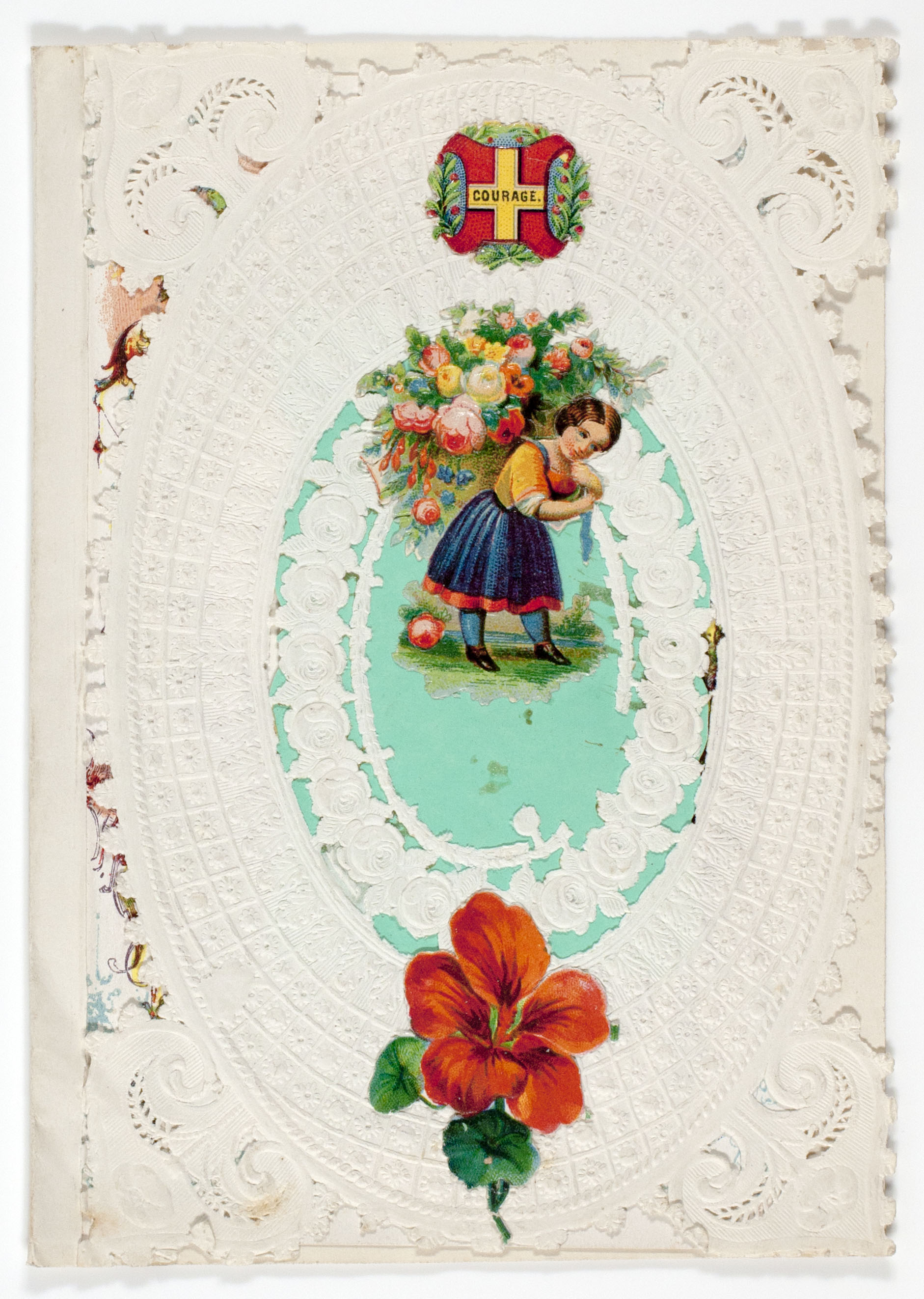
Esther Howland created many innovations in valentine design.  She introduced layers of lace, wafers of colored paper placed beneath lace, three dimensional accordion effects, and a mechanical bouquet in which pulling a string moves flowers aside to reveal printed verses underneath.  She insisted that verses and mottos not appear on the outer surface of a card. A shrewd businesswoman, she instructed her girls to write a red “H” on the back of her valentines to distinguish them when she encountered rivals.  Her sales quickly reached $75,000 a year and she stayed in business for 30 years.

Original valentines produced by Esther Howland are part of the American Antiquarian Society’s collections.  Many of them sport vivid primary colors in contrast to our modern reds and pinks.  Delicately cut, gilt lace affairs featuring pictures of lovers in Victorian costume and verses reflecting Victorian ideals, they are a must see for anyone interested in the history of Valentine’s Day.  And as for that other Valentine’s Day staple, conversation hearts, the small heart-shaped candies were also invented right here in Massachusetts by Daniel Chase of Boston in 1866.

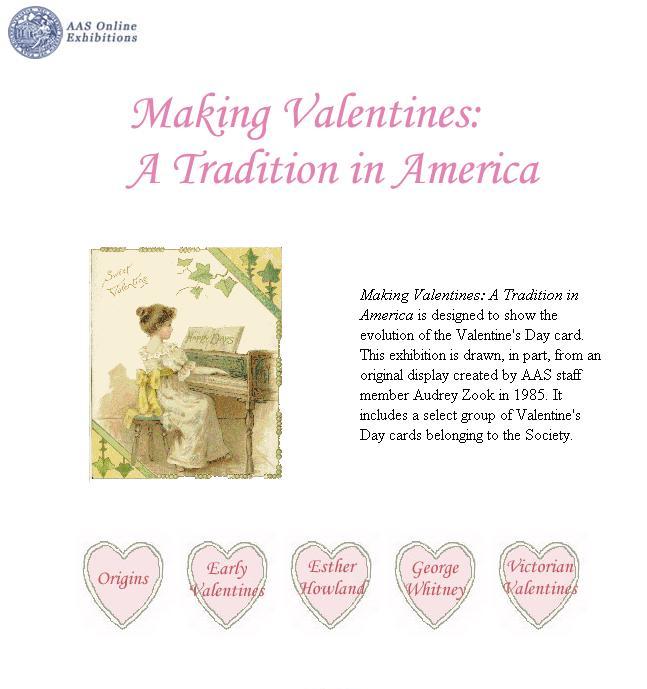
This Valentine’s Day we hope you will keep a special place in your heart for Worcester, and Massachusetts generally, now that you know how integral their residents were in shaping Valentine’s Day traditions in America.  As part of your Valentine’s Day celebrations, please enjoy more of the beautiful valentines from AAS collections in one of our classic online exhibits: “Making Valentines: A Tradition in America.”  Consider it our valentine to you, dear Past is Present readers.

Making Valentines

For Further Reading:

Cook, Lisa Connelly.  “Esther Howland and the Business of Romance.”  The Worcester Review.  23,2 (2002): 99-110.

Emerson, Marion Winslow.  “The Rose Is Red” or Esther Howland’s Valentines.  Newburyport, Mass.: Newburyport Press, 1953.

Petrino, Elizabeth A.  “Allow me, Sir, at parting’: Sentimentality and Emotional Spectatorship in Dickinson and Poe’s Verse Valentines.”  The Worcester Review.  23,2 (2002): 89-97.

Sweeney, Susan Elizabeth.  “Words from the Heart in Early American Valentines.”  The Worcester Review.  23,2 (2002): 81-87.

Finding Abraham Lincoln at AAS

Lincoln Cartoon
Detail from a political cartoon depicting an admirer of Lincoln. Click on the image to see the entire Currier & Ives print, The Republican Party Going to the Right House (1860)

Abraham Lincoln is a hot topic these days.  From renowned historians to local students, everyone is interested in learning more about the man who once declared: “I was born and have ever remained in the most humble walks of life.” While Lincoln has been a perennial favorite for researchers at AAS, recently interest in him has picked up even more due to a confluence of anniversaries. Two years ago, on February 12, 2009, we celebrated the bicentennial of Abraham Lincoln’s birth and this year marks the beginning of the sesquicentennial of the Civil War.  The Washington Post has even devoted an entire blog to the 150th anniversary of the Civil War, A House Divided, and in a recent post commented on how Lincoln (not surprisingly) remains an important part of that commemoration.

For our part, AAS will be hosting two free public lectures this May related to Lincoln and the Civil War. On Thursday, May 12, James O. and Lois E. Horton will present: “Liberty and Justice for All: The Civil War as Blacks’ Second American Revolution.” The Hortons are currently Mellon Distinguished Scholars in Residence at AAS and are in the reading room each day working primarily on a project titled: “A Documentary History of African Americans from 1619 to the Civil War.” Later in the month, on Tuesday, May 24th, David S. Reynolds will present: “Igniting the War: Harriet Beecher Stowe’s Uncle Tom’s Cabin, Antislavery Politics, and the Rise of Lincoln.” So be sure to mark your calendars or read more about these and other upcoming public programs here.

It is not only scholars who are excited about Lincoln. Currently at AAS we have a Worcester Polytechnic Institute student working on an online exhibition and inventory of the Lincoln portrait prints from our American Portrait Prints collection.  As part of a semester-long project for Professor Jim Cocola’s “Textual Engineering” course, Amber Truhanovitch is photographing, describing, and tracking down sources for the 116 prints of Lincoln in the collection.  Stay tuned for an update when her project is finished.  Her work will complement our growing collection of online finding aids that assist researchers in finding materials not yet in our online catalog.

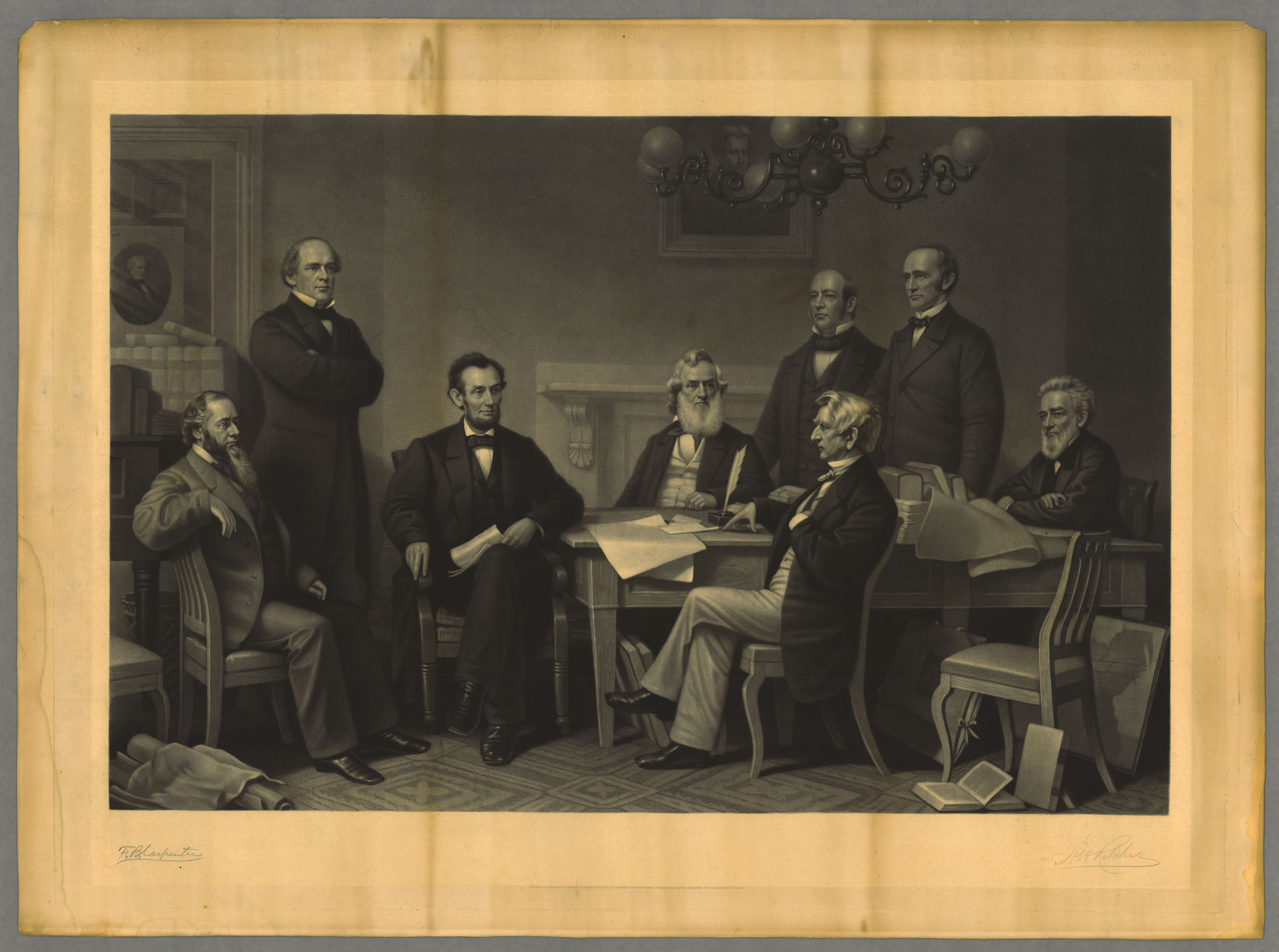
First Reading of the Emancipation Proclamation
The First Reading of the Emancipation Proclamation Before the Cabinet (1866). Click on the image to enlarge.

Indeed, the Graphic Arts collections generally at AAS are vital for any researcher hoping to understand Lincoln’s life and times.  When Bancroft-award-winning historian William Freehling gave the 2009 Baron lecture at AAS, he displayed one of our prized prints, The First Reading of the Emancipation Proclamation Before the Cabinet.  The Graphic Arts department houses not only the print, which was sold as a premium plate to New York Independent subscribers, but also the proof for the plate (click here to see the online catalog records for both).  AAS’s sizable collections of other graphics — including Civil War cartoons, Civil War envelopes, and cartes-de-visite — often feature Lincoln.

Additional AAS collections — including other prints, broadsides, political cartoons, songsters, ephemera, newspapers, and children’s literature — all supply the Lincoln scholar with endless sources for research and study. Most of these materials can be found by searching the AAS online catalog for “Abraham Lincoln” as a phrase. This search results in over 750 hits (click here to see for yourself), all of which goes to show just how easy it is to find Abraham Lincoln at AAS!

Portraits — Online and On The Acquisitions Table

Here is a fun anecdote from Graphic Arts curator Lauren Hewes that highlights both the value of AAS’s online illustrated inventories and how our online resources can help to put new items on The Acquisitions Table:

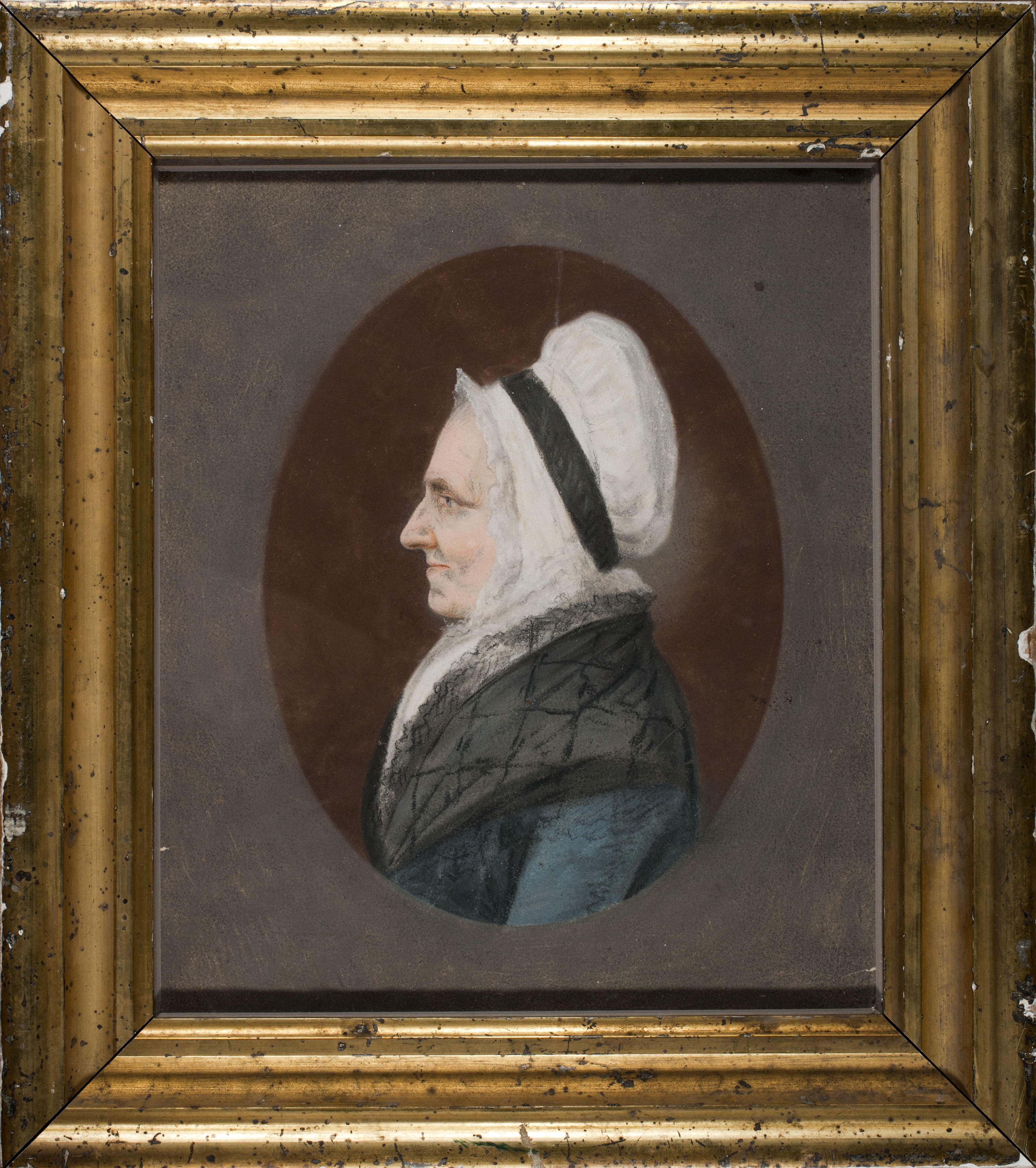
Pastel portrait of Hannah Church Weld by Gerritt Schipper, 1804

One day this past year a dentist in Alabama was on Google searching for more information about a pastel he had bought at a Louisiana auction in 2009. In his search he came across our AAS portraits online, including illustrations and text about all of our painted portraits.  He contacted me with questions about the artist Gerritt Schipper and we had a lovely correspondence, which resulted in the Society purchasing the pastel shown at right.

The profile portrait is of Hannah Church Weld (1733-1804), the wife of Edward Weld, a prosperous Boston merchant.  Her portrait was of interest to AAS for a number of reasons, but the one that tops the list is that Mrs. Weld was also the mother-in-law of Isaiah Thomas, Jr. and we are particularly interested in materials relating to the family of our founder.  The AAS portrait website contains images and information on the six pastels of the Thomas family made by Gerritt Schipper in 1804 (which is how our Googling dentist found us).  Schipper drew pastel portraits of two of her daughters during his travels in Boston, Salem, and Worcester in August and September of 1804. Hannah Church Weld died in September 14th, 1804, and so, if done from life, this could be the last likeness made of her, taken at the age of 71.  Alternatively, the pastel could have been completed posthumously.  The early ownership of the pastel is unknown, but based on an inscription on the verso, the piece came down through another line of the Weld family and was not owned by the Thomas’s.  Now it has found its way back to a permanent home with the other Thomas family portraits.

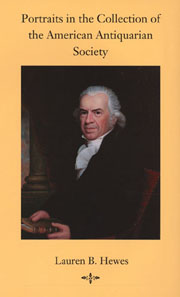
The online illustrated inventory of AAS portraits describes a fascinating collection that many people, even those who know AAS well, don’t know that we have.  Along with images of the oil paintings, busts, and miniatures, the website contains biographical portraits and catalog information from the book Portraits in the Collection of the American Antiquarian Society by Lauren Hewes (available for purchase from Oak Knoll).

In the online Introduction to the American Painted Portrait and Sculpture Collection, Georgia Barnhill and Caroline Stoffel highlight some of the unique features of AAS’s portraits collection. For instance:

Since many of the portraits came to AAS together with manuscript collections or were commissioned by the Society, we have extraordinary information about the circumstances of their production. There are occasional first-person accounts of the process of sitting for portraits as well as important documents revealing the costs of the paintings and even their frames. Newspaper advertisements found in the AAS collection provide documentation about itinerant artists who came to Worcester. In an effort to obtain commissions for one artist, Isaiah Thomas, Jr., placed an advertisement in the September 12, 1804, issue of the Worcester Spy saying that examples of Gerrit Schipper’s portraits could be seen in his home or office. Other early nineteenth-century Worcester residents, such as Edward D. Bangs and Isaiah Thomas, traveled to Boston to sit for oil portraits by artists established in Boston studios; later in the century, Stephen Salisbury II went to New York for sittings with Daniel Huntington.

Some special features of the AAS portraits online include:

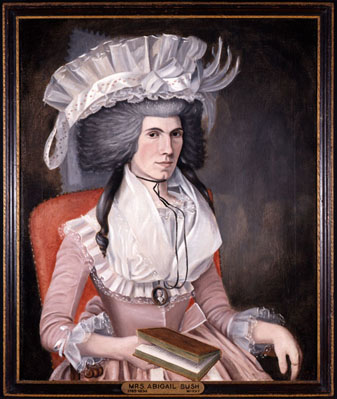
Hannah Ackley Bush (1767-1807), attributed to John Mackay or M’Kay, 1791

To highlight just one of the images, the striking Hannah Bush portrait pictured at right hangs over the card catalogs in AAS’s reading room and is a personal favorite of many visitors and staff alike. But could it actually be, as one reader suggested, a portrait of Daniel Day Lewis in drag? Click here for a picture of Daniel Day Lewis to compare to Hannah Bush’s portrait and decide for yourself.

Or just have fun browsing through the thumbnail gallery of portraits on your own — you never know which one may strike your fancy!

The Acquisitions Table: Sophia May Tuckerman Letters

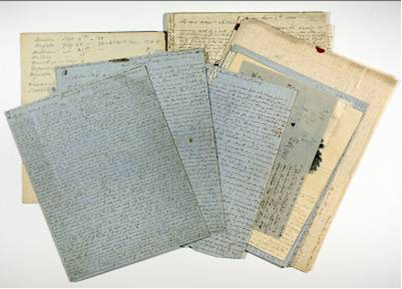
Tuckerman, Sophia May. Letters, 1841-1857.

Sophia May (1784-1870) was the daughter of Col. John May (whose jaunty portrait in military uniform hangs in the AAS reading room) and his wife Abigail, who was also his cousin. Sophia May married Edward Tuckerman (1775-1843). AAS has a business letterbook of Edward Tuckerman’s firm of Tuckerman and Rogers. Among their children was the botanist Edward Tuckerman (1817-1886), a large collection of whose correspondence is at AAS. Sophia May Tuckerman travelled abroad extensively and these letters were written during her travels. The earliest are from 1841, but most date to the period between 1849 and 1857, after Edward’s death. They are addressed to her children and other family members. We are always particularly happy to add manuscript material to the collections that is closely related to material already here. Gift of Thomas S. Michie.

Public Programs Reach an Even Wider Audience with Podcasts

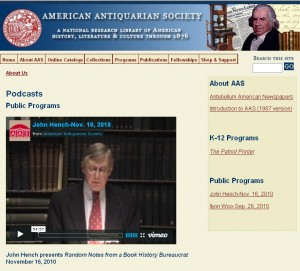
Every spring and fall AAS produces a series of public programs and offers them to the public at no charge. While we often see over a hundred people at these presentations, we are now expanding the audience for these programs by presenting recorded podcasts of them.  The web page Podcasts from the American Antiquarian Society currently has two of our latest programs by John Hench and Ilyon Woo. Additionally, the site contains other short films created by and about the Society including a promotional video featuring Walter Cronkite for the Society’s 175th anniversary celebration in 1987.  We hope to add additional video segments and to post podcasts of our lectures shortly after each is presented as part of our public program series.

John Hench delivered the twenty-seventh annual James Russell Wiggins lecture in the History of the Book in America on November 16, 2010. The podcast captures all the wit, wisdom, and reflection of John’s wonderful program.  John was formerly the senior vice president for collections and programs at the Society and worked here for thirty-three years before his retirement in 2006.  He was instrumental in conceiving and then administrating the Society’s seminal Program in the History of the Book in America and his talk recounts that important chapter in the Society’s history. John brilliantly describes his own fascination with books throughout his childhood, education, and professional career culminating in his latest scholarship on the role American publishers played in rebuilding post-World War II Europe.

Ilyon Woo conducted research at AAS for her recently published book The Great Divorce as a Kate and Hall J. Peterson fellow during the 2004-05 academic year.  The podcast of her lecture, delivered on September 28, 2010, details how Ilyon’s experience at AAS transformed her project both because of the key evidence she uncovered in the library and how her interactions with AAS staff and other fellows helped her to sharpen the narrative arch of her story about a woman named Eunice Chapman who fought her husband, the Shakers, and the conventions of American Society in the early 1800s to gain custody of her children.

Additionally, this webpage contains two other short films created as part of the Society’s services for pre-collegiate educators and their students.  AAS curator of newspapers, Vincent Golden is featured in one film describing the characteristics of antebellum newspapers. Vince shows us some temperance and anti-slavery newspapers as examples of those promoting a particular reform movement.  He also shares several journals published under the auspices of a political party.

Another short film entitled “The Patriot Printer” imagines Isaiah Thomas printing the May 3, 1775 issue of his paper The Massachusetts Spy, which contains Thomas’s account of the Battles of Lexington and Concord.  Thomas, as portrayed by actor Neil Gustafson, describes the characteristics of eighteenth-century newspapers as he hands his latest issue to post riders who will dispatch it to the rest of the colonies. He then stresses the importance to the nascent American rebellion of controlling the narrative of the first battles of the war.  Both of these videos are also on the Society’s website designed specifically for K-12 populations: www.teachushistory.org.

And finally, the podcast page features a historic film created as part of the Society’s 175 anniversary celebrations.  Narrated by former CBS-TV journalist Walter Cronkite, this program describes the Society’s collections and programs and offers us a fascinating time capsule of how we lived in 1987.  We are now in the process of creating a new film promoting the Society as part of our 200th anniversary in 2012.  When completed, it too will be added to this podcast page.

The Acquisitions Table: How ’tis done

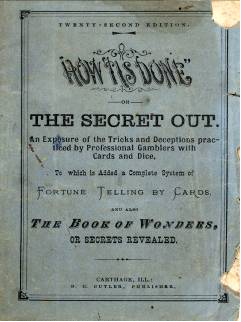
How ‘tis done; or The secret out. An exposure of the tricks and deceptions practiced by professional gamblers with cards and dice … 22nd ed. Carthage, IL: D. C. Cutler, [ca. 1869?]

From a small Illinois town 10 miles east of Keokuk and the mighty Mississippi, D. C. Cutler ran a mail-order business for cheap chapbooks, “splendid colored engravings,” and handy devices such as the “magic comb … [which] will color gray hair a permanent black or brown,” as listed in the 16-page catalog appended to this pamphlet. A few of these chapbooks Cutler published—or rather, reprinted—himself, complete with cheerfully disregarded copyright notice. The copyright for How ‘tis done, for example, was owned by Hunter & Co. of Hinsdale, NH, which published its own editions beginning in 1864. Only the first seven pages detail the card sharp’s tricks; the remaining pages discuss “cardiology” (i.e. “the science of foretelling events by cards”), and offer recipes for useful concoctions such as “imitation liquors.” The Cutler edition is unrecorded. Purchased from Ian Brabner. Harry G. Stoddard Memorial Fund.

Paper Rituals

It is perhaps not surprising that we can be a little obsessive about our paper here at AAS. However, a recent influx of interns reminded me how strange all the paper shuffling that goes on at the desk can appear to an outsider. People new to doing research at AAS, upon being asked to present their exit card or asked where their pink slip is, are often — not surprisingly — perplexed. After all, can you even be given a pink slip and get fired as a reader?

While the seemingly endless paper shifting may, at first glance, appear merely obsessive, it is absolutely essential in a closed-stack library. (To read about other seemingly odd terms at a research library, click here.) After all, every time an item leaves its home in our climate-controlled stacks there is a risk of it being mishandled or misplaced. To prevent any such disasters, a variety of pieces of paper create a sort of bread-crumb trail for each book or item. The paper trail for each item marks its way safely out of the stacks and then back again to its original spot, where it will remain secure until called for by the next reader.

So you see why the rituals of working at the reference desk rely heavily on moving pieces of paper from one spot to another. Each type of paper has different rules for its usage, where it should be kept and returned to, etc. Carefully choreographed movements specify exactly where each type of paper should go and signify a variety of messages to those “in the know.” Here’s the inside scoop on the paper rituals of Antiquarian Hall.

The Call Slip
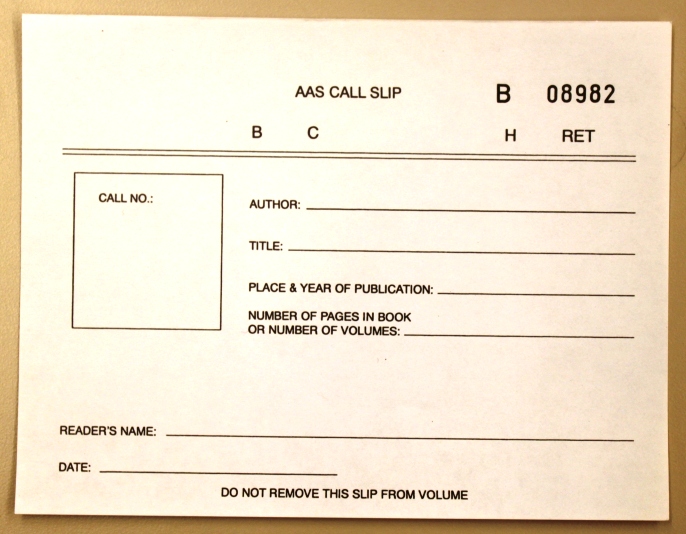
The call slip could be thought of as the “trinity” at the center of our paper rituals (although to do so may be rather sacrilegious). It contains three-parts-in-one and is absolutely essential to our paper rituals. Each call slip is numbered, and when readers write out the information about the materials they want on the top layer, it transfers to all the layers below. This way everything can be matched up exactly.

The White
The white is the top-most layer of the call slip and it becomes main player in our paper games. The white is filed in a box at the desk anytime an item goes out into the reading room so that we know to ask for it back at the end of the day. No one can go home until the box at the desk is cleared of white slips, because that means all the collection materials have been turned in.

The Pink Slip
Don’t panic! This pink slip is just the second part of the call slip. The pink slip must stay with the book or item at all times until it is returned to its proper home in the stacks. So I guess this makes a pink slip a good thing, and in fact a necessary thing, to have. Whew!

The Buff
If you hear us talking about “the buff” at the desk don’t worry: it has nothing to do with nudity. The buff is the last part of the call slip. It remains on the shelf in the stacks in back holding the place where the book (or other item) used to be.

Red Flags
Not for offensive technical fouls, these red flags are also technically not made of paper. Instead, the red flags are plastic sheaths that hold the buff so that it can sit nicely on the shelf in the stacks. This holds the place for the book and attracts attention with its bright fire-engine red. When it comes time to return everything and all the books on all the shelves start to look the same, these red flags make it easier to find the exact spot on the shelf where the book came from.

The Exit Card
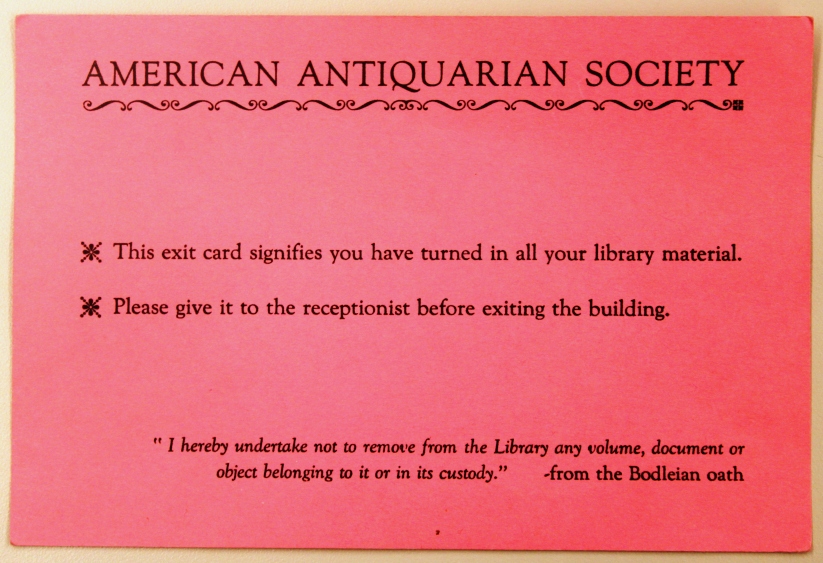
As a final check or security measure, we require that anytime readers want to leave the library building they must turn in all collection materials at the reference desk in the reading room and be issued an exit card. This card must be given to the receptionist before a reader will be allowed to leave the building. The exit card serves as our signal to the receptionist that readers have turned everything in and are free to go. Exit cards are sometimes known by other aliases at AAS, including “freedom pass” or “get-out-of-archive-free card.”

Tidbit You May Not Know: The AAS Exit Card got a makeover a couple of years ago by AAS’s own Jackie Penny and her husband. The current incarnation includes a part of the pledge users of the Bodleian Library in Oxford were required to sign, which reads (translated from the original Latin):

I hereby undertake not to remove from the Library, nor to mark, deface, or injure in any way, any volume, document or other object belonging to it or in its custody; not to bring into the Library, or kindle therein, any fire or flame, and not to smoke in the Library; and I promise to obey all rules of the Library.

We thought it better to leave out the part suggesting readers might even consider bringing in “any fire or flame.” Better not to plant the suggestion.

Now you know more than you ever wanted to about the paper rituals we engage in at the desk! So next time you see us moving all these little slips of paper around or someone asks you for your pink slip or exit card, you’ll know we’re not just making you play an obsessive game consisting of passing little pieces of paper around. Rather, you (and those little slips of paper) are vital participants a system to ensure access to and the safe return of AAS’s priceless collection material. And who wouldn’t want to be a part of that?

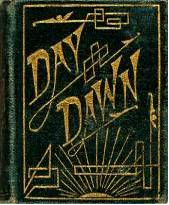
The Acquisitions Table: Day-Dawn

Day-Dawn. New York: American Tract Society, [ca. 1860]

Devotional books containing brief Bible passages for daily reading were frequently printed in two-inch miniature format so as to easily fit in a pocket. The American Tract Society was a major 19th-century publisher of these pocket devotionals. This title is new to AAS, and features a splendid gilt cover design of the rising sun. Purchased on eBay from Tracy Bradbury. Emma Forbes Waite Fund.

Hot Off the Press!

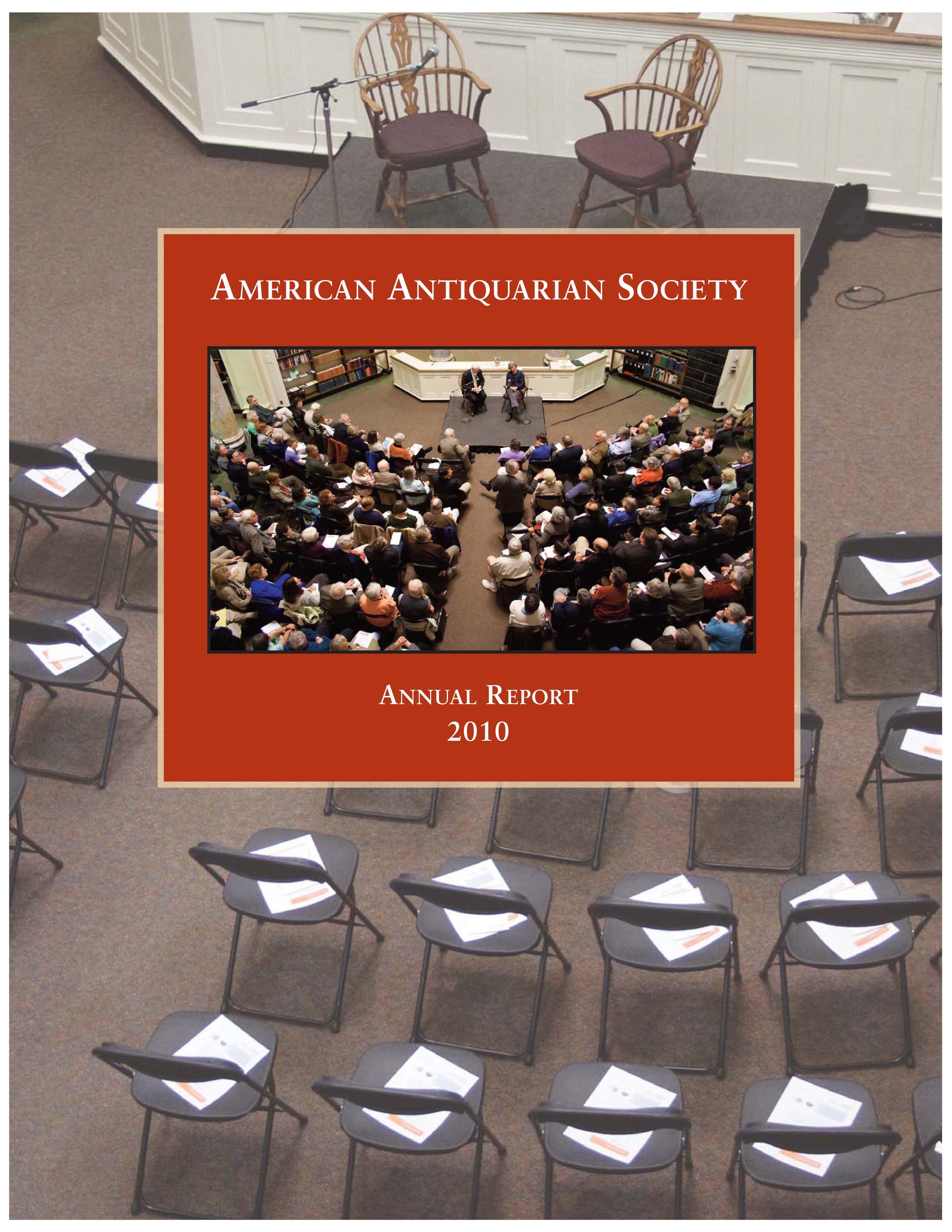
Our new 2010 annual report is available online! Click here to catch up on the past year at AAS with over 70 photographs of people, acquisitions, and some of the lively programs that were held here.

Our front and back cover photographs offer views seldom seen by visitors to Antiquarian Hall, since both were taken from the balcony overlooking the reading room. On the front cover, National Endowment for Humanities Chair Jim Leach and historian Jill Lepore take questions after their talk on incivility in American political discourse. Incivility – indeed, incendiary language and symbolism – continue to be a prominent national concern and we were happy to be the only Massachusetts venue for Jim Leach’s 50-state speaking tour.

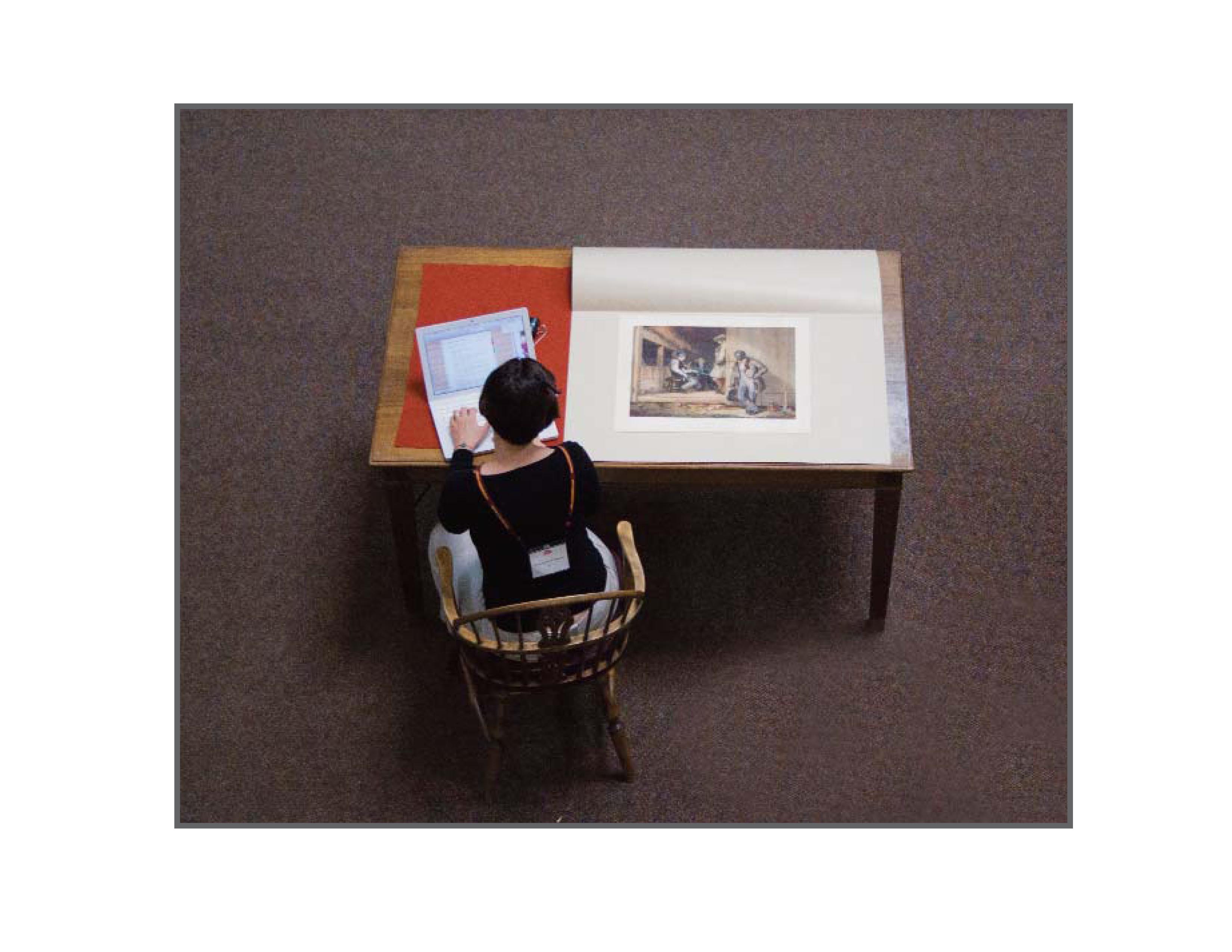
The serene photograph on the back shows an American Historical Print Collectors’ Society Fellow doing research. I was amused when Lauren Hewes, Andrew W. Mellon Curator of Graphic Arts, and Gigi Barnhill, director of our Center for Historic American Visual Culture, both identified the print as Alphonse Léon Noel’s “The Power of Music” (1848), a hand-colored lithograph after a painting by William Sidney Mount. An impressive ID from the second floor, and yes, they both know the Society’s collections well.

Enjoy the entertaining descriptions of recent acquisitions written by the curators, from instructions for playing the banjo, “an instrument which has ever been considered a mystery unknowable,” to a handbill describing how betting against Abraham Lincoln’s election led one man to walk from Boston to Washington, and keep walking. A separate post is promised on one of the more colorful collection items pictured: an 1871 issue of the National Police Gazette with its sensational coverage of crimes of passion.

Our free public programs ran the gamut last year from a brief history of thrift in America to a spellbinding series on John Brown, a hair-raising tale of witch hunts in Hartford, and a look at the causes of the Civil War.

Each week, researchers request an astonishing variety of items. On one summer afternoon when the circus posters came out, I marveled again at the sheer variety of our collections. These large-scale posters conjure up all the rumbling excitement of the circus rolling into town in the 1850s (see photo on p. 12). Leaf through AAS’s annual report to see other collection items and read about what it’s like to do research in Antiquarian Hall. And if you’re in the area, come to a public lecture or sign up for a seminar. There’s a lot going on at the American Antiquarian Society – please join us!

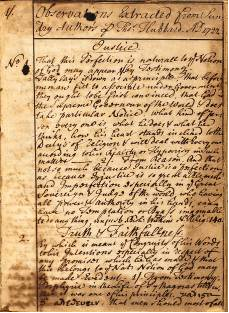
The Acquisitions Table: Thomas Hubbard’s Commonplace Book

Hubbard, Thomas. Commonplace book, 1722-1805.

Thomas Hubbard (1702-1773) was born in Boston, the Son of Joseph and Thankfull (Brown) Hubbard. He was a successful merchant in Boston, for a time the treasurer of Harvard and also the Commissary General of the province of Massachusetts. Hubbard began to compile this commonplace book in 1722, the year following his graduation from Harvard College. The notes include brief extracts from published works on subjects such as “Riches,” “Life it’s Shortness,” “Free Will,” and “Christ’s Descent into Hell.” The volume also contains the diary of an as-yet unidentified man who lived in or near Neeedham, MA. The entries, spanning the period from 1784 to 1792, consist mostly of records of his church attendance, although there are also some entries concerning his daily activities. Gift of Stephen Gronowski in memory of Kurt Gronowski.