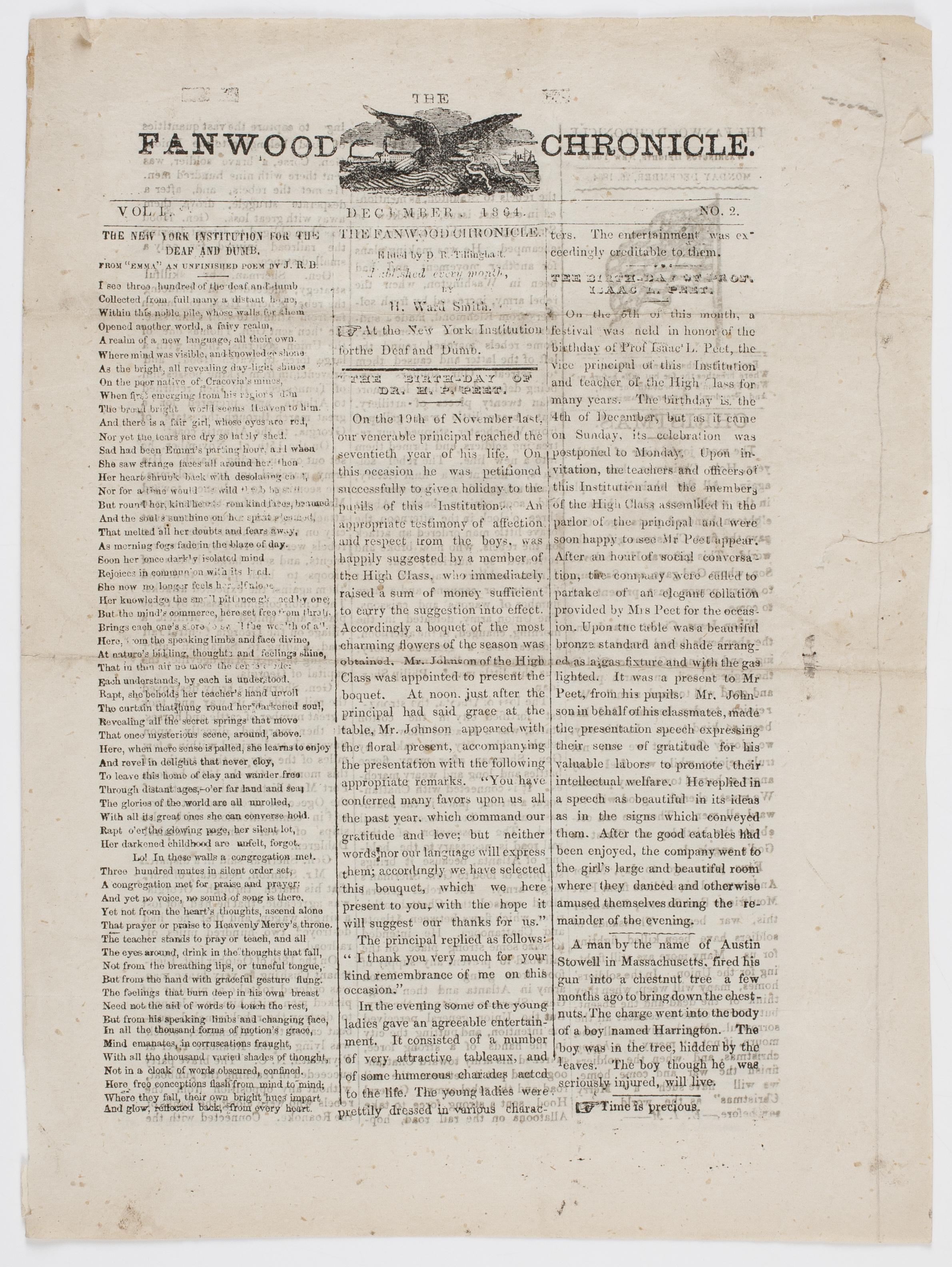
Fanwood Chronicle (New York, NY). Dec. 1864. Vol. 1, no. 2.
This periodical was published by the New York Institution for the Deaf and Dumb. One of the goals of the institution was to train its students in a vocation. In 1864 it acquired enough materials to establish a print shop for its students. The publisher was H. Ward Smith, who practiced printing the previous summer working in the office of the Orleans American (NY). The Fanwood Chronicle contains institutional news, news about the Civil War, including Sherman’s march to Atlanta, poetry, and the tragic story of a former student of the institution murdering his father. The 46th annual report for this institution in 1865 included the following: “I have nothing new to report in the Mechanical Department …except that some of the pupils of High Class, having a small printing office, have started a little monthly paper, The Fanwood Chronicle, which I hope we may be able to continue and enlarge. Such a paper I consider a valuable auxiliary to the labors of our teachers, especially in the incitement it offers to habits of reading. Many of our pupils will make through this little paper the discovery that they can derive pleasure and profit from independent reading, and will be encouraged to preserve in the practice.” This is a very scarce newspaper. The only other institution that has copies is the Gallaudet University Library which has two issues from 1865.
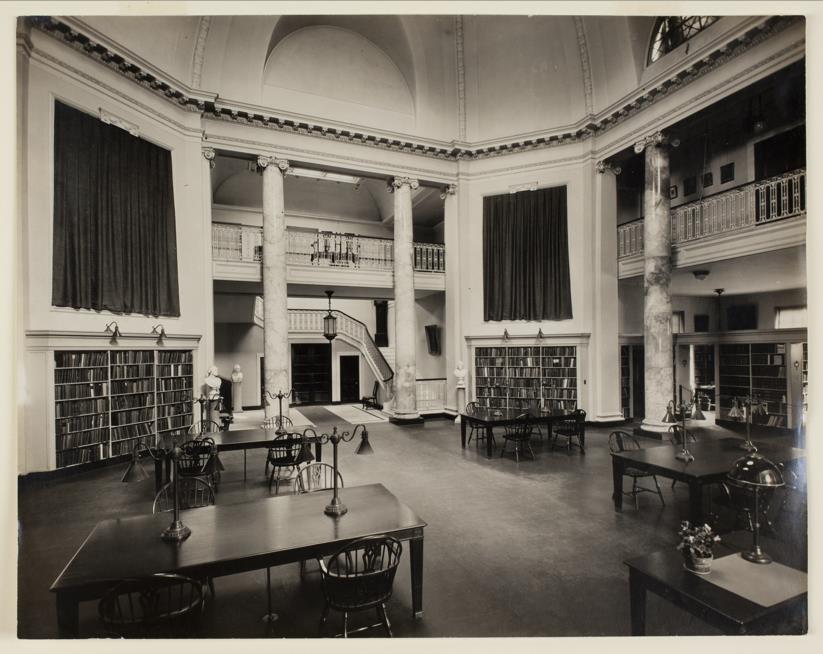
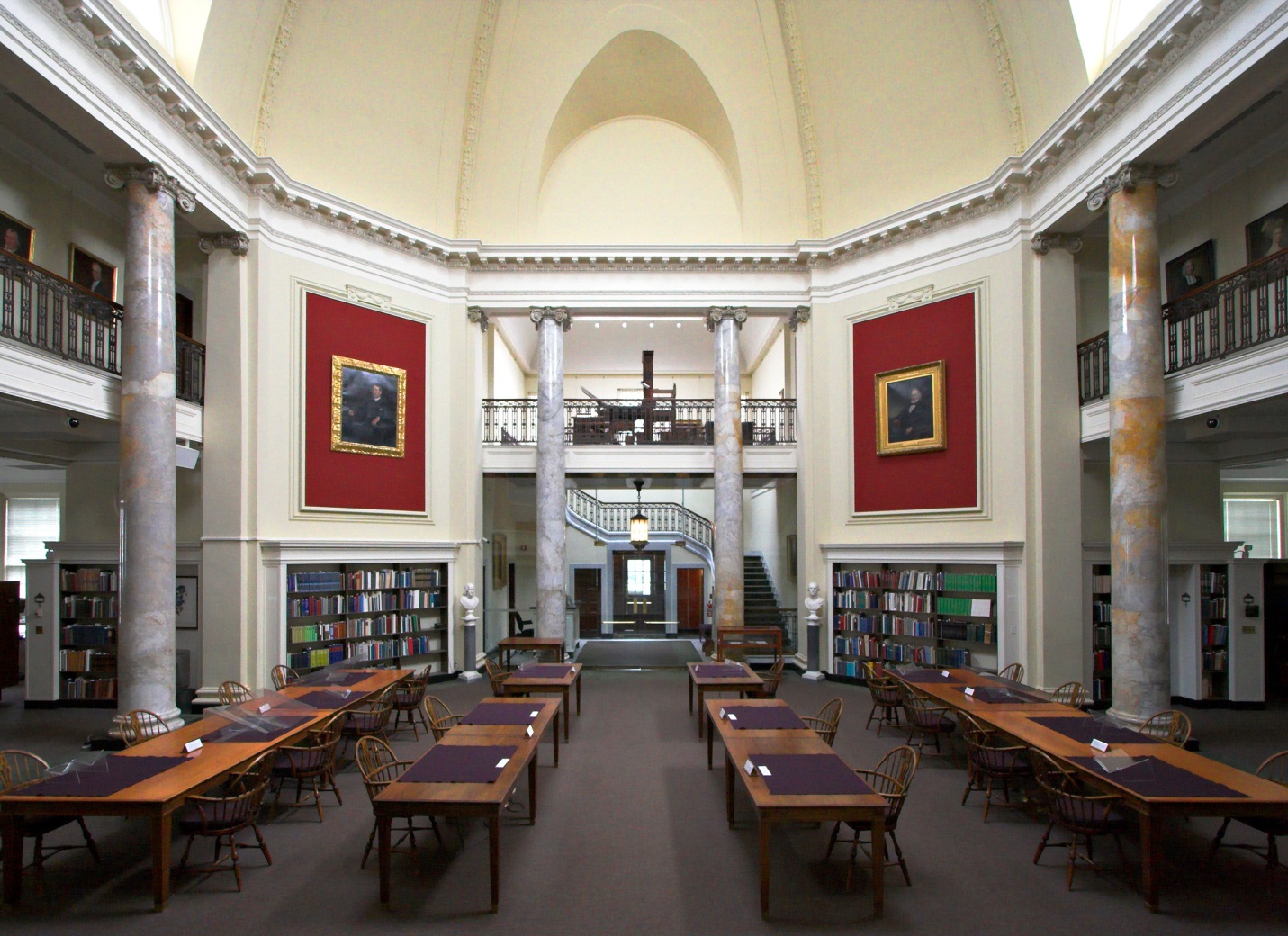
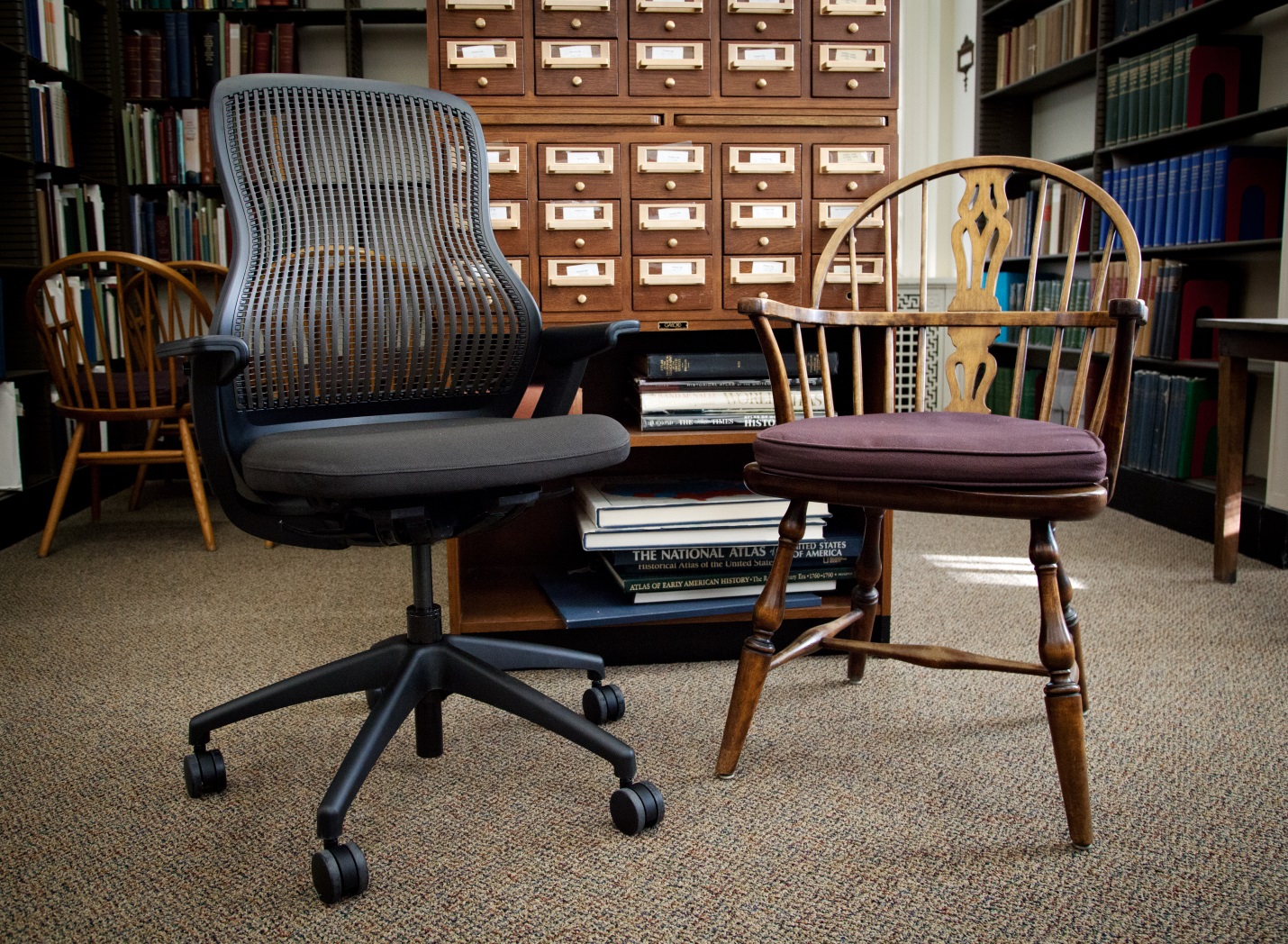
January 6, 2014, marked a notable acquisition here at the American Antiquarian Society. It also signaled the end of an era. When the Society’s current library building opened in 1910, it featured library tables and chairs manufactured by the Francis H. Bacon Furniture Company of Boston. For over a century, readers engaged with AAS’s peerless collections sitting in Colonial revival Windsor chairs, made of a variety of different hardwoods and designed to be light in weight in order to be easily moved. Yet these chairs were not built in a period when readers took notes using laptops or tablets, nor were current reading room policies governing the use of book cradles in place. The arms of the chairs were too high to fit underneath the reading room tables, and until roughly 15 years ago, our reading room chairs did not even have cushions. Sore backs and tired shoulders were frequent side-effects of research visits to Antiquarian Hall. Despite their period appeal, it was becoming clear that the Windsor chairs had outlived their usefulness (a fact that was borne out by the growing graveyard of fractured spindles and broken legs in the library basement).
So, on January 6, we got new chairs. Still, being the Antiquarian Society, we cannot resist one last look back at our previous furnishings, however uncomfortable. Francis H. Bacon had been trained as an architect at MIT, and started his career as a draftsman in New York City before sailing for Europe with a friend in 1878. The two 22-year-olds purchased a small boat in England, which they then sailed across the Channel, down the Rhine and Danube to the Black Sea, and then to the Aegean, where they planned to sketch archaeological sites in Greece and Turkey. He returned to New York in 1879, “stone broke but in good health and having had a famous experience.” The day after his return, he was hired as a draftsman in the firm of McKim, Mead, and White, where he worked until returning to Europe in 1881 (his position at McKim was filled by Cass Gilbert, who would go on to design the Woolworth Building in New York and the U.S. Supreme Court building in Washington).
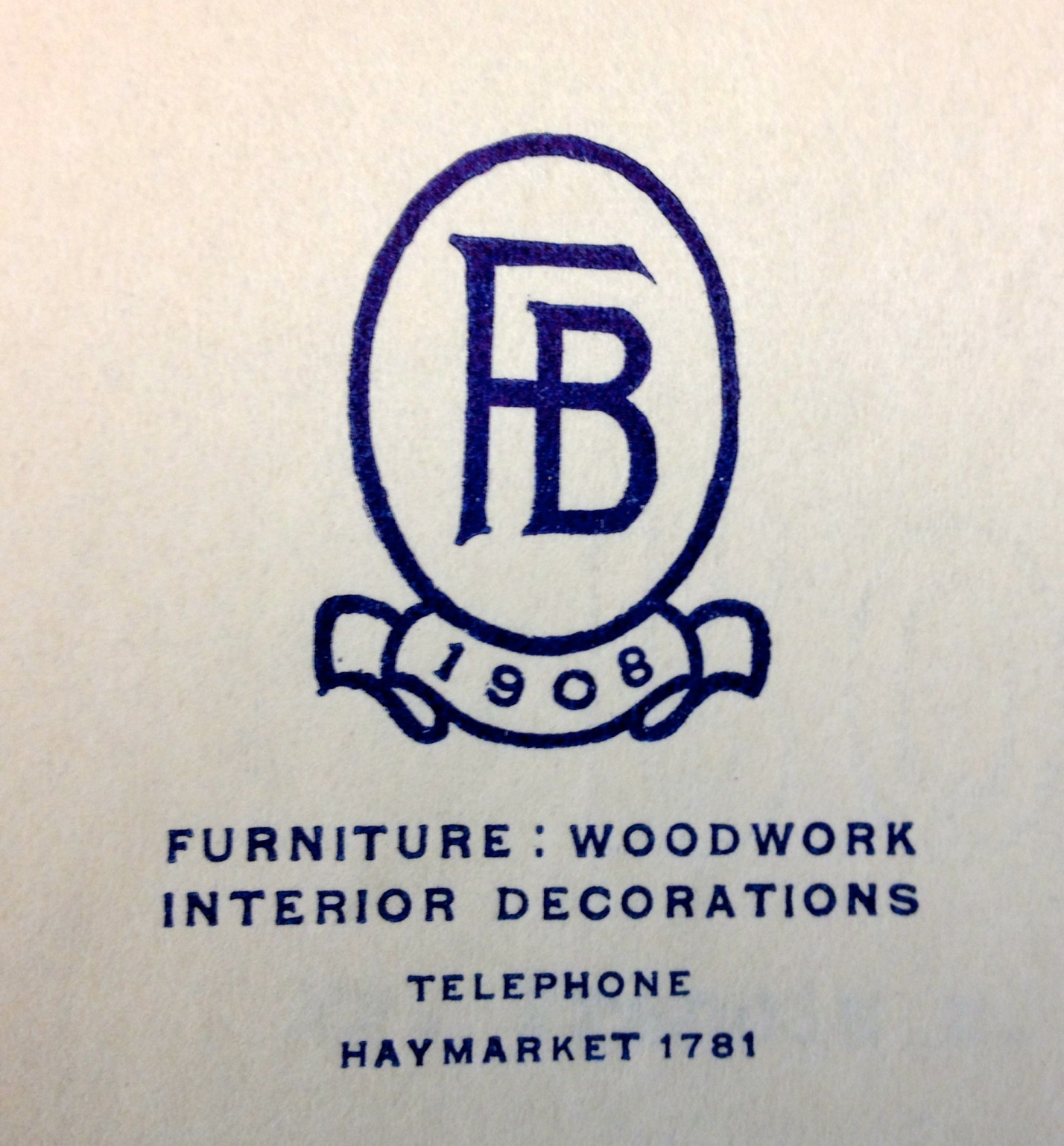
In 1884, Bacon returned to the U.S. and joined the firm of H.H. Richardson outside Boston, where he worked for several years as a designer before leaving to join the Boston furniture manufacturer A. H. Davenport and Company, which provided the furniture for most of Richardson’s Romanesque buildings (if your grandparents refer to a sofa as a “davenport,” it’s because of a line of furniture made by that company). He struck out on his own in 1908, making custom furniture for high-end clients. His many commissions include manufacturing the new chairs and desks for the U.S. House of Representatives chamber in 1913 after reapportionment resulted in expanding the membership of the House to 435, and designing the “shrine” that housed the Declaration of Independence in the Library of Congress from 1924 until 1952. Thus AAS’s purchase of tables and chairs for its reading room in early 1910 likely represented one of Francis Bacon’s earliest major orders. Although Francis’s architect brother, Henry, is more prominent today (he designed the Lincoln Memorial), Bacon’s career working with many of the leading architects of his day led him to be considered one of the most influential furniture designers in early twentieth-century America.
It’s not clear from records in the AAS archives what woods were used to make the original chairs and tables, nor do we know how much they cost. An early report by the AAS building committee included notes from visits to other libraries, which indicated that the metal tables stained mahogany in use in the reading room of the Historical Society of Pennsylvania were of “fine appearance,” but that the “complaint [was] frequently made that they are cold.”
Instead of sending a committee out to visit other libraries, we brought several different models of chairs in to the reading room and asked AAS fellows and readers to test drive them in the late fall of 2013. After extensive evaluation—and yes, there were written reports—we purchased 50 Knoll ReGeneration work chairs. Our new chairs are ergonomic, fully adjustable, and cushioned, and thus far the reviews have been enthusiastic. The surviving old models were mostly distributed among staff offices at AAS, where they will continue to age gracefully. We hope that the next time you’re in the neighborhood you’ll stop by and give the new chairs a try yourself. They should make your visit a bit more comfortable.
Last week, about twenty AAS catalogers, research fellows, curators, and other staff members gathered to discuss the challenges that come with transforming the visual code of an image into a written code. The creation of metadata in the form of indexing images is an inexact science, and it is one challenge that faces us as we, like many similar institutions, look to make our graphic arts collections as searchable and accessible as possible. In preparation for our conversation, we read Wanda Klenczon and Pawel Rygiel’s “Librarian Cornered by Images, or How to Index Visual Resources,” detailing the difficulties that come with assigning “high quality semantic metadata to the non-textual materials.” Though the development of automated image recognition software is underway, Klenczon and Rygiel explain, “there are layers of meaning that can be indexed only with human knowledge, experience, and intuition. Properties of an image such as shape, texture, and color contribute to our understanding of an image, but do not define it. Text-based search techniques remain the most efficient and accurate methods for image retrieval” (43). Our graphic art catalogers shared their own experiences of creating this metadata, and we discussed how we think about the 94,000 visual objects represented in the AAS’s online digital image archive, GIGI. As detailed in Klenzon and Rygiel’s articles, crowdsourcing or social tagging present considerable disadvantages, such as inconsistency and subjective expression, while at the same time we have institutional limits to how much indexing we can do ourselves.
We then turned our attention to one attempt to address the disadvantages of social tagging while still taking advantage of the many people willing to assist in the herculean task of providing metadata to the vast digitized, but not searchable, visual record. Recently developed at Dartmouth College with the support of NEH and ACLS, Metadatagames is a digital gaming platform that entices players to contribute metadata while playing games, either against a clock or against other anonymous participants on the site. The goal of Metadatagames is to refine the crowd’s tagging efforts by testing how many others would associate the same word or phrase with a given image. To simulate the games one plays in Metadatagames, we turned online games into group activities and then discussed our findings.
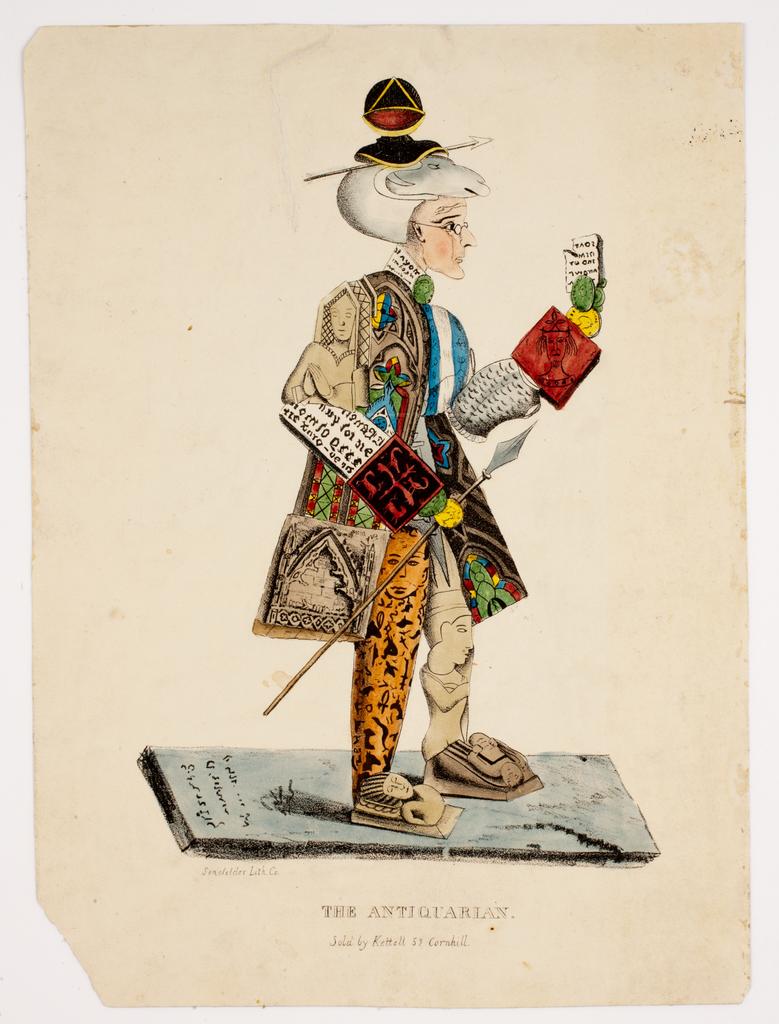
First, we looked at an image that is near and dear to us all at AAS:
In silence, we each wrote down five words or short phrases we would use identify this image, and then we compared our results. Our tags varied considerably, and we quickly realized how many of our tags were subtle acts of interpretations, rather than just descriptions. Our resident experts in nineteenth-century American graphic arts added valuable context that made many of us rethink some of our tags. For example, in reaction to many people’s use of the word “man” to describe the image, one participant asked if we can know that the figure depicted is in fact male. One of our curators responded that because the painting dates to the 1830s and that is too early for women to wear bloomers, we can be pretty sure that the figure is male. We discussed how such knowledge is specialized and would not necessarily be present in an unmitigated social tagging experiment.
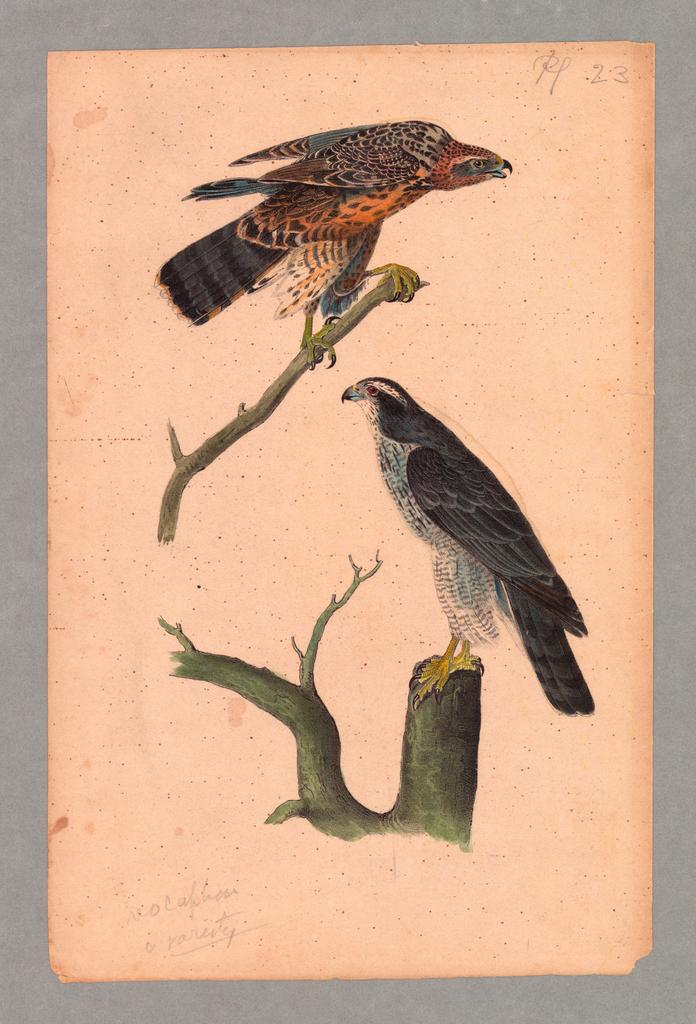
We then tried another adopted version of Metadatagames. Half of us left the room, and the remaining half looked at this image:
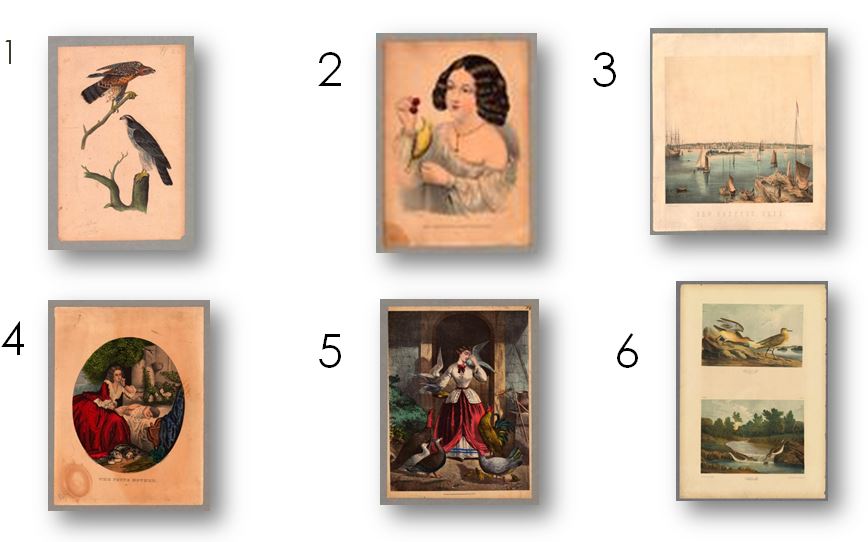
Those of us in the room had to come up with one word or short phrase to describe this image. We then asked the other half of the room to come back into the room, and we showed them these six images:
Based on one descriptor, “birds of prey,” the group that had been out of the room had to determine which image we were describing. After much debate among themselves, they chose correctly: number one. We then talked about how it took an expert curator, who was part of the describing group, to convince the group to use “birds of prey” and not just “birds,” the tag others suggested. Had we just chosen “birds,” the group that had been out of the room would have been lost: all six images either have birds in them, or, as is the case in #3, have a “bird’s eye view.” We then discussed the need to be specific when tagging and searching images. In these ludic activities, we came to see the ways in which tagging is an act of representation, and how it grows much more precise as more people collaborate to generate the tags.
Have you already picked your favorites for the Oscars this Sunday? Here in Worcester, American Hustle is a popular choice since scenes from it were shot on Worcester streets and in the Worcester Art Museum. Captain Phillips even shot a few scenes at the Worcester Airport (yes, there is a Worcester airport!). Here at the American Antiquarian Society, though, we probably have the closest connection to the film 12 Years a Slave, given its grounding in American history and publishing as described in an earlier post.
In a time before multiplexes and Netflix, the arenas for information and entertainment in the nineteenth century included books, illustrations, lectures, newspapers and periodicals, music and theatrical productions. Solomon Northup’s experience as a free black man sold into slavery was reproduced in all these forms during his lifetime, and often under his direction. Before turning to the book form, let’s investigate some of the other ways Northup’s experience was conveyed.
Dramatizations
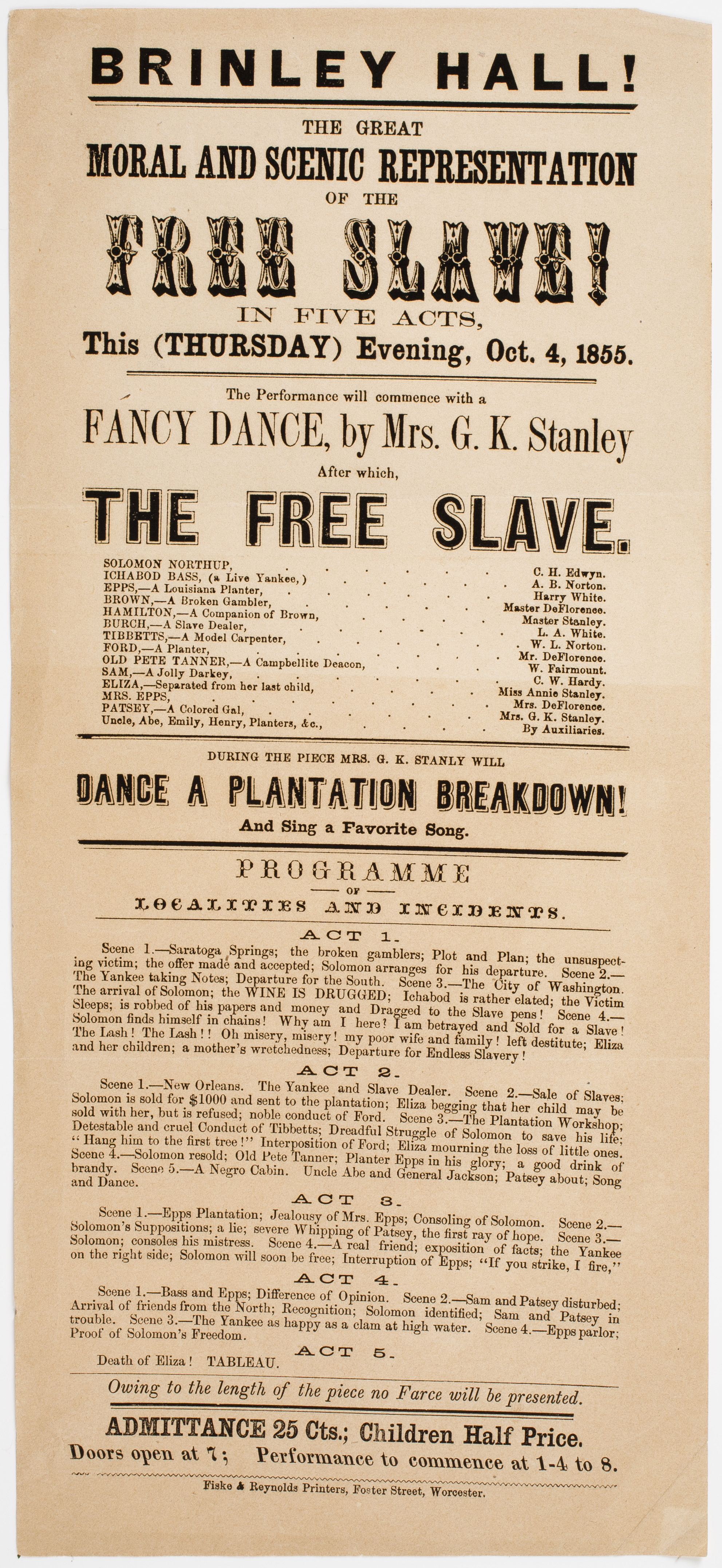
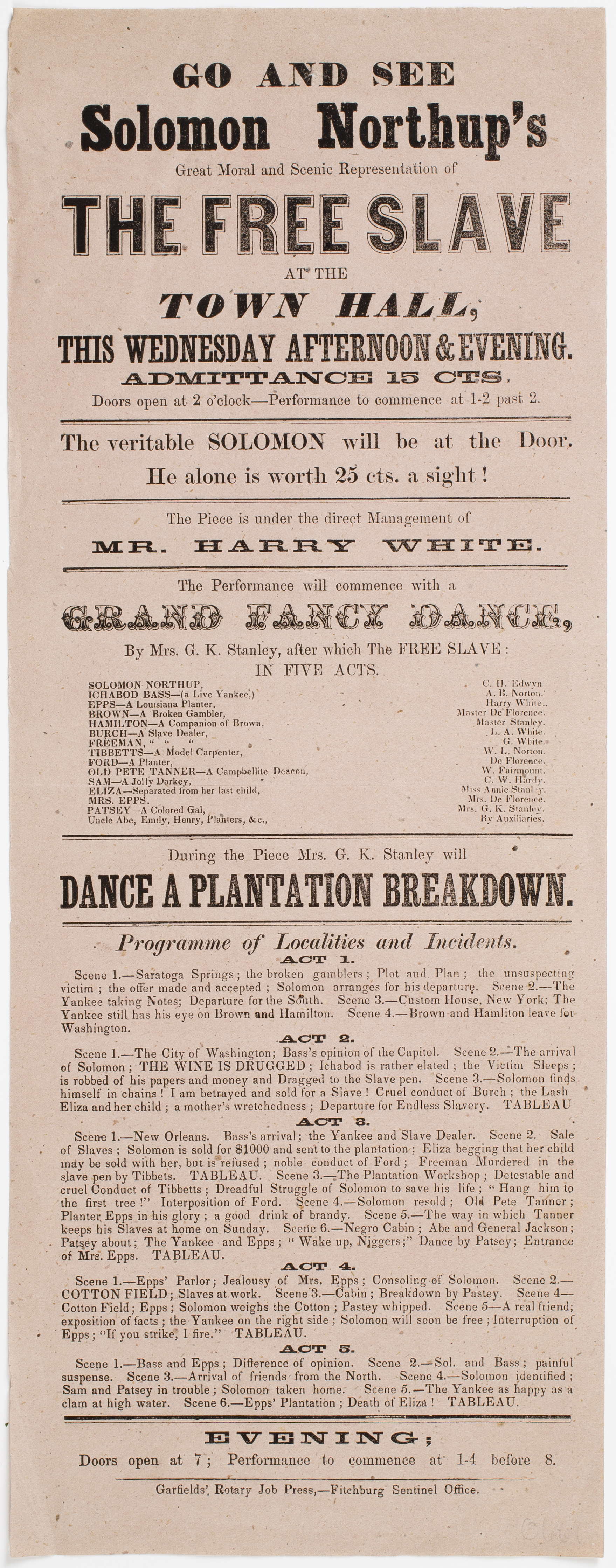
Worcester playbill [AAS catalog record] Fitchburg playbill [AAS catalog record]The recent Academy Award-nominated movie is not the first time Solomon Northup’s story was dramatized. For years after the book’s initial publication in 1853, Northup appeared on the anti-slavery lecture circuit. Perhaps most fascinating, Northup himself apparently wrote/produced the play “The Free Slave” based on his experience. The American Antiquarian Society has two playbills for “The Free Slave” as performed in Massachusetts towns: one from when it was performed in Worcester in October 1855 and another from Fitchburg. The date for the Fitchburg performance is not listed, but the cast is essentially the same, which would seem to indicate they were relatively contemporaneous. Interestingly, the content of the acts has shifted somewhat (click on the images to enlarge and compare for yourself).
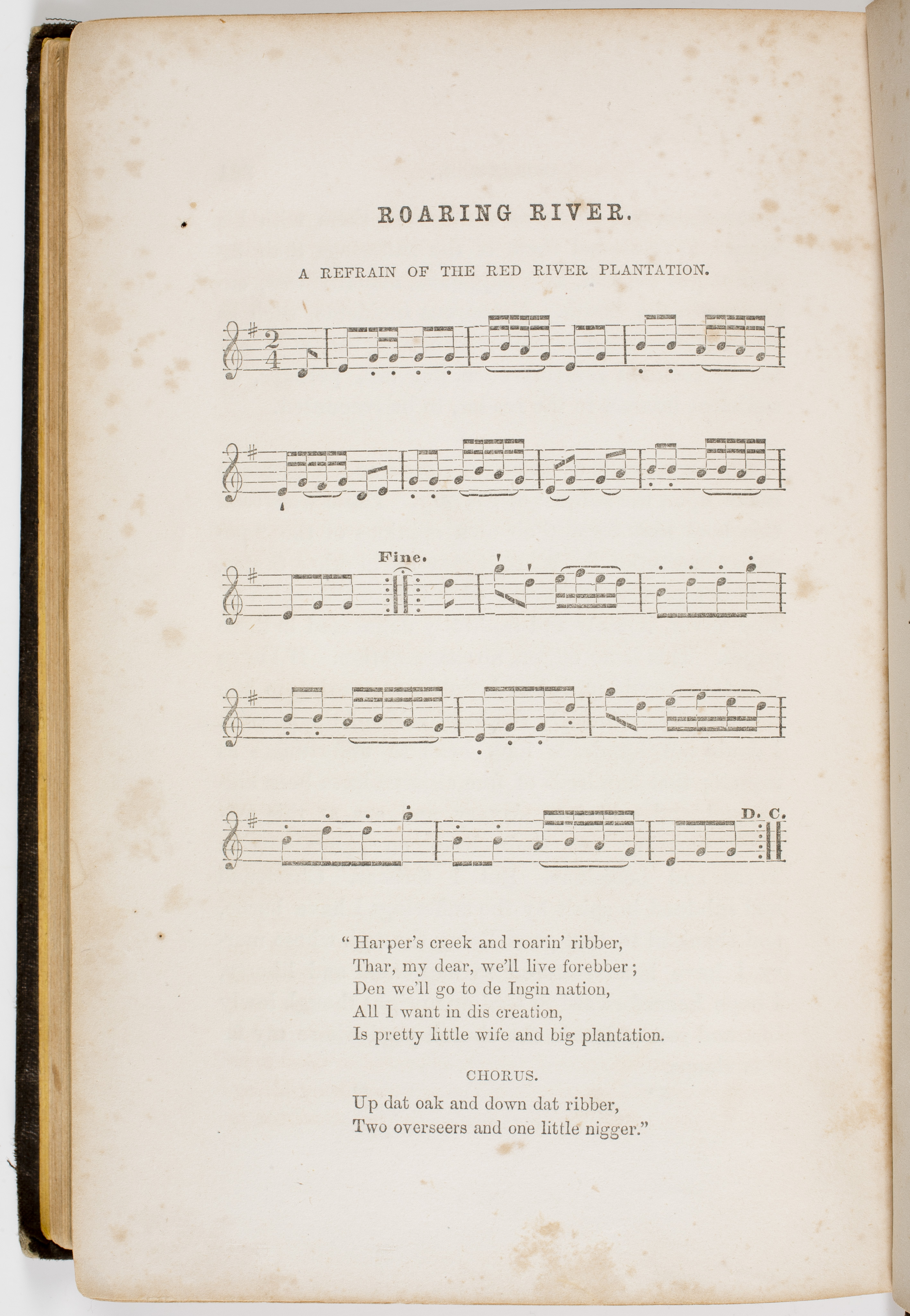
Not only was Northup’s story available for a 19th century audience to watch and hear in dramatic form, they could even participate themselves, in some small part. At the end of the book Twelve Years a Slave is the tune to “Roaring River: a Refrain of the Red River Plantation,” appropriate since Northup was a renowned fiddler. Including the tune in his book invited his nineteenth-century readers into a more active form of participatory engagement. And it still does today: just see the YouTube video embedded below for an example of a recent movie-goer who was inspired to read the book and then couldn’t resist performing the tune at the end of Twelve Years a Slave.
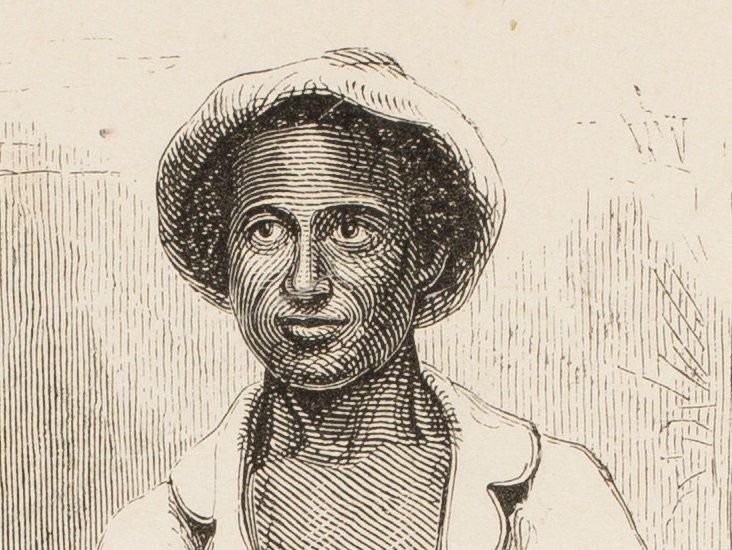
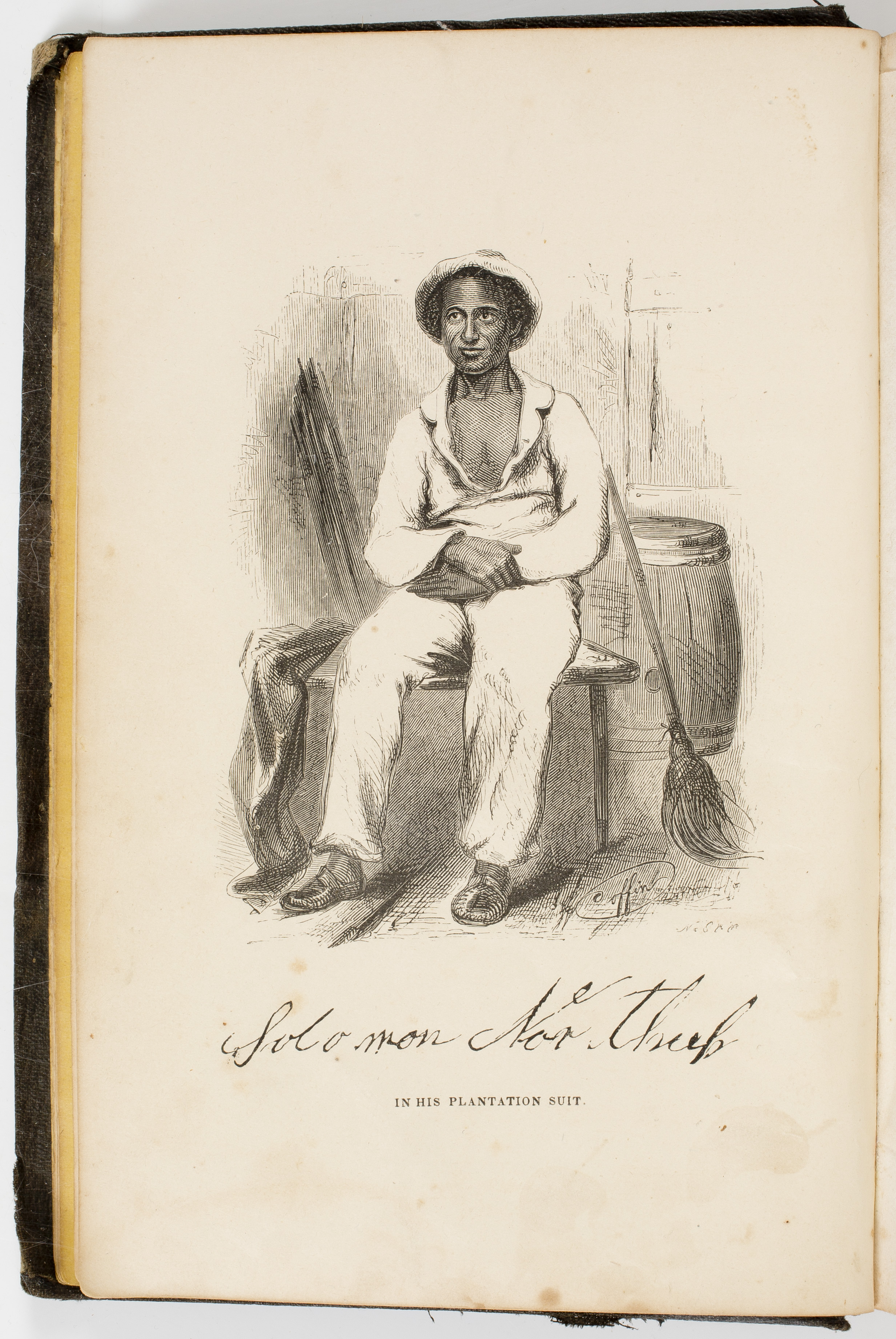
Closeup of frontispiece titled “Solomon Northup in His Plantation Suit”
When preparing for his role playing Solomon Northup in the recent film, Academy Award-nominated actor Chiwetel Ejiofor described being particularly moved by the frontispiece illustration of Northup: “The look on his face is kind of strange, almost relaxed kind of way.” (CBS Sunday Morning, February 2, 2014) While it is uncertain how much control Solomon Northup would have had over his representation in visual form, what we do know for certain is who produced the images. The illustrations were drawn by Frederick M. Coffin and then produced as wood engravings by Nathaniel Orr. Both were in upstate New York and had worked with Northup’s publishers Derby, Miller & Co., illustrating other books.
Coffin’s signature appears on the left, Orr’s on the right
Frederick M. Coffin was a born on Nantucket in 1822 before moving with his parents to Auburn, NY in the 1840s. He moved between there and Buffalo and became closely associated with the publishers of Northup’s narrative, Derby, Miller & Co., after 1850, where he is described as spending “three subsequent years in designing and drawing on wood for the publishers.” He also drew for Harper’s Weekly. (History of Cayuga County, New York, 1879, p. 68)
Nathaniel Orr was also born in 1822 and became an engraver much in demand, working in Albany and later New York City. His firm, which eventually included his brother and his son also, cut steel and wood plates, usually from work of other artists. He retired in 1888 “with the reputation of having brought the art of wood engraving to the highest perfection, and the signature ‘Orr,’ cut in the block was always a sure guarantee of art excellence.” (National Cyclopedia of American Biography, 1901, p. 426)
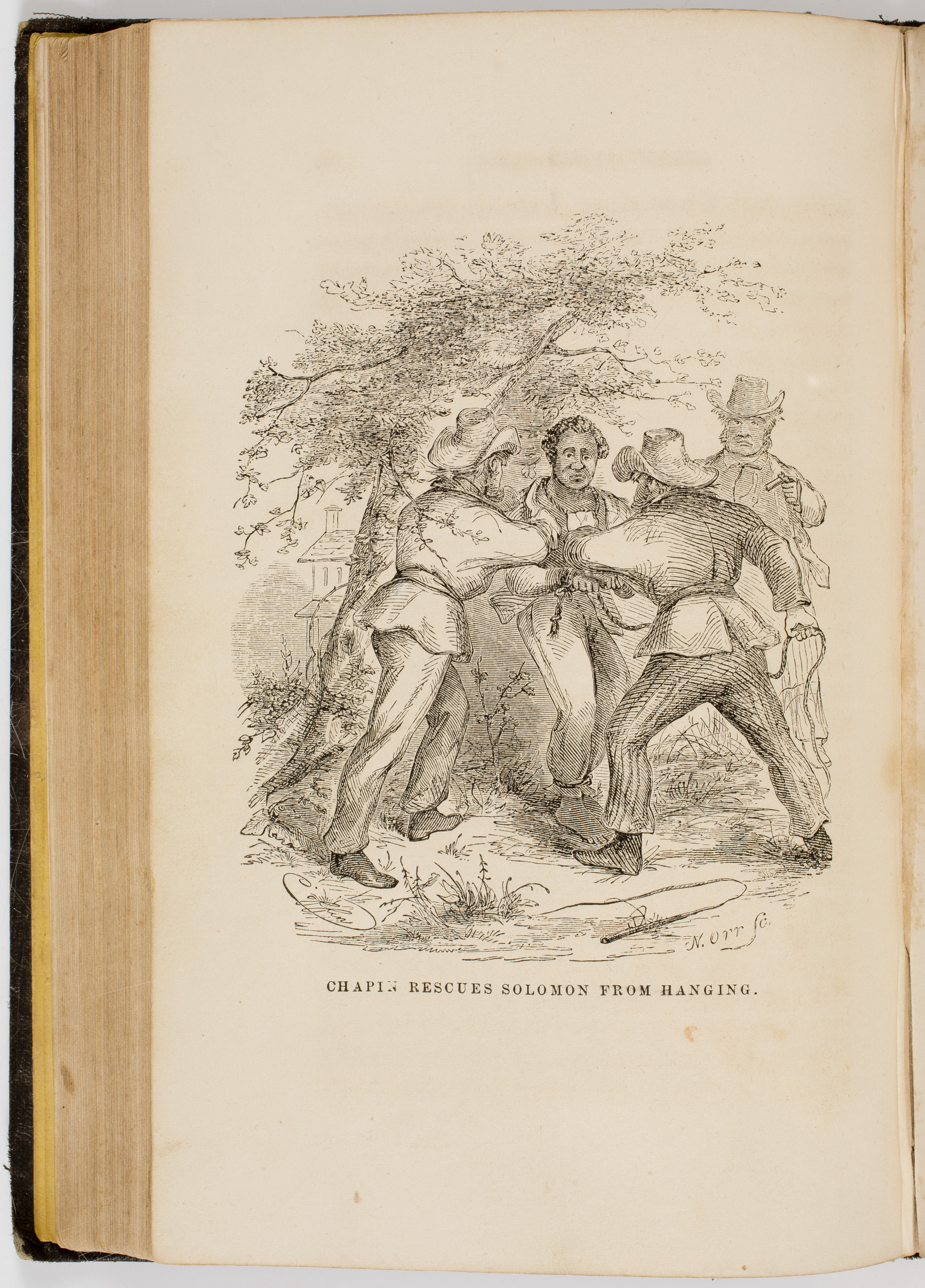
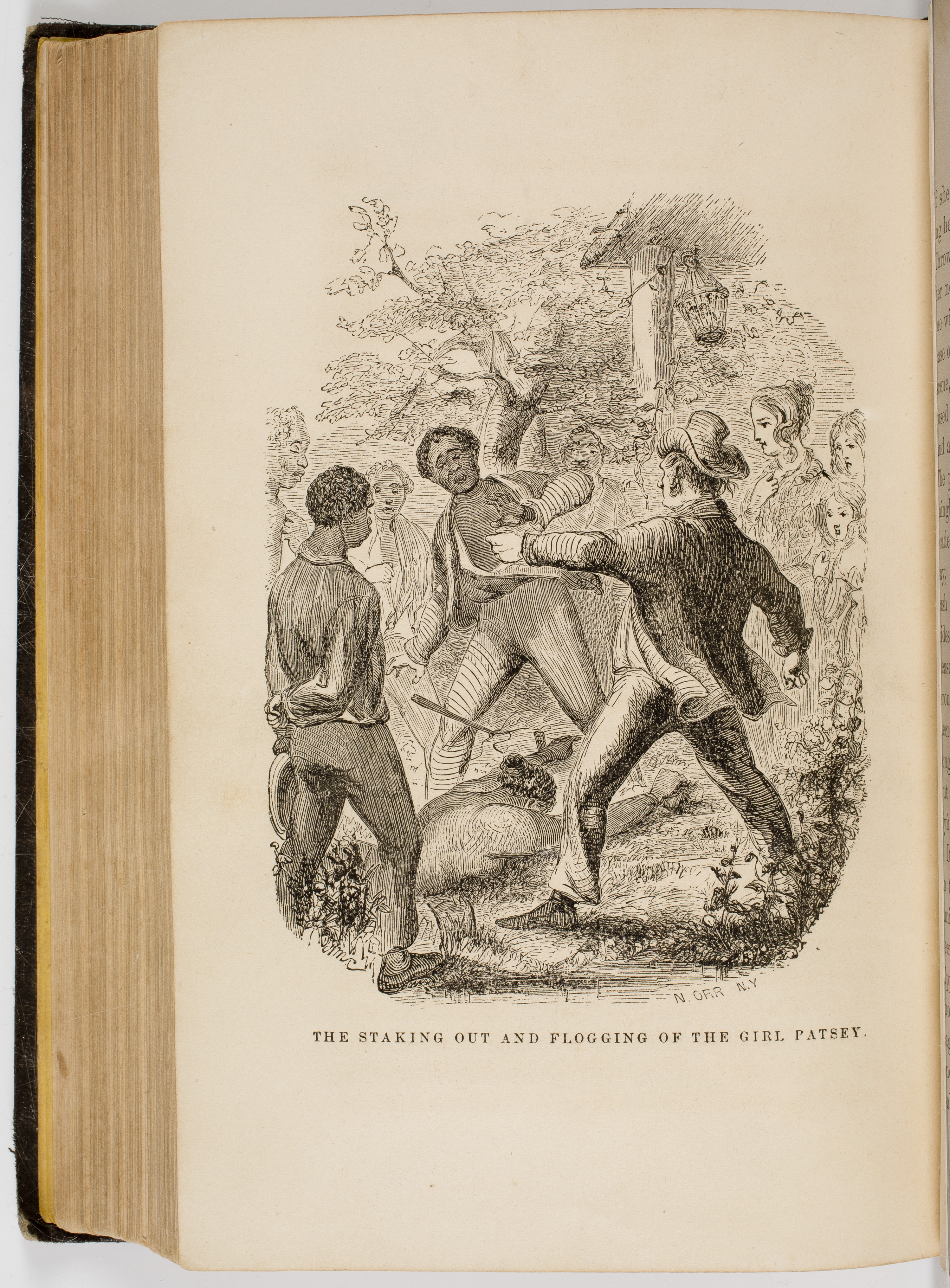
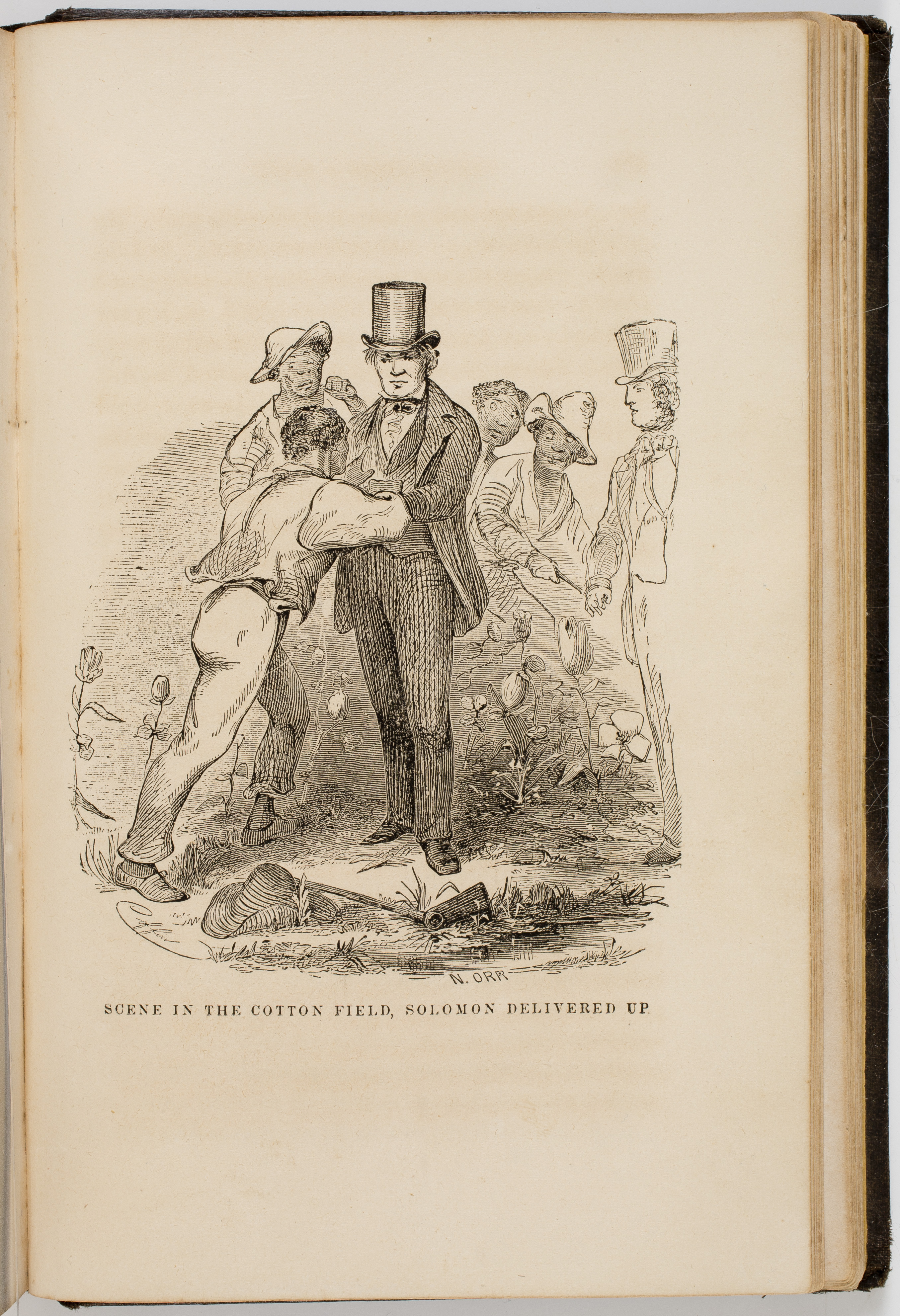
One feature of the illustrations in Northup’s account is that they all refer to specific significant moments in the text rather than iconographic moments used to illustrate slavery generally. A contrasting example can be found in the illustrations titled “Life as a Slave” or “Life as a Freeman” that appeared in the slave narrative of Frederick Douglass, My Bondage, My Freedom (also done by Nathaniel Orr, and published in 1855 by the same firm that was publishing Northup’s narrative).
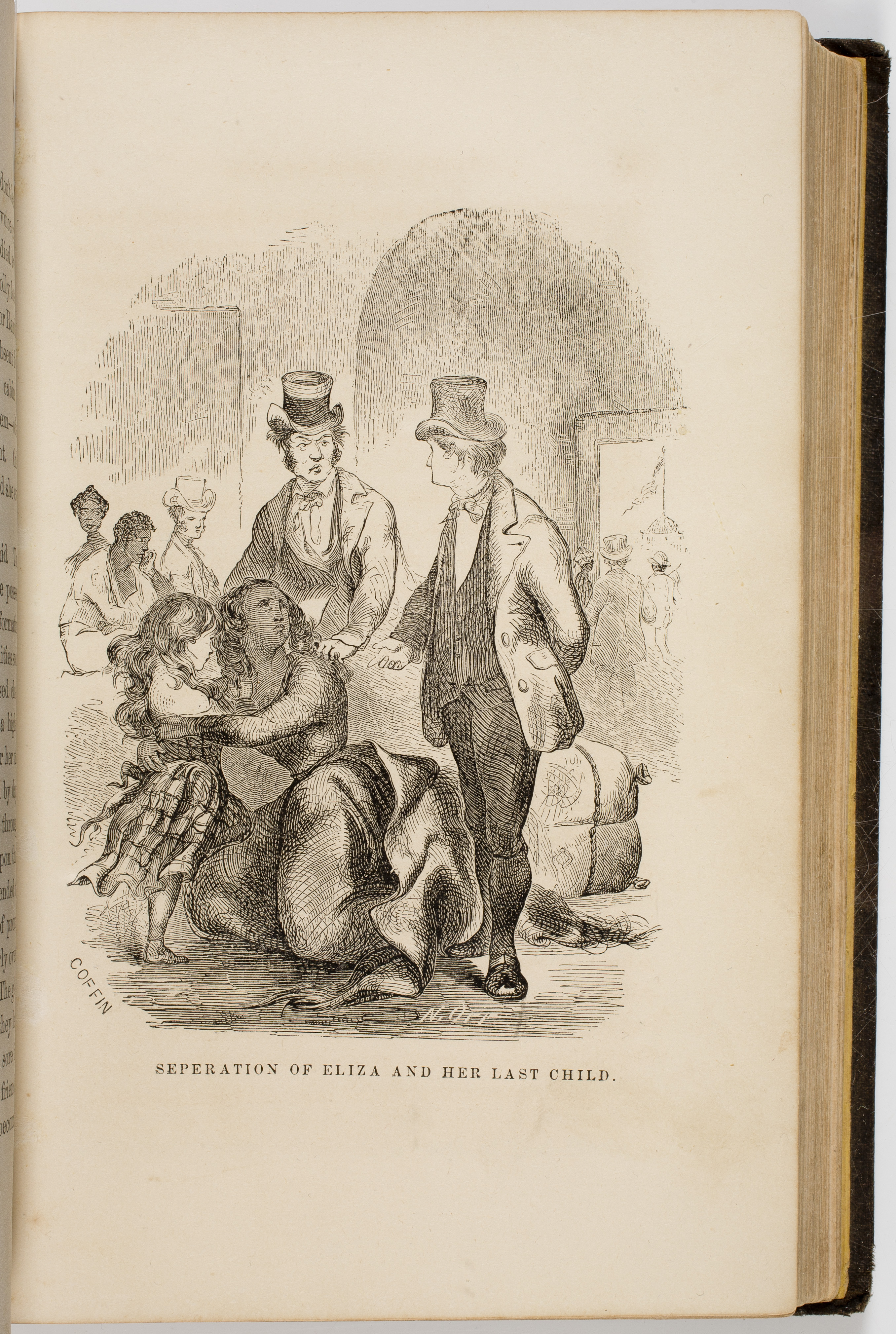
The illustrations in Twelve Years a Slave were specific to Northup’s narrative, but they also drew on a larger visual vocabulary of slavery and antislavery images — an area many scholars come to AAS to study. This visual vocabulary could be utiilized by publishers to help market and sell the book. As a possible example, one of the seven illustrations in Twelve Years a Slave, “Separation of Eliza and her last child,” is particularly reminiscent of similar illustrations in the international bestseller Uncle Tom’s Cabin of Eliza crossing the river in that story, reinforcing the connection between the two books. “Separation of Eliza and her last child” had not been listed among the illustrations in early advertisements while the book was in press. This last minute addition was perhaps meant to capitalize on the recognition a slave mother named Eliza being separated from her child would undoubtedly spark in the minds of a reading public who just the year before made Uncle Tom’s Cabin so popular.
Think about a world with no TV or movies, where even still photography is a newfangled invention, and you begin to realize the power book illustrations had to their 1850s audience. An example of the power of slavery images in particular comes from the end of Northup’s own narrative. Reunited with his family, they discuss what the past twelve years without him had been like and his wife, Anne, recounts how one day the children returned from school “weeping bitterly” because:
While studying geography, their attention had been attracted to the picture of slaves working in the cotton-field, and an overseer following them with his whip. It reminded them of the sufferings their father might be, and, as it happened, actually was, enduring in the South. (p. 321)
With this last anecdote in his book, Northup emphasizes the power of pictures comes from the realities lying behind them, a lesson that could be extended perhaps to the illustrations in his own book (see directly below) which depict the most dramatic and horrific moments in his narrative.
Publishing History
Things moved quickly after Solomon Northup was reunited with his family on Jan. 23, 1853. Within three months, Northup had produced the text of his narrative with the help of his editor, David Wilson, and in less than six months the book was available for sale. Twelve Years a Slave was advertised as “Now in press” between April 15 and July 2. By August 1, 1853, it was described as “Just published.” Such a tight turn around was certainly helped by the fact that the entire production crew for the original 1853 publication of Northup’s Twelve Years a Slave — theillustrator, engraver, publisher, editor, and author — all lived and worked basically along a straight line from Buffalo to Auburn to Albany (and Glen Falls, just north of Albany).
Early ads for the book in these first few months claimed “A large portion of the net price secured to Solomon,” but this promise was dropped from later ads. Northup did receive $3,000 for the copyright of his book, which he used to buy land in Glen Falls next to his now married daughter. Over the next few years, he also received some compensation from the lectures he gave at anti-slavery events, but his attempts to capitalize on his story as a play ultimately proved to be financially unsuccessful.
This despite the fact that his book was quite successful, at least according to the publishers. By way of contrast, Narrative of the Life of Frederick Douglass was published in 1845, and within four months it sold 5,000 copies. Twelve Years a Slave sold 5,000 copies within weeks of the initial printing. Similarly, while it took 15 years to sell almost 30,000 copies of the Narrative of the Life of Frederick Douglass,Twelve Years a Slave was printing its 25,000th copy in the first year and had reached almost 30,000 copies printed in four years time. (Frederick Douglass sales reported in “The Autobiographies of Frederick Douglass” in Phylon by James Matlack, March 1979).
Early Editions, 1850s
The original edition of Twelve Years a Slave, published by Derby & Miller in 1853, was reprinted from stereotyped plates by their successor publishing company Miller, Orton & Mulligan from 1854-1857 and their successor C.M. Saxon in 1859, with a self-reported 30,000 copies printed in all printed in the 1850s.
[Copies not held at AAS are in brackets; those at AAS have links to their catalog records.]
1853 (July) First edition, first printing includes Auburn, Buffalo, and Cincinnati
Twelve Years a Slave: Narrative of Solomon Northup, a citizen of New-York, kidnapped in Washington City in 1841, and rescued in 1853, from a cotton plantation near the Red River, in Louisiana. Auburn [NY]: Derby and Miller; Buffalo: Derby, Orton and Mulligan; Cincinnati: Henry W. Derby, 1853. [AAS catalog record]
1853 Later printings drop Cincinnati but add London’s Sampson Low, Son & Co.
Auburn [NY]: Derby and Miller; Buffalo: Derby, Orton and Mulligan; London: Sampson Low, Son & Company, 1853. (“Entered at London in Stationer’s Hall” added to copyright statement on verso of title page.)
Solomon Northup himself had disappeared at this point, and so did his story. The book doesn’t appear to have been printed or advertised at all during the 1860s and 1870s. During these decades, the Civil War and Reconstruction evaporated the market for antislavery publications.
Later Editions, 1880s-1890s
The copyright period of 28 years had lapsed in 1881, which may explain the timing of this small trickle of late-nineteenth century editions. A new publisher’s preface in these later editions also attempts to distance their present-day from slavery in the past. Differences in subtitles between the first editions and these later ones also reflect the changed cultural climate. Rather than a factual narrative of an individual citizen who is given a name, the story is framed in sensational and racial terms and the unnamed “colored man” is described as “reclaimed” like property rather than rescued as a person. Solomon Northup’s full name is not even included on the title page.
Wording in the first edition: Wording in this later edition:
Narrative thrilling story
Solomon Northup [later on title page: “S. Northup”]
a citizen of New-York a free colored man
rescued reclaimed by state authority
1881 New subtitle, preface, and publisher. Printed from same stereotyped plates, degraded, no illustrations.
Twelve Years a Slave: the thrilling story of a free colored man, kidnapped in Washington in 1841, sold into slavery, and after a twelve years’ bondage, reclaimed by state authority from a cotton plantation in Louisiana. By S. Northup. Philadelphia: John E. Potter and Company, [undated but advertised in Publishers Weekly, Sep. 12, 1881] [AAS catalog record]
1891-2 Another new publisher. Same stereotyped plates, further degraded, no illustrations.
New York: International Book Co., 17 & 19 Waverley Place [undated but moved to this address in 1891 and had moved to Worth Street by Jan. 1893] No AAS catalog record yet, as we just found this title on eBay!
1880s-1890s Uncertain or unexamined later editions with new publishers/titles:
[Philadelphia, PA : Keystone Pub., 1880s-1890s?]
[Dallas, Tex.: Talty & Wiley, 1890]
[Solomon Northup. A freeman in bondage or twelve years a slave. (Companion story to “Uncle Tom’s cabin.”) A true tale of slavery days. Columbian library, no. 6. Philadelphia, Columbian Pub. Co. 1890.] Advertised in Publisher’s Weekly Aug. 16, 1890 for 25 cents.]
Disappearance #2, 1900-1968
Northup’s narrative then disappears entirely for a second time. It wasn’t until generations later that Northup’s story was revived in an era of Civil Rights protest, black power politics, and efforts to recover African American history and literature, when a 1968 scholarly edition was published (and vindicated for its historical accuracy). Since that time, Twelve Years a Slave has remained in print, although largely in the domain of academics, college classrooms, and PBS (see their 1980s film Solomon Northup’s Odyssey).
Today
Which brings us up to the present, when Solomon Northup’s story has once again come to prominence during a period of historic change along racial lines in the United States. First it was the decade of the Fugitive Slave Law and lead up to the Civil War, then the tensions following Reconstruction, then the Civil Rights movement, and now his story is once again at the fore of popular culture during the historic term of the first black president of the U.S. (who just yesterday unveiled his “My Brother’s Keeper” initiative designed to focus attention on issues facing young black men).
Hopefully taking this journey along the winding path Solomon Northup’s story has wended it way through more than a century and a half of American history will add historical drama to your Oscar party this weekend. But even after all the hype of the Hollywood machinery dies down, it’s worth considering if the actor portraying Northup, Chiwetel Ejiofor, wasn’t exactly right when he said:
“The look on his face is kind of strange, almost relaxed kind of way,” Ejiofor said. “To come out of that experience, and to write about it with such kind of gentility and poetry and absolute grace was something that really stunned me, and I realized that this was a person who had something to teach.” (CBS Sunday Morning, February 2, 2014)
Is there something more his story has to say to us today?
P.S.: For the next couple weeks, you can still see a display of original items related to Solomon Northup’s book Twelve Years a Slave on display in the AAS reading room in person during our regularly scheduled free public tours of the building every Wednesday at 3pm.
I can speak of Slavery only so far as it came under my own observation – only so far as I have known and experienced it in my own person. (p. 17-8)
Twelve Years a Slave frontispiece titled “Solomon Northup in his Plantation Suit”
So Solomon Northup begins his harrowing account of slavery from the inside. In Twelve Years a Slave, Northup, a free black man from upstate New York, describes how he was kidnapped and sold into slavery. For twelve years he was held as a slave on various plantations in the South before he was able to get word to his friends and family to affect his release. His book narrating this astonishing story was published in 1853 and became an instant bestseller, and exactly 160 years later, the Academy Award-nominated film 12 Years a Slave was released in 2013.
Northup’s book not only supplied the film’s narrative, it also provided the filmmaker’s motivation and inspiration. Both the director and star have revealed in interviews that reading a copy of the physical book Twelve Years a Slave made them determined to make the movie. Director Steve McQueen described how he was introduced to Northrup’s memoir by his wife:
“[My wife] found this book called 12 Years a Slave, and I read this book, and I was totally stunned. It was like a bolt coming out of the sky; at the same time I was pretty upset with myself that I didn’t know this book… I basically made it my passion to make this book into a film.” (Fresh Air interview, NPR, October 24, 2013)
Best Actor nominee Chiwetel Ejiofor, who plays Solomon Northup, described how he almost turned down the lead role:
“I just wondered whether I could tell the story. I felt the responsibility of it, and I felt intimidated by it, actually.” So what changed? “Well, in the end, what changed was, I read the book,” he said. (CBS Sunday Morning, February 2, 2014)
Closeup of frontispiece
Ejiofor went on to describe being particularly moved by the frontispiece illustration:
“The look on his face is kind of strange, almost relaxed kind of way,” Ejiofor said. “To come out of that experience, and to write about it with such kind of gentility and poetry and absolute grace was something that really stunned me, and I realized that this was a person who had something to teach.” (CBS Sunday Morning, February 2, 2014)
What was it about this book that proved so inspiring?
One answer might be the true-to-life, insider perspective that gives such power to the narrative. As Frederick Douglass’ Paper described the book upon its release in 1853: “It is a strange history, its truth is far stranger than fiction.” This dichotomy between “truth” and “fiction” was at the center of Solomon Northup’s story, in part because of the direct corollaries between his narrative and the best selling novel, Uncle Tom’s Cabin, which had first appeared in book form just the year before. The fact that most of Northup’s captivity took place in the same Red River region of Louisiana where Harriet Beecher Stowe had set her novel only served to reinforce the comparisons.
Another Key to Uncle Tom’s Cabin
A few of the more than 100 editions of Uncle Tom’s Cabin available at AAS
From its first appearance in print, the similarities between Solomon Northup’s narrative and Uncle Tom’s Cabin was noted. Even though the book Twelve Years a Slave was released only six months after Northup had safely returned to New York, it was not the first published account of his sensational story. Early newspaper reporting based on court records appeared in January 1853 in The New York Times. Quickly picked up across the country, it was largely reprinted verbatim, including the misspelling of his name as “Northrop.” The newspaper account described the location where Northup was held down South as a place “where slavery exists with features more revolting than those described in Uncle Tom’s Cabin,” and declares:
The condition of this colored man during the nine years that he was in the hands of EPPES, was of a character nearly approaching that described by Mrs. STOWE, as the condition of “Uncle Tom” while in that region.
From Uncle Tom’s Kindred, or The Wrongs of the Lowly (Mansfield, Ohio, 1853).
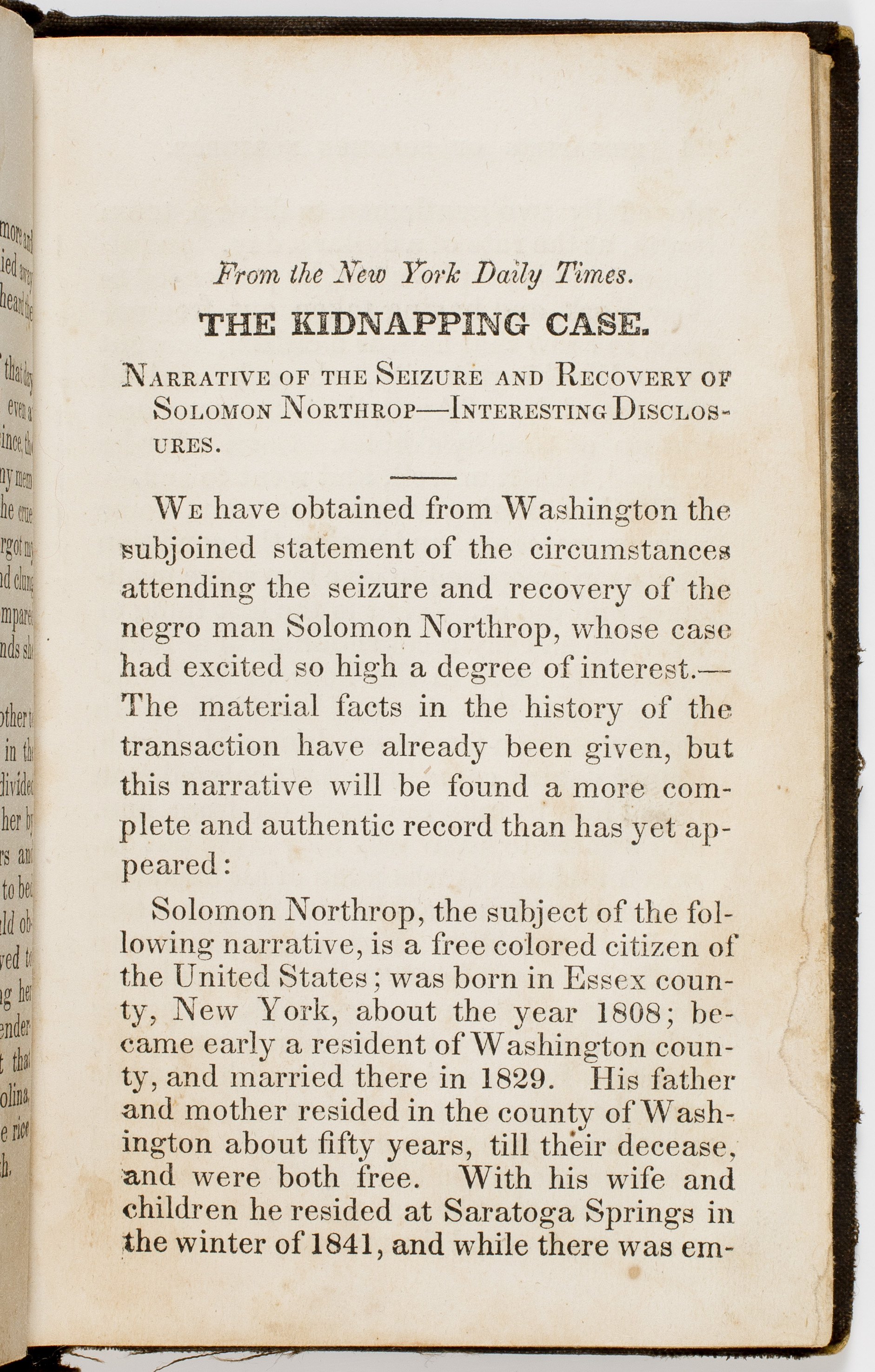
The earliest appearances of Northup’s story in book form were taken directly from the New York Times’s original newspaper reporting. In these early instances, Northrup’s story is always told as one account among many that serves to validate the truth of Uncle Tom’s Cabin. Northup’s story was told for children as “The Kidnapping Case” (in which he is named as “Northrop”) in the first volume of Uncle Tom’s Kindred [AAS Catalog record], published for Wesleyan Methodist Sabbath school children also in 1853.
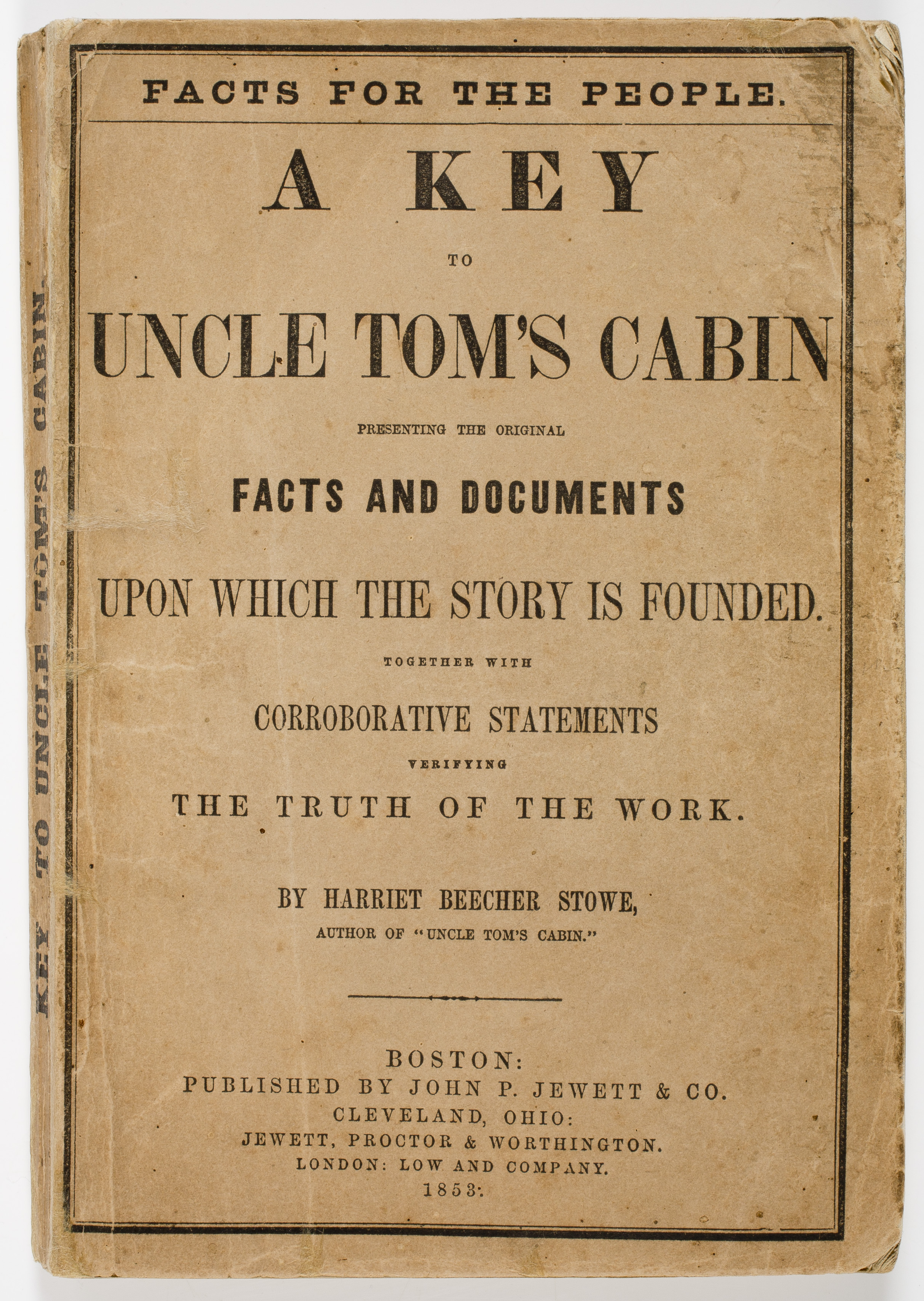
Most notable of all, Harriet Beecher Stowe herself used the newspaper account of Northup’s story in her book: A Key to Uncle Tom’s Cabin [AAS Catalog record], published in April of 1853. In it, Stowe attempted to counter the critics’ claims (especially loud coming from the South) that her work misrepresented slavery. To accomplish this, Stowe recounted factual narratives to bolstered her depictions of slave life.
Twelve Years a Slave was published only months after A Key to Uncle Tom’s Cabin and was deliberately positioned as part of this debate. The book was dedicated to Harriet Beecher Stowe and described itself as “another Key to Uncle Tom’s Cabin”. In later printings, the dedicatory page also included a direct quote from Stowe’s Key.
In this mutually reinforcing setup, Stowe borrowed truth from Northrup’s narrative to bolster her fictional novel, and Twelve Years a Slave attempted to capitalize on the popularity of the novel among anti-Slavery audiences. In other words, she needs his narrative facts and he needs her bestseller status. (Two key references to Uncle Tom’s Cabin and A Key to Uncle Tom’s Cabin within Northup’s narrative, see Heidi Kim’s fascinating article in the Los Angeles Review of Books, Feb. 17, 2014.)
The earliest advertisements and reviews of Twelve Years a Slave focused on its similarity to the incredibly popular international bestseller from the year before.One of the first notices predicted:
This volume is attracting considerable attention, and will probably achieve a popularity something akin to Uncle Tom’s Cabin. (Moore’s Rural New-Yorker for August 6, 1853)
Stay tuned: our next blog post will reveal if Twelve Years a Slave was able to rival Uncle Tom’s Cabin‘s level of publishing success!
Truth Stranger than Fiction
Northup was undoubtedly aware of these potential comparisons and took pains to emphasize his story was an example of the axiom, “Truth stranger than fiction!” (a headline that topped many of the advertisements and reviews of his book). He described his purpose at the beginning of his narrative as follows:
My object is, to give a candid and truthful statement of facts: to repeat the story of my life, without exaggeration, leaving it for others to determine, whether even the pages of fiction present a picture of more cruel wrong or a severer bondage. (p. 17-8)
Over the years, people have doubted the veracity of the story told in Twelve Years a Slave and just how much of it was coming from the actual Solomon Northup. At the time of its initial publication, this concern was addressed by the book’s editor. David Wilson was from the same area of upstate New York as Northup, which may help explain his selection, since he had only published one earlier book. As editor, Wilson attests to Northup’s authorship and the truthfulness of his account in the preface:
He has invariably repeated the same story without deviating in the slightest particular, and has also carefully perused the manuscript, dictating an alteration wherever the most trivial inaccuracy has appeared. (p. xvi)
The question of white editors’ role in mediating black narrators’ voices has vexed scholars for years. In this case, Northup was a literate, educated man, so the editor’s claim that Northup had “carefully perused the manuscript” checking for inaccuracies seems reasonable.
Furthermore, the past few decades of scholarship since the 1960s (especially the work of Dr. Sue Eakin) have uncovered documentary evidence supporting the accuracy of Northup’s account. A free colored man from upstate New York, Northup was indeed lured to Washington, D.C. with the promise of work where he was drugged and sold into slavery. For 12 years he was enslaved on various plantations, including one in the very same Red River region of Louisiana where Harriet Beecher Stowe set her novel Uncle Tom’s Cabin. He was finally able to obtain his freedom, and legal documents and state records validate this fact. However the case against his kidnappers that followed highlighted the problems African Americans faced in a legal system in which they were not allowed to testify. The kidnappers were eventually released and no one was convicted for the crime.
While some may have found it difficult to accept his account as fact, Northup’s tragic story was certainly not unique: many free blacks were kidnapped and sold into slavery. What makes Northup’s life remarkable was that he was able to return to his life as a free black man, even if it was only for a few years before he disappeared again.
After Twelve Years a Slave was published, the next few years saw Northup frequently speaking in public and performing his own plays based on his story until he suddenly disappeared from the public record in the fall of 1857. To this day, no one knows exactly what happened to him. There is some evidence Northup may have been involved with the Underground Railroad, others speculated he was kidnapped again or killed, although the fact that his legal case against his kidnappers collapsed makes the latter seem unlikely. (For more details on his life, see the recent book Solomon Northup: The Complete Story of the Author of Twelve Years a Slave [AAS catalog record].)
A follow-up blog post later this week will present more information about the various editions and formats of the physical book that so inspired director Steve McQueen and actor Chiwetel Ejiofor. We hope you will have a deeper appreciation for the history behind Solomon Northup’s story. You’ll certainly have all kinds of insider knowledge to share at your Oscar viewing party this Sunday, March 2nd!
NOTE: A selection of the items described in these posts (along with some others) has been on display in the AAS reading room in honor of Black History Month. The display will remain up for at least the next few weeks and is accessible during our free weekly public tours Wednesdays at 3pm.
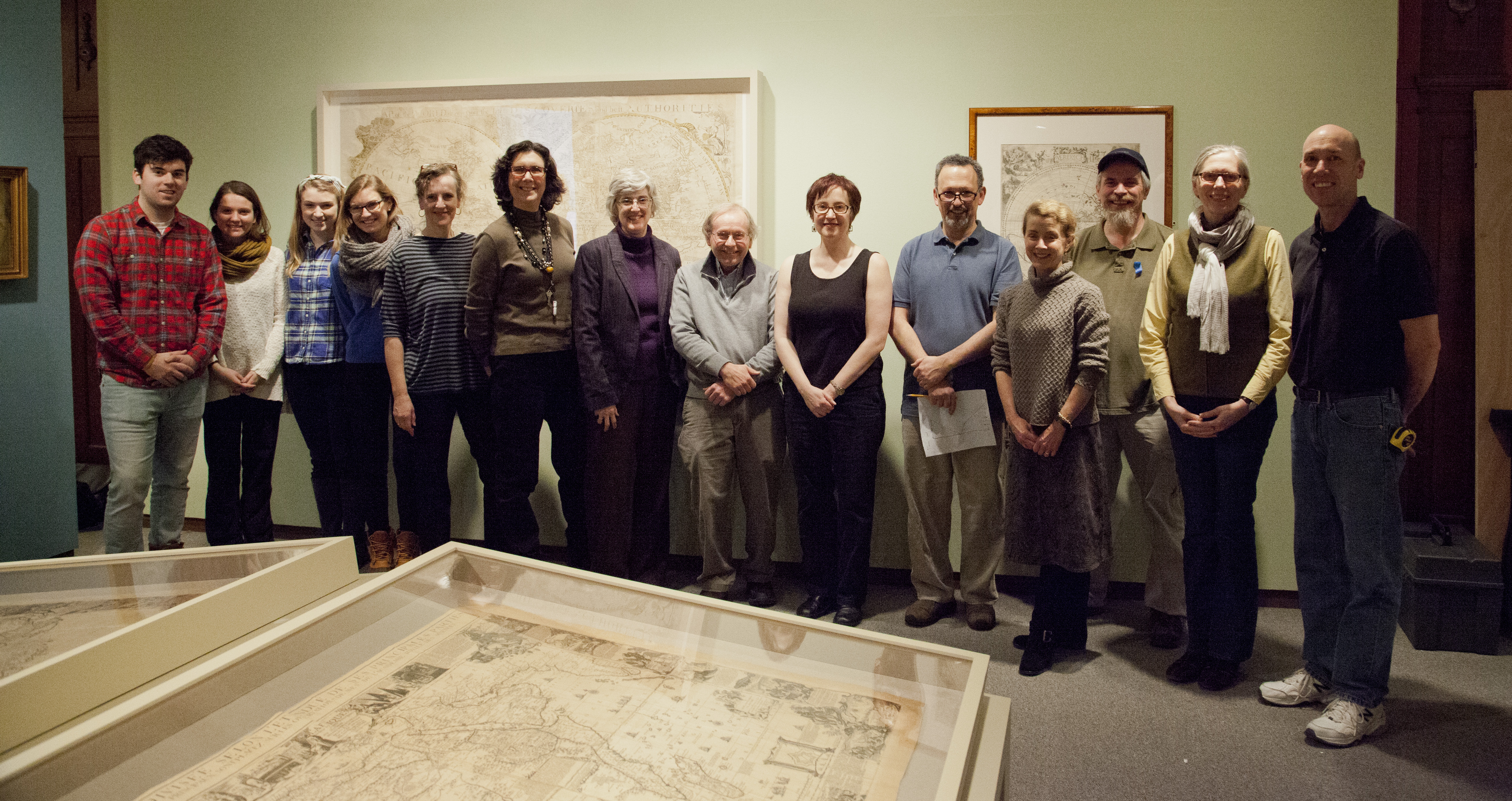
We know how to keep busy in the dead of winter here at the American Antiquarian Society. In late 2012 Patricia Johnston, the Professor Rev. J. Gerard Mears, S.J. chair in fine arts at the College of the Holy Cross, approached AAS with the idea of having one of her Holy Cross classes research and prepare an exhibition on an aspect of life in pre-1830s America. The students arrived at the library in September of 2013, and working with the Society’s curators and reference staff, began searching the collection for material related to the ways in which early Americans encountered the rest of the world, a theme selected by Dr. Johnston and the students. They looked at exploration and travel narratives, maps, children’s books, ephemera, and broadsides. Nearly fifty items from the library were selected for loan to the Iris and B. Gerald Cantor Art Gallery exhibition, scheduled for winter 2014.
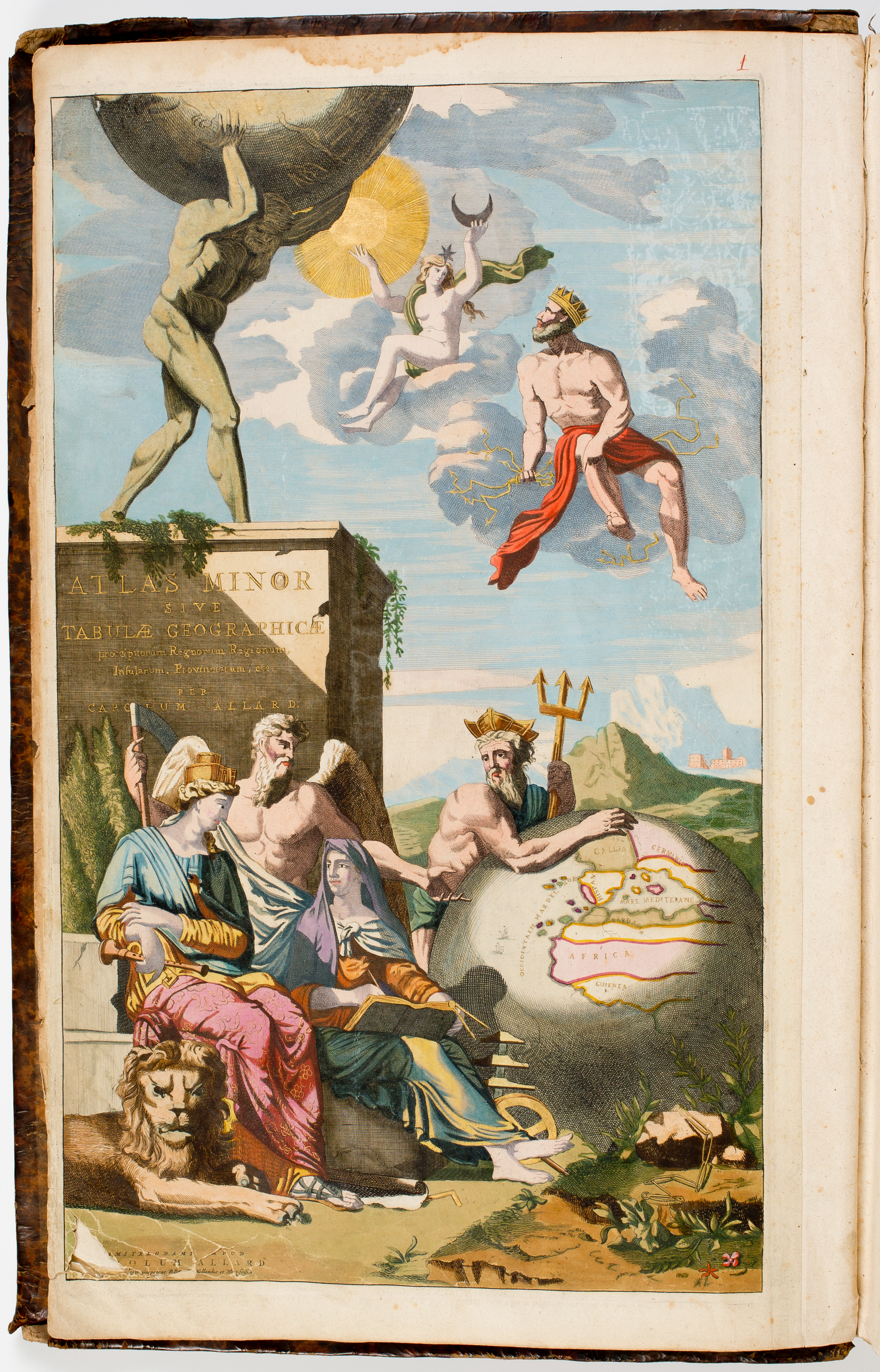
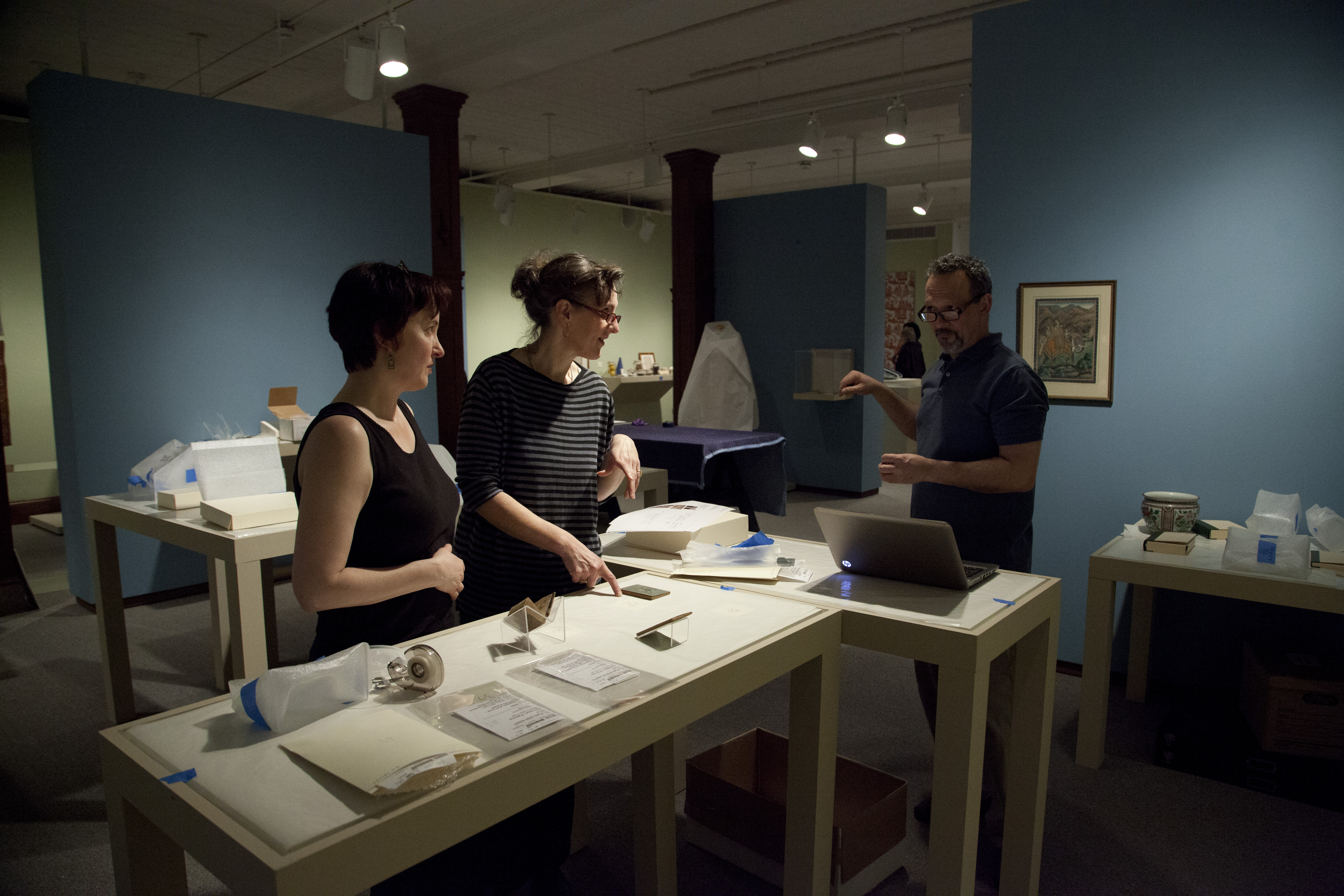
The AAS staff and the Holy Cross students, faculty, and staff involved in the exhibition.The frontispiece of the 1696 Dutch “Atlas Minor.”
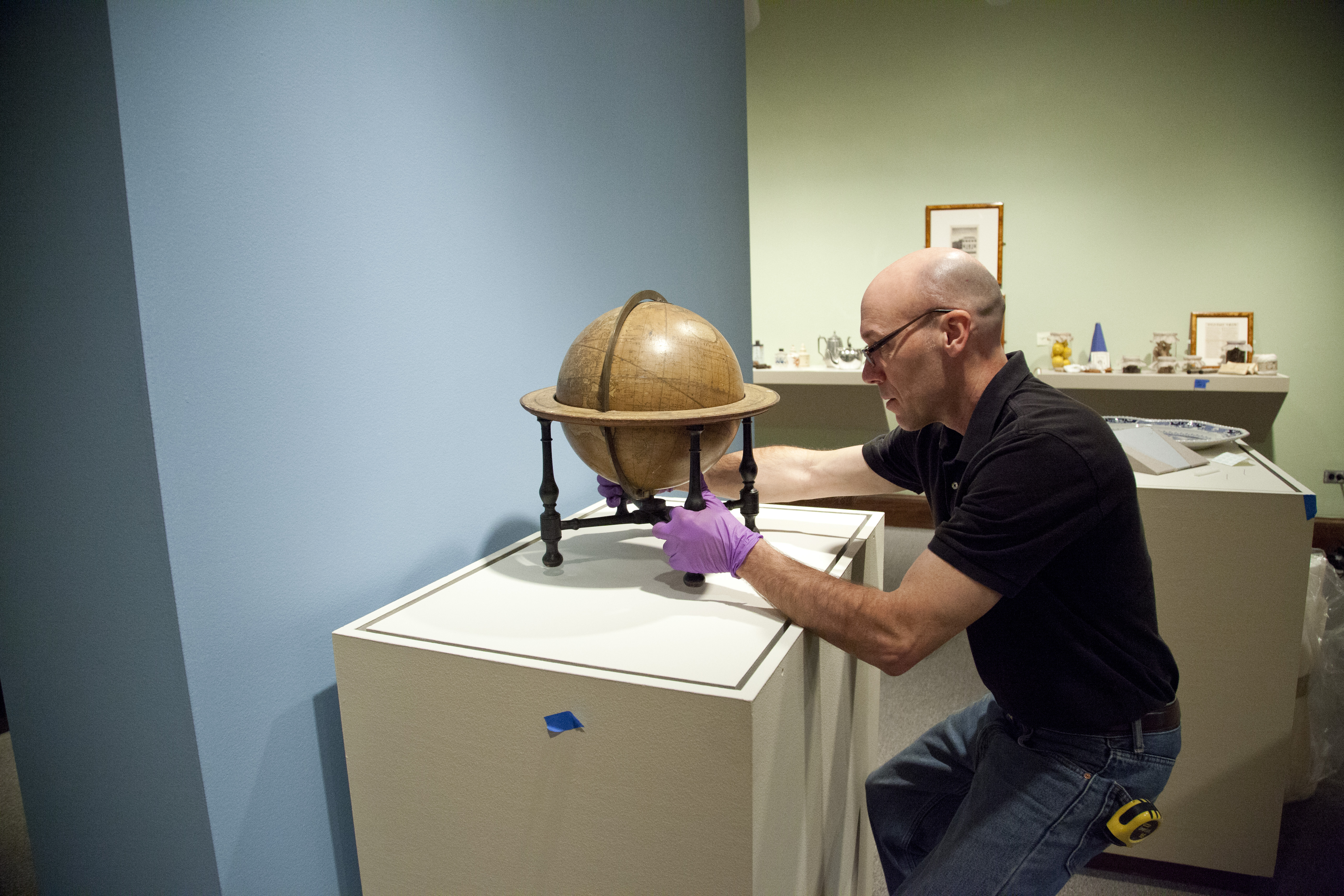
During the 2013 winter holidays, the books, maps, and ephemera moved to the conservation lab at AAS where each item was evaluated, cleaned and conserved if needed. Many large, eighteenth-century maps from the collection had stains and old repairs removed and tears mended. An important, hand-colored 1696 Dutch atlas, donated to AAS in 1848, was repaired and fortified for travel. Each item was next photographed by the Society’s photographer and the material was packed up for delivery to Holy Cross earlier this month. Some objects will be missed at the Society. The case for a 1795 British globe in the Graphic Arts workroom now sits forlorn and vacant, and the head librarian will be looking at empty hooks on a wall in his office where our ca. 1850 painting of Canton, China, usually hangs. However, we all realize that more people will see these wonderful objects and the rare material from the library collections at this exhibition than would ever see them in our offices!
The Society’s conservation team discuss book cradles with designer Frank Gregory. The cradles were custom-made for each volume.
Installation began in early February for the exhibition, called Global Encounters in Early America,which opens tonight and runs through April 6, 2014. Over one hundred objects are included in the show, almost entirely borrowed from local Worcester county organizations like AAS, Old Sturbridge Village, and the Worcester Historical Museum. For more on the exhibition and all of the activities surrounding the show—including a K-12 teacher workshop on March 15 and an academic symposium on April 4 and 5—please see the complete description and calendar.
Timothy Johnson, a preparator for the Cantor Art Gallery, places the Society’s Dudley Adams globe, 1795, during the installation of “Global Encounters.”
So, no excuses for having cabin fever in all this winter weather and snow—come out to the opening tonight, or visit the Cantor any time between then and April 6 to see wonderful treasures from several local historical organizations. AAS may not loan that Dutch atlas again for another 166 years, so be sure to stop in and see it, and all the other wonderful books, prints, ceramics, costumes, and maps on display!
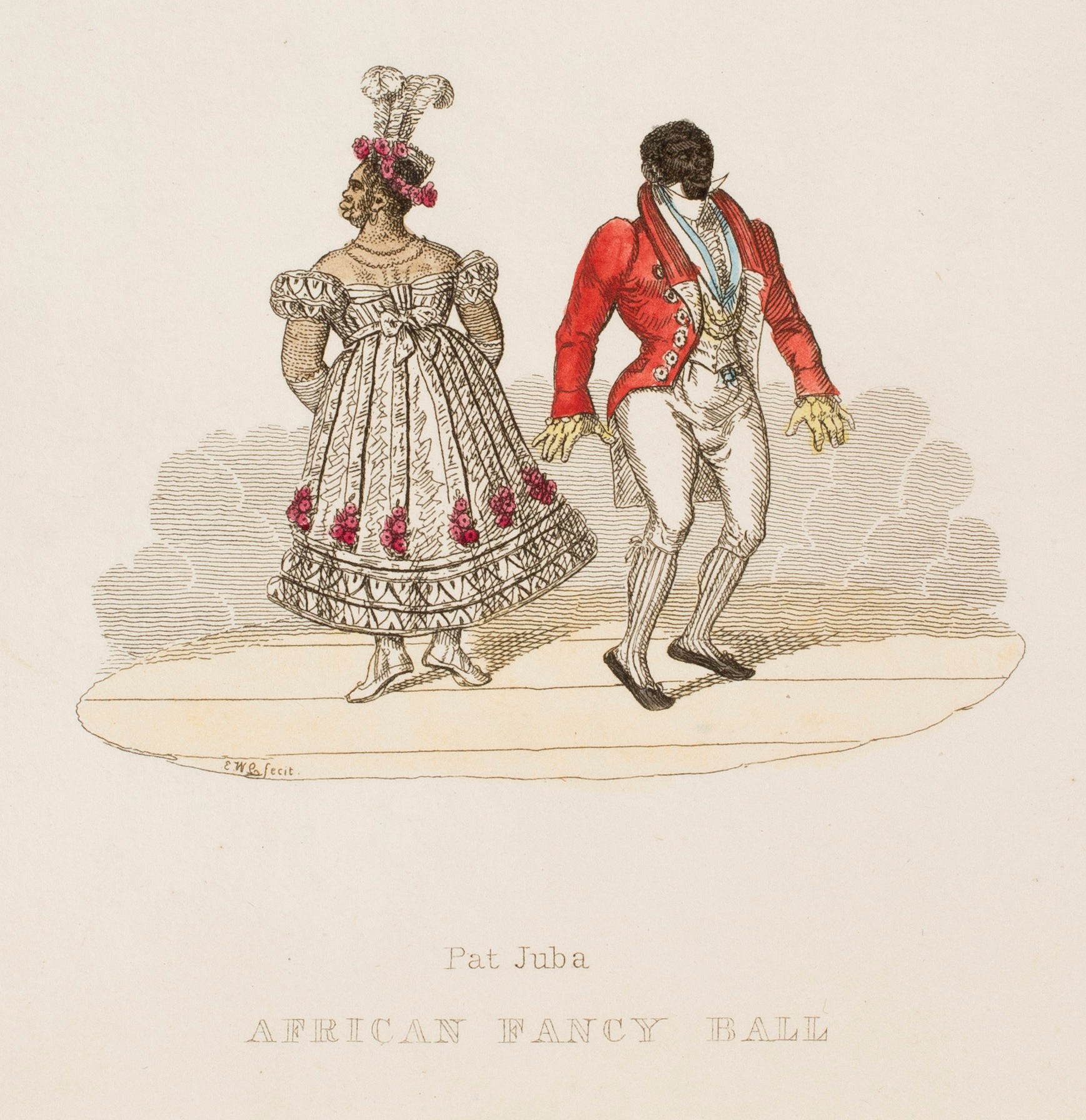
Dilettante [i.e. Edward W. Clay] Lessons in Dancing, Exemplified by Sketches from Real Life in the City of Philadelphia.Philadelphia: Published by R.H. Hobson,1828.
Only the second known copy of this title with eight delicately hand-colored plates of dancing couples mounted on stubs and sewn into printed tan paper wrappers with the imprint information. The finely-detailed plates depict couples from a range of social classes, races, and religious groups performing different dance steps in a variety of costumes. This copy has the first four plates of dancing pairs annotated in pencil with the names of historical figures including Arthur Middleton (grandson of a signer of the Declaration of Independence), Don Francisco Tacon (Spanish ambassador to the U.S. who arrived in Philadelphia in July 1827 and was in residence in 1828) and Monsieur and Madame Hutin (French dancers who appeared briefly at Philadelphia’s Chestnut Street Theatre in 1827). Though the work is anonymously attributed to “A Dilettante,” the last four plates are signed EWC so it can be identified as the work of the artist Edward W. Clay (see also Clay’s The Sorcerers’ Adieu above). Clay became famous for his caricatures such as the series “Life in Philadelphia” (1828-1830) satirizing middle-class African American Philadelphians. A somewhat less offensive example can be seen here in the dancing couple labeled “Pat Juba African Fancy Ball.” Gift of Michael Zinman in honor of the American Antiquarian Society’s bicentennial.
As has been blogged on Past is Present before, AAS has an extensive and representative assortment of nineteenth- and early-twentieth-century valentines. Part of the Graphic Arts Collection, these ephemeral pieces of affection were exchanged on or before February 14, as Valentine’s Day provided the perfect opportunity to give that special someone a card. Many were sentimental; sometimes they were comical.
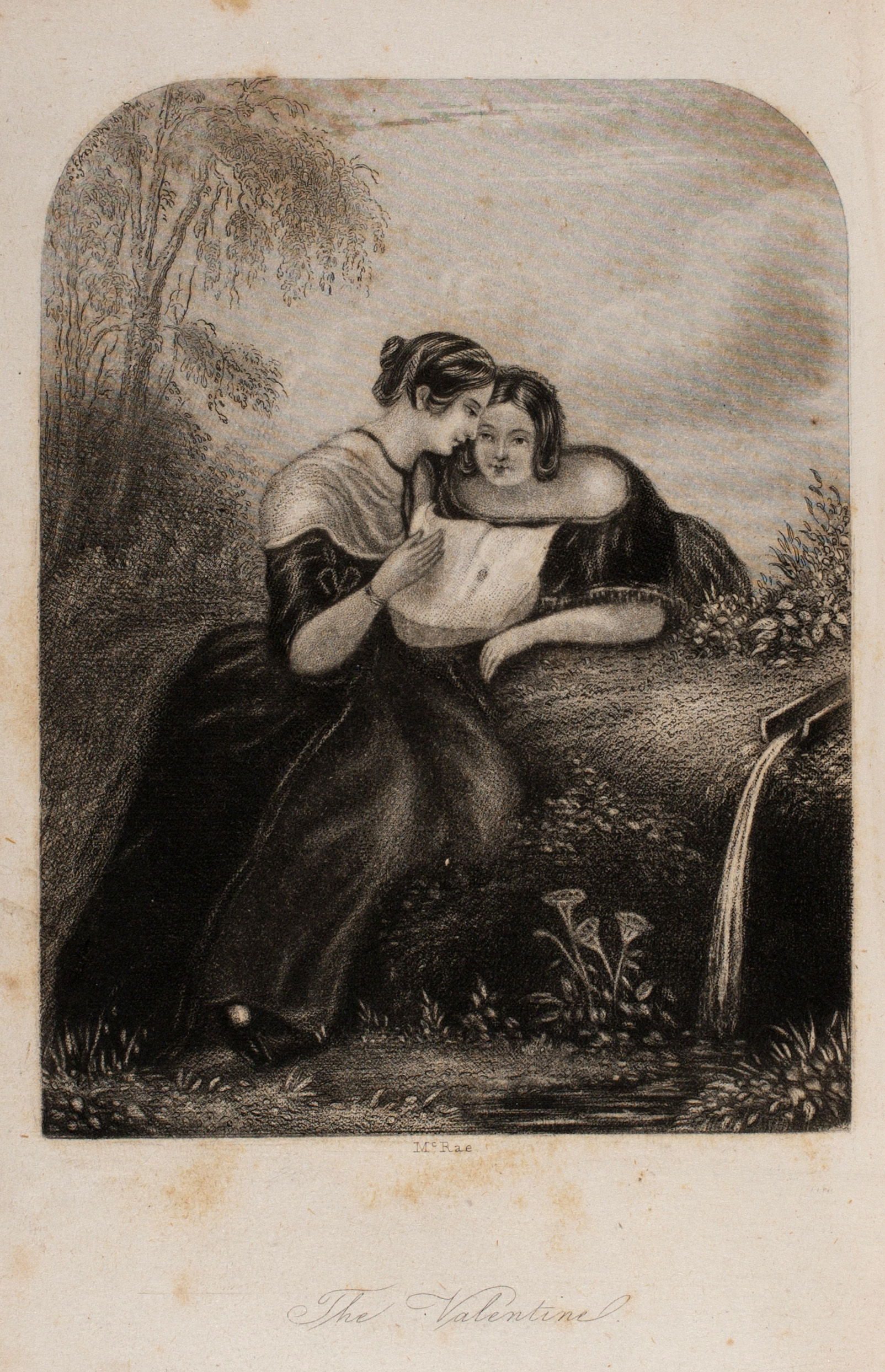
But Valentine’s Day culture appears in more than just valentines themselves. Gift books and annuals, for example, show the predictable scene of giving and receiving the greetings. “The Valentine,” a plate appearing in Temperance Offering circa 1853, was engraved by John C. McRae and shows two women outdoors sharing the opening and reading of a valentine.
Yet exterior views such as these seem to forget the reality of valentine making, manufacture, and mailing, a point not lost on several periodical writers in the nineteenth century. Instead of surveying the collection or showing some of the enchanting examples of romantic/sentimental valentines (which have been featured this week to our Instagram followers), this post will examine a particular valentine found within the collection and look at it from a few angles.
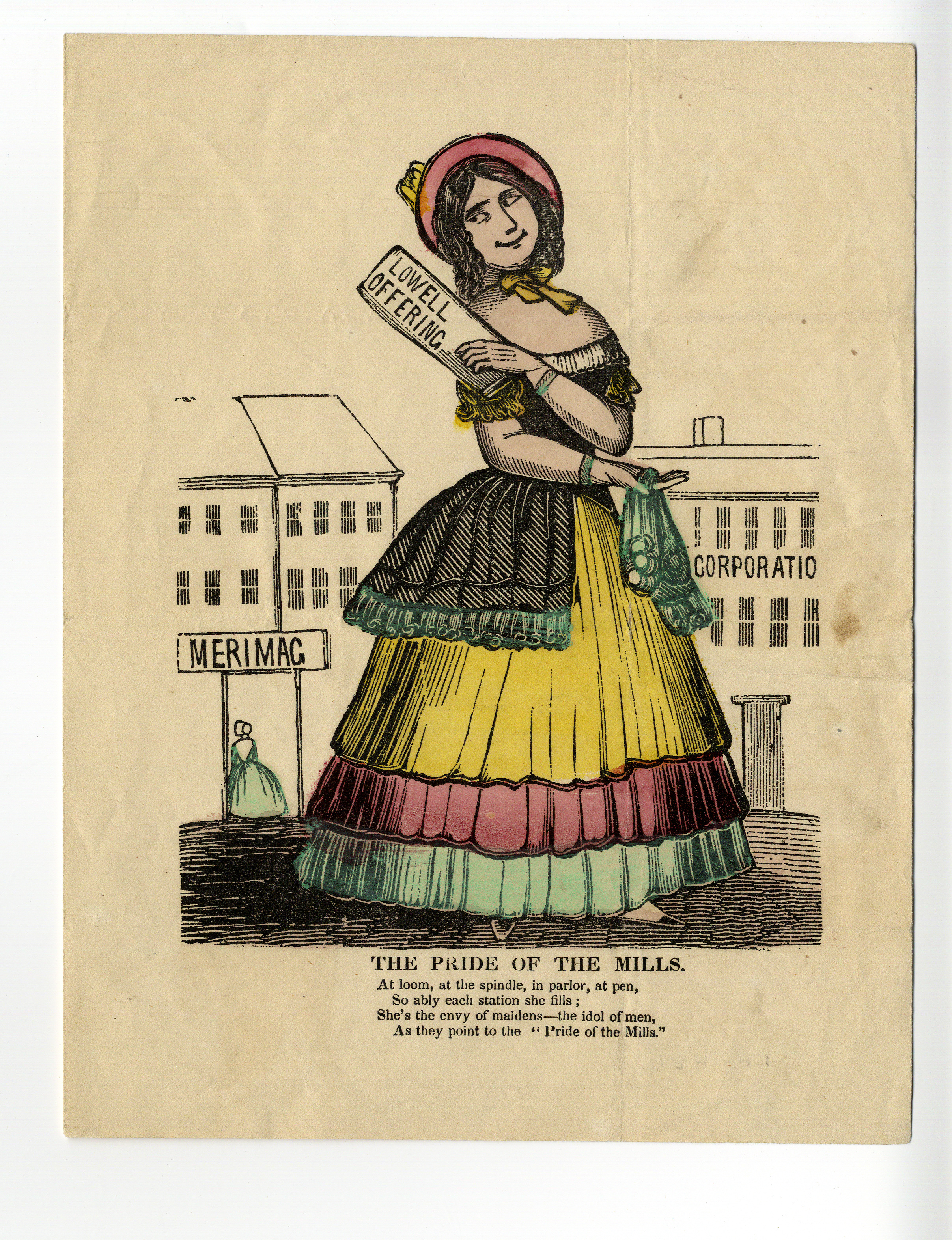
The valentine “Pride of the Mills” (below) is housed in the comic valentine category. It features a caricature of a well-dressed woman worker in the Merrimack Mills in Lowell. In one hand she holds a rolled copy of the Lowell Offering, in the other bags of coins. The poem beneath reads, “At loom, at the spindle, in parlor, at pen,/So ably each station she fills;/She’s the envy of maidens-the idol of men,/As they point to the ‘Pride of the Mills.’”
Though the mill girl is the subject of this comic valentine, and perhaps not its intended recipient, part of its ironic interest is that the Pride is outside the mill. Indeed, the image and text show a deceptively independent woman (as opposed to other comical valentines, which range from the crude or rude to exaggerated features and professions). Comparatively, this one is tame. And yet it is one laced with confusion. The Pride of the Mills is an advocate for change, yes. Women, for any number of reasons, have to work in a factory to earn money and yet, re: valentines, are to maintain a passive role in the game of love.
The Lowell Offering—written, edited, and published by female operatives employed in the mills—instigated a conversational line about the sending of Valentines.
In the March 1, 1845, issue of the periodical, “Q” states:
There have been several thousand Valentines distributed from the Lowell post-office this month. We are acquainted with one lady who wrote a letter to a stranger, last Valentine’s day, who is this year upon the eve of marriage with him. Girls! Is this an argument in their favor or not?
Like many articles in the Lowell Offering, this piece invites the readership into dialogue. Much in the same way the comic valentine does.
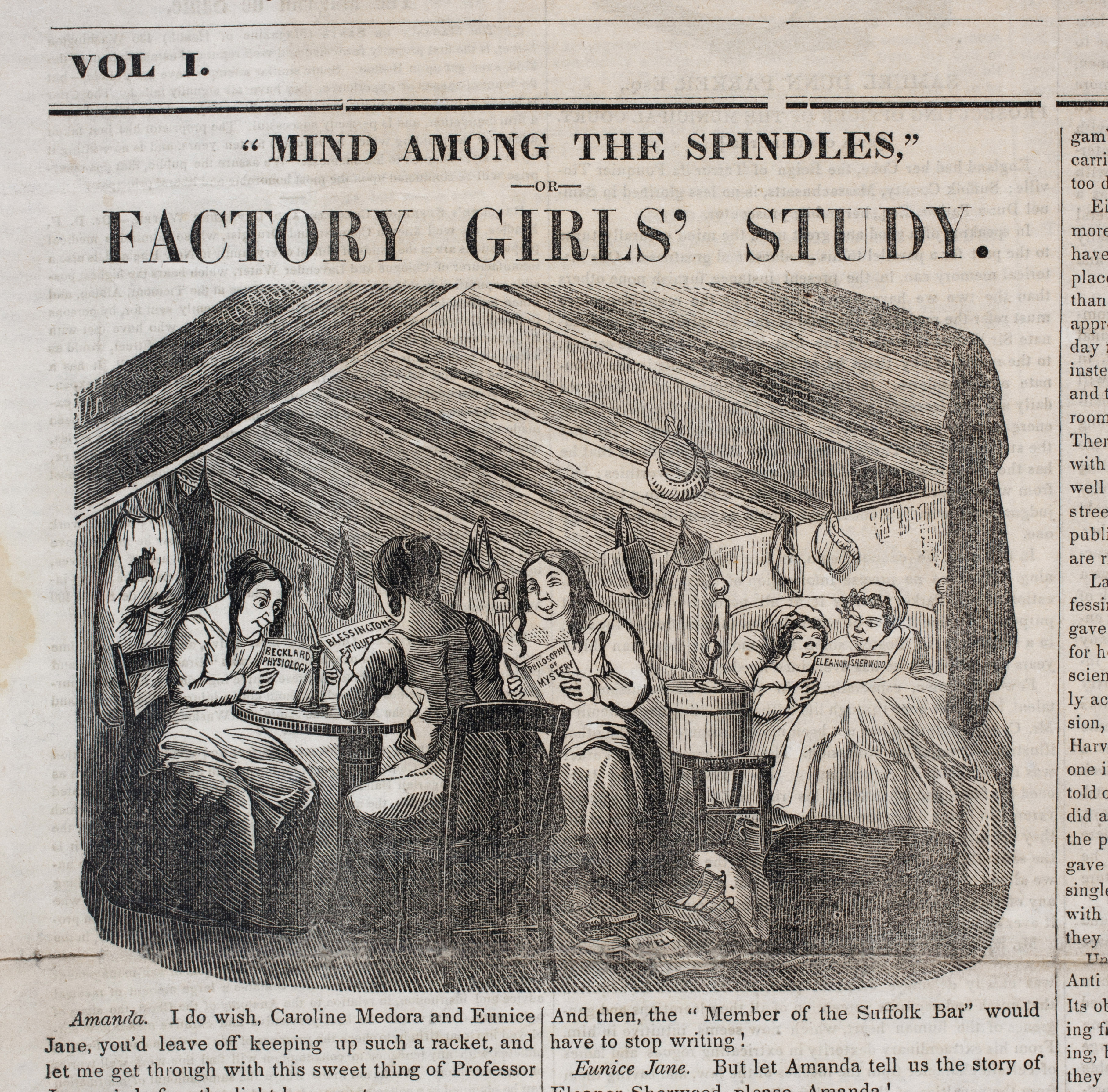
The discussion about factory girls is never uncomplicated, as this illustration of “‘Mind Among the Spindles,’ or Factory Girls’ Study” in the April 1846 Boston City Crier and Country Advertiser makes clear. In the image, young women sit gathered around a table or curled up in bed together reading; a discarded copy of the Lowell Offering is cast on the floor. The girls are reading copies of Eugène Becklard’s Physiological Mysteries and Revelations in Love, Courtship and Marriage,a guidebook on marriage, sex, and hygiene (AAS has several copies of the text in its collection). They are also reading J.H. Ingraham’s Eleanor Sherwood (Ingraham also wrote The Beautiful Temptress), Lady Blessington’s “Etiquette,”and The Philosophy of Mystery by Walter Cooper Dendy. The illustration and selected texts suggest the less than ideal reading habits among the factory’s spinning machines and that little else is on the mind of these women but the vagaries of love and the human experience.
Though factory work and valentines seem an unlikely alliance to make, we can momentarily look at Worcester-born Esther Howland (1828-1904) who, when her amorous art skyrocketed in popularity, employed the assembly-line system to create her valentines. While Howland remains one of Worcester’s success stories, the industrial-made cards were not without their critics.
Godey’s Lady’s Book lamented in its February 1849 issue that “the title [Valentine] is bestowed on printed doggerel, bought in market and distributed through penny-post, with no more of sentiment to consecrate the offering than though these were patented recipes for colds, or notices of a new milliner’s shop.” The reproduction of sentimental cards, according to the Lady’s Book, was mournfully sublet to the factory setting rather than lovers creating their own homemade (or at least less generic) sentiments.
Similarly, an article called “A Valentine Factory” in the January 1874American Artisan and Illustrated Journal of Popular Science echoes the same general attitude. Noting the disconnect between the delicate sentiments contained within a Valentine and the reality of how they are created, the author of the article notes, “Brawney-armed mechanics are turning out a strange medley of lovers and bowers, flowers, birds hearts and arrows, bachelors and pining spinsters.”
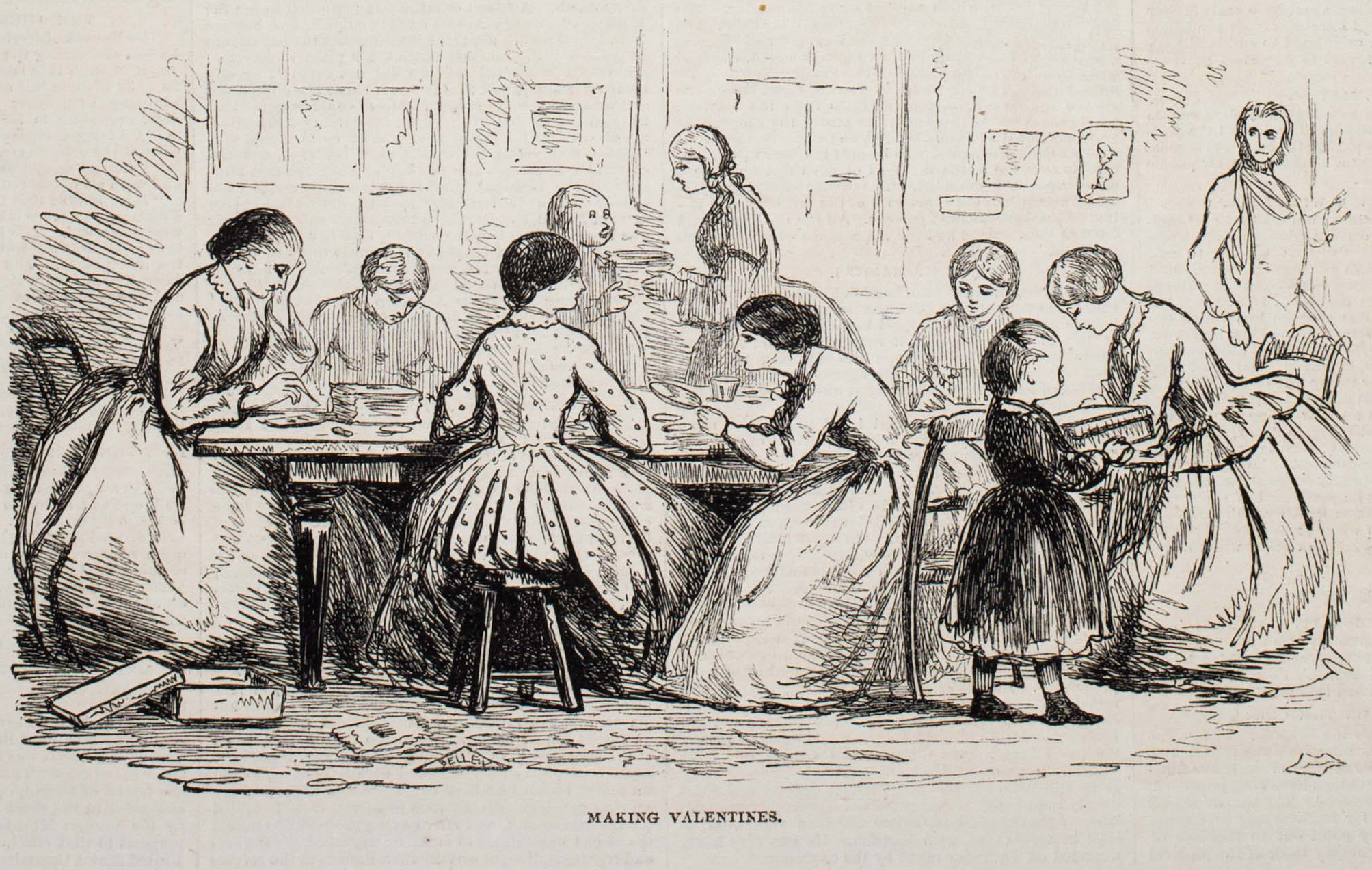
A Harper’s Weekly engraved illustration by Frank Bellew (above) shows an interior where women are at work creating valentines.[1]Harper’s,with its general-audience appeal, even comments on the manufacturing process of valentines: “Few guess the amount of capital invested in the manufacture of these missives – amatory and otherwise – or the vast number sold and dispatched each year.” (The article, from February 13, 1858, is reproduced here and here). The article continues with regards to the employment behind these valentines, “seventy-five are women and twenty-five boys and men” – or to the point, it was another employment opportunity for women.
If you are looking for valentines, the Antiquarian Society is undoubtedly a unique resource of study. And if you’re looking for periodical writers and editors (such as Harper’s, the American Artisan, Godey’s,and even to an extent the Lowell Offering) to critique and admit the disconnect of making these items commercially, we are fertile ground as well – love knows no bounds!
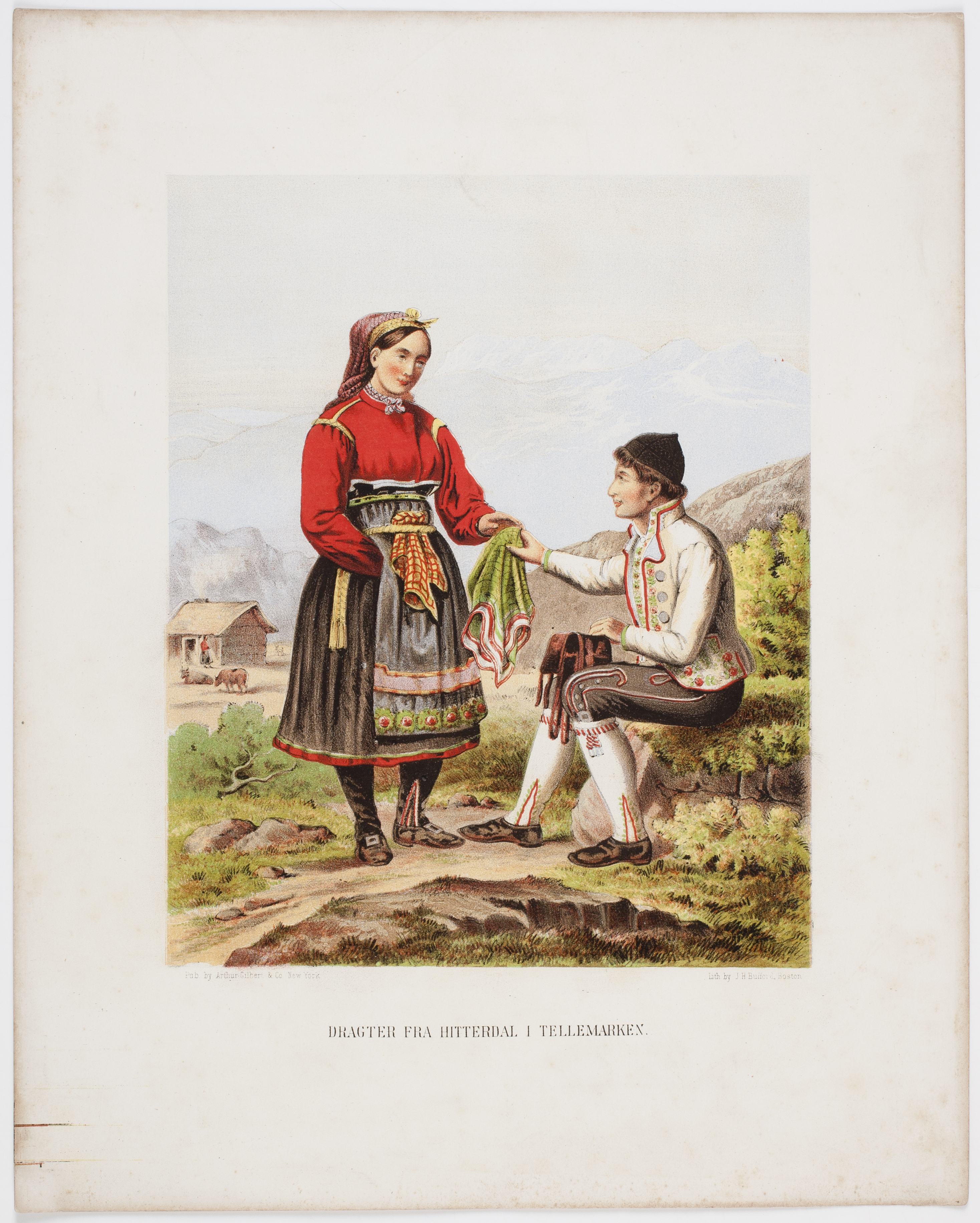
Bufford, J.H. Vinter dragt [i.e. drakt] fra Karasjok i Finmarken and Dragter [i.e. Drakter] fra Hitterdal i Tellemarken. Costume plates from Norway Illustrated. New York: Arthur Gilbert & Co., 1872.
AAS holds an uneven medley of the pieces that made up an ambitious 1872 printing called Norway Illustrated. The set was to be issued by New York publisher Arthur Gilbert & Co. in eighteen parts, each with four black and white lithographed views of the Nordic landscape and one color costume plate. The publication was copied directly from C. Tønsberg’s, Norge fremstillet i Tegninger med oplysende (Oslo, 1848). The U.S. re-publication wasapparently not very successful as only three partial sets arerecorded (AAS, University of Minnesota and University of Wisconsin). In fact it isunlikely that all eighteen parts were ever issued. When the Society’s set was cataloged in 2009, we found that we had the first part as issued with text, and eighteen additional landscape sheets from later sets. Unfortunately we had no examples of the color-lithographed costume plates. Recently, however, AAS visual materials cataloger Christine Graham-Ward located five of the costume plates online by searching for the publisher and printer’s names. This discovery indicates that at the very least at least five parts of Norway Illustrated were probably issued.
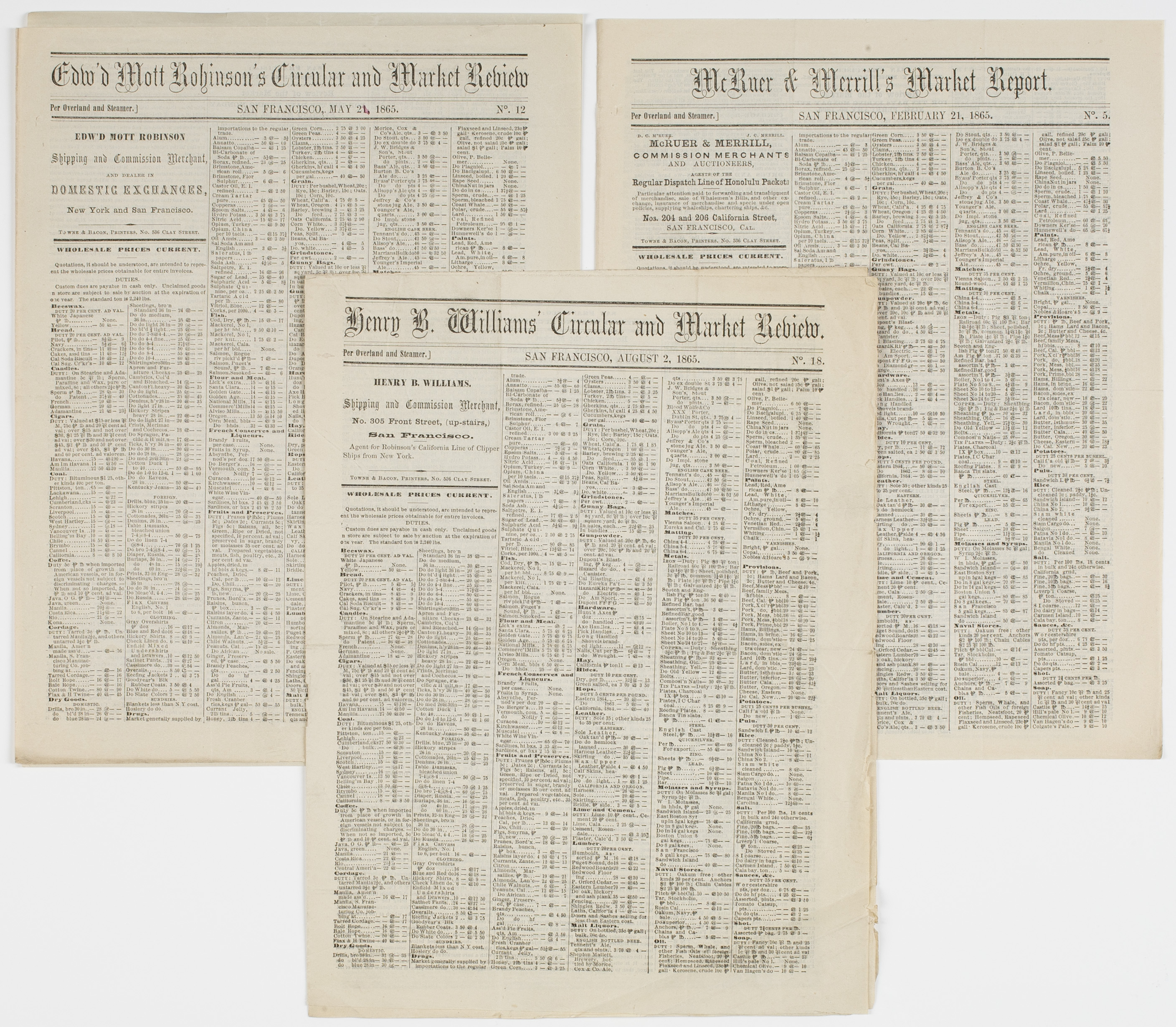
AAS has a large collection of serial publications with titles such as Prices Current or Market Reports. They contain the latest market prices of commodities and/or stocks and local commercial information. Sometimes people wonder why we try to get examples of everything we can. We do this because more materials tell a more complete story. For example, take a look at the three San Francisco publications from 1865 listed and pictured below:
Henry B. Williams’ Circular and Market Review (August 2, 1865)
Edw’d Mott Robinson’s Circular and Market Review (May 21, 1865)
All were published within a few months of each other and all look similar. Looking at them separately, one might think Williams, McRuer & Merrill, and Robinson were publishers. If you take a look at them side by side, however, you might notice in very small type in the section in the upper left under the masthead, “Towne & Bacon, Printers, No. 536 Clay Street.” Here you find the true publisher of the circulars. Merchants would pay to have their name attached to a report. Towne and Bacon would print the market reports, changing the masthead to the name of the merchants paying. The merchants would then have something to pass out to their clients as a price report and promotional material.
The ability to make connections like these is why more material is better.
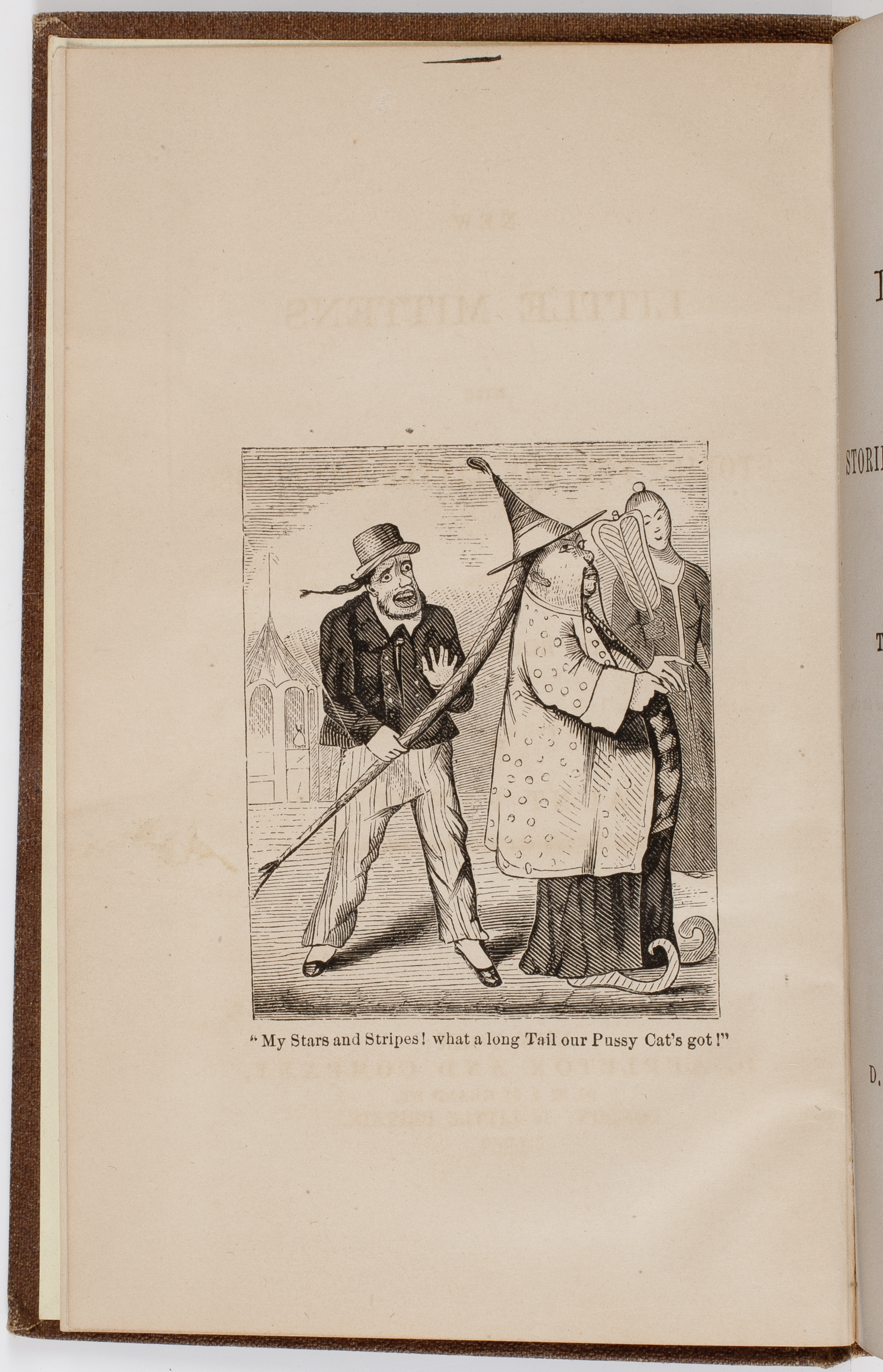
Barrow, Frances. New Little Mittens. New York & London: D. Appleton and Co., 1869.
This wood-engraved frontispiece is a comic scene set in the culture clash between a Chinese gentleman going out for a stroll, and an ignorant American sailor who pulls his queue and says “My stars and stripes! What a long tail our pussy cat’s got!” Any hope that this picture serves as the basis for a discussion about respecting people from different cultures is quickly dispelled: this image is used to illustrate a story about children misbehaving in church. Instead of listening to the minister, a little boy chooses instead to look at a secular book about foreign countries containing this picture. Eventually, the boy laughs out loud in church, and his bad behavior (reading a worldly book in church) is discovered.
Molly O’Hagan Hardy is AAS digital humanities curator and an ACLS public fellow. Every month on Past is Present she will be sharing news on digitization efforts at AAS, coverage of digital humanities projects using AAS materials, and ideas for such projects. Stay current with all things DH at AAS by checking out the “Digital AAS” section of our website.
After attending some excellent panels at the recent Modern Language Association Convention on work being done in the digital humanities, I was struck by the number of projects in early modern and eighteenth-century British literary studies that rely on the Text Creation Partnership (TCP). Prominent eighteenth-century British literature scholar and digital humanist Ted Underwood describes Gale Cengage’s Eighteenth Century Collections Online (ECCO) partnership with TCP as “an ideal solution” to the problem of procuring clean, machine-readable texts. Anupam Basu relies heavily on the fruits of ProQuest’s Early English Books Online (EEBO) partnership with TCP for his innovative work on Shakespeare. And yet both at the MLA Convention and in some post-MLA snooping around, I could find no examples of early Americanists making use of Readex’s Evans Early American Imprints Series, 1639-1800 partnership with TCP. The most obvious reason for this difference is scale: while tens of thousands of titles have been included in EEBO-TCP, only 5,000 titles from Readex’s Evans have been included. This makes Evans-TCP less than ideal for large-scale text mining projects, but its corpus could still be used for single text or author data analysis, the building of digital scholarly editions (see how this access works in the section below), or for pedagogical purposes (many of the titles in Evans-TCP have not been republished in modern editions for the classroom). In what follows, I explain how one might conceive of a project using Evans-TCP by describing what it is and how it might be used for those at partnering institutions now and in the near future by researchers anywhere.
What is the Evans-TCP?
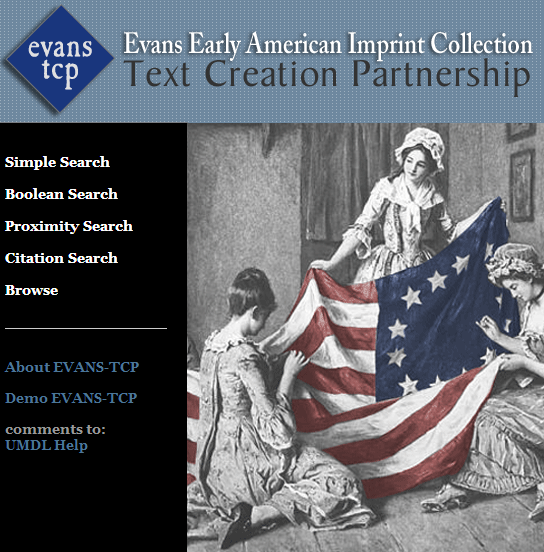
Evans-TCP is a partnership among the TCP, NewsBank/Readex Co., and the American Antiquarian Society that, between 2003 and 2009, created almost 5,000 accurately keyed and fully searchable SGML/XML text editions. In other words, actual people have typed every word of the selected texts, rendering a much higher degree of accuracy than the optical character recognition (OCR) software that Readex relies on to transform the scans of texts into words. Not only are searches of such texts more reliable, but through Evans-TCP a user can see the keyed-in text that she searches. When working in the Readex database, a user sees only the image of the original text that has gone through OCR software, but not the text that is being searched. Moreover, in Evans-TCP, a user can also access the XML file created by the TCP.
How can I find out which early American texts are included in the TCP?
In consultation with a number of scholars, AAS selected which titles within the date range of 1640 to 1800 would be chosen for Evans-TCP. The Evans-TCP page offers a number of search options to navigate through these titles: simple, Boolean, proximity, citation, and browsing. The searching is fairly intuitive, but if you need help, check out these instructional videos (though they were created for EEBO-TCP, the interface is pretty much the same).
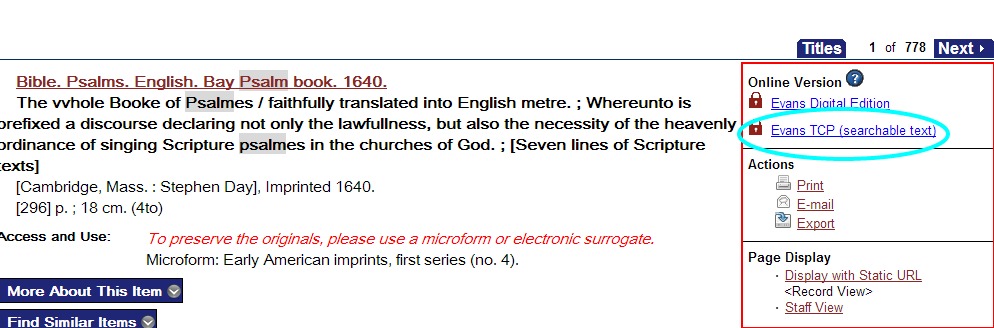
The AAS General Catalog is another way to find texts in Evans-TCP. Note that on the upper right side of the screen in our catalog record (see the screenshot below), a user will see a link to any title included in Evans-TCP. As of now, the lock icon next to the link indicates that one must either be on the AAS campus or that of a partnering institution in order to access the Evans-TCP text, but read on to find out how that is changing SOON.
Who can access the TCP and how does access work?
This is the really great news: as of June 30, 2014, anyone anywhere can access the Evans-TCP texts. TCP welcomes requests for source files (now from users at partnering institutions, but soon for everyone) for individual texts, or the whole corpus of its titles. After the June release date, anyone will be free to access and make use of these raw files through an online directory where they can be downloaded. Rebecca Welzenbach, TCP outreach librarian at the University of Michigan, explains, “Our intention is to make them available in such a way that people can find and download them without having to come through us.” Welzenbach does offer one reminder: although TCP includes links to the Readex/Newsbank page images, these will be available only at subscribing institutions. The TCP makes XML encoded transcriptions, not the whole database, available. It is, however, these transcriptions upon which digital humanities work from the early modern period to the nineteenth century relies, and we at AAS would love to hear how early Americanists are making use of this incredible resource.
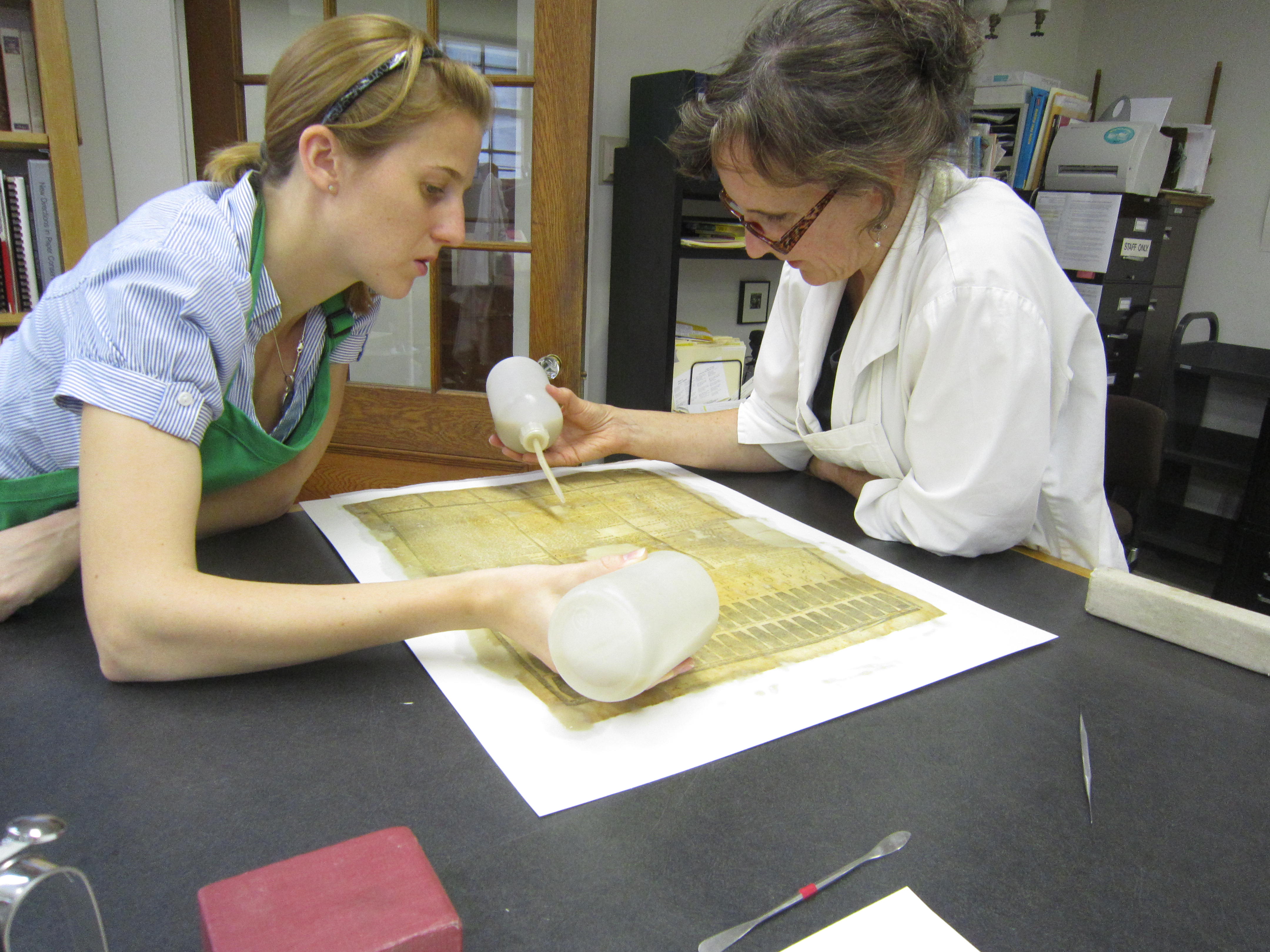
Halaina Demba, our guest author here, is a third year student in the Buffalo State College Program in art conservation. She spent this past summer, the final one of her graduate studies, interning in the Society’s book and paper conservation lab.
The author working closely with chief conservator Babette Gehnrich.
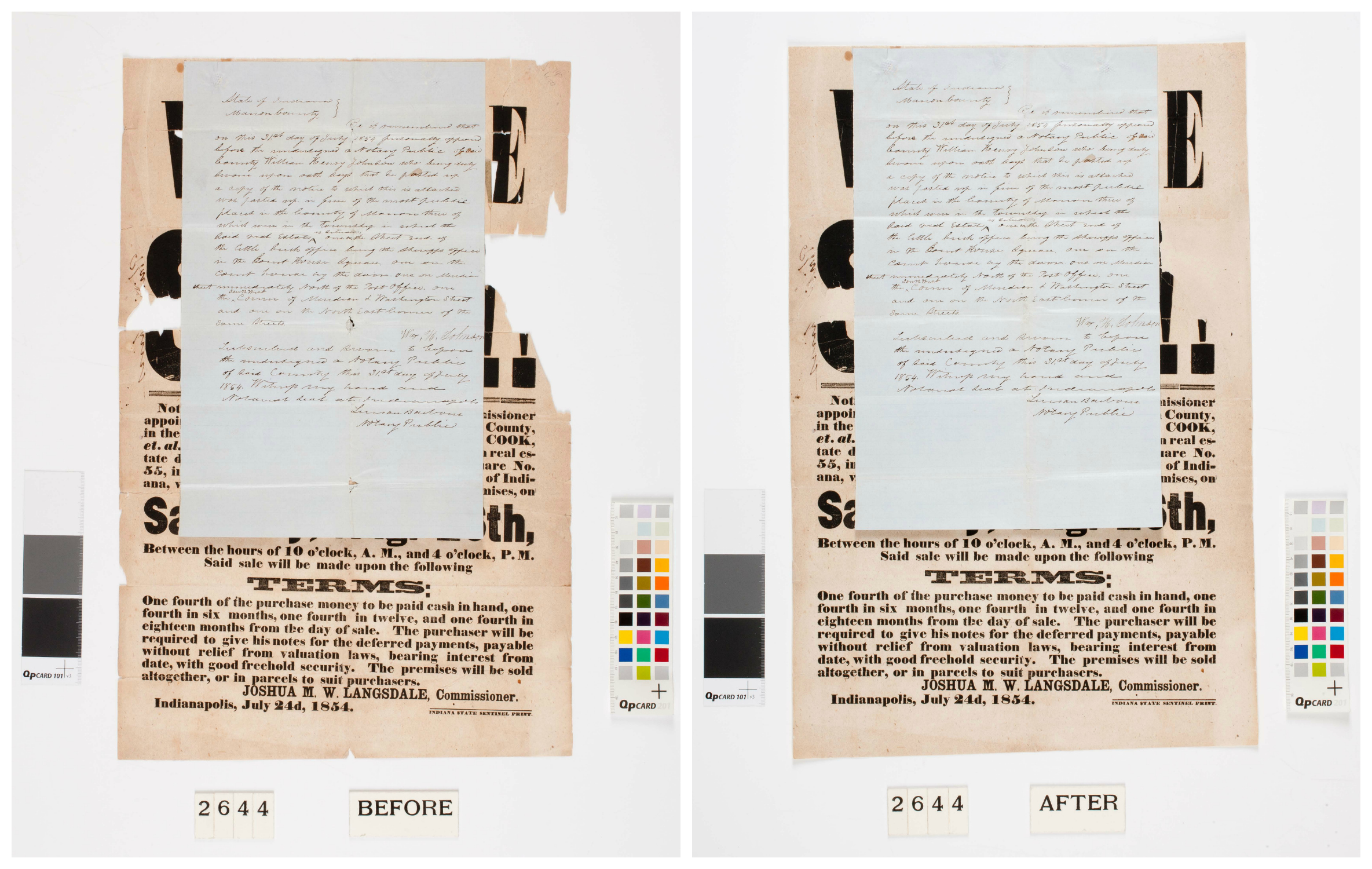
This summer the American Antiquarian Society received a unique gift of an 1854 broadside with an attached docket. The broadside announces the sale of a “Valuable City Lot” in the city of Indianapolis, Marion County, Indiana. Announcements, like this one, were commonplace during the nineteenth century and could be found posted in prominent areas of a town or city, such as near the post office or courthouse. At the conclusion of an announced event, the broadside would be removed, posted over, or just forgotten; these advertisements would not typically be saved. Consequently, it is rare to find advertisements like this one. It is even more rare to find one that has an attached docket stating who posted the broadside, when it was posted, and locations where the broadside was posted.
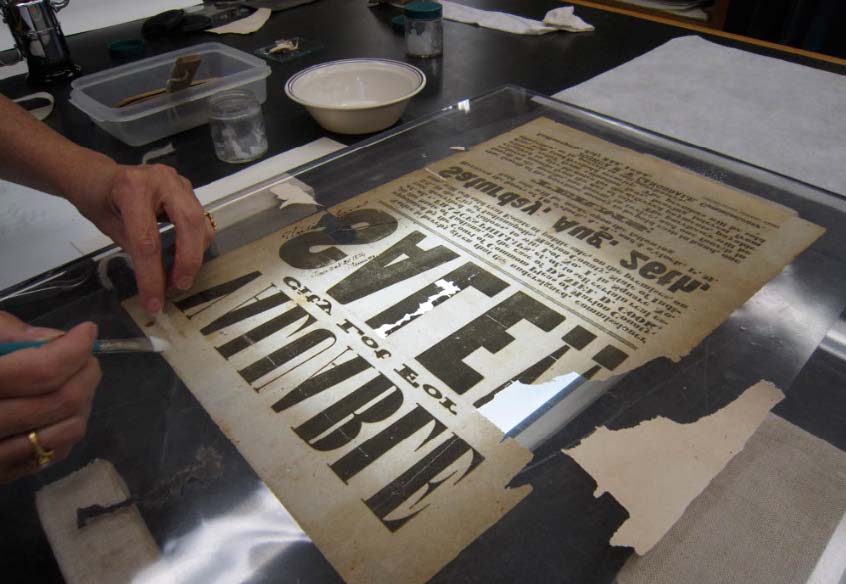
Paper was cut to fit losses and inserted with wheat starch paste while broadside was on a light table.
While the docket was in stable condition, the broadside was in a marked state of deterioration. The paper substrate of the broadside was extremely fragmented with complex tears and losses predominantly located in the upper half of the document. The paper in the inked areas was observed to be extremely brittle, which further compromised the document’s fragile condition. This document could not be safely handled without conservation treatment. Conservation was undertaken by chief conservator Babette Gehnrich and myself.
After photographic documentation, a thorough assessment, and a consultation with the curator, the broadside was mechanically separated from the docket and then washed with water on a capillary fleece to reduce discoloration.
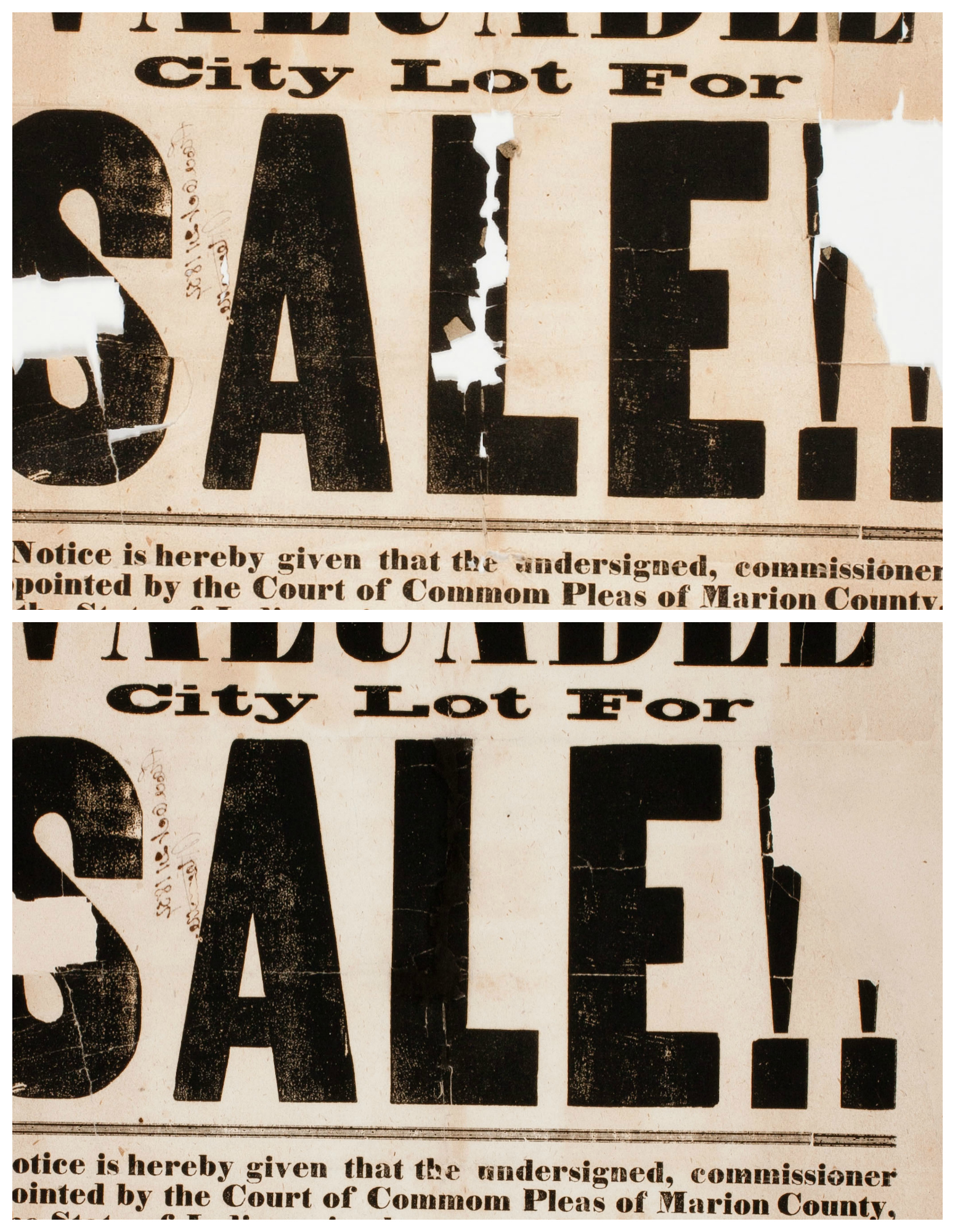
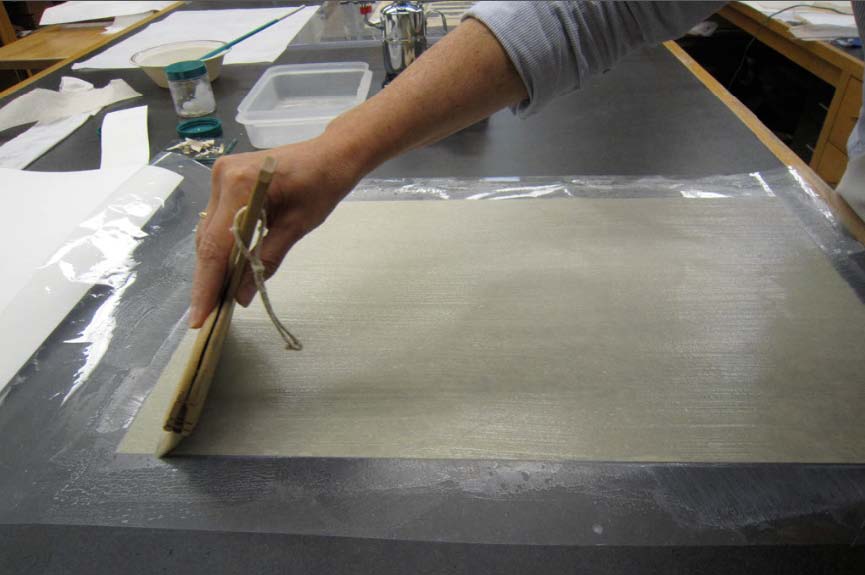
Detail of before (above) and after (below) treatment of broadside. Note improvement in tone of broadside and inserted fills.Wheat starch paste being applied to Japanese tissue lining sheet.
Losses in the broadside were filled with historic and modern toned paper of a similar color and texture. The many complex tears were first repaired with Japanese paper strips. After consulting with curator of graphic arts Lauren Hewes and chief conservator Babette Gehnrich, it was decided to not tone the large text losses of the broadside. For archival documents, legibility of the written contents and stability of the object are the most important factor of the treatment. Even with the many losses, the text of the broadside was legible. Furthermore, the losses are part of the history of the piece. However, it was decided to fill some of the minor losses with toned paper to create a unified visual appearance.
Next, the reverse of the broadside was lined with a sheet of Japanese tissue that was prepared with wheat starch paste. The broadside was placed under pressure until the paste had dried. The lining tissue was trimmed to the edge of the broadside, and the losses were toned. The treatment was finished when the docket was reattached to the broadside.
Overview of before (left) and after (right) treatment of broadside with attached docket.
I was extremely satisfied with how this treatment turned out. The treatment significantly reduced the condition problems. The inserted fills, repairs, and lining tissue helped to stabilize the broadside. Now the broadside can be safely stored without further loss and damage and, when necessary, handled by researchers.
Be it remembered that on this 31st day of July 1854 personally appeared before the undersigned a Notary Public of said county of William Henry Johnson who being duly sworn upon oath says that he posted up a copy of the notice to which this is attached was posted up in front of the most public place in the county of Marion this of which was in the Township in which the said real estate is ?—- one on the sheet end of the little bush office being the sheriffs office, in the court house Square and on the Court house by the door, one on ?—– street immediately north of the post office, one the south west corner of ?— and Washington street and one on the North east corner of the same Streets
?— and sworn to before the undersigned a Notary Public of said County this 31st day of July
1854. W?— hand and ?———–
?——-
Notary Public.
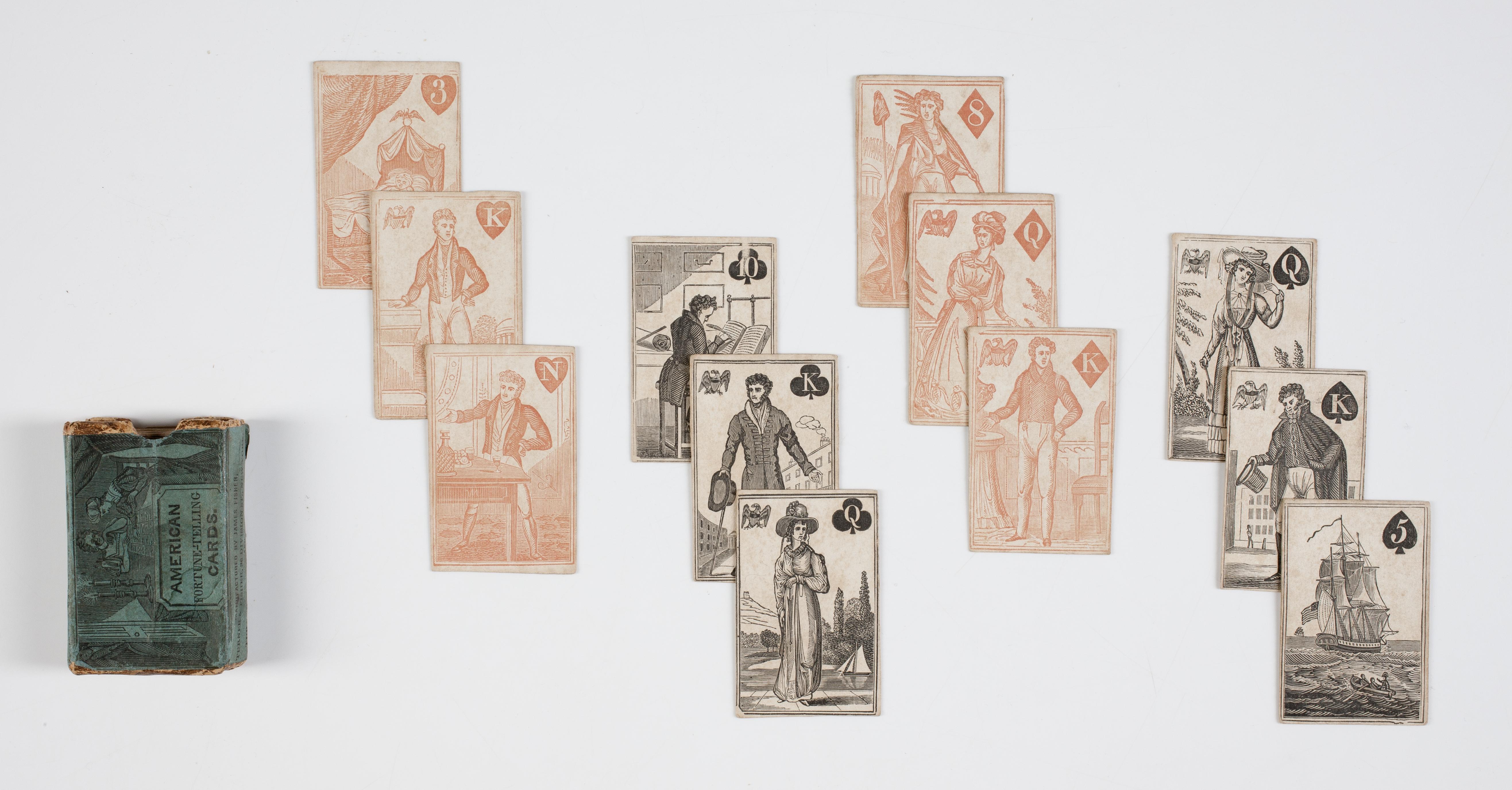
American Fortune Telling Cards, with Directions. New York and Philadelphia: Turner & Fisher, after 1835. 36 cards with box. AAS has several sets of fortune telling cards in its Toys and Games collection. This set features typical four-suit cards suggesting travel, wealth, poverty, love, etc., but is distinctive because many of the images feature American eagles, allegories of Liberty, and American flags. Produced in Philadelphia by Turner & Fisher, who also printed almanacs and children’s books, this set of cards was sold at bookstores up and down the eastern seaboard, starting in 1835. Advertisements read: “Peeps into Futurity, or a Knowledge of what is to come, will be revealed in the most infallible manner by the new American Fortune Telling Cards, which are founded upon the true scientific principles of the ancient Horoscope.” The price varied from bookseller to bookseller, ranging from 15 cents a box to 25 cents per box.
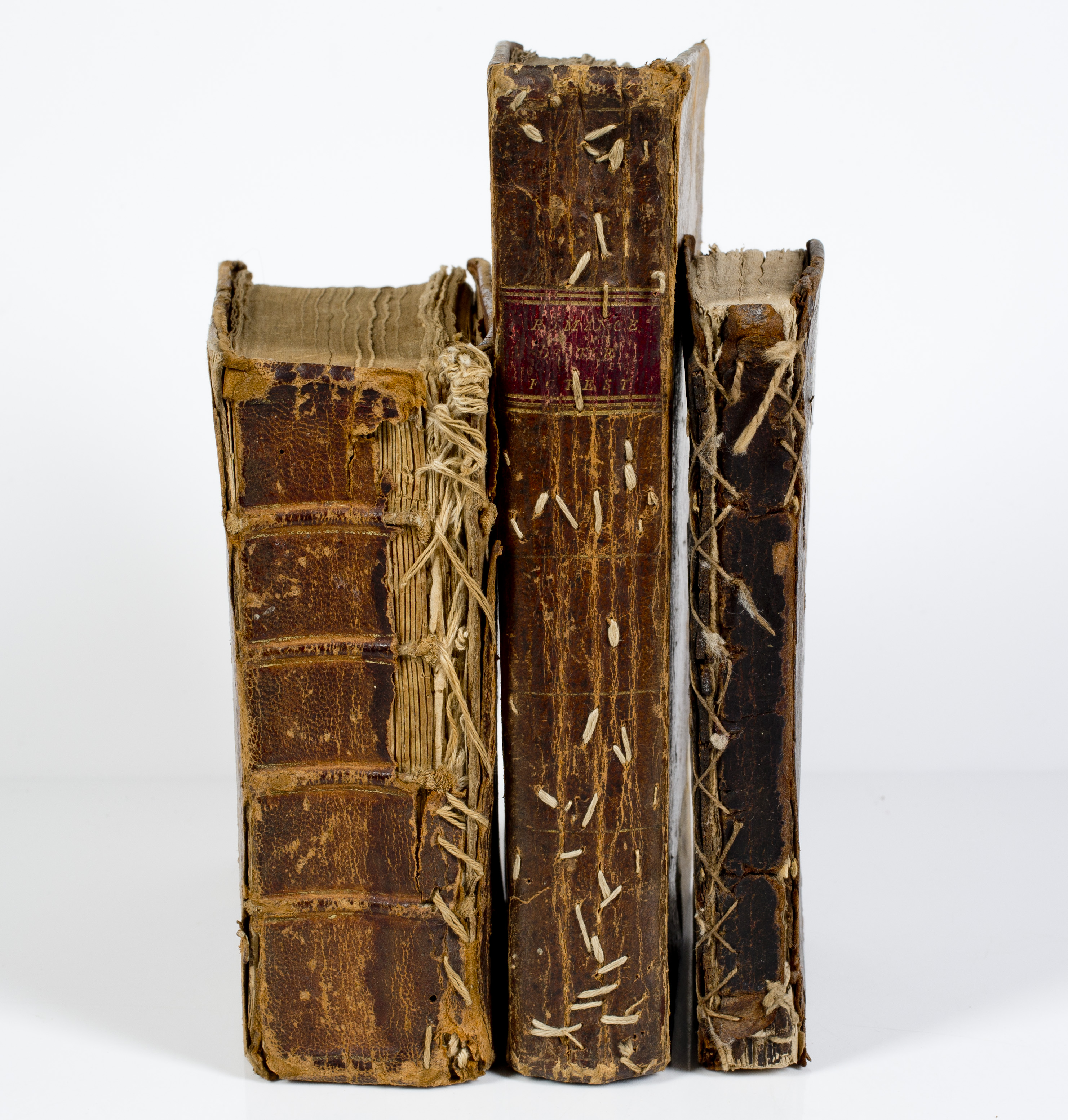
The re-stitched bindings of Perry’s Royal Standard English Dictionary (Worcester, Mass., 1788), Radcliffe’s Romance of the Forest (Philadelphia, 1803), and Russel’s Seven Sermons (Boston, 1715).
As a cataloger for the North American Imprints Program, my job is to catalogue books and pamphlets printed and published in North America between 1801 and 1820. I describe them, I put them into context with other books and pamphlets, and I become the latest person to handle an item that is two centuries old.
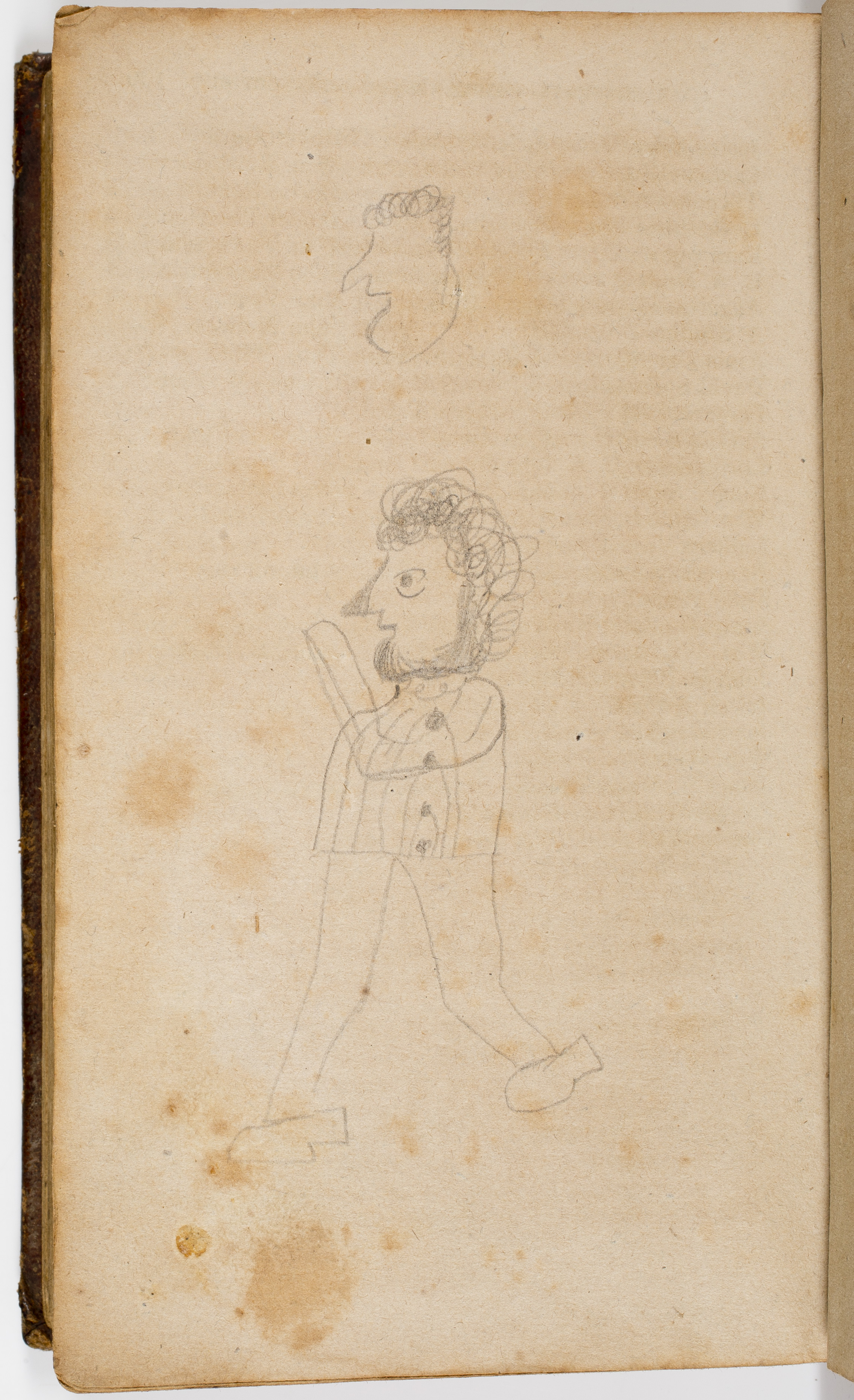
Many people have touched these books over their 200 year lifespan, and some of them leave traces of their presence and lives when books pass through their hands. I’ve seen the results of individuals wielding needles and thread (left), classical studies of the human form (below right), and poetic claims of ownership (bottom). Sometimes the inscriptions and annotations left in a book catch my eye and pique my interest, although I will never know what a person was thinking when she or he put pen to paper and inscribed their book!
Of the many inscriptions that I have seen, the following made me smile, intrigued me, or otherwise stood out, and I thought that I would share them.
One of several drawings founds on the rear flyleafs of Remarkable Shipwrecks (Hartford, 1813).
I can’t help but hope that Emmeline M. Henry enjoyed her birthday gifts, perhaps with a nice cup of tea.
2. Hobbit-style gift-giving
Miss Olive L. Gregory received A Real Treasure for a Pious Mind (New York, 1807) as a “present from her brother Harvey H. Gregory on the 25th of November 1818 being his birth day 24th year of his age.”
Olive Gregory was not the only young woman to own A Real Treasure for a Pious Mind, nor was she the only one to receive it as a gift. The American Antiquarian Society holds eleven copies of it printed between 1797 and 1820, and seven of them are inscribed. Six of the seven inscribed copies were owned by women (the seventh inscription is ambiguous). Julia Bissell received a copy of the 1801 U.S. edition “from [her] grandmother, who died Sept. 24, 1824, age 92 years,” and Lucretia Burrows was given a copy of the 1803 New Haven edition as “a present from her grand-father.”
However, Miss Gregory is the only person to have received it as a gift on someone else’s birthday!
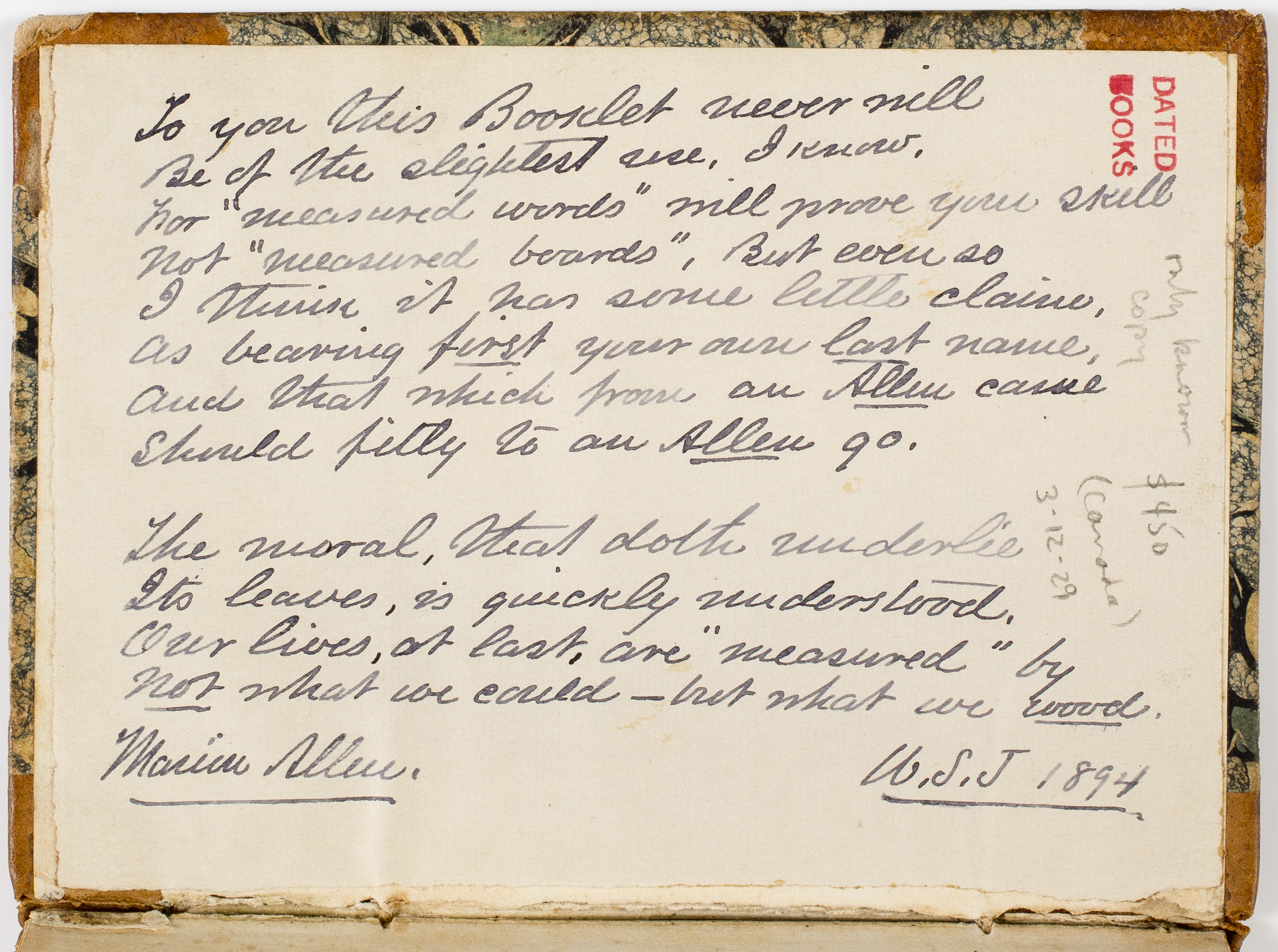
Verse inscription on the flyleaf of A ready Reckoner for the Use of Dealers in Timber and Others (Quebec, 1809). The book was originally given from Heman Allen to John Johnson in 1823; in this verse, John Johnson’s descendent, William Shaler Johnson, gives it to one Marion Allen.
3. Honesty is the best policy
Dr. James Tinsley sent a copy of his A New Theory of Yellow Fever, Founded on the Results of Chemical Experiments (Charleston, 1819) to Dr. Samuel L. Mitchill, a prominent New York physician. On page 25 someone, possibly Tinsley, states that “the pages prior to the 25th I conceive to be of no consequence whatever.” One wonders about Mitchill’s reaction to the remaining pages of the pamphlet, which argues that yellow fever is caused by a combination of heat, moisture in the air, fauna and flora putrefying, and the effects of plants and animal respiration on air quality.
 This periodical was published by the New York Institution for the Deaf and Dumb. One of the goals of the institution was to train its students in a vocation. In 1864 it acquired enough materials to establish a print shop for its students. The publisher was H. Ward Smith, who practiced printing the previous summer working in the office of the Orleans American (NY). The Fanwood Chronicle contains institutional news, news about the Civil War, including Sherman’s march to Atlanta, poetry, and the tragic story of a former student of the institution murdering his father. The 46th annual report for this institution in 1865 included the following: “I have nothing new to report in the Mechanical Department …except that some of the pupils of High Class, having a small printing office, have started a little monthly paper, The Fanwood Chronicle, which I hope we may be able to continue and enlarge. Such a paper I consider a valuable auxiliary to the labors of our teachers, especially in the incitement it offers to habits of reading. Many of our pupils will make through this little paper the discovery that they can derive pleasure and profit from independent reading, and will be encouraged to preserve in the practice.” This is a very scarce newspaper. The only other institution that has copies is the Gallaudet University Library which has two issues from 1865.