Show Me the Money! Online Gallery Features American Revolution Currency

These days it is rare to see someone pay with cash. Usually debit or credit cards are swiped or phones are tapped at checkouts and funds move invisibly between accounts. Apps like Venmo mean a group can easily move digital money around in real time to split a restaurant bill. Parking meters use apps, laundromats ...

Adventures in Amateur Newspaper Cataloging: “Wicked” Magic at AAS

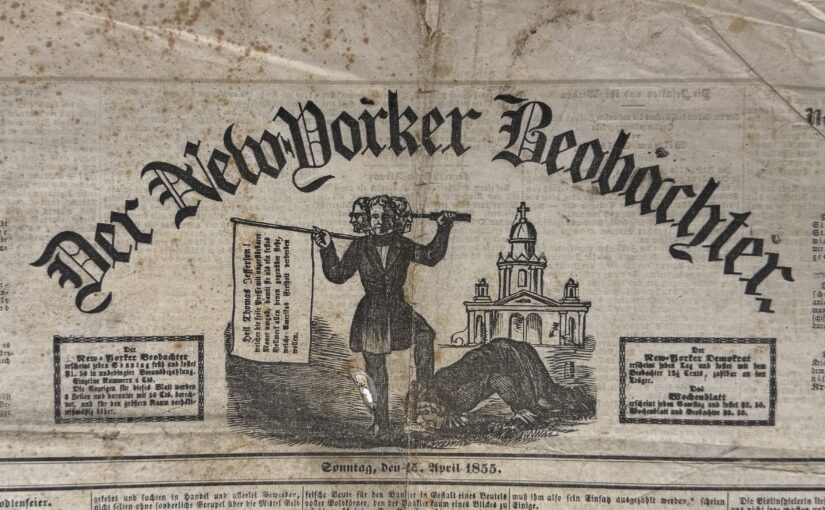
The recent purchase of the Western Investor, an 1890 newspaper from Aberdeen, South Dakota, brought an unusual level of excitement to the newspaper office at the American Antiquarian Society. Despite sporting a slightly whimsical masthead, the paper appeared to be a standard, somewhat dull financial newspaper interesting only for researchers of bank and stock market ...

A Beginner’s Guide to Acquisitions

The American Antiquarian Society already preserves over four million books, newspapers, graphics and manuscripts, but new acquisitions are still being added to the collection every month.  How are newly acquired collection materials made accessible to researchers in the AAS reading room? This post examines the detailed process by which AAS staff acquire, receive, process, pay ...

New Online Gallery Showcases Cloth Printings at AAS

While most library collections are printed or written on paper, hundreds of historic objects at the American Antiquarian Society -- including broadsides, children's books, and ribbon badges -- were printed onto cloth. Often produced as keepsakes, souvenirs, commemorative objects, or teaching tools, cloth printings in the AAS collection include texts and images printed onto silk, ...

In Her Own Words: The Life and Death of Rachel Wall, Massachusetts’ Female Pirate

Rachel Wall (née Schmidt) was born in Carlisle, Pennsylvania, on October 1, 1760. She was 29 years old on October 8, 1789, when she was executed by hanging on the Boston Common. According to some accounts, Wall may have been America’s first female pirate; it is certain that she was the last woman to be ...

Letters from Freedom: New Digital Resource

Last year, the American Antiquarian Society received a grant from the Gladys Krieble Delmas Foundation to support the reorganization, rehousing, and digitization of 655 pages of letters, notebooks, and photographs created by formerly enslaved people. The new digital resource Letters from Freedom provides additional context to the materials and to the stories of the people ...

Printing in the Hawaiian Language: New Digital Resource

Thanks to a generous grant from the Pine Tree Foundation of New York, newly digitized Hawaiian-language materials are now available through Printing in the Hawaiian Language, a digital resource on the American Antiquarian Society website.  The resource contains a digital library of 115 digitized Hawaiian materials, as well as background information on the Hawaiian collection ...

Finding Family After Slavery: The Last Seen Project and AAS

In January 2025, staff at the American Antiquarian Society attended a workshop on African American print culture taught by Dr. Derrick Spires, associate professor of English at the University of Delaware (and an AAS member and councilor), generously sponsored by the Nadia Sophie Seiler Family Fund. Dr. Spires shared how Black people used African American ...

Ephemera Explored: Over 40,000 New Images Give Glimpses into 19th-Century American Life

A light beige card with green-ish print and an illustration of a mer-man with wings.

Have you ever wanted to catch a ride on the Flying Dutchman? Or wondered what people ate at Faneuil Hall to celebrate the 4th of July? Would you like to attend a nineteenth-century séance? Earn ten cents from your teacher? Or shop for a tombstone? You can learn about all those activities (and more) from the ...

‘To Which is Added’: The History, Structure, and Conservation of New England Primers at the American Antiquarian Society

In the summer of 2023, while completing my MA in book conservation at West Dean College in Chichester, England, I undertook a 10-week internship at the American Antiquarian Society, working alongside Chief Conservator Babette Gehnrich and Library and Archives Conservator Marissa Maynard. In between my time spent writing a thesis, attending a week-long course on ...

Artifacts of an Antebellum Physician

Within the vast collections at the American Antiquarian Society there is a particularly interesting assortment of items that offer a unique glimpse into the world of Dr. Nathan Staples Pike, his family, and the medical trade in antebellum America. The Pike-Wright Family collection, donated to AAS by Susan Pike Corcoran, contains Dr. Pike’s early 19th ...

Reflections from a Returning Intern

As I near the end of my second summer at the American Antiquarian Society as an intern through the Library Internship for Nipmuc Community Members, supported by a grant from the United Way Central MA, I wanted to reflect on what this internship has done for me, and what I have been doing for it ...

DeWitt Clinton and the Common School Fund: Early Public Education in the Collection

For the past few months, I have had the opportunity to work as an intern in the manuscripts department here at the American Antiquarian Society. Usually, I spend my days the digitizing department working as a liaison between AAS and our vendors, paging newspapers and serials. I jumped at the chance to work in manuscripts ...

“An Opulence Unexpected”: Examples of Red Morocco’s Use in Bookbindings

The history of the book is predicated on the idea that the book itself as an object is significant in its own right, not simply on its printed content alone. Which materials were used, how they were made, and who made them all speak to a vast network of economic, environmental, and human systems that ...