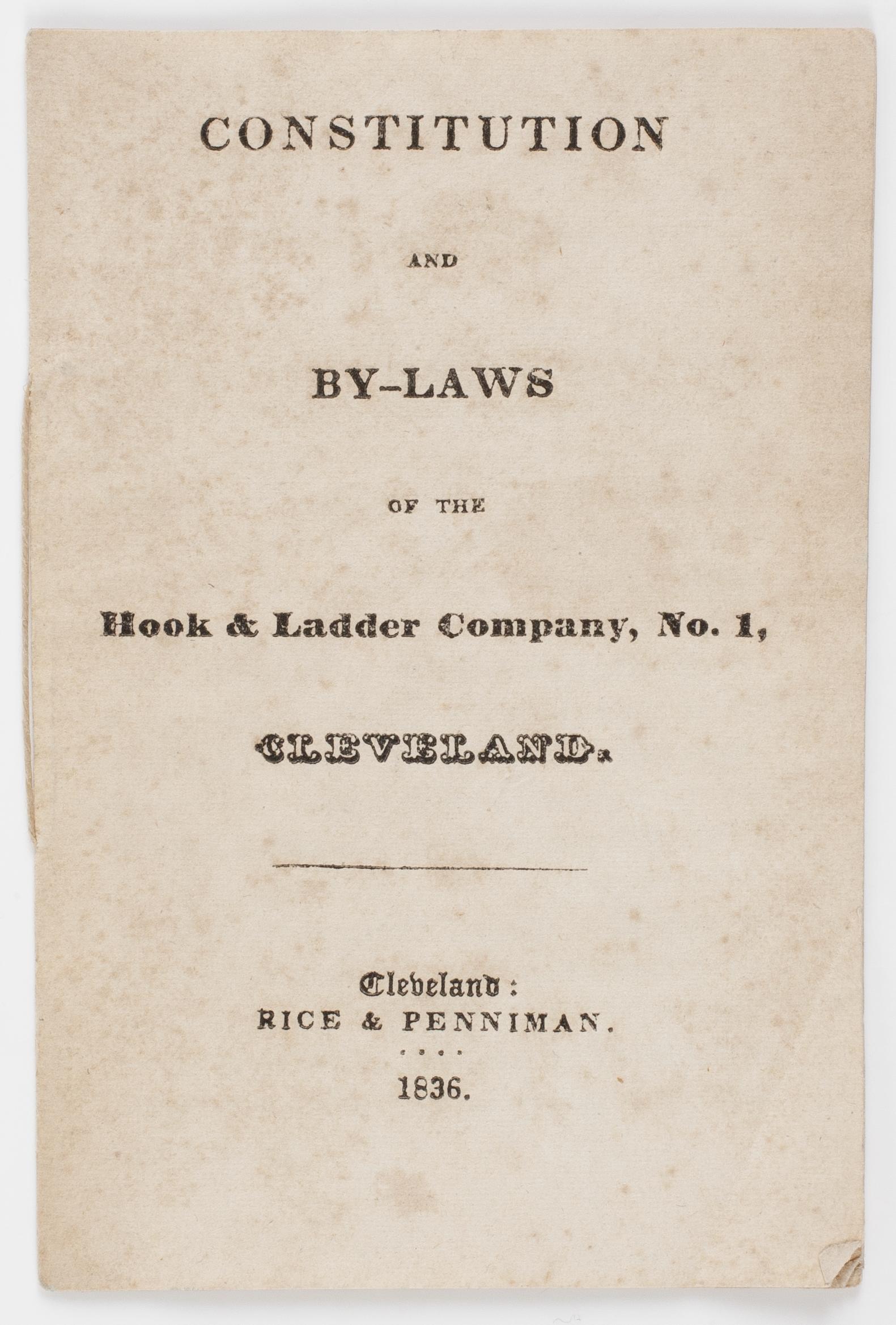
Constitution and By-Laws of the Hook & Ladder Company, No. 1, Cleveland. Cleveland: Rice & Penniman, 1836.
 APPARENTLY UNRECORDED, ONLY KNOWN COPY!
Rice & Penniman were known to be printing in Cleveland, Ohio, in the mid-1830s, but this particular pamphlet is evidently entirely unrecorded. The Constitution for this firefighting company defines the duties of the Officers, who are headed by the Foreman. The bylaws decree that “the uniform of this company shall be a felt hat painted with the initials and number of the company, and a leather belt.” There is a 50 cents reward for “that member who shall first appear at the deposit of the hook and ladders having on his uniform.” And, “It shall be the duty of those who are engaged in the transportation of the hooks and ladder to a fire while on their way to call out at intervals the name and number of their company.”
Happy Birthday, Isaiah!
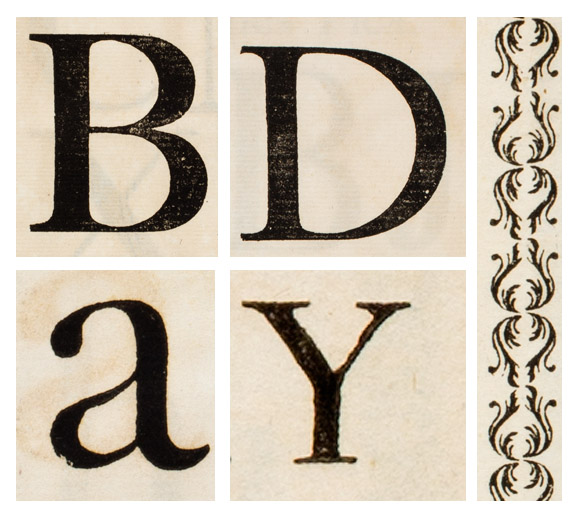 We’re wishing a very happy 265th birthday to AAS founder Isaiah Thomas! We compiled this card from Thomas’s own copy of A Specimen of Printing Types by Thomas Cottrell, Letter Founder.
As our gift, we’ve digitized the 1774 London imprint, so you can browse the type specimens and ornaments! You can find it in our digital image database: http://goo.gl/xqPj5j
These amateur puzzle newspapers aren’t for amateurs
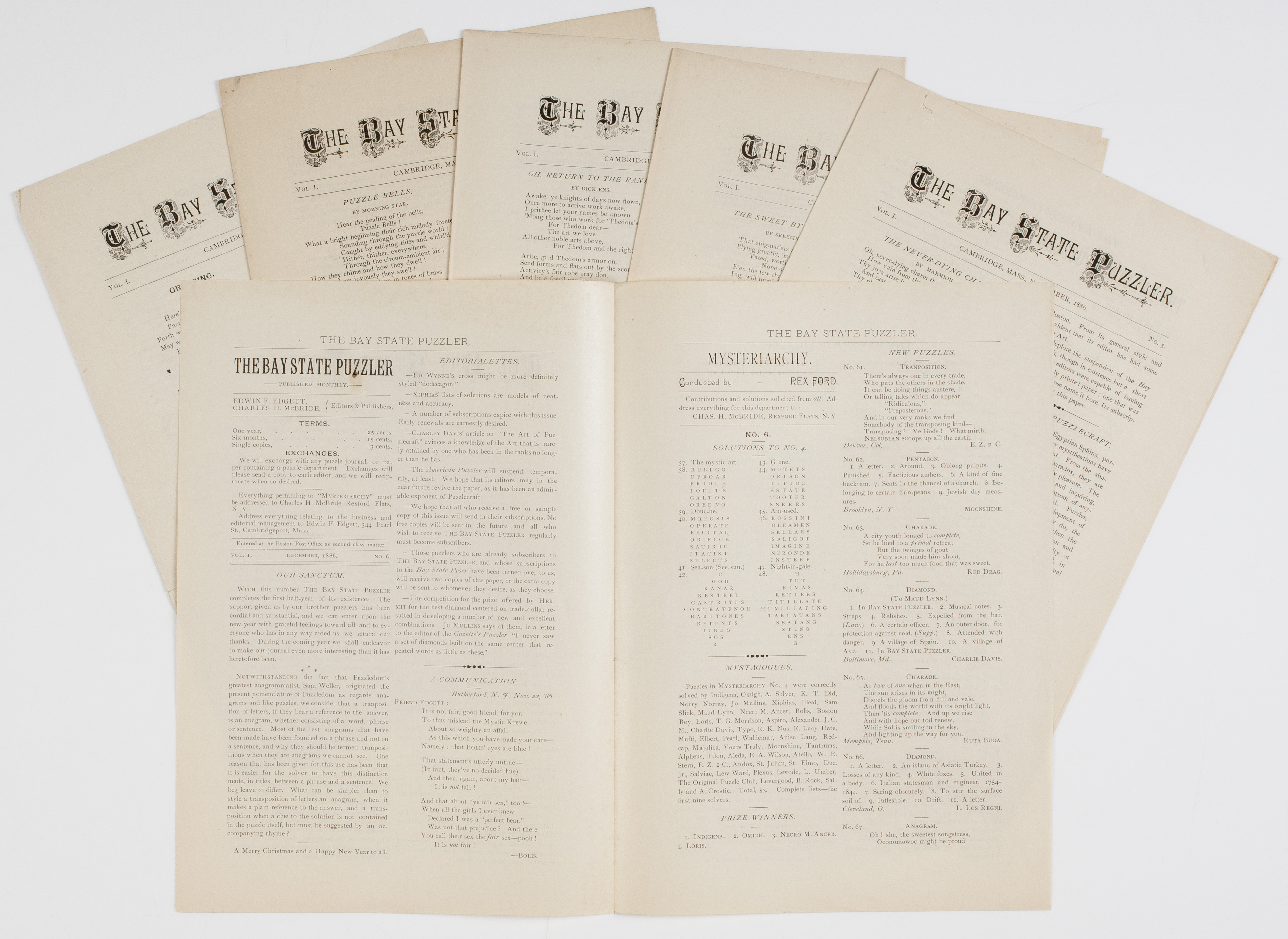 AAS has one of the largest collections of nineteenth-century amateur newspapers in the country. These were little publications printed on table-top hobby presses and often done by children and young adults. They became popular in the 1870s and by the 1880s hundreds of them were being published all over the country. Their publishers even had regional and national organizations and conferences.
One sub-genre of amateur newspaper is the puzzle newspaper. In each issue the editor would put together articles about puzzles and print puzzles for readers to solve. Some even offered prizes. Since these are so little known, we thought a list of the titles in our collection was in order:
- American Puzzler (London, AK) 1886
- Ardmore Puzzler (Ardmore, PA) 1899, 1900
- Atlantic Poser (New York, NY) 1883, 1884
- Bay State Poser (Worcester, MA) 1886
- Bay State Puzzler (Cambridge, MA) 1886
- Black Imp (Philadelphia, PA) 1897-1900
- Buckeye Puzzler (New Lisbon, OH) 1884
- Detroit Puzzler (Detroit, MI) 1894
- Empire Puzzler (New York, NY) 1884
- Fairmount Puzzler (Hyde Park, MA) 1884
- Golden State Puzzler (San Francisco, CA) 1884
- Lake Shore Poser (Buffalo, NY) 1884-1887
- Materia Mystica (Bangor, PA) 1892, 1893
- Michigan Puzzler (Grand Rapids, MI) 1883, 1884
- The Mystic (Winchendon, MA) 1878
- Mystic Argonaut (San Francisco, CA) 1884
- Mystic Argosy (Baltimore, MD) 1889, 1890
- Mystic Courier (New York, NY) 1883
- Mystic Dots (Brooklyn, NY) 1898-1900
- Mystic Inn (Whitehouse, NJ) 1897
- Mystic Knight (Danbury, CT) 1879-1882
- Mystic Messenger (Carson City, NV) 1879
- Mystic Mint (Liberty Falls, NY) 1884
- Mystic News (New York, NY) 1893, 1894
- Mystic Record (Davenport, IA) 1893
- Mystic Record (Moline, IA) 1894
- Mystic Star (Brooklyn, NY) 1884
- Mystic Taps (Philadelphia, PA) 1891
- Mystic Tree (Brooklyn, NY) 1897-1899
- Mystic Times (New York, NY) 1880
- Mystic World (New York, NY) 1886, 1887
- New Jersey Puzzler (Newark, NJ) 1883, 1884
- Newark Puzzler (Newark, NJ) 1882, 1883, 1884, 1887
- Our Poser’s Pride (Danville, IL) 1880
- Pacific Puzzler (San Francisco, CA) 1880
- Peninsula Poser (Dover, DE) 1887
- Peninsula Poser (Detroit, MI) 1882
- Pennsylvania Puzzler (East Brady, PA) 1886
- The Poser (New Orleans, LA) 1894
- Puzzle Bugle (Smyrna, NY) 1881
- Puzzle-craft (New York, NY) 1890
- Puzzledom (Denver, CO) 1883
- The Puzzler (Lambertville, NJ) 1877, 1878
- The Puzzler (Champlain, NY) 1879
- Puzzler’s Banner (Clara, PA) 1884
- Puzzler’s Monthly (Philadelphia, PA) 1877
- Puzzler’s Own (Henderson, MN) 1879
- Puzzler’s Own (Harrisburg, PA) 1879
- Puzzler’s Pride (Harrisburg, PA) 1877
- Puzzler’s Record (Jersey City, NJ) 1877, 1878
The Bay State Puzzler (see picture above) was edited and published monthly by Edwin F. Edgett and Charles H. McBride in 1886 in Cambridge, Mass. It appears to have lasted just six issues, ending with the December issue. Each issue contained a variety of word puzzles. One regular puzzle was a diamond or square. The answer to each clue would fill in a line to form a square or diamond shape that read the same left to right as top to down. For example, in the first issue, puzzle no. 10 is a diamond with the clues:
- A letter
- Hebrew dry measure
- Demands
- The water-thistle
- Situated on the calyx
- Certain plants, growing in marshy places
- Enclosing
- One of the Orthodox Mohammedans
- French author, 1828 – .
- Slow.
- A letter.
And the answers are:
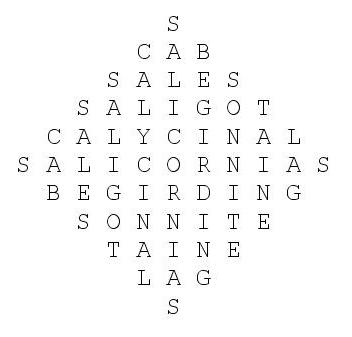
Not that easy. Squares are formed in a similar manner except each row and column have the same number of letters.
Edgett and McBride also offered prizes:
First complete list – Fifty cents
Second complete list – A bound book
Best incomplete list – This paper, one year
Next best list – This paper, six months
Next best list – American Puzzler, three months
For first correct solution to each flat, a copy of the Elzevir Library.
Open until September 15 [1886] to subscribers and exchanges only.
In the spirit of things, here are some examples for the gentle reader to attempt.
I. Diamond (from July 1886)
- A letter.
- A tree of the genus Abies.
- Clears
- Having a part displaced.
- Becoming brothers.
- Divided into small pieces.
- Relied
- Governing bodies.
- Low places between hills.
- Caused to go.
- A letter.
II. Diamond (from July 1886)
- A letter.
- A mixture of carbureted hydrogen and olefiant gas.
- The heron, (Obs.).
- Talked without ceremony.
- Inscribed.
- Troublesome plants.
- Complied with.
- A difference in copies of a book.
- A village of the Netherlands, in Dreuthe.
- Drawn out.
- A letter.
III. Square (from July 1886)
- To drive back.
- A genus of mollusks.
- A special privilege.
- German philologist and critic, 1772-1848.
- Province of Ireland, county of Dublin.
- Earthy pigments.
- Hearty.
IV. Diamond (from Aug. 1886)
- A letter
- A Hebrew measure.
- Went.
- More deadly. (Obs.)
- Alloys of gold, silver, and copper, of which an inferior quality of jewelry is made.
- A compound of an element of boron with a base.
- Locates a second time.
- Carries on.
- Certain plants.
- Musical syllables.
- A letter.
V. Square (from Sept. 1886)
- Presses firmly together.
- A genus of fishes.
- Gratifying in self esteem.
- French-Latin poet (1480-1524).
- A town of China.
- A duty on ships.
- Russian measures of seven feet.
VI. Hour-glass (from Sept. 1886)
- Imperfection (Worc. obs.).
- Activity (obs.).
- Inclined to run together.
- Income (obs.).
- A large kind of bat.
- A thin, metallic plate.
- Date.
- A letter.
- A virtue of the Deity, existing throughout eternity.
- A throb.
- A sea-woman.
- One who advocates church denomination over civil power (Worc.).
- Absolute.
- State of being slighted.
- Modesty.
Diagonals, left, down: Indifference
Left, up: Excessive indulgence of appetite.
Centrals, down: Counter accounts.
The Acquisitions Table: Tippecanoe Banner and Spirit of Democracy
Tippecanoe Banner and Spirit of Democracy (New-Albany, IN) Oct. 15, 1840. No. 27.
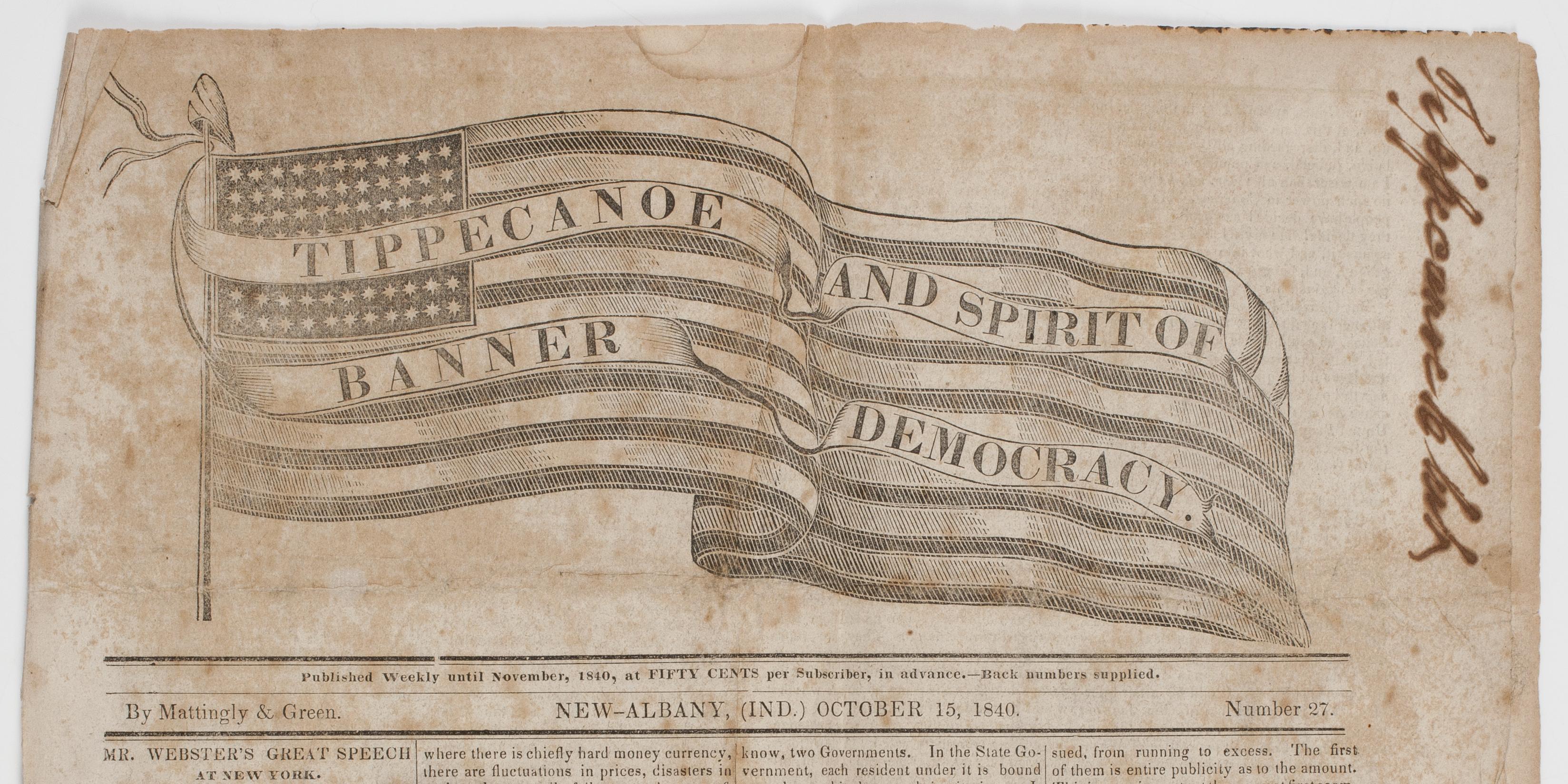 Here is an example of a presidential campaign newspaper supporting the election of William Henry Harrison. The hotly contested presidential election of 1840 produced a lot of campaign newspapers produced by local newspaper offices to promote candidates and platforms. This example was published in the office of the New-Albany Gazette. It is featured here because of its spectacular masthead.
Notes of a sub-sub-sub
Whenever it’s a damp, drizzly November (or January) in your soul, where do you go to keep from knocking people’s hats off? In Melville’s Moby-Dick Ishmael goes to sea, while the novel’s sub-sub librarian (Melville’s fictional assistant, assistant librarian who scours the earth for the “Extracts”) apparently retreats to literary references to the Leviathan. The sub-sub librarian in Ishmael reaches out to a fantastical cetology based on book format, Beale’s Natural History, and an only known copy of a book about the north wind. Some of us, who are less inclined to travel the world hunting either for whales or extracts about them, go to first editions of books like Moby-Dick—preferably if these first editions are owned by our own libraries.
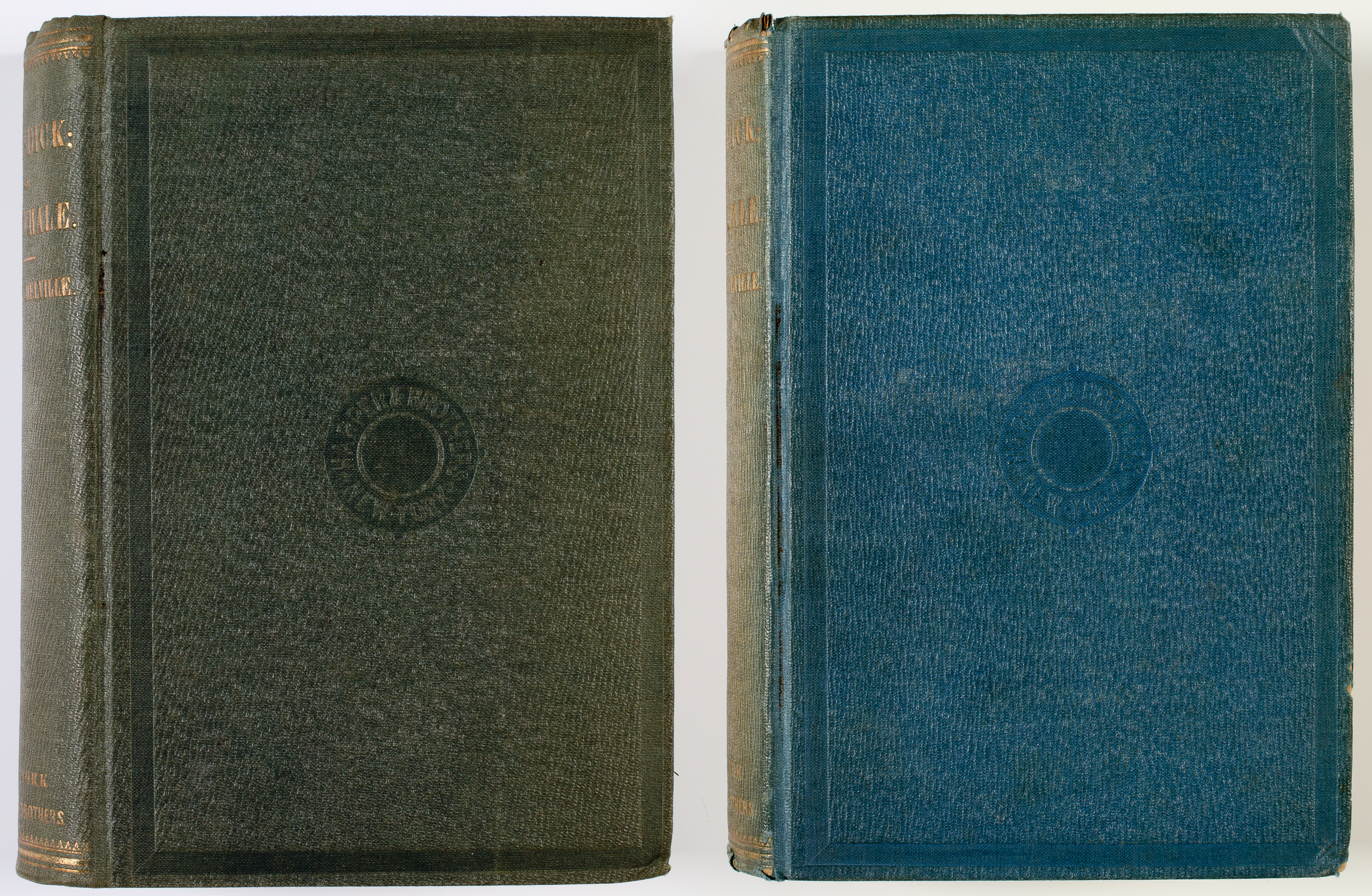
The American Antiquarian Society has two copies of the first American edition of Moby-Dick. As is well-known by now, the American edition was published by Harper’s shortly after Richard Bentley released the London edition with a mutilated version of Melville’s novel in 1851. Both of AAS’s copies have the first edition binding stamped with the Harper’s device at center, one in blue cloth with bright orange endpapers and the other in green cloth with brown-orange endpapers.
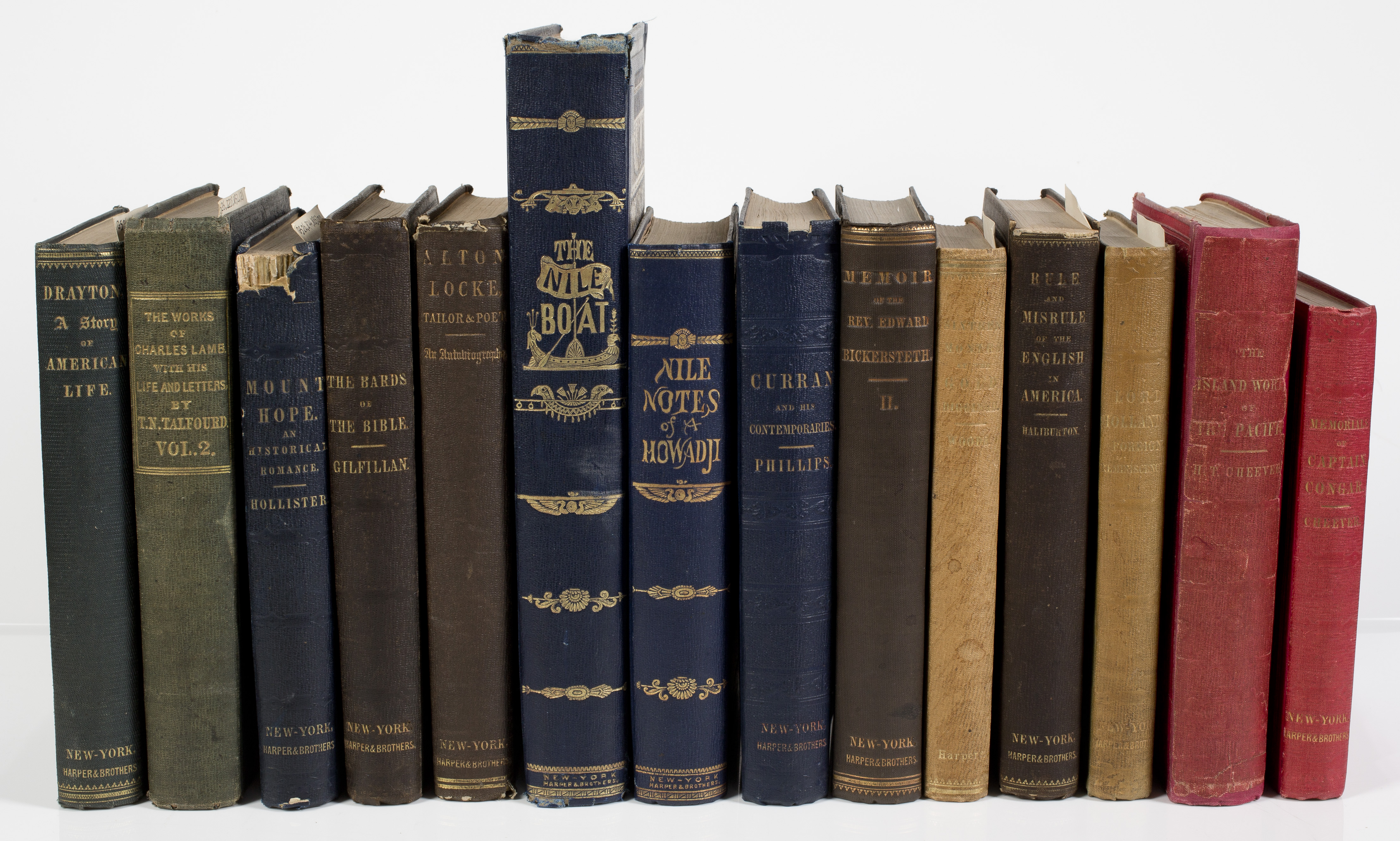
Neither copy physically stands out from Harper’s many other publications of that year. Titles published in 1851 and owned by AAS include: Henry Cheever’s The Island World of the Pacific and Autobiography and Memorials of Captain Obadiah Congar; Thomas Haliburton’s Rule and Misrule of the English in America; Gideon Hollister’s Mount Hope; Charles Kingsley’s Alton Locke; Henry Mayhew’s London Labour and the London Poor; Emmeline Stuart-Wortley’s Travels in the United States; and William Henry Bartlett’s Nile Boat. The design of Harper’s books is homogeneous, and Harper’s desire to push out books with little embellishment for maximum gain is noticeable. Not only does Moby-Dick not stand out from the others, but its design can’t even compare to Nile Boat‘s. And Melville’s other works published by Harper’s around that time—Omoo (1847), Mardi (1849), Redburn (1849), White-Jacket (1850), Pierre (1852)—show almost nothing distinctive in individualized book design. Perhaps the lack of focus on design, as Jeffrey Groves has suggested about house styles, promoted uniformity for Harper publications, self-servingly making all publications appear the same as successful ones. Perhaps the neglect of fancy design elements simply allowed Harper’s to devote themselves to other aspects of book production, like making good books available for all.
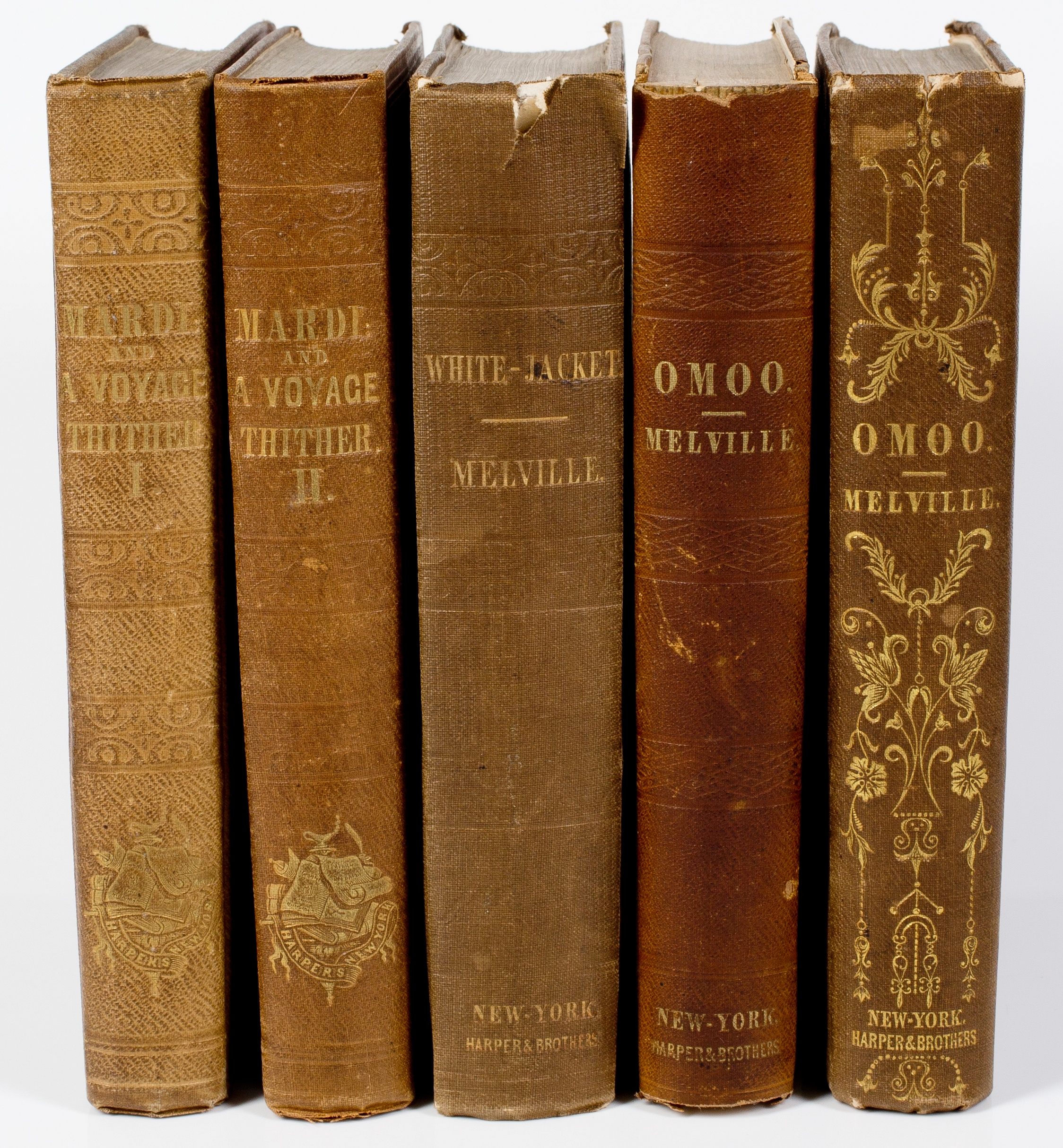
So what do we wish to do with extracts, folio whales, and first editions except hope to discover some truth that brought us to these things in the first place? A.S.W. Rosenbach said in his preface to an edition of Moby-Dick published 90 years ago: “Melville has made the deep give up its dead; he has disclosed to us its long-hidden mysteries. But he has done more. He has revealed…the secrets of the soul.” It must be these secrets that keep us coming back to Moby-Dick in the sea of nineteenth-century mass-produced books.
Instagram Redux
The Society’s Graphic Arts collection is a wonderful place for browsing, looking for visual evidence of whatever topic you may be working on. I have helped researchers hunt in the collection on such broad topics as death, food production, and dress, and as specific as orphaned children, methods of doing laundry, and book shop interiors.
As our visual materials cataloger Christine Graham Ward continues to move through the collection, creating individual records as she goes, more and more images are opened up to this sort of browsing. Maps and early music have occupied us most recently, but records for lithographs and engravings and cartoons are added nearly every week to our General Catalog.
In September, with the encouragement of our savvy photographer and our digital humanities curator, I started posting regularly to the Society’s Instagram account, easily finding graphic images relating to Halloween, the holidays, the weather, current events, etc. I turned up an early selfie of a generous collector (above), images of nineteenth-century AAS employees at work (below), and a seemingly endless supply of fabulously printed broadsides, quirky ephemera, and evocative photographs. My staff teases me about my addiction to the iPad—I carry it everywhere in case something interesting for Instagram pops up while I am pulling material for a reader, returning a loan, or writing a blog post. And guess what…it nearly always does.
The Instagram account just reached 200 followers yesterday. There are bibliophiles, of course, and library and museum folks. Some former fellows have found us and a handful of staff, too. But there are also graphic and type designers, artists, contemporary photographers, even two tattoo artists (they love all the eagles)! We have followers in New Zealand, Japan, Spain and the U.K. Neat, right? I put up an image from Frank Leslie’s Illustrated Newspaper showing Asian railroad workers (below), and it is seen in Japan immediately.
Now, I fully realize in the world of Instagram, 200 followers is not very many (my 15-year-old has dryly pointed out that there are cats who have more fans than we do), but overall the experiment with this visual forum has been encouraging. In Worcester when I see a wonderful Civil War broadside screaming about treason, I can show it to whomever is in the reading room that day, or I can post it on the blog or our Facebook page for our core constituents. But with Instagram, it is like browsing with 200 people looking over my shoulder, all at once. I am not sure where we are going with Instagram, but it sure is amazing to be browsing through AAS treasure along the way!
The Acquisitions Table: Reynard the Fox
Reynard the Fox. After the German Version of Goethe by Thomas James Arnold. London: Trubner & Co.; New York: Theo. Stroeffer, 1870.
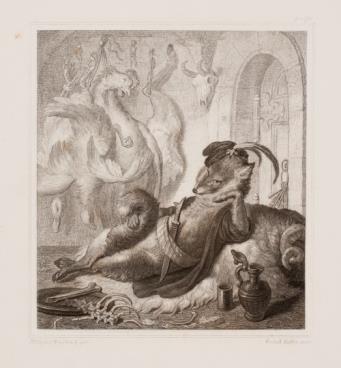 This is a folio format edition of the celebrated animal adventurer Reynard the Fox. This luxurious metal engraving of Reynard reclining after a busy day of hunting prey was engraved by Rudolph Kahn after a drawing by Wilhelm Kaulbach (1804-1874). This is truly a transatlantic production issued in London by Trubner & Co. and in New York by Theodore Stroefer; they also jointly issued the picture book Illustrated Flying Sheets (1871) featuring illustrations by German artists. We delight in collecting transatlantic children’s books, and this book came to use through the generosity of AAS member Chris Dumaine.
As Luck Would Have It
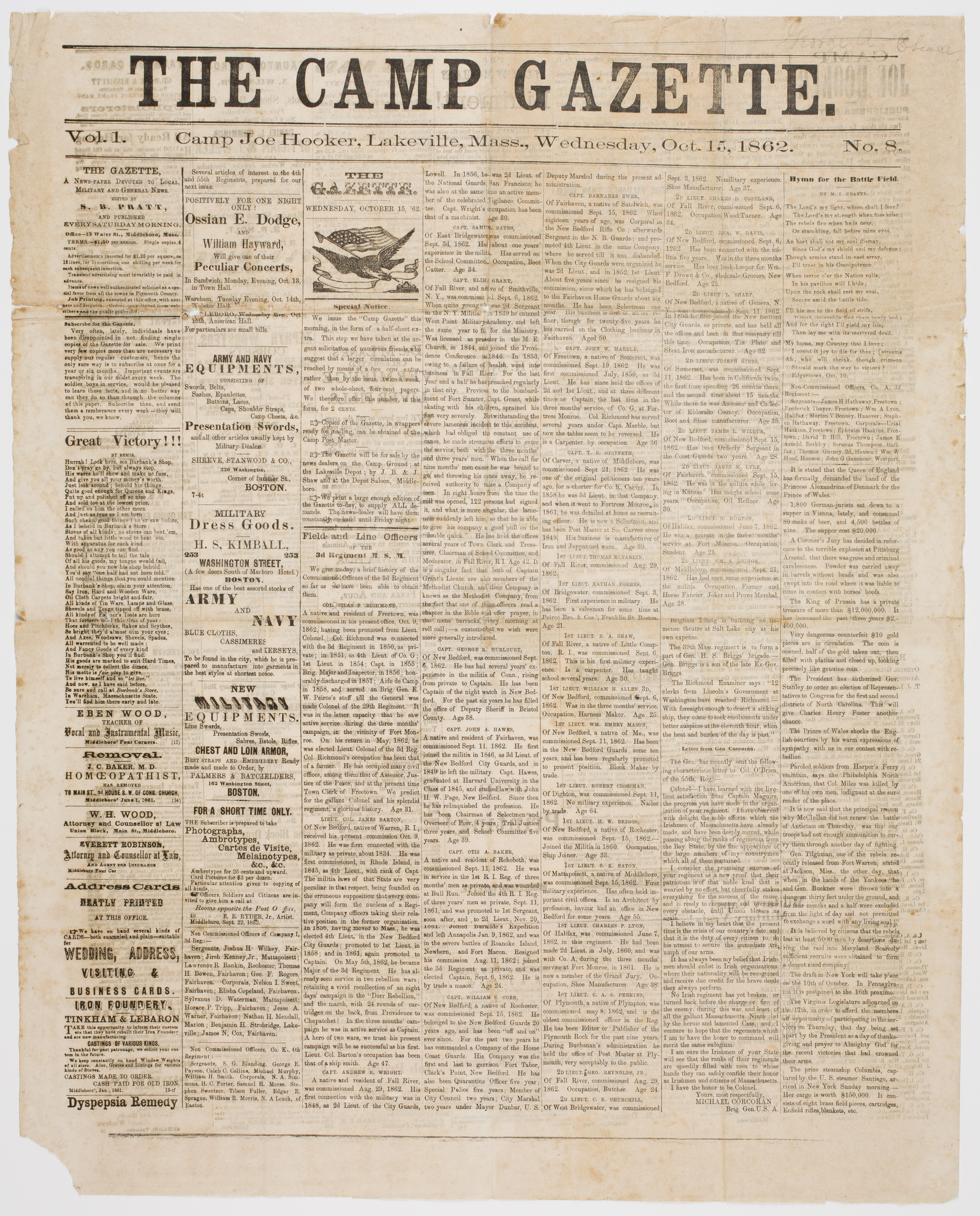 As Thomas Jefferson put it, “I’m a greater believer in luck, and I find the harder I work the more I have of it.” Here at the American Antiquarian Society all of the curators work very hard in acquiring new items for the collections. Every year thousands of items are added to our holdings. Sometimes luck favors a fellow from our hard work.
Recently, a month-long fellow mentioned body armor from the Civil War era during her introductory talk to the staff. Most of us had never heard of such a thing from the 1860s.
The next week AAS acquired this rare issue of The Camp Gazette from Camp Joe Hooker in Lakeville, Mass. (just west of Boston), one of only three known issues of this title (AAS has one of the other two). One of the advertisements on the front page of this October 15, 1862 issue reads, “New military equipment. Line swords. Presentation swords. Sabres, Pistols, Rifles, Chest and Loin Armor, Best straps and embroidery ready made and made to order, by Palmers & Batchelders, 162 Washington Street, Boston.”
I showed her the issue the day it arrived. She was thrilled because she had never seen an advertisement for loin armor and it gave her the name of a merchant selling them. Was it luck that this issue arrived the month she was here, or was it kismet?
The Acquisitions Table: Small Family Papers
Small Family Papers, 1820-1905.
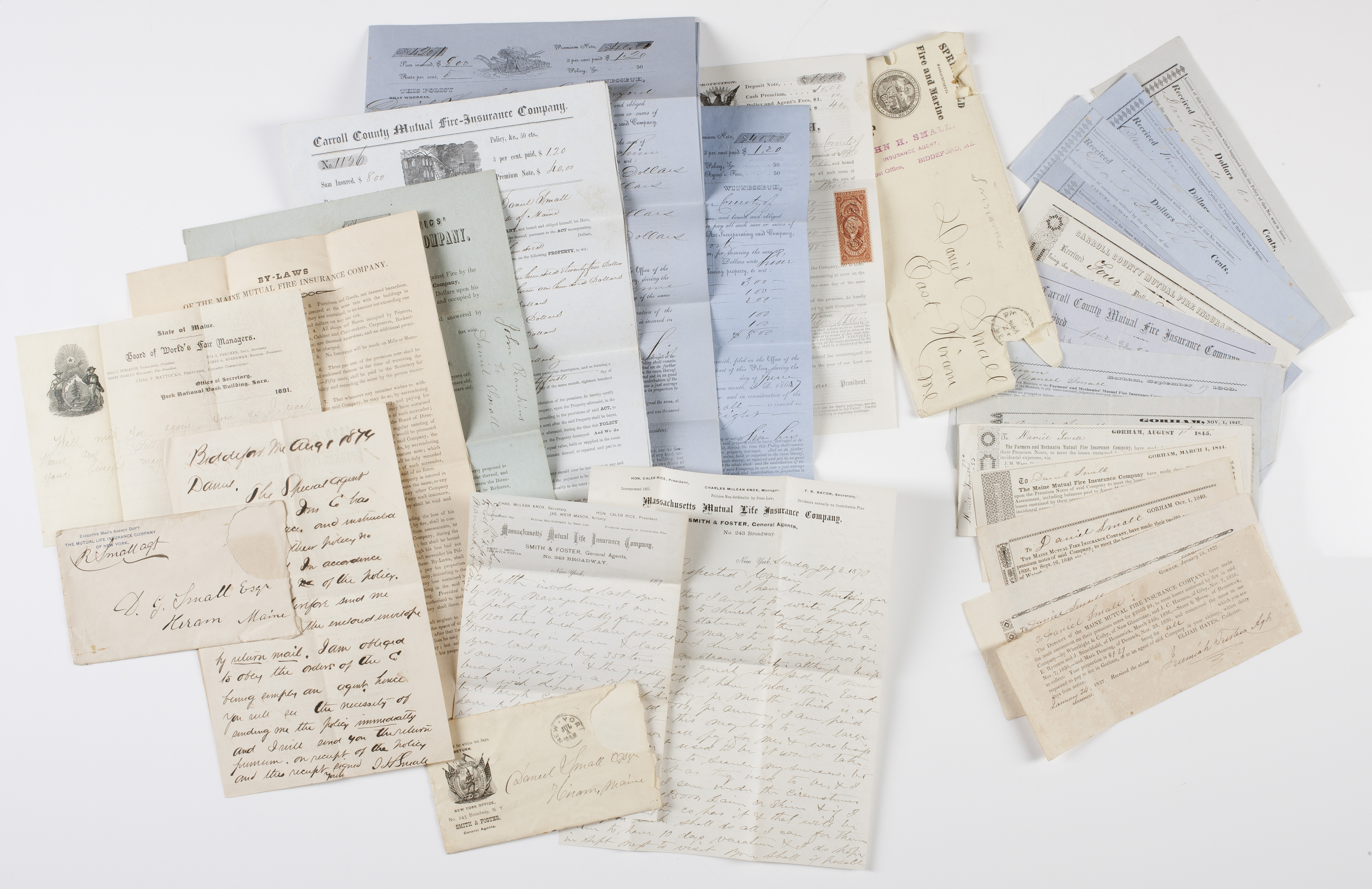 The Small family resided in the town of Hiram, Maine. According to the 1850 census, the Small household was anything but. The head of the house, Daniel Small (1800-1877), is listed as a cooper. According to correspondence in the collection, he also served as an agent of the Hiram school district. He lived with his wife, Susan Small, his father Reuben Small, Deborah Small (perhaps a step-mother, aunt, or other family member), and five children: Patience, Daniel, Isaac, Susan and Dean. This collection of family papers includes correspondence, receipts, insurance papers, and a small account book. Many of the letters are addressed to Daniel from his cousin Rufus Small of New York. There are also a few letters exchanged between the Small children. Of particular interest are numerous receipts from Mother Noble’s Remedies for healing syrup and other treatments, as well as correspondence regarding adulterated medicine; Daniel Small’s membership certificate for the Farmers’ Mutual Fire Insurance Company; and a volume kept by Daniel with writings and musings on numerous topics such as misery, affection, swearing, boasting, and seduction – “The man who can seduce anyone, from the path of virtue, can have no rival, on earth – no equal – except in hell.”
Did you send out your New Year’s cards yet?
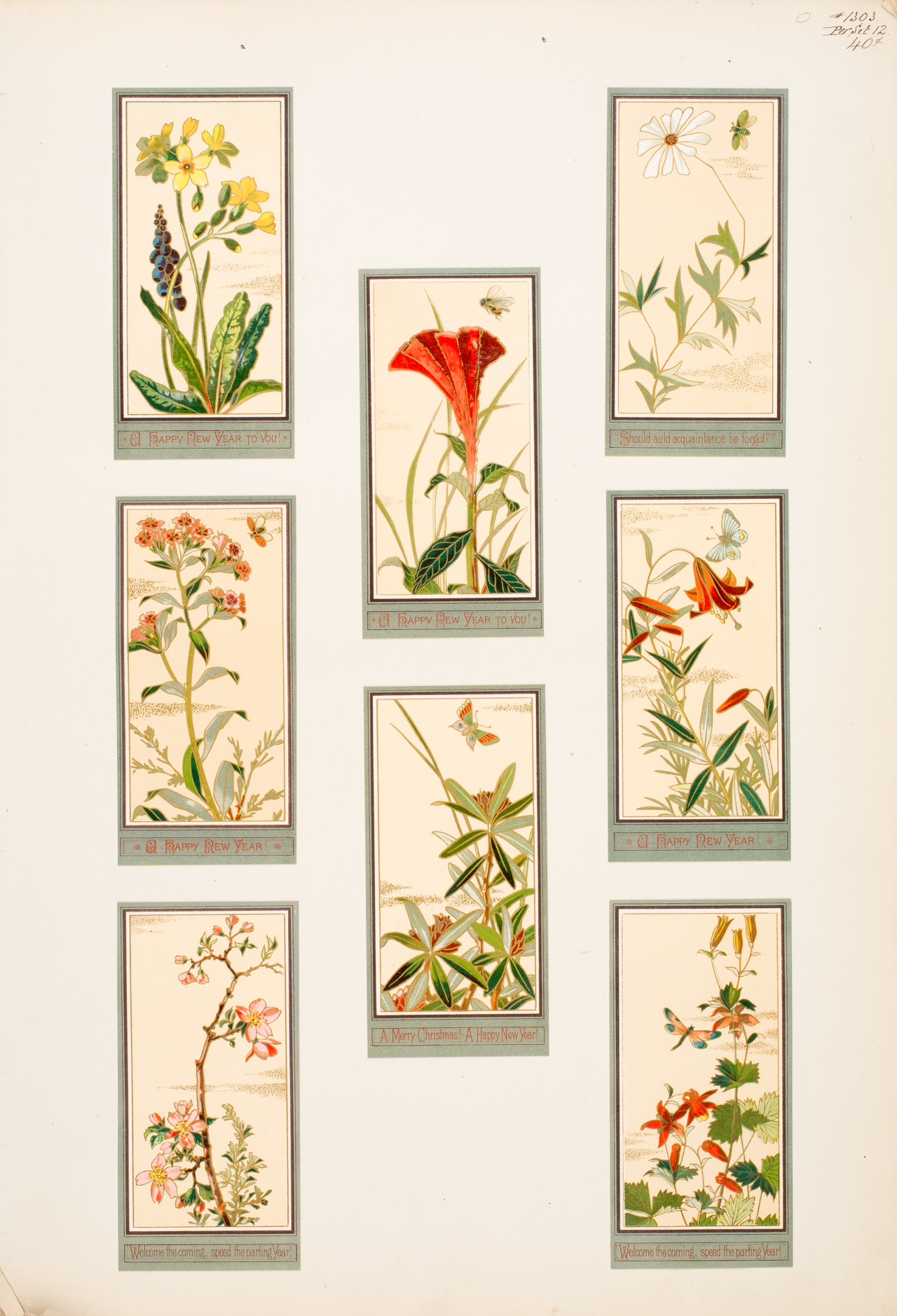 It’s no wonder Louis Prang is considered the “Father of the American Christmas Card.” During the height of chromolithography in the 1860s, 70s, and 80s, Prang’s firm in Boston introduced the concept of the Christmas card to America and produced over 5 million greeting cards per year. While Prang’s Christmas cards are displayed often, in honor of New Year’s Day let’s look at some of the fun New Year’s cards from the Society’s collections.
The AAS has a sizable collection of Prang archive material. There are more than twenty books of salesman’s samples used by the firm to sell greeting cards, trading cards, and small prints. These albums are great because they preserve the color and have the prices and options for each card. Cards were usually sold by the dozen, and embellishments like silk fringe, a folded greeting card, and mica flecks were sold at an additional cost. An entire volume of salesman’s samples from 1882 has been digitized and is available here.
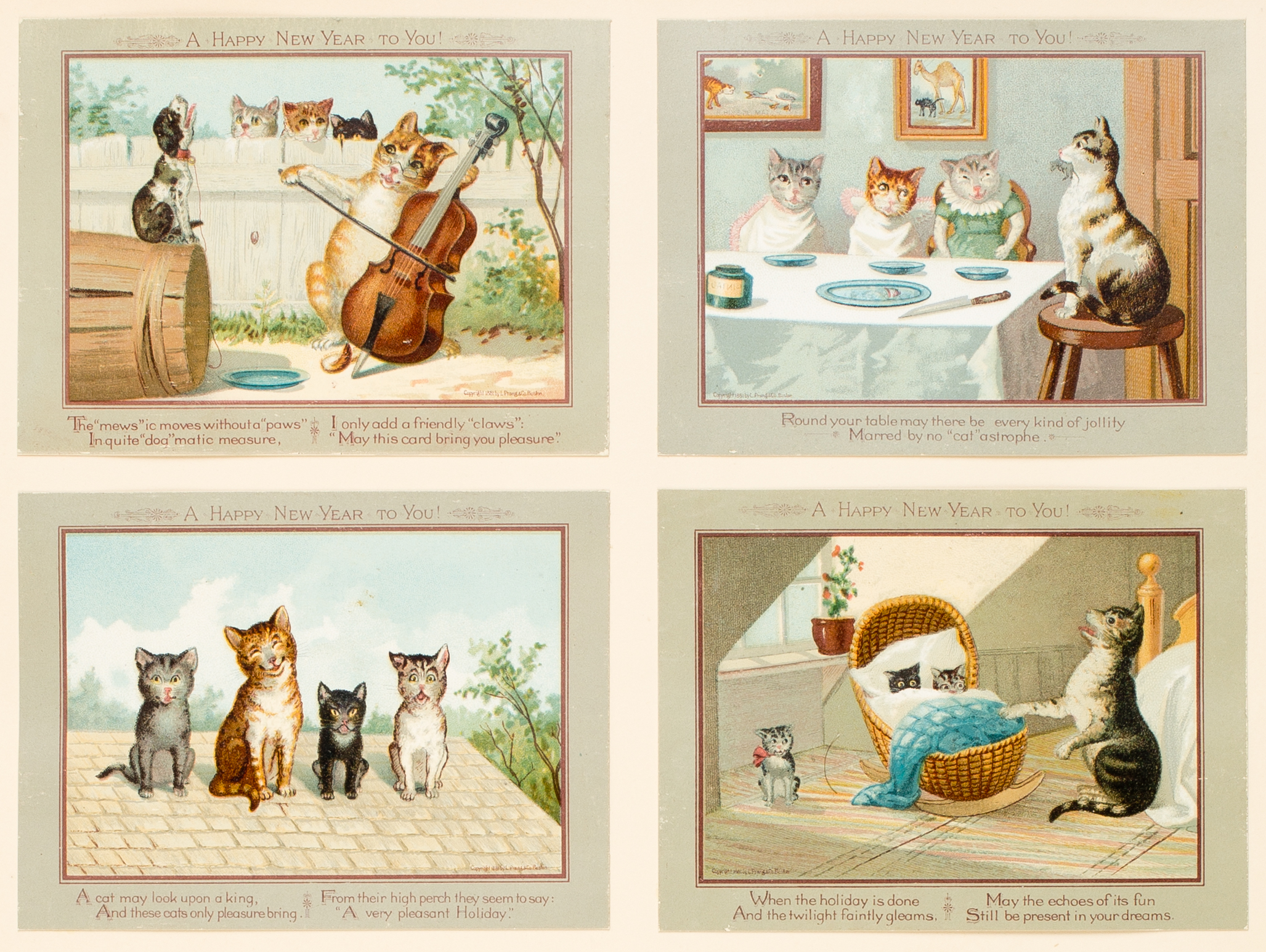
Comical cards were very popular and common in these sets. The set above shows happy cats engaged in singing with a dog, enjoying a feast of a poor mouse, meowing on a rooftop, and kittens being rocked to sleep by their mother. Each has a humorous verse wishing happiness in the New Year.
The “mews”ic moves without a “paws”
In quite “dog” matic measure.
I only add a friendly “claws”:
“May this card bring you pleasure.”
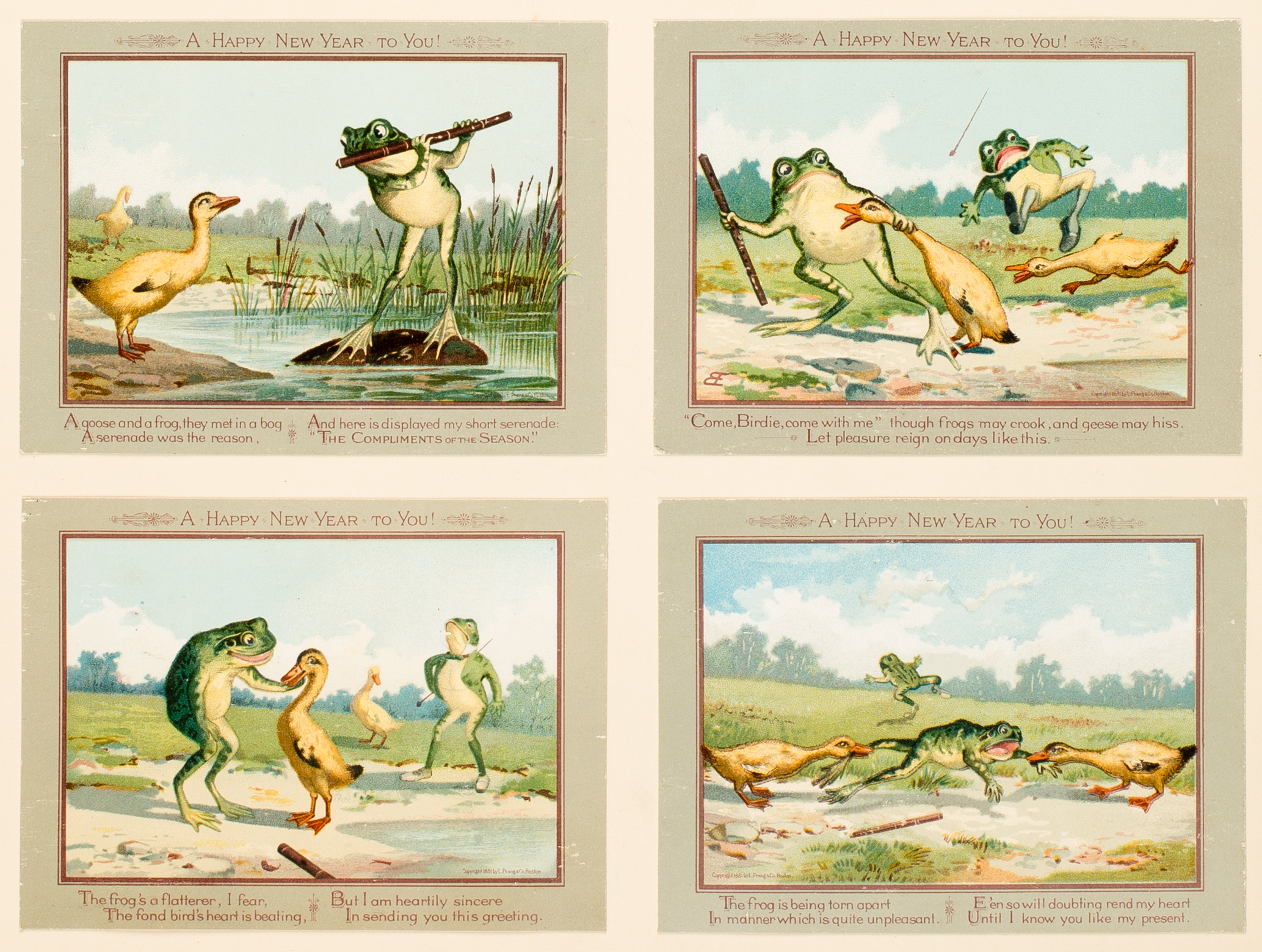
Another comical set shows frogs and ducks (who knew they didn’t get along!) acting peacefully in one scene, and at each others’ throats in the next. The top right scene reads
“Come, birdie, come with me”
though frogs may croak,
and geese may hiss.
Let pleasure reign on days like this.
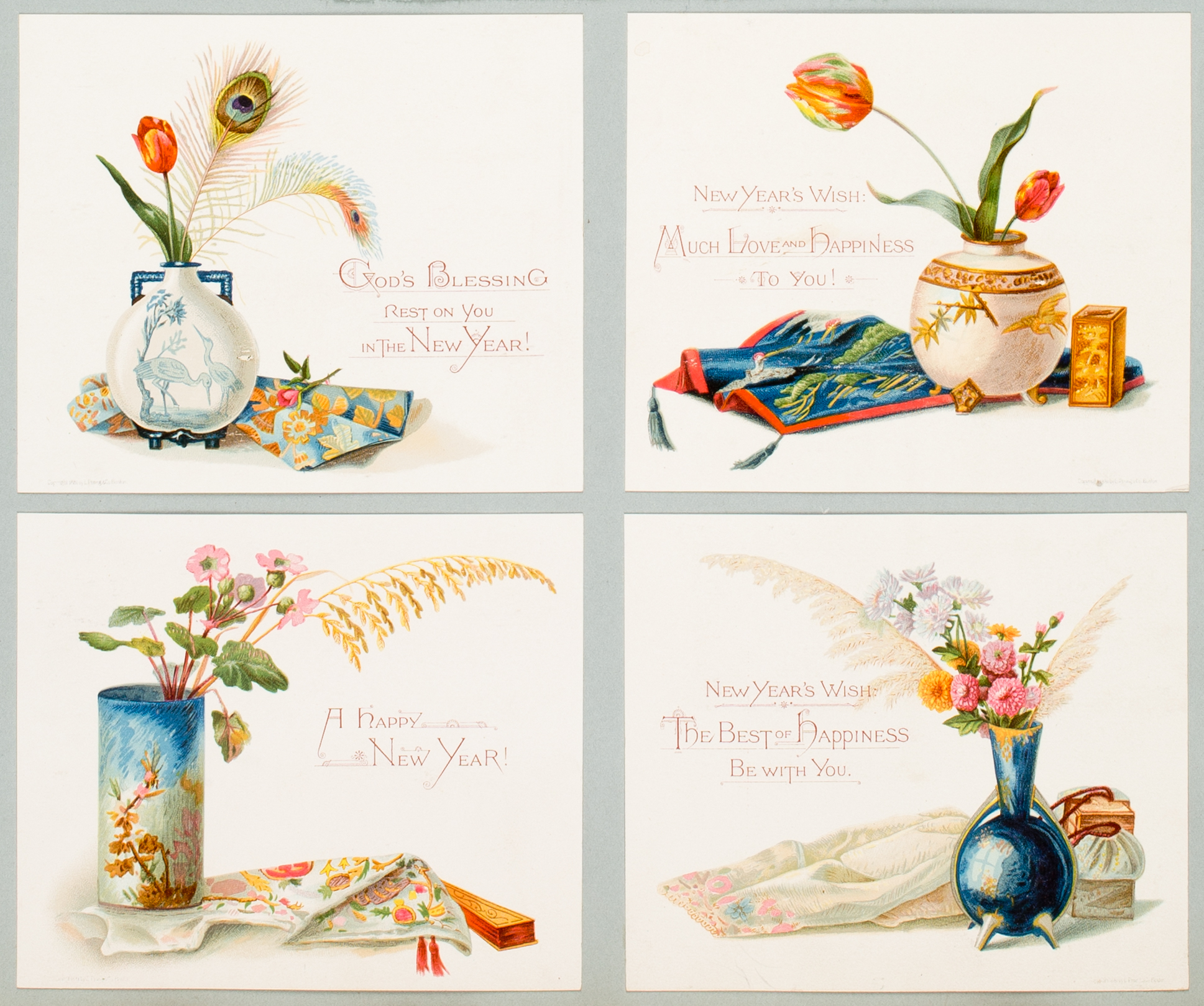
 Japanese art and design were very popular during the last decades of the nineteenth century in Boston. The Peabody Museum in Salem had been amassing Japanese items since the early 1800s. In the 1870s, Edward Sylvester Morse left Boston to travel to Japan, and collected Japanese artifacts and shipped them back to Boston, furthering the city’s affection for Japanese art. Prang depicts beautiful Asian-inspired designs in this set of New Year’s cards with vases, silks, fans, and flowers. This set was also used for Christmas cards, as Prang often used the same designs for different holidays.
New Year’s Day isn’t celebrated nearly as much as it was in the nineteenth century. But wouldn’t you like to receive one of these fun, colorful New Year’s cards in the mail tomorrow?
The Acquisitions Table: Norwich Fire Insurance Co.
Norwich Fire Insurance Co. New York: Hatch & Co., 1863-1865.
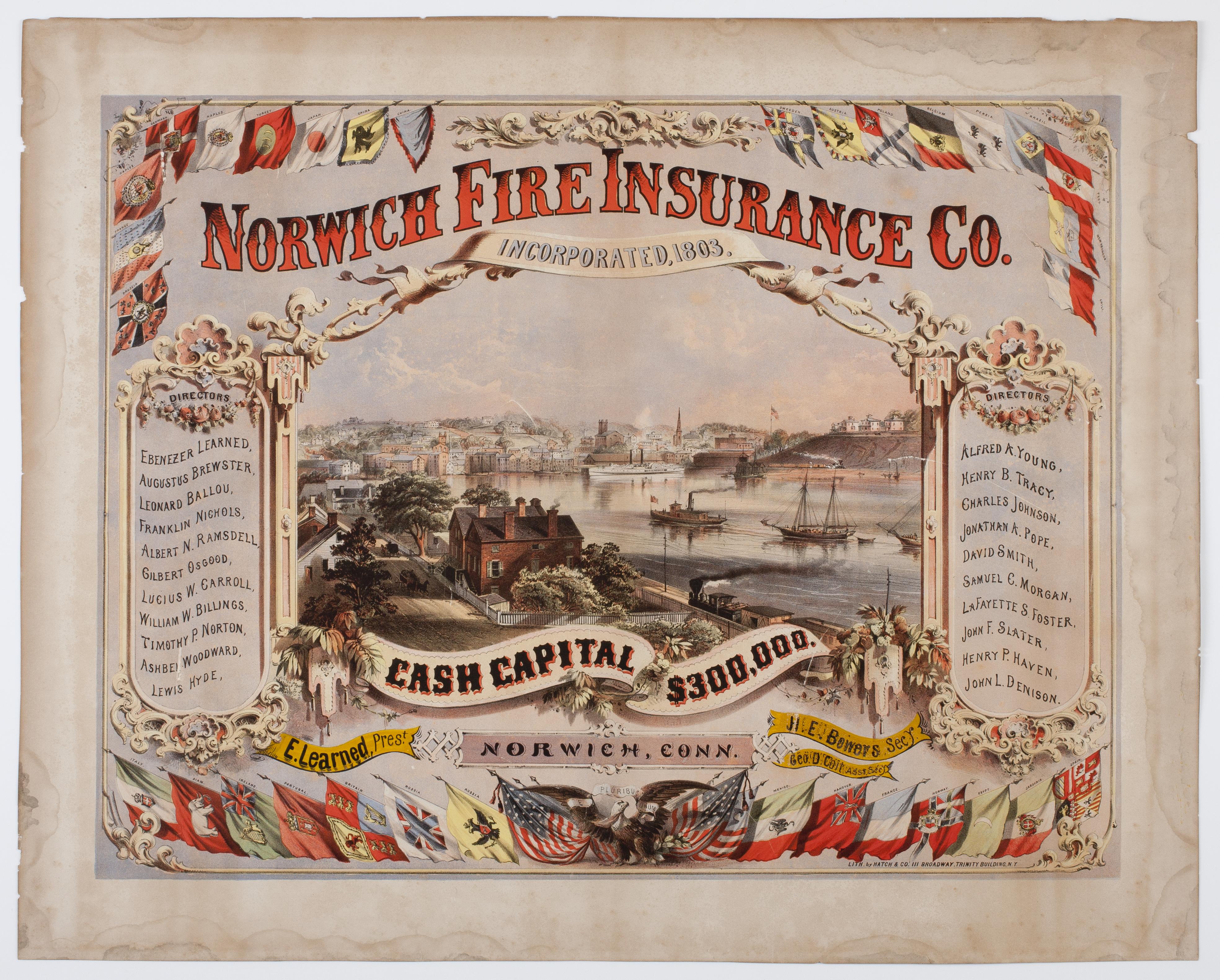 This color lithograph for a Connecticut insurance company features a city view surrounded by international flags and the names of local directors with interests in the firm. The sheet was printed by Hatch & Co. in New York, who advertised that they could produce: “Portraits landscapes, labels & show cards, and every description of color work. Bonds, certificates of stock, checks insurance policies, diplomas, note & letter heads, executed in the best style.” The view of Norwich is taken across the river from the west and aligns closely with an 1849 lithograph produced by Sarony & Major based on a painting by Fitz Henry Lane, with added steam-powered vessels plying the water. The print was probably produced as a promotional image, intended for display in the company’s office or in the offices of the individual directors.
Santa and the Christmas Tree in Nineteenth-Century American Children’s Books
Although we might think of Santa and an evergreen Christmas tree as inevitably wedded in nineteenth-century children’s book illustration, that was not necessarily the case. Until about 1840, New Year’s Day was favored over Christmas as the family-appropriate winter holiday in the young American Republic, particularly in New England, where the descendants of the 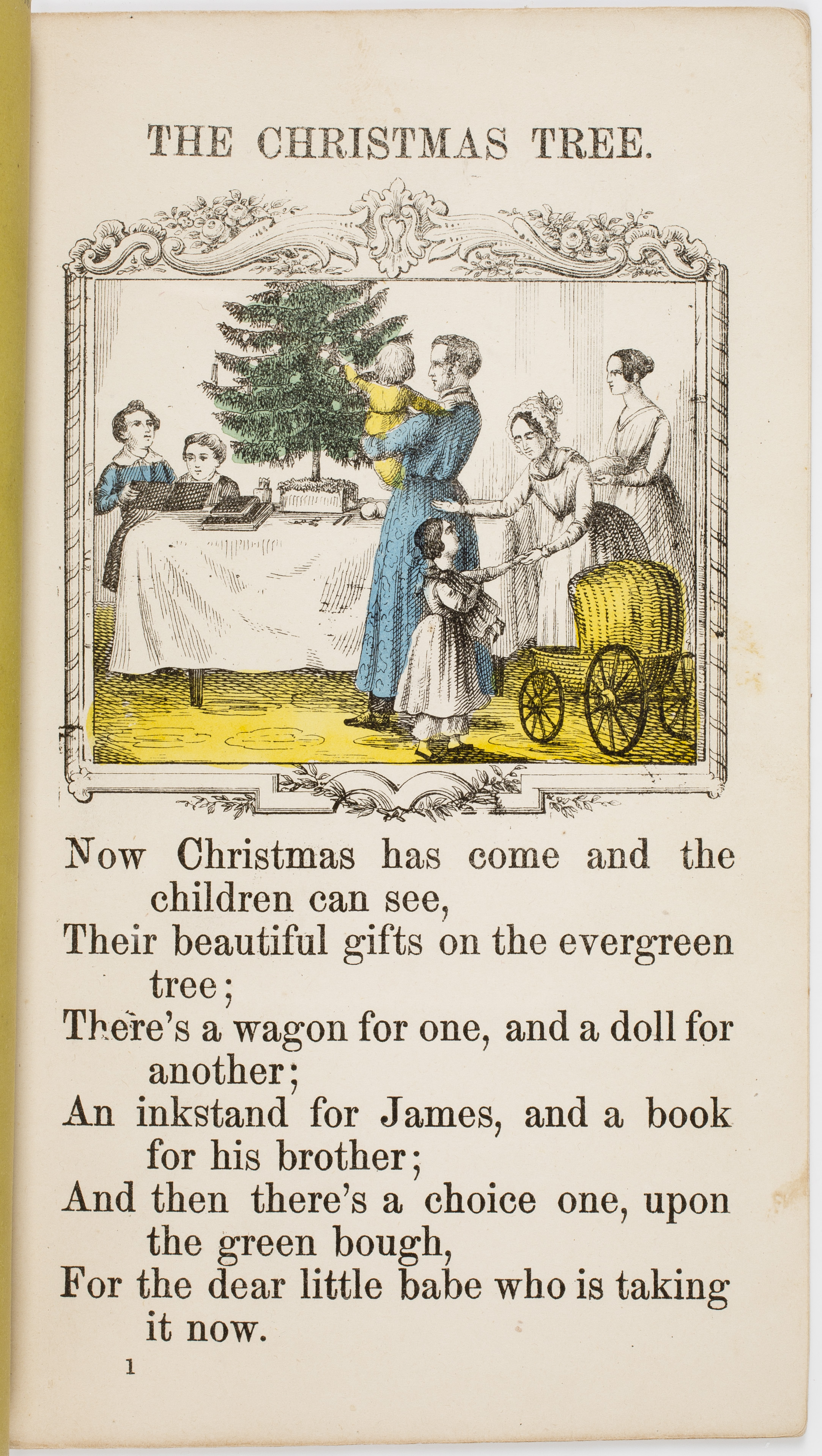 Puritans cast a dim eye upon the Christmas holiday with its Roman Catholic roots. However, with the influx of German immigrants to the United States in the 1840s, the celebration of Christmas and the use of the Christmas tree gained a toehold in American culture. Many of the newly arrived Germans settled in Philadelphia; among them were skilled book artists like lithographer Augustus Kollner (b. 1813).
Kollner illustrated several picture books published in Philadelphia by the American Sunday-School Union, one of most prolific children’s book publishers operating before the Civil War. AAS recently acquired a copy of the ASSU picture book Life in the Nursery. The Christmas Tree; it was issued circa 1844-1853, and contains one of the earliest children’s picture book illustrations that we have of a Christmas tree. It shows a hand-colored lithograph of the lower half of a tabletop Christmas tree modestly decorated with a few ornaments and a few candles. The image is not religious, but rather family-centered: children are looking up at the tree and the gifts on the table. The parents are in control of the situation: the father holds a very young child, and the mother extends a hand to her daughter, gesturing to the tree. The accompanying text gives us an introduction to the Christmas tree as panacea of gifts: “Now Christmas has come, and the children can see, / Their beautiful gifts on the evergreen tree/; There’s a wagon for one, and a doll for another…” Although this poem and picture describe an evergreen tree, this image was not yet culturally embedded as what constitutes a proper Christmas tree.
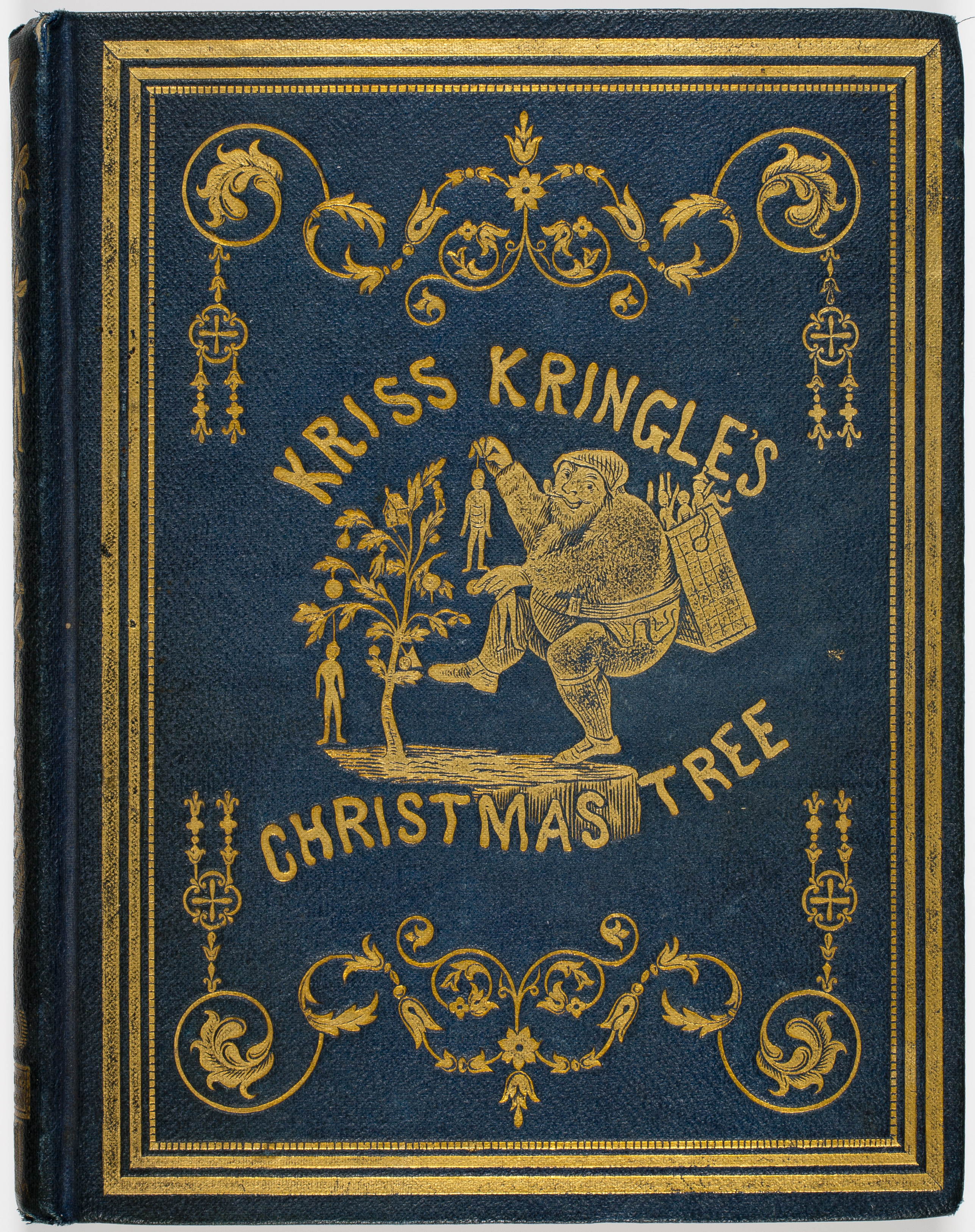 The cover design for Kriss Kringle’s Christmas Tree, also published in Philadelphia at about the same time, in 1846, shows a rotund, elfish Santa putting gifts from his backpack onto a short, deciduous tree. This collection of brief stories includes “The Christmas Tree”—a tale about an impoverished child who receives a vision of the Christ child showing him a star-spangled Christmas tree up in the heavens.
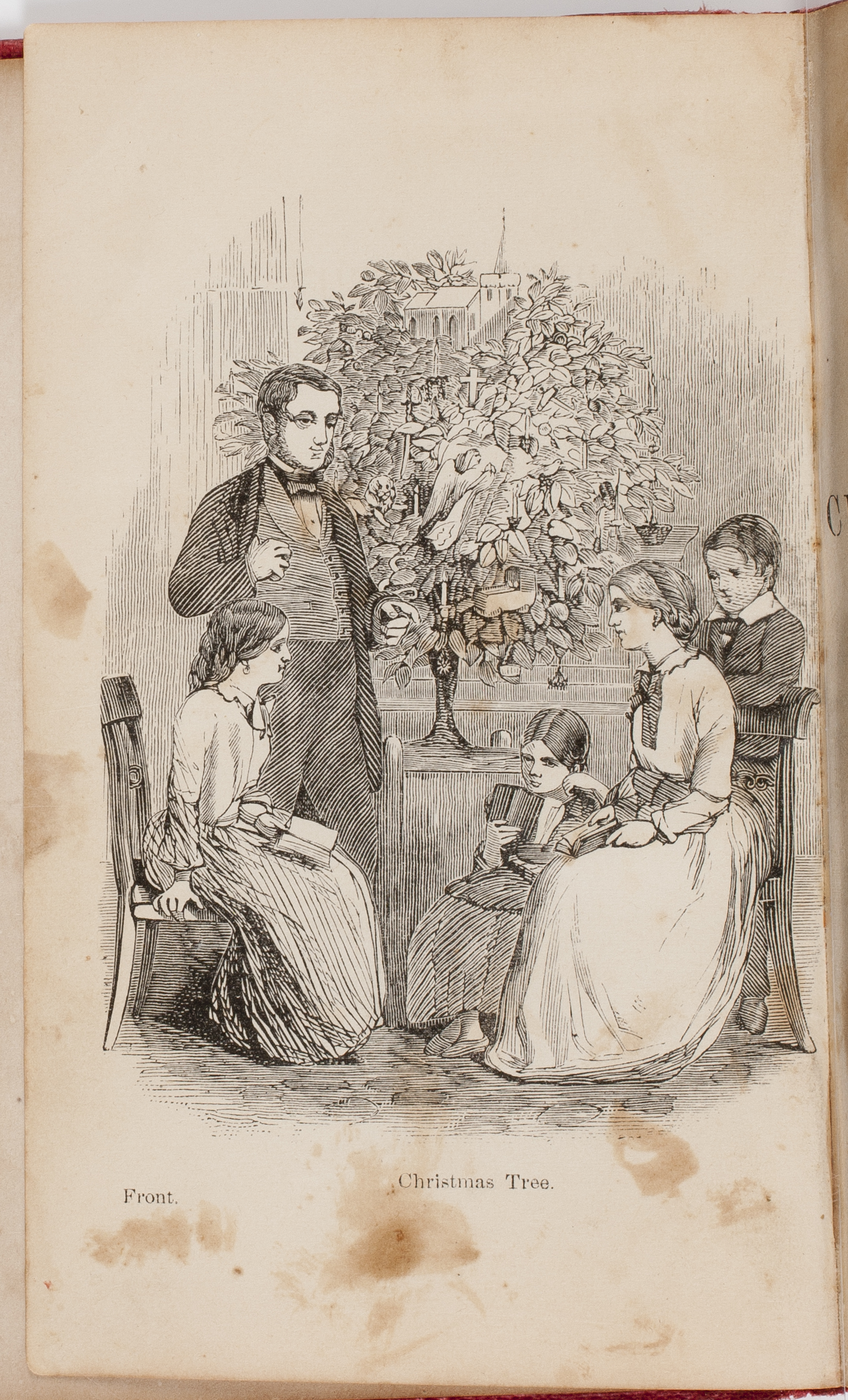
In 1860, the New York-based General Protestant Episcopal Sunday School Union published A Christmas Tree for Christ’s Children. It too featured a non-evergreen tree: according to the book’s first chapter, the tree is a novelty; it is an orange tree brought into the parlor from the home’s conservatory and decorated with dolls, candy, and wax lights by Mr. & Mrs. Oldham for their children’s delight and religious instruction. The frontispiece (below) shows the children gathered around the newly decorated Christmas tree under the direction of their father, who points out the religious significance of the various ornaments; for example, a toy soldier represents the belief that when one is baptized, he becomes a soldier of Christ.
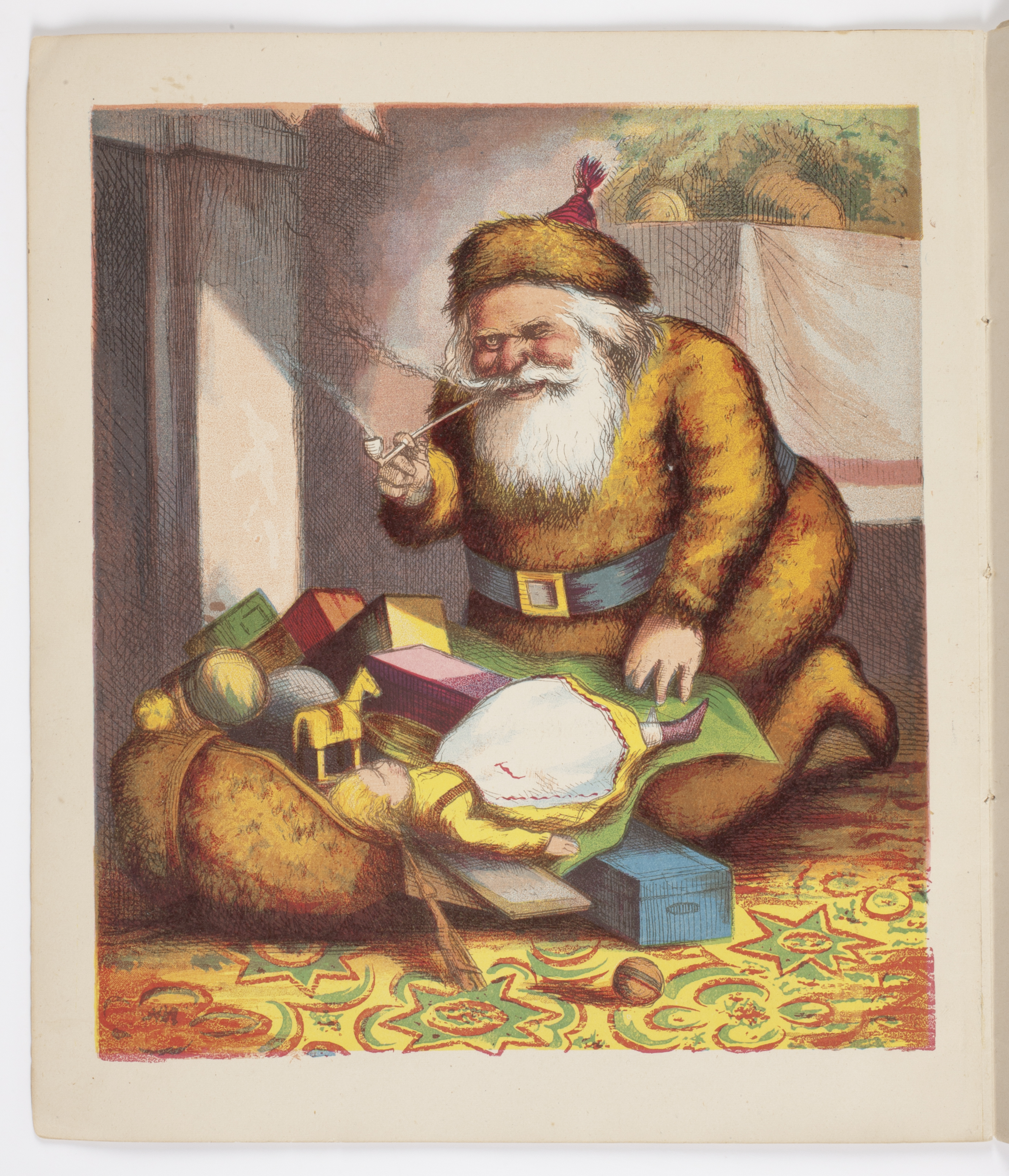 Although the first picture book version of Clement Clarke Moore’s poem The Night Before Christmas was issued in 1848, arguably it is Thomas Nast’s illustrations some twenty years later for New York publisher McLoughlin Brothers that shaped the American cultural image of a rotund, fur-suited, pipe smoking Santa that we recognize today (see right). But even then, Santa appears crouched over his gifts with a tabletop Christmas tree just barely visible in the upper right hand corner of the picture.
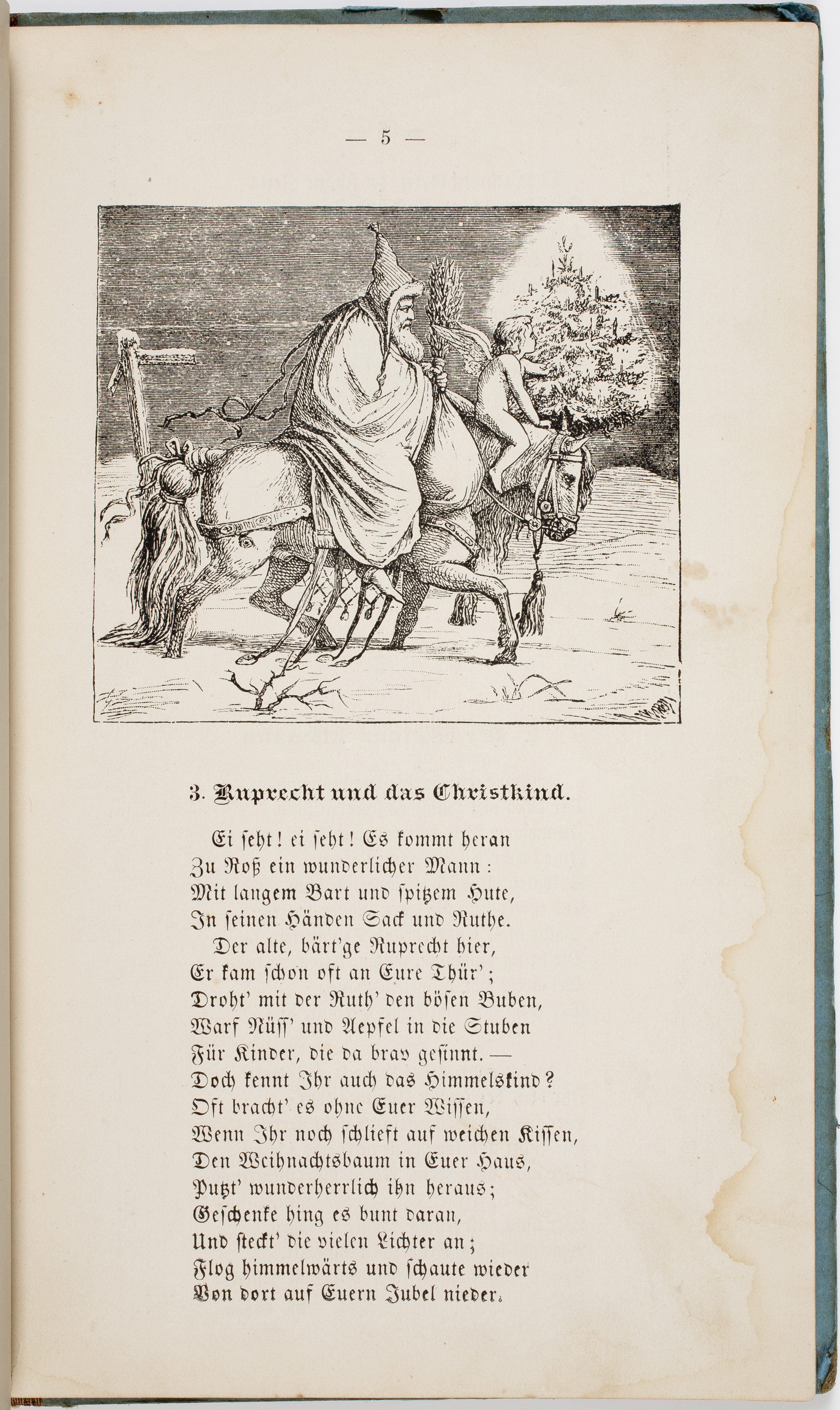
It would take an ongoing infusion of German immigrants and German language picture books like the edition of Gustav Erlenkotter’s Poetischer Jugendschatz in Bild und Spruch (New York, ca. 1870-1885) seen below to build a solid iconographic bond between Santa and the Christmas tree. In this case “Ruprecht” (Father Christmas or Santa Claus) rides a horse co-piloted by a cherubic angel bearing a lit Christmas tree (what a headlight!).
In the late nineteenth century, Moore’s reindeer-driving St. Nick and the Germanic Ruprecht bearing the Christmas tree on horseback became merged, resulting in this fantastical cover image for The Night Before Christmas issued by McLoughlin Brothers in 1899. We see a Santa driving a packed sleigh laden with not only gifts, but a full-sized, decorated Christmas tree; it is as if Santa is bringing all of the Christmas trappings to families everywhere.
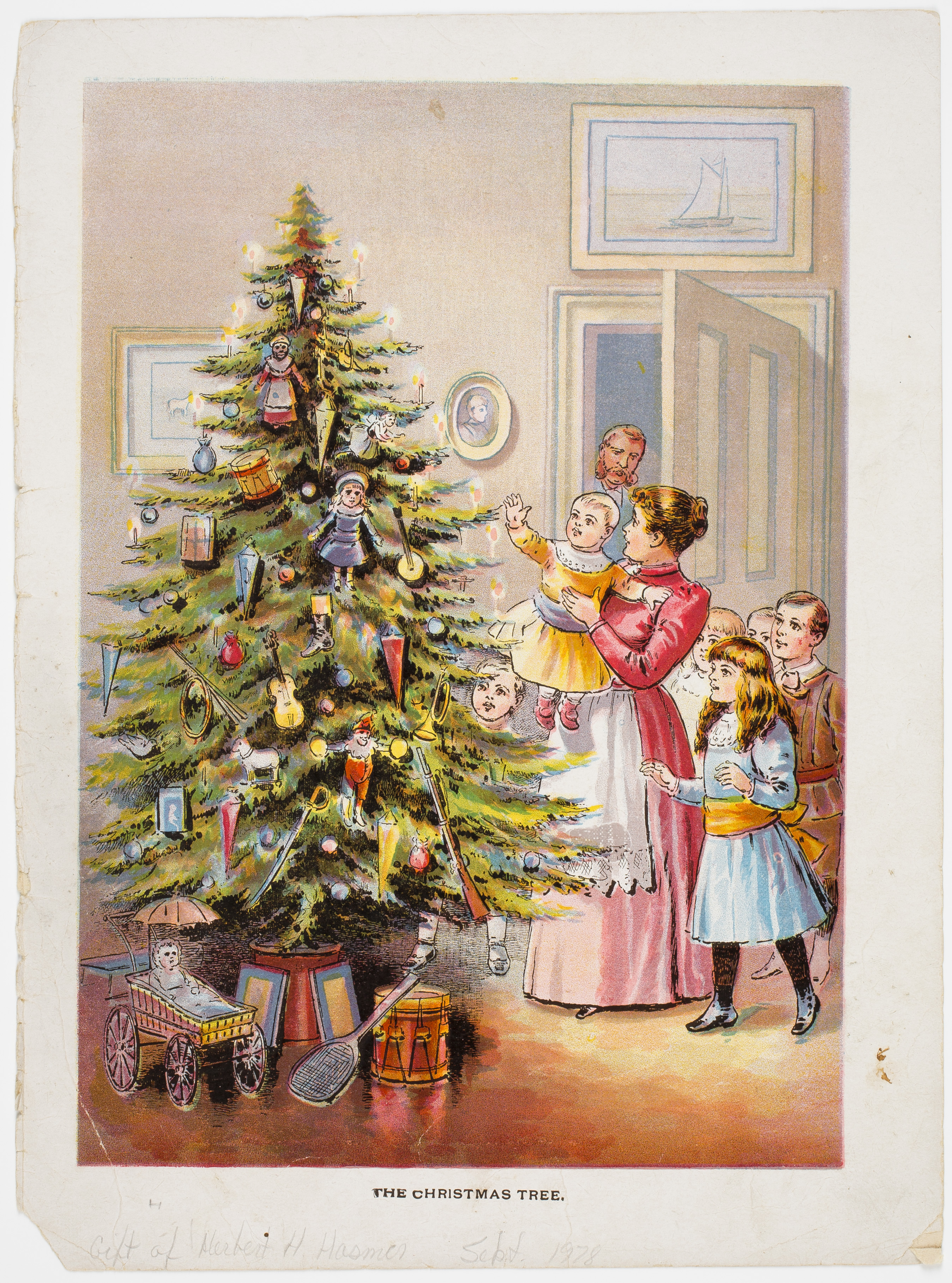
And what is the end result of Santa’s delivery? This magnificent, tall Christmas tree, loaded with ornaments and small gifts, sheltering the larger gifts placed around it (below). Santa and the Christmas tree both came of age in America in the latter half of the nineteenth century, and their story unfolds in the pages of children’s picture books with whimsical splendor.
The Surprisingly Similar Case of Shopping, Then and Now
At this time of year, when shopping becomes a constant (and sometimes stressful) preoccupation, it’s easy to forget that for many people it’s a pleasurable pastime. Not just because of what you actually buy, but also because of the searching, comparing, matching, and imagining that all make up the act of shopping. As it turns out, the attractiveness of shopping as entertainment is nothing new. So as you search for your last-minute Christmas gifts, here are some items from the collections to get you in the mood.
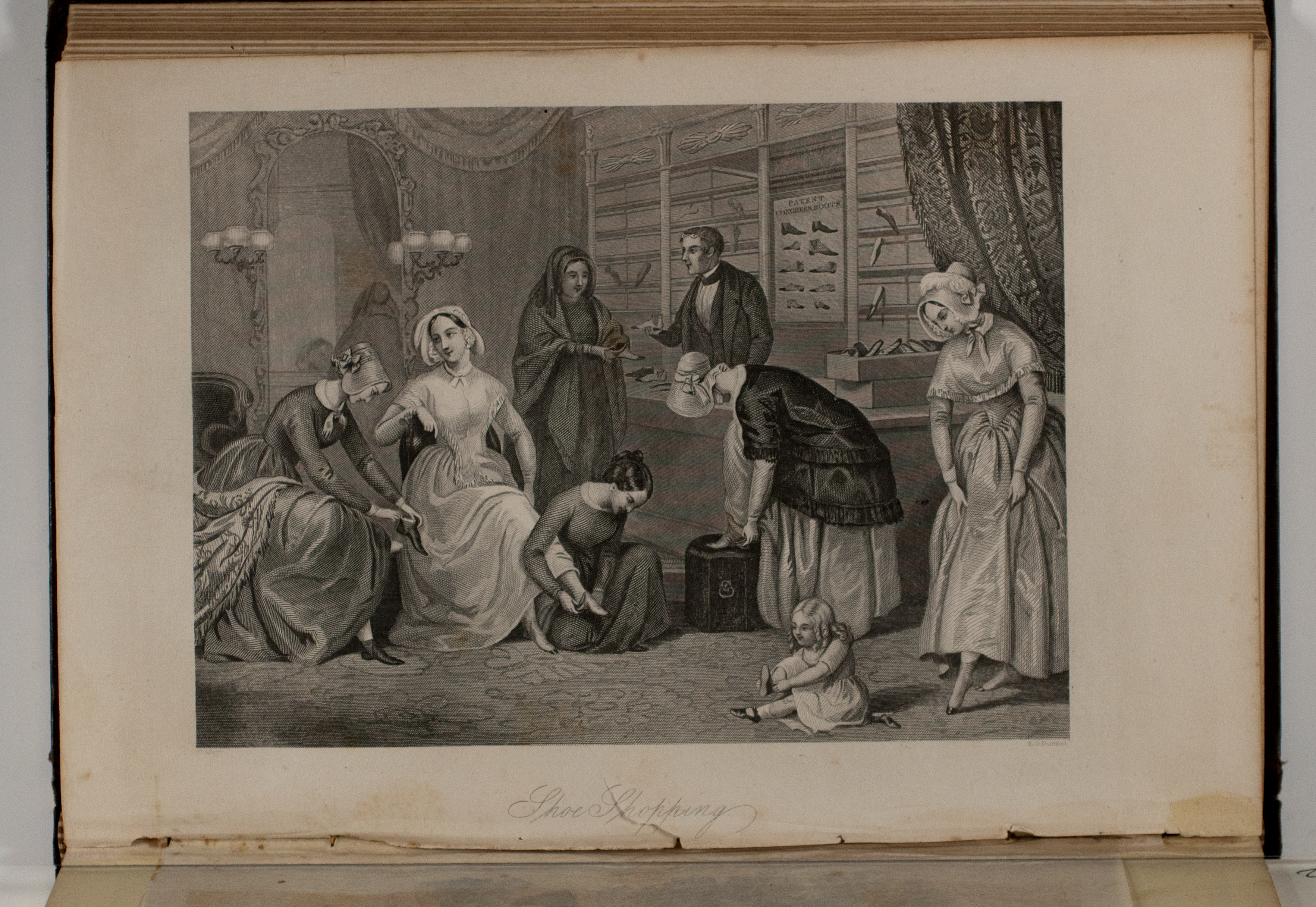 Let’s start with clothes. Men like to grumble about women’s love of shoes and accessories—purses, jewelry, gloves, scarfs, etc. Just what is it about these items that is so attractive to women, they ask? Although we may not be able to answer this question, evidence from the archives suggests that women have long found shopping for these things particularly enjoyable. Take, for example, the 1849 image of women shoe shopping above. Five adult women and one young girl are each in the process of finding that perfect shoe. Of the five faces we can see, all have contented smiles—even the shop-girl kneeling to help the woman in the center looks to be pleasantly occupied. The woman on the far right is holding out her foot for admiration, while the young girl in front of her excitedly tries to pull on a shoe. Although women loving shoes is a stereotype, it is apparently one based somewhat in truth. (I’m guilty of it myself.) And it can start young; in Gap just the other day, I saw a girl about the same age as the one in the image in the same exact pose. I also have a one-year-old goddaughter who can be bribed by telling her you will put on a pair of her favorite shoes for her.
You may also notice that four of the women in the image are wearing fashionable bonnets. A new bonnet at that time would have been about equivalent to a new purse now. Women would have bought 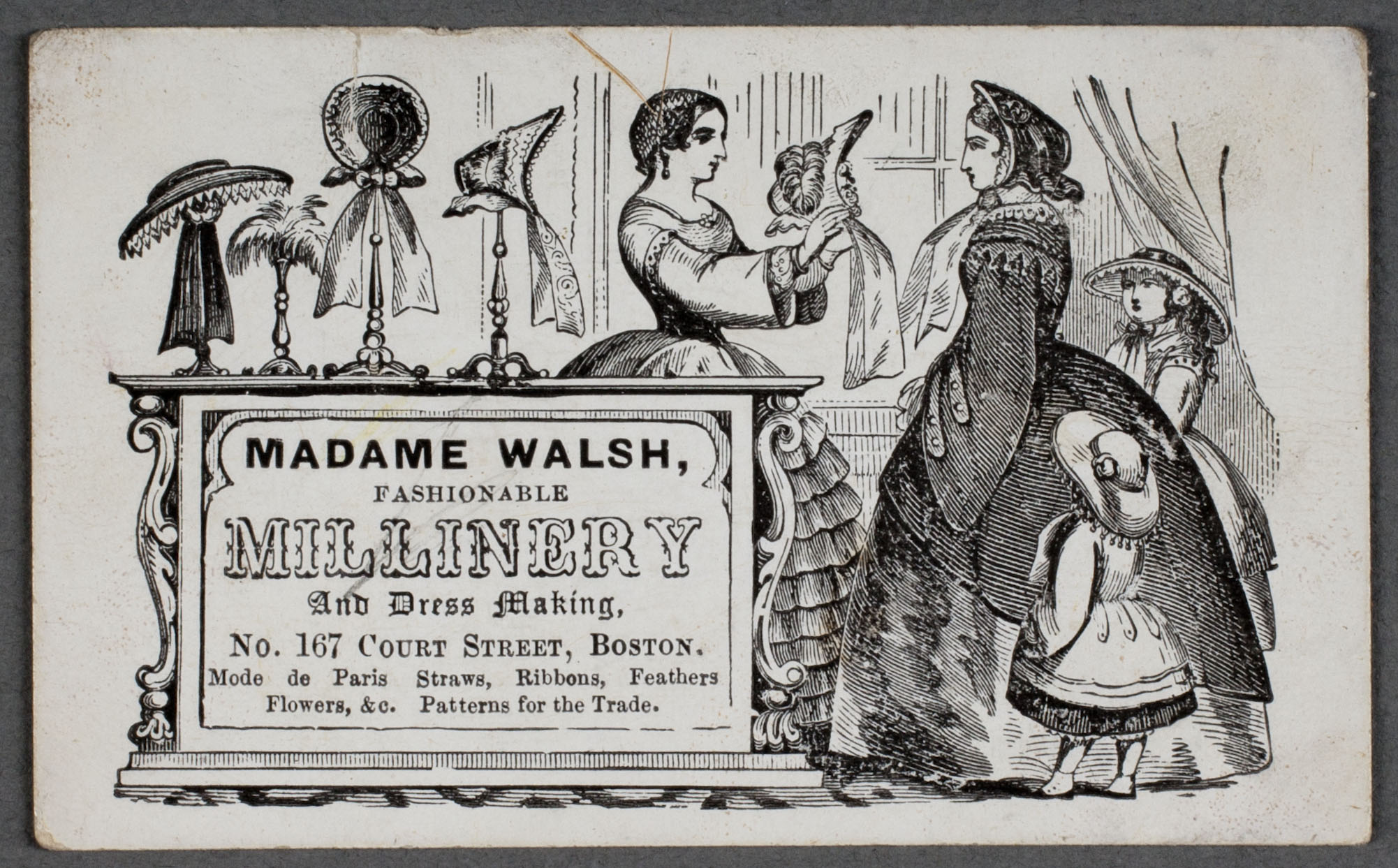 those bonnets from a milliner, or a tradesperson who specialized in hat and bonnet making. This trade card for Madame Walsh, Fashionable Millinery and Dress Making, shows a well-dressed woman with her two young girls looking at bonnets with the milliner, who is also a woman. As you’ll notice, the milliner herself is also well-dressed—dressmakers and tailors would often wear their own wares as a way of advertisement.
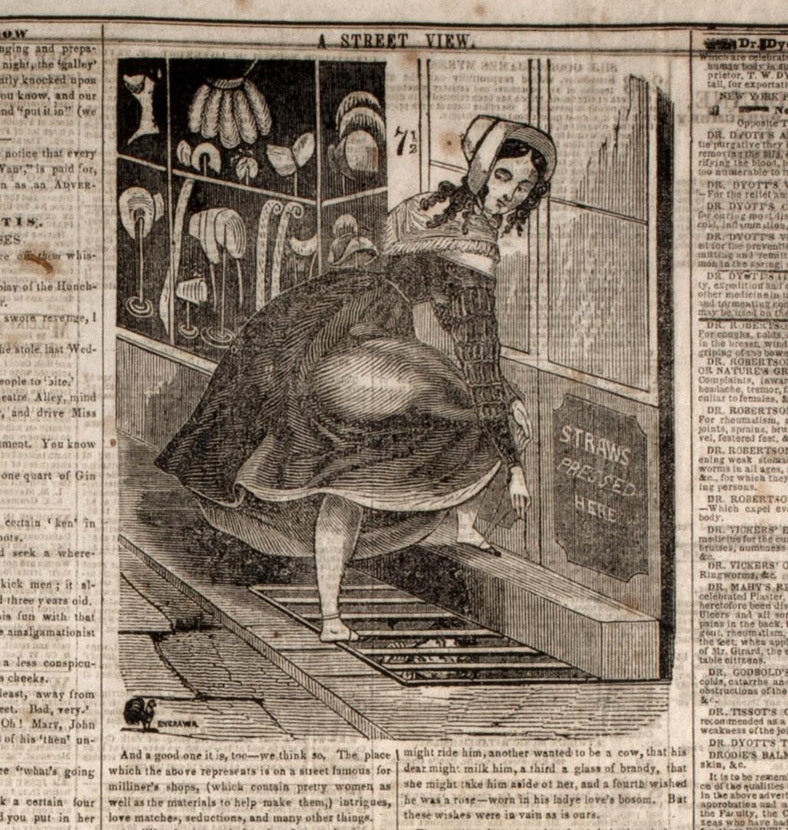 While the trade card is geared toward the shop’s female customers, the popularity of hat shops was used in other popular culture of the time aimed at men. In an 1842 issue of the New York racy newspaper The Weekly Rake, the image seen to the left accompanied an article advising its male readers to hang out near hat shop windows as a way to meet women. While the man under the grate took things a bit too literally, the existence of such an article and image imply that women’s love of hats and window shopping were well known.
Lest we think that only women have the shopping bug, below is an 1865 advertisement for a men’s clothing store in Boston called Macullar, Williams & Parker. According to the ad, they sold “fine clothing to order and for the wholesale and retail trade,” carrying “fine clothing and mens furnishing goods…fine woolens and tailor trimmings.” A fashionable couple can be seen window shopping in front of the store, and both men and women 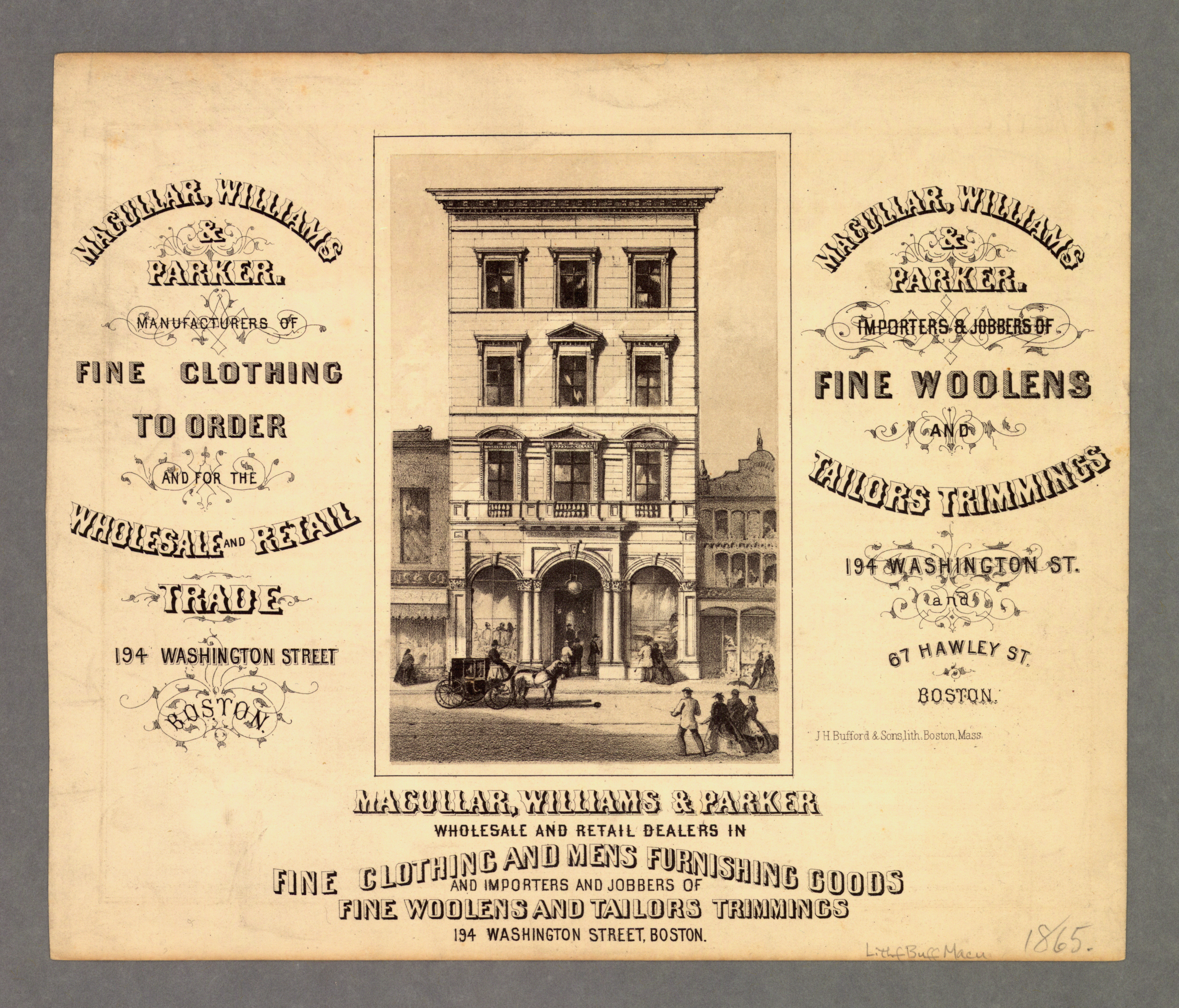 are entering the building. Then as now, it seems, men were believed to need some help in the clothing department.
If window and accessory shopping were popular activities in the nineteenth century, there is also evidence that the idea of “retail therapy” was not unknown. On April 25, 1861, about a week and a half after the outbreak of the Civil War, Caroline Barrett White, a staunchly antislavery upper-middle-class housewife from Brookline, Mass., recorded her early war efforts in her diary: “Made the Soldiers handkerchiefs today and carried them to the hall – Went into town this P. M. with Frank to get bonnet fixings – we also purchased some patriotic streamers to decorate curtains with.” Here, shopping for those all-important bonnet trimmings is coupled with a more patriotic kind of shopping. Over the next few days she records trimming her bonnet and “making some decorations of the national colors,” which, when hung in the parlor, she writes, “they are pretty I think.” Shopping, home decorating, and making things look nice have become a way to deal with the beginning of a tragedy that, though they don’t know it, will continue for the next four years.
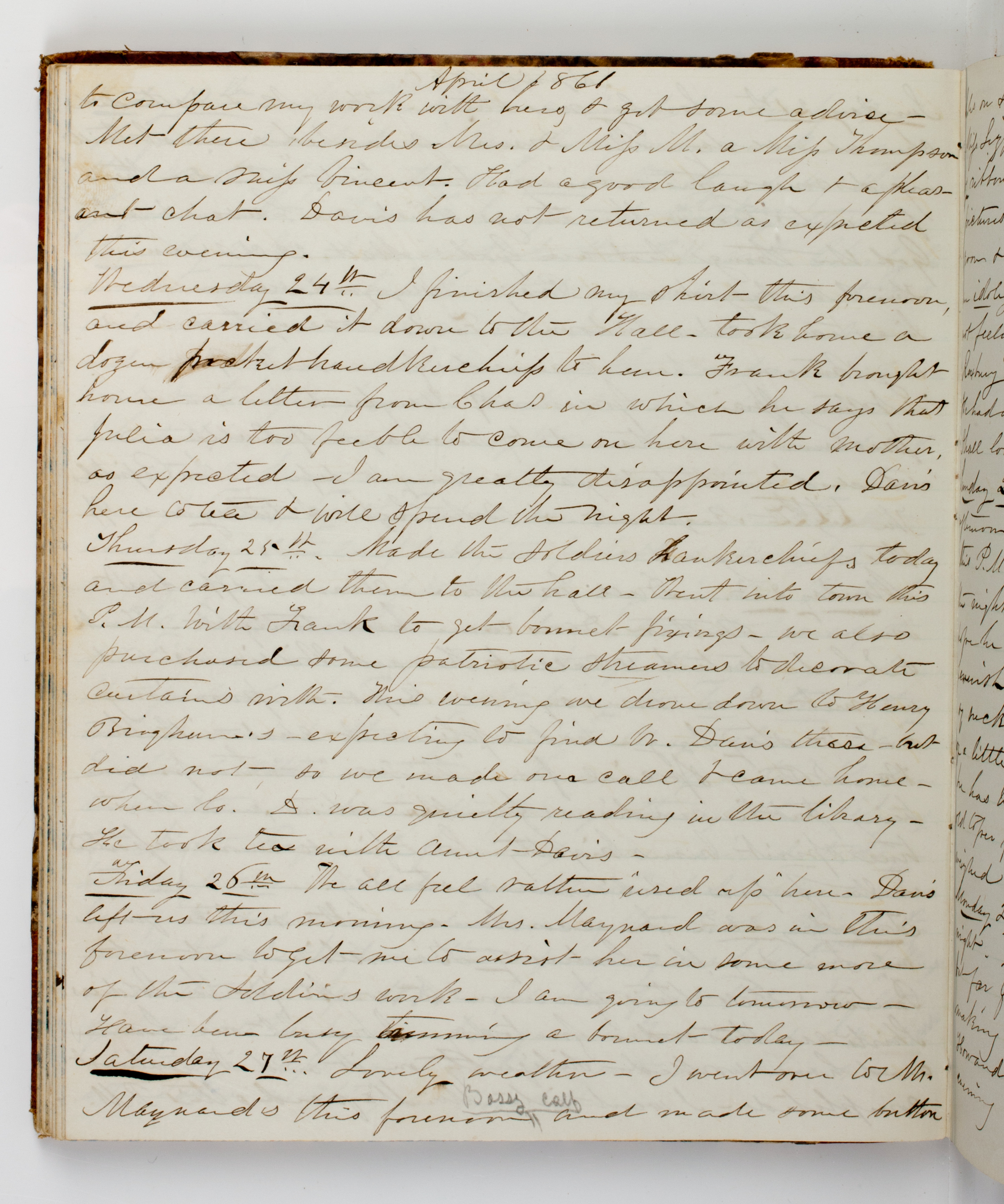
Over the course of those years, White writes both jubilantly and heart-wrenchingly, depending on the war news. On September 3, 1862, as the war is starting to look very poorly for the Union, she writes the following:
Lovely cool day – I went to Boston this morning – did some shopping – could not find what was very satisfactory to me – but it does not matter – It seems to me nothing matters now – I feel sad, sad & discouraged – the news from our armies is of the saddest – dying, dying, dying poor brave soldiers! I do not know but it is the worst to be desired however – to die, rather than live to be disgraced – Oh God! Hasten the right.
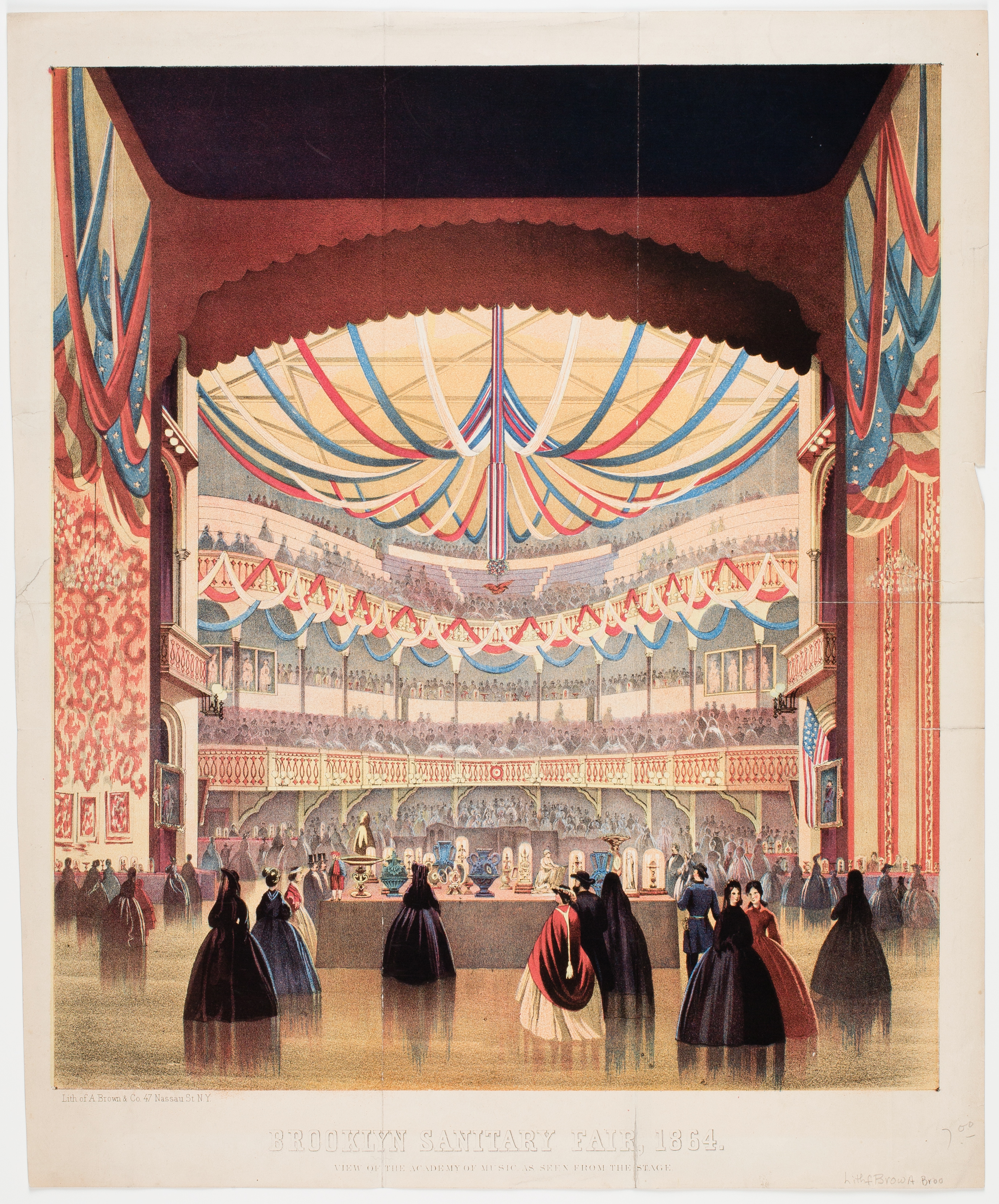 Suddenly something that she had once found pleasurable and productive, and may even have hoped to help cheer her this day, now seemed meaningless. In reality, however, shopping often had a lot of meaning during the Civil War, particularly during Sanitary Commission fairs and other bazaars that were intended to raise money for the war effort. These functions, planned mostly by the women on the home front, sold goods and offered entertainment to fundraise and provide a bit of a respite from the harsh realities of the war. The image to the left depicts a Sanitary fair in Brooklyn in 1864. Decked in patriotic decorations, the hall is populated by home goods and women, many in their dark mourning clothes. Most of the few men visible are in uniform, probably on leave from the front.
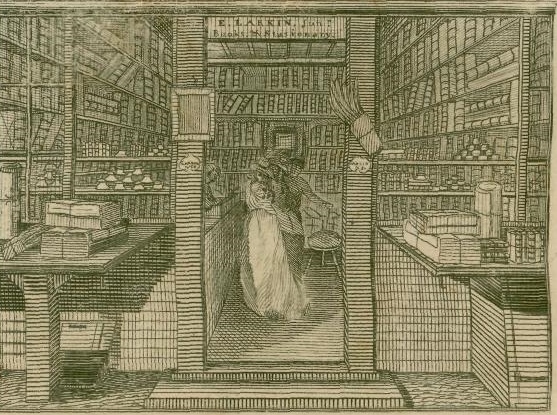
While using shopping as a distraction from the horrors of war is the extreme, the idea of “retail therapy” is a common one today. Here at AAS, we would suggest heading to a bookstore to browse the shelves. (This is also a great break from other Christmas shopping you may be doing.) The detail below from a 1789 engraved receipt from the Society’s ephemera collection shows the interior of Ebenezer Larkin’s bookstore on Cornhill in Boston. You can see a man and a woman browsing in a room lined with shelves full of books and stacked with ink pots. In many ways it doesn’t look so different from bookstores today, and would have offered book lovers similar pleasures.
 So if you find yourself tired of tracking down the perfect present or standing in lines, just remember: shopping has been viewed as a pleasurable activity and effective distraction for centuries. Chances are that enjoyment will return for you as well. Eventually.
The Acquisitions Table: Traveller’s Rough Notes, on Niagara Falls
Travellers’ Rough Notes, on Niagara Falls. Black Rock, NY: Smith H. Salisbury, 1827.
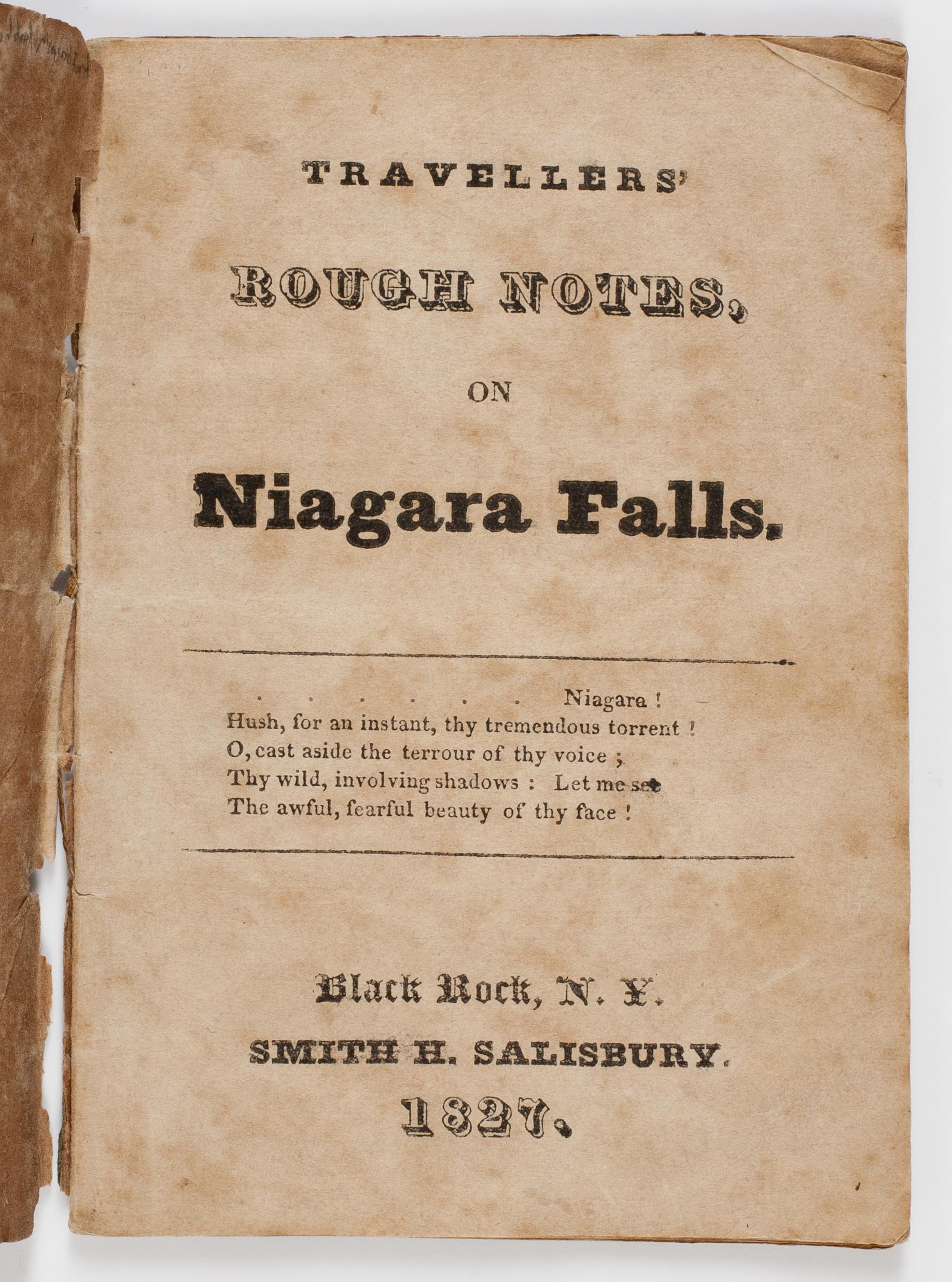 APPARENTLY UNRECORDED, ONLY KNOWN COPY!
Please excuse the yelling, but we get excited at AAS when we are able to add a new piece to scholarly and bibliographical knowledge. Though tiny (just a little over 11cm in height) this small pamphlet represents just such a discovery. Upon first seeing its description in the Swann Auction catalog, we knew it belonged at AAS. And we weren’t the only ones to excited by this recent discovery – the local New York paper, The Niagara Gazette, even featured an article about AAS acquiring this previously unknown title.
The first 12 pages of this curious little pamphlet are devoted to “Rough Notes of an Old Traveller,” which compare the anonymous author’s 1797 visit to Niagara Falls with another visit in 1827. The remainder of the 32 pages contains a charming and humorous account of the falls titled “Dick Wildfire’s Narrative,” signed in type “Rich: Wildfire” and dated 14 June 1827. Neither of these sections appears to have been published elsewhere making this quite possibly the unique surviving copy of either section of the text.
Get the perfect gift for the antiquarian in your life, and help AAS and the world!
This November AAS experimented with a new year-end fundraiser. We called it “Give a Gift to AAS Give a Gift to the World.” Thirty objects were selected from across the entire spectrum of the Society’s collections with several criteria in mind. Items had to be significant sources of research, fragile or rare, and under about 200 pages in length. Also, the pieces could not be part of a digital resource. In fact, the whole point of the fundraiser was to secure funding to digitize and make available all thirty pieces, for free, via the Society’s website.
 This turned out to be one of our most successful initiatives to date. No sooner had we put the catalog of our choices online when the support started pouring in. At about 10:30 on a Monday, we sent an email announcement out to members and friends who had participated in previous Adopt-a-Book efforts and Adopt-a-Gift-book from last December. By noon, one third of the material had been selected for funding! By Tuesday, half was gone. We had several instances when multiple emails poured in for a single object. It was great!
We had originally planned for the fundraiser to run through the end of 2013. But, of the thirty original pieces, only two remain. This blog post is a plea for the final support needed to call this effort a complete success. What is left, you ask? Click on over to the catalog website and see in more detail, but described here briefly, the two lone, abandoned, unloved, remaining objects are:
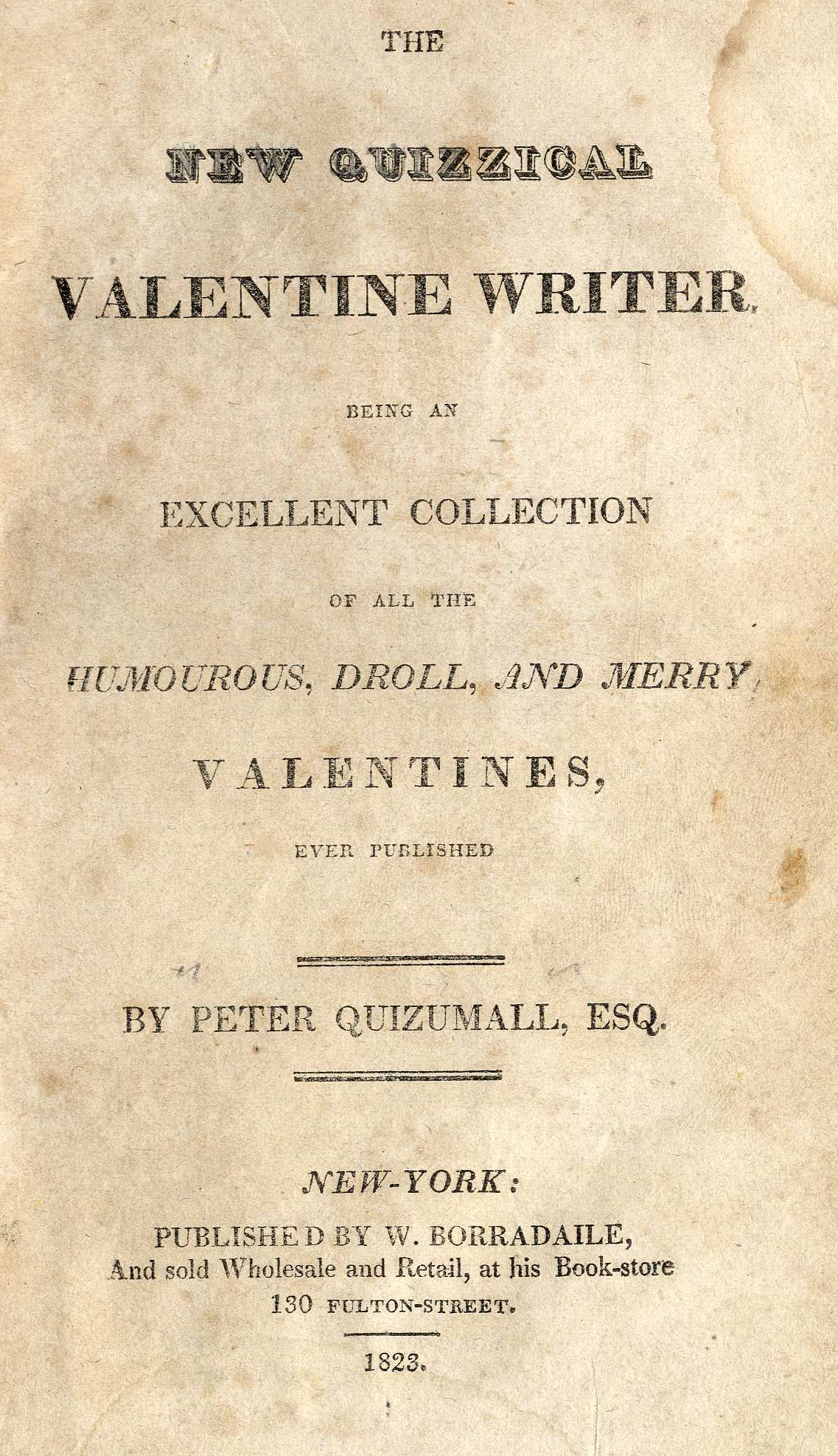 An 1828 Valentine writer, published in New York. For a donation of $75 AAS will photograph all twenty-eight pages of this slim volume, which was originally used by lovelorn correspondents with writer’s block. Popular and clever turns of phrase, snippets of poetry and suggestions for humorous quips were all published here to help those making valentines at home, or for appending to published valentines to come up with just the right way of saying “I love you.”
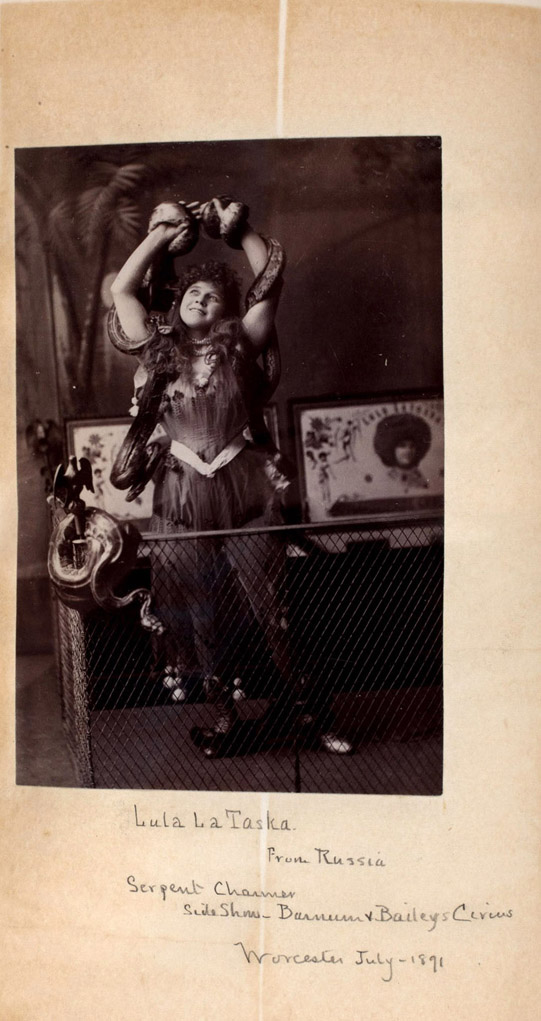 For the less sentimental, the final historic object waiting for digitization is a homemade scrapbook from the Society’s manuscript collection. Made by Nathaniel Paine in the 1880s, the unfortunately titled “Freaks of Nature” includes an abundance of ephemera related to circuses, theater, and side show entertainment. Lots of the pieces glued to its pages are not known in any other copies, are annotated by Paine with the location and date of the original event, and document the variety of popular entertainment consumed in the United States in this era. For $100, the entire volume will be photographed and unlocked for all to consider, both in Worcester and well beyond.
So here’s the pitch—and this is coming from the curator who as a kid was the bespectacled, skinny child chosen last for kickball, baseball, and just about any other team sport. I feel for these two last historic objects, leaning, if you will, against the gym wall. They remind us of the elephant and dolly stranded on the Island of Misfit Toys in the Rudolph the Red Nosed Reindeer television special playing all over cable this month. Can you help AAS with your gift to make them part of the great sweep of bytes, jpegs, and TIFFs that swirl through the ever-growing digital realm? We thank you, as always, for your amazing support of the Society and our activities. Happy New Year!