Preservation Matters

Riding the wave of our recent James Russell Wiggins lecture’s Franklin-iana and the American Library Association’s 2014 Preservation Week: Pass it On (which takes place April 27-May 4, 2014), we found ourselves struck by the Benjamin Franklin quotation, “An ounce of preservation is worth a pound of cure.” Although Franklin was speaking about fire safety (and the quote has been used in the context of health), we used it as a charge to reflect on general collection health and maintenance.
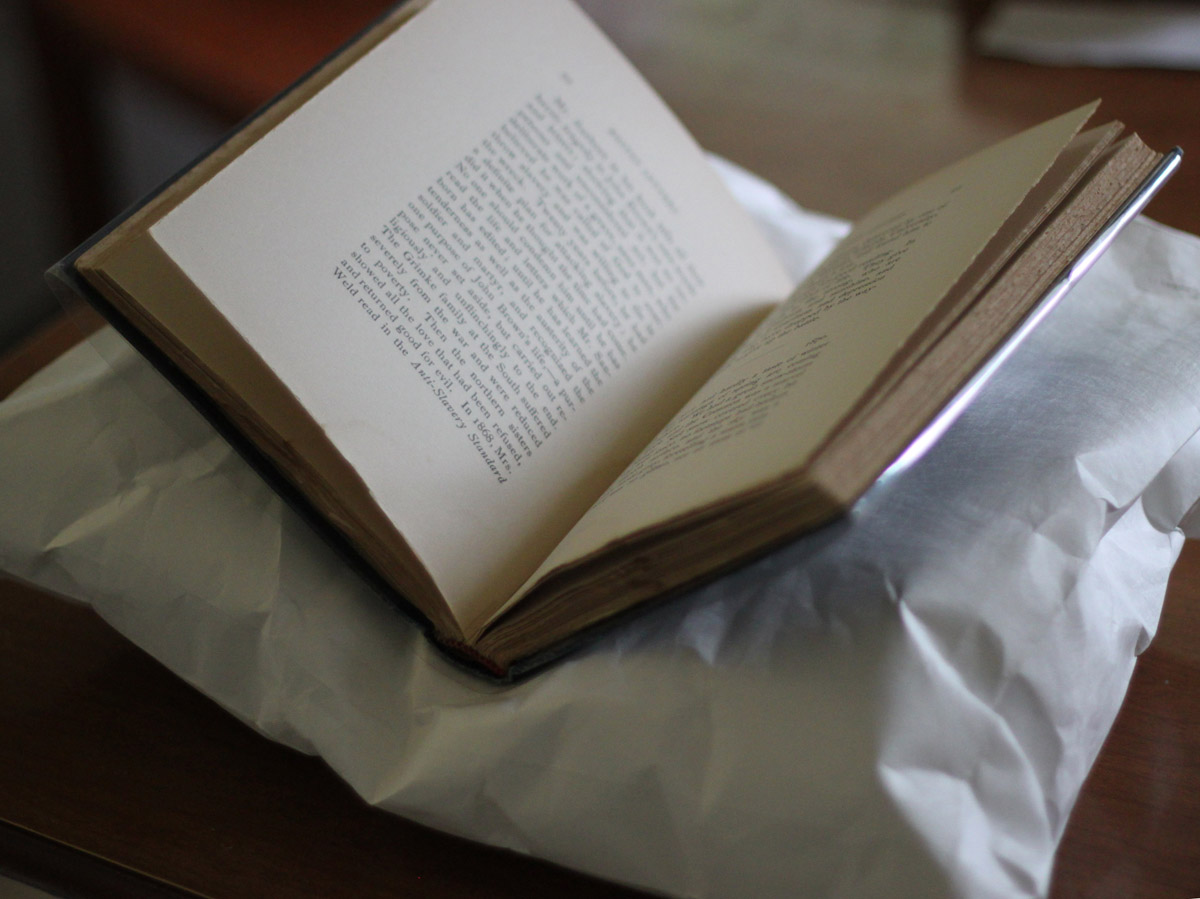
preservation_bookcradle
DIY book cradle

One of the goals of ALA’s Preservation Week is how we can preserve personal and shared collections. Several weeks ago, curator of graphic arts Lauren Hewes had an eye-opening experience in the flooded basement of a descendent of a photographer (photographs of the subsequent conservation work were posted on the AAS Instagram account). In this case, minimal preservation steps would have gone a long way. Similarly, two years ago while in a Preservation Management in Libraries and Archives class with Rachel Onuf at Simmons College, I was assigned a final project to create a preservation education program for the public. The forum I selected was to produce a blog to showcase selected preservation needs – a blog created for those interested in preservation of library materials on a shoe-string budget. The project was called “Simple Preservation Matters” because it gathered together the most straightforward preservation strategies and suggested that carrying them out would have value for a collection.
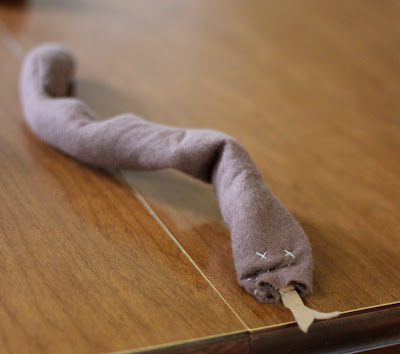
A book snake, to hold open pages
DIY book snake

The project started out with a budget – of eighteen dollars and eighteen days. The goal was to create eighteen resourceful ways of dealing with the issues of preservation, including housing, education, proper display, use and handling, acquisition of suitable housing, minor book treatments, and disaster preparedness. The purpose of the project was two-fold: first to create a resource for those interested in the preservation of library materials which could lead them in the right direction, but also to display how achievable the ideas are.
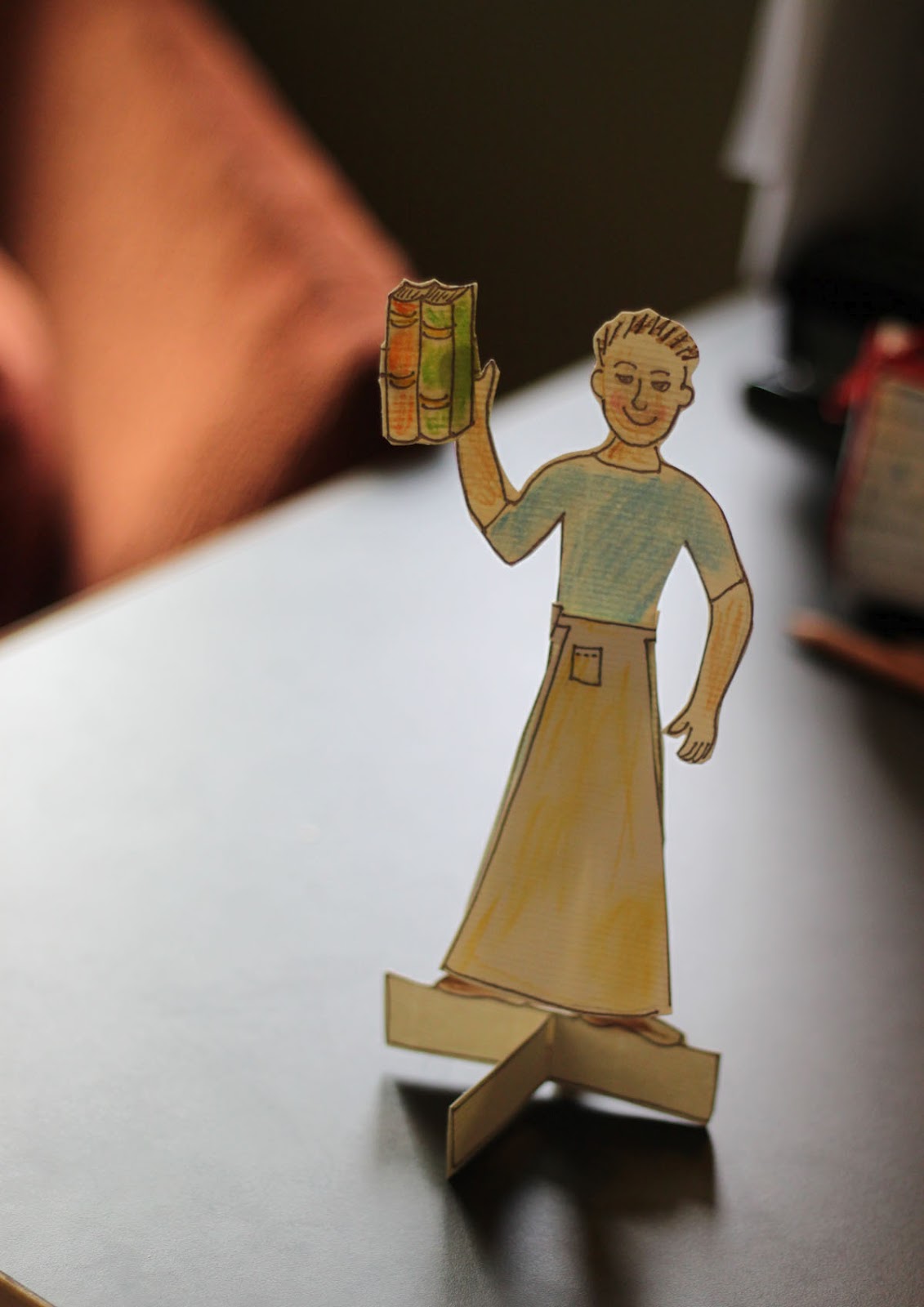
Preservation paper dolls

A few points about what this project was not. This blog did not attempt, or suggest, that professionals shouldn’t be called in when needed. It did not encourage conservation, but rather attempts to filter some of the larger preservation goals (environmental monitoring, security, minor building surveying/fixing, housing) into manageable pieces. This site was not intended to be a resource for collections conservators – nor was it to encourage librarians or well-meaning individuals to think they are collections conservators or technicians. Instead it was a forum for creativity, for ideas, for humor, and to show doable best practices in action.

Some of the activities were for the DIY crowd (making your own book cradle and making your own book snake), while others were for a younger audience and advocated proper book handling and, if creativity allowed, making preservation paper dolls with Tyvek suits. Still others were on the lighter/informational side and advocated for proper collection transport (à la “my other car is a book truck” bumper sticker).

preservation_rulerThe blog was created to lead those interested in preservation to the authoritative resources on preservation management (see footnote). Usually the most inexpensive strategies make a difference in the protection of a collection. This included recommendations from the NEDCC on how books should never be stored directly against walls (but be three inches from them) and all collections should be at least four inches off the ground. Instead of an “app” for that, we created a printable-ruler. There is also a post to the Council of State Archivists’s “Pocket Response Plan (PReP)™,” which is available for download (and to be filled out) by those interested in having a truly mobile response plan but who may not already have one. We also showed the best way to remove a volume from the shelf (and showed cap damage to a volume pulled incorrectly). Also included was how to make a paper enclosure and tintype storage.
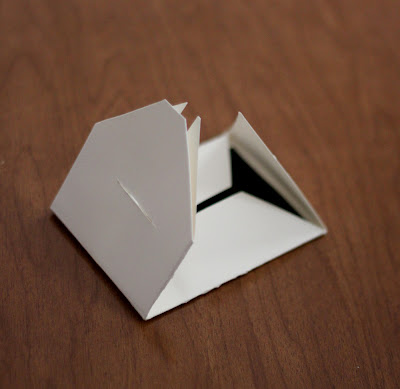
DIY tintype storage
DIY tintype storage

In my experience as a librarian I have done minimal housing and handwork, which I think underscores why some of these posts can work. Education is important, but so is feeling empowered to tackle the daily preservation issues of any archive in relatively simple ways. Culling together best practices from authoritative resources and sharing how they are achievable with a low (to sometimes “no”) budget was the objective. At AAS, we believe that collection safety, housing, and use are to be taken seriously. And I do not mean to suggest that the blog is comprehensive or will lighten a librarian/archivist/collector’s already laborious workload. The work never ends; instead it gradually becomes less absorbing. But my hope through this brief project was to allow users to start seeing preservation issues in a new way.

Some useful resources consulted:

Banks, Paul N. and Roberta Pilette, eds, Preservation: Issues and Planning. Chicago: American Library Association, 2000.

Library of Congress: Collections Care Web Resource. < http://www.loc.gov/preservation/care/>

Long, Jane S, Richard W. Long, Inge-Lise Eckmann, and Clare B. Hansen. Caring for Your Family Treasures: Heritage Preservation. New York: H.N. Abrams, 2000.

Northeast Document Conservation Center Resources: Preservation Leaflets. Andover, MA: Northeast Document Conservation Center, [consulted July 2012]. Web resource < http://www.nedcc.org/resources/leaflets.list.php>

Patkus, Beth. Assessing Preservation Needs: A Self-Survey Guide. Andover, Mass: Northeast Document Conservation Center, 2003.
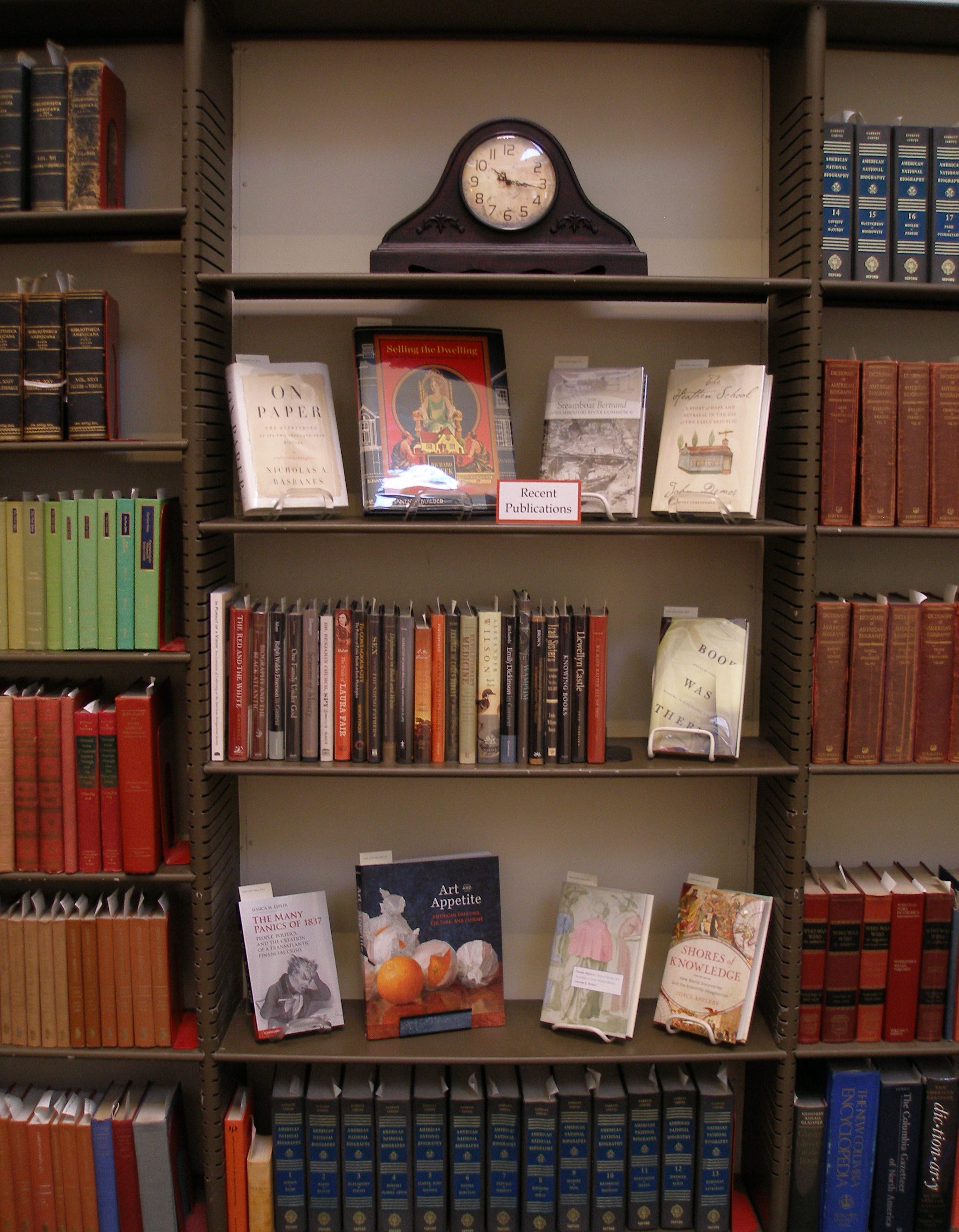
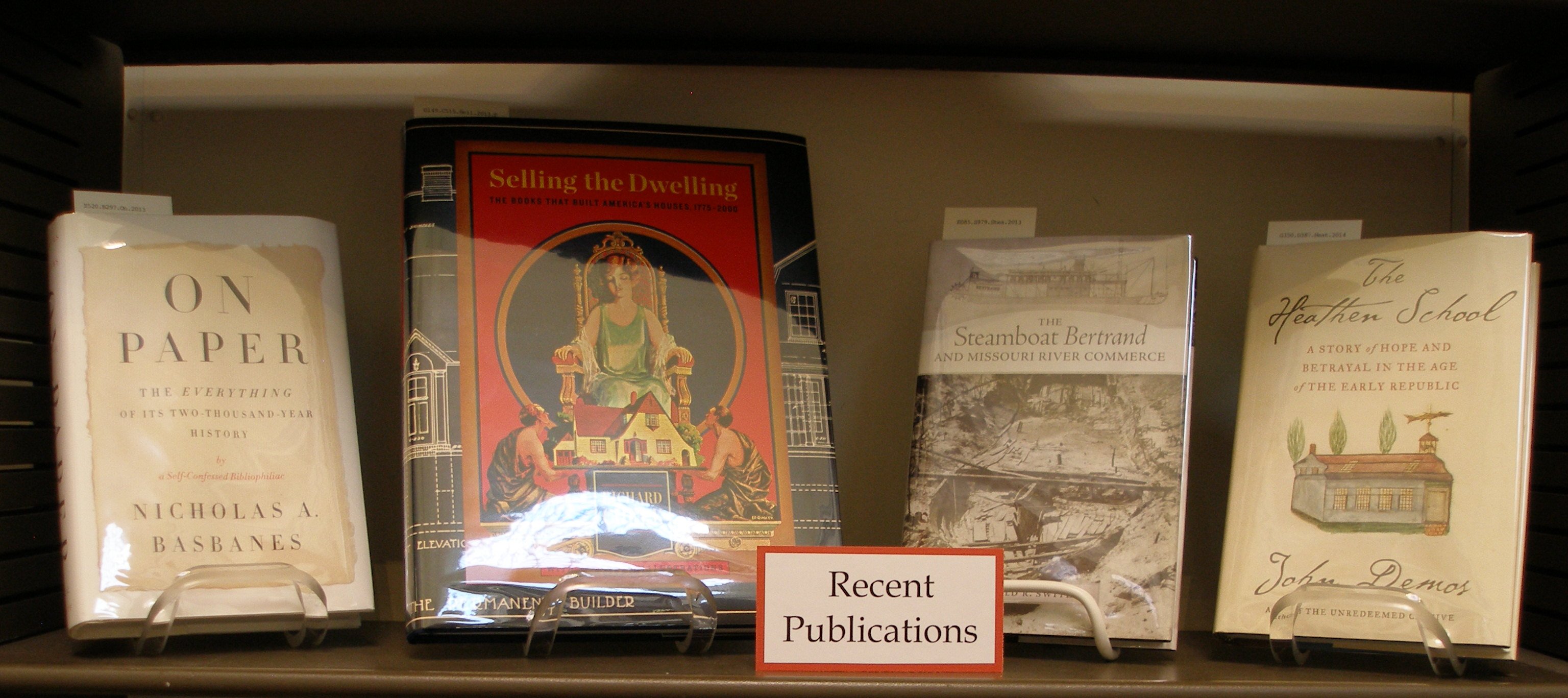
 

Recent Arrivals Shelf – Modern Scholarship

OLYMPUS DIGITAL CAMERALiving in the stacks amongst the vast collections of historical primary source material at AAS, one will find books of a much younger age.  AAS does not only seek to collect one copy of every thing printed in the United States up until about 1876; we also strive to add recent scholarship written about topics that reflect the time period of the collections. Having scholarship alongside these historic gems allows for some context to be provided for the materials, as well as encouragement for the fulfillment of possible missing areas of research and other untold stories. After all, there will always be an item inside of an archive that is waiting for an eager reader to stumble upon it and place it in context of the larger historical picture.

Here are some highlights from our Recent Arrivals Shelf, which can be found under the dome in the Reading Room for a short while before they make their way to their new home in the stacks.

OLYMPUS DIGITAL CAMERA

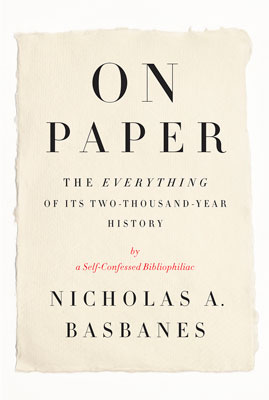
On Paper: The Everything of Its Two-thousand-year History
(New York: Alfred A. Knopf, 2013)
By Nicholas A. Basbanes
AAS Member (elected 1995)

Courtesty of www.nicholasbasbanes.com
Courtesy of www.nicholasbasbanes.com

Published in 2013, this book was also the topic of a talk given at AAS by the author on November 12th of this past year. In the first part of the book, Basbanes traces the history of the invention and spread of paper beginning in China and then traveling to North America. Aside from the timeline of the life of paper, Basbanes’ particular interest in regards to this book has to do more with the idea of paper, “one that certainly takes in the twin notions of medium and message, but that also examines its indispensability as a tool of flexibility and function” (Basbanes, xii). Basbanes also explores how paper has been a force in shaping historical events across time and place. On Paper was recently placed on the ALA’s shortlist for the Andrew Carnegie Medal of Excellence in Nonfiction. Read more about this honor here.

Also by Nicholas Basbanes:

  • About the Author: Inside the Creative Process (2010)
  • A World of Letters: Yale University Press, 1908-200 (2008)
  • Editions & Impressions: Twenty Years on the Book Beat (2007)
  • Every Book its Reader: The Power of the Printed Word to Stir the World (2005)
  • A Splendor of Letters: The Permanence of Books in an Impermanent World (2003)
  • Among the Gently Mad: Perspectives and Strategies for the Book-Hunter in the 21st Century (2002)
  • Patience & Fortitude: A Roving Chronicle of Book People, Book Places, and Book Culture (2001)
  • A Gentle Madness: Bibliophiles, Bibliomanes, and the Eternal Passion for Books (1995)

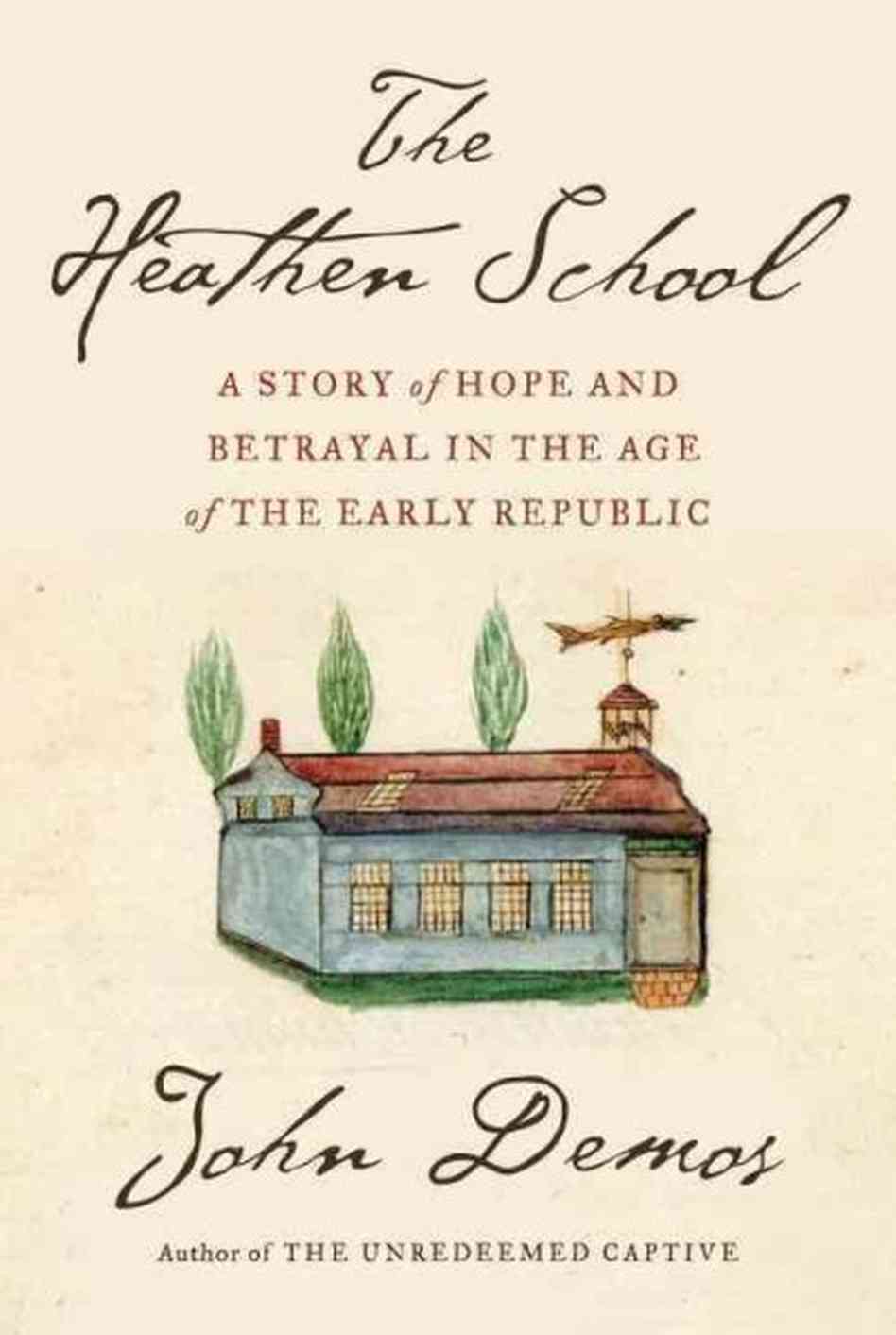
The Heathen School: A Story of Hope and Betrayal in the Age of the Early Republic
(New York: Alfred A. Knopf, 2013)
By John Demos
AAS Member (elected 1979)

Courtesy of: http://www.npr.org/2014/03/18/291130318/what-u-s-learned-from-heathen-school-wasnt-part-of-the-lesson-plan

Just published last month, this book will be the topic of an upcoming public lecture to be given by the author on June 10th, 2014, at 7:00 p.m. in Antiquarian Hall. The Heathen School tells the history of the Foreign Mission School of Cornwall, Connecticut, which was founded in the early nineteenth century. “Heathen youth” from all over the world would be brought to the school to be educated on Christianity and “civilization.” The story of this school encompasses the legacy of “American exceptionalism” as a nation that promotes, “a feeling of obligation…to make the world as a whole a better place” (Demos, 4). After a seemingly perfect start, the school was soon enveloped in controversy when some of the students began courting local white women. Ultimately, the reasons behind the failure of this school demonstrate that there are many points in American history that we need to encounter, learn from, and reflect on more often.

The Heathen School was also featured in a recent NPR article and Fresh Air story.

Also by John Demos:

  • The Enemy Within: 2,000 Years of Witch-hunting in the Western World (2008)
  • Circles and Lines: The Shape of Experience in Early America (2004)
  • A Little Commonwealth: Family Life in Plymouth Colony (1999)
  • The Tried and the True: Native American Women Confronting Colonization (1995)
  • The Unredeemed Captive: A Family Story from Early America (1994)
  • Past, Present, and Personal: The Family and the Life Course in American History (1988)
  • Entertaining Satan: Witchcraft and the Culture of Early New England (1982)

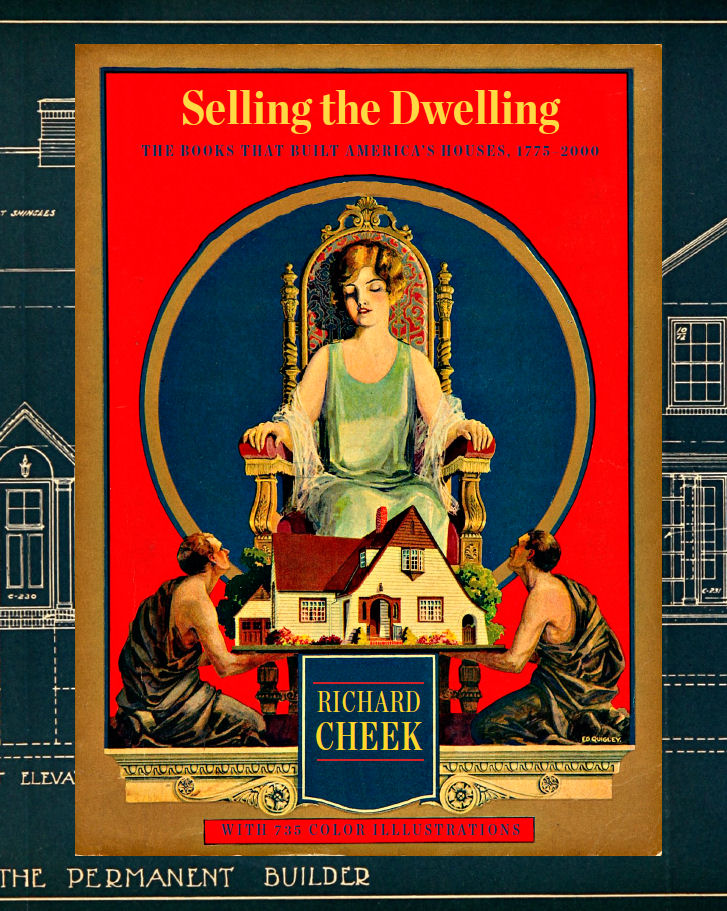
Selling the Dwelling: The Books that Built America’s Houses, 1775-2000
(New York: The Grolier Club, 2013)
By Richard Cheek
AAS Member (elected 2004)

Courtesy of Oak Knoll Press

This book was published as an accompaniment to an exhibition by the same name at the Grolier Club in New York which ran from December 11, 2013-February 7, 2014. The author of this book, who also curated the exhibit, is an architectural photographer who specializes in recording the visual history of American architecture. Both the exhibit and the publication explore how advertising ephemera, such as builder’s guides, pattern books, and catalogues, helped to portray a particular ideal home and market that home in order to make a sale.

“Cheek highlights the more visually arresting and socially compelling examples, focusing on books that reveal the character of our country as much as they do the style of our houses. With over 600 examples illustrated in the text, plus an appendix listing several hundred additional items, Selling the Dwelling is a significant contribution to the bibliography of American domestic architecture.” – Oak Knoll Press

Read more about the publication and the exhibition at the Grolier Club website.

Also by Richard Cheek:

  • Land of the Commonwealth: A Portrait of the Conserved Landscapes of Massachusetts (2000)
  • Gardens and Landscapes of Virginia (1993)
  • Newport Mansions: The Gilded Age (1982)

AAS to Participate in Greater Worcester GIVES, May 6th

On Tuesday, May 6, 2014, the American Antiquarian Society will be part of Worcester County’s first-ever online giving challenge, Greater Worcester GIVES. Organized and hosted by the GWG_400x300px_R-1Greater Worcester Community Foundation, Greater Worcester GIVES seeks to inspire people to support local nonprofits within that 24-hour period, for a collective impact that will benefit the region as a whole. Please help AAS contribute to a strong total for the community by donating to us in the challenge!

How it works:

On May 6th, go to http://www.gwgives.org/ and follow instructions to make an online donation of $25 or higher to the American Antiquarian Society. Your gift will be tax-deductible. All gifts are unrestricted unless you specify otherwise in the notes field on the giving form.

Stay tuned for more details closer to May 6th!

2014 Spring Public Programs Now in Full Swing

Now that the spring weather seems to have (finally) reached us here in Worcester, everyone is beginning to get out and partake in all of those activities they put off during the winter, including cultural events. We hope that our spring lineup of public programs at Antiquarian Hall—including the one tonight—will be among those that make it on to your springtime calendar!

“Dreaming up a Nation Forever on the Move: The Strange Quest for the ‘Great American Novel’”
By Lawrence Buell
Tuesday, April 22, at 7:00 p.m.
Co-sponsored by the Franklin M. Loew Lecture Series at Becker College

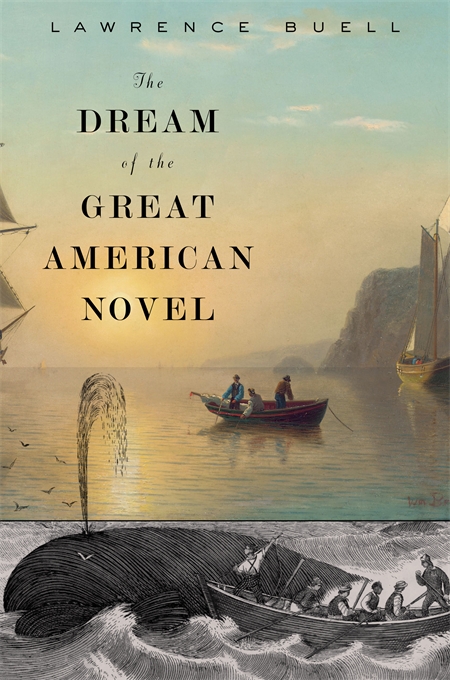
There have been hundreds of candidates for the Great American Novel in the nearly 150 years since John William DeForest first introduced the idea, but why have these books been buell (3)contenders for this title? What do claims of being the GAN really mean? In this lecture based upon his recently published book The Dream of the Great American Novel, lecturer Lawrence Buell charts the history of the quest to write the Great American Novel and then uses this history as a platform for exploring some of the characteristic ways that GAN candidates have acted as explorations and reference points for imagining a national identity.

Buell is Powell M. Cabot research professor of American literature at Harvard. He has written and lectured worldwide on American fiction, on the Transcendentalists and their legacies, and on the environmental humanities. His books include Literary Transcendentalism (1973), New England Literary Culture (1986), The Environmental Imagination (1995), Writing for an Endangered World (2001), and Emerson (2003).

“‘Slavery in the Bowels of a free & Christian Country:’ People of Color and the Struggle for Freedom in Revolutionary Massachusetts”
By Thomas Doughton

Tuesday, May 13, at 7:00 p.m.
Co-Sponsored by Africana Studies at the College of the Holy Cross

Regional people of color submitted three important petitions to the provincial legislature: one calling for an end of slavery in the colony, another asking that former slaves be transported back to Africa, and a third that the legislature set aside lands in the western part of Massachusetts for former slaves. This presentation will explore the relationships of people of color in central New England as “A great number of Negroes …detained in a state of Slavery” to an emerging political discourse of revolutionary freedom and racial equity in rural Massachusetts.

Thomas Doughton is the senior lecturer at the Center for Interdisciplinary and Special Studies at the College of the Holy Cross. Doughton specializes in the history of people of color and their relationships with whites in Central New England.

worcrevolution(This program is being presented as part of the Worcester Revolution of 1774, a celebration of Worcester County’s overthrow of British Authority seven months before the fighting at Lexington and Concord. For further information about this project see http://www.revolution1774.org/)
“Sifting the Uneven Archive: Researching The Forage House”
By Tess Taylor

Thursday, May 29, at 7:00 p.m.

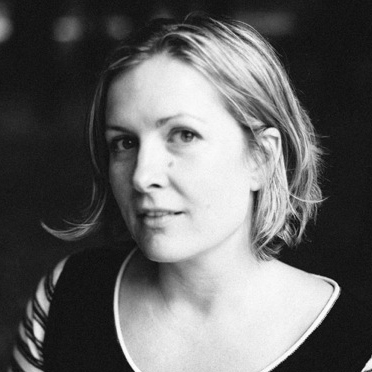
In this program, poet Tess Taylor will recount how a residency here at the AAS helped her as she researched and wrote her latest book of poems, The Forage House. Her poems layer oral TessTaylor-tnhistories, documents, and folksongs to craft an exploration of her ancestors—a mix of New England missionaries and Southern slave owners, including Thomas Jefferson. Taylor’s poems are as much about the imperfect material of family stories as they are about the politically charged material of history.
Taylor’s poetry and nonfiction have appeared in The Atlantic, Boston Review, Harvard Review, Literary Imagination, The Times Literary Supplement, and The New Yorker. She currently reviews poetry for NPR’s “All Things Considered” and teaches writing at the University of California, Berkeley.

“On the Trail of the ‘Heathen School’: Local History, American History, and World History”
By John Demos

Tuesday, June 10, at 7:00 P.M.

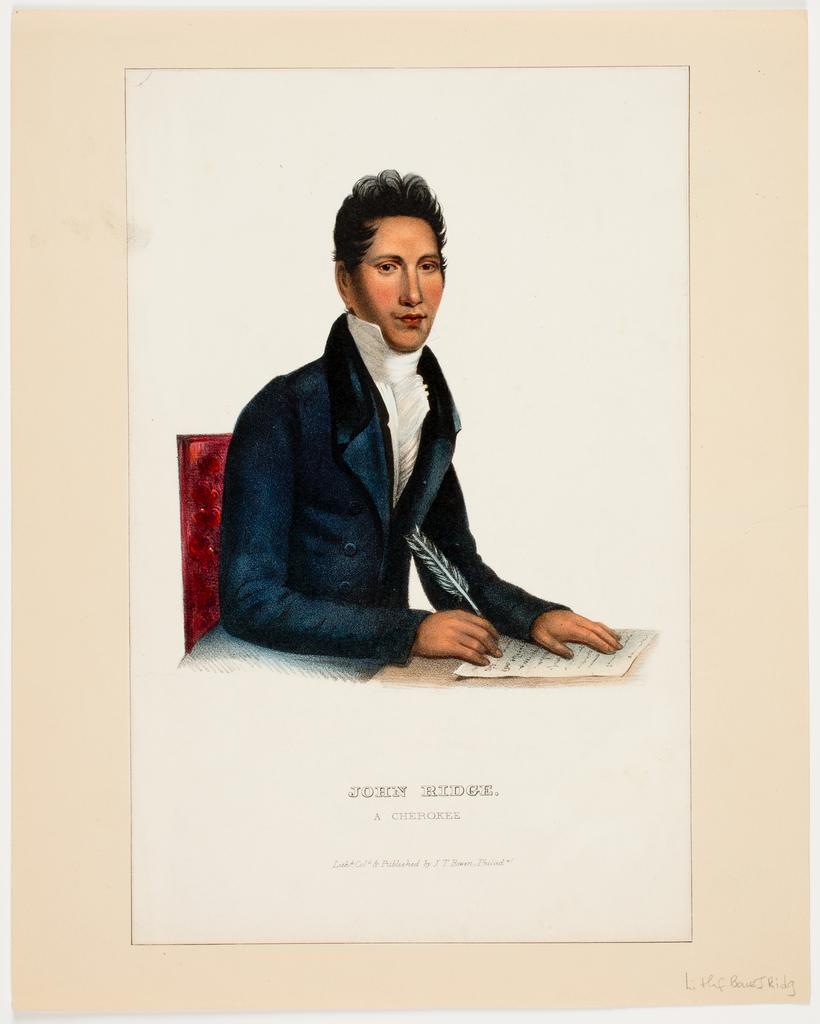
john ridgeThis lecture will be based on Demos’s newly published book unraveling the forgotten story of a special school for “heathen youth” brought to New England in the early nineteenth century from all corners of the earth. Located in the little town of Cornwall, Connecticut, this uniquely fashioned institution embodied an early version of what we now call American exceptionalism: convert them, educate them, civilize them, then send them back to found similar projects in their respective homelands, and the world will be saved in the shortest time imaginable. After a seemingly brilliant beginning, however, the plans ran afoul of racism—when some of the heathen students courted local women. The result was scandal, widespread controversy, and permanent closure of the school. Demos will also reflect on the process of his research, including his time as a distinguished scholar at the Antiquarian Society and his visits to places central to the story.

John Demos is the Samuel Knight professor of history emeritus at Yale University. Demos’s award-winning books cover topics ranging from family life in Plymouth County, Massachusetts, to witch-hunting in the Western world, in such works as A Little Commonwealth: Family Life in Plymouth Colony (1970), the Bancroft Prize-winning Entertaining Satan: Witchcraft and the Culture of Early New England (1982). Demos is a member of the American Antiquarian Society and was the AAS-Mellon Distinguished Scholar-in-Residence during the 2012 calendar year.

The Acquisitions Table: The Bookbinders Shop

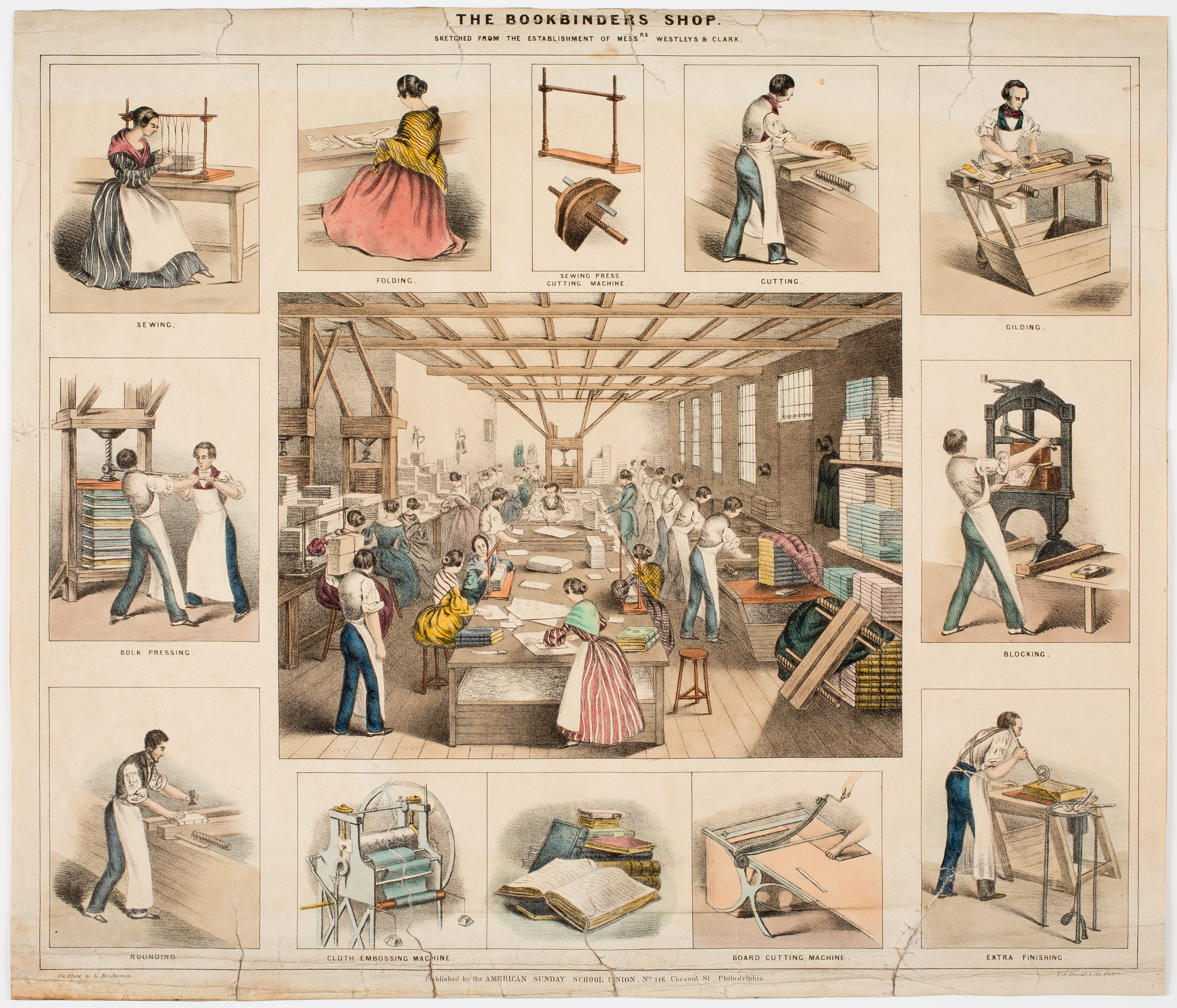
The Bookbinders Shop. Philadelphia: P.S. Duval for the American Sunday School Union, ca. 1850.

This image of the interior of the British bookbinding establishment of Westleys & Clark was issued by the Philadelphia lithographer P.S. Duval sometime between 1842 and 1850. A second, related print showing a ship and its furniture was printed by Duval using the same bordered vignette format, also for the American Sunday School Union.  Possibly the images (along with others not yet located) were used to educate children about trades — each features workers and modern equipment along with relevant vocabulary.  Duval had a steady relationship with the American Sunday School Union, publishing several small-format, paper-covered books for children during this period.  The bookbinding shop shown in this print includes both male and female workers surrounded by reams of paper and the tools used to create books for the booming markets of Europe and America.

Adopt-a-Book 2014

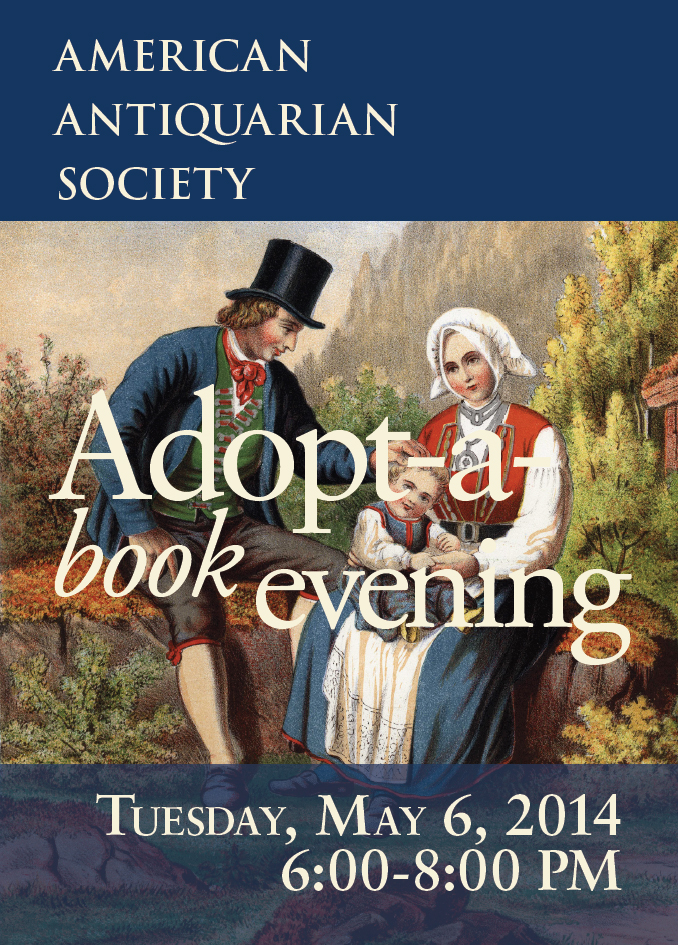
This year the American Antiquarian Society will be holding its 7th annual Adopt-a-Book event on Tuesday, May 6th, from 6:00 to 8:00pm.  This event has been an entertaining and successful fundraiser for the library’s continued acquisitions of historic material. The money raised helps curators buy more books, pamphlets, prints, newspapers, and manuscripts.  coveradoptabookOn May 6th, participants will have the opportunity to view all kinds of material recently acquired by AAS, including a book on fortunetelling, a Confederate newspaper, and a copy book made by a New England schoolchild.   You can adopt in your name or in memory/in honor of a special person (or both, with multiple adoptions!). The event has become so popular with our members, fellows, local supporters, and staff, that many previous participants ask the curators in advance for hints about the type of material that will be made available for adoption!  Everyone has been waiting for the catalog.

And here it is!  Today, we launch the 2014 Adopt-a-Book event with the online catalog, which will remain active through May (or until everything is adopted).  Participants who wish to pre-adopt can do so now, direct from the digital catalog (and as an added incentive, entrance to the May 6th event is FREE if you pre-adopt from the online catalog, otherwise $10).  So click on over and have a look at the 110 objects the curators have selected for the online portion of this event.  Don’t worry if it seems like everything is getting snapped up quickly – we are always gratified by the enthusiasm our supporters show.  And, the curators have already selected additional, exclusive, material that will only be up for adoption in person at the event on May 6th.

To further tempt you, here are selections in the online catalog from each of the five curatorial departments:

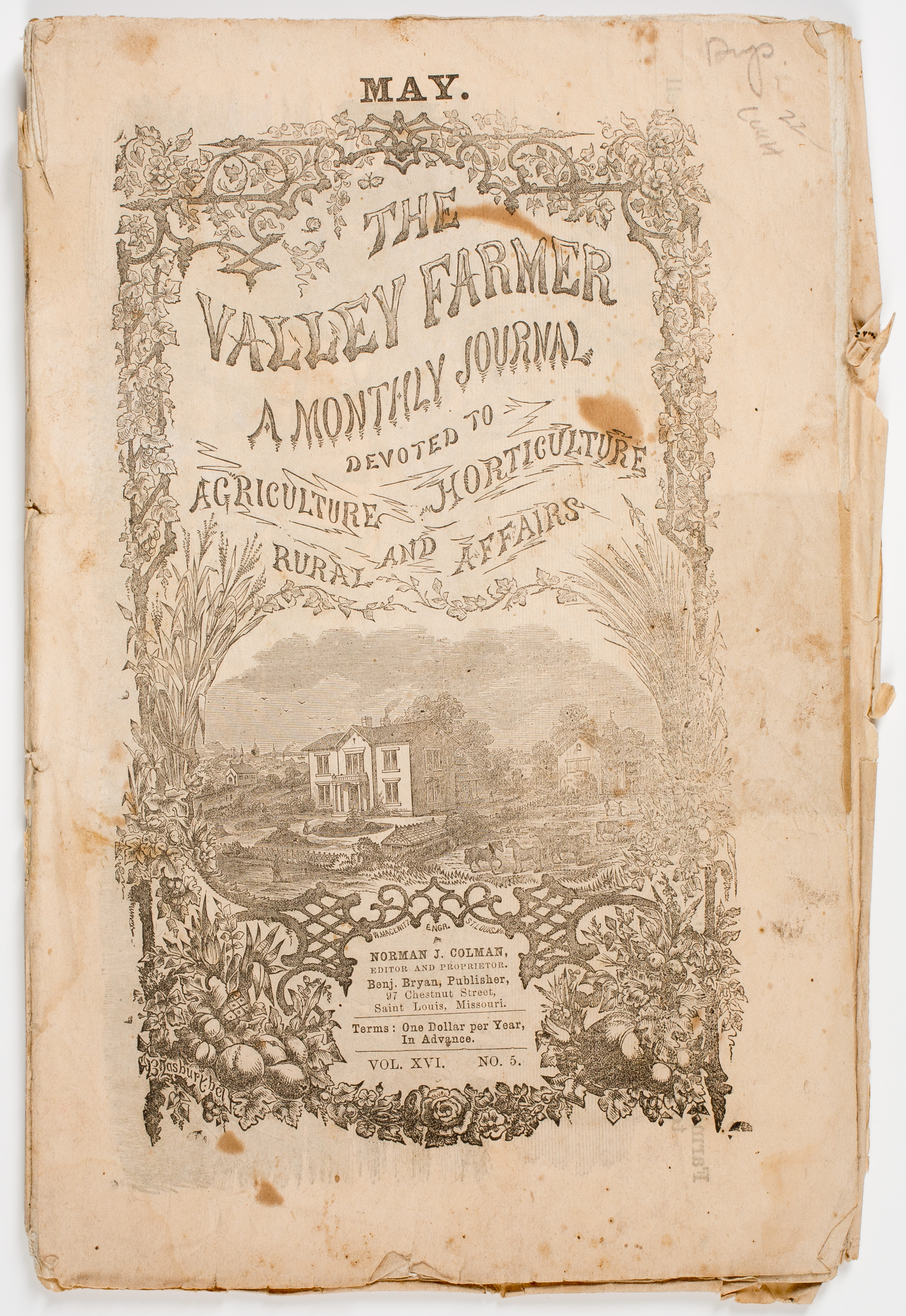
1The Valley Farmer (St. Louis, MO).  May 1864 
Adopt me for $25

This is a nice western agricultural periodical in its original wrappers.  This issue was edited by Norman J. Colman who was later the first U.S. Secretary of Agriculture.  He purchased the failing periodical in 1855 and made it very successful promoting modern agricultural techniques.


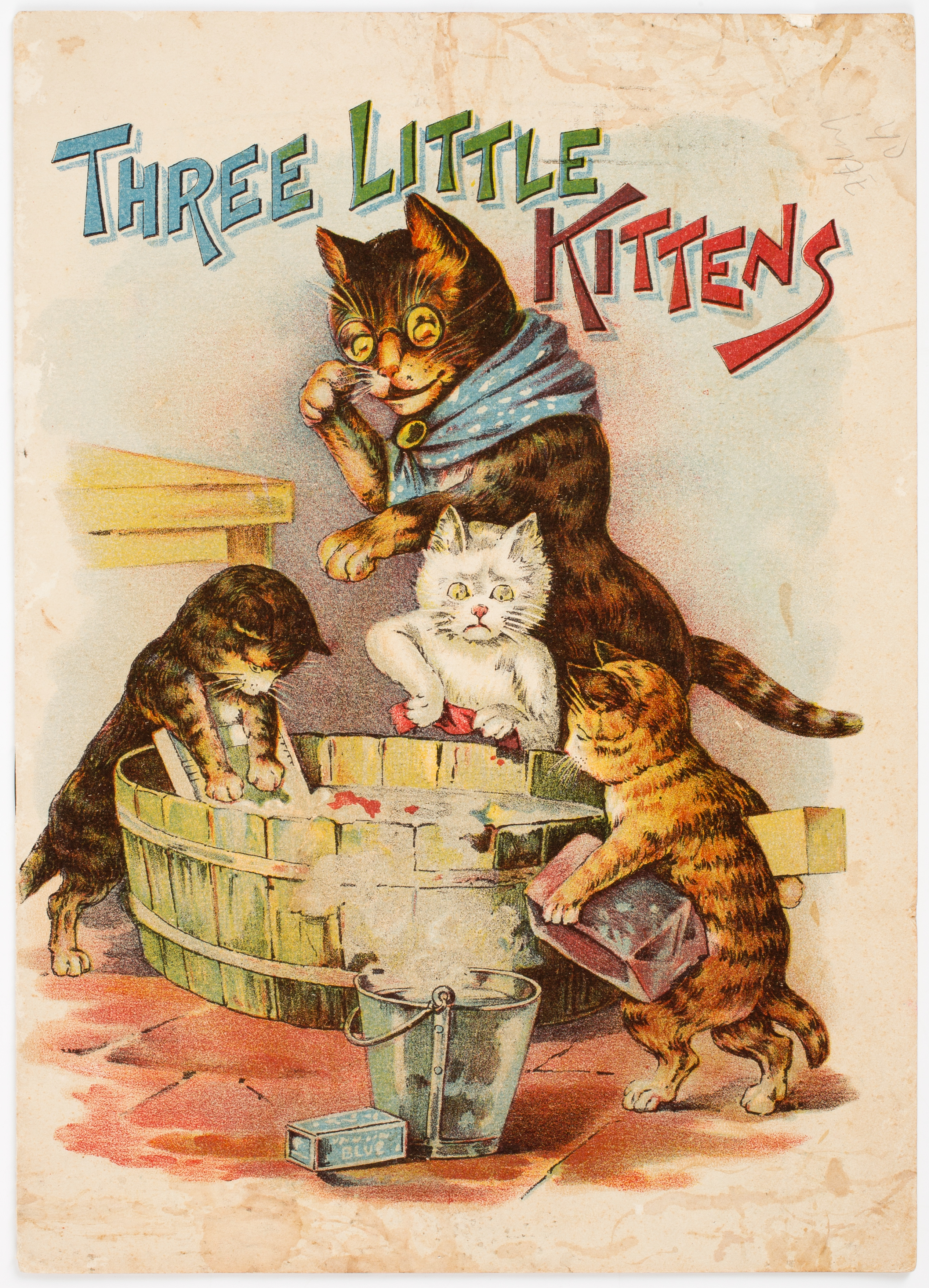
fThree Little Kittens. St. Louis: Scruggs, Vanderwoort & Barney, ca. 1880.
Adopt me for $50

Mamma Cat puts her three kittens to work washing their mittens in this delightful chromolithographed Three Little Kittens, a picture book issued by the St. Louis department store Scruggs, Vanderwoort & Barney.  The back cover has a full-page advertisement for the store touting its reputation as “a vast storehouse of everything that the feminine mind can think of for immediate wear.”

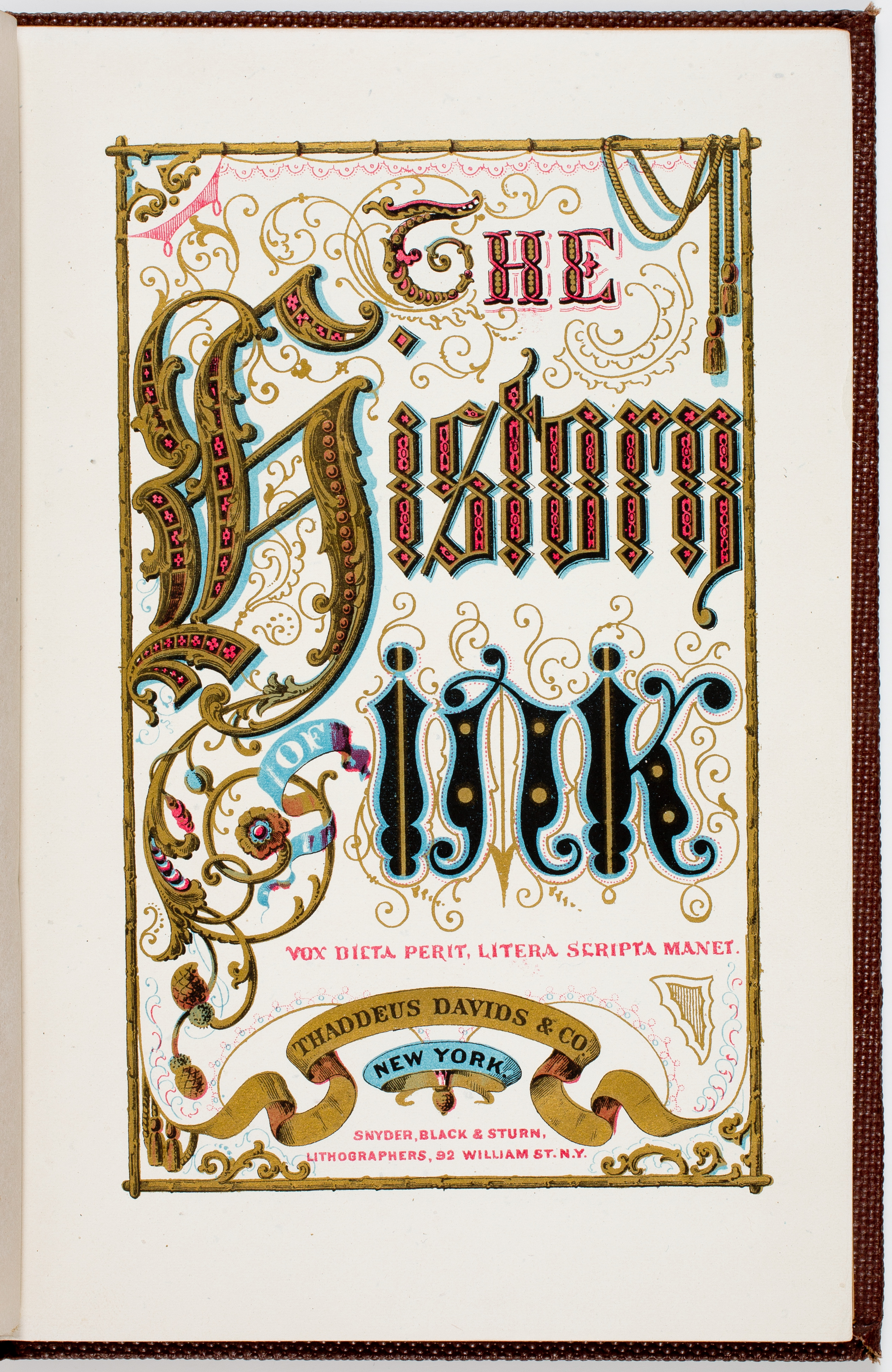
inkThaddeus Davids, The History of Ink: Including its Etymology, Chemistry, and Bibliography. New-York, 1856.
Adopt me for $100

Designed in large part to promote Thaddeus Davids’ company, self-proclaimed maker of “the best ink known,” later editions of the book were plastered with advertisements and press notices. It took its subject matter seriously, though, from its first sentence declaring, “Ink is history.” Egypt and the Aztecs, writing ink and printing ink, paper mills and poetry about ink are all discussed.

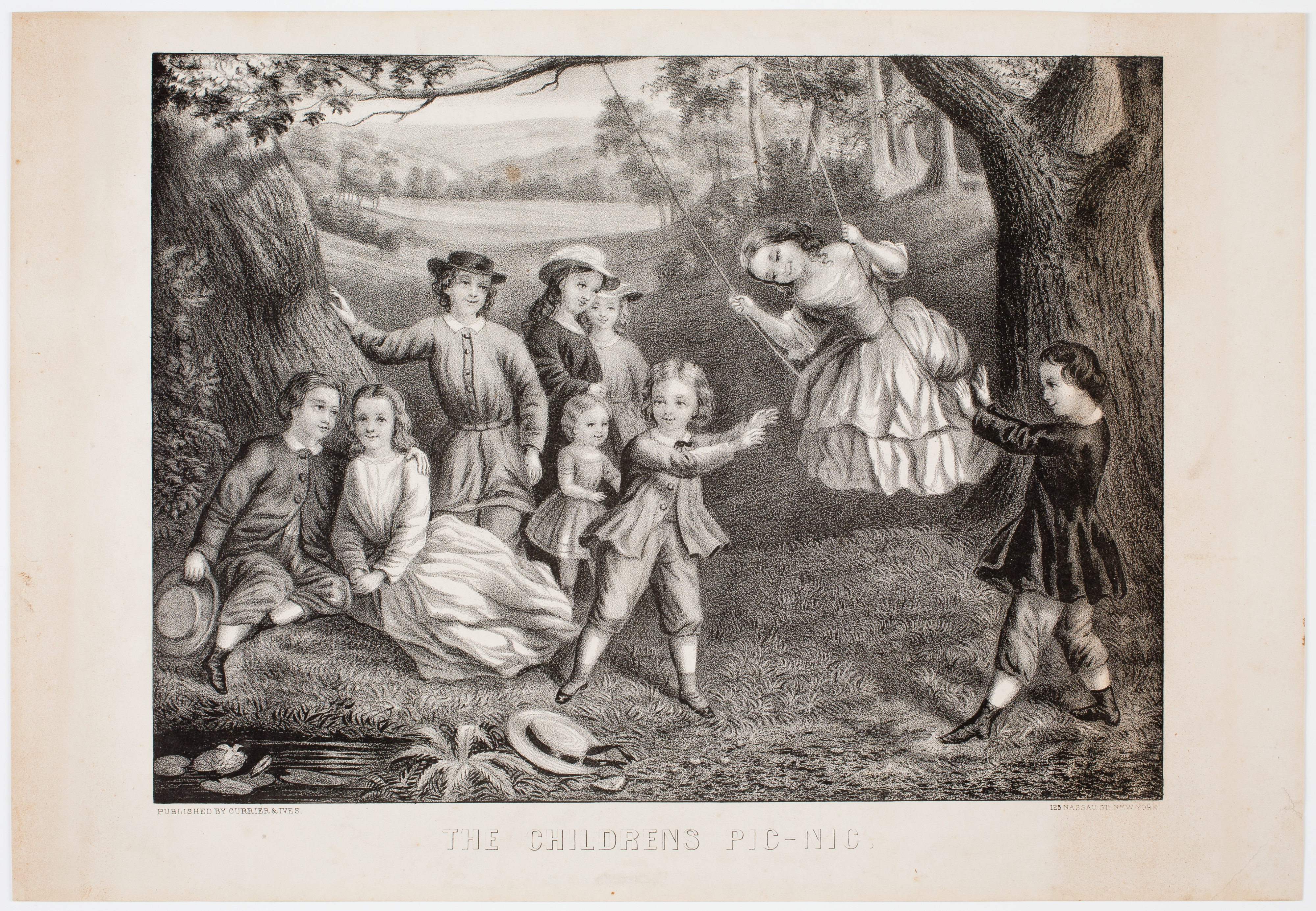
childrenThe Children’s Pic-nic. New York: Currier & Ives, 1872-1874.
Adopt me for $75

This charming scene of well-dressed children playing outdoors was issued by Currier & Ives towards the end of their long run as print sellers and publishers in New York. The firm listed numerous genre prints of happy and adorable (and adoptable!) children under the heading “Juvenile” in their catalogs.

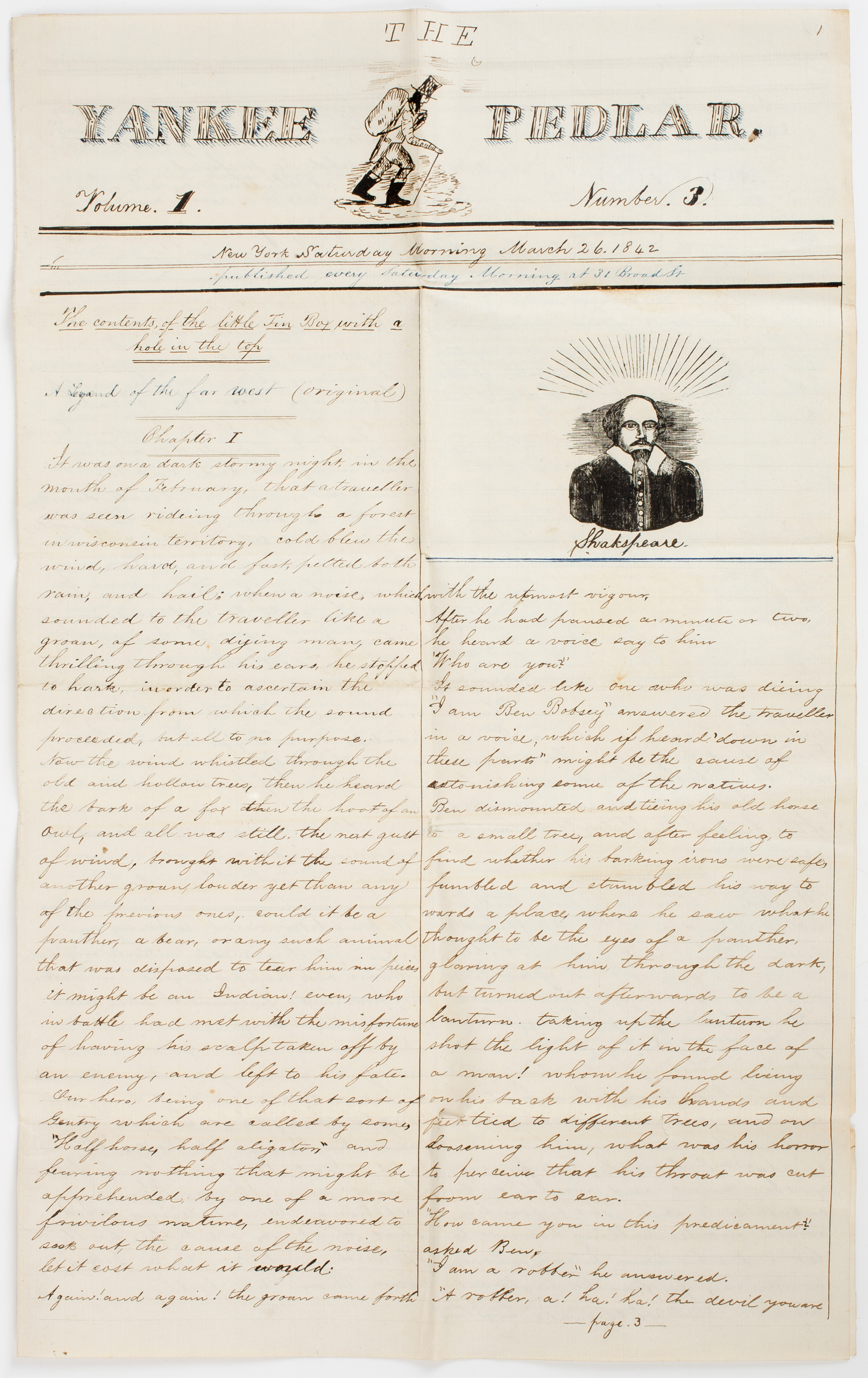
yankeeThe Yankee Pedlar, vol. 1, no. 3, 1842.
Adopt me for $100

According to the masthead, this handwritten newspaper was “published every Saturday Morning at 31 Broad St.”  The cover features a piece titled “The contents of the little Tin Box with a hole on the top” as well as a woodcut portrait of Shakespeare.


We are grateful to the following vendors for their generous donations for your enjoyment on May 6th:

  • Ed Hyder’s Mediterranean Marketplace
  • Sahara Restaurant
  • Crown Bakery

This event is being held in conjunction with Greater Worcester Gives.

The Acquisitions Table: Samuel Dickinson Barton Lecture Notes

Barton, Samuel Dickinson. Lecture Notes (Amherst College), 1827 and undated.

Barton notebooksSamuel Dickinson Barton was a student in the class of 1831 at Amherst College in Amherst, Massachusetts.  These two volumes contain notes written by Barton while attending lectures at Amherst.  One is dated 1827, the other is undated.  The lectures he attended cover a variety of topics including theology, geology, mineralogy, natural philosophy, English, French, and chemistry.  These volumes are particularly interesting because they include lectures delivered by Edward Hitchcock (1793-1864).  Hitchcock is considered one of the founders of American geology and geology as a science.  He founded the Association of American Geologists, was head of the first geological survey of Massachusetts, and was appointed State Geologist of Massachusetts in 1830.  He began teaching at Amherst College in 1825, and served as president of the college from 1845-1854.  These volumes show that Hitchcock not only made his mark on the science of geology, but remained devoted to teaching and education as well.  He continued teaching at Amherst College until his death in 1864.

Adventures in Cataloging: Some Sleuthing Required (Part III)

This week, the series ends by correcting a case of mistaken identity. And if you missed the first two parts, be sure to check them out: Part I, Part II.

3. The Doctors Jackson

We like to trace provenance information in our records when we can. This allows one to find former owners, virtually reconstruct an individual’s book collection, and think on questions about audience and readership in relation to the titles at hand.

An Eulogium upon Benjamin Rush, M.D. by David Ramsay (Philadelphia, 1813) was given to “S. Jackson from E. Lewis” at an unknown time in the early nineteenth century. Later, it was owned by Dr. Asa M. Stackhouse of Morristown, N.J., who inscribed the title page, and William R. Stackhouse, who affixed his bookplate to the front flyleaf.

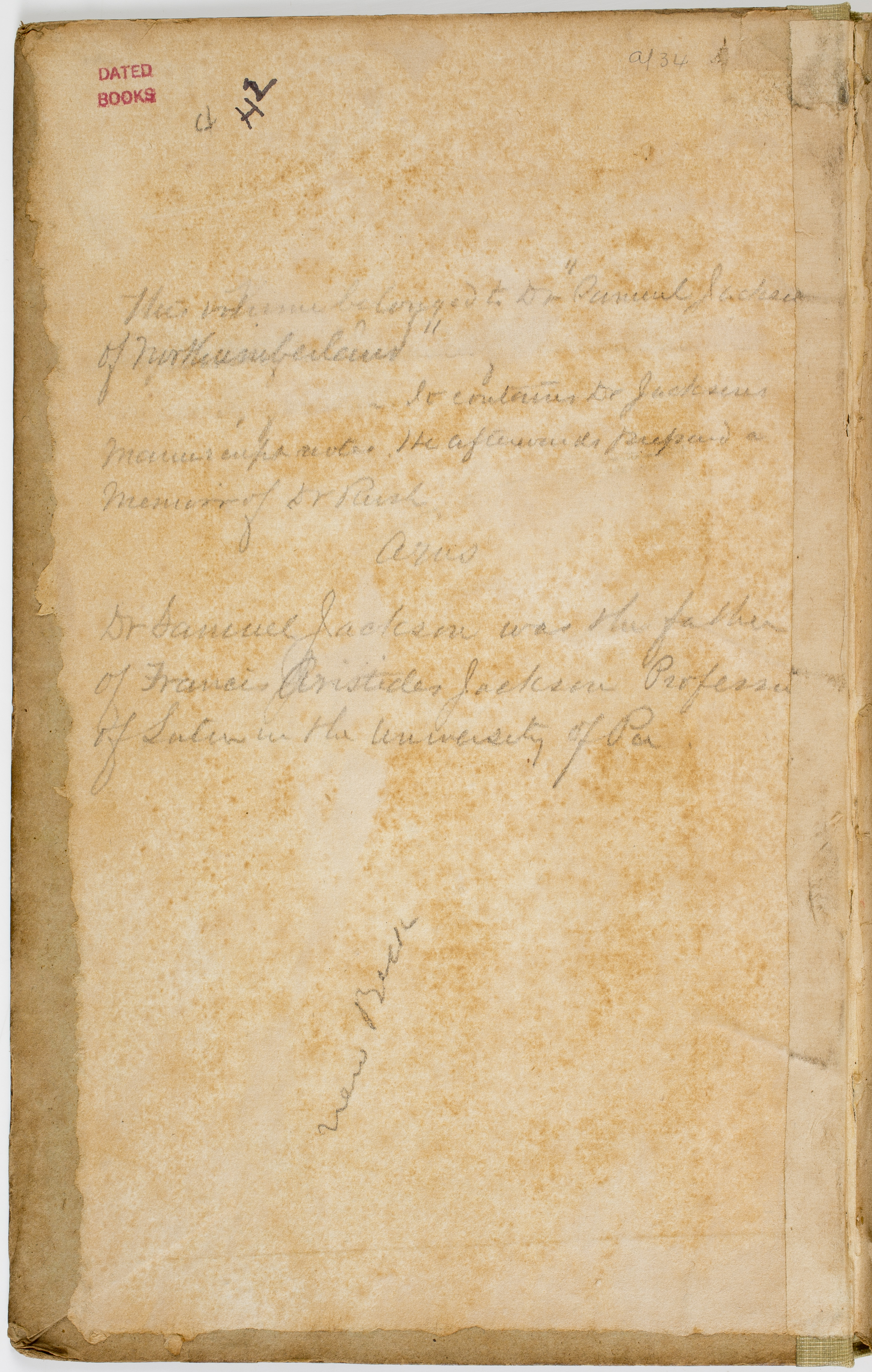
Dr. Asa M. Stackhouse’s notes about Dr. Samuel Jackson, which proved to be the key to disentangling the identities of the doctors Jackson.

Unfortunately, “S. Jackson from E. Lewis” is a rather uninformative inscription and gives little information that would help identify the individuals involved. However, Dr. Stackhouse obligingly added a note concerning provenance. He tells us that Dr. Samuel Jackson of Northumberland was the former owner and annotator of the volume, and that Dr. Jackson was the father of Francis Aristides Jackson, a professor of Latin in the University of Pennsylvania.

Searching for biographical information about the father of Francis Aristides Jackson proved productive, and we discovered that Dr. Samuel Jackson was born in 1788, earned his M.D. at the University of Pennsylvania in 1812, lived in Northumberland, Pa., and died in 1869.

However, the process of discovery did not stop there! Dr. Samuel Jackson (1788-1869) was actually one of two individuals by that name who lived in Pennsylvania and obtained an M.D. from the University of Pennsylvania during the early nineteenth century. The other Dr. Samuel Jackson was born in 1787, earned his M.D. at the University of Pennsylvania in 1808, and died in 1872.

Unsurprisingly, the good doctors had been confused and bibliographically conflated. All the titles ascribed to a Dr. Samuel Jackson of Pennsylvania had been attributed to Dr. Samuel Jackson (1787-1872), and Dr. Samuel Jackson (1788-1869) had disappeared from the bibliographic record. Knowing that there were two Dr. Samuel Jacksons allowed us to disambiguate them and correct errors in attribution.

Dr. Samuel Jackson (1788-1869) is now correctly listed as the author of two pamphlets, The Annual Discourse before the Philadelphia County Medical Society, delivered February 10, 1852 (Philadelphia, 1852) and The Organizing of the American Medical Association (Philadelphia, 1852). Additionally, he has been identified as the former owner of two titles held by the American Antiquarian Society, Elements of Surgery for the Use of Students by John Syng Dorsey (Philadelphia, 1813) and The Philosophy of Human Knowledge, or A Treatise on Language by A.B. Johnson (New York, 1828). These corrections will not, perhaps, set the academic and bibliographic worlds afire, but they help make the bibliographic record a little more correct than it was before.

A Young Reader’s Appreciation for Johnny Tremain

Editor’s note: In a twist that follows up on Jackie Penny’s account of reading pre-1900 fiction to her children, retired AAS director of book publication Caroline F. Sloat turned to her ten-year-old grandson for an enthusiastic recommendation of Esther Forbes’s Johnny Tremain.

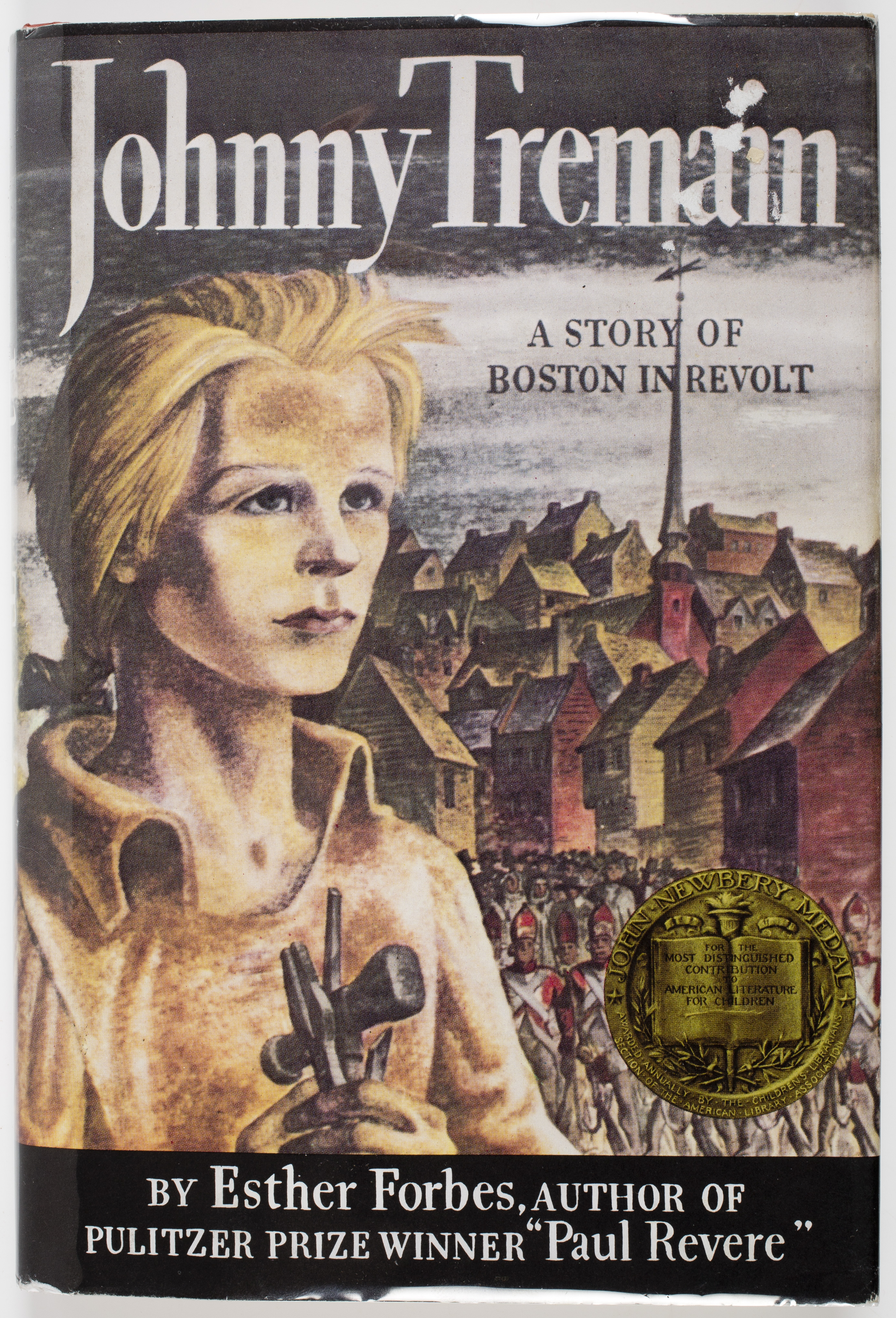
Our bags were packed and we were ready to leave for the airport when Henry chose to ask about Johnny Tremain.  He had read it before school closed for the summer and was captivated. My grandson usually stops reading a book when “something bad” happens to the hero, but the injury to Johnny’s hand was an exception. In fact, Henry even thinks the book needs a sequel.

Tremain 1998
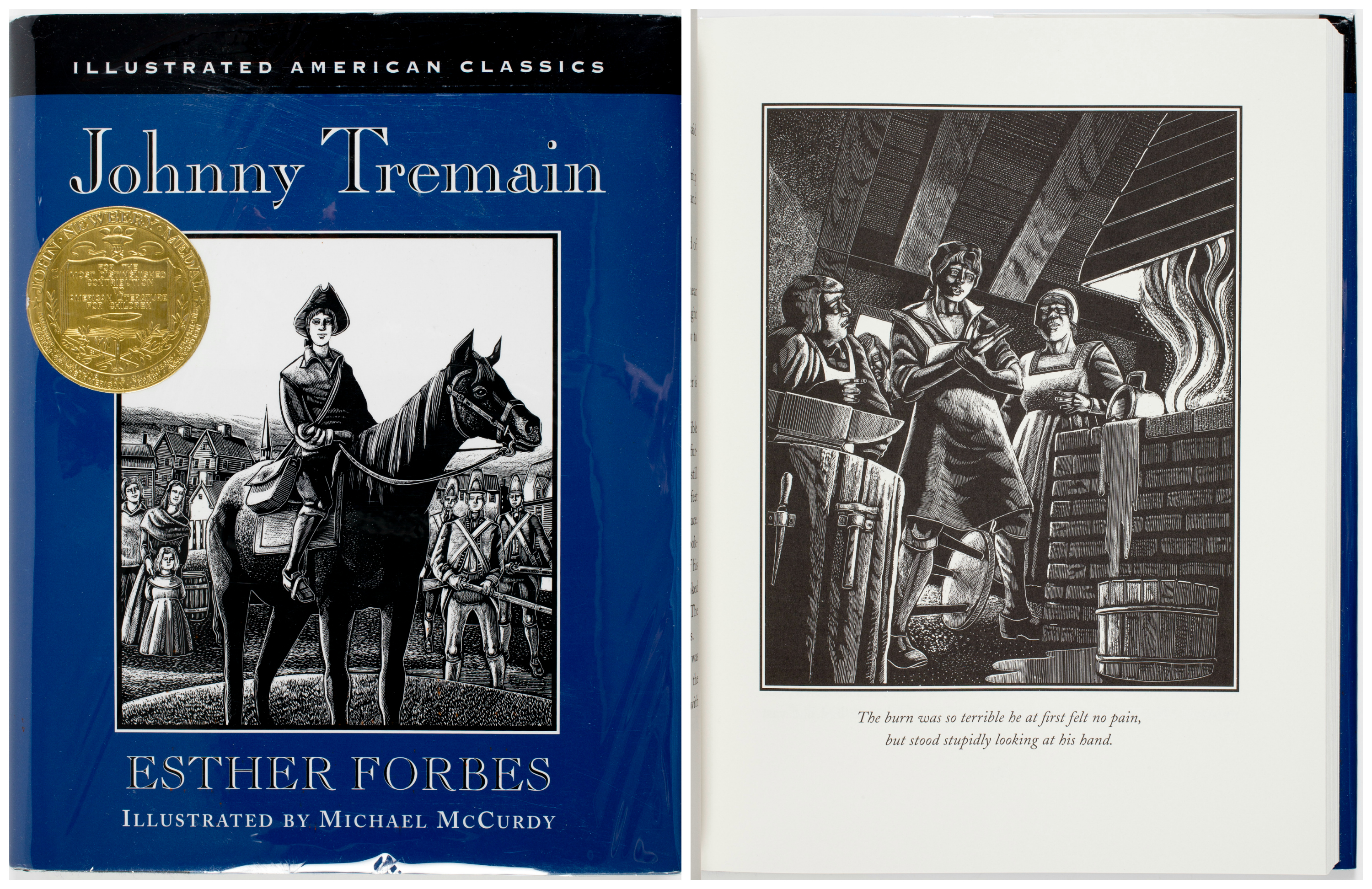
Cover of and illustration from the 1998 edition of Johnny Tremain. The illustration depicts the injury to Johnny’s hand.

His comments begged further discussion, but then, alas, was not the time. I knew it would be a few months before I would see him again and, and as full as his days are, I wondered how much he would remember.  A lot it turned out, and he was eager to talk.  He began by saying that he liked the way the author “blended an invented story into a real story.” The result “made sense” to him because it was a way to learn a lot about the time in which it took place, one that he considered important.  He particularly liked the way the plot revolved around more than Johnny’s accident. In his experience with fiction he thought that many writers would have ended the story there.  “Instead,” the author wrote “the extra section” that was “really long and you learn a lot more than you expected.”

112176_0001
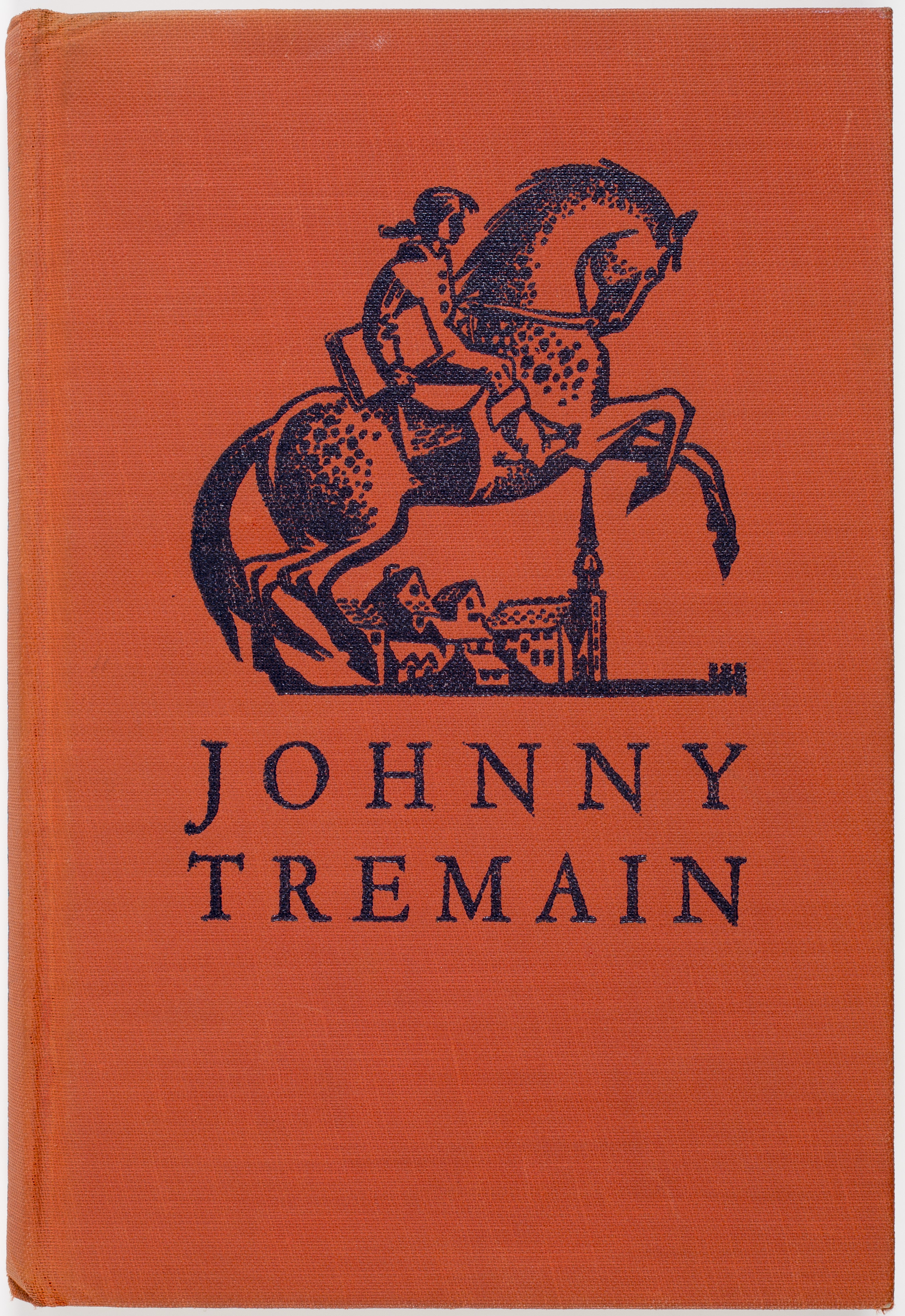
Cover of the original 1943 edition

Nuances were not lost on him either: “most people would think that Americans only wanted independence and the British only wanted to keep the colonies. But that’s not true because a few Americans really wanted the British to keep ruling and some of the British wanted America to be separate. Sometimes people think that the United States already had a big military, but they didn’t and so they had to train their own soldiers.”

Esther Forbes might be pleased to know that reading the book was a “fun way” for Henry to explore Boston from his Seattle classroom. Boston came alive as Johnny “carried mail for money and delivered letters as a spy.” He also enjoyed reading about working in the ships and how to get around Johnny’s Boston and felt it was important to learn about such topics as the Boston Tea Party and Paul Revere’s Ride, but—and here comes the critique that Forbes might not find as gratifying: “I also noticed that the book didn’t have a really good ending. You need a second book. Johnny wanted to go into the army and you need to teach about life in the army and learn more about the whole revolution.”

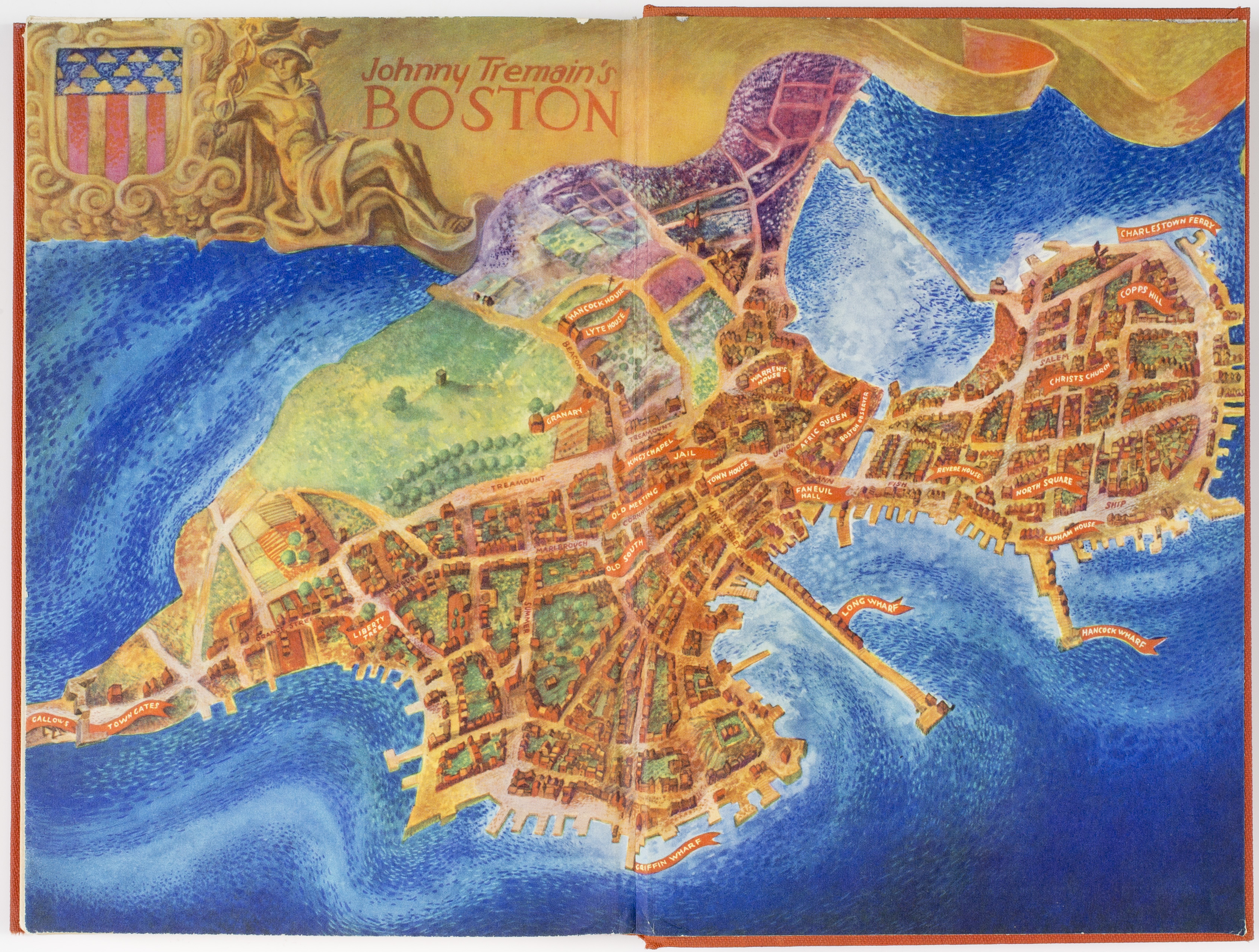
Map from the inside cover of the 1943 edition - a helpful tool for understanding the text
Map from the inside cover of the 1943 edition – a helpful tool for understanding the text.

That said, Henry reported that the book started a “Revolutionary War craze” in Mr. A.’s classroom. The kids watched the 1957 Disney Johnny Tremain movie and found other books. Over the summer Henry himself was able to visit Mystic Seaport to see old ships and Old Sturbridge Village, which seemed to him a “lot like the outskirts of Boston.”  The “blacksmith and the tin shop also give you the idea of silversmithing and the printing office and houses also help you learn about what life was like for Johnny. “

Cover of the 1971 edition

Henry summed up our conversation by observing that the book has a lot of facts for kids who don’t like to read nonfiction on their own and was a “good way to sneak them in.” As Henry’s grandmother, I would say it was a good way of sneaking fiction into his usual diet of nonfiction by creating a character and situation that he found completely credible and engaging.

Seventy years after Forbes won the Newbery Medal for this book—a product of her creative imagination and skillful transformation of archival research at the American Antiquarian Society—it still resonates with young people. Johnny Tremain will be the subject of a Hands-On History Workshop to be offered by the Society on Saturday, May 10, 2014, and a portion of the day will feature discussion about the use of the novel in the classroom. If you are a teacher, take it from Henry: “it adds to your knowledge and it’s nice to read.” And if you’re an adult who hasn’t read it recently, it’s still in print (or available for download) and a wonderful glimpse of some of the best research and writing to emerge from “under the generous dome.”

Adventures in Cataloging: Some Sleuthing Required (Part II)

Last week, in Part I, Amy discovered the title and date of a pamphlet missing a title page by scouring the newspapers. Now, she puts a name to a remarkable but unidentified woman.

2. The life of Ms. Sally (or Sarah) Rogers

Sometimes, I catalog a book or pamphlet and a person appears whom we know nothing about and who isn’t in the Name Authority File, the international database catalogers use to identify people.[1] When this happens, I once again dive into research to sort out the identity of the such people so that I can identify them with a unique heading in our records and they can be found as an author or subject.

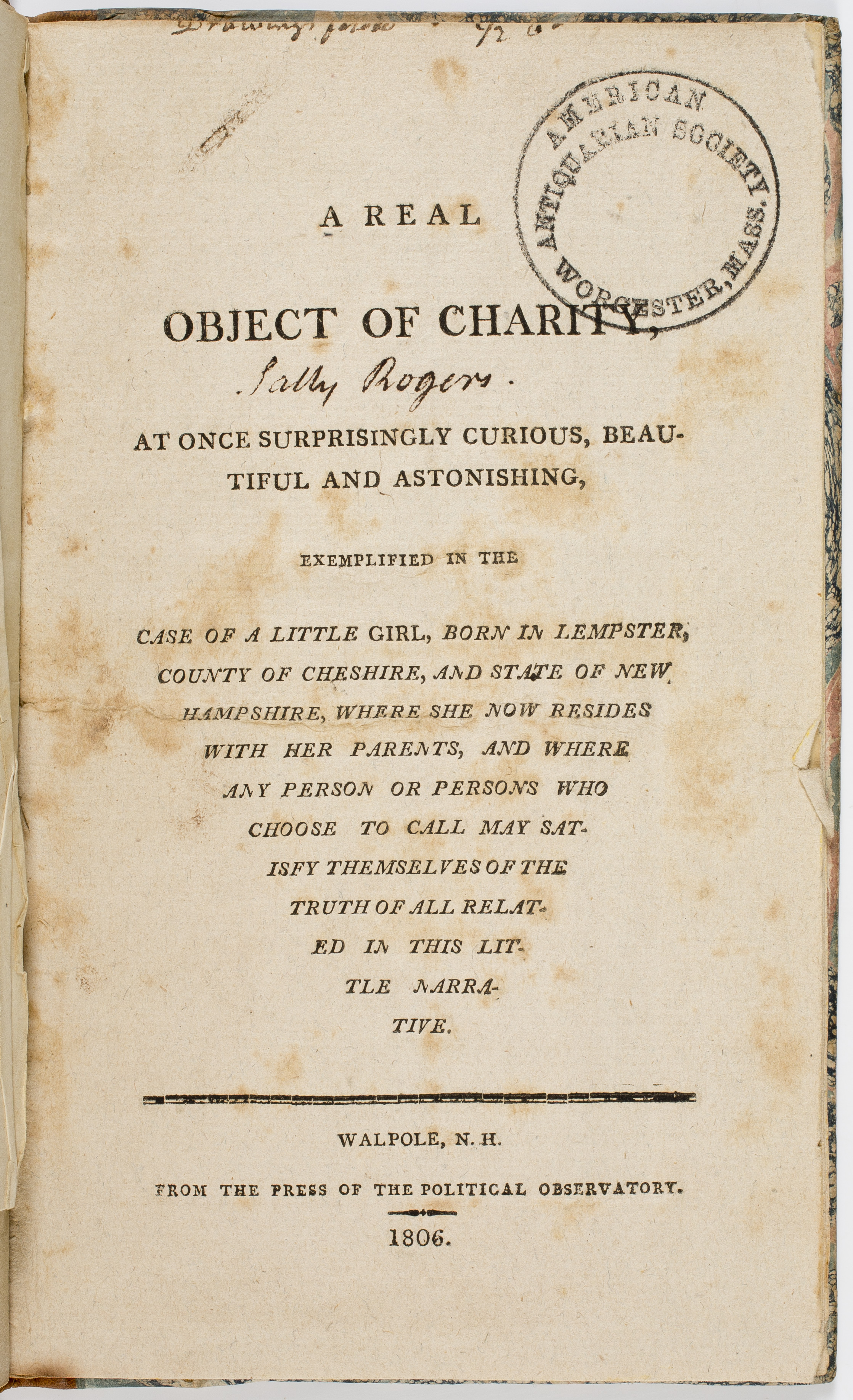
Title page of A Real Object of Charity (Walpole, N.H., 1806).

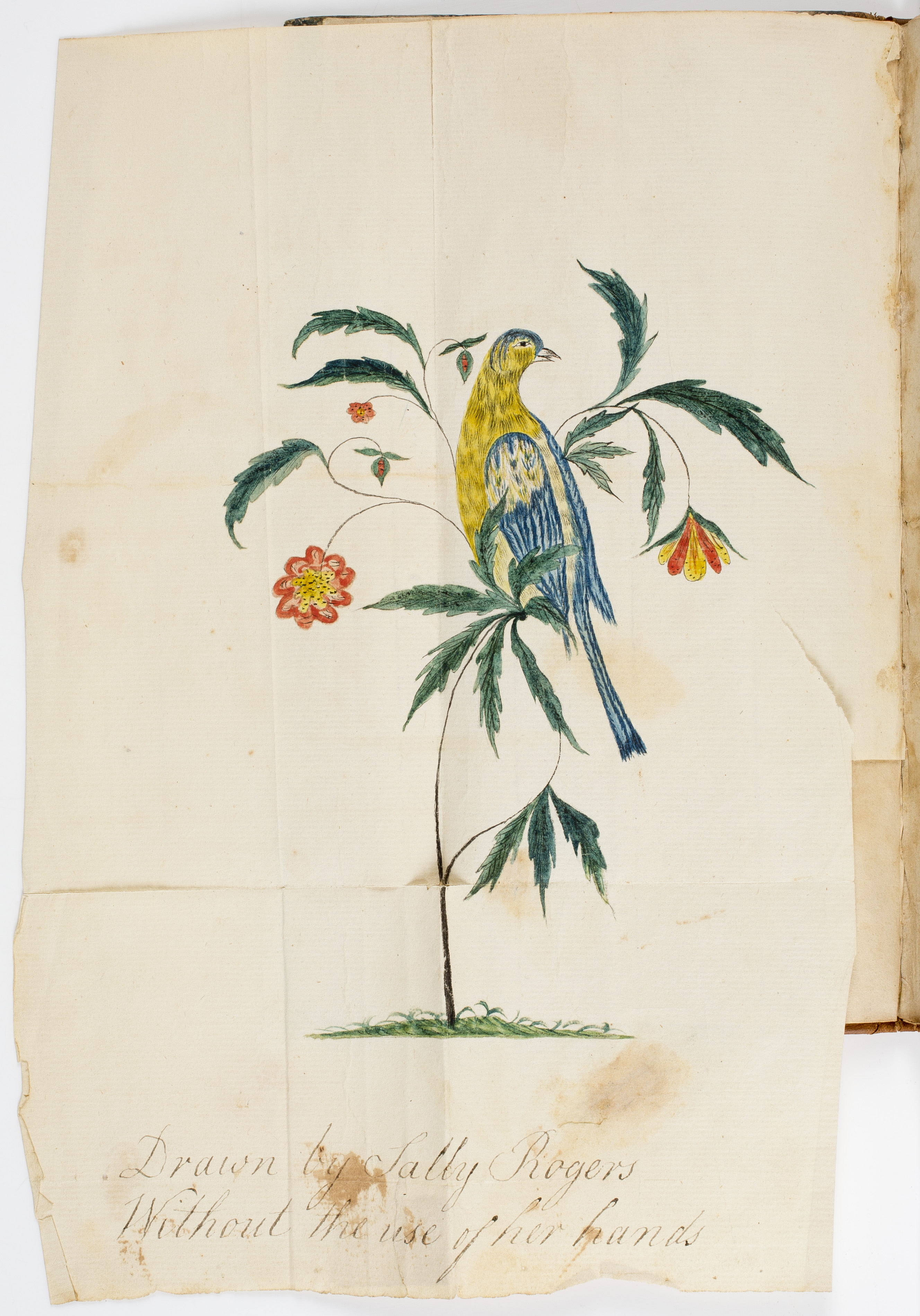
Sally Rogers was such an individual. I first encountered her when I cataloged A Real Object of Charity, a small pamphlet published about April 1806 in New Hampshire. She is the subject of the pamphlet, although it gives only her father’s name, not hers; however, she did sign the original artwork accompanying it. Isaiah Thomas, the founder of the American Antiquarian Society, placed a value of $1.00 on the pamphlet, and it has resided in our collections for the past two centuries.

I couldn’t find Sally Rogers in vital records, and I was skeptical about my chances at discovering more about her due to the common nature of her name. Happily I was proved wrong, and now she can be found in our catalog as “Sally Rogers, approximately 1788-1813.” Unfortunately, her history survives primarily in ephemeral newspaper advertisements and reviews, which makes it difficult to trace her story in full and know what she thought about her life and choices.

In the pamphlet, Sally’s age is given as “about 18,” and she lived with her parents in Lempster, New Hampshire. It states that “nature seems to have denied her … the use of her limbs” – other reports described her as lacking hands and feet – but made “amends… in the exercise of other faculties as surpassing all human belief,” namely, the ability to create art by holding her instruments in her mouth and the ability to excel at such tasks as threading needles and moving with grace and decorum.

Watercolor illustration from A Real Object of Charity (Walpole, N.H., 1806). The painting, an image of a bird on a flowering tree, was created by Sally Rogers; it, along with three other illustrations, was inserted into the pamphlet after it was printed.

A Real Object of Charity marks the beginning of Sally Rogers’ public career as a working artist and performer. On June 17, 1806, the Repertory, a Boston paper, announced the commencement of her stay at the Columbian Museum. There she had “consented to perform in publick” and would “paint, mix colours, thread a needle, cut paper or cloth with scissars [sic] held in her mouth, &c.” Sally Rogers is unnamed in this advertisement, but the positive reviews which followed recognized the talents of “Miss Rogers.” She worked steadily for the next seven years, both under the name Sally Rogers and, after 1807, under the name Sarah Rogers. She toured from New Hampshire to South Carolina, experimenting with admission prices, taking commissions, exhibiting her work, and, in the South, sometimes working alongside Martha Ann Honeywell, another woman who lacked hands and adeptly performed artistic and feminine tasks. Sally/Sarah’s performances ended only with her death in Philadelphia on October 30, 1813. According to her obituary in the Democratic Press (Philadelphia, Pa.), she was twenty-four years of age, and her funeral would be held at the house of General James Barker.[2]

Next week, in the third and final part, Amy will clear up a case of mistaken identity!


[1] For example, the Name Authority File links different forms of an author’s name, so that you’ll find the Harry Potter books if you look for J.K. Rowling, Joanne K. Rowling, or Jo Rowling.  It also differentiates between people, so that the works of Cotton Mather, the New England Puritan (entered under Mather, Cotton, 1663-1728) aren’t confused with the works of Cotton Mather, the professor of geography (entered under Mather, Cotton, 1918- ).

[2] Lanning, A. “Sally Rogers: The Celebrated Paintress.” In Historic Deerfield (Summer 2012).

Spring issue of the Almanac is here!

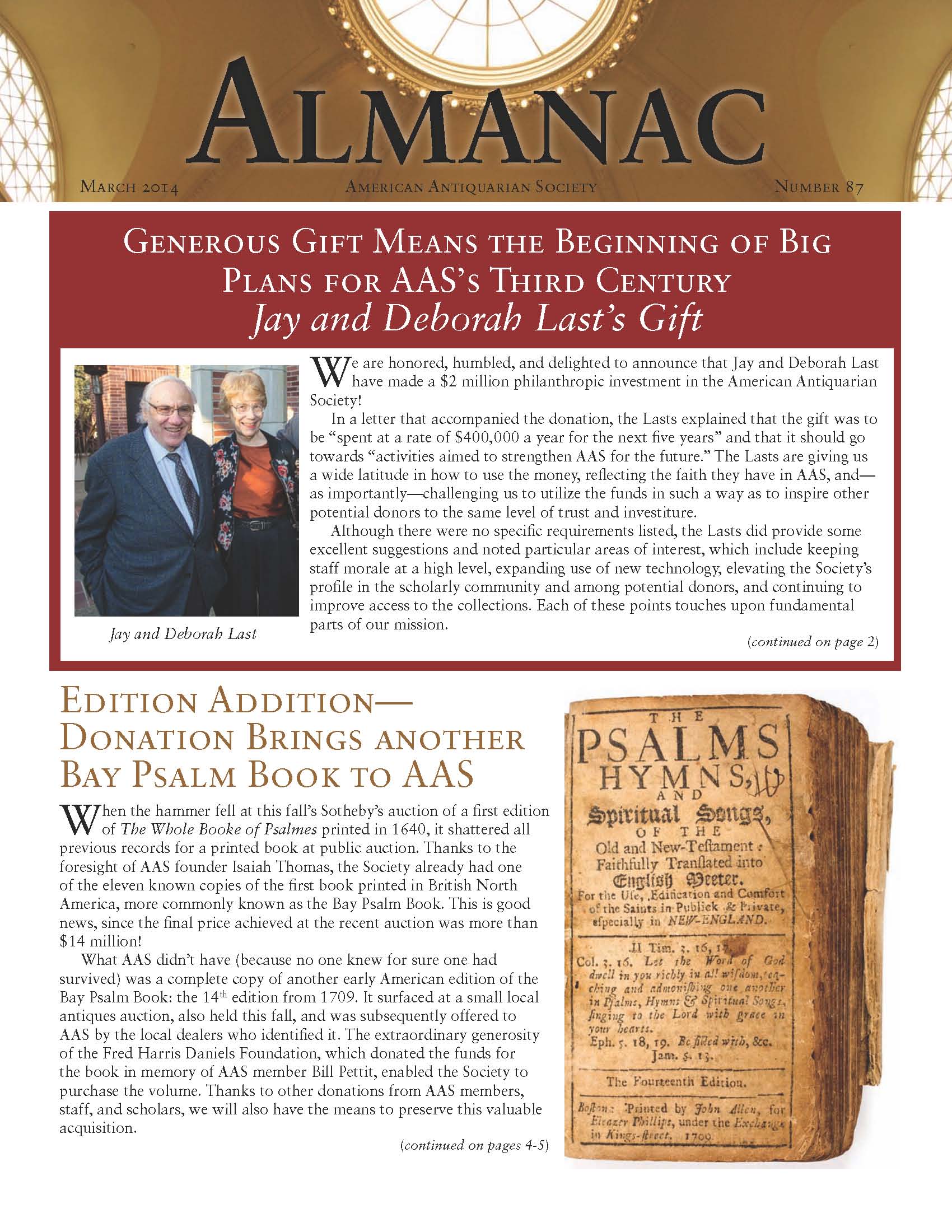
2014March Almanac final_Page_01We’re excited to share the March 2014 issue of the Almanac with everyone. This issue has a feature story about a unique acquisition related to the Bay Psalm Book (the first book printed in North America), news about an extremely generous gift that is already having a significant impact on the Society, and a history of conservation at AAS. As always, the Almanac also contains information about our upcoming public programs and events, including our popular new Hands-On History Workshops and our annual Adopt-a-Book event.

So take a look, revel in the beautiful images from our collections, and we hope to see you soon at one of the many events on our spring calendar!

Adventures in Cataloging: Some Sleuthing Required (Part I)

Our 25 miles of shelves hold many mysteries for the intrepid cataloger to unravel.

One of the neat things about working as a cataloger at the American Antiquarian Society is solving the puzzles that come across my desk. I work exclusively on books and pamphlets published in the early nineteenth century, and over the course of 200 years title pages are lost, authors are forgotten, and people disappear into the mists of history. Often, I try to reconstruct the who, where, and when of early U.S. imprints based on what is in my hands; I leave the why to scholars’ debates!
1. No author, no title, no imprint – no problem

Sometimes I work on a pamphlet without an author, without a title page, and without a known date of publication. Such was the case of Address. Gentlemen of the Union Harmonic Society, a pamphlet of 13 pages with its title taken from a caption on the first page of text and a conjectured publication date of 1816.

We try not to leave our records with that many question marks (although sometimes it can’t be helped), so to research it I visited America’s Historical Newspapers and searched for booksellers’ advertisements, Union Harmonic Society events, and mentions of William Collins’ “Ode to Music,” which was reproduced in the pamphlet. It was the last that proved key to discovering the identity of the mysterious pamphlet.

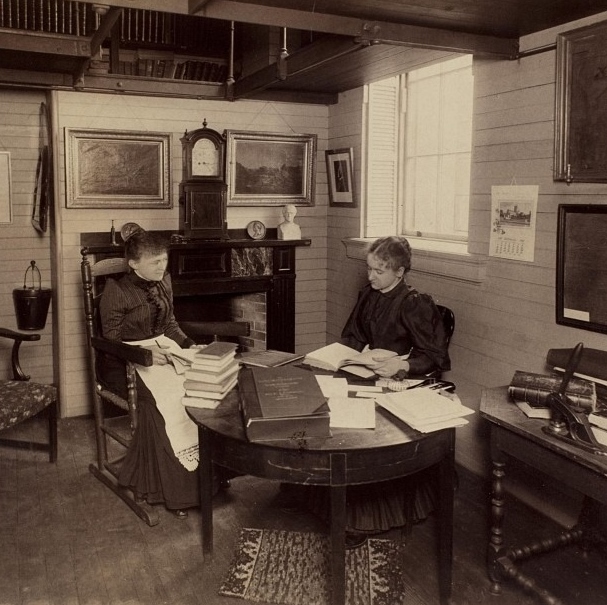
Catalogers in 1892 describing items and solving mysteries; today I use the internet alongside reference books, but the spirit of our goals remains the same -- to accurately identify and describe AAS's holdings.
Catalogers in 1892 describing items and solving mysteries; today I use the internet alongside reference books, but the spirit of our goals remains the same — to accurately identify and describe AAS’s holdings.

An advertisement in the Jan. 1, 1821 issue of the Charleston City Gazette announced an anniversary concert of the Union Harmonic Society. “In the course of an evening,” it proclaimed, “an address will be delivered by Dr. Henry T. Farmer, a member of the Society—in which will be introduced Collins’ Ode on the Passions, with appropriate and descriptive music.”

This was a promising lead, albeit one more suggestive than conclusive. However, I discovered that Henry Farmer’s 1821 address to the Union Harmonic Society had been printed and I reached out to the Charleston Library Society, which holds the pamphlet. They confirmed that the pamphlet on which I was working, known as Address. Gentlemen of the Union Harmonic Society, was, in fact, Farmer’s discourse at the 1821 anniversary concert.

Victorious, I edited the pamphlet’s record, filling in blank elements and conjecture with information from the title page and unifying the pamphlet’s fractured presence in two different early American bibliographies under one (correct!) title: Henry Farmer’s An address, pronounced before the Union Harmonic Society of Charleston, S.C. on the 30th day of January 1821 (Charleston, 1821).

“Adventures in Cataloging: Some Sleuthing Required” will continue next week with part II, when Amy will track down the name of an unidentified woman who is the subject of a pamphlet. Stay tuned!

Abby Goes Digital

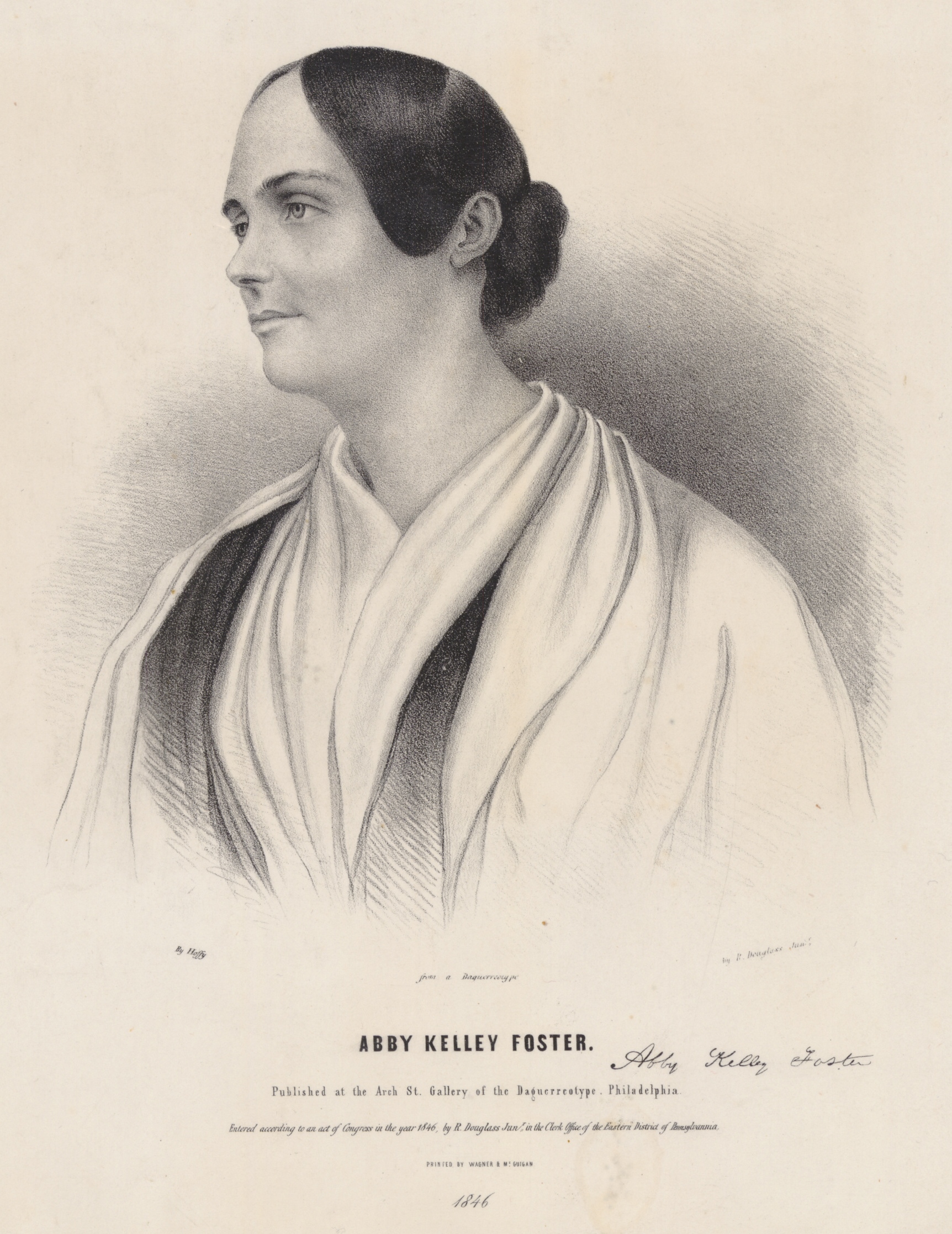
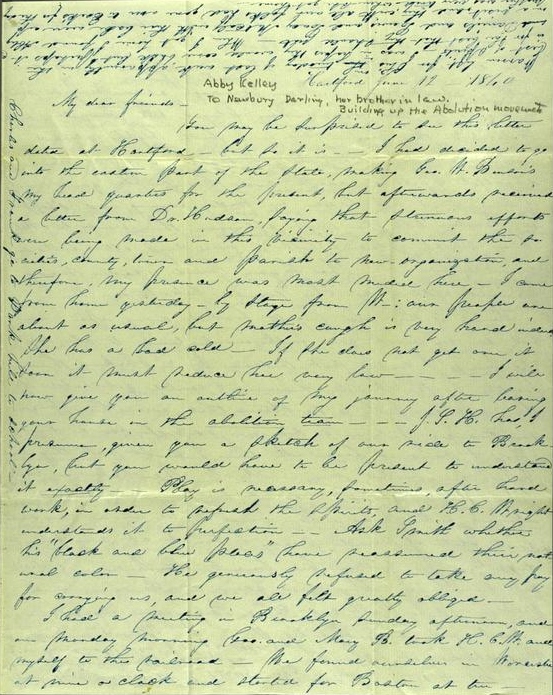
AKF1AAS is excited to announce the launch of an important new digital resource.  In partnership with the Worcester Historical Museum, AAS has digitized both the Worcester Historical Museum’s and our own collection of Abby Kelley Foster Papers.  Foster was a noted mid-nineteenth-century reformer, involved in both the anti-slavery and women’s rights movements.  Both AAS and the Worcester Historical Museum hold substantial collections of Foster’s correspondence and papers, and although located less than two miles apart, the collections have been separated from each other and not readily available to the wider world.  Now, over 2500 images of Foster’s letters are freely accessible and available to researchers everywhere through a new digital archive.

There are a number of upcoming special events and workshops in Worcester to celebrate and showcase the new digital archive.

“Abby Kelley Foster: The Unsung Hero of Abolition,” Thursday, March 27, 2014, 7:00pm, Worcester Historical Museum, 30 Elm Street

Dr. William Casey King will lead a lecture and discussion about Foster, Worcester, and the larger social narrative of the nineteenth-century social reform movements of abolition and women’s rights.  Dr. King is a scholar, author, and distinguished lecturer, and past Executive Director of the W.E.B. DuBois Institute for African American Research.

AKF“Accessing Abby,” Friday, March 28, 2014, 5:00pm, Boyden Salon, Mechanics Hall, 321 Main Street

The online collection will be launched, with comments from the American Antiquarian Society, Worcester Historical Museum, Dot Willsey, president of the National Abolition Hall of Fame in Peterboro, NY, and artist Charlotte Wharton, who painted Abby Kelley Foster’s portrait in Mechanics Hall.

“Suffragists, Teetotalers, and Abolitionists: Social Reform in the Nineteenth Century,” Saturday, March 29, 2014, 3:00pm, American Antiquarian Society, 185 Salisbury Street

This Hands-on History Workshop is for K-12 teachers, museum professionals, and the interested general public.  Featured lecturer Thomas Augst will lead a lecture and discussion, and participants will engage in hands-on sessions with collection material. These sessions will explore how reform movements used print culture to spread their messages, focusing on the careers of two individuals: temperance lecturer John Gough and Abby Kelley Foster. This workshop will also include an introduction to the new Abby Kelley Foster digital collection.

Happy St. Patrick’s Day! The Mathew Carey Account Volumes: A Digitization Case Study

Under cover of night on the Dublin docks in 1784, Mathew Carey, disguised as a woman, set sail for Philadelphia. Having spent the previous week hiding out in his friends’ bookshops along Grafton Street, Carey decided that this was the only sure way to escape the British officials who were in hot pursuit of him because of his unfavorable depiction of the Chancellor of the Exchequer in his radical newspaper. This printer turned polemicist turned newspaper editor turned publisher turned activist assumed many roles in his life, and fortunately for us, he ceaselessly wrote for most of that time. AAS holds a significant portion of his writing, in the form of his financial records from 1785-1847. They include receipts, bills, memoranda, invoices, bills of lading, and other records of his publishing business, and its successors: Carey, Lea, and Company; and Lea and Blanchard. These records not only detail Carey’s daily business dealings, but they also offer a window into the early American national and international book trade and larger worlds of trade and politics (see, for example, Vincent Kinane’s “‘Literary Food’ for the American Market: Patrick Byrne’s Exports to Mathew Carey” in The Proceedings of the American Antiquarian Society (1994)). As a recent special issue of Early American Studies reflects, Carey’s archive can help us to understand the politics, economics, and culture of early America through the lens of an extraordinarily successful businessperson. For example, Carey is credited  with being the first to publish a bestseller in the United States, Susanna Rowson’s Charlotte Temple (1794) (see Michael Winship’s “Two Early American Bestsellers” in Common-place (2009)).

St. Patrick’s Day seems like a good time to take stock of this Irish émigré’s archive, parts of which are available at different levels of digital accessibility here at AAS. Having scanned the individual pages of the Carey financial records, we have made all 16,000 scans free to browse and download through our digital asset management system, GIGI. We are now beginning to consider the ways in which we will make these 16,000 images searchable, knowing that optical character recognition software is not yet up to the task of transforming these scrawls into searchable text. The work that we are doing now to make Carey’s business records navigable and therefore far more valuable to researchers relies on metadata that was created when AAS acquired this archive in 1928. And this work also raises questions around the threshold between metadata—or “data about data”—and the text or data proper. Where is the line between a text and the metadata about a text? When does that metadata become as important as the text itself?

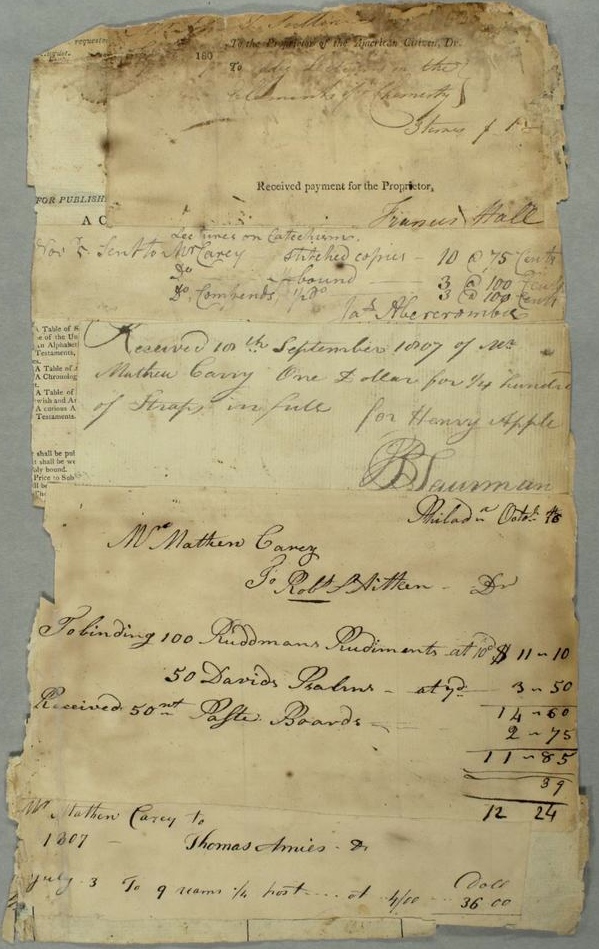
Carey_Gigi-535For example, let’s take a look at the physical pages onto which Carey’s records are pasted. As a publisher, Carey was well aware of the cost of paper, and thus reused spare sheets in creating his records. The waste paper to which Carey’s records are glued functions as a sort of “accidental paratext,” an addition to the text that mediates between the work of the author of the transactions and the publisher of the waste paper (Carey was both), but not intentionally so. When we examine this waste paper, we are essentially digging through Carey’s recycling bin, but this evidence is not readily visible in the digital surrogates.

Let’s start with an image from the Carey archive that is available in GIGI. To the right is account #535, which was once a part of Accounts Volume 21 (when the books were disbound for scanning, it became part of Box 13, Folder 1).

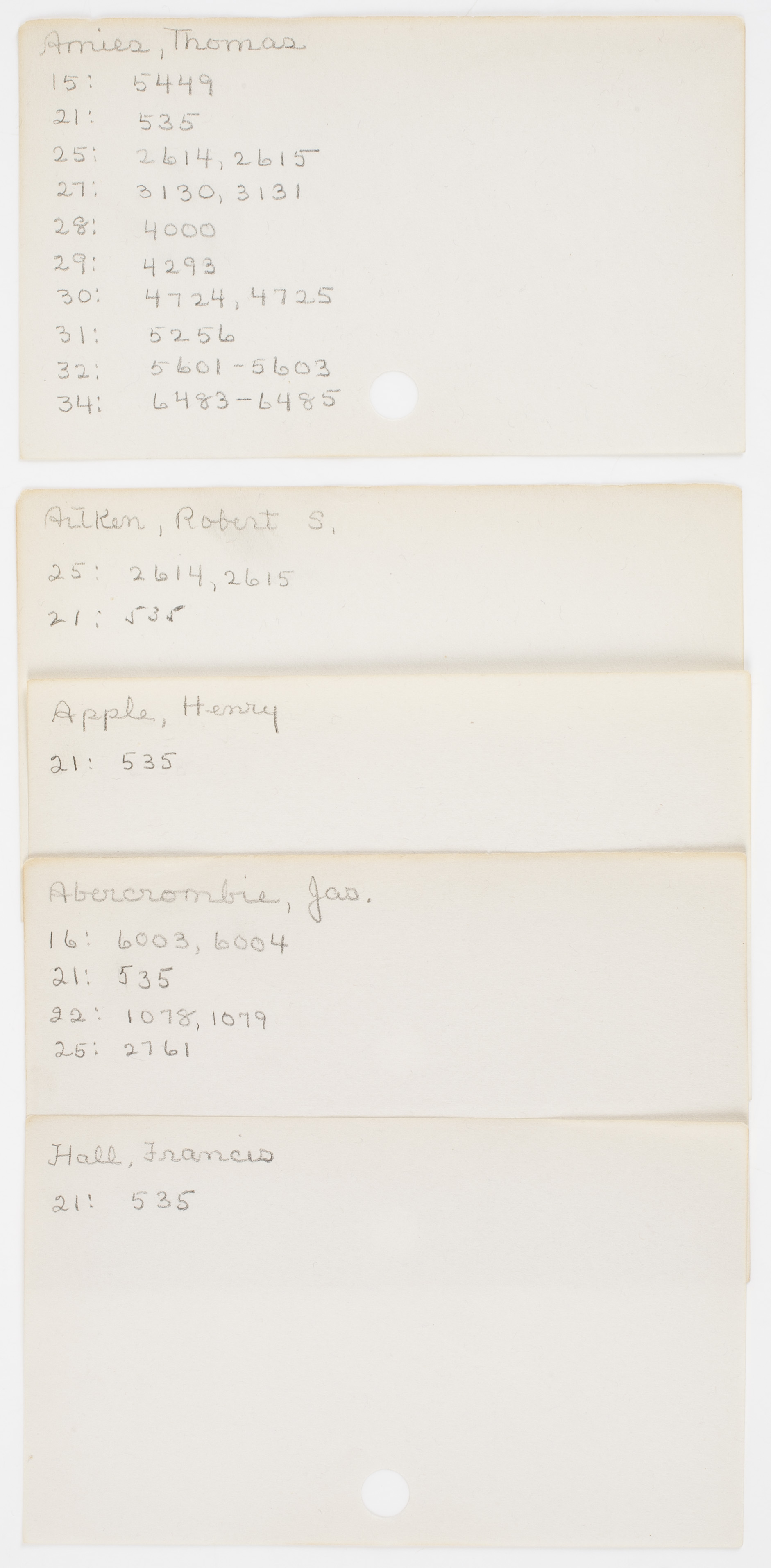
This is a fairly typical looking page from the financial records in that it has a number of names and transactions listed on it. Shortly after acquiring this archive, Clarence Brigham hired a “special assistant to begin the tremendous task of making a name index to the entire series.” This index, which includes about 50,000 individual cards and occupies three card catalog drawers in the reading room, is the key to making use of this collection, whether one encounters it in manuscript form or online. The cards that might lead one to this leaf (or its digital surrogate) in Box 13, Folder 1 include:

535_cardsFrom these cards, one would learn an account number, which corresponds to a box and folder number in the finding aid. The finding aid has recently been augmented to include links to the images of each box and folder number, so that a user can scroll through about 10-20 images of the pages in that folder to find the account number she wants. We are currently in the process of keying the index cards into a spreadsheet; soon, we hope to make available both the spreadsheet and a database that can be used to run name searches. If we wanted information about early Bible printing in America, for example, we might have looked up the name “Aitken, Robert,” a printer of one of America’s earliest Bibles, on the index cards (soon to be in the online database) and found that one of the transactions between Carey and Aitken can be found in Box 13, Folder 1. But wait, there’s more!

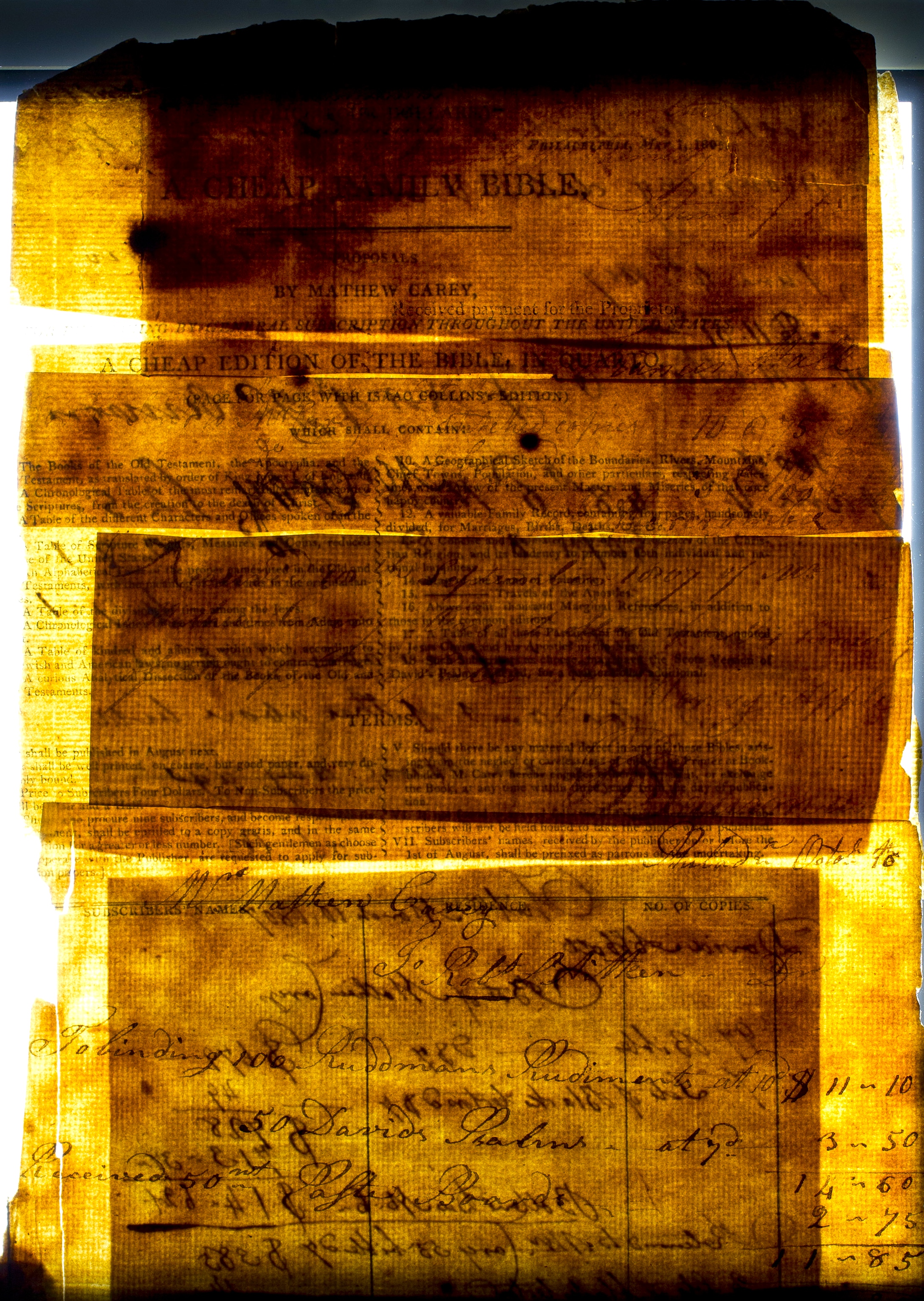
Carey_535_BacklitIf we scrutinize the high-resolution TIFF in GIGI of account #535, we can see that printed text is visible on the left margins. A backlighting of this page (left), which was presumably waste paper Carey had on hand, is an advertisement for Carey’s King James Bible (Carey also published the first version of the Roman Catholic Bible printed in the United States).

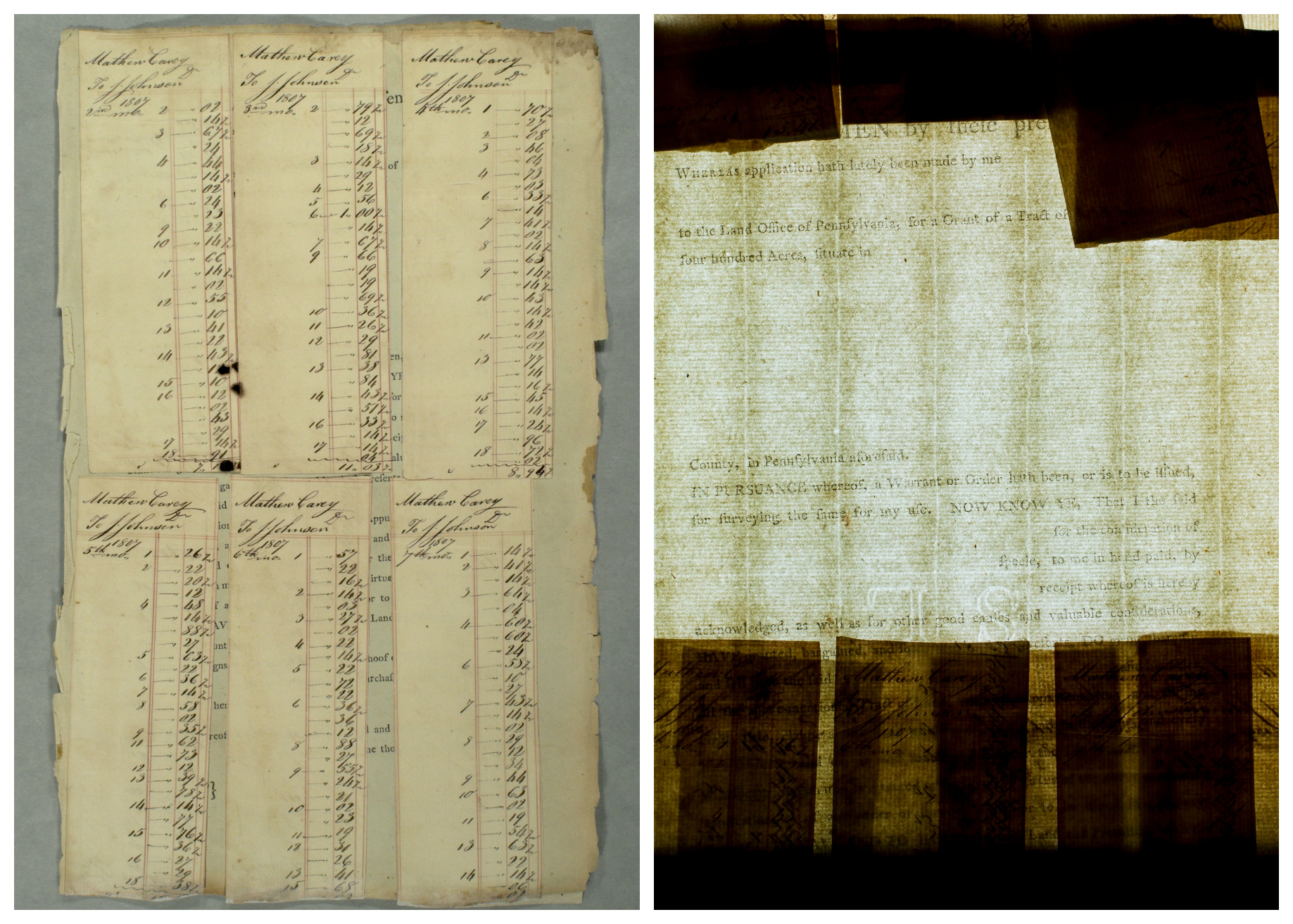
This layering of a transaction between one of the first American Bible printers and advertisement for another prominent American Bible is largely serendipitous in this instance, but I mention it to show what we might uncover by examining the physical paper sheets that Carey used in making his records. In another instance (below), we can see Carey’s transactions with the prominent radical London publisher Joseph Johnson. The columns of numbers are barely discernable. But, when the researcher encounters the actual physical page, one quickly realizes that these columns lift up.

carey582Underneath is a blank form (presumably printed by Carey) from the Land Office of Pennsylvania for a tract of land for 100 acres and a receipt for the money paid for the land. What other scraps might one uncover under the pasted down accounts in Carey’s records? In a 1980 article in Book Collector, Marcus McCorison examined scintillating evidence about what Isaiah Thomas might have been printing but not recording based on marbled waste paper glued to the boards of various volumes here at AAS. What might one find if left to illuminate the waste paper Carey used as the foundation for his financial records? And, how might digitization account for that accidental paratext? It can only be photographed with the use of a special backlight, and unlike the name index we have on cards and are transforming to a spreadsheet, it cannot be organized and sorted in the same way. This waste paper can be read as revealing the limits of digitization, or as an invitation, made possible through digitization, to disrupt the hierarchy of the page and the information architecture that implicitly accompanies it.

By St. Patrick! Irish Ballads

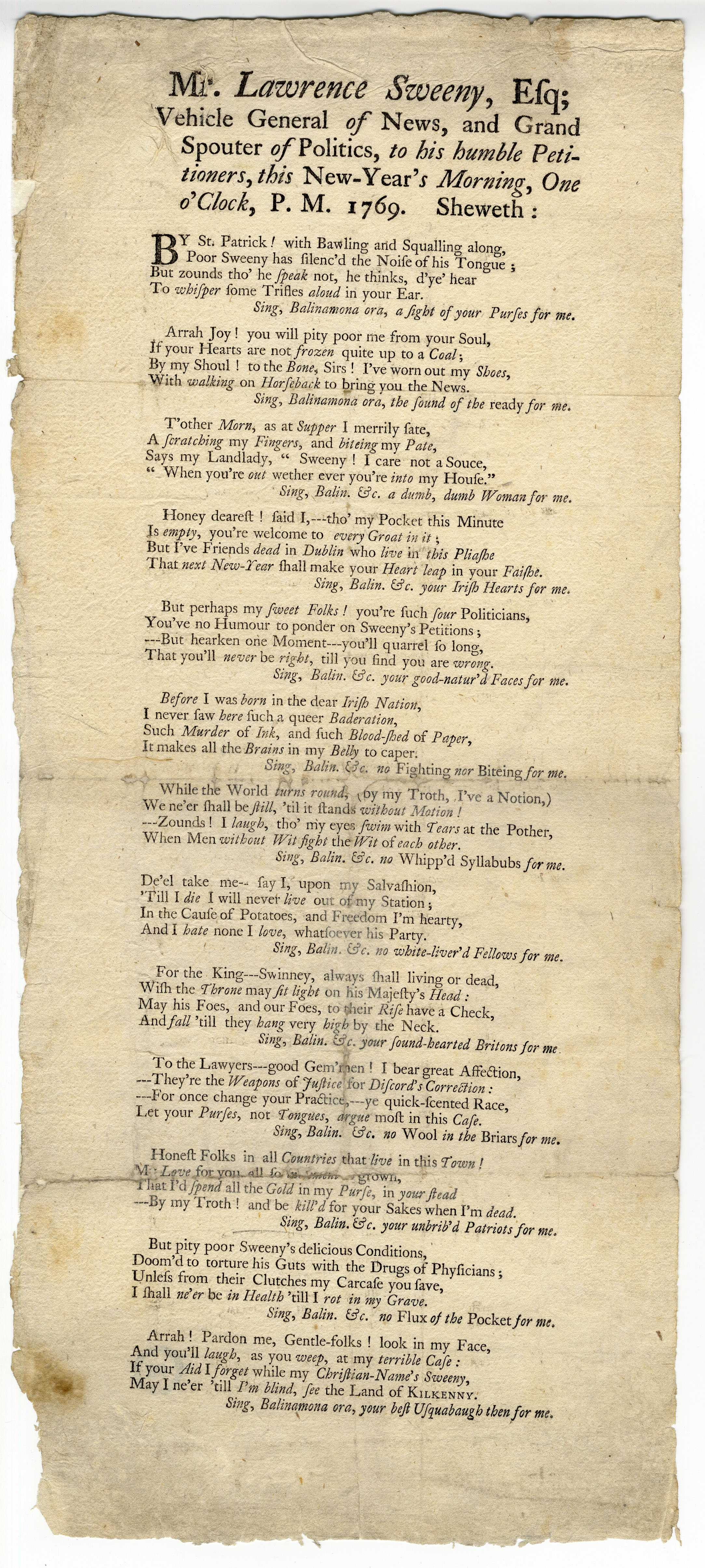
This post will present approximately one hundred years of Irish ballads contained within the Society’s collections. The first is a fascinating 1769 broadside containing a New Year’s address by Ireland native Lawrence Sweeney (-1770), a popular figure in New York City journalism in the 1760s. Sweeney is one of the first identifiable Irish-American voices. He was so well-known that he made an appearance in AAS founder Isaiah Thomas’s History of Printing in America for his assistance in the distribution of the Constitutional Courant, a seditious newspaper printed during the Stamp Act crisis of 1765.[i] Sweeney’s authored text displays an American interest in Ireland and the emerging Irish-American experience (with its share of satire and sadness). The ballad concludes, “Arrah! Pardon me, Gentle-folks! Look in my Face/ And you’ll laugh, as you weep, at my terrible Case:/ If your Aid I forget while my Christian-Name’s Sweeny,/ May I ne’er ‘till I’m blind, see the Land of KILKENNY./ Sing, Balinamona o a, your best Usquebaugh then for me.”

Irish ballad 1click here to enlarge in GIGI

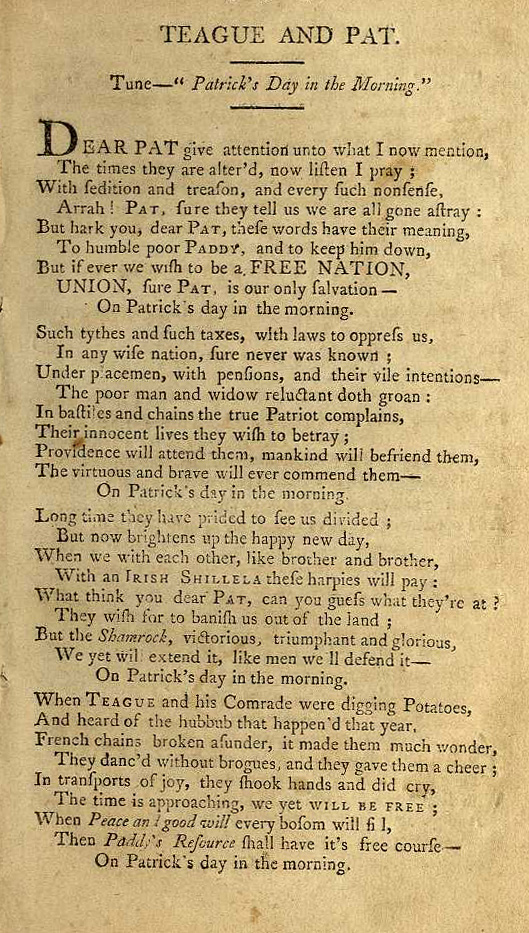
The ballads transitioned from the Sweeney-authored (i.e. Vehicle General of News and Grand Spouter of Politics) to ones of Irish and British origin that were reprinted in the United States. The first edition of Paddy’s Resource, a collection of political ballads and Irish national songs (with toasts and sentiments), was first printed in 1796 in Philadelphia. AAS owns a later edition printed in New York in 1798. Contained within it is “Teague and Pat” set to the tune of “Patrick’s Day in the Morning.” It’s a song that looks forward to expanded freedom: “The time is approaching, we yet WILL BE FREE;/ When Peace and good will every bosom will fill,/ Then Paddy’s Resource shall have its free course-/ On Patricks’ day in the morning.”

Irish ballad 2click here for the title page and contents enlarged in GIGI

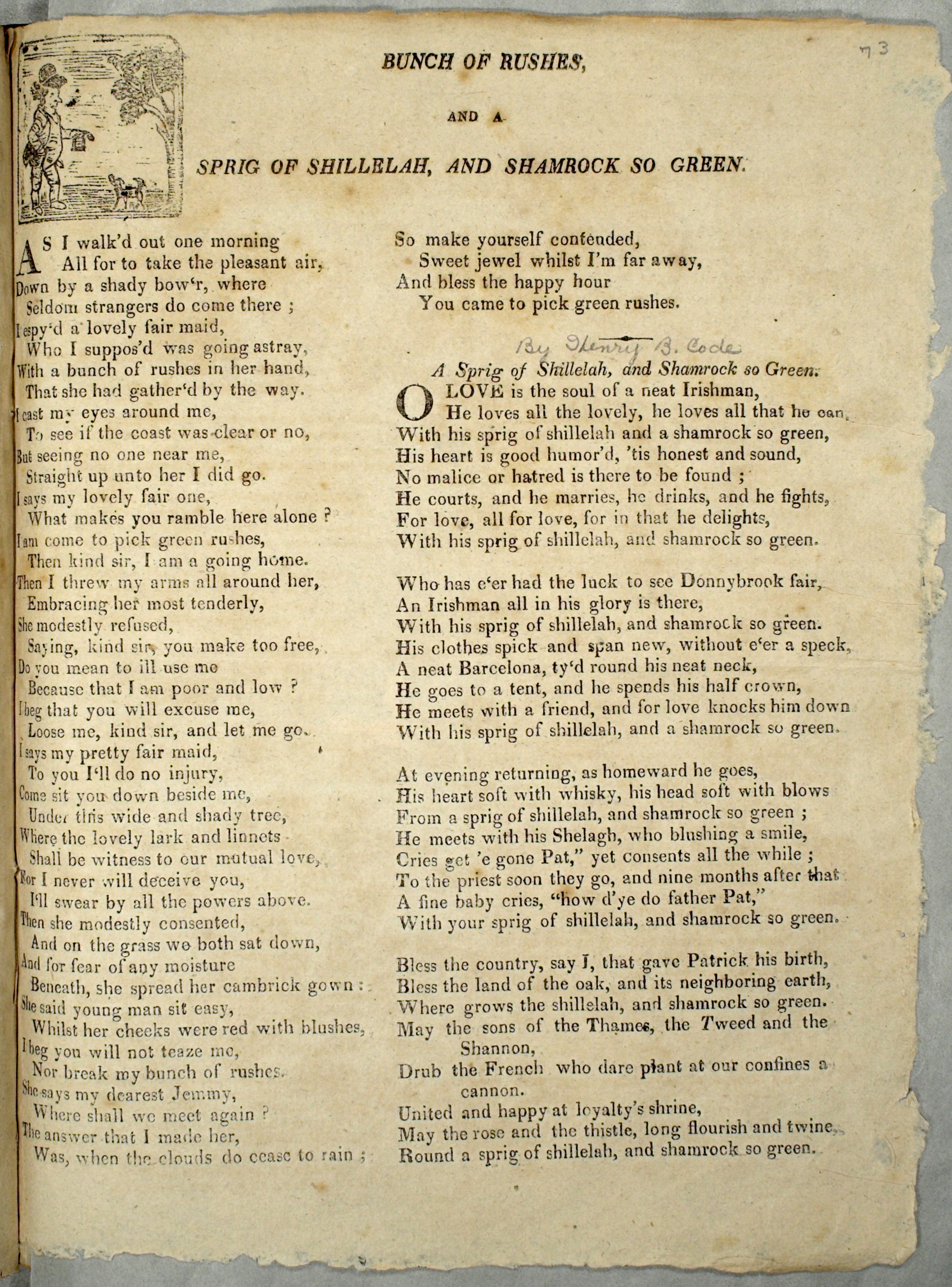
A search of Irish songs and music of the Society’s collection also provides several from the Isaiah Thomas collection of broadside ballads, presented to the Society in August 1814. AAS owns three copies of one broadside ballad, “A Sprig of Shillelah, and Shamrock so Green,” by Irish songwriter and dramatist Henry Brereton Code (-1830) and printed by Nathaniel Coverly in Boston. (AAS also has an 1830s copy sold by L. Deming which is paired with “O’er the hills and far away.”) The ballad is one which represents the “love” theme in Irish music (this theme meaning to include love of country and/or love of a girl). The song starts, “O LOVE is the soul of a neat Irishman,/ He loves all the lovely, he loves all that he can,/ With his sprig of shillelagh and a shamrock so green…”

Irish ballad 3click here to view all three copies of this ballad broadside

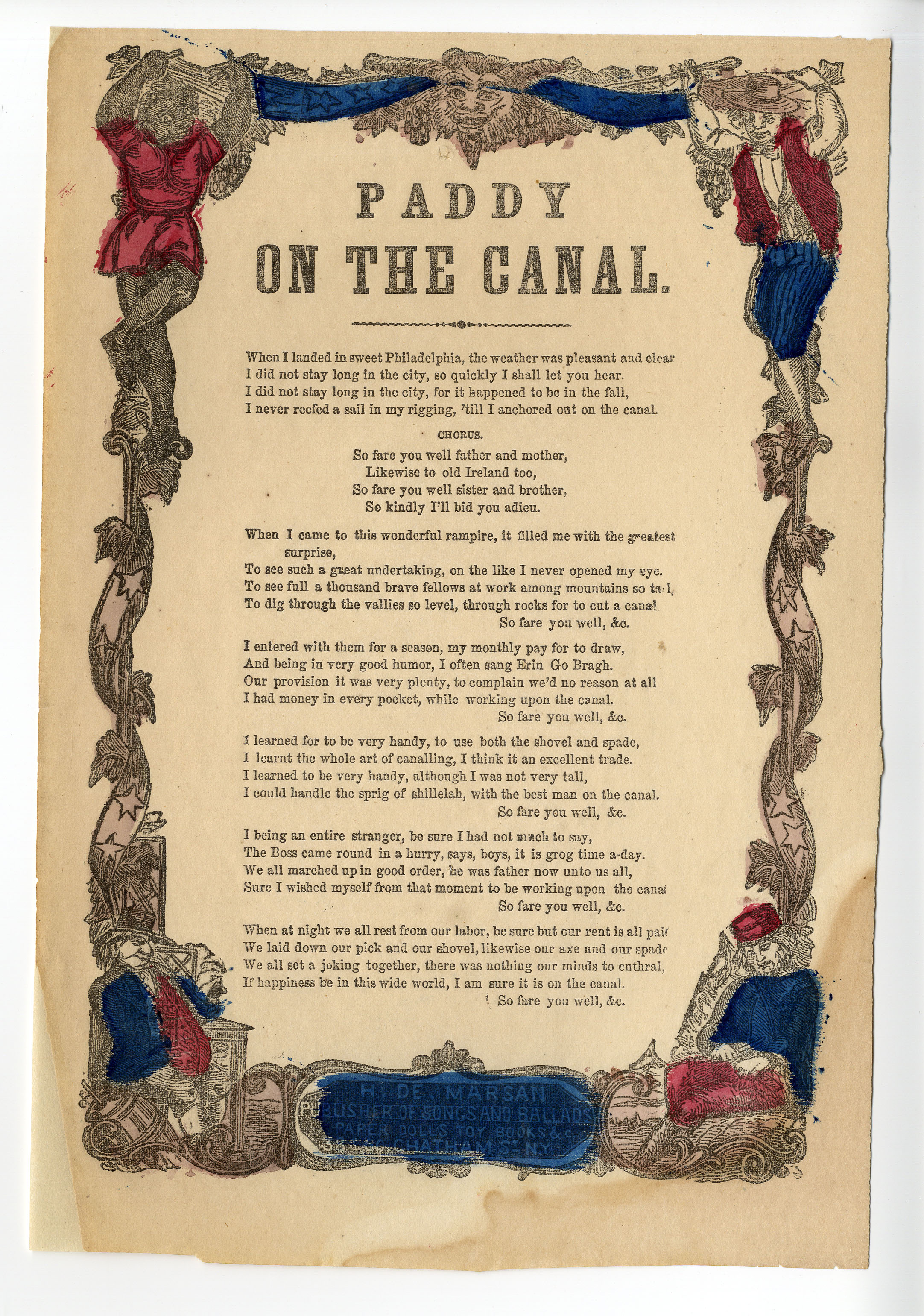
Other Irish songs are incorporated into the Society’s ephemera ballad collection. One with an illustrated ornamental border, “Paddy on the Canal,” printed and published by H. De Marsan, is a song of an Irish emigrant and his path to becoming a canal construction worker after leaving his family. The author learns the “art of canalling” – and he “…learned to be very handy, although I was not very tall,/ I could handle the sprig of shillelagh, with the best man on the canal.”

Irish Ballad 4click here to view an enlargement in GIGI

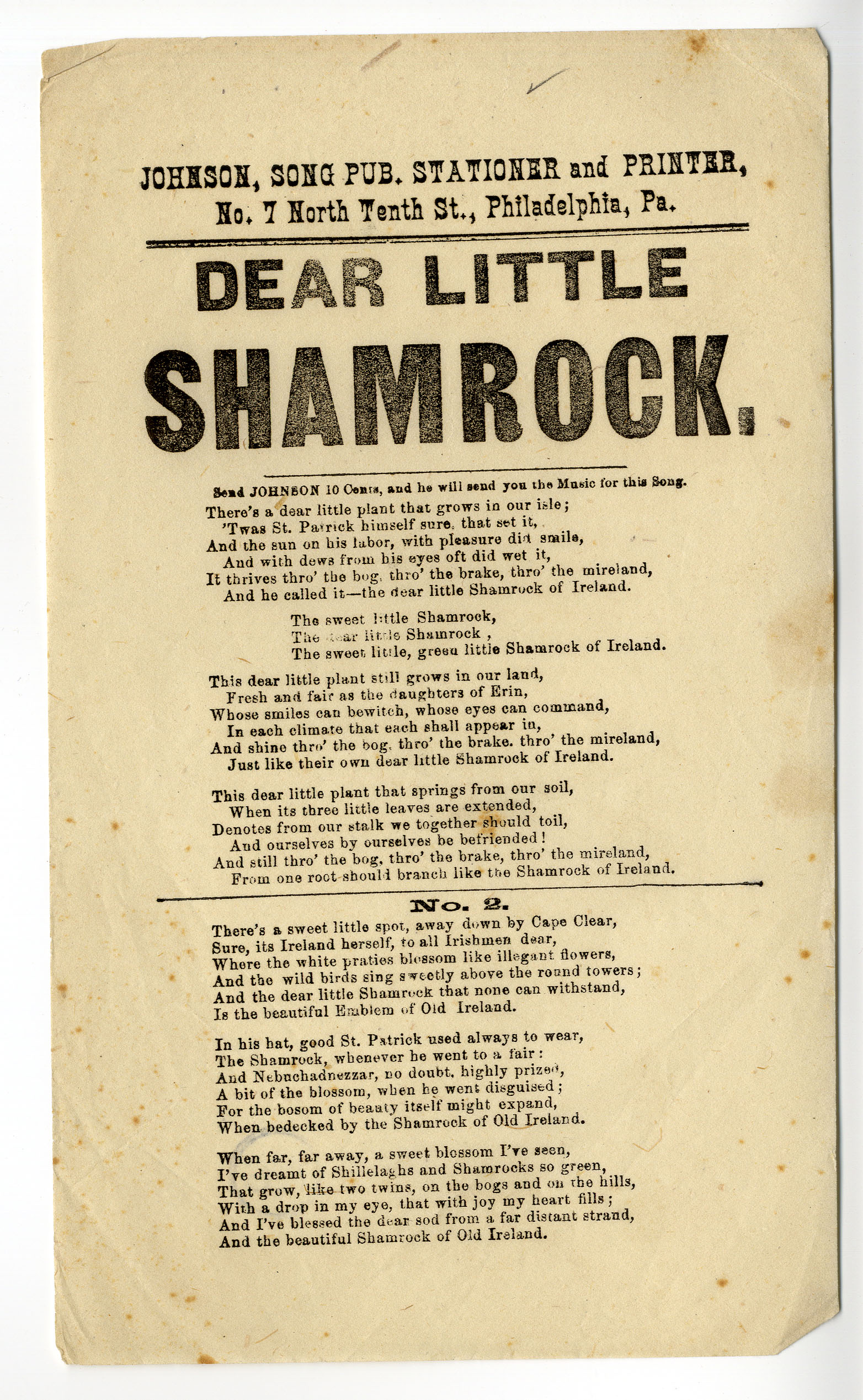
Other ballads were reproduced by specific song publishers, stationers, and printers such as John H. Johnson in North Tenth Street in Philadelphia. “Dear Little Shamrock” by Irish writer, dramatist, and actor Andrew Cherry (1762-1812) has two songs and a note that if you send Johnson “10 Cents, he will send you the Music for this Song.” “No. 2” on the sheet may be the most St. Patrick’s Day-appropriate for a modern audience as it invokes the beautiful “Emblem of Old Ireland.”

Irish ballad 5click here to view an enlargement in GIGI

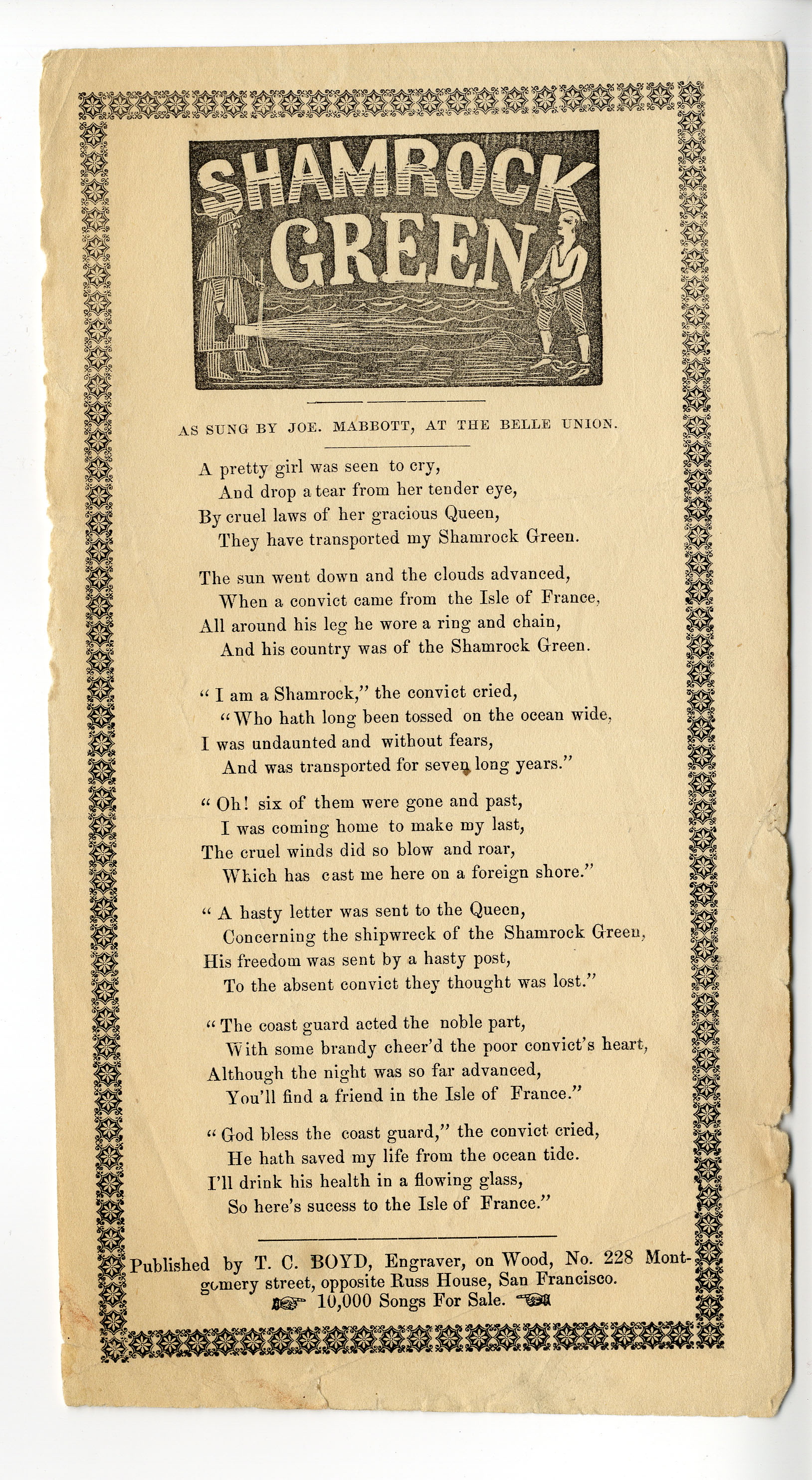
Songs and music about Ireland, though mostly represented in the Society’s Boston, New York, and Philadelphia imprints, were printed on the West Coast of the United States as well. The Bella Union, which originally opened as a gambling house, also hosted minstrel shows and varied types of entertainment.[ii] Theodore C. Boyd, the publisher and engraver of Shamrock Green, printed this ballad in 1862 which was sung by Joe. Mabbott at the Bella Union. The text describes an Irish exile/convict – Shamrock Green – who drinks to his rescue.

Irish ballad 6click here to view an enlargement in GIGI

Irish music is a staple of St. Patrick’s Day; we have offered here print-size copies of songs to pair with a pint-size portion of your choosing. Feel free to use, share, sing, or study in your celebrations.


[i] Isaiah Thomas and Benjamin F. Thomas, The History of Printing in America: With a Biography of Printers, and an Account of Newspapers, Vol. 2 (Albany, N.Y: J. Munsell, printer, 1874), p 130.

[ii] Jeremy Agnew, Entertainment in the Old West: Theater, Music, Circuses, Medicine Shows, Prizefighting and Other Popular Amusements (Jefferson, N.C: McFarland & Co., 2011), p 83.