Filling in a Gap: Reporting Lincoln’s Assassination

9420_0001In May I picked up a large collection of newspapers from the Indiana State Library.  It took 20 book cart loads to unload the back of the 26’ truck.  There were a number of bundles of miscellaneous newspapers of single or scattered issues.

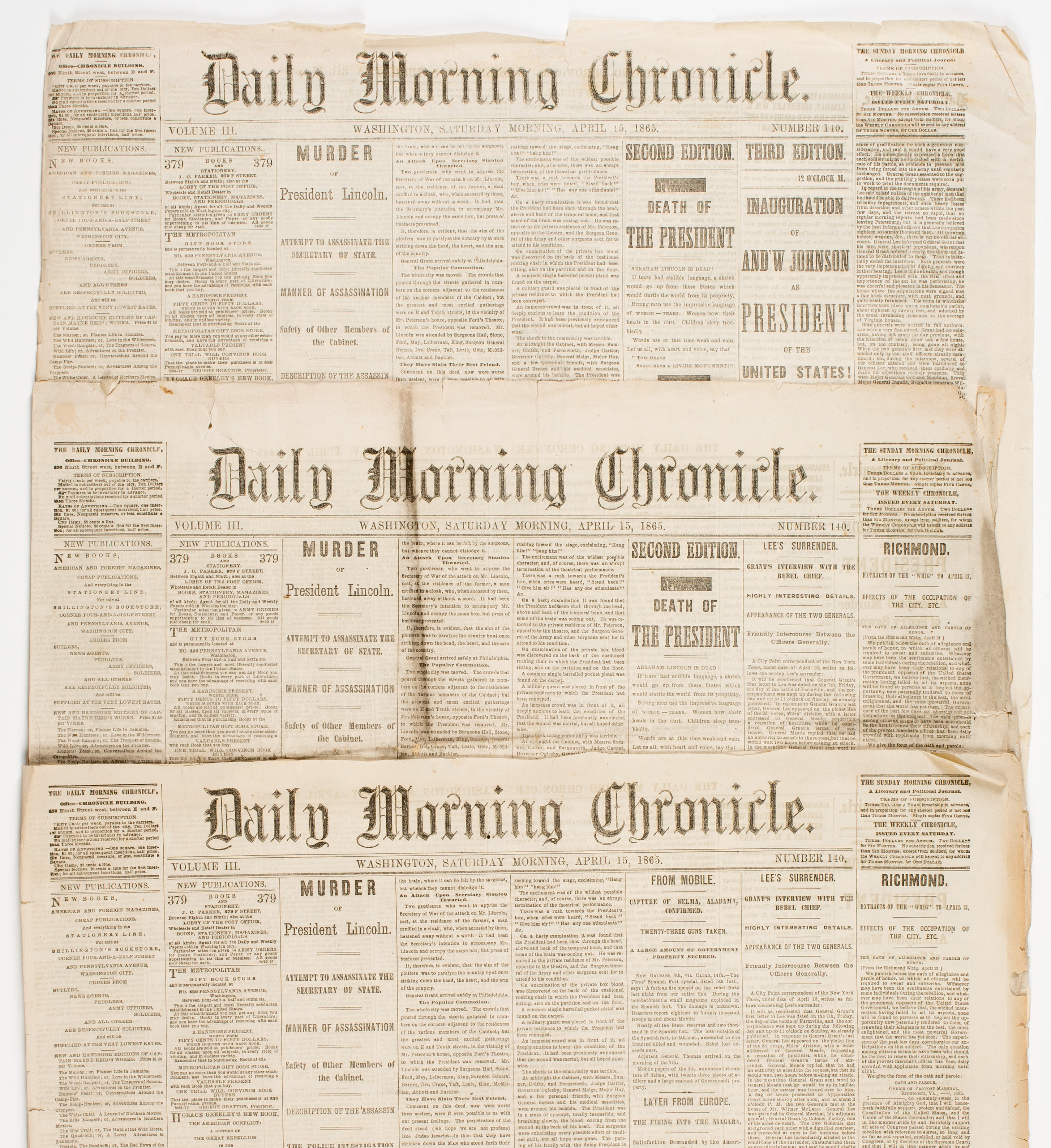
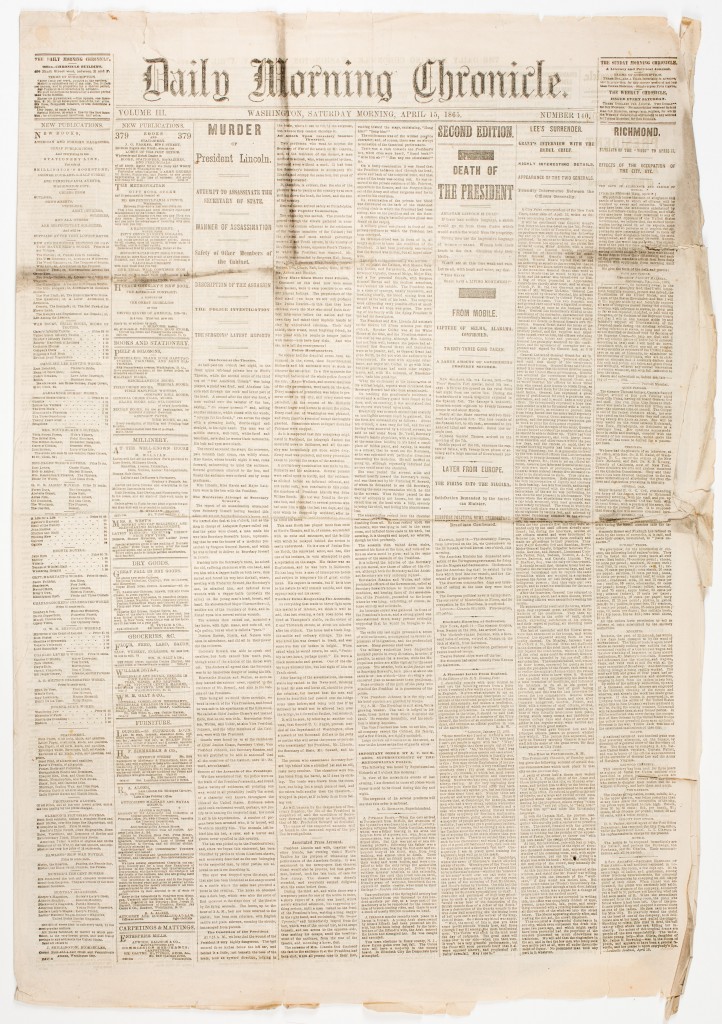
While going through one of the bundles, I came across an issue of the Daily Morning Chronicle from Washington, D.C., dated April 15, 1865.

This is an Abraham Lincoln assassination issue.  What caught my attention was it was the second edition with the headline “Death of the President” between two thick black bars.  I checked our holdings and discovered we have the first and third edition, but not second.  This issue filled in the gap and completed our set of the various editions printed that morning.

9420_0002
All three April 15 editions

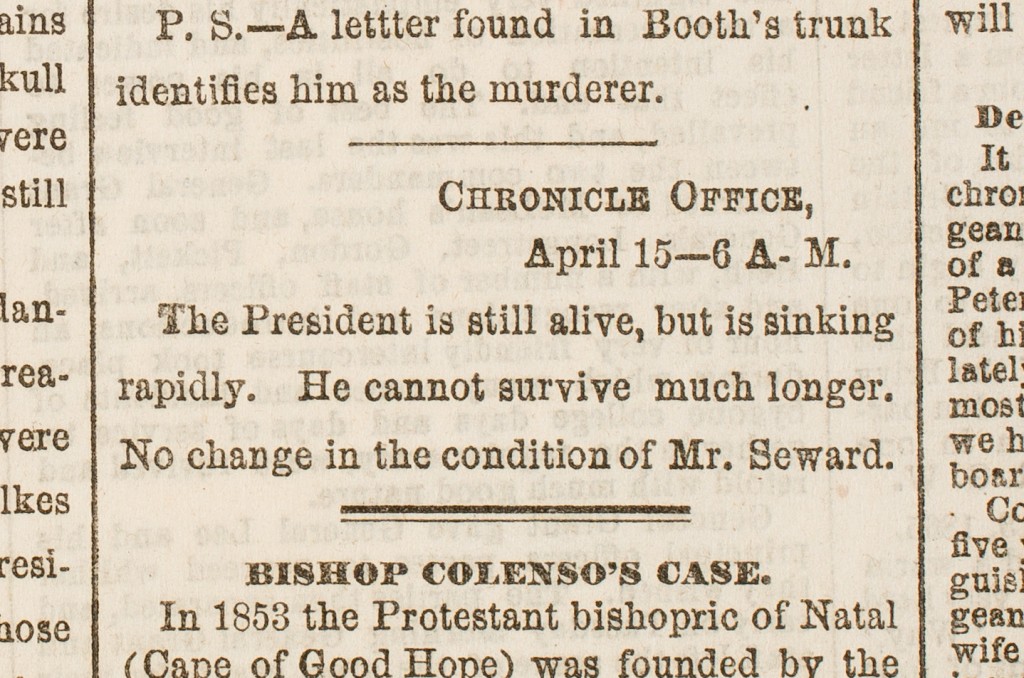
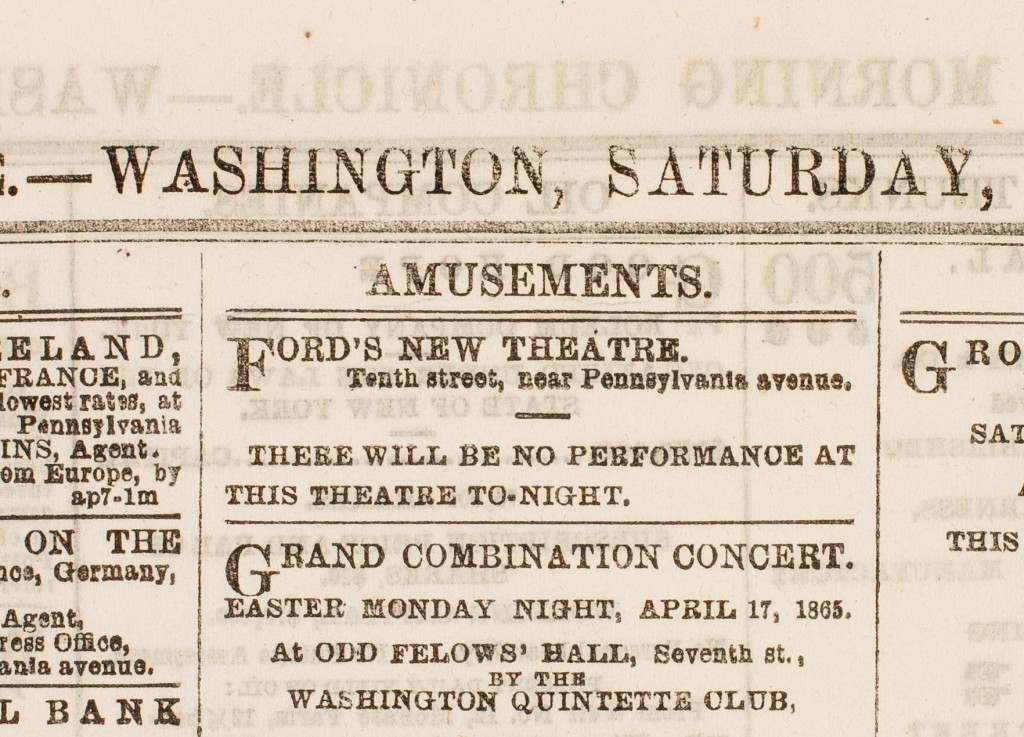
9420_0004One thing that makes this set of papers interesting is that the newspaper was located on the same block as Ford’s Theatre.  They were getting the news directly and not by telegraph.  The first edition has the headline “Murder of President Lincoln.”  Underneath it and inside there are a series of ongoing reports as they were received with the last one at 6 a.m.: “The President is still alive, but is sinking rapidly.  He cannot survive much longer.  No change in the condition of Mr. Seward.”   Lincoln died9420_0003 the next hour.  The compositors must have stripped out the original columns of text and set the new reports as they came in.  The second edition is later that morning and other material was removed or shifted on the front page.  The third edition was at noon and has the news that Andrew Johnson has been sworn in.  The three editions differ on the front page, but pages 2 through 4 stay the same throughout. On page 3 there is also an advertisement from Ford’s Theatre announcing there will be no performance that night.

These issues gives you the feeling of immediacy that a history book can’t convey.  You can read the news as other Washingtonians did that fateful morning.

The Acquisitions Table: Benjamin Franklin

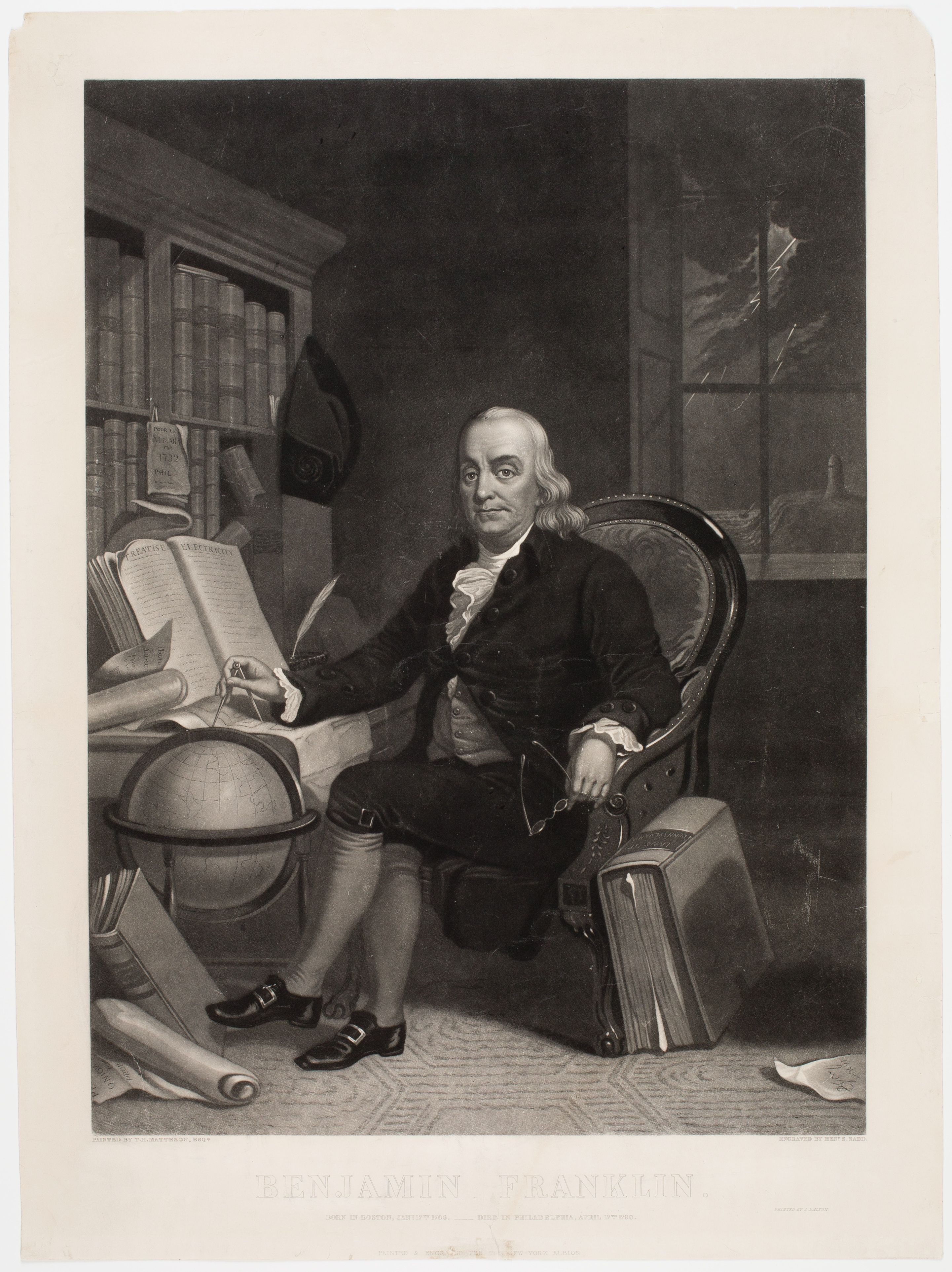
Benjamin Franklin.  New York: J. Dalton, for the New York Albion, ca. 1860.

ben franklinLarge format engravings were distributed in several ways in pre-Civil War America.  They could be ordered from a publisher by subscription, purchased directly through book and print dealers, or awarded as premiums for membership in an organization, such as the American Art Union. Many newspapers and periodicals also distributed prints to their subscribers, usually sending inexpensive lithographs as year-end thank-you’s to customers.  The weekly New York Albion eschewed lithographs completely and instead sent their subscribers an annual (and more expensive) engraving. This image of Benjamin Franklin is an example of one of the Albion’s subscription premiums.  The Albion started publishing in 1822 and began issuing engravings in 1837.  The majority of the prints are British in subject matter, which was fitting for the paper’s Anglophile audience (although printed in New York City, the paper described itself as a “British, colonial, and foreign weekly gazette”). AAS holds eleven of the twenty-five engravings distributed by this paper.

Give Pieces a Chance

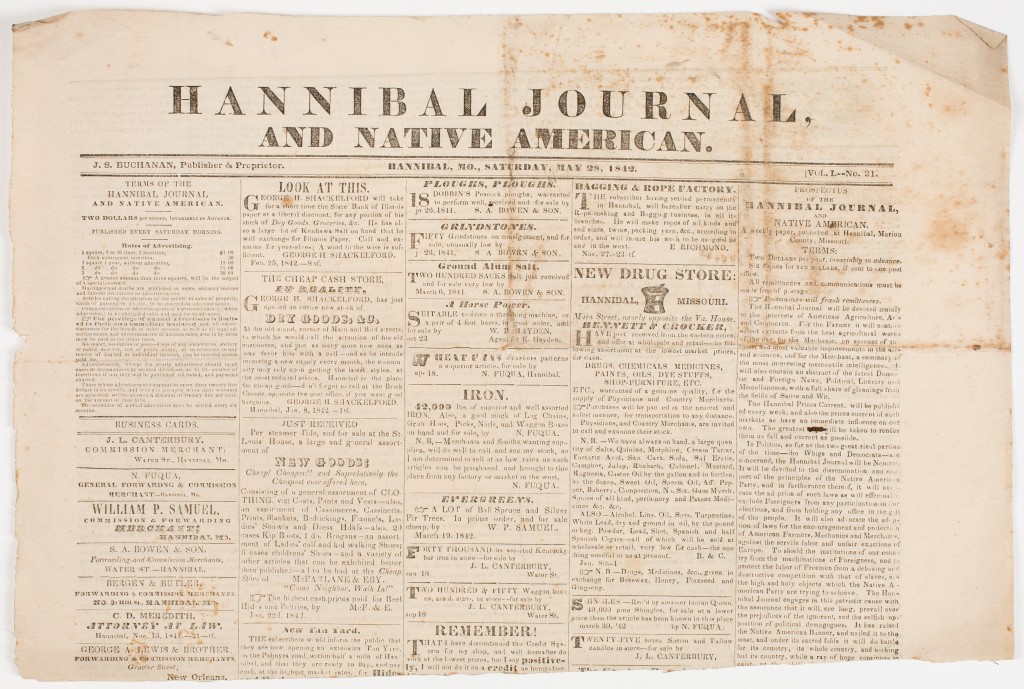
Hannibal Journal, and Native American.  May 28, 1842.  Vol. 1, no. 21.

A dealer recently sent me a box with pieces of newspapers.  Some of them were either the front or back page, and many of them were just half of one page.  Still, I waded through the large mound of fragments to see what was there.

Why should I spend time going through them considering the dealer gave them to me because they had no market value?  I spent time because discoveries can be made.  This example of the Hannibal Journal, and Native American is the only known issue with this title in an institutional library.  Old references refer to the newspaper as starting out with this title, then later becoming just the Hannibal Journal.  This fragment of the top half of the front page confirms the old references and preserves the bibliographic evidence.

509236_0001Even though this is just one-eighth of the complete issue it tells us a lot.  It lists J.S. Buchanan as publisher and proprietor.  The paper is published weekly, which gives the starting date as around the beginning of January.  There are 15 different advertisers that can be found on the front side of the fragment.  On the back side are a variety of articles copied from newspapers such as the Louisville Journal, Cincinnati Chronicle, Quincy Whig (IL), St. Louis Republican, Hunt’s Merchant’s Magazine, Boston Post, and the New Orleans Picayune, showing it exchanged issues with a number of newspapers.

Part of the prospectus is also extant.  It states that the main audiences of the paper are farmers and merchants.  Old references recorded the Hannibal Journal, and Native American as the successor to the Journal and Price Current.  The prospectus also states that the Hannibal Prices Current will also be published weekly.  Even though no issues are recorded, here is evidence that a separate publication was being published from this office.

AAS added a number of fragments to the collection.  Each fragment added a little more to the sum total of information we can provide readers, and we are giving these pieces a chance to be used.

The Acquisitions Table: Afternoon Tea

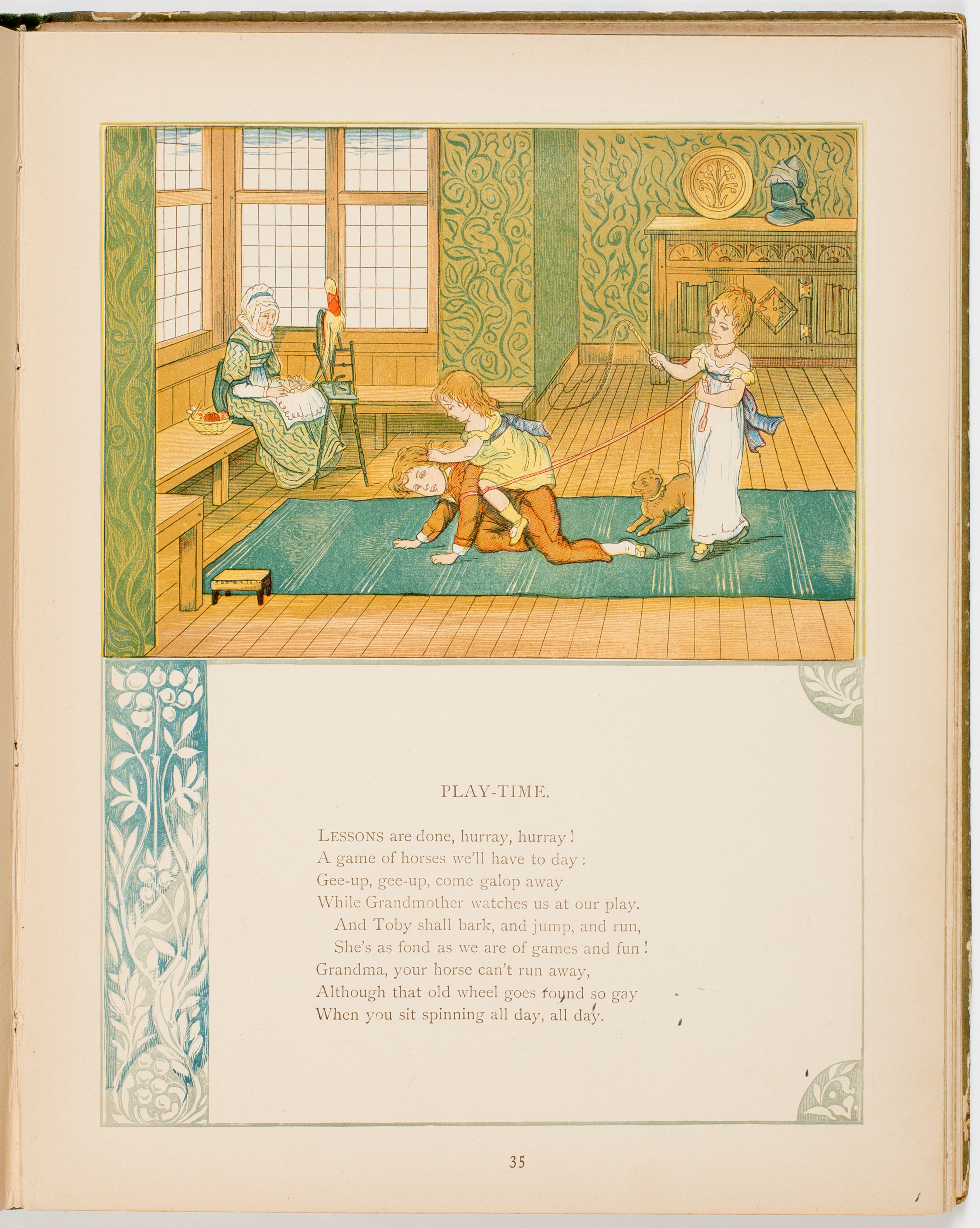
Afternoon Tea: Rhymes for Children. New York: Thomas Nelson and Sons; London: Frederick Warne and Co., ca. 1880.

play-timeThis delicate color-printed illustration of children at play is taken from a book of children’s poetry published jointly in New York and London by the England-based houses of Thomas Nelson and Sons and Frederick Warne.  Both publishers were direct competitors of New York titan McLoughlin Brothers, whose massive press runs of brightly colored chromolithographed children’s books soundly dominated the late nineteenth-century American picture book market.  Although this illustration was designed by John G. Sowerby and H.H. Emmerson, it clearly was influenced by the quaint antique style of Kate Greenaway.  The girls are dressed in empire waist gowns from the early nineteenth century, and the grandmother is sitting at a spinning wheel, which had been largely rendered obsolete by late nineteenth-century textile factories.

Now in print

Every quarter at AAS we release a list of recent publications by those who have researched at the library as fellows, members, or readers. To see this list, as well as a list of works published from 2000-2014, please visit our recent scholarship page on the AAS website. If your book, article, or other achievement is not included, just let us know if you’d like to see it there!
Readers


March-May 2014

BOOKS

Barreyre, Nicolas. L’or et la liberté: Une histoire spatiale des États-Unis après la guerre de Sécession. Paris: École des hautes études en sciences sociales, 2014. (Tracy Fellow, 2011-2012)

Ben-Atar, Doron S. and Richard D. Brown. Taming Lust: Crimes against Nature in the Early Republic. Philadelphia: University of Pennsylvania Press, 2014. (Brown: AAS-NEH Fellow, 1977-1978 and 1992-1993; AAS member)

Berkin, Carol. Wondrous Beauty: The Life and Adventures of Elizabeth Patterson Bonaparte. New York: Knopf, 2014. (Daniels Fellow, 1976-1977; AAS member)

Buell, Lawrence. The Dream of the Great American Novel. Cambridge: Harvard University Press, 2014. (AAS member)

Calloway, Colin G. Pen and Ink Witchcraft: Treaties and Treaty Making in American Indian History. New York: Oxford University Press, 2013. (AAS member)

Davis, David Brion. The Problem of Slavery in the Age of Emancipation. New York: Knopf, 2014. (AAS member)

Dayton, Cornelia and Sharon V. Salinger. Robert Love’s Warnings: Searching for Strangers in Colonial Boston. Philadelphia: University of Pennsylvania Press, 2014. (AAS-ASECS Fellow, 1991-1992; Mellon Fellow, 2004-2005; AAS member)

Demos, John. The Heathen School: A Story of Hope and Betrayal in the Age of the Early Republic. New York: Knopf, 2014. (Mellon Distinguished Scholar in Residence, 2011-2012; AAS member)

Garrett, Matthew. Episodic Poetics: Politics and Literary Form after the Constitution. New York: Oxford University Press, 2014. (NeMLA Fellow, 2011-2012)

Pacheco, Derek. Moral Enterprise: Literature and Education in Antebellum America. Columbus: Ohio State University Press, 2013. (Packer Fellow, 2013-2014)

Wyatt-Brown, Bertram. A Warring Nation: Honor, Race, and Humiliation in America and Abroad. Charlottesville: University of Virginia Press, 2014. (AAS member)

ARTICLES

Altschuler, Sari and Aaron M. Tobiason. “Playbill for George Lippard’s The Quaker City.” PMLA 129.2 (2014): 267-273. (Altschuler: Legacy Fellow, 2011-2012; Hench Post-Dissertation Fellow, 2013-2014)

Cohen, Patricia. “The ‘Anti-Marriage Theory’ of Thomas and Mary Gove Nichols: A Radical Critique of Monogamy in the 1850s.” Journal of the Early Republic 34.1 (2014): 1-20. (Daniels Fellow, 1977-1978; AAS-NEH Fellow, 1987-1988; Mellon Distinguished Scholar in Residence, 2001-2002; AAS member)

Coward, John M. “The Princess and the Squaw: The Construction of Native American Women in the Pictorial Press.” American Journalism 31.1 (2014): 71-99. (AHPCS Fellow, 2010-2011)

Fisher, Linford D. and Lucas Mason-Brown. “By ‘Treachery and Seduction’: Indian Baptism and Conversion in the Roger Williams Code.” William and Mary Quarterly 71.2 (2014): 175-202. (Peterson Fellow, 2007-2008; AAS-NEH Fellow, 2014-2015)

Malanson, Jeffrey. “ ‘If I Had It in His Hand-Writing I Would Burn It’: Federalists and the Authorship Controversy over George Washington’s Farewell Address, 1808-1859.” Journal of the Early Republic 34.2 (2014): 219-242. (Peterson Fellow, 2009-2010)

O’Brien. Donald. “The Engravers of Philadelphia’s Port Folio Magazine.” Printing History 15 (2014): 3-31. (AAS member)

Thompson, Catherine L. “ ‘If They Smile He Will Flourish’: Mothers, Doctors, and Nineteenth-Century Children’s Literature.” Literature and Medicine 32.1 (2014): 148-168. (Peterson Fellow, 2006-2007)

AWARDS

Wendy Bellion was awarded the Charles C. Eldredge Prize for Distinguished Scholarship in American Art for her book Citizen Spectator. (Last Fellow, 2011-2012; AAS member)

Ansel Elkins won the Yale Younger Poets Prize for “Blue Yodel.” (Hearst Fellow, 2012)

Honorée Fanonne Jeffers was awarded a Witter Bynner fellowship from the Library of Congress. (Baron Fellow, 2009)

Andrew Jackson O’Shaughnessy won the Washington Prize for his book The Men Who Lost America. (Peterson Fellow, 1986-1987; AAS member)
 

Public Program: Poet Tess Taylor on Researching at AAS

We’ve had an interesting lineup of public programs so far this spring, exploring everything from nineteenth-century theater and attitudes towards alcohol to what life was like for free and enslaved African Americans in Massachusetts during the prelude to the Revolutionary War.

Tomorrow, Thursday, May 29, at 7:00 p.m., we’ll continue our series with a talk by poet Tess Taylor called “Sifting the Uneven Archive: Researching the The Forage House.”

Tess TaylorIn this program, Taylor will recount how a residency here at AAS helped her as she researched and wrote her latest book of poems, The Forage House. Her poems layer oral histories, documents, and folksongs to craft an exploration of her ancestors- a mix of New England missionaries and Southern slave owners, including Thomas Jefferson. Taylor’s poems are as much about the imperfect material of family stories as they are about the politically charged material of history. Natasha Trethewey, our current poet laureate, described The Forage House as “a brave and compelling collection that bears witness to the journey of historical discovery. Sifting through archives, artifact, and souvenir, Taylor presents dialectic of what’s recorded and what is not, unearthing the traces that give way to her own history – and a vital link to our shared American past.” Taylor researched The Forage House as a Robert and Charlotte Baron Creative Artist Fellow in 2006.
Tess Taylor’s poetry and nonfiction have appeared in The Atlantic, Boston Review, Harvard Review, Literary Imagination, The Times Literary Supplement, and The New Yorker. She currently reviews poetry for NPR’s All Things Considered and teaches writing at the University of California, Berkeley. You can listen to some of Taylor’s spots on NPR here and here.

This spring’s public programs series will conclude on Tuesday, June 10, with a talk by John Demos titled “On the Trail of the ‘Heathen School’: Local History, American History, and World History” about his new book.

AAS joins the Worcester Revolution of 1774

On September 6, 1774, 4,622 militiamen from 37 towns marched into Worcester, shiretown for  the county, closed the Royal courts, and forced each court official to resign. Forming WorcRevLogo (2)two lines, they forced each court official, hat in hand, to disavow the recent Massachusetts Government Act, which revoked the Province’s charter and disenfranchised its citizens. With this dramatic action, all British authority vanished from Worcester County, never to return. While the actual war for American independence started in Lexington and Concord, the revolution – the actual transfer of political and military authority – occurred here in Worcester nine months earlier.
Parkman diary
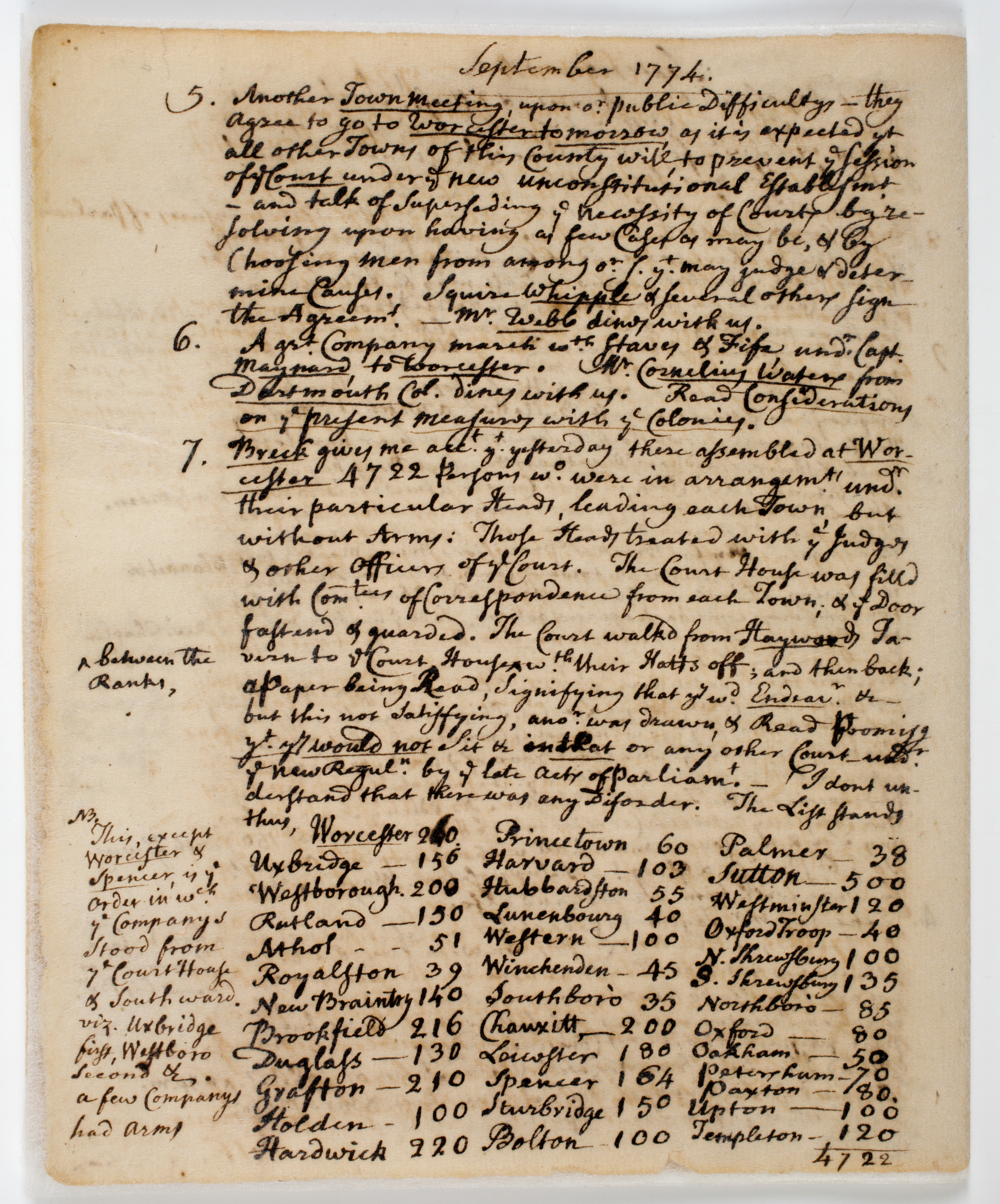
Page from the Ebenezer Parkman diary showing the list of militia units

Now, AAS has joined a coalition of individuals and organizations to commemorate this historic event with a series of public programs culminating in a reenactment of the event on September 7, 2014. The project, called The Worcester Revolution of 1774, is planning a region-wide celebration that will include activities across the cultural and historical organizations of Worcester and the 37 towns that participated in 1774. The project has received funding from the Greater Worcester Community Foundation, the Worcester Arts Council, and Mass Humanities.

The Society’s collections contain the key evidence of this historical event, including the diary entry of the Reverend Ebenezer Parkman, which recorded the event and listed each of the towns and the place their militia stood along the “gauntlet” to hear the recantations of the court officials.

The short film below (or here) promotes the project and features Timothy Bigelow, a local blacksmith and leader in the Whig movement. Bigelow assisted AAS founder Isaiah Thomas in taking his press out of Boston on the night of April 16, 1775. They set the press up in the basement of Bigelow’s home and it was here that Thomas printed his famous May 3, 1775 issue with his eyewitness accounts of the Battles of Lexington and Concord.

The Society is participating in this project by sponsoring workshops and lectures and providing digital facsimiles of AAS collection materials. Additionally, I have been commissioned to write a play about this event that will be the centerpiece of the September 7, 2014, celebration. For more information see http://www.revolution1774.org/.

The Acquisitions Table: The Death and Burial of Poor Cock Robin

The Death and Burial of Poor Cock Robin.  Philadelphia: Davis, Porter & Coates, ca. 1866-1868.

Poor Cock RobinThis poignantly humorous image of the owl digging departed Cock Robin’s grave is taken from an “indestructible” picture book that had its pages reinforced with cloth for the hard use of young and eager hands.  This hand-colored wood engraving is characteristic of American children’s picture books of the mid-nineteenth century. When Davis, Porter & Coates issued this book New York picture book publisher McLoughlin Brothers was starting to publish picture books mechanically printed using color lithography, revolutionizing the economic production of multi-colored picture books.

Who is that Book-Clad Man? William Jenks on the Science of Early American Antiquarianism

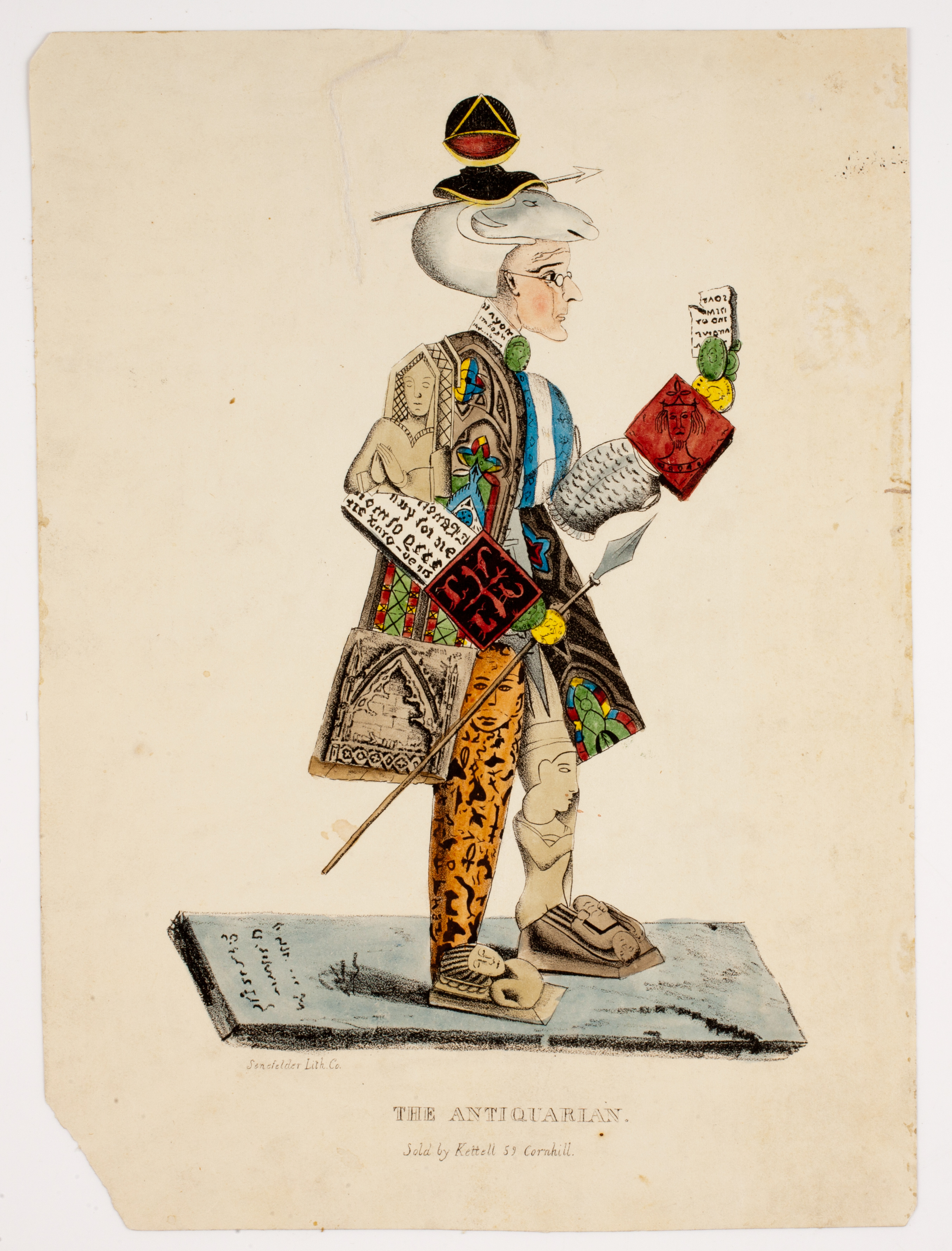
This image, a favorite around AAS, is part of a series a lithographs that circulated in the late 1820s and early 1830s, depicting people as an amalgamation of various objects: shells, vegetables, paintings, and in this instance, relics. This graphic motif harkens back to the the antiquarianRenaissance painter Giuseppe Arcimboldo, whose portrait heads made of similar objects were popular in sixteenth-century Italy. Where Arcimboldo created a head made of books and titled it “The Librarian,” the artist here depicts “The Antiquarian,” made up of manuscript materials and of ancient relics and statutes. Engrossed in his reading, this figure turns away from the viewer, not looking to engage us in any way, but instead, perhaps encouraging us to examine the ancient artifacts that constitute him.

“The Antiquarian” begs many question, not the least of which is who is this book-clad man? What is the cultural type he represents? And more broadly, who was the early nineteenth-century American antiquarian? And what, if anything, might he (and the antiquarian in the period is always coded male) tell us about our current practices of collecting, organizing, and processing the materiality of the past? Part of the answer to this question can be found in the early documents of AAS. Founding members gave considerable weight to the term “antiquarian,” thinking and writing about the mission that they understood it to embody. They did not consider themselves historians, or even humanists really, but rather, for them, “antiquarianism” was a scientific line of inquiry, with a discrete methodology. In our present moment, their understanding of antiquarianism might help us to challenge disciplinary practices and assumptions that organize scholarly engagement with the past.

As tied to the nationalist project as these founding “American” antiquarians imagined themselves to be, they acknowledged, from AAS’s inception, the precedents for their understanding of themselves and their labor as borrowing from a longstanding British tradition. In their 1812 petition to the Legislature of Massachusetts, the six incorporating members hoped to model themselves after the College of Antiquaries in Ireland, which is, they conjecture “probably the most ancient institution, now existing in the world.” The tradition of antiquarianism is an inherited one, an imported drive to collect and to organize. That impulse, that drive, is, also true to its Enlightenment roots, understood as systematized, as a “science,” though it would take another year before AAS articulated it as such.

In the first annual address to the Society, Reverend William Jenks, who fulfilled several key roles at AAS and who would go on to be a founding member of the Asiatic Oriental Society, defined antiquarianism as part of, but not the same as, either history or poetry. Echoing Aristotle’s definition of Rhetoric as the discipline that allows all other disciplines to do their work, Jenks positions antiquities as so ubiquitous as to ”belong to almost every art and science; and they, who have cultivated art or science with attachment and diligence, may be often benefited by the history of its progress.” The progress of the antiquarian is not “the pleasing task of dwelling on individual characters,” for that is the work of history and poetry, according to Jenks. The antiquarian “aim[s] at objects less exposed to ordinary notice.” The antiquarian is then in part a detective as they “investigate their causes,” laboring in service to time rather than to scholarship or creative enterprises per se. Ten years later, Christopher Columbus Baldwin, AAS’s first fulltime librarian, would make this point in his loving description of time as “the antiquary’s best friend, his right hand man” (Letter to Reverend George Allen, October 20, 1832).

There is much more to be said here about how the work of the antiquarian morphed over the next two centuries into the work of cataloguing, archiving, and collecting, of how the “science” of antiquarianism has become the “science” of information. In the month ahead, as I look at the history of metadata creation here at AAS, I intend to trace some of the genealogy of the organization and preservation of the documentary record in the hopes of elucidating how that genealogy informs and at times disrupts some of the prevailing tenets of the digital humanities.

Preservation Week Redux: Saving a Collection

Those of you who follow the Society’s blog are aware that the last week in April was Preservation Week, a period set aside by the American Libraries Association to focus on the care and conservation of collections material.

We take preservation seriously at AAS. The word is part of our core mission, in fact. We have a conservation lab on site and the curators regularly review priorities with the head conservator in order to plan actions and treatments for the coming year. We budget for materials and supplies like archival boxes and folders, Mylar pouches, matte board, etc. Surveys and rehousing projects are scheduled at this time, as well.

Wohl4
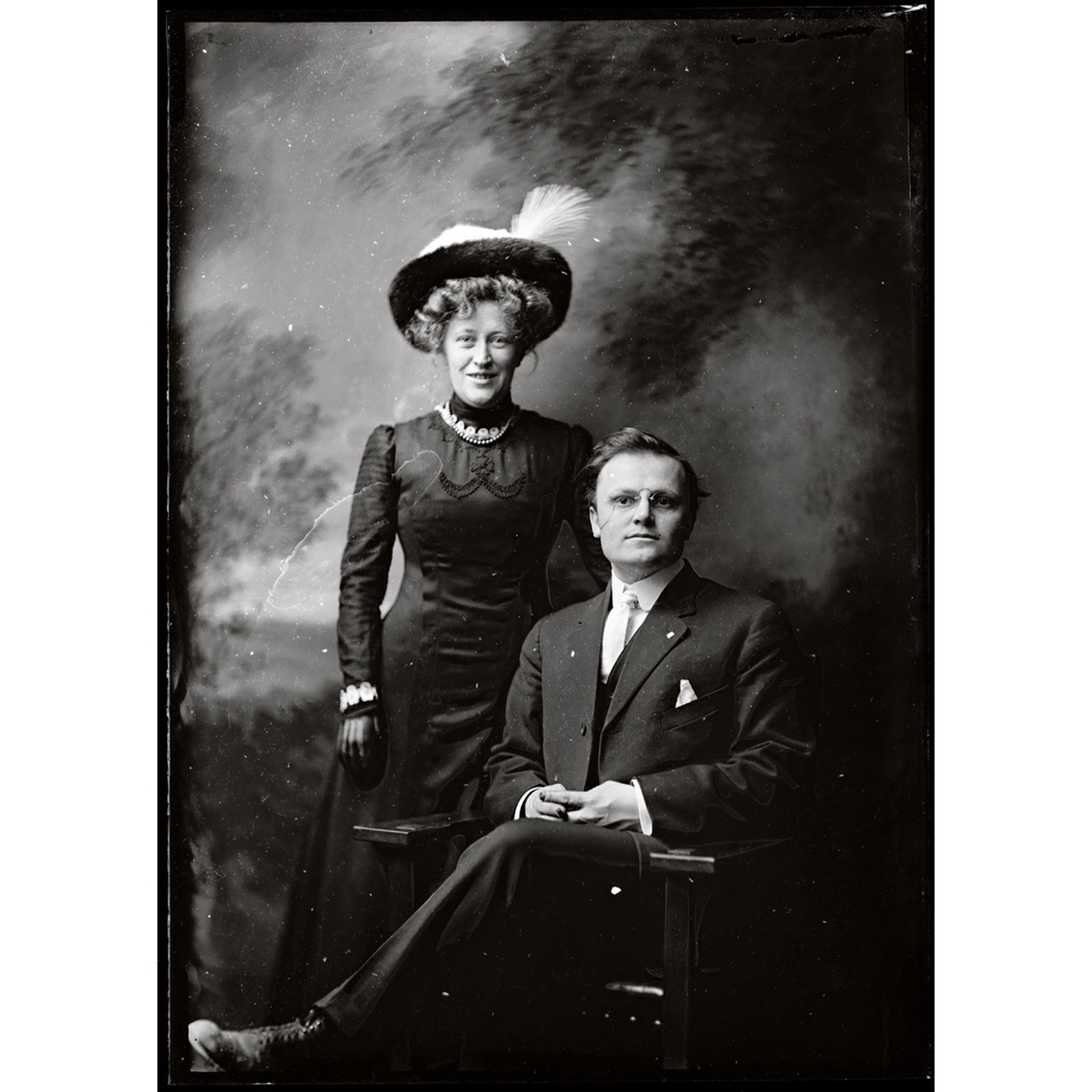
Here is Wohlbruck himself, with his wife. The negative for this image was in one of the very worst boxes, at the bottom of the wet cardboard box.

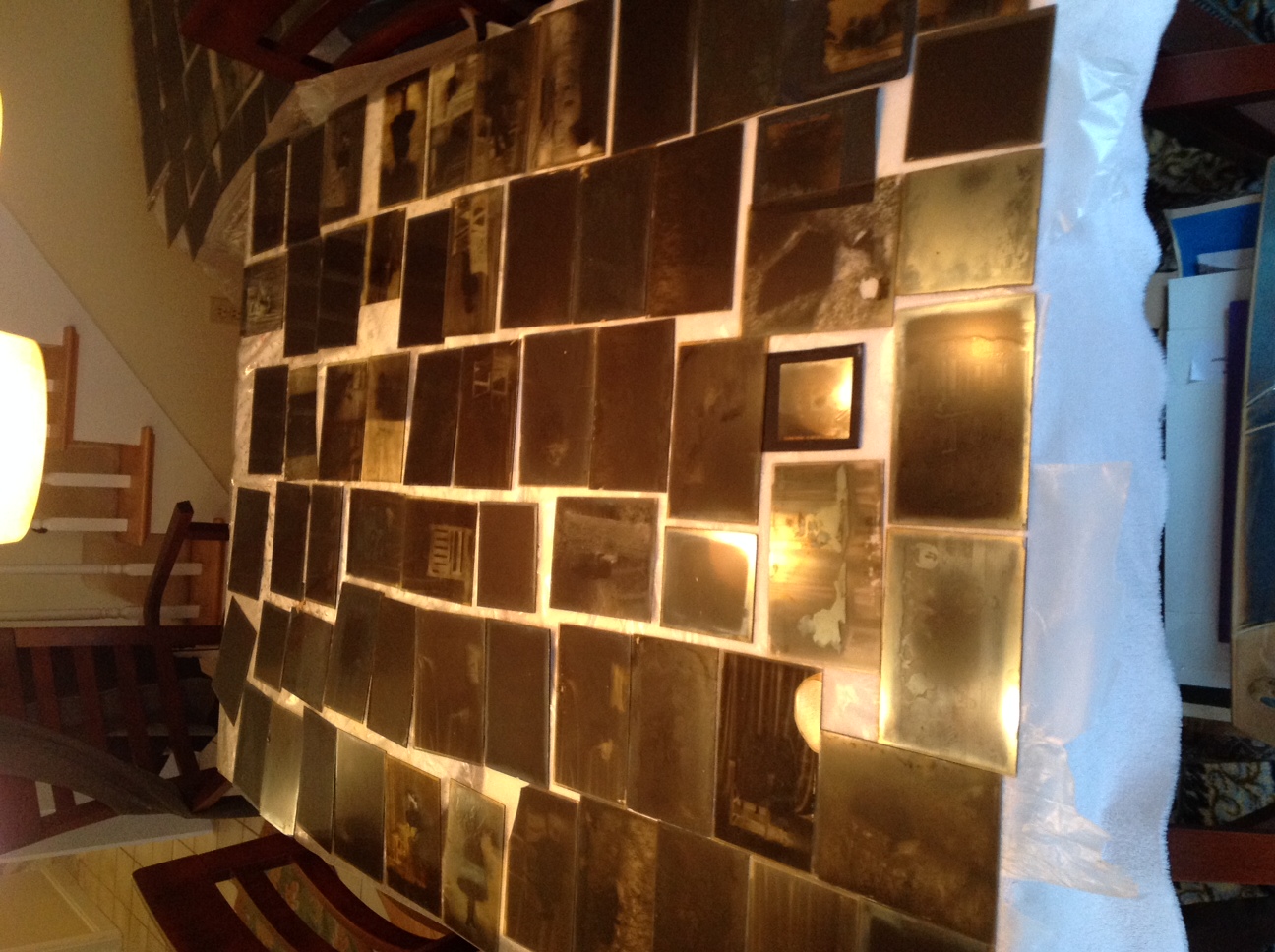
All this planning and budgeting and discussion is well and good, but occasionally a collection will arrive at AAS unexpectedly. This was the case in early April of this year when I received a phone call from a Worcester County resident who had been planning for years to donate his grandfather’s glass plate negatives to AAS. We had some email correspondence back in 2013, but at that point he was not ready to place the material with us. The negatives were made by Theodor C. Wohlbruck (1879-1936), a Worcester photographer whose early professional archive was already housed at the Society, having arrived here before 1960. The Society’s collection includes over a thousand plates and prints by Wohlbruck, primarily views of towns in Worcester County and photographs of prominent Worcester buildings made between 1890 and 1910.

The donor said he had more negatives, mostly family photographs made in the studio, as well as images related to family trips. His April phone call was stimulated by the unfortunate fact that a springtime flood resulted in water in his basement and the negatives had been impacted. Could we come and get them and preserve them immediately? Without promising much (water and glass plates do not mix well), we agreed to have a look at the damage and see if there was anything we could do. Our conservation lab is a paper based lab. Serious photographic preservation would have to be handled offsite if needed.

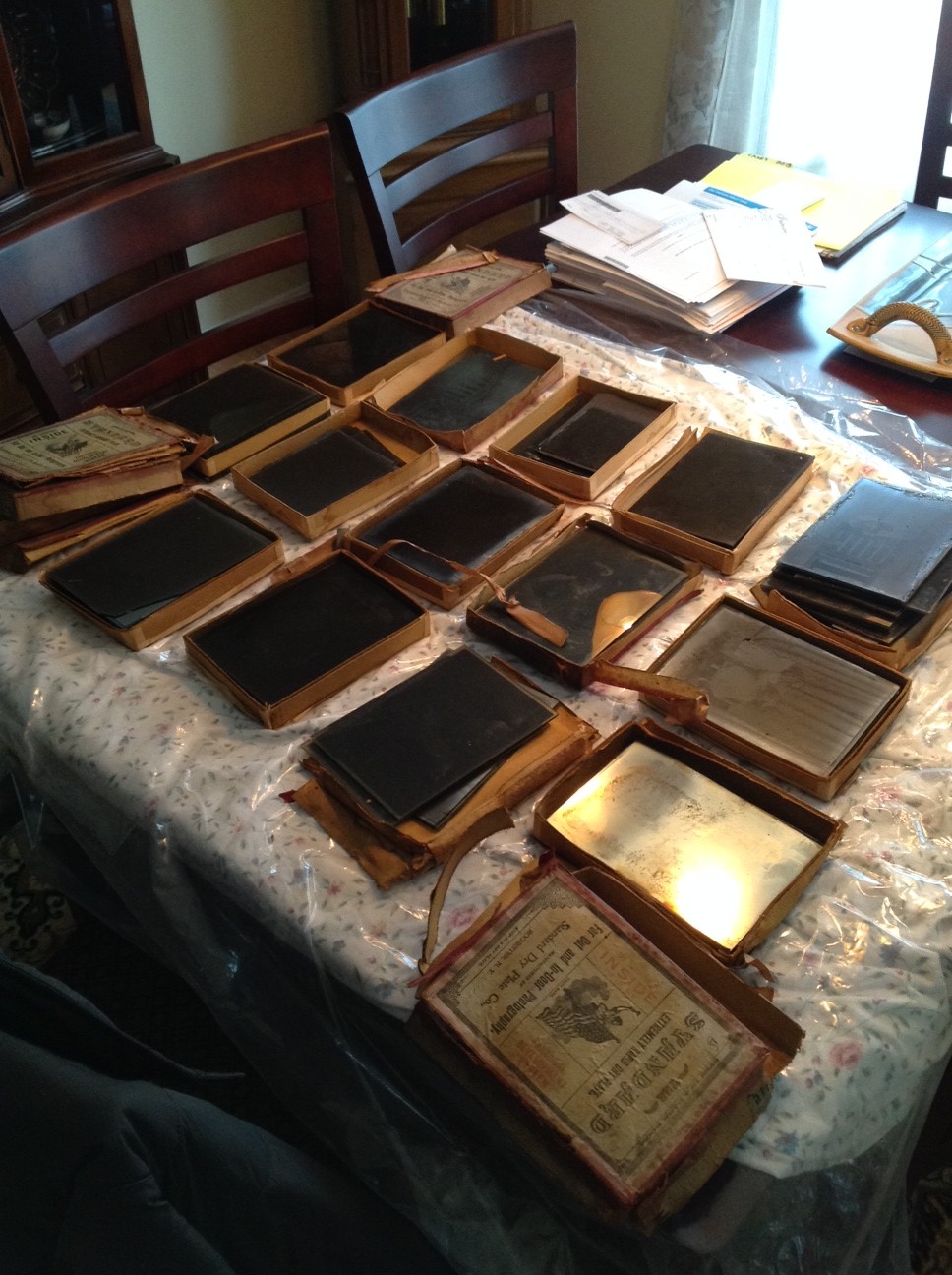
Wohl3Upon arrival at the donor’s home we navigated the dumpster, the box fans, and the quickly laid wooden planks that often accompany a flooded basement here in New England. The negatives were all laid out on a stone wall, in their original paper board boxes. They had been stored on the floor of the basement stacked in a wooden fruit crate and had sat in the water for a couple of days before the flood was detected. It did not look good. We encouraged the donor to contact a conservation center that could handle the negatives, but he wanted them to go to AAS only.

We ended up loading the 148 negatives and their soggy boxes and the fruit crate into the car. A quick phone call to our chief conservator confirmed that the negatives needed to air dry. The negatives were removed from the sodden boxes and were spread out immediately, emulsion side up. Some were completely bonded together, and the ones at the bottom of the box looked to be a total loss. We placed fans strategically and hoped for the best. Preservation, triage style! Our conservator consulted with the regional photography expert and he agreed that air drying offered the best hope for salvation of the plates. It was a stressful 36 hours but the majority of the negatives came through the ordeal intact.

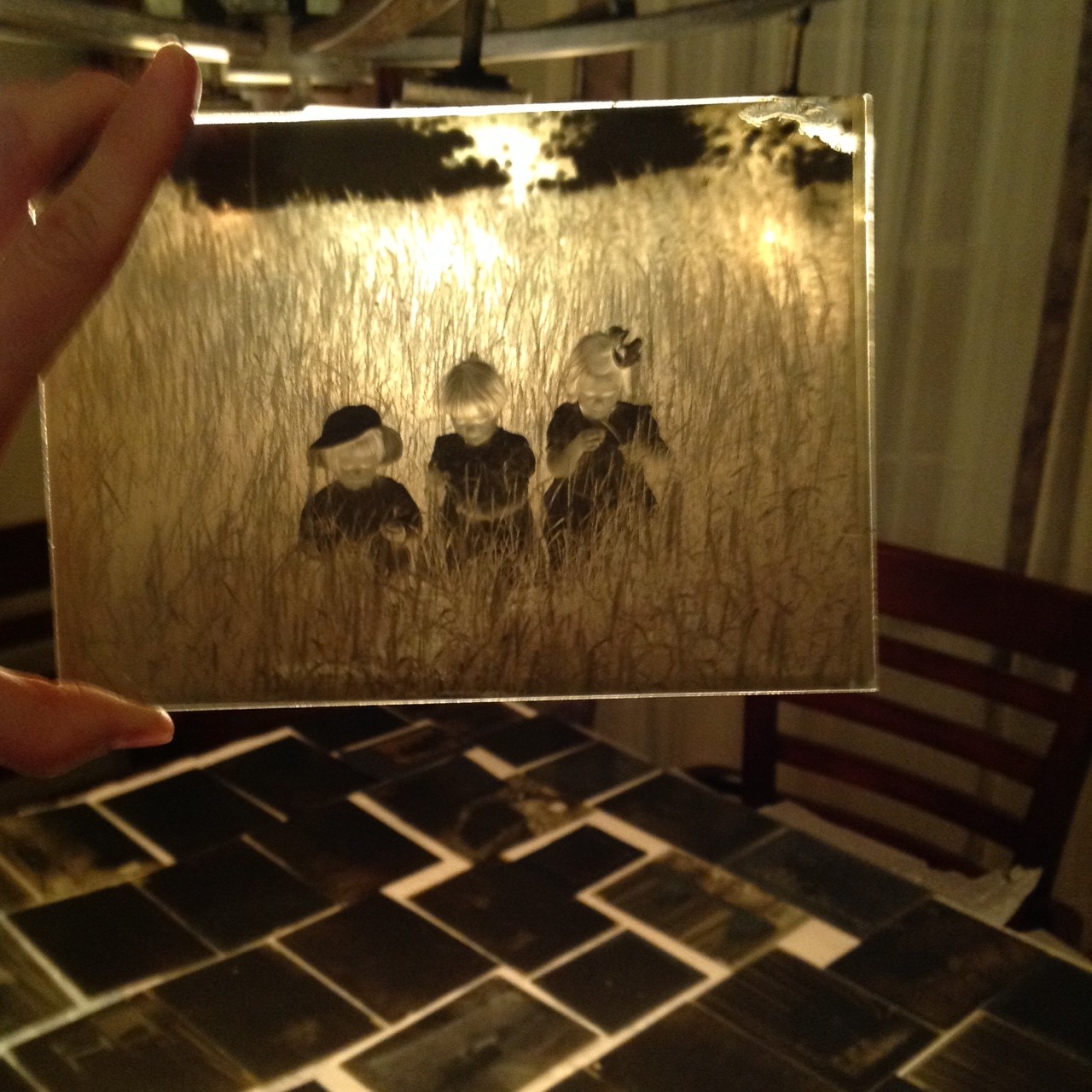
Wohl1The end of the preservation story for this group of Wohlbruck negatives has not happened yet. The plates are now safely in climate control at AAS and the transfer from the donor is complete. Supplies have been ordered and each negative will be individually foldered and placed in acid free boxes after they have been cleaned. Our photographer made a couple of test scans of the negatives and they appear to be mostly intact, although some are covered in grit and others have losses of emulsion at the edges. Twenty or so are a complete loss, but will be retained as teaching tools.

Wohl2
Wohlbruck’s three children

This portion of Wohlbruck’s work will be preserved alongside the rest of his archive. Making fragile glass plates accessible is another role of a library, along with preservation. The majority of the new donation will be digitized after cleaning and made available to the world through our website. We will continue to post about this fascinating collection as the preservation and digitization moves forward. And one last preservation tip: if you can help it, do not store historic photographs in your basement!

What’s AAS Preserving this Week? An Early (1709) Bay Psalm Book

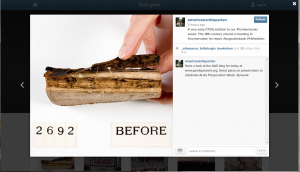
To continue the celebration of the American Library Association’s 2014 Preservation Week held back in April (and mentioned in an earlier post), we’re bringing you a behind-the-scenes peek into a conservation project that started just a couple weeks ago on a recent acquisition – a Bay Psalm Book from 1709. The revitalization process for this volume will start with a photo shoot, a cleansing bath, and some re-stitching, and will end with a new back, protective clothing, and secure housing.

BPB music
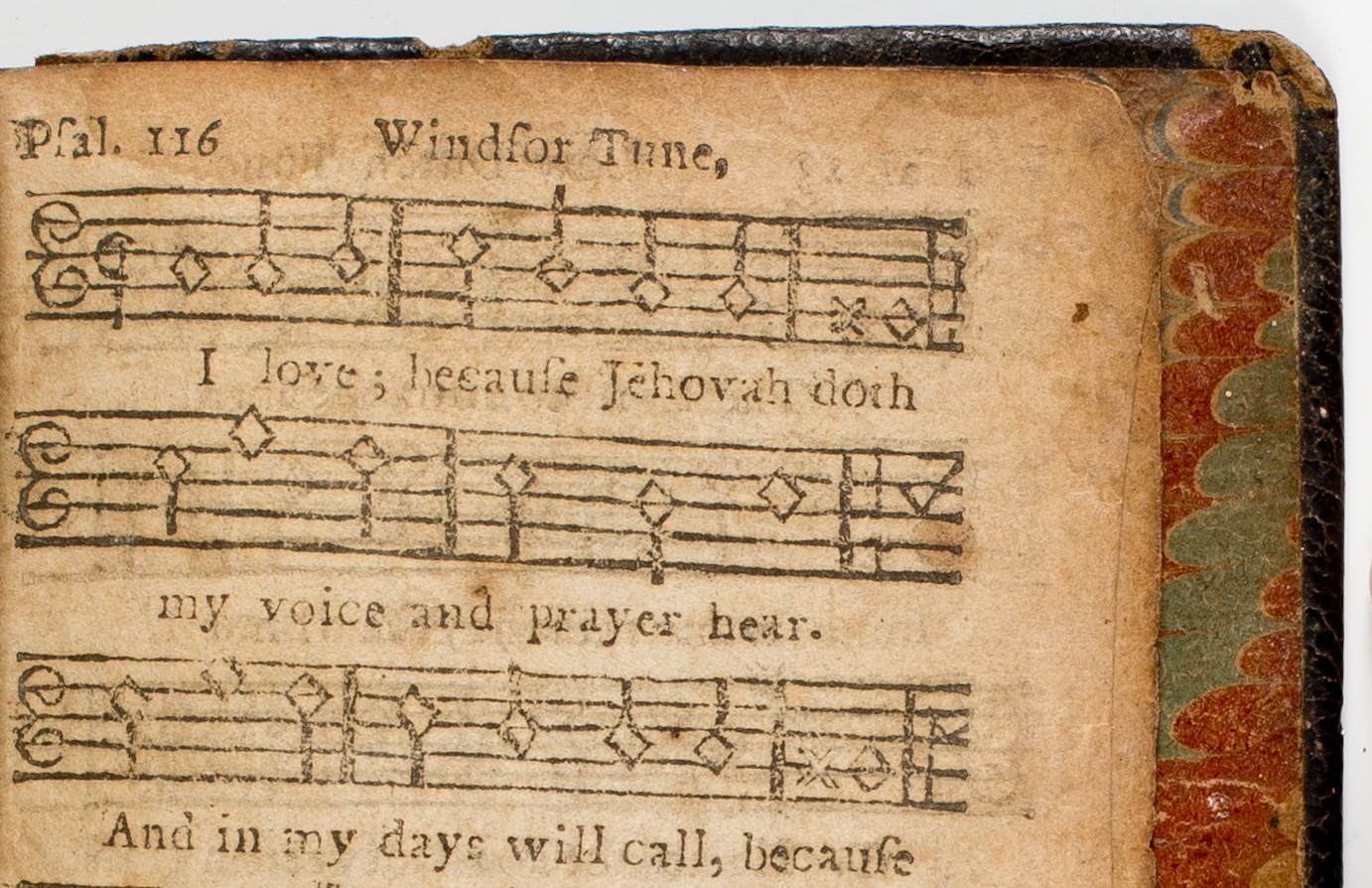
Closeup of musical supplement at the end of the 1709 Bay Psalm Book

AAS was thrilled to add this early eighteenth-century edition to our already strong collection of early Bay Psalm Books, including a copy of the first edition from 1640. You can learn more about the Bay Psalm Book editions and why this particular one is of interest to us by reading the full article in the AAS newsletter, the Almanac, embedded below. (Spoiler alert: it’s the only known complete copy of this edition, it contains the earliest example of music printed in North America at AAS, and it is in complete and unsophisticated — although certainly not perfect! — condition.)

Even before the funding was secured to acquire this 1709 Bay Psalm Book (given by the Fred Harris Daniels Foundation in memory of AAS member William O. Pettit, Jr.), donations had begun flowing from eager members, scholars, and staff. Thanks especially to early donors Margery Dearborn, Jock Herron, and Meredith Neuman! Those generous early donations are now being used to conserve, house, and digitize the book in order to preserve its physical structure.

BPB cover
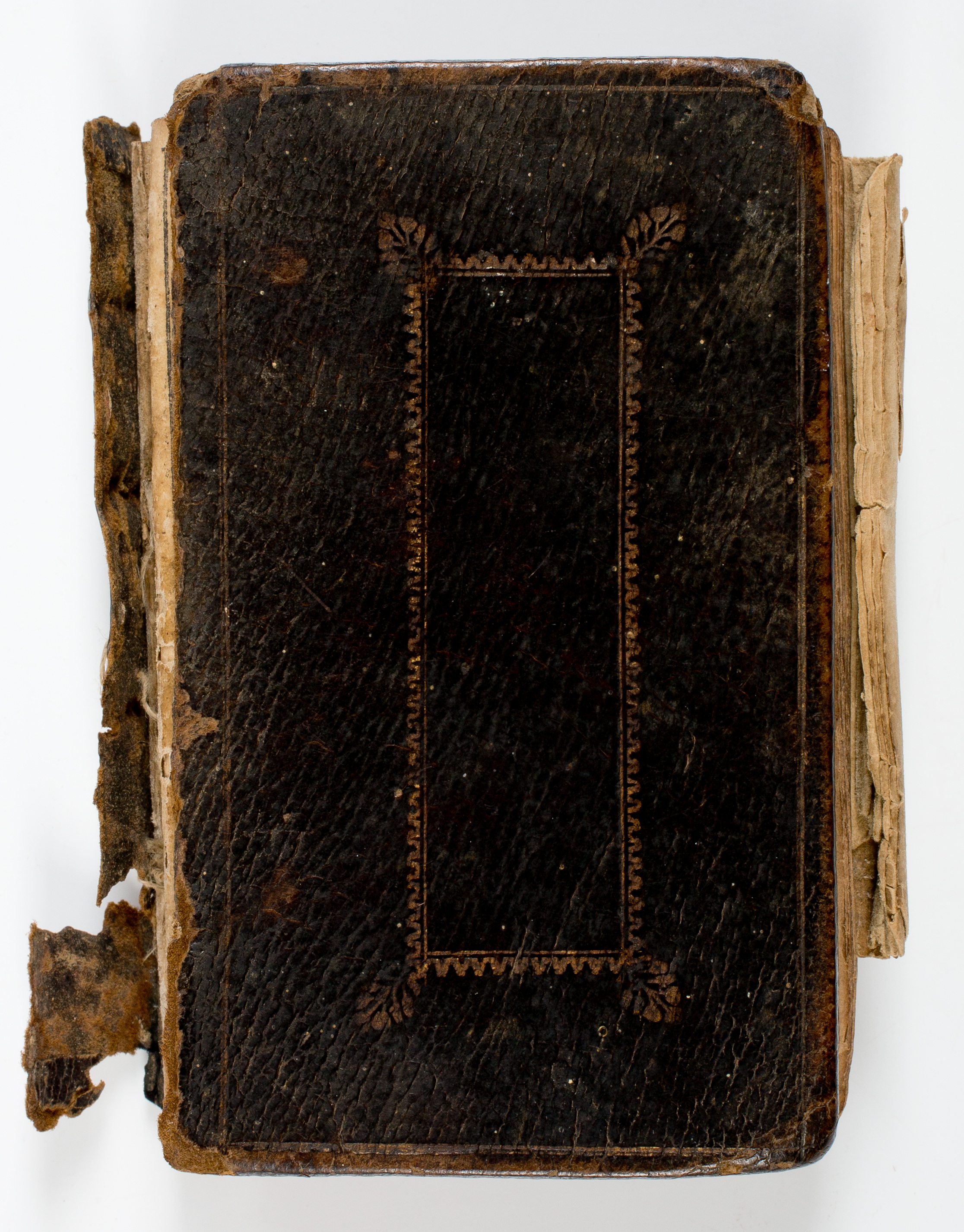
Binding of the 1709 Bay Psalm Book, or more precisely, The psalms hymns, and spiritual songs, of the Old and New-Testament. 14th ed. Boston: John Allen for Eleazer Phillips, 1709.

Using our newest Bay Psalm Book as it was originally intended is challenging in its current condition. Yet it is actually in remarkably good shape compared to other early psalters. Given that hymnals or psalters were meant to be flipped through and handled at least once a week rather than read through once a lifetime, those that do survive the centuries have almost invariably lost a few things along the way: their original binding, at least part of the title page, and usually some of the pages of music at the end. Remarkably, this 1709 Bay Psalm Book managed to hold on to all of its parts. Still, even just leafing through the volume in its current state puts its over-300-year-old body under undue pressure.

The goal of AAS conservation staff is to stabilize the book’s condition without losing potential information binding historians might find useful. The conservation plan, as it stands now, begins with high-quality, detailed photographs documenting the current state of the volume. The text block will then have to be removed from its period binding. The paper will be washed to deacidify or neutralize it, then alkalized in a magnesium bicarbonate solution, as it has become discolored from age and improper storage. Remarkably, little paper repair is needed apart from mending the tattered edge of the title page with Japanese paper. The signatures will be resewn and new endbands fabricated in the same style as they were originally. The text block will then be fit back into the  original binding, which will be retained, but will need to have a leather re-back as the original binding has broken over the years. End papers will be added to protect the title page. A custom box will be made to the exact dimension of the volume so it can sit on the shelf with no danger of friction. There it will safely sit in AAS’s doubly-locked and climate-controlled vault (home of our “holy of holies”) where it will remain available for scholarly examination for hopefully at least another 300 years.

Instagram
Images from the conservation photoshoot are on AAS’s Instagram page. Now that you’ve seen our “before,” stay tuned for our “after”!

We think of these planned interventions as not so much a facelift as a hip replacement. Although the book will look more aesthetically pleasing in the end, the goal is to make it functional again. After all, if no one can open a book or turn its pages without breaking it or damaging it further, does it really exist as a book?

The Way to a Woman’s Heart—Or Not

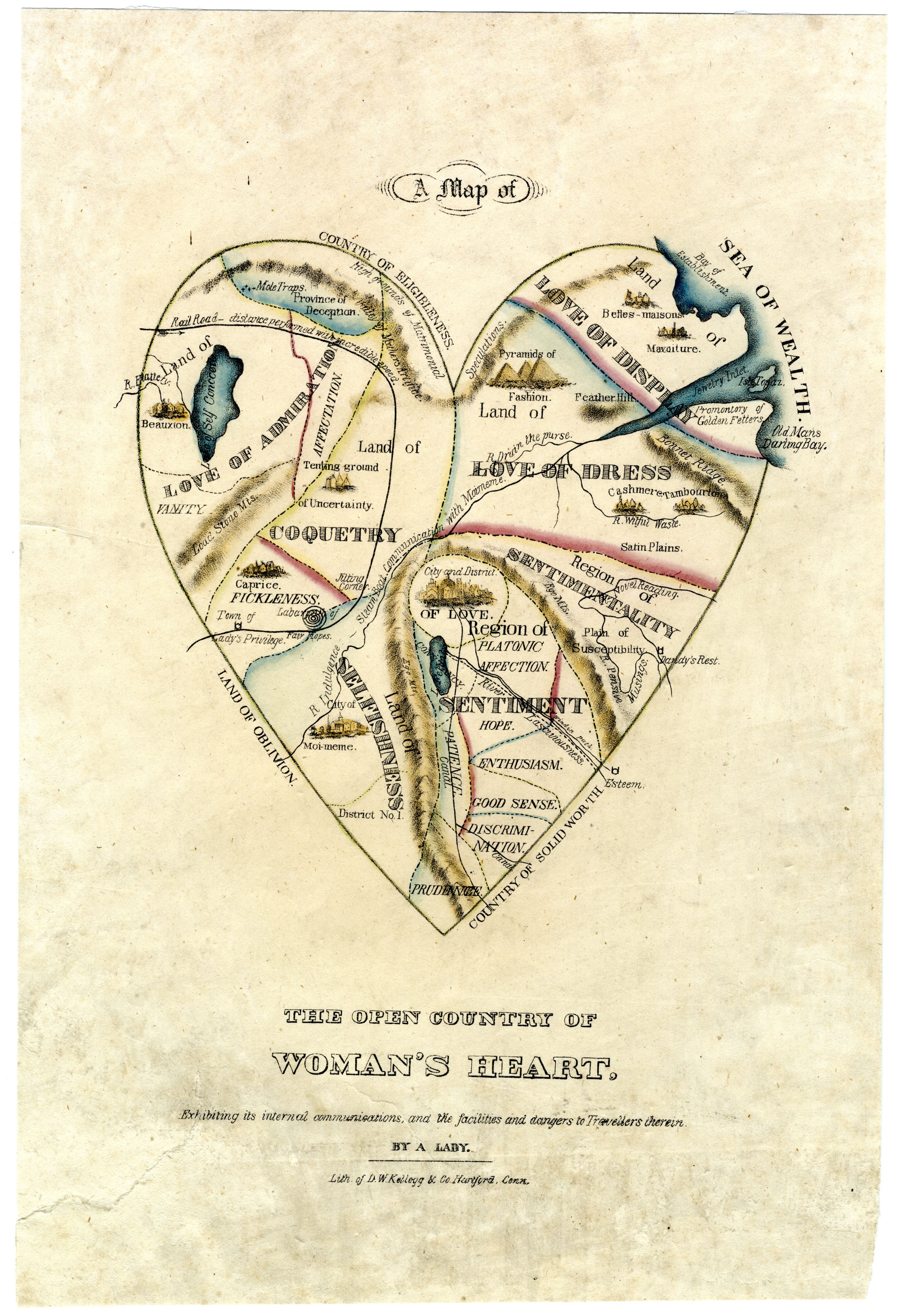
map of woman's heart tifIt’s an age-old question: What is the way to a woman’s heart? (It’s also a timely question, with Mother’s Day this coming weekend.) We often hear the way to a man’s heart is food, beer, or sports. To a woman’s, it’s usually said that it’s chocolate, jewelry, clothing, or shoes. If we dig a little deeper, men may also value kindness and compassion, women sensitivity and strength. These are all stereotypes, of course, but one striking thing about working in an archive is reaffirming that there really is nothing new under the sun, including stereotypes—and the tiny bits of truth they sometimes hold.

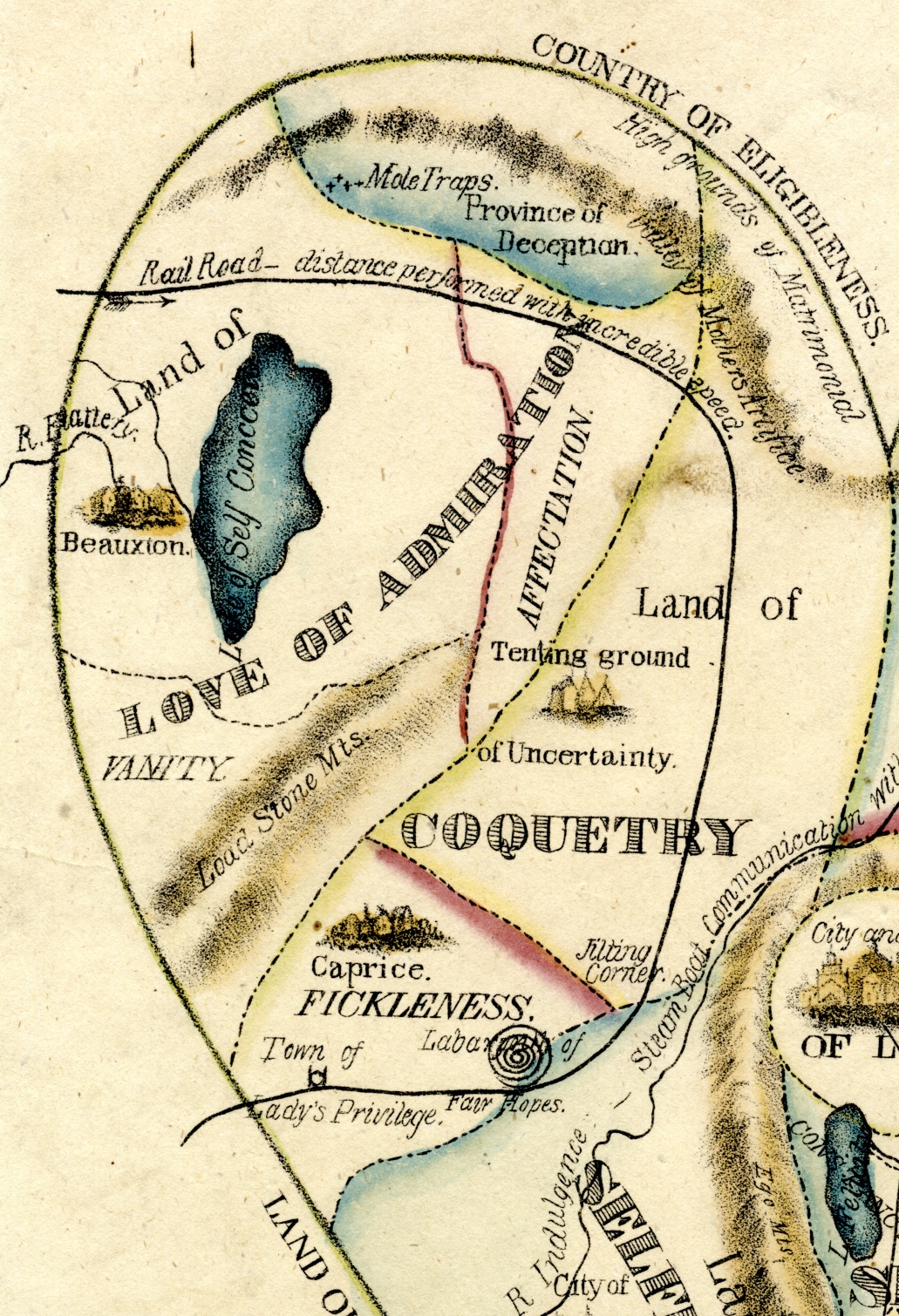
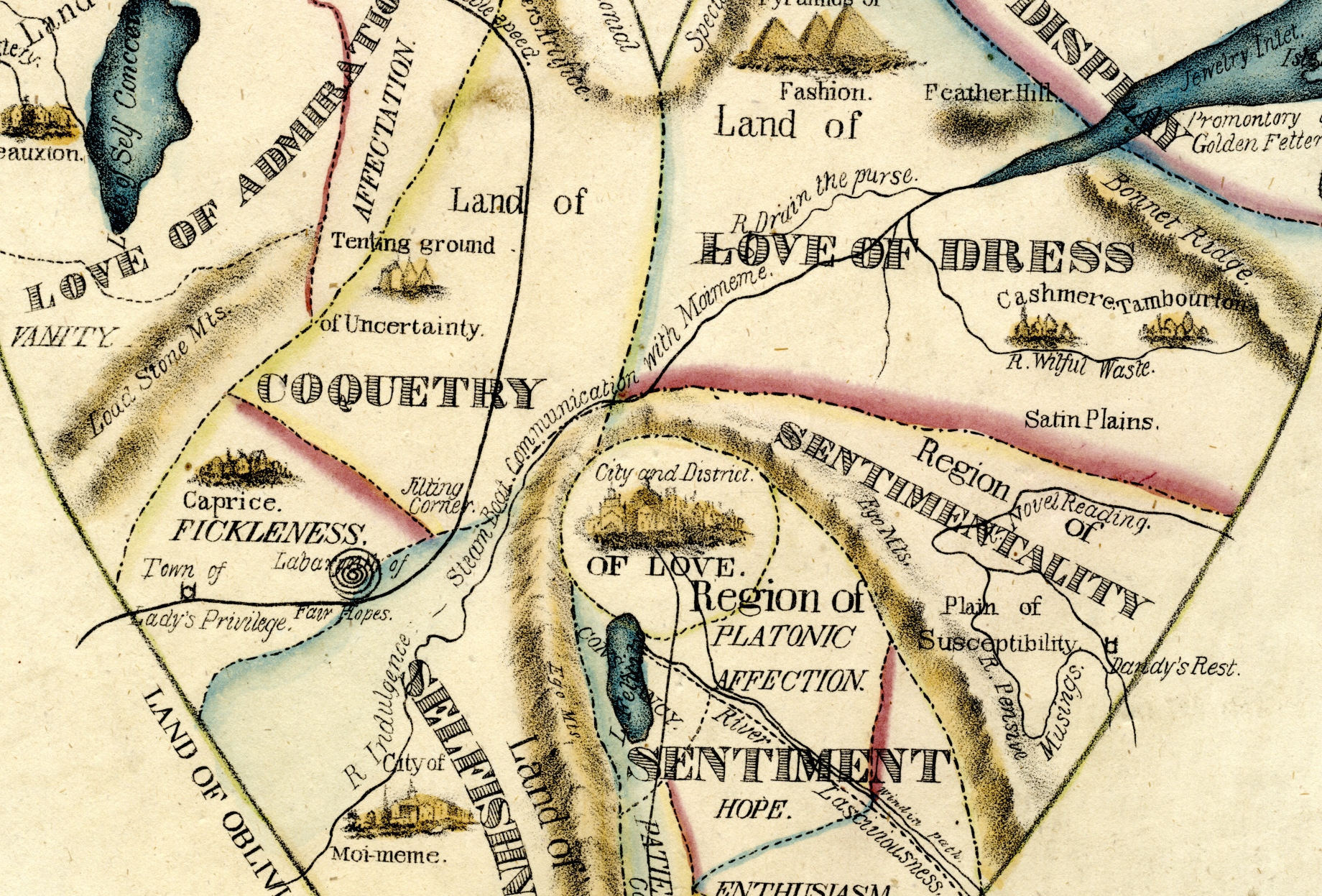
Among the thousands of images depicting women in our collections, there is one that has continually sparked discussion whenever we share it with K-12 and Hands-On History Workshop participants: A Map of the Open Country of Woman’s Heart, Exhibiting its internal communication, and the facilities and dangers to Travellers therein. Printed between 1833 and 1842 with attribution stated as “By a Lady,” this image serves as a perfect place to begin exploring nineteenth-century ideas about and attitudes towards women. At first glance, its complex layout and soft, pretty colors lead the viewer to think they are looking at a positive and glowing depiction of women’s love and understanding. Closer viewing belies these initial signals, revealing that the Lands of Love of Admiration, Love of Display, Love of Dress, Coquetry, and Selfishness take up far more space in a woman’s heart than the Region of Sentiment, which consists of districts such as Love, Hope, Enthusiasm, Good Sense, and Patience.

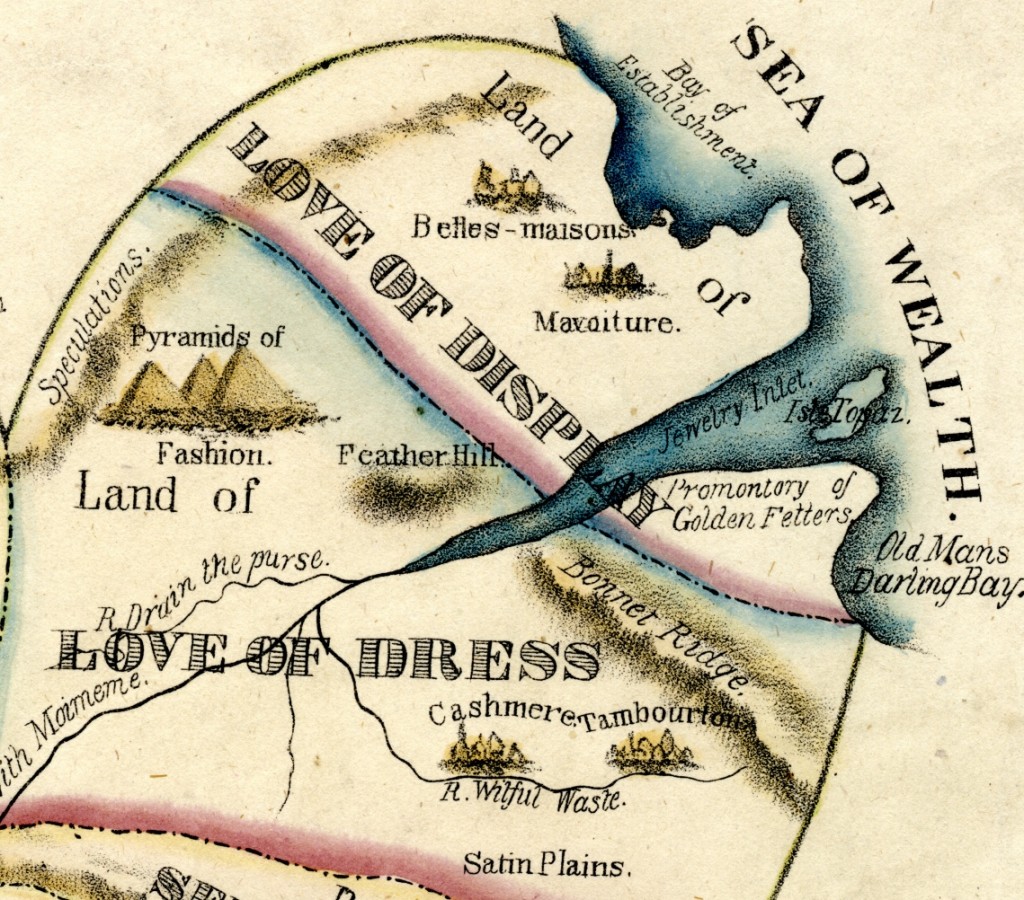
While I certainly take issue with the creator’s proportions of positive versus negative traits, closer inspection of these so-called lands and regions does bring to mind some present-day assumptions about human woman's heart detail 1(and woman) nature. For example, apparently jewelry and clothing have always been seen as one way to a woman’s heart. If you look closely at the Lands of Love of Dress and Display in the top right of the heart, they include the cities of Cashmere and Belles-maisons (“Beautiful-houses”); the Satin Plains; the Pyramids of Fashion; Bonnet Ridge; and the Rivers Drain the Purse and Wilful Waste, both of which flow into the Jewelry Inlet. The creator has left no doubt about their attitudes toward a love of fashion and style, even bordering these lands with the Bays of Establishment and Old Mans Darling. By these standards, some women today—including myself, who can never pass up a good pair of shoes—are certainly guilty of a love of dress and display.
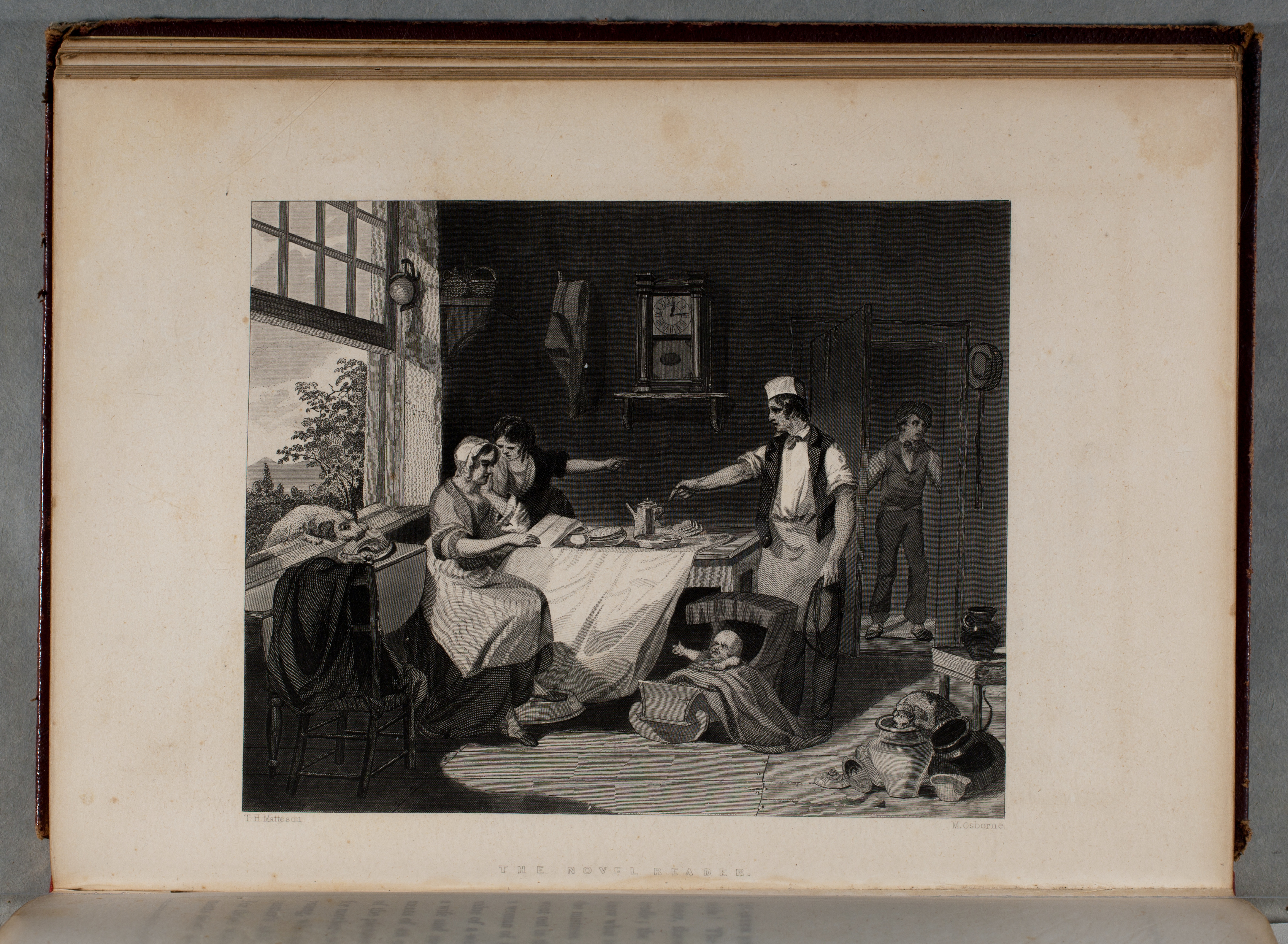
This mid-nineteenth-century engraving depicts some of the dangers of novel reading for women.

Many of the other lands include similar negative topographical names. Even the Land of Sentimentality—a concept that was very popularly applied to women in the nineteenth century—features the Plain of Susceptibility and the town of Dandy’s Rest, the idea presumably being that if you are too sentimental you are susceptible to being taken in, making you perfect prey for those vain dandies. Let’s also not forget the damaging influence of the ultimate conveyor of sentimentality, the novel. A Land of Sentimentality would not be complete without a River of Novel Reading.

woman's heart detail 2Aside from these topographical elements, however, one of the most interesting aspects of this image is the use of what was at the time either relatively or very new transportation technology to convey a sense of women’s patterns of emotion and behavior. Take, for example, the railroad, which begins in the top left corner in the Land of Love of Admiration and covers distance “with incredible speed.” It moves through this first land, past the Lake of Self Concern, the High Grounds of Matrimonial Speculations, and the Valley of Mothers Artifice, and into the Land of Coquetry. From there it speeds past the Tenting ground of Uncertainty, through Jilting Corner, briefly finds itself in the Land of Selfishness where it passes the Labarynth of Fair Hopes, and on through the Town of Lady’s Privilege in the Region of Fickleness, finally crossing the border into the Land of Oblivion. Following this path gives one the impression of a whirlwind tour of the plot of one of those nineteenth-century sentimental novels the creator finds so distasteful, or else reeks of the bitterness of someone who has fallen prey to a woman’s (and her mother’s) prospective matrimonial games one to many times. Perhaps someone had been reading a too few many of those novels themselves.

woman's heart detail 3The employment of the transportation metaphor shows up again with the steamboat on the River of Indulgence, which provides communication between the City of Moi-meme (“Myself”) in the Land of Selfishness and the Lands of Love of Dress and Display on the opposite end of the country. The metaphor of a steamboat—a form of transportation that was relatively quick and could travel lengthy distances, but was not quite as efficient as a railroad—gives one the sense that it is not a far trip from selfishness to vanity. Indeed, rather than the windswept sense of love affairs the railroad gives, the connection between selfishness and vanity is more constant and steady.

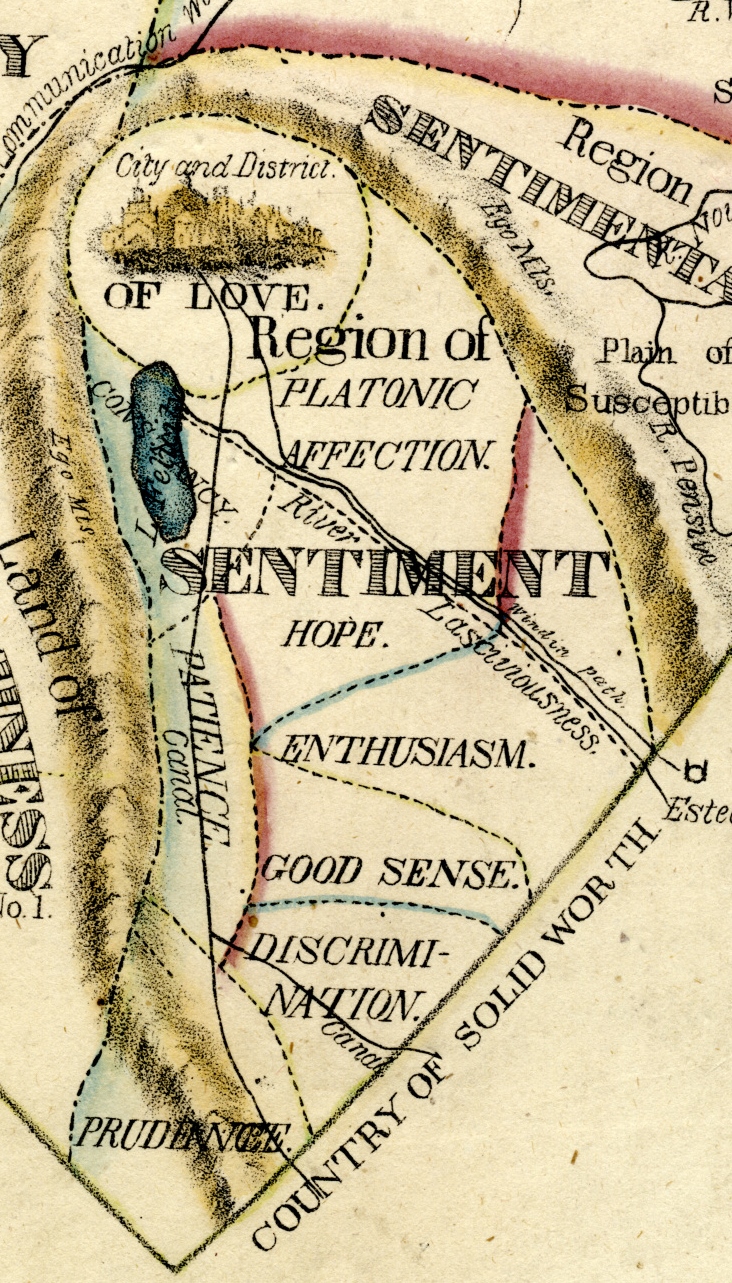
woman's heart detail 4Before we get too angry with the artist, there are a few good traits depicted—a very few. Right at the heart of the heart is the City and District of Love. As mentioned earlier, this Region of Sentiment includes qualities such as patience, prudence, and hope. Within this small region, protected (to keep people in or out?) by the Ego Mountains, reside the final, as well as the slowest and oldest, forms of transportation included on the map. The Canal and the Windin Path, which begin in the Country of Solid Worth, are the only two routes that lead into the City and District of Love. Both are short and slow methods of travel, suggesting that to enter that golden city, one needs patience, steadiness, and reliability. A woman’s love is worth taking the time and effort to acquire. (What the River of Lasciviousness, connecting the Country of Solid Worth and the Lake of Felicity, is doing in this region is less clear.)

With all this said, the question remains: Was this designed by a man or a woman? Sure, it states it’s “By a Lady,” but as with nineteenth-century authorship, that does not necessarily mean it’s so. Is the image reflecting nineteenth-century male stereotypes about women? Or was someone trying to send a message to her fellow women? In any case, I hope you’re planning a nice gift for your mother this weekend. Some jewelry or a novel would be much appreciated, I’m sure.

Today’s the Day: Support AAS in Greater Worcester GIVES!

GWG_400x300px_R-1Today is Worcester County’s first-ever online giving challenge, Greater Worcester GIVES, and the American Antiquarian Society is proud to be participating. Please show your support for AAS – and for the community we are part of – by donating to us in the challenge before midnight EST so that we can contribute a strong total for the region!

How it works:

Go to http://gwgives.org/#npo/american-antiquarian-society anytime today, May 6,  and follow instructions to make an online donation of $25 or higher to the American Antiquarian Society. Your gift will be tax-deductible. All gifts are unrestricted unless you specify otherwise. You do not have to be a Worcester County resident to participate – all donations are welcome!

Organized and hosted by the Greater Worcester Community Foundation (GWCF), Greater Worcester GIVES seeks to inspire people to support local nonprofits within this 24-hour period, for a collective impact that will benefit the region as a whole. Visit http://www.gwgives.org/ for more information.

Come Adopt-a-Book tomorrow night!

Tomorrow night the Society is holding its seventh annual Adopt-a-Book event at Antiquarian Hall from 6:00 to 8:00pm. Come join us for libations and snacks (generously donated this year by Ed Hyder, Panera, and Crown Bakery). Each of the Society’s curators has selected material for adoption including paper dolls, ledger books, newspapers, lithographs, and bound volumes. There will be dozens of historic objects up for adoption, ranging in price from $25 to $400. There will also be a display of material already adopted through the very successful online adoption portion of the event, which has raised over $10,000 since April 15th.

During the course of the evening we will be holding a raffle for some quirky prizes (i.e.., two chairs from the original set ordered for the reading room in 1912), the five curators will speak about material they have purchased with funds raised during last year’s Adopt-a-Book event, and current NEH fellow Marina Moskowitz, from the University of Glasgow, will speak about her ongoing research under the dome.

But the real focus of the evening is raising funds for continued acquisitions at the Society. The money we raise through adoptions helps us further expand the collection.

Here are three items that will be up for adoption tomorrow evening:

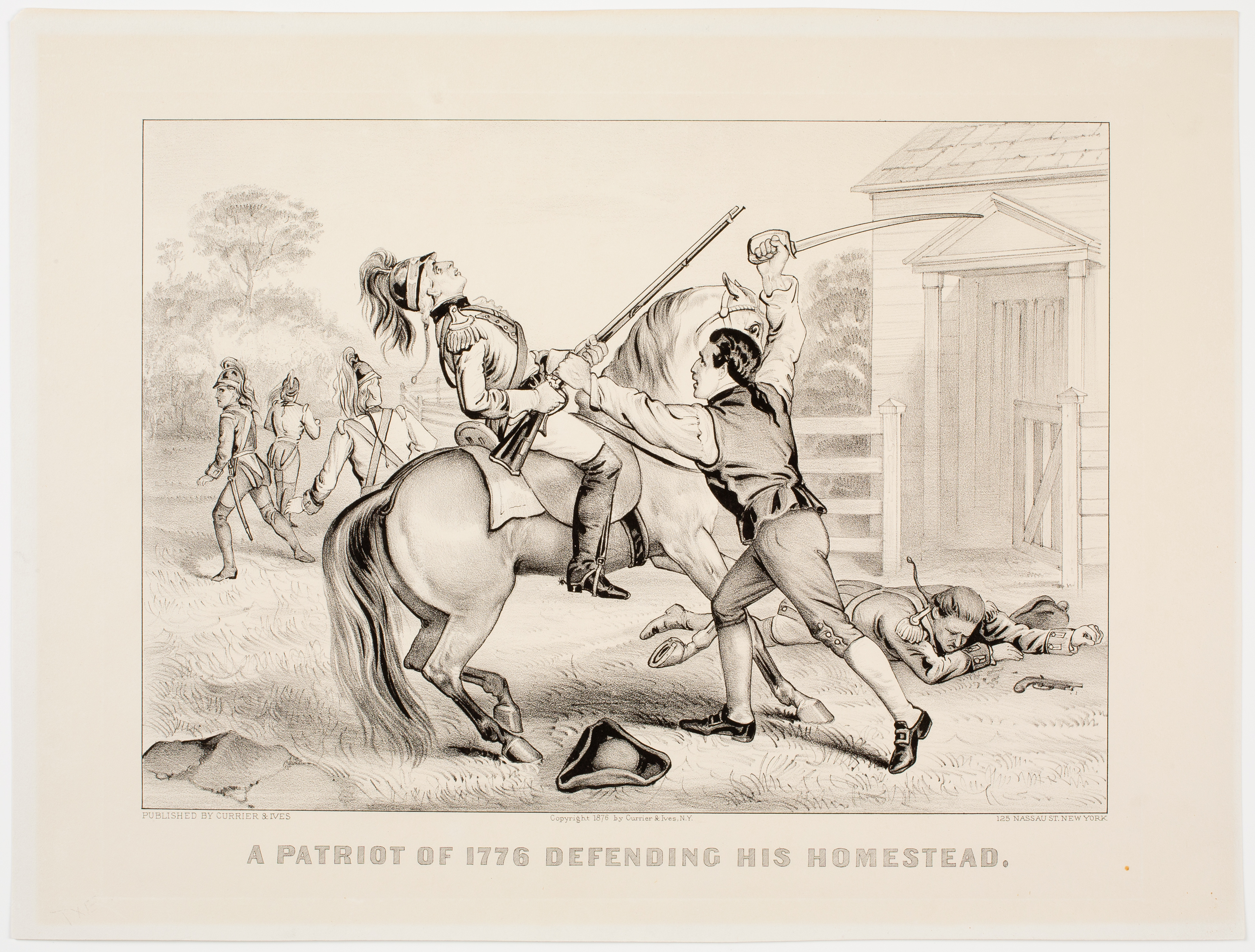
1.) Currier & Ives, A Patriot of 1776 Defending his Homestead, New York, 1876. Adopt me for $100.

Patriot of 1776


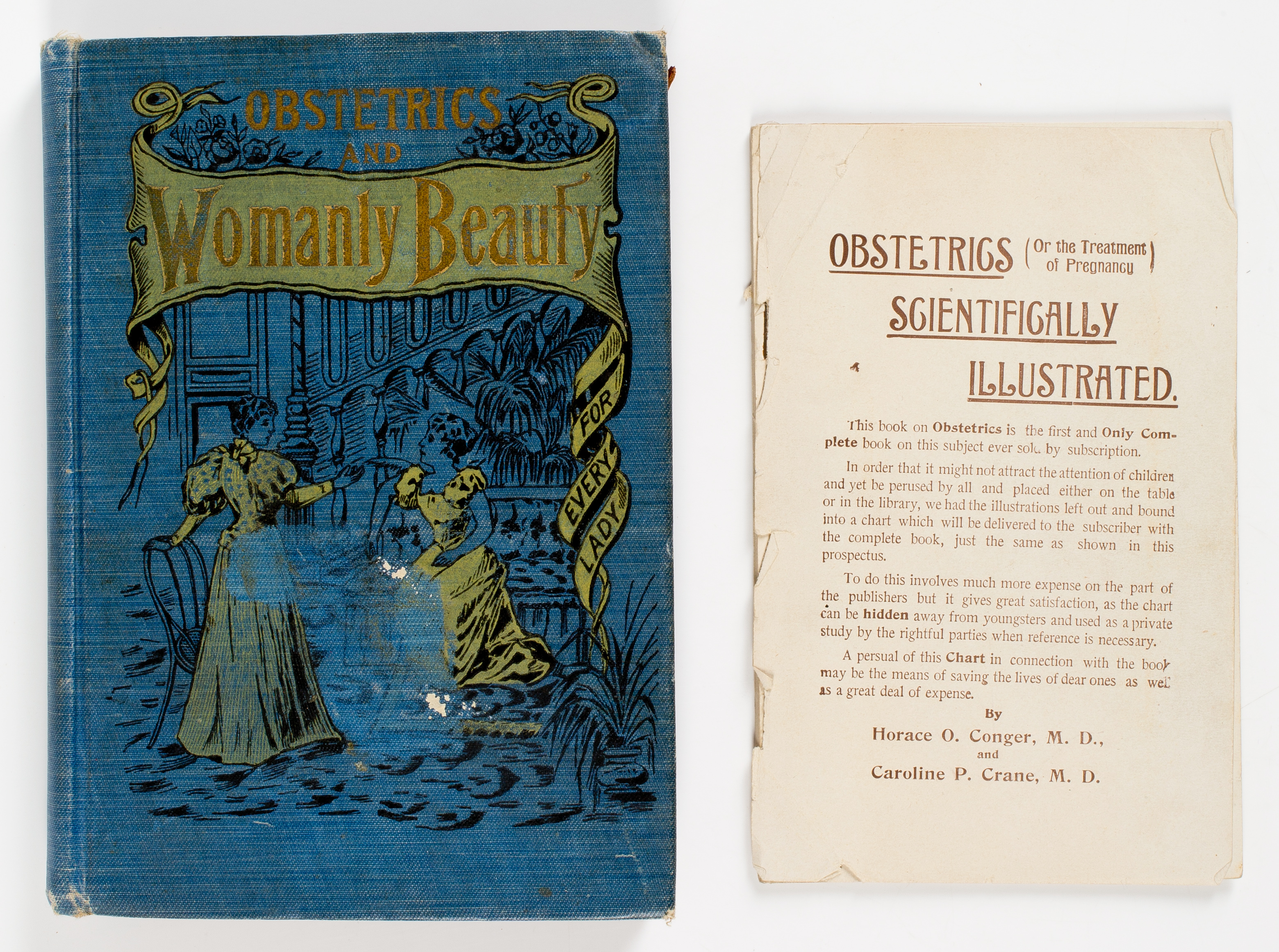
2.) Horace O. Conger and Caroline P. Crane. Obstetrics and Womanly Beauty. A treatise on the physical life of woman, embracing full information on all important matters for both mothers and maidens. Chicago:American Publishing House, after 1875. Adopt me for $50.

obstetrics and womanly beauty


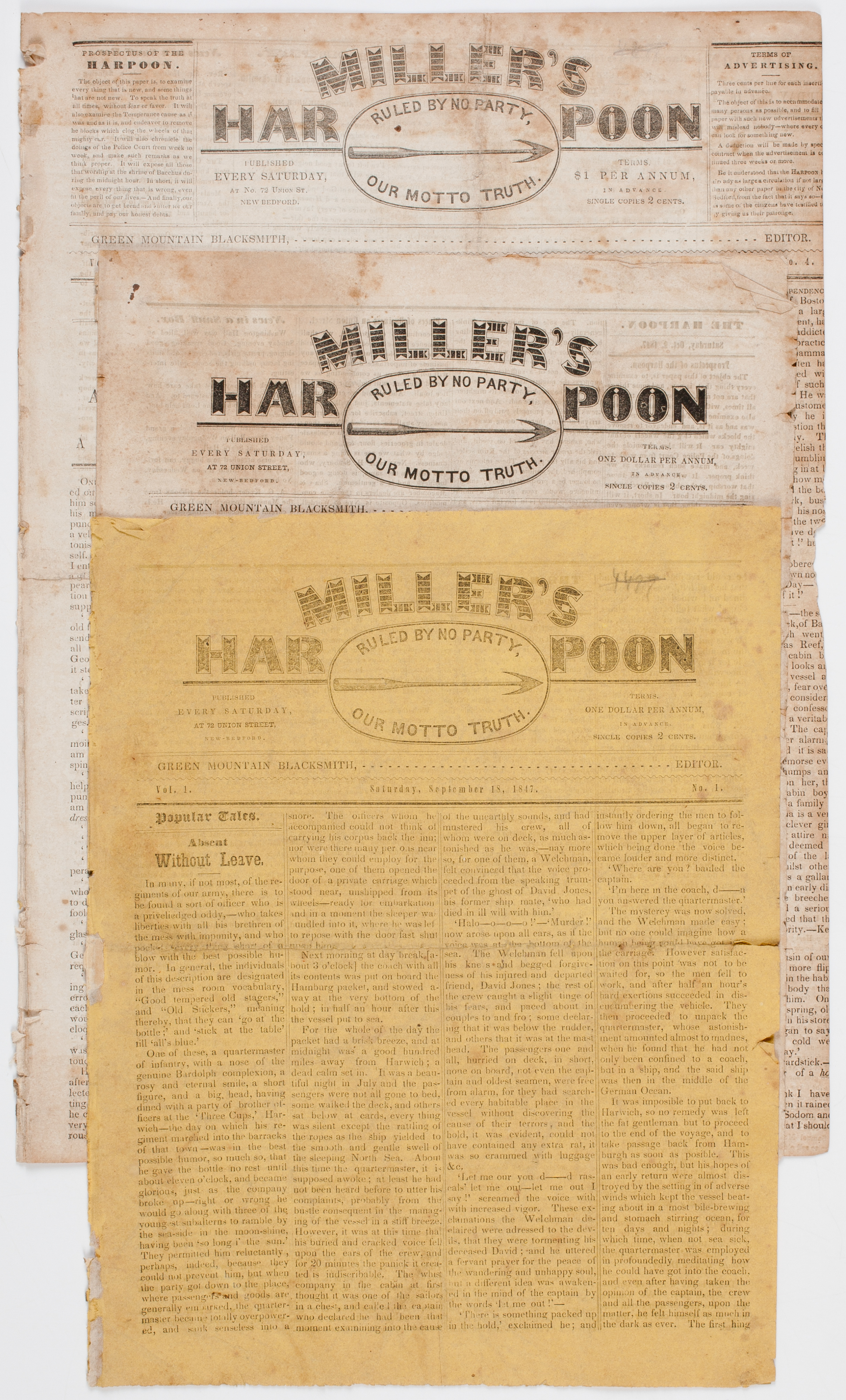
3.) Miller’s Harpoon, New Bedford, Massachusetts, 1847. Adopt me for $100.

Millers Harpoon

If you have pre-adopted online, admission to this event is free, otherwise $10 at the door. We hope to see you tomorrow night!

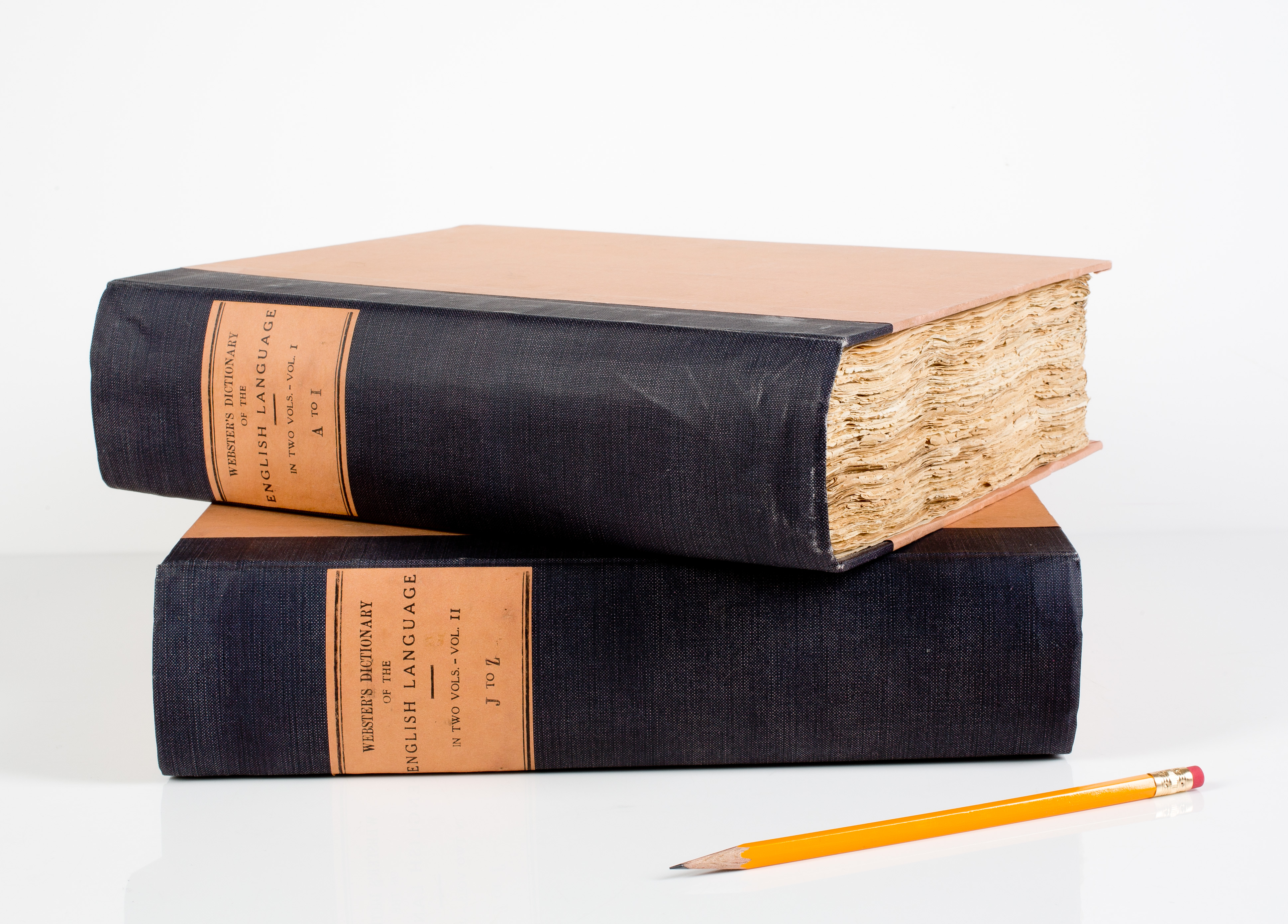
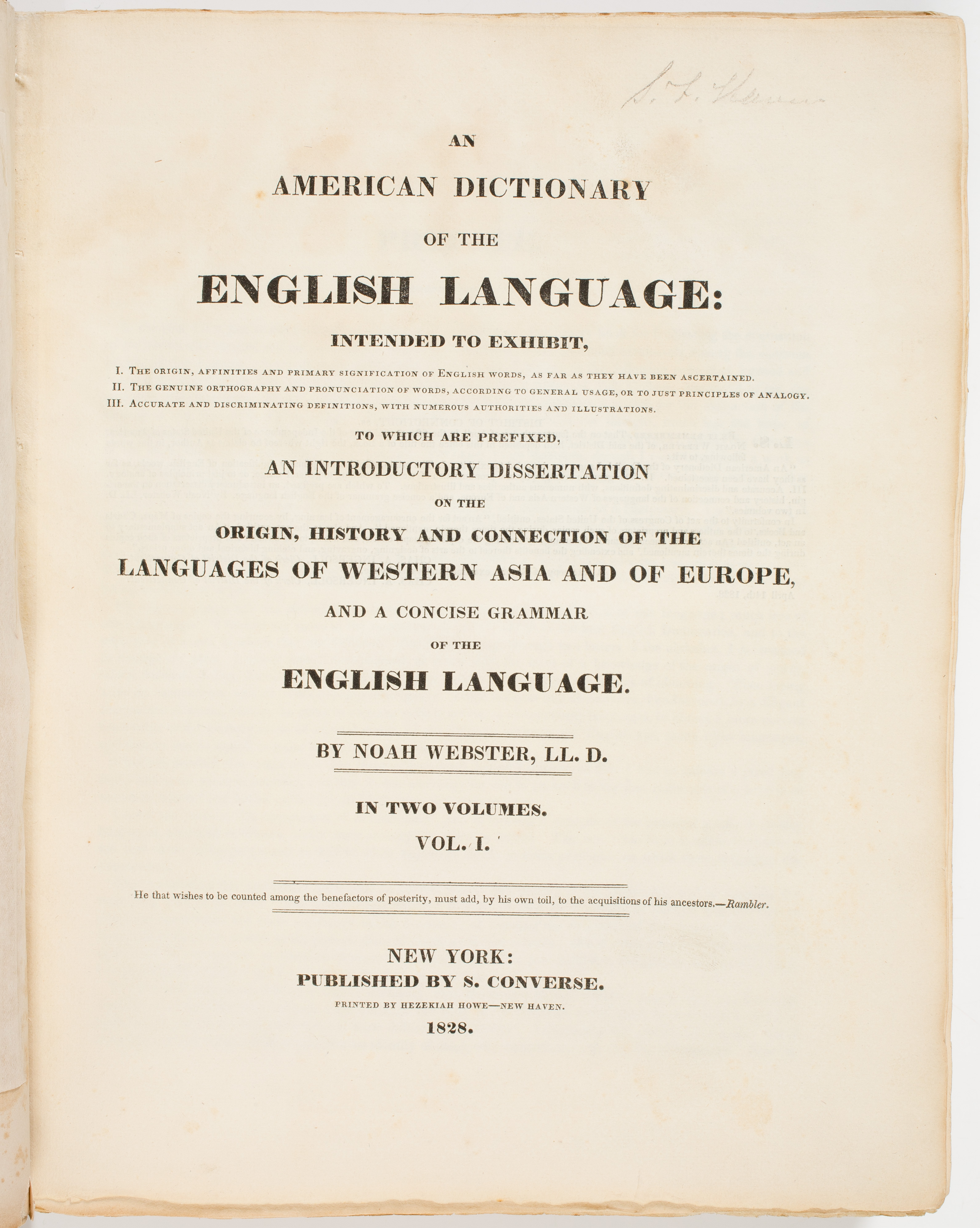
Noah Webster’s American English

First edition of the two-volume American Dictionary.
1828 first edition of the two-volume An American Dictionary of the English Language by Noah Webster

Do you remember – especially before the advent of the internet – being in need of a definition or a proper spelling of a word and turning to your home’s, school’s, or work’s copy of a Merriam-Webster dictionary?  That dictionary you used was based on the life’s work of one ambitious American, Noah Webster.  Webster’s legacy continues today, not only in his printed dictionaries and now the Merriam-Webster online dictionary, but in the Americanized version of English that he helped to standardize after the Revolution.

Noah Webster was born on October 16, 1758 to a well-respected West Hartford, Connecticut family.  He and his siblings received a great deal of attention from his parents in the form of instruction on religion, morality, and academic subjects.  In The Forgotten Founding Father (2010), Joshua Kendall argues that Webster gleaned from his upbringing an admiration for his authoritarian parents as well as a view of himself dependent on his accomplishments (15).   He engaged in private studies with a local pastor before entering Yale College in the 1770s, where he developed revolutionary sympathies as he lived through events like the Battles of Lexington and Concord, after which he showed his patriotism by joining his classmates in a student-directed military drill.  After graduating from college in 1778, Webster turned to the law profession.  He soon redirected his career to teaching for a more stable income, and founded a successful school in Sharon, Connecticut in 1781.  Webster went back and forth between teaching assignments for a number of years.  He then turned his attention to what would be a best-selling project, uniting his ambitions for nationalism, “fame and silver dollars” (Kendall, 71).

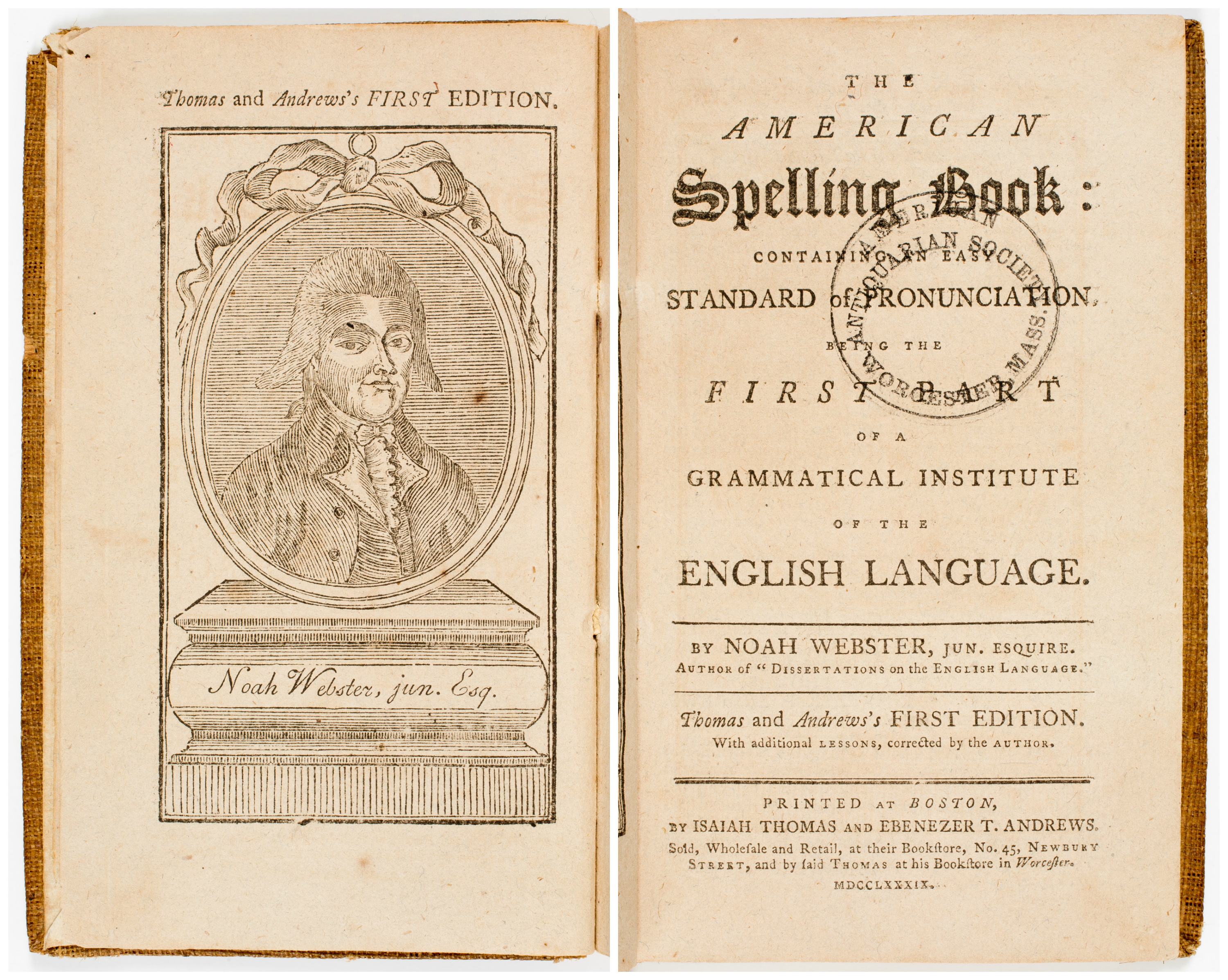
This edition of The American Spelling Book was printed by Ebenezer Andrews and AAS's founder, Isaiah Thomas
This edition of The American Spelling Book was printed by Ebenezer Andrews and AAS’s founder, Isaiah Thomas

In these post-Revolutionary years, Webster voiced strong convictions that a national language would unify the independent and distinct states.  He published his American Spelling Book in 1783 as the first of a three-part series on the English language.  Webster wrote in his preface that he wished to “diffuse uniformity and purity of language in America [and] destroy provincial prejudices” which he believed had arisen as a result of unstandardized spellings and varied pronunciations of words.  Webster borrowed heavily from Thomas Dilworth’s A New Guide to the English Tongue, printed in England in the mid-eighteenth century.  Webster added key modifications, however, including the fact that the language of his speller was more readable (Kendall, 72).  Furthermore, he employed standardized syllables that reflected pronunciation, as opposed to Dilworth’s syllables based on Latin grammatical rules (Kendall, 74).  Webster also included moral lessons instead of heavy Christian concepts.  His Spelling Book took off, selling a million and a half copies between 1783 and 1801.  This number is significant considering that the U.S. population was only about 2.8 million people in 1780 (Lemon, 122). AAS holds multiple editions of the Spelling Book, including a 1789 edition and a corresponding digital copy.

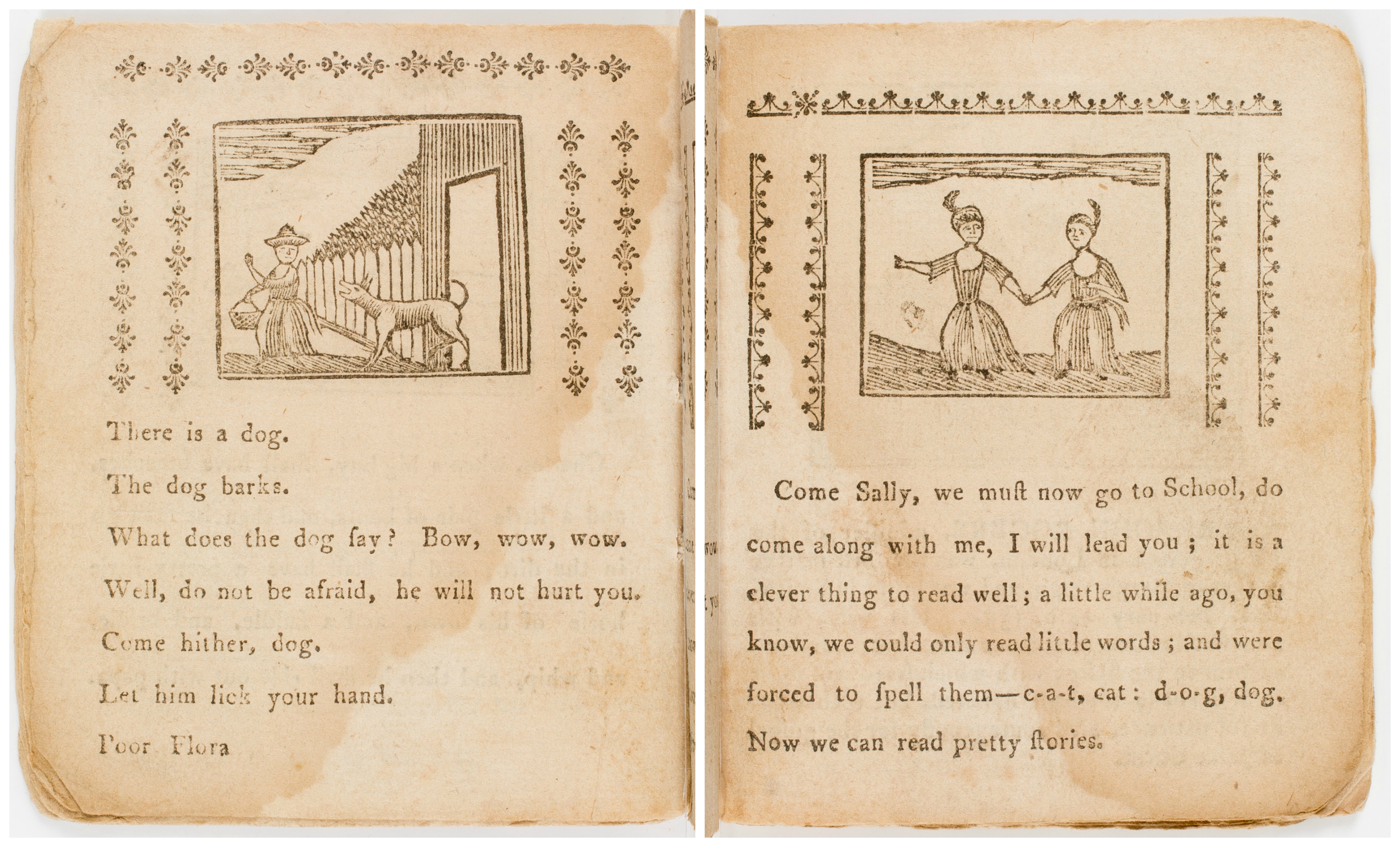
Webster kept busy after his successful Spelling Book, retaining an interest in the development of his new nation and its education.  In the 1780s, he published his own version of the New-England Primer, a text originally published by an Englishman in the seventeenth century that had been reprinted throughout the colonies for decades due to a lack of copyright laws. AAS holds multiple editions of Webster’s adapted Primer. Furthermore, Webster composed a work called Sketches of American Policy (1785), which articulated proposals for a structure of a strong, balanced federal government as an alternative to the Articles of Confederation.  Never idle, Webster travelled the country giving lectures on the English language.  He also penned works advocating the ratification of the new Constitution.

Pages from the New England Primer
Reading selections from The New-England Primer, 1789

Despite the success of his Spelling Book, Webster was publicly scorned by many leading Americans when he first proposed in 1800 to compile An American Dictionary of the English Language.   Webster stuck to his linguistic efforts, however, beginning work on the Dictionary in 1807.  He put in full work days engaging such books as  Samuel Johnson’s popular English dictionary and Robert Ainsworth’s Latin one, while himself contributing “meanings and distinctions” (Kendall, 260).

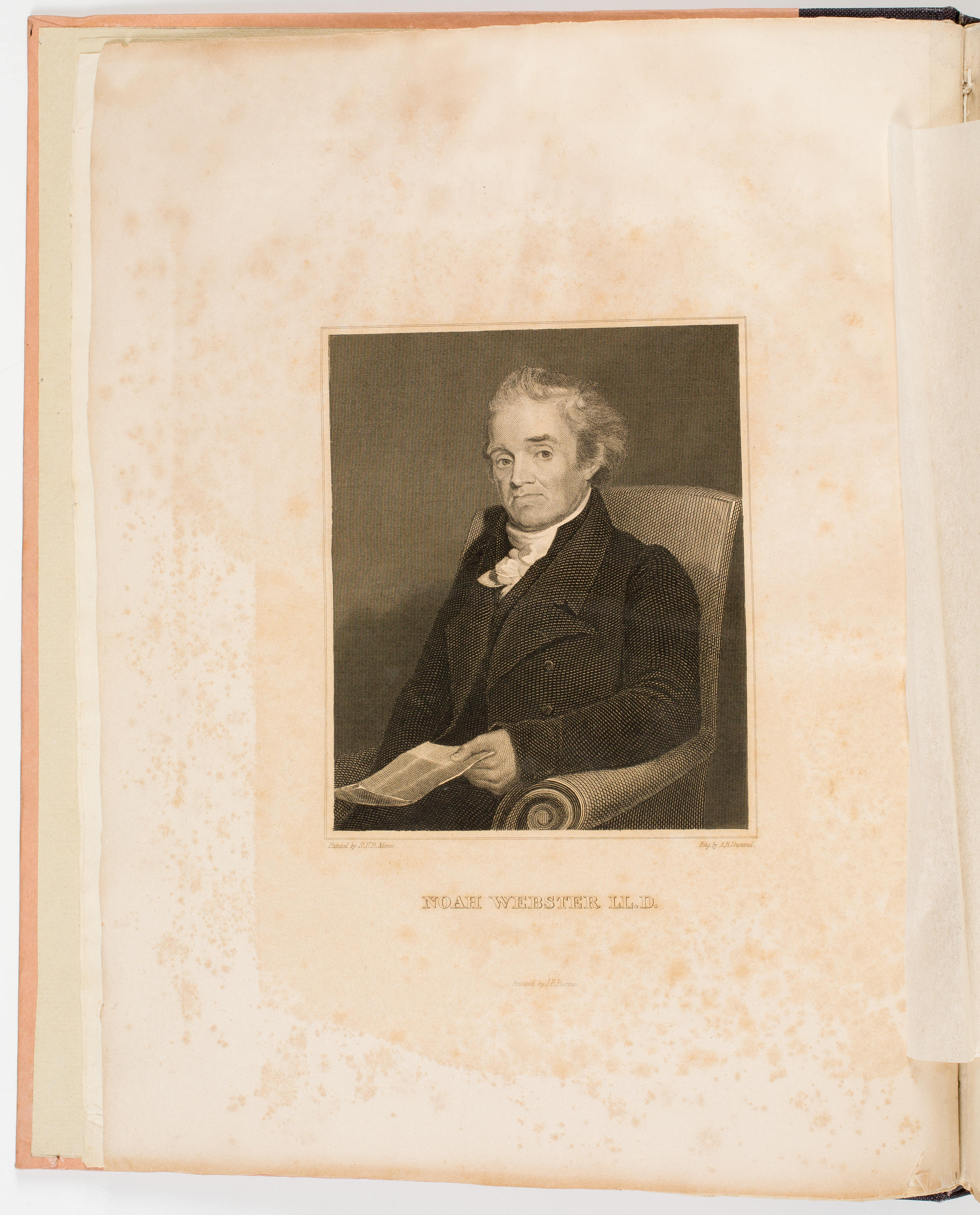
Frontispiece portrait of Noah Webster in An American Dictionary

Overcoming early criticism, Webster’s Dictionary was well received upon its publication in 1828; it was a major feat that brought significant increases and changes to a more standardized and Americanized English language.  Webster included 70,000 words, greatly exceeding Johnson’s dictionary of the same period.  He helped standardize changes from British English that were previously used only erratically in America, such as eliminating superfluous letters in certain words.  His dictionary included even quotidian words and scientific expressions; it was also influential for his clear and thorough definitions (Kendall, 304).  AAS holds many editions of Webster’s Dictionary, including the 1828 two-volume publication.

An American Dictionary of the English Language was far from unbiased; Webster inserted his rigid moral values and personal views in the definitions.  For example, as an American Patriot who had supported the rebellion against King George III just a few decades earlier, Webster’s negative opinion of kings shone through in his definitions of the words “monarchy” and 424901_0002“monarchal.” For the former, he offers as an example the quote “‘A free government has a great advantage over a simple monarchy’ J. Adams;” for the latter: “‘Satan, whom now transcendent glory raised / Above his fellows, with monarchal pride’ – Milton.” Despite his anti-monarchal views, Webster did not advocate a very inclusive republican system of government. Richard Rollins, in “Words as Social Control” (1976), describes Webster’s growing desire for authoritative order around the turn of the nineteenth century.  Webster, who in 1808 had undergone a Calvinist conversion, fervently pushed the ideal of God-fearing Christians submitting to the authority of male leaders with a very high age minimum. Webster thought that such men, unlike younger politicians, would be less self-interested in serving the public good (Rollins, 418). As Rollins points out, this distrust of politicians is hinted at in his Dictionary in his two-part definition of a politician, the second part being men “of artifice and contrivance.”  The dictionary itself was not democratic in that it cost twenty dollars and was thus not available for the majority of private citizens.  When the Merriam brothers bought the rights and revised the dictionary, however, they were able to create a six dollar version that allowed for a much wider audience.

An exhibit of several of Webster’s works is currently on display in the AAS Reading Room.  You can see the enormous volume that comprises only half of Webster’s 1828 Dictionary, as well as his Spelling Book and his New England Primer.  Webster was a crucial leader in adapting the English language to the new American nation, from teaching it with more logical syllabication to implementing key spelling reforms.  His Dictionary, the product of decades of labor, was a groundbreaking model in content and style.

Works Cited:

  • Kendall, Joshua. The Forgotten Founding Father: Noah Webster’s Obsession and the Creation of an American Culture. New York: G. P. Putnam’s Sons, 2010.
  • Lemon, James T. “Colonial America in the Eighteenth Century.” In North America: The Historical Geography of a Changing Continent.   Ed. Robert Mitchell and Paul Groves. 1987.
  • Rollins, Richard M. “Words as Social Control: Noah Webster and the Creation of the American Dictionary.” In American Quarterly, Vol. 28, No. 4, p. 415-430. JSTOR.
  • Webster, Noah. An American Dictionary of the English Language. New York: 1828.
  • Webster, Noah. The American Spelling Book: containing an easy standard of pronunciation. Boston: 1789.
  • Webster, Noah. The New-England Primer, Amended and Improved. New York: 1789.

Further Reading:

  • Lepore, Jill. A is for American: Letters and Other Characters in the Newly United States. New York: Alfred A. Knopf, 2002.
  • Nietz, John A. “Old Textbooks.”   University of Pittsburgh Press, 1961. In 19th Century Schoolbooks. Digital Research Library, University of Pittsburgh.
  • Verma, Henrietta. “BackTalk: 20 Years, One Assistant, 70,000 Words.” Library Journal. May 1, 2013. Reviews.libraryjournal.com.
  • Warfel, Harry R. Noah Webster: Schoolmaster to America. New York: The MacMillan Company, 1936.