The Life and Times of a Miner’s Wife: Part II

Last week, we met Nancie Colburn Hartford and her mining husband, Miles, and explored their change in attitude toward mining over the course of a couple of years. This week, we’ll look at a different kind of change: those that so often happen in the life of a woman.

While Miles was navigating the difficulties of mining and exploring alternative options for making a living in Colorado, Nancie was navigating an entirely different set of difficulties.

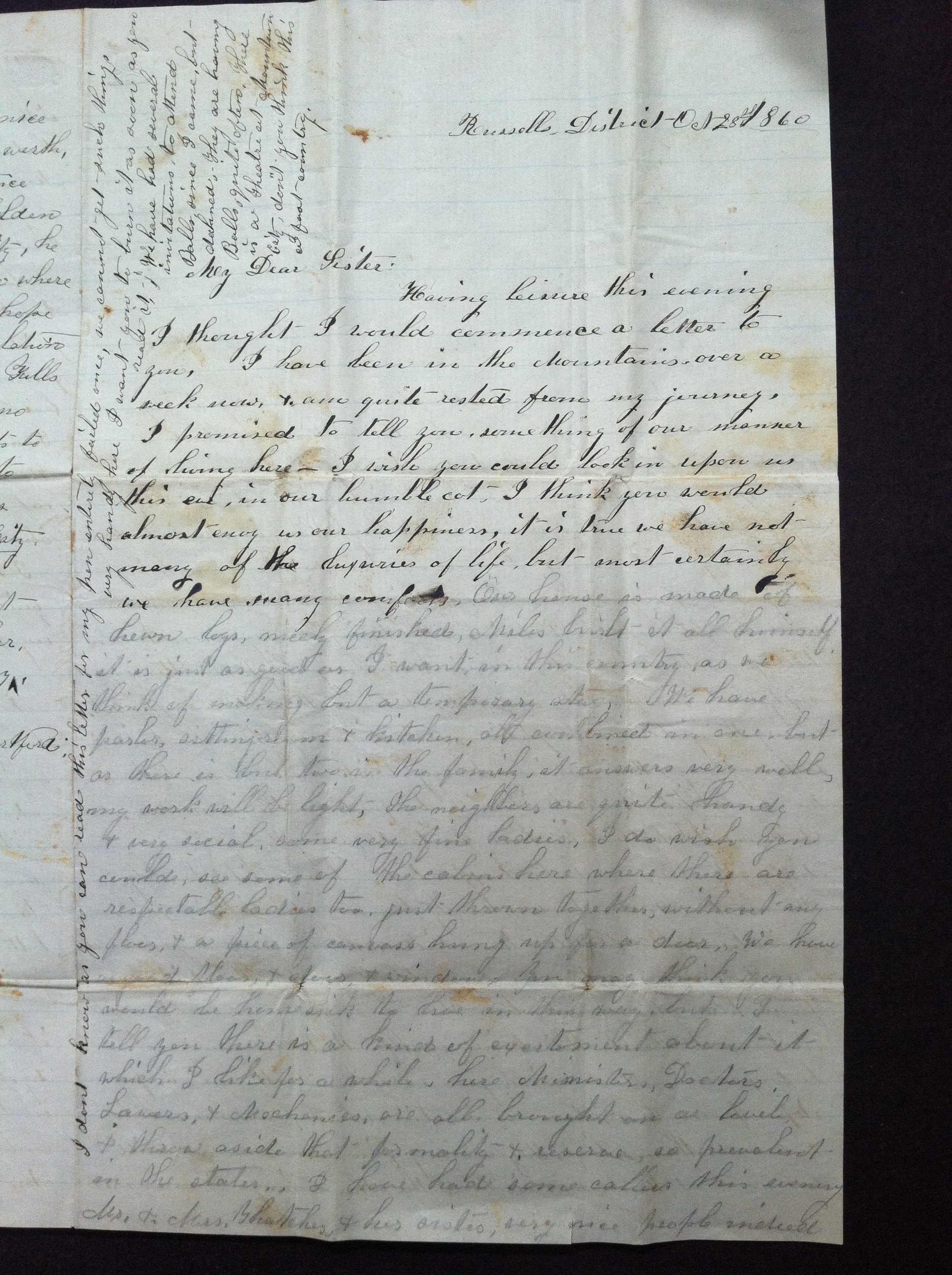
Throughout her early letters, Nancie took close stock of the social atmosphere of Russell’s Gulch. In her first letter back to Maine describing her surroundings, Nancie mentioned that “The neighbors are quite handy & very social, some very fine ladies.” She went on to mention several by name who had called on her, and in a postscript seemed quite taken aback by the extent to which a cosmopolitan lifestyle was sought after, noting that “We have had several invitations, to attend Balls, since I came, but declined. They are having Balls, quite often. There is a theatre at Mountain City, don’t you think this a fast country.”
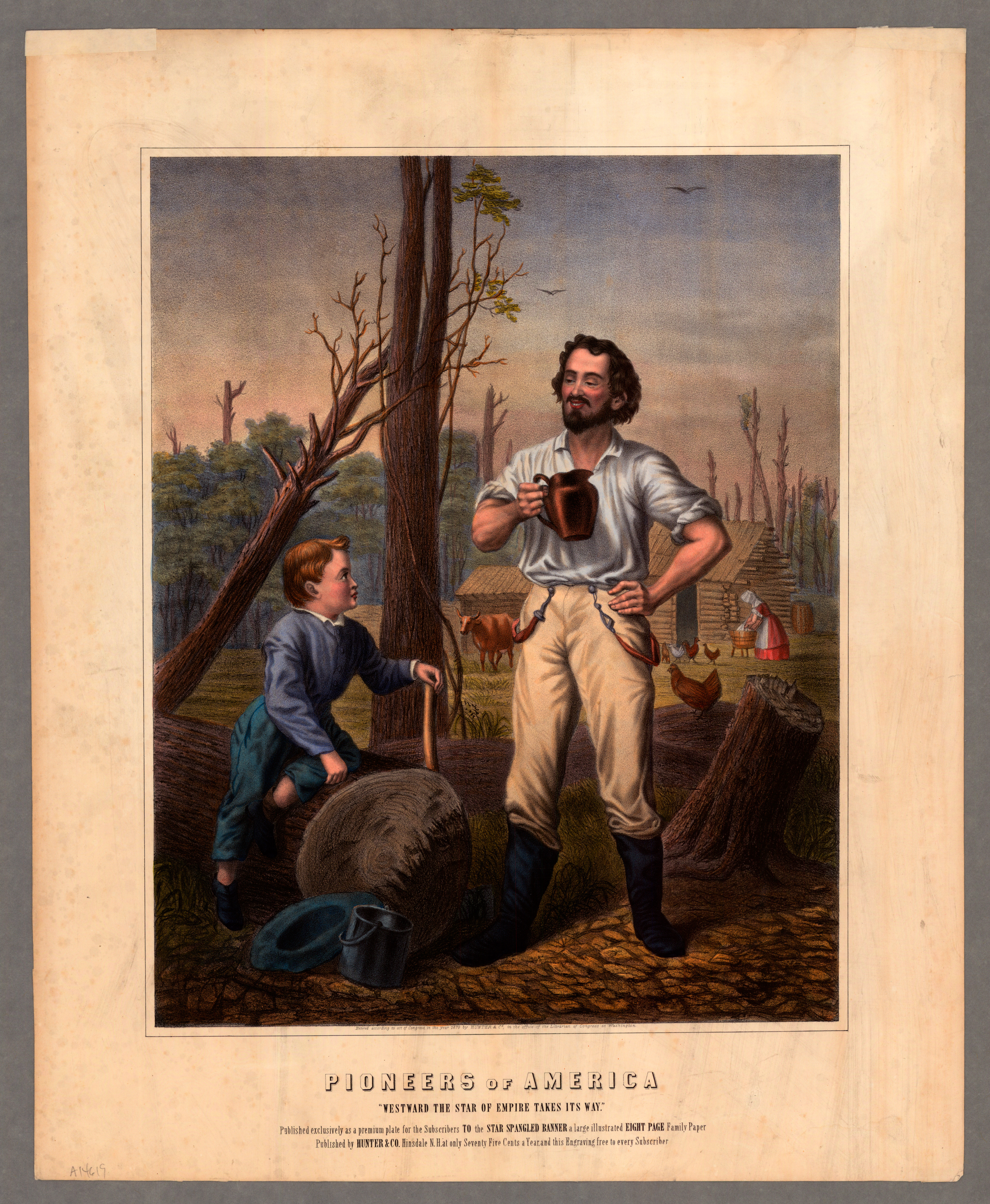
This lithograph, which idealizes family life on the frontier, was printed in 1870 by Hunter & Co. of Hinsdale, NH, exclusively for subscribers to their illustrated newspaper.

Among Nancie’s early acquaintances was a “Mrs. Thacher,” a “nice lady formerly of Vermont. her sister is teaching school here.” Two months after her arrival, Nancie went to Central City with Mrs. Thacher and a Mrs. Bensen to do some shopping. She was “really surprised to find so large an assortment, of goods, here. I never saw a better, assortment, in any retail store, &. they ask a good price.” The trip seemed to increase her acquaintance with Mrs. Thatcher, as a few days later she attended a tea party at her house and “had a splendid time. There were about eight ladies present. all very fine ladies – Mrs. Thacher is one of the finest ladies I ever knew. I think so much of her.” Despite the rustic setting and hardships of living in a log cabin in a small village, Nancie had found a comforting social circle to make her adjustment easier.
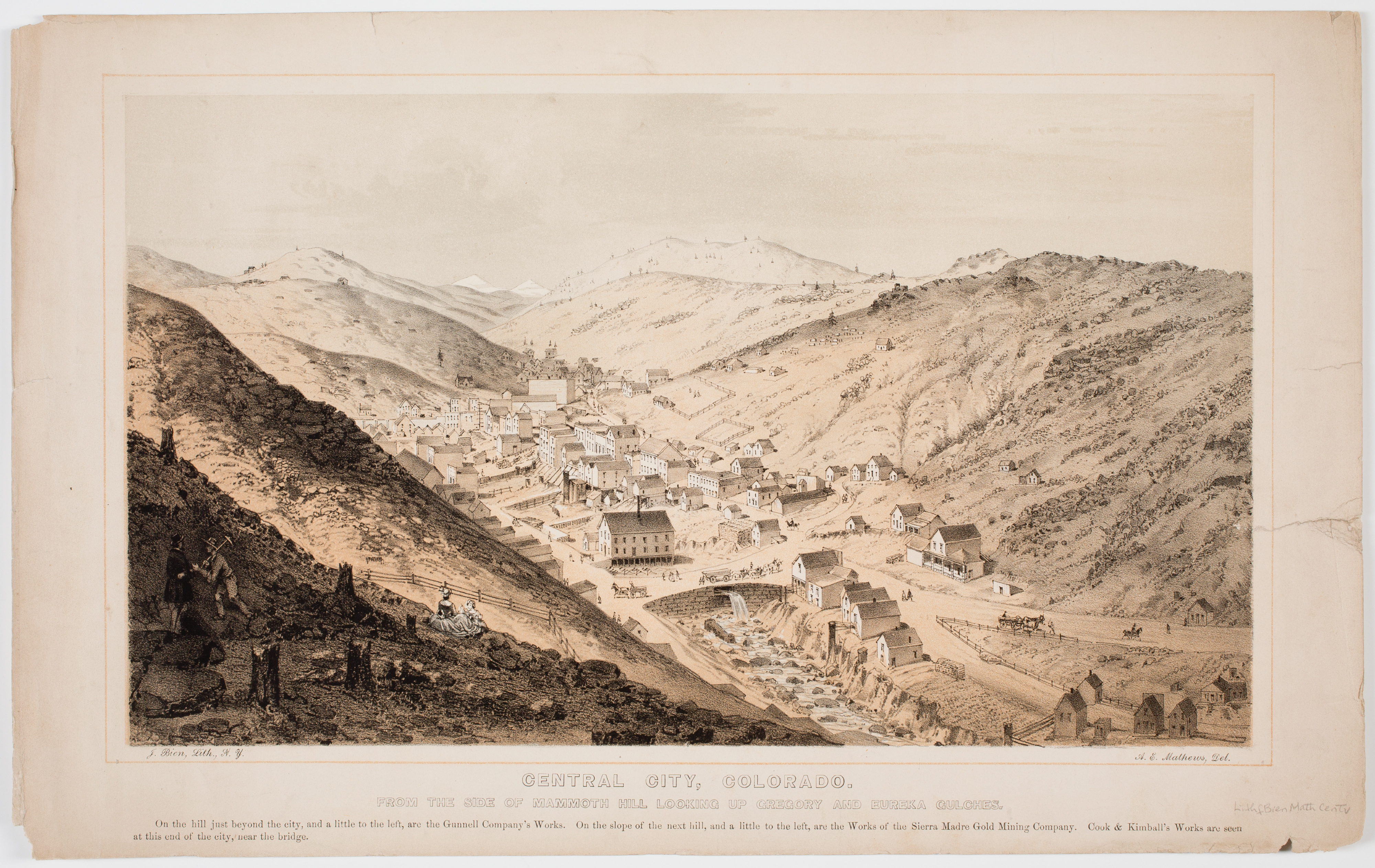
An image of Central City, the "city" closest to Nancie and where they would take shopping trips. From "Pencil Sketches of Colorado" by A. E. Mathews, with lithography by Julius Bien. New York, 1866.
An image of Central City, the “city” closest to Nancie and where she took shopping trips. Note the well-dressed women sitting on the bluff in the foreground overlooking the city. From “Pencil Sketches of Colorado” by A. E. Mathews, with lithography by Julius Bien. New York, 1866.

Or so she thought.  It turns out that removing oneself from “civilization,” as it were, does not remove one from human nature. About seven months into her settlement, Nancie wrote to her mother that, while she had “some excellent neighbors,” she did not “think quite as much of Mrs Thatcher as I did. She is deceitful as she can be, she has talked about every lady on the Gulch, at the same time pretending to be their friend. I don’t like such friends as that.” It appears that some relationship and personality types don’t change no matter what century or location you’re in.

In addition to dealing with the establishment of female relationships, Nancie, as a newlywed, also began to contemplate starting a family. Writing to her mother on May 26, 1861, Nancie told her that Jennie, her sister, “wished to know if I intended to help populate the mountains.” Nancie’s reply to this question is direct, and rather curious. “I think not,” she wrote. “There will be a plenty besides; &. I think I would rather be excused.” At a time when all married women were expected to produce children, was she truly indifferent to them? Or, even though she had only joined her husband about seven months before, was she beginning to worry that she was not yet pregnant and thus responded defensively?

Of course, there’s no way to know. But what we do know is that by the beginning of November 1861 she had “never had such an appetite in my life,” and in April 1862 she wrote IMG_1722her mother to apologize for not having written earlier, but she had “been very sick indeed, am now better &. able to be about the house. You will probably be some surprised to hear, that I have a little Daughter. but it is even so, she was born the twentieth day of March.” Today, when communication is instant and travel easy and quick, it is hard to imagine a young woman not telling her mother that she is pregnant with her first child, but for Nancie it was a matter of practicality: “I did not say anything to you about it, for I thought it would only worry you for nothing. I have had good care. Miles has done every thing in his power to make me comfortable. (he is a dear good husband) & I had a good Doctor, & Nurse, Mrs. Mitchell, one of my neighbors, took care of me during my sickness, and is with me now.”
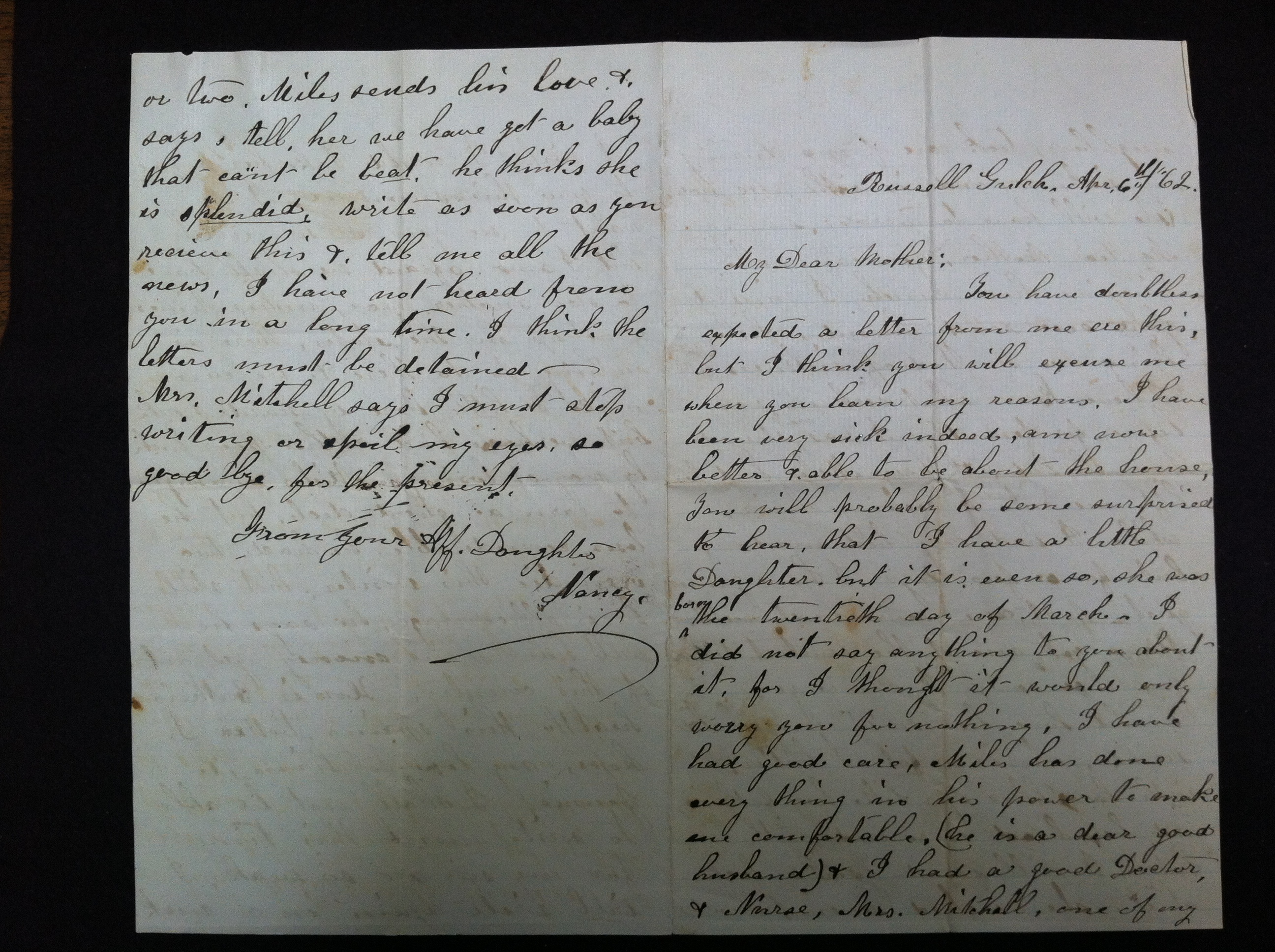
Despite her confidence in the care she had received, childbirth away from her family was not an easy experience for Nancie. “My dear Mother,” she wrote, “you can well imagine how much I missed your ever ready hand, while lying on a bed of sickness I never knew what sickness was before, for ten days I was not stirred from the bed. & then Miles had to lift me into a rocking chair, while I had my bed made, but for a few days. I have gained quite fast. am now most well. have got one of the sweetest Babes you ever saw. I know you would love her so if you could see her…I wish I could take her home to you this summer.”

Childrearing without her mother’s ready advice also proved challenging. A few weeks after the letter announcing the baby’s birth, she wrote again saying that the baby was not gaining weight as she should, and that she had been worried. But “Dr. Barber told me he thought my milk did not agree with her & said I had better feed her some with cows milk. I did so, & now she will not nurse a bit. She has not nursed for over a week. I think it is so funny. I have to feed her all the time, I feel in hopes she will grow some now, she grows smart every day.” For Nancie, it seems, approaching hardships with a sense of humor was a key to survival.

Next week, the series will conclude with a look at how the outbreak of the Civil War affected Nancie and those around her.
The Acquisitions Table: Home Again

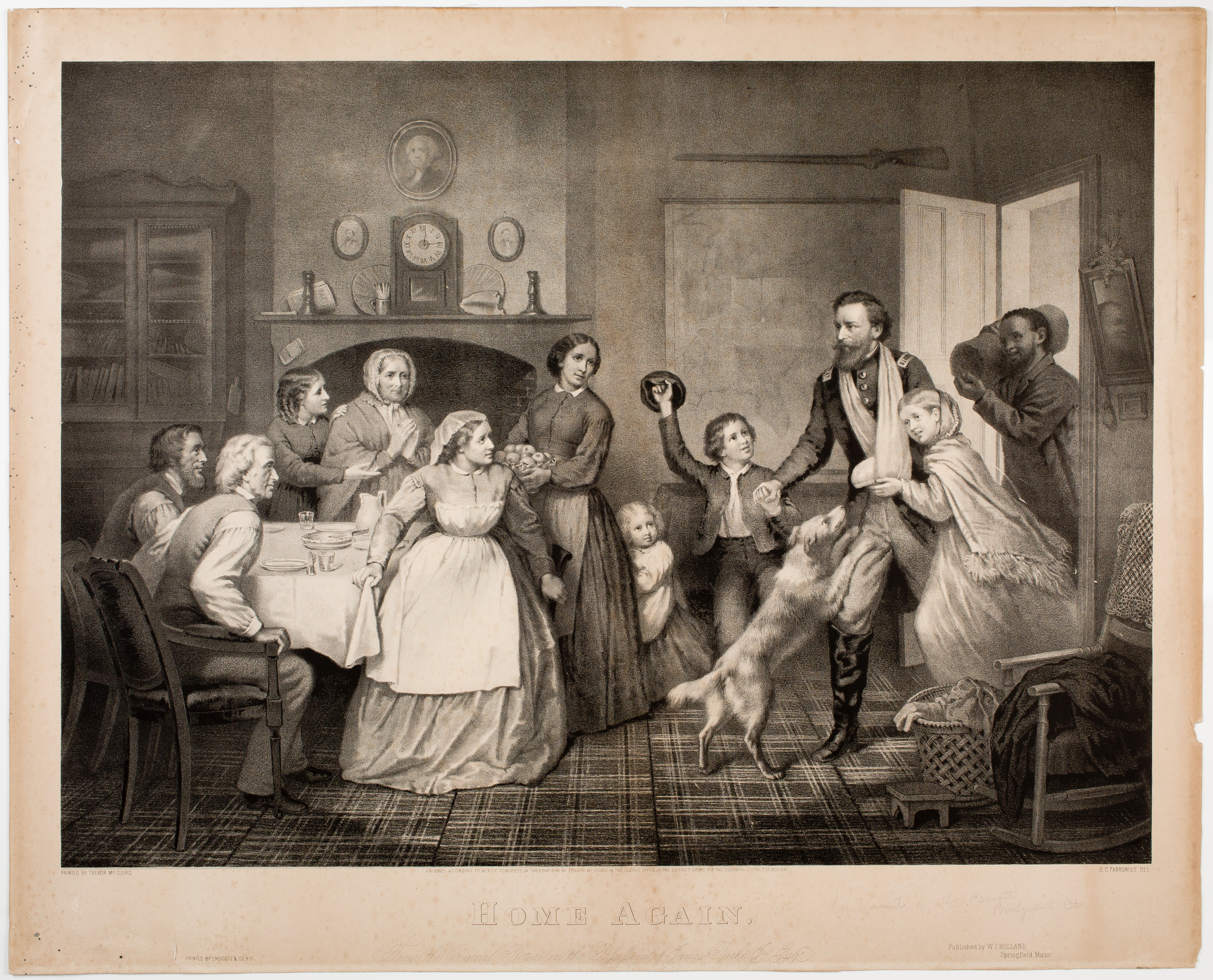
D.C. Fabronious after Trevor McClurg, Home Again, New York: W. Endicott, 1866.

home againThis large lithograph was printed a year after the Civil War had ended. Made after a painting by Pittsburgh-area artist Trevor McClurg who had trained with Emmanuel Leutze in Dusseldorf, Germany, the print shows an injured Union veteran returning to his home. The sentimental scene would have been very appealing to families in the north who were welcoming back their fathers, sons, and brothers. The scene includes wonderful interior details, including a patterned rug, candlesticks and a shelf clock on the mantle, a large map hanging behind the door, and a glass-front bookcase full of books at the left.

The Life and Times of a Miner’s Wife: Part I

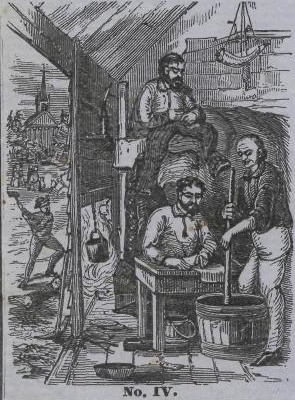
Detail from "The Miner's Ten Commandments" (California, 1853). Miners doing domestic work in the absence of women.
Detail from “The Miner’s Ten Commandments” (California, 1853). Miners doing domestic work on the Sabbath in the absence of women.

The nineteenth-century gold rushes continue to have a strong hold on the imagination of the American public. Perhaps it’s the promise of wealth or adventure or simply starting a new life. In any case, the gold rushes opened not only new physical and political frontiers for the United States, but also very personal ones for the people who partook in them. And although we usually focus on the miners themselves, theirs were not the only lives transformed by the decision to chase the golden dream—it was also those of their parents, siblings, spouses, children, and friends.

This was certainly the case for one Nancie Colburn Hartford who, in September of 1860, left her home in Maine and headed out west by railroad and stagecoach to meet up with her husband, Miles, who had left for the Pike’s Peak gold rush (located in what would soon become Colorado territory) shortly after they had been married in 1859 or 1860. Once there, Nancie wrote extensively to her mother and sister back in Winterport, Maine, giving us a rare glimpse of what life was like for those women who followed their husbands into the mining camps (or at least those of the post-California years).

Nancie (whose letters can be found in the Shaw-Webb Family Papers, 1756-1936) wrote about her journey to the territory, the scenery, her life in a log cabin, the Civil War, and pioneer and mining life in general. Over the course of several years, Nancie’s letters shifted in tone and focus as the enthusiasm of starting a new adventure waned, the complications caused by the Civil War dragged on, and the realities of sustaining a family on the frontier set in. Watching these shifts is what makes these letters so fascinating—and so human.

Nancie’s first letter home to her sister after arrival at Russell’s Gulch.

The most obvious way in which one sees this shift is through Nancie’s attitude toward pioneer life and more specifically what brought them there, mining. In the beginning, as one usually is at the start of a new adventure, Nancie was full of enthusiasm and hope for the future. After being in Colorado a week, she wrote to her sister:

I think you would almost envy us our happiness, it is true we have not many of the luxuries of life, but most certainly we have many comforts. Our house is made of hewn logs, nicely finished. Miles built it all himself it is just as quick as I want, in this country, as we think of making but a temporary stay. We have parlor, sitting room & kitchen, all combined in one, but as there is but two in the family, it answers very well. my work will be light. The neighbors are quite handy & very social, some very fine ladies. I do wish you could see some of the cabins here where there are respectable ladies too just thrown together, without any floor & a piece of canvass hung up for a door…You may think you should be would be homesick to live in this way, but I tell you there is a kind of excitement about it which I like for a while. here Ministers, Doctors, Lawyers, & Mechanics, are all brought on a level & throw aside that formality & reserve, so prevalent in the states…

…I know I shall like here firstrate. every thing is so different from what I expected. I can sit here by the window &. count over twenty houses, all within five minutes walk, besides two Mills, which run night and day. There are meetings every Sabbath a short distance from here, also a school. There is so much novelty and excitement about this kind of life that one can not be lonesome.

Nancie put a positive spin on her situation and was determined to not only enjoy, but also find charm in her new life “roughing it” on the frontier. But of course, the situation was to be temporary.

Just before Christmas 1860, eight weeks after arriving at “the ‘Peak’,” Nancie wrote to her sister lamenting that she had not yet received any letters from home, which made her very anxious, but “I like my Mountain home very much, indeed.” Nonetheless, the beginnings of concerns about making a living on the frontier had already begun to set in. She acknowledged that “This is going to be a hard winter at the Peak, there are a great many who have no money to get home, no money to even buy their food, and cannot get trusted….people expect good times next summer, but this winter money is scarce. & provision high… Miles almost gets the blues sometimes….I tell you this is a hard country to get rich in any one of less pluck than Miles would have left in disgust, but he is all courage he says he does not expect to get rich. but he is bound to get something worth coming for.”

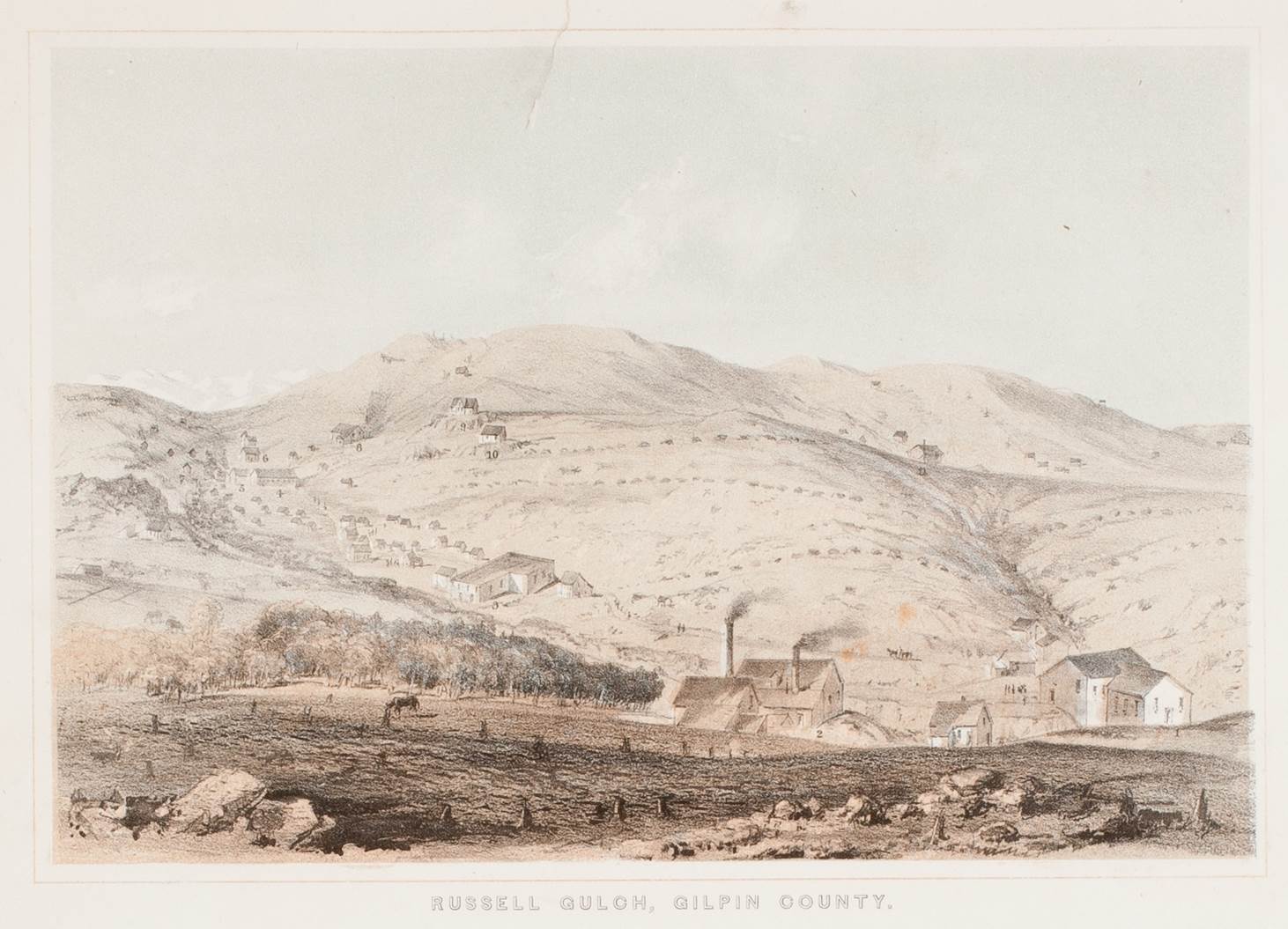
An image of Russell's Gulch, the mining village where Nancie and her husband lived. From "Pencil Sketches of Colorado" by A. E. Mathews, with lithography by Julius Bien. New York, 1866.
An image of Russell’s Gulch, the mining village where Nancie and her husband lived. From “Pencil Sketches of Colorado” by A. E. Mathews, with lithography by Julius Bien. New York, 1866.

Even after spring arrived, she continued to be concerned about money. In May 1861 she told her mother, “I go to walk every morning Miles has gone to work on his claim. it does not pay very well.” Come November, Miles had begun to look for alternative ways to make some money. “Miles commenced mining in the spring,” wrote Nancie, “but had such poor luck that he gave it up in July and commenced teaming, he has three yoke of oxen, now, we laugh considerable about his coming to ‘Pikes Peak’ to drive oxen, but he says anything to make money.”

Description of Russell's Gulch from "Pencil Sketches of Colorado."
Description of Russell’s Gulch from “Pencil Sketches of Colorado,” including a key to the image above.

By the middle of 1862, the Hartfords had managed to create a decent living for themselves by running a dairy farm. They had fourteen cows, which they milked themselves (with the help of a hired boy), and Nancie sometimes churned butter. Nancie could “hardly get time to think, I have so much to do,” but by selling the milk and butter they were “doing pretty well, better than mining.” “You know little about this country by what the papers say,” Nancie wrote to her mother. “There is now & then a claim paying pretty well, but they are rare. Miles says he shall not mine any more in this country.” After two years of constant toil and worry, Miles realized something many miners had realized before him: you make more money at the mines doing something other than mining.

Nancie’s letters can be found in the Shaw-Webb Family Papers, 1756-1936. Next week we’ll take a closer look at the particular challenges women faced on the mining frontier.

Lessons Learned through AAS’s YouTube Channel

Sarah Harker, AAS media outreach intern this summer, graduated from Clark University last May, where she studied Film and Communications & Culture. She is currently an independent filmmaker while continuing her education at Clark, pursuing her master’s degree in Professional Communications.

Having grown up in northeastern Massachusetts and living the past four years in Worcester as a student, I have always been surrounded with a respect and reverence for the history of our nation’s beginnings. The evidence is preserved and concentrated within the spread of New England and has always been accessible through learning and living in this part of the country.

My summer work at the Society as the media outreach intern has given me an opportunity to see how deep this accessibility extends. Coming from a video production background instead of a historical one, my time here has given me a deep respect and admiration for the AAS YouTube screenshotpassion and dedication of the people that work here and their commitment to preservation and education. I have been able to view the Society with a certain amount of detachment: my job is primarily to go through the backlog of filmed public programs and podcasts and edit them to upload to the AAS YouTube channel. Through this process I have been able to see prominent historians, authors, and Society members who have made major contributions to our knowledge of American history. Despite being designated to pre-1876 United States history, the Society’s programs are spread over a wide scope of topics and perspectives. Even though my work is fairly solitary and removed from the main library building, by working so intensely with the archived footage I feel as though I have been given a unique insight into AAS’s public image and the important topics that it champions and cherishes.

So far, the over twenty programs that I have worked with (now all available on the channel) span from lectures given in 2002 to public programs that took place earlier this year. Topics span from little-known New England residents like Hiram Harwood and his struggle with mental illness to examinations of eminent Americans such as Abraham Lincoln.

I have watched how AAS not only champions the pure historians, but also puts the spotlight on creative endeavors. In an interesting talk from earlier this year (see video above), Tess Taylor reads her historical poetry and goes into detail about how the Society had provided the perfect setting and the best research materials to fuel inspired stanzas of historical weight. Even though Taylor’s work differs from the historical writing that most of these talks focus on, the Society is still the shining star of the program. No matter what a reader comes in to research or discover, they leave inspired and eager to share their discoveries.

Even though I have only been working here for a couple of months, I feel as though I understand the passion that people have for this place. There is a certain enthusiasm that draws all of the diverse programs together. The success of the speakers, their final products, their advancements all seem to stem from time at AAS. Experiencing these programs one after the other as I edit them has not only added to my historical knowledge, but has proven the importance for remembrance and the creative encouragement that it subtly provides. With the AAS YouTube channel others can now experience the same realizations that I did, or simply be able to re-watch memorable programs from the past and feel inspired by these speakers.

Join Our Live Feed of the National Humanities Medal Ceremony!

Join us here today, at 3 p.m., for a live feed of the 2013 National Humanities Medal ceremony taking place at the White House! AAS president Ellen Dunlap with be accepting the award on behalf of the Society, as well as AAS Council Chair Sid Lapidus and AAS Councilor Bill Reese.

We are also following Ellen’s movements in the capital on our Instagram and Facebook pages, which already feature some pictures from the pre-ceremony dinner last night.

We hope you’ll join us in celebrating this wonderful event!

AAS Awarded a 2013 National Humanities Medal!

NEH MedalAAS is extremely humbled and honored to be a recipient of a 2013 National Humanities Medal. President Barack Obama will present the medal to Ellen S. Dunlap, AAS president, Sid Lapidus, AAS Council Chair, and William S. Reese, AAS Councilor at the White House on Monday, July 28, 2014, at 3 p.m. The citation for our award that will be read at Monday’s event says:

To the “American Antiquarian Society … for safeguarding the American story. Through more than two centuries, the Society has amassed an unparalleled collection of historic American documents, served as a research center to scholars and students alike, and connected generations of Americans to their cultural heritage.”

At Monday’s award ceremony, which will be broadcast live at www.WhiteHouse.gov/live, the President will award both the National Medal of Arts and the National Humanities Medal to a total of 20 organizations and individuals. Since its inauguration in 1997, only ten other organizations have received the medal, AAS being the first independent research library among those. A total of 40 AAS members have been recipients:

David Brion Davis
Anne Firor Scott
Edward L. Ayers
Jill Ker Conway
Natalie Zemon Davis
Robert Darnton
Andrew Delbanco
Daniel Aaron *
Bernard Bailyn
Stanley N. Katz
Gordon S. Wood
Annette Gordon-Reed
Albert H. Small
Richard Brookheiser
Harold Holzer
Rogert Hertog
Kevin Starr
Richard Gilder
Lewis Lehrman
Elizabeth Fox-Genovese
Edmund S. Morgan
Patricia M. Battin *
Henry Louis Gates, Jr.
Vartan Gregorian
Arthur M. Schlesinger, Jr.
Garry Wills
Martin E. Marty
Paul Mellon
Doris Kearns Goodwin
Bill Moyers *
William R. Ferris
David McCullough
Dorothy Porter Wesley
John Hope Franklin
Laurel T. Ulrich
Harold K. Skramstad, Jr.
Ken Burns
John Tchen
Daniel Boorstin
Clay S. Jenkinson

(asterisks indicate resigned members)

Vimmin and politics!

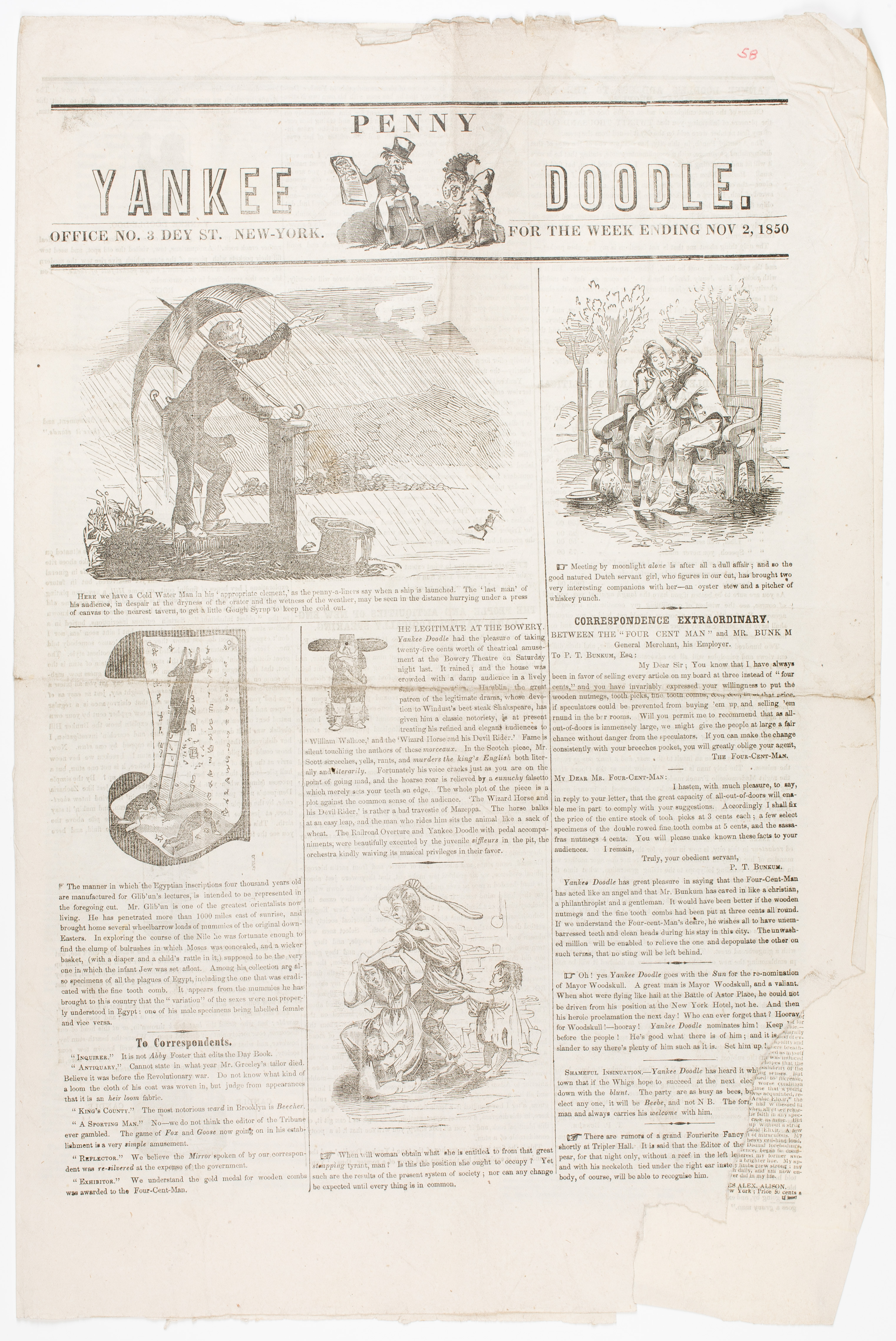
Penny Yankee Doodle  (New York, NY).  November 2, 1850.

465696_0001This is one of a number of illustrated humor newspapers and periodicals that appeared in the 1840s and 1850s.  The editor says they are not an imitation of Punch from England, but, “I am myself alone – the original Genius of American Humor.”  There are the usual advertisements for various cures and comic publications.  There are a variety of humorous articles, including a poem on “Vimmins Right” that makes fun of Abby Kelley Foster.  One of the best pieces is a note to political candidates that they can be bought:

For a Forged Document                               $100.00
For a Lie circumstantial or direct                $25.00
For a Libel, well seasoned,                           $50.00
For a Speech, you never made,                  $75.00
For my interest with my party, the Laughing Philosophers, a very numerous and powerful body, my charge is                             $1000.00

Catalog Camper or Archive Detective? My Summer at the AAS

Samantha Cook is a senior at the University of Wyoming where she is majoring in History and Museum Studies. She spent last summer on an archeological dig in Italy, and this summer, she has been with us at AAS as a catalog camper, doing a completely different kind of digging.

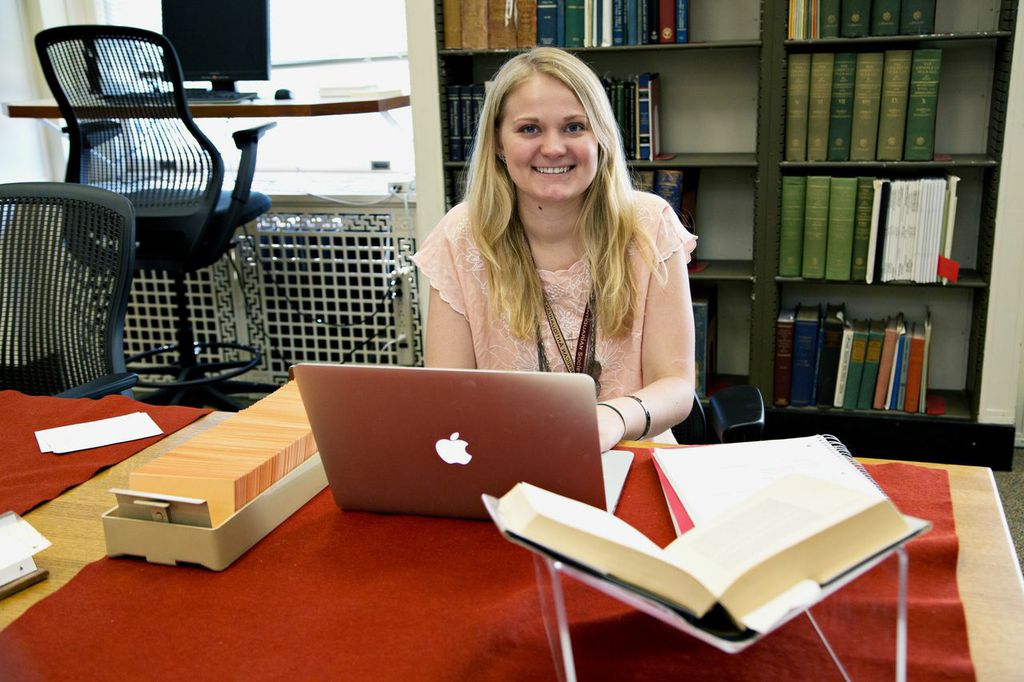
The author at work in the reading room.

When I made the bold decision to move from small town Wyoming to the second largest city in New England for a summer of catalog camp at the AAS, I did not know what to expect, being that there were so many unknowns: how would I like my job? The people? The institution? The city? I am fortunate that I have been handed a wonderful project, friendly co-workers, and the ability to learn about numerous topics so that my brain is happy and full. My time here learning the ins and outs of being a research detective and figuring out mysteries left behind by a brilliant cataloger has been one of the best experiences in my life.

The Printers’ File is well known to many people who come to visit the reading room, and many early Americanists and book historians eagerly await its incarnation as a relational database. The effort to create this digital resource brought me from Laramie, Wyoming, to Worcester, where I now spend my days sifting through the copious amount of information collected by Avis Clarke.

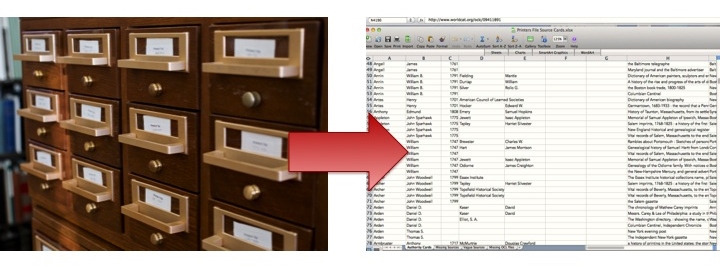
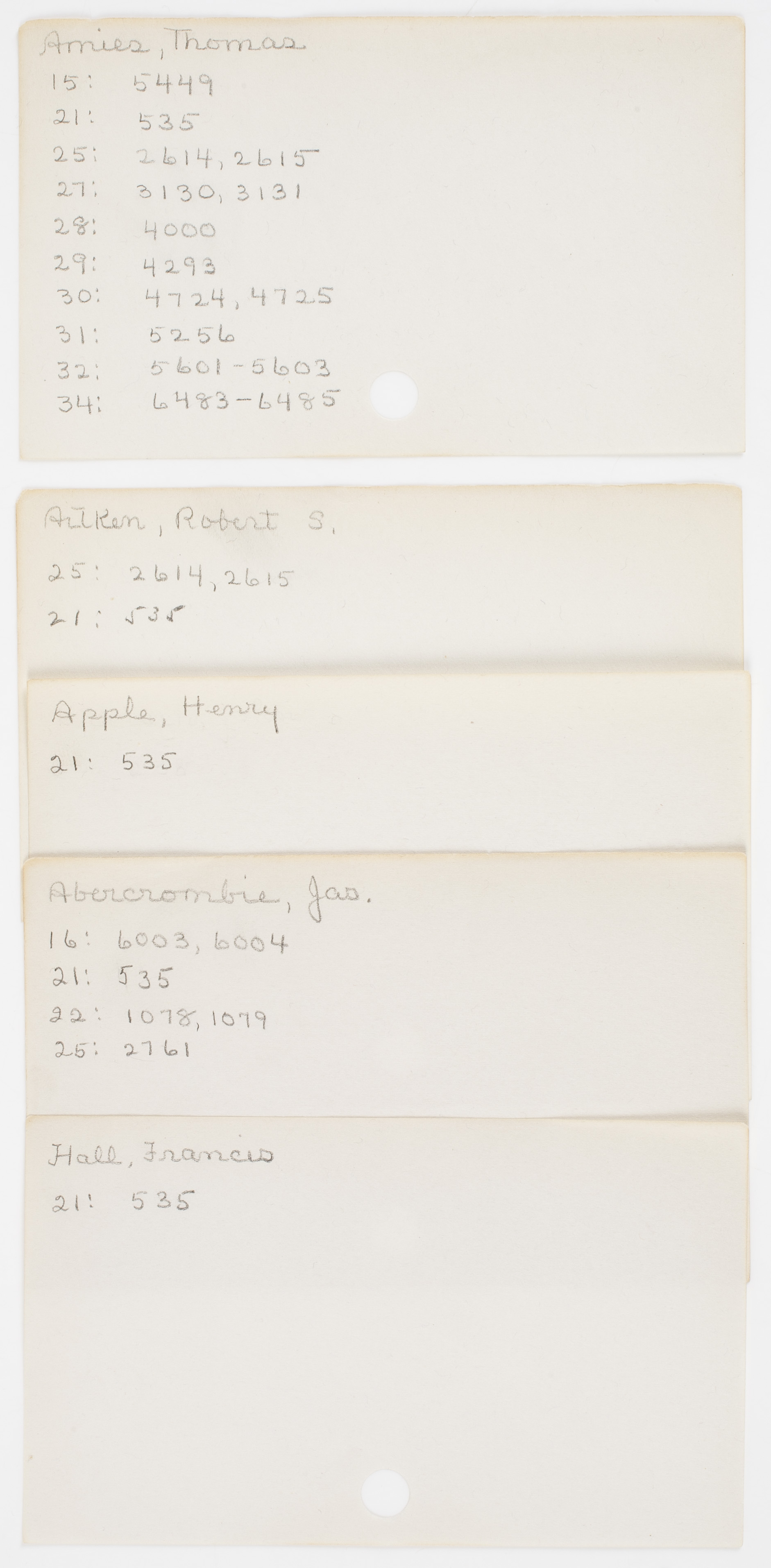
Clarke was the first trained cataloger here at AAS, and I look up to her for her dedication and the patience that she must have had while building the Printers’ File. From 1927 to 1970, Clarke spent each Wednesday looking through books, directories, letters, and newspapers as she gathered biographical information of people in the book and related trades from 1640 to 1820. Clarke searched by hand through these books, not having the technology we have today; on multiple occasions I have turned to Molly Hardy, curator of digital humanities and the project’s manager, wondering how Clarke sat there and built this amazing resource over so many years. Molly and I regularly find occasion to marvel at her perseverance as I look through these cards finding the authority or source cards where Avis listed the myriad materials she consulted. I have been transforming Clarke’s sources into an Excel spreadsheet (see below), which will then be transferred to tables in a MySQL database.

PFExcelWorking with these cards has led me to try to think like Clarke, to figure out her shorthands and abbreviations, and in some instances to re-research her sources. There have been numerous times that I have felt frustrated with Clarke for her shorthand notations that left me to deduce what she may have meant. I can sometimes see Clarke laughing at my struggles as if she were still here.

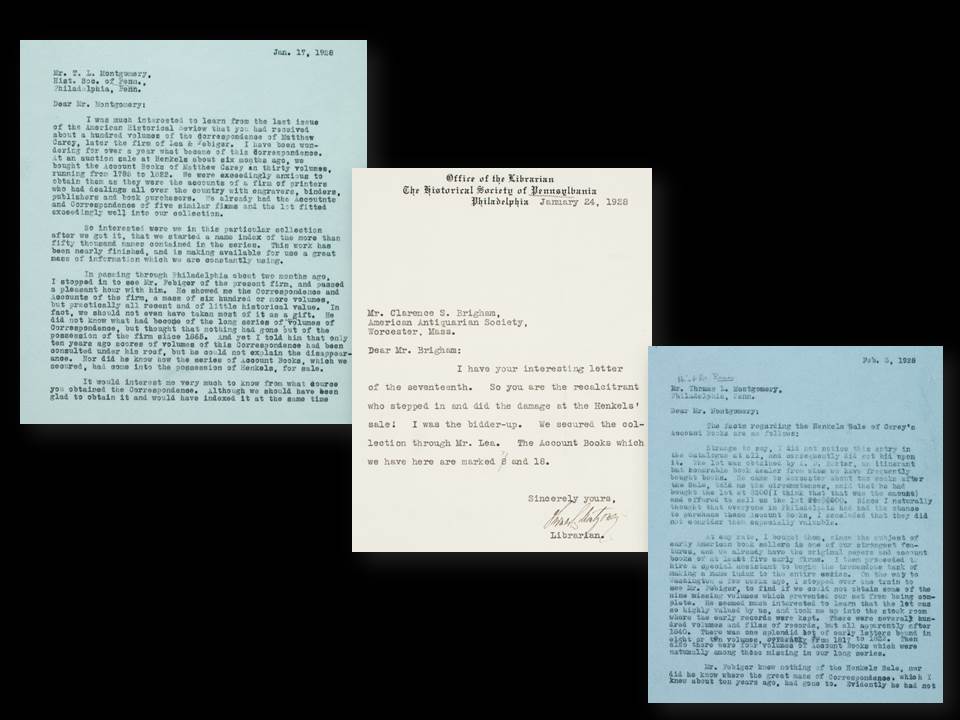
The mysteries left for me to unravel include what Clarke might have had in mind in her more enigmatic citations. At the start of my time here, I came across a source that said, ‘Letter from Elmer T. Hutchinson, New Jersey Historical Society, January 5, 1946.’ When I realized that this was a manuscript, I was still not sure how to find it because, as I learned, manuscripts in archives are rarely cataloged at item level. Members of the AAS staff were soon able to direct me to AAS archives to find the letter. In reading the letter, I eavesdropped on the friendship between Clarence Brigham and Elmer T. Hutchinson, who not only exchanged information on printers, but also shared their reading pleasures with each other making it clear they were friends as well as colleagues. Because Clarke includes this letter in her sources and because I have included it in the Excel spreadsheet, complete with a link to the AAS Records, which date back to 1812, many others will be able to not only find the source of this information, but will also bear witness to this friendship based on a shared enthusiasm for printers and books.

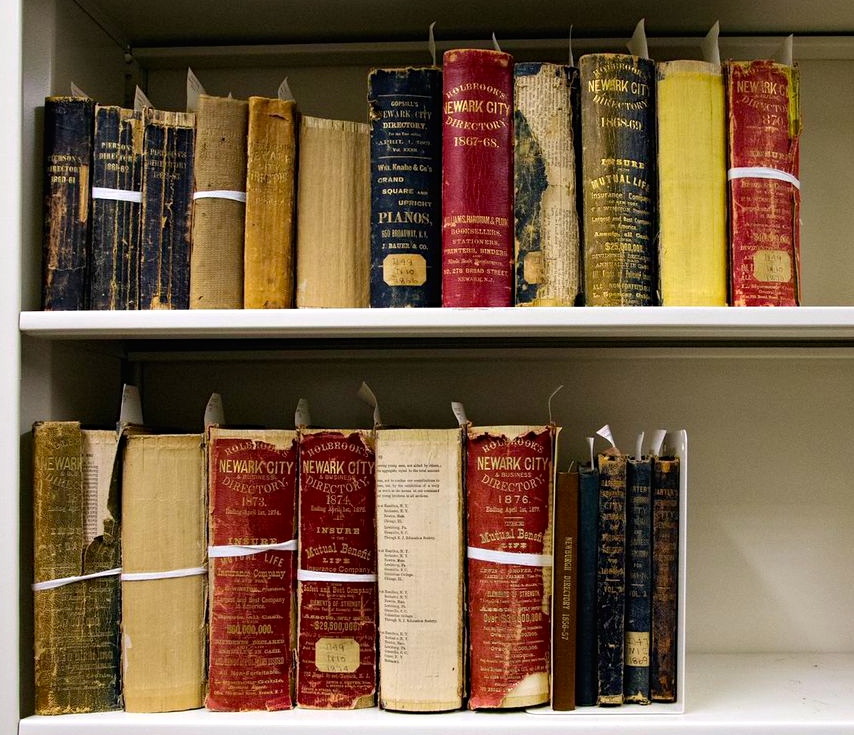
City directories
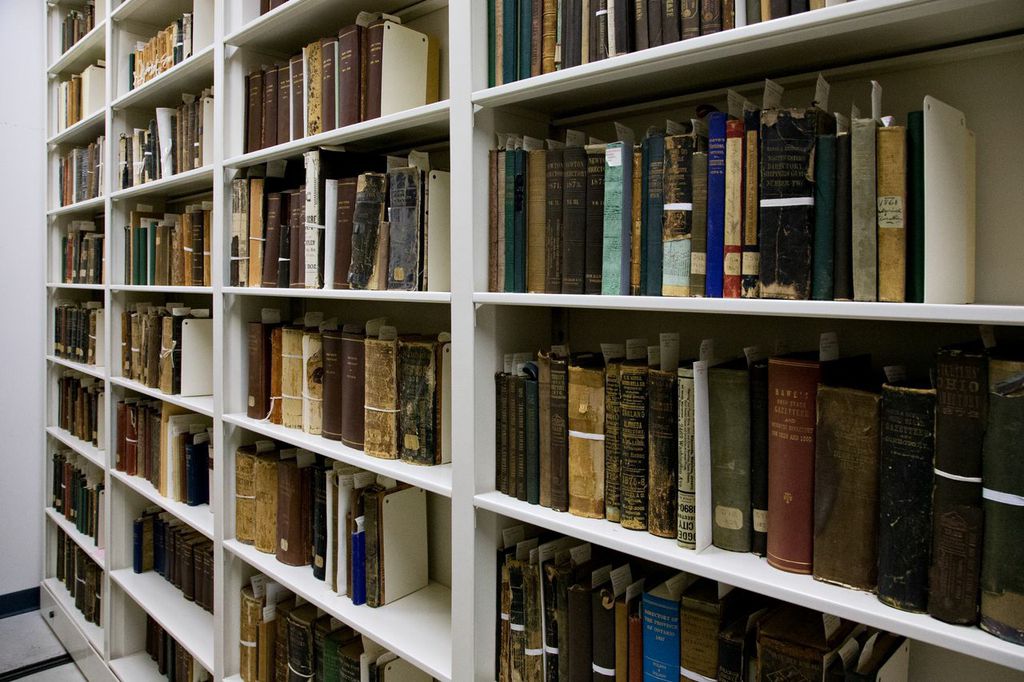
City directories

Part of what has amazed me so much as I retrace Clarke’s path is the staggering range of sources she consulted: letters, books, newspapers, genealogies, and archive collections. But the source that stunned me the most were the directories from different cities in the United States.

Clarke had to go through year-after-year looking for different names to find information on people in the book trade. She consulted a staggering number of directories to complete her research. Clarke would often list 15-20 consecutive years on the same cards. From those sources it has been remarkable to see the vast differences between each directory from different cities or Directories Image 2states. These directories are easily the most used source by Avis, making up a third of the total expanse of sources used, though the citations can at times be rather vague. Instead of citing “New York directories from 1801-1810,” she might only write “New York directories.” She also once cited “New York directories 1810-1815 and more.” This led to frustrations because it was impossible for me to determine the specific dates she intended as sources. But, with these as my biggest frustrations, this project has been a delight.

Having to speculate what Clarke might have meant by certain sources is something that I have learned to do over time here and my love for the Printers’ File has only grown along with that time. At the end of this summer, I will dearly miss the Printers’ File, my co-workers, and fellows at AAS, but I am proud of helping to lay the groundwork for the Database of the Early American Book Trade.

The Acquisitions Table: The Eclectic Harmony

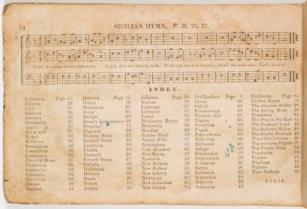
Johnson, Andrew W. The Eclectic Harmony. Revised and improved second edition. Shelbyville, Tenn.: N.O. Wallace & Co., Printers, Shelbyville Free Press Office, 1847.

Eclectic HarmonyOnly one other copy is known of this title, and that was purchased in 2001 by the Center for Popular Music at Middle Tennessee State University. Then just this past year a private individual discovered a second copy when sorting through hundreds of books in her mother-in-law’s Tennessee attic. This newly-discovered copy is in better condition than the other. It is complete, in a wallpaper wrapper, and includes an index at the end listing all the hymn tunes. The owner of this copy contacted the Center for Popular Music, but as they already had a copy, the director Dale Cockrell kindly suggested AAS might be the right home for it.

Here is how the Center for Popular Music described what was, at the time they acquired it, the only copy of a previously unknown central-Tennessee shape-note tunebook:

Eclectic Harmony represents the shape note system of music notation, which developed in the early 19th century. The system is historically associated with the Singing School Movement, a reform movement to raise standards of singing in Protestant churches in the Northeast. Between 1810 and 1820, the shaped notation as well as the style of folk hymnody it embodied fell out of favor in the North. But it continued to thrive in the rural South and West. Folk hymns in shape notation are among the earliest known music publications to carry a Tennessee imprint. Little is known of Eclectic Harmony‘s publisher, Andrew Johnson, other than he seems always to have lived in Middle Tennessee. He compiled at least two other shape note collections, The American Harmony (1839) and The Western Psalmodist (1853), both published in Nashville.

The red vegetable pill or the blue vegetable pill?

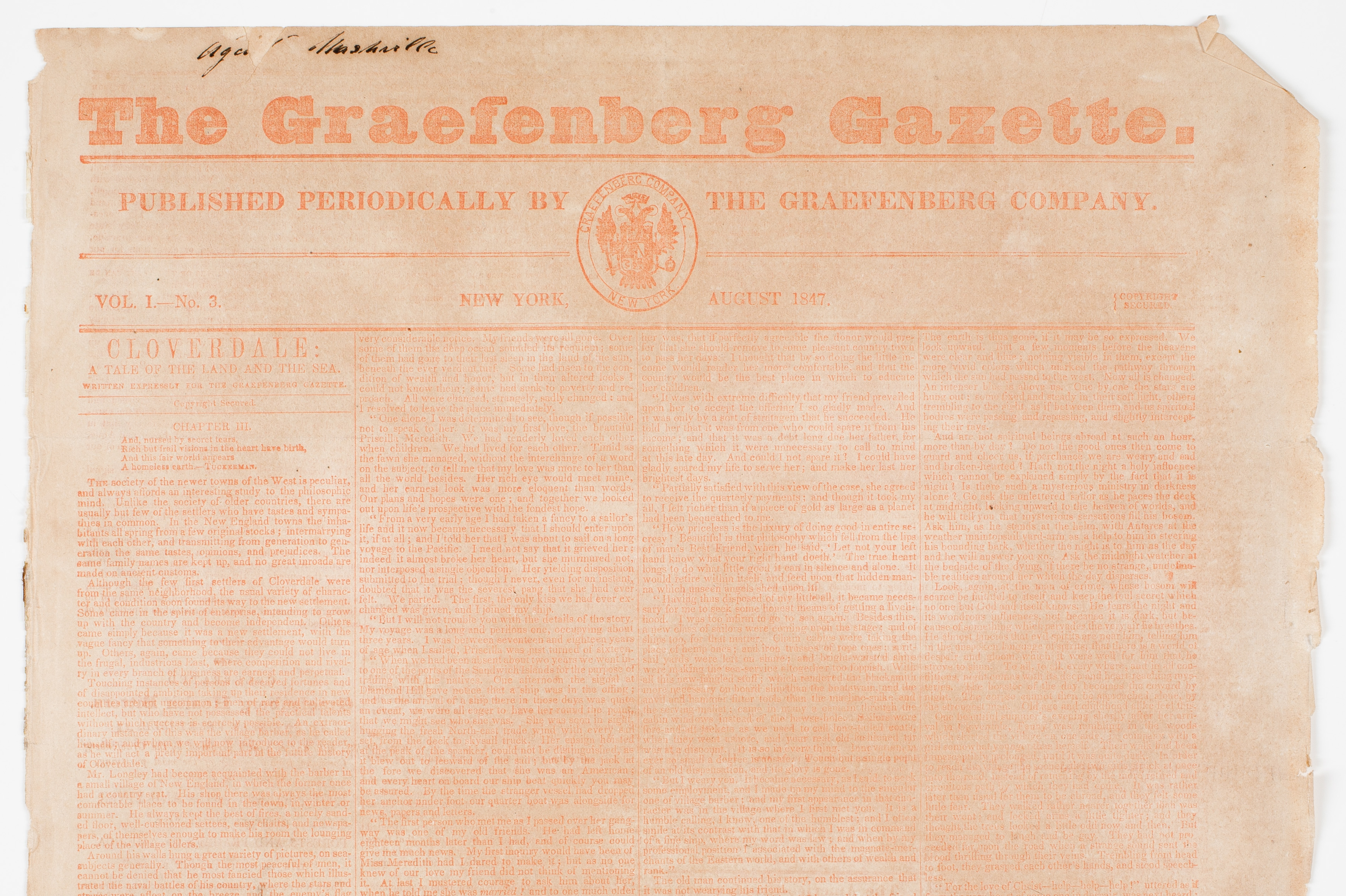
Graefenberg Gazette (New York, NY),  August 1847.

464331_0001The first thing that should grab your attention about this advertisement sheet is that it is printed in red ink.  This was a marketing trick by the Graefenberg Company that put out a wide variety of pills and elixirs.  This particular sheet promoted their vegetable pills, sarsaparilla compounds, eye lotion, Green Mountain compound, fever and ague pills, children’s panacea, and health bitters.  The promotional pieces on the back page are in English, German, French, and Spanish.  This is issue number three and on the front page is the third chapter of a story that began in the first issue.

Because it is an advertising piece, very few copies have survived.  As far as we can tell, this third issue is the latest known.  We happen to have the first issue dated September 1846.  It states under the title that it is published periodically.  Considering ours is the third issue in almost a year, periodically is an understatement.

Now back to the red ink.  When this was first printed, the text must have been a vibrant red on clean white paper.  As you can see, today the red ink has faded a bit (common with this color), and the foxing of the paper has added to the difficulty of reading the text.   Even when you enlarge the image, it is very difficult to read the faded text against the slightly browning background.  Perhaps you need their eye lotion.

From Conservation: Treatment of the Protestant Tutor

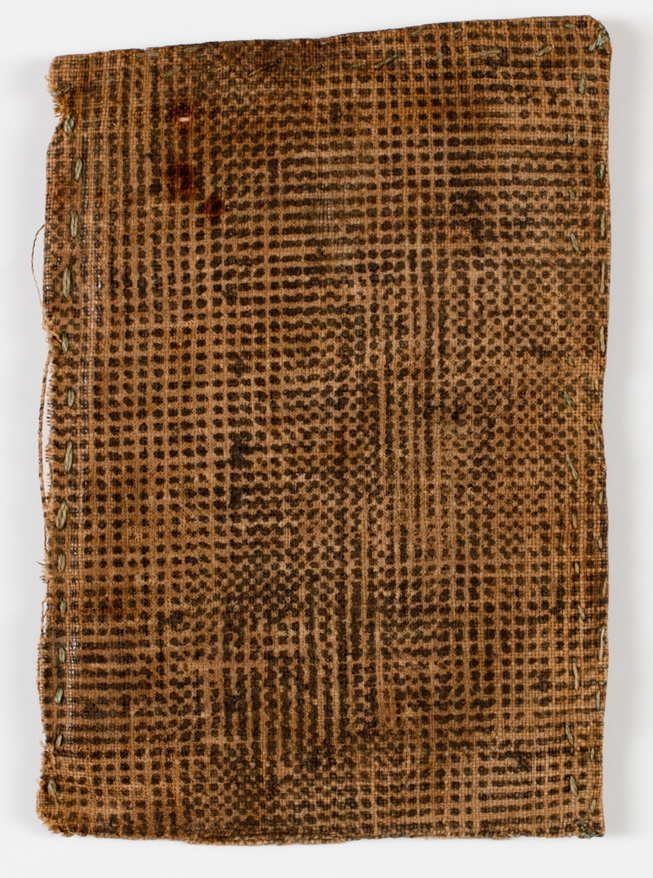
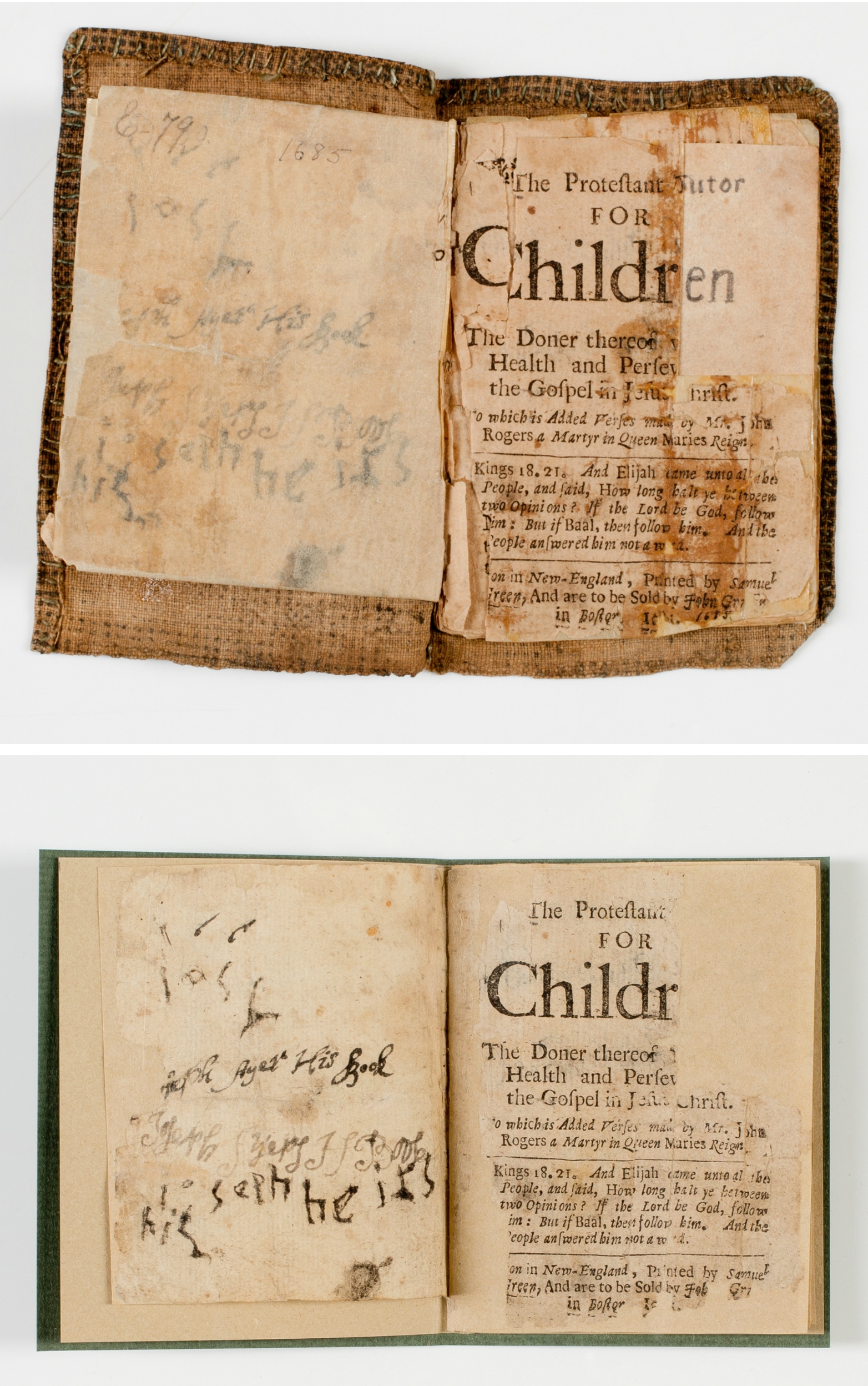
Cover of the item before treatment.

Recently, I had the opportunity to treat a very special item from our Reserve collection as part of our Save America’s Treasures grant.   The Protestant Tutor for Children is attributed to Benjamin Harris and was printed by Samuel Green in Boston, 1685. Thought to be a precursor text to the New England Primer, it is the first and only known extant copy printed in New England.  AAS has been in ownership of this pamphlet since at least 1885.

Upon examination, I found this rare pamphlet to be severely mutilated, with paper tears, losses, and stains. Hand-stitched into a dear little cloth wrapper, and with every page backed with glassine tape, it was evident that someone in its almost 330-year life had cared about preserving it. A missing section of the title page had been filled in with new paper and text neatly written in pencil. I imagine they probably felt they were doing a great job of it. There was ink manuscript throughout, declaring ownership (William Giddons and Joseph Ayers, specifically). Overall, charming, but in rough shape!

Before and after
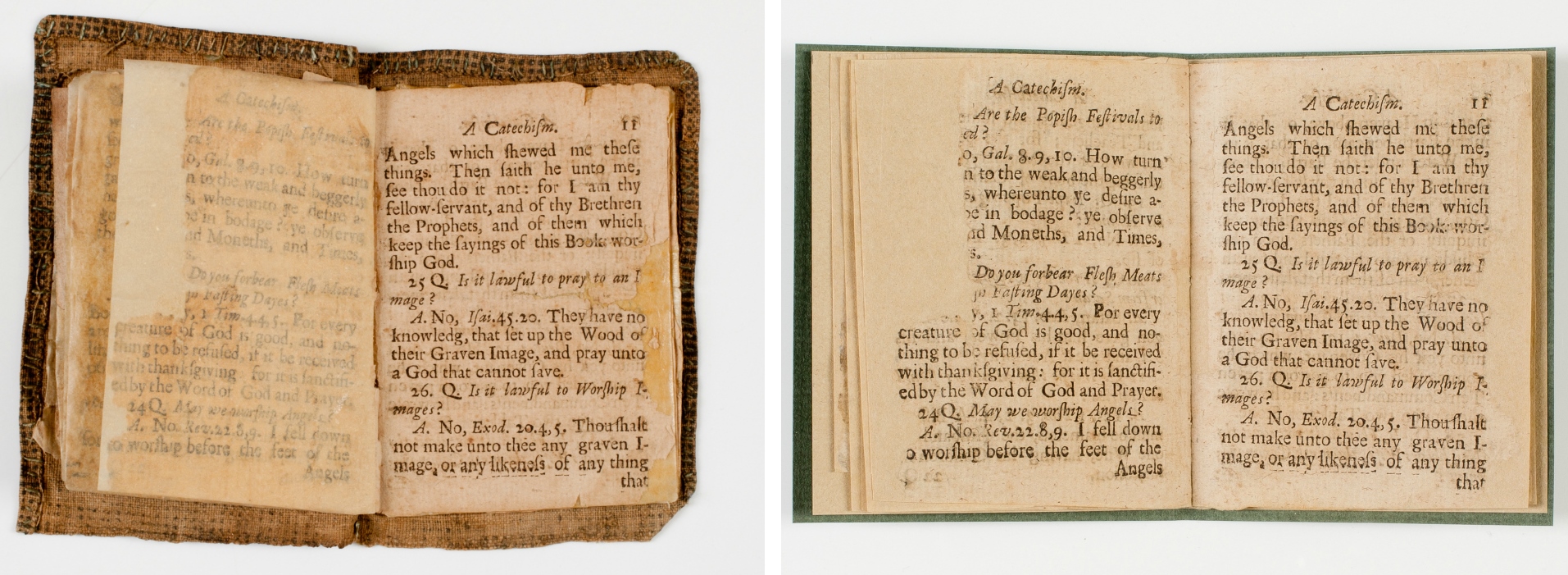
Before and after

What is required first in treating such an object is thorough documentation. A detailed description of its condition is written up and captured visually with digital photography. In this case, every page was shot both before and after treatment. The pamphlet was then disbound, and the pages were cleaned of surface grime before washing. All of that glassine had turned yellow and obscured the text. It had certainly kept the pamphlet intact, but it had to go! Fortunately, the adhesive on glassine tape is water soluble, and was easily removed in a water bath. After the tape floated off and the acids were removed from the paper, it was alkalized with a magnesium solution, and when dry, re-sized with gelatin. It was now time to reattach all the little bits that came apart when the glassine came off. Usually we mend tears and fill losses with Japanese tissue and wheat starch paste, but due to the extent of damage this was a better candidate for a pulpfill, which tends to be more seamless. We’d just spent the month doing pulpfills, and I’d saved this one for last.

collage2
Before and after

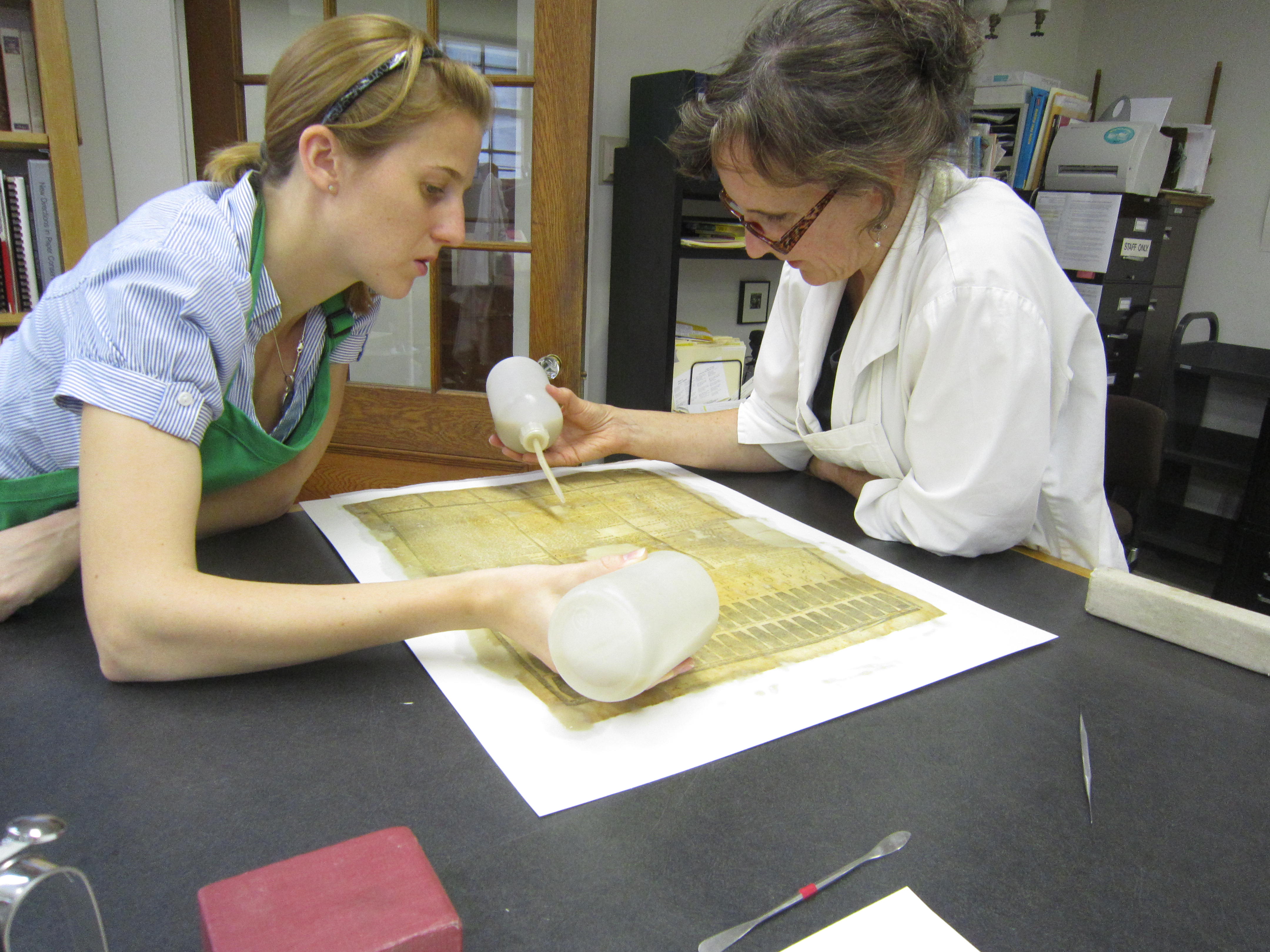
Making fills with pulp is fun, and creative, even kind of artsy – one tears into small pieces a variety of high-quality handmade papers (old and new) in an attempt to match the hue and tone for the area you are repairing. These are whirred up in a blender with water (passersby are unable to resist the smoothie joke) until you have a suitably blended paper pulp. It can take a bit of tweaking, but is highly satisfying when you’ve gotten it right. We then fill a squeeze bottle with the pulp and apply it to the wet object on Hollytex (a synthetic material which allows water to flow through, but prevents sticking) and blotters. (To see what this process looks like, click here.) It is then dried under pressure between felts.

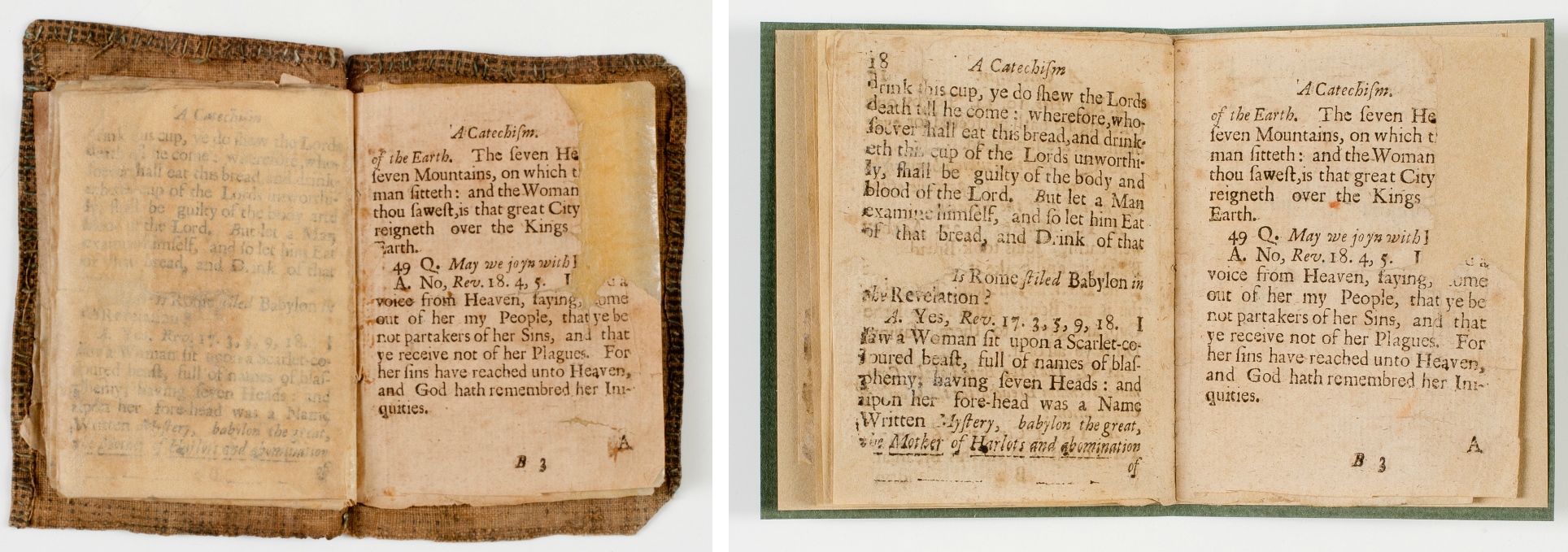
collage3
Before and after

After the paper repairs, the pamphlet was re-sewn into a new paper wrapper because the original wrapper was too fragile for re-use. Both the old wrapper, and the original threads that were cut to release it, have been saved with the pamphlet in an enclosure, along with some notes about the provenance that were found with it. The “after” photos were taken, and it was returned to our cool, dark, secure stacks, where it will remain safe and sound for generations to come.

Isaiah Celebrates the Fourth of July

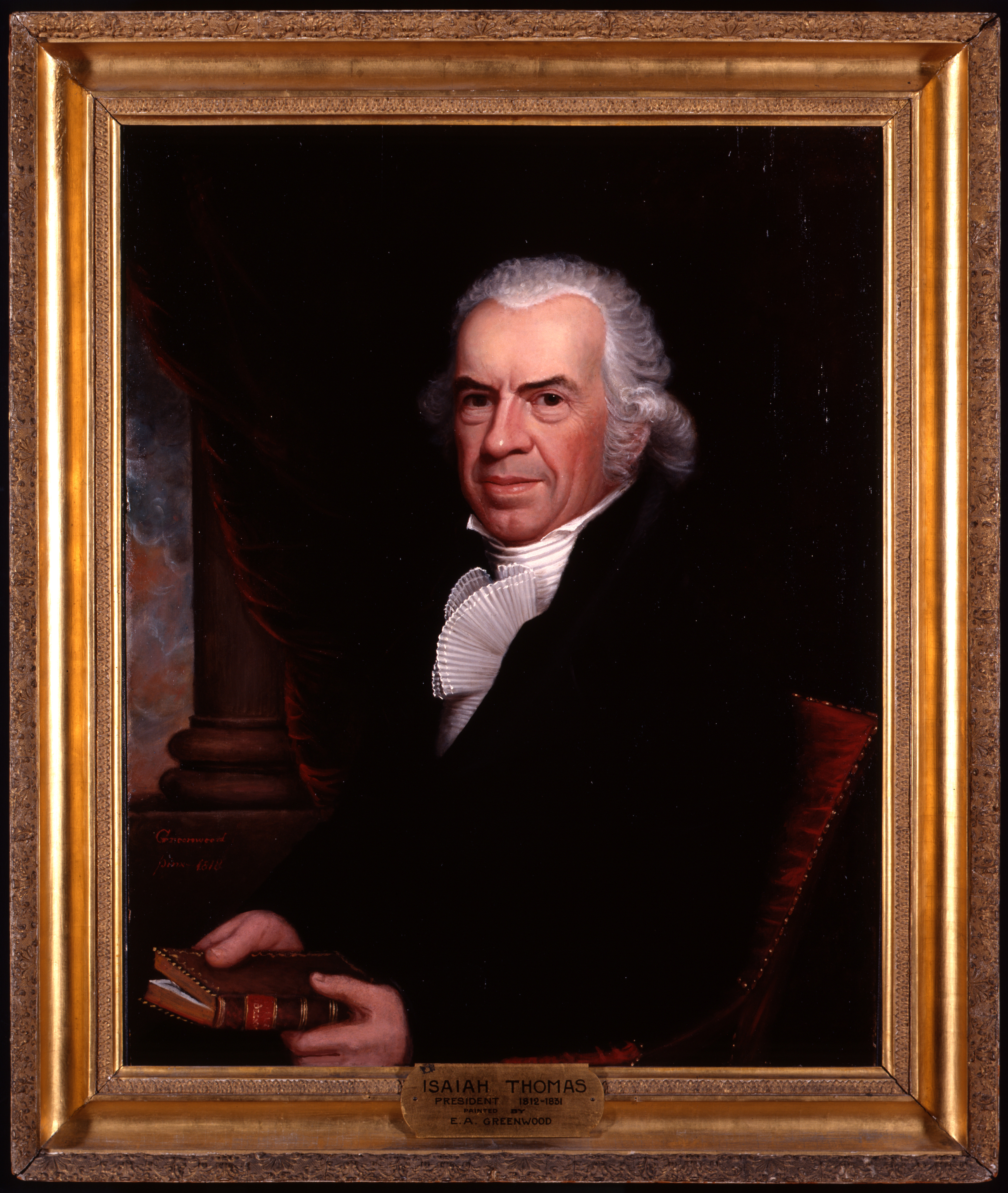
Portrait of Isaiah Thomas by Ethan Allen Greenwood, 1818

Here at AAS, nary a holiday goes by without some reflection on how the same was celebrated in days past. On this Fourth of July we’re going to take a trip back 200 years and check in on how our founder, Isaiah Thomas, celebrated the holiday.

In July 1814 the United States was in the midst of the War of 1812 with Britain. Many of the events we have come to most closely associate with the War of 1812—including the burning of Washington, D.C. and the composition of the Star Spangled Banner at the Battle of Baltimore—had yet to happen. Though the war was in many ways entering the beginning of the end—just the next month peace negotiations would begin in Ghent and would be finalized in December—this was not clear to Americans at the time. Thus, it was a war-weary and politically fractured populace that celebrated Independence Day in 1814.

Support for the war had been split from the beginning. The two major political parties at the time, the Federalist Party and the Democratic-Republican Party, were starkly opposed on the war. The older of the two, the Federal Party, had weakened in the recent years and remained strong mainly in the northeast. It supported strong central government and closer ties with Britain. The Democratic-Republicans favored a weaker central government, expansion, and a clearer independence from Britain. When Congress voted on the declaration of war in June 1812 no Federalists voted in favor, setting up a dichotomy that was to last throughout the war.

This opposition is clear in Isaiah’s account of the Fourth of July festivities in 1814. He begins his diary entry by stating simply, “Independence Celebrated by both political Parties, separately.” He goes on to explain that the “Federalists dined in a large Booth, on my land, near the north meeting house—The other party dined at Wheeler’s Tavern—Each formed in procession, and saluted each other as they passed—each had a military escort, and a band of Musick.—The federalists had their Exercises in the south Meeting house—the other in the north meeting house.” One begins to get a sense of how politics played a part in the town, not only ideologically, but also physically.

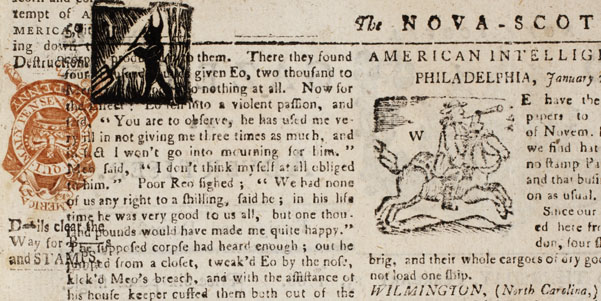
Detail of Isaiah's devil woodcut and stamp from The Halifax Gazette. February 6 to 13, 1766.
Detail of Isaiah’s devil woodcut and stamp from The Halifax Gazette. February 6 to 13, 1766.

As this entry suggests by the mention of the Federalists dining on his land, Isaiah had never been one to keep his politics to himself. When he was just 16, he got himself into trouble with the authorities in Halifax, Nova Scotia, for printing items in the Halifax Gazette protesting the Stamp Act. First, it was a woodcut of the devil (which Isaiah made himself, of course) stabbing the official stamp with a pitchfork (see above). When he got in trouble for this he decided to get around the order not to do it again by simply reprinting copy from other newspapers, a common practice in the eighteenth century. This meant that he could print an article from the Pennsylvania Journal outlined in mourning borders and skulls announcing the death of the newspaper due to the Stamp Act and claim that he was simply sharing the news.

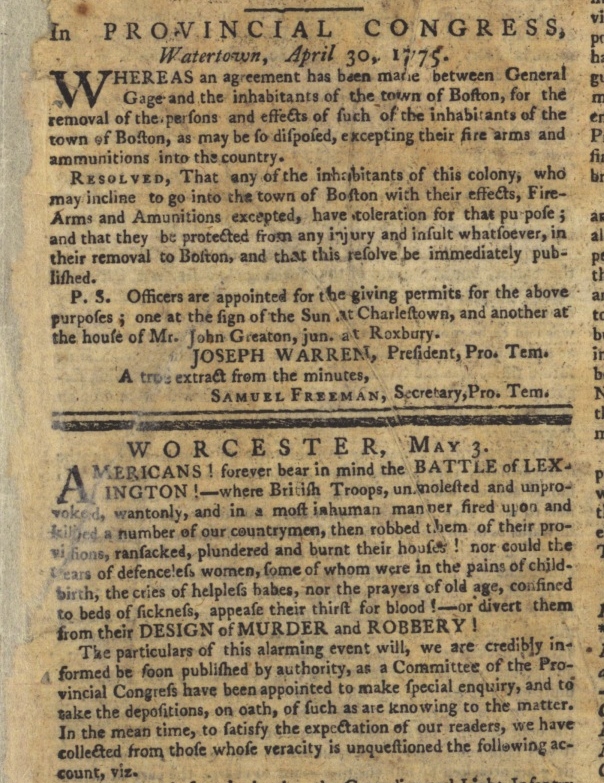
Mass Spy Lex-Conc
Detail from May 3, 1775 issue of Massachusetts Spy

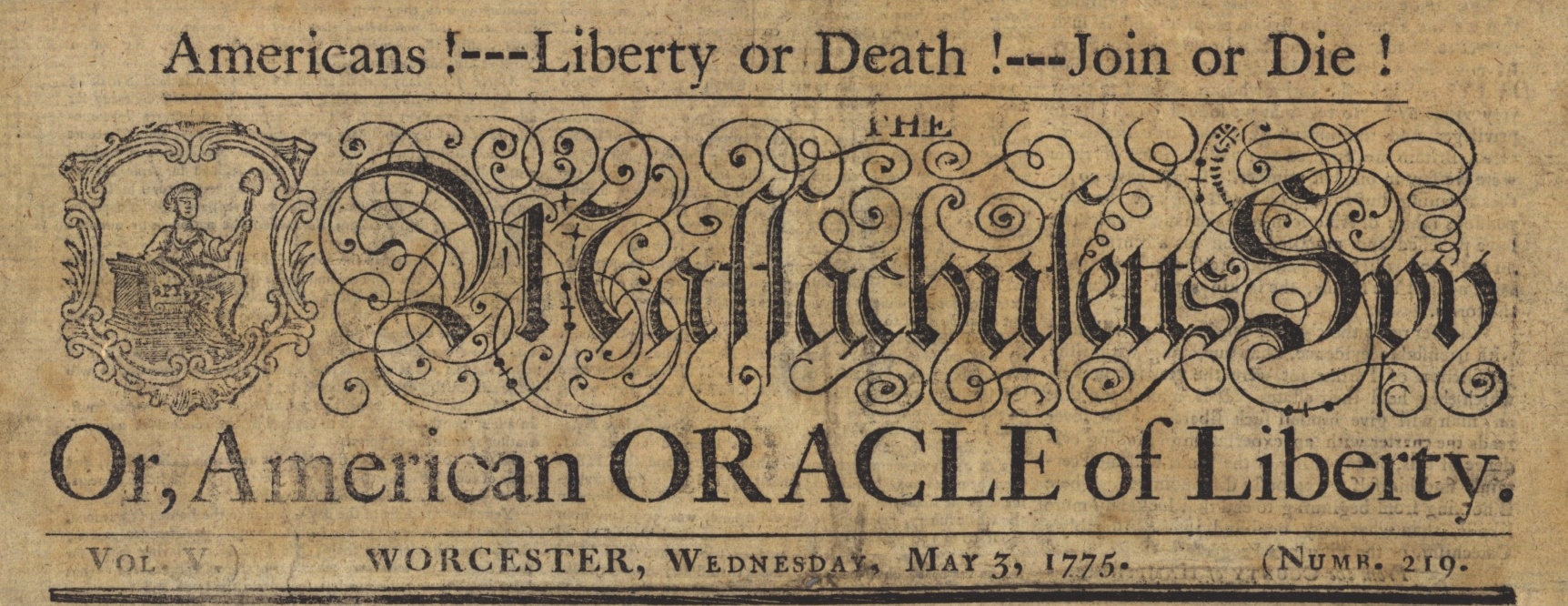
In the years leading up to the Revolutionary War, Isaiah’s newspaper, the Massachusetts Spy, transitioned from one “Open to ALL Parties, but Influenced by None,” to one that, by 1774, featured the slogan “JOIN OR DIE,” and eventually, “Americans!—Liberty or Death!—Join or Die!” The Spy became such an influential Patriot newspaper, in fact, that three days before the Battles of Lexington and Concord Isaiah smuggled his printing press out of Boston to Worcester for fear of it being impounded by the British authorities. On May 3 he printed his eyewitness account of the battles, a model of non-partisan journalism: “Americans!  forever bear in mind the BATTLE of LEXINGTON!  where British Troops, unmolested and unprovoked wantonly, and in a most inhuman manner fired upon and killed a number of our countrymen, then robbed them of their provisions, ransacked, plundered and burnt their houses!  nor could the tears of defenseless women, some of whom were in the pains of childbirth, the cries of helpless, babes, nor the prayers of old age, confined to beds of sickness, appease their thirst for blood! – or divert them from their DESIGN of MURDER and ROBBERY!”

Mass Spy BannerIsaiah’s partisanship and rabble-rousing didn’t end with the Revolution. During late 1813 and early 1814, several British officers were taken prisoner in order to leverage an exchange for American soldiers and were paroled in Worcester. Isaiah, like many Federalists, believed these “hostages [of] government” were being mistreated and spent much time visiting them and bringing them extra comforts. In reality, their imprisonment was quite comfortable and when they found they were to be transferred elsewhere they bound and gagged the under-keeper and made their escape. Several were recaptured, but four remained free. Isaiah recorded the escape in his diary and noted that he had visited them earlier that day.

With this record it comes as no surprise that the political parties celebrated Independence Day separately, nor that Isaiah was among the leaders on the Federalist side. Despite their separation, the two factions did observe some basic civilities, although whether these civilities were intended to be sincere or facetious is difficult to determine. As noted earlier, they saluted to each other as they crossed paths on their way to their respective meeting places, and later in the entry, Isaiah relates that “Two toasts were reciprocated—with a discharge of artillery—a Comee accompanied with a band of Music, waited one on the other party with the toasts.”

And lest we have any doubts about where Isaiah stood in his viewpoints (although at this point that seems unlikely), his closing statement for the entry erases them: “The federal party was the largest about 400, and really the most respectable.—dined with the Federalists.”

The Acquistions Table: Chronicles of New England

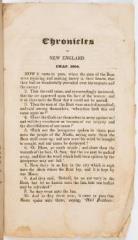
Chronicles of New England. Chap. 1000. [United States: s.n., 1826-7?]

ChroncilesTwo copies of the earlier Chapter 999 have been traced (one of which was already at AAS), but this appears to be the only copy of Chapter 1000. When it appeared at auction this fall, we had to have it. A satire written in Biblical style, Chapter 1000 of the Chronicles of New England begins: “Now it came to pass, when the men of the Boat were rejoicing and making merry in their hearts…” Both chapters describe the competition between the Hartford-based shipping merchants who plied their trade along the Connecticut River, and a rival group of New Haven investors who bypassed them with a canal to Massachusetts. The pamphlets allude to the icebound steamer Barnet, placing the date of composition in 1826.

The Acquisitions Table: Elliot Cowdin Letterpress Copy Book

Cowdin, Elliot.  Letterpress Copy Book, 1861-1869.

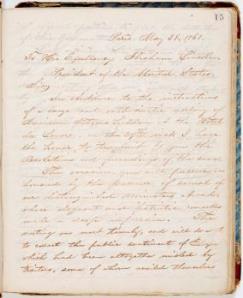
CowdinElliot C. Cowdin (1819-1880) was a well-known merchant in New York.  As a young man he was greatly involved with the Mercantile Library Association, where he learned much about his trade.  Later in life he became involved in politics, especially during the Civil War.  This letterpress copy book contains copies of letters he wrote primarily during his politically active time, from 1861-1869.  Included are letters addressed to Charles Sumner, Salmon P. Chase, and Abraham Lincoln.  He traveled to Europe frequently for business, especially to Paris, which is where he wrote a letter to Abraham Lincoln at the outbreak of the Civil War 1861 assuring overseas Americans’ support – “Rest assured, Sir, that our citizens abroad feel deeply grateful to you for the energetic manner in which you are prosecuting the war, and will stand by you to the end.”