Adventures in Amateur Newspaper Cataloging: The Acorn

As I work through cataloging the American Antiquarian Society’s collection of amateur newspapers,  I’m often amused by both the content of the material and the stories of the people who published them. The Acorn (Catalog Record), published in North Attleboro, Massachusetts, by Fannie Hamilton, delights on both accounts. Hamilton published the first issue of the Acorn ...

New to AAS: Boston, Massachusetts, Papers addition, 1710

Almanacs, pregnancy, and dodging fines are all contained in this one-page testimony to the Court of General Sessions of Massachusetts from 1710. Unmarried Ruth Copeland became pregnant with a child by a man named Samuel Hayden, who promised to marry her after finding out she was to have his child. Samuel subsequently rescinded his offer after ...

Reminiscing on the Moments of the Past: My Time at the American Antiquarian Society

It’s not every day that one gets the opportunity to move across state lines to experience the workings of a new career. Throughout my undergraduate years at Virginia Commonwealth University, I juggled with the possibilities of the future and where it would ultimately take me. I have always been attracted to the ways history can ...

History of Conserving History: The Evolution of Paper Conservation in Libraries

In the summer of 2024, I spent eight weeks at the American Antiquarian Society (AAS) for my first paper conservation internship as part of my master’s program in conservation at the Institute of Fine Arts, New York University. Under the guidance of Chief Conservator Babette Gehnrich — who has dedicated over 35 years to stewarding ...

A Scoundrel at Work in the Archives: George Weeks’ Scams

In my work as the Serials Cataloger at AAS, I recently came across the Ladies' Enterprise, a periodical printed in several New England cities (including Worcester!) in the 1850’s. I was immediately drawn in by its subtitle “Edited and published by females” and its decorative masthead depicting women working at a print shop. Further digging ...

Ephemera Explored: Over 40,000 New Images Give Glimpses into 19th-Century American Life

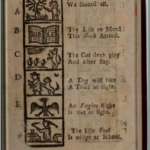
A light beige card with green-ish print and an illustration of a mer-man with wings.

Have you ever wanted to catch a ride on the Flying Dutchman? Or wondered what people ate at Faneuil Hall to celebrate the 4th of July? Would you like to attend a nineteenth-century séance? Earn ten cents from your teacher? Or shop for a tombstone? You can learn about all those activities (and more) from the ...

Not Everything That is Printed is on Paper: Survey of Textile Broadsides

One lesser-known collection at the American Antiquarian Society is a group of broadsides printed on textiles. Broadsides are ephemeral, single-sheet items that are usually printed only on one side. Some topics typical of broadsides include advertisements, official proclamations, theater announcements, and opinions. AAS has approximately 148 textile broadsides that showcase the breadth and type of these ...

‘To Which is Added’: The History, Structure, and Conservation of New England Primers at the American Antiquarian Society

In the summer of 2023, while completing my MA in book conservation at West Dean College in Chichester, England, I undertook a 10-week internship at the American Antiquarian Society, working alongside Chief Conservator Babette Gehnrich and Library and Archives Conservator Marissa Maynard. In between my time spent writing a thesis, attending a week-long course on ...

Interpreting Coded Messages in Friendship Albums

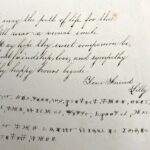
The Stubbs Collection at the American Antiquarian Society contains hundreds of friendship albums. Friendship albums usually contain messages to the album owners from friends, family members, and schoolmates. Many messages have a "forget me not" theme, or they may be philosophical or humorous. The contents of friendship albums were not private, in that the albums ...

Artifacts of an Antebellum Physician

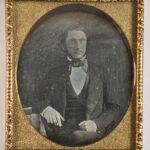
Within the vast collections at the American Antiquarian Society there is a particularly interesting assortment of items that offer a unique glimpse into the world of Dr. Nathan Staples Pike, his family, and the medical trade in antebellum America. The Pike-Wright Family collection, donated to AAS by Susan Pike Corcoran, contains Dr. Pike’s early 19th ...

Conservation of the Brown Family Collection

The Brown Family Library was donated to the American Antiquarian Society in 2019 by Dr. John Goldsberry, Jr., and his wife Dr. Dorista Goldsberry, along with their family. The family’s library joins other part of the Brown Family Collections already at AAS, donated by earlier generations of the family starting in the 1970s. Together the ...

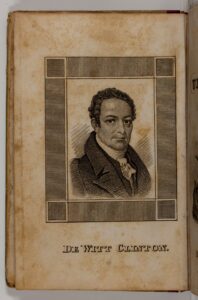
DeWitt Clinton and the Common School Fund: Early Public Education in the Collection

For the past few months, I have had the opportunity to work as an intern in the manuscripts department here at the American Antiquarian Society. Usually, I spend my days the digitizing department working as a liaison between AAS and our vendors, paging newspapers and serials. I jumped at the chance to work in manuscripts ...

“An Opulence Unexpected”: Examples of Red Morocco’s Use in Bookbindings

The history of the book is predicated on the idea that the book itself as an object is significant in its own right, not simply on its printed content alone. Which materials were used, how they were made, and who made them all speak to a vast network of economic, environmental, and human systems that ...

“Your cooperation is requested”: The American Antiquarian Society and Operation Alert

Operation Alert was a Cold War exercise designed to assess how prepared both government agencies and citizens were in the event of a nuclear attack on the United States. Starting in 1954, about 200 cities around the country took part in these drills until the project ceased in 1962. Worcester, Massachusetts, the home of the ...