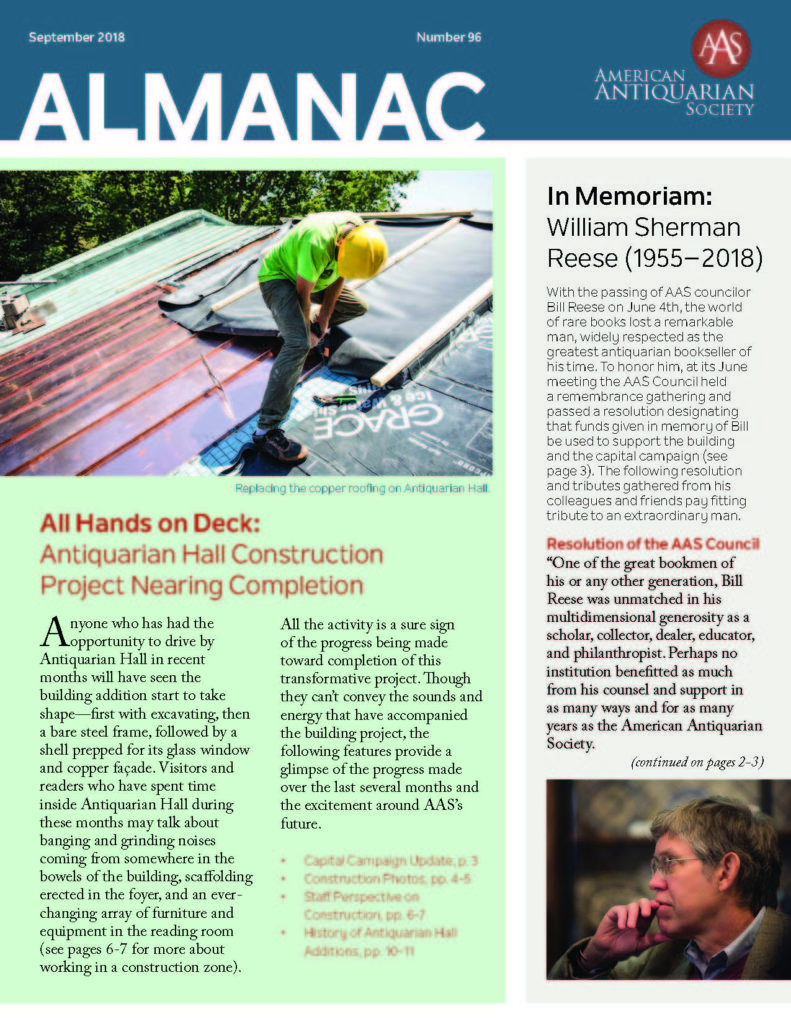
The fall edition of the AAS newsletter, the Almanac,is now up on the website and showcases some of the exciting things going on at AAS!
Some items featured include the opening of the Paul Revere exhibition at New-York Historical Society last month; a pictorial look at how we are utilizing our new Learning Lab and conservation spaces; an introduction to our new Director of Book History and Digital Initiatives, Kevin Wisniewski; and our 2019–20 long-term named fellows, Karen Sanchez-Eppler and Rachel Miller.
This issue also contains a photographic look at Antiquarian Hall through the lenses’ of Waldo Lincoln and Nate Fiske (over a century apart); our newest public program, which will engage the public with the staff curators; the lineup of the fall lecture series; a feature on the manuscript collection; staff news; member biographies; and so much more.
Finally, it was announced last month that AAS’s president, Ellen S. Dunlap, will be retiring in 2020; over the course of the next few issues of the Almanac we will be highlighting her invaluable legacy at the Society.
The American Antiquarian Society houses more than a thousand photographs and glass-plate negatives produced by photographer Theodore Clemens Wohlbrück (1879–1936) between 1900 and 1910. Since 2010, we have periodically highlighted different aspects of the collection on this blog, including information about Wohlbrück’s views of towns in Worcester County, his photographs of urban architecture, and a donation of negatives in 2014 from a Wohlbrück descendent.
Today, we are pleased to announce that all the negatives from the 2014 donation have been fully digitized and can be accessed via a new online resource compiled by the Society’s visual materials cataloger, Christine Graham-Ward. The resource, which is the twenty-second illustrated inventory to be produced based on AAS collections, is built on the Omeka platform and allows users to search the photographs by a variety of subjects.
T. C. Wohlbrück moved to Worcester, Massachusetts, from New Jersey in 1900 and started his career as a photographer when he was twenty-two years old. He specialized in landscape and city views that were often turned into postcards. He opened a modest photo studio on Main Street and married a local girl in 1902.
The new resource includes studio photographs made by Wohlbrück of his family and friends, including many portraits of his first wife, Mabel Brown Wohlbrück Penneton (1879–1960), and their three young children, Virginia Wohlbrück Willard (1903–1994), Gretchen Wohlbrück Bath (1904–1995), and Theodore C. Wohlbrück Jr. (1906–1985). Wohlbrück also took photographs documenting the construction of the family’s home in North Worcester and recorded a family trip to Virginia.
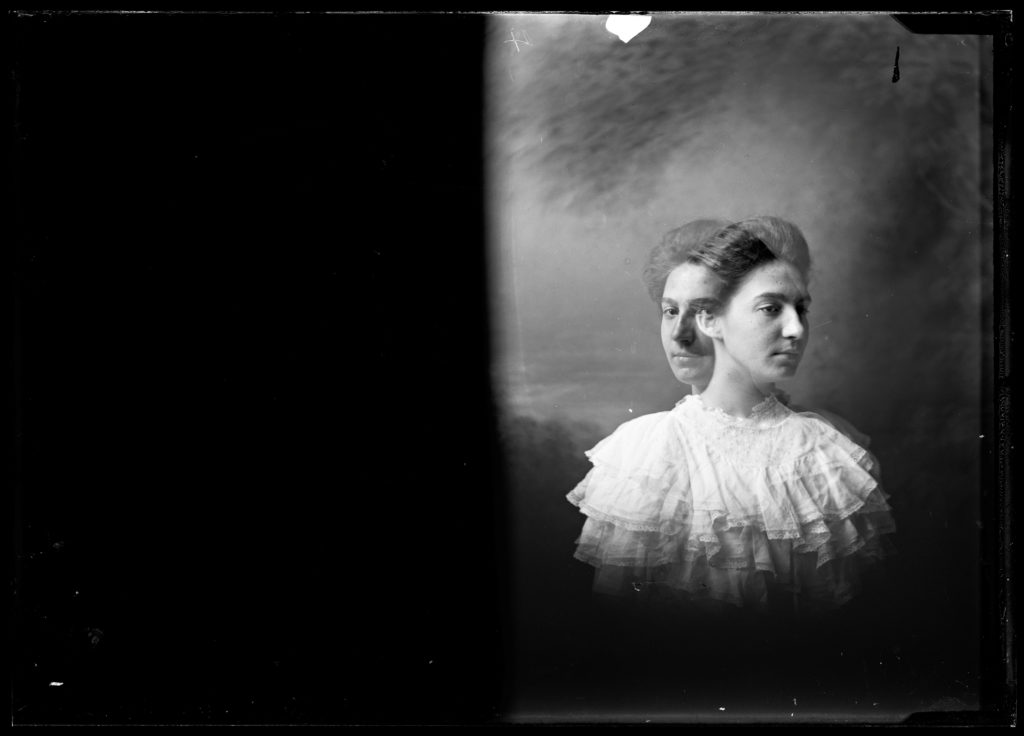
Examined as a group, the digital files of the negatives show the work of a young photographer finding his way technically (some are out of focus, poorly framed, or double exposed) and should be considered a prelude to the later professionally produced glass negatives and photographic prints by T. C. Wohlbrück already preserved at AAS and the artist’s Western work produced after he left Worcester for Nevada and California in 1910 .
“Double Portrait of a Woman,” Wohlbrück Collection, c. 1905-1910.
This fall we’re introducing a new kind of public program—one that gets you in conversation with our curators about our collection material!
This Wednesday, October 30, from 5 to 7 p.m., we will host our first “Chat with a Curator” program, during which the public is invited to drop in anytime during that window to view a selection of collection materials about Halloween and talk about them with some of the AAS curators. The items will range from children’s books and postcards to “haunted” diaries and early illustrated editions of classic scary tales, from documents about the Salem Witch Trials to “ghost” stereocards—just the thing to get in a spooky mood!
While there is no charge for this program, a suggested donation of $5 is recommended. Please also note that curators will be available to talk about the collection material on view during the program, but discussions about other research topics and/or donations should be held at a separate time.
See the video below for a sneak peek of the program. After you’ve watched, you can vote on which collection item you think is the scariest by clicking here! Voting will continue until the beginning of the event.
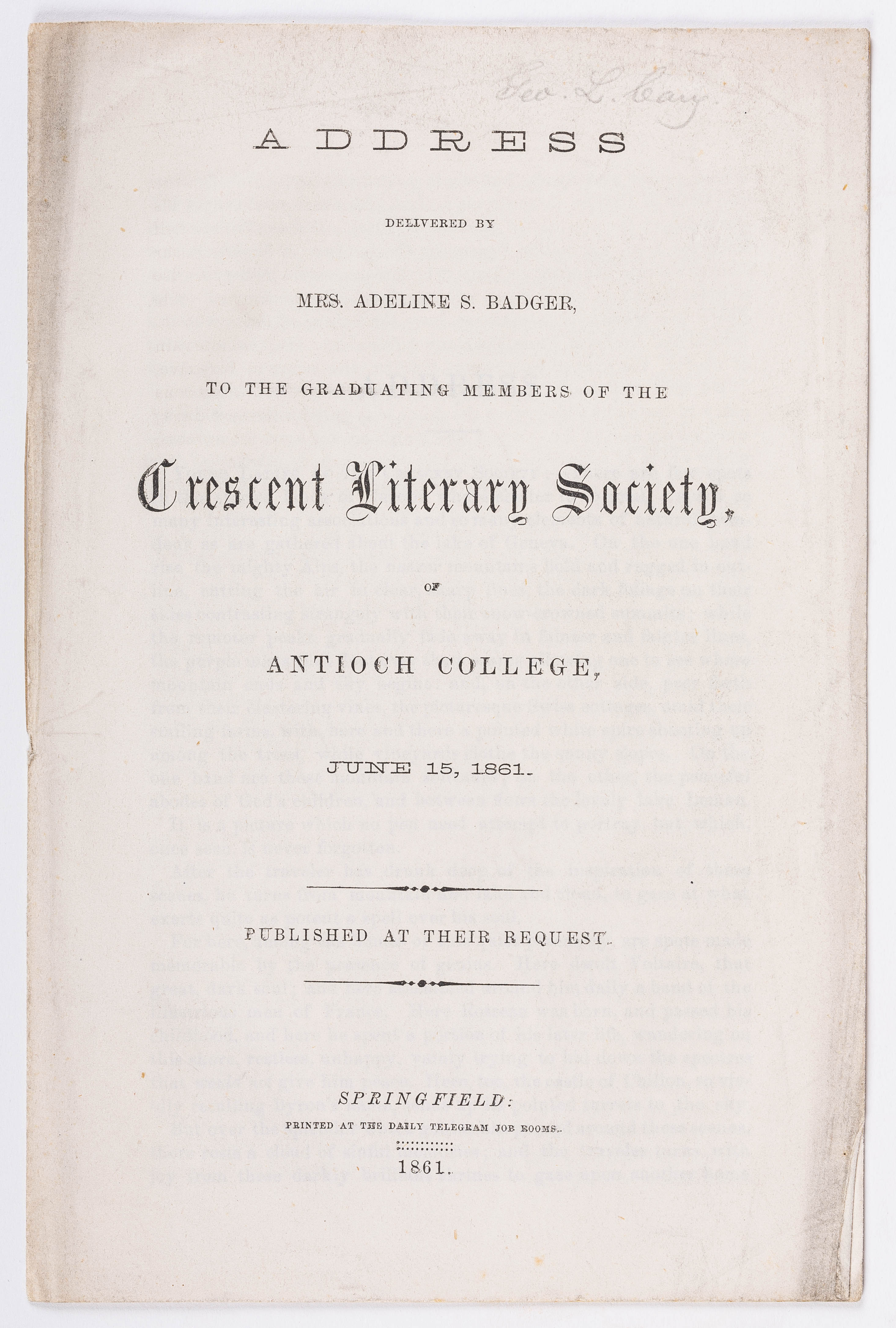
Title page of Badger’s address to the Crescent Literary society of Antioch College, an all-female society.
Over the past few years, the Cataloging Department has been actively working toward adding the subject heading “Women as authors” to all pre-1900 records in the AAS catalog with a woman author. This will enable researchers to easily identify and search for the women authors in our catalog. As cataloging assistant, I’ve been given the task of adding the heading and confirming that the people we’ve identified as women are, in fact, women. (This is not as simple as one might think. In addition to gender neutral names, men occasionally wrote under a female pseudonym and vice versa.) Through this process, I’ve stumbled across a lot of interesting women; many are familiar names whose contributions to history are well known, but there are many whose names are more obscure. I’d like to share the story of one of these lesser-known women here.
Ann Adeline Shepard was born into a transcendentalist family in 1835 in Dorchester, Massachusetts. After graduating from Antioch College in 1857, Adeline, known as Ada, became governess for Nathaniel Hawthorne’s three children. Ada traveled with the family throughout Europe, enhancing her teaching skills and knowledge of foreign languages. (Her sketchbooks and letters from this time are held by the Concord Free Public Library in Concord, Massachusetts.)
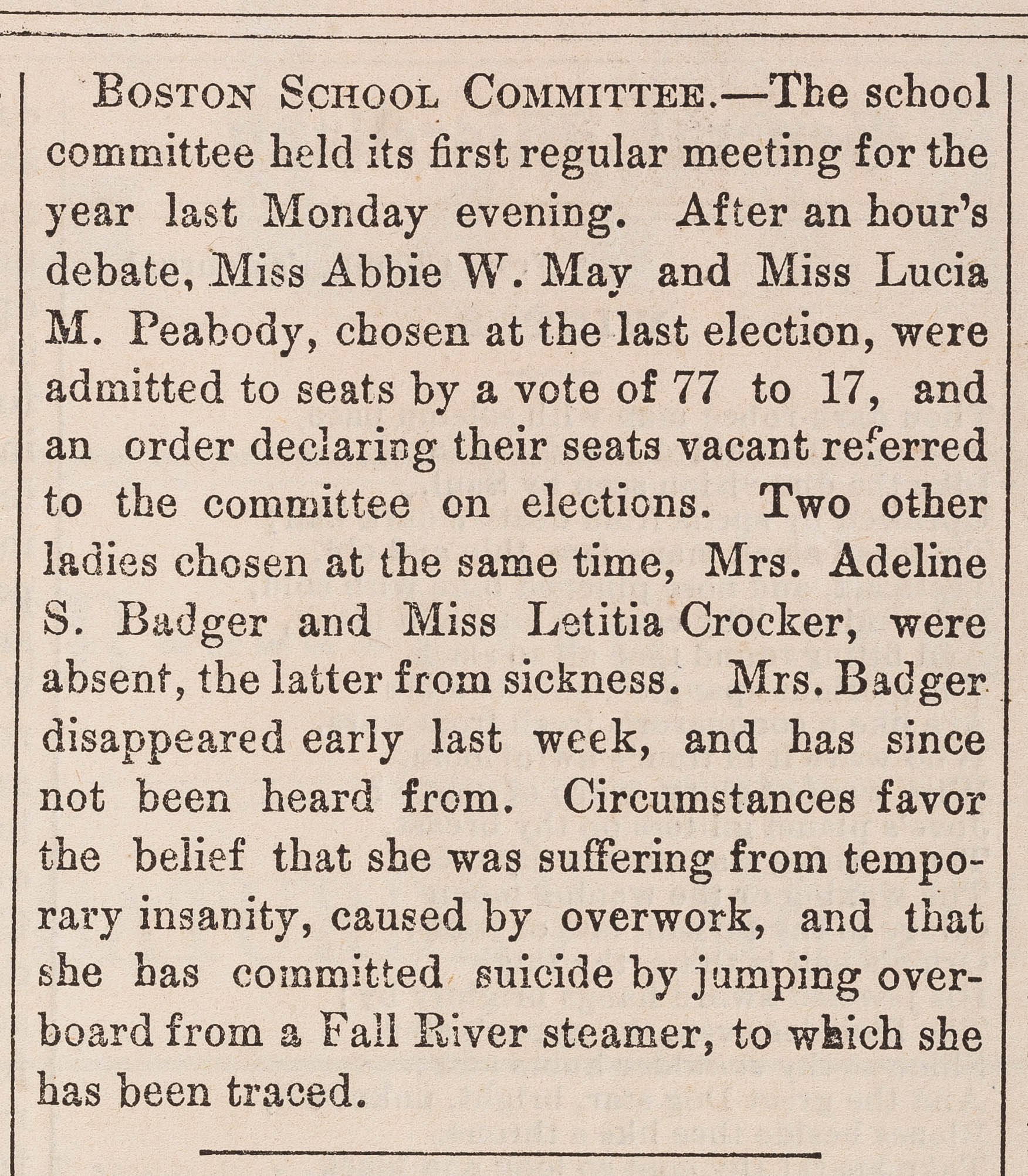
She returned to Antioch College in 1859 where she became Professor of Modern Languages and Literature and married Henry Clay Badger. In June 1861, Ada gave a speech to the graduating students of the Crescent Literary Society, apparently an all-female society at Antioch College. A copy of this address is held by AAS and is the only record of Ada in our catalog. In her speech, Ada encourages the graduating women to strive for greatness but also to “despair not, if your way should lead you among quiet scenes and your life’s mission be such as will bring you no worldly fame” (p. 8). Shortly after, Ada moved to Boston with her husband where she had four children and founded an all-girls school in Cambridge in 1867. In 1873, she became one of the first women on the Boston School Committee. Sadly, in 1874 Ada committed suicide when her youngest child was only 3 years old. It was reported that Ada was suffering from “temporary insanity, caused by overwork.” More than a decade earlier, in her speech at Antioch College, Ada had written “We all know mothers who walk quietly on in their homely round of duties, uncomplaining, self-sacrificing, with a cheering smile for everyone, but with an aching at the heart and a burden on the soul that only the deep, sad eye reveals” (p. 7); a sad foreshadowing of her own future.
Even by today’s standards, Ada lived an intriguing life. She graduated college, traveled with the family of a famous author, became a professor, and was active in her community. That she accomplished all this as a woman in the nineteenth century makes it all the more remarkable.
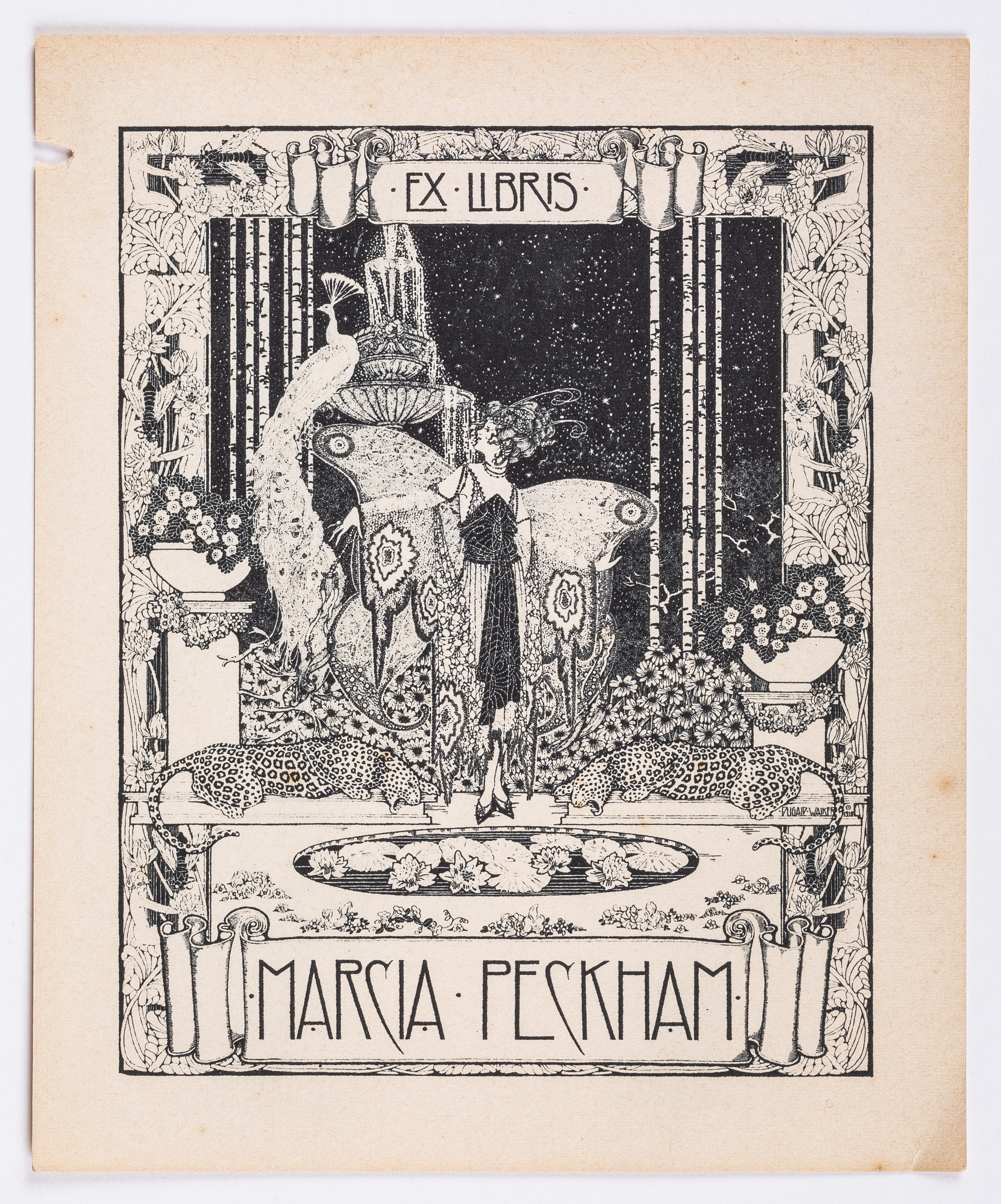
Dugald Stewart Walker, Bookplate for Marcia Peckham, ca. 1919.
In 2014, AAS receptionist Sally Talbot was looking for a project she could work on during slow periods on the front desk in the foyer of Antiquarian Hall. Creating a name list of the Society’s collection of loose American bookplates (not those tipped into books) was suggested by Curator of Books Elizabeth Pope. As the loose bookplates are housed in the Graphic Arts Department, I was brought in to discuss the possibility. The Society’s bookplate collection is one of the largest in the world and covers 300 years from the 1640s to the 1940s. Check out previous blog posts on our earliest bookplates and some fun Halloween-themed examples or read an overview of the collection in our newsletter, the Almanac, from Spring 2017 to learn more.
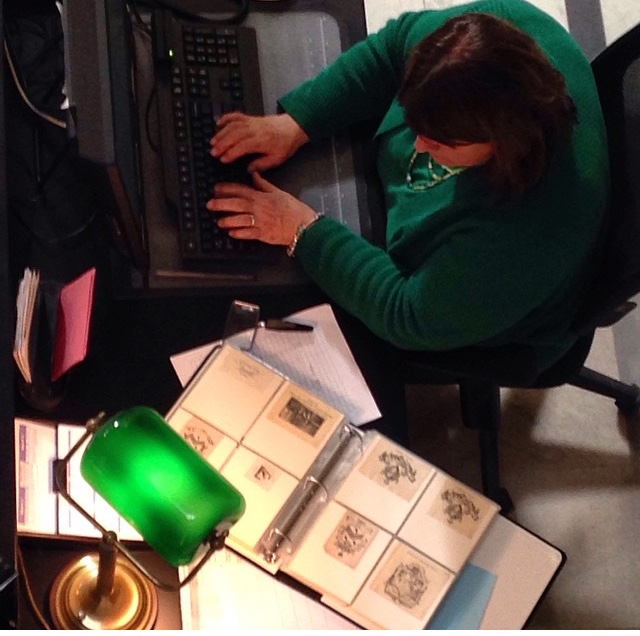
Sally Talbot at work on the inventory, 2015
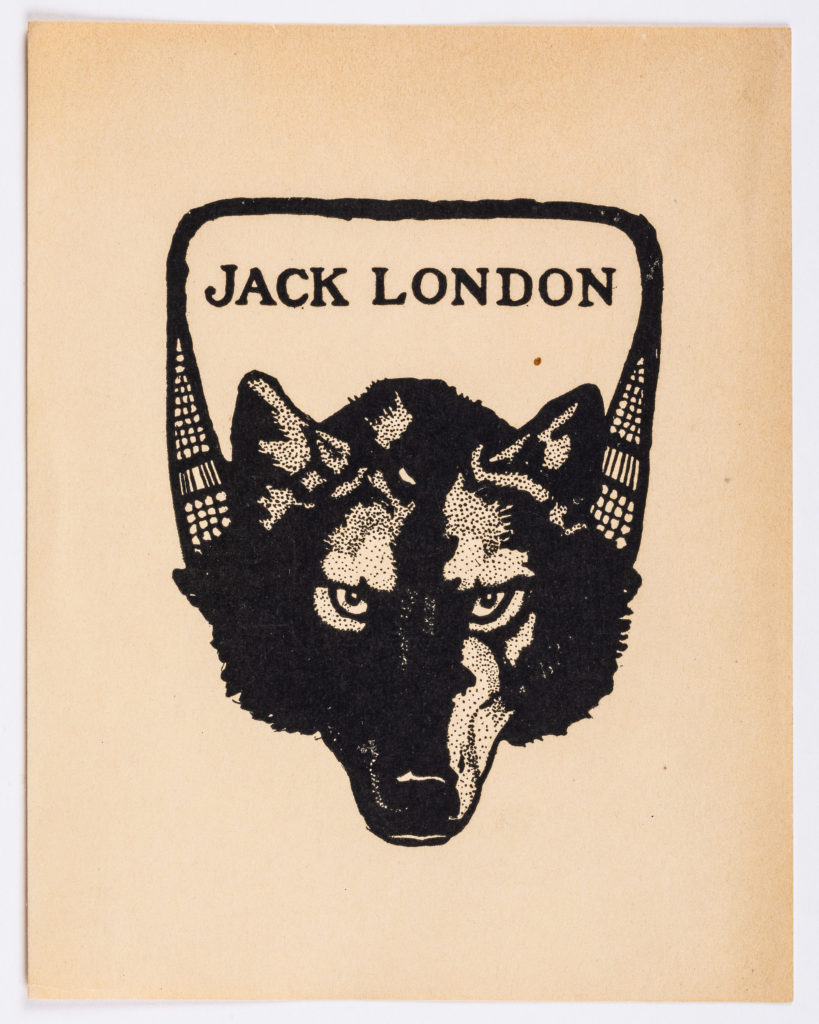
When I gave Sally a brief introduction to the 118 binders that hold the 40,000+ piece collection, she did not seem at all deterred by the scale of the undertaking. Our head of readers’ services, Kim Toney, helped Sally set up an Excel spreadsheet, and brought the first binder to the desk. The collection is arranged alphabetically by surname, and over the years that Sally worked on the project, I got into the habit of stopping by the desk to see what letter of the alphabet she was up to or to answer questions or help decipher a name. An open black binder of American ex libris became a feature on the desk during her shifts. When I posted an image of Sally working on the bookplate project on the Society’s Instagram account in the spring of 2015, some former readers commented about how amazing it was that Sally was still at it — chipping away at those binders full of tiny beautiful rectangles and squares. I recently asked Sally about her favorite plates and she recalled seeing Jack London’s ex libris and texting a picture of it to her husband who is a London fan. She also admired some of the Art Deco-influenced plates from the early twentieth century. Over the four years it took to complete the project, Sally sorted out lots of misfiling, cross-checked names to be sure she was spelling them correctly, and finally, in December of 2018, entered the 21,048th name, completing an inventory of the first sixty-eight binders, which contain the individual owner’s bookplates — fifty binders of corporate plates await Sally’s attention whenever she is ready!
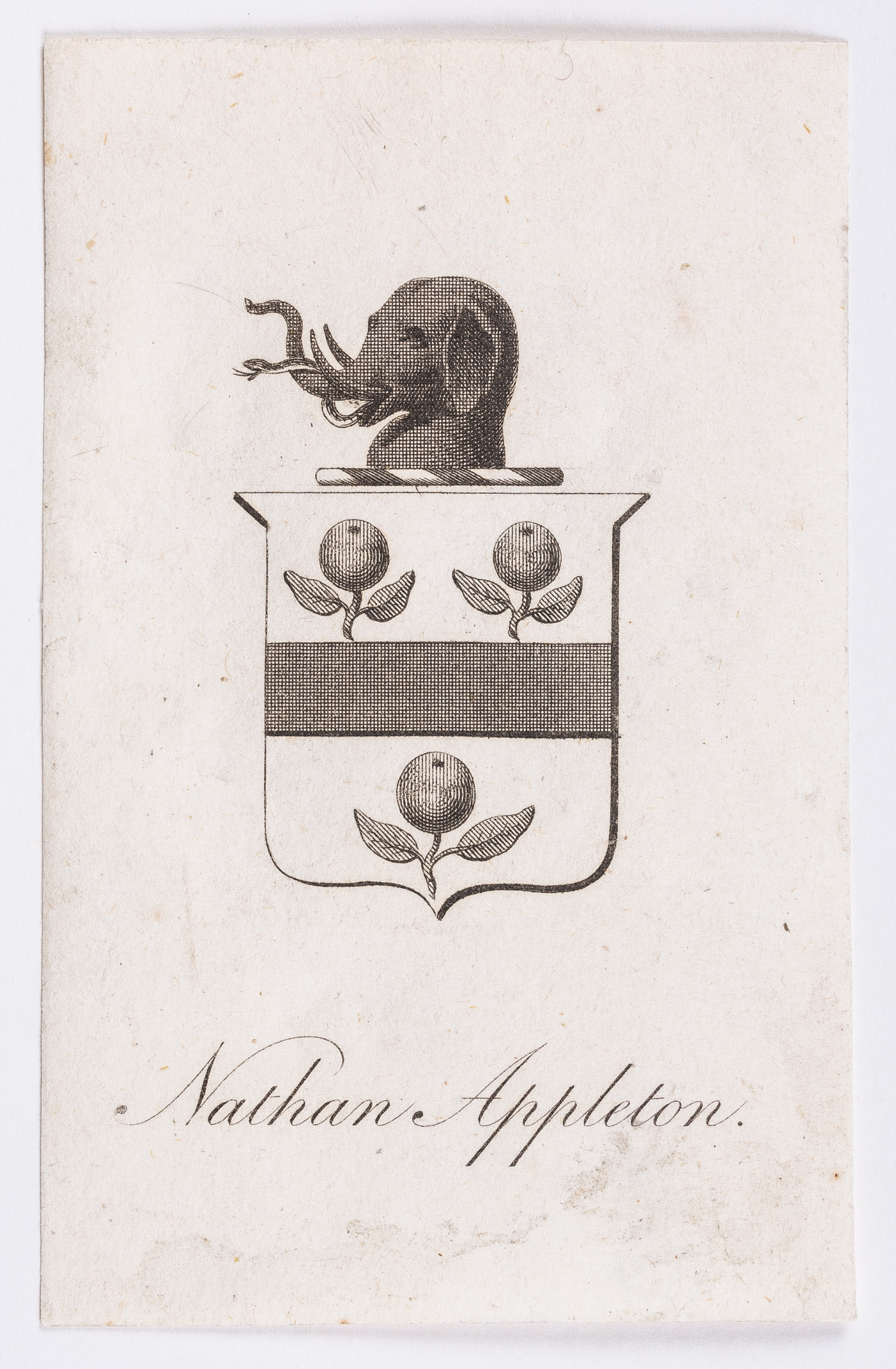
Ernest J Cross, Bookplate for Jack London, ca. 1910Artist unknown, Bookplate for Nathan Appleton, 1835-1845.
The inventory is now available online via the AAS website or through our General Catalog. Sally’s dedication and tireless efforts to successfully create access to a collection that was previously only available by physically visiting AAS in Worcester can be summed up with the old adage “When eating an elephant, take one bite at a time.” AAS staff, including curators, librarians, and catalogers, have tackled a lot of enormous projects over the years, all in a quest to help researchers find and use historic material. This includes our North American Imprints Project (NAIP) catalog; a newspaper index resource called Clarence; and A New Nation Votes, which tabulates early American election returns. Today, I often find myself mentally thanking the AAS employees who came before me. They wrote out title cards for 70,000 pieces of sheet music, typed up biographical information for thousands of early American printers, or tallied individual issues of hundreds of newspapers. Some may perceive this work as monotonous or tedious, but many, like Sally Talbot, know how rewarding and frankly fascinating it can be to “eat an elephant.”
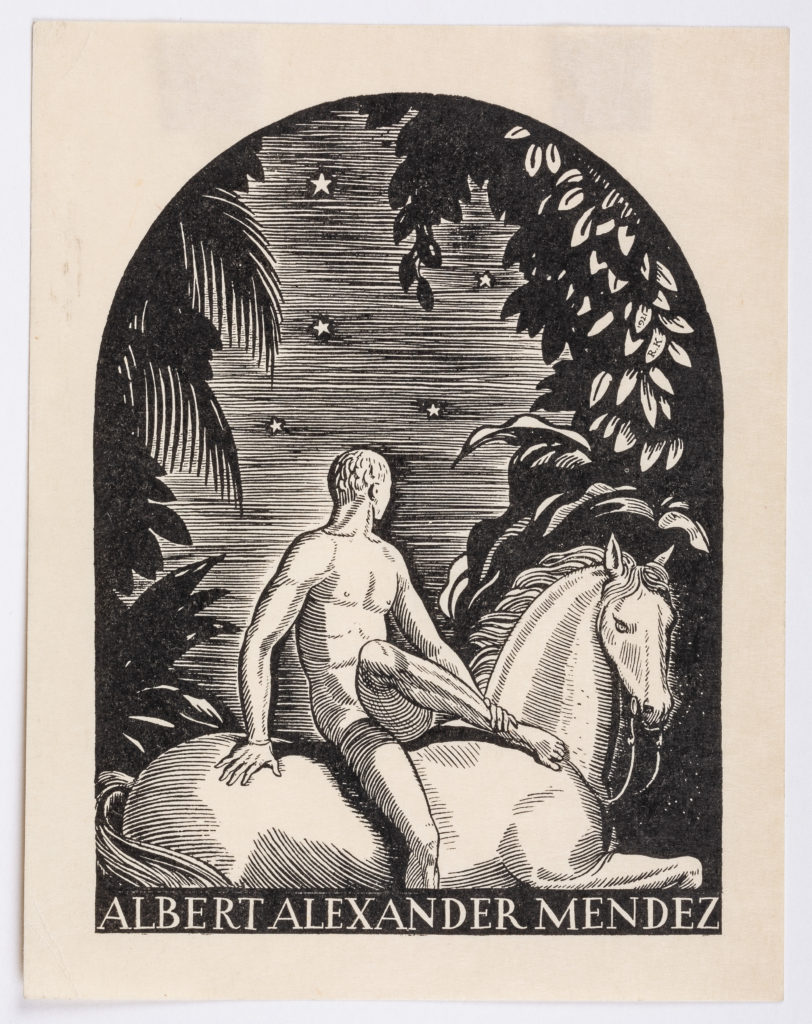
Rockwell Kent, Bookplate for Albert Alexander Mendez, 1921.
Everyone knows Abigail Adams’s famous request to her
husband to “Remember the Ladies” as he participated in discussions to form the
new United States government. But what of Abigail’s other correspondence? Was
she always so witty and quotable? Did she often discuss politics and the place
of women in society? What did she think about the first First Lady, the newest
fashions, and living in the newly created federal capital?
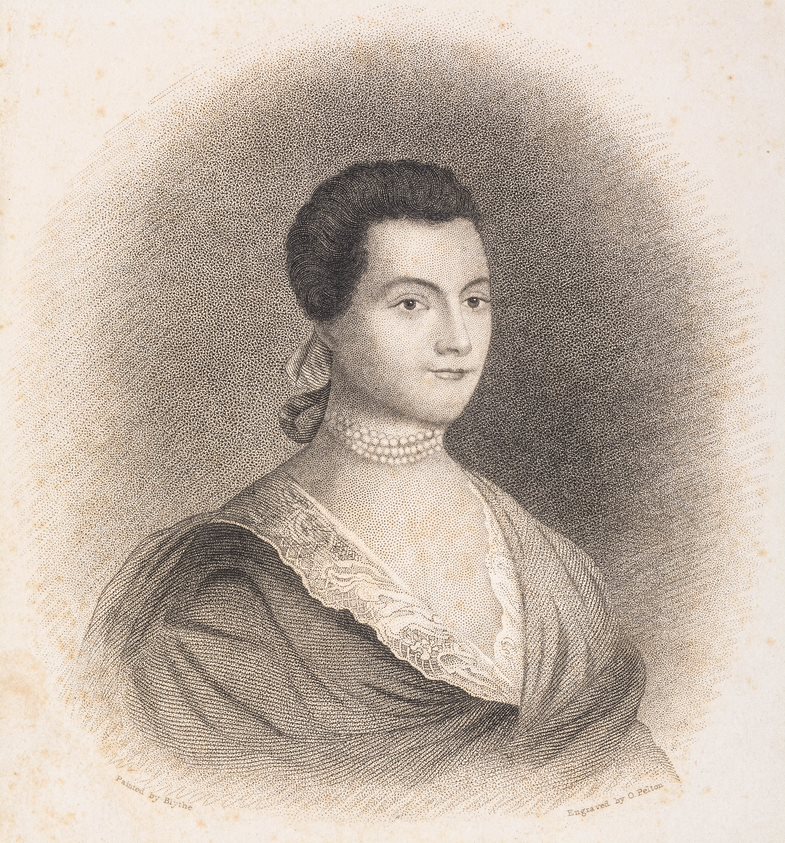
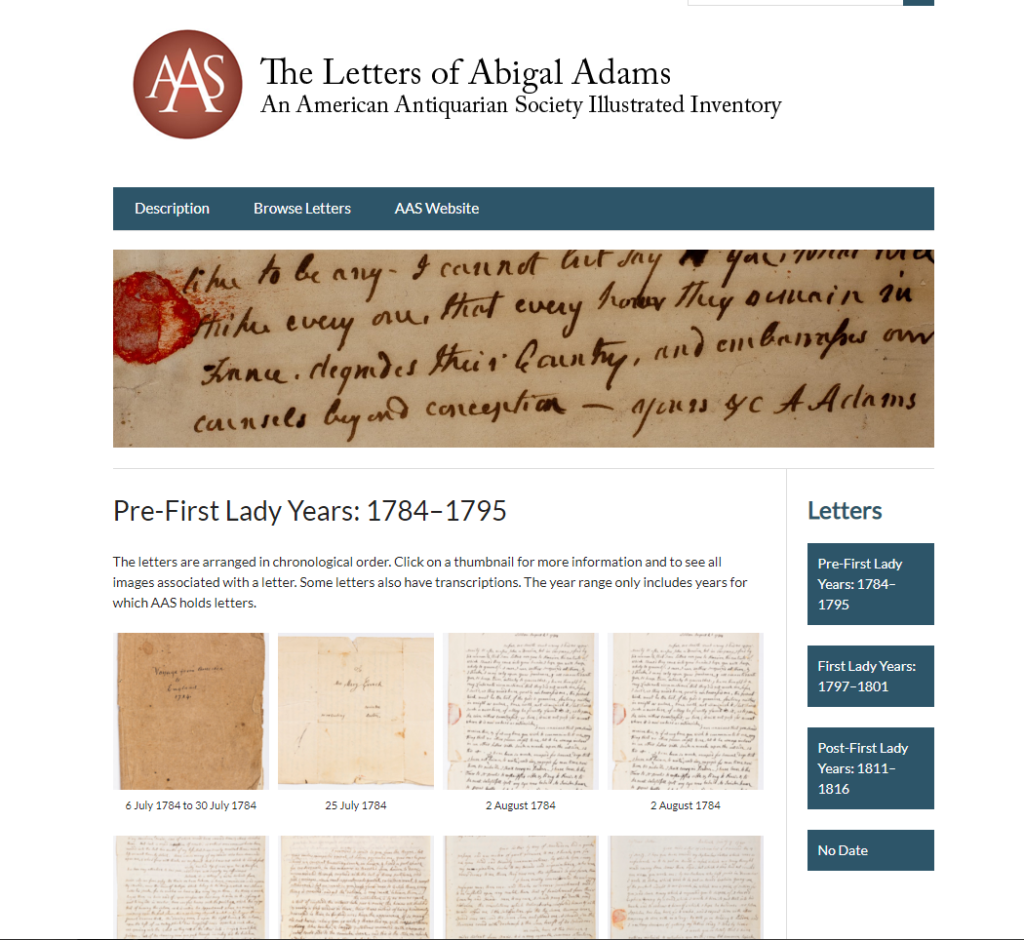
All of these questions and more can be answered by browsing through Abigail’s letters, over two hundred of which reside in the Society’s collections and are now digitally available through our newest online inventory, “The Letters of Abigail Adams.” AAS purchased this cache of letters, which had been preserved by a great-grandchild of Abigail’s sister, Mary Smith Cranch (1741-1811), in 1942. They are addressed almost exclusively to Mary and Mary’s daughter, Lucy Cranch Greenleaf (1767-1846). In these very personal letters Abigail describes traveling to London, New York, Philadelphia, and Washington. She writes about her time in England in 1784, when John served as Minister to the Court of St. James, her life in Washington as First Lady, and her time in Quincy after John retired from the presidency in 1801.
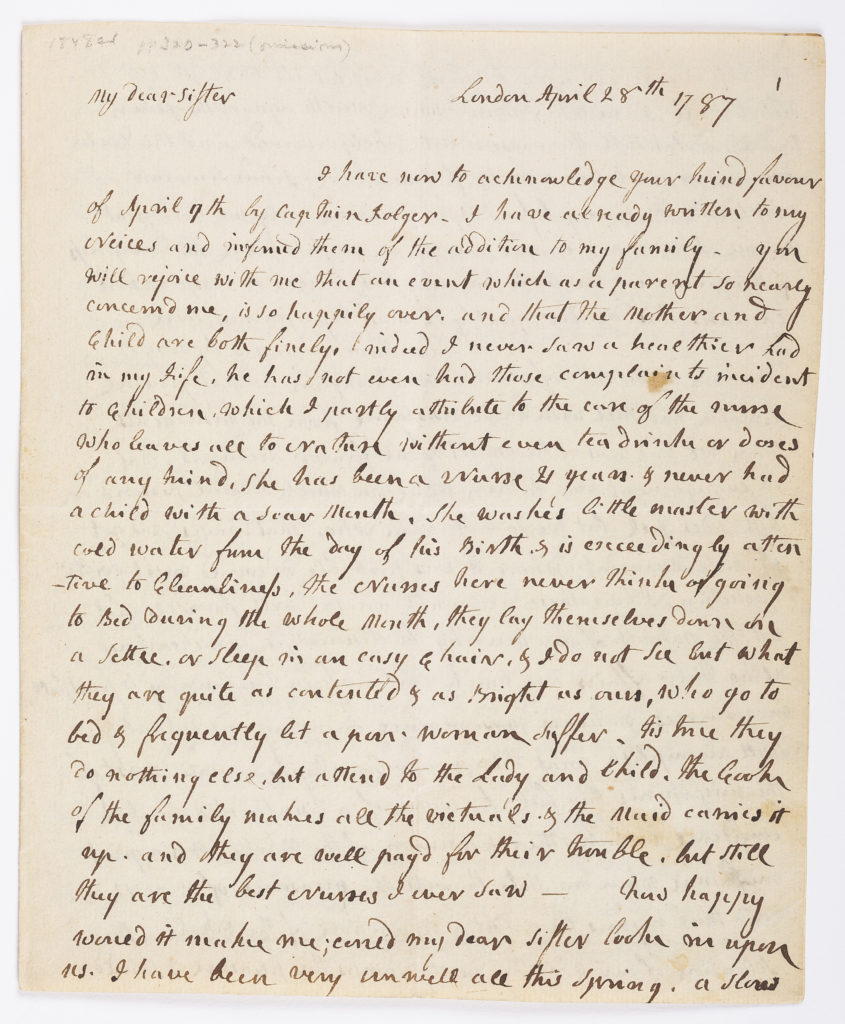
One letter that seems to exemplify the tone, depth, and acute insightfulness of Abigail’s correspondence is one written to her sister Mary from London on April 28, 1787. In the letter, she touches upon the birth of her daughter Nabby’s first child, English versus American nursing styles, her own health, news about Shays’ Rebellion, American loyalist refugees in England, and potential second marriages for her uncles. In perhaps the most entertaining and shrewd part of the letter, she muses upon why one Miss Mayhew, whom she believes would be a “good wife,” is still single. She “cannot help thinking that it argues cowardice in the gentlemen that she still remains single. she has a strength of mind, and an understanding, which will always ensure her respect, provided the heriditary talant which she has at Satire; is properly regulated.” In the end, Abigail concludes that “I have ever observed that it is a most Dangerous thing for a Female to be distinguishd for any quallification beyond the rest of her sex. Whatever may be her Deportment, she is sure to draw upon herself the jealousy of the men and the envy of the women, nor do I see any way to remedy this evil but by increasing the number of accomplished women, a monopoly of any kind is always envidious.”
In this new inventory, you can view digital images of each of the letters at AAS, many of which also have transcriptions and brief abstracts. Letters with transcriptions that also appear in the Massachusetts Historical Society’s Adams Papers Digital Edition include links out their locations in that resource, which includes more of Abigail’s letters and other correspondence from her husband, children, and grandchildren located at other institutions.
To entice you to take a closer look at some of Abigail’s letters, we’ve teamed up with the Massachusetts Historical Society (MHS) to bring you March Madness Abigail Adams-style. Beginning on Friday, March 22, we’ll be pitting thirty-two letters—sixteen from each institution’s collection—against each other in a bracket where users can vote on their favorite letters. For the first round of voting, the letters are grouped into eight categories: Education & Learning; Parenting & Family; Things Abigail Valued; Friends & Frenemies; Politics & Public Life; War; The World According to Abigail; and Women. The various rounds of “Abigail’s All-Stars” will run until March 31, the anniversary of her famous “Remember the Ladies” letter, and the winner will be announced on April 1. Keep an eye on Twitter and Facebook for updates on the competition and comment and follow along with the hashtags #AbigailsAllStars and #RememberAbigail.
In the meantime, take a dive into Abigail’s letters by browsing the new illustrated inventory. You may just be able to capture a little of the magic that happens when looking at the handwriting of an extraordinary woman who has inspired generations of historians, politicians, and women.
If you’re like me and occasionally find yourself lying in bed endlessly scrolling though BuzzFeed quizzes and pop culture articles, then you are no stranger to the modern-day dad joke. For those of you unfamiliar with the term, I like to define a “dad joke” as a cheesy and often predictable pun told by (but not limited to) a middle-aged man. One of the most classic examples of a dad joke is when a son or daughter tells their father, “I’m hungry,” and he replies, “Hi hungry, I’m Dad. Nice to meet you!” Jokes such as this one have become such a staple amongst young Millennials and Gen Z’ers that it’s almost impossible not to come across one on Twitter, Facebook or any other online social platform. But what exactly do dad jokes posted on the internet have in common with the American Antiquarian Society and, more specifically, old newspapers?
The amateur newspaper collection at AAS.
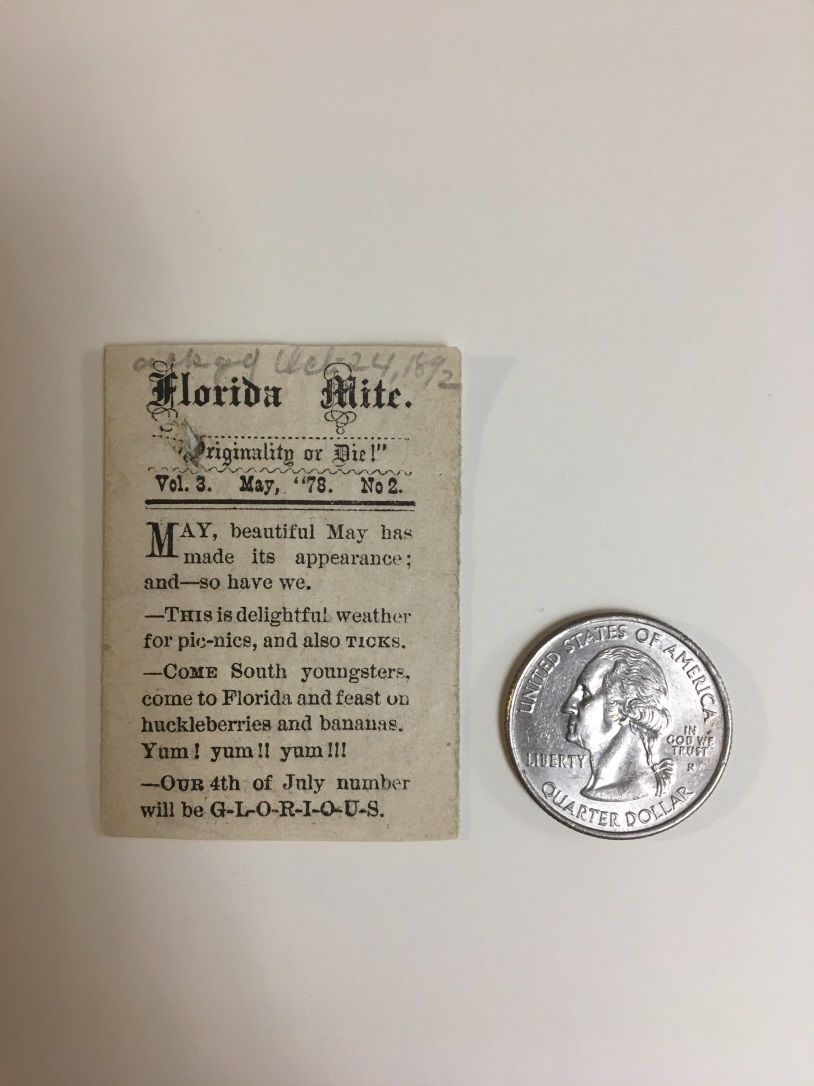
Over the past few months I have started the slow (but extremely entertaining) process of going through every amateur newspaper held at AAS to make sure the entire collection has been scanned and digitized. Most simply put, an amateur newspaper is a periodical that is written, edited, and published by teenagers or young adults. Arguably, most of these papers were created for the love of the craft and not for profit; consequently, many publications were small in size as well as short-lived. Although amateur journalism saw its heyday in America during the latter half of the nineteenth century, one of the earliest papers held at AAS dates from 1805.
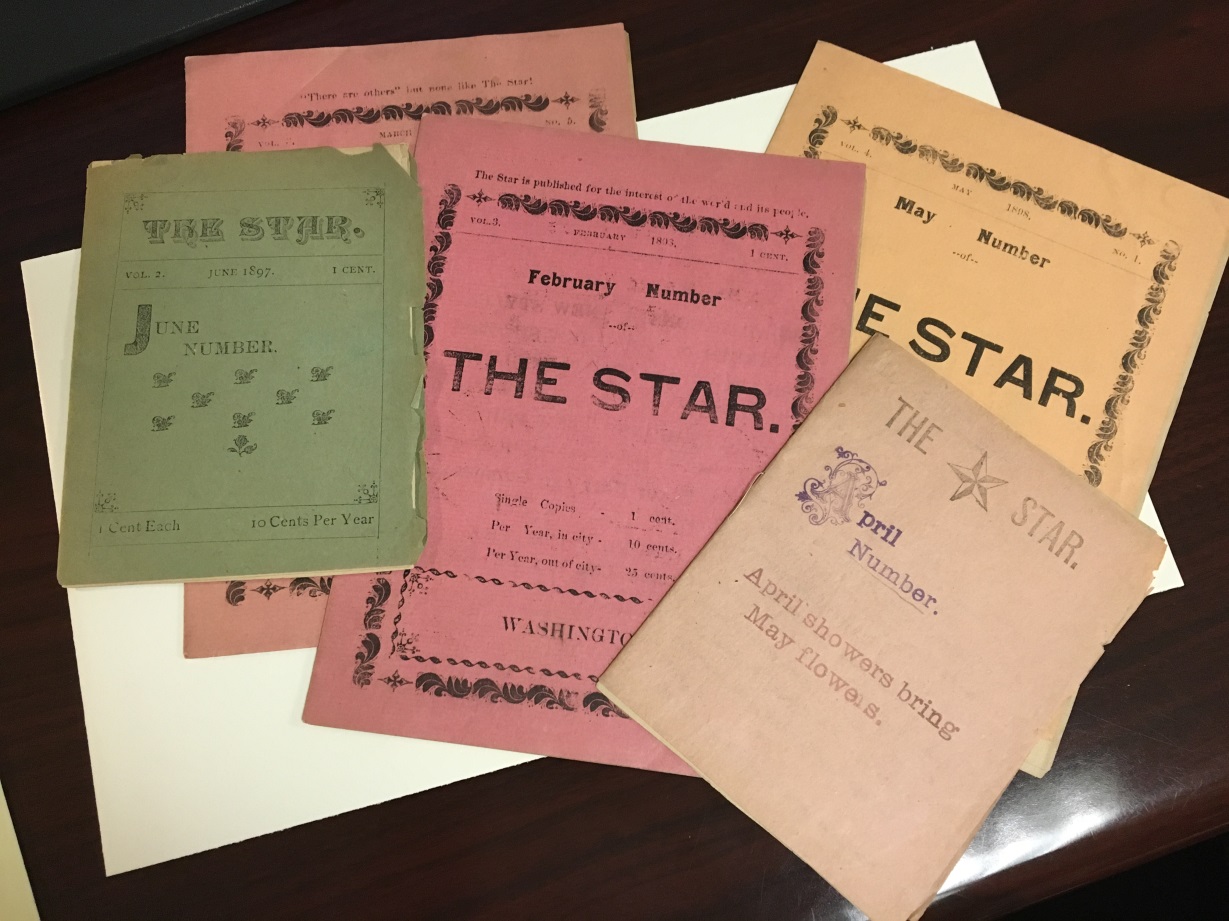
Multiple issues of The Star published in Des Moines, Iowa. Our collection contains issues from 1897 and 1898, many of which have brightly colored wrappers.One of the many tiny amateur newspapers I’ve seen so far! Florida Mite (Orlando, FL), May 1878.
In total, our collection has over 3,900 titles from every state except Alaska and Hawaii, so I was a bit overwhelmed when first starting this project (so far I’ve made it through 550 titles and I am currently looking at amateur newspapers from Iowa). However, much to my delight, I’ve found that every paper has something fun and unique to add to the world of amateur journalism—one of these things being the nineteenth-century version of a dad joke! Although dad jokes are sweeping their way through the internet today, they are certainly not a new phenomenon. Even then, people my age and younger were drawn to the groan-worthy jokes of their fathers, and one of best ways to spread that cheer was through their version of the internet—amateur newspapers.
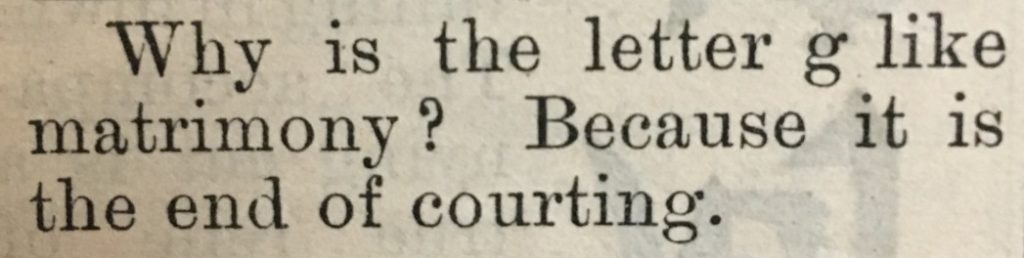
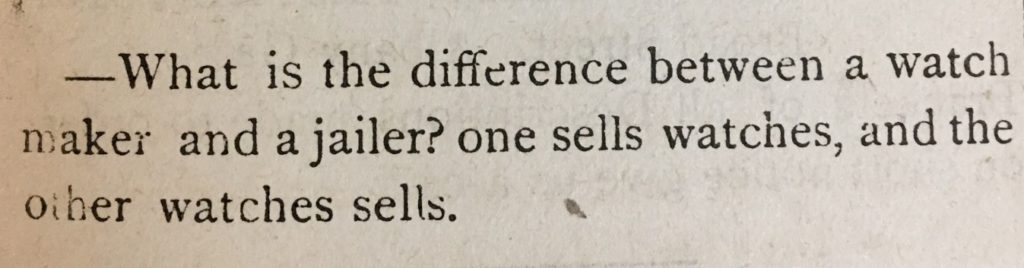
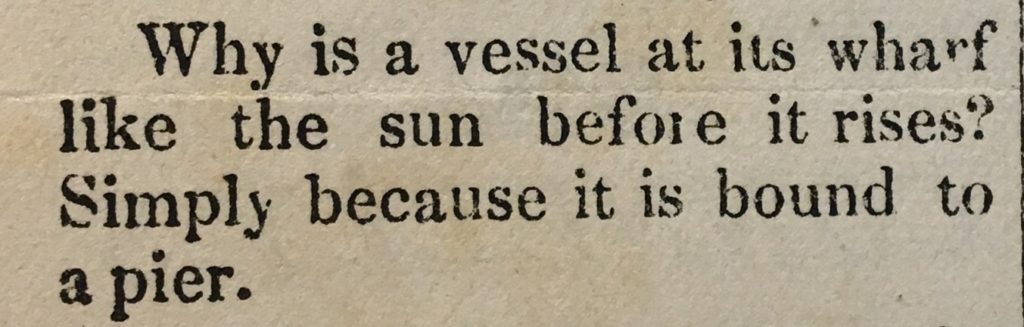
Here are some of my favorite nineteenth-century dad jokes!
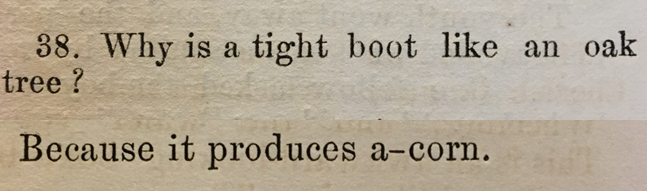
“Why is the Letter g Like Matrimony?” The Peanut (San Francisco, CA), 6 May 1878, p. 1.“Miscellaneous.” The Western Star (Rockford, IA), Oct. 1878, p. 2.“Scraps.” Monthly Star (Albany, GA), Aug. 1885, p 3. “Original Gems.” Gem of the West (Lansing, IA), Sept. 1878, p. 3.“Tag Ends.” The Bohemian (Washington, DC), May 1879, p. 4.“Conundrums.” Hail Columbia (Hartford, CT), July and Aug. 1867, p.2.
I hope that at least some of these puns gave you a light chuckle! I know that they’ve certainly provided me with much needed laughter during these cold winter months. I’ve barely scraped the surface of AAS’s vast collection and I already have several more topics that I’d love to share with you. But in the meantime, let me know if you have any questions about our collection or feel free to leave some of your best “antiquarian” dad jokes down in the reply section!
“Young Artist Painting Book,” drawings by W. Bruton (New York: McLoughin Brothers. copyrighted 1882)
In past years of the AAS annual report, we have included in the back pages quotes about the institution over its two centuries, a traveling chess game and paper dolls (with pieces to be cut out!), an Instagram hashtag match-up, and in last year’s iteration, a rebus-palooza. This year’s “back fun pages” (as they have been dubbed in-house) serve as a nod to the countless hours of work put into the 2017 Grolier Club exhibition Radiant with Color & Art: McLoughlin Brothers and the Business of Picture Books, 1858–1920 by curators Lauren Hewes and Laura Wasowicz. In addition to many of the firm’s published works, AAS is also fortunate to have McLoughlin Brothers’ extensive art archive of its published materials, including some coloring, outline, and painting books! And since the McLoughlin Brothers were known as trailblazers for their experimentation with color printing and book formats, we thought we would use one of those painting books (pictured here) for a bit of fun.
Both the physical exhibition and printed catalog are highlighted in the annual report (just published!), but the concluding pages of the report (see below) hope to encourage readers to kick back, pull up a palette, and relax. After all, isn’t one of the many pros of the still-growing adult coloring book phenomenon near-instant stress relief (although for those keeping score, these aren’t relief prints at all, but chromolithographs!)? Although countless books in the McLoughlin archive could have been appropriate, it was the firm’s Young Artist Painting Book by William Bruton which really caught our eye (and begged reproduction as both the catalog’s frontispiece image and for these pages).
In “Try Your Own Brush with History” we’ve included a period color sample palette as well as excerpts from the (comprehensive) directions by the McLoughlin firm. In addition, the lithographed cover plate from 1882 and its black and white version for readers to color on their own were also reproduced. But if you feel compelled to color more than what we supplied in the annual report, we offer here as a PDF file the remainder of the book! This includes Bruton’s gorgeous uncolored images of children: “On the Sea Shore,” “Sailing the Yacht,” “In the Hay Field,” “In the Meadows,” “Off for a Sail,” London Bridge,” “The Skipping Rope,” “Four in Hand Team,” “The Swing,” “Tug of War,” “Picking Blackberries,” and “Gathering Blossoms.”
Color us scholarly, but we just can’t help providing facsimiles! Try your hand at it!
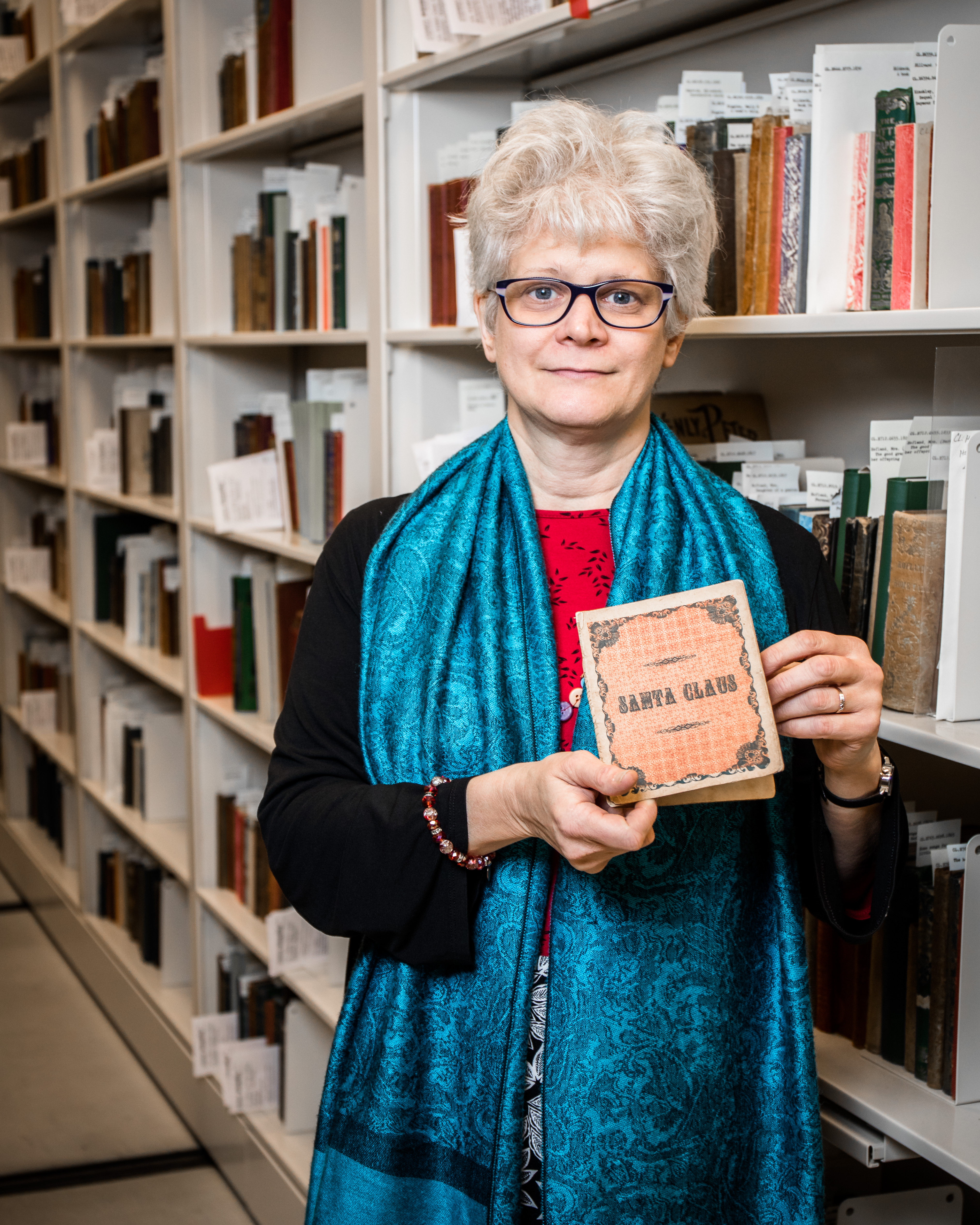
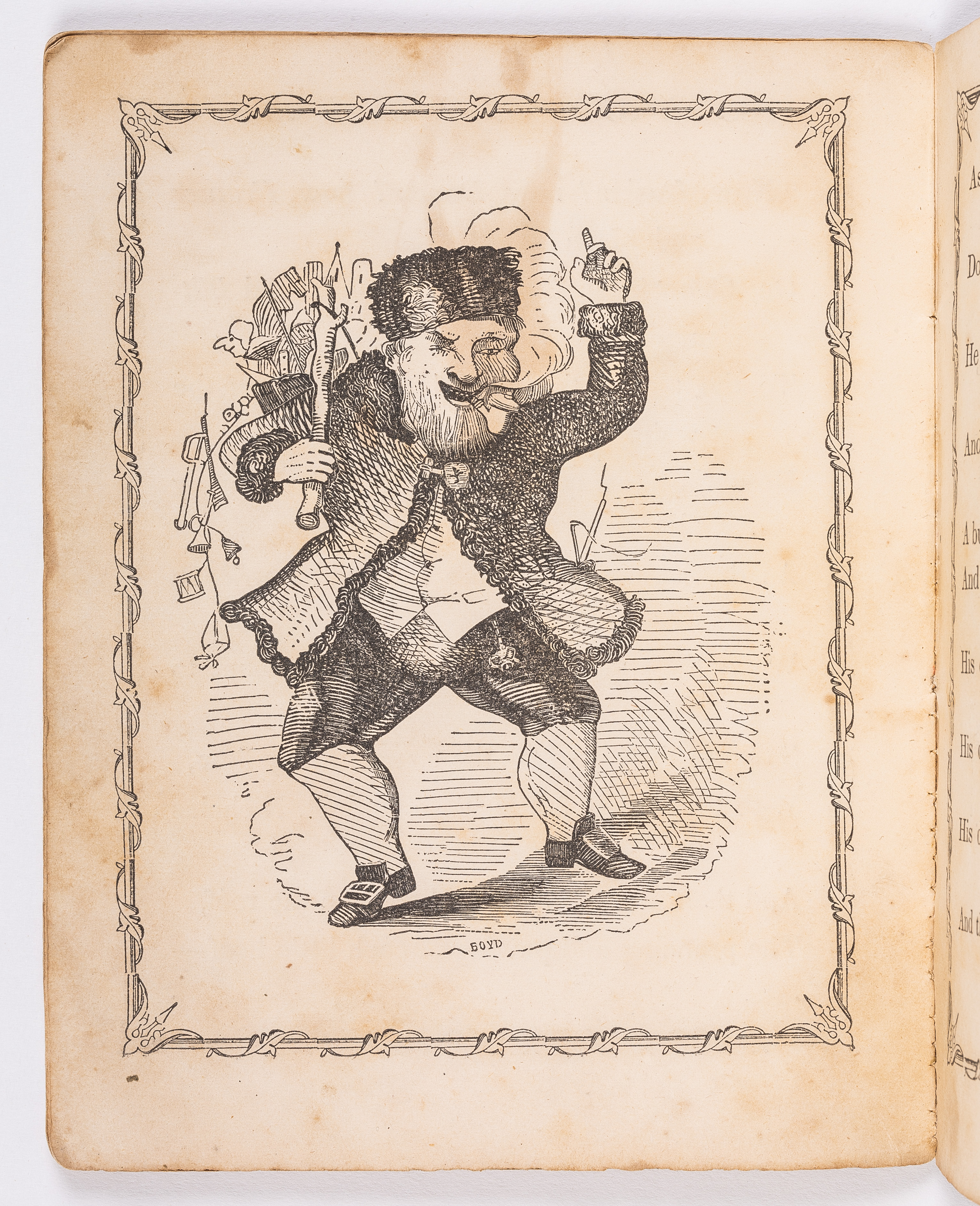
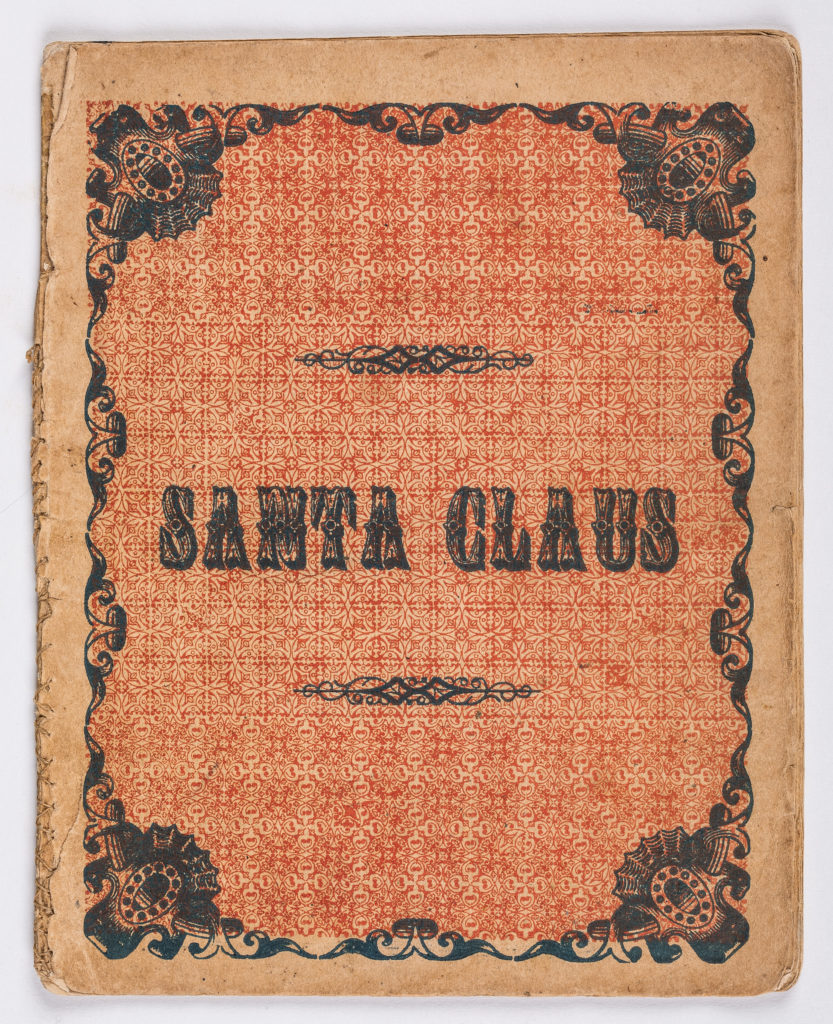
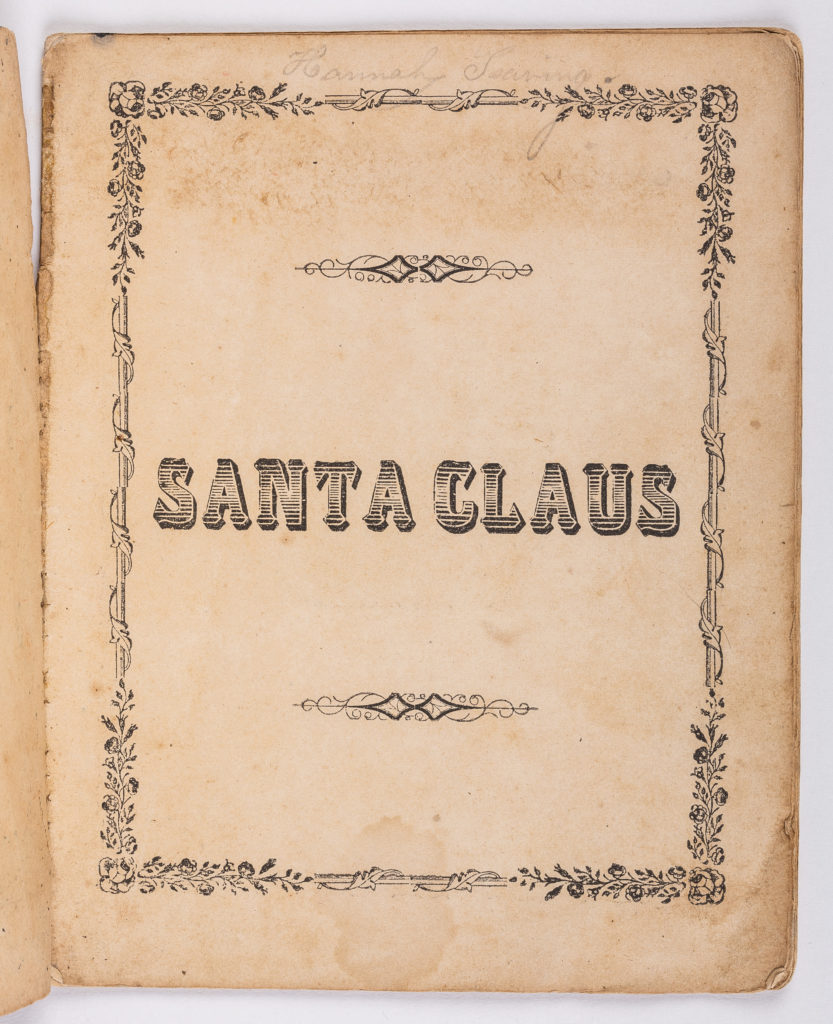
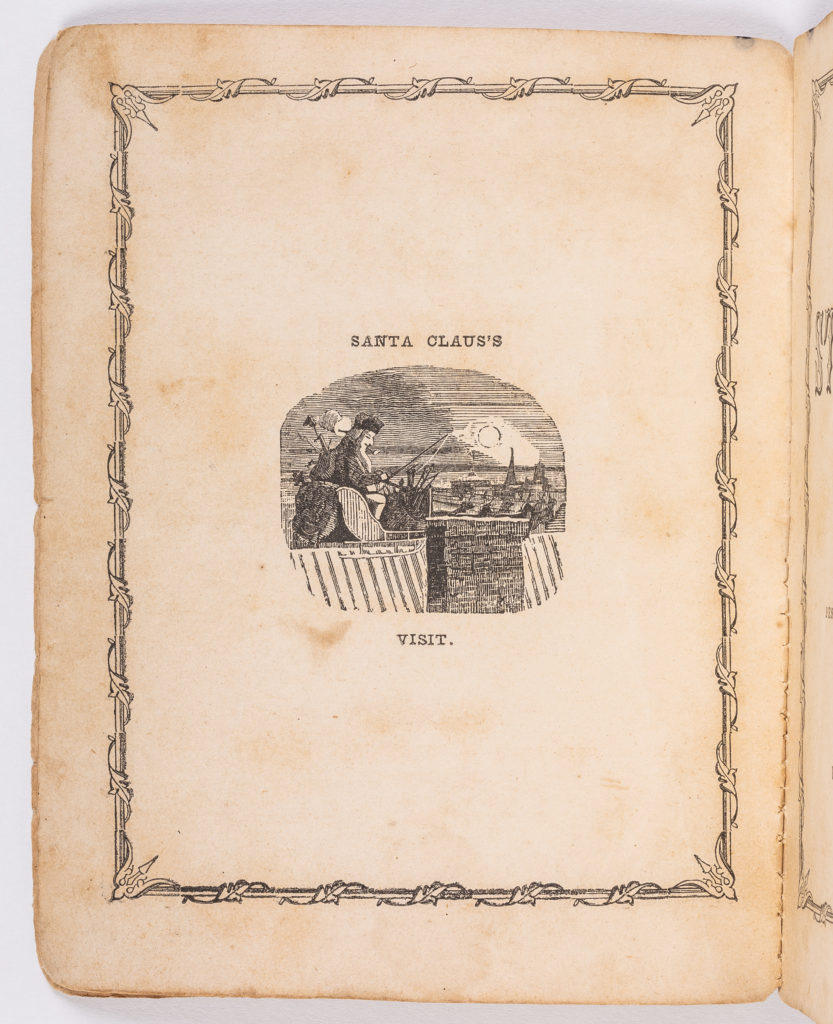
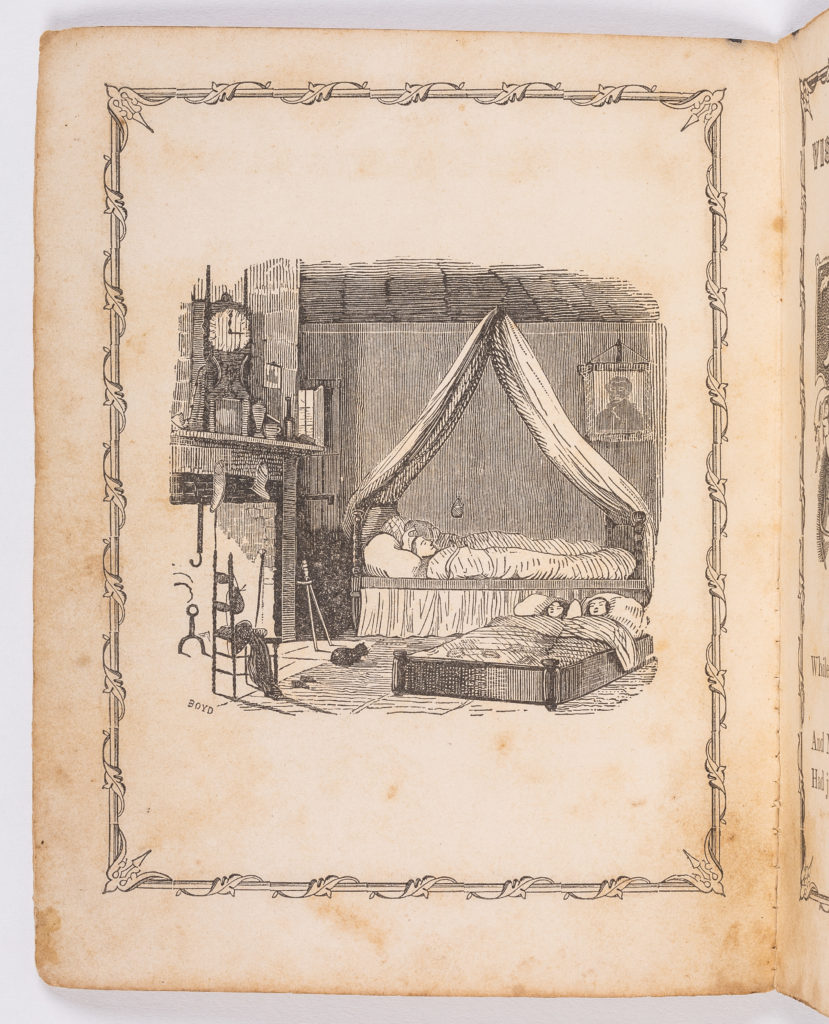
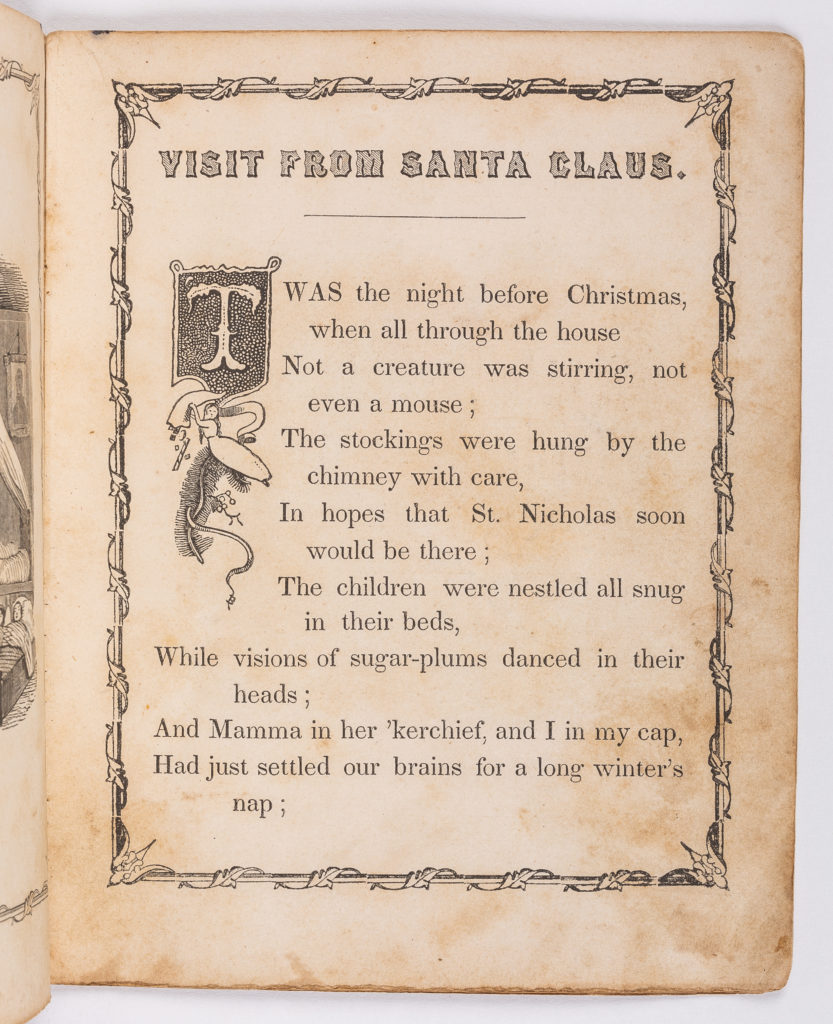
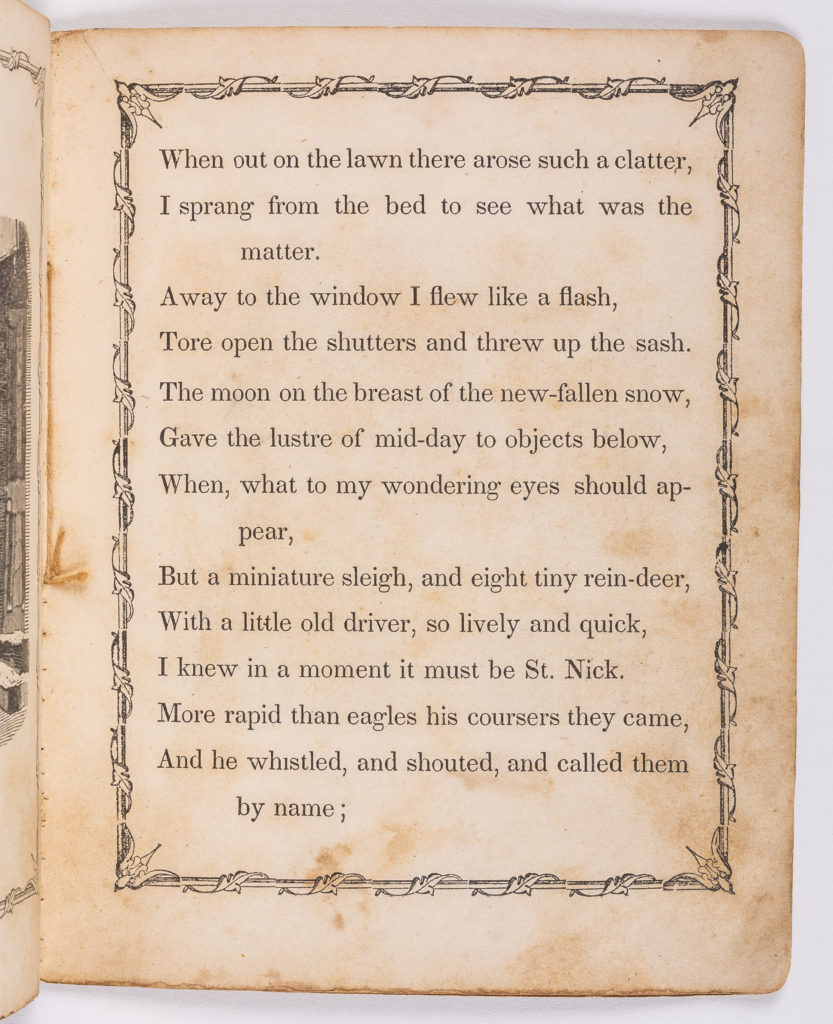
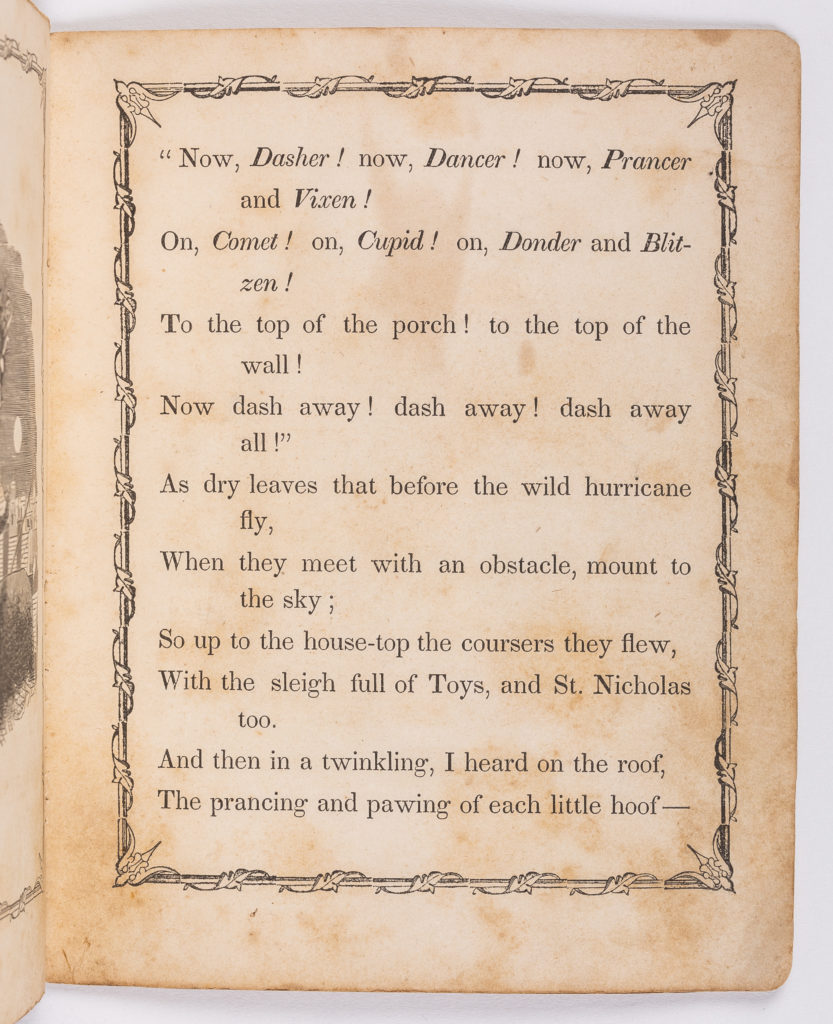
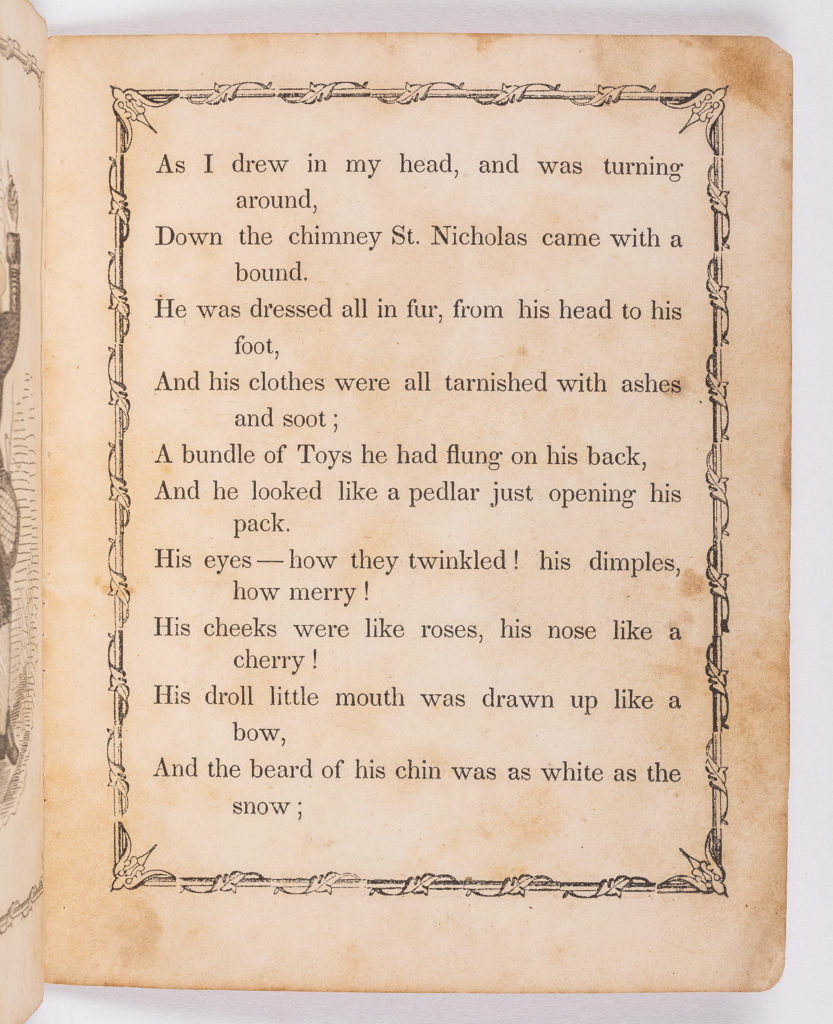
Not so long ago I got a phone call from AAS member David Doret (elected 2009), telling me that he had a Christmas book of potential interest. It was what seemed to be the first fully illustrated book-length edition of Clement Clarke Moore’s classic Christmas poem A Visit from St. Nicholas, better known as “The Night before Christmas.” Although Moore’s poem was first published in an 1823 issue of the Troy Sentinel newspaper and had appeared in children’s poetry anthologies, it was not until 1848 that the poem commanded center stage as the subject of its own picture book replete with wood engravings by Theodore C. Boyd. It was published in New York by Henry M. Onderdonk, who issued various publications for the Protestant Episcopal Church and was likely well acquainted with Moore, who was a professor of Divinity at the Episcopal General Theological Seminary in New York. It is a humble square book of sixteen pages, cheaply bound in a paper wrapper emblazoned with the title “Santa Claus.”
The post author with the 1848 edition of “A Visit from St. Nicholas”
I listened to David with great interest. I had been on the prowl for this little book during my entire thirty-year tenure at AAS, and my collecting predecessor, former AAS director Marcus McCorison, had been eagerly searching for it for some decades before that. It was always in the back of my mind as I perused catalogs from book dealers and auction houses, but it was eerily absent. The truth of the matter is that only a handful of copies of the 1848 edition of Visit survive in institutional collections. Even in the 2006 Sotheby’s catalog devoted to Jock Elliott’s Christmas Collection—a collection compiled over half a century by the late chairman emeritus of the advertising firm Ogilvy & Mather—the 1848 Onderdonk edition of Visit is nowhere to be found. A copy of the 1823 Troy Sentinel issue containing the famous poem, however, was listed with a starting bid of between ten and twenty thousand dollars; I can only guess what a copy of this little book with its Santa pictures would have fetched, had it been available.
When David told me he would send me the book, I was cautiously optimistic. Over the years I had received various queries from people saying that they had a copy of the original picture book edition, but upon further research, I realized they had copies of a twentieth-century facsimile edition bound with a flamboyant tassel to make it “look” antiquarian. Happily, the copy that David sent us was contemporary to 1848, with its slightly foxed paper stock and tiny stitches made by a former owner mending a tear at the spine, and as of today AAS can count itself among the few institutions to hold a copy of this coveted book.
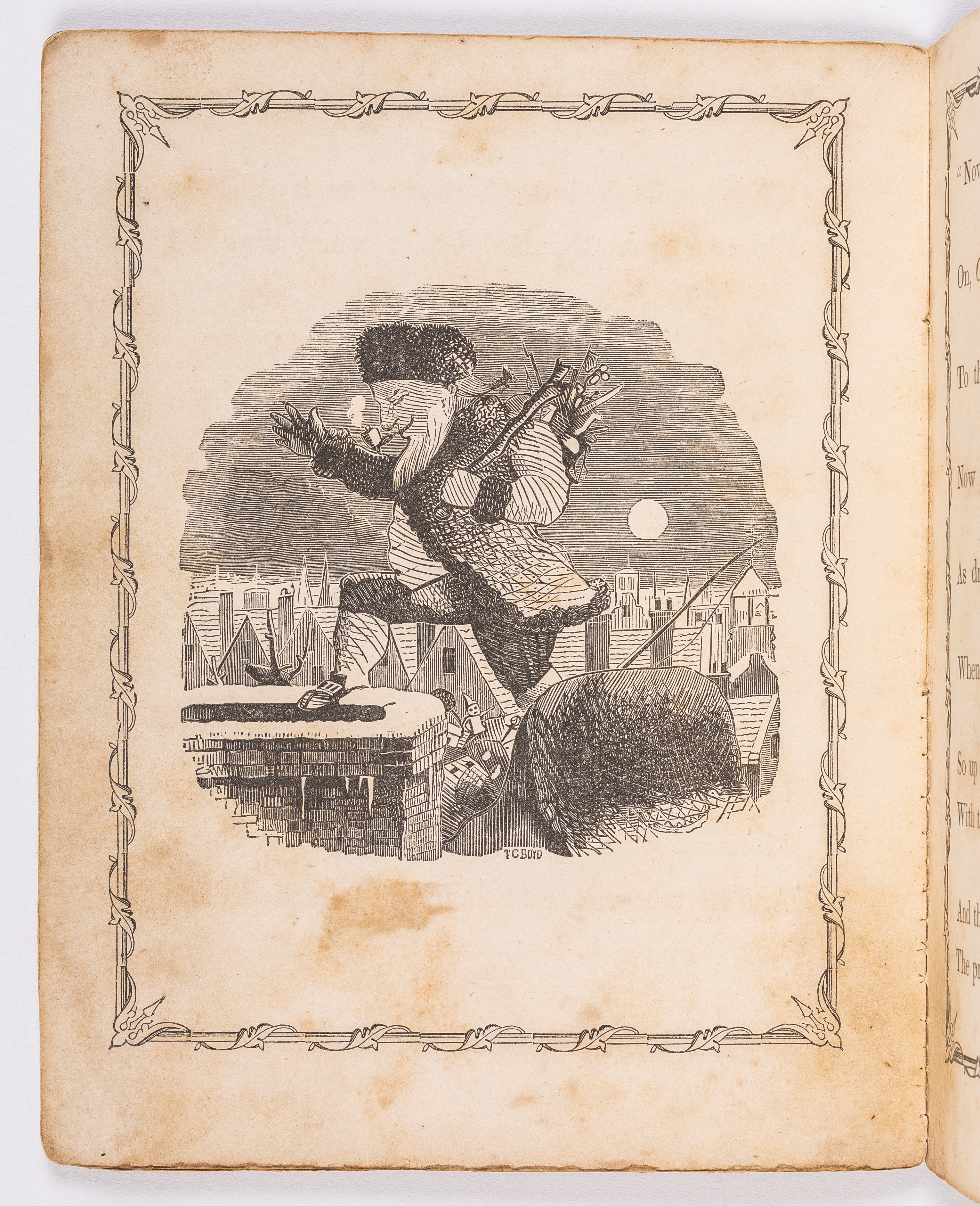
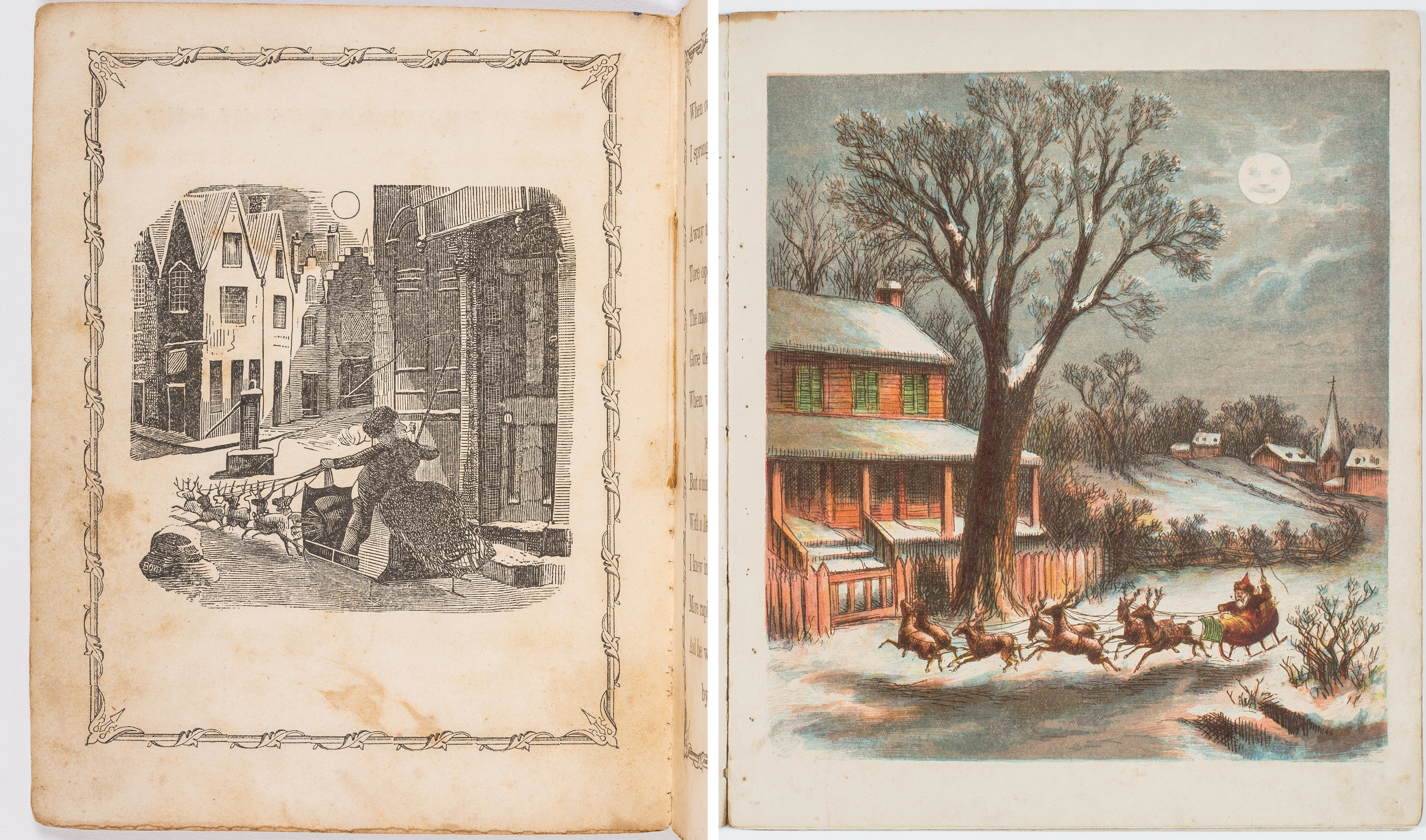
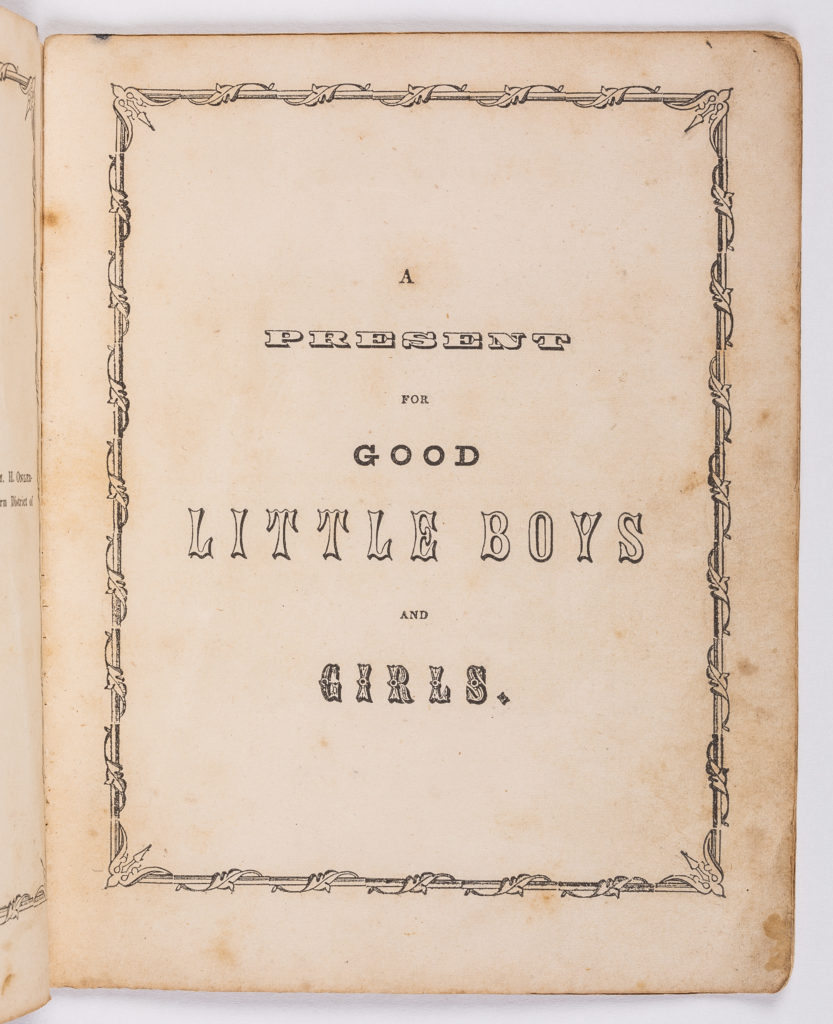
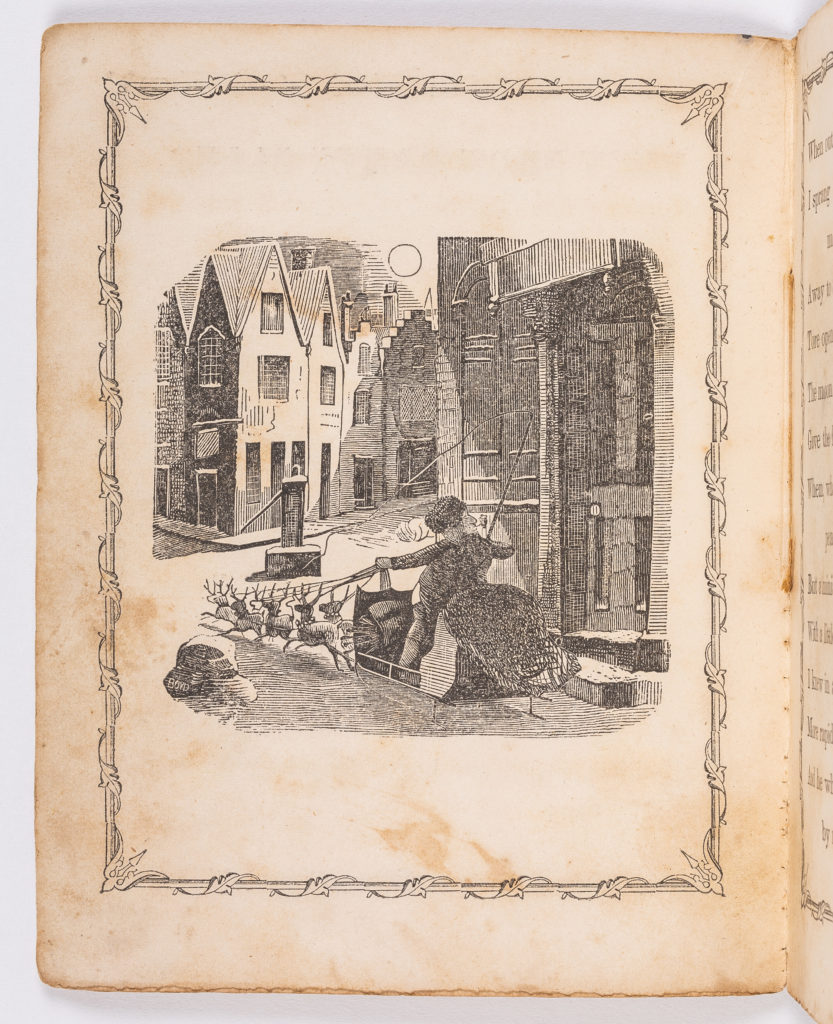
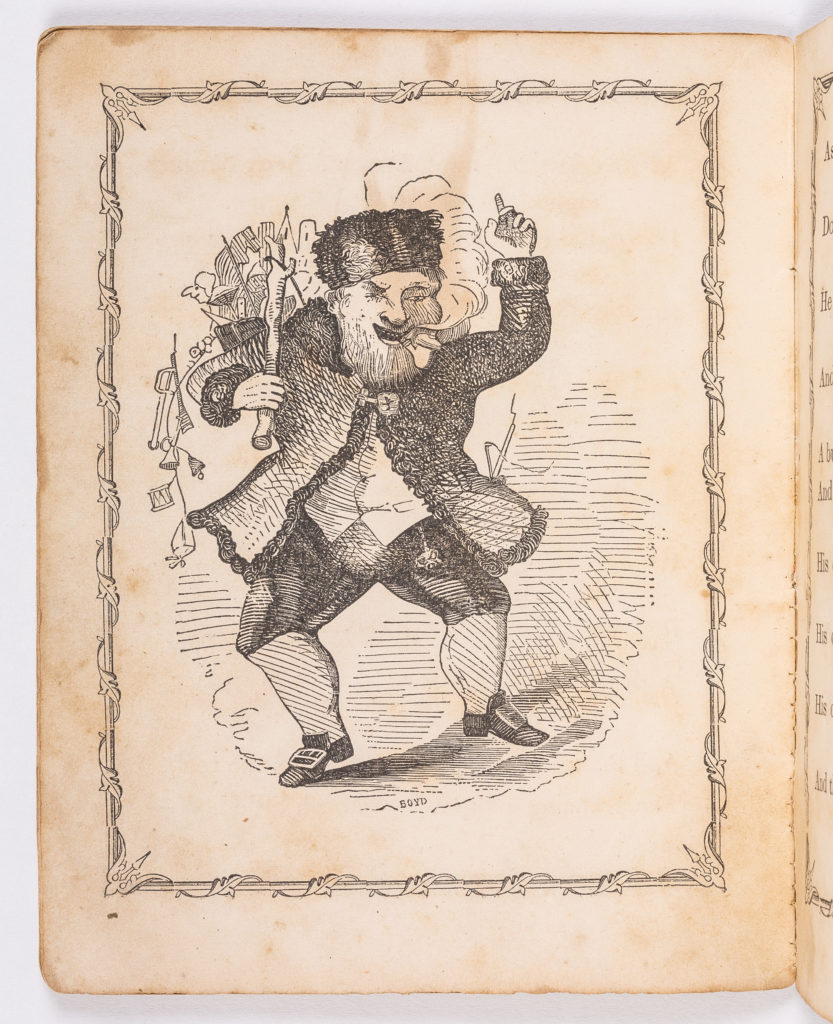
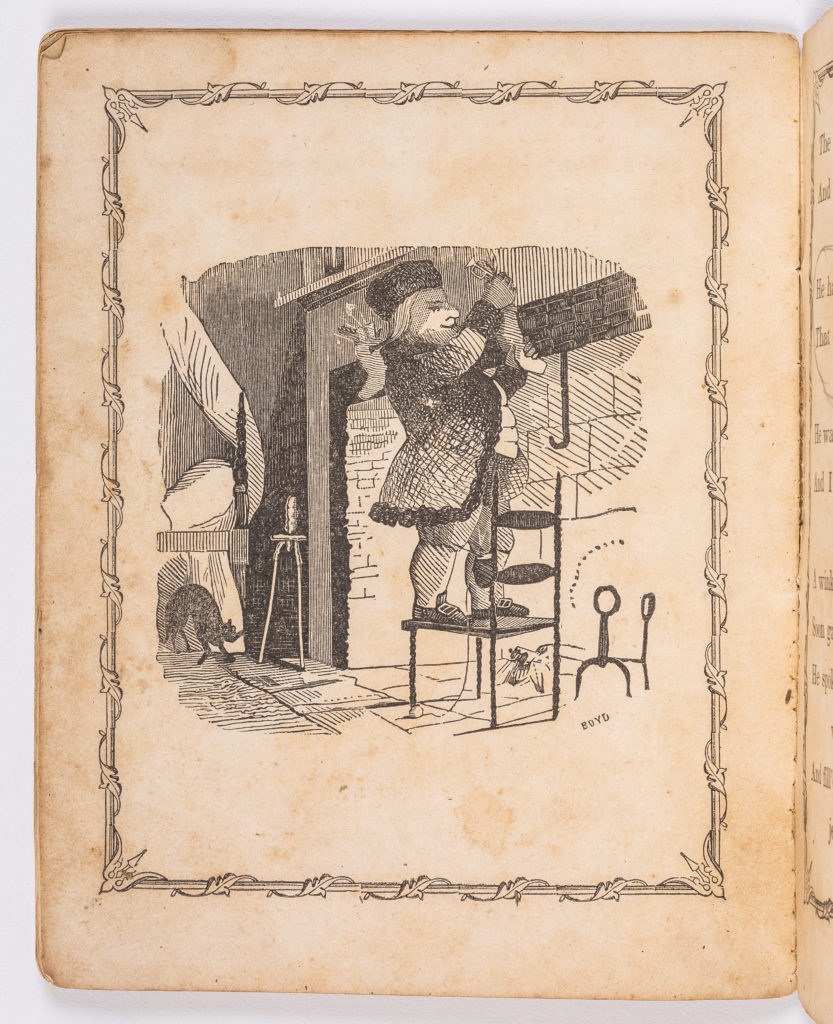
Self-proclaimed as “a present for good little boys and girls,” it features wood engravings by Theodore C. Boyd celebrating Santa as a scrappy elf shouldering a gift-laden peddler’s pack and smoking a stubby pipe.In Boyd’s hands, Santa operates nimbly through the densely crowded townhouses of Antebellum New York (below); conveyed in its spare black line, this image offers an austere contrast to Thomas Nast’s full-color illustrations of Santa driving through an expansive American countryside, published two decades later by McLoughlin Brothers.
Depictions of St. Nick’s sleigh in 1848 edition (left) and an 1869 edition published by McLoughlin Brothers and illustrated by Thomas Nast (right)
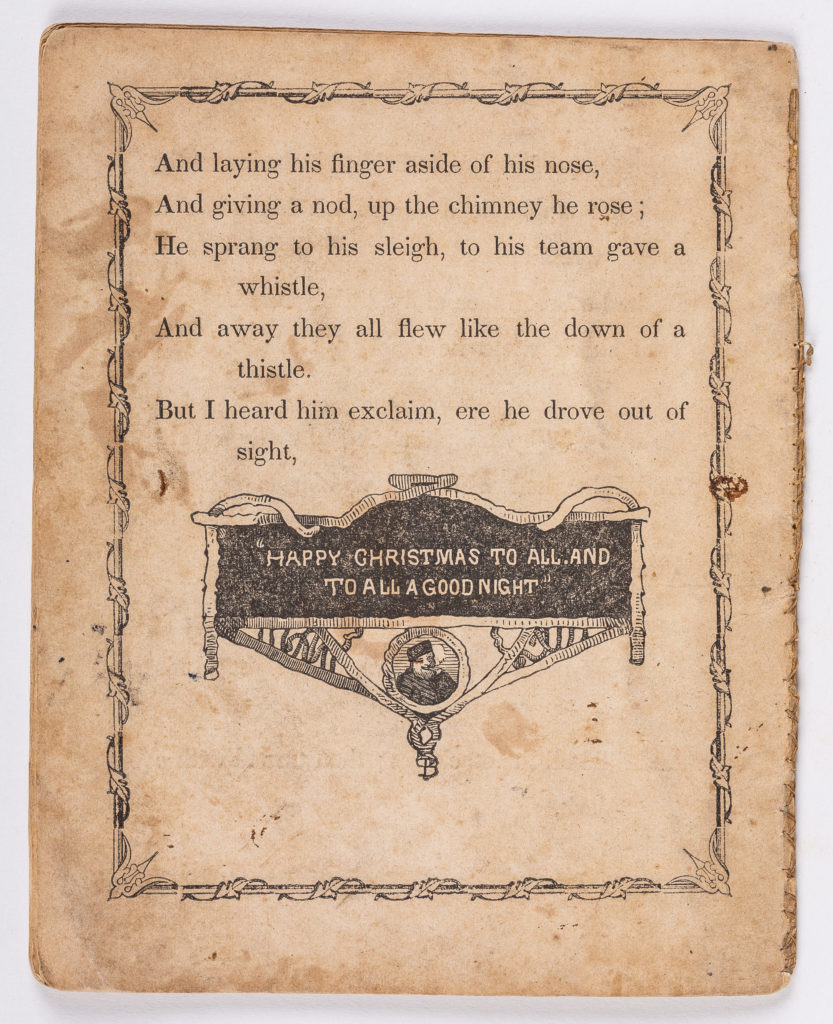
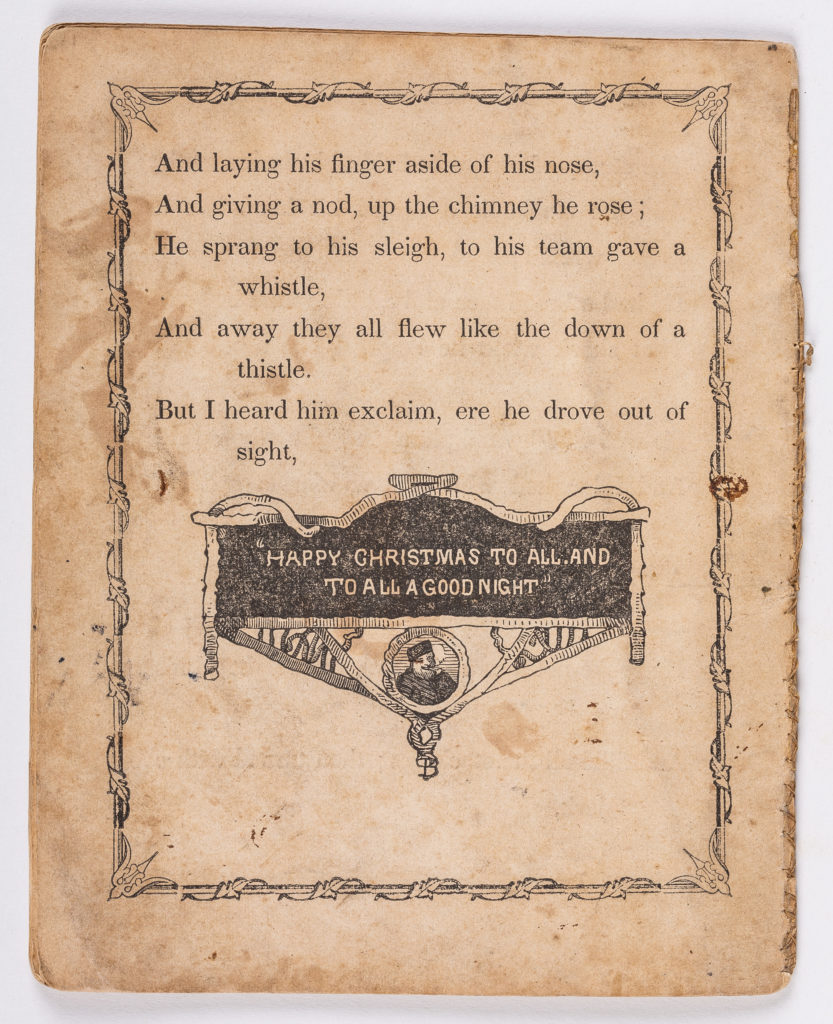
Perhaps most delightful of all the illustrations is the full-length view of Santa; dressed in knee britches and buckled shoes, he looks like a holdover from the eighteenth century. He is a stout man of action, who could effectively wield the stick in his right hand if necessary, but the twinkling eyes of this “right jolly old elf” tell us we indeed have nothing to fear. The famed closing message “Happy Christmas to all and to all a good night!” is encased in a banner festooned with a medallion of Santa jauntily smoking his pipe, visually branding the ultimate Christmas poem for generations to come.
Thank you, David Doret, for donating one of the best Christmas gifts to AAS in a very long time. It is as though I have been handed the Holy Grail!
Now if I can only find that long-rumored seventeenth-century copy of the New-England Primer. The chase goes on!
Tara Bynum has been assistant professor of African American literature and culture at Hampshire College since fall 2017. She previously taught at the College of Charleston and Towson University and has published articles on Phillis Wheatley in Legacy: A Journal of American Women Writers and Common-place and other works of cultural criticism in the Los Angeles Review of Books. Tara was an AAS–NEH Fellow for the 2016–17 academic year with a project titled “Reading Pleasures.” In this interview Tara discusses her work on Wheatley’s poetry and why pleasure and joy were essential elements in the lives of African Americans in the eighteenth and nineteenth centuries.
Every quarter at AAS we release a list of publications by those who have researched at the library as fellows, members, or readers. If your book, article, or other achievement is not included, just let us know if you’d like to see it posted next quarter!
Articles:
Boutelle, R.J. “‘Greater Still in Death’: Race, Martyrology, and the Reanimation of Juan Placido.” American Literature 90.3 (2018): 461–493. (Peterson Fellow, 2014–15)
Fagan, Benjamin. “The Fragments of Black Reconstruction.” American Literary History 30.3 (September 2018): 450–465. (Tracy Fellow, 2008–9)
Harvey, Sean P. “Native Views of Native Languages: Communication and Kinship in Eastern North America, ca. 1800–1830.” The William and Mary Quarterly 75.4 (2018): 651-684. (AAS–NEH Fellow, 2010–11)
Imholt, Robert J. “Connecticut Confronts the Guillotine: The French Revolution and the Land of Steady Habits.” New England Quarterly, 90:3 (September, 2017), 385–417.
Jaros, Peter. “Irving’s Astoria and the Forms of Enterprise.” American Literary History 30.1 (2018): 1–28. (Peterson Fellow, 2017–18)
“Keywords in Early American Literature and Material Texts.” Early American Studies 16.4 (2018). Contributions by past fellows: Joseph Rezek, Sarah Schuetze, James N. Green, Christy L. Pottroff, Nora Slonimsky, Molly O’Hagan Hardy, Sonia Hazard, Seth Perry, Meredith McGill, Juliet S. Sperling, Myron Gray, John J. Garcia, Alea Henle, Steven Carl Smith, Michael Winship, Jessica C. Linker.
Van der Woude, Joanne. “Sweet Resoundings: Friendship Poetry by Petrus Stuyvesant and Johan Farret on Curacao, 1639–1645.” The William and Mary Quarterly 75.3 (2018), 507–540. (Reese Fellow, 2006–7)
Wisecup, Kelly. “‘Meteors, Ships, Etc.’: Native American Histories of Colonialism and Early American Archives.” American Literary History 30.1 (2018): 29–54. (Peterson Fellow, 2014–15)
Books:
Altschuler, Sari. The Medical Imagination: Literature and Health in the Early United States. Philadelphia: University of Pennsylvania Press, 2018. (Legacy Fellow, 2011–12; Hench Fellow, 2013–14)
DeLucia, Christine. Memory Lands: King Philip’s War and the Place of Violence in the Northeast. New Haven: Yale University Press, 2018. (Peterson Fellow, 2011–12; AAS–NEH Fellow, 2015–16)
Hyde, Carrie. Civic Longing: The Speculative Origins of U.S. Citizenship. Cambridge: Harvard University Press, 2018. (Peterson Fellow 2009–10)
Miller, Laura. Reading Popular Newtonianism: Print, the Principia, and the Dissemination of Newtonian Science. Charlottesville: University of Virginia Press, 2017.
Philbrick, Nathaniel. In the Hurricane’s Eye: The Genius of George Washington and the Victory at Yorktown. New York: Viking, 2018. (AAS member, 2002)
Phillips, Christopher. Hymnal: A Reading History. Baltimore: Johns Hopkins University Press, 2018. (Lapides Fellow, 2012–13; Burkhardt Fellow, 2016–17)
Jessica Bigelow is a second-year English master’s student at Clark University and served as a Readers’ Services page this past summer. Her current master’s thesis focuses on medieval literature, and she aspires to someday be a rare book curator working with medieval and early modern materials. Her time at AAS fostered her passion for the curation and preservation of early published works.
As an English master’s student with a particular interest in medieval studies, I didn’t ever expect my interests to align with the materials housed at the American Antiquarian Society. After I began working here as a page, however, I discovered a little-known collection within the Society—a collection of medieval incunables. Now, the definition of an incunable, or incunabula (a word that literally translates to “from the cradle”), is a book that was printed during the first fifty years after the invention of the European printing press, roughly 1450 to 1500 CE. Therefore, it came as a shock to me that an institution focused on collecting materials printed in what is now the United States before 1877 would hold texts that were not only non-American but printed significantly earlier than the set timeline of the Society’s collection. Because of this, I decided to dig deeper into this collection of incunables and see what I could discover about their connection to the rest of the collections housed within AAS.
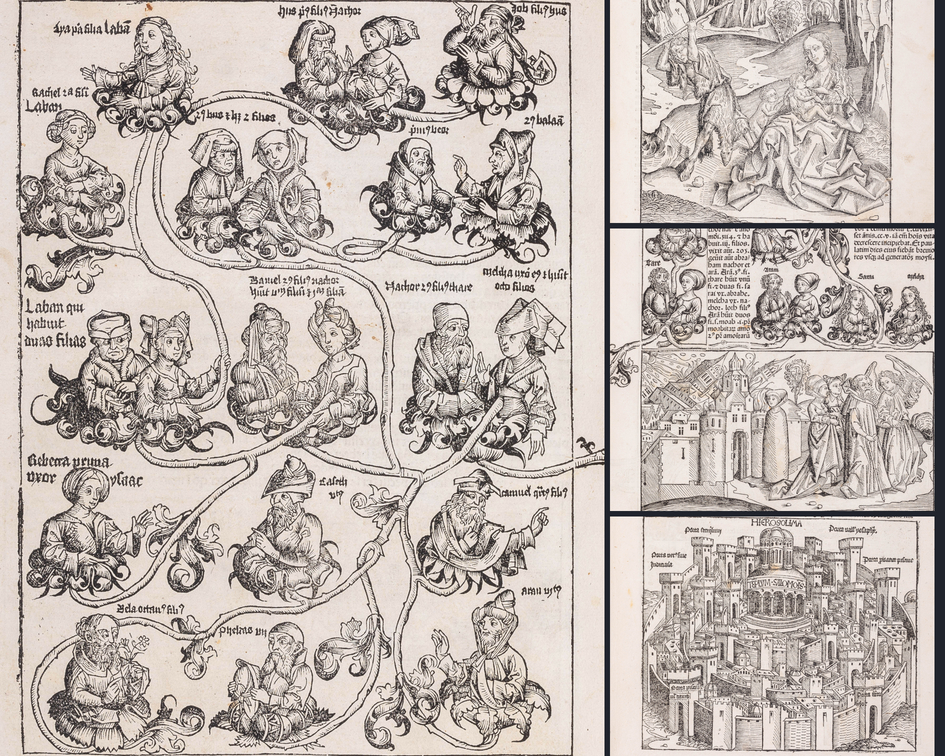
Doing so came with some difficulties, however. First, because these items are not the stated focus of the Society’s collection, they were not fully cataloged when I began this project. (This is also one of the reasons it is not well known that the Society owns these texts.) Of the six incunables that AAS currently holds, only three had online catalog records when I began this project, although all have since been cataloged. Furthermore, those records that did exist were limited and difficult to use. For example, one of the most interesting (in my opinion) incunables the Society owns is a copy of Liber Cronicarum, otherwise known as the Nuremberg Chronicle, printed in 1493. The Nuremberg Chronicle is a history of the world that begins with biblical times and continues through the fifteenth century, touching on many major cities and political/religious figures from history. The Chronicle is also revered for its liberal use of woodcut illustrations (such as the images shown here), which depict the people and places being discussed throughout history. Not only is this text vastly interesting to study on its own, the AAS copy is particularly valuable because it is in excellent condition. The catalog record for this text, however, is almost entirely in Latin, which makes it hard to find in the online catalog and also hard to decipher if you do find it. Furthermore, although this record contains all the information needed to find the Nuremberg Chronicle, the information provided is very technical and not very user-friendly.
Confusing catalog records for incunables are common, as they are notoriously hard to catalog due to missing leaves, lack of publication information, faded text, and other time-consuming difficulties. At AAS, because they are outside of the normal collection scope and because the Society does not have a curator specialized in materials from that time period, creating detailed catalog records is especially difficult. Fortunately, AAS currently has someone working very hard to improve these catalog records, which will make them much easier to find and access in the near future.
Once I was able to get into the text of the Nuremburg Chronicle, as well as a few of the other incunables, I discovered an interesting connection between the incunable collection and the rest of the material owned by the AAS, which helped me discover how they ended up here. Several of the incunables were donated by Isaiah Thomas, the Society’s founder, and he left extensive notes within each incunable on both the monetary value and the academic value of each piece based on their connection to the history of printing. This has led me to the conclusion that the incunables were kept not just for their donors’ connections to the Society—some other notable donors of incunables were the Mather and Hunnewell families, which you can read more about here and here—but because of their connection to the Society’s history. The Society had a much broader scope when originally founded by Thomas, and it was only in the 1970s that it was narrowed to North America. This new scope lessened the broad interest the Society used to have in the history of printing. There are a number of other resources at AAS that also deal with the history of early European printing, the existence of which makes the presence of the incunables within the collection make sense.
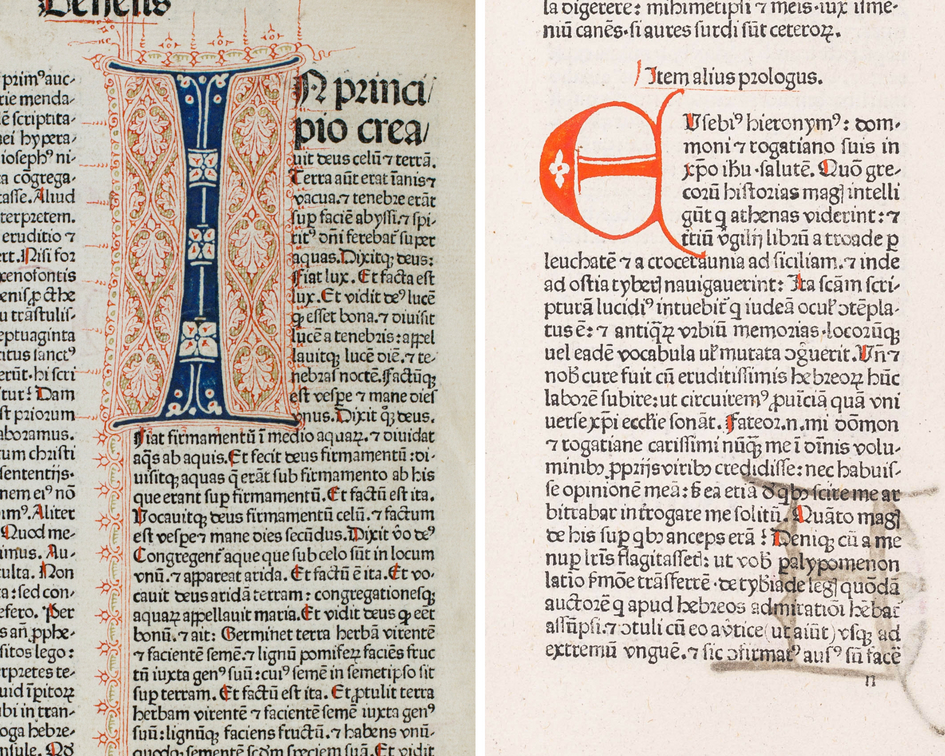
“Bible Latina,” 1476, examples of illumination in incunabula
This change in scope led me to my second difficulty—deaccessioning. Deaccessioning is the official disposal of items within a library collection, which generally entails selling those items in order to raise money for the library. In the early 1970s, several of the Society’s dozen incunables were deaccessioned; there was a lot of change happening to the Society’s collection during the ’70s, and the deaccessioning of these incunables appear to go hand-in-hand with AAS lessening its focus on the general history of printing within the collection. I tried to discover where the texts went after being a part of our collection, but although the American Antiquarian Society Proceedings of 1873 and 1879 list these incunables as being owned by the Society, during the short time I was at AAS I was not able to find the records that indicate who bought them during their deaccessioning.
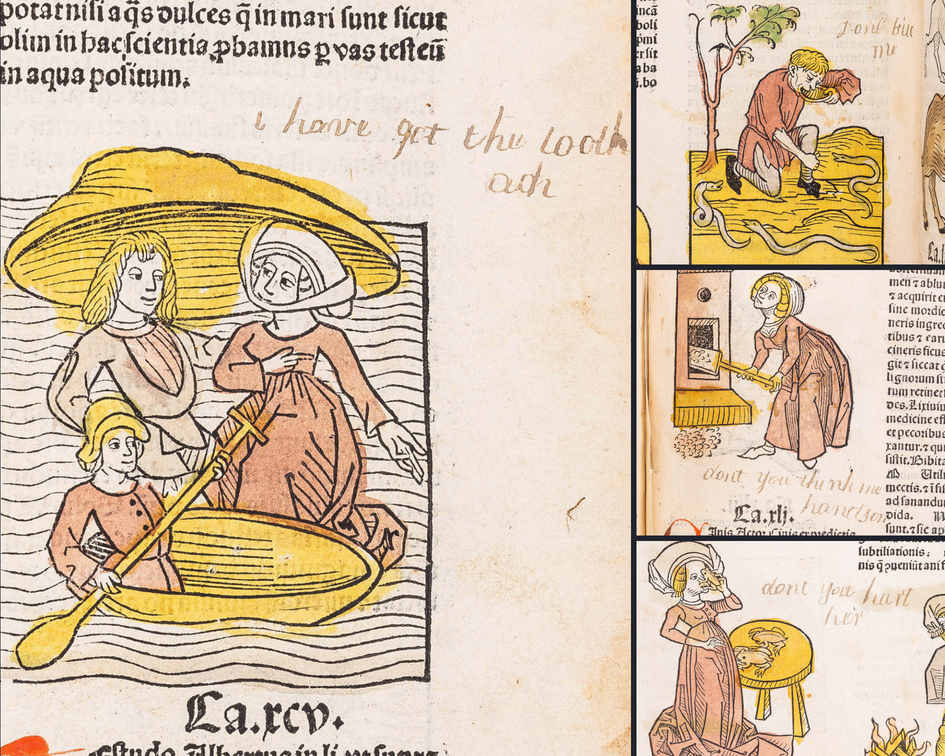
Therefore, my research into the incunable collection at AAS led me down many mysterious rabbit holes that did not always lead to answers. But, one thing I definitively learned was how unique and interesting this collection of incunables is. To prove this, I’ll leave you with this final example of an incunable you can find at the Society: the Hortus Sanitatis, printed in 1491. The Hortus Sanitatis was the first natural history encyclopedia and was published by Jacob Meydenbach in Mainz, Germany, the home of the first European printing press. Many copies of this text still survive, and the Society’s copy, like many others, is in poor condition. Therefore, this copy is not considered special just because it survived. Rather, it is the annotations that make this text not only academically interesting, but fun to look at as well. As you can see from the images, the book is full of hand-painted woodcut illustrations of the different plants, animals, and people that are discussed throughout the encyclopedia. Many of these images have readers’ marks next to them that contain puns and jokes applying to the image they are situated next to, enhancing anyone’s reading of this delicate text. While the culprit of these notations is currently unknown, I hope to someday learn their name—and if you come and see this amazing collection, maybe you can figure it out for me!
Further Reading:
Bouchot, Henri. The Book: Its Printers, Illustrators, and Bonders, from Gutenberg to the Present Time. London: H. Grevel & Co., 1890.
Duff, E. Gordon. Early Printed Books. London: Trübner & Co., Ltd., 1893.
Haebler, Konrad. The Study of Incunabula. New York: Grolier Club, 1933.
Did you miss the Radiant with Color & Art exhibition featuring a portion of the AAS’s large archive of McLoughlin Brothers material that was shown at the Grolier Club last winter? Yes? Then you’re in luck! The exhibition has now been fashioned into a colorful online exhibit showcasing the history and work of the McLoughlin Brothers, the New York publishing firm that transformed American children’s book publishing.
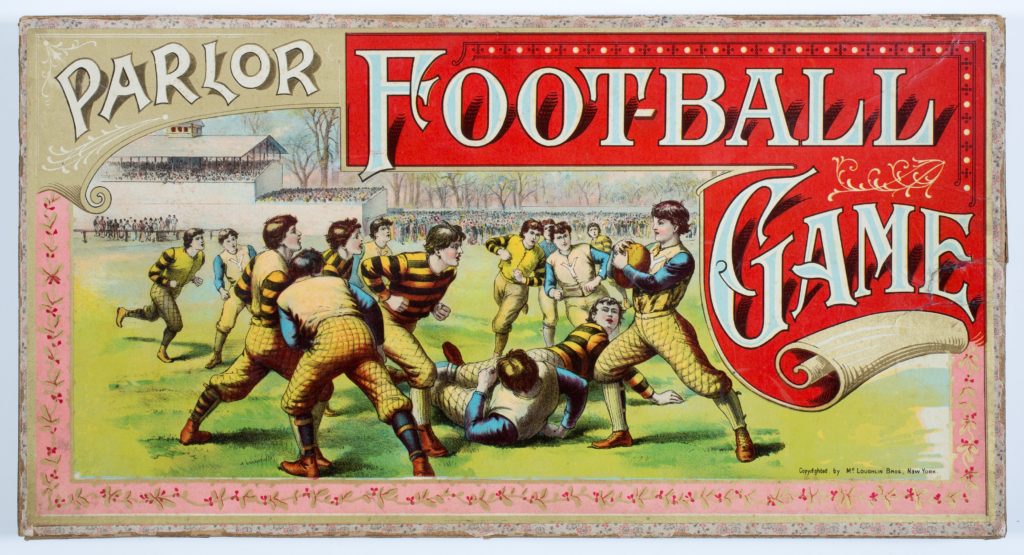
Box cover for “Parlor Football Game,” 1891.
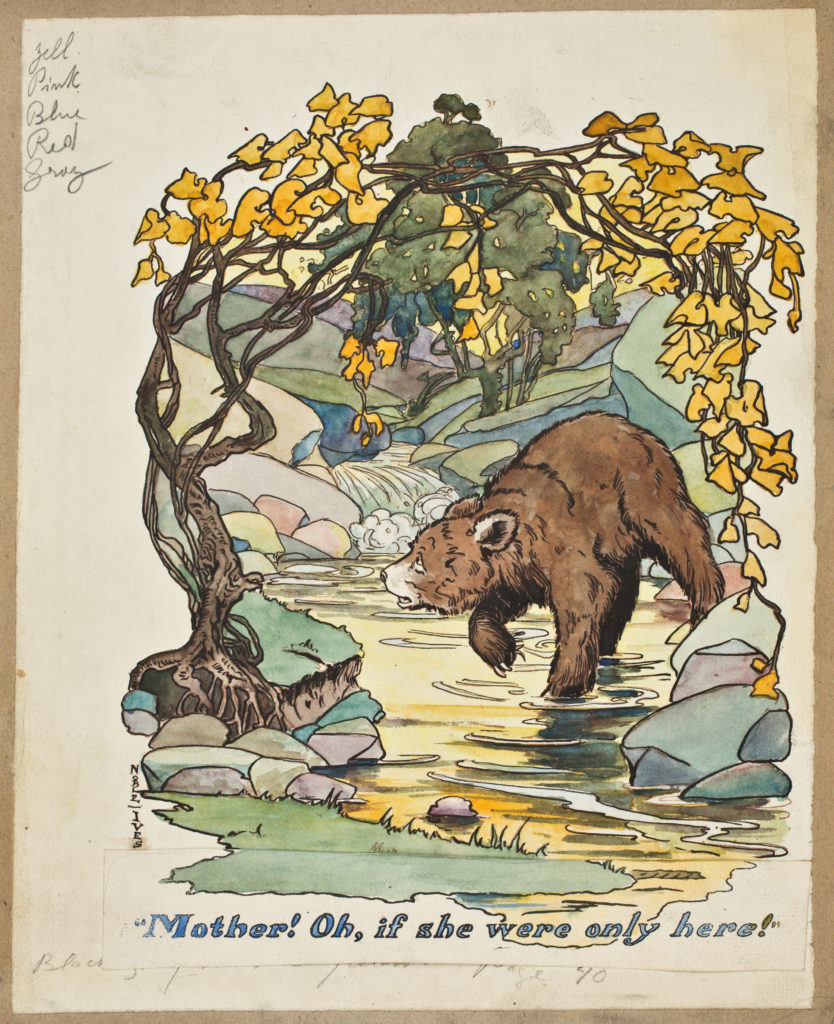
Original watercolor by Sarah Noble Ives, ca. 1907, used in “The Story of Teddy the Bear.”
The McLoughlin Brothers were publishers who operated in New York City from 1858 to 1920. Their firm produced books, games, and toys for children for over fifty years, a notable achievement for any business, but an especially important one in the history of picture book publishing.
As one of the first publishers to focus exclusively on products for children, McLoughlin Brothers was able to shape and define the American picture book market. The firm used wholesale and retail channels to distribute its books across the United States and in Latin America and Europe; produced picture-dominated books that significantly escalated consumer’s expectations that image-laden books could be had at affordable prices; and created popular content that reflected the modern world of the child reader. The Brothers never rested on their success, always striving to use technological innovation to improve their products and keep prices down and profits up. In no small way, McLoughlin Brothers sold the idea of picture books as a cultural necessity of American childhood—a belief still held by parents today.
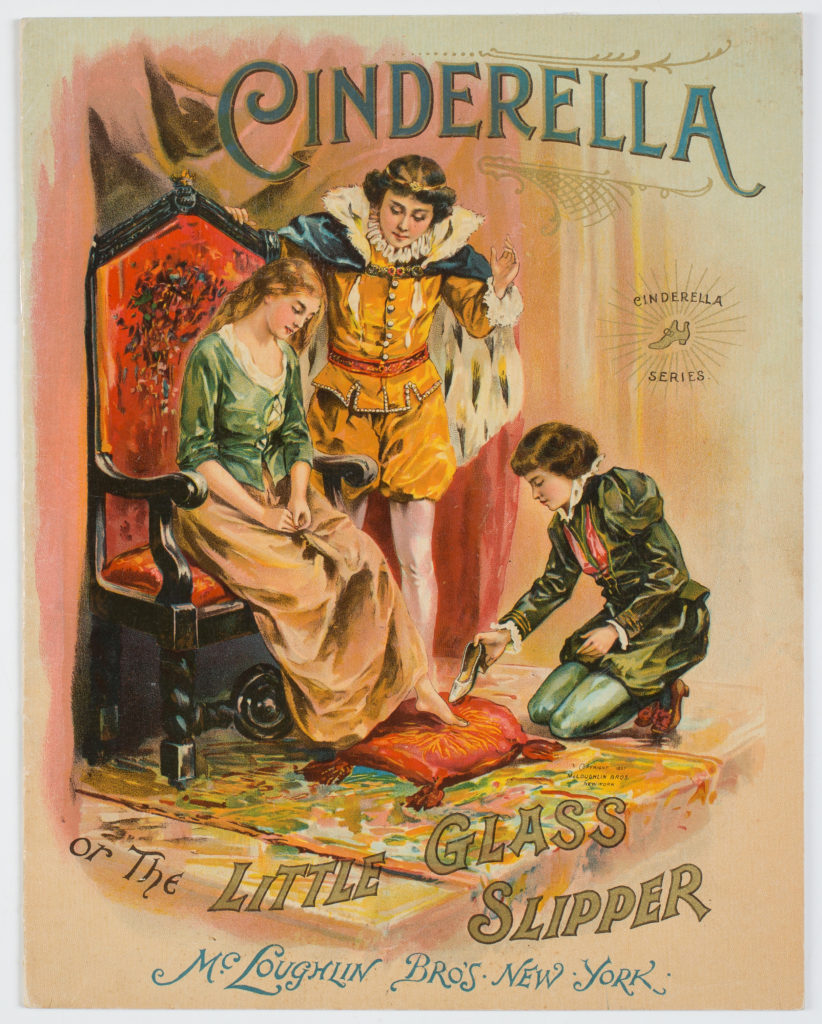
Cover for “Cinderella or The Little Glass Slipper,” 1897.
The exhibition and catalog, which was curated by AAS Children’s Book Curator Laura Wasowicz and AAS Andrew W. Mellon Curator of Graphic Arts Lauren Hewes, highlighted more than two hundred items from the Society’s collections, including picture books, games, original watercolors, and wood blocks. This shortened online exhibit, built on the Omeka platform, draws from the Grolier exhibition and tracks the evolution of children’s book publishing in America and the rise and fall of the McLoughlin Brothers firm. The exhibit is broken down into nine distinct themes, which give a glimpse into the audience the brothers sought to engage, the social norms at the time, the technological advances in printing, and the introduction of the stories and tales that are still passed down to today’s children. Enjoy!
We’ve finally reached the point in our major expansion and renovation project where everything is all construction all the time. The finish line is in sight, and we can’t wait to share it with everyone! In the meantime, this issue of Almanac was an opportunity for us to reflect on the construction at AAS, past and present, and to also say goodbye to an invaluable friend and member of our Council, Bill Reese, who championed the current project from the start.
In this issue you’ll find:
A collage of photographs illustrating construction progress
A feature highlighting the staff’s perspective on working in a construction zone
A memorial to Bill Reese and his legacy at AAS
A history of building additions to all three Antiquarian Halls
An update on the Safeguarding the American Story Campaign
And of course the lineup for this fall’s public programs and introductions to our newest long-term fellows. We hope this issue will get you as excited for the Society’s next phase we are!
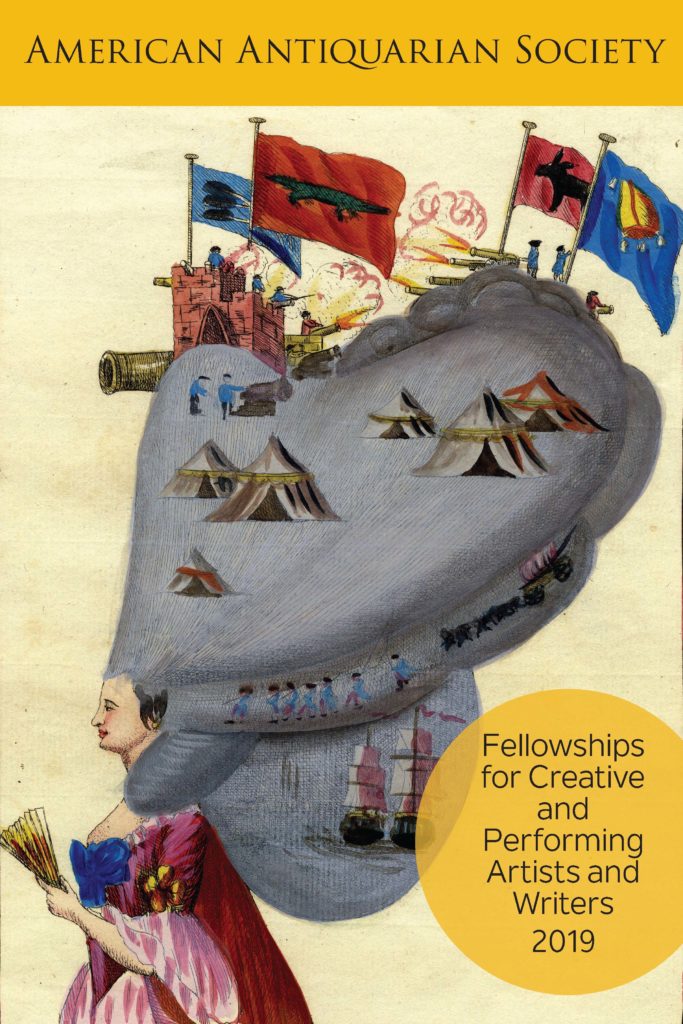
The deadline for our Fellowships for Creative and Performing Artists and Writers is Friday, October 5th. The 2019 class of fellows will be our twenty-fourth. This initiative encourages creators of all types to come to AAS for a month and conduct research on original works of art and non-fiction related to pre-twentieth-century American history and culture. The competition applies equally to people creating many different kinds of works of art, such as musicians, painters, playwrights, poets, and fiction writers, as well as journalists, documentary filmmakers, and public historians working in museum or historic site settings. The fellowships are designed for people creating work aimed at the general public as opposed to an academic audience.
While similar programs now exist in many research facilities, the Society’s program was the first of its kind when it was established in 1995. Since that time, we have hosted 98 fellowships. Their disciplines have been as varied as their personalities and have included a performance artist, a Civil War reenactor, a radio producer, two book artists, a sculptor, a cellist, two choreographers, a doll artist, and two cartoonists, among many others.
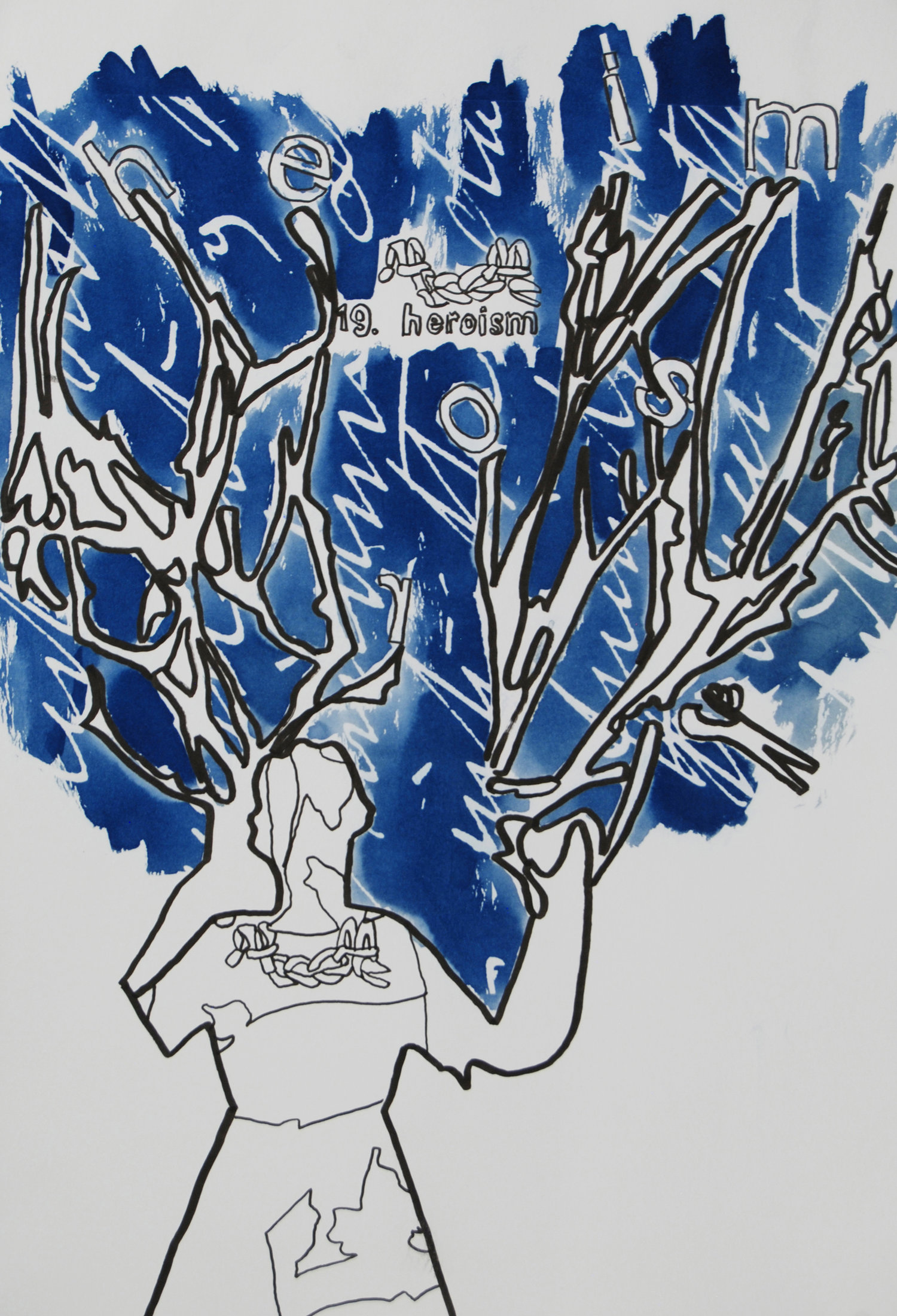
From exhibition “Solitude of Selfie,” Number 19, “Heroism,” 18×12, cyanotype and sharpie on watercolor paper, 2017, by Carol Flueckiger
Carol Flueckiger, a painter from Lubbock, Texas, who held a Jay and Deborah Last Fellowship in 2009, expressed the sentiments of many of our fellows when she wrote in her fellowship report: “The American Antiquarian Society Creative Artist Program is stellar. This mission is clear: come, absorb the resources in the library, bounce ideas off fellows, talk to the staff, consult the online catalogue, attend fellow lectures, and fill up on content to take back to the studio. The environment of scholarly research challenged me to confront my own field in general, the way I research imagery for my paintings, and how I define art. At first I was hesitant to leave the studio for a month, but as I got to know the staff, collections, and other fellows, my passion to integrate historic sources into my images grew as much as my passion for devising a unique painting/blueprint technique.”
Flueckiger’s latest work, an exhibition of thirty-six mixed media images called Solitude of Selfie, is on view at the Women’s Rights National Historical Park in Seneca Falls, New York. This exhibition visually revises “Solitude of Self,” one of the most well-known speeches delivered by Elizabeth Cady Stanton. Some of the images in this collection were based on her research here at the Society.
The fellowship program, initially funded by the Lila Wallace Reader Digest Fund, is now supported by Charlotte and Robert Baron, the Hearst Foundation, and Deborah and Jay Last. For more information about the Fellowships for Creative and Performing Artist and Writers, visit our website.
 The fall edition of the AAS newsletter, the Almanac, is now up on the website and showcases some of the exciting things going on at AAS!









 article, or other achievement is not included, just let us know if you’d like to see it posted next quarter!