Past is Present‘s series of posts on the upcoming Adopt-a-Book event will resume tomorrow. For today, please enjoy this story of (un)covered literary history.
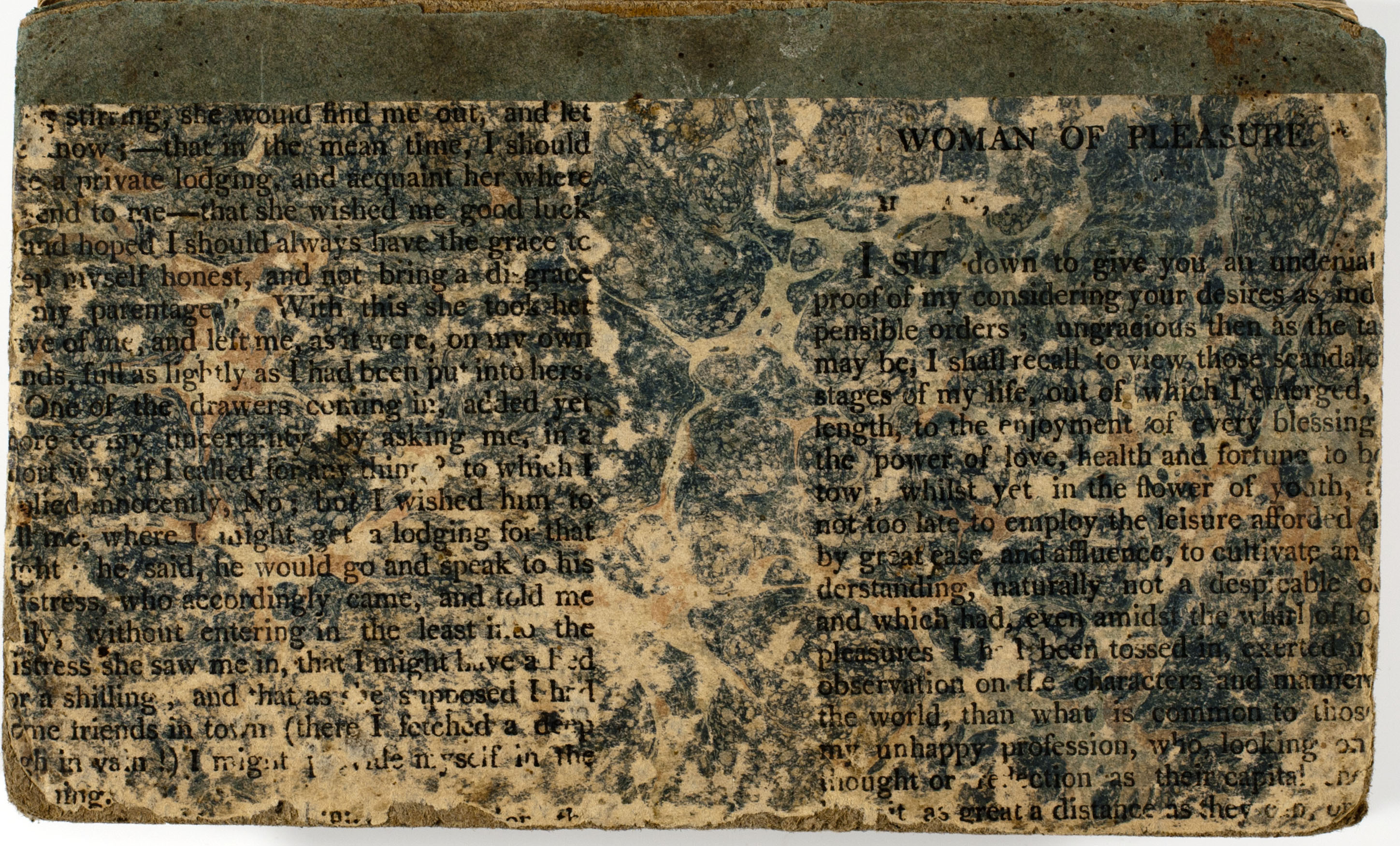
Ungracious then as the task may be, I shall recall to view those scandalous stages of my life…
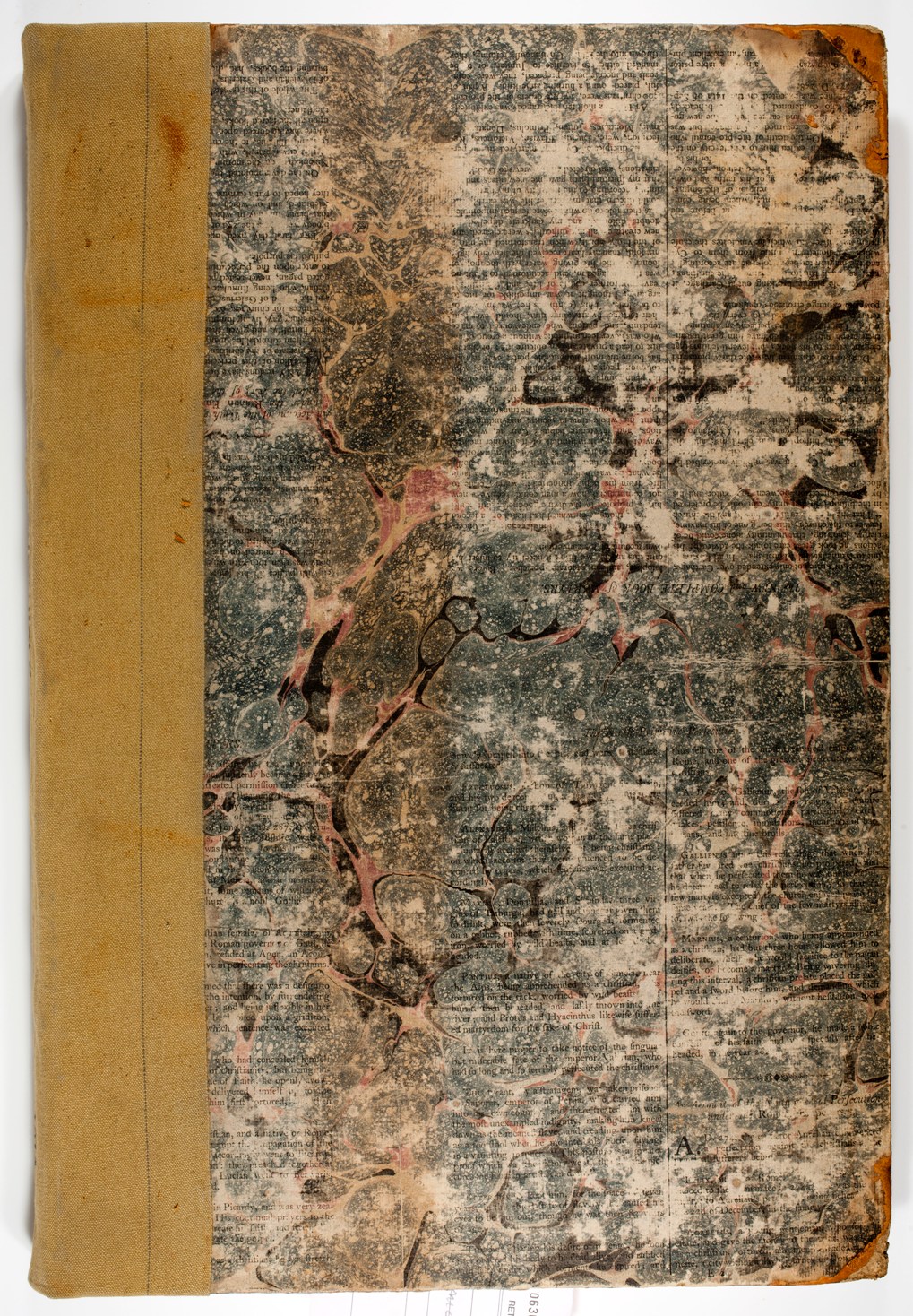
Hanway's Advice, 1810
So say the marbled boards** (see further information below) covering AAS’s copy of Jonas Hanway’s Advice from Farmer Trueman to His Daughter Mary. The text inside is a series of discourses in which Farmer Trueman warns his daughter of the perils awaiting a country girl upon moving to the city: if a “silly proud girl,” then she may be “seized by the cold hand of poverty” and “to relieve her wants…[become] a prostitute.” Just such a tale seems to peek out of the book’s marbled boards, perhaps to accentuate Farmer Trueman’s virtuous message in one odd and unintended pulp story.
Or perhaps not. The sheets covering the boards of this 1810 Boston edition are actually unbound, unused copies of John Cleland’s quite vicious Memoirs of a Woman of Pleasure (popularly known as Fanny Hill). Marcus McCorison, AAS President Emeritus, bibliographer, and author of an essay on early American printing of Fanny Hill, has pointed to the “curious juxtaposition of pious works” bound with such risqué words. Perhaps an impertinent binder, with a supply of marbled Fanny Hill sheets at his side and a Hanway book to bind, covered this copy of Advice From Farmer Trueman. The binder may never have thought that the marbling would wear away, expose Cleland’s words, and reveal the binder to be quite the ironist.
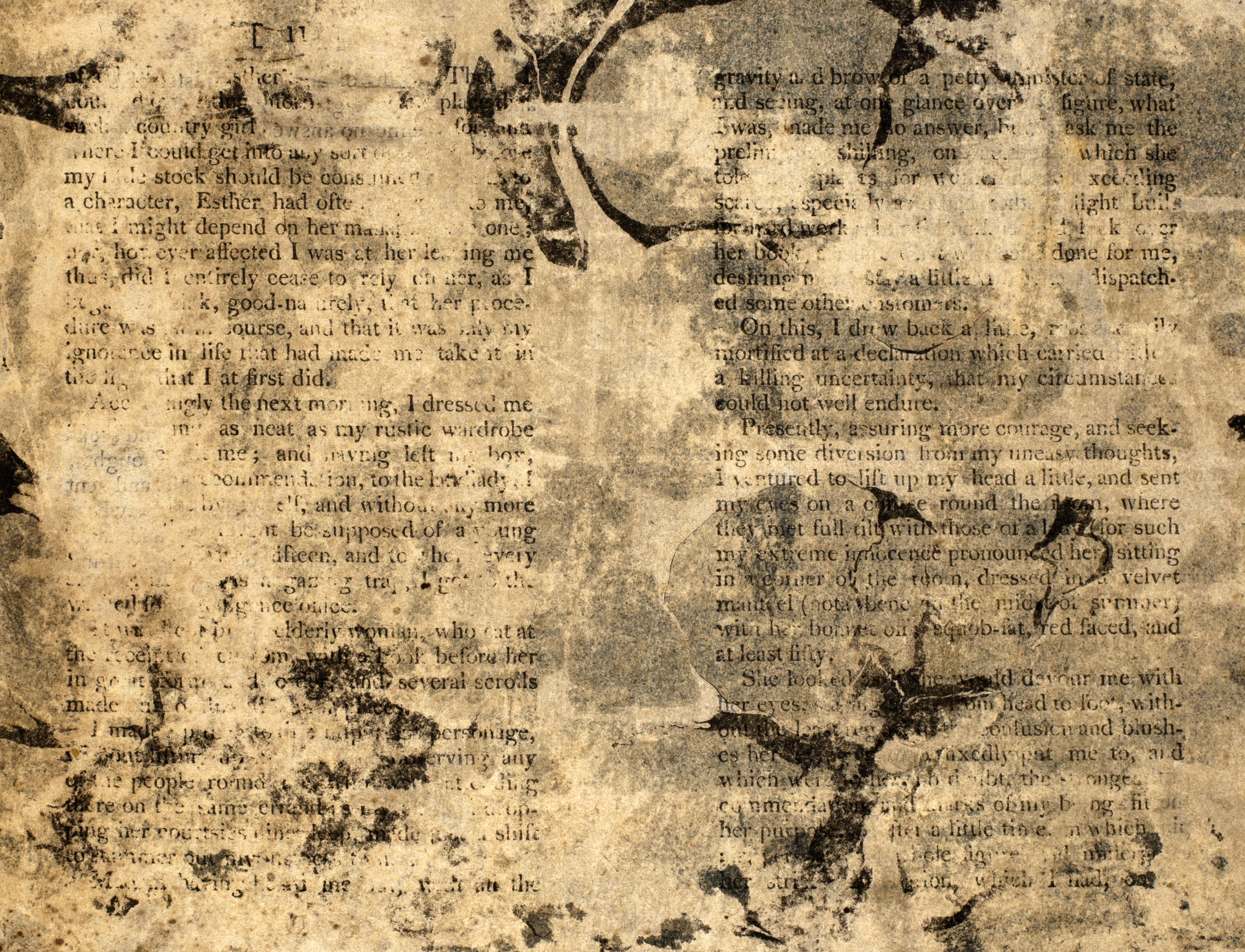
Boston Independent Chronicle, 1814
This anonymous binder was not unique in presenting such “curious juxtapopsitions.” In 1814, AAS founder Isaiah Thomas bound many of his newspapers in pages from Fanny Hill, as McCorison points out. Thomas marbled any paper at hand, using sheets of everything from the Psalms to Francis Blagdon’s History of Christian Martyrdom to Fanny Hill to cover his newspapers. So when readers request AAS’s early American newspapers, they may be confronted with quite a surprising array of “curious juxtapositions.”
At times our books relay information, ideas, and even wisdom to us only with repeated readings and incessant handling. Fanny Hill had been obscured by censors (and marbled paper) for years. It was only on this date (March 21) in 1966, over 200 years after its first printing and over 150 years after its first American printing, that the U.S. Supreme Court finally declared that Cleland’s novel was not obscene. Readers, critics, and time had their way with the censors and with the paper. Sometimes our books, as well as their secrets between and even under their covers, have a way of knowing (at least some) things before we do.
Further Information: Boston Courier, 1806
** “The boards” are the covers of a hard bound book, which were usually covered with scrap paper. Often, as in the examples shown here, that paper was decorated with a multi-colored, swirled design or pattern called marbling. Many pre-1850 books were issued by the publishers bound in paper covered boards, allowing for an inexpensive binding which could later be replaced with leather by a hand book binder. Read more at The Antiquarian Booksellers Association of America’s Glossary of Book Terms.
McCorison, Marcus A. “Memoirs of a Woman of Pleasure or Fanny Hill in New England,” American Book Collector 3 (1980): 29-30.
McCorison, Marcus A. Risque Literature Published in America Before 1877. (Available online)
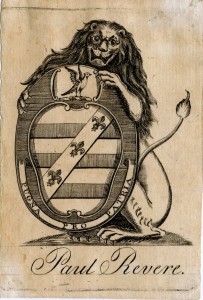
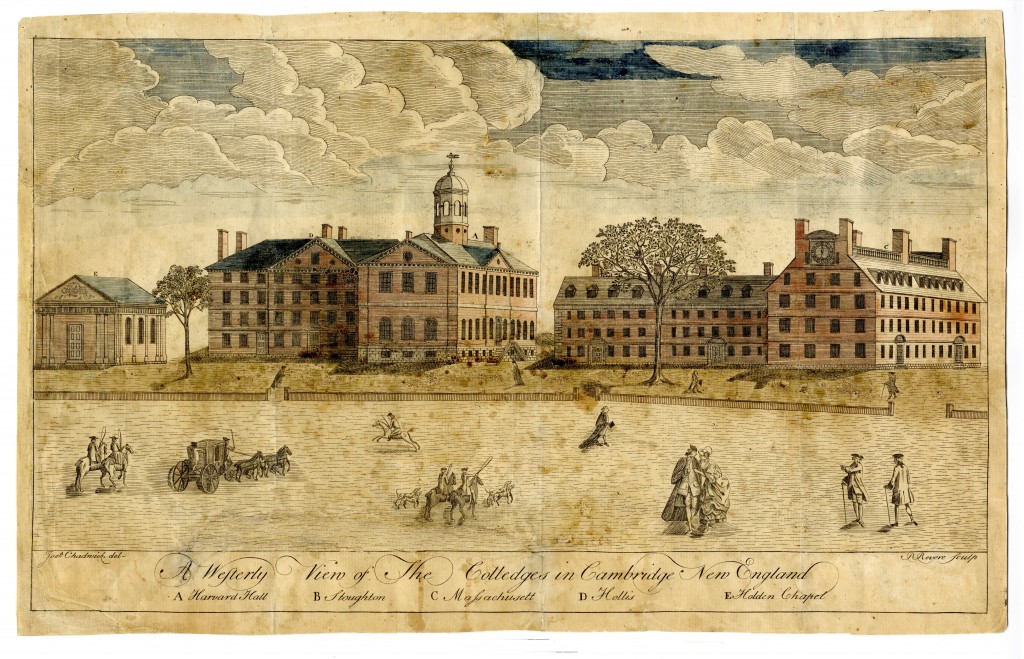
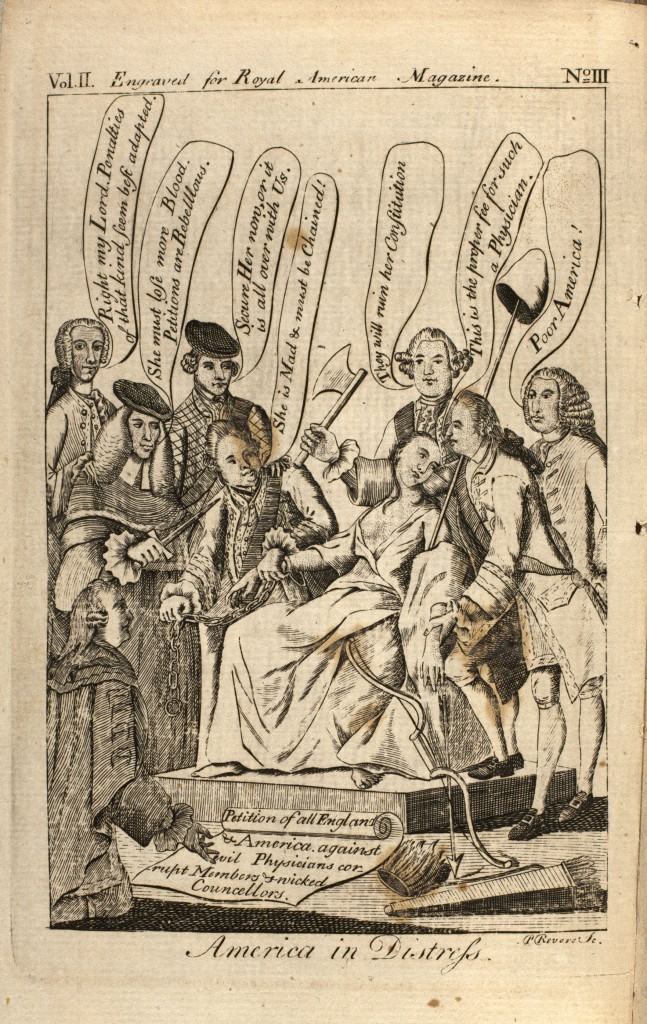
Paul Revere’s works are fabulous. And AAS has even more reason to celebrate because our collection includes copies of most of his known works. Revere is important historically, culturally, socially, and economically – and he deserves to be seen in his entirety. But we understand that not everyone can make it up to Worcester to see his works. So we want Worcester, and the Revere Collection, to come to you.
Anywhere. Anytime. And to anybody.
A Westerly View of the Colleges in Cambridge, New England (click on image to learn more)
The larger goal in designing this inventory was to cast a wide net and attempt to reach as many audiences as possible. In his time, Revere appealed to merchants, other craftsmen, patriots, book and music lovers, and readers of newspapers, to name a few. Illustrated online inventories are one way to democratize holdings and recreate that breadth in viewership. Therefore, our aim is to make collection materials available to teachers, students, scholars, collectors, artists, and anyone with an interest in historically significant works.
America in Distress (click on image to learn more)
If you like detail-rich descriptions, we have those. Thumbnails? Those are there too. If you want to browse the collection visually by subject, you will find the items have all been tagged with multiple general-audience-friendly headings. If you don’t have your own reference copy of Clarence Brigham’s Paul Revere’s Engravings, we have copious excerpts of the text online available via PDF. If you are in need of a writing prompt to dive into the collection, we came up with some to get you started. Perchance, if you like to zoom in to see everything from the time on the clock to the flourish of a Chippendale, you can. If you have your own Revere(s) and wish to compare plate markings, you can download them in higher-resolution. And to all those who need an excuse to enter the AAS Online Catalog, we have canned links to the holdings record.
Detail from The Boston Massacre (click on image to learn more)
With other inventories, the compulsion has been to explain collection material elsewhere at AAS; one example is the D. C. Johnson Family Collection (where other Johnston pieces are in the Society’s political cartoon holdings, lithograph collection, plates in books and manuscripts, etc.) but in the Paul Revere Collection Inventory, we decided to store it in “one” space while maintaining it in its various curatorial collections.
In short, we “collected” it virtually.
As we wind down one inventory and gear up for another, the perpetual question always arises – what did we forget? What would make for a better inventory? So we ask you, what’s in your ideal inventory?
Today we continue a series of blog posts highlighting items from our upcoming Adopt-a-Book event, slated for Tuesday, March 29, 2011, at 6PM in Antiquarian Hall. You can read the entire Adopt-a-Book 2011 catalog on the AAS website, where you will find descriptions of all 176 items up for adoption this year.
Our fourth orphan scheduled for the spotlight today is no. 14 in the catalog and was selected by AAS’s curator of books, David Whitesell. This orphan is different, though, in that it is a perfect example of how fast the adoption process can happen at AAS. In the time since this post was written and scheduled to go up, the item has already been adopted! You can still come to see it in person at our Adopt-a-Book event, but let this be a lesson to us all: Don’t let your favorite get away — adopt today!
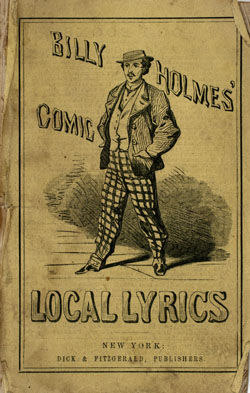
14. Billy Holmes’s comic local lyrics, containing a choice collection of comic and sentimental songs … New York: Dick & Fitzgerald, [1866]. Adopted in honor of Joanne L. Wilson.
This scarce songster contains lyrics to nearly fifty songs in the repertory of popular stage comedian Billy Holmes. Nearly half are predictably Irish in content, including three versions of “The Wearing of the Green.” But many refer to the recently concluded Civil War: “Admiral Farragut’s Fleet,” “Kearsarge and Alabama,” “The Dying Soldier at Antietam,” etc. During the war Holmes performed in New York, Philadelphia and Hartford and was often billed as a “variety specialist.” In his dashing checkered pants, he sang, acted and danced both in a troupe (called by one newspaper critic a “full and efficient company”) and alone. His solo act got great press during the Civil War when Holmes was billed variously as the “best comic Irish and Patriotic singer of the day,” the “best comic singer in the country,” and the “established Philadelphia favorite.” This song book joins several separately published patriotic ballads written by Holmes during the war which are already in the Society’s holdings.
In order to adopt any other object in the Adopt-a-Book 2011 catalog that hasn’t already been adopted, please click on the link and follow the directions for “How to Adopt” which are found in the sidebar to the right at the top of the page. Remember, you don’t have to wait until March 29th to adopt!
Today we continue a series of blog posts highlighting items from our upcoming Adopt-a-Book event, slated for Tuesday, March 29, 2011, at 6PM in Antiquarian Hall. You can read the entire Adopt-a-Book 2011 catalog on the AAS website, where you will find descriptions of all 176 items up for adoption this year.
Our third orphan for the spotlight is no. 12 in the catalog and was selected by AAS’s curator of children’s literature, Laura Wasowicz.
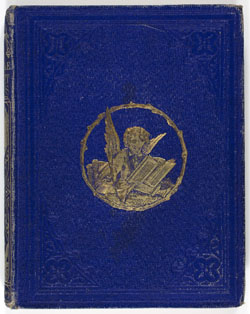
12. Barrow, Frances. The Little Nightcap Letters. New York & London: D. Appleton & Co., 1863.
Frances Barrow (1822-1894) enjoyed a long and prolific career as a writer of children’s story books, particularly the Nightcap series. The author was in her forties by the time this reprinted edition of the Little Nightcap Letters appeared in 1863. The book tells the engaging story of a northern mother’s trip down to Charleston, South Carolina, before the Civil War made such a trip impossible. Structured as a series of letters written between the mother (recovering from an illness) and her daughter Bella in the north, the book follows the activities of both adults and children in the two regions. In one letter the mother writes:
As I walked home, I saw such a sweet little white girl carried in the arms of a great black woman, whose head looked like an immense butterfly fastened on her shoulders; for she had a handkerchief on it, of all colors of the rainbow and it was spread out on either side like wings. The sweet little child seemed to love her black nurse dearly, for as I walked behind, I saw her press her tender, lovely pink and white cheek close against the dusky face of her nurse, and I heard her say in a sweet lisping tone: ‘Oh Binah, I love you. When I go to Heaven, I will take you with me.’
Interestingly, little Bella never responds to this description, and instead writes back to her mother about an argument that she had with a sister, a broken candlestick, and a new paper doll. The book is illustrated through out with wood engravings of children, pets, and scenes of everyday life, both North and South, including views in a school room and a slave cabin. The binding has a gilt cover design of a little cherub boy whimsically dipping his pen into the inkwell, symbolizing the child as professional author.
In order to adopt this or any other object in the Adopt-a-Book 2011 catalog, please click on the link and follow the directions for “How to Adopt” which are found in the sidebar to the right at the top of the page. Remember, you don’t have to wait until March 29th to adopt!
Today we continue a series of blog posts highlighting items from our upcoming Adopt-a-Book event, slated for Tuesday, March 29, 2011, at 6PM in Antiquarian Hall. You can read the entire Adopt-a-Book 2011 catalog on the AAS website, where you will find descriptions of all 176 items up for adoption this year.
Our second orphan for the spotlight is no. 79 in the catalog.
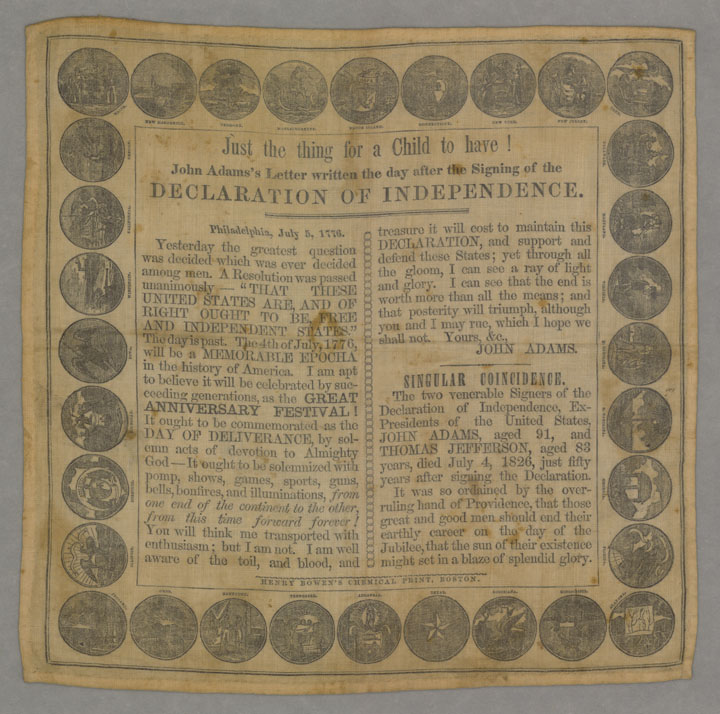
79. Just the thing for a child to have! John Adams’s Letter . . . . (Boston: Henry Bowen Chemical Prints, c. 1848), printed on muslin. Adopt me for $450.
The printer of this textile handkerchief was Henry Bowen who was a printer in Boston as early as 1818. For decades he produced books, periodicals, broadsides, and ephemera, running his business right up until his death in 1874. Through out the nineteenth century he produced a number of broadsides printed on textiles like cotton, muslin and linen. These printings included commemorative handkerchiefs for the opening of the Bunker Hill Monument, and textiles intended for children emblazoned with the Golden Rule, bible verses, or moral lessons.
The child’s handkerchief up for adoption has a more historical and patriotic message. The border is made of state and territorial seals, arranged in geographical order from Maine, down the east coast and west to the Oregon territory, subtly reinforcing in small children who might use the textile the idea of westward expansion as an American right and destiny. To solidify the patriotic message, the central portion of the piece reprints a 1776 letter by John Adams written the day after the signing of the Declaration of Independence, as well as a paragraph exclaiming upon the coinciding deaths of Adams and Thomas Jefferson on the fourth of July 1826. Given Bowen’s history of printing textiles for events held in the Boston area, it is possible that he produced this handkerchief as part of the city’s Fourth of July celebration in 1848 or 1849.
In order to adopt this or any other object in the Adopt-a-Book 2011 catalog, please click on the link and follow the directions for “How to Adopt” which are found in the sidebar to the right at the top of the page. Remember, you don’t have to wait until March 29th to adopt!
Today we begin a series of blog posts highlighting items from our upcoming Adopt-a-Book event, slated for Tuesday, March 29, 2011, at 6PM in Antiquarian Hall. You can read the entire Adopt-a-Book 2011 catalog on the AAS website, where you will find descriptions of all 176 items up for adoption this year.
Our first orphan destined for the spotlight is no. 121 in the catalog and is one of the lowest priced items in the event (the prices range from $10 up to $1,500, so we surely have something for everyone!).
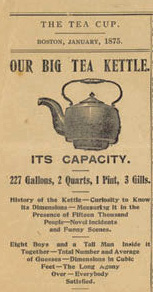
121.Oriental Tea Cup (Boston, 1875) $10.
Designed to mimic a newspaper, this advertising broadside promotes a contest that was held in Boston at the Oriental Tea Company. The firm had a large copper tea kettle hanging outside of their main entrance which acted as a trade sign and drew customers to the store. Over the years, many customers asked how big that tea kettle actually was – would it hold 60 gallons, or 600?
The savvy business owners decided to hold a contest to estimate the capacity of the kettle and 12,000 Bostonians entered, each hoping to win a chest of tea or coffee, which was the prize offered for the correct answer. The broadside goes on to describe in great detail the precautions taken to ensure the accurate reading of the kettle, which was made on New Year’s Day. Scaffolding was built over the sidewalk and roadway to allow judges to pour fluid into the kettle in measured containers. It is a wonder that the kettle did not come crashing down on the crowd gathered to watch! In the end, eight people guessed correctly that the copper trade sign kettle held 227 gallons, two quarts, and one pint. The broadside is an excellent example of the variety of advertising strategies that developed after the Civil War, as businesses competed for middle class dollars in the growing Northern economy.
In order to adopt this or any other object in the Adopt-a-Book 2011 catalog, please click on the link and follow the directions for “How to Adopt” which are found in the sidebar to the right at the top of the page. Remember, you don’t have to wait until March 29th to adopt!
On Tuesday evening, March 29, 2011, at 6pm, the American Antiquarian Society will hold its fourth annual Adopt-A-Book event in Worcester. At this event you will see recently acquired books, pamphlets, newspapers, prints and ephemera that have been added to the collection by the Society’s curators over the past year. You can also enjoy drinks and hors d’oeuvres, all included in the $20 entrance fee, while listening to the curators talk about their finds. We hope you will want to “adopt” an object by making a contribution to help the library take in other waifs and strays in the future. In return AAS will permanently record the adopter’s name(s) on a special bookplate attached to each item, and in the AAS online library catalog.
As with previous years, we have prepared an illustrated online catalog of the 176 items up for adoption this year. Have a look! If you see an orphan that appeals to you, you can even adopt now, in case you can’t make it to the event at the end of the month. Just follow the “How to Adopt” directions on the side bar of the catalog and contact our Curator of Books (and Chief of Adoptions) David Whitesell with your adoption requests. Be assured, you don’t have to be a Daddy Warbucks or Angelina Jolie, either – we have objects available for adoption for as little as $10! That said, if Ms. Jolie reads our blog and would like to adopt, of course we would be more than happy to help her make a selection.
The 2010 Adopt-a-Book event
At the event on March 29th, AAS curators will give a brief overview of objects they have purchased with resources raised at last year’s Adopt-a-Book fundraiser. All of this year’s adoptees will be displayed in the reading room and the AAS staff will be available for questions and conversation. In addition, AAS-National Endowment for the Humanities fellow Lisa Wilson, Professor of American History at Connecticut College, will discuss her ongoing research on American step-children and step-families. As an added incentive to come out to the event, we will have some “too-new-to-make-the-catalog” adoptees, fresh from the acquisition table and only available for adoption that night.
For the next couple of weeks we are going to use the blog as a way to highlight different objects in the Adopt-a-Book catalog. You will see examples from each department including manuscripts, books, children’s literature, newspapers & periodicals and graphic arts. Hopefully, all these postings will help raise funds for the Society’s future acquisitions by matching up material with potential adopters. So mark your calendars for March 29th and we look forward to seeing you under the dome!
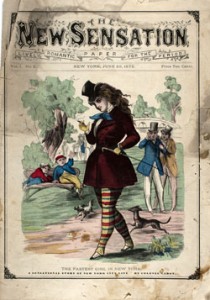
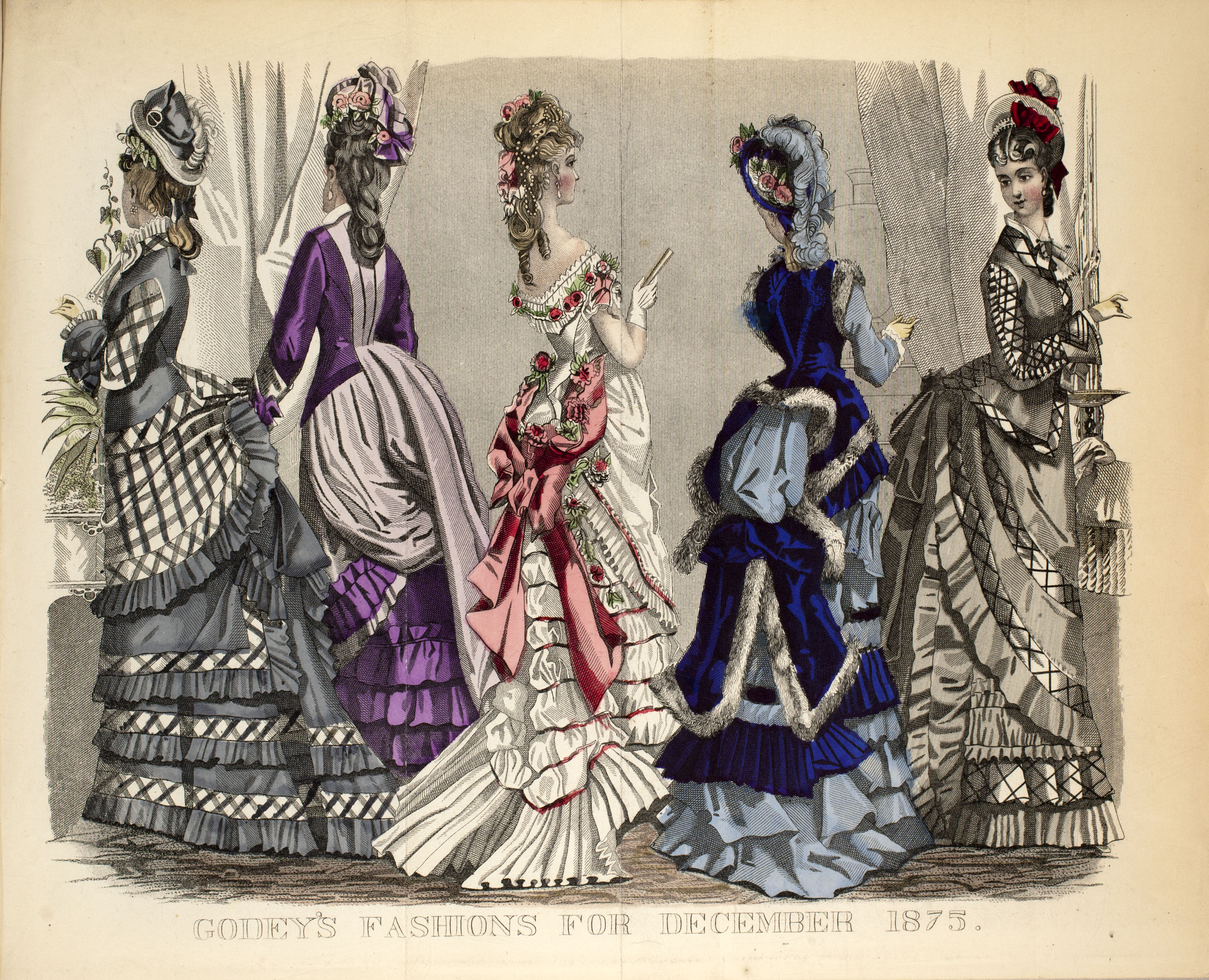
Leaf through the pages of Glamour or Vogue in mid-March and the inventory will reveal that American fashion designers’ thoughts have turned to the spring line. Here at the American Antiquarian Society, when our thoughts turn to fashion, they turn to hoopskirts and side curls and to the famed fashion plates of Godey’s Lady’s Book. As March is women’s history month, we thought it the perfect time to examine this “Lady’s Book.”
As you might know, Godey’s Lady’s Book was the number one selling periodical in Victorian America. Mr. Godey himself calculated the number of readers at a million by the eve of the Civil War. You might also know that the colored fashion plates at the beginning of the magazine were its most famed component. But did you know that the colored plates were hand painted? That the ‘lady editor’ of the magazine was vehemently opposed to including fashion plates in a woman’s periodical? That the magazine played an integral role in establishing Thanksgiving as a national holiday? That hoopskirts were gigantic during the Civil War? All of this information and more can be found in original issues of Godey’s Lady’s Book in the collections at the American Antiquarian Society along with secondary source material on the creation of the magazine. Godey’s Lady’s Book contains not only a wealth of information about Victorian fashion but also about the culture of bygone America.
The ‘lady editor’ of Godey’s Lady’s Book was Sarah Josepha Hale, a literary-minded social reformer whose civic-minded zeal rivaled that of Lucretia Mott and Harriet Beecher Stowe. She edited the magazine along with its owner, Louis A. Godey, from 1837 to 1877. Many are familiar with Hale solely for her authorship of “Mary Had a Little Lamb,” but Sarah Hale’s accomplishments reached far beyond a poem for children. Formal education for women at the time was scant. Hale derived much of her education from a brother who attended Dartmouth College and tutored Sarah at home. After losing her husband at a young age, Hale went on to support her family through literary means, successfully submitting novels and shorter pieces to publishers. She edited the Boston-based Ladies’ Magazine, the first women’s magazine in America. In the magazine, she included original literary pieces by American authors, an unusual practice at a time when American magazines borrowed heavily from those of Europe. As editor, she promoted women’s education and worthy social causes. She spearheaded the completion of the Bunker Hill Monument and founded the Seaman’s Aid Society of Boston to give monetary relief to the families of poorly paid sailors.
In 1837, she partnered with Louis Godey as co-editor for Godey’s Lady’s Book, which was a second-rate magazine until Hale came aboard. As editor of Godey’s, Hale promoted women as heads of female boarding schools, advocated for the retention of married women’s property rights, and opposed the current fashion trend of tight bodices for women’s dresses on grounds that they were unhealthy. She championed Elizabeth Blackwell, was integral in establishing the observance of Thanksgiving as a national holiday, which she believed would help unite a country divided by slavery, and promoted the creation of Vassar College, the first women’s college in America. She staunchly opposed including fashion plates in a woman’s magazine on grounds that they were frivolous.
Louis A. Godey, a Philadelphia publisher and the owner of Godey’s Lady’s Book, was the other vivid character involved in the creation of the magazine. Hailing from two of the world’s fashion centers, as a New Yorker of French descent, Louis fervently believed in including fashion plates in his magazine, overriding Hale’s opposition to them. Sharing Hale’s journalistic vision and interest in the new womanhood being promoted in America at the time, he complemented Hale as a charming extrovert with a flair for business. He knew that a female co-editor would be well received by the American reading public of the time and reputedly flattered Sarah into accepting the position. He insisted that the magazine not take a political stance during the Civil War in order to avoid alienating Southern readers. He suavely referred to his readers as “dear readers” and “the fair ladies.” He promised a free copy of his magazine to subscribers who failed to receive a copy, a common phenomenon at a time when the mail service in America was unreliable. Most notably, he insisted on including the colored fashion plate with which every issue of Godey’s commenced, and which would become its most beloved feature. Godey was also the first person to copyright a periodical in America with his copyrighting of Lady’s Book.
The impressive joint effort of these two editors was Godey’s Lady’s Book. The magazine was in print from 1830 to 1878. Its circulation doubled that of rival magazines. It was published at 113 Chestnut Street in Philadelphia on a monthly basis and was read by both men and women. Each page of the magazine was printed on a hand held flat-bed press. The printed sheets were folded and sewn by hand. The colored plates were hand painted in Philadelphia both at the Godey plant and in the home of young women hired to assist with the painting. Artists sometimes misunderstood coloring instructions. When the supply of color ran out, they often switched to other colors. This resulted in different subscribers receiving differently colored fashion plates, and made women unsure about the latest style when comparing their copy of the magazine to their neighbors’! Godey boldly smoothed the situation over with characteristic charm, “We now colour our plates to different patterns, so that two persons in a place may compare their fashions, and adapt those colours that they suppose may be most suitable to their figures and complexions” (Finley 54).
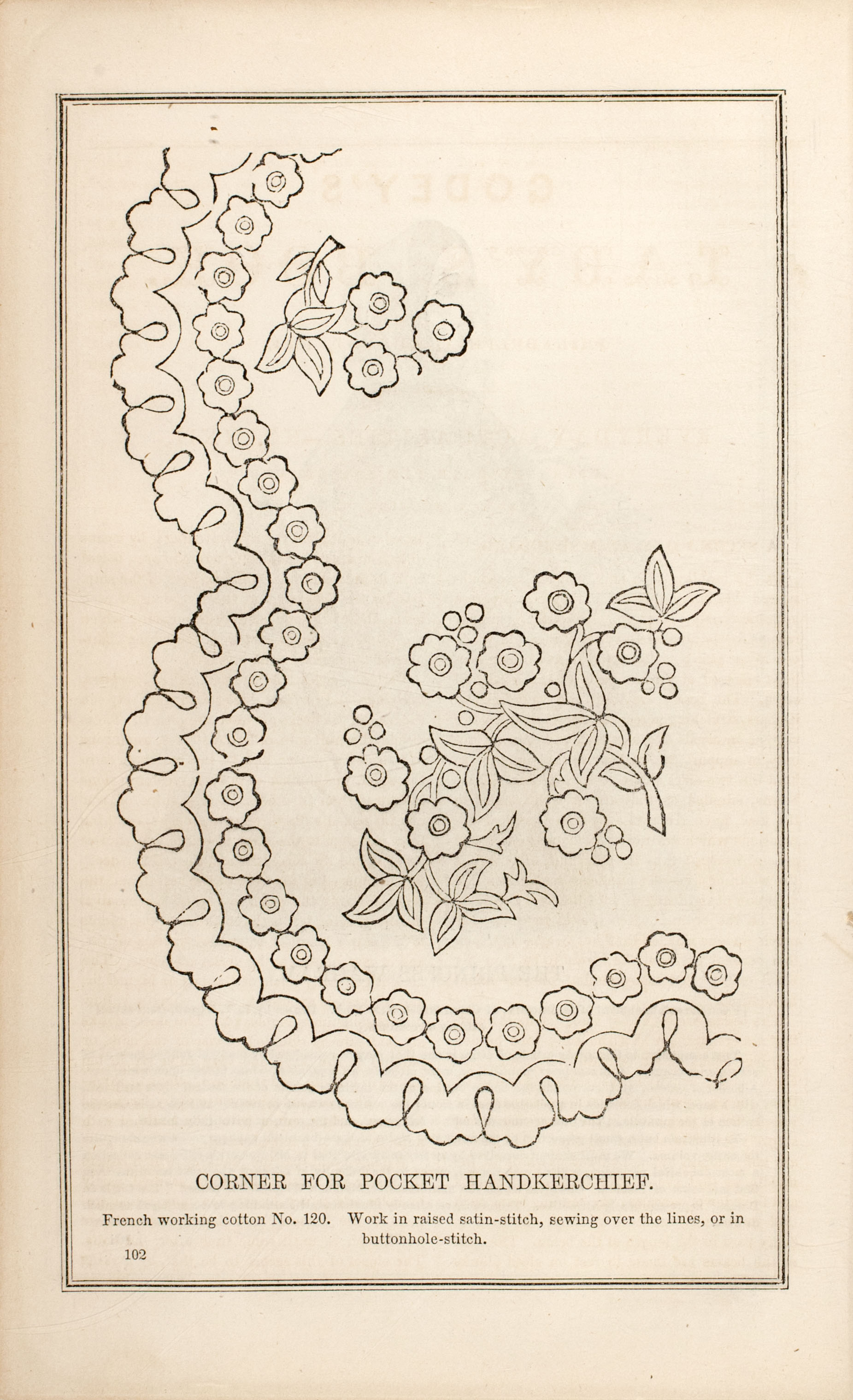
Early American fashion can be charted by following the changing clothing design in the colored plates of Godey’s Lady’s Book. Crinolines gave way to hoops, skirt width expanded with increasingly elaborate trim, sleeves tightened and loosened, hoops evolved into bustles. Dresses required at least twenty-five yards of material, and often weighed so much they were difficult to wear! As a result, not all women wore hoops and no one wore them all the time. Ringlets, flared sleeves, knitted hoods, bows on children’s dresses, checkered pants, gowns of “peach-blossom hue,” cashmere morning robes of Persian design, beaded opera hats, gentlemen’s mitts, and flower adorned bonnets are among the many fashions to be found in the magazine’s pages. Along with fashion plates, the magazine included recipes, embroidery patterns, sheet music for the piano, suggestions of hairstyles, lessons in drawing, suggestions for interior decorating, and original American literature, including pieces by Hawthorne, Holmes, and Irving.
Godey’s Lady’s Book is both eye candy for fashion buffs and a treasure trove of early American culture for the professional and casual historian. Consider making it part of your research endeavors the next time you stop by the American Antiquarian Society. It will whet your interest in the human drama of our country’s past and make you regret that dresses so elegant and elaborate can no longer be found in your latest issue of Vogue.
For Further Reading:
Finley, Ruth E. The Lady of Godey’s: Sarah Josepha Hale. Philadelphia: J.B. Lippincott, 1931.
Okker, Patricia. Our Sister Editors: Sarah J. Hale and the Tradition of Nineteenth-Century American Women Editors. Athens: University of Georgia Press, 1995.
Rogers, Sherbrooke. Sarah Josepha Hale: A New England Pioneer, 1788-1879. Grantham, New Hampshire: Tompson & Rutter, Inc., 1985.
Did you know that a patriot printer named Isaiah Thomas founded the American Antiquarian Society in 1812? Did you know that the terms uppercase, lowercase, and stereotype originated from terms used in relation to early printing presses? Did you know that early printers needed to read backwards and upside down? Do you know why the pages of many late nineteenth-century books crumble when turned? The answers to all of your unasked questions about Isaiah Thomas, early printing, the American Antiquarian Society’s history, and more can be learned on the library’s free public tours offered every Wednesday afternoon at 3:00pm.
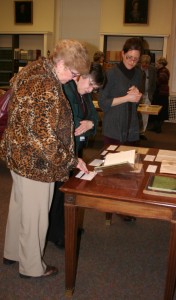
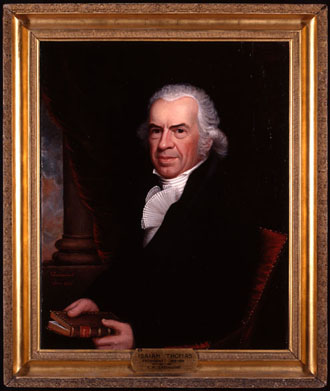
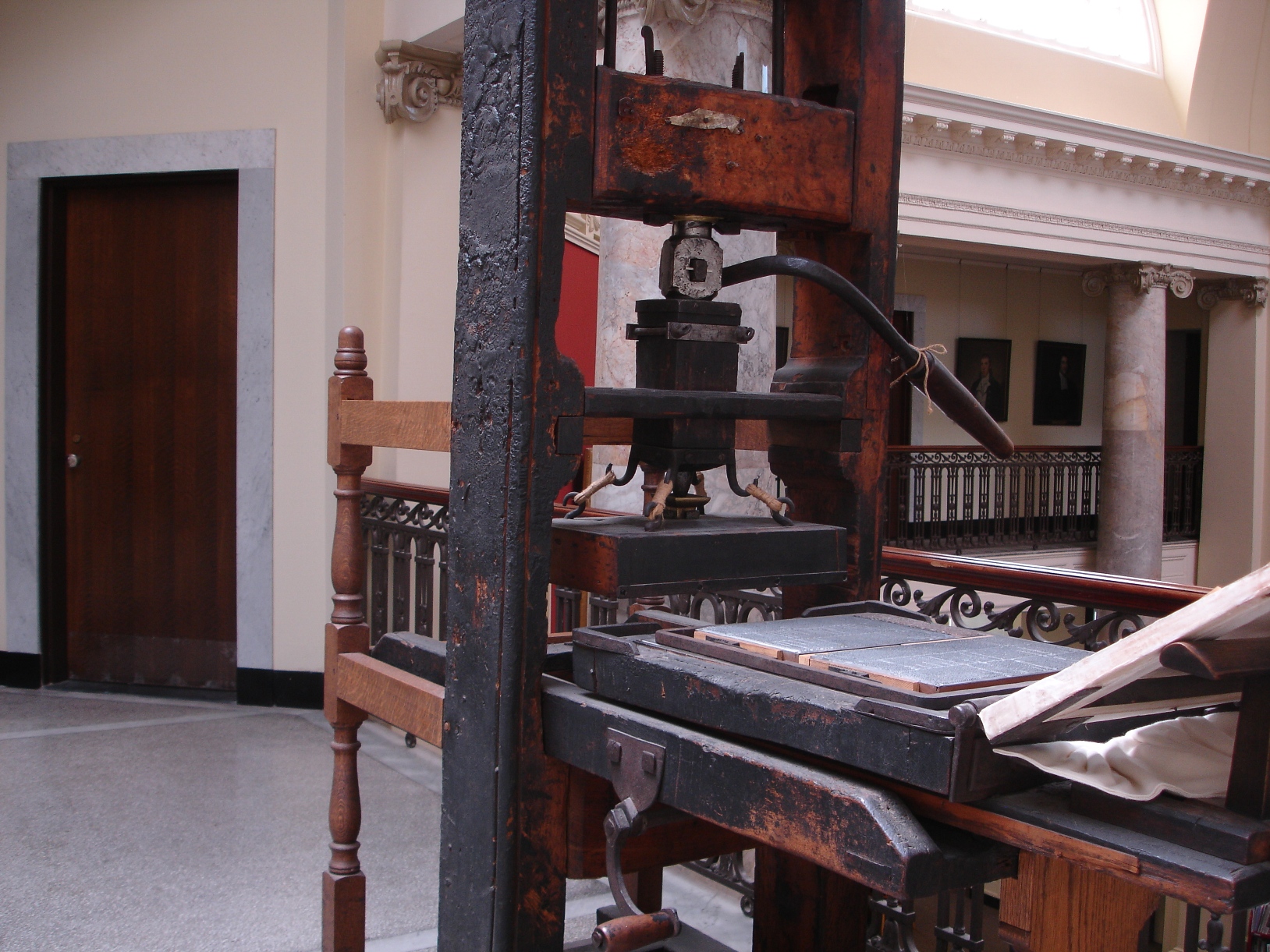
As a new intern here in the readers services department, I joined Elizabeth Pope, Head of Reader Services, last Thursday for a fascinating tour of the library. I thought I would blog about what I learned for the benefit of the readers of Past is Present who are as curious as I was about the library’s history. The tour was specially arranged for a local college history professor and his class of what we hoped were budding young historians. Beginning the tour in the lobby, Elizabeth showed us the portrait of Isaiah Thomas, which hangs above the stairs, informing us that he was a patriot printer who lived during the Revolutionary War. She then led us upstairs to see Isaiah Thomas’s original wooden printing press and the shoulder-height cases where he stored his type.
Standing amid Isaiah’s printing equipment on a landing overlooking the reading room, Elizabeth regaled us with engaging historical facts. Isaiah Thomas’s press was a wooden one, made in England, and it had a name. Isaiah referred to it as “Old No. 1.” Born into a poor family, Isaiah was apprenticed to a printer at a young age. Elizabeth explained to us that it was a common phenomenon in early America to apprentice young boys to a tradesman. Can you imagine what it would be like to leave your family at the age of eight and be required to learn a trade? Isaiah later became such a successful printer that he was able to buy his master’s business, including the very printing press that Isaiah had first learned on as a young apprentice, something that Elizabeth surmised must have brought him satisfaction. Isaiah called this press “Old No. 1” as it was the first of many in what became his printing empire.
Isaiah Thomas was famous for publishing, The Massachusetts Spy, a Whig newspaper, which supported the cause of American Independence. One day in April 1775, just days before the Battle of Lexington, Thomas heard rumors that the British were intending to seize his press. He smuggled it out of Boston and set it up in Worcester where he published accounts of the Battles of Lexington and Concord. Years later, in the hopes of improving posterity, he later founded the American Antiquarian Society also in Worcester, donating his personal collection of over 8,000 books to the library.
Elizabeth passed around a facsimile of the first paper printed in Worcester on Isaiah’s press and showed us the metal type letters similar to the type Isaiah Thomas used in printing. In the eighteenth-century, type was stored in separate cases; the lowercase was nearest to the printer’s apprentice who would be setting the type and it contained the more frequently used smaller letters, which would come to be called lowercase. The farther case had the larger capital letters, which would be come to be called uppercase. Elizabeth showed us a composing stick, a small tray that could fit a couple lines of type, that was used to move the type over to the composing stone, where each page worth of type was set into a metal tray. Basically, you needed to be able to read backwards and upside down in order to lay the type since it needed to have a reverse impression when pressed onto paper! Later in the early nineteenth century when printers devised paged-sized metal molds of type, used to print a whole sheet at the same time, it was called a stereotype – the root of our term, stereotype, or a pre-prepared, conventional notion. Elizabeth also showed us how to work the press and informed us that printers in early America could be identified when walking down the street in Boston since they had overly developed muscles on the arm they used to pull the bar on the press. Apparently printing was the early American counterpart to scooping ice cream at Ben and Jerry’s, only more extreme!
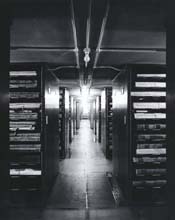
The tour resumed in the closed stacks where the Society stores all its collection materials. On the floor we were on, shelves of large, flat boxes filled with newspapers lined the walls in a room where lights are dim for preservation purposes. Elizabeth passed around a duplicate copy of The Boston Chronicle, an early eighteenth-century newspaper printed on paper with a high rag content. She informed us that the earliest newspapers were made from rags. In fact, newspapers often put out ads asking for people’s old white rags to make their papers. This paper is easier for librarians to preserve than later paper since its fibers are relatively strong. Later paper was made from wood pulp. Brittle, yellow, and easily crumbled when handled, the pages of many late nineteenth-century books were made from wood pulp. The next time you read an early copy of The Adventures of Huckleberry Finn, you’ll know why it’s crumbling in your hands! Elizabeth proceeded to show us the newest, state-of-the-art part of the stacks where rare books and pamphlets are stored.
This special tour ended in the council room, a large room with a long table where curators laid out rare books and manuscripts for the students to see relating to the Civil War. (On the normal public tour you get to see the council room, but these original materials would not be out.) Plastic book cradles supported the bindings of many of the old books. We were excited to learn that visitors are allowed to gently touch original documents at the American Antiquarian Society, as long as their hands are clean and dry. A curator led us around the room and showed us each book or manuscript. The first was a large sheet of paper describing slaves for sale. Others were Civil War sheet music and a document outlining the conditions of surrender for the seceded states. Among the treasures on display were children’s books printed in the North and South during the war and a printed story about a woman who lived in a cave during the Battle of Vicksburg. Seeing these original documents, and being allowed to lightly handle them, brought history alive.
Elizabeth informed us that the American Antiquarian Society estimates they have two out of every three books printed before 1820 in what became the United States, which makes it the best collection of such material in the world. AAS continues to collect original sources and recent works on early America through 1876, actively acquiring additional material every day. She invited the tour to come back to the American Antiquarian Society to conduct research. If you have a research project related to early America before 1876 (or even 1900), it only takes about half an hour and two forms of ID (one with a photograph) to register to use the resources at AAS. The research library is not appropriate for children, but high school students may do advanced research here if accompanied by a parent. More information about the requirements and the process of registering as a reader (the term for library patrons in rare book libraries) is on the “Using the Library” page on the AAS website.
So the next time have a historical research project or are investigating your family tree or the history of your hometown, make researching in the reading room here at the American Antiquarian Society a part of your afternoon. Or if you’re simply curious about early American history and old books, join us at 185 Salisbury Street, Worcester, MA for a tour any Wednesday at 3:00pm.
AAS is pleased to announce our spring series of public lectures. These programs are designed to highlight the work of our members and fellows, showcase the kinds of research done in the collections, and explore the history and culture of the United States during the time period of the Society’s collections. These programs will explore various ways that American culture was created and defined from the American Revolution through the antebellum period.
All of these programs take place at 7:30 p.m. in Antiquarian Hall, 185 Salisbury Street, Worcester, Massachusetts. They are all open to the public free of charge.
Tuesday, April 5
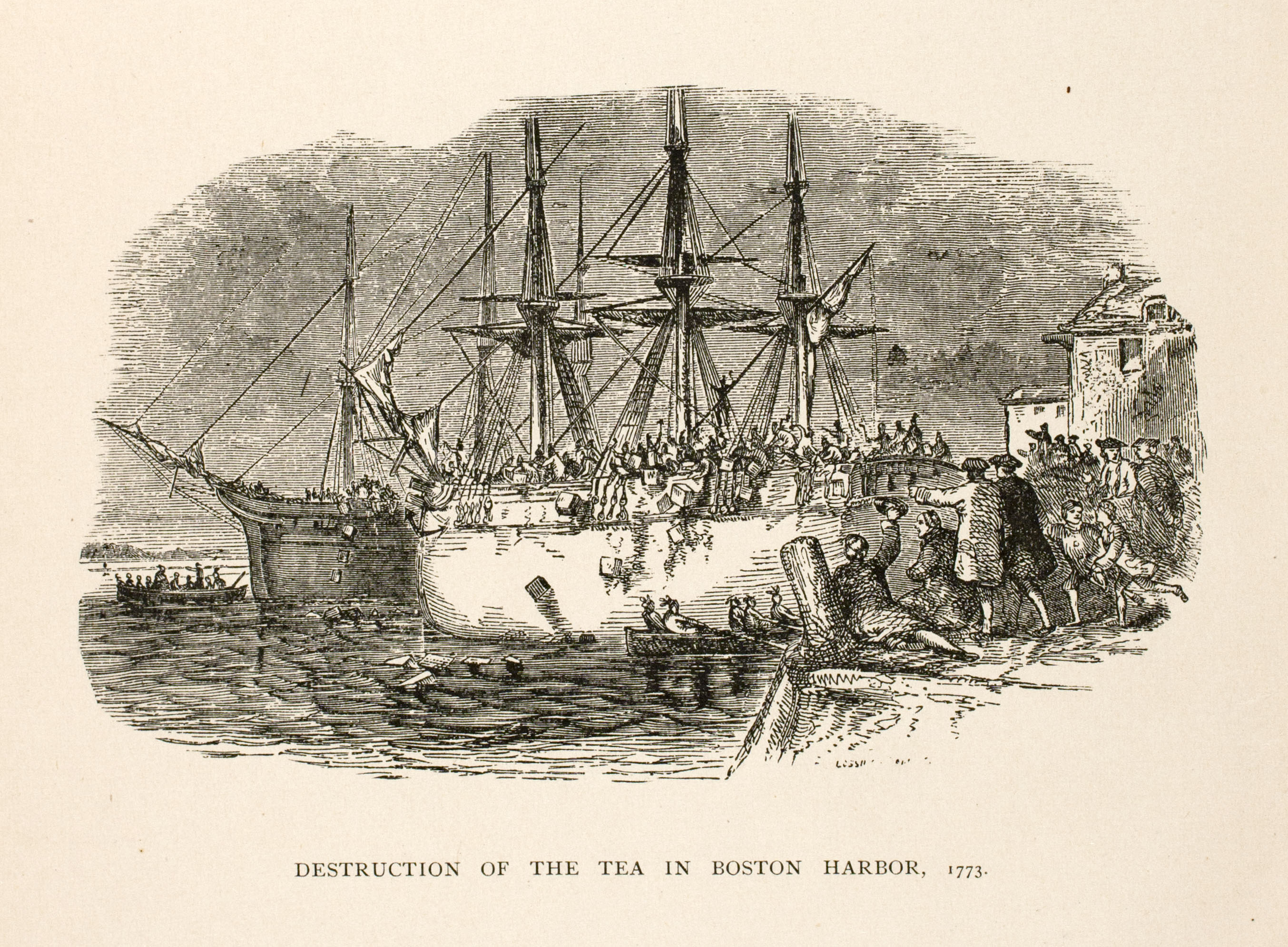
“Teapot in a Tempest: Massachusetts and the Boston Tea Party”
By Benjamin L. Carp
On the evening of December 16, 1773, a group of disguised Bostonians boarded three merchant ships and dumped more than forty-six tons of tea into Boston Harbor. Why did the Tea Party happen? Whom did it involve? What did it mean throughout Massachusetts and beyond? Based on his new book, Defiance of the Patriots: The Boston Tea Party and the Making of America, Benjamin L. Carp will explore these questions.
Tuesday, April 19
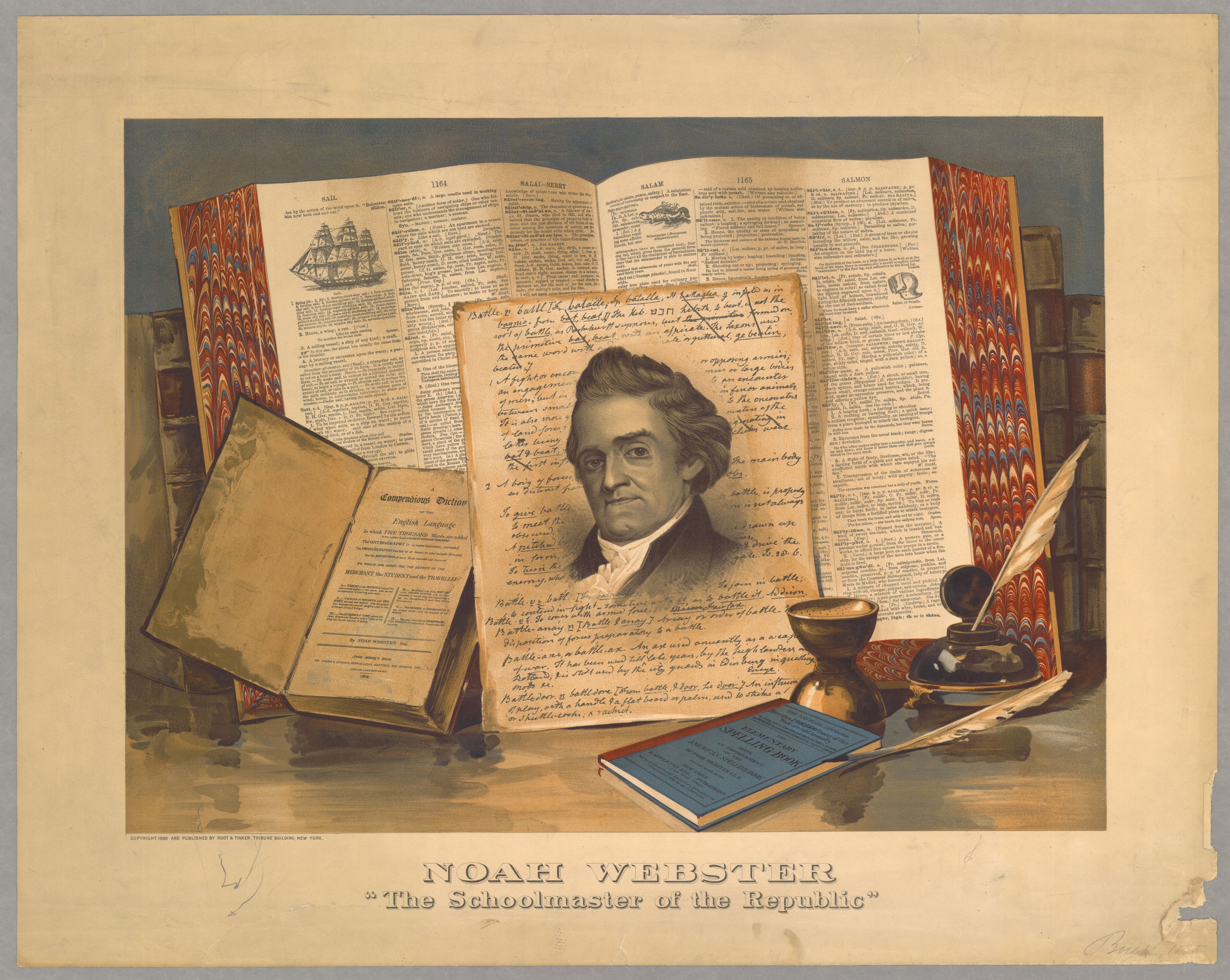
“Noah Webster and the Creation of an American Culture”
By Joshua C. Kendall
Noah Webster was not only America’s greatest lexicographer; he was also a Founding Father who helped define American culture. His obsession with words, which helped a high-strung genius live an amazingly vibrant life, ended up giving America a language of its own. This talk is based on Kendall’s new book, The Forgotten Founding Father: Noah Webster’s Obsession and the Creation of an American Culture.
Thursday, May 12
“Liberty and Justice for All: The Civil War as Blacks’ Second American Revolution”
By James O. and Lois E. Horton
During the increasingly militant 1850s, African Americans formed unofficial militias to prepare themselves for an anticipated conflict over their liberty. In this lecture, James O. and Lois E. Horton will explore how African Americans’ militia and military service shaped the Civil War as a war for freedom, turned the tide of the war, and helped to fulfill the promise of the American Revolution.
Tuesday, May 24
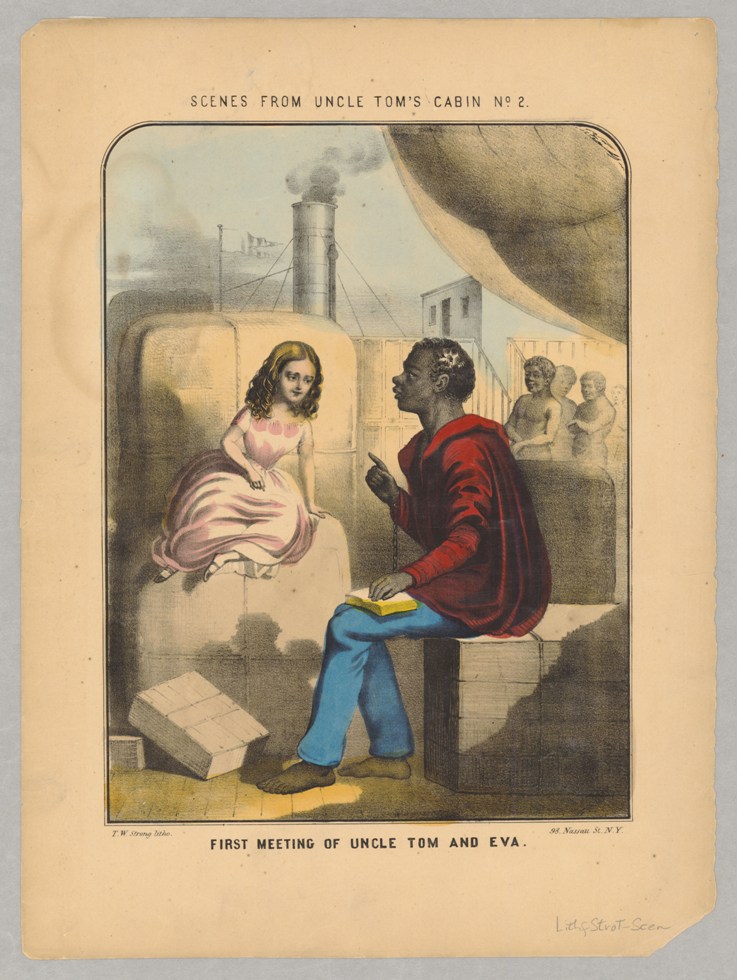
“Igniting the War: Harriet Beecher Stowe’s Uncle Tom’s Cabin, Antislavery Politics, and the Rise of Lincoln”
By David S. Reynolds
Twenty-eighth Annual James Russell Wiggins Lecture in the Program in the History of the Book in American Culture
No book in American history molded public opinion more powerfully than Uncle Tom’s Cabin. David S. Reynolds will describe how Stowe’s novel shaped the political scene by making the North, formerly largely hostile to the antislavery reform, far more open to it than it had been. The novel and its dissemination in plays, essays, reviews, and the tie-in merchandise directly paved the way for the public’s openness to an antislavery candidate like Lincoln. Simultaneously, it stiffened the South’s resolve to defend slavery and demonize the North. Uncle Tom’s Cabin thus ratcheted up the political tensions that led to the war that ended slavery.
Thursday, June 2
“American Love Story: Abigail and John”
By Joseph J. Ellis
The friendship and love of John and Abigail Adams is contained in the letters they left behind, nearly twelve thousand of which still exist today. Based on his latest book, First Family: Abigail and John Adams, Ellis will draw upon these sources to explore the combination of commitment, honesty, and loyalty that made John and Abigail’s marriage a success and played a significant role in the triumph of the Revolution and the early government.
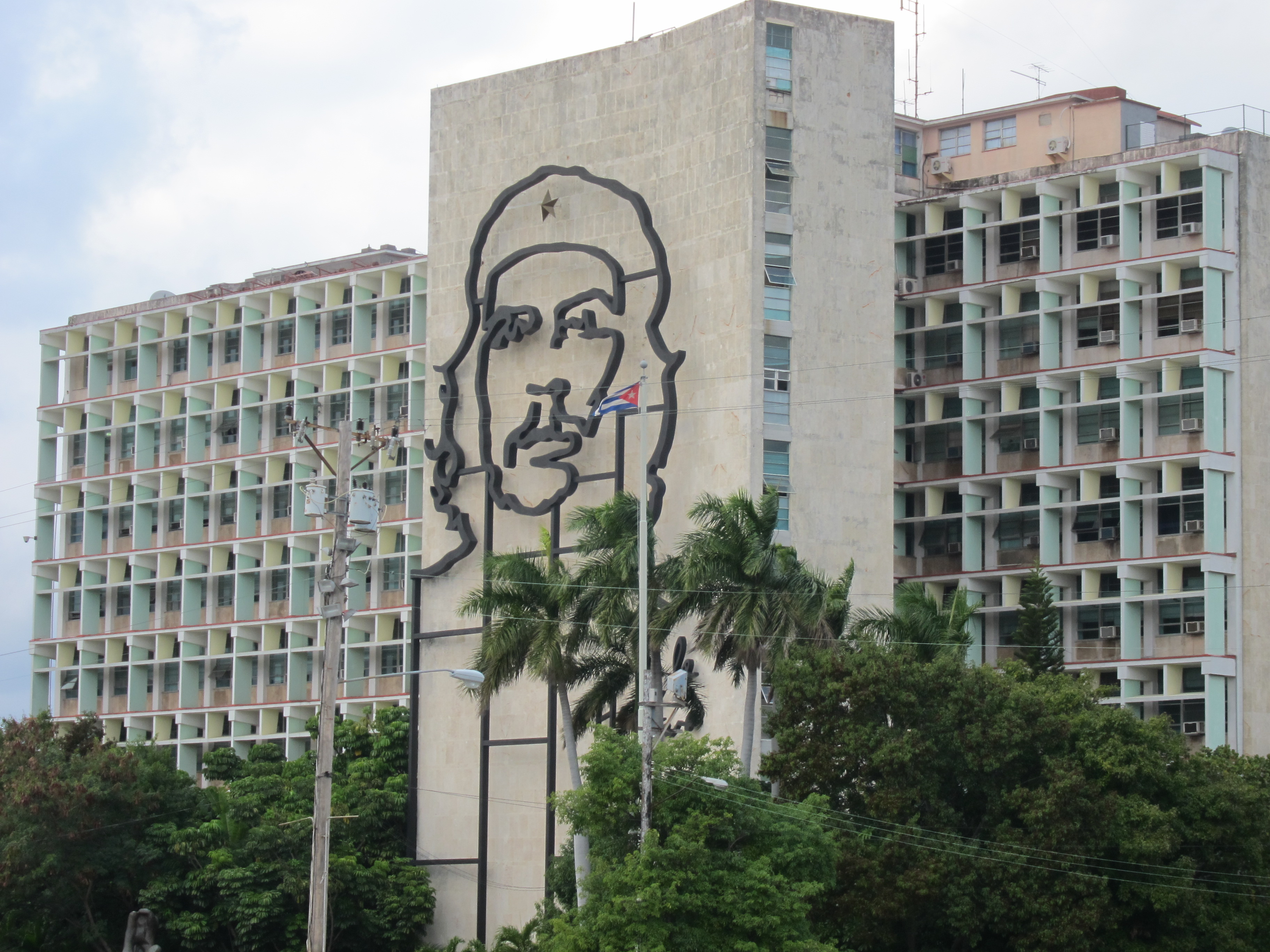
Ministry of the Interior building in Havana with giant steel image of Che Guevara, 2011
Here is a link to a short piece I recently wrote about a trip to Cuba in January sponsored by the Massachusetts Foundation for the Humanities. The piece appeared in Mass Humanities’ blog The Public Humanist. My excuse for mentioning it on this blog is the fact that 9 of the 21 people on the trip were members of AAS. That is a remarkable number given that only 287 of AAS’s 953 members are Massachusetts residents and that the state’s population is about 6.5 million.
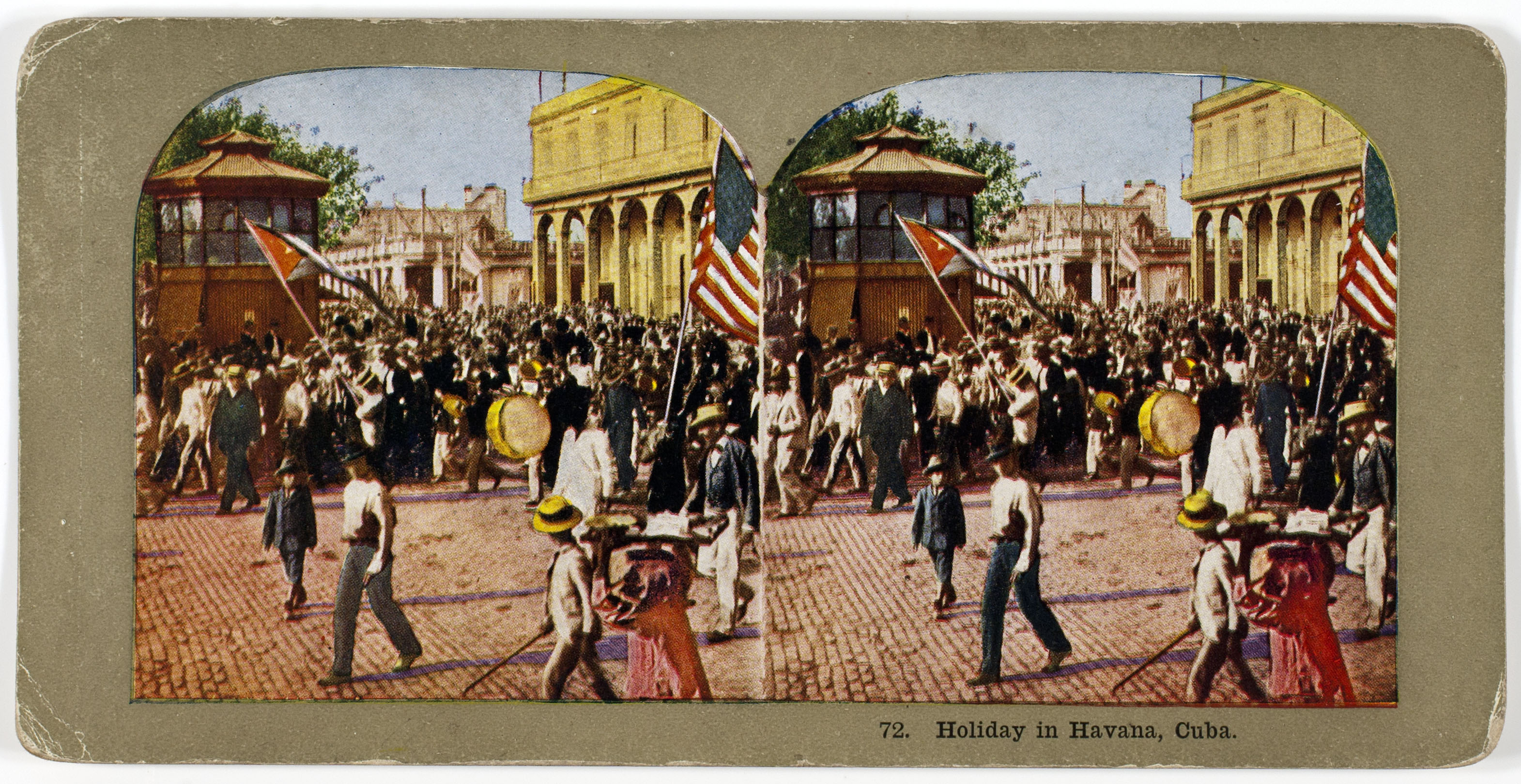
"Holiday in Havana, Cuba," late nineteenth-century view from the AAS Stereograph Collection
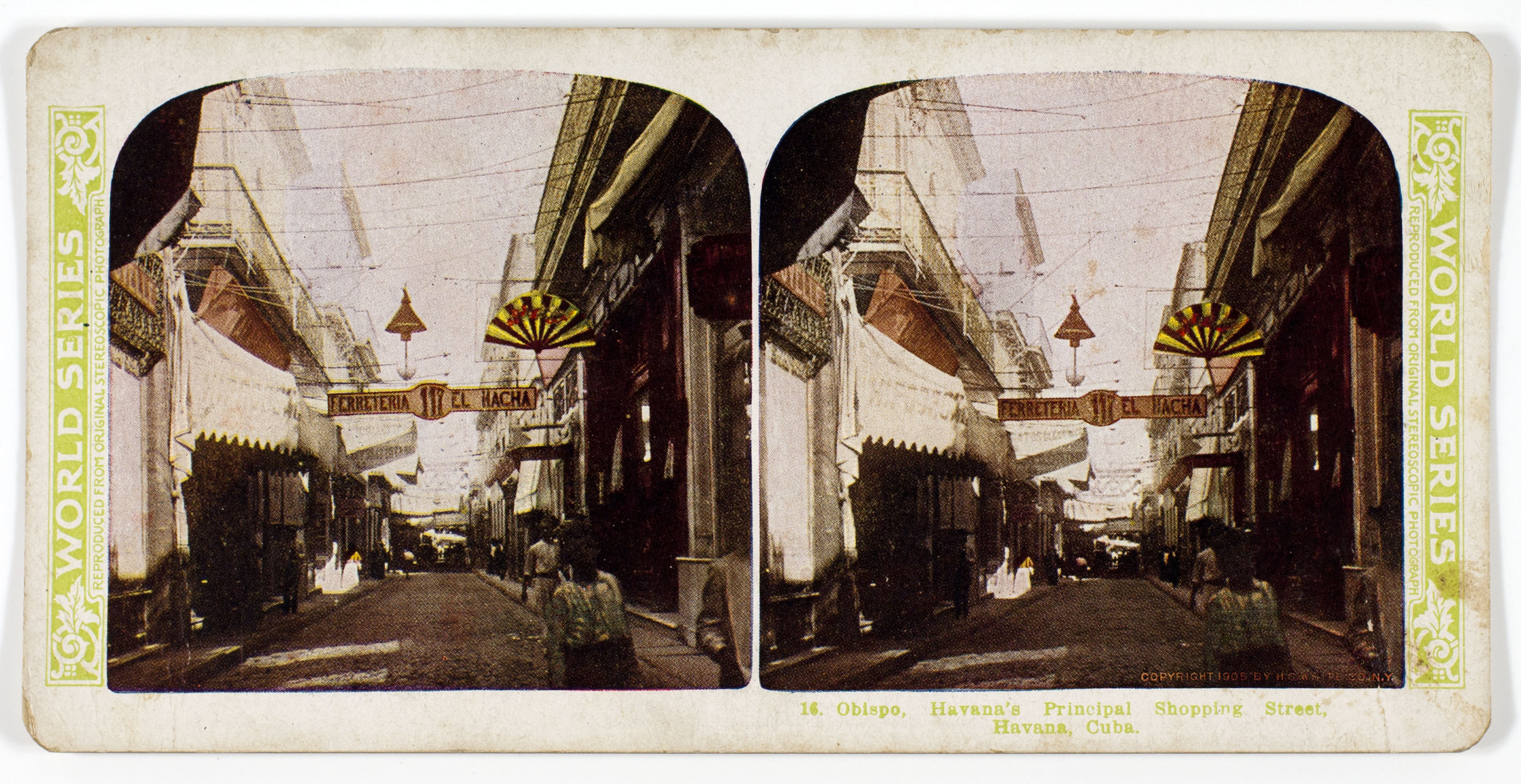
The trip to Cuba also provides an opportunity to mention a part of AAS collections that is not well-known. While AAS may not be the first place you think of when doing research on Cuba, we actually have an impressive amount of material about the island. An earlier post on Past is Present mentioned our recent acquisition of a wonderful collection of early Cuban newspapers, but there’s more Cuban material to be found at AAS by searching our two main online resources:
AAS online catalog: Searching for Cuba results in almost 400 records. Limit your search by type of item (i.e. manuscripts, serials, or graphic arts) or by date to winnow down your results.
AAS website: Searching here will help you locate material listed in graphic arts inventories, lists of newspapers recently acquired, and manuscript collection finding aids. These additional online resources list items not necessarily in the AAS online catalog yet (although we’re working on it!). A search of the AAS website yields a few dozen hits from other collections with Cuba material.
While not all of us can travel to present-day Cuba, AAS always provides the opportunity to travel to Cuba’s past.
A late nineteenth-century stereograph of Obispo, Havana's main shopping street from the AAS Stereograph Collection
Luckily, the American Antiquarian Society does not collect in all areas of human condition and experience.
An example of such an area?
Internal organs.
What we do have, however, is a rich collection around this object of study. And whereas February was American Heart Month, an opportunity in the calendar year to focus on the well-being of what we refer to colloquially as the ticker, we thought it fitting to extract some pieces from the collection to showcase how nineteenth-century Americans valued and studied this vital organ.
Each image in the virtual exhibit below can be clicked on to enlarge for closer examination.
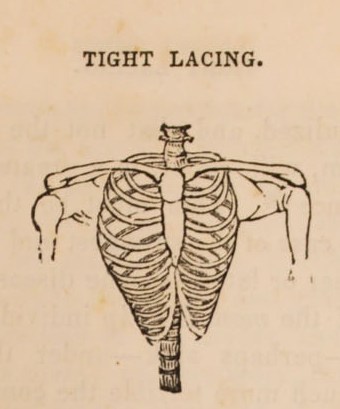
Health-related publications are an area well represented in the library. Soon after its first appearance on the American fashion scene, the now notorious corset was suspected as having less-than-beneficial side effects on the female body. This illustration inside Dr. William Alcott’s health tract Tight Lacing published in 1841, shows the deformation of the chest cavity resulting from wearing the garment. The author also devotes a section to injuries of the heart which resulted by practicing the style.
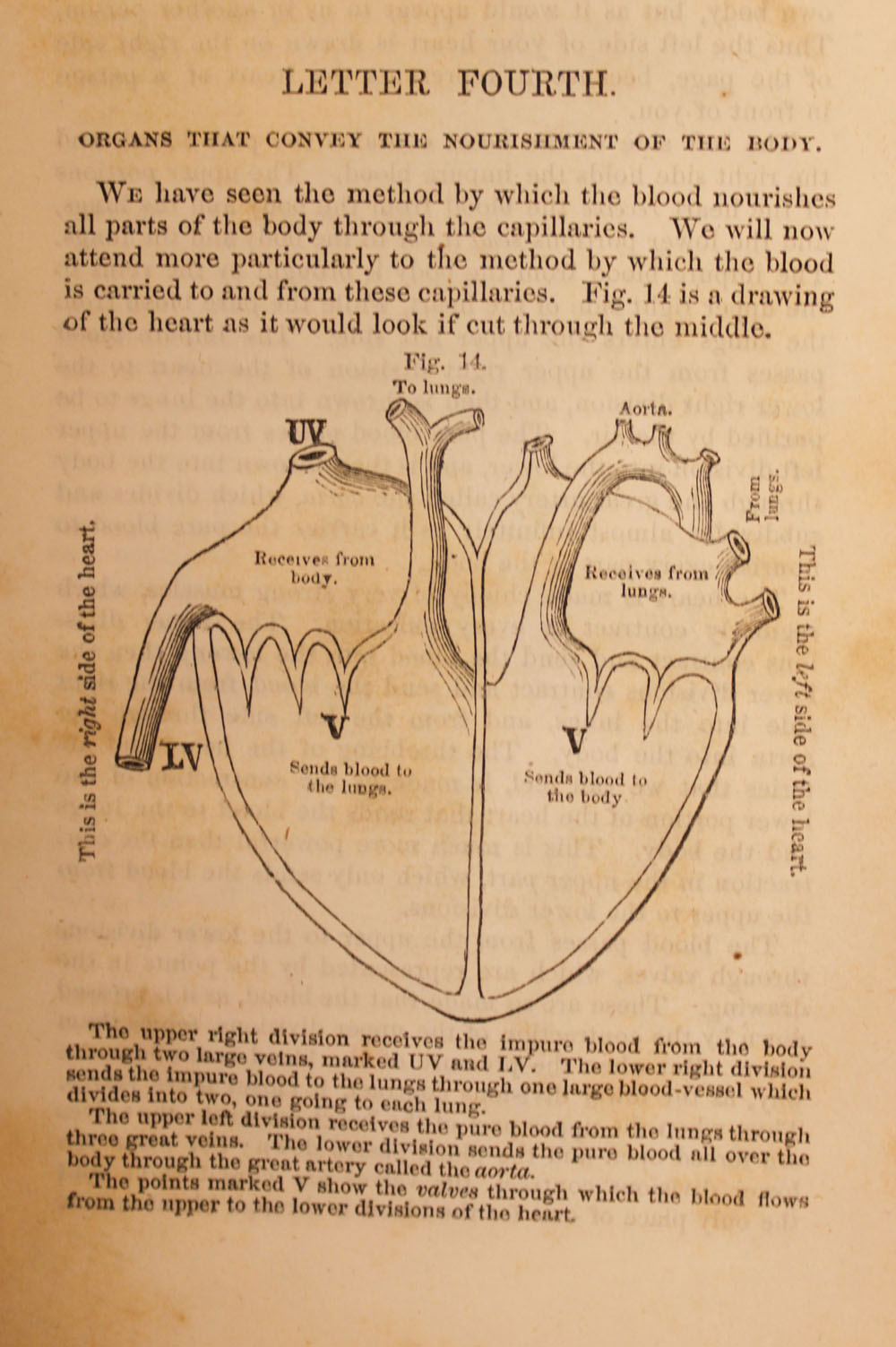
Publications such as home companions and health manuals proliferated during the era, since much health monitoring and hygiene fell under the purview of the domestic space. Catharine Beecher (1800-1878), the writer and innovative educator, penned Letters to the People on Health and Happiness in 1855. It is a more-or-less epistolary style piece which discusses laws of health, the functions of organs of the body as well as remedies and how they are created. Women, as keepers of the health of the home, would find these books central as reference material.
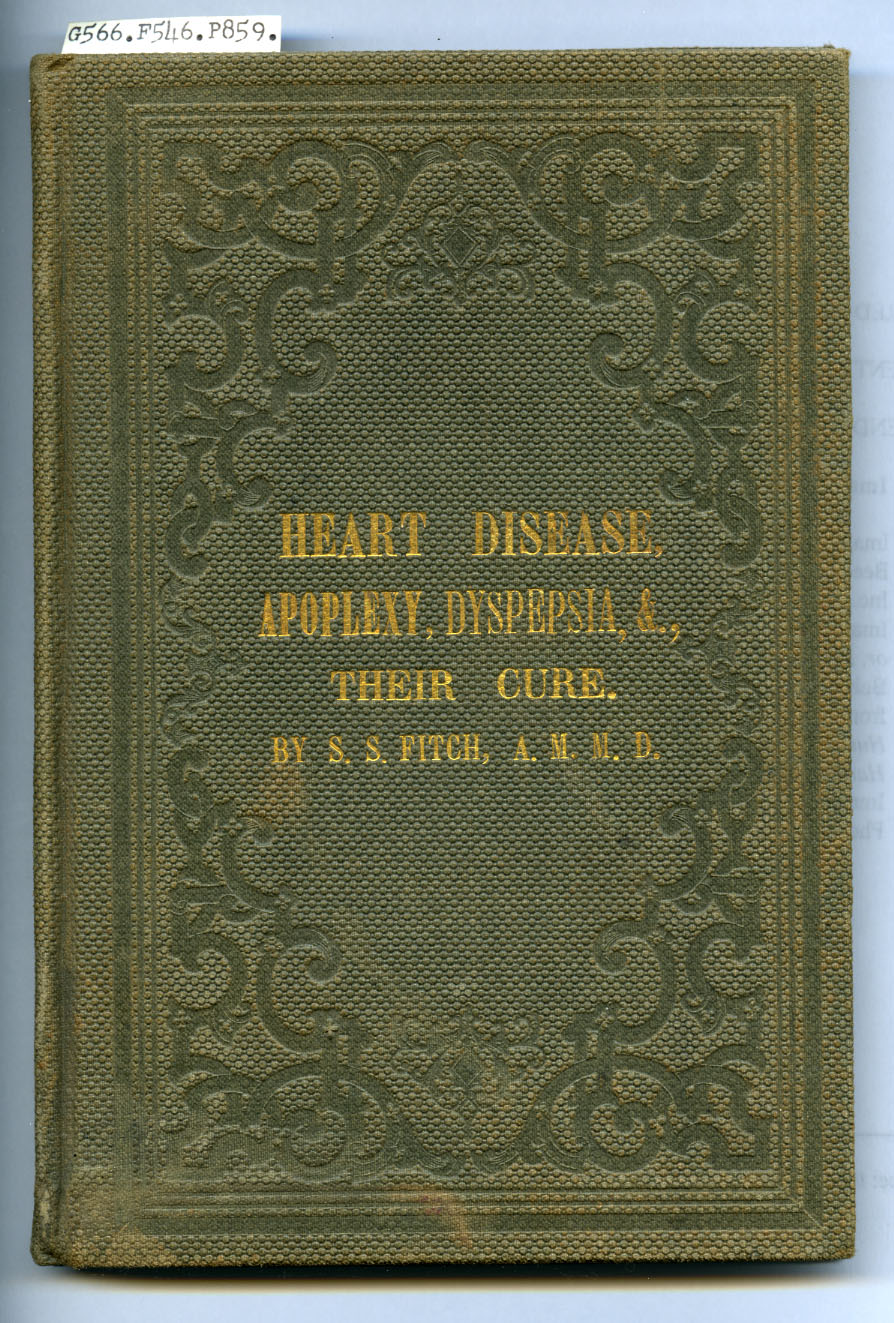
As well as magazines and home manuals, AAS also has examples of medical companions and the published form of delivered anatomical lectures. This example from A Popular Treatise on Diseases of the Heart published in 1859 by Samuel Sheldon Fitch (1801-1876) features illustrations of the structures of the heart and discusses ailments of the organ. Fitch also edited a periodical for general use called The Medical Exponent and Gazette of Health – the aim of both publications being the spread of popular medicine.
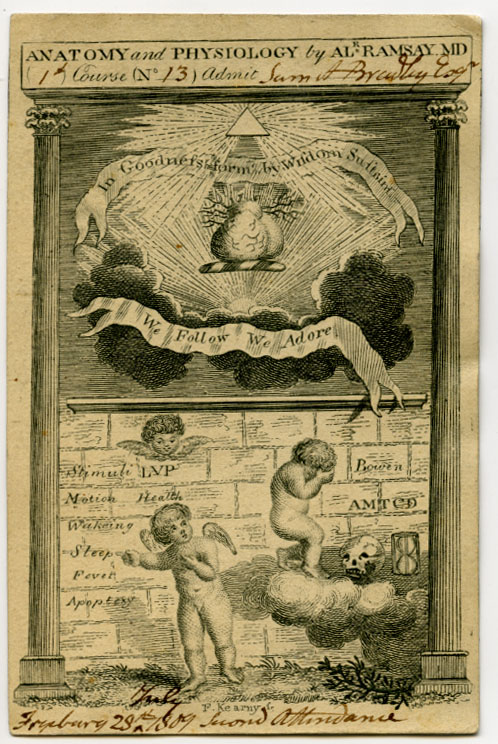
Anyone who has experience with the Society’s holdings knows of its vast graphic arts and ephemera collections. In the tickets collection, we have examples for anatomical lectures engraved with images of the heart. The item featured here is to see Doctor Alexander Ramsay (ca. 1754-1824); AAS also has several of Dr. Ramsay’s prospectuses for the lecture series. The ticket here is by engraver Francis Kearny (1785-1837) dated 1809 which granted its holder, Samuel A. Bradley Esquire, admission to “Anatomy and Physiology or the 1st Course No. 13” which likely included a live dissection of a cadaver.
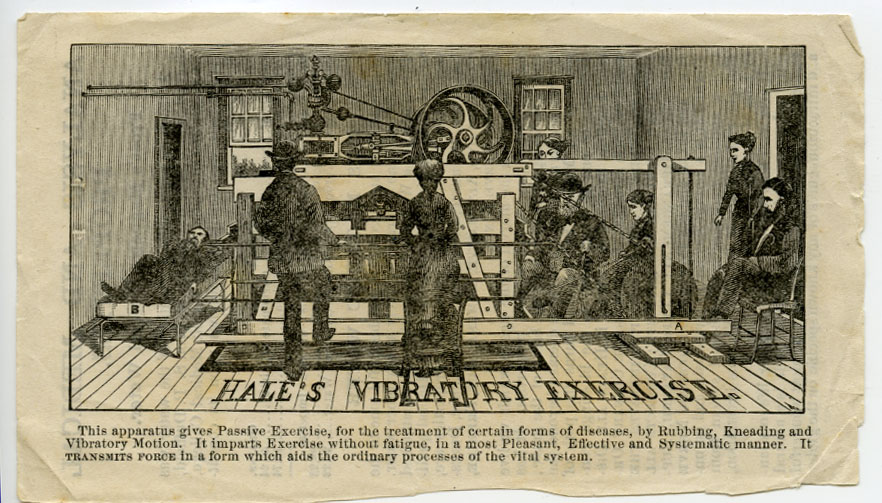
Other ephemera items include trade cards for bitters and other medical aids. Diet, exercise, and stress were quickly discovered to be culprits for ill heart-health, which gave advertisers a profitable stage to promote their goods. Machines such as “Hale’s Vibratory Exercise” featured on this trade card from circa 1870, promised to give “Passive Exercise” for the treatment of disease. (Many of AAS’s trade cards are available digitally through the Readex product, American Broadsides and Ephemera, which is available in the AAS reading room.)
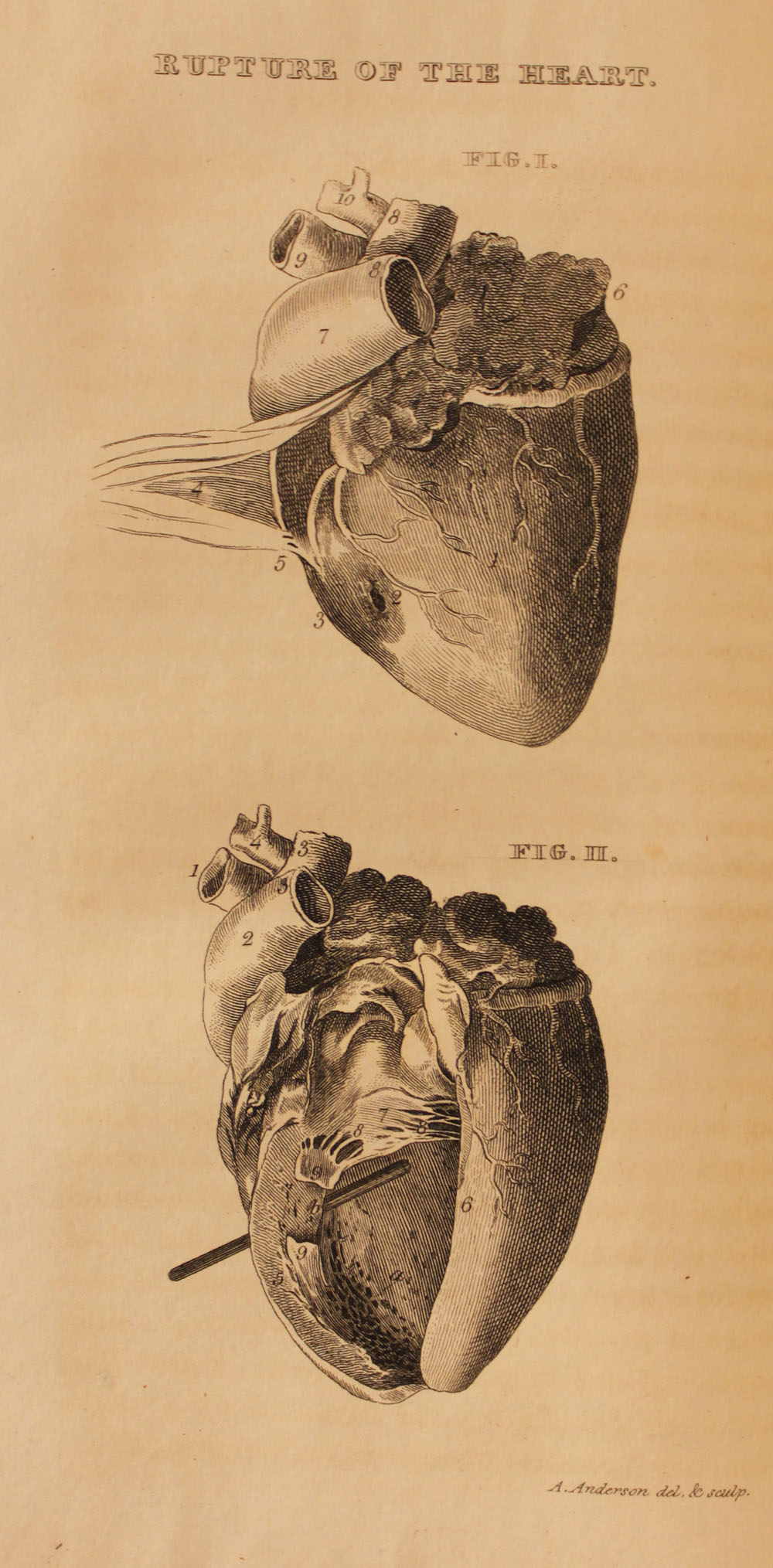
In addition to manuals and ephemera, AAS also has texts where the intended audience was the medical establishment and community. Frequently, these were illustrated. One such example is this engraving by prominent American artist Alexander Anderson (1775-1870) which shows the “Rupture of the Heart” a piece which appeared inside The Physico-Medical Society of New York Transactions published in New York in 1817. Anderson’s engraving appeared at the end of the piece “A Case of Sudden Death from a Rupture of the Left Ventricle of the Heart, with remarks” by Valentine Mott, M.D. read before his colleagues; it is constructed similarly to our contemporary medical journals.
The objects featured here demonstrate that although it was not instituted until 1963 as American Heart Month, the heart nonetheless has remained vital in national mind, print – and, yes, heart. Each of the items discussed here are currently on display in the exhibit case in the AAS reading room. Since we got a late start celebrating American Heart Month, the exhibit will remain up in the reading room through March. If you are in the area and are interested in viewing these pieces, feel free to stop in for our public tour offered every Wednesday at 3pm to see them in person.
Fraud Week on Past is Present concludes today on an appropriately ambiguous note with examples from AAS’s graphic arts collections, most of which are not true forgeries but rather what might be called wishful attributions. These works of art hover perpetually in “the limbo of doubtful pictures,” to quote an earlier AAS librarian. In honor of the collaborative nature of scholarship at AAS, this post is presented in three part harmony.
I. From Jackie Penny, Imaging Rights Coordinator:
Objects fated for the AAS Council Room are typically invested with much prestige. Currently on exhibit is the large collection of Staffordshire Pottery, given to the Society by Emma Deforest Morse in 1913. Also on display is the John Hancock desk and clock, the Isaiah Thomas tea service, a bottle of tea leaves collected after the Boston Tea party, the Mather Family highchair…
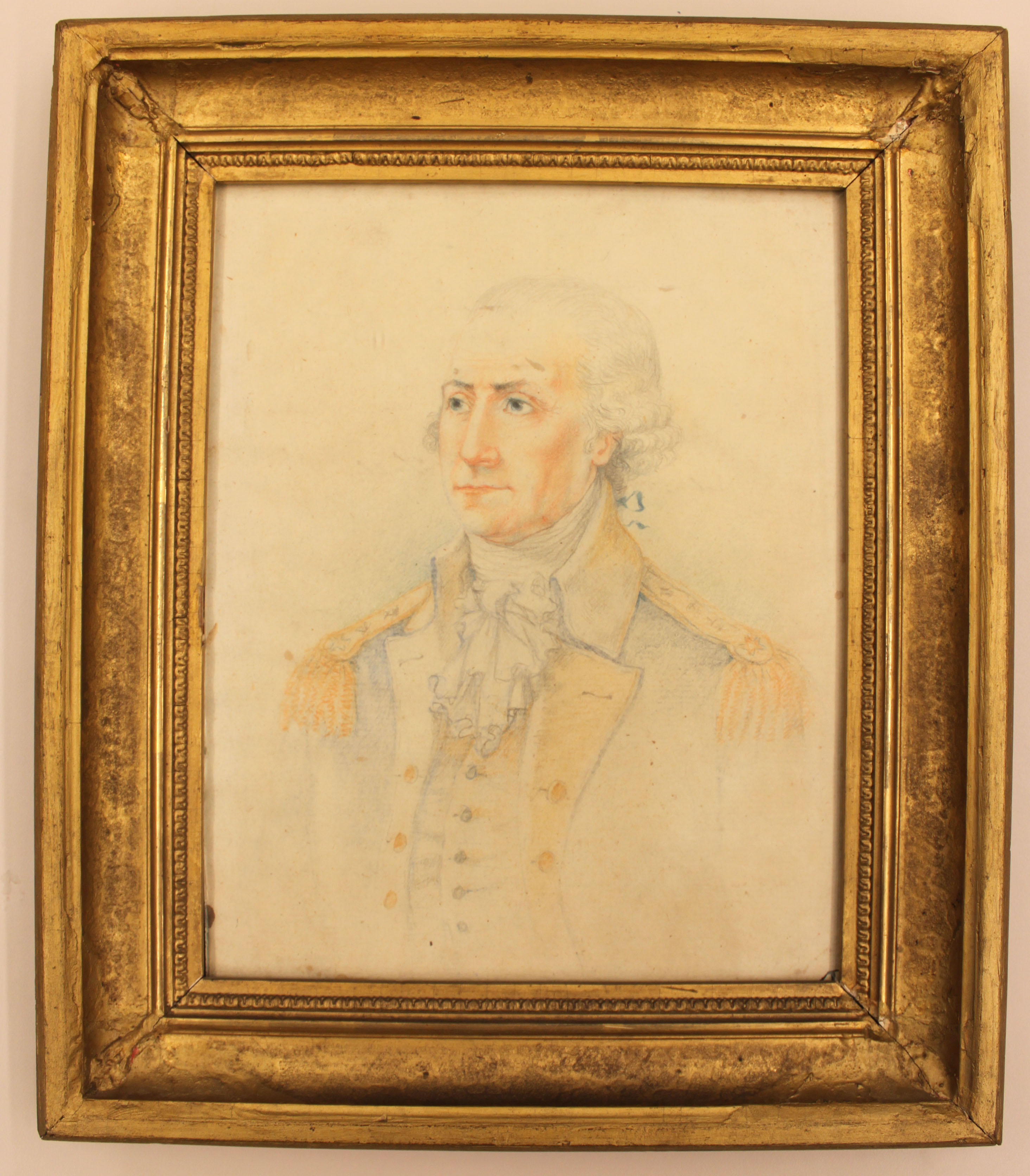
In other words – historically powerful objects. So when a crayon and pencil portrait of George Washington in General’s uniform by famous portrait painter Thomas Sully (1783-1872) was given to the Society in 1932 it was slated for Council Room display as well.
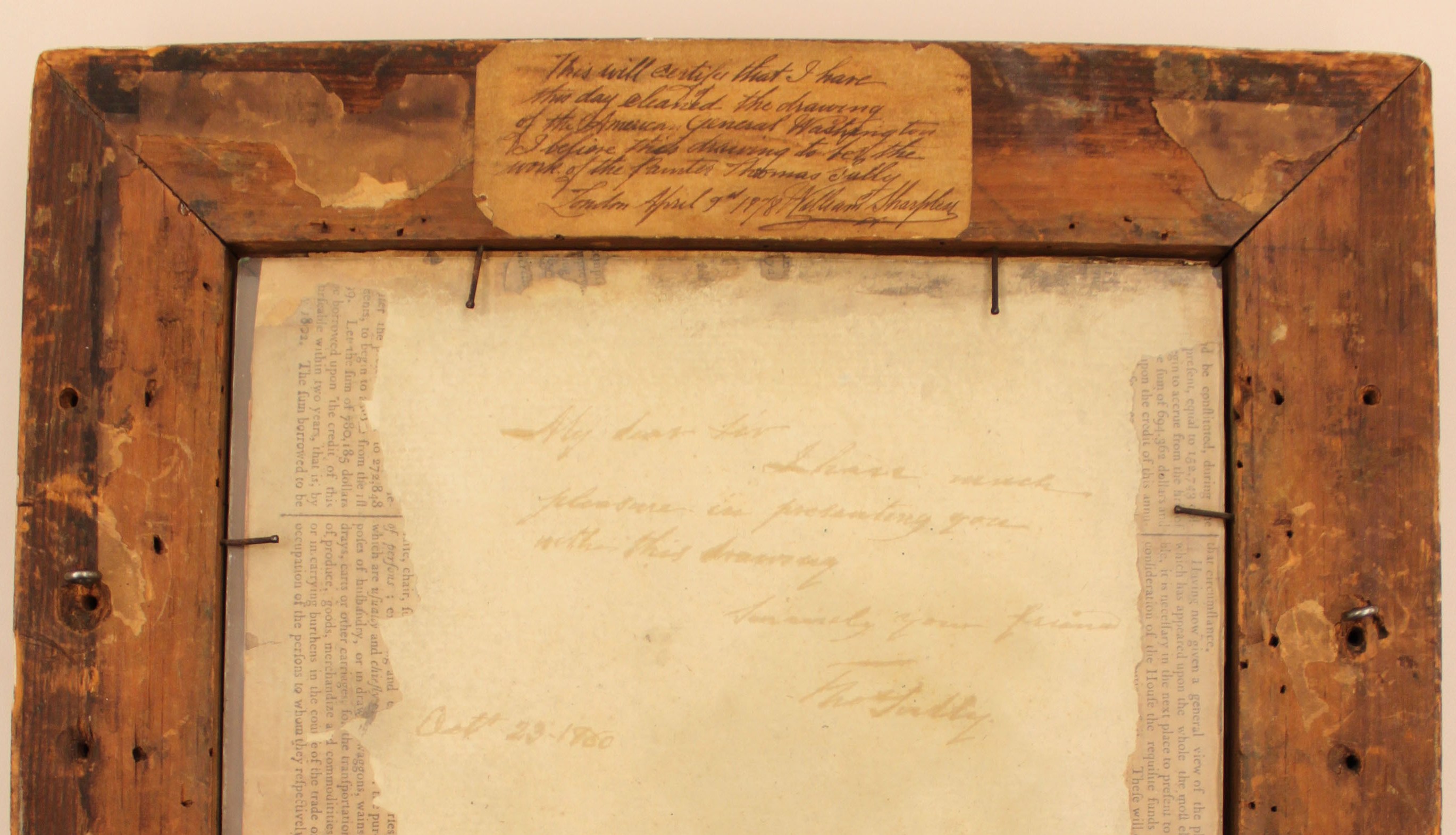
Figure 1 (front): Portrait of George WashingtonFigure 1 (back): The supposed Sully signature and authentication on reverse
This framed bust portrait of the former President [Figure 1] has a manuscript annotation on the reverse that reads: “My dear Sir I have much pleasure in presenting you with this drawing” and is signed “Sincerely your friend Tho[mas] Sully. Oct 23 1860.”
Mounted on the frame itself is an additional manuscript annotation: “This will certifies that I have this day cleaned the drawing of the American General Washington I believe this drawing to be the work of the painter Thomas Sully London April 9th 1878 William Sharpless.”
It was an exciting addition to rather small fine arts collection of the library…
…that is, until it was deemed a forgery, stripped of its designation and banished from the Council Room.
Sully’s signature featured here on the reverse of the framed Washington portrait, was deemed a forgery by John Hill Morgan (1870-1945) two years after it was presented to AAS in 1932. Hill determined the forger was “Doc” Shepard (also known as George J. Shepard OR Ferdinand Danton OR John J. Hughes – a man with many alias names). Morgan uncovered material regarding Shepard as well as other Washington Portraits sold as forgeries in the 1920s and 30s; the resulting collection “John Hill Morgan research files, 1922-1944” is currently at the Frick Art Reference Library.
II. From Lauren Hewes, Andrew W. Mellon Curator of Graphic Arts:
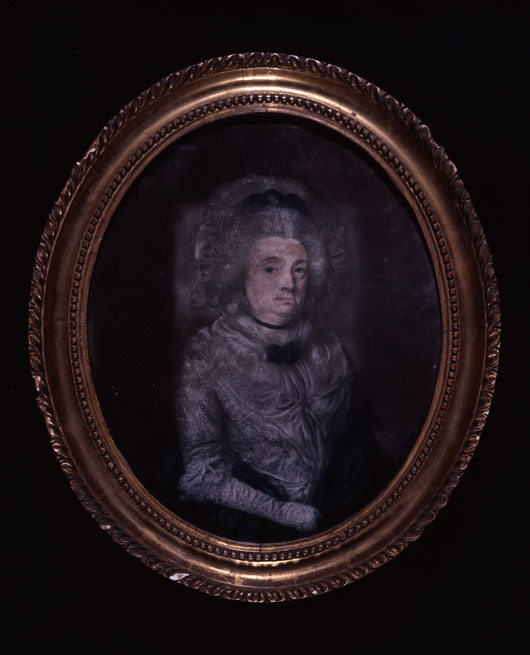
Figure 2: Portrait of unknown woman
Continuing in the Washington theme, this portrait [Figure 2] was once thought to depict Martha Washington (1731-1802). The portrait has been the subject of much scrutiny since its arrival at the American Antiquarian Society in 1943 since a twentieth-century inscription on the reverse reads ‘Martha Washington, 1787,’ but there is little other evidence to support this identification of the older woman. We do know the previous owners often traveled abroad, which suggests that the pastel may be of European origin. AAS Director Clarence Brigham wrote in 1943:
“[I]t may be of a European lady by an English artist. It is well possible that Mrs. Lowell picked it up in an antique shop and someone penciled Martha Washington’s name on the back because it seemed a likely choice…. All we can do for now is to let the portrait stay in the limbo of doubtful pictures and hope for an eventual solution.”
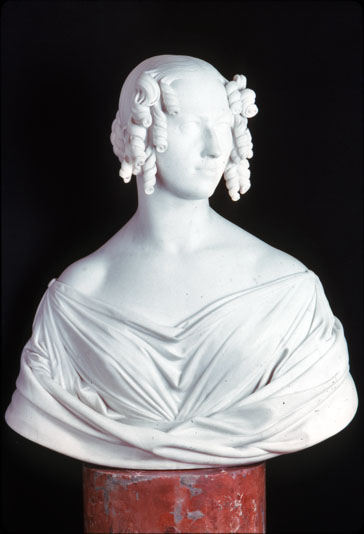
Figure 3: Sculpture of an unknown woman
Similarly, the identity of the subject of this bust [Figure 3] has been in doubt from the time it was acquired on behalf of the American Antiquarian Society in 1881. In that year’s Proceedings, Librarian Edmund T. Barton requested assistance from the members to help identify the subject:
“Attention is called to a marble bust lately received by Mr. Salisbury Jr., from New York, and your judgment requested both as to the sculptor and subject. It was found in a Spanish drugstore, which had previously been used by a marble worker, and represents a lady, probably of the early part of the nineteenth century. Nothing more is known of its history.”
In 1884 the possibility that the bust depicted the writer Lydia Huntley Sigourney (1791-1865) was put forward but was disputed by friends who had known the author in Connecticut. The following year a photograph of the bust was sent to Sigourney’s daughter, Mrs. Francis T. Russell, whose husband responded: “The bust is not of Mrs. Sigourney, we are sure of that.” The elegant sitter, with her carefully coiffed hair and fashionable gown, remains unidentified.
There is, of course, a difference between the outright deceit of a forgery and these examples of wishful thinking. The gaps in history, when information is lacking, often cause people to “fill in” information to create a new reality — one that often reflects modern taste more that the reality of the information that the object presents. When looking at the first woman’s portrait in 1943 they probably thought: it must be Martha — who else could it possibly be? And looking at the bust in 1880, it should be Sigourney — after all, it’s in a prestigious research library now. Sometimes it is better to just honestly say, “we don’t know.” Leave the gaps alone and maybe eventually someone will come along and fill them up!
(You can try your hand at helping us fill in those gaps by examining images of these and other unidentified portraits at the end of the list of sitters in the Society’s illustrated inventory of portraits.)
III. From Elizabeth Watts Pope, Head of Readers’ Service:
To carry on from Lauren’s line of reasoning above, why is it that no matter how lovely a work of art is in its own right, it seems to be human nature to want to dress it up with a famous name? Certainly, one answer is monetary valuation, and the associated values of historical significance and artist merit. Yet the work of art doesn’t change even if you find out it wasn’t done by a famous artist. So why this persistent push to try to connect art to famous people?
Another reason may be because a famous artist or subject gives us a point of contact, a way to connect to a historical artifact. It can help to make history seem somehow less distant and more comprehensible. After all, how can I hold in my head the infinite variation of images from the daily lives of all the eighteenth and nineteenth century women who were washing dishes and reading to their children and dressing up in their finest clothes? But if I think of an eighteenth-century woman and picture Martha Washington, or a nineteenth-century woman and see Lydia Sigourney, that gives me a discrete and understandable package to put my historical ideas into.
Here at AAS, though, we aim to bust open those narrow frames. We don’t want to just talk about famous people or valuable art. The American Antiquarian Society has always collected as indiscriminately as possible (within the scope of our collection). Here you will find the fakes, the unknowns, and the copies identified as such and sitting on the shelf alongside the famous and the first editions.
IV? There’s room for your voice too!
We hope you have enjoyed this week of posts exploring this underside of the archival world, and we would love to hear your thoughts on the implications of fraud in history. Hopefully we have armed you with some tools so you can be on the look out for forgeries, funny money, pirated copies, and falsely-identified works of art. Let us know what you find!
If we’re to believe iconic popular culture films like Christian Slater’s 1990 Pump Up the Volume, media and information pirates act as heroic rebels fighting an overbearing FCC and even more overbearing parents. If we’re to believe historians like Adrian Johns, author of the recently published Piracy and Death of a Pirate, piracy has fostered multiple creative communities far more vital than large corporate entities. If we’re to believe novelists like William Gaddis, author of the 1994 novel A Frolic of His Own, neither piracy nor copyright law have any relevance when it comes to authorial originality and adjudicating copyright infringement claims. And if we’re to believe early Americans like Noah Webster, copyright was essential for protecting American identity and nationality against pirate re-printers. As we enter the fourth day of our archival Shark Week (or Fraud Week, as we have dubbed ours) the topic is—you guessed it—piracy, a serious menace of the literary seas.
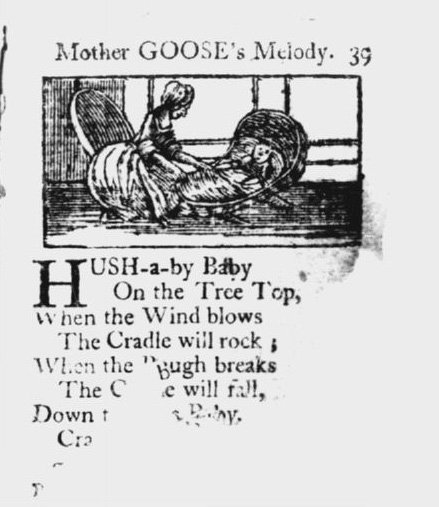
From Isaiah Thomas\’s 1785 edition of Mother Goose
Throughout the eighteenth and nineteenth centuries in North America, literary piracy most often took the form of reprinting copyrighted British works. Before 1790 the U.S. had no copyright law of its own, and the 1709/1710 British copyright law had never applied to British colonies. Such a lack of restrictions allowed printers like AAS founder Isaiah Thomas to reprint exactly such popular works as John Newbery’s original children’s books, including the rare Mother Goose’s Melody (1785).
By the time copyright was made federal law in 1790, thanks to the likes of Noah Webster, pirate reprinting of British works had become common practice. Printers like Mathew Carey, whose account books are in the AAS manuscript collection of Mathew Carey Papers, were famous for reprinting popular British works of literature. Since the 1790 copyright law applied only to U.S. citizens and residents, British authors were generally not protected by American copyright. Printers like Carey took full advantage of lax laws.
At the same time Thomas was reprinting Newbery, Noah Webster, schoolteacher and author of the Grammatical Institute of the English Language, fought to protect his own publications by copyright. Throughout the 1780s, Webster and others gained success in one state after another, but state copyright laws, like the states themselves, remained fragmented. Earlier copyright laws (like John Usher’s limited 1673 copyright) did not apply to American authors, and Webster wished for a copyright law that would cross state borders. When federal copyright went into effect and covered American citizens and residents, national copyright effectively coincided with Webster’s vision of a national language.
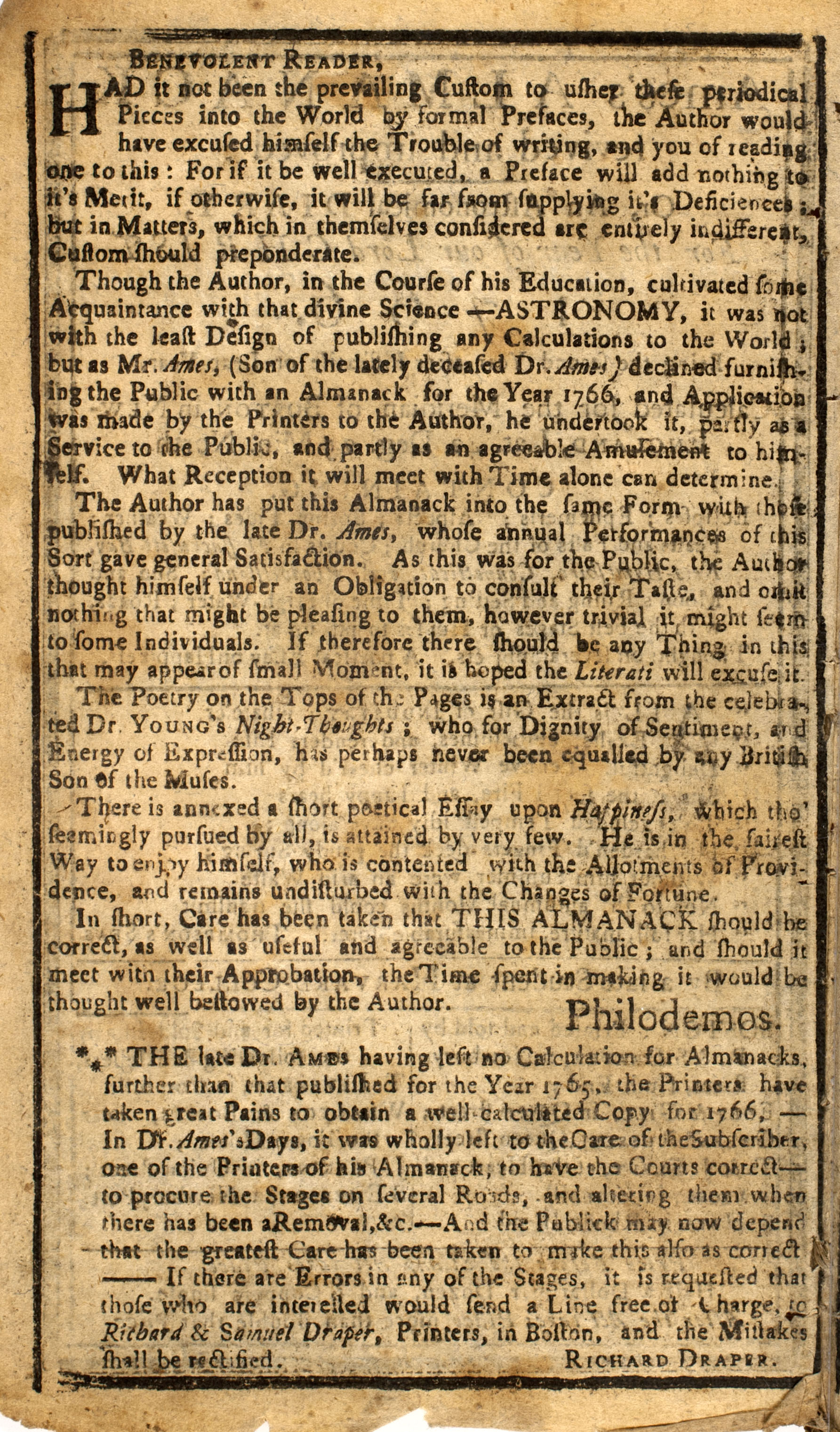
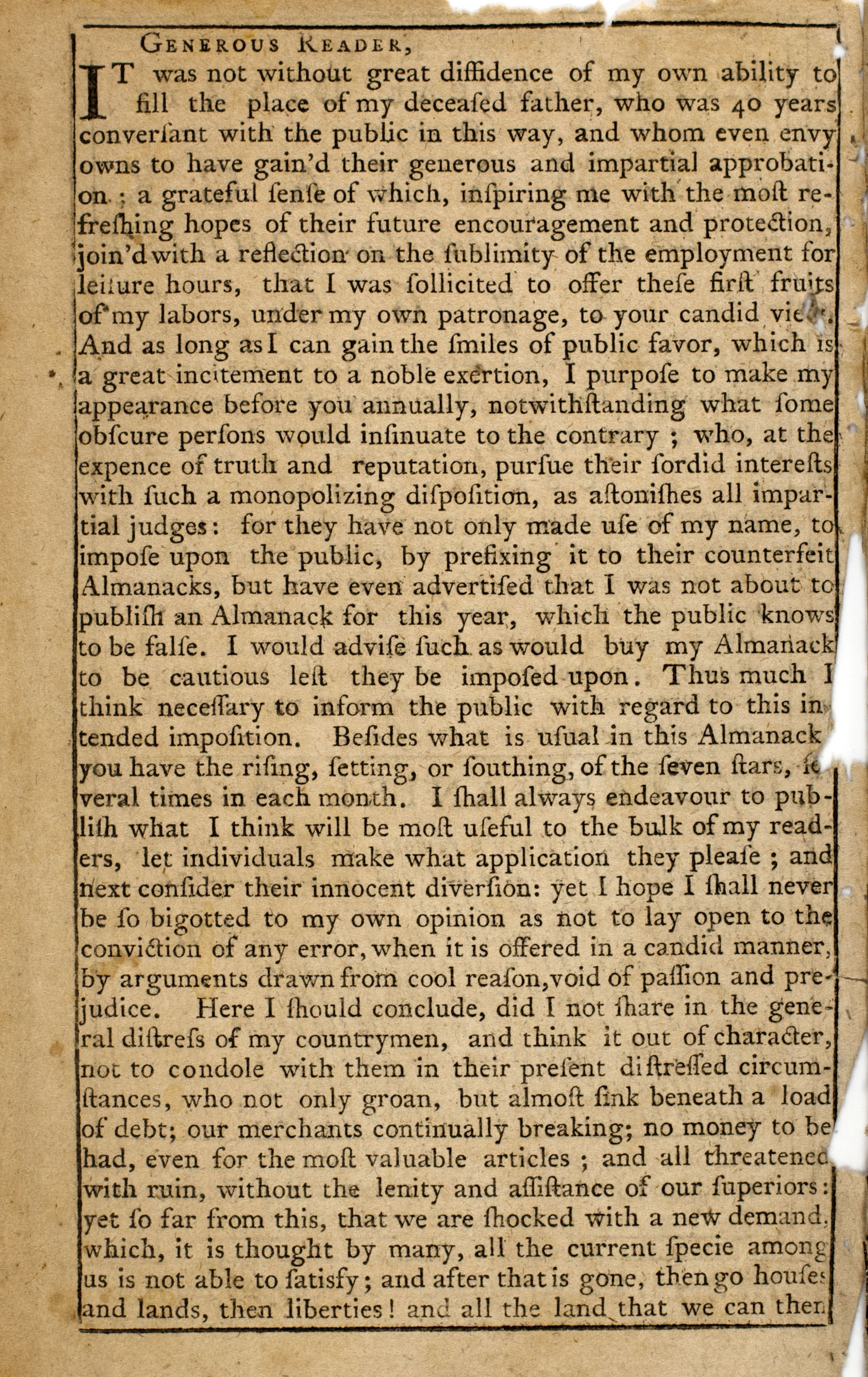
Click to enlarge and read John Willard’s justification for using Ames’s name on his almanacClick to enlarge and read Ames’s response
Throughout the eighteenth century, pirating of British American works on North American soil occurred frequently. One of the more well-known “pirated” items at AAS, and an example of this very kind of unauthorized copying, is a 1766 Ames almanac. In 1765, John Willard, writing as Philodemos, published an almanac in Nathaniel Ames’s name. Declaring that Ames was not planning to publish an almanac for 1766, Willard most likely published under Ames’s name to profit quickly before the Stamp Act went into effect. Ames retaliated by writing in his preface to his 1766 almanac that Willard “made use of [his] name, to impose upon the public, by prefixing it to their counterfeit almanacks.” Even James Franklin, years before his brother Ben created his own authentic and original almanac, pirated a 1725 Bowen’s almanac.
At the height of battles over U.S. copyright in 1786, Philip Freneau, poet and newspaper editor, wrote a poem “Literary Importation.” Seemingly ashamed at Americans’ lack of creativity and inspiration, he satirically lamented American dependence on British learning:
If a college be planned,
‘Tis all at a stand
‘Till in Europe we send at a shameful expense,
To send us a book-worm to teach us some sense.
Copyright was the early American solution to the creativity gap. But with the new copyleft movement advocated by groups like Creative Commons, the future of American creativity and originality may very well be in the hands of those who embrace digital piracy and support limited or little copyright at all!
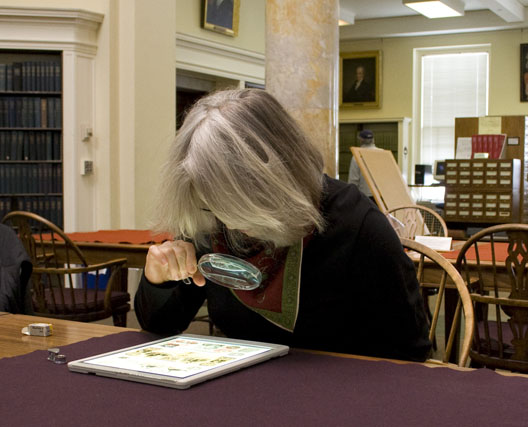
Deborah M. Child (www.deborahmchild.com) has been at AAS for the past month researching her upcoming book on Lyman Parks (1788-1872). Parks’ forged bank notes were so accomplished that even the experts could not tell his notes from legitimate currency. Part of Fraud Week on Past is Present, Deborah’s post below gives tips on how to identify counterfeit currency, starting with a bill that features our man-of-the-week, George Washington.
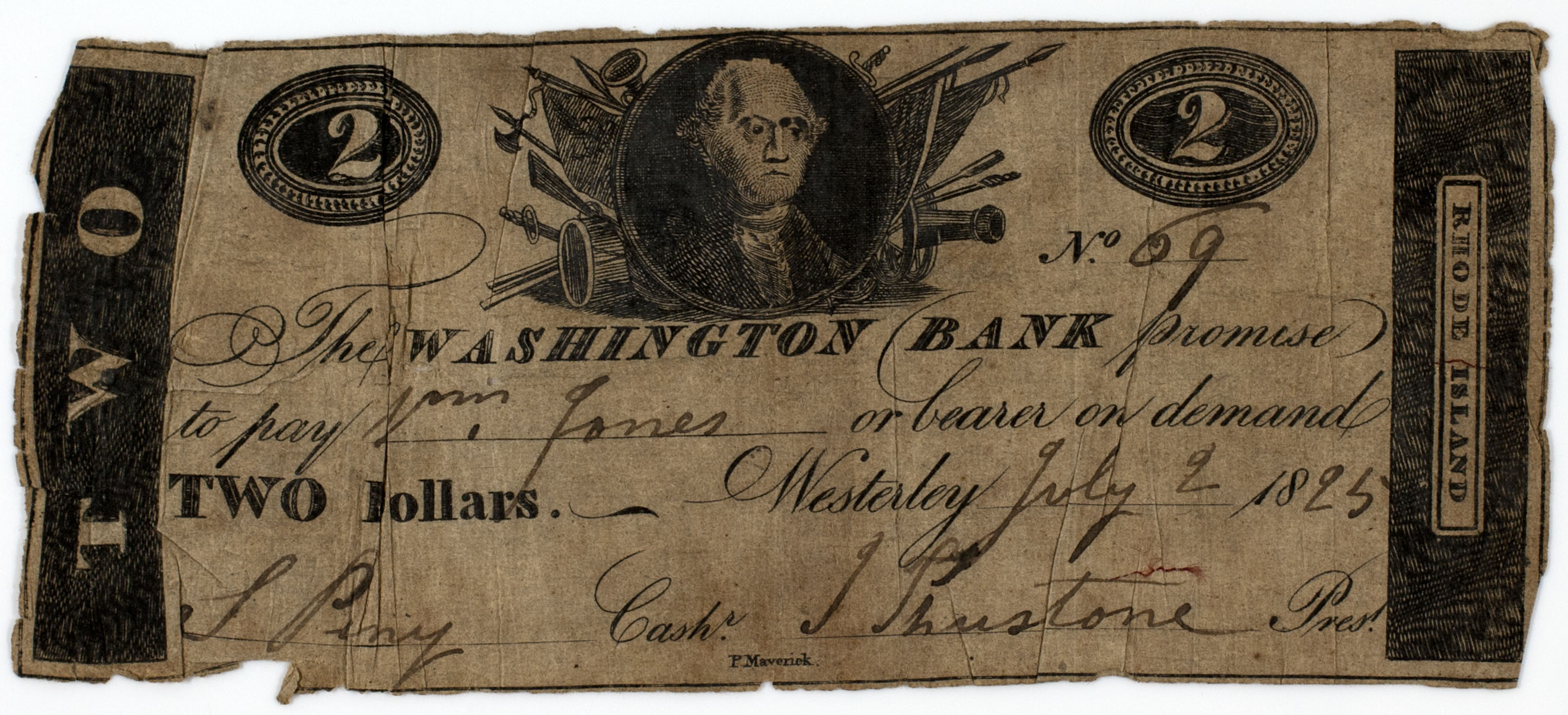
Gilbert Stuart’s bust portrait of George Washington continues to be a favorite subject for vignettes on American currency. Shown here [Fig. 1] is an example from the AAS currency collection. Figure 1 (click to enlarge): Two dollar bill purportedly from the Washington Bank in Westerly, RI This counterfeit bank note is an excellent illustration of what to look for when examining currency made before 1862 when the Federal Government began regulating the currency. Prior to that, each bank adopted its own distinctive design. Paper was not standardized and bank note plates were outsourced to private engravers. Internal control of currency was just as loosely maintained. Each note was individually numbered and then signed by the cashier and the bank president. Denominations for currency were not standardized either and could range from five and half cents to 10,000 dollars. All these variations provided a myriad of opportunities for the counterfeiters aka koniackers to ply their trade.
The first thing to consider when assessing whether a bank note is genuine is its textual content. Is the date inscribed on the note consistent with the dates of operation of the bank? Secondly, is it the correct plate design for that particular bank? Third, do the signatures look right? In this case [Fig. 1], the same hand clearly signed as the cashier and the president of the bank. The paper is equally suspect: it is thinner and darker than currency paper which has a whiter appearance and softness to it owing to the presence of silk rag.
The ink here [Fig. 1] is of a similar inferior quality having none of the glossy jet black qualities found in inks an engraver would painstakingly prepare. Note the amateur quality and uneven spacing of the numbers. Instead of the precise lines that are accomplished with the use of a geometrical lathe that a professionals engraver would use, the lattice work surrounding the currency numbers is crudely drawn by hand and off-center. The vignette featuring Washington’s face is similarly lacking and disappears into the paper.
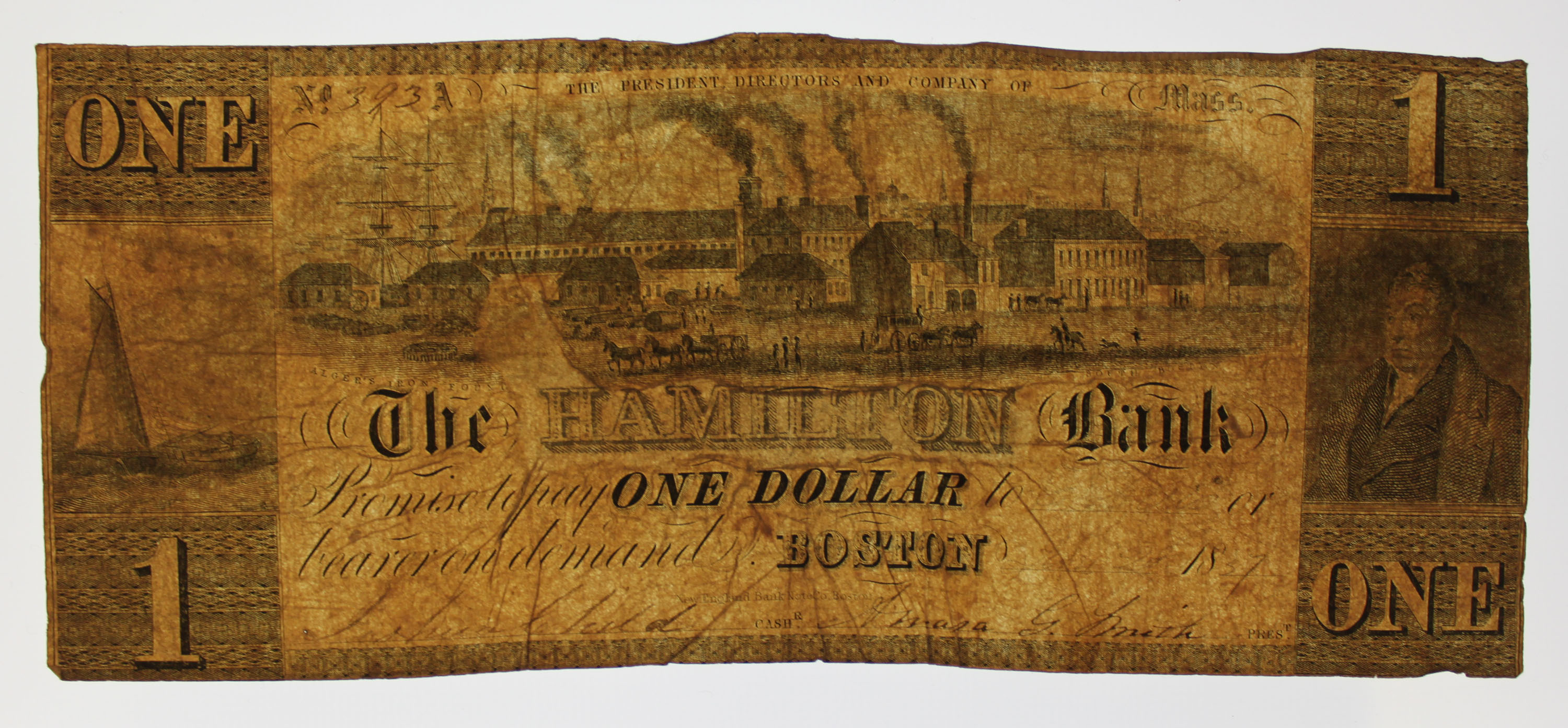
Figure 2 (click to enlarge): One dollar bill purportedly from the Hamilton Bank in Boston
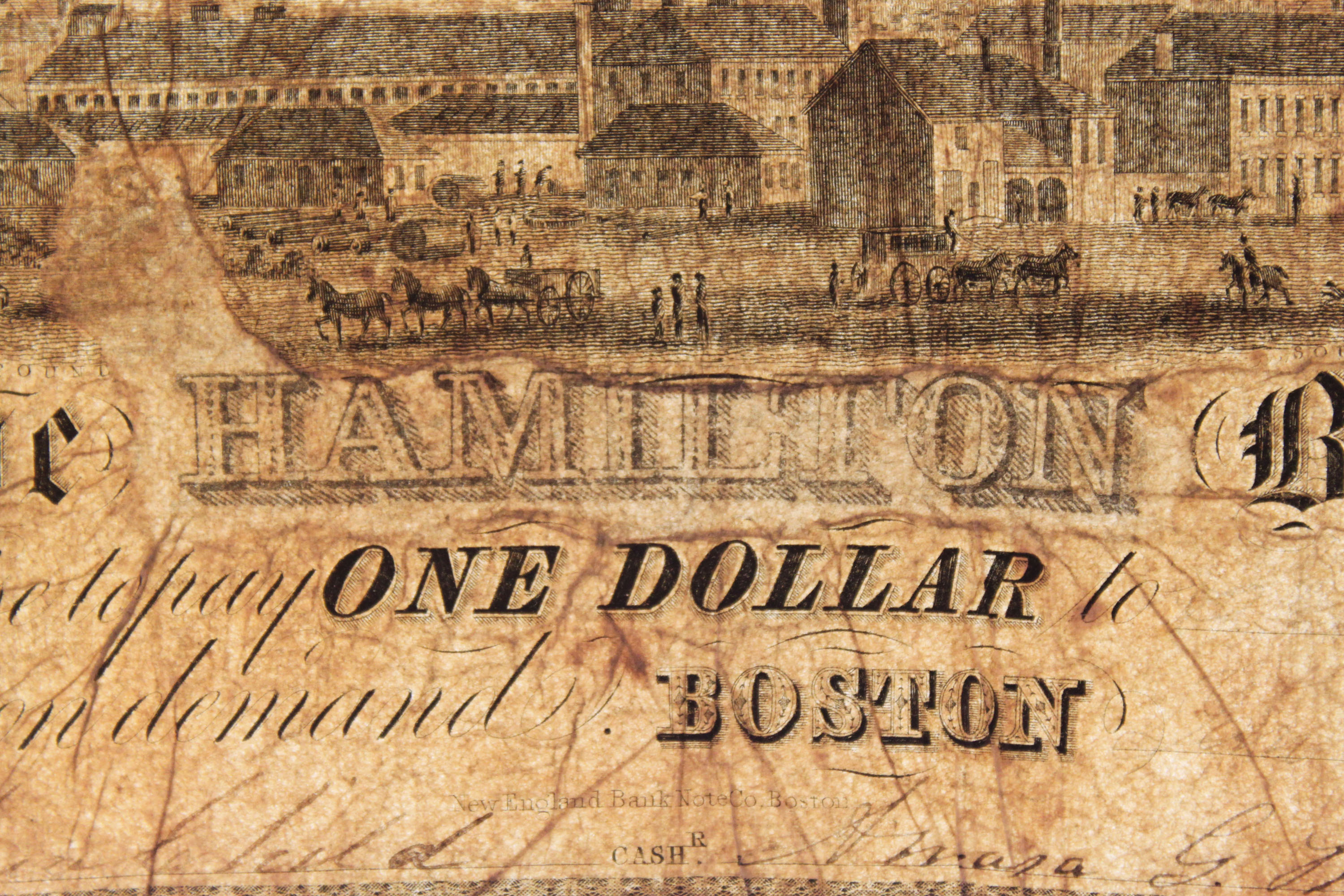
The second example [Fig. 2] is another bank note from the AAS currency collection. Examined over a light box, it becomes immediately apparent this bill has been chemically altered. The ink is uneven and the lettering is not consistent with the rest of the text. The paper is thinner and lighter, the texture altered, making it obvious that the bank name “Hamilton” in the center has been substituted.
Figure 2 (close-up)
The bank for which it was originally printed was undoubtedly defunct so the counterfeiter removed the name of the original bank and substituted this name to place it back in circulation.
Not surprisingly, all this devious behavior corrupting the currency prompted a public outcry and a proliferation of anti-counterfeit guidebooks and newspapers. Trouble was the counterfeiters would study these guides as closely as the bankers and adjusted their practices accordingly.
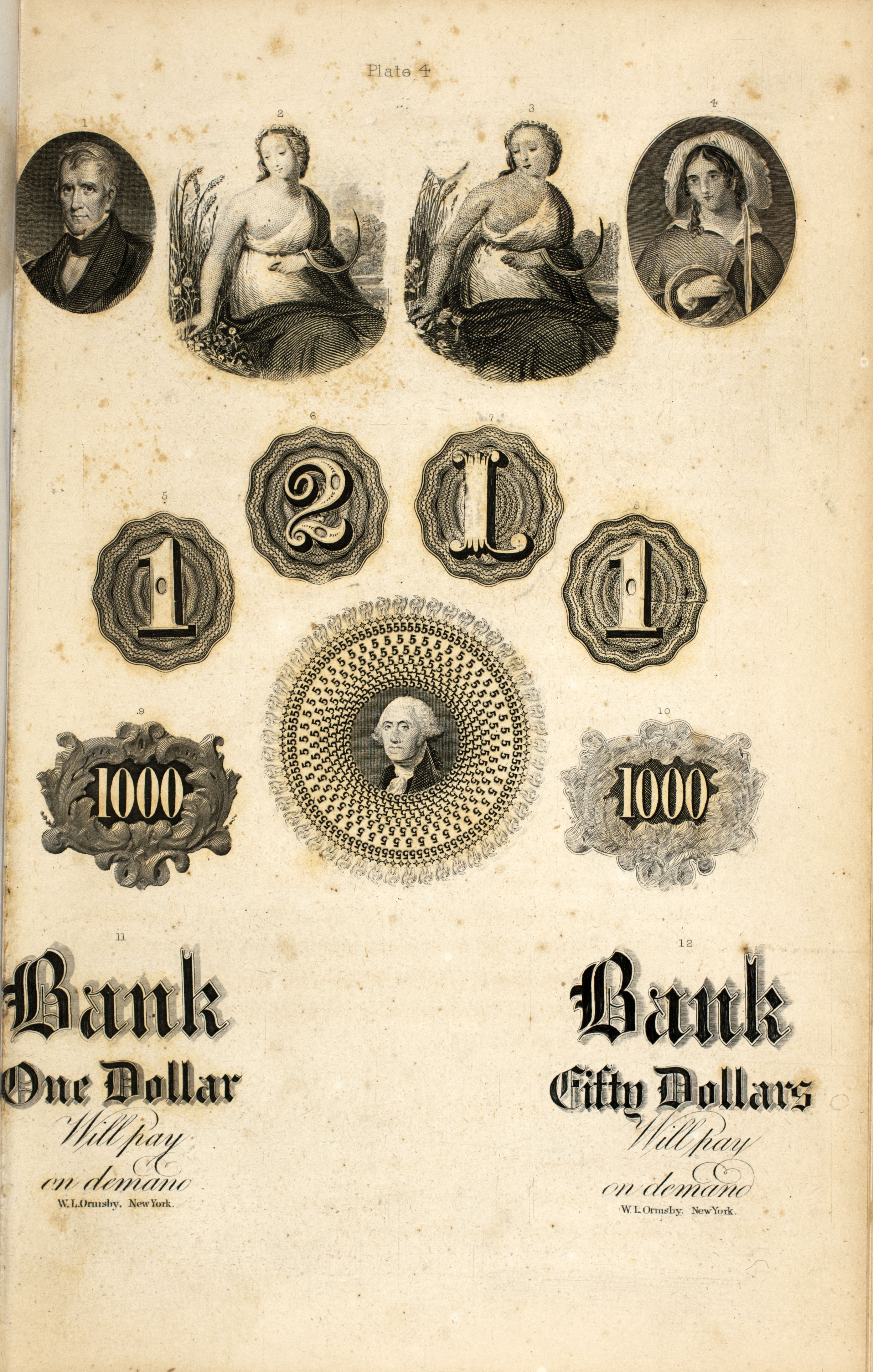
Figure 3 (click to enlarge)The last example [Fig. 3] is a book illustration from E.J. Wilber & E. P. Eastman, A Treatise on Counterfeit, Altered and Spurious Bank Notes … (1865), a guideshowing step by step how to discriminate between genuine and dubious currency. No comparison image is provided for Washington at the centerpiece of the sheet. Why? The engravers here employed an especially ingenious method to prevent replicating his countenance on the currency. They placed his visage in a gilt oval using a method called dry-printing process that counterfeit artists would not have access to. Instead, the deceivers would have to rely on the ordinary wet process which results in a much darker appearance that is instantly recognized as being counterfeit. In this case, duplication (at least in theory) should not be possible.
What better way to say Happy Birthday George!
Further Reading:
Clark’s New England Bank Note List and Counterfeit Bill Detector. (Boston, MA: 1838-1845)
Mihm, Stephen. A Nation of Counterfeiters. (Cambridge, MA: Harvard University Press, 2007)
Wilber, E.J. & E. P. Eastman. A Treatise on Counterfeit, Altered and Spurious Bank Notes with Unerring Rules for Detection of Frauds in the Same. Illustrated with original steel, copper, and wood plate engravings. (Poughkeepsie, NY: Published by the authors, 1865)