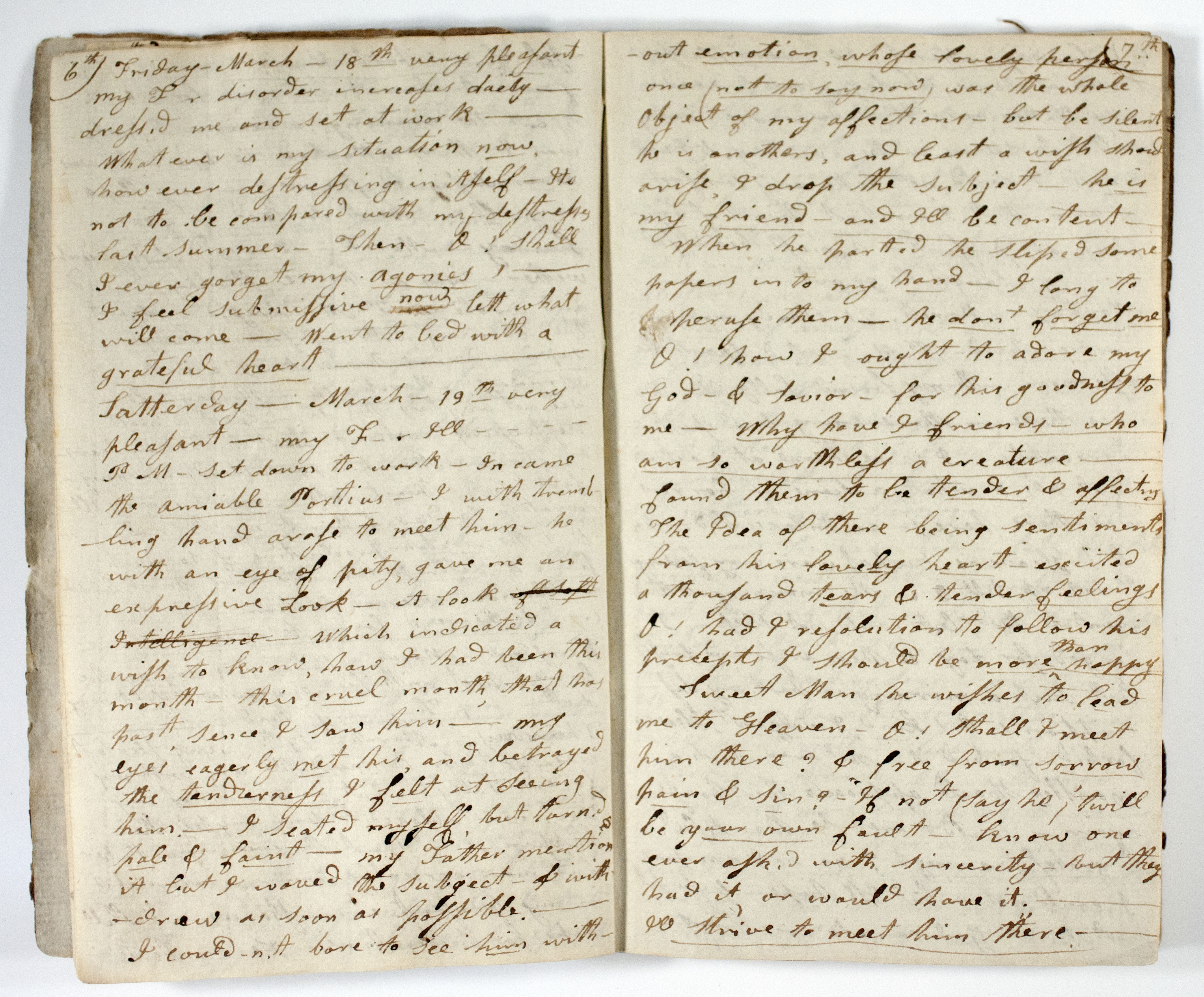
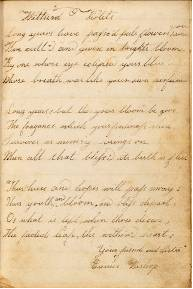
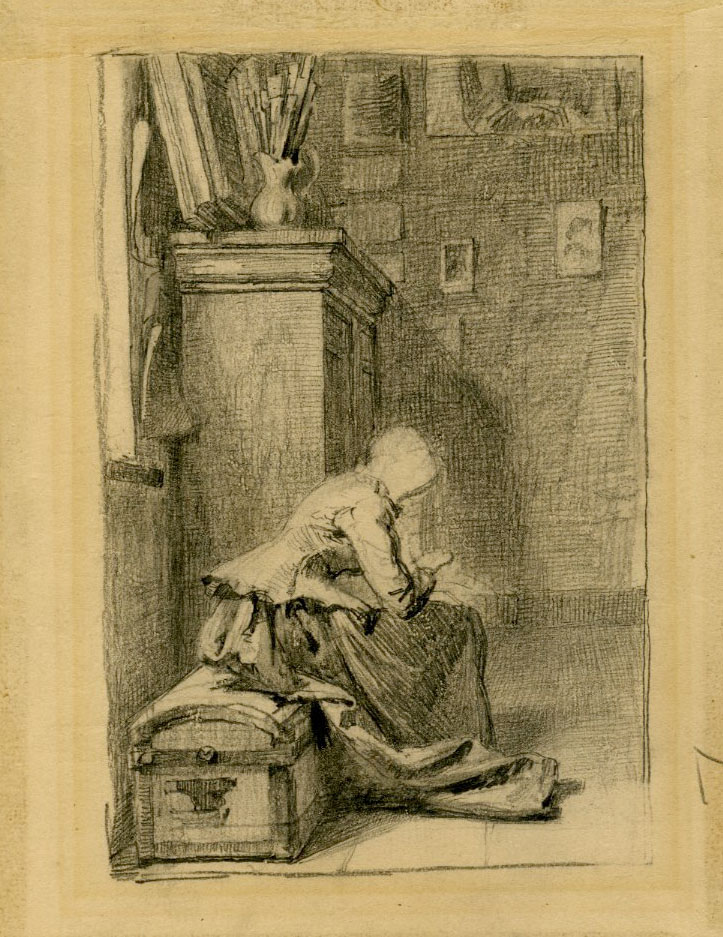
This small volume belonged to Sophia Morgan of Somers, CT. It is a collection of poems, both original and copied, entered into the volume by Morgan’s friends and relatives. Among the titles are “Withered Violets,” “Friendship,” “Time is Short,” and “Contentment.”
Purchased from Shelf Life Antiques. John Thomas Lee Fund.
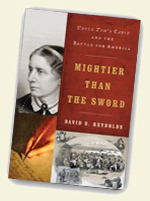
Please join us tomorrow evening, Tuesday, May 24th, at 7:30 p.m. for “Igniting the War: Harriet Beecher Stowe’s Uncle Tom’s Cabin, Antislavery Politics, and the Rise of Lincoln.” Dr. David S. Reynolds, Distinguished Professor of English and American Studies at the Graduate Center of the City University of New York, will draw on materials from his forthcoming book, Mightier Than the Sword: Uncle Tom’s Cabin and the Battle for America (to be released in June 2011, but will be available for sale at tomorrow night’s program!). Further information and directions are available online here.
Describing why he pursued this project, Reynolds commented:
“I chose to write about a book about Harriet Beecher Stowe’s Uncle Tom’s Cabin because I felt the full story about this landmark novel–its roots, its impact on the Civil War, and its long-term influence–had never been told. My book shows that this novel had an influence on American race relations and on progressive movements abroad unmatched by any other work of imaginative literature. Also, the novel’s influence on many aspects of culture–theater, music, films, advertising, and mass merchandising–is immense.”
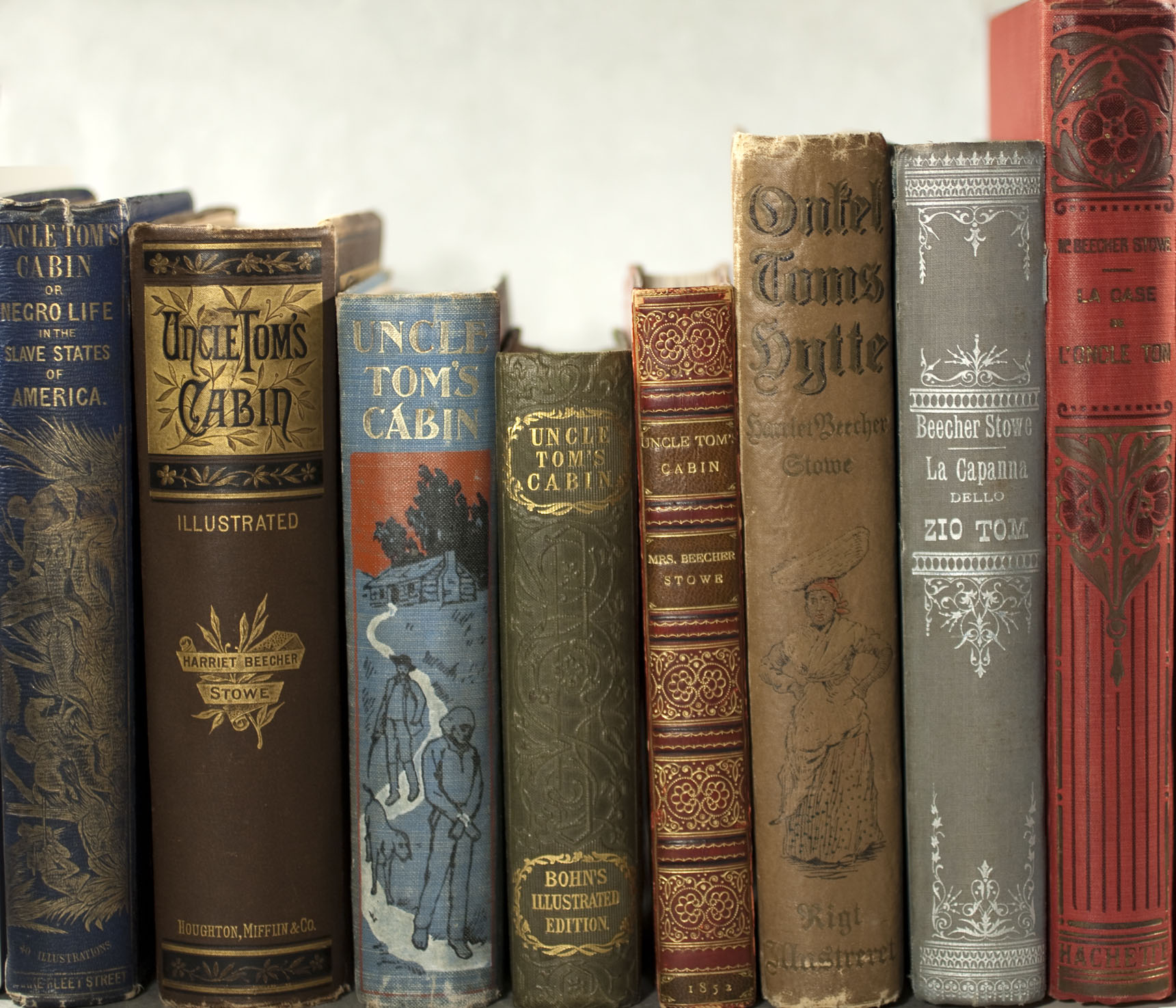
AAS collections offer insight into the “long-term influence” of Uncle Tom’s Cabin that Reynolds explores in Mightier Than the Sword. Of course, the Society owns numerous copies of nineteenth-century editions of the novel printed in English. But readers can also call for copies of Uncle Tom’s Cabin published in Danish, Dutch, French, German, Italian, Norwegian, Spanish, Swedish, and Welsh. Thanks to the generous gift of James F. O’Gorman in 2009, the Society also owns a variety of twentieth-century editions of Stowe’s work. In addition to an extensive collection of books, the Graphic Arts department houses lithographs that depict scenes from the book, playbills that advertise productions of a stage version of the story, and even a set of playing cards that feature illustrations of the main characters.
Further Information:
Over 120 AAS online catalog records have the titleUncle Tom’s Cabin.
Over 240 AAS online catalog records have the keywordsUncle Tom’s Cabin.
Dr. Reynolds has published a number of books on nineteenth-century American literature and history. Walt Whitman’s America: A Cultural Biography, published in 1995, received the Bancroft Prize. He is also the author of Waking Giant: America in the Age of Jackson, Beneath the American Renaissance, and John Brown, Abolitionist.
AAS is pleased that “Igniting the War” is the 2011 James Russell Wiggins Lecture in the History of the Book in American Culture. Named for the James Russell Wiggins (1903-2000), this annual lecture honors the former chairman of the Society (1970-1977) and editor of the Washington Post.
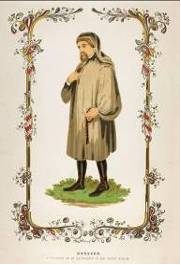
Old England: a pictorial museum of regal, ecclesiastical, municipal, baronial, and popular antiquities. Ed. by Charles Knight. Boston: Samuel Walker and Co., [186-?]
A fine copy of a most unusual salesman’s sample book. This two-volume large folio (36 cm. high) history of England, profusely illustrated with hundreds of wood engravings and 27 full-page color-printed wood-engraved plates, was first published in London in 1845, then reissued several times with 13 additional color plates. Sometime in the 1860s, Samuel Walker of Boston published an American edition consisting of the English sheets with new title pages. This salesman’s sample consists of the tables of contents, index, ca. 100 sample pages of text, and no fewer than 14 of the 40 color plates. No ruled leaves are included for subscribers to sign their names, and no sample bindings are included—this copy is plainly bound in a “wallet” binding of black pebble-grain morocco—so this particular sample of what would have been an expensive book probably was shown to bookstore proprietors and other members of the trade.
Purchased on eBay. Janet & Marcus McCorison and Henry F. DePuy Funds.
More examples of salesman’s sample books (also calling canvasing books or dummies) can be found in the AAS online catalog by searching for the genre “dummies.”
Anyone who has an email account is by now all too familiar with the forwarded email, as well as the accompanying guilt-laden demands to keep forwarding it.
The promise: just forward this email to 20 of your closest friends and you will be happy, or rich, or blessed.
The threat: vague but ominous bad things will befall you if you fail to do so.
Handwritten version of "The Copy of a Letter..." from 1800 (click on image to enlarge)
But is this only a present-day phenomenon? Those of us of a certain age, who once upon a time sent and received actual letters, know that these forwarded emails are merely a modern take on a form from the not-to-distant past: the chain letter. Often religious in nature, chain letters were occasionally used for practical purposes. (In fact, I remember once getting a recipe chain letter in which I was asked to send one recipe to ten people and then, through the wonderful power of exponents, I would eventually receive 100 more recipes — or something to that effect.)
It turns out chain letters are nothing new to this century (or the last, for that mater). The American Antiquarian Society has a couple dozen copies of a very popular early chain letter titled: “A Copy of a Letter written by our Blessed Lord and Saviour.” Many were printed as pamphlets in America between 1761 and 1815 [see a list of AAS online records] and have been digitized in Readex’s America’s Historical Imprints. However, AAS also has a couple of handwritten copies of this letter in our miscellaneous manuscript collection (filed under Jesus, of course). One handwritten copy of the letter is signed and dated at the bottom: “August the 12 1800 JSH A true copy from the original.” The manuscripts collection also has an undated copy that appears to be from after 1800. In the miscellaneous broadsides collection there is a copy printed in New Orleans in 1820, which appears to be the latest printed copy at AAS. Printed version of "The Copy of a Letter..." from New Orleans, 1820 (click on image to enlarge)
All of these letters have only minor variations in wording. They start with a description of the letter’s provenance and the distance it has traveled:
“A Copy of a Letter written by our Blessed Lord and Saviour Jesus Christ and found eighteen miles from Iconium, fifty three years after our Blessed Saviour’s Crucifixion. Transmitted from the Holy City by a converted Jew. Faithfully translated from the original Hebrew copy, now in the possession of Lady Cuba’s family at Mesopotamia.”
The actual content of the letter is rather unremarkable if you’ve read Jesus’s words in the Bible, but it does include the prerequisite blessings and curses, in appropriately Biblical language:
“And he that hath a copy of this my own letter, written with my own hand, and spoken with my own mouth, and keepeth it without publishing it to others shall not prosper; but he that publisheth it to others, shall be blessed of me, and though his sins be in number as the stars of the sky, and he believe in this he shall be pardoned; and if he believe not in this writing, and this commandment, I will send my own plagues upon him, and consume both him and his children, and his cattle.”
It appears these words were taken to heart. AAS’s holdings can attest to the fact that many late eighteenth- and early nineteenth-century Americans were careful to be the one that “publisheth” this letter to others, in a variety of forms. I imagine printers were quick to assure buyers that the same blessing applied for purchasing multiple copies of the letter and then distributing them.
But Americans were not alone in this obsession. Turns out the copies of this letter at AAS are versions of what may be the longest running chain letter in human history. According to an amazing website called the Paper Chain Letter Archive devoted to all things chain letter (it even includes a mathematical explanation of the exponential growth!), the “Copy of a Letter written by our Blessed Lord and Saviour” is one of the earliest in a line of “Letters from Heaven” (or in German, “Himmelsbrief”). Daniel W. VanArsdale describes the spread of these letters in his discussion of the evolution of the chain letter:
“A letter which was said to have fallen from heaven existed in the third century AD (Hippolytos, Refutation of All Heresies). The oldest Letter from Heaven for which we have a full text is the Latin “Letter from Heaven on the observance of the Lord’s day,” the original of which dates from the close of the sixth century (Priebsch). St. Boniface denounced this as a “bungling work of a madman or the devil himself.” Eckehard (1115 AD) wrote that it had spread over the whole globe then known to man. It has circulated in English in many versions.”
VanArsdale then links to a 1795 English version printed by “J. Evans, 42 West-Smithfield, London,” the text of which is virtually identical to the copies at AAS. You can read VanArsdale’s transcription of the full text of the letter by clicking here.
One very interesting oddity about these letters, though: while the texts are nearly identical, each of the examples we have at AAS gives a different distance from Iconium at which the original of this letter was supposedly found — all the other details stay the same. The manuscript letter from 1800 lists the distance as 12 miles, the undated manuscript copy lists 18 miles, and the 1820 New Orleans printed copy lists 84 miles.
Perhaps the tendency to increase the distance from Iconium has something to do with the increasing distance these letters traveled, with the message becoming distorted over distance, like in the children’s game of telephone. Maybe it’s part of an ancient code and the numbers have to increase as part of a secret message being passed with the letters. Or perhaps you have a better explanation?
In closing, I feel I should warn you that you probably will want to forward this blog post to all your friends. You never know what may happen to you or your family or your cattle if you do not!
Wishing you peace and prosperity (which you certainly will have if you “like” this post on Facebook and/or email it to 20 people),
This Thursday, May 12, at 7:30 p.m., James O. and Lois E. Horton will present “Liberty and Justice for All: The Civil War as Blacks’ Second American Revolution.” Directions to AAS and further information about this and other public programs are available on the AAS website.
Describing the scope of their lecture, Professor Horton commented:
“We will be talking about the connection that African Americans made between the American Revolution and the Civil War. We will discuss black people’s expectations of the Revolution, especially in New England, the extent to which their hopes were realized, and what they saw as the Revolution’s unfinished business. African Americans, under siege in the 1850s, prepared for a war they believed would fulfill the revolutionary promise, and black soldiers played a decisive role in bringing slavery to an end.” At first rejected as soldiers by the federal government, about 200,000 blacks eventually fought in the Civil War, their courageous service was instrumental to the Northern victory of the conflict.”
Items in the AAS collections provide some insight into how abolitionists, white and black, looked upon the unfinished legacy of the American Revolution. William Cooper Nell, a black abolitionist and journalist, wrote two histories of blacks’ contributions to American conflicts: Services of Colored Americans in the Wars of 1776 and 1812 [AAS online catalog record] and The Colored Patriots of the American Revolution [AAS online catalog record], both published in Boston in 1851 and 1855 respectively. In researching and publishing these experiences, Nell sought to bring attention to dozens of black men who contributed to the patriot cause but who had otherwise been forgotten. In his introduction, Nell asserted:
“Of the services and sufferings of the Colored Soldiers of the Revolution, no attempt has, to our knowledge, been made to preserve a record. They have had no historian. With here and there an exception, they have all passed away, and only some faint traditions linger among their descendants. Yet enough is known to show that the free colored men of the United States bore their full proportion of the sacrifices and trials of the Revolutionary War.”
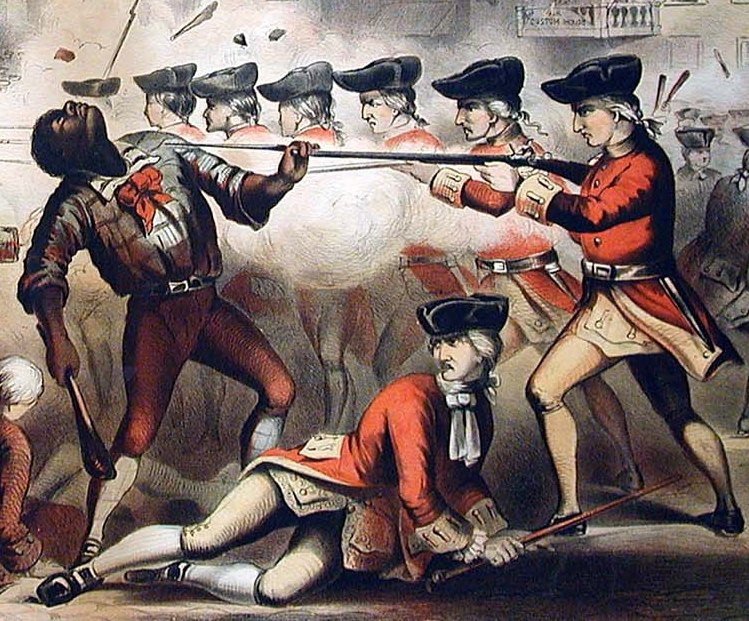
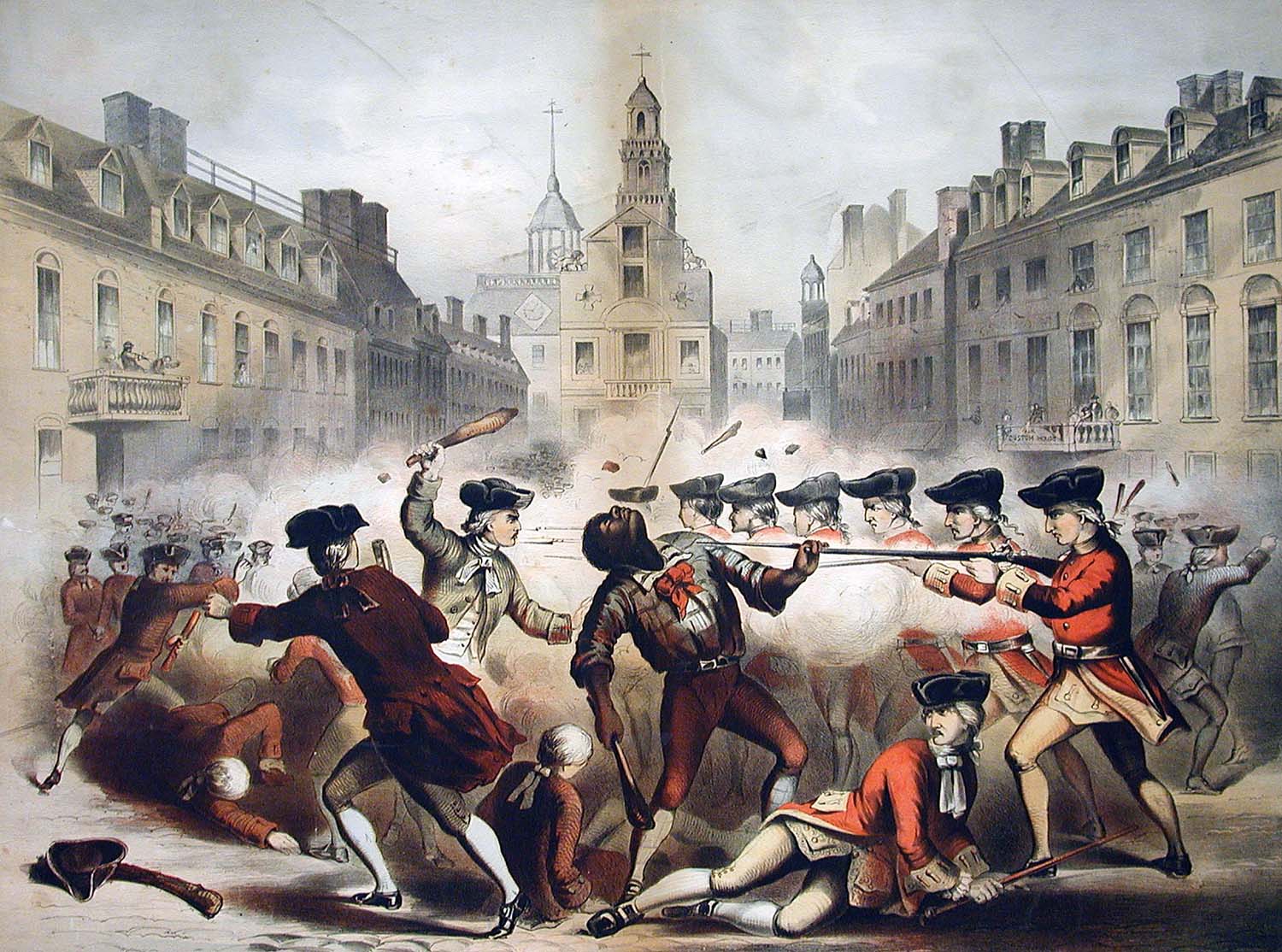
Nell’s The Colored Patriots of the American Revolution featured Crispus Attucks, the ‘first martyr of the American Revolution,’ prominently in the frontispiece and as the first biographical sketch of the volume. Attucks, of African and Native American descent, grew up in Framingham, MA, and he was said to be a runaway slave who became a sailor and rope maker in Boston. He was also said to be a very tall, physically imposing figure. As a dockworker, Attucks became very familiar with the British Regulars who were in Boston, many of whom were working during their off-duty hours and taking away Americans’ jobs by undercutting their wages. In early March, 1770, these tensions were violently acted out between the Americans and the British. On March 5, a confrontation between townspeople and soldiers resulted in five dead and six wounded. Attucks was the first to be shot, and according to Nell’s research, was the ringleader of the townspeople.
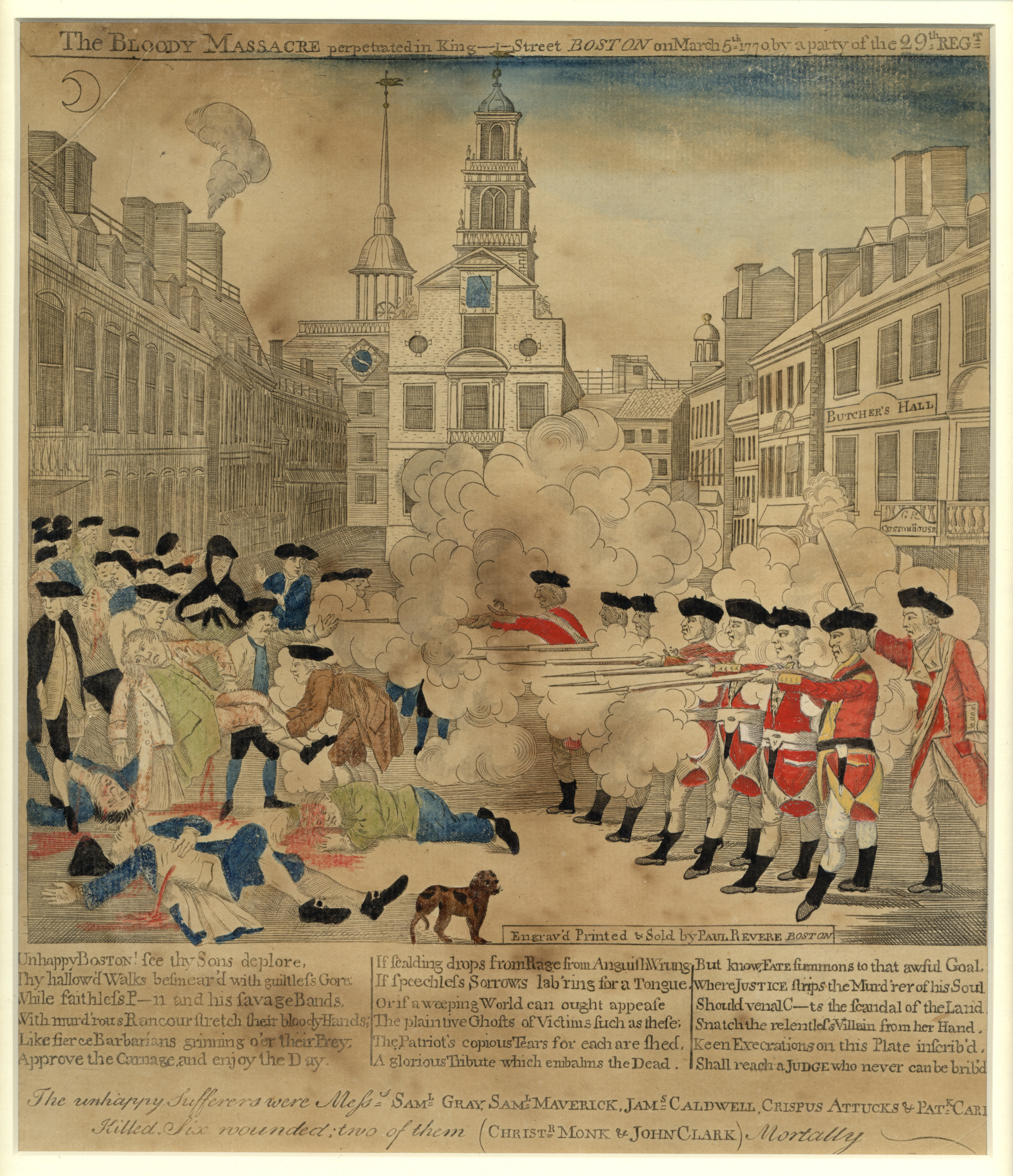
In 1856, the year after Nell’s publication, another Boston man told Attucks’ story though a lithograph. J. H. Bufford’s lithography company began publishing “Boston Massacre, March 5th, 1770,” based on an illustration by W. L. Champney. If this lithograph looks vaguely familiar, that is no surprise – it revised the story told in Paul Revere’s “Bloody Massacre” engraving of 1770. While Revere’s engraving did not include Attucks, Champney’s illustration put him front and center. Amidst the chaos, Attucks wielded a club as he was shot by a British Regular. The only black man in the lithograph, Attucks stood bravely against the British while surrounded by white men who would eventually gain their independence from Britain. Black and white abolitionists may have hung this lithograph in their homes to remind them of the work still to be done.
James and Lois Horton have been in residence at the American Antiquarian Society for the 2010-2011 school year as the Mellon Distinguished Scholars. They are primarily working on a project titled “A Documentary History of African Americans from 1619 to the Civil War.” James Horton is the Benjamin Banneker Professor Emeritus of American Studies and History at George Washington University. Lois Horton is Professor of History Emerita at George Mason University in Virginia, where she was also on the faculties of Sociology, Cultural Studies, Women’s Studies, and African American Studies. The Hortons have co-authored numerous scholarly studies, including Slavery and Public History: The Tough Stuff of American Memory (New Press, 2006); Slavery and the Making of America (Oxford University Press, 2004); Hard Road to Freedom: The Story of African America (Rutgers University Press, 2001). Both professors have had distinguished careers in teaching and public history.
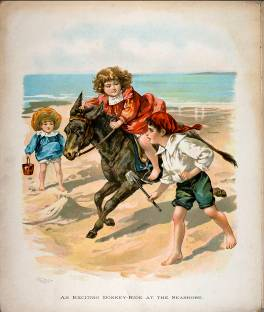
Snow White and Red Rose. New York: McLoughlin, 1899.
This magnificent chromolithograph of “An Exciting Donkey-Ride at the Seashore” is taken from this collection of fairy tales and poems. It is an excellent example of McLoughlin’s turn-of-the-century idealized portrayals of children at play.
Purchased from Christopher Holtom. Harry G. Stoddard Memorial Fund.
In August and December of 2010, the AAS received additional gifts to supplement the already delectable David Claypoole Johnston Family Collection. (You can see a portrait of the artist and read a short bio as part of the online exhibition of Portraits at the American Antiquarian Society.)
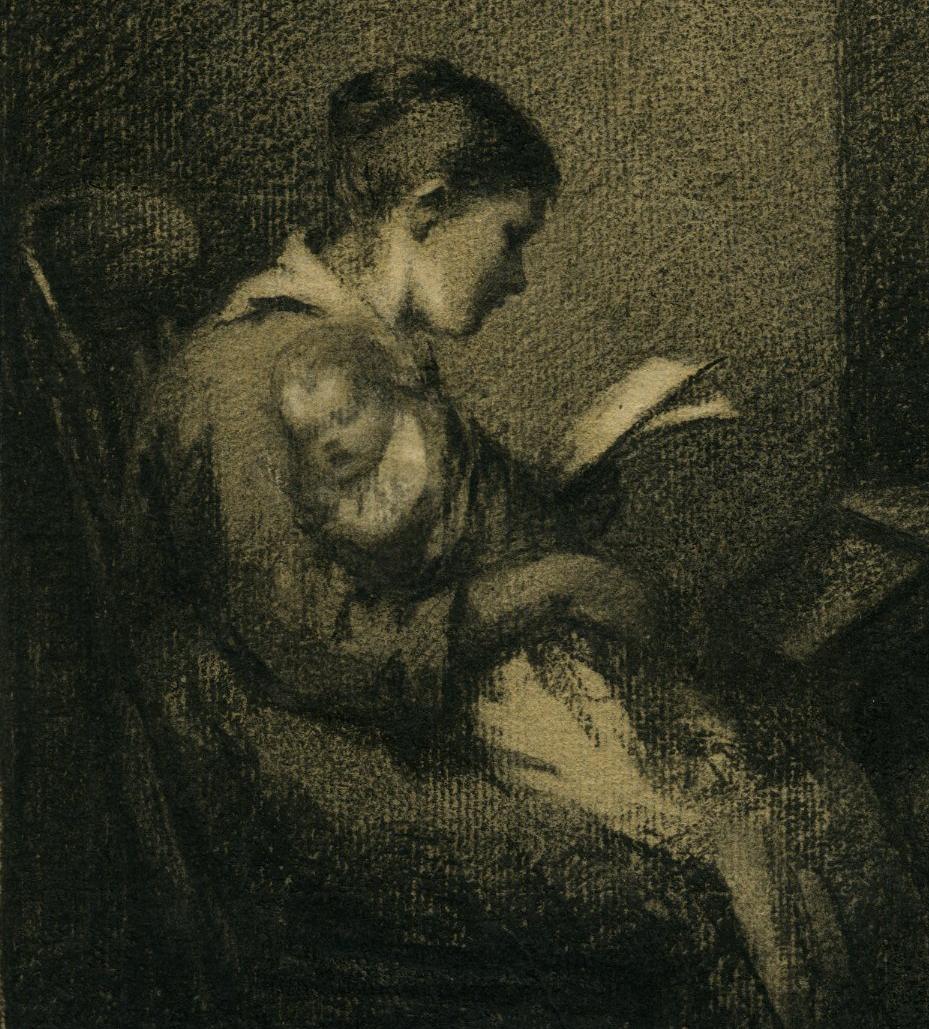
Of the material which came (in the form of three gifts), one included several pieces by students who worked with David Claypoole Johnston. One of his more notable students?
Author Louisa May Alcott.
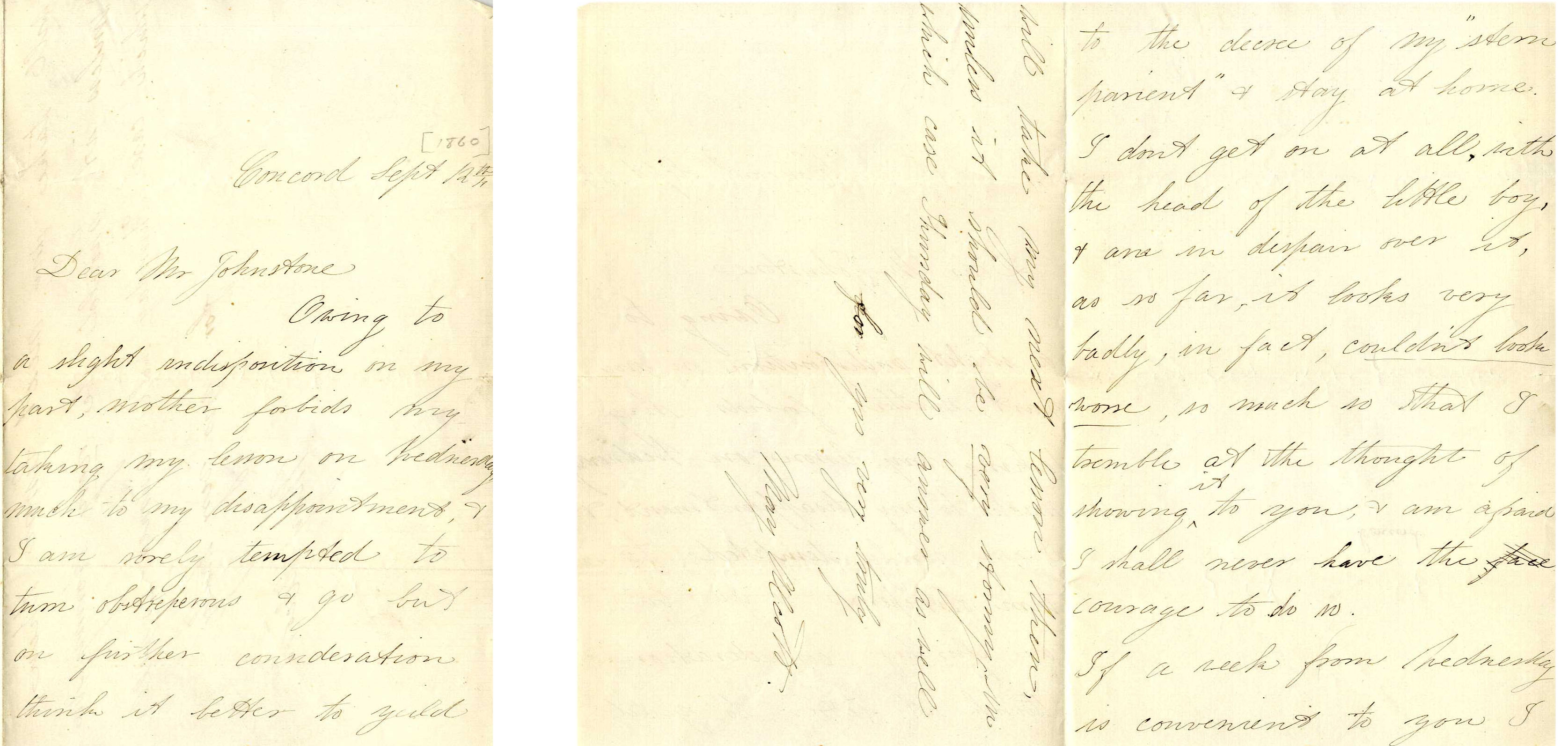
In 1933 the Society received (again by gift) much of the D.C. Johnston Collection, and in that bequest was a letter to Johnston from his young student.
The letter dated September 12, 1860 from Concord reads:
Dear Mr. Johnston,
Owing to a slight indisposition on my part, mother forbids my taking my lesson on Wednesday much to my disappointment, & I am sorely tempted to turn obstreperous & go but on further consideration think it better to yield to the decree of my “stern parent” & stay at home. I don’t get on at all, with the head of the little boy, & am in despair over it, as so far, it looks very badly, in fact, couldn’t look worse, so much is that I trembled at the thought of showing it to you, & am afraid I shall never have the courage to do so. If a week from Wednesday is convenient to you I will take my next lesson then, unless it should be very story, in which case Thursday will answer as well for yours very truly
May Alcott
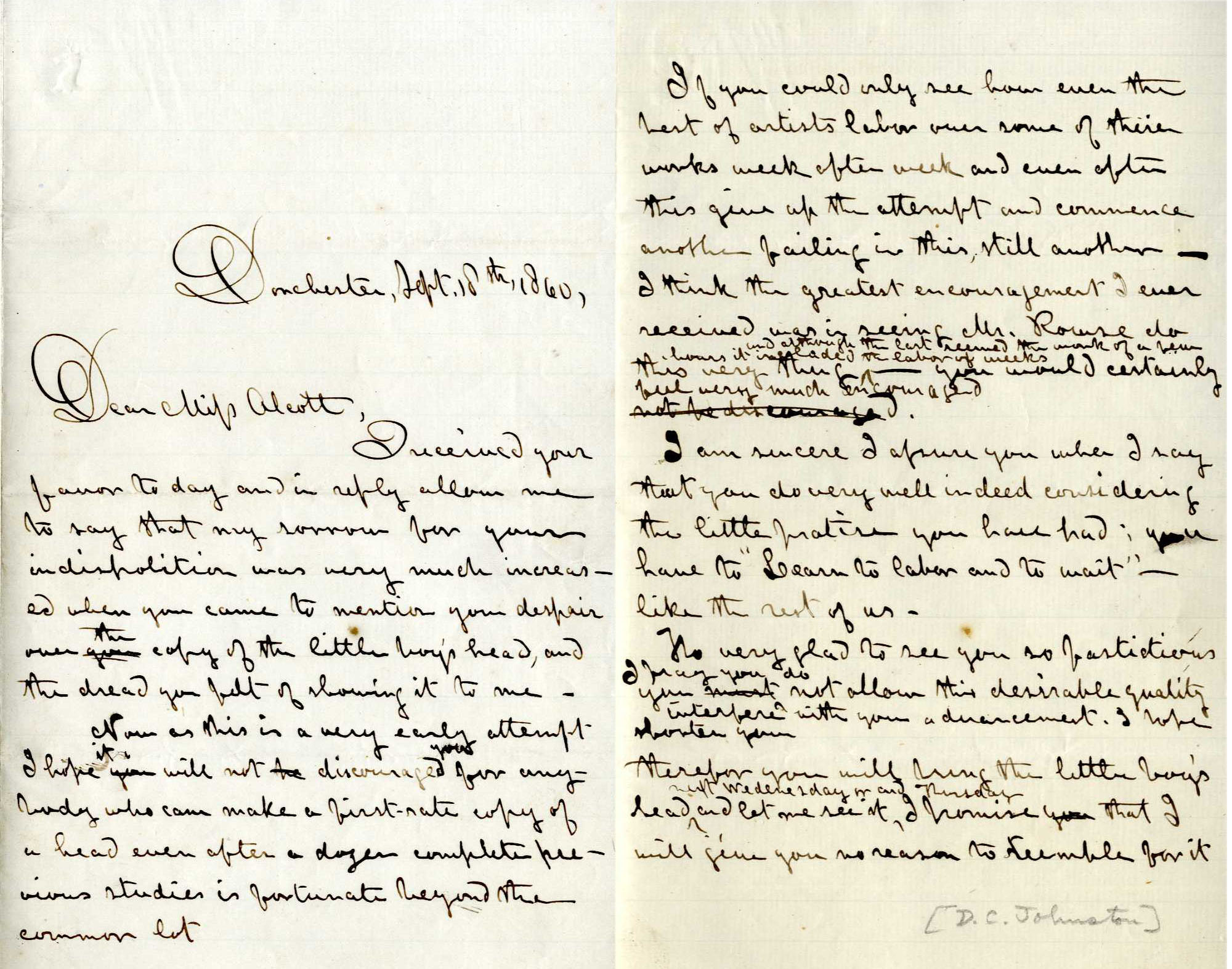
Johnston’s reply, also included in the AAS collection, was careful, patient and kind. He writes to Alcott from Dorchester on September 18, 1860:
Dear Miss Alcott,
I received your favor to day and in reply allow me to say that my sorrow for your indisposition was very much increased when you came to mention your despair over the copy of the little boy’s head, and the dread you felt of showing it to me.
Now as this is a very early attempt I hope it will not discourage you for any body who can make a first-rate copy of a head even after a dozen complete previous studies in fortunate beyond the common lot. If you could only see how even the rest of artists labor over some of their works week after week and even after this give up the attempt and commence another failing in this, still another – I think the greatest encouragement I ever received was in seeing Mr. Rouse do this very […] you would certainly feel very much encouraged [and although the last seemed the work of a few hours it the labor or weeks].
I am sincere I assure you when I say that you do very well indeed considering the little practice you have had; you have to “learn to labor and to wait” – like the rest of us.
Tho’ very glad to see you so fastidious I pray you do not allow this desirably quality interfere with your advancement. I hope […] you therefore you will bring the little boy’s head next Wednesday or Thursday and let me see it and I promise that I will give you no reason to tremble for it.
Johnston’s letter itself seems a work-in-progress – as are many of his drawings. Constantly being tweaked, revised, amended…
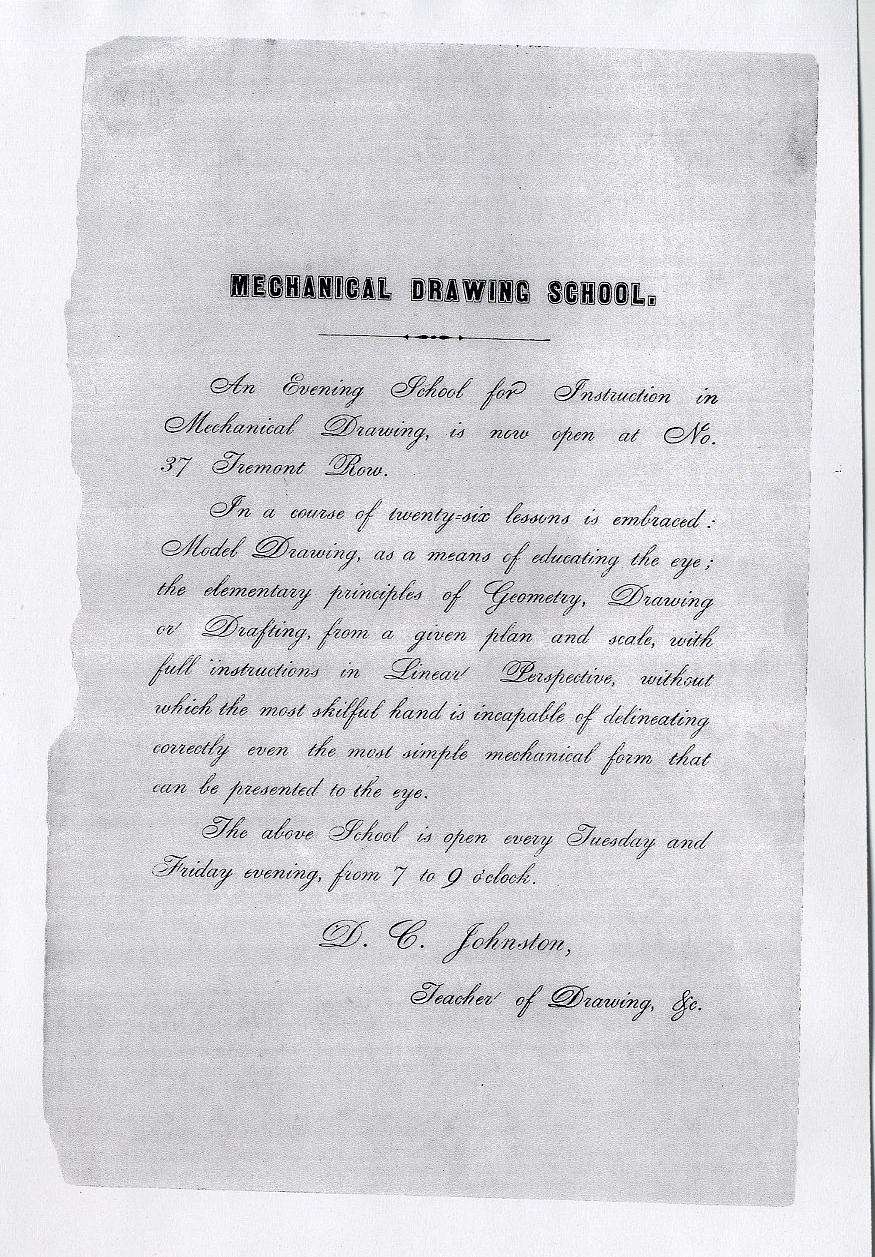
There are many things we will never know about the exchange – or about whom Johnston’s students were. We do know David Claypoole Johnston taught a Mechanical Drawing School (see the advertisement at right), and that Johnston and his family collected students’ work, or were given them. But many of these new student pieces are unsigned (the same is true of the book item of student work in Box 6 Folder 1.49). And yet, like it or not, the temptation is there (how exciting would it be, if in this cache there was a piece drawn by the same hand that penned Little Women?) to find pieces and assign them – even without proper clues.
L.M. Alcott is known today almost by her non-signer status, one of the tantalizing things about her is the mystery surrounding how many items she did author. Experts agree we will never know her entire canon. Her ‘anthologies’ will perhaps never be complete. Madeleine Stern and Leona Rostenberg, for example, discovered the thrill-ier side of Alcott, discovering some of her ‘nameless’ pieces in periodicals of the nineteenth-century in letters at Houghton Library, Harvard.
Even if the archive has the pieces listed now as ‘unidentified’ for artist, we still have all the pieces ready for the historian-cloaked version of Sherlock Holmes to just come and sleuth-ily put it all together. And that is part of the fun working in a place like AAS. We – in the back of the archive – compile, add-on, update and push out all the newest things so you can come into the reading room gasp, scream, sob, clap and enjoy history. While leaving “creator not known” can be frustrating, it can equally be the makings, the bread crumbs, if you will, of a future project for a researcher. Of the things unknown.
Interested yet? Take a look at the new pieces listed in the Additions section of the online illustrated inventory.
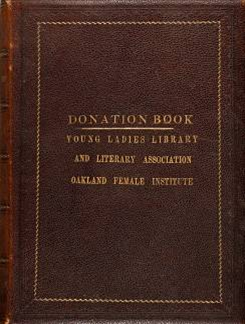
Young Ladies Library and Literary Association of Oakland Female Institute. Donation Book, 1853-1855.
The Oakland Female Institute was opened in Norristown, PA in 1845. By 1853 the Institute had 186 students and a library of “over 500 volumes of standard value—all trashy literature being contraband,” as an 1853 circular states. The school closed in 1880. This fairly elaborately bound volume, with a binder’s ticket for W.G. Perry & Erety in Philadelphia, lists donations both in cash and books in the period 1853-1855. There are only four pages of entries, suggesting either that the association was short-lived or that its members lost interest in record-keeping. Purchased from DeWolfe & Wood. Harry G. Stoddard Memorial Fund.
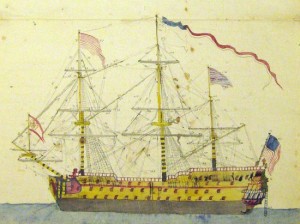
Although the ship pictured above is not a brig like Dana sailed on, you can click on the image to see its description in AAS's Drawings Collection Inventory
In April 1836, the future attorney and activist Richard Henry Dana was busy binding books aboard the brig Alert. Yes, binding books, not reading them. Dana might have been reading had a bad case of the measles and an even worse case of myopia not forced him to leave Harvard for a couple of years. To broaden his vision, Dana spent two years sailing to California, working as a “common sailor” in the merchant service, and experiencing the hide trade firsthand.
But Dana’s attempt to recuperate from illness by “taking a long absence from books and study” was a dismal failure. It seems as though books, real and metaphorical, had informed Dana’s life and perception of the world so much so that he simply couldn’t escape from them: he began to ransack fellow sailors’ chests for books, devour the latest newspapers aboard ship, trade old books for new in Santa Barbara, and read Scott aloud to his fellow sailors. As he prepared for his return trip home, Dana even helped to bind hides, the ship’s goods, into “books.” He describes the process as such:
“[A] large ‘book’ was made of from twenty-five to fifty hides, doubled at the backs, and put into one another, like the leaves of a book. An opening was then made between two hides in the pile, and the back of the outside hide of the book inserted. Two long, heavy spars, called steeves, made of the strongest wood…were placed with their wedge ends into the inside of the hide which was the centre of the book, and to the other end of each, straps were fitted….”
Dana’s two worlds had become one, the physical labor of the jack-tar necessitating the very books he had so longed to leave behind and even producing a few in the process.
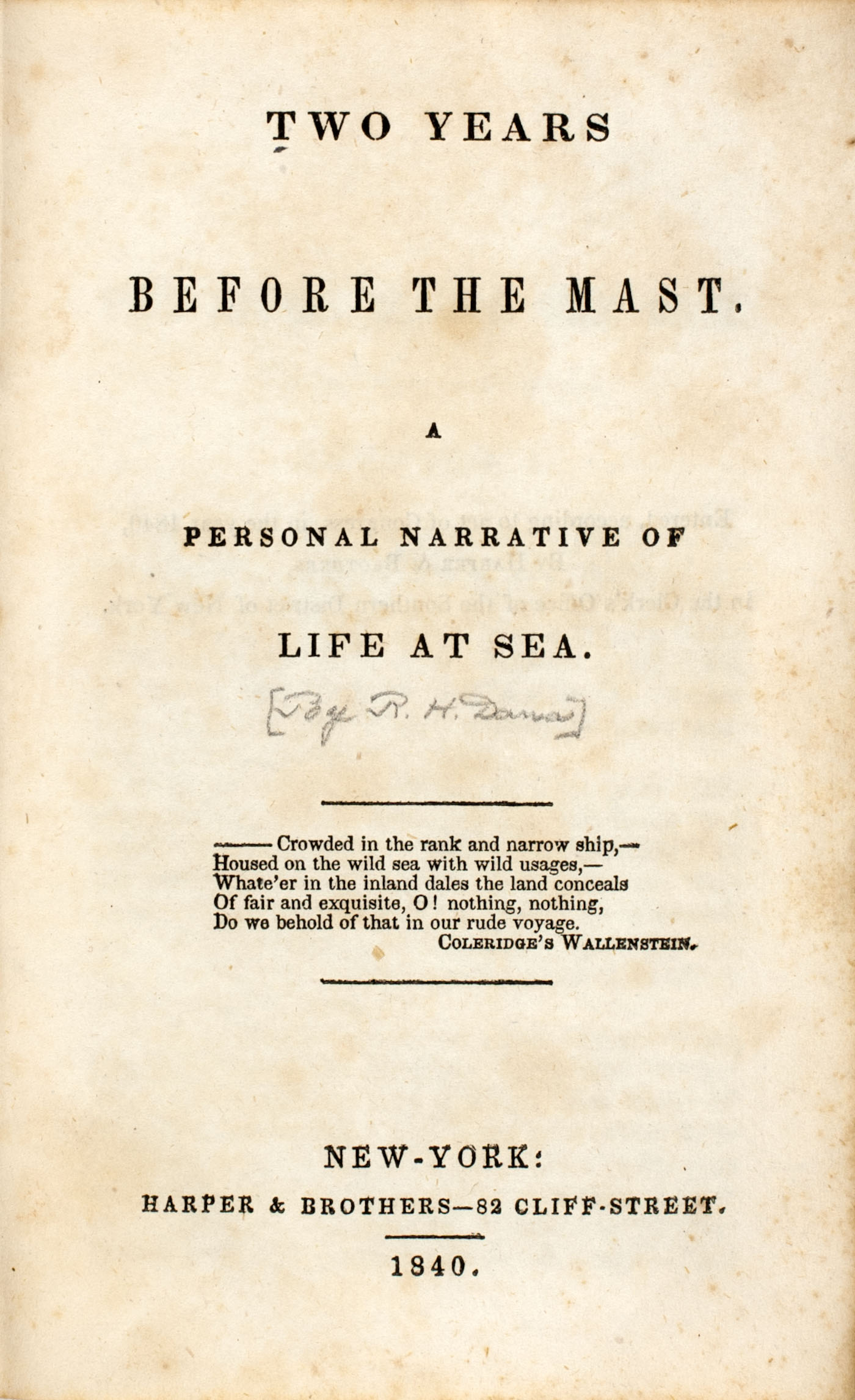
While AAS is not known for any special emphasis on maritime history, its collections nevertheless feature some significant Dana holdings. Dana’s legal papers are housed in AAS manuscripts collections (the AAS catalog record and finding aid with a complete contents list are available online). Featuring files on over 600 of Dana’s cases, this cache of understudied material was discovered by Scott Sandage at the Worcester Law Library during Sandage’s 1993-94 AAS Peterson fellowship. Some may also be pleased to learn that our Reserve Collection, a restricted collection that houses one of only several extant copies of the Bay Psalm Book, contains both the first and second printing of Dana’s own book, Two Years Before the Mast.
Just for fun, see if you can spot the difference between the two printings from their copyright pages below before reading the online record that describes AAS’s copies of Two Years Before the Mast.
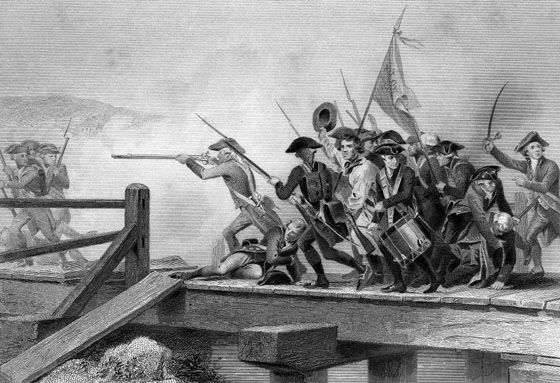
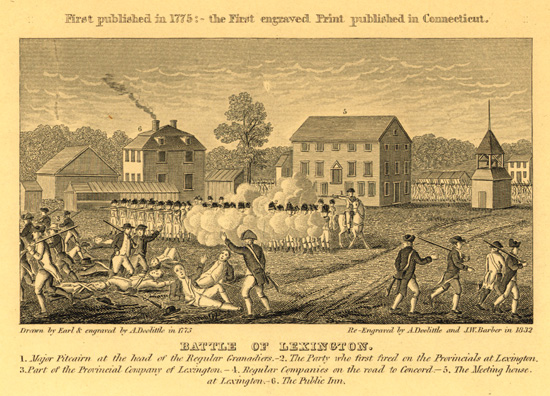
Each April here at the American Antiquarian Society, our thoughts turn to Patriots’ Day, a holiday which we celebrated last week here in Massachusetts. Patriots’ Day commemorates the famous battles of Lexington and Concord, the battles that started the American Revolution. We The Struggle on Concord Bridge, 1859.envision minutemen firing muskets on Lexington Green and gun smoke clouding Concord’s North Bridge. Our thoughts also turn to the patriot silversmith and engraver Paul Revere, whose work you can examine online in the illustrated inventory of AAS’s Paul Revere Collection. Revere became famous for sounding the Lexington Alarm, an act that was immortalized in Longfellow’s poem “Paul Revere’s Ride”. The fleet craftsman is also remembered by the image Grant Wood created in his painting, Paul Revere’s Ride, in which he figures Revere as a solitary rider galloping through the American countryside. But did you know that Paul Revere went on multiple rides leading up to the Revolution? That the Lexington Alarm was not his first ride? That many men rode through the countryside to sound the Lexington and Concord Alarms? Did you know that Revere was captured on Concord Road and that only a doctor named Samuel Prescott made it to Concord to sound the Alarm of the three original riders? There is much to be learned about the true story behind Paul Revere’s Ride from the books at the American Antiquarian Society.
You may have visited Paul Revere’s house in Boston’s North End or seen battle re-enactments in Lexington and Concord. You might know that Paul Revere was a member of the Sons of Liberty and that he had sixteen children and at least fifty-two grandchildren. You might not have known, however, that Paul Revere played many key parts leading up to the American Revolution, aside from the one Longfellow casts him in, the sounder of the Lexington Alarm. Before 1775, Paul Revere made many rides conveying messages from the Whigs in Boston to other patriots at greater distance. He rode to New York and Philadelphia to garner Whig resistance to The Intolerable Acts, a set of British laws colonists viewed as unfair. Since Revere knew many different people and moved in many different circles, he was an excellent messenger for Whig purposes. He took a leading part in getting the Stamp Act repealed. He participated in the Boston Tea Party, dumping teas chests into Boston Harbor. Revere also led a secret group of Whigs who met in the Green Dragon Tavern in Boston. He sounded an Alarm in Portsmouth, New Hampshire to warn colonists of imminent British seizure of Whig munitions. He also influenced Whig sentiment by engraving the famous print, The Boston Massacre [pictured at right], which helped to depict the British as unjust in the eyes of the colonists.
When the British Governor Thomas Gage decided to attack the town of Concord, seize its munitions, and attempt to capture John Hancock and Sam Adams (who were staying five miles to the east in the town of Lexington), the person selected to warn Concord was none other than Paul Revere. The Whig colonists resolved not to act first, to create an image of innocence, and therefore needed to mobilize quickly when the British made a move. Historian David Fischer noted, “Everything for New England depended on careful preparation, timely warning, and rapid mobilization” (79). Revere was clearly the man for the job since he could spread news throughout New England faster than Gage’s infantry could march.
In case the British cut off communication between Boston and outlying towns, Boston Whigs appointed messengers to slip past Gage’s men by secret routes and devised a system of lantern signals from Boston to Charlestown to alert the colonists to the Tories’ movements. Revere got wind of British movement from a stable boy and passed the news on to Doctor Joseph Warren. Warren verified the information with his Tory informant who was reputed to be Governor Gage’s American wife!
Revere enlisted two friends to put two lanterns in the Old North Church steeple, Boston’s tallest building in 1775, to warn Whigs that the British were coming by sea. The Old North Church was officially named Christ Church at the time and its rector was a Loyalist. Luckily Revere was friends with a vestryman, John Pulling, and a sexton, Robert Newman. These two men climbed into the rafters of the Old North Church and hung the famed two lanterns while their friend, Thomas Bernard, stood guard.
As Revere set out across the Charles River en route to Concord, another rider, William Dawes, a Boston tanner, was already on the road to Concord ahead of him. Two more little more known patriots, Joshua Bentley, a boat builder, and Thomas Richardson helped Revere cross the Charles River. Upon landing, Revere borrowed a horse from John Larkin named Brown Beauty, known for its strength and swiftness. Revere went north across Charlestown Neck and west on the road to Lexington.
When Revere arrived at the house where Hancock and Adams were staying, he shouted, “The Regulars are coming out!” Notably, he did not say, “The British are coming!” since all colonists in revolutionary America considered themselves British. William Dawes arrived a half hour later.
Revere and Dawes next headed to Concord. Along the way, they met Doctor Samuel Prescott, a physician of Concord who joined them in warning the colonists. The three men eventually encountered ten British Regulars on Concord Road. The British soldiers quickly surrounded Paul Revere and took his horse. Dawes escaped and went limping back to Lexington. Doctor Prescott was the only rider of the original three who made it past the British to sound the Alarm at Concord. Along the way, Prescott alerted many more Whig citizens who joined the Alarm. Revere regained his freedom at three o’clock in the morning on April 19th in time to see some of the battle on Lexington Green.
More information about Paul Revere’s ride and the battles of Lexington and Concord can be found in the books in the collections at the American Antiquarian Society. So this month, we invite you to explore the many stories behind history and to learn more about Paul Revere, the brave silversmith who helped craft our country’s past.
For Further Reading:
Fischer, David Hackett. Paul Revere’s Ride. New York: Oxford University Press, 1994.
Morgan, Edmund S., ed. Paul Revere’s Three Accounts of His Famous Ride. Boston: Massachusetts Historical Society, 2000.
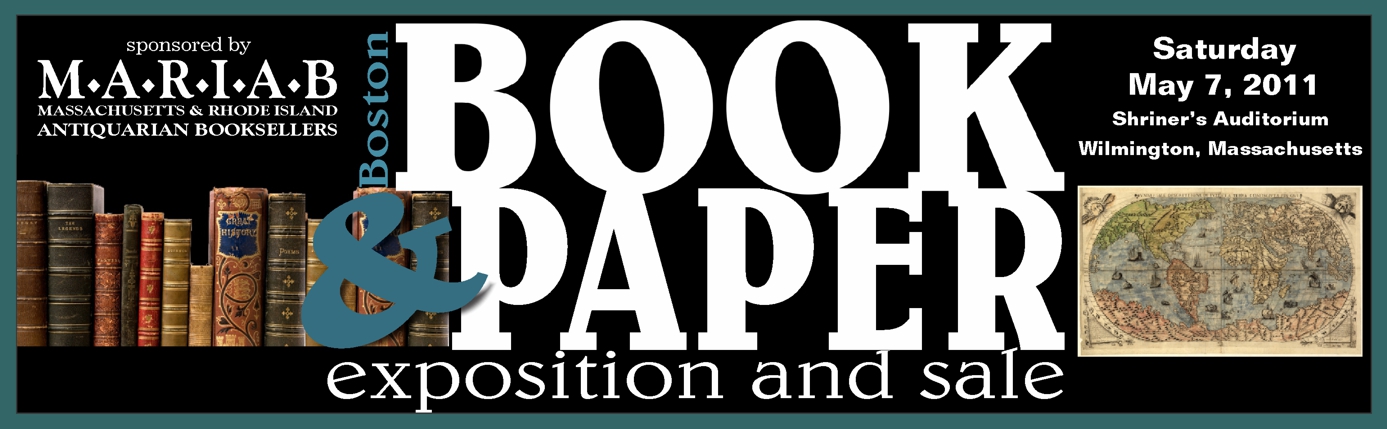
An annual rite of spring for AAS curators is the Boston Book & Paper Exposition and Sale, one of two fairs sponsored annually by the Massachusetts and Rhode Island Antiquarian Booksellers (MARIAB). This spring’s fair will be held on Saturday, May 7, 2011 from 10:00 a.m. to 5:00 p.m. at the Shriner’s Auditorium, 99 Fordham Road, Wilmington, MA (click here for directions). Over 80 MARIAB member booksellers will be offering a wide range of used and antiquarian books, ephemera, photographs, manuscripts, maps, postcards, and other paper collectibles. New this year is a day-long series of special lectures and exhibits, including a talk at 1:45 p.m. by John B. Hench, retired Vice President for Collections and Programs at AAS, on his recent book, Books as Weapons: Propaganda, Publishing and the Battle for Global Markets in the Era of World War II. More information can be found at the fair website.
AAS curators have always found this fair to be an excellent opportunity to acquire new treasures for the collection. If you like to collect, or are simply curious to attend the fair, dealers are more than happy to answer questions and let you browse their books. Even better, fair promoter Marvin Getman has generously offered free admission (normally $7 per person) to all who print a copy of the complimentary pass below and present it at the door.
“Noah Webster: The Schoolmaster of the Republic,” printed by Root and Tinker in New York in 1885
Don’t forget to join us tonight at 7:30 to hear Joshua Kendall discuss his new book, The Forgotten Founding Father: Noah Webster’s Obsession and the Creation of an American Culture.
Noah Webster was not only America’s greatest lexicographer; he also helped to define American culture through his dictionaries and spelling books. A search of the Antiquarian Society’s online catalog produces hundreds of items authored by Noah Webster (1758-1843) and dozens more about him and his work. AAS founder Isaiah Thomas published numerous editions of Webster’s spelling book, A Grammatical Institute of the English Language. Some of these items will be on display in the exhibit case in the reading room for Kendall’s talk.
Mobile Circulating Library. New and revised catalogue of the Mobile Circulating Library … established November, 1874. Mobile [AL]: Shields & Co., 1879.
Only recorded copy (in any edition) of this catalog of a substantial southern lending library. Rates began at $6 per year and up, for which subscribers had access to over 2,000 volumes (including some in French), and some 30 newspapers and periodicals (including several in German). Fiction predominated, and there was a fair amount of German literature as well, apparently all in English translation. The Mobile Circulating Library, which occupied rooms in the Battle House Hotel (pictured), was also—perhaps primarily—a bookstore and stationery shop. Primary sources on the “book culture” of the ante- and post-bellum South are distinctly uncommon, and this is a noteworthy addition to AAS’s holdings. Purchased from L. & T. Respess. Harry G. Stoddard Memorial Fund.
Cover of The American Economical Housekeeper by Mrs. E.A. Howland
Ever wonder what Susanna was chewing on in Stephen Foster’s famous folk song? Curious about how women occupied their days at home in early America? Interested in learning more about the relationship between early American housewives and their maids? Whether you are interested in the history of American cooking, women’s history, domestic history, or the recipes for antiquated baked goods mentioned in early American folk music, the American Antiquarian Society’s cookbook collection has a wealth of information on many cooking related topics. Small in size and well worn, these tomes bear uncommon witness to our social as well as culinary past.
The makings of women’s history in America can be found in these books alongside ingredients for archaic-sounding dishes such as Boiled Indian Pudding and English Curd Pie. Many of these books contain prefaces and chapters recording first hand accounts of household tasks women performed and accounts of their opinions on topics as varied as education and household economy. In Maria Rundell’s American Domestic Cookery published in Baltimore in 1822 [online catalog record], she gives a brief sketch of social roles for women in early America:
To attend to the nursing, and at least, early instruction of children, and rear a healthy progeny in the ways of piety and usefulness: – to preside over the family, and regulate the income allotted to its maintenance: to make home the sweet refuge of a husband fatigued by intercourse with a jarring world: to be his enlightened companion and the chosen friend of his heart; these, these are woman’s duties! (Rundell 7).
This passage outlines gender roles for men and women in keeping with the conception of separate spheres, women kept homes running happily and smoothly while men engaged in commerce in the outside world. Yet, we also learn that women were in involved in the disposal of household income from this passage. Further evidence of female economic skill is put forth in the passage, “Many families have owed their prosperity full as much to the propriety of female management, as to the knowledge and activity of the father” (Rundell 11). Rundell further notes, “can any one urge that the female mind is contracted by domestic employ?” (Rundell 8) Behind this statement we can hear the voices of those Rundell addresses. Some people in early America were concerned that domestic duties, or perhaps sole engagement with them to the exclusion of more intellectual endeavors, had an adverse affect on women’s minds.
Image from The Life of Benjamin Franklin (1848) illustrated by Alexander Anderson
In Sarah Josepha Hale’s The Ladies’ New Book of Cookery, published in New York in 1852 [online catalog record], she notes that if mothers pamper their sons’ appetites they contribute to their future selfishness and profligacy. She more sweepingly characterizes the integral nature of women’s roles in early American society, “the duty which Nature has assigned her, that of promoting the health, happiness and improvement of her species” (Hale vii). Here, Hale echoes the commonly held view that women had a morally improving effect on society. Hale also notes that cooking is “the medium of social and domestic happiness” (Hale iii). It is clear from this cookbook that women in early American society regarded their domestic endeavors with philanthropic gravity.
In Lydia Maria Child’s The American Frugal Housewife [online catalog record], she asserts the importance of women’s roles in early America:
There is no subject so much connected with individual happiness and national prosperity as the education of daughters…The greatest and most universal error is, teaching girls to exaggerate the importance of getting married; and of course to place an undue importance on the polite attentions of gentlemen. (Child 91)
Here, we learn that early Americans thought women could have a positive impact on society outside of matrimony.
Cookbook composition also enabled women to find a literary voice at a time when it was less socially acceptable for women to become writers. In Eliza Smith’s The Compleat Housewife [online catalog record], she assumes the posture of a historian and a fiction writer at the beginning of her cookbook. Her book commences with a preface containing a short history of cooking, in which she discusses early cooks mentioned in the Bible. Smith also comments on the current literary mode of using prefaces: “It being grown as unfashionable for a Book now to appear in Publick without a Preface, as for a Lady to appear at a Ball without a Hoop-Petticoat.” She writes of her book “if it either instruct or divert, I shall be satisfied, if you are so.” Some women explored different forms of verbal expression through cookbook prefaces.
And what about the recipes themselves you might ask? Much of the fare in early American cookbooks remains the same as it does today. Influence of European cookery, Native American cookery, and Creole cookery in the south can also be traced. British influence existed in most recipes and notably in “English Plum Pudding” and “English Curd Pie.” Native American influence can be found in recipes calling for corn, Indian meal, and medicinal barks and herbs. Other recipes have a distinctly American ring: Fried Hominy, Pennsylvania Flannel Cakes, Kentucky Corn Dodgers, Cranberry Pie, Boiled Indian Pudding, Green Corn Pudding, and New England Pumpkin Pie.
A confection called Pilgrim Cake, which was reputedly concocted by “our pilgrim and pioneer forefathers,” simply called for flour, butter, and water, according to Miss Beecher’s Domestic Recipe Book [online catalog record] (Beecher 98). It was rolled out an inch thick and baked under ashes in the hottest part of the hearth. The ashes were scraped off before eating of course!
Hasty Pudding recipe from Miss Beecher’s Domestic Receipt Book
On a more whimsical note, Catherine Beecher’s recipe for Hasting Pudding provides historical verification of the thickness of hasty pudding as captured in the lyrics of “Yankee Doodle”: “And there we saw the men and boys / As thick as hasting pudding.” According to this recipe, one stirred hasting pudding “till so thick that the stick will stand in it” (Beecher 108).
An examination of early American cookbooks reveals a cornucopia of information regarding the history of early American cooking and the cultural and social history with which such history is interwoven. So, the next time you stop by the American Antiquarian Society to research women’s history or domestic history or the history of cooking, we suggest you explore the wide array of small tomes in the cookery book collection, well worn by generations of American housewives. And as for tearful Susanna’s buckwheat cakes, they were made from a mixture of buckwheat flour, milk, salt, yeast, and Indian meal.
How to Find Cookbooks at AAS:
AAS’s cookbooks are fully cataloged online. Searching AAS’s online catalog for the call number “Cook Books” will give you a list of the main collection, which consists of over 1,000 cookbooks published after 1820. Earlier cookbooks can be found by searching for the genre term “cookbooks” and then sorting the list by date. There is even a manuscript collection of handwritten cookbooks with an online contents list.
Further Reading:
Beecher, Catherine. Miss Beecher’s Domestic Receipt Book. New York: Harper & Brothers, 1846.
Child, Lydia. The American Frugal Housewife. 10th ed. Boston: Carter and Hendee, 1832.
Hale, Sarah Josepha. The Ladies’ New Book of Cookery. 5th ed. New York: H. Long & Brother, 1852.
Rundell, Maria. American Domestic Cookery. Baltimore: Fielding Lucas, 1822.
Smith, Eliza. The Compleat Housewife. Williamsburg, Virginia: William Parks, 1742.
The New Tale of a Tub. London & New York: George Routledge and Sons, [ca. 1870]
The Routledge firm was a popular transatlantic picture book publisher and a direct competitor of McLoughlin Bros. The New Tale of Tub is a humorous poem about two Bengalese gentlemen whose picnic feast is interrupted by the approach of a hungry tiger. Purchased from Christopher Holtom. Harry G. Stoddard Memorial Fund.