In 1842, Charles Dickens made his first of two visits to America. He took a sweeping tour of the country, meeting with dignitaries such as Longfellow, Poe, and President John Tyler. He visited Massachusetts, New York, Pennsylvania, Washington D.C., Virginia, Maryland, Ohio, Kentucky and Missouri. While in New York City, he was welcomed with a grand ball (from which AAS has a menu). And during his glamorous whirlwind tour, Dickens managed to find time to visit our humble city of Worcester!
AAS has a collection of papers belonging to the Newton Family of Worcester. The Newtons were a prominent family in the early 19th century. The patriarch, Rejoice Newton, was a Justice of the Peace, the first President of the Worcester Mutual Fire Insurance Company, and served in the Massachusetts Senate and House of Representative. He married Rebecca Lincoln, sister of Governor Levi Lincoln. The couple had two children, Hester and Levi. Levi, a Harvard graduate, class of 1830, was an excellent diarist, recording his daily activities during his college years, and later as he worked as a cashier for the Worcester Bank. We have 11 of his diaries, spanning the years 1837 – 1843. And in one of his diaries, he recounts Dickens’ visit to Worcester.
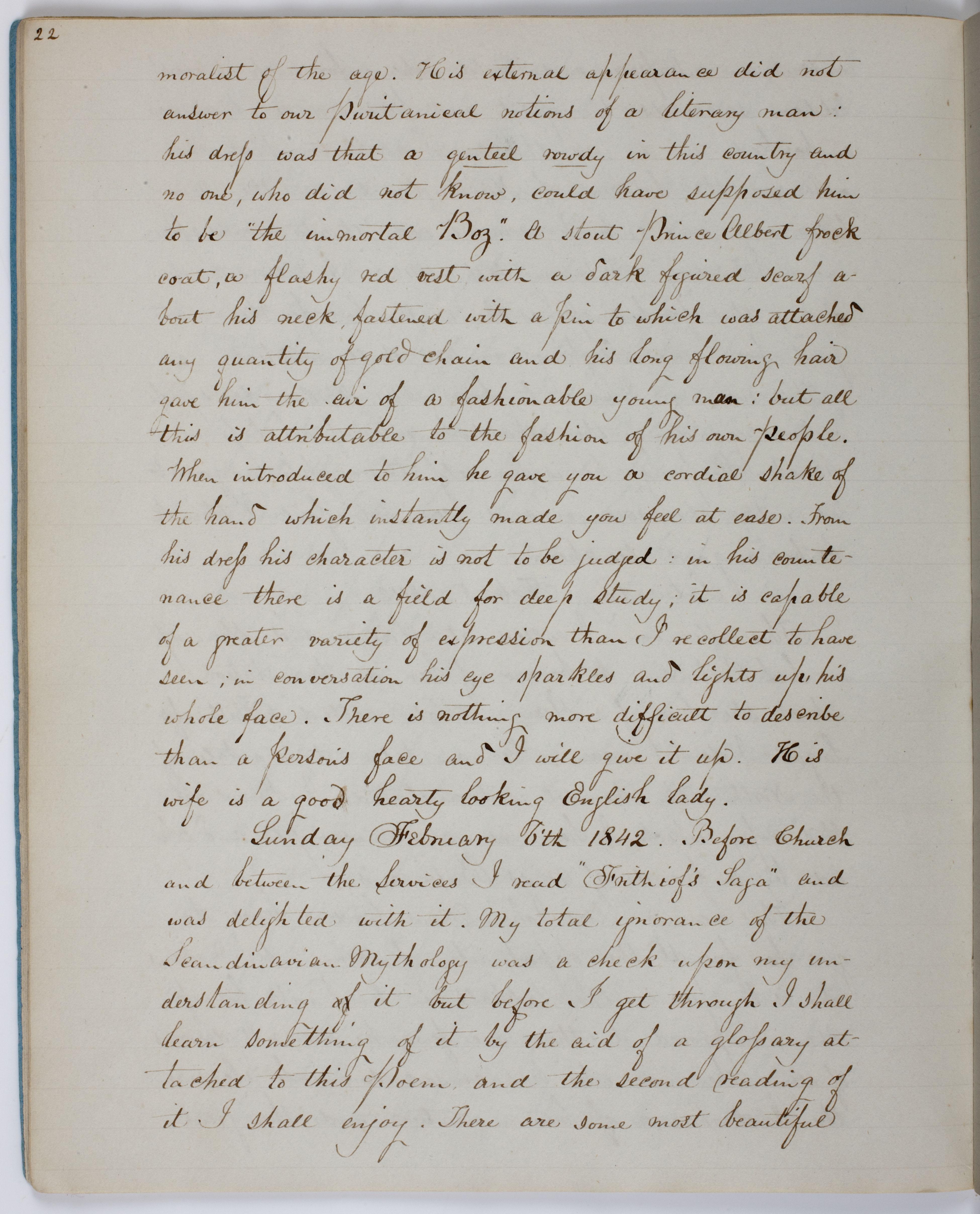
On February 5th, 1842, Levi finally catches an in person glimpse of the famed Dickens. We can learn much about Dickens’ visit through his own reminiscences of the trip in his work American Notes. Or perhaps read what literary scholars have to say about his trip’s impact on his writing and views of America. But what I like about Levi’s diary entry is how in awe he is, much as anyone would be when meeting their favorite celebrity. It’s also interesting that the majority of Levi’s entry for the day he meets Dickens is about what Dickens was wearing.
His external appearance did not answer to our puritanical notions of a literary man: his dress was that a of genteel rowdy in this country and no one, who did not know, could have supposed him to be “the immortal Boz.” A stout Prince Albert frock coat, a flashy red vest with a dark figured scarf about his neck, fastened with a pin to which was attached any quantity of gold chain and his long flowing hair gave him the air of a fashionable young man…
Gold chains and long flowing hair? Who would have imagined Dickens as such a fashionable, flashy dresser? Diaries, when written in such detail as Levi’s, are great for providing the reader with amazing visuals. A picture can say a thousand words, but in the 19th century, when photography was just beginning, images of celebrities were few and far between. So thanks to sources such as diaries we are able to remember the little things, like Charles Dickens’ sense of style.
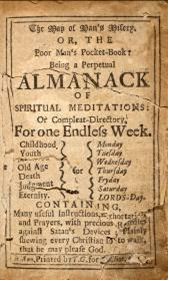
Ker, Patrick, fl. 1691. The map of man’s misery. Or, The poor man’s pocket-book. Being a perpetual almanack of spiritual meditations … Boston: Printed by T. G. for B. Eliot, [ca. 1710?]
The only known copy of a newly discovered early American imprint. Patrick Ker’s collection of meditations, arranged in a seven-day “week” extending from childhood to death and eternity, was first published in London in 1690. No subsequent English editions are known, but The map of man’s misery achieved extended popularity in colonial New England. Boston bookseller Samuel Phillips commissioned an edition in 1700 (copy at AAS, erroneously noted in some bibliographies as printed in “1692”), and later Boston printings appeared in 1706 and 1732 (copy at AAS). A copy of a fourth, unrecorded Boston edition turned up at auction this spring and is now safely in Worcester. Still in its original blind-ruled sheep binding over thin wooden boards, the copy is complete save for a hole where the all-important title-page date would be. However, we can deduce from the imprint—“Printed by T. G. for B. Eliot”—that this edition was printed by Timothy Green (1679-1757) for bookseller Benjamin Eliot (1665-1741) and must date between 1700 and 1714, when Green left Boston for New London. Bought at a Pacific Book Galleries auction. Sid & Ruth Lapidus, Bank of Boston, and Robert & Mary S. Cushman Funds.
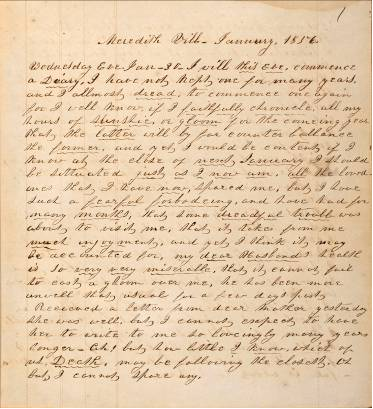
Cassandra Swasey (1818-1901) was the daughter of John B. and Alice Ladd Swasey of Meredith, NH. After her first husband died, Cassandra married Col. Ebenezer Stevens, a merchant in Meredith in 1846. This diary, which covers the period between 1856 and 1858, covers her daily activities. A recurring theme is her fears and anxieties. As she says in the diary’s first entry “I have such a fearful foreboding, and have had for many months, that some dreadful trouble was about to visit me, that it takes from me much enjoyment.” Purchased from Charles Cullen. Adopt-a-Book Fund.
Today we present a story in two parts, part of which you probably already know and part of which you probably didn’t know before.
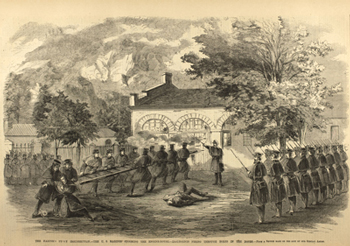
PART I is a summary of the story of John Brown, Harper’s Ferry, and American Anti-Slavery from AAS volunteer Colin Fitzgerald: 'The Harper's Ferry Insurrection' from Frank Leslie's Illustrated, October 29 1859
For three days in October 1859, radical abolitionist John Brown conducted an armed raid on the federal arsenal at Harper’s Ferry, (West) Virginia. Considered a seminal event in the years prior to the Civil War, Brown’s raid signified the growing intensity of the American anti-slavery movement. One of the raid’s main purposes involved acquiring weapons (rifles and pikes) for African-American slaves in the surrounding communities. Brown believed the raid would be a quick stop followed by a strong push southward along the Appalachian Mountains. He also believed that hundreds of slaves would join. He was wrong.
Before Harper’s Ferry, Brown’s interest in abolition had developed over many years. Having been profoundly inspired by notions of religious equality and anti-slavery, which emerged in the Second Great Awakening of the 1820s and 1830s, he intended to become a Christian minister. But after the murder of abolitionist minister Rev. Elijah P. Lovejoy in 1837, Brown’s anti-slavery views radicalized, as he wished to abolish slavery by any means necessary. For example, in the mid-1850s, Brown traveled to Kansas to clash with pro-slavery forces and make Kansas into a free state. Despite their futility, Brown’s forays in Kansas served as a dress rehearsal for Harper’s Ferry.
'John Brown Ascending the Scaffold Preparatory to Being Hanged' from Frank Leslie's Illustrated, December 17, 1859Harper’s Ferry changed the terrain of the American Anti-Slavery movement in ways that John Brown could never have fully anticipated, starting with Brown’s death.
*******************************************
Part 2 of our story reveals new details about the immediate afterlife of John Brown, as told by AAS’s Librarian and curator of manuscripts, Tom Knoles:
AAS recently acquired an extraordinary grouping of three hitherto unknown letters that shed new light on a pivotal event in American history – and also on a significant literary response to that event. The letters, purchased on the Harry G. Stoddard Memorial Fund, were written by three of the most important figures in nineteenth century American thought: Frederick Douglass, Ralph Waldo Emerson, and Henry David Thoreau.
The series of letters starts with one from Frederick Douglass:
“Confidential
My Dear Sir:
Seventeen Marshalls are
on the look out for me in the
States, and to avoid arrest I
must avoid a journey to Boston…”
So former slave and abolitionist Frederick Douglass wrote from Canada on October 28, 1859, to Charles W. Slack in Boston informing Slack that Douglass would be unable to keep his engagement to speak in Boston on November 1. Slack was the organizer of the Fraternity Course, a popular series of lectures sponsored by Theodore Parker’s Congregational parish, and Douglass had been scheduled to speak on the topic “Self Made Men.” Less than two weeks earlier, John Brown’s raid on the government arsenal at Harper’s Ferry had rocked the nation. Douglass had visited Brown in Virginia in August, bringing money from contributors in the northeast. Consequently, he was implicated in the raid and was sought for his alleged role in planning it. The Douglass letter now at AAS shows his state of mind during the days following Brown’s capture:
“I should have written before – but for the hope that the clouds that now overshadow me would pass away. Instead of this they grow darker every hour.”
From Canada, Douglass went to Great Britain, only returning to the United States the following year after Brown had been hanged and the government was no longer interested in prosecuting others involved in the affair.
In the second of these three letters, Ralph Waldo Emerson writes to Slack on October 31:
“I understand that there is some doubt about Mr. Douglass’s keeping his engagement for Tuesday next. If there is a vacancy, I think you cannot do a greater public good than to send for Mr. Thoreau, who has read last night here a discourse on the history & character of Captain John Brown, which ought to be heard or read by every man in the Republic.”
On October 30, Thoreau had delivered his lecture “The Character and Actions of Capt. John Brown” for the first time in the vestry of the First Parish Meetinghouse in Concord. Emerson was present, and reports in this letter:
“He read it with great force & effect, & though the audience was of widely different parties, it was heard without a murmur of dissent.”
Thoreau wrote to Slack the following day to make arrangements: “I will come to Boston as desired. My subject will be ‘Capt. John Brown’….” He delivered the speech that evening to a crowd of twenty five hundred at the Tremont Temple, and the lecture was widely reported in the newspapers.
The outline of the story told in these letters is well known, particularly because Thoreau’s discourse, first published the following year as “A Plea for Captain John Brown,” became one of his most famous essays. Nonetheless the letters now at AAS provide many new details about Douglass’s fear of being apprehended by federal authorities, about how Thoreau came to replace Douglass on the podium, and also about Emerson’s enthusiastic reaction to the lecture.
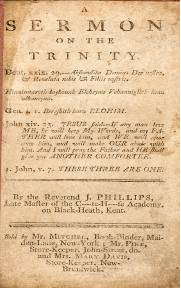
Phillips, John. A sermon on the Trinity. [New York]: Sold by Mr. Mitchel, book-binder, Maiden Lane, New-York; Mr. Pike, store-keeper, John Street; and Mrs. Mary Davis, store-keeper, New-Brunswick, [1794]
Third known copy of an unusual American imprint, as yet unreported to the North American Imprints Project (NAIP) or the English Short Title Catalogue (ESTC). John Phillips led a boys’ school at the Chocolate House Academy in Blackheath, London, from 1790 to 1792. This sermon was possibly first printed in England—some aspects of the typography suggest that this edition is a reprint—though no copy of an English edition has survived. What distinguishes this American edition is the imprint shared among three publishers at the outermost reaches of the American book trade: Edward Mitchell, a bookbinder and stationer who published a few other tracts in the mid-1790s; a Mr. Pike, a “store-keeper” of whom little else is known; and Mary Davis of New Brunswick, NJ, who published nothing else but who did place an advertisement for this work in Arnett’s New-Jersey Federalist for October 9, 1794, enabling us to date this edition.
Purchased from E. M. Lawson & Co. Henry F. DePuy Fund.
In honor of Independence Day, I thought I’d take a look into AAS’s manuscript collection to see how folks observed the holiday in the past. Sure, it’s all about barbeques and fireworks now, but closer to our independence the holiday probably meant something different to those who lived through the Revolution.
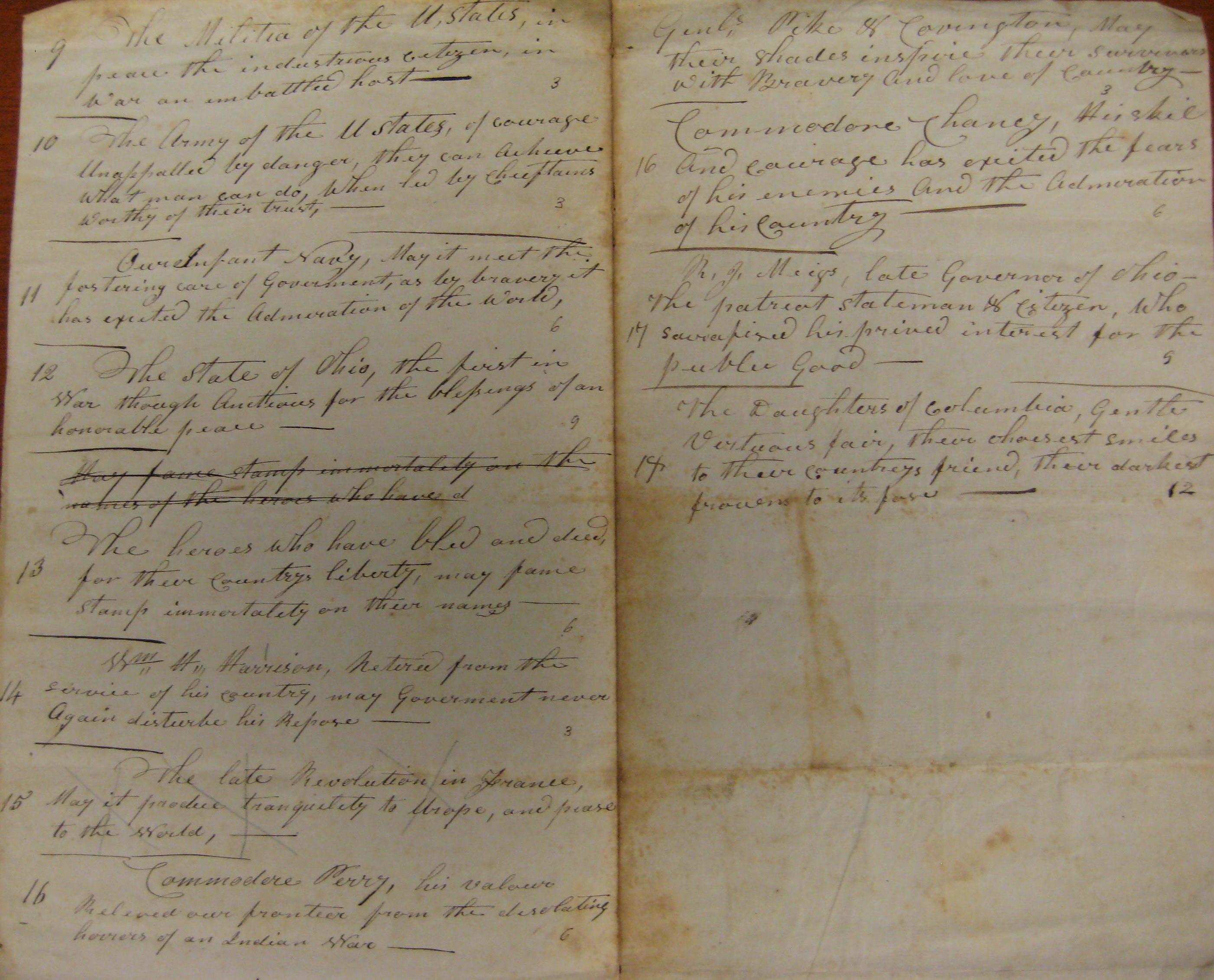
Elnathan Scofield (1773 – 1841) was a patriot through and through. He served in a multitude of government roles, from Postmaster of Lancaster, Ohio, to a Captain in the Ohio militia. He even served terms in both branches of the Ohio legislature. Included in his collection of papers here at AAS is a list of 18 toasts for the 4th. Whether he actually recited these toasts at a dinner (or BBQ!) we can’t say. But it’s interesting to see the thoughts stirred up on this holiday, and how appropriate and applicable they still are today. Below are some of my favorites – feel free to use them during your celebrations today!
The 4th of July, may its blessing be perpetuated to the latest posterity.
The President of the U states May the good of his country ever be his Aim
The Union of the states, cemented by the blood of our fathers, may it be perpetual
The Militia of the U States, in peace the industrious citizen, in War an embattled host
The heroes who have bled and died, for their countrys liberty, may fame stamp immortality on their names
So whatever your opinions and politics, I think we can all agree to honor our nation on this most patriotic of patriotic holidays, and raise a glass to our nation, to its history, and to its future. Happy 4th everyone!
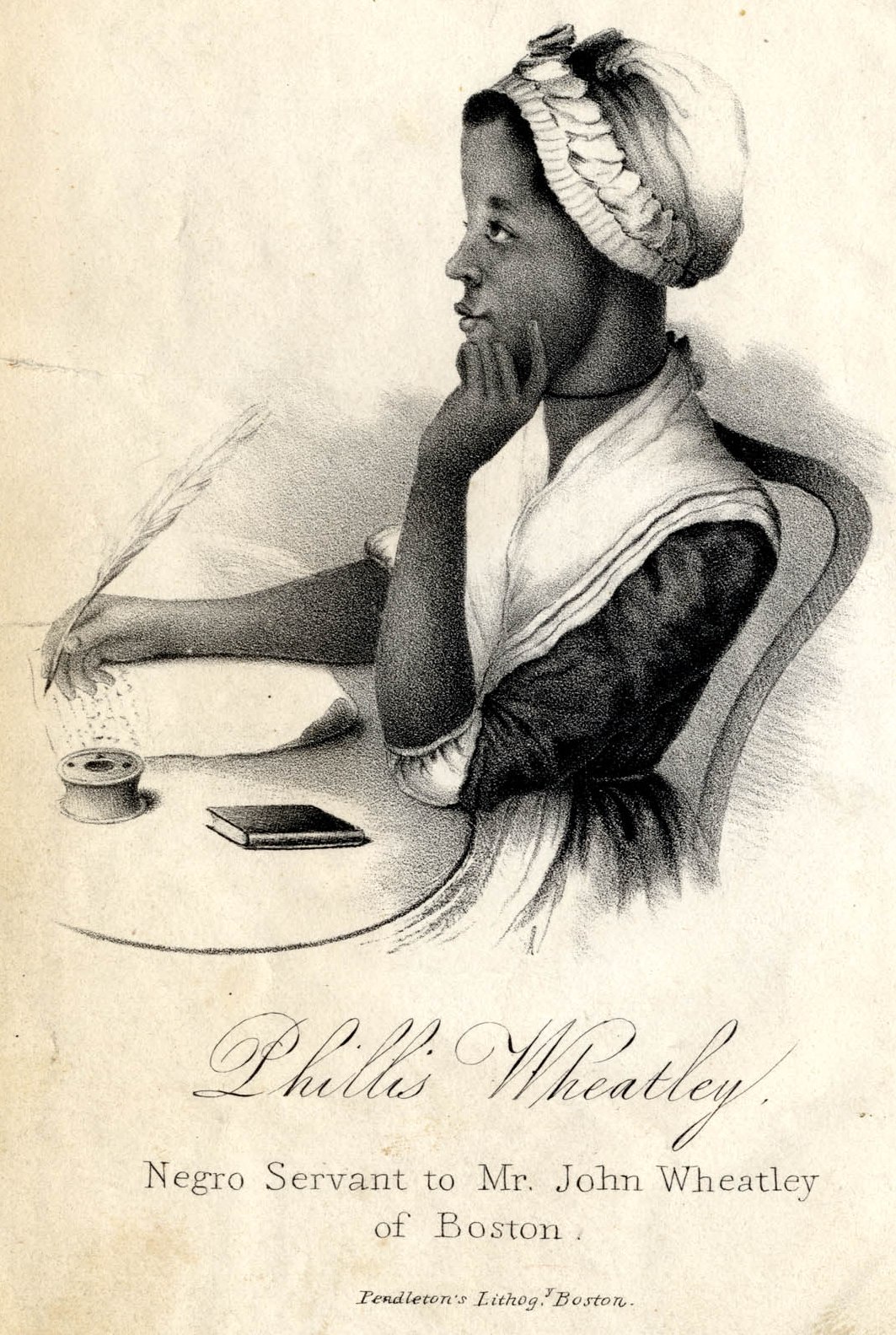
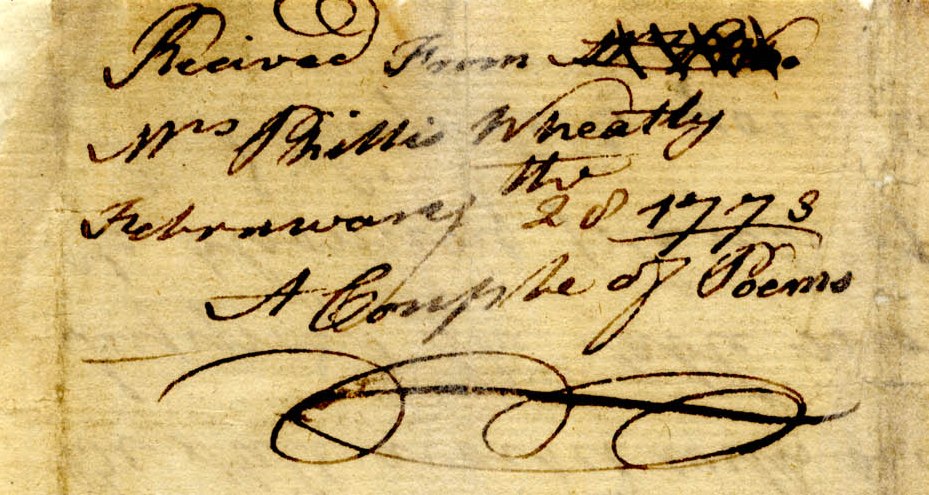
With the publication of Poems on Various Subjects, Religious and Moral (London, 1773) [AAS online catalog record], Phillis Wheatley became the first published African American poet. Because of her status as a house slave in Boston, Massachusetts, she achieved high literary recognition in the years following publication. Prominent political figures like George Washington and Thomas Jefferson were even aware of her poetry in the succeeding decades. But what made Wheatley’s poetry particularly intriguing was the passion she exhibited for memorializing the dead. Perhaps this passion grew from her conversion to Christianity as a young slave learning to read from the Bible.
This lithograph was not made until about 1834, about 50 years after Wheatley’s death.
One example of Wheatley’s passion for memorializing the dead included the poem On the Death of the Rev. Mr. George Whitefield, 1770. Since Whitefield was one of the primary preachers in the First Great Awakening, a time of heightened religious fervor during the 1730s and 1740s, Wheatley praised him as a “prophet.” She wrote:
Behold the prophet in his tow’ring flight!
He leaves the earth for heav’n’s unmeasur’d height,
And worlds unknown receive him from our sight.
With rhythmic lines such as these, it became clear that Wheatley possessed a special talent for poetic eulogy. Whitefield’s central message encouraged a self-driven religious experience, without regard to race, class, or gender, and Wheatley personally embraced it as such. In short, she understood Whitefield and the First Great Awakening as a kind of liberating theology which helped guide Christianized African-American slaves in their search for spiritual salvation.
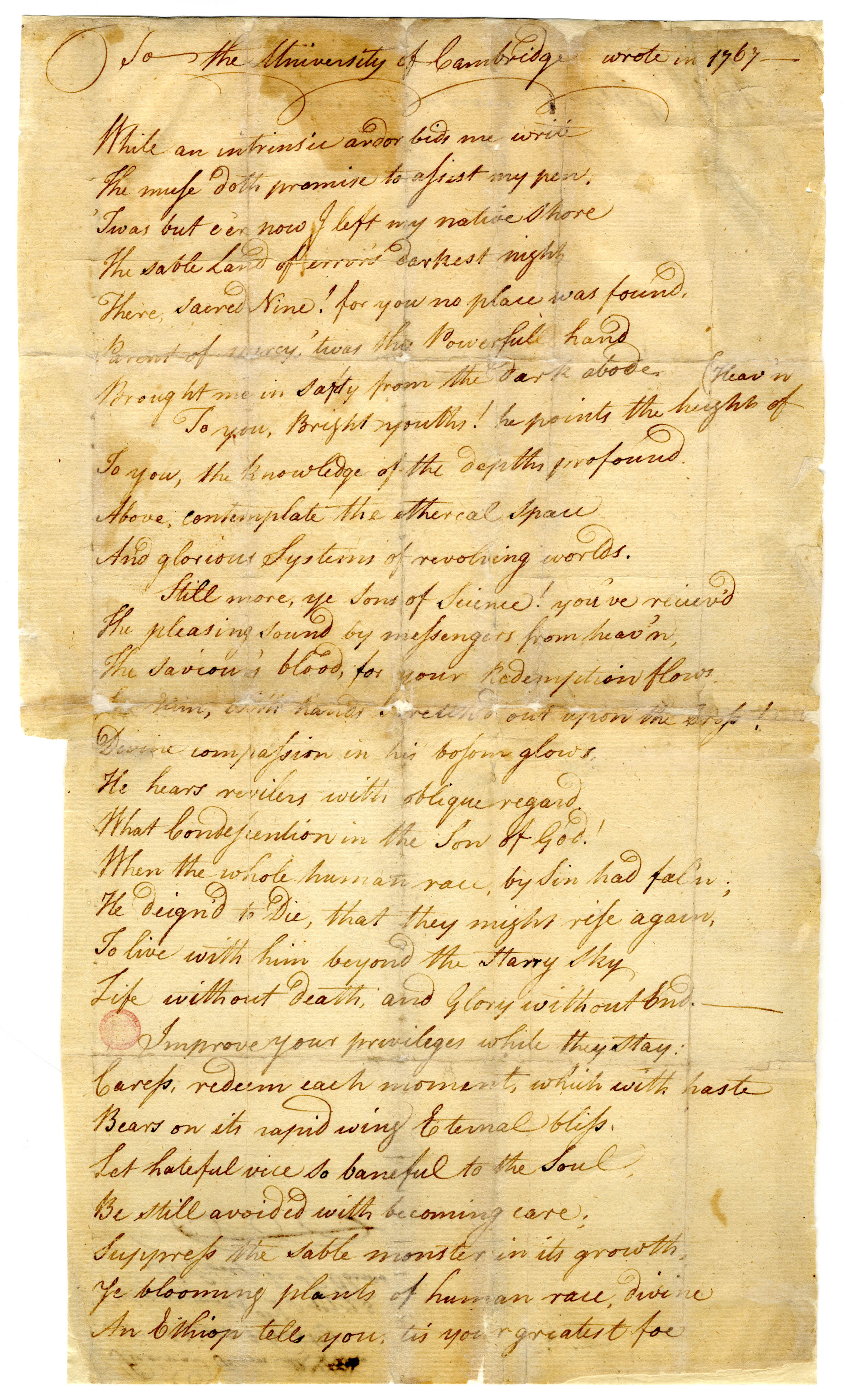
AAS holds two Wheatley poems in the manuscript collections [AAS online record]. “To the University of Cambridge” is shown here (click on the image to enlarge), along with the attribution on the back.
Although Wheatley died in 1784, many of her poems continued to be edited, revised, and updated over the next fifty years. In fact, AAS’s collection of editions of Wheatley’s writing covers the 18th, 19th, and 20th centuries. AAS specializes in preserving materials prior to 1876 and Wheatley’s writings certainly constitute an important part of the Society’s African-American resources.
As was mentioned in a post last week, Americans will be marking the 150th anniversaries of the great events of the Civil War over the next four years. Many of the battles, commanders and regiments of that conflict have become legends, and the narrative of a nation split apart, brother fighting against brother, remains compelling. However, because these events loom so large in our national memory, it is easy to forget that beyond the legends the life of the nation went on.
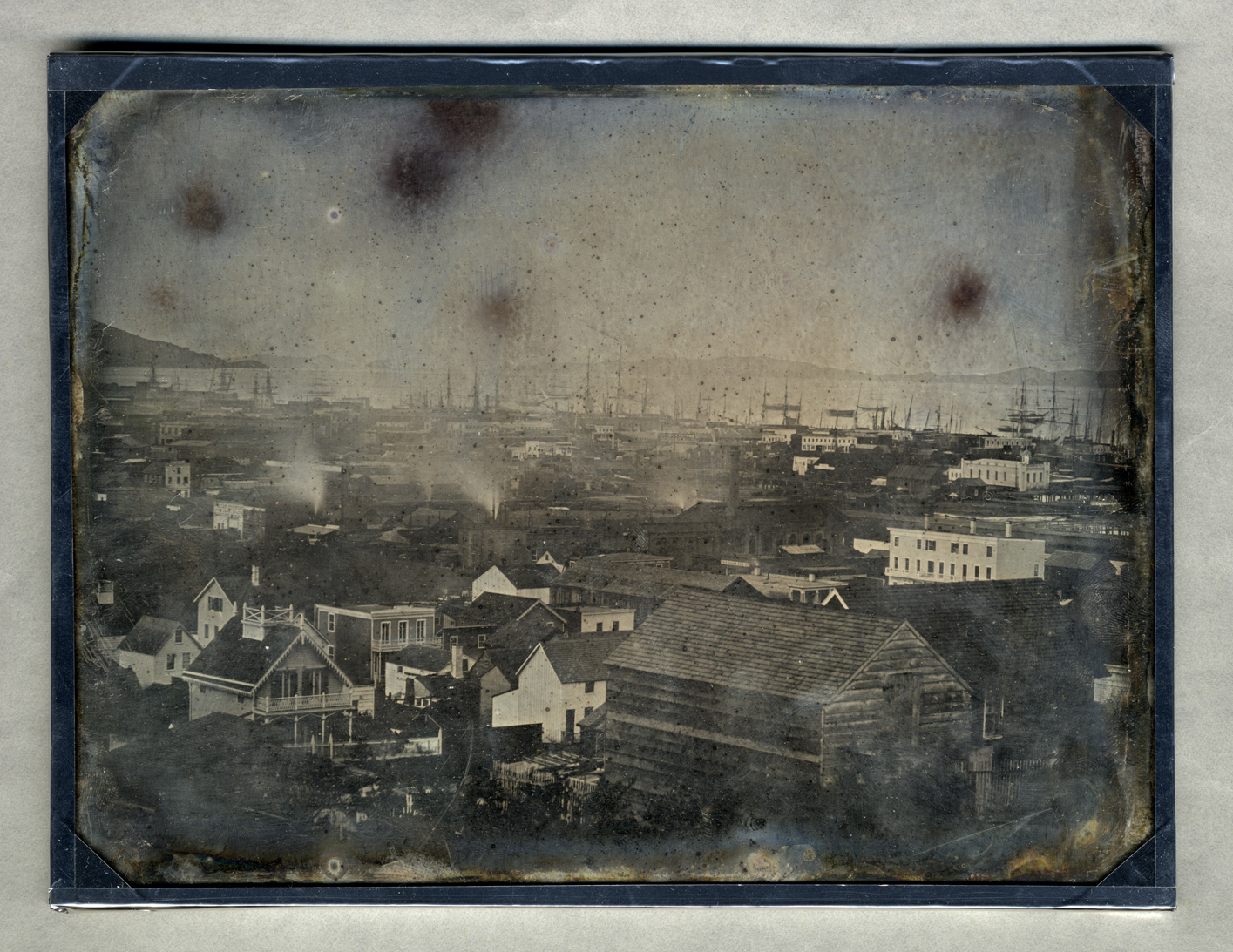
View of San Francisco, California, ca. 1855. Whole plate daguerreotype. (click to enlarge) The Society owns a set of three whole plates depicting early San Francisco including this view of the harbor, a view of the hills with Tehama Market and a view of a residential area of the city.
California, for example, experienced the war in a different way from most of the Unites States. Still a frontier state in 1861, Californians were removed by both time and distance from the conflict raging in the east. The San Francisco Bulletin, a newspaper of the time, did not print the news of Lincoln’s election until November 14th 1860, one week after the election was held. During the secession crisis and the early years of the war, news generally took a week or two to reach California from the east coast, because the telegraph did not yet extend across the continent and the remaining distances had to be covered by riders of the pony express.
Despite the distance, Californians were not content to remain on the sidelines of the conflict. San Francisco and most of northern California were pro union, especially after the Confederate states opened fire on Fort Sumter. This sentiment is echoed in an article in the Bulletin of May 6, 1861 which advertises a lecture to be given called “The Love of One’s Country.” It suggests that a true patriot cannot sit idly by while the seceding states tear “limb after limb” from the “bleeding body” of the nation.
Also like many others across the nation, the opinion makers of California did not foresee the terrible war that was to come. On the same day news of Lincoln’s election reached San Francisco, an editorial in the Bulletin predicted the secession crisis would blow over. Even once it became clear that it would not, the editor was not concerned because in his opinion “the cotton states were powerless.”
Despite the union sentiment in the north of the state, California did not send its volunteer regiments east to fight in the well-known campaigns that define our image of the war. Instead, it had its own secession crisis to deal with. In southern California, many settlers from the southern states and Spanish speakers who resented US control, which was less than two decades old, sought to form a new state and either join the Confederacy or declare outright independence. California troops took up the duties of regular army troops who went east to fight and kept the “secession element,” as the Bulletin labeled it, at bay, while also guarding the western forts, which the regular troops had vacated, against Native American attacks. Furthermore, California’s volunteers were instrumental in defeating a confederate invasion of modern New Mexico and Arizona when, on May 20th 1862, they forced Southern troops to evacuate the town, causing the Bulletin to gleefully declare: “Tucson Occupied by the Federals!” California, though it is now largely forgotten, fought its own small war within the war.
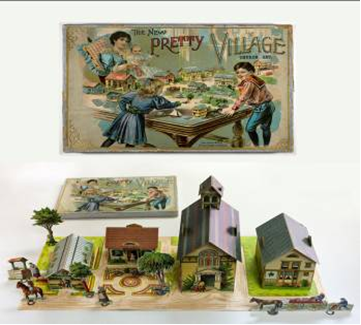
The New Pretty Village. Church Set. New York: McLoughlin Bros., 1897.
The McLoughlin Brothers dominated both the picture book and game markets in late 19th-century America, and The New Pretty Village is a wonderful example of McLoughlin’s halcyon era. This segment of the ideal suburban village includes cardboard models of a church, a stately house, a cozy cottage, and a florist’s greenhouse, along with trees, bushes, and villagers that can be posed on metal perches. The chromolithographed box shows the church set in its visual context with other village segments. It is truly rare to get a McLoughlin game in such great condition, and the AAS curator of graphic arts, Lauren Hewes, and I are inspired to collect the entire village, as acquisition funds permit!
Purchased from Helen Younger. Linda & Julian Lapides and Harry G. Stoddard Memorial Funds.
Further information:
You may be able to find the original price for The New Pretty Village in the McLoughlin Bros. catalogs, price lists, and order sheets in AAS collections — all are available online now as PDFs.
Here is a roundup of a few blogs that have recently mentioned Past is Present.
One of our recent posts — “City Living” was referenced a couple of times. Two Nerdy History Girls had a post “Big Bad City Tempts Young Men, 1849” in which Susan provides a wonderful set-up to introduce our earlier post:
“Just as the country has traditionally represented a pure and wholesome life, cities everywhere are most often depicted harboring sin and wickedness on every street corner. As the focus of the 19th c. American economy shifted away from farms to factories, young men became increasingly eager to leave rural homes for the proverbial bright lights of the big city. Cautionary tracts were quick to appear, doubtless far more popular with worried parents than ambitious youth.”
Make sure to go to her post on Two Nerdy History Girls to see the illustration showing just how tempting cities could be!
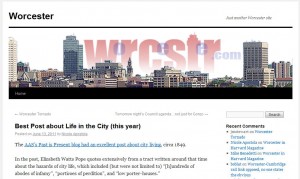
The same Past is Present post on “City Living” was also described as “Best Post about Life in the City (this year)” by Nicole on her Worcester blog, an accolade we greatly appreciate.
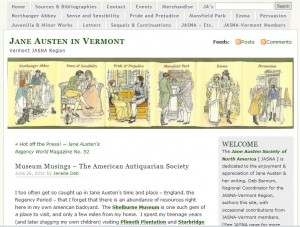
And just this weekend, the blog Jane Austen in Vermont had a lovely post “Museum Musings – The American Antiquarian Society” which aptly describes the serendipity of online historical research. After kindly complementing AAS’s online exhibits (you can find them all here), Deb goes on to reveal her favorite find:
“But here is my favorite find: note very closely this image of the title page of The Ladies Library and the owner’s signature Jane Mecom
“Serendipitous, don’t you think that I read this article a few weeks ago and then find this title page image on the AAS site with her name in the book!”
As Deb aptly points out, you never know what you’re going to find while poking around online. It could be interesting material from the present or from the past. So here are our recommendations for three enjoyable blogs with which to start your online fun today: Two Nerdy History Girls, Worcester, and Jane Austen in Vermont. Hope you enjoy them as much as we have!
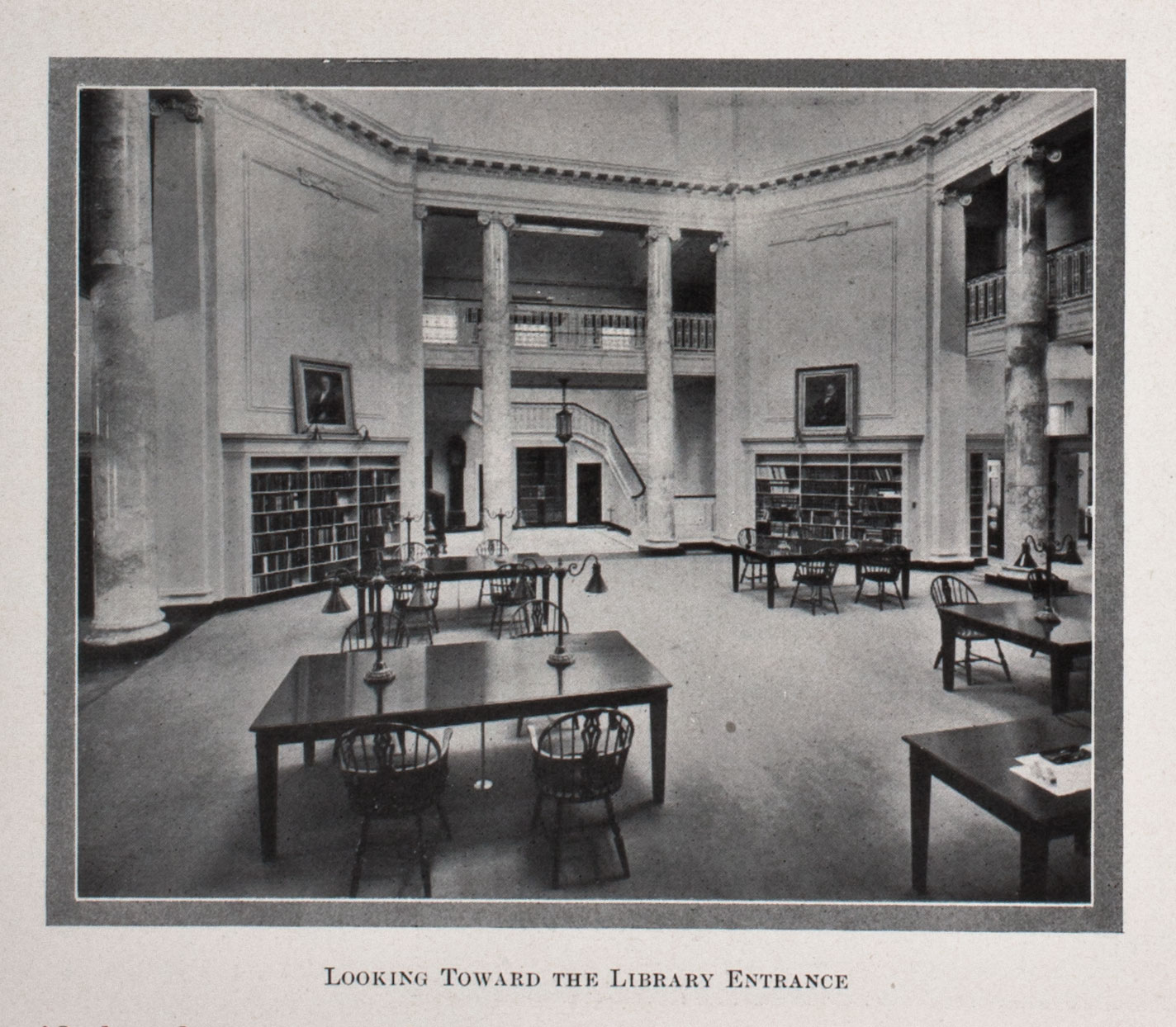
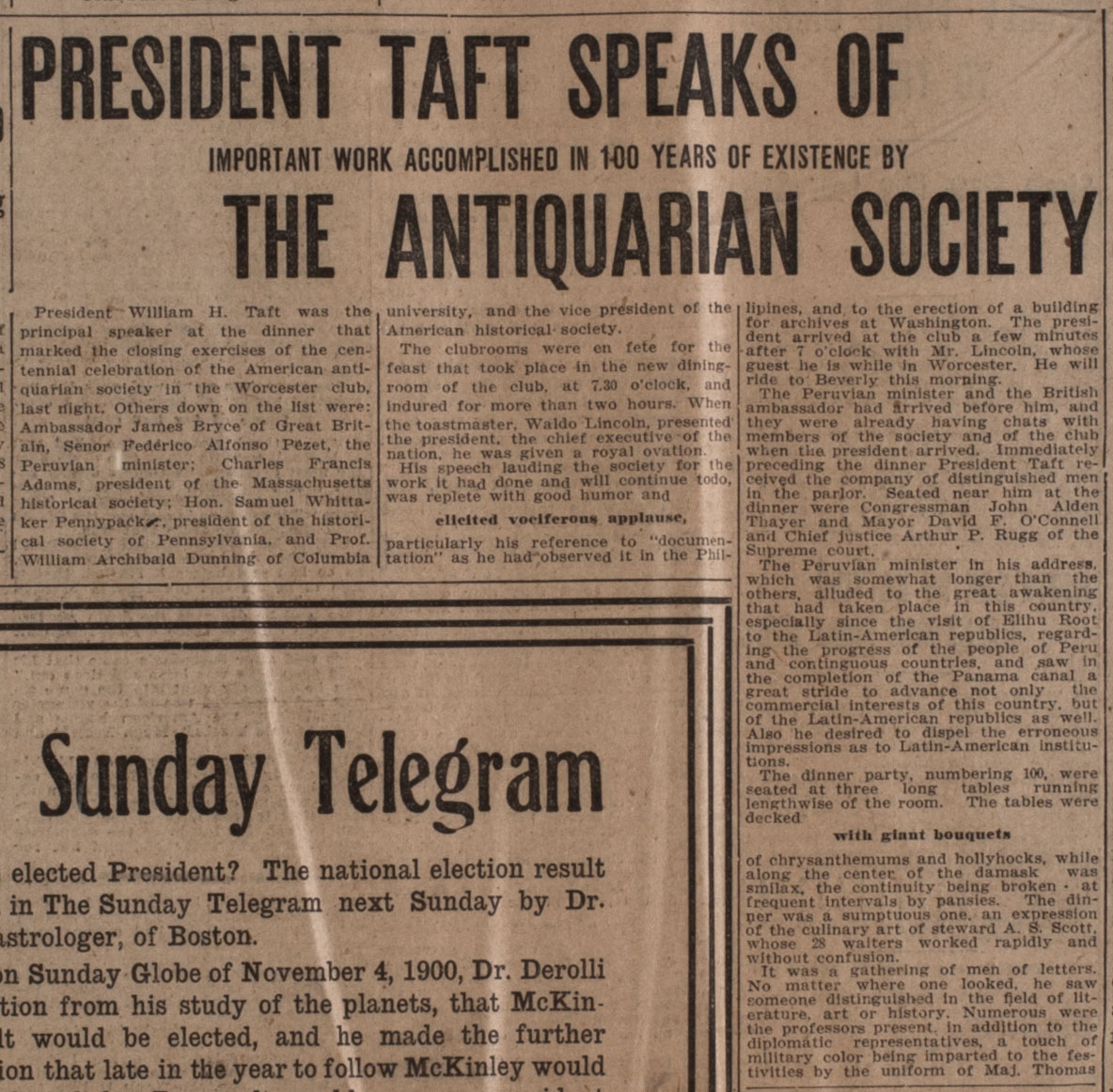
As AAS gears up for the most momentous occasion of its bicentennial in 2012, I thought it would be fitting to take a look back in the AAS archives to see how we celebrated the first 100 years. In 1912, the Society had just moved into its new (and now current) home at 185 Salisbury Street, Waldo Lincoln was serving as president of the Society, Clarence Brigham as librarian, President Taft gave a speech at the celebratory dinner, and the Red Sox won the World Series. The library acquired 2624 bound volumes, 3455 pamphlets, 1864 unbound early newspapers, and 824 maps, broadsides and manuscripts. I wonder what 2012 has in store!
Worcester Magazine recounted the events of the 1912 centennial in its November issue of that year as quite the event:
…the one hundredth anniversary of the American Antiquarian Society, observed on October 16 with exercises and ceremonies as impressive and dignified as befitted an occasion so important in the field of historical research work.
The festivities were apparently so extensive, “a volume, almost, might be written by way of introduction to the anniversary exercises.” Festivities began with an opening reception in Antiquarian Hall, to which some thousand Worcester residents were invited. Next was the annual meeting, with an address by Charles G. Washburn, which was followed by formal anniversary exercises at the First Unitarian Church. Finally, President Taft made an appearance as guest of honor at the concluding anniversary dinner. Other distinguished guests included Ambassador of Great Britain James Bryce, Minister from Peru Alfonso Pezet, and Senator Henry Cabot Lodge.
In his address during the centennial celebrations, President Lincoln described the strength and vigor of the Society as it reached its 100th year. I think he would be proud to see how the Society has continued to grow, and age with grace, 100 years later.
The completion of one hundred years of existence by a learned society is no indication of approaching senility, but rather is like the coming of age of a young man about the enter with the vigor of manhood on the duties of life, and congratulations on the strength which has enabled a society to complete five score years are unmarred by any fear lest that strength may be but labor and sorrow.
There has been much interest in the Civil War of late. The increased coverage makes sense given that next few years mark 150 years since the conflict that divided our United States. Here at Past is Present, we would like to highlight another side of the war years. Rather than focusing on the battles or military or diplomatic events, we wondered: what were the average citizens seeing in their papers every week during the war?
Here is one example from this week during the Civil War.
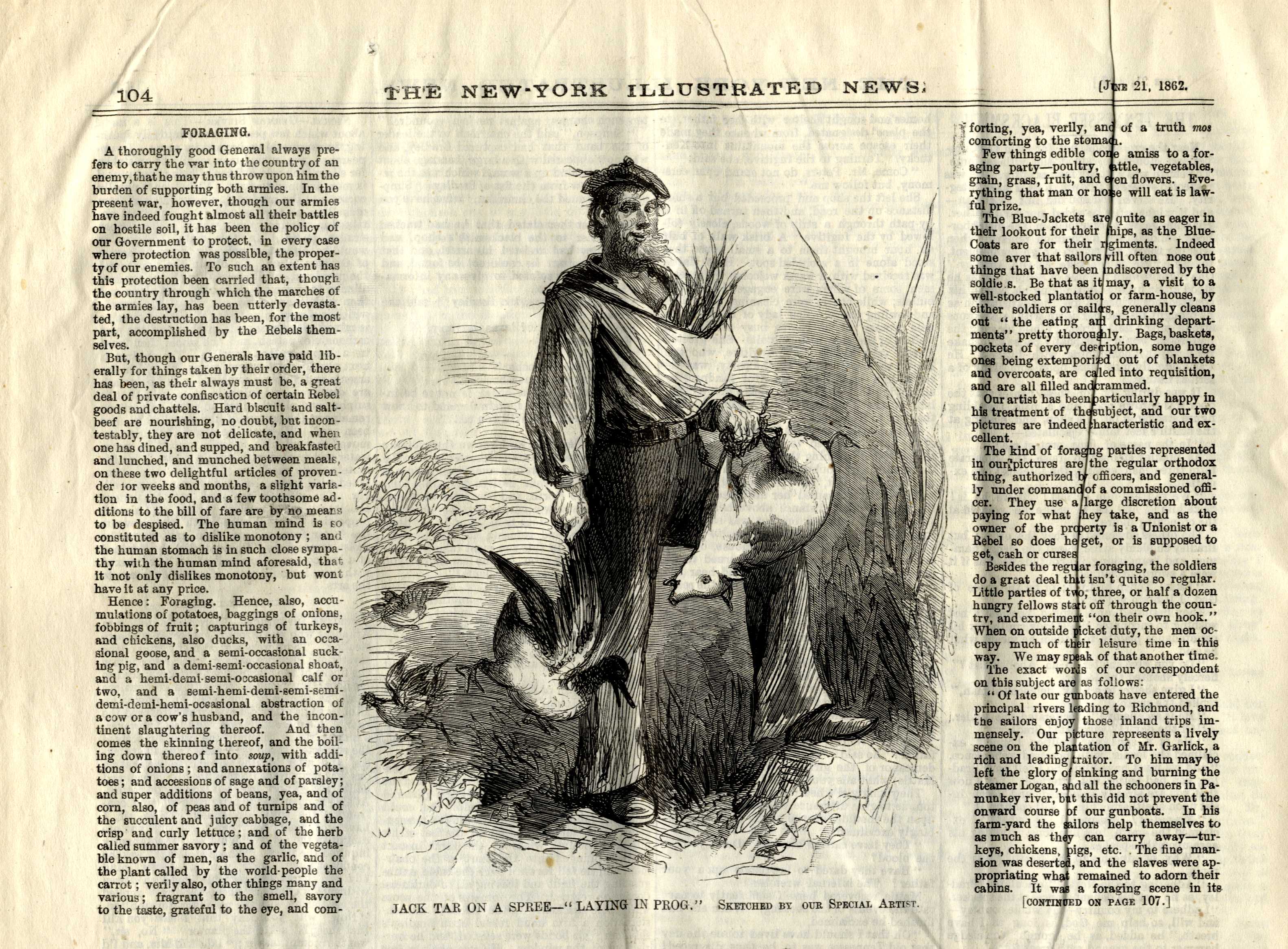
Hunger is a universal human experience, and this article in the New-York Illustrated News on June 21, 1862, used hunger to connect their readers to the Union soldiers fighting far afield:
“Hard biscuit and salt-beef are nourishing, no doubt, but incontestably, they are not delicate, and when one has dined, and supped, and breakfasted and lunched, and munched between meals on these two delightful articles of provender for weeks and months, a slight variation in the food, and a few toothsome additions to the bill of fare are by no means to be despised. The human mind is so constituted as to dislike monotony; and the human stomach is in such close sympathy with the human mind aforesaid, that it not only dislikes monotony, but wont [sic] have it at any price.
Hence: Foraging.”
But was this behavior sanctioned by the Union army, or undertaken surreptitiously by soldiers whose taste buds and stomachs drove them to steal? According to the paper:
“The kind of foraging parties represented in our pictures are the regular orthodox thing, authorized by officers, and generally under command of a commissioned officer. They use a large discretion about paying for what they take, and as the owner of the property is a Unionist or a Rebel so does he get, or is supposed to get, cash or curses.”
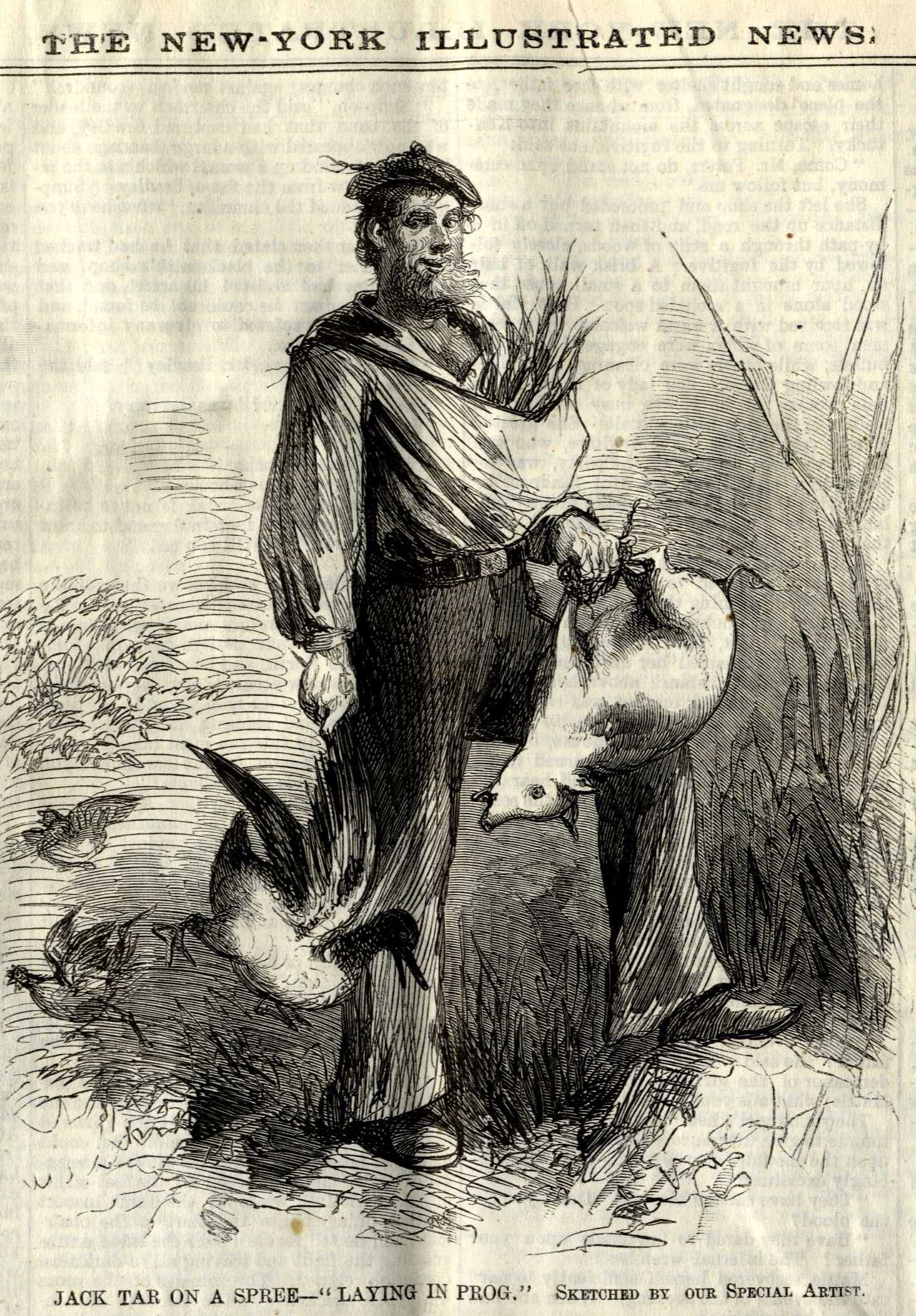
However they acquired the food, a forager like “Jack Tar on a Spree,” as depicted in this illustration by the newspaper’s “special artist,” looks quite satisfied with himself and his catch.
Click on the newspaper article below to read more. (Sorry about the wrinkle disrupting the text, but think of it this way: you can tell you’re reading from a real 3D newspaper, right? And you didn’t even need to put on those silly glasses.)
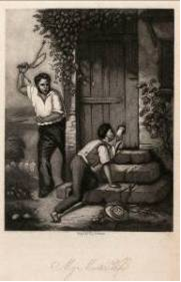
No rose without a thorn. New York: Nathaniel Currier, [1838-1856] Shown with “My Master’s Wife”
When he started his business on Nassau Street in New York City, Nathaniel Currier offered for sale lithographs of news events, historic images, local views, and pretty women. He also occasionally produced narrative genre scenes such as this curious depiction of a young man kissing a lady’s hand through a hole in a wooden door. The unfortunate youth is about to be whipped for his freshness by an older, angry man approaching from behind.
Although AAS tends to purchase prints related to historical events or to the history of printing, this image was too good to pass up, given its visual relationship to another item already here. Our current NEH-funded project, “Prints in the Parlor,” involves cataloging images from the AAS collection of annuals and gift books. (Read an earlier blog post introducing the project here.) In the Forget-me-Not for 1850 (New York: E. O. Jenkins, 1849), we encountered the illustration “My Master’s Wife,” engraved by William G. Jackman, who did quite a bit of work for the annuals industry from his base in New York City. The Jenkins printing works was located at 114 Nassau Street, just four blocks away from Currier’s shop at 152 Nassau Street. We will never know who was copying whom, but it is wonderful to have both images together in the collection for future scholars to debate.
Purchased from the Old Print Shop, New York. Print Acquisitions Fund.
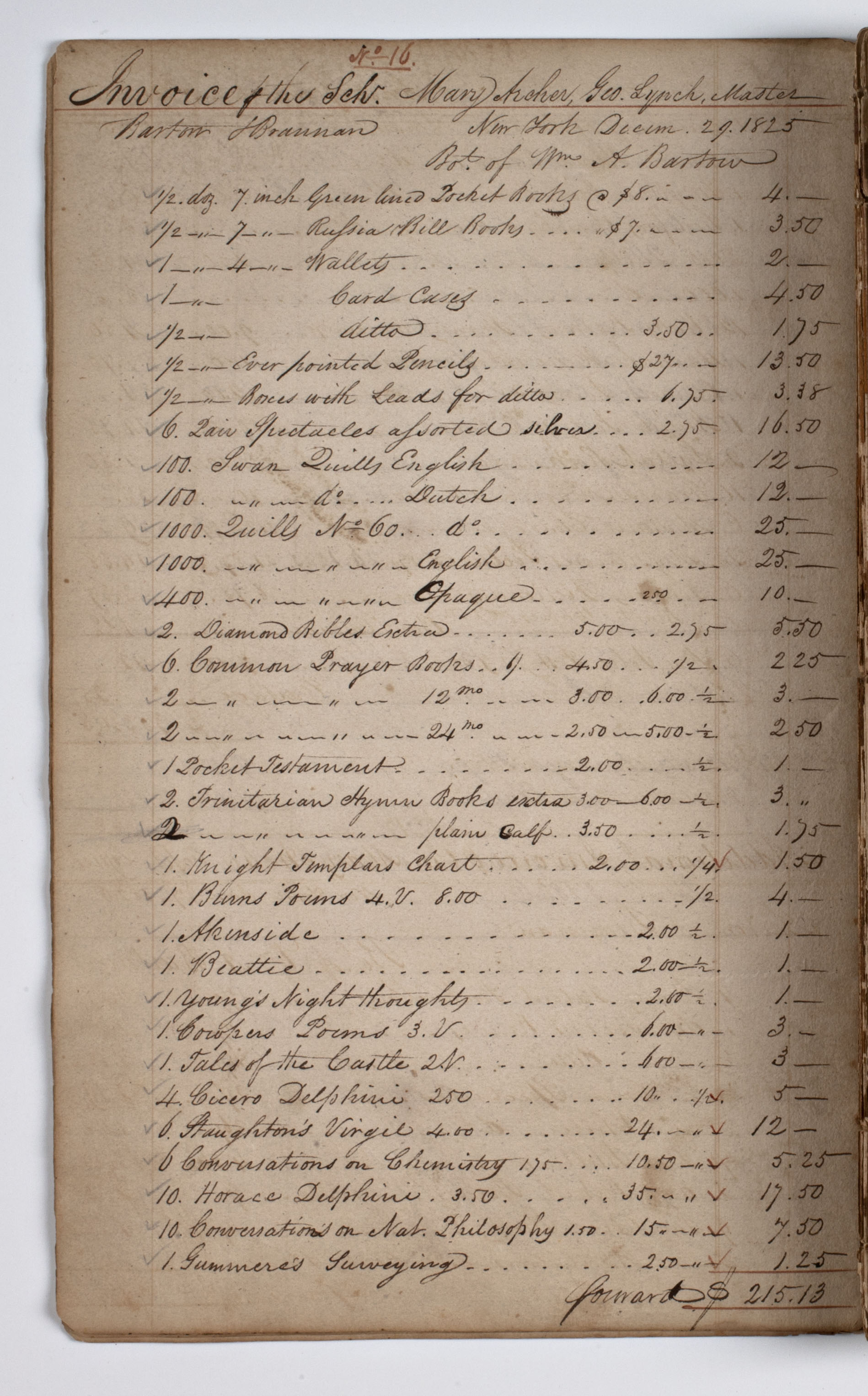
Ever wonder what people were reading in the 19th century? A great way to see what the most popular books were at a particular time is to look at account books from publishing firms and booksellers. Now, even more interestingly, ever wonder what people were reading on ships in the 19th century? How about looking at an account book from booksellers working in a port! AAS has just such an account book.
AAS has the daybook of William Augustus Bartow (link to catalog record), a bookseller and paper merchant from New York. Between the years 1825 and 1835, Bartow, along with his partner Brannan, sold books, stationary merchandise, and general merchandise to schooners and captains. Their business was based in Washington D.C.
It’s hard to say whether the merchandise sold was actually used by the crew, or if it was being transported by the ships to be sold elsewhere. However, when looking at some of the transactions, it’s occasionally safe to assume the crew was using the merchandise when small quantities were being purchased. For example, the crew was probably using those 5 copies of the bible, not selling them. But when the quantities get into the 100s, it’s possible these items were being transported for sale.
Flipping through the pages of the Bartow daybook is an excellent, and really fun way of reconstructing life on a ship in the 19th century. We are reminded of how young some of the crew members on board were when we see text books, such as arithmetic and grammar books, being bought. Then again, this also reminds us of how many crew members, both young and old, were uneducated. We also can imagine the long days at sea, away from loved ones, when seeing the purchase of large quantities of stationary, pens and ink.
I do wonder, however, who was the one crew member brave enough (or with a good enough sense of humor) to read a copy of Robinson Crusoe while on board a ship.
David Whitesell, curator of books, reports on a recent acquisition:
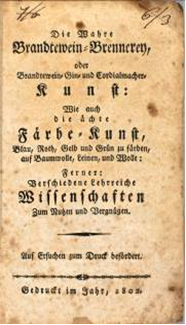
Die Wahre Brandtewein-Brennerey, oder Brandtewein- Gin- und Cordialmacher-Kunst: wie auch die a?chte Fa?rbe-Kunst, Blau, Roth, Gelb und Gru?n zu fa?rben, auf Baumwalle, Leinen, und Wolle … [Reading, PA?: Gottlob Jungmann and Carl Andreas Bruckmann?], 1802.
Very rare third of four recorded editions of what might be termed the first German-American cookbook. This manual for distilling brandy, gin, and cordials was first published by Salomon Mayer in York, PA in 1797, together with another Mayer pamphlet on the dyeing of silk, linen, and wool. Mayer reprinted these works in a combined edition in 1802, the same year that this piracy was issued. On the basis of typographical evidence, this edition has been ascribed to the Reading, PA press of Jungmann and Bruckmann. A final edition appeared in 1809. Each edition is known in only a handful of copies, and none are listed in any bibliography of American cookery books. This copy is in its original decorative wrappers, block-printed in green in a floral pattern. Purchased from Steve Finer. Harry G. Stoddard Memorial Fund.
4th ed., 1809: Not at AAS, yet. We have an AAS online catalog record ready and waiting, though, so if you find a copy of this edition (the imprint reads “Gedruckt im Jahr, 1809”), perhaps you can help us complete the set!
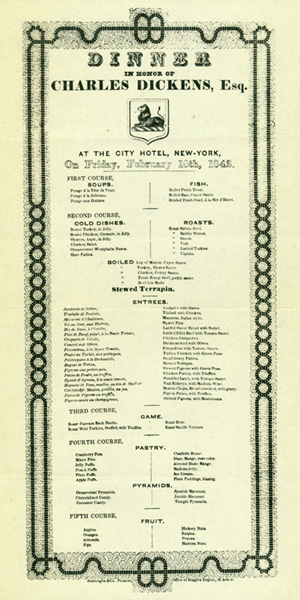 In 1842, Charles Dickens made his first of two visits to America. He took a sweeping tour of the country, meeting with dignitaries such as Longfellow, Poe, and President John Tyler. He visited Massachusetts, New York, Pennsylvania, Washington D.C., Virginia, Maryland, Ohio, Kentucky and Missouri. While in New York City, he was welcomed with a grand ball (from which AAS has a menu). And during his glamorous whirlwind tour, Dickens managed to find time to visit our humble city of Worcester!
His external appearance did not answer to our puritanical notions of a literary man: his dress was that a of genteel rowdy in this country and no one, who did not know, could have supposed him to be “the immortal Boz.” A stout Prince Albert frock coat, a flashy red vest with a dark figured scarf about his neck, fastened with a pin to which was attached any quantity of gold chain and his long flowing hair gave him the air of a fashionable young man…