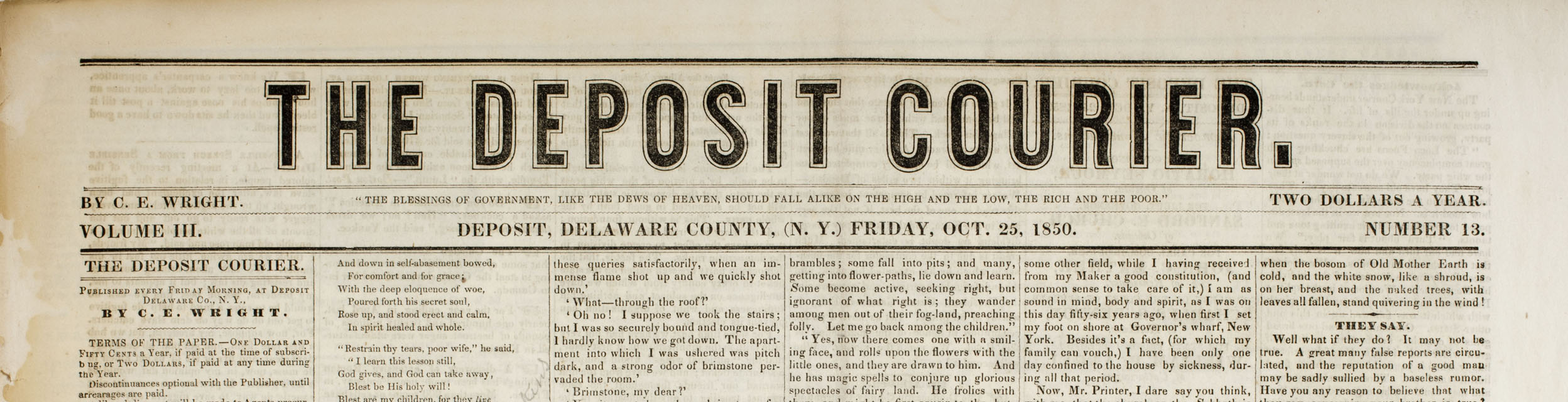
AAS has few newspapers from Delaware County, NY and, until this spring, only two issues from the town of Deposit. Six years ago we were the underbidder at auction on a lot of the Deposit Courier. The person who won it was a Californian, John Aiello, who had grown up in Deposit. Mr. Aiello promised to donate his run to AAS when he was done reading them and copying articles. Now he has made good on his promise, and the issues have arrived, giving a major boost to our Deposit holdings. This paper began publication in 1849 and continued until 1853 under the editorship of C.E. Wright.
Hannah Weld Part III
And now for some concluding thoughts from Jeanne McDougall about her encounter with Hannah Weld. If you’ve missed the previous two posts about Hannah and her mother Mary, click here to get caught up.
What can you say after experiencing such an extraordinary epistle? My reading for the day came to a full stop; any day in life where you learn something new, or make a friend, is a good day. This had been both.
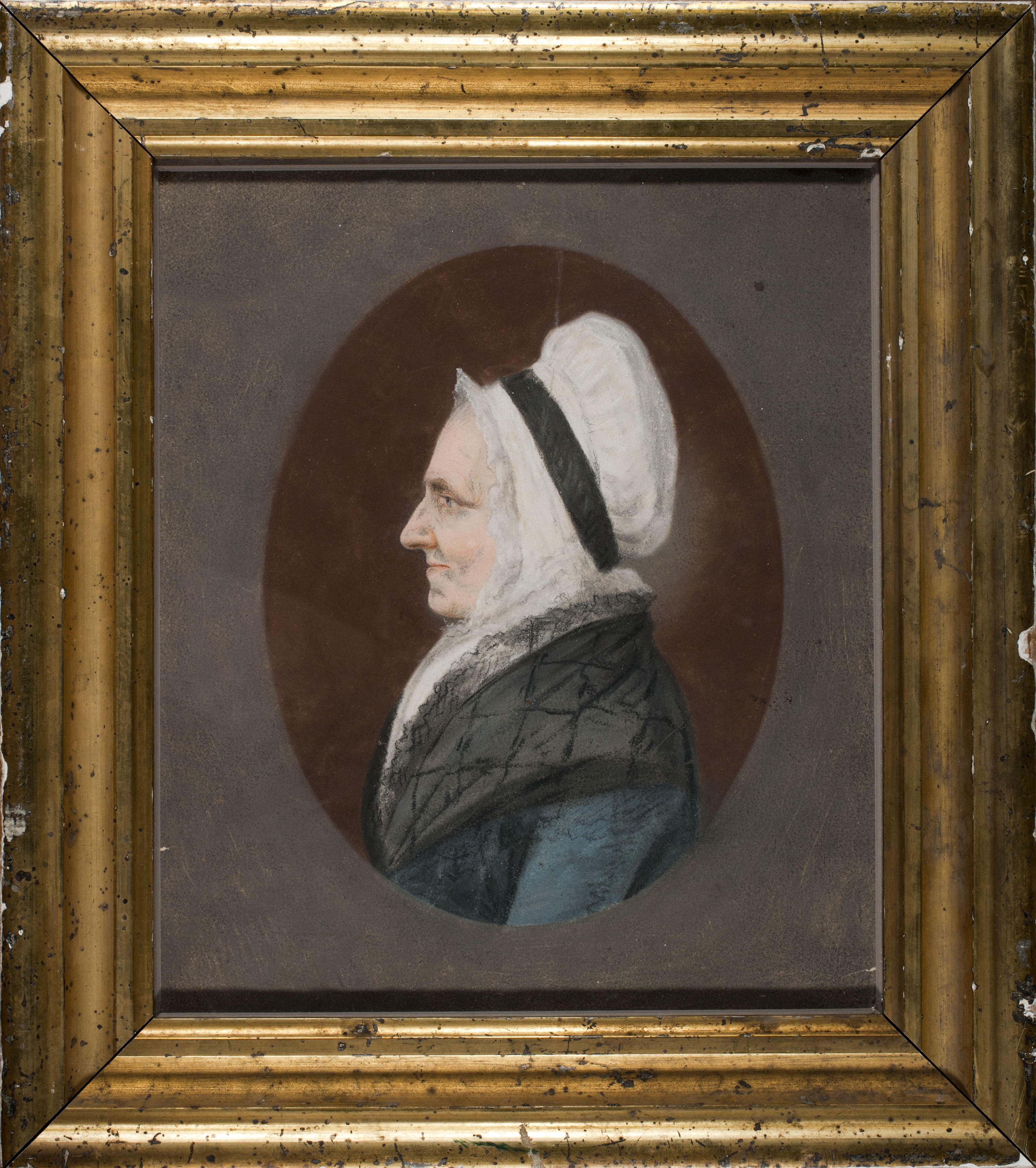
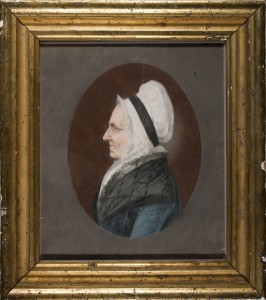
February 21, 1799 wasn’t the only day in her life that Hannah Weld wrote a letter, or her only letter in the AAS collection – there are three, as well as a letter from daughter Hermione to daughter Mary. Awareness of the Weld women should only become greater thanks to the recent acquisition of Hannah’s portrait by AAS. Ashley Cataldo, working at the desk that afternoon, offered to show me, and I eagerly waited for the image to materialize on the computer screen.
There are fewer than a thousand words in Hannah’s February letter from so long ago to allow a comparison of the scribal portrait to the one in oil. I don’t know how to make a qualitative statement about how many words a picture paints, but what the image reveals tends to confirm what the text suggests.
The profile gazing purposefully toward some unknown point in the distance belonged to a woman prosperous enough to be neatly clothed and well-fed, though not so “well” as to appear unhealthy or suggest extravagance, a woman who enjoyed oysters and a good laugh, shared apples and anecdotes, and lived her life in the midst of company, alive to danger, and loving her children. Her bright eyes reveal curiosity, intellect, even wit – and something else, for the lines encircling them came from a lifetime of smiling, a subtle smile captured by the artist and still playing about her lips two centuries after the original went to sleep, not unlike that other smile so admired in the Louvre.
Had we never had the ability to know Hannah by anything more than this image, we could not have helped but feel a warmth, even a kinship. But we have so much more, because she took the time to tell us.
I love Hannah Weld. And I’m glad her letters survived, to tell me why.
If you would like to contact Jeanne directly with any questions or comments about her posts, she can be reached at jmcdouga@usc.edu.
Jeanne Eller McDougall is a Ph.D. candidate in History at the University of Southern California, writing a dissertation entitled, “‘Fit to be sung in Streets:’ the mobilizing power of political song in pre-revolutionary British Colonial North America, 1750-1776.” She is a USC-Huntington Early Modern Studies Institute Fellow and a Michael J. Connell Foundation Fellow at the Huntington Library for 2011-2012.
Featured Fellow: Aston Gonzalez

Aston Gonzalez, Ph.D. Candidate in History, University of Michigan-Ann Arbor
Jay and Deborah Last Fellowship: “Kneeling and Fighting: African American Artists’ Depiction of Black Humanity”
My project at the American Antiquarian Society investigates how African American visual artists produced work that acted as counternarratives to the racist messages contained in popular literature, images printed in newspapers, and blackface minstrel shows performed on stages during the middle half of the nineteenth century. From images of the supplicant slave to engravings depicting Black intellectuals and leaders, my project recognizes the significance of these black artists’ battle to convince white Americans of black people’s humanity before and after the Civil War. Engravers and photographers figure most prominently in my study, especially those who worked in the South, the Midwest, and along the East Coast.
In order to discern the artistic and political conversations with which nineteenth century African American artists were fluent, my research project at the American Antiquarian Society investigates two bodies of work. The first includes nineteenth century documents that negatively stereotype African Americans as inept, unintelligent, and indolent. These negative portrayals of “authentic” blackness are essential for understanding the ways in which African American artists’ work directly and indirectly countered these claims and proposed their own visions of African American identity and culture. This second body of work demonstrates how and why African Americans used print and visual culture to subvert racist representations of blackness in the nineteenth century.
I am drawing on a vast array of sources for this project including sheet music, caricatured prints, frontispieces, African American newspapers, cartes de visites, Civil War ephemera, pamphlets, and manuscripts. These sources will help piece together these visual artists’ life stories and the wide-ranging subjects of their work.
More information about fellowships at AAS, including a directory of fellows and their work, is available on our website.
The Acquisitions Table: The Bridal Keepsake
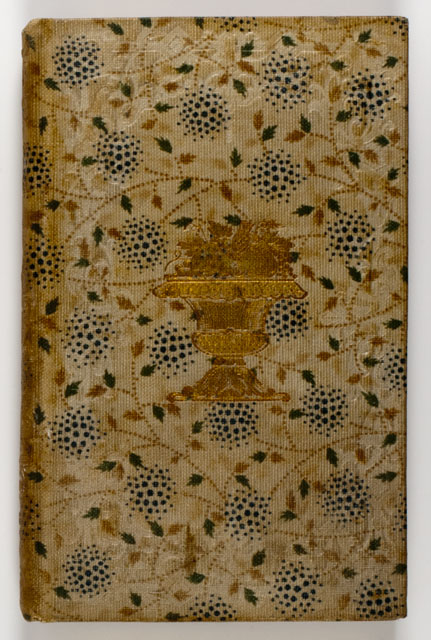
AAS member (and publisher’s cloth binding expert) Steve Beare regularly alerts us to interesting bindings he spots on eBay. Thanks to his deeply appreciated referrals, over the past two years we have added many unusual bindings to the AAS collection. Perhaps the most remarkable of Steve’s finds is this gift book binding of fine-ribbed white satin finish cloth, printed in no fewer than four colors, with a deeply blind-embossed ornate frame on each cover, gilt-stamped floral centerpiece on front cover, richly gilt-stamped spine, gilt edges, and gold-printed glazed paper endleaves. Although modestly dulled by time, the overall effect is spectacular, and unlike any other binding we know of at AAS
I Love Hannah Weld: Part II
Last week, AAS reader Jeanne McDougall introduced us to the Weld family. Today, she continues exploring the mother and daughter pair, and examines their relationship and personalities through Hannah’s letter.
During the closing days of February 1799, Hannah would have had every reason to wish her daughter back home with her in Boston rather than far-off, rural Worcester, enduring the final weeks of a rugged winter during the worrisome early days of a pregnancy that would produce, on July 6, Mary Rebecca Thomas, the elder Isaiah’s first surviving grandchild.
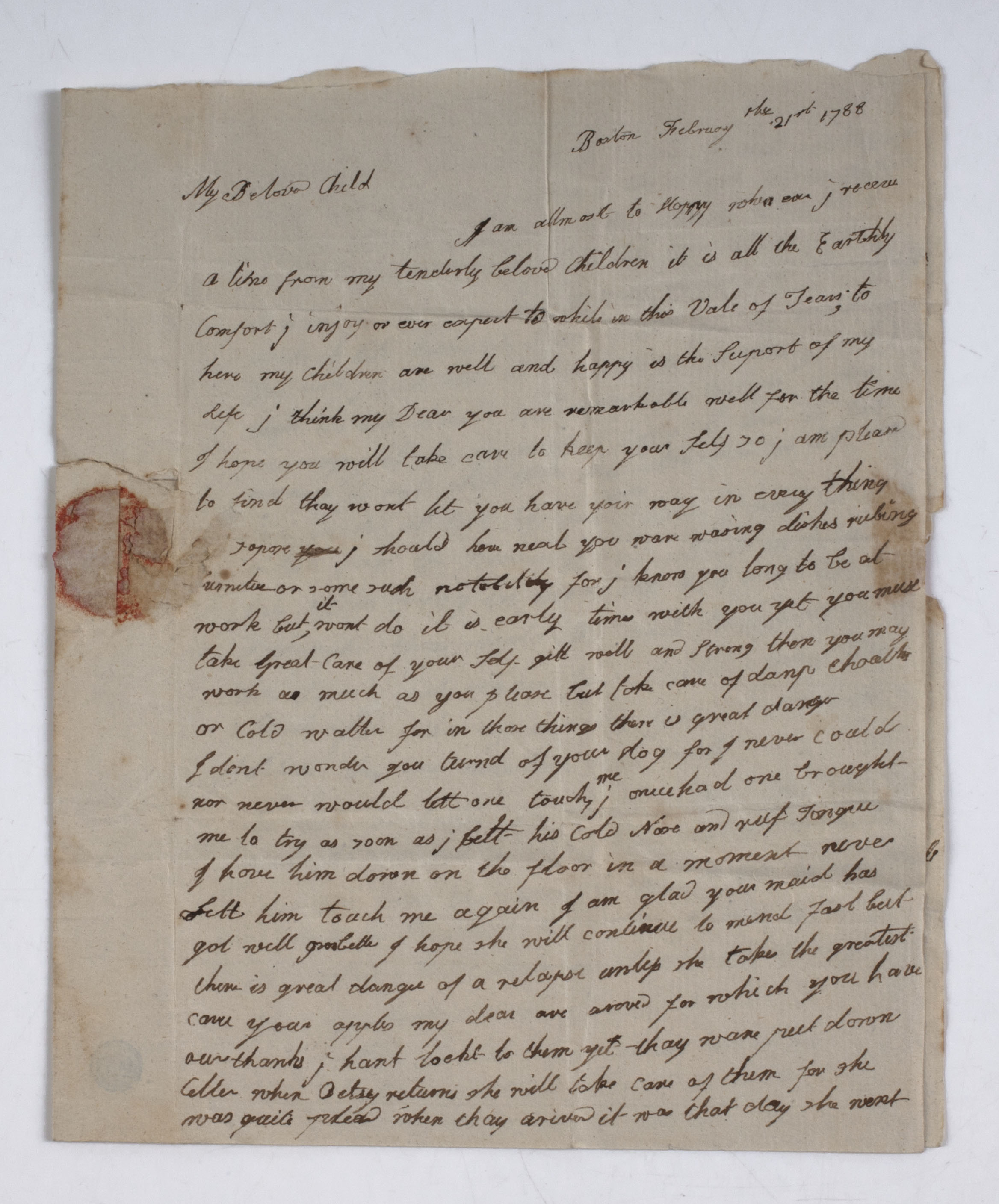
“I think my Dear you are remarkable well for the time (but) I hope you will take care to keep your Self so,” counseled Grandma Hannah. She may have had an informant in the household: “I am pleasd to find thay wont let you have your way in every thing,” such as “wasing dishes rubing furnitur or some such notability.” An active woman herself, Hannah acknowledged that her daughter would “long to be at work but, it wont do,” for “it is early times with you (and) you must take Great Care of your Self – gitt well and Strong then you may work as much as you please.” She further warned Mary to “take care of damp (chills) or Cold watter for in those things there is great danger,” and obviously knew the expectant mom well enough to know she “would always have her own way (a chip off the old block?).” “Danger” appears twice in the letter, a reminder of how many children in this period did not survive – as indeed, Mary’s first child, also a daughter, had been stillborn almost exactly a year earlier.
These cautions were but a prelude to the real purpose of the letter: providing Mary with a means of enjoying the company of her Boston family in a way once characterized as “vicarious,” and which we might call “virtual,” accessible to us today through the manuscript media of the period.
If you’re lucky, such a letter emerges from an archival folder expressing itself in sensory terms, affording the reader the giddy pleasure of actually seeing, hearing, feeling, smelling, even tasting the moment. Hannah was that sort of writer. I grieved that this particular conversation didn’t involve music, my area of interest. But never mind.
“I don’t wonder you turned off your dog,” Hannah exclaimed, adding, “I never could nor never would lett one touch me,” because “I once had one brought me to try” but “as soon as I felt his Cold Nose and ruf Tongue I hove him down to the floor in a moment (and) never Lett him touch me again.” Now before getting your petticoats in a bunch, keep in mind that while such seeming callousness might shock us today, the maintenance of animals in a producer society was somewhat more practical, and far less fetishized, than in our pet-rich environment. But it’s the way Hannah expressed herself that invites the reader into her sitting room – you can see the hapless canine, feel his tongue, and perhaps even wish to comfort him after he’d been “hoved” to the floor like so much ballast. You have officially stepped through the looking glass.
But the rabbit holes continue to present themselves. “I receved a Lettr from (Betsy) by the Deacon,” Hannah continued, likely referring to yet another absent daughter, Elizabeth. “She had a feteuging time of it,” and “was very Sick at reding in the Sleagh like her Sister.” Having spent a lifetime coping with motion sickness, even when so much as an elevator makes too many stops, it never occurred to me that reading in an eighteenth-century sleigh might have been potentially as upsetting as doing so in an automobile. Another cross-century resonance.
There were more to come. In my own childhood on the lower Chesapeake Bay, where no one ever explains to a toddler upon eating her first raw oyster that the creature is still living (otherwise, you couldn’t safely eat it), I completely related to the discourse on shellfish. “I well tell you what says the Deacon,” Hannah confided. Quoth he: “‘I had about as (lief) take a live Frog in my mouth as a raw Oyster!’” His audience roared: “I thought thay would dy with Laughing,” recalled Hannah, “& am Sure I cant refrain from smiling every time I think of it.” Neither can I.
Hannah’s one regret was that her “tenderly belovd children” could not spend more evenings together, where times could be “very Drole.” She lived for the letters that were “all the Earthly Comfort I injoy or ever expect to while in this Vale of Tears;” she wanted nothing more than to hear that “my children are well and happy … the Suport of my Life.” And to that end, Mary, when it comes to rearranging the furniture, knock it off.
The feeling was clearly mutual. Hannah thanked her daughter not only for the comfort of her letters, but for the small kindness of a gift of apples which had “aroved” from the country, at a time of year when a city cellar might be somewhat bare. A thoughty-thing, “for which,” said her grateful mother, “you have our thanks.” Happily, the apple she bore had not fallen far from the tree, and she would live just long enough to see yet another apple share her name, when Mary and Isaiah Jr. welcomed sixth daughter Hannah Weld Thomas in 1803, eleven months before Grandma Hannah’s death on September 14, 1804.
Check back next week for Jeanne’s concluding thoughts.
Jeanne Eller McDougall is a Ph.D. candidate in History at the University of Southern California, writing a dissertation entitled, “‘Fit to be sung in Streets:’ the mobilizing power of political song in pre-revolutionary British Colonial North America, 1750-1776.” She is a USC-Huntington Early Modern Studies Institute Fellow and a Michael J. Connell Foundation Fellow at the Huntington Library for 2011-2012.
The Acquisitions Table: A Practical Grammar of the English Language
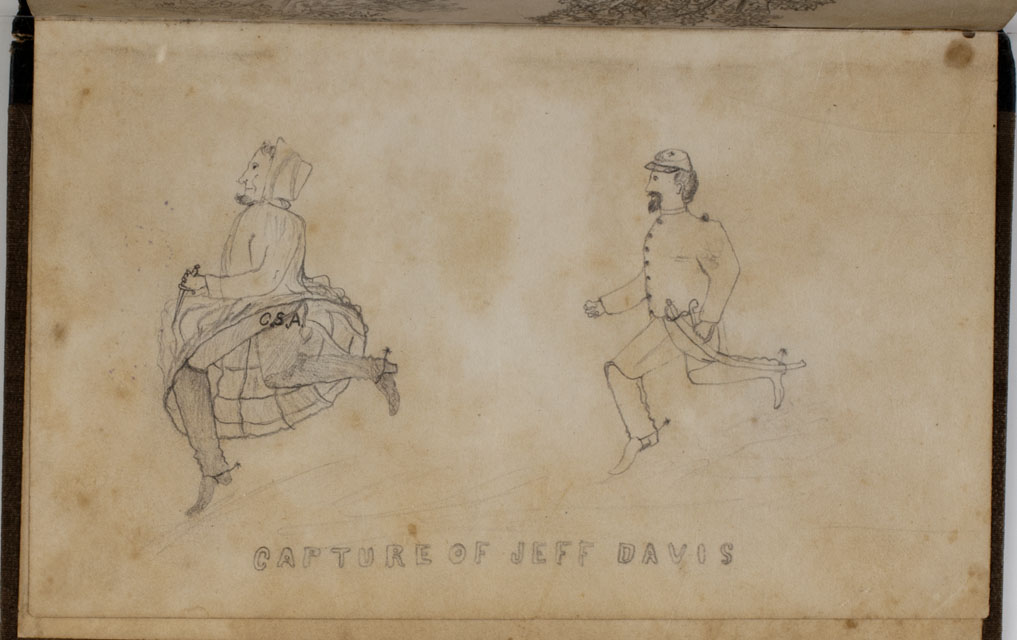
Don’t let the utilitarian title fool you! In this case, it is not what was printed but what a former owner drew on a flyleaf that is the book’s true treasure. Mimicking a popular political cartoon of the time, a Union soldier chases a cross-dressing Jefferson Davis—giving us a rare glimpse into the intersection between juvenilia and popular print culture.
A slice of 19th century humor
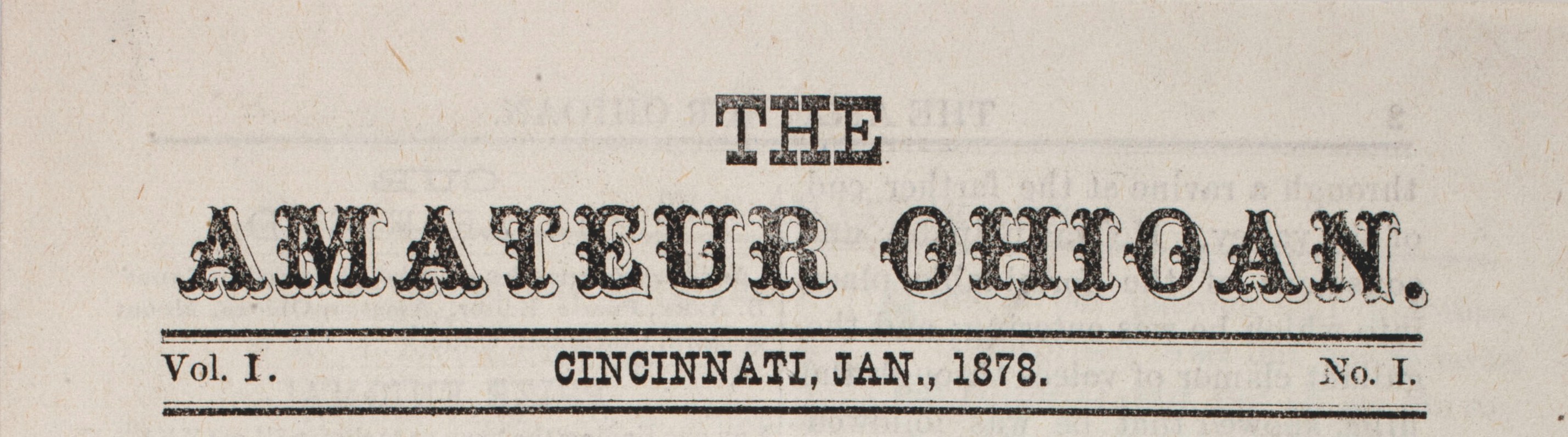
The Amateur Ohion, published in Cincinnati, in January of 1878, like many amateur newspapers, contains a short humor column. This little column contains a very odd little joke. It begins:
Why is an elephant like a steamboat?
We’d love to hear your guesses for the punchline! Send us your comments and we’ll reveal the “correct” answer later in the week.
I Love Hannah Weld
Over the winter, AAS reader Jeanne McDougall spent some time with our Isaiah Thomas manuscript collection. While searching through the correspondence, she stumbled upon a letter from Hannah Weld to her daughter Mary Weld, who married Isaiah Thomas Jr. Below, Jeanne describes her encounter with Hannah and Mary. Jeanne’s experience certainly demonstrates the serendipitous nature of manuscript research!
Jeanne McDougall’s post will be featured in three parts. Stayed tuned the next two Mondays to read the continuing saga!
Part I
I love Hannah Weld. Here’s why.
Not surprisingly, for those of us working on the late colonial/early Republic periods, the vast majority of paper we push was first pushed by men. We know so much more today about the lives of women in the early Republic, thanks to recent generations of scholarship that have famously given us good wives and nasty wenches, tale-telling midwives and Republican mothers. And when you find one amid the columns of calculations and mountains of man-talk, you pause.
That’s what happened when I reached Box 1, folder 9 of the Thomas family collection. The letter on the desk wasn’t handsome or imposing, but small and unassuming, nor the handwriting florid and expansive, but tiny, even cramped, as if to conserve the precious paper, yet revealing a boundless warmth from its salutation, “My Belovd Child,” to its signature, “Your affectnate parent Hannah Weld.”
I wasn’t even supposed to meet Hannah, as my search period ends at 1794. But Hannah could not have written to her married daughter in Worcester, Massachusetts on “February the 21st 1788,” as the letter indicates, because Isaiah Thomas Jr. didn’t marry Mary Weld until May 4, 1797, at the Hollis Street Church in Boston. A physical impossibility. Perhaps in haste, or a moment of absent-mindedness, Hannah misdated her letter, and for reasons that would eventually become clear, it may be that she wrote “88” when she intended “99.” But however it happened, in an irony of the sort that often occurs in archival work, without that numerical error more than two centuries ago, we might never have met.
It would be easy to dismiss Hannah Church Weld’s late-winter missive of motherly advice on the basis of what we would call its lack of literacy – the erratic spelling, the frequent disregard of elementary grammar, the relentless absence of punctuation. That would be a mistake. At age 55 or 66, depending on the correct date of the letter, Boston-born Hannah would presumably have been able to read well enough to understand her Bible, and written sufficiently well to run a household including her successful Boston merchant husband and seven children. But coming from a prominent Boston family with a lineage dating back, through her father’s mother, Martha Burton Church, to the Mayflower, and patrilineally to the first generation at Plymouth Colony, she may have been able to do quite a bit more. Younger brother Benjamin received the best education available to a young man of his time, graduating from Boston Latin School and Harvard College, and continuing his medical training in London before being the first man named the equivalent of surgeon general in the U.S. Army, a career that ended with his dramatic 1775 conviction, at the dawn of the American Revolution, of having passed information to General Gage.
Hannah’s connections to the world of printing and publication also predate her daughter’s marriage to the scion of the Thomas family. Her sister Alice married John Fleeming, one of the publishers of the loyalist newspaper the Boston Chronicle, in 1770, the same year the paper ceased operations after its offices had been attacked by an angry readership the previous October. Hannah’s second cousin, the Rev. Ezra Waldo Weld, joined Isaiah Thomas Sr.’s publishing network in 1788, founding with him the Hampshire Gazette, and her daughter Hermione, Mary’s younger sister, married Thomas’ Boston business partner, Ebenezer Andrews, in 1791, several years before the families were further united through the marriage of two more of their children, Mary and Isaiah Jr.
Nor was Hannah the first author in her family. Brother Benjamin kept a commonplace book while at Harvard, honing the satiric and rhetorical skills that would make him “one of the most feared political propagandists on the Revolutionary scene,” one for whom Paul Revere and fellow Whigs harbored suspicions but nevertheless “courted;” during those same college years, he also produced “a landmark poem in colonial American literature” entitled “The Choice,” inspired by the 1700 John Pomfret poem of the same name yet transcending the original in a way that helped “define those poetic qualities which may be labeled ‘American’ … eager to satisfy the poetic demands of the mother country, but … equally eager to assert its own individuality.” And even long before her own generation, Hannah’s great-grandfather, the Benjamin Church who captured Metacomet, the native leader known to the Puritans as “King Philip” in the war that bore the same name, chronicled that event in his 1716 publication, Entertaining Passages Relating to Philip’s War.
So writing was in Hannah’s genes, as she composed entertaining passages of her own during the first generation of republican grandmotherhood, passages made possible for one of her sex by her birth into a world of privilege, and which must stand in for so many other women who were denied, by so many reasons so distressingly familiar to anyone who considers the excluded, the means to tell us stories of their own.
Whatever education had been available to her, and whatever discipline she could have developed from it, Hannah had a method of her own. “Misspelled” words are done so consistently. The regular lack of apostrophes for contractions, or the more commonly dropped “e’s” from “-ed,” could suggest a deliberate decision. And if Hannah chose to use the archaic “j” interchangeably with “I,” then perhaps it was a question of tone or style, rather than literacy. Whatever the explanations, this letter is the work of a literate person, in all but the most literal sense of the word.
Next week, Jeanne will provide some excerpts from the letter, and explore Hannah and Mary’s relationship.
Jeanne Eller McDougall is a Ph.D. candidate in History at the University of Southern California, writing a dissertation entitled, “‘Fit to be sung in Streets:’ the mobilizing power of political song in pre-revolutionary British Colonial North America, 1750-1776.” She is a USC-Huntington Early Modern Studies Institute Fellow and a Michael J. Connell Foundation Fellow at the Huntington Library for 2011-2012.
Featured Fellow: Nicolas Barreyre, “Of Gold and Freedman”
This post has been long delayed (sorry Nicolas!), and although he has now returned to his native France, here is some information about the project Nicolas Barreyre worked on during his month in residence at AAS.
Nicolas Barreyre, Assistant Professor in American History, Université Paris Ouest Nanterre and École des hautes études en sciences sociales, Paris, France.
Joyce A. Tracy Fellowship Project: “Of Gold and Freedman: A Sectional History of Reconstruction, 1865-1877”
Nicolas Barreyre’s project examines how economic debates mobilized much political energy in the North after the Civil War and directly affected the fate of the South. It aims to analyze why Northern policies on the public debt, greenbacks, and tariffs, were as much a part of Reconstruction as Southern race relations and constitutional issues.
At the end of the Civil War, Americans were faced with the daunting economic consequences of the conflict. The Union had to find a way to pay off its huge public debt, transition to peacetime taxation, and regulate the value of a double currency of greenbacks and gold coins with no system of convertibility. This was, of course, in addition to rebuilding and reforming a South disorganized by defeat, economic exhaustion, and emancipation.
Battles over economic and monetary regulation proved as contentious as battles over race, and they disrupted party politics. Tariffs and gold pitted Northeasterners against Midwesterners much more than Republicans against Democrats. Section, it appeared, could trump party. Nicolas Barreyre will use the American Antiquarian Society’s extensive collection of newspapers, campaign newspapers, trade journals, pamphlets, but also visual arts such as political cartoons, to explain why national economic policymaking turned into sectional confrontation; and why this confrontation, in turn, shaped the fate of Southern Reconstruction.
More information about fellowships at AAS, including a directory of fellows and their work, is available on our website.
Late Breaking News: Thoreau on the Economy, Friday, Sept. 23
At 6:30 PM on Friday, September 23, the American Antiquarian Society will take visitors back to the late 1840s, as Jay DiPrima recreates Henry David Thoreau’s lecture “Economy.” Thoreau originally delivered his lecture, drawn from his early writings on his year at Walden Pond, on Friday, April 20, 1849 at Worcester City Hall. A review in the Worcester Palladium from April 25, 1849 described how the “sylvan philosopher” offered an
autobiography of two years of life in the woods;–an experiment by the lecturer to illustrate, not perhaps so much the absurdity of the present organization and customs of society, as the ease with which a man of … stern expedients may have ample leisure for the cultivation of his intellectual powers and the acquisition of knowledge.
This lecture on the simplification of life also sheds light on Walden’s roots as an oral text, one that was given as a series of lectures many times before it appeared in print.
Jay DiPrima has been performing theater pieces based on Thoreau and his writings for over twenty-five years. Jay received his Ph.D. in Educational Theatre from NYU, and from 1992-95 was the Artistic Director of the Worcester Children’s Theatre. He teaches courses in drama, education, and creative arts at colleges across Massachusetts.
This performance will take place in the Society’s main library building, Antiquarian Hall, located at 185 Salisbury Street in Worcester. It is free and open to the public. It is offered as part of the “Cosmopolitan Lyceum” research symposium, sponsored by the AAS and the University of Oxford.
The Lyceum Comes to AAS
Ever wonder if you were born in the wrong century?
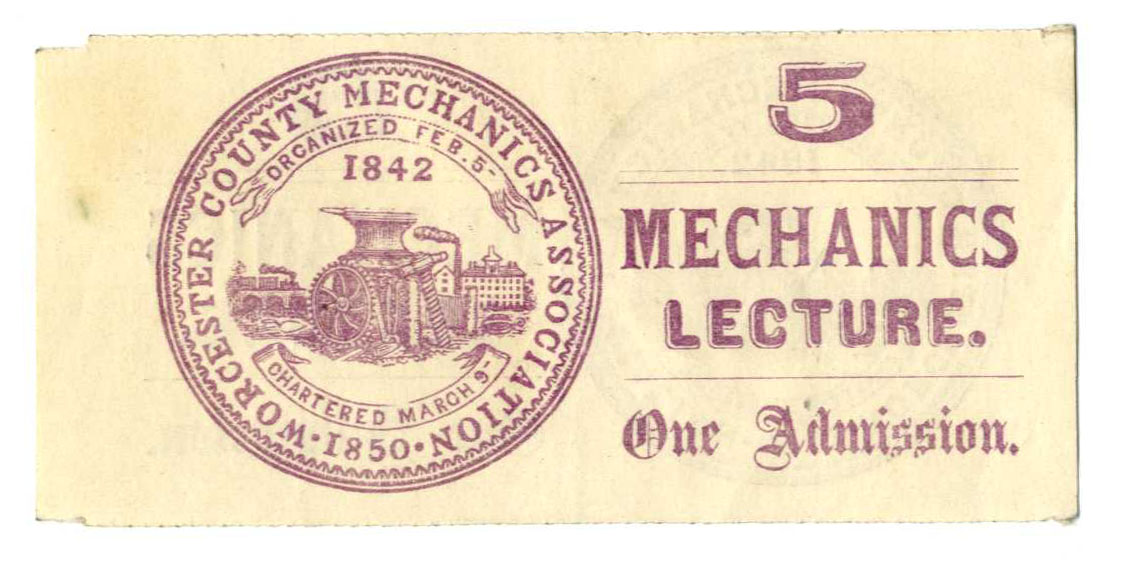
If so, imagine it is still those halcyon early days when AAS was a new institution. A time when lyceums were considered viable forms of entertainment. When you could subscribe to attend a series of lectures on a topic and feel your brain expand with useful knowledge.
If this exercise of the historical imagination sounds appealing, then check this out:
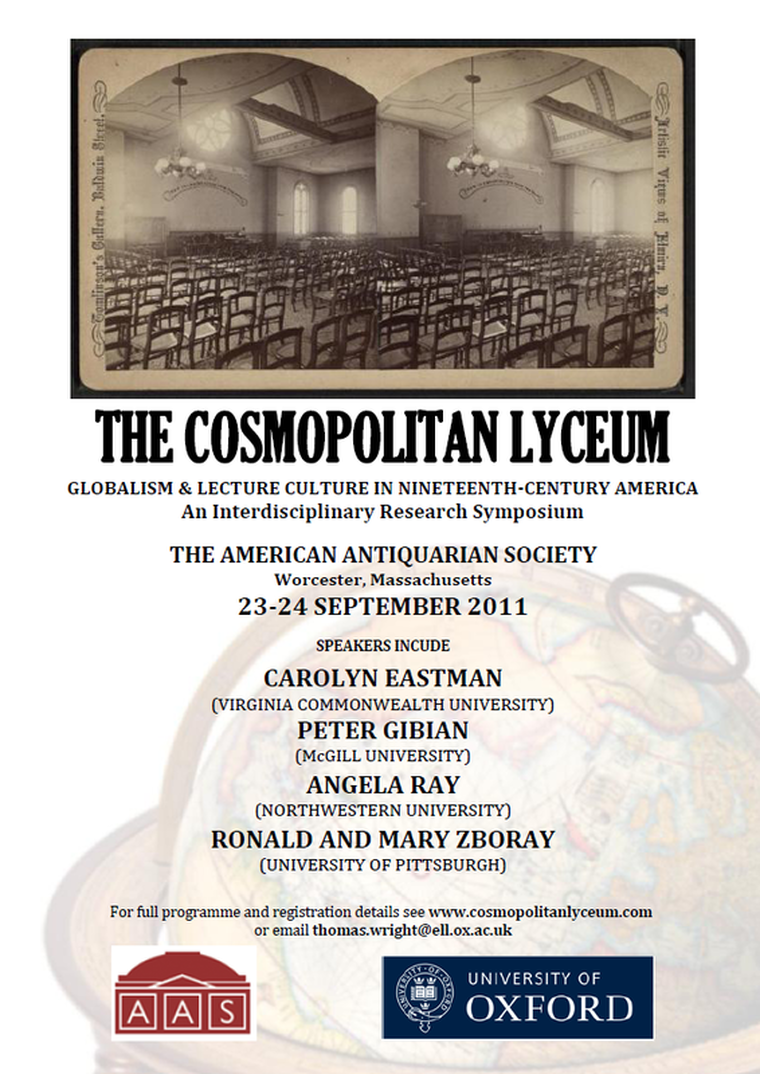
You may remember an earlier post when we first mentioned this conference, but now the time is upon us. This Friday and Saturday, Sept. 23 & 24, AAS will be hosting “The Cosmopolitan Lyceum: Globalism and Lecture Culture in Nineteenth-Century America,” presented in conjunction with Oxford University.
All the details are available on the conference website, including a provisional schedule and abstracts of some of the conference papers to be presented. The registration fee for this event is $50, which includes coffee, lunch on both days, and a Friday evening drinks reception (register online).
Please consider joining us this weekend for what promises to be a fascinating interdisciplinary research symposium — or, if you will, a lyceum experience of its own.
150 years ago this week…
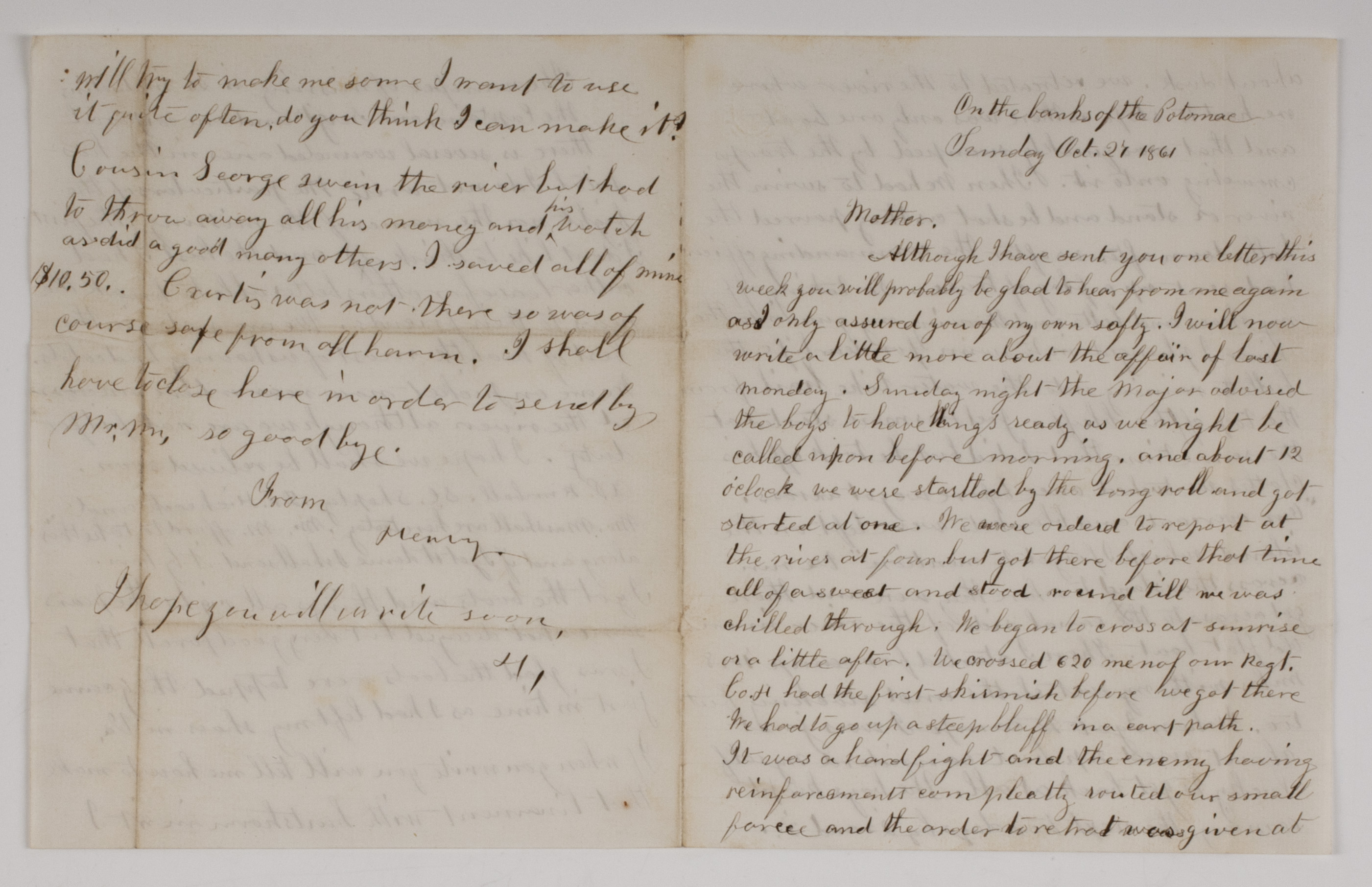
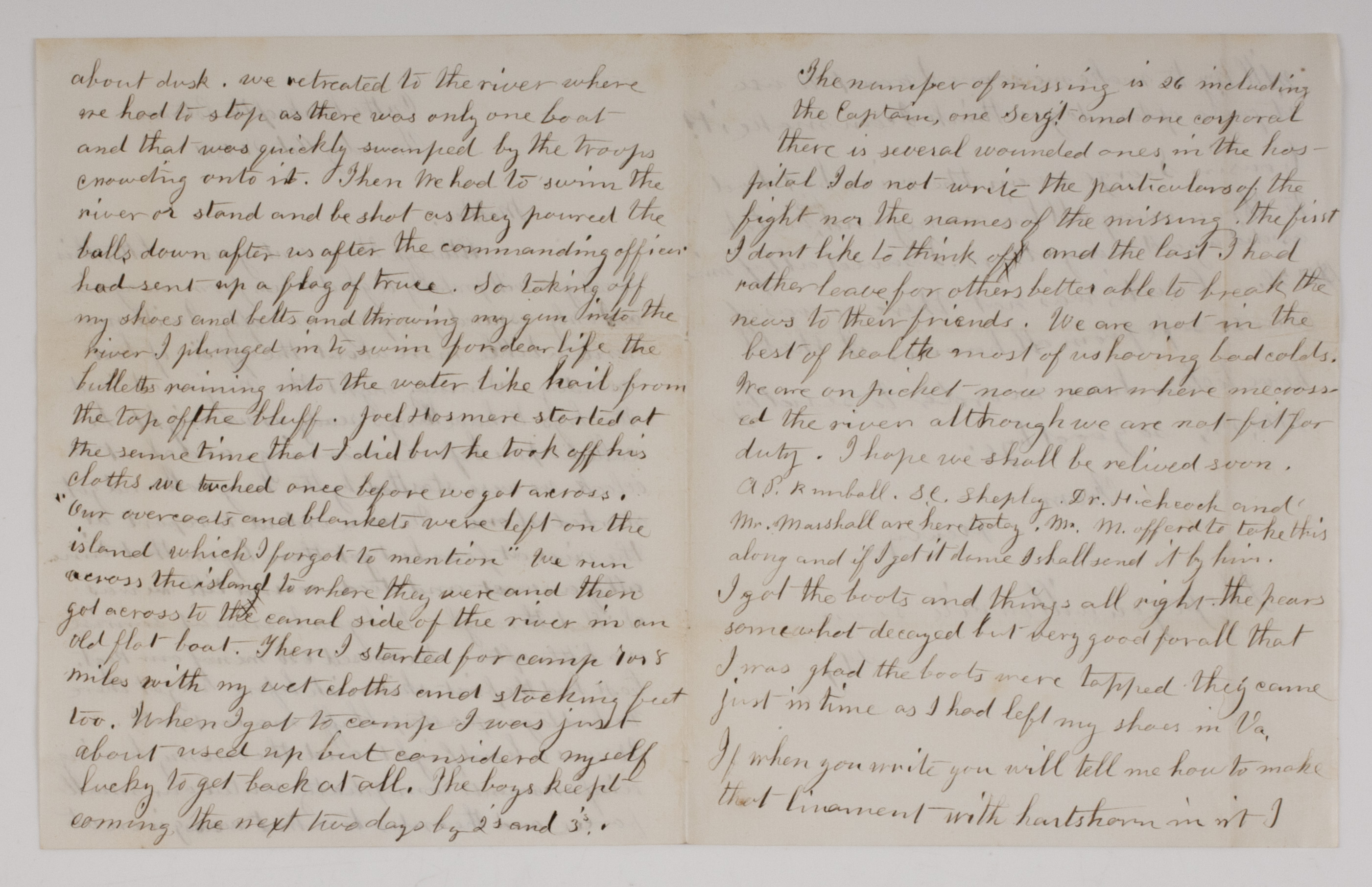
…a young man named Henry L. Joslin, from Fitchburg, Massachusetts, was writing home to his mother on September 24th.
Henry, born in 1843, was serving in the Civil War and was working picket duty in Poolsville. In his letter he describes his camp, what guard duty was like, and gives updates about his health, and other young men at his camp. Below are some highlights from his letter. You can see the entire transcription here.
We have to go on guard once in about four days. It is pleasanter doing guard duty here than in camp as we do not have to walk our beats and we have a fire to keep warm by. We have to turn out half an hour before day break and remain under arms till sunrise and to keep warm we drill most of the time. It is quite cold here nights and we get a few chestnuts but not many yet. Some of us go hunting most every day and get two or three grey squirrels. Cousin George got some young ones alive which he carried up to camp.
Col. Griswold is here and is well. Bill is up to camp tending to cooking. I have not heard from Henry Greene since I let Camp Scott. I wish you would speak to him about it and wake him up a little. My health has been good except a cold that I caught on guard which is all night now.
So what was Henry missing while he was away? What was his mother experiencing while she anxiously awaited news from her son? Click here to see what news was happening in Lowell, one town over, on September 24th.
Sadley, Henry never returned home to his mother. He died from disease while serving as Corporal of his Company in Virginia in 1863. He did, however, write home frequently, and I’ll be featuring more of his letters on the anniversary of their composition, so look out for more letters from Henry soon.
The Acquisitions Table: Appeal to the Democracy
Appeal to the Democracy (Augusta, ME). Oct. 10, 1840.
Over the past few years AAS has acquired a number of campaign newspapers. These are always desirable due to their short existence, rarity, and political content. The Whig Battering-Ram was a revival of a campaign paper with a similar title from the 1840 election. It supported Henry Clay and was published by the Ohio State Journal, edited by Rufus B. Sage. Only one file is known of this title. Appeal to the Democracy was a Democratic Republican paper supporting Martin Van Buren for President. This paper was issued during elections in 1838, 1840, and 1844, but only two issues were known from the 1840 election until this one turned up.
A Lesson to Procrastinators…
One way we add to our manuscript collection is through what staff and readers find within other collections at AAS. Often we will find letters, notes, or other ephemera interfiled in books, periodicals and newspapers, and often it is deemed best to move this material into the manuscript collection. These items are fun because, while their provenance is not always clear, knowing where they came from within our collection adds a bit of mystery to the item. Seeing handwritten notes within the pages of books connects us to the past owner of the book. It makes us think of what that person might have been doing while reading the book. Were they bored and needed a distraction, and therefore decided to jot down a poem? Were they about to deliver a letter but decided to use it as a bookmark and forgot about it? Or maybe there’s a scrap piece of paper with important information on it that has been frustratingly lost within a book for 100 years.
One such item was recently brought to my attention by an AAS Fellow. A piece of correspondence was found in the pages of the songster Greenback and Labor Songs (see the catalog record for this item here). The letter is addressed to a Mr. Verry, who apparently had written to the Greater Joliet Chamber of Commerce (Greenback and Labor Songs was published by the Greenback News of Joliet, Illinois) in search of a copy. Mr. Jack P. Meade, Business Manager of the Chamber of Commerce, responded to Mr. Verry with the unfortunate news that four of the five men involved in the publication of this book – Young and McLaughlin, who compiled the book, as well as Nelson and Ferris, of the publishing firm Nelson, Ferris & Baldwin – had passed away. But Mr. Baldwin was still around, and could help Mr. Verry with his request. Please note all the dates listed on the letter, including the all important footnote at the bottom. Lesson be told, don’t procrastinate!
However, as this letter was folded and stashed away in a copy of the book he was looking for, we can assume Mr. Verry indeed did find a copy!
Shakespeare in the Parlor…and everywhere
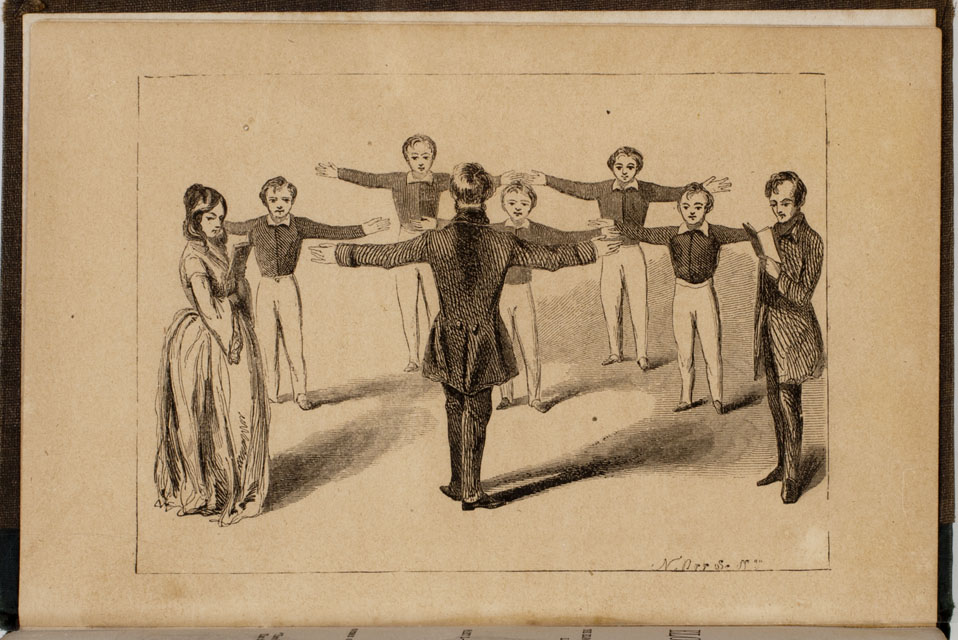
As the Prints in the Parlor (PIP) Project begins its last leg of digitization and access to images generated, those of us involved with it find ourselves itching to pull together some of the results into conversation with one another. The reason for this is to show how these book illustrations, sometimes independent of the books they are contained within, can demonstrate larger contexts of print culture of the nineteenth century.
We are also hoping the web pages we are creating – with links to the catalog records and accompanying text files – will show how the resource can enable researchers to think about these prints. (Check out our online tutorial for search tips.)
One of these recent forays resulted in the mini-exhibit appropriately titled “Shakespeare in the Parlor.” It features four areas of focus – Shakespeare’s women, comedies, imagining-the-man, and re-using Shakespeare – each area with its own four representative images. Attached are also high-resolution digital photographs of the book pages, excerpts from the cataloging record, and a link to the AAS catalog entry, in addition to a short general introduction.
Being exclusive was a problem in preparing the exhibit because there were so many good images from which to choose. On the chopping block, for instance, were the images of Shakespeare “places”, such as the “Palace of the Duke of Bedford” (still digitized and made available, but not included in the exhibit). Also, developing some sort of a narrative was difficult. But in essence, the prints spoke for – and almost organized – themselves. And while the place of study for Shakespeare in American study is undoubtedly the Folger Shakespeare Library in Washington, D.C., here at the AAS, we like to think we have some pieces of that Bard-pie.

With PIP, and hopefully with several mini-exhibits to follow, we have created a “bank” of images and descriptive cataloging records to work with. Our expectation is that as we make available the last few hundred images generated from the project, researchers and scholars will start to put images together in different ways and across different fields.
Doubtless, following the trail of some of these images has resulted in some fascinating leads. The “Shakespeare in the Parlor” exhibit included the print “Dreams of a Youthful Shakespeare“- after Richard Westall (1765-1836) – who worked for the John Boydell’s Shakespeare Gallery (a collection of the American prints of which are also in AAS collections).
While “Dreams of a Youthful Shakespeare” is featured in our online exhibit, one that isn’t (but is also noteworthy) is “The Murder of the Princes” which was part of Boydell’s Shakespeare Gallery and is reproduced in PIP as well (in two separate gift books, no less). What makes this even more interesting is an image produced in Frank Leslie’s Budget of Fun in November 1860, titled “The Smothering Of The Democratic Princes” shows a new take on the already popular image but in which:
enter two assassins (vide Shakespeare). Catesby Lincoln and Rat-cliff Sanders steal surreptitiously into the Apartment of the Sleeping Princes, Bell and Breckinridge, and smother them with the Pil(lar)low of Squatter Sovereignty.
In this account, Shakespeare is invoked – not the subject.

“The Smothering Of The Democratic Princes” image is part of the Civil War Cartoon Collection. (Currently this collection only has an online inventory, but it is one of the Society’s holdings slated to be re-organized, re-inventoried and re-served as an online resource that will contain digital images.) It is only fitting that the subject matter was re-used as well. What this recognizes even more broadly, is that images are representatives of a sort of language so saturated in print-culture economies that it made its way back to the popular press. The staging and even subject matter could easily move from the museum, to the parlor, to the press and back again.
We have had fun organizing the images, making connections, and even finding the necessary scaffolding for our future projects. Our hope is you will do the same!