The Acquisitions Table: Charles Eastman & Co. Letterbook

Charles Eastman & Co. Letterbook, 1828 – 1834

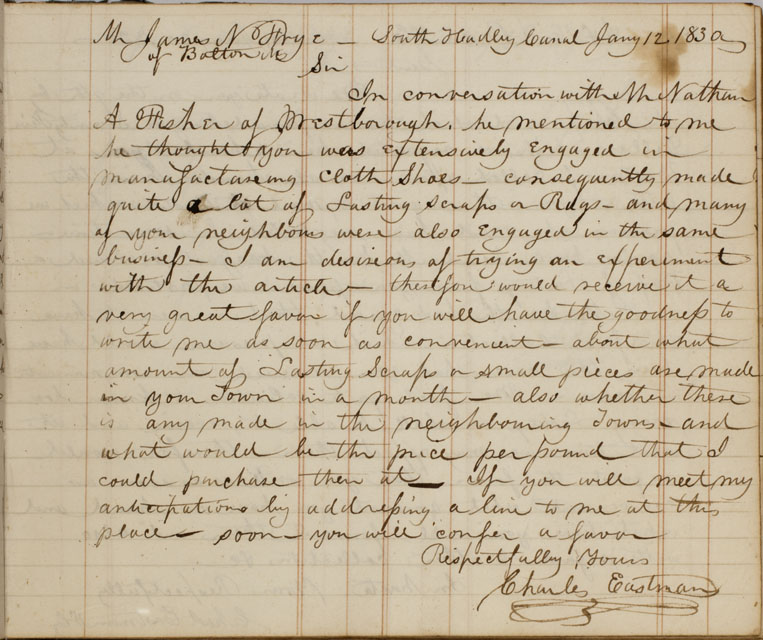
The South Hadley (Massachusetts) Canal opened in 1795 to bypass waterfalls on the Connecticut River and it was one of the earliest canals in the United States. Steamboat traffic on the canal began in 1828. This letter book was kept by Charles Eastman (1803 – 1884) and contains copies of outgoing correspondence.  Charles Eastman and Co. was engaged in the manufacturing and wholesale trade of buttons, lastings, sheets, fabrics, pins and hardware.  His letterbook contains over 100 letters relating to his business trade on the canal.  The volume also contains two inventories, apparently for a store, from 1829

California Gold

Although the majority of AAS’s manuscript collection is focused on New England, we do have collections that cover other parts of the country.  Our Book Trades Collection and Slavery in the US Collection, for example, have a national scope, and collections such as the Louisiana Collection and the California Papers are focused outside of New England.  These collections help diversify our holdings, and have definitely proven useful to our readers.  Former AAS Fellow Sarah Keyes utilized our California Papers during her fellowship and shares with us an interesting item found in this collection.

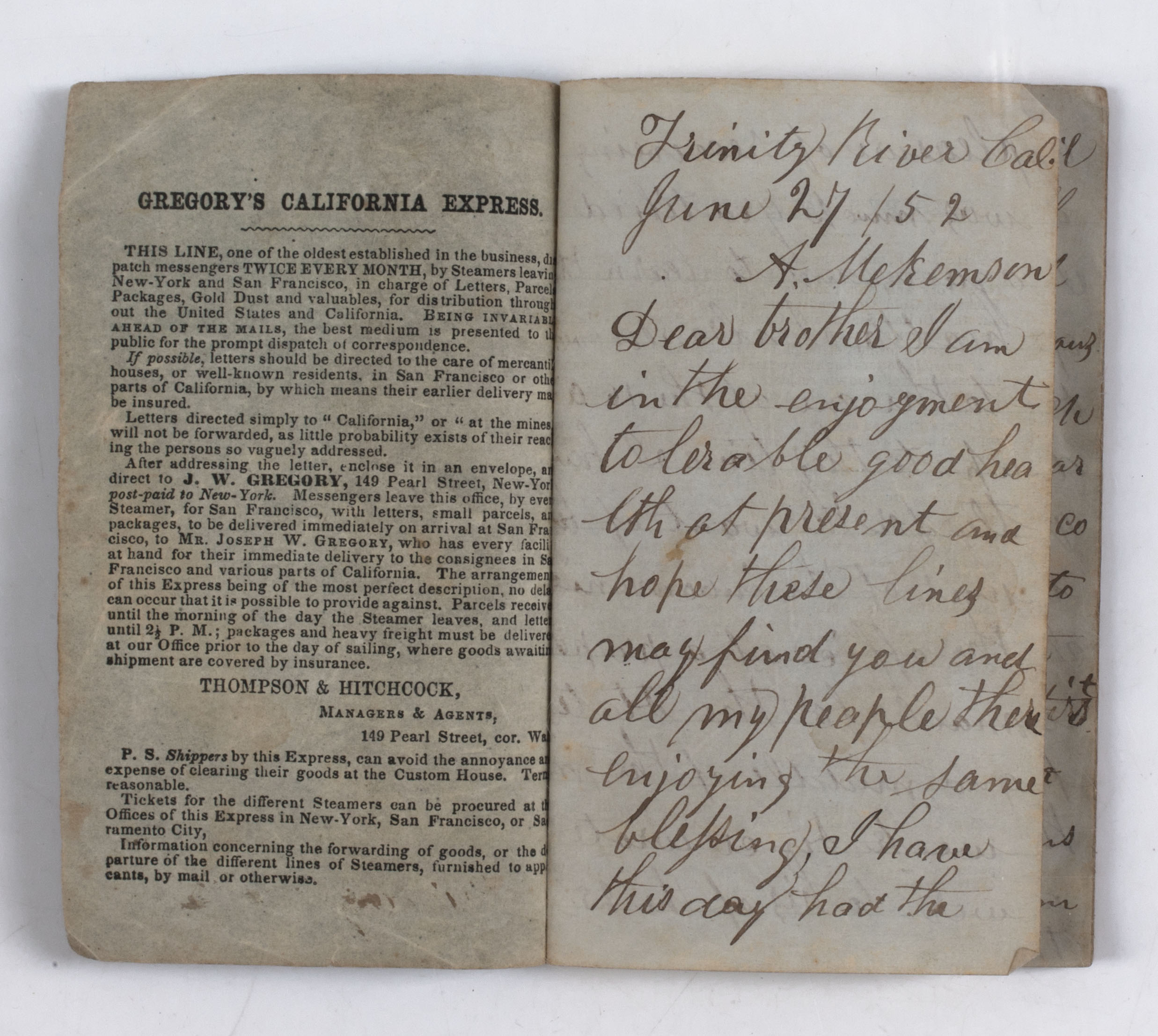
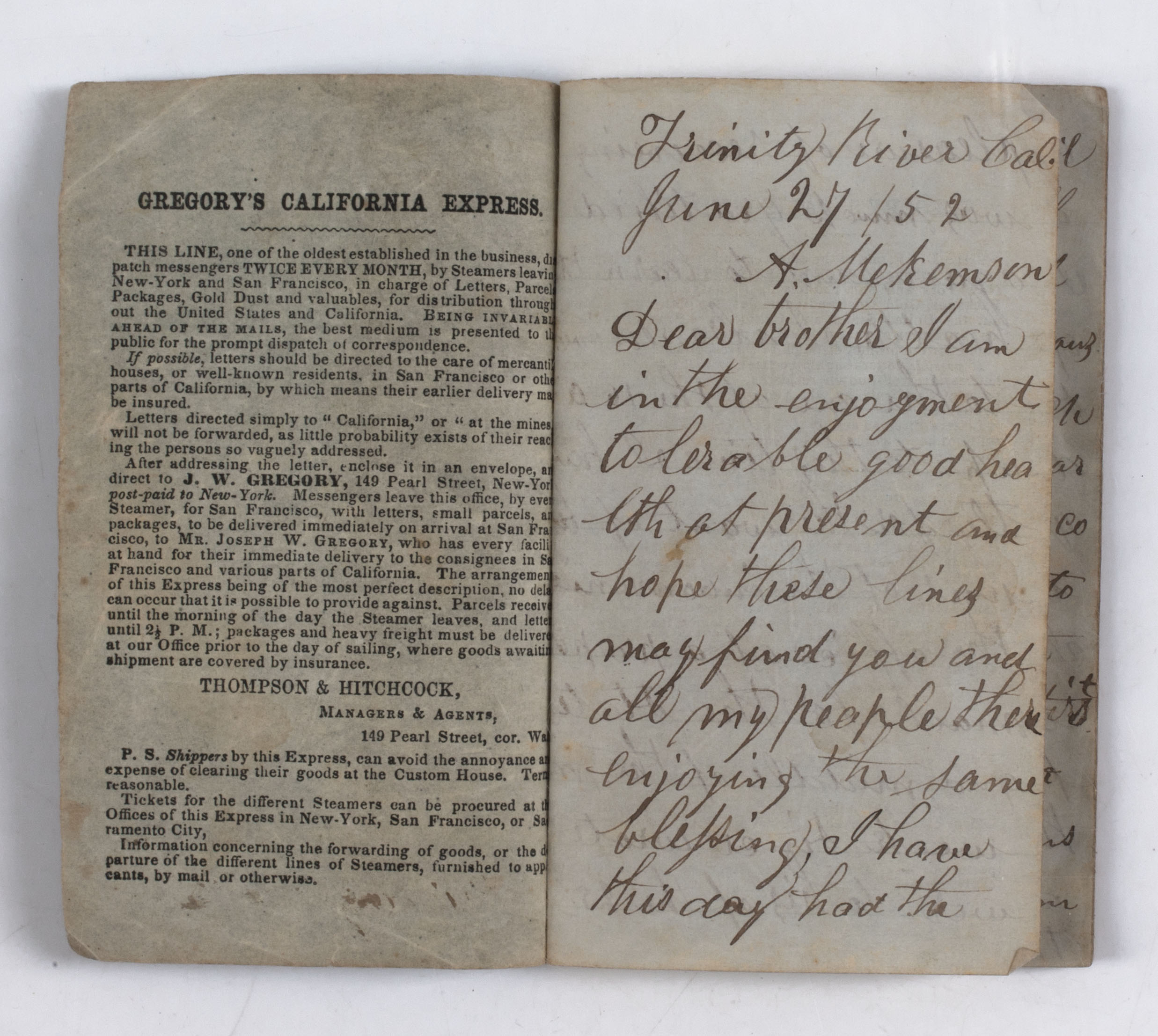
More than a year after he left Ohio for the California gold fields, David Howlett answered his wife’s demand that he tell her “all the partickulars (sic)” of his overland journey. Howlett acquiesced, assuring his wife that he had not “left all of his clothes on the Plains” but rather still possessed two under shirts, two pairs of summer pants, one pair of boots and his bed clothes. His pillow, he declared, was especially “grate”: “I do not see many pillows here when A man goes to bed here he pulls off his coat or boots & puts them under his head.” By telling her of this luxury, Howlett helped to lay his wife’s fears to rest regarding his life in far-away California.

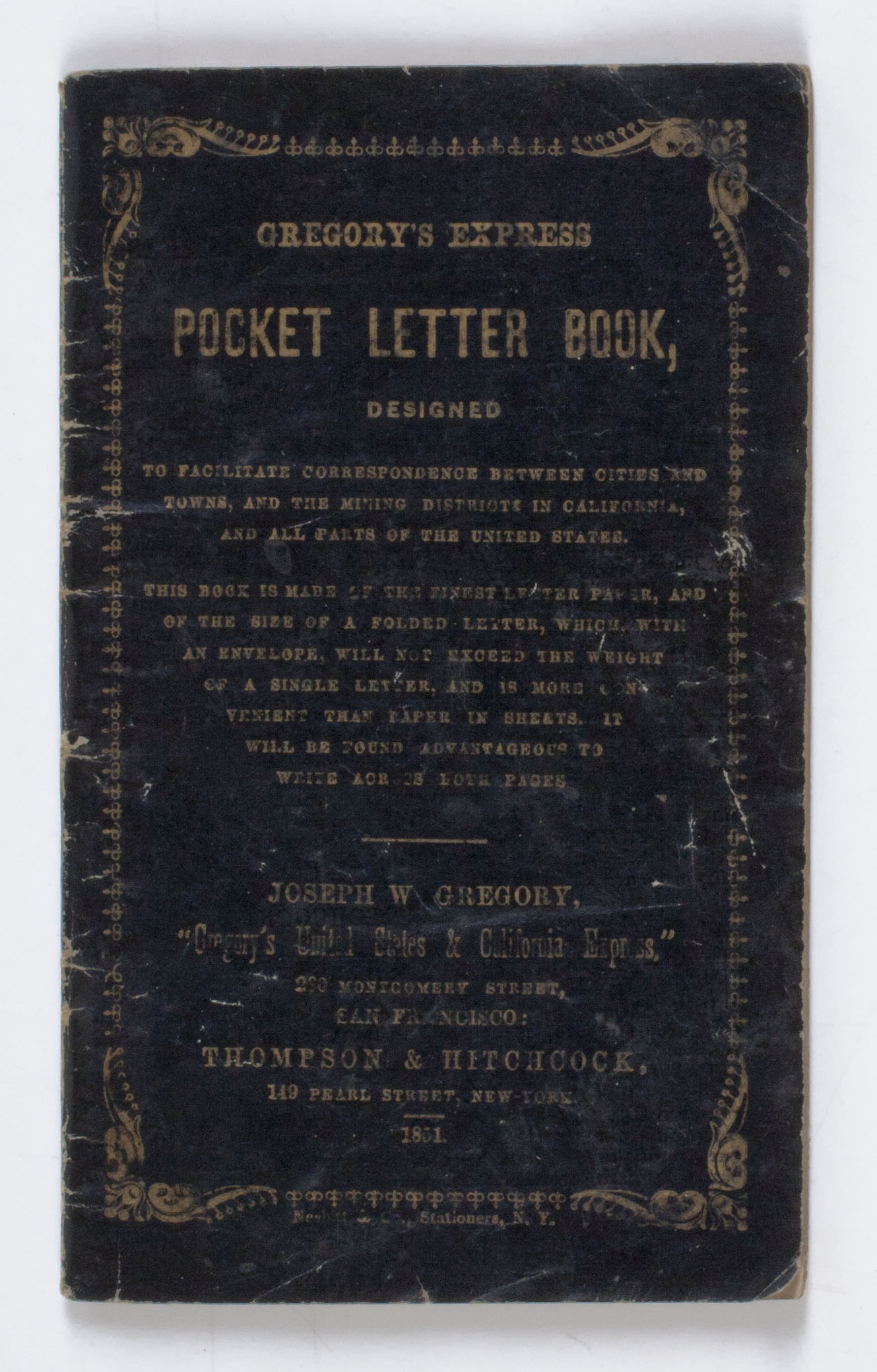
This document is an example of a very rare find, a letter penned inside a letterbook produced by the short-lived Gregory’s Express Company. Joseph F. Gregory created these letter books “To facilitate correspondence between cities and towns, and the mining districts in California, and all parts of the United States.” Gregory expanded his business too rapidly, and, unable to meet demands, he closed the company in 1853.

Although Gregory failed, his letter books attest to the increasing importance of the postal service. The rise of the postal system in the mid-nineteenth century helped the Howletts and other families separated by vast distances to maintain their relationships. The growth of communication by letter was particularly significant for the approximately two hundred and fifty thousand EuroAmericans who left their homes in the mid-nineteenth century in search of opportunity on the Pacific coast. The departure from home initiated a process of familial separation that stretched across the over two thousand miles overlanders traveled to the Far West. Measured in time as up to six months, the sheer length of the journey helped it to overshadow the majority of other contemporary migratory movements such as the move toward urban centers, Texas, and the region now known as the Midwest. Letters, journals as well as material objects allowed family members to share the experience with relatives who had not traveled to the Pacific Coast.

The Acquisitions Table: The White Knight or The Rock of the Candle

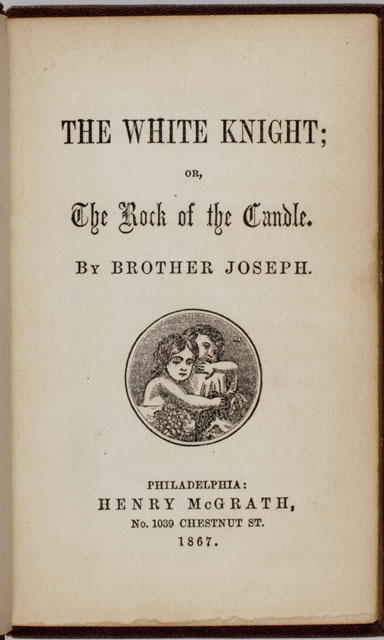
Brother Joseph. The White Knight or The Rock of the Candle. (Brother James’s Library). Philadelphia: Henry McGrath, 1867.

American Catholic children’s literature is rare before 1850, and The White Knight exemplifies the modest boom in Catholic publishing after the Civil War. The back pages contain advertisements for the Catholic Pocket Library, and books for parochial libraries published in England, Ireland, and Scotland—giving us a glimpse into the transatlantic world of Anglo-American 19th-century Catholic publishing.

Frankenstein Book

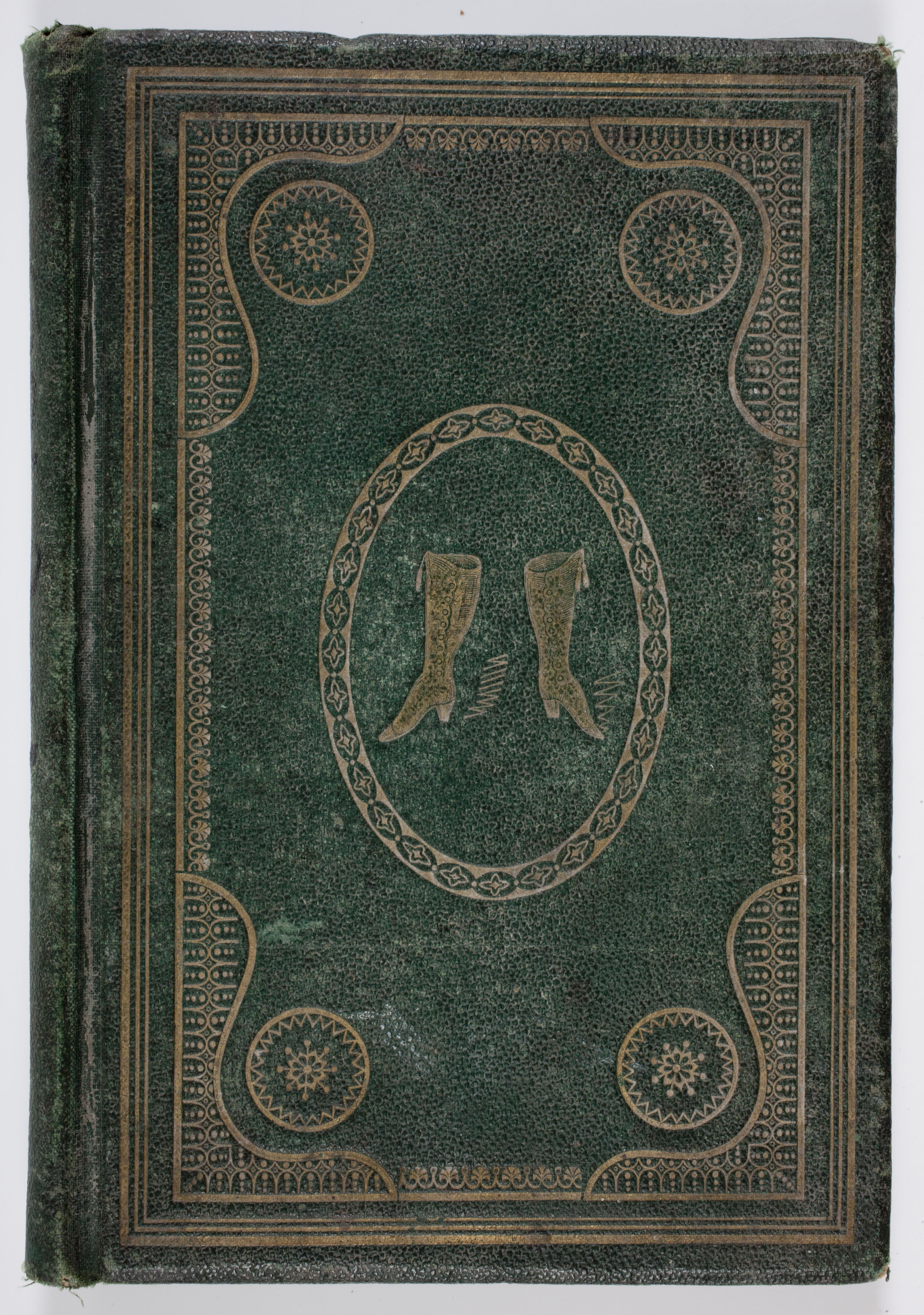
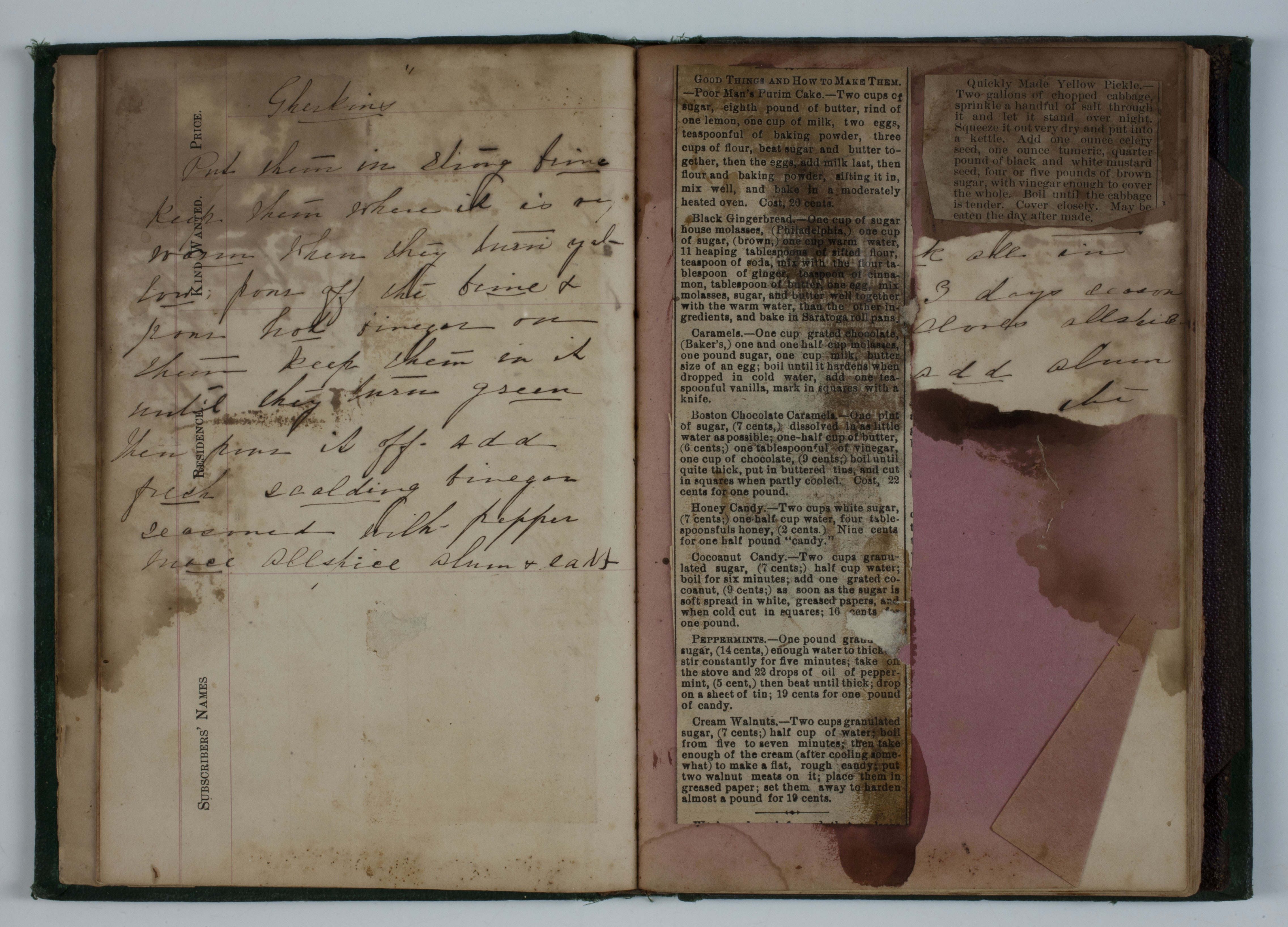
Recently we acquired an interesting new addition to our ever growing scrapbook collection.  In 1869, Mary H. Hill of Nelson County, VA, somehow got her hands on a salesman’s sample book and proceeded to use it as a scrapbook for her favorite recipes over the next decade or so.  What makes her book stand out is its non-categorical nature.  The volume has newspaper clippings of recipes pasted on some pages.  Other pages feature handwritten recipes.  And the book itself is a repurposed salesman’s sample book.  So we could label this book a scrapbook, a cookbook, a salesman’s sample book, or a bit of all three!

Before this book became a scrapbook, it was a sample book for The Women of New York, or, The Under-world of the Great City.  Illustrating the Life of Women of Fashion, Women of Pleasure, Actresses, and Ballet Girls, by George Ellington, published in 1869.  Salesman’s sample books (or subscription books or dummies, as they are also known) feature excerpts from the books they were promoting, along with plates and a brief description.  The remainder of the pages of the sample book were left as space for the salesman to list interested subscribers’ information (names, addresses, numbers of copies desired, prices, etc.).  Unfortunately, Mary’s scrapbook has all of the front pages ripped out and only the blank subscriber pages remain.  She used these blank pages for her scrapbooking.  I guess no one in Virginia was interested in learning about women from New York!

Mary included some great recipes found in newspapers, as well as household recipes for items such as bleach and dyes.  Her handwritten recipes include how to prepare an East India pickle, apple custard, and tip top cakes.  Finally, at the end of the volume, Mary pasted a newspaper clipping about the unveiling of the Stonewall Jackson statue in Virginia.

If you’d like to learn more about salesman sample books, check out a description here.  There is an online bibliography that includes a portion of AAS’s holdings, but the most comprehensive search strategy would be to search the AAS online catalog for the genre term “dummies (publishing)“.  You’ll find records for well over 600 examples in AAS collections!

The Acquisitions Table: Travels by Land & Water

Barnard, H. D. Travels by land & water. [Hartford: H. D. Barnard, 1860]

A very rare and unusual biography and travel narrative authored by 11-year-old H. D. Barnard, who also set this small-format pamphlet in type and printed it on an amateur press. Born in Detroit, Barnard describes several long journeys to Michigan and Wisconsin, and several shorter trips within southern New England, that he took with his father. Another brief chapter describes a visit on board the S.S. Great Eastern while docked in New York during its maiden voyage to the United States.

The Cosmopolitan Lyceum

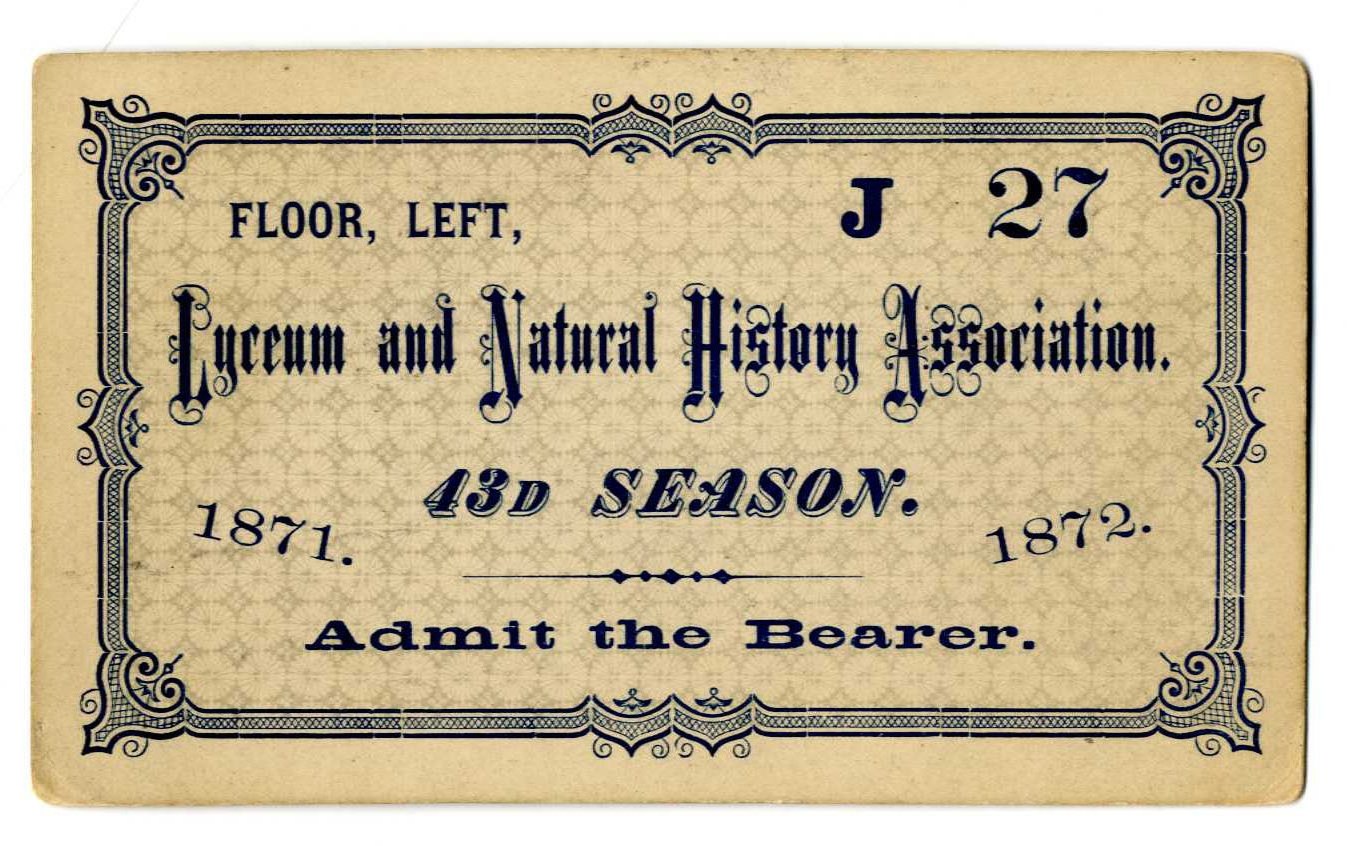
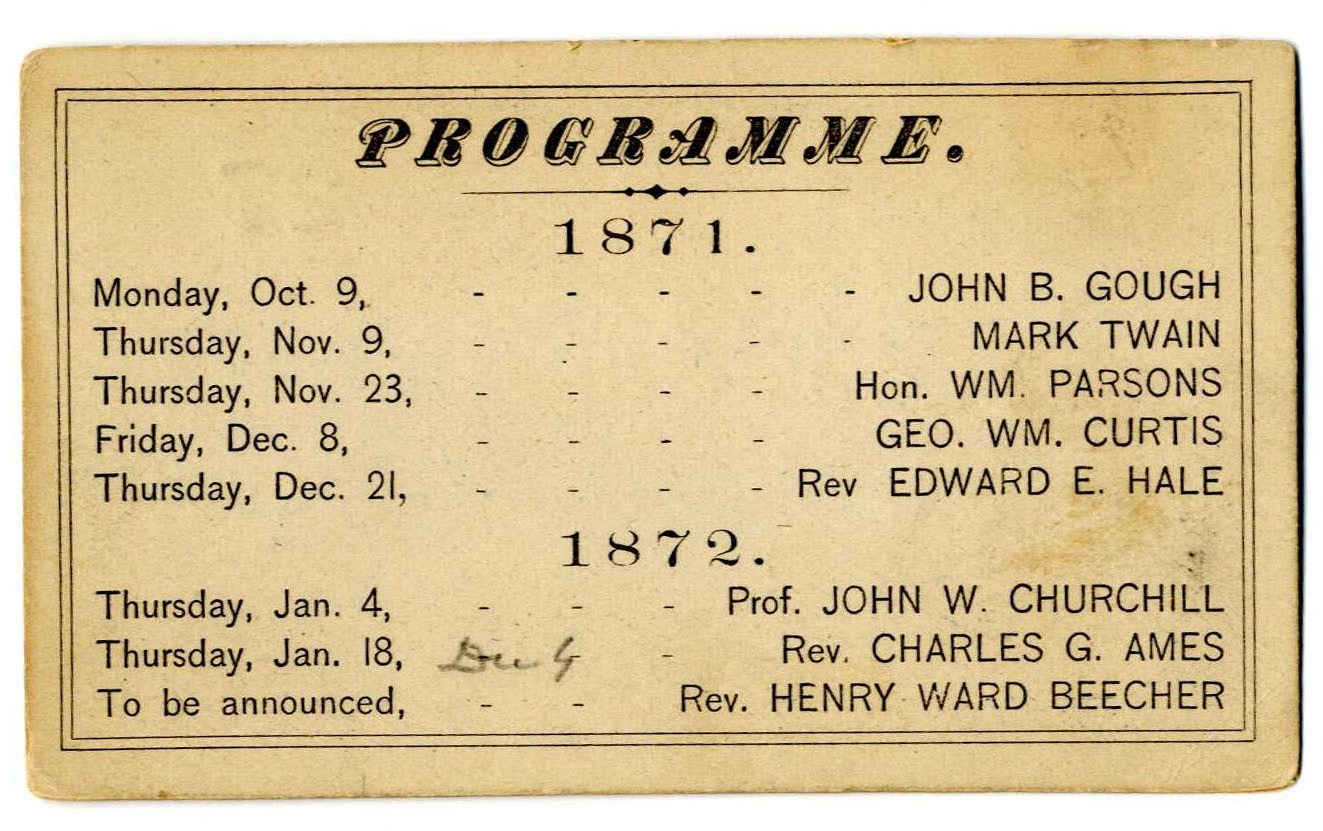
On September 23-24, 2011, the American Antiquarian Society will host a symposium titled “The Cosmopolitan Lyceum: Globalism & Lecture Culture in Nineteenth-Century America.” This conference was organized by Dr. Tom Wright, of the University of Oxford.

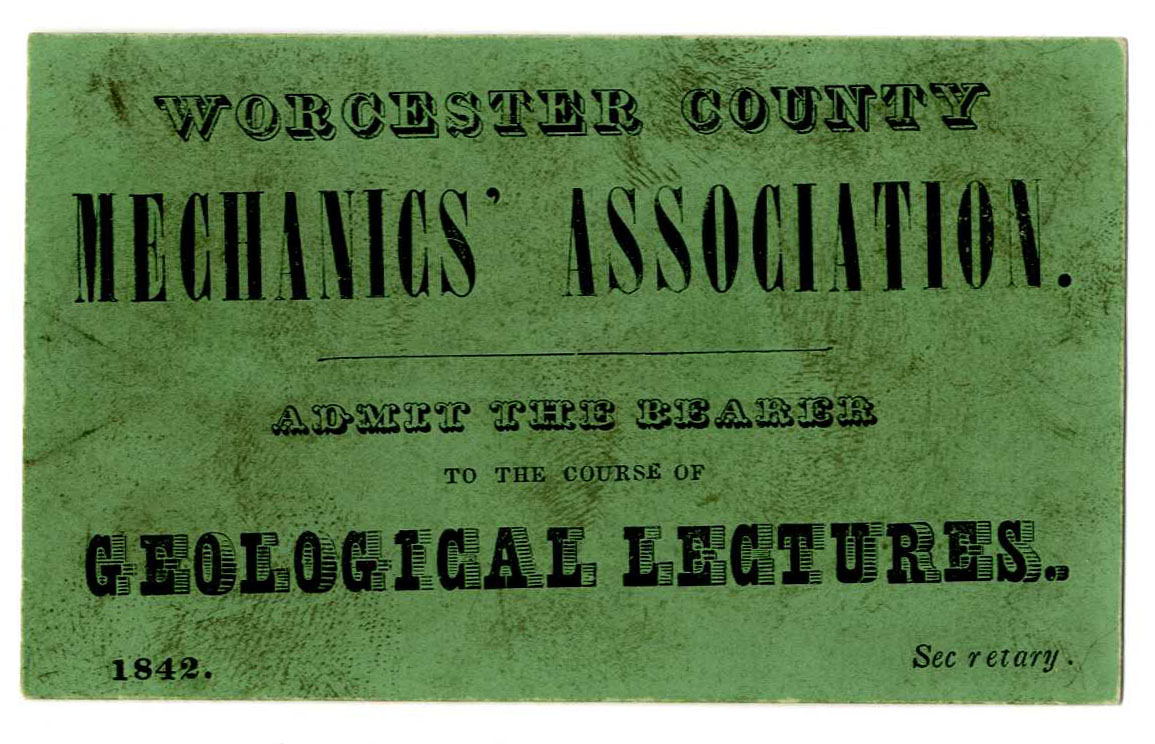
So what’s a lyceum, anyway? Throughout the nineteenth century, the lyceum—a scheduled public lecture that was intended to be both educational and entertaining—was one of the dominant modes that Americans in cities large and small learned about the larger world and spent their evenings. These lectures were delivered in learned societies (like AAS), academies, mechanics’ institutes (like Worcester’s own Mechanics’ Hall), or on commercial tours, and they provided writers like Ralph Waldo Emerson and Mark Twain with a way to make a reliable living. As such, these lectures occupied a middle ground between the printed world of books and the purely performative world of the theater. They also helped spread both scientific knowledge and social reform, as topics ranged from geology and medicine to temperance and women’s suffrage.

The lyceum was also “cosmopolitan,” in that it provided a venue for well-known foreigners to speak, and it familiarized American audiences with parts of the world they would never see. This conference will be similarly cosmopolitan, as it features speakers from the U.S. and Europe, as it explores the ways in which lecturing engaged with and made use of global knowledge, realities, and experience.

The Cosmopolitan Lyceum symposium is open to the public. Further information, a conference program, and registration details can be found on the AAS website at www.americanantiquarian.org.

Lucy Chase, Part II

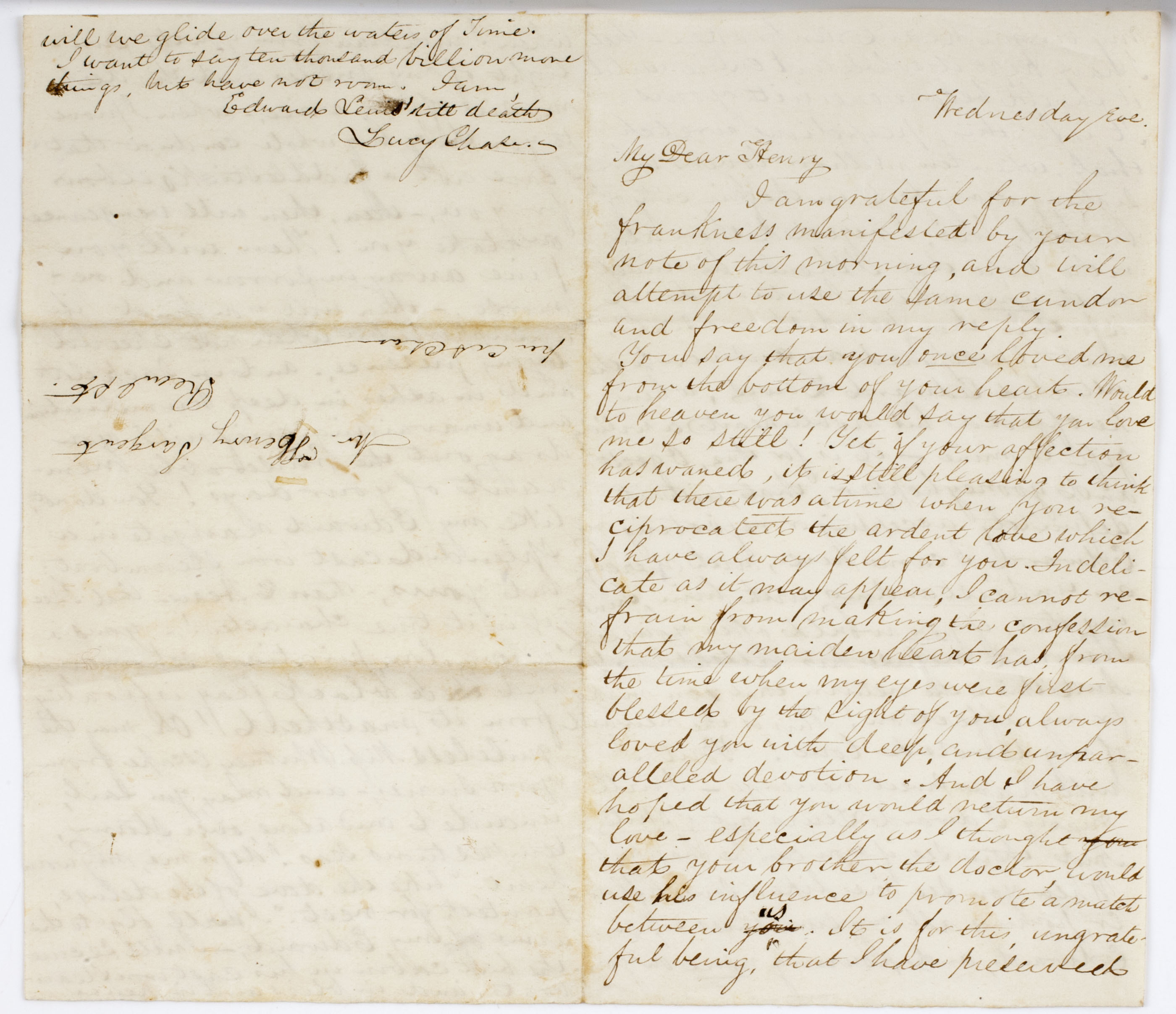
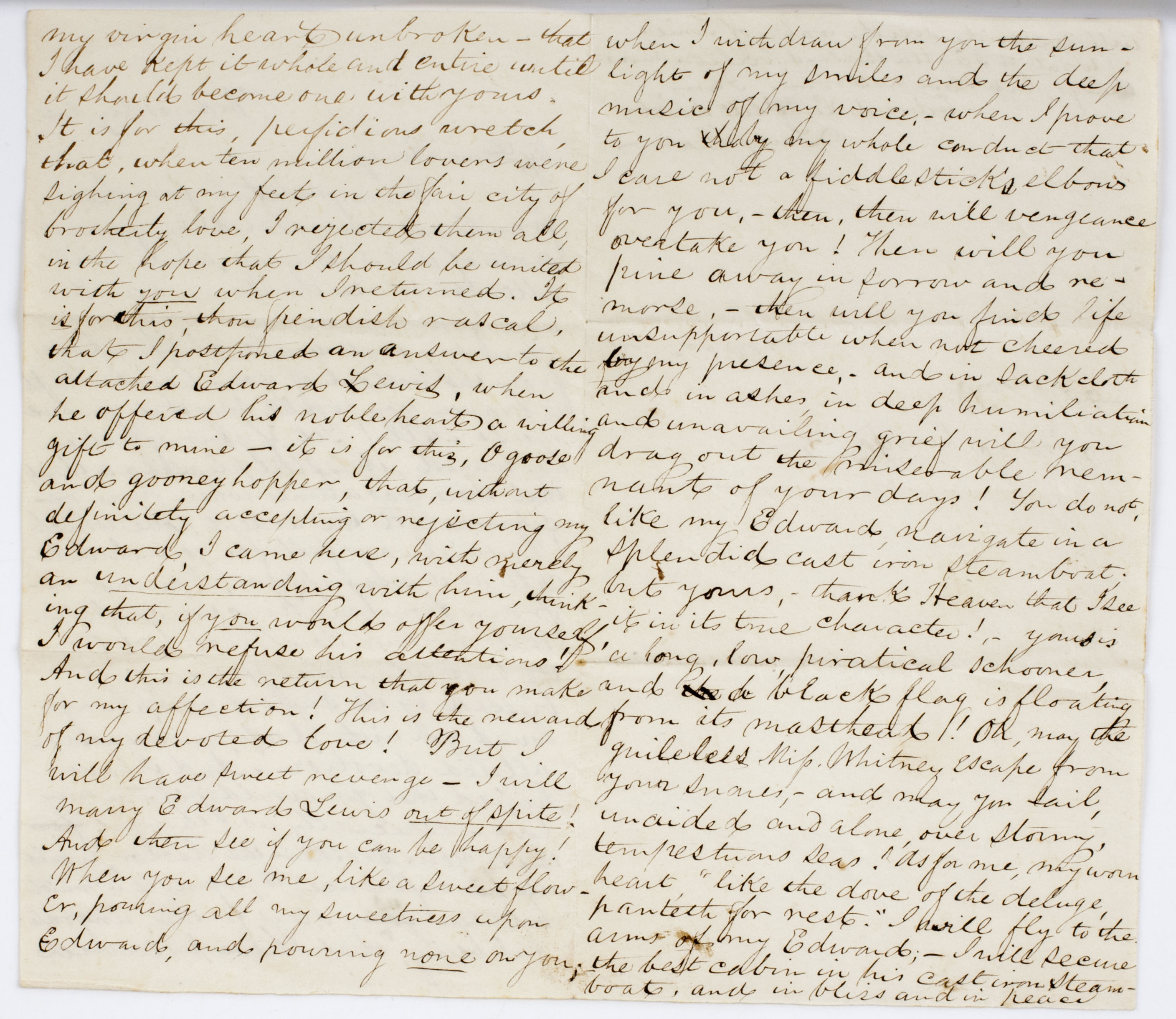
Last week I shared a letter from Lucy Chase to a Henry Sargent, and promised more about it this week.  Here’s the letter again, as a refresher!


Any thoughts?  Well, according to those who have studied this letter, many agree that it is, in fact, a joke!  Knowing Lucy’s personality (her wit, her humor, and her intelligence) it hardly seems in character for her to write such a dramatic, love scorn letter.  The fact that it is incredibly over the top reaffirms its role as a piece written to give Mr. Sargent a good laugh.

And for those who are wondering, Mr. Henry Sargent was a doctor living and practicing in Worcester.  His older brother, Joseph, was also a doctor in Worcester.  Henry married his “Miss Whitney”, Catherine Dean Whitney, in 1849.  Henry unfortunately died at the young age of 36. 

This letter proves the importance of context in historical research.  Reading the letter without any background information about Lucy, one would probably take the letter at face value.  Even knowing basic information about Lucy, such as her birth and death, where she lived, and what she did, might not be enough.  It is because this letter lives in the larger context of the Chase Family Papers that we are able to understand its value.  By piecing together an entire picture of Lucy through her correspondence and diary entries, we can recognize this letter for what it truly is. 

Finally, I love this letter for proving to those who think people were so different “back then” that they really were not.  People have always had a great sense of humor!

Featured Fellow: Carsten Junker

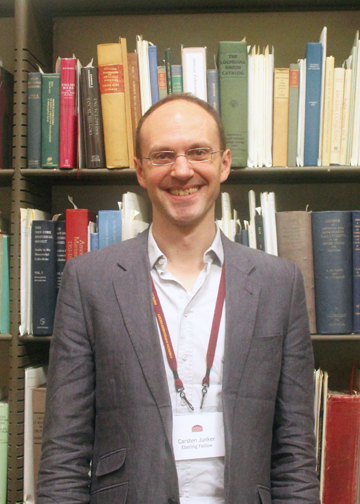
Carsten Junker, Assistant Professor of English and American Studies, University of Bremen, Germany

Ebeling Fellowship Project: “Reading Affect in 18th-Century Abolitionist Debates”

Professor Junker’s project examines late eighteenth-century texts that envisioned an end to the enslavement of African-diasporic people in the North American colonies and early republic. The struggle to overcome slavery was fought by many – by the enslaved themselves and by white abolitionists – and in many different genres. Essays, letters, pamphlets, and other short texts are the genres Carsten Junker plans to analyze closely at the American Antiquarian Society. Within this framework, the question of how abolitionists sought to provoke affective responses in their audiences – from empathy, guilt and shame to fear, outrage and grief – will be central to his analysis.

While Professor Junker is at AAS on an Ebeling Fellowship, he also intends to learn more about the namesake of his fellowship – Christoph Daniel Ebeling (1741-1817). The Christoph Daniel Ebeling Fellowship is jointly administered by the German Association for American Studies (DGfA) and AAS. Application for this short-term fellowship is made through the DGfA. The AAS-DGfA Fellowship is open to German citizens or permanent residents at the post-graduate or postdoctoral stages of their careers. The Fellow will be selected on the basis of the applicant’s scholarly qualifications, the scholarly significance or importance of the project within the field of American studies in general and its German context, and the appropriateness of the proposed study to the Society’s collections. For more information about applying for the Ebeling Fellowship, see the German Association for American Studies website.

More information about fellowships at AAS, including a directory of fellows and their work, is available on our website.

“Past is Present” in the Future

One of the greatest strengths of the AAS fellowship program is that researchers from around the globe, working in diverse disciplines (history, English, art, creative writing, archaeology, etc.), all live together just up the street from Antiquarian Hall. During their lunch hour and after being forced out of the reading room at 5 pm, they gather together in our new fellow’s residence (and sometimes down the street at Nick’s bar over beers and burgers).  They discuss their research, insights, and the really exciting things they stumbled upon that day. Sometimes the staff is even lucky enough to join in. Past is Present will give everyone the opportunity to participate in the discussion.

The paragraph above comes almost verbatim from the “About” page on this blog. It was written to describe the vision for Past is Present when the blog debuted almost two years ago. A biennial (two year anniversary) may not seem like much at an institution that next year will be celebrating its bicentennial (two hundred year anniversary). In the blog-o-sphere rather than the archival world, though, we feel it is something to be celebrated.

Take a browse through our archives to see the hundreds of posts from AAS staff, fellows, readers, council members, volunteers, interns, and friends.  If you’ve done research at AAS or participated in a program here lately, please take this opportunity to consider writing about it for Past is Present.  Your name could be the next to appear in our authors section!

As part of our biennial assessment at Past is Present, we are making plans to beef up the content and frequency of publication.  We are also considering a re-design and re-launch of the blog.  This is your chance to let us know what you would like to see more of (or less of) on the blog.

One new feature we know we want to debut is a weekly post introducing one of the many people doing research at AAS — you know, the ones we mentioned in the introductory paragraph that come from all different disciplines, states, and even countries.  Tune in tomorrow for our first “Featured Fellow” — and an international one at that.  Bonus points (or extra research assistance?) will be awarded to anyone who can guess what country our featured fellow is from, or to anyone who provides feedback on what you would like to see at Past is Present in the future.

John Adams: Deadbeat, careless accountant, or the continuing victim of partisan politics?

Since last October, the project catalogers creating online rare-book level records for 1801-1820 imprints have been working on United States’ federal documents. Admittedly, some government documents are boring. But much more often than I imagined they have been a source of interesting, even surprising, information.

Many documents, but especially Secretary of the Treasury Albert Gallatin’s report to the House of Representatives, dated November 6th, 1807, remind us that the questions the country is grappling with today are the same as occupied Congress and government officials two hundred years ago:

On the first day of January, 1809, the principal of the debt, will, if the proposed modification be not assented to by the public creditors, amount to near fifty-seven millions and five hundred thousand dollars … That the revenue of the United States will … be considerably impaired by a war, neither can or ought to be concealed. … It is, on the contrary, necessary … to examine the resources which should be selected, for supplying the deficiency, and defraying the extraordinary expenses. … Whether taxes should be raised to a greater amount, or loans be altogether relied on for defraying the expenses of a war, is the next subject of consideration. …

Depending on one’s point of view, knowing this can be oddly reassuring (we’ve gotten through this before, we can do it again), or the cause for sadness (why don’t we learn from history?)

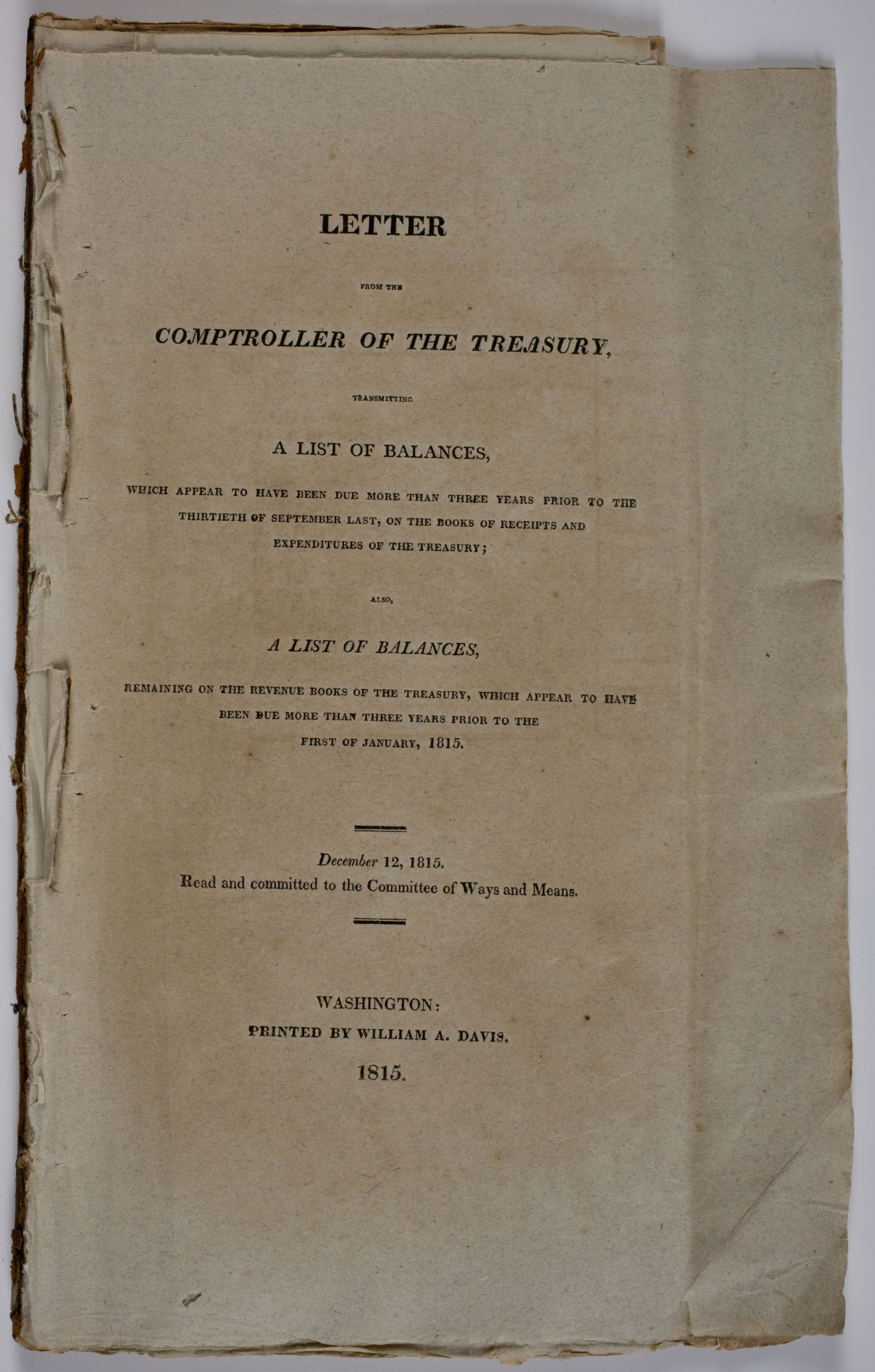
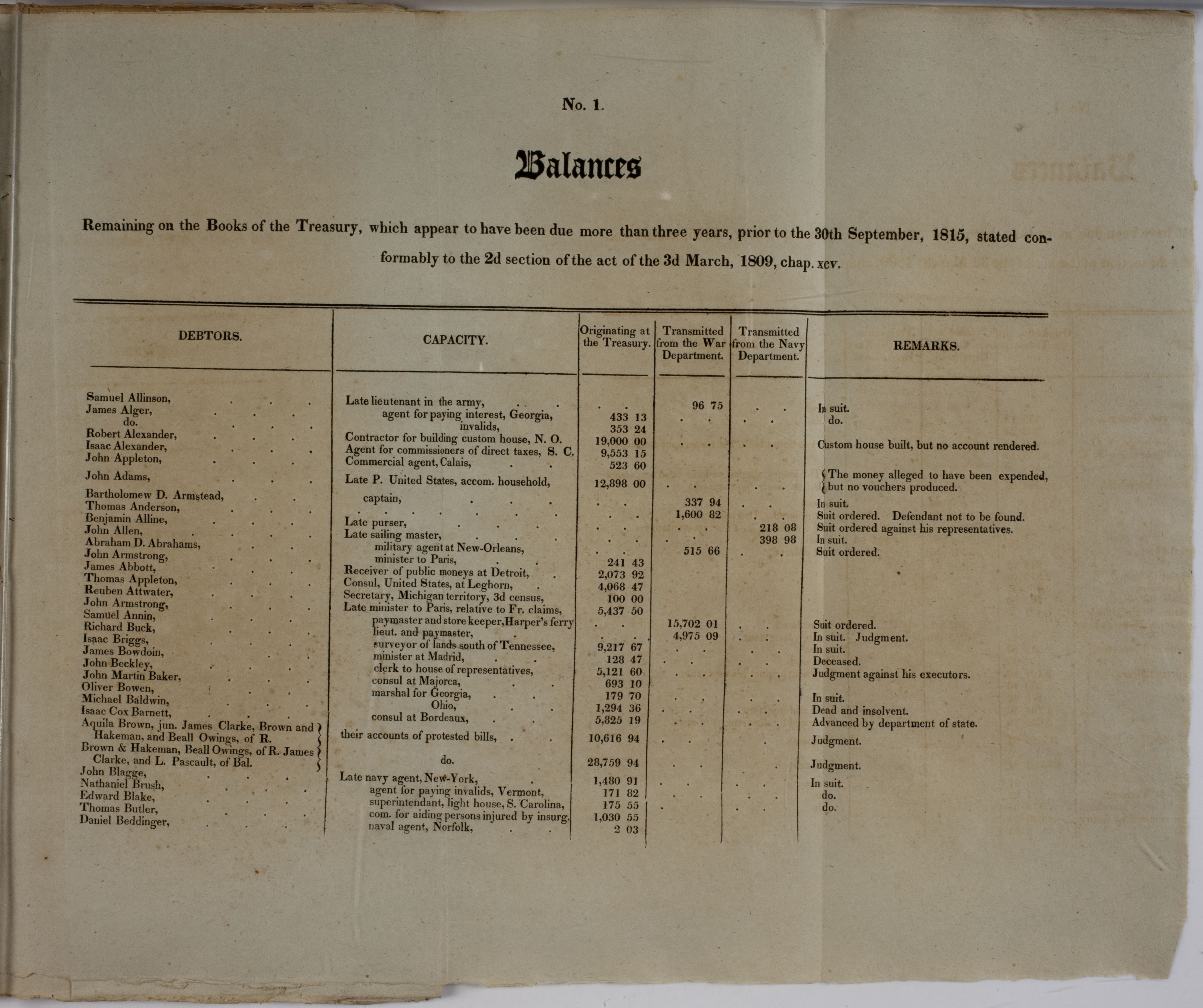
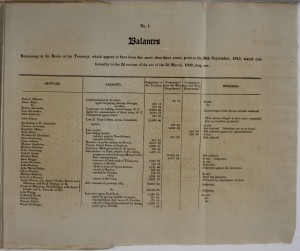
But the documents which have most recently piqued my interest and imagination are three statements from the Comptroller of the Treasury, dated 1814, 1815, and 1817. They report “unsettled balances” remaining on the books of the Treasury Dept. In the 1814 statement, John Chisholm, “conductor of Indians,” is listed with a balance of $926.24. The accompanying note reads, “He is not to be found.” Was he killed by Indians, did he die of illness or accident en route, or did he take the money and run? In the 1815 statement, Robert Alexander, contractor for building a custom house at New Orleans, is listed with an outstanding balance of $19,000. The note reads, “Custom House built, no account rendered.” Lost in the mail? And in the1817 statement, Samuel Sitgreaves, “commissioner under 6th article British treaty,” is listed with a balance of $6,857. 20. The note reads, “Advanced by Department of State. No account rendered. Mr. S. alleges that the public is in his debt.” Call me a cynic, but what are the odds that this was ever settled?
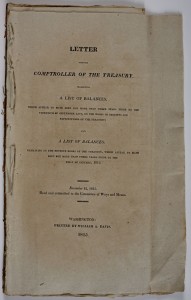
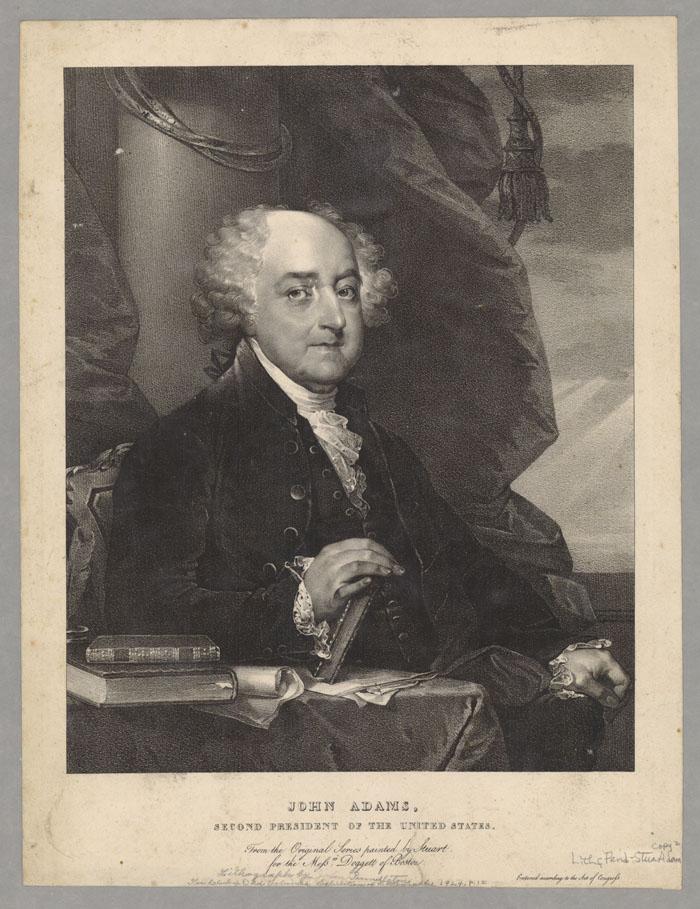
Others with outstanding balances were noted as deceased, insolvent, or subject to suit. Among the debtors are some familiar personages: William Henry Harrison, governor of the Indiana Territory, Joel Barlow, late minister plenipotentiary to France, and John Adams, late president of the United States. John Adams? Yes, on all three statements the second president of the United States is listed with an outstanding balance of $12,898 for “household accommodation.” In both the1814 and 1815 reports the note reads, “The money alleged to have been expended, but no sufficient vouchers produced.” In 1817 the note was expanded and softened a bit:

Advanced to him for the accommodation of the household of the president. Mr. Adams forwarded a certificate of his then secretary, that the money was expended according to law; but this has been deemed an inadmissible voucher by my predecessors, and cannot now be found in the office.
My imagination runs wild. Was Adams avoiding specificity so that it would not be known exactly how many place settings of china Abigail purchased? Or was he always a bit careless with his accounts? Or should the sloppy accounting be attributed to the Treasury Dept. rather than to Adams? By this time John Adams had been out of office for more than a decade. If there was a problem, why hadn’t it been resolved before this? The matter might simply have been ignored to avoid confrontation. Can you imagine being the clerk charged with contacting President Adams and requesting “proper” vouchers? Or maybe no one ever contacted Adams because some partisan official in the Treasury Dept. expected that the inclusion of Adams’s name on the list of “unsettled balances” would repeatedly embarrass the former president.

Well, time to shut off the imagination, end the speculation, and move on to the less interesting “Letter from the acting secretary of the Treasury, transmitting a report of the names of the clerks employed in the several offices of the Treasury Department …”
The Acquisitions Table: Taxation, Exactly 149 Years Ago Today

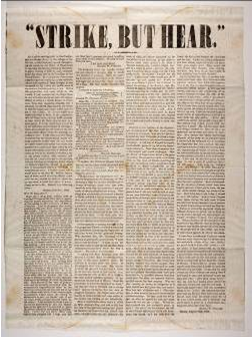
“Strike, but hear.” Homer, NY, August 16, 1862.

This broadside, found between the pages of an August 1862 issue of the Cortland County Republican newspaper, recounts the difficulties of taxation and raising bonds in the small town of Homer, NY, during the Civil War. Issued by dry good merchant (and Town Supervisor) George W. Phillips, the broadside documents the difficulties Phillips encountered when dealing with bounty payments for soldiers enlisting in local regiments. Phillips felt that the state should tax its citizens evenly to raise equivalent funds for bounties, while some Homer residents wanted to levy only enough tax to supply each soldier with a flat $50 enlistment bounty. Phillips explains his unpopular position of waiting for the state government to take action (he was accused of being unpatriotic) and the failures of earlier locally-funded bounty systems. The problem was real, and enlistment calls were often delayed as young men waited to see which towns offered the best bounties. By 1863, some New York towns offered up to $400 per soldier, making the town of Homer’s $50 bounty quite unattractive.

Gift of the Phillips Free Library, Homer, NY.

My Dear Henry…you fiendish rascal

I have always found Lucy Chase to be one of the most interesting women represented in our manuscript collection.  Lucy was born in 1822 to a successful Worcester family.  She spent time teaching in contraband camps and freedman schools in the South, and travelled across Europe with her sister for 5 years.  She was intelligent, well-educated, and a talented artist as well.  Her writings, included in the Chase Family Papers here at AAS, show her interest in women’s suffrage, religion, abolition and social reform.

What I appreciate most about Lucy is the way her intelligence comes through in her writing.  Always witty and not one to hide what she thinks, you never know what you’re going to find in Lucy’s diaries and letters.  Recently a reader came across this letter written by Lucy.  Oh, unrequited love. 

My Dear Henry,

I am grateful for the frankness manifested by your note of this morning, and will attempt to use the same candor and freedom in my reply.

You say that you once loved me from the bottom of your heart.  Would to heaven you would say that you love me so still!  Yet if your affection has waned, it is still pleasing to think that there was a time when you reciprocated the ardent love which I have always felt for you.  In delicate as it may appear, I cannot refrain from making the confession that my maiden heart has from the time when my eyes were first blessed by the sight of you, always loved you with deep and unparalleled devotion.  And I have hoped that you would return my love – especially as I thought that your brother the doctor would use his influence to promote a match between us.  It is for this, ungrateful being, that I have preserved my virgin heart unbroken – that I have kept it whole and entire until it should become one with yours.

It is for this, perfidious wretch, that when ten million lovers were sighing at my feet in the fair city of brotherly love, I rejected them all, in the hope that I should be united with you when I returned.  It is for this, you fiendish rascal, that I postponed an answer to the attached Edward Lewis, when he offered his noble heart a willing gift to mine – it is for this, O goose and gooney hopper, that, without definitely accepting or rejecting my Edward, I came here, with merely an understanding with him, thinking that, if you would offer yourself I would refuse his attentions!  And this is the return you make for my affection!  This is the reward of my devoted love!  But I will have sweet revenge – I will marry Edward Lewis out of spite!  And then see if you can be happy!  When you see me, like a sweet flower, pouring all my sweetness upon Edward, and pouring none on you, when I withdraw from you the sunlight of my smiles and the deep music of my voice – when I prove to you by my whole conduct that I care not a fiddlestick’s elbow for you – then, then will vengeance overtake you!  Then will you pine away in sorrow and remorse, – then will you find life unsupportable when not cheered by my presence, – and in sack cloth and in ashes in deep humiliation and unavailing grief will you drag out the miserable remnants of your days!  You do not, like my Edward, navigate in a splendid cast iron steamboat but yours, – thank Heaven that I see in it its true character!, – yours is a long, low piratical schooner and a black flag is floating from its masthead!  Oh, may the guileless Miss Whitney escape from your snares, – and may you sail, undecided and alone, over stormy, tempestuous seas!  As for me, my worn heart “like the dove of the deluge panteth for rest.”  I will fly to the arms of my Edward; – I will secure the best cabin in his cast iron steamboat, and in bliss and in peace will we glide over the waters of time.

I want to say ten thousand billion more things, but have not room.  I am

Edward Lewis’ till death,

Lucy Chase

Next Monday I’ll be sharing more information about this letter, and the story behind it, so stay tuned!  And in the meantime, if you’d like to learn more about Lucy and the rest of the Chase family, check out the collection description here.

The Newspaper Front: The Civil War from the Southern Side

Disclaimers always add something titillating to a post, so here goes our very own… This post focuses on reporting in the South, but the war of words worked both ways during the Civil War. The northern press could be inaccurate, hypocritical, and disingenuous. We would love to read examples you have found in your own research of strongly sectional reporting, or perhaps someone would be willing to write a follow up post highlighting the slanted reporting of northern presses? In the meantime, here are some examples our volunteer found in one southern newspaper (including a cartoon of Lincoln as the devil!).

While the armies of the United States and the Confederacy fought on the battlefield, newspapers North and South waged a war of words. With skills honed during the contentious decades before the war, writers launched salvos back and forth from their well-stocked arsenals of rhetoric. In this post, I have chosen some of the most sharply pointed attacks penned by southern newspapermen in The Southern Illustrated News [AAS online catalog record] against the perceived “inborn malignity” of their Yankee foe.

Unsurprisingly, the Southern writers were eager to demonstrate the inferior qualities they perceived in northern culture, people, and government compared with the Confederacy. Culturally, the “Yankee” was lambasted as “an imitative animal,” and “utterly devoid of original genius.” The writers even find fault with the way northerners speak and write. They accuse Yankees of torturing the English language “in a most inhuman fashion,” distorting it into “an unknown tongue, leaving scarcely any trace of its parentage.” Furthermore, the Union government is viewed with utter contempt. In the past, they allege, “great Southern Presidents” had made for the United States “all of its history which is not absolutely contemptible. Now, they claim, “The government there is a military despotism, as absolute as that of Russia.”

Although the whole north was vilified and derided, New England was singled out for the strongest venom in the southern press, because it had been the center of abolitionism before the war and because many southerners resented its cultural preeminence in mid 19th century America. One angry writer labeled it “that benighted corner of the globe.” Clearly, in this heated climate, facts were less important than rallying support for the cause and opposition to the enemy.

Cartoon of Lincoln as the devil from p. 8 of the January 8, 1862 issue of The Southern Illustrated News

Additionally, in many articles writers strove to create a distinct identity that stood on its own and was not based solely on opposition to the North. A common complaint is that southern creativity had been stifled before the war because the North had “supplied us with every article of daily use,” from farm implements to books, placing the south in “a state of colonial vassalage.” Continuing along these lines, the burning of the College of William and Mary by United States troops gave The Southern Illustrated News an opportunity to allege that the reason for the destruction was the Yankee determination to make themselves “the exclusive patron of learning and science on this American continent.” To make the hoped-for independence of the Confederacy complete, cultural as well as political independence must be achieved through the development of, among other things, “a vigorous, healthful literature” which will “speak for us and our society in the intellectual forum of the world.” The anger and resentment at so-called Yankee domination is clear in these statements, but there is also an undercurrent of uncertainty since, having rejected one culture, the South had not yet built another.

Despite the ferocity of these statements, the writers reserved their most bellicose condemnation for what they viewed as the dishonorable tactics used by the “murdering rascals in Washington.” After both Antietam and Gettysburg, they accuse the Federal armies of leaving the field of battle in the face of Lee’s army, only to return after the Confederates had retreated on their own accord in order to claim victory for the North. Though historically inaccurate, it did allow The Southern Illustrated News to declare that Union generals, although they cannot outfight their rebel counterparts, can out-lie them. Furthermore, the newspaper laments that the south is “beset on all sides by a rapacious, vindictive and powerful foe which respects neither age nor sex in the execution of its fiendish purposes.” Descriptions of the allegedly heinous acts committed by Union troops became so commonplace that, in November 1862, it was necessary only to say that during an invasion of the North Carolina coast the Yankees had perpetrated their “usual atrocities.” Readers could use their imagination to fill in the details.

In this way, The Southern Illustrated News presented a dual narrative of the war in which Southerners were brave and honorable soldiers defeating the Yankees through great feats of arms, while at the same time were the oppressed victims of a ferocious, marauding enemy. Confederate supporters could feel pride in Southern martial prowess and self-righteous indignation as victims all at the same time.

The Acquisitions Table: Lewis Bradford Letters

Bradford, Lewis. Letters, 1817 – 1829

Lewis Bradford, a descendant of Governor William Bradford, and son of Levi Bradford and Elizabeth Lewis Bradford, was born in Plympton, Massachusetts in 1768.  Lewis lived his entire life in the town of Plympton, working as the town clerk for forty years.  In addition to his work, Bradford was a member of the New England Historic and Genealogical Society, and was an avid historical researcher.  Bradford never married, and died from a fall from a carriage in 1851 at the age of 83.  This collection of letters from Bradford are all addressed to his younger brother, Major Levi Bradford (1772 – ), while Levi was living in New York.  The letters speak mostly of the goings-on in Plympton, updating Levi as to births, deaths, marriages, new ministers, court cases, new buildings (“This is a world of changes – the new houses built in Plympton, and several new roads…”) as well as family gossip. Bradford’s pious and polite attitude comes through in these letters, especially when having to pass along unfortunate family news – “It is rather of an unpleasant task to write about unpleasant things which take place in families, but perhaps it is not amiss for different branches of the same family to know them.”

Watch Papers at the American Antiquarian Society

This summer, Graphic Arts intern Dominique Ledoux, a student at Wellesley College, created an inventory of the Society’s collection of 464 watch papers. Watch papers are round decorative papers placed between the inner and outer case of a pocket watch to protect its inner workings. They also served as advertisements for watchmakers as they often included names and addresses along with elaborate designs. Popular iconography included Father Time, Aurora in her chariot, cherubs, allegorical women, Masonic symbols, hourglasses, clocks and eagles. Most of the papers are engraved, although a few are letterpress printed. Famous engravers including Peter Maverick, Paul Revere, and Nathaniel Hurd are represented in the collection.

Currently, the collection is being digitized and by December 2011, the images will accompany Ledoux’s inventory in an electronic resource on the Society’s website.  If you just cannot wait until then, we have put a selection of watch papers on display in the AAS reading room for you to examine.