Some things never change

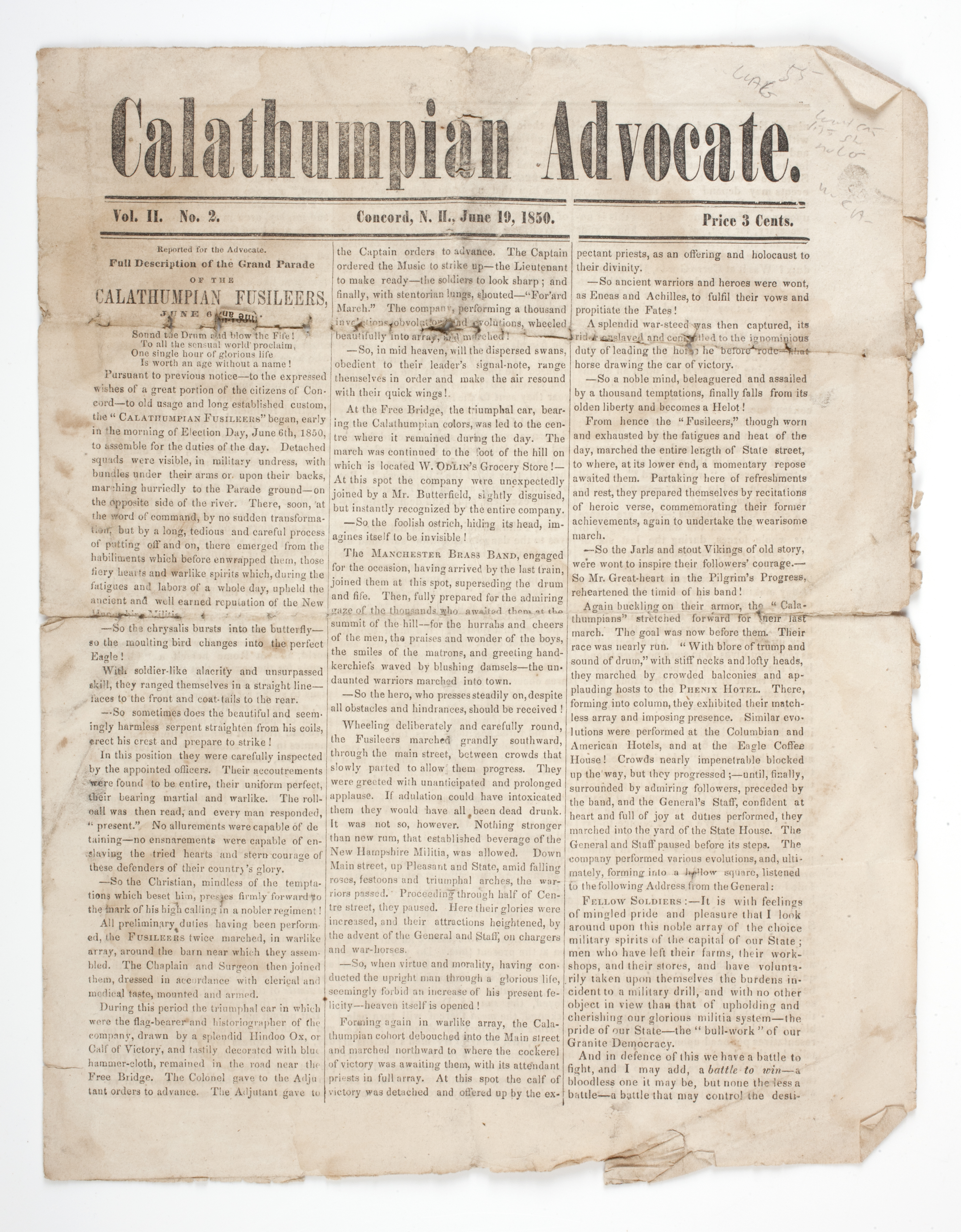
Recently I’ve been going through some newly acquired diaries in our manuscript collection.  Randomly reading diary entries can prove to be very entertaining.  Sure, you could end up reading page after page of daily weather, or recaps of Sunday sermons, but once in a while you’ll find a gem.  Because so many diaries are straightforward record keeping, it can be hard to find a diarist with entertaining prose, so I’m going to share a couple of entries that caught my eye.

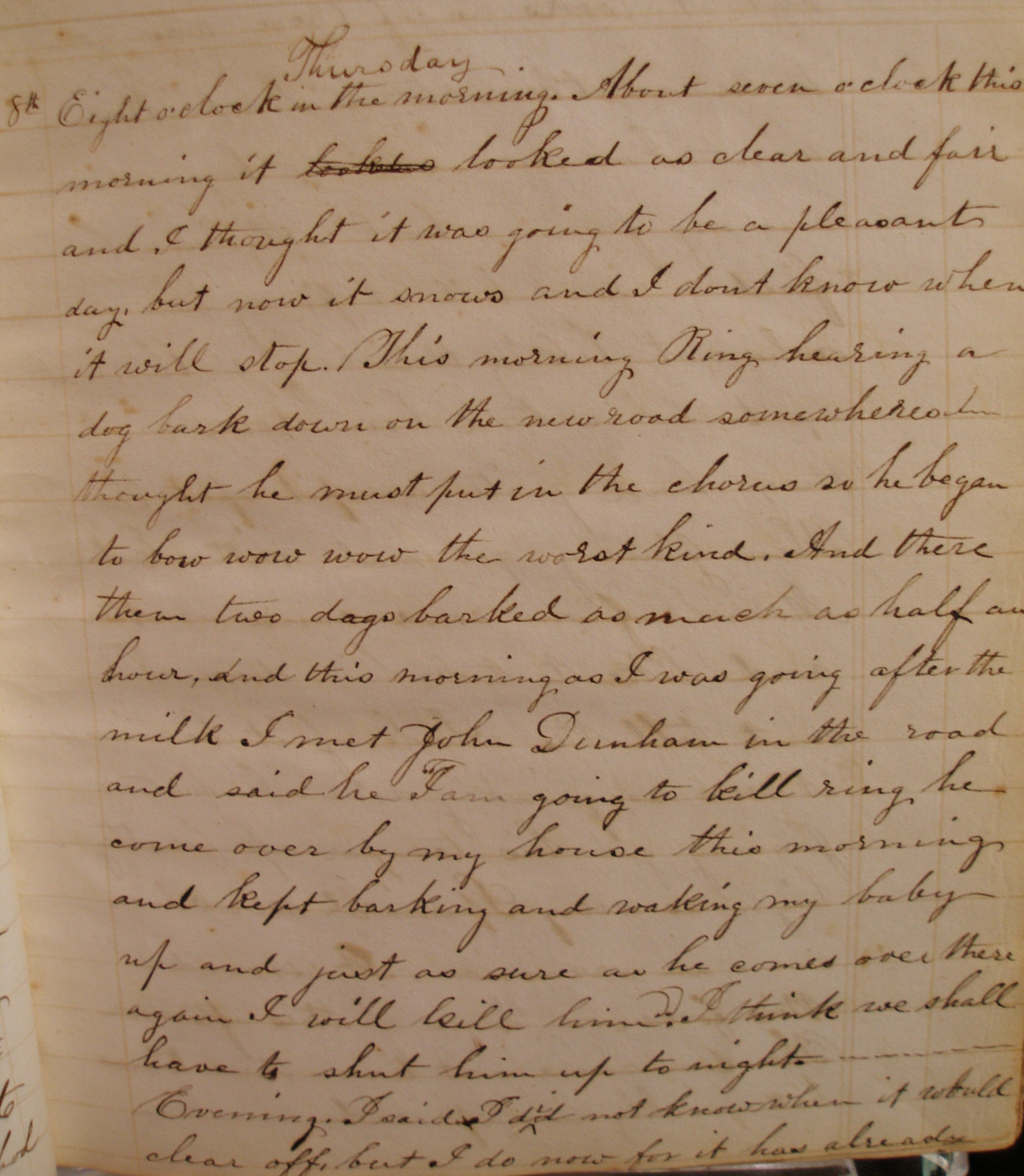
First, we have an entry from Walter Goodrich.  Walter lived in Portland, Maine, and kept a diary from January through June of 1846.  While the diary doesn’t cover a long time span, his entries are lengthy (about a full page per day) and detail his life at school and in his community.  In one entry, Walter recounts the all too familiar issues dog ownership –

Eight o’clock in the morning About seven o’clock this morning it looked as clear and fair and I thought it was going to be a pleasant day, but now it snows and I don’t know when it will stop.  This morning Ring hearing a dog bark down on the new road somewheres thought he must put in the chorus so he began to bow wow wow the worst kind.  And there then two dogs barked so much as half an hour, and this morning as I was going after the milk I met John Dunham in the road and he said he was going to kill ring he came over by my house this morning and kept barking and waking my baby up and just as sure as he comes over there again I will kill him!!

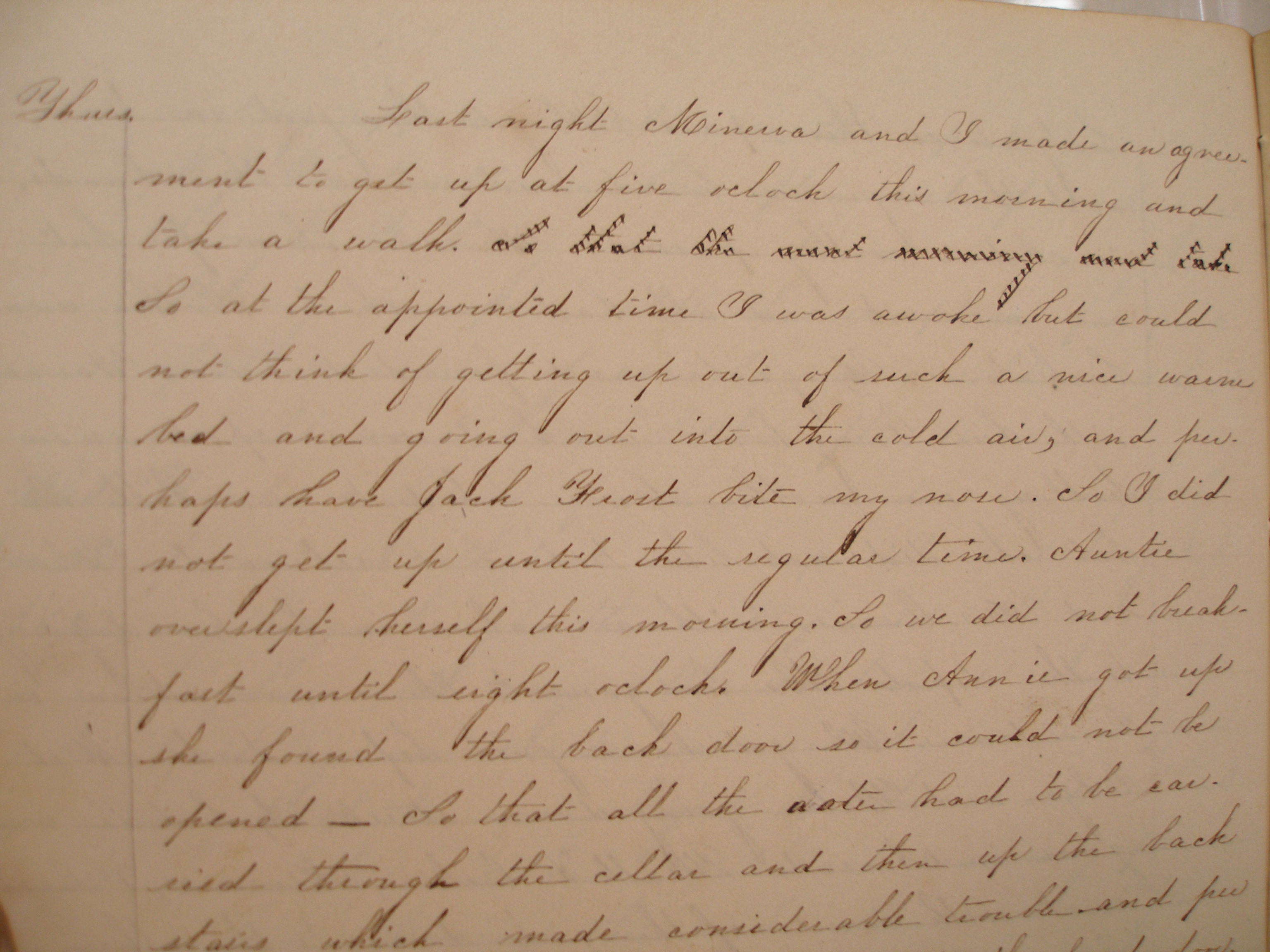
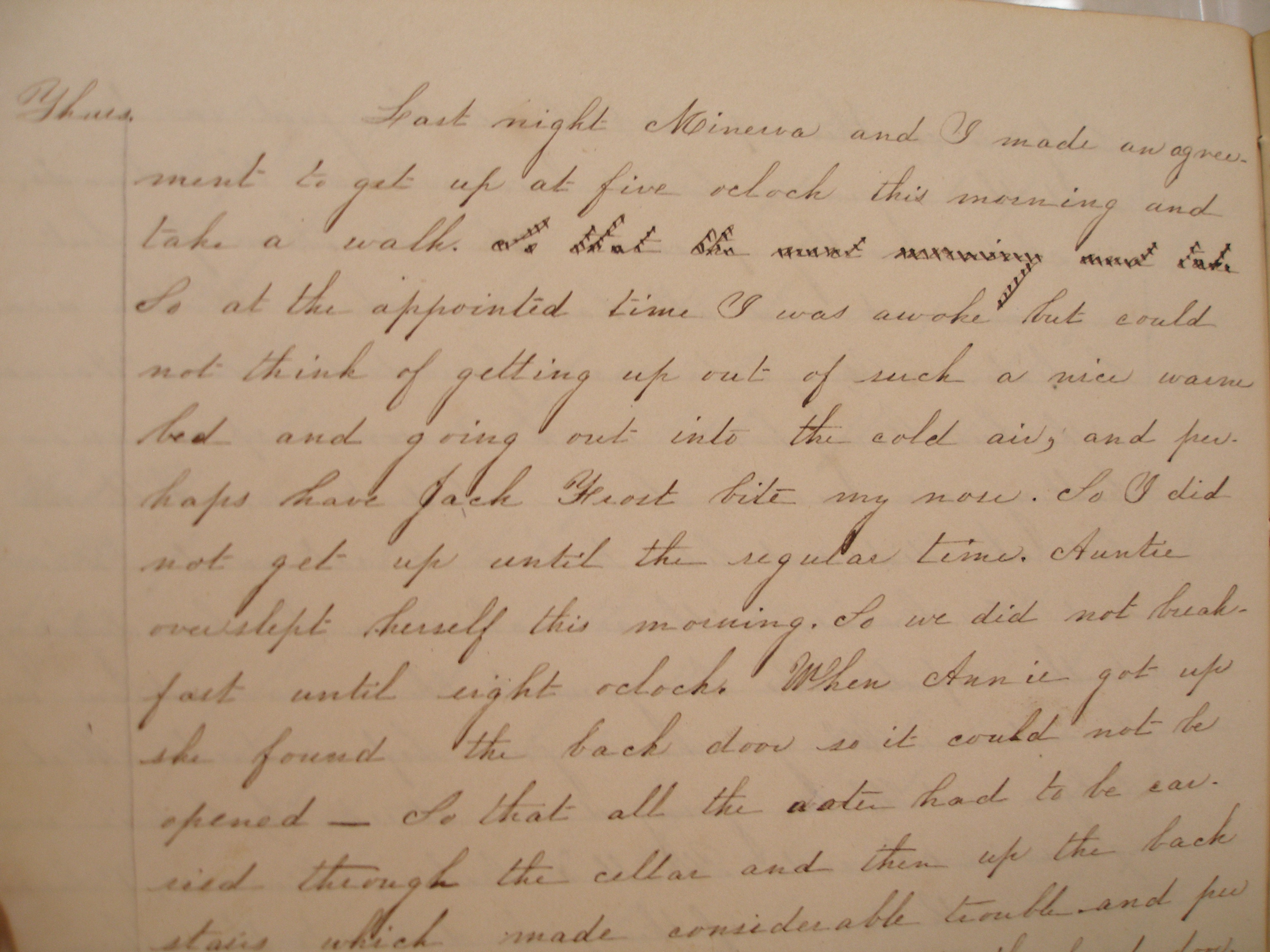
Another entry comes from a new addition to our unidentified diaries collection.  The diary was kept by a school girl from Rhode Island.  Another short diary, she kept daily entries for only three months, from November 1852 through January 1853.  On a Thursday during the cold winter, our author writes of a promise made with a friend to get up at 5am the next morning for some exercise.  And much like we still all hit the snooze button and ignore our good intentions, she too slept in –

Last night Minerva and I made an agreement to get up at 5 o’clock this morning and take a walk.  So at the appointed time I was awoke but could not think of getting up out of such a nice warm bed and going out into the cold air, and perhaps have Jack Frost bite my nose.  So I did not get up until the regular time.  Auntie overslept herself this morning.

I love how diaries can capture these real life moments and make us realize how some of the simple things in life never change!

Both of these diaries will be up for adoption during AAS’s annual Adopt-A-Book event on April 3, 2012.  [You can read about last year’s event here.]  More information about this year’s event, as well as other items up for adoption, will be available on our website soon!

National Award and Standing Ovation for AAS’s Philip Lampi

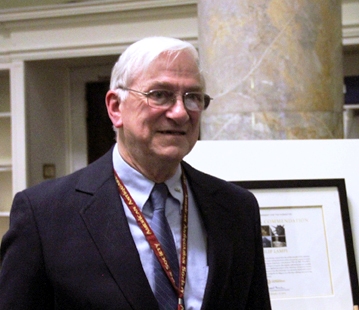
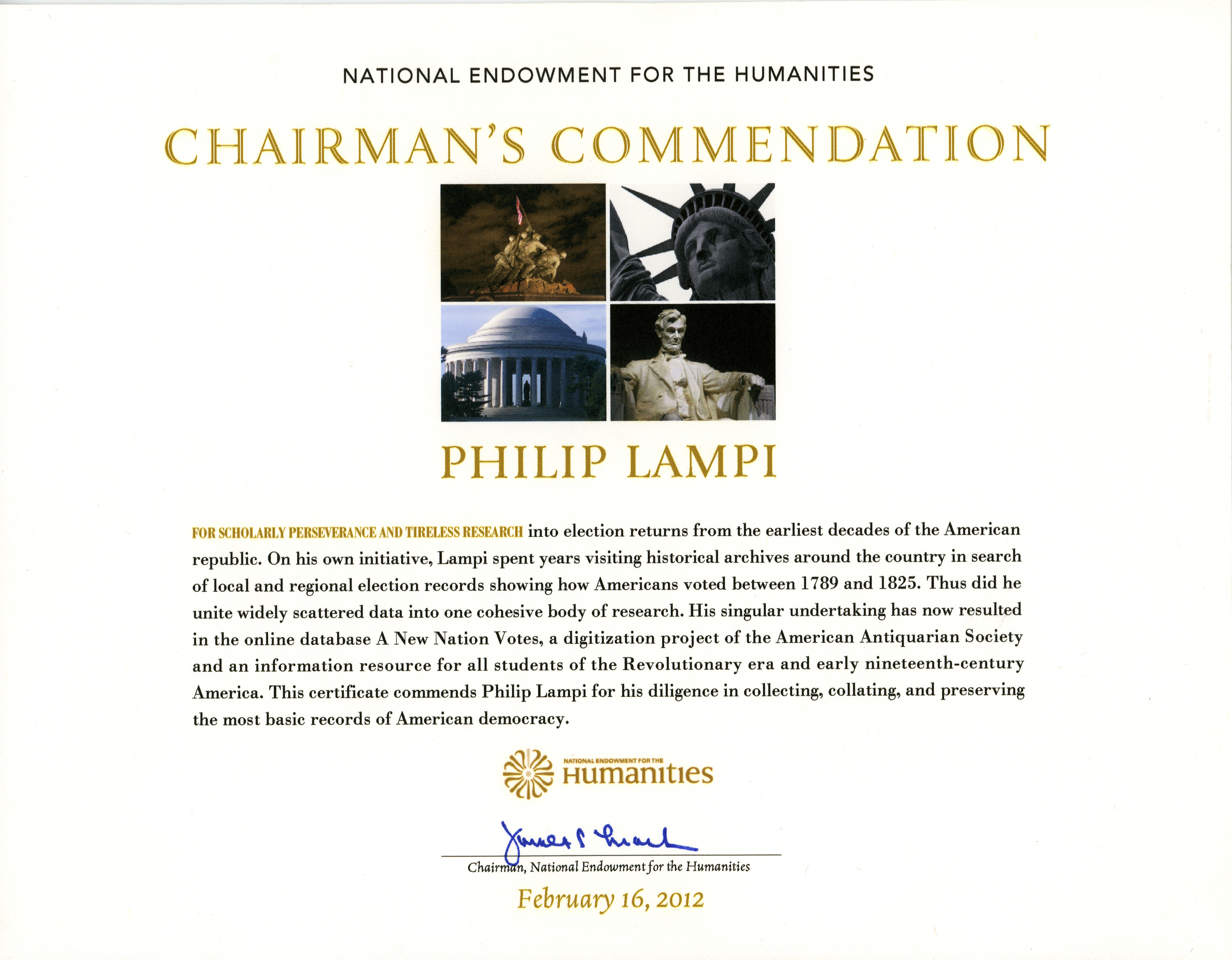
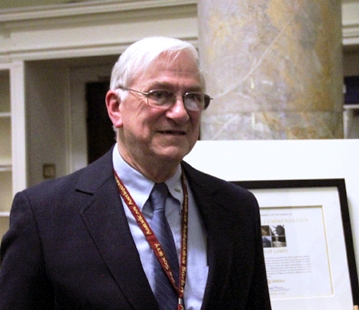
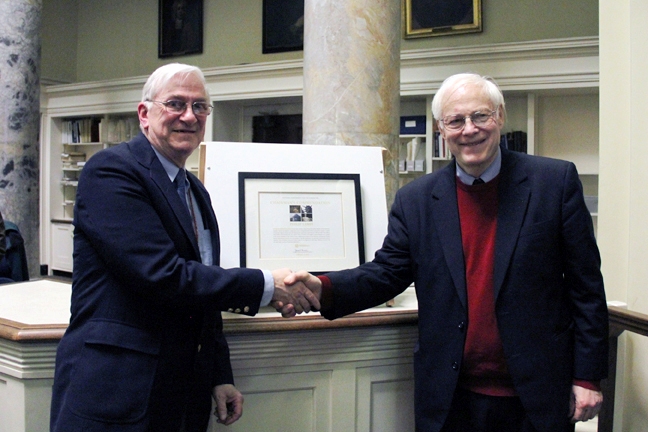
The first ever Chairman’s Commendation from the National Endowment for the Humanities (NEH) was awarded to AAS staff member Philip J. Lampi in a ceremony yesterday afternoon.  Local politicians, current and former AAS staff, and some of Lampi’s many friends and colleagues gathered to honor his lifetime of research into early American election returns.

Learn more by reading:

  • the front page story in today’s Telegram & Gazette (be sure to check out the slideshow of images from the event)
  • a blog post from current AAS fellow, Joseph Adelman, explaining the impact of Lampi’s work on historical scholarship

Here are quotes describing the significance of Lampi’s life work:

Back in 1987, Walter Dean Burnham referred to “the lost Atlantis of nineteenth century politics.” If that is indeed the correct description, then Phil is the Captain Nemo. — Erik Beck, A New Nation Votes project coordinator, in the AAS Annual Report for 2009-2010 [Download a PDF]

Indispensable for understanding politics in the early Republic is Philip Lampi’s monumental collection — Gordon S. Wood in Empire of Liberty: A History of the Early Republic, 1789-1815, Oxford University Press, 2009

One of the strangest and most heroic tales in the annals of American historical research — Jill Lepore in “Party Time,” The New Yorker, September 17, 2007

The Society issued the following press release written by director of outreach, James David Moran:

James Leach, chairman of the National Endowment for the Humanities, awarded Philip J. Lampi, a researcher at the American Antiquarian Society (AAS), a Chairman’s Commendation in a ceremony at AAS yesterday. Leach cited Lampi’s life-long research into the voting records from 1787 – 1825 and his compilation of local, state and national election data from newspapers and archives from throughout the nation. The award “commends Philip Lampi for his diligence in collecting, collating and preserving the most basic records of American democracy.”

This award is all the more remarkable because Lampi possesses only a high school diploma. Lampi first became interested in election returns as a teenager while living in the Stetson Home for Boys in Barre, Massachusetts. When he could not get access to the television, he wandered off to discover a collection of yearly almanacs. The election statistics contained within them fascinated him as did the fact that no statistics were listed before 1825. What happened prior to that date became a lifelong obsession that took him to libraries and historical societies throughout the country. Supporting himself by various jobs including night watchman, Lampi suffered great privations including sleeping in his car in his quest of voting returns which he would discover in newspapers, deed books, and manuscripts scattered in repositories throughout the nation. Eventually his research brought Lampi to the AAS when in 1974-75 he was the recipient of an AAS Fred Harris Daniels Research Fellowship to mine the Society’s collection of over two million pre-twentieth century American newspapers. Lampi eventually joined the staff of the Society.

Today, Lampi is recognized by political scientists and historians as the most authoritative expert on early national election returns. Lampi’s research has been cited by numerous scholars including: George A. Billias, David Bohmer, James P. Broussard, David Hackett Fischer, Ronald P. Formisano, William J. Gilmore, Roy R. Glashan, Daniel P. Jordan, Kenneth Martis, Richard P. McCormick, Donald J. Ratcliffe, Andrew W. Roberston, and Jeremiah Slade, among many others.

The fruits of Lampi’s life’s work are now part of an online searchable database of early American voting records entitled A New Nation Votes created in collaboration with the American Antiquarian Society and Tufts University Digital Collections and Archives and with funding from the National Endowment for the Humanities.

Please join us in paying tribute to the remarkable achievements of this remarkable man.

‘Chasing the Dumpster’ for historic newspapers

Who knew the skill set for a successful curator of newspapers included dumpster diving abilities?

While this may not always be literally true, figuratively speaking at least AAS’s curator of newspapers has rescued some of the collection’s treasures from pretty precarious situations. Vincent Golden recently gave a talk on his “Chasing the Dumpster” activities, which you can read about on the New England Newspaper & Press Association’s website by clicking here.

As this article suggests, Vince Golden is committed to his mission of rescuing historic newspapers. How committed? Well, he’s so committed that he periodically rents a U-Haul and drives it across half the country, stopping along the way at prearranged sites to pick up newspapers that can no longer be properly housed. Just picture it: rather than a covered wagon traveling along the Oregon Trail, imagine a “Newspaper Trail” being blazed by a lone curator in a rented U-Haul. The best part, though, from our point of view is that rather than staying out West, Vince brings the newspapers back to a safe forever home at the American Antiquarian Society.

While Vince is willing to go to great lengths to successfully corral newspapers, he would probably be the first to admit that the newspaper that walks in the door by itself (or more accurately, carried by a generous donor) just may be his favorite. So if you wanted to help out by walking in your own donation of newspapers published before 1876 in the U.S. (or the West Indies) that are not yet in AAS’s collections, I’m sure you would make Vince’s day (and save some gas in the U-Haul).

On AAS’s website, you can catch a short video featuring Vincent Golden in which he describes the history and characteristics of antebellum American newspapers. Filmed in the newspapers workroom at the Society, the video features examples of various newspapers and illustrated magazines from the Society’s collection.

Antebellum American Newspapers from American Antiquarian Society on Vimeo.

More information about AAS’s newspaper collections can be found on the newspaper section of our website.

The Acquisitions Table: The Boys’ and Girls’ American Annual

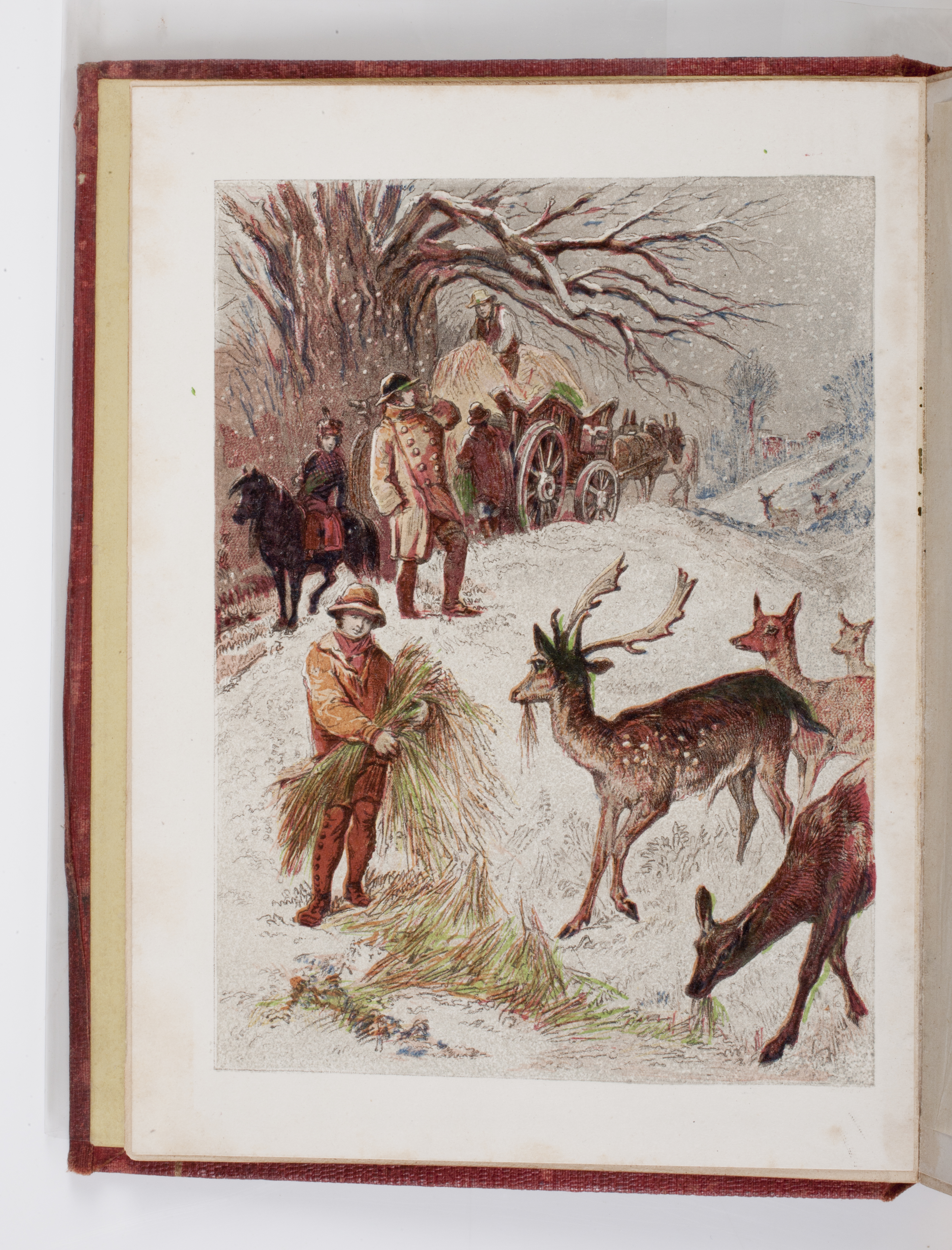
The Boys’ and Girls’ American Annual: A Christmas and New Year’s Present for Young People. New York: D. Appleton and Co., 1861.

This utterly charming chromolithographed winter scene of a boy feeding deer is the frontispiece to our newly acquired copy of The Boys’ and Girls’ American Annual. It is unabashedly devoted to leisure reading. The first chapter gives suggestions to its young readers on how to stage a holiday dance and charade party. Casting aside any lingering distrust of Christmas as a popish holiday, the preface proclaims, “Ring the merry bells of your hearts, my little ones, and let their clappers—your tongues—tell of joy and gladness, good cheer, good spirits, good fun, and good feelings.”

On the Radio: “The Mother of the Valentine”

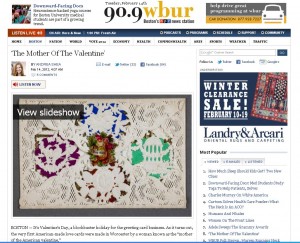
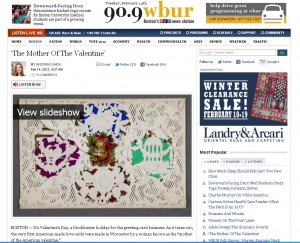
As a special Valentine’s Day treat, our curator of graphic arts, Lauren Hewes, was on Boston’s NPR news station (90.9 WBUR) to talk about Worcester’s own Esther Howland and her valentines. A transcript of “The Mother of the Valentine” is up on WBUR’s website or you can click on the “Listen Now” button to hear the piece. Be sure to also view the slideshow!

To learn more, you can also read the earlier post on Past is Present or check out the AAS online exhibition “Making Valentines.” And here are some related images in AAS collections.

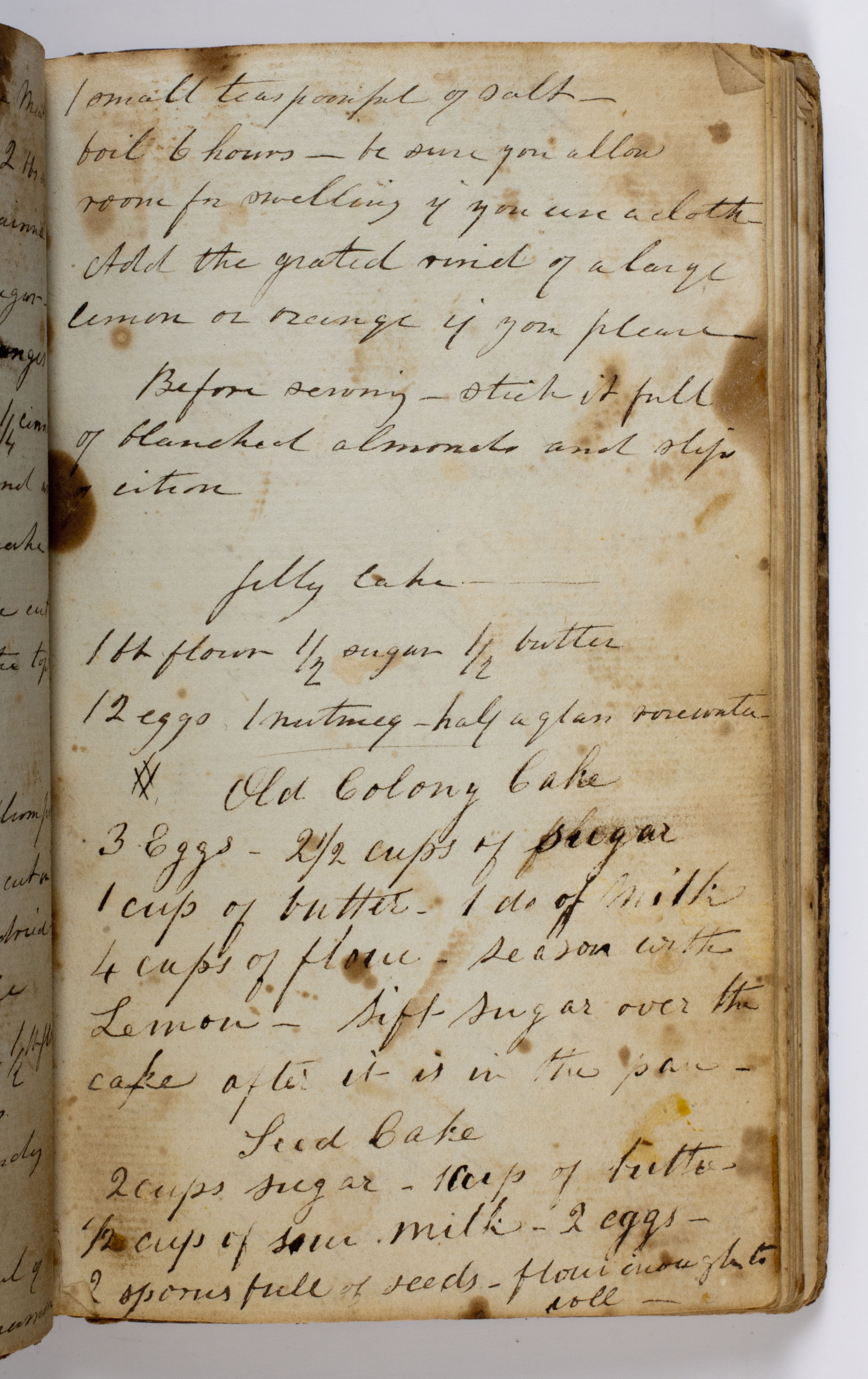
Cooking the Old Colony Cake

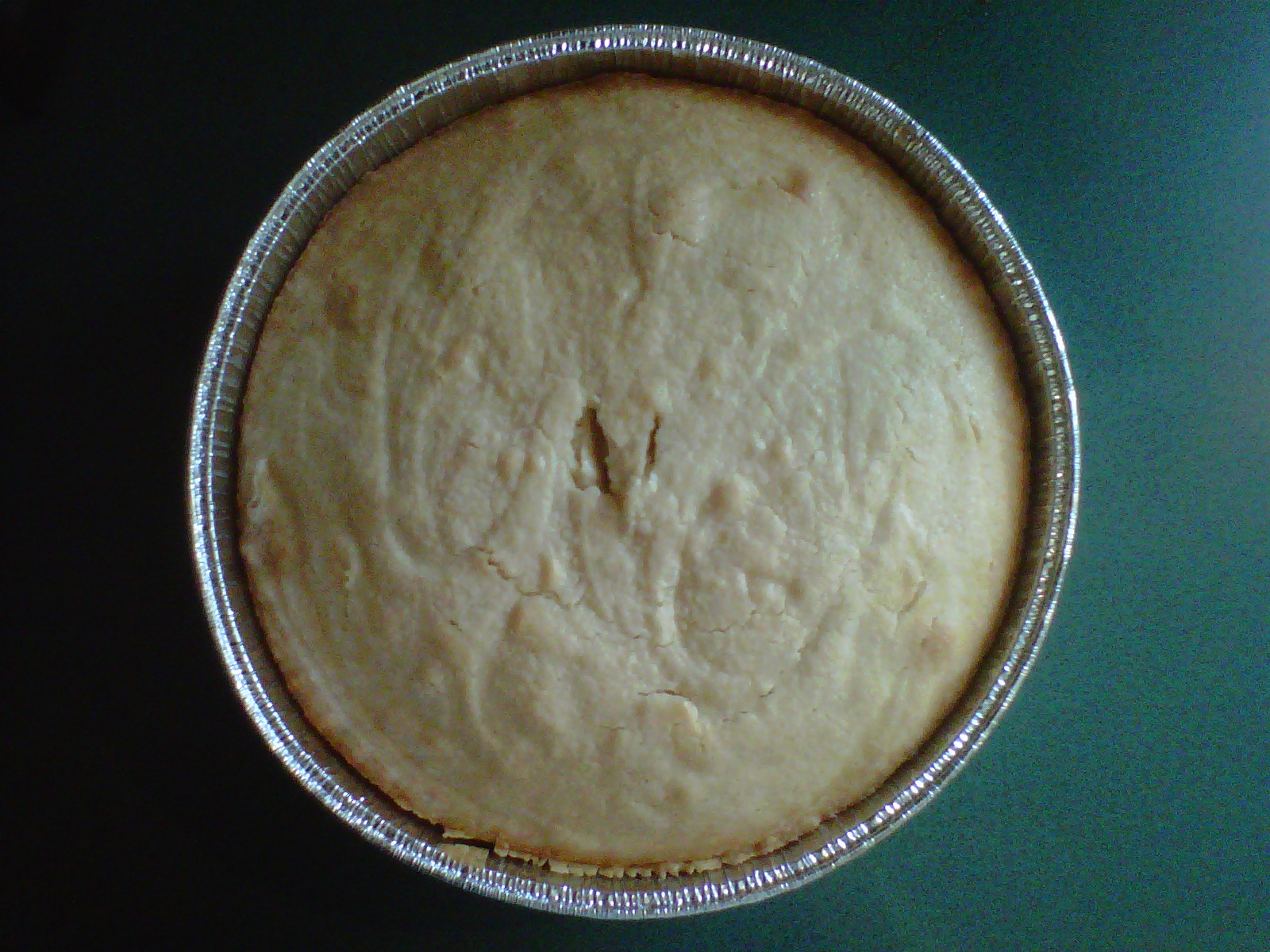
So the Old Colony Cake didn’t turn out too bad!  While the ingredients were identical to traditional cake recipes, the ratios were a bit different.  The result was very thick batter and a dense cake, but the lemon added a much needed bright flavor.  Not sure which way to add the lemon, I added both a squeeze of juice and some zest, and it seemed a perfect balance.

I ended up cutting the recipe in half and had just enough batter to fill your standard cake pan.  The recipe didn’t provide a cooking time, or a cooking temperature, of course.  I baked it according to what I usually do with cakes – 350 degrees for about 25 minutes.  However, I ended up upping the timer every time I checked it until it baked for almost an hour.  The long baking time did make for a nice crispy outside and perfectly baked inside.

As I was baking the halved recipe I tried to imagine Ms. Tilgham baking this cake in 1860.  Whenever I recreate these historic recipes, I’m always curious about the cooking time and temperature.  While the recipes spell out the exact measurements of the ingredients, I wonder how random the actual baking was.  And I wonder how many cakes were tossed out because they were over or under cooked.  Perhaps this falls under the category of differing expectations, but I know I have thrown out many a cake and cookies for being baked wrong, and I have all the direction and control in the world (even adjustments for baking at different altitudes!).  Perhaps a little dry or burnt on the bottom was more acceptable when there wasn’t as much temperature control.

If anyone baked along, please share your results.  And I’m open for suggestions for another dish!

TV for lovers of history, art, furniture, and more

For those who may have missed David Jaffee’s talk on “Learning to Look at Early American Material Culture” when he presented it at AAS this fall (or for those who want to see it again), you’re in luck! The program will be airing on C-SPAN 3 this weekend at the following times:

  • Sat. 2/11 @ 11am ET
  • Sun. 2/12 @ 6pm ET
  • Mon. 2/13 @ 7am ET
  • Even if you don’t get C-SPAN, the presentation will be streaming live on the internet. And even if you are busy all this weekend, early next week the entire broadcast will be available to watch at your convenience in C-SPAN’s video library.

    A preview is available on C-SPAN’s website now.

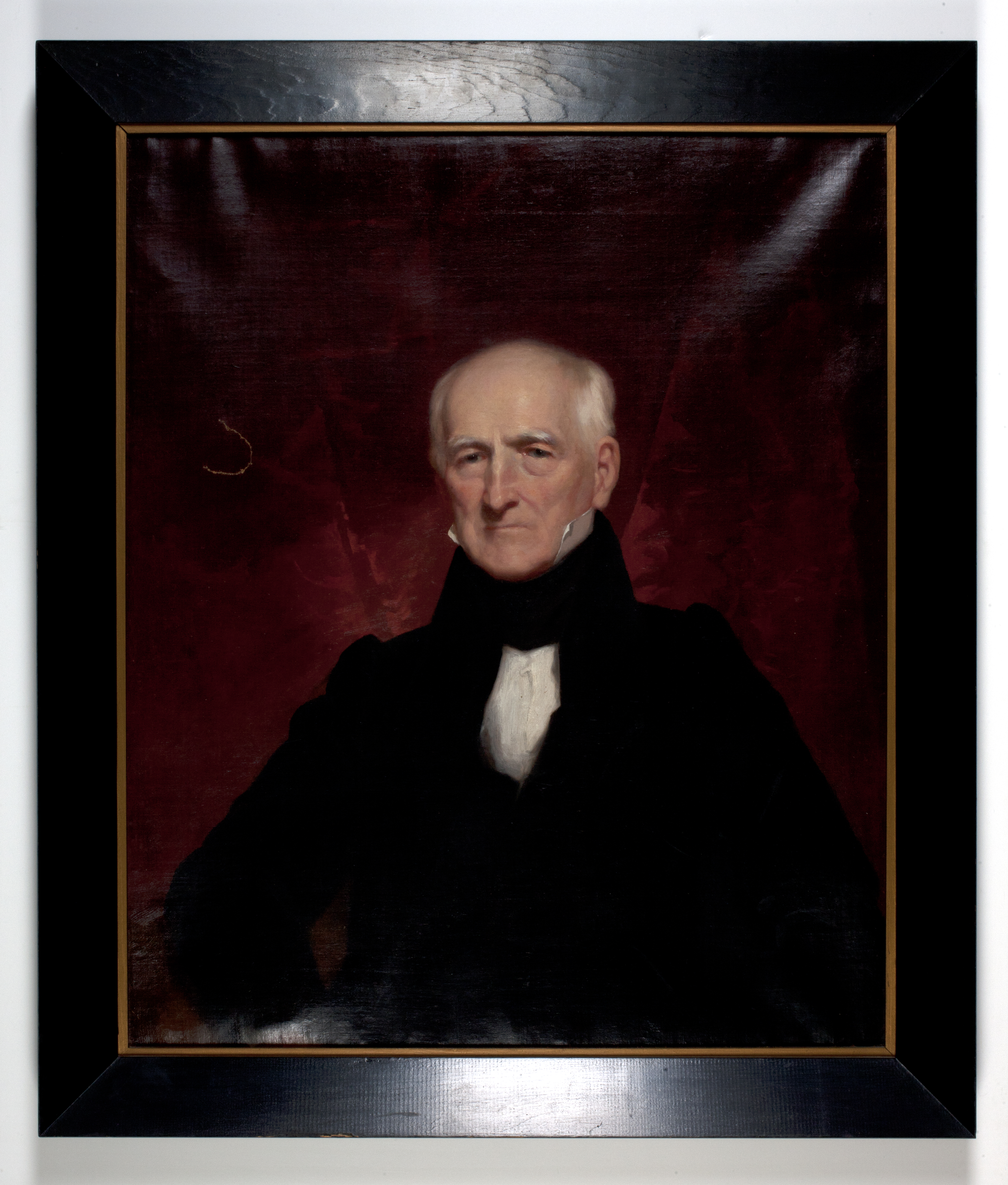
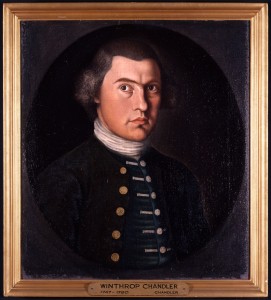
    Click on the portrait to learn more about it and others in AAS's portraits collection

    Synopsis of the Talk
    In the middle of the nineteenth century, middle-class Americans embraced a new culture of domestic consumption, one that centered on chairs and clocks as well as family portraits and books. How did that new world of goods, represented by Victorian parlors filled with overstuffed furniture and daguerreotype portraits, come into being? David Jaffee will talk about the significant role of provincial artisans in four crafts in the northeastern United States – chairmaking, clockmaking, portrait painting, and book publishing – to explain the shift from preindustrial society to an entirely new configuration of work, commodities, and culture. His lecture will focus on many of the objects beloved by decorative arts scholars and collectors to evoke the vitality of village craft production and culture in the decades after the War of Independence.

    About the Speaker
    David Jaffee is Professor and Head of New Media Research at the Bard Graduate Center. Trained as a cultural historian, he has extensively studied the culture of the preindustrial northeast. His 1999 book, People of the Wachusett: Greater New England in History and Memory, 1630-1860, looked at town founders and local historians in Worcester County. He is now at work on a new project, New York as Cultural Capital, looking at how the nineteenth-century domestic interior – and the parlor in particular – was filled with furniture, displays of stereographs, plaster figures, and chromolithographs. He has held fellowships at several institutions including the Metropolitan Museum of Art, Winterthur Museum, the National Museum of American History, and the American Antiquarian Society. He is a member of the American Antiquarian Society, and he is on the board of the Society’s Center for Historic American Visual Culture (CHAViC).

    Professor Jaffee is also interested in pedagogy and the incorporation of new media. He has published several essays on teaching and learning with new media publications, as well as directed two NEH projects to develop multimedia resources for the history classroom. He has led numerous new faculty development seminars and programs, including the NEH-supported New Media Classroom, Learning to Look with the American Social History Program and AAS’s CHAViC Summer Seminar on Interpreting Historical Images for Teaching and Images.

    The Acquisitions Table: Treatise on the Imposition of Forms

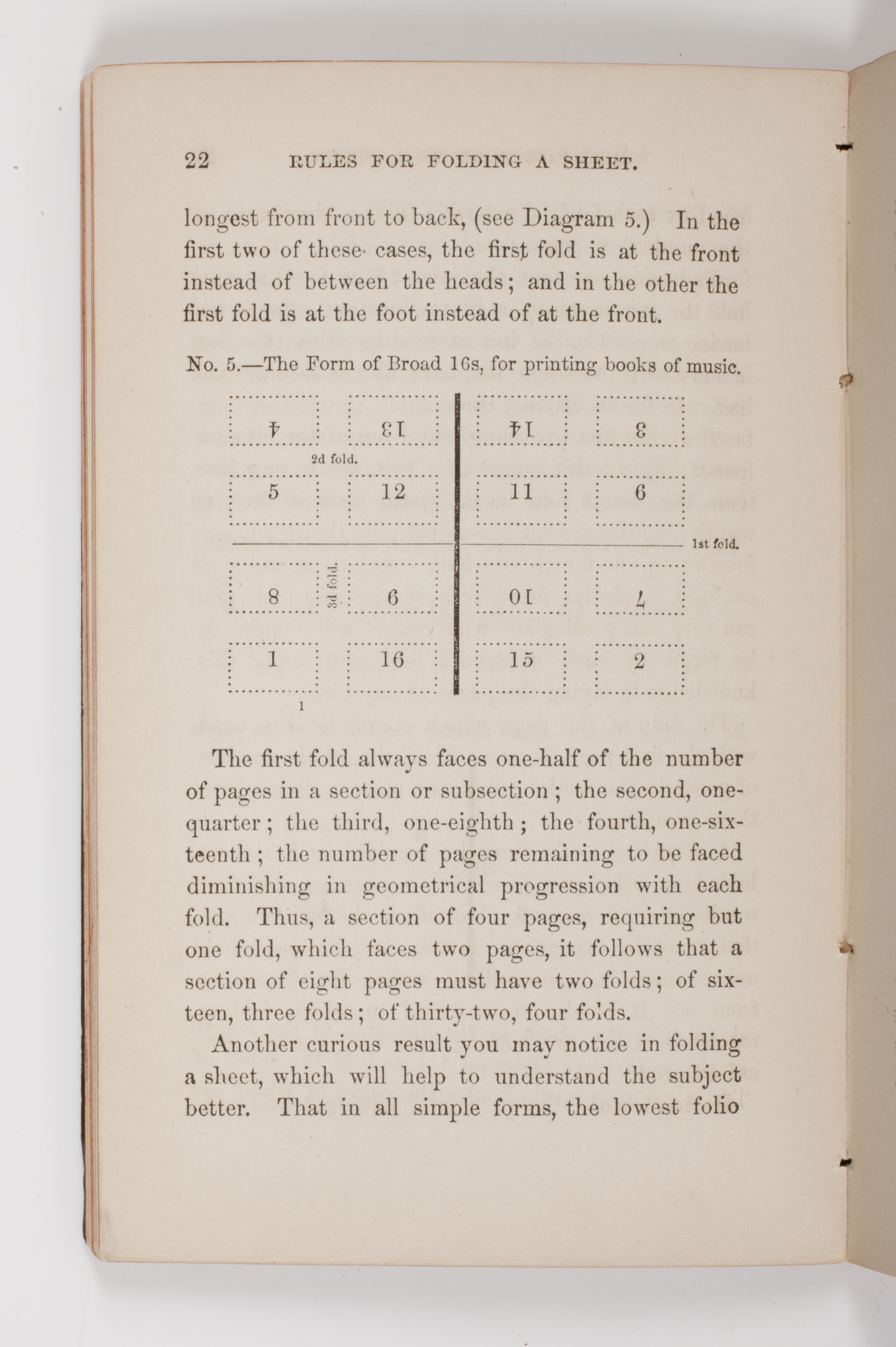
    Bidwell, George, d. 1885. Treatise on the imposition of forms … also, tables of signatures, etc., useful to compositors, pressmen, and publishers. New York: Raymond & Caulon, 1865.

    Rare first edition of one of the few dedicated handbooks for printers on “imposition,” that is, the arrangement of text pages in the “forme” placed on the bed of a press so that, when both sides of a sheet are printed and the sheet folded, pages will fall in the proper sequence. Such information commonly appeared in printer’s manuals, but typically in far less detail than is given here. Nineteenth-century innovations in printing technology—such as the casting of stereotype plates and the invention of large, steam-powered presses—gave printers many new options for imposing a text, but rarely does a machine-press-era printed and bound book preserve the physical evidence necessary for determining the imposition scheme employed. Bidwell’s Treatise offers an important window into how mid-19th century American printers understood imposition and what were considered the best contemporary practices. Published at the direction of the New York Typographical Society, this copy bears the March 18, 1865 ownership signature of a New York printer.

    Piling On! Football in the archive

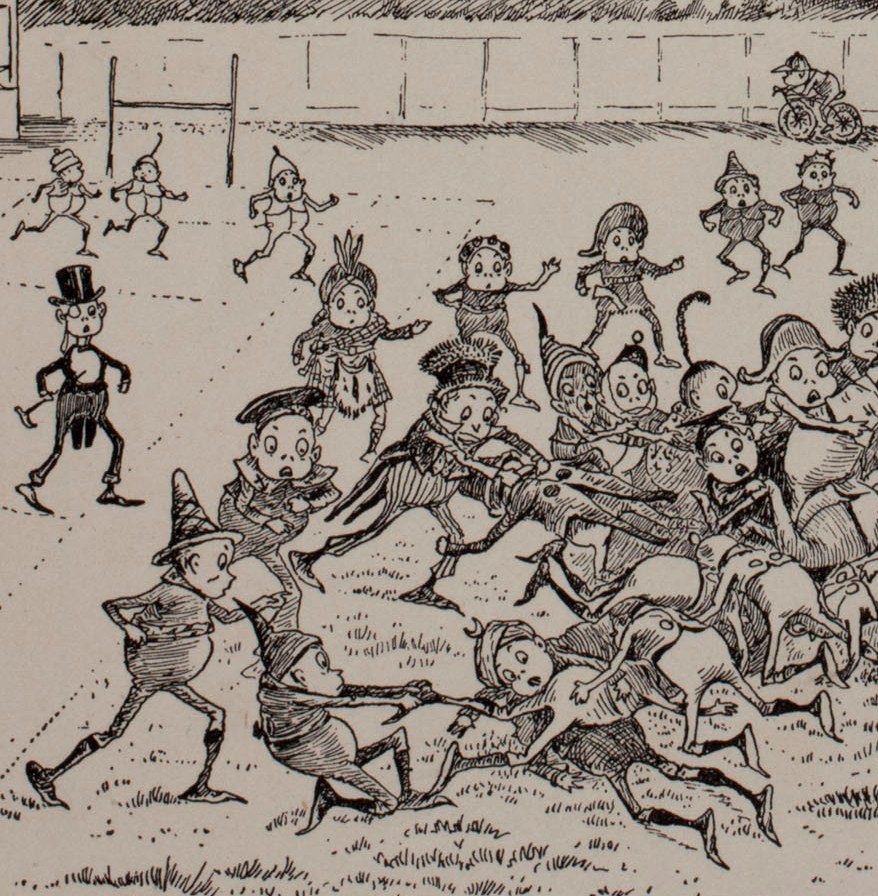
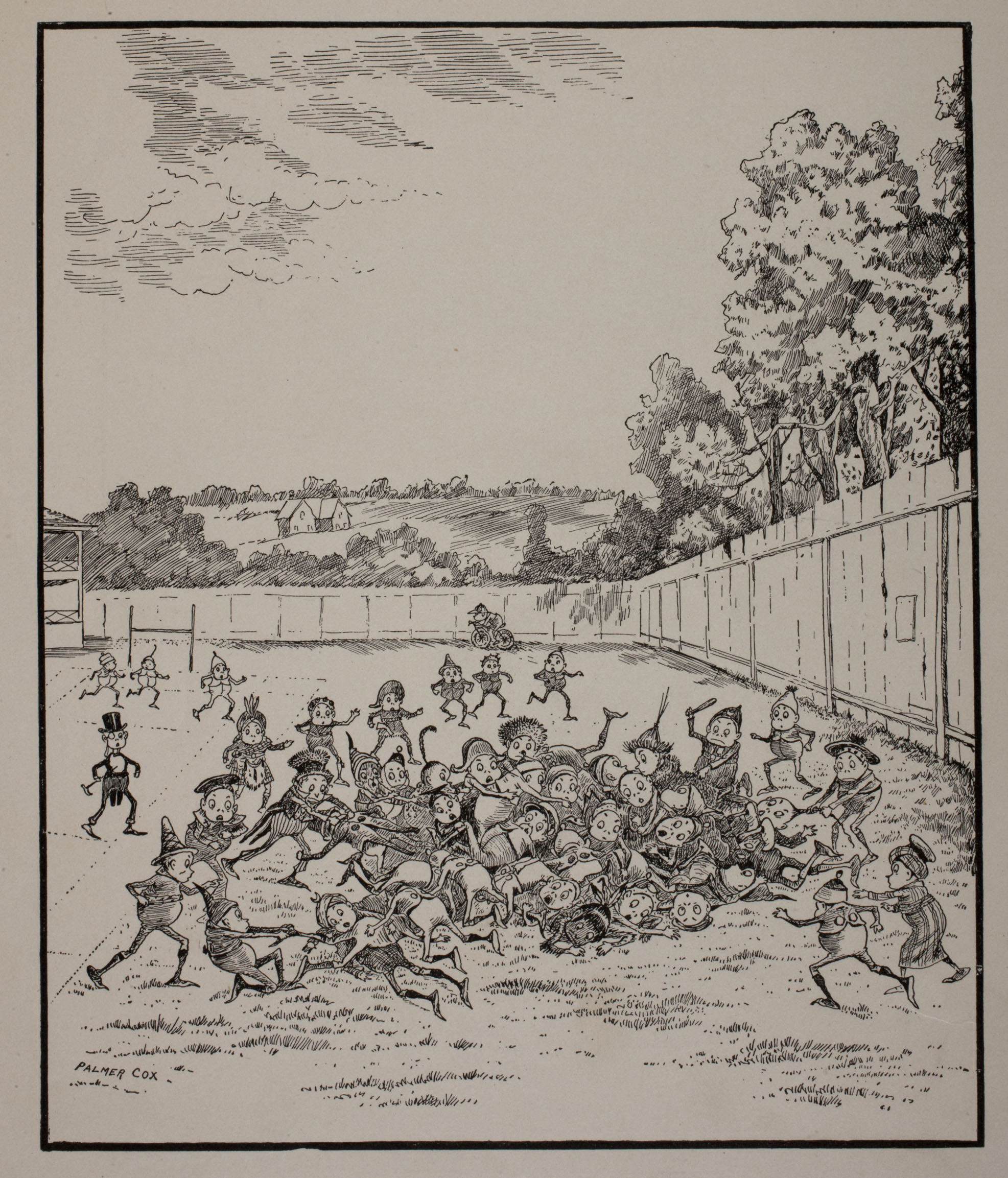
    The Brownies "Piling On" (more images at the end of the post)

    The items featured in this post were originally intended to be on display in the Reading Room of Antiquarian Hall by way of noting the Super Bowl. But the Curator of Graphic Arts instead installed archival items relating to the upcoming Leap Year in February. This is probably more fitting as, statistically speaking, Leap Year has seen fewer appearances on the calendar in the past decade than the Patriots have been contenders for the championship. And though last night didn’t work out in their favor, it may help to put the game of football in a historical perspective to ease the blow.

    Football is arguably a game about reminiscences – a contact sport undoubtedly – but you’ll be hard-pressed to find anyone who enjoys the game who is not quick to reveal their earliest memories of encountering it.  What better place to help alleviate the burden of recollections than in an archive?

    So sit back and enjoy the visual post-game show.

    Figure 1
    Figure 2

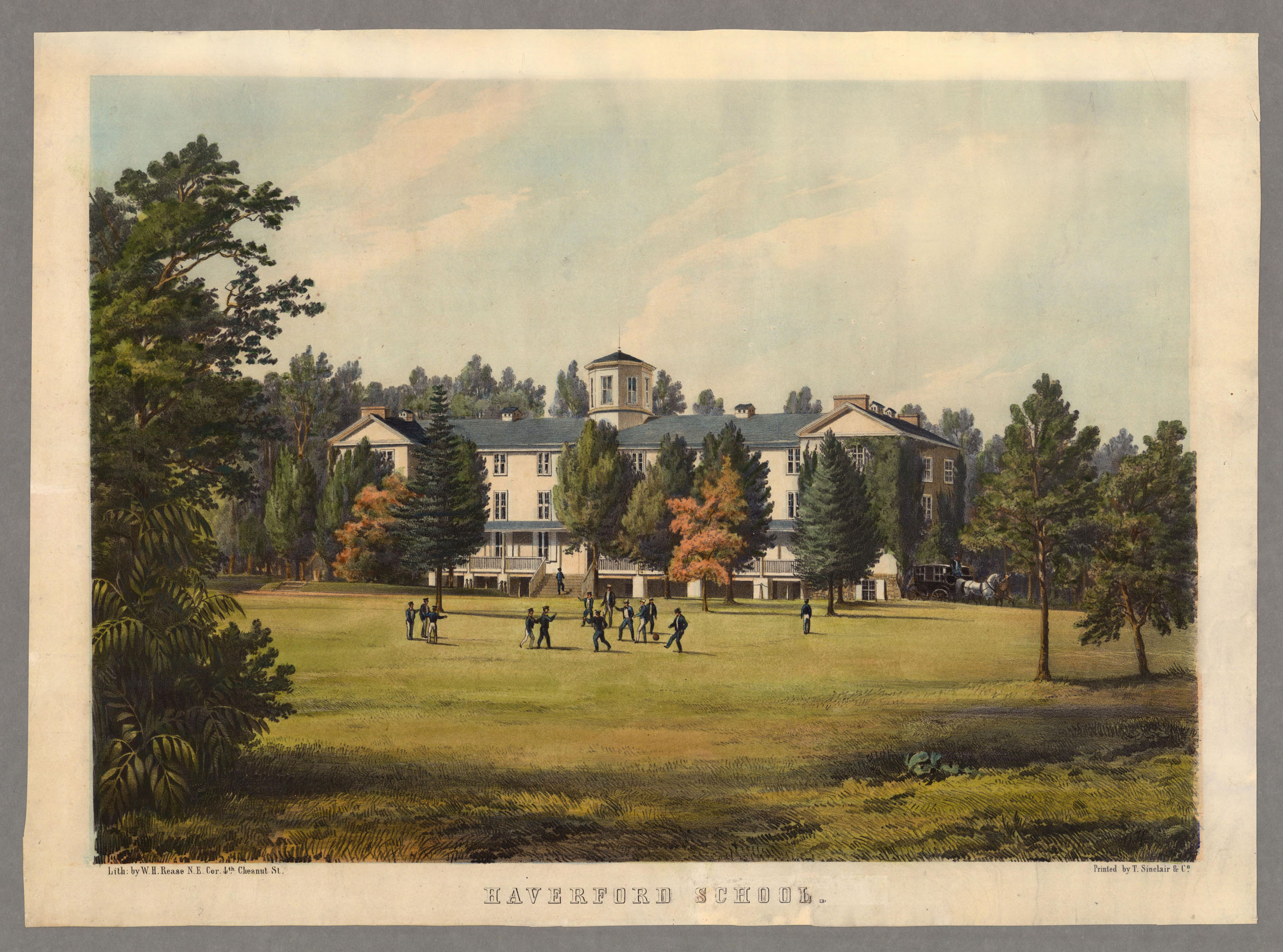
    While the true game of American football as we know it today did not make an official appearance until the late 19th and early 20th centuries (alas, out of the AAS scope date of 1876), we certainly have items concerning its early history. British children’s author Thomas Hughes’s Tom Brown’s School Days, enormously popular in the nineteenth century, was recalled constantly as an introduction to Rugby. AAS has not one, but two copies of School Days at Rugby published in Boston by Ticknor and Fields 1857. Also in this vein of early depictions of the game from the late 1850s and early 1860s is Haverford School, a lithograph by W.H. Rease depicting a group of young men playing a game remarkably close to football; the men are outside what is now Haverford College in Haverford, Pennsylvania (Figure 1).

    Figure 3

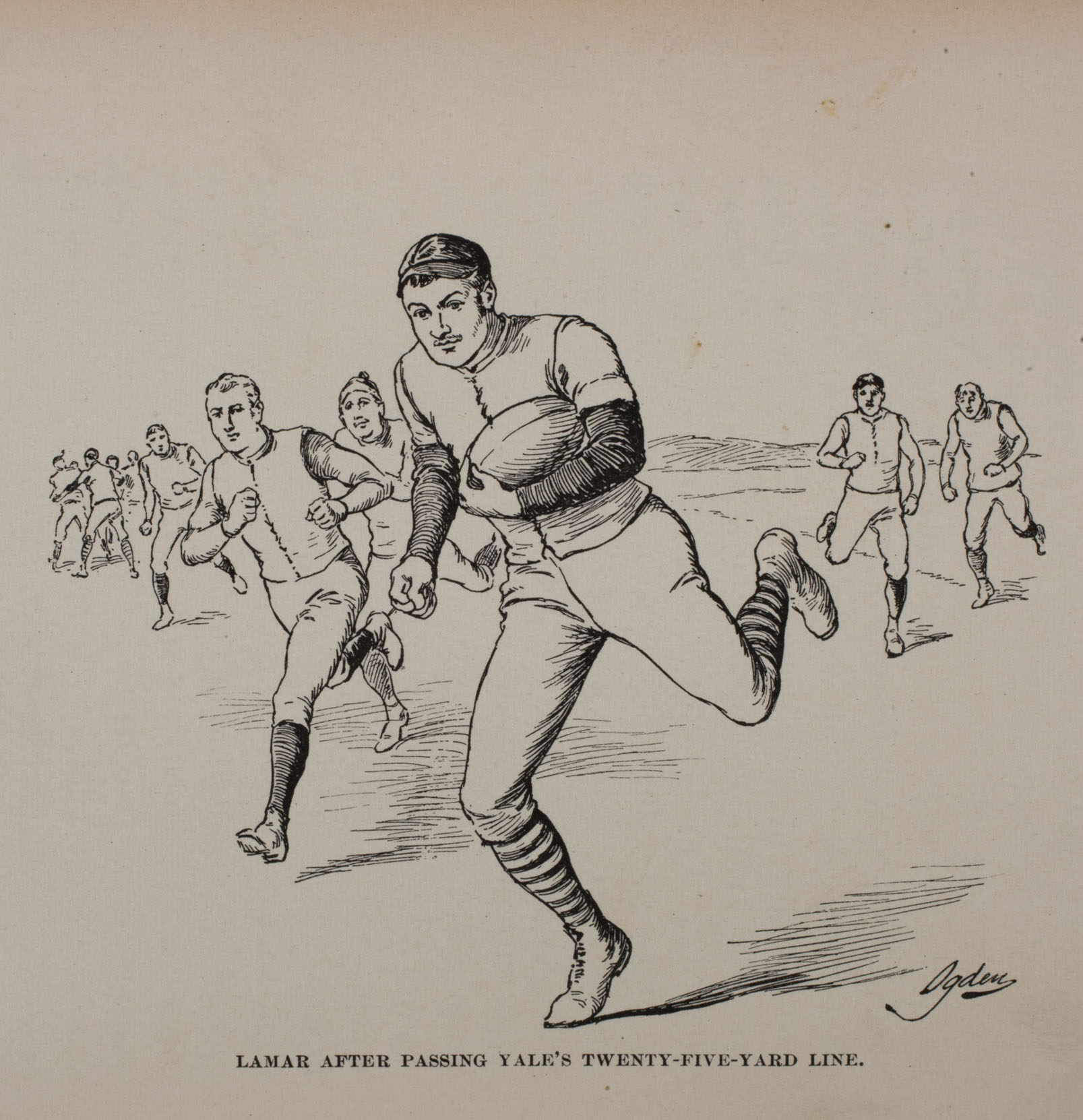
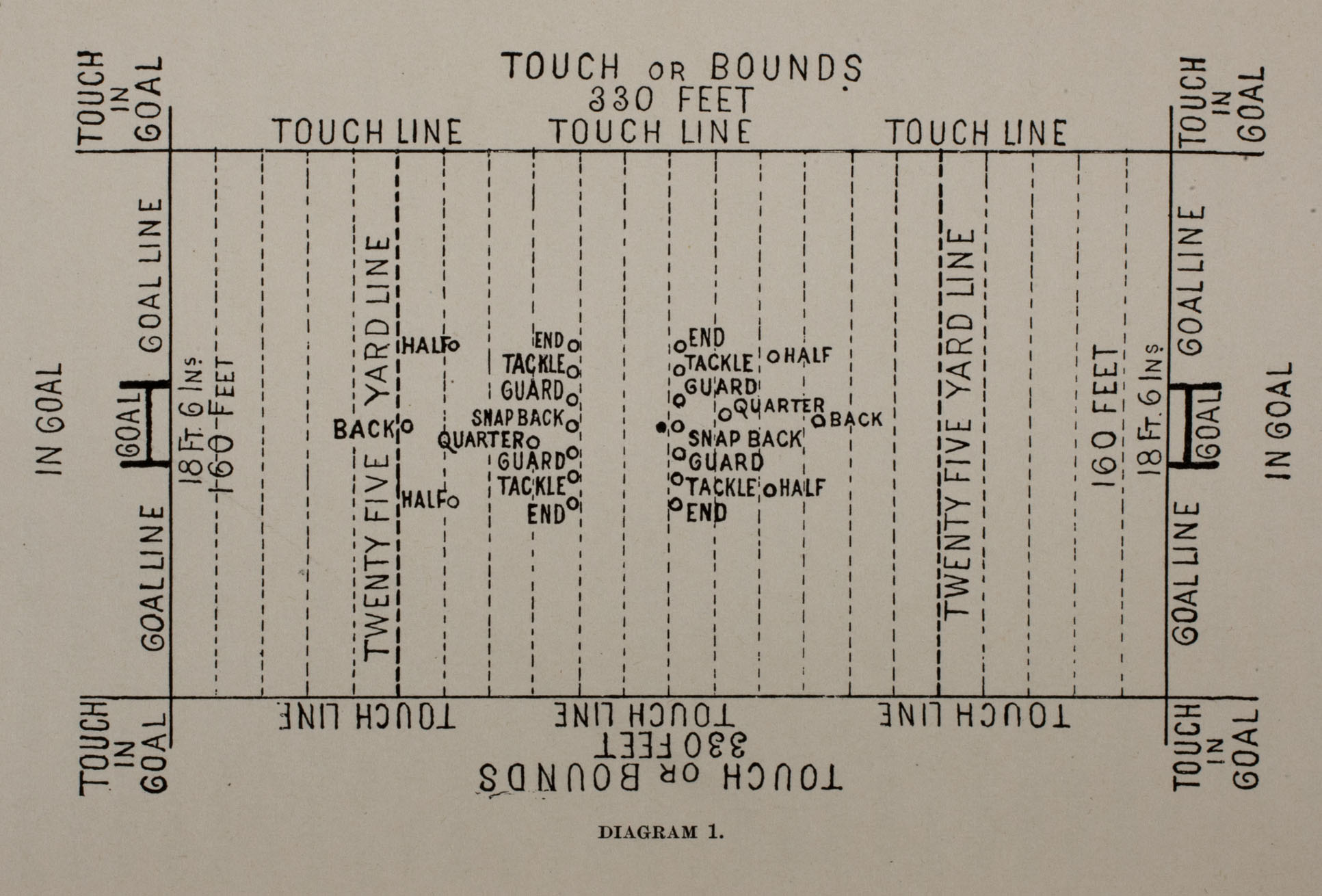
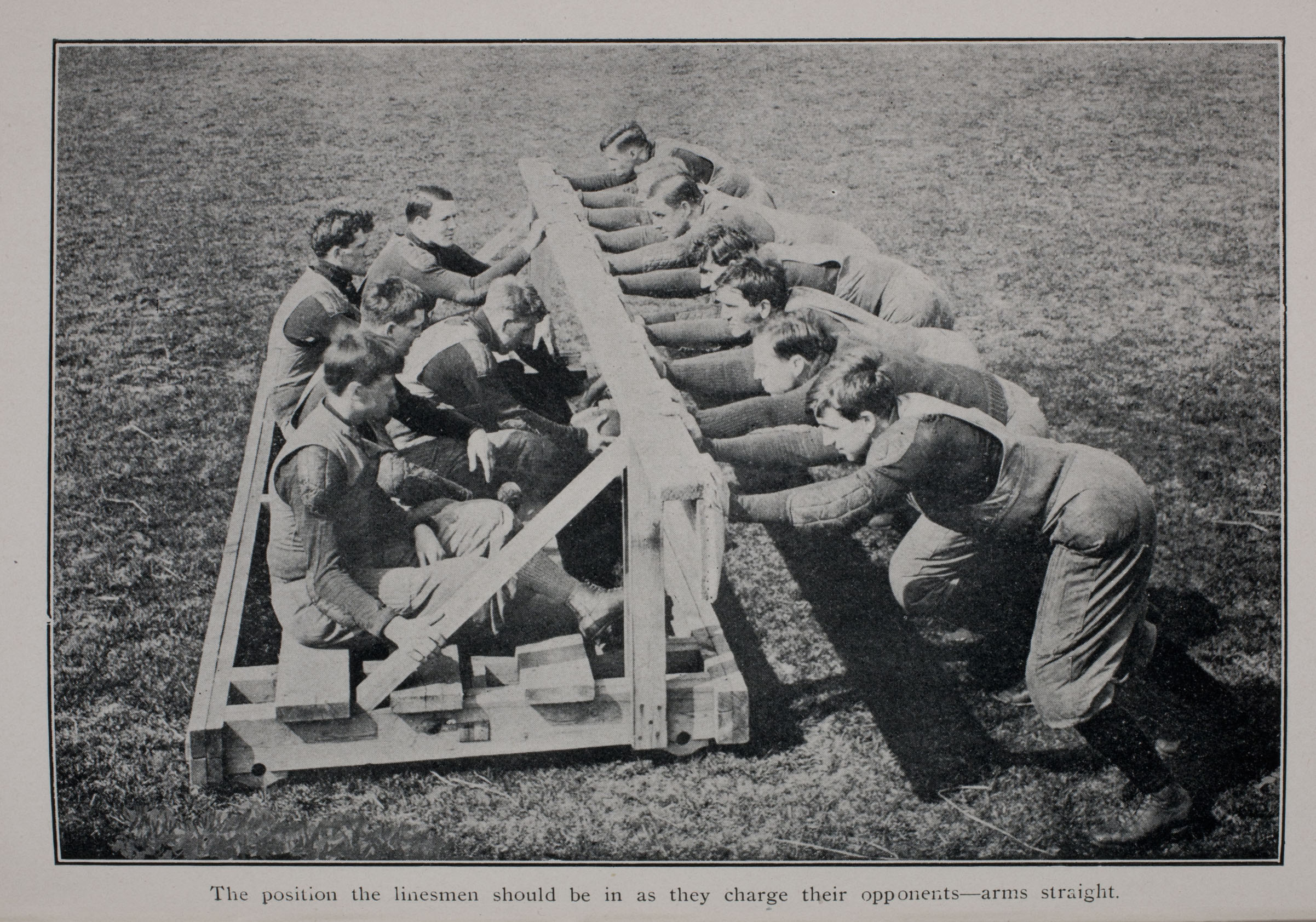
    Walter Camp’s Book of College Sports, published in New York in 1893, offers an impressive overview of the history of the game as well as rich interior illustrations by Henry Alexander Ogden (1856-1936) and Irving Ramsey Wiles (1861-1948), in addition to diagrams, regulations, strategies, descriptions of costumes, shoes, and players (Figures 2, 3, 4).

    Figure 4

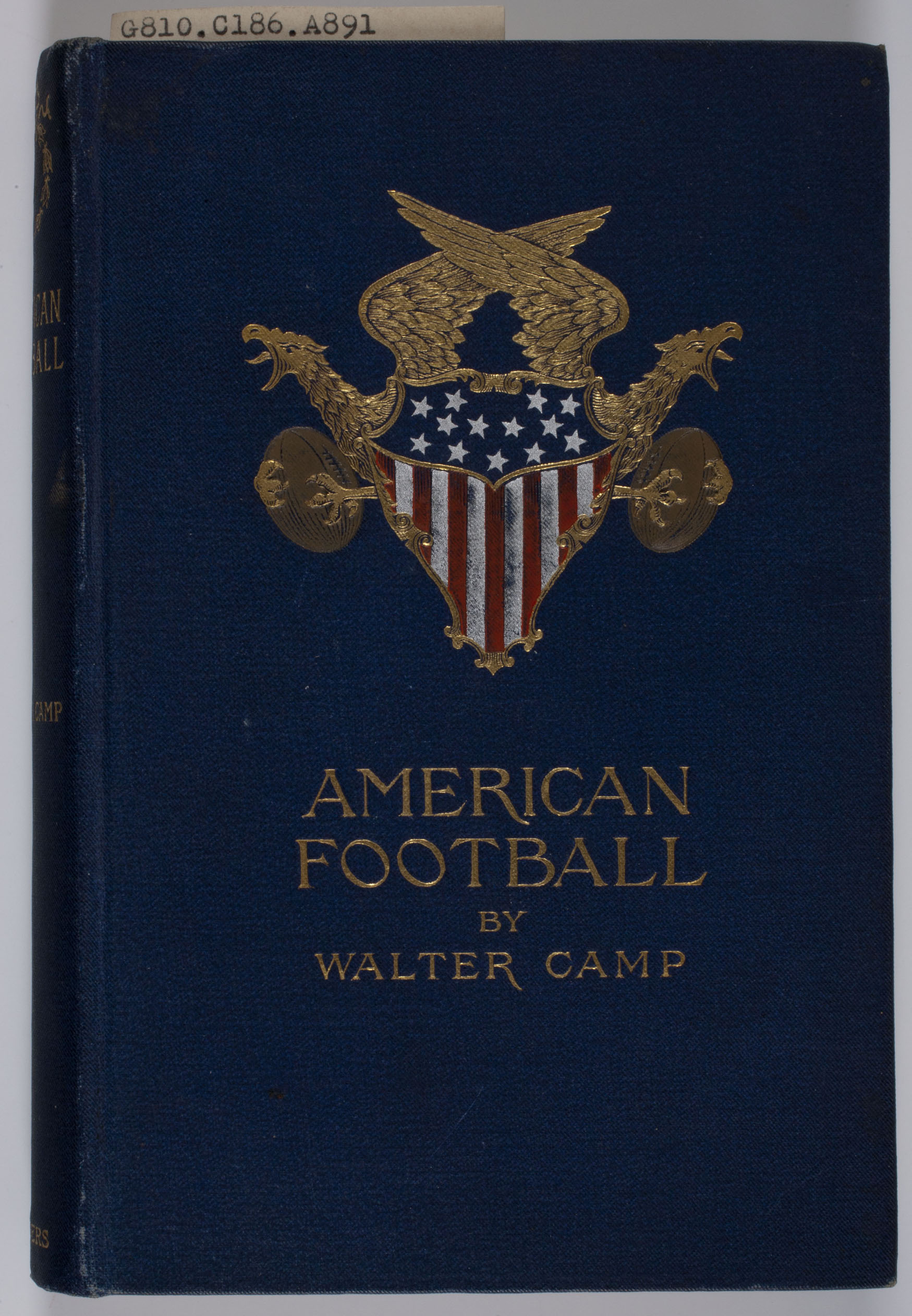
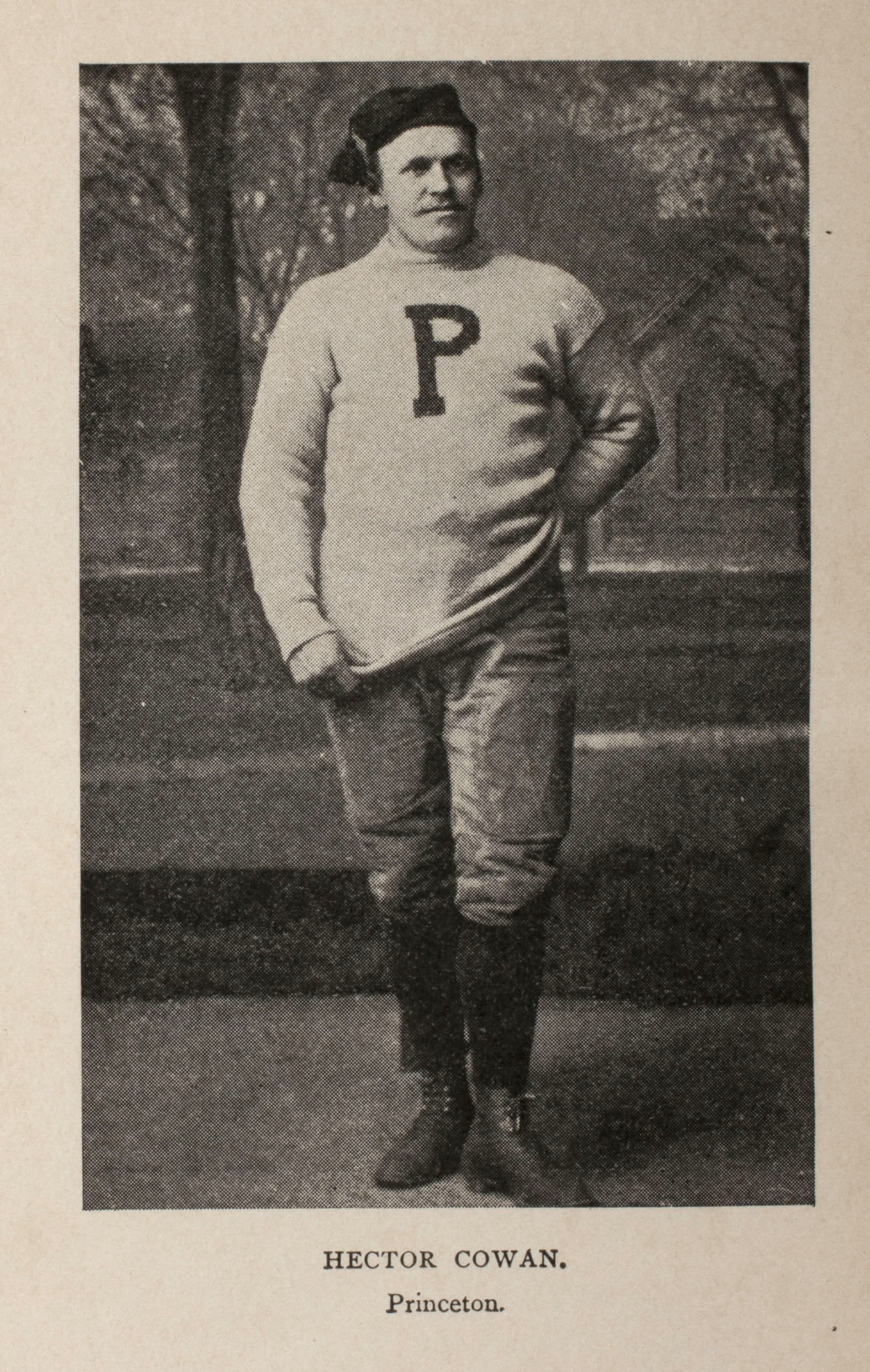
    Camp’s text American Football: with thirty-one portraits, published by Harper Brothers in 1891, illustrates the sport’s most outstanding figures on the field in the late nineteenth century including the player (and later coach) Hector Cowan (Figures 5 & 6).

    Figure 5
    Figure 6

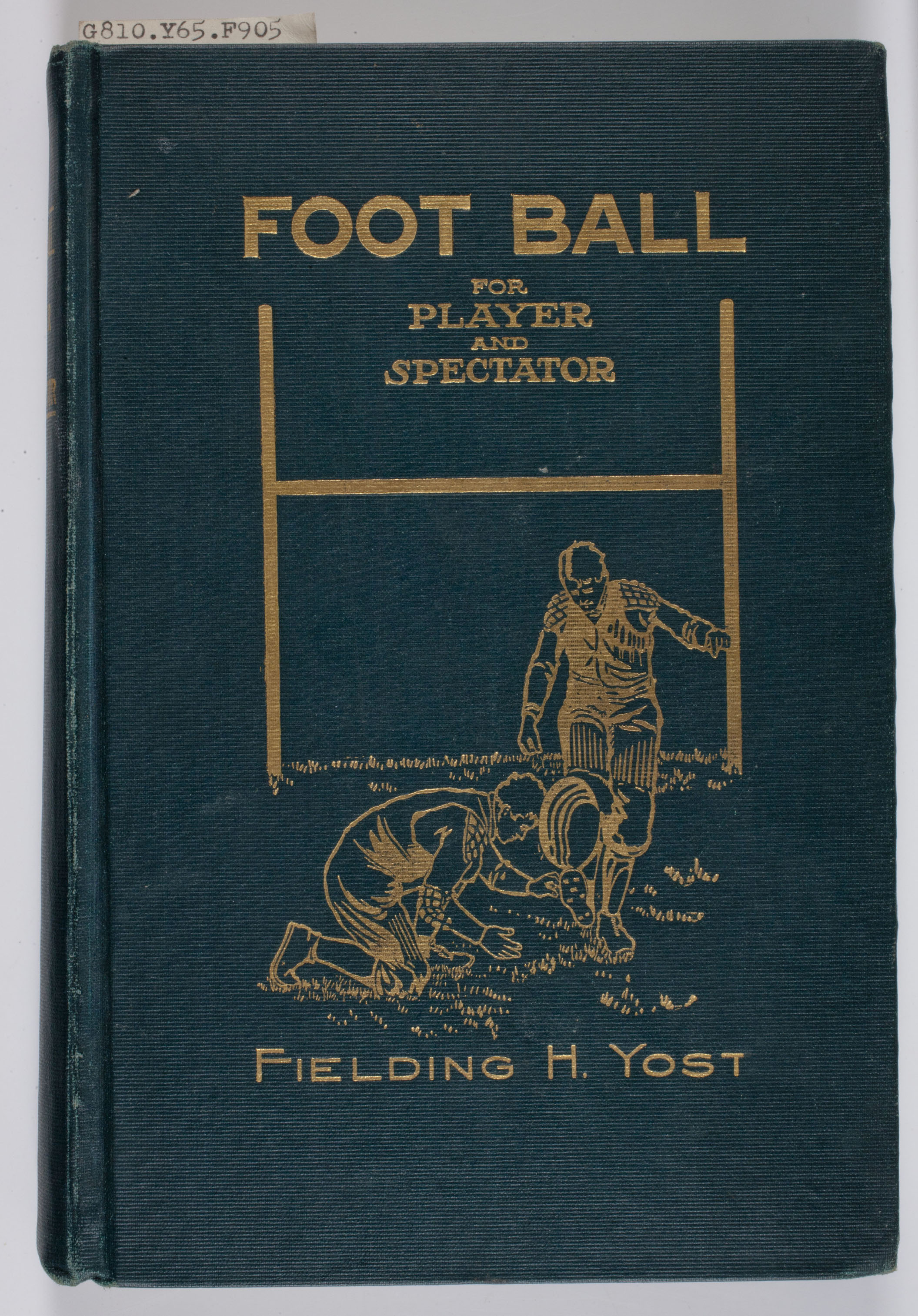
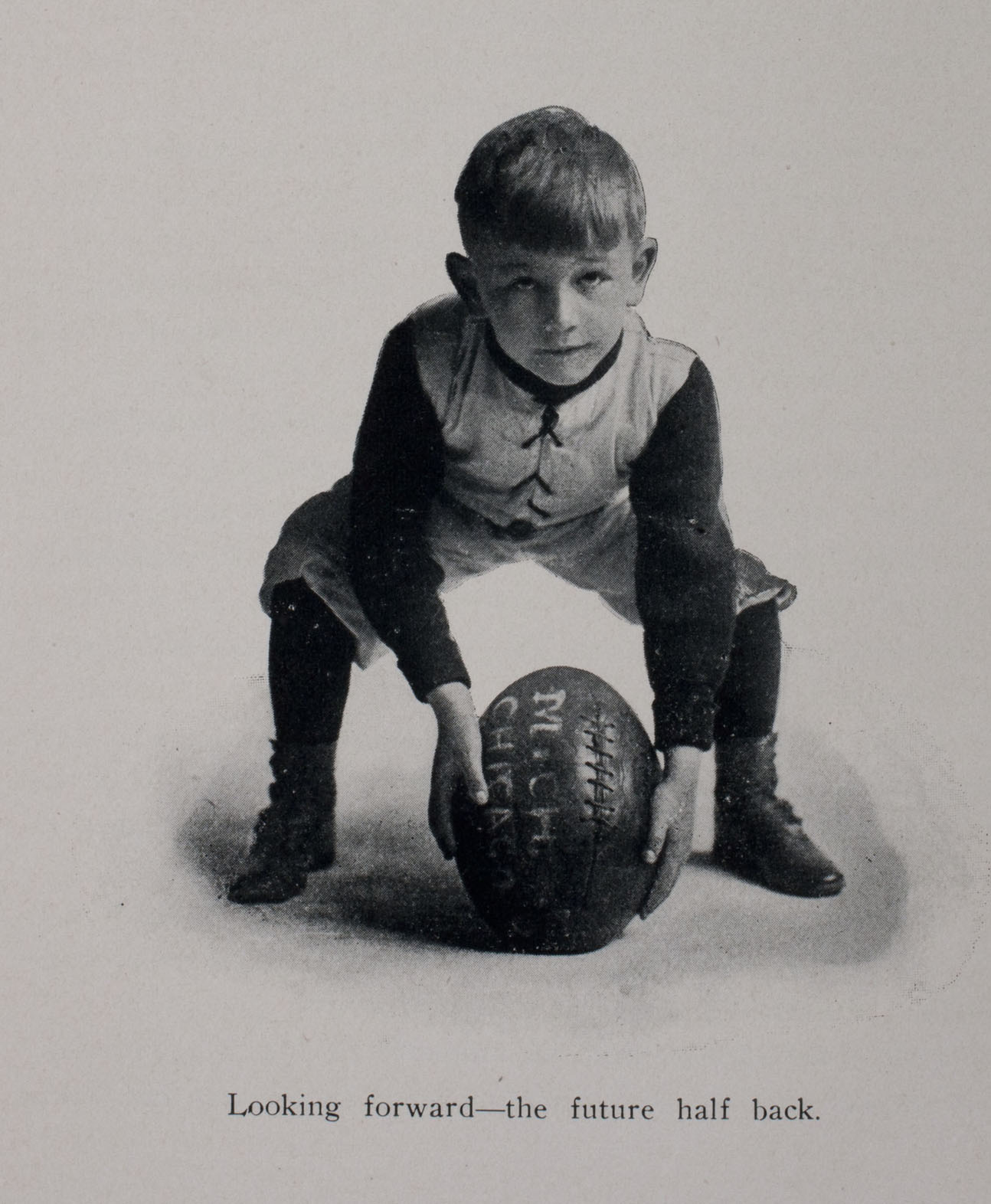
    Football for Player and Spectator, published in Ann Arbor, MI in 1905, is a heavily illustrated guide to the game with more photographic depictions than Walter Camp’s Book. The author, Fielding H. Yost, was both a player and coach; in his preface, he states that his hopes are that:

    The perusal of the work will give the reader – player or spectator – an adequate idea of the spirit in which the game is both played and viewed in its best form.

    Following are rules, development, formations and diagrams of play (Figures 7, 8, 9).

    Figure 7
    Figure 8
    Figure 9
    Figure 10

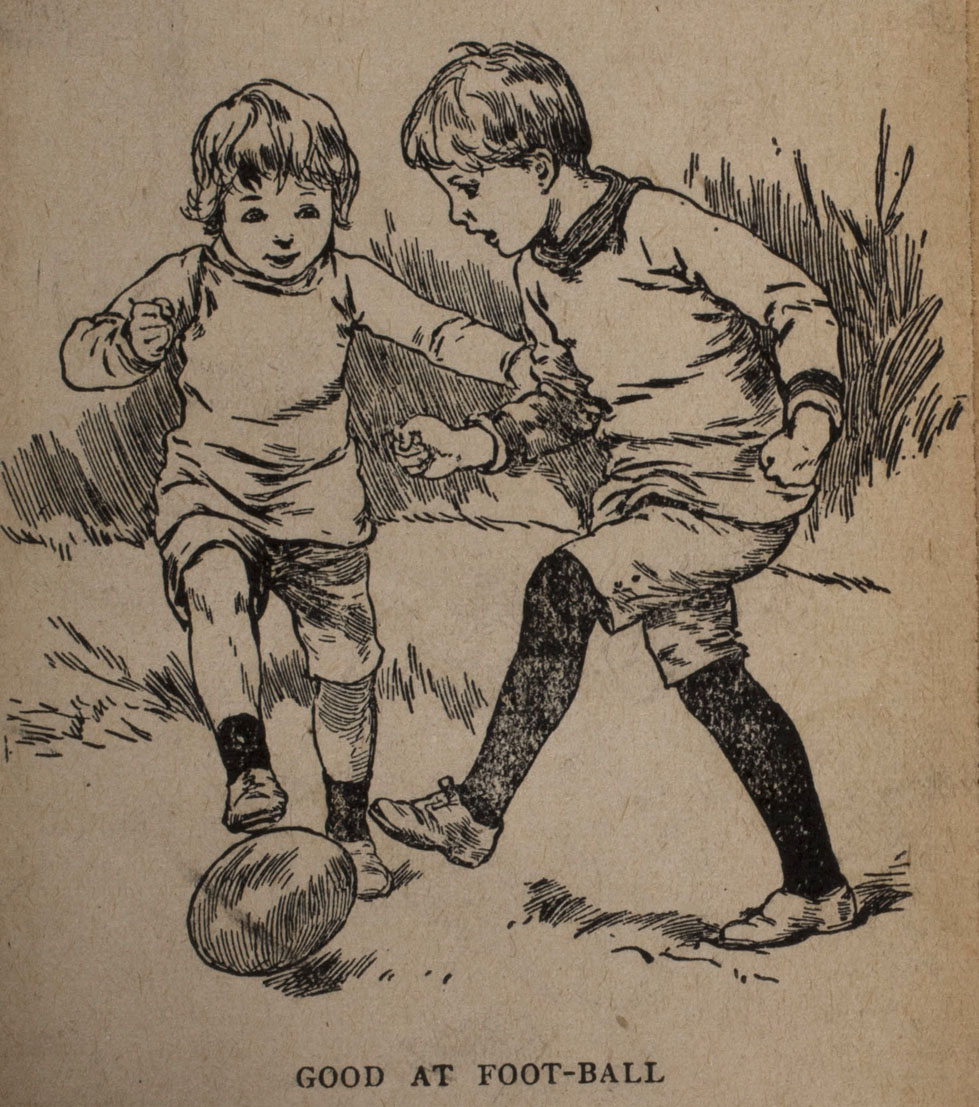
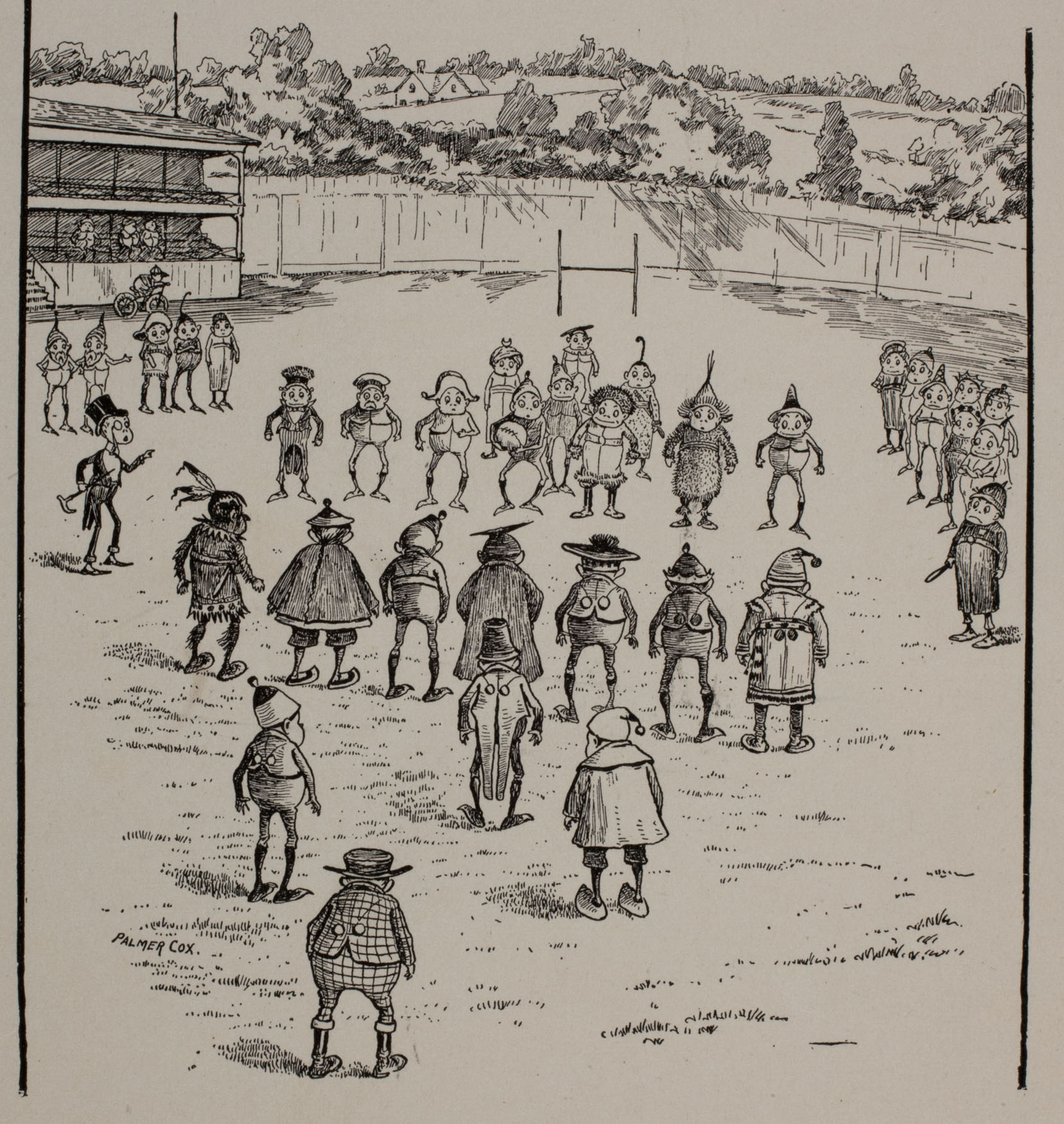
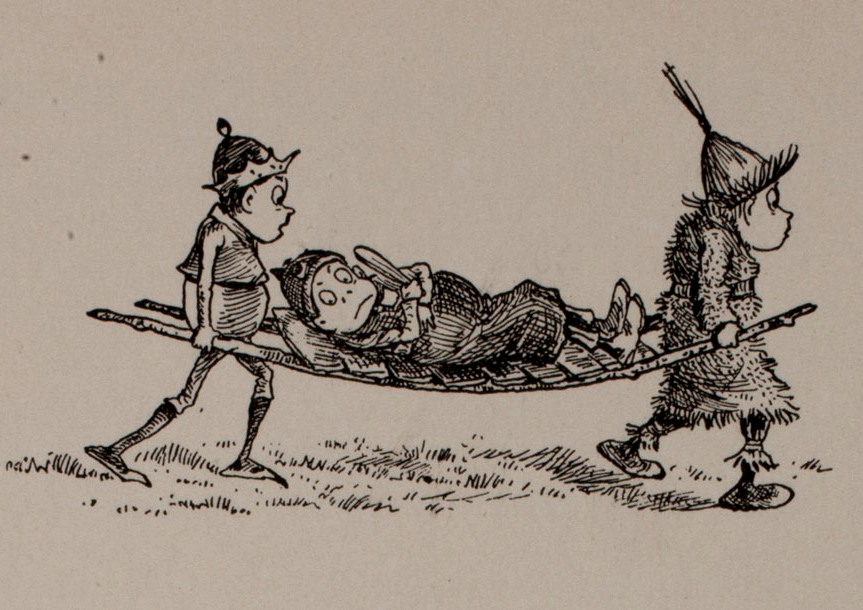
    While our variation of the game came from the more collegiate practice, it quickly became a sport known, and played, by children as is illustrated in Farmer Gooding’s Circus by Harriet Putnam published by the McLoughlin brothers ca. 1905 (Figure 10).  In the text, Jack and Bart Bailey make short work of mastering the game. Palmer Cox’s famous The Brownies also have a notable, and humorous, attempt at the game in The Brownies Through the Union (1897). Their attempts at American Football are replete with illustrations of piling-on and injuries as they attempt to maneuver their way through the rules of the game (Figures 11, 12, 13).

    Figure 11
    Figure 12

    Figure 13

    It’s a Leap Year!

    Here in New England, we are often glad that February is the shortest month, even in a leap year.  Back in 45 B.C., the Julian calendar codified the tradition of adding a day to February every four years, and the Gregorian calendar followed suit.  The practice, of course, continues today and helps align the seasons and planetary rotation with our calendars. In nineteenth-century America, leap year was often used as excuse for winter parties and balls. The British tradition of allowing women to propose marriage during a leap year was adopted in the United States and resulted in many jokes and stories in the local papers, played out in the theater, and in children’s books.

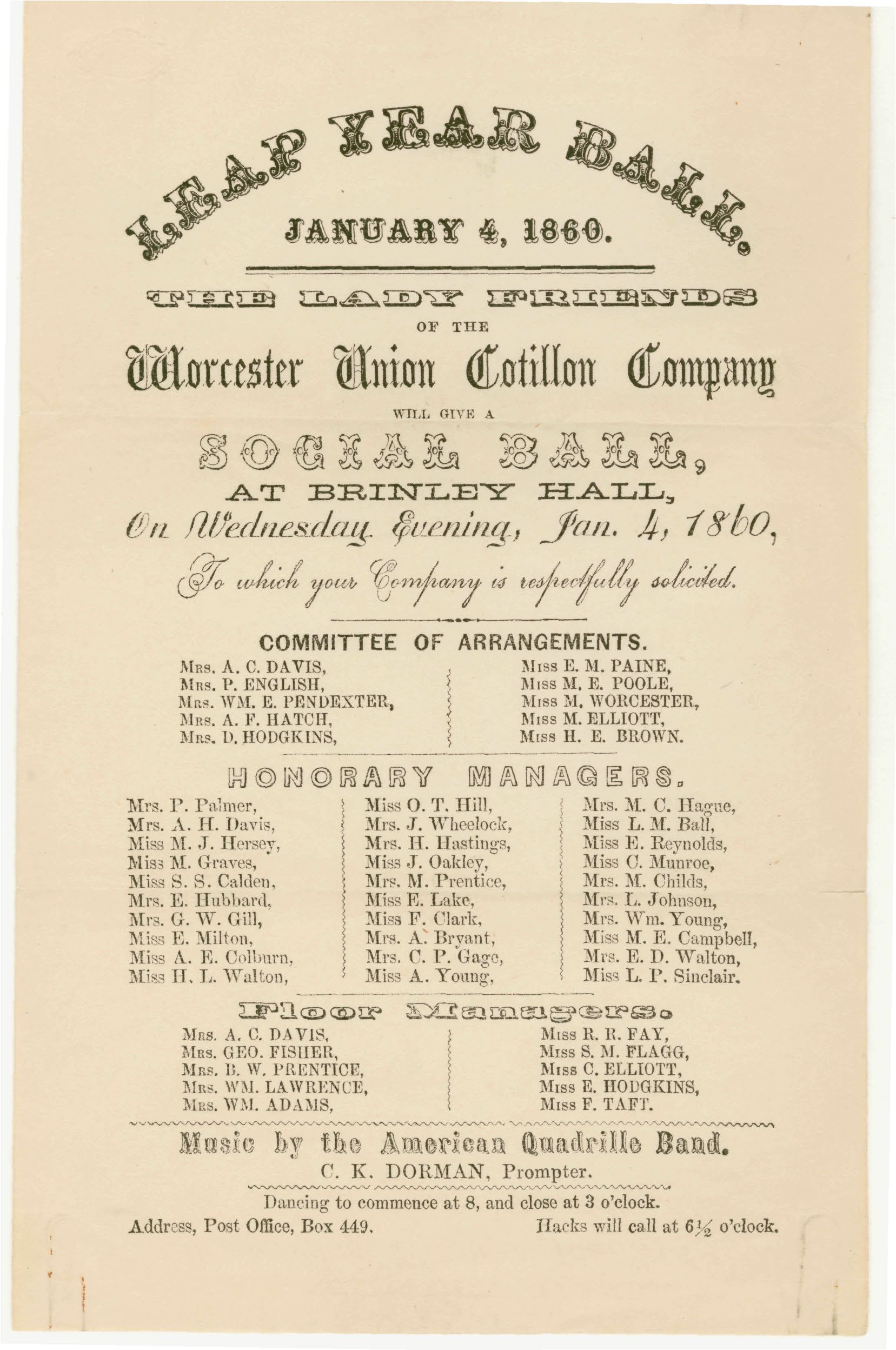
    To mark February 29, 2012, we selected a few items from the collection to display in our Reading Room.  For those of you who can not make it to Worcester in February, this post will have to substitute.  The two invitations to Leap Year parties date from the 1860s, with one featuring a quadrille band and dancing until 3:00am.  The play Leap Year is a comical farce published around 1860, and was performed in Boston in 1862 as shown in the broadside playbill.  The 1872 McLoughlin publication, although part of the Society’s children’s literature collection, was likely intended for an adult audience.  The humorous illustrations feature all sorts of unmarried women seeking marriageable men in banks, taverns and on the street.

    A search in the American Historical Newspaper database resulted in hundreds of articles and essays in January and February issues of leap years, often satirizing unmarried women and bachelors.  An article in an 1804 issue of the Dover, New Hampshire Sun states:

    It has from time immemorial been considered a rightful prerogative of the ladies in LEAP YEAR, without subjecting themselves to any imputation or want of modesty, to make the first advances in negotiations for matrimonial alliances.

    An 1820 headline reads “Old Bachelors, Look Out!” and a mock “Bachelor’s petition” appeared in The American Citizen from Jackson, Michigan in 1852, encouraging “unmarried ladies of all kinds, sizes, and ages” to propose because most bachelors were really just shy and would make good husbands.

    All of this raises interesting questions about gender roles, marriage, and American society — especially after 1860, when eligible, unmarried men were in extremely short supply due to the Civil War. The war resulted in over 600,000 male deaths in this country, knocking social mores on their heels. It is all well and good to make fun and joke, but it is very likely that for a few leap years (1864, 1868, 1872, 1876), women took advantage of the relaxation of the rules and proposed to those men that could help them build a family and a future in the healing nation.

    A return to historic cooking, manuscript style

    With winter upon us, and snow (finally!) on the ground, I thought it would be a good time to fire up the old hearth, so to speak, and return to some historic recipes.  This time around, I decided to explore our manuscript cookbook collection.  These handwritten recipes include as much variety as one would find in published cookbooks, featuring recipes not only for food and drink, but also for household products such soap, tooth powder, cologne, dye, and even medical cures.  The collection features cookbooks from 1770 through 1890.

    I browsed through a volume belonging to Augusta M. Boyds Tilgham of Baltimore, dated 1860.  Ms. Tilgham’s book is filled mostly with recipes for cakes and other desserts, as well as a few household items such as whitewash and cold cream.  What’s most interesting about her book are the recipe names.  This personal touch is what makes manuscript cookbooks stand out from their published counterparts.  Ms. Tilgham named many of her recipes after the women who shared them with her.  She also seems to have been on a presidential kick, including recipes for Taylor pudding, Washington cake and Harrison cake.

    The numerous cake recipes – Poor man’s cake, Washington cake, a cheap cake, Ellen’s wedding cake – seem to differ only slightly.  They all call for the standard flour, eggs, milk and sugar, but one might call for nutmeg, the other for molasses.  I’m going to give the Old Colony cake a try, whose special ingredient is lemon.  Also, I couldn’t resist trying a recipe that, in 1860, was already called “old.”  I’ve transcribed the recipe below.  I’ll be trying it out this week and will be reporting back soon with the results.  Feel free to bake along and share your results!

    Old Colony Cake

    3 eggs – 2 1/2 cups of sugar / 1 cup of butter – 1 ts of milk / 4 cups of flour – season with / Lemon – sift sugar over the / cake after it’s in the pan

    NCA Public Address Division: A Conversation with the Zborays

    We are delighted to republish a piece from the Public Address Division of the National Communication Association. The article that appears below is the first of their series of scholarly conversations they are calling Vibrant Voices of Public Address. This first conversation is with Ronald J. Zboray and Mary Saracino Zboray — both of whom are members and have held fellowships at AAS — and the artifact they are discussing is a letter from AAS’s manuscript collections. Please check out the NCA Public Address Division blog for further information and future conversations.

    A Conversation with Ronald J. Zboray & Mary Saracino Zboray

    In this issue, Public Address Division members Ronald J. Zboray and Mary Saracino Zboray discuss their study of an eight-page letter by Eliza Bancroft Davis (1791–1872) of Worcester, Massachusetts, written to her husband, John Davis, a U.S. Senator, on 18 June 1840. The original letter is in Box 1 (“Family Correspondence”), Folder 7 (“1840”), in the John Davis Papers at the American Antiquarian Society in Worcester, Massachusetts. The Zborays’ transcription of the letter appears below as Appendix 1, and a facsimile of the original letter accompanies this conversation on the Public Address Division’s Web site. The transcription and facsimile of the original appear by courtesy of the American Antiquarian Society.

    [book id=’19’ /]

    A transcription of Eliza Bancroft Davis’s letter of 18 June 1840 appears as pages 7–9 in the PDF of the Zborays’ conversation, available here:
    2012-01-VibrantVoices

    What do you find especially compelling about this artifact?

    We located this letter by Eliza Davis, the wife of a Whig U.S. Senator, in 1994 while researching a book about nineteenth-century reading practices. All about politics, the letter said nothing about reading. But it stuck with us, and it inspired our 2010 book, Voices without Votes. According to the “woman’s sphere” paradigm, women of the antebellum era were not supposed to voice partisan allegiances. To be sure, a few pioneering activists spoke out for women’s rights, the abolition of slavery, and other moral reforms. But hard-core electoral party politics? That was thought to be in the sphere of men. Eliza Davis showed us otherwise. As we contextualized the letter with newspaper reports, we learned that the partisan press and some speakers used it as 1840 campaign propaganda. Truly, we concluded, such personal letters can be the stuff of public address.

    What do you believe are the most important contexts for understanding the rhetorical functions of this artifact?

    The artifact captures a crucial moment in the birth of American mass politics, with all the hoopla that Robert Gray Gunderson sketched in his Log-Cabin Campaign (1957) on the 1840 election. Whigs, more so than Democrats, recruited nonvoters, including women, for campaigning. Yet would they be anything more than faces in the crowd? This letter, a self-revelation of the partisan activities of one disfranchised woman, portrays Eliza Davis as she steps from her private world into the political limelight. The document can be read as a testament of women’s fluency in the new argot of mainstream party politics and as an argument that they could and should be part of it.

    Davis wrote from her home in Worcester to her husband John, the day after the Massachusetts Whig nominating convention, with its 30,000 attendees, was held there on 17 June 1840. She was heavily involved because John was to be nominated for governor of Massachusetts, at the same time that presidential nominee William Henry Harrison’s state electors were to be selected. She knew her letter’s importance to her husband. Being in Washington, he relied upon her overall persuasive effectiveness in responding to the situations that she faced. As she explains, her rhetorical activities involved meeting with convention committee members, accepting calls from Whig movers and shakers in town, and, ultimately, standing up before a parade of 10,000 to acknowledge cheers to “the Lady of John Davis.” One line about her publicity in this parade reveals her transition to self-conscious partisan efficacy: “[A]fter the first five minutes I forgot myself entirely; and received it only as a part of the enthusiasm of the day in which, such is the power of sympathy, I fully participated.” She had become part of the machinery of political persuasion.

    Davis, like many political wives, was “on” all the time, and she had to strategize rhetorically before the public. For example, she was challenged to a verbal duel before a delegation of 150–200 Whigs. When its leader supposed that she would forget them, she admitted, “my memory was poor for names,” and quickly added, “but at such a time the name of Whig was enough.” Her adversary retorted that the opposition candidate, Martin Van Buren, “never forgets any one,” to which she parried, “I hope . . . I am as unlike Van Buren in every thing else as that.” The delegates applauded her. It was a verbal performance not unlike stump speaking, where the ability to respond extemporaneously to challenges from the crowd demonstrated character and tested one’s mettle. We would not have known about this unpublished, yet public rhetoric if we did not peer into “private” letters.

    After being moved to tears by her letter, John Davis gave it to renowned Senate orator Daniel Webster, who deemed it the best letter he had ever read. It reached William Halstead, a New Jersey Congressman, who used it in a speech at a Whig rally in New Brunswick. Replete with misquotes about unexpected delegates who devoured her food, the speech also fabricated Webster’s tears. After excerpts appeared in the papers, Democrats had a field day. The Ohio Statesman proclaimed on 23 September: “The Great Whig Boobies, Daniel Webster and John Davis, crying!” due to “the guzzling propensities of a band of two hundred hungry Federals.” Other newspapers attributed Webster’s tears to envy of Eliza’s superlative rhetoric.

    How would you characterize your critical approach to the artifact? Why have you chosen this approach?

    This letter’s public afterlife shows that a critical reading of such rhetorical artifacts is contingent upon the context of their creation, as well as their dissemination and reception. If we had stopped at the text of the letter, we could not have known just how much Davis addressed the public from the confines of her home.

    Woman’s sphere scholarship dating from the 1970s had left the impression that women’s partisanship was so proscribed that our finding of even a few nineteenth-century women writing such “personal” material in a partisan register was significant. That women could be political transformed our understanding of woman’s sphere from a discourse constitutive of women’s “experience” to an admonitory and contingent rhetoric. It also altered our critical approach to interpreting women’s letters and diaries: we adopted a hermeneutic that assumed that their partisanship would manifest itself under close textual reading and contextual research.

    Through this interpretive practice, supported by chasing down (through online newspapers and other resources) unidentified politicians and events tossed into letters, we have constructed a sense of a vernacular of partisan awareness and activity that can apply to other marginalized groups engaged in their own forms of public address beyond the podium and pulpit. At least for the women we have studied, the vernacular rhetoric of partisanship turned out to be not just possible, but quite prevalent, sustained, and often eloquently expressed.

    Such partisanship on the margins prompts a reimagining of what being marginalized means from a civic perspective. Is it a way of countering exclusion—by resisting civic alienation through thinking, expressing, and acting oneself into a sense of inclusion—or is it playing the hand one is dealt as best as one can? Or both?

    Using a different lens, we wonder to what degree and under what conditions dominant groups recognized the vernacular political culture of the disfranchised. When interpreting speeches by privileged nineteenth-century white politicians, for example, should modern critics pause and consider that these speakers may have been addressing women as well as men?

    How would you incorporate this artifact into a class?

    We believe that historical manuscript letters and diaries have special pedagogical value in classes on the history of American public address, women’s rhetoric, and political communication. They show how vibrant political life was among groups whose members could not vote or easily obtain access to the podium. Granted, such materials by white, lower- to upper-middle-class women are easier to find than, say, those of African Americans or working-class people. But digging in archives can prove beneficial. Many letters appear in digital collections such as the North American Women’s Letters and Diaries database, North American Immigrant Letters and Diaries, and American Civil War Letters and Diaries. Several archives post facsimiles or transcripts of manuscript letters and diaries (e.g., Historical Journals and Diaries Online).

    For this artifact specifically, one classroom activity might involve dividing the class into six groups, all of which read the Davis letter but in conjunction with a different piece of scholarship on women’s public address. Questions for discussion could be: What light does the scholarship throw upon the Davis letter and vice versa? In what types of political rhetorical activity did nineteenth-century American women engage, as seen in the scholarship and the letter? How did their roles as daughters, wives, and mothers shape their rhetoric? What kind of roles can private letters play in the study of American public address?

    The secondary public address scholarship to draw from offers such an embarrassment of riches, that it is difficult to choose which articles to assign. A small sample of six, selected for breadth, might include the following pieces. Analyzing the text of one abolitionist’s published letter, Stephen Howard Browne’s 1996 Quarterly Journal of Speech essay, “Encountering Angelina Grimké,” locates rhetorical public action in the epistolary form. Lisa M. Gring-Pemble’s “Writing Themselves into Consciousness,” published in the Quarterly Journal of Speech in 1998, argues that by corresponding, Lucy Stone and Antoinette Brown honed a feminism that prefigured their women’s rights activism. In their 2002 Rhetoric and Public Affairs essay, “The Rise of the Rhetorical First Lady,” Shawn J. Parry-Giles and Diane M. Blair examine letters to find nineteenth-century precedents for the more activist contemporary political wife. Nineteenth-century partisan women’s more overt challenges to disfranchisement can be seen in Angela G. Ray’s “The Rhetorical Ritual of Citizenship,” published in the Quarterly Journal of Speech in 2007. Susan Zaeske’s “Little Magic: Martin Van Buren and the Politics of Gender,” in Martin J. Medhurst’s edited volume Before the Rhetorical Presidency (2008), demonstrates the power of women’s Whig rhetoric to disrupt the President’s agenda. Susan Zaeske and Sarah Jedd’s “From Recovering Women’s Words to Documenting Gender Constructs,” in Shawn J. Parry-Giles and J. Michael Hogan’s volume Handbook of Rhetoric and Public Address (2010), guides public address scholars through the archives.

    Where can interested readers find additional information?

    Zboray, Ronald J., and Mary Saracino Zboray. “Gender Slurs in Boston’s Partisan Press during the 1840s.” Journal of American Studies 34 (2000): 413–46 [See especially 422, 429, 430.]

    ——. Voices without Votes: Women and Politics in Antebellum New England. Durham, NH: University of New Hampshire Press, 2010. [See especially 50–63, 81–88.]

    ——. “Whig Women, Politics, and Culture in the Campaign of 1840: Three Perspectives from Massachusetts.” Journal of the Early Republic 17 (1997): 277–315 [Davis discussed on 285–95, illustration on 304.]

    Contributors: Ronald J. Zboray (Professor of Communication, Affiliate Faculty in Women’s Studies, and Director of the Graduate Program for Cultural Studies), and Mary Saracino Zboray (Visiting Scholar in Communication), both at the University of Pittsburgh, have published extensively on women in antebellum political life and on nineteenth-century U.S. print culture. Their paper “I Have Said My Say: Ordinary Women and Partisan Speech Making in the Antebellum Era” won the NCA Public Address Division’s 2010 Wrage-Baskerville Award. Their book Voices without Votes won the 2011 Everett Lee Hunt Award of the Eastern Communication Association. Their other coauthored books include Everyday Ideas: Socioliterary Experience among Antebellum New Englanders (2006), Literary Dollars and Social Sense: A People’s History of the Mass Market Book (2005), and A Handbook for the Study of Book History in the United States (2000). Ronald Zboray also published A Fictive People: Antebellum Economic Development and the American Reading Public (1993). The Zborays’ articles have appeared in American Quarterly, American Studies, Journalism History, Journal of American Studies, Journal of the Early Republic, Libraries and Culture, Libraries and the Cultural Record, Nineteenth-Century Contexts, and Nineteenth-Century Literature. They are working on a new book, tentatively entitled “The Bullet in the Book: Reading Cultures during the American Civil War”; this work in progress is supported with a research grant from the American Journalism Historians Association and a fellowship from the National Endowment for the Humanities.

    Editor: Angela G. Ray, Associate Professor of Communication Studies at Northwestern University, is chair of NCA’s Public Address Division for 2012.

    The Acquisitions Table: Waterman Journals

    Waterman, Martha Elizabeth and Walter.  Journals, 1854-1880.

    Martha Elizabeth Drew was born in 1839 in Kingston, RI. She married Walter Waterman of Bridgewater, MA. This collection consists of three journals written by Martha, and one by Walter. Martha’s journal entries detail daily weather and daily activities such as calling on friends, and attending singing school and sewing circles. Walter, who appears to have been a mechanic, records each day’s work in his journal, such as working at the forge or working on furnaces. He also includes daily records of the weather. In a typical entry from May of 1870, Walter writes of a hot summer day spent with his family, “Very warm for the season the thermometer stood at 90 above at twelve o’clock in the shade.  myself and family have been to Abington today to see Mary … got home quarter past nine.”

    A Giant Hoax

    In 1869, a giant was uncovered, and along with it, a giant hoax.  The 10 foot statue of what was thought to be a petrified man was unearthed at a farm in Cardiff, NY.  The Cardiff Giant, as it quickly became known, confounded scientists, historians, and the general population.  Was this a statue made to honor giants that used to walk the earth?  Was it the fossilized remains of one of the said giants?  Many theories were discussed, but it didn’t take long for suspicion to arise.  The hoax was soon discovered.

    George Hull of Binghamton, NY, buried the statue on a friend’s farm in Cardiff after having a frustrating debate with a preacher about the presence of Giants on earth – Hull disagreed with the preacher’s too literal reading of the Bible.  In probably one of the most extravagant practical jokes ever, Hull decided to find an over 10 foot piece of gypsum, have an artist carve the slab into a statue, and cart it all the way to Cardiff for a proper burial – not an easy feat for 1868!  However, hoax or not, people were still interested.  People still wanted to see the Giant, not only because some might have thought it the real thing, but because of the controversy it was stirring.  Hull made a fortune charging people to view the statue, as well as exhibiting it across the state.

    Many people over the years made offers to buy this piece of practical joke history.  P.T. Barnum actually offered Hull $60,000 just to lease the Giant for three months (after being turned down, he went ahead and carved his own and displayed it as “The Original of all ‘Cardiff Giants’” much to the dismay of Hull).  The Giant was eventually purchased by Calvin O. Gott of Fitchburg, MA, who kept the Giant in storage with his friend, Sumner Lawrence.  The Giant stayed in the Lawrence family until the early 20th century, when the storage bills were not being paid.  Newspapers had a field day with the story, saying the Cardiff Giant was behind on his rent, being evicted, etc.  By 1948, the Giant found a final resting place at the Farmers’ Museum in Cooperstown, New York.

    What struck me most while looking into the story of the Cardiff Giant was the wealth of information I was able to find.  Researching a topic such as this serves to remind me of what incredible resources can be found at AAS.  A single topic as esoteric as the Cardiff Giant actually has a presence across all collections.  I was able to find newspaper articles about the Giant, written days after its discovery all the way until the early 20th century when it made news again.  I could read a poetic tribute to the Giant written in 1871, and even see advertisements for exhibitions.  Scrapbooks (believe it or not, we have two scrapbooks devoted to the Giant!) in the manuscript collection bring together multiple mediums and show how the topic held the interest of everyday people.  Even modern takes on the subject have been written and are available at AAS.  As James Taylor Dunn of the Farmers’ Museumwrote in his pamphlet about the Giant in 1948, “a fake, well established, is long lived.”  Fortunately for us, the hoax created so much debate and speculation, many resources were left behind so that the Giant’s memory can live on at AAS.

    A Defense of Pottery

    Of all the artifacts AAS has held on to over two centuries, the hardest one to explain is the collection of Staffordshire pottery. It’s not because it is a stretch really, but more because of the never-ending layers to unpack when the question comes up. How is it that a library that is devoted unwaveringly to early American history in print, manuscript and prints manages to have 324 pieces of these highly-coveted objects? And more importantly, how can you possibly make such items accessible?

    This first question is a relatively easy one: the donor, Emma DeForest Morse, bequeathed her collection to the Society in 1913, evidently feeling that the American historical scenery found on the faces of the plates would prove to be well-matched with AAS’s notable collections (and even more so with the impressive visual record found in the Graphic Arts holdings).

    The second question is one which Ruth Ann Penka, AAS volunteer and curator of the newest online exhibit Beauties of America: The Staffordshire Pottery of John and William Ridgway, has been working on for years. It has been no easy task, since she is willing to do it only with gold-standard results. Penka wanted maps, illustrations, corresponding prints – and most importantly – documentation to follow the trail. So while on a Kinnicutt Fellowship in the United Kingdom, she found a treasure: the journal potter John Ridgway made during his journey to the United States in 1822 to accumulate views for his new series, The Beauties of America. Ridgway’s journal introduced Penka to some of the period’s cosmopolitan artists and allowed her to follow – through a Staffordshire potter’s own hand – the making of what would become an entire dinner service. This journey is preserved in her well-researched Curator’s introduction. Indeed, in Penka’s narrative and work the three big archival pieces of evidence – manuscript, books and graphics – coalesce. But they unite under an unusual medium: pottery. To this end (and in the hopes of providing the best surrogate for research possible) we have photographed the fronts and versos of the pieces, as well as the corresponding prints – painstakingly located by Penka – and we have made available her text-rich descriptions. The site also features photographs of the original set-up of Penka’s talk, at which this material was first presented, complete with dynamic maps of the places Ridgway visited.

    In 1821, Percy Bysshe Shelley wrote A Defense of Poetry, which just happens to be the same year Ridgway took his journey abroad (saying nothing of his comparable British roots). In Shelley’s Defense, he made candid his thoughts on beauty, goodness and the inexplicable connection between the two. He states that the poet’s functions are twofold:

    One it creates new materials of knowledge, power, and pleasure; the other it engenders in the mind a desire to reproduce and arrange them according to a certain rhythm and order which may be called the beautiful and the good.

    Shelley’s posthumously published essay, written in response to a piece calling for more reliance on sciences and less on arts, is one heightened by the poet seeing and making visible through his gift language ideas about the world. The poet’s purpose is of language favoring this impulse – towards a pattern, rhythm and order. Indeed, Penka’s project underscores (and preserves) this fact – that is, seeing the work of Ridgway as facilitator and pattern-finder, she brings together the beauty and elegance of his work and time by charting his course and showing his vision of the new nation. It seems only fitting that the project was originally destined to be on display at the 2010 CHAViC conference “History Prints: Fact and Fiction” where participants were able to see and engage with these fascinating pieces and the print culture surrounding them.

    Seem a stretch to relate poetry to pottery?

    Good. I was hoping you’d say that.

    The lasting effect of this seemingly inoffensive piece of dishware is well-played in American poet Gwendolen Haste’s 1946 poem entitled “Dorchester Plate”.  In the piece, she describes the problematic history represented on a plate’s face – a scene which ignores the grass darkened by death and the sweat in the voiceless mill. In fact, Haste seems to take issue with Shelley who felt that “poetry is a mirror which makes beautiful that which is distorted” whereas she concludes this Dorchester plate (itself a creation) is instead a “mirror of the unreal.” Overall, Haste’s poem bridges this gap and highlights a challenge of historic scenery – that being how the representation is played out (and for what audience).

    I guess I cannot help myself: I see a certain cadence, arrangement – and yes, poetry – in cataloging and in this exhibit. Perhaps it’s because there is sense being made of items – and allowing caverns of human knowledge and experience to come within reach. The twenty-two plates featured in the exhibit are just a taste – only a small part of the Society’s collection. Beauties of America will be augmented this year and a visual catalog of 100 plates will be made available by the end of 2012. So we encourage you to engage with this new site – and feast your eyes on this dinner service.