The Acquisitions Table: Manuscript Music Book

Music Book, 1819.

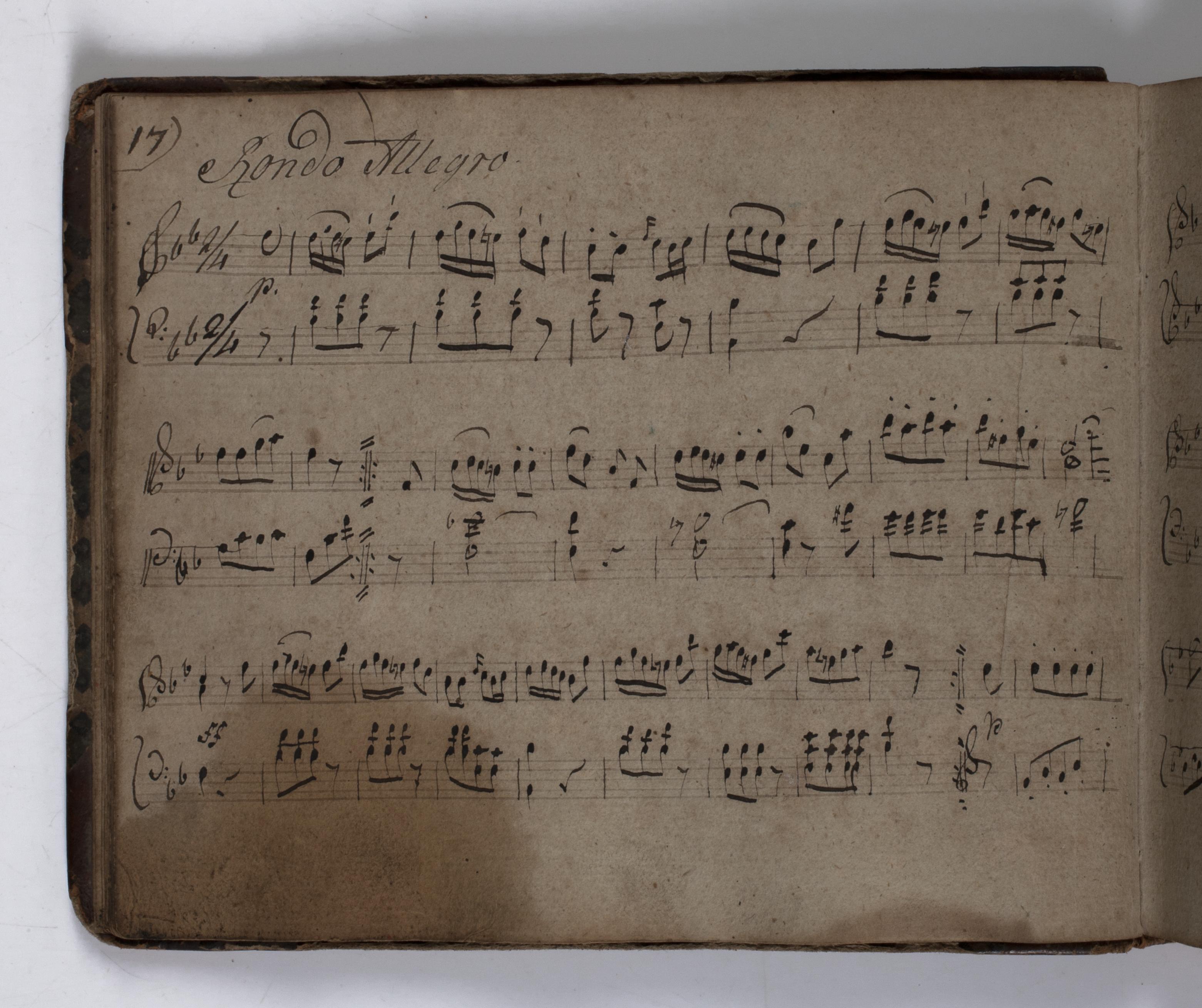
A new addition to the Music Book Collection, this volume contains handwritten bars of both religious and secular music with no corresponding lyrics. Most songs are German hymns, and are simple compositions. Occasionally throughout the volume, the owner of this book transcribed more complicated pieces of music (Rondo Allegro, Trio, and Sonatina, for example). Some of the German hymns include “Now Rejoice Dear Christians,” “Dear Jesus We Are Here,” and “If You Fulfill Your Duty.” Also included is a German Christmas song. In the back of the volume is an alphabetical index of songs

Manhood in Civil War Cartoons

The Civil War Cartoon collection at AAS was donated by Dr. Samuel B. Woodward in 1934. It consists of over 600 newspaper clippings each containing a cartoon about any and all aspects of the Civil War. Because the cartoons were delivered to the Antiquarian Society as clippings, many of them are out of context and often it is not clear which newspaper they may have come from. However, some clippings do list their source, and one source that appears quite frequently throughout the collection is Frank Leslie’s Budget of Fun.

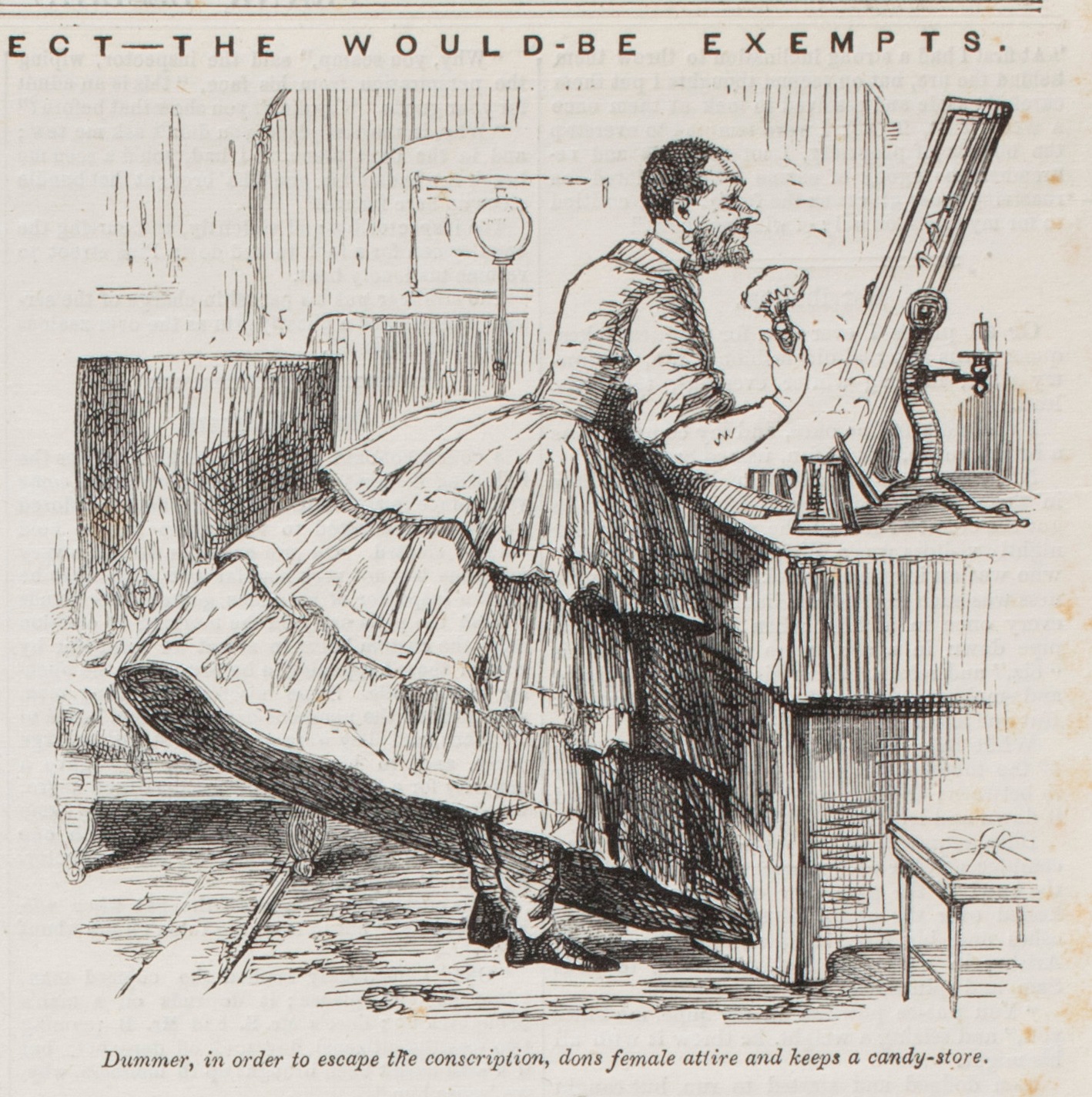
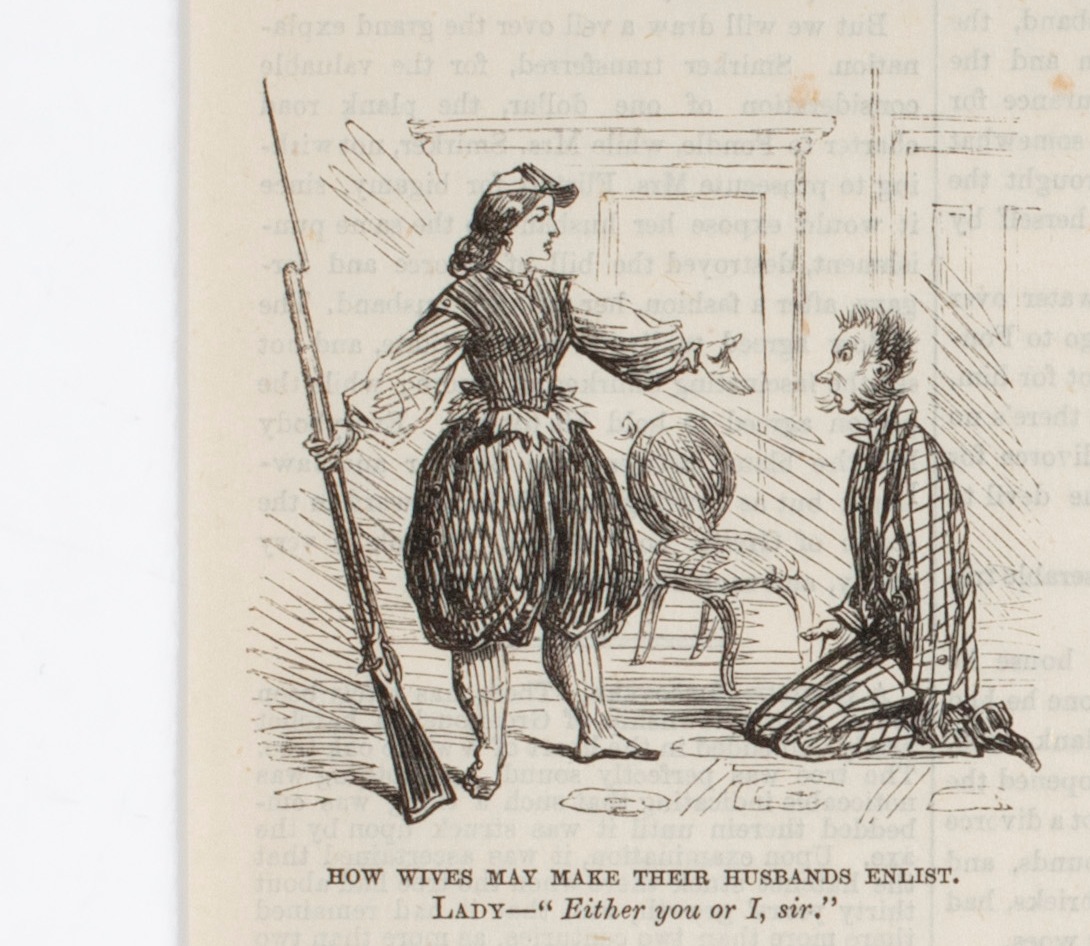
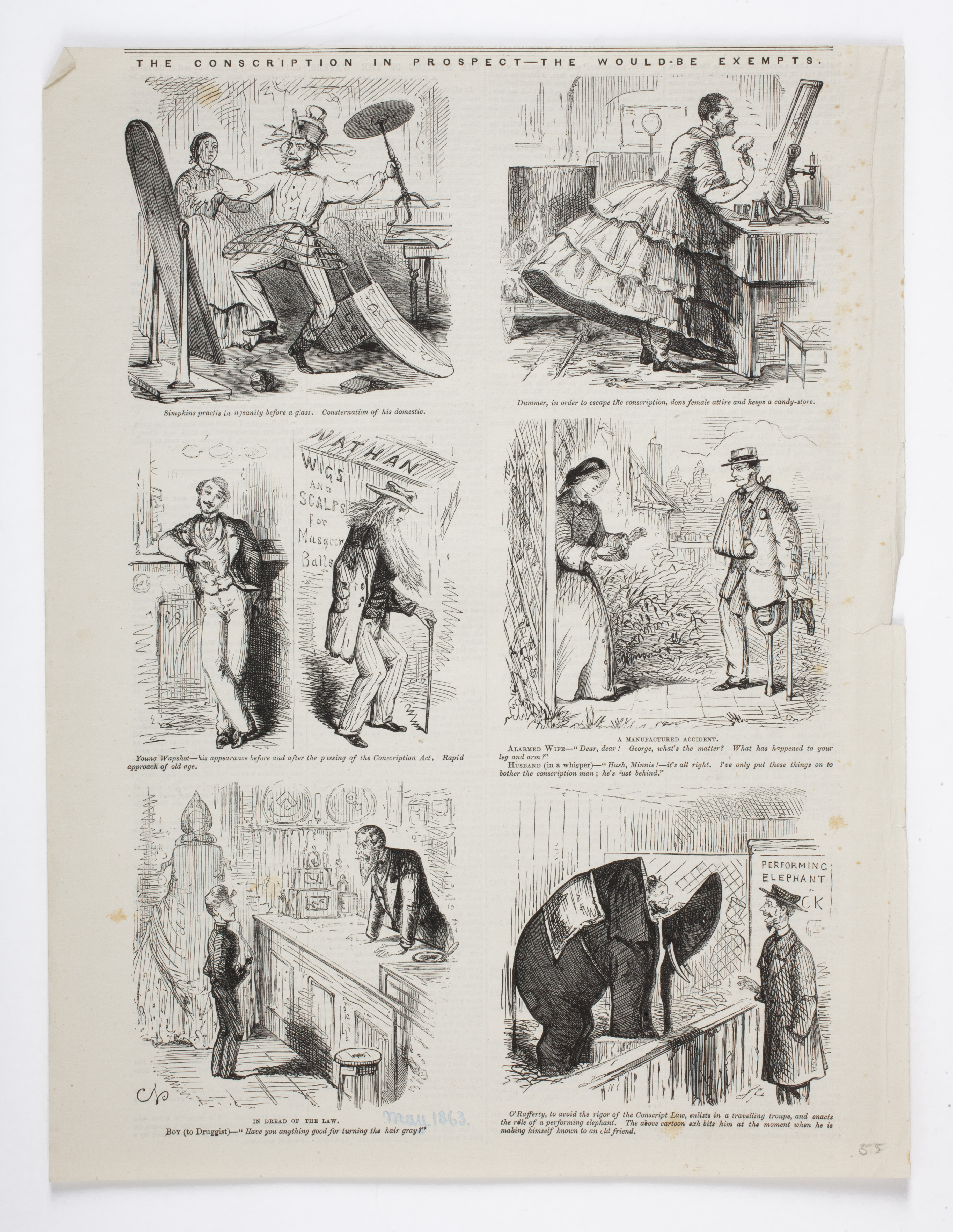
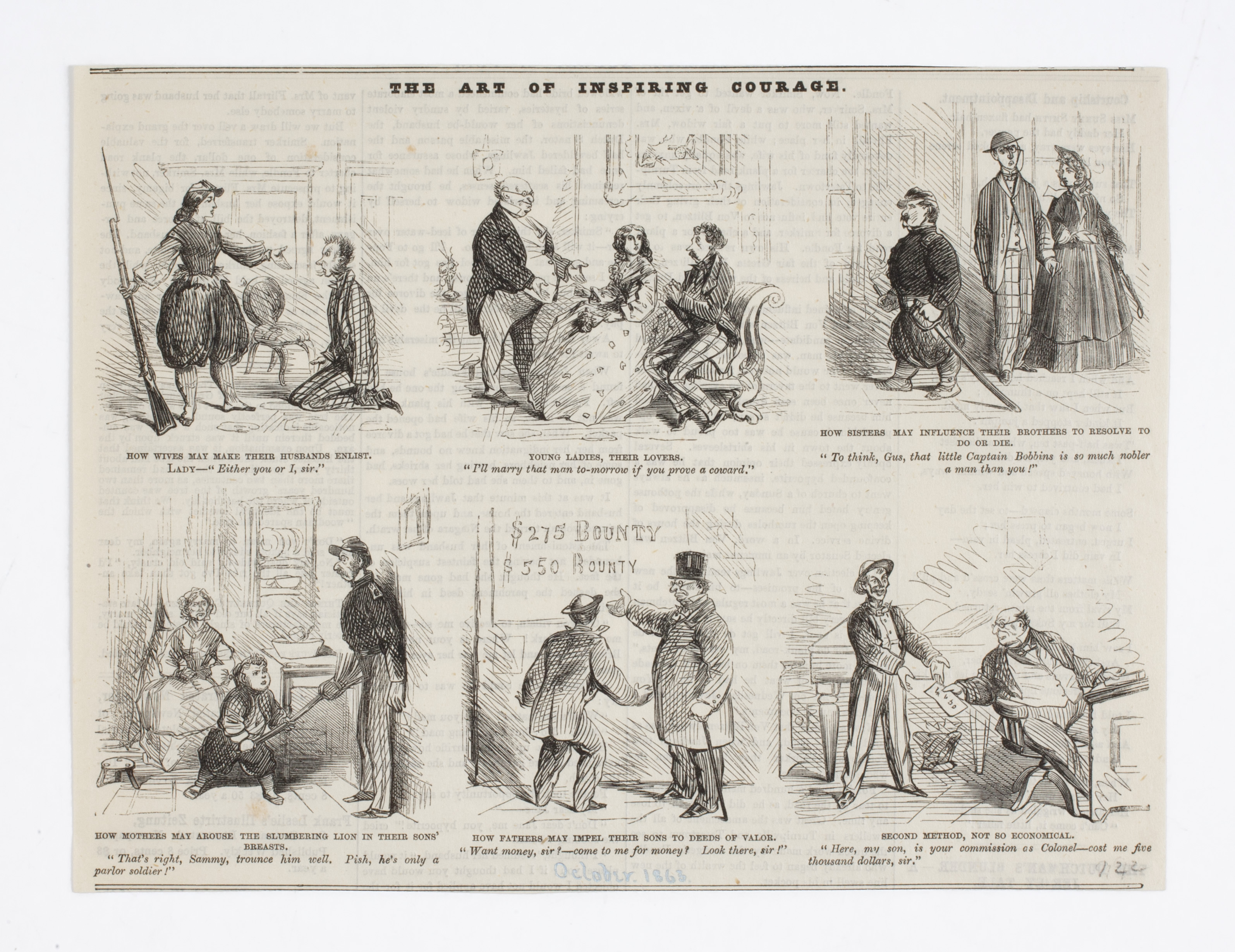
Frank Leslie (1821-1880) was a British native who immigrated to North America in 1848. He was a well known engraver, publisher, and illustrator and the work that he and his associates undertook of illustrating the Civil War received much praise. The collection contains clippings from Budget of Fun beginning in 1859 and ending in 1867.  Excerpts from this publication which are present in the collection depict an entire range of subjects from excessive drinking among soliders to Abraham Lincoln and Jefferson Davis parodies. One theme that really stands out is that of recruiting Union Soldiers, as seen in the two full pages illustrated to the right (click on the full pages bottom right to view larger images). 

One of the images is a cartoon entitled “The Conscription in Prospect – The Would-Be Exempts” from May 1863 and it parodies evasion of the Enrollment Act of 1863. The Enrollment Act was passed by the Federal government to supply new troops to the Union Army, but this form of conscription caused a lot of unrest in the North and led to the New York Draft riots. The law allowed for men to pay substitutes to enlist in their stead, but this led to widespread desertion.

It seems that there was still a great need for more soldiers, because the next tactic depicted in Budget of Fun encouraged women to make the men in their lives feel obligated to go and fight. In “The art of inspiring courage” which appeared in October 1863, Leslie parodies this task of women. Most of the methods tout emasculation as an effective means of persuasion. In one scene you will see a woman has dressed up in her husband’s clothes and threatened to go to war in his stead. There are also two scenes with an older man encouraging his son to fight. The more efficient way to do this is by convincing your son that joining the army is a way for him to support himself, then there is the “less economical means,” which suggests you buy him a commission in the army.

Based on these examples, it seems that for some young men the main impetus for going to war was tied up with a personal sense of honor and masculinity rather than only the stated need to preserve the Union or serve one’s country.

New Year’s on the Potomac

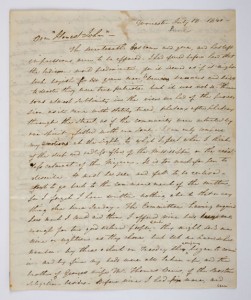
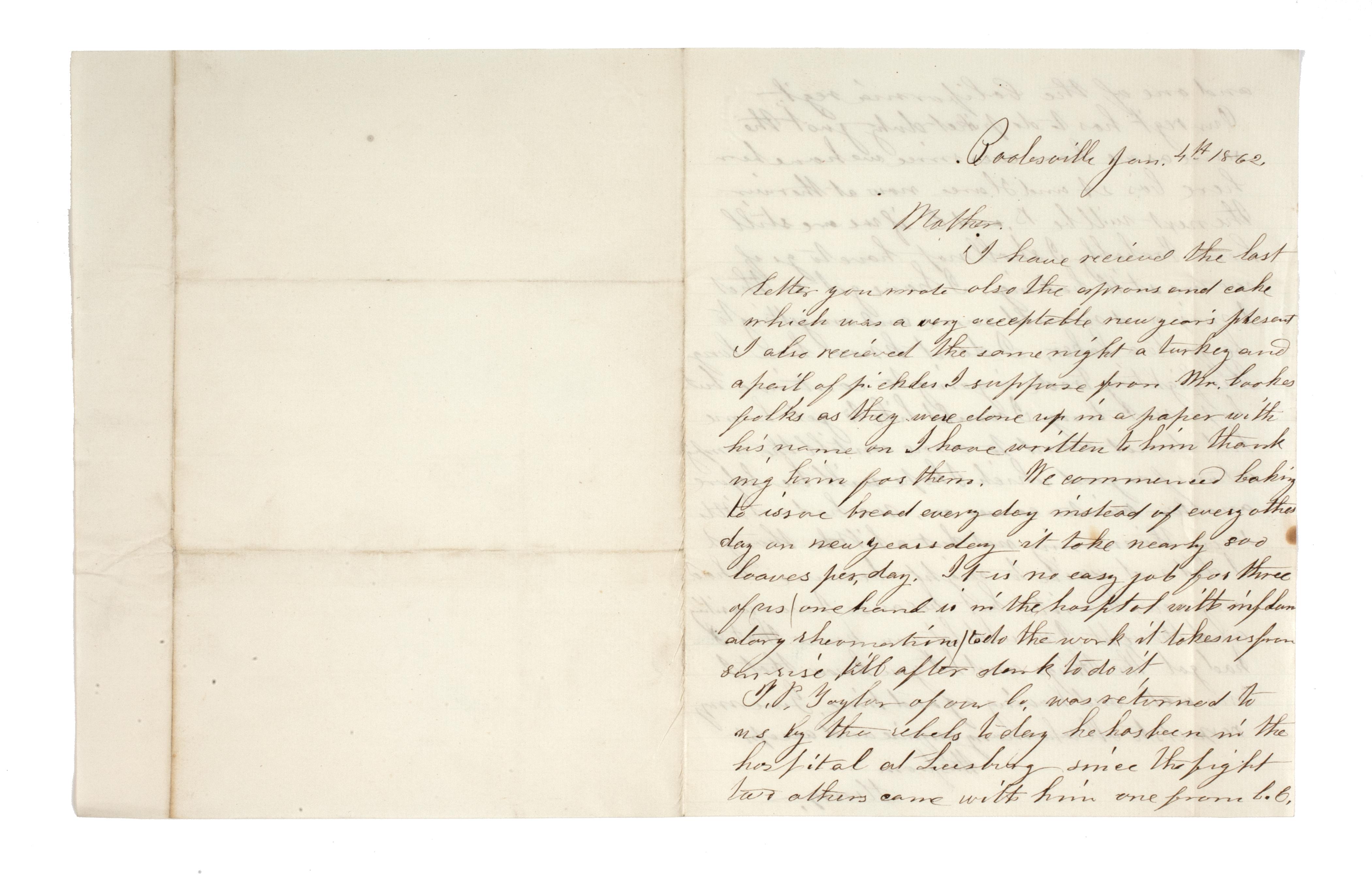
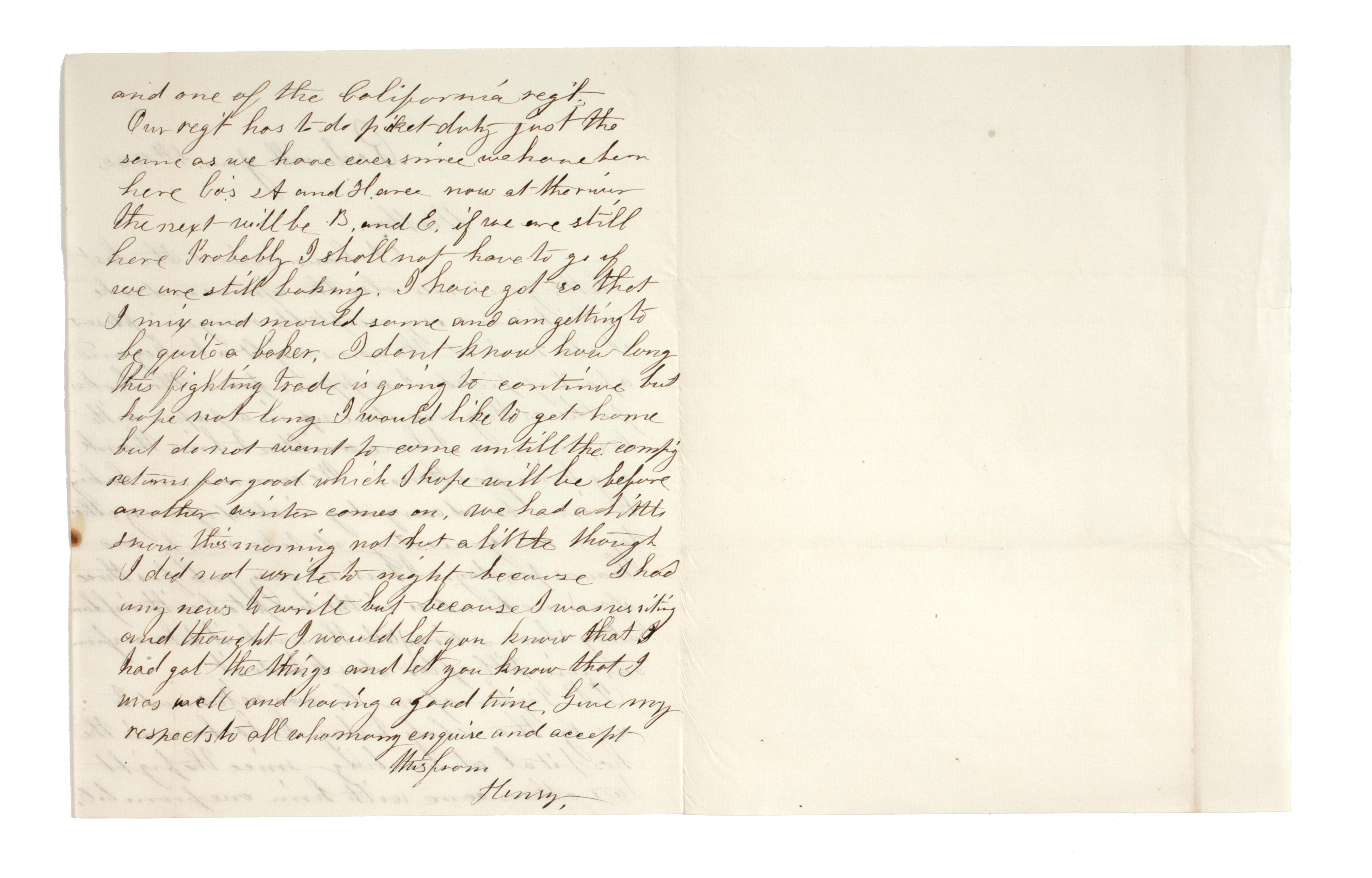
Over the past few months, we’ve been following our Civil War soldier Henry Joslin while his company was on picket duty on the banks of the Potomac.  Last we heard Henry and his Company were involved in a skirmish in late October.  Now in the New Year, 150 years ago, Henry is writing home to his mother, thanking her for his new year’s gifts of aprons and cake, which he deems “a very acceptable new year’s gift”, and describes his new duties as the Company’s baker –

We commenced baking to issue bread every day instead of every other day on new years day it toke [sic] nearly 800 loaves per day.  It is no easy job for three of us…to do the work it takes us from sunrise till after dark to do it.

He later writes proudly, “I have got so that I mix and mould same and am getting to be quite the baker.”

The winter seems to be setting in, and Henry hopes this will be the last winter he sees away from home.  We unfortunately know Henry was still in service through the next winter.

I don’t know how long this fighting trade is going to continue but hope not long I would like to get home but do not want to come until the comp’y returns for good which I hope will be before another winter comes on.  We had a little snow this morning not but a little though.

The tone of this letter is certainly different from the previous.  All seems calm for the moment, and Henry is relishing in his new task.  Not quite what one may expect from war letters.  We’ll catch up again with Henry soon!

The Acquisitions Table: Carrier’s Address to the Patrons of the Bridgeton Chronicle

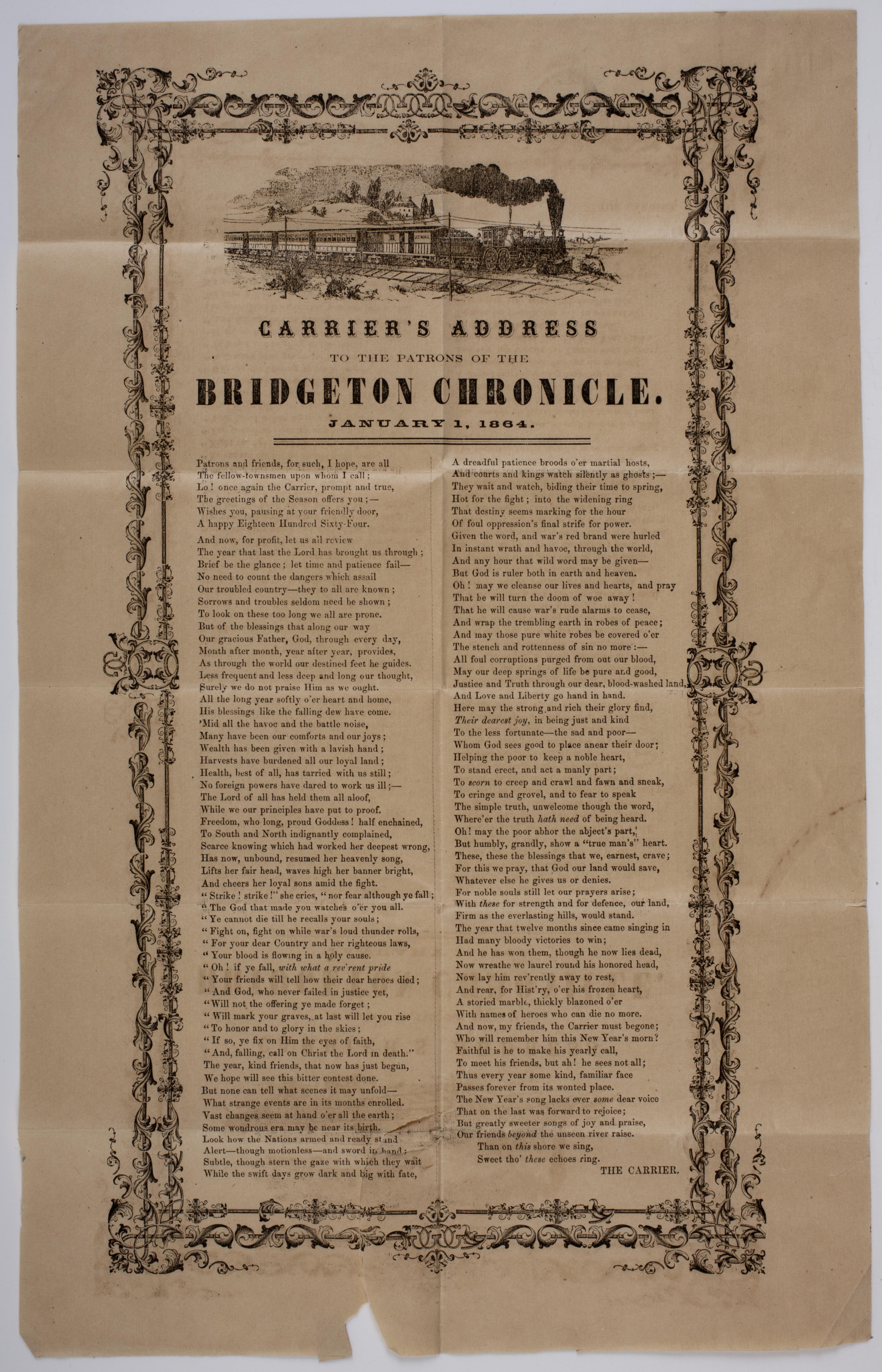
Carrier’s address to the patrons of the Bridgeton Chronicle, January 1, 1864. Bridgeton, NJ: James M. Seymour & Matthew Newell, 1863. 

This carrier’s address came to AAS with a large group of New Jersey newspapers. Written at the end of 1863, the central poem, topped by a cut of a U.S. Mail train, focuses on the nation’s weariness with the Civil War, calling America “our troubled country” and “our dear, blood-washed land.” Much of the poem takes the form of a prayer to God, asking Him to “cause war’s rude alarms to cease, and wrap the trembling earth in robes of peace.” With the battles of Vicksburg and Gettysburg behind them, the writers of the address must have hoped the end of the war was close. It would be sixteen more long months to the surrender at Appomattox.

New Year, New Resolution

With New Year’s Eve fast approaching, it’s time to think about our New Year’s resolutions.  Resolutions are a wonderful way to reflect upon the past year, on the year to come, and attempt to bring about changes in our lives.  It’s in our nature to seek this kind of renewal – everyone likes a fresh start.  And after glancing through a diary in AAS’s manuscript collection, it appears this is hardly a new practice.

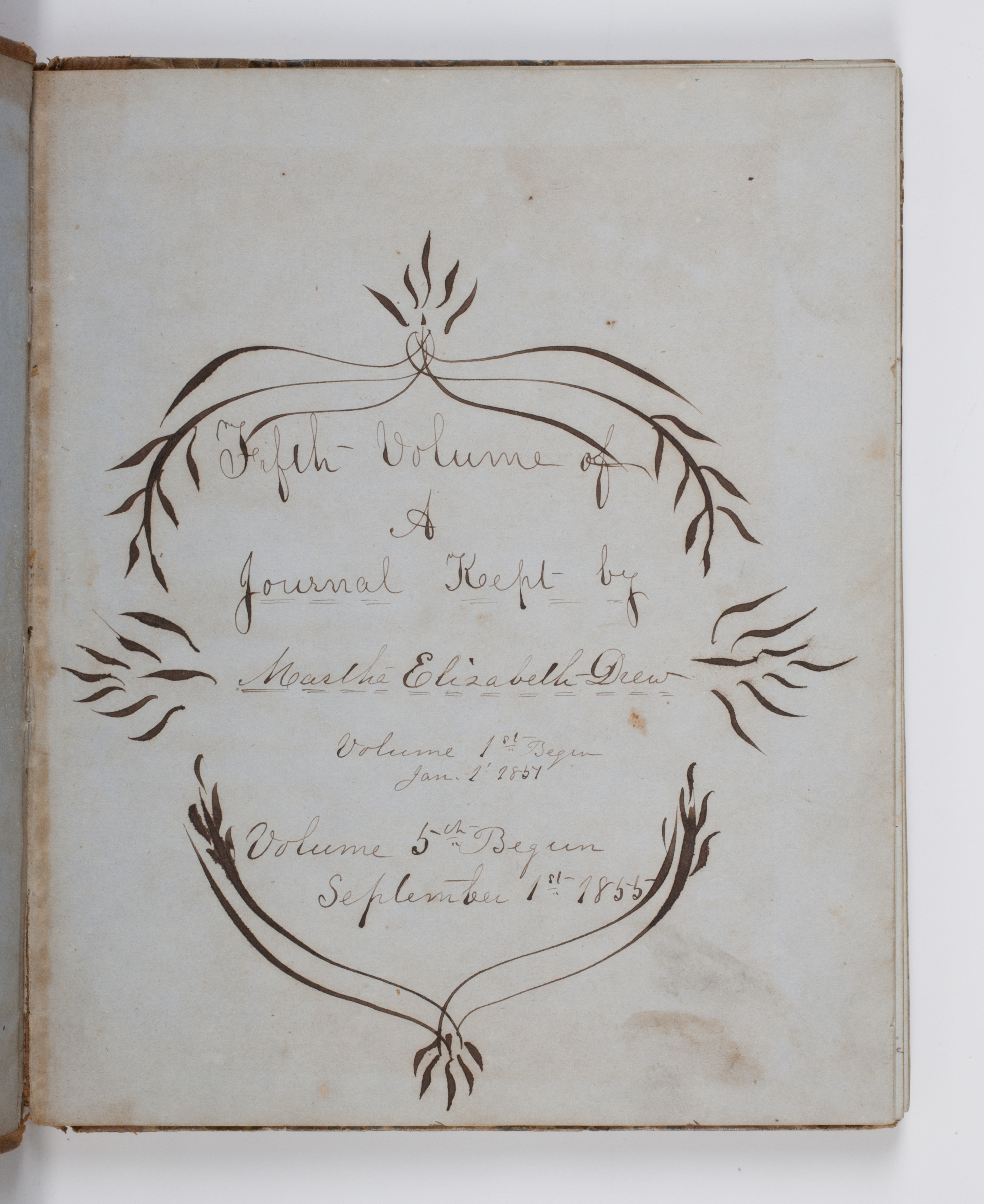
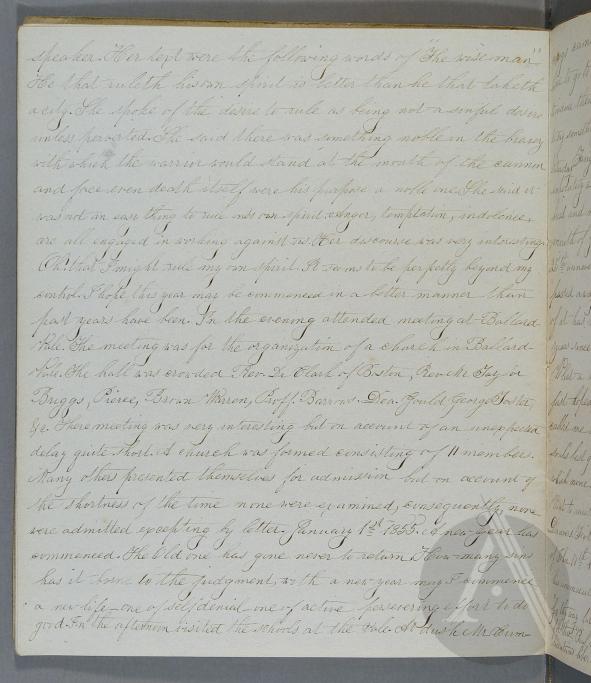
Below are transcriptions and copies from a diary from AAS’s Unidentified Diaries Collection.  The diary belonged to a woman from Andover, Massachusetts.  Her diary, with entries beginning in 1852 and continuing through 1855, describes her life as a teacher, and also includes many reflective entries about her experiences in church.  Her entries of December 29th and January 1st show this reflective spirit, and how the changing of the year has inspired her.

In reflecting on a sermon delivered on December 29th, 1854, the woman writes

Oh! That I might rule my own spirit.  It seems to be perfectly beyond my control.  I hope this year may commence in a better manner than past years have been.

A few days later on January 1st, after the arrival of the year 1855, she writes

A new year has commenced.  The old one has gone never to return.  How many sins has it borne to the judgment, with a new-year may I commence a new life – one of self denial, one of active preserving effort to do good…What can I do for my scholars to induce them to commence a new year aright?  May God enable to say something which shall affect their hearts.

Even though it seems more dramatic than many of our resolutions today (lose weight!  save money!) it all still boils down to us wanting to be better people, and do better things, for the benefit of both ourselves and for those around us.

So make those resolutions, and write them down.  Who knows, someone 150 years down the road might be interested to see what kind of self reflection and self improvement we were embarking upon in the year 2012.

The Acquisitions Table: The Californian

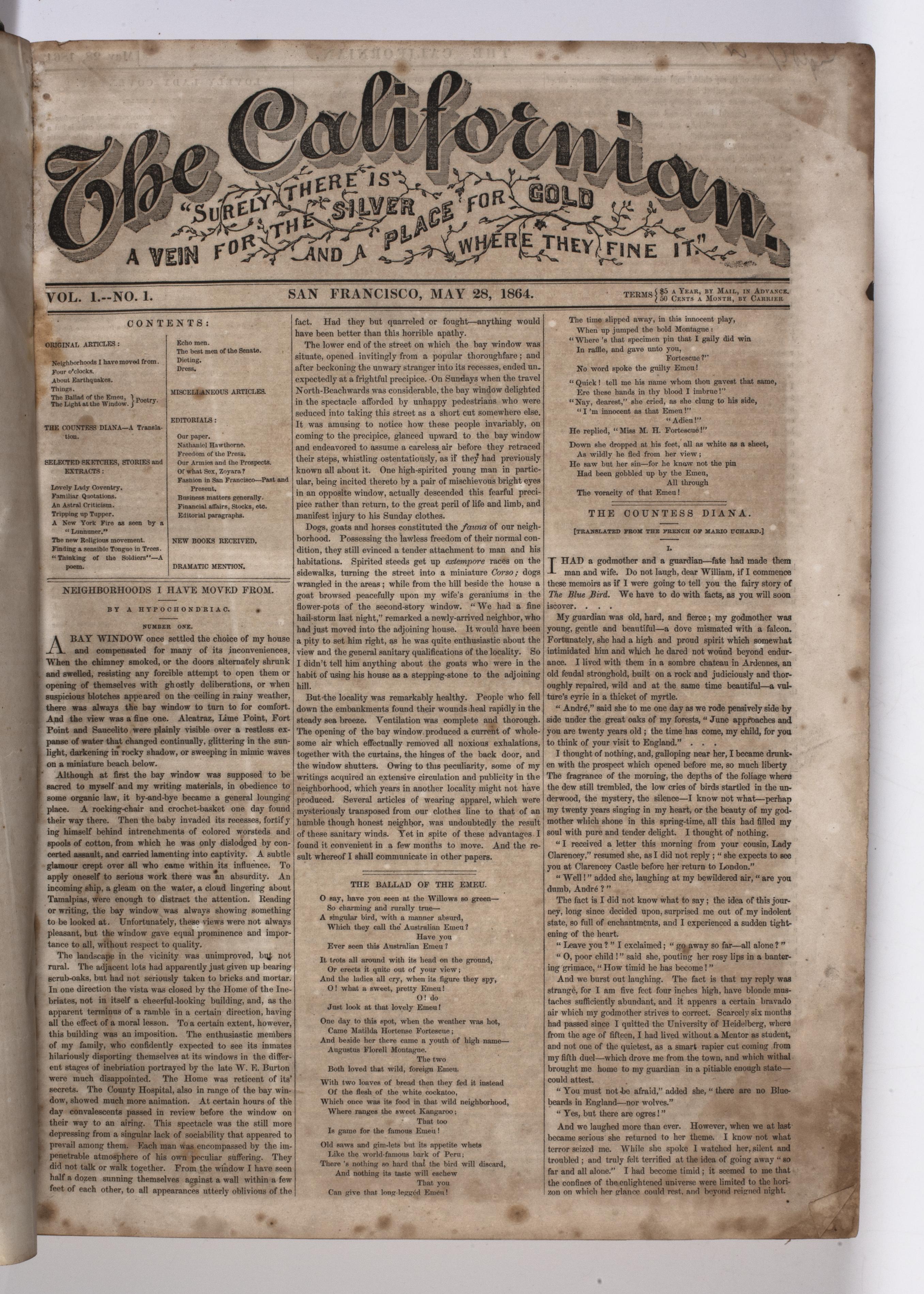
The Californian (San Francisco, CA).  70 issues, 1864-1867.

This bound volume of The Californian begins with the first issue of May 28, 1864. It was primarily a weekly literary periodical with some local news thrown in. Charles Henry Webb started the paper but Bret Harte soon succeeded him as the editor. One of the contributors hired by Harte was Mark Twain—this volume contains at least 11 articles penned by Twain.

The Great Gliddon Mummy Unwrappings of 1850

While most people today are familiar with Egyptian mummies through various sorts of media — books, television, films, supermarket tabloids, museum exhibitions and the ubiquitous Halloween decorations —  people in mid-nineteenth century America did not have this same experience. To them, mummies were rare, mysterious relics, most often associated with the Biblical past, and few had ever actually seen one in the flesh, as it were.

Indeed, the continentals had it all over their American counterparts, for mummies had long been a very public institution, particularly in England, where it was not uncommon for a mummy unwrapping to be a high society event, accompanied by an elaborate dinner, after which the unfortunate relic would be unceremoniously despoiled of its linen cerements in hopes that something along the lines of valuable collectables, such as amulets or jewelry, might be found. How many of these ancient Egyptians suffered this indignity and to what fate their remains were eventually consigned is not known, but it may well have been hundreds or more.

In the United States, fewer mummies were imported, owing chiefly to a ban on their export by the Pasha in 1835, and what unwrappings were performed were chiefly public events in front of medical or scientific audiences. The first such unwrapping was in December 1824, at New York’s Castle Garden, where a mummy procured by Captain Larkin Thorndike Lee was unwrapped and pronounced genuine and female. Lee then consigned the mummy and exhibition rights to a Mr. Bishop, who briefly exhibited the mummy in New Jersey and Pennsylvania, and then absconded with both the artifact and the money. In the mid 1830’s Rubens Peale and John Scudder, rival museum entrepreneurs in New York each advertised a mummy unwrapping, which would be limited to audiences of adult men only, the subject being deemed inappropriate for women and children.

Then in 1850, George Gliddon, Egyptologist, former consul in Egypt and lecturer, proposed a mummy unwrapping in Boston at Tremont Temple. He had obtained the mummies with much difficulty and expense from Egypt and London, after losing a dozen mummies, previously purchased, to the vagaries of the Egyptian Customs Office, which had lagged so long in their deliberations about allowing Gliddon to take them out of the country that they crumbled to bits in a storage shed. Nevertheless, Gliddon was able to scrounge up four mummies, which he used as an adjunct exhibition to his “transparent” Panorama of the Nile. The Boston unwrapping was a means to promote both the panorama and Gliddon as an authority on Egypt.

 The announcement featured representations of two mummies and their coffins, and Gliddon postulated that the one he was going to unwrap in Boston was a priestess of Thebes, as evidenced by the inscriptions on her coffin, which gave her name as ASCH-ph*****, some of the hieroglyphics being unreadable. This was seized upon with serious interest as the Bostonians signed up for the three-day course of lectures during which the unwrapping would occur. One anonymous poet even penned a lengthy ode in which he describes the beautiful young woman’s untimely death, and how her beloved “weeps upon the broken stem of the lily of the Nile.” By the time of the opening, the priestess was also a princess and excitement was rife. Various notables were in attendance, including Louis Agassiz, who helped with the unwrapping. All went splendidly until the third and final evening, when Gliddon got the surprise of his life as the mummy turned out to be male, “exhibiting in its fossil state the erected unequivocal mark of its sex.”  Quick-thinking Gliddon had an explanation, blaming the gaffe on drunken coffin makers and embalmers, but he never quite lived down that moment of infamy.

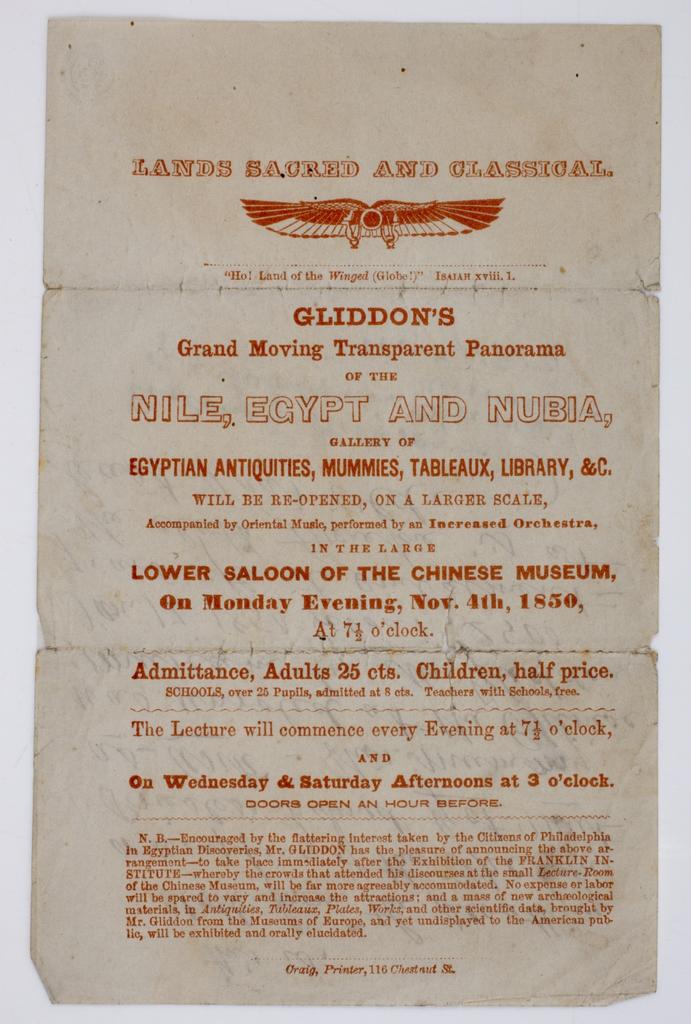
Shortly thereafter Gliddon packed up the Panorama of the Nile and the mummies, and went to Philadelphia, where on 23 November 1850, underneath a picture of the coffin and mummy of Got-Mut-As-Anch, he issued a similar proposal to the one he had issued in Boston, except that he would unroll TWO mummies, the other one being a nameless child. He also issued a small handbill printed in red ink, advertising the display of the Panorama of the Nile, in the Lower Saloon of the Chinese Museum. Before the lectures, Gliddon exhibited the mummies and some visitors were startled to hear the words coming from the one which had been unwrapped in Boston!

          “Open the box! Open the box!”        

echoed throughout the room. There followed a dialogue between the observers and the mummy, which covered the decline of the Egyptian Empire and strongly hinted that the ancient inhabitants thereof had migrated to Mexico, there to continue their pyramid building habits. This was of course, a hoax, perpetrated by the famous ventriloquist Bobby Blitz, who reaped such fun from his folderol that he later incorporated a mummy in his performances.
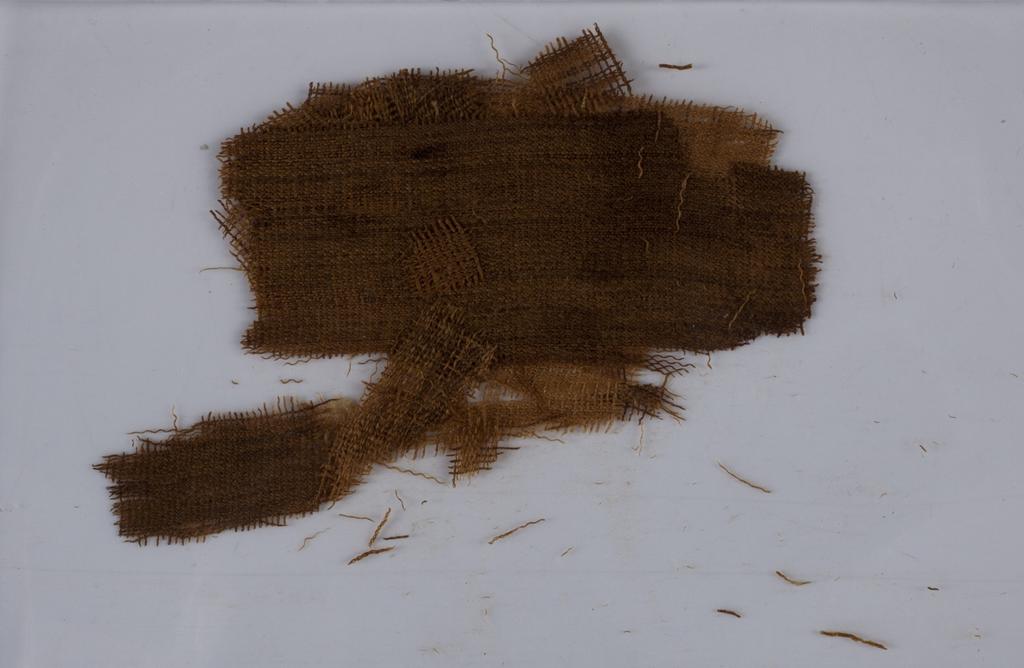
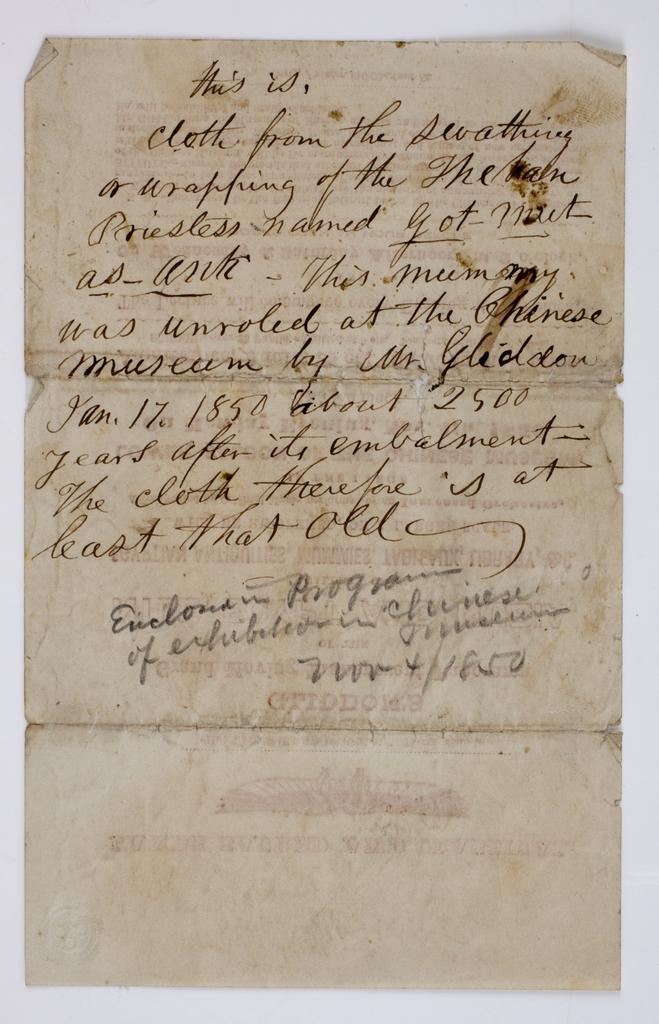
The lectures and unwrappings went without a hitch, and one anonymous onlooker was able to obtain a length of the linen wrapping of Got-Mut-As-Anch, carefully recording the authenticity of the piece before folding it in a copy of the small broadside as a souvenir. The American Antiquarian Society now owns both the flier and the linen, a remarkable acquisition under any circumstances.

After his sojourn in Philadelphia, Gliddon eventually made his way to New Orleans where he unwrapped the final mummy. He then presented the mummy to the University of Louisiana, to be placed in the museum of the medical school—later Tulane University.

This mummy was given the name “Nefer Atethu” or  “Beautiful youth” many years later during a radiological study of her and Got-Thoti-Aunk (the mummy unwrapped in Boston), who had also been given to the museum in 1851 by Gliddon and Josiah C. Nott (who had collaborated on the writing of Types of Mankind).

The two mummies and their coffins were stored in various locations, including a space under the bleachers in the football stadium. They attended three Super Bowl games (and numerous college games) before being rescued, in the mid 1970’s,  and placed in a somewhat more appropriate setting at the college. According to Samuel Morton’s catalogue of skulls, the head of Got-mut-as-Anch was given to him for that collection. It is not known what happened to the rest of the body, nor to the child’s mummy unwrapped in Philadelphia.

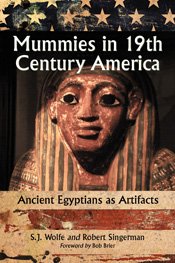
A more extensive telling of this story appears in the chapter “Unholy unrollers” in my book Mummies in Nineteenth Century America; Ancient Egyptians as Artifacts (McFarland, 2009) which is a discussion of how Egyptian mummies came to America and what happened to them after they got here as they progressed from being viewed as curiosities, to being exploited as commodities, and finally their ongoing role as cultural connections to a world long past.

By S.J. Wolfe, senior cataloguer and serials specialist, American Antiquarian Society.

The Acquisitions Table: The American Juvenile Pictoral Primer

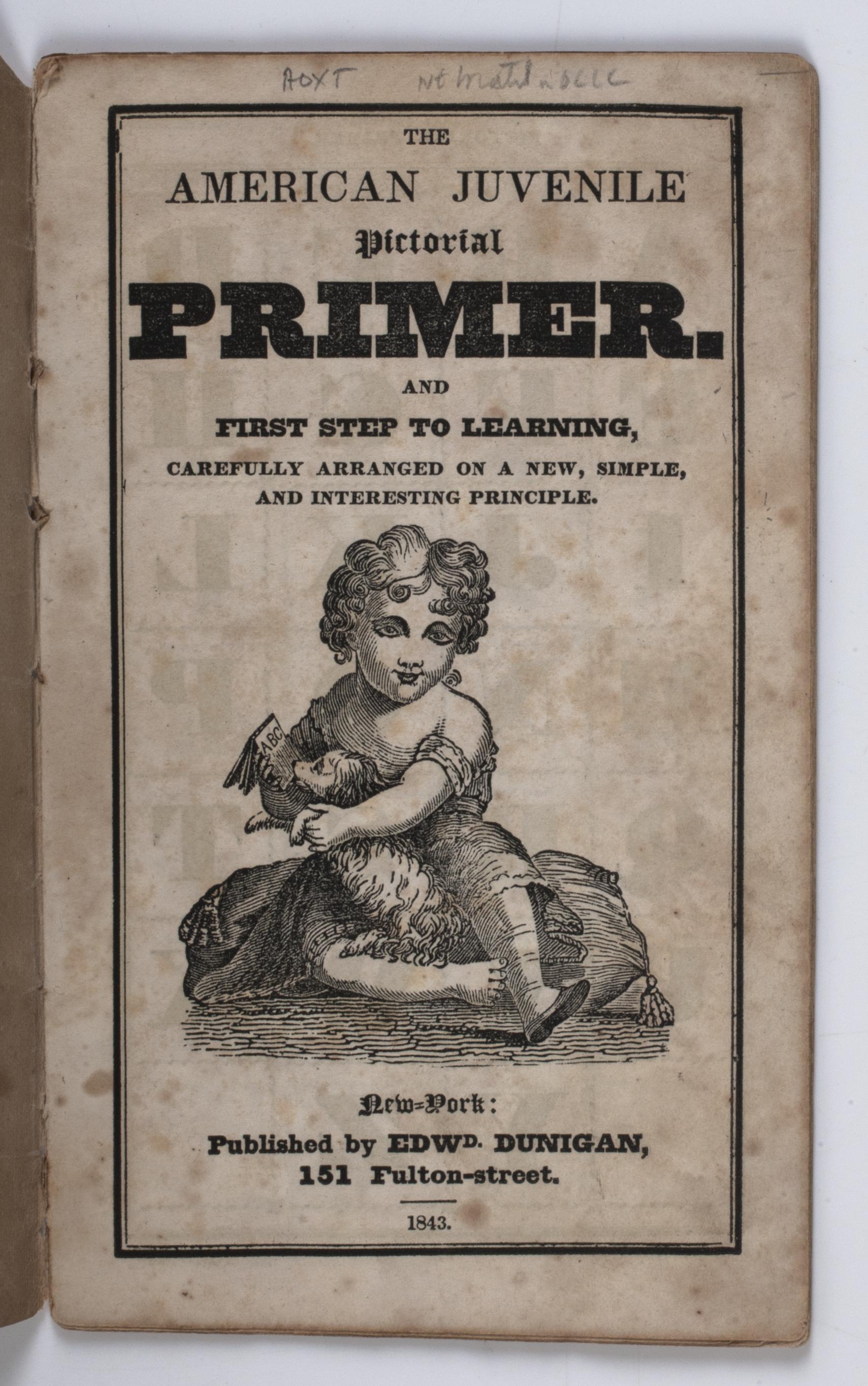
The American Juvenile Pictorial Primer. New York: Edward Dunigan, 1843.

Up until about 1820, The New England Primer, with its religiously inspired alphabet, account of John Rogers’s burning at the stake, and religious dialogues, dominated the American primer market. By the 1840s, secular primers like The American Juvenile Primer featuring pictures and large type became quite popular. Many of Dunigan’s cheap picture books would be reissued by the fledgling publisher McLoughlin Bros. some fifteen years later. Apparently, the title page illustration is a redrawn version of the frontispiece for Catherine Parr Strickland Traill’s Fables from the Nursery (1839).

Curwen’s Calendar, Part II

Last week I shared some letters from the Curwen Family Papers showcasing the change from the Julian to the Gregorian calendar.  The colonies officially made the change in 1752, yet some letters in the Curwen Family Papers exhibited the switch previous to the official change.  Why the early appearance of these dates?  The change was happening as early as 1582 in parts of Europe, and although they were an ocean away, colonists kept abreast of developments as they happened in Europe.  Early sources show it was being talked about, and also express how the news was being received.

Talk of the switch appears in newspapers and almanacs prior to 1750, when the Calendar (New Style) Act of 1750 was passed.  Below is an excerpt from the American Weekly Mercury, a Philadelphia newspaper, from 1745.  In an opinion piece, the author first comments upon the differences in units of measurement between Europe and the colonies, and goes on the support the proposed calendar change, stating it basically isn’t that big a deal.  And don’t even try to use holidays as an excuse, the author says, they’re messed up to begin with!

But some may object, that an alteration in these things would so discompose the order and method in which affairs are carried on at present, that the propos’d [sic] remedy would be worse than the disease; so that of two evils we should chuse [sic] the least.  To which I answer, as to time: If it be required I can produce a calendar with plain tables, in which the days of the year, month and weeks, the change of the moon, the movable and immovable fasts and festivals, terms &c. will appear at first view for any time past, present, or future, as well as according to the old and new style now in use, as the Gregorian account now recommended.  And were the latter introduced into astronomy, tables depending on the sun’s place, &c. would not be soon out of date, as they are by the method now in use for calculation. 

Transposal [sic] of the holy days &c. can be no valid objection, since they are now so irregular as to be observed in different parts of Christendom, according as the new and old style is received; and in the same individual countries they are in such a fluctuating condition, that they insensibly revolve quite thro’ the year: so that in process of time Christmas will fall out at Midsummer, and May-day will come to the middle of Winter: but the method now proposed reduces the years, months, and days to a permanent certainty.

In another opinion piece from the Boston Evening Post in 1747, the author writes a letter “To the Author of the London Courant” addressing the “Design…on Foot for changing our Style.”  The author certainly seems to convey understanding and support, stating that the change

…has been a Thing often talked of, and, I believe, very much looked for; indeed, I have often wondered, that it was not done long ago, and have heard other Persons say the same, and that no good Argument could be assigned, why this Alteration has not been or should not be made, to prevent our being longer singular to such a Degree, as to be in some Measure ridiculous.

Jumping across the pond momentarily, London Magazine published an article in 1747 titled “Of the Confusion arising from the Uncertainty of beginning our Year.”  Hoping to find some complaints, or even evidence of the Brits’ reaction to loosing 11 days, I found only support.  “The absolute necessity there is for an Uniformity in the Dates of History is so obvious to every Man who makes that Science his study, or even his Amusement…” the authors states.  His only complaint is the confusion in dating (newspapers and decrees, he mentions specifically) that the switch may bring about.

These few sources, among others, show that while the changeover may have caused some inconvenience, it was understood as a necessity to be consistent with the rest of Europe.  No strong arguments were presented otherwise, but it must just be human nature to complain about change.  The fear of loosing a firm handle on one’s own history, insomuch as dates were wishy-washy, is understandable.  And it’s easy to see people fretting about losing 11 days, but, not to get philosophical, time is just an illusion anyways.  An article regarding the calendar change in the Universal Magazine of Knowledge and Pleasure from December 1st, 1751 opened wisely with the following quote from the Roman poet and philosopher Lucretius, perhaps as a reminder to those citizens who may have been worried about their time lost –

Time of itself is nothing, but from thought / Received its rise, by labouring fancy wrought, / From things consider’d; whilst  we think on some / As present, some are past, or yet to come; / No thought can think on time, that’s still confest, / But thinks on things in motion, or at rest.

The Acquisitions Table: Allan’s Lone Star Ballads

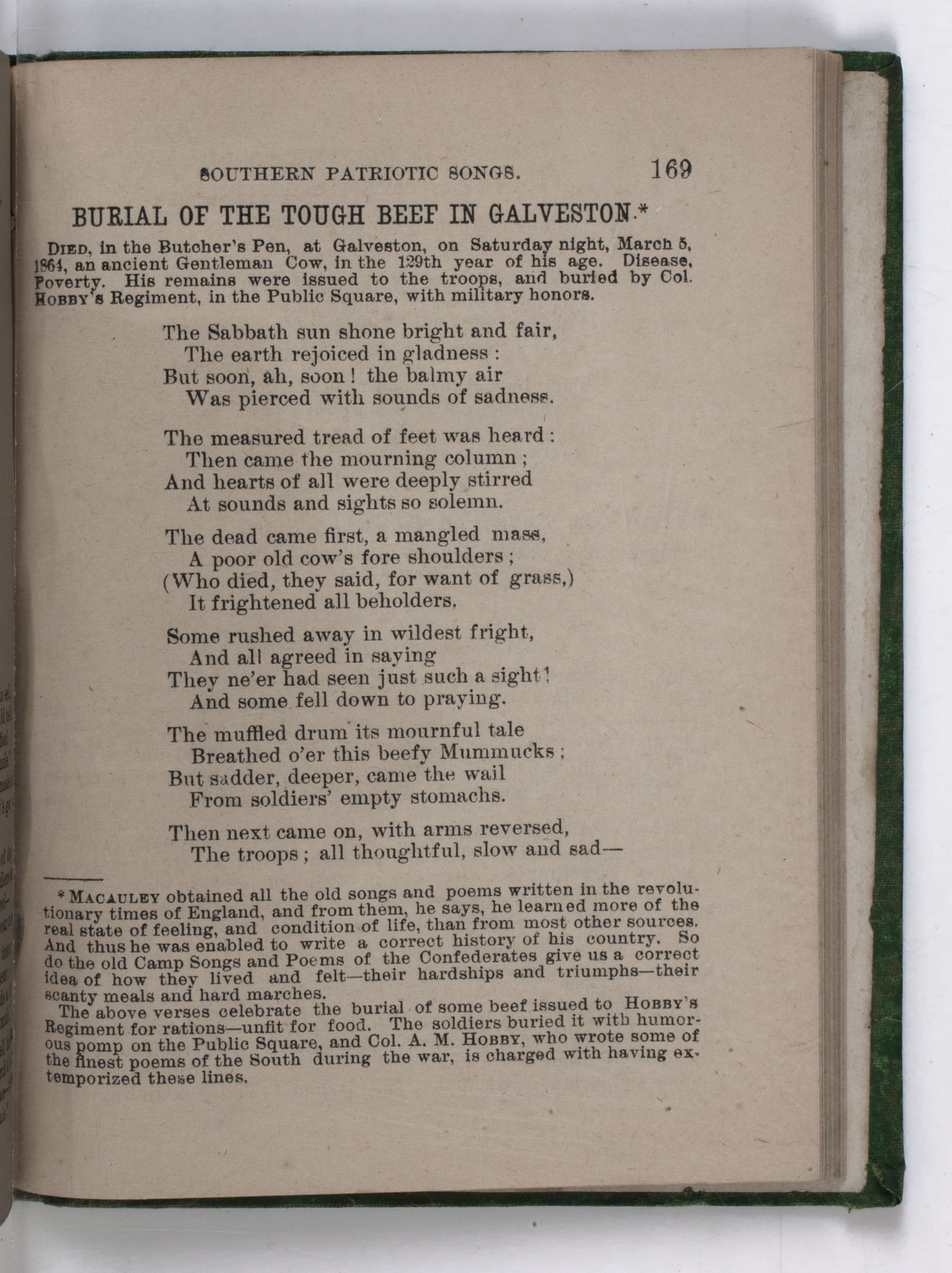
Allan, Francis D. Allan’s Lone Star ballads. A collection of Southern patriotic songs, made during Confederate times. Galveston: J.D. Sawyer, 1874.

First obtainable edition of this important Confederate and Texas songster; Allan had previous issued a much shorter compilation in 1863, now extremely rare. In his preface, Allan explains that during the Civil War he assiduously collected “a very important, but often neglected, portion of the history of those times,” the songs actually “sung in the Camp.” His plans to publish a larger compilation suffered a cruel blow in 1866 when Federal soldiers burned his property and archive “long after the war was supposed to be over.” Undaunted, he resumed collecting, here offering ca. 200 of his best finds, some with authors identified. Many were printed here for the first time, including several relating to the Texas Rangers. Of special interest are the 23 pages of local advertisements at the end, which highlight Galveston’s role in the cotton trade. The book closes with two pages of ads identifying Allan as a subscription agent and proprietor of the People’s Circulating Library.

Prints for a Different Parlor

Disclaimer: This post contains adult content. If there are any children reading this blog, or anyone else who wishes to avoid the “hidden” side of the 19th century, this post isn’t for you. But for the rest of our readers, we could use your help learning more about a new acquisition.

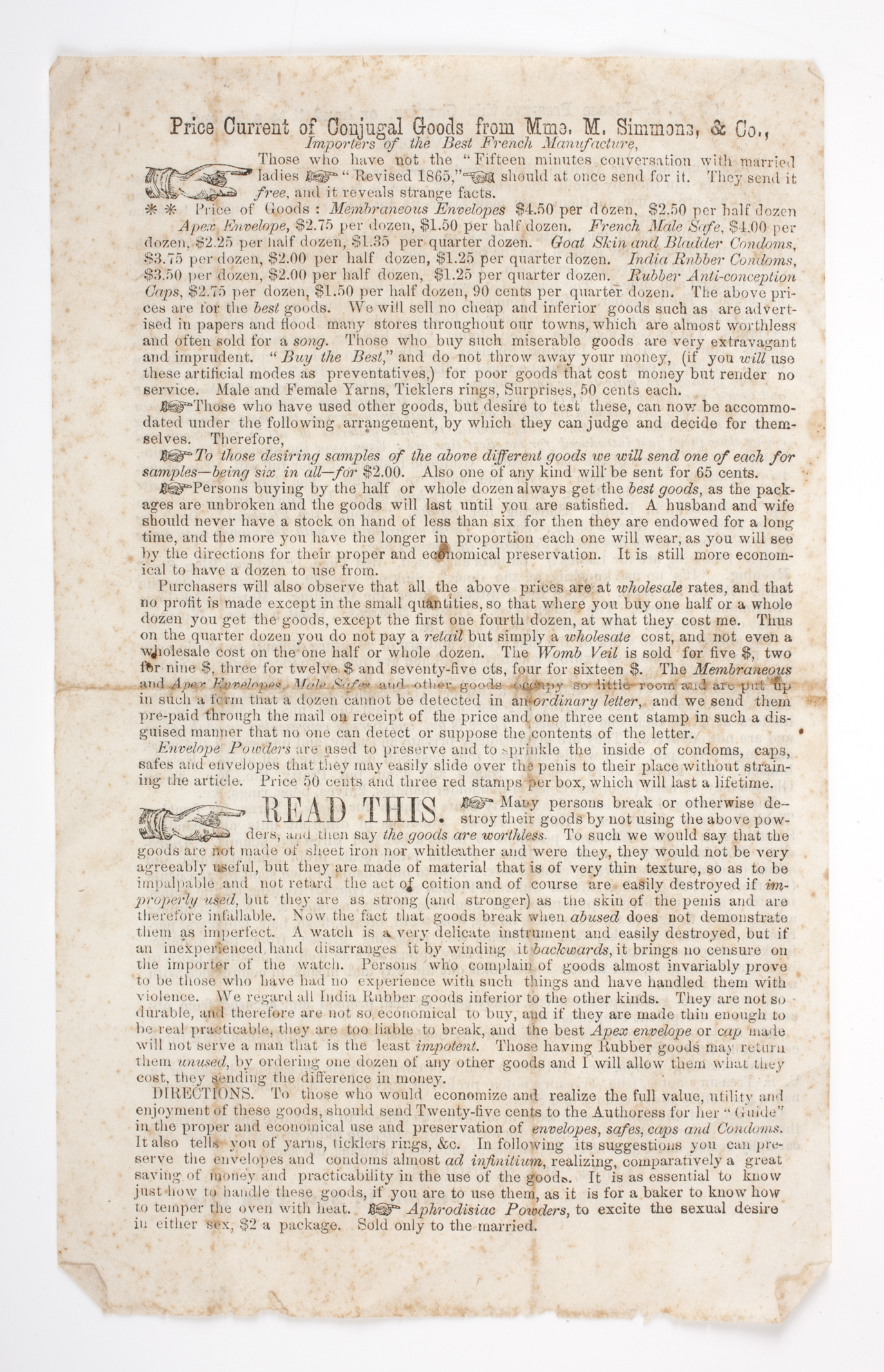
The AAS curator of graphic arts, Lauren Hewes, recently purchased this circular letter, headlined “Price Current of Conjugal Goods from Mme. M. Simmons, & Co.” On one side, the letter advertises a wide range of condoms (male and female), “French Male Safes” (condoms made from a mixture of India rubber and gutta percha), “apex envelopes,” “womb veils” (an early form of diaphragm), and other contraceptive devices, along with “Male and Female Yarns, Ticklers rings, Surprises, 50 cents each.”

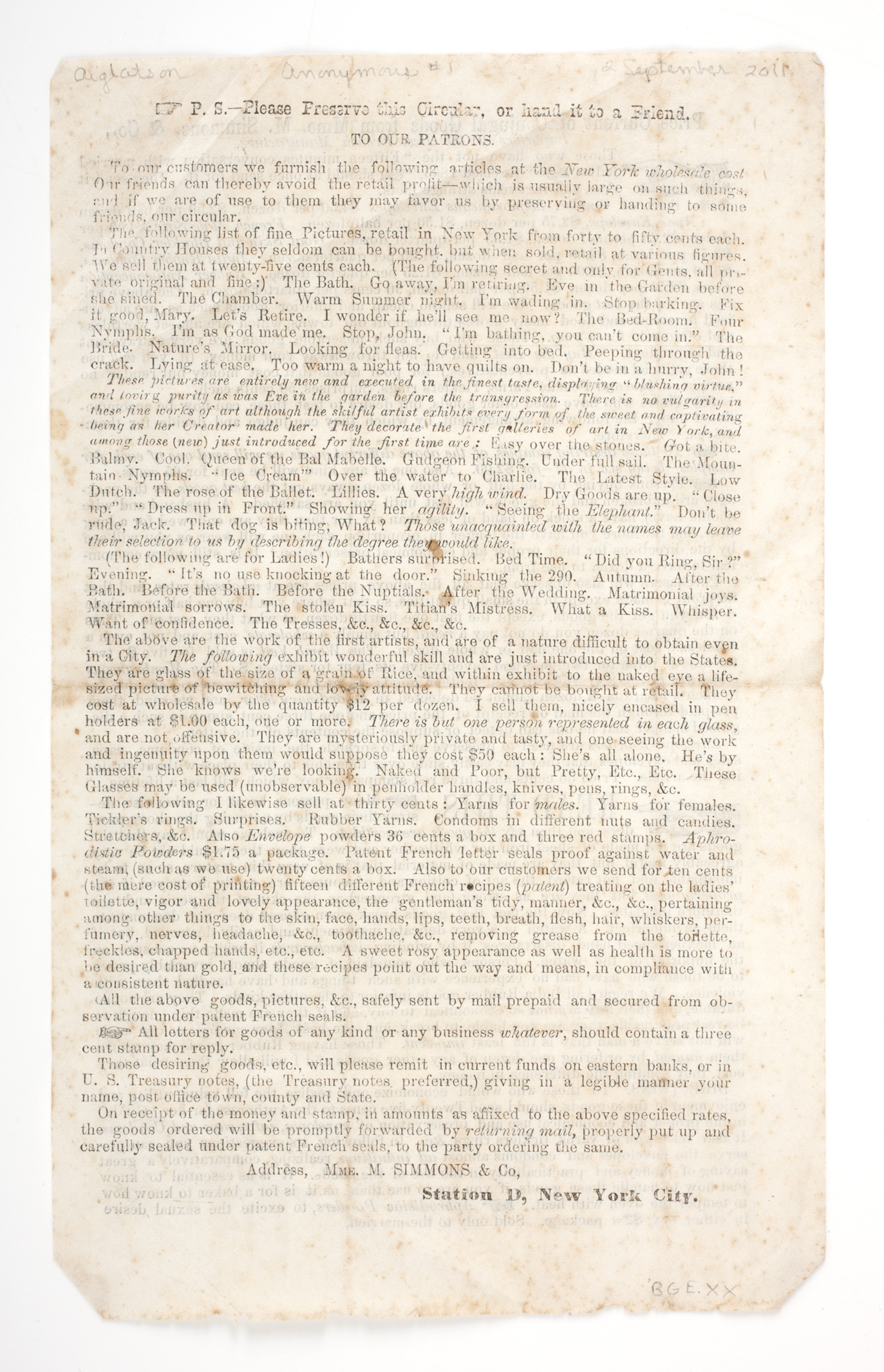
The other side of the letter describes a list of (presumably) pornographic or erotic prints that are also available for purchase via mail order, with long lists of titles of images, some specifically intended “for Ladies.” “There is no vulgarity in these fine works of art,” the letter proclaims, “although the skilful artist exhibits every form of the sweet and captivating being as her Creator made her,” adding that these prints “decorate the first galleries of art in New York.” In addition to prints, the letter also advertises items “just introduced into the States,” which are described as follows: 

They are glass of the size of a grain of Rice, and within exhibit to the naked eye a life-sized picture of bewitching and lovely attitude. … I sell them, nicely encased in pen holders at $1.00 each, one or more. There is but one person represented in each glass, and are not offensive.

These erotic novelty items, which apparently featured an image of a nude figure underneath a small magnifying lens, are of a piece with a wide range of similar goods that were available by retail in American cities (and by mail elsewhere) through much of the nineteenth century. (The letter’s italicized insistence that they only contain one figure is intended to underscore the fact that they only depicted naked individuals, and did not show actual sex acts.)

All of the goods advertised here—contraceptives, erotic prints, aphrodisiacs, and sexual novelty items—could be obtained by sending cash and postage stamps to Mme. Simmons at Station D, New York City (a post office in Manhattan located in “Bible House,” the headquarters building of the American Bible Society at 9th Street and 4th Avenue). Ordered items would be sent to purchasers “through the mail … in such a disguised manner that no one can detect or suppose the contents of the letter,” using “patent French letter seals proof against water and steam….” Even though information about contraception was relatively easy to find in mid-nineteenth-century America, this concern with discretion is understandable.

But we have some questions, which we were hoping this blog’s readers could help us answer. 

  • When was this letter printed?

We know that it was after the end of the Civil War, as it refers to Simmons as the author of a pamphlet titled Fifteen Minutes Conversation with Married Ladies, revised in 1865. It also contains several references of a fairly topical nature—such as one to a print titled “Sinking the 290,” which most likely is a double entendre referring to the sinking of the Confederate warship Alabama in 1864.

But was the letter printed before 1873, when Anthony Comstock, the founder of the New York Society for the Suppression of Vice, persuaded Congress to pass the Comstock Act, which made it illegal to deliver through the mail any “obscene, lewd, or lascivious,” or any information or items related to birth control? That is, was Simmons operating in the more freewheeling period from 1865-73, or was she advertising and mailing her goods directly under the nose of the nation’s most tireless anti-obscenity crusader (or vigilante, depending on one’s point of view), when people were regularly paying stiff fines and serving long prison sentences for sending “obscene” material through the mail?

  • And what are “yarns”? The letter advertises “yarns for males, yarns for females,” and “rubber yarns,” but offers few hints as to what they might be.
  • Finally, do any of you know anything about Mme. Simmons (almost certainly not a real name)? Was this name a front for another operator in the nineteenth-century smut trade?


The only book you’ll ever need

According to its preface, A New Academy of Compliments: or, Complete Secretary “is a book full of variety, and many things not found in any other.”  Without a doubt, this is the most eclectic book to have crossed my desk during many years as a cataloger.  It begins with directions for composing letters using examples addressed to a mother, a father, a brother, a sister, a child, a master, an apprentice, and to friends.  Next are sample dialogues for the tongue tied, rules of etiquette, and advice on courtship.  Guys, here’s just one line you might try when approaching the girl of your dreams:

Think it not strange, mistress, if I should speak the truth, and tell you, that I have a long time been broiling on the flames of ardent affection towards your dear self.

[You can read the entire first page of the dialogue at the end of this post.]

A chapter on fortune enumerates signs of a successful marriage, describes the art of getting and keeping money in hard times, interprets dreams and moles, and lists which are the “evil or perilous days in every month of the year.”  Those beginning a journey on one of these days are in danger of death during the journey, and those who marry “shall either be quickly parted, or else live together with much sorrow and discontent.”  Planning ahead perilous days during the next three months are November 15th and 19th, December 5th, 6th, and 11th, and January 1st, 2nd, 4th, 5th, 10th, 15th, 17th, and 19th.  Hibernating for the month of January seems like a good idea for a lot of reasons.

But wait, there’s more.  Another chapter illustrates, with pictures and written instructions, “the silent language, by motion of the hands.”   With a bit of practice, or keeping the book at hand to follow the instructions, a gentleman could sign “Madam I am your humble servant.”   Also, and just in time for the holidays, there’s a chapter containing directions for “carving fish, flesh, and fowl, and other delicacies, after a decent and modish manner.”  And finally, the book concludes with “A collection of choice songs.”

Two editions of A New Academy of Compliments: or, Complete Secretary are known, published in New York City in 1799 and 1802 [AAS catalog record] (the illustrations in this post are from the later edition).  An earlier edition, printed here in Worcester by Isaiah Thomas in 1795, has title A New Academy of Compliments: or, The Lover’s Secretary [AAS catalog record]; the contents vary slightly.  A later edition with the title The American Academy of Compliments; or, The Complete American Secretary [AAS catalog record] was printed by Ashbel Stoddard at Hudson, N.Y. in 1804.  The Antiquarian Society holds the Worcester edition and the New York edition from 1802, which was purchased from the bookseller Benjamin Tighe for $22 in 1948.  There’s no indication how much the book originally cost but the preface states “tho’ but of a small price may yet nevertheless prove of great value.”

In another word, priceless.

Curwen’s Calendar

The Curwen Family Papers represents one of the earliest collections in the manuscript department.  This collection, which includes material from 1637 through 1808, provides an insightful look into pre-revolutionary America.  Samuel Curwen, the main player in this collection, was a Harvard graduate, class of 1735, a trader in Salem, Massachusetts, and a Tory.  When his stance on the war became public, Curwen had to flee the colonies for England for the duration of the war.  This collection highlights religious and political developments in colonial New England, and includes letters written by the Mather family, Jonathan Edwards, and William Bradford to name a few. 

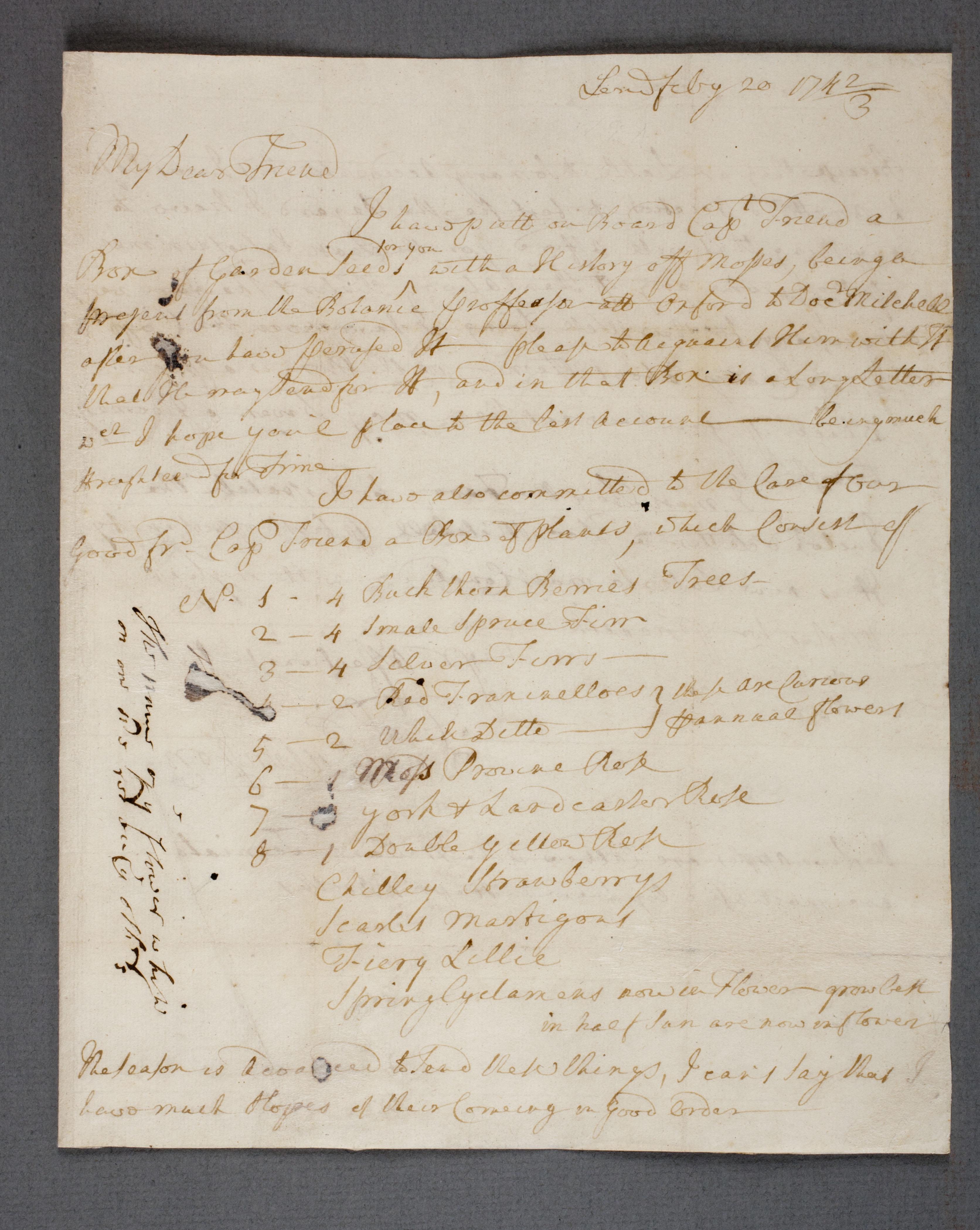
Within the Curwen Papers are letters with dates such as March 4th, 169 1/2, and February 15th, 174 3/4.  Take a look at some examples below.

These letters showcase the change from the Julian to the Gregorian calendar, which happened officially in the colonies in 1752, as decreed by Great Britain with the Calendar (New Style) Act of 1750.  Before this act, according to the Old Style calendar, the year officially began on March 25th.  Only after the switch to the Gregorian calendar in 1752 did the year begin on January 1st.  So during January, February and March, many people were probably very confused as to how to date their letters, especially when considering to whom and where they were writing, as countries were switching calendars at different times (Italy, France, Spain and Portugal adopted the New Style in 1582, and Greece was last to the party in Europe, adopting the New Style in 1923.)

It’s interesting to see how early these dates appear, and makes me wonder how the news of the switch was spreading, and how it was being received.  There is a historically unproven, but still telling, myth that Londoners rioted during the passage of the act in 1750 because they wanted their 11 days back that they lost during the change over.

If you’d like to see how the colonists were told of the change, almanacs are one way to go.  An Almanack of almanacks, collected from Poor Job, and others. For the year of our Lord 1752. … : With a small allowance fitted for the province of Massachusetts-Bay, New-Hampshire, Rhode-Island, and Connecticut. : With an abstract of the act of the Parliament of Great-Britain, for regulating the commencement of the year, and for correcting the calender [sic] now in use featured a three page explanation of the switch, which you can read here.

And stay tuned next week for more history behind, and reaction to, the switch.

Chromolithographed Christmas Cards

The holiday rush has started for us all, so we hope you will forgive us at Past is Present for having taken a bit of a break recently.  To kick off the month of December, in the spirit of Christmas giving, please accept these chromolithographed Christmas cards as our present from the past.  Click on any of the cards below to view the larger image.  Or come by the AAS reading room in person and see the originals on display in our reading room exhibition case for the month of December.

Boston lithographer Louis Prang developed the Christmas greeting in the 1870s and 1880s, flooding the market with beautiful, mass-produced, chromolithographed Christmas cards. Many of the examples here are Prang cards. Some were single postcard-sized cards with small poem or greetings printed on the back.  Other cards were decorated with mica sparkles, like the sleigh ride scene at right above, or with fringed fabric trim, like the pug card at right below.

The Prang Company held yearly competitions for Christmas card designs, encouraging both notable and amateur artists to submit work.  The examples below were taken from a salesman’s sample book of the 1880s showing two contest entries. “Merwy Kissmas” was designed by Alfred Fredericks, a New York illustrator and artist, and won fourth prize in 1884. The card at right, designed by C.D. Weldon, shows a child’s idealized dream of Christmas and won first prize in the 1885 competition.

Businesses also gave out Christmas themed trade cards, such as the card advertising Holmes & Coutts famous biscuits, and the card below was given to patrons of Barnard, Sumner & Co’s. department store in Worcester. Other cards were printed in series, and could be collected, such as the last two which showcase children with their pets.