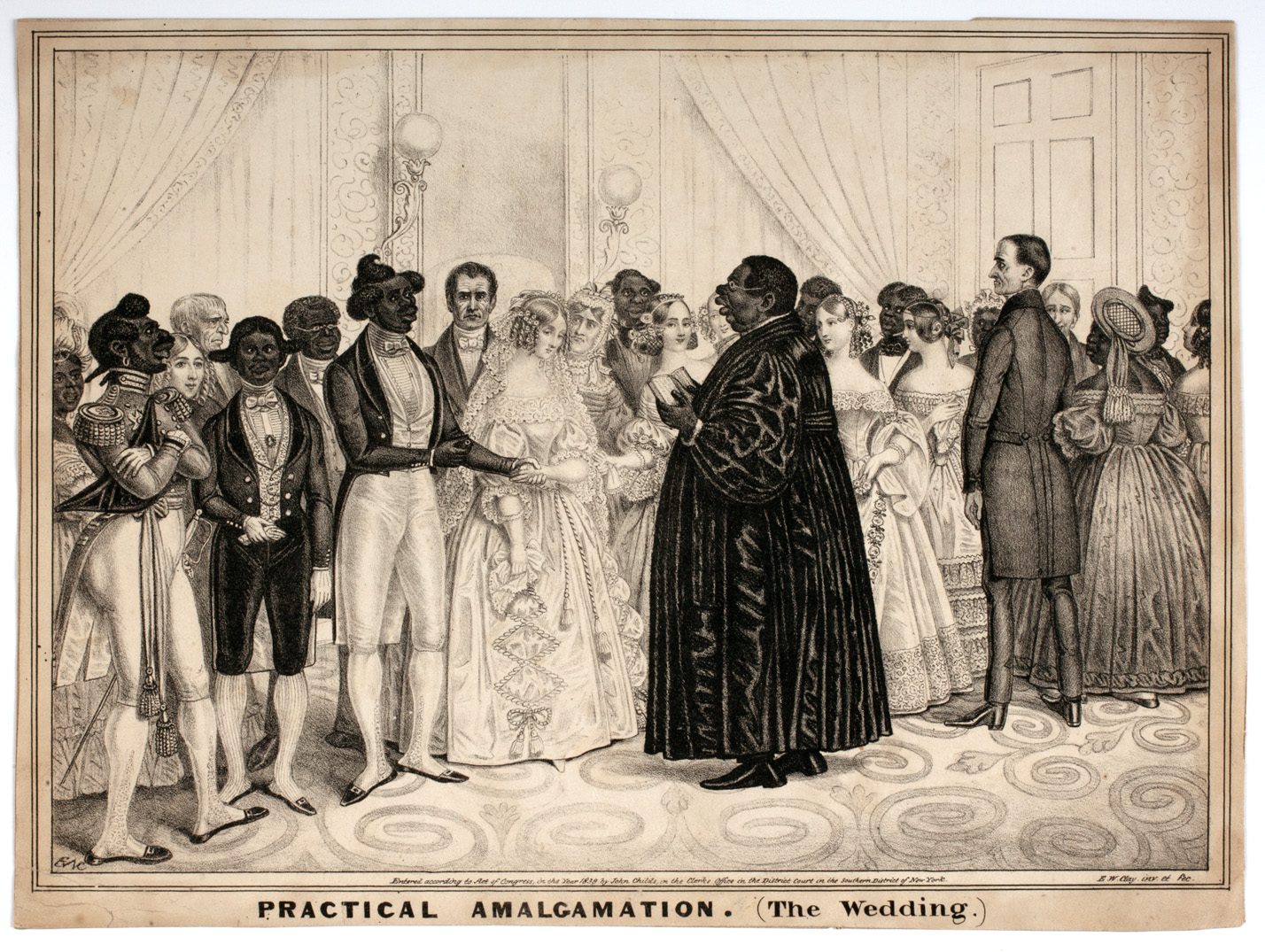
Edward W. Clay, PracticalAmalgamation. The Wedding.New York, John Childs, ca. 1839.
This print by Edward W. Clay is one in a series of images that comments on interracial relationships in America during the 1830s. Most of the prints in the set are held by the Society. This impression is actually a second copy of the wedding scene print. The donor contacted us after seeing a posting on the AAS blog Past is Present about another Clay image from the series, recently given to the Society by former librarian Nancy Burkett. The donor had three prints from the Clay series, all duplicates of prints already in the collection, but, because of their superior condition, we were pleased to accept them and add them to our holdings. The Clay prints are frequently used by scholars of reform, race, anti-slavery, and humor in the United States.
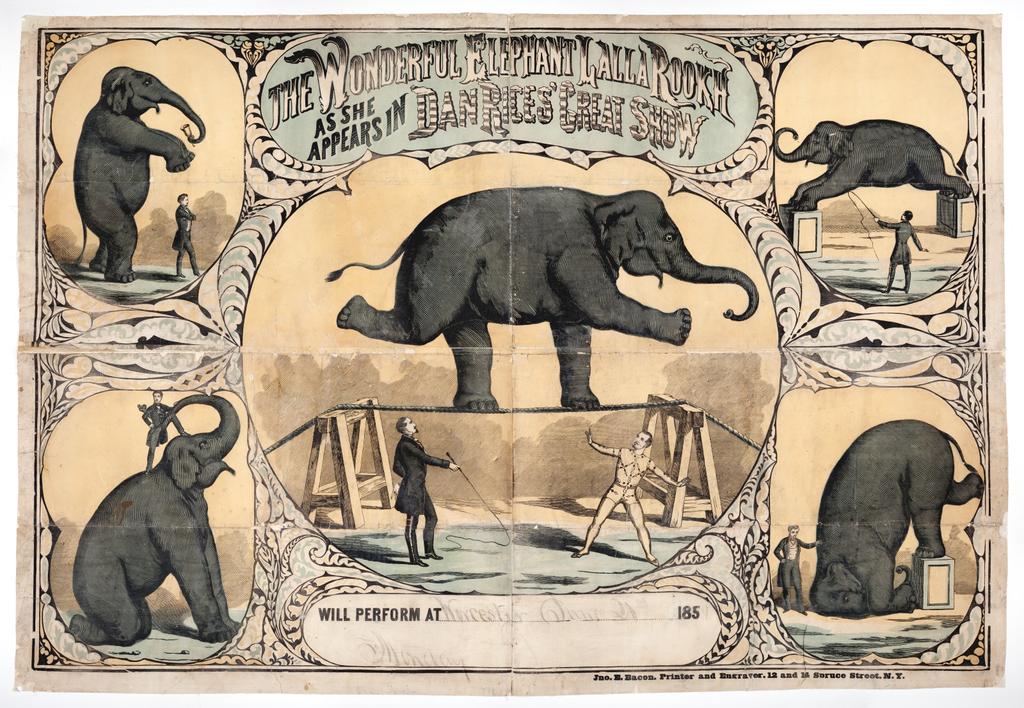
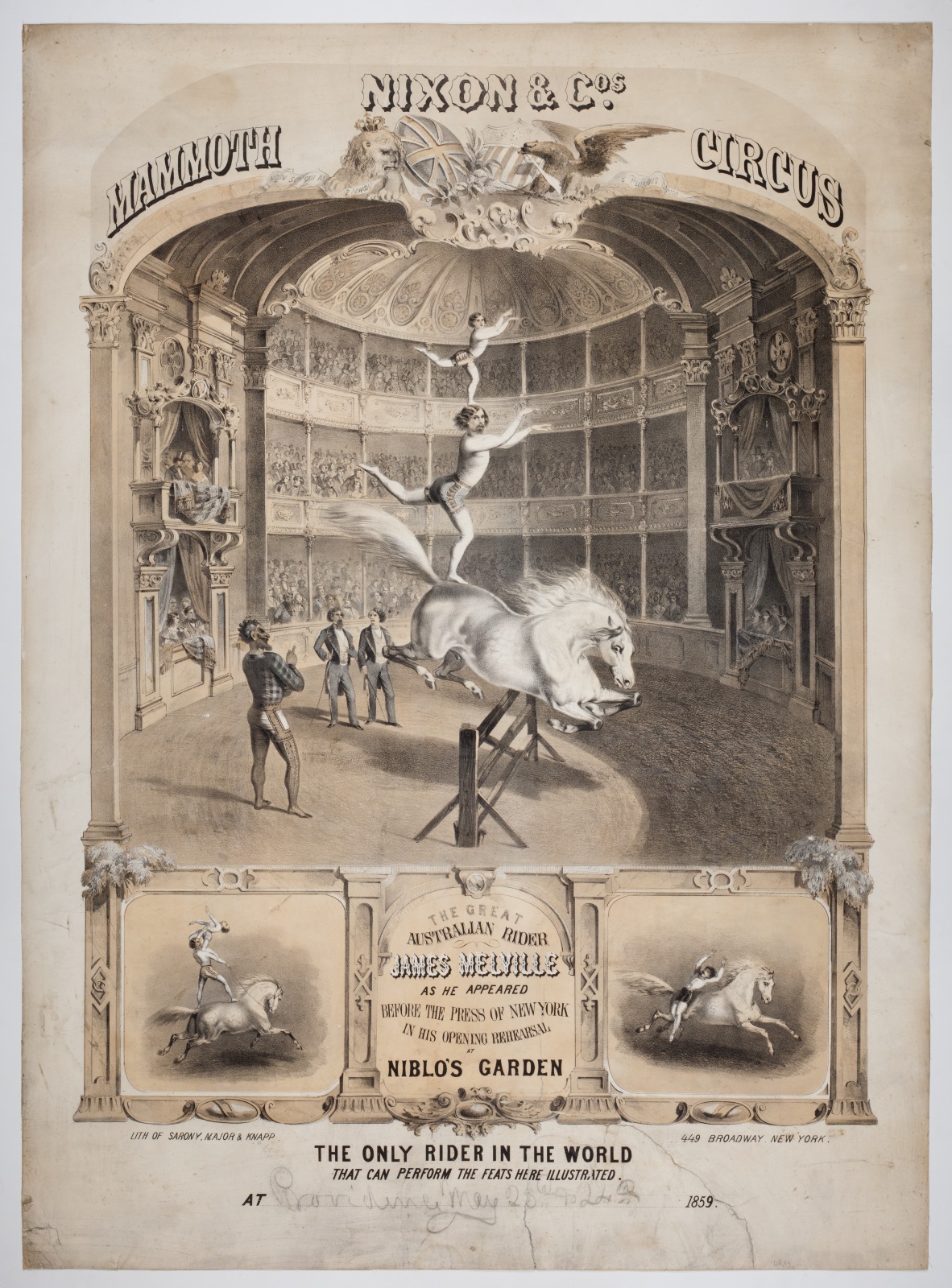
This month Circus and the City: New York, 1793-2010 opened at the Bard Graduate Center Galleries in New York (September 12, 2012 to February 3, 2013). You can learn more about the exhibition here. Two former AAS fellows, Matthew Wittmann and Brett Mizelle, contributed essays to the related (and very substantial) publication, The American Circus (New York: Bard Graduate Center, 2012), and the Society loaned four circus posters to the show, including one large poster of the elephant Lalla Rookh from the 1850s. Another of the AAS’s posters was featured in the New York Times review and slideshow of the exhibition, which you can read here.
But these are not the only AAS connections to the Bard show. When The American Circus arrived on the Society’s acquisition table, I was admiring the design and heft of the book and opened it up to flip through the pages to see the Society’s material. That was when I saw an essay by Kory Rogers, the Curator of Design at Shelburne Museum in Shelburne, Vermont. Shelburne has a wonderful circus collection, including carvings, toys and posters. Rogers wrote about a set of important circus posters which were discovered more than twenty years ago, under the siding of a house in Colchester, Vermont. As it happens, I was a young assistant curator at Shelburne Museum at that time, and was part of the crew that rescued the posters! Seeing the photos of the house and the posters brought back that experience immediately.
It began in the spring of 1991 when Shelburne Museum got a call from Harold and Gladys Degree in Colchester. They were doing renovations on their home and, when the old siding was removed, they discovered several very large, brightly colored posters underneath. Would we be interested, and if so, could we come quickly, as the contractors were waiting to continue their work? As Mr. Rogers writes, “Immediately a team of curators, conservators, and carpenters was dispatched to the scene to assess the situation and determine the safest and most expedient way to detach the posters from the walls.” With the conservators taking the lead, the carpenters set up huge plastic tarps and staging. We were planning to carefully remove the paper from the wooden clapboards. However, the process would prove not to be so simple. Close examination of each sheet revealed that a second layer of posters existed underneath. Mr. Rogers explains that this was the result of a posting war between two travelling circuses, the Adam Forepaugh show and the John B. Doris troupe, who were fighting for customers in 1883. In July of that year John B. Doris put up several showy posters on the house in Colchester, only to have them plastered over by Forepaugh’s advance men. Sometime shortly thereafter, the house was encased in siding and the posters were hidden from view for over 100 years.
So there we were, up on the scaffolding, attaching acid-free strengthening tabs across all the tears on the fronts of the posters to ensure that they were stable. It was slow going using small spatulas to lift both layers of paper away from the wood. Too slow. The contractor was tapping his foot waiting for us to make quick work of the images of giraffes, snake charmers, and tightrope walkers that had suddenly interrupted his job. And then it started raining. We regrouped. One of the carpenters pulled out his Sawzall. Further discussion with the contractor ensued. More Sawzalls appeared. I was given quick instructions on the operation of this power tool (amazing things, really, they indeed can cut through anything). And soon the conservators and an assistant curator (me!) were all up on the scaffolding cutting the clapboards away from the house, with the posters intact, board by board. The carpenters came behind us, replacing the boards with new lumber, and the head conservator was numbering and wrapping the boards for storage.
It was an exciting day. I am not sure how many print curators can say they learned to use power tools on the job, but the buzz and vibration of that tool was the first thing I remembered when I was flipping through the catalog and saw the photos of the house in Colchester. My second thought was “Huh, how about that…” It is a small world indeed, when an exhibition focused on the big top can unite and compress a twenty-three year career in the blink of an eye.
Several of the Colchester posters, by the way, have now been restored and are included in the exhibition. That work, and the fundraising it took to complete it, happened well after I left Shelburne in 1995 to take a new job closer to my spouse here in Massachusetts. To learn more about the restoration of the posters and to see a picture of the house while the posters were still on it, visit the Northeast Document Conservation Center’s (NDCC) website.
It is probably not news to readers of this blog that The New York Times recently, and favorably, reviewed the American Antiquarian Society’s Grolier Club exhibition “In Pursuit of a Vision.” But readers familiar with the two societies neither will be surprised that the AAS has exhibited at the Grolier Club in the past (in 1967 with “A Society’s Chief Joys”) and contributed items from its own collections to many exhibitions held at and sponsored by the Grolier club, including:
“Children’s Books” (1929)
“Books, Prints, and Manuscripts by and relating to Dibdin” (1935-1936)
“Engravings by Paul Revere” (1936, with an address by Clarence Brigham on March 19)
“Prints and Drawings by Hans Holbein” (1937)
“History of Navigation” (1938)
“Frankliniana” (1939)
“American Calligraphy” (1944)
“Unique Books, Pamphlets, and Broadsides” (1944)
“One Hundred Influential Books, 1640-1900” (1946)
“Caricatures Relating to America, 1760-1815” (1946-1947)
“Association Books” (1947)
“American Hand Bookbindings” (1947)
“Work of Famous American Women Writers” (1948-1949)
“Writings of Edgar Allan Poe” (1949)
“The Sea in Literature” (1953)
“Famous Children’s Books” (1953-1954)
“‘Odd Volumes’ – Books of Interest for the Unusual Nature of their Format, Binding, or Materials” (1955-1956)
“Manuscripts and First Editions of American Literature of the South” (1957)
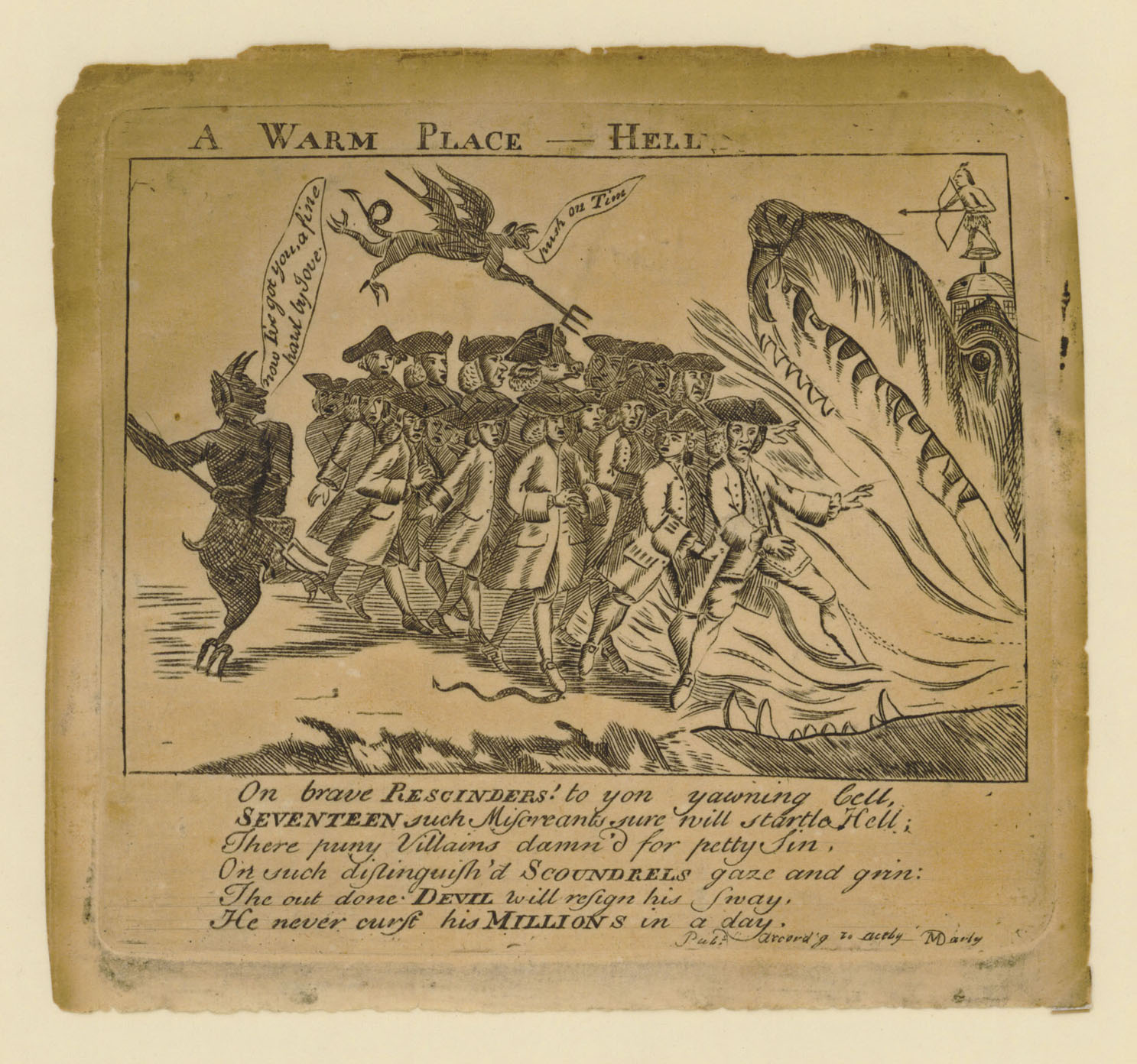
The exhibitions, both together and separately, reveal a history of AAS collections and of America that The New York Times has called “exuberantly shapeless.” To the 1946-47 American caricatures exhibit alone, the AAS contributed three Revere engravings (“View of the Year 1765,” “Warm Place–Hell,” “View of the Obelisk”), a Nathaniel Hurd engraving (“Courtship and Marriage”), one Amos Doolittle engraving, and three William Charles works, among others. The 1947 bookbindings exhibition got an Edmund Ranger and a John Ratcliff binding from the Mather Library in addition to six other bindings. And the library provided, with other manuscripts, marbled sheets from Fanny Hill for the 1955-56 odd volumes exhibition.
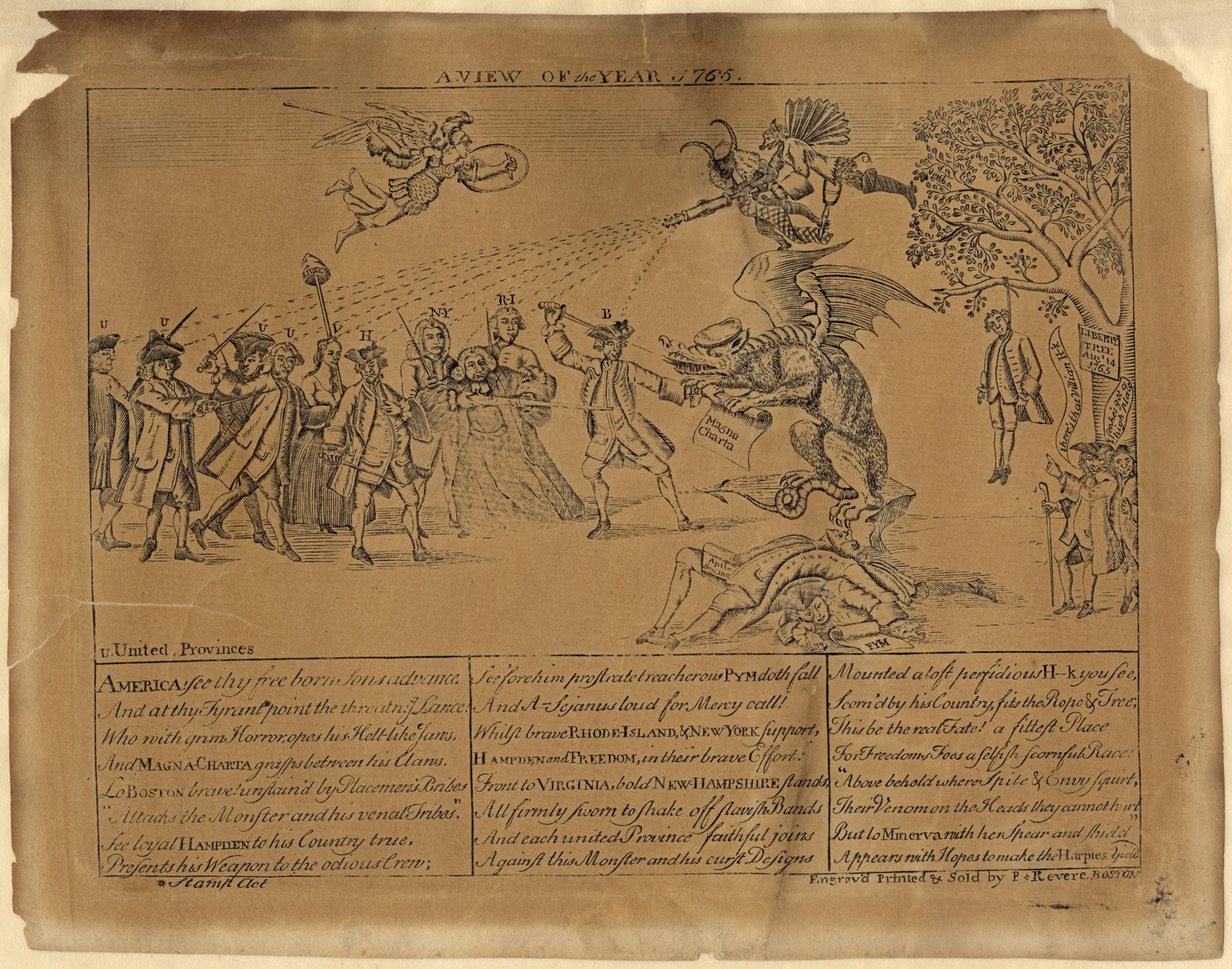
Paul Revere, "A View of the Year 1765" (1765)
Relations between the Grolier Club and AAS were friendly throughout the planning stages of each exhibition, even when disagreements arose between the two parties. For instance, after Director Clarence Brigham presented at the Revere exhibition, he was asked to publish his work with the Grolier Club. Brigham declined, writing on May 18, 1936: “I want a fairly large edition of the Paul Revere book, and I do not think that a publisher would bring out an edition if the Grolier Club in a way skimmed the cream from the market through previous publication.” The same exhibition spurred Grolier Librarian Ruth Shepard Granniss to write on March 4, 1936: “When I come to think of it, I cannot imagine how eighteen cases can be filled with Paul Revere’s work.” Brigham assured her that the cases would be filled, with 53 engravings and other works by Revere.
Out of all of the exhibitions, Brigham seemed most interested in the 1944 exhibition featuring unique books. On November 1, 1943, he even offered a volume from his personal library for the exhibition: “I have seldom seen a more attractive possibility than the projected exhibition of Unique Books and I hope that it goes through. Would ‘only known copy’ be construed as unique? The only item I have in my private library which might qualify is a Latin tract with the title ‘Oratio ad Crucifixum’ by Johannes Baptista de Cruce, Spanish printing, c. 1498, pp. 7, bound in full morocco. Every word in the text–about 1500 words–begins with the letter S and the tract was written in answer to a Jewish tract, every word of which began with the letter M. Although undated […] it was printed about 1498 and […] the only other known copy was in the Vatican. Perhaps it is not there now if the Germans have raided that library. In the library of the Antiquarian Society we have many ‘unique’ books which of course I could loan as Director.”
AAS and its staff have been dedicated to preserving the unique history of America and the printed word for a long two hundred years, through both the plundering of war and of digitization. Here’s hoping for another two hundred.
Editorial Note:Also check out our earlier post describing the current Grolier Club exhibition.
Everyone connected closely with AAS knows our old orientation film, produced in 1987 for the 175th anniversary celebration and hosted and narrated by Walter Cronkite. (If you haven’t seen it, it’s still available on our website.) Although this film has served us well over the years, we believe that it’s time the Society shows how it has grown and diversified in the last quarter-century, and how it fits into the quickly-changing twenty-first century. Thus, the Society has produced a new orientation film for our bicentennial year that shows the diversity and extensiveness of our collections and describes the accessibility, inspiration and transformation that many readers have experienced working at AAS. Click on the video below to see it now. It will also be shown at AAS events and during our tours of Antiquarian Hall.
As Director of Outreach, I wrote and served as executive producer of the project. I worked with Lawrence Hott and Diane Garey of Hott Productions/Florentine Films. Larry and Diane, who are also married, began working together in 1978, as members of the Florentine Films consortium. They formed Florentine Films/Hott Productions in 1981. Since then they have produced nearly two dozen films for national PBS broadcast including most recently TheWar of 1812, Divided Highways, John James Audubon: Drawn from Life, Niagara, and The Adirondacks, among many other films. Their awards include an Emmy, two Academy Award nominations, a duPont -Columbia Journalism Award, the Erik Barnouw History Award, the George Foster Peabody Award, five American Film Festival Blue Ribbons, and 14 CINE Golden Eagles.
The new film features many AAS members and friends who speak powerfully of what the Society and its collections mean to them and the nation. These people include such well-known AAS members as Jill Lepore, Nathaniel Philbrick and David McCullough. In addition the film features former fellows Honorée Jeffers and Ilyon Woo, scholarly AAS members William Fowler and Scott Casper and AAS council member William Reese.
Stay tuned for another post coming soon featuring six short modules that were produced along with the film that describe various aspects of the Society’s collections and activities in greater depth, including Access, Preservation, Collections, Scholarly Programs, K-12 Programs, and Fellowships.
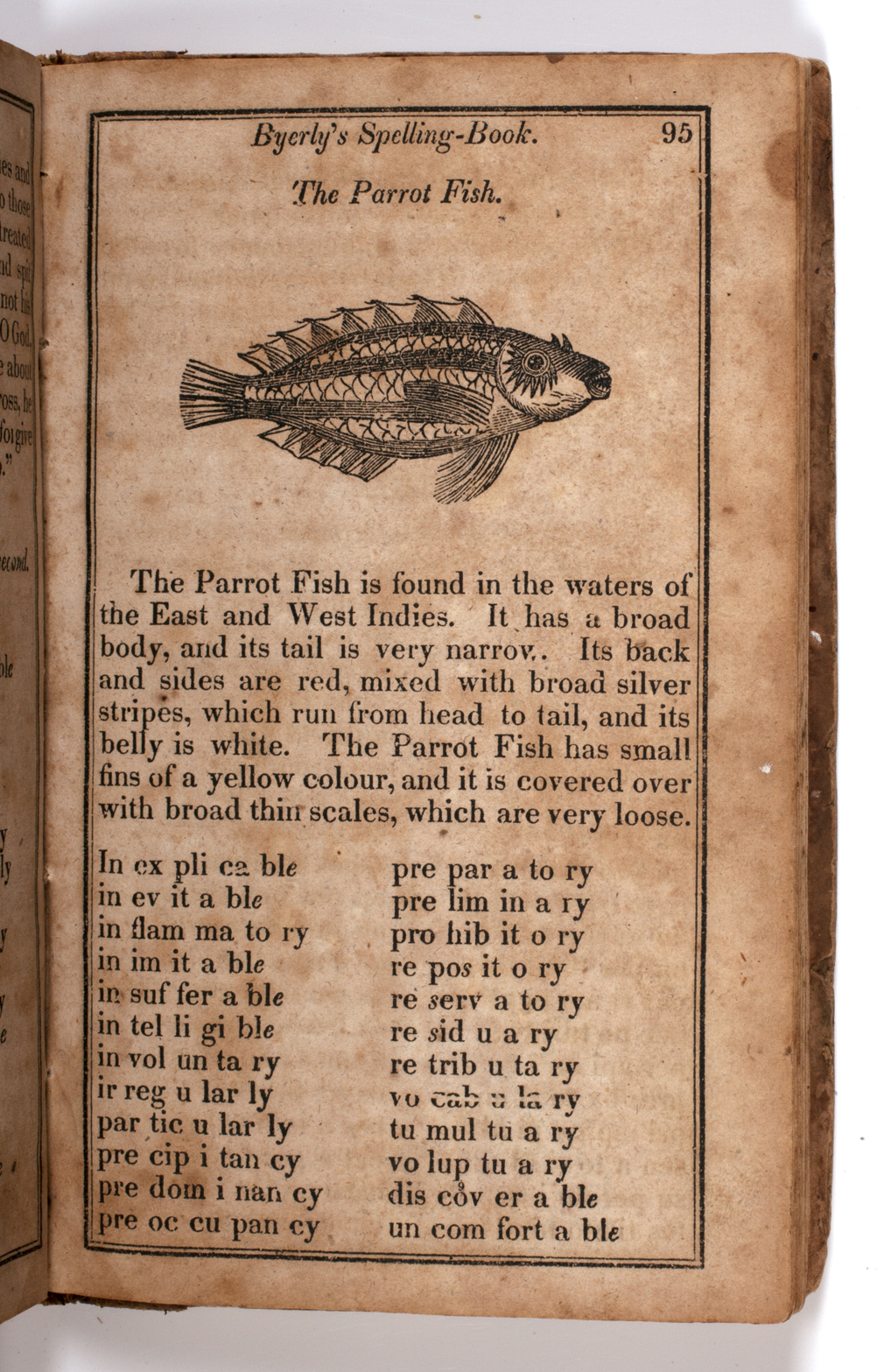
Byerly, Stephen. Byerly’s New American Spelling-Book. Philadelphia: M’Carty & Davis, 1830.
This lovely wood engraving of the exotic Caribbean parrot fish is taken from a speller written by Quaker school teacher Stephen Byerly (c. 1797-1850). His spelling and reading lessons are punctuated with clear illustrations of animals both common and uncommon to his young readers such as the rooster, the carp, and the hippopotamus.
We are pleased to announce the start of our signature bicentennial Fall Public Programs! The programs this fall include an impressive array of scholars and artists who will share new perspectives on key moments and fascinating people in American history.
We will be kicking off the series on September 28 at 7 p.m., when Vincent Carretta, professor of English at the University of Maryland and a specialist in eighteenth-century transatlantic historical and literary studies, delivers the twenty-ninth annual James Russell Wiggins Lecture in the Program in the History of the Book in American Culture.
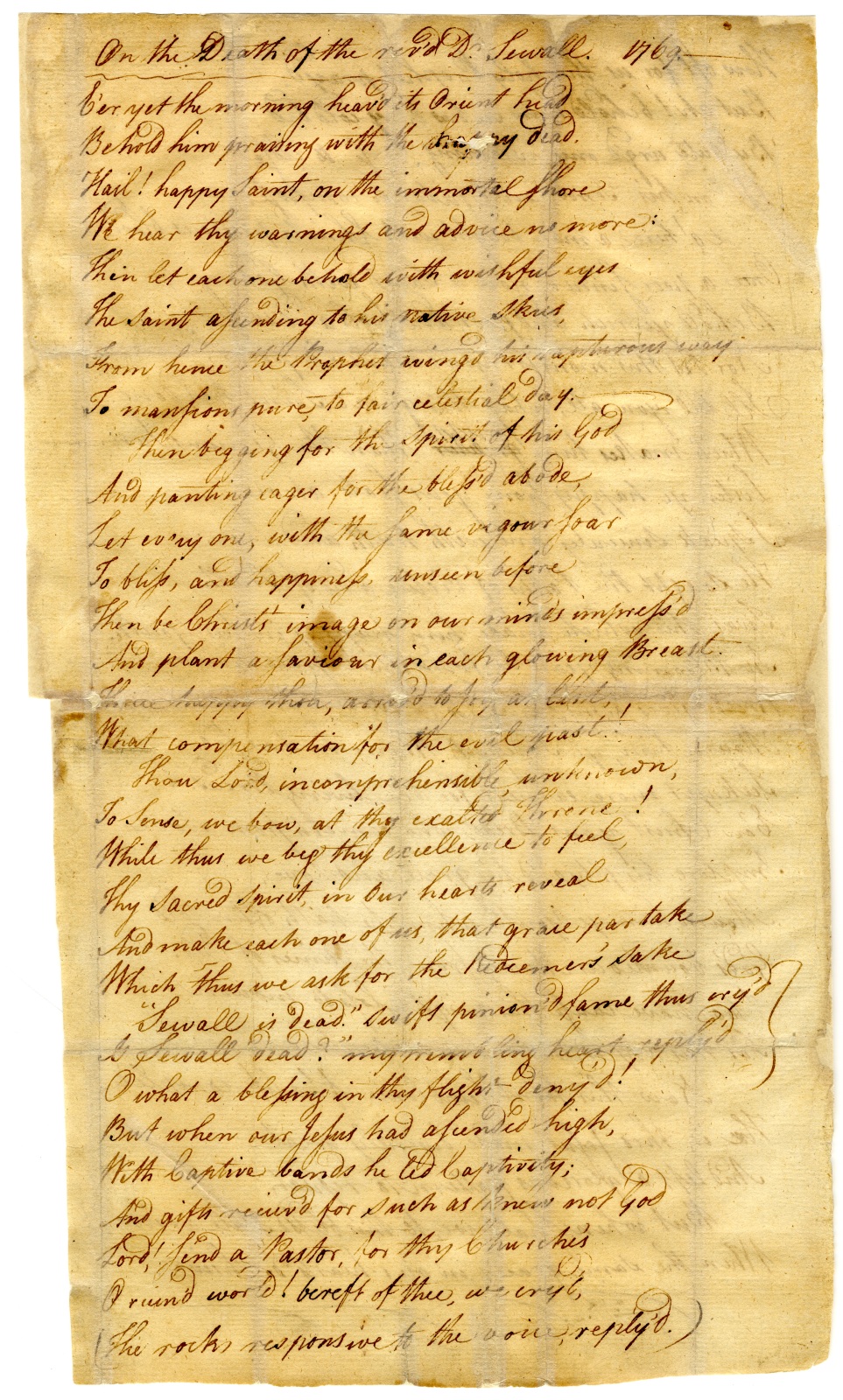
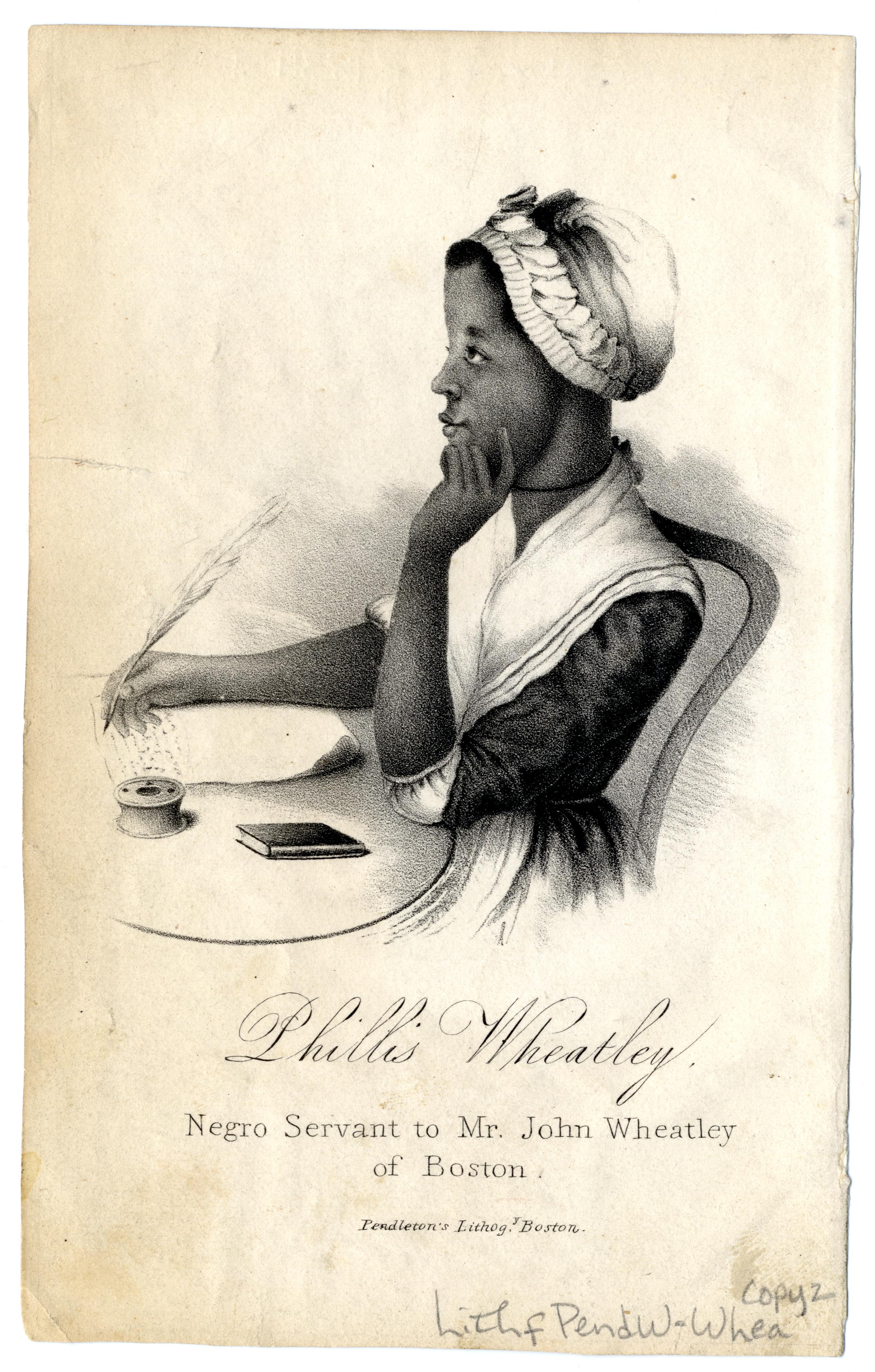
Manuscript poem, "On the Death of the rev’d Dr. Sewall" (dated 1769). This is an elegy to her pastor, Joseph Sewall (1688-1769).
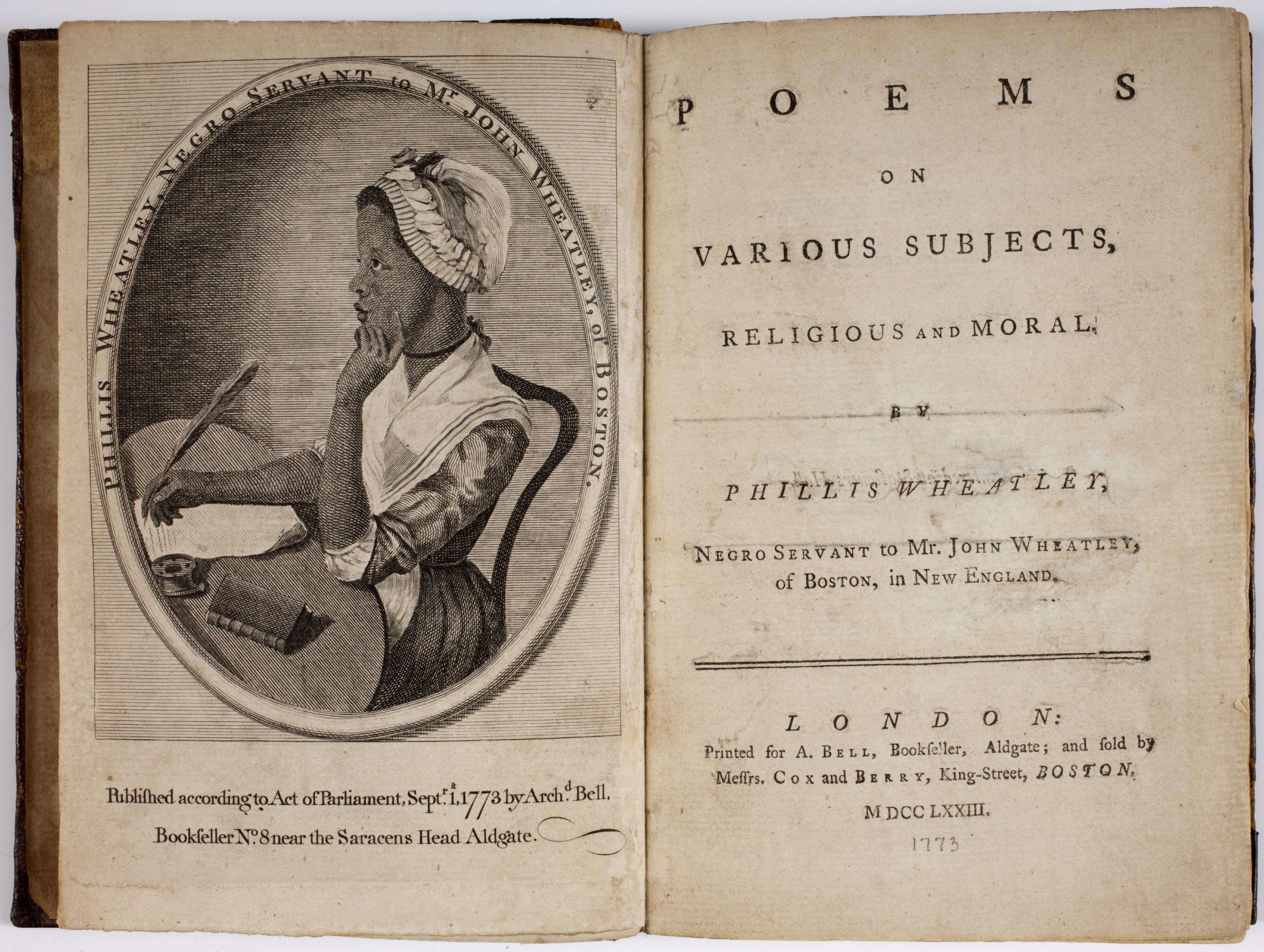
In this lecture called “In Search of Phillis Wheatley,” Carretta will share the story behind researching and writing the first full-length biography of Phillis Wheatley. After stepping off a slave ship in Boston Harbor at the age of 7, she rose to international fame while still a slave after the publication of her Poems on Various Subjects, Religious and Moral in 1773. Despite this early success, she died in poverty and obscurity, leaving little behind for biographers to piece together the extraordinary life of the first English-speaking person of African descent to publish a book and the second woman of any descent to publish a book in America. Now, almost 250 years after Wheatley arrived in America, Carretta has been able to solve some of the mysteries surrounding Wheatley’s life and piece together a more complete narrative of her involvement in the publication and distribution of her work, her rise to fame, and her post-emancipation life.
Please join us for the first public lecture of our fall series! All lectures are free and open to the public. To see what other lectures are coming this fall, visit our website.
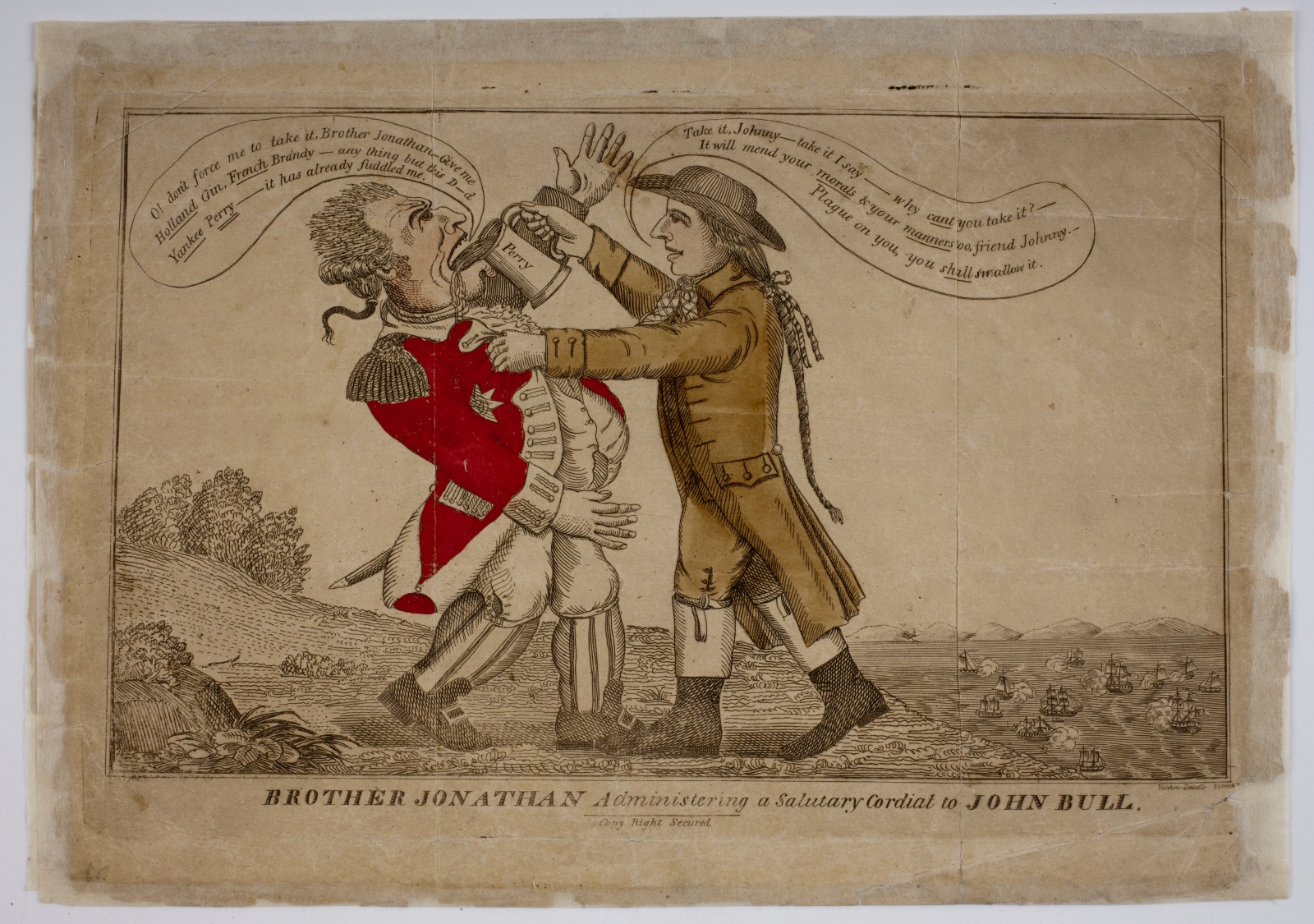
Amos Doolittle, "Brother Jonathan Administering a Salutary Cordial to John Bull," New Haven, CT (1813)
As many of you may already know, the story of the American Antiquarian Society is in many ways linked to the War of 1812. For if the war had not been underway when Isaiah Thomas decided to found the Society, we could very well have ended up in Boston rather than here in Worcester. As it was, however, the ever-practical Thomas realized that busy port towns would be a prime target for the British Navy – as Washington D.C. proved to be two years later – and decided that the inland town of Worcester would be a safer place for his collections and the Society.
So, what better way to celebrate our bicentennial than with a conference about the related bicentennial of the War of 1812? On October 13, in our first K-12 program of the year, AAS, in conjunction with the New England History Teachers Association (NEHTA), will be presenting a conference for teachers on all aspects of the war. In addition to concurrent sessions covering the political, martial, and cultural causes and effects of the war, a plenary talk by William Fowler of Northeastern University will discuss why we should care about a war that was ultimately a draw and has all but been forgotten by all parties involved except for Canada.
Teachers will have the opportunity to attend sessions that cover pedagogical approaches and the latest scholarship in the field. They will explore topics such as the culture surrounding the conflict, both in the United States and Canada; the war at sea; the conflict in an international context; and the impact of the war on American politics. And of course, this conference would not be complete without some of AAS’s own treasures relating to the War of 1812 on display. There will be a special exhibition in Antiquarian Hall and participants will have an opportunity to work directly with some of the materials during a session on images of the war and the early nineteenth-century Atlantic world.
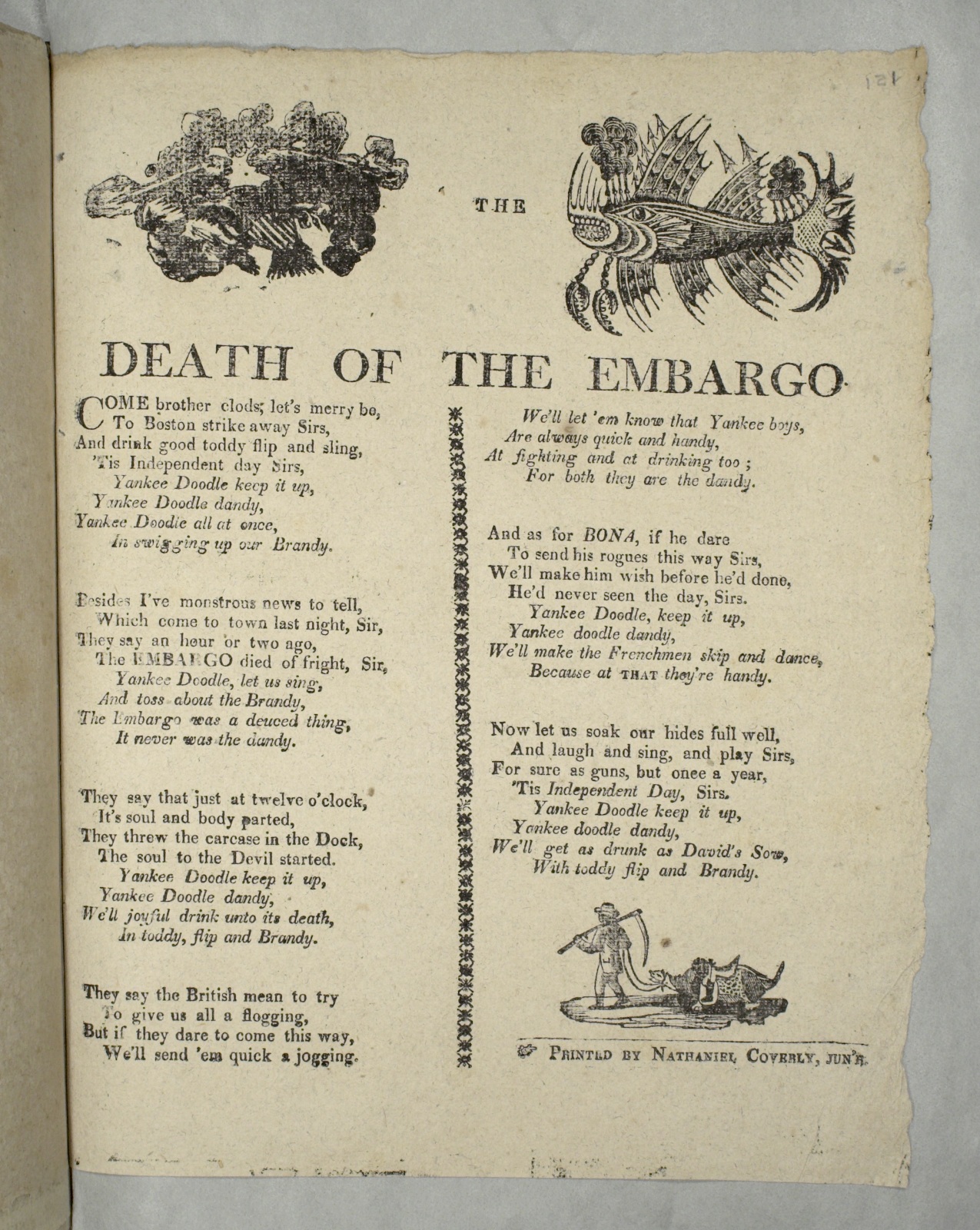
Nathaniel Coverly, "The Death of the Embargo," Boston, MA (c.1809)
The keynote for this conference will be a lecture by Pulitzer Prize-winning historian Alan Taylor based on his recent book, The Civil War of 1812. This will take place the previous evening, October 12, at 7 p.m. as part of our fall public program series.
Another special guest will be David Hildebrand, musician and author, who will not only conduct a session on the music of the war, highlighting the origin of the Star Spangled Banner, but will also perform a concert in period costume and on period instruments, at a special reception closing the conference.
More information and online registration is available on the conference page on our website.
This conference is sure to be one filled with instructive discussion, interesting presentations, and entertaining performances. Please join us in celebrating the bicentennials of the War of 1812 and AAS!
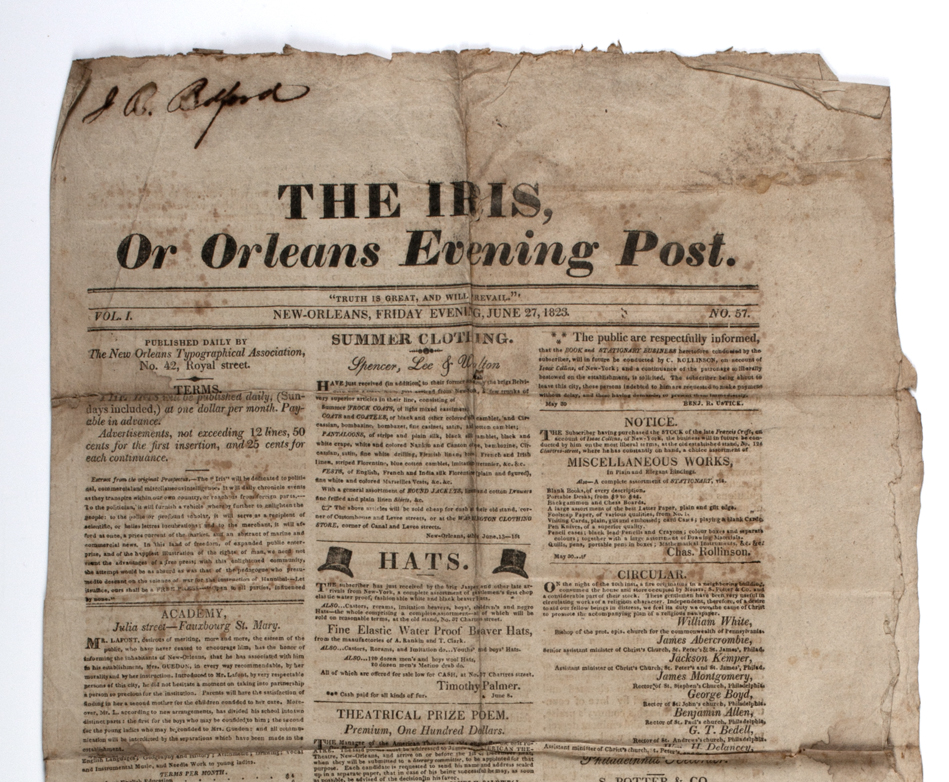
The Iris, or Orleans Evening Post (New Orleans, LA). June 27, 1823. Vol. 1, no. 57.
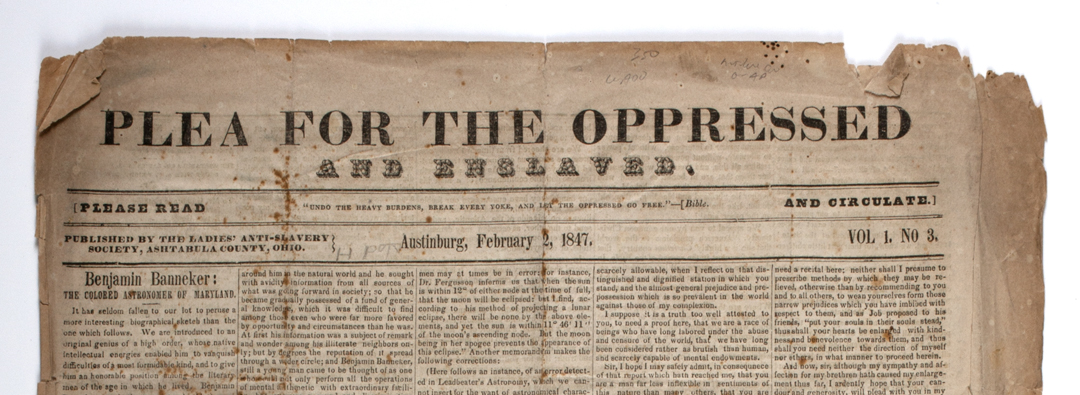
This is an unrecorded daily New Orleans newspaper that appeared on eBay. It was started by the New Orleans Typographical Association in May 1823. According to an article in the Salem Gazette (MA) of June 3, 1823, this paper was started by “Journeymen Printers, who allege that they are driven to this undertaking by the oppression of the Master Printers.” The editor was Henry T. Beatty who died in September 1823 during an outbreak of Yellow Fever. The paper was quoted in other papers as late as March 1824, so probably ended soon after.
Although we’re often holding newsworthy events, conferences, and lectures, the bicentennial has brought even more media attention than usual to AAS and its offerings.
Today, poetry occupies one of the smallest possible corners of the publishing landscape. The market for books of poetry by contemporary poets is miniscule, and—apart from occasionally having one of the poems in, say, the New Yorker catch one’s eye—many readers can go months (if not years) without seeing a contemporary poem in print. This was emphatically not the case in early America. In an age when novels were still morally suspect, poetry was the highest form of literary art—but also the lowest, as cheap ballads and broadsides featuring humorous doggerel were readily available from printers around the colonies. Poetry was used to teach history, to raise money for charity, to convert unbelievers to Christianity, to entertain, cajole, and comfort.
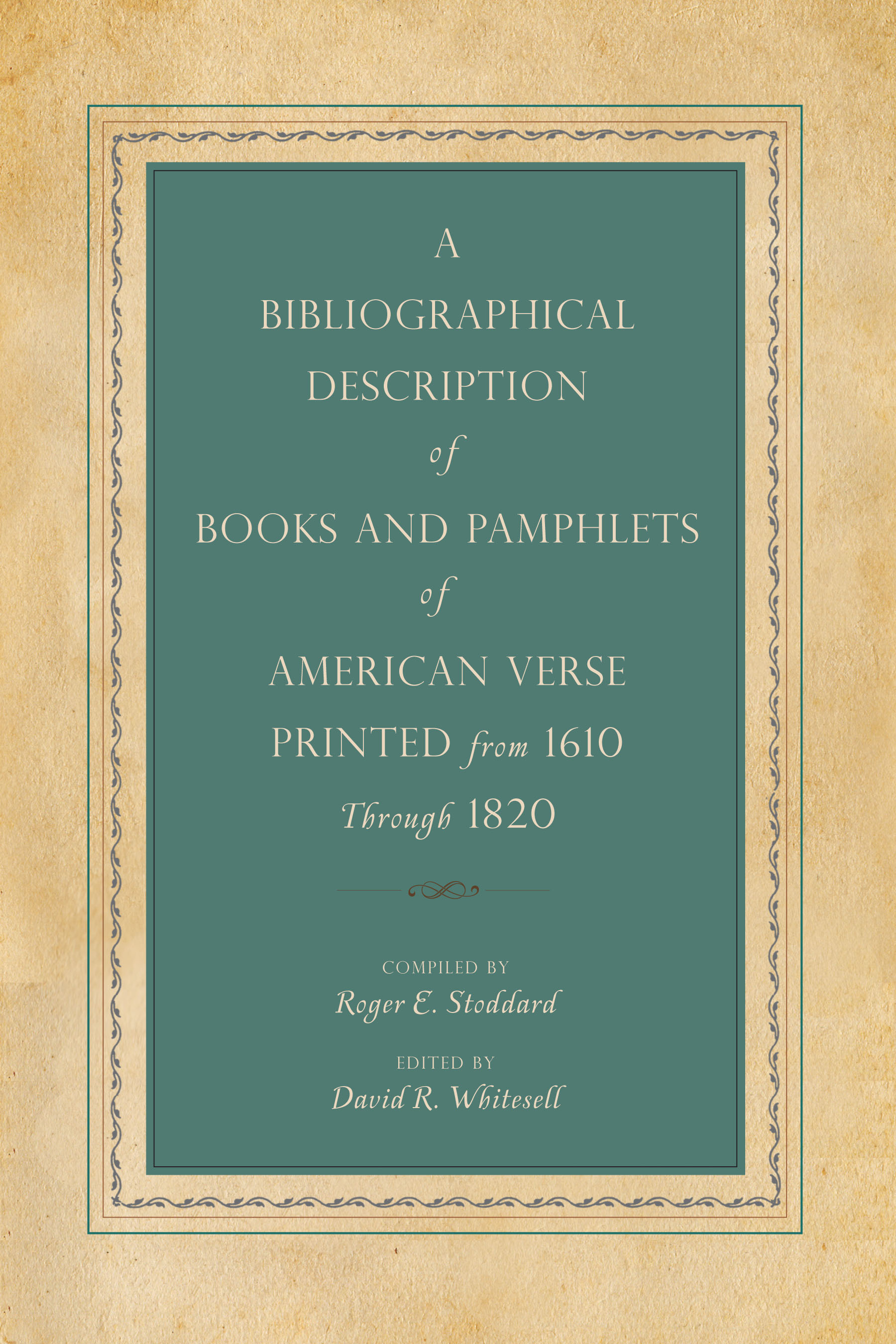
On September 29, AAS will examine the place of poetry in the world of early American print culture in a symposium titled “Poetry & Print in Early America.” This symposium, sponsored by the Bibliographical Society of America, is being held to mark the publication of A Bibliographical Description of Books and Pamphlets of American Verse Printed from 1610 Through 1820. This bibliography—compiled by Roger Stoddard, and edited by David Whitesell—is a landmark of scholarship on early American printing, and is destined to become the standard bibliographic work in the field for decades to come.
The American Antiquarian Society holds many of the titles examined in this new bibliography, and we are delighted to observe its publication with a rich set of conversations about poetry in early America by bibliographers, scholars, and book dealers and collectors. Ranging from examinations of early African-American hymnbooks to the productions of a “mad poet” in early Philadelphia, the presentations at the symposium will be of interest to those who study poetry, those who write poetry, and those who love poetry. A full program for the symposium and registration details are available on the AAS website.
On the evening of Friday, September 28, the Society will host the Twenty-ninth Annual James Russell Wiggins Lecture in the Program in the History of the Book in American Culture. This year’s Wiggins Lecture, in keeping with the theme of the following day’s program, is titled “In Search of Phillis Wheatley,” and will be delivered by Vincent Carretta, professor of English at the University of Maryland, College Park. Phillis Wheatley—an enslaved African-American woman who was brought from West Africa to Boston as a young girl—won fame with the 1773 publication of a collection of her poetry, Poems on Various Subjects, Religious and Moral. This was the first book authored by an African-American woman to be published, and made Wheatley a figure of signal importance in American letters. Professor Carretta’s lecture will draw on his book, Phillis Wheatley: Biography of a Genius in Bondage (University of Georgia Press, 2011), which is the first full-length biography of Wheatley. The Wiggins Lecture is free and open to the public; further details are available here.
Each year, the Rochester Institute of Technology (RIT) honors a person or an organization with the Isaiah Thomas Award in Publishing in recognition of their outstanding contributions to the industry.
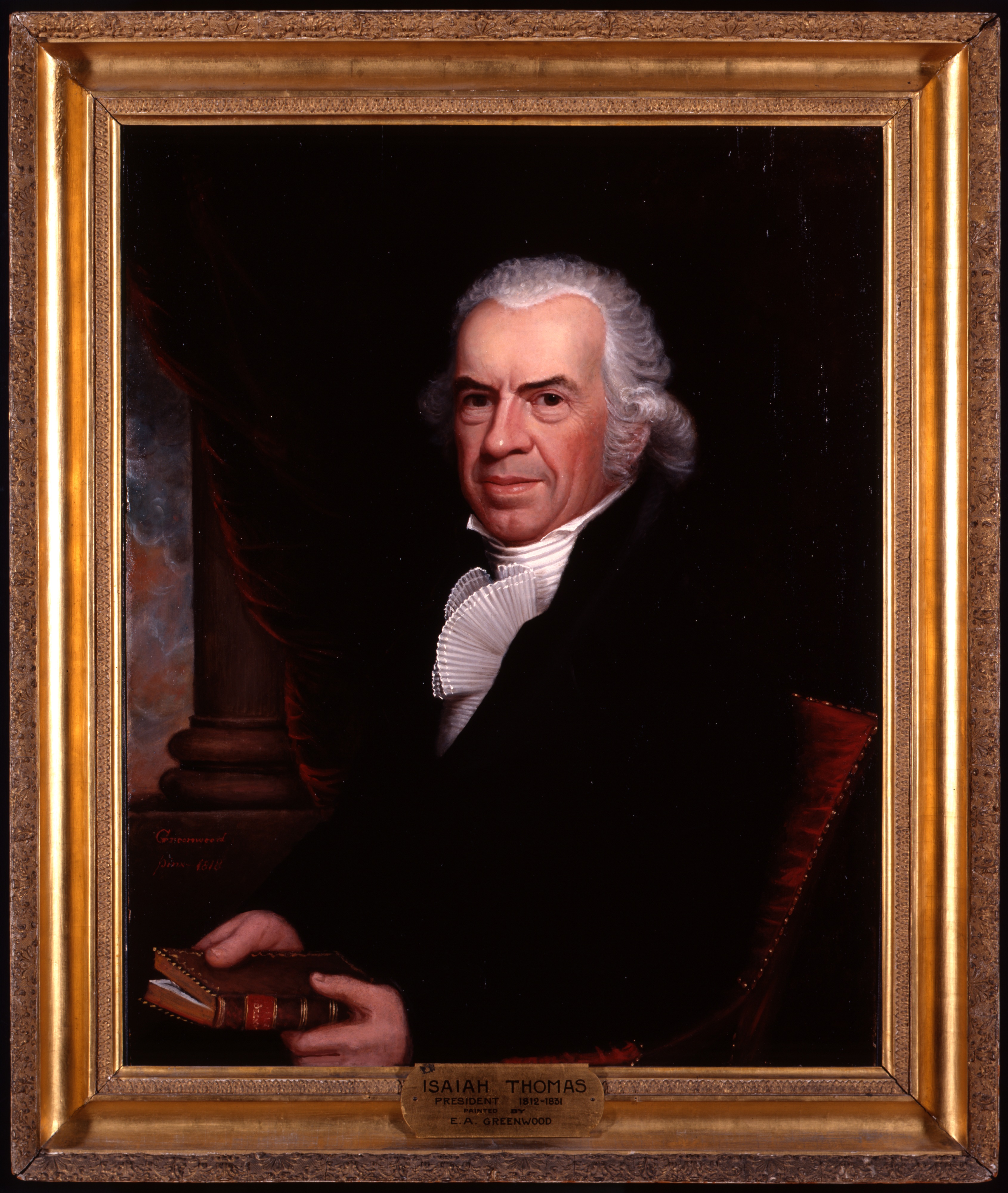
Portrait of Isaiah Thomas by Ethan Allen Greenwood (1818)
This year’s award honors AAS, in honor of the 200th anniversary of our founding by none other than Isaiah Thomas himself.
The award ceremony will take place on Thursday, September 20 from 10 a.m. to noon at the Campus Center of the Worcester Polytechnic Institute. Following the formal award presentation, we will host an open house in Antiquarian Hall that will include a special exhibition of our Isaiah Thomas materials, public tours of Antiqurian Hall and display a multi-media presentation produced by RIT’s Cary Graphic Arts Collection.
The theme of the event is “Celebrating the Life of a Patriot Printer: A Tribute to Isaiah Thomas.” It is free and open to the public.
The morning’s events will include a panel discussion titled “Preserving the History of News in a Digital Age” that will be moderated by David Pankow, director of the RIT Press. Distinguished panelists will include Vincent Golden, curator of newspapers and periodicals at the American Antiquarian Society; Frank Romano, president of the Museum of Printing (North Andover, Mass.) and RIT professor emeritus; Dr. Tracey Leger-Hornby, dean of library services at the Gordon Library at Worcester Polytechnic Institute; Bruce Gaultney, publisher of the Worcester Telegram & Gazette; and Alex Rogala, editor of RIT’s Reporter student magazine.
This year also marks the 75th anniversary of RIT’s School of Media Sciences (formerly the School of Print Media), which established the Isaiah Thomas Award in 1979.
Past winners of the Isaiah Thomas Award include RIT’s seven Pulitzer Prize-winning alumni who’ve won a combined 11 Pulitzers in photography (Paul Benoit, Robert Bukaty, Ken Geiger, Stan Grossfeld, Dan Loh, William Snyder and Anthony Suau); Katharine Graham, president, Washington Post Company; Thomas Curley, CEO and president of the Associated Press; and Arthur Sulzberger, chairman and publisher of The New York Times.
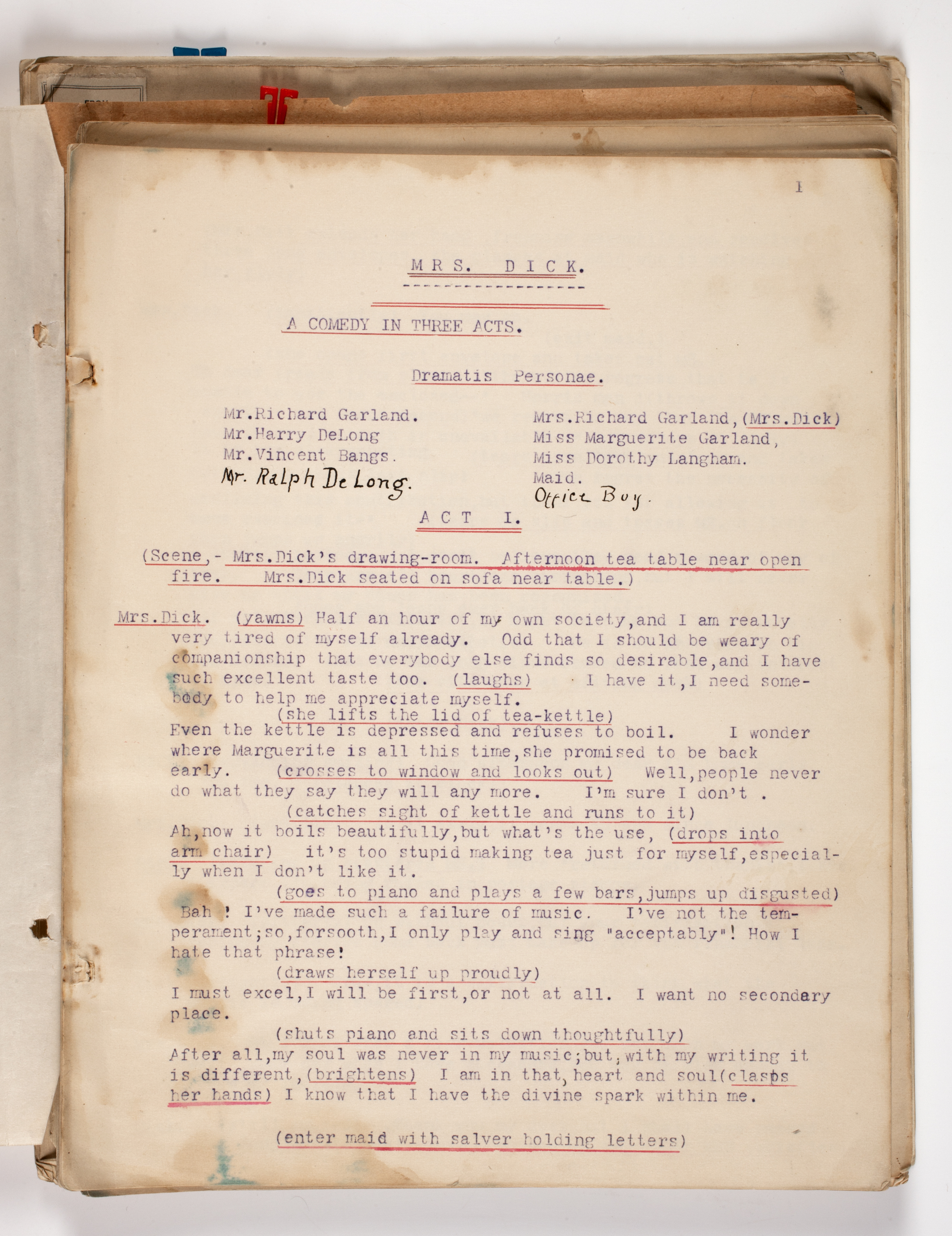
This handwritten textbook of geography is something of a mystery. Heavily illustrated with original drawings and images clipped from publications, the text is divided into lessons with topics such as “About Travelling,” “About the Surface of the Earth,” “About Animals,” and “About Trees and Plants.” The title, Fitch’s Geography… suggests that the text may have been written by George W. Fitch, author of several geography texts in the 1840s and 1850s. Is this a mockup made by Fitch? Or a work created by a teacher or student? It can be roughly dated by a map showing California (admitted 1850) as a state but Minnesota (admitted 1858) as a territory.
After Antiquarian Hall’s signature copper dome was renovated this summer, five bicentennial banners were installed on the Park Avenue and Salisbury Street facades. Custom-designed hardware will allow the banners to be changed in the future.
Four of the banners are on the library stacks, brick walls without windows that provide an excellent backdrop. Each features a collection item with a single word meant to convey – at a glance –priorities at AAS: Research, Lectures, Programs, and Fellowships.
The first banner shows the title page of Pamela: Or, Virtue Rewarded by Samuel Richardson. Initially published in London, this book was popular in both England and America. Benjamin Franklin printed this edition in 1742-1744 (AAS has the only known copy), making it the first novel published in America. Franklin started and stopped the job and, by the time he finished, had lost valuable time for selling the book. The London editions were widely available by then and Franklin swore never to print another novel. Pamela is a series of letters from a beautiful young woman to her parents, published “in order to cultivate the principles of virtue and religion in the minds of youths of both sexes.”
Installation of the banners.
The second banner features a group of young boys dressed up as soldiers with decorated hats, epaulets, fife, and drum. This is from the first page of an ABC book entitled Little Soldier Boys, published by McLoughlin Bros. in 1899. AAS has a superb collection of McLoughlin Bros. titles, a premier children’s book publisher in the mid- to late-nineteenth century. The firm was located in Springfield, Massachusetts and New York and is known for publishing beautiful books for children with rich, full-color chromolithographic illustrations.
The third banner is from an advertisement for Wagner & McGuigan’s Lithographic and Steam Power Printing Establishment, printed between 1851 and 1856. Patriotic symbols include the figure of Columbia, holding a sword and draped in the U.S. flag, and an eagle perched on a red, white, and blue shield. Since the purpose is advertising, it also includes a bust of Alois Senefelder, the inventor of lithography in 1798. The title “Encourage American Arts!” curves around rolls of paper and an artist’s palette. On the back side, the firm describes its “superior facilities” and a relief print shows more than forty presses.
The sidewalk scene in the fourth banner is from the title page of The Ledger Polka,sheet music published in 1849. AAS has approximately 60,000 examples of sheet music. This polka was “dedicated to the readers of the Public Ledger,” a newspaper that began publication in Philadelphia in 1836. The image by James Bellak shows a group of gentleman gathered outside of the newspaper’s office. The Ledger continued to be published until 1934, when it was absorbed by the Philadelphia Inquirer.
Banner to the left of the front entrance.
The fifth banner, to the left of the front entrance, announces the Society’s bicentennial: “AAS Celebrates 200 Years – A National Research Library of American History& Culture – Founded in 1812.” As bicentennial celebrations conclude at the end of 2012, this banner will be replaced, perhaps with one announcing AAS’s public programs and other special events.
Special exhibition to mark the Society’s bicentennial, at the Grolier Club, New York, September 12 through November 17, 2012.
Considered to be the first Confederate imprint, this broadside announced to the public the declaration, on December 20, 1860, that South Carolina would secede from the United States. This sheet was removed from a wall in Charleston by the popular Boston-born author Caroline Howard Gilman (1794-1888).
As most readers of this blog already know, the American Antiquarian Society was founded two hundred years ago, in 1812 in Worcester, Massachusetts, by the patriot, printer and publisher Isaiah Thomas. In fact, Thomas’s personal library forms the nucleus of the collection which today numbers four million items, over two million newspapers, and includes substantial holdings of periodicals, graphic arts, and manuscripts.
It would be difficult to truly represent the full breadth and depth of AAS collections in a single exhibition, so a different approach was taken by the Society’s curatorial team. We wanted to show that the creation of an institution like the Society depends on support from a large number of individual people. In Pursuit of a Vision introduces nearly thirty of the many librarians, philanthropic collectors, book dealers, members and scholars who have, over the past two hundred years, helped to build this independent institution into a national treasure. As aficionados and collectors well know, each acquisition, whether it is added to a public or personal collection, often comes with its own story. This exhibition and the generously illustrated catalog that accompanies it (order at Oak Knoll Books), chronicle the individual stories of almost two hundred objects, which have been arranged by theme: laying the foundation, late nineteenth-century benefactors, collecting in the twentieth century, bibliographic initiatives, specialized collecting, and responsible stewardship.
This mid-nineteenth century example of a children’s picture book depicting street vendors follows a long tradition of children’s literature about street vendors and their cries dating back to the late seventeenth century in London. The book was given to AAS by Charles Henry Taylor, head of the Boston Globe newspaper.
As the American Antiquarian Society begins its third century as a leading research library and a learned society, the institution’s success remains a collective achievement shared by many individuals, both past and present, whose commitment and generosity have made it a reality.
In the early days of the American Antiquarian Society, founder Isaiah Thomas asked members to send materials for preservation in the Society’s library at Worcester, Massachusetts. He explained, “We cannot obtain a knowledge of those who are to come after us, nor are we certain what will be the events of future times; as it is in our power, so it should be our duty to bestow on posterity that which they cannot give to us, but which they may enlarge and improve and transmit to those who shall succeed them.” Over the course of two hundred years, generations of the Society’s members, friends, and staff have ably answered Thomas’s call.
In Pursuit of a Vision celebrates the generosity and farsightedness of some of the many collectors, book dealers, and librarians who have, each in his or her own way, contributed to the greatness of the American Antiquarian Society.
Installed case at the exhibition.
LOCATION AND TIME: In Pursuit of a Vision will be on view at the Grolier Club, 47 East 60th Street, New York, from September 12 – November 17, 2012. The exhibit will be open to the public free of charge, Monday – Saturday, 10 a.m. to 5 p.m. Additional information and directions are available at www.grolierclub.org.
W. Barnard after Joshua Cartwright, The Cambrian of Boston, Willm. Marshall Master. Beating off a French Butter Privateer, on 23 October 1804. Boston, C. Cave, 1805.
In the fall of 1804, the British ship Cambrian was part of a blockade of New York Harbor. This print depicts the ship engaging a French cutter (several French ships were blocked in the harbor at the time) just outside of New York Harbor. The dispute was part of the Napoleonic Wars being fought in Europe and would help to raise American ire prior to the War of 1812, where the young United States of America would have to assert itself on the open seas to fight back against privateering and impressments. The Society’s holdings of pre-1820 engravings are exceptionally strong.