The Acquisitions Table: Captain Gregg and His Dog

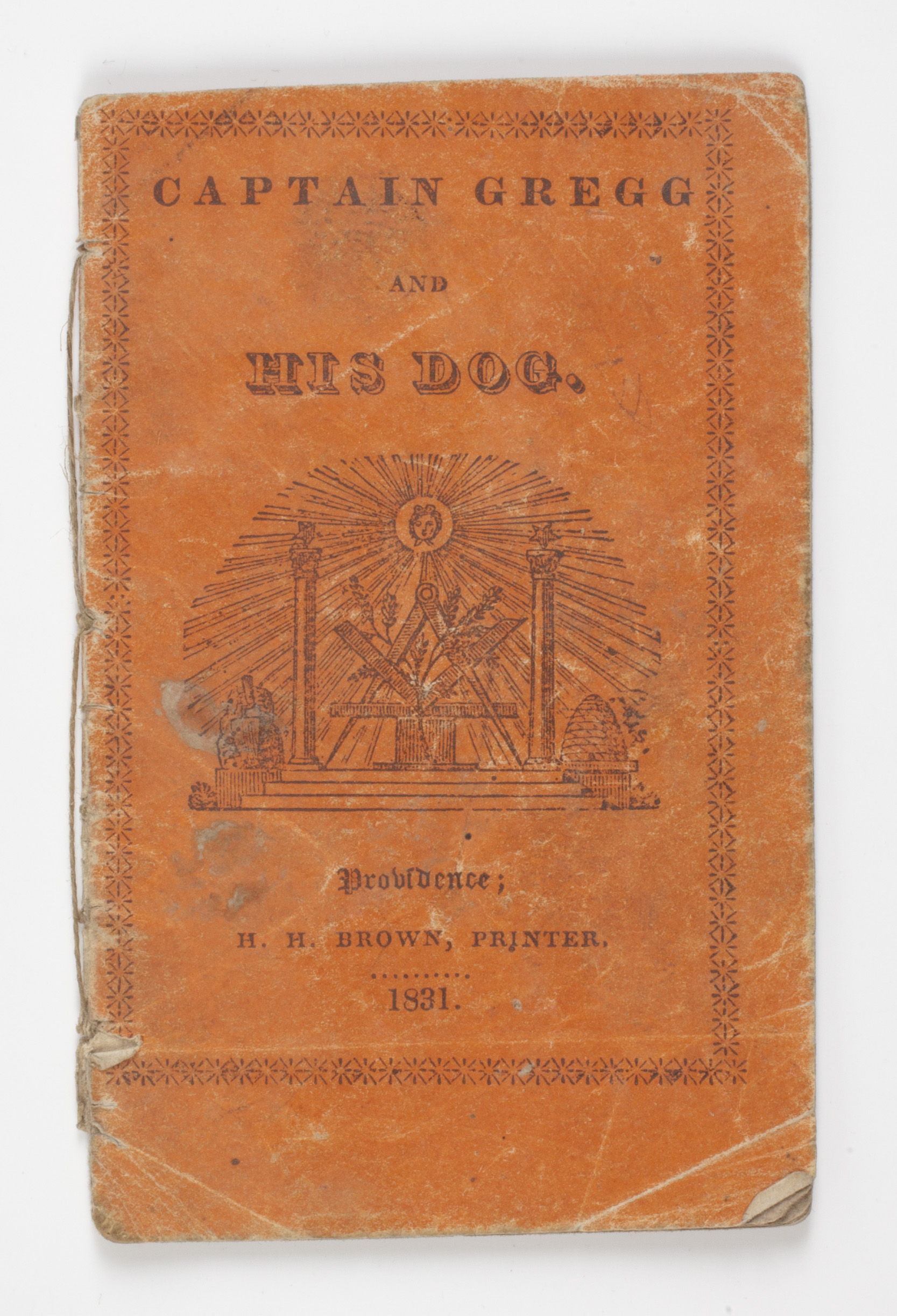
Captain Gregg and His Dog.Providence: H.H. Brown, 1831.

This is a scarce copy of an adventure story about an injured soldier and his loyal dog who survive the perils of the American Revolution in upstate New York.  I was able to successfully bid on this book at a recent Swann auction through the kind assistance of AAS member Joseph Felcone.

The Acquisitions Table: 100 Pieces of American Ephemera

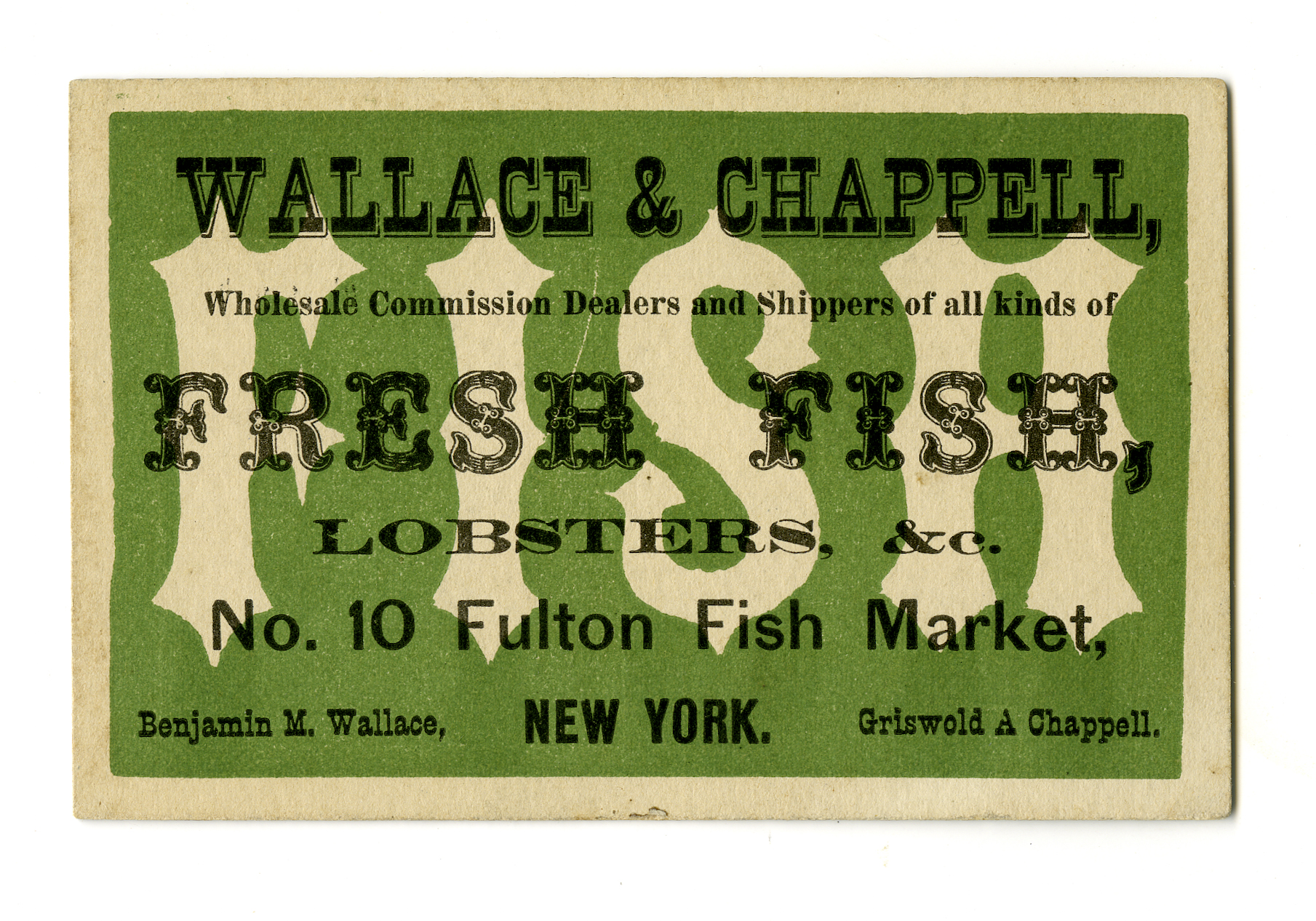
Group of 100 pieces of American ephemera, 1830-1900.

In order to mark the Society’s 200th birthday, AAS member and collector Lisa Baskin took the unique approach of donating 100 pieces of American ephemera, including the examples shown here.  The collection includes labels, trade cards, and tickets, and features a variety of printing styles, including letter press, lithography and wood engraving.  Boat makers, dentists, and sellers of pickles, books, and safes are all represented.  A set of trade cards for Fulton Street fish mongers is perhaps the most exciting, as on their versos the cards were used by a young boy to keep a diary in November and December of 1876.  He records lighting the stove in school, delivering fish, and shopping at a local store for supplies, as well as breaking a window during a snow ball fight!   Bicentennial gift of Lisa Baskin.

New K-12 Workshop: The Emancipation Proclamation with Harold Holzer

Over the next several months we are very excited to offer a new series of workshops for K-12 teachers. First up is “The Emancipation Proclamation” on Saturday, April 20 from 9 a.m. to 3 p.m., led by prominent Lincoln historian Harold Holzer.

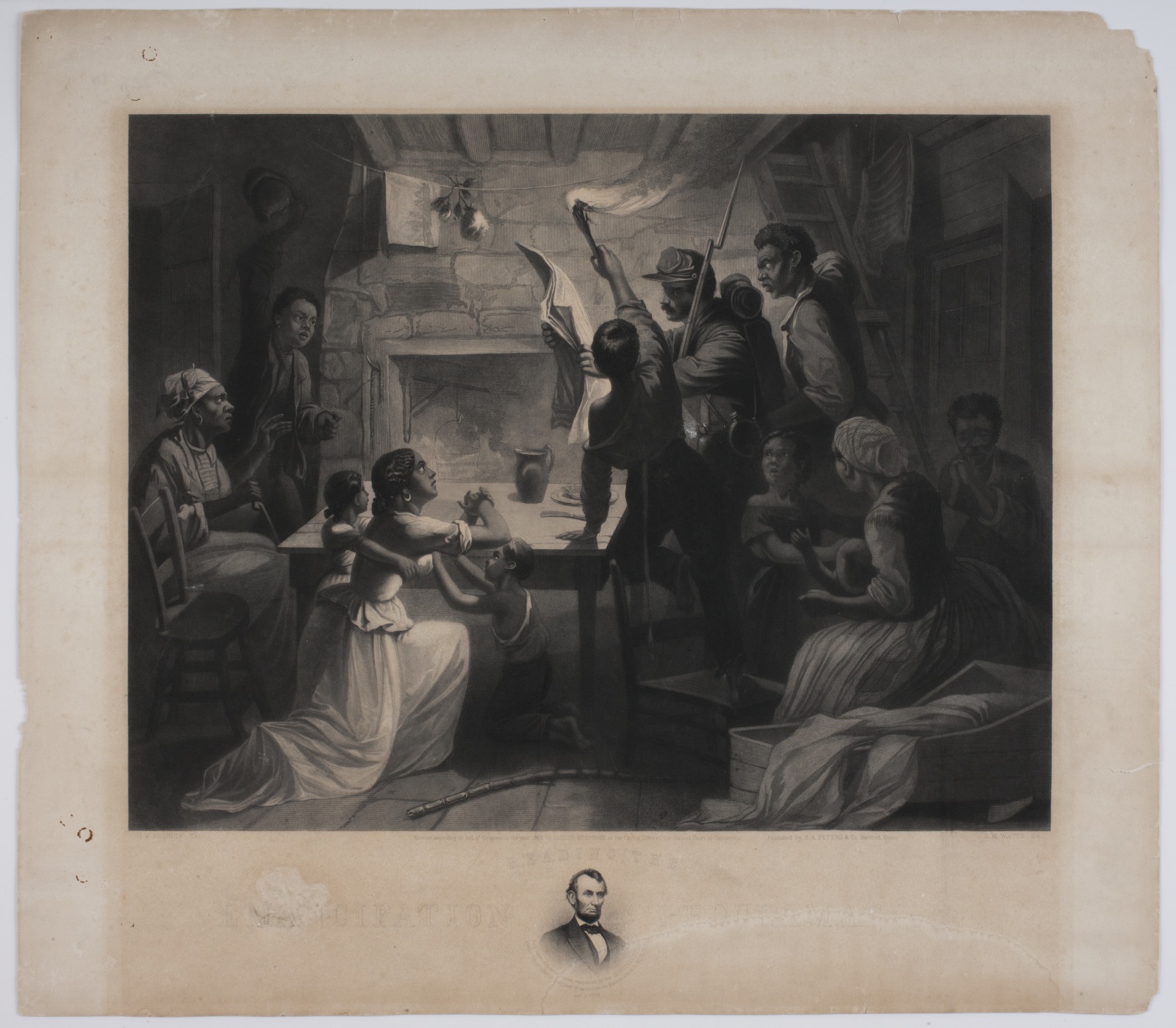
"Reading the Emancipation Proclamation" by H.W. Herrick, 1864.

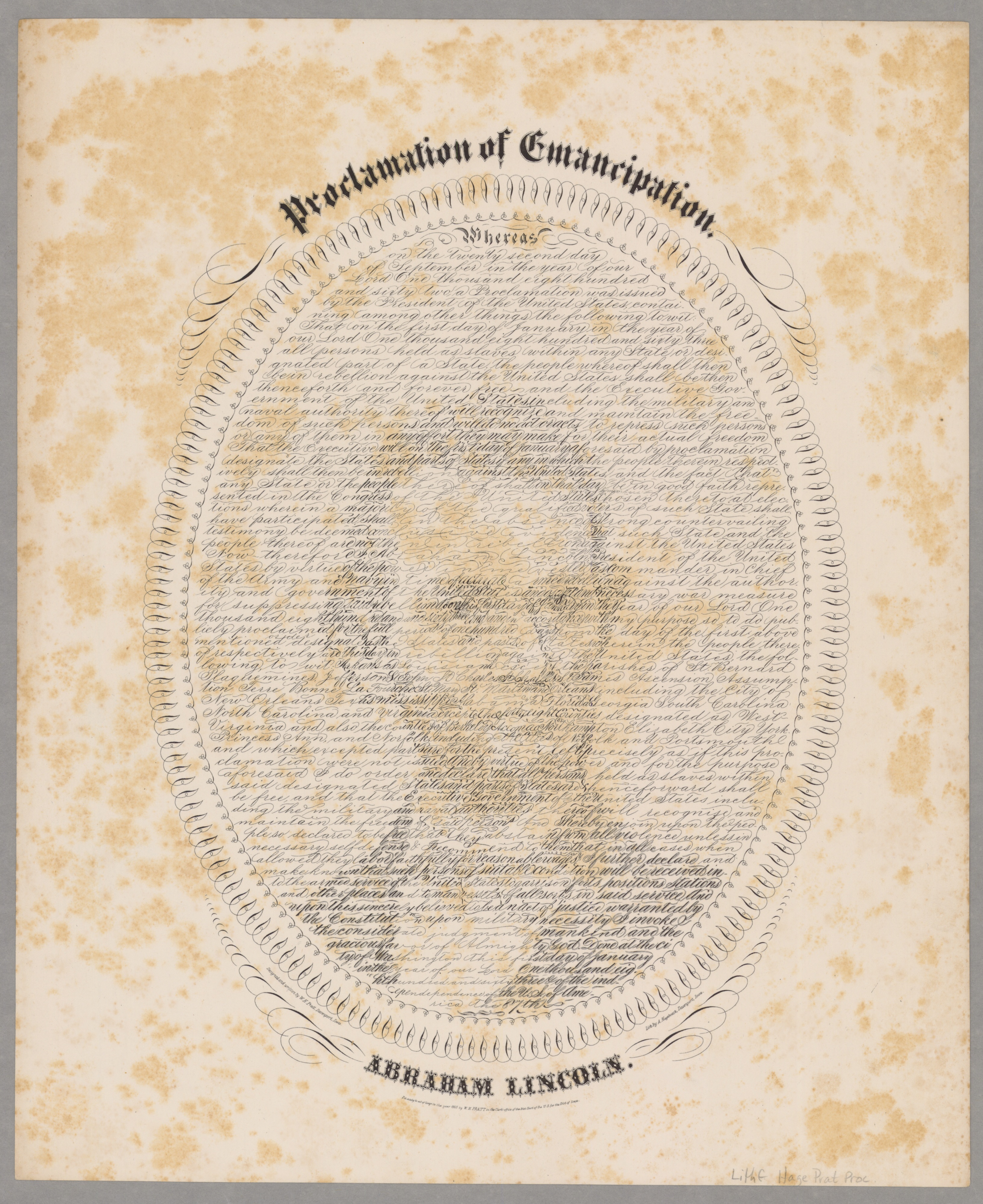
During this one-day workshop we will examine carefully the text of the proclamation, examine the political and social culture from which it sprung, and the impacts it had both in its own day and through American history. We will also be tying our study of the proclamation to recent popular culture by examining how the proclamation and the broader issues of slavery and race relations in nineteenth-century America can be taught through the award-winning Steven Spielberg film Lincoln.

The day will begin with a lecture/discussion with Dr. Holzer, who served as a consultant for the film Lincoln and wrote the official young adult companion book for the film, Lincoln: How Abraham Lincoln Ended Slavery in America, which will act as a guide for the day. This lecture/discussion will be followed by a series of interactive workshops in which participants will be able to examine first-hand a variety of historic texts and images from AAS’s collections. Investigating a variety of these primary sources relating to slavery, race relations, and the Civil War, and discussing how to use them effectively in the classroom, will be a major component of the day.

"Proclamation of Emancipation, Abraham Lincoln." by Augustus Hageboeck, 1865.

As evidenced by his role as a consultant on the film, Holzer is one of the country’s leading authorities on Abraham Lincoln and the political culture of the Civil War era. He serves as chairman of The Lincoln Bicentennial Foundation and is a prolific writer, having authored, co-authored, and edited 43 books. In addition to the official young adult companion to the film his latest book is Emancipating Lincoln: The Emancipation Proclamation in Text, Context, and Memory. (For more information about Holzer visit his website.)

As a nice complement to the workshop, Holzer will also kick off our spring public program series the previous night, April 19, with “Emancipating Lincoln: How the Great Emancipator Led, and Misled, America to Freedom.”

The cost for the day-long workshop is $60 per person (Worcester Public School educators can attend at no charge due to grant funding), which includes morning refreshments, lunch, and educational materials for use in the classroom. Professional development points for attending the session will also be available. For more information or to register visit: http://www.americanantiquarian.org/k12workshop

And keep your eyes open for more information on upcoming K-12 workshops!

Timing

In show business timing is everything.  It is the same at the American Antiquarian Society.  Sometimes you acquire a piece when a researcher is here and it is just what he or she needs.  Other times you acquire an item and you think it would have been perfect for that person that was here the previous month.

A few years ago I went to an auction with Marcus A. McCorison, former President of AAS.  One of the items up for auction was a bound volume of the National Magazine; or, a Political, Historical, Biographical, and Literary Repository dated 1799-1800 and published in Richmond, Virginia by James Lyon.  The publisher was originally a Vermont printer who fled to Virginia and then later to Washington to escape debts.  Mr. McCorison had published a bibliography on Vermont imprints and was very interested in the career of James Lyon.  The volume up for auction contained issues not at AAS, but unfortunately I was limited in what I could bid.  Mr. McCorison kept insisting I bid higher, but I had reached my limit and was the underbidder.  He never let me forget it.  Over time the volume appeared twice in other dealers’ catalogs with the price going up each time.  As each one came out, I knew I would get a photocopy of the entry in the mail from Mr. McCorison with the price underlined.

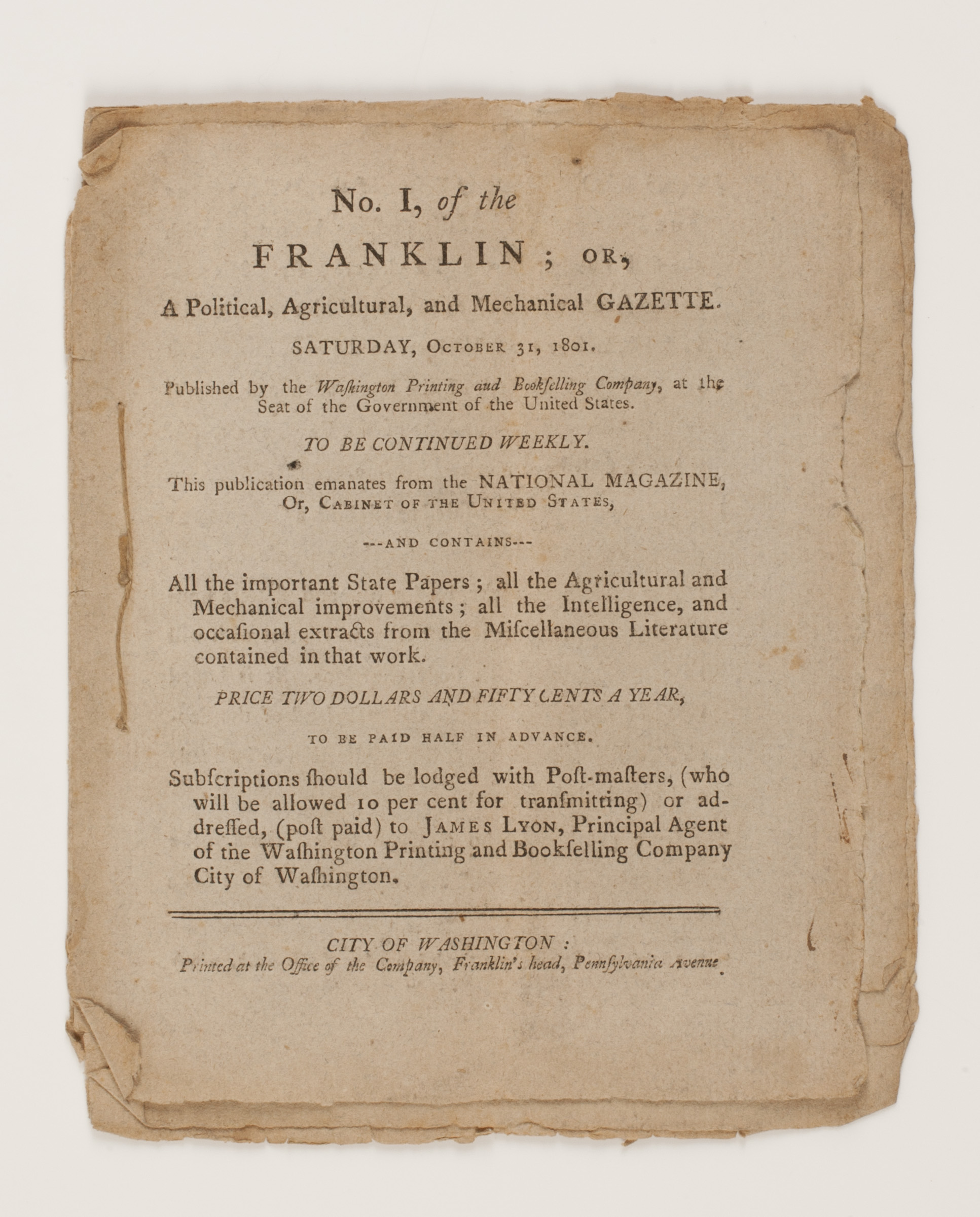
Marcus McCorison passed away on February 3rd.  About a month later a dealer offered me an unrecorded periodical called Franklin; or A Political, Agricultural, and Mechanical Gazette published in Washington and dated October 31, 1801.  The publisher was James Lyon.  Inside the front wrapper is a note from James Lyon about his difficulties publishing the Friend of the People (Richmond, Virginia) and having to move to Washington before subscribers received “the full worth of the sums advanced.”  This periodical was published at the office of the National Magazine, Or, Cabinet of the United States, another periodical that Lyons was publishing.  The Franklin included articles originally printed in this publication as well as material from other sources.   This is issue no. 1 of the Franklin and may have been the only one published.  No evidence has been found so far of another one being printed and the National Magazine folded less than three months later.

I wish I could have shown Marcus McCorison this periodical.  I am sure he would have loved it.  Sometimes the timing is just a little off.  I will miss him and the opportunities of showing him new acquisitions.

For those who wish to celebrate Marcus McCorison’s life, a reception will be held in honor of Mr. McCorison for dealers, collectors, and AAS members at the Antiquarian Booksellers Association of America book fair in New York City this Saturday, April 13.

Adopt-a-Book 2013: Lewdness & Loud Talking Forbidden!

Tonight is the night! Come to AAS at 6 p.m. for the Society’s 6th annual Adopt-a-Book event! There will be food, drinks, original collection materials to view, and curatorial knowledge-sharing.  If you haven’t pre-adopted it will be $10 to get in, but if you have, it’s free! You can still browse the 2013 Adopt-A-Book Catalog to view the 125 items up for adoption, but remember 50 NEW items will be available exclusively tonight. Here’s an example of one of the graphic arts items that will only be up for adoption in person tonight:

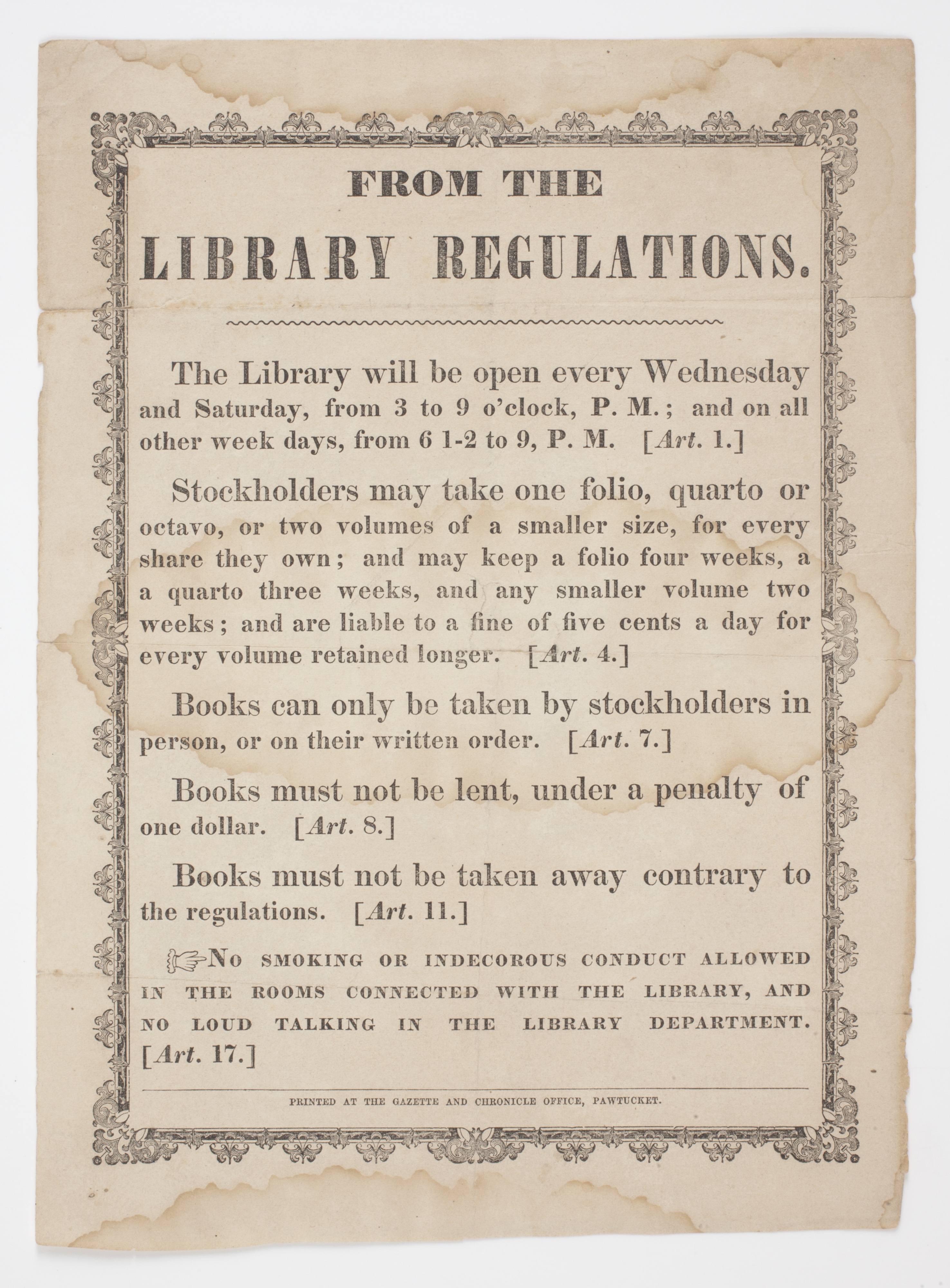
From the Library Regulations. Pawtucket, Rhode Island: Gazette & Chronicle Office, after 1827.

Adopt me for $50

This small broadside from a library in Pawtucket, Rhode Island, spells out the penalties for breaking rules (mostly fiduciary in nature) and also clarifies stockholders’ borrowing terms and how long books may be used at home. The rules end with a declaration set in all caps that there will be no smoking or loud talking or, most importantly, no indecorous conduct in the library. Not much has changed, really, when it comes right down to it.

We look forward to seeing you tonight!

Adopt-a-Book 2013: Poetry and Flowers

We hope to see you in the library in person tomorrow, Friday, April 5, at 6 p.m.  AAS’s 6th annual Adopt-a-Book event will bring together book-loving research fellows, staff, and supporters for an evening of viewing historical material recently purchased by the curators, sharing a drink, and, of course, raising funds for the Society’s future acquisitions. You can still browse the 2013 Adopt-A-Book Catalog to view the 125 items up for adoption ahead of time, but remember 50 new items will also be available exclusively tomorrow night. If you adopt online, admission to the event is FREE, otherwise $10 at the door.


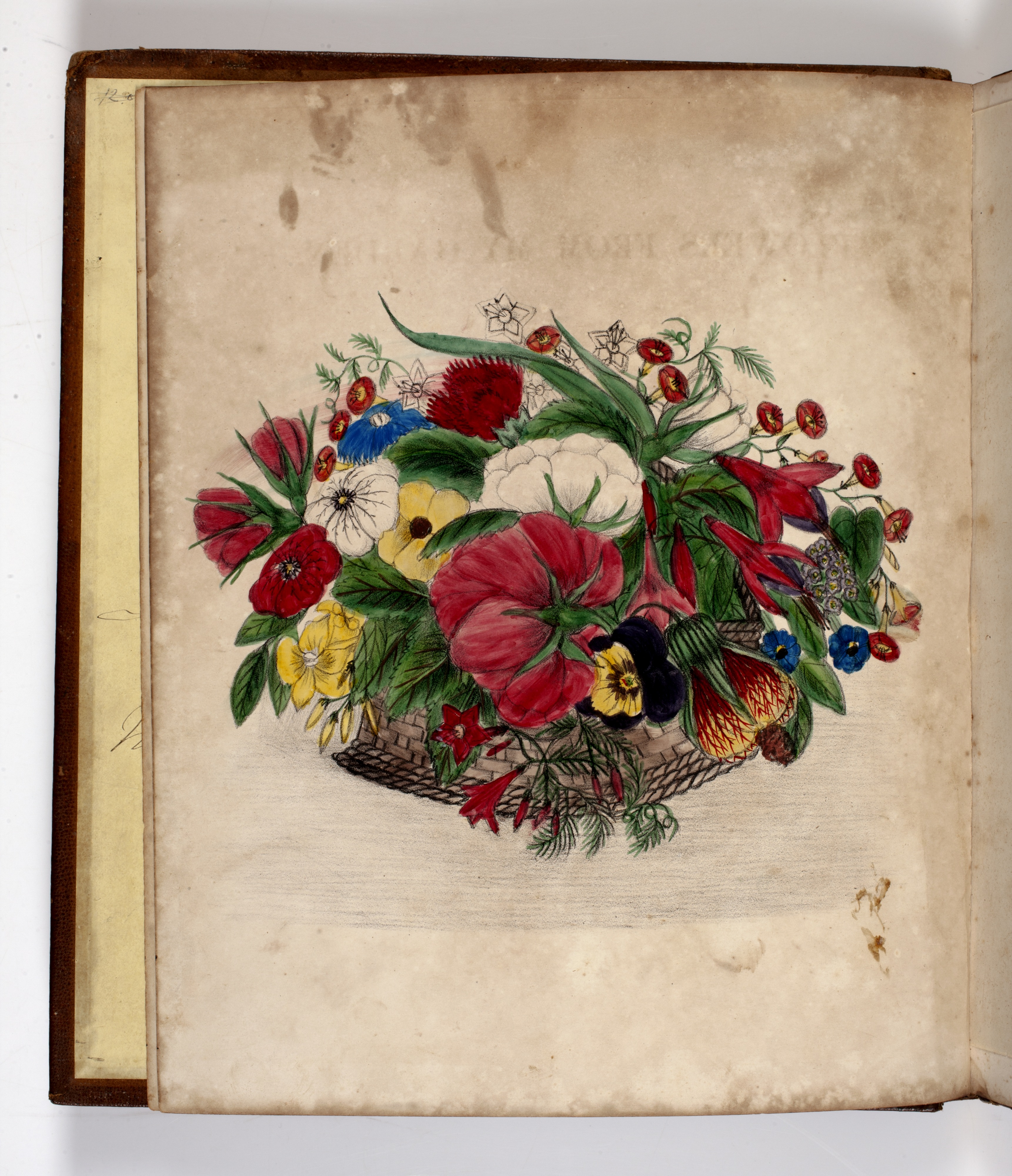
Munson, Laura Gordon. Flowers from My Garden. Sketched and Painted from Nature with an Introductory Poem by Mrs. L. H. Sigourney. New York: Anson D.F. Randolph, 1864.

Adopt me for $200

Acquired by the Society’s Curator of Books Elizabeth Pope, this book of poetry is interleaved with seventeen hand-colored illustrations of flowers.  Poets featured in the volume include Lydia Sigourney, Henry Wadsworth Longfellow, and Felicia Hemans.  The volume is inscribed “Aug. 24th, 1865, Kaalaa, Nuuanu Valley” and also bears the bookplate of Jay M. Kuhns.  Ka’ala is the highest peak on the island of Oahu in Hawaii and the inscription hints at the distances this volume must have traveled after being published in New York during the Civil War.  Somehow the book made it across the Pacific where it was later acquired by Kuhns, a physician, plantation owner, and teacher of bacteriology at the College of Hawaii in the 1920s and 30s.

The Acquisitions Table: Leonard Deming Booksellers’ Stamp

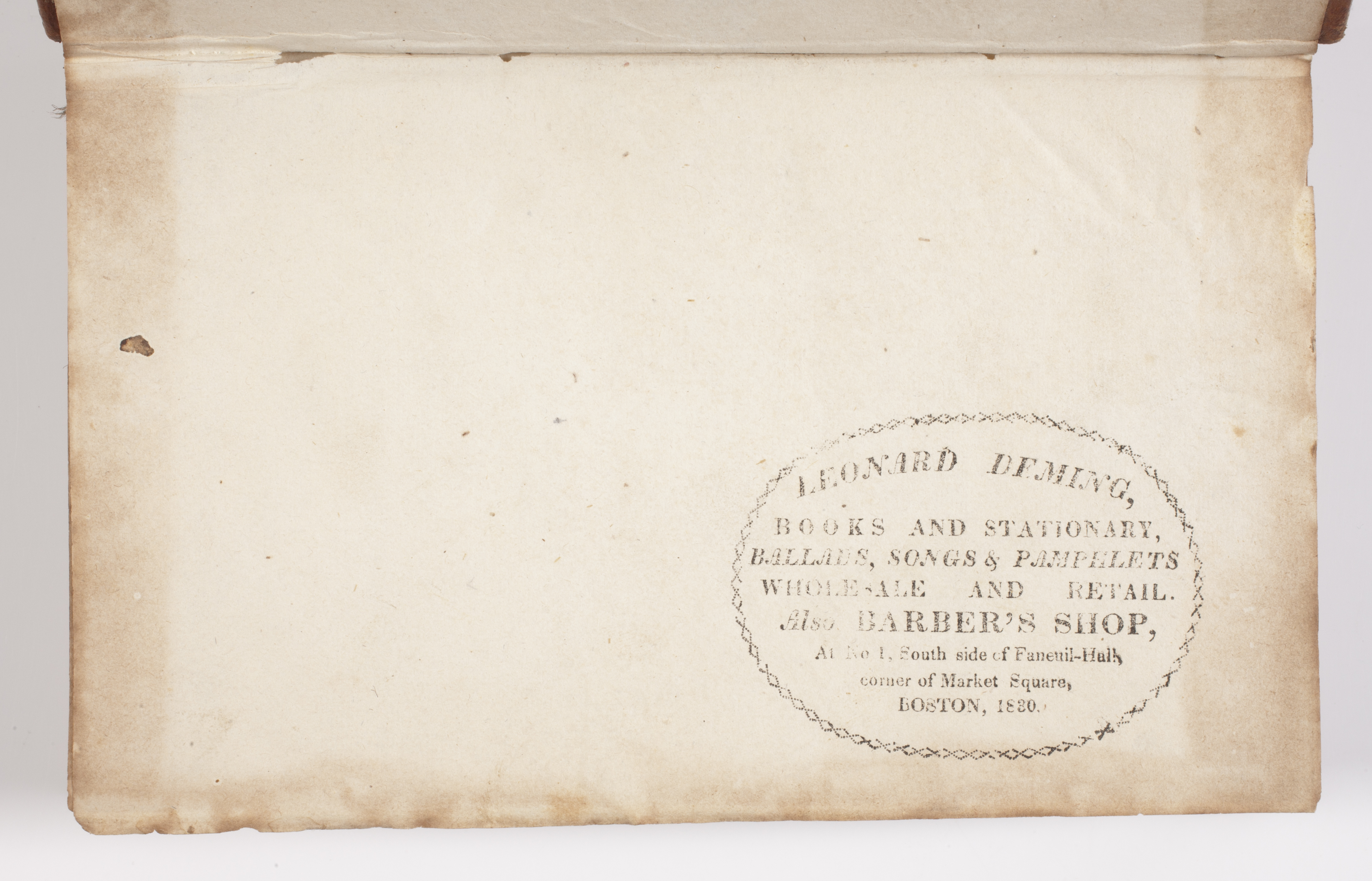
Leonard Deming booksellers’ stamp. In Jonathan Edward’s The Salvation of All Men Strictly Examined.Boston: Published by C. Ewer, and T. Bedlington, 1824.

Leonard Deming is best known to scholars today for being (along with Nathaniel Coverly) the other important purveyor of folk ballads and street literature in early nineteenth-century Boston and a prolific publisher of Jim Crow lyrics in Boston. One penny ballad, published by Demingand likely hawked by street vendors, contains sixty-six verses on “Jim Crow.”

In 1830, Leonard Deming advertised himself as a Boston book and ballad seller, but he wanted readers to know he could cut their hair as well.  The booksellers’ stamp he included on the front free endpaper of this theological book reads: “Leonard Deming, books and stationary, ballads, songs & pamphlets wholesale and retail. Also Barber’s shop, at No. 1, south side of Faneuil-Hall, corner of Market Square, Boston, 1830.”  The connection between books and barbershops may not seem a natural one to us today, but it was not uncommon in the nineteenth century.

The advertisement of one of Deming’s immediate competitors at the “South End Bookstore” demonstrates this fact. “James B. Dow, bookseller, stationer, and dealer in fancy goods, no. 362 Washington Street, Boston, (sign of the large book, near the Boylston Market.)” advertised his Boston bookshop as carrying “a complete assortment of articles usually kept in this line of business, of the best quality, and at the lowest prices.”  These included, along with books and stationary supplies, “Cutlery” (including razors, scissors, and shears) and “Fancy Goods” (including tooth brushes).  So the connection between bookstores and personal grooming was well-established.  Perhaps this understanding of books as one of number of consumer experience options offered by the same purveyor may not be so wildly different from our habit of putting cafes and wireless hotspots in our Barnes &Nobles today?  AAS Bicentennial Gift of John F. Gately, 2012.

The Acquisitions Table: Lemuel Haynes Sermon

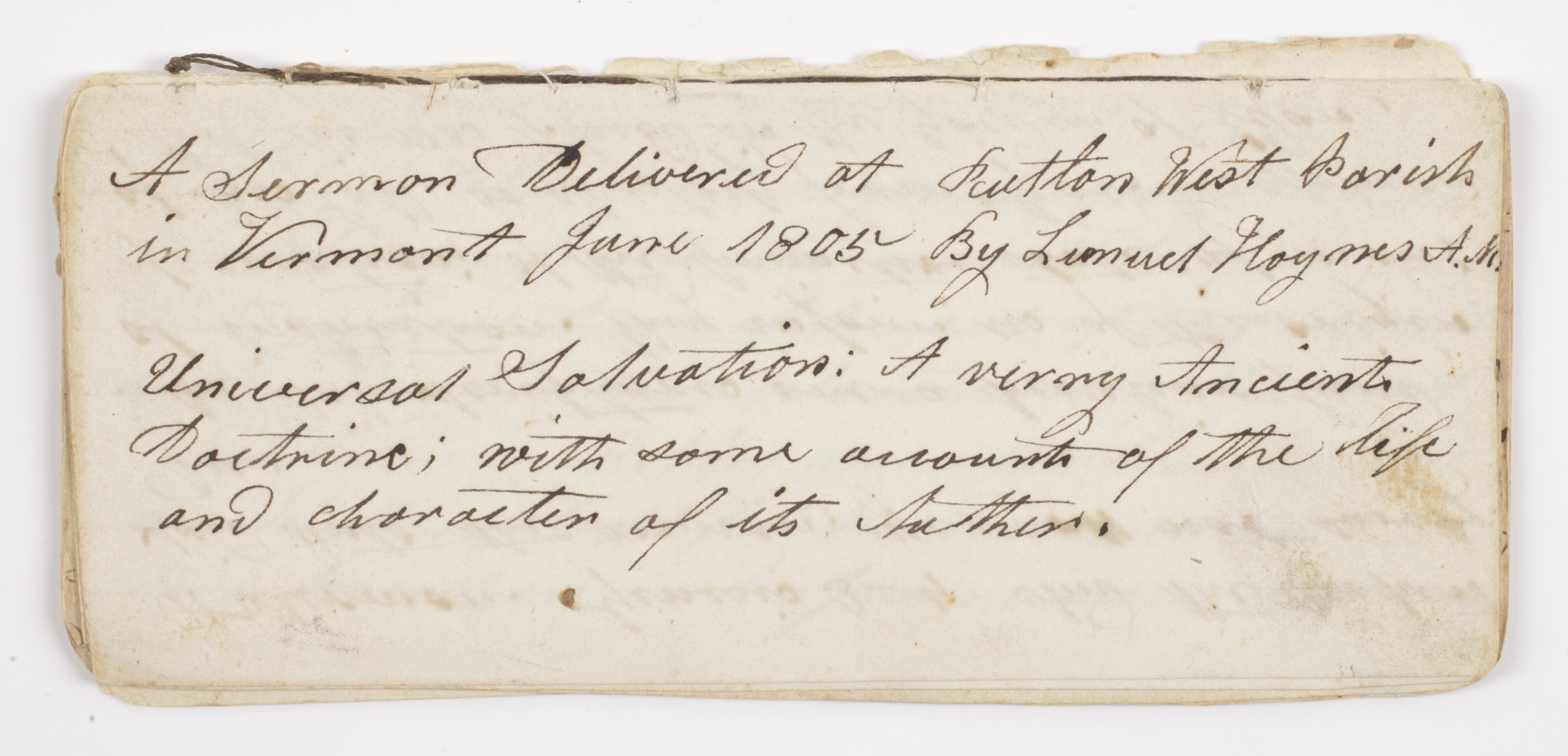
Haynes, Lemuel, “A Sermon Delivered at Rutlan West Parish in Vermont June 1805.”

Lemuel Haynes (1753-1833) was a highly influential religious and anti-slavery leader.  Among Haynes’s many firsts, he was the first African-American to be ordained to the Christian ministry and the first African-American to receive a college degree (an M.A. from Middlebury in 1804).  After serving in the Continental Army during the Revolution, Haynes began his career as a minister in Rutland, Vermont, where he remained for thirty years.  It was during this ministry that Haynes delivered his famous sermon, Universal Salvation, a Very Ancient Doctrine: with Some Account of the Life and Character of Its Author.  Delivered as a response to a lecture by Hosea Ballou on the doctrine of universal redemption, Haynes’ Universal Salvation stands as one of the most famous and reprinted works of religious satire.  This copy of the sermon, in Haynes own hand, contains more than sixty textual differences and three deletions from the printed copies.  Including this copy, only three sermons in Haynes’s own handwriting are known to exist.

New Objects up for Adoption!

Due to the popular demand for “orphans” in our 2013 Adopt-a-Book online catalog, we have recently added twenty new titles for you to review.  All of these new items are priced below $200 and the group includes material from the  books, newspapers, children’s literature, manuscripts and graphic arts departments.

Here are two examples from the new additions that celebrate warmer climates and the arrival of spring (both things that we need here in Worcester, to date the snowiest city in America this winter!)
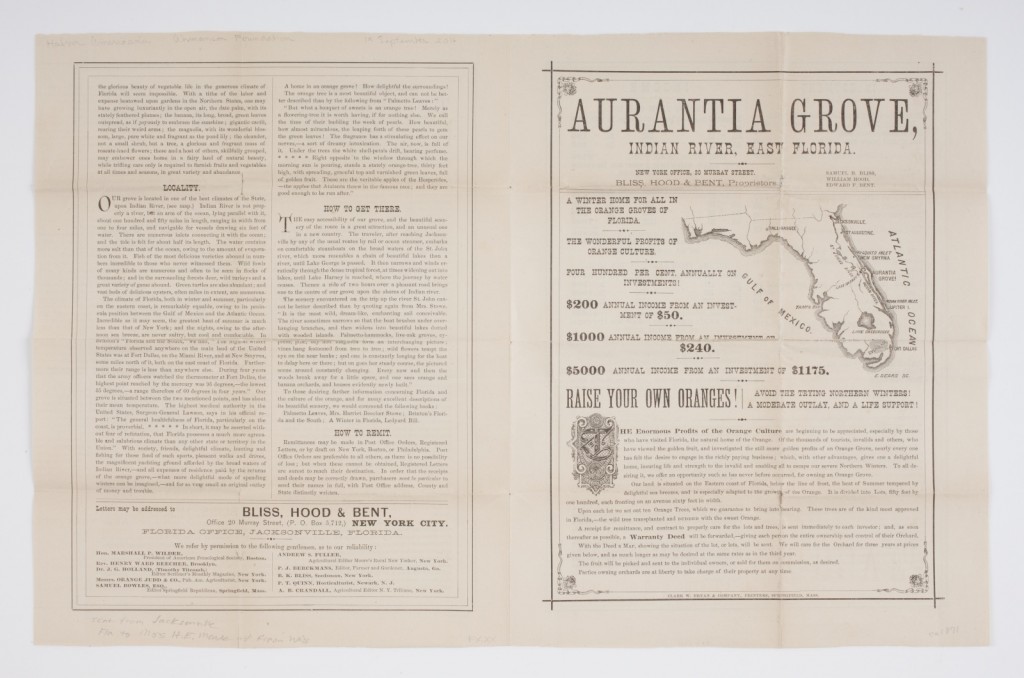
Orange you glad I’m up for adoption?

Adopt me for $75

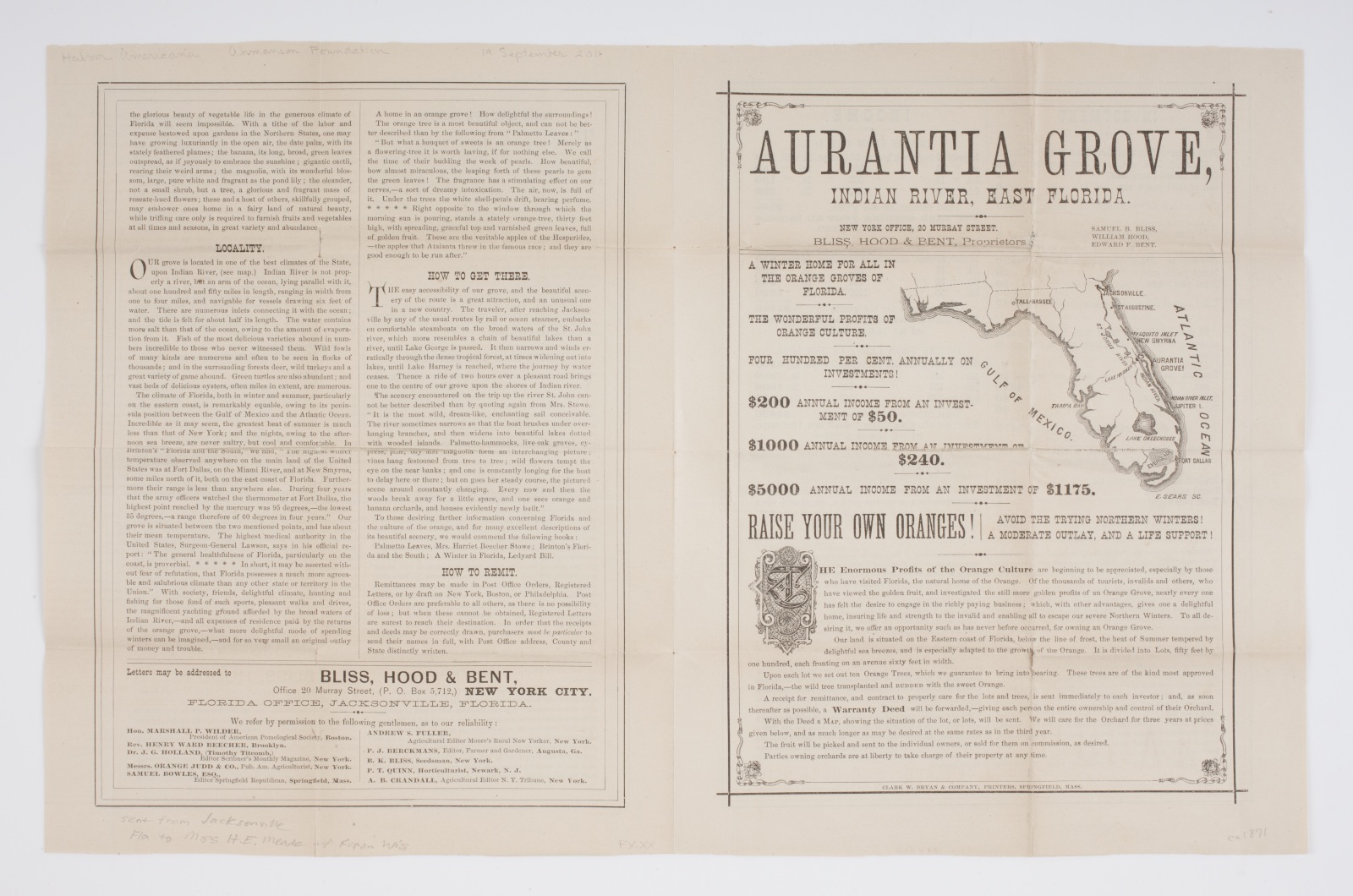
Aurantia Grove, Indian River, East Florida. Springfield, MA: Clark W. Bryan & Co., ca. 1871.

The text on this circular promotes raising oranges for investment in the balmy Florida climate. Located northwest of Cape Canaveral, Aurantia Groves was typical of late-nineteenth-century Florida developments. Speculators bought up land and created lots for resale. Groves of orange trees were planted and could be managed from a distance, with a small financial investment. The circular lays out the details of prospective income and uses testimonials from previous investors as proof of success. They even quote Harriet Beecher Stowe’s Palmetto Leaves. An editor of a newspaper in Springfield, Massachusetts (where this circular was published) wrote glowingly of a Mr. A.S. Dickinson’s investment in Aurantia, which resulted in 100 boxes of oranges being shipped north in January and sold for 70 cents per pound.
A “Tweet” Children’s Book

Adopt me for $50

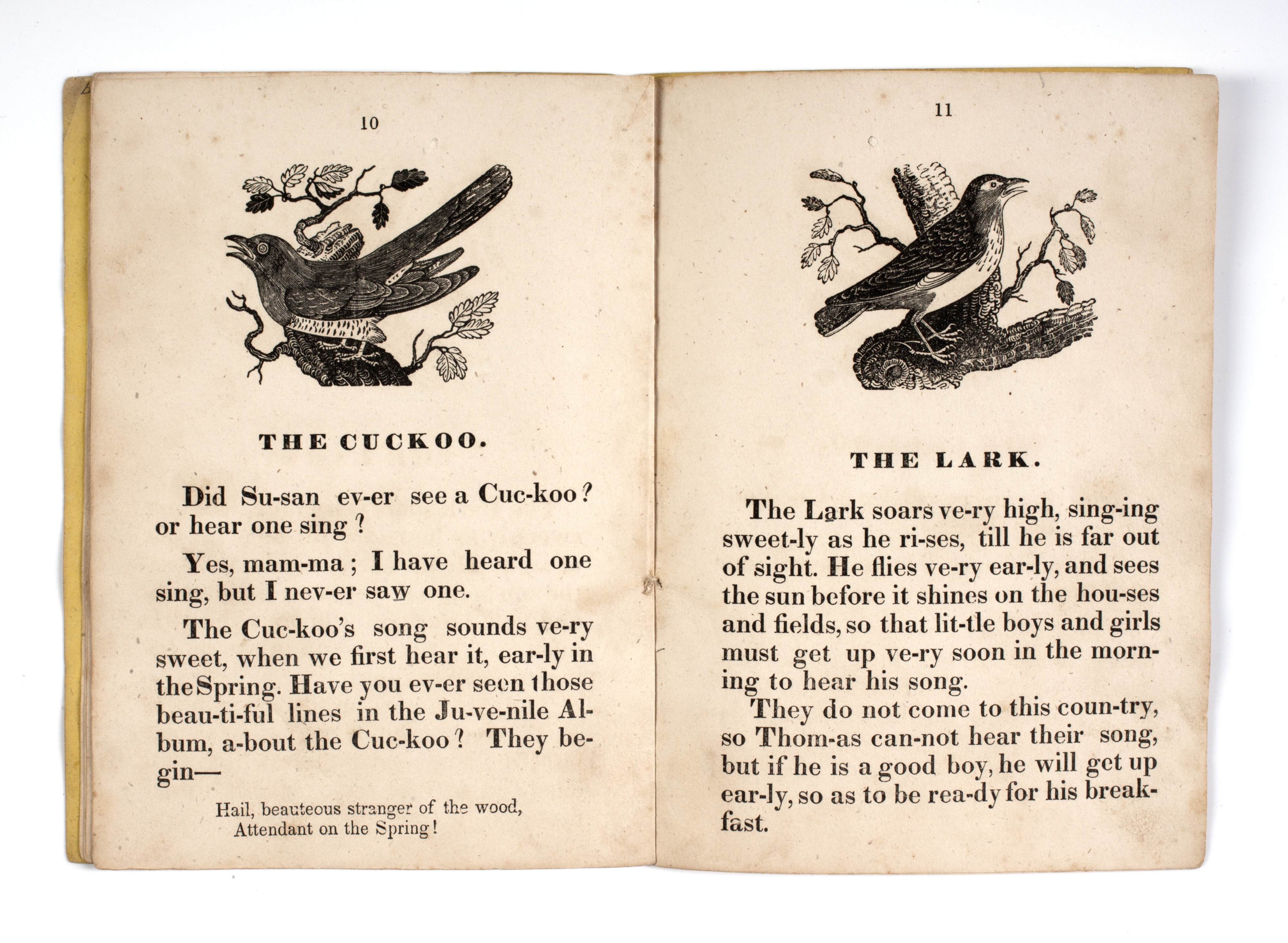
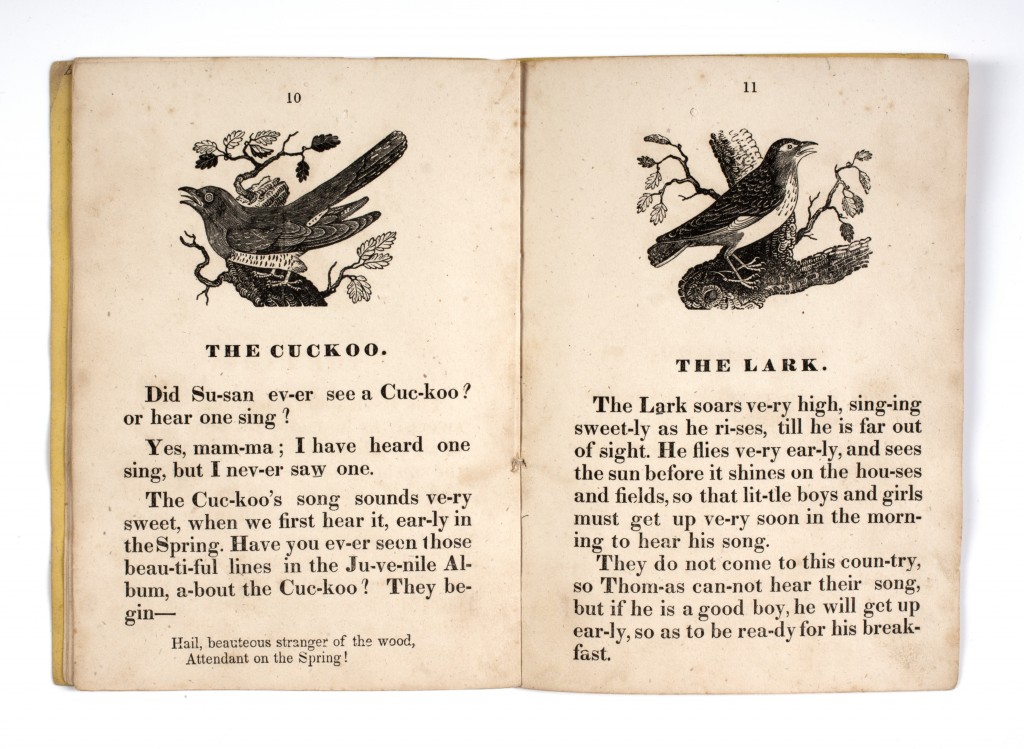
The Child’s History of Birds. New York: Mahlon Day, 1837.

Quaker publisher Mahlon Day (1790-1854) was among the most prolific children’s book publishers in antebellum America. This picture book features wood engravings of birds commonly seen by American children, including this description of the Cuckoo, the herald of spring. The description quotes from a poem about the bird from The Juvenile Album (also issued by Day).

Don’t forget we are holding our evening Adopt-a-Book event at the Society on Friday, April 5, 2013 from 6:00 to 8:00 p.m.  The curators will be displaying fifty more objects for potential adoption.  If you have pre-adopted from the online catalog, admission is free to this event, otherwise $10 at the door.  Come and hear the curators speak about recent acquisitions made possible through the Adopt-a-Book program, nibble delicious food generously provided by Struck Catering, and look over wonderful American books, colorful prints, and important newspapers and manuscripts.  We hope to see you there!
The Acquisitions Table: Aspinwall Courier

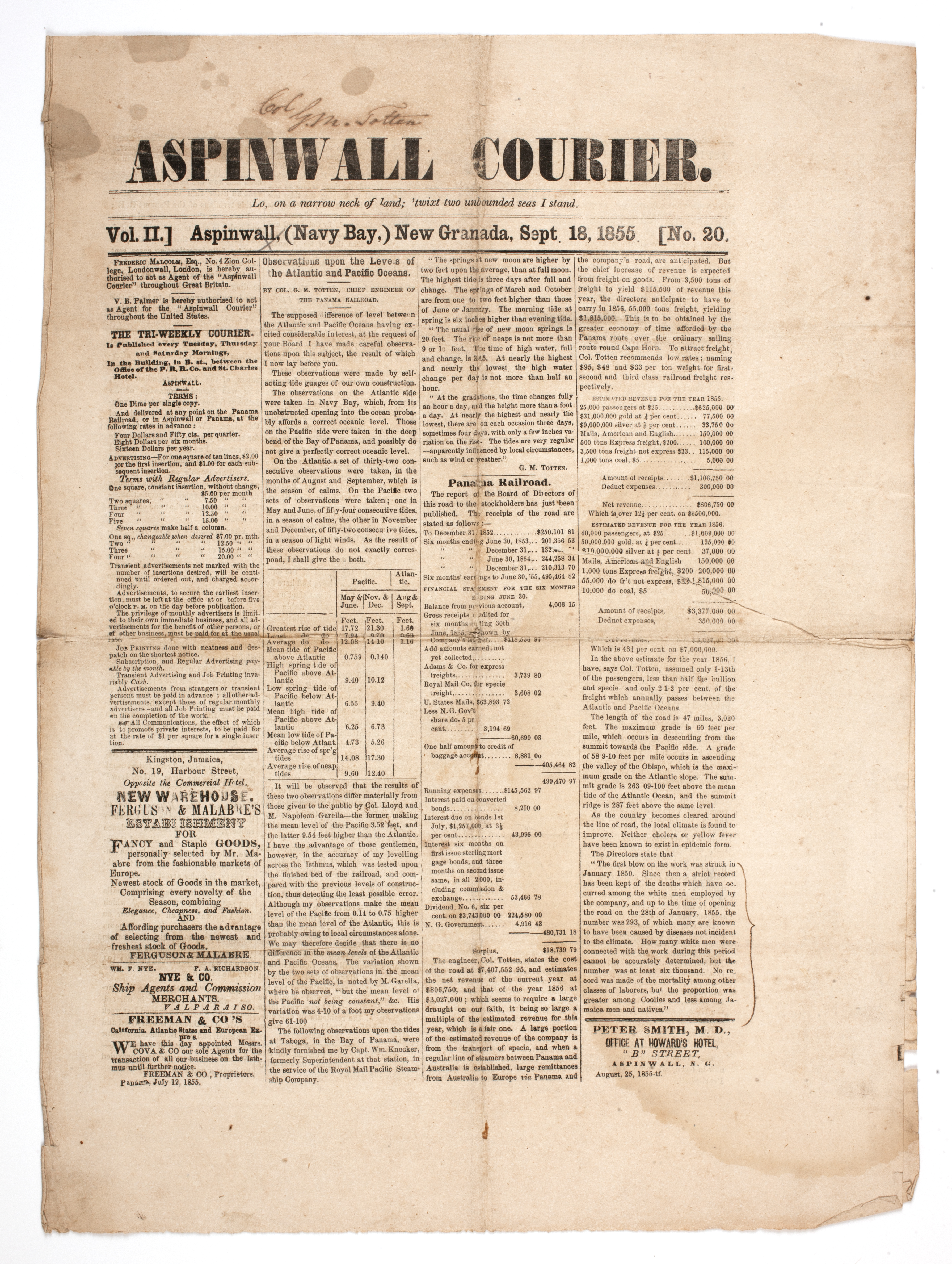
Aspinwall Courier.  Aspinwall, Panama.

In the 1850s, Aspinwall (today known as Cólon) was founded as one of the end points of the Panama Railroad, which spanned the isthmus for and provided part of the route to and from the California gold rush regions.  This paper was edited by Frederic E. Foster and printed in English for the American community.  It was published between 1853 and 1857 and only a handful of issues survive.

Adopt-a-Book 2013: Fires and Trains

The AAS curatorial team is just delighted by the response to our 6th annual Adopt-a-Book event, with over half of the selected “orphans” already adopted by generous supporters.  Thank you!  Below, please find one of the few titles for children still available from the online catalog as well as a railroad map from the cartography collection. The night of the event, the curators will be presenting fifty additional titles for adoption, so be sure to come to the Society for our evening event on Friday April 5, from 6:00 to 8:00. In order to keep up with online demand, we hope to post ten additional objects to the web catalog within the next several days.  What a lovely problem to have and we hope you enjoy reading the catalog and supporting the Society’s future acquisitions!


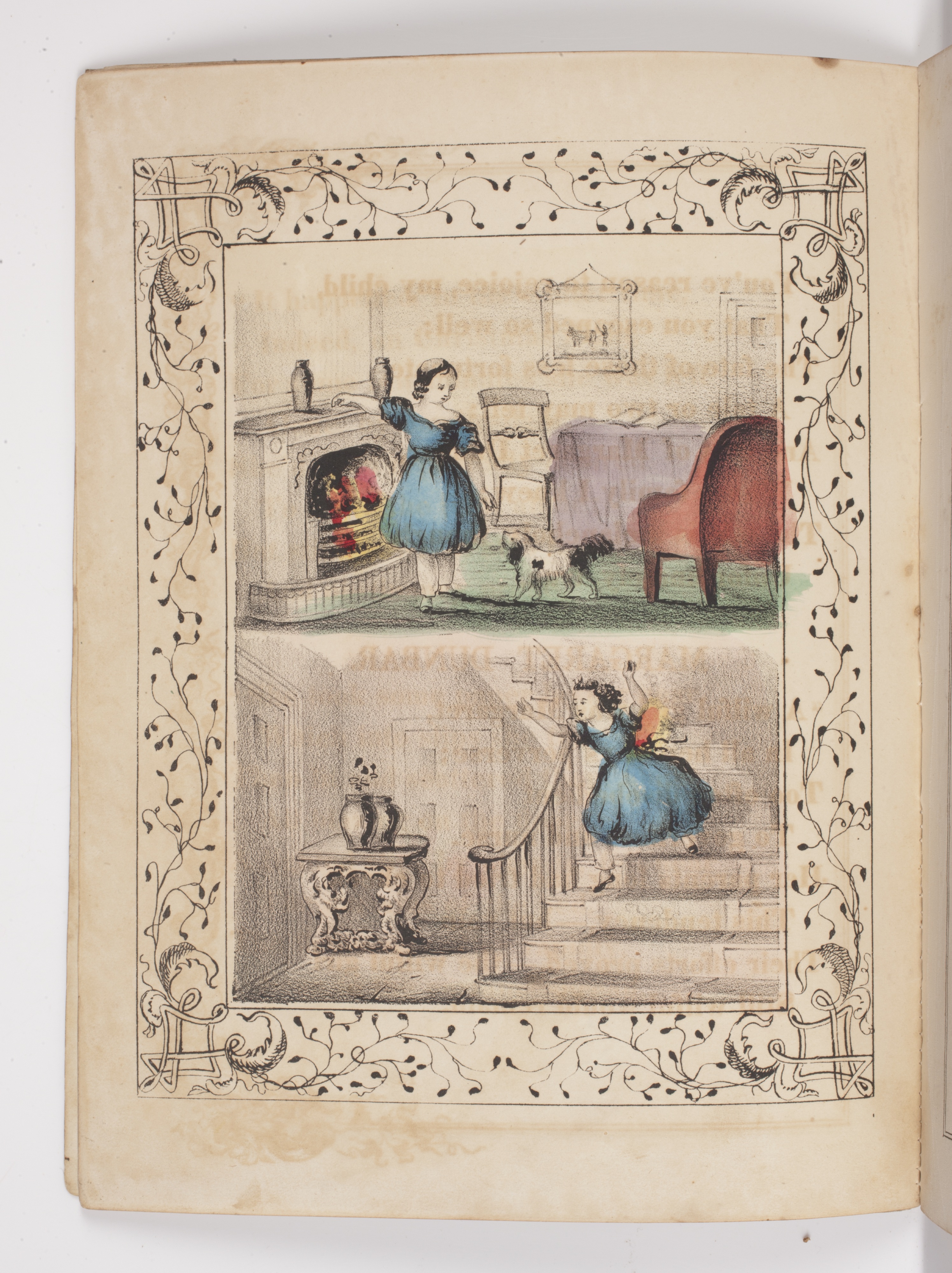
Peter Piper’s Tales. Danger of Fire. Albany: Richard H. Pease, 1844-1847.

Adopt me for $250

This is a rare lithographed picture book issued by Albany book and toy seller Richard H. Pease; he generally used wood engravings.  This text is a set of cautionary poems about the dangers of playing with or near the fire.  In this case, the obstinate Margaret threw some lighted scraps of papers on the floor, which wound up setting the house on fire, destroying her father’s savings, and disfiguring Margaret.  Given the lack of house insurance and the dependence upon open fireplaces for heat, these grim poems conveyed life lessons that needed to be learned if children were to survive into adulthood intact.

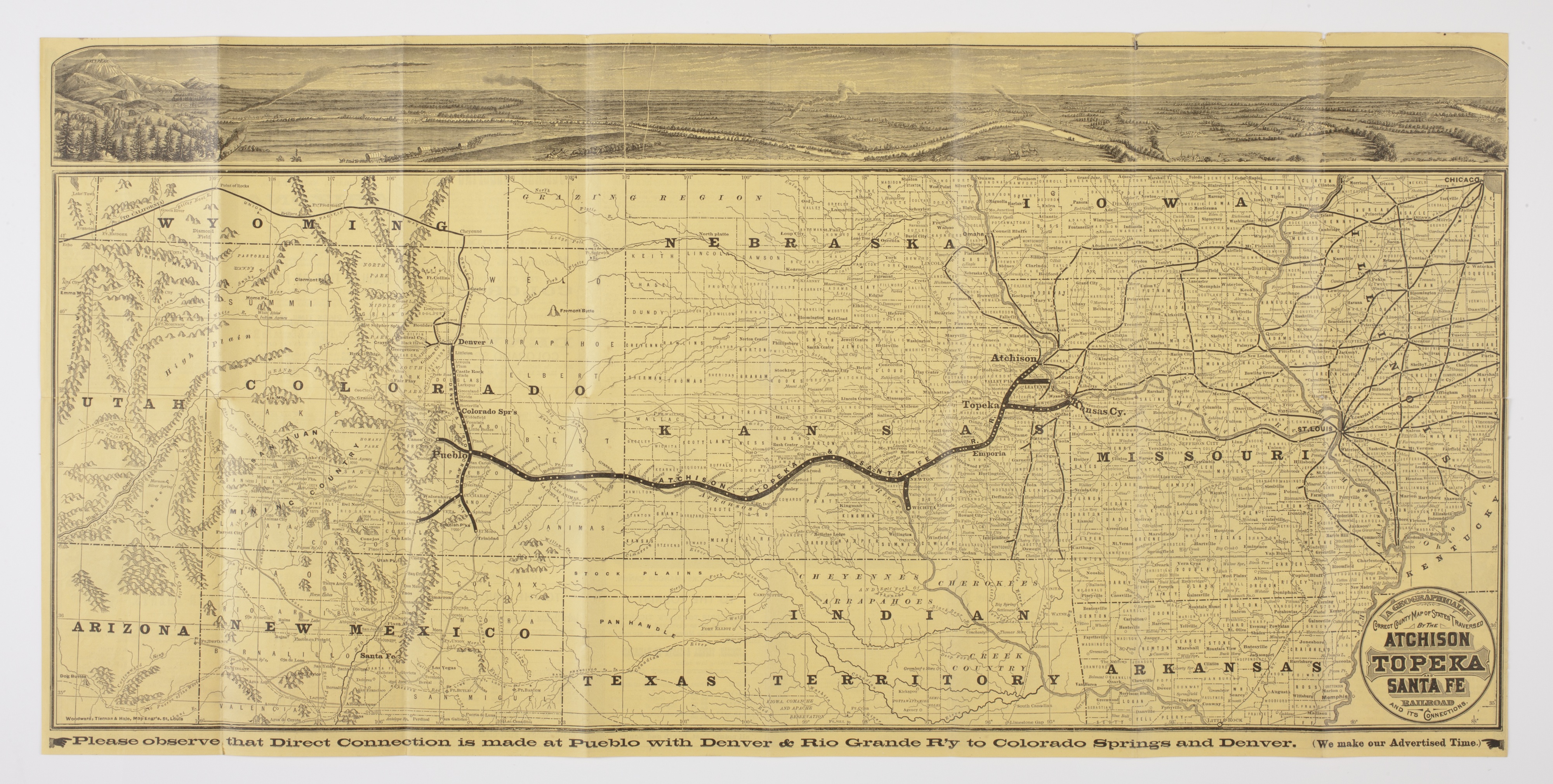
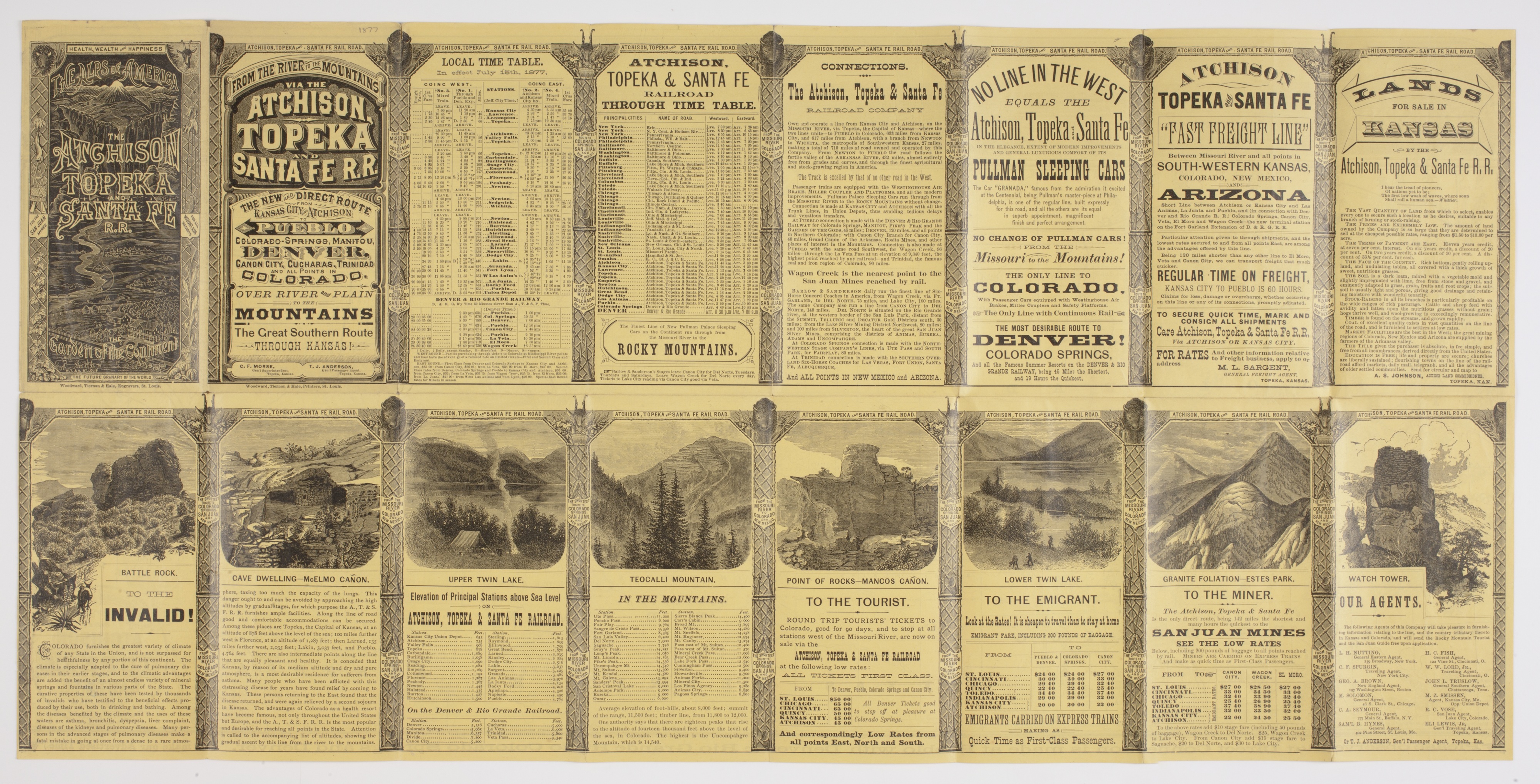
Geographically Correct County Map of the States Traversed by the Atchison, Topeka & Sante Fe Railroad. St. Louis: Woodward, Tiernan & Hale, 1877.

Adopt me for $200

This timetable for the Atchison, Topeka and Sante Fe Railroad includes on one side details of scenic highlights, information on connections, and listings of land for sale. The other side provides a (somewhat compressed) route map complete with an image of trains traversing the Great Plains.  The line was chartered in 1859 but did not reach the Kansas/Colorado border until 1873 due to work stoppages associated with the Civil War. In the 1870s, the line moved passengers, cattle, coal and supplies to and from Colorado and northern New Mexico.

You can search the online Adopt-A-Book catalog here.  Keep an eye out for the ten new additions to be added shortly. And remember, if you pre-adopt online, your entrance to the event on April 5th is FREE.  Otherwise, it is $10 at the door.  We look forward to seeing you in Worcester!

WPI Students Team Up with “A New Nation Votes”

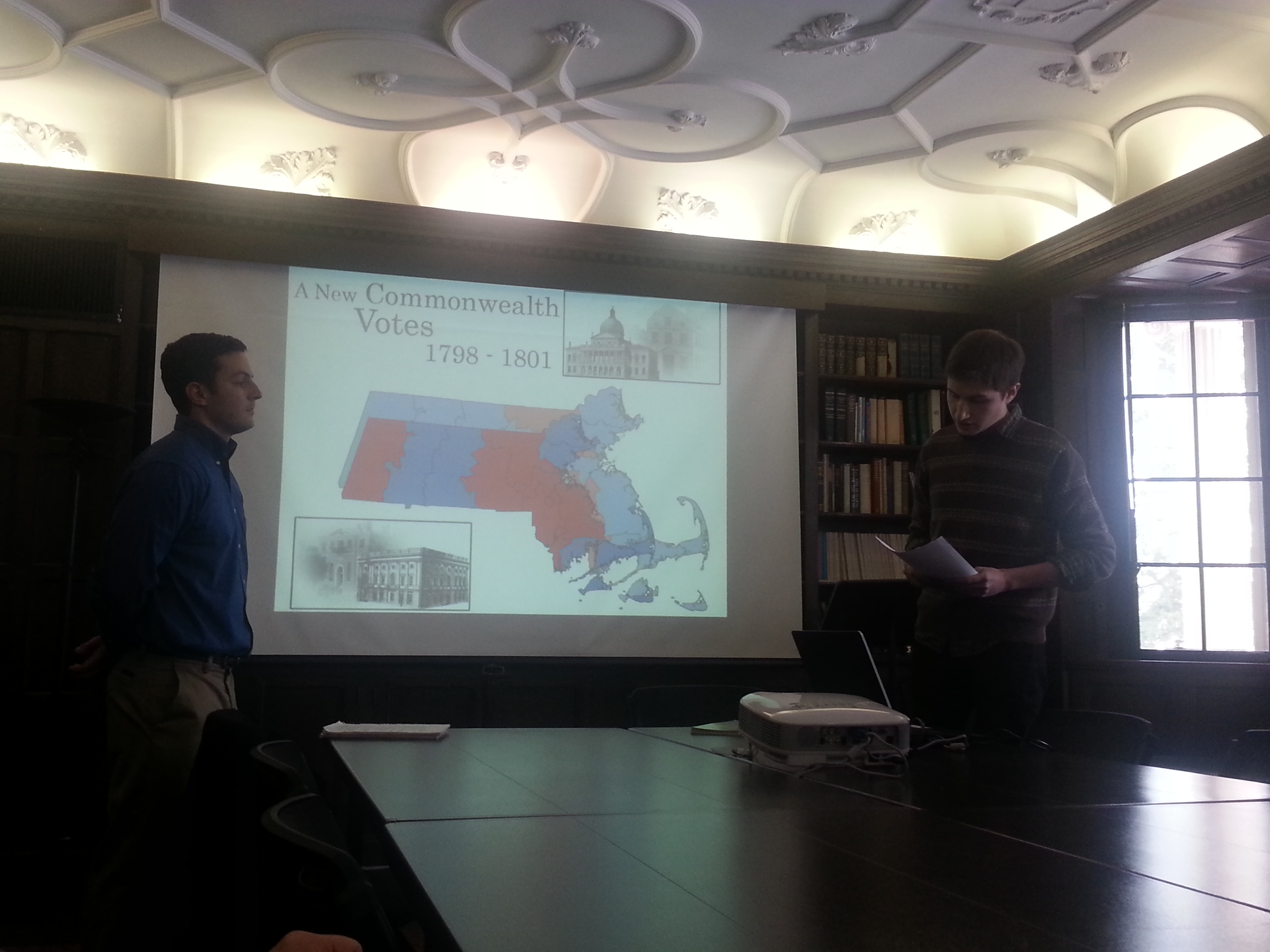
Bryan MacDonald (left) and Dan Boudreau presenting their project to AAS staff.

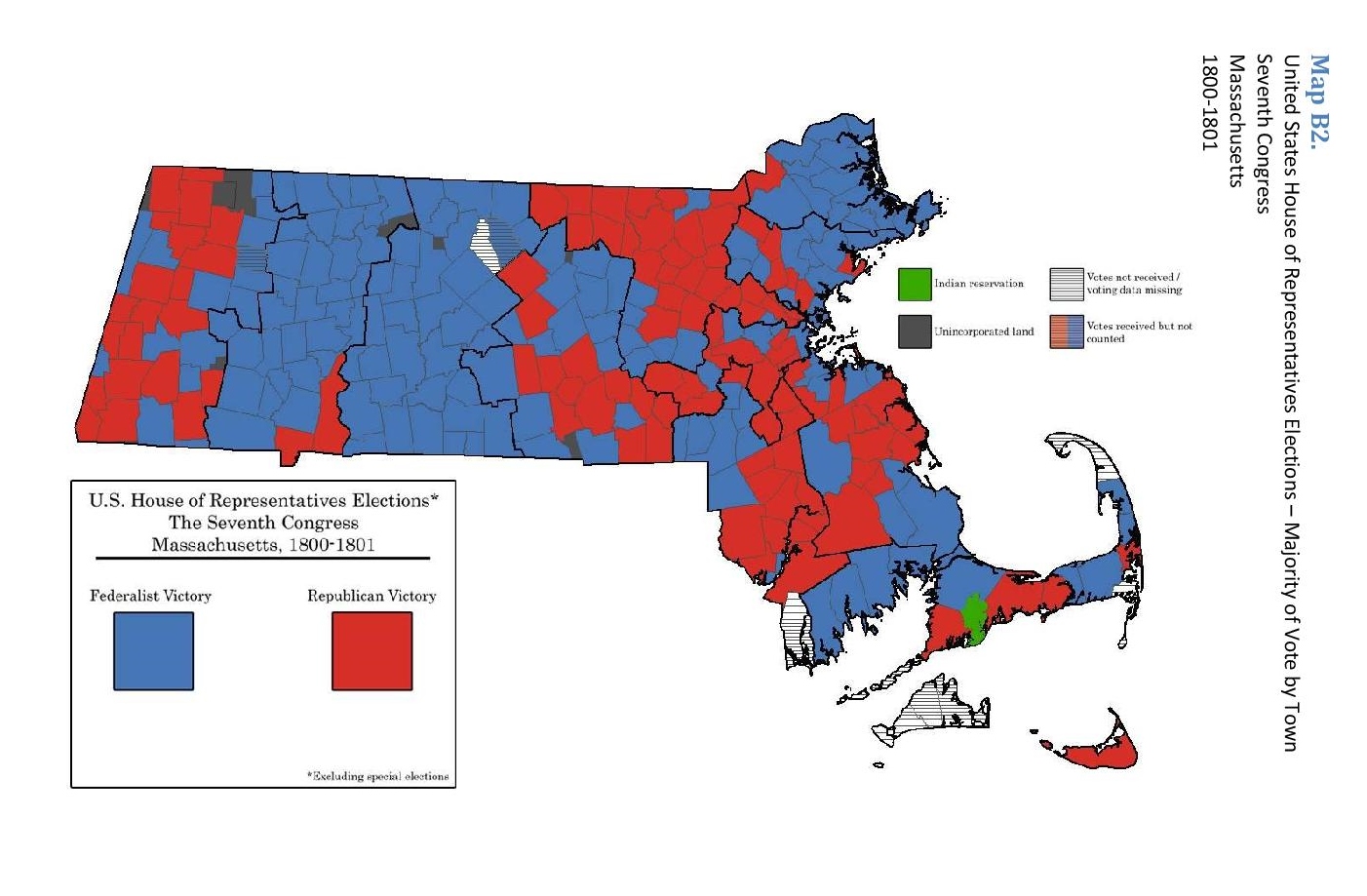
Here at AAS we are always happy to collaborate with that institution across the street, Worcester Polytechnic Institute.  The students there are required to do what is called an Interactive Qualifying Project, which involves a digital humanities project.  To that end, Dan Boudreau and Bryan MacDonald produced “A New Commonwealth Votes: Using GIS to Analyze the Politics of Turn-of-the-19th-Century Massachusetts,” a project that combines emerging GIS software with our New Nation Votes project (whose brand new website will be unveiled by the end of the month).  Boudreau and MacDonald produced a 100-page report complete with a dizzying 80 different maps that analyzed the Congressional elections of 1798 and 1800.

This project, combined with earlier work from their fellow student Kris Kellogg, is hopefully just the first step into a larger world of combining the massive research work of Philip Lampi with emerging software that will allow the New Nation Votes project to take that next step into the world of mapping technology.

An example of one of the election maps produced during their project.

The Acquisitions Table: Atalanta

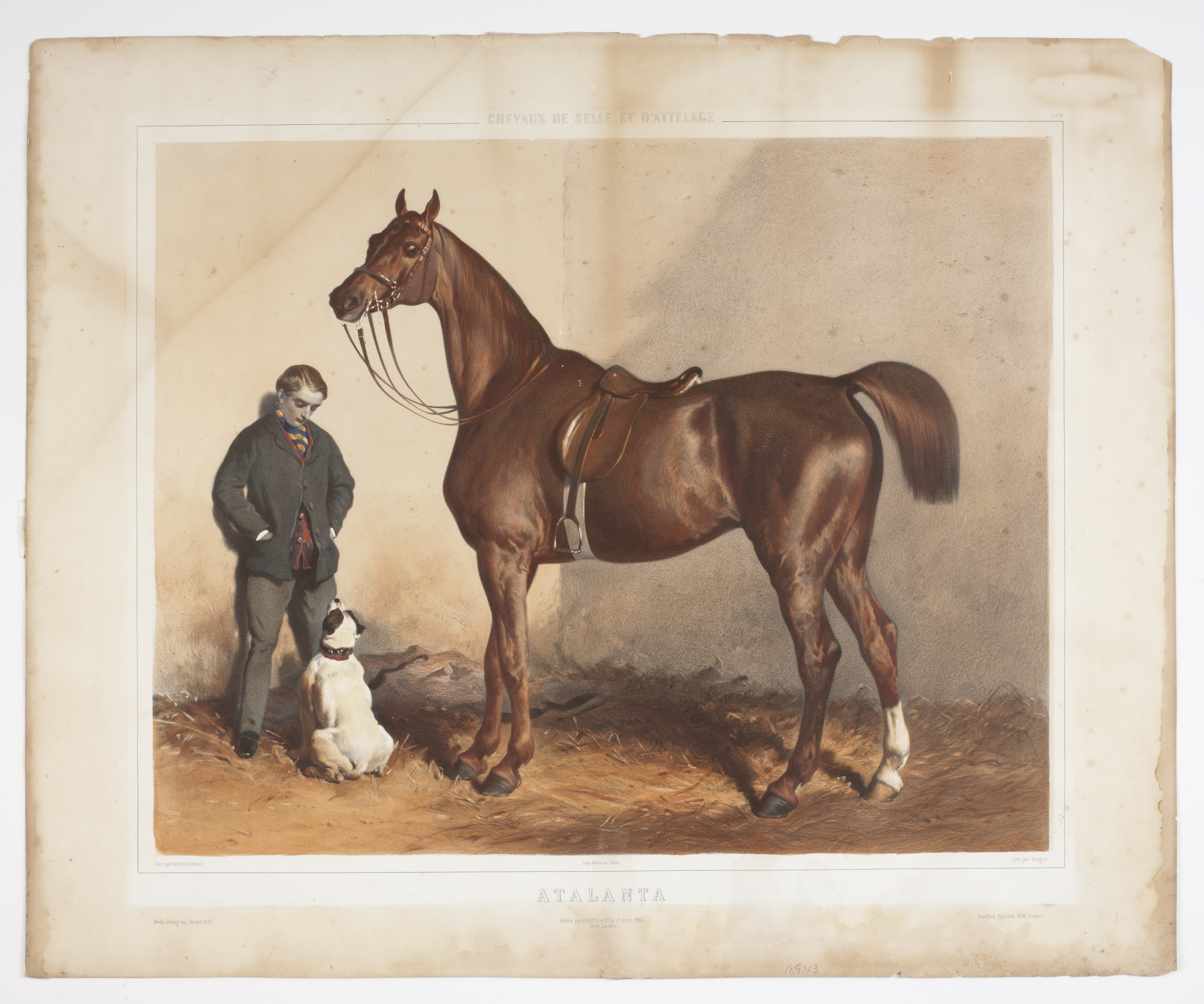
Bargue, Charles after Alfred de Dreux, Atalanta, Paris, Berlin, New York: Goupil and Knoedler, 1860.

Another beautiful example of transatlantic lithographic printing from France, this image of the horse Atalanta from a series of prints of driving and saddle horses was the bicentennial gift of AAS member George Fox.  Named for a Greek goddess of hunting, the print shows a well-proportioned bay-colored hunter standing near a wall with a stable boy and small dog.  While the boy and the dog are oblivious to the viewer, the horse turns her fine head and looks out at us.  Many of the prints in the set were drawn by the lithographer Charles Bargue after well-known French animal painter Alfred de Dreux.  The prints were also sold individually by Goupil in their shops in France, Germany and New York, and would have appealed to any lover of horses. Bicentennial gift of George K. Fox.

Adopt-a-Book 2013: Romney and Obama, 1844 style

On Friday, April 5th from 6:00 to 8:00 p.m., the American Antiquarian Society will be hosting our 6th Annual Adopt-A-Book event. This event is an important fundraiser for the curatorial team at the Society, and monies raised will go towards future acquisitions of books, prints, newspapers, manuscripts, and children’s literature. Below are examples of two items that have been put up for adoption by Curator of Newspapers, Vince Golden:

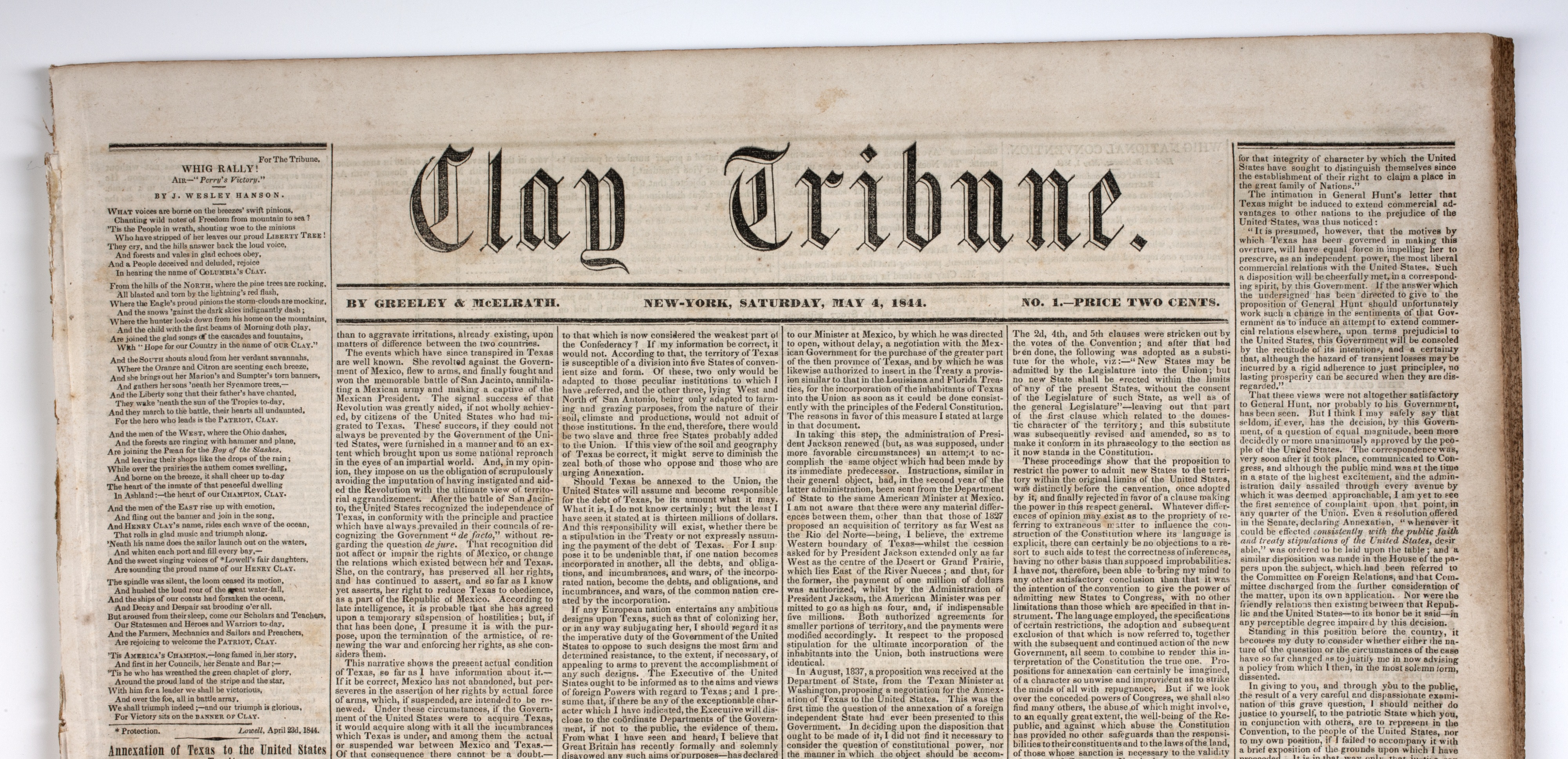
Clay Tribune (New York, NY). May 4, 1844.
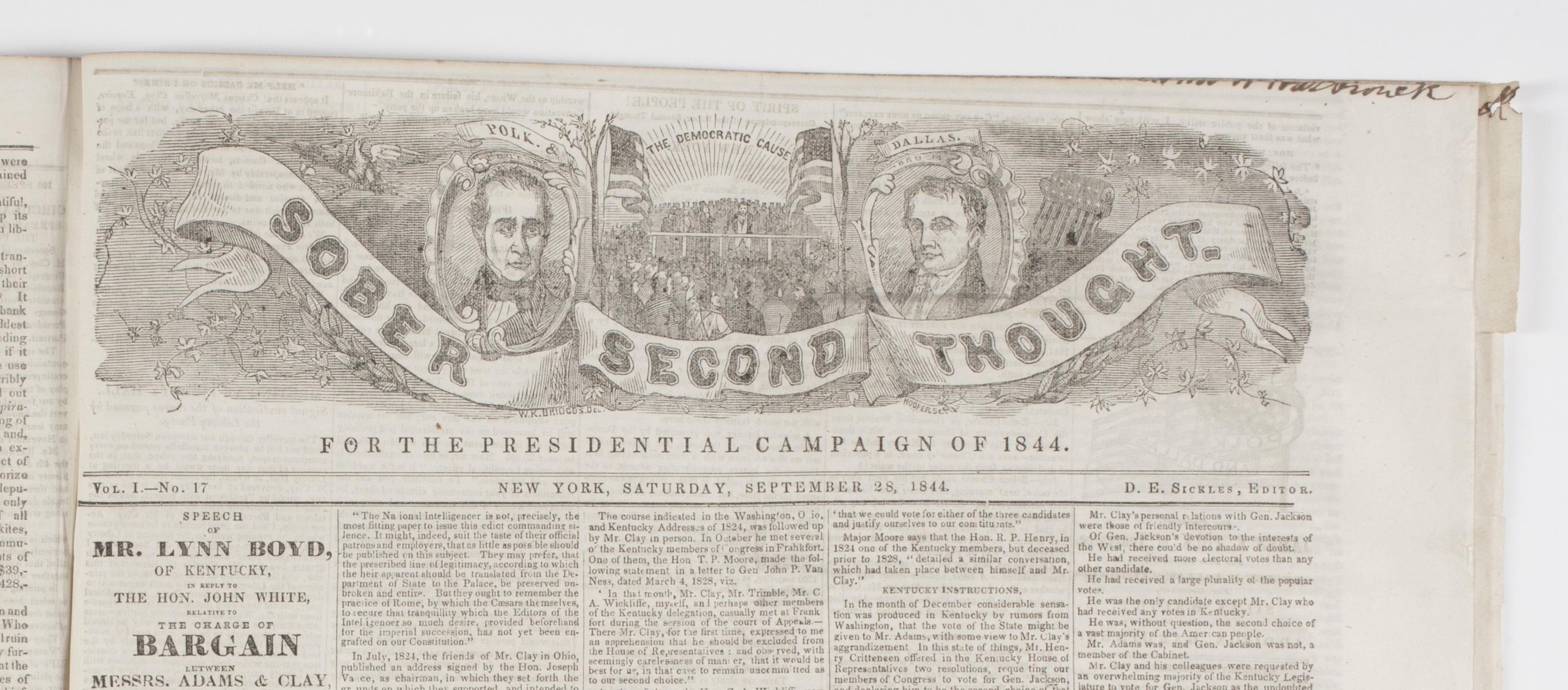
Sober Second Thought for the Presidential Campaign of 1844 (New York, NY). Oct. 5, 1844.

Adopt me for $100 each (Or the entire file of issues for $1,000 each)

During elections in the nineteenth century it was quite common for campaign newspapers to be published supporting a specific candidate or party.  These ephemeral publications were short-lived and are often difficult to locate today.  The Clay Tribune supported the Whig Party and the Sober Second Thought for the Presidential Campaign of 1844 supported the Democratic Party.  Both were published in New York during the election of 1844, and they often go toe-to-toe on the issues.  The usual exaggerated political discourse surrounding issues of the day (Texas annexation, growing conflicts with Mexico) is parsed out with reprinted speeches and often vicious negative propaganda against the other side.

Remember, you can browse the entire catalog of the 100 items that make up the 2013 Adopt-A-Book list. Fifty additional items will be available for adoption that evening only. As a bonus, if you pre-adopt, entrance to the evening on April 5th is free!

Calling all readers!

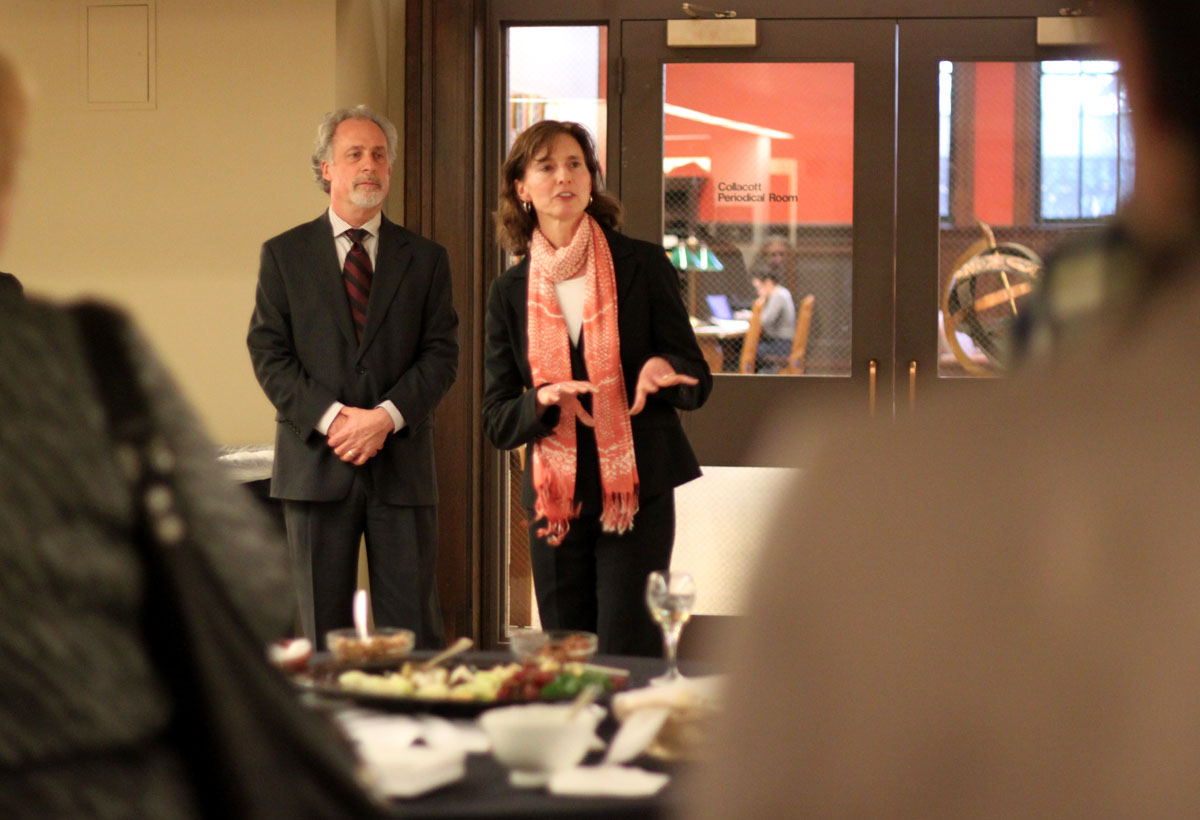
CHAViC director Nan Wolverton with Martin Antonetti, curator of rare books at the Mortimer Rare Book Room, during the opening of the exhibition.

Chances are if you are looking at this, you like to read.  If you are the least bit curious about reading habits in America and how they have been presented in books and images over the past three centuries, I encourage you to visit a new exhibition at Smith College in Northampton, Massachusetts.  Last week the American Antiquarian Society’s Center for Historic American Visual Culture (CHAViC), in collaboration with the Mortimer Rare Book Room at Smith, hosted the opening of A Place of Reading: Three Centuries of Reading in America.  Located in the Book Arts Gallery on the third floor of Neilson Library at Smith, the exhibition is open to the public and will be on view through May 28, 2013. Most of the materials in the exhibition are on loan from AAS.

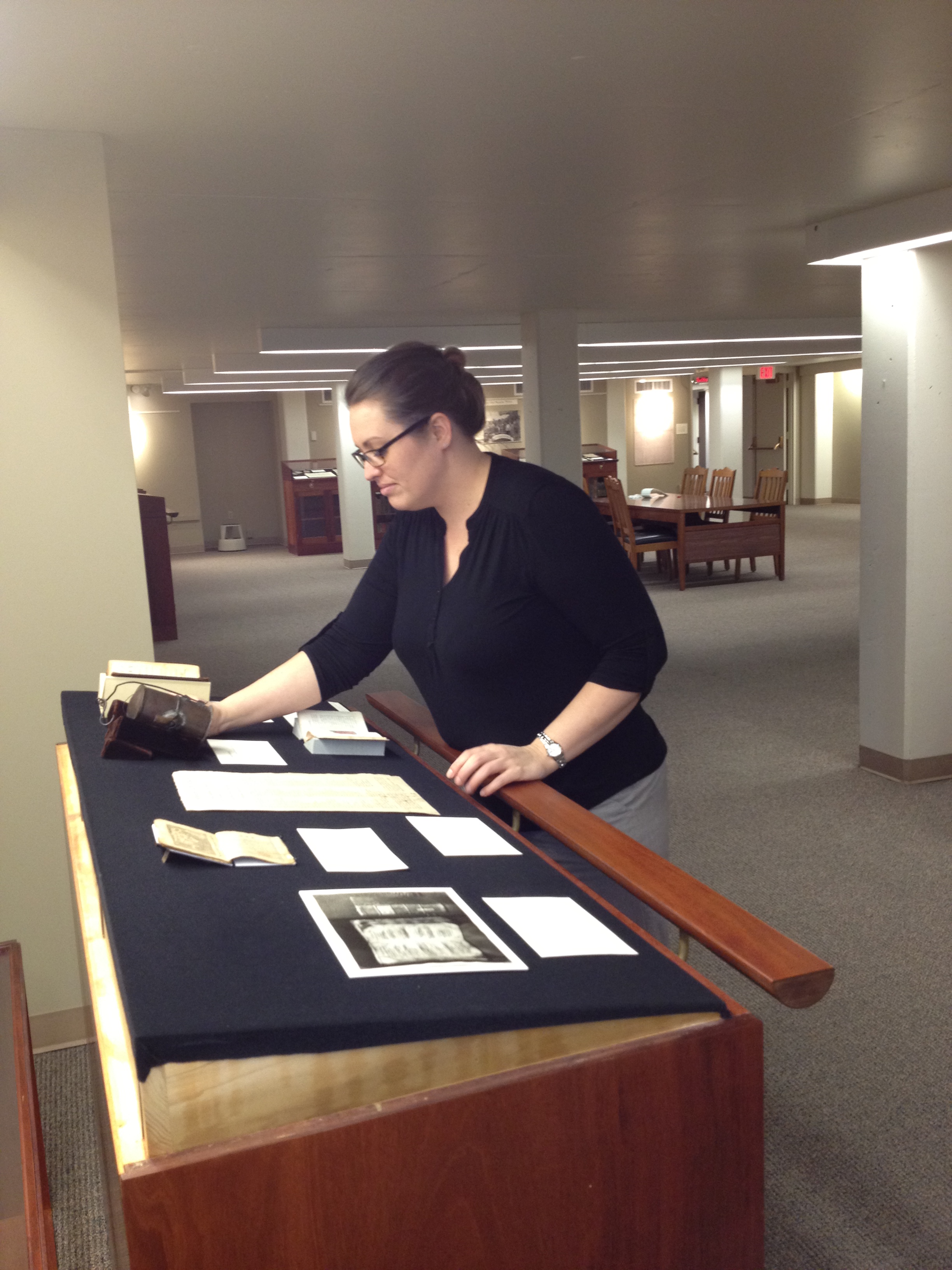
Cheryl Harned, the curator of the exhibition, installing a case.

Included in the exhibition are representations of the places and events that prompted reading among Americans of all ages. The exhibition is organized into the following sections: The Colonial Home; Revolutionary Taverns; North/South/East/West: Newspapers, Periodicals, and the Popular Press; and Reading at the Front: The Civil War.  An additional section, “Caught in the Act,” highlights other places of reading such as the kitchen, bedroom, bath, prisons, and public spaces.

The exhibition was curated by Cheryl Harned, a University of Massachusetts graduate student who completed an internship at AAS several years ago. Under the direction of former director of CHAViC Gigi Barnhill, Cheryl researched the history of reading and developed an online exhibition for the AAS website as her final project.  More recently, Cheryl developed the online version into a physical exhibition so that visitors can see the actual prints and books. Some of the materials now on view are not in the online exhibition, and the new exhibition also includes objects on loan from the Joseph Allen Skinner Museum of Mount Holyoke College.

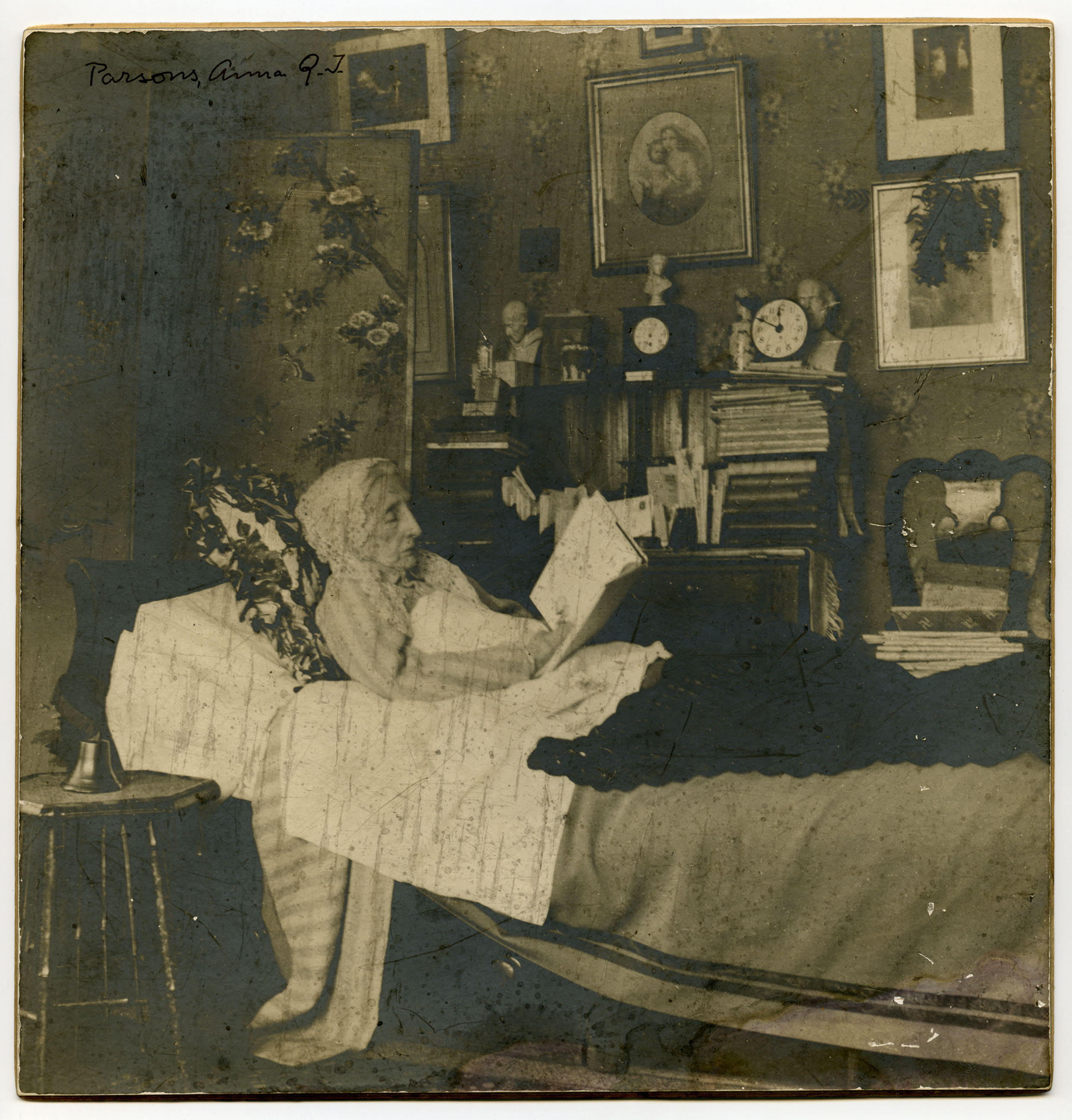
As the new director of CHAViC, I find this exhibition particularly exciting because as an instructor in American Studies and Art History at Smith, I can use it as a teaching tool. This week I took my students to see the numerous discussion-provoking examples of people reading and what they could help us to understand about gender and national identity. They especially loved seeing the photograph of the elderly matron reading in bed (see left) and the mid-nineteenth-century mother reading a novel in the kitchen while chaos ensues all around her!  Go see for yourself–it’s worth a visit. Take a complimentary bookmark home with you, and don’t forget to write a note in the guest book about your favorite place to read!

For more information on the exhibition visit: http://www.smith.edu/libraries/info/news/placeofreading