F.D. Allen, Concert of Sacred Music, in the Third Associate Reformed Church . . . New York: E. Conrad, 1819.
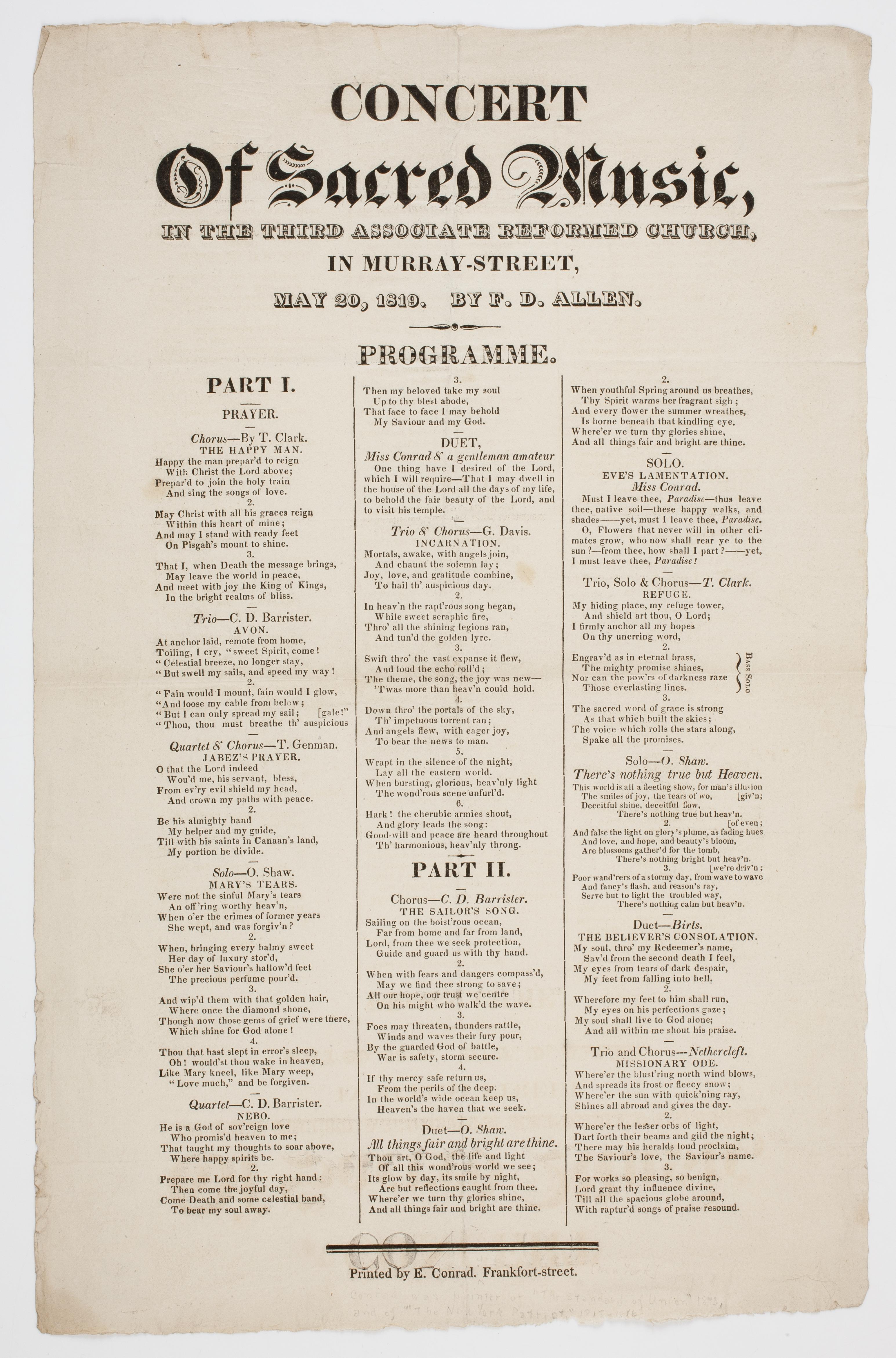 This broadside for a concert given in the spring of 1819 was not identified by Shaw & Shoemaker in their bibliography of American imprints from before 1820, making it an exciting acquisition for AAS. The broadside, printed with several different type styles, was made by Ephriam Conrad, who was at work in Philadelphia from 1795 to 1827, and steadily produced pamphlets, reports and newspapers for local clients. Author and composer Francis D. Allen arranged the concert and began promoting it in New York papers in April 1819, listing tickets at 50 cents. He emphasized that much of the music was new, very chaste, and appropriate for a wide audience. After the event, the press reported that over 600 ladies and gentlemen attended the concert. The Providence [R.I.] Patriot printed a summary of the concert which although held in New York, featured three new works by local composer Oliver Shaw.
Recommended Reading: Isa, A Pilgrimage (1852) by Caroline Chesebro’
Editor’s note: In the most recent issue of the Almanac, we asked members of the AAS community to give us their choice of recommended reading for “fiction published before 1900.” We are continuing those recommendation in this series on Past is Present. This first post is written by AAS member Philip F. Gura, who is the William S. Newman Distinguished Professor of American Literature and Culture at the University of North Carolina at Chapel Hill, the author of the bicentennial history of the American Antiquarian Society and, most recently, of Truth’s Ragged Edge: The Rise of the American Novel (2013).
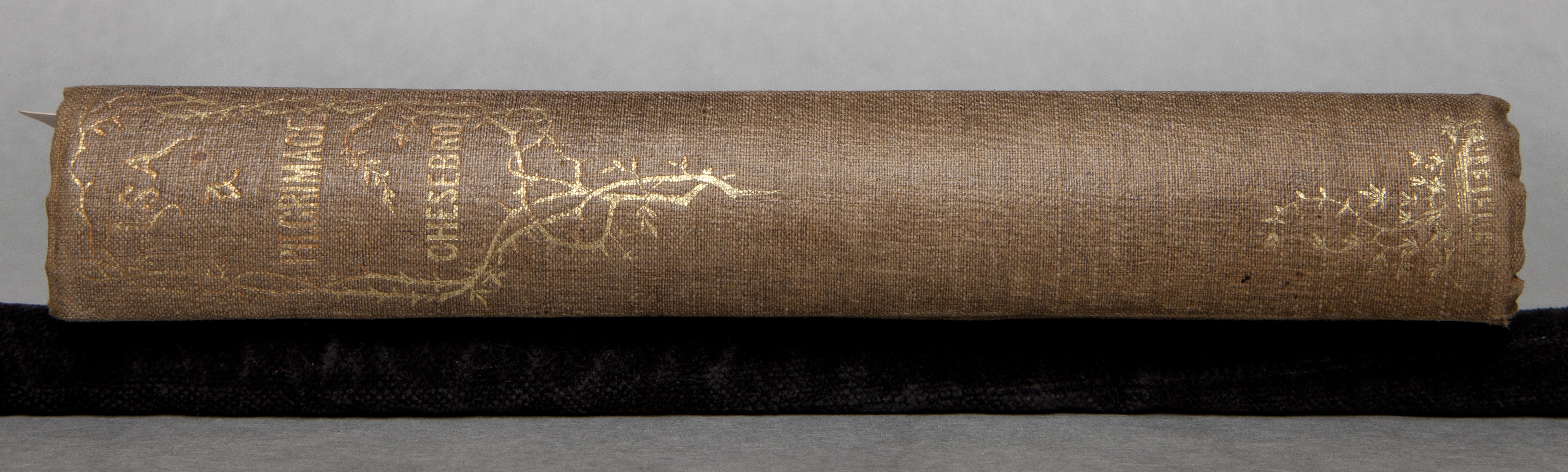
What is there to add to the standard history of the American novel? Don’t we already know which books are most deserving of our attention and respect? The answer is no. More recently, the digitization of our literature has given a second wind to older books that may be difficult to find in your local Barnes and Noble. The full variety of early American novels is now at our fingertips: novels by women, African Americans, and white men forgotten not because of their race or gender but often because of the novelty or radicalism of their art.
To sample such literature, one might start with Caroline Chesebro’, a native of upstate New York; her father was involved in the kidnapping and disappearance of William Morgan that precipitated the Anti-Masonic movement. She went to a young women’s academy and soon thereafter began publishing stories in such magazines as Graham’s. Encouraged by positive reviews—one reviewer found her stories “unmistakable evidence of originality of mind”—she wrote Isa, a Pilgrimage (1852). Next came The Children of Light (1853), the story of two young women who, when they are rejected by the men they love, move together to the city, where one supports the other in her budding acting career. Getting Along (1855) focuses on various couples’ relationships, in which, while assuming that marriage is the norm, she assesses the partners’ fidelity to their original commitments to each other.
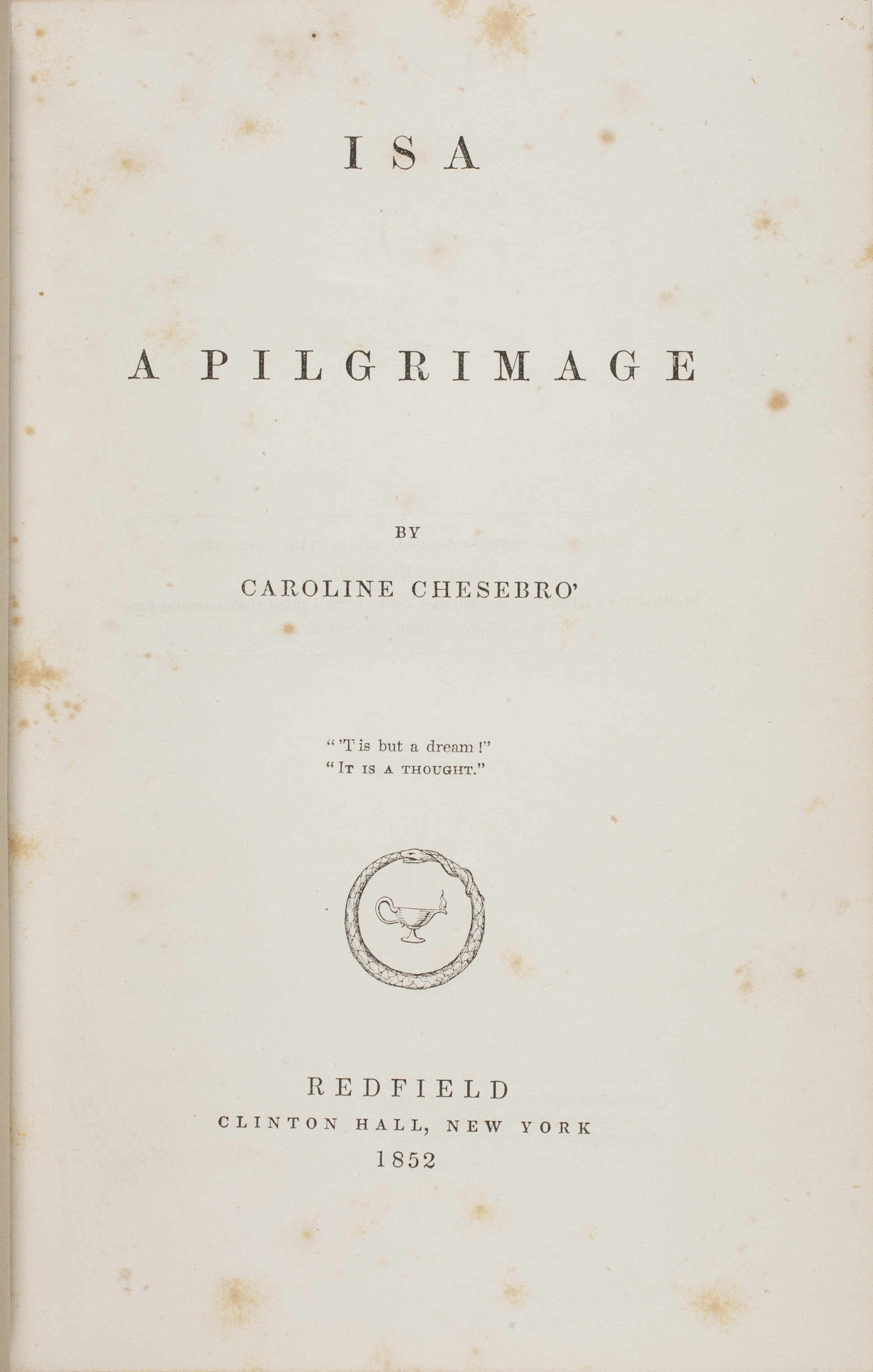 Start with Isa, A Pilgrimage (1852), published the same year as Uncle Tom’s Cabin, a novel in which Chesebro’ is interested in the plasticity of gender roles. Her heroine Isa is not trapped by society’s expectations but rather experiences more of herself and the world as she challenges the limits of propriety. Isa is an orphan rescued by the Weares, a good Christian family whose traditional notions of religion she appreciates but soon leaves behind as she flourishes intellectually. She takes up advanced ideas about religion, philosophy—she is a Transcendentalist—morality, and the role of women in society and believes that faith is “cowardly” at best, “for there is no limit given but that which our own will regulates. No other voice,” she continues, “than man’s mental capacity, ever said, thus far, no farther.”
Isa receives an attractive marriage proposal from an older man who offers her “his name, his fame, his fortune,” but she refuses because she wants no restrictions in her life. Eventually, she marries a likeminded intellectual named Alanthus Stuart, with whom she moves to Europe where, though unmarried, they live together and have a child—a scandal for the time. Thus, in Isa, Chesebro’ broached subjects few other American novelists at the time dared to: the relationship between orthodox religious faith and personal fulfillment, between the demands of the soul and the demands of society, between her love and marriage as well as the potentiality of living a life of the mind, inhabited by radical philosophical and political ideas. One reviewer complained, “Isa makes her self-will, her intellectual progress, her ambition, a three-fold deity.” But that is the point: she had merely fashioned a personal religion from secular ideas and values, and in so doing stands as a remarkably fulfilled example of Emersonian self-reliance.
Join us on Instagram!
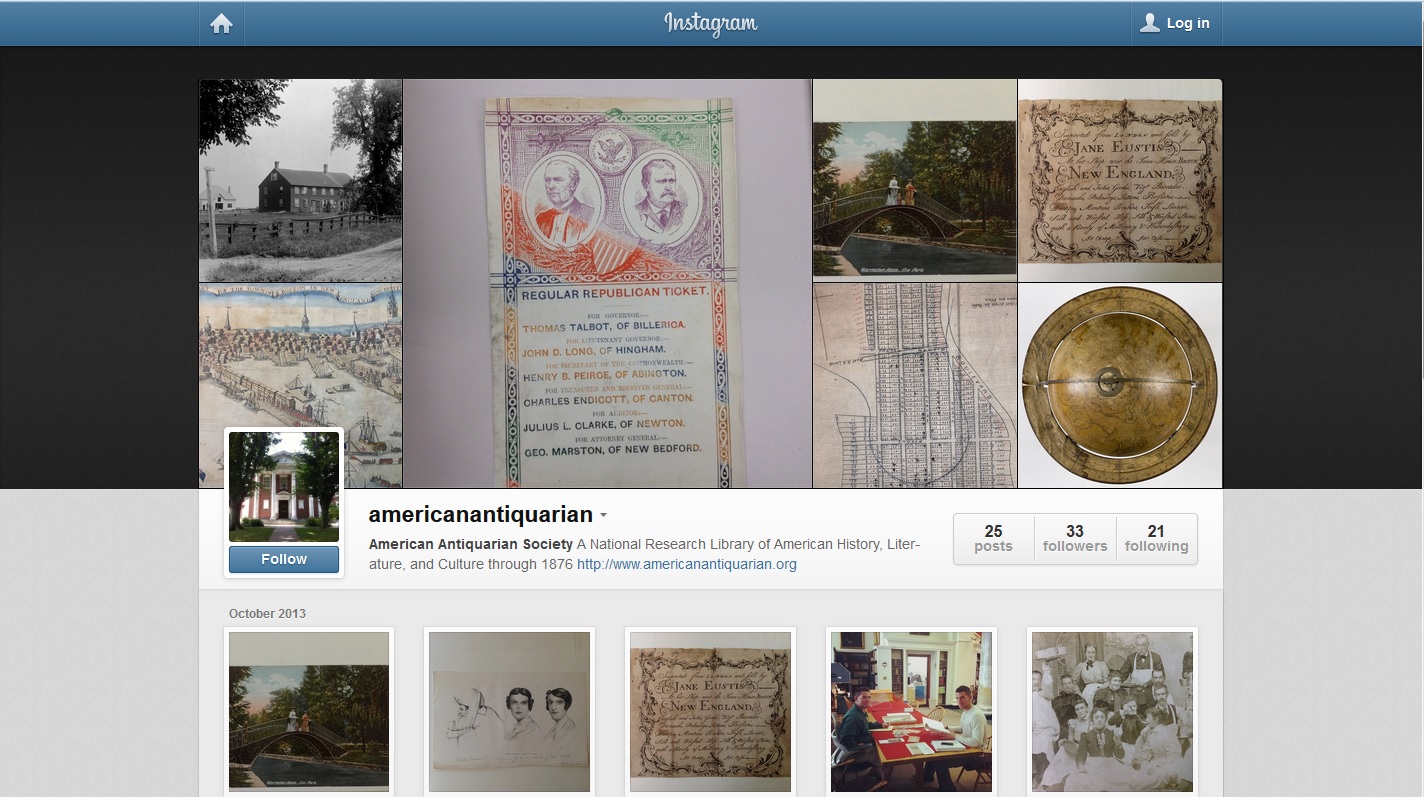 Ever wonder what goes on behind the scenes at AAS, or what our programs and events look like? We recently set up an Instagram account as a way to promote interest in the collections and resources at the Society as well as to let people know about events and activities. Our digital photographer Cade Overton first began posting images that he found compelling. Since then, numerous staff members have been posting to the account and we now have images of events, collections materials, readers, classes, and other goings on. Cade recently posted a photo of a class from Holy Cross working in the reading room and as he did so, one of the students posted a photo on their Instagram of Cade photographing them! Catalogers and curators will be posting images of new material as it is acquired or cataloged, and pictures of events will be posted soon after they take place. This week, for example, Nan Wolverton, director of CHAViC, and I will be traveling to Bordeaux, France, to hold a conference on French and American lithography before 1860 at the Musée Goupil. Both Nan and I will be Instagramming during the event, and posting images for you to enjoy.
So please, come follow us on Instagram (at “americanantiquarian”) and join us for all of the activity going on at AAS (and in France!).
The Acquisitions Table: The Franklin
The Franklin, or, A Political, Agricultural, and Mechanical Gazette (Washington, DC) Oct. 31, 1801. No. 1.
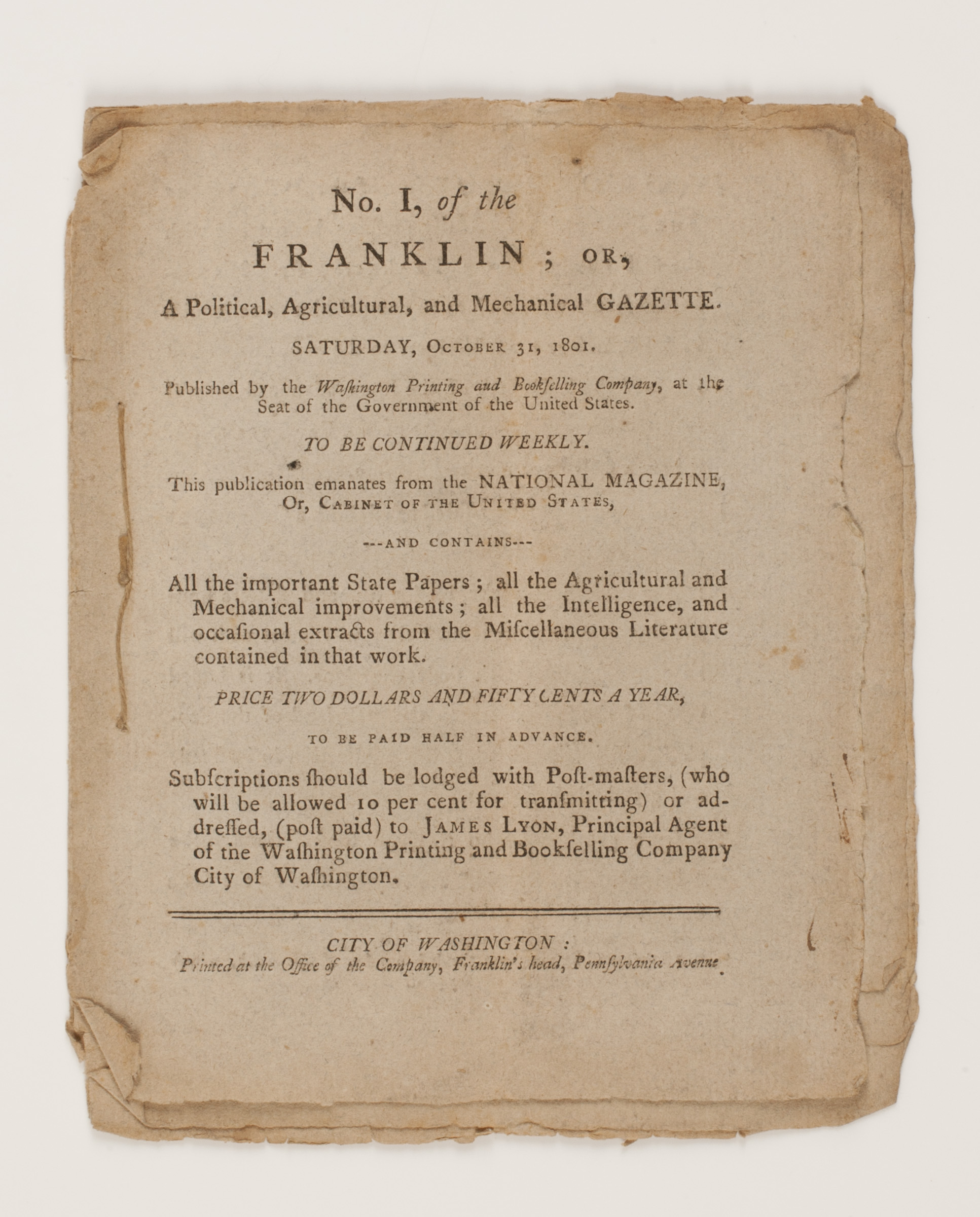 The Franklin was published by James Lyon. Inside the front wrapper is a note from Lyon about his difficulties publishing the Friend of the People (Richmond, VA) and having to move to Washington before subscribers received “the full worth of the sums advanced.” This periodical was published at the office of the National Magazine, Or, Cabinet of the United States, another periodical that Lyons was publishing. The Franklin included articles originally printed in this publication as well as material from other sources. This is issue no. 1 of The Franklin and may have been the only one published. No evidence has been found so far of another one being printed and the National Magazine ceased publication less than three months later.
Newest Issue of the Almanac Hot Off the Press
 If you haven’t yet seen a copy of the latest issue of our newsletter, Almanac, you can see it here! It has news on upcoming public programs, workshops, and conferences, as well as the opening of an exhibition in Bordeaux, France, recommended reading from the AAS community, and much more. In a new feature article, we also explore the all-important acquisitions process that continues to build our collection every day.
In other words, it’s a must-read and a must-see (because of course it also includes some beautiful images from the collections). So be sure to check it out and get caught up on all things AAS!
The Acquisitions Table: The Hunting of the Snark
Carroll, Lewis. The Hunting of the Snark: an Agony in Eight Fits. Boston: James R. Osgood and Company, late Ticknor & Fields, and Fields, Osgood & Co., 1876.
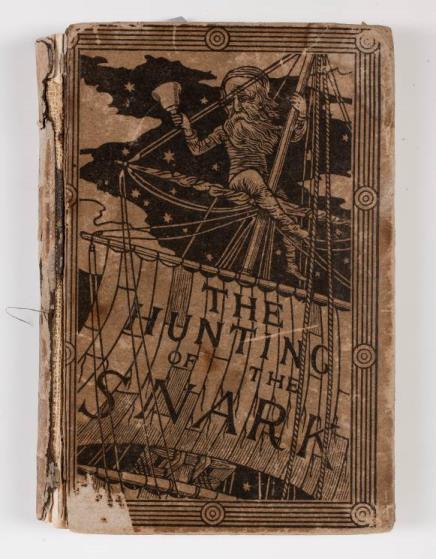 Best known as the author of Alice’s Adventures in Wonderland (1865), Lewis Carroll – the pen-name of Charles Lutwidge Dodgson, a mathematical lecturer at Christ Church, Oxford – also wrote this fantastical epic tale recounting the adventures of a bizarre troupe of nine tradesmen and a beaver. First published in London in 1876, this first American edition was reproduced that same year by photo-lithography in a smaller format by James R. Osgood in Boston. The paper-covered boards on this copy, while not the best condition, do immediately attract attention, as do the nine illustrations inside, all of which were done by Henry Holiday. A tenth illustration depicting the Snark was rejected by Carroll – he wanted the creature to remain unimaginable.
Public Program Season Starts with Historic Performance
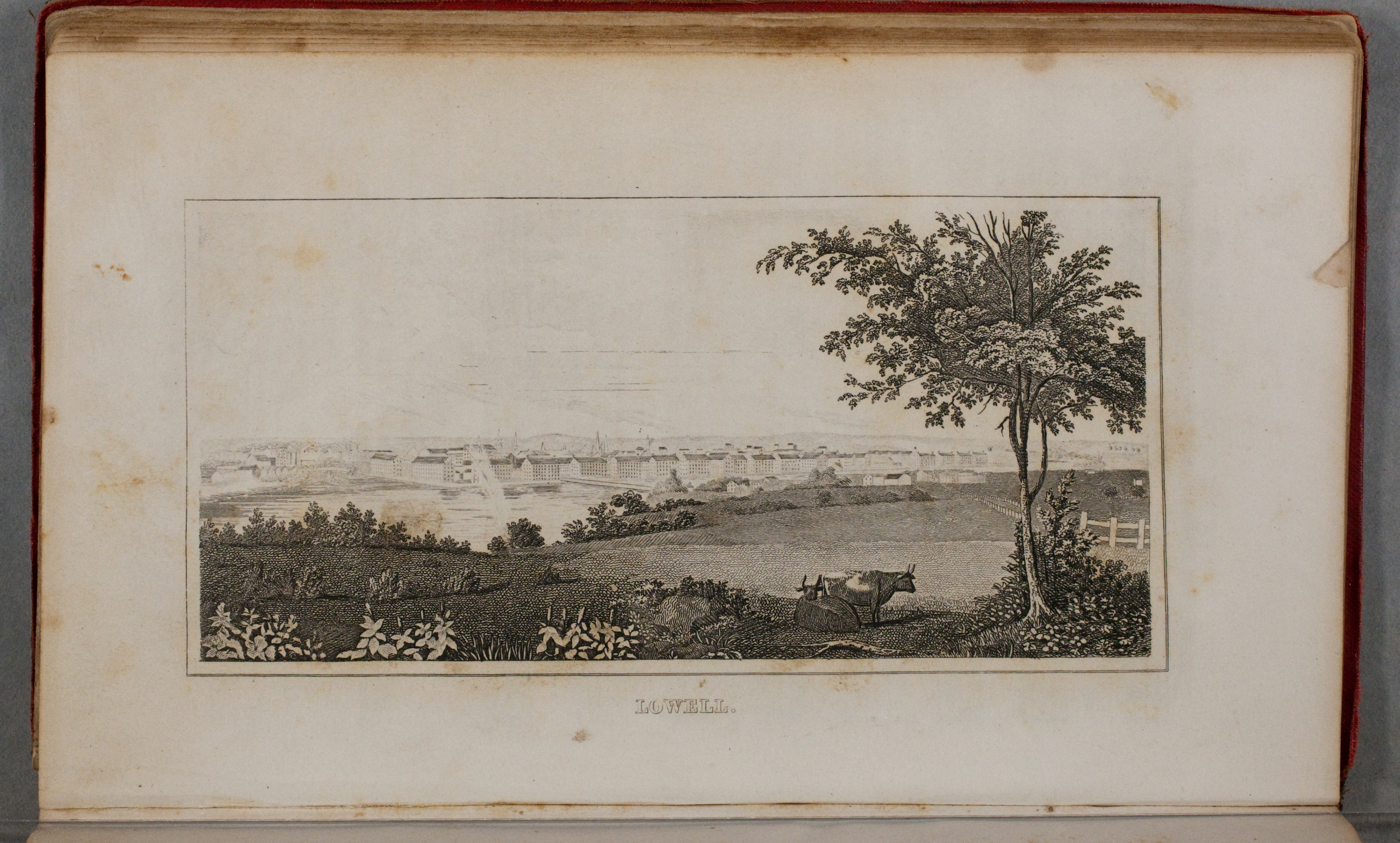
 This Thursday evening at 7 p.m., we will start our fall series of public programs with a one-woman play called Lowell Mills Boardinghouse Keeper. Kate Carney wrote and performs this presentation about Mrs. Lois Larcom (1786-1868), who kept a boardinghouse for female factory workers in the 1840s. Her daughter, Lucy Larcom (1824-1893), became a poet, writer, and editor of some influence in the nineteenth century. She described her mother and the boardinghouse she ran in her memoir, New England Girlhood, Outlined from Memory.
Lois Larcom began running a boardinghouse in Lowell in 1835 after the death of her husband, Benjamin. As she needed to find some way to support their ten children, she left her rural home in Beverly, Massachusetts, to live in the rapidly growing community on the Merrimack River. Lowell was then an inspirational experiment in industrialization attracting many young women from throughout the New England countryside to work in the new cotton mills. Most of the young women who boarded with Larcom came from rural Vermont and New Hampshire. In addition to painting a dramatic portrait of Mrs. Larcom, the play on Thursday evening will also explore the social dynamics of the Lowell community and the evolving role of women in nineteenth-century society.
Kate Carney is a professional actor and director who has directed plays on Broadway, performed in Boston and New York theaters, toured nationally and internationally, and appeared in films and on network TV. Since 1993, she has been bringing history alive at museums, libraries, schools, and First Nights throughout the Northeast with Heroic Women You Can Talk To, interactive theater pieces. Carney has taught and directed at Brandeis, Smith, and other colleges and trained theater companies in France and Israel. For more information on Kate visit her website.
The American Antiquarian Society has a great many imprints connected to the Lowell experiment and to the works of Lucy Larcom, some of which will be on display Thursday evening. These include complete holdings of the Lowell Offering, and first editions of Lucy Larcom’s Poems and New England Girlhood, among many others.
Step into the Nineteenth Century with Our Fall K-12 Workshops
The fall is always an exciting time here at AAS, with a full schedule of public programs, conferences, and workshops. We’ll be keeping you updated with all of these events throughout the season, starting here with our next round of professional development workshops for K-12 educators.
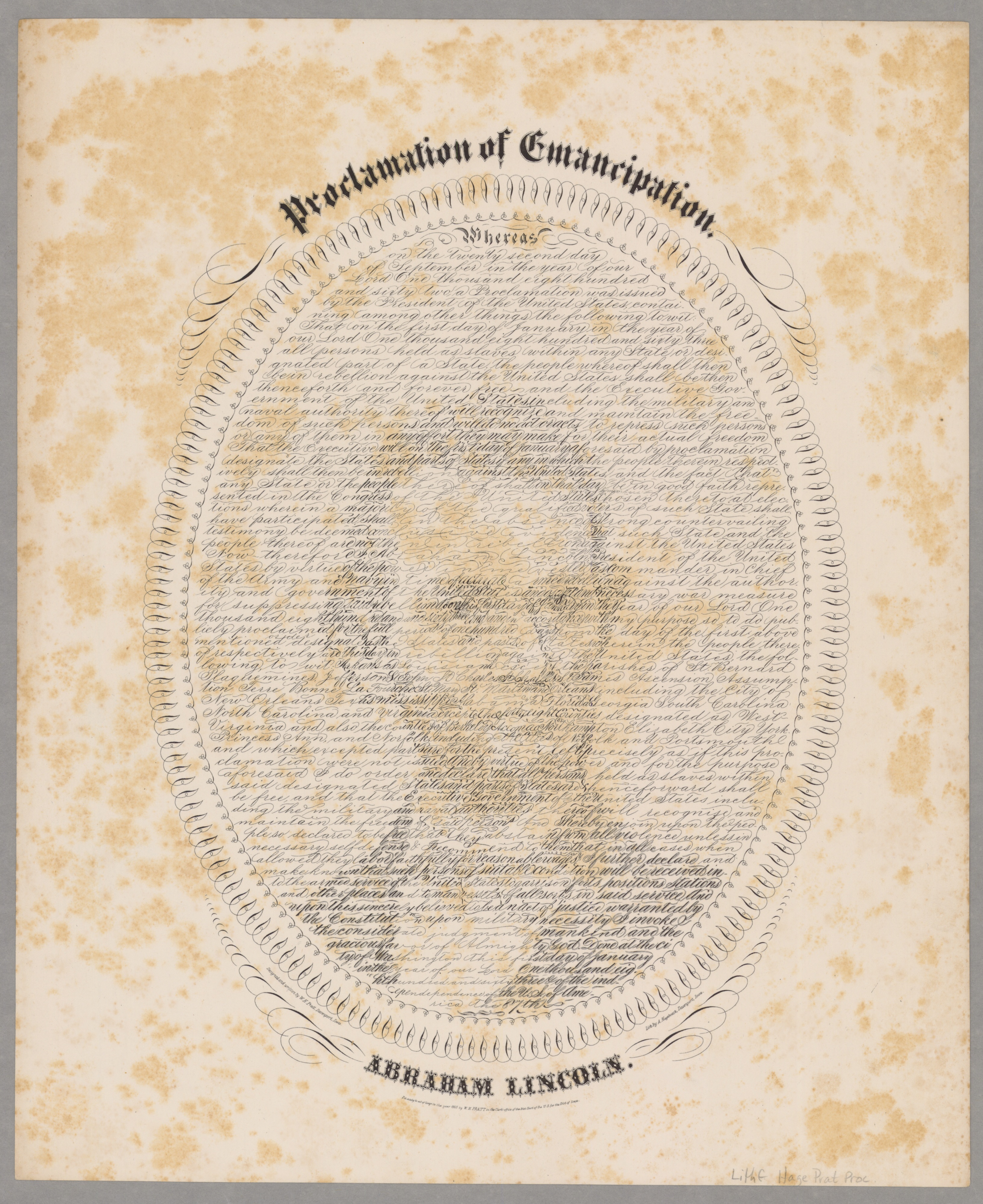 First up, on Saturday, October 19, will be the “Emancipation Proclamation and the Gettysburg Address,” led by Lincoln scholar Harold Holzer. With both of these seminal documents celebrating their 150th anniversaries this year, it was the perfect time to reflect on their significance in their own times, as well as today. We’ll be exploring their impact through primary sources in our collections, as well as through more recent media. Take this image to the right, for example. At first glance, you see a portrait of Abraham Lincoln. But if you take a closer look, you’ll find that the portrait is actually composed of the text of the Emancipation Proclamation. It’s similar to those puzzles that use tiny still frames from movies that all add up to one big still frame. In terms of more recent media, Harold Holzer served as a consultant on Steven Spielberg’s Lincoln and wrote the official companion to the film, Lincoln: How Abraham Lincoln Ended Slavery in America (2012), putting him in the perfect position to examine the ways Lincoln’s legacy has persisted to the present day. Holzer will also be delivering a free public lecture at Antiquarian Hall the previous night, October 18, called “Emancipating Lincoln: The Prose and Poetry of the Emancipation Proclamation.”
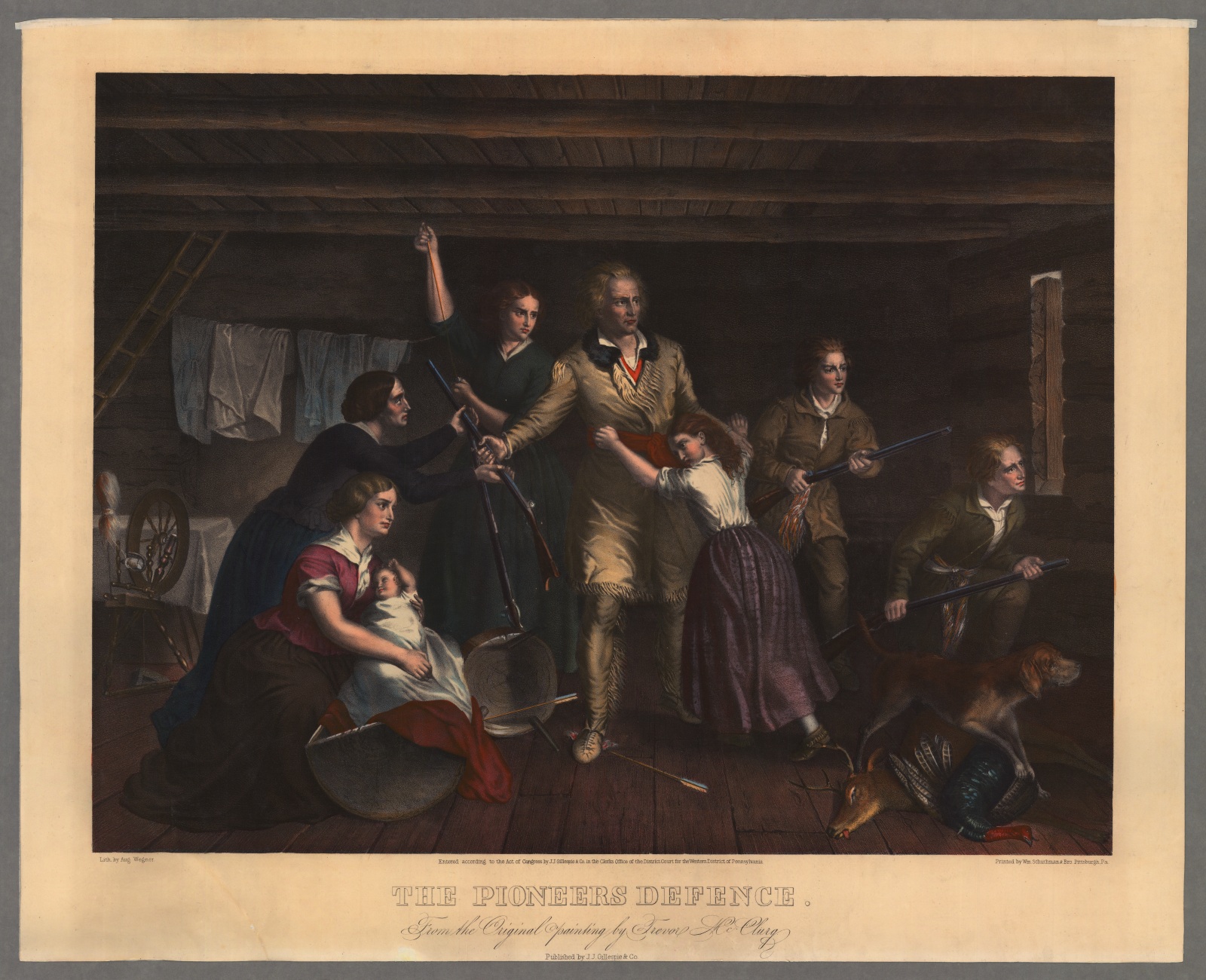 “Picture Perfect: Nineteenth-Century Women in Words and Images” will follow on Saturday, November 16. This interdisciplinary workshop, which is co-sponsored by the Society’s Center for Historic American Visual Culture (CHAViC), will examine historic visual representations of women in conjunction with selected texts by nineteenth-century women authors, many of whom are cited in curriculum frameworks. What’s so exciting about this workshop is that it will appeal to history, English language arts, and visual arts teachers alike, all of whom will find the texts and images useful tools in the classroom. Through the juxtaposition of words and images we’ll explore notions of gender, reform, and women’s roles and examine topics such as anti-slavery reform, the domestic environment, Indian removal, and westward migration. We’ll put the works of well-known authors like Harriet Beecher Stowe, Louisa May Alcott, and Laura Ingalls Wilder into context using contemporary manuscripts, images, and printed documents. For example, how do Wilder’s descriptions of encounters with Native Americans compare with this 1850s image seen to the left? The lead scholar for the day will be Laura Smith, a lecturer in English at the University of New Hampshire, where she teaches courses in American literature and English teaching methods.
We hope to see you there! Details and registration can be found here.
American Studies Students Blog about AAS Experience
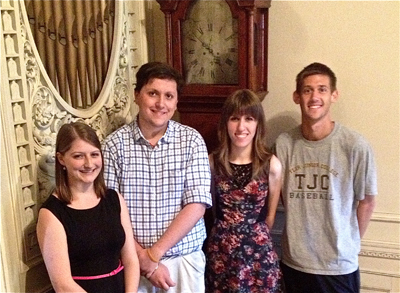 For over thirty years, the American Antiquarian Society has offered an annual honors seminar in American Studies to undergraduates from the five four-year colleges in Worcester. This year’s seminar, titled “The Nineteenth-Century Networked Nation: The Politics of American Technology, 1776-1876,” is being taught by Daniel Klinghard, Associate Professor of Political Science at the College of the Holy Cross. The four students from Assumption College who were selected to participate in the seminar—Maura Corbett, Jason Duke, Jennifer Gargan, and Erich Grosse—will be blogging about their experience in the seminar and discussing their research projects as they take shape. You can follow their seminar blog here.
The Acquisitions Table: Copy Book of A.D. Arms
Arms, A.D. Copy Book, 1870-1877 (with stylus and carbon papers).
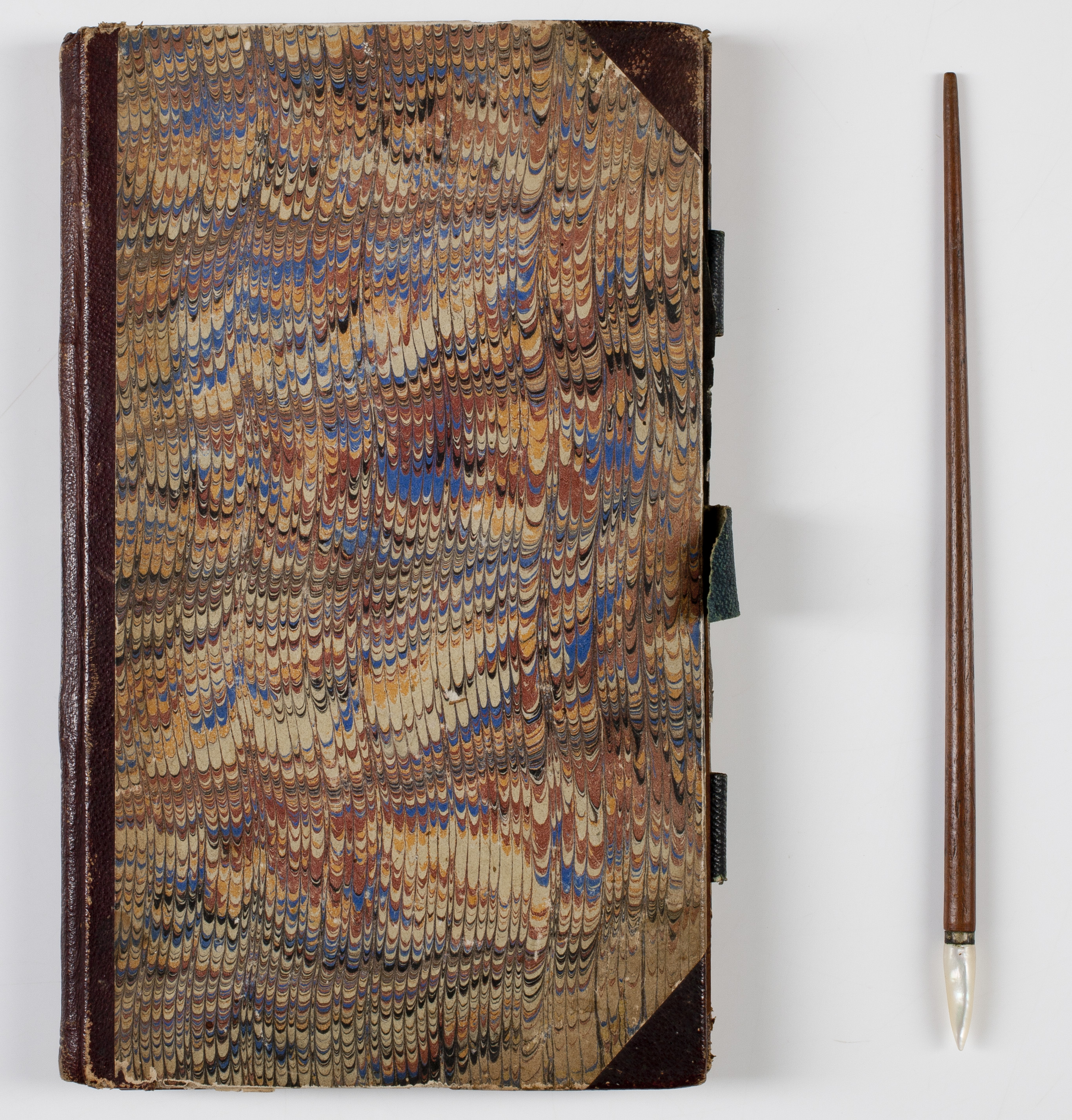 A new addition to the Society’s Penmanship Collection is this copy book, with stylus and copy paper still intact. The copied letters are all signed by an A.D. Arms, and most are written to recipients in Montpelier, so he was likely from the town, or close by. Although the book has only a few copied letters, they are entertaining and provide a glimpse into his daily life. Arms’s outgoing correspondence includes letters concerning a sheep dilemma (he does not think the sheep he received were the ones described by the seller), a trial of a new mowing machine, and inquiries about an artificial ear drum. Because Arms’s outgoing correspondence is all together in this copy book, (a rarity, since correspondence is typically scattered among its recipients), we get a fairly good picture of this individual who was clearly also interested in copybook technology.
Your Move!
Many magazines of the nineteenth century were published with paper wrappers, the purpose of which were to protect the issue as it went through the mail on its way to the subscriber’s home. These wrappers (often on colored paper) would identify the name of the periodical. Sometimes they would just reproduce the title page, but at other times they would be decorative with imaginative borders and illustrations. After all, that was the first thing people would see. That left three other wrapper pages; why leave them blank? The publisher would often fill them up with information about the serial, notices about upcoming issues, other publications for sale, advertisements, or other pieces of information they thought relevant to the subscriber. Sometimes the only reason we know who the editor or authors of particular articles are is because their names were printed on the wrappers.
The problem is much of this rich information was lost when magazines were bound into multi-issue volumes. Most binders would remove the wrappers because they had served their purpose, i.e. protected the issue. AAS has many bound volumes without the wrappers, but over the years we’ve added many individual issues (even if we have a bound volume) just for the wrappers.
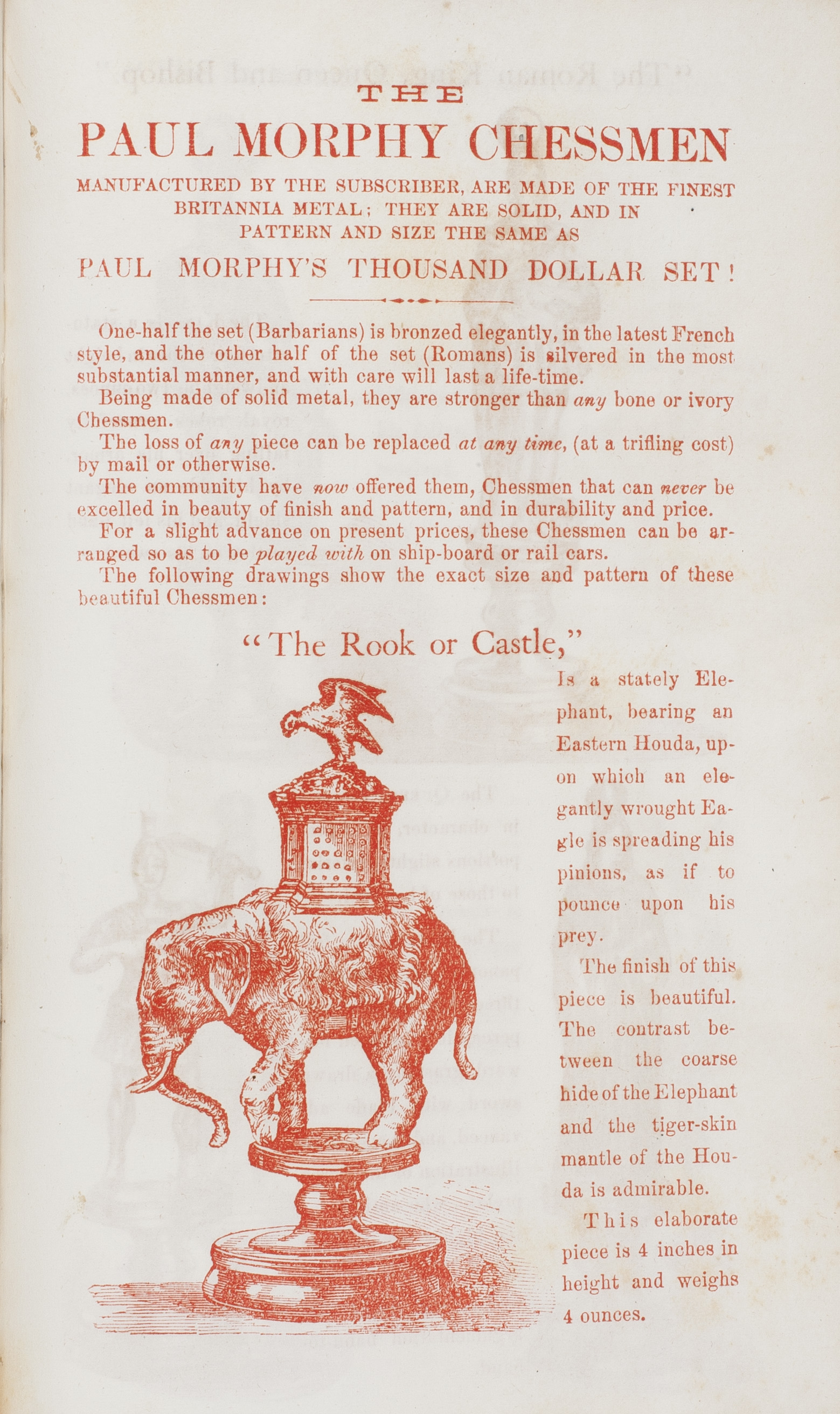
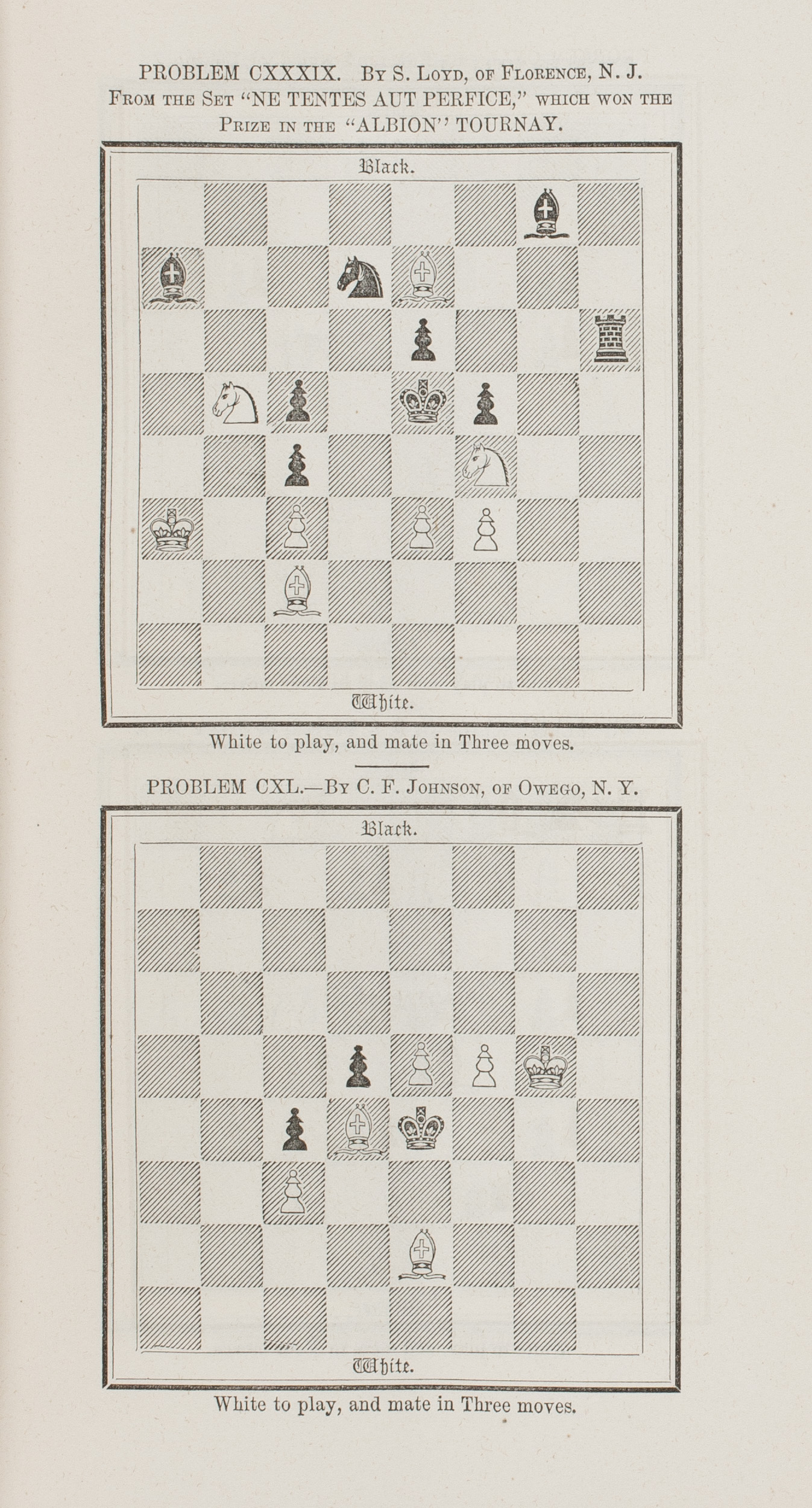
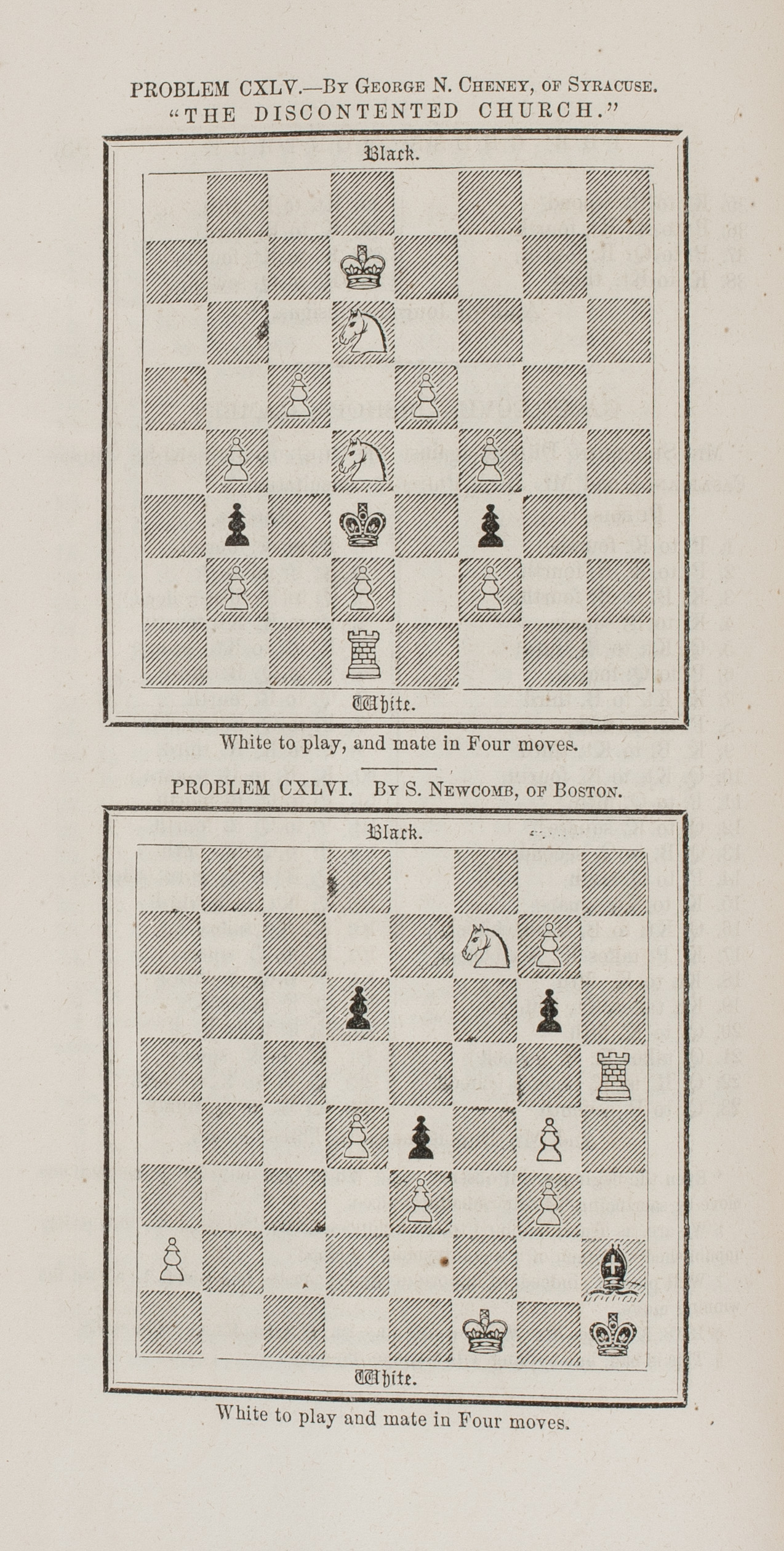
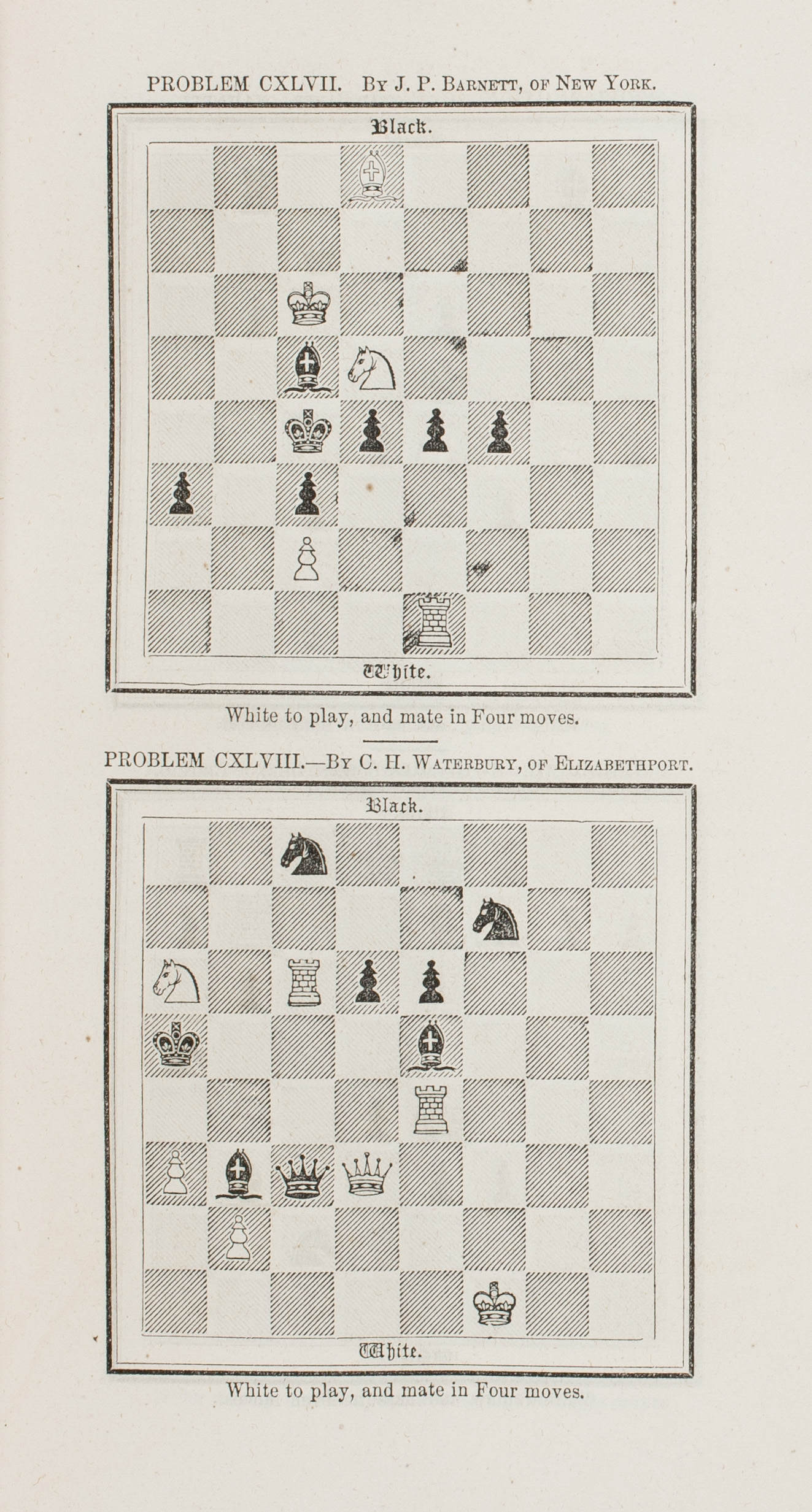
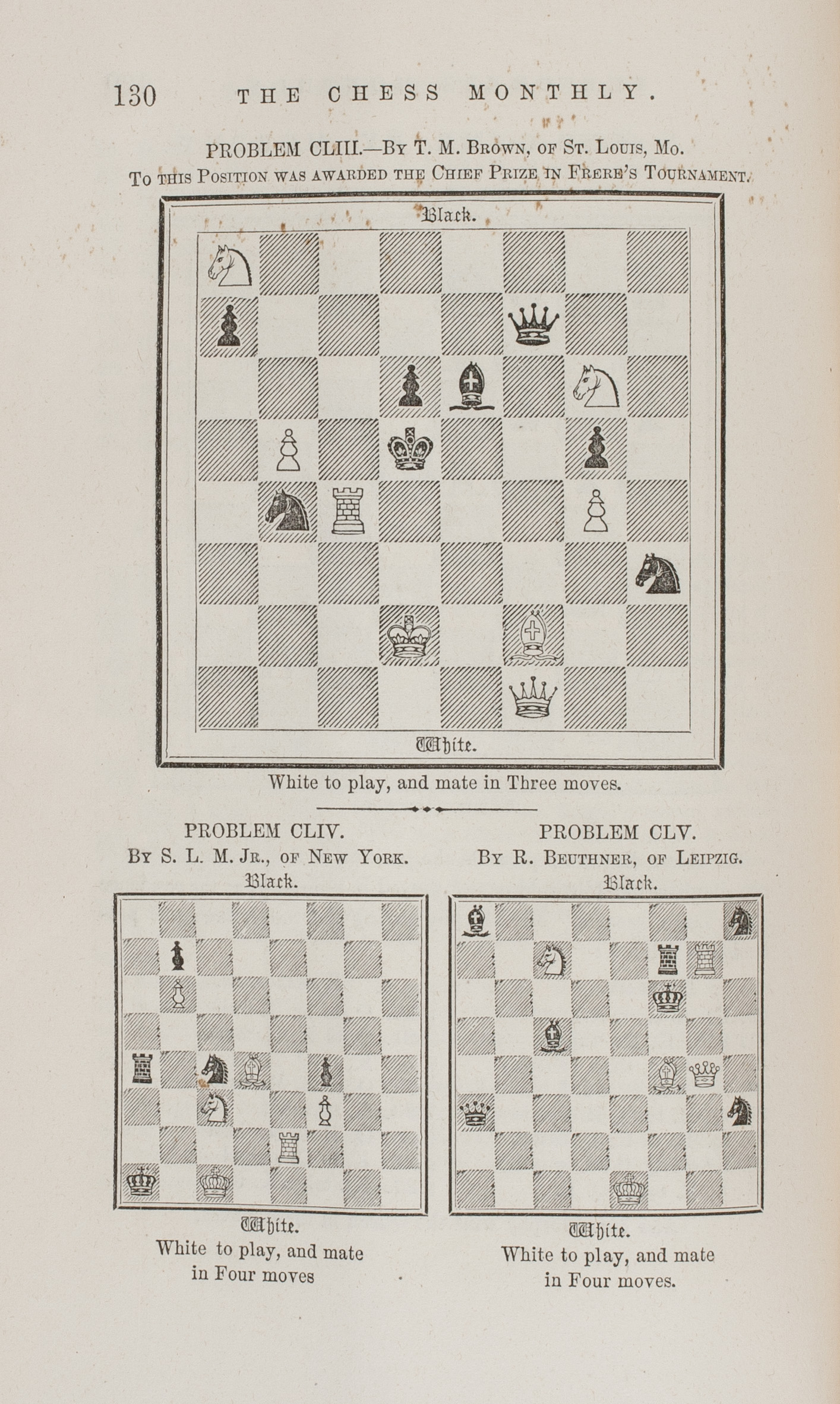
One interesting case is the periodical Chess Monthly. It appeared between 1857 and 1861. It was edited by Daniel Fiske and “co-edited” by the American chess champion, Paul Morphy, who in reality mostly just provided his name and contributed some annotated games. Puzzle inventor Sam Loyd also edited some of the chess puzzles. The wrappers of Chess Monthly contained information such as the names of the editors and advertisements for chess paraphernalia such as books and chess boards, but they also contained the answers to the chess problems published in the previous month’s issue. So you can see the problem of the chess problems. When the issues were bound, the wrappers (and the solutions) were removed and thrown away. Fortunately, the publisher provided a separate title page, index, and solutions to the problems after a volume was completed. This material could be combined with the issues when they were bound, but sometimes the binder didn’t include them.
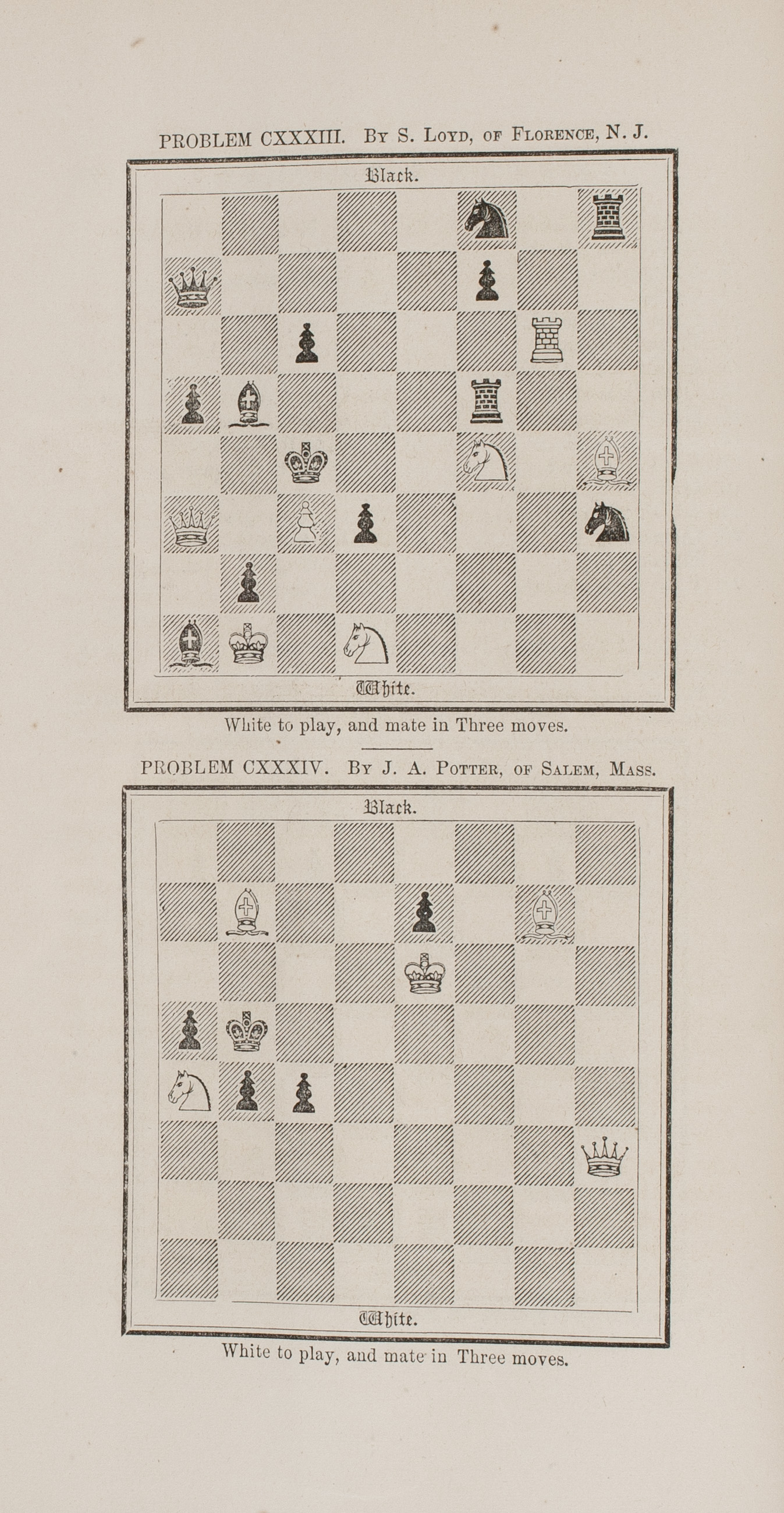
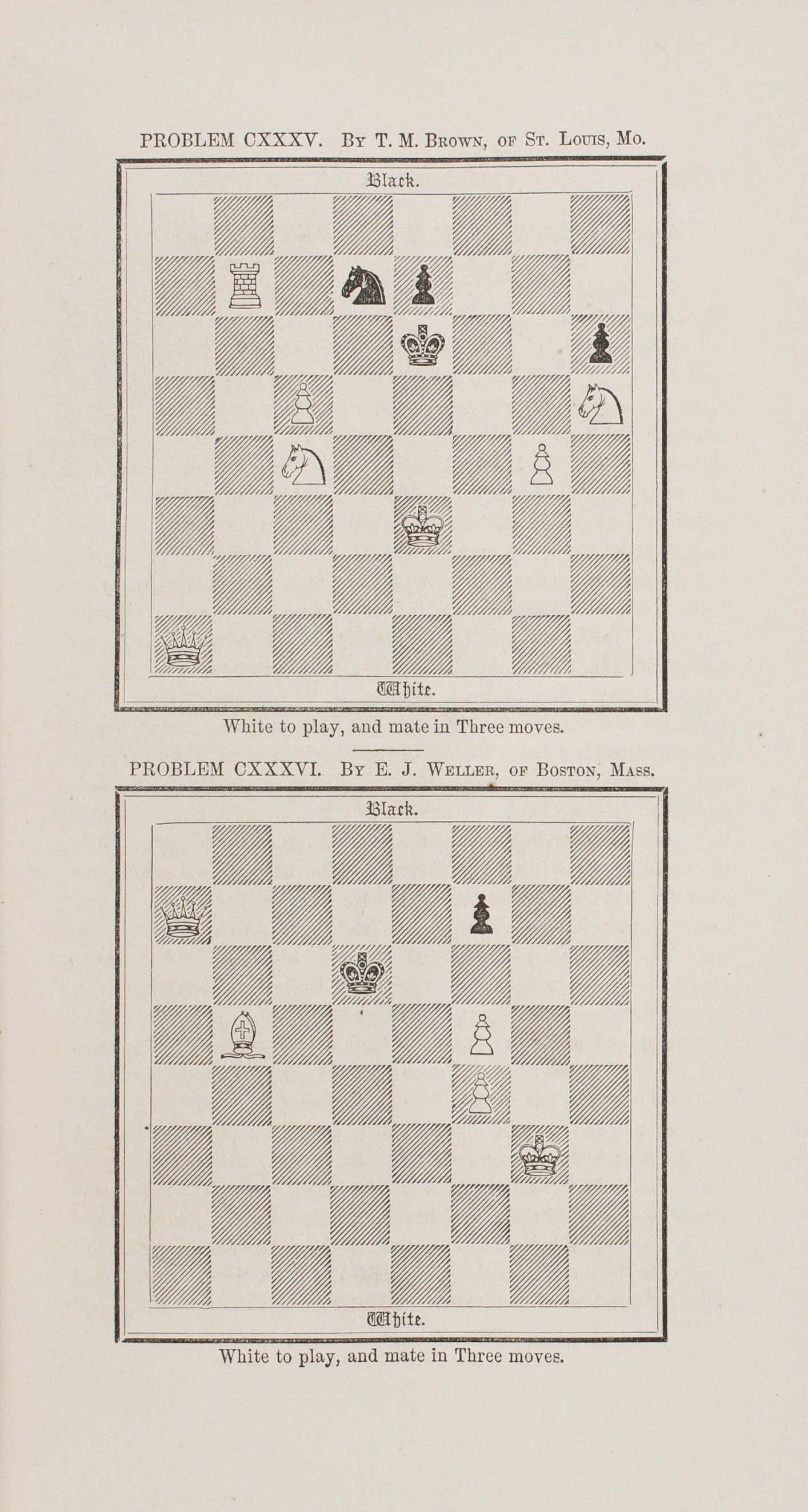
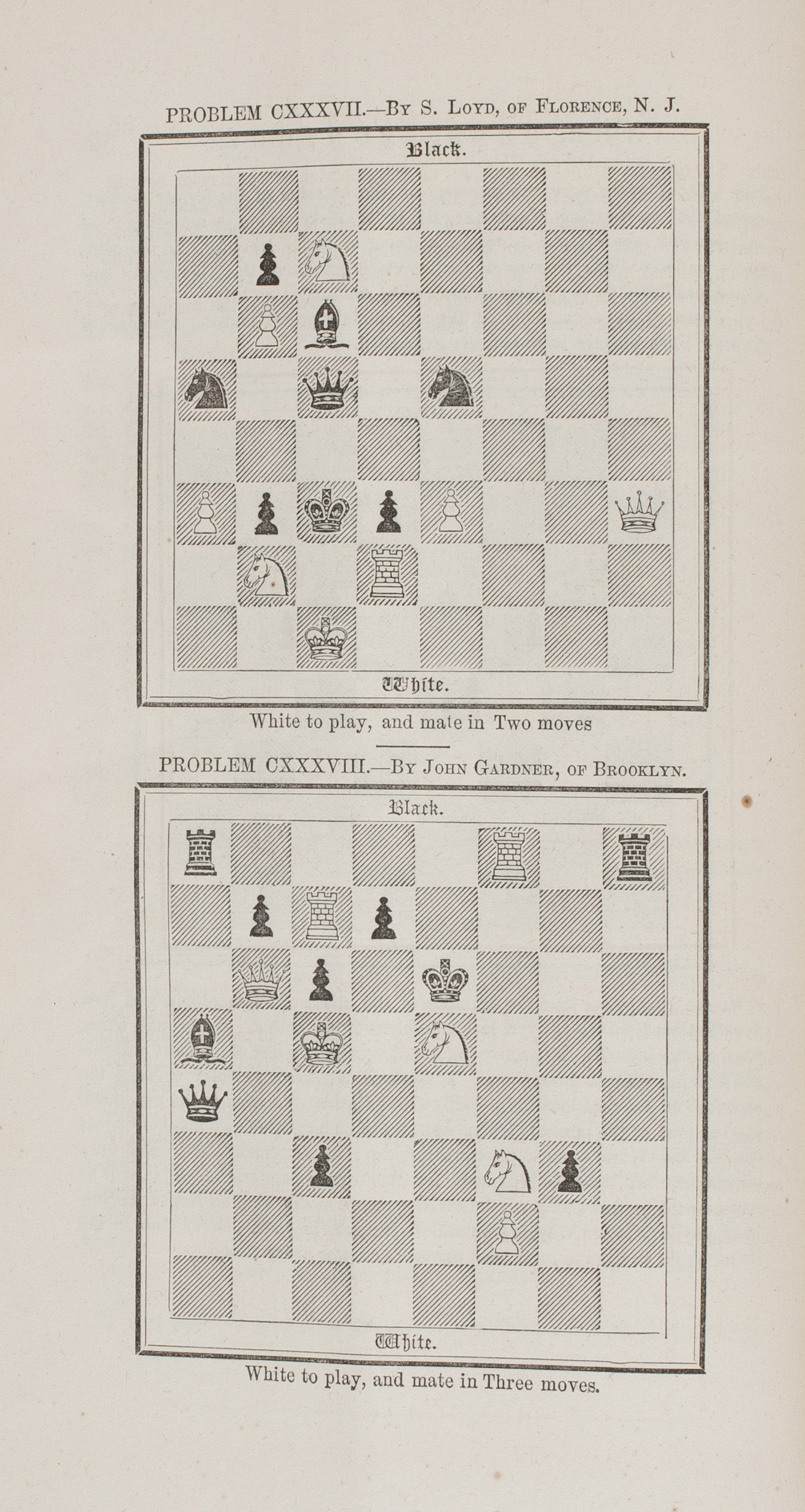
Here are the problems that appeared in Chess Monthly for volume 3, January through April 1859. See if you can solve the puzzles and share your answers in our comment section. Like the wrappers in our bound volume, solutions are not to be found here.
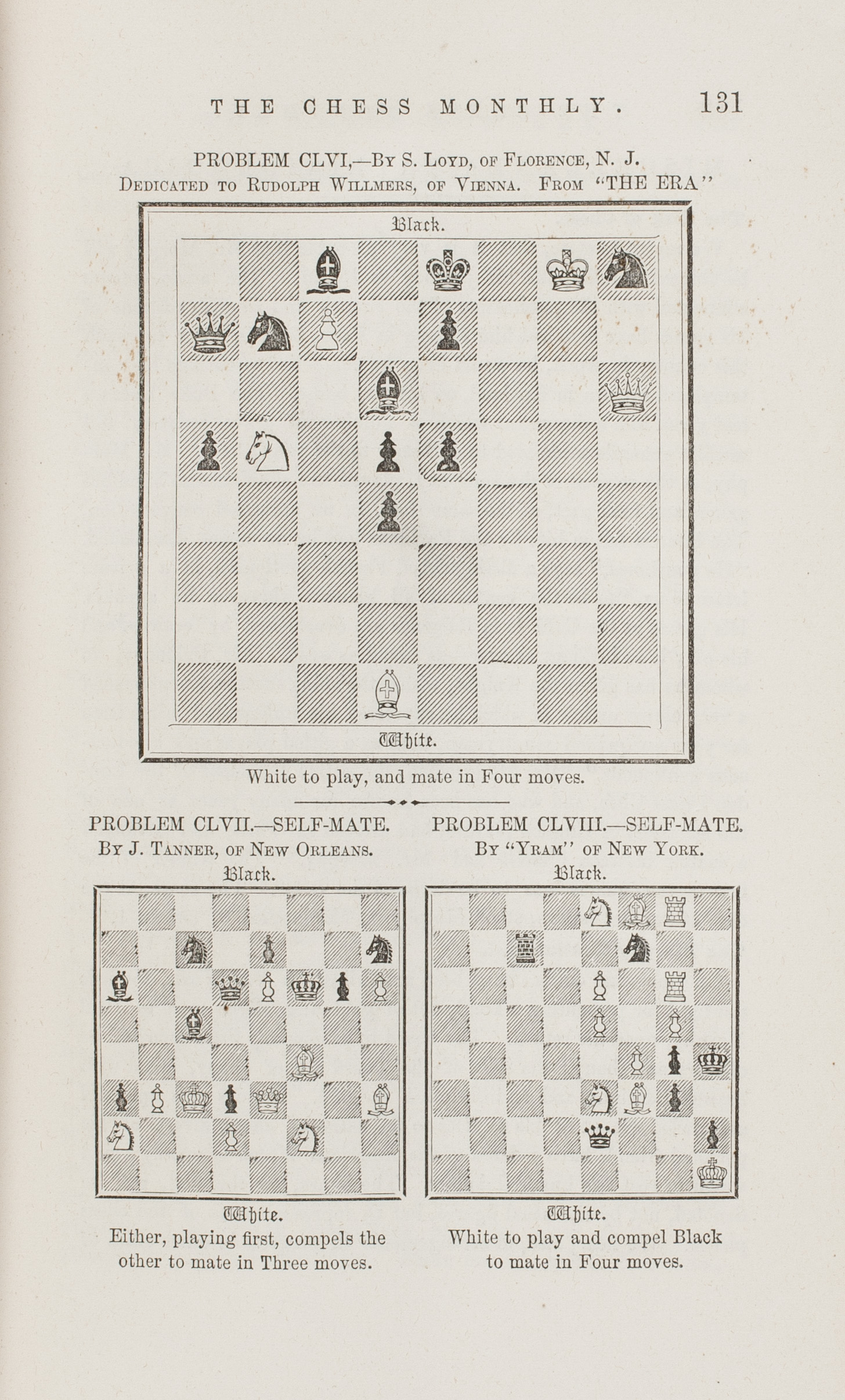
The New Face of Past is Present
You may notice that things look a little different around here. Last October, just in time for the bicentennial, we released the new AAS website. Its sleek look and improved navigation have been a success, so we decided to give our blog a similar treatment this fall.
To go with the new look, we also have some great posts coming up. Besides keeping you updated on public programs, conferences, and other events, we will also be posting recommended reading, hearing from our curators about their adventures finding new acquisitions, and even testing your wit with some puzzles.
So we hope you enjoy the new site, and please join us in our historical musings – we’d love to hear from you!
The Acquisitions Table: The Adventures of Teasing Tom and Naughty Ned with a Spool of Clark’s O.N.T. Cotton
?The Adventures of Teasing Tom and Naughty Ned with a Spool of Clark’s O.N.T. Cotton. New York: F.B. Patterson, 1879.
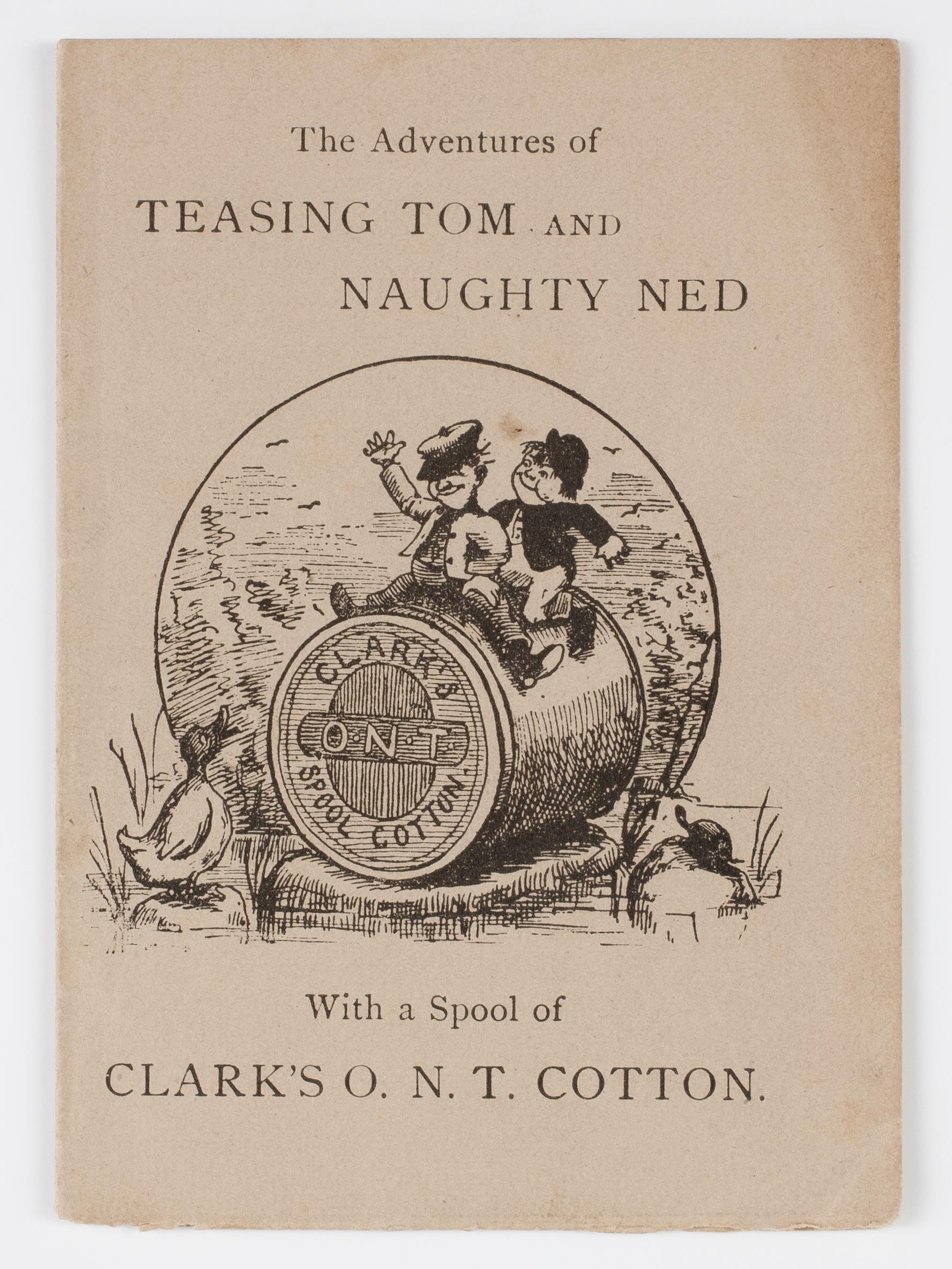 Books printed as advertisements were frequently directed at children, as is the case of this chapbook hawking Clark’s cotton thread. Not only do Tom and Ned play hooky from school, but they use a spool of Clark’s Thread to strangle four ducks, leaving them for Granny Blobkin to roast. The naughty boys do not let the resourceful Granny enjoy her roast ducks; they use more of the thread to hook them up the chimney. The text all but absolves the boys from their bad behavior: “Boy’s pranks are soon forgotten, If after deeds are true and strong And useful–as Clark’s Cotton!”
The Acquisitions Table: Address of the Carrier of the Kentuckian
Address of the Carrier of the Kentuckian. Frankfort, Kentucky: s.n., A.T. Leonard., 1830.
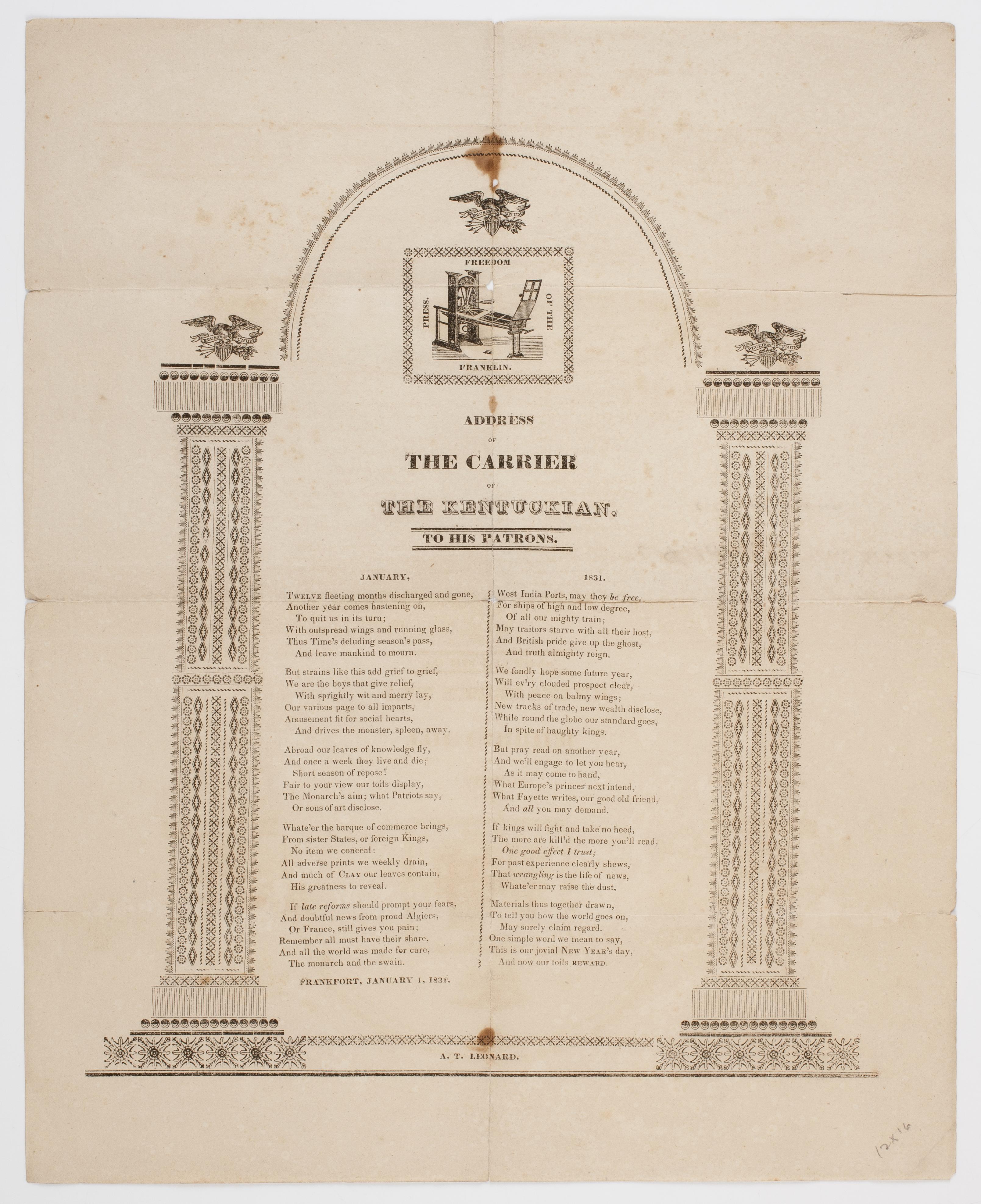 This broadside is the earliest example of a Kentucky carrier’s address in the AAS collection (earlier addresses are known, but are lacked by the Society). Bordered with elegantly laid out type ornamentation topped off with eagles and a cut of a printing press, the poem on the sheet is a typical summary of the events of the previous year (1830) with a New Year’s message and call for tips for the boys who carry the papers. The poem mentions Kentucky hero Henry Clay, then serving as a state Senator, lists events in Europe and Algiers, and philosophizes that all the coverage of battles and coups is what sells the paper, stating: “Wrangling is the life of news.”
Common-place article picked up by the AP
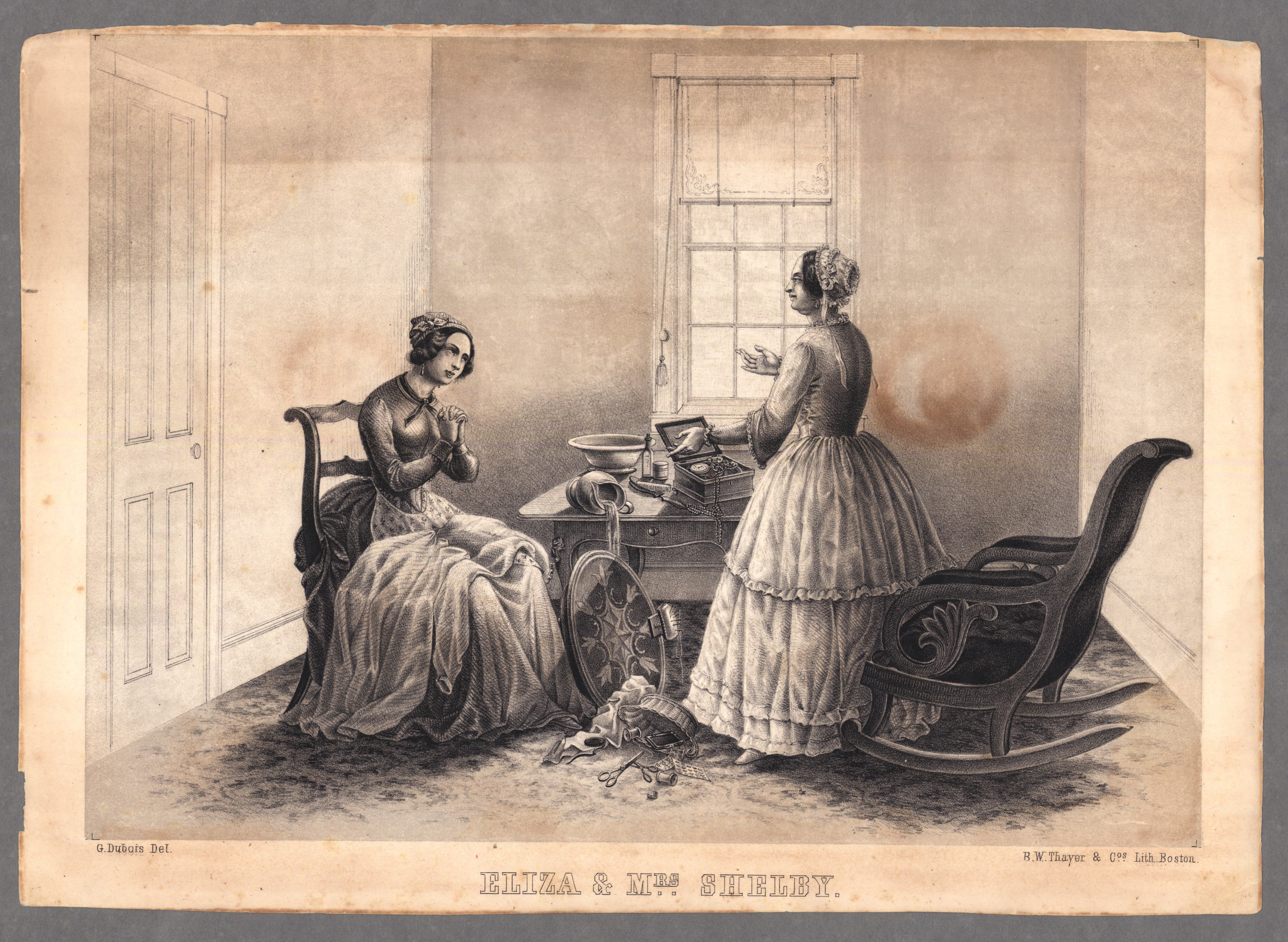
We are very excited that an article about the inspiration for Uncle Tom’s Cabin by Susanna Ashton that appeared in the most recent issue of Common-place was picked up by the Associated Press and is getting some national circulation, including in the New York Times over the past weekend. If you haven’t yet read them, be sure to check out both the Common-place article and the AP’s take on Susanna’s findings!