Seven Years and a Quiet Dirt Road in Exchange for 600 Newspaper Issues

This week we continue our curators’ acquisitions stories with curator of newspapers Vince Golden. His story combines elements of both of the previous posts (I and II), making for quite an interesting turn of events!

There are various phrases in the English language that mean act immediately. Strike while the iron is hot. He who hesitates is lost. We are encouraged to jump at an opportunity. Shakespeare wrote, “Nay, but make haste, the better foot before.” On the other hand, we are told to look before we leap. Slow and steady wins the race. Haste makes waste. Benjamin Franklin wrote, “Make haste slowly.”

As curators, one of our main duties is to acquire materials for the collection. Some situations require haste. A new dealer’s catalog arrives and we have to quickly scan it for potential items and get our order in before someone else snaps it up. An auction catalog often has a short deadline from the time it arrives. Someone stops by with an issue in hand wondering if we would be interested.

On the flip-side, patience is a virtue. It may take months or years developing a relationship with collectors before they decide to donate their collections to the American Antiquarian Society. We might have to wait a few months while the board of directors of a historical society debates the pluses and minuses of transferring their newspapers to AAS.
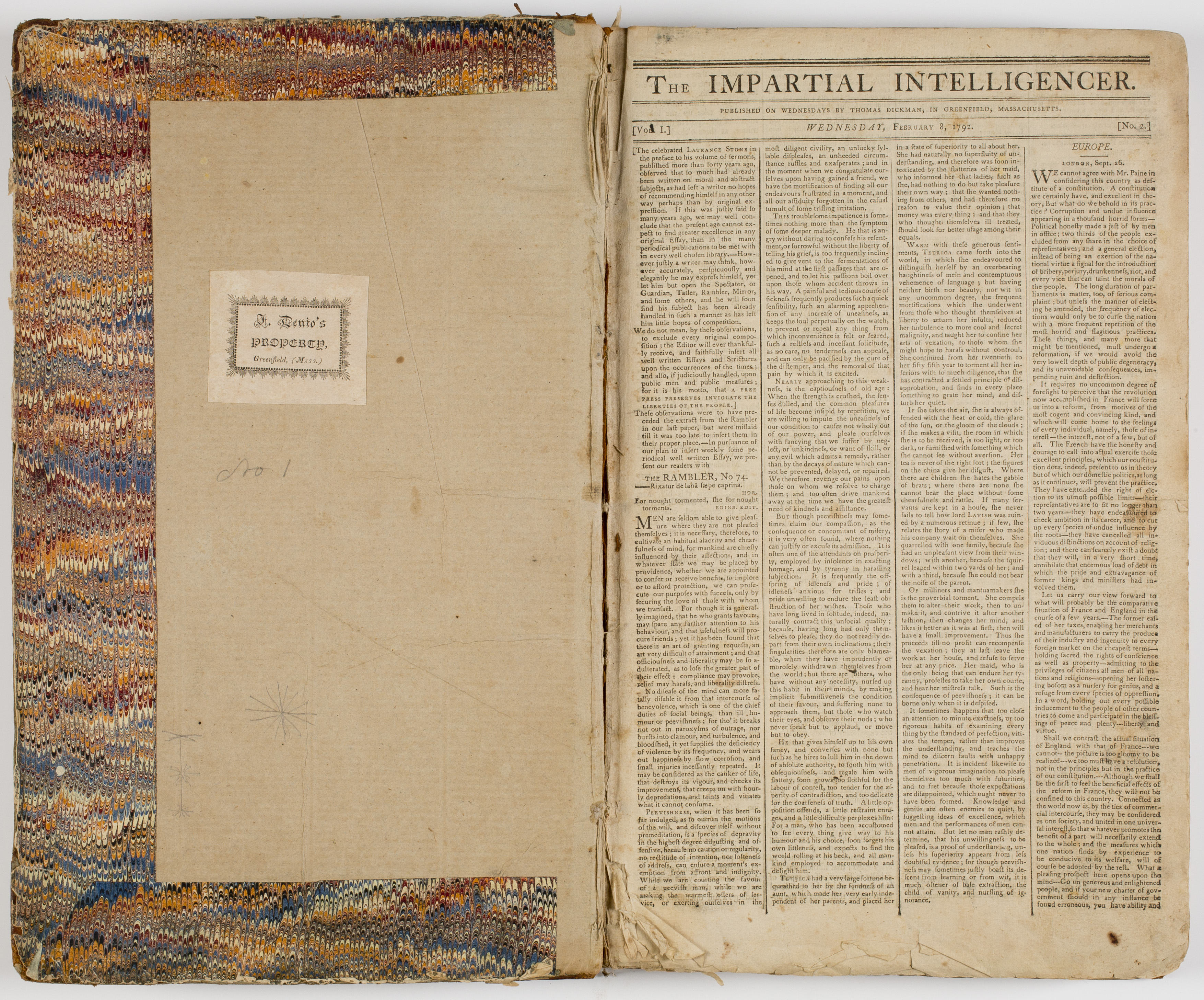
506_0001In 2002, I received a phone call from a gentleman who had several volumes of Greenfield, Mass. newspapers. His father had rescued them decades before when someone was cleaning out a house and left them by the sidewalk to be thrown away. The gentleman wanted to sell the volumes. Over a series of phone calls, I got a better idea of the scope and condition of the collection. They went back to the 1790s and appeared to fill in large gaps in our collection. I thought progress was being made when for some unknown reason communication was cut off. There were no responses to phone calls or letters. I saved my notes and put the incident in the back of my mind.

Seven years later the gentleman called again, this time from a new number and location. He wanted to know if we were still interested in the volumes. Of course we were. What was different now was that he offered to donate them. The following month I was traveling near where he lived, and I offered to drive to his house and pick up the volumes, which he agreed to. When I went, I found myself in western New York on a small two-lane road with no cell phone signal. We met at a crossroad and I followed him back to his house. We ended up on a dirt road driving through trees for over half a mile to a not quite completed log-cabin house. Inside, sitting on a table, were sixteen volumes of old newspapers. We sat down and he told me what happened.

When he first contacted me things were not going that well for him and he was looking to sell the volumes to raise a little cash. The reason he stopped contacting me was he fell ill and was in the hospital for a long time. After recovering from his illness, things improved for him. Once his health and fortune recovered he decided he could afford to donate the newspapers to us.
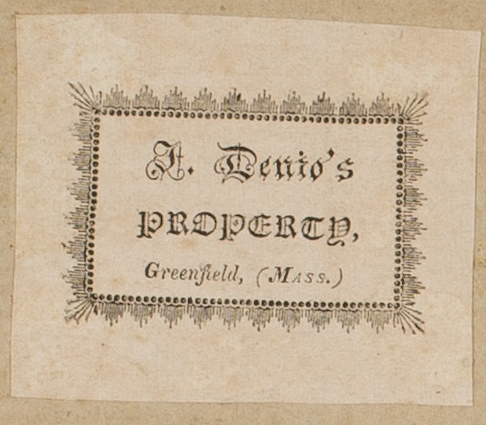
Detail of bookplate on bound volume of newspapers
Detail of bookplate on the bound volumes of newspapers

So, I finally ended up with the newspapers in the trunk of my car in the middle of nowhere, western New York. When I got back and was able to carefully take a look at the volumes I discovered something special about them. The volumes had bookplates reading “J. Denio’s property, Greenfield, (Mass.).” John Denio was originally a Vermont printer who moved to Greenfield in 1802. At different times he was part owner of the earlier Greenfield Gazette and the Franklin Herald. He also helped establish the later Greenfield Gazette in competition with the Franklin Herald. This was a publisher’s file of his own newspapers. They must have been saved by the family over many years only to be subsequently thrown out and rescued by someone that found them interesting. And after several more years, they finally ended up in our collection. Over 600 issues were added to the collection. The newspapers (all from Greenfield, Mass.) included:

  • Impartial Intelligencer for 1792
  • Greenfield Gazette for 1792-1811
  • The Traveller for 1811
  • Franklin Herald for 1812-1822
  • Franklin Herald, and Public Advertiser for 1822-1823
  • Greenfield Gazette for 1823-1826
  • Greenfield Gazette and Franklin County Advertiser for 1826-1827

Seven years is a long time to wait, but the wait was worth it.
“Use every precaution or I perish”: Breaking Dr. Benjamin Church’s Code

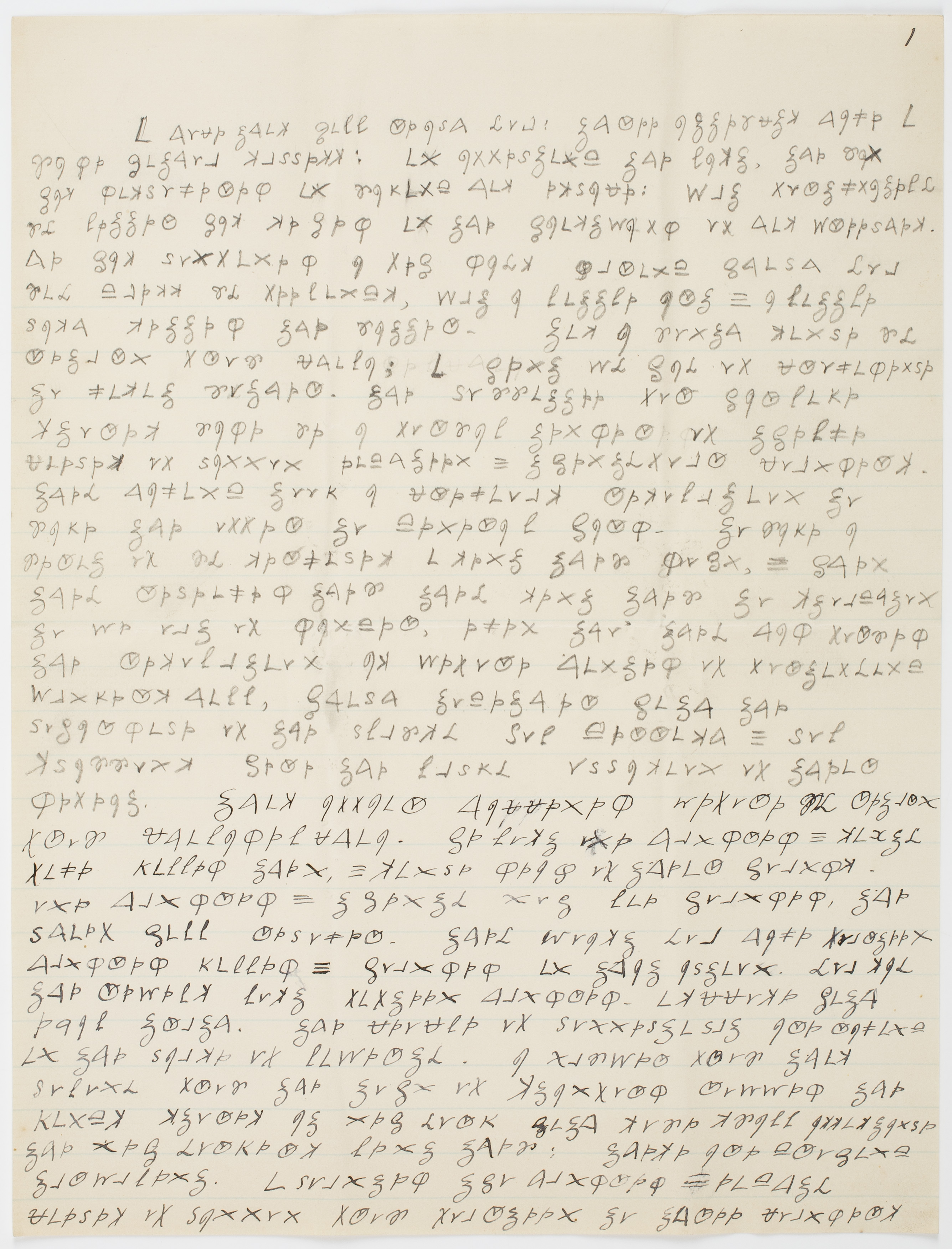
USRevColl_0003Ever since we’ve been recording information, we’ve been trying to find ways to keep it out of the wrong hands.  This need often times comes to the forefront during times of war and conflict when information is at its most valuable.  Codes, ciphers, even invisible ink, have been employed quite successfully and famously in the past, so it wasn’t rare to find a coded letter in our manuscript collection here at AAS.  However, rare or not, when one finds a coded letter, one has to investigate!

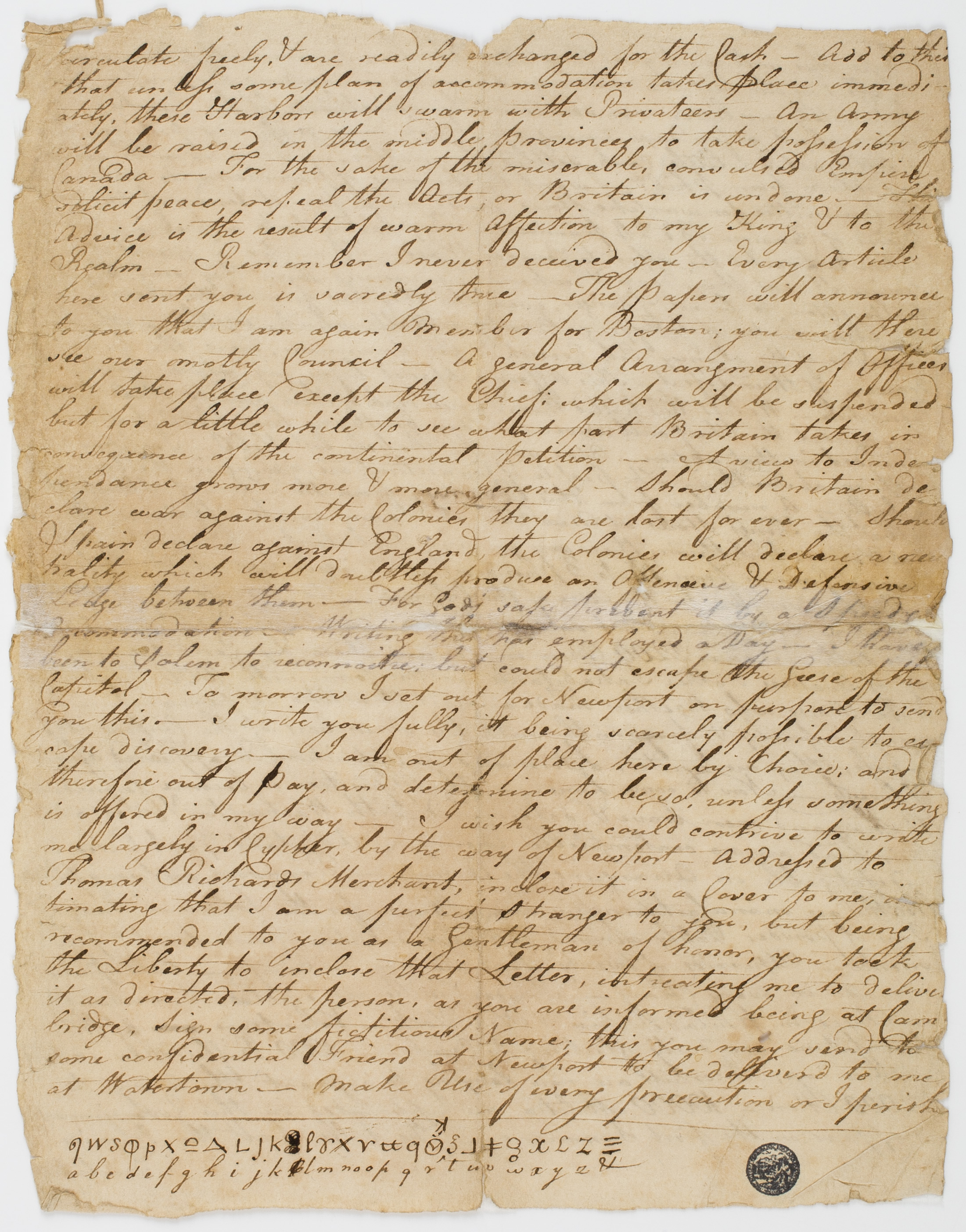
Perhaps lesser known than George Washington’s or Benedict Arnold’s use of code are the treasonous letters of Dr. Benjamin Church.  Church, a Harvard-trained physician and close confidant of Samuel Adams, John Hancock, and Paul Revere, was appointed the first Surgeon General of the Continental Army.  He even participated in the Boston Tea Party.  Despite his patriotic façade, he provided General Thomas Gage with information about munitions, military plans, and equipment.  It is unknown why he sold secrets to the British.  Some believe it was his attempt to uphold his luxurious lifestyle when money got tight.  Others think it was the influence of his British wife.  Whatever the reason, he was found out, imprisoned for treason, and after serving some years in prison, was exiled to the West Indies.  The ship, however, never reached her destination, and Church was never heard from again.

USRevColl_0001One of Church’s coded letters, written from Philadelphia in 1777, was deciphered by Samuel West, a former classmate of Church’s from Harvard.  Seen here is West’s transcription of the letter, with the broken code at the bottom.  This letter was found within our West Family Collection (and was later moved to our US Revolution Collection).  The original coded letter written by Church can be seen at the Library of Congress.

Just out of curiosity, I passed a copy of the letter, in code, to a friend who had recently taken a cryptography class.  Upon my brief and inexpert inspection, the code seemed somewhat easy to crack, but I had the translated letter right beside it, so I’m sure that increased my confidence as I guessed my way through the code.  It turns out, though, I was right.  The letter was completely deciphered in about one hour.  Why was it so easy?  Church used a simple mono-alphabetic code, assigning a single symbol to a single letter.  All it takes to crack a code such as this is a quick character analysis (observing which characters appear most frequently, which characters are always next to one another, etc.) and one can quickly determine which characters represent which letters.

I wonder why, when performing such a dangerous, treasonous act, Church didn’t take better care to disguise his secrets.  Why did he use such a simple code?  The code surely kept the message secret from casual readers or interceptors, so perhaps those were the only readers Church was worried about.  But anyone who really wanted to could easily break it.  If one is to go into the business of espionage, one best use a complex code.  As Church stated at the end of his letter – “Use every precaution or I perish –”.  He should have heeded his own advice.

The Acquisitions Table: Taxidermy Without a Teacher

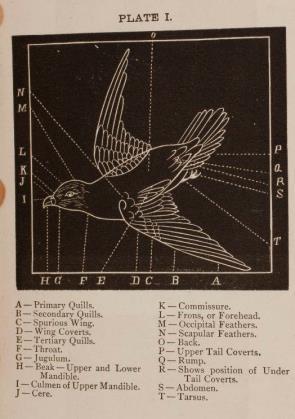
Manton, Walter P. Taxidermy Without a Teacher. So. Framingham [Mass.]: The J.C. Clark Printing Company, 1876.
The author describes how he originally wanted to call this book “Simple Chats on Taxidermy,” and in it he certainly takes a conversational approach after first setting the stage: “I ask the reader to take himself, in imagination, to my work-shop, and to proceed as if I were at his elbow, guiding his hand and explaining to him the mysteries of this mysterious and beautiful art.” What follows is a manual of instruction for preparing and preserving birds and animals, including information on hunting and hygiene. This copy has a blindstamp on the title page from Philbrick James Library and the bookplate of Deerfield Public Library, which declares, among other rules, that “All loud talking or unnecessary noise in the Library room is strictly prohibited.”

The Pay Off for a Curator’s Perseverance

Last week, curator of children’s literature Laura Wasowicz posted about finding a unique find in a dusty house. This week, curator of graphic arts Lauren Hewes talks about another tack curators more often have to take: “hard work and diligence.”

Recently, the Society’s curatorial staff was asked to blog about significant acquisitions and the process by which historic material comes into the collection. I think perhaps the blog editors were hoping for high adventure, with hidden treasures discovered at flea markets, or exciting visits to exclusive dealers. Alas, the reality is that most of the great pieces and memorable objects come to AAS through plain old hard work and diligence.

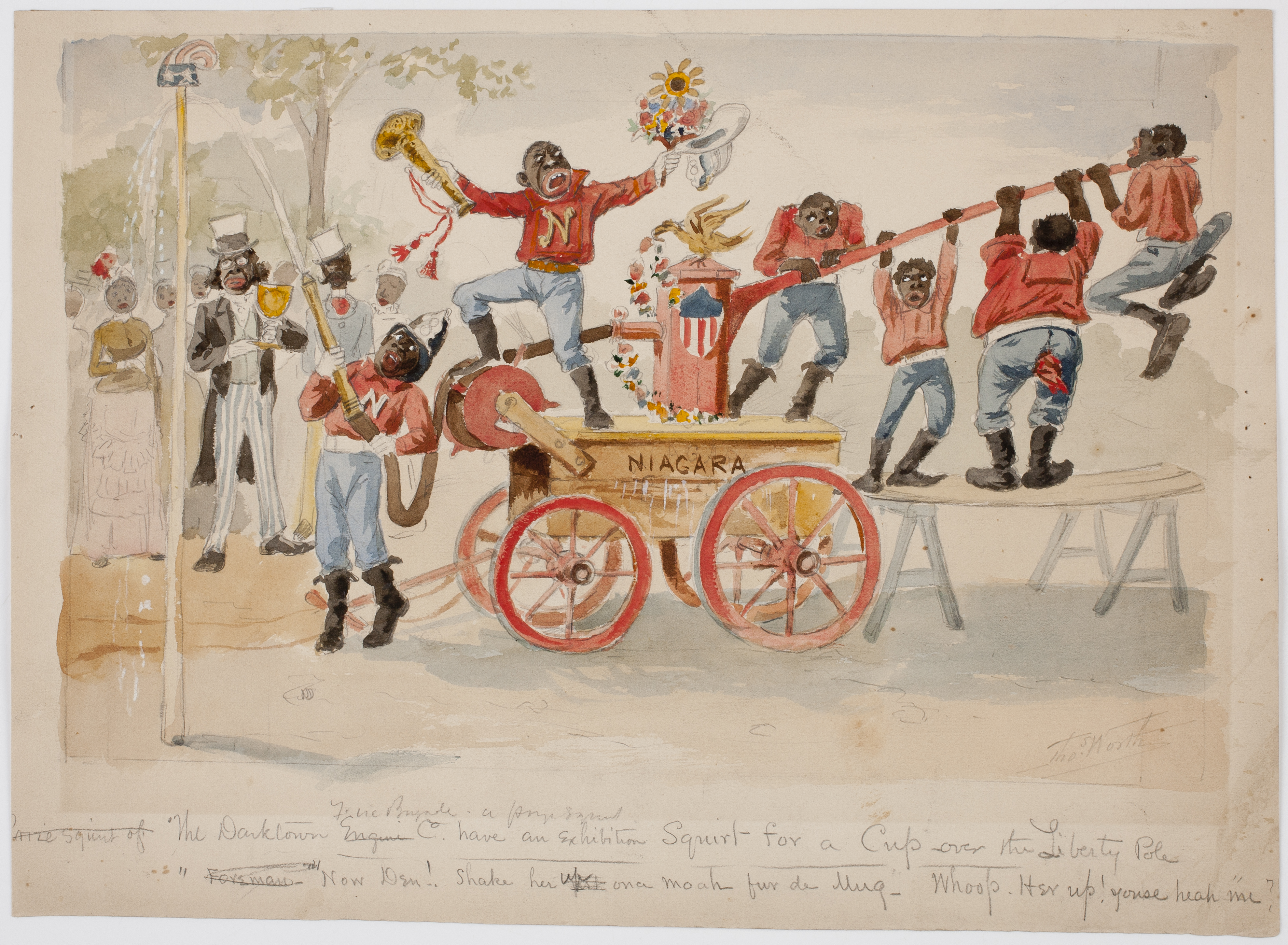
Take for example the rare watercolor by American artist Thomas Worth (1834-1917) illustrated below. This watercolor, The Darktown Fire Brigade – A Prize Squirt, is the original study that Worth made for a lithograph published by Currier & Ives of New York. After the Civil War, Currier & Ives hired Worth (along with other cartoonists) to create several different series of comic prints. The Darktown prints are difficult for today’s viewers. They are racist and insulting and they use gross caricatures to mock and make fun of free African Americans in a variety of situations. The figures are made to look foolish and outlandish and reflect the anxiety of white Americans as freed slaves integrated into what was becoming a mixed race society. Eventually numbering over seventy-five titles, Darktown prints were sold individually for 20 cents each or six for a dollar. The caricatures of African Americans as firemen, clergy, sportsmen, and cowboys, were quite popular in their time. Over 73,000 sheets were sold from the series and when Currier & Ives folded, the lithographic stones for the series were purchased by a competitor and reissued into the twentieth century. The Darktown series is just now beginning to be evaluated by scholars trying to understand racial conflict and perception in the United States during the pre-Civil Rights era.

501065_0001All well and good, but how did AAS end up with the watercolor? It is a long story and it started back in 2005 with my predecessor Georgia B. Barnhill, curator emerita of graphic arts. She paid a visit to AAS member Philip C. Beals. Beals (like his father before him) was a collector of American prints, with a special focus on sporting prints by Currier & Ives. There, in Mr. Beals’s print cabinet, lay the watercolor by Thomas Worth, tucked in among lithographs of sulky drivers and snipe hunters. Mr. Beals eventually gave over 160 prints from his collection to the Society, greatly increasing the institution’s holdings of Currier & Ives lithographs. In 2009, after Mr. Beals passed away, Gigi and I returned for a visit with his widow, Elaine W. Beals, who had called about possible future donations. We had a lovely visit, and were asked to make a list of prints from the Beals collection that the Society would like. It was my first time seeing the Worth, and I was impressed with its condition and the way it illustrated the creative steps behind the lithographic process at the end of the century. The Worth, of course, was placed on the list of sixty or so prints that we created for Mrs. Beals.

I thought no more about the watercolor until 2012, when AAS Drawn to Art fellow Melanie Hernandez arrived from the University of Washington, Seattle, to work on her dissertation project: “Currier & Ives’s ‘Darktown’ Series: Recovering White Capital through Violent Satire.” I communicated with Mrs. Beals about four Darktown lithographs in her collection and, knowing she intended to donate them anyway, asked about having them in Worcester in time for Hernandez’s month-long fellowship. She and her family graciously agreed to donate the four lithographs and, most generously, to loan the Worth watercolor to AAS for one month. This was an outstanding opportunity for one of our fellows to see a work of art that helped explain the entire process behind the prints she was studying, and so we jumped at the chance.

The lithograph based off of Worth's watercolor.
The lithograph based off of Worth’s watercolor.

The watercolor was loaned to AAS for four weeks. Both Melanie Hernandez and I spent a lot of time with the drawing, comparing it to the published lithograph, noting the changes that the printers had made to Worth’s original design and the changes Worth himself had made to the title and other elements of his drawing. We were given permission to photograph the watercolor and it is included in Hernandez’s dissertation. We returned the watercolor to Mrs. Beals after the fellowship was over with many thanks.

Then in the summer of 2013, one of Mrs. Beals’s daughters contacted me about coming to pick up yet another group of prints from our 2009 list. There had been a family gathering and many of the prints were distributed to children and grandchildren, but there was a small group of a dozen or so pieces for AAS. The group of material, to my great surprise and delight, included the Worth watercolor. Bringing the watercolor to Worcester took just over eight years, with multiple people on the curatorial staff and acquisitions team all working together to build a good relationship with a donor. As curators, part of our job is to explain the strengths of the Society and why AAS would make a good home for an object. Donors can then decide how they wish to distribute their collection. We are very pleased to add the Worth watercolor to our holdings and can now help future scholars bring relevance to this difficult work of art.

But does it play in Pareoi?

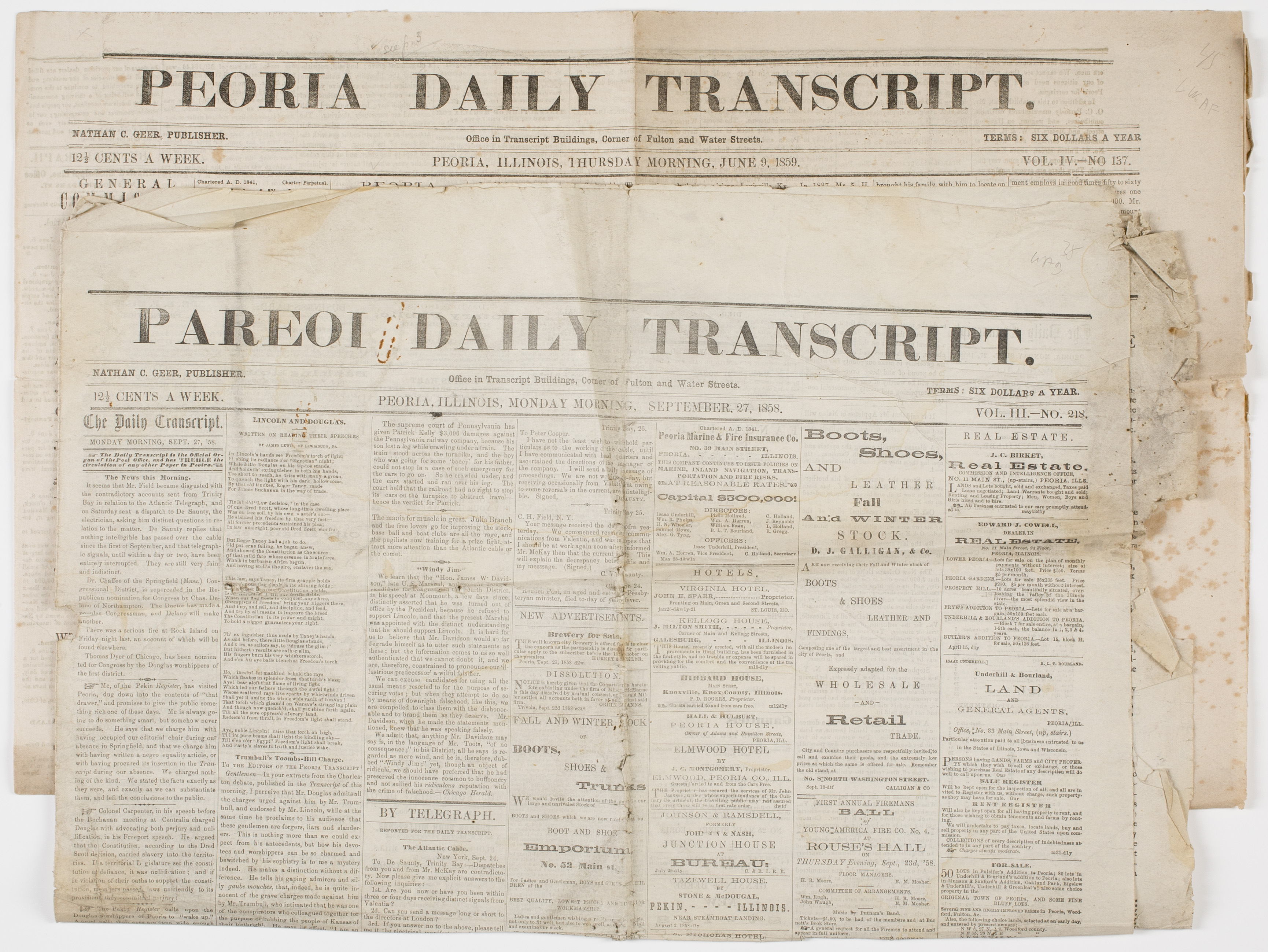
Peoria Daily Transcript (IL) Sept. 27, 1858.  June 9, 1859.

Peoria paperThose who research the history of printing love mistakes.  It is the little “oops” that give us clues into the methods of production.  A piece of type might work loose and fall on top of the bed and get printed that way, showing us the shape of the type.  When the same page is printed twice it reveals the imposition of the pages.

In the case of these two issues, one of them has the name of the town, Peoria, misspelled.  Five of the six letters are out of place.  That tells us the masthead was made up of individual pieces of 48-point type instead of one solid block.  What it doesn’t tell us is why it is so badly misspelled or how long they were printing it this way before anyone noticed.  Was the compositor illiterate and tried to put back letters that dropped out?  Was someone drunk?  While one question was answered by the misspelling, it also led to other questions that will remain unanswered.

The Acquisitions Table: Writings of Omaha

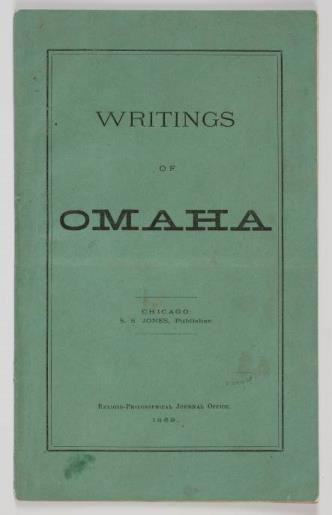
Writings of Omaha. Chicago: S. S. Jones, Publisher, Religio-Philosophical Journal Office, 1869.
APPARENTLY UNRECORDED, ONLY KNOWN COPY!
Describing the nature of reality, electricity, and the spirit realm in 61 numbered paragraphs, this overview of Spiritualist theory is also an apparently unrecorded Ante-Fire Chicago imprint. The 26-page pamphlet in its original printed green wrappers was issued by the central figure in Chicago Spiritualist publishing, Stevens Sanborn Jones (1813-1877). Jones edited and published the leading Chicago Spiritualist journal, the Religio-Philosophical Journal. He lost everything in the fire of 1871 (which no doubt accounts for the scarcity of this title) but managed to keep the journal afloat before he was murdered in his office in 1877. Jones was shot in the head by a jealous husband, a phrenologist named William C. Pike, who “if the daily papers may be believed, boasted that his knowledge as such enabled him to select that particular point at which to place his pistol.” (See Emma Hardin Britten, Nineteenth Century Miracles, 1884).

The votes are in!

1
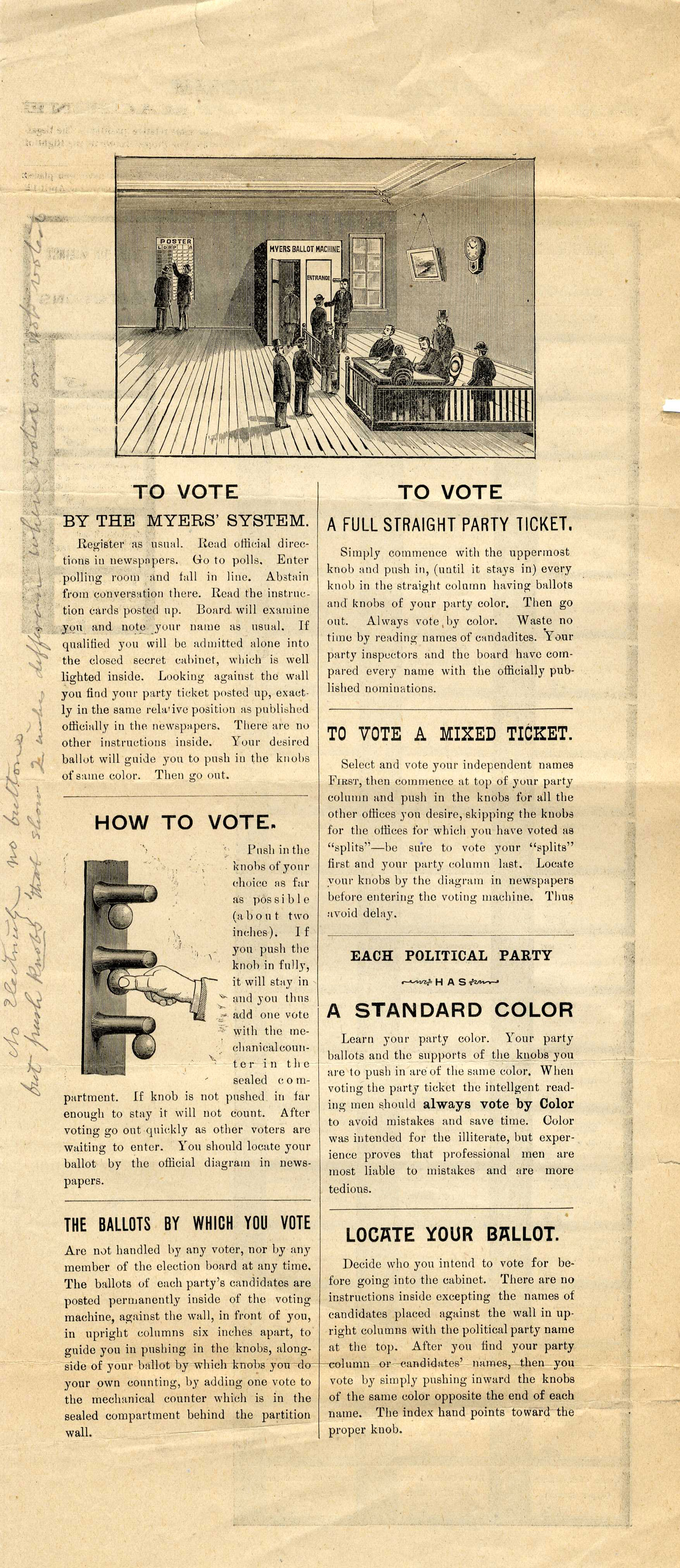
Header for the Official Ballot Diagram for the Myers Ballot Machine (with buttons and voting booth)

The collection of election ballots at the American Antiquarian Society is an impressive group of 952 items spanning the nineteenth through the early twentieth centuries. Several of these are individual ballots for specific elections, others are completely uncut; some are annotated, others are marked-up canvassing sheets (with sample tickets) or are comprised of paste downs. Some tickets are from parties as well-known as the Republican or as unfamiliar as the Peace. While separate ballots have not been individually cataloged, the collection has been digitized in its entirety, organized and inventoried. You will find links to each box/folder here.

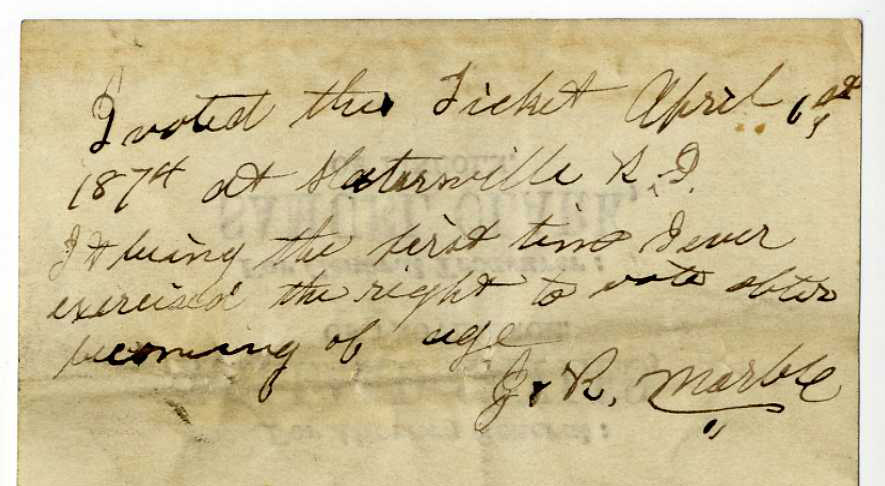
The collection is considered part of the Society’s Graphic Arts, ephemera collection; some early examples feature wood cut illustrations and letterpress on wove paper, and towards the end of the nineteenth century they became sophisticated printing jobs and important political prints in their own right. The images on many of these tickets encompass (and now evoke) many of the key emotions in the political process – pride, shame, innovation, engagement, and deception. Take for instance the pleasure of J.R. Marble, who wrote on the reverse of his Rhode Island National Union Republican Ticket “I voted the Ticket April 6th, 1874 at Slatersville, R.I it being the first time I ever exercised the right to vote after coming of age.”

2

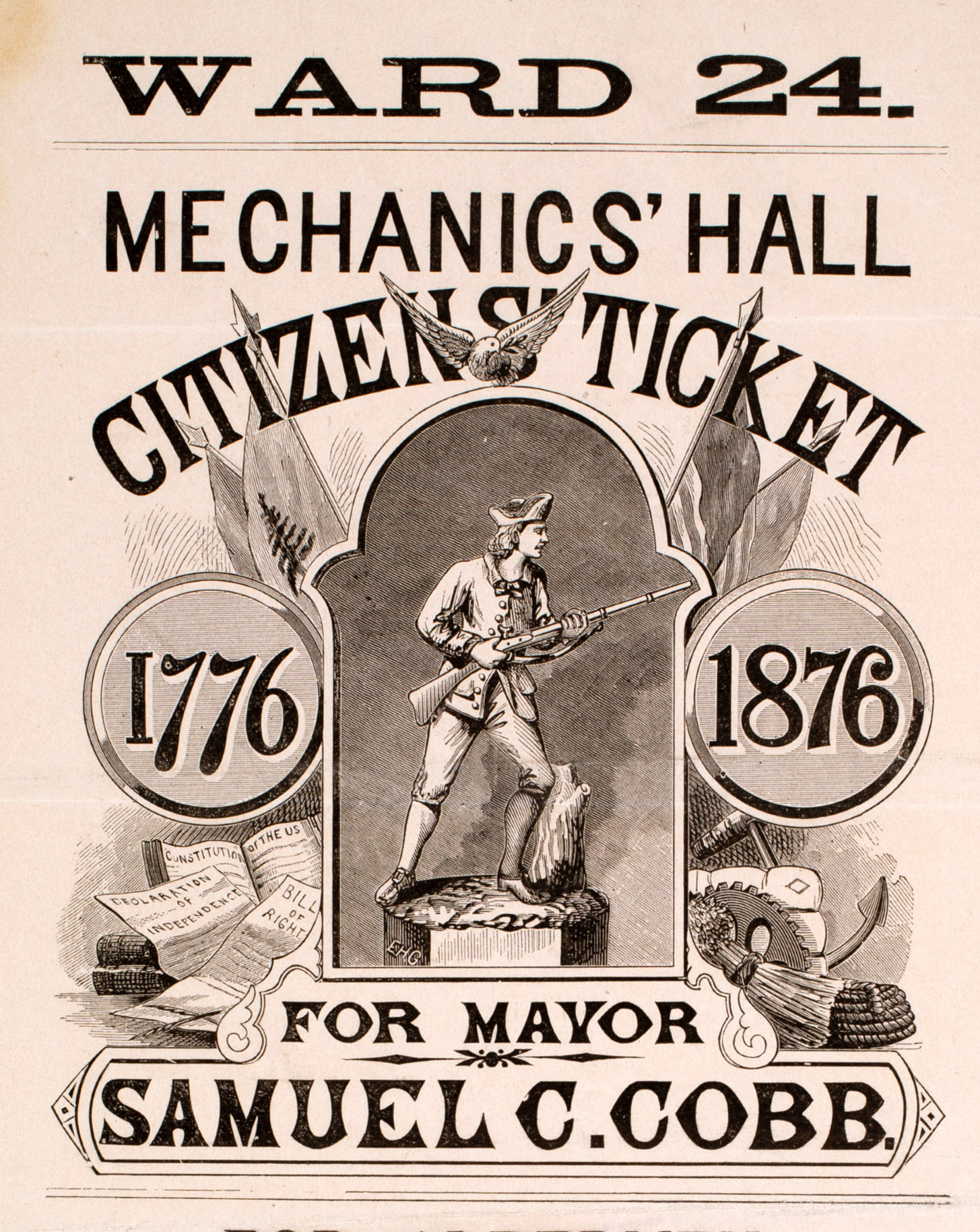
3Sometimes when we think about the history of the country it is in terms of the “Big Documents” – the Constitution of the United States, the Declaration of Independence, the Bill of Rights – documents which are actually embedded in the images of some of these very election ballots (such as this one from Ward 24 Mechanics’ Hall Citizens’ Ticket). And yet, looking over the collection as a whole, it seems these little slips of paper – when combined – have more at stake in their contents and eventual outcome. Ephemeral, yes, but also extremely powerful. We release them here for your perusal, insights and thoughts.


Curatorial Instinct: Or Flying Blind in Upstate New York

In the most recent issue of the Almanac, we had a feature article about the process of bringing new items into the collection. This got us thinking about some of the interesting ways in which these treasures are found. In the coming weeks, each curator will share one of their favorite stories about finding a new acquisition.

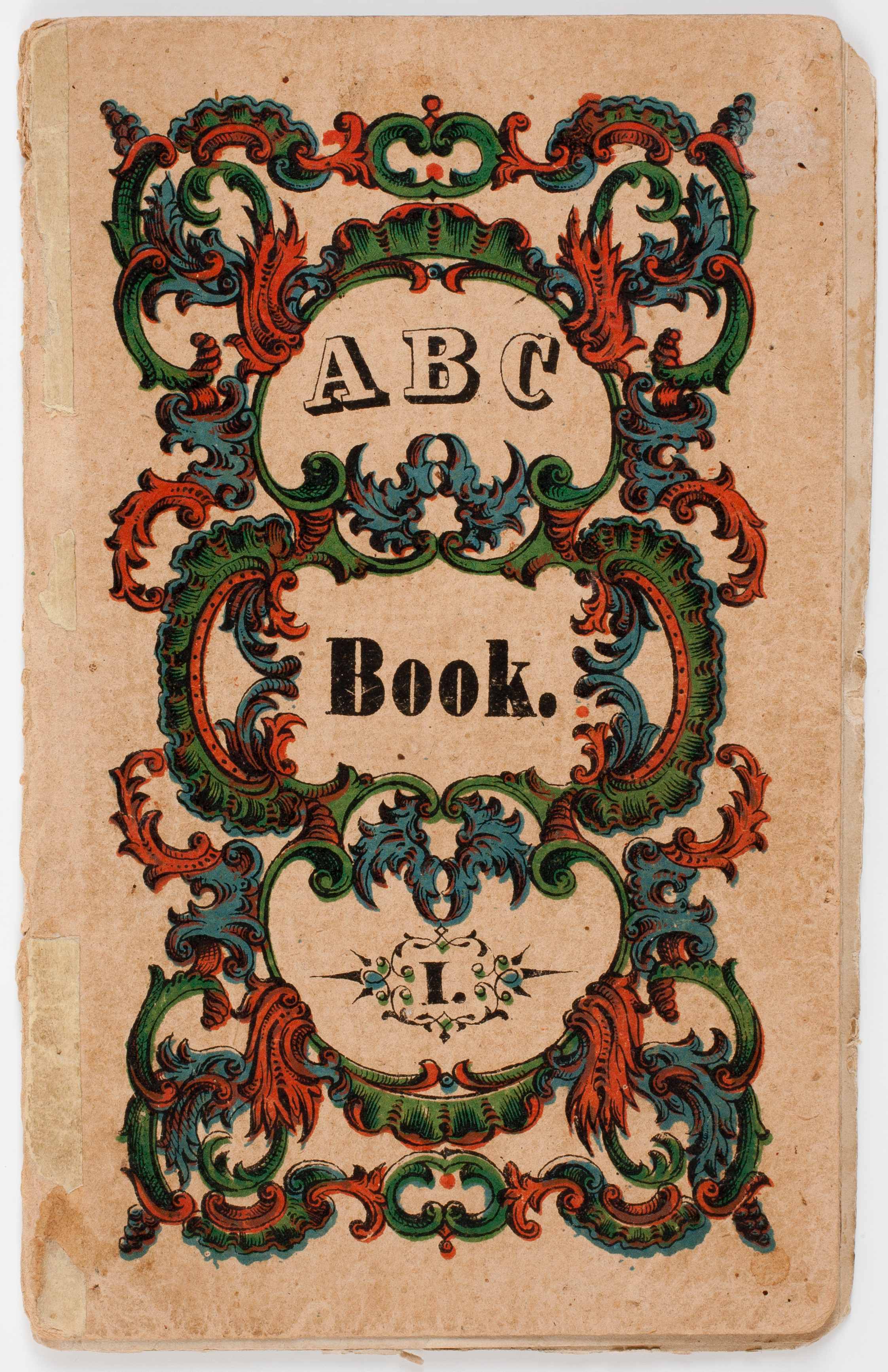
496837_0001Early last summer, I (along with curatorial colleagues Vince Golden and Elizabeth Pope) piled into a rental van to travel to upstate New York to pay a visit to dealer Peter Luke, who has managed to fill an old house with crates and boxes full of books, newspapers, and printed scraps politely known as ephemera. While scouring the musty boxes for children’s books, I found ABC Book I, a charming piece of mid-nineteenth-century color relief printing (see right). It was issued without an imprint, adding to its mystery and fascination. I thought it looked very familiar, but could not conclusively tell whether AAS had it or not. Although my colleagues had cell phones with internet search capability that could access our online catalog, Peter’s house was just beyond the reach of the cell towers. My instinct told me I had seen it before, and that we already had it, but I took Peter up on his generous offer to let me take it back to AAS and check it.

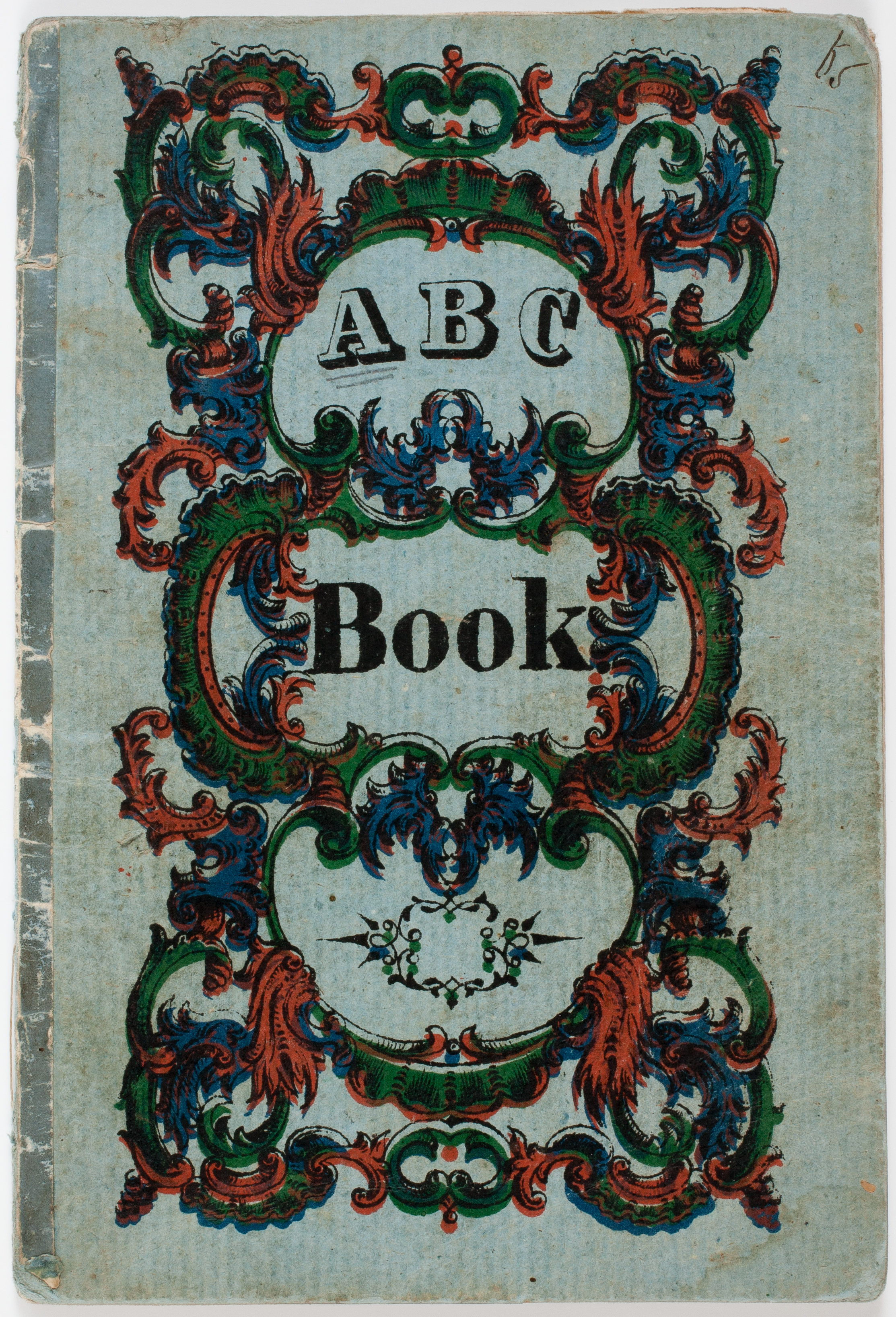
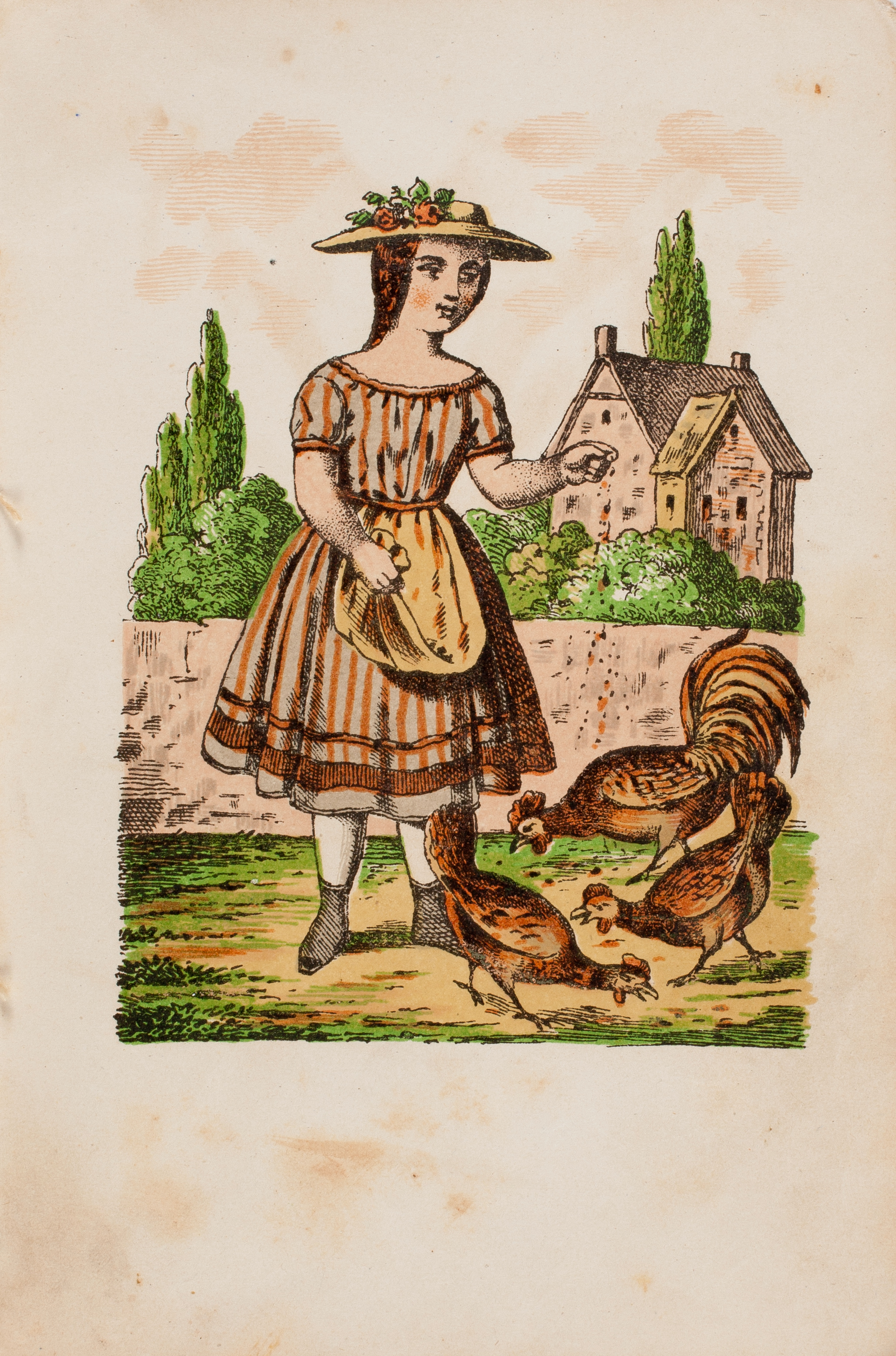
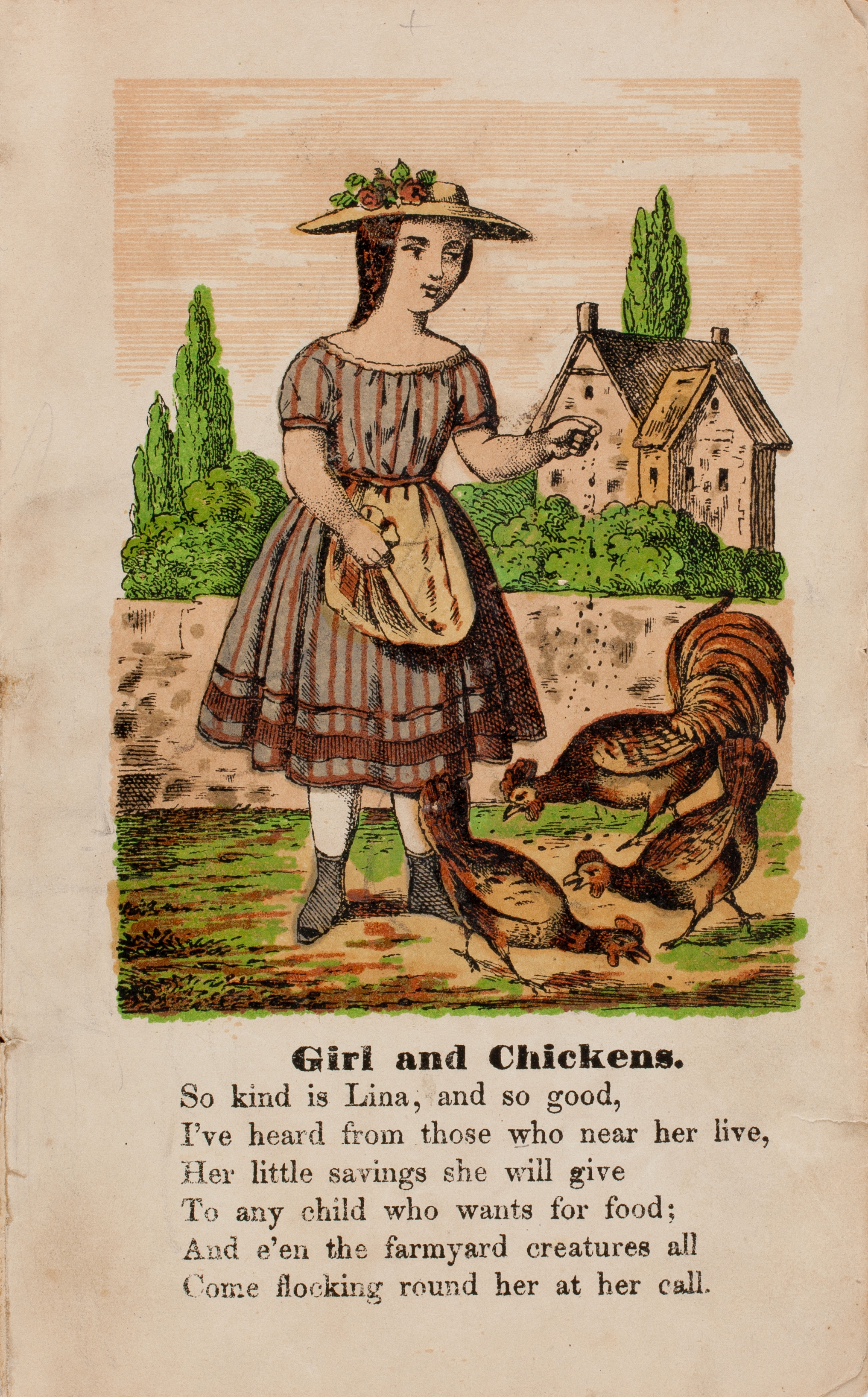
213575_0001Upon returning to Worcester, I discovered that we do have a very similar ABC Book (left), but with a bit of a twist; it had no number. Upon opening the two copies, I discovered that our present copy had the images and no text (below left), and that the copy I just got from Peter included the same pictures with verse captions (below right). In this example of the girl and the chickens, the caption fleshes out the story of the girl: her name is Lina, and not only does she take care of the chickens, but she will generously give from “her little savings” to any child needing food. When I showed the two books to my colleague Lauren Hewes, curator of graphic arts, I also learned that the newly acquired copy was probably printed first, as the light brown color block detailing the background sky is much more detailed than the abbreviated brown lines found in the other copy. With their neatly executed color woodblock prints, these two copies occupy a brief moment in children’s picture book production at mid century between crude hand-colored woodcuts and mass-produced chromolithography.

213575_0003496837_0003

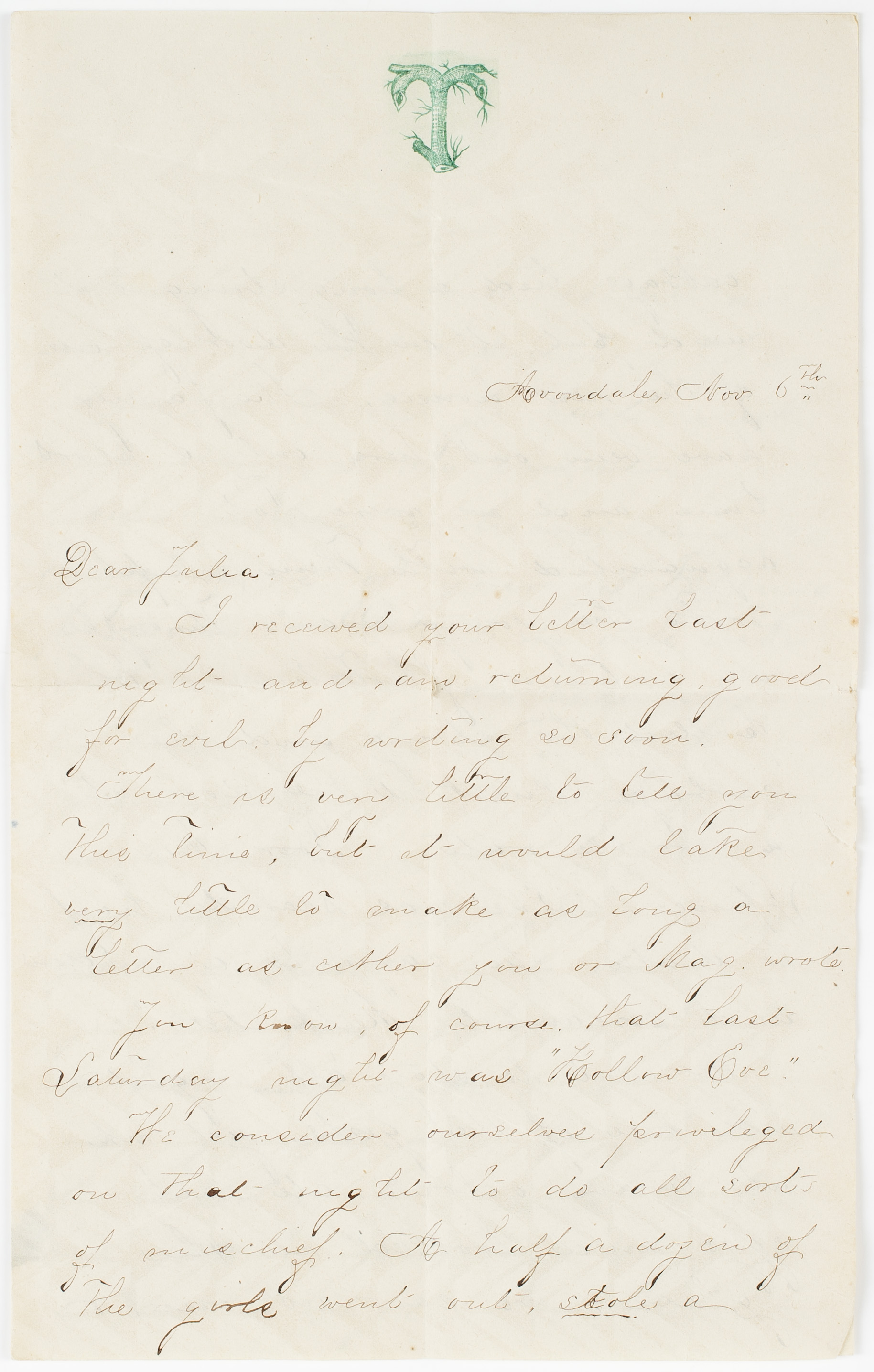
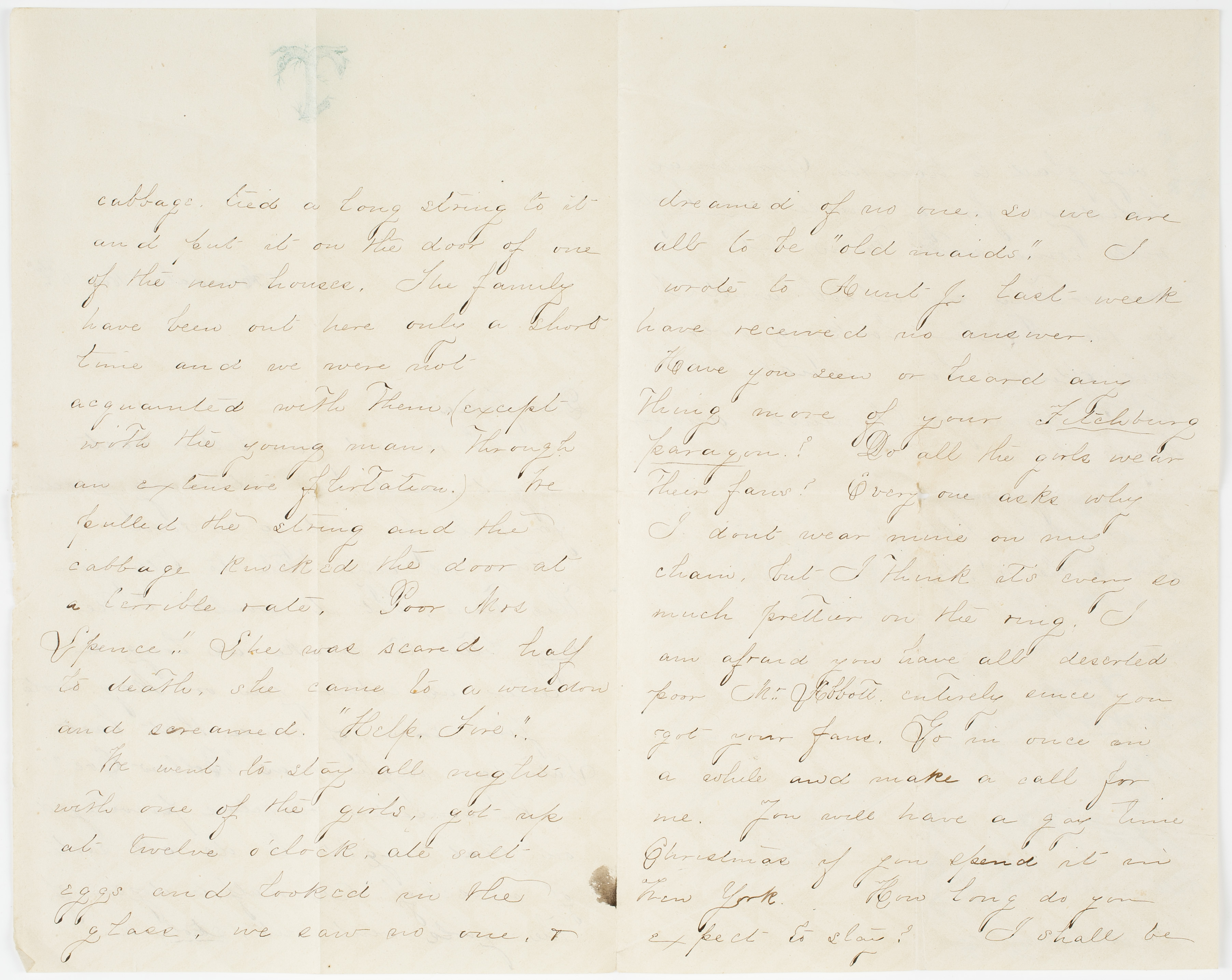
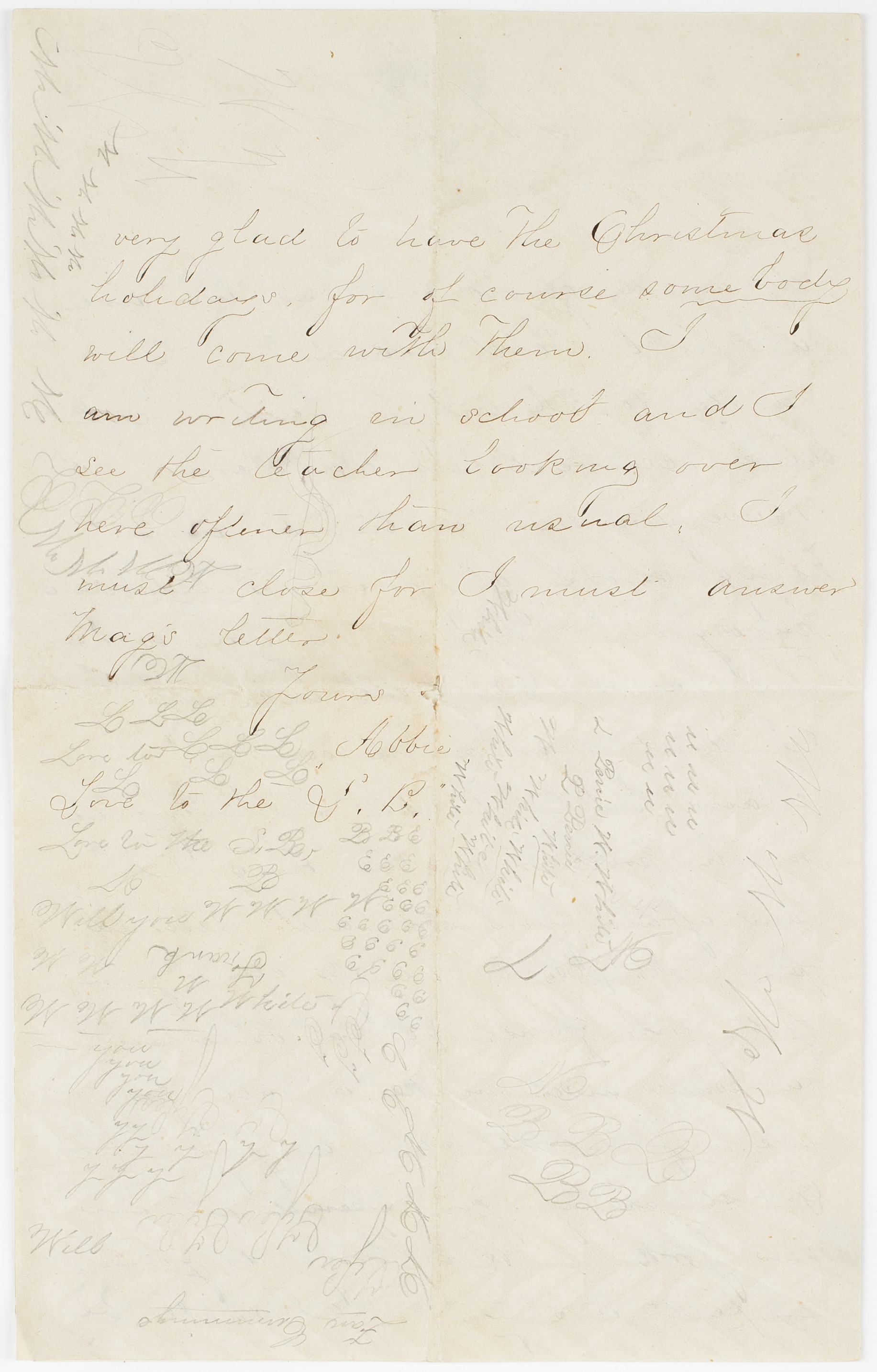
“Hollow Eve” pranks, 19th century style

For those that are sad to see the holiday pass, here’s one last dose of Halloween for you.  Today we are featuring a letter found by one of our volunteers while processing a new manuscript collection, the White Family Papers.  John White, the patriarch of the wealthy West Boylston family, was a pioneer in textile manufacturing.  In this letter, his daughter, Julia, recounts her exploits on Halloween.  You can read a full transcription of the letter here.

Hopefully no one got pranked like poor Mrs. Spence last night!

White_family_papers_0001


White_family_papers_0002


White_family_papers_0003


A “Spirited” Collection

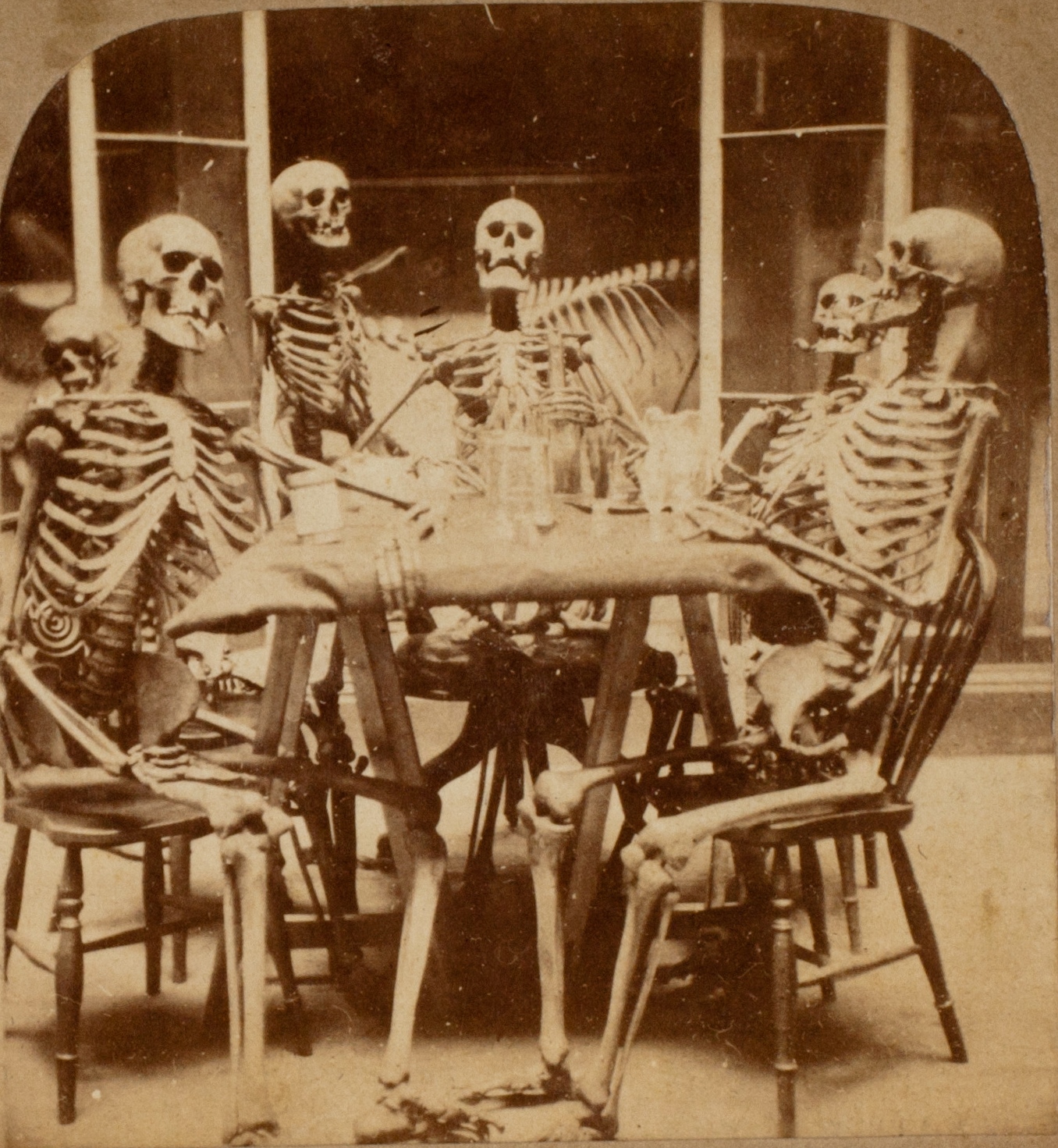
skeleton stereocard cropNothing is hair-raising quite like a chilling photograph.

This month, when the occult is most heavily sought after in popular culture, we made a small collection accessible which examines death, the afterlife, photography, technology, and (naturally) print culture. AAS’s impressive collection of stereocard views includes a subset categorized as “Ghost” images. This includes approximately 31 images which have been digitized and put into our digital image archive GIGI. In this group are such strange occurrences as an assemblage of skeletons arranged by an anatomist and recreations of literary pieces such as Lord Byron’s Gothic work Manfred and Tennyson’s May Queen. This set of views also features examples of “spirit photography,” which Nancy West defines in her essay “Camera Fiends: Early Photography, Death, and the Supernatural” as “the practice of taking photographs in order to produce visual evidence of ghosts, spirits, and other supernatural elements” (1).

While at first glance many of these images do not appear to be the type of spirit photography of the sinister variety (which offered claims to customers that portraits could be taken with deceased friends or family members), they still represent a striking group. The more predatory practice is described in depth  by P.T. Barnum in 1866 in a chapter titled “Spiritual Photographing” in his text Humbugs of the World: An Account of Humbugs, Delusions, Impositions, Quackeries, Deceits, and Deceivers, in All Ages. He blames the success of the such practices, in part, on “the extreme gullibility of the human race.” The photographs at the Society, however, instead seem to belong to a range of experimentation with long exposures and staged scenes. In the spirit of Halloween we thought it would be a treat to showcase these items which are paradoxically dark and playful, blend realism with humor, and for the nineteenth-century viewer likely produced a combination of fright and delight. The deliberate creating of spirit images can be done at any stage of photography, says Fred Gettings in his Ghosts in Photographs, “from the preparation of such images on the background behind a sitter with special chemicals invisible to ordinary vision, but recorded on the film, to the mere conjuring trick of the substitution of pre-photographed images to the most common – the double exposure” (2).  Below are just a few of our favorites which make use of these techniques of design.

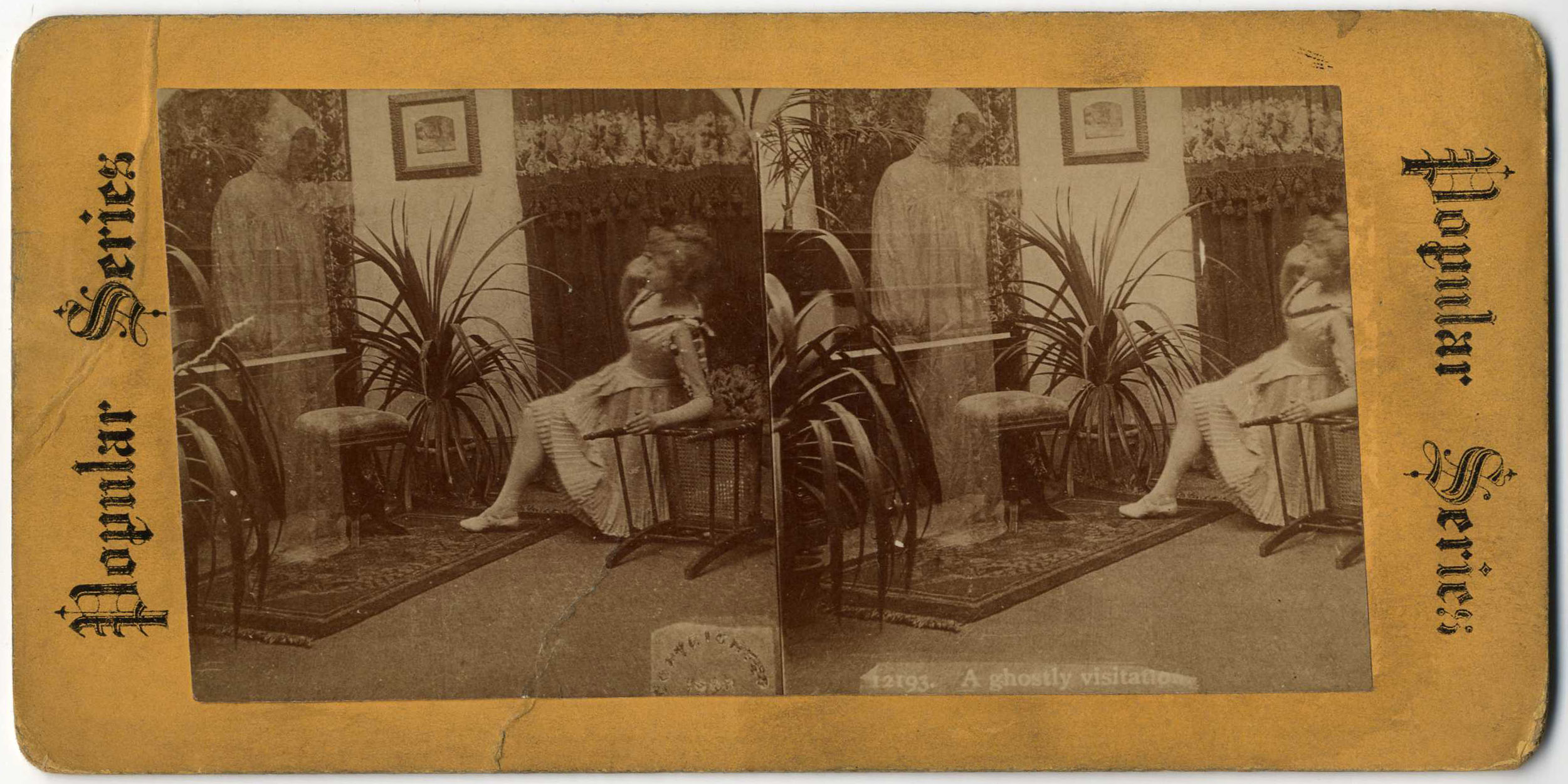
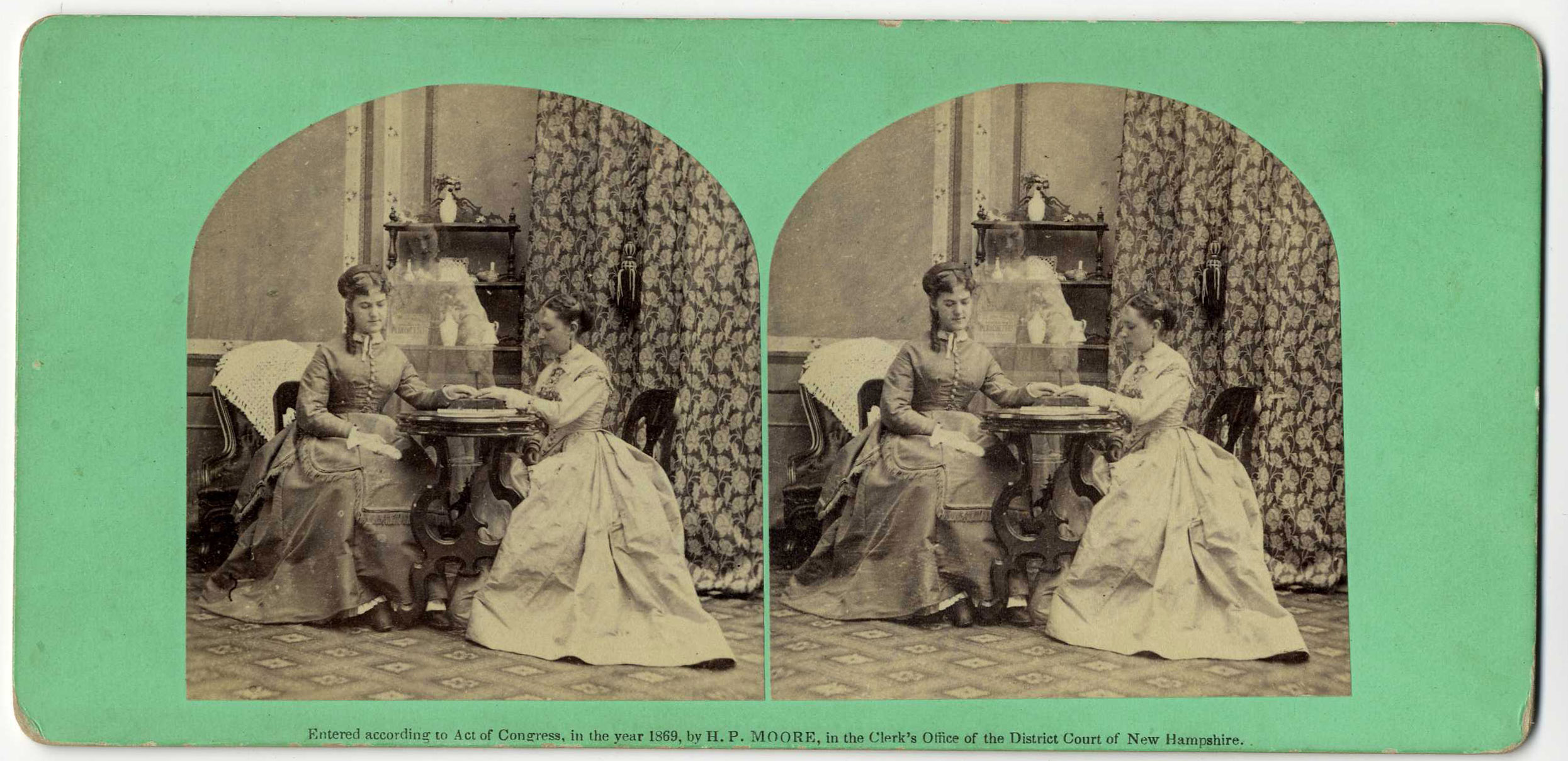
In this view below titled “A Ghostly Visitation,” a startled young woman pulls back, knocking over a chair, her hand towards her mouth; she is looking towards a hooded ghost before the bench of an upright piano.boo_047This view titled “The Planchette” (which centers on an entertainment of the same name) features two women conducting a séance seated at a table with eyes closed holding the device while the ghost of a third woman (seen standing) guides the writing implement. The box for the Planchette can be seen through the ethereal figure on the shelf behind her. This 1869 image by H.P. Moore creates visual evidence of a rare opportunity to see how the Planchette is operated by the otherworld – and how “communication” is directed.

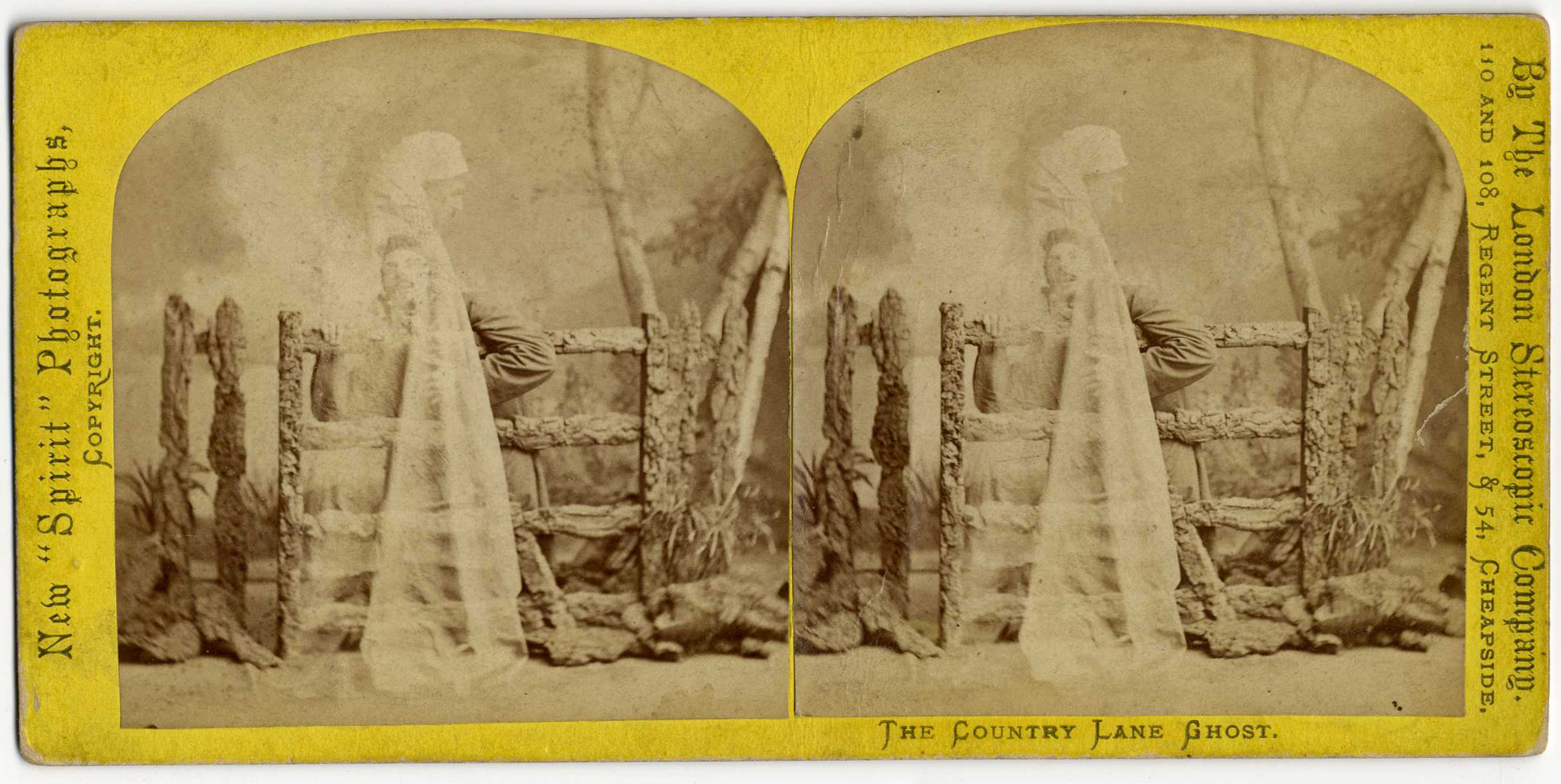
boo_048“The Country Lane Ghost” by New “Spirit Photographs” of London Stereoscopic Company, takes the spirit outside in this view, which shows a hooded figure walking down a road in a countryside. The man, crouching behind a worn fence, is visibly stunned and the fear on his face is visible through the exterior of the strolling ghost.

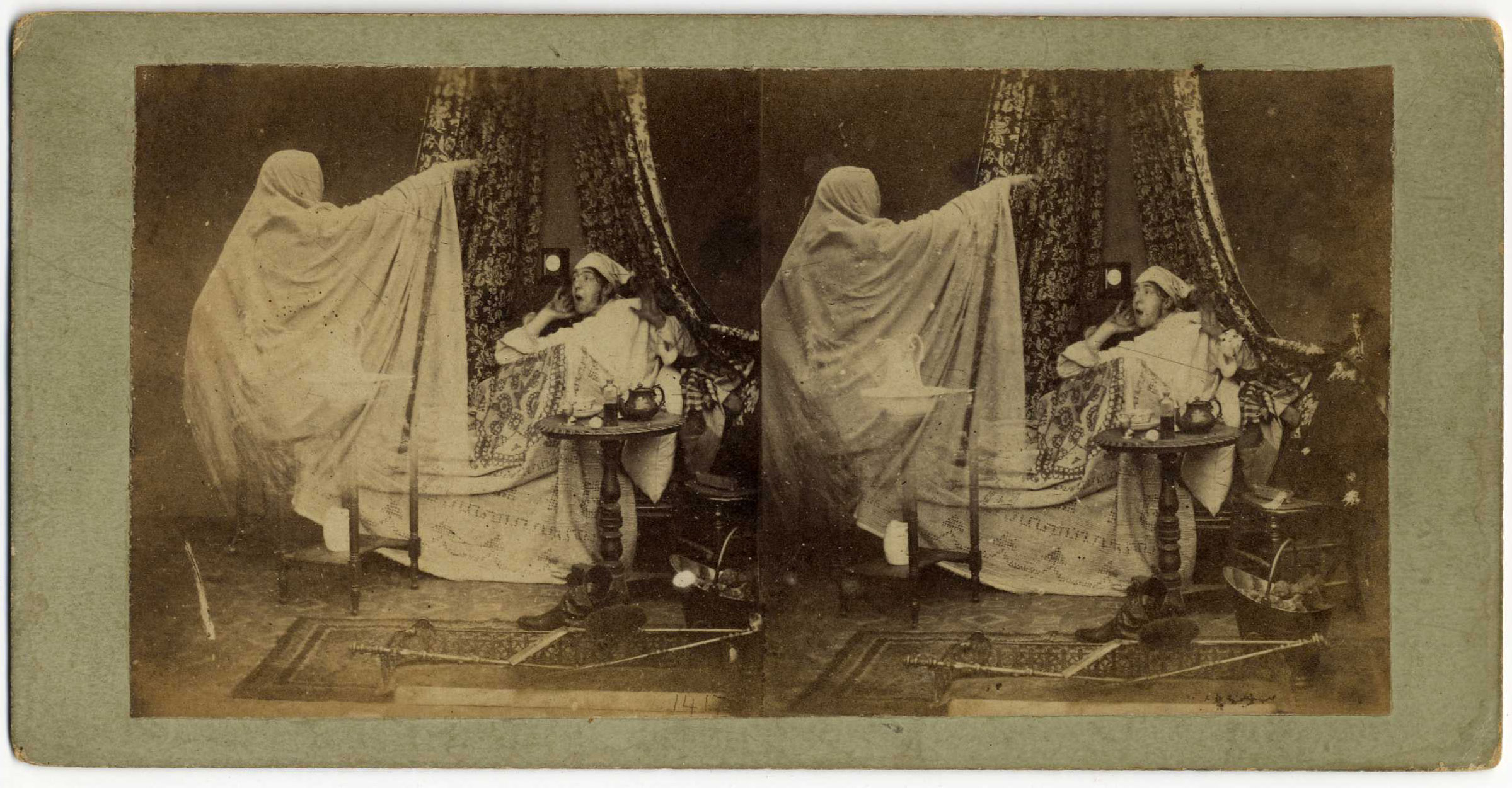
boo_049The final image we show here is inside, in a bedroom to be precise, where a man (in nightclothes and cap) is awoken by a ghost with an outstretched arm. The bed is beside a table with pitcher, teakettle, cup, saucer, and bottle, which may suggest other means for bringing on this spiritual visit.

boo_050What strikes me about these images is how the figures are staged – two with the living person literally boxed in by the apparition (on the left), one with the apparition in the center back suggesting the guiding hand of a creature from another world, and a final one with the apparition in the center front (who might actually “pop” towards the viewer when the stereocard is seen through a viewfinder). It’s also interesting how these images place the ghost figure in front of items to enhance their transparency and highlight the skill of the photographer. By looking at these images, the figures are invited not only into the world of the living, but into the intimate world of the viewfinder.

If you’re seeking some examples of stereocards with specter, give up the ghost and peruse these views!

Notes:

  1. Nancy West, “Camera Fiends: Early Photography, Death, and the Supernatural,” CR: The Centennial Review vol. 40, no. 1 (1996): 170-206.
  2. Fred Gettings, Ghosts in Photographs: The Extraordinary Story of Spirit Photography (New York: Harmony Books, 1978), 144.

The Acquisitions Table: Moses B. Holmes Excelsior Writing Book

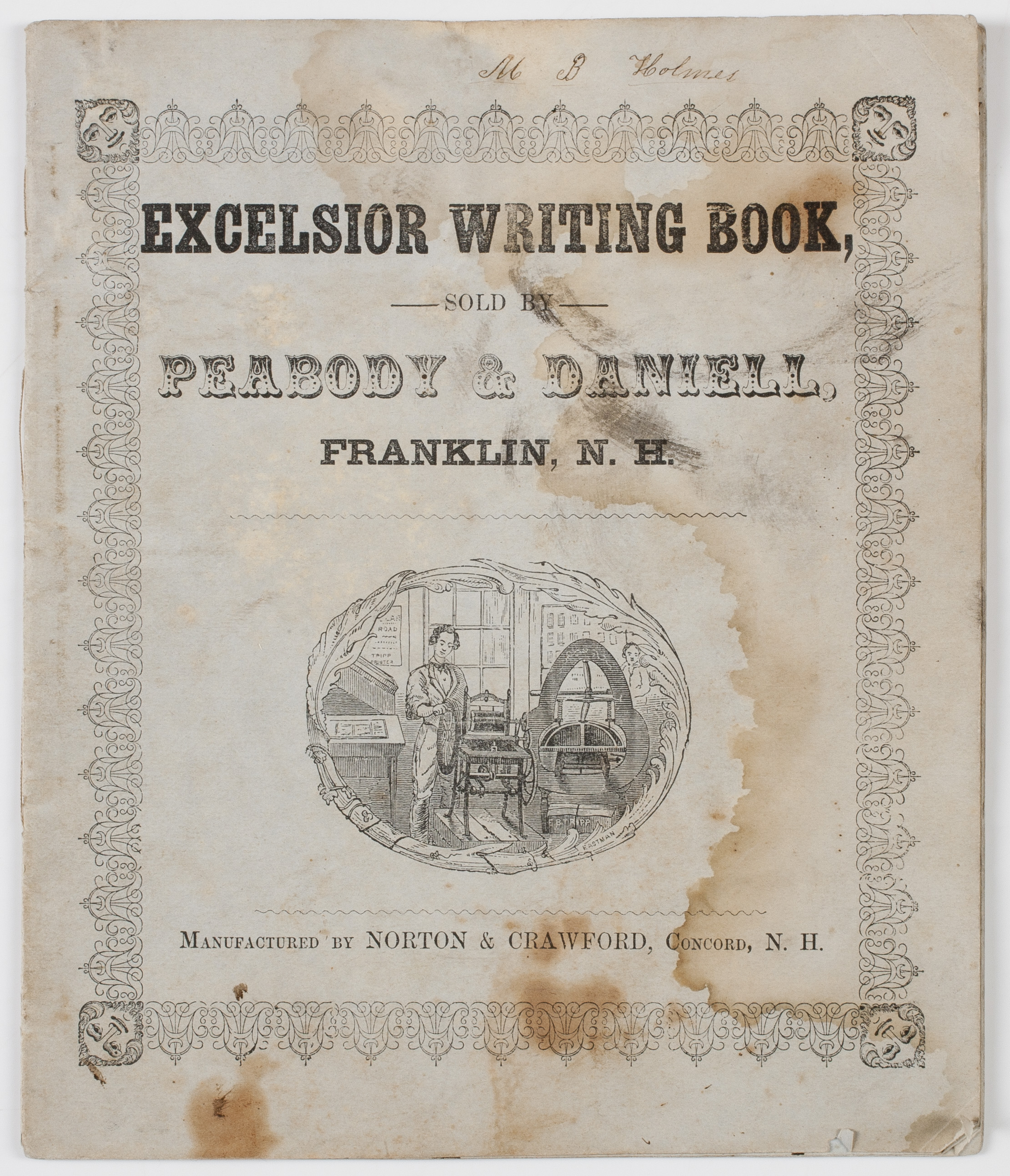
Holmes, Moses B., Excelsior Writing Book.
Moses B. Holmes (1837-1894) lived in Campton, New Hampshire. He married Ann M. Bartlett (1839-1914) and the couple had two children, Willie B. Holmes and Lewis Holmes. Moses was young when he began writing in this writing book, which was manufactured by Norton and Crawford in Concord, New Hampshire; some of the writing is dated 1851 and 1857. Moses appears to have been quite the romantic, copying and even composing his own poems about love, including many reinterpretations of the classic “roses are red…”–“The sun is red / The moon is white / I hope that I shall see you tonight.” Not only is the volume filled with verses, but it is quite unusual in its abundance of doodles and sketches. One page in particular features rows of trees and birds, with text weaving through the pictures – “What is more beautiful than the weaping [sic] Willow”, and “I know thou art beautiful / I [sic] I love the more I love”. The last page of the volume features a list of school children (Moses included) in Campton in 1851.

Recommended Reading: Marcy, the Blockade Runner

Editor’s note: In this week’s recommended reading for “fiction published before 1900,” AAS member and Councilor Chuck Arning, park ranger and AV specialist at the Blackstone River Valley National Heritage Corridor, talks about a nineteenth-century book that was passed down through his family. Unlike all of the other books in this series (see Philip Gura’s and Jackie Penny’s), however, AAS does not own a copy…yet. As we like to say, “If we don’t have it, we want it!”

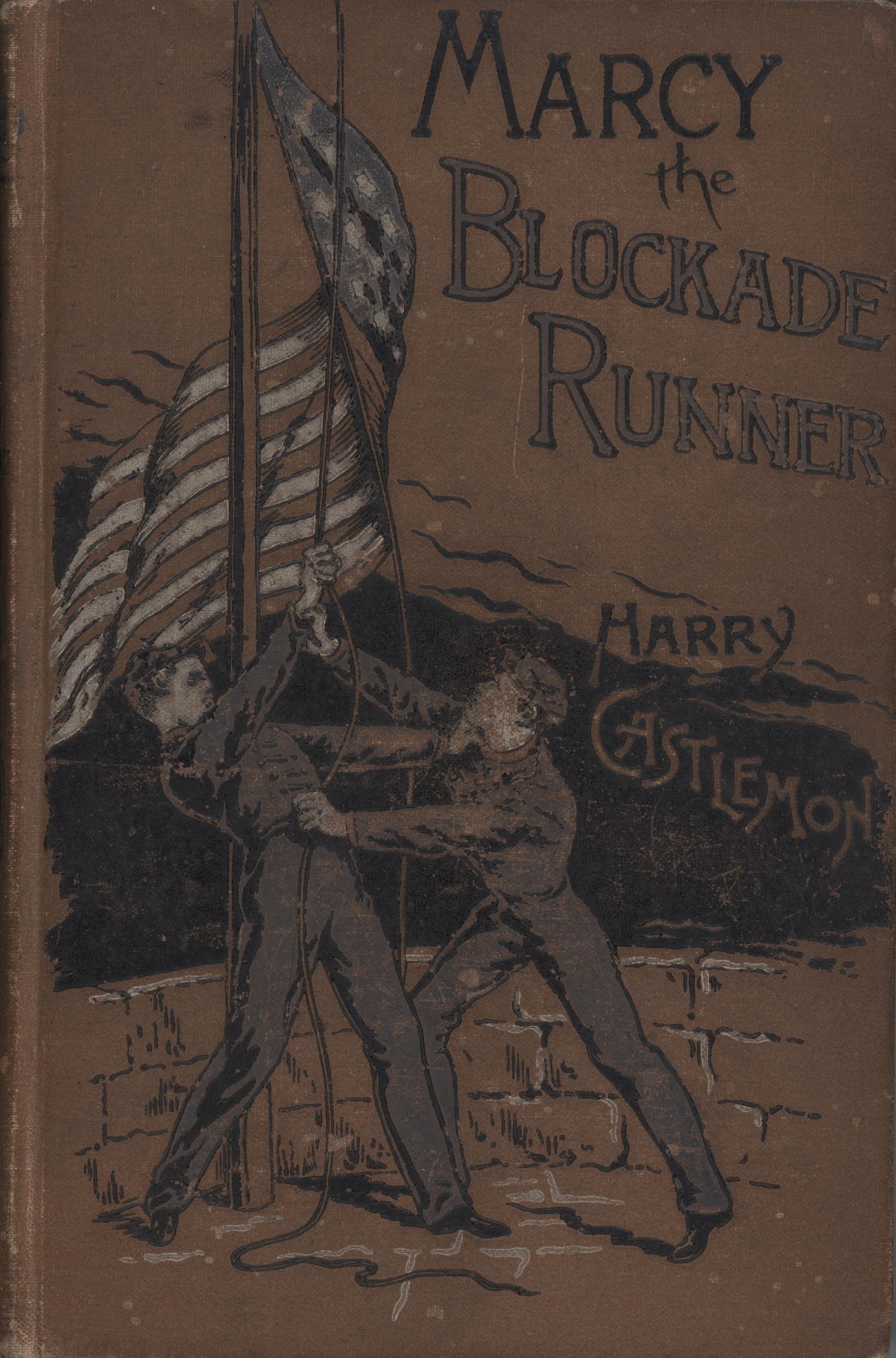
Cover of the author's copy.
Cover of the author’s copy.

What books find their way into one’s personal library, particularly books published prior to 1900, is often the result of pure chance, a family connection or curiosity. Most likely, such longevity is the result of a combination of these factors.

The book that has managed to remain intact from the past in my library is Harry Castlemon’s juvenile action adventure Marcy, the Blockade Runner (Castlemon’s War Series, published by Porter & Coates, Philadelphia, 1891). Set in the coastal area of North Carolina during the Civil War, a family headed by a Union-sympathizing widow that owns a plantation fights off cruel southern traders who have designs on the Gray plantation.There is a strong African-American character who is seeking his own path to freedom. Marcy, a talented coastal boat pilot, is a pure Union man, but must conceal his true feelings. His older brother, Jack, has secretly left the South and joined the Union Navy. Marcy’s adventures revolve around his need to conceal his Union feelings and protect his mother, all while guiding blockade runners through the coastal waters of North Carolina. The reader must be warned that the language is reflective of the nineteenth-century view of African-Americans and is necessary to some degree for the plot development, but is distasteful to the twenty-first-century ear.

The Acquisitions Table: The Game of Jack of All Trades

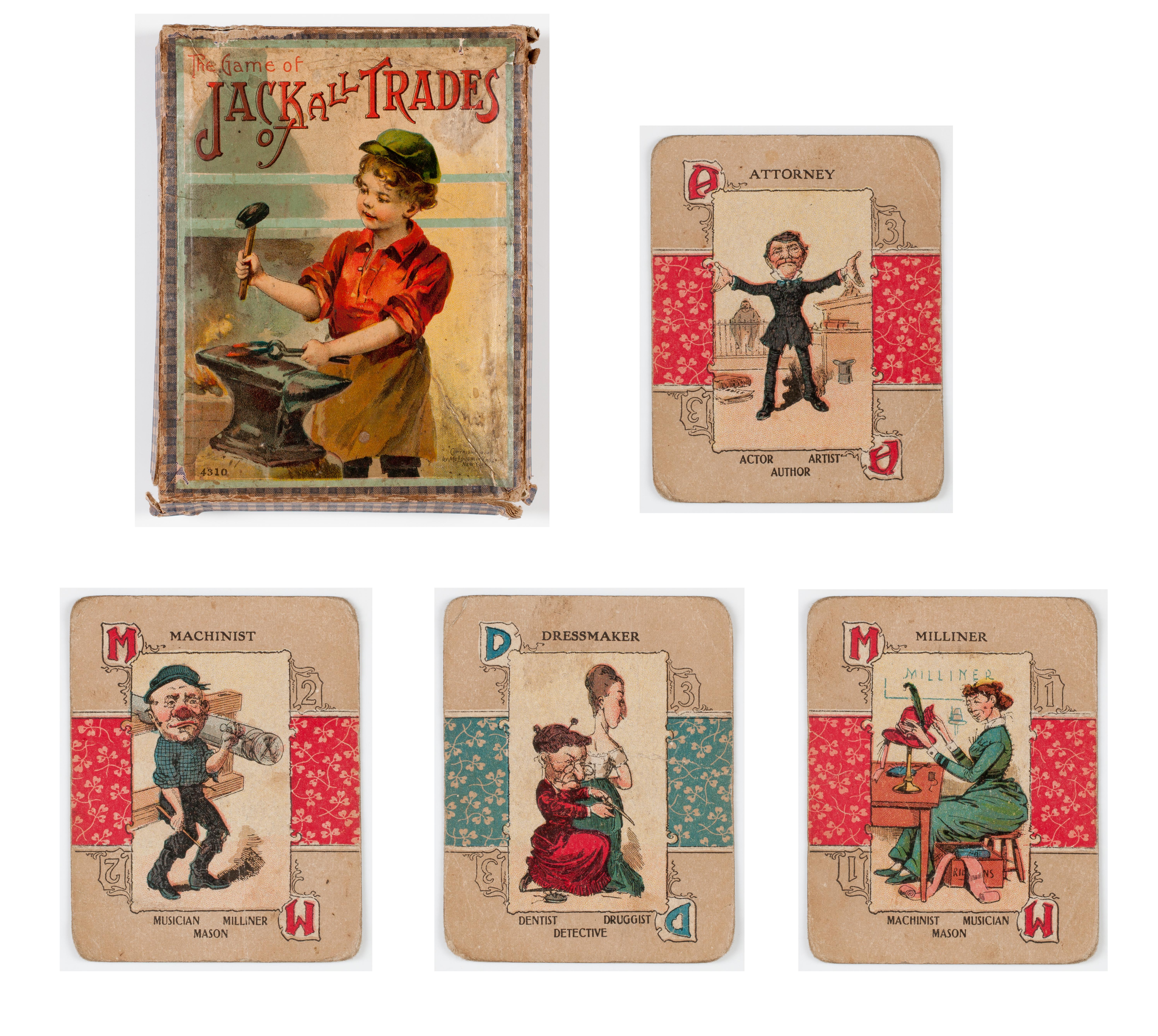
The Game of Jack of All Trades. New York: McLoughlin Bros., ca. 1900.
This is a welcome addition to our holdings of McLoughlin Bros. games. McLoughlin published an extensive line of small boxed card games, like Jack of All Trades. Games and picture books about professions and trades were used since the late eighteenth century to teach children about various ways of pursuing a living. In this case, most of the occupations represented are male, including the pleading attorney and rather drunken looking machinist. Some female trades are present, including the seamstress and milliner, although both women look like sour faced spinsters. Cultural artifacts of childhood like The Game of Jack of All Trades reveal a great deal about prevailing attitudes toward gender and specific occupations.

Public Program: Mary Kelley Talks Love, Literature, and War

Many of you may already follow the fantastic blog Boston 1775, but if you don’t now is a great time to begin! A post this past weekend explored the subjects of tonight’s Public Program with Mary Kelley, William Tudor and Delia Jarvis. Be sure to check out the post and join us tonight in Antiquarian Hall at 7 p.m. for Mary Kelley’s talk, “‘While Pen, Ink & Paper Can Be Had’: Reading and Writing in a Time of Revolution.”

Recommended Reading: Burnett’s A Little Princess

Editor’s note: In the most recent issue of the Almanac, we asked members of the AAS community to give us their choice of recommended reading for “fiction published before 1900,” a series we are continuing here on Past is Present. Last week we heard from AAS member Philip Gura. This week, Jackie Penny, AAS’s image rights and design librarian, has two very good (and very adorable) reasons for her choice.

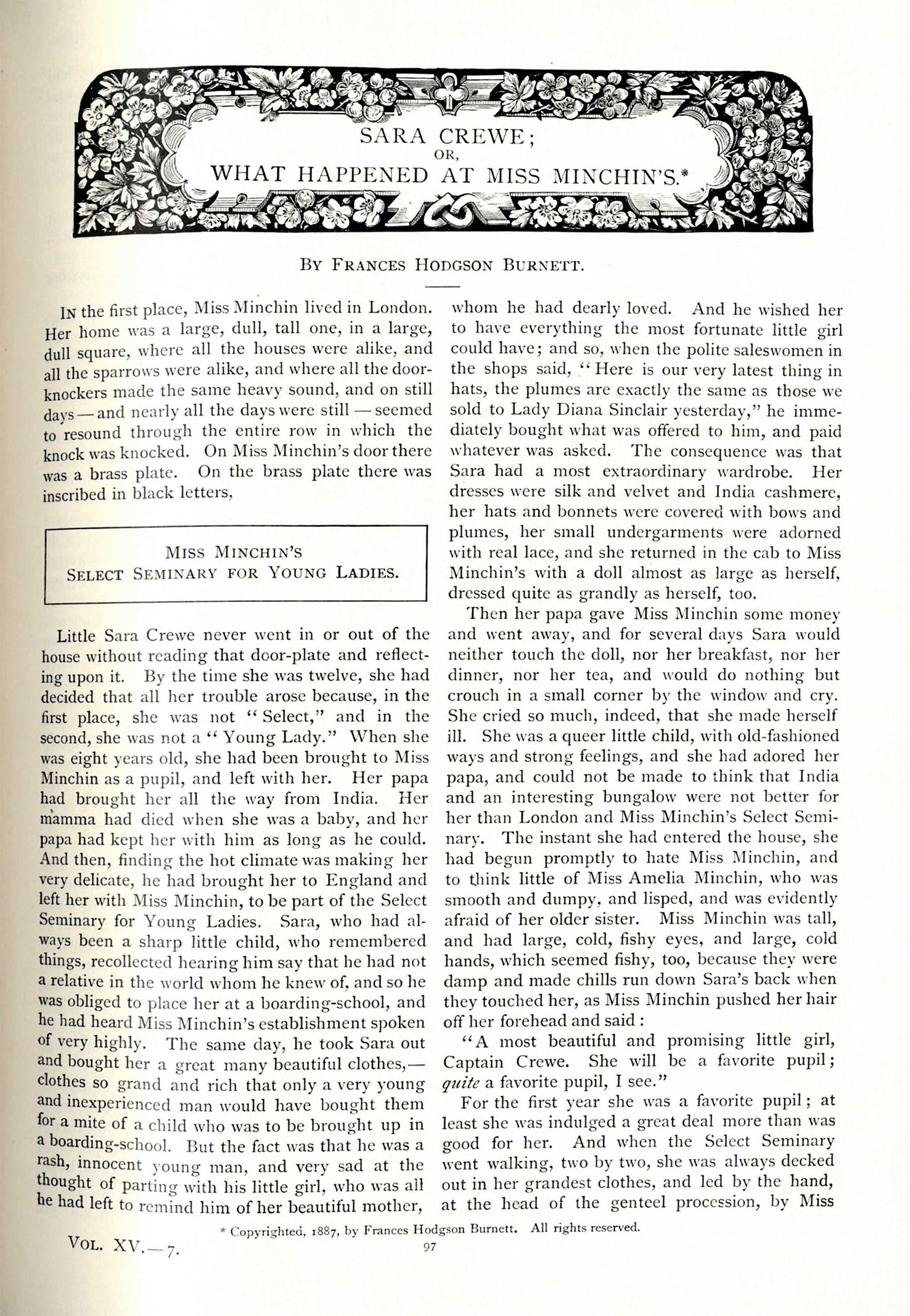
The first page in the serialized “Sara Crewe: or What Happened at Miss Minchin’s,” which started in the Volume XV, Number II (December 1887) issue of St. Nicholas: An Illustrated Magazine.

At home, my children and I read what we colloquially refer to as the Big Book before bed – a text (usually fiction) of modest novel/novella length. Anything else (of the 32-page with-picture variety) is just A Book. So while scouting for new Big Book material lately, I was taken with the Almanac’s challenge of finding something to read and recommend published before 1900. My requirements were that it needed to be something that I could find in AAS’s first edition collection, that it had been reissued, and that it could lull a pair of three-year-olds to sleep. When I asked my daughter for her thoughts, like most girls born after 2007, she suggested something to do with a “princess.” Undoubtedly, she wanted something closer to the garish strain which is represented in everything from bandages to ghostwritten paperbacks; I resisted at first (but admit, she was on to something).

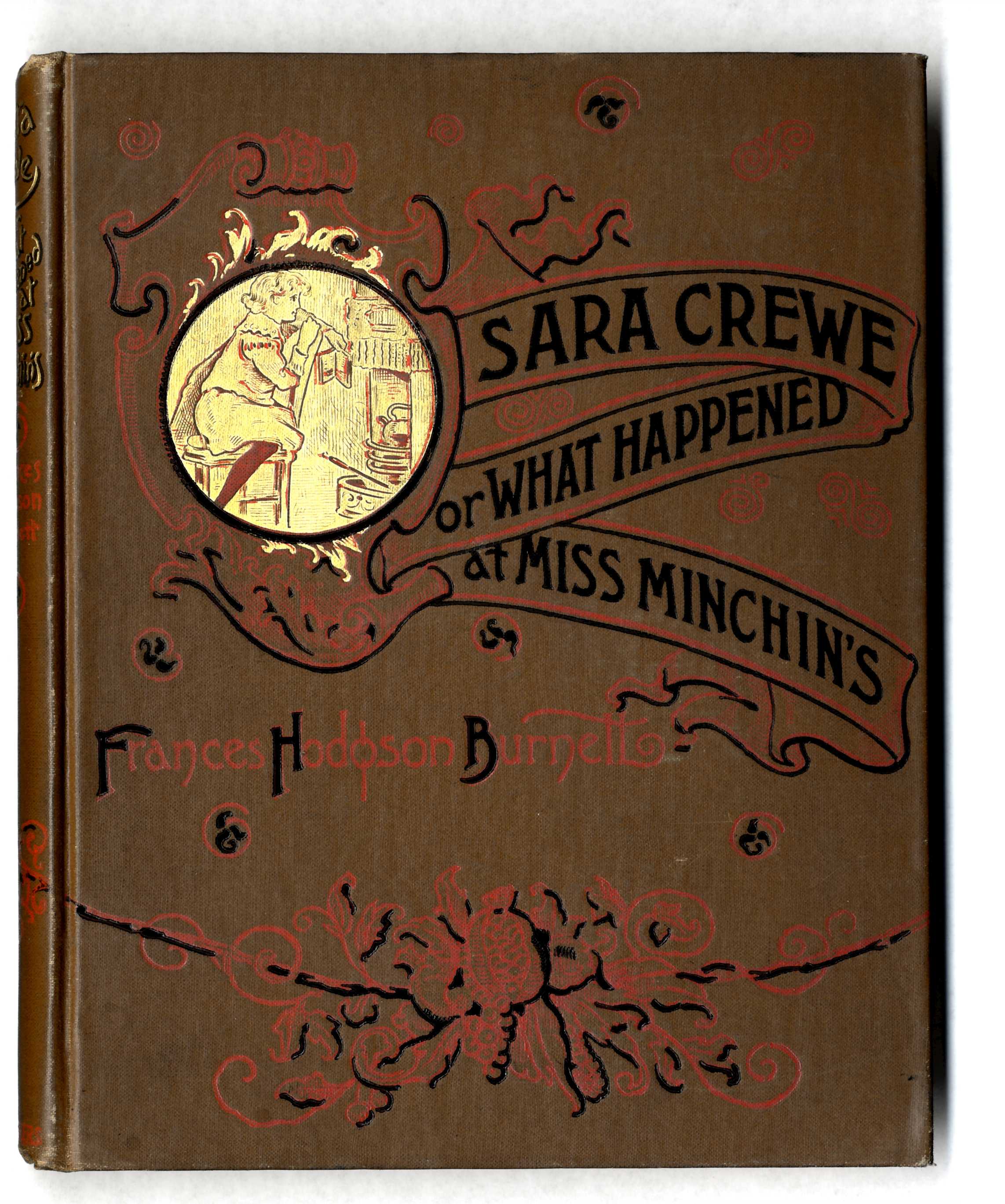
Cover of Sara Crewe or What Happened at Miss Minchin’s, published in New York by C. Scribner's Sons, 1888.
Cover of Sara Crewe or What Happened at Miss Minchin’s, published in New York by C. Scribner’s Sons, 1888.

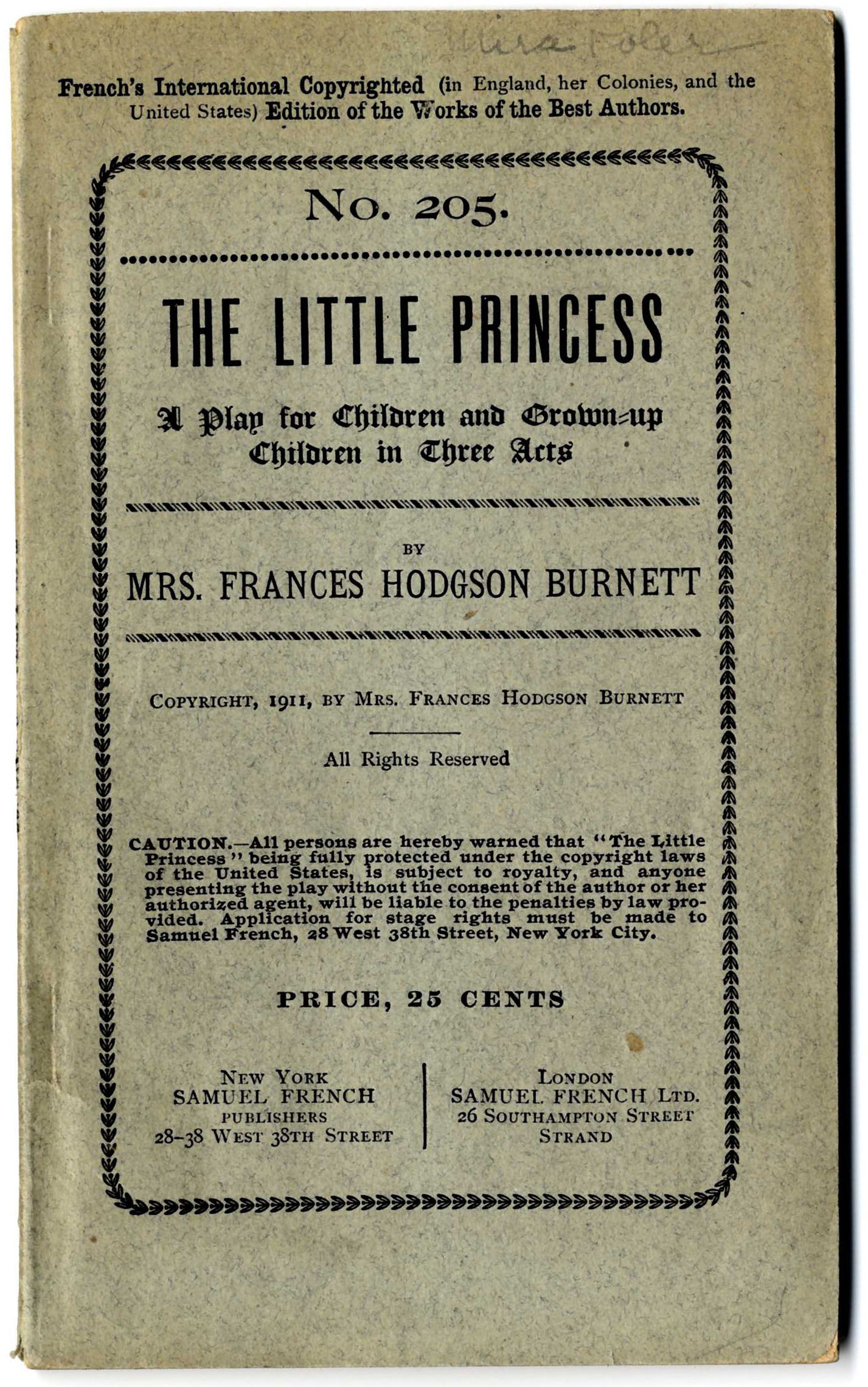
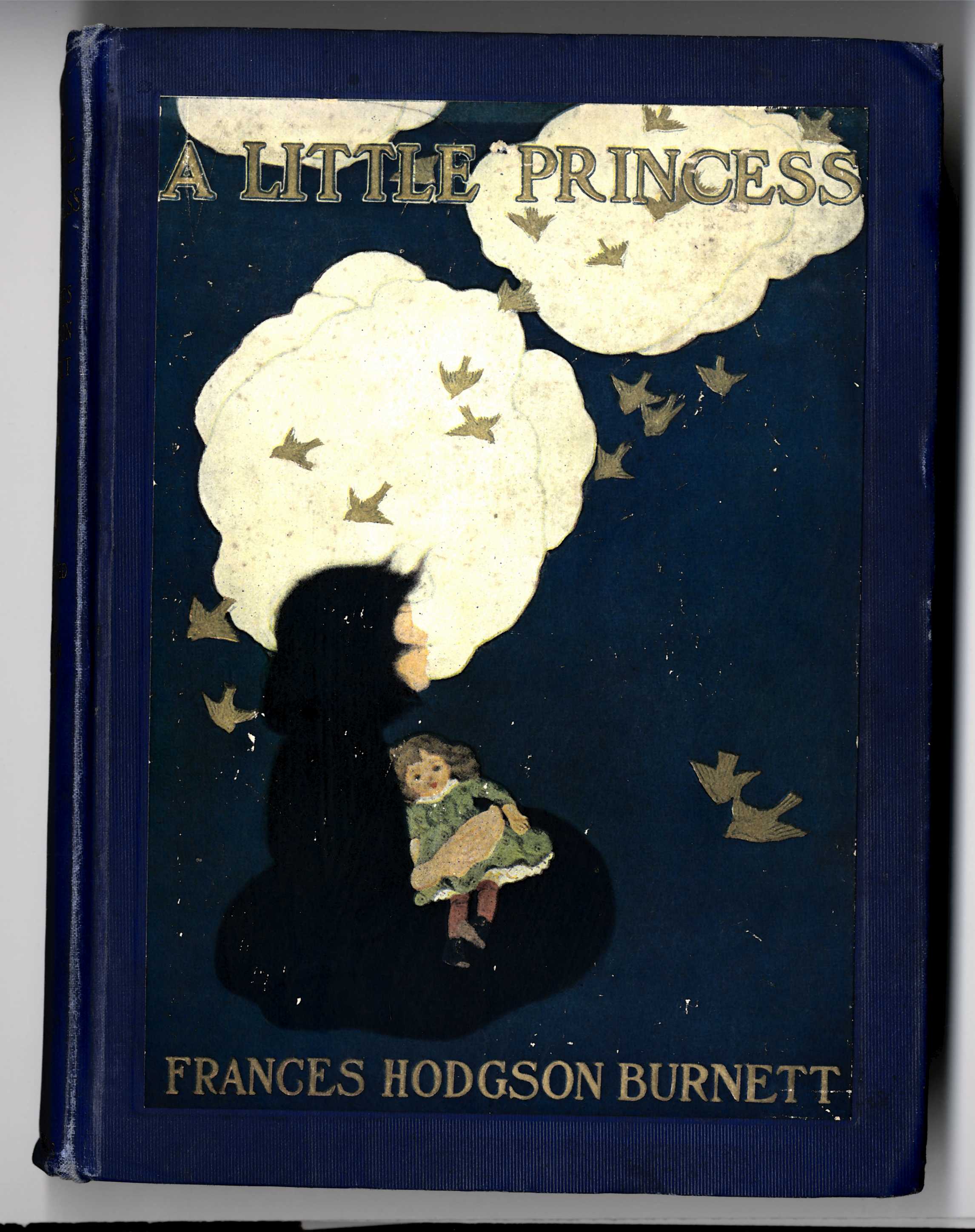
The book we settled on was Frances Hodgson Burnett’s (1849-1924) A Little Princess, a story that first appeared serialized in St. Nicholas: An Illustrated Magazine for Young Folk as “Sara Crewe, or What Happened at Miss Minchin’s” starting in 1887 (AAS holds a copy of this periodical). By 1888, Sara Crewe was published in New York by C. Scribner’s Sons (and in London by Warne) as a bound volume (AAS has two copies of this edition). In the early twentieth century, the familiar tale was issued as a stage play, A Little Princess (which AAS has a circa 1911 paperbound copy of). Finally, in 1905 the now-famous text appeared in its full-length iteration A Little Princess, which it is most known for today.

A 1911 copy of the play The Little Princess: A Play for Children and Grown-up children in Three Acts.

So why is this important? And why is it significant that AAS has several expressions of Sara Crewe’s story (as play, serial, compiled serial/novella, and revised version)? Apart from trying my hardest to raise a future generation of librarians fluent in bibliographic description, I believe the text (and publishing history) is valuable not only because it remains a hallmark of my own childhood reading, but it underscores what I believe are progressive markers of a true princess: to be intelligent, kind, strong, positive, imaginative, and have the ability to remain clever and creative even in the most grim of circumstances (a sudden fall in fortune and being orphaned in another country, for example).

A color-illustrated 1905 copy of the expanded A Little Princess: Being the Whole story of Sara Crewe, Now Told for the First Time.

The publishing history is textured, rich, and arguably pretty common among practices of the late nineteenth and early twentieth centuries. And yet, Burnett’s story of Crewe is complicated to say the least. I recommend it because I feel by reading (and re-reading) this perennial favorite, we are looking to the past for reminders and cues on how to act today; these stories aren’t frozen, archaic, or outdated, but reflect our own complex lives.