Writings of Omaha. Chicago: S. S. Jones, Publisher, Religio-Philosophical Journal Office, 1869.
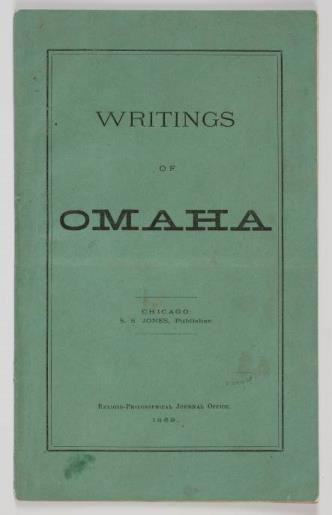 APPARENTLY UNRECORDED, ONLY KNOWN COPY!
Describing the nature of reality, electricity, and the spirit realm in 61 numbered paragraphs, this overview of Spiritualist theory is also an apparently unrecorded Ante-Fire Chicago imprint. The 26-page pamphlet in its original printed green wrappers was issued by the central figure in Chicago Spiritualist publishing, Stevens Sanborn Jones (1813-1877). Jones edited and published the leading Chicago Spiritualist journal, the Religio-Philosophical Journal. He lost everything in the fire of 1871 (which no doubt accounts for the scarcity of this title) but managed to keep the journal afloat before he was murdered in his office in 1877. Jones was shot in the head by a jealous husband, a phrenologist named William C. Pike, who “if the daily papers may be believed, boasted that his knowledge as such enabled him to select that particular point at which to place his pistol.” (See Emma Hardin Britten, Nineteenth Century Miracles, 1884).
The votes are in!
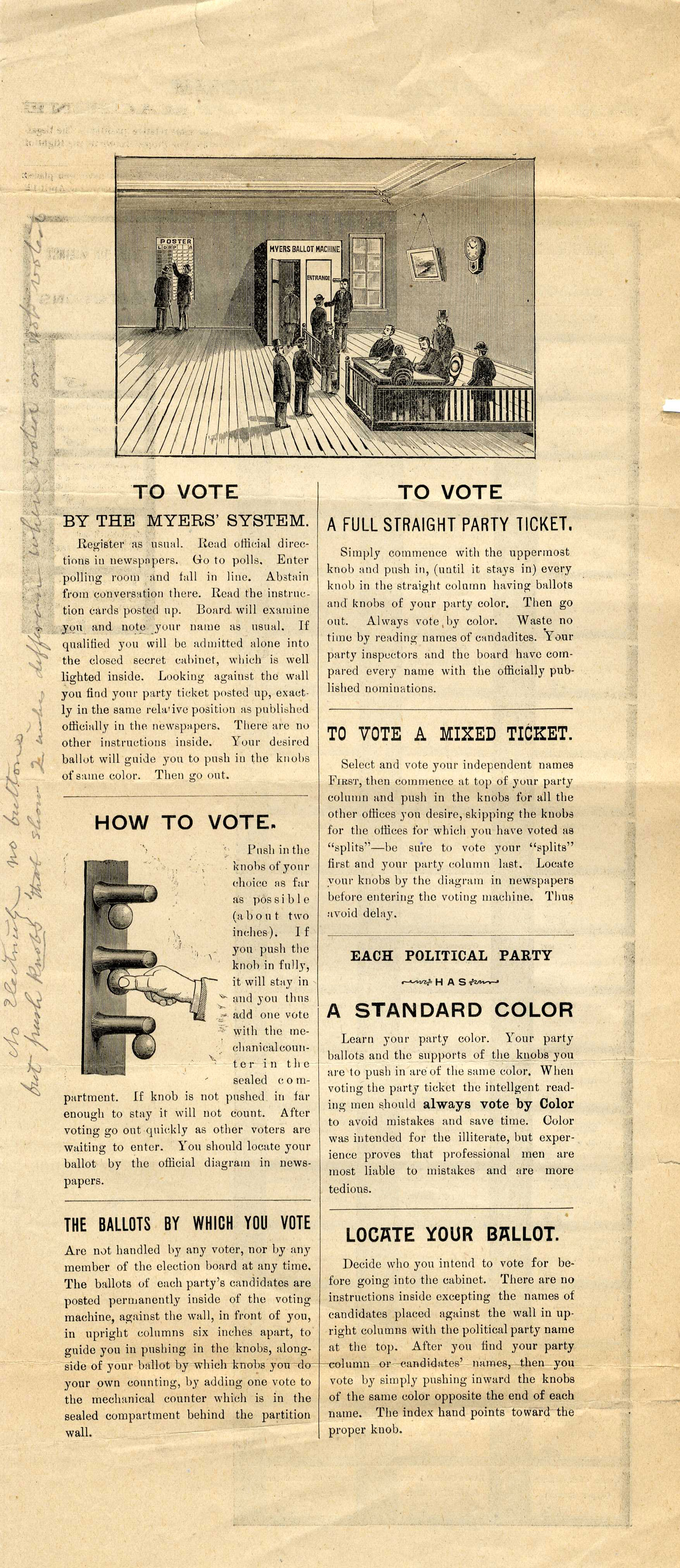
The collection of election ballots at the American Antiquarian Society is an impressive group of 952 items spanning the nineteenth through the early twentieth centuries. Several of these are individual ballots for specific elections, others are completely uncut; some are annotated, others are marked-up canvassing sheets (with sample tickets) or are comprised of paste downs. Some tickets are from parties as well-known as the Republican or as unfamiliar as the Peace. While separate ballots have not been individually cataloged, the collection has been digitized in its entirety, organized and inventoried. You will find links to each box/folder here.
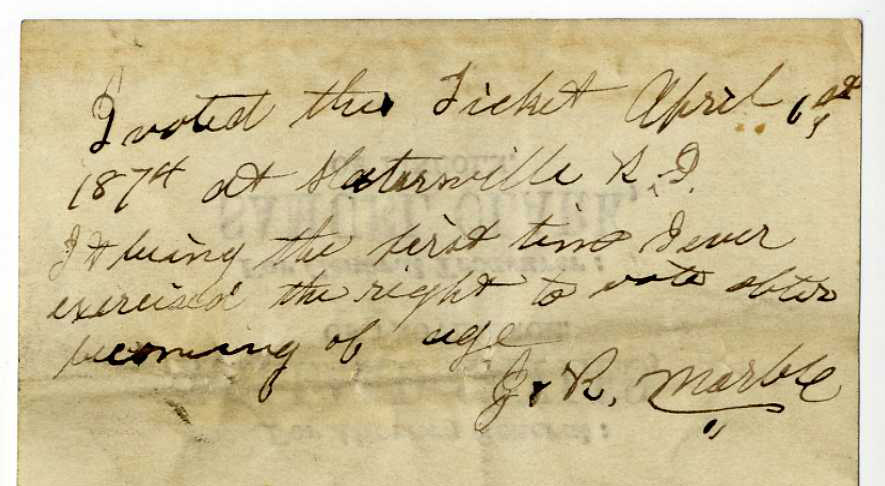
The collection is considered part of the Society’s Graphic Arts, ephemera collection; some early examples feature wood cut illustrations and letterpress on wove paper, and towards the end of the nineteenth century they became sophisticated printing jobs and important political prints in their own right. The images on many of these tickets encompass (and now evoke) many of the key emotions in the political process – pride, shame, innovation, engagement, and deception. Take for instance the pleasure of J.R. Marble, who wrote on the reverse of his Rhode Island National Union Republican Ticket “I voted the Ticket April 6th, 1874 at Slatersville, R.I it being the first time I ever exercised the right to vote after coming of age.”
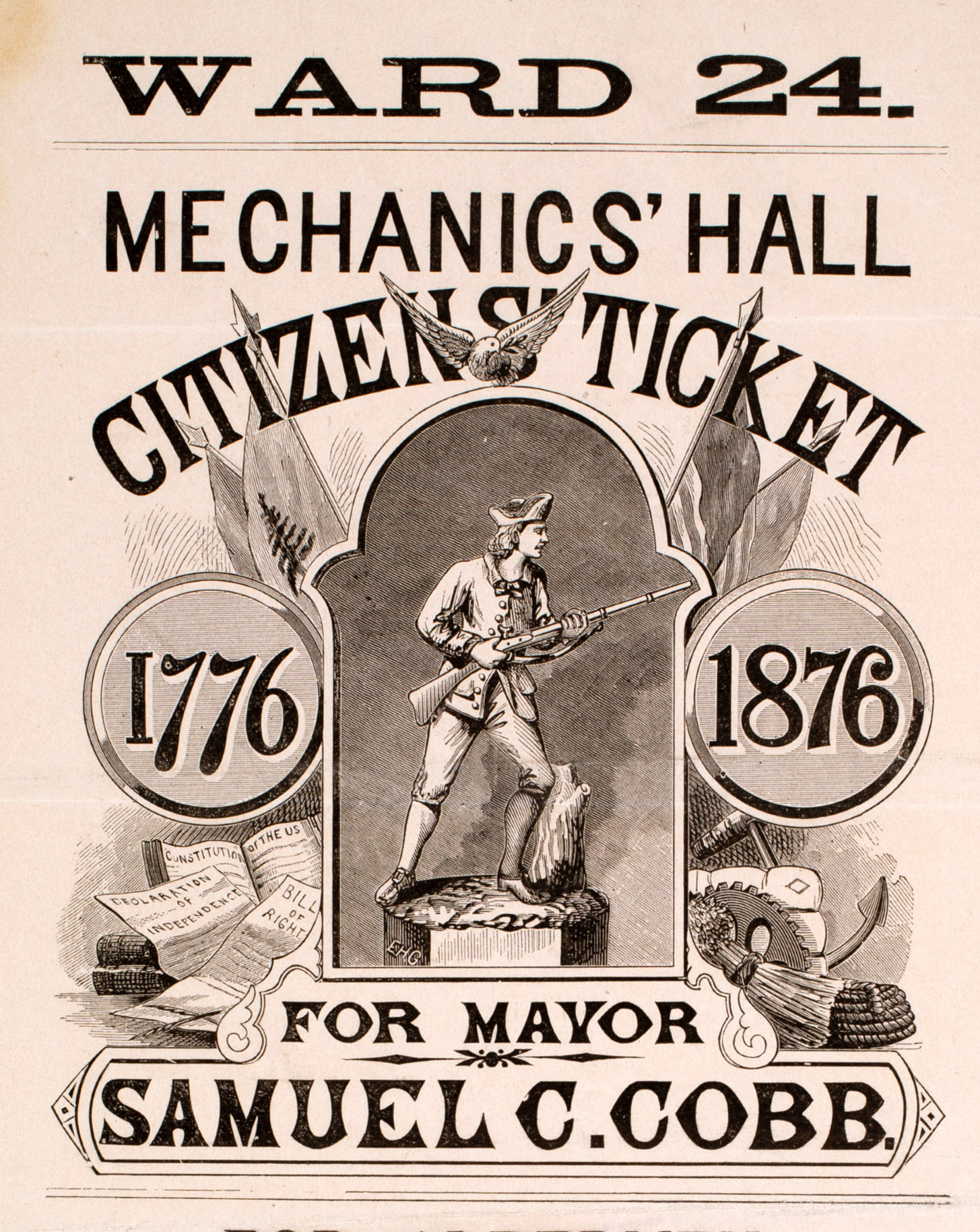 Sometimes when we think about the history of the country it is in terms of the “Big Documents” – the Constitution of the United States, the Declaration of Independence, the Bill of Rights – documents which are actually embedded in the images of some of these very election ballots (such as this one from Ward 24 Mechanics’ Hall Citizens’ Ticket). And yet, looking over the collection as a whole, it seems these little slips of paper – when combined – have more at stake in their contents and eventual outcome. Ephemeral, yes, but also extremely powerful. We release them here for your perusal, insights and thoughts.
Curatorial Instinct: Or Flying Blind in Upstate New York
In the most recent issue of the Almanac, we had a feature article about the process of bringing new items into the collection. This got us thinking about some of the interesting ways in which these treasures are found. In the coming weeks, each curator will share one of their favorite stories about finding a new acquisition.
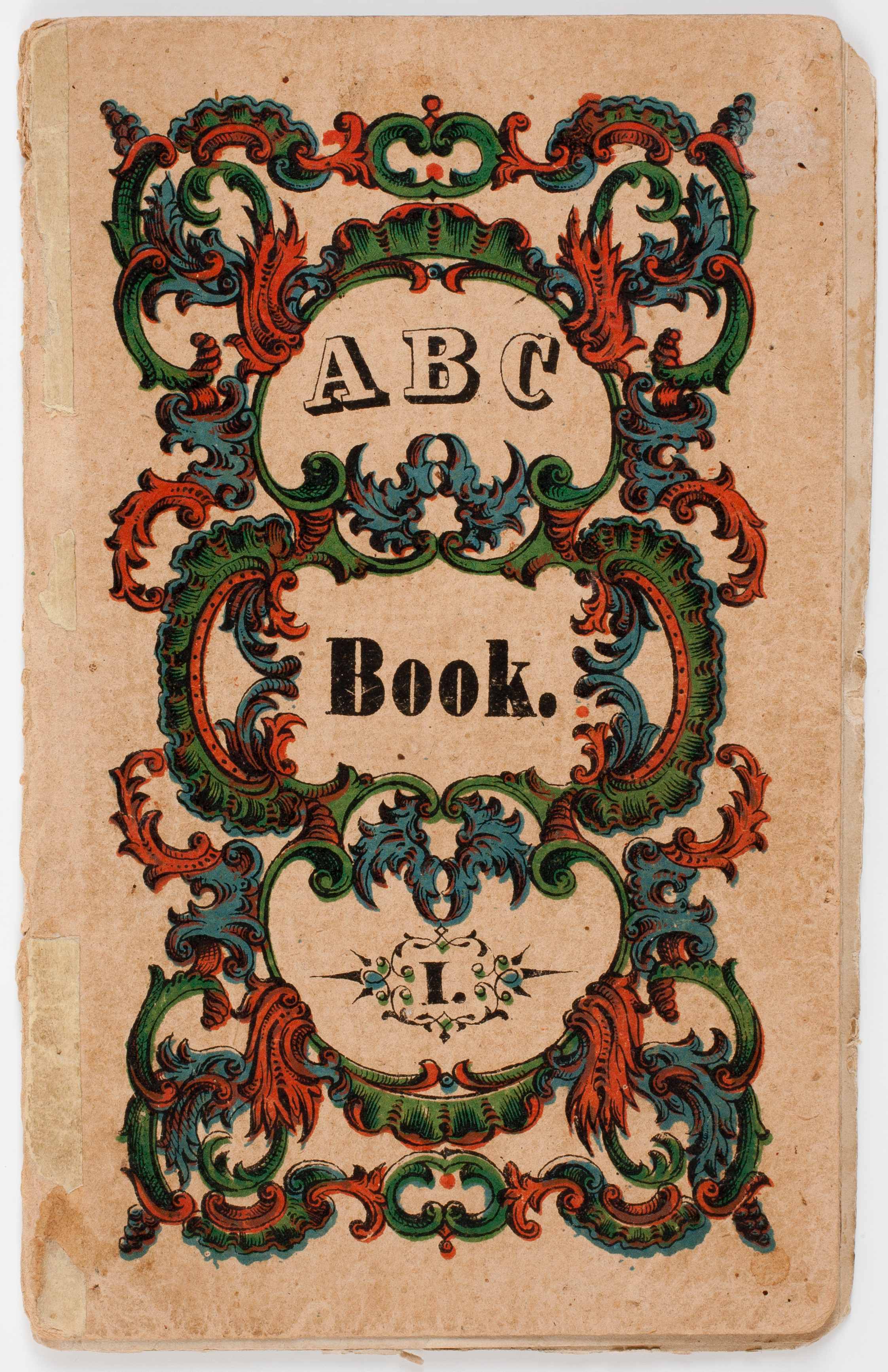 Early last summer, I (along with curatorial colleagues Vince Golden and Elizabeth Pope) piled into a rental van to travel to upstate New York to pay a visit to dealer Peter Luke, who has managed to fill an old house with crates and boxes full of books, newspapers, and printed scraps politely known as ephemera. While scouring the musty boxes for children’s books, I found ABC Book I, a charming piece of mid-nineteenth-century color relief printing (see right). It was issued without an imprint, adding to its mystery and fascination. I thought it looked very familiar, but could not conclusively tell whether AAS had it or not. Although my colleagues had cell phones with internet search capability that could access our online catalog, Peter’s house was just beyond the reach of the cell towers. My instinct told me I had seen it before, and that we already had it, but I took Peter up on his generous offer to let me take it back to AAS and check it.
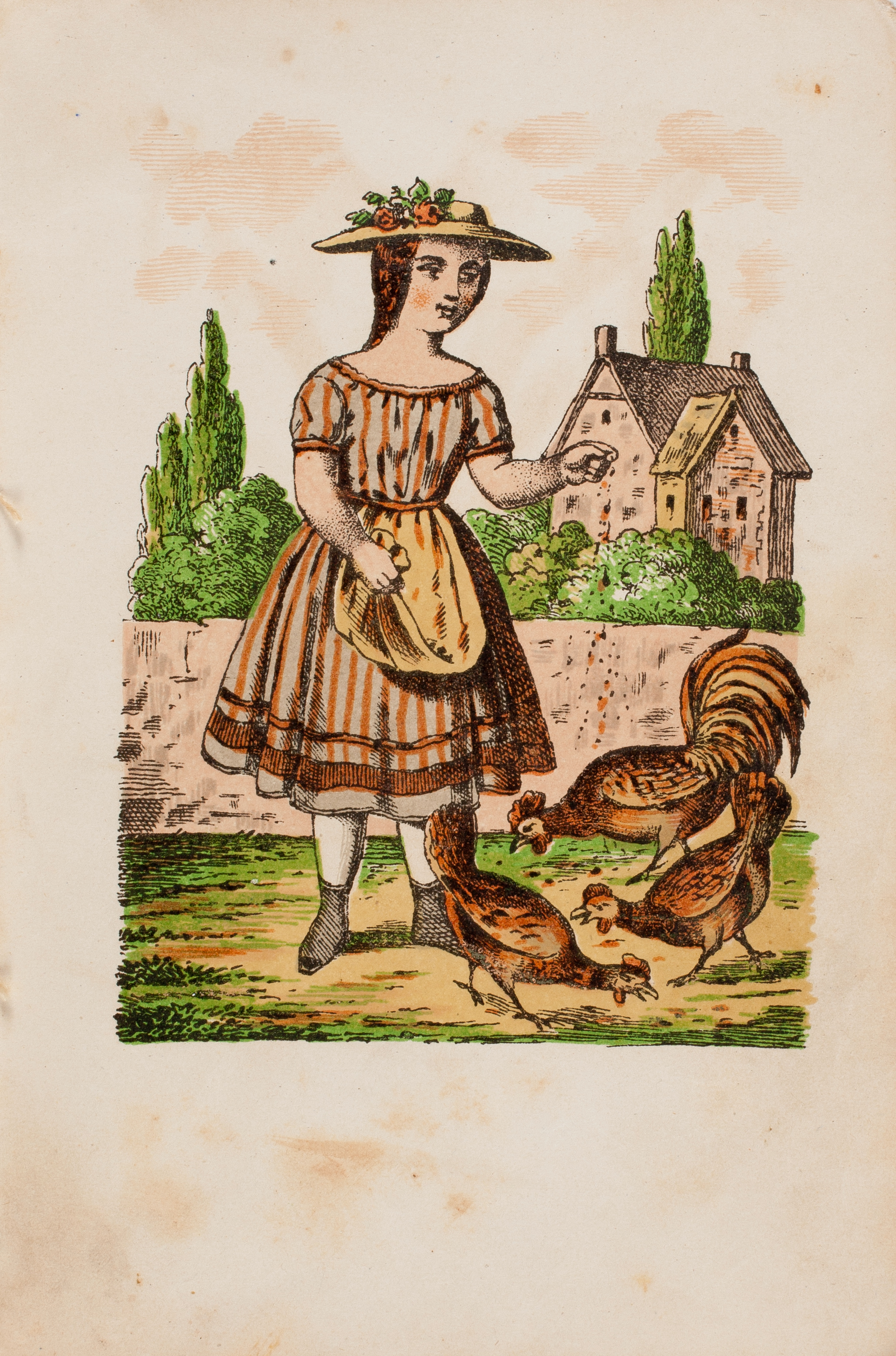
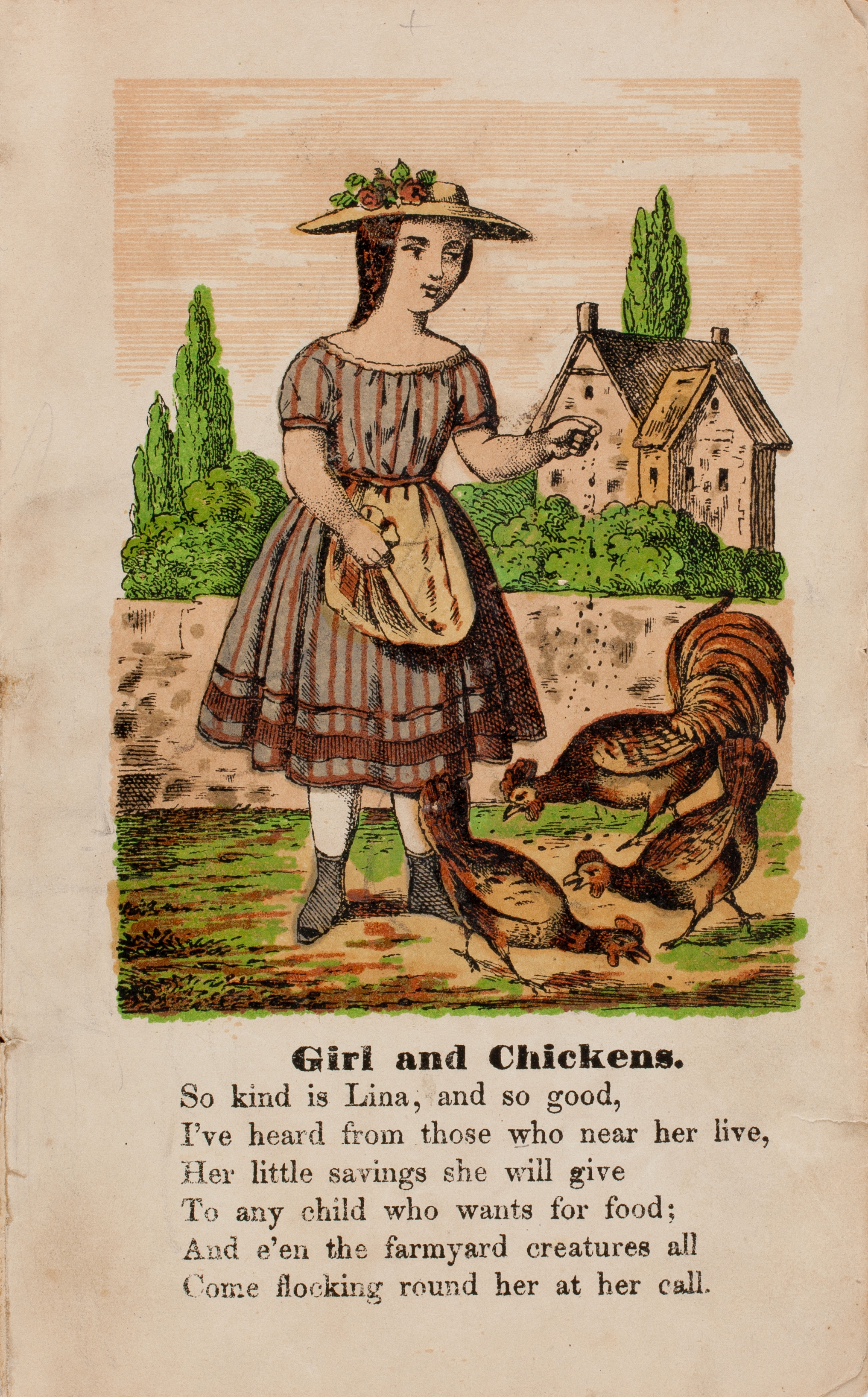
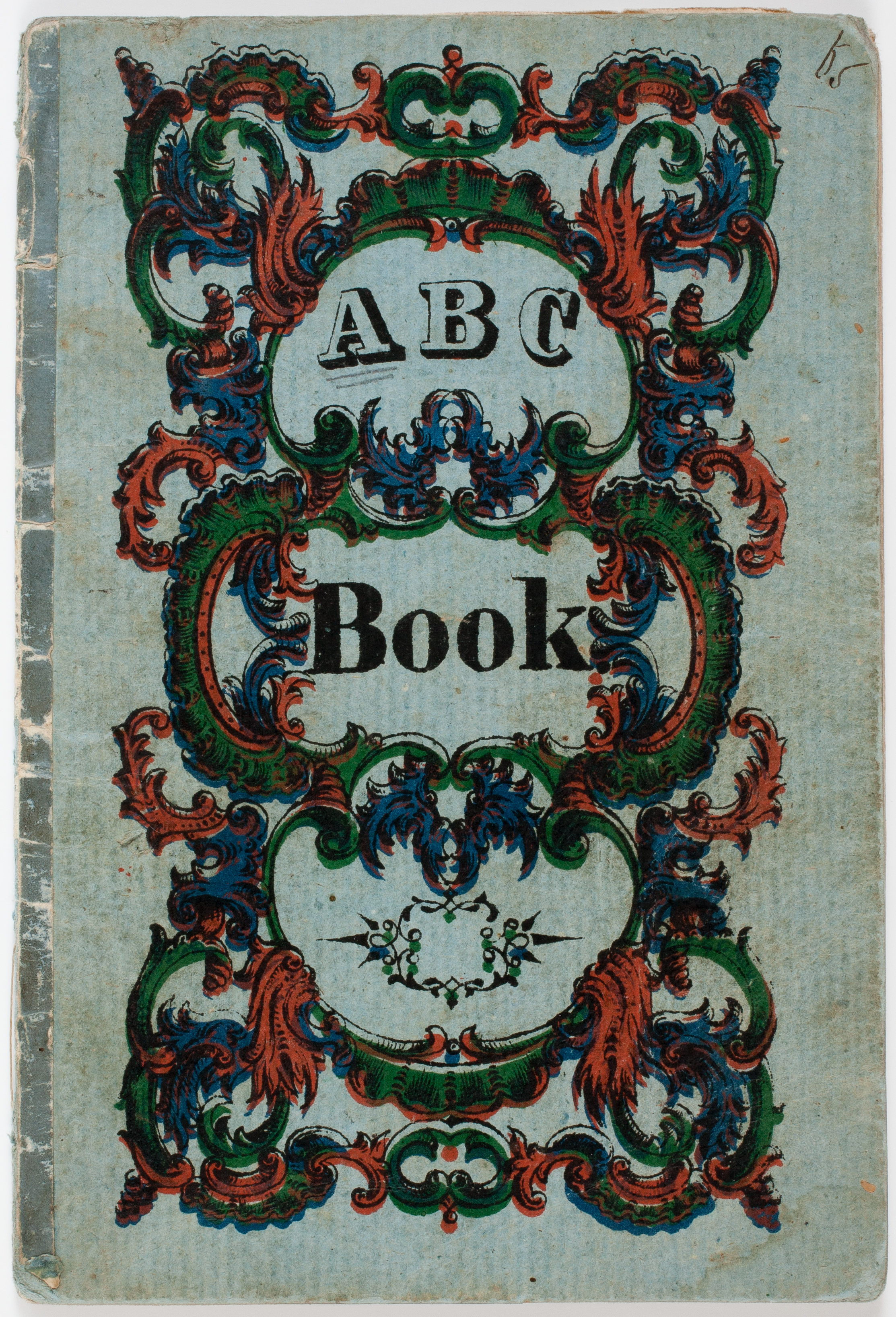 Upon returning to Worcester, I discovered that we do have a very similar ABC Book (left), but with a bit of a twist; it had no number. Upon opening the two copies, I discovered that our present copy had the images and no text (below left), and that the copy I just got from Peter included the same pictures with verse captions (below right). In this example of the girl and the chickens, the caption fleshes out the story of the girl: her name is Lina, and not only does she take care of the chickens, but she will generously give from “her little savings” to any child needing food. When I showed the two books to my colleague Lauren Hewes, curator of graphic arts, I also learned that the newly acquired copy was probably printed first, as the light brown color block detailing the background sky is much more detailed than the abbreviated brown lines found in the other copy. With their neatly executed color woodblock prints, these two copies occupy a brief moment in children’s picture book production at mid century between crude hand-colored woodcuts and mass-produced chromolithography.
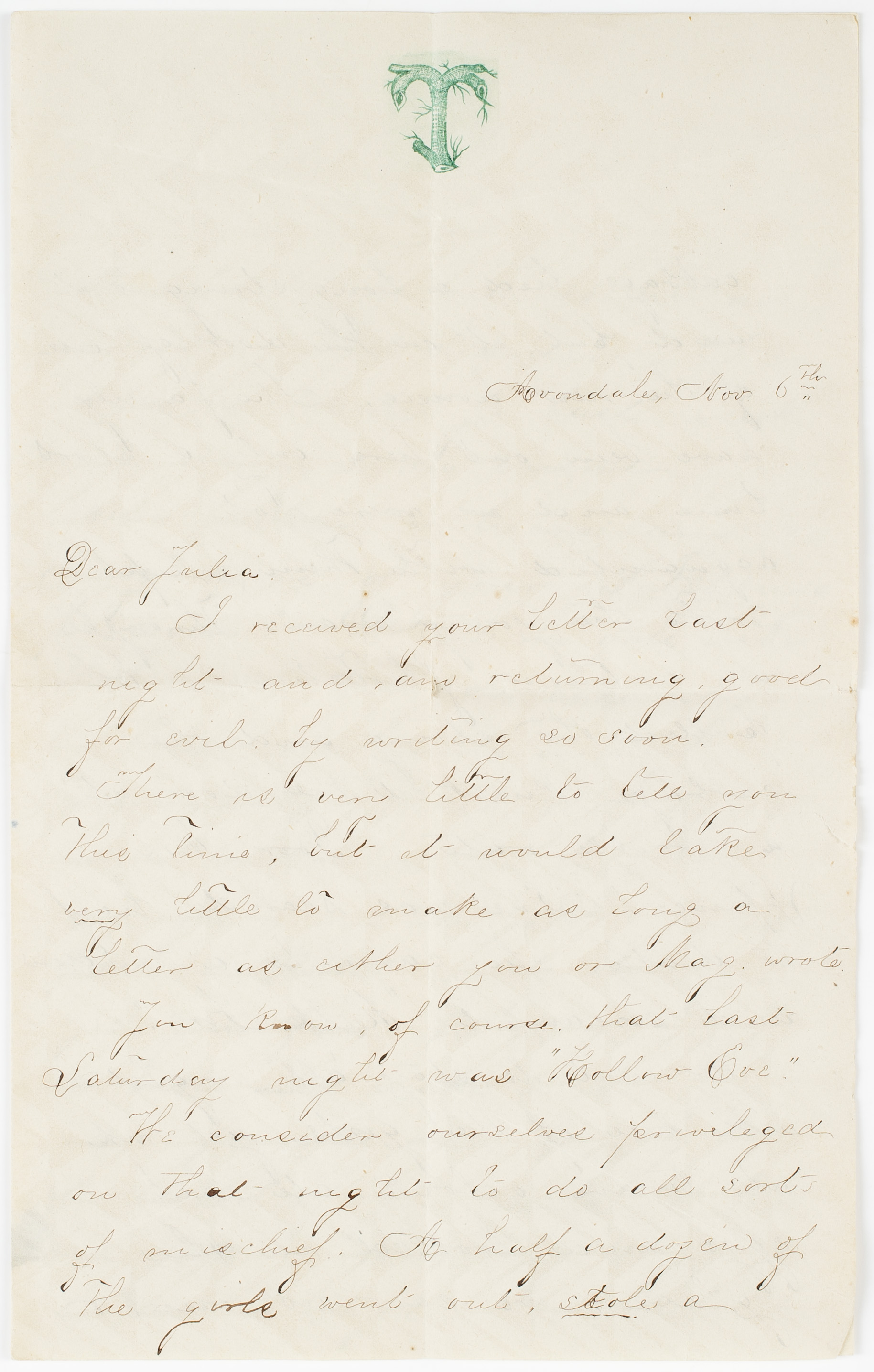
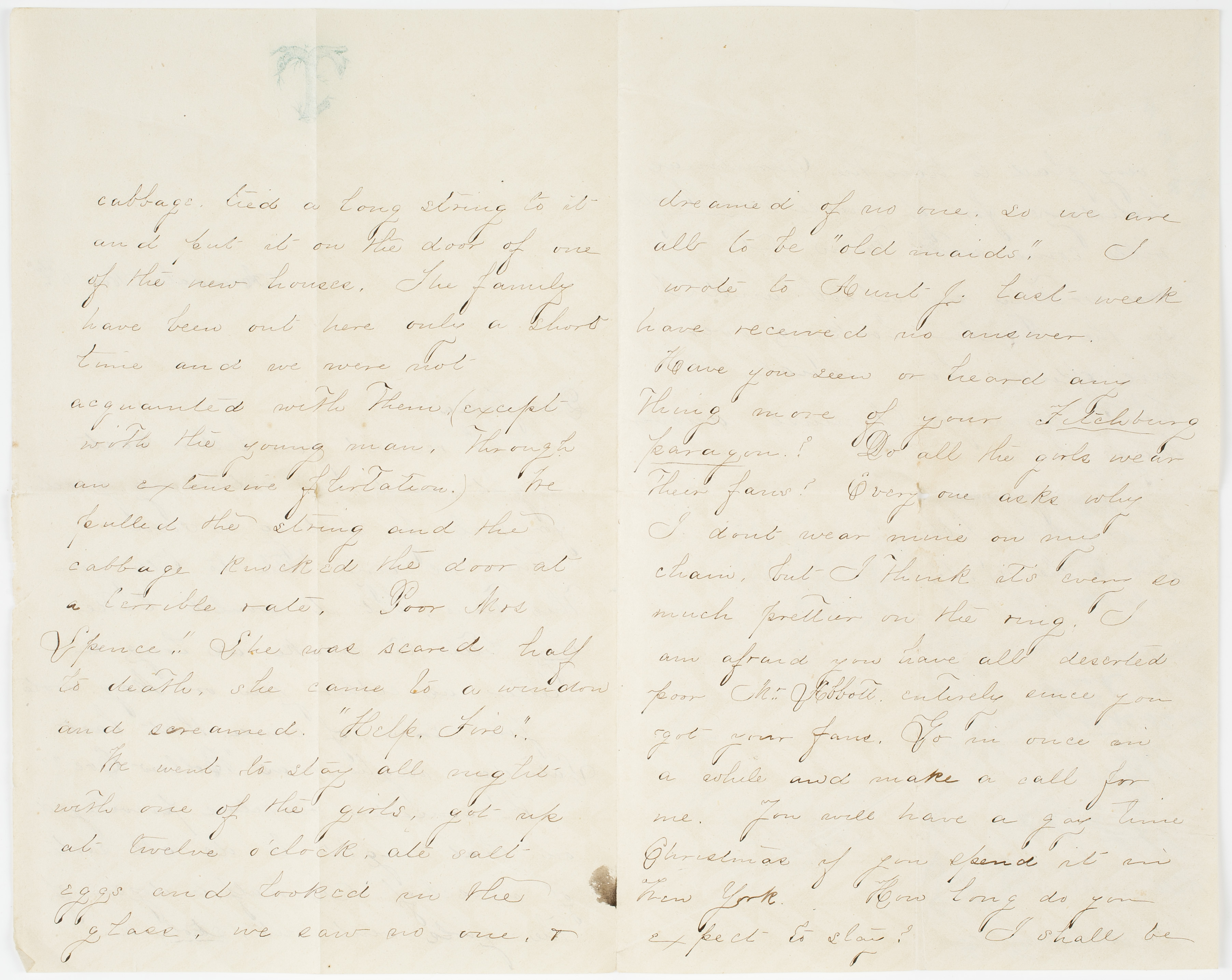
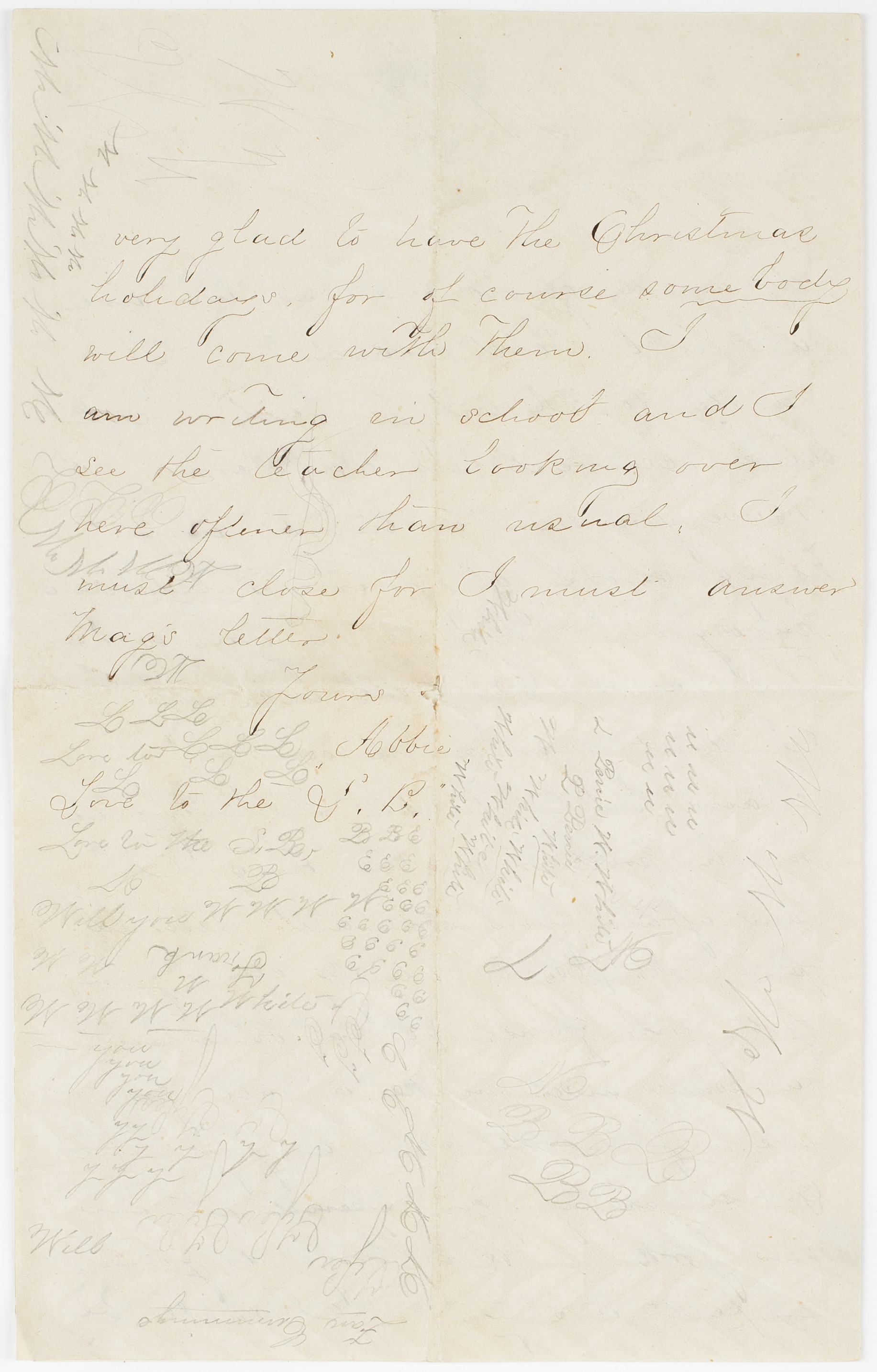
“Hollow Eve” pranks, 19th century style
For those that are sad to see the holiday pass, here’s one last dose of Halloween for you. Today we are featuring a letter found by one of our volunteers while processing a new manuscript collection, the White Family Papers. John White, the patriarch of the wealthy West Boylston family, was a pioneer in textile manufacturing. In this letter, his daughter, Julia, recounts her exploits on Halloween. You can read a full transcription of the letter here.
Hopefully no one got pranked like poor Mrs. Spence last night!
A “Spirited” Collection
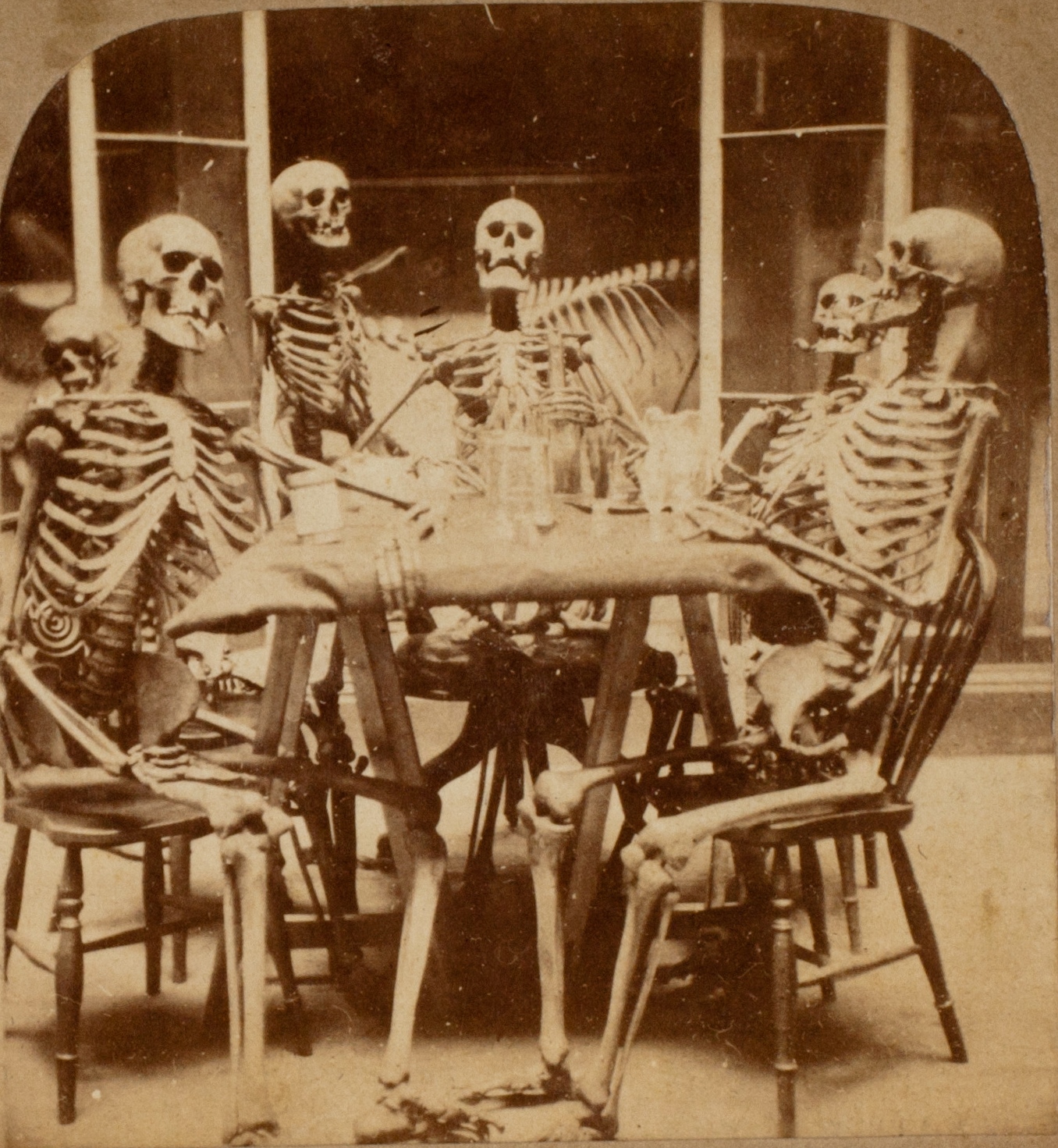 Nothing is hair-raising quite like a chilling photograph.
This month, when the occult is most heavily sought after in popular culture, we made a small collection accessible which examines death, the afterlife, photography, technology, and (naturally) print culture. AAS’s impressive collection of stereocard views includes a subset categorized as “Ghost” images. This includes approximately 31 images which have been digitized and put into our digital image archive GIGI. In this group are such strange occurrences as an assemblage of skeletons arranged by an anatomist and recreations of literary pieces such as Lord Byron’s Gothic work Manfred and Tennyson’s May Queen. This set of views also features examples of “spirit photography,” which Nancy West defines in her essay “Camera Fiends: Early Photography, Death, and the Supernatural” as “the practice of taking photographs in order to produce visual evidence of ghosts, spirits, and other supernatural elements” (1).
While at first glance many of these images do not appear to be the type of spirit photography of the sinister variety (which offered claims to customers that portraits could be taken with deceased friends or family members), they still represent a striking group. The more predatory practice is described in depth by P.T. Barnum in 1866 in a chapter titled “Spiritual Photographing” in his text Humbugs of the World: An Account of Humbugs, Delusions, Impositions, Quackeries, Deceits, and Deceivers, in All Ages. He blames the success of the such practices, in part, on “the extreme gullibility of the human race.” The photographs at the Society, however, instead seem to belong to a range of experimentation with long exposures and staged scenes. In the spirit of Halloween we thought it would be a treat to showcase these items which are paradoxically dark and playful, blend realism with humor, and for the nineteenth-century viewer likely produced a combination of fright and delight. The deliberate creating of spirit images can be done at any stage of photography, says Fred Gettings in his Ghosts in Photographs, “from the preparation of such images on the background behind a sitter with special chemicals invisible to ordinary vision, but recorded on the film, to the mere conjuring trick of the substitution of pre-photographed images to the most common – the double exposure” (2). Below are just a few of our favorites which make use of these techniques of design.
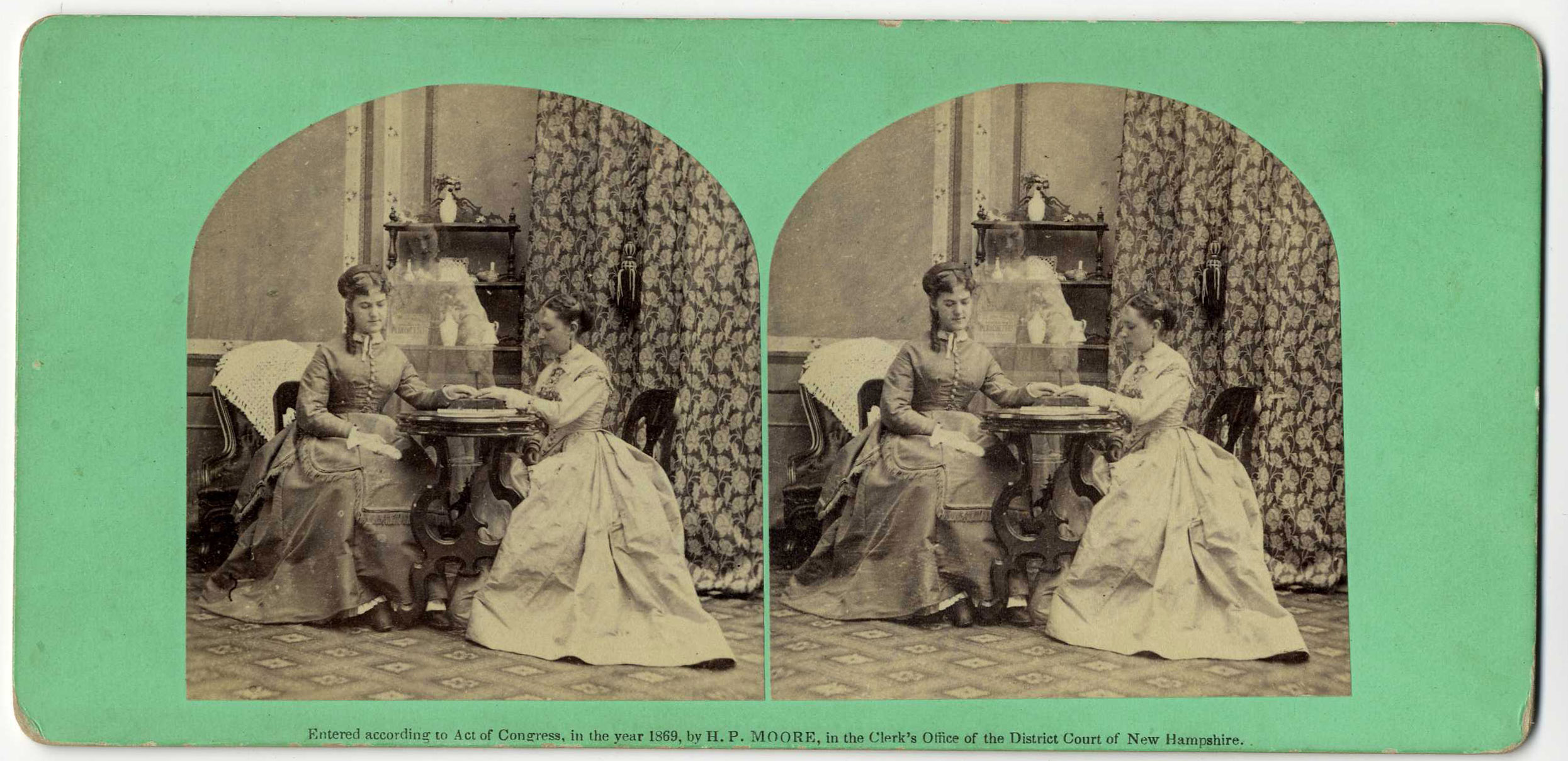
In this view below titled “A Ghostly Visitation,” a startled young woman pulls back, knocking over a chair, her hand towards her mouth; she is looking towards a hooded ghost before the bench of an upright piano.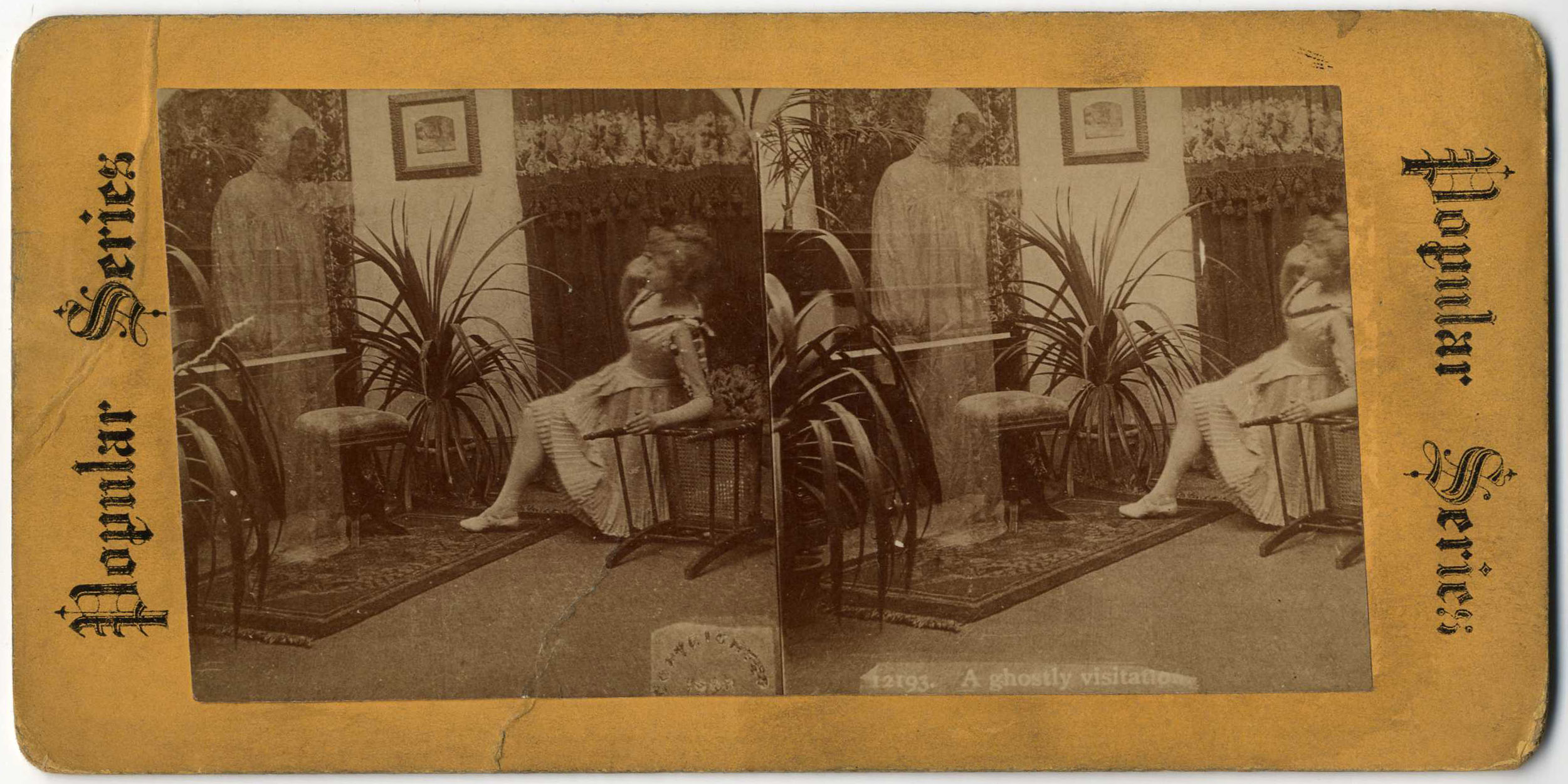 This view titled “The Planchette” (which centers on an entertainment of the same name) features two women conducting a séance seated at a table with eyes closed holding the device while the ghost of a third woman (seen standing) guides the writing implement. The box for the Planchette can be seen through the ethereal figure on the shelf behind her. This 1869 image by H.P. Moore creates visual evidence of a rare opportunity to see how the Planchette is operated by the otherworld – and how “communication” is directed.
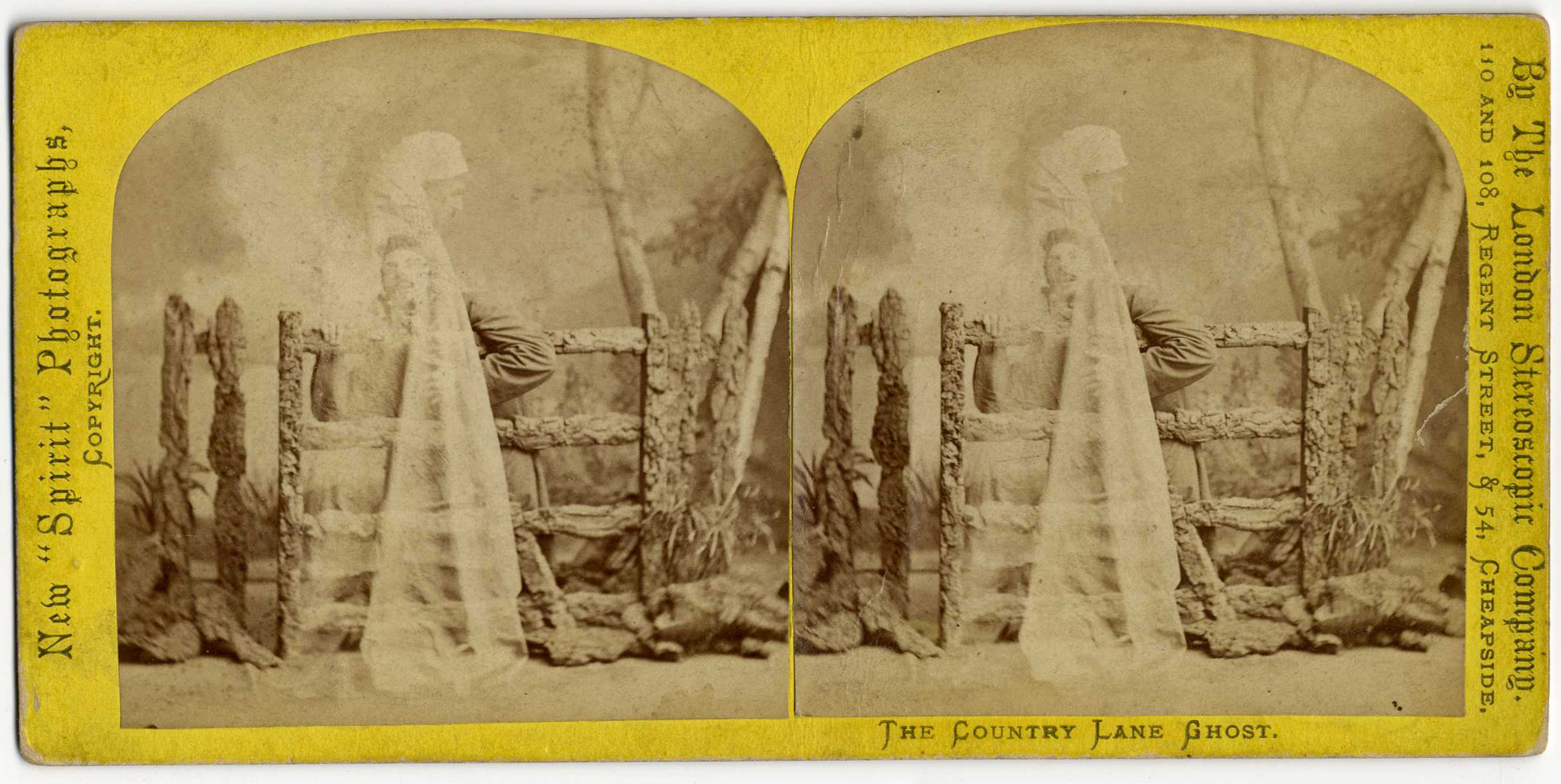
 “The Country Lane Ghost” by New “Spirit Photographs” of London Stereoscopic Company, takes the spirit outside in this view, which shows a hooded figure walking down a road in a countryside. The man, crouching behind a worn fence, is visibly stunned and the fear on his face is visible through the exterior of the strolling ghost.
 The final image we show here is inside, in a bedroom to be precise, where a man (in nightclothes and cap) is awoken by a ghost with an outstretched arm. The bed is beside a table with pitcher, teakettle, cup, saucer, and bottle, which may suggest other means for bringing on this spiritual visit.
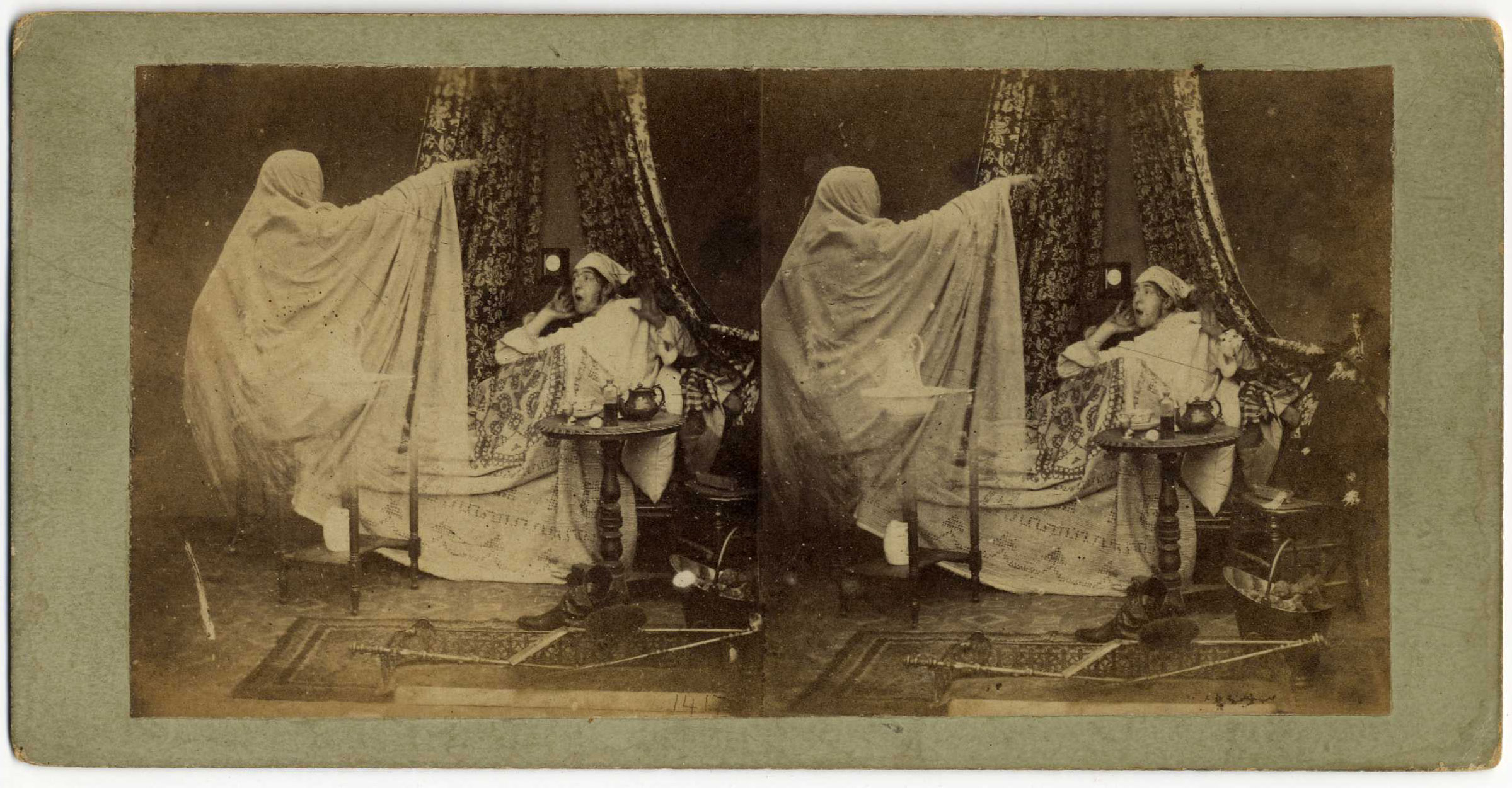 What strikes me about these images is how the figures are staged – two with the living person literally boxed in by the apparition (on the left), one with the apparition in the center back suggesting the guiding hand of a creature from another world, and a final one with the apparition in the center front (who might actually “pop” towards the viewer when the stereocard is seen through a viewfinder). It’s also interesting how these images place the ghost figure in front of items to enhance their transparency and highlight the skill of the photographer. By looking at these images, the figures are invited not only into the world of the living, but into the intimate world of the viewfinder.
If you’re seeking some examples of stereocards with specter, give up the ghost and peruse these views!
Notes:
- Nancy West, “Camera Fiends: Early Photography, Death, and the Supernatural,” CR: The Centennial Review vol. 40, no. 1 (1996): 170-206.
- Fred Gettings, Ghosts in Photographs: The Extraordinary Story of Spirit Photography (New York: Harmony Books, 1978), 144.
The Acquisitions Table: Moses B. Holmes Excelsior Writing Book
Holmes, Moses B., Excelsior Writing Book.
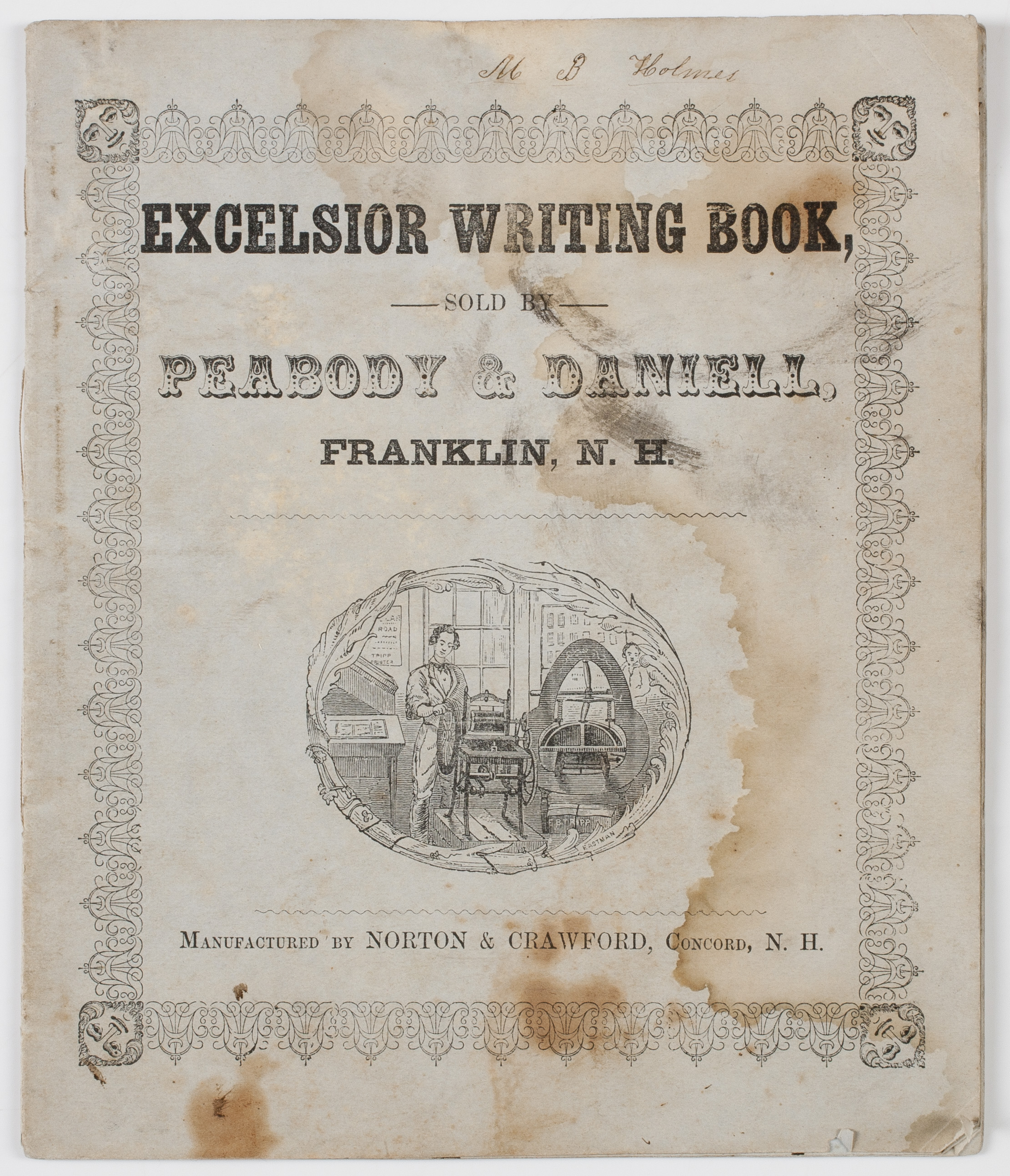 Moses B. Holmes (1837-1894) lived in Campton, New Hampshire. He married Ann M. Bartlett (1839-1914) and the couple had two children, Willie B. Holmes and Lewis Holmes. Moses was young when he began writing in this writing book, which was manufactured by Norton and Crawford in Concord, New Hampshire; some of the writing is dated 1851 and 1857. Moses appears to have been quite the romantic, copying and even composing his own poems about love, including many reinterpretations of the classic “roses are red…”–“The sun is red / The moon is white / I hope that I shall see you tonight.” Not only is the volume filled with verses, but it is quite unusual in its abundance of doodles and sketches. One page in particular features rows of trees and birds, with text weaving through the pictures – “What is more beautiful than the weaping [sic] Willow”, and “I know thou art beautiful / I [sic] I love the more I love”. The last page of the volume features a list of school children (Moses included) in Campton in 1851.
Recommended Reading: Marcy, the Blockade Runner
Editor’s note: In this week’s recommended reading for “fiction published before 1900,” AAS member and Councilor Chuck Arning, park ranger and AV specialist at the Blackstone River Valley National Heritage Corridor, talks about a nineteenth-century book that was passed down through his family. Unlike all of the other books in this series (see Philip Gura’s and Jackie Penny’s), however, AAS does not own a copy…yet. As we like to say, “If we don’t have it, we want it!”
What books find their way into one’s personal library, particularly books published prior to 1900, is often the result of pure chance, a family connection or curiosity. Most likely, such longevity is the result of a combination of these factors.
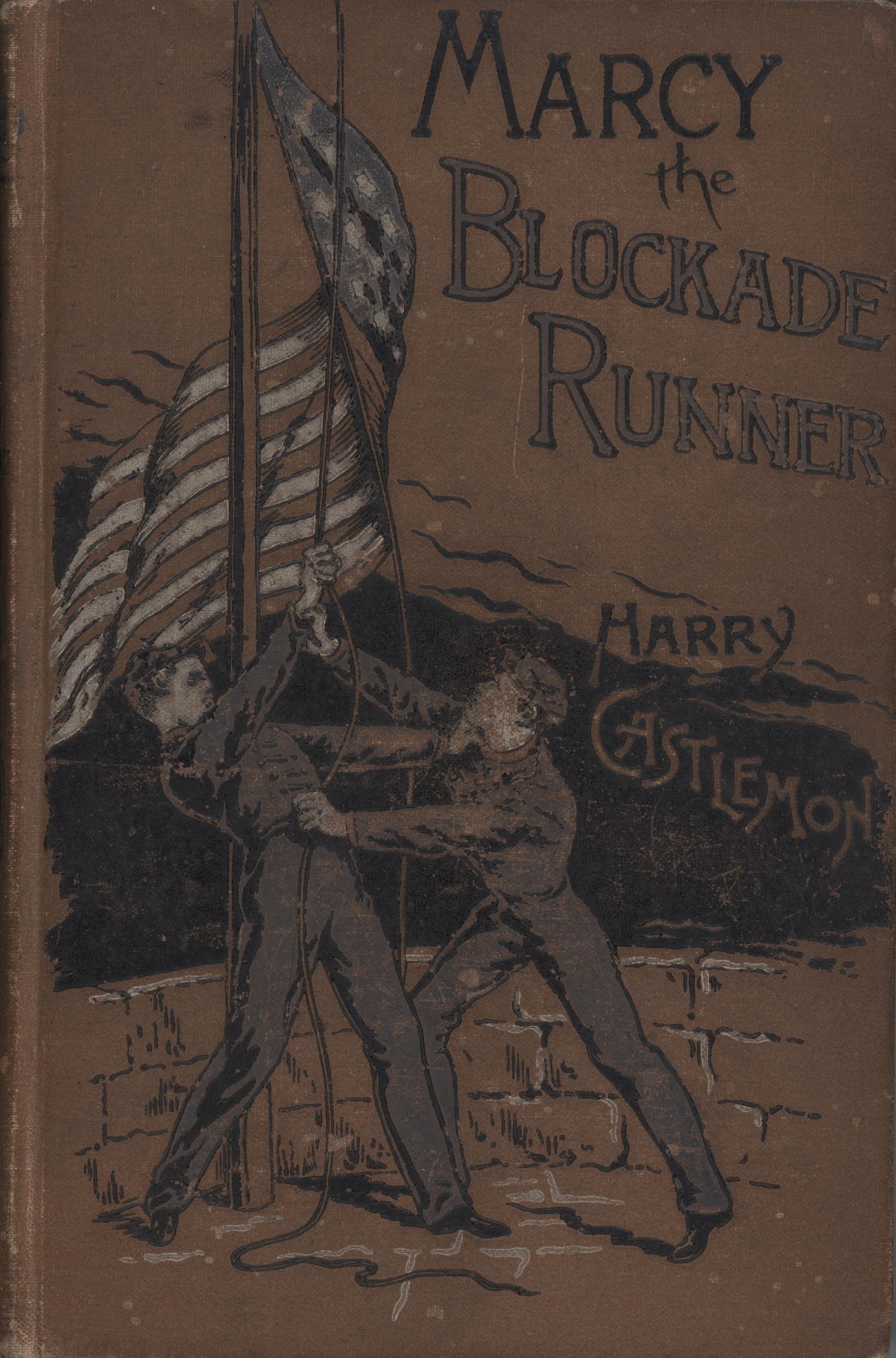
The book that has managed to remain intact from the past in my library is Harry Castlemon’s juvenile action adventure Marcy, the Blockade Runner (Castlemon’s War Series, published by Porter & Coates, Philadelphia, 1891). Set in the coastal area of North Carolina during the Civil War, a family headed by a Union-sympathizing widow that owns a plantation fights off cruel southern traders who have designs on the Gray plantation.There is a strong African-American character who is seeking his own path to freedom. Marcy, a talented coastal boat pilot, is a pure Union man, but must conceal his true feelings. His older brother, Jack, has secretly left the South and joined the Union Navy. Marcy’s adventures revolve around his need to conceal his Union feelings and protect his mother, all while guiding blockade runners through the coastal waters of North Carolina. The reader must be warned that the language is reflective of the nineteenth-century view of African-Americans and is necessary to some degree for the plot development, but is distasteful to the twenty-first-century ear.
The Acquisitions Table: The Game of Jack of All Trades
The Game of Jack of All Trades. New York: McLoughlin Bros., ca. 1900.
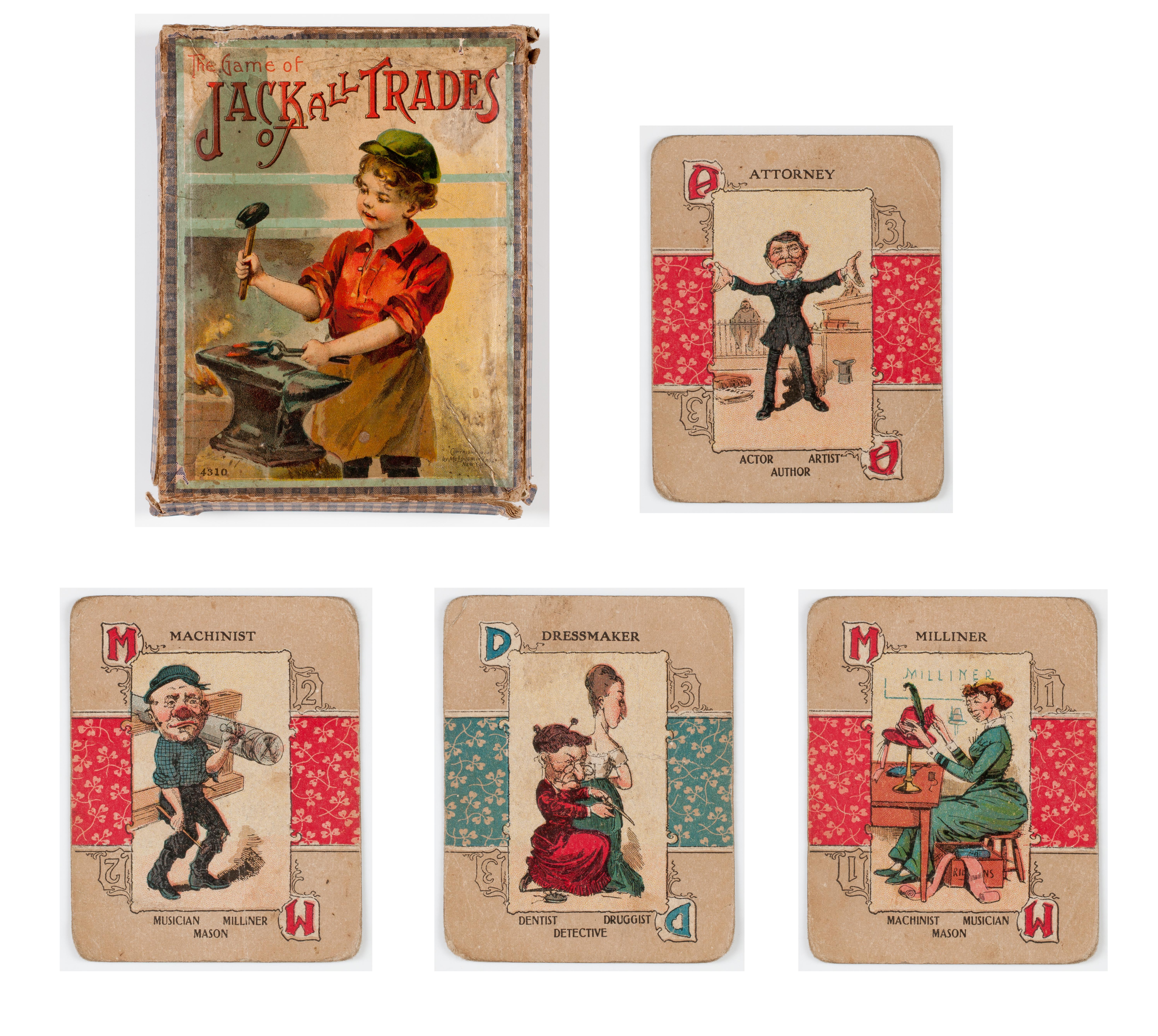 This is a welcome addition to our holdings of McLoughlin Bros. games. McLoughlin published an extensive line of small boxed card games, like Jack of All Trades. Games and picture books about professions and trades were used since the late eighteenth century to teach children about various ways of pursuing a living. In this case, most of the occupations represented are male, including the pleading attorney and rather drunken looking machinist. Some female trades are present, including the seamstress and milliner, although both women look like sour faced spinsters. Cultural artifacts of childhood like The Game of Jack of All Trades reveal a great deal about prevailing attitudes toward gender and specific occupations.
Public Program: Mary Kelley Talks Love, Literature, and War
 Many of you may already follow the fantastic blog Boston 1775, but if you don’t now is a great time to begin! A post this past weekend explored the subjects of tonight’s Public Program with Mary Kelley, William Tudor and Delia Jarvis. Be sure to check out the post and join us tonight in Antiquarian Hall at 7 p.m. for Mary Kelley’s talk, “‘While Pen, Ink & Paper Can Be Had’: Reading and Writing in a Time of Revolution.”
Recommended Reading: Burnett’s A Little Princess
Editor’s note: In the most recent issue of the Almanac, we asked members of the AAS community to give us their choice of recommended reading for “fiction published before 1900,” a series we are continuing here on Past is Present. Last week we heard from AAS member Philip Gura. This week, Jackie Penny, AAS’s image rights and design librarian, has two very good (and very adorable) reasons for her choice.
At home, my children and I read what we colloquially refer to as the Big Book before bed – a text (usually fiction) of modest novel/novella length. Anything else (of the 32-page with-picture variety) is just A Book. So while scouting for new Big Book material lately, I was taken with the Almanac’s challenge of finding something to read and recommend published before 1900. My requirements were that it needed to be something that I could find in AAS’s first edition collection, that it had been reissued, and that it could lull a pair of three-year-olds to sleep. When I asked my daughter for her thoughts, like most girls born after 2007, she suggested something to do with a “princess.” Undoubtedly, she wanted something closer to the garish strain which is represented in everything from bandages to ghostwritten paperbacks; I resisted at first (but admit, she was on to something).
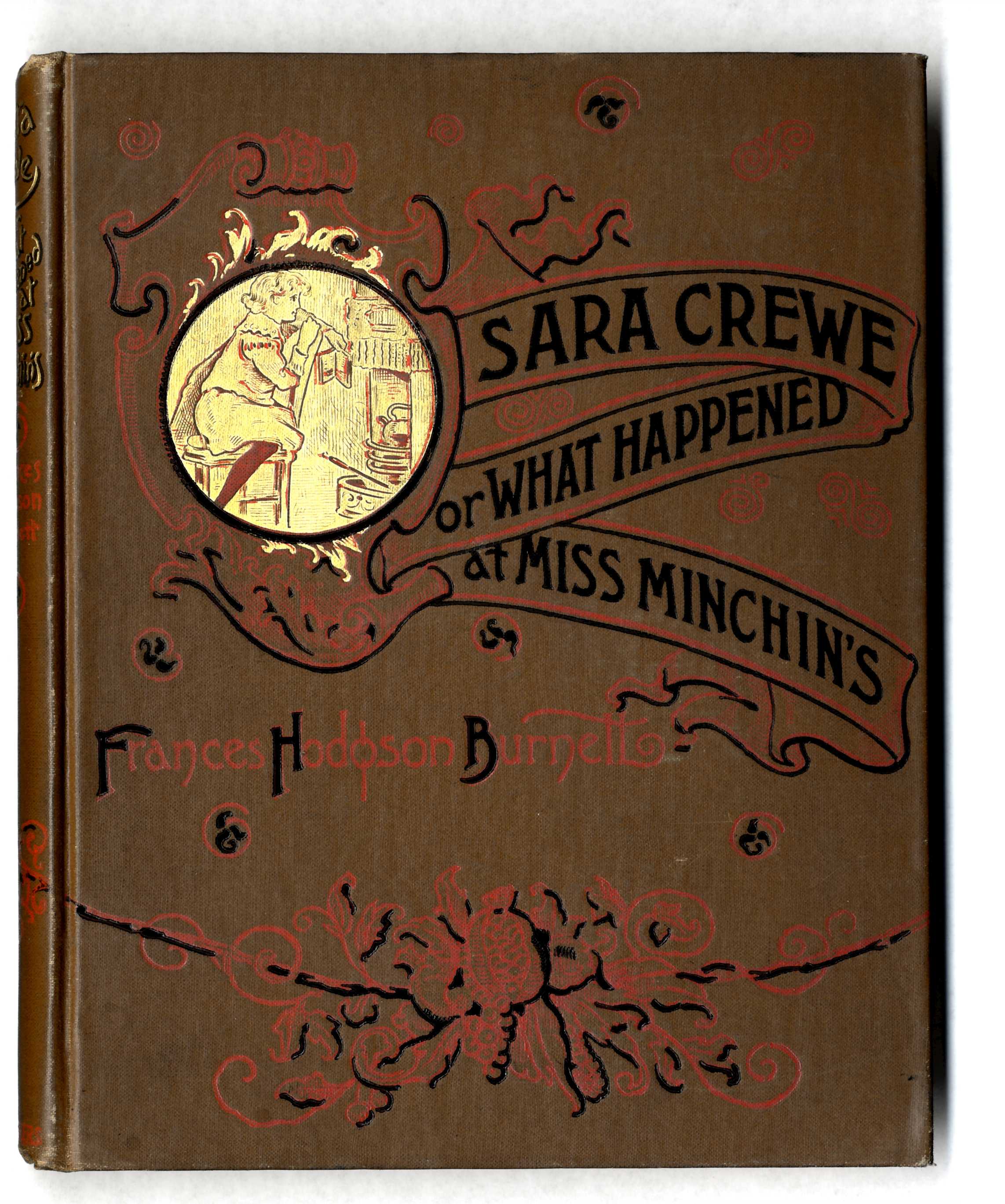
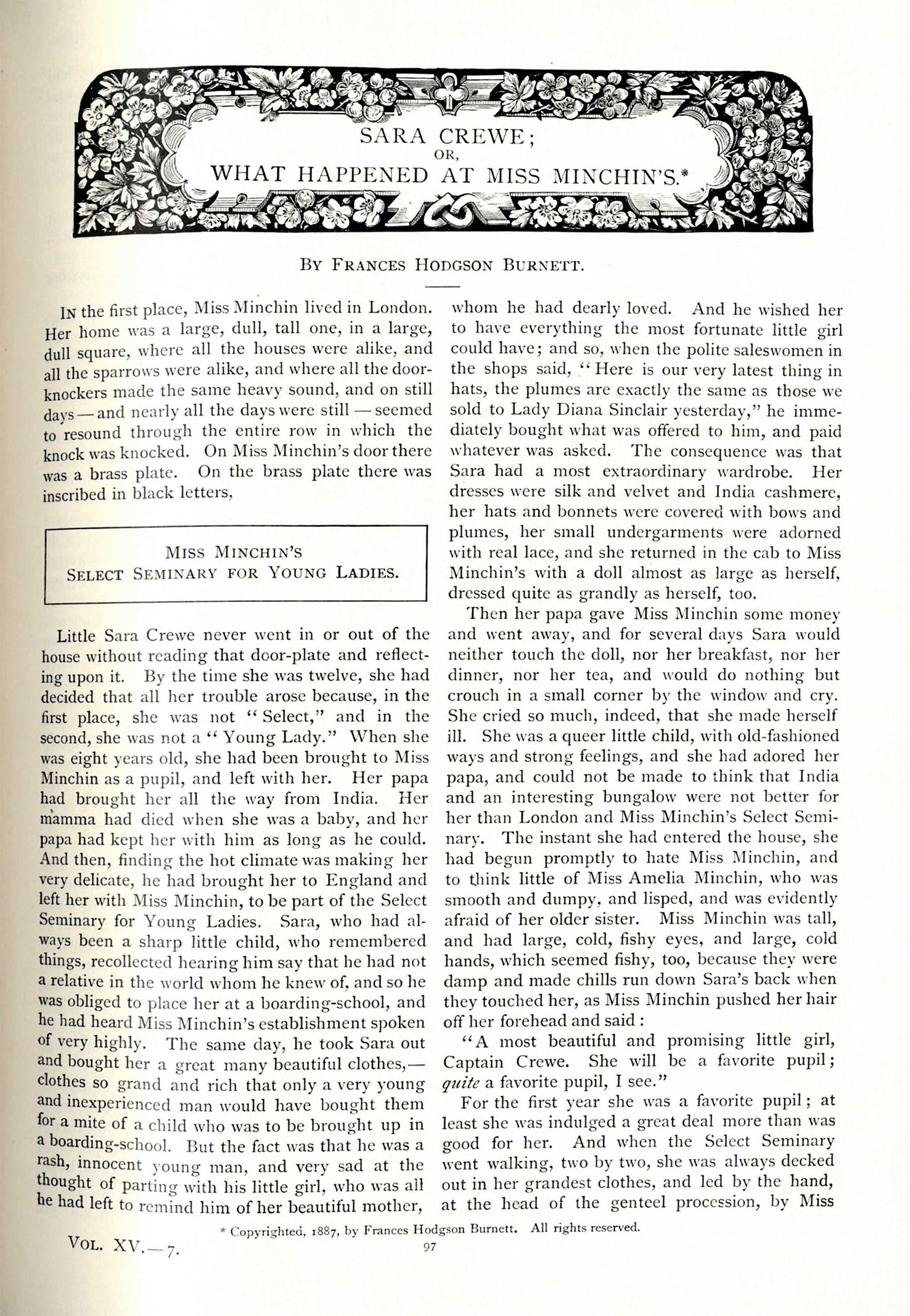
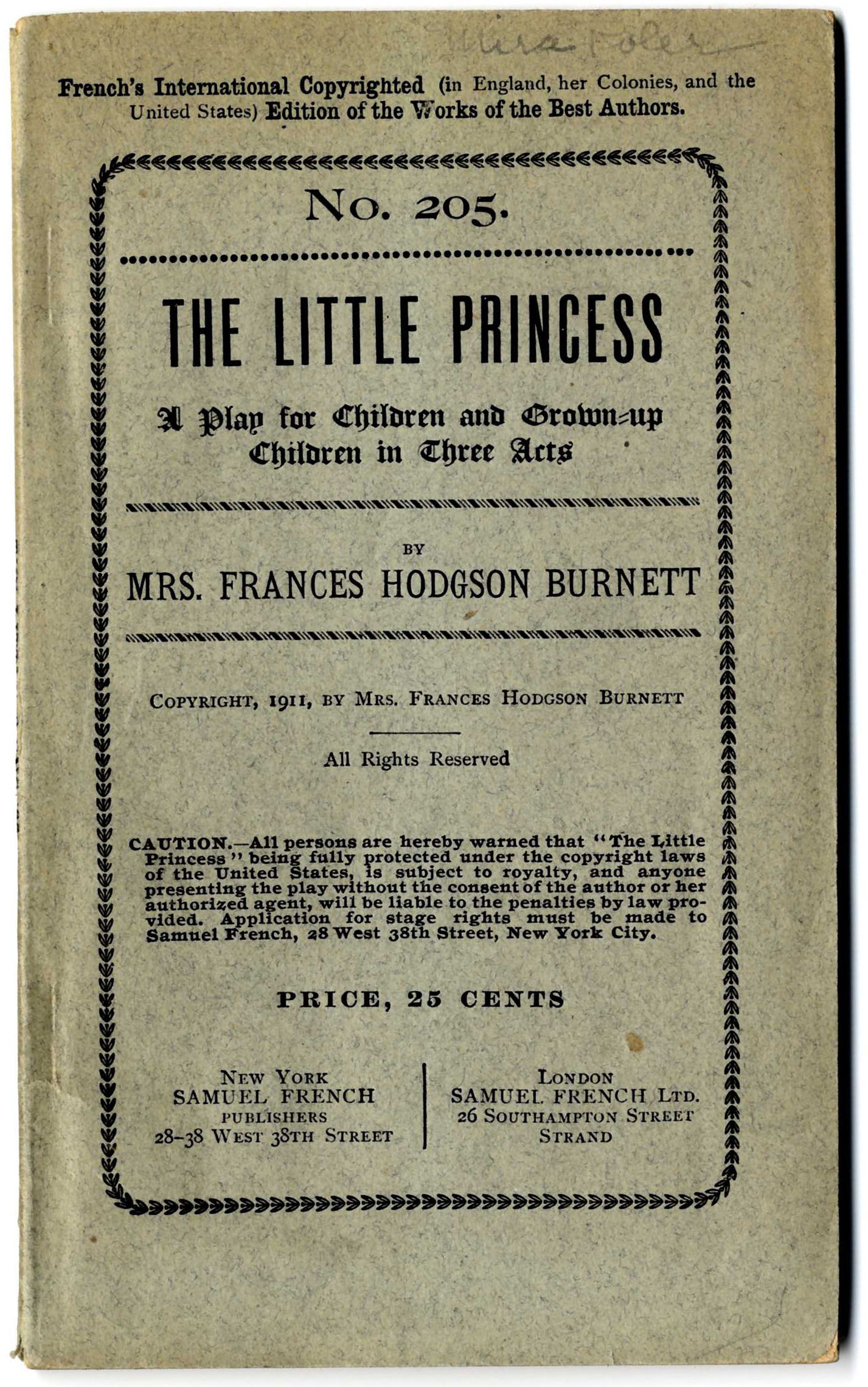
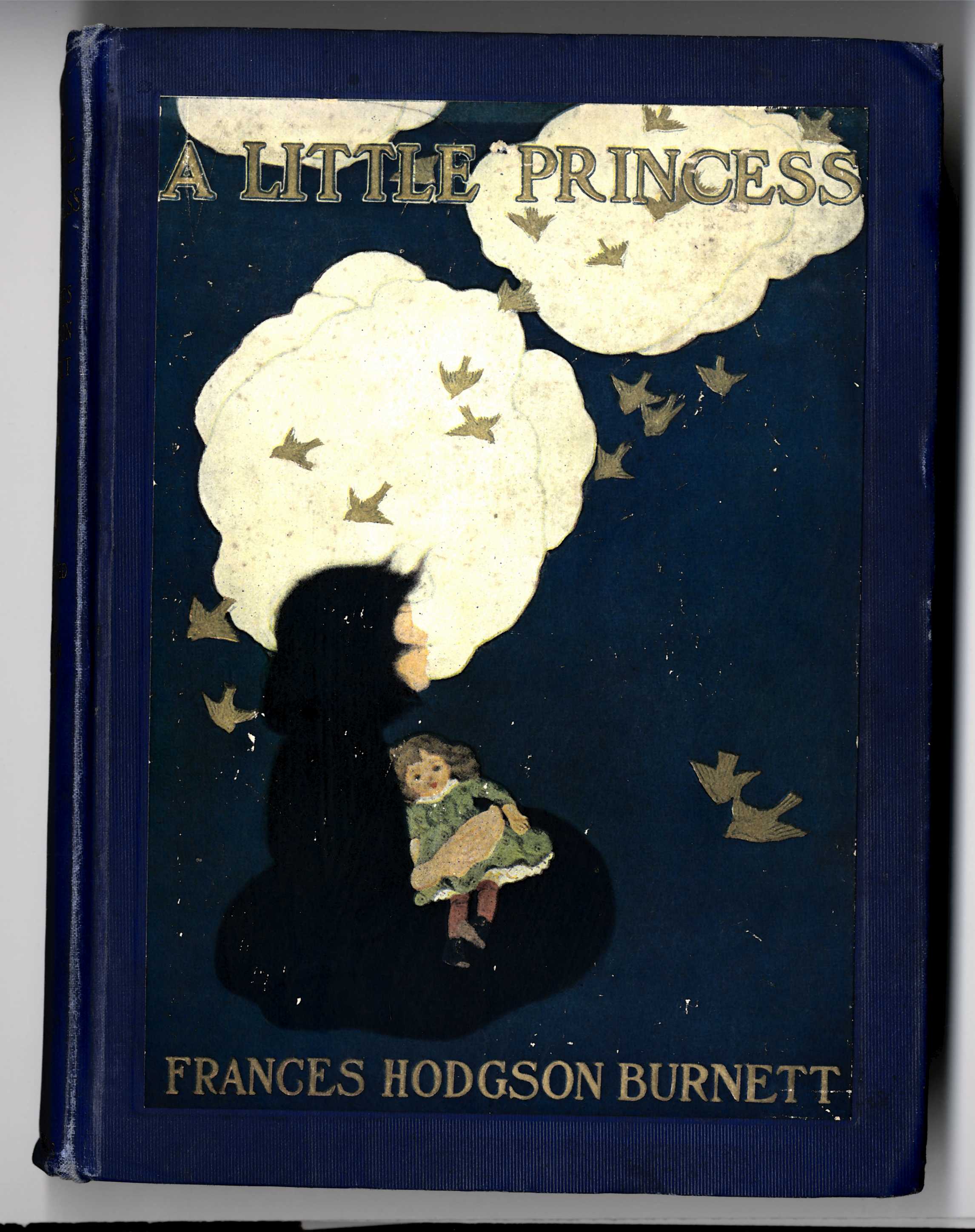
The book we settled on was Frances Hodgson Burnett’s (1849-1924) A Little Princess, a story that first appeared serialized in St. Nicholas: An Illustrated Magazine for Young Folk as “Sara Crewe, or What Happened at Miss Minchin’s” starting in 1887 (AAS holds a copy of this periodical). By 1888, Sara Crewe was published in New York by C. Scribner’s Sons (and in London by Warne) as a bound volume (AAS has two copies of this edition). In the early twentieth century, the familiar tale was issued as a stage play, A Little Princess (which AAS has a circa 1911 paperbound copy of). Finally, in 1905 the now-famous text appeared in its full-length iteration A Little Princess, which it is most known for today.
So why is this important? And why is it significant that AAS has several expressions of Sara Crewe’s story (as play, serial, compiled serial/novella, and revised version)? Apart from trying my hardest to raise a future generation of librarians fluent in bibliographic description, I believe the text (and publishing history) is valuable not only because it remains a hallmark of my own childhood reading, but it underscores what I believe are progressive markers of a true princess: to be intelligent, kind, strong, positive, imaginative, and have the ability to remain clever and creative even in the most grim of circumstances (a sudden fall in fortune and being orphaned in another country, for example).
The publishing history is textured, rich, and arguably pretty common among practices of the late nineteenth and early twentieth centuries. And yet, Burnett’s story of Crewe is complicated to say the least. I recommend it because I feel by reading (and re-reading) this perennial favorite, we are looking to the past for reminders and cues on how to act today; these stories aren’t frozen, archaic, or outdated, but reflect our own complex lives.
The Acquisitions Table: Concert of Sacred Music
F.D. Allen, Concert of Sacred Music, in the Third Associate Reformed Church . . . New York: E. Conrad, 1819.
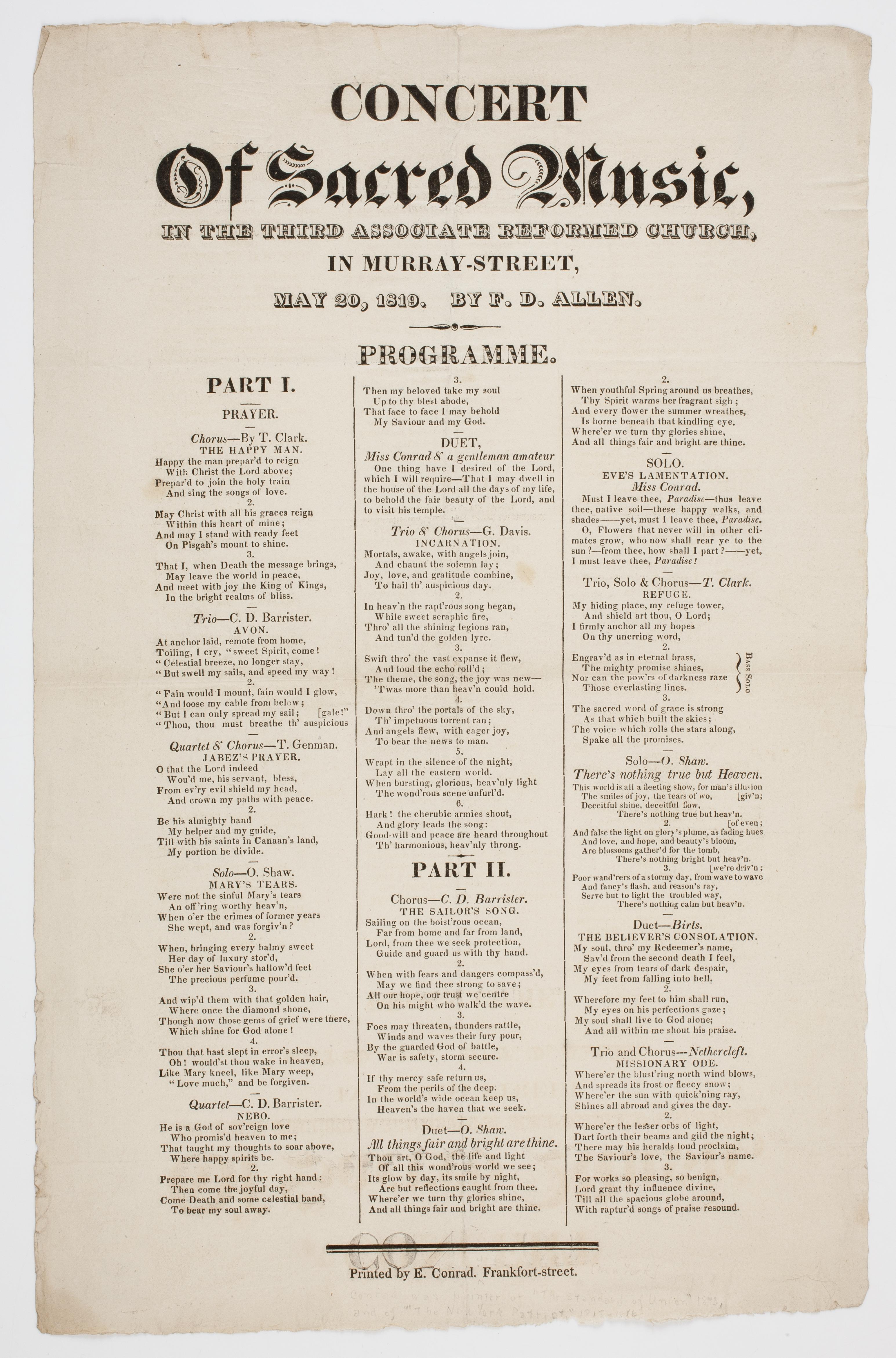 This broadside for a concert given in the spring of 1819 was not identified by Shaw & Shoemaker in their bibliography of American imprints from before 1820, making it an exciting acquisition for AAS. The broadside, printed with several different type styles, was made by Ephriam Conrad, who was at work in Philadelphia from 1795 to 1827, and steadily produced pamphlets, reports and newspapers for local clients. Author and composer Francis D. Allen arranged the concert and began promoting it in New York papers in April 1819, listing tickets at 50 cents. He emphasized that much of the music was new, very chaste, and appropriate for a wide audience. After the event, the press reported that over 600 ladies and gentlemen attended the concert. The Providence [R.I.] Patriot printed a summary of the concert which although held in New York, featured three new works by local composer Oliver Shaw.
Recommended Reading: Isa, A Pilgrimage (1852) by Caroline Chesebro’
Editor’s note: In the most recent issue of the Almanac, we asked members of the AAS community to give us their choice of recommended reading for “fiction published before 1900.” We are continuing those recommendation in this series on Past is Present. This first post is written by AAS member Philip F. Gura, who is the William S. Newman Distinguished Professor of American Literature and Culture at the University of North Carolina at Chapel Hill, the author of the bicentennial history of the American Antiquarian Society and, most recently, of Truth’s Ragged Edge: The Rise of the American Novel (2013).
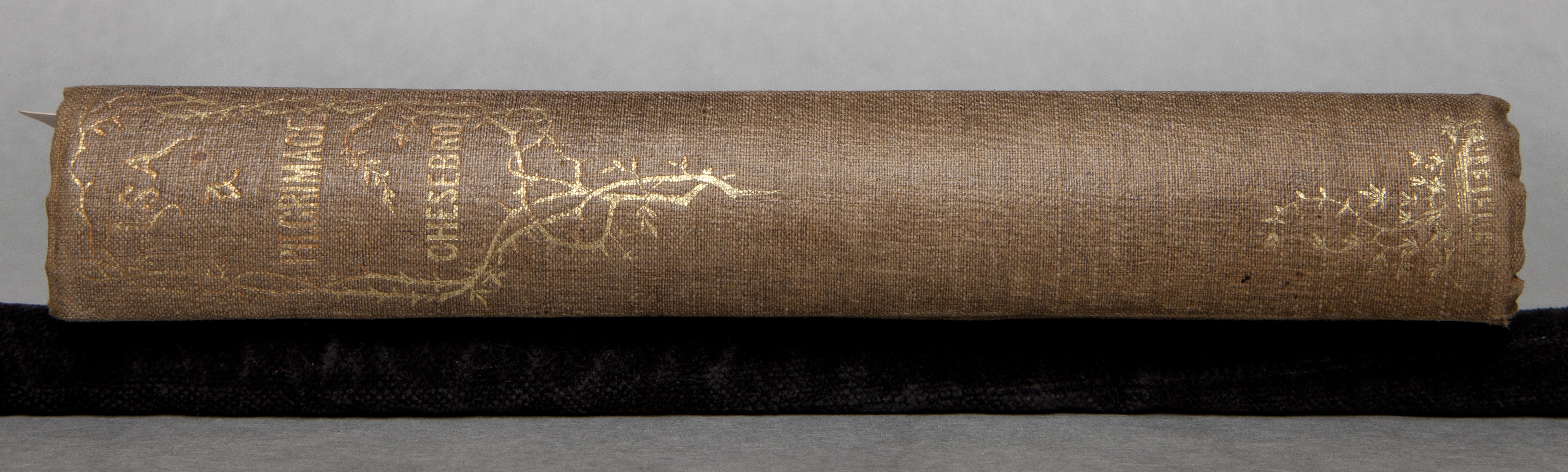
What is there to add to the standard history of the American novel? Don’t we already know which books are most deserving of our attention and respect? The answer is no. More recently, the digitization of our literature has given a second wind to older books that may be difficult to find in your local Barnes and Noble. The full variety of early American novels is now at our fingertips: novels by women, African Americans, and white men forgotten not because of their race or gender but often because of the novelty or radicalism of their art.
To sample such literature, one might start with Caroline Chesebro’, a native of upstate New York; her father was involved in the kidnapping and disappearance of William Morgan that precipitated the Anti-Masonic movement. She went to a young women’s academy and soon thereafter began publishing stories in such magazines as Graham’s. Encouraged by positive reviews—one reviewer found her stories “unmistakable evidence of originality of mind”—she wrote Isa, a Pilgrimage (1852). Next came The Children of Light (1853), the story of two young women who, when they are rejected by the men they love, move together to the city, where one supports the other in her budding acting career. Getting Along (1855) focuses on various couples’ relationships, in which, while assuming that marriage is the norm, she assesses the partners’ fidelity to their original commitments to each other.
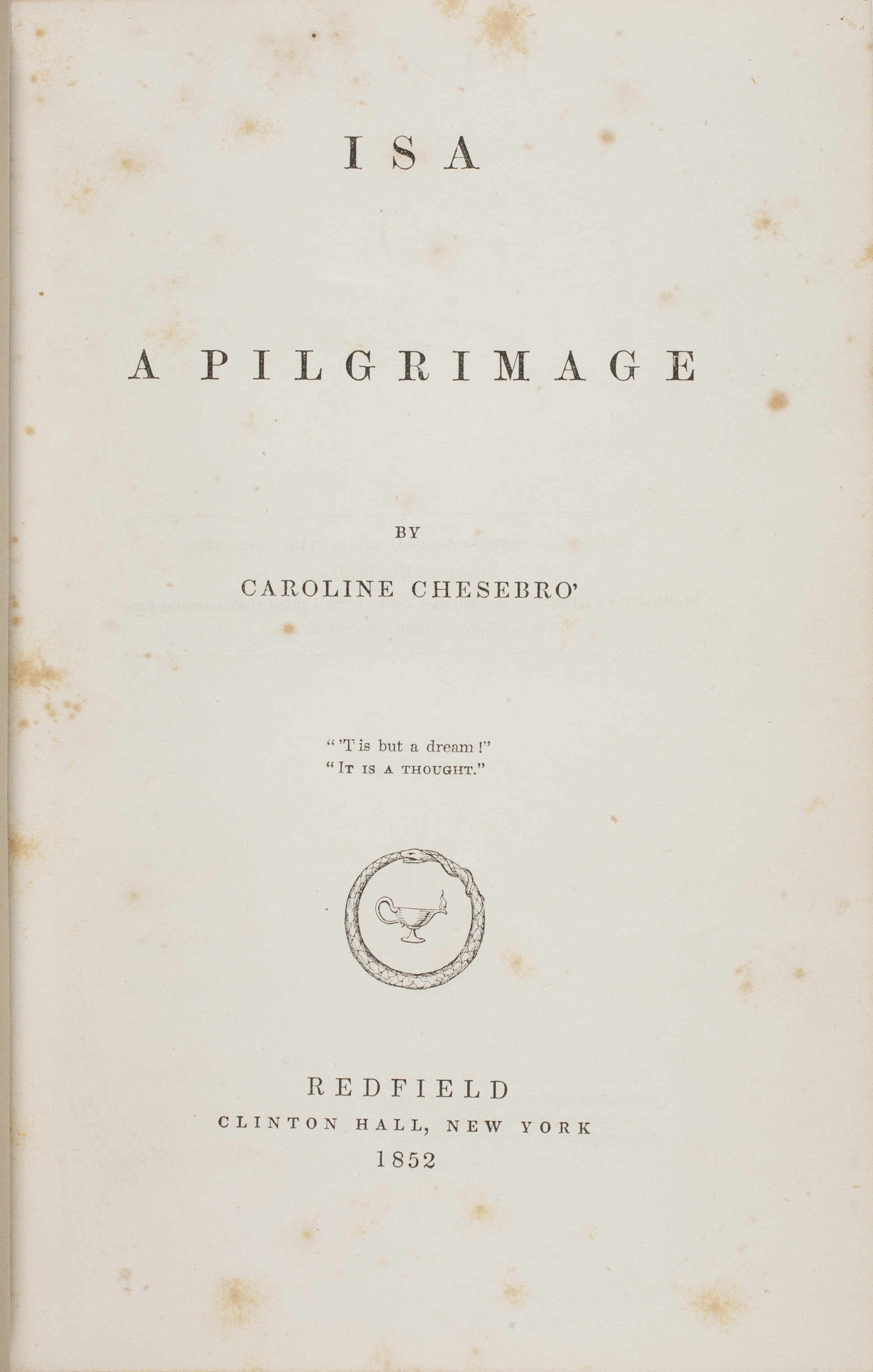 Start with Isa, A Pilgrimage (1852), published the same year as Uncle Tom’s Cabin, a novel in which Chesebro’ is interested in the plasticity of gender roles. Her heroine Isa is not trapped by society’s expectations but rather experiences more of herself and the world as she challenges the limits of propriety. Isa is an orphan rescued by the Weares, a good Christian family whose traditional notions of religion she appreciates but soon leaves behind as she flourishes intellectually. She takes up advanced ideas about religion, philosophy—she is a Transcendentalist—morality, and the role of women in society and believes that faith is “cowardly” at best, “for there is no limit given but that which our own will regulates. No other voice,” she continues, “than man’s mental capacity, ever said, thus far, no farther.”
Isa receives an attractive marriage proposal from an older man who offers her “his name, his fame, his fortune,” but she refuses because she wants no restrictions in her life. Eventually, she marries a likeminded intellectual named Alanthus Stuart, with whom she moves to Europe where, though unmarried, they live together and have a child—a scandal for the time. Thus, in Isa, Chesebro’ broached subjects few other American novelists at the time dared to: the relationship between orthodox religious faith and personal fulfillment, between the demands of the soul and the demands of society, between her love and marriage as well as the potentiality of living a life of the mind, inhabited by radical philosophical and political ideas. One reviewer complained, “Isa makes her self-will, her intellectual progress, her ambition, a three-fold deity.” But that is the point: she had merely fashioned a personal religion from secular ideas and values, and in so doing stands as a remarkably fulfilled example of Emersonian self-reliance.
Join us on Instagram!
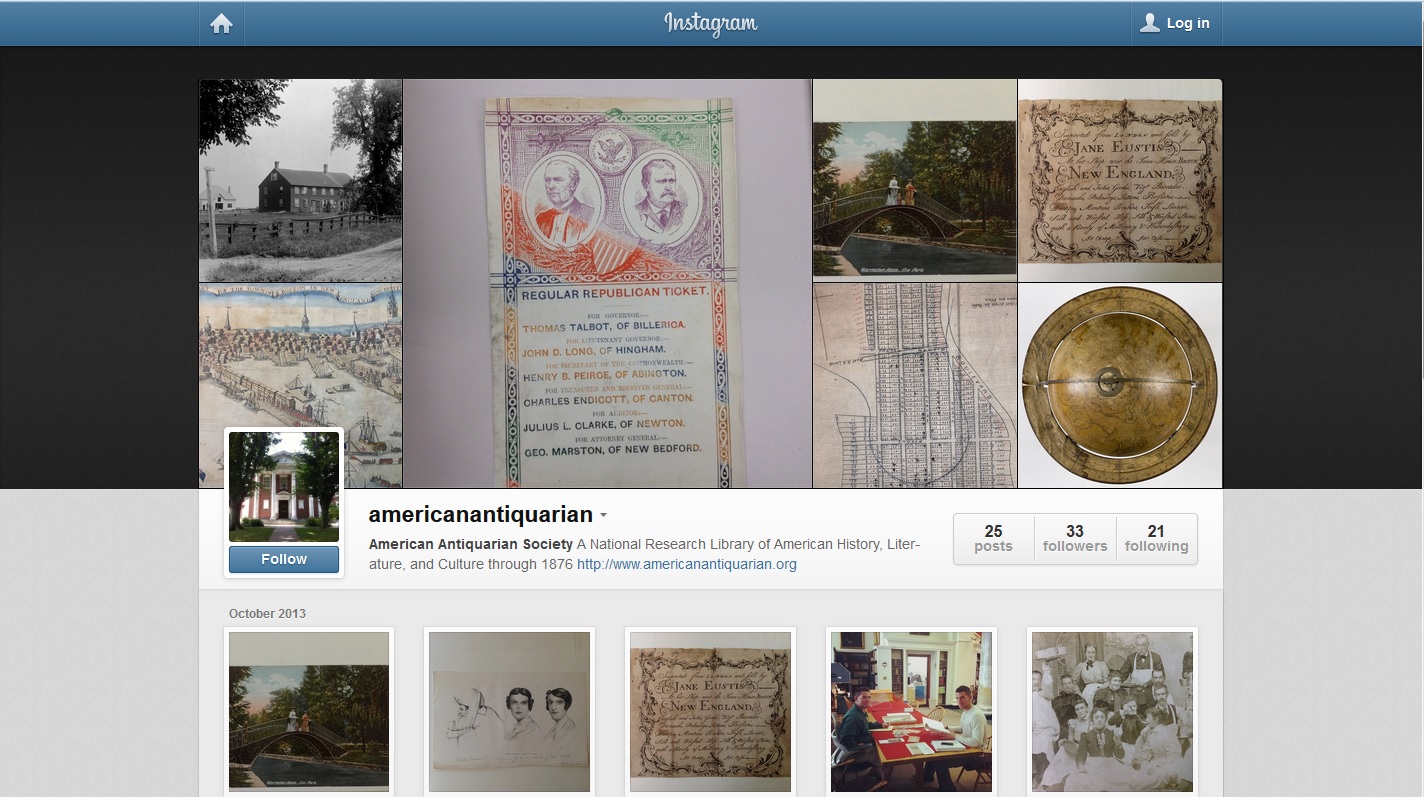 Ever wonder what goes on behind the scenes at AAS, or what our programs and events look like? We recently set up an Instagram account as a way to promote interest in the collections and resources at the Society as well as to let people know about events and activities. Our digital photographer Cade Overton first began posting images that he found compelling. Since then, numerous staff members have been posting to the account and we now have images of events, collections materials, readers, classes, and other goings on. Cade recently posted a photo of a class from Holy Cross working in the reading room and as he did so, one of the students posted a photo on their Instagram of Cade photographing them! Catalogers and curators will be posting images of new material as it is acquired or cataloged, and pictures of events will be posted soon after they take place. This week, for example, Nan Wolverton, director of CHAViC, and I will be traveling to Bordeaux, France, to hold a conference on French and American lithography before 1860 at the Musée Goupil. Both Nan and I will be Instagramming during the event, and posting images for you to enjoy.
So please, come follow us on Instagram (at “americanantiquarian”) and join us for all of the activity going on at AAS (and in France!).
The Acquisitions Table: The Franklin
The Franklin, or, A Political, Agricultural, and Mechanical Gazette (Washington, DC) Oct. 31, 1801. No. 1.
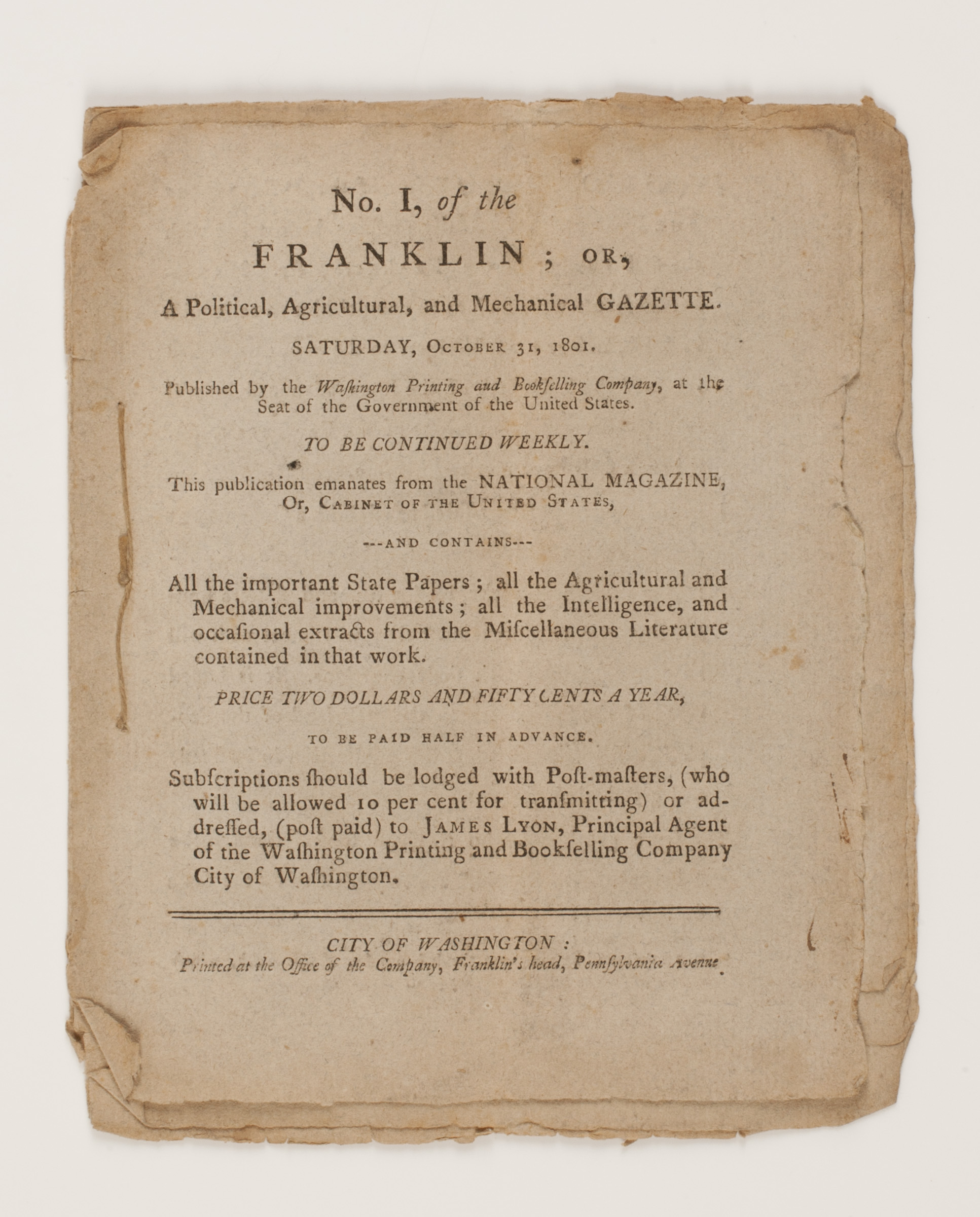 The Franklin was published by James Lyon. Inside the front wrapper is a note from Lyon about his difficulties publishing the Friend of the People (Richmond, VA) and having to move to Washington before subscribers received “the full worth of the sums advanced.” This periodical was published at the office of the National Magazine, Or, Cabinet of the United States, another periodical that Lyons was publishing. The Franklin included articles originally printed in this publication as well as material from other sources. This is issue no. 1 of The Franklin and may have been the only one published. No evidence has been found so far of another one being printed and the National Magazine ceased publication less than three months later.
Newest Issue of the Almanac Hot Off the Press
 If you haven’t yet seen a copy of the latest issue of our newsletter, Almanac, you can see it here! It has news on upcoming public programs, workshops, and conferences, as well as the opening of an exhibition in Bordeaux, France, recommended reading from the AAS community, and much more. In a new feature article, we also explore the all-important acquisitions process that continues to build our collection every day.
In other words, it’s a must-read and a must-see (because of course it also includes some beautiful images from the collections). So be sure to check it out and get caught up on all things AAS!