Carroll, Lewis. The Hunting of the Snark: an Agony in Eight Fits. Boston: James R. Osgood and Company, late Ticknor & Fields, and Fields, Osgood & Co., 1876.
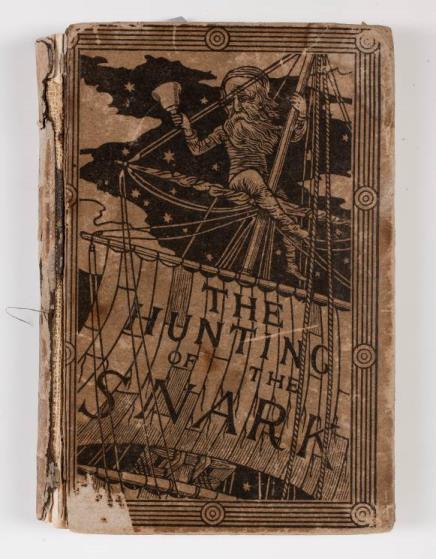 Best known as the author of Alice’s Adventures in Wonderland (1865), Lewis Carroll – the pen-name of Charles Lutwidge Dodgson, a mathematical lecturer at Christ Church, Oxford – also wrote this fantastical epic tale recounting the adventures of a bizarre troupe of nine tradesmen and a beaver. First published in London in 1876, this first American edition was reproduced that same year by photo-lithography in a smaller format by James R. Osgood in Boston. The paper-covered boards on this copy, while not the best condition, do immediately attract attention, as do the nine illustrations inside, all of which were done by Henry Holiday. A tenth illustration depicting the Snark was rejected by Carroll – he wanted the creature to remain unimaginable.
Public Program Season Starts with Historic Performance
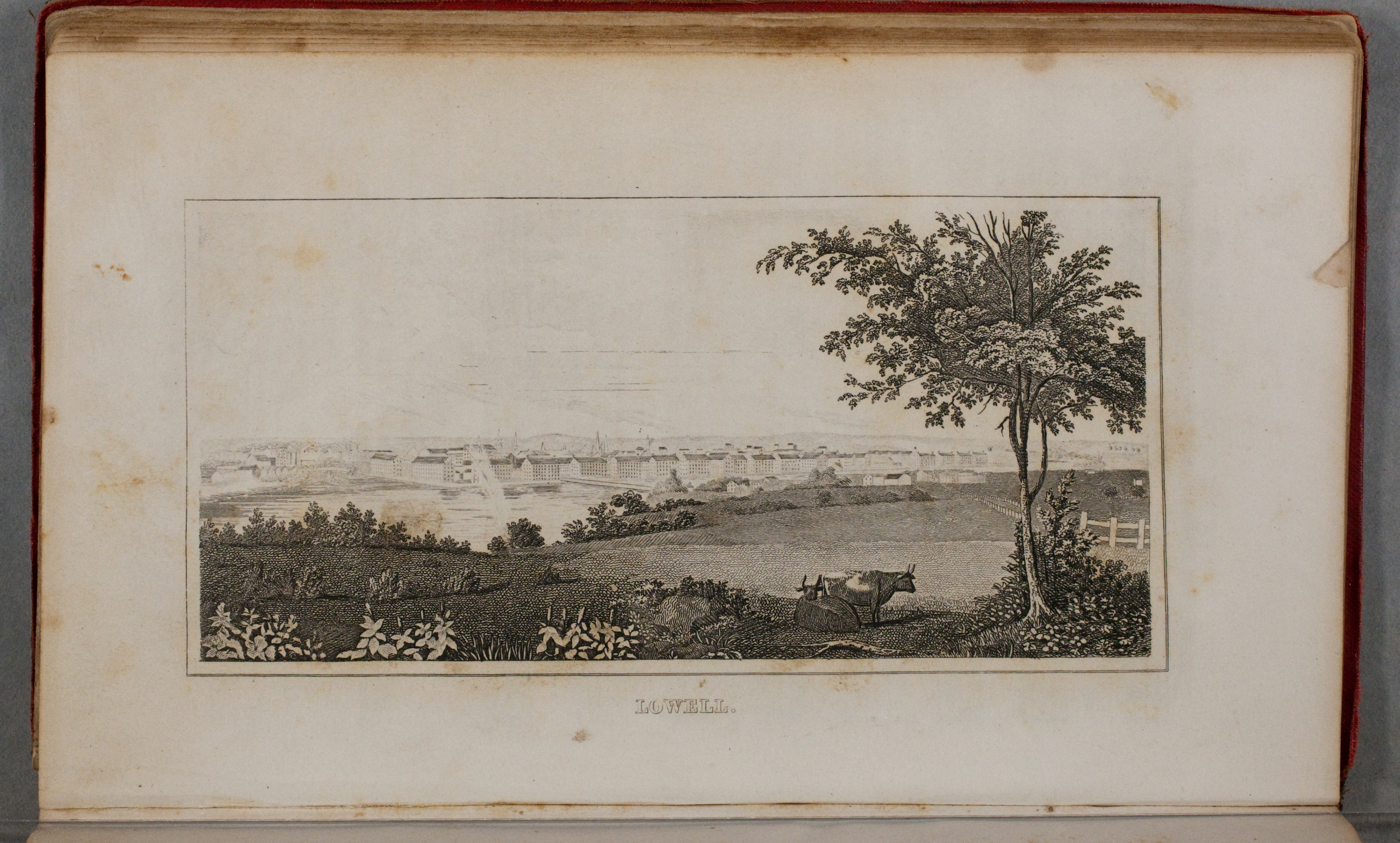
 This Thursday evening at 7 p.m., we will start our fall series of public programs with a one-woman play called Lowell Mills Boardinghouse Keeper. Kate Carney wrote and performs this presentation about Mrs. Lois Larcom (1786-1868), who kept a boardinghouse for female factory workers in the 1840s. Her daughter, Lucy Larcom (1824-1893), became a poet, writer, and editor of some influence in the nineteenth century. She described her mother and the boardinghouse she ran in her memoir, New England Girlhood, Outlined from Memory.
Lois Larcom began running a boardinghouse in Lowell in 1835 after the death of her husband, Benjamin. As she needed to find some way to support their ten children, she left her rural home in Beverly, Massachusetts, to live in the rapidly growing community on the Merrimack River. Lowell was then an inspirational experiment in industrialization attracting many young women from throughout the New England countryside to work in the new cotton mills. Most of the young women who boarded with Larcom came from rural Vermont and New Hampshire. In addition to painting a dramatic portrait of Mrs. Larcom, the play on Thursday evening will also explore the social dynamics of the Lowell community and the evolving role of women in nineteenth-century society.
Kate Carney is a professional actor and director who has directed plays on Broadway, performed in Boston and New York theaters, toured nationally and internationally, and appeared in films and on network TV. Since 1993, she has been bringing history alive at museums, libraries, schools, and First Nights throughout the Northeast with Heroic Women You Can Talk To, interactive theater pieces. Carney has taught and directed at Brandeis, Smith, and other colleges and trained theater companies in France and Israel. For more information on Kate visit her website.
The American Antiquarian Society has a great many imprints connected to the Lowell experiment and to the works of Lucy Larcom, some of which will be on display Thursday evening. These include complete holdings of the Lowell Offering, and first editions of Lucy Larcom’s Poems and New England Girlhood, among many others.
Step into the Nineteenth Century with Our Fall K-12 Workshops
The fall is always an exciting time here at AAS, with a full schedule of public programs, conferences, and workshops. We’ll be keeping you updated with all of these events throughout the season, starting here with our next round of professional development workshops for K-12 educators.
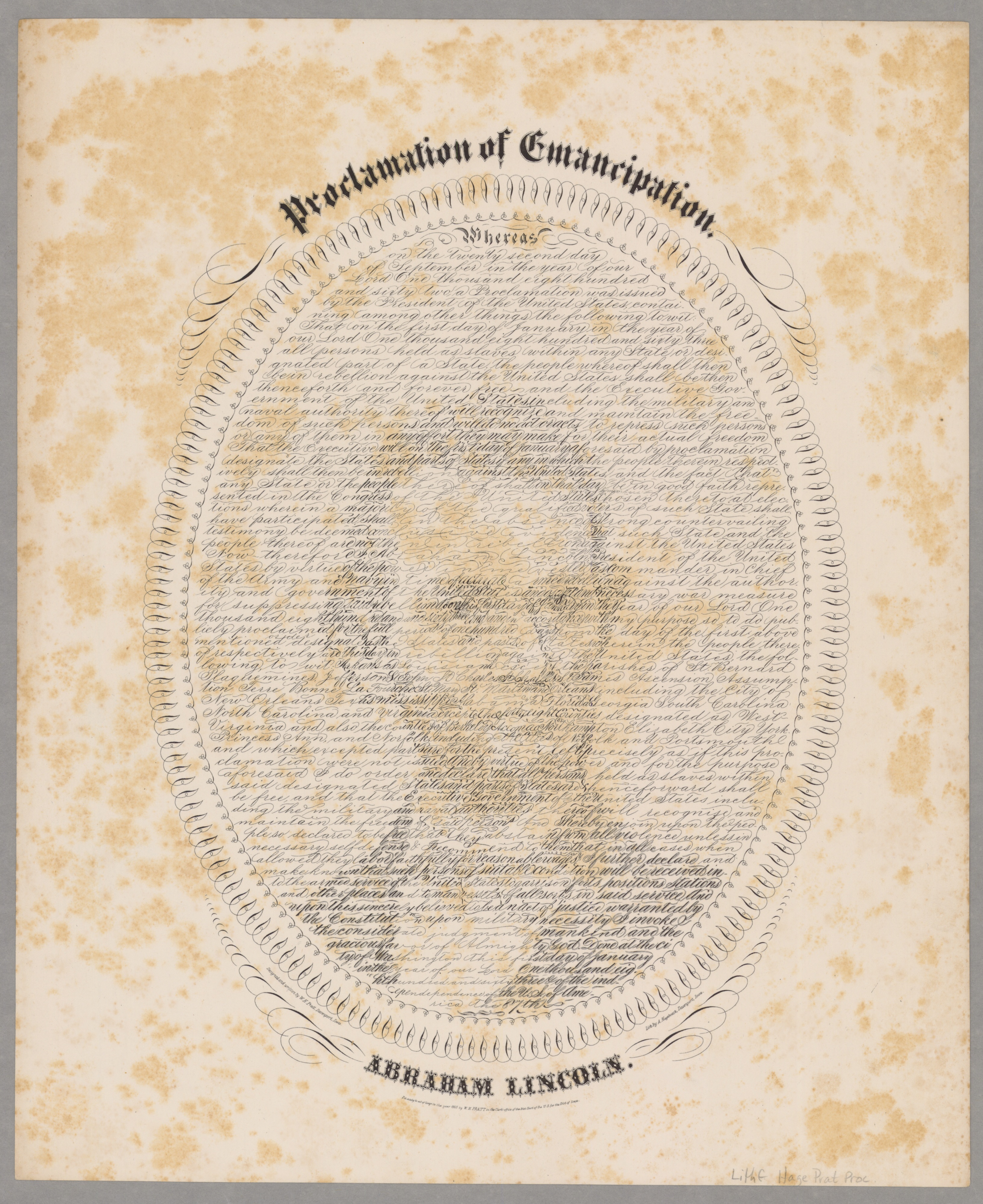 First up, on Saturday, October 19, will be the “Emancipation Proclamation and the Gettysburg Address,” led by Lincoln scholar Harold Holzer. With both of these seminal documents celebrating their 150th anniversaries this year, it was the perfect time to reflect on their significance in their own times, as well as today. We’ll be exploring their impact through primary sources in our collections, as well as through more recent media. Take this image to the right, for example. At first glance, you see a portrait of Abraham Lincoln. But if you take a closer look, you’ll find that the portrait is actually composed of the text of the Emancipation Proclamation. It’s similar to those puzzles that use tiny still frames from movies that all add up to one big still frame. In terms of more recent media, Harold Holzer served as a consultant on Steven Spielberg’s Lincoln and wrote the official companion to the film, Lincoln: How Abraham Lincoln Ended Slavery in America (2012), putting him in the perfect position to examine the ways Lincoln’s legacy has persisted to the present day. Holzer will also be delivering a free public lecture at Antiquarian Hall the previous night, October 18, called “Emancipating Lincoln: The Prose and Poetry of the Emancipation Proclamation.”
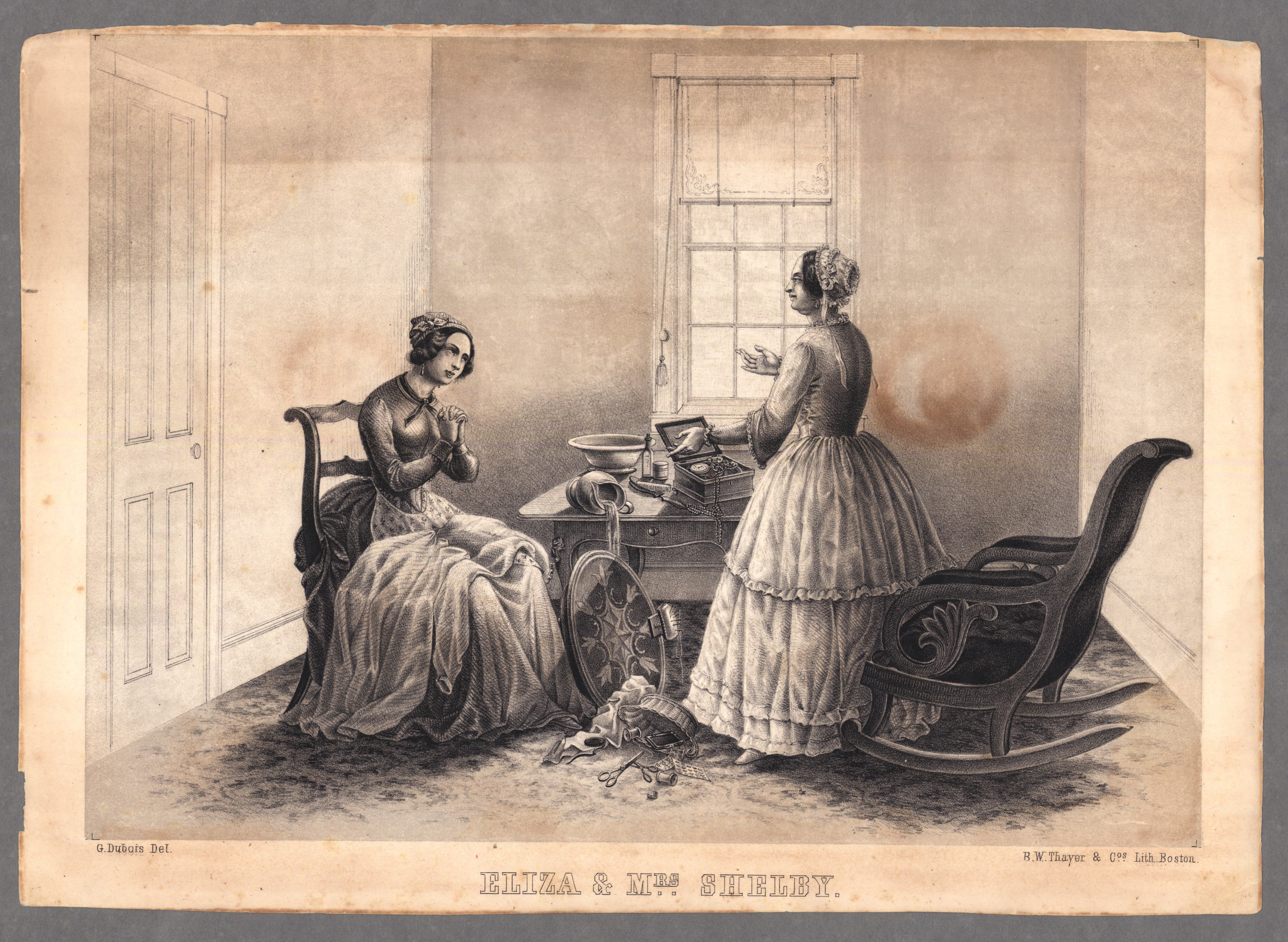
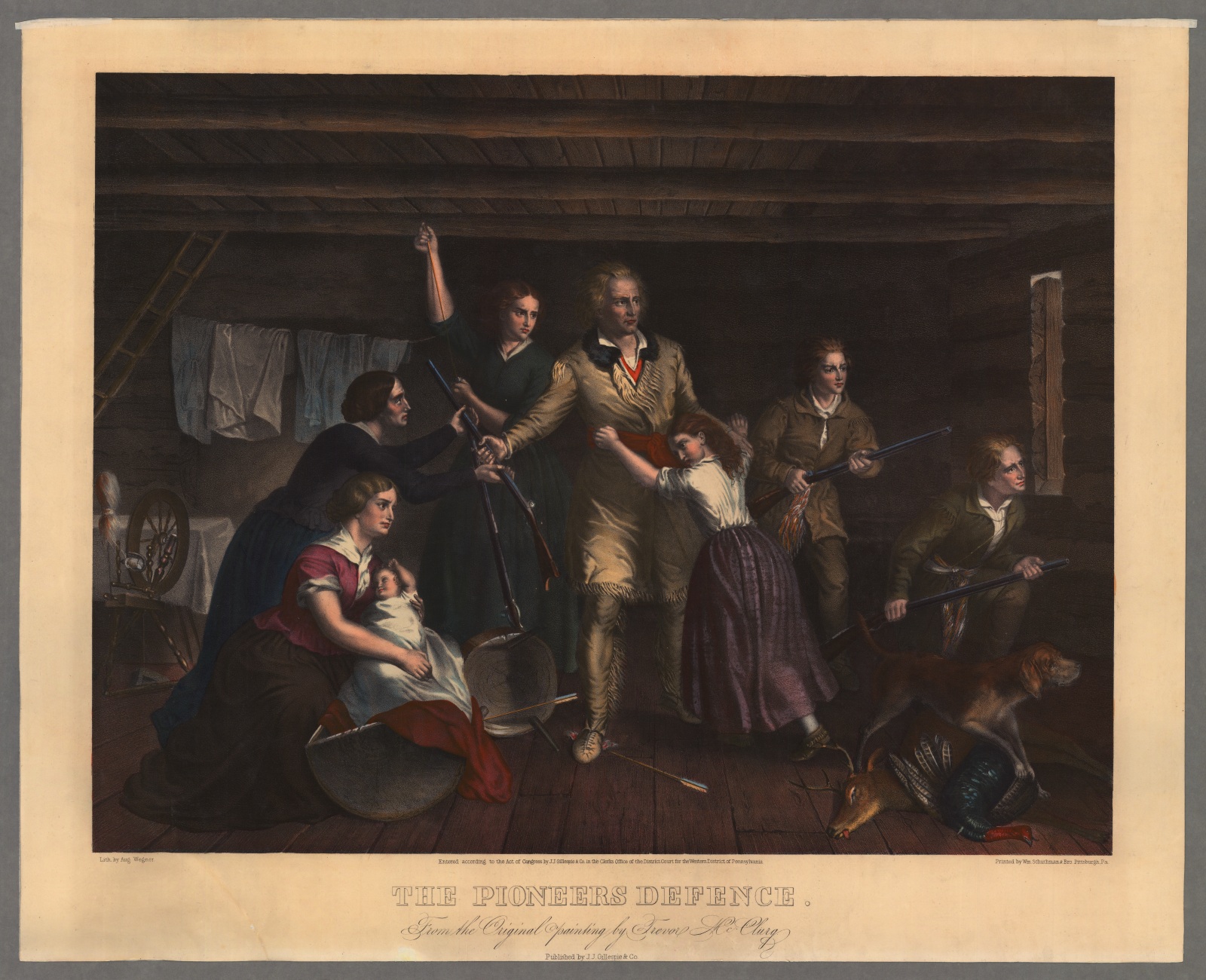 “Picture Perfect: Nineteenth-Century Women in Words and Images” will follow on Saturday, November 16. This interdisciplinary workshop, which is co-sponsored by the Society’s Center for Historic American Visual Culture (CHAViC), will examine historic visual representations of women in conjunction with selected texts by nineteenth-century women authors, many of whom are cited in curriculum frameworks. What’s so exciting about this workshop is that it will appeal to history, English language arts, and visual arts teachers alike, all of whom will find the texts and images useful tools in the classroom. Through the juxtaposition of words and images we’ll explore notions of gender, reform, and women’s roles and examine topics such as anti-slavery reform, the domestic environment, Indian removal, and westward migration. We’ll put the works of well-known authors like Harriet Beecher Stowe, Louisa May Alcott, and Laura Ingalls Wilder into context using contemporary manuscripts, images, and printed documents. For example, how do Wilder’s descriptions of encounters with Native Americans compare with this 1850s image seen to the left? The lead scholar for the day will be Laura Smith, a lecturer in English at the University of New Hampshire, where she teaches courses in American literature and English teaching methods.
We hope to see you there! Details and registration can be found here.
American Studies Students Blog about AAS Experience
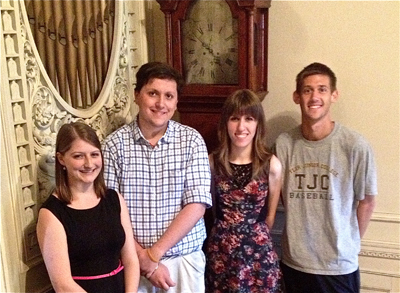 For over thirty years, the American Antiquarian Society has offered an annual honors seminar in American Studies to undergraduates from the five four-year colleges in Worcester. This year’s seminar, titled “The Nineteenth-Century Networked Nation: The Politics of American Technology, 1776-1876,” is being taught by Daniel Klinghard, Associate Professor of Political Science at the College of the Holy Cross. The four students from Assumption College who were selected to participate in the seminar—Maura Corbett, Jason Duke, Jennifer Gargan, and Erich Grosse—will be blogging about their experience in the seminar and discussing their research projects as they take shape. You can follow their seminar blog here.
The Acquisitions Table: Copy Book of A.D. Arms
Arms, A.D. Copy Book, 1870-1877 (with stylus and carbon papers).
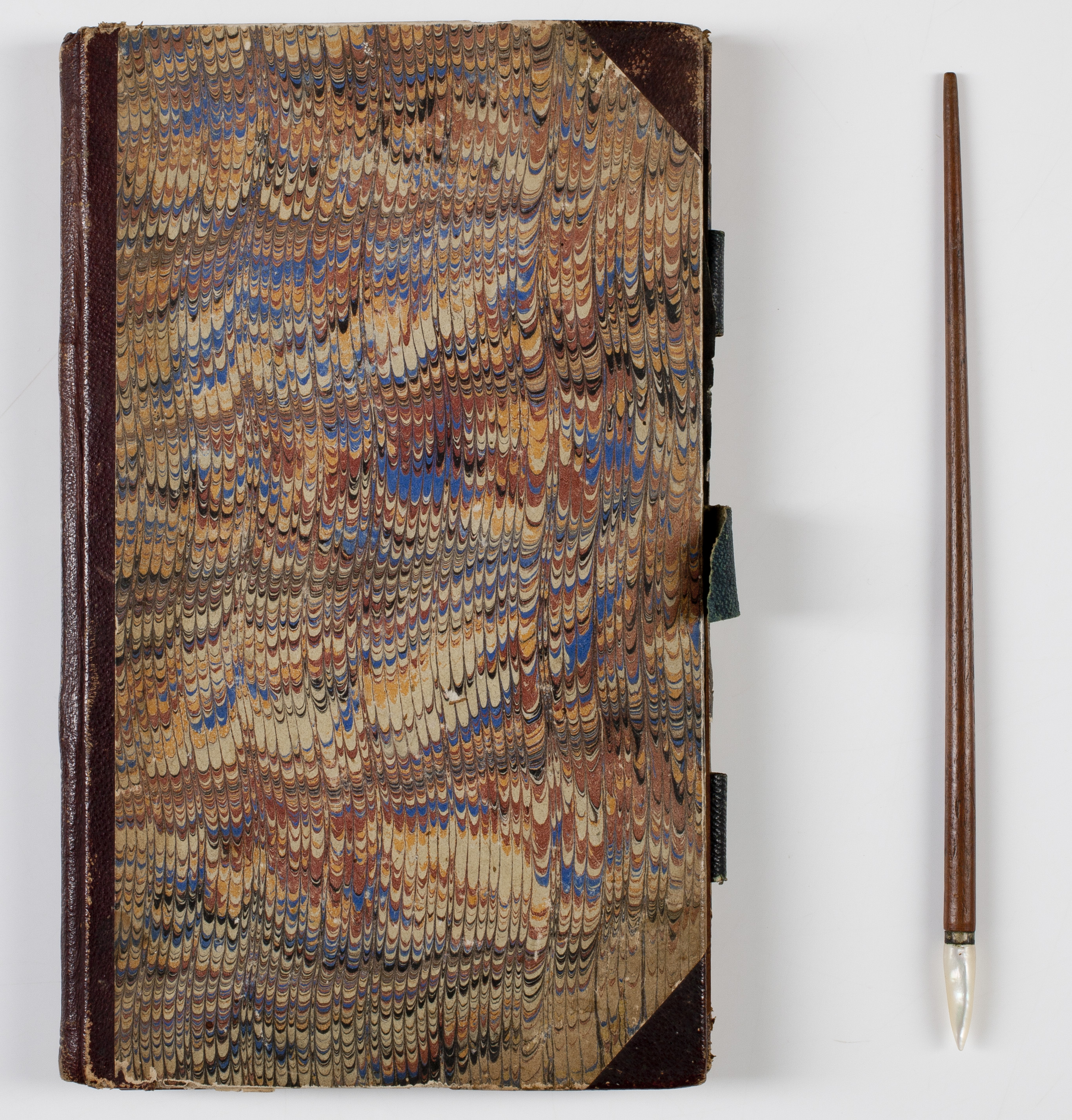 A new addition to the Society’s Penmanship Collection is this copy book, with stylus and copy paper still intact. The copied letters are all signed by an A.D. Arms, and most are written to recipients in Montpelier, so he was likely from the town, or close by. Although the book has only a few copied letters, they are entertaining and provide a glimpse into his daily life. Arms’s outgoing correspondence includes letters concerning a sheep dilemma (he does not think the sheep he received were the ones described by the seller), a trial of a new mowing machine, and inquiries about an artificial ear drum. Because Arms’s outgoing correspondence is all together in this copy book, (a rarity, since correspondence is typically scattered among its recipients), we get a fairly good picture of this individual who was clearly also interested in copybook technology.
Your Move!
Many magazines of the nineteenth century were published with paper wrappers, the purpose of which were to protect the issue as it went through the mail on its way to the subscriber’s home. These wrappers (often on colored paper) would identify the name of the periodical. Sometimes they would just reproduce the title page, but at other times they would be decorative with imaginative borders and illustrations. After all, that was the first thing people would see. That left three other wrapper pages; why leave them blank? The publisher would often fill them up with information about the serial, notices about upcoming issues, other publications for sale, advertisements, or other pieces of information they thought relevant to the subscriber. Sometimes the only reason we know who the editor or authors of particular articles are is because their names were printed on the wrappers.
The problem is much of this rich information was lost when magazines were bound into multi-issue volumes. Most binders would remove the wrappers because they had served their purpose, i.e. protected the issue. AAS has many bound volumes without the wrappers, but over the years we’ve added many individual issues (even if we have a bound volume) just for the wrappers.
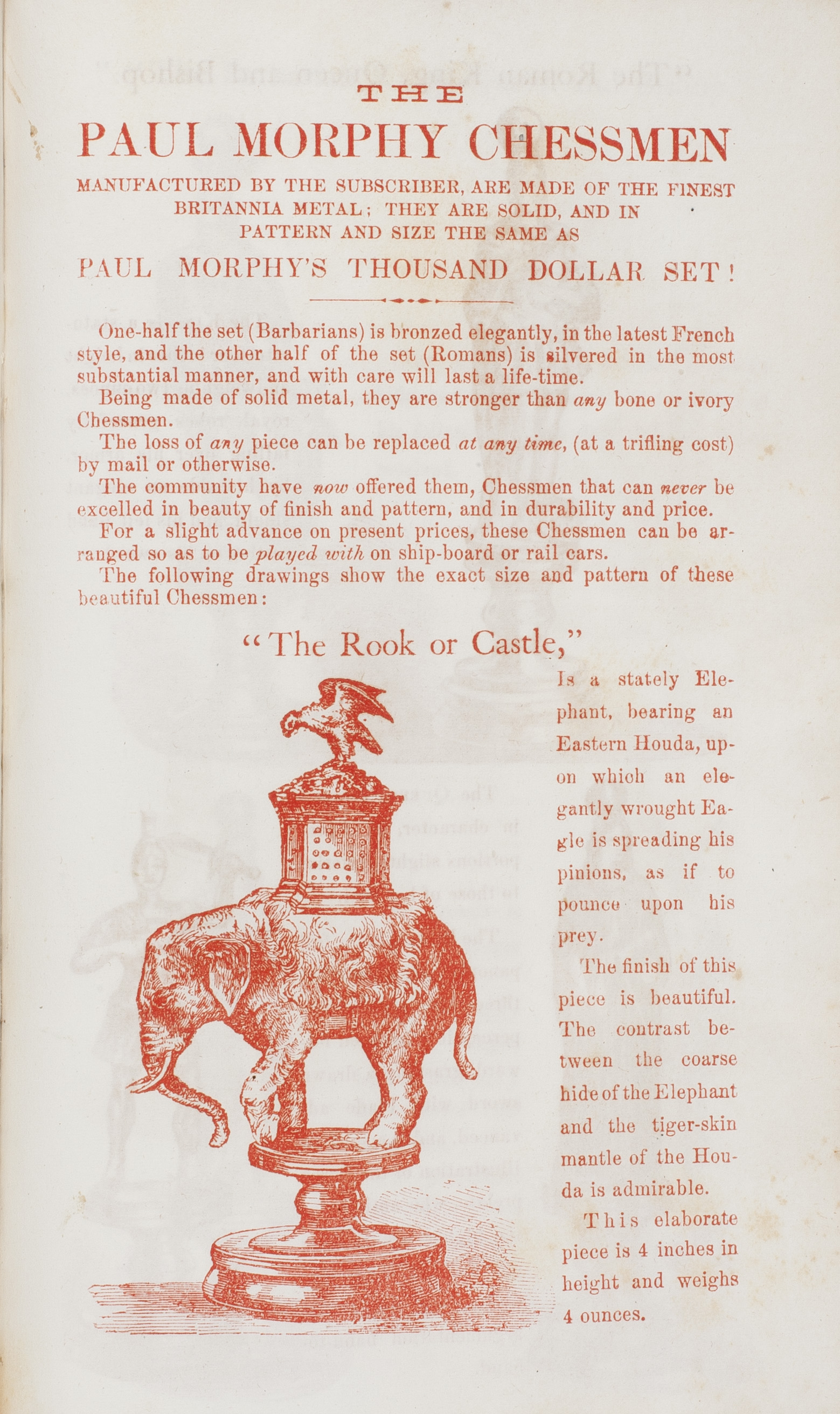
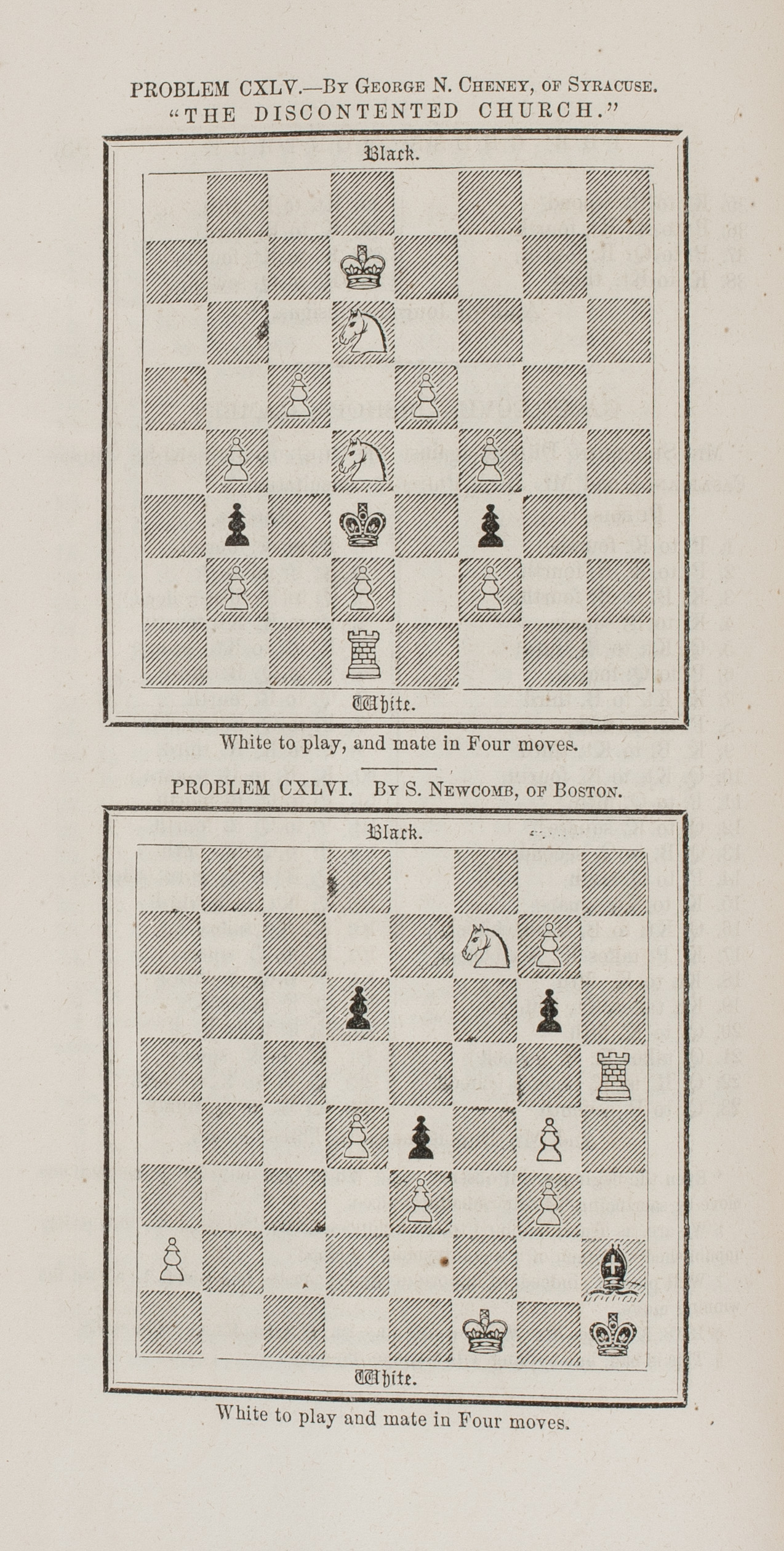
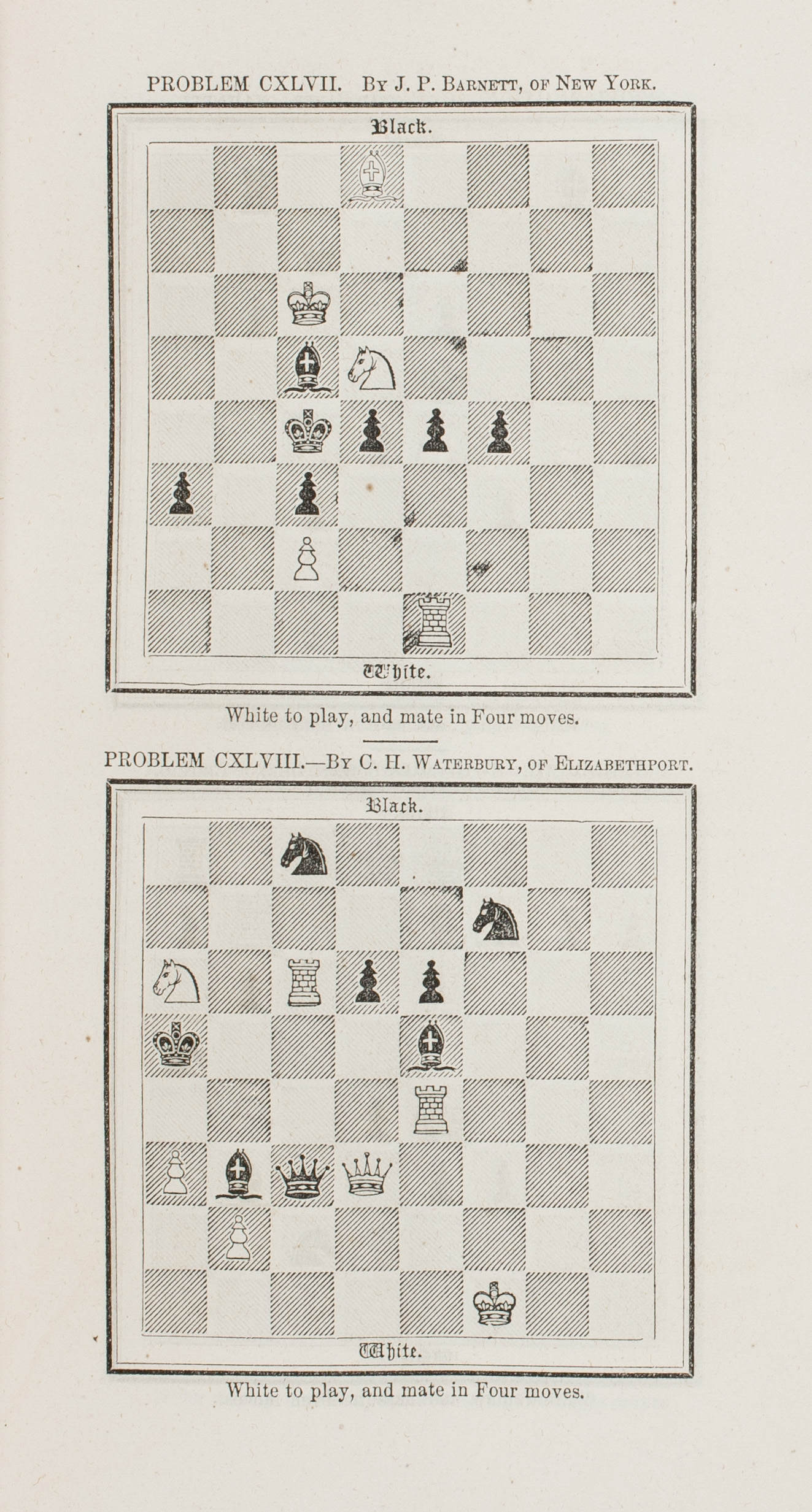
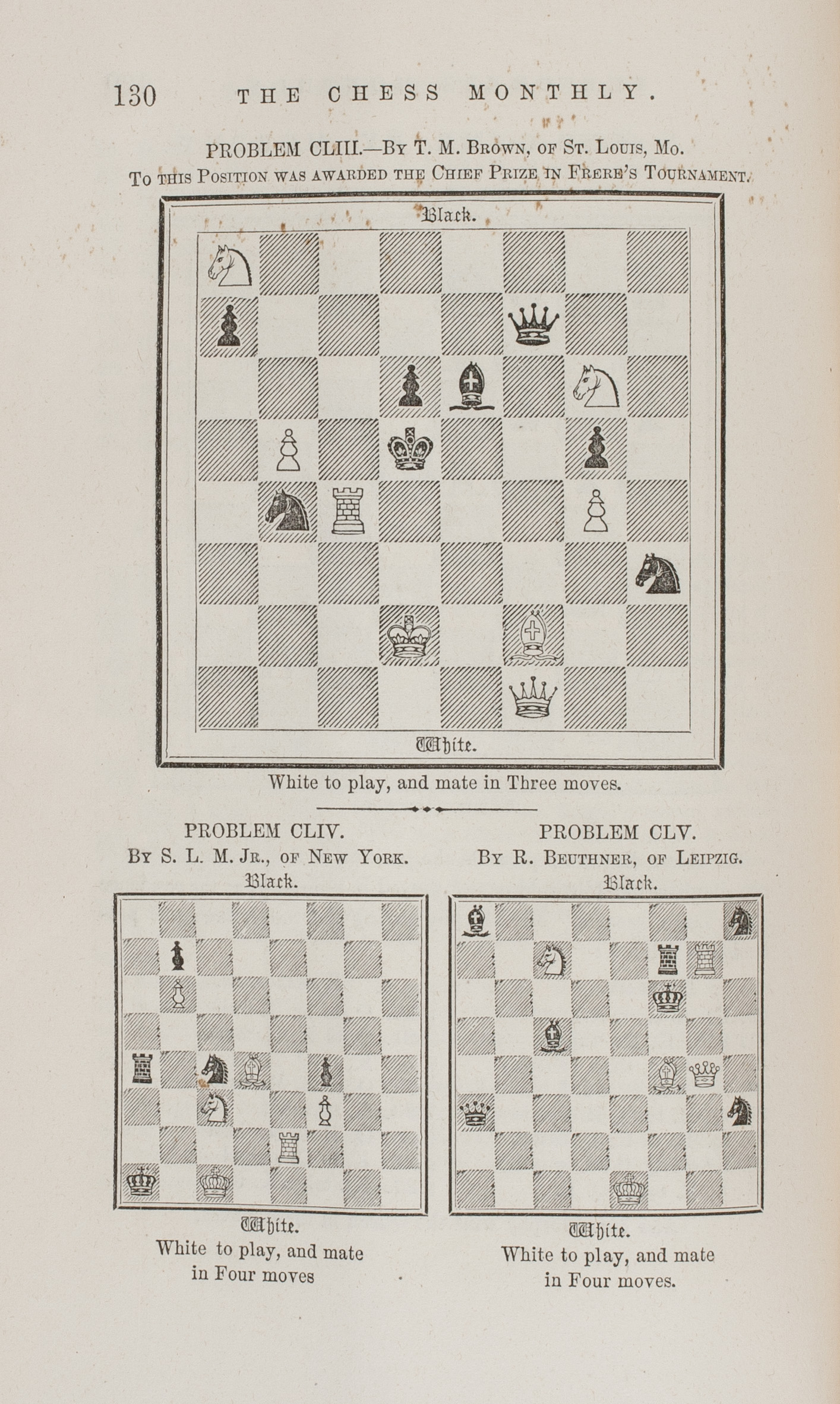
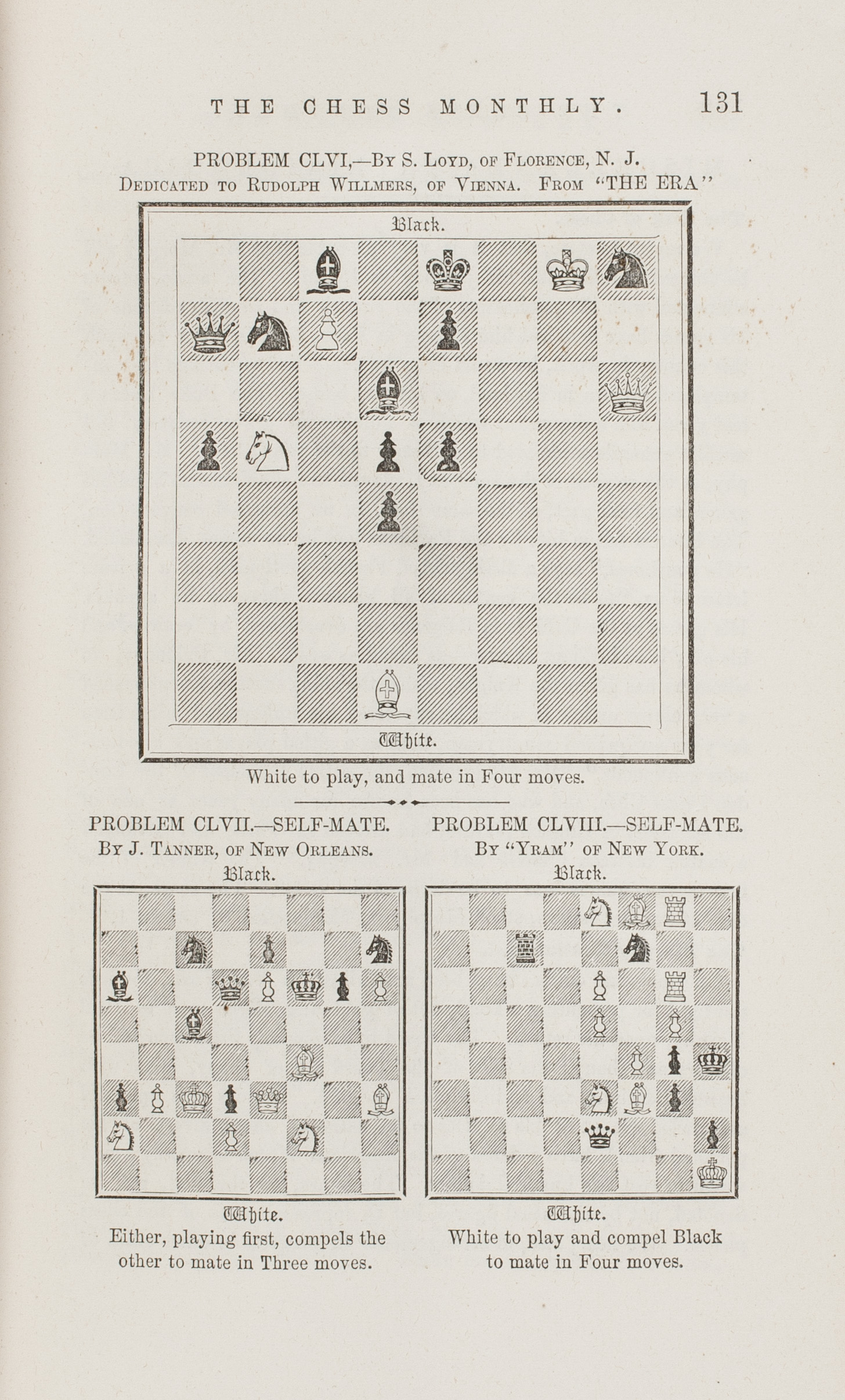
One interesting case is the periodical Chess Monthly. It appeared between 1857 and 1861. It was edited by Daniel Fiske and “co-edited” by the American chess champion, Paul Morphy, who in reality mostly just provided his name and contributed some annotated games. Puzzle inventor Sam Loyd also edited some of the chess puzzles. The wrappers of Chess Monthly contained information such as the names of the editors and advertisements for chess paraphernalia such as books and chess boards, but they also contained the answers to the chess problems published in the previous month’s issue. So you can see the problem of the chess problems. When the issues were bound, the wrappers (and the solutions) were removed and thrown away. Fortunately, the publisher provided a separate title page, index, and solutions to the problems after a volume was completed. This material could be combined with the issues when they were bound, but sometimes the binder didn’t include them.
Here are the problems that appeared in Chess Monthly for volume 3, January through April 1859. See if you can solve the puzzles and share your answers in our comment section. Like the wrappers in our bound volume, solutions are not to be found here.
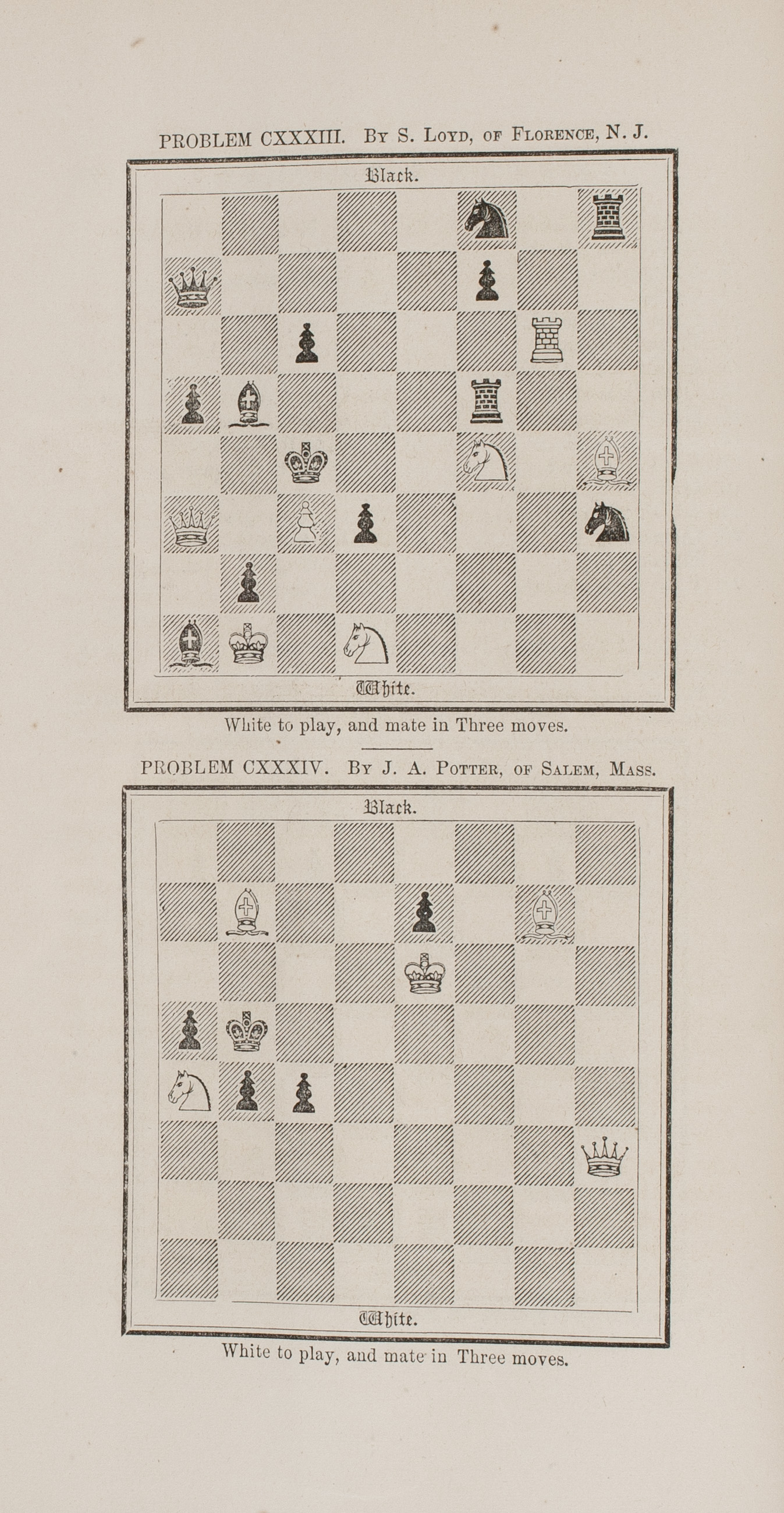
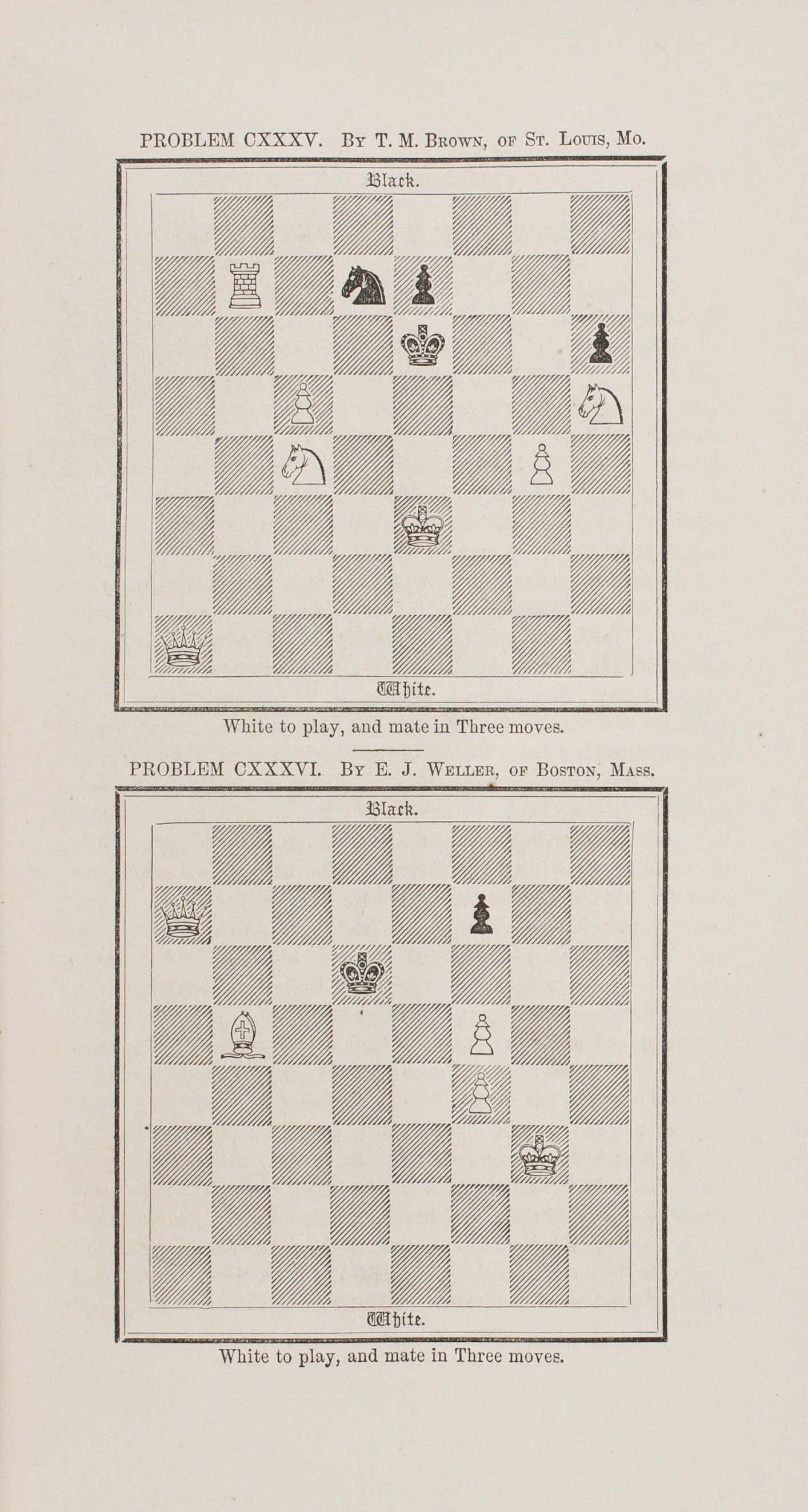
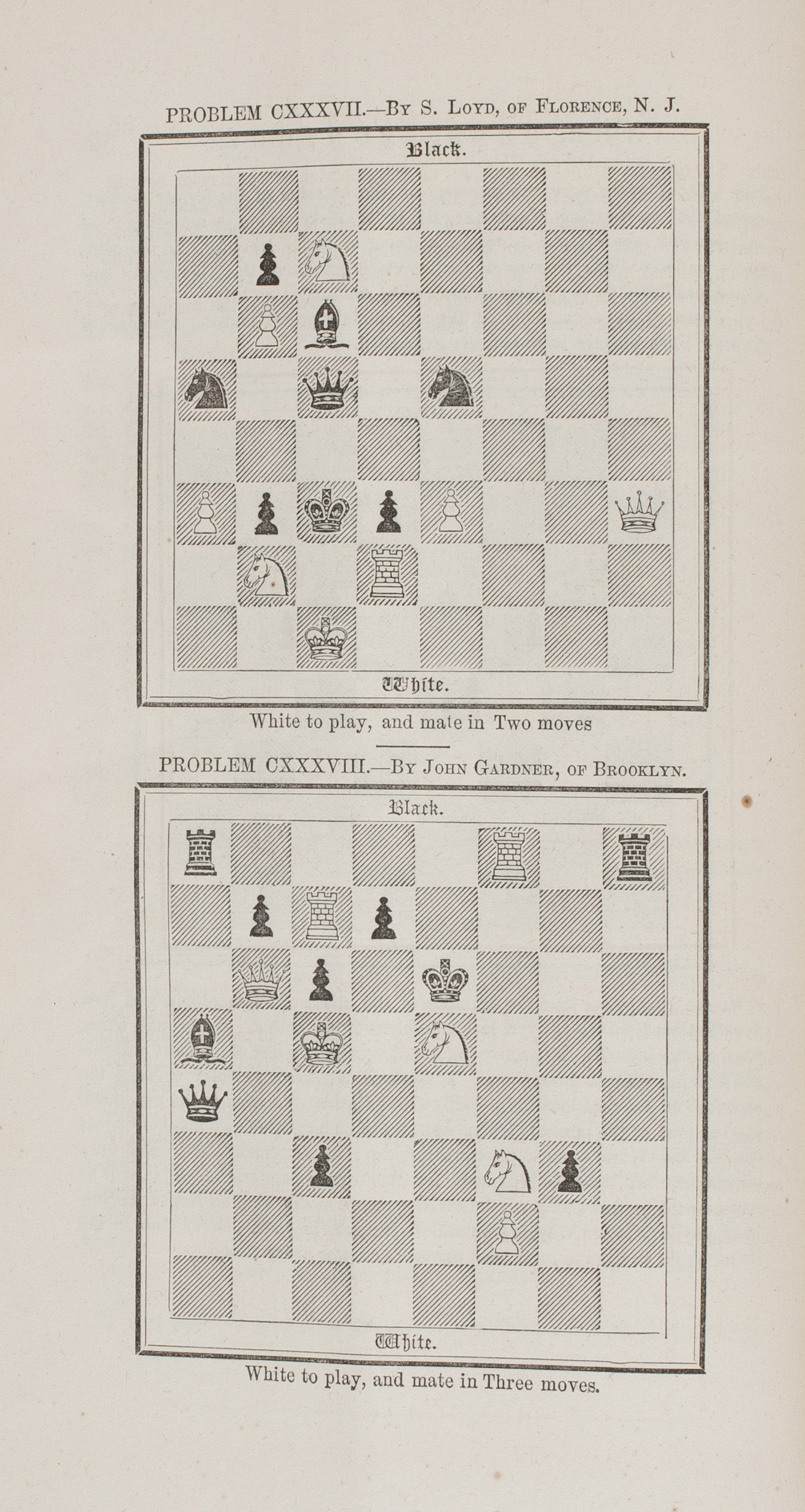
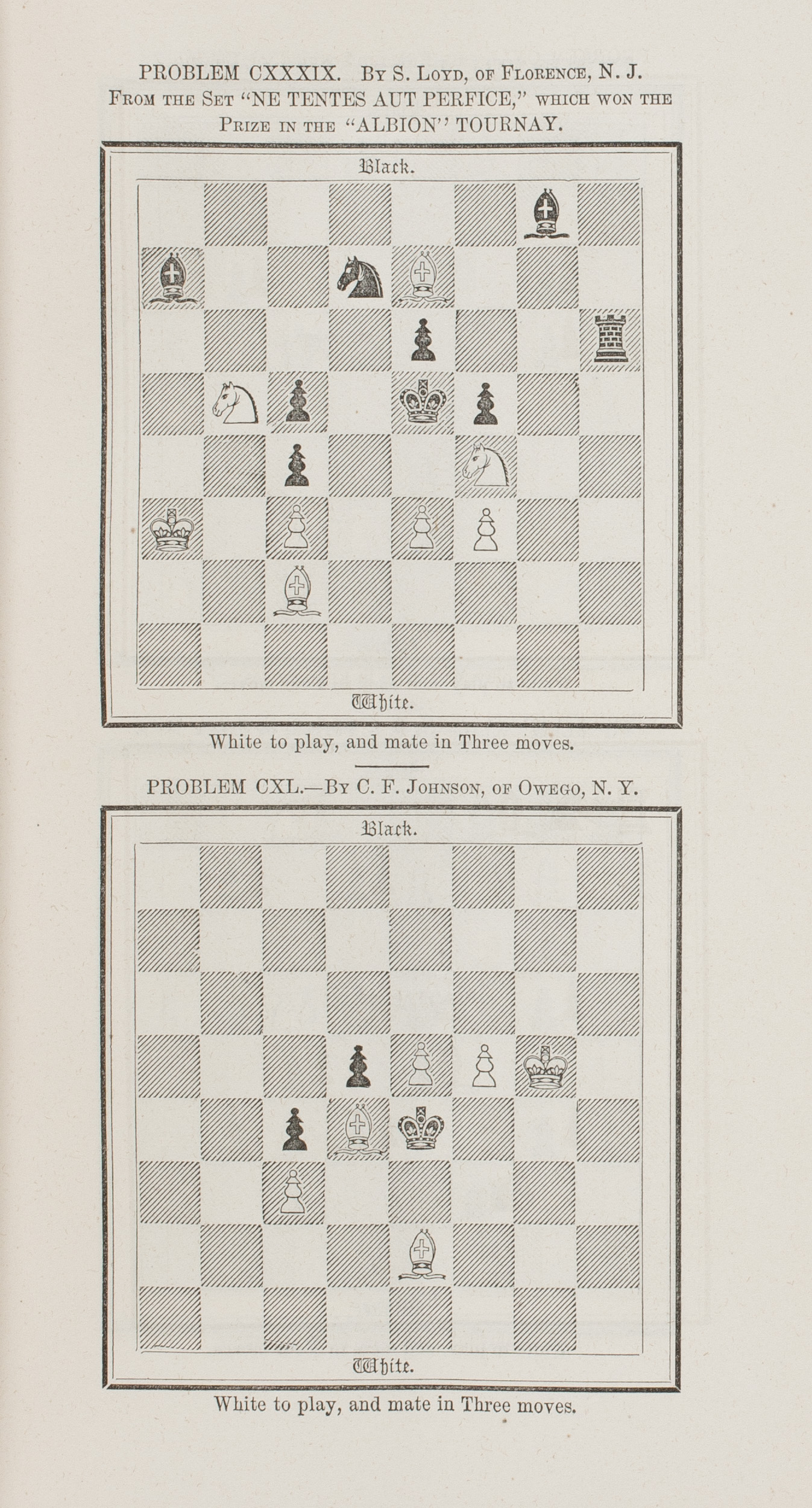
The New Face of Past is Present
You may notice that things look a little different around here. Last October, just in time for the bicentennial, we released the new AAS website. Its sleek look and improved navigation have been a success, so we decided to give our blog a similar treatment this fall.
To go with the new look, we also have some great posts coming up. Besides keeping you updated on public programs, conferences, and other events, we will also be posting recommended reading, hearing from our curators about their adventures finding new acquisitions, and even testing your wit with some puzzles.
So we hope you enjoy the new site, and please join us in our historical musings – we’d love to hear from you!
The Acquisitions Table: The Adventures of Teasing Tom and Naughty Ned with a Spool of Clark’s O.N.T. Cotton
?The Adventures of Teasing Tom and Naughty Ned with a Spool of Clark’s O.N.T. Cotton. New York: F.B. Patterson, 1879.
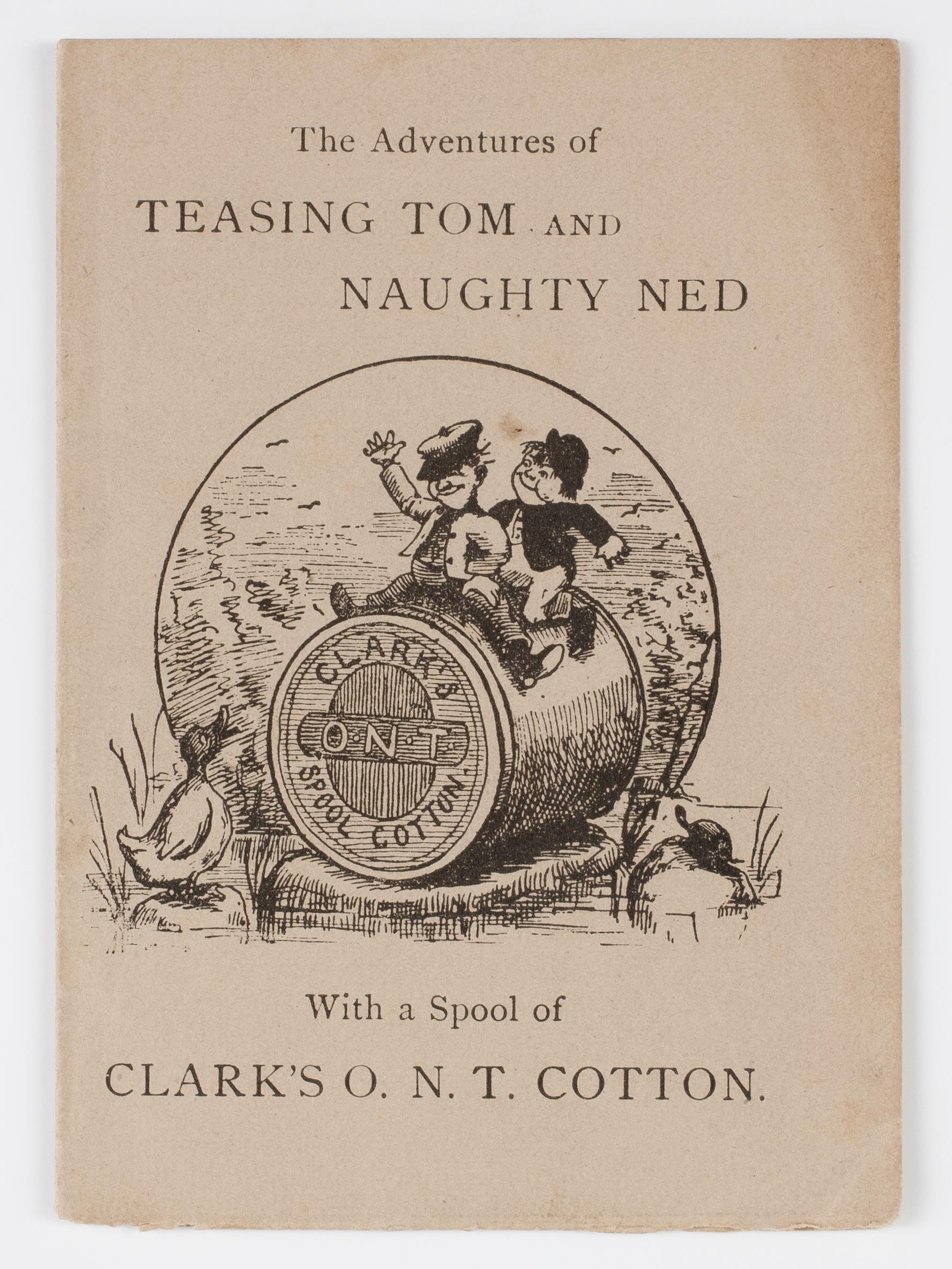 Books printed as advertisements were frequently directed at children, as is the case of this chapbook hawking Clark’s cotton thread. Not only do Tom and Ned play hooky from school, but they use a spool of Clark’s Thread to strangle four ducks, leaving them for Granny Blobkin to roast. The naughty boys do not let the resourceful Granny enjoy her roast ducks; they use more of the thread to hook them up the chimney. The text all but absolves the boys from their bad behavior: “Boy’s pranks are soon forgotten, If after deeds are true and strong And useful–as Clark’s Cotton!”
The Acquisitions Table: Address of the Carrier of the Kentuckian
Address of the Carrier of the Kentuckian. Frankfort, Kentucky: s.n., A.T. Leonard., 1830.
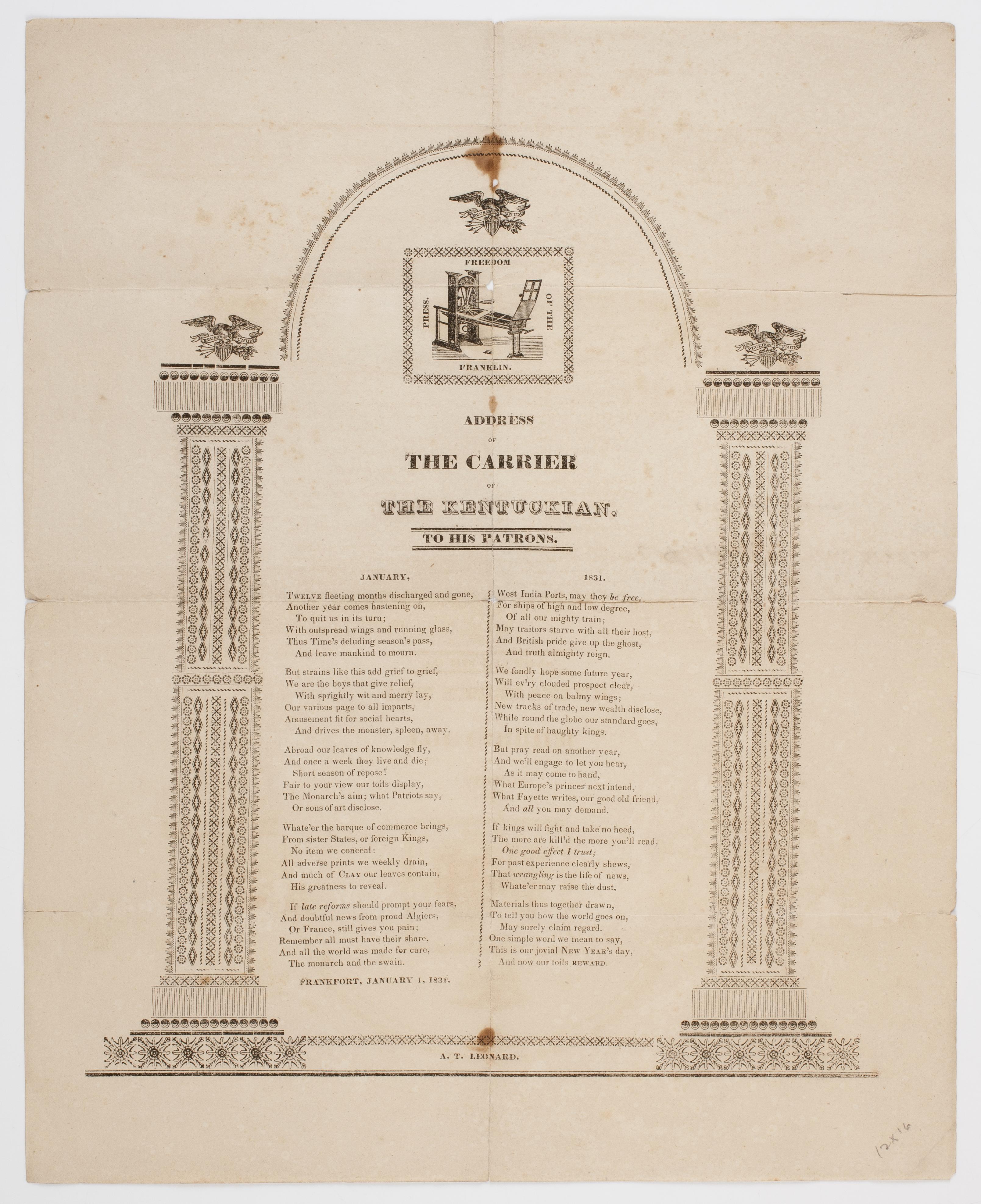 This broadside is the earliest example of a Kentucky carrier’s address in the AAS collection (earlier addresses are known, but are lacked by the Society). Bordered with elegantly laid out type ornamentation topped off with eagles and a cut of a printing press, the poem on the sheet is a typical summary of the events of the previous year (1830) with a New Year’s message and call for tips for the boys who carry the papers. The poem mentions Kentucky hero Henry Clay, then serving as a state Senator, lists events in Europe and Algiers, and philosophizes that all the coverage of battles and coups is what sells the paper, stating: “Wrangling is the life of news.”
Common-place article picked up by the AP
We are very excited that an article about the inspiration for Uncle Tom’s Cabin by Susanna Ashton that appeared in the most recent issue of Common-place was picked up by the Associated Press and is getting some national circulation, including in the New York Times over the past weekend. If you haven’t yet read them, be sure to check out both the Common-place article and the AP’s take on Susanna’s findings!
The Acquisitions Table: Children’s Book for Sabbath Hours
Bullard, Asa. Children’s Book for Sabbath Hours. Springfield, Mass. & Chicago: W.J. Holland & Co., 1873.
 With the secularization of American society after the Civil War, this book by minister Asa Bullard answered a need to give children something wholesome yet entertaining to read while keeping the Sabbath free from raucous play. This is a selection of short stories and poems, issued with luxurious full page photo-engravings, like this one of children playing with their large (but gentle) dog.
Benjamin T. Hill Goes to the Fair
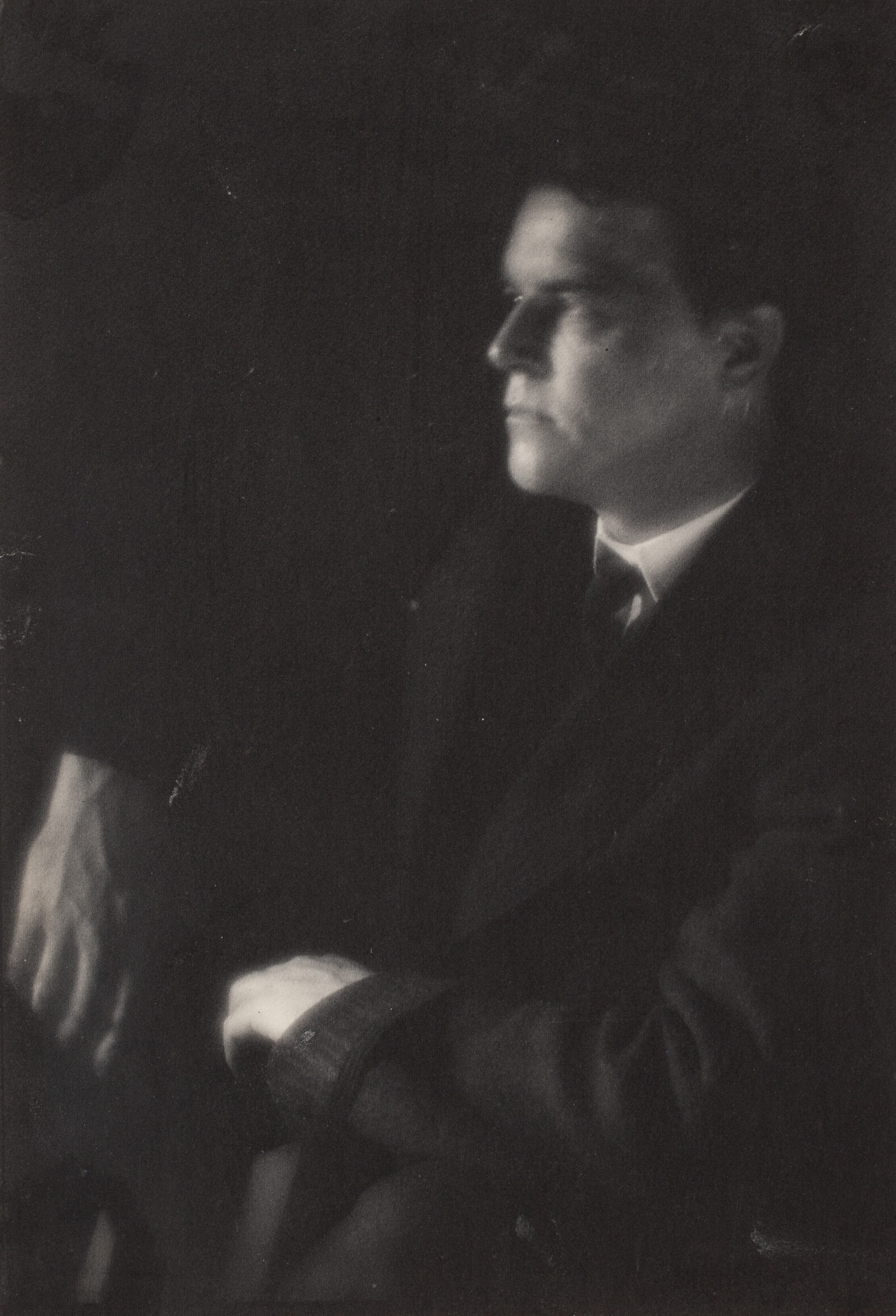
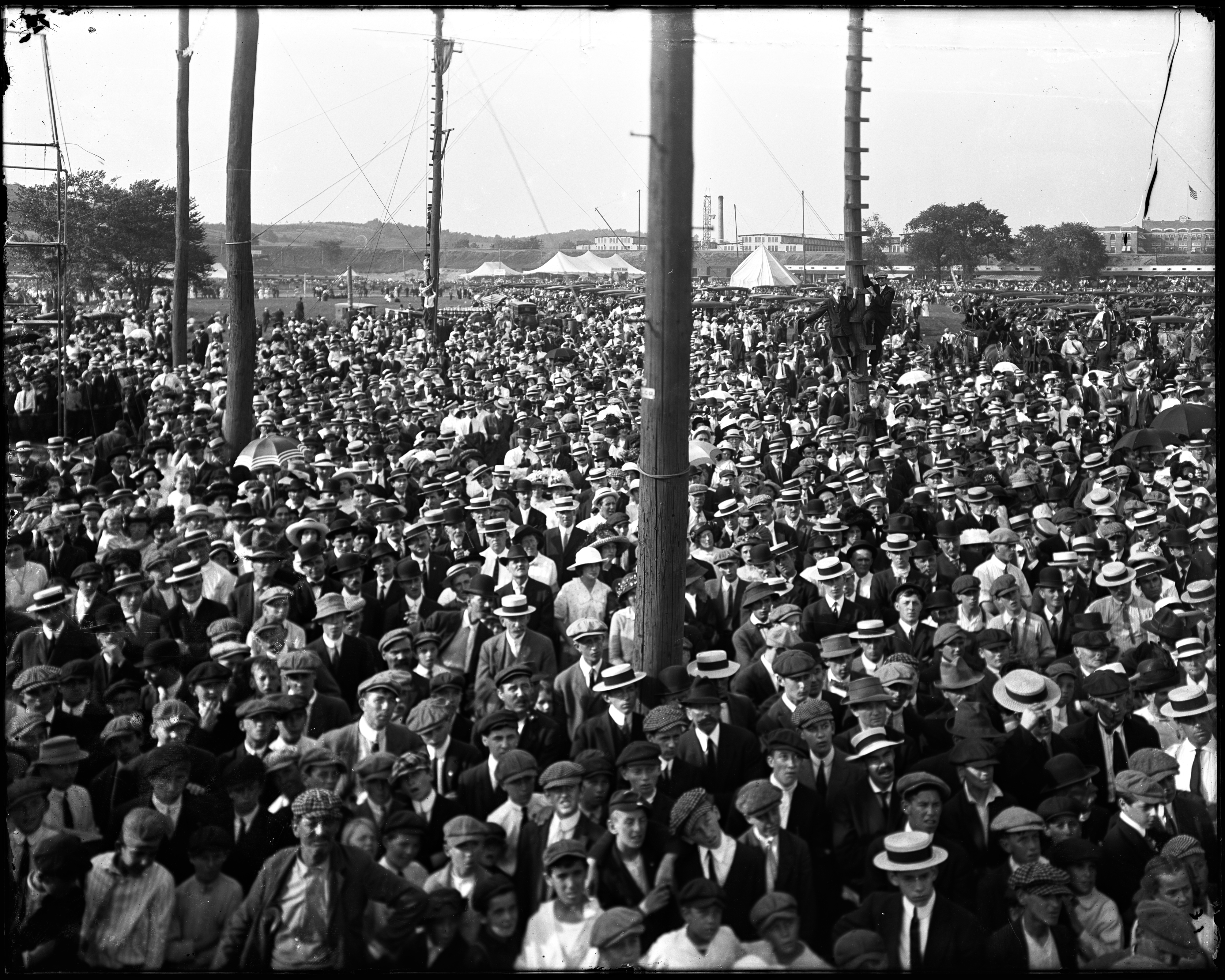
I recently scanned a few boxes of glass negatives from the collection, all made by one Benjamin T. Hill, an amateur photographer and local historian elected to the Antiquarian Society in 1901 who also served as an auditor for the Society for twenty-three years. These negatives were all made at a fair in Worcester in the early 1920s. The fair took place near what was then Norton Abrasives and is now the Saint-Gobain complex, just west of West Boylston Street. The historic Odd Fellows’ Home, built in 1890 on Randolph Road, is visible in the distance in many of the photographs.
In this sizable array of images are photographs that are poorly framed, blurry, underexposed, negatives that fell victim to light leaks, images of crowds of people with their backs turned, images of rows of livestock presenting their hindquarters to the camera, inexplicable reenactments, a whole lot of empty foregrounds…and several stunning gems that offer a crisp and beautiful view into the world of the fair on that particular day. It’s worth clicking on the images to see them at full resolution.
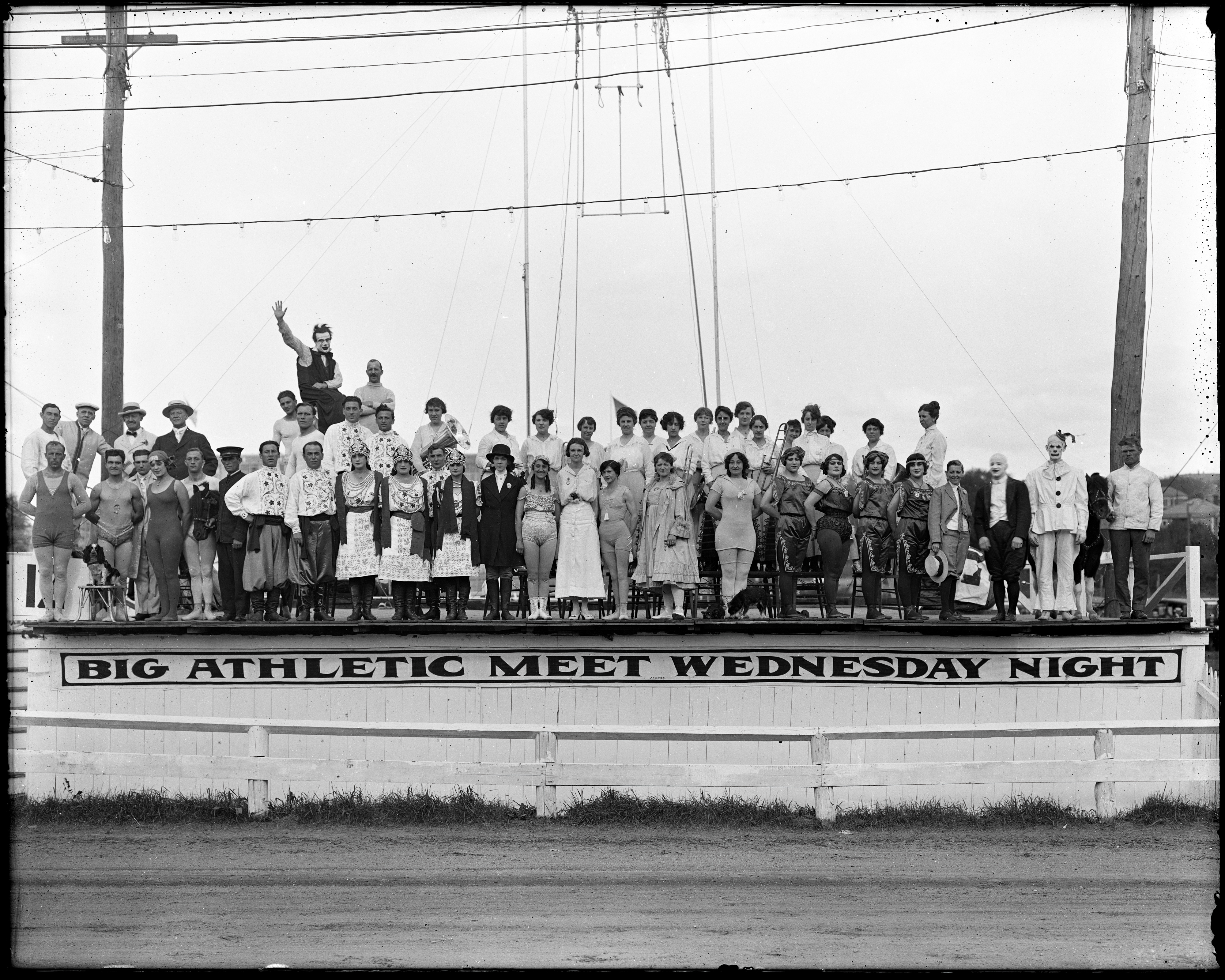
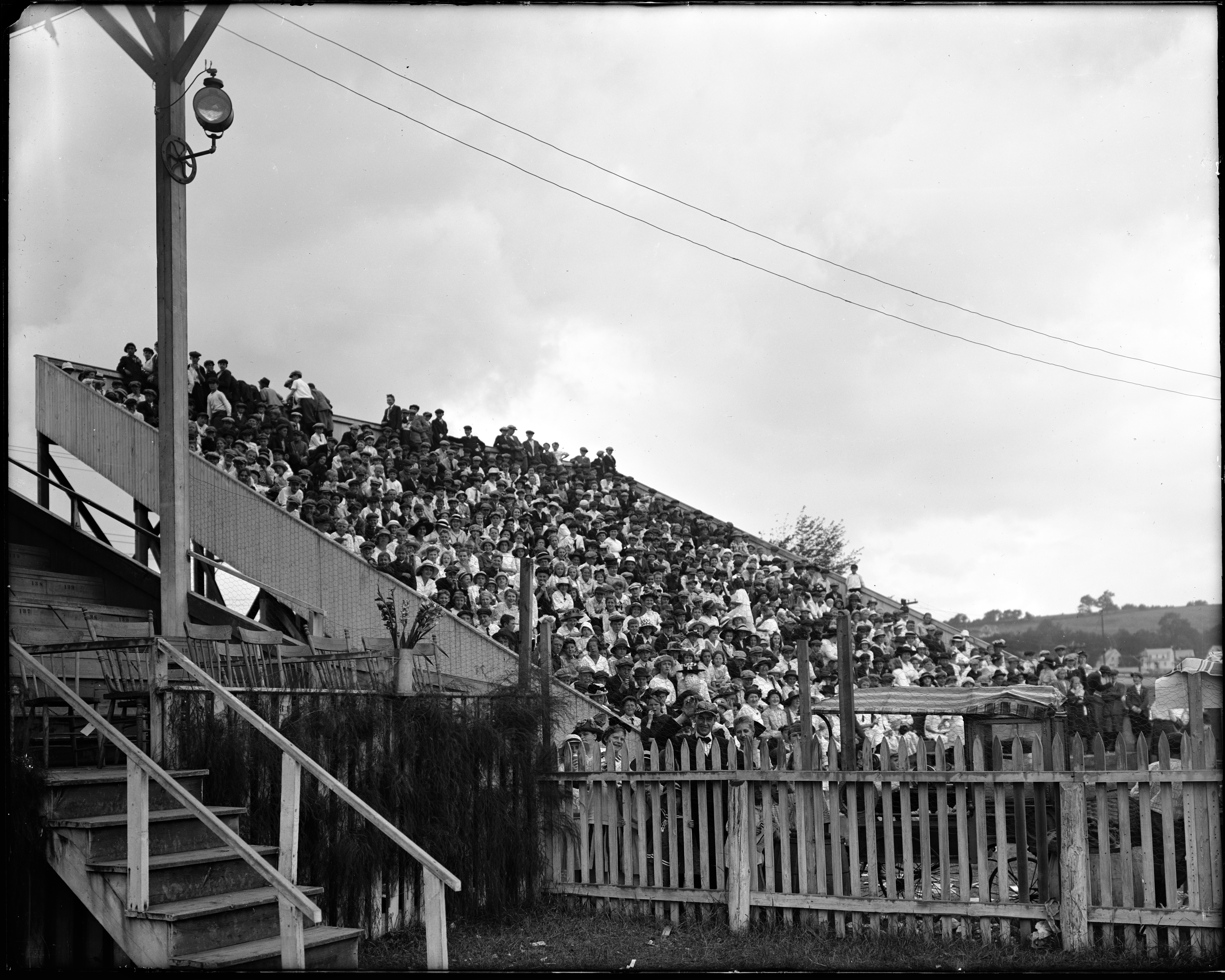
It isn’t clear why Hill was photographing the fair – it’s possible that he was hired to document the festivities, or, as some of the images indicate, had acquaintances who were vendors at the fair (an insurance company, a lumber company, car dealers). Some of the images are posed group shots, with subjects fully aware of and engaged with the camera, as can be seen in the photographs of the circus performers and, more unexpectedly, the entire grandstand of spectators with their heads turned to the left, looking straight at the camera:
What is most interesting about the collection of glass-plate negatives of the fair is how revealing the collection is as a whole of Hill’s amateur status (and as a result, his probable wealth – this was not a cheap pursuit). He had a clear interest in entertainment. In the two boxes of 5×7 plates, the majority are images of horses jumping, many of them repeated attempts at the same shot, some slight variations in angle, some framed incredibly awkwardly. Of the lot, there are only one or two real successes, and one image of a woman jumping a horse while riding side-saddle is particularly stunning:
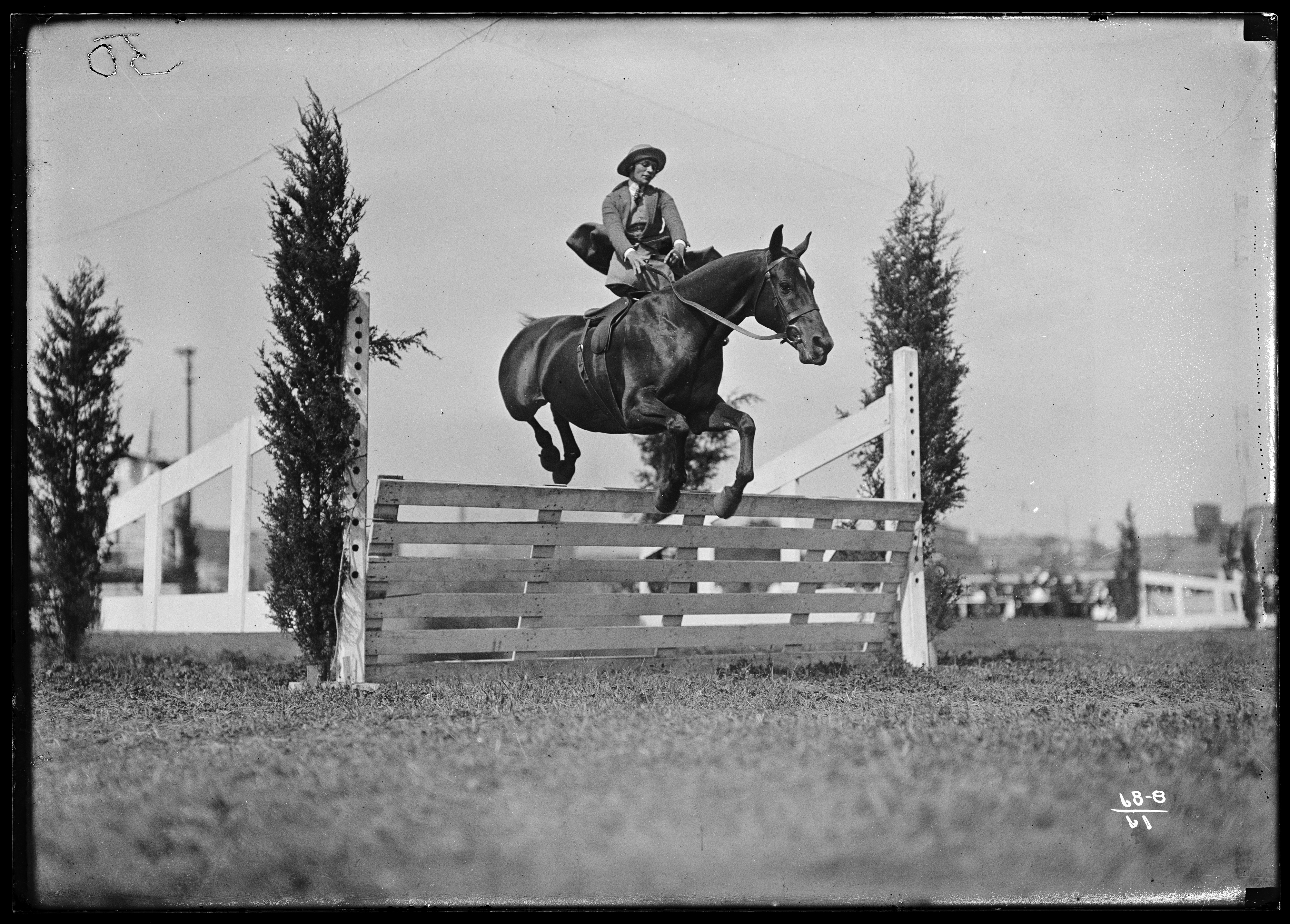
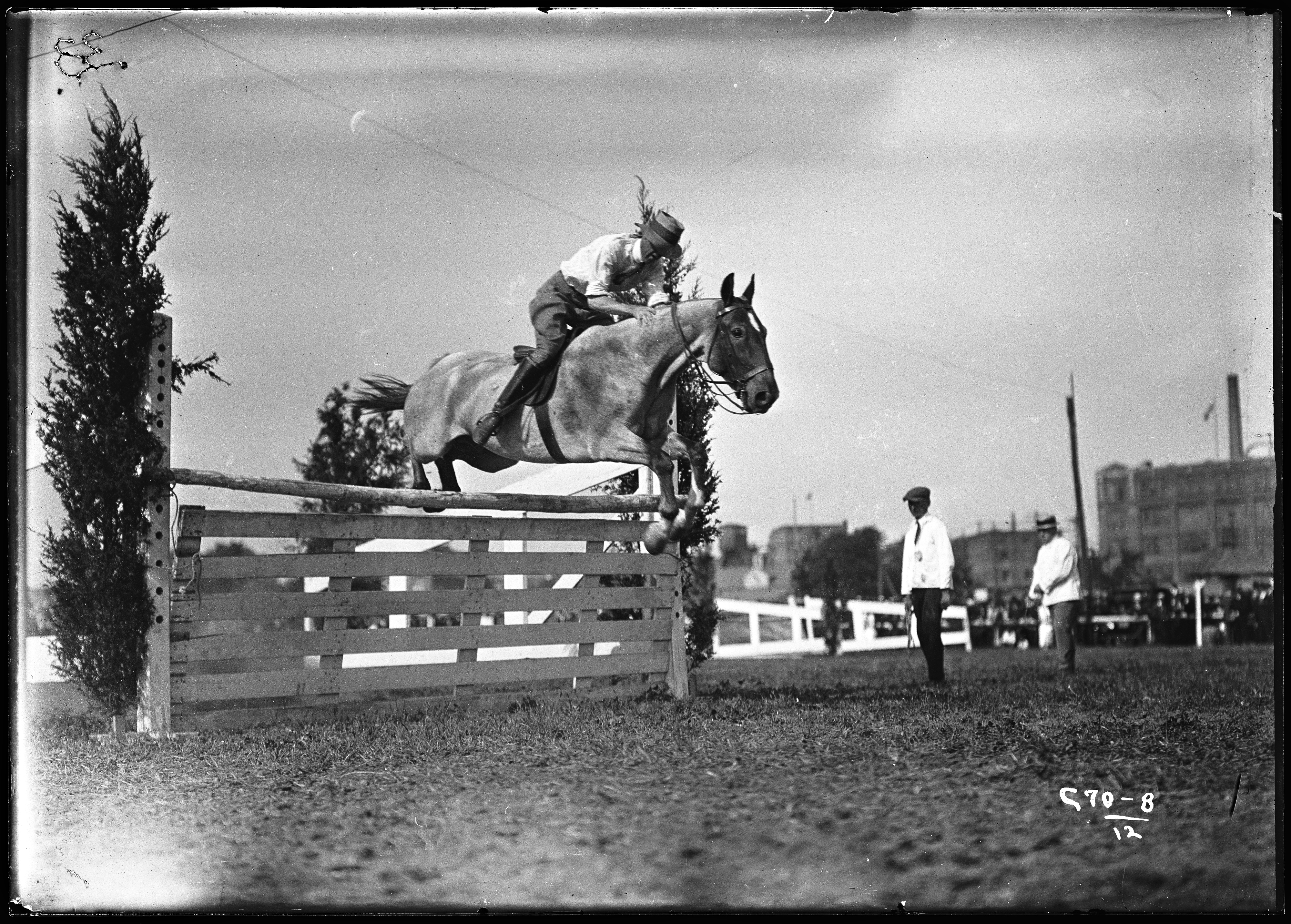
The framing is thoughtful and careful, the horizon is level, and horse and rider are sharp. He released the shutter just past the peak of the jump, and if you look closely you can see that she is even coming out of the saddle. No less dramatic is the image of a man and horse on the same jump; however, this one has a strange, hurried snapshot quality to it that belies the complexity of the photographic process.
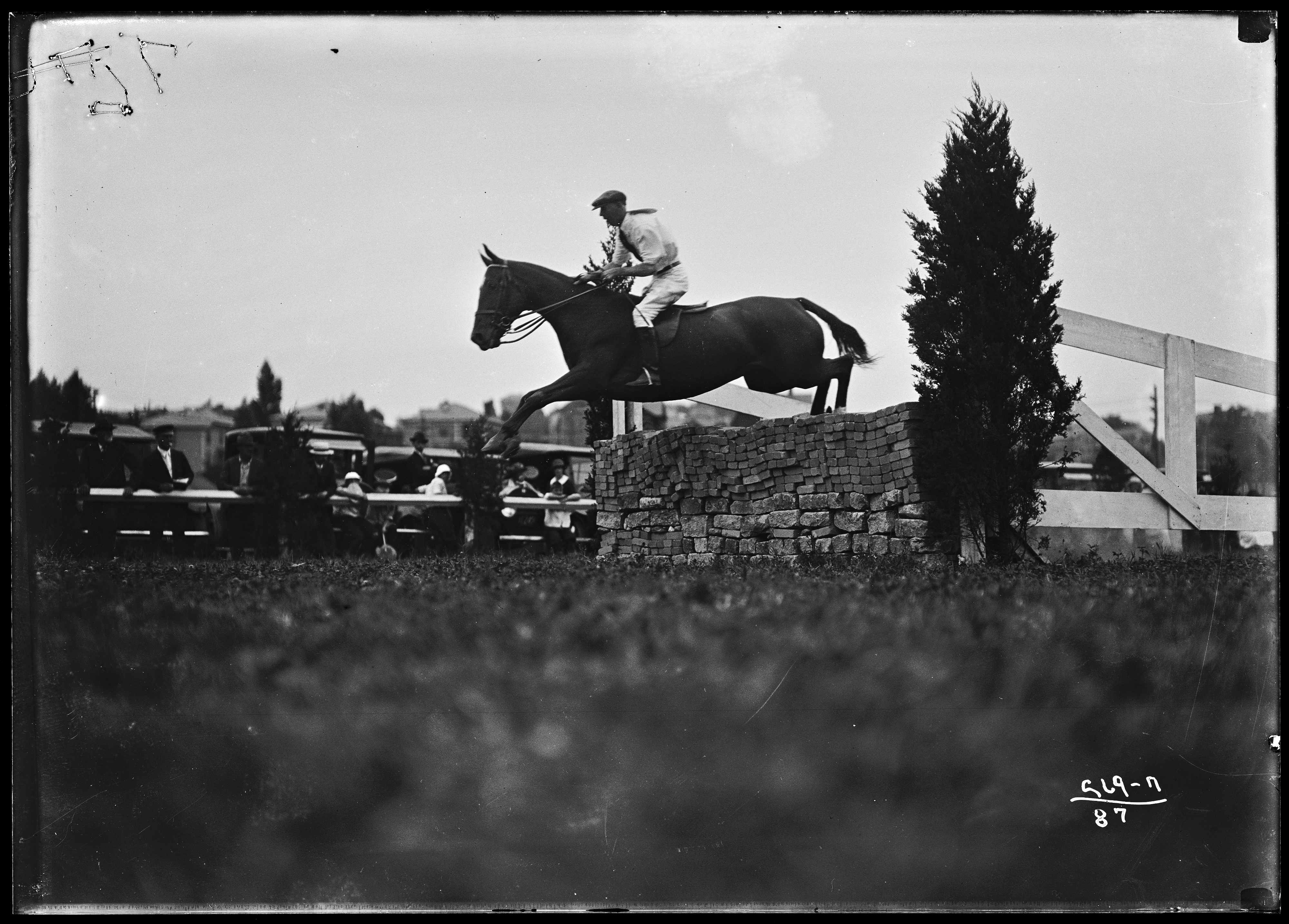
A third attempt reveals a bad angle and a flat image, and draws attention to the fact that he had the camera sitting on the ground, for reasons unknown (one possibility is that he needed to reduce his own visibility and a large tripod would have spooked the horses).
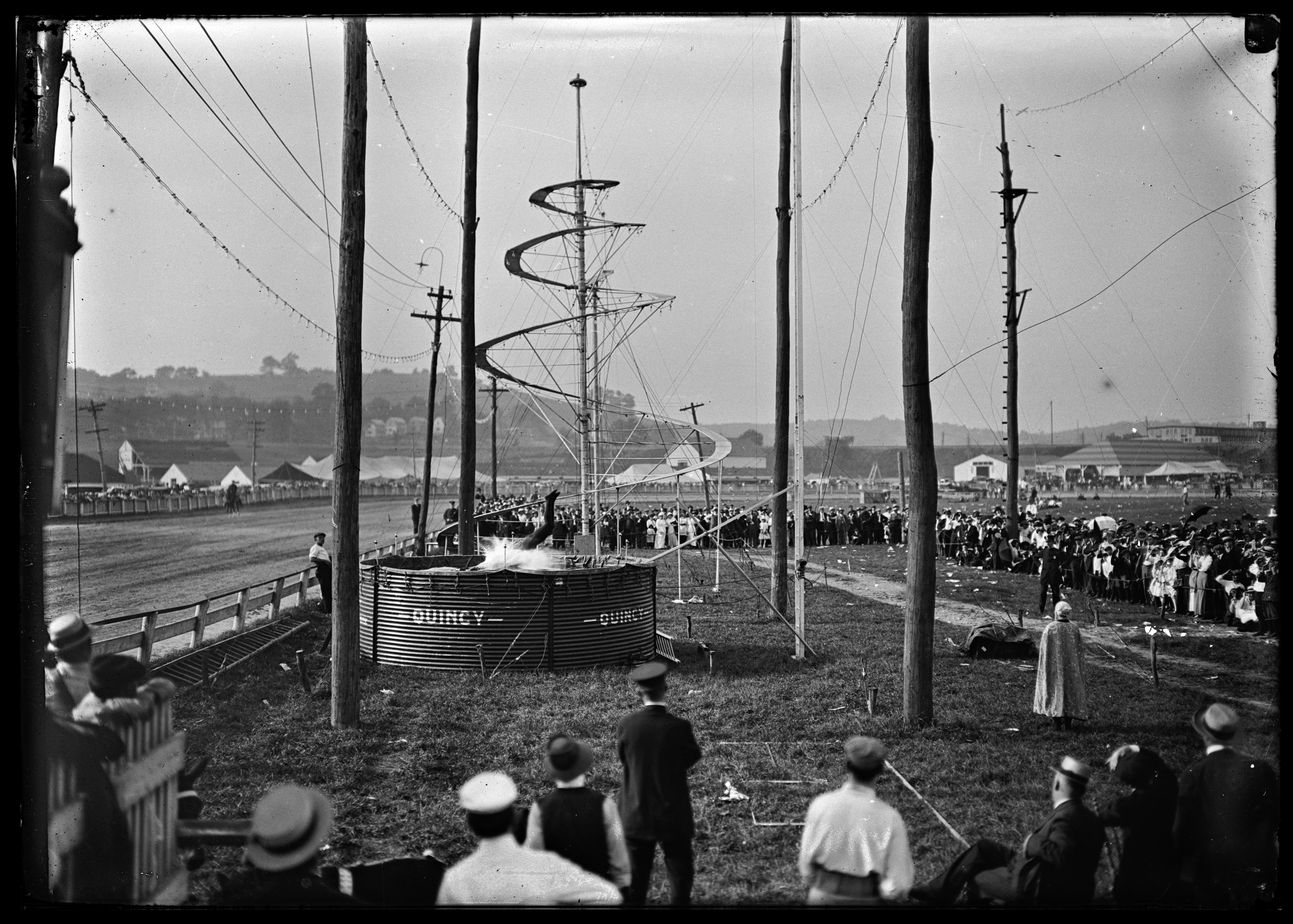
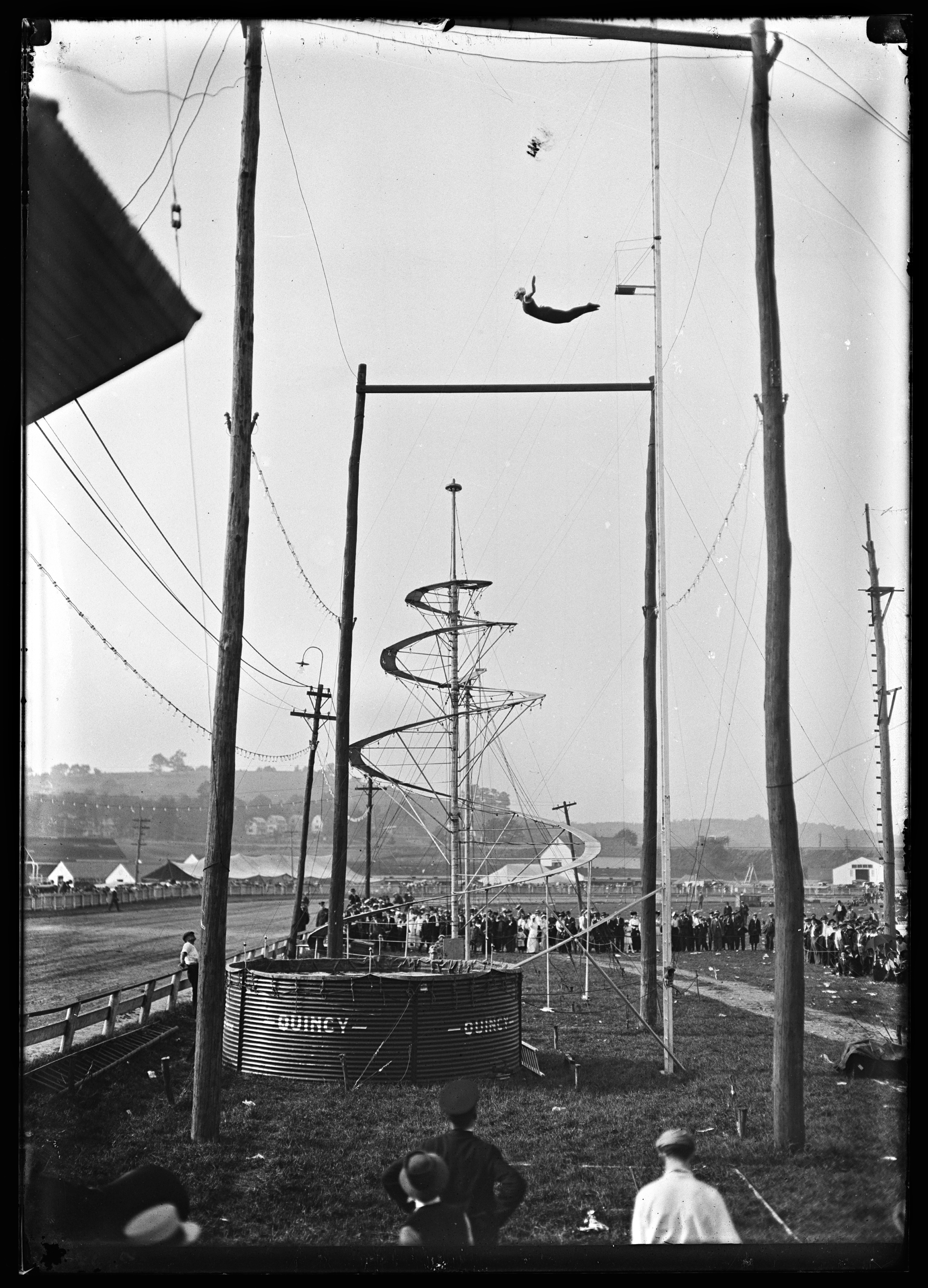
Another scene he photographed a few times was the high-diver. It appears as though he was trying to get at least one shot of the performer actually splashing into the tank, but he’s far enough away and the frame is so cluttered that it takes the viewer a long time to figure out what’s going on. In another image, he’s still probably standing in the same spot, but he simply turned the frame to vertical and released the shutter at an earlier stage of the dive. The first image is almost comical and bizarre; the second is dramatic and succinct:
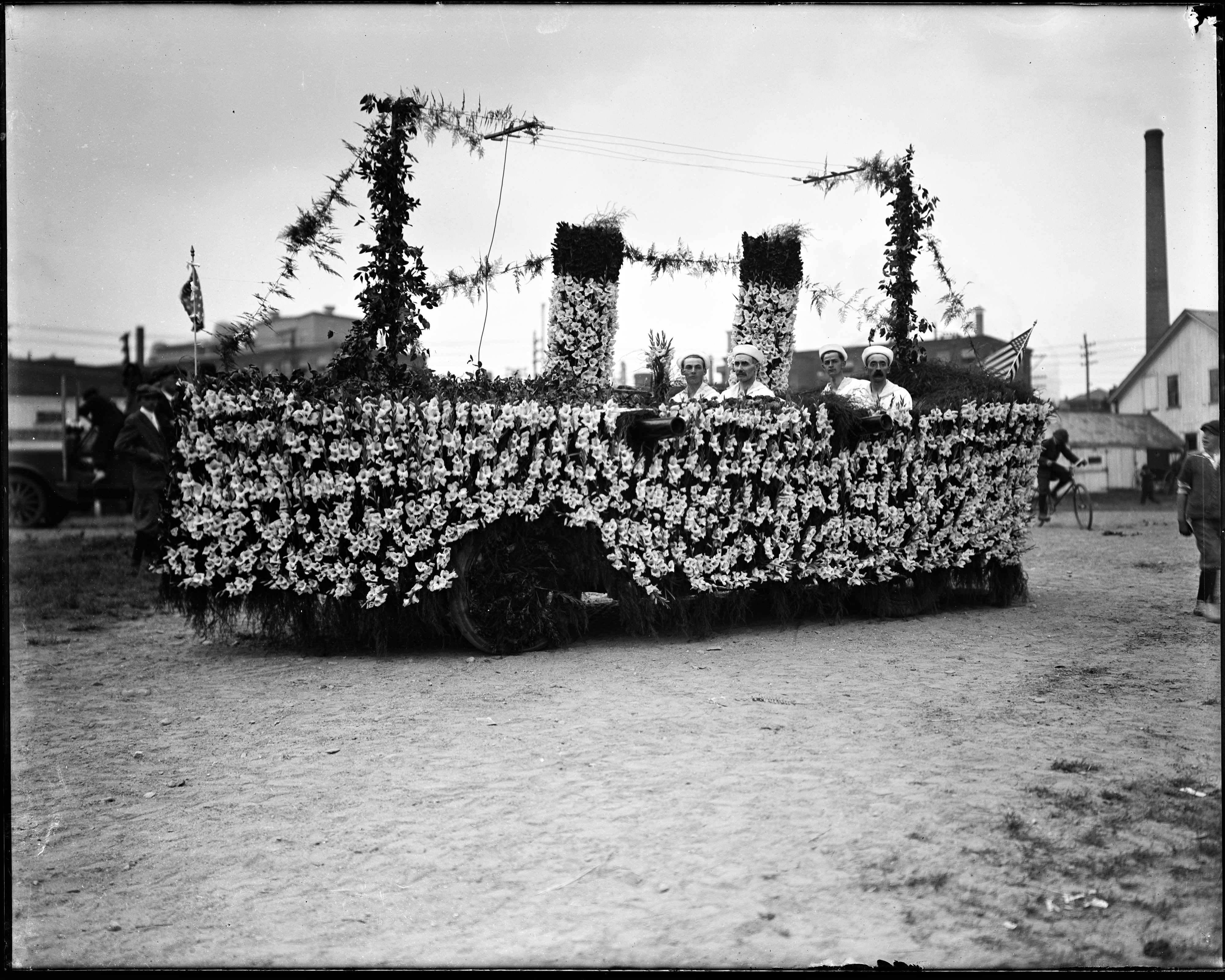
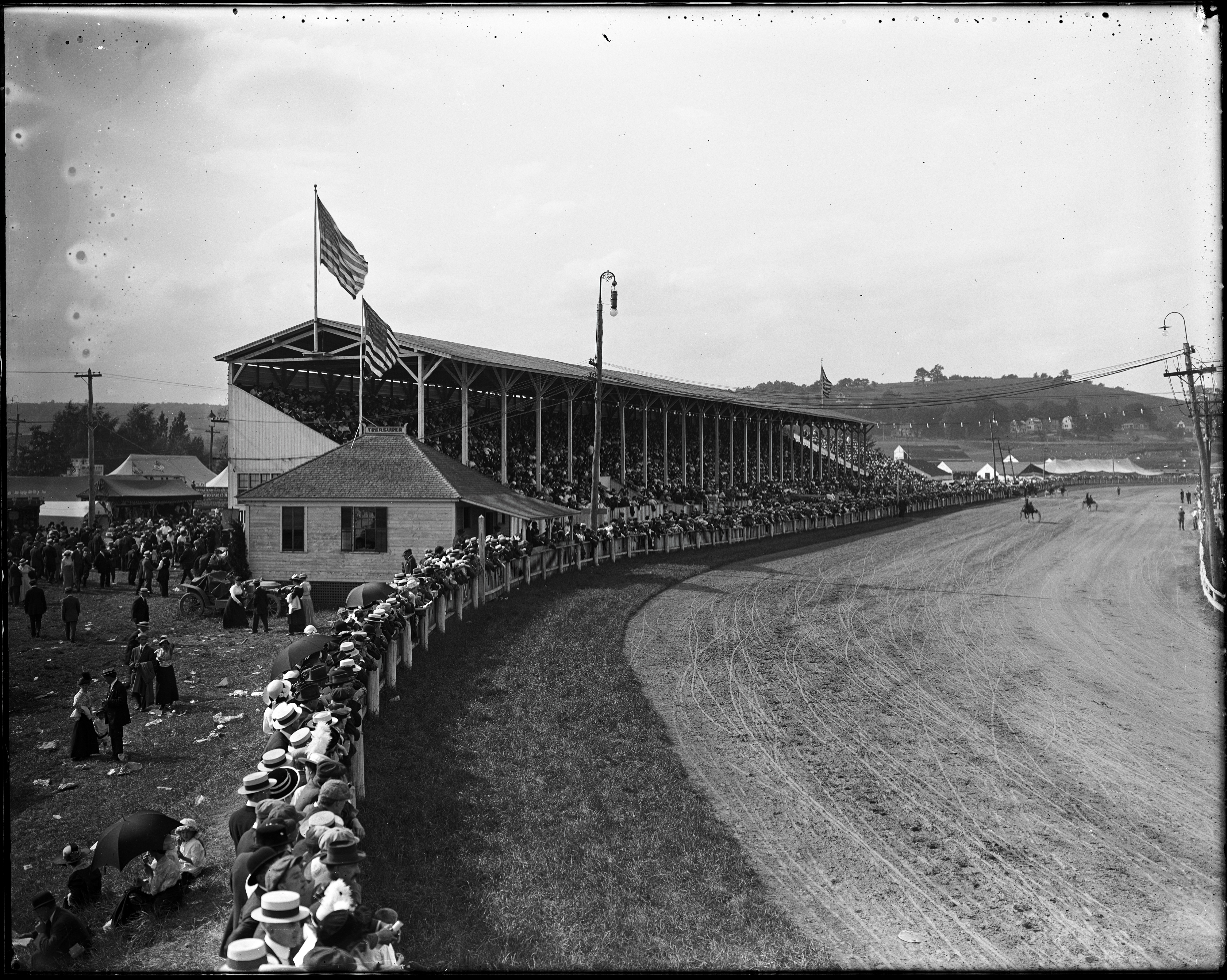
Regardless of how amateur he may have been, Hill managed to document a wide variety of scenes, and though some are eye catching simply for their novelty (like the parade float/battleship made of flowers seen below), others hold a level of detail that is nothing short of magic. The faces and costumes of circus performers (see the above group photo of performers on stage), the smiling couple behind the chicken wire (see the above photo of crowd on the grandstand), the families near the edge of the frame oblivious to the racetrack (see the left edge of the racetrack photo below), and the two boys who have climbed up the pole out of the crowd and spotted the photographer (see the second image of this post of the big crowd), are all there in sharp resolution (just look closely). It’s these larger 8×10 inch plates that go beyond the realm of pure documentation and are almost transportive to look at now.
Hill was, as one of his obituaries puts it, taken by death at the age of 64, in November of 1927. U. Waldo Cutler, the director of the Worcester Historical Society, wrote a letter to the editor of the Worcester Telegram in mourning of his passing saying, “There is no one to take his place as a source of information and of stimulus in the study of Worcester history. His wide and accurate knowledge of the facts and his great accumulation of historical material in picture and collected records have been a resource for many years already, and they will, I trust, remain down the generations as a monument to his patient and skillful research among the archives of our city.”
You can see the complete set of 131 glass plate negatives made by B.T. Hill of the fair here.
The Acquisitions Table: The Flower People
Mann, Mary Peabody. The Flower People. Boston: James R. Osgood & Co., 1875.
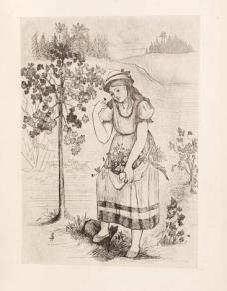 First published in the early 1840’s, Mary Peabody Mann’s The Flower People introduced the study of botany to children under the guise of conversations between a girl named Mary and various plants. In this case, Mary is speaking to a leaf that she picked on a fall day. The leaf patiently explains the life cycle of a tree, and its place in the ecosystem—a very early work of its kind written for children. This exquisite photo-mechanically printed plate was designed for this edition by the elusive woman artist Mrs. G.P. Lathrop.
With a French Accent goes to Bordeaux, France!
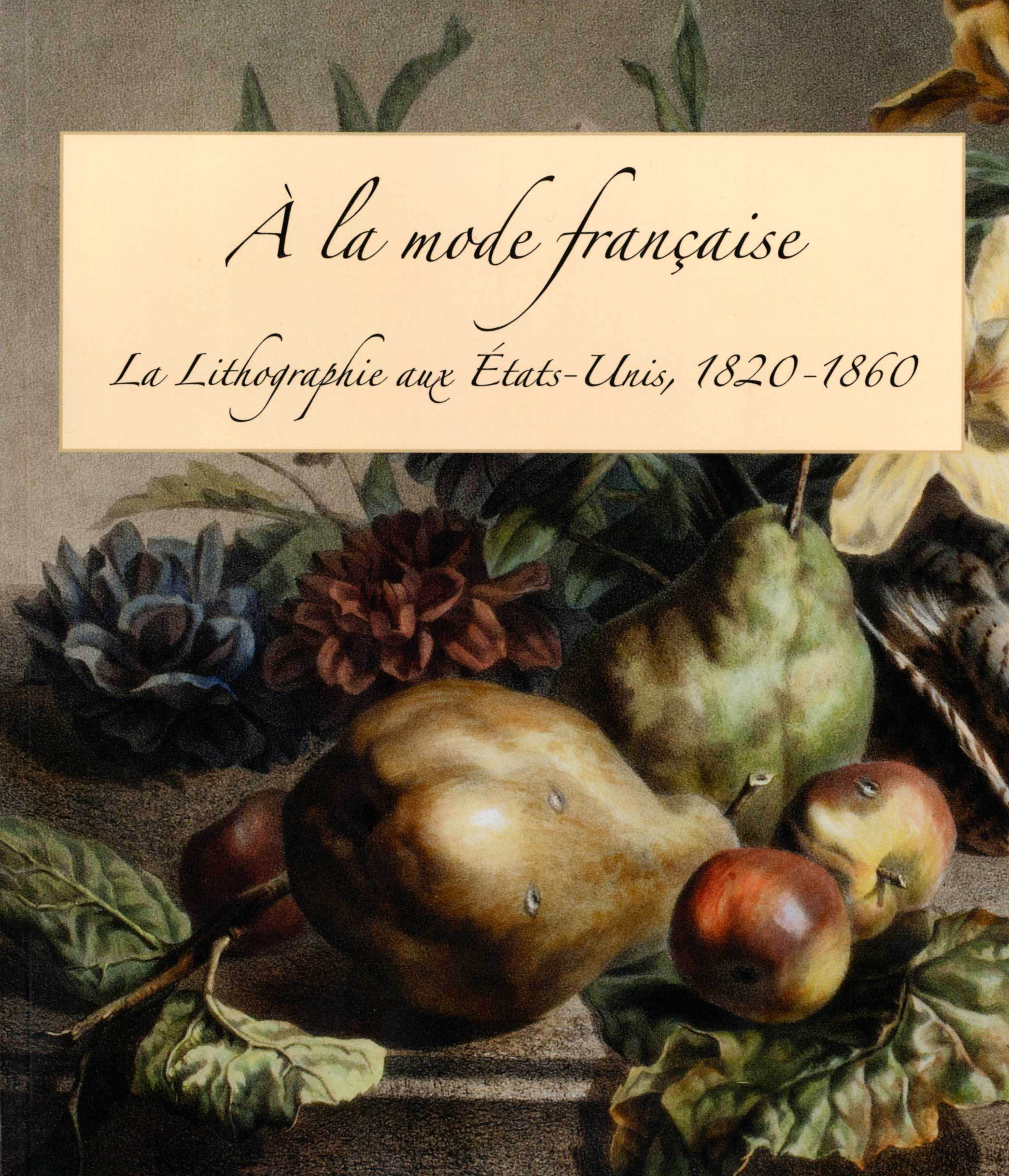
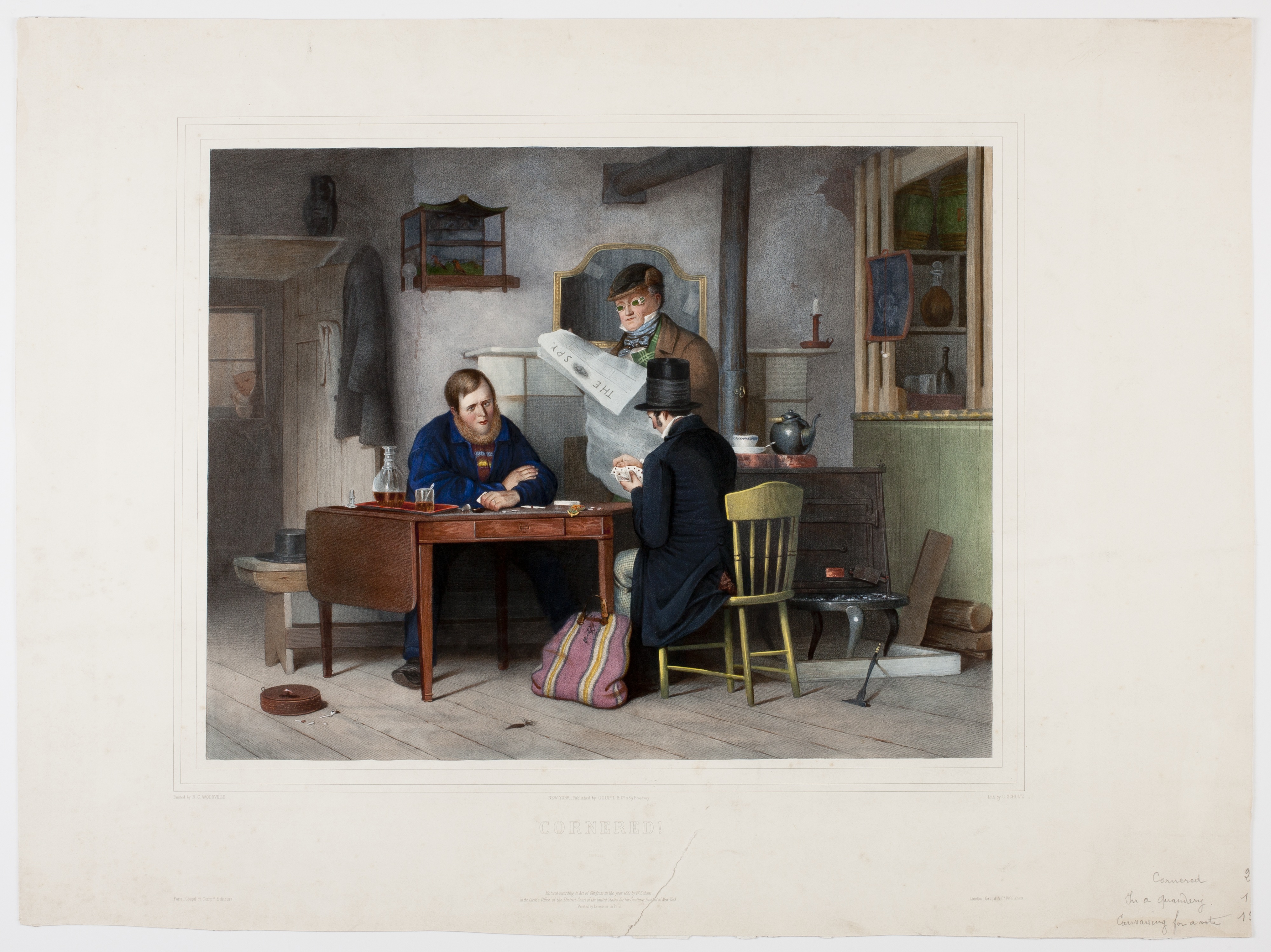 This fall, the American Antiquarian Society, with the generous support of the Terra Foundation, is sending an important exhibition of American lithographs to the Musée Goupil in Bordeaux, France. The exhibition, À la mode francaise: La lithographie aux États-Unis 1820 to 1860, will be opening on September 6 and closing on November 10, 2013. The exhibition is made up of over fifty objects selected from the Society’s outstanding collection of lithographs from the pre-Civil War era. The prints of American presidents, French leaders, genre scenes, and landscapes all reflect the relationship between French and American printers and artists during the early days of lithography. Prints made by French artists who immigrated to the United States will hang with works printed in
Boston, New York, and Philadelphia by firms such as Pendleton’s Lithography and George Endicott who each purchased French presses and hired trained Parisian pressmen to improve their products. Examples of well-known prints published in France after American artists are also featured, including the Power of Music after the American William Sydney Mount and Cornered after Richard Caton Woodville (see above). These images were published and printed by the French firm Goupil & Co. for distribution in the United States and Europe.
The AAS exhibition was first displayed in 2012 during the Society’s bicentennial year at the Davis Art Center at Wellesley College and was well-received by visitors and the press (https://pastispresent.org/2012/news/with-a-french-accent/). This second venue will feature a slightly expanded exhibition and will be accompanied by a French-language edition of the original catalog. The Musée Goupil will also be installing a historic lithographic press in the galleries along with an example of a lithographic printing stone used by the Goupil firm.
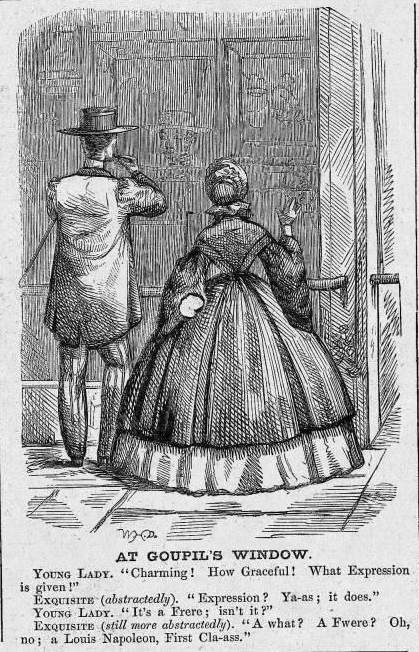
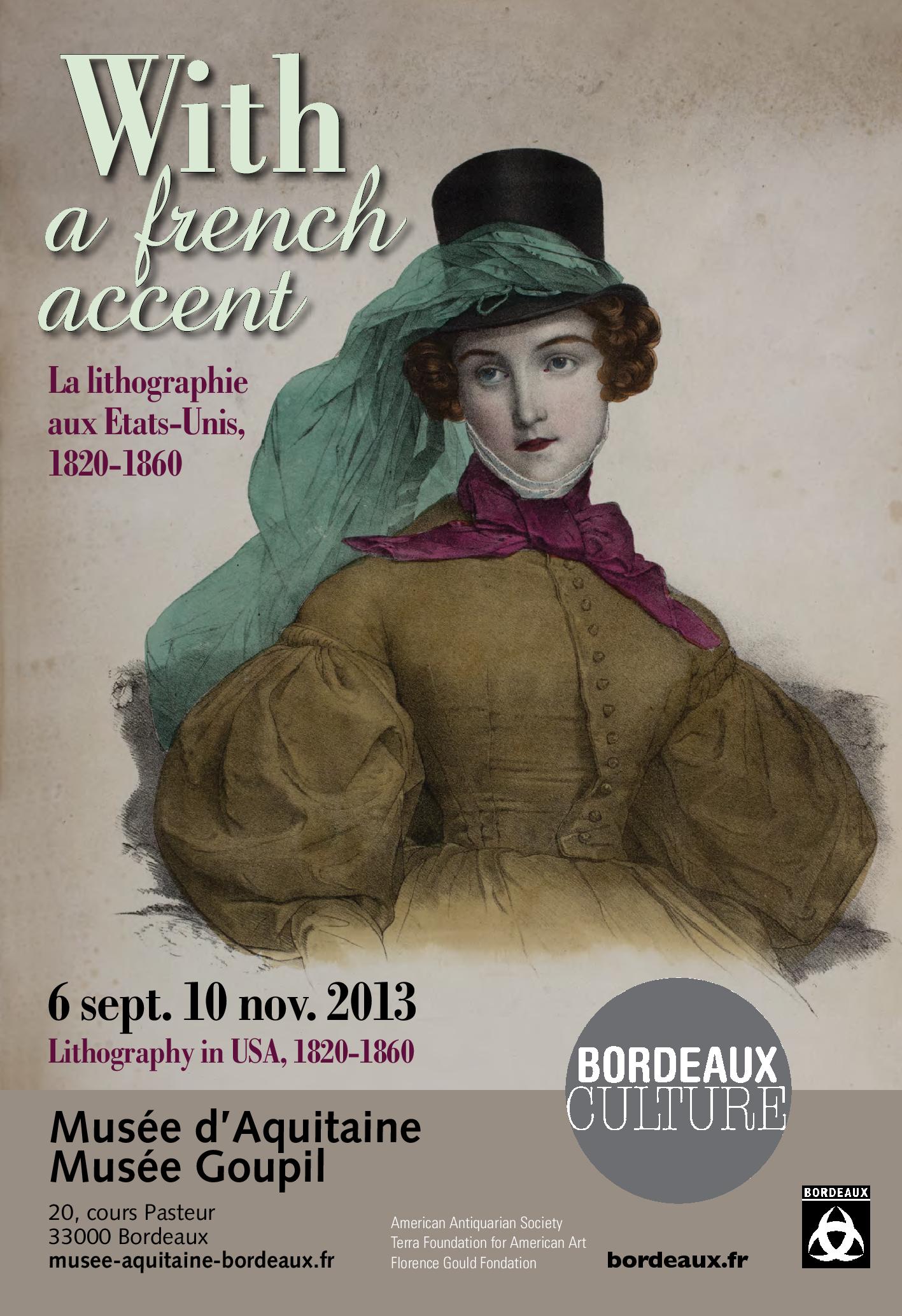 Work on the Bordeaux exhibition has been underway at AAS for several months. All the prints were examined by our conservators, matted and framed and packaged for transportation by air to France. Labels were translated into French for a new audience. The French-language catalog was edited and designed and arrived from the printer in early July. Emails have been flying between Worcester and the mayor’s office in Bordeaux (the Musée Goupil is overseen by the municipal government there). Posters (such as the one seen at the right) and invitations have been prepared by our French counterparts and the logistics of moving and installing the printing press into the gallery are all worked out. The Musée Goupil opened in 1991 following two generous donations to the city of nearly a quarter of a million prints and artifacts relating to the French publishing house of Goupil & Co., which was founded in Paris in 1850 and had offices around the world (including one in New York, which was featured in a cartoon in the January 19, 1861 issue of Harper’s Weekly). The museum preserves and displays Goupil lithographs, photogravures, copper plates, lithographic stones, and presses and also holds important archival papers relating to the firm’s various business ventures.
To round out the activities, in October the Society’s Center for Historic American Visual Culture (CHAViC) will be hosting a conference in Bordeaux focusing on the exhibition. The conference is also generously supported by the Terra Foundation. American and French scholars and AAS staff and members will gather on Friday, October 11th to hear papers on a variety of topics, including French printers who migrated to the United States, the circulation of French prints in the American market, and depictions of Lafayette and Napoleon by American publishers. Stay tuned for more details on the conference as the date approaches.
The Acquisitions Table: Moses Kimball’s Journal
Kimball, Moses. Journal, 1850-1851.
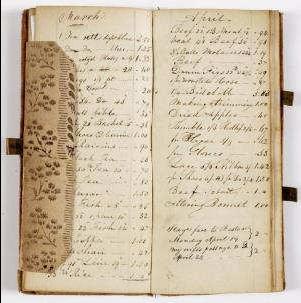 Moses Kimball (1809-1895) was an active citizen of Boston throughout the 19th century. After failed attempts at the newspaper and printing business, Kimball succeeded in the museum business, purchasing and expanding the New England Museum (which had been established by Ethan Allen Greenwood) in 1838, and opening the Boston Museum in 1841. He was a close associate of P.T. Barnum, and was the founder and owner of the “Fejee Mermaid”, made famous and widely exhibited by Barnum. Kimball’s political life included three terms in the Massachusetts House of Representatives, as well as three unsuccessful runs for Mayor of Boston. This account book chronicles another side still to Kimball, his family life. Labeled “Family Expenses”, the book includes monthly lists of the various purchases Kimball made for his family (wife Frances Lavinia Hathaway and daughter Margaret Kimball). Pages show the purchase of items such as linen and other fabrics, meat and sundries, wine and coffee, and the occasional travel expenses. The front of the volume contains a pocket with receipts, including one for bleeding with leeches.