Norwich Fire Insurance Co. New York: Hatch & Co., 1863-1865. This color lithograph for a Connecticut insurance company features a city view surrounded by international flags and the names of local directors with interests in the firm. The sheet was printed by Hatch & Co. in New York, who advertised that they could produce: “Portraits landscapes, labels & show cards, and every description of color work. Bonds, certificates of stock, checks insurance policies, diplomas, note & letter heads, executed in the best style.” The view of Norwich is taken across the river from the west and aligns closely with an 1849 lithograph produced by Sarony & Major based on a painting by Fitz Henry Lane, with added steam-powered vessels plying the water. The print was probably produced as a promotional image, intended for display in the company’s office or in the offices of the individual directors.
Although we might think of Santa and an evergreen Christmas tree as inevitably wedded in nineteenth-century children’s book illustration, that was not necessarily the case. Until about 1840, New Year’s Day was favored over Christmas as the family-appropriate winter holiday in the young American Republic, particularly in New England, where the descendants of the Puritans cast a dim eye upon the Christmas holiday with its Roman Catholic roots. However, with the influx of German immigrants to the United States in the 1840s, the celebration of Christmas and the use of the Christmas tree gained a toehold in American culture. Many of the newly arrived Germans settled in Philadelphia; among them were skilled book artists like lithographer Augustus Kollner (b. 1813).
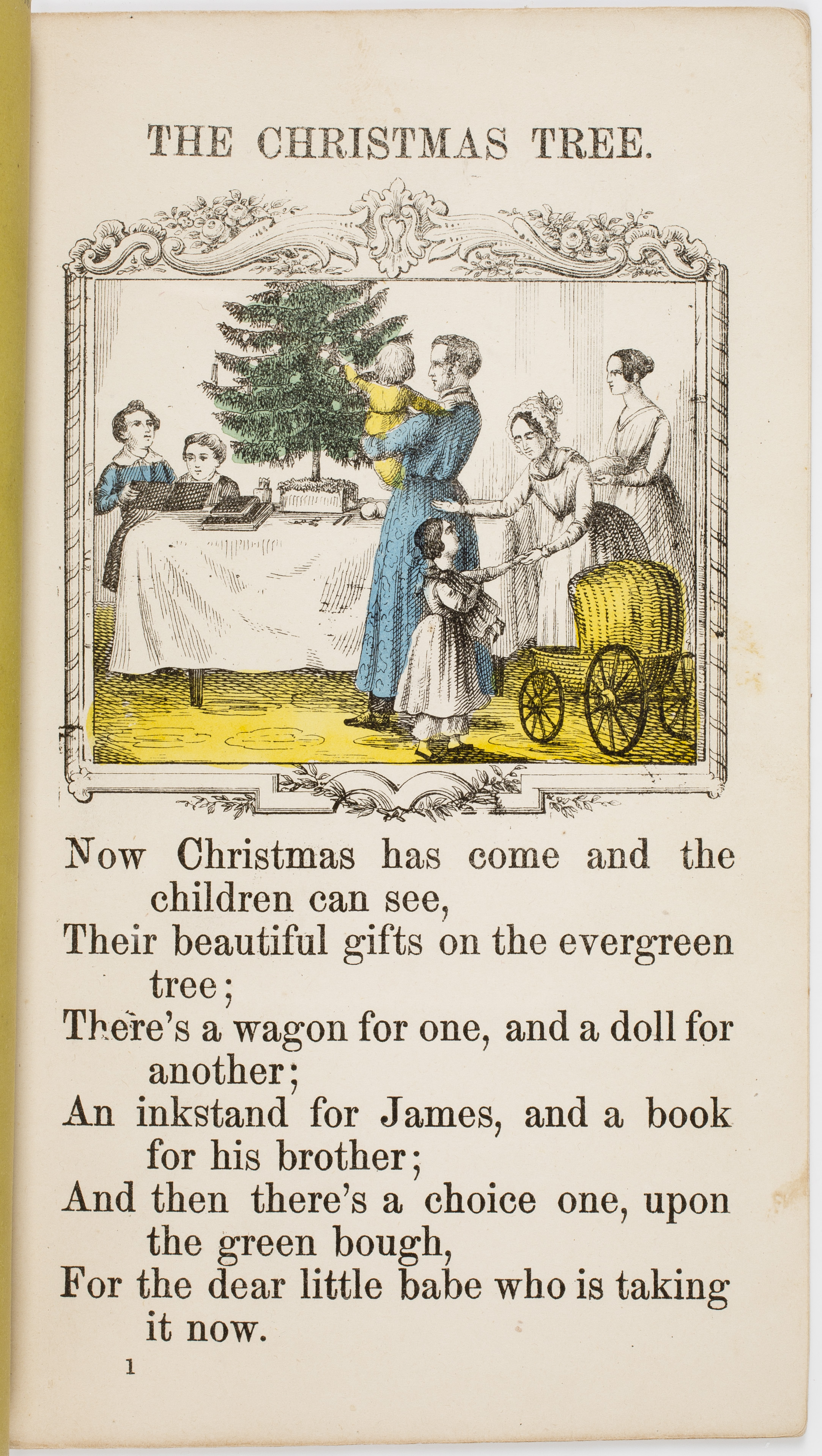
Kollner illustrated several picture books published in Philadelphia by the American Sunday-School Union, one of most prolific children’s book publishers operating before the Civil War. AAS recently acquired a copy of the ASSU picture book Life in the Nursery. The Christmas Tree; it was issued circa 1844-1853, and contains one of the earliest children’s picture book illustrations that we have of a Christmas tree.It shows a hand-colored lithograph of the lower half of a tabletop Christmas tree modestly decorated with a few ornaments and a few candles. The image is not religious, but rather family-centered: children are looking up at the tree and the gifts on the table. The parents are in control of the situation: the father holds a very young child, and the mother extends a hand to her daughter, gesturing to the tree. The accompanying text gives us an introduction to the Christmas tree as panacea of gifts: “Now Christmas has come, and the children can see, / Their beautiful gifts on the evergreen tree/; There’s a wagon for one, and a doll for another…” Although this poem and picture describe an evergreen tree, this image was not yet culturally embedded as what constitutes a proper Christmas tree.
The cover design for Kriss Kringle’s Christmas Tree, also published in Philadelphia at about the same time, in 1846, shows a rotund, elfish Santa putting gifts from his backpack onto a short, deciduous tree. This collection of brief stories includes “The Christmas Tree”—a tale about an impoverished child who receives a vision of the Christ child showing him a star-spangled Christmas tree up in the heavens.
In 1860, the New York-based General Protestant Episcopal Sunday School Union published A Christmas Tree for Christ’s Children. It too featured a non-evergreen tree: according to the book’s first chapter, the tree is a novelty; it is an orange tree brought into the parlor from the home’s conservatory and decorated with dolls, candy, and wax lights by Mr. & Mrs. Oldham for their children’s delight and religious instruction. The frontispiece (below) shows the children gathered around the newly decorated Christmas tree under the direction of their father, who points out the religious significance of the various ornaments; for example, a toy soldier represents the belief that when one is baptized, he becomes a soldier of Christ.
Although the first picture book version of Clement Clarke Moore’s poem The Night Before Christmas was issued in 1848, arguably it is Thomas Nast’s illustrations some twenty years later for New York publisher McLoughlin Brothers that shaped the American cultural image of a rotund, fur-suited, pipe smoking Santa that we recognize today (see right). But even then, Santa appears crouched over his gifts with a tabletop Christmas tree just barely visible in the upper right hand corner of the picture.
It would take an ongoing infusion of German immigrants and German language picture books like the edition of Gustav Erlenkotter’s Poetischer Jugendschatz in Bild und Spruch (New York, ca. 1870-1885) seen below to build a solid iconographic bond between Santa and the Christmas tree. In this case “Ruprecht” (Father Christmas or Santa Claus) rides a horse co-piloted by a cherubic angel bearing a lit Christmas tree (what a headlight!).
In the late nineteenth century, Moore’s reindeer-driving St. Nick and the Germanic Ruprecht bearing the Christmas tree on horseback became merged, resulting in this fantastical cover image for The Night Before Christmas issued by McLoughlin Brothers in 1899. We see a Santa driving a packed sleigh laden with not only gifts, but a full-sized, decorated Christmas tree; it is as if Santa is bringing all of the Christmas trappings to families everywhere.
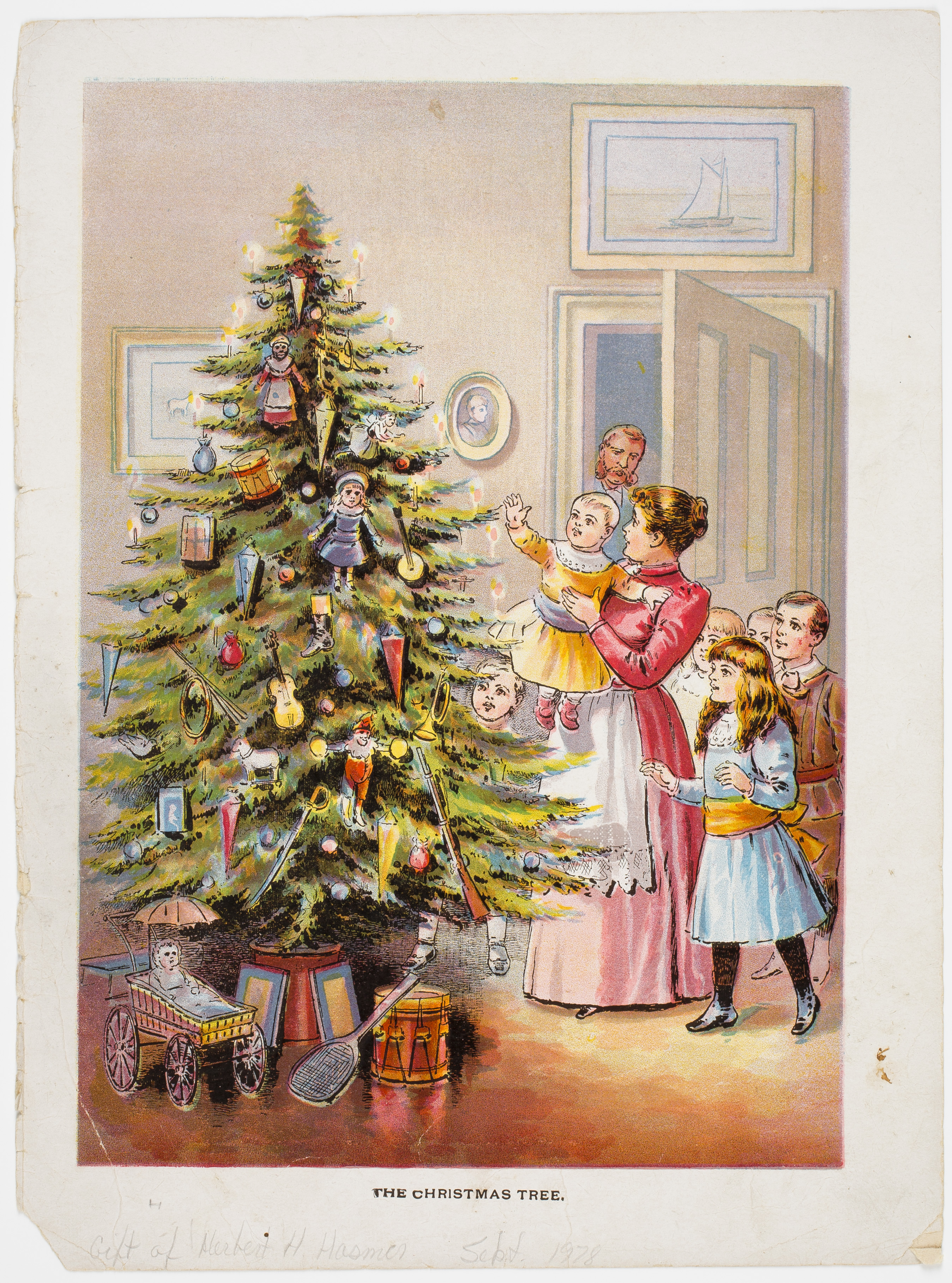
And what is the end result of Santa’s delivery? This magnificent, tall Christmas tree, loaded with ornaments and small gifts, sheltering the larger gifts placed around it (below). Santa and the Christmas tree both came of age in America in the latter half of the nineteenth century, and their story unfolds in the pages of children’s picture books with whimsical splendor.
At this time of year, when shopping becomes a constant (and sometimes stressful) preoccupation, it’s easy to forget that for many people it’s a pleasurable pastime. Not just because of what you actually buy, but also because of the searching, comparing, matching, and imagining that all make up the act of shopping. As it turns out, the attractiveness of shopping as entertainment is nothing new. So as you search for your last-minute Christmas gifts, here are some items from the collections to get you in the mood.
Let’s start with clothes. Men like to grumble about women’s love of shoes and accessories—purses, jewelry, gloves, scarfs, etc. Just what is it about these items that is so attractive to women, they ask? Although we may not be able to answer this question, evidence from the archives suggests that women have long found shopping for these things particularly enjoyable. Take, for example, the 1849 image of women shoe shopping above. Five adult women and one young girl are each in the process of finding that perfect shoe. Of the five faces we can see, all have contented smiles—even the shop-girl kneeling to help the woman in the center looks to be pleasantly occupied. The woman on the far right is holding out her foot for admiration, while the young girl in front of her excitedly tries to pull on a shoe. Although women loving shoes is a stereotype, it is apparently one based somewhat in truth. (I’m guilty of it myself.) And it can start young; in Gap just the other day, I saw a girl about the same age as the one in the image in the same exact pose. I also have a one-year-old goddaughter who can be bribed by telling her you will put on a pair of her favorite shoes for her.
You may also notice that four of the women in the image are wearing fashionable bonnets. A new bonnet at that time would have been about equivalent to a new purse now. Women would have bought those bonnets from a milliner, or a tradesperson who specialized in hat and bonnet making. This trade card for Madame Walsh, Fashionable Millinery and Dress Making, shows a well-dressed woman with her two young girls looking at bonnets with the milliner, who is also a woman. As you’ll notice, the milliner herself is also well-dressed—dressmakers and tailors would often wear their own wares as a way of advertisement.
While the trade card is geared toward the shop’s female customers, the popularity of hat shops was used in other popular culture of the time aimed at men. In an 1842 issue of the New York racy newspaper The Weekly Rake, the image seen to the left accompanied an article advising its male readers to hang out near hat shop windows as a way to meet women. While the man under the grate took things a bit too literally, the existence of such an article and image imply that women’s love of hats and window shopping were well known.
Lest we think that only women have the shopping bug, below is an 1865 advertisement for a men’s clothing store in Boston called Macullar, Williams & Parker. According to the ad, they sold “fine clothing to order and for the wholesale and retail trade,” carrying “fine clothing and mens furnishing goods…fine woolens and tailor trimmings.” A fashionable couple can be seen window shopping in front of the store, and both men and women are entering the building. Then as now, it seems, men were believed to need some help in the clothing department.
If window and accessory shopping were popular activities in the nineteenth century, there is also evidence that the idea of “retail therapy” was not unknown. On April 25, 1861, about a week and a half after the outbreak of the Civil War, Caroline Barrett White, a staunchly antislavery upper-middle-class housewife from Brookline, Mass., recorded her early war efforts in her diary: “Made the Soldiers handkerchiefs today and carried them to the hall – Went into town this P. M. with Frank to get bonnet fixings – we also purchased some patriotic streamers to decorate curtains with.” Here, shopping for those all-important bonnet trimmings is coupled with a more patriotic kind of shopping. Over the next few days she records trimming her bonnet and “making some decorations of the national colors,” which, when hung in the parlor, she writes, “they are pretty I think.” Shopping, home decorating, and making things look nice have become a way to deal with the beginning of a tragedy that, though they don’t know it, will continue for the next four years.
A page from White’s diary including the April 25, 1861 entry
Over the course of those years, White writes both jubilantly and heart-wrenchingly, depending on the war news. On September 3, 1862, as the war is starting to look very poorly for the Union, she writes the following:
Lovely cool day – I went to Boston this morning – did some shopping – could not find what was very satisfactory to me – but it does not matter – It seems to me nothing matters now – I feel sad, sad & discouraged – the news from our armies is of the saddest – dying, dying, dying poor brave soldiers! I do not know but it is the worst to be desired however – to die, rather than live to be disgraced – Oh God! Hasten the right.
Suddenly something that she had once found pleasurable and productive, and may even have hoped to help cheer her this day, now seemed meaningless. In reality, however, shopping often had a lot of meaning during the Civil War, particularly during Sanitary Commission fairs and other bazaars that were intended to raise money for the war effort. These functions, planned mostly by the women on the home front, sold goods and offered entertainment to fundraise and provide a bit of a respite from the harsh realities of the war. The image to the left depicts a Sanitary fair in Brooklyn in 1864. Decked in patriotic decorations, the hall is populated by home goods and women, many in their dark mourning clothes. Most of the few men visible are in uniform, probably on leave from the front.
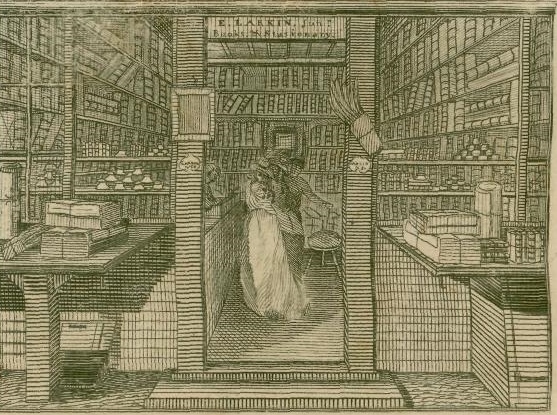
While using shopping as a distraction from the horrors of war is the extreme, the idea of “retail therapy” is a common one today. Here at AAS, we would suggest heading to a bookstore to browse the shelves. (This is also a great break from other Christmas shopping you may be doing.) The detail below from a 1789 engraved receipt from the Society’s ephemera collection shows the interior of Ebenezer Larkin’s bookstore on Cornhill in Boston. You can see a man and a woman browsing in a room lined with shelves full of books and stacked with ink pots. In many ways it doesn’t look so different from bookstores today, and would have offered book lovers similar pleasures.
So if you find yourself tired of tracking down the perfect present or standing in lines, just remember: shopping has been viewed as a pleasurable activity and effective distraction for centuries. Chances are that enjoyment will return for you as well. Eventually.
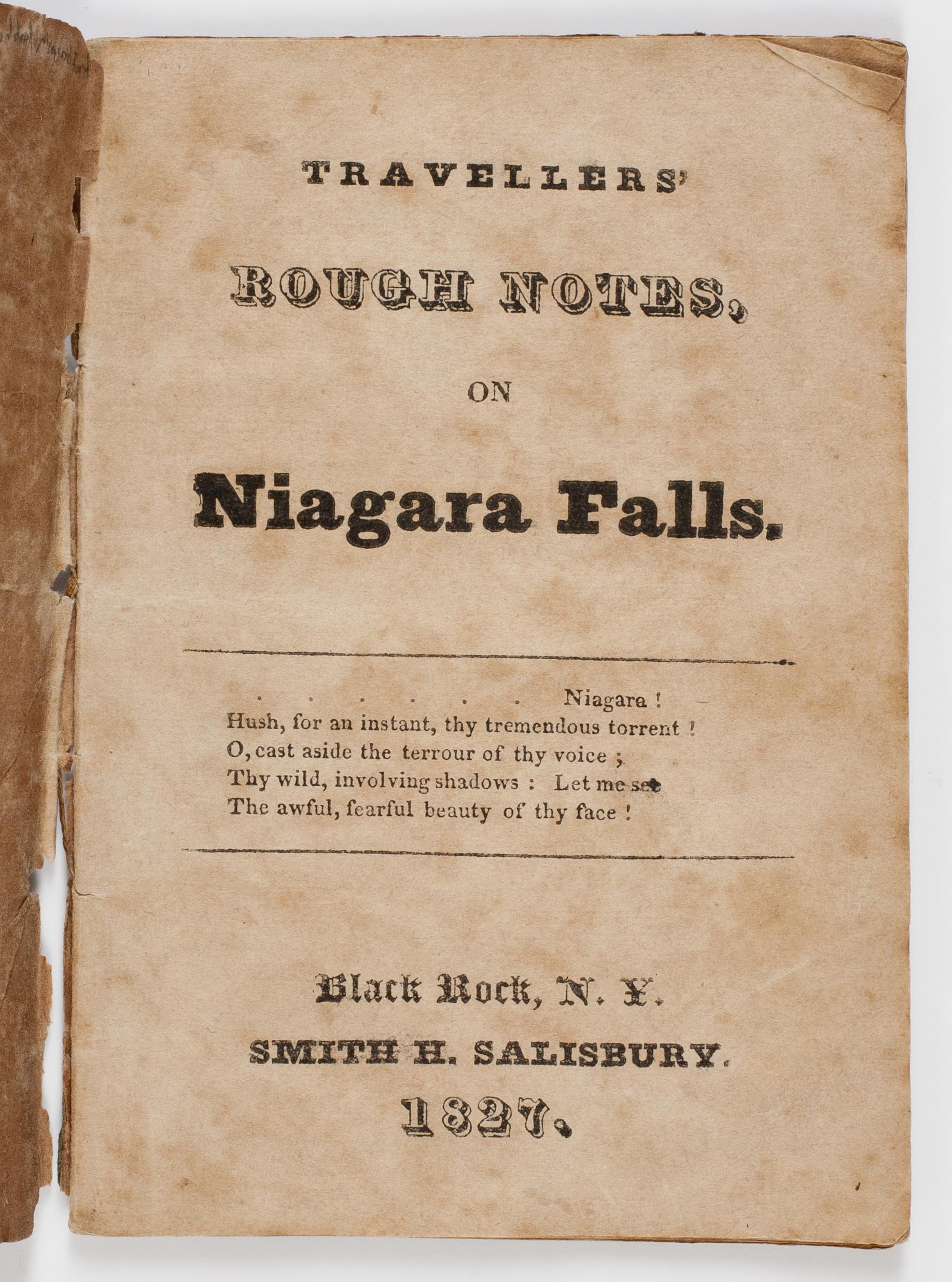
Travellers’ Rough Notes, on Niagara Falls. Black Rock, NY: Smith H. Salisbury, 1827.
APPARENTLY UNRECORDED, ONLY KNOWN COPY!
Please excuse the yelling, but we get excited at AAS when we are able to add a new piece to scholarly and bibliographical knowledge. Though tiny (just a little over 11cm in height) this small pamphlet represents just such a discovery. Upon first seeing its description in the Swann Auction catalog, we knew it belonged at AAS. And we weren’t the only ones to excited by this recent discovery – the local New York paper, The Niagara Gazette, even featured an article about AAS acquiring this previously unknown title.
The first 12 pages of this curious little pamphlet are devoted to “Rough Notes of an Old Traveller,” which compare the anonymous author’s 1797 visit to Niagara Falls with another visit in 1827. The remainder of the 32 pages contains a charming and humorous account of the falls titled “Dick Wildfire’s Narrative,” signed in type “Rich: Wildfire” and dated 14 June 1827. Neither of these sections appears to have been published elsewhere making this quite possibly the unique surviving copy of either section of the text.
This November AAS experimented with a new year-end fundraiser. We called it “Give a Gift to AAS Give a Gift to the World.” Thirty objects were selected from across the entire spectrum of the Society’s collections with several criteria in mind. Items had to be significant sources of research, fragile or rare, and under about 200 pages in length. Also, the pieces could not be part of a digital resource. In fact, the whole point of the fundraiser was to secure funding to digitize and make available all thirty pieces, for free, via the Society’s website.
This turned out to be one of our most successful initiatives to date. No sooner had we put the catalog of our choices online when the support started pouring in. At about 10:30 on a Monday, we sent an email announcement out to members and friends who had participated in previous Adopt-a-Book efforts and Adopt-a-Gift-book from last December. By noon, one third of the material had been selected for funding! By Tuesday, half was gone. We had several instances when multiple emails poured in for a single object. It was great!
We had originally planned for the fundraiser to run through the end of 2013. But, of the thirty original pieces, only two remain. This blog post is a plea for the final support needed to call this effort a complete success. What is left, you ask? Click on over to the catalog website and see in more detail, but described here briefly, the two lone, abandoned, unloved, remaining objects are:
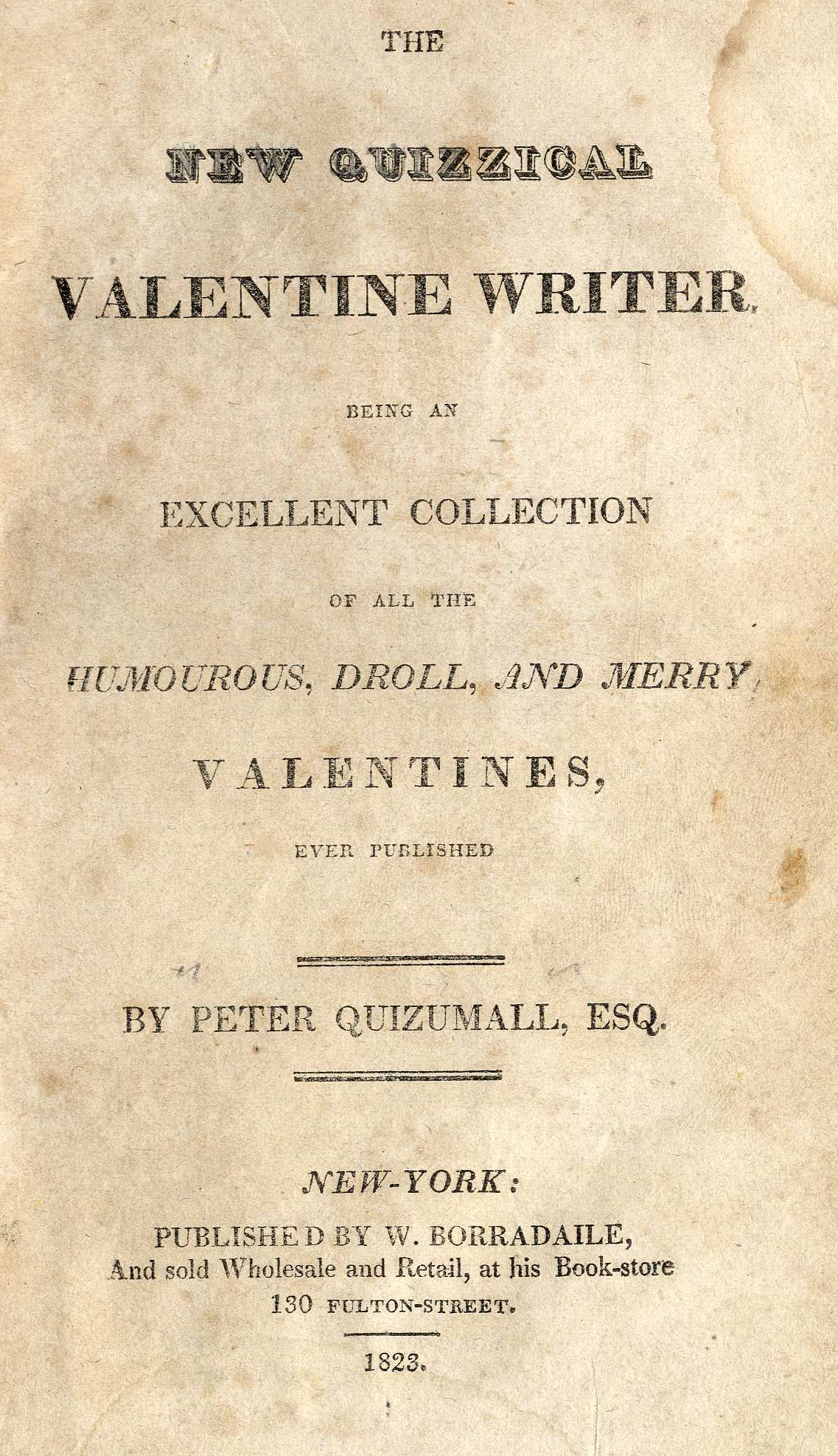
An 1828 Valentine writer, published in New York. For a donation of $75 AAS will photograph all twenty-eight pages of this slim volume, which was originally used by lovelorn correspondents with writer’s block. Popular and clever turns of phrase, snippets of poetry and suggestions for humorous quips were all published here to help those making valentines at home, or for appending to published valentines to come up with just the right way of saying “I love you.”
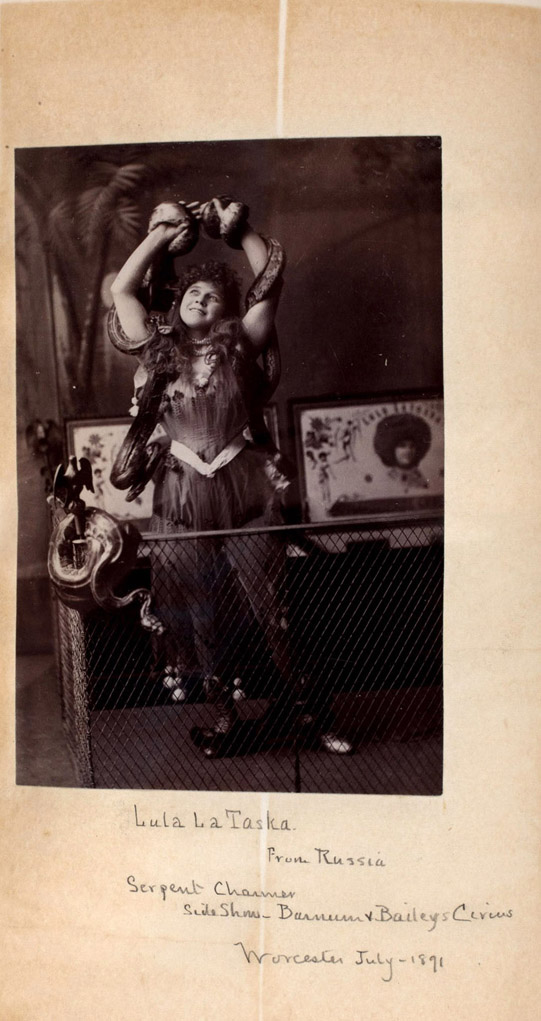
For the less sentimental, the final historic object waiting for digitization is a homemade scrapbook from the Society’s manuscript collection. Made by Nathaniel Paine in the 1880s, the unfortunately titled “Freaks of Nature” includes an abundance of ephemera related to circuses, theater, and side show entertainment. Lots of the pieces glued to its pages are not known in any other copies, are annotated by Paine with the location and date of the original event, and document the variety of popular entertainment consumed in the United States in this era. For $100, the entire volume will be photographed and unlocked for all to consider, both in Worcester and well beyond.
So here’s the pitch—and this is coming from the curator who as a kid was the bespectacled, skinny child chosen last for kickball, baseball, and just about any other team sport. I feel for these two last historic objects, leaning, if you will, against the gym wall. They remind us of the elephant and dolly stranded on the Island of Misfit Toys in the Rudolph the Red Nosed Reindeer television special playing all over cable this month. Can you help AAS with your gift to make them part of the great sweep of bytes, jpegs, and TIFFs that swirl through the ever-growing digital realm? We thank you, as always, for your amazing support of the Society and our activities. Happy New Year!
The Los Angeles skyline at dawn during a recent AAS business trip.
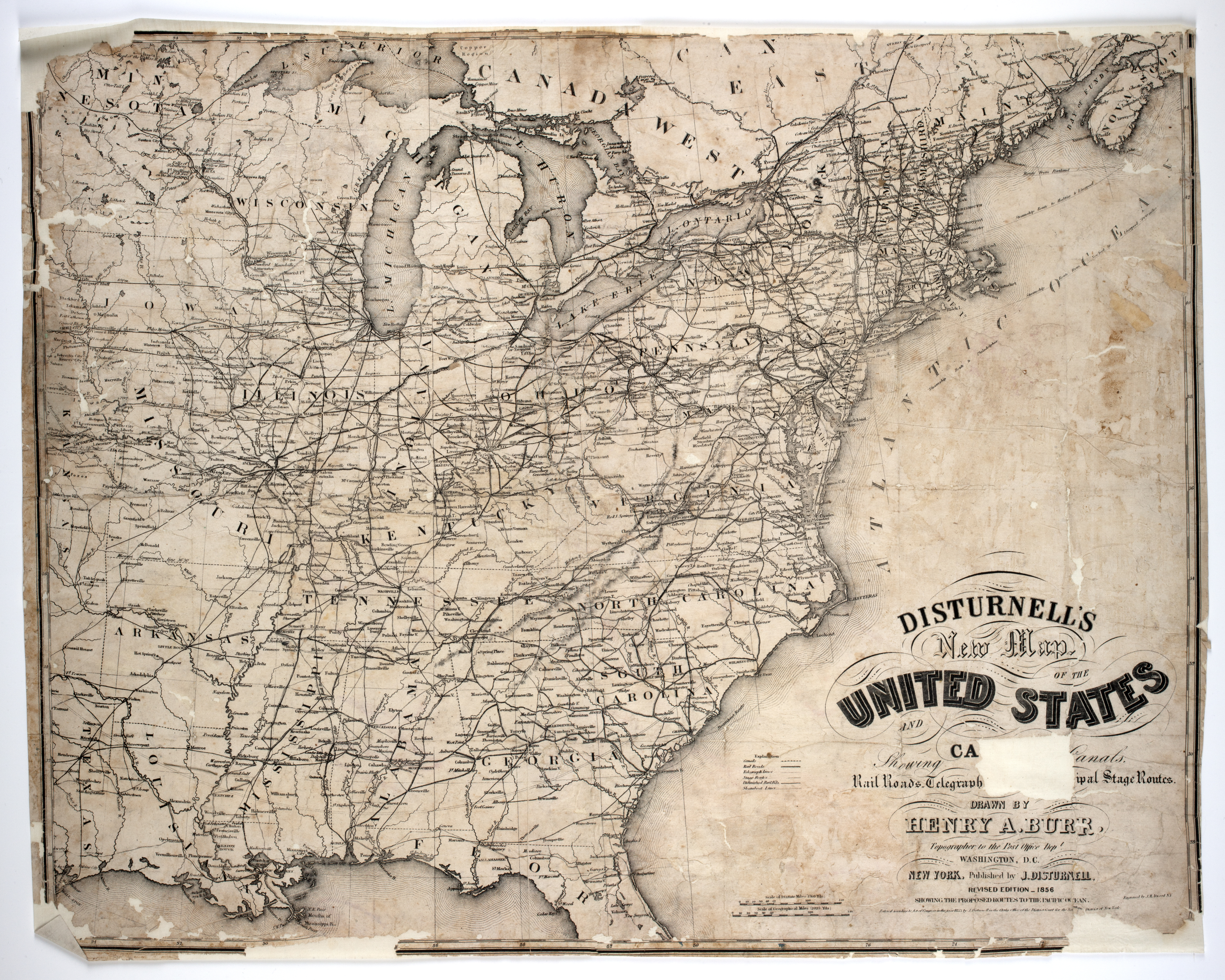
A lot of the Society’s staff travels for work. We are a national organization and we collect material from all across the fifty states and Canada. Curators travel to conferences and to visit collectors, catalogers move about for training and to stay up to date with the latest methods, managers visit members, foundations, granting agencies, and vendors. Meetings and events are held regularly in Worcester, of course, but this past year we held a conference in Bordeaux, France, participated in collaborative exhibitions in Northampton and Boston, and gave papers or attended conferences in San Francisco, St. Louis, and London, England.
This past Tuesday several of us were on the move all at once, as you may have noticed if you follow the Society’s Instagram account. Two staffers were in California visiting donors and foundations while four others drove through snow and ice to Vermont to work out the details of a new digitization project. Another curator was in New York to attend a member’s opening and to visit with book dealers about possible acquisitions.
This 1856 map shows canal, steamboat, stage, telegraph, and railroad routes.
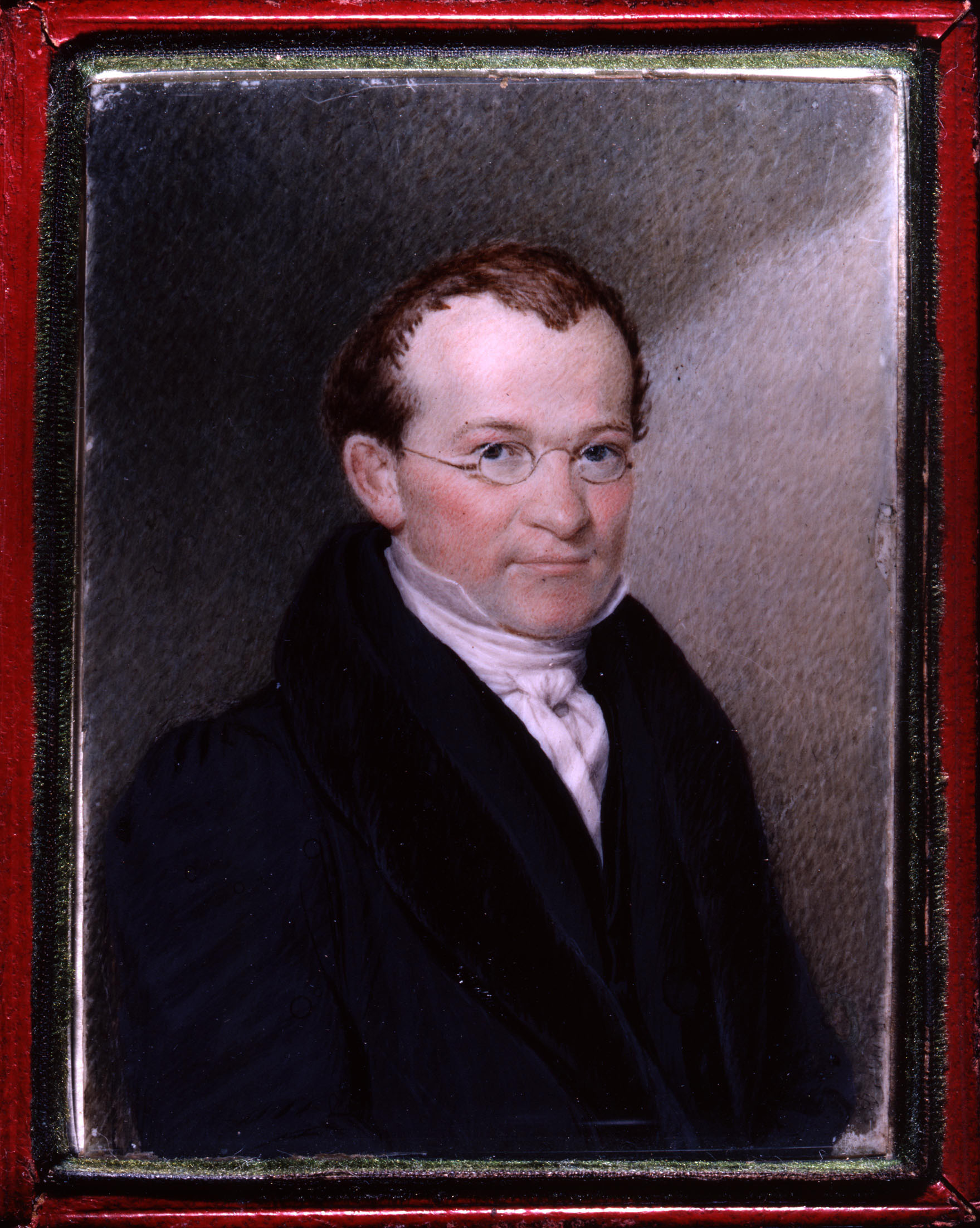
So what, you say? People travel all the time for work. The planes and highways are crowded with business activity every day. What is different about AAS? Nothing really…just consider this…Our founder Isaiah Thomas did not stay behind his desk in Worcester, often visiting Boston and Salem in his pursuit of interesting specimens of American printing. One of our early librarians was killed in a stage coach accident in Ohio while on a research trip. A later president traveled frequently to Central America to study archaeology there. We have been part of a global world since the beginning in 1812, not focusing on one region or state or city, but all of North America. How do you preserve the printed history of a continent? You have to move across it all the time, gathering, listening, talking, collecting. Staying home is not an option, even in the digital age.
Christopher Columbus Baldwin, AAS librarian from 1831 to 1837, who died in a stage coach accident in Ohio while on AAS business.
Watching the planes cross the dawn sky in Southern California while shaking off jet-lag and knowing my colleagues were mucking through Vermont and the slushy specialness that can be the streets of New York made me think about the movement of acquisitors, of fundraisers, of ambassadors for the Society, not only on Tuesday, but for the past 201 years. Our willingness to get in a stagecoach, on a steamboat, a train, or a plane is part of the drive to make the Society a better, more comprehensive collection. Lucky us to be part of the long history of AAS road trips.
The News-Letter (Otterville, Missouri). Jan. 27, 1862. Vol. 1, no. 1. Newspapers published by Civil War regiments are scarce. One scarce genre of newspapers is Civil War regiment publications. Sometimes a regiment had printing equipment at a fort or took over a printing office at an occupied town and produced its own newspaper for the amusement of the troops. Often the only issues known survive because someone sent one home as a souvenir. Last year we acquired a rare camp newspaper from Otterville, Missouri called The First Division Proclamation, published by an Illinois regiment. I was surprised to find this second camp newspaper published at Otterville at the same time, but by an Indiana regiment. It is an unrecorded title not listed in the standard references or OCLC. The News-Letter was published by J.K. Davisson of the 24th Indiana Volunteers. The printing is a bit crude, but that is to be expected of a camp publication. It has two poems, some camp news, a humorous piece about camp etiquette, jokes, and camp gossip. One piece mentions two other camp newspapers being printed at the same time. One is the First Division Proclamation mentioned above and the other is the War-Eagle,only a few examples of which are owned, printed by a separate Illinois regiment. The News-Letter is printed on blue ruled ledger paper with the inside blank as space for a soldier to write a letter. In this copy, William Smith wrote a letter home to Indiana telling his brothers they should not enlist.
Another year done means another Annual Report. For most, the phrase “annual report” doesn’t exactly elicit imaginings of stimulating reading material. But here at AAS we like to think of the Annual Report as more than just a business reckoning. It’s also a reflection of a thriving community—a learned society, if you will—made up of diverse individuals which offers a wide range of resources, events, exhibitions, and seminars. So if you look beyond, and even to, the numbers, lists, and recaps of the year, you’ll see a much more interesting story take shape, one in which the Society is growing and flourishing as it enters its third century.
That’s why we’ve decided to share with you some of our favorite parts of this year’s Annual Report (September 2012 – August 2013), now available in print and online.
The covers! Almost every printing job gives us the chance to show off a physical book history element. For this issue of the Annual Report,we inverted the idea of endpapers and placed them on the outside of the text rather than the inside, to almost bookend the events of the 2012-2013 year. The example we show here is a marbled sample from a copy of Isaiah Thomas’s 1810 The History of Printing in America. The endpapers were pasted to the board covers and first leaf to secure the binding of the volume. It’s not that we disapprove of securing the binding of the Annual Report—we just want you to dive right in and read it cover to unprotected cover. On the back cover over the endpapers is the bookplate of Isaiah Thomas that was engraved by Paul Revere in 1769. There was a lively debate about which version of Thomas’s bookplate to use, State I or State II. Annual Report 2013 challenge: figure out which one we used.
The several pages covering bicentennial events. Although the bicentennial now seems ages ago, this provided the perfect opportunity to reflect one more time on what was an extremely busy but extremely successful autumn in 2012. From the vintage dancers at the Black and White and Read All Over gala, to the many appearances of Isaiah Thomas, to the Grolier Club exhibition in New York, the celebrations raged on!
The recent acquisitions. In pursuit of our mission to “collect, preserve, and make available for study” the printed record of what is now the United States through 1876, we are continually acquiring new items through purchase or gift. (If you’re curious to know more about our acquisitions process, check out the feature article in the latest issue of the Almanac.) Although there are too many to feature them all, we picked a few that illustrate the breadth and rarity of the collections. Among them is the only known copy of a 1788 broadside about a double hanging in western Massachusetts related to Shays’s Rebellion; a bound volume of six early American pamphlets, five of which we did not yet hold in our collections; an 1886 McLoughlin Bros. three-dimensional panorama book featuring a farmer, a parrot, and an elephant; and yet another addition to our quickly-growing collection of the various editions of Audubon—a plate from the original elephant-sized folio edition of Birds of America. Not too shabby!
The “In Memoriam” section. At first glance this may seem like a strange choice, especially given what a sad year it was for AAS membership—we lost twenty-four members, almost twice as many as last year, and many of them close friends and staunch supporters of the Society. But this is also what makes this section so rich. As a whole, it provides a captivating look at a cross-section of our membership, and serves as a reminder of how lucky we are to count such fascinating and illustrious people as part of our community. They include prestigious historians, local businessmen and philanthropists, former staff members, dedicated researchers and writers, and many, many World War II veterans. We are pleased to have the opportunity to mourn, honor, and celebrate them all.
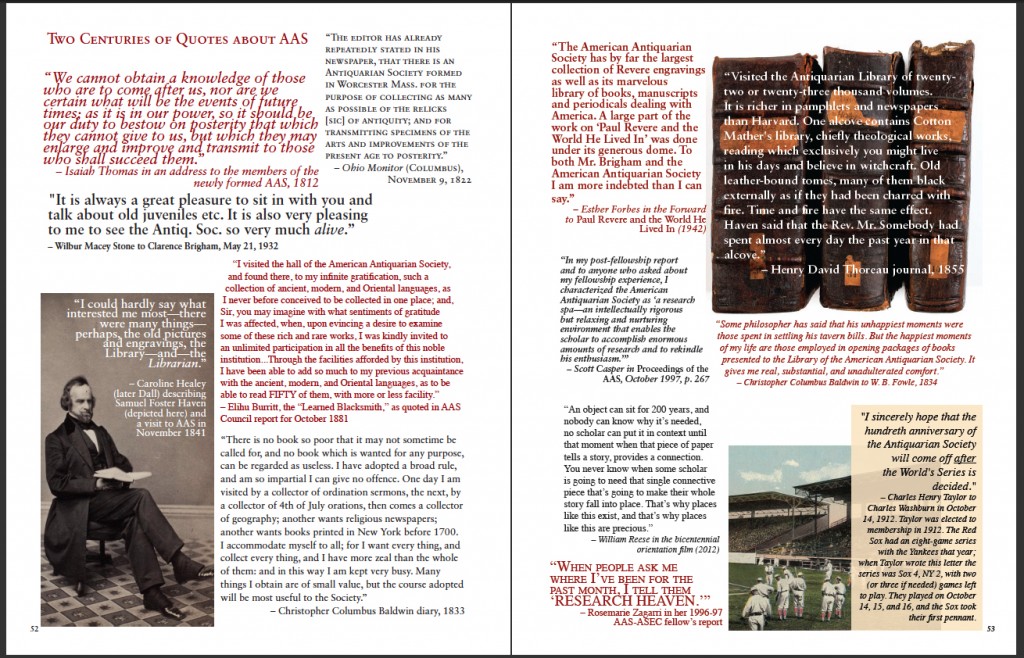
And finally, “Two Centuries of Quotes about AAS”! With two hundred years of fodder, we were sure to find some gems. Read these to find out who had a crush on one of our nineteenth-century librarians, what Henry David Thoreau thought about his visit in 1855, and what the Red Sox have to do with our centennial. This was also a section where, graphically speaking, we could let our hair down. Throughout the rest of the text we kept to Sabon 18-Point Bold Small Caps. Here you’ll see, well, we lost all control.
See? The Annual Report really is not all business. We could keep going on and on with the nuts and bolts, but then this post could be 56 pages long. So at this point, you might as well just read the Annual Report.
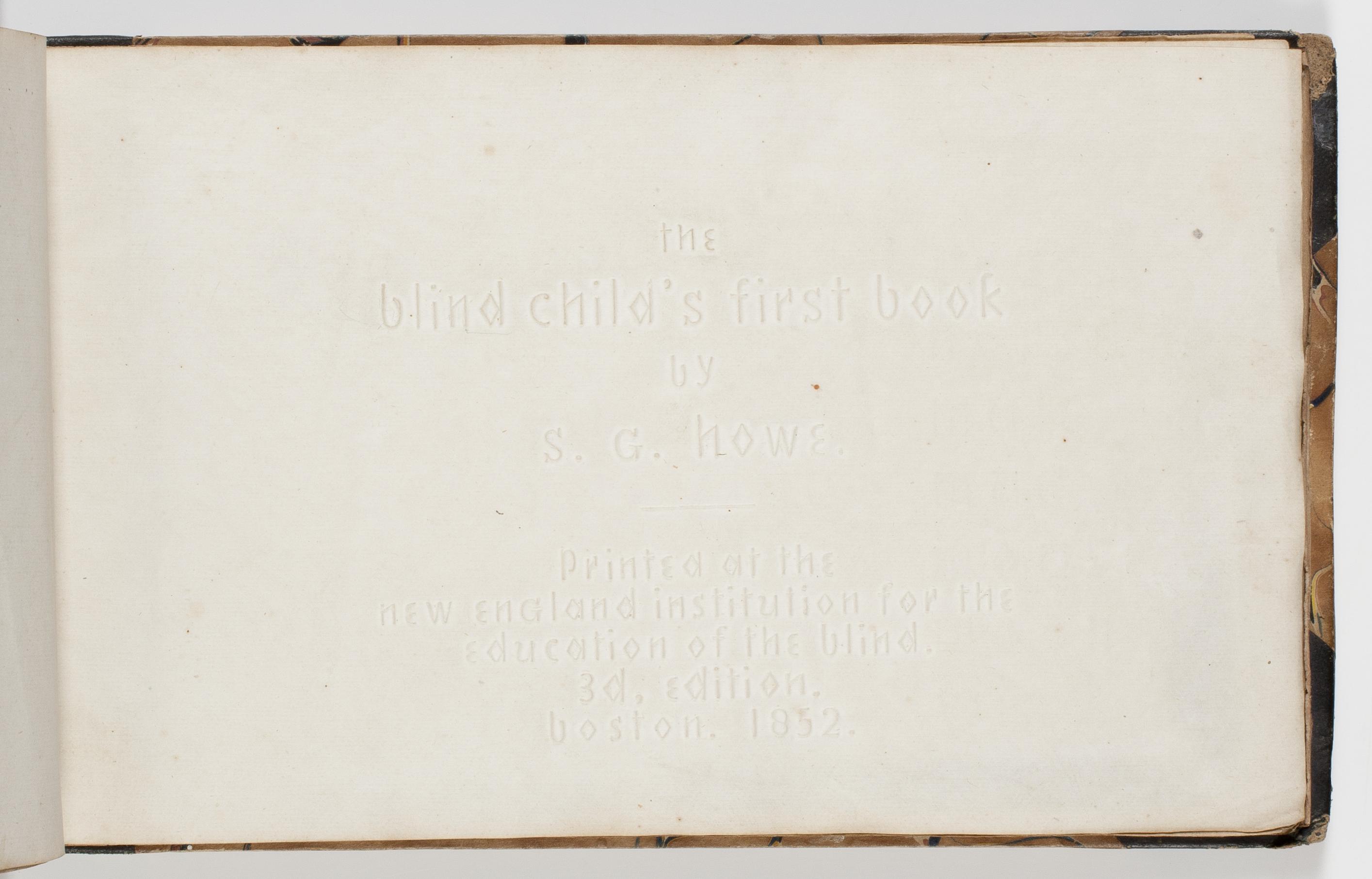
Howe, Samuel Gridley. The Blind Child’s First Book. Third edition. Boston: New England Institution for the Education of the Blind, 1852. This is a fairly early (and rare) example of printing for the blind using raised type known as Boston Line, developed by the book’s author Samuel Gridley Howe (1801-1876), who gained national fame as the founder and public face of the New England Institution for the Education for the Blind, later the Perkins Institution. A forerunner to the dot system of Braille, Boston Line incorporates the shapes of letters used by seeing readers. The text encourages its blind readers to develop the senses that they do have, reminding them, “You can learn to hear much better than people who can see.” The Blind Child’s First Book joins the thirty Boston Line books now held in the AAS collections.
“Continental Life Insurance Company of New York” by Louis Prang & Co. (1870)
As many researchers already know, life stops in 1876 for many parts of the American Antiquarian Society’s collections which are limited to the pre-Centennial era. Recently, however, the Society has amended its collection policies to permit the curator of graphic arts to add prints produced between 1876 and 1900 to the Society’s holdings in order to tell the story of print production through the end of the century. The ephemera and photography collections both already include the 1876 to 1900 period, so adding the prints (lithographs and engravings, as well as relief prints) made sense contextually. This change will allow late-century chromolithographs to be added to our holdings.
Not long after this policy was put into place, I was reading Mark Twain’s A Connecticut Yankee in King Arthur’s Court, which starts out set in 1879 when a bump on the head sends protagonist Hank Morgan back in time to medieval England. Samuel Clemens, writing the text between 1885 and 1889, was well aware of the proliferation of inexpensive prints in the United States and often includes chromolithographs in his detailed descriptions of American interiors. In chapter 7 of A Connecticut Yankee, Hank Morgan is settling into his spacious chambers in Arthur Pendragon’s castle. His reaction to the space, while thick with Twain humor, reflects the ubiquitous, homey nature of chromos as understood by late-century American readers. Hank states,
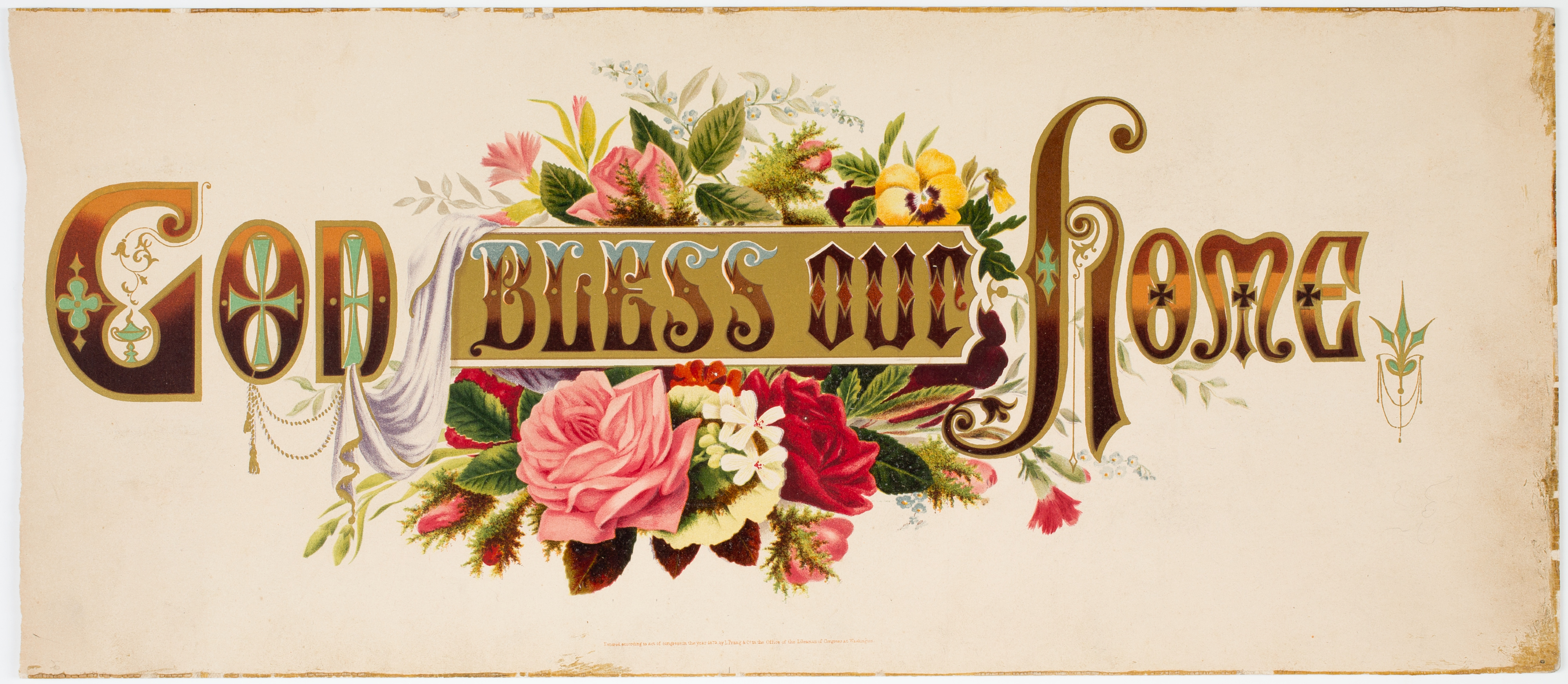
“God Bless Our Home” by Louis Prang & Co. (1873)
As for conveniences, properly speaking, there weren’t any. I mean little conveniences; it is the little conveniences that make the real comfort of life. The big oaken chairs, graced with rude carvings were well enough, but that was the stopping place. There was no soap, no matches, no looking glass….And not a chromo. I had been used to chromos for years, and I saw now that without my suspecting it a passion for art had got worked into the fabric of my being, and was become a part of me. It made me homesick to look around over this proud and gaudy but heartless barrenness and remember that in our house in East Hartford, all unpretending as it was, you couldn’t go into a room but you would find an insurance chromo, or at least a three-color God-Bless-Our-Home over the door; and in the parlor we had nine.
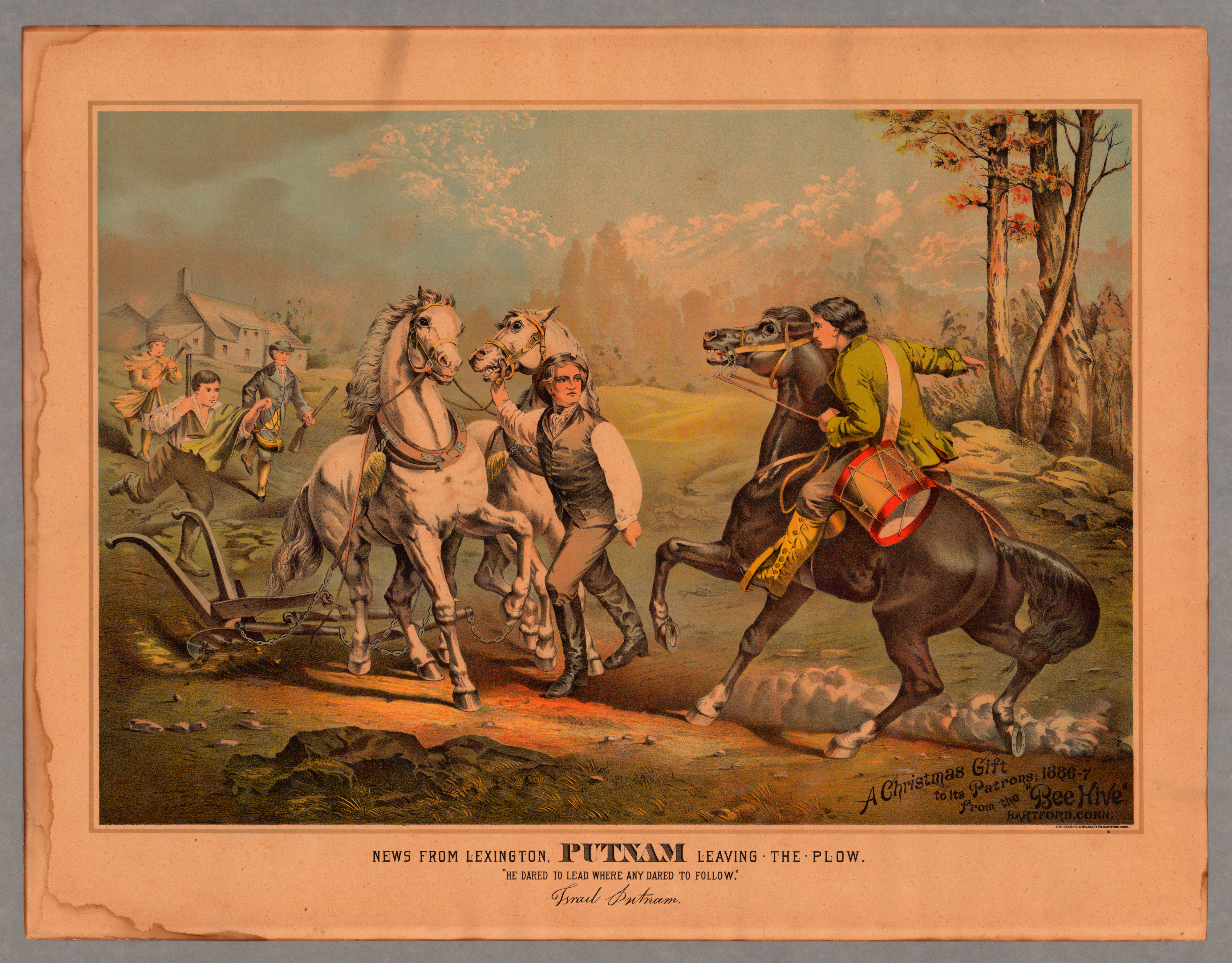
“News from Lexington, Putnam Leaving the Plow” by Kellogg & Bulkeley Co. (1886?)
AAS has a collection of just over 300 individual chromolithographs intended for framing, most dating from 1845 to 1875. This group includes several examples of prints issued by insurance companies (see top) and we even have chromos printed in Clemens’ adopted hometown of Hartford, Connecticut, a city that supported several thriving print production factories (right). The collection includes excellent examples made by Boston firms, and is somewhat slanted towards premium prints—images that were given away to subscribers by newspaper or magazine publishers, Sunday schools, book stores, etc. We have examples of brightly colored advertisements, religious scenes (yes, we even have a God-Bless-Our-Home chromo), humorous prints, landscapes and portraits of adorable children. Now, with the recent policy change, we can make our best effort to find additional examples from after 1876, because, as Twain insinuates in his final line (“and in the parlor we had nine”), quantity and easy proliferation were part of the attraction of these vivid, inexpensive, kitschy and sometimes even artistic prints.
Horoscope, Philadelphia, March 1850. A rare find for the manuscripts department is this hand written horoscope, or “nativitie,” The four page document features a chart mapping out alignments of planets and the moon. The astrologer gives the twenty-three year old subject details about his character, general fortune on specific days and months, and children – “you will have 6 children, but will raise only 4.” Most predictions are positive, with occasional warnings on certain days – “Sickness, which may interfere with and mitigate against your success in business undertakings…” And at the end comes the all-important disclaimer – “Now Sir! I have given you a general statement as to the manners, your prospects fluctuate during life, and you will find the advice valuable to follow. I mean to say, that on the days noted for evil, you should be on the ground, attending to your business, and deal with caution when giving credit. This information receive and follow, and you will reap the benefit, you will understand, that this judgment will be found correct to events yet hidden in the womb of futurity as a general guide to prevent misfortune.”
It has been a big year for some of the country’s most important documents. January saw the sesquicentennial of the Emancipation Proclamation, and just last week was the 150th anniversary of the reading of the Gettysburg Address. This Thursday in the United States we celebrate our national day of Thanksgiving, and so are looking back, once again, to 1863, when countless Union newspapers printed President Abraham Lincoln’s Proclamation for “a day of thanksgiving and praise to our beneficial Father” on November 26. Each year since, the sitting president has formally proclaimed that Thanksgiving Day should be celebrated on the last Thursday of November (this changed in 1939 when President Franklin D. Roosevelt set it one week earlier; two years later it was ruled by Congress to be observed as a legal federal holiday on the fourth Thursday in November). In President Lincoln’s Proclamation he states, “it has seemed to me fit and proper they [the bounties of the United States] should be solemnly, reverentially and gratefully acknowledged, as with one heart and voice, by the whole American people.” This proclamation appeared in many publications, including post-observance mentions in some Confederate newspapers. The copy seen to the left is from the October 8, 1863 issue of the Amherst, New Hampshire, Farmer’s Cabinet.
Lincoln’s edict was met with support from Union state governors’ offices. In AAS’s collection are several broadsides endorsing a national day of Thanksgiving, including from New England states Massachusetts, Connecticut, and New Hampshire, but also this featured example from the Colorado Territory (see below), which closes with a prayer that “the white-winged messenger of peace may again perch upon our banners as they wave in triumph from sea to sea and from shore to shore.”
By the time of Lincoln’s Proclamation, Thanksgiving practices had their own history spanning Colonial and Revolutionary America, and it was an issue frequently brought to the surface by states observing a yearly Thanksgiving holiday. This is in addition to Sarah Josepha Hale, long-time editor of the popular Godey’s Lady’s Book, promoting the idea of a national thanksgiving. Her editorial in September 1863, “Our National Thanksgiving,” provides the recipe for such a holiday, tying it closely to the war effort – she closes, “A national feeling of Thanksgiving, putting the beauty, goodness and love of the Creator before the eyes of the dullest and the hearts of the coldest, would effect incalculable benefits to our Country.”
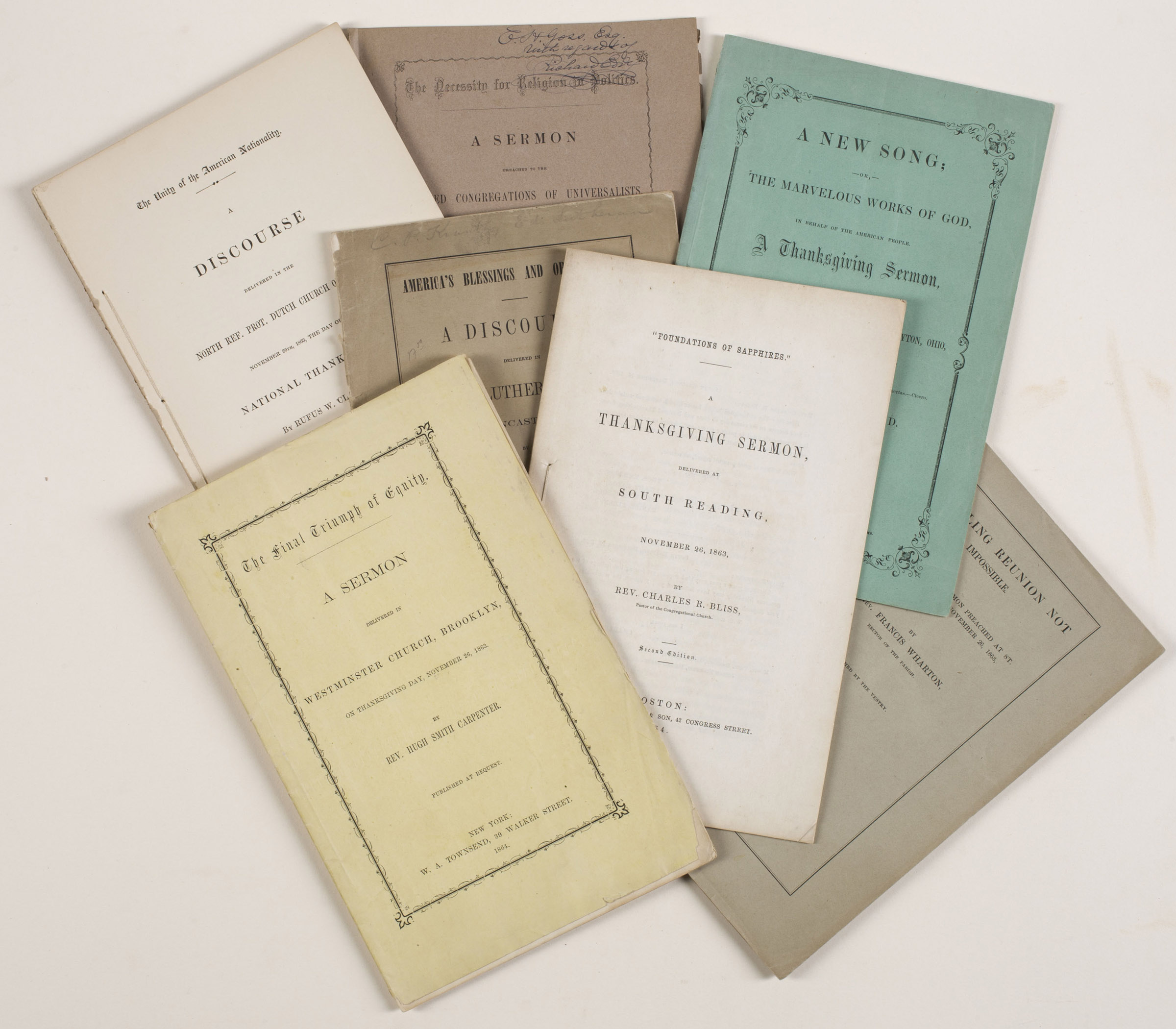
Items in the Society stemming from this day are not just limited to those created by people in executive positions, however. For example, contained within the collections is also an assortment of pamphlets and transcribed sermons reflecting numerous religious denominations, places, and subjects. This assortment includes titles such as America’s Blessings and Obligations, A Willing Reunion Not Impossible, and The Necessity for Religion in Politics.
The print culture of Thanksgiving 1863 is understandably more somber than images of Pilgrims and turkeys. This includes a double-page wood engraving by Thomas Nast (1840-1902) in the December 5, 1863 issue of Harper’s Weekly (below). In this image, a central illustration of Columbia is seen kneeling at the Union Altar which is draped with the American flag. Six scenes of Thanksgiving prayer – the Union Army, kneeling Presidents George Washington and Abraham Lincoln, the Navy, farmers in the country, residents gathered in a Town Hall, and emancipated slaves – surround the dominant allegorical figure.
So is Thanksgiving a day of food and feasting? Absolutely. It is also one that has evolved from the New England fall festivals into joyous reunions and big dinners. But during the years of the Civil War, especially 1863, it grew into one of observance, serious moral and religious thinking, church services, and prayer. In an attempt to answer one the earliest appeals for its establishment as a national holiday, Lincoln shaped it into one about the widows, orphans, mourners, and others suffering from the war.
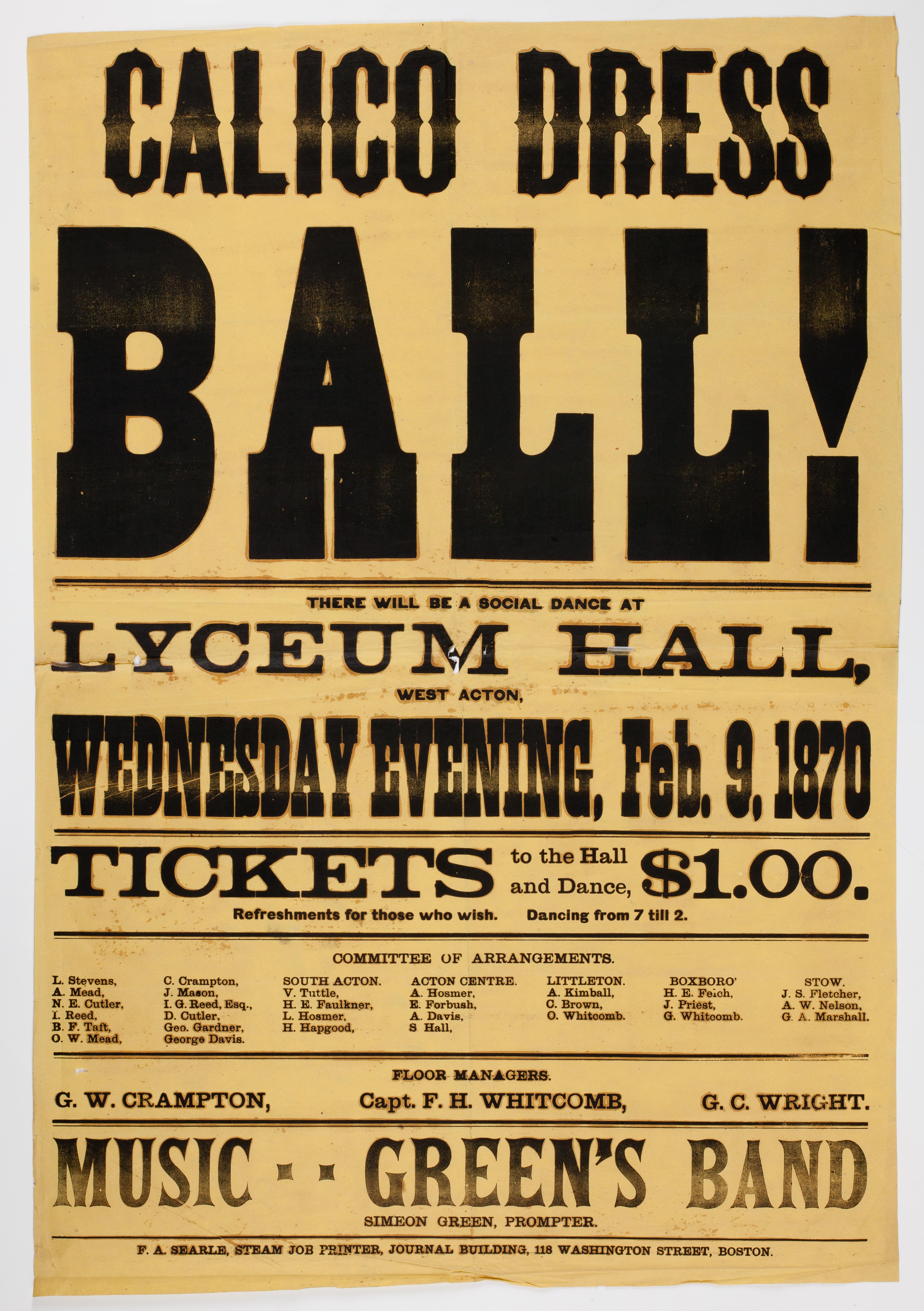
Calico Dress Ball! There Will be a Social Dance at Lyceum Hall, West Acton. Boston: Searle Printing, 1870.
This large (42” x 28 ½”) broadside was one of a group of five sheets purchased together, all of which relate to activities in Acton and West Acton, Massachusetts, between 1865 and 1875. Printed in Boston by F.A. Searle, who was well-known for his circus posters, all of the broadsides make excellent use of large, eye-catching wooden type and brightly colored paper. Given the thin paper and temporal nature of the events advertised (dances, fund-raising levees, and church festivals), it is amazing that these five printed sheets survived. This broadside advertises a dance in mid-February, which may have been held in honor of Valentine’s Day, a popular occasion for community social events.
At most non-profits, November and December are year-end fundraiser months. You are probably getting a lot of solicitation letters in your mail box, along with those stacks of glossy holiday catalogs. AAS has several important initiatives underway, including donations to our Annual Fund. This year, however, we are also trying something new.
Council for New England Records, “The booke of Orders,” 1622-1623.
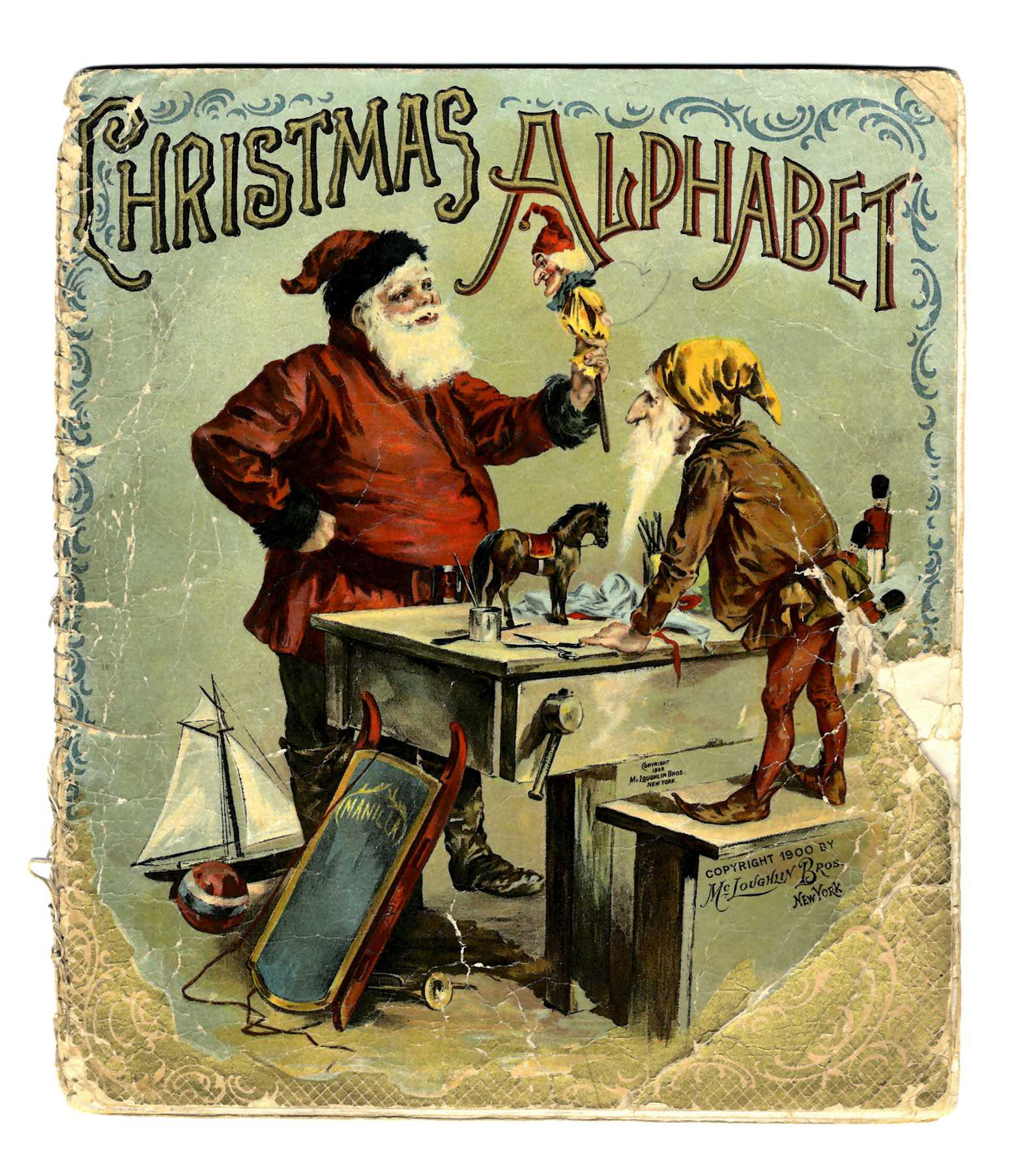
The Society’s curators have selected thirty objects from the collection that would be excellent candidates for digitization. These are books, periodicals, photographs, or manuscripts that are heavily used or fragile but are not available digitally through any of our partnerships or collaborative projects. The inspired idea of our Image Coordinator Jaclyn Penny (who oversees all of our digital processing), this 2013 year-end initiative will allow the Society to raise the funds needed to photograph and record all thirty of the selected pieces. In the digital-fundraising catalog the candidates are each listed and described, with the appropriate curator stating why the object should be made available through a digital surrogate. We spent a couple of weeks selecting material, writing up the texts, building the website – all the while thinking this was going to be a great way for people to help the Society, bit by bit (or byte!), to provide access to important historic documents. For example, the earliest item is a manuscript of the Council for New England Records, “The booke of Orders,” 1622-1623 (see above), and the latest is the children’s book Christmas Alphabet published by McLoughlin Bros. around 1900 (see below). Most of the objects are under 80 pages in length and can be digitized for between $25 and $200.
So, great idea, right? We built the website and made the pitch to our usual email list of friends and supporters (many of whom support our annual Adopt-a-Book program, which will be back in the spring of 2014). We put the catalog up on Monday morning, November 18th. And… (drum roll, please) the response has been positively overwhelming! In the first hours over half of the listings were funded for digitization. We are so thrilled that this important material is going to be made available for scholars and researchers around the world. Thank you, thank you!
Carolyn Wells, “Christmas Alphabet.” New York: McLoughlin Bros. 1899-1900.
Here is how it works — supporters donate the funds to have the selected material digitized (which they can do in honor of someone else). The material is then taken to our in-house photographer and digitized. The files are processed and loaded into the Society’s database and links are made to those files from various places, including our online catalog. Keep an eye on the fundraising catalog, as we will also be putting links there as we process each order.
As I am typing this blog post, more orders are coming in and we are all cheering – it is a bit like a mini-telethon! I fear that we will not get this post up before everything is gone. Either way, we can surely call the initiative a success. So the Society’s curators send out a great big thank you to all of AAS’s supporters and friends who help and will help us in the future with providing access to our outstanding collections. I think it is safe to say that we will definitely be repeating this fundraiser again – and yes, there are still a few items left, if you want to cruise over to the website and take a look.
Most sincerely, the Society’s curatorial team: Vincent Golden, Lauren Hewes, Thomas Knoles, Elizabeth Pope, and Laura Wasowicz
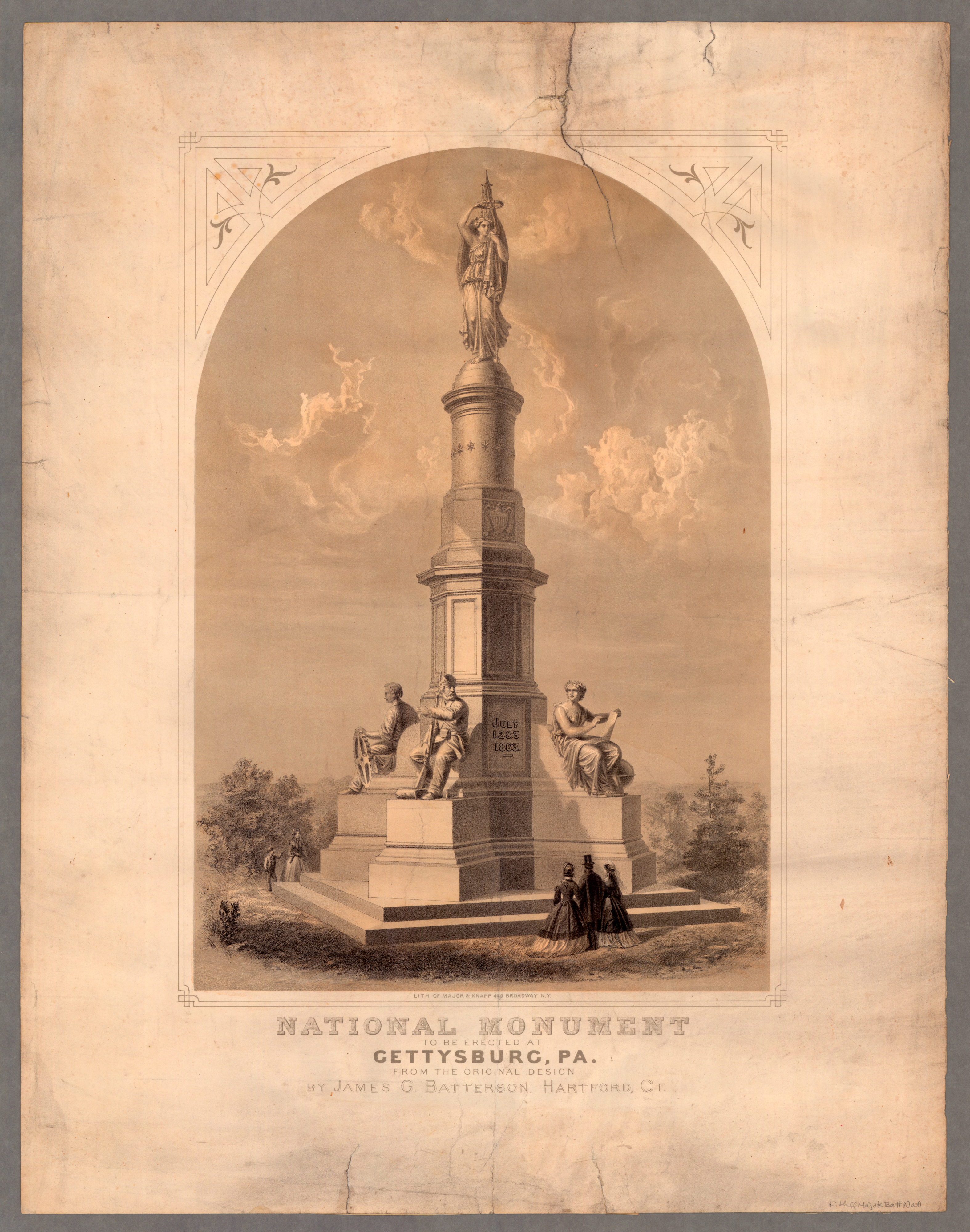
“National monument to be erected at Gettysburg, Pa. — .” By James Goodwin Batterson. (New York: Major & Knapp, ca. 1863-1867)
“The newspapers are making morning after morning the rough draft of history. Later, the historian will come, take down the old files, and transform the crude but sincere and accurate annals of editors and reporters into history, into literature. The modern school must study the daily newspaper.” – The State (Columbia, SC) December 5, 1905
On November 19, 1863, Abraham Lincoln gave one of the most memorable speeches in American history when the cemetery at Gettysburg was dedicated just four months after the great battle. Edward Everett spoke first for over two hours. When it was Lincoln’s turn, his speech was over almost before people realized he had begun.
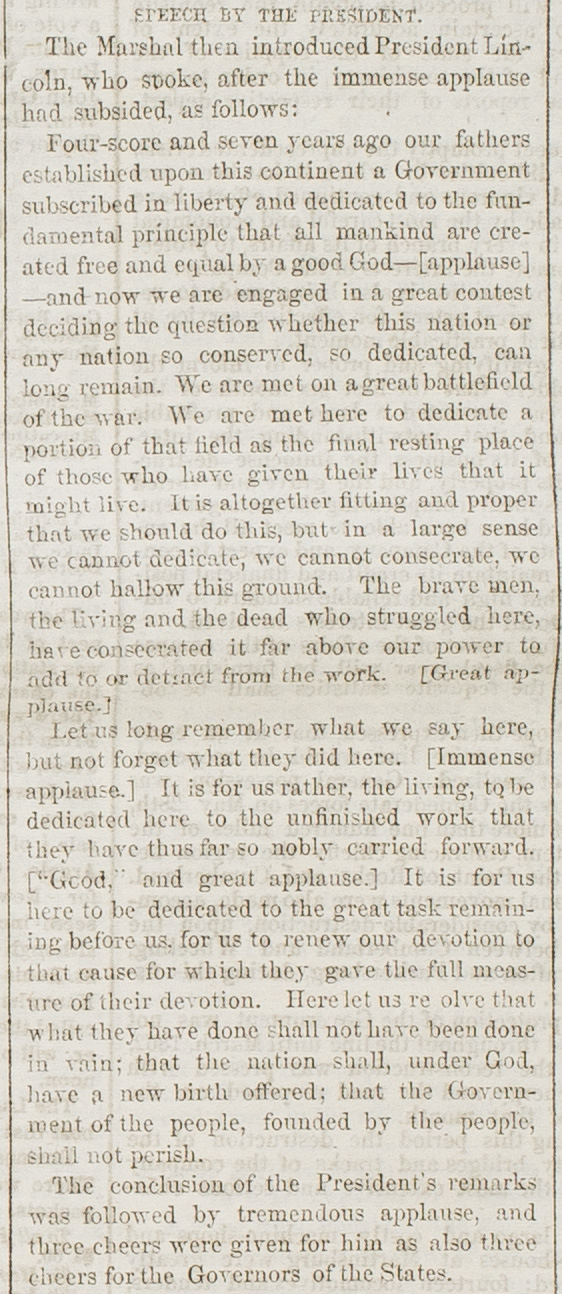
One of the people in the audience was a reporter for the Associated Press. He sent in a report about the speech which was subsequently printed in various newspapers. The Cincinnati Gazette for November 21, 1863, printed the entirety of Everett’s speech on page 1. On page 3, they gave a description of the ceremony and included Lincoln’s speech as recorded by the AP reporter. Whether he tried to copy it down by shorthand or tried to reconstruct it from memory and/or by consulting others who were there, we do not know. It does differ from the traditional version of the Gettysburg Address we know today from fair copies written out by Lincoln after the event.
Here is the version reported in the Cincinnati Gazette. See how many differences you can find:
Four-score and seven years ago our fathers established upon this continent a government subscribed in liberty and dedicated to the fundamental principal that all mankind are created free and equal by a good God – [applause] – and now we are engaged in a great contest deciding the question whether this nation or any nation so conserved, so dedicated, can long remain. We are met on a great battlefield of the war. We are met here to dedicate a portion of that field as the final resting place of those who have given their lives that it might live. It is altogether fitting and proper that we should do this, but in a large sense we cannot dedicate, we cannot consecrate, we cannot hallow this ground. The brave men, the living and the dead who struggled here, have consecrated it far above our power to add or detract from the work. [Great applause.]
Let us long remember what we say here, but not forget what they did here. [Immense applause.] It is for us rather, the living, to be dedicated here to the unfinished work that they have thus far so nobly carried forward. [“Good,” and great applause.] It is for us here to be dedicated to the great task remaining before us, for us to renew our devotion to that cause for which they gave the full measure of their devotion. Here let us resolve that what they have done shall not have been done in vain; that the nation shall, under God, have a new birth offered; that the Government of the people, founded by the people, shall not perish.
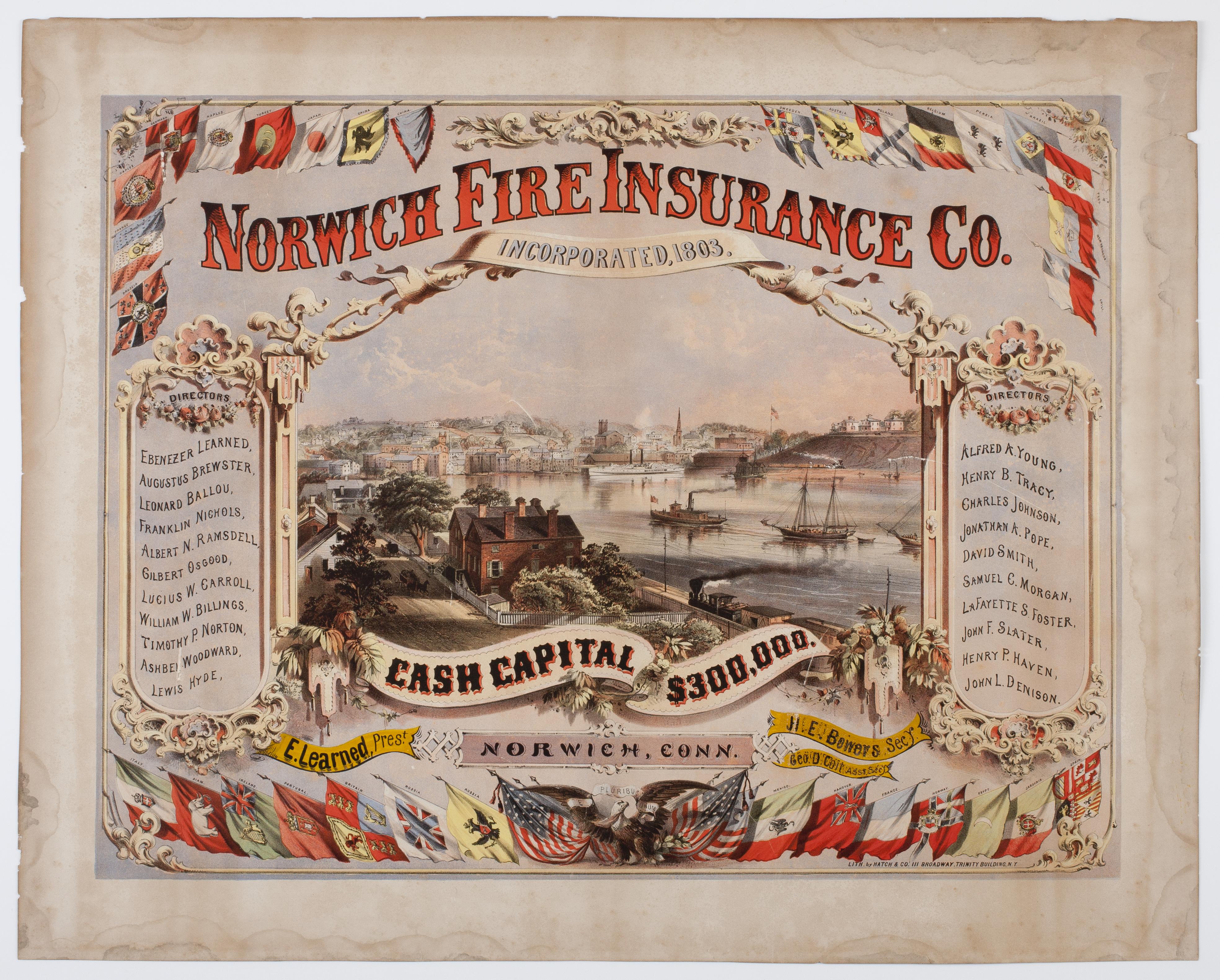 This color lithograph for a Connecticut insurance company features a city view surrounded by international flags and the names of local directors with interests in the firm. The sheet was printed by Hatch & Co. in New York, who advertised that they could produce: “Portraits landscapes, labels & show cards, and every description of color work. Bonds, certificates of stock, checks insurance policies, diplomas, note & letter heads, executed in the best style.” The view of Norwich is taken across the river from the west and aligns closely with an 1849 lithograph produced by Sarony & Major based on a painting by Fitz Henry Lane, with added steam-powered vessels plying the water. The print was probably produced as a promotional image, intended for display in the company’s office or in the offices of the individual directors.
 Puritans cast a dim eye upon the Christmas holiday with its Roman Catholic roots. However, with the influx of German immigrants to the United States in the 1840s, the celebration of Christmas and the use of the Christmas tree gained a toehold in American culture. Many of the newly arrived Germans settled in Philadelphia; among them were skilled book artists like lithographer Augustus Kollner (b. 1813).
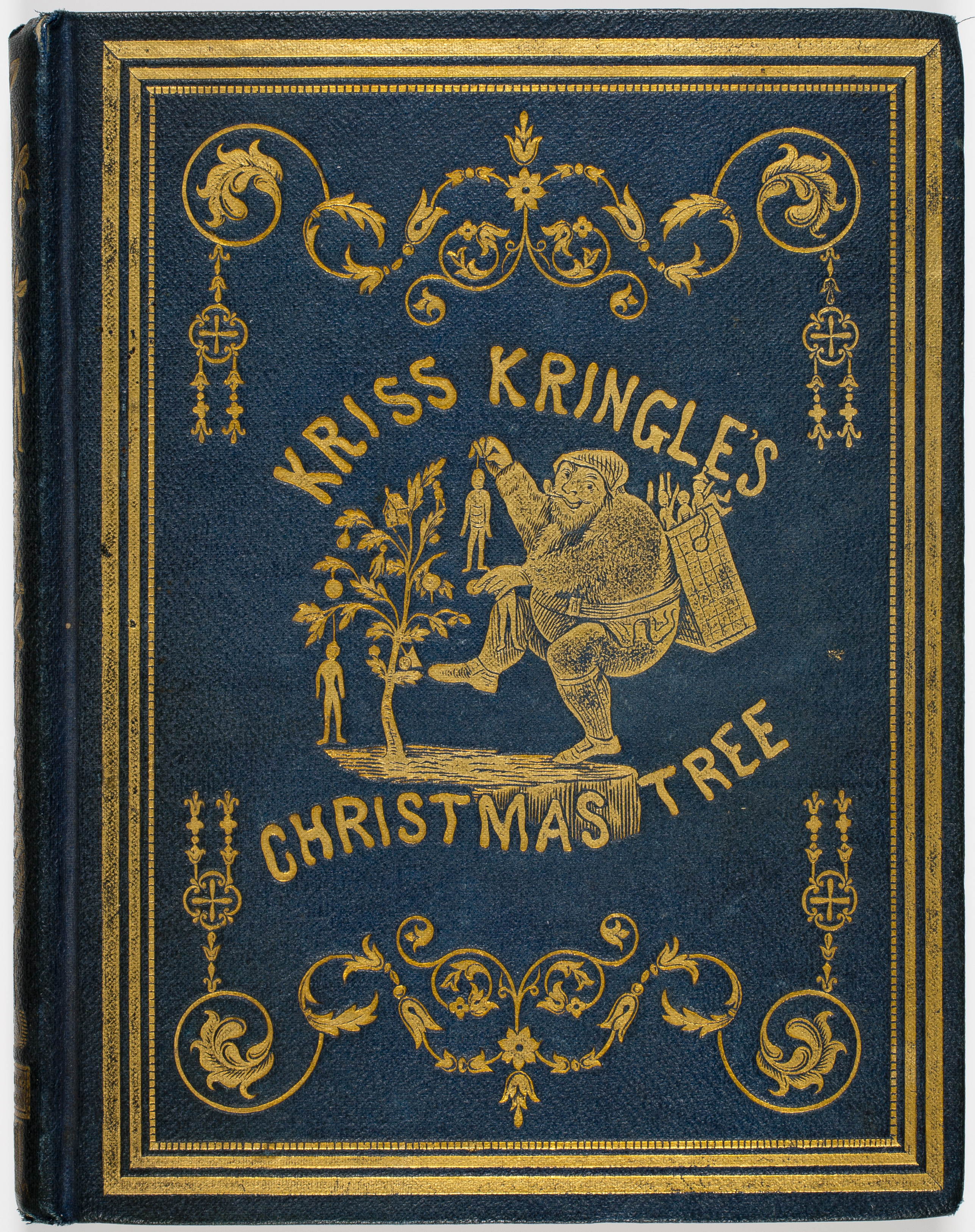 The cover design for Kriss Kringle’s Christmas Tree, also published in Philadelphia at about the same time, in 1846, shows a rotund, elfish Santa putting gifts from his backpack onto a short, deciduous tree. This collection of brief stories includes “The Christmas Tree”—a tale about an impoverished child who receives a vision of the Christ child showing him a star-spangled Christmas tree up in the heavens.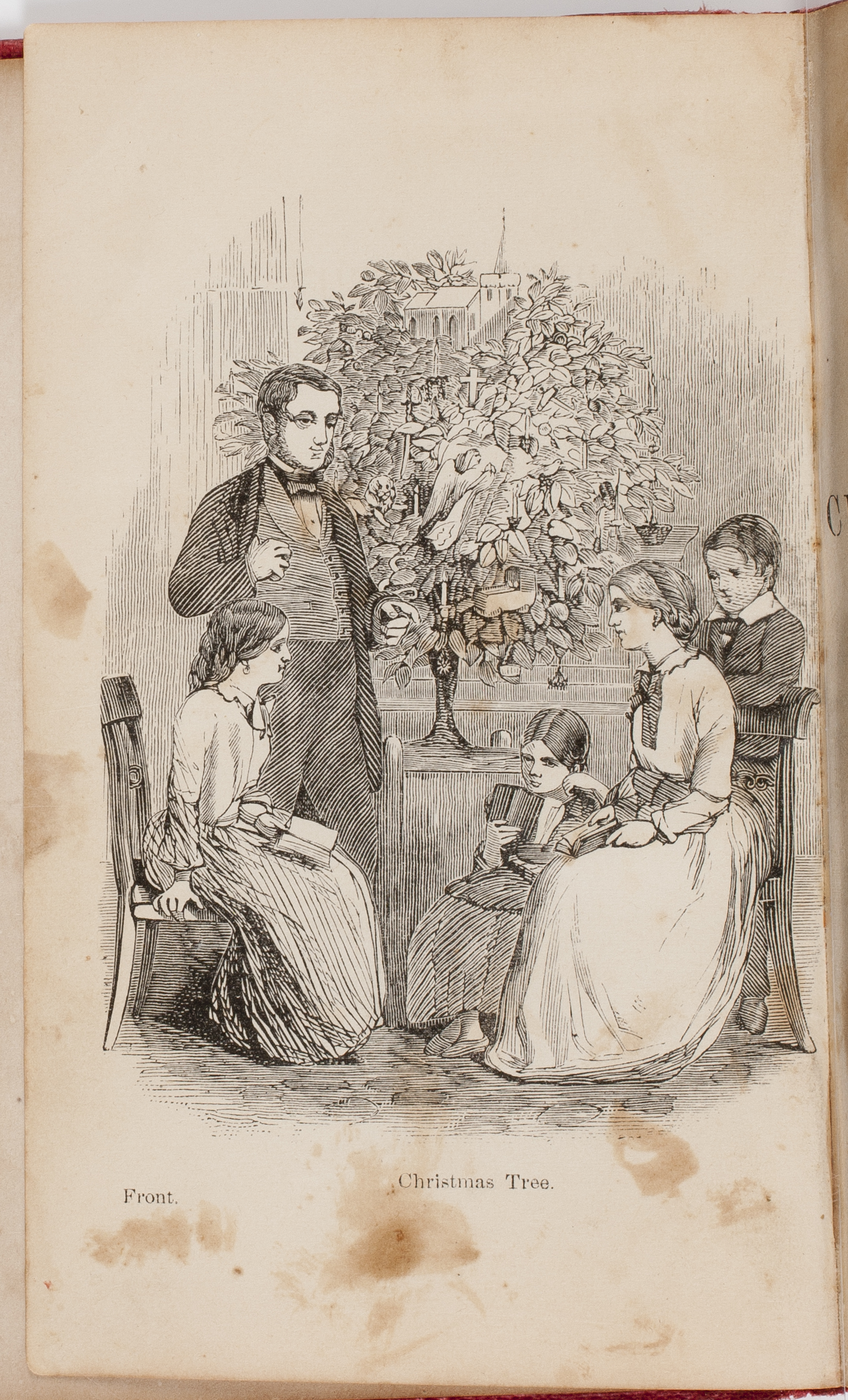
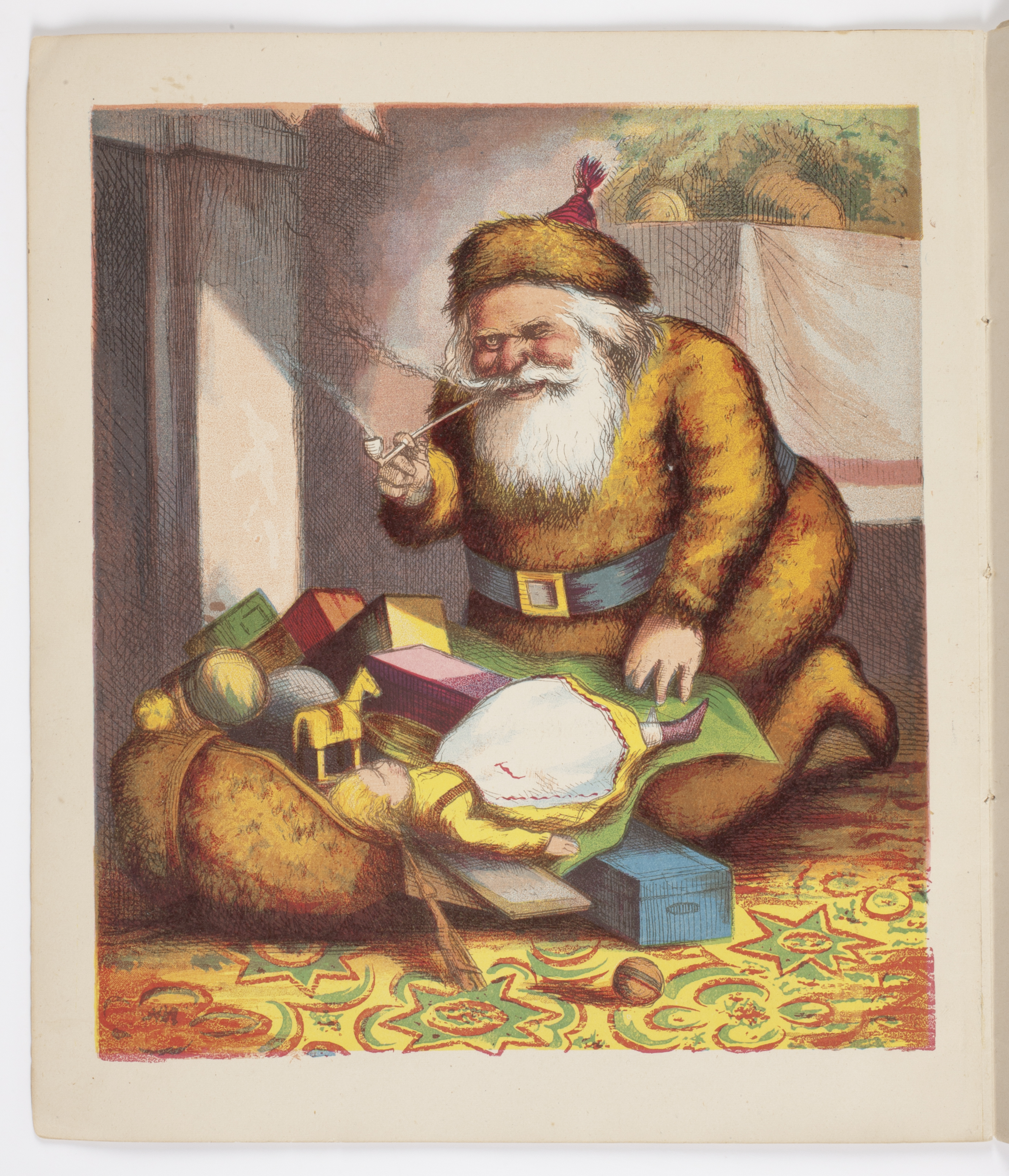 Although the first picture book version of Clement Clarke Moore’s poem The Night Before Christmas was issued in 1848, arguably it is Thomas Nast’s illustrations some twenty years later for New York publisher McLoughlin Brothers that shaped the American cultural image of a rotund, fur-suited, pipe smoking Santa that we recognize today (see right). But even then, Santa appears crouched over his gifts with a tabletop Christmas tree just barely visible in the upper right hand corner of the picture.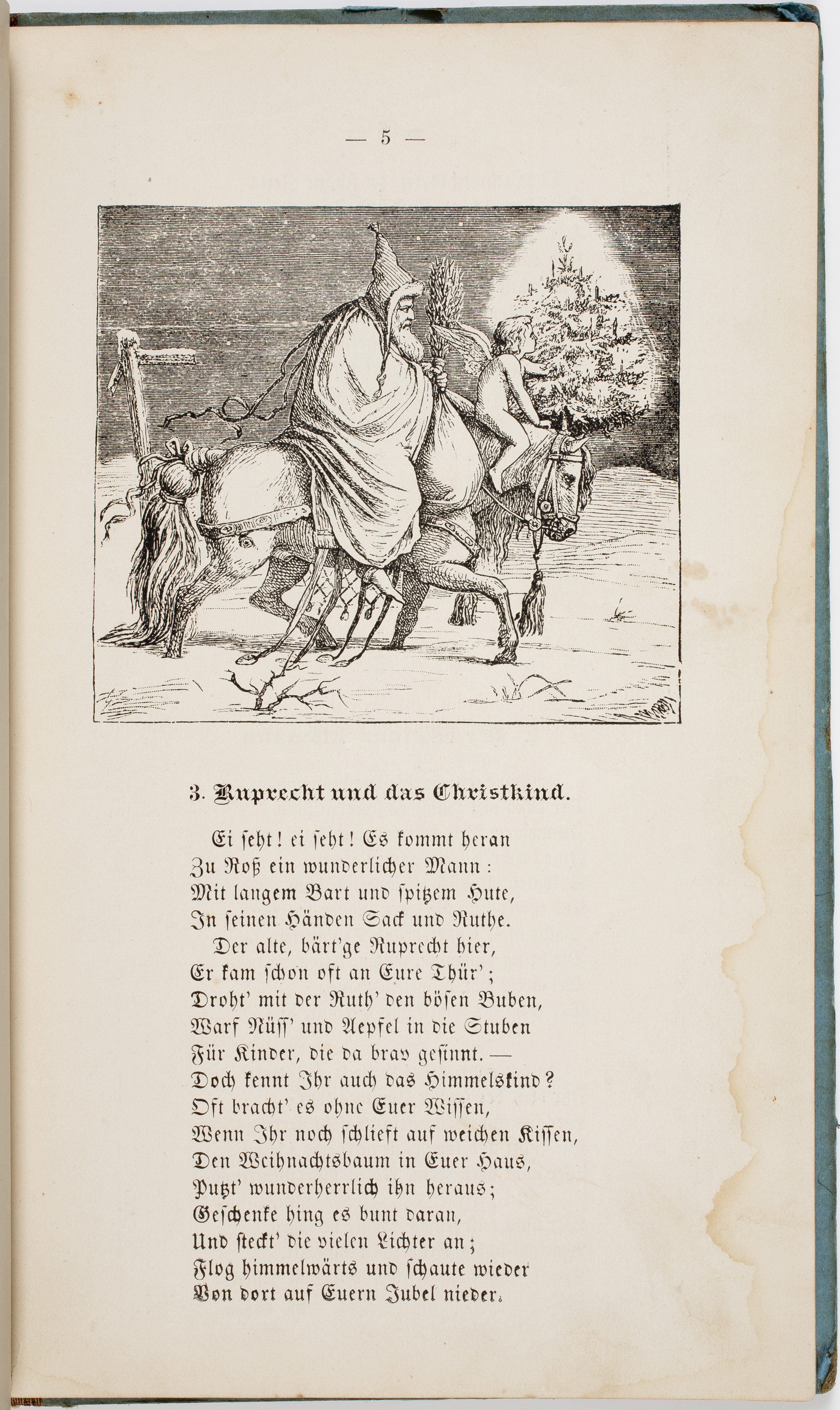

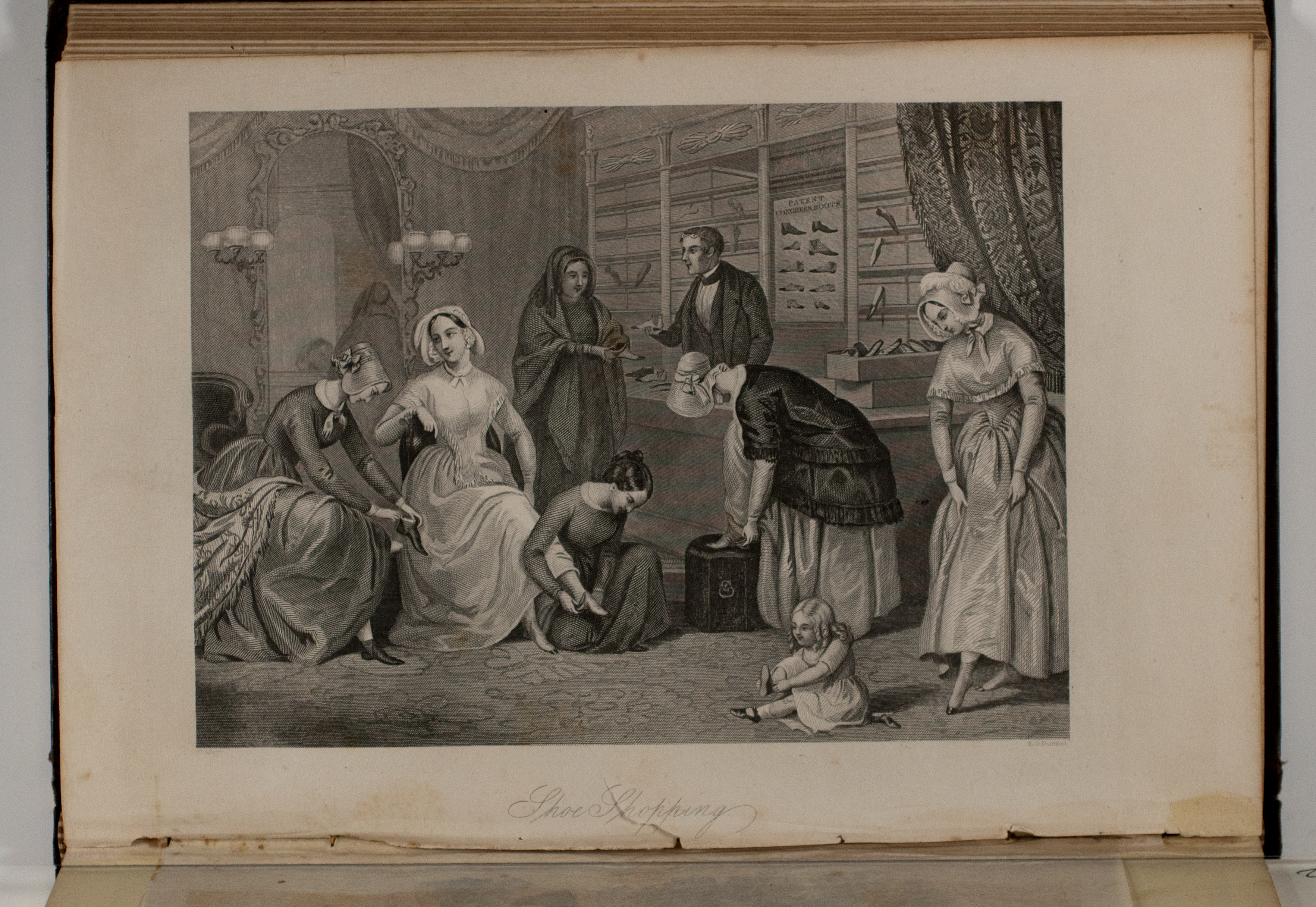 Let’s start with clothes. Men like to grumble about women’s love of shoes and accessories—purses, jewelry, gloves, scarfs, etc. Just what is it about these items that is so attractive to women, they ask? Although we may not be able to answer this question, evidence from the archives suggests that women have long found shopping for these things particularly enjoyable. Take, for example, the 1849 image of women shoe shopping above. Five adult women and one young girl are each in the process of finding that perfect shoe. Of the five faces we can see, all have contented smiles—even the shop-girl kneeling to help the woman in the center looks to be pleasantly occupied. The woman on the far right is holding out her foot for admiration, while the young girl in front of her excitedly tries to pull on a shoe. Although women loving shoes is a stereotype, it is apparently one based somewhat in truth. (I’m guilty of it myself.) And it can start young; in Gap just the other day, I saw a girl about the same age as the one in the image in the same exact pose. I also have a one-year-old goddaughter who can be bribed by telling her you will put on a pair of her favorite shoes for her.
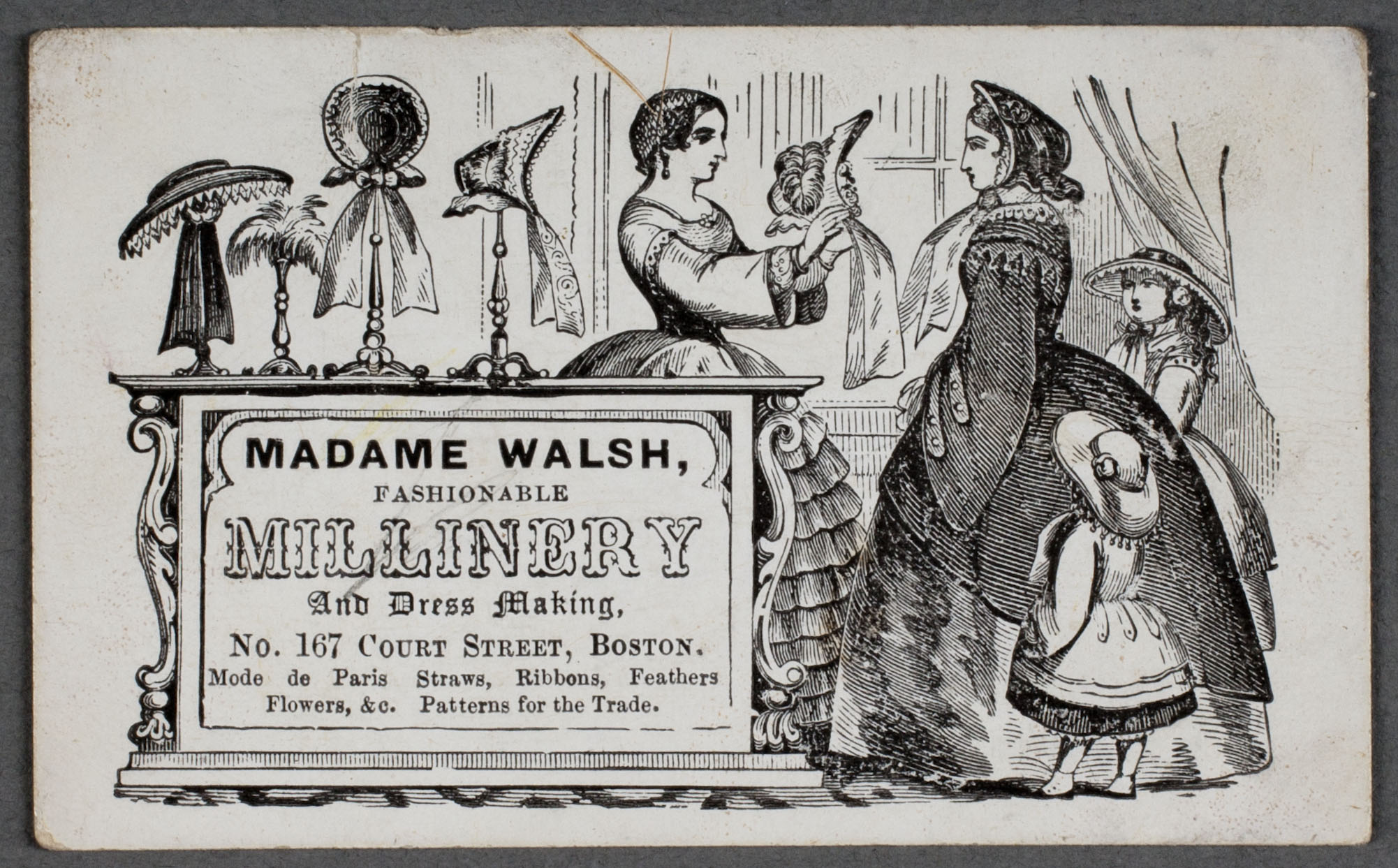 those bonnets from a milliner, or a tradesperson who specialized in hat and bonnet making. This trade card for Madame Walsh, Fashionable Millinery and Dress Making, shows a well-dressed woman with her two young girls looking at bonnets with the milliner, who is also a woman. As you’ll notice, the milliner herself is also well-dressed—dressmakers and tailors would often wear their own wares as a way of advertisement.
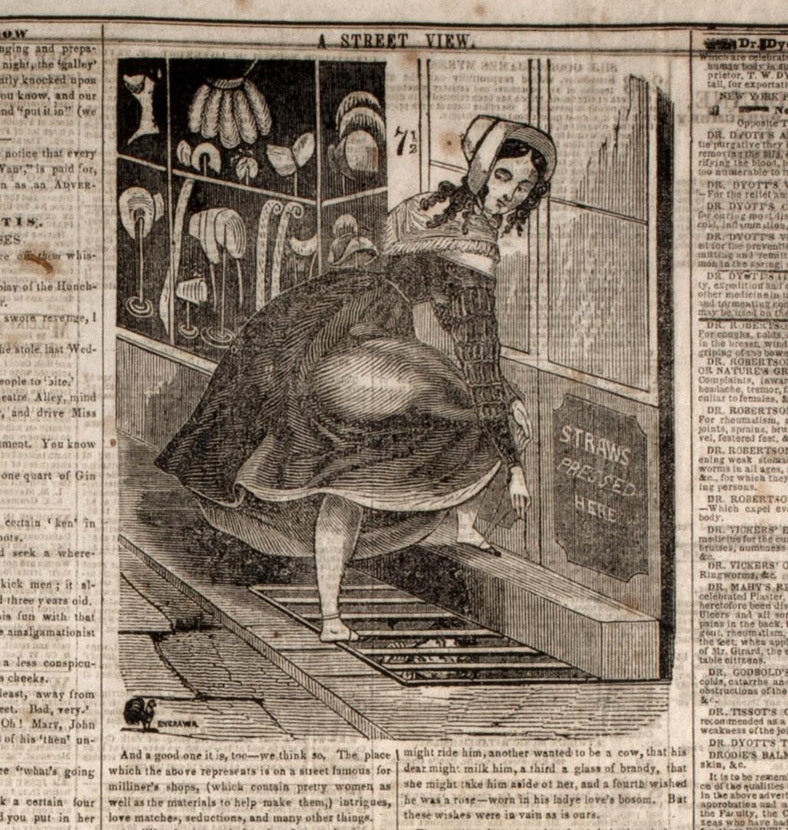 While the trade card is geared toward the shop’s female customers, the popularity of hat shops was used in other popular culture of the time aimed at men. In an 1842 issue of the New York racy newspaper The Weekly Rake, the image seen to the left accompanied an article advising its male readers to hang out near hat shop windows as a way to meet women. While the man under the grate took things a bit too literally, the existence of such an article and image imply that women’s love of hats and window shopping were well known.
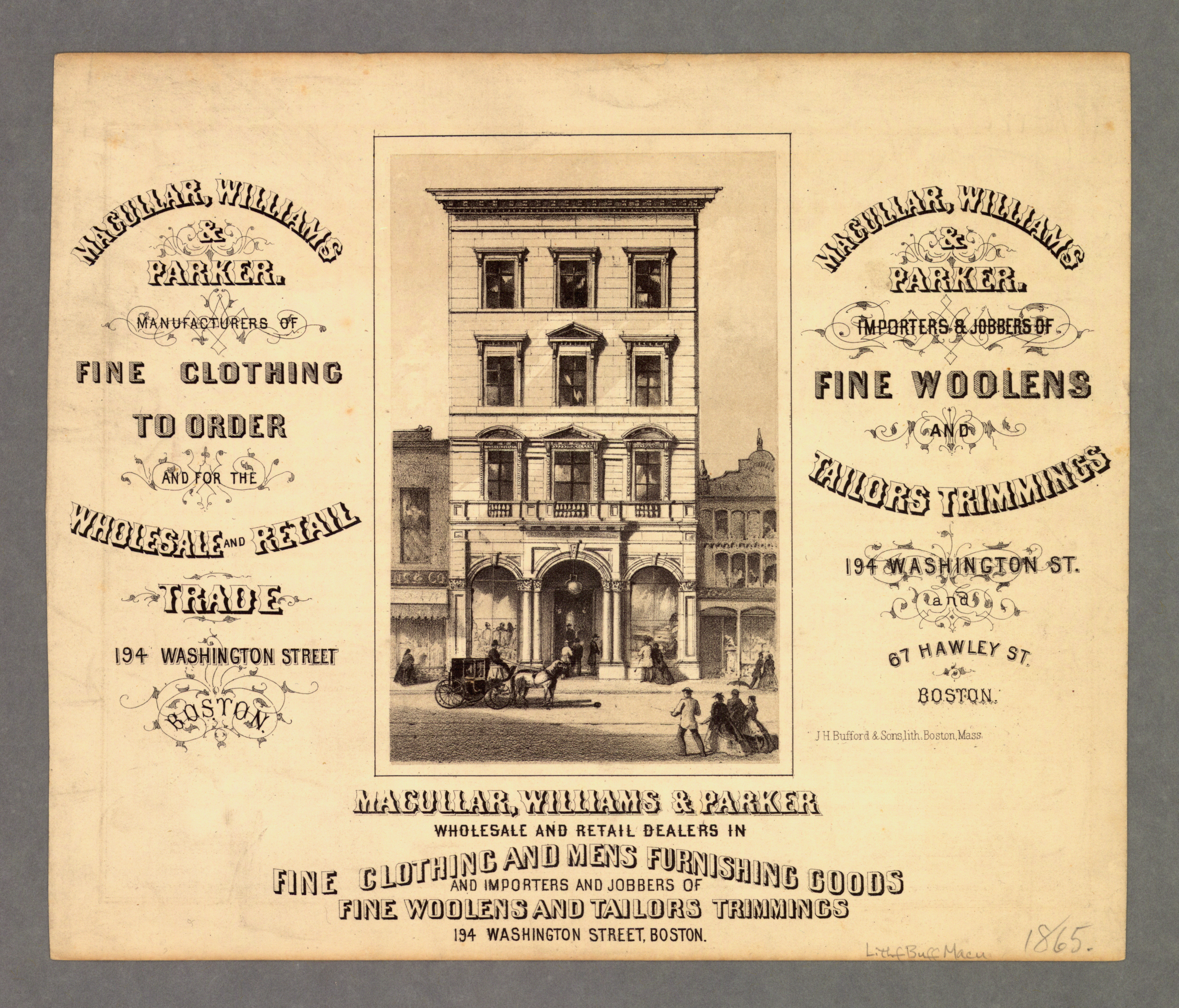 are entering the building. Then as now, it seems, men were believed to need some help in the clothing department.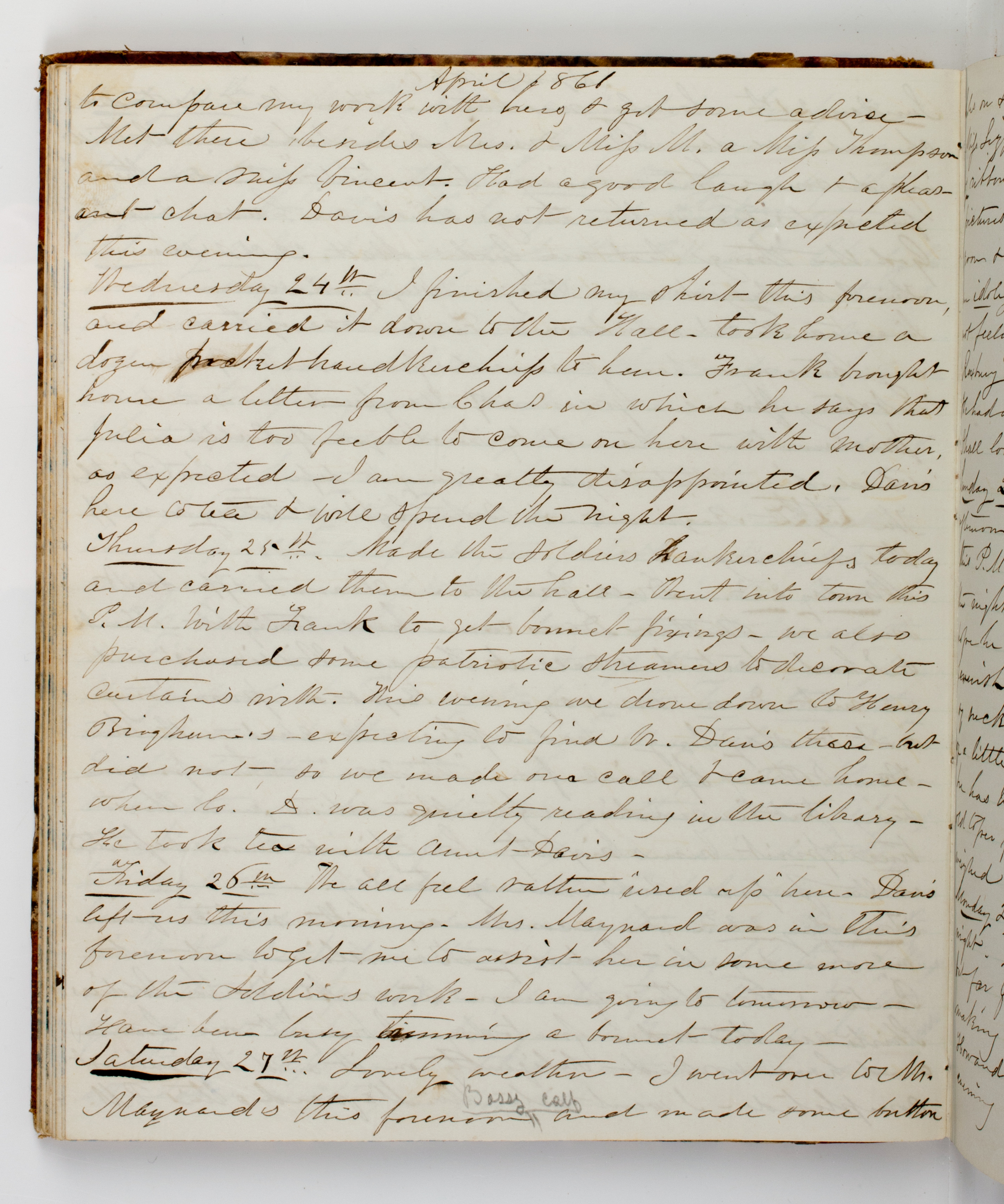
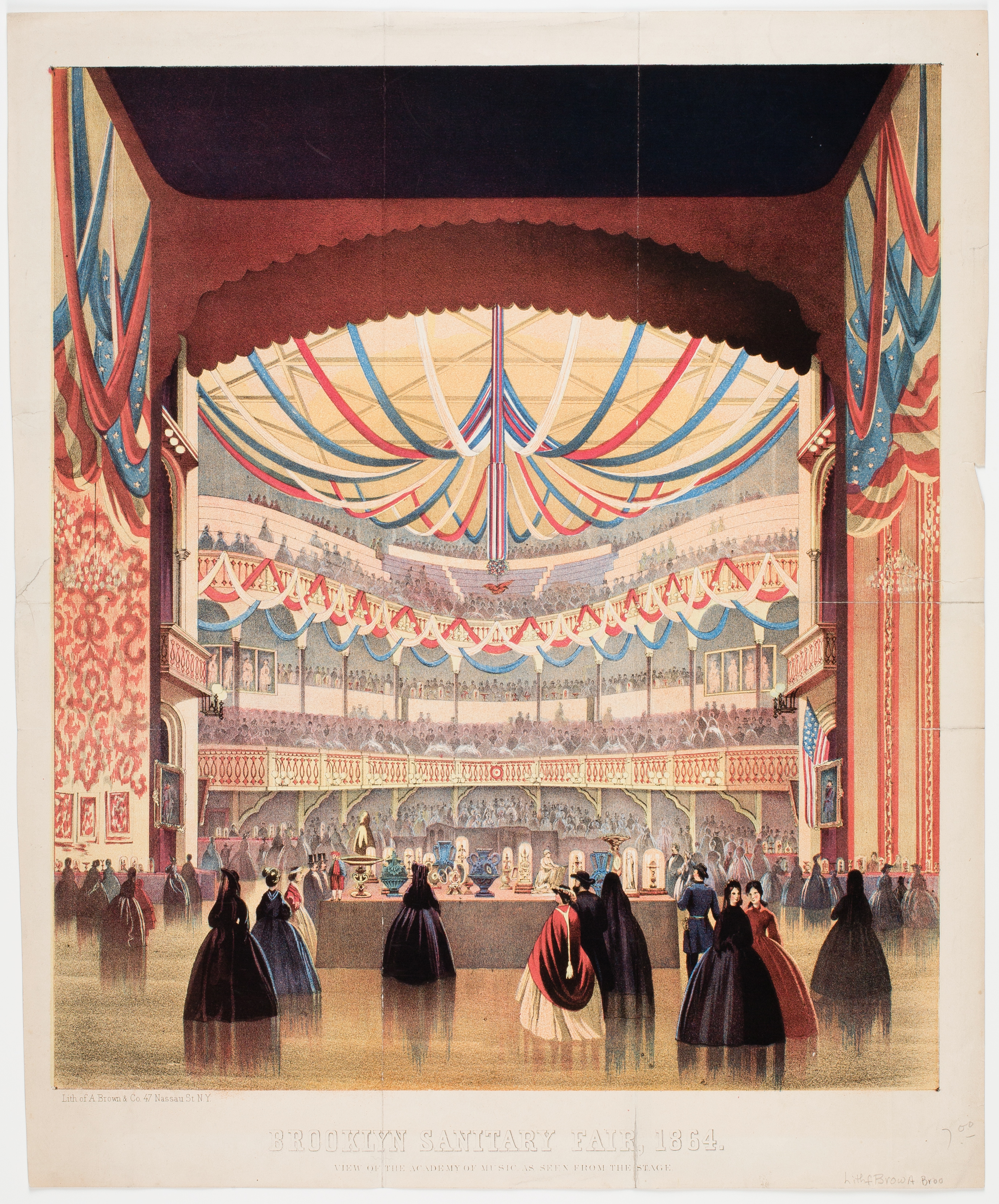 Suddenly something that she had once found pleasurable and productive, and may even have hoped to help cheer her this day, now seemed meaningless. In reality, however, shopping often had a lot of meaning during the Civil War, particularly during Sanitary Commission fairs and other bazaars that were intended to raise money for the war effort. These functions, planned mostly by the women on the home front, sold goods and offered entertainment to fundraise and provide a bit of a respite from the harsh realities of the war. The image to the left depicts a Sanitary fair in Brooklyn in 1864. Decked in patriotic decorations, the hall is populated by home goods and women, many in their dark mourning clothes. Most of the few men visible are in uniform, probably on leave from the front.
 So if you find yourself tired of tracking down the perfect present or standing in lines, just remember: shopping has been viewed as a pleasurable activity and effective distraction for centuries. Chances are that enjoyment will return for you as well. Eventually.
 APPARENTLY UNRECORDED, ONLY KNOWN COPY!
 This turned out to be one of our most successful initiatives to date. No sooner had we put the catalog of our choices online when the support started pouring in. At about 10:30 on a Monday, we sent an email announcement out to members and friends who had participated in previous Adopt-a-Book efforts and Adopt-a-Gift-book from last December. By noon, one third of the material had been selected for funding! By Tuesday, half was gone. We had several instances when multiple emails poured in for a single object. It was great!
 An 1828 Valentine writer, published in New York. For a donation of $75 AAS will photograph all twenty-eight pages of this slim volume, which was originally used by lovelorn correspondents with writer’s block. Popular and clever turns of phrase, snippets of poetry and suggestions for humorous quips were all published here to help those making valentines at home, or for appending to published valentines to come up with just the right way of saying “I love you.”
 For the less sentimental, the final historic object waiting for digitization is a homemade scrapbook from the Society’s manuscript collection. Made by Nathaniel Paine in the 1880s, the unfortunately titled “Freaks of Nature” includes an abundance of ephemera related to circuses, theater, and side show entertainment. Lots of the pieces glued to its pages are not known in any other copies, are annotated by Paine with the location and date of the original event, and document the variety of popular entertainment consumed in the United States in this era. For $100, the entire volume will be photographed and unlocked for all to consider, both in Worcester and well beyond.
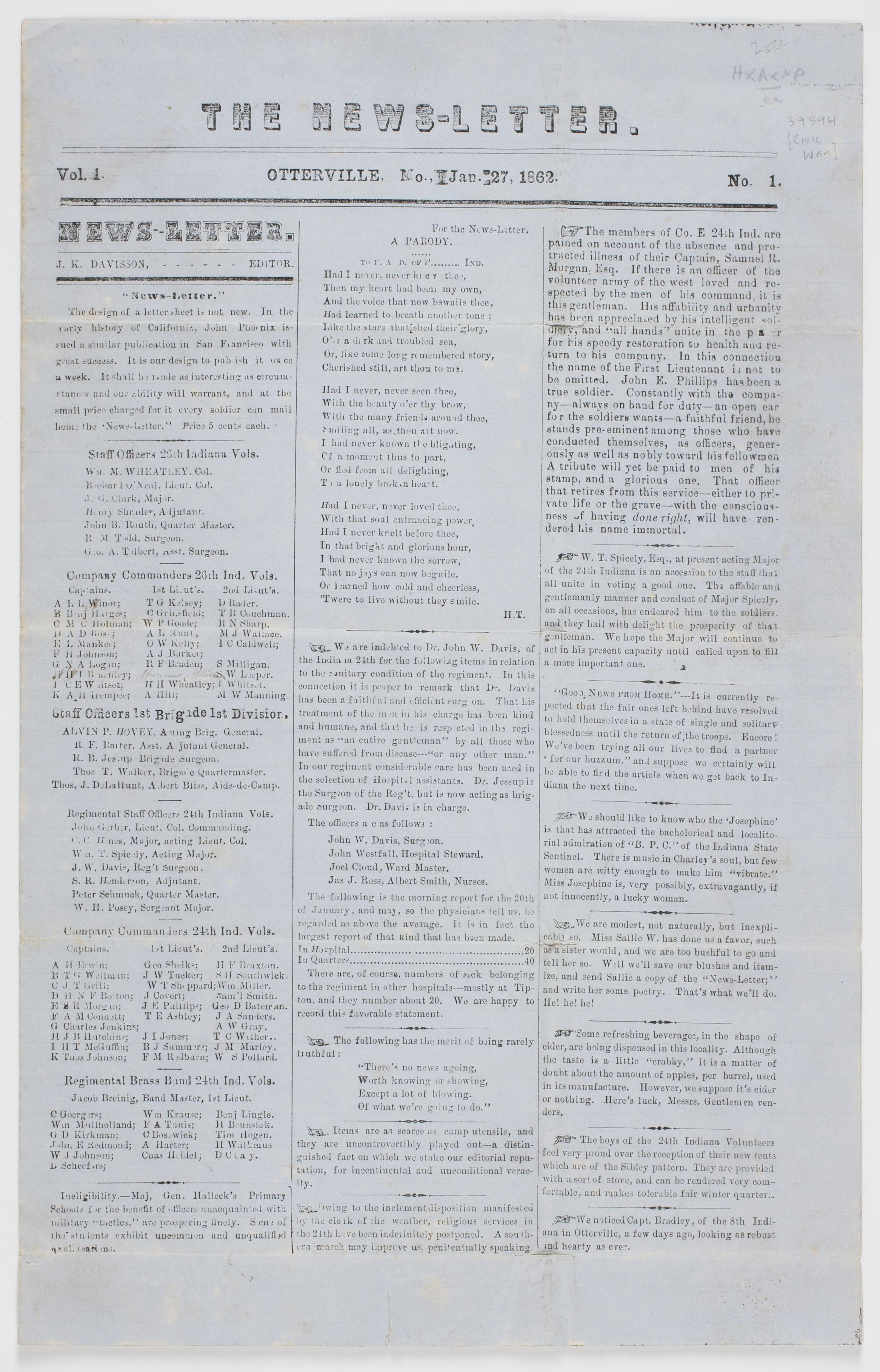 Newspapers published by Civil War regiments are scarce. One scarce genre of newspapers is Civil War regiment publications. Sometimes a regiment had printing equipment at a fort or took over a printing office at an occupied town and produced its own newspaper for the amusement of the troops. Often the only issues known survive because someone sent one home as a souvenir. Last year we acquired a rare camp newspaper from Otterville, Missouri called The First Division Proclamation, published by an Illinois regiment. I was surprised to find this second camp newspaper published at Otterville at the same time, but by an Indiana regiment. It is an unrecorded title not listed in the standard references or OCLC. The News-Letter was published by J.K. Davisson of the 24th Indiana Volunteers. The printing is a bit crude, but that is to be expected of a camp publication. It has two poems, some camp news, a humorous piece about camp etiquette, jokes, and camp gossip. One piece mentions two other camp newspapers being printed at the same time. One is the First Division Proclamation mentioned above and the other is the War-Eagle,only a few examples of which are owned, printed by a separate Illinois regiment. The News-Letter is printed on blue ruled ledger paper with the inside blank as space for a soldier to write a letter. In this copy, William Smith wrote a letter home to Indiana telling his brothers they should not enlist.
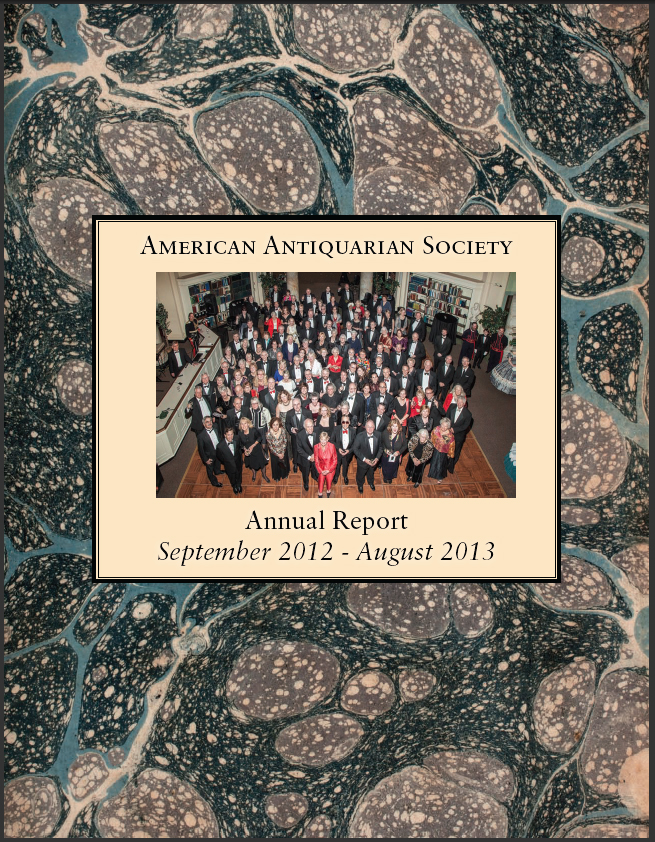 Another year done means another Annual Report. For most, the phrase “annual report” doesn’t exactly elicit imaginings of stimulating reading material. But here at AAS we like to think of the Annual Report as more than just a business reckoning. It’s also a reflection of a thriving community—a learned society, if you will—made up of diverse individuals which offers a wide range of resources, events, exhibitions, and seminars. So if you look beyond, and even to, the numbers, lists, and recaps of the year, you’ll see a much more interesting story take shape, one in which the Society is growing and flourishing as it enters its third century.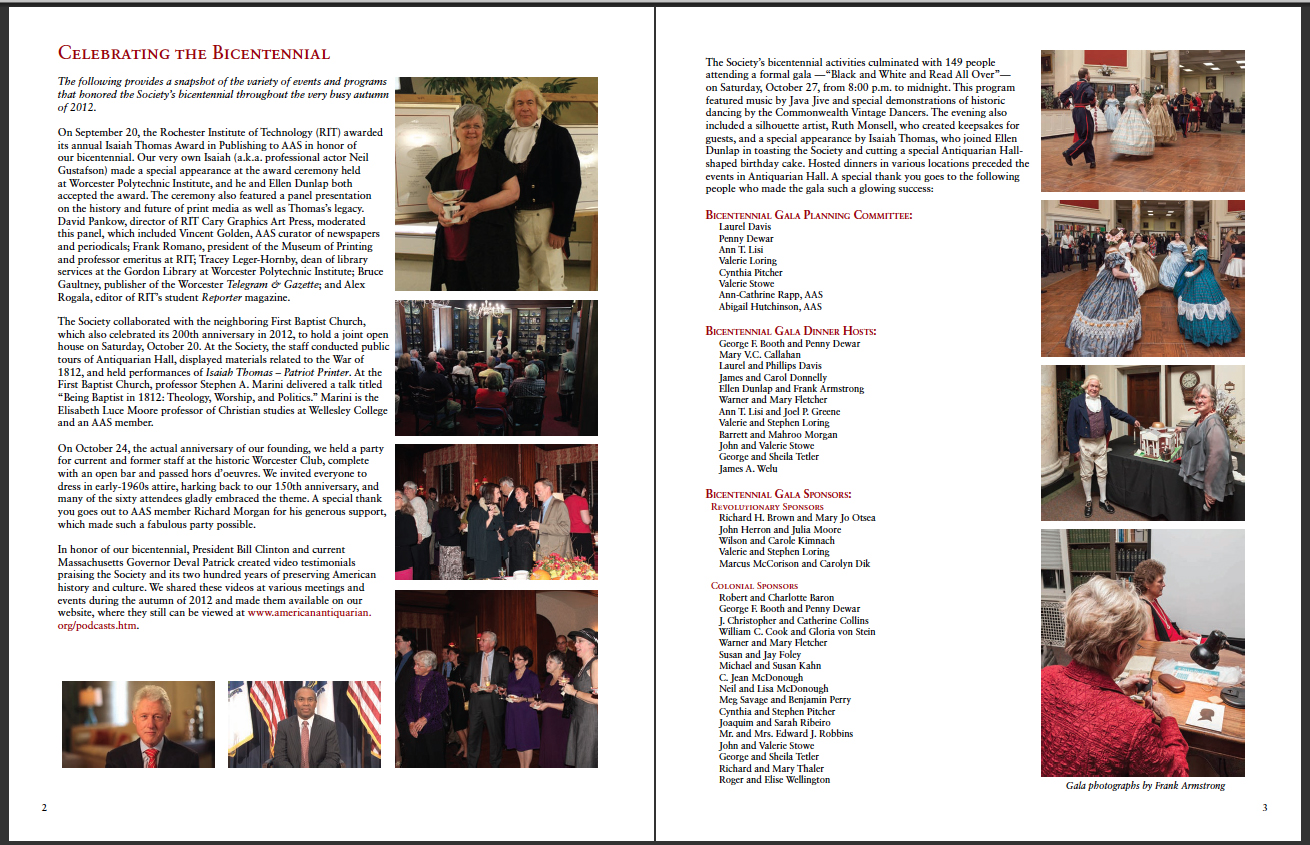
 And finally, “Two Centuries of Quotes about AAS”! With two hundred years of fodder, we were sure to find some gems. Read these to find out who had a crush on one of our nineteenth-century librarians, what Henry David Thoreau thought about his visit in 1855, and what the Red Sox have to do with our centennial. This was also a section where, graphically speaking, we could let our hair down. Throughout the rest of the text we kept to Sabon 18-Point Bold Small Caps. Here you’ll see, well, we lost all control.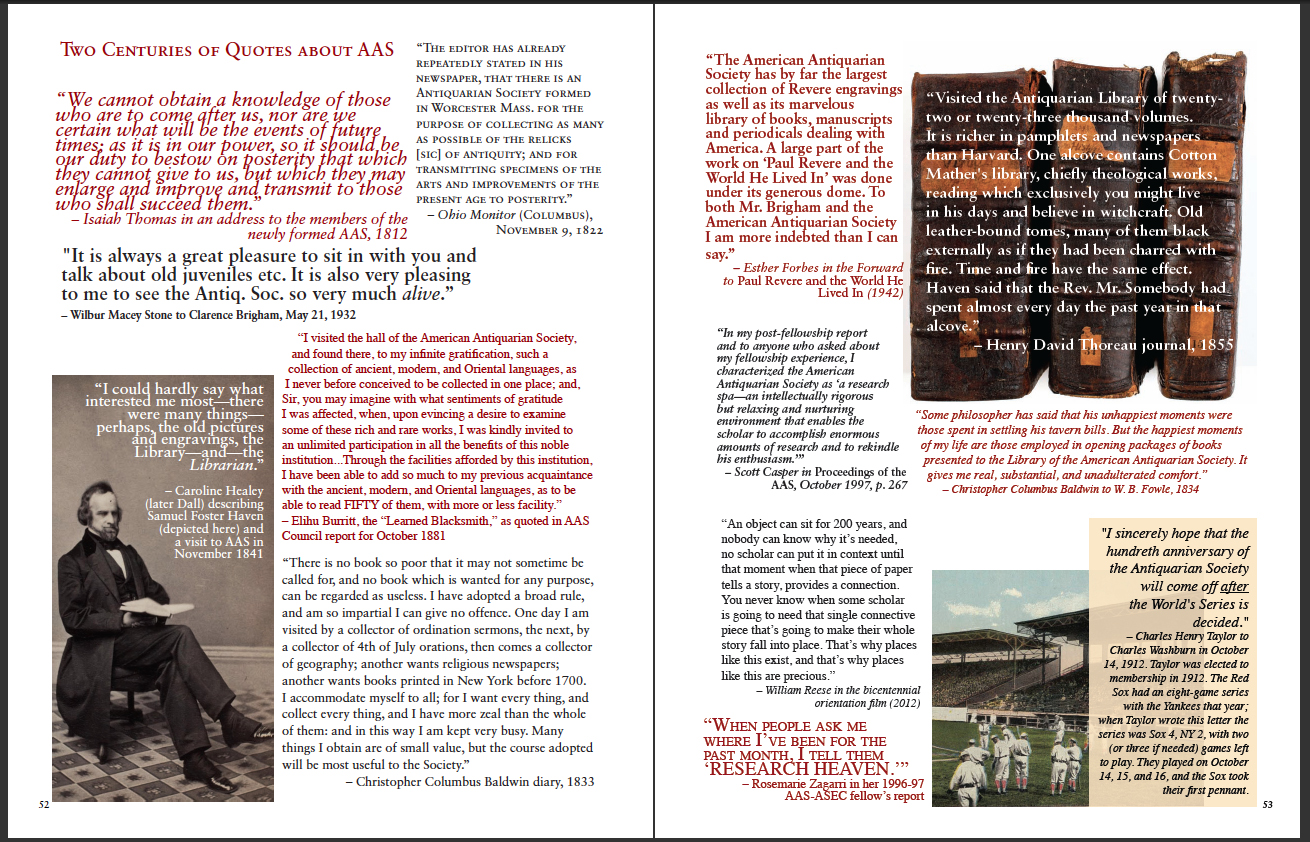
 This is a fairly early (and rare) example of printing for the blind using raised type known as Boston Line, developed by the book’s author Samuel Gridley Howe (1801-1876), who gained national fame as the founder and public face of the New England Institution for the Education for the Blind, later the Perkins Institution. A forerunner to the dot system of Braille, Boston Line incorporates the shapes of letters used by seeing readers. The text encourages its blind readers to develop the senses that they do have, reminding them, “You can learn to hear much better than people who can see.” The Blind Child’s First Book joins the thirty Boston Line books now held in the AAS collections.
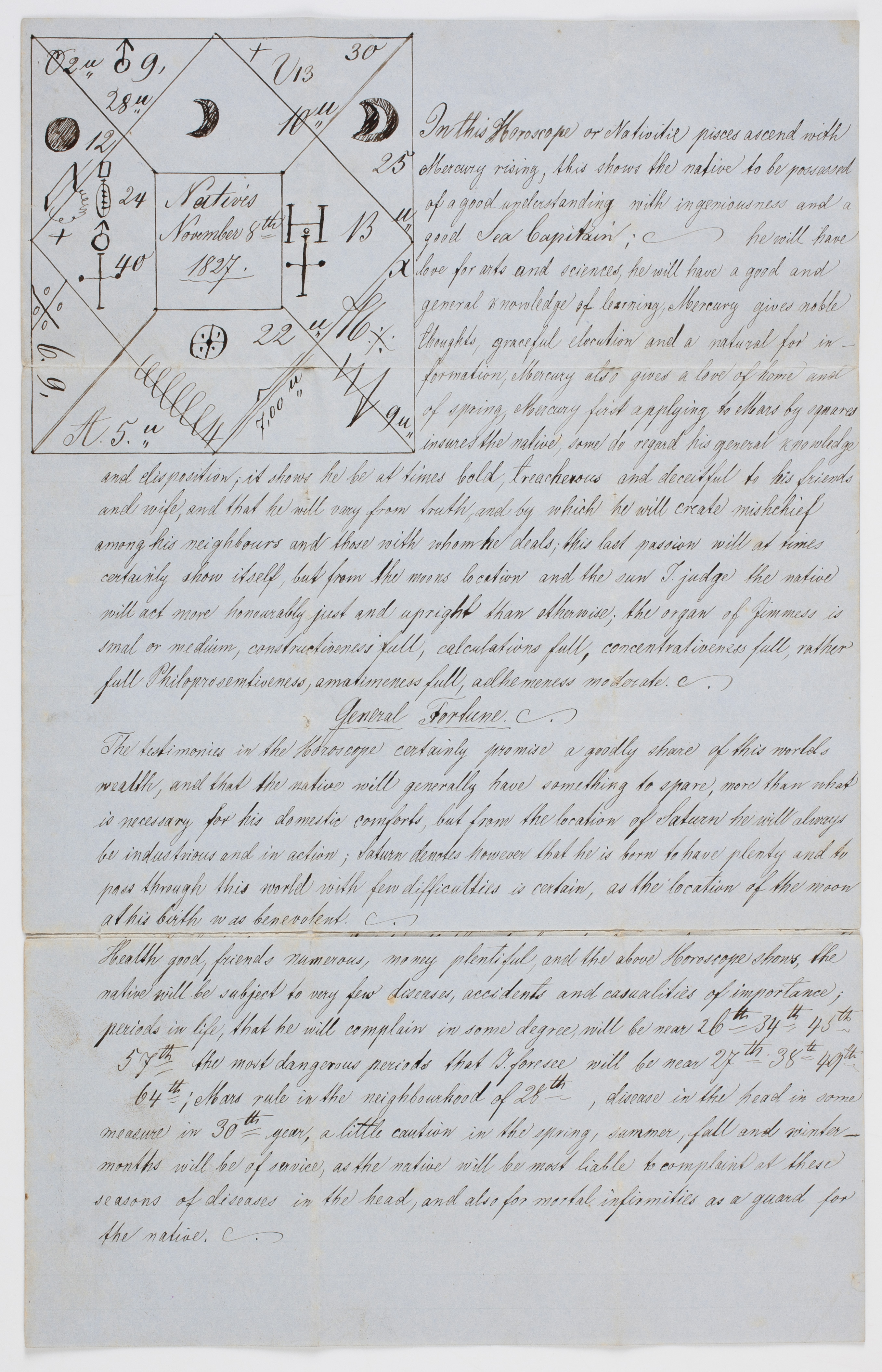 A rare find for the manuscripts department is this hand written horoscope, or “nativitie,” The four page document features a chart mapping out alignments of planets and the moon. The astrologer gives the twenty-three year old subject details about his character, general fortune on specific days and months, and children – “you will have 6 children, but will raise only 4.” Most predictions are positive, with occasional warnings on certain days – “Sickness, which may interfere with and mitigate against your success in business undertakings…” And at the end comes the all-important disclaimer – “Now Sir! I have given you a general statement as to the manners, your prospects fluctuate during life, and you will find the advice valuable to follow. I mean to say, that on the days noted for evil, you should be on the ground, attending to your business, and deal with caution when giving credit. This information receive and follow, and you will reap the benefit, you will understand, that this judgment will be found correct to events yet hidden in the womb of futurity as a general guide to prevent misfortune.”
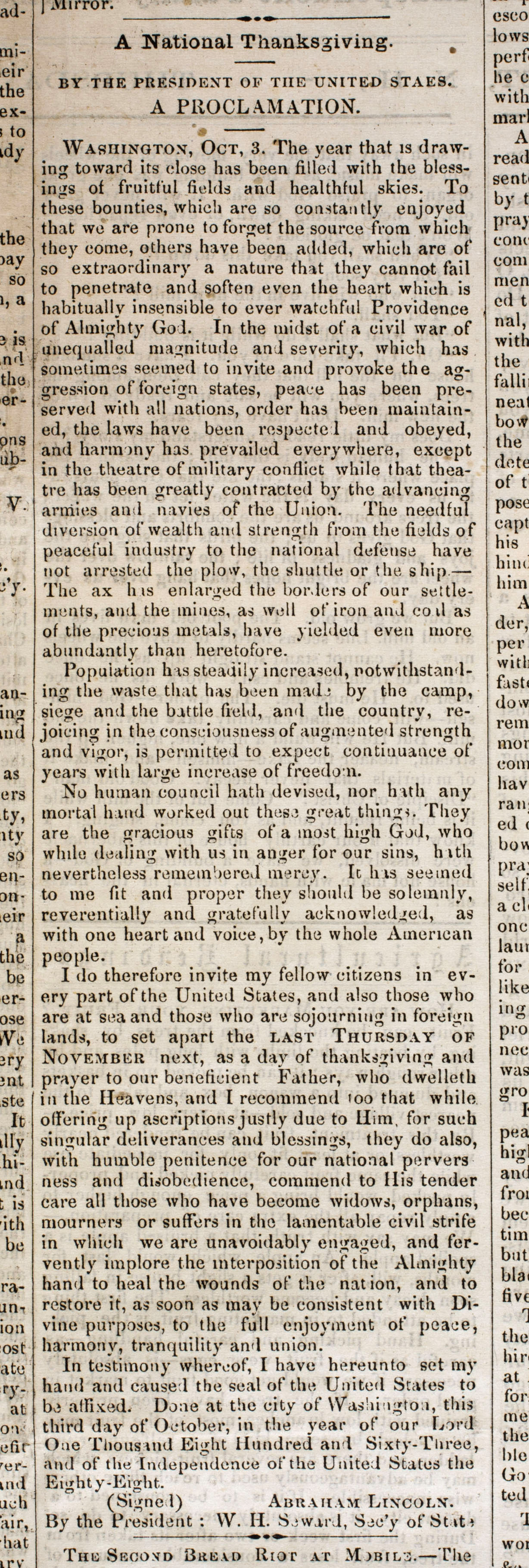 It has been a big year for some of the country’s most important documents. January saw the sesquicentennial of the Emancipation Proclamation, and just last week was the 150th anniversary of the reading of the Gettysburg Address. This Thursday in the United States we celebrate our national day of Thanksgiving, and so are looking back, once again, to 1863, when countless Union newspapers printed President Abraham Lincoln’s Proclamation for “a day of thanksgiving and praise to our beneficial Father” on November 26. Each year since, the sitting president has formally proclaimed that Thanksgiving Day should be celebrated on the last Thursday of November (this changed in 1939 when President Franklin D. Roosevelt set it one week earlier; two years later it was ruled by Congress to be observed as a legal federal holiday on the fourth Thursday in November). In President Lincoln’s Proclamation he states, “it has seemed to me fit and proper they [the bounties of the United States] should be solemnly, reverentially and gratefully acknowledged, as with one heart and voice, by the whole American people.” This proclamation appeared in many publications, including post-observance mentions in some Confederate newspapers. The copy seen to the left is from the October 8, 1863 issue of the Amherst, New Hampshire, Farmer’s Cabinet.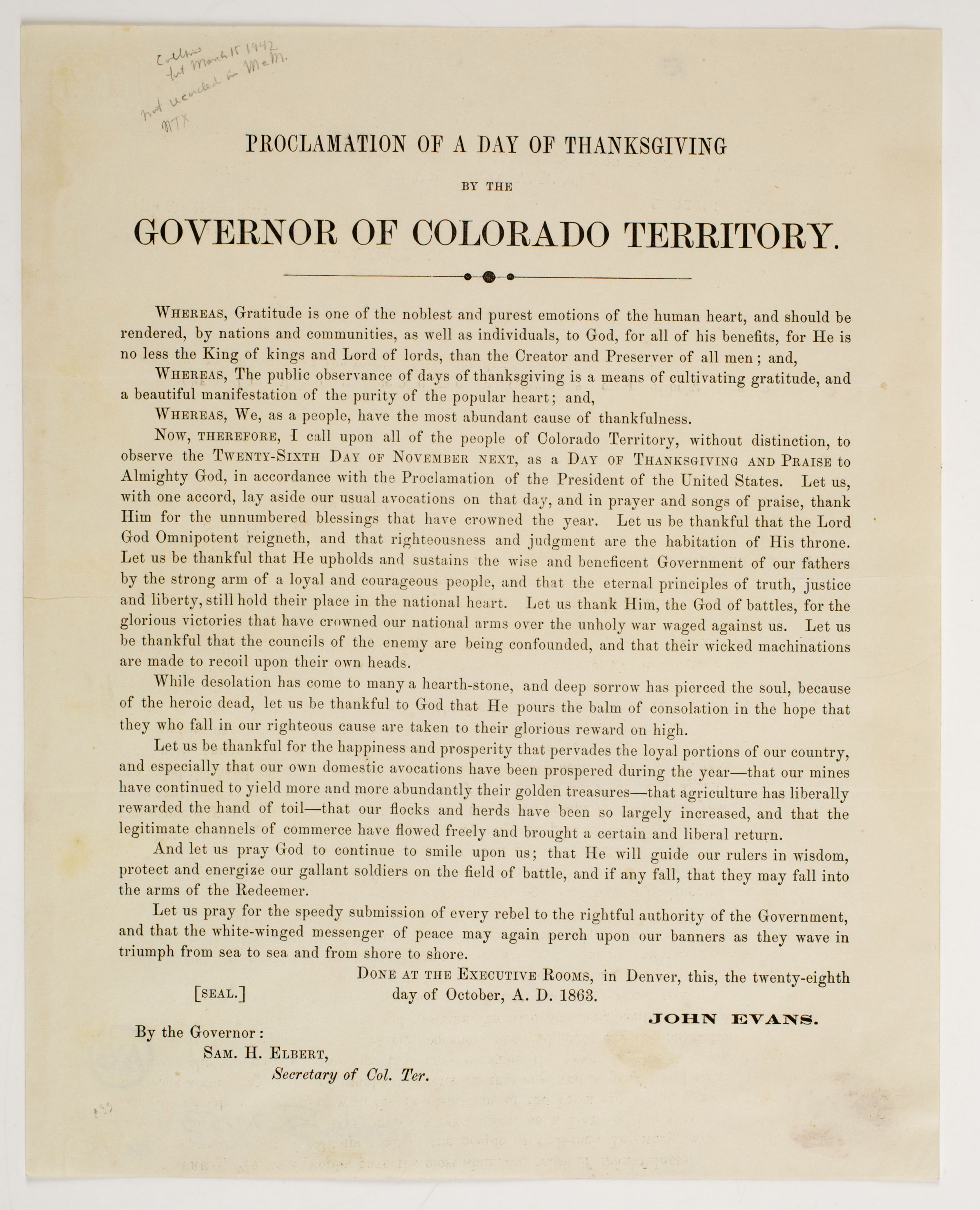
 Items in the Society stemming from this day are not just limited to those created by people in executive positions, however. For example, contained within the collections is also an assortment of pamphlets and transcribed sermons reflecting numerous religious denominations, places, and subjects. This assortment includes titles such as America’s Blessings and Obligations, A Willing Reunion Not Impossible, and The Necessity for Religion in Politics.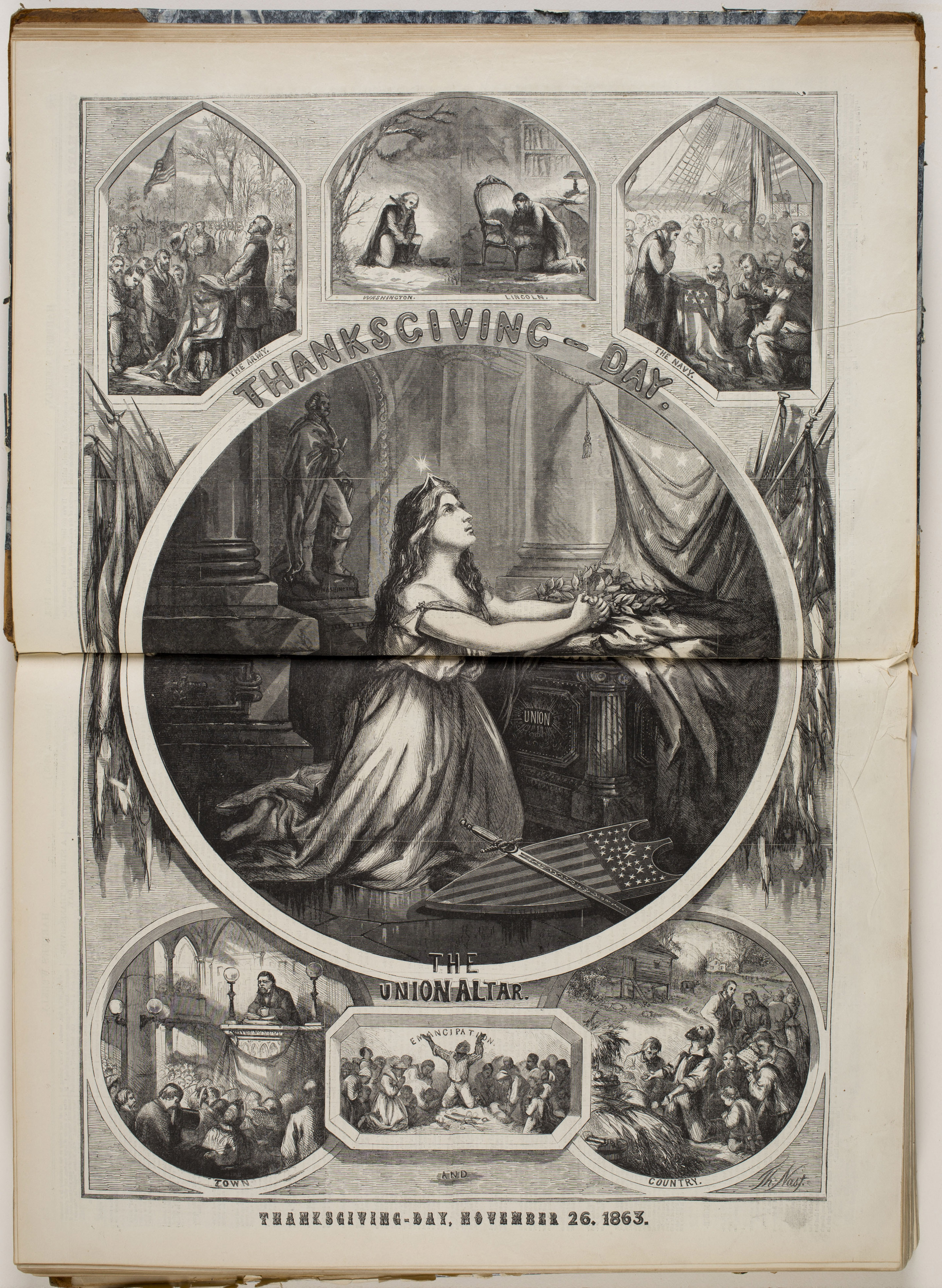
 This large (42” x 28 ½”) broadside was one of a group of five sheets purchased together, all of which relate to activities in Acton and West Acton, Massachusetts, between 1865 and 1875. Printed in Boston by F.A. Searle, who was well-known for his circus posters, all of the broadsides make excellent use of large, eye-catching wooden type and brightly colored paper. Given the thin paper and temporal nature of the events advertised (dances, fund-raising levees, and church festivals), it is amazing that these five printed sheets survived. This broadside advertises a dance in mid-February, which may have been held in honor of Valentine’s Day, a popular occasion for community social events.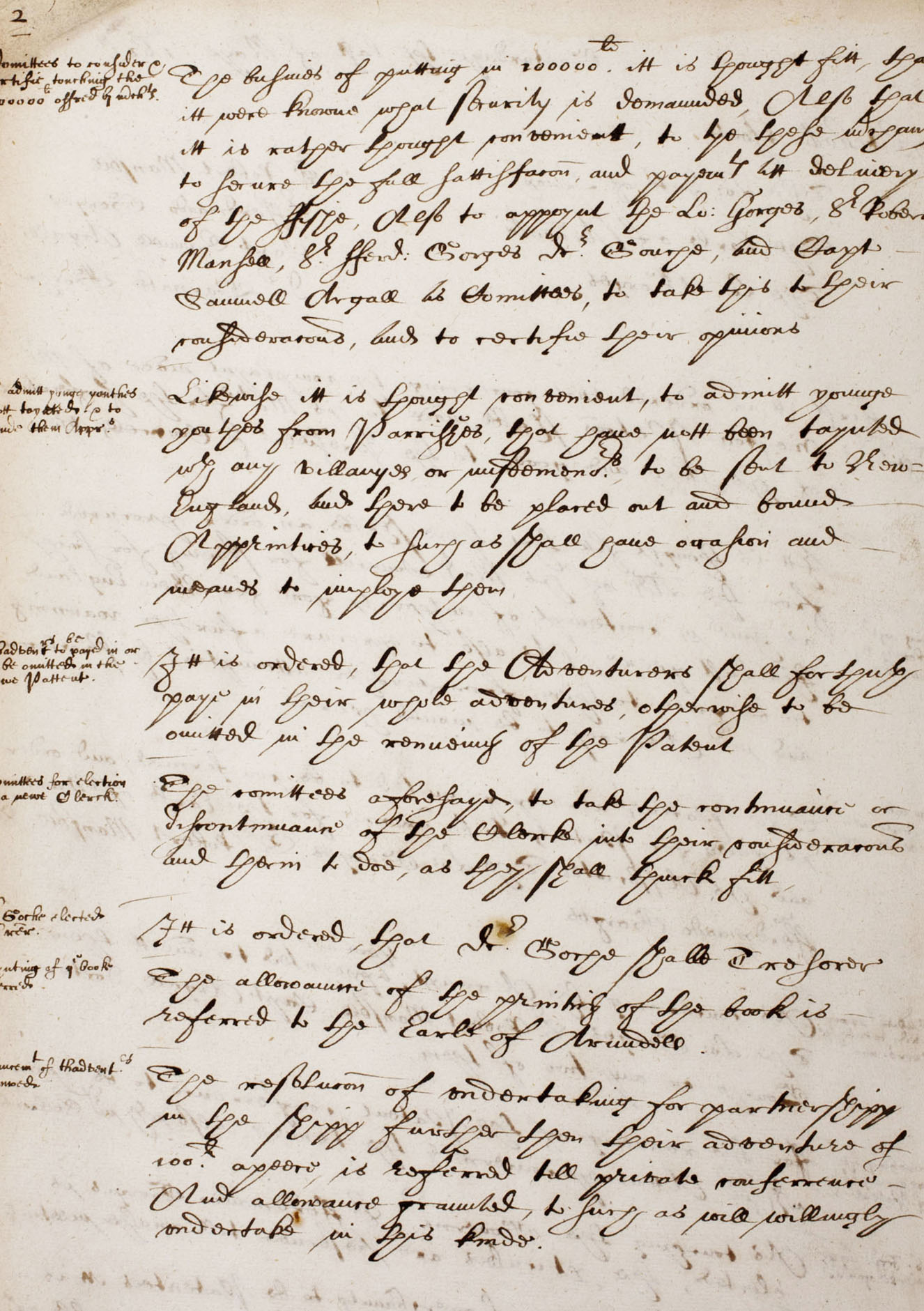
Four-score and seven years ago our fathers established upon this continent a government subscribed in liberty and dedicated to the fundamental principal that all mankind are created free and equal by a good God – [applause] – and now we are engaged in a great contest deciding the question whether this nation or any nation so conserved, so dedicated, can long remain. We are met on a great battlefield of the war. We are met here to dedicate a portion of that field as the final resting place of those who have given their lives that it might live. It is altogether fitting and proper that we should do this, but in a large sense we cannot dedicate, we cannot consecrate, we cannot hallow this ground. The brave men, the living and the dead who struggled here, have consecrated it far above our power to add or detract from the work. [Great applause.]