Barrow, Frances. New Little Mittens. New York & London: D. Appleton and Co., 1869.
This wood-engraved frontispiece is a comic scene set in the culture clash between a Chinese gentleman going out for a stroll, and an ignorant American sailor who pulls his queue and says “My stars and stripes! What a long tail our pussy cat’s got!” Any hope that this picture serves as the basis for a discussion about respecting people from different cultures is quickly dispelled: this image is used to illustrate a story about children misbehaving in church. Instead of listening to the minister, a little boy chooses instead to look at a secular book about foreign countries containing this picture. Eventually, the boy laughs out loud in church, and his bad behavior (reading a worldly book in church) is discovered.
Molly O’Hagan Hardy is AAS digital humanities curator and an ACLS public fellow. Every month on Past is Present she will be sharing news on digitization efforts at AAS, coverage of digital humanities projects using AAS materials, and ideas for such projects. Stay current with all things DH at AAS by checking out the “Digital AAS” section of our website.
After attending some excellent panels at the recent Modern Language Association Convention on work being done in the digital humanities, I was struck by the number of projects in early modern and eighteenth-century British literary studies that rely on the Text Creation Partnership (TCP). Prominent eighteenth-century British literature scholar and digital humanist Ted Underwood describes Gale Cengage’s Eighteenth Century Collections Online (ECCO) partnership with TCP as “an ideal solution” to the problem of procuring clean, machine-readable texts. Anupam Basu relies heavily on the fruits of ProQuest’s Early English Books Online (EEBO) partnership with TCP for his innovative work on Shakespeare. And yet both at the MLA Convention and in some post-MLA snooping around, I could find no examples of early Americanists making use of Readex’s Evans Early American Imprints Series, 1639-1800 partnership with TCP. The most obvious reason for this difference is scale: while tens of thousands of titles have been included in EEBO-TCP, only 5,000 titles from Readex’s Evans have been included. This makes Evans-TCP less than ideal for large-scale text mining projects, but its corpus could still be used for single text or author data analysis, the building of digital scholarly editions (see how this access works in the section below), or for pedagogical purposes (many of the titles in Evans-TCP have not been republished in modern editions for the classroom). In what follows, I explain how one might conceive of a project using Evans-TCP by describing what it is and how it might be used for those at partnering institutions now and in the near future by researchers anywhere.
What is the Evans-TCP?
Evans-TCP is a partnership among the TCP, NewsBank/Readex Co., and the American Antiquarian Society that, between 2003 and 2009, created almost 5,000 accurately keyed and fully searchable SGML/XML text editions. In other words, actual people have typed every word of the selected texts, rendering a much higher degree of accuracy than the optical character recognition (OCR) software that Readex relies on to transform the scans of texts into words. Not only are searches of such texts more reliable, but through Evans-TCP a user can see the keyed-in text that she searches. When working in the Readex database, a user sees only the image of the original text that has gone through OCR software, but not the text that is being searched. Moreover, in Evans-TCP, a user can also access the XML file created by the TCP.
How can I find out which early American texts are included in the TCP?
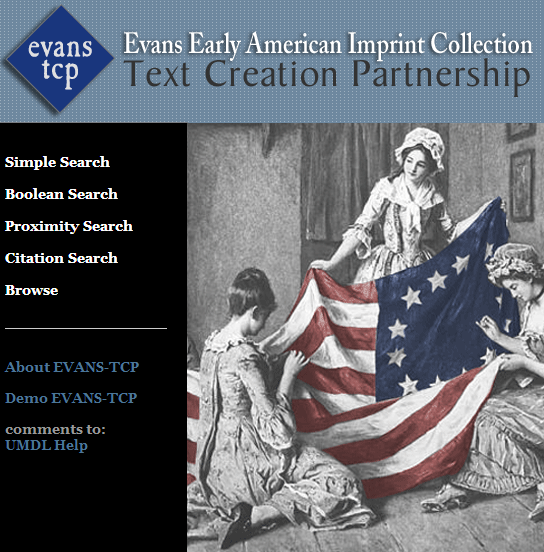
In consultation with a number of scholars, AAS selected which titles within the date range of 1640 to 1800 would be chosen for Evans-TCP. The Evans-TCP page offers a number of search options to navigate through these titles: simple, Boolean, proximity, citation, and browsing. The searching is fairly intuitive, but if you need help, check out these instructional videos (though they were created for EEBO-TCP, the interface is pretty much the same).
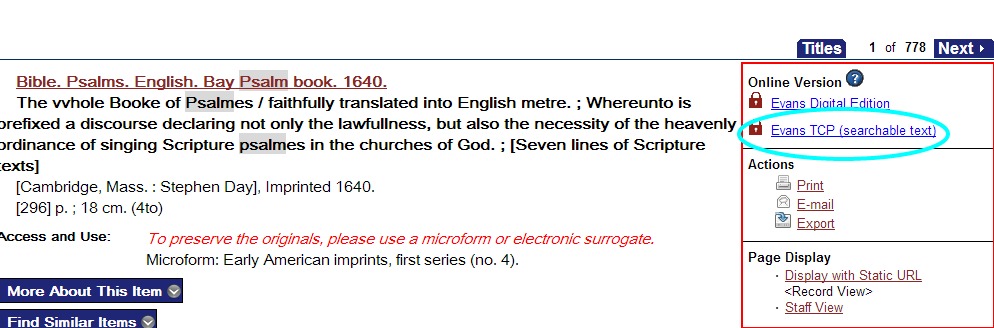
The AAS General Catalog is another way to find texts in Evans-TCP. Note that on the upper right side of the screen in our catalog record (see the screenshot below), a user will see a link to any title included in Evans-TCP. As of now, the lock icon next to the link indicates that one must either be on the AAS campus or that of a partnering institution in order to access the Evans-TCP text, but read on to find out how that is changing SOON.
Who can access the TCP and how does access work?
This is the really great news: as of June 30, 2014, anyone anywhere can access the Evans-TCP texts. TCP welcomes requests for source files (now from users at partnering institutions, but soon for everyone) for individual texts, or the whole corpus of its titles. After the June release date, anyone will be free to access and make use of these raw files through an online directory where they can be downloaded. Rebecca Welzenbach, TCP outreach librarian at the University of Michigan, explains, “Our intention is to make them available in such a way that people can find and download them without having to come through us.” Welzenbach does offer one reminder: although TCP includes links to the Readex/Newsbank page images, these will be available only at subscribing institutions. The TCP makes XML encoded transcriptions, not the whole database, available. It is, however, these transcriptions upon which digital humanities work from the early modern period to the nineteenth century relies, and we at AAS would love to hear how early Americanists are making use of this incredible resource.
Halaina Demba, our guest author here, is a third year student in the Buffalo State College Program in art conservation. She spent this past summer, the final one of her graduate studies, interning in the Society’s book and paper conservation lab.
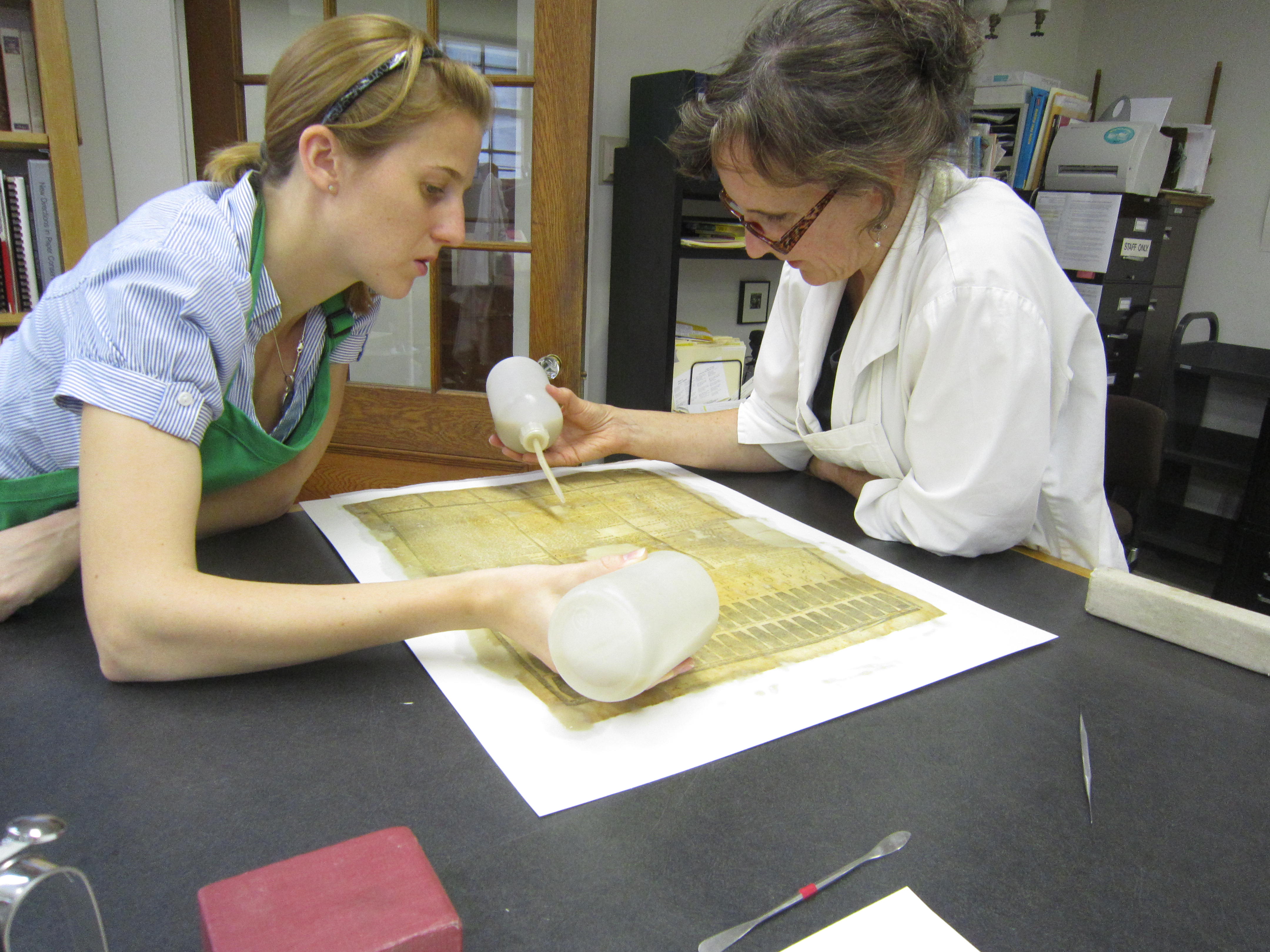
The author working closely with chief conservator Babette Gehnrich.
This summer the American Antiquarian Society received a unique gift of an 1854 broadside with an attached docket. The broadside announces the sale of a “Valuable City Lot” in the city of Indianapolis, Marion County, Indiana. Announcements, like this one, were commonplace during the nineteenth century and could be found posted in prominent areas of a town or city, such as near the post office or courthouse. At the conclusion of an announced event, the broadside would be removed, posted over, or just forgotten; these advertisements would not typically be saved. Consequently, it is rare to find advertisements like this one. It is even more rare to find one that has an attached docket stating who posted the broadside, when it was posted, and locations where the broadside was posted.
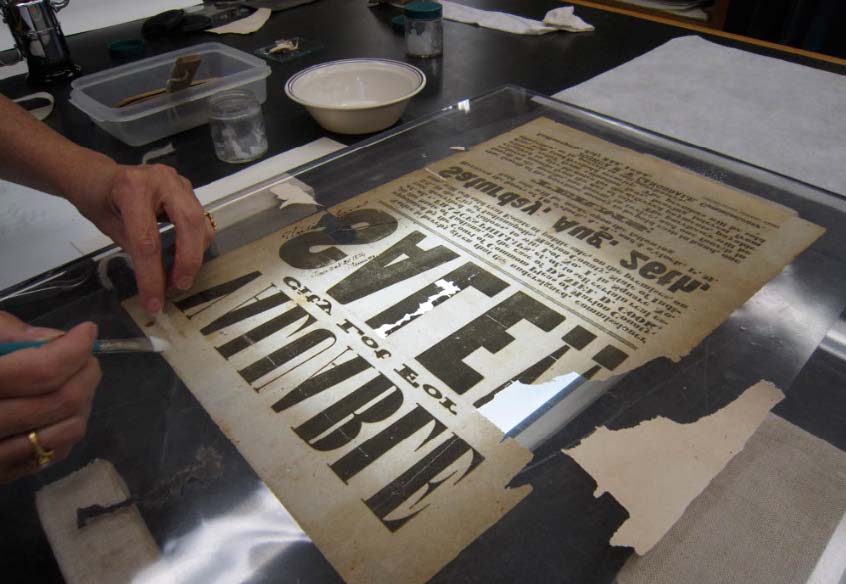
Paper was cut to fit losses and inserted with wheat starch paste while broadside was on a light table.
While the docket was in stable condition, the broadside was in a marked state of deterioration. The paper substrate of the broadside was extremely fragmented with complex tears and losses predominantly located in the upper half of the document. The paper in the inked areas was observed to be extremely brittle, which further compromised the document’s fragile condition. This document could not be safely handled without conservation treatment. Conservation was undertaken by chief conservator Babette Gehnrich and myself.
After photographic documentation, a thorough assessment, and a consultation with the curator, the broadside was mechanically separated from the docket and then washed with water on a capillary fleece to reduce discoloration.
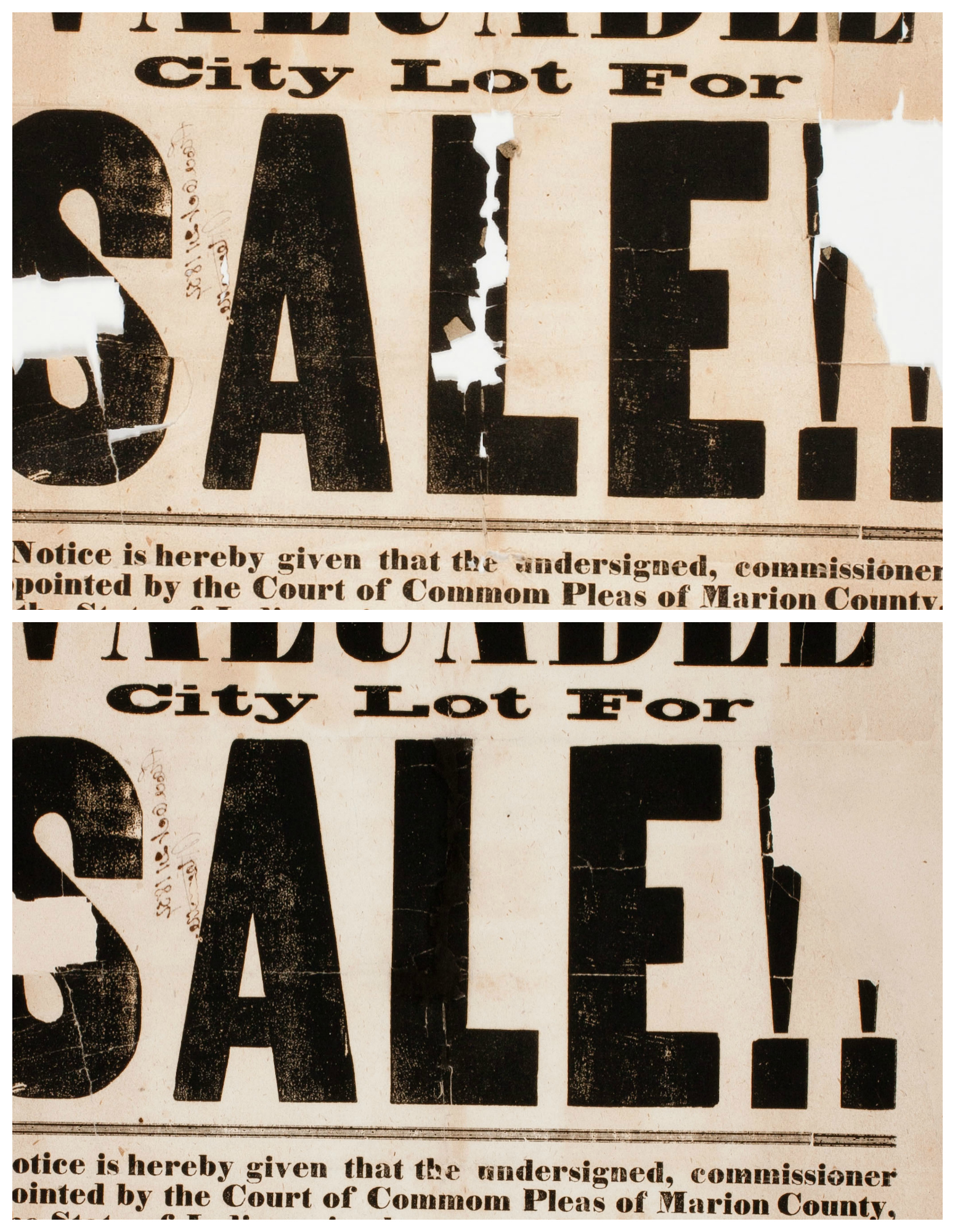
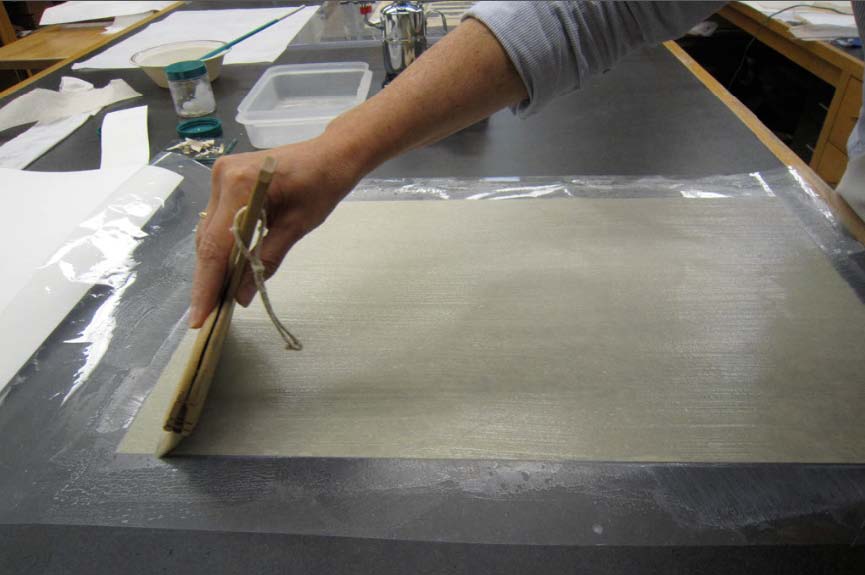
Detail of before (above) and after (below) treatment of broadside. Note improvement in tone of broadside and inserted fills.Wheat starch paste being applied to Japanese tissue lining sheet.
Losses in the broadside were filled with historic and modern toned paper of a similar color and texture. The many complex tears were first repaired with Japanese paper strips. After consulting with curator of graphic arts Lauren Hewes and chief conservator Babette Gehnrich, it was decided to not tone the large text losses of the broadside. For archival documents, legibility of the written contents and stability of the object are the most important factor of the treatment. Even with the many losses, the text of the broadside was legible. Furthermore, the losses are part of the history of the piece. However, it was decided to fill some of the minor losses with toned paper to create a unified visual appearance.
Next, the reverse of the broadside was lined with a sheet of Japanese tissue that was prepared with wheat starch paste. The broadside was placed under pressure until the paste had dried. The lining tissue was trimmed to the edge of the broadside, and the losses were toned. The treatment was finished when the docket was reattached to the broadside.
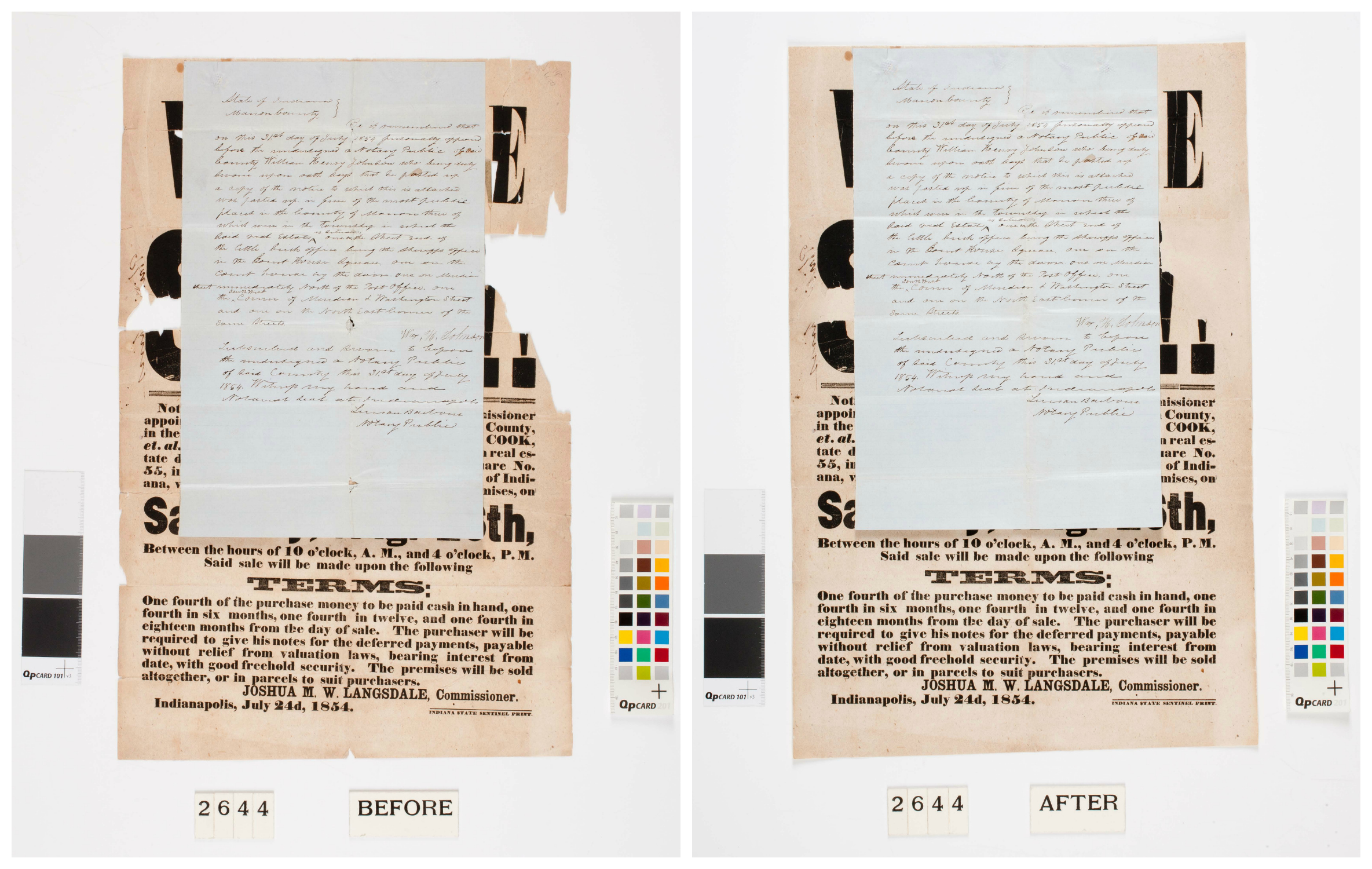
Overview of before (left) and after (right) treatment of broadside with attached docket.
I was extremely satisfied with how this treatment turned out. The treatment significantly reduced the condition problems. The inserted fills, repairs, and lining tissue helped to stabilize the broadside. Now the broadside can be safely stored without further loss and damage and, when necessary, handled by researchers.
Be it remembered that on this 31st day of July 1854 personally appeared before the undersigned a Notary Public of said county of William Henry Johnson who being duly sworn upon oath says that he posted up a copy of the notice to which this is attached was posted up in front of the most public place in the county of Marion this of which was in the Township in which the said real estate is ?—- one on the sheet end of the little bush office being the sheriffs office, in the court house Square and on the Court house by the door, one on ?—– street immediately north of the post office, one the south west corner of ?— and Washington street and one on the North east corner of the same Streets
?— and sworn to before the undersigned a Notary Public of said County this 31st day of July
1854. W?— hand and ?———–
?——-
Notary Public.
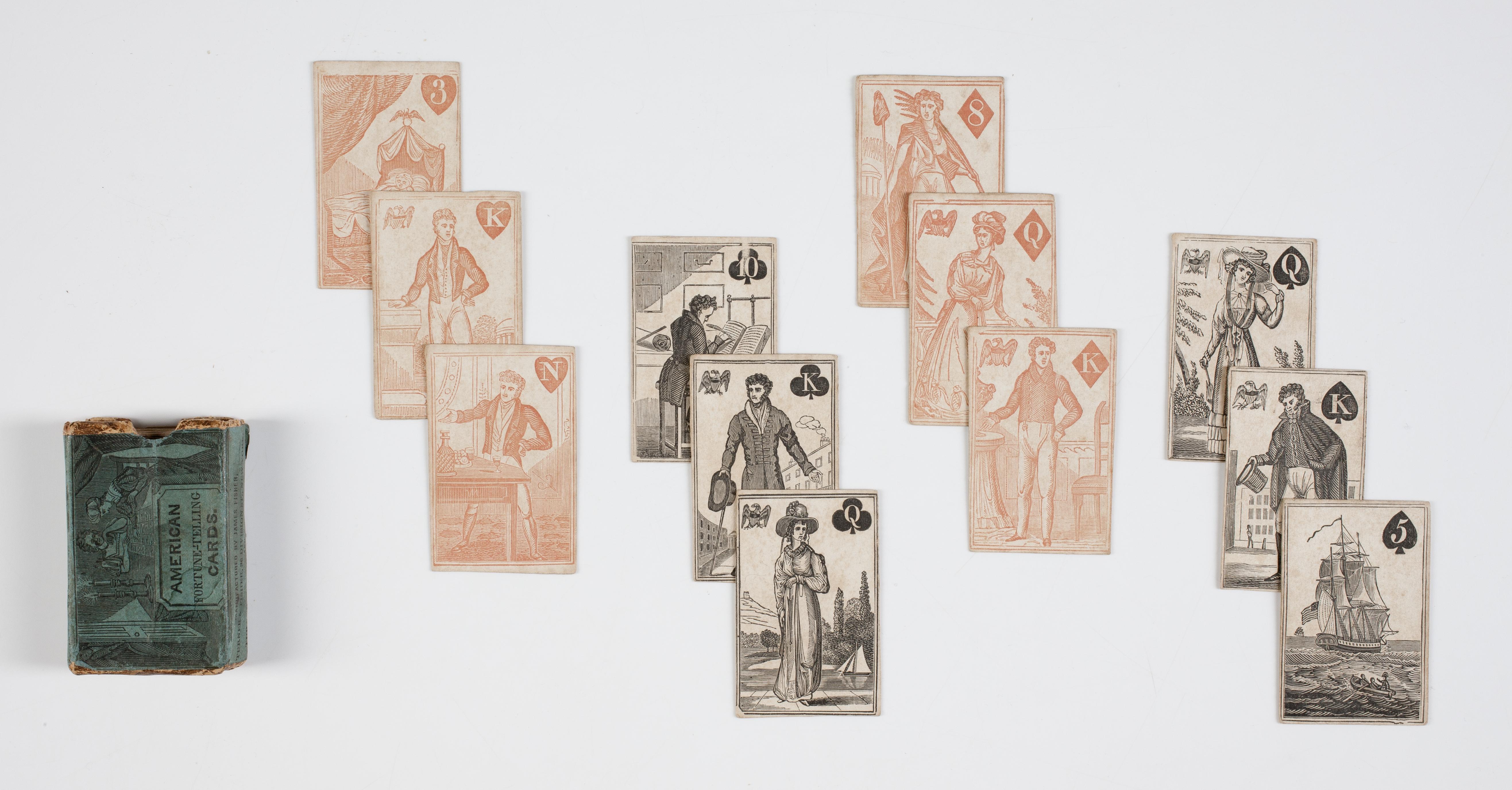
American Fortune Telling Cards, with Directions. New York and Philadelphia: Turner & Fisher, after 1835. 36 cards with box. AAS has several sets of fortune telling cards in its Toys and Games collection. This set features typical four-suit cards suggesting travel, wealth, poverty, love, etc., but is distinctive because many of the images feature American eagles, allegories of Liberty, and American flags. Produced in Philadelphia by Turner & Fisher, who also printed almanacs and children’s books, this set of cards was sold at bookstores up and down the eastern seaboard, starting in 1835. Advertisements read: “Peeps into Futurity, or a Knowledge of what is to come, will be revealed in the most infallible manner by the new American Fortune Telling Cards, which are founded upon the true scientific principles of the ancient Horoscope.” The price varied from bookseller to bookseller, ranging from 15 cents a box to 25 cents per box.
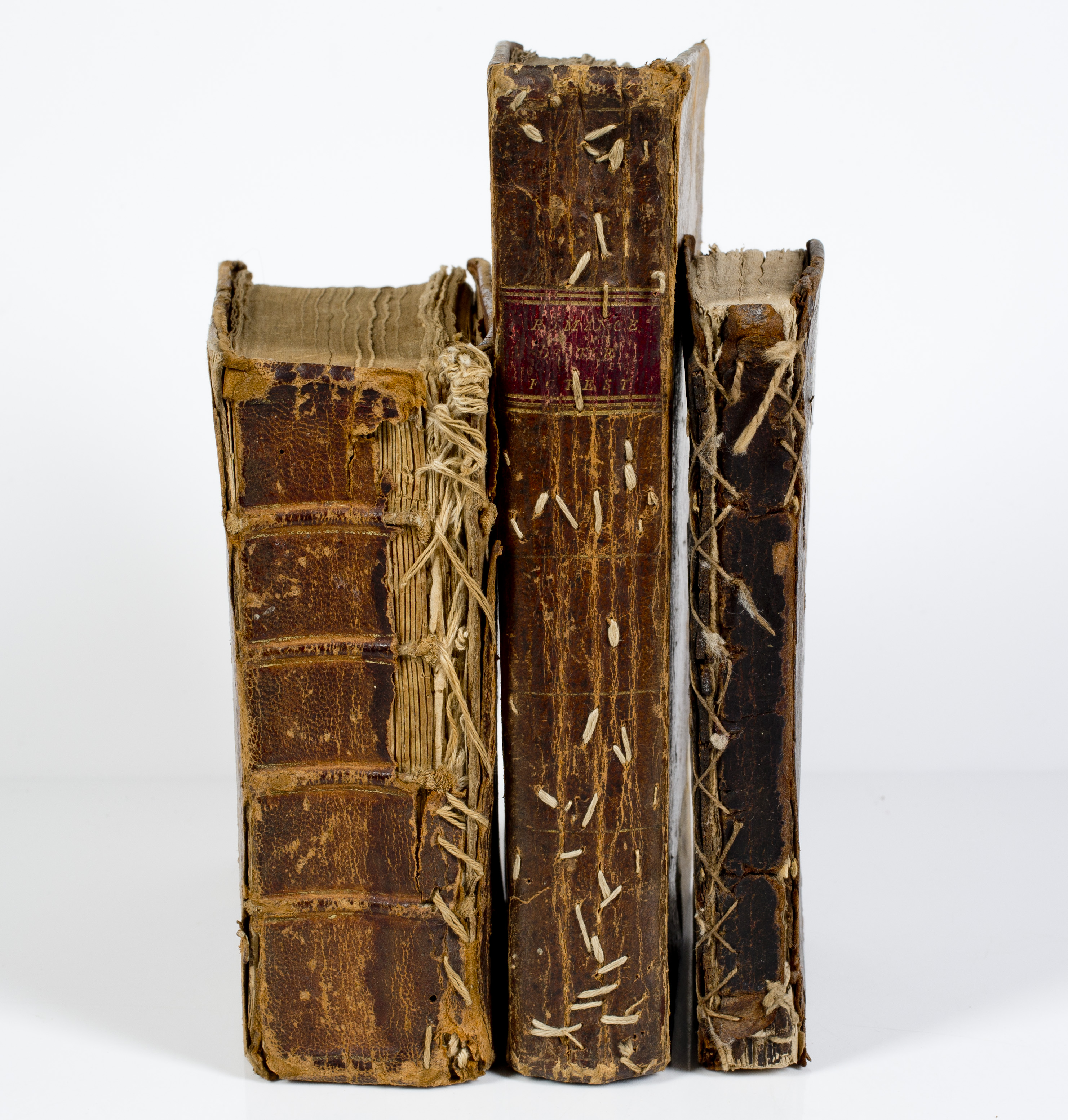
The re-stitched bindings of Perry’s Royal Standard English Dictionary (Worcester, Mass., 1788), Radcliffe’s Romance of the Forest (Philadelphia, 1803), and Russel’s Seven Sermons (Boston, 1715).
As a cataloger for the North American Imprints Program, my job is to catalogue books and pamphlets printed and published in North America between 1801 and 1820. I describe them, I put them into context with other books and pamphlets, and I become the latest person to handle an item that is two centuries old.
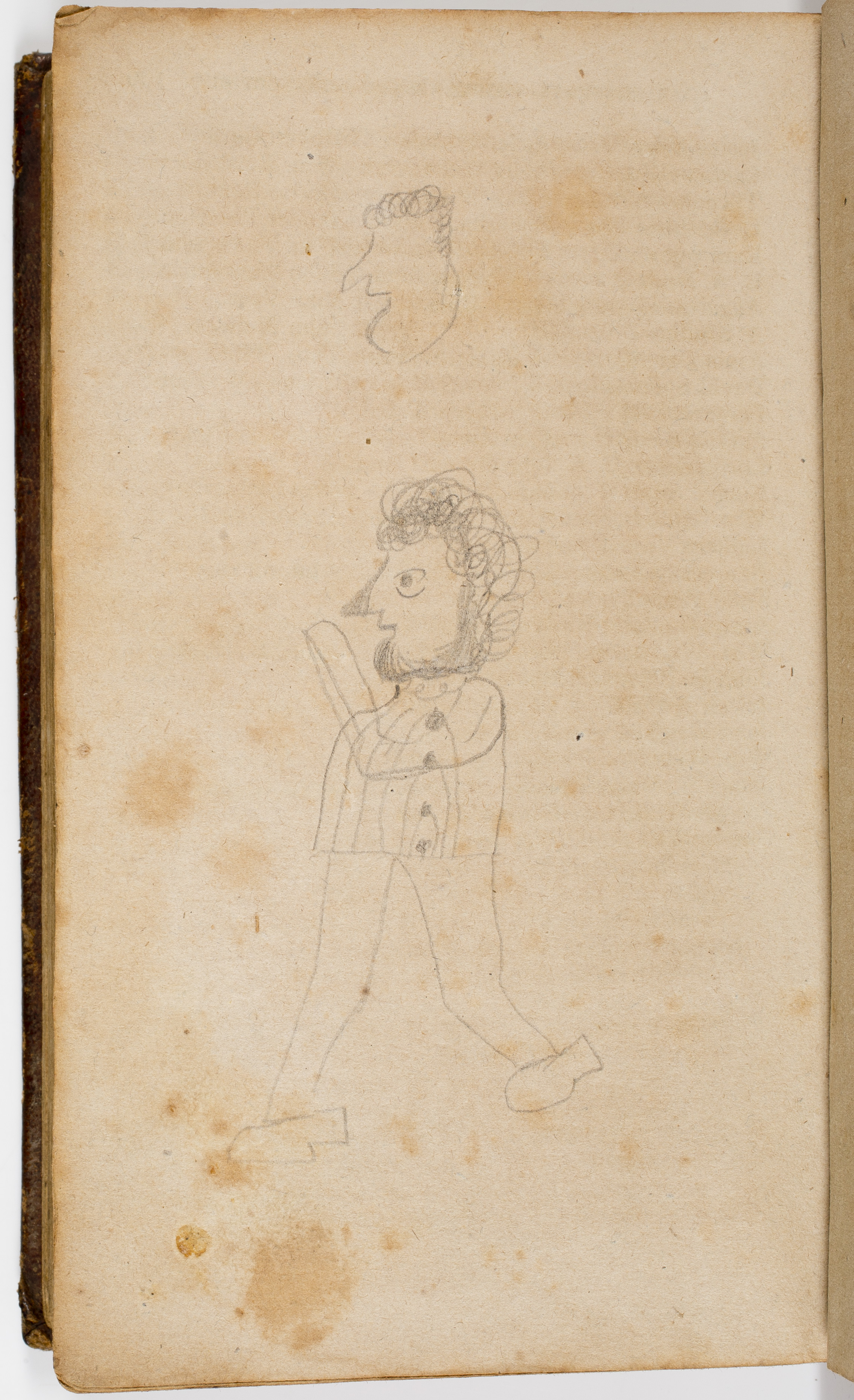
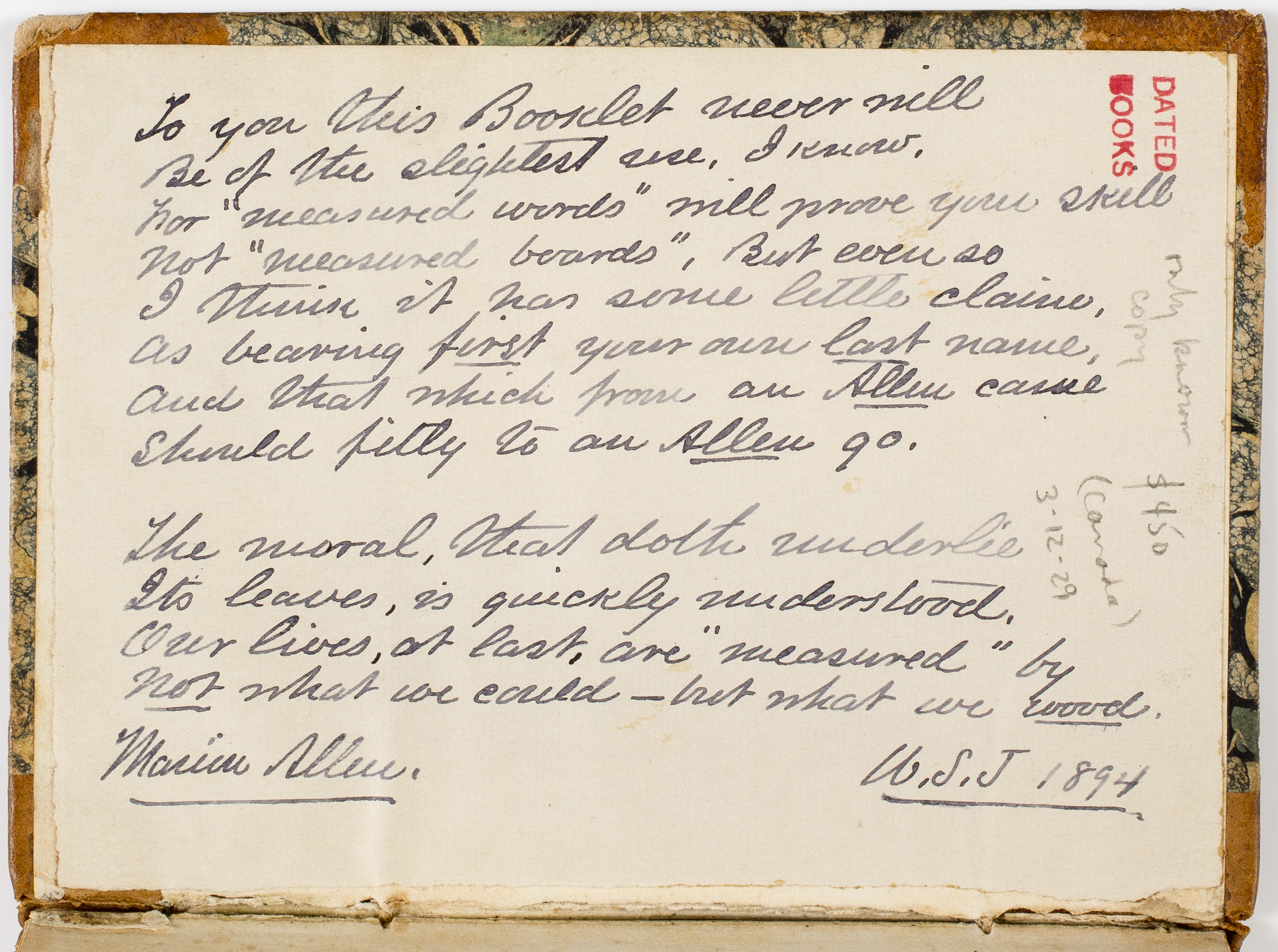
Many people have touched these books over their 200 year lifespan, and some of them leave traces of their presence and lives when books pass through their hands. I’ve seen the results of individuals wielding needles and thread (left), classical studies of the human form (below right), and poetic claims of ownership (bottom). Sometimes the inscriptions and annotations left in a book catch my eye and pique my interest, although I will never know what a person was thinking when she or he put pen to paper and inscribed their book!
Of the many inscriptions that I have seen, the following made me smile, intrigued me, or otherwise stood out, and I thought that I would share them.
One of several drawings founds on the rear flyleafs of Remarkable Shipwrecks (Hartford, 1813).
I can’t help but hope that Emmeline M. Henry enjoyed her birthday gifts, perhaps with a nice cup of tea.
2. Hobbit-style gift-giving
Miss Olive L. Gregory received A Real Treasure for a Pious Mind (New York, 1807) as a “present from her brother Harvey H. Gregory on the 25th of November 1818 being his birth day 24th year of his age.”
Olive Gregory was not the only young woman to own A Real Treasure for a Pious Mind, nor was she the only one to receive it as a gift. The American Antiquarian Society holds eleven copies of it printed between 1797 and 1820, and seven of them are inscribed. Six of the seven inscribed copies were owned by women (the seventh inscription is ambiguous). Julia Bissell received a copy of the 1801 U.S. edition “from [her] grandmother, who died Sept. 24, 1824, age 92 years,” and Lucretia Burrows was given a copy of the 1803 New Haven edition as “a present from her grand-father.”
However, Miss Gregory is the only person to have received it as a gift on someone else’s birthday!
Verse inscription on the flyleaf of A ready Reckoner for the Use of Dealers in Timber and Others (Quebec, 1809). The book was originally given from Heman Allen to John Johnson in 1823; in this verse, John Johnson’s descendent, William Shaler Johnson, gives it to one Marion Allen.
3. Honesty is the best policy
Dr. James Tinsley sent a copy of his A New Theory of Yellow Fever, Founded on the Results of Chemical Experiments (Charleston, 1819) to Dr. Samuel L. Mitchill, a prominent New York physician. On page 25 someone, possibly Tinsley, states that “the pages prior to the 25th I conceive to be of no consequence whatever.” One wonders about Mitchill’s reaction to the remaining pages of the pamphlet, which argues that yellow fever is caused by a combination of heat, moisture in the air, fauna and flora putrefying, and the effects of plants and animal respiration on air quality.
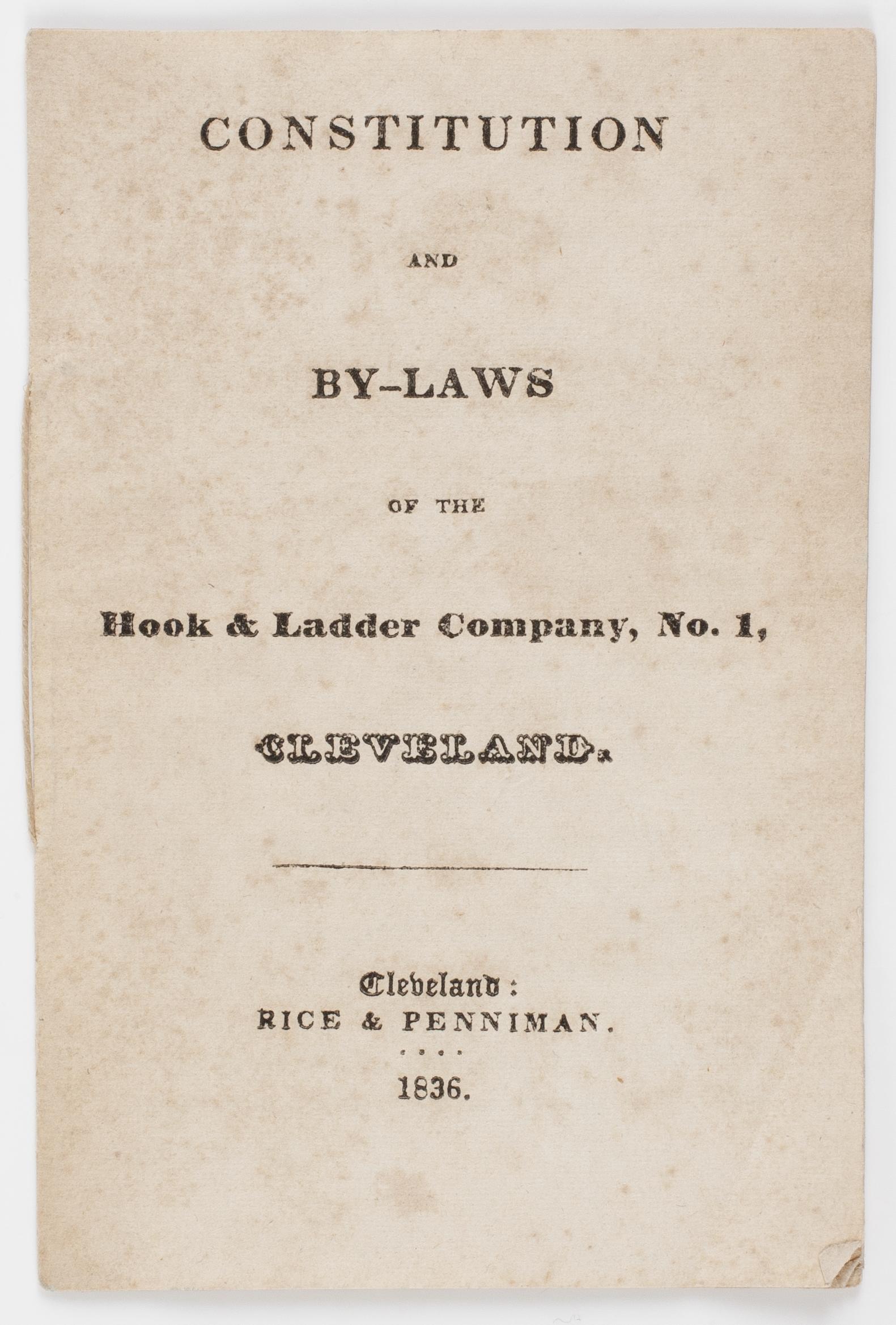
Constitution and By-Laws of the Hook & Ladder Company, No. 1, Cleveland. Cleveland: Rice & Penniman, 1836. APPARENTLY UNRECORDED, ONLY KNOWN COPY!
Rice & Penniman were known to be printing in Cleveland, Ohio, in the mid-1830s, but this particular pamphlet is evidently entirely unrecorded. The Constitution for this firefighting company defines the duties of the Officers, who are headed by the Foreman. The bylaws decree that “the uniform of this company shall be a felt hat painted with the initials and number of the company, and a leather belt.” There is a 50 cents reward for “that member who shall first appear at the deposit of the hook and ladders having on his uniform.” And, “It shall be the duty of those who are engaged in the transportation of the hooks and ladder to a fire while on their way to call out at intervals the name and number of their company.”
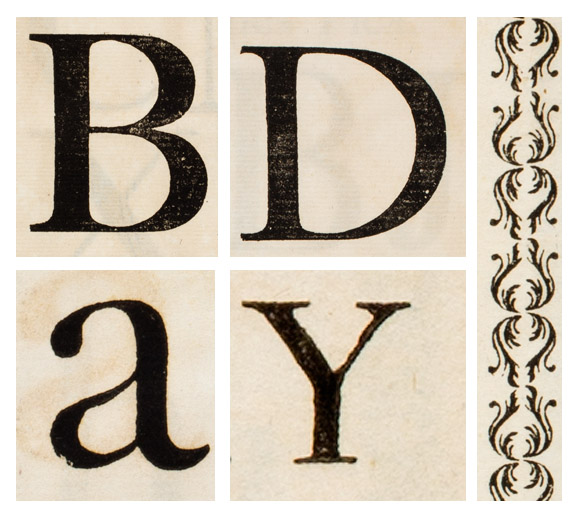
We’re wishing a very happy 265th birthday to AAS founder Isaiah Thomas! We compiled this card from Thomas’s own copy of A Specimen of Printing Types by Thomas Cottrell, Letter Founder.
As our gift, we’ve digitized the 1774 London imprint, so you can browse the type specimens and ornaments! You can find it in our digital image database: http://goo.gl/xqPj5j
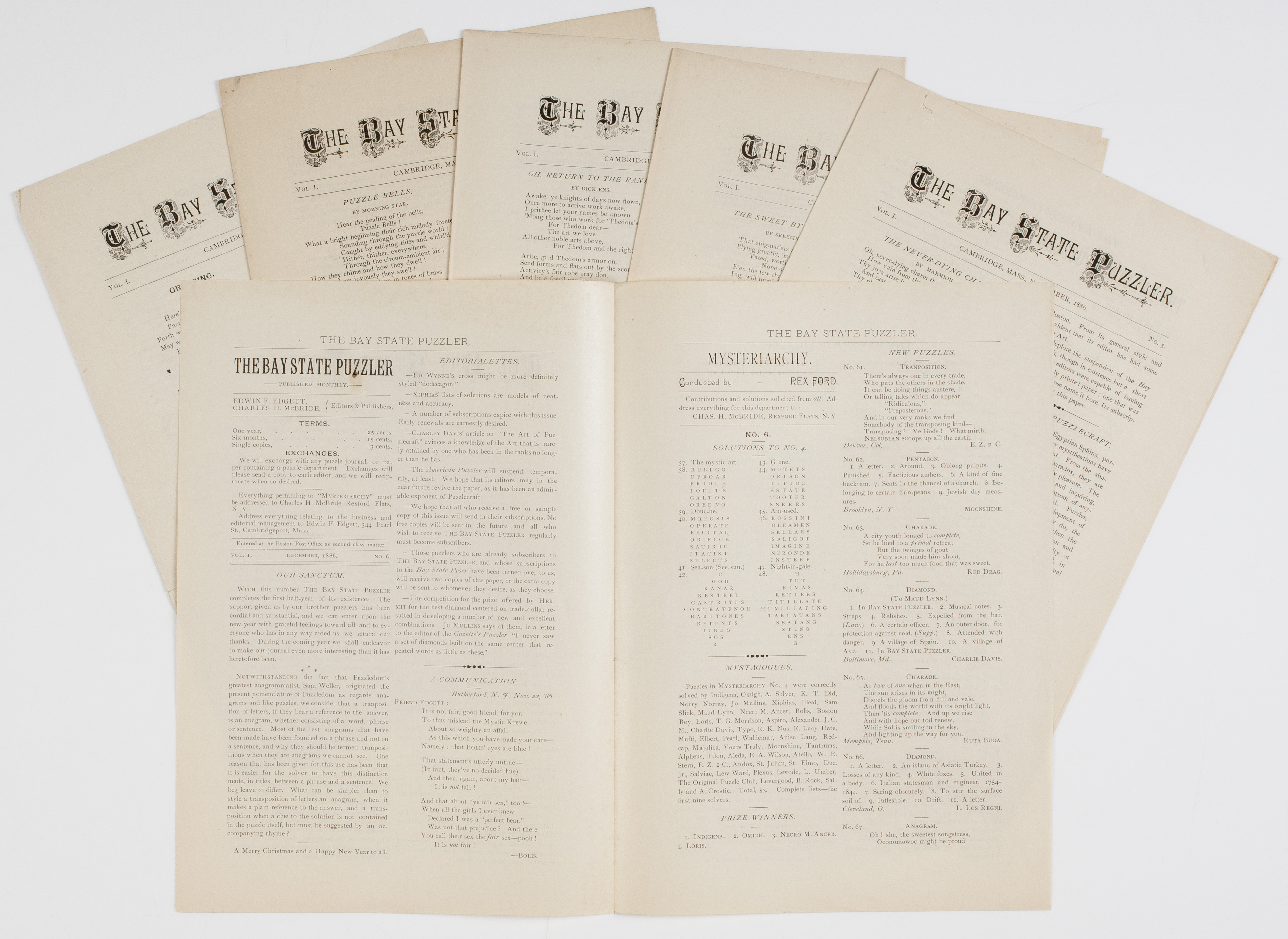
AAS has one of the largest collections of nineteenth-century amateur newspapers in the country. These were little publications printed on table-top hobby presses and often done by children and young adults. They became popular in the 1870s and by the 1880s hundreds of them were being published all over the country. Their publishers even had regional and national organizations and conferences.
One sub-genre of amateur newspaper is the puzzle newspaper. In each issue the editor would put together articles about puzzles and print puzzles for readers to solve. Some even offered prizes. Since these are so little known, we thought a list of the titles in our collection was in order:
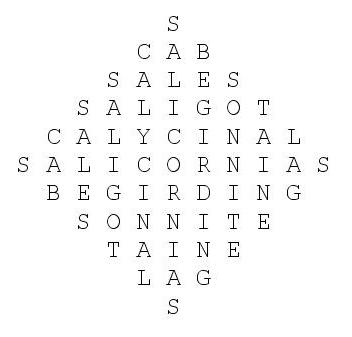
The Bay State Puzzler (see picture above) was edited and published monthly by Edwin F. Edgett and Charles H. McBride in 1886 in Cambridge, Mass. It appears to have lasted just six issues, ending with the December issue. Each issue contained a variety of word puzzles. One regular puzzle was a diamond or square. The answer to each clue would fill in a line to form a square or diamond shape that read the same left to right as top to down. For example, in the first issue, puzzle no. 10 is a diamond with the clues:
A letter
Hebrew dry measure
Demands
The water-thistle
Situated on the calyx
Certain plants, growing in marshy places
Enclosing
One of the Orthodox Mohammedans
French author, 1828 – .
Slow.
A letter.
And the answers are:
Not that easy. Squares are formed in a similar manner except each row and column have the same number of letters.
Edgett and McBride also offered prizes:
First complete list – Fifty cents
Second complete list – A bound book
Best incomplete list – This paper, one year
Next best list – This paper, six months
Next best list – American Puzzler, three months
For first correct solution to each flat, a copy of the Elzevir Library.
Open until September 15 [1886] to subscribers and exchanges only.
In the spirit of things, here are some examples for the gentle reader to attempt.
I. Diamond (from July 1886)
A letter.
A tree of the genus Abies.
Clears
Having a part displaced.
Becoming brothers.
Divided into small pieces.
Relied
Governing bodies.
Low places between hills.
Caused to go.
A letter.
II. Diamond (from July 1886)
A letter.
A mixture of carbureted hydrogen and olefiant gas.
The heron, (Obs.).
Talked without ceremony.
Inscribed.
Troublesome plants.
Complied with.
A difference in copies of a book.
A village of the Netherlands, in Dreuthe.
Drawn out.
A letter.
III. Square (from July 1886)
To drive back.
A genus of mollusks.
A special privilege.
German philologist and critic, 1772-1848.
Province of Ireland, county of Dublin.
Earthy pigments.
Hearty.
IV. Diamond (from Aug. 1886)
A letter
A Hebrew measure.
Went.
More deadly. (Obs.)
Alloys of gold, silver, and copper, of which an inferior quality of jewelry is made.
A compound of an element of boron with a base.
Locates a second time.
Carries on.
Certain plants.
Musical syllables.
A letter.
V. Square (from Sept. 1886)
Presses firmly together.
A genus of fishes.
Gratifying in self esteem.
French-Latin poet (1480-1524).
A town of China.
A duty on ships.
Russian measures of seven feet.
VI. Hour-glass (from Sept. 1886)
Imperfection (Worc. obs.).
Activity (obs.).
Inclined to run together.
Income (obs.).
A large kind of bat.
A thin, metallic plate.
Date.
A letter.
A virtue of the Deity, existing throughout eternity.
A throb.
A sea-woman.
One who advocates church denomination over civil power (Worc.).
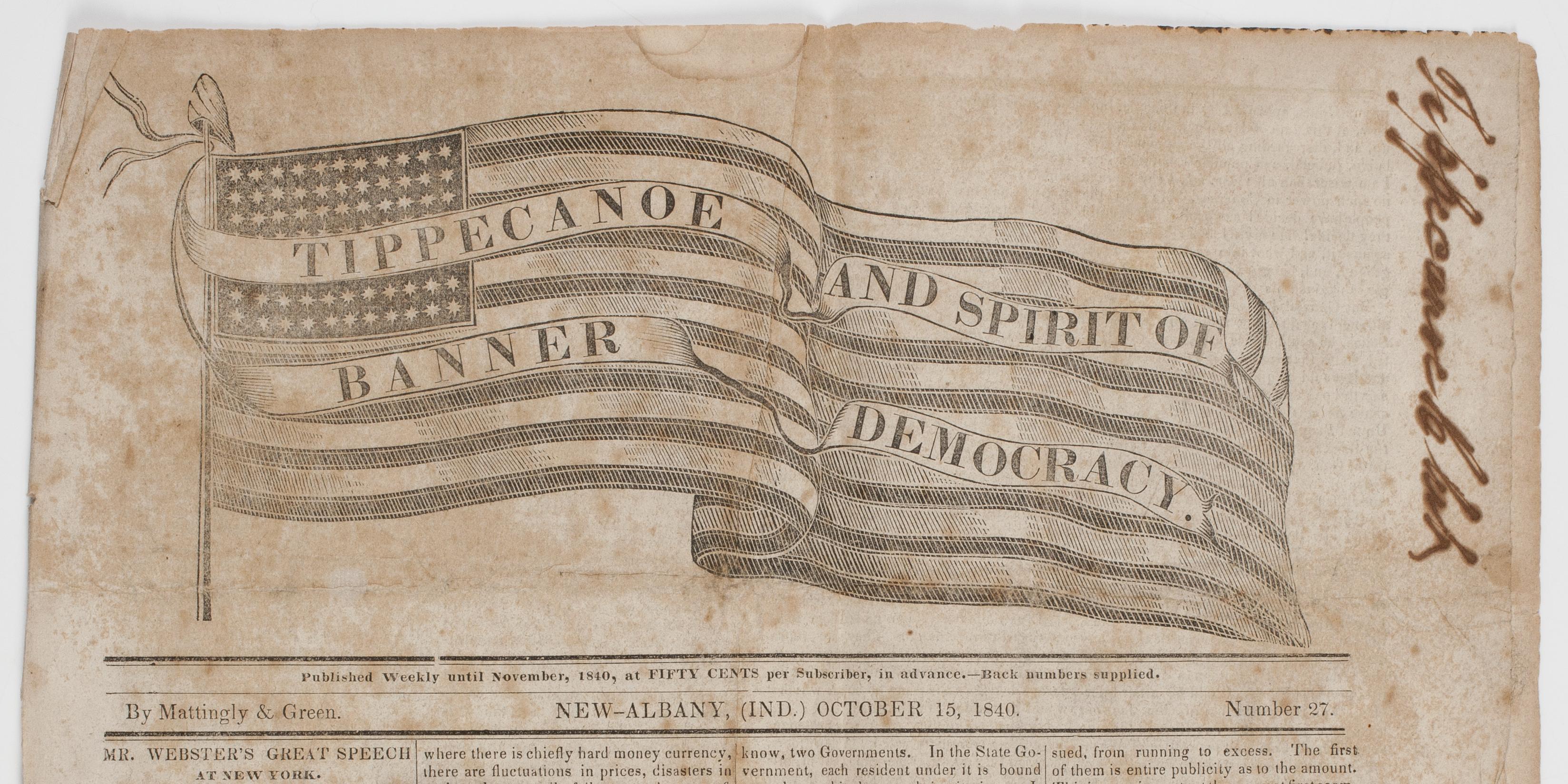
Tippecanoe Banner and Spirit of Democracy (New-Albany, IN) Oct. 15, 1840. No. 27. Here is an example of a presidential campaign newspaper supporting the election of William Henry Harrison. The hotly contested presidential election of 1840 produced a lot of campaign newspapers produced by local newspaper offices to promote candidates and platforms. This example was published in the office of the New-Albany Gazette. It is featured here because of its spectacular masthead.
Whenever it’s a damp, drizzly November (or January) in your soul, where do you go to keep from knocking people’s hats off? In Melville’s Moby-Dick Ishmael goes to sea, while the novel’s sub-sub librarian (Melville’s fictional assistant, assistant librarian who scours the earth for the “Extracts”) apparently retreats to literary references to the Leviathan. The sub-sub librarian in Ishmael reaches out to a fantastical cetology based on book format, Beale’s Natural History, and an only known copy of a book about the north wind. Some of us, who are less inclined to travel the world hunting either for whales or extracts about them, go to first editions of books like Moby-Dick—preferably if these first editions are owned by our own libraries.
First edition covers of Moby-Dick
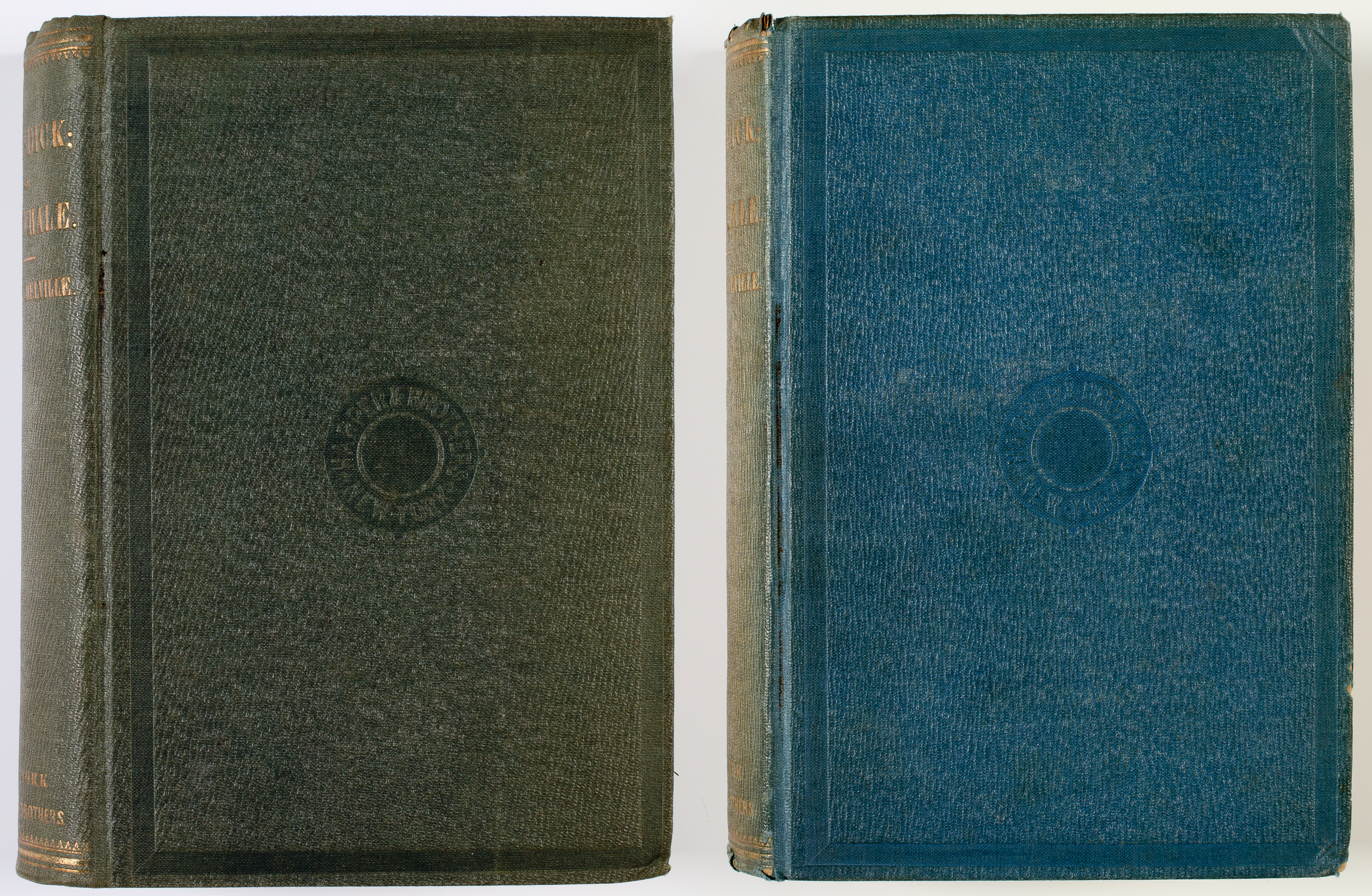
The American Antiquarian Society has two copies of the first American edition of Moby-Dick. As is well-known by now, the American edition was published by Harper’s shortly after Richard Bentley released the London edition with a mutilated version of Melville’s novel in 1851. Both of AAS’s copies have the first edition binding stamped with the Harper’s device at center, one in blue cloth with bright orange endpapers and the other in green cloth with brown-orange endpapers.
Other titles published by Harper in 1851
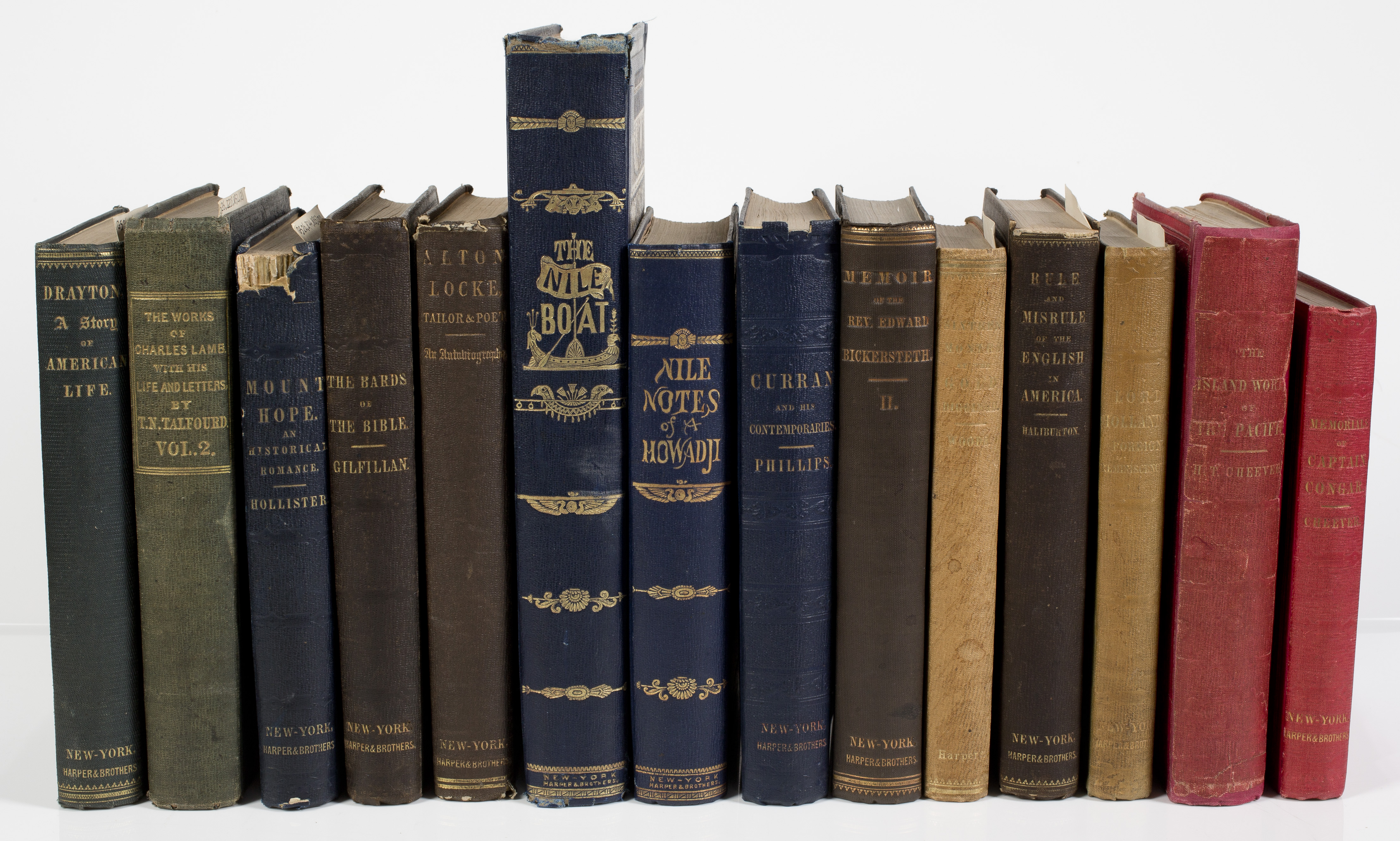
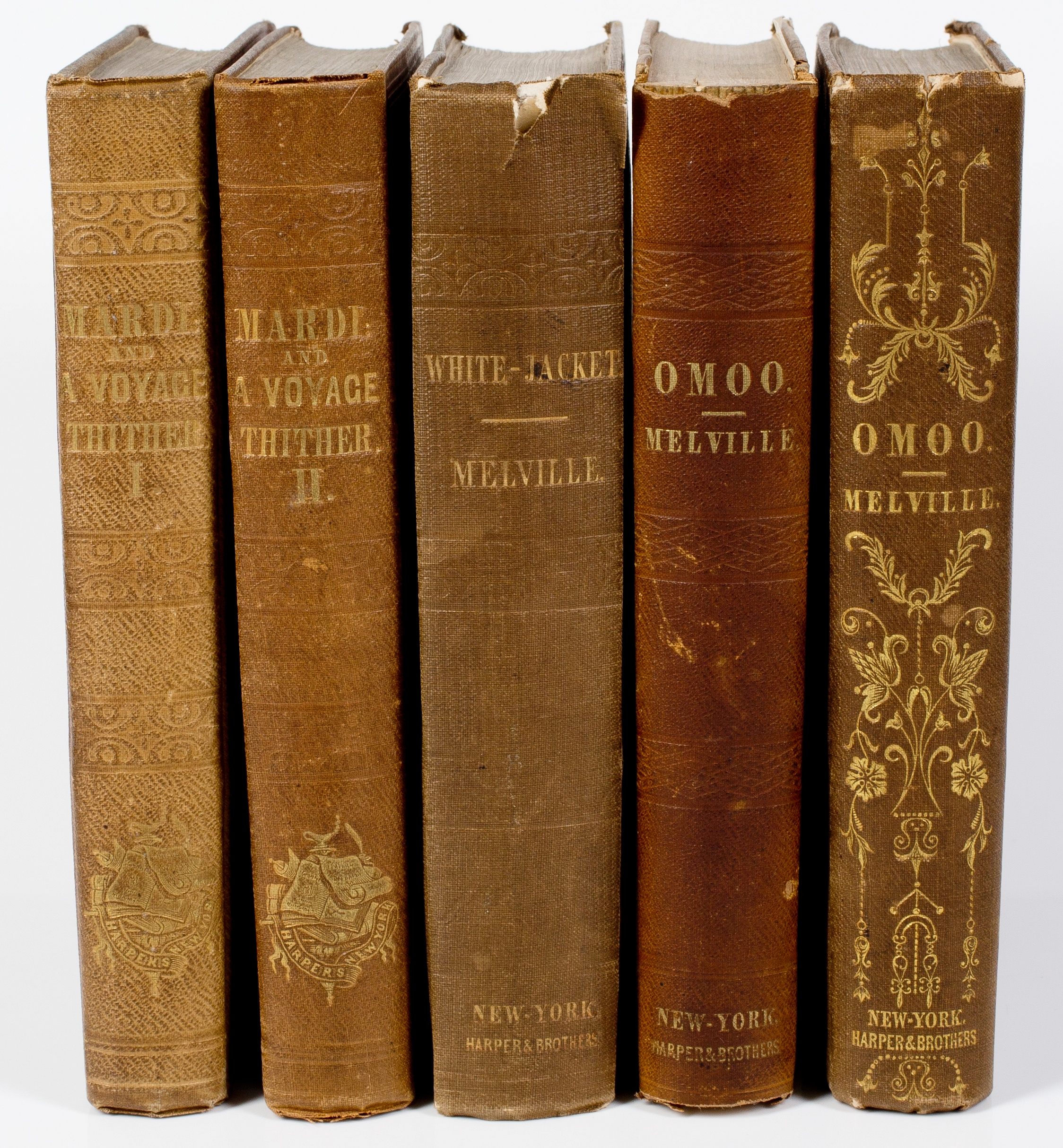
Neither copy physically stands out from Harper’s many other publications of that year. Titles published in 1851 and owned by AAS include: Henry Cheever’s The Island World of the Pacific and Autobiography and Memorials of Captain Obadiah Congar; Thomas Haliburton’s Rule and Misrule of the English in America; Gideon Hollister’s Mount Hope; Charles Kingsley’s Alton Locke; Henry Mayhew’s London Labour and the London Poor; Emmeline Stuart-Wortley’s Travels in the United States; and William Henry Bartlett’s Nile Boat. The design of Harper’s books is homogeneous, and Harper’s desire to push out books with little embellishment for maximum gain is noticeable. Not only does Moby-Dick not stand out from the others, but its design can’t even compare to Nile Boat‘s. And Melville’s other works published by Harper’s around that time—Omoo (1847), Mardi (1849), Redburn(1849), White-Jacket (1850), Pierre(1852)—show almost nothing distinctive in individualized book design. Perhaps the lack of focus on design, as Jeffrey Groves has suggested about house styles, promoted uniformity for Harper publications, self-servingly making all publications appear the same as successful ones. Perhaps the neglect of fancy design elements simply allowed Harper’s to devote themselves to other aspects of book production, like making good books available for all.
Melville works published by Harper
So what do we wish to do with extracts, folio whales, and first editions except hope to discover some truth that brought us to these things in the first place? A.S.W. Rosenbach said in his preface to an edition of Moby-Dick published 90 years ago: “Melville has made the deep give up its dead; he has disclosed to us its long-hidden mysteries. But he has done more. He has revealed…the secrets of the soul.” It must be these secrets that keep us coming back to Moby-Dick in the sea of nineteenth-century mass-produced books.
The Society’s Graphic Arts collection is a wonderful place for browsing, looking for visual evidence of whatever topic you may be working on. I have helped researchers hunt in the collection on such broad topics as death, food production, and dress, and as specific as orphaned children, methods of doing laundry, and book shop interiors.
As our visual materials cataloger Christine Graham Ward continues to move through the collection, creating individual records as she goes, more and more images are opened up to this sort of browsing. Maps and early music have occupied us most recently, but records for lithographs and engravings and cartoons are added nearly every week to our General Catalog.
In September, with the encouragement of our savvy photographer and our digital humanities curator, I started posting regularly to the Society’s Instagram account, easily finding graphic images relating to Halloween, the holidays, the weather, current events, etc. I turned up an early selfie of a generous collector (above), images of nineteenth-century AAS employees at work (below), and a seemingly endless supply of fabulously printed broadsides, quirky ephemera, and evocative photographs. My staff teases me about my addiction to the iPad—I carry it everywhere in case something interesting for Instagram pops up while I am pulling material for a reader, returning a loan, or writing a blog post. And guess what…it nearly always does.
The Instagram account just reached 200 followers yesterday. There are bibliophiles, of course, and library and museum folks. Some former fellows have found us and a handful of staff, too. But there are also graphic and type designers, artists, contemporary photographers, even two tattoo artists (they love all the eagles)! We have followers in New Zealand, Japan, Spain and the U.K. Neat, right? I put up an image from Frank Leslie’s Illustrated Newspaper showing Asian railroad workers (below), and it is seen in Japan immediately.
Now, I fully realize in the world of Instagram, 200 followers is not very many (my 15-year-old has dryly pointed out that there are cats who have more fans than we do), but overall the experiment with this visual forum has been encouraging. In Worcester when I see a wonderful Civil War broadside screaming about treason, I can show it to whomever is in the reading room that day, or I can post it on the blog or our Facebook page for our core constituents. But with Instagram, it is like browsing with 200 people looking over my shoulder, all at once. I am not sure where we are going with Instagram, but it sure is amazing to be browsing through AAS treasure along the way!
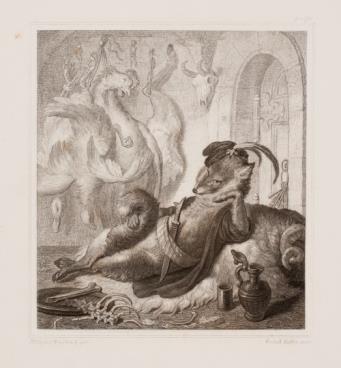
Reynard the Fox. After the German Version of Goethe by Thomas James Arnold. London: Trubner & Co.; New York: Theo. Stroeffer, 1870. This is a folio format edition of the celebrated animal adventurer Reynard the Fox. This luxurious metal engraving of Reynard reclining after a busy day of hunting prey was engraved by Rudolph Kahn after a drawing by Wilhelm Kaulbach (1804-1874). This is truly a transatlantic production issued in London by Trubner & Co. and in New York by Theodore Stroefer; they also jointly issued the picture book Illustrated Flying Sheets (1871) featuring illustrations by German artists. We delight in collecting transatlantic children’s books, and this book came to use through the generosity of AAS member Chris Dumaine.
As Thomas Jefferson put it, “I’m a greater believer in luck, and I find the harder I work the more I have of it.” Here at the American Antiquarian Society all of the curators work very hard in acquiring new items for the collections. Every year thousands of items are added to our holdings. Sometimes luck favors a fellow from our hard work.
Recently, a month-long fellow mentioned body armor from the Civil War era during her introductory talk to the staff. Most of us had never heard of such a thing from the 1860s.
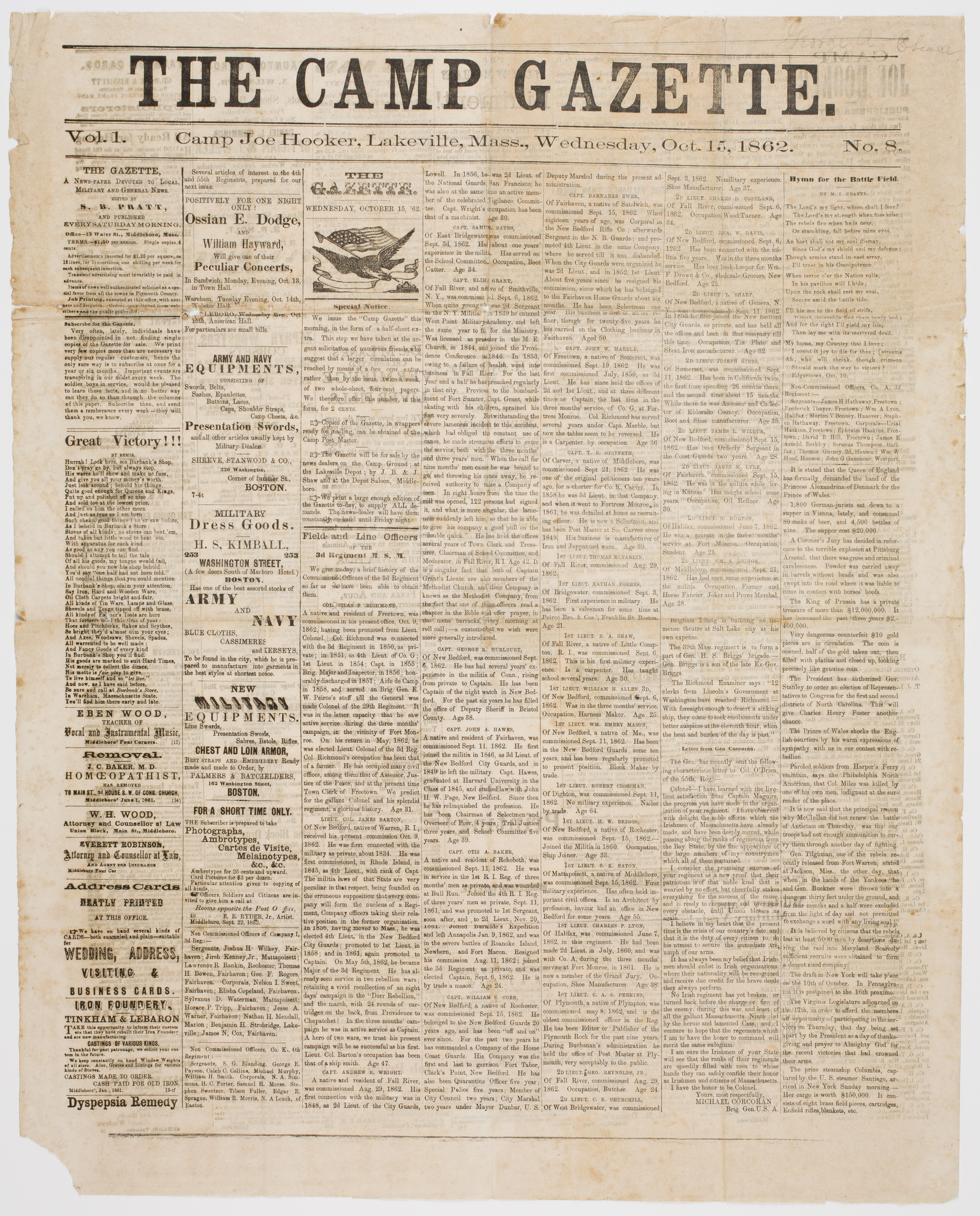
The next week AAS acquired this rare issue of The Camp Gazette from Camp Joe Hooker in Lakeville, Mass. (just west of Boston), one of only three known issues of this title (AAS has one of the other two). One of the advertisements on the front page of this October 15, 1862 issue reads, “New military equipment. Line swords. Presentation swords. Sabres, Pistols, Rifles, Chest and Loin Armor, Best straps and embroidery ready made and made to order, by Palmers & Batchelders, 162 Washington Street, Boston.”
I showed her the issue the day it arrived. She was thrilled because she had never seen an advertisement for loin armor and it gave her the name of a merchant selling them. Was it luck that this issue arrived the month she was here, or was it kismet?
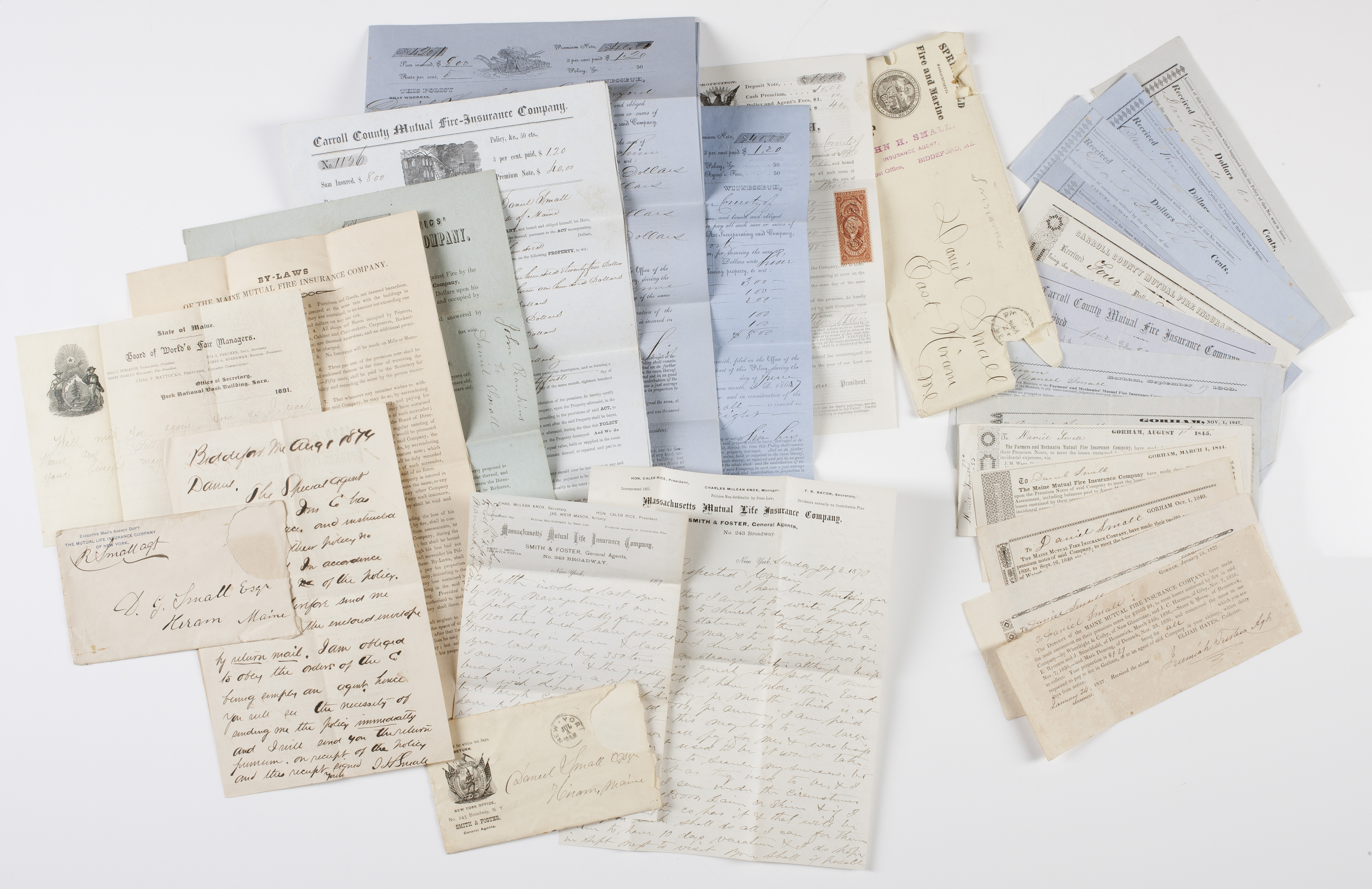
Small Family Papers, 1820-1905. The Small family resided in the town of Hiram, Maine. According to the 1850 census, the Small household was anything but. The head of the house, Daniel Small (1800-1877), is listed as a cooper. According to correspondence in the collection, he also served as an agent of the Hiram school district. He lived with his wife, Susan Small, his father Reuben Small, Deborah Small (perhaps a step-mother, aunt, or other family member), and five children: Patience, Daniel, Isaac, Susan and Dean. This collection of family papers includes correspondence, receipts, insurance papers, and a small account book. Many of the letters are addressed to Daniel from his cousin Rufus Small of New York. There are also a few letters exchanged between the Small children. Of particular interest are numerous receipts from Mother Noble’s Remedies for healing syrup and other treatments, as well as correspondence regarding adulterated medicine; Daniel Small’s membership certificate for the Farmers’ Mutual Fire Insurance Company; and a volume kept by Daniel with writings and musings on numerous topics such as misery, affection, swearing, boasting, and seduction – “The man who can seduce anyone, from the path of virtue, can have no rival, on earth – no equal – except in hell.”
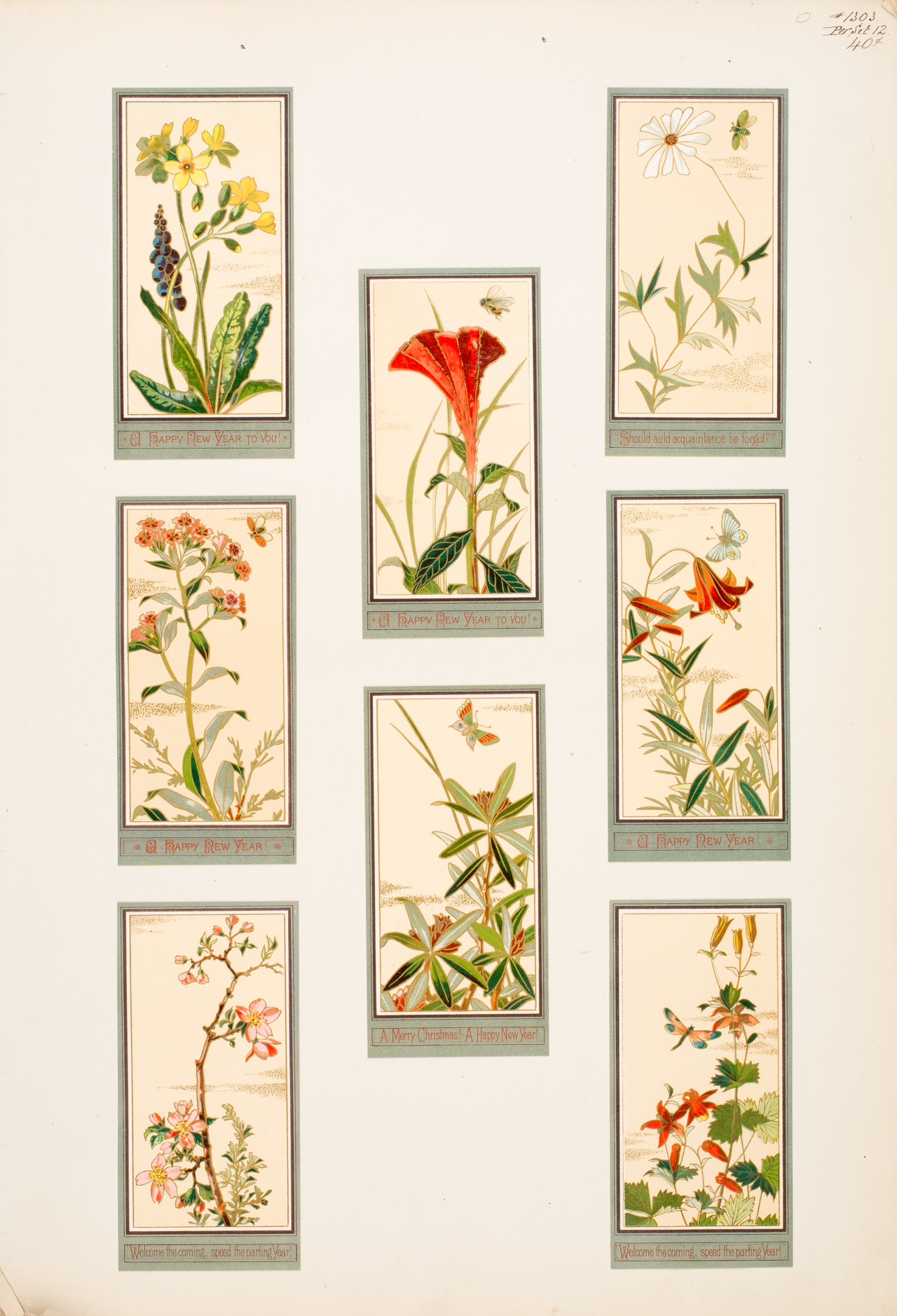
It’s no wonder Louis Prang is considered the “Father of the American Christmas Card.” During the height of chromolithography in the 1860s, 70s, and 80s, Prang’s firm in Boston introduced the concept of the Christmas card to America and produced over 5 million greeting cards per year. While Prang’s Christmas cards are displayed often, in honor of New Year’s Day let’s look at some of the fun New Year’s cards from the Society’s collections.
The AAS has a sizable collection of Prang archive material. There are more than twenty books of salesman’s samples used by the firm to sell greeting cards, trading cards, and small prints. These albums are great because they preserve the color and have the prices and options for each card. Cards were usually sold by the dozen, and embellishments like silk fringe, a folded greeting card, and mica flecks were sold at an additional cost. An entire volume of salesman’s samples from 1882 has been digitized and is available here.
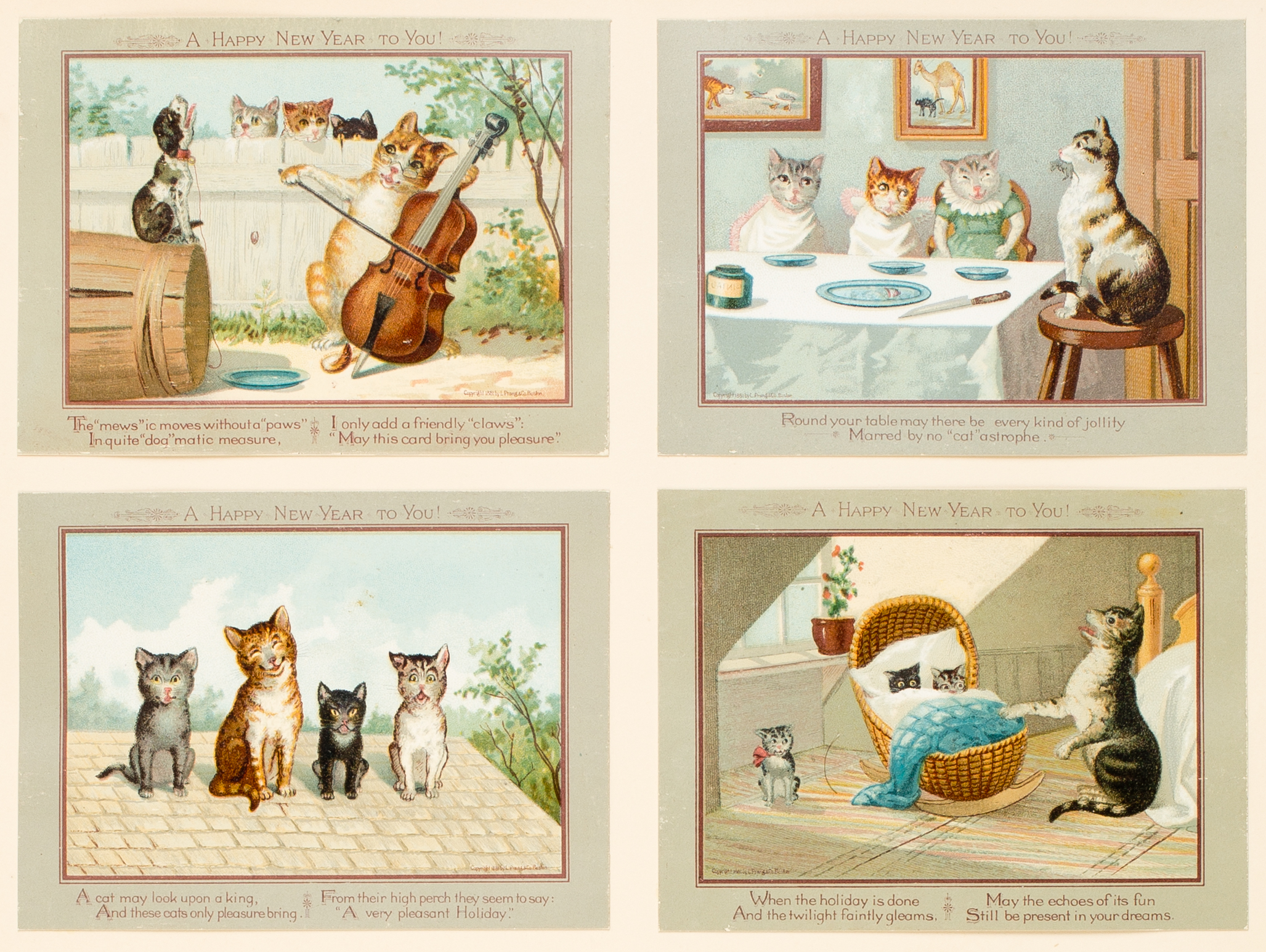
Comical cards were very popular and common in these sets. The set above shows happy cats engaged in singing with a dog, enjoying a feast of a poor mouse, meowing on a rooftop, and kittens being rocked to sleep by their mother. Each has a humorous verse wishing happiness in the New Year.
The “mews”ic moves without a “paws”
In quite “dog” matic measure.
I only add a friendly “claws”:
“May this card bring you pleasure.”
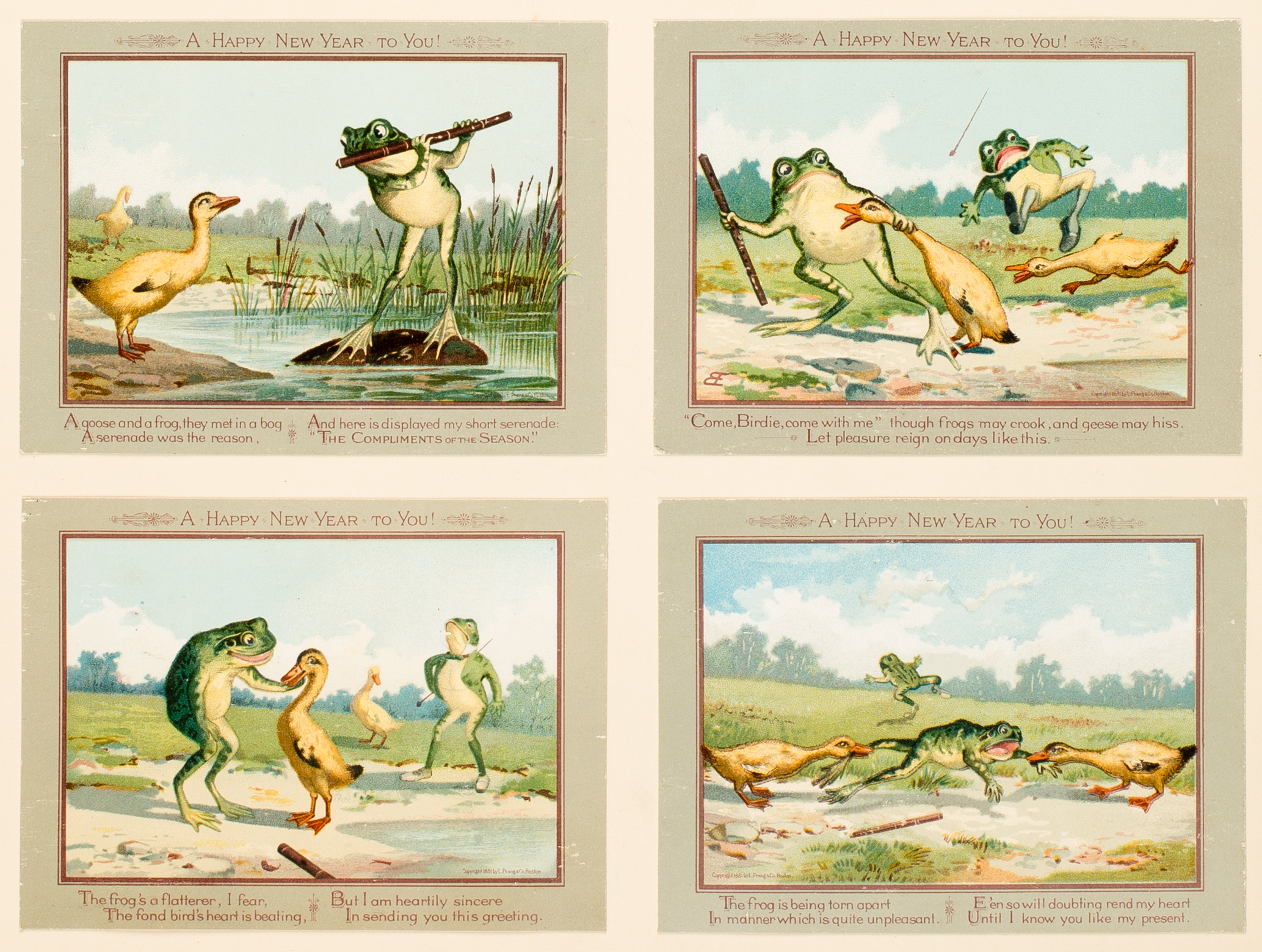
Another comical set shows frogs and ducks (who knew they didn’t get along!) acting peacefully in one scene, and at each others’ throats in the next. The top right scene reads
“Come, birdie, come with me”
though frogs may croak,
and geese may hiss.
Let pleasure reign on days like this.
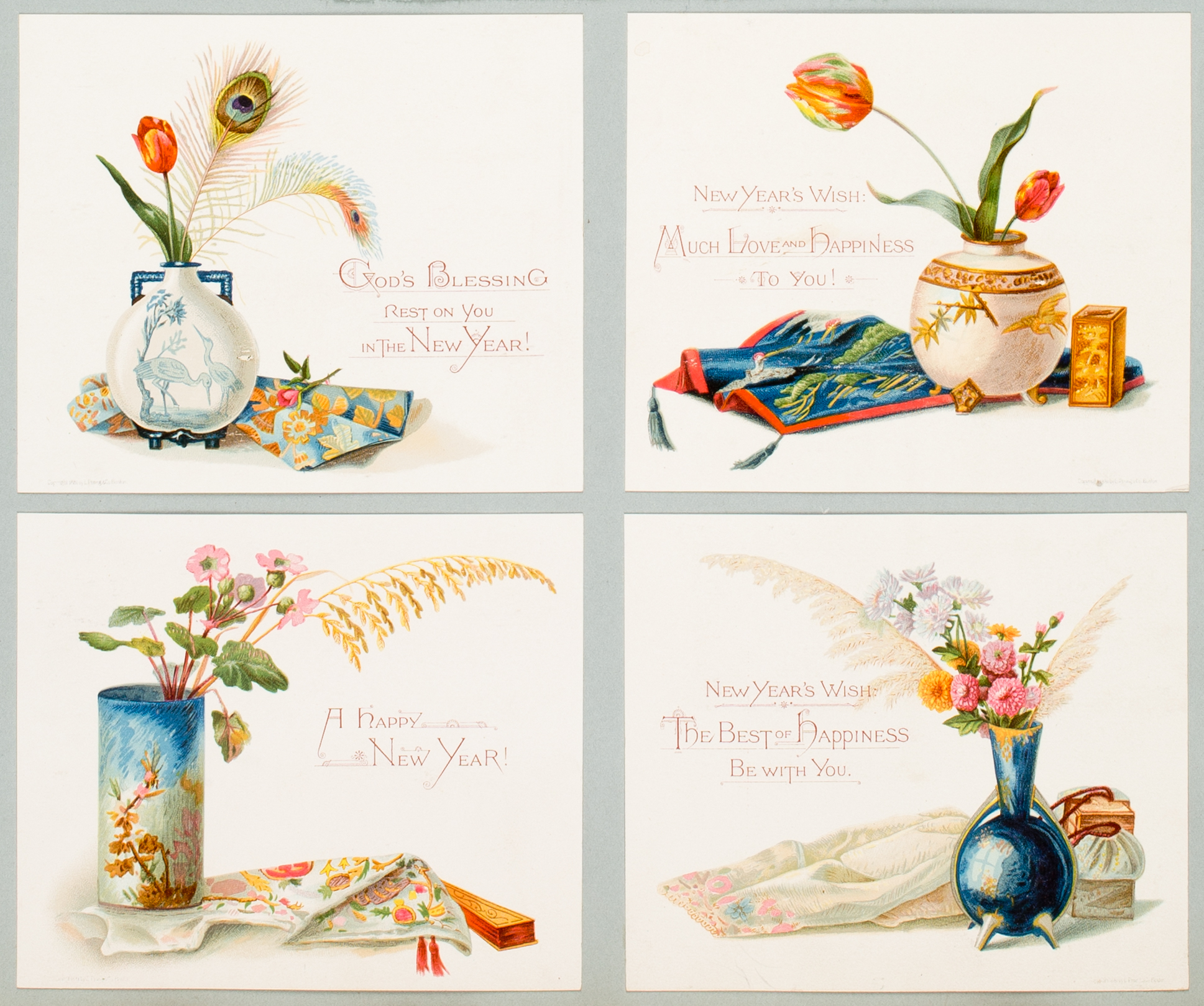
Japanese art and design were very popular during the last decades of the nineteenth century in Boston. The Peabody Museum in Salem had been amassing Japanese items since the early 1800s. In the 1870s, Edward Sylvester Morse left Boston to travel to Japan, and collected Japanese artifacts and shipped them back to Boston, furthering the city’s affection for Japanese art. Prang depicts beautiful Asian-inspired designs in this set of New Year’s cards with vases, silks, fans, and flowers. This set was also used for Christmas cards, as Prang often used the same designs for different holidays.
New Year’s Day isn’t celebrated nearly as much as it was in the nineteenth century. But wouldn’t you like to receive one of these fun, colorful New Year’s cards in the mail tomorrow?
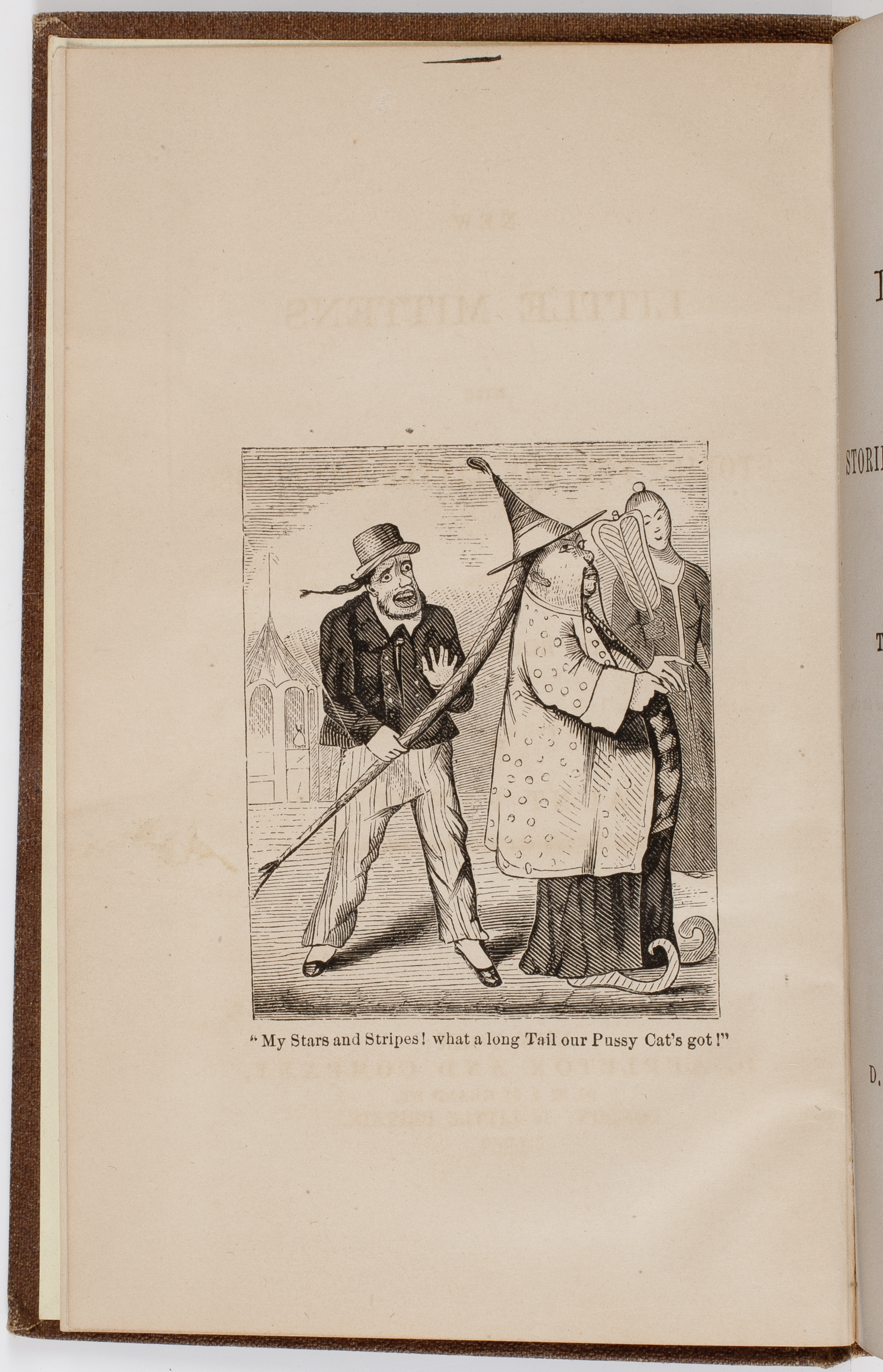 This wood-engraved frontispiece is a comic scene set in the culture clash between a Chinese gentleman going out for a stroll, and an ignorant American sailor who pulls his queue and says “My stars and stripes! What a long tail our pussy cat’s got!” Any hope that this picture serves as the basis for a discussion about respecting people from different cultures is quickly dispelled: this image is used to illustrate a story about children misbehaving in church. Instead of listening to the minister, a little boy chooses instead to look at a secular book about foreign countries containing this picture. Eventually, the boy laughs out loud in church, and his bad behavior (reading a worldly book in church) is discovered.