Finding Family After Slavery: The Last Seen Project and AAS

In January 2025, staff at the American Antiquarian Society attended a workshop on African American print culture taught by Dr. Derrick Spires, associate professor of English at the University of Delaware (and an AAS member and councilor), generously sponsored by the Nadia Sophie Seiler Family Fund. Dr. Spires shared how Black people used African American newspapers as a communication platform to reconnect with their families and community in the wake of the Civil War. One source caught my eye – a project called Last Seen: Finding Family After Slavery.

Launched in 2017, Last Seen: Finding Family After Slavery seeks to identify, digitize, transcribe, and publish information-seeking personal advertisements placed in newspapers by formerly enslaved people looking for their loved ones. The project aims to publish 5,000 ads. According to their website at the time of writing, they currently have found 4,790 ads.

Inspired by Dr. Spires’ presentation, I wanted to find out if the formidable newspaper collection at AAS held any advertisements that the Last Seen project had not yet documented. I suspected that our collections could help the project – and my suspicion proved correct! Continue reading Finding Family After Slavery: The Last Seen Project and AAS
New to AAS: Alice in Wonderland: A Play; Emily Prime Delafield, 1898

Inspired by a performance of scenes from Alice in Wonderland performed in Japan by a cast of English-speaking children in 1890, New York socialite Emily Prime Delafield (1840-1909) wrote her own dramatized version of Alice. It was originally performed at the Waldorf Hotel in March 1897 as a benefit for the Society of Decorative Arts, an organization devoted to artistic training and for the exhibition and sale of artwork created by women.

(Front cover of Alice in Wonderland: A Play. New York: Dodd, Mead & Co., 1898.)

Published by Dodd, Mead & Co. in 1898, this book is a high-end production; it was printed at Boston’s Merrymount Press under the leadership of renowned typographer Daniel Berkeley Updike (1860-1941). This evocative wood block cover illustration was designed by Bertram Goodhue (1869-1924); he became a prominent architect who later formed a business partnership with Ralph Adams Cram.

~ Laura Wasowicz, Curator of Children’s Literature

New to AAS: The Genius of Universal Emancipation, 1830-31

Benjamin Lundy was a prominent abolitionist in the 1820’s and 1830’s. Brought up as a Quaker in what is now West Virginia, he saw the iniquity of slavery. In 1821 he started the Genius of Universal Emancipation in Mount Pleasant, Ohio.

(Front page of the July 1830 issue of The Genius of Universal Emancipation.)

From there the periodical moved several times, being published in Greenville, TN; Baltimore, MD; Washington, DC; and Philadelphia, PA. It ceased publication in 1835 and Lundy took over the editorship of National Enquirer in Philadelphia for a brief period. In 1838 he purchased a farm in northern Illinois and reestablished the Genius of Universal Emancipation but died the next year at age 50. The Genius of Universal Emancipation, an early and influential anti-slavery periodical influenced by Lundy’s Quaker principles, advocated the colonization of former slaves and the slow dissolution of the slave system. William Lloyd Garrison worked on the paper in 1829 while Lundy was away on lecture tours. He advocated a more direct attack on slavery and the slavers of the area. This led to his imprisonment for 6 months. Upon his release Garrison parted with Lundy who resumed control of the publication again.

(Detail of engraving included in The Genius of Universal Emancipation.)

What makes this rare volume even more special is the inclusion of four engraved plates. Illustrated here is the engraving, “United States Slave Trade. 1830,” included with the July 1830 issue. “The Copperplate engraving accompanying this number, was executed by one of our ingenious Baltimore artists, from a design furnished by the editor, and drawn by a young gentleman of this city.” Lundy went on to note that it was prepared expressly for the periodical, at an expense of $30. Copies were available separately, with or without frames.

~ Vincent Golden, Curator of Newspapers and Periodicals

Ephemera Explored: Over 40,000 New Images Give Glimpses into 19th-Century American Life

Have you ever wanted to catch a ride on the Flying Dutchman? Or wondered what people ate at Faneuil Hall to celebrate the 4th of July? Would you like to attend a nineteenth-century séance? Earn ten cents from your teacher? Or shop for a tombstone?

A light beige card with green-ish print and an illustration of a mer-man with wings.
(Ship card advertising passage on the Flying Dutchman clipper ship. Catalog Record)

You can learn about all those activities (and more) from the collections at the American Antiquarian Society – and now, you can view images of ephemera related to these topics online, for free! With the completion of a recent project, more than 40,000 new images of ephemera were linked to records in the AAS online catalog. Read more about the project below!

Historical material is considered ephemera if it was intended to be discarded after a specific use. This includes objects such as menus, concert programs, broadsides, photographs, and trade cards. 

Image of a colorful cartoon illustration of a small brown dog and small black cat walking arm-in-arm. The cat is carrying a parasol and wearing a red bow tie. The dog is wearing a red coat with a gold buckle and a black hat.
(Ship card advertising passage across the Hudson River. Catalog Record)
Small, beige card with black text and a red image of a shipyard printed in the background.
(Advertisement for Bay City Stone Co. tombstones and headstones. Catalog Record)

When I started in the role of Digital Librarian in June 2024, Vice President for Collections and Curator of Graphic Arts Lauren Hewes knew just the thing for me to tackle first. A backlog of approximately 43,000 unorganized and unprocessed scans needed to be checked for quality and arranged to match up with the scanned item’s catalog record. These scans were captured in 2005 and 2006 as part of a larger commercial project, and AAS received copies of the scans.

Continue reading Ephemera Explored: Over 40,000 New Images Give Glimpses into 19th-Century American Life

Not Everything That is Printed is on Paper: Survey of Textile Broadsides

One lesser-known collection at the American Antiquarian Society is a group of broadsides printed on textiles. Broadsides are ephemeral, single-sheet items that are usually printed only on one side. Some topics typical of broadsides include advertisements, official proclamations, theater announcements, and opinions. AAS has approximately 148 textile broadsides that showcase the breadth and type of these objects. The textiles were produced on the same presses that were used for paper printing,  and like their paper counterparts, they combined text and decorative elements. These objects were used as keepsakes, souvenirs, or commemorative objects, and some, in theory, could be used as handkerchiefs. The themes include commemorating specific events or people, “persuasive texts” that showcase social or political movements of the time, and instructional textiles that would have been used for teaching tools in reading, spelling, and arithmetic. The commemorative textiles were usually printed on silk, whereas the “persuasive” and instructional textiles were printed on cotton or muslin (Affleck, 2001). 

These textiles were created using various transfer methods common in paper printing, including plate printing, letterpress, and lithography. In addition to the content being copied from other printed sources, the decorative elements like the images and borders were also not created specifically for the textile broadside. The same decorative elements are seen in other printed formats like title pages, tail pieces, and on book covers. The tools used to create these decorations were generally made at local type founders, and many of the ornamental borders can be found in catalogues or type specimen books for these foundries (Affleck, 2001).  Continue reading Not Everything That is Printed is on Paper: Survey of Textile Broadsides

Interpreting Coded Messages in Friendship Albums

The Stubbs Collection at the American Antiquarian Society contains hundreds of friendship albums. Friendship albums usually contain messages to the album owners from friends, family members, and schoolmates. Many messages have a “forget me not” theme, or they may be philosophical or humorous. The contents of friendship albums were not private, in that the albums were circulated by the owner among those who made entries, and in many cases the albums would have been on display for household visitors to read. Some messages are in foreign languages, including Greek, Latin, Hebrew, Arabic, and various Asian languages. While reviewing the albums recently, we noticed coded messages in two of the albums.

The first example is in 17-year-old Mary Boyden’s 1854 album from South Walpole, MA. It contains the following dedication:

A birthday present from her friend Dkaqhcfd, July 27th/54

The person who presented Mary Boyden with her album wrote his name in code, perhaps to preserve a sense of privacy, but it is a code which is easily solved. If we shift each letter by one place in the alphabet, D becomes E, k becomes l, and so forth, yielding the name Elbridge for the album donor. We can determine who Elbridge was by looking at public records. From marriage records, we find that at age 23, Mary Boyden, the daughter of Harvey and Esther Boyden, married E. P. Boyden, a schoolteacher, the son of James and Lucy Boyden on June 3, 1860. Later records confirm that E. P. Boyden was Elbridge Boyden. In other words, the coded name “Dkaqhcfd” represents the person that Mary would marry, six years after the entry was made in her friendship album. Continue reading Interpreting Coded Messages in Friendship Albums

Artifacts of an Antebellum Physician

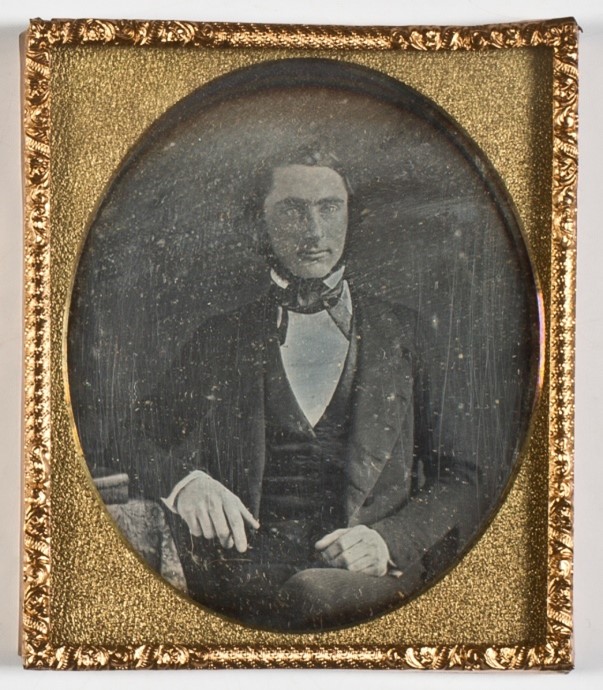
Within the vast collections at the American Antiquarian Society there is a particularly interesting assortment of items that offer a unique glimpse into the world of Dr. Nathan Staples Pike, his family, and the medical trade in antebellum America. The Pike-Wright Family collection, donated to AAS by Susan Pike Corcoran, contains Dr. Pike’s early 19th century medical equipment alongside numerous letters, ledgers, journals, and more. A handful of these items are currently on display in the AAS reading room, along with related materials. Looking at these items brings to life the daily activities of Dr. Pike more than just reading words on a page. You can almost see him plucking one of the tools out of his bag while visiting a patient recorded neatly in his ledger.

Dr. Nathan Staples Pike c. 1845.

Continue reading Artifacts of an Antebellum Physician

Conservation of the Brown Family Collection

The Brown Family Library was donated to the American Antiquarian Society in 2019 by Dr. John Goldsberry, Jr., and his wife Dr. Dorista Goldsberry, along with their family. The family’s library joins other part of the Brown Family Collections already at AAS, donated by earlier generations of the family starting in the 1970s. Together the collections consist of family papers, portraits, photographs, and over one hundred 19th-century books. The materials center around William and Martha Ann Brown and their descendants, a prominent Black family living in Worcester, Massachusetts, in the mid-1800s. 

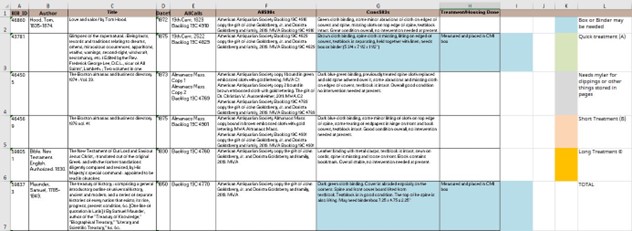
Recently, a conservation survey was conducted to assess the overall condition of each of the 19th-century books. From this survey, books were pulled to be placed in custom housing for preventive conservation, or for treatment to help improve the longevity and stability of these historic materials. Below is a snapshot of the spreadsheet created to record the condition and treatment or rehousing measures taken for each Brown family book.  

Figure 1. Sample of Excel spreadsheet used for survey of Brown Family Collections.

Some of the main treatments included minor repair of the original cloth bindings using wheat starch paste or animal glue and toned Japanese papers, as well as reattaching loose spines and cover boards (figs. 2-7). Here is one example where the back cover board and spine were detached from the text block (figs. 2 and 3). Continue reading Conservation of the Brown Family Collection

Reflections from a Returning Intern

As I near the end of my second summer at the American Antiquarian Society as an intern through the Library Internship for Nipmuc Community Members, supported by a grant from the United Way Central MA, I wanted to reflect on what this internship has done for me, and what I have been doing for it in return.

Sophia speaking to visitors during the meeting of the Northeast Regional and Digital Native American Archives Collective at AAS.

This internship has given me a passion for archives and librarianship – things I didn’t think I’d be interested in when I applied, as I’d mainly applied due to my love of books and history. I remember when I wrapped up my time at AAS last year, I was in disbelief at just how much I loved my time here and how much excitement for my future and career I came away with. It’s given me opportunities by way of admission to Simmons University for a library science degree and has given me hope for a future where I can steward cultural archives and give other youth from underprivileged communities the same opportunities I was gifted. It has fostered my love for research and has given me tools for hunting down topics I’m interested in, or for tracking down genealogies. Continue reading Reflections from a Returning Intern

DeWitt Clinton and the Common School Fund: Early Public Education in the Collection

For the past few months, I have had the opportunity to work as an intern in the manuscripts department here at the American Antiquarian Society. Usually, I spend my days the digitizing department working as a liaison between AAS and our vendors, paging newspapers and serials. I jumped at the chance to work in manuscripts and learn a little more about a different part of our collections.

I started my internship working with the miscellaneous oversized manuscripts. My task was to sort through the box, pull out items that needed different housing, and identify any items that should get their own catalog record. One item particularly caught my eye: a large, undated, hand-written document addressed to the New York state legislature signed by one DeWitt Clinton. Reading through the document without any context, it seemed as though Clinton was calling for less funding for New York public schools; but I knew there was more to the story, and in any case, I needed to figure out when the document was created to catalog it. So, with the permission and encouragement of manuscript curator (and my internship supervisor) Ashley Cataldo, I dove into the world of early 19th-century New York public education. Continue reading DeWitt Clinton and the Common School Fund: Early Public Education in the Collection

“An Opulence Unexpected”: Examples of Red Morocco’s Use in Bookbindings

The history of the book is predicated on the idea that the book itself as an object is significant in its own right, not simply on its printed content alone. Which materials were used, how they were made, and who made them all speak to a vast network of economic, environmental, and human systems that came together to create a printed volume; these elements of bookbinding are always interesting and worthy of investigation. And if those things are beautiful to behold, even better!

“An Opulence Unexpected” brings together a variety of books bound in red morocco leather, which have been prized for centuries for their beauty and exemplification of a binder’s craft. Also known as “Turkey leather,” it was first produced in North Africa from Turkish goats and exported to Spain as early as the 11th century. It is made traditionally with tawed goatskin stained with sumac (a tangy spice prevalent in Middle Eastern cuisine) for its iconic deep red color. The use of morocco in western book binding became popular in the 17th century, as goatskin leather was supple, long lasting, and took color and tooling well, especially gilt tooling, a method of finishing bindings by pressing gold into covers and bindings with specific tools to create ornate, sometimes lavish, designs. Continue reading “An Opulence Unexpected”: Examples of Red Morocco’s Use in Bookbindings

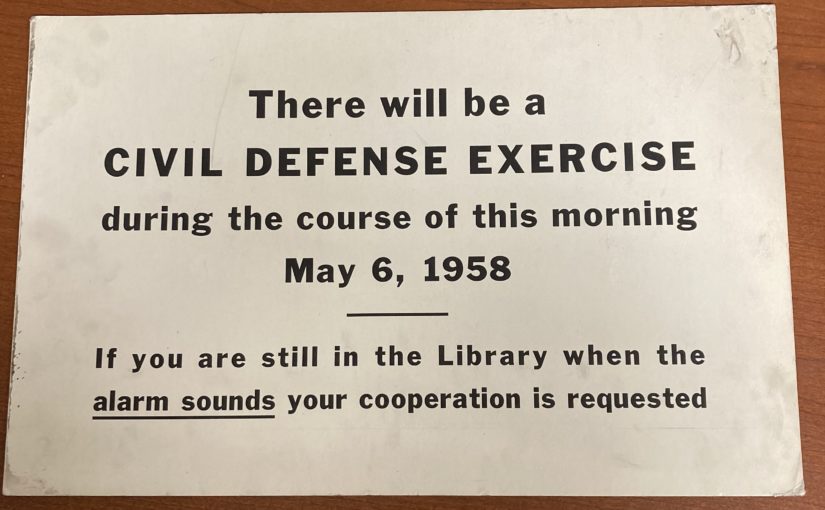
“Your cooperation is requested”: The American Antiquarian Society and Operation Alert

Operation Alert was a Cold War exercise designed to assess how prepared both government agencies and citizens were in the event of a nuclear attack on the United States. Starting in 1954, about 200 cities around the country took part in these drills until the project ceased in 1962. Worcester, Massachusetts, the home of the American Antiquarian Society, was one of these cities.

This fall I’ve been an intern at AAS as part of my graduate program in public history and archives, and one of my projects has been cataloguing the objects in the Society’s archives. While working with these objects, I came across a sign that reads, “There will be a civil defense exercise during the course of this morning May 6, 1958. If you are still in the Library when the alarm sounds your cooperation is requested.” On that day, alarms and air raid sirens would have gone off and people were required to stay indoors, sheltering in place for fifteen minutes. Depending on the location, certain penalties were in place for noncompliance. For example, in New York City, there was a fine of $500 for people who didn’t follow the directions of the Civil Defense Agency. Continue reading “Your cooperation is requested”: The American Antiquarian Society and Operation Alert

Adultery, crime, and the “professedly obscene”: The beginnings of book bans in the United States

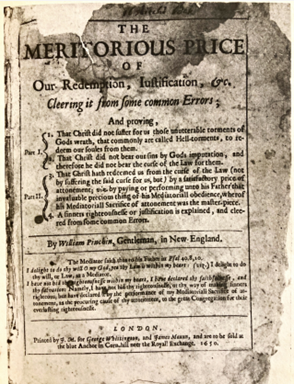
Book bans and challenges have been on the rise in libraries and schools across the United States: according to the American Library Association, who have tracked book censorship since 1982, over 1,600 titles have been affected in 2022 alone. These challenges, whether for political, legal, religious, or moral motivations, illuminate a variety of the nation’s current cultural anxieties, are not the first instances of books being banned in America. The American Antiquarian Society holds a panoply of materials that have been repressed, hidden, and censored, including a facsimile of the book which lit the flame of North America’s relationship with the concept of literary obscenity and government sanctioned censorship. In 1651, William Pynchon’s 1650 writing The Meritorious Price of Our Redemption was publicly burned in Boston via court order for its perceived criticism of the Puritans, who dominated local governance; Boston’s common executioner personally carried out the order. The book was so efficiently destroyed that only four copies are known to be extant, and are held at the Congregational Library in Boston, the British Museum, the New York Public Library, and the Connecticut Historical Society. 

Title page of a reproduction copy of The Meritorious Price of Our Redemption, including details of Pynchon’s main argument, directly opposing Calvinist theory of the time.

Over 200 years later, after an aggressive morality campaign led by Civil War veteran and founder of the New York Society for the Suppression of Vice, Anthony Comstock, the Comstock Laws of 1873 were passed in Congress which would effectively outlaw the distribution, sale, and possession of “obscene” materials, especially those solicited and sent through the U.S. Postal Service. U.S. obscenity laws were largely overturned through a series of Supreme Court decisions in the late 1950s, backed up by the First Amendment, which ended a nearly 90 year crusade on novels, valentines, song sheets, textbooks, contraception, newspapers, and erotica. Materials were confiscated and destroyed en masse during this time, significantly impacting the history of material culture in the United States.   Continue reading Adultery, crime, and the “professedly obscene”: The beginnings of book bans in the United States