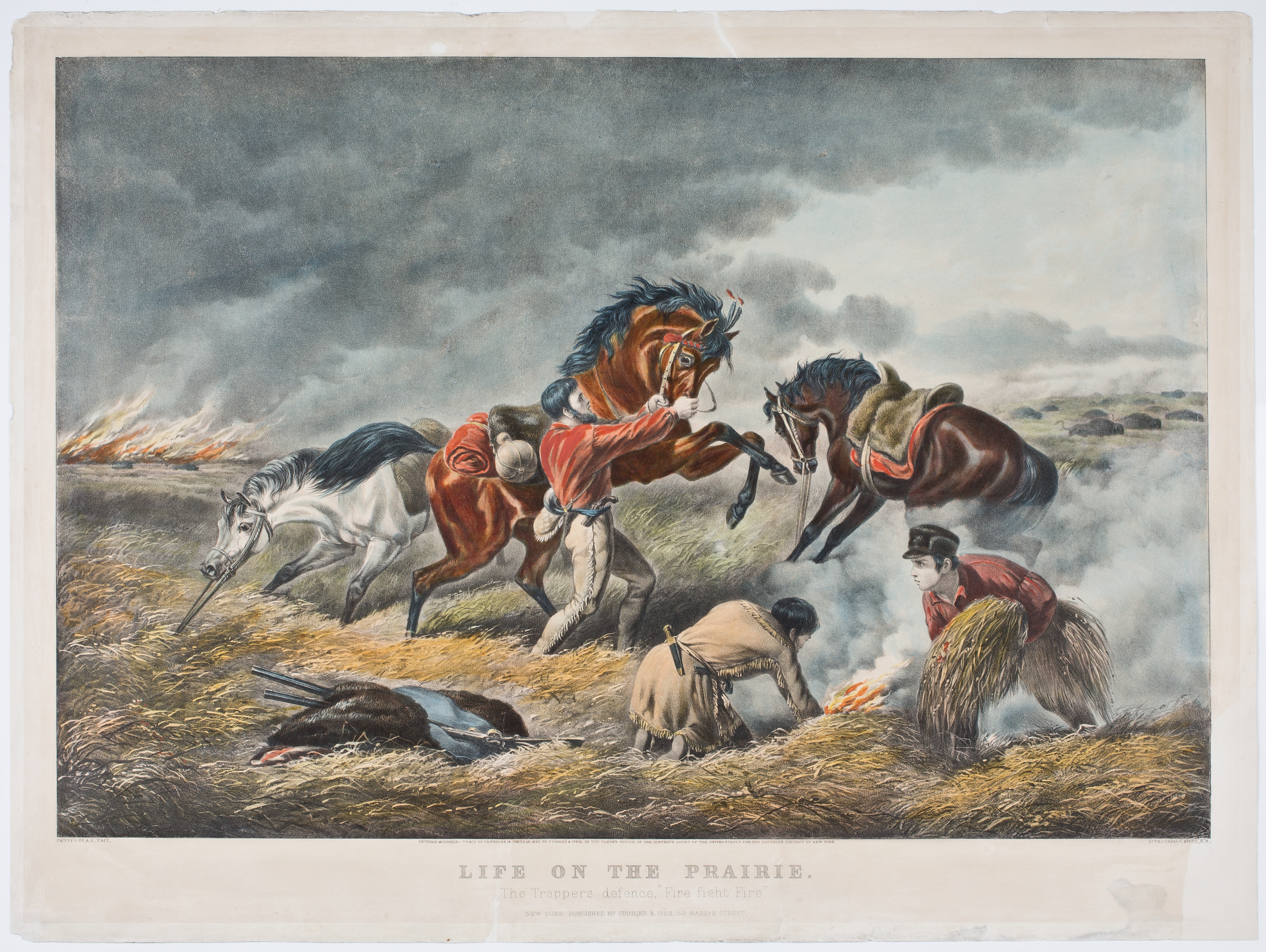
After Arthur F. Tait. Life on the Prairie.The Trappers’ Defence [sic]. “Fire Fight Fire.”New York: Currier & Ives,1862.
Large folio lithographs by Currier & Ives represent the pinnacle of the firm’s production and were the most costly images that they issued. This image of western trappers setting fire to the prairie to act as a back stop for a larger blaze was published in 1862, at the same time that the nation was battling through the Civil War. The subject matter of tough, independent frontiersman working together to solve a problem must have been exotic and appealing to Currier & Ives’s clientele in eastern cities. This print was sold as one of a pair (the other depicts a buffalo hunt) and was priced at $3.00 uncolored and $5.00 hand-colored with watercolor.
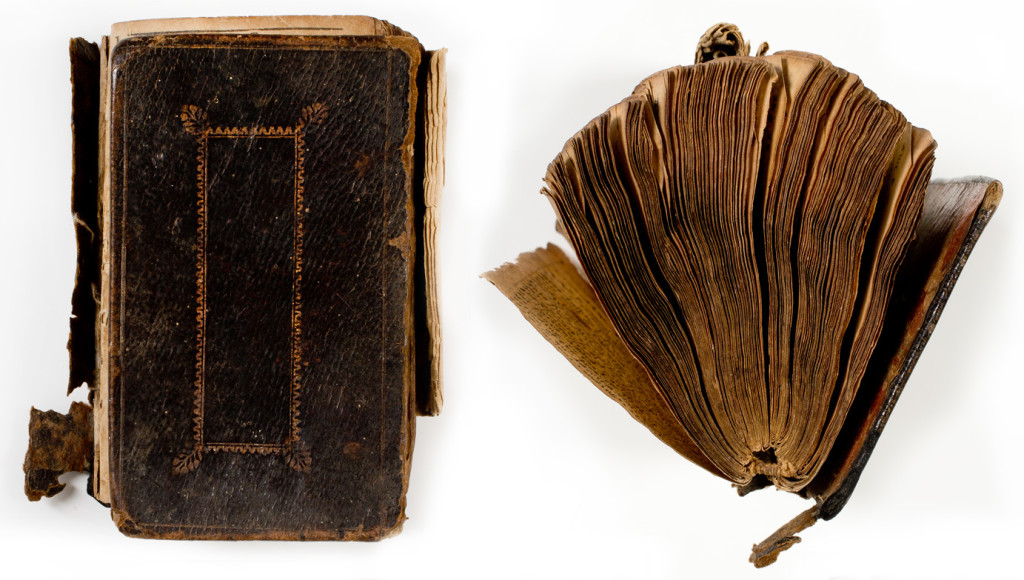
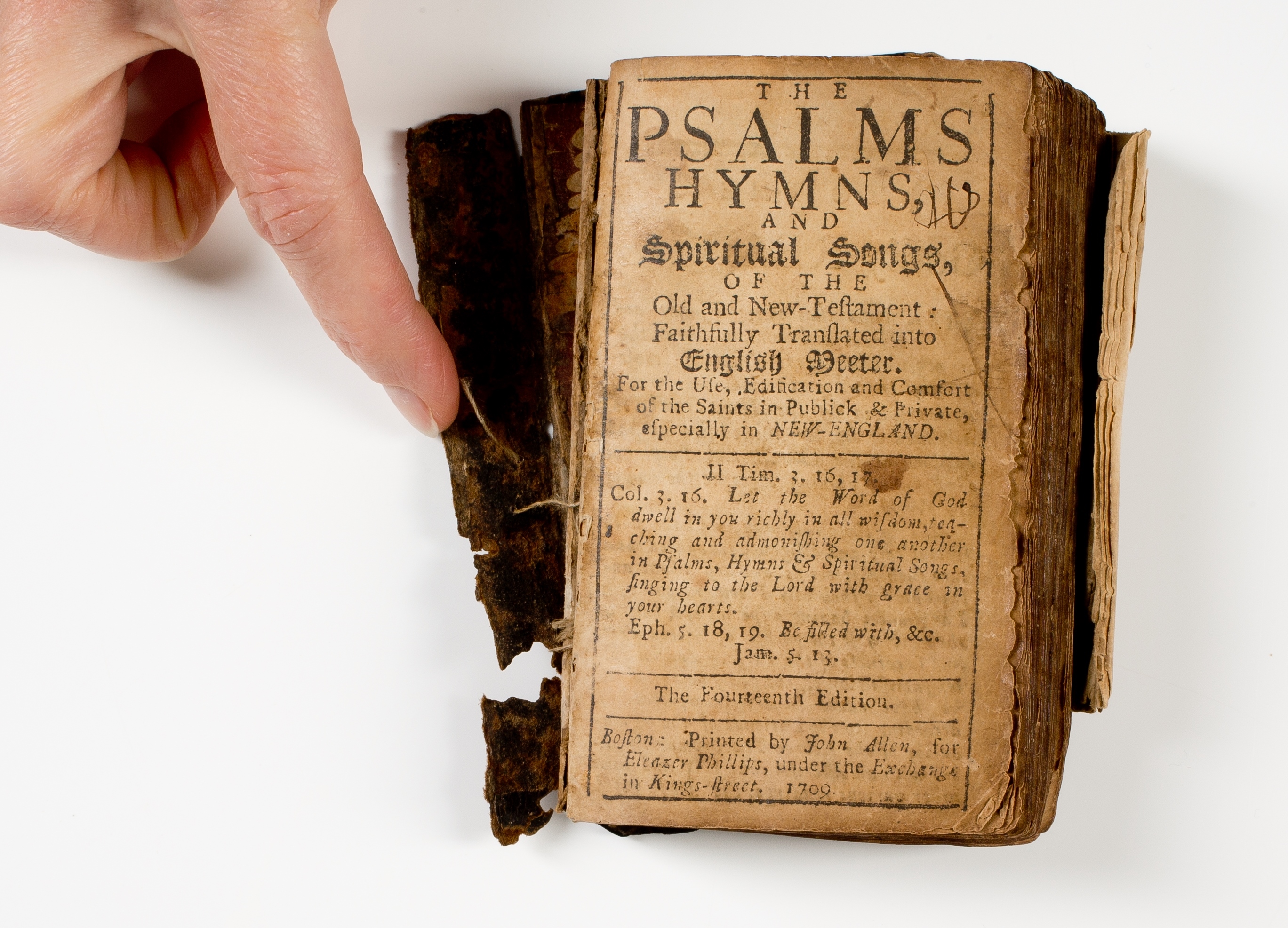
The conservation of the exceedingly rare copy of the 1709 14th edition of the so-called Bay Psalm Book was recently completed, and it is now available for gentle study. This small, outwardly modest book was acquired in the fall of 2013, through funds generously donated by the Fred Harris Daniels Foundation in memory of Bill Pettit, after an observant dealer spotted it at an auction. Suffering from three hundred years of wear and tear, it arrived at the library with its front cover detached and its back cover weakly hanging onto the spine. A course of treatment was drawn up by Chief Conservator Babette Gehnrich, and, with the able help of Conservation Assistant Nancy Fresella-Lee, the book was restored to a readable condition. Happily, scholars can now turn its pages—albeit gingerly!
1709 edition of the Bay Psalm Book before treatment
This acquisition has fittingly found a permanent home at AAS, where it joins its famous parent—the 1640 first edition of The Whole Book of Psalmes—as one of the library’s most prized possessions. It will be recalled that AAS holds one of only eleven extant copies of this book, the once commonly used, metered translation of the Psalms. It is renowned because it is the first book that was printed in British North America, by Stephen Day[e] in Cambridge (probably with his son Matthew) on a press owned by the recently widowed Elizabeth Glover, just two decades after the Puritans landed on the shores of the Massachusetts Bay. In 1698, for the 9th edition, “tunes” with musical notations were added following the Psalms—another landmark in the history of printing in the colonies. The 1709 14th edition that was printed and published in Boston by John Allen includes these musical notations, and, in addition to all its other accolades, this copy now represents the earliest example of music printed in North America in the AAS collections. (For a timeline describing all twenty-seven editions of the Bay Psalm Book, see the Almanac of March 2014.)
1709 edition of the Bay Psalm Book before treatment
Conservation treatment
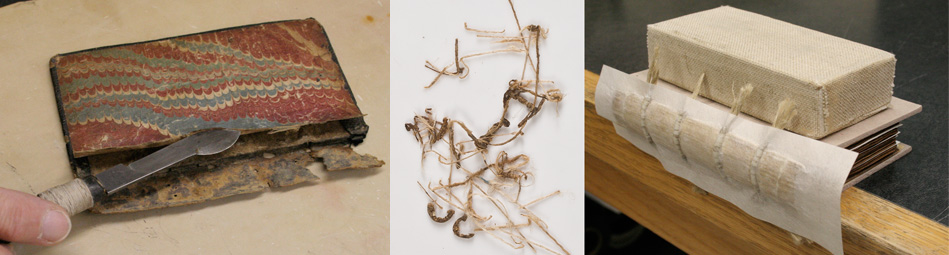
Though complete in its components, the worn condition of the book’s binding made it too unstable for safe handling. To address the foremost problem, reattaching the front cover and reversing the concave shape of the textblock, the entire book had to be disassembled. First, the original sewing was removed, the sections were separated, and the pages were lightly cleaned with eraser crumbs. A series of baths came next: first in cold water (which turned a satisfying yellow), followed by a second with the addition of calcium hydroxide to raise the pH level of the paper and loosen more dirt; and the third and final bath in a solution of water and magnesium bicarbonate to alkalize them. After drying on felts, the folios were sized with gelatin to restore the softened paper to an appropriate crispness and crackle. After washing, there was a notable difference in the paper’s color. It became lighter and brighter except around the edges, and thus is now closer to its original eighteenth-century state. While in this disassembled state, the entire volume was sent to the AAS photographer for digitization.
1709 edition of the Bay Psalm Book during treatment
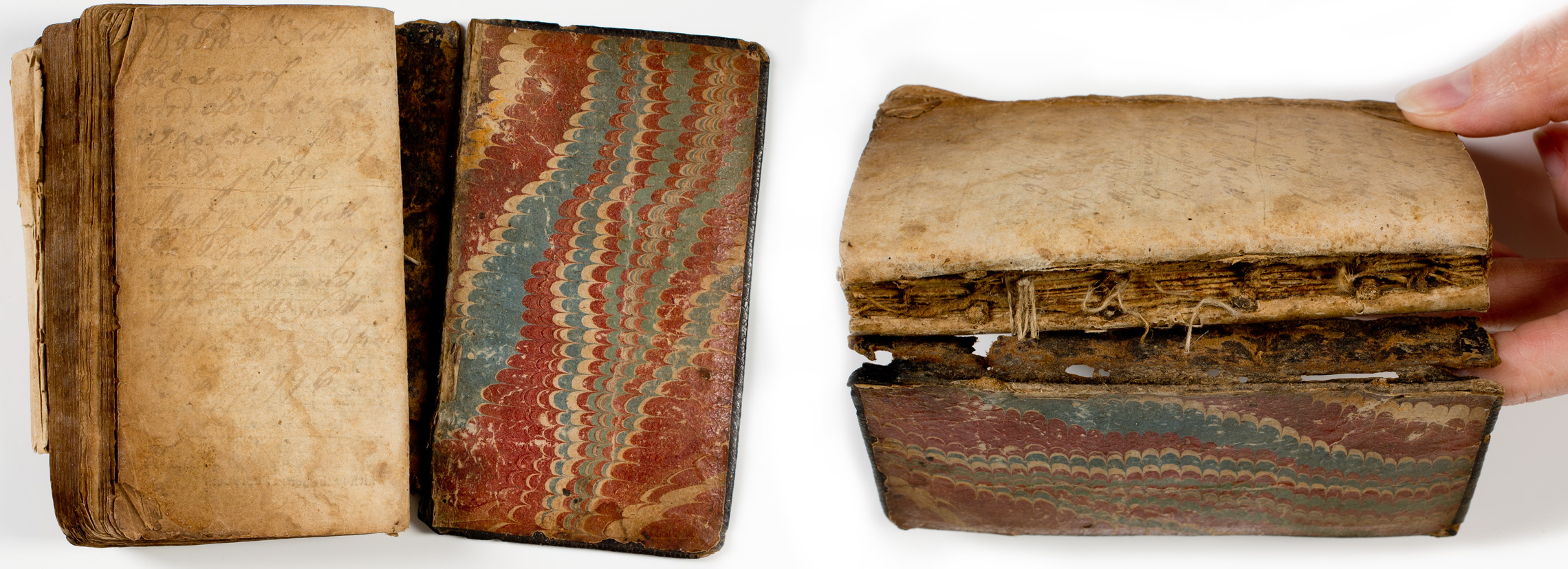
Following aqueous treatment and digitization, the folios were sewn back together, using the original holes. The original head and tail bands had been precariously dangling from the binding, so these had to be reconstructed. Since there were fortunately few tears within the book, only a minimal amount of paper repair was required. The (unidentified) eighteenth-century binder had used Dutch-pattern marbled (imported?) paper for the endpapers. To replace the missing flyleaves, salvaged period papers that closely match the originals were found amongst the lab’s stores. Finally, the original covers were reattached, and the spine, with its decorative tooling between the raised bands, was carefully glued over a new leather rebacking.
It is always a difficult decision to disturb the valuable historical evidence from an old binding. While repair could not be avoided in this case, all of the fragments that were removed from the book during its treatment—the head and tail bands, the sewing thread, and even the accumulated dust of three centuries that fell out of the page gutters—were carefully saved for posterity, and the treatment process was photographically documented.
A Treasure within a Treasure: A Surviving Book for the Ages
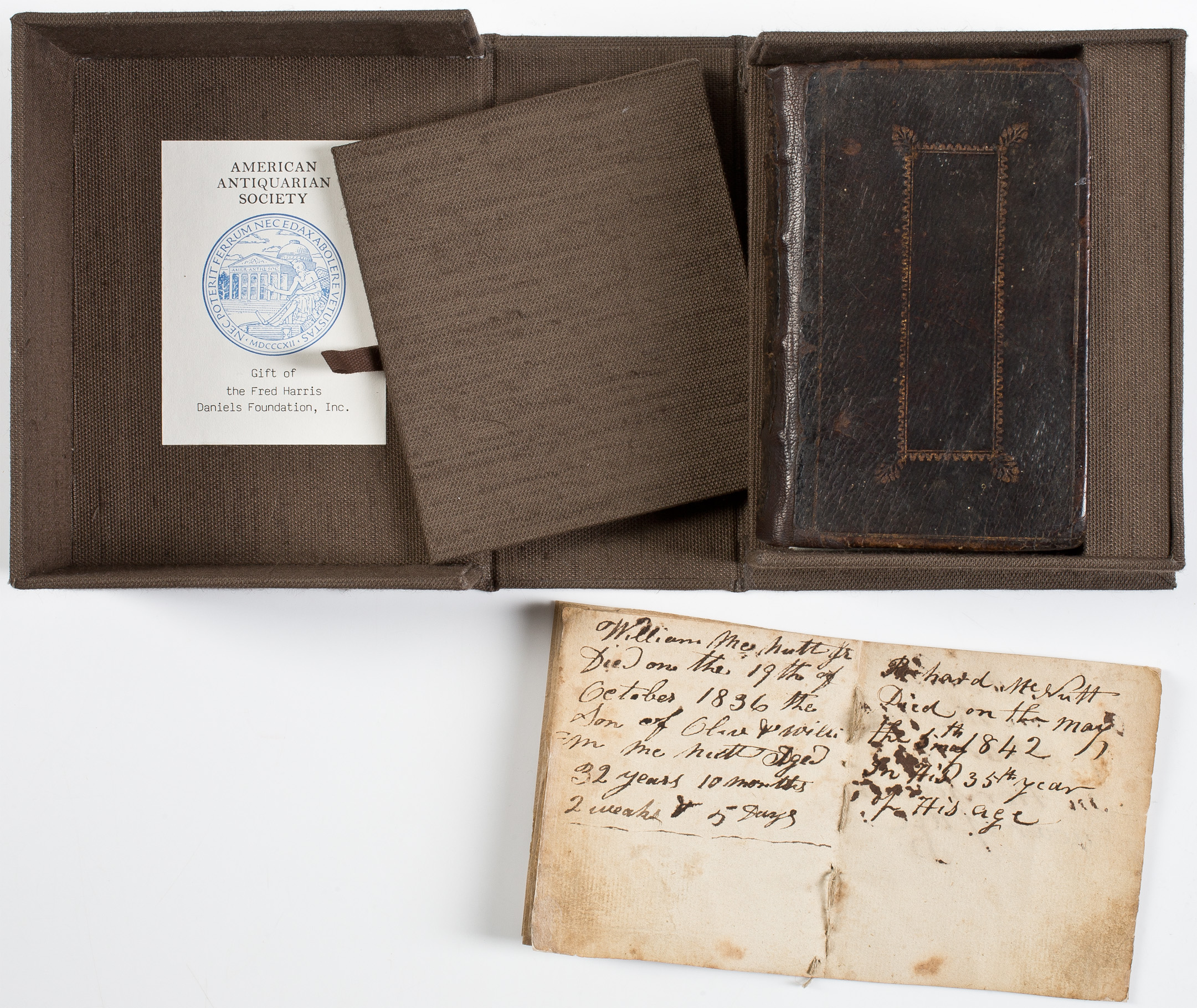
1709 edition of the Bay Psalm Book after treatment, with the removed “Book of Ages”
A further cause for celebration of this rediscovered rare book is yet another treasure that has been almost miraculously preserved between its damaged covers: an insert that reveals poignant proof of its early provenance. Four folded sheets that are shorter but wider than the pages of the book itself were sewn into the spine, between pages 190 and 191; the information handwritten on them undoubtedly reveals at least one pair of its former owners, William McNutt (1769–1821) and his wife, Olive (1774–1840). The booklet is a “Book of the Ages,” just like the one made by Benjamin Franklin’s youngest sister, which was the basis for historian Jill Lepore’s biography Book of Ages: The Life and Opinions of Jane Franklin. It was probably Olive who made the booklet, stitched it into her cherished copy of the Bay Psalm hymnal, and recorded her own name, her husband’s, those of their parents, and then her ten children in the order of their births (including two sets of twins). She died in 1840, so whoever added the latest recorded death date, 1842 (that of one of her sons, Richard Sweeney McNutt), was perhaps the next keeper of the book.
The “Book of the Ages” pamphlet was not sewn back into the book, because it protruded from the fore edge of the Bay Psalm textblock and was already frayed at the edges. This pamphlet is now stored and protected in a separate compartment in the custom-made box that holds the Bay Psalm Book.
As visions of baked goods dance through the pages of holiday Instagram, we bloggers at Past is Present have decided to take a look at some of our historical manuscript cookbooks to see what early American bakers were cooking up instead. Like our fellow bloggers at Cooking in the Archives and the experts at Colonial Williamsburg, we were curious to see what our collections could tell us about the dishes early modern and colonial bakers served during the holidays and year round.
Of course historical cooking is not new to us at Past is Present. Since we started posting around the holidays back in 2009, we’ve blogged about the history of early American cooking and had one amazing cookoff between staff members and fellows. But since we wrote those posts, the Society has scanned and made freely available all of our manuscript cookbooks with the generous support of the Pine Tree Foundation, and we thought it was time for an update!
To view these scanned cookbooks, you can go directly to GIGI (our collection of digital images), click on “Manuscripts,” and do a keyword search for cookbooks. Alternatively, you can click here to pull up a list of catalog records of the scanned cookbooks. Each record includes a link to the scanned images in GIGI.
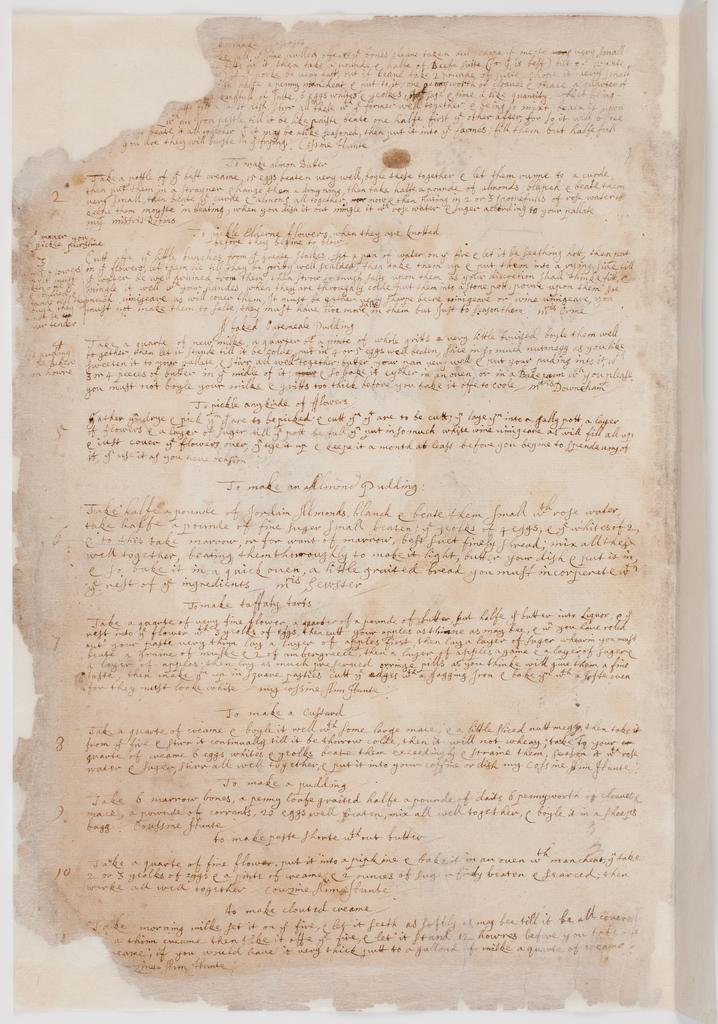
The earliest cookbook in this collection is one of the most interesting, as it was owned by several women on both sides of the Atlantic. Once kept by Anna Cromwell, or Williams, in England (she dates the book December 23, 1650), the book was eventually transferred to Mary Parks and then Sarah Sartell Prentice in Grafton, Massachusetts, in the eighteenth century. Like many cookbooks from the period, it contains recipes for sweet and savory dishes and cosmetic and medicinal remedies. I toyed with the idea of making one or more of the recipes in the book, but the obscure ingredients made authentic recreation of the foodstuffs nearly impossible. Some foods, like “Queen Elizabeths cake,” incorporate musk and ambergris, both whale products that became popular flavorings in the seventeenth century, while the “haggasse pudding” requires sheep’s maw. Many recipes include rosewater—but an authentic rosewater, at least the best kind according to Anna, requires at least a month’s fermentation.
Taffaty Tarts
At other times the lack of clarity in the instructions kept me from even thinking about picking up the spoon. For the “taffaty tarts,” the instructions say to put half of the butter into liquor but then never specify what to do with the butter-liquor mixture. I wonder if the purpose of including the liquor was to make an extra-flaky dough (as with a recent Cook’s Illustrated vodka pie crust). If anyone knows, please pass on your knowledge and I’ll try to make the recipe! Many of the medicinal recipes—”oyle of toads,” “a receipt against ye plague,” “to prevent a womans miscarrying with child“—are completely out of the question, especially when it comes to boiling live toads.
Clearly the author of our cookbook was familiar enough with certain methods of preparing her “paste,” or pastry, and other foods that she didn’t need to write down all of the instructions. Perhaps she watched the women who contributed recipes to her book, like her sister Elizabeth English and cousin Anne Hunte, as they prepared the dishes. This network of female bakers spent time baking together, sharing recipes, ideas, and maybe a little gossip. Rebecca Tannenbaum, who has written briefly about the book, has said that the book represents generations of women’s collective wisdom.
Not trying to recreate one of these dishes seems right, though, because they were “perishable arts,” as Laurel Thatcher Ulrich has called them. Twenty-first-century Instagrammers digitally preserve their pies and cookies with a metaphorical digital shellac or varnish, something that was not available to the earlier bakers. The early bakers recorded their process in sometimes cryptic instructions and occasionally preserved their books for years. Maybe it’s only fitting that the historical recipes remain available in traces only, the original perishable art gone with their maker, their words presenting just a hint of what they enacted. These words and traces, fragile in the original book, are now preserved, like Instagram photos, in digital ink.
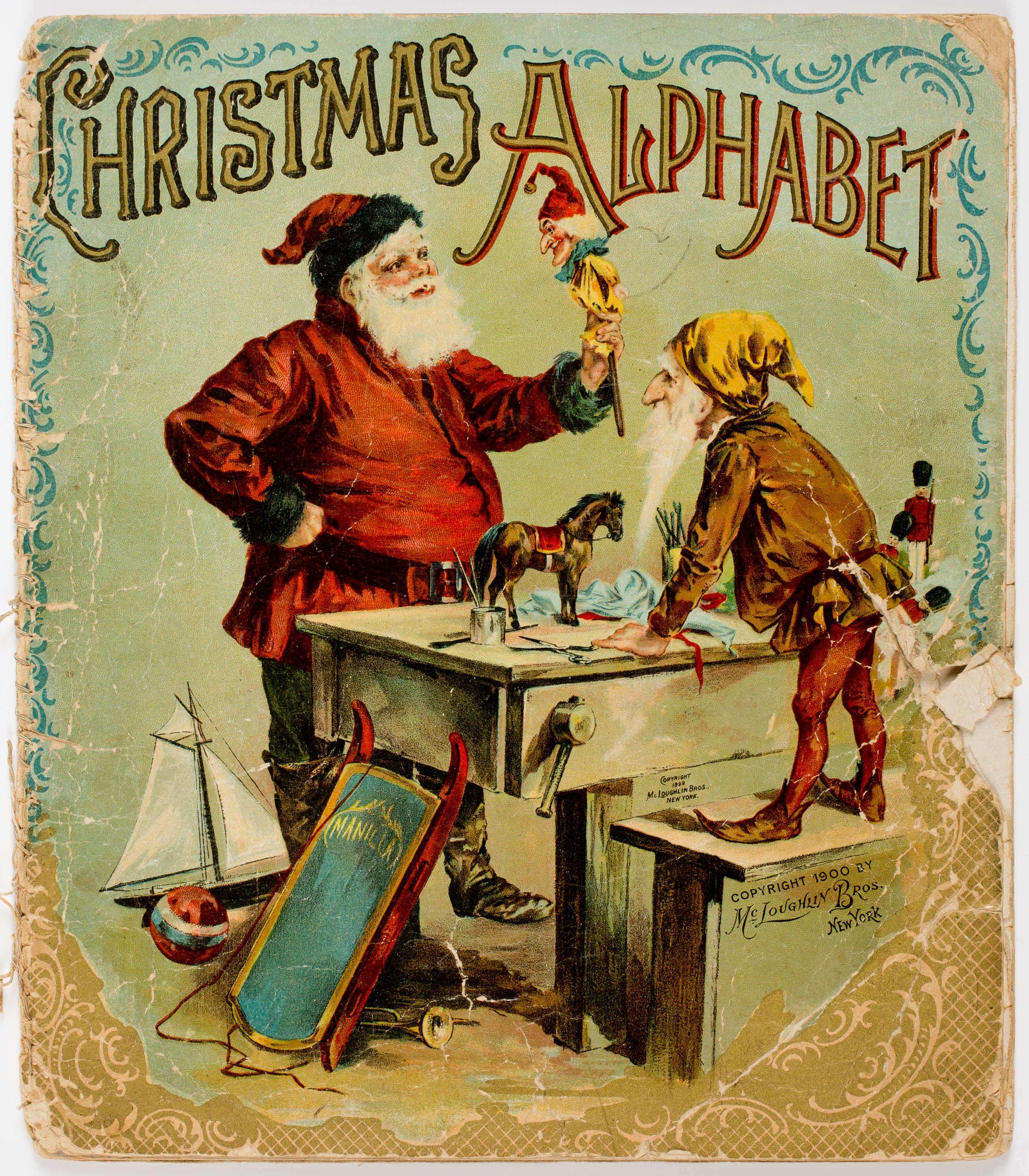
Although Clement Clarke Moore is now recognized as the celebrated Christmas poet, early twentieth-century writer Carolyn Wells (1862-1942) expanded on Moore’s vision of Christmas as a season of wholesome family-centered celebration in her Christmas Alphabet. Issued by New York picture book publisher McLoughlin Brothers in 1900, the Christmas Alphabetweaves evocative verse and gorgeous full-color chromolithograph illustrations to give a more modern cast to the image of a Santa laden with gifts made famous by Thomas Nast’s illustrations for the Night Before Christmas, published shortly after the Civil War (also by Mcloughlin Brothers).
The Alphabet’s cover (above right) does not show a rakish fur-suited elf, but a dignified gentleman in a red suit with a snowy beard, inspecting a puppet made by his helper, not unlike a manufacturer examining his employee’s product. Santa is flanked by other toys, including a miniature pony, a sailboat, a ball, and a sled; perhaps he is about to load them into his pack!
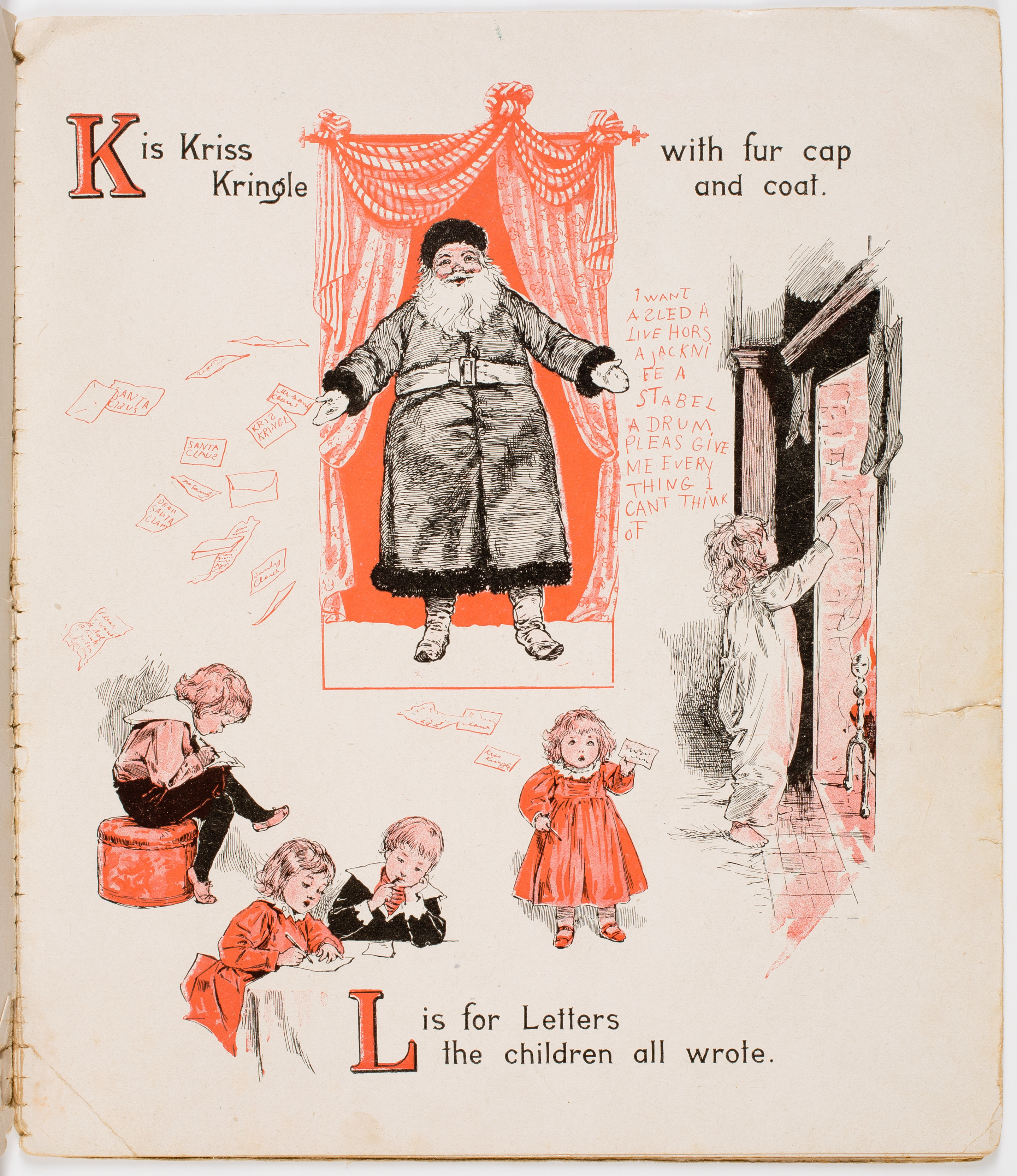
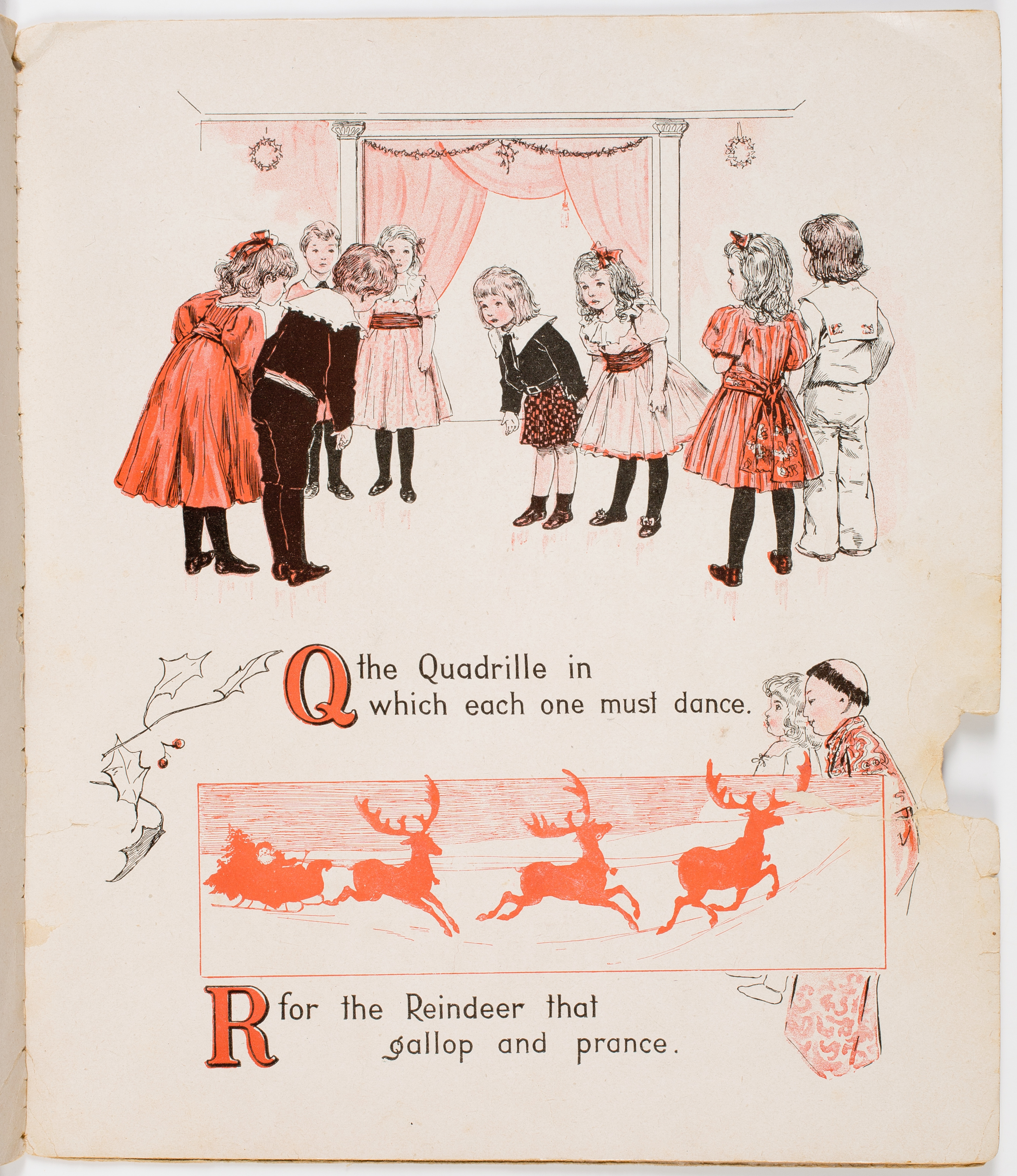
Inside the book, Wells’s poem is accompanied by illustrated vignettes capturing the essence of each letter (the mini illustration for “D” shows a girl walking her new doll dressed in the latest fashion). The alphabet is also interspersed with full-color images of Santa and his elves at work, and children indulging in winter play, making for a delightfully disjointed effect. The poem hearkens to the senses: “C is for Candy to please boys and girls; I is for Ice, so shining and clear; J is the Jingle of bells far and near; S is for Snow that falls silently down; U is for Uproar that goes on all day.” Besides these sensual pleasures, there are appeals to social expectations: “L is for Letters the children all wrote,” and we see children concentrating on writing their requests to Santa asking for gifts. Wells also alludes to the gently reinforced sociability of Christmas parties: “Q [is for] the Quadrille in which each one must dance,” accompanied by an image of boy and girl couples bowing to each other in a square set. Santa gets only one letter in the alphabet—“K is Kriss Kringle with fur cap and coat”—presented as more of a statement of fact than an explanation of who Santa is (that was already handled by Moore’s poem).
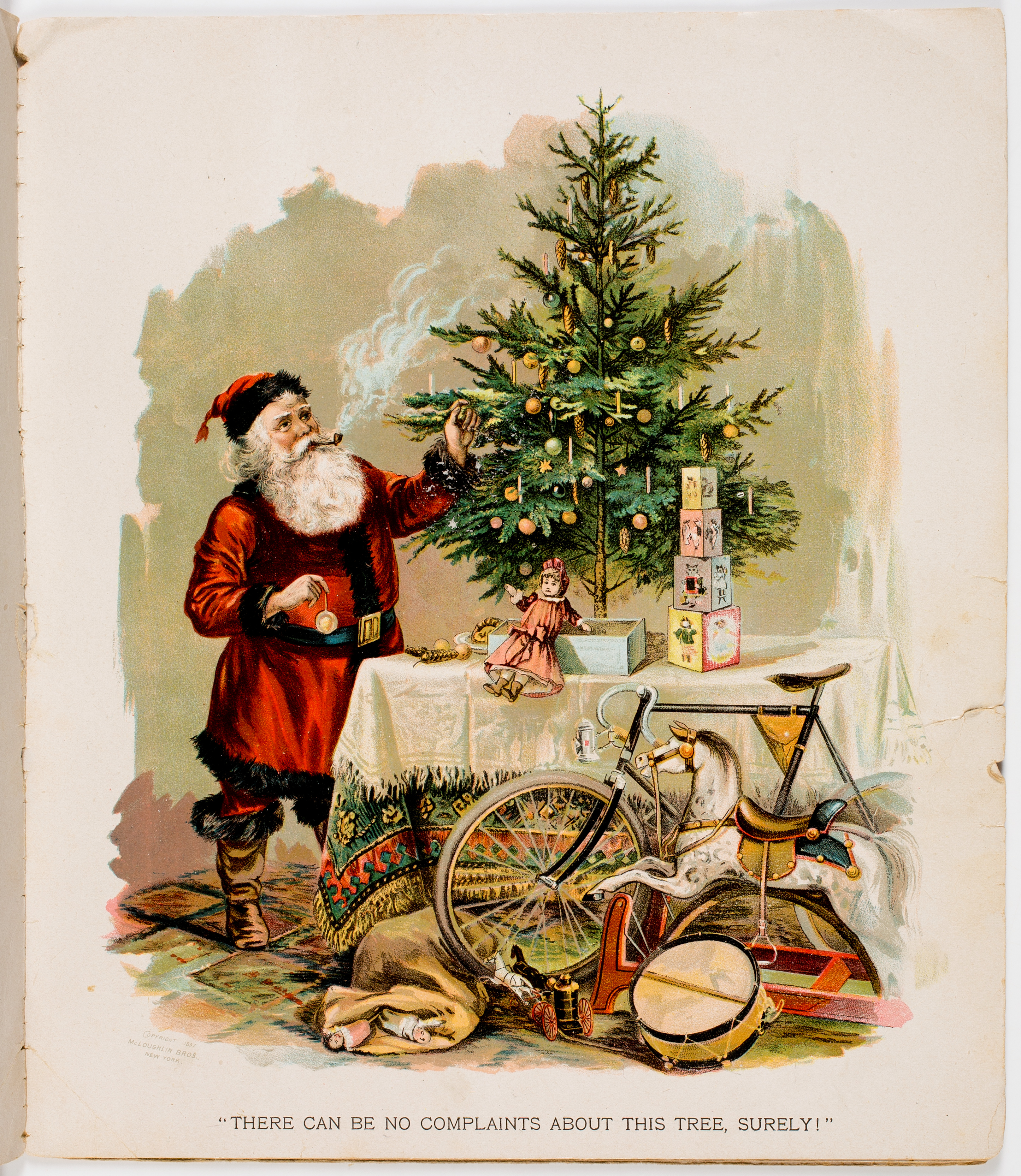
Towards the end of the book is a full-page color image of Santa finishing his work decorating a tabletop Christmas tree, declaring, “There can be no complaints about this tree, surely!” Beneath the tree are his latest deliveries, including a brand new bicycle (a pretty new-fangled vehicle in 1900), a toy drum, and an elegant rocking horse. On the table are a set of toy blocks decorated with kittens, not unlike those sold by McLoughlin Brothers in their extensive toy line. In this one image, supernatural wonder, winter beauty, and mass-produced consumerism all meld together, not unlike the sights, sounds, and expectations rendered in Wells’ poem. This ABC is a playbook for what Christmas has been, and to a fair extent, what we want it to be.
You can see this delightful book in its entirety through the viewer below or in our image database!
Like many born and bred New Englanders, I have developed a soft spot for Louisa May Alcott’s holiday pieces (1832-1888). Alcott’s literary career, which began with pseudonymously published magazine articles, was followed by beloved books; sprinkled throughout are works seasoned with festive subjects, settings, and themes. Her novels for children (which cue-in these topics) were wildly popular in her lifetime. Admiration has not waned; today it is easy to find reprints of her stories and poems, which have been collected and reissued as classic texts and are available to be read on limitless websites and online resources.[i]
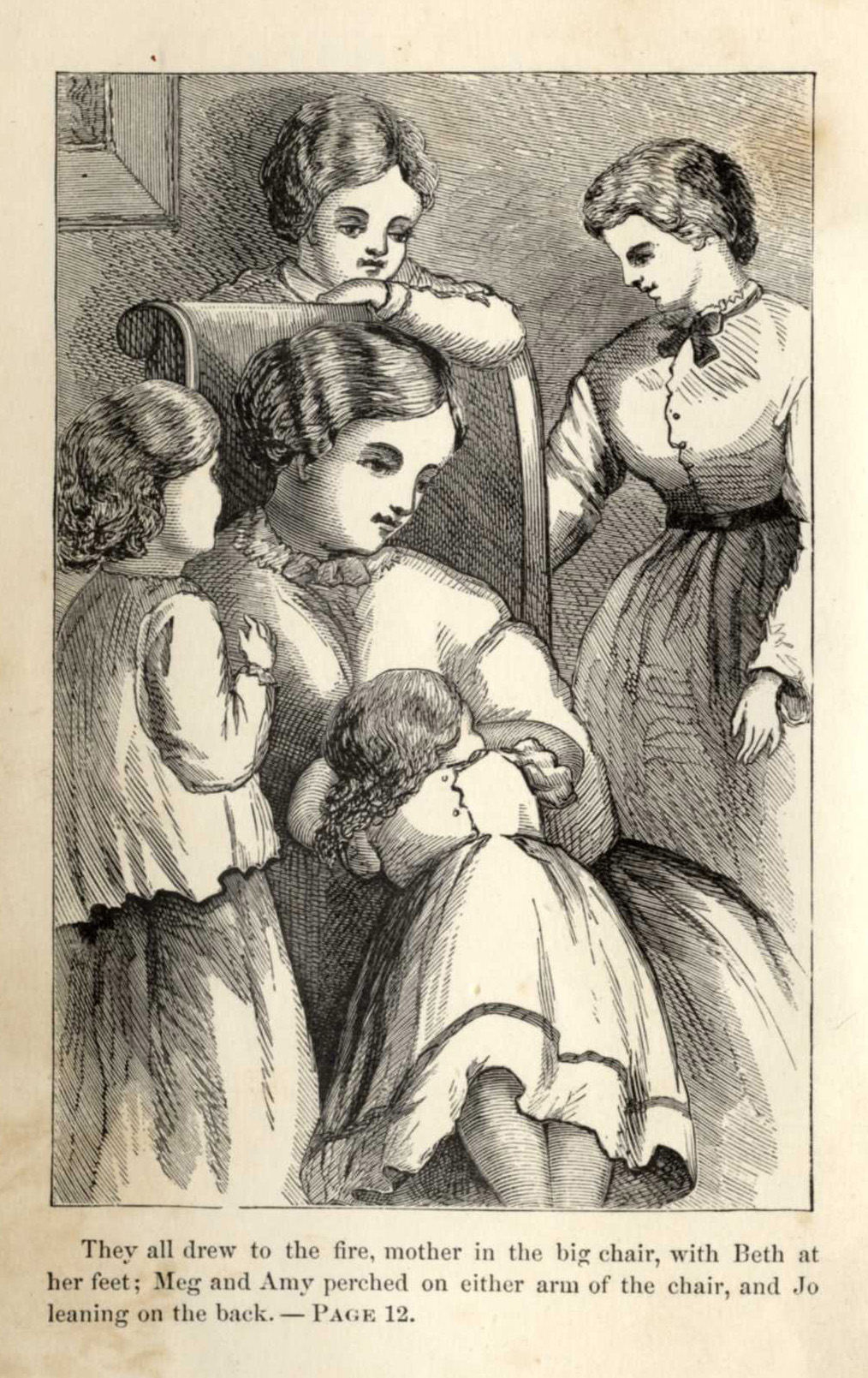
Her semi-autobiographical novel (and most famous work), Little Women, opens with the grumblings of Jo March: “Christmas won’t be Christmas without any presents.” This frontispiece was from the first volume of Little Women, published in 1868, and was illustrated by Louisa May’s sister, May Alcott. The image features Marmee, the March children’s mother, Amy, Jo, Beth, and Meg and shows the sisters in one another’s company. By the second chapter, titled “A Merry Christmas,” we find a delighted Jo with a gift, having slipped her hand under her pillow to discover “a little crimson-covered book.” (Though unnamed, is perhaps a copy of The Pilgrim’s Progress hinted at in the previous chapter.) Sister Meg found the same with “a few words written by their mother, which made their one present very precious in their eyes.” Meg opens her “new book and began to read. Jo put her arm around her, and, leaning cheek to cheek, read also, with the quiet expression so seldom seen on her restless face.”
Evidence of books as Christmas presents is found in AAS collection material in everything from appropriate-named annuals and gift books (many lavishly illustrated), to miniature books and temperance addresses, to countless items of children’s literature. Hundreds of books in the Society’s collection are inscribed with either Christmas or the date December 25, usually on the front flyleaf. But it is this scene in Little Women I’ve always been obsessed captivated by—this idea of book-receiving on December 25—and thought it worthy of exploring with Alcott’s works as being the ones gifted. Not only did Alcott create texts on the subject of Christmas (or include poems tucked in such as “A song for a Christmas tree” in The Rose Family: a Fairy Tale), but a search in WorldCat (and even my own personal library) shows that her books were given as holiday gifts as well.
The AAS collection also features several copies of Alcott’s books which bear evidence of Christmas gift-giving of the celebrated and beloved author.
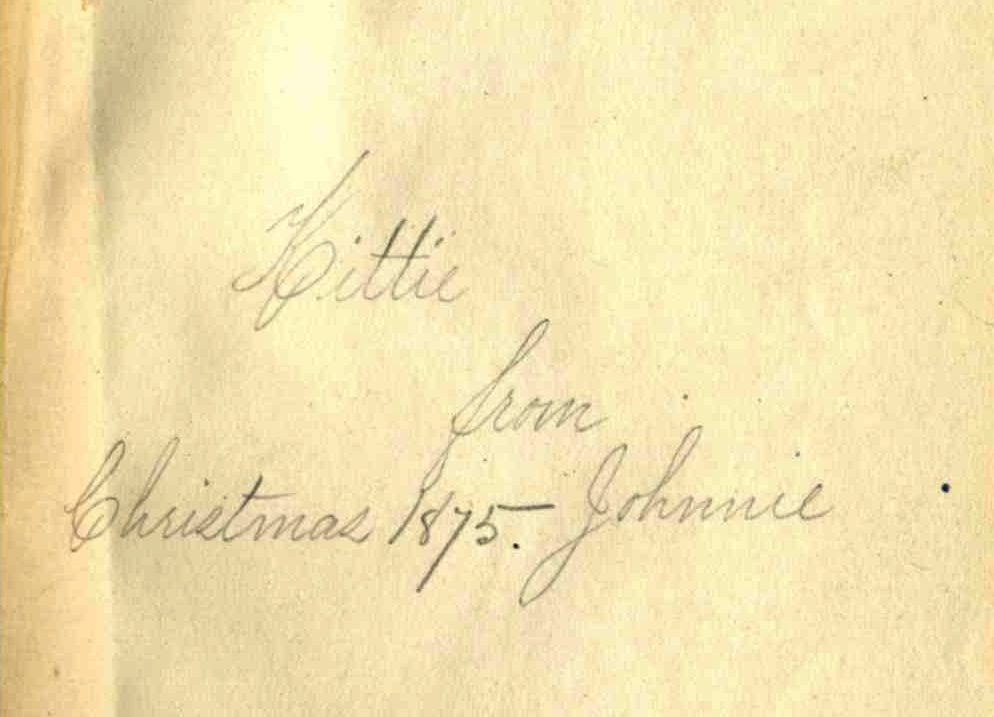
An 1875 illustrated copy of Eight cousins; or The Aunt-Hill, a children’s novel about an orphan named Rose in the care of her aunts (surrounded by energetic boy cousins), has a mechanically-reproduced dedication by Alcott but is also inscribed, “Kittie from Johnnie, Christmas 1875.”
In addition to novels like Little Women and Eight Cousins, Alcott also wrote short stories, such as “My Boys,” published under the series title of Aunt Jo’s Scrap-Bag. Some of these short story collections were created for the holiday market, such as an 1871 edition of the first volume of Aunt Jo’s Scrap-Bag, published in Boston by the Roberts Brothers. The preface is dated “Christmas holidays, 1871-72” and addresses her readership as a “large family so rapidly and beautifully growing about me.” This copy of the text also carries a presentation inscription reading, “For Lillie, with a ‘Merry Christmas’ from Alice, Dec. 25, 1871” and features the oft-reproduced story of “Tilly’s Christmas.”
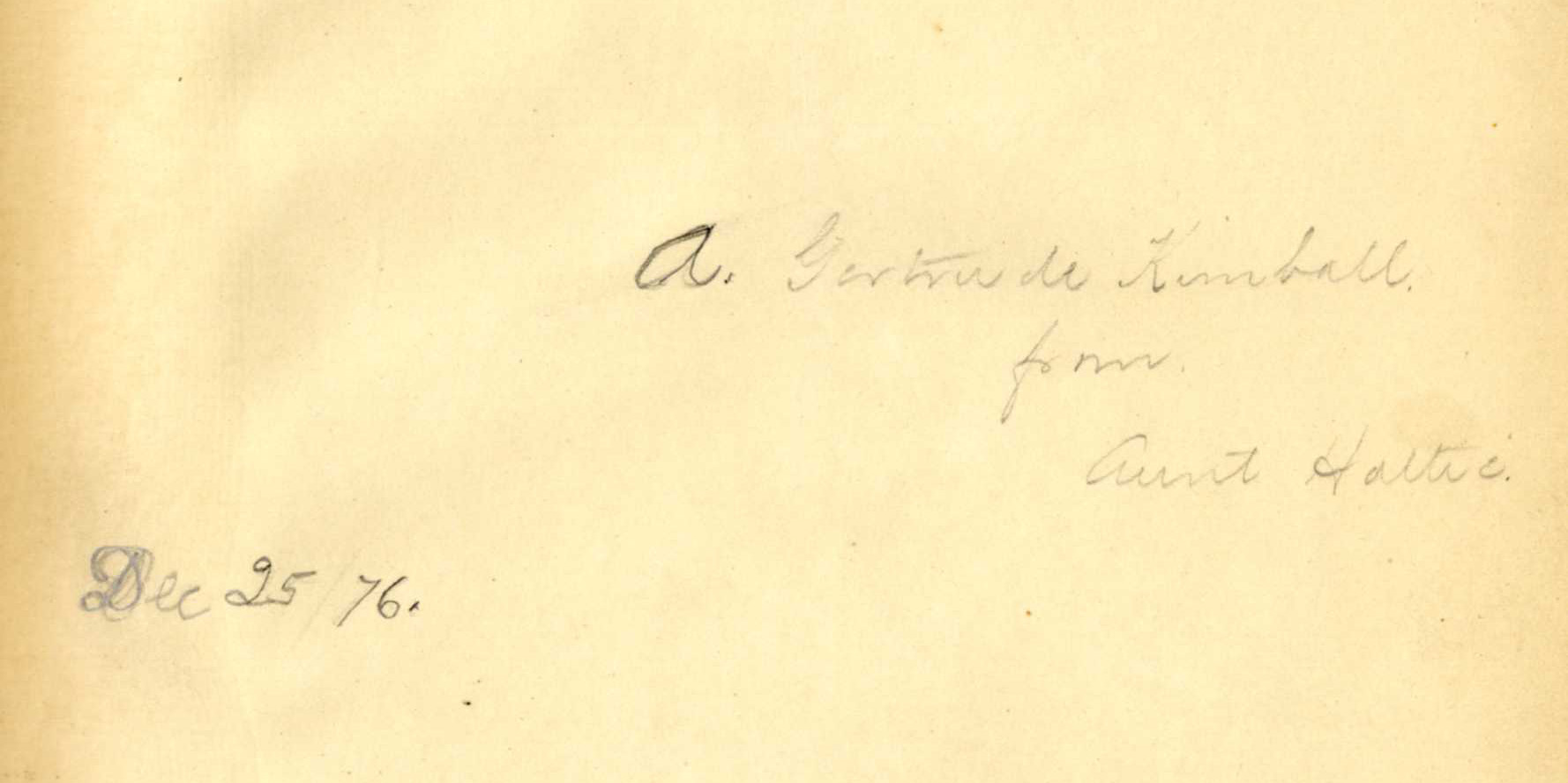
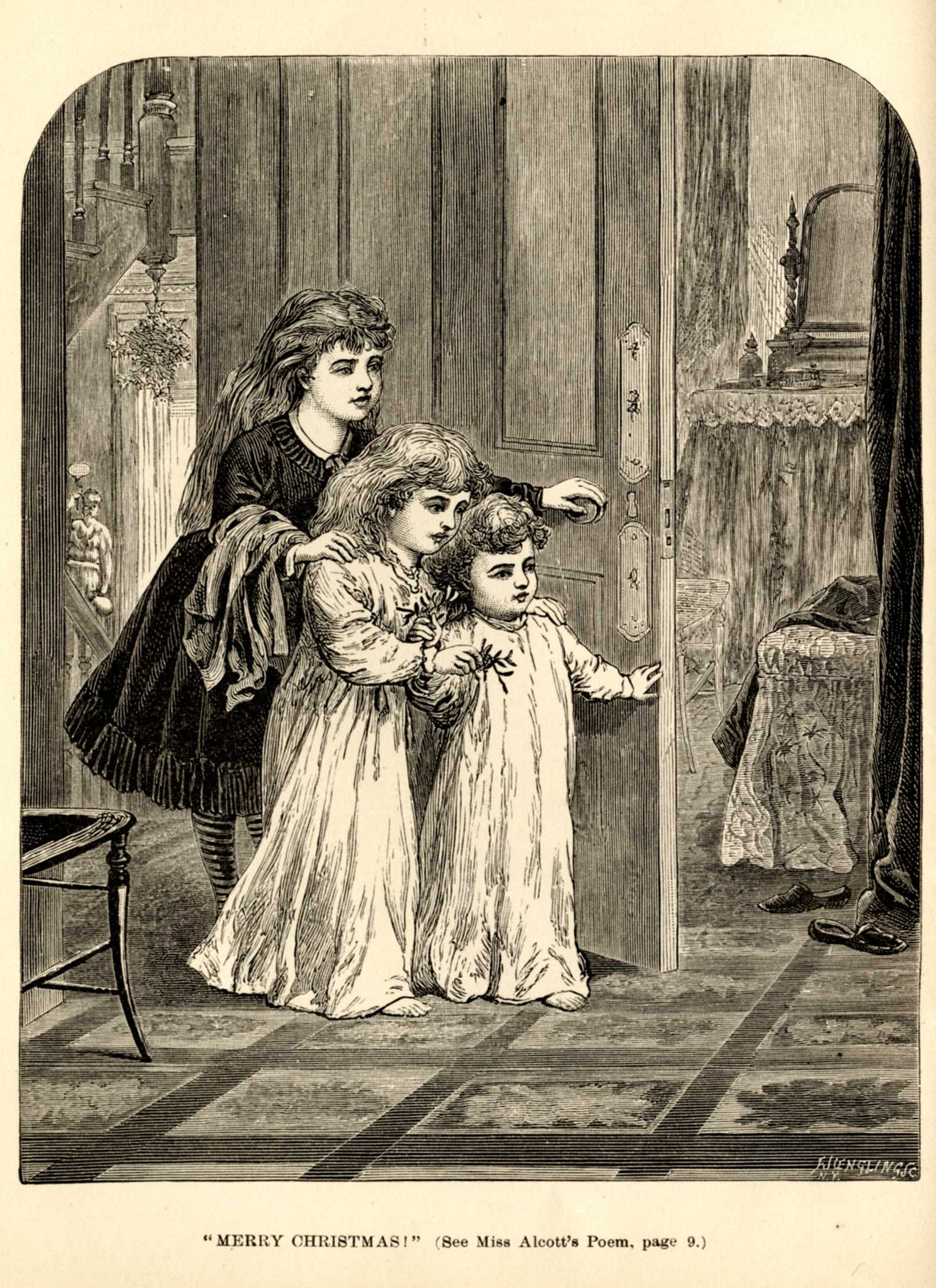
A gorgeous book with gilt title, likely intended for the gift-giving market, is an anthology of poems, The Horn of Plenty of Home Poems and Home Pictures; editorship has been attributed to Sophie May and William Fearing Gill. Published in 1876, it excitedly announces new poetry by Louisa May Alcott and doesn’t disappoint by the placement—the frontispiece illustrates the poem “Merry Christmas,” which appears, along with another Alcott poem called “Our Little Ghost,” on the opening pages. The book is dedicated “to all the little women and little men who have been made happy by Aunt Jo who wishes them a Merry Christmas…by a warm admirer of Little Women and Little Men.” Of the two copies in the AAS children’s literature collection, one is inscribed, “A. Gertrude Kimball, from Aunt Hattie. Dec. 25, ’76.”
Perhaps some of these inscribed, gifted editions of Alcott’s work were slipped under a pillow on Christmas morning mimicking the beloved scene in Little Women? One can dream!
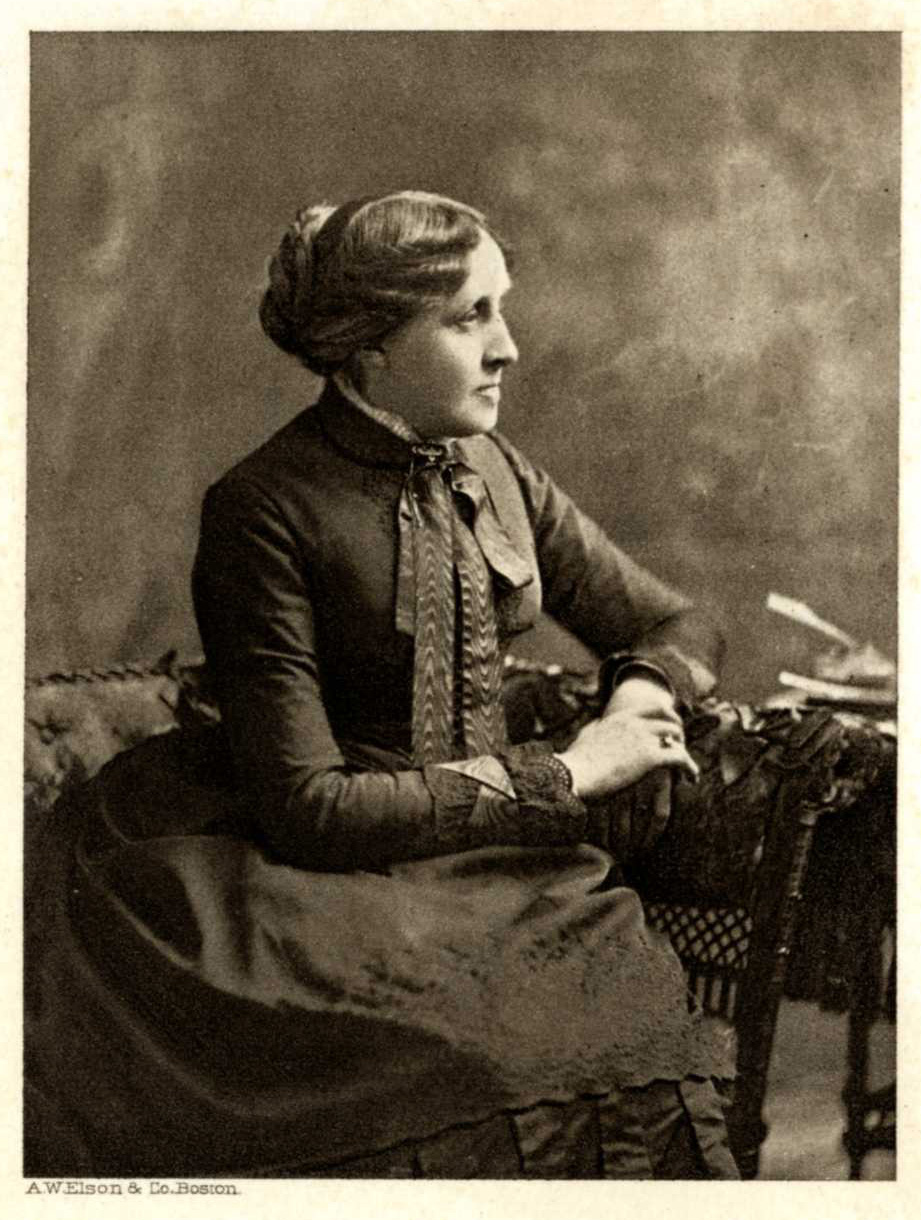
[i] Posthumously published biographyLouisaMayAlcott: Her life, letters, and journals edited by Ednah Dow Cheney with a A.W. Elson & Company photogravure frontispiece portrait of Alcott.
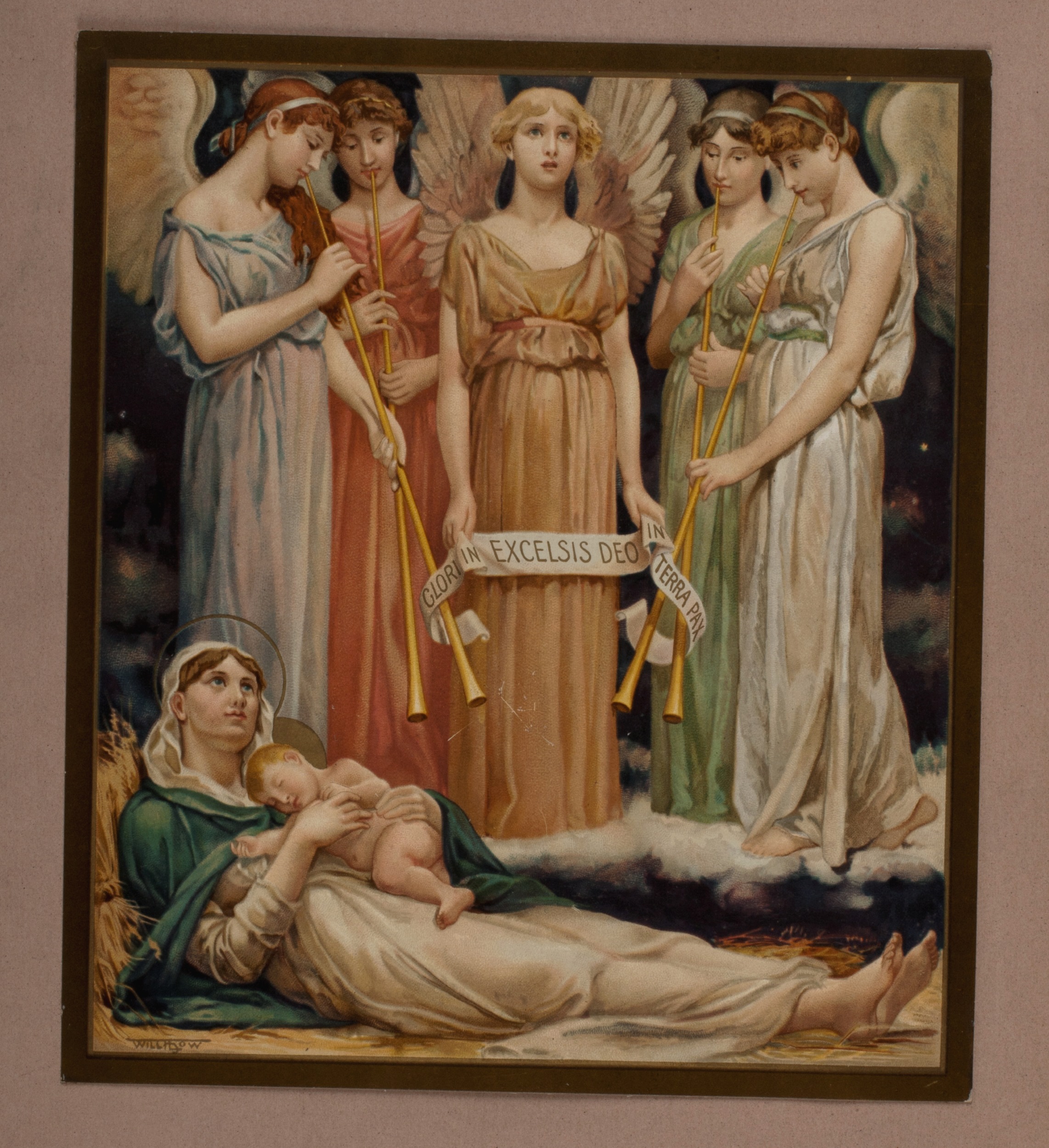
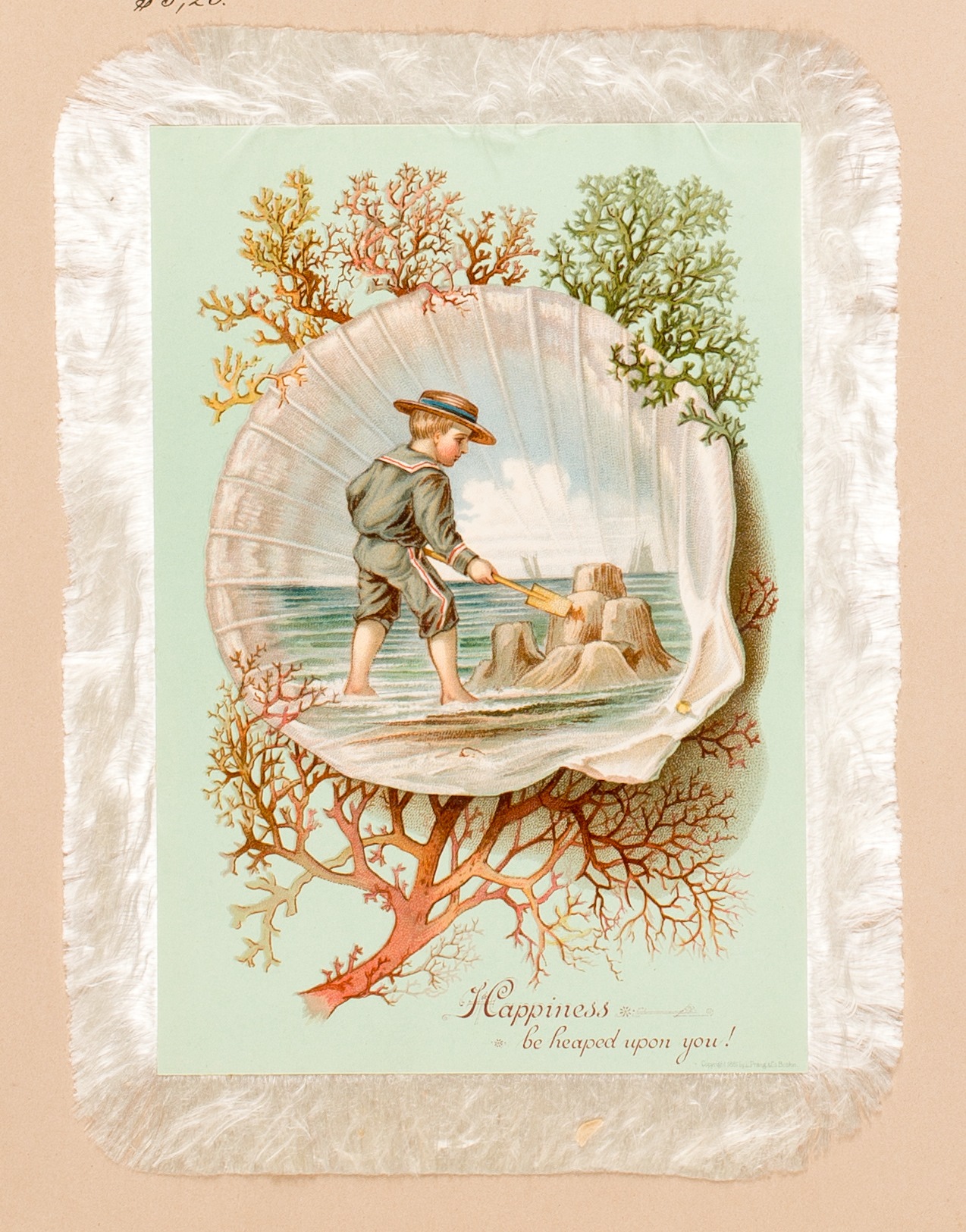
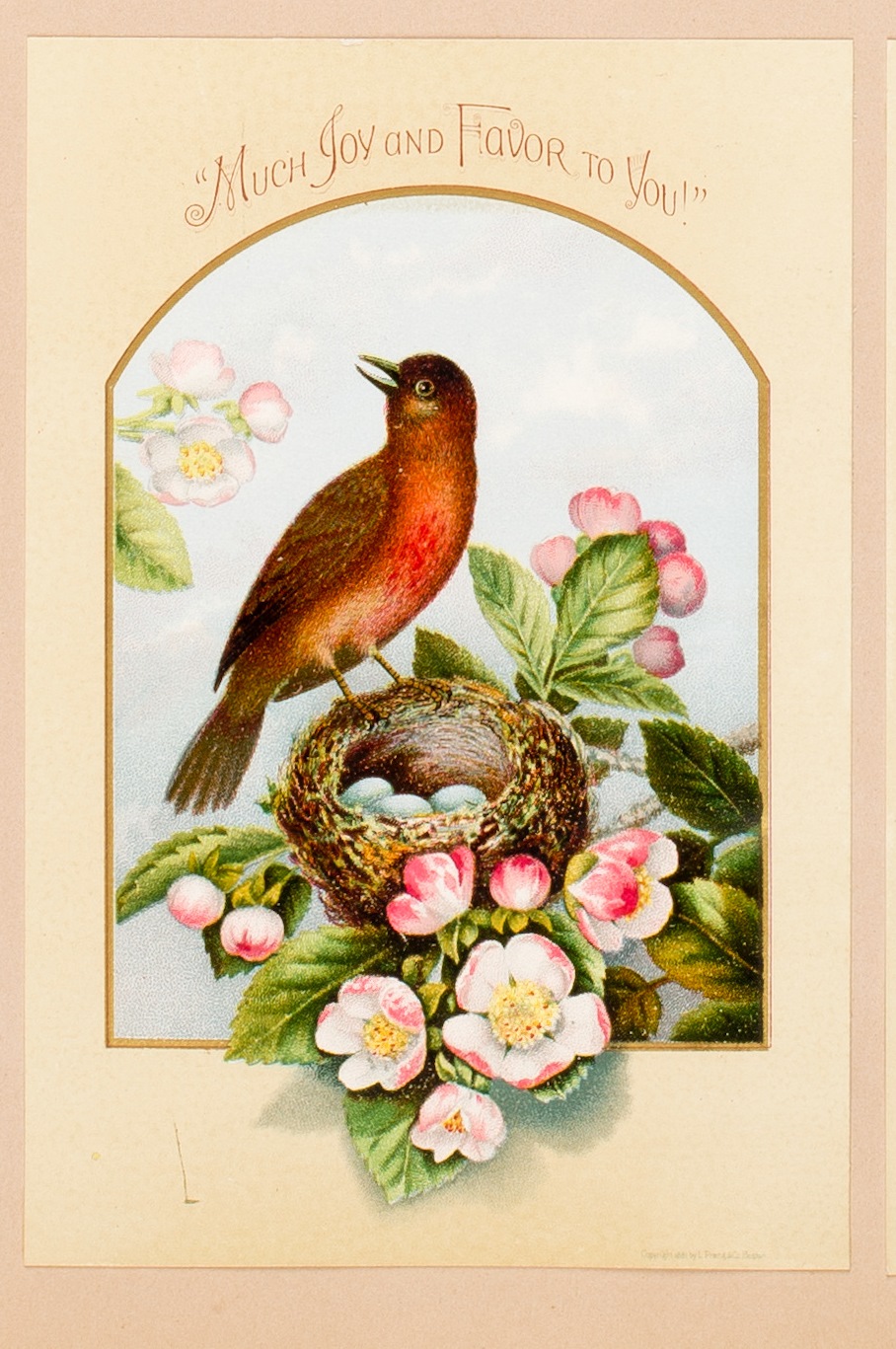
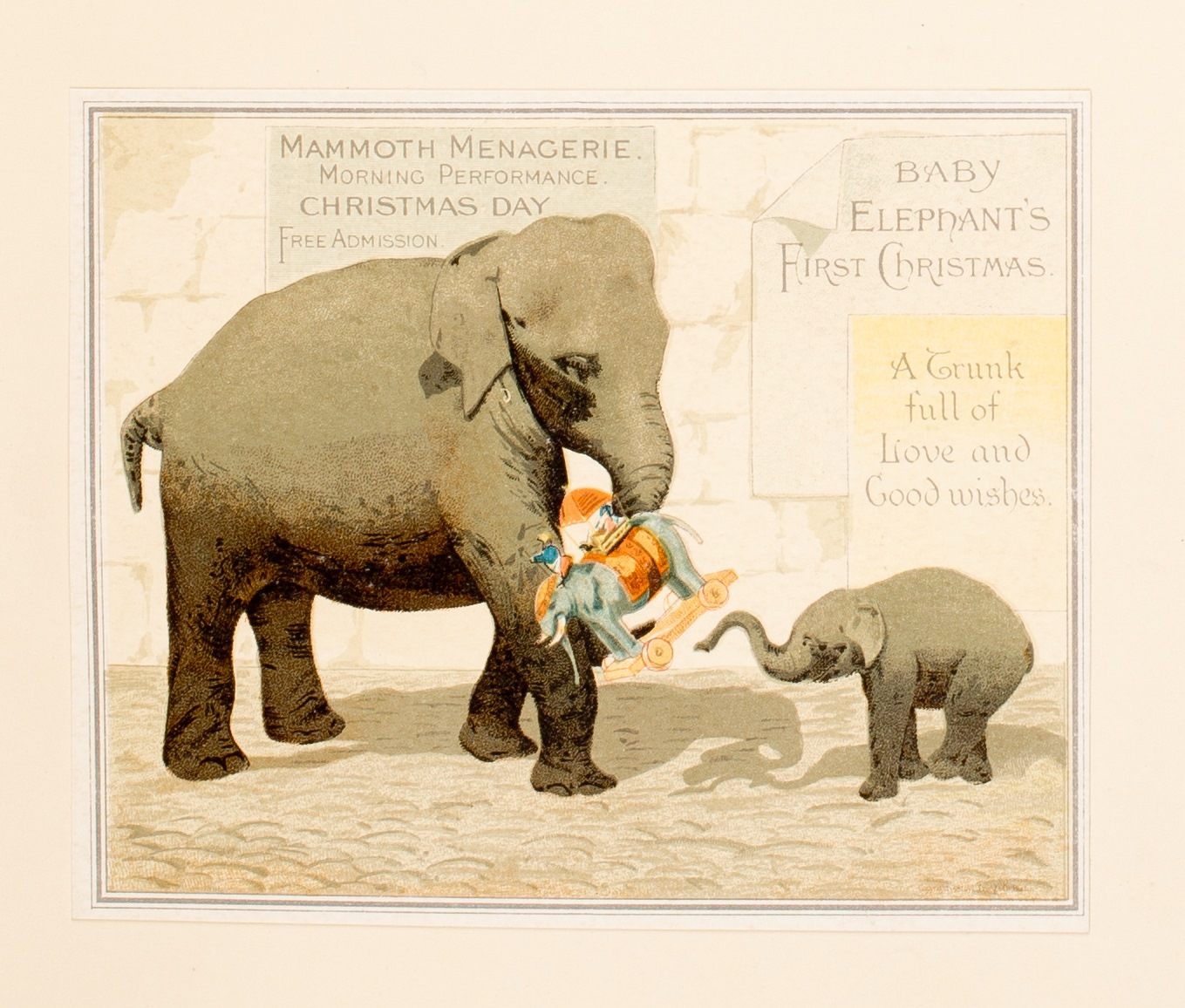
In December it is traditional to send Christmas cards. We have discussed this practice on the AAS blog in the past and also have looked at the popularity of the New Year’s card, something that has fallen out of fashion entirely in the United States. But one aspect of nineteenth-century holiday cards that we have not explored is the fact that so many of their subjects seem incongruous to twenty-first-century eyes. The cards do sometimes feature the more expected snowy scenes, Santa, and the Nativity (right) with greetings of “Best Wishes,” “Merry Christmas,” and “Peace and Joy.” But more often than not, today’s viewer is left scratching his head asking, “That’s a Christmas card?”
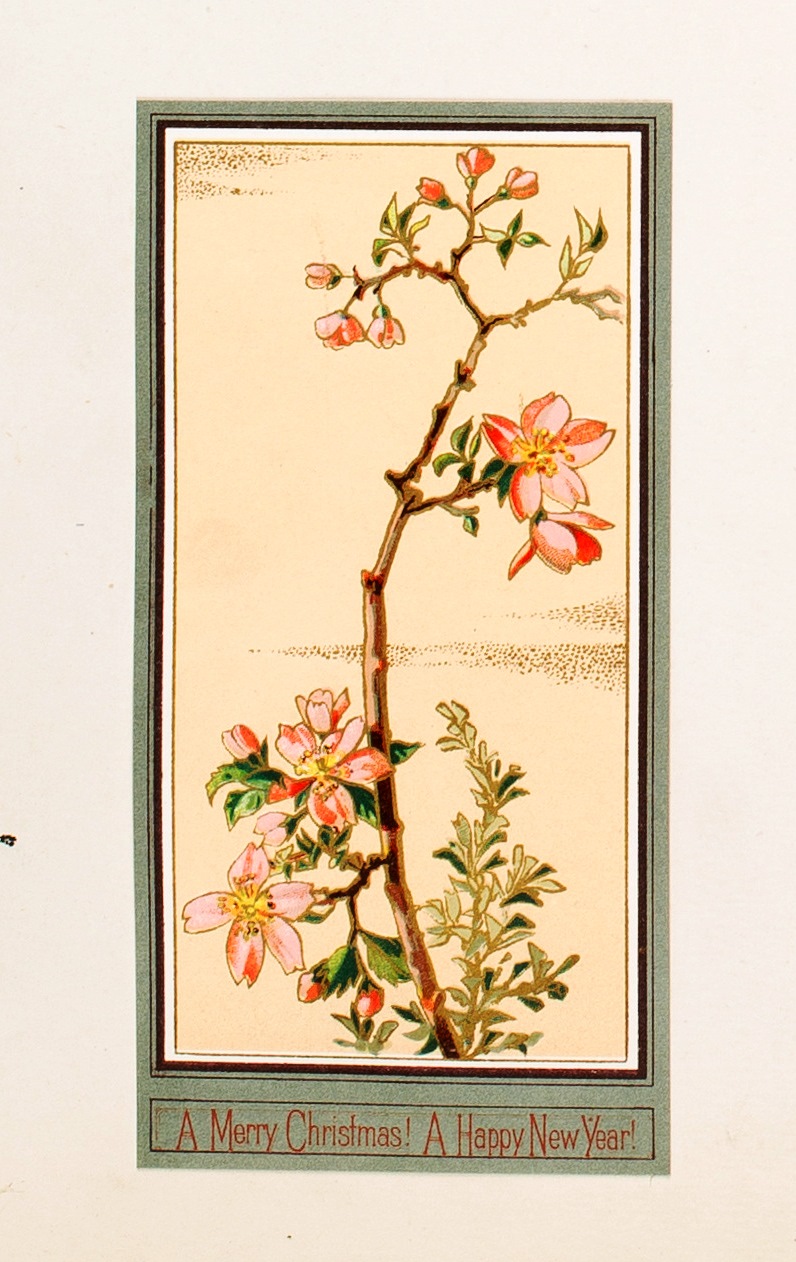
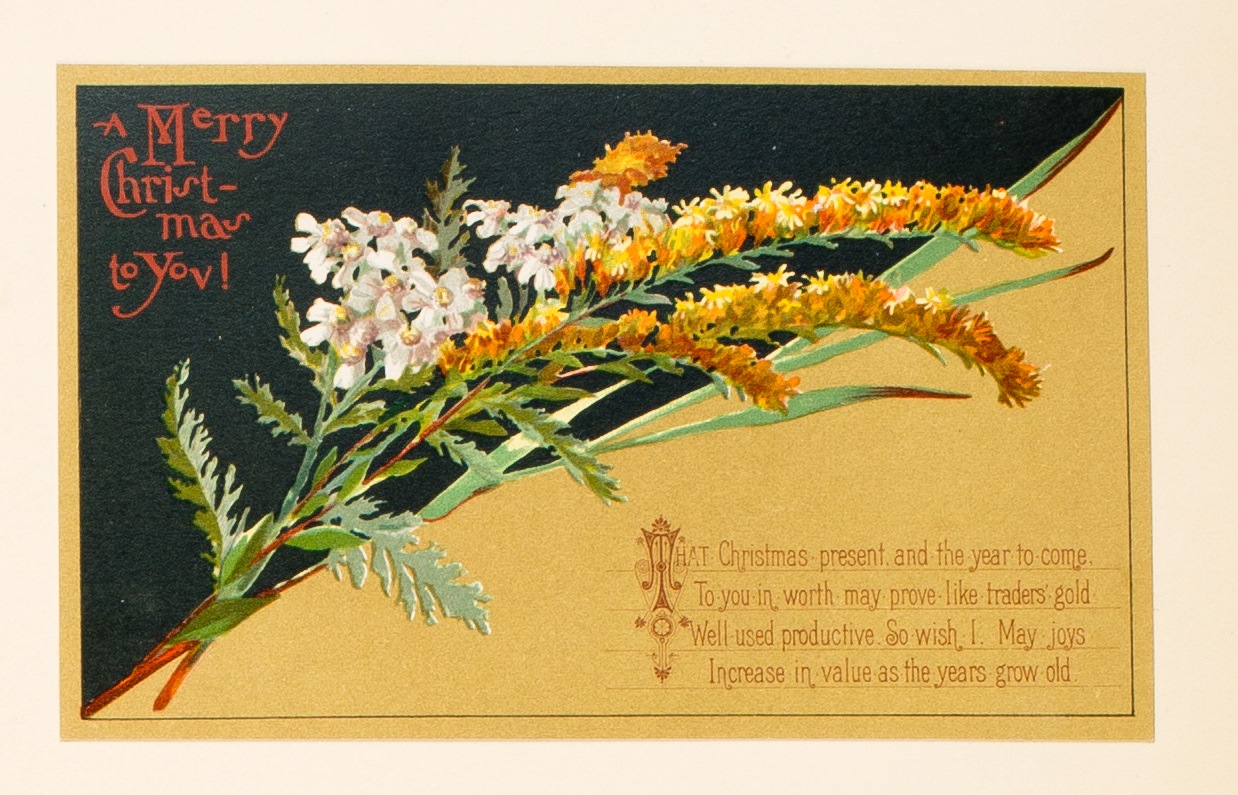
It was easy to pull examples of the unexpected genres we have in mind. The first, and by far the largest group with literally hundreds of representative cards in the Society’s collection, is the floral-themed card. These cards range from simple messages with floral borders to more elaborate depictions of bouquets and poetry. Spring flowers were especially popular, with apple blossoms (right), pea plants, and poppies appearing on cards, but autumnal botanicals also make an appearance, including maple leaves, nettles, and goldenrod (below). The language of flowers, where different blossoms denote different emotions and characteristics (pink carnations = you are unforgettable and rhododendrons = strength) was better understood in the nineteenth century, which might help explain the popularity of these cards. They are also quite pretty and were often saved by recipients and pasted into scrapbooks.
Other themes produced by several printers in the New England region involved the sea. Messages are framed by elaborate coral and shells, ships sail into the sunset and beach scenes with rolling waves and children playing in the sand read “Merry Christmas” and “Happiness Be Yours.” Regional cards are still published today, of course, with snowy desert scenes of cacti and rock formations coming from our relatives in the American Southwest and lighthouses bedecked with Christmas lights and wreaths offered for sale in gift shops on Cape Cod. But the nineteenth-century cards lack those little clues (the snow, the wreaths) and just depict happy summer scenes and underwater plants that happen to also be carrying seasonal greetings.
Finally, popular nineteenth-century Christmas cards often featured animals of all kinds—and we are not talking about reindeer and penguins. Animals like elephants, cats, dogs, and birds grace hundreds of Christmas and New Year’s cards, some for comic effect and others with just decorative intent. Louis Prang, who is often considered the Father of American Christmas Cards and who produced all of the examples we selected for this post, produced whole series of holiday cards of birds with nests and comic cats and dogs dressed like people. Sometimes these animal cards make “holiday sense” to modern eyes (such as a mama elephant giving her baby a toy as a gift as seen below), but other times we can’t grasp the holiday significance of dogs wearing top hats or kittens in bibs.
So this holiday season when you send or receive a card, think for a moment about the significance of the image on the front of the card—it likely makes perfect sense to you, immersed as you are in the cultural context of the moment. But in 2080, will someone look at it and say, “That’s a Christmas card?” In fact, now that we think of it, will the practice of sending folded pieces of colorfully printed paper stock, with shiny inks and velvet touches, have fallen completely out of fashion and our 2080 imagined scholar asks instead, “What is a Christmas card?”
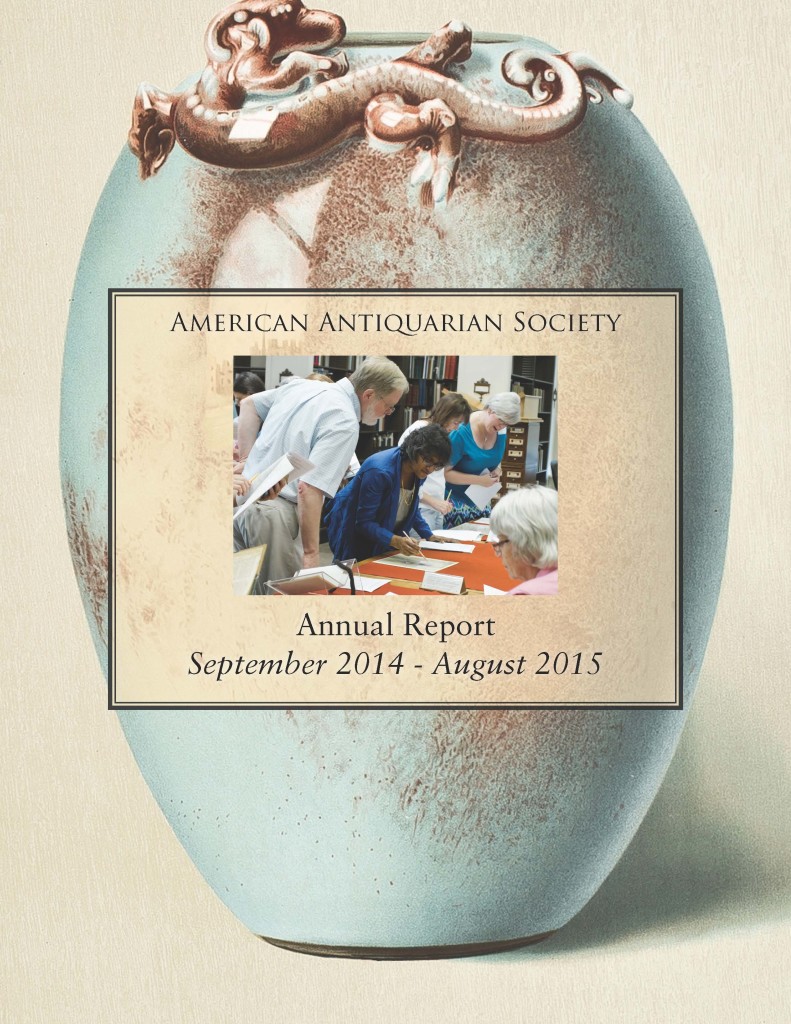
Our newly released annual report covering September 1, 2014, through August 31, 2015, is now ready for perusal! It’s been an exciting year, with wonderful new acquisitions, the development of digital initiatives, the addition of two multi-day summer workshops, and more. You can read the full issue here, or click the image below.
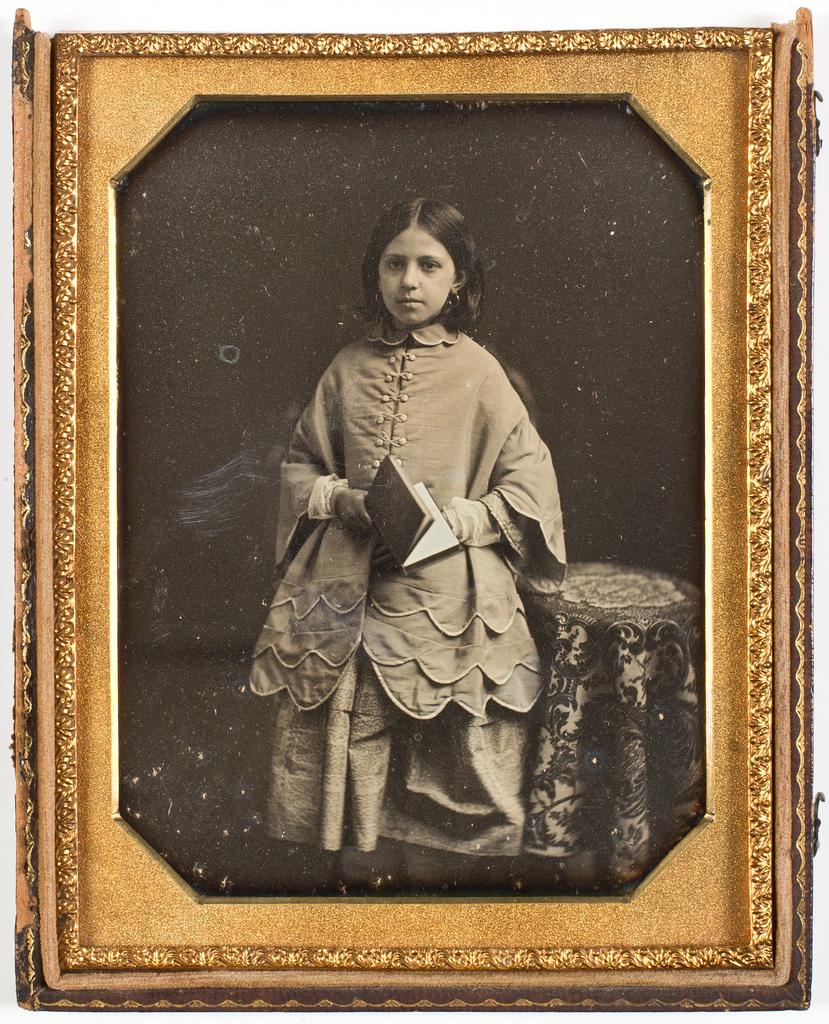
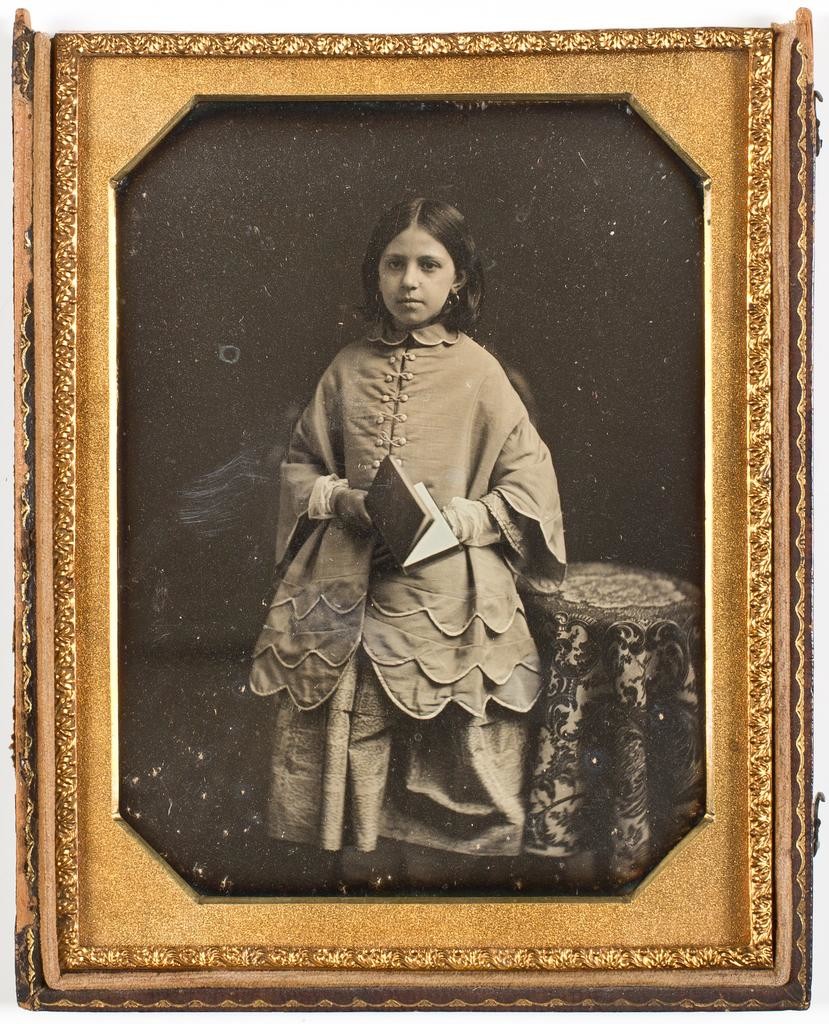
Portrait of T. P. and D. C. Collins. Daguerreotype, Philadelphia, 1846.With T. P. Collins. Unidentified Girl Holding a Book. Daguerreotype, Philadelphia, 1846.
This daguerreotype of brothers Thomas P. and David C. Collins lounging on a sofa was generously donated to AAS this spring by scholar Rebecca Norris. The donation was accompanied by the opportunity to purchase additional photographic material associated with the Collins brothers (all collected by Ms. Norris), such as the half-plate daguerreotype of a young girl with a book shown here. The collection includes daguerreotypes made by both brothers, portraits of their family members, and albumen photographs taken by them later in their careers. In April 2010, AAS acquired a pair of rare manuscript ledgers recording the clientele of the Philadelphia daguerreotype firm established by T. P. and D. C. Collins. The volumes list over 23,000 customers who sat for portraits in the company’s Daguerreian rooms between 1845 and 1854. These volumes were digitized by AAS and made available via the web, attracting the attention of Ms. Norris, who has written extensively on the brothers and their work. Her two articles in The Daguerreian Annual (in 2006 and 2013) were based on her research in archives, art collections, and private holdings, and made heavy use of the ledgers. In January 2015, Ms. Norris, who was impressed with our preservation of the ledgers and the fact that we provided open access to them, contacted AAS about placing her personal collection of Collins photographs at the Society. The plate of the brothers was her gift and, with a generous grant from the Breslauer Foundation, AAS was able to bring the collection of 31 additional daguerreotypes and 50 other photographs (ambrotypes, tintypes, albumen prints) to the Society. Gift of Rebecca Norris (daguerreotype of T. P. and D. C. Collins) and grant from the Breslauer Foundation.
Every quarter at AAS we release a list of recent publications by those who have researched at
the library as fellows, members, or readers. To see this list, as well as a list of works published
from 2000-2014, please visit our recent scholarship page on the AAS website. If your book, article, or other achievement is not included, just let us know if you’d like to see it there!
BOOKS
Kennedy, Rick. First American Evangelical: A Short Life of Cotton Mather. Grand Rapids: William B. Eerdmans Publishing Company, 2015.
Powers, David M. Damnable Heresy: William Pynchon, the Indians, and the First Book Banned (and Burned) in Boston. Foreword by David D. Hall. Eugene, Oregon: Wipf & Stock, 2015. (Hall: AAS-NEH Fellow, 1981-1982; AAS member)
Schiff, Stacy. The Witches: Salem, 1692. New York: Little, Brown and Company. 2015.
Wiegand, Wayne. Part of Our Lives: A People’s History of the American Public Library. New York: Oxford University Press, 2015. (AAS member)
ARTICLES
Dayton, Cornelia H. “’The Oddest Man that I Ever Saw’: Assessing Cognitive Disability on Eighteenth-Century Cape Cod.” Journal of Social History 49 (2015): 77-99. (AAS-ASECS Fellow, 1991-1992; Mellon Fellow, 2004-2005; AAS member)
Den Hartog, Jonathan. “Religion and Politics in the American Revolution and Beyond.” Journal of the Early Republic 35.3 (2015): 475-481. (AHPCS Fellow, 2012-2013)
Edelstein, Sari. “Louisa May Alcott’s Age.” American Literature 87 (2015): 517-546. (Peterson Fellow, 2008-2009)
Hazard, Sonia. “Agency, the Idea of Agencies, and the Problem of Mediation.” Church History 84 (2015): 610-615. (CHAViC Fellow, 2013-2014)
AWARDS
Kathryn Neurnberger received the James Laughlin Award for her second book of poetry, The End of Pink (Hearst Fellow, 2010)
Amanda Herbert’s book Female Alliances: Gender, Identity, and Friendship in Early Modern Britain was named the best book of 2015 by the Society for the Study of Early Modern Women. (Peterson Fellow, 2007-2008)
Cornelia H. Dayton and Sharon V. Salinger were awarded the Littleton-Griswold Prize for Robert Love’s Warnings: Searching for Strangers in Colonial Boston. (Dayton: AAS-ASECS Fellow, 1991-1992; Mellon Fellow, 2004-2005; AAS member)
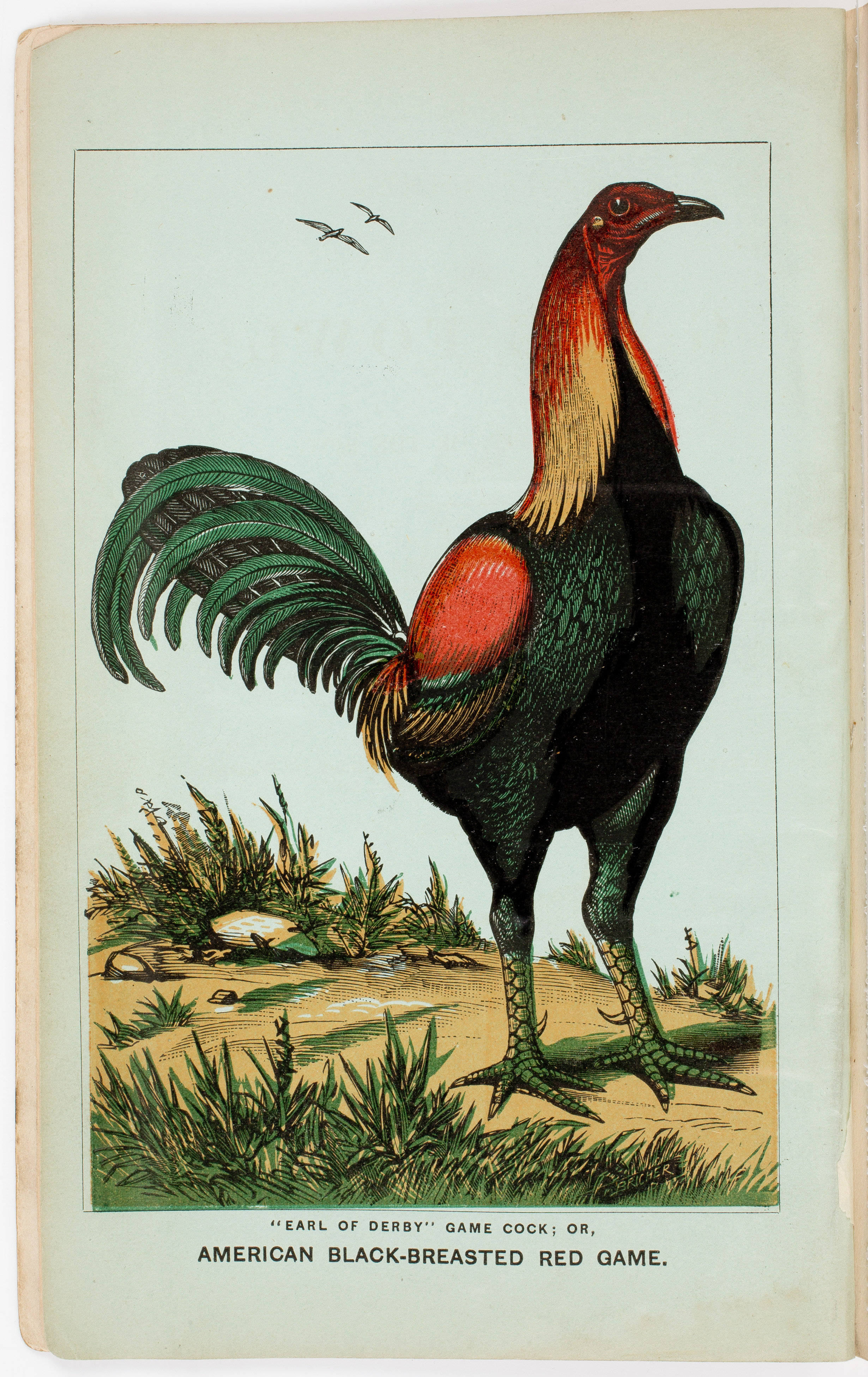
Burnham, Geo. P. The Game Fowl; for the Pit, or the Spit. Melrose, Mass.: [s.n.], 1877.
The frontispiece portrait of the “Earl of Derby” game cock provides a striking starting point to this thorough, and early, survey of American game fowl and their culinary and pugilistic applications. The poultry advice book was copyrighted by George P. Burnham in 1876 as part of his books for poultrymen, a series for which AAS already has the first and second titles. This third title promises to elucidate “how to mate, feed, breed, handle and match them; with practical suggestions as to cures for their peculiar ills and ails.” Included is a directory of suppliers of various breeds of game fowl.
In a post last January about the difficulty of cataloging dime novels, I discussed how much valuable information is lost when a novel no longer has its wrapper (paper cover). One of the most important kinds of information lost is series information. Knowing that a novel was in a specific series is one of the best places to start if the novel is missing useful information, like a publication date. But without wrappers, you’re left with what you can find on the title page and in the text.
Most of the novels I’m cataloging have no wrappers. They’ve been rebound in volumes containing anywhere from five to seven novels. The novels aren’t always in any useful order, and sometimes they have novels from multiple publishers in one volume. In the cataloging office, we joke that the research needed to do the kind of deep cataloging to which we are committed is “forensic cataloging,” and dime novels without wrappers frequently call for my forensic skills.
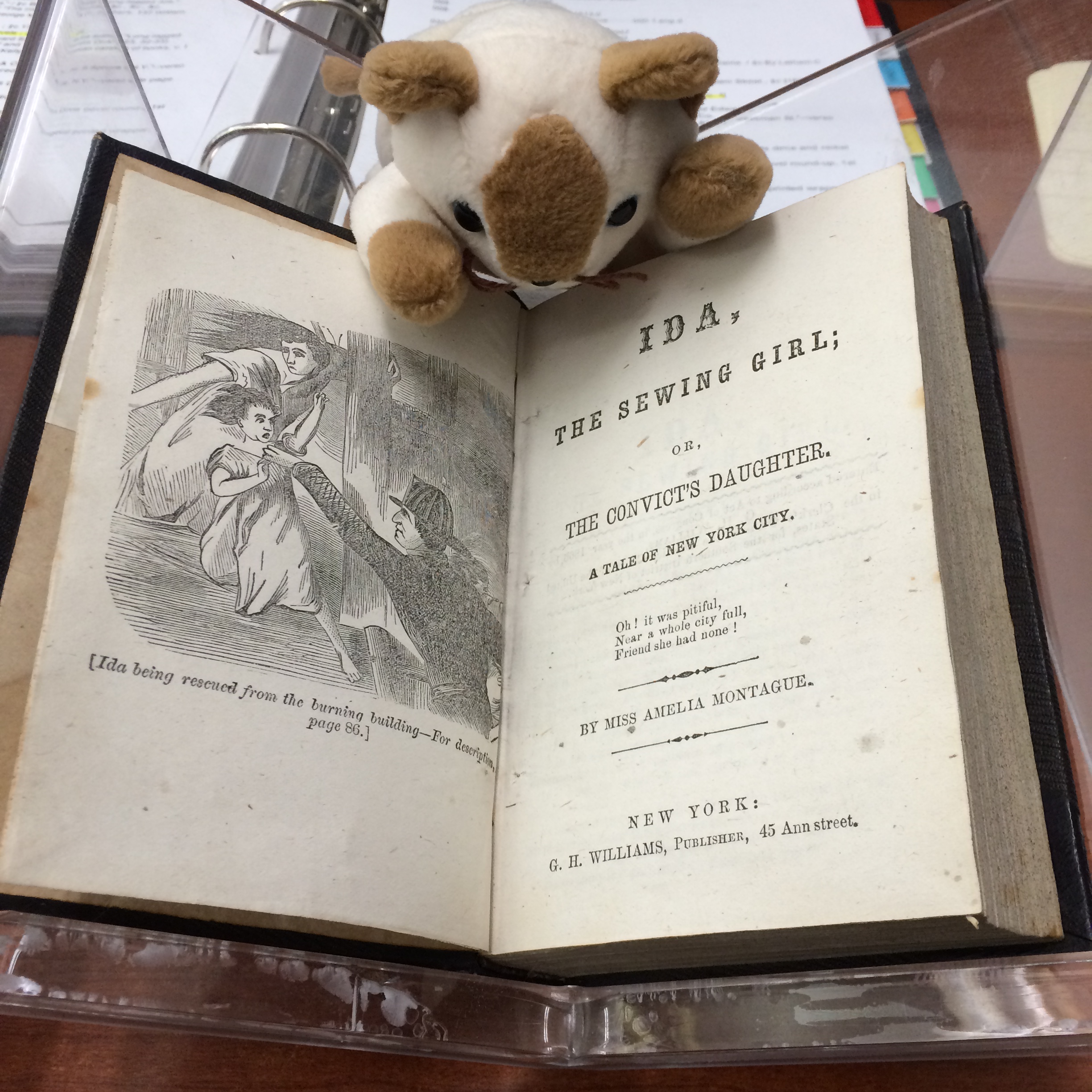
In one of the volumes I cataloged, I came across a novel called Ida, The Sewing Girl; or, The Convict’s Daughterby Miss Amelia Montague, which was published by G. H. Williams and copyrighted in 1866. This is enough information to do basic cataloging, but I thought it would be worth a little extra work to see if it was originally published as part of a series. There were no records in other libraries, and no mention of the novel in a quick Internet search. Now, I was 95% sure I’d seen G. H. Williams’s name somewhere, but I couldn’t for the life of me think where. He didn’t appear in any of my dime novel bibliographies, and I couldn’t find anything useful online. I went to check our collection of loose dime novels, those that aren’t bound together. Williams was mentioned on the label for the last box as the publisher of Chaney’s Union novels. The one novel we had in the series had been moved to C for Chaney, and when I looked at it, I saw that it was indeed also published by G. H. Williams. Now that I had a series, one I knew I’d read about, I went back to my bibliographies. Of course, I only looked at the front wrapper and didn’t bother looking at any of the advertisements.
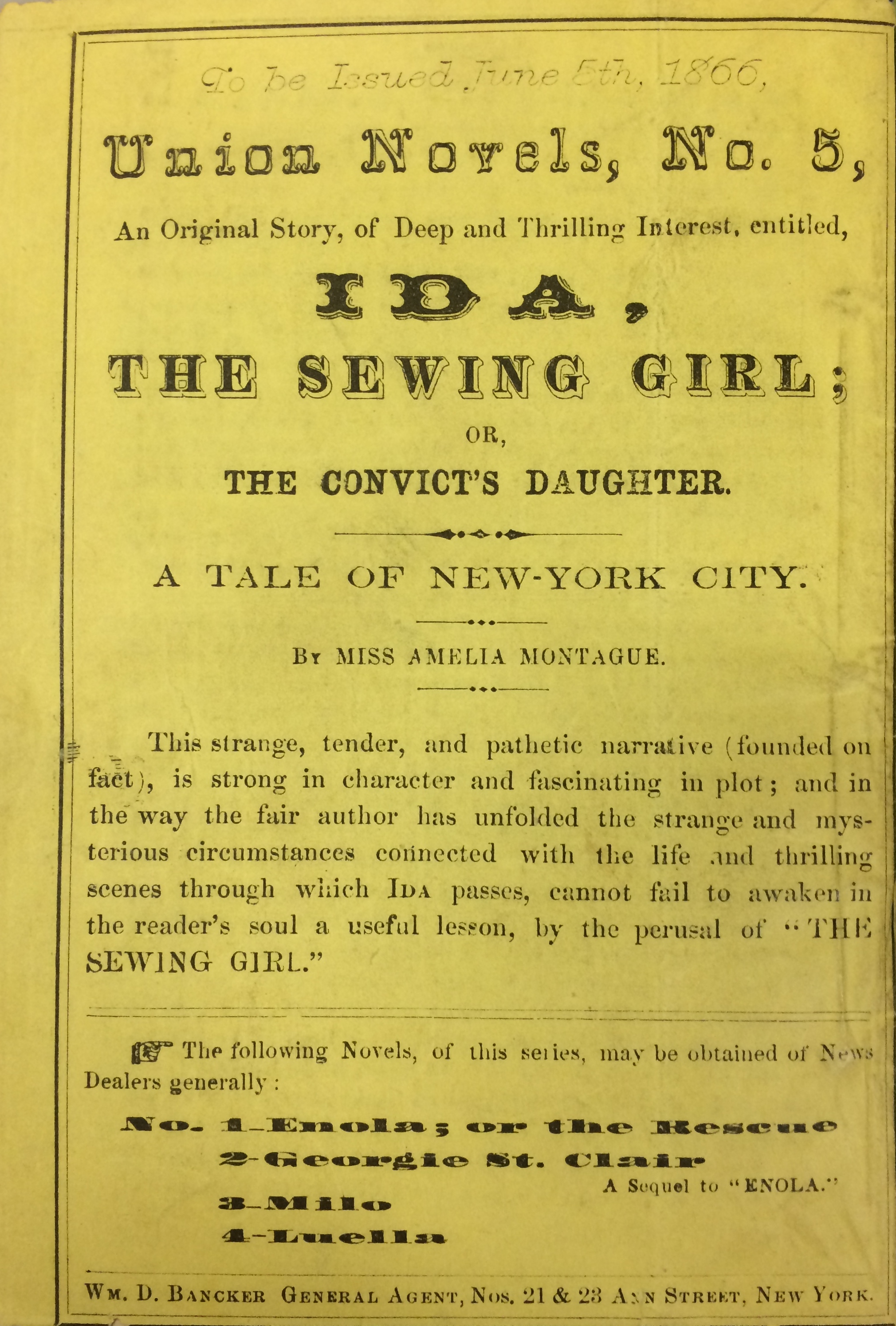
The series was in my reference sources, and they pretty much all said that there were only four issues. The entire description of this series was based only on issue no. 3, which had a list of the previous two novels, and an advertisement for no. 4, Luella; or, The Magic Kiss. What I had in the bound volume was not one of these four. But the one we had in wrappers in the stacks, it turned out, was a copy of no. 4, which no one had seen, and I trekked back out into the stacks to look at it again, and finally looked at the advertisement on the back of the wrapper, where it advertised no. 5 in the series (see right). I almost did a happy dance in the stacks when I saw that it was advertising Ida, the poor, wrapperless novel sitting on my desk.
Since none of the bibliographers had had access to our copy of no. 4 (and we seem to be the only library that has it), they had no reason to think a fifth issue had been published. I also realized that the reason G. H. Williams wasn’t listed in any of the bibliographies as a publisher is that the publisher on no. 3 (the only one seen) was Chaney and Williams, and that’s the firm described in the reference sources. Williams took over as sole publisher with no. 4. In the end, solving the mystery of Ida would have been impossible if our copy of Luella also hadn’t had wrappers.
Cataloging novels in the more famous series, like Beadle’s dime novels, is much easier, because they are well-documented. More copies of those novels existed, and survived for researchers to write about. But the work of cataloging novels like Ida is ultimately more fun and satisfying.
The Improved and Illustrated Game of Dr. Busby. Salem, Mass.: Published by W. and S. B. Ives., [1843?].This past summer we completed work to make the Society’s collection of over four hundred games more accessible to our readers and the scholarly community. Christine Graham Ward, the Society’s Visual Materials Cataloger, created detailed records for each game in our General Catalog. These records include a brief description of each game, a tally of all of the pieces (including whether the directions were included), and information on the date and publisher. Prior to this work, the games had been roughly organized by category and were accessed through a finding aide which had unfortunately fallen out of date and was of limited use. The collection includes card games, puzzles, paper dolls, and board games ranging in date from the eighteenth century to the 1920s. It also contains objects used by school-aged children, including slates, quills, nibs, and even a pencil made by Thoreau & Co. in Concord, Massachusetts.
Chiromagica. New York: McLoughlin Bro’s. N.Y., [between 1869 and 1877].The Society’s collection is particularly strong in holdings of games related to texts or produced by book publishers. For example, fifteen games by W. & S. B. Ives, a book publisher in Salem, Massachusetts, are preserved in the collection, and many are associated with books produced for children under the Ives imprint. The first boxed paper doll issued in the United States, Fanny Gray, was based on a popular children’s book The History of Little Fanny—both were published by Crosby, Nichols & Co. of Boston. (You can find a full print-friendly version of Fanny here!) Nearly one quarter of the games in the collection, including the fortune telling game Chiromagica (the precursor to the Magic 8 Ball), were published by McLoughlin Brothers of New York between 1858 and 1920. AAS holds a major repository of McLoughlin material, including books, illustration designs, printing blocks, manuscripts and puzzles. Other children’s book publishers, including F. R. Lockwood in New York and Peter G. Thomson of Cincinnati, are represented in the game collection as well. These connections between books and games are of great interest to book historians and to students studying child life. Now that the games are cataloged, we are hopeful that they will be used as evidentiary resources by scholars across many genres.
Flora McFlimsy. Cincinnati: Peter G. Thomson, [between 1877 and 1889].After each game was cataloged, it made the journey to our in-house photographer where it was recorded visually through digital imaging. Each puzzle was put together and photographed, and each paper doll and all his or her outfits were recorded, back and front. Board games were unfolded and those all-important directions booklets were photographed from start to finish. These photographs are linked to our catalog records and are available freely via the Society’s digital asset management system. Once photography was complete, the games returned to the Graphic Arts Department, where they were rehoused in acid-free materials and placed in our climate controlled stacks, awaiting paging by readers. Indeed, since the cataloging project was completed, we have seen an uptick in use of the games by readers. Over the summer, we posted several highlights from the collection on the Society’s social media outlets, including Facebook and Instagram, and had enthusiastic response from our followers and friends. Our outreach coordinator even inaugurated a video series, The Gamebrarians, to showcase one card game in the collection.
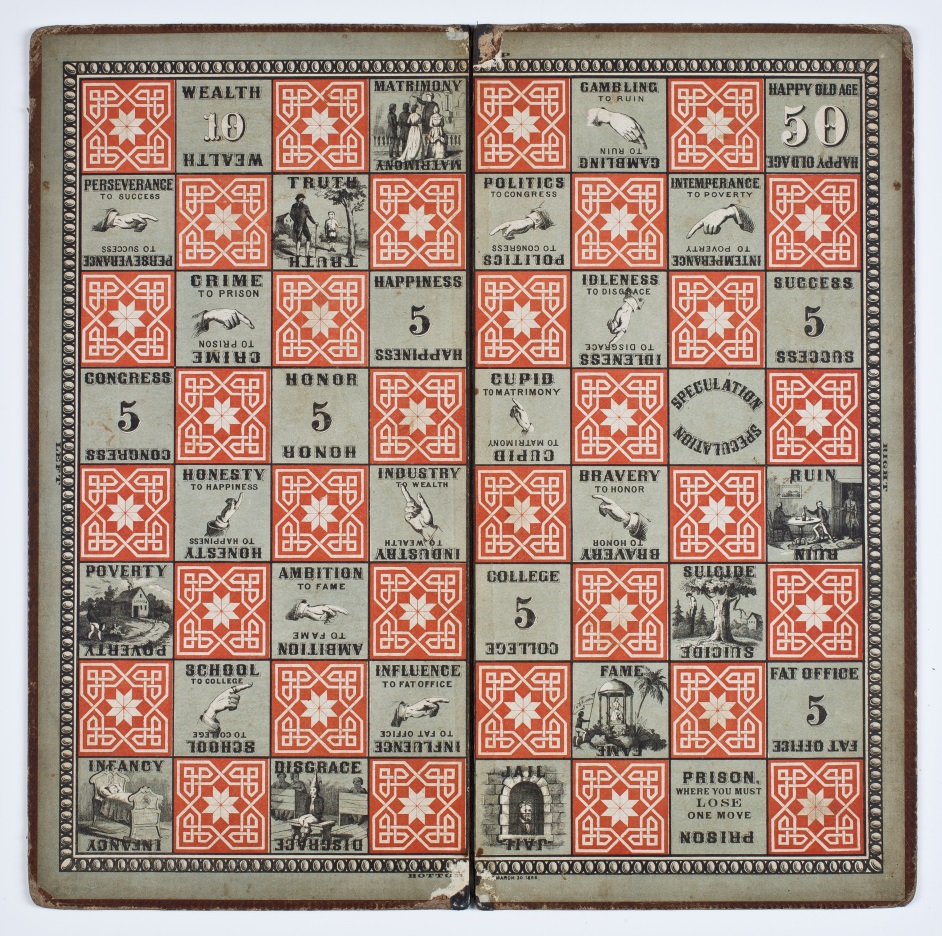
Access is always at the heart of what we do here at AAS, but what, you might ask, is the big deal about historic games? Are they as important as the Bay Psalm Book, or The Massachusetts Spy? Aren’t they just for kids? When the Society was preparing for our bicentennial in 2012, we brought a number of eminent historians into the library and asked them to select an item to discuss. Professor of American history at Harvard University and AAS member Jill Lapore selected the 1860 Milton Bradley board game The Checkered Game of Life, calling it one of her “favorite objects in all of American history.” The game brings players through the stages of life, with pitfalls like intemperance and bonuses like achieving education along the way, to the final square of “Happy Old Age—50.” Lepore went on to state that the game “reveals to you a whole different world of how people in the nineteenth century thought about the course of life—where we begin and where we end—what our journey is all about. You can read in this simple object that story.” That is the power of toys and games. The stories we tell our children as we read or use paper dolls or play board games are the stories of our culture, our beliefs, and our very position in time. We are delighted to make this collection more accessible.
The work to catalog and digitize the games was made possible by generous support from Jay and Deborah Last and an anonymous donor.
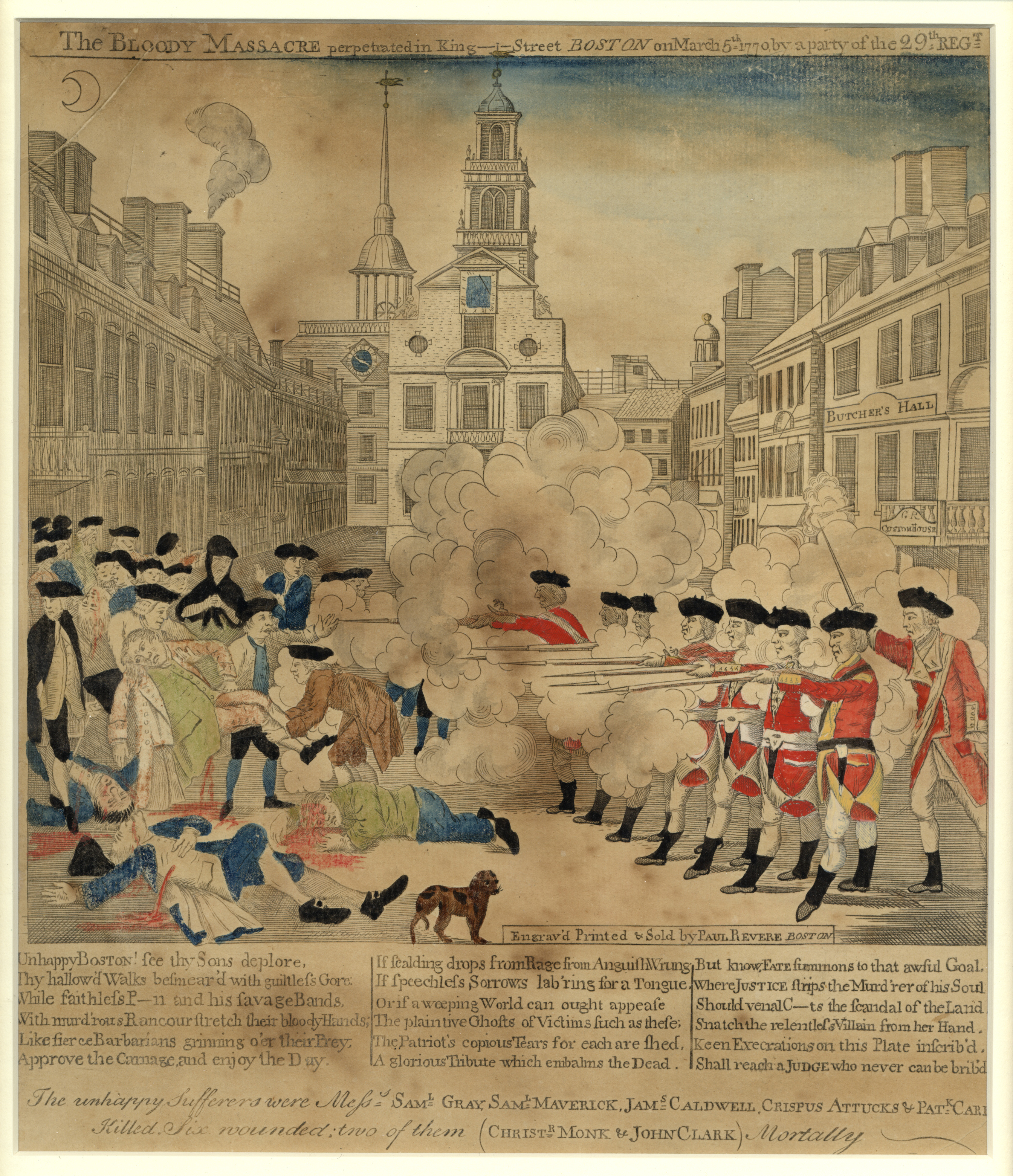
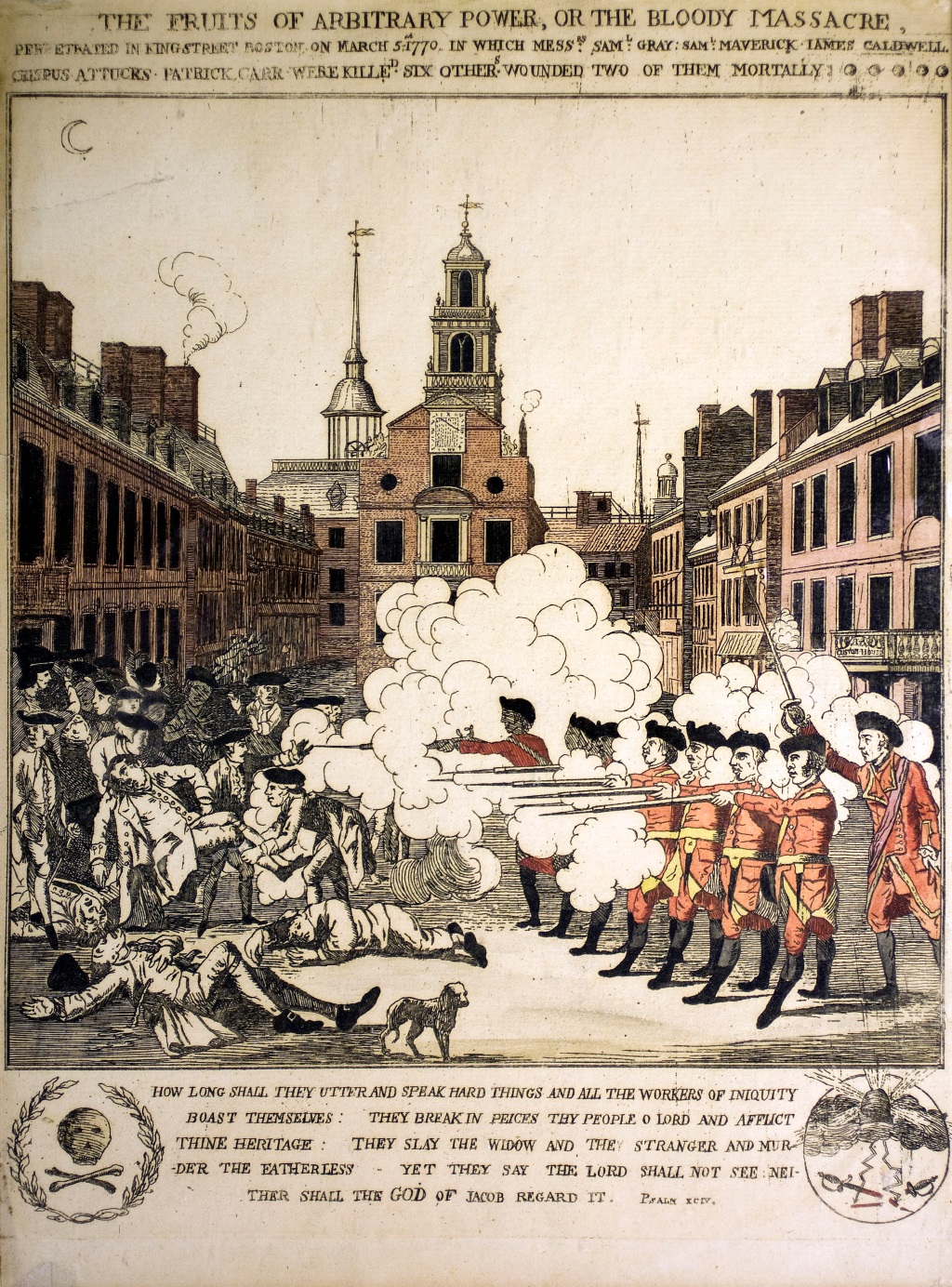
When a singular image is reused in various publications or shows up in more than one medium, it’s indicative of the breadth of its impact. Take, for example, perhaps the most iconic image of the American Revolution, “The Boston Massacre” by Paul Revere, which was not only first copied by Revere from someone else’s design, but his own version was then copied by others. This was a scene that got a lot of traction and helped fuel the Revolution, which was the original intent!
Copying another’s work—not an uncommon practice in the eighteenth century—might be considered the sincerest form of flattery, but this was not the sentiment of Henry Pelham (1749-1806) when he discovered that Revere had copied his rendering of “The Bloody Massacre” (also known as “The Boston Massacre”) in March of 1770. Pelham was livid about Revere’s preempting his work, as revealed in a letter from Pelham to Revere on March 29, 1770: “When I heard that you were cutting a plate of the late Murder, I thought it impossible as I knew you was [sic] not capable of doing it unless you coppied [sic] it from mine and as I thought I had entrusted it in the hands of a person who had more regard to the dictates of Honour and Justice than to take the undue advantage you have done of the confidence and Trust I reposed in you.”[1]It is unclear whether Pelham ever sent the letter but certainly he was not happy about Revere copying his print and advertising it for sale first.
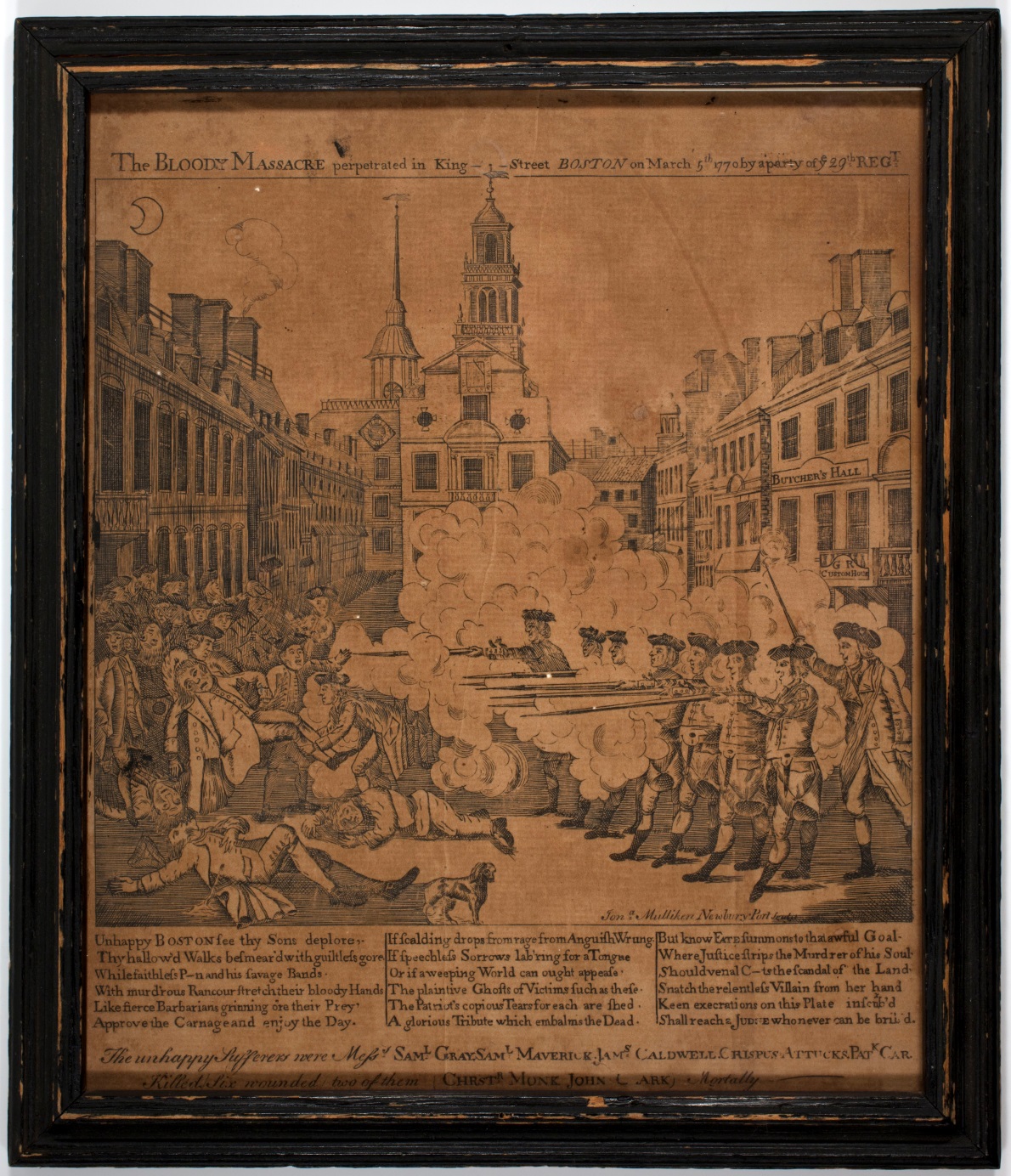
Pelham’s “The Bloody Massacre”Muliken’s version of the image
Certainly others followed suit in printing this propagandistic scene. Clockmaker Jonathan Muliken of Newburyport made use of his experience in engraving clock faces to also engrave the popular print in 1770. His version was based quite directly on Revere’s print. We have no record of how Revere responded to Muliken’s print, but suspect that he saw it as business as usual.
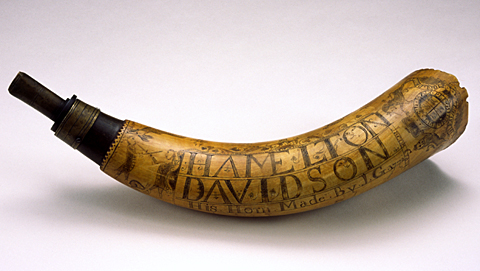
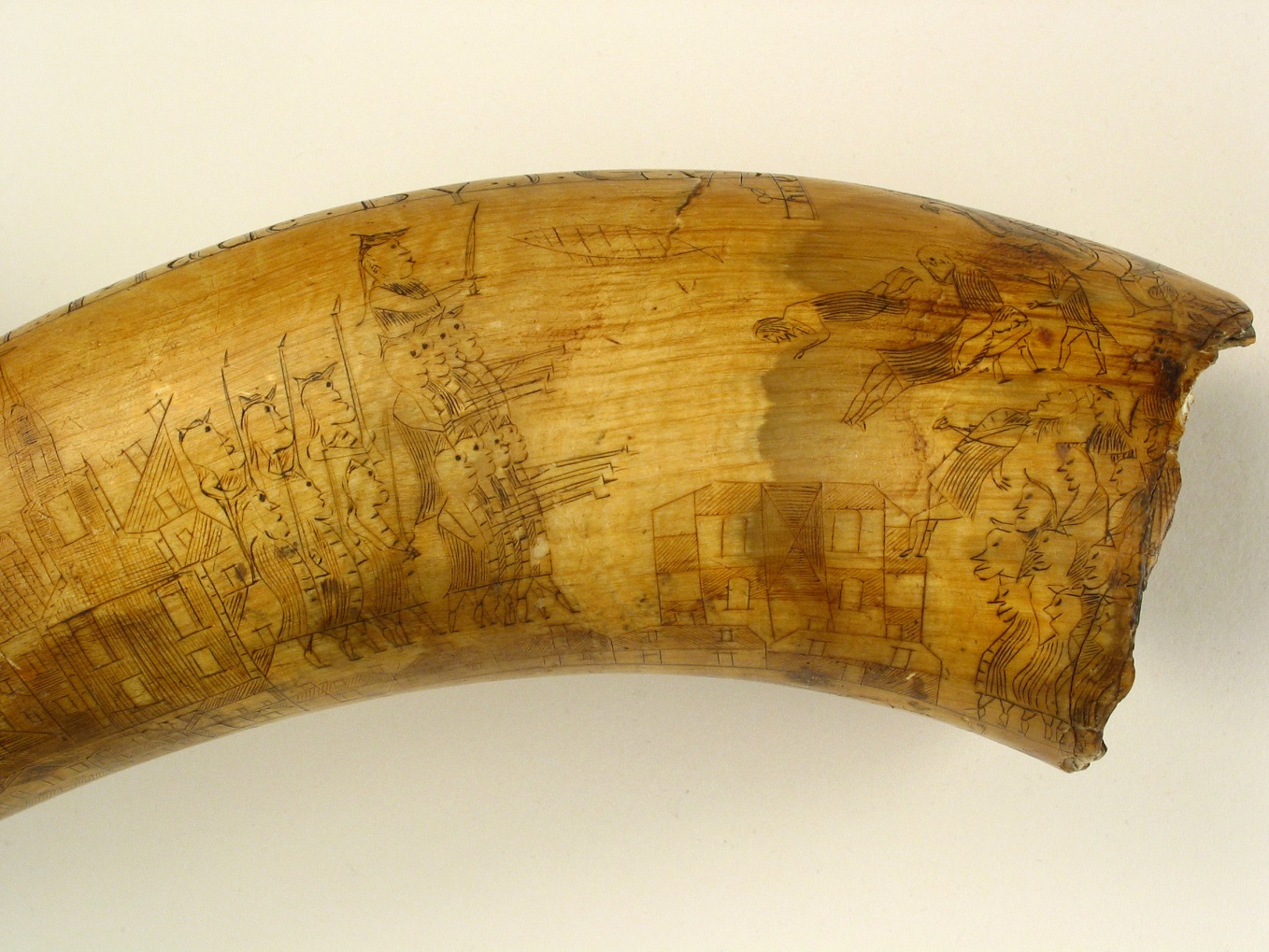
What is even more fun to consider is that the image likely traveled right onto the Revolutionary battlefield in the 1770s on a powder horn owned by one Hamilton Davidson, probably from New Hampshire. The Davidson powder horn in the collections of Historic Deerfield was made by Jacob Gay in 1772 and depicts the historic Boston Massacre scene in reverse. The horn is one of Gay’s finest (he was a prolific carver of horns) and its detail suggests how this inciting image may have inspired a soldier in battle. Gay has reversed the scene, with the British soldiers shooting from the left, and depicts the men in his cartoon-like style. Whether he adapted the scene from a print by Revere or Pelham or Muliken, Gay’s rendering is impressive, especially when you recognize that he was engraving the scene on a curved horn surface rather than on a copper plate!
Hamilton Davidson horn by Jacob Gay, 1772. Courtesy of Historic Deerfield, Inc., Deerfield, Mass.Detail of Hamilton Davidson horn, 1772. Courtesy of Historic Deerfield, Inc., Deerfield, Mass.
[1] The original of the Pelham letter is in the British Public Record Office, Colonial Office Record. A photostat of the original is available at the Massachusetts Historical Society.
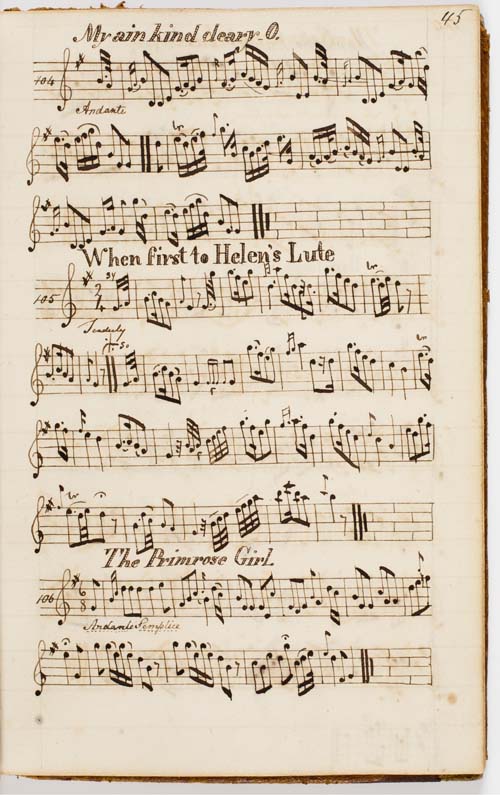
Manuscript music book belonging to Mrs. Elizabeth Everett. This page comes from a calf-bound octavo volume inscribed “Presented to Mrs Eliza Everett Boston Janry 17th 1811” and “Samuel W. Everett. Jany. 24th 1838.” The volume contains manuscript copies of 130 English, Scottish, and Irish jigs, reels, and music associated with the theater from the late eighteenth and early nineteenth centuries.
By the mid-eighteenth century, a common rite of passage for many young people in Colonial America was to attend a local singing school conducted by some itinerant music-master. There they learned the names of the notes, time signatures, rudimentary music theory, and how to sing harmony in four parts. For the young, singing schools were fun!—Singing itself was a joy and achieving some mastery over the notes deeply satisfying. And it didn’t hurt that for the tenors and basses at the school there would generally be an equal number of sopranos and altos (and vice versa)! Indeed, one wan Yalie from that time wrote a friend that: “At present, I have no Inclination for anything, for I am almost sick of the World & were it not for the Hopes of going to singing-meeting tonight & indulging myself a little in some of the carnal Delights of the Flesh, such as kissing, squeezing &c. &c. I should willingly leave it now.” Whatever the reasons—musical, intellectual, or carnal—singing schools flourished well into the twentieth century.
Teach a person to read and they will want to write, a maxim as true for notes as it is for words. And sure enough, whereas only a bare fistful of compositions by Americans existed in 1730, by 1810 there were more than 5,000[1], and by 1900 millions. One result of learning to read music and then to write it was that ordinary people soon bought or fashioned copybooks and inscribed in them the songs, hymns, and tunes that mattered to them, music they had composed, performed, heard, or wanted to learn. Hundreds of such books survive today in collections that range from the solitary manuscript held in some local historical society to the 223 in the collections of the American Antiquarian Society. These manuscripts contain prima facie evidence of musical taste and usage during a particular time and in a particular place, and serve a scholarly function quite distinct from printed music, which typically documents only accessibility.
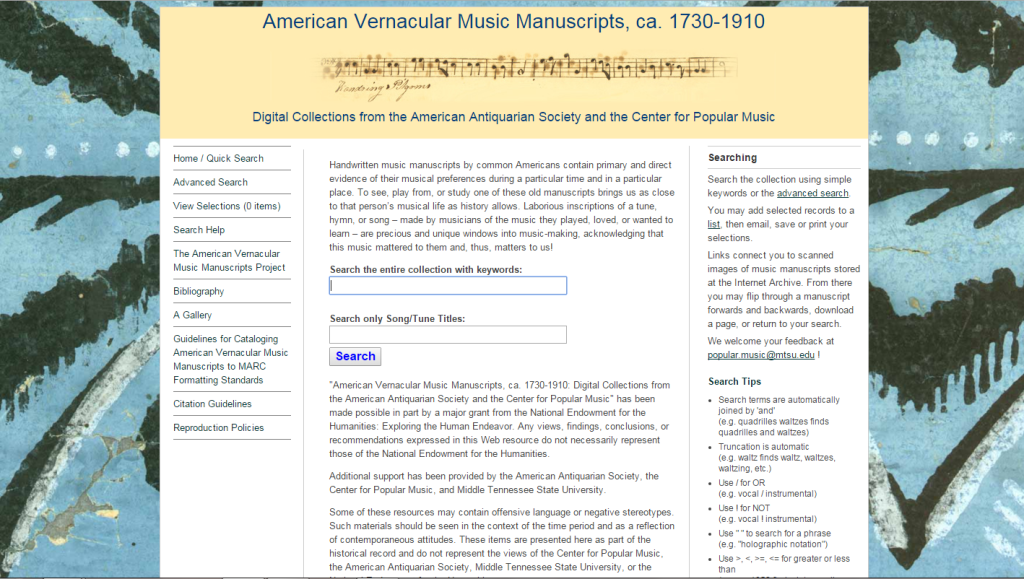
In 2012, the National Endowment for the Humanities, under the provisions of the “Humanities Collections and Reference Resources” program, awarded a major grant to the Center for Popular Music (CPM) at Middle Tennessee State University to develop a collaborative project with AAS that would: a) catalog their collective music manuscripts at the song-title level; b) digitize all materials to archival standards; c) build the “American Vernacular Music Manuscripts, ca. 1730-1910” website, d) provide full and free web-based public access to the results; and e) develop guidelines that would allow other archival institutions to make their manuscripts available and accessible. The CPM and the AAS were natural partners in this enterprise, for the AAS collections were strong in the earlier period and in sacred music, while the CPM collections better documented secular music and the period to 1910 (about when the act of writing music succumbed to the inexpensive ubiquity of printed music). Furthermore, while AAS had more manuscripts, the Center had the cataloging expertise to deal with the myriad and manifold questions on detailed music matters.
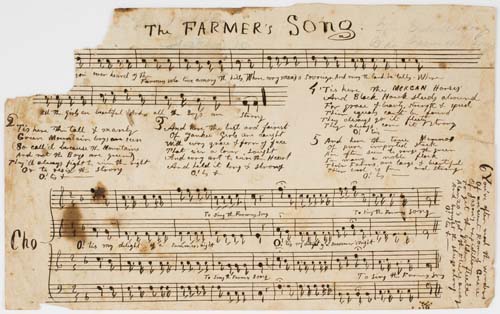
The Farmer’s Song. This single sheet from around 1835 includes music and lyrics for six verses of “The Farmer’s Song” in four-part harmony. Inscriptions on the verso of the leaf read, “Betsy A. Stickney, George Stickney” and “West Drummerson, Vermont.”
The project took more than two years to complete, but the end results warranted the work. Staff from both institutions processed and digitized 351 manuscripts, which resulted in 17,230 images of inscribed pages found in commonplace books, copybooks, and on single and double leaves. Approximately 17,000 tunes, hymns, songs, ballads, and other musical pieces were indexed. Everything is now searchable at the project’s website and in many different and Boolean ways (names, first lines, towns, states, and more). A click on any search result takes the user to the appropriate image, stored on the Internet Archive, which can then be studied in detail or in context (by “flipping” through the virtual manuscript).
Music now made freely accessible has long been difficult to find and study. It has never been fully cataloged and certainly not at the song-title level. As a result of the project, a whole new field of research on the writing and treasuring of American music has opened up. For the student of American music the excitement generated by these manuscripts is palpable, for to see, play from, or study one of these old scrawled pages brings us as close to that person’s musical life as history allows.
— Dale Cockrell (Project Co-Director and AAS Member, ’95) and Thomas G. Knoles (Project Co-Director and AAS Librarian)
[1] Richard Crawford, “A Historian’s Introduction to Early American Music,” Proceedings of the American Antiquarian Society 89/2 (1979), 289.
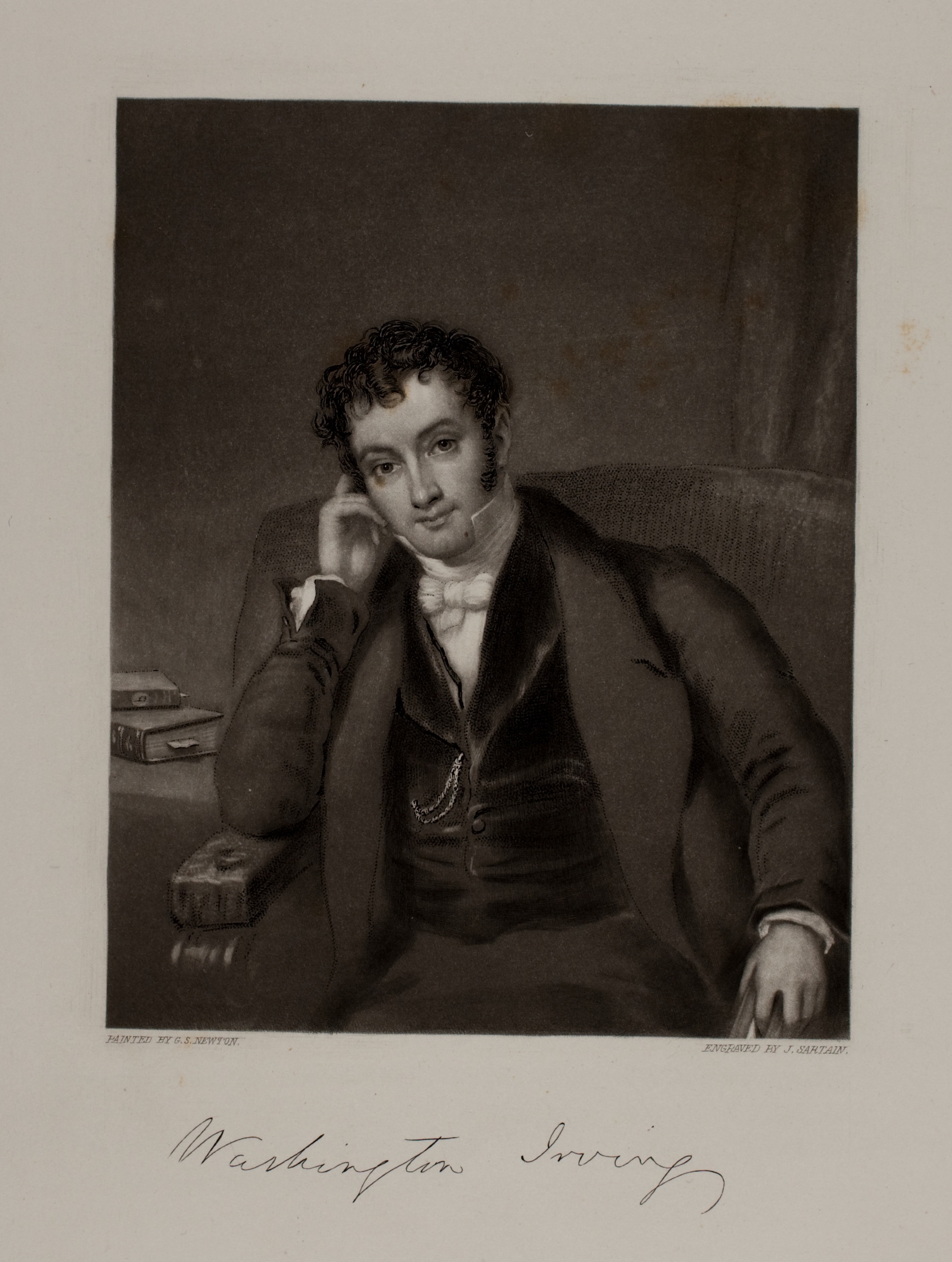
Portrait of Washington Irving in The Drawing-Room Scrap Book (Philadelphia, 1850), engraved by J. Sartain after a painting by Gilbert Stuart Newton.
What comes to mind when you hear “Sleepy Hollow”? A dark, windy night, a mysterious horseman who just happens to have no head, a terrified Ichabod Crane fleeing for his life—no matter in what form you first come to know “The Legend of Sleepy Hollow,” there are certain dramatic elements the story always seems to have in common.
Two recent screen adaptations take very different approaches (neither even close to the original material), but retain these basic features. The 1999 horror-thriller-mystery Sleepy Hollow, which pairs the gothic vision of Tim Burton with the talents of Johnny Depp and Christina Ricci, takes place in roughly the same time period as the original tale, but makes Ichabod (Depp) a constable rather than a schoolmaster, the Headless Horseman murders half a dozen people, and Ichabod marries Katrina (Ricci). FOX’s current TV show by the same name grafts the gothic onto a pseudo-historical/biblical frame, reimagining Ichabod as an English-born Revolutionary War patriot who, put into a magical sleep by Katrina (now a witch, of course), awakes in modern times to find out that he must stop the Headless Horseman, who is both Abraham (Brom Bones) and the Horseman of Death from the Book of Revelation. (Interestingly, for all the differences between how the two adaptations depart from the source material, both associate Ichabod with law enforcement and test his crime-solving skills in a procedural drama format.)
Mulling over these two recent interpretations of the classic tale while working at AAS inevitably raises the question, what did early depictions of the story look like? Were they also gothic and horror-inspired? Did they focus on the terrifying imagery of the Headless Horseman? Was Ichabod as attractive as Johnny Depp or Tom Mison?
Washington Irving first published the story as part of a compendium of short stories and essays called The Sketch Book of Geoffrey Crayon, Gent. Published in seven serial parts over the course of 1819 and 1820 in both the U.S. and England, The Sketch Book is widely considered to be one of the first pieces of American literature read extensively abroad. The publishing history of the many ensuing editions of The Sketch Book is long and complex, but suffice it to say that by 1848, when famed New York publisher George Putnam published the first illustrated edition of The Sketch Book, “The Legend of Sleepy Hollow” was indeed already that—a legend.
This first illustrated edition featured the work of Felix O. C. Darley, a self-taught artist and book illustrator who had already done work for Edgar Allan Poe and Harper’s Weekly, among others, by the time he was tapped to take on some of Irving’s most famous stories. Ultimately, he would become one of the most prolific and renowned book illustrators of his day, creating accompaniments for works by Nathaniel Hawthorne, Harriet Beecher Stowe, and James Fenimore Cooper. (We recently launched an online exhibition about J. F. Cooper material at AAS, including an entire section with digital copies of Darley’s illustrations!)
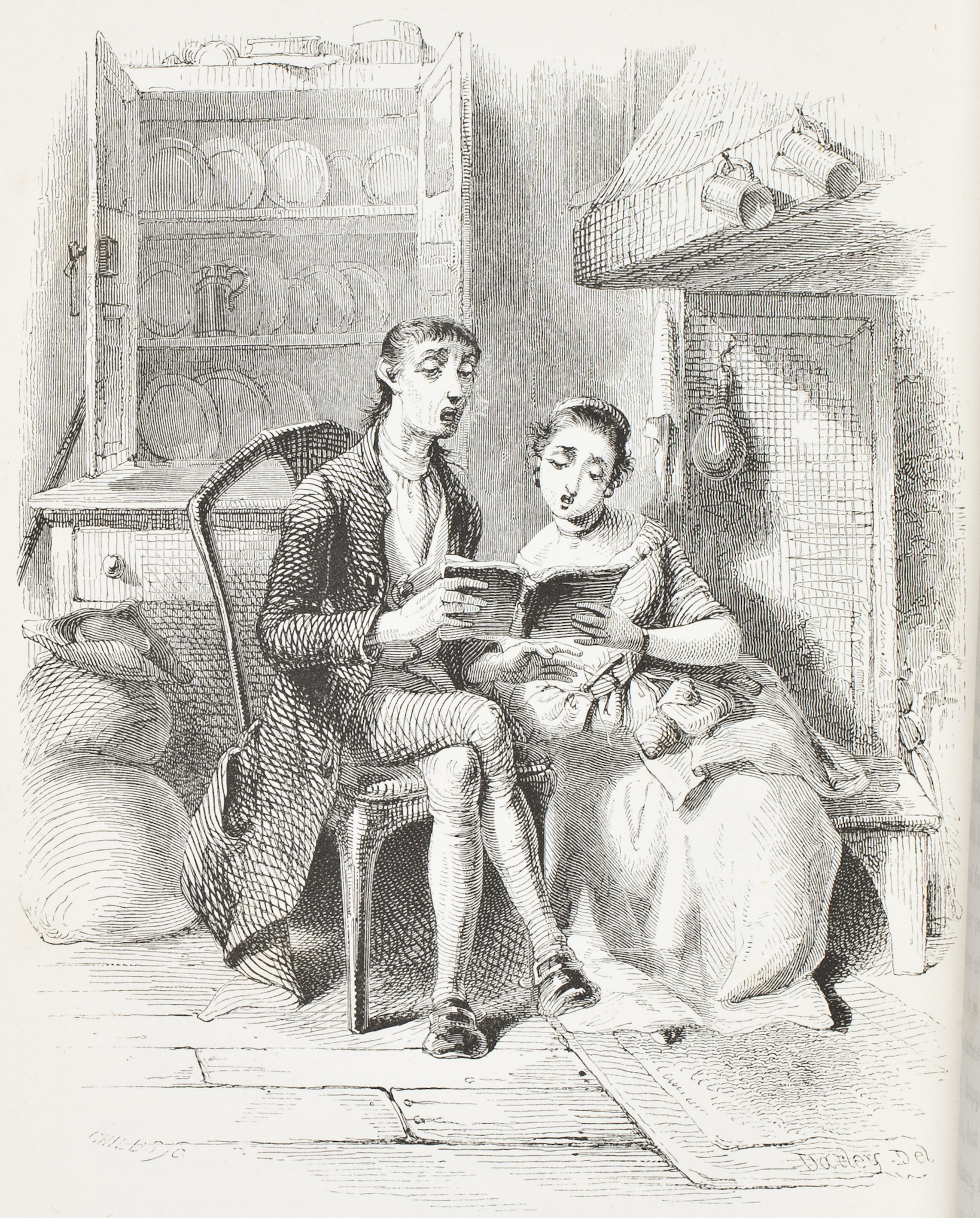
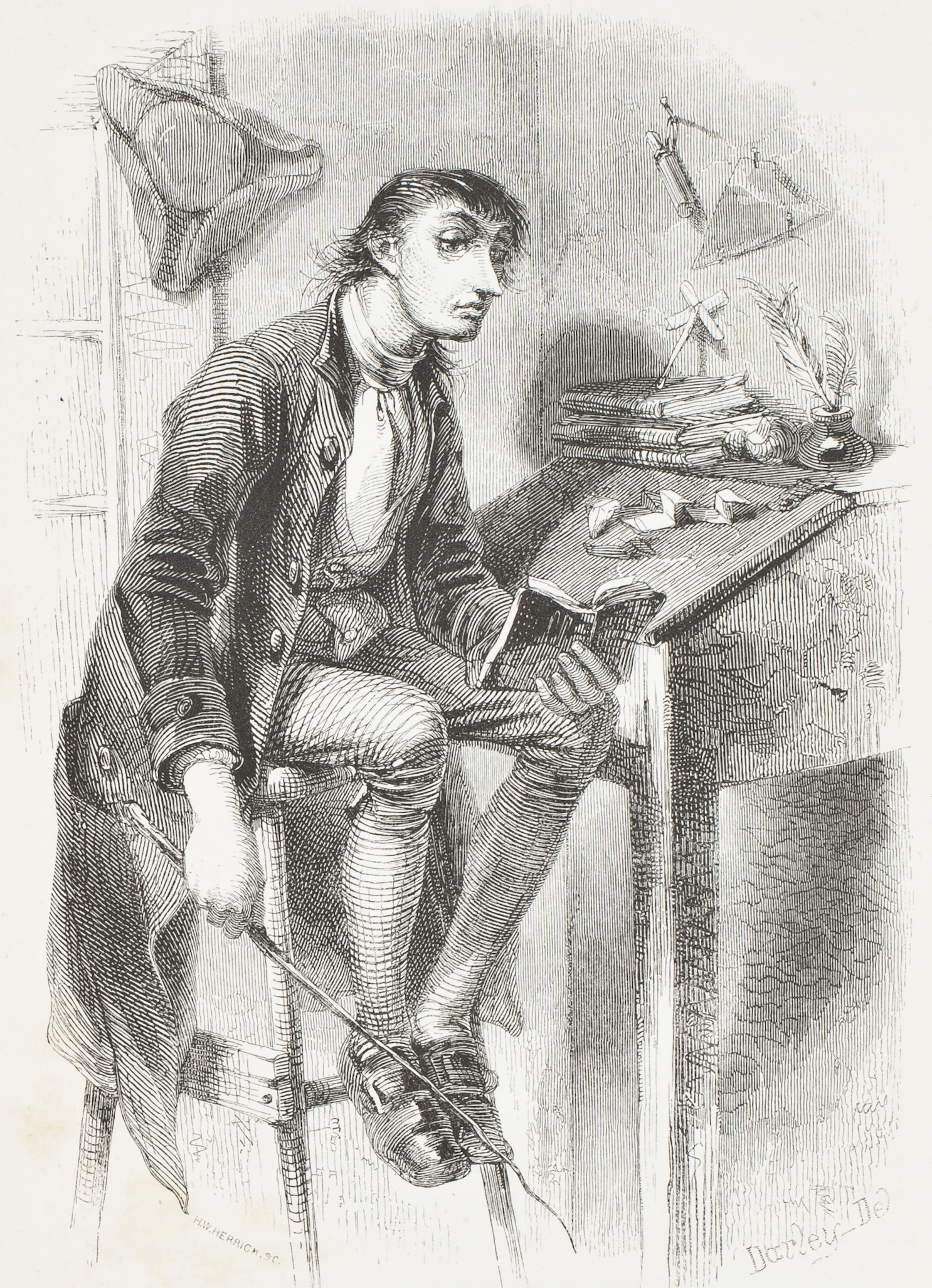
Despite the success of this first illustrated edition of The Sketch Book, from a modern perspective the images for “Sleepy Hollow” are almost a bit disappointing. Since Darley illustrated the entire volume, “Sleepy Hollow” gets just two illustrations, neither of which include the Horseman. The first shows Ichabod giving singing lessons to Katrina, and the second depicts Ichabod at his schoolmaster’s desk (accompanied by a few origami cranes embodying his name). Although the subject matter of the illustrations is less than thrilling, Darley’s depictions of Ichabod and Katrina closely follow Irving’s descriptions. Ichabod, who is described as “tall, but exceedingly lank, with narrow shoulders, long arms and legs, hands that dangled a mile out of his sleeves, feet that might have served for shovels, and his whole frame most loosely hung together,” is gaunt, lanky, and grotesque—certainly lacking the refinement of Depp or Mison’s modern Ichabods. Meanwhile, Katrina, that “blooming lass of fresh eighteen; plump as a partridge; ripe and melting and rosy-cheeked as one of her father’s peaches,” is all buxom femininity.
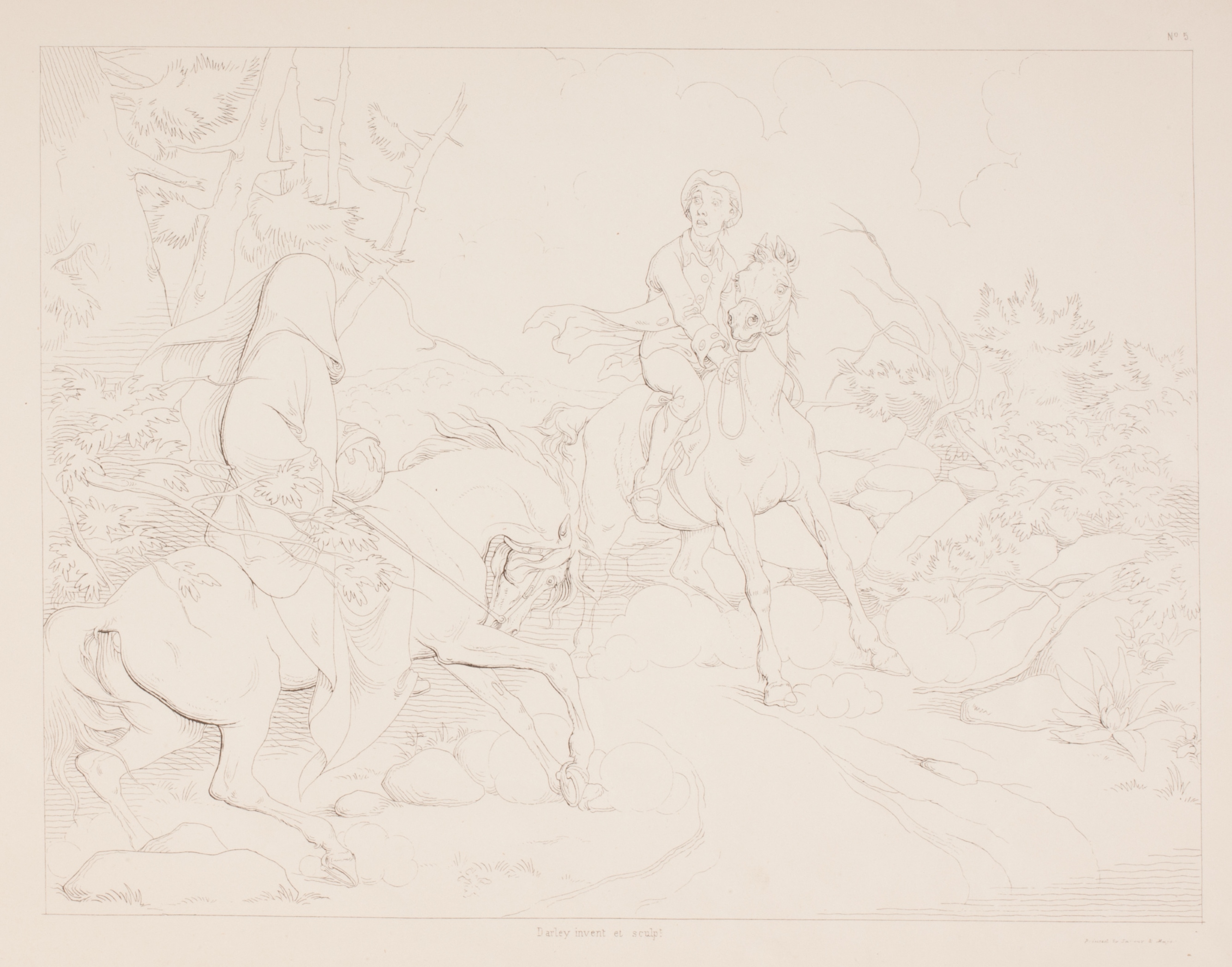
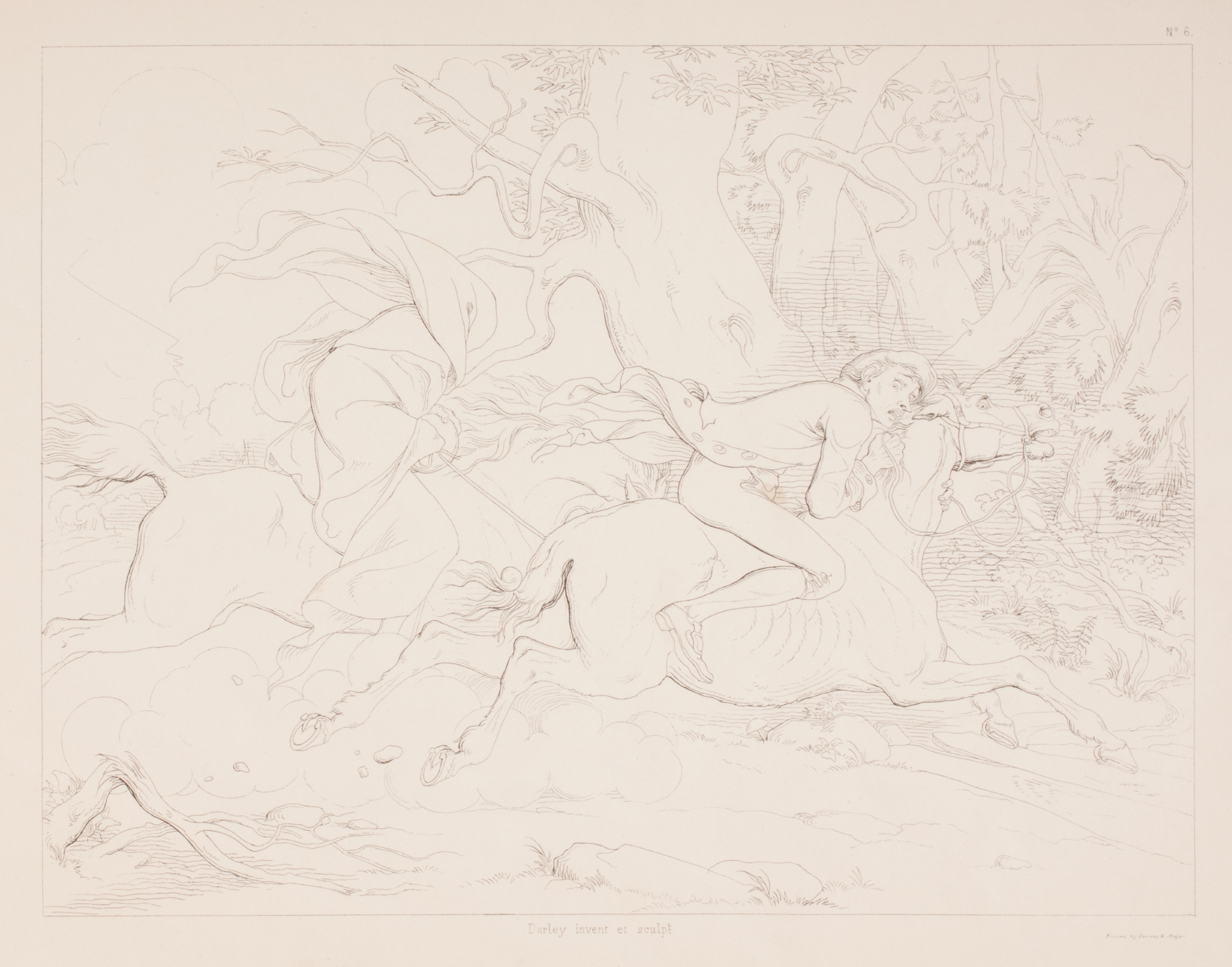
But these were not the only illustrations Darley made for “Sleepy Hollow” around this time. In 1850, the American Art-Union released a folio edition of the story for its members, which featured six beautiful outline lithographs by Darley, none of which were the same illustrations as the two in The Sketch Book. And although these depictions are more illustrative of the actual story—here we see Ichabod with his pupils and at the Van Tassel party and being chased by the Horseman—Ichabod, though still a bit ragged and ungainly, has become somewhat less ludicrous-looking, and thanks to the busily peopled scenes and slightly less exaggerated faces, the overall feel is more storybook than gothic.
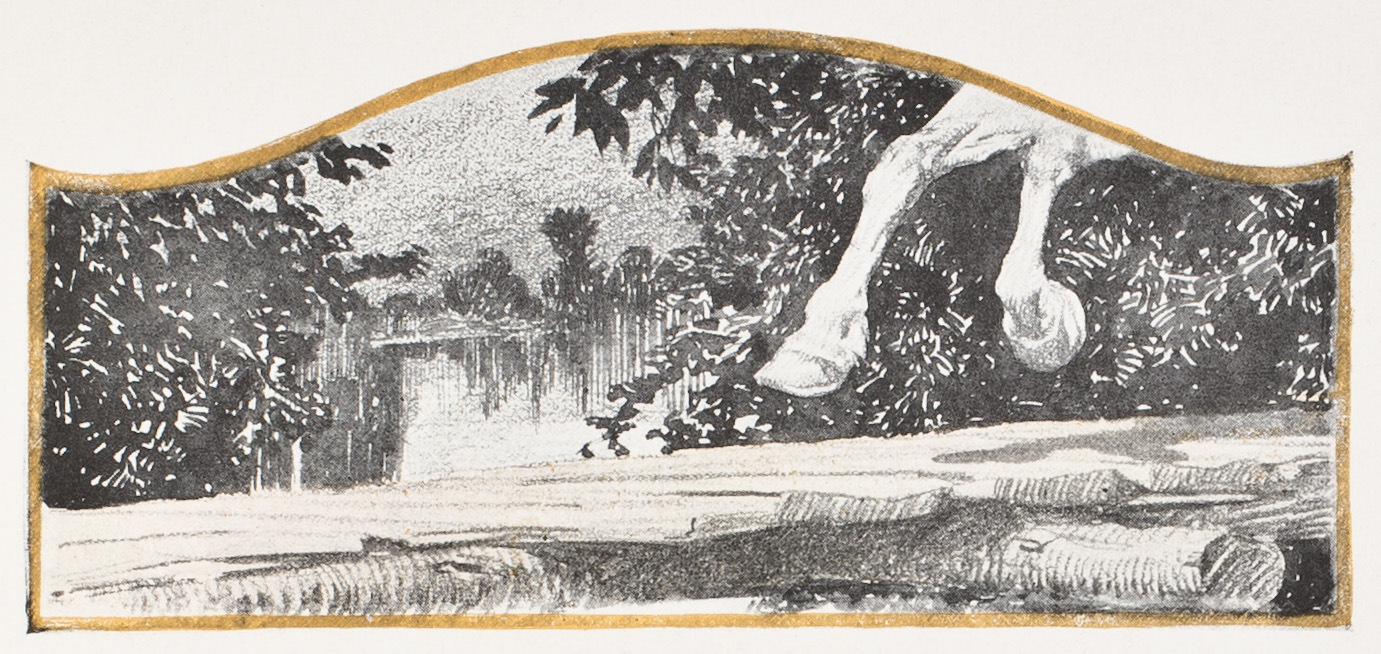
This is also where a depiction of the Headless Horseman first appears. In fact, there are two (see below): In the first, when Ichabod initially sees him, the Horseman clearly has a head covered by a hood, but a round shape (the pumpkin) also sits in front of him on the horse. In the second, as he’s chasing Ichabod, he appears to be indeed headless, and the pumpkin is still nestled in front of him. Perhaps this was Darley’s way of demonstrating the power of fear and darkness to turn the illusion into a reality.
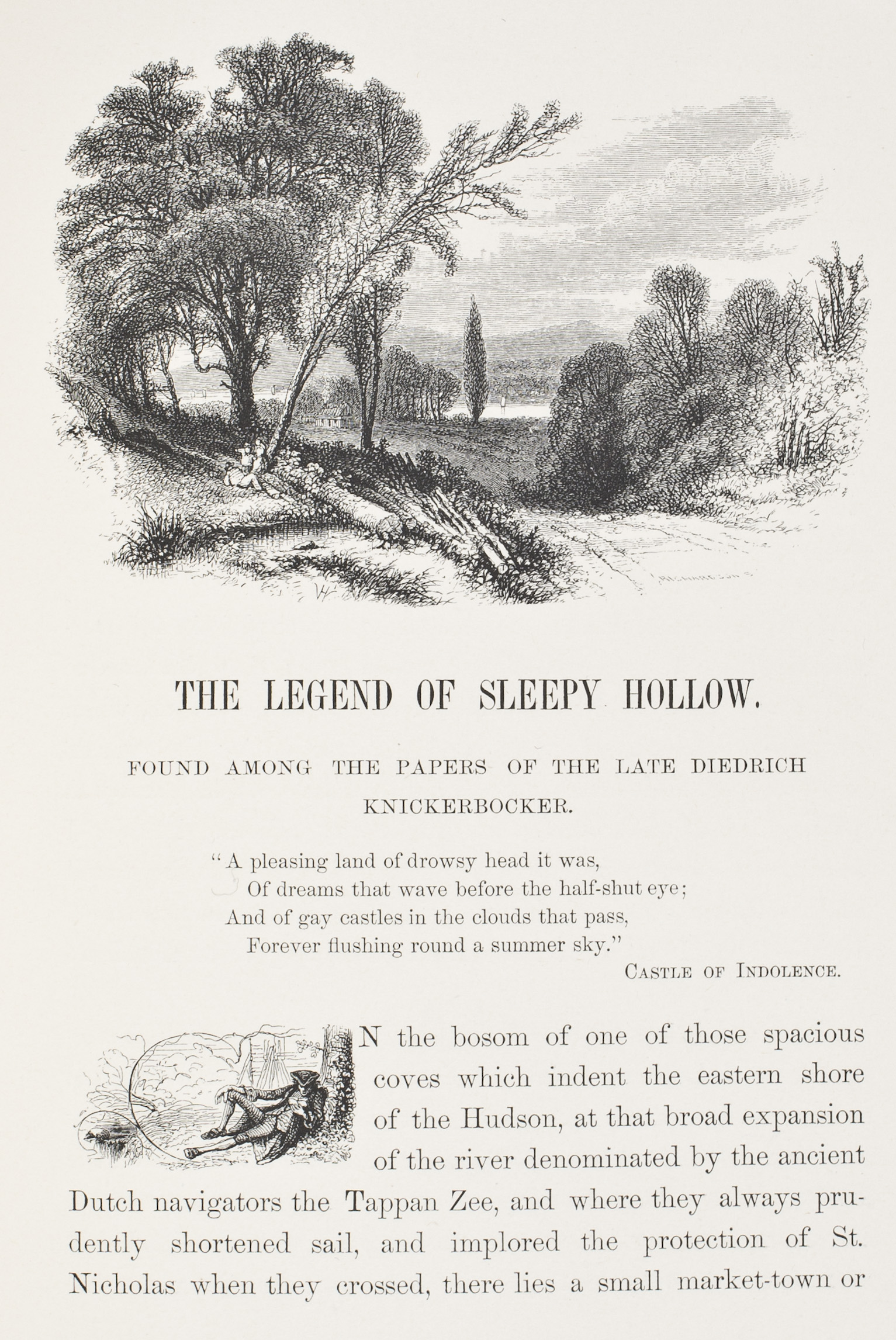
In 1864, Putnam issued a new illustrated edition of the full Sketch Book, featuring the work of several different artists, including William Hart and John Frederick Kensett of the Hudson River School and Emanuel Leutze, most famous for Washington Crossing the Delaware. In order to get as much mileage as possible out of this new edition, Putnam also released Hudson Legendsas a separate volume, which included only “Sleepy Hollow” and “Rip Van Winkle.”
The first page of “The Legend of Sleepy Hollow” in Hudson Legends (1864).
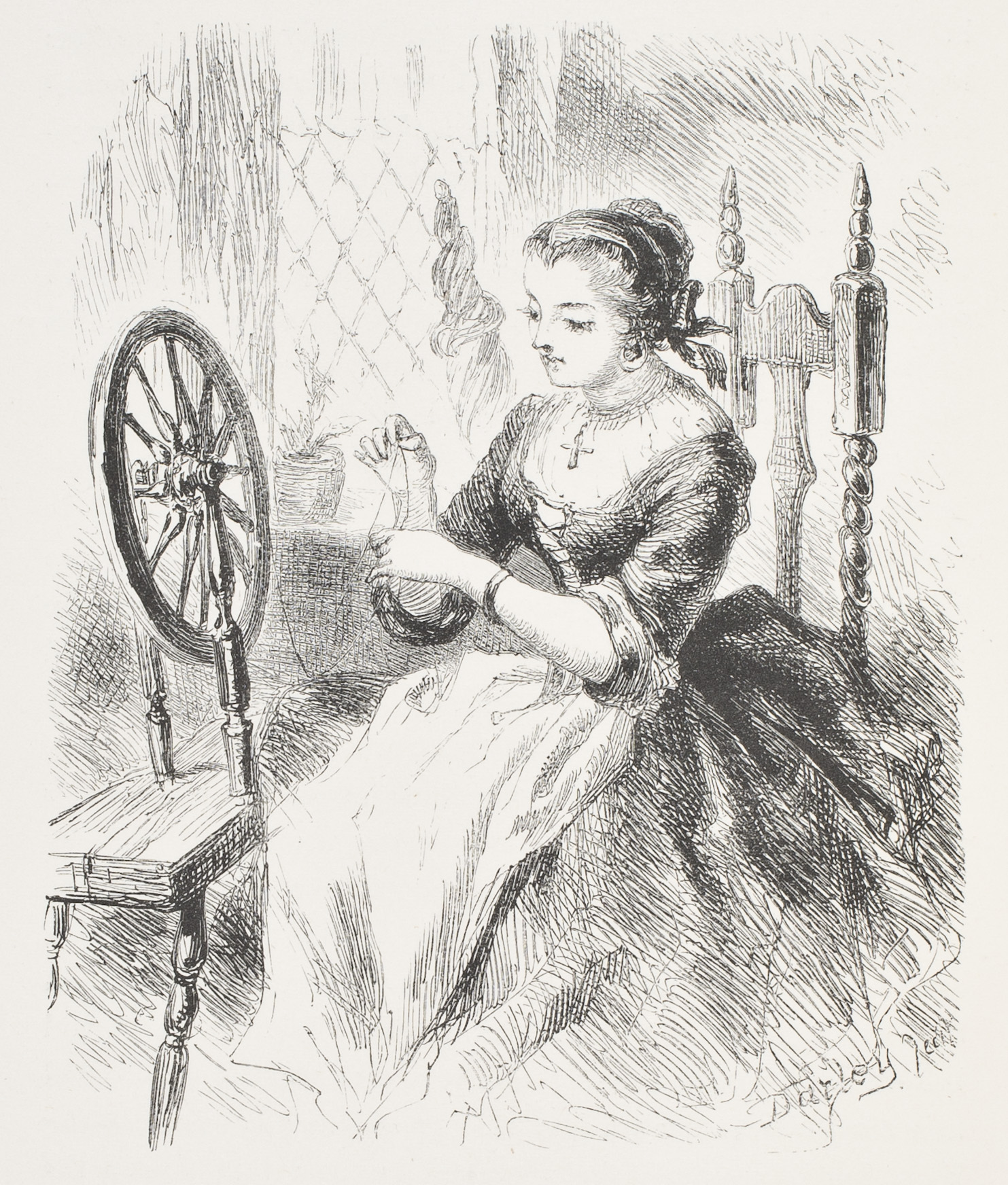
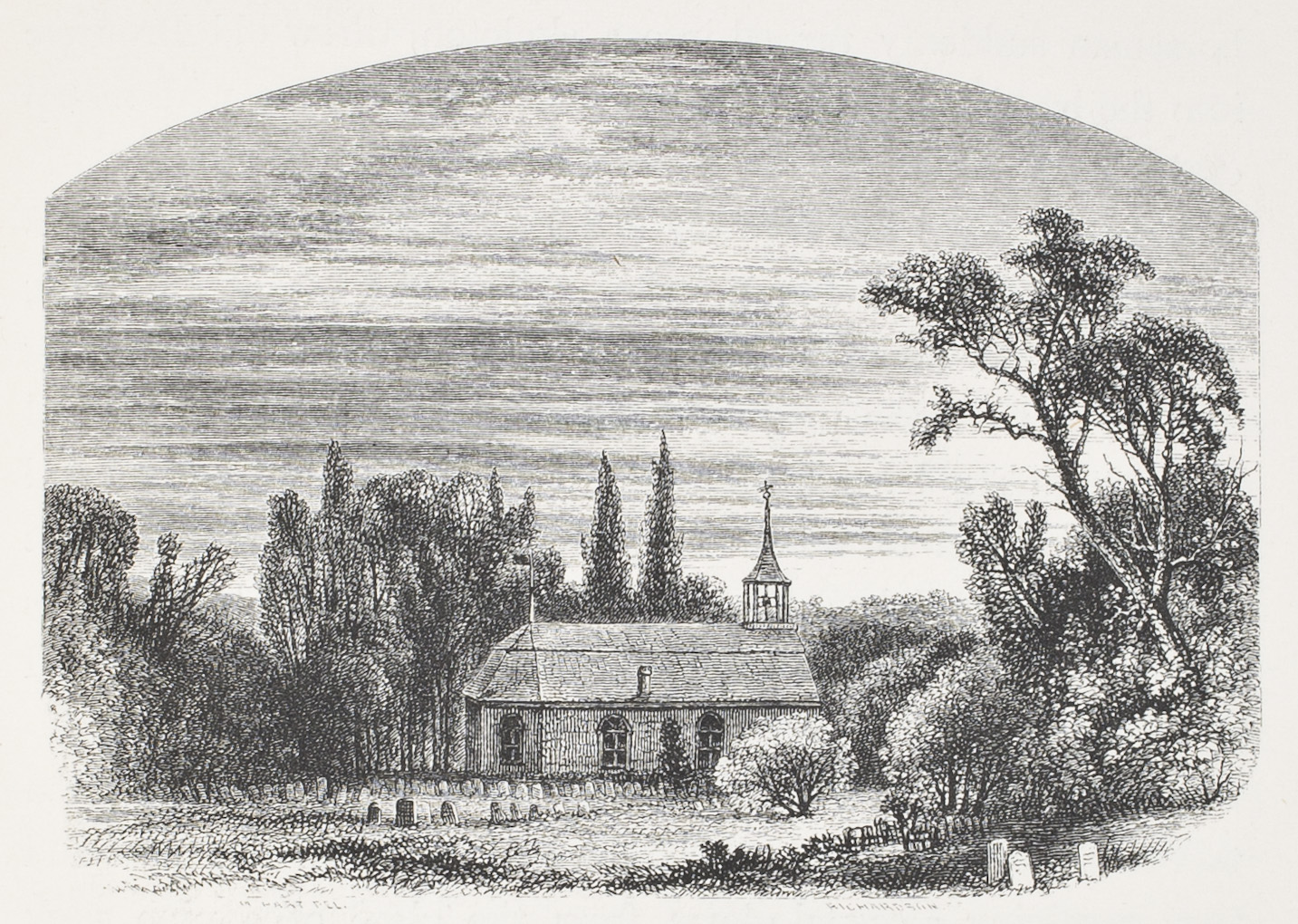
Two of the illustrations in this new version of “Sleepy Hollow” were by Darley, both of Katrina, looking very similar to his version of her in the lithographs for the 1850 Art Union book. One of them places her at spinning wheel, emphasizing her female usefulness, as well as her beauty. The other illustrations included several landscapes, such as the Tappan Zee and the Sleepy Hollow Church (the latter done by Hart), a scene of Katrina and Ichabod together, and of course the Horseman’s chase.
“Sleepy Hollow Church” by William Hart in Hudson Legends.
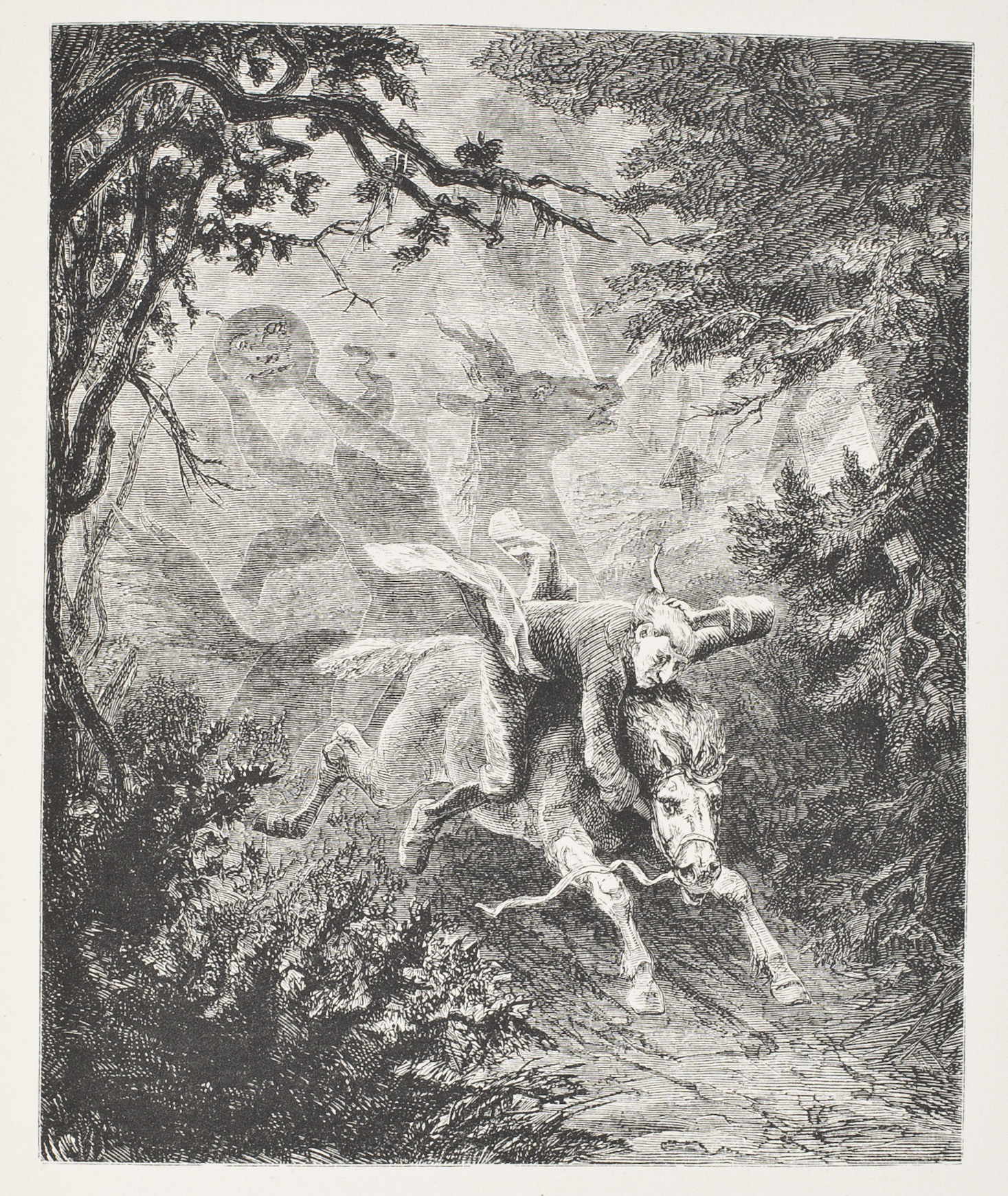
This last image, done by Leutze and titled “Ichabod and Brom Bones,” eliminates the implication from Irving’s telling by outright naming the Horseman. Like Darley’s depiction of the scene, a clumsy Ichabod flees the Horseman, but in this version the Horseman wields a giant pumpkin with a carved face. The added depth of shading and the framing of the trees in this version, as well as the visible pumpkin face, emphasize the spooky atmosphere. We know Leutze is good at setting tone given the iconic Washington Crossing the Delaware, but it feels a bit strange to see that same skill applied to illustrating a gothic folktale, albeit one that was an icon in itself.
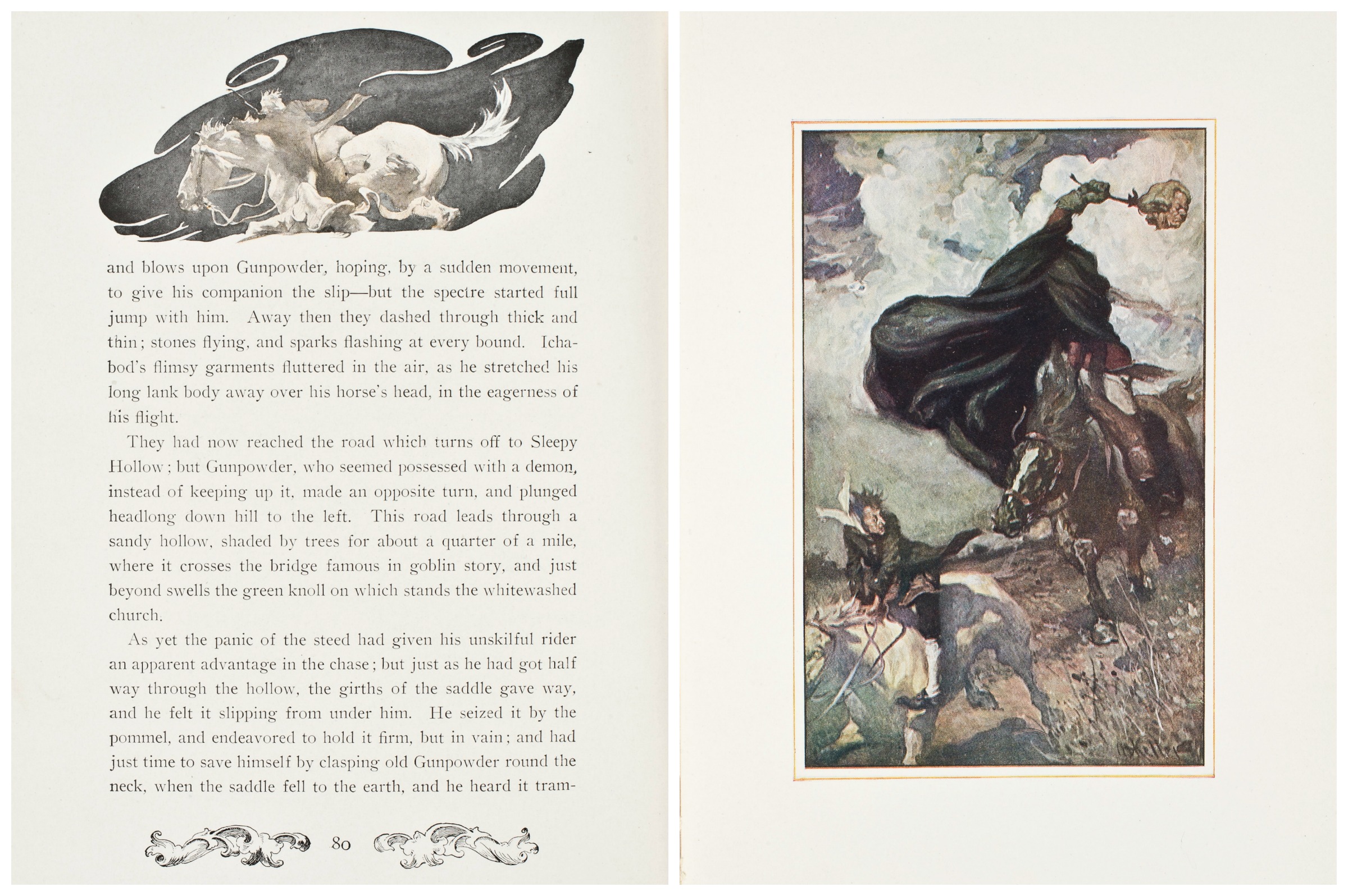
From this point on, “The Legend of Sleepy Hollow” saw innumerable reprints and new illustrated editions, each generation putting its own stamp on the story’s imagery. One 1906 edition in our collections, for example, relies heavily on shades of orange, brown, and black to set an eerie atmosphere—reminiscent of colors associated with dime novels—and its depiction of the chase is truly terrifying. The horseman carries not a pumpkin, but instead swings an actual head by its ponytail. Clearly the publisher cared less about accurately illustrating the story and more about provoking fear and horror in its audience.
Once film adaptations were possible, the imagery of “The Legend of Sleepy Hollow” changed continuously and departed even further from the story, whether through a silent film, or cartoon dogs and frogs, or live-action movies, all spanning over ninety years. In 1974, the story was even immortalized on a postal stamp. For my part, I don’t much mind what form the legend takes, as long as it lives on.
 Present have decided to take a look at some of our historical manuscript cookbooks to see what early American bakers were cooking up instead. Like our fellow bloggers at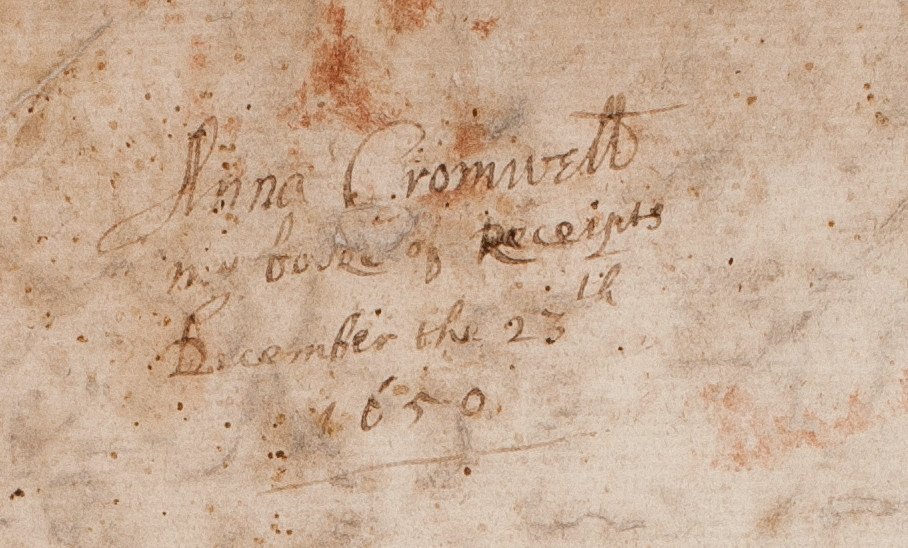
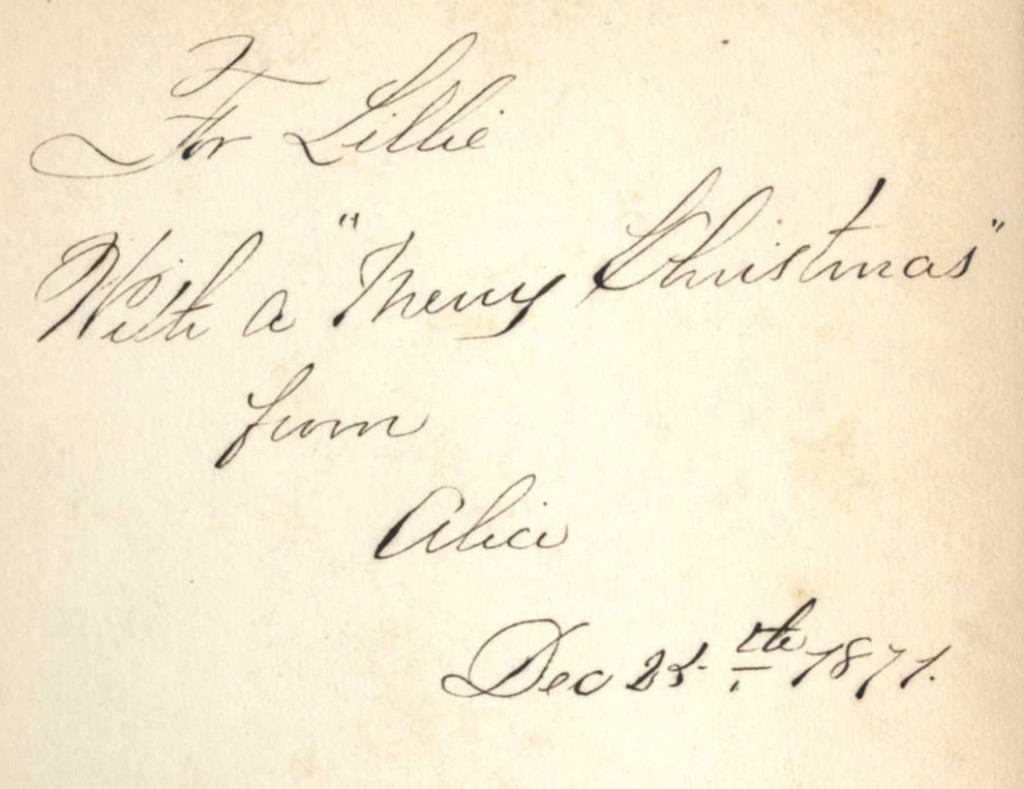 Scrap-Bag, published in Boston by the Roberts Brothers. The preface is dated “Christmas holidays, 1871-72” and addresses her readership as a “large family so rapidly and beautifully growing about me.” This copy of the text also carries a presentation inscription reading, “For Lillie, with a ‘Merry Christmas’ from Alice, Dec. 25, 1871” and features the oft-reproduced story of “Tilly’s Christmas.”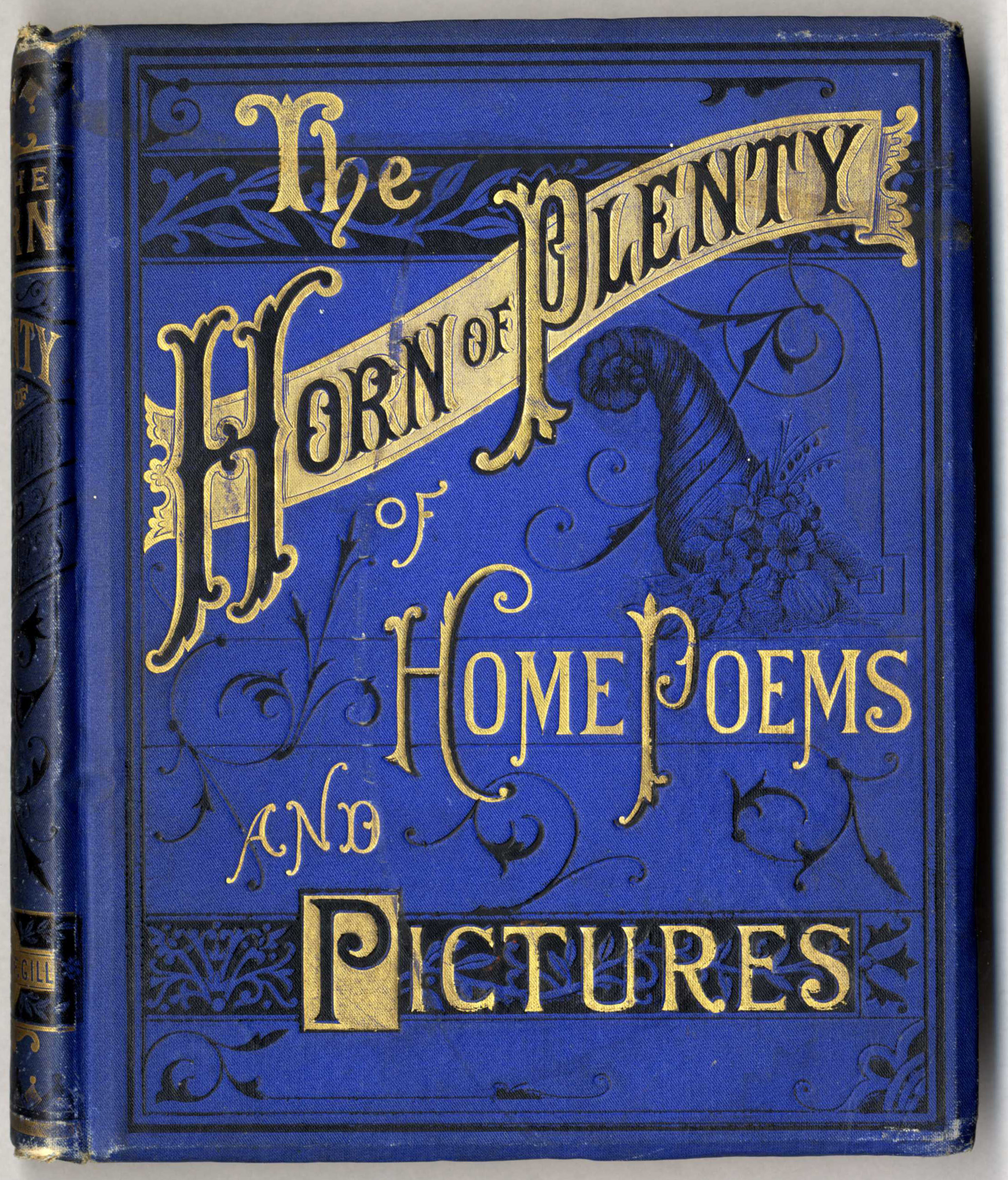
 digitized by AAS and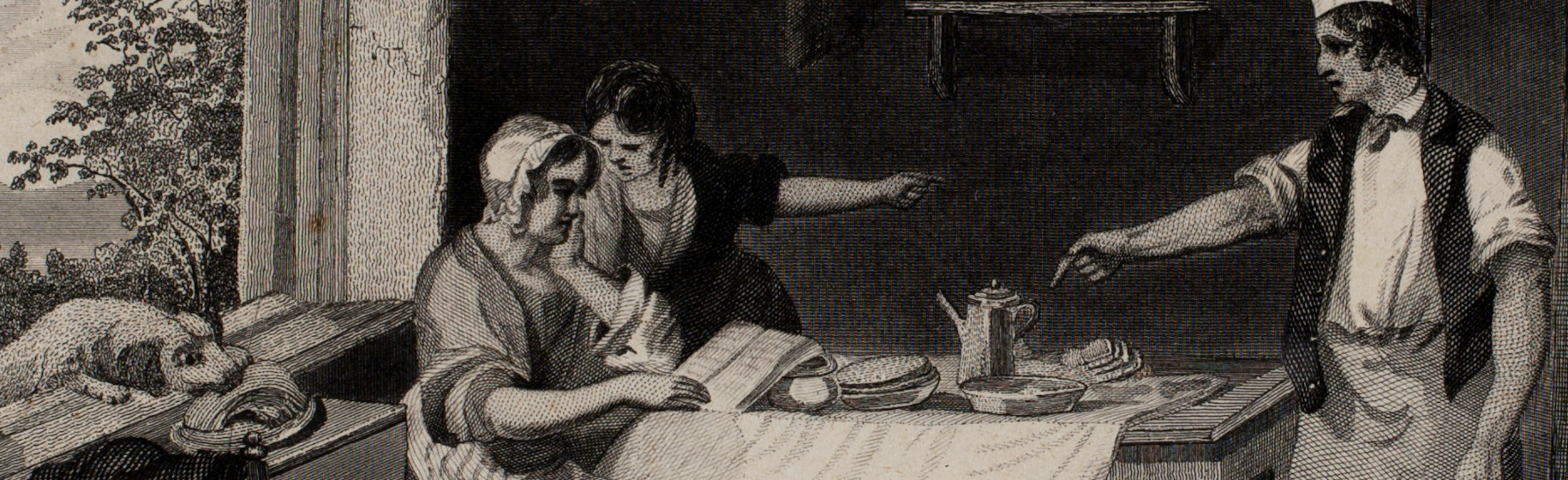
!["The Improved and Illustrated Game of Dr. Busby." Salem, Mass.: Published by W. and S. B. Ives., [1843?].](https://pastispresent.org/wp-content/uploads/Dr.-Busby.jpg)
![Chiromagica. New York: McLoughlin Bro's. N.Y., [between 1869 and 1877].](https://pastispresent.org/wp-content/uploads/Chiromagica.jpg)
![Flora McFlimsy. Cincinnati: Peter G. Thomson, [between 1877 and 1889].](https://pastispresent.org/wp-content/uploads/Flora-Flimsy.jpg)
 In 2012, the National Endowment for the Humanities, under the provisions of the