The North American Imprints Program makes the AAS Catalog ideal for bibliometric analysis in the North American colonies and in the early United States before 1820, as I have noted before on Past is Present. In this screencast, I walk you through how to export Machine-Readable Catalog (MARC) records from our General Catalog and then how to convert this data from the MARC format to a spreadsheet or CSV using the freely available software MarcEdit. Once the MARC data is in a CSV and has been cleaned up a bit, it can be used as the backbone for visualization, exhibitions, mapping, and other types of analysis. Please see our Digital AAS page to see how we use our MARC data to create databases and Omeka exhibitions, and please visit the “Digital Humanities Projects Using AAS Materials” section of this page to see how others are using data from our Catalog in innovative ways. Please contact me if you put our data to work in one of your projects, and please also feel free to contact me with any questions or ideas for further screencasts.
Fall 2015 Almanac now available!
The fall issue of our twice annual newsletter, the Almanac, is now available electronically! In addition to all of the usual items—upcoming public programs and conferences, book reviews, and other Society news—this issue has some great features:
- updates about the future of digital humanity projects at the Society
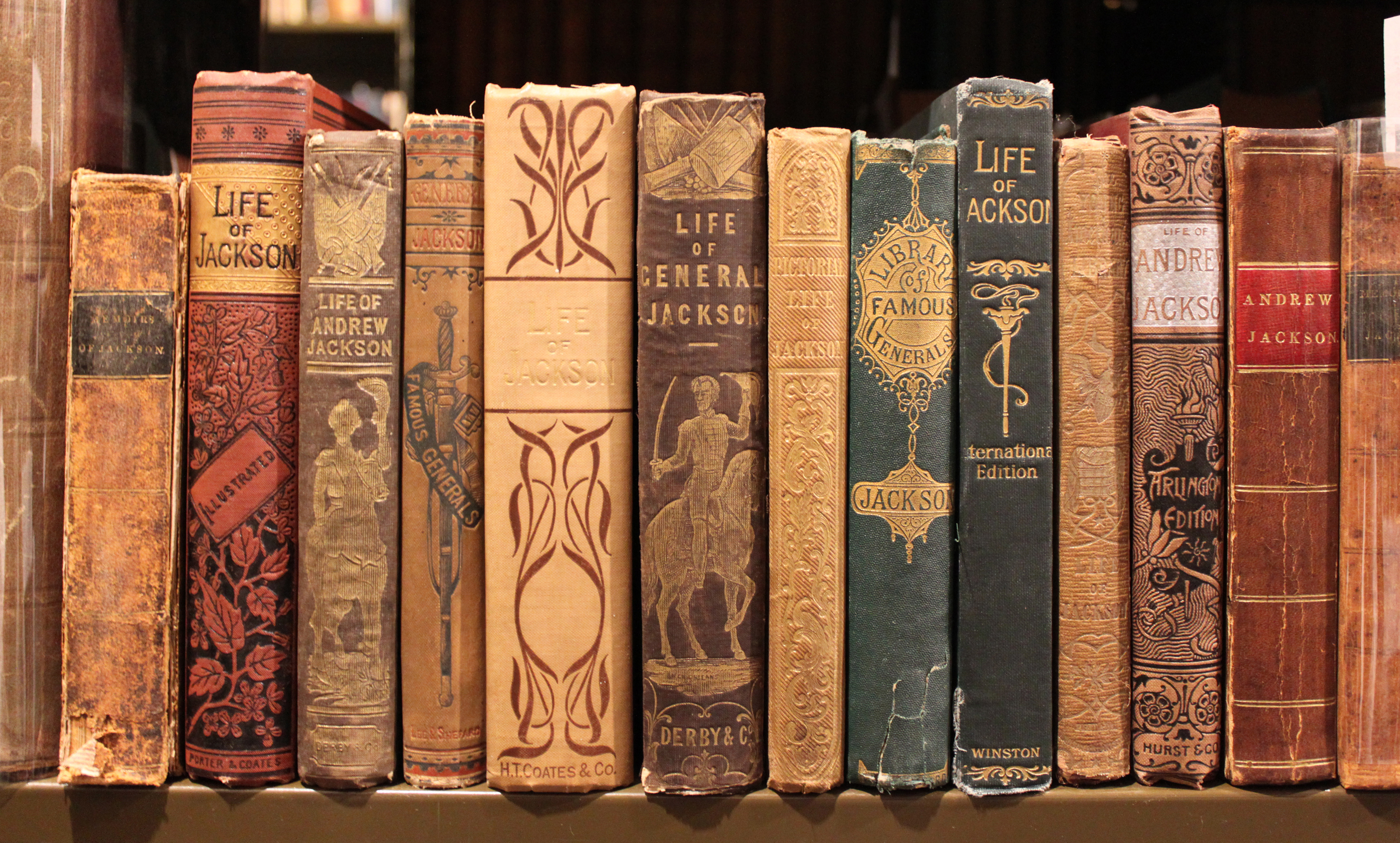
- reports about the acquisition of a unique set of daguerreotypes and a large collection of Jacksonian era material
- notes about the newly designed Common-place
- improvements to the AAS campus
Find out more in the viewer below, or download the PDF.
New AAS Online Exhibition Launched: James Fenimore Cooper, Shadow and Substance
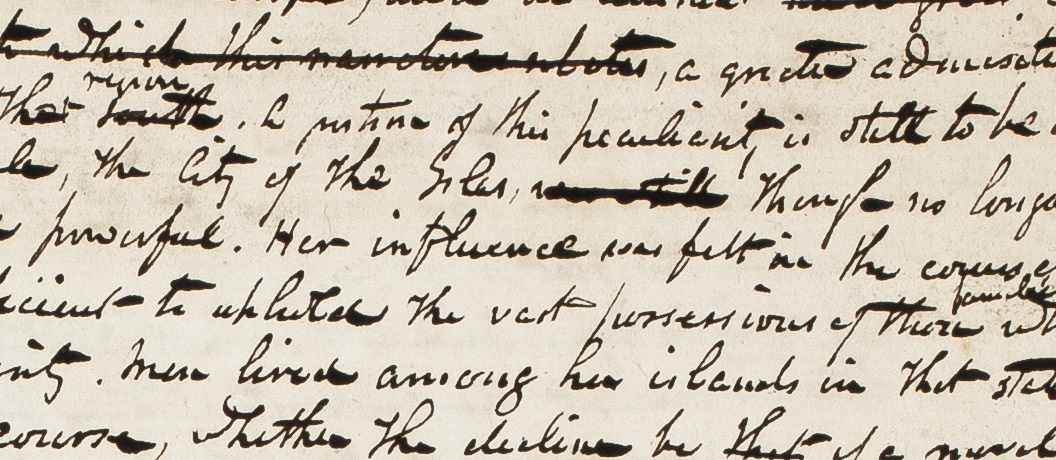
It seems as though many studies of James Fenimore Cooper begin on the defense. Mark Twain’s severe treatment of Cooper in the 120-year-old essay “Fenimore Cooper’s Literary Offenses” leaves many a poor Cooper critic to battle with Twain before easing into the comforts of Cooper. Never mind that Melville called him “our national novelist” or that Balzac declared Cooper’s writing “the despair of every novelist who has tried to follow in [his] footsteps.” Some people will insist that Cooper’s novels are insignificant, boring, tired. Echoing Truman Capote’s description of Jack Kerouac’s work (“It isn’t writing at all—it’s typing”), one might say of Cooper, “It isn’t writing at all—it’s scribbling.”
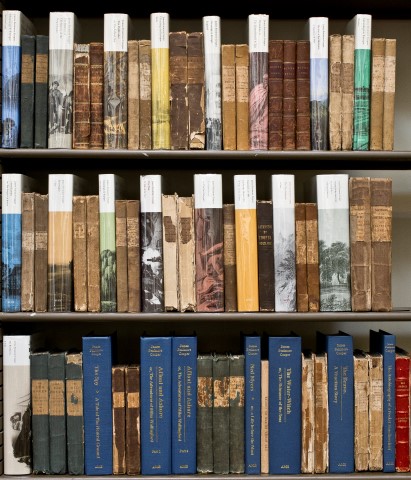
The newest AAS online exhibition, James Fenimore Cooper: Shadow and Substance, does not work very hard to defend Cooper. Instead it presents a variety of AAS materials that showcase the variety and significance of Cooper’s work. There are three sections of the website: one on the Society’s manuscript holdings, one on F.O.C. Darley’s and Alfred and Tony Johannot’s illustrations of Cooper’s novels, and one on the Cooper Edition. For those unfamiliar, the Cooper Edition, officially known as The Writings of James Fenimore Cooper, is the series of scholarly editions that has been in production for over forty years and has received the support of the Society for nearly as long. Librarians at the Society have built the Cooper collection of works published in any language up to the year 1877 to aid in the production of the series.
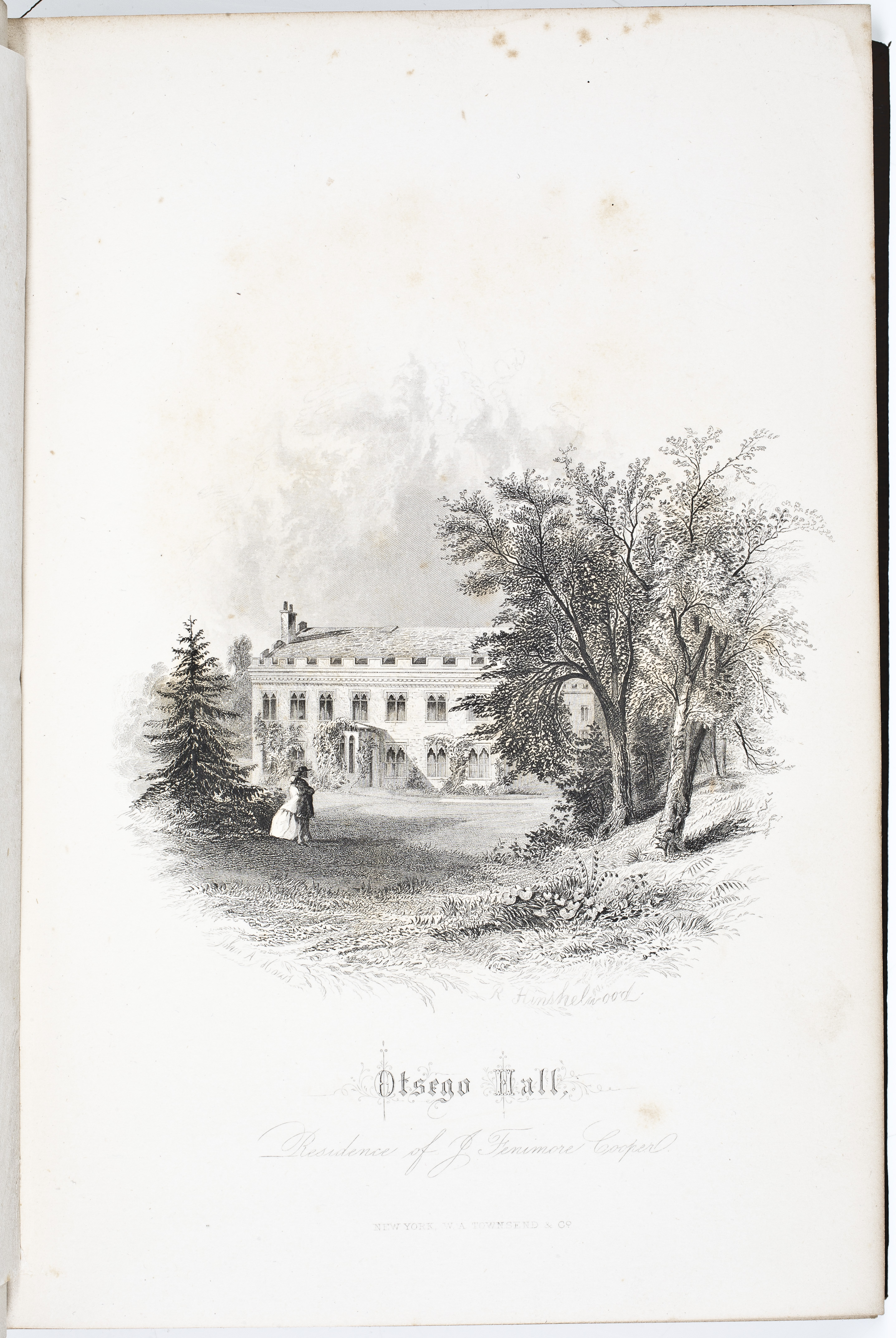
Interested readers will find new comments and reflections by those who have worked on the Cooper Edition, a gallery of Darley’s illustrations, brief descriptions of Cooper’s editorial practice, and the author’s comments on his own work and publishers.
Thanks to the help of Ken Albers and Omeka, this web exhibition is here for you to enjoy!
The Acquisitions Table: Barker Burnell School Exercise Book
Burnell, Barker. School Exercise Book, 1813.
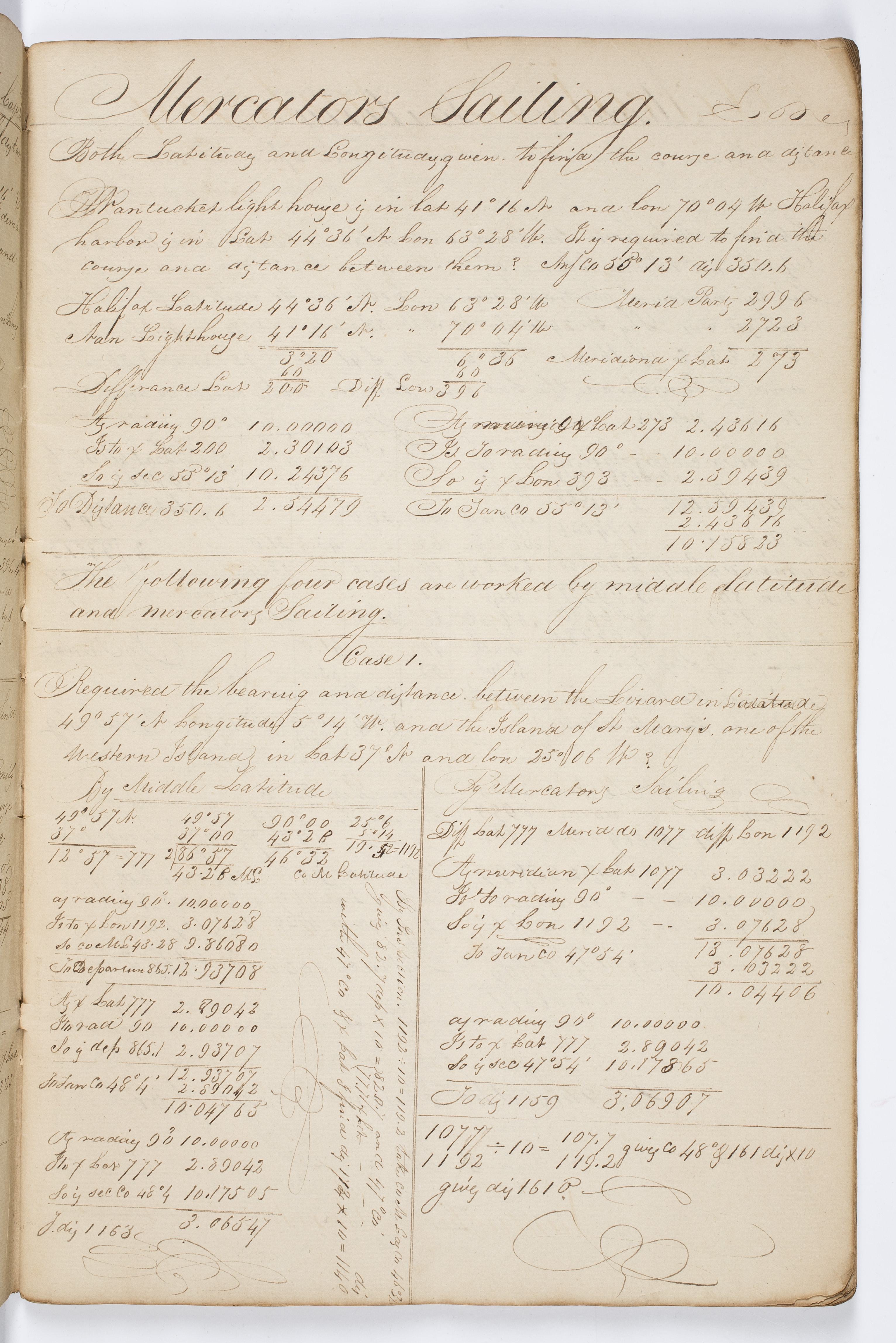 Barker Burnell (1798-1843) lived in Nantucket, Massachusetts. He served as a member of the Massachusetts House of Representatives in 1821-1822, and as a member of the Massachusetts Senate in 1823, 1825-1833, and 1838. This schoolbook was kept by Burnell in 1813 when he was fifteen years old. The book opens with “Mercators Sailing” problems – “A Ship in lat. 49˚57’ and lon. 5˚14W Sail S Westward until her departure from the meridian…” He also practices ship log entries, such as a hypothetical “Journal of a Voyage from London to Madeira & Teneriffe.” The remainder of the volume contains more familiar math lessons, including algebra, fractions, involution, evolution, and simple equations. Burnell’s work certainly is interesting, but living on an island, it is no surprise that Burnell incorporated sailing lessons into his schoolwork.
It’s Time for the Fall 2015 Public Programs
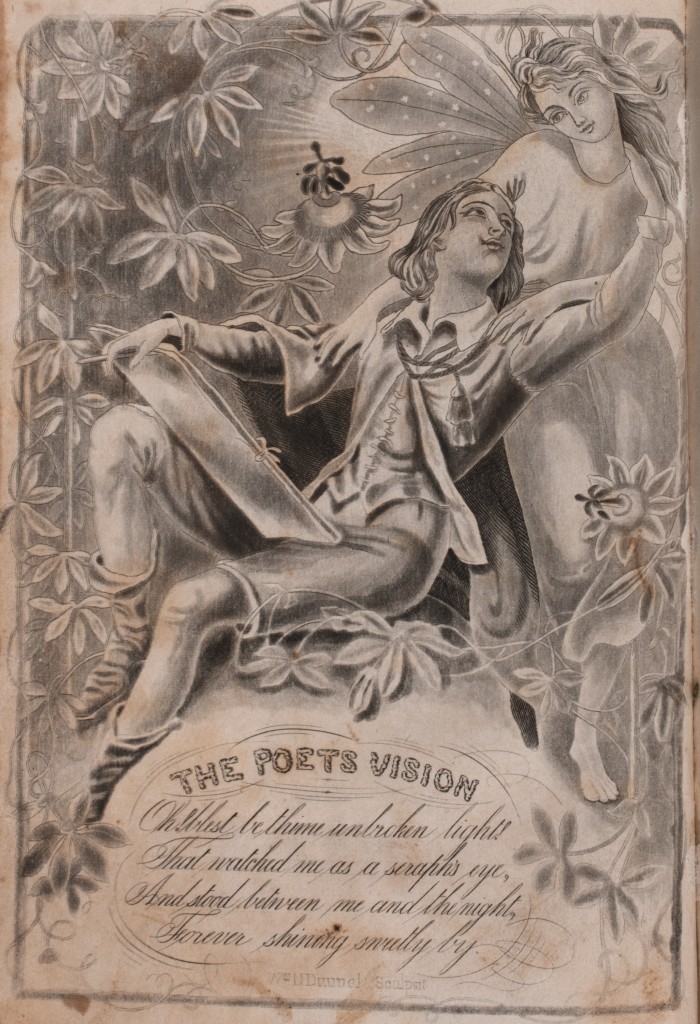 It’s public program time again, beginning tomorrow! This season we have a wonderful variety of programs, including a book launch, a panel presentation of former Creative Artists and Writers Fellows to celebrate the program’s 20th anniversary, and reflections on the Revolutionary War era.
As always, public programs are open to the public and free of charge. Full descriptions of the programs and biographies of the speakers are also available.
We hope to see you at one or all of this fall’s lineup!
Thursday, October 8, at 7 p.m.
“Bancroft Heights: Catching the Spirit of the Place”
In collaboration with Preservation Worcester and the Worcester Historical Museum
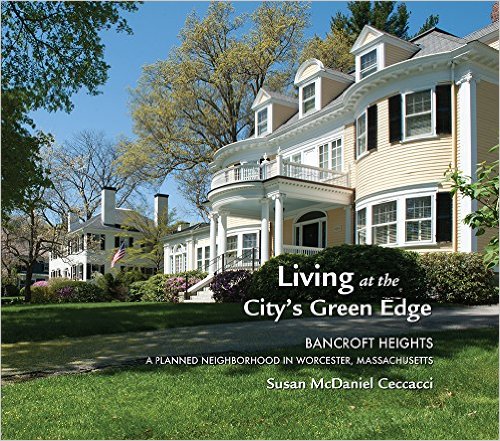 Join us as we launch the newly published book Living at the City’s Green Edge: Bancroft Heights, A Planned Neighborhood in Worcester, Massachusetts by Susan McDaniel Ceccacci. This book tells the story of the turn-of-the-twentieth-century neighborhood surrounding Antiquarian Hall, how it developed, its architecture, and the influential families who have lived here over the past century. Those who first planted the seed for this lively neighborhood history and those who finally made it a reality tell what it took to put together this book.
Thursday, October 22, at 7 p.m.
The eleventh annual Robert C. Baron Lecture
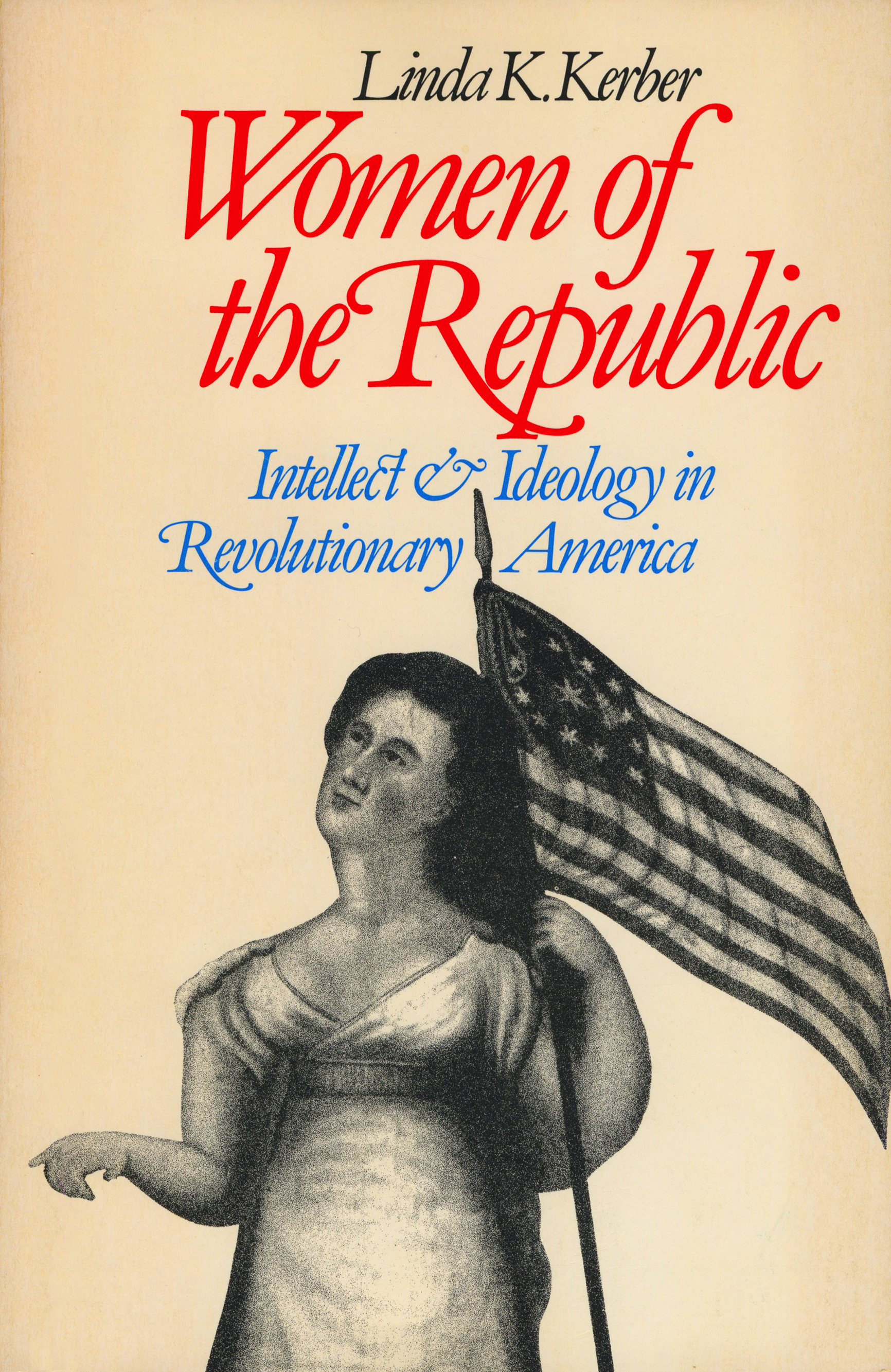 “Looking Back at Women of the Republic”
By Linda K. Kerber
Each year the Baron Lecture brings a distinguished AAS member who has written a seminal work of history to Antiquarian Hall to reflect on the book’s impact on scholarship and society in the years since its first appearance. This year, Linda Kerber will discuss her 1980 book, Women of the Republic: Intellect and Ideology in Revolutionary America, which is a landmark study of American political thought and has transformed our understanding of the Revolutionary period.
Friday, October 23, 3:30-5:00 p.m.
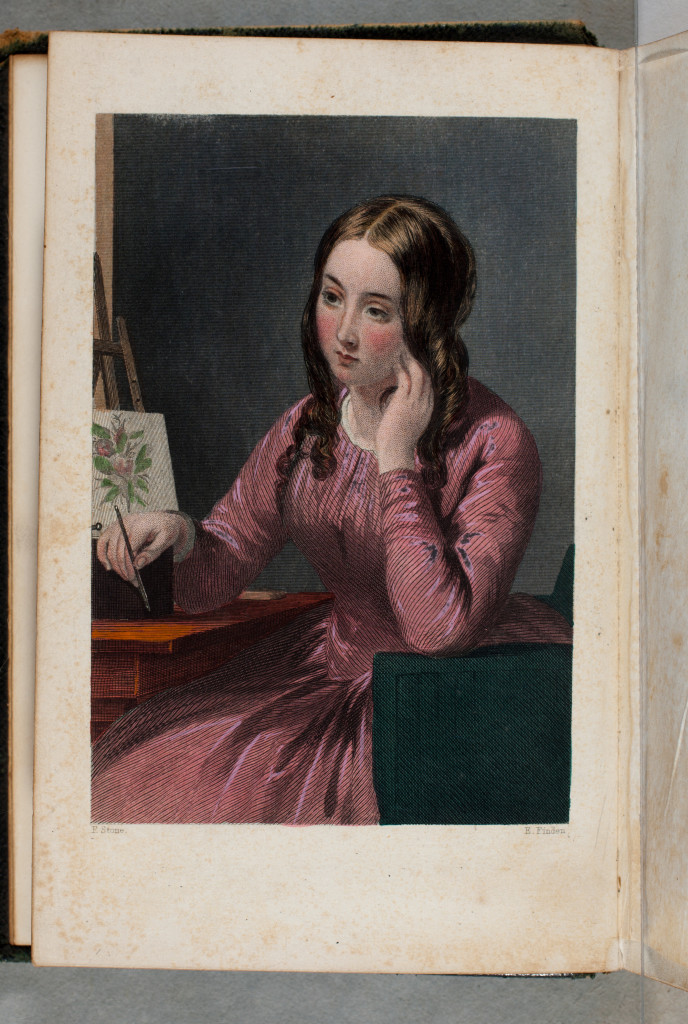 “Twenty Years of Creative Artists in the Collections”
A panel presentation featuring Honorée Jeffers, Ann Lovett, and Stephen O’Connor
For twenty years AAS has offered fellowships to creative and performing artists and writers. Since 1995, 91 people working in all kinds of artistic disciplines from throughout the United States have come to the AAS library and conducted research for historical works designed for the general public. Join us for a panel presentation by a poet, a visual artist, and a fiction writer, who will describe their experiences as fellows, share samples of their works, and reflect on how history has shaped their artistic visions and their careers as professional artists.
Friday, October 23, at 5:30 p.m.
“Dispatches from the Front Lines: Maps and Views of the American Revolutionary Era”
By Richard H. Brown
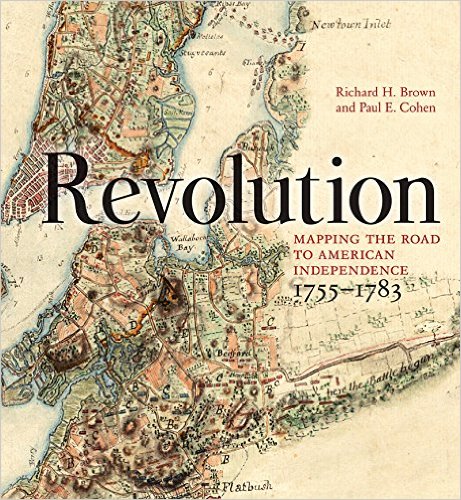 In this illustrated lecture Richard Brown will examine rare and beautiful full color maps and images created on the scenes of battles from the French and Indian War through the American Revolution. This lecture is based upon the recently published book Revolution: Mapping the Road to American Independence, 1755-1788 by Richard H. Brown and Paul E. Cohen. Many of these maps have never been published before, some document decisive battles, and all provide visual energy and clarity to the Revolutionary Era.
Thursday, November 5, at 7 p.m.
“The Birth of the Liberty Tree”
By Robert J. Allison
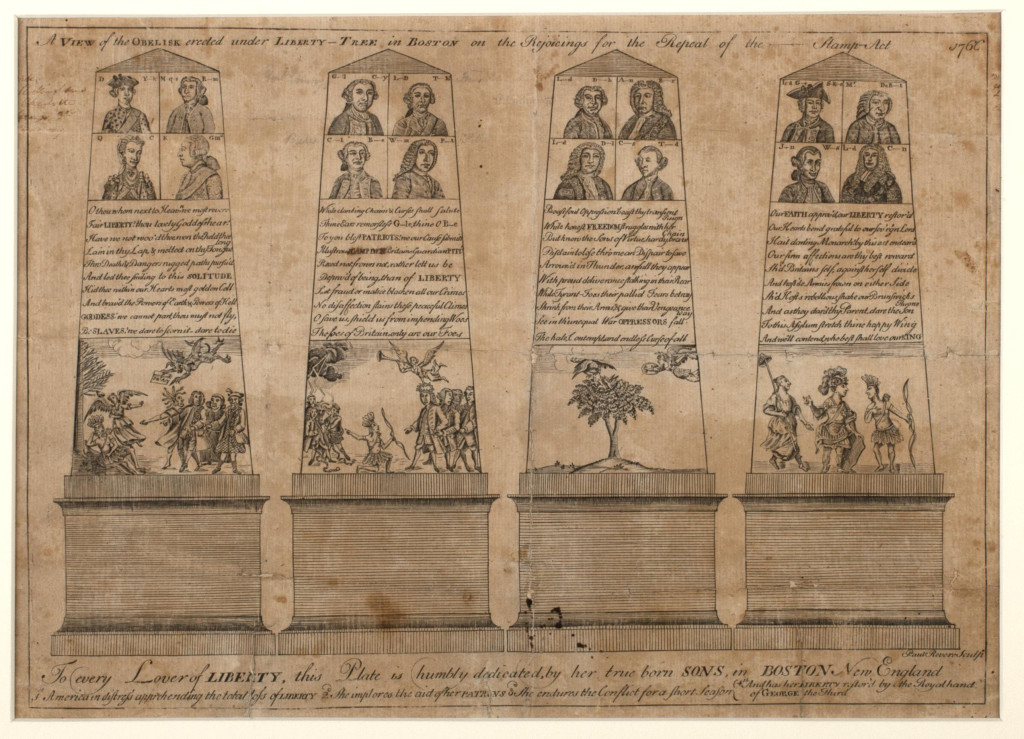 What were the long-term consequences of Boston’s resistance to the Stamp Act? A broad mobilization of Bostonians demolished property and forced Crown officials to resign; the British government rescinded the law; and both sides felt they had averted a bigger crisis. But had they? We will commemorate the 250th anniversary of the Stamp Act with this lecture that examines the importance of the Stamp Act Crisis, both for those who lived through it and for future generations.
Tuesday, November 17, at 7 p.m.
“Creating Salem Lessons”
By Nicole Cooley and Maureen Cummins
In collaboration with ArtsWorcester
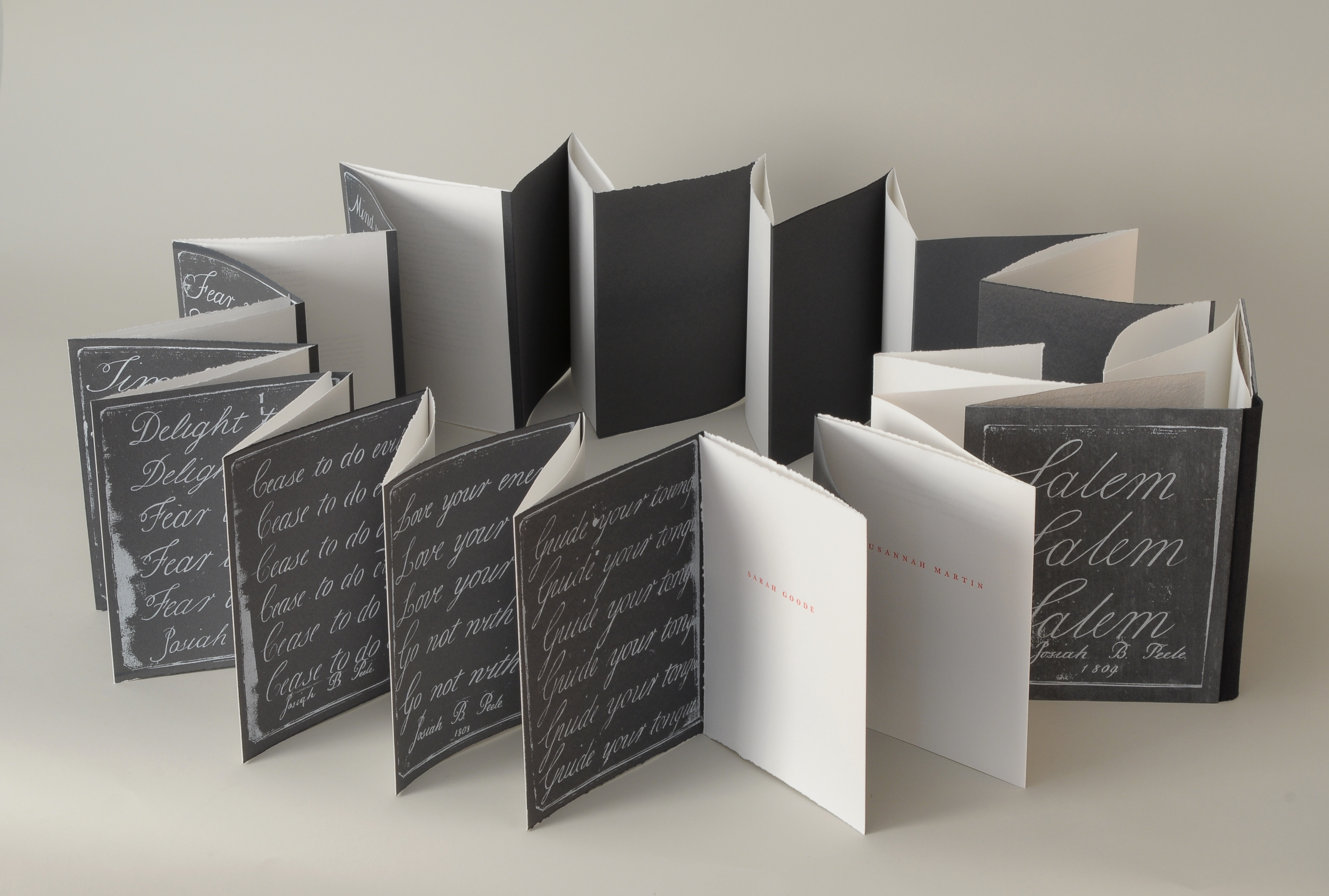 Two former AAS Creative and Performing Artist and Writers Fellows will return to discuss their collaborative project, Salem Lessons, a limited-edition artist book. Salem Lessons provides multiple perspectives on the experience of the Salem Witch trials of the 1690s. It features a “chorus of voices” of both accusers and executed that tell the story not only of what happened during that terrible time, but also—through images of copy-book pages kept by a Salem boy a century later—of the psychic reverberations that lasted long after the trials ended.
Friday, November 20, at 7 p.m.
“Representing Iconoclasm: Paint, Print, Performance”
By Wendy Bellion
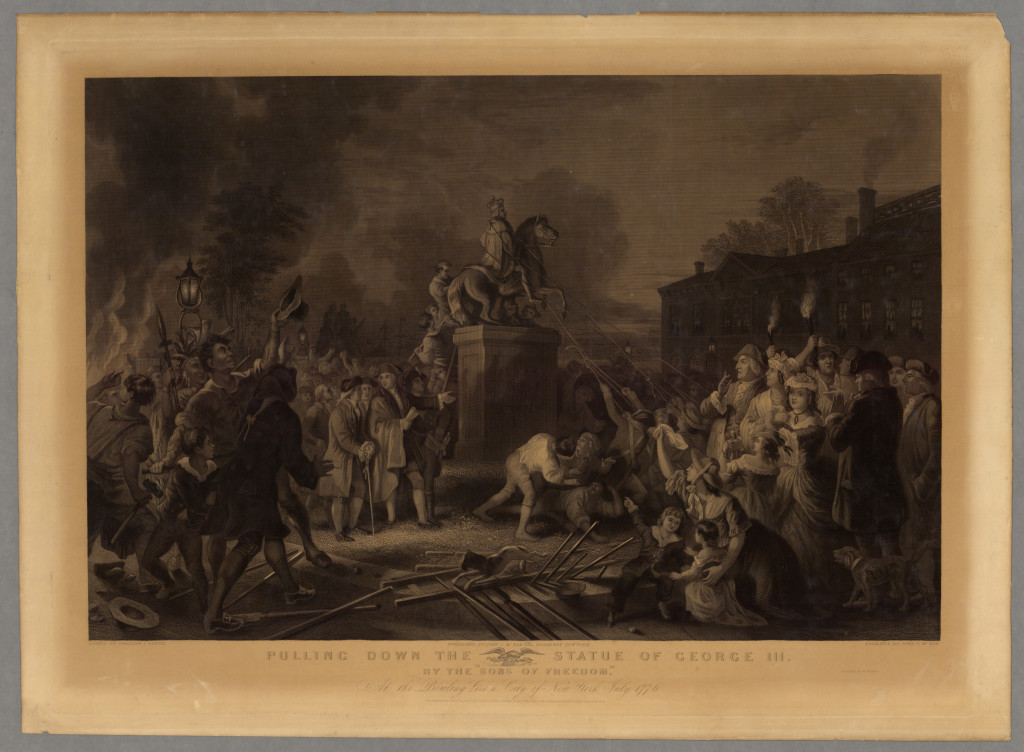 This talk will explore nineteenth-century representations of colonial iconoclasm—such as the 1776 destruction of a statue of King George III in New York—and the re-performance of that action in civic pageants and parades, which often included ephemeral reproductions of the destroyed statue. This lecture is also serving as the keynote address for the CHAViC fall conference.
A Wonderful Gift to AAS and Other Worcester Cultural Institutions
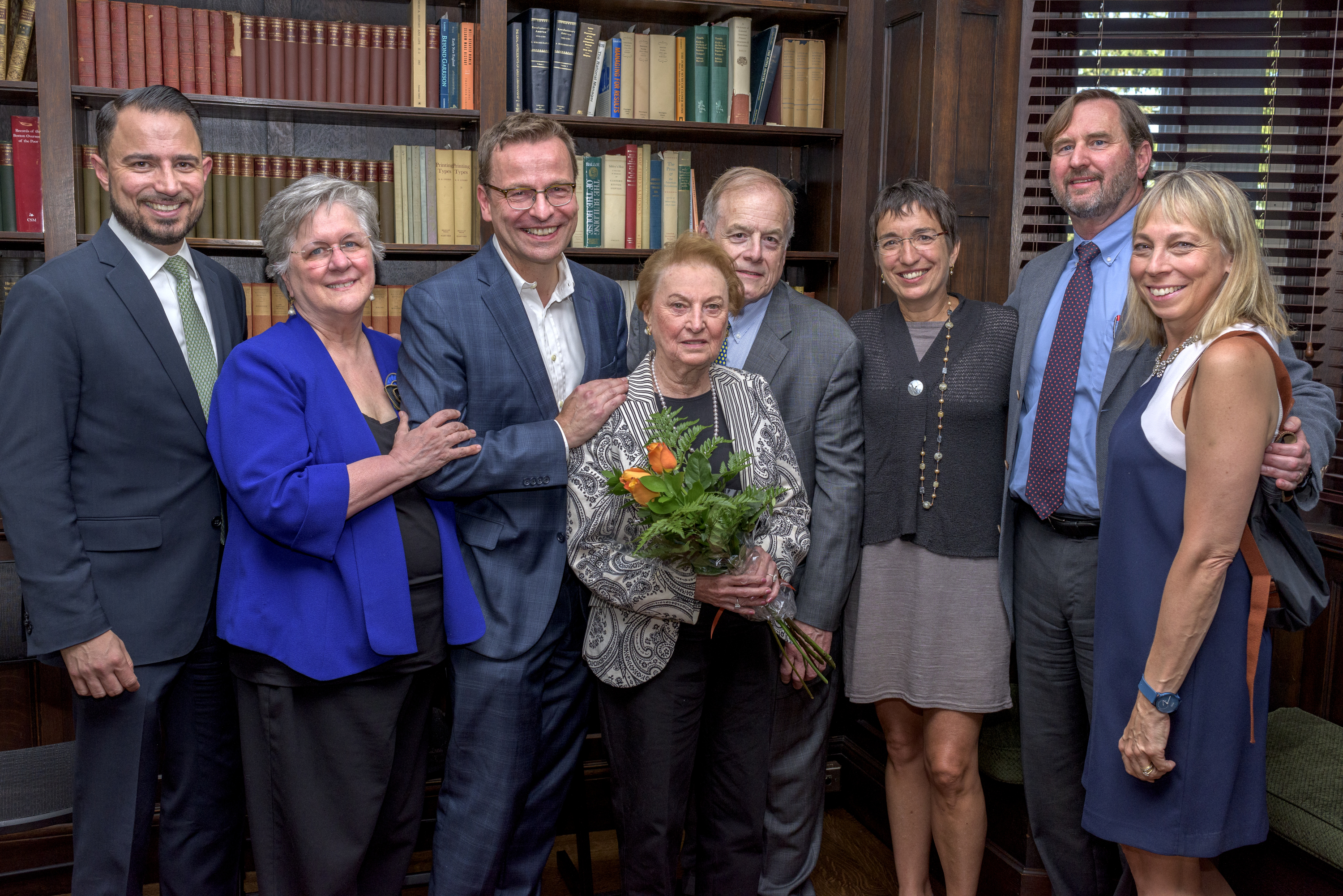
In addition to the $1 million dollar gift to the Society from Jean McDonough last spring, we have this wonderful news to share about the extraordinary generosity of the McDonough family. We have shared the press release below.
CONTACT:
John F. Hill, Communications Specialist
Office of City Manager Edward M. Augustus, Jr.
hillj@worcesterma.gov, 508-799-1175
FOR IMMEDIATE RELEASE
October 2, 2015
Myles & C. Jean McDonough Foundation Announces More than $15 Million in Commitments to Seven Leading Cultural Institutions in Worcester and Central Massachusetts
WORCESTER, MASS. — The McDonough family, on behalf of the Myles & C. Jean McDonough Foundation, is pleased to announce $15.25 million in commitments to seven leading cultural institutions in Worcester and central Massachusetts. In a sweeping philanthropic act that will have profound and lasting benefits to Worcester and surrounding communities, the commitment will be used to support initiatives at the American Antiquarian Society, EcoTarium, The Hanover Theatre for the Performing Arts, Music Worcester, Tower Hill Botanic Garden, Worcester Art Museum, and Worcester Historical Museum.
C. Jean McDonough and her late husband Myles, founder of Spencer, Mass. manufacturer FLEXcon, have shown their passion for these seven institutions for decades, through philanthropic generosity and direct involvement. “These extraordinary institutions have long been a part of the cultural heart of central Massachusetts. We felt the time was right to present each with a gift to show our continued adoration of the role each plays in our community, with the desire to support their initiatives for years to come,” said C. Jean McDonough.
“Worcester takes great pride in our cultural institutions and in the city’s support of all things creative and historic. These organizations are the lifeblood of the heart of the Commonwealth,” said City Manager Edward M. Augustus, Jr. “This gift is perhaps the biggest to the Worcester cultural community this century, if not of all time. I’m so grateful to the McDonough family for its overwhelming support of these vital pillars of our community.”
Representing some of the oldest and largest cultural organizations in central Massachusetts, the seven institutions combined represent more than 850 years of serving the Worcester community and attract nearly 580,000 visitors each year. The impact of this gift to central Massachusetts in providing communities the opportunity to engage with culture in science, nature, art, music, performing arts and history, will be far reaching for decades to come.
The Myles & C. Jean McDonough Foundation gifts were committed as follows:
- $4 million to the American Antiquarian Society (AAS). Founded in 1812 by Revolutionary War patriot and printer Isaiah Thomas, the American Antiquarian Society is both a learned society and a major independent research library. The AAS library today houses the largest and most accessible collection of books, pamphlets, broadsides, newspapers, periodicals, music, and graphic arts material printed through 1876 in what is now the United States, as well as manuscripts and a substantial collection of secondary texts, bibliographies, and digital resources and reference works related to all aspects of American history and culture before the twentieth century. AAS was presented with the National Humanities Medal by President Obama in a ceremony at the White House, the only research library to ever receive such an award.
- $4 million to the Worcester Art Museum (WAM). Founded in 1896, the Worcester Art Museum’s encyclopedic 38,000 piece collection covers fifty one centuries of art. Highlights include the Medieval Chapter House, Renaissance Court, and Worcester Hunt Mosaic, as well as the recently acquired John Woodman Higgins Armory Collection of arms and armor. Internationally known for its collection of European and American art, WAM was the first art museum in America to acquire paintings by Monet and Gauguin, one of the first to collect photography, and one of the first to collaborate with local schools.
- $2.5 million to Tower Hill Botanic Garden. The Worcester County Horticultural Society, incorporated in 1842, is the third oldest active horticultural society in the United States. The society is a nonprofit educational organization for the purpose of advancing the science, and encouraging and improving the practice of, horticulture. Its public garden, Tower Hill Botanic Garden, showcases carefully planned gardens and trails that enhance the natural features of this beautiful 132-acre property and is the first and only comprehensive botanic garden in New England.
- $2 million to EcoTarium. Founded as the Worcester Lyceum of Natural History in 1825 and incorporated as the Worcester Natural History Society in 1884, the EcoTarium is well rooted in the Worcester community as an organization dedicated to the study of science and nature, and is the second oldest natural history society in the United States. With a three floor museum, historic collections, wildlife, educational programs and 55 acres of grounds, EcoTarium offer hands-on exploration of natural and physical sciences and the New England environment.
- $1.5 million to the Worcester Historical Museum (WHM). The Worcester Society of Antiquity was founded in 1875 with the purpose to increase an interest in archaeological science, and to rescue from oblivion such historical matter as would otherwise be lost. WHM is the only institution devoted to local history. It includes a research library of over 7,000 titles, an archive that houses thousands of documents, and a collection of artifacts, all vital to the study of Worcester history.
- $750K to Music Worcester. Music Worcester, Inc., formerly called the Worcester Music Festival, was founded in 1858 to bring live music and cultural events to the greater Central Massachusetts region. Music Worcester presents world-renowned musicians and artists from across all performing arts disciplines in addition to serving its community through far-reaching educational and outreach activities. Music Worcester programs include international orchestras, Grammy-award winning headliners, and celebrated soloists and chamber ensembles to inspire tens of thousands of audience members each season. The Worcester Music Festival was recognized by the Library of Congress as one of the oldest performing arts organizations in the country and the oldest music festival in continuous operation.
- $500K to The Hanover Theatre for the Performing Arts. The Hanover Theatre opened in March of 2008 following a $32 million historic renovation. Over the last seven seasons, the theatre has established its place as a world-class performing arts venue, acting as a catalyst for the economic development of downtown Worcester and gaining recognition by Pollstar as one of the top theatres in the world. Serving the youth, education and accessibility are some of the values behind the theatre’s mission to foster a love and appreciation of the performing arts in audiences of today and tomorrow.
These commitments provide renewed vigor for the cultural institutions, which will use these gifts for current capital campaigns or endowments.
On behalf of all seven institutions, Joseph P. Cox, president of the EcoTarium and chair of the Worcester Cultural Coalition, said, “Words cannot express nor encompass the generosity and passion for culture that remains the legacy of Myles McDonough, and that has been the continuing mission of one of Worcester’s most gracious ladies, Jean McDonough.” He added, “Jean’s energetic enthusiasm and nurturing support for central Massachusetts remains unparalleled, enabling all of us to successfully fulfill our missions and inspire future generations of children and families to develop a passion for science, nature, art, music, performing arts and history. As we have inspired others, so she continues to inspire us.”
For more information about each of the cultural institutions, visit their websites: American Antiquarian Society at americanantiquarian.org, EcoTarium at ecotarium.org, The Hanover Theatre for the Performing Arts at thehanovertheatre.org, Music Worcester, Inc. at musicworcester.org, Tower Hill Botanic Garden at towerhillbg.org, Worcester Art Museum at worcesterart.org, and Worcester Historical Museum at worcesterhistory.org.
The Acquisitions Table: Daisy’s Death
Aunt Fanny (Frances Barrow). Daisy’s Death. Buffalo: Breed & Lent, ca. 1866-1872.
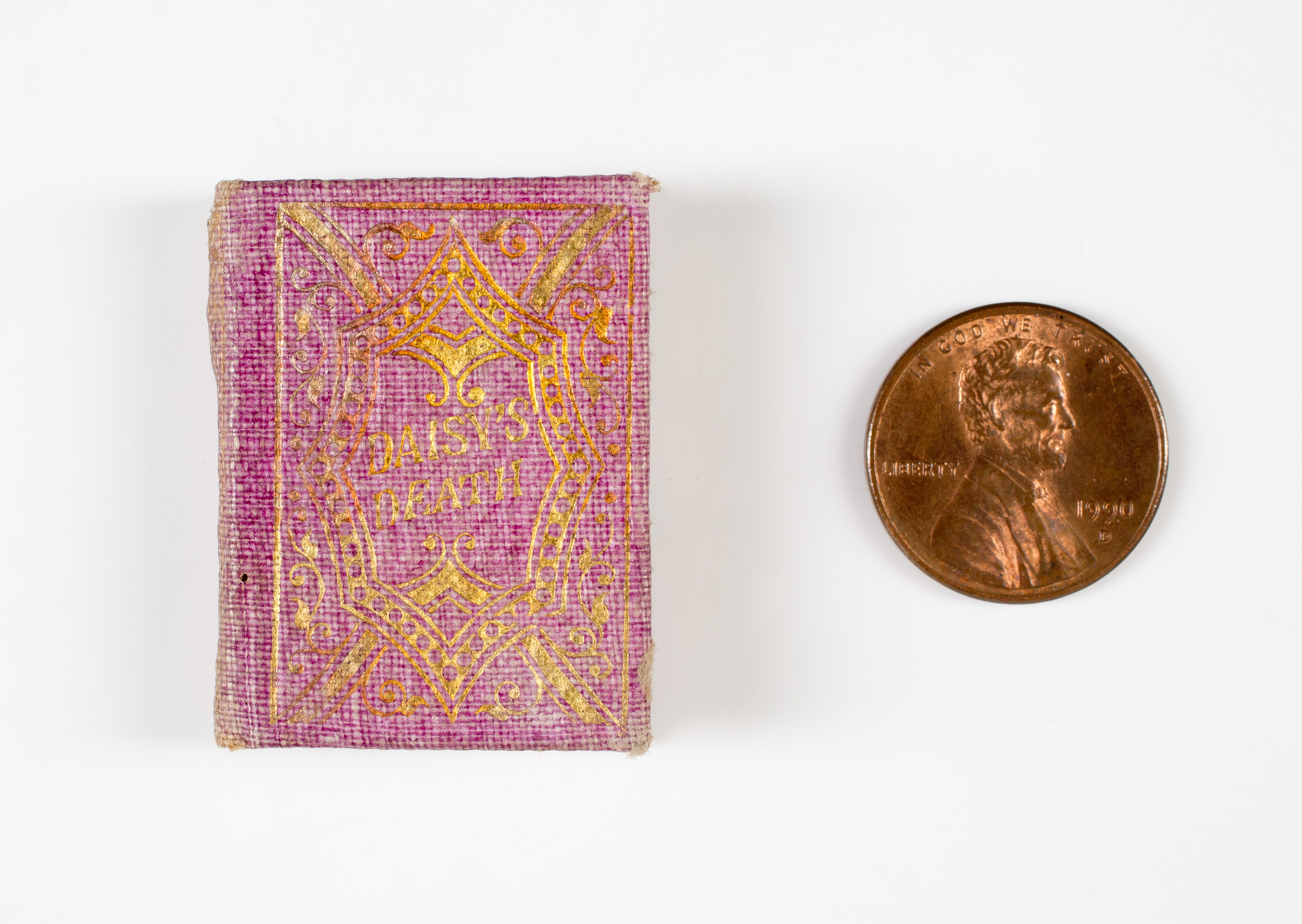 Frances Barrow (1822-1894) authored some thirty books in the “Aunt Laura” and “Aunt Fanny” series, published in miniature format by Breed, Butler & Co. and its successor, Breed & Lent. Daisy’s Death is about Daisy, an older cat who has kittens, although she is struggling through a serious sickness. Her mistress is a girl named Fanny, who helps to find homes for Daisy’s kittens before Daisy is put out of her misery by being drowned in a sack by a hired man. Although death is a prevalent topic in nineteenth-century children’s books, this is a rare example of pet euthanasia.
Unusual Titles: The Answers
Last week we posted ten nineteenth-century newspaper titles, which included three fake ones. Here are the real titles from that list with images of the mastheads as proof.
1. Sucker and Farmer’s Record (Pittsfield, IL). March 30, 1843.

At that time people of that region were sometimes known as suckers. See the reply in this previous blog with one theory about the name “sucker.”
3. Horseneck Truth Teller and Gossip Journal (Greenwich, CT). August 9, 1830.
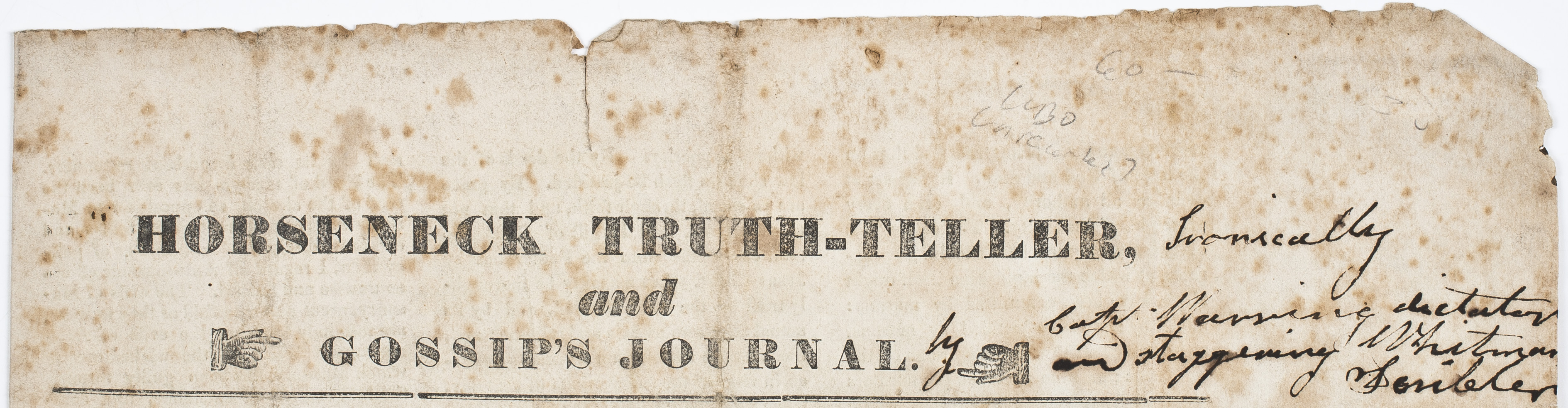
This is the first issue of a paper where the intent of the editor was to expose the moral failings of the community. It appeared in an earlier blog posting here.
4. Criminal Life of Albany (NY). April 20, 1865.
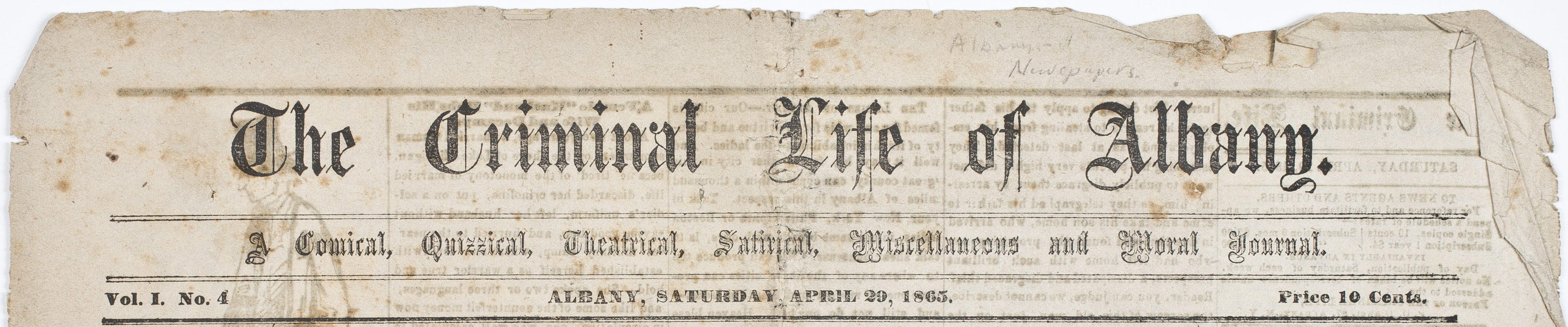
Another unrecorded paper with the purpose of exposing the seamier side of politics and life in the state capitol.
6. Estabrook’s Great Public Chowder (Boston, MA). May 8, 1847.
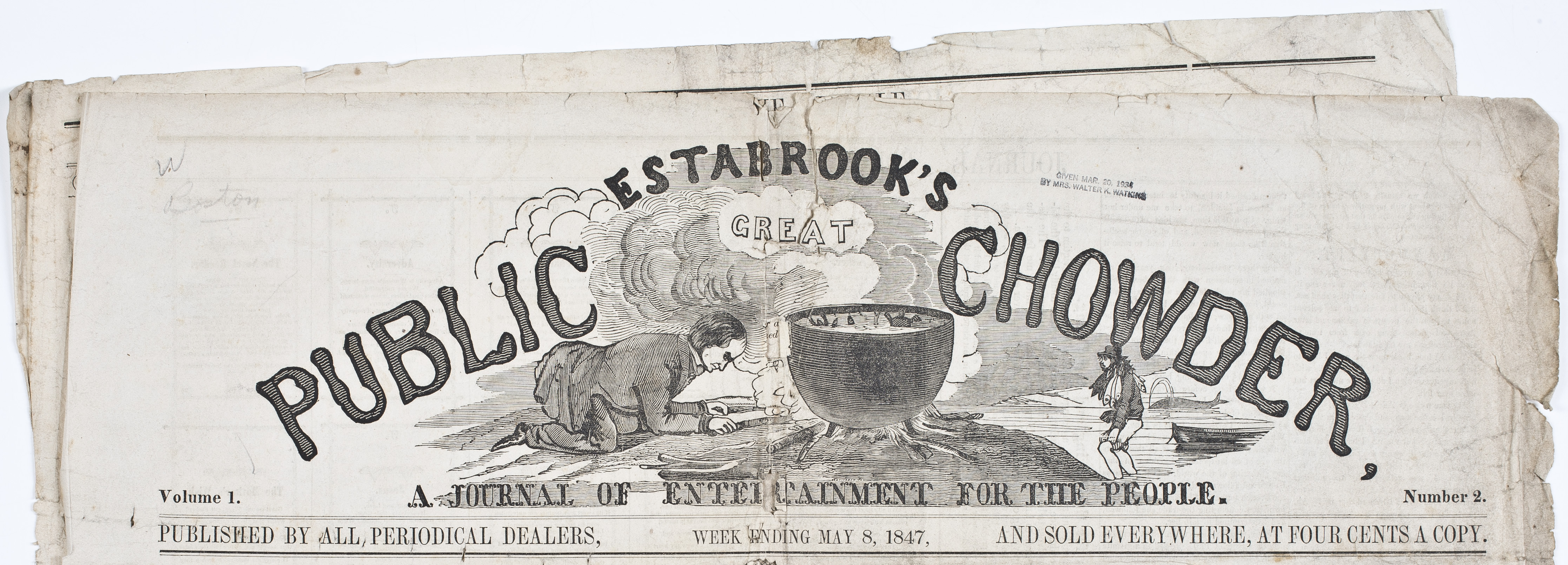
The subtitle is “A Journal of Entertainment for the People.” As the name implies, they have included all sorts of items (stories, gift cards, jokes, etc.) to make up a chowder of a newspaper.
7. Stephen H. Branch’s Alligator (New York, NY). July 17, 1858.
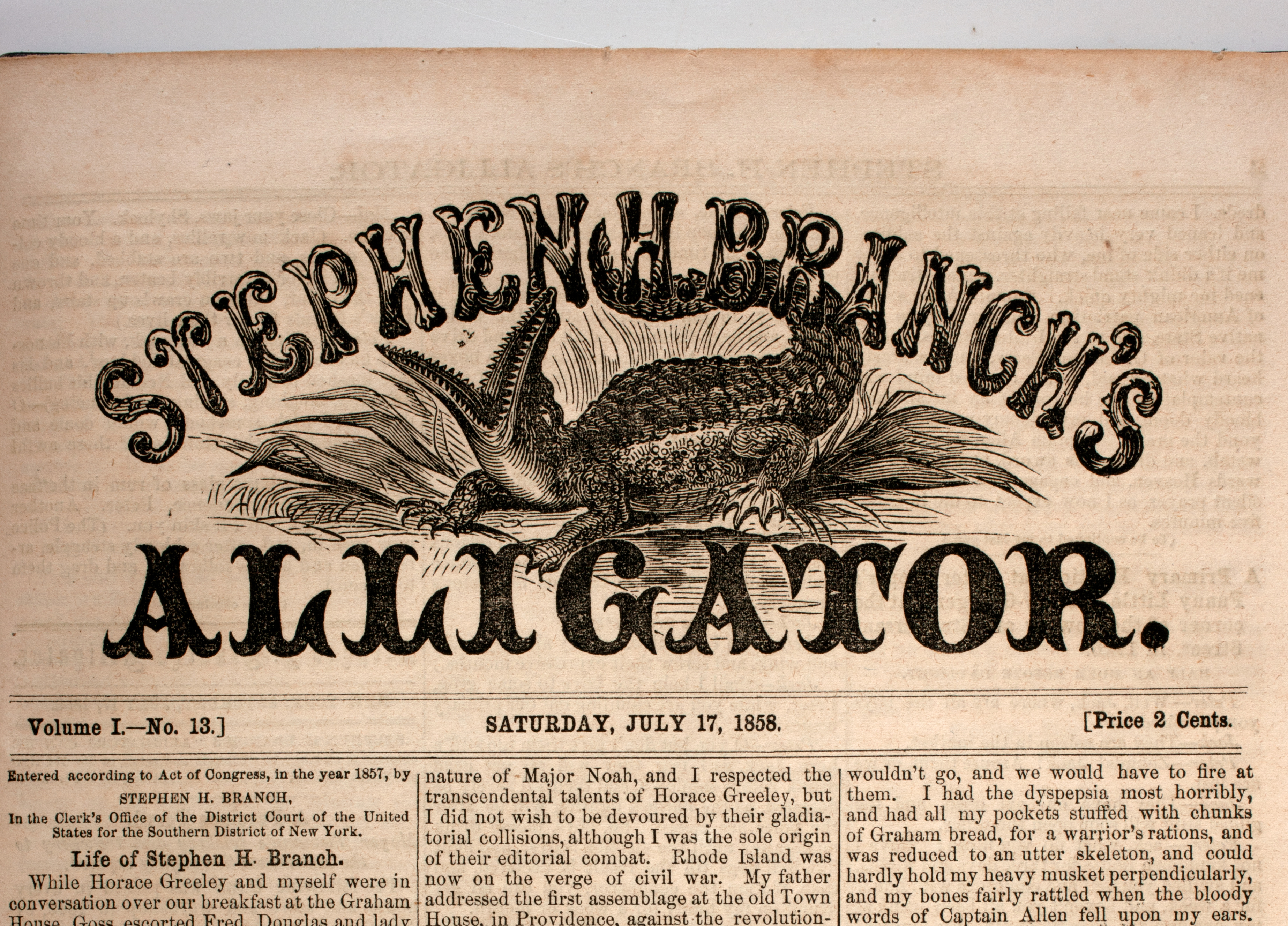
Here is another newspaper aimed at exposing the corruption of a city, this time New York City. It lasted just twenty-five issues and Branch edited some of them while in jail on charges of libel.
8. Mud Turtle (Alligator Bayou, TX). February 8, 1864
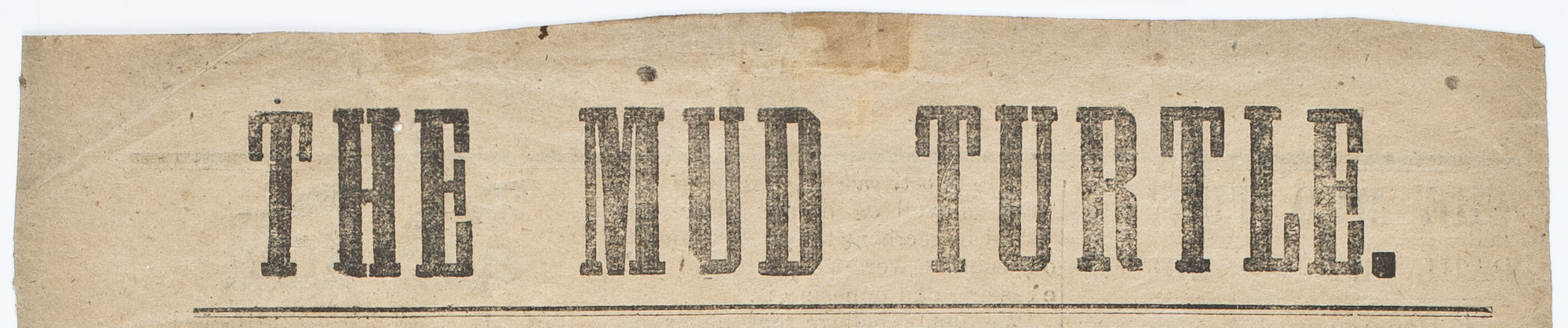
This is a very rare humor paper out of Texas. Based on surviving issues, it is surmised that Alligator Bayou was some place near Houston.
9. Striped Pig (Boston, MA). [1838?]
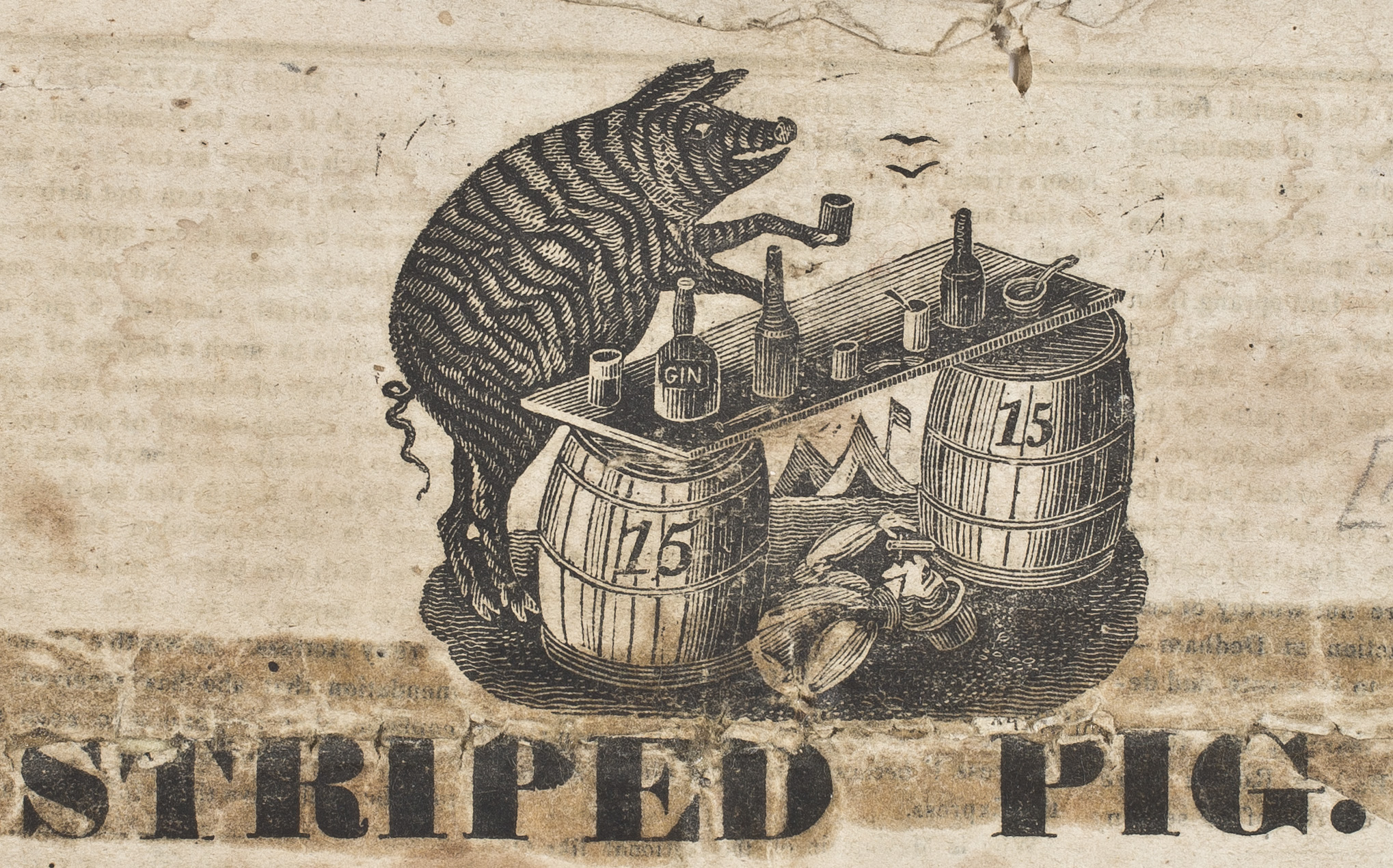
The striped pig of the title and accompanying woodcut referred to a tale of someone being banned from selling alcohol at a fair in Dedham, Massachusetts, and instead took a pig, painted stripes on it, and charged admission to see it while offering attendees a glass of rum as refreshment. It was supposedly a popular exhibit. A striped pig indicates opposition to temperance movements.
The fake titles are:
2. Widow’s Bite and Lincoln Advocate (Cleveland, OH)
5. Honest Politician (Washington, D.C.)
10. Pitch Fork of Righteousness (Philadelphia, PA)
It isn’t easy coming up with fake titles that sound like they could have been issued in the 1800s, but how did we do in tricking you?
Unusual Titles: The Challenge
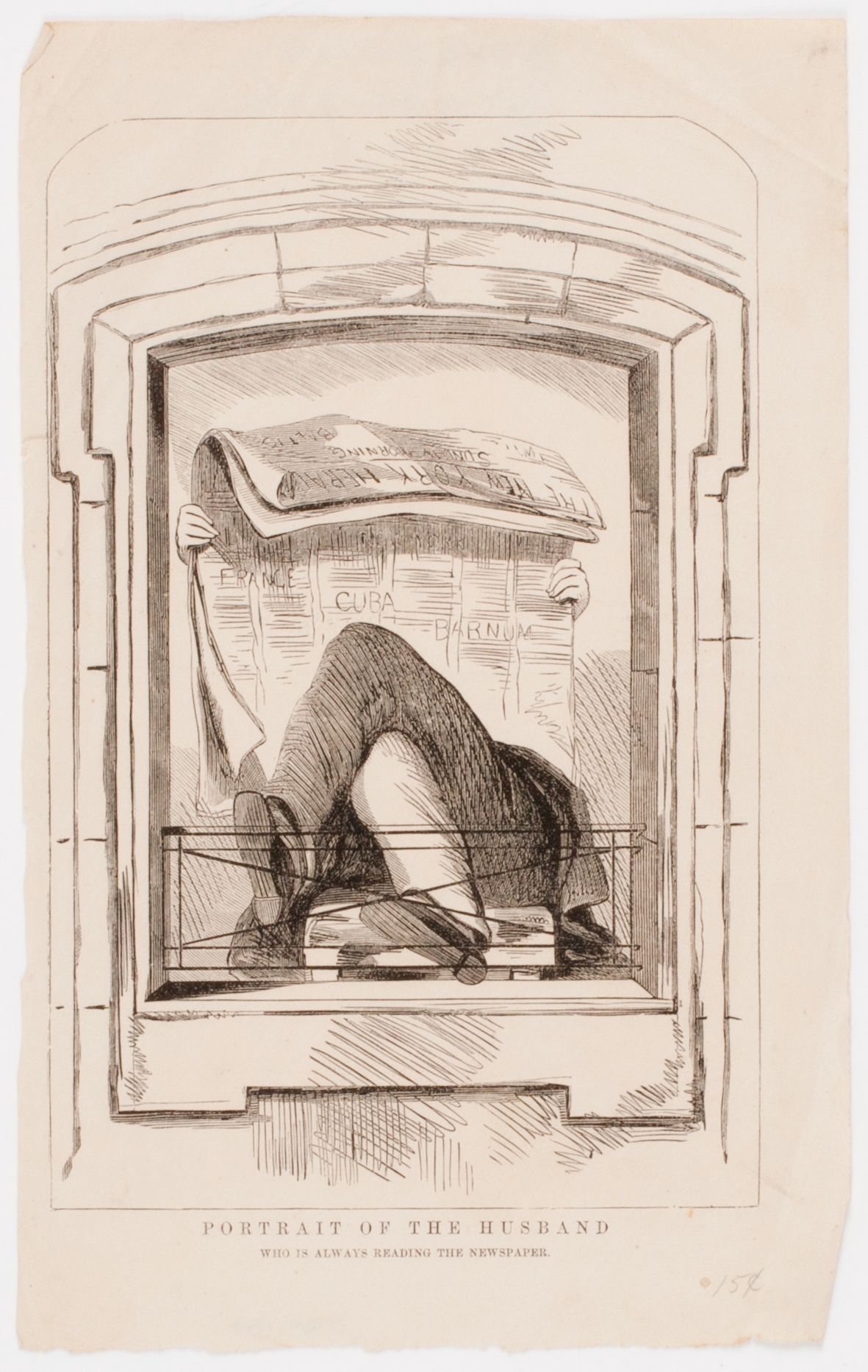
When you look at the names of current newspapers you see much sameness in the titles. How often do you see Times, Post, Globe, Union, Herald, Sun, Independent, or Tribune as part of the title? Once in a while you might run across a paper still published today, such as the Quincy Herald-Whig (IL), which continues to hold onto a term that is now considered old-fashioned or obsolete, but generally there is little variety left in the names of papers.
Such was not the case in the nineteenth-century. Below is a list of ten titles of nineteenth-century newspapers or periodicals, but three of them are not real publications. Can you pick out the three fake titles (without using online resources)?
Share your answers in the comments section below. The answers will be posted next week with photos of the mastheads to prove they are real.
- Sucker and Farmer’s Record (Pittsfield, IL)
- Widow’s Bite and Lincoln Advocate (Cleveland, OH)
- Horseneck Truth-Teller and Gossip Journal (Greenwich, CT)
- Criminal Life of Albany (NY)
- Honest Politician (Washington, D.C.)
- Estabrook’s Great Public Chowder (Boston, MA)
- Stephen H. Branch’s Alligator (New York, NY)
- Mud Turtle (Alligator Bayou, TX)
- Striped Pig (Boston, MA)
- Pitch Fork of Righteousness (Philadelphia, PA)
The answers can be found here.
Meet AAS Fellow Linford Fisher
 Linford Fisher is associate professor of history at Brown University, where he studies and teaches the religious history of colonial America and the history of Indian and African slavery and servitude. His first book, The Indian Great Awakening: Religion and the Shaping of Native Cultures in Early America, was published by Oxford University Press in 2012. While he was an AAS-NEH fellow at the AAS during the 2014-2015 academic year, he worked on his new book, Land of the Unfree: Indians, Africans, and the World of Colonial Slavery, and took a few minutes to talk about his work with Past is Present.
Past is Present: Describe your current project, its geographical and chronological scope.
Linford Fisher: My current project is a comparative study of New England and a few select English Caribbean islands, primarily Barbados, Bermuda, and Jamaica. It’s really centered on the question of Native American and African slavery from the beginning of colonization up through emancipation in 1834 in the English Caribbean. And in that time frame, I’m interested in the intersection of Indian and African slavery as well as regional difference and different kinds of slave regimes in these various locations. Like others in the field, I’m also trying to understand slavery not in terms of binaries (not just slave and free) but the way that people think about the experience of slavery in different ways at different times on a broader spectrum of unfreedom. People’s conditions change over time, their circumstances change over time. For a vast majority of slaves in the Caribbean, they were either born into slavery and died in slavery or else were enslaved and died a slave. But for others there was a diversity of experiences over time. The project is really an attempt to understand the dynamism, movement, migration of people in unfree conditions. One portion of the book focuses on the way that Native Americans were the subject of an Indian slave trade, whether from New England on the east coast of North America down to the Caribbean or from South America to the Caribbean or in other countless ways being forcibly moved around. So the Caribbean becomes this sort of crossroads of a wide variety of people. I’d like to bring at least some of these different pieces together, primarily with regard to the English Atlantic. I taught a class on Indian and African slavery a year ago, and the number of books and articles that I could have assigned that dealt with both Native American and African slavery in any of these contexts, well, you could list them on one hand. There’s a very small (but growing) literature. And so I’m trying to contribute this emerging literature in a positive way to that.
Past is Present: Who inspires you to do this work?
LF: I am personally drawn to two kinds of works that might seem like opposite intellectual currents. The first are works that tackle the big sweeping questions and huge issues about human life more generally. People like Jared Diamond and Guns, Germs, and Steel and Charles Mann and 1491 and 1493. Mann’s first book, 1491, is a hemispheric history and 1493 contains a global awareness. Guns, Germs, and Steel is asking really important questions about how cultures change over time and the origins of certain differences. I might not agree with his conclusions, but he’s asking really interesting questions. The second kind of works I am drawn to are super micro-historical studies. I think they remain powerful because they’re stories about people and their interior worlds and we can identify with them. So Carlo Ginzburg The Cheese and the Worms is a classic that I think every historian has read and has either mimicked or channeled at some point. But also Natalie Zemon Davis’s The Return of Martin Guerre and Laurel Thatcher Ulrich’s A Midwife’s Tale are other books that do really tight micro-historical work. In my own work I try to move back and forth between the two, to keep a larger context in mind but also to tell stories and to get inside, maybe not people’s minds, but at least their worlds. Other inspiring works are Walter Johnson’s Soul By Soul and Richard Dunn’s recent book A Tale of Two Plantations about a plantation in Jamaica and a plantation in Virginia. He takes plantation slave inventories and brings them to life. He puts flesh and bones on names that are in the register and is able to tell stories and create family lineages and describe in intimate detail plantation life. Another book that came out recently that exemplifies the kind of writing and the kinds of big questions that I’m drawn to is (and everyone’s talking about it) Ed Baptist’s The Half Has Never Been Told. Also Adam Rothman’s Beyond Freedom’s Reach. It’s a super micro-history, but it also tells a larger story. So these and many other books inspire me. I hope all of that comes together in this book. I want my readers to get both an intimate portrait of people’s lives and get a firm sense of what it all means, of the larger picture.
Past is Present: What keeps you dedicated to the work? What keeps you going?
LF: A little bit of craziness perhaps. I’m not really sure. In some ways it’s become a real passion and I’m not sure I have a rational explanation for it. Some people have a job and have to go to work. I’ve felt for a very long time that I’m fortunate because what I want to do most days and what I have to do are pretty much the same thing. I really enjoy the archival process, I really enjoy teaching, I really enjoy going out and talking to wider audiences and giving lectures. I really enjoy the writing process, even though it’s difficult sometimes. But it is not always easy to churn out pages of text. I came across a quote recently about this: “Writing is hard for every last one of us. . . . Coal mining is harder. Do you think miners stand around all day talking about how hard it is to mine for coal? They do not. They simply dig. You need to do the same.” It’s the same with writing. You just have to do it. I enjoy the whole package of academia, perhaps because of the diversity of things that is required of me each day. I find it inspiring to talk through issues in the field with graduate students and seeing undergraduates who come from such different backgrounds who have fresh ideas and so forth. But the core of it is the belief that the past has something to offer us in the present. I’m not trying to be presentist, but I do believe that we are doomed to repeat a history that we don’t understand. I want my students not just to think about the relevance of the past (that word has become kind of fashionable) but get them to think critically about the present. And if history is one tool for them for them to think critically about the present, then that’s great. I’m not just sitting in an ivory tower, thinking deep thoughts and writing about some obscure topic. I’m writing about race and power relations and colonialism and conquest and human violence and that’s all in the world we live in today, and I hope they see that.
You can read the whole interview here!
New Online Exhibition Launched: Women and the World of Dime Novels
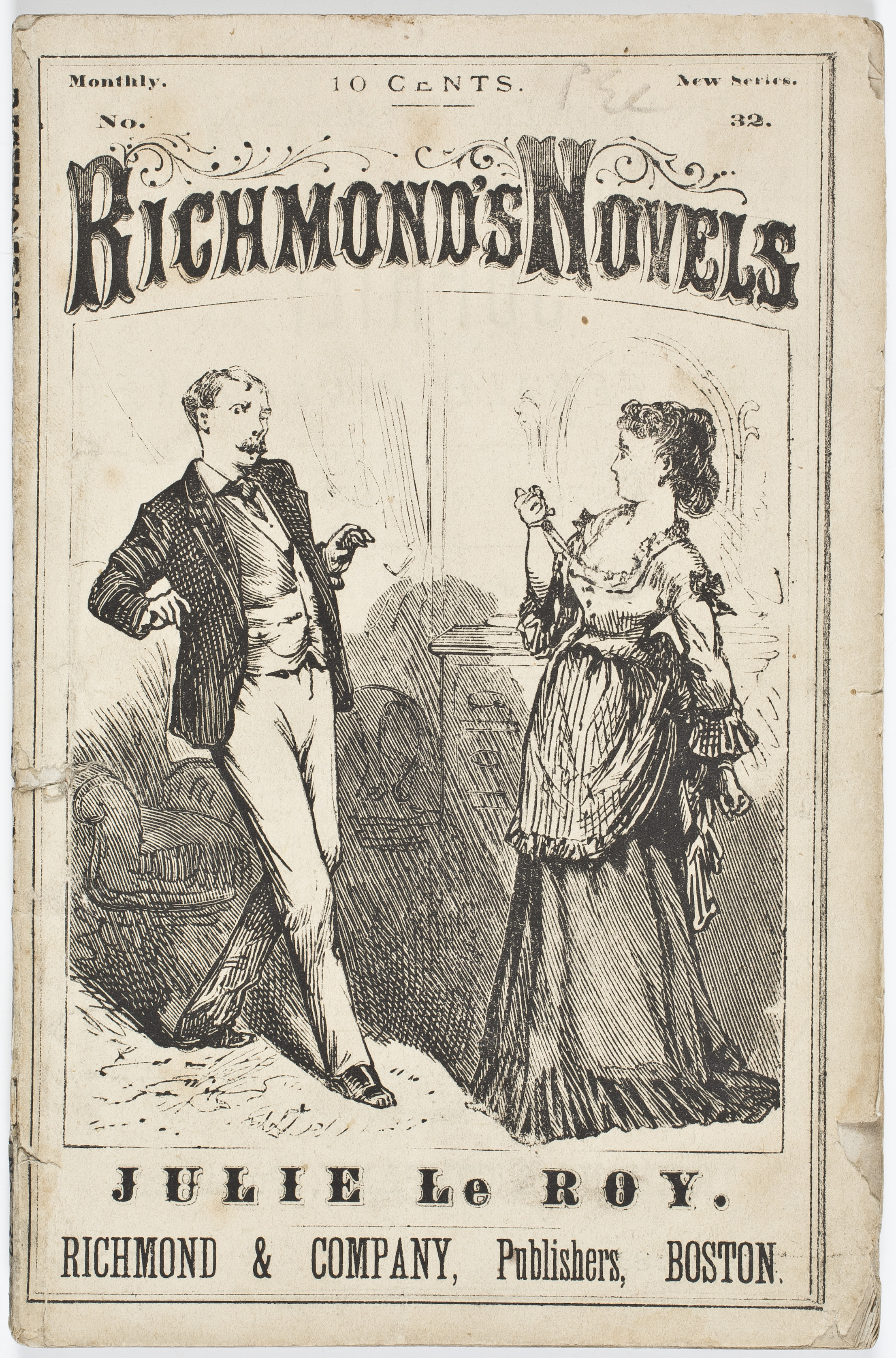
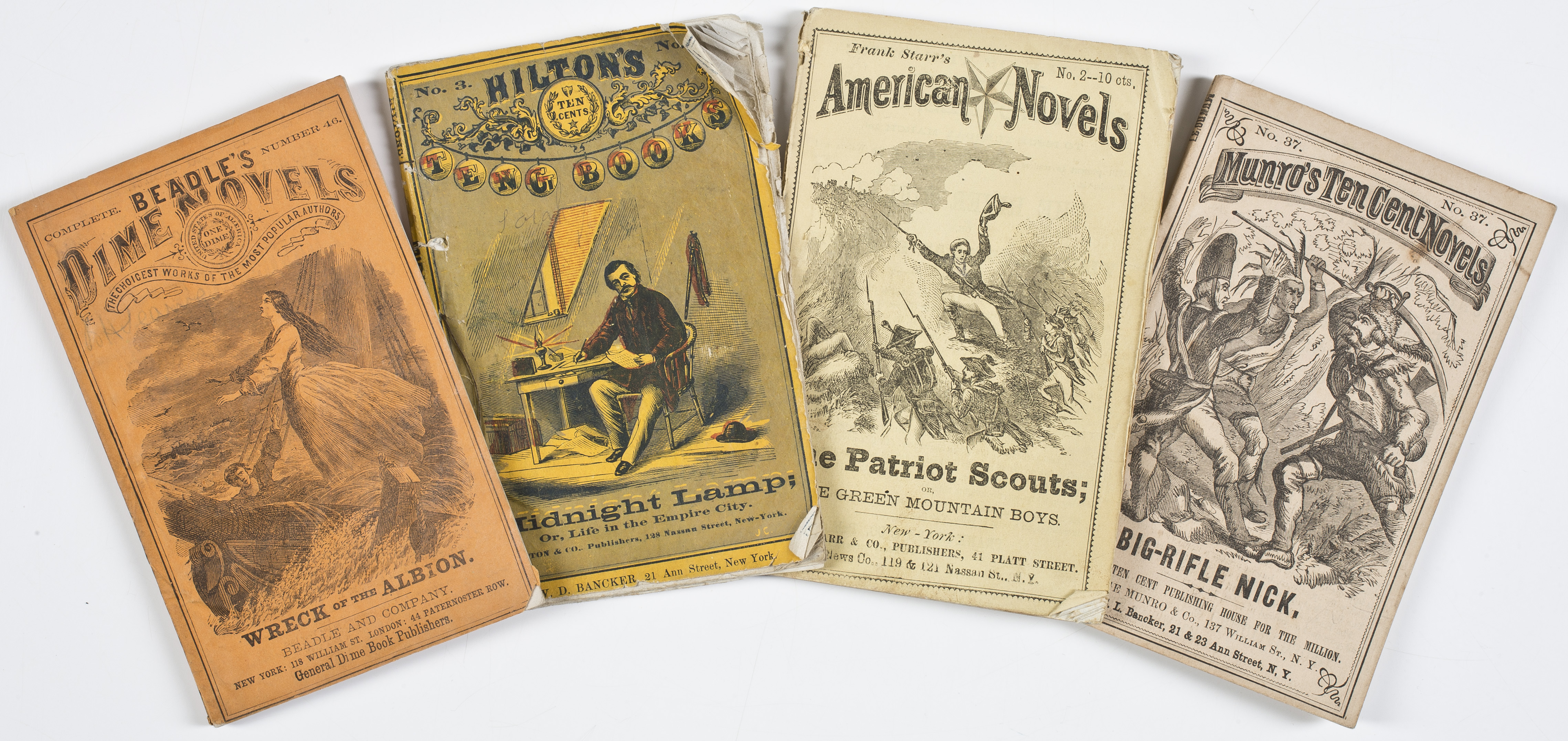
I’ve written previously about my experiences cataloging the AAS dime novel collection. I was still fairly early in the process when I discussed the relative quality of three publishing houses: Beadle and Adams, George Munro, and Elliott, Thomes & Talbot. As I have continued working with the collection since, I have had a chance not only to explore more novels by these firms, but also novels from even lesser known firms, in series that only lasted for a couple dozen, or even only five or six numbers. As I’ve had the chance to delve into the truly wide array of dime novel publishing, I couldn’t help but notice how many tropes were common to the genre as a whole. I found it absolutely mind-boggling how many novels included the following general plot device: a woman is in love with Man A, but Man B wants to marry her. When the woman turns down Man B, he has her kidnapped in an effort to coerce her into marriage. The woman is eventually freed to marry Man A and Man B’s villainy is revealed to the world. It was then that I realized just how many of these tropes I’d been seeing, and how many centered around the women in the novels.
I have some wonderful college and graduate school professors to thank for fostering my passion for women’s history, and my imagination was fired by the world of dime novel women. The novels certainly contained some of the stereotypical characters I expected, but they also included many strong, fiery, independent woman. When Molly O’Hagan Hardy, our digital humanities curator, brought Ken Albers to AAS to train us in using Omeka, providing us with the opportunity to curate our own online exhibitions, it didn’t take much thinking to know I wanted to work with the women in dime novels. Their stories were so funny and tragic and just unexpectedly sensational or delightful that I wanted to be able to share a glimpse of this world.
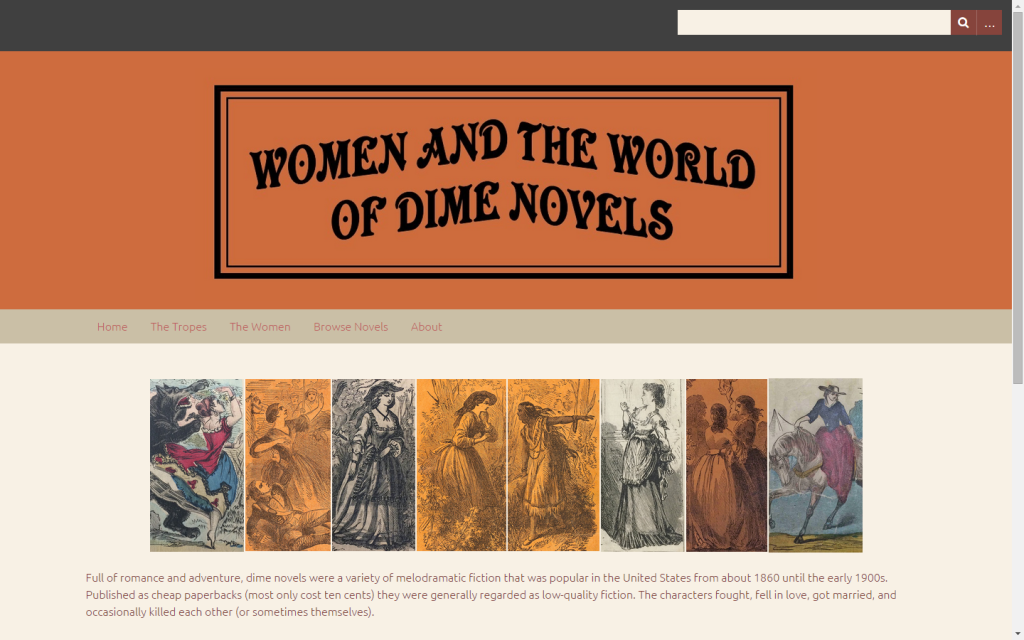 The exhibition, called Women and the World of Dime Novels, is divided into two main sections: the Tropes and the Women. The Tropes section provides an overview of six of the more common character tropes I have found in dime novels, such as the Brokenhearted Wife or the Ruined Woman. The Women section explores specific characters from the dime novels, providing summaries of their stories, highlighting how they exemplify certain tropes. These summaries include quotations from the novels, both to highlight key scenes and to provide a flavor of the writing styles present in dime novels. The Trope pages link to the relevant characters who exemplify them and the Women pages link both to the tropes and to pages providing information about the novels themselves, all of which come from the AAS collections. These links and connections are provided to encourage readers to follow their own path through the exhibition, so please explore and enjoy!
The Acquisitions Table: The Life and Adventures of Martin Chuzzlewit
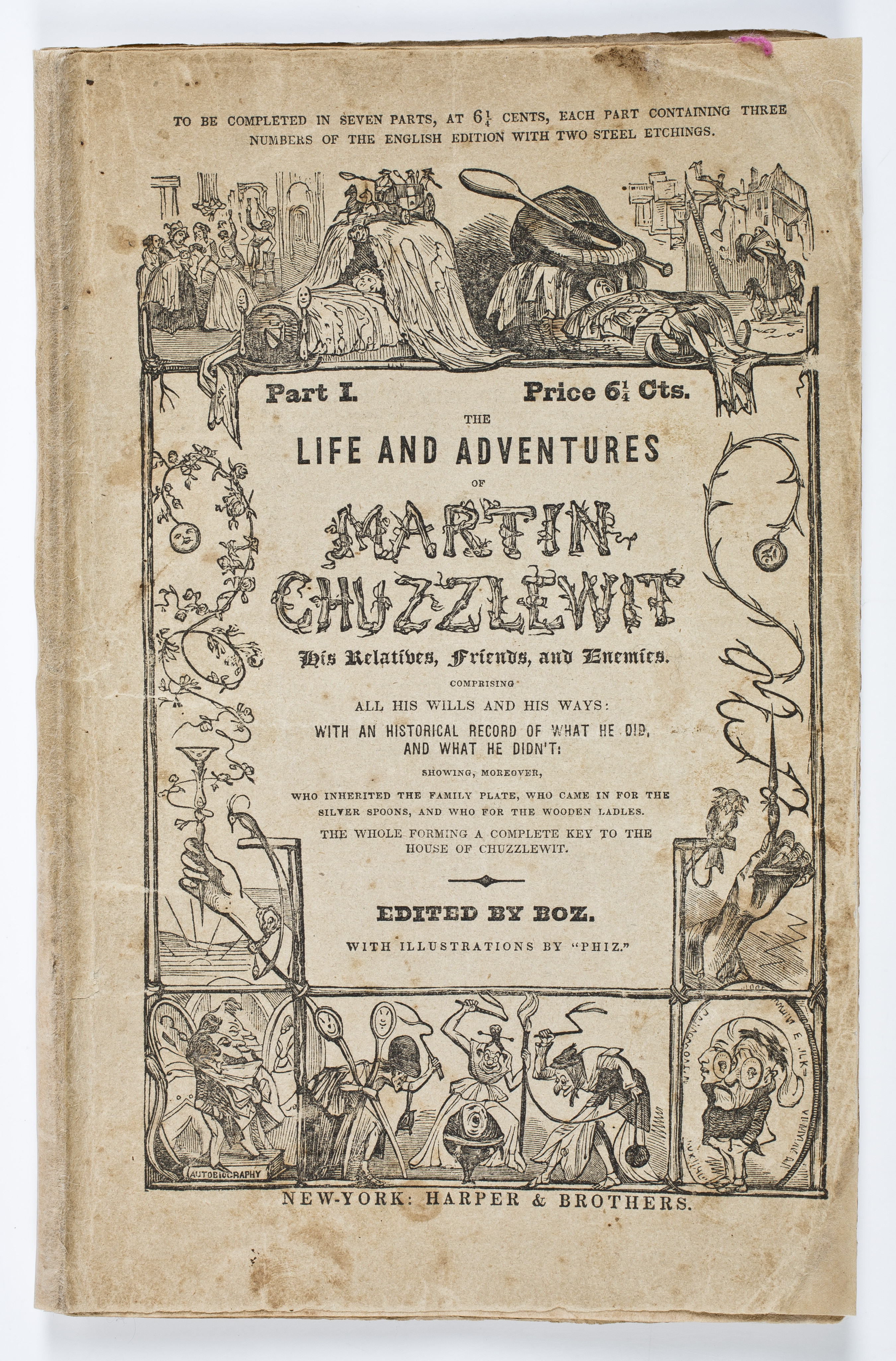 Dickens, Charles. The Life and Adventures of Martin Chuzzlewit. New York: Harper & Brothers, [1844].
The first authorized American edition of Martin Chuzzlewit was issued by Harper & Brothers in seven serial parts, all of which are present here in their wrappers. As such they are exceptionally rare; as the story goes they were hawked on the New York streets by newsboys who crowded into the store just before a part was issued to attend a speech of exhortation by Mr. James Harper. Martin Chuzzlewit is a novel of particular American interest, as in it Dickens satirically presented American characters he had envisioned after his 1842 tour of the United States.
The Girl Behind the Red Cloak
Sloane Perron graduated from Anna Maria College in May and is currently finishing her position as a summer page for AAS. As an English major, the prospect of working hands-on with archives and first editions excited the bookworm inside her. She has greatly enjoyed her experiences at AAS and liked learning more about the collections as well as the behind the scenes aspects of a research library.
Readers will immediately recognize images of a young girl in a red cloak, a wolf dressed in a grandmother’s night dress, and a mysterious forest as being part of the story Little Red Riding Hood. Over the centuries, there have been countless adaptations and retellings of the well-known fairy tale. A quick search of the AAS catalog alone will reveal over a hundred items relating to Little Red Riding Hood. Each new version of the text brings to light different symbols and emphasizes different societal values. While paging in the Children’s Literature Collection at AAS, however, I came across three adaptations of the tale which exemplify just how individualistic and different the stories can be despite the fact that they are all based on the same fairy tale. These contrasts are particularly apparent in the endings of the stories.
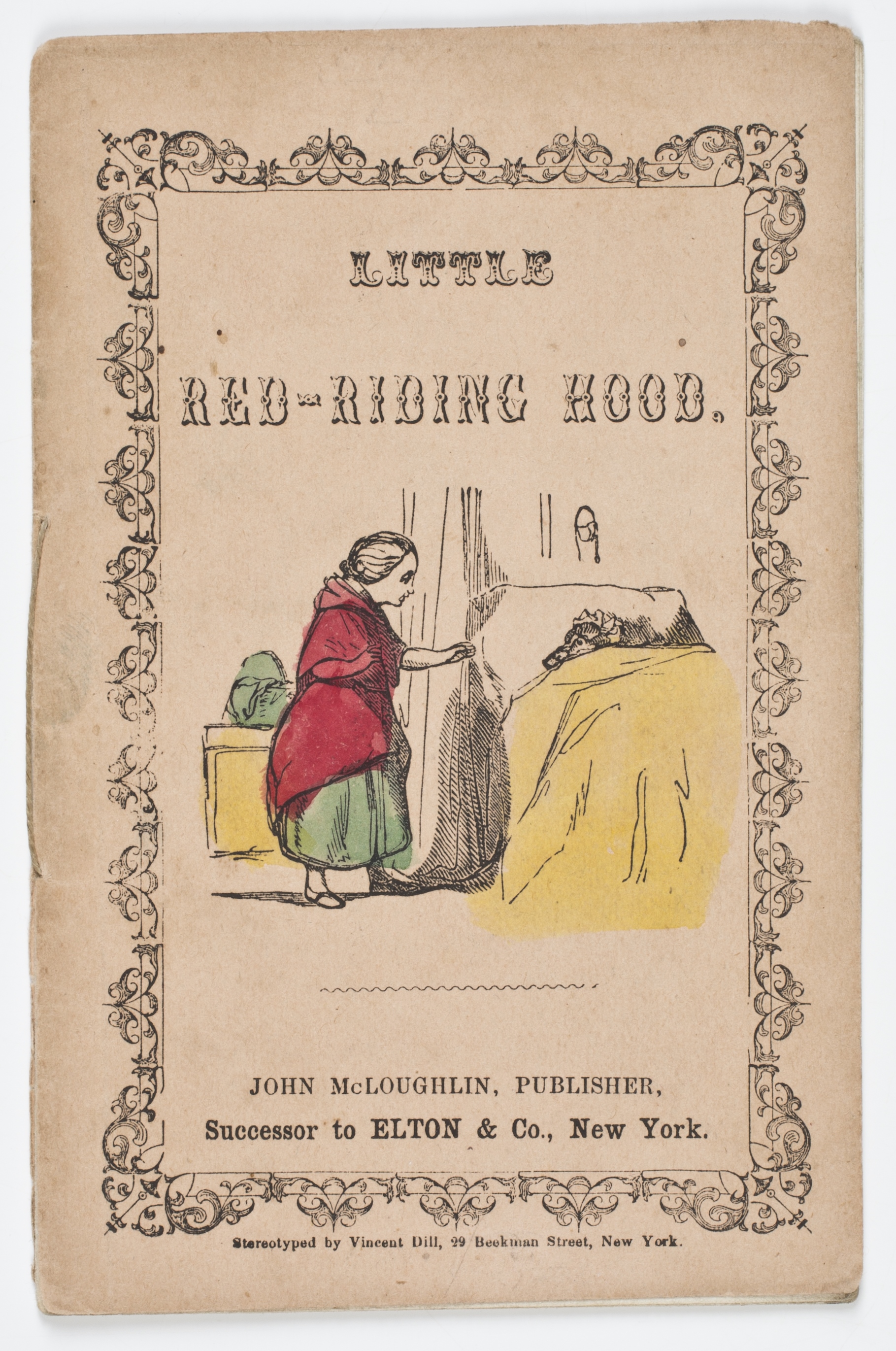
One version of the tale, Little Red-Riding Hood published by John McLoughlin between 1854 and 1858, introduces the new characters of a wasp, a bird, an old woman, and a green huntsman. During her journey to “granddam’s” house, Red Riding Hood comes in contact with new characters and helps them. She saves the wasp, feeds the bird, cares for the old woman, and delivers a message to the huntsman. All of Red Riding Hood’s good deeds have delayed her visit to her grandmother’s where the wolf has already eaten her grandmother and now waits for the little girl. Just as the Wolf is about to eat Little Red Riding Hood, all of the creatures that she helped in the past repay her kindness by saving her life and killing the Wolf. It is later revealed that the old woman is actually a fairy and that the green huntsman is a mystical figure that only appears to those who are worthy. The story reveals that by respecting all of God’s creatures equally, Little Red Riding Hood was worthy of being saved herself.
The sweet and harmonic mood that I found in the first adaptation quickly turned macabre in the second story I read.
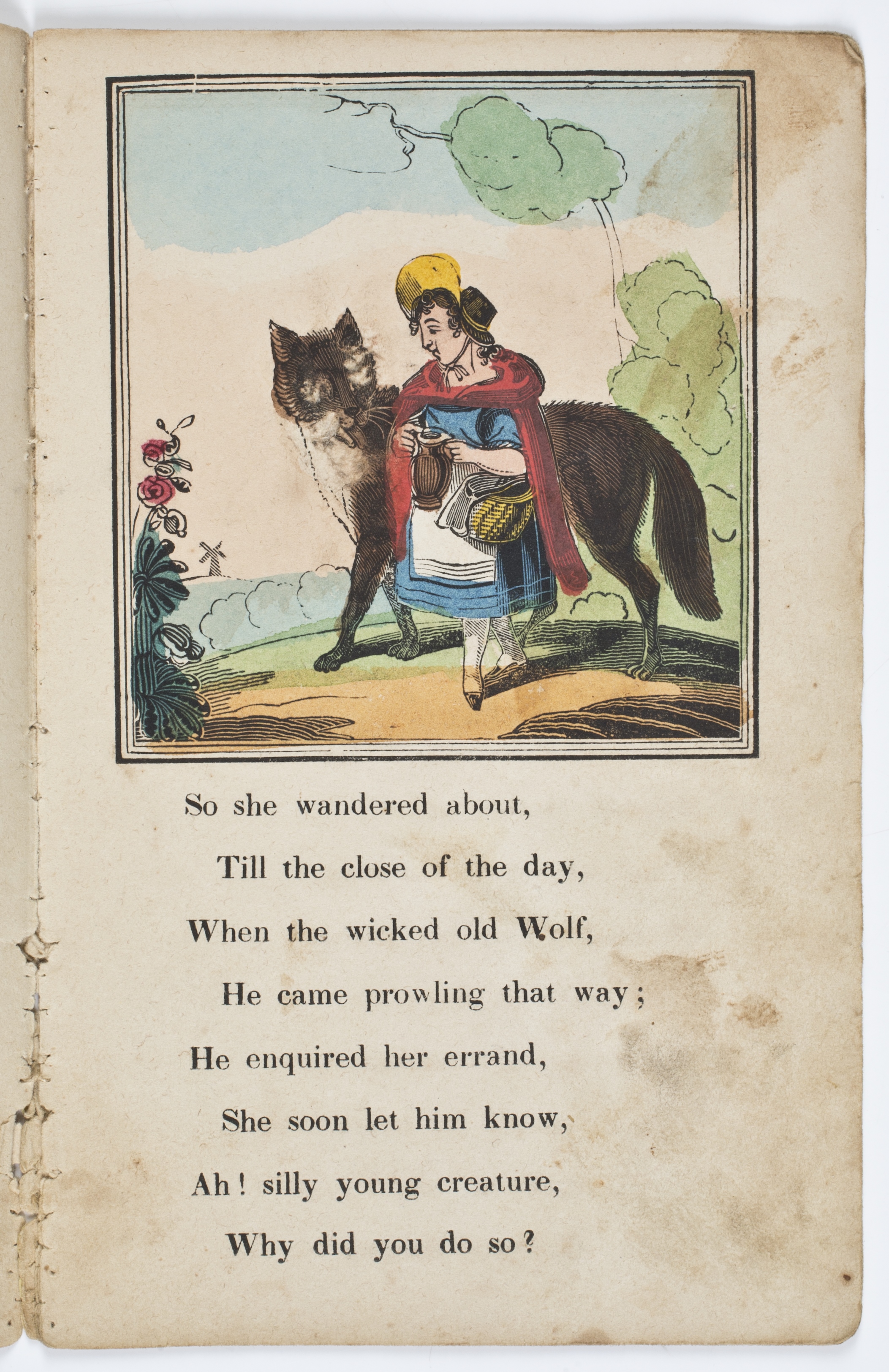
Published by J.L. Marks in London in the second half of the nineteenth century, The History of Little Red Riding Hood starts out as a sing-songy description of Red Riding Hood trekking through the woods on her way to grandma’s house. The trouble begins when she disobeys her mother’s orders not to loiter. Instead the little girl becomes distracted with playing in the woods and picking flowers when she runs into a Wolf. The naïve Red then makes matters worse by telling the creature that she is headed to her grandma’s house. The Wolf beats Red Riding Hood to the house where he eats grandma. Little Red Riding Hood pays the ultimate price for her disobedience when the Wolf gobbles her up as well. (The violence that was described in children’s literature during the 1800s was shocking!)
Last but certainly not least, is an adaptation of the fairy tale known as Little Red Riding Hood, published by Saxton & Kelt between 1845 and 1848. In this story, Red Riding Hood embodies perfection. She is beautiful, loved by all, industrious, creative, and compassionate. Her only flaw seems to be trusting the wolf and saving him. Predictably, the wolf races to the house and eats grandma and then proceeds to eat Little Red Riding Hood.
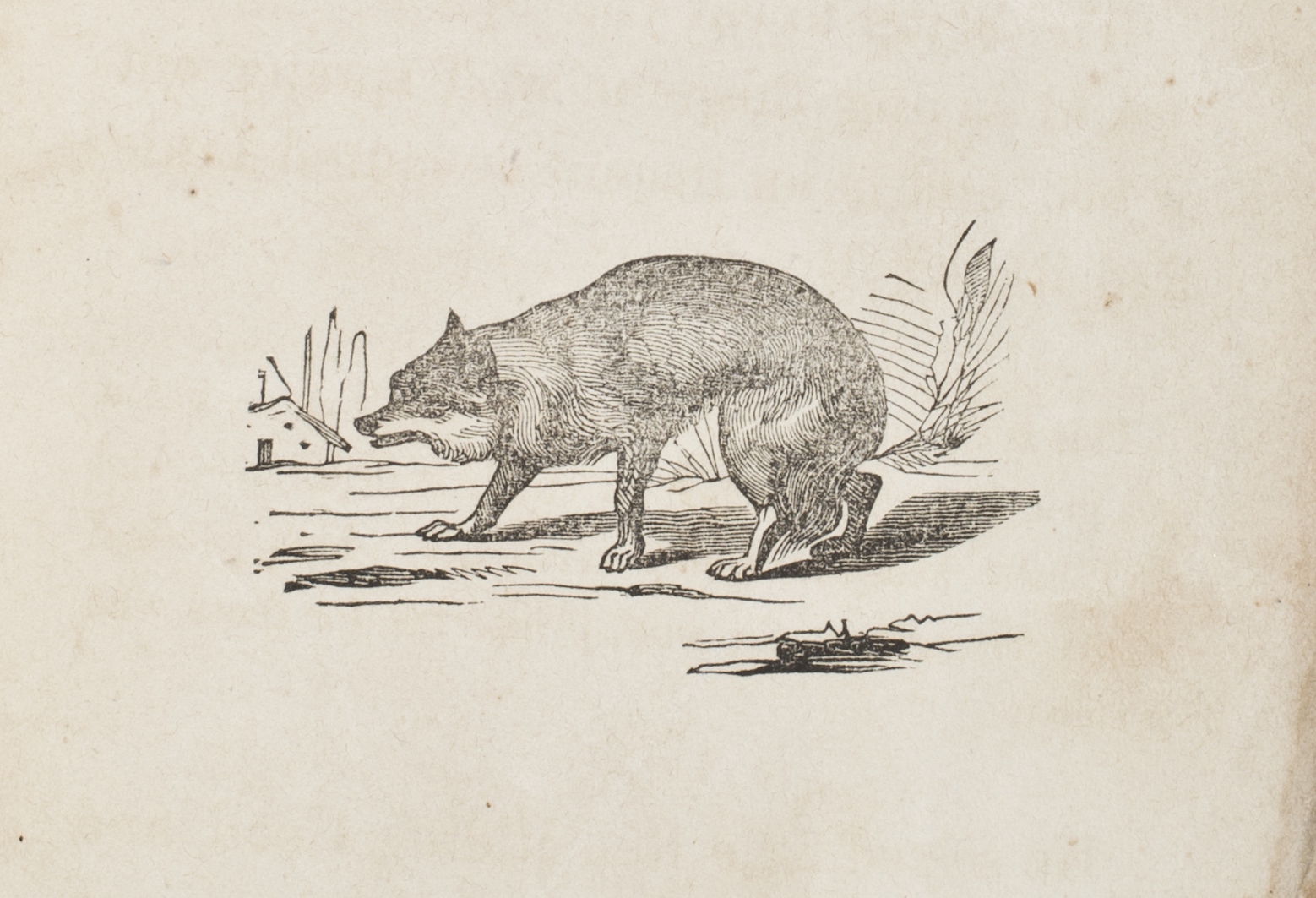
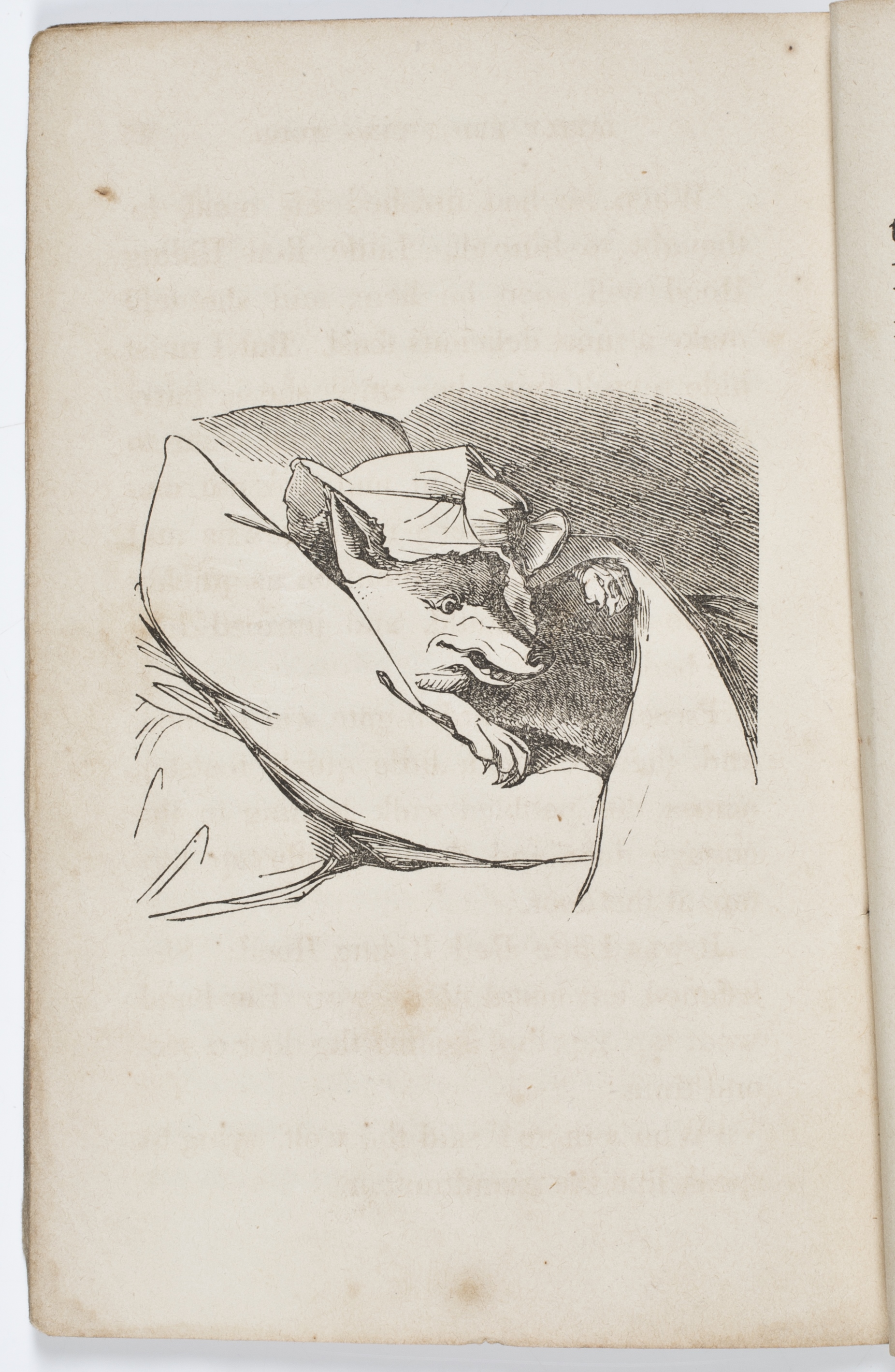 However, my favorite moment occurs when the author hilariously inserts his own “voice” in order to create an alternate ending. Just when the end seems near for Little Red Riding Hood as she is consumed, the author adds, “This is the traditional ending of the Tale – but it is a grievous one, which most children dislike. – And as I heard a version related in which poetical justice is done to the wolf, I insert it for those who prefer it.” Instead of being the wolf’s dinner, this version of the story ends with Red Riding Hood being saved by a group of men working nearby while the wolf is killed.
In all three stories, Little Red Riding Hood is the epitome of stereotypical womanly beauty and virtue. Despite the vastly different ways in which the stories end, the Red Riding Hood tales all begin by describing this fairy-tale character in similar ways. She is used as a symbol to show what little girls should strive to be during this point in history. The stories demonstrate the limited behaviors that were socially acceptable for young girls. As a result, obedience seems central to the plot. The only time that the Red Riding Hood actually ends tragically is in “The History of Little Red Riding Hood” when the little girl blatantly disobeys her mother’s warning. As a consequence of not following the demands of her mother (and by extension the confines of socially acceptable behavior for women), Little Red Riding Hood is eaten by the Wolf.
The warning becomes horrifyingly clear for any child reading this version of the tale. Listen to your mother or bad things will happen! Can you imagine reading this right before bedtime?
Throughout the stories there is also a clear focus on Little Red Riding Hood’s physical features. In each of these three instances, she is referred to as beautiful, but her attractiveness is depicted as wholesome and natural. When I was a child reading fairy-tales, I remember the pictures of Red Riding Hood being sweet, rosy-cheeked girls or glamorous figures traipsing about in the woods. However, in these three particular pamphlets the illustrations were not what I was expecting. Instead of glamorous, the illustrations of Little Red Riding Hood were somewhat plain. Even the usual image of a vivid red cape was changed due to the fact that many of the pictures were black and white. In the version published by Saxton & Kelt, the girl does not even wear a red hood, but rather wears a bonnet in every scene. By making the physical descriptions and scenes realistic rather than larger than life, children reading the story would be able to relate to the character. As a result, they would have been better able to absorb the tales’ underlying lessons.
My interest in Gothic literature and fairy-tales led to my quest for Little Red Riding Hood stories in order to see how the main character evolves. After reading them, I realized that the red cloak may remain a constant image but the actual character of Little Red Riding Hood changes with each story because of societal influences. As a result, the girl behind the red cloak will always remain a mystery because there are so many interpretations of her. But I’ll have fun reading some of the other Little Red Riding Hood stories in the AAS collection as I try to compare endings and embedded lessons in the text. Maybe one day I’ll be able to understand the girl behind the red cloak!
Now In Print from the AAS Community
Every quarter at AAS we release a list of recent publications by those who have researched at
the library as fellows, members, or readers. To see this list, as well as a list of works published
from 2000-2014, please visit our recent scholarship page on the AAS website. If your book, article, or other achievement is not included, just let us know if you’d like to see it there!
BOOKS
Ceccacci, Susan. Living at the City’s Green Edge. Bancroft Heights: A Planned Neighborhood in Worcester, Massachusetts. Cambridge: TidePool Press, 2015. (AAS member)
Child, Deborah. Soldier, Engraver, Forger: Richard Brunton’s Life on the Fringe in America’s New Republic. Boston: New England Historic Genealogical Society, 2015.
McCaskill, Barbara. Love, Liberation, and Escaping Slavery: William and Ellen Craft in Cultural Memory. Athens: University of Georgia Press, 2015.
Malanson, Jeffrey. Addressing America: George Washington’s Farewell and the Making of National Culture, Politics, and Diplomacy, 1796-1852. Kent: Kent State University Press, 2015. (Peterson Fellow, 2009-2010)
Michals, Teresa. Books for Children, Books for Adults: Age and the Novel from Defoe to James. New York: Cambridge University Press, 2014.
Ronson, Jon. So You’ve Been Publicly Shamed. New York: Riverhead Books, 2015.
Thompson, Todd Nathan. National Joker: Abraham Lincoln and the Politics of Satire. Carbondale: Southern Illinois University Press, 2015.
Welburn, Ron. Hartford’s Ann Plato and the Native Borders of Identity. Albany: SUNY Press, 2015.
ARTICLES
Altschuler, Sari. “ ‘Picture it all, Darley’: Race Politics and the Media History of George Lippard’s The Quaker City.” Nineteenth-Century Literature 70.1 (2015): 65-101.(Legacy Fellow, 2011-2012; Hench Post-Dissertation Fellow, 2013-2014)
Coleman, Dawn. “Mahomet’s Gospel and Other Revelations: Discovering Melville’s Hand in The Works of William E. Channing.” Leviathan 17.2 (2015): 74-88. (NeMLA Fellow, 2006-2007)
Crane, Jacob. “Barbary(an) Invasions: The North African Figure in Republican Print Culture.” Early American Literature 50.2 (2015): 331-358. (Schiller Fellow, 2013-2014)
Looby, Christopher. “Lippard in Part(s): Seriality and Secrecy in The Quaker City.” Nineteenth-Century Literature 70.1 (2015): 1-35. (AAS member)
Pender, Patricia. “Constructing a Canonical Colonial Poet: Abram E. Cutter’s Bradstreetiana and the 1867 Works.” Papers of the Bibliographical Society of America 109.2 (2015): 223-246. (Reese Fellow, 2013-2014)
Pritchard, Janet. “More Than Scenery: Yellowstone, an American Love Story.” Fraction Magazine 76 (2015). (Last Fellow, 2008)
Rebhorn, Matthew. “Ontological Drift: Medical Discourse and Racial Embodiment in Robert Montgomery Bird’s Sheppard Lee.” ESQ 61.2 (2015): 262-296.
Reynolds, David S. “Deformance, Performativity, Posthumanism: The Subversive Style and Radical Politics of George Lippard’s The Quaker City.” Nineteenth-Century Literature 70.1 (2015): 36-64. (AAS member; AAS-NEH Fellow, 1982-1983)
Roy, Michaël. “Cheap Editions, Little Books, and Handsome Duodecimos: A Book History Approach to Antebellum Slave Narratives.” MELUS: Multi-Ethnic Literature of the United States 40.3 (2015): 69-93. (d’Héricourt Fellow, 2013-2014)
Winship, Michael B. “In Search of Monk Hall: A Publishing History of George Lippard’s The Quaker City.” Nineteenth-Century Literature 70.1 (2015): 132-149. (AAS member; Peterson Fellow, 1989-1990; AAS-NEH Fellow, 1993-1994; AAS-NEH Fellow, 2009-2010)
Wirzbicki, Peter. “ ‘The light of knowledge follows the impulse of revolutions’: Prince Saunders, Baron de Vastey and the Haitian Influence on Antebellum Black Ideas of Elevation and Education.” Slavery and Abolition 36.2 (2015): 275-297. (Packer Fellow, 2014-2015)
1775 Breaking News: The First Published Map of the Revolutionary War
Guest author Allison K. Lange is an assistant professor of history at the Wentworth Institute of Technology, was an AAS AHPCS Fellow in 2011-2012, and helped curate the Leventhal Map Center’s “We Are One” exhibition. Lange received her PhD in American history from Brandeis University. Currently she is completing a manuscript on the visual culture of the woman’s rights and woman suffrage movements in the United States. Her work has appeared in Imprint and The Atlantic. She also works with the National Women’s History Museum. Learn more about her research at allisonklange.com.
We see wars unfold on live video alongside satellite maps, but our eighteenth-century counterparts had to wait. Maps had to be drawn, engraved, and printed before they were sold to those who could afford them. The American Antiquarian Society houses the first battle map of the Revolutionary War, which gives us a glimpse into the way people learned about the war from afar. I. De Costa’s A Plan of the Town and Harbour of Boston depicts the battles of Lexington and Concord on April 19, 1775. De Costa’s map is the only one to feature the marches of the British forces and battle sites.
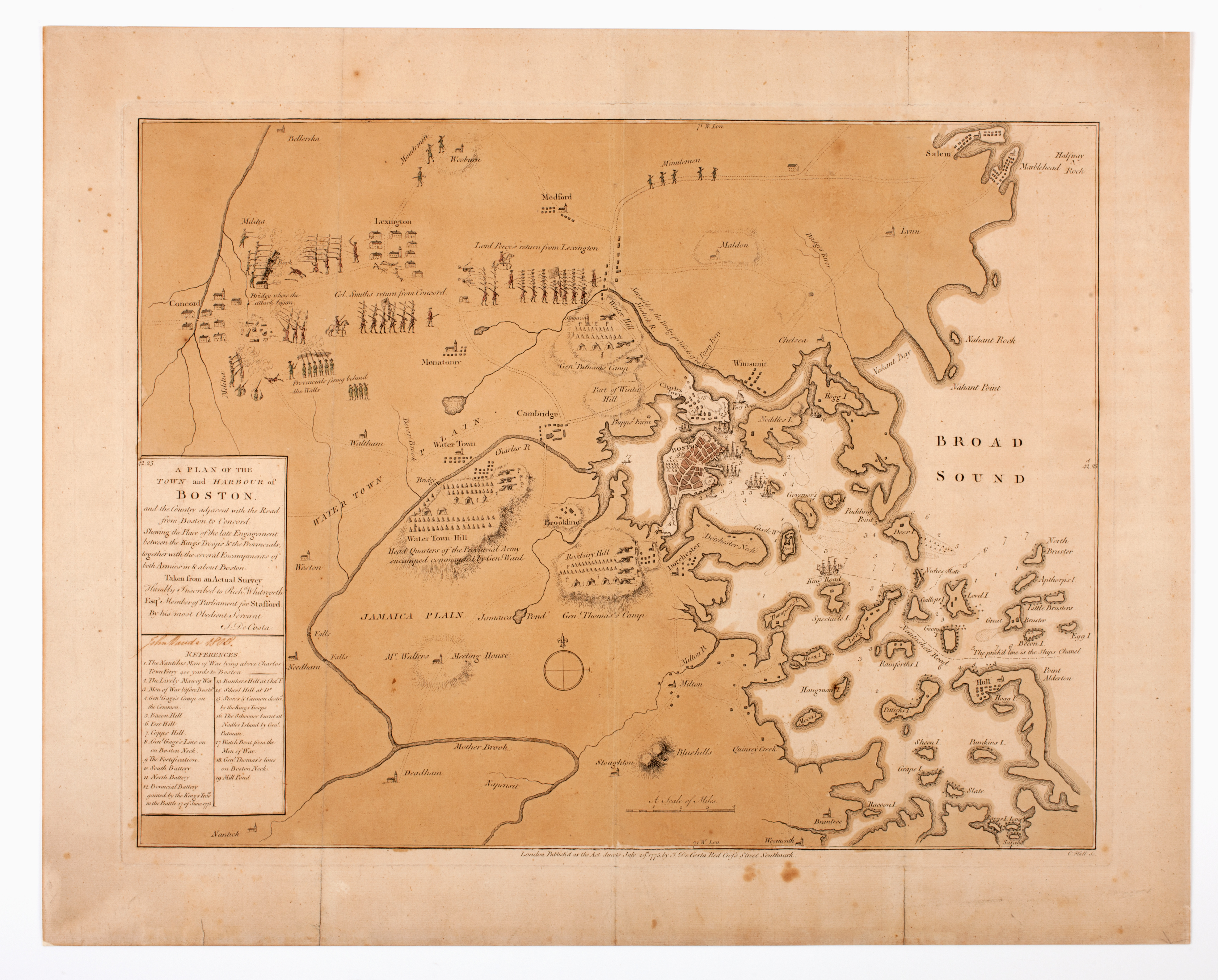
“A Plan of the Town and Harbour of Boston, and the Country Adjacent with the Road from Boston to Concord Shewing the Place of the Late Engagement between the King’s Troops & the Provincials.”
London, 1775. Engraving, hand colored 15 x 19.5 inches, on sheet 19 x 23.5 inches.
American Antiquarian Society.
A Plan of the Town and Harbour of Boston was published in London on July 29, 1775, three months after the battles. Little is known about the mapmaker. He may have witnessed the skirmishes and sent his manuscript across the Atlantic to London engraver C. Hall. Or, De Costa could have drawn the original map in London using information from the battle and an existing survey of the area. He dedicated his plan to Richard Whitworth, a Member of Parliament from 1768 to 1780, who was likely his patron.
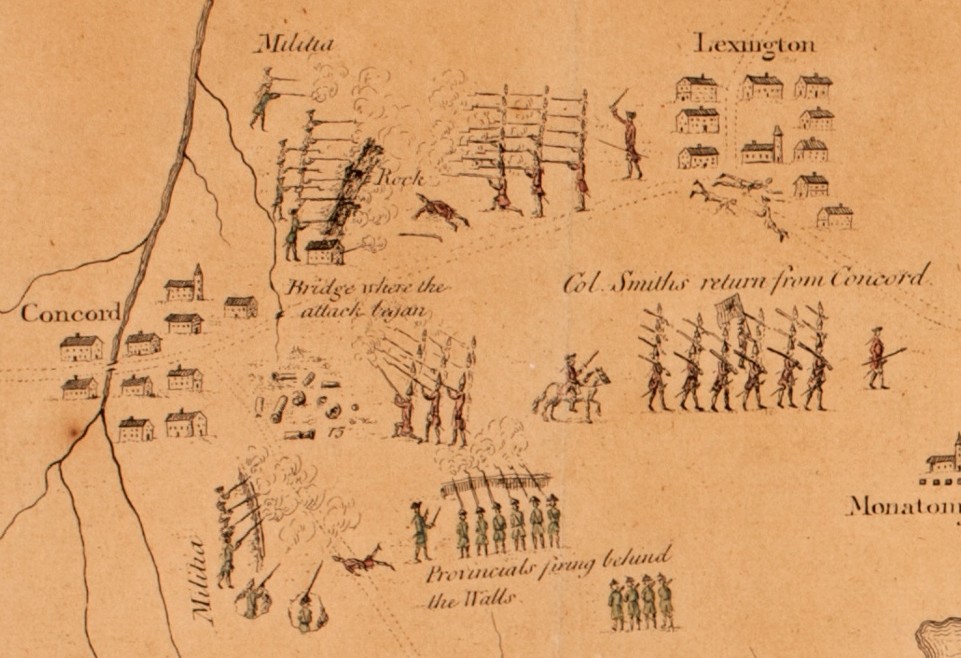
Unlike most of the era’s battle maps, De Costa’s is a pictorial map. He illustrated the progression of troops using human figures rather than rectilinear blocks. Small groups of soldiers represent the British troops’ march to Concord and back. They fire at their opponents, and the wounded figures fall to the ground. De Costa represented encampments with tents and cannons and showed specific British ships, labeled in his key, in the Boston harbor.
De Costa’s pictorial map was unusual, but not unprecedented. In 1756, Massachusetts mapmaker Samuel Blodget created a pictorial map of a battle in the French and Indian War entitled A Prospective View of the Battle Fought near Lake George. The left section situates Lake George on the Lake Champlain corridor, while the other two show the battle’s progression. The numbers correspond to an accompanying pamphlet with detailed explanations for each point of interest.
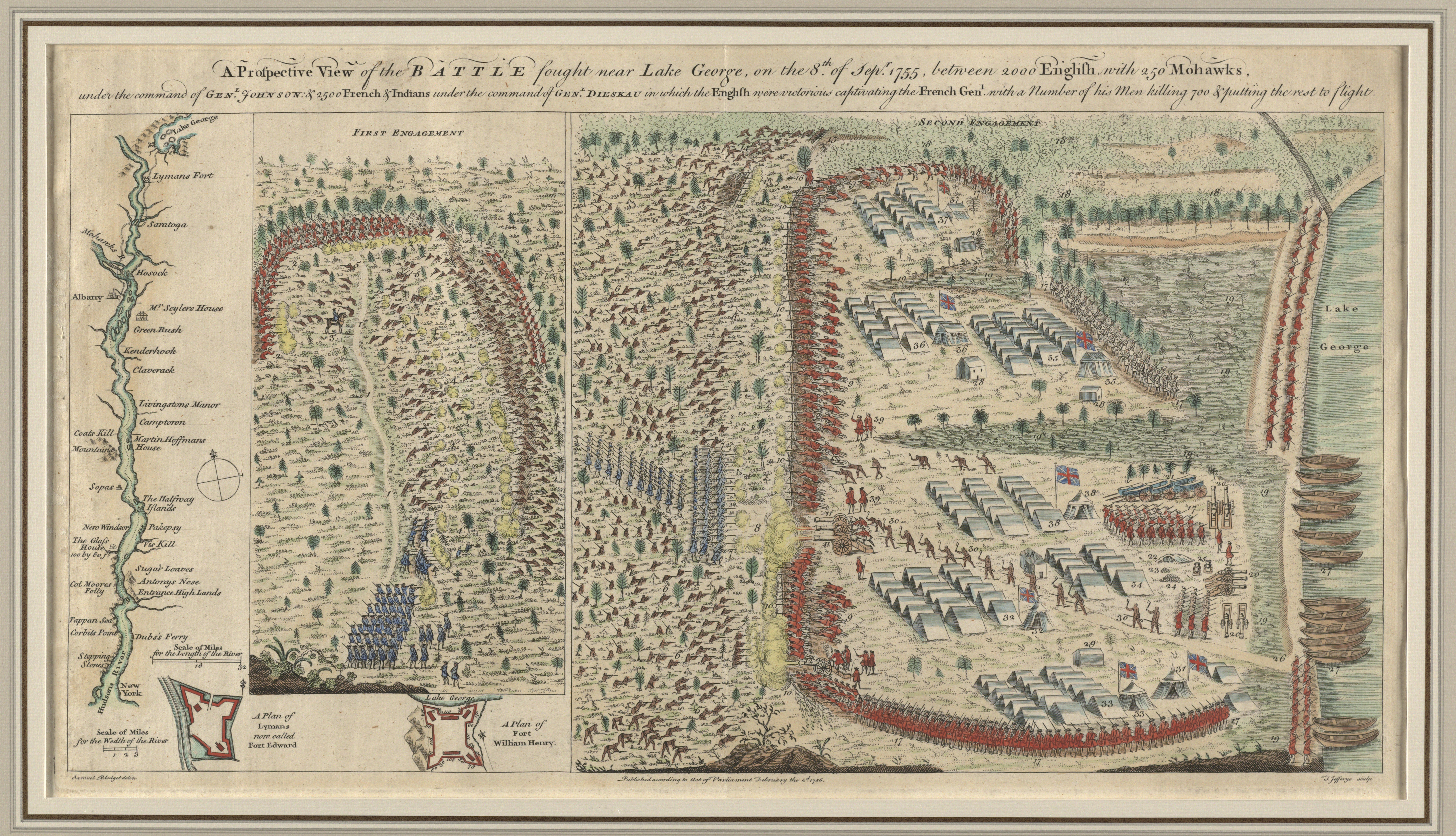
“A Prospective View of the Battle Fought near Lake George.”
London, 1756. Engraving, hand colored, 10.5 x 20.5 inches.
Courtesy of Richard H. Brown.

“A Plan of the Action at Bunkers Hill, on the 17th of June 1775.”
London, 1778. Engraving, hand colored, 19.75 x 17.25 inches.
Norman B. Leventhal Map Center.
These pictorial maps differ from battle maps like this 1778 map of the Battle of Bunker Hill. Thomas Hyde Page used thin rectilinear blocks to represent troops and lines to show their movement. In De Costa’s map, everything occurs at the same time: the British troops march west, fire, and return to Boston. Page, in contrast, conveyed time’s passage by adding a leaf that can be lifted to show later troop positions.
De Costa’s map offered Londoners the earliest glimpse of the rebellion across the Atlantic. A map like this would have helped politicians, like Richard Whitworth, and military strategists make better understanding of the uprising in the colonies.
You can see the American Antiquarian Society’s copy of De Costa’s map on display in the Norman B. Leventhal Map Center’s exhibition at the Boston Public Library. The exhibition, We Are One: Mapping America’s Road from Revolution to Independence, uses maps to explore the tumultuous events that led thirteen colonies to forge a new nation. We Are One demonstrates that maps, from De Costa’s plan to early maps of the new nation, were central to the revolutionary process. The exhibition features maps as well as prints, paintings, and objects from the Leventhal Map Center’s own collection and those of twenty partners, including the British Library and Library of Congress. Visit zoominginonhistory.com to explore geo-referenced maps from the exhibition.
The exhibition will be on display at the Boston Public Library through November 29, 2015. We Are One then travels to Colonial Williamsburg from February 2016 through January 2017 and to the New-York Historical Society from November 2017 through March 2018.
The Leventhal Map Center also hosts the NEH-funded American Revolution Portal database. Researchers can access maps from the American Antiquarian Society, British Library, Library of Congress, and other institutions in one search. Users can download images for research and classroom use.
Access these resources and learn more about We Are One at http://maps.bpl.org/WeAreOne.