Santa Claus Exposed

AAS’s The Children’s Friend: A New Year’s Present is one of just two known copies of the 1821 pamphlet.  Fifteen centimeters tall and eight pages deep, the paper-covered volume stood little chance of survival in the hands of generations of American children. But there was one family fastidious enough for the task, and by chance they would be among AAS’s most important benefactors.

The Salisbury family provided AAS, notably, with two of its presidents, 67 boxes and an additional 100 bound volumes in manuscript materials, and the land for the library’s current home. In 1897 the Society also received the childhood book of  one of those presidents, Stephen Salisbury III. Six-year old Stephen received The Children’s Friend in 1841 as a gift from Kitty Lawrence.

What makes this little book so important?  Put simply it is believed to be the first American Christmas picture book. But we asked Laura Wasowicz, Curator of Children’s Literature, and Gigi Barnhill, Director of CHAViC for a few more details.

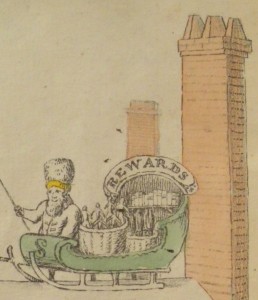
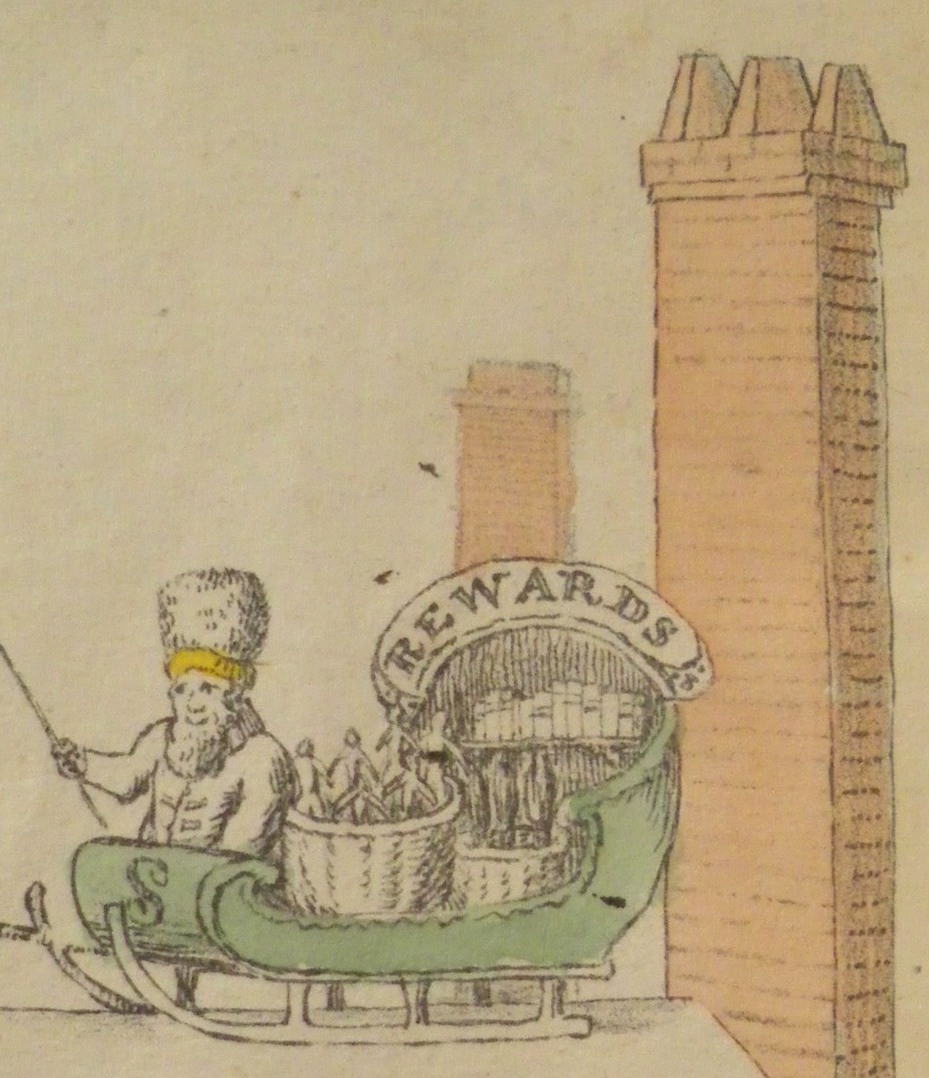
  • chimneys~The publishing location, New York City, is important. The brick chimneys visible as “Old Santeclaus” lands his sleigh indicate an urban environment.
  • ~The pamphlet falls within a set of attempts by well-to-do New Yorkers to domesticize the holiday from a time for rowdy alcohol-infused parties and mob revelry to a safe, family-focused holiday. The Children’s Friend joined efforts by New York Historical Society founder John Pintard and Clement Clarke Moore (author of the poem “A Visit from St. Nicholas” first published in 1823).*
  • ~The story offers the first visit by St. Nicholas on Christmas Eve (instead of his Saint’s day December 6th), as well as the first appearance of his reindeer.
  • ~While the “long, black birchen rod” left for parents with naughty sons might seem a harsh ending to modern readers, it was in keeping with the parlance of the day. In a time when a children’s book might conclude with a child burned to death for playing too close to the fire, The Children’s Friend is in fact a gentle cautionary tale.
  • family~The Children’s Friend is considered the first American example of a completely lithographed book.  Lithography (the practice of drawing on limestone with waxy crayons to create a master image that absorbed ink) was introduced in the United States in the early 1800s.
  • ~Unlike engraving, lithography did not require the same high level of skill to execute and could make up to 100,000 impressions with one stone.  But the technology did require special equipment and a specific type of printing press.
  • ~Barnet and Doolittle, the firm that likely lithographed the pamphlet, was the first commercial lithographic printing shop to be established in the U.S.
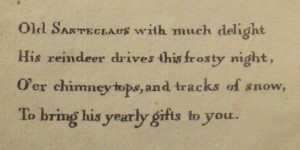
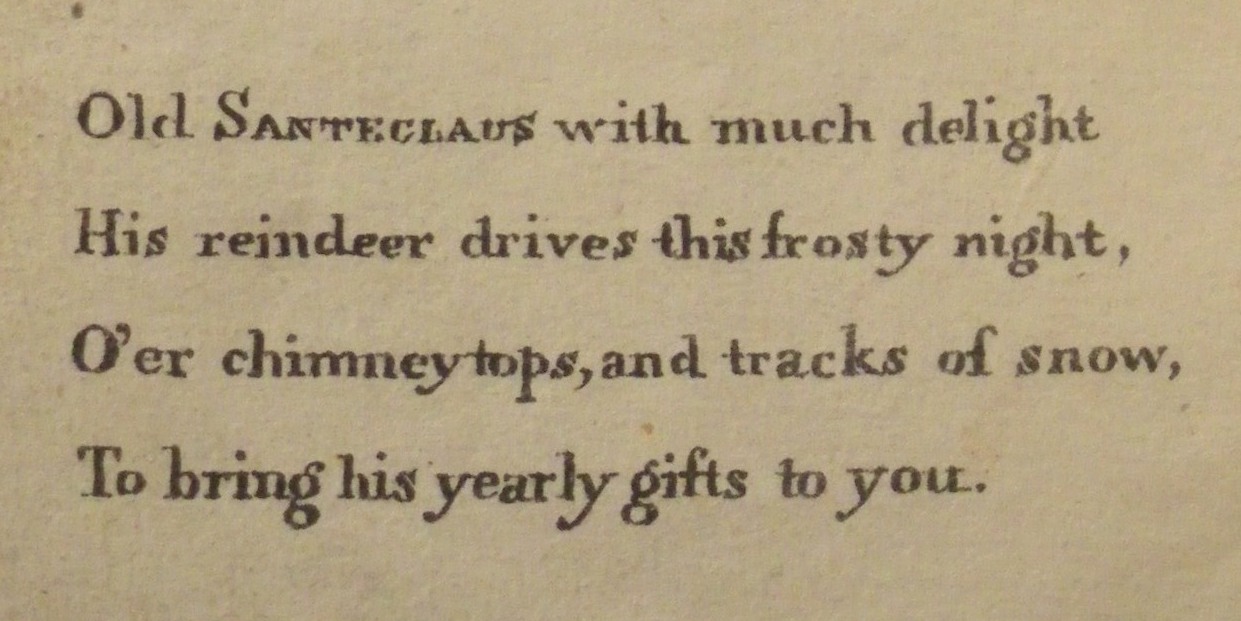
  • santeclaus_text~The publishers used lithography as an inexpensive alternative to engraving and avoided the expense of multiple presses by lithographing both illustration and text (you can see that the text looks handwritten).
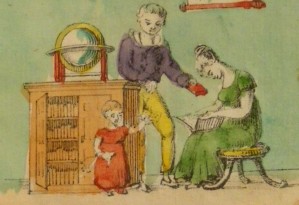
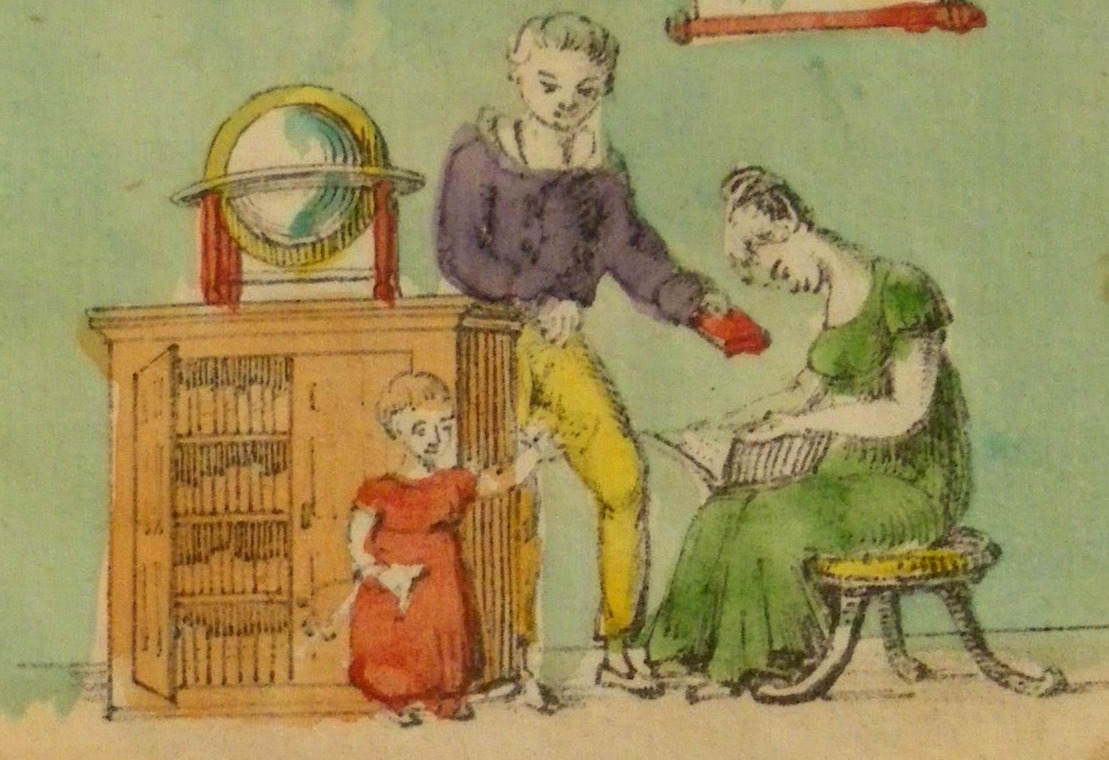
  • ~The color, added by hand after printing, suggests the pamphlet was expensive to buy.

*Historian Stephen Nissenbaum discusses The Children’s Friend and explores the transition to a family-oriented holiday in The Battle for Christmas (New York, 1996). Nissenbaum did much of his research at AAS  as a long-term fellow.

The Acquisitions Table

In 1834, AAS librarian Christopher Columbus Baldwin wrote: “Some philosopher has said that his unhappiest moments were those spent in settling his tavern bills.  But the happiest moments of my life are those employed in opening packages of books presented to the Library of the American Antiquarian Society.  It gives me real, substantial, and unadulterated comfort.   It is then that like glorious Tam O Shanter, I am ‘O’er the ills of life victorious.’”

I can report that 175 years later the source of Baldwin’s joy continues to give “real, substantial, and unadulterated comfort” to those of us who are fortunate enough to see what arrives daily for the AAS library.

The Acquisitions Table

The acquisitions department staff (Peg Lesinski, Sarah Barnard and Anne Hendrickson) and the curators (Vince Golden, Lauren Hewes, Laura Wasowicz, David Whitesell and myself) are all involved in various aspects of acquiring and processing material for the collections. We order from dealers via catalogs and quotes, we purchase at auction (including many items from eBay), and we receive gifts, sometimes unsolicited (more on that below) and sometimes after much work with potential donors.

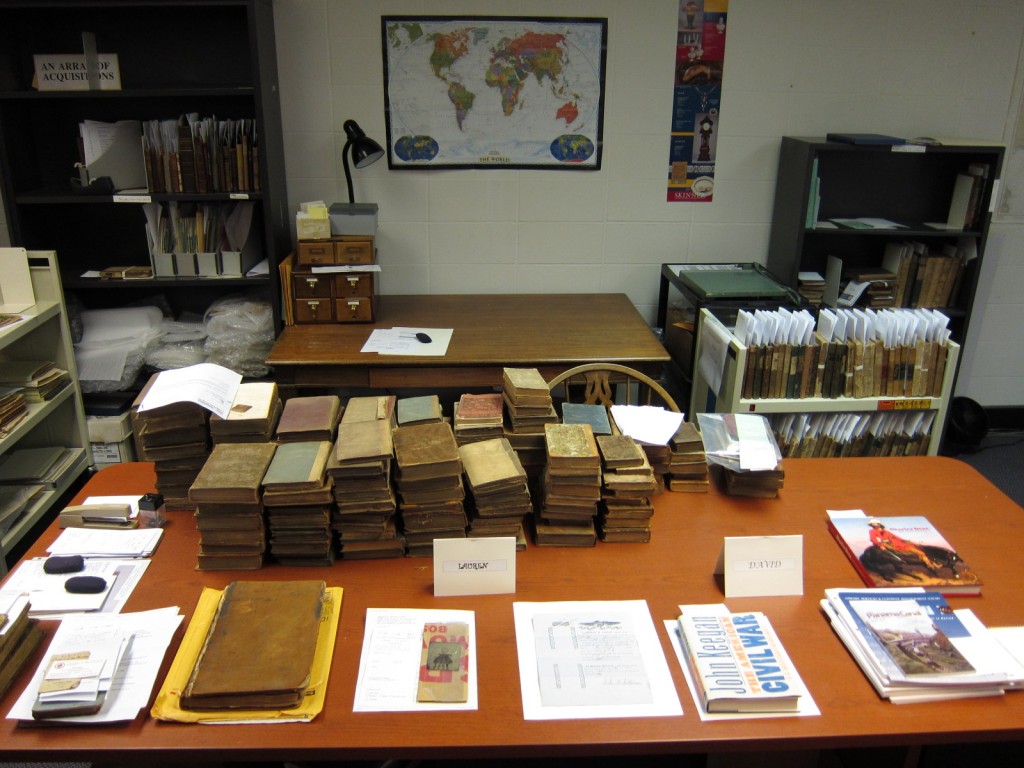
On arrival all of these things land on the acquisitions table.  It is an unassuming table, three and a half by eight feet. It is located in the acquisitions department, and it is on this table that each day’s arriving mail is first sorted, and packages from the post office and other carriers are brought to be opened.  Frequently, its twenty-eight square feet aren’t sufficient to hold our newly received booty and it is a continuing challenge to the acquisitions department staff to keep up with new acquisitions and send them along for eventual cataloging, shelving, and use by readers.

IMG_0103

The accompanying photograph shows the table as it was at 1:30 p.m. on Thursday, December 10.  The piles of books in the background are 149 volumes just given to us by a university library.  These are odd volumes, many of them parts of incomplete sets.  It will be our job to check each volume against our holdings, and with luck we will add a number of things we don’t have, fill in gaps in broken sets, or identify variant bindings or copies in better condition than the ones we currently have.  But before we do anything else, we need to vacuum them because they’re very dusty!

To the left of the front row is the manuscript account book of a gin distiller in Enfield, Massachusetts in the 1820s.  Enfield no longer exists. It was one of the “Quabbin Towns” flooded in the late 1930s during the construction of the Quabbin Reservoir.  Moving right we see a small tintype showing a rather cross looking baby girl; a partly printed 1859 certificate stating that an African American sailor named Aldridge Sanders is an American citizen; John Keegan’s new military history of the Civil War, and some recently received U.S. government documents (we are a depository library, in fact the first one to be so designated by Congress—in 1814).

Although much comes in, there is still plenty for us to seek out and acquire.  We are omnivorous in our appetite for material printed in the United States before 1877—if we don’t already have it, we want it, and even if we do have it, we might want another copy if it is slightly different or in better condition than the one we have.  We also add secondary materials to the collections to support research here.

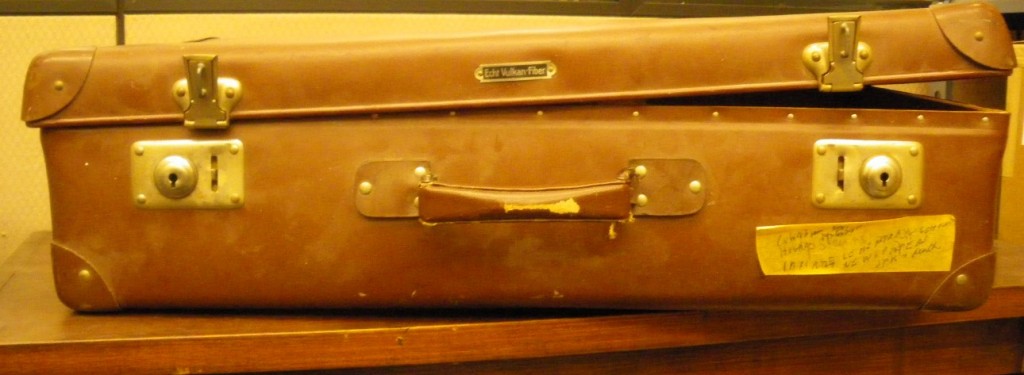
Once in a while a gift arrives that we can’t really use, such as the suitcase that we found on our doorstep early one morning a few months ago. There was no name or note with it, and on opening it we found that it contained newspapers with stories about the JFK assassination and the first Moon landing.  We’ll try to find a good home at another institution for the newspapers, although I’m less sanguine about the future of the suitcase.

suitcase_2

Since you, dear reader, do not have the opportunity we do to stop by acquisitions and see what’s on the table today, we want to offer you a chance to experience some of the excitement we feel about newly acquired items.  Every week or so Past is Present will highlight a recent arrival.  Our curators will explain why each one is interesting and why we want it for our collections.  I hope you will find these items as wonderful, interesting, and sometimes quirky as we do.

Christmas Treasures: Flip through the pages of The Children’s Friend

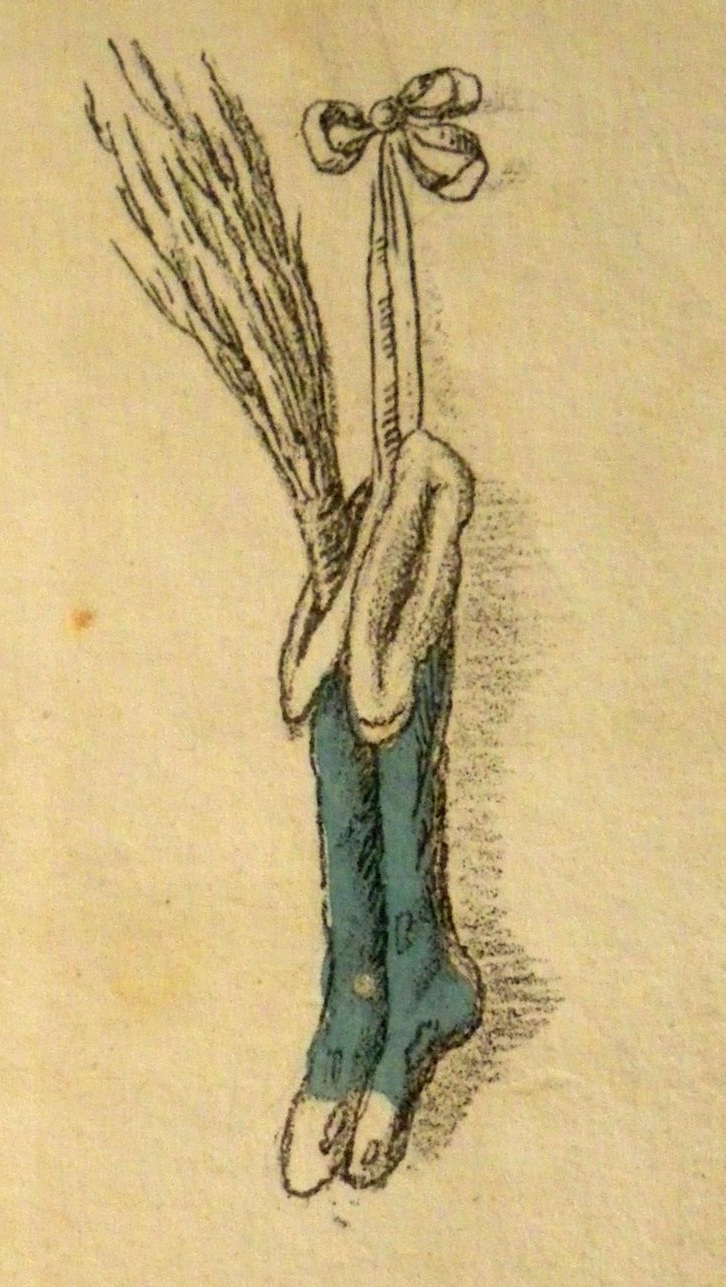
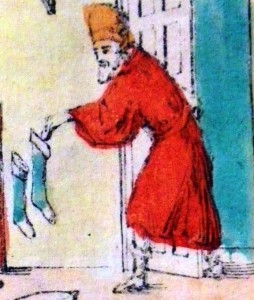
childrens_friend_stocking_croppedIt’s that time of year. Time to take ornaments out of boxes, shake the dust from stockings, and hang wreaths on front doors.  The holiday season is no different at AAS. santaDecember is the one month when it’s appropriate to pull out all of our wonderful Christmas treasures– after all who wants to see Santa Claus in July?  We hope you will enjoy (or bear with us) as we share these seasonal gifts from our collections.

And we’re starting big with the 1821 Children’s Friend. Curator of children’s literature, Laura Wasowicz, gives this little softcover book a heartfelt endorsement, “I never get tired of looking at it.” Read it now and check back with us next Monday for a behind-the-pages discussion with our curators.

N.B.: Clicking on the corner of any page below will turn the page, and double-clicking on one of the amazing illustrations will zoom in for a more detailed view. Hope you enjoy this treasure as much as we have!
[book id=’9? /]

You say “Shah-vick,” I say “Chay-vick”: An Introduction to the Center for Historic American Visual Culture

Inadvertently, three graduate students were responsible for the creation of the Center for Historic American Visual Culture (CHAVic). Two appeared at AAS asking if we had 18th century prints or lithographs of wedding ceremonies.  Another spoke of the struggle to convince her dissertation committee that a history thesis could focus successfully on stereographs.  Between the printed word relied on by historians and the fine art prized by art historians lies a world of visual culture often misunderstood or overlooked in the study of America’s past.

heavenly_nine_croppedEstablished in 2005 by the AAS Council, CHAViC’s mission is to provide opportunities for educators to learn about American visual culture and resources, promote the awareness of AAS collections, and stimulate research and intellectual inquiry into American visual materials. The Center received major funding in the spring of 2008 that has enabled AAS to undertake some great initiatives.  To see the full panoply of activities from the first teacher workshop held in 2006 to the most recent conference held in October, visit the newest AAS website:  http://www.chavic.org.

For readers of this blog, perhaps the most visible aspect of CHAViC is the enhancement of access to collections previously available only in Antiquarian Hall.  Even within the library, many of the collections lacked finding aids and were accessible only on the suggestion of the curator of graphic arts or readers’ services staff. Now that AAS has staff to catalog separately published prints and to produce inventories, the situation has changed dramatically.  Searching on the phrase “American Art Union” in the online catalog for example, will bring up over 30 detailed catalog records for the prints in the collection.  In due course, images will be linked to these records.  There are also records of 385 gift book illustrations!  In the past three months over 650 engravings have been carefully described with funds from the National Endowment for the Humanities.

The most recent collection inventory to be created is European Political Prints.  There are now fully illustrated inventories of:

drawings_box9_folder14Photograph Portraits of Native Americans

-Cased Photographs (Daguerreotypes, Ambrotypes, and Tintypes),

-the David Claypoole Johnston Collection

Hawaiian Engravings

Drawings

Portrait Paintings and Miniatures

Photographs of Seventeenth- and Eighteenth-Century Structures in Massachusetts taken by Harriette Merrifield Forbes.

Surf the AAS Collections Page for other tantalizing graphic arts collections!

For interpretative projects focusing on AAS collections, check out the online exhibitions portion of the CHAViC website.  AAS archives all of its exhibitions.

I hope you will enjoy the new CHAViC website and that we will hear from you if you have questions or want to submit proposals for conferences or fellowships.

Georgia Barnhill, Director

Center for Historic American Visual Culture

Gbarnhill (at) mwa.org

The Answer, or what to do when Google doesn’t give it up easily

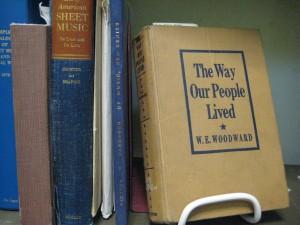
Ding, ding, ding… We have a winner! Our exercise in crowd-sourcing research questions was a success, and all the antiquarian glory goes to peterme for solving the reference mystery posed in our earlier post. The correct book our reader was looking for was (drum-roll please) “The Way Our People Lived: an Intimate American History,” by W.E. Woodward. wayourpeoplelivedThank you to all who participated. You came up with great suggestions for further reading which I will forward to the reader who posed the question.

Personally, I was able to identify our mystery book through a Google Book search (so I knew I wasn’t sending you all on a wild goose chase), but trust me, the search was not an easy one! No matter what they say about online access, it still requires a lot of work to figure out the right questions to ask. If you’re sick of the Google bashing or if you think Google marks the end of civilized scholarly research (since we all know those are the only two options), then you may enjoy a recent exchange on the SHARP (Society for the History of Authorship and Publishing) listserv titled: “Do you use google books?“. You’ll find some great comments from scholars trained to think about book history and reading technology in intelligent ways.

Our new honorary antiquarian, peterme, describes his research process in his comments, but to give you the highlights: “in terms of finding it, Google was useless.” He went straight to his library’s catalog (yeah!) and was able to find the correct title. Check out our posts on “Anatomy of a Cataloging Record” or “The Embezzler Redeemed, Part I, Part II, or Part III” to see just how much behind-the-scenes work it takes from our catalogers to make the right titles show up in your searches. After peterme found what he thought was the right title, he continues: “I then googled that title, and found it was in the internet archive. I then searched the book to find that passage” i.e., the quote about the drinking babies. In case you want to check it out for yourself it’s on p. 40: “Babies were given beer and cider as soon as they were old enough to toddle.” So Google played an axillary role in his search strategy.

My own solution began with Google, starting with an “Advanced Book Search,” a feature I was unaware even existed until I was forced to resort to it in this desperate search. In the title line I put in the keywords “American” AND “Lived” (after playing around with a few different variations). I also set the date limit to between 1940 and 1990, assuming that while it certainly had to be published before our reader found it in the bookstore, it may have been older than he thought or have been republished. Turns out the book was originally published in 1944, which certainly threw me off a bit and perhaps some of you too, but it was republished just about every decade so our reader probably found a later republication in that bookshop in the 1980s.

no_cover_thumbThe right title showed up, but I got that frustrating blank book cover Google teases you with when it has “no preview available.” (Although, you’ll notice Internet Archive does does have the full text available.) Fortunately, there was a link from JSTOR to a review in The American Historical Review (Oct. 1944), which summed up the book thus: “All in all, the book is a potpourri of every variety of odds and ends of information gleaned along American folkways” (p. 145). Everything was sounding good, so with my heart in my throat I checked AAS’s catalog, discovered we had a copy, and when I pulled it from our stacks my heart was strangely warmed to discover I had the right book in my hands! I confirmed this with our reader and he is happily searching out a used copy of his own.

All this research talk leads me to ask a slightly twisted version of the question from the SHARP list-serv: “How do you use google books?” Please reply with your own research tricks and go-to alternative research sites (Internet Archive is one of our favorites), horror stories and triumphs. If you’ve solved a similar research mystery of your own, how did you do it? Let’s make “crowd-researching” the next hot trend.

Please join me in congratulating peterme for his perspicacity, and if anyone wants to give him a run for his money, maybe you can help me find a book another reader asked about that’s way beyond our scope at AAS? The clues I’ve been given are that it’s called “The Emperor” and it’s about how Japanese emperors are raised from early childhood. Happy hunting!

The Question: See if YOU can solve this reference mystery

I was in a bookstore in the ’80s and started reading a book about Puritans feeding their babies ale but now I can’t remember the title. Can you help me find the book?

bookquestionThis is the kind of question we live for at AAS: the test that can make or break you as a professional. Succeed and you will glow with a satisfaction almost akin to discovering gold at the end of a treasure hunt. Fail and it will haunt you for years to come. You may find yourself wandering the aisles of bookshops and libraries muttering about “Puritans,” “babies,” and “ale,” which believe you me will attract some strange sideways glances from the other patrons.

The Rules:
How would you discover the answer to this question? We hope you will share with us your research strategies, tips for searching online resources like Google, and the results you come up with. There is a right answer and I will post it next week, hopefully after we’ve heard some of your suggestions. Basically, this post is an exercise in crowd-sourcing and if it works we may have to begin outsourcing some of our toughest questions to you all. In fact, I already have one lined up which I wasn’t able to figure out. Can a group solve a mystery like this faster than an individual? Let’s find out…

The Clues:
1. The title was something like “How We Lived” or “How Americans Lived.”

2. It was a social history of America from the Puritans into the early 20th century and included something about taverns and the common substitution of ale among Early Americans for often-contaminated water. The book described the practice of weaning Puritan babies with ale (I guess to ease the let-down).

3. The book was spotted in the ’80s (the 1980s, I should clarify) and our questioner thought it had been recently published.

The Attempts:
Like any good researcher, my first instinct was to run right to the welcoming arms of that search-engine-to-the-stars: Google. After all, why do all the work if the milk (or in this case perhaps the ale) is free? However, when an initial search of Google didn’t yield easy success, I dug my heels in for a tougher fight. No matter what they say about online access making this generation lazy and less skilled researchers, it still requires a lot of work to figure out the right questions to ask of all these amazing resources. When I was still unable to find anything, I passed the buck to Diann who also struck out. Diann sent around an ALL-STAFF email asking if any other AAS staff members could help. We received some great suggestions, but none quite fit. Then my own competitiveness kicked in. I decided I was not going to let this be the one that got away so I went back in for another try and ultimately hitting the jackpot. How’s that for a paragraph full of mixed metaphors?

The Challenge:
Test yourself to see if you have the detective skills and research chops it takes to succeed. Finding the answer is all about figuring out the right questions to ask — and isn’t that a good skill to have in life? If you like your puzzles straight-up or want to find your own solution, you’ve been given exactly the same information we had. If you’d like a little extra help, click here for some hints based on how I found the book. Also, I should warn you there is at least one slight red herring in the information given, but what mystery doesn’t have at least one twist?

The Prize:
All the best intangibles: satisfaction and bragging rights.

Good luck, and I can’t wait to hear what you all come up with!

(Click here for The Answer)

It’s all in the timing

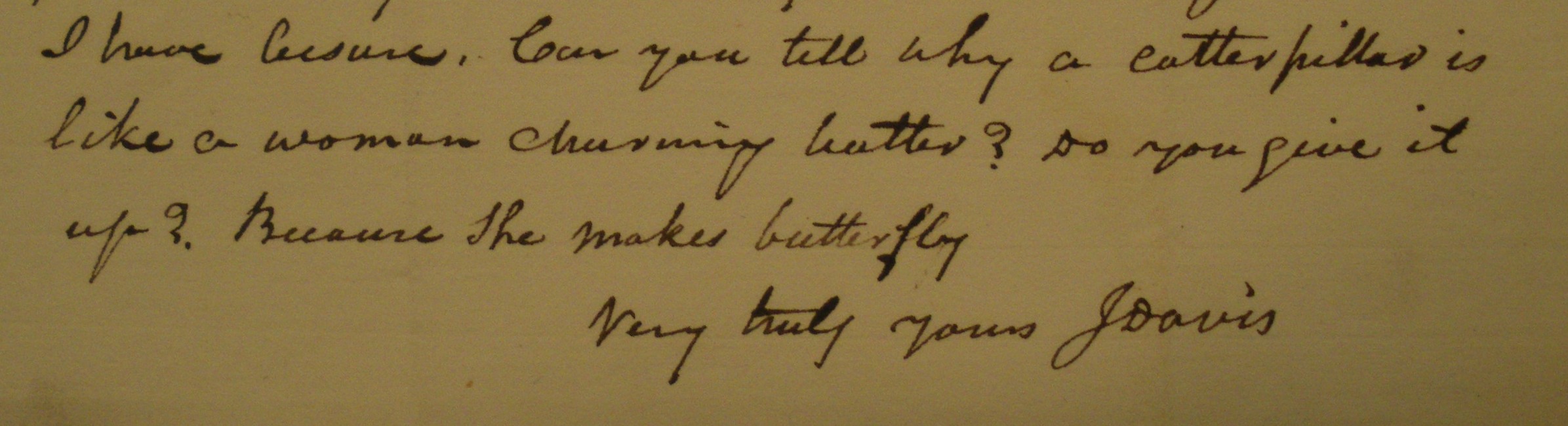
Proof that humor is not a modern invention:  a joke to lighten our Wednesdays direct from John Davis to AAS Librarian Christopher Columbus Baldwin in the close of a February 4, 1832 letter.

Can you tell why a catterpillar [sic] is like a woman churning butter? catterpillar

Do you give it up?

Because she makes butterfly.

No groans please.  This joke comes from a very dignified source. In 1832, John Davis was serving his third term in Congress. He would go on to become governor of Massachusetts as well as a senator.  And most importantly (of course), he served as AAS president from 1853 until his death in 1854.

Known as “Honest John,” Davis distinguished himself as an uncompromising anti-slavery Whig, an adversary of President Andrew Jackson, and a staunch opponent of the Compromise of 1850.  After his death at sixty seven, one newspaper described him as a “very practical and honest”  statesman.  In the April 1854 AAS Proceedings, council member Thomas Kinnicutt remembered him warmly as, “social in his habits, genial in his disposition, and constant in his friendships.”

The papers of John Davis are held in the AAS manuscript collection.

The Embezzler Redeemed – Part 3

Continued from Part 2 of the Embezzler Redeemed

One possible answer to this question is suggested by an account published in the November 19, 1803 issue of the Morning Chronicle.

We understand that the Manhattan Company have discovered a further fraud of about eight thousand dollars, committed by Benjamin Brower, previous to his elopements. It is said to have been done in his capacity of book keeper and of course involves his sureties. For the former deficiency they were supposed not answerable, as he purloined the amount while acting protempore as teller, a station for his conduct in which no surety had been given.

We are told that a letter was received from him with information that if the bank would set him at liberty he would make some important discoveries relative to his books. This exciting investigation the further deficiency abovementioned was discovered. The examinations, we understand are not yet completed.

brower_manhattan_company_bank_noteAlmost immediately this account was stated to be incorrect.  In fact, in some of the more distant newspapers covering the story, the account and the refutation were published at the same time.  But just suppose, in the course of the investigation, further irregularities and fraud were discovered.  Suppose the fraud involved more than Benjamin Brower absconding with $10,000.  Suppose the teller and first book-keeper who were absent from work on Saturday August 27, 1803, were involved in the scheme and purposefully absent so that the fraud might be committed according to a larger plan.  Except for the existence of a larger scheme we would have to believe that Brower hatched and executed the fraud within a single day when circumstances made him teller as well as book-keeper.  Could the Manhattan Bank survive a public trial which would surely raise these questions?

Even without the publicity raised by Brower’s fraud, the Manhattan Bank was much in the news during 1803 and 1804.  The annual election of directors was reported thus in the December 9, 1803, issue of the New York Evening Post.

The following was the successful ticket at the election on Tuesday for directors for the Manhattan Bank. The opposition which was contemplated was relinquished before the day of the election; it was found that too many Federalists were unwilling to put at the least hazard the value of their stock, in the attempt to gratify their wishes. This bank, which owes its origin to Mr. Burr, and was often made subservient to his political views, has now fallen completely into the hands of the Clintonians …

During the winter and spring, when the directors of the Manhattan bank might have been preparing their case against Benjamin Brower, it appears they were intensely involved in state politics encouraging the legislature to refuse a charter and halt the operations of the new, and competing, Merchants Bank.  Opinion pieces in various New York newspapers used words like “intemperate,” “hostile,” “despotism,” and “tyranny,” in describing the actions of the Manhattan Bank.  An account in the New York Morning Herald of March 20, 1804, copied from the Albany Centinel reports:

The committee on the subject reported to the House on Wednesday last, that it was expedient, &c. for the legislature to put a stop to the operations of the Merchant’s Bank in New-York – and a bill was accordingly read to that effect, allowing till October next for closing the business of the institution. Whether this report was the result of that temperate zeal for the public good, which ought to actuate the legislators of the state, or whether it was the illegitimate offspring of that party spirit which has unceasingly plotted the destruction of the Merchant’s Bank, is not for us to determine.

A gentleman has just informed us that the committee from the Merchants Bank offered stock to the amount of 20,000 dols. for the use of the state, if the legislature would incorporate them, and that the agent of the Manhattan Company outbid the petitioners. He offered stock in that company to the amount of 100,000 dols. if the legislature would suppress the new bank, So it seems the longest purse has won the cause.

On April 26, 1804, the following letter by “a citizen” appeared in the Morning Chronicle:

Citizens of New-York: This is the last day of the election. It is the last moment in which you can resist the efforts of a powerful and selfish aristocracy. … Do not then suffer any paltry inclemency of weather to detain you from the polls. …

The gale of political vengeance will overturn banks and carry ruin into our merchants counting rooms and warehouses, without decency, humanity, or remorse. A political tribunal, intolerant as ever disgraced a country, will be constituted by the Board of Bank Directors. The Manhattan Bank is already in their power. The Merchants Bank is already overthrown, others will be destroyed or seized, as best suits their convenience, and every mercantile man or tradesman, will be frowned on, and persecuted, who will not crawl in the dust at the feet of these people. …

The Manhattan Bank did not “set” Benjamin Brower at liberty but by failing to prosecute the case against him he was set free according to law.  The bank had recovered between $7000 and $8000 of the money stolen by Brower and presumably paid out between $1200 and $1300 in reward.  What they saved by avoiding a public trial and potential scandal in addition to the unfavorable press they were already experiencing was undoubtedly worth considerably more.

And so here is the final question.  Was New York City large and impersonal enough during the first decades of the nineteenth century that in the course of ten years Benjamin Brower’s past as an embezzler was forgotten, or had he truly been redeemed?  I find it hard to believe everyone had forgotten the sensational stories which filled the newspapers between September 1803 and May 1804.  Perhaps, as I have concluded, New Yorkers came to realize that Brower could not have acted alone in the embezzlement. Surely he was fortunate to have brothers who were willing and able to secure work for him in the years following his imprisonment.  His “pleasant and agreeable voice” and the tenor of his conduct which originally recommended him to the directors of the Manhattan Bank may also have played a role in his redemption, as may have his service during the War of 1812.  But it seems certain the Benjamin Brower was redeemed or parents would not have entrusted their sons and daughters to his academy, nor the school received their “marked approbation.”

From Cheap-Jacks to Scrooge McDuck

In Cheap We Trust

Recent economic events have raised the profile of cheapness, which makes this Tuesday evening’s free public lecture at AAS a particularly timely event.  On Tuesday, Nov. 17, at 7:30pm Lauren Weber will be discussing the value of thriftiness in American history in a talk titled: “From Cheap-Jacks to Scrooge McDuck: A Brief History of Cheapness and Thrift in America.”  By following this link you can learn more about the event, about Ms. Weber, and about the new book which this talk is based on: In Cheap We Trust: The Story of a Misunderstood American Virtue (2009).

In preparation for tomorrow’s lecture, what follows is some economic wisdom from that paragon of thrifty virtue, Ben Franklin, in his classic Way to Wealth (1758).  Way to Wealth is the “uniform title” of the work, a cataloging term for a book’s moniker or nickname (another example being “Bible”).  Uniform titles are especially important in rare book cataloging because, since the earliest incunabula all the way through the 19th century, title writers seemed to be in an extended quest to see just how long a title they could fit on a title page.  In fact, the actual title for Way to Wealth fills the entire title page (you may notice that in this paragraph-long title, the words that don’t appear are “Way to Wealth”).  Here’s the full transcription:

Father Abraham’s speech to a great number of people, at a vendue of merchant-goods; introduced to the publick by Poor Richard, a famous Pennsylvania conjurer, and almanack-maker, in answer to the following questions. Pray, Father Abraham, what think you of the times? Won’t these heavy taxes quite ruin the country? How shall we be ever able to pay them? What would you advise us to? To which are added, seven curious pieces of writing.

Thriftiness is not only verbally honored in Way to Wealth: after listing the table of contents, rather than leaving even a few lines of “unimproved” white space, the text proceeds directly to list the proverbs for which Franklin (or “Poor Richard”) has become famous.  Here are a few choice tidbits to keep in mind in these tough economic times:

  • Beware of little Expenses: a small leak will sink a great ship.
  • A Ploughman on his Legs is higher than a Gentleman on his Knees.
  • A Child and a Fool imagine Twenty Shillings and Twenty Years can never be spent.
  • When the Well’s dry they know the Worth of Water.
  • If you would know the Value of Money, go and try to borrow some.
  • He that goes a borrowing goes a sorrowing.
  • ‘Tis hard for an empty Bag to stand upright, if it does ’tis a stout one.
  • Creditors are a superstitious Sect, — great Observers of set Days and Times.
  • ‘Tis easier to build two Chimnies, than to keep one in fuel.
  • Silks and Sattins, Scarlet and Velvets, have put out the Kitchen Fire.

Are your bookshelves looking bare?

Happy weekend, everyone!  Hope you all have had a chance to crash out on the couch and luxuriate in the do-nothing vibe. Should the time come when you decide to do something more drastic with your weekend, here’s a last-minute but heartfelt invitation to join us at the acclaimed Boston International Antiquarian Book Fair at the Hynes Convention Center tomorrow afternoon, Sunday (Nov. 15), from 12-5.  I just got back from there myself and had such a great time I thought I should encourage you all to check it out.

icon.book

(As a side note, I encourage you to use public transportation.  I had the quintessential Boston driving experience as my penance for attempting to drive into the city which left me wandering the city streets in the driving rain.  Don’t ask me what I was thinking.  And while I’m digressing, I just want to mention I ran into a fan of PastIsPresent.org there,so keep on passing the word to your friends.  We really appreciate it!)

Assorted AAS folk are manning a booth in the cultural row at this year’s gathering of rare book dealers and their friends. Besides having a chance to meet an AAS curator in person, the Antiquarian Society’s booth also offers tons of information, brochures, a new digital slide show, and ever-popular chocolate.

My theory is that candy takes on a heightened and virtually irresistible appeal to those who work with rare books all day because we’re forbidden to have any food objects at our desks, but perhaps candy has this effect on everyone.  In any event, if you are feeling peaked in the midst of your bibliographical quest, take a break to refuel yourself in the cultural row — or as I like to call it, the candy counter — at the back of the room.

With over 100 book dealers flaunting their wares, you may just find the perfect new volume to grace your bookshelves at home or to surprise a lucky loved one with beneath the Christmas tree. Even should you strike out on the acquisitions front, we hope you’ll have an entertaining afternoon of window shopping and book chat.  I may have to go back tomorrow afternoon myself, so maybe I’ll see you there!

The Embezzler Redeemed- Part 2

Continued from Part 1 of “The Embezzler Redeemed”

A report that Benjamin Brower had been apprehended at Albany was refuted almost immediately as being “wholly without foundation.”  But on October 25, 1803, the New England Palladium (Boston) briefly reported he had been captured.  On the 29th the New York Morning Chronicle expanded upon the news of Brower’s arrest.

The Boston Gazette of Monday last, states that Benjamin Brower, who lately robbed the Manhattan Bank, of a very considerable sum of money, was taken up in that town, on Friday evening preceding, and after an examination, and the discovery of between 7 and 8000 dollars which had been concealed about his cloathes [sic], confessed the fact. He had taken passage, a few weeks since, from Newburyport for Passamaquaddy, where he arrived; but from whence he returned to Boston in a vessel commanded by Capt. Pulsifer, of Newburyport. It is to the vigilance of that gentleman with the aid of some others, that he was detected and committed. The reward for taking Brower is 500 dollars and ten per cent. of all the money recovered.

A brief notice in the May 2, 1804 issue of the New York Gazette stated “The trial of Benjamin Brower is postponed.”  A fuller communication published in the Washington Federalist (Georgetown, D.C.) on May 7th reads:

The trial of Benjamin Brower, who has already been confined upwards of 6 months, on a charge of the Manhattan Company, for defrauding their bank, is further postponed by his prosecutors; and I am informed that Mr. Brower is so unfortunately situated, from the prevailing prejudice, that he is unable to give the bail required.

Seventeen days later Benjamin Brower was released from custody, “not” to quote the newspaper accounts, “because he was innocent” but because at the time New York State law required all prisoners to be released and discharged after two sessions of the Court of Oyer and Terminer “if in that time no prosecution has been carried through against them.”
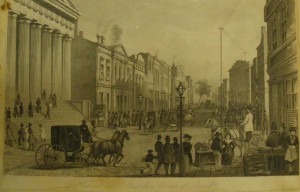
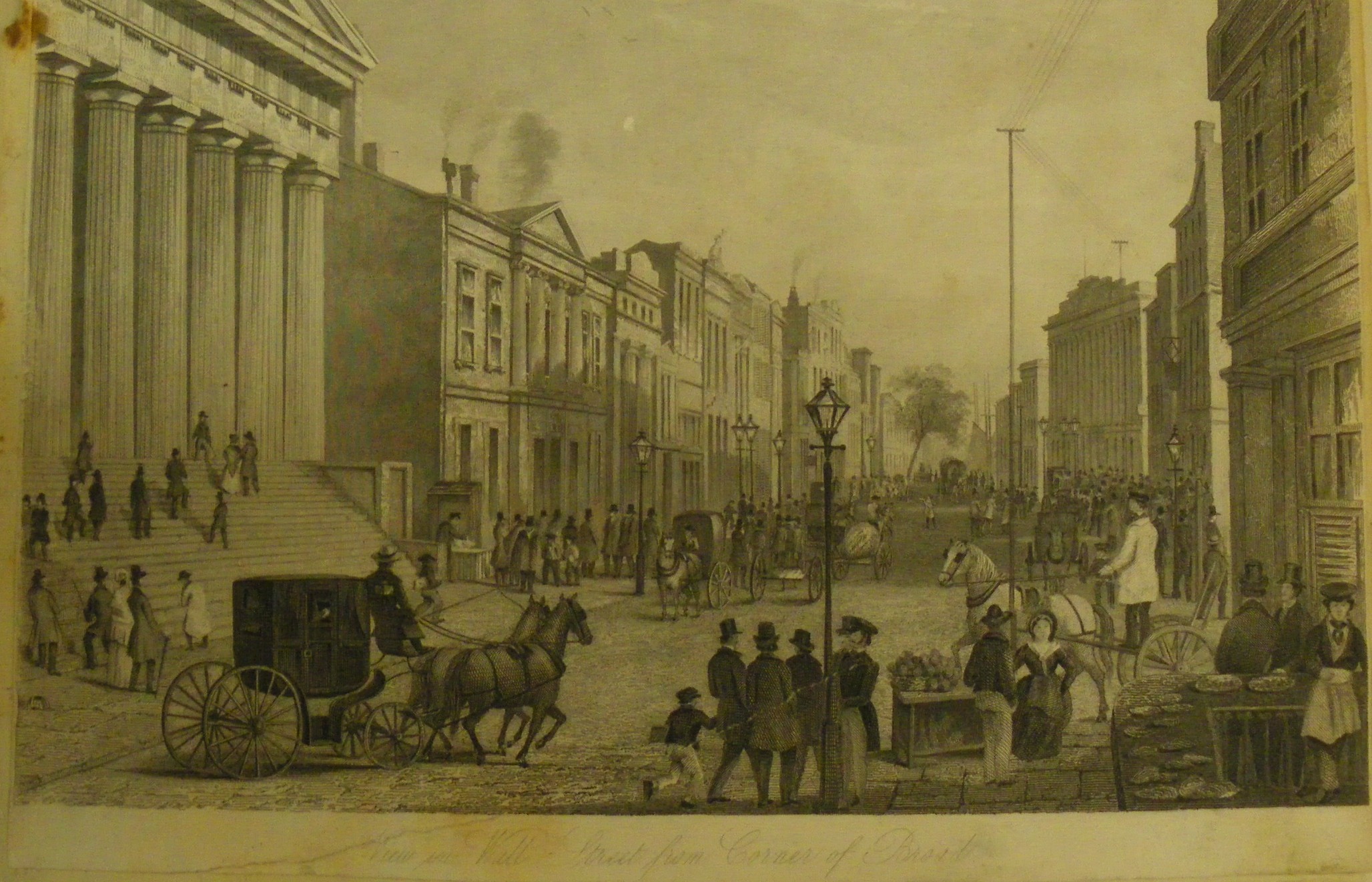
brower_wall_street

Between his release from prison in May 1804 and his death in May 1818, I located only two notices of him in any newspaper.  The first was published in the January 14, 1812 issue of the New England Palladium where Benjamin Brower was among five officers appointed to the 6th U.S. Regiment from New York. The notice concludes, “Mr. Brower, we believe, is a printer, and of the office of the N. York Public Advertiser.”  The second was published under the head “Washington Academy, no. 236 Greenwich-Street” and appeared in the November 25, 1817, issue of the National Advocate (New York).

Mr. Brower respectfully informs the patrons of this establishment and the public generally, that their liberal patronage has induced him to form an association with Mr. Holly, a gentleman of good character, liberal education, and much experienced in teaching …

This school has now been before the public nearly four years, and received its marked approbation. … The male and female departments are separate, and, at the same time, every scholar is under the constant eye of the principals. The young ladies are under the more immediate care of Mrs. Brower, and every attention is paid to their manners.

But it is the decided opinion of the principals of this institution, that the same degree of delicacy or modesty ought to be cultivated in the minds of both sexes, and that many of the evils in society can never be remedied until this principle shall universally be recognized, and until as much disgrace shall attend every aberration from strict delicacy and propriety of conduct in a male as that of a female…

I was collecting evidence but still didn’t have proof that the printer and embezzler were one and the same.  I turned next to the New York city directories.  In Longworth’s directories for 1801-1805, Benjamin Brower is listed as an accountant. brower_1804_directoryHis name does not appear in the directory for 1806, and in 1807 it appears without an occupation.  For the next two years, Benjamin Brower’s occupation is listed as milliner in association with Nicholas B. Brower, proprietor of a hat store at 109 William Street.  In  1811 and 1812, Benjamin Brower is once again listed as an accountant. By the next year, the directory listed him without an occupation but his address at 3 George Street put him in close proximity to the printer Samuel Brower at 16 George Street.  Benjamin Brower’s address first appears as 236 Greenwich Street in the 1814 directory, in which he is described as a reading teacher.  Finally, in keeping with the news articles, for 1815-1817 he is listed as the principal of Washington Academy. In 1818, his widow Mary Brower is listed at the Greenwich Street address.


brower_1818_directory

Assuming that Nicholas B. and Samuel Brower were related to Benjamin, and assisting him to get back on his feet, I went back to Ancestry.com and discovered that Nicholas B. and Samuel Brower were brothers, sons of Nicholas Brouwer and Mary Birdsall.  Nicholas Birdsall Brower was born at Fishkill, Dutchess County, New York, on April 26, 1772, the year after his parents were married.  Samuel was born at Wappingers Falls, also in Dutchess County, on May 4, 1786.  Also listed are two sisters, Mary born in 1783, and Martha, with no birth date given.  The children of both Nicholas B. and Samuel Brower were all born in New York City so I felt confident that they were, respectively, the proprietor of the hat store and the printer.  I also believed that Benjamin Brower was their brother.  In all the considerable authority work I have done in conjunction with cataloging, this would not be the first time that the “black sheep” was omitted from the family genealogy: the saddest case being that of a young woman who had committed suicide.  Her birth record was listed in the town’s vital records and I was able to find an obituary which noted several previous attempts before the successful suicide, but her name appeared nowhere in the family’s published genealogy.

By this time I was relating the story to colleagues over coffee and lunch, and decided it was worth pursuing even further.  I went back to America’s Historical Newspapers to read the articles I had skipped, and soon found the missing link between Benjamin Brower and Nicholas Brouwer of Dutchess County.  An article published in the September 24, 1803, issue of the Republican Watch-Tower (New York) began with the description of Brower which had already been widely disseminated but continued with new information uncovered during the investigation.

He went away from Newark, New Jersey, on Sunday morning, the 28th of August, in a horse and chair, with his wife and child, and some baggage. The horse was a bay, about 15 hands and a half high, though it is probable he has changed horses on the road. The chair has steel springs, plated mouldings, green painted body, with sword case … the lining of the chair body olive velvet … We have learnt that he went up the North [Hudson] River, on the westerly side, crossed at Peekskill, left his wife and child, with some or all of his baggage, at Wapping’s Creek, Dutchess County, where his father resides; took up there a small lad about 14 years of age, a brother of his, and proceeded with him towards Poughkeepsie. The persons dispatched in pursuit of him have been as far as Albany, but could not learn that he had been there, or any where in the neighbourhood. We conclude, therefore, that he took one of the roads just beyond Poughkeepsie, which led to Canada, Vermont, or into the eastern states; or possibly crossing the North River, with the intention of getting through the back part of New-Jersey and Pennsylvania, to Philadelphia or Baltimore, in order to leave the U. States. …
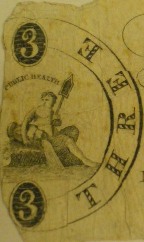
brower_manhattan_company_bank_noteThe evidence that Benjamin Brower, the accountant turned embezzler, was also the printer of the Daily Telegraph and the compiler of The Columbian Speaker, or Juvenile Orator was, at this point, strong enough to enter a record for him in the national Name Authority File.  But the question remained, why didn’t the Manhattan Bank carry through with the prosecution against him?  Brower had most of the money with him when he was captured, confessed to the crime, and the “prevailing prejudice” was against him.  It would seem that a guilty verdict was assured.

Finished in Part 3
Anatomy of a Catalog Record

People tend to treat catalog records a lot like refrigerators: open it, grab what you need, and close it up again. At AAS, the milk, eggs, and butter of the record are the author, title, and call number. Locate those three and the rest can stay a black and white blur. But know that somewhere a cataloger sheds a tear.

Cataloging to rare-book standards is an exacting process that treats the record as a surrogate for the imprint itself. The practice acknowledges the intrinsic value of each physical copy. It also recognizes the item as just one manifestation of the intellectual work as a whole. One scholar recently described using the AAS online catalog “almost every day while researching this book and years before I finally walked through the door in Worcester” because of the records’  “unparalleled annotations.”  It is the goal of AAS to eventually catalog all of its pre-1877 American imprints collection to such detail. At this point, just about all American imprints through 1800 and between 1821 and 1840, and 2/3 of those between 1801 and 1820, have been so cataloged.

But what work actually goes into creating a catalog record? From a variety of sources, bibliographic and copy-specific data is collected. That information is then tailored to meet both the Anglo-American Cataloging Rules 2 (AACR2)and the Descriptive Cataloging of Rare Materials (Books) [DCRM(B)] standards. Once formatted, the metadata is inputted into the Machine Readable Cataloging (MARC) structure that creates the backbone of the online catalog.

Confused yet?

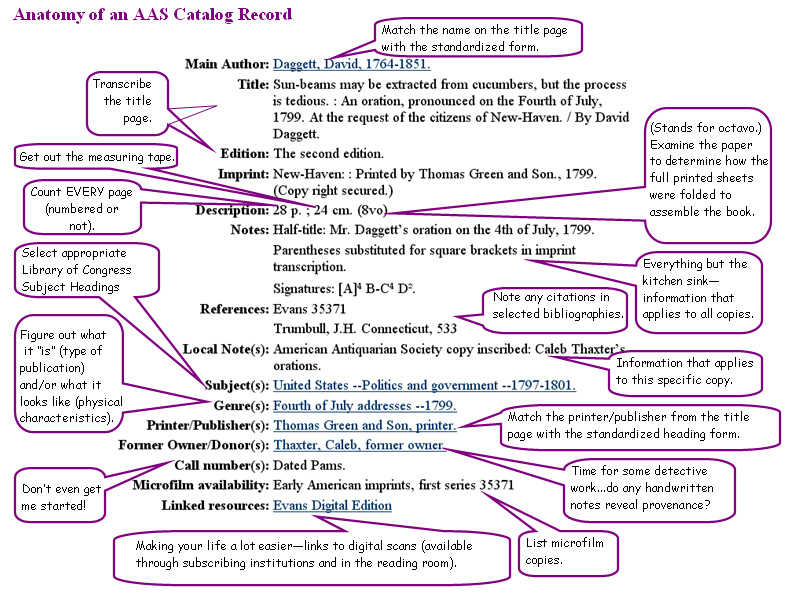
The diagram below gives you the straight scoop on what it all means. (Click on it to open an expanded version in a new window.)

catalog_record

The Embezzler Redeemed- Part 1

One of the great joys of cataloging is figuring out who the folks were who wrote, edited, illustrated, printed, published, or owned the books that cross our desks.  In most cases we don’t have time to delve into the lives of these people, and wistfully think that someone ought to write a dissertation on this person or that.  But occasionally a life is just so fascinating that we can’t help but look beyond the usual vital statistics.

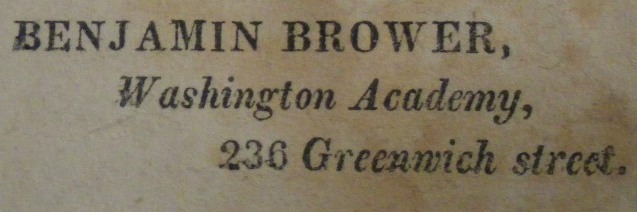
When I took up The Columbia Speaker, and Juvenile Orator (New York,brower_columbian_speaker_preface 1815) to upgrade the cataloging record, the heading for the compiler had been entered as Brower, Benjamin, d. 1818.  I noticed that we also had a heading in the online catalog for a Benjamin Brower without dates who printed the New York Daily Telegraph in 1812-13.  It seemed likely that the printer and the compiler, who signed the preface “Benjamin Brower, Washington Academy, 236 Greenwich Street,” were one and the same, but I wanted to verify this assumption before adding the death date to the printer’s heading.

I began in Ancestry.com but found no record for a Benjamin Brower who died in 1818.  Nor did FamilySearch.org have a record for him.  Next I searched the America’s Historical Newspapers database where a May 6, 1818 obituary in the New York Gazette confirmed that the compiler of The Columbian Speaker had indeed died in 1818.

Died yesterday morning, after a painful illness, Mr. Benjamin Brower, in the 43d year of his age. His relations and friends are invited to attend his funeral this afternoon at 5 o’clock, from Washington Academy, no. 236 Greenwich-Street without further invitation.

Obituaries for Brower were included in four other New York City newspapers and a notice of his death was published in the Essex Register, Salem, Mass., suggesting that he was a man held in some regard.

None of the obituaries mentioned that he had ever worked as a printer, but what did grab my attention as I was scrolling through the database results  was a series of articles beginning in the Mercantile Advertiser on September 10, 1803.

The circumstances which have come to our knowledge respecting the reported embezzlement of money, by a person in the service of the Manhattan Company, are these—In consequence of the indisposition of Mr. Hunn (one of the tellers) and the absence of the first book-keeper, the situation of temporary teller on Saturday the 27th ult. devolved upon Mr. Benjamin Brower, who had been received into the bank with very respectable recommendations, and at that time filled the office of second book-keeper, to the entire satisfaction of the Directors, whose opinion of his integrity was highly flattering.

On the day above-mentioned, Mr. Brower received, in his capacity of teller, upwards of 70,000 dollars. The money delivered by him to the cashier, in the evening as the closing of the accounts fell 10,000 dollars short of this sum; but as the money and the written statement of receipts had been made to correspond in the sum total, no suspicions of fraud were entertained. Mr. Brower was absent from the bank on Monday, Tuesday, and Wednesday following; still from the tenor of his former conduct, and from the sickly state of the city, no one entertained a sentiment injurious to his reputation, or supposed his absence to be occasioned by any other circumstance than some derangement in his own health or the health of his family.

The adjustment of the accounts of the Bank, preparatory to its removal to Greenwich, took place on Wednesday evening the 31st, when a deficiency to the amount above stated was discovered, ‘and the cup was found in Benjamin’s sack.’

An enquiry was immediately instituted respecting Mr. Brower. The result was, that he had left the city on Sunday, with his family, but no person could give information to what part of the country he had absconded. Messengers were dispatched in different directions in search of him; but we understand all their vigilance has hitherto been unsuccessful.

The Manhattan Company have offered a reward of 500 dollars for his apprehension, and ten per cent. upon such part of the embezzled property as may be recovered.

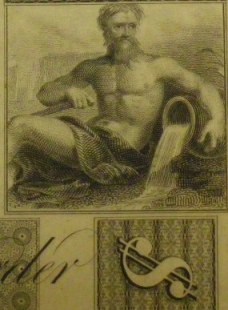
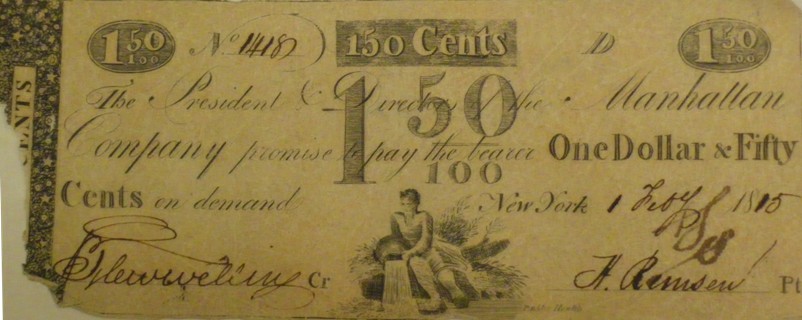
A Manhattan Company bank note from the AAS collection.

The New York Evening Post included the story on September 12th and within days it was reprinted in newspapers North and South.  A widely copied description of Benjamin Brower appeared:

About 26 or 27 years of age; 5 feet 10 inches high; dark complexion, with some black or dark brown freckles on his face; of a thin or meager habit and face; nose and features sharp; dark blue eyes; black hair, short and combed over his forehead; has a remarkable tuft or lock of grey hair just above, or on a parallel line with his left ear; long neck, arms and lower limbs; walks actively; swings his arms much while walking; treads on his heels; and is somewhat knock-kneed; tone of voice pleasant and agreeable, though apt to hesitate when questioned closely.

Quick arithmetic proved that someone who died in 1818 in his 43rd year would have been born about the same time as someone who was 26 or 27 years of age in 1803 – in 1775 or 1776.   I skipped many articles, jumping ahead to learn what had happened to Benjamin Bower.

Continued in Part 2

Apple Pie Bake-Off Or The Sweet Taste of Revenge

In the October 1813 Report of the Committee, Isaiah Thomas justified the choice of Worcester for the home of the American Antiquarian Society. He maintained that an “inland situation” offered the best protection against,

the destruction so often experienced in large towns and cities by fire, as well as from the ravages of an enemy, to which seaports in particular are so much exposed in times of war.

War and fire. Yeah right, Mr. T. We know the real reason you picked Worcester: the apples. From the end of August into late November, the orchards in the surrounding hills gently rock us out of summer and into the sweet lull of autumn. We are eventually deposited harshly onto winter’s doorstep. But up until that point, it is a reverie of fresh apples. So in the spirit of a New England autumn, an apple pie experiment.

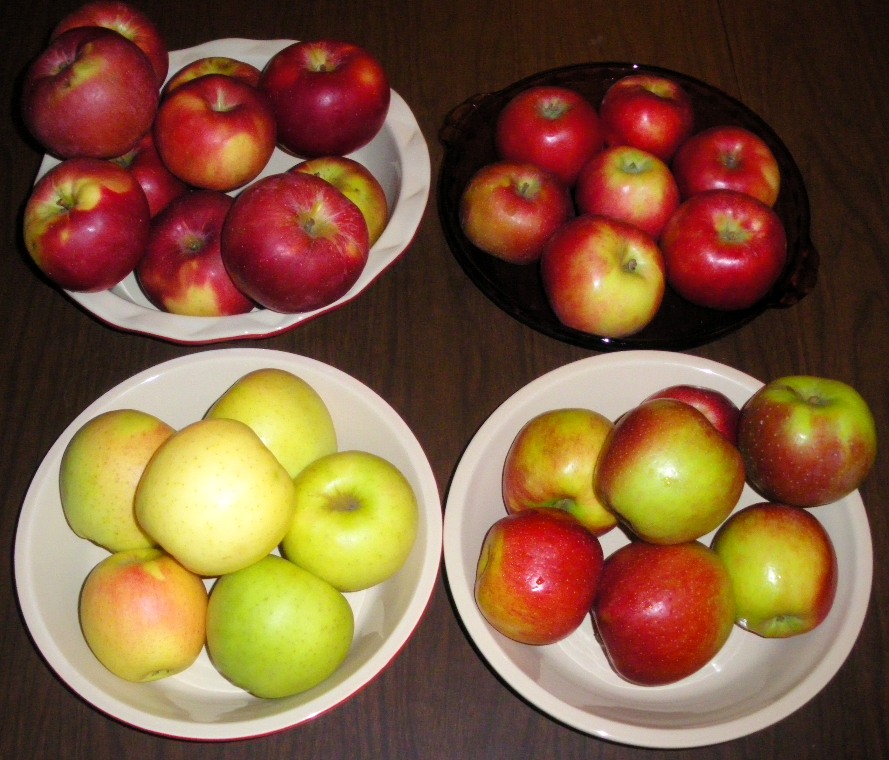
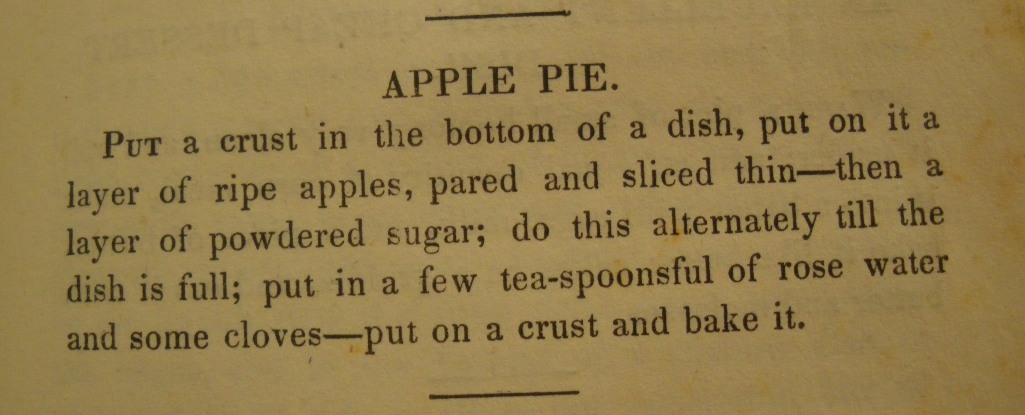
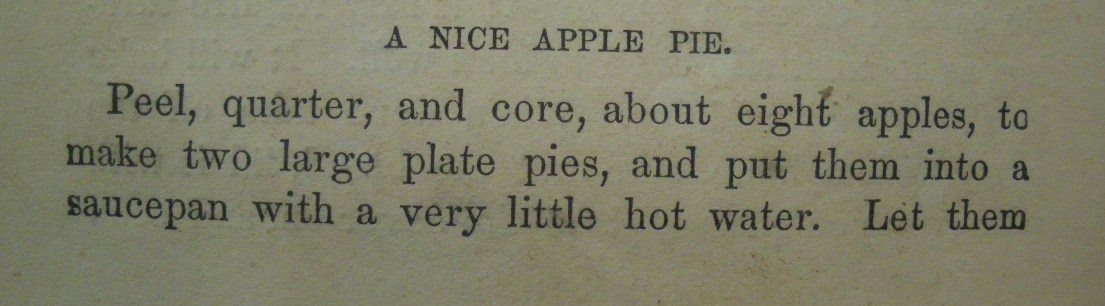
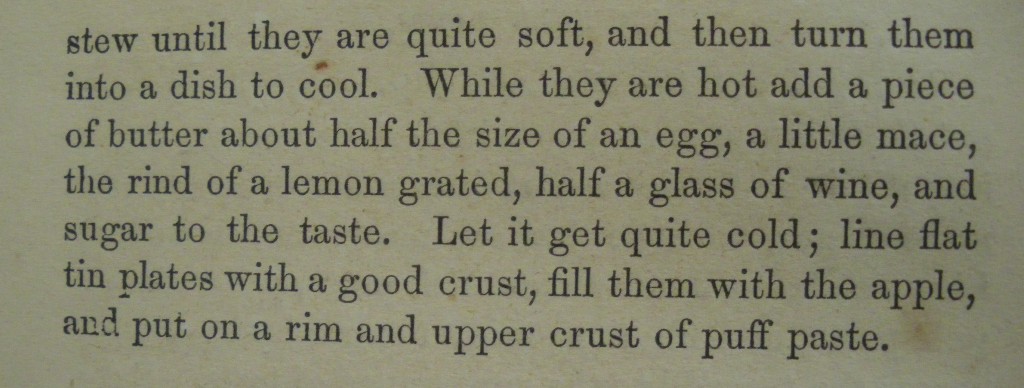
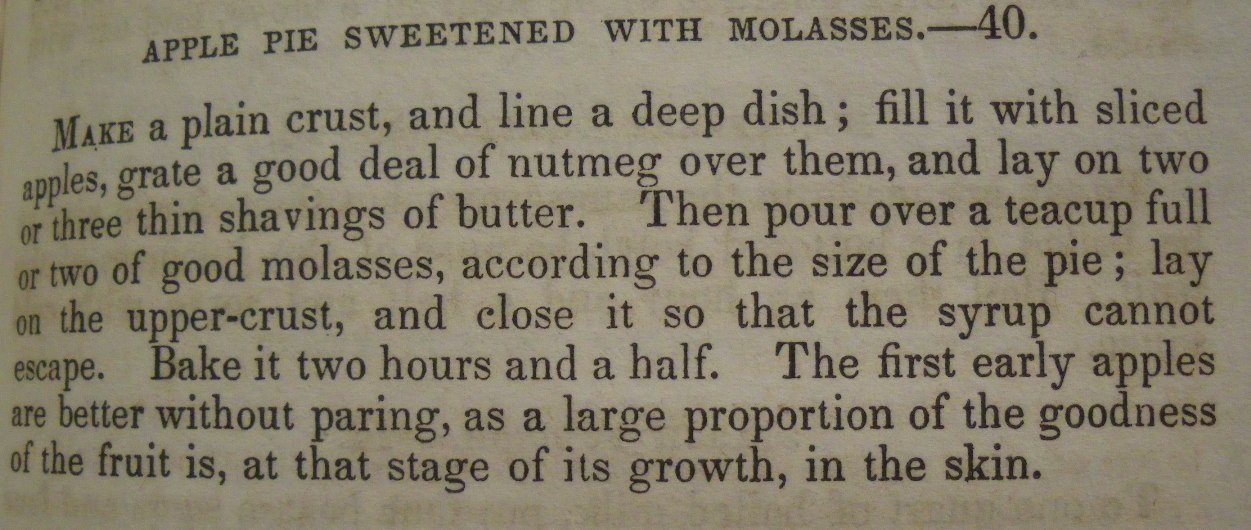
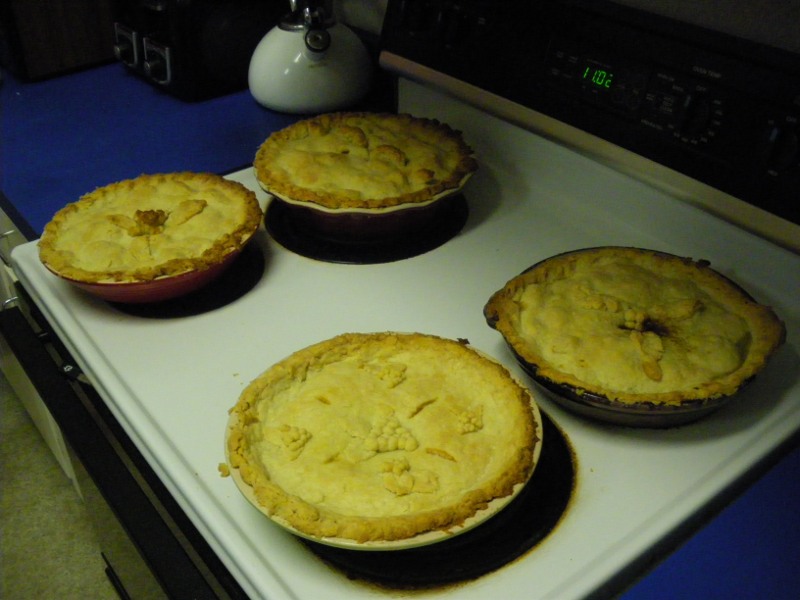
applesThe Premise: Four pies sharing the same crust recipe and apple varieties (Gravenstein, Northern Spy, Baldwin, and Golden Delicious to be exact). The differences would be the spices and sweeteners used in the filling: three from historical recipes and one from a modern cookbook. As with the pound cake experiment, our testers would be the AAS fellows.

The Historic Recipes: Most of us are familiar with apple pies starring apples coated in white (or brown) sugar with a dash of cinnamon or nutmeg. We kept the modern recipe modern, but took advantage of historical recipes that called for unexpected sweeteners.

Powdered Sugar/Rose Water Recipe from The Virginia Housewife by Mary Randolph, 1836

apple_pie_rosewater

White Wine and Lemon Recipe from Mrs. Putnam’s Receipt Book by Elizabeth Putnam, 1860

apple_pie_wine1apple_pie_wine2

and finally…

Let’s be honest, lately these fellows have been working hard, turning in call slip after call slip for materials the reference staff then pages. Their industry is our sore feet. But we can’t say no. Instead it was time for a different kind of revenge:

The Molasses-Sweetened Recipe from The Young Housekeeper’s Friend by Mary H. Cornelius, 1846

The Young Housekeeper's Friend by Mrs. Cornelius, 1846

The unwitting accomplices: Jess “Could have been a pastry chef” Lepler, Hench Post-Dissertation fellow and assistant professor of History at the University of New Hampshire, Emily “Queen of the Crusts” Pawley, AAS-NEH fellow and Ph.D. in the History of Science (2009), University of Pennsylvania, and Allison “I don’t really cook” Stagg, Last fellow and Ph.D. Candidate in Art History, University College, University of London.

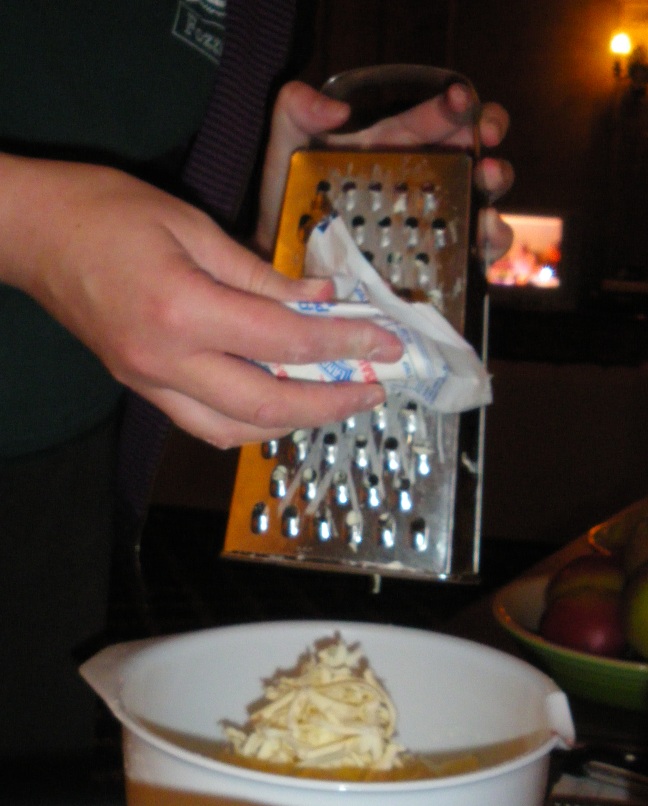
apple_pie_butter_gratingThe Process: Pie making is a relatively boring task. One part was thrilling: the discovery of a cheese grater to easily add the cold butter to the crust dough. The rest was pretty straight forward: peel, cut, mix, pour, and repeat. The historic recipes forced us to make educated guesses on what exactly a “teacup” of molasses, a “little” mace, or a “few tea-spoonsful” of rosewater actually meant–caution usually guiding our judgment.

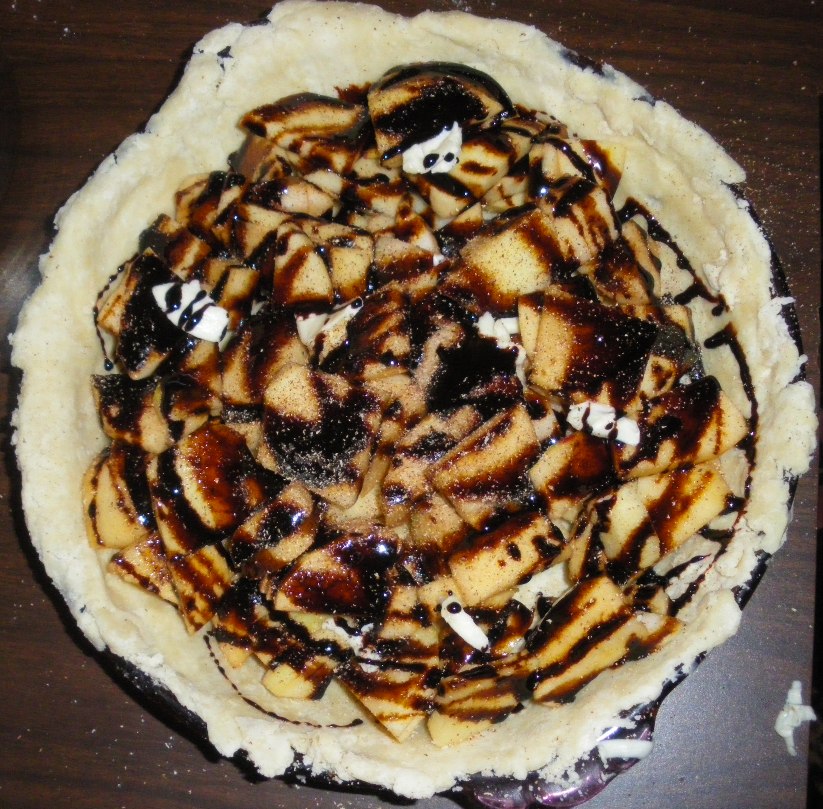
Before the crust covering, there was time for a snapshot of one pie. (t looks delicious when you think it’s chocolate…)

apple_pie_molasses_ready_for_baking

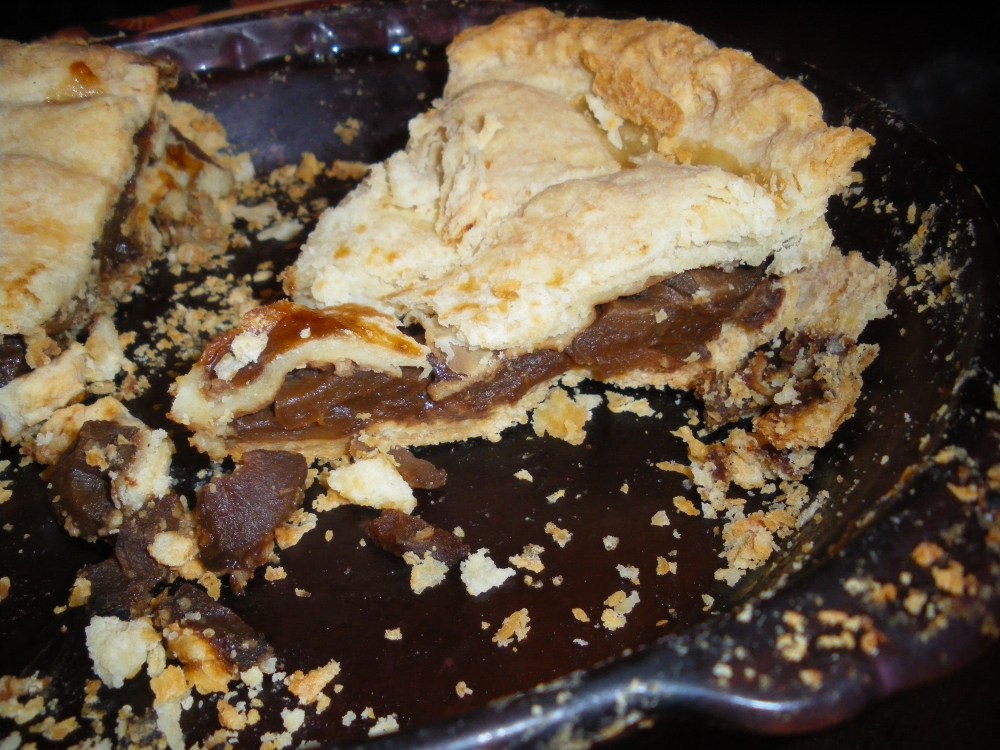
apple_pie_molasses_pieceThe Results: Victory! “The molasses one was vile. It was gross. It was disgusting,” said one esteemed fellow. “Horrible,” proclaimed another. That’ll teach them.

But what of the other pies?

apple_pie_bakedThe powdered sugar/rosewater pie prompted the most broadly split opinion. The cloves created a particularly pronounced flavor that some found an odd combination with the perfumy and off-putting rosewater; others were disappointed they couldn’t taste the rosewater more. As spirits are likely to do, the wine-flavored pie swayed many a fellow. The final score tallied, the white wine pie tied with the modern one in terms of taste. One fellow concluded, “We Americans should be eating wine pie.”

The fresh, tart taste of the modern and wine recipes complimented the crisp apples purchased that day from an orchard. Would this story have ended differently if the experiment took place in the middle of winter with mushy apples two months old? The weighty flavors of the molasses and powdered sugar/rosewater recipes might help mask less-than-delicious apples.

The Take-Away: When you are going to torture library fellows make sure your boss isn’t there. But from Ellen Dunlap, AAS president and unexpected tester, the thoughtful conclusion that our palettes may be more comfortable with subtle flavors. She preferred the modern pie, enjoying the complexity of its spices to the more monotone qualities of the historically-inspired ones. “I kind of liked the first taste of the rosewater and the wine, but they quickly got boring,” she said. And apparently even presidents don’t care for molasses-sweetened pie.

Historical reenactment: John Brown lives again in Thoreau’s Words

This one’s for the history geeks among us (and I include myself in this): You will not want to miss a truly unique historical reenactment taking place tomorrow night Defending John Brown: Henry David Thoreau and Worcester’s Reform Tradition on Tuesday, November 3, 2009 at 7:30 p.m. at Mechanics’ Hall, Main Street, Worcester.Radaker As ThoreauWitness Henry David Thoreau (or at least, someone who looks very much like him) speak in defense of John Brown in exactly the same spot as he did 150 year ago to the day. (This second iteration will really be more of a dramatic monologue, so you will learn about other parts of Thoreau’s life and work as well.)

To crib from Jerry Seinfield’s catch-phraseology: What’s with the historical reenacting? I’m guessing some in our audience have participated in Civil War battle reenactments, or been costumed interpreters at a historic site. If so you know the strange power of putting on the same clothes, standing in the same spot, uttering the same words as an historical actor. It adds a whole new experiential dimension to what were once static words and images on a page. My personal experience with historical reenactment was sadly limited to an ill-advised college relationship with a member of the SCA (Society for Creative Anachronism, for those less-geeky in our audience). Perhaps I am revealing to much here, but I have to say the best thing I got out of that relationship was a sword-fighting lesson from a bunch of dudes dressed in medieval armor.

BTW, if anyone else wants to share reenactment stories — the good, the bad, and the ahistorical — please add your comments below. I need to know I’m not alone!

For those of you not yet ready to make the jump to full-fledged costume wearing, don’t fret. You won’t have to dress up historically for tomorrow’s event, so it’s the perfect way to ease yourself into the experience. To help set the mood, check out this advance notice for Thoreau’s original speech that appeared in the Massachusetts Spy on November 3, 1859:

Thoreau Advertisement in Mass Spy

“As Mr. Thoreau never deals in common places, — as he considers Brown a hero, — and as he has been so moved by the Harper’s Ferry affair, as to feel compelled to leave his customary seclusion in order to address the public, what he has to say is likely to be worth hearing.”

We may have missed Thoreau’s speech the first time around, but now we can take advantage of a second chance to experience this moving speaker live. Click here for complete information on the speech and Kevin Radaker and Edmund A. Schofield who will be performing the dramatic monologue and providing historical commentary.