The Acquisitions Table: Children’s Book with Paper Dolls

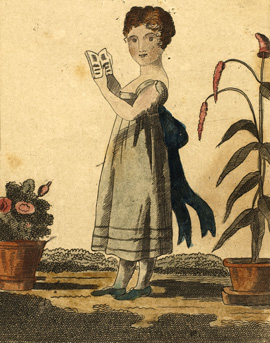
The History and Adventures of Little Eliza. Philadelphia: William Charles, 1811.

This imprint is among the earliest American editions of a book first printed in London accompanied by a set of paper dolls. The celebrated Philadelphia engraver and publisher William Charles integrated the images with the text as a picture book, complete with his subtle background clues. Eliza is a smart but disobedient little girl who runs away from home. She ultimately hits bottom as a street beggar before she is re-united with her parents. In the above illustration, we see Eliza before her travail, reading a book. She is a well-dressed little girl surrounded by potted plants, alluding to her pampered and sheltered existence.

Purchased from Philadelphia Rare Books & Manuscripts Co. Ruth E. Adomeit Book Fund.

The entire text of Little Eliza can be seen online at AAS’s exhibition: A Place of Reading.

The Acquisitions Table: German-American author Charles Sealsfield

The Karl J. R. Arndt Collection of Charles Sealsfield
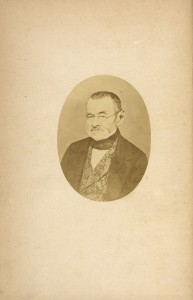
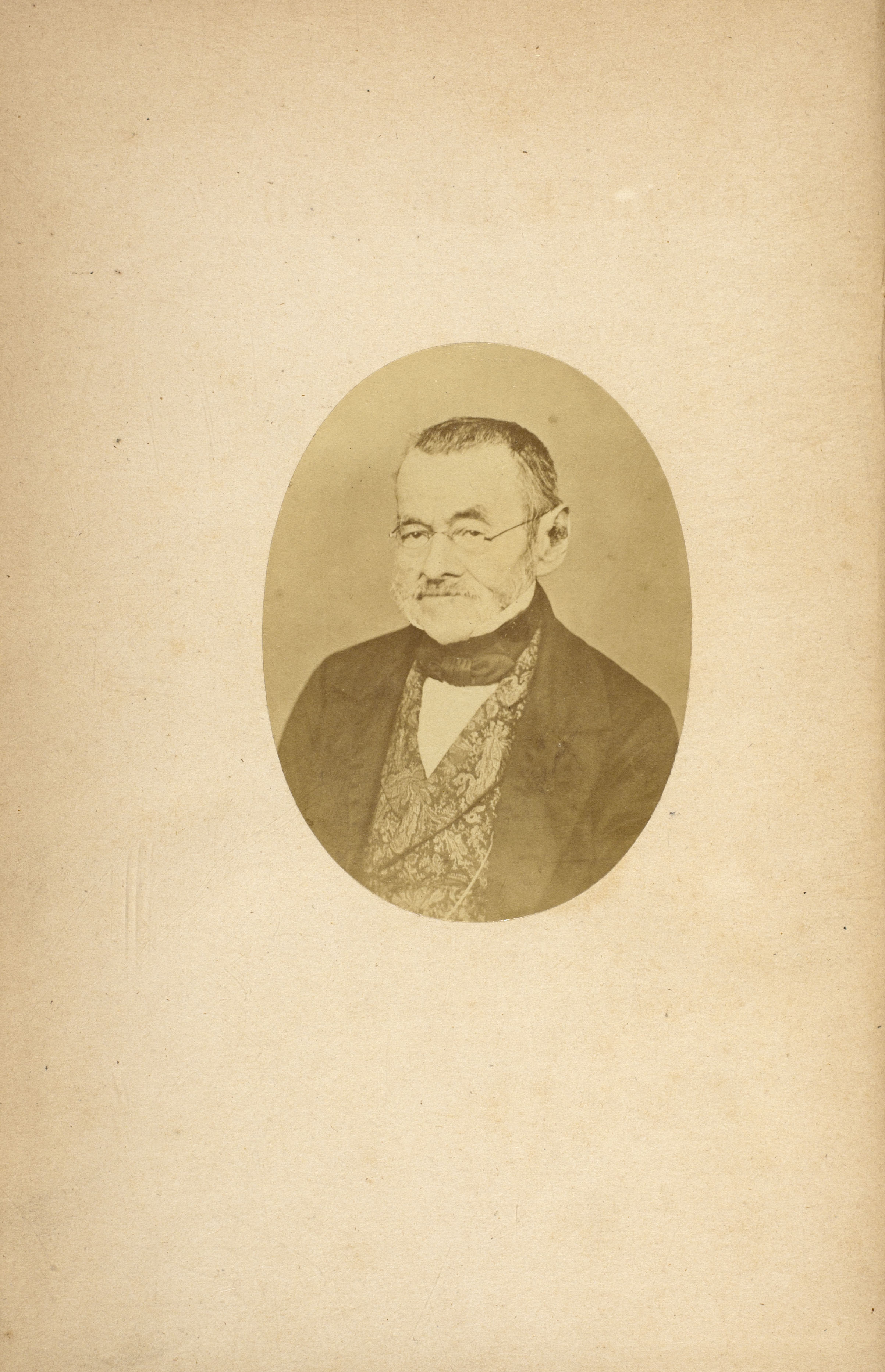
Mrs. Blanca H. Arndt of Worcester has donated to AAS the remarkable collection of works by and about the German-American author Charles Sealsfield (1793-1864) formed by her late husband, Karl J. R. Arndt. Numbering some 250 volumes, with accompanying research files, the Arndt gift elevates AAS’s Sealsfield holdings from passable to world-class.

Although the Arndt gift contains few American imprints, its relevance for AAS is clear. Born Karl Postl in Moravia, Sealsfield entered a Prague monastery in 1814. By 1823 Postl had tired of the stifling religious and political climate and, breaking his vows, fled under threat of arrest to the United States. There he created a new identity as “Charles Sealsfield.” During the 1820s Sealsfield traveled widely in Texas, Mexico, Louisiana, and northward through Pennsylvania and New York, eventually establishing himself as a journalist, novelist, and canny observer of American life. His first novel, Tokeah, or, the white rose (1829) was written in English and published anonymously in Philadelphia to modest success. Though now a U.S. citizen, Sealsfield moved to Switzerland in 1830, where he spent most of his remaining years, his true identity kept secret until after his death.

In Switzerland Sealsfield wrote prolifically (now in German), publishing an entire shelf of novels before retiring in 1843. Drawing upon his American experiences, Sealsfield pioneered a new kind of “ethnographic” novel, taking as his theme the confrontation between white Americans and the various ethnic populations sharing the expansive American landscape. His novels proved enormously popular in German-speaking Europe, and when several were translated into English in the early 1840s, Sealsfield’s fame spread to England and back to the United States. No longer could the “Great Unknown,” as his readers called him, continue to publish his works anonymously, and the name Charles Sealsfield (sometimes “Seatsfield”) was henceforth added to their title pages. Although Sealsfield’s American reputation soon waned, he (and his later imitator Karl May (1842-1912)) introduced generations of German readers to the American West. Sealsfield’s influence upon American writers such as Longfellow is well documented, and his career epitomizes the dangers of defining “American” literature and authorship too narrowly. With the Arndt gift, AAS’s superb American literary holdings can be situated in a more properly nuanced context.

Karl Arndt (1903-1991), professor of German at Clark University, pursued many interests during a long and distinguished career. An AAS member, Arndt mined the collections heavily for many scholarly projects on Germans in 18th– and 19-century America, most notably his studies of the Harmony Societies in Pennsylvania and Indiana, the German-language press in America, and, of course, Sealsfield. His many publications include the definitive bibliographies The first century of German language printing in the United States of America (1989), and The German language press of the Americas (1973-1980).

Like many comprehensive collections, Karl Arndt’s Sealsfield holdings were not formed one volume at a time. Rather, Arndt purchased the collections of Sealsfield’s two primary bibliographers—the American scholar (and Arndt’s mentor) Otto Heller (1863-1941) of Washington University in St. Louis, and Albert Kresse (1886-1961) of Stuttgart—and then he built upon that solid foundation. A scholar as well as a collector, Arndt used his library for a number of articles and as a resource for editing Sealsfield’s collected works (Hildesheim, 1972- ; 28 v. to date). Hence the copies given to AAS have already had a distinguished, sustained impact upon Sealsfield scholarship. And preserved in perpetuity at AAS, they will continue to do so thanks to the thoughtful generosity of Blanca Arndt.
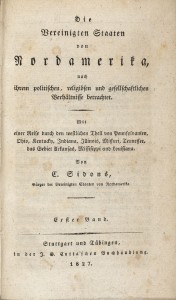
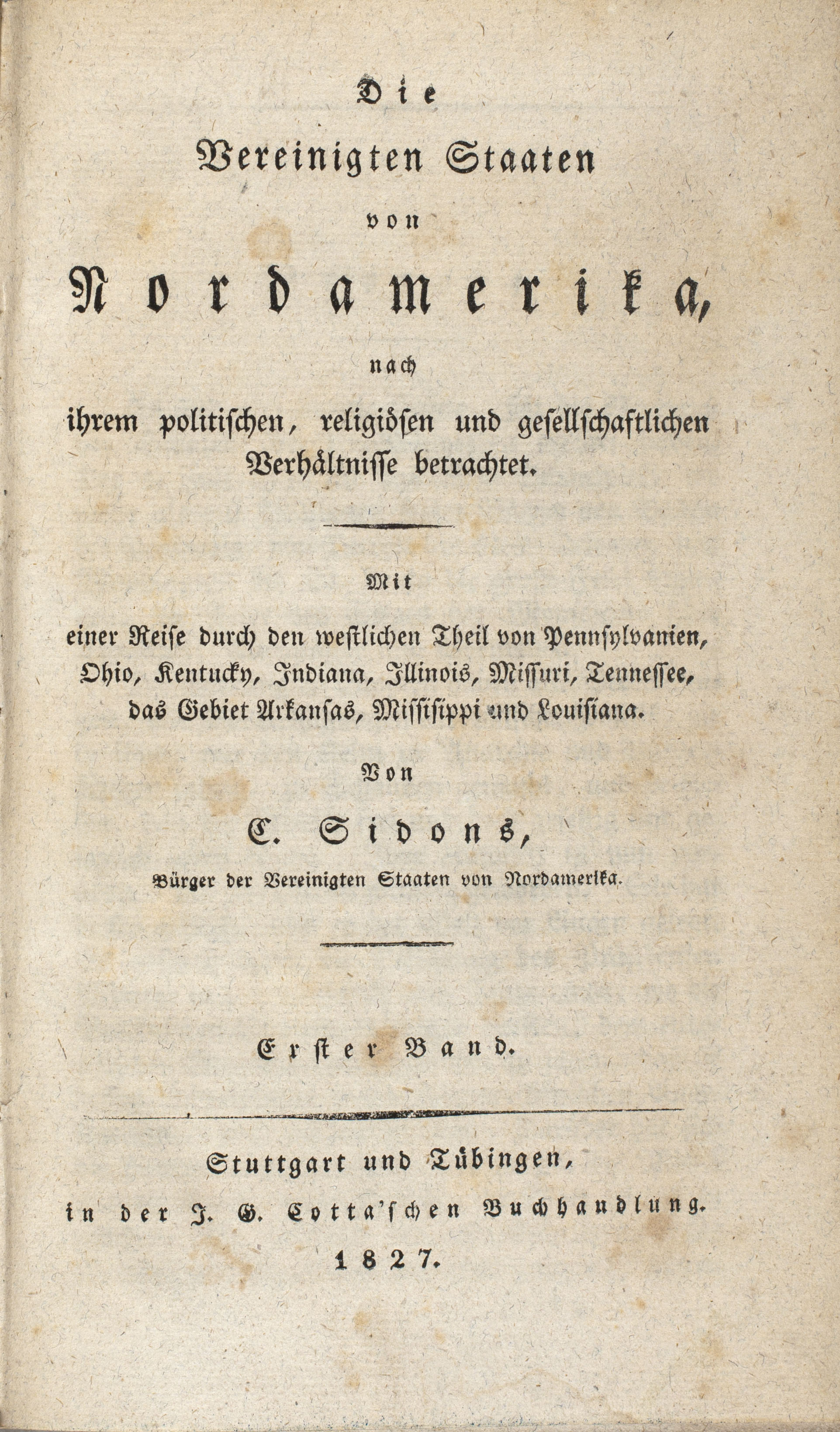
Die Vereinigten Staaten von Nordamerika, nach ihrem politischen, religiösen und gesellschaftlichen Verhältnisse betrachtet … Stuttgart & Tübingen: J. G. Cotta, 1827.

Sealsfield published his first book under the pseudonym “C. Sidons,” which he never again employed. The first volume offers an overview of American political institutions (including the rise of Jacksonianism), society, and culture, while the second takes the reader on an extended tour of the Mississippi and Ohio River valleys.
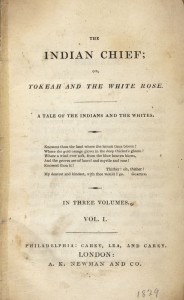
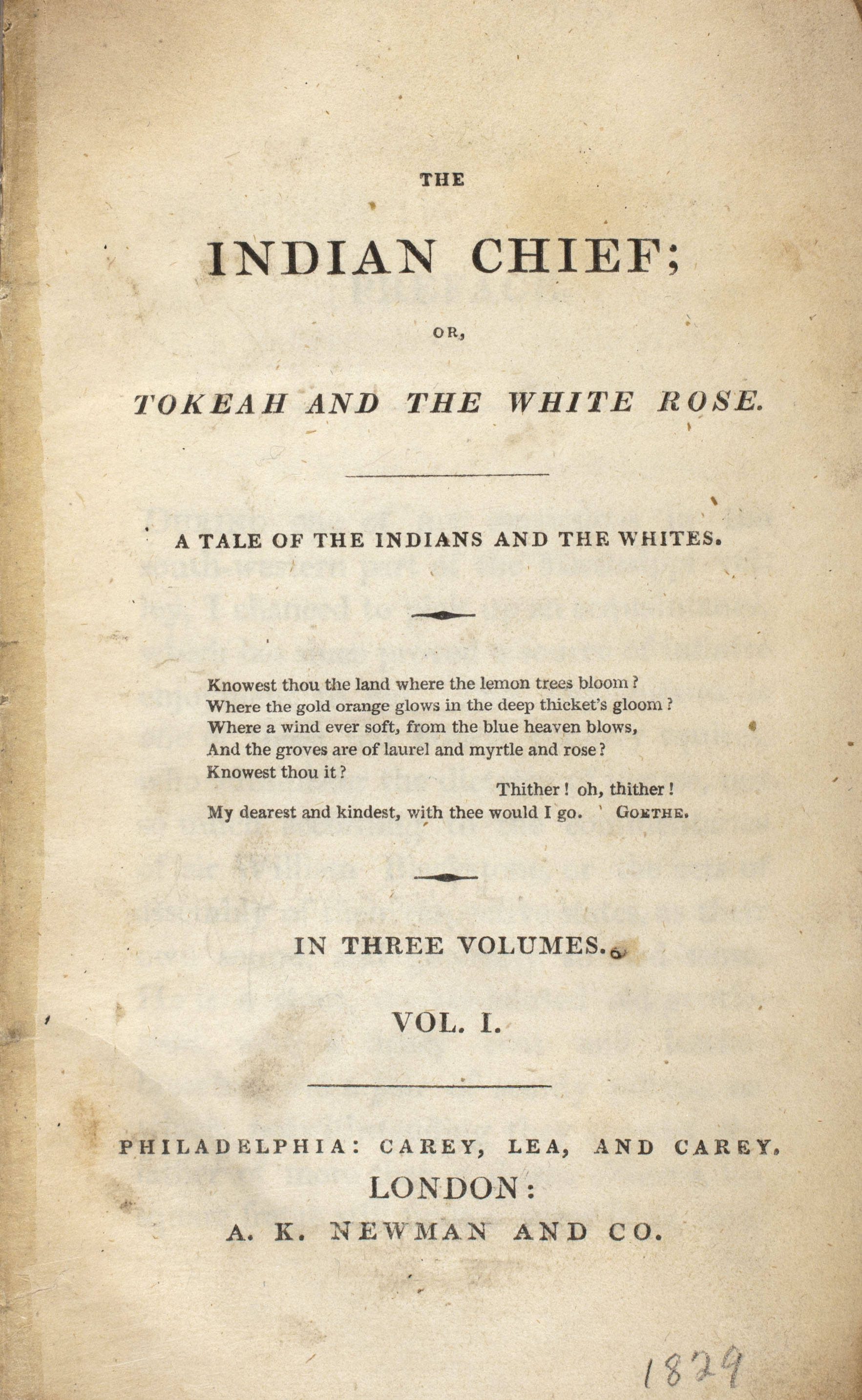
The Indian chief; or, Tokeah and the white rose. A tale of the Indians and the whites. Philadelphia: Carey, Lea, and Carey; London: A. K. Newman, 1829.

Sealsfield’s first novel is set in the lower Mississippi valley during the War of 1812, where Creek Indians struggled to protect their lands and culture from unscrupulous whites. Originally issued in two volumes in Philadelphia, this rare three-volume second edition was printed in London and bears an unusual transatlantic joint imprint. Arndt knew of only one other copy—at the British Library—though a few others have since turned up.
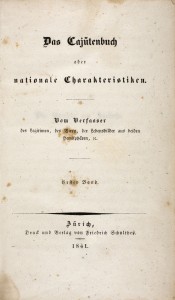
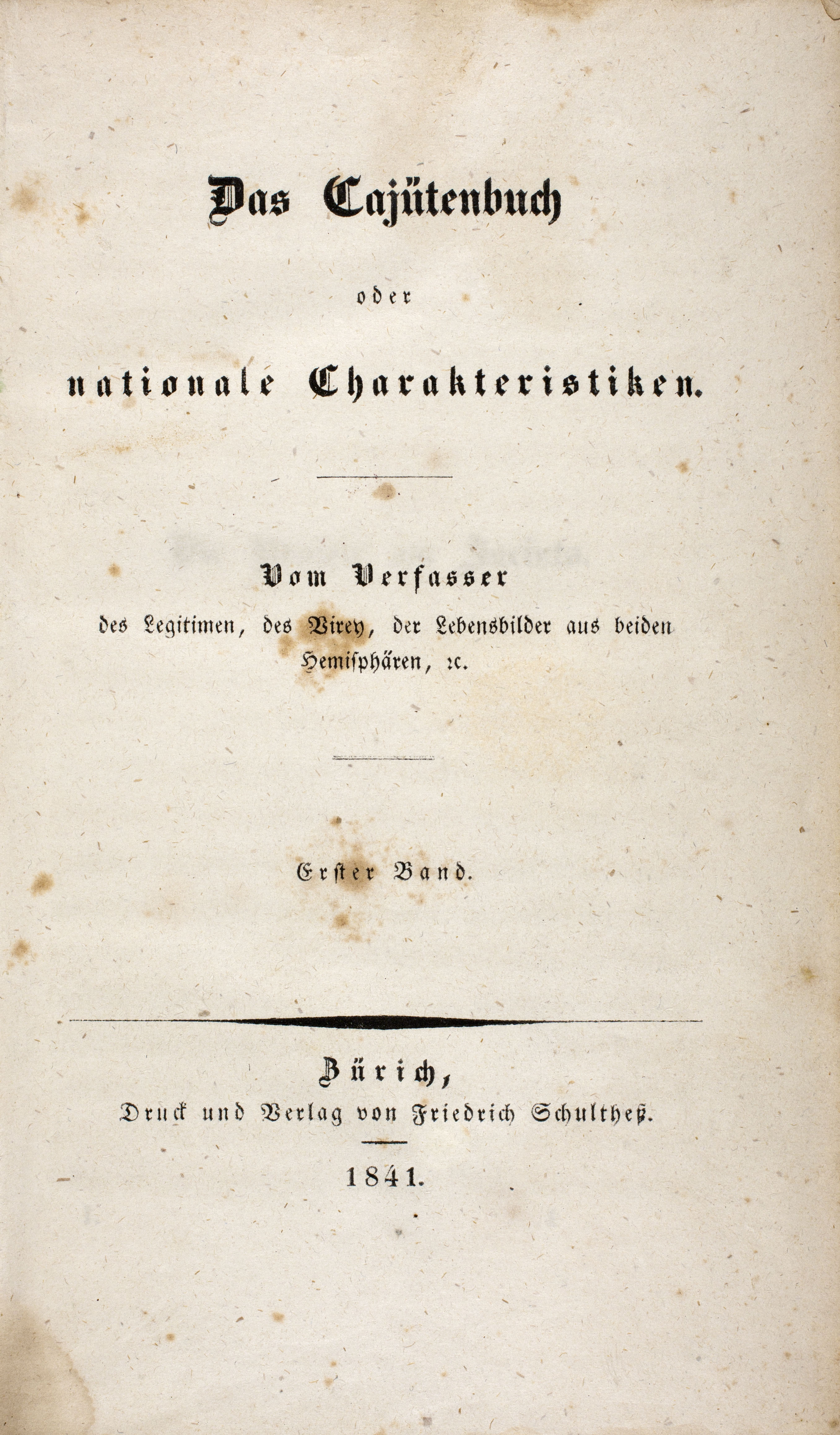
Das Cajütenbuch oder nationale Charakteristiken. Zürich: Friedrich Schultess, 1841.

Das Cajütenbuch (The Cabin book) is Sealsfield’s best-known work and one of the earliest novels to be set in Texas. In a series of five tales related at a fictional dinner party, Sealsfield offers a portrait of Texas and its settlers during the struggle for independence from Mexico.
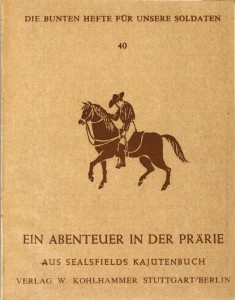
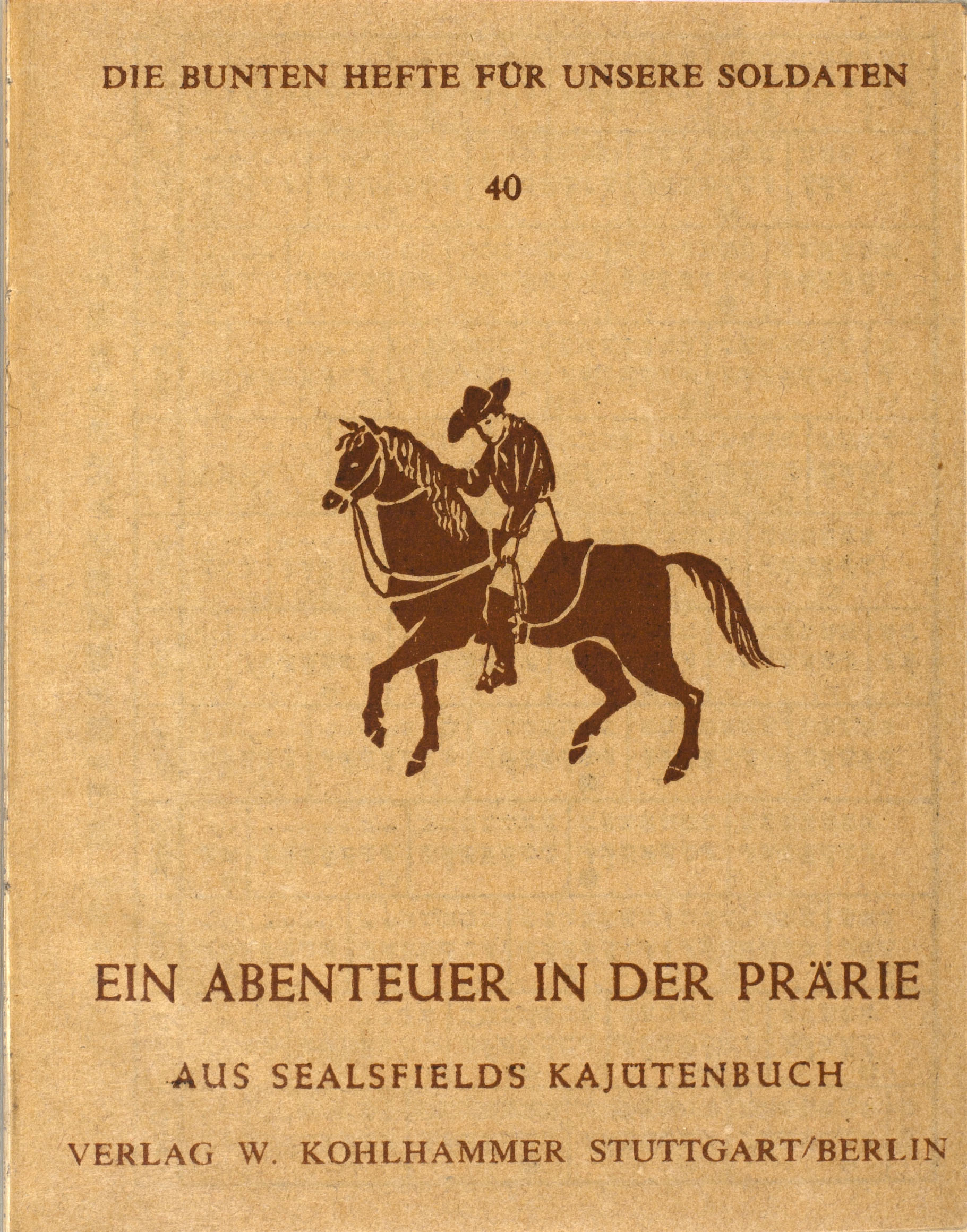
Ein Abenteuer in der Prärie, aus Sealsfields Kajütenbuch. Stuttgart: Verlag W. Kohlhammer, 1944.     (Die bunten Hefte für unsere Soldaten, 40)

This excerpt from Sealsfield’s Cabin book is one of several pocket editions in the collection that were published during World War II for the use of German soldiers. Printed in small format on thin paper, this 48-page pamphlet contains a calendar for 1944 inside the front wrapper and a space on the back wrapper for filling in a “Feldpost” mailing address.
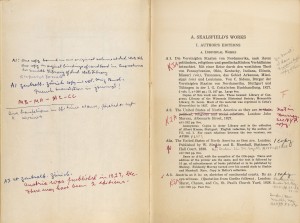
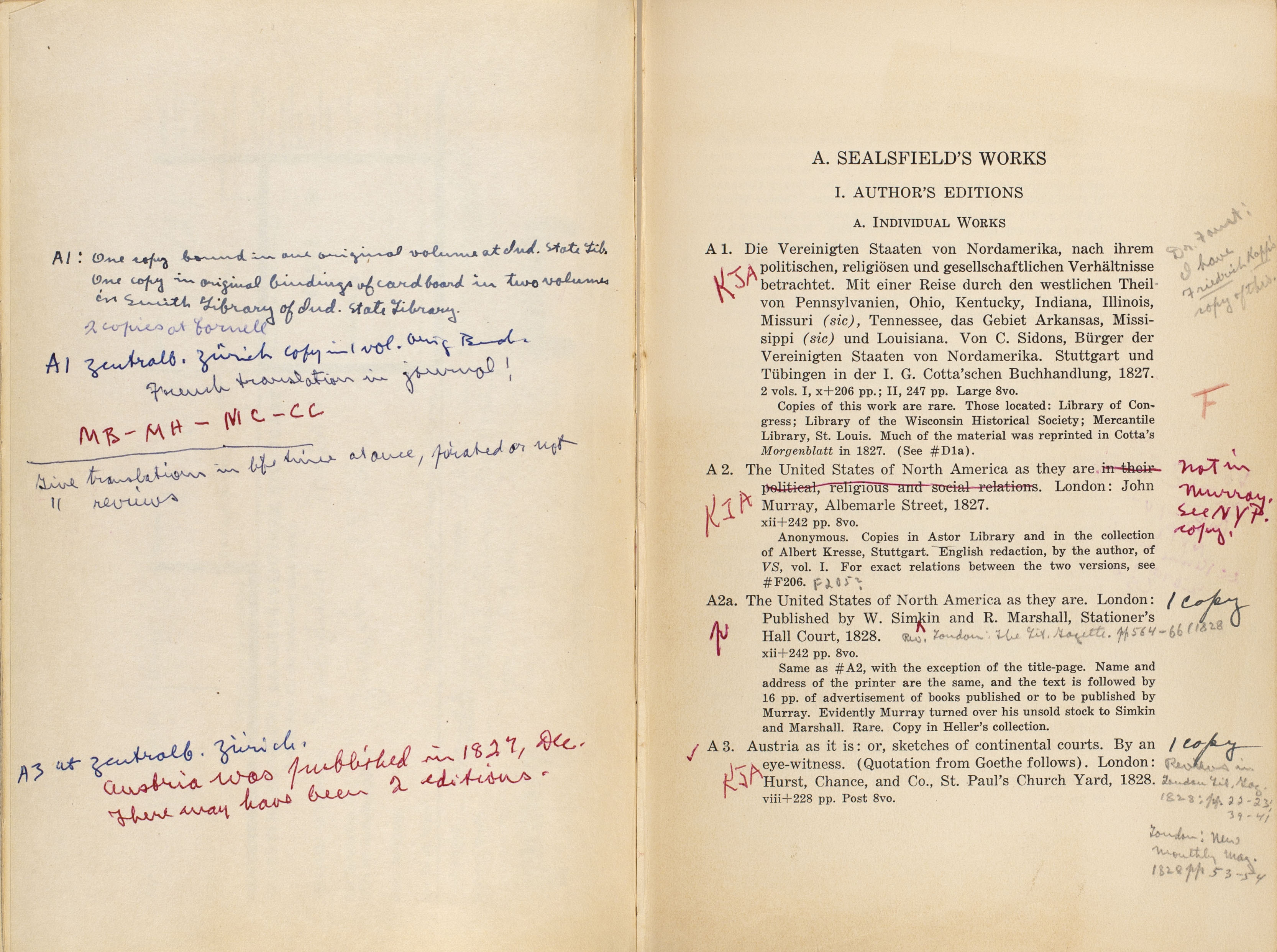
Heller, Otto, and Theodore H. Leon. Charles Sealsfield: bibliography of his writings …  St. Louis: Washington University 1939.

This interleaved copy was heavily annotated, first by Otto Heller and then by Karl Arndt, with additions, corrections, and notes.
Hidden Treasure of Hawaiiana

The vast collections at an institution like the American Antiquarian Society have been built and sorted over decades and, somewhat to the surprise of many scholars and readers, continue to be processed today.  Bulk collections are constantly being inventoried and rehoused to address conservation concerns and, when the Society has the resources and staff available, many of these collections are cataloged to the item level to improve access.  During a sweeping hunt for separately published engravings for our Prints and the Parlor project, visual material cataloger Christine Graham Ward and I are having a closer look at the Society’s U.S. Views Collection, which is a useful pictorial reference collection organized by state.  (A box list is available online at http://www.americanantiquarian.org/Inventories/usviews.htm.) The U.S. Views Collection is quite a hodgepodge of visual material and includes printed ephemera, photographs, book illustrations, and engraved material showing street scenes, buildings, and landscapes.

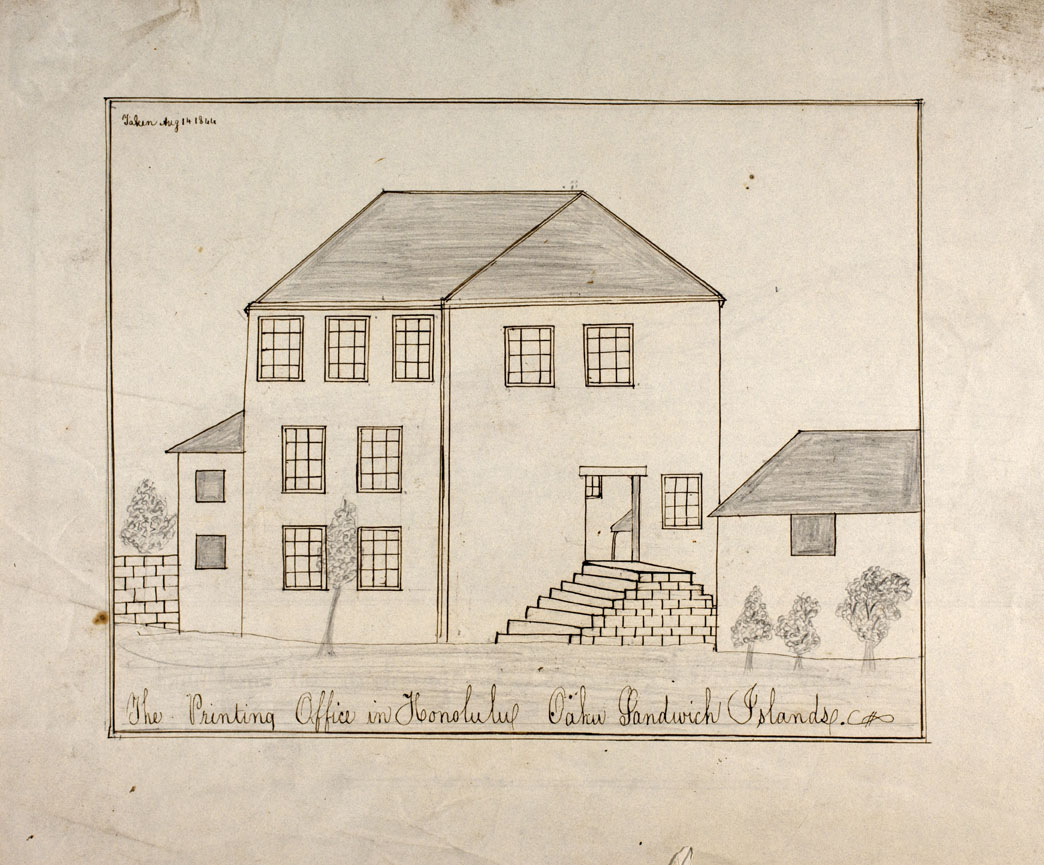
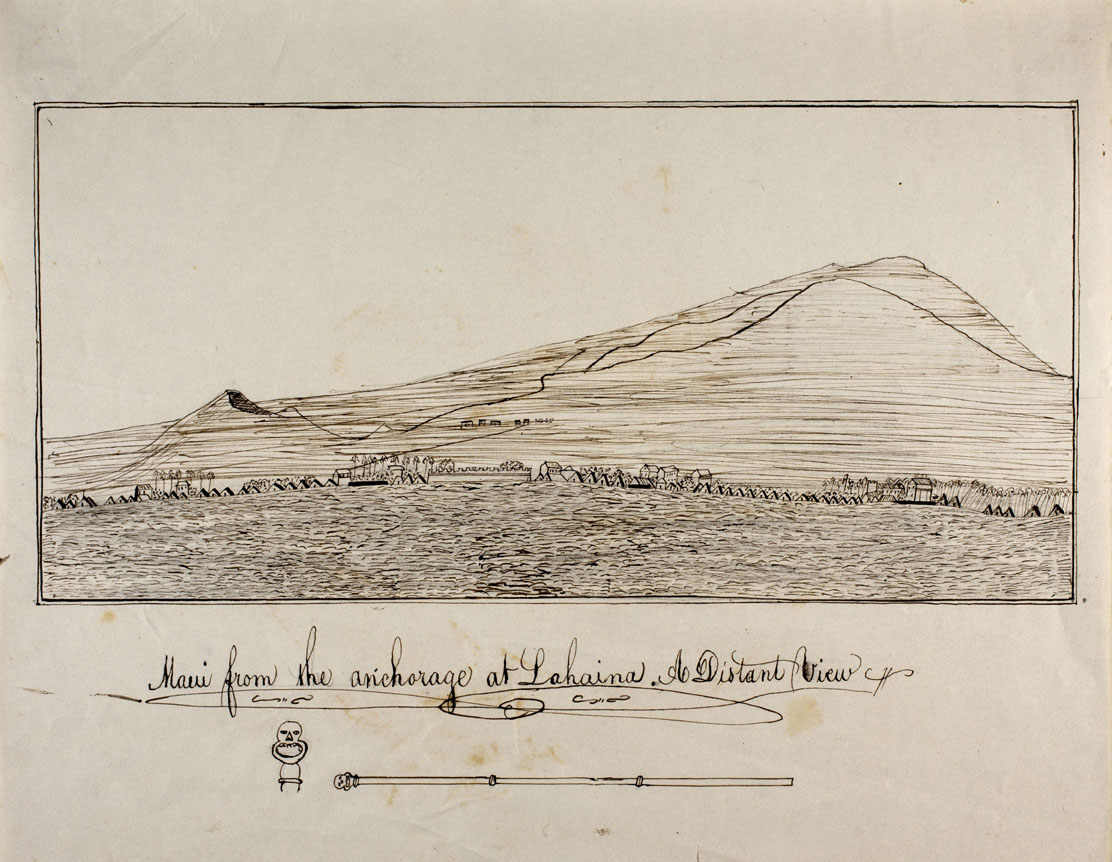
While going through the folders concerning Hawaii, we discovered the simple drawing of the printing office in Honolulu shown here.  The ink drawing features accents and shading done in graphite and is dated August 14, 1866.  It shows a three story building with large windows.  The printing office was built in 1841 out of bleached coral blocks cut from the reef in the nearby ocean.  We were very excited to find the drawing, as the Society is home to outstanding examples of Hawaiian printing, including newspapers, books and maps.  We also hold a collection of rare early Hawaiian engraved views produced by students at the Lahainaluna School on the island of Maui in the 1830s and 1840s.  (An illustrated inventory of these images is available online at http://www.americanantiquarian.org/Inventories/hawaiianengravings.htm.)

We were chatting about how great it would be to add this newly discovered view of the printing office on Honolulu to the Drawings Collection at the Society, when I noticed the sheet was folded over.  After unfolding, we discovered the second drawing inside, also illustrated here, showing the island of Maui from the water!  This drawing is closely based on the Lahainaluna School engraving with the same title, already in our collection. Both are called “Maui from the anchorage at Lahaina” although the artist of the drawing has added the subtitle “A distant view” as well as marginalia featuring two small doodles of a carved stick with a wide-mouthed tiki head.  We know the print was done by a student named Kalama after a drawing by K. L.  Could this be the original drawing for the engraving?  Or is this a later picture based on the engraving?  The 1866 date on the accompanying drawing of the printing shop seems to argue for the latter. The drawing will be added to the Society’s drawing inventory and be made available online and we shall continue to work our way through the U.S. Views over the coming months.  Who knows what additional treasures we may find!

You scream, I scream…

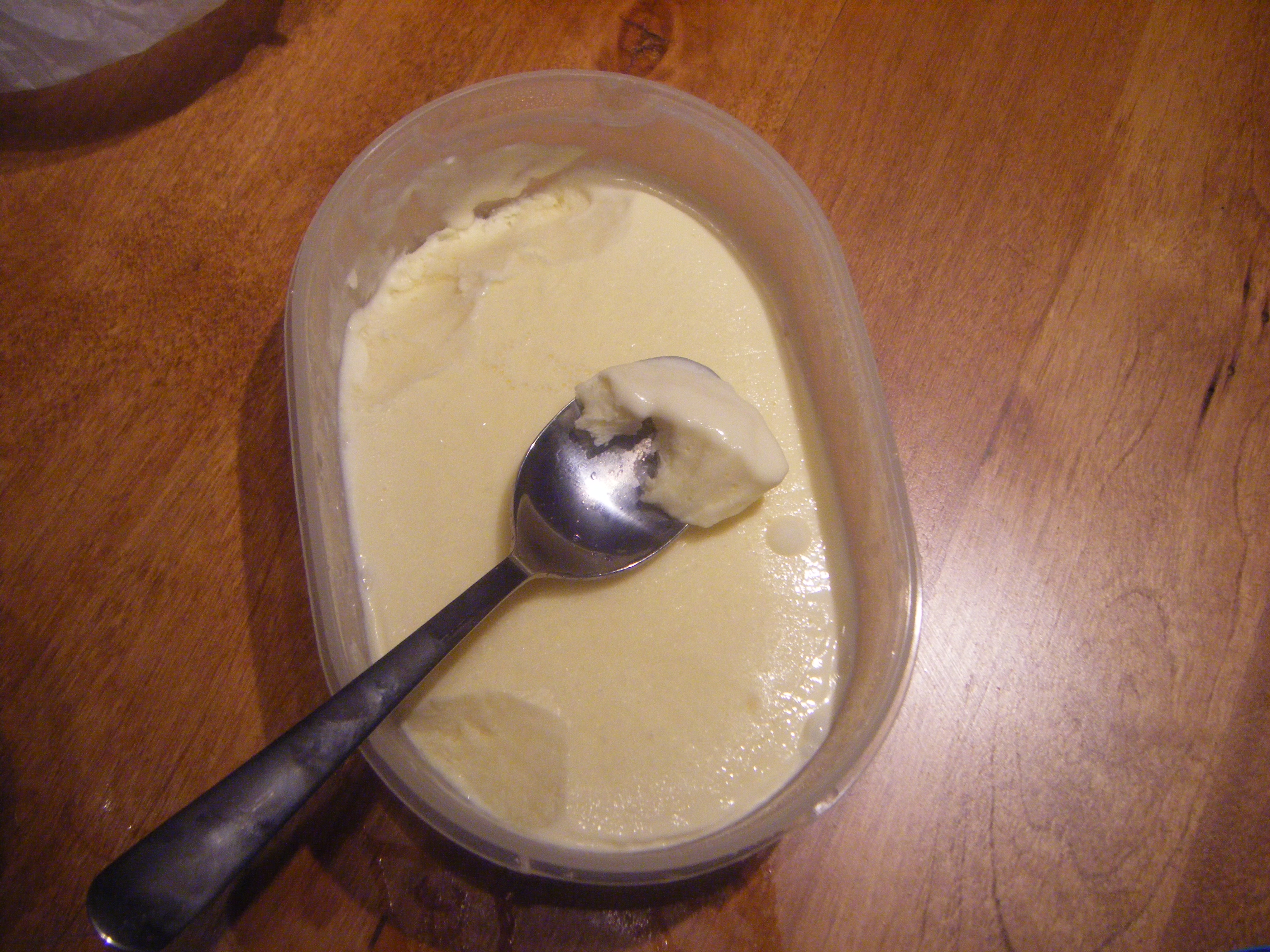
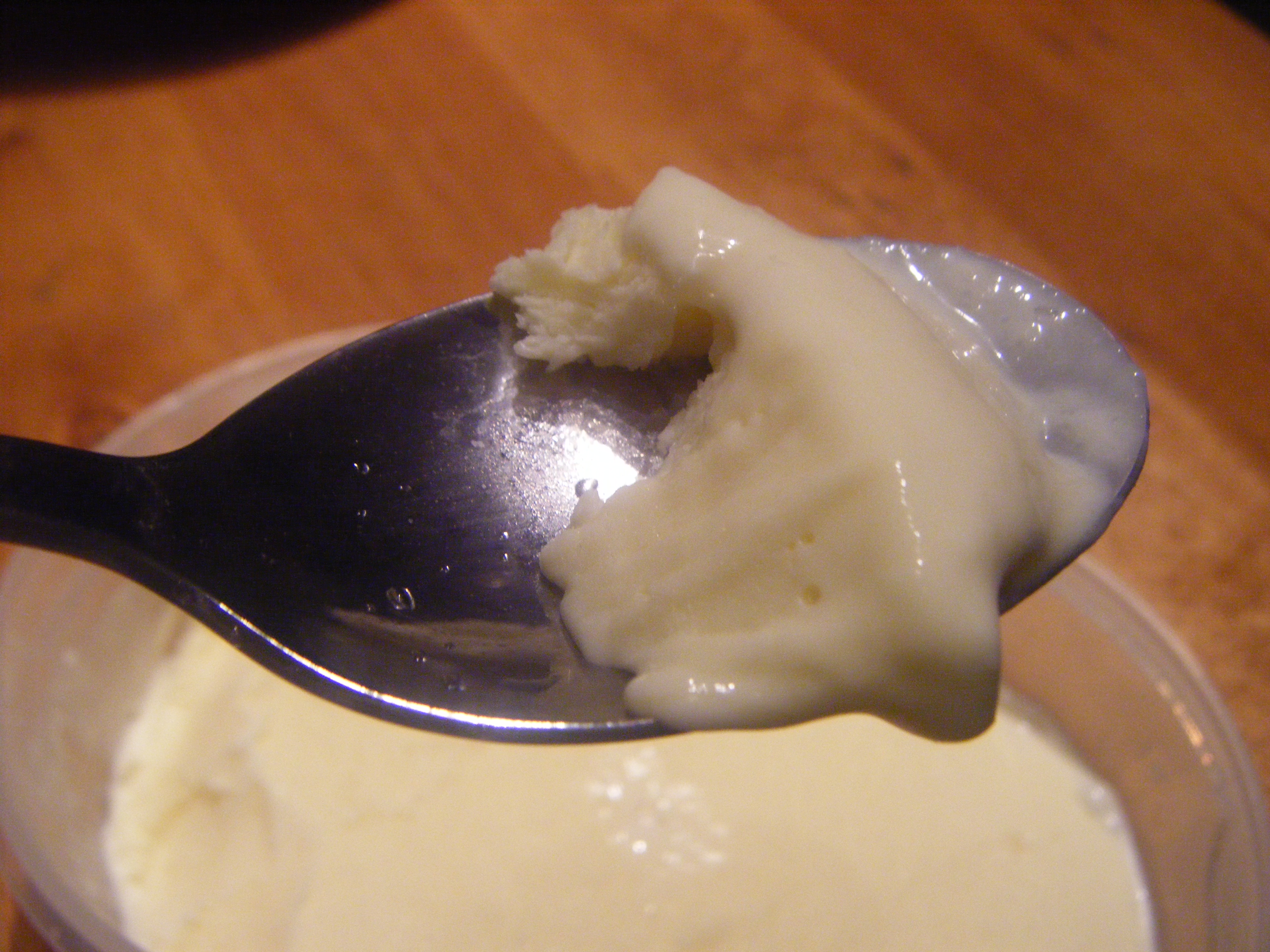
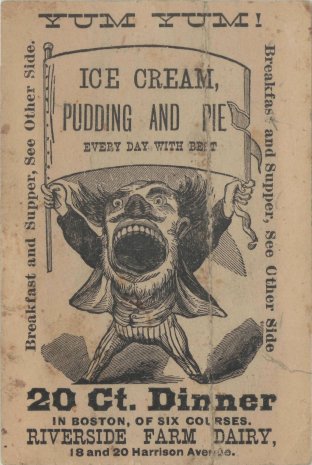
Even though the calendar says September, fall seems to be the last thing on our climate’s mind.  Up here in Worcester, Massachusetts at least, we’re hanging onto to the summer weather, clocking a scorching 97 degrees last week!  While I was excited to finally break out the cinnamon and pumpkin, I think it best to instead offer a final homage to the waning summer season.  It’s time for some homemade ice cream!

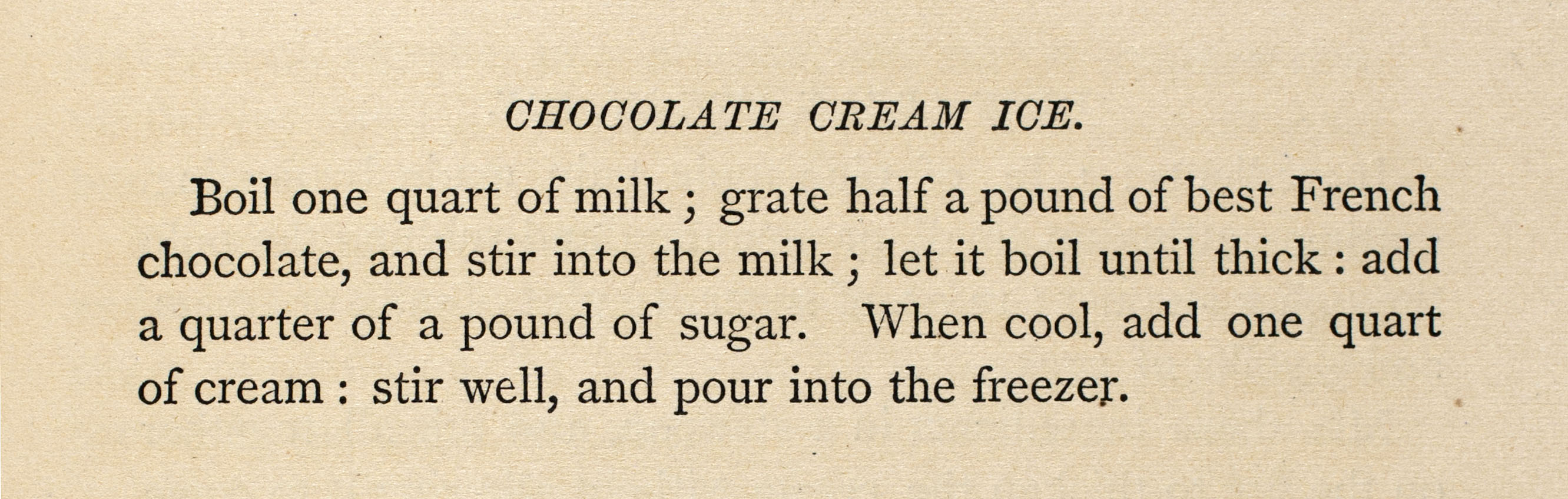
This time around, I’ll be using a recipe from The art of confectionary: With various methods of preserving fruits and fruit juices; the preparation of jams and jellies; fruit and other syrups; summer beverages, and directions for making dessert cakes.  This cookbook was published in Boston in 1866, and is a compilation of “recipes…from the best New York, Philadelphia, and Boston confectionaries.”  A dessert dish will be a welcome change, and The art of confectionary agrees, stating that “while the preparation of soups, joints, and gravies, is left to ruder and stronger hands, the delicate fingers of the ladies of a household are best fitted to mingle the proportions of exquisite desserts.”

The ice cream recipes in this volume are fairly standard, all including milk and/or cream, sugar, and egg yolks.  What’s interesting are the additions made to create the wide array of flavors.  Classic variations include the addition of one ingredient, such as chocolate, strawberries or ginger. The more daring cooks out there could try recipes for Italian ice cream, which includes almonds, cloves, coriander, orange rind, and brandy, or bourbon ice cream, with almond milk, almonds, currants, candied orange peel, dried cherries, pineapple and vanilla.  But I think I’ll try a classic chocolate recipe to start.

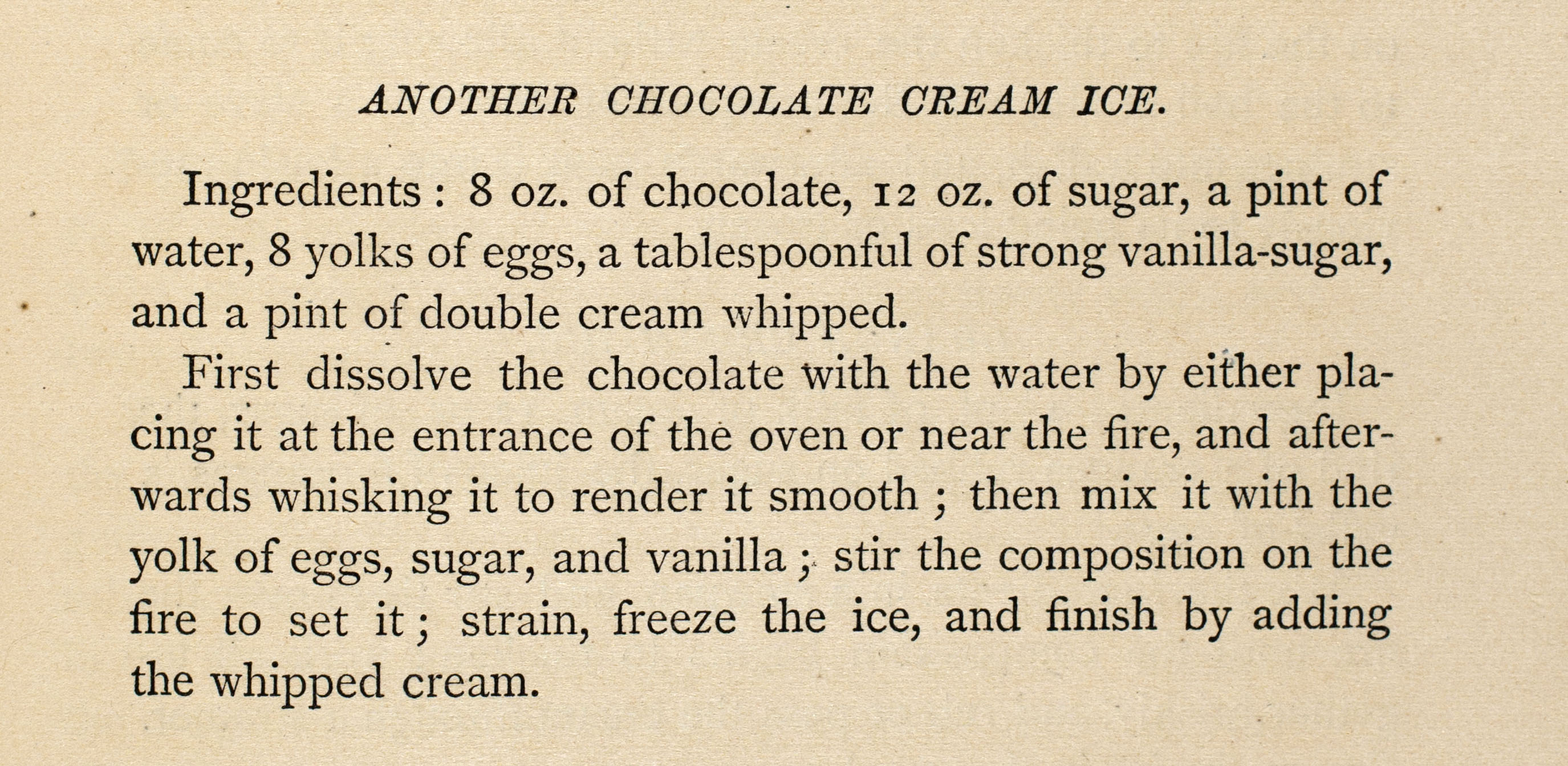
As a disclaimer, I think I should mention the presence of eggs in this dish.  I’ve posted an alternative chocolate ice cream recipe without eggs.  While the heating of the eggs with the cream may be enough to kill any bacteria, some folks may not want to take any chances.  So take your pick!  I’ll most likely cook both, but probably only taste one!

Happy cooking!

The Aquisitions Table: Amateur Newspapers


Two titles were recently added to AAS’s collection of Amateur Newspapers.

  • The Orb. Portland, ME. 1838. 3 issues. Adopted by Jo Radner.
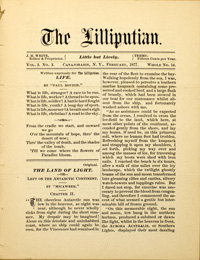
  • The Liliputian. Canajoharie, NY. 1876, 1877. 22 issues.

Amateur newspapers were printed usually by teenagers, and more for the pleasure and experience rather than profit. The Orb (recently “adopted” by Jo Radner during AAS’s Adopt-a-Book event) is particularly interesting because of its early date. The editor had to find either the full-size equipment or a print shop to produce the newspaper. The Liliputian, in contrast, was published in the heyday of amateur newspaper publishing. Thanks to the invention in 1868 of the table-top press, many hobbyists could afford their own press, distributing their papers locally and trading with other amateur journalists.

You can read more about AAS’s collection of Amateur Newspapers on our website at http://www.americanantiquarian.org/amateurnews.htm.

There is also an online inventory of the collection (although not yet complete) available at http://www.americanantiquarian.org/Inventories/amateura.htm.

The Novel Reader

Click on image to see more detail

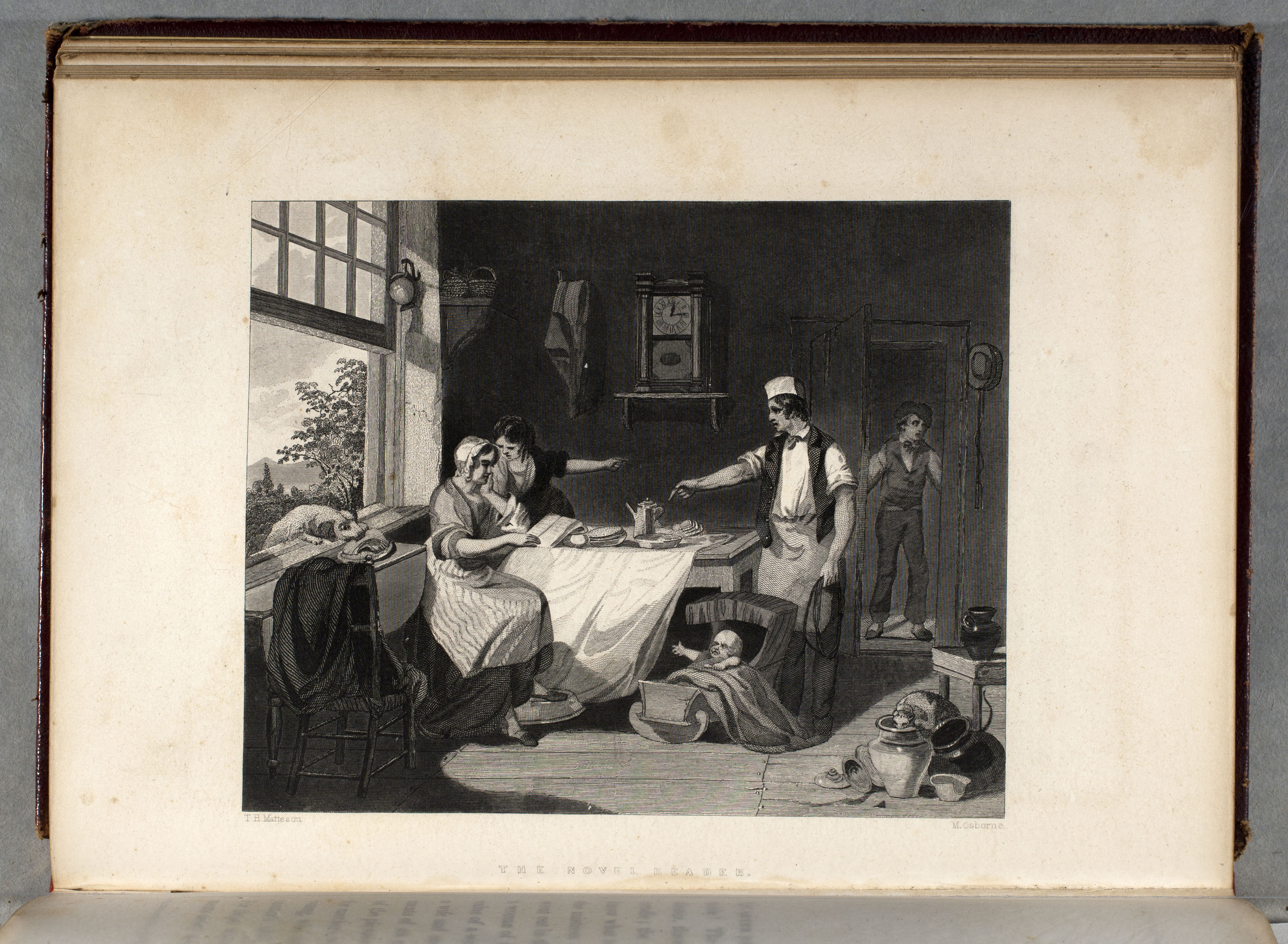
This image above of a woman reading in a busy interior, surrounded by household chaos appears in two gift books in the Society’s large collection, one from 1849 and one from 1853. The main figure sits completely engrossed in her book while the baby cries and a cat and a dog steal food. A tradesman demands payment and the lunch dishes are still on the table at 3:00. The illustration is a visual treatise on the dangers of novel reading. One does not even need to read the accompanying two page text to get the point that the editor of this particular annual was against novels for women. He describes the young woman as a figure of “ill-regulated mind, who has no appreciation of the value of a well-ordered household, or for the sacred duties of a wife and mother, and who delights only in the false excitement of an over-fed and pampered imagination.” Perhaps the young housewife is engrossed in a title such as The Monks of Monk-Hall: A Romance of Philadelphia Life, Mystery, and Crime (published in 1845) or Hen-Pecked Husband, a Novel (published in 1848). These sound so much more compelling than your standard religious text, volume on housekeeping or cookery or other wholesome books with titles like Sketch of my Friend’s Family: Intended to Suggest Some Practical Hints on Religion and Domestic Manners (1848) or Sayings and Doings; or Proverbs and Practice (1849). Ho hum. Given the choice, I’d rather read a novel, too.

AAS has many texts on the dangers of reading novels, including an essay by a minister published in 1853 entitled, Pernicious Fiction: or, The Tendencies and Results of Indiscriminate Novel Reading. Novels were seen as a distraction from the moral seriousness of life, a waste of time when young women could be industriously improving themselves or their households. Fortunately for all of us who wasted hours this summer reading novels (myself included), the nineteenth-century naysayers were defeated by the overwhelming popularity of the novel which continues even today.

As I was preparing to blog about this image, which was revealed during our current Prints in the Parlor cataloging project, a series of events transpired here under the dome, which, while not unusual, did give me pause. The volume with the image was actually being photographed this morning and was removed from the office of our digitizer so I could quote from the text. As I was transcribing the quote above a reader approached the reference desk. He is working on a film about the history of dogs in domestic spaces and he handed me a call slip for the “The Novel Reader” image. Three people needing to access the same image (myself, the digitizer, and the reader) at nearly the same moment is a bit wondrous – perhaps I should write a novel about it!

My Funny Valentine

Recent AAS fellow Hugh McIntosh recently spent some time with our Valentines Collection.  This collection includes some of the frilly, lovey-dovey valentines one would expect, but also some unexpected gems!  The comic valentines of the 19th century in particular caught Hugh’s eye, and he shares the following about his look at the 19th century’s sense of humor.


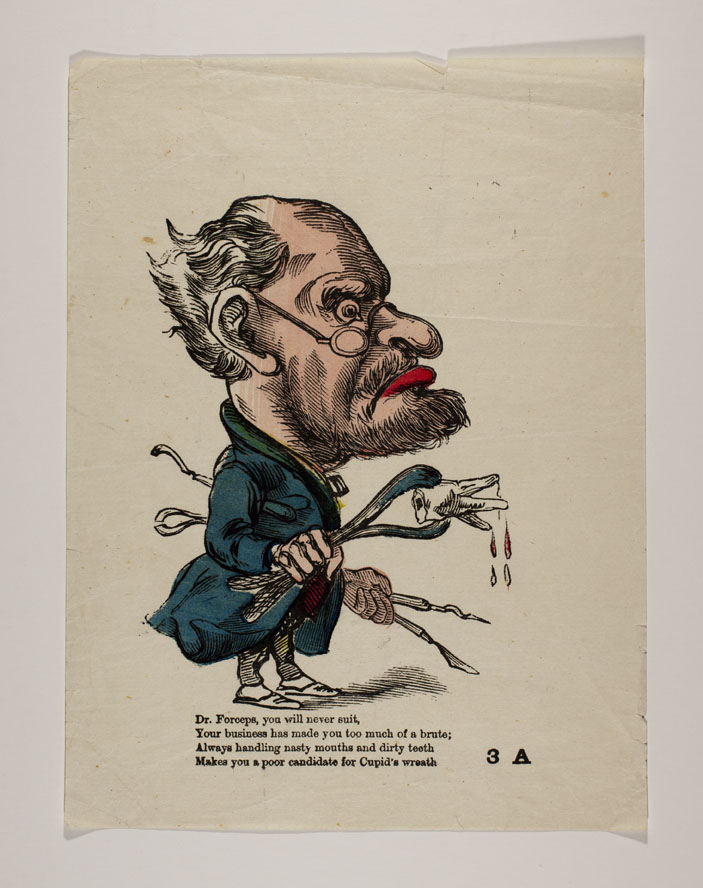
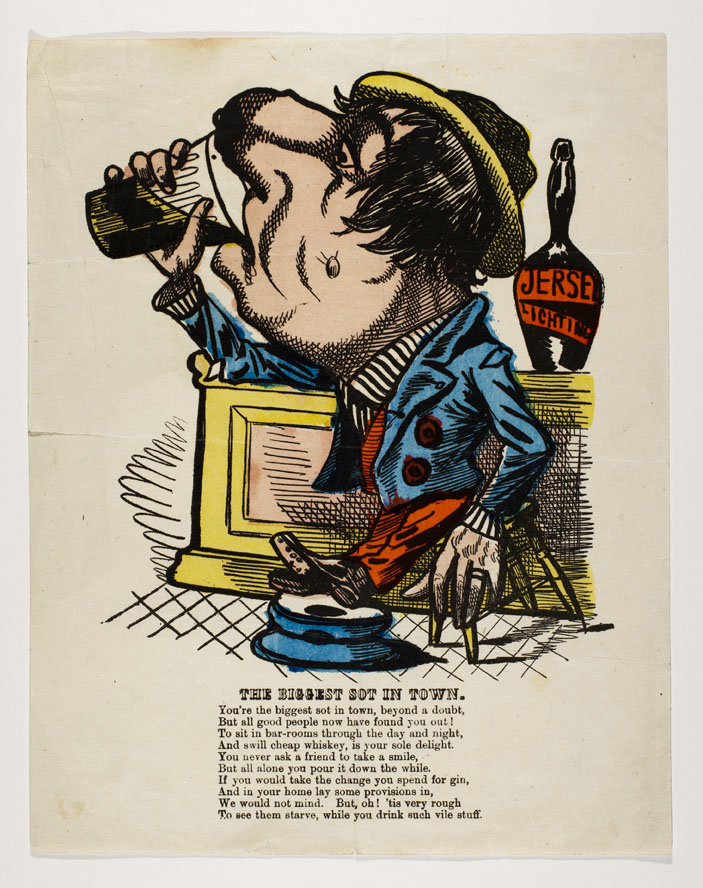
Ranging from satirical to insulting, these cartoons offer a window into the belligerent side of nineteenth-century romance. Most are accompanied by short, comic poems, many of them ending with some variation on the line, “You will never be my Valentine.” The collection includes caricatures of several professions, such as country newspaper editors, “quack” doctors, and a sadistic dentist, “Dr. Forcepts,” grinning over a huge tooth he’s just pulled. Barroom characters are popular targets as well—“topers,” “bummers,” and “sots.”

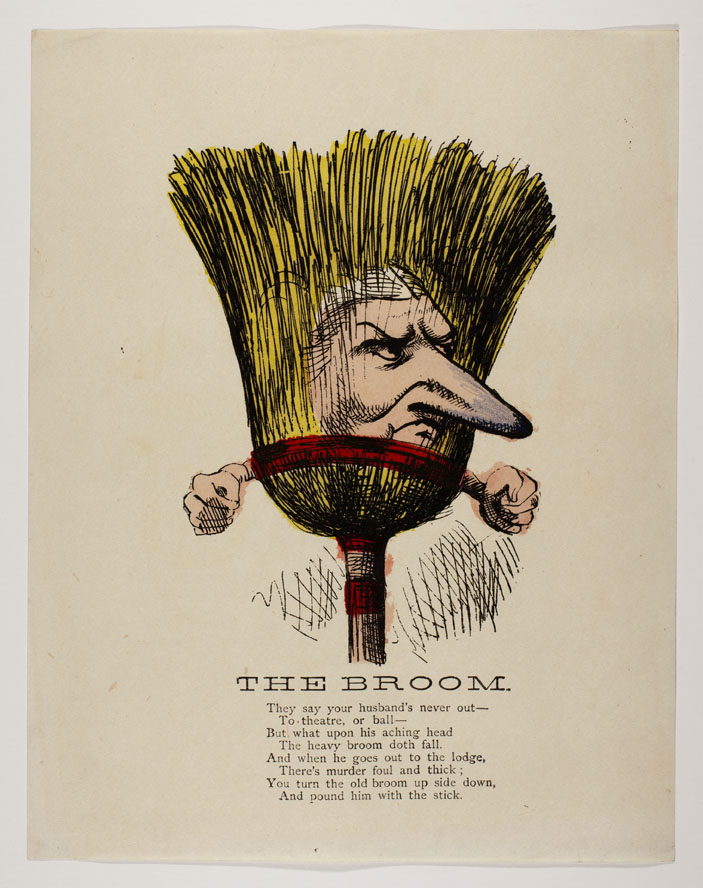
Cards depicting females make fun of overly fashionable young women and overbearing wives. One especially memorable example is addressed to “The Broom,” portrayed as a domestic weapon with an angry woman’s face. In contrast, many of the Civil-War-themed comic valentines depict soldiers who are either too timid or too clumsy to fight. In a parody of sentimentalized wartime romance, one Union soldier, crouching down to propose to his sweetheart, ends up sitting on one of his riding spurs. Alongside these specific cartoons, a few of the cards ridicule love more abstractly, such as this simple image of a hammer about to crush a heart.

Antiquarian News is Not an Oxymoron

Many of us begin a new academic or fiscal year this week.  In the spirit of new beginnings and renewed vows of organization, AAS has added an RSS feed to our website.  Those who have visited the AAS website recently have no doubt noticed how much content has been added, events promoted, books published, etc.  The list of what’s new at AAS just from this past year is pretty impressive for an Antiquarian organization! 

Here are just a few of the most recent examples:

AAS Fellow

Download Fellowship Applications

Applications for AAS fellowships are now online. The Hench Post-Dissertation Fellowship and Fellowships for Creative and Performing Artists and Writers applications are due in October.

Reading Exhibition

A Place of Reading

The new online exhibition A Place of Reading uses images and objects from the AAS collections to illuminate the spaces where reading happened in early America.

Mary Kelley

HBA Celebrated in Washington

A History of the Book in America editors David D. Hall, Scott E. Casper, Mary C. Kelley, and Joan Rubin discuss the project upon its completion. (There’s even a video clip!)

You can ensure you won’t miss out on any Antiquarian News by clicking here to subscribe to the “New at AAS” RSS feed.   Whenever news is added to our website, you will receive a notification in your preferred RSS reader.  We hope this feature will make it easier for you, our friends, to keep up with current developments at AAS.

If you haven’t already, you can also subscribe to Past is Present‘s RSS feed by clicking here.  Or if you’re anything like me and feel more in tune with the past than the present, you can sign up to have Past is Present posts sent directly to your email by clicking here.  Who knew the day would come so soon when e-mail could be considered the older technology?

The Mince Meat Throwdown, Part II

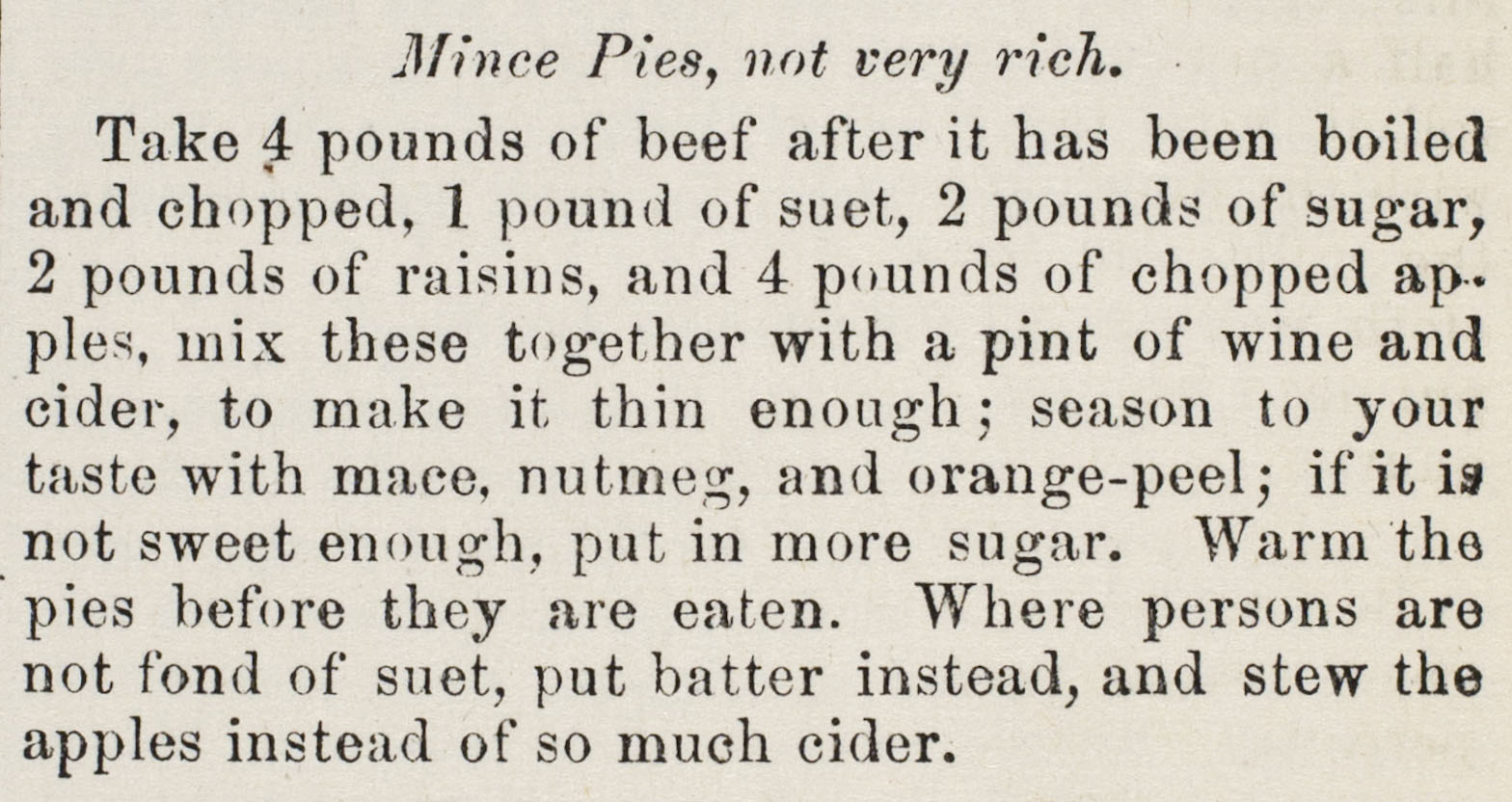
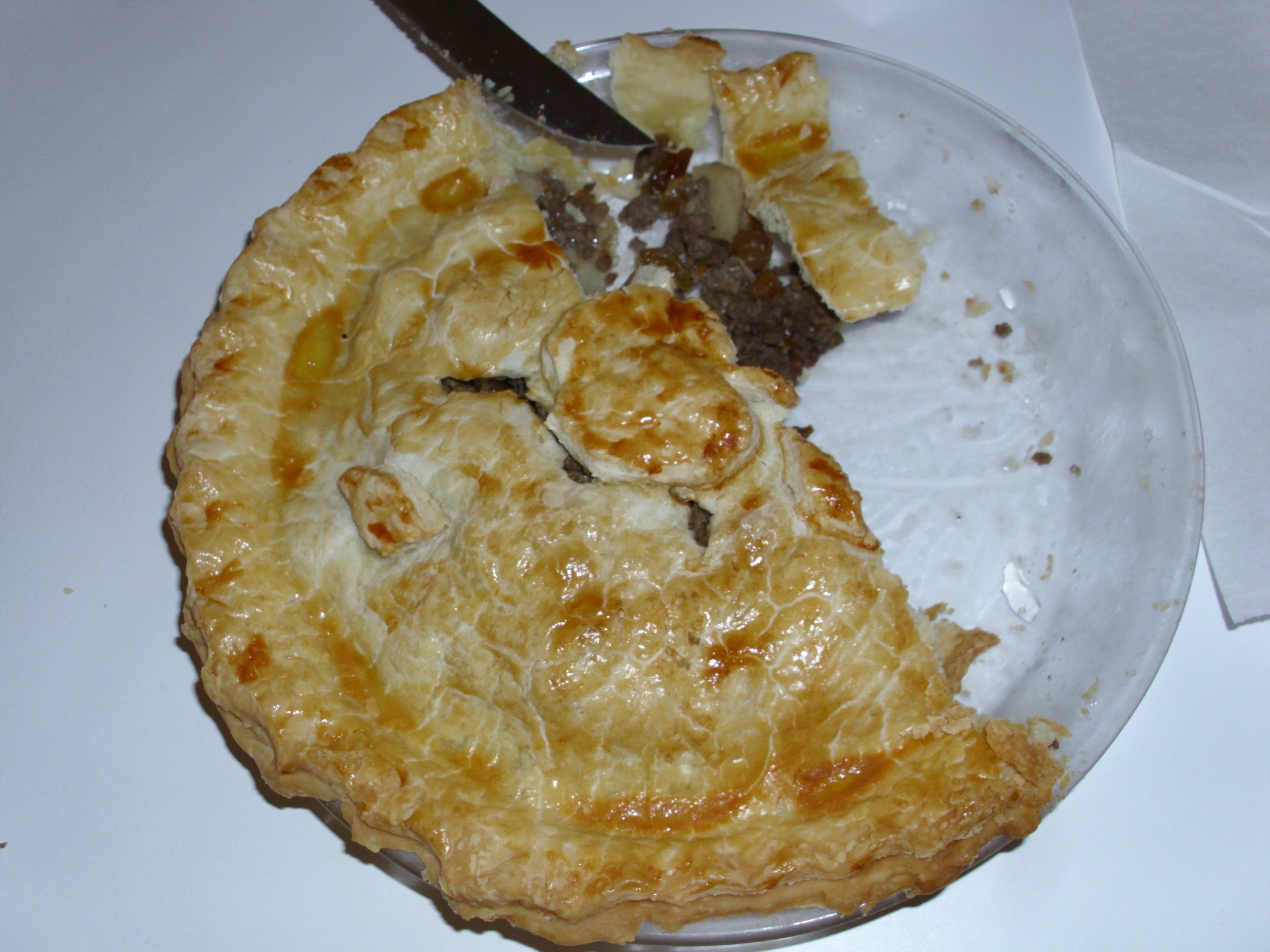
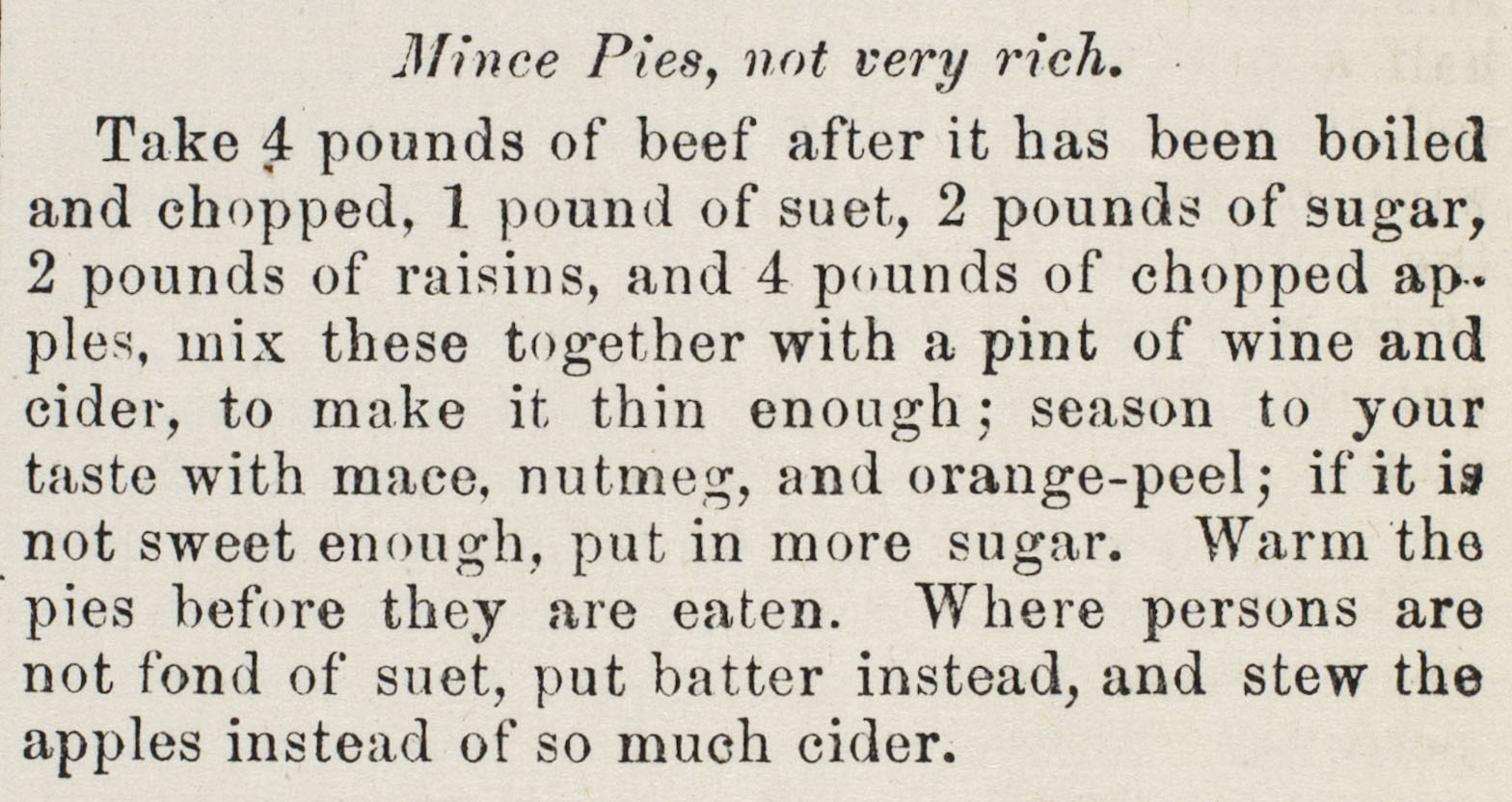
The Mince Meat Throwdown was a success!  Unlike the chowder made from Mrs. Bliss’ cookbook, the mince pie actually held its own as a main course.  The recipe could have easily worked as a dessert pie, being as sweet as it was.  Even though there was beef in the pie, it certainly didn’t taste like it!  In fact, I was quite surprised by the lack of any savory aspect in this dish.  While it was obvious from the recipe there wouldn’t be anything savory about it, my mind still expected it.  If anyone gives the recipe a try and is feeling the same way, I would suggest serving it up with some gravy to satisfy the sweet/savory combination.

I tried to remain as true to the recipe as possible, but must admit some adjustments were necessary.  While suet can still be found in some grocery stores and butcher shops, I unfortunately didn’t find it in my local grocery store and instead went with the next best thing – Crisco shortening.  While a bit turned off by the idea at first, after adding it to the beef, I saw it simply made the beef thicker and richer.  It certainly won’t become a staple in my cooking, but it did the trick.  Another adjustment I made was pure weakness on my part.  After measuring out the necessary sugar for the recipe, I simply could not stomach adding as much as was called for, and ended up including about 2/3 of the needed sugar.  And I’m glad I did, because I can’t imagine it being any sweeter!

What I’ve found I like best about cooking these old, historic recipes is the simplicity of throwing everything into one pot.  Whereas now, we sauté first then combine, or cook a sauce in this pot, and sear meat in another.  The process, while enjoyable, can become rather complicated, not to mention the amount of pots and dishes that need to be washed afterwards.  Being able to throw everything together in no particular order and allowing all the ingredients to marry is a welcome change.  One pot suppers and casseroles seem to be rather popular recently, so perhaps we are returning to some of these old ideas.

If anyone out there gives the recipe a shot, let us know how you like it!  And I’ll be posting some new recipes soon.  Happy cooking!

The Acquisitions Table: Amateur Newspapers in Chicago

Amateur city directory. Chicago: Warner Bros., 1876.
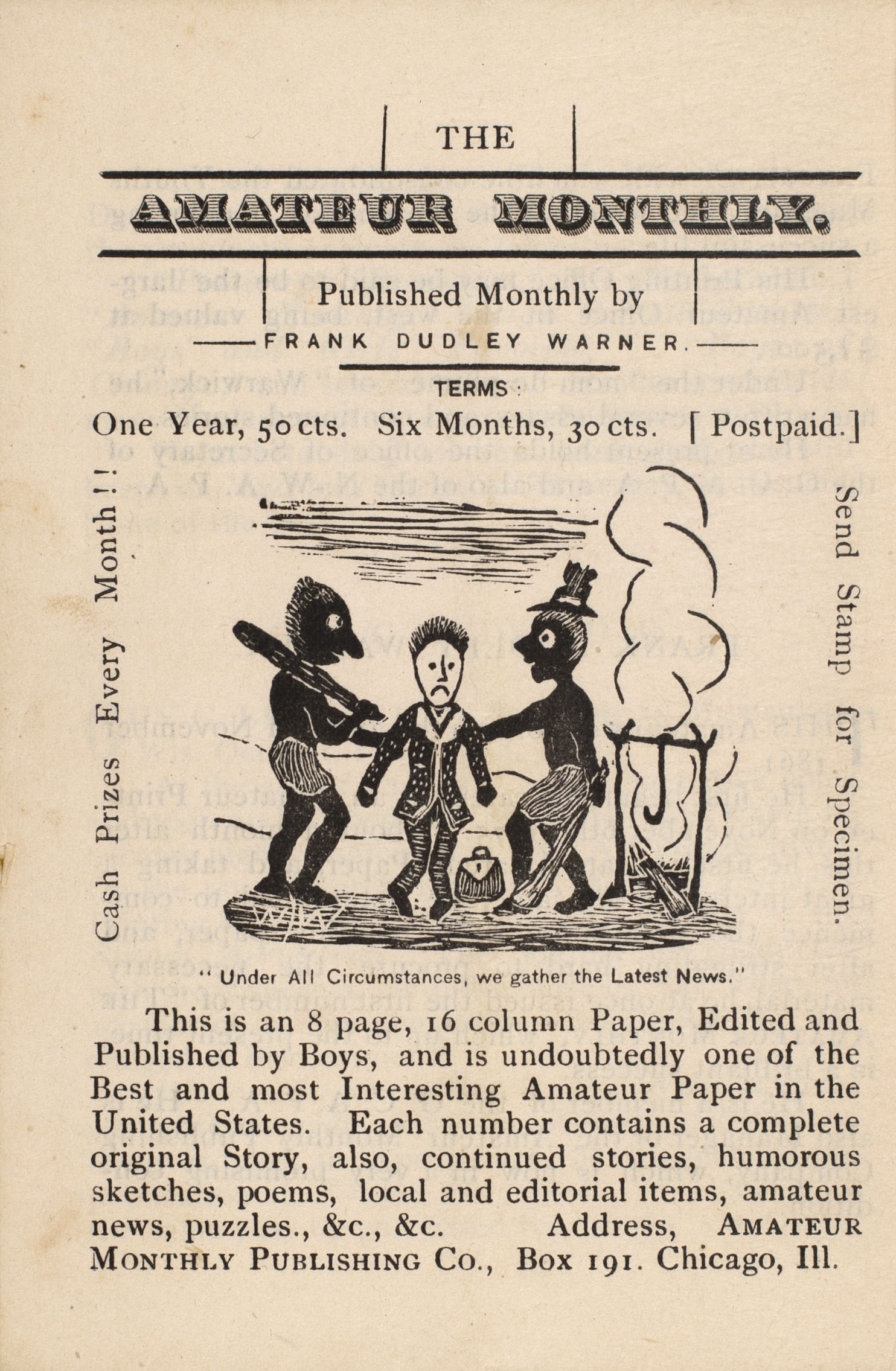
This rare pamphlet chronicles Chicago’s amateur press community as of 1876. Its publisher was 15-year-old Frank Dudley Warner, editor of the recently established Amateur Monthly—one of a burgeoning number of amateur newspapers then being published nationwide by hobbyists on table-top presses. Included is a directory of nearly a hundred Chicago amateur printers, a listing of 13 amateur newspapers (all monthlies) then being published in Chicago (“the combined circulation … is between Seven and Eight Thousand”), biographies of the Greater Chicago Amateur Press Association’s teen-aged officers, and advertisements for printing supplies. Quite expertly printed for an amateur publication, the Directory usefully supplements AAS’s superb collection of 19th-century amateur newspapers.  Purchased on eBay. Francis H. Dewey Fund.
~ David Whitesell

Have You Seen This Woman?

The following conundrum for Past is Present readers comes from AAS reader Mary Fissell.

I’m writing a book about Aristotle’s Masterpiece, and have just spent a couple of very productive and happy weeks working with the AAS’s collection of 50+ editions. This book, neither by Aristotle, nor a masterpiece, is one of the longest-running popular medical books on either side of the Atlantic. First published in London on 1684, it was still for sale in sleazy London sex shops in the 1930s. While the text remains surprisingly stable — it is basically a 17th century midwifery book spiced up with a racy poem and half a dozen images of monster babies — the pictures in the book change over time.

For most of the eighteenth century, the picture at the front is of a hairy woman and black baby (see my WMQ article http://www.jstor.org/stable/3491495 for some thoughts on how this image worked), but in the nineteenth century, there’s a riot of new imagery associated with the work. It’s as if the book is a chameleon, taking on the coloration of whatever the publisher thought was trendy and might sell a few more copies. Shortly after their arrival in Boston, Chang and Eng Bunker, the so-called Siamese twins, were featured in the Masterpiece. (See the AAS copies G566 A717 A829 and G566 W926 W831 for examples.) And the borrowing was sometimes two-way; the Masterpiece’s “hairy woman” woodcut was re-used by Nathaniel Coverly in his 1770 Boston edition of the Mary Rowlandson captivity narrative!

Some of the images chosen by publishers or printers have a logic that I can follow — Chang and Eng Bunker fit right in with a text obsessed about unusual births. For others, I can’t figure out what the original image was, and here I beg the help of other readers of cheap print. For example, do any of you recognize this scene?

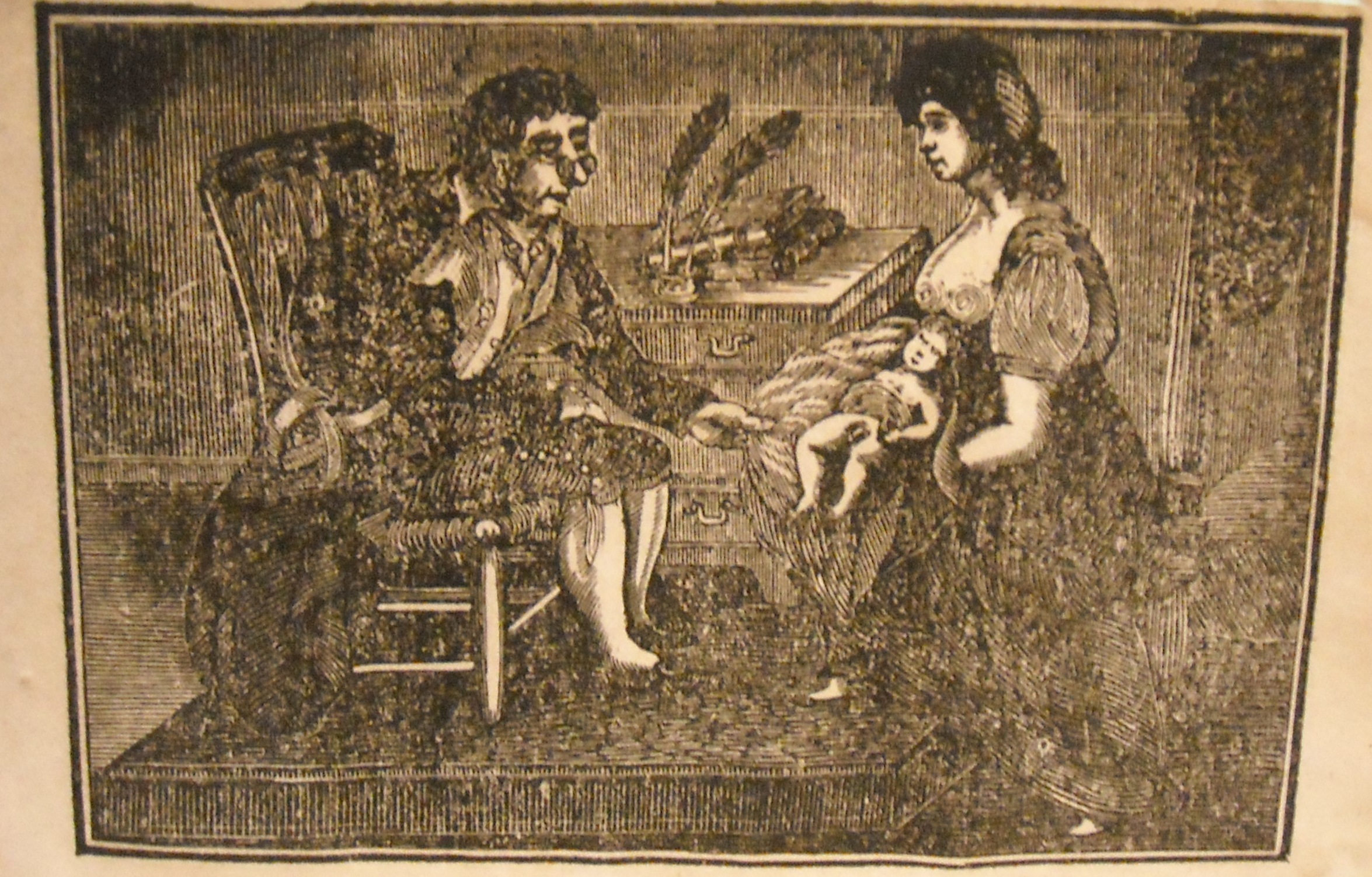
It’s the frontispiece to an 1831 edition of the Works, the omnibus volume that included the Masterpiece, held at the AAS (G566 W926 W831 Copy 2). What is happening here, and from where did the printer or the bookbinder borrow this scene? The AAS copy is the only one with this image that I have seen — other 1831 New England editions have Chang and Eng Bunker as the frontispiece. Could it be depicting a scene from a novel?

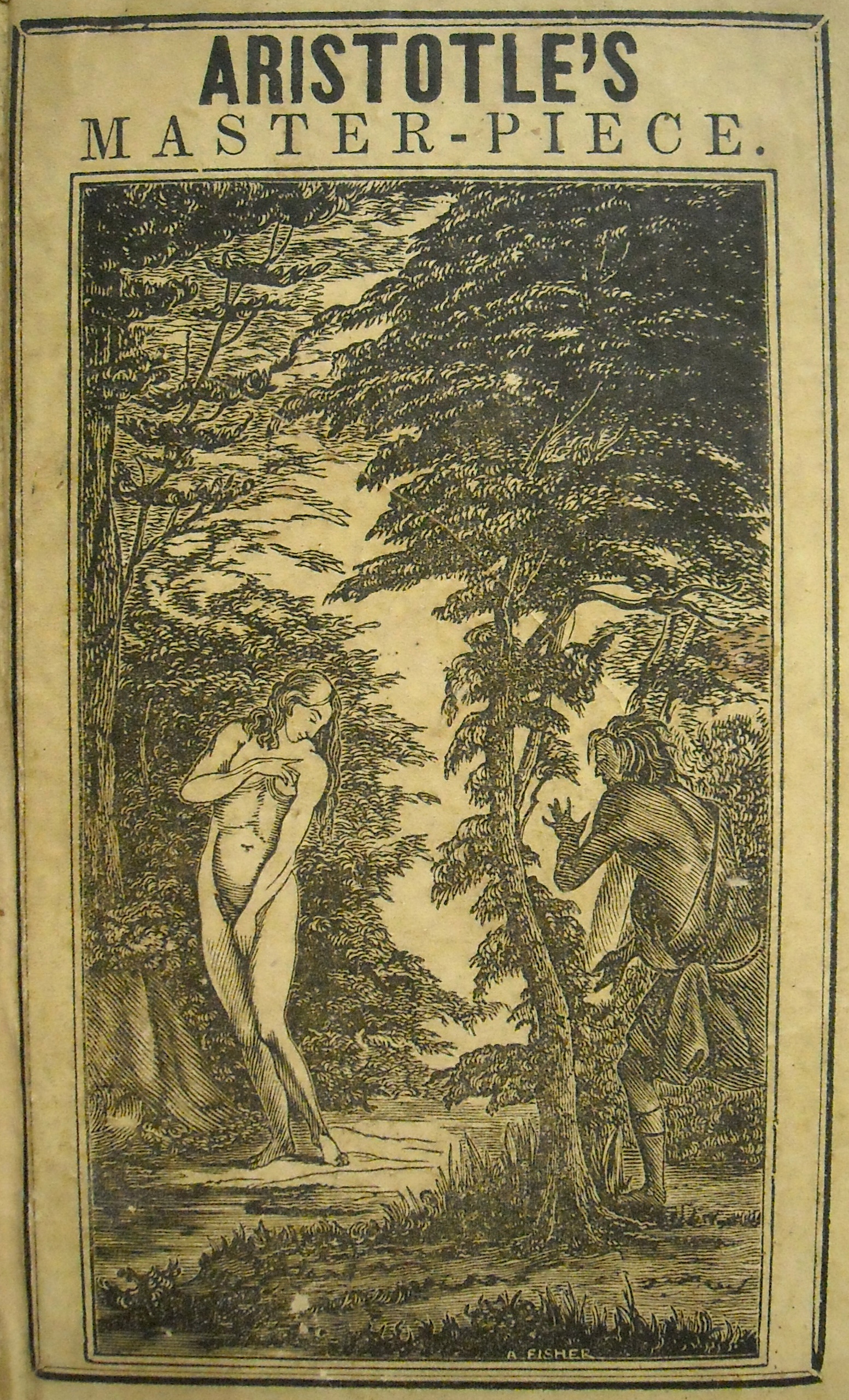
Or take a look at this picture. It’s the cover of an 1842 New York City edition of the Masterpiece (AAS Backlog 19C 0607).

The book looks like a number of other New York editions, seemingly made for a racier readership than many others. But I’d love to know where this image, probably from a painting by Alvan Fisher, came from. Looks like a captivity narrative, perhaps?

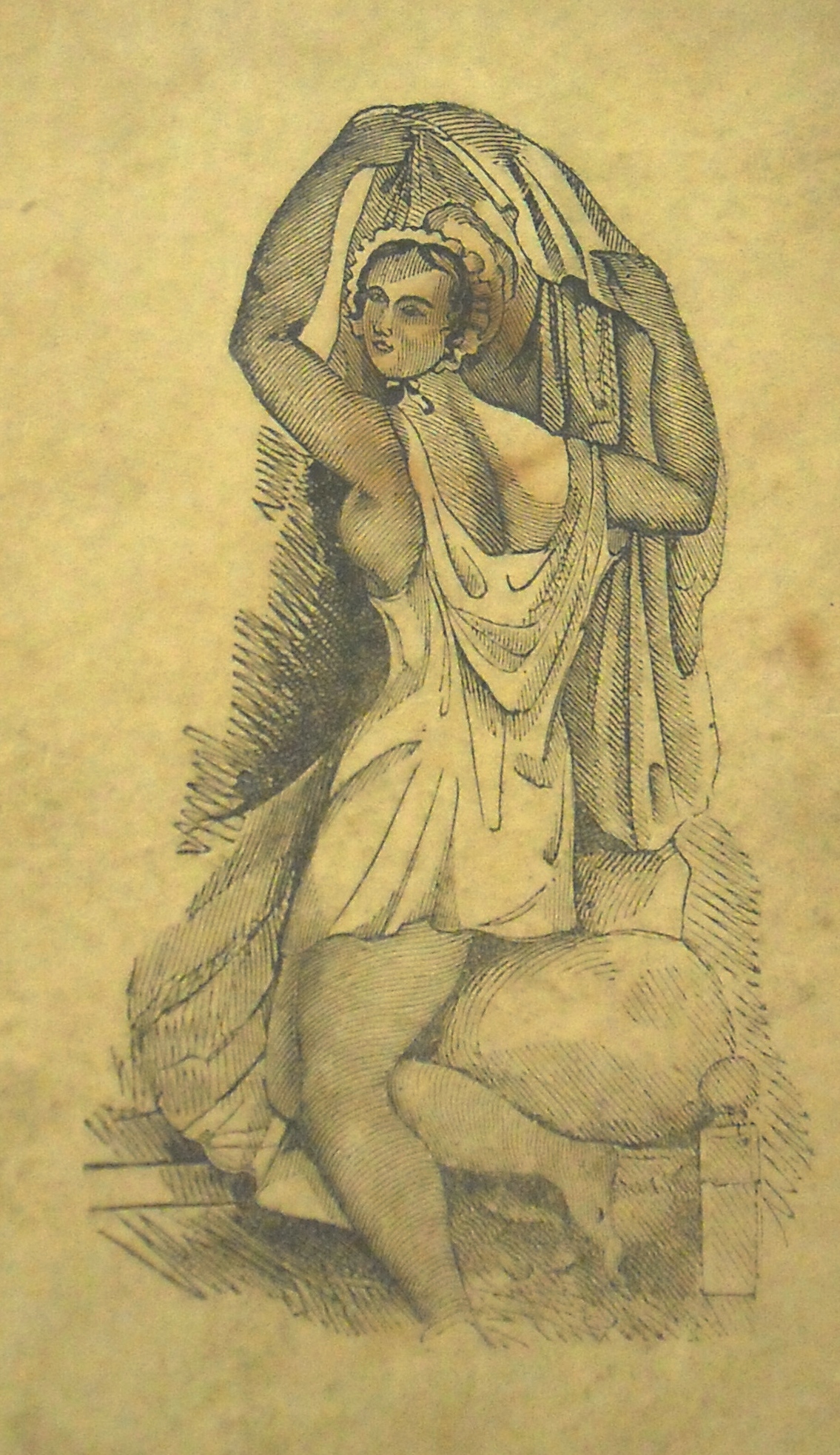
And lastly, here’s this lady of dubious virtue, who is the back cover of the same 1842 New York edition. What earlier publication did she adorn?

If you recognize any of these images, or have any ideas about what they may have illustrated originally, please send me an email: mfissell@jhu.edu. I’m very grateful for any leads!

The Acquisitions Table: Fate of the Rebel Flag

Fate of the Rebel Flag. Painted by William Bauly, lithographed by Sarony, Major & Knapp. New York: William Schaus, 1861).

Due to the approaching 150th anniversary of the American Civil War, several examples from AAS’s holdings of war images and broadsides will appear in loan exhibitions and as reproductions in upcoming publications. This chromolithograph from a Connecticut estate was offered for sale to AAS. It is one of a pair of images that were issued in 1861 by William Schaus to take advantage of the patriotic fever that gripped the North after the attack on Fort Sumter. In this print the burning ship represents the Confederacy, which is sinking and being struck by lightning. The flames form the modified flag of the South with seven stars to represent the seceding states. AAS is still seeking the companion print, Our Heaven Born Banner, which shows the American flag as a sunset with a Union soldier standing at attention in the foreground. Purchased from John Perch. Print Acquisitions Fund.

Henry David Thoreau meets Cotton Mather at the Antiquarian Society

The following post comes to us from AAS reader Peter MacInerney.

Early in January 1855, a Concord-based free-lance writer, occasional surveyor, and sometime lecturer, visited the American Antiquarian Society at its then-new building.  This second Antiquarian Hall had been completed little more than one year before, after the Society outgrew its original building. The visitor recounted that day as follows:

Jan. 4. To Worcester to lecture. Visited the Antiquarian Library of twenty-two or twenty-three thousand volumes. It is richer in pamphlets and newspapers than Harvard. One alcove contains Cotton Mather’s library, chiefly theological works, reading which exclusively you might live in his days and believe in witchcraft. Old leather-bound tomes, many of them black externally as if they had been charred with fire. Time and fire have the same effect. Haven said that the Rev. Mr. Somebody had spent almost every day the past year in that alcove.

The visitor who wrote this account was Henry Thoreau (1817-1862), author of the just-published Walden, or, Life in The Woods (1854).

In Thoreau’s account of his visit, he refers to Cotton Mather (1663-1728), an American icon (unfairly) stigmatized as a witch-hunter. Mather was a Boston Puritan pastor and owner of a library said to hold more volumes than any other in North America. Many Mather items — written by Cotton and other Mathers or held in their libraries — are now housed at the Society’s current building (built in 1909 and expanded most recently  in 2001).

In the quote above, Thoreau also referred to “Haven,” or Samuel Foster Haven (1806-1881).  Haven had been the Society’s Librarian since 1838. The “Rev. Mr Somebody” observed by Thoreau, and described by Haven, remains unidentified.

The interior of the 1853 Antiquarian Society building that Thoreau visited and the reverend gentleman patronized — handling perhaps hundreds of Mather’s old leather tomes, black with time  — appeared as shown in the photograph below.

The Antiquarian Society’s Mather holdings include two groups: the Mather Family Collection contains works written by members of the Mather family, including Cotton Mather, and the Mather Family Library consists of works once owned by Mather family members. Some four hundred eighty-nine books, pamphlets, and sermons written by Cotton Mather are listed in the Society’s online catalog, and many are available digitally on Early American Imprints, Series 1:  Evans Digital Edition.

Society-held items written by Cotton Mather certainly do include “chiefly theological works,” as Thoreau may have learned from Haven. Cotton Mather was concerned professionally with matters of belief and witness and doctrine. He was the son of the Reverend Richard Mather, whom Cotton succeeded as minister of the North Church and served some forty-three years.

Mather’s most famous work – though, like most, rarely read — is titled Magnalia Christi Americana (1702), an account of the great progress of Christ in the New World. The Society holds several American imprint editions of that work. But the breadth of the Society’s collection of American imprints of Cotton Mather’s writings reveals the extent of Mather’s career as an Early American Protestant cleric. His A, B, Cs of Religion instructed children, converts, and their teachers. As wartime minister, he delivered “A Discourse” titled Souldiers Counselled and Comforted (1689) addressed to “Forces engaged in the JUST WAR…against the Northern and Eastern Indians.”  Mather preached hundreds of sermons, some of which were printed at his own expense and distributed free. What’s more, Cotton Mather’s writings held at the Antiquarian include works of natural philosophy and epidemiology, including urging of inoculation against smallpox.   Such achievements that earned Mather election as a Fellow of England’s Royal Society.

Much of the scholarship about Cotton Mather was produced in part by means of the two groups of American Antiquarian Society holdings: the Mather Family Collection and the Mather Family Library (the single largest gathering in the world of texts written and owned by Mathers).  These works include Kenneth Silverman’s 1984 Pulitzer Prize-winning biography, The Life and Times of Cotton Mather, and William Van Arragon’s forthcoming Cotton Mather as American Icon.

If Henry Thoreau and Librarian Samuel Foster Haven and Reverend Mr. Somebody were to return to the Society today, they would find Cotton Mather’s old, black tomes not in an open, browsable alcove, but stored safely in a cool, climate-controlled vault. Here they sit, racked in hand-cranked, movable grey steel stacks, resting upon quiet shelves. But now the Concord visitor, the Worcester Librarian, and the Reverend could also search, retrieve and download virtual Mather volumes at a speed near light under the Antiquarian Society’s “generous dome.” Or if their research required it, such visitors may still obtain curatorial permission to examine the original volumes that were handled and written and read by Cotton Mather three centuries ago — old, leather-bound books, black externally, as if charred by a fire within Cotton Mather, a blaze bursting from the Boston pen and pulpit of an ardent “souldier” and American icon.

The Acquisitions Table: Walking from Boston to Washington

Walking from Boston to Washington between February 22d and March 4th 1861. Boston, 1861.

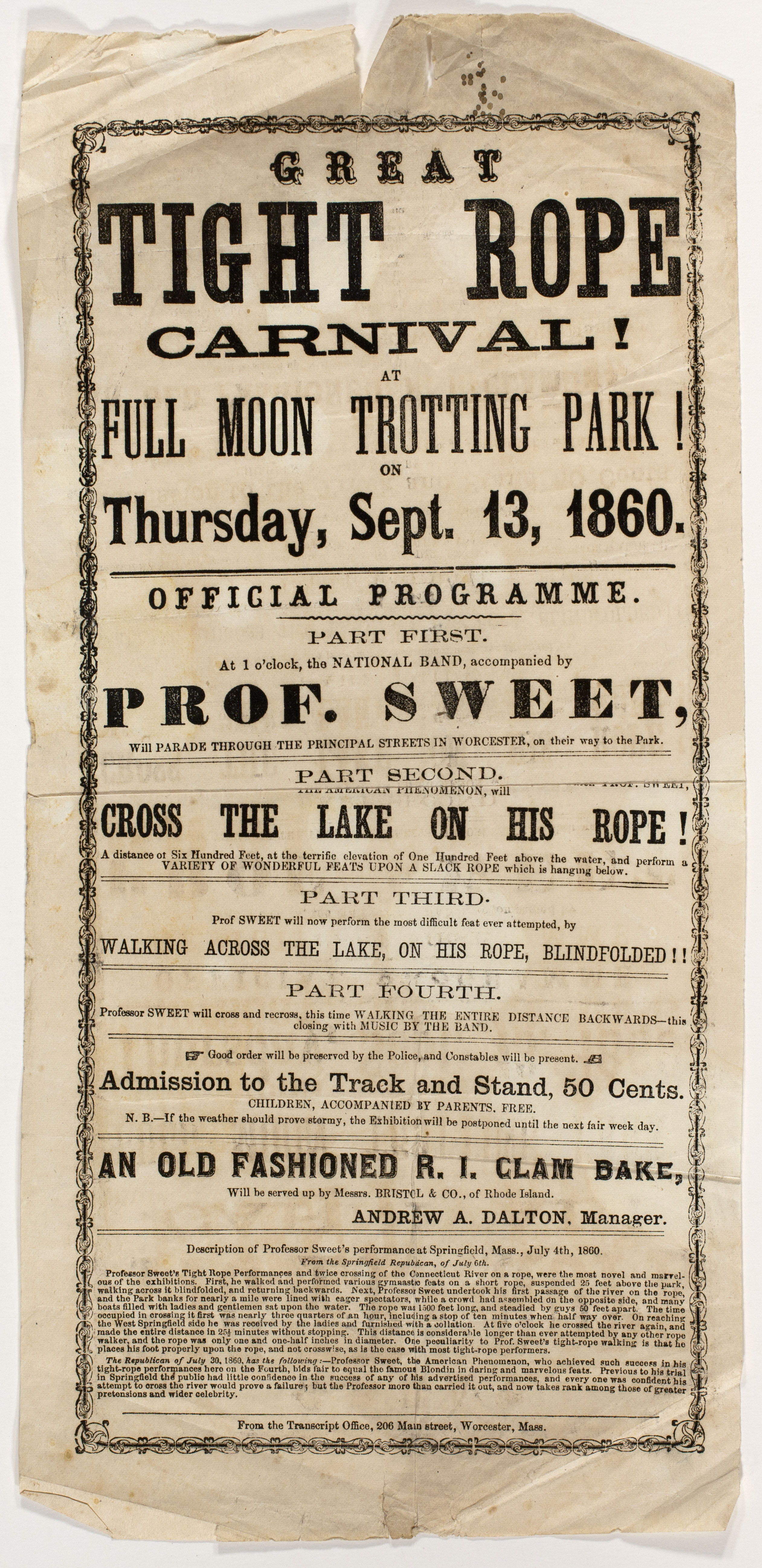
This small handbill records the unusual political activism of the Providence, RI, book publisher Edward Payson Weston (1839-1929). During the 1860 presidential campaign, Weston made a wager against the odds of Lincoln winning. If Lincoln won, Weston agreed to walk from Boston to Washington in ten days and to be present at the inauguration. Lincoln did win and Weston was successful in his 470 mile walk. In fact, he gave up book publishing to become a promoter of pedestrian sports and is today considered the father of race walking. AAS holds several books of poetry published by Weston in the 1840s, as well as a pamphlet he issued after his walk to Washington, DC. This handbill, which also includes an advertisement for a sewing machine company, states that Weston would “leave this card with those who choose to preserve it as a memento of his trip.” Purchased from Aiglatson. Ahmanson Foundation Fund.

~ Lauren Hewes

Everyone Loves a Wedding

With all of the media buzz around the recent nuptials of Chelsea Clinton, I thought of another presidential wedding: the marriage of Nellie Grant to English aristocrat Algernon Sartoris in 1874.

Eighteen year-old Nellie Grant was the only daughter of Ulysses S. and Julia Grant.  She met Sartoris, the son of the famous singer Adelaide Kemble (sister of Fanny) and Algernon Sartoris Sr., on a steamship on her return voyage from Europe. The two immediately fell in love and became engaged. Apparently, the twenty-three year old Sartoris had a bit of a reputation as a womanizer, which led Gen. Grant to question whether he should allow this union, but he eventually acquiesced.

The marriage went off without a hitch on May 21, 1874 in the East Room of the White House. The magazines and newspapers of the day were abuzz with the details of the wedding, from the flowers and decorations, to the bridal gown, the guests, and the food.

The June 6 issue of Harper’s Weekly describes some of the gifts; “… a dessert-service of eighty four pieces [given] by Mr. George W. Childs, and a complete dinner-service by Mr. A.J. Drexel, the combined value of the two being $4500.” Harper’s also states that the couple received a “little” gift of $10,000 from Mr. Grant, and a silver Tiffany fruit dish that the bride supposedly swooned over.

An entire chapter in Grant’s 1885 biography by B. Poore and O.H. Tiffany is devoted to the event. Rev. O.H. Tiffany had officiated the ceremony as well. About two hundred and fifty guests attended the wedding in the East Room, where a platform was built so that all of the guests could see the ceremony.  The stage was “flanked by white columns wreathed with flowers, over which was a floral arch bearing a swinging marriage-bell of white roses. From this arch wreaths of flowers were carried to the covered window, forming a bower, and the back of which was the monogram of the happy pair.”

At eleven o’clock in the morning, the ceremony began. Sartoris wore a “black evening suit and appeared the embodiment of health and happiness.” His best man, Frederick Grant, stood beside him in his military uniform. The eight bridesmaids entered the room, all wearing the same white silk gowns, four wearing dresses trimmed with blue forget-me-nots, and the other four dresses trimmed with pink roses. Nellie’s dress was described:

The bridal dress was white satin, with a comet-like train trimmed with a set of point lace made in Brussels at a cost of five thousand dollars … It was arranged in wavy horizontal lines across the front of the skirt of the dress and interspersed with white flowers, green leaves, and miniature oranges … The bridal wreath was of white flowers and green leaves of the most delicate kinds … She wore high satin shoes bearing water stripes from the toes upward.

I plugged in the $5000 cost of the lace of the dress into a historical currency calculator and found that the dress would cost about $92,000 to make today. Does Vera Wang (the designer of Chelsea’s dress) even make gowns that expensive?

After the ceremony, the guests were led through the gift-filled library into the dining room where satin menus were placed at each setting, and the centerpiece of the table was the cake, “crowned with a bouquet of delicate white flowers arranged in the highest style of art.”

Chelsea Clinton and Marc Mezvinsky’s wedding has caused a similar public examination of every detail of the president’s daughter’s wedding, much like a hundred and twenty six years ago.