The Acquisitions Table: Van Etten Bros. Catalog

Van Etten Bros., Manufacturers, Importers and Jobbers of Novelties, Notions, Books, Photographs, Chromos, Stereoscopic Views, and a Full Line of Goods Adapted Especially to the Wants of Canvassing Agents. Chicago: Birnery Hand &Co’s Steam Printing House, 1876.

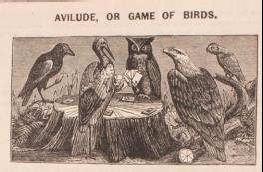
The Van Etten Bros. catalog is like a nineteenth-century SkyMall catalog, only instead of reading it while on an airplane, items would be sold by canvassers, or door-to-door salesmen (or women, apparently, for Van Etten Bros. declare: “We want one live, energetic lady or gentleman agent to canvass and sell our goods in every town in the United States”). Items for sale include not only “Dogs Playing Poker”-type popular images like the one here, but also all those strange inventions that you never knew you needed. The Defiance Lock Protector “renders it simply impossible to turn any key while it is in the lock,” and is apparently especially useful to secure hotel rooms. Hartshorn’s Improved Patent Folding Lamp Shade had “more than 100,000 sold in sixty days,” although the necessity for folding one’s lamp shade is less clear.  The importance of the Patent Duplex Ventilated Garter is more immediately clear, since “the garter should measure about three inches less than the circumference of the limb” it seems especially important that this one is unique in “insuring free circulation of the blood.”

AAS Welcomes New Digital Humanities Curator

The American Antiquarian Society is delighted to welcome Molly O’Hagan Hardy as our new Digital Humanities Curator. Molly will join AAS in September as a 2013 American Council of Learned Societies (ACLS) Public Fellow, and will be working to promote digital humanities scholarship using the Society’s collections, increase access to the Society’s digitized collection materials, and manage projects in digital humanities at AAS.

We are pleased to partner with ACLS in this innovative fellowship initiative, which offers recent humanities Ph.D.s the opportunity to gain valuable, career-launching experience in areas such as arts management, communications, public administration, and digital media. This year’s 20 ACLS Public Fellows will take up two-year assignments at a diverse set of organizations in the government and non-profit sectors. A full list of the 2013 Public Fellows and their placements can be found here. The ACLS Public Fellows program is made possible by a grant from The Andrew W. Mellon Foundation.

The Acquisitions Table: Clear the Track!

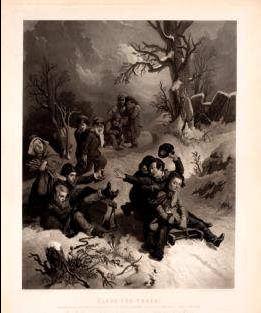
Sartain, Samuel after Christian Schussele. Clear the Track! Philadelphia: Samuel Sartain, for the Art Union of Philadelphia, 1854. 

Founded in 1844, the Art Union of Philadelphia issued six engravings to its subscribing members between 1847 and 1854 in an attempt to promote and disseminate American art in the region.  With generous support from the Richard A. Heald Foundation, the Society is attempting to build a complete set of all of the prints issued by art unions from across the country before 1876.  This print of rambunctious children sledding down a snowy hill was based on a painting by Christian Schussele, who emigrated to the U.S. from Alsace in 1848 and worked in Philadelphia as a successful lithographer and artist.  Samuel Sartain was paid $900 to engrave Clear the Track for the Art Union of Philadelphia and his work on the print won him a medal when the engraving was exhibited at the Franklin Institute.  Reviews in the local press called the print “beautiful” and stated: “It is really a gem of art.” It was also the last print issued by the Art Union of Philadelphia, which was disbanded in 1855.

Digitization of the Political Cartoon Collection

This past year the American Antiquarian Society has been hard at work proving the old adage that a picture is worth a thousand words, especially when it comes to cartoons.

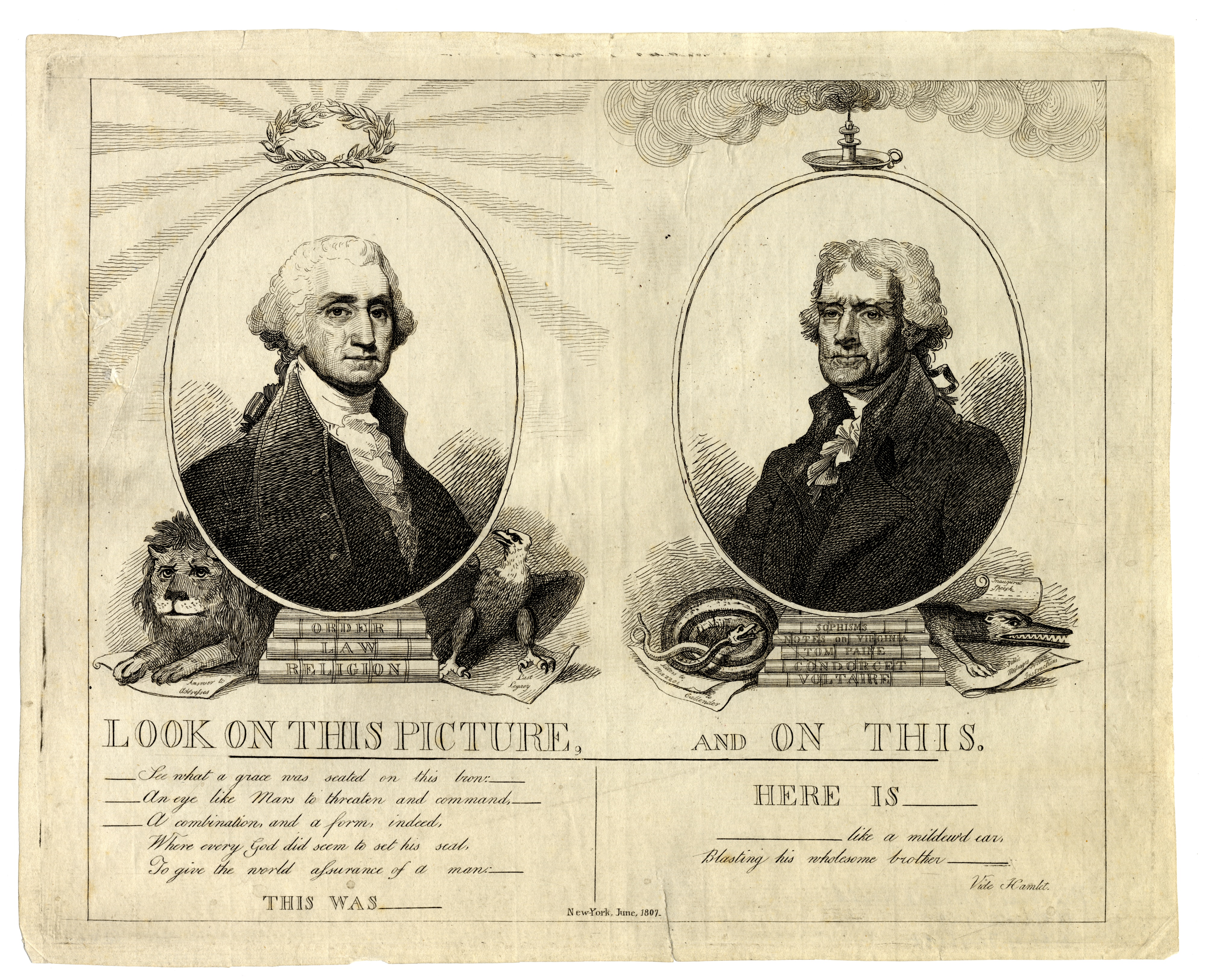
Look on This Picture (1807)

AAS holds a comprehensive collection of political cartoons produced in the United States between 1764 and 1876.  The separately published American cartoon collection holds over 600 examples of caricatures, satires, and political subjects (European Political cartoons are housed separately).  The collection includes everything from very early cartoons relating to the establishment and operation of the federal government (including a cartoon comparing Jefferson to Washington – unfavorably (see right)), to slanderous depictions of local politicians.  The cartoon collection is widely used by a variety of scholars and collectors looking for evidence of historical activities, trends, and motivations.

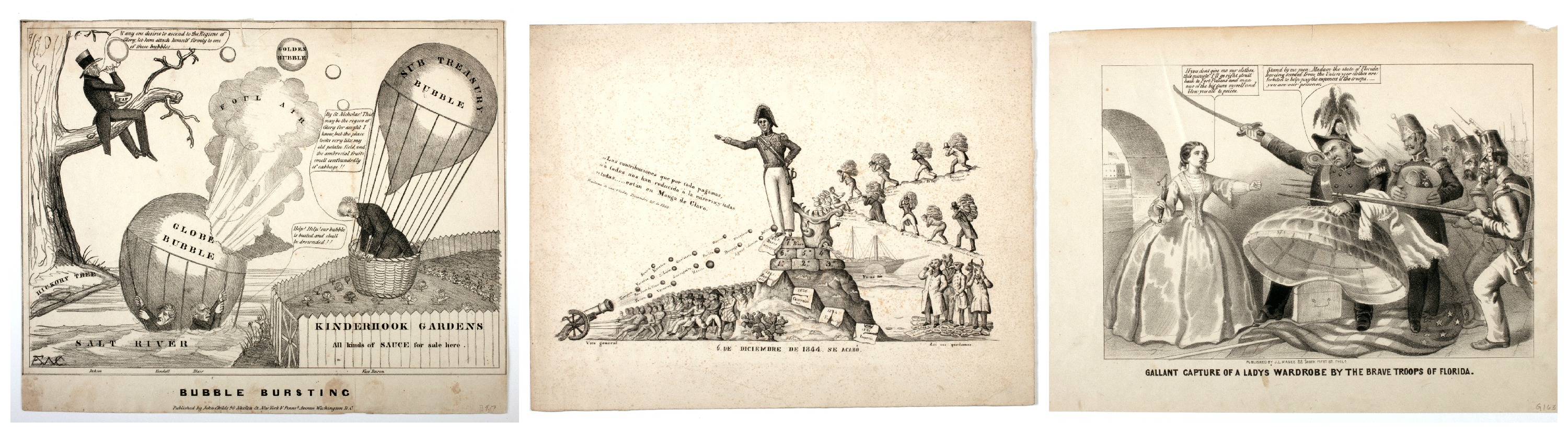
The Society’s collection is included in our main online catalog with brief records for each cartoon (some better than others), which include the artist’s name, the title, the publisher, date, and a short description of the image.  Subject headings such as “War of 1812” or “Slavery” are helpful, but not having full descriptive text is very limiting.  It was decided in August of 2012 to set up the cartoons as a side project for our digital photographer to work on “as time permits.”  It has taken nearly a year, but the images are now all digitized and linked to our catalog record.  You can now easily see images relating to the campaign of 1840, the Mexican-American War – from the Mexican side of the border – and the Civil War.  Each image can be enlarged so that all the words in the various speech bubbles are legible and details are easily understood. (Click on the links above for the catalog records of the examples shown below.) These scans can also be downloaded for teaching purposes and used in PowerPoint presentations by students and scholars alike.

Left to right: Bubble Bursting (ca. 1840); 6 de Diciembre de 1844 (1845); Gallant Capture of a Ladys Wardrobe (ca. 1861)

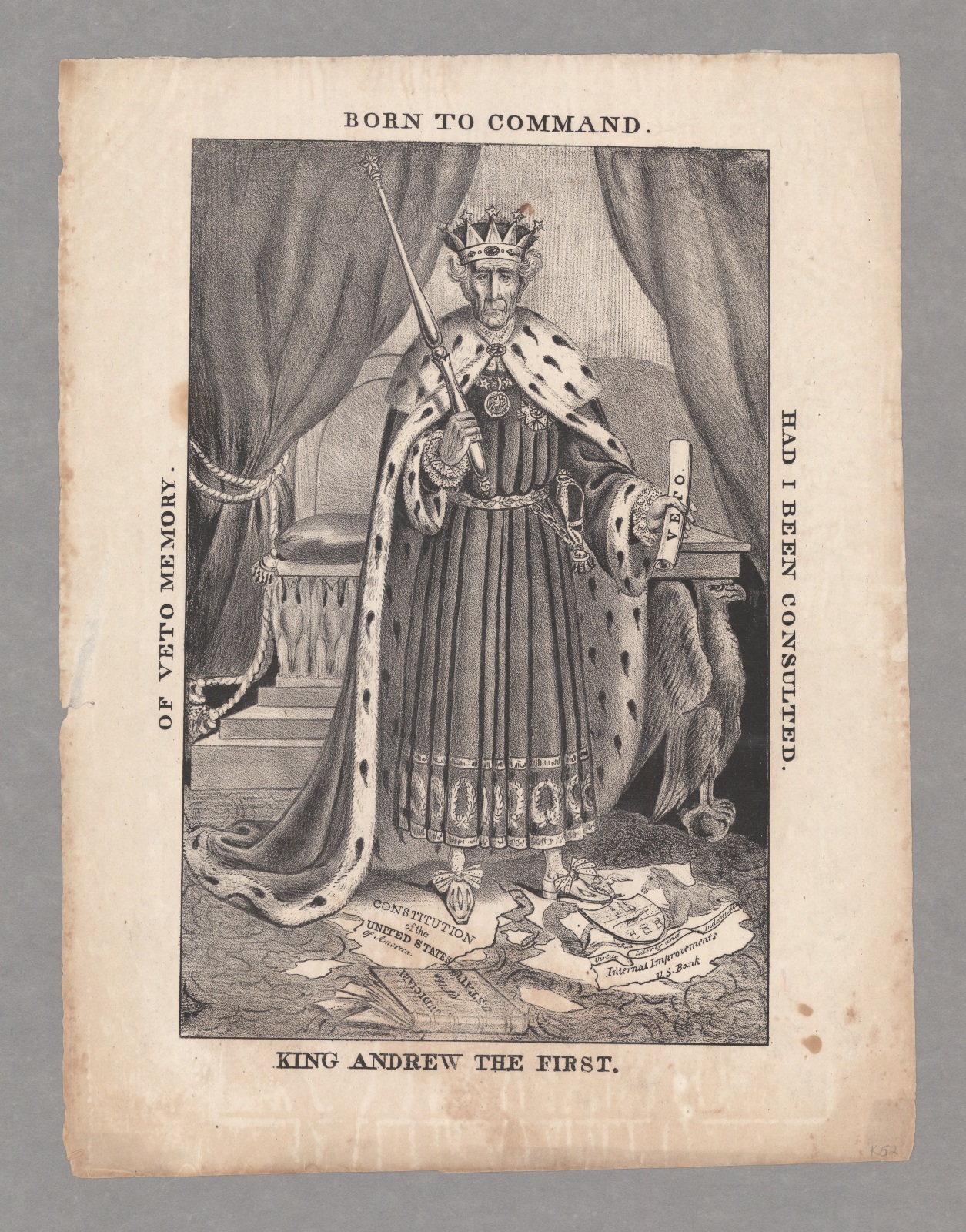
King Andrew the First (ca. 1833)

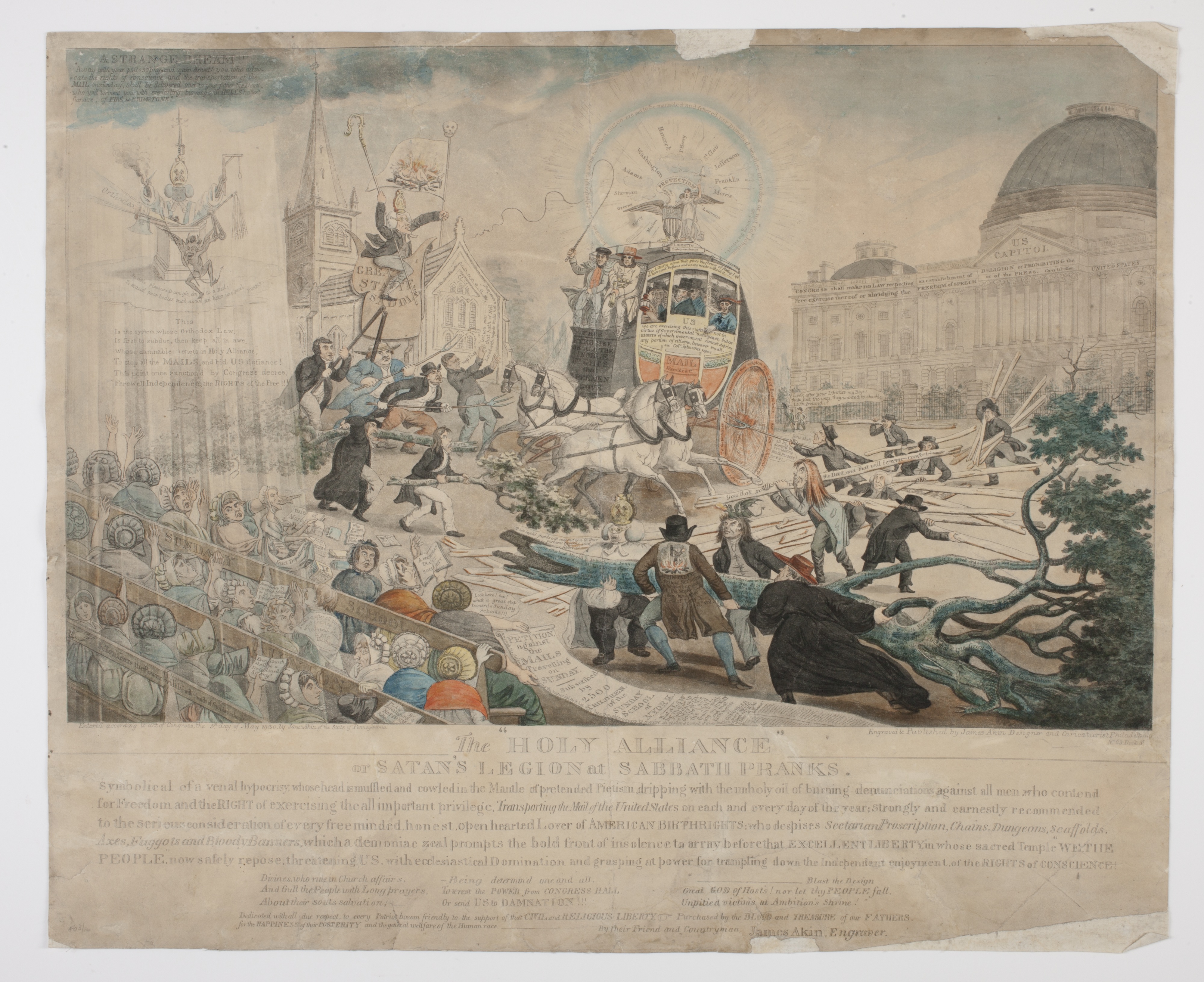
We still want to upgrade our political cartoon records to include richer descriptions of these complex objects. While some are easy to understand from just a quick look (such as that seen to the right), understanding the joke in others takes more digging and looking and digging again (see below).  Now that we have all the images in place, let the digging begin!

"The Holy Alliance" (1830)

The Acquisitions Table: New-York Clipper

New-York Clipper (New York, NY).  Apr. 13, 1863 – Apr. 8, 1865.

At a recent book fair, AAS was offered two bound volumes of this extremely rare sporting and entertainment periodical.  It began in 1853 as a periodical covering sporting events.  By the time of the Civil War the New-York Clipper included coverage of the theatrical scene.  Some issues contained literary pieces and short stories.  While the circulation was fairly high, few files survive today due to its low-brow content.  Some of the advertisements are for risqué books and photographs though they were not explicit (e.g. one ad for photographs described them as “Le petite figurante!”).  Each issue also contains a woodcut on the front page, usually the portrait to accompany a biographical article.

Remembering the Ladies

Detail from "The Woman's Advocate," 1855

At the July 4, 1818, anniversary of its founding the New York Typographical Society celebrated with one of its typical ceremonies. Since its establishment in 1809, the Society had commemorated its anniversary every year with an evening of toasts and odes dedicated to the art of printing. Those in attendance at the 1818 event toasted typographical societies, “forms firmly locked up and well justified,” Benjamin Franklin, “who, from a small capital, acquired a capital reputation,” and the Declaration of Independence, “the proof sheet of American sufferings.” They also toasted the “fair sex,” which deserved a place only as the “frontispiece of Nature’s great work–may they only grace the title of competent workmen.”

Yes, very funny. While the Society paid its respects to women, it also excluded them from its ranks throughout its short life as a wage regulating organization. The U.S. saw typographical societies, such as the New York, Franklin, Philadelphia, Albany, Baltimore, and Columbia typographical societies, come and go throughout the nineteenth century. Women could be considered as temporary replacements for striking workers, but they were not admitted as members until the International Typographical Union resolved to admit women in 1869.

Women had long been involved in printing, and union recognition was just one stage in their long association with the trade. They often worked as assistants to their better-known husbands, as household managers, and as keepers of finances. The names of some prominent female printer-businesswomen active during the colonial and early national periods might be familiar: Dinah Nuthead, the first woman to operate a press in colonial British North America; Ann Franklin, wife of James and sister-in-law to Benjamin and Colony printer in Rhode Island; Catherina Zenger, who continued operating her husband John Peter’s press after his imprisonment; Clementina Rind, the first female printer in Virginia, who printed Jefferson’s Summary View of the Rights of British America; and Lydia Bailey, one of the first female printers in Philadelphia and the subject of a recent book, Lydia Bailey: A Checklist of Her Imprints, by Karen Nipps. AAS does not exclude female printers, and our library is full of early American works printed and even owned by them, such as the receipt book once owned by Lydia Bailey and used by Nipps in her research.

So this July 4th, let’s toast the fair sex, who might sometimes be a second, but who are always a more perfect, edition.

The Bachelors’ Journal

AAS has a strong collection of American periodicals dating back to the 1740s, which often focused on a particular subject or advocacy.  Scattered throughout the stacks are serials focusing on topics such as religion, agriculture, temperance, crafts, abolitionism, vegetarianism, reform, anti-masonry, art, or women.

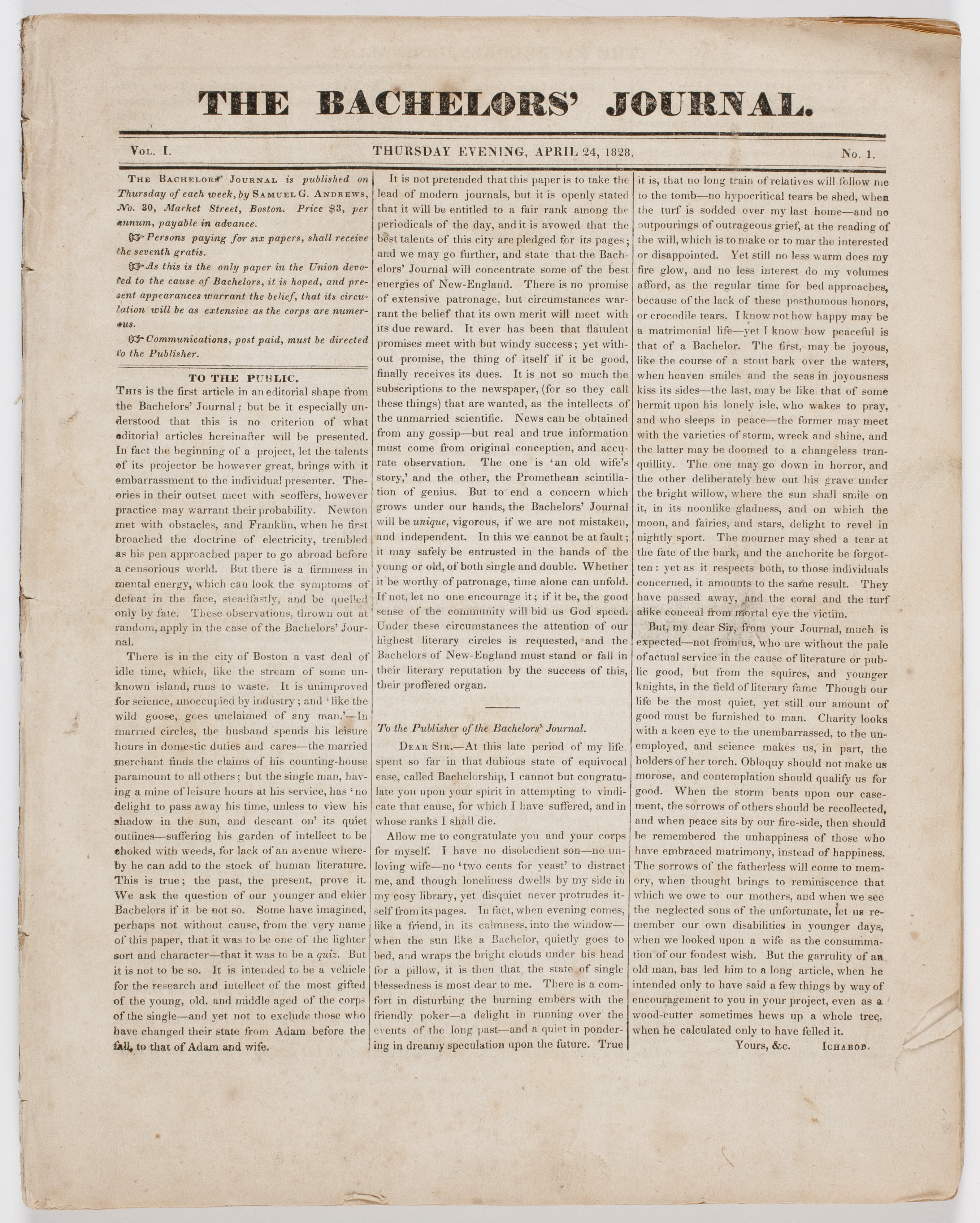
There is one periodical that is unlike any other in the collection, however.  The Bachelors’ Journal was published in Boston between April 24 and September 13, 1828, lasting just twenty-two issues.  It was edited by John W. Whitman, a lawyer and poet, and published by Samuel G. Andrews.  The purpose of this publication was to address the idle time of the unmarried man:

In married circles, the husband spends his leisure hours in domestic duties and cares – the married merchant finds the claims of his counting-house paramount to all others; but the single man, having a mine of leisure hours at his service, has no delight to pass away his time, unless to view his shadow in the sun, and descant on its quiet outlines – suffering his garden of intellect to be choked with weeds, for lack of an avenue whereby he can add to the stock of human literature.

The Bachelors’ Journal is filled with stories, poems, jokes, anecdotes, and commentaries mostly about the single life.  In one article the cry was “Divided we stand, united we fall.”  There are several pieces written by married men with tales of woe warning bachelors of what may be in store for them if they succumb to matrimony.  The editor was a poet, and he selected many poems with titles such as “The Broken Vow,” “Love and Time,” “Corporal Trim’s Advice,” and “The Fatal Kiss.”  There are no advertisements in this publication, but there are occasional promotions of theatrical productions that might appeal to the single man.  The overall theme of the publication is that the single man has many more options in which to partake and enjoy than the married man.

What is interesting is the year this periodical came out.  By 1828 there was a stirring of a women’s movement as they began to assert themselves more.  In 1792 Mary Wollstonecraft wrote A Vindication of the Rights of Women.  In the 1820s more periodicals were being published with women as a target audience.  They were beginning to insist on more rights rather than being treated as property.  The Bachelors’ Journal seems to be a reaction to this trend reminding single men what they don’t have to deal with while enjoying the single life.

The Bachelors’ Journal lasted just twenty-two issues.  After the last issue, it turned over its subscription list to the Yankee and Boston Literary Gazette.

And what happened to the editor, John W. Whitman?  He died in the 1830s (conflicting dates are given) leaving behind a widow.  Yes, he lived out the final years of his life a married man.
The Acquisitions Table: Fitch’s Geography for Beginners

Fitch’s Geography for Beginners, [1850-1858].

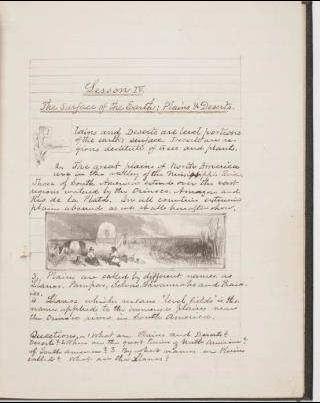
This handwritten textbook of geography is something of a mystery.  Heavily illustrated with original drawings and images clipped from publications, the text is divided into lessons with topics such as “About Travelling,” “About the Surface of the Earth,” “About Animals,” and “About Trees and Plants.”  The title, Fitch’s Geography… suggests that the text may have been written by George W. Fitch, author of several geography texts in the 1840s and 1850s.  Is this a mockup made by Fitch? Or a work created by a teacher or student?  It can be roughly dated by a map showing California (admitted 1850) as a state but Minnesota (admitted 1858) as a territory.

How to Impress the Modern Teen, or the Power of Poe

Recently my high-school-aged daughter was working on a final paper for her English class.  She was writing about Edgar Allan Poe, comparing the vault setting of “The Cask of Amontillado” with the quiet library used in the poem “The Raven.”  She asked me to proofread her paper and to check her bibliography (I was a bibliographer in a former life and she knows the limits of EndNote). As I read through looking for typos and extra commas, I casually mentioned that she might find it of interest that AAS holds copies of the first printings of both of these Poe works.  “The Raven” appeared under a pseudonym in The American Review in January of 1845. It was published shortly after under Poe’s own name in the Evening Mirror newspaper where it was picked up and reprinted by numerous papers across the country.  “The Cask of Amontillado” was first published in the November 1846 issue of Godey’s Lady’s Book which had a national circulation.

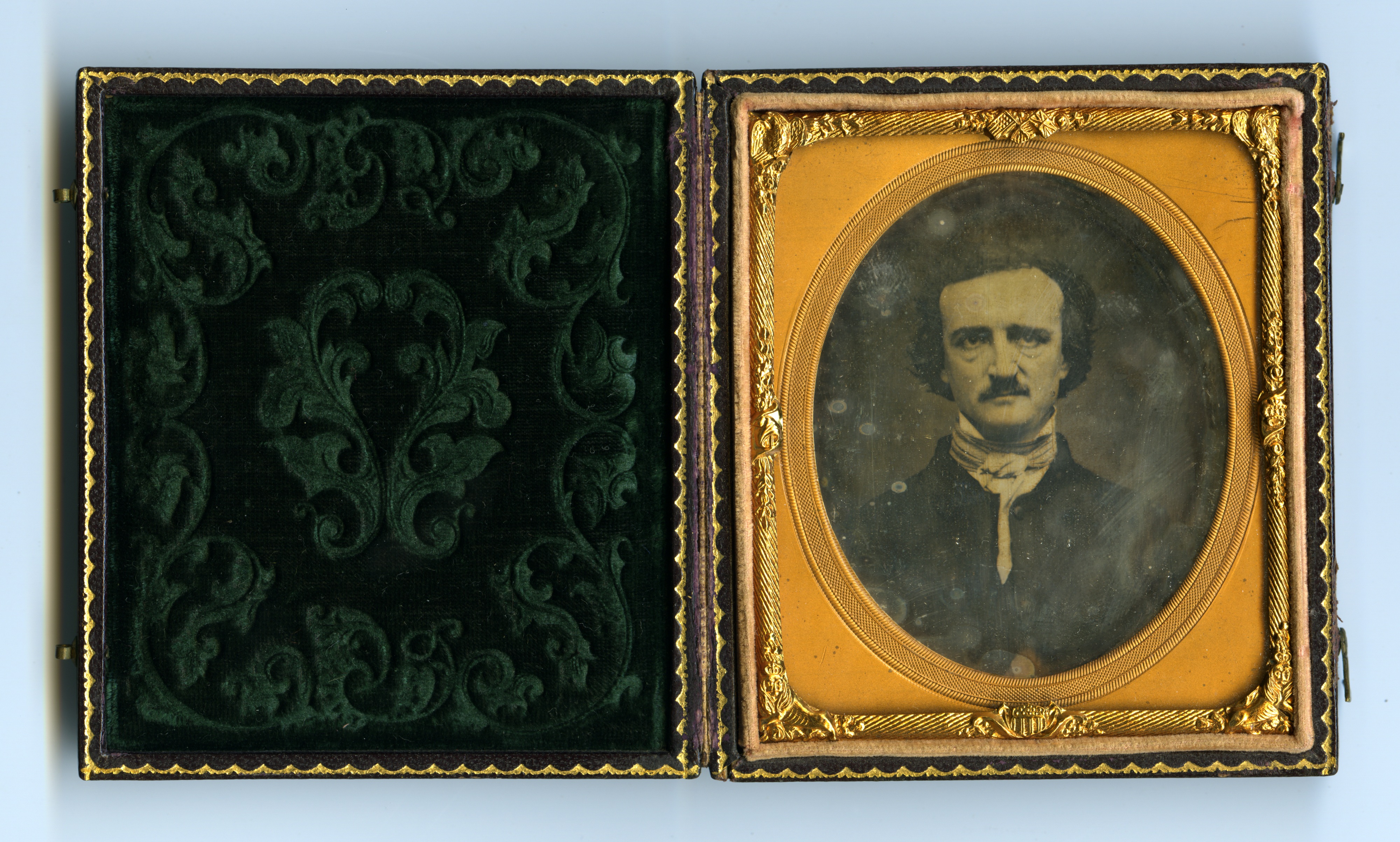
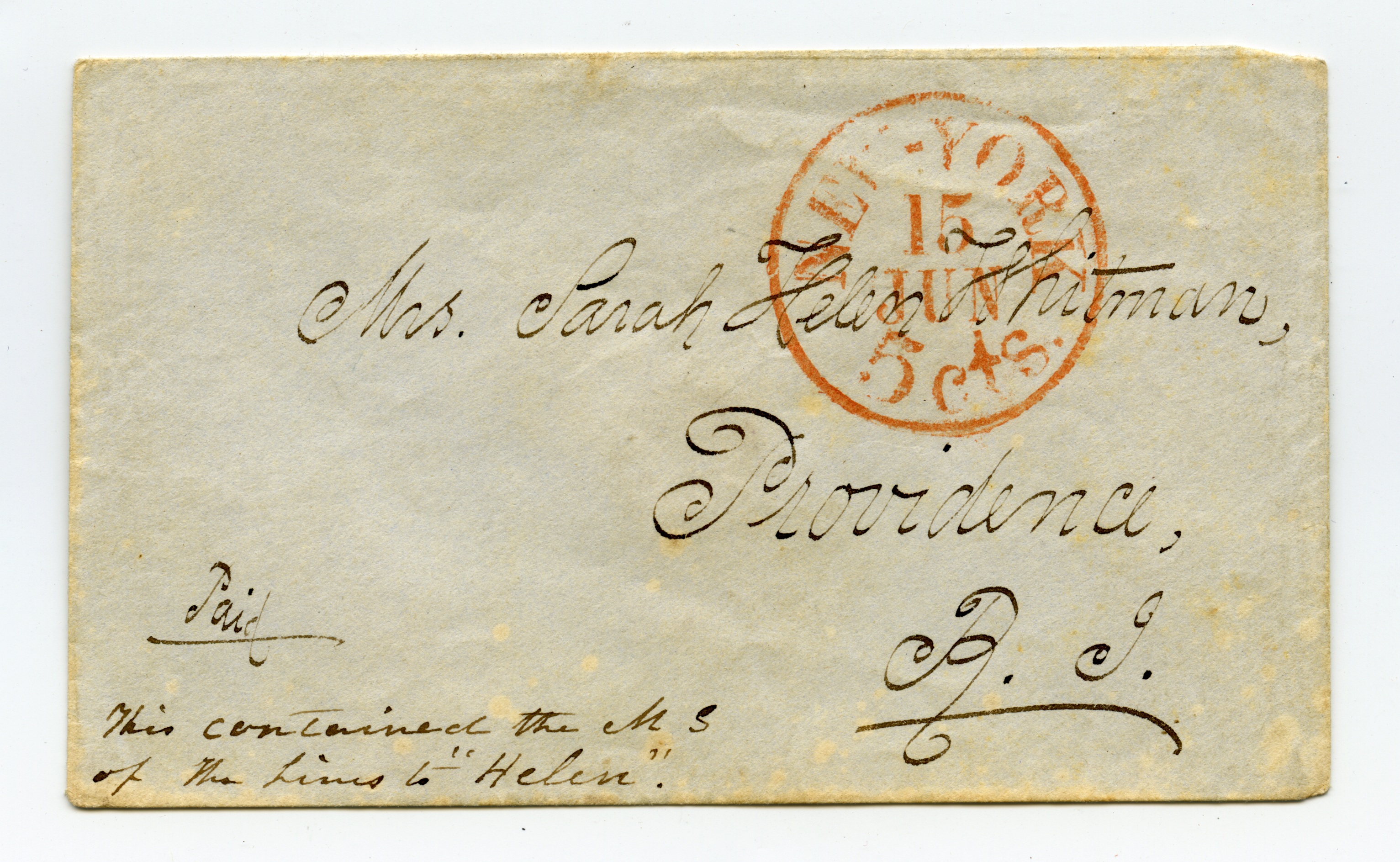
My daughter was unimpressed.  She asked if the copies we had were Poe’s own copies.  No, I replied, they were collected by the Society but they were never owned by Poe.  I countered with the fact that AAS also holds many early printings of Poe’s books, including his book on shells (The Conchologist’s First Book, 1839), and a first edition of The Raven.  Again, she was not that interested since these volumes were never owned by Poe himself.  I had to pull out my trump card.  “Well,” I said, “We also have a daguerreotype of Poe that he sent to a friend.  We even have the envelope he used to send it.” That did it – immediately we went to the computer to see the photo and the envelope.  Because Poe had touched this object it had resonance for a teenager interested in the author’s work.  “Cool,” she said, “That is pretty cool.”

Getting high school readers interested in American literature is a challenge.  I am lucky my child had a teacher who mixed up the classics with contemporary writing.  This week there was a piece on our local NPR station about the “dumbing down” of summer reading lists and classroom assignments where high schoolers are reading books intended for fifth-graders (http://www.wbur.org/npr/190669029/what-kids-are-reading-in-school-and-out).

While AAS does not generally serve a high school population in our reading room, we do offer considerable programming for K-12 teachers. We hear a lot from the participating teachers about the challenges of connecting students with historical material.  The language is tough, the dense writing style can be impenetrable, themes feel disconnected from today’s realities.  It takes a determined educator to venture down a path lined with writings by Melville and Wharton or Dickinson and Emerson.  As the distance seems to grow ever greater between Poe and his work and today’s fourteen- and fifteen-year-olds, I am glad that we had a teacher who challenged his students, and I am glad that AAS had preserved a photograph and an envelope – objects which electrify the brain and visually relate to the man who captured the very basic idea of fear and uncertainty when he wrote:

And the silken sad uncertain rustling of each purple curtain
Thrilled me – filled me with fantastic terrors never felt before;
So that now, to still the beating of my heart, I stood repeating
“‘Tis some visitor entreating entrance at my chamber door –
Some late visitor entreating entrance at my chamber door; –
This it is, and nothing more.”

The Acquisitions Table: The Cider Maker’s Manual

Buell, Jonathan S.The Cider Makers’ Manual:a Practical Hand-Book, Which Embodies Treatises on the Apple; Construction of Cider Mills, Cider-Presses, Seed-Washers, and Cider Mill Machinery in General; Cider Making; Fermentation; Improved Processes in Refining Cider, and its Conversion into Wine & Champagne. Revised edition with additions.Buffalo:Published by Haas, Nauert& Co., 1874.

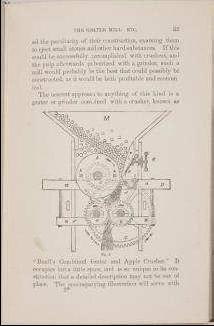
Perhaps the best of 19th-century American cider manuals, Buell’s is an important reference for all interested in reviving this most American of thirst quenchers. Coming home dragging at the end of a hard workday? Buell has the solution: “Cider is exactly the food suited to a tired condition” as “it satisfies the more interior parts of the system.” But beware misnomers: Buell very carefully distinguishes between the various liquid products that can be derived from apples, including cider, cider vinegar, apple wine, apple Champaign, and apple juice. Makes you thirsty, doesn’t it? Fortunately, Buell includes practical discussion and diagrams for “The Grater Mill,” “Portable Mill,” “Buell’s Improved Screw-press” and finally “The Model Cider Mill, and how it should be constructed.”

Thou Shalt Not Miss “Mining for Minerals: The Pull of the West”

On Saturday, June 22, AAS will hold an interactive workshop for educators entitled Mining for Minerals: The Pull of the West that explores the search for gold and silver in the west and the impact that it had on immigration, economic development, the environment, Native Americans and social interactions. Led by Middlebury College professor Kathyrn Morse, the daylong program will explore a variety of materials from the AAS collections providing rich context to literary works by Mark Twain and Brete Harte.  The day will include a variety of methodologies for educators to use these materials in multidisciplinary ways and thus enrich history, language arts, visual studies and literature classes.

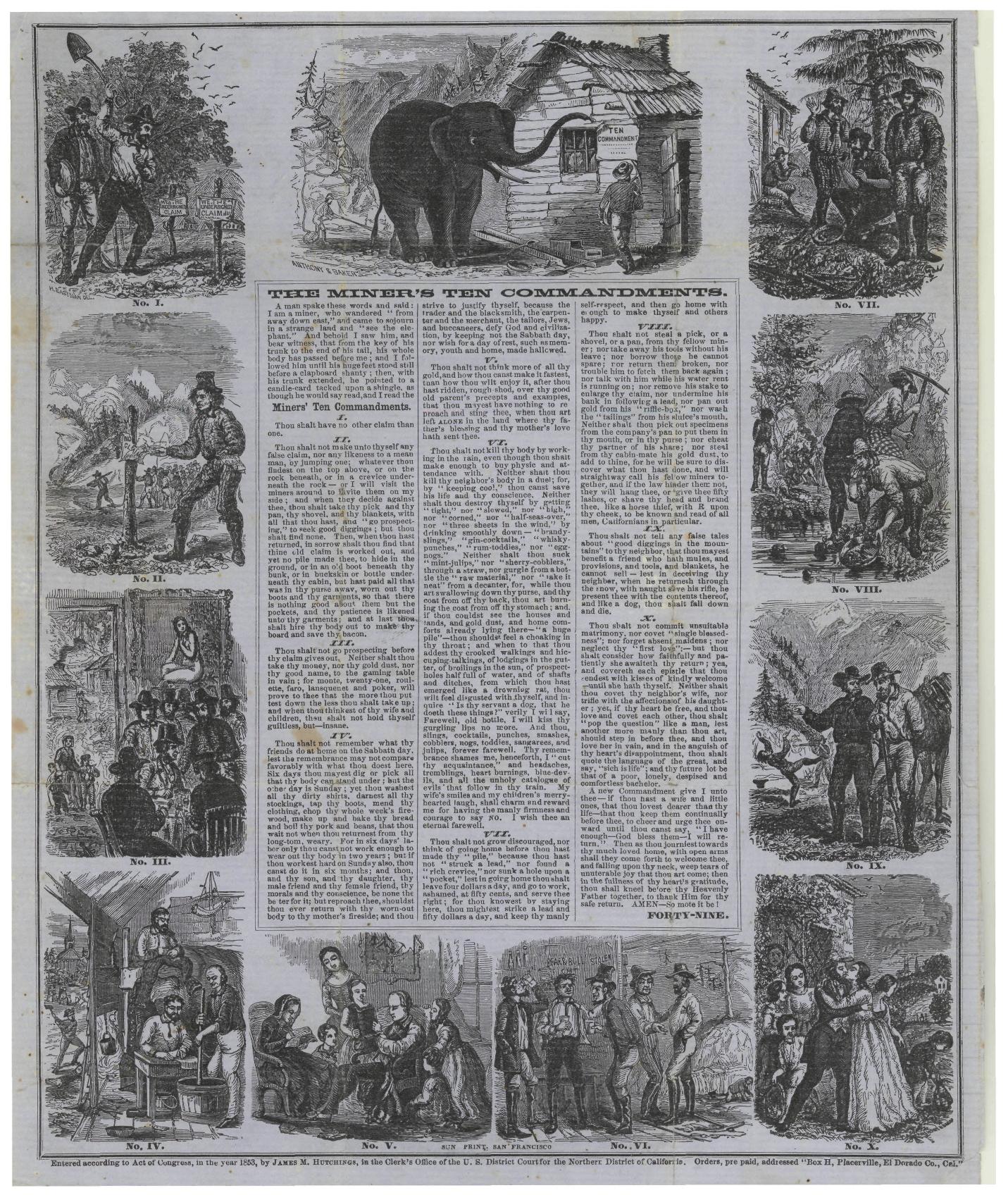
Among the many items that will be studied during this workshop is this lettersheet, “The Miner’s Ten Commandments,” which reimagines the Ten Commandments God handed to Moses in the Old Testament as advice to people seeking gold in California.  Published in San Francisco by J.M. (James Mason) Hutchings in 1853, “The Miner’s Ten Commandments” was an enormous success selling 97,000 copies in one year alone.

This lettersheet is in fact stationary as the verso contains faint blue lines to guide the reader in creating his own missive presumably addressed to loved ones back home.  Those back home are acknowledged at the end of the satirical text with these lines: “A new Commandment give I unto thee — if thou hast a wife and little ones, that thou lovest dearer than thy life — that thou keep them continually before thee, to cheer and urge thee onward until thou canst say, ‘I have enough — God bless them — I will return.’”

We still have openings in this workshop and encourage you all to come find your fortune in intellectual riches at the Mining for Minerals: The Pull of the West workshop on June 22.

Picture this!

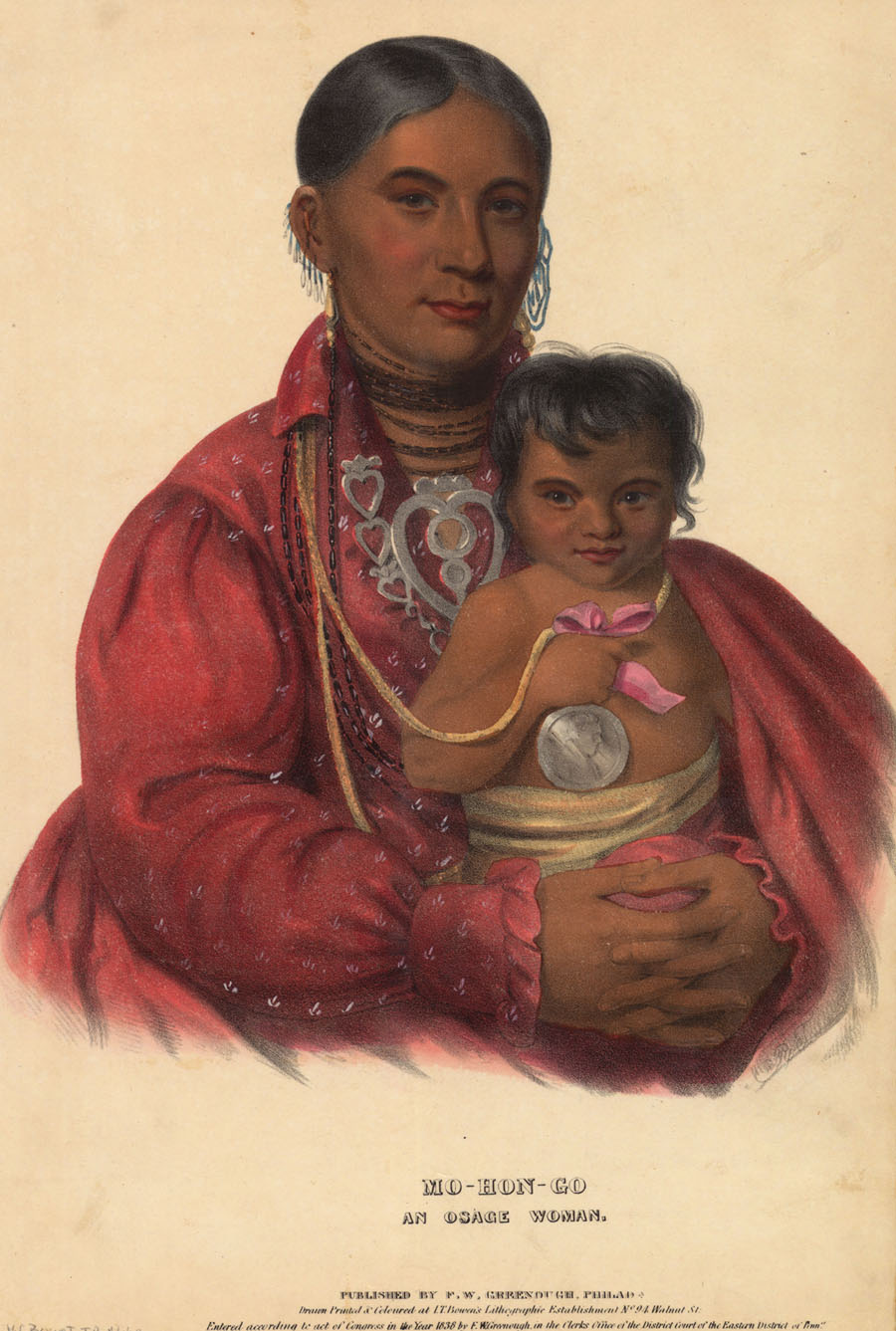
How can images help make the past more accessible to students? If you are an educator looking for ways to enrich your classroom teaching, consider an upcoming workshop at the American Antiquarian Society—Picture Perfect: Nineteenth-Century Women in Words and Images. The Center for Historic American visual Culture (CHAViC) at AAS is sponsoring a one-day interdisciplinary workshop designed to help K-12 educators develop strategies for using historical images in conjunction with texts by nineteenth-century women authors.  How can a political cartoon depicting the effects of the fugitive slave law help students grasp the powerful influence of a Harriet Beecher Stowe novel? How can an engraving of a frigate provide a window to the significance of an Emily Dickinson poem? What does a lithograph of an Osage woman (pictured left) have in common with the stories of Laura Ingalls Wilder? Come to the workshop to find out!

Participants will have the rare opportunity to examine and learn firsthand from AAS collections, and they will leave well-armed with knowledge and activities to take back to the classroom. Lead scholar Laura Smith from the University of New Hampshire along with AAS staff will guide participants in interpreting historical images and how to use them in concert with texts frequently taught in K-12 classrooms.  The day will include two workshops using primary sources. The first will examine the many roles of women in nineteenth-century America, while the second will focus on influential female writers and how images can help students find those writings more accessible.

For more information and details on how to register click here.

The Acquisitions Table: Sketches from Nature

Brown, Frances.  Sketches from Nature, for My Juvenile Friends.Cleveland: Mrs. H.F.M. Brown; Cincinnati: Longley Brothers; Boston: Bela Marsh, 1858.

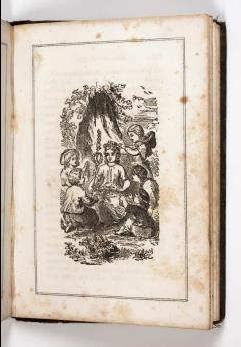
This is a remarkable collection of short stories that were clearly the product of the reformist press that flourished in Boston, Cincinnati, and Cleveland shortly before the Civil War.  Although the wood-engraved illustrations look quite conventional–here is a picture of a May Queen being “crowned”–the text is anything but conventional.  In the short essay on “Girls’ rights,” Mrs. Brown exhorts her young readers, “You have rights, and it is time you were looking them up.  … You have a right to learn, to cook, to wash, to make shirts, to skate, to swim, to roll the hoop, to fly the kite, to laugh till your soul is brimful of mirth, and your lungs full of air.”

AAS’s own “Dr. Phil”

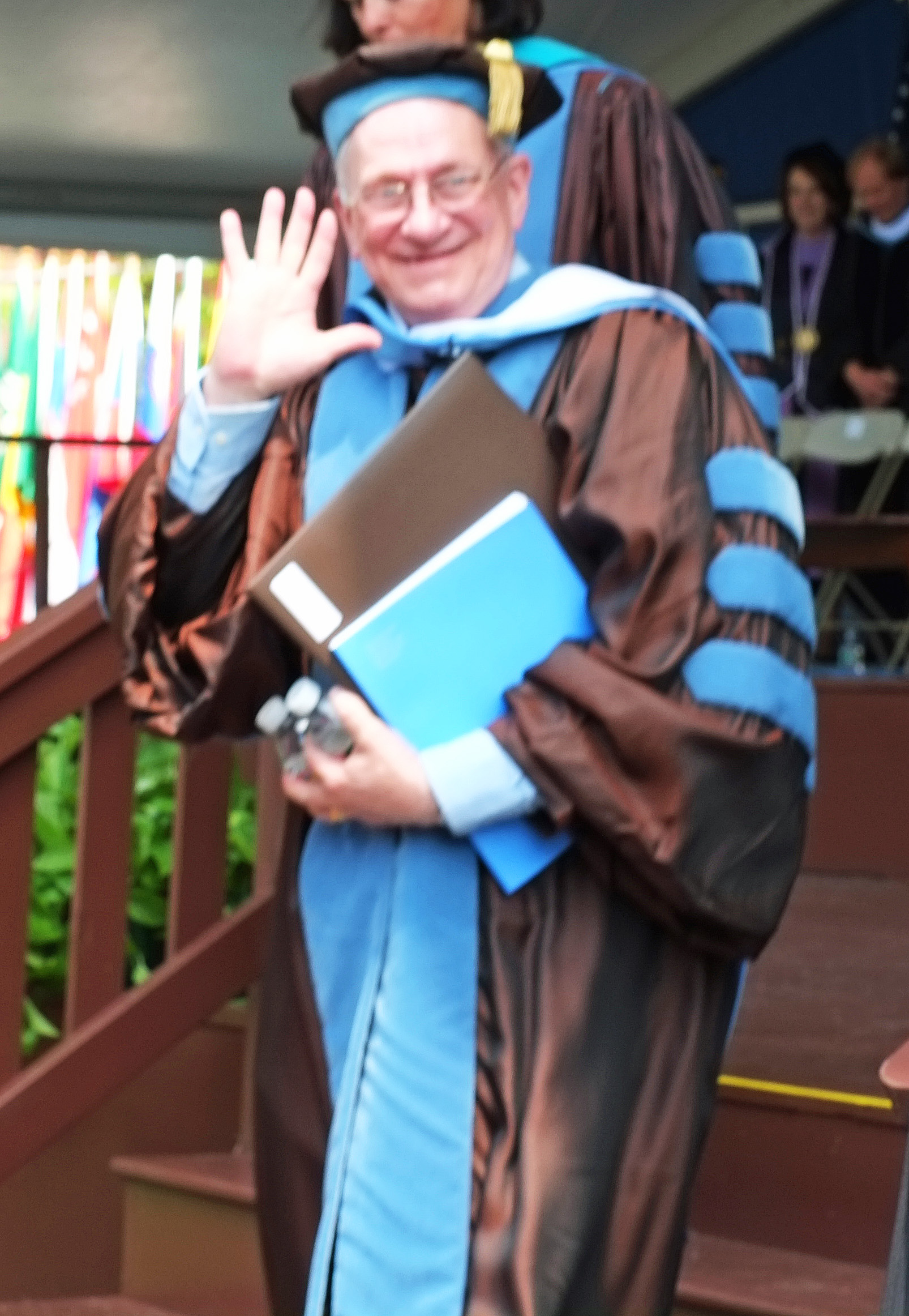
On a sunny Sunday morning in May, Tufts University held its 2012 commencement exercises.   The event was of particular significance to us at AAS because among the recipients of honorary degrees was AAS’s own Philip J. Lampi, who has spent more than four decades compiling early electoral data.  Mostly on his own time and at his own expense, Phil spent years visiting courthouses, town halls, and libraries to transcribe election returns for the entire country for the period from 1787 to 1825.  In the process, he has transformed the understanding of politics and elections in the early republic. A partnership between AAS and Tufts University, with support from the National Endowment for the Humanities, has resulted in the New Nation Votes database which makes this valuable data available to all.

After years of quiet and patient labor, Phil has gained a considerable amount of recognition, including this most recent and most public honor from Tufts.  His work was lauded in an article by Jill Lepore in the New Yorker in 2007. Last year, he received the first ever Chairman’s Commendation from NEH; Phil’s work is also the centerpiece of the Summer 2012 issue of Journal of the Early Republic, which includes articles by Phil and four other noted scholars of American electoral history.

We’re proud to be Philip Lampi’s colleagues.  Congratulations, Phil!

New Program for the Public a Hit

Take some history buffs, students, teachers, museum professionals, an enthusiastic and well-known scholar, and some wonderful materials from our collections and what do you get? A great inaugural Hands-on History Workshop! Last Saturday we presented “Worcester and the American Revolution,” led by Ray Raphael, to a diverse group of interested, informed, and eager participants.

We thought it was a resounding success, but if you don’t believe us check out the article in the Telegram & Gazette, which features quotes from many of the participants and sums up the day.

We’re already thinking about our next one, so please contact us if you’re interested or if there are any particular topics you’d like to see in the future. We hope to see you there!

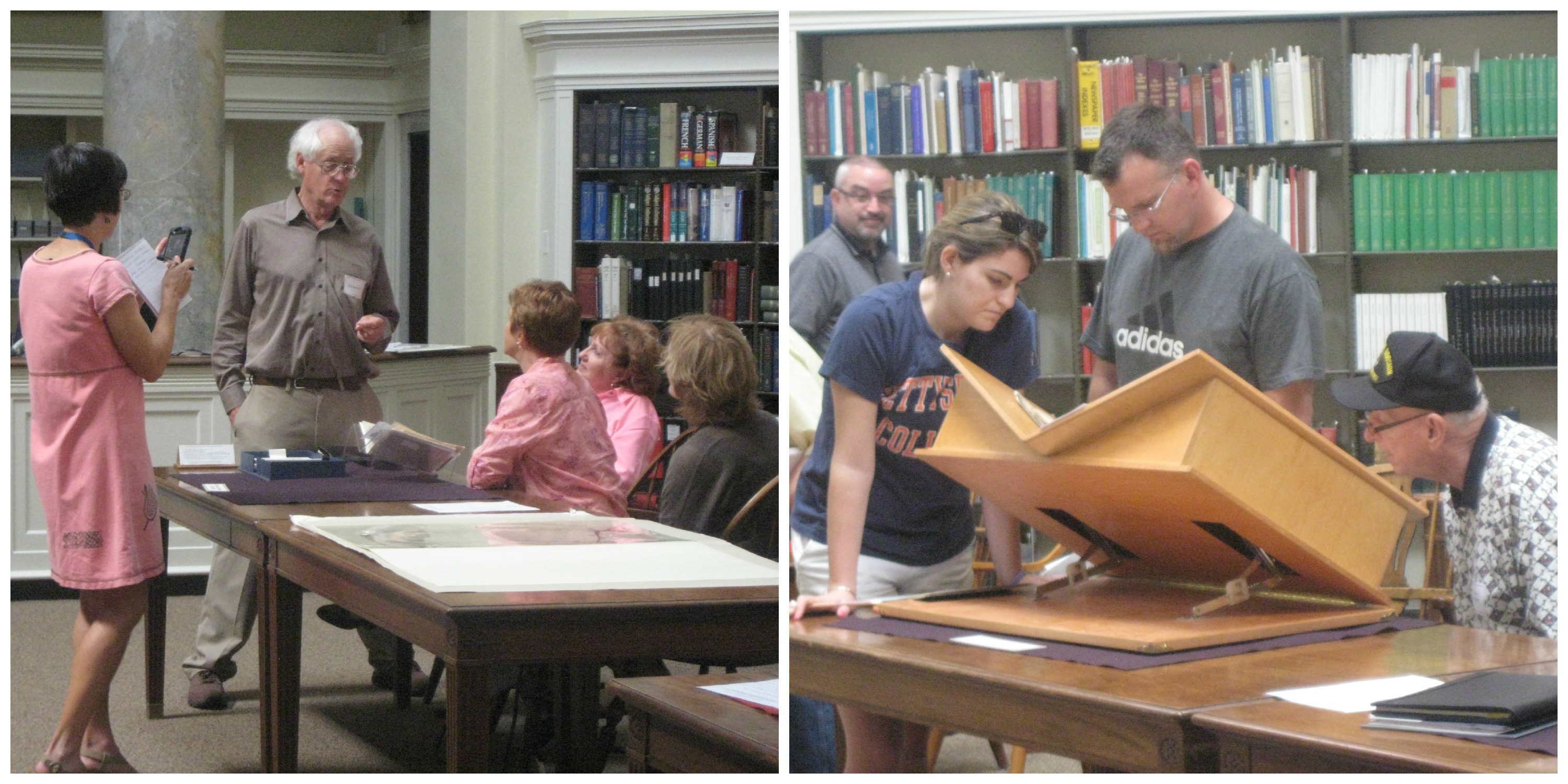
Left: Participants working closely with Ray Raphael. Right: Three generations of the same family working together.