During the early colonial period, owning a personal library signaled wealth and education. In fact, because books had monetary value as well as educational significance, they were listed in inventories and wills for ministers, merchants, colonial authorities, and educators. Many books from this era bear decades of evidence of prior ownership as new readers wrote their names or pasted bookplates or labels over those of former owners. Surviving pre-1701 book labels reveal how early American readers marked ownership and left behind rare evidence of the material history of reading in colonial North America.
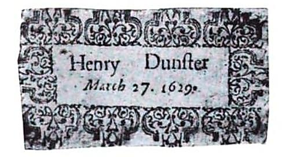
While readers in Europe and Mexico placed printed decorative bookplates and book labels inside their books from as early as the 1530s, British colonists in North America did not adopt the custom until the seventeenth century. Some brought printed labels made in England across the Atlantic, either loose or already pasted inside their books, while others hired local printers. In the Massachusetts Bay Colony, Henry Dunster (1609-1659) helped introduce book labels after he became Harvard College’s first president in 1640. Dunster began using book labels around 1629 while studying at Cambridge University in Cambridge, England, and he continued the practice at Harvard.
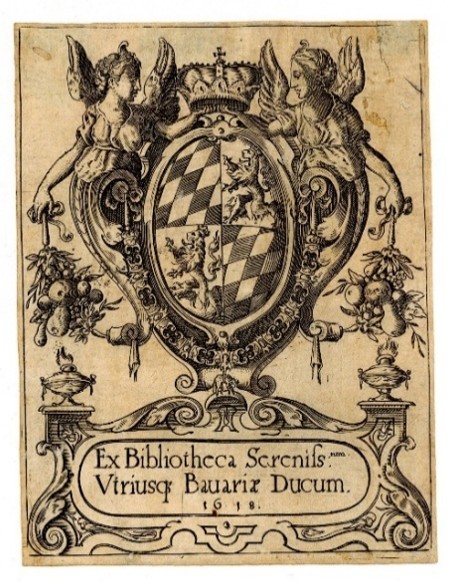
The terms “book label” and “bookplate” are often used interchangeably to describe ex libris (labels inside books), but the terms have slightly different meanings. Bookplates were usually decorative and could include coats of arms, pictorial designs, and elaborate borders. Often engraved by artists, bookplates acted as a sign of social status, and because the owner selected symbols or images that held meaning for them, they could be highly personal.
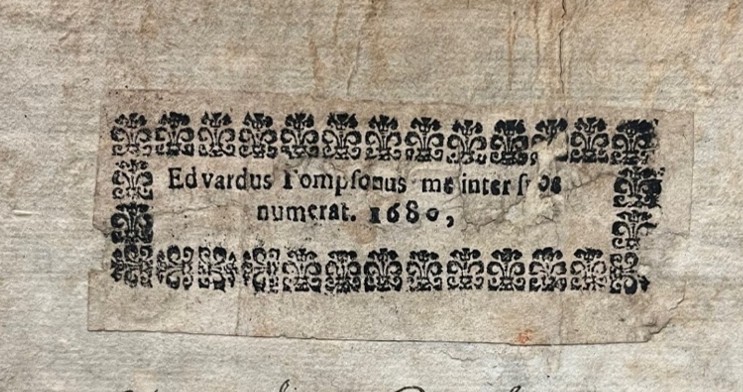
Book labels were more utilitarian than decorative. These austere labels used simple designs and modest borders made from pieces of ornamental type. They included the book owner’s name, sometimes a date, and often language clarifying ownership: “Edward Tompson numbers me as his” or “John Hancock, he rightfully owns this book.” They were often printed in Latin, reflecting the owners’ scholarly inclinations.
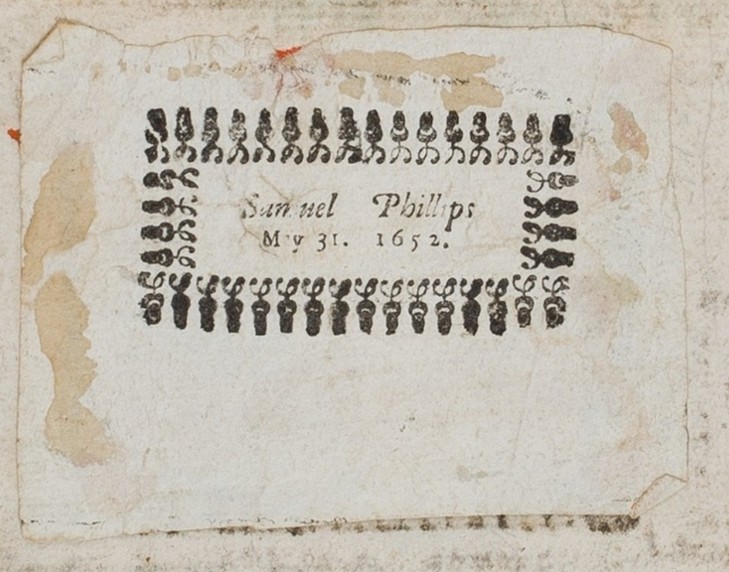
The American Antiquarian Society preserves fifteen of the twenty-seven known, pre-1701 book labels printed in the American colonies. A new online resource includes images of each label, identifies printers when possible, and supplies brief biographical information on the owners. Some of these rare book labels are housed in the Society’s loose bookplate collection while others remain inside their original volumes in the book collection. Several belonged to young Harvard College students who may have seen Henry Dunster’s labeled books.
As part of the resource, AAS staff identified the ornaments on each label using Elizabeth Carroll Reilly’s A Dictionary of Colonial American Printers’ Ornaments and Illustrations to help connect these early objects to printers like John Foster (1648-1681) and Samuel Green (1615-1702).
For further research:
This document contains images and holding information for the remaining twelve seventeenth-century labels, which are held outside of AAS: Not at AAS_PDF
