
pastispresent.org
an online forum for early American discovery, discussion, and diversion from the American Antiquarian Society

March 12, 1870 Saturday, In the Life of a Blacksmith: Blacksmithing again.  Did several jobs and then went to making step pads and worked on them about all the rest of the day.  Went to a church meeting in the eve.

Archive for the ‘Cookery’ Category

The Question: Something Smells Fishy

January 8th, 2010, by Diann Benti

6

If Abigail Adams were planning an Independence Day feast what would she make? According to a 1964 New York Times article: “gdrawings_box2_folder7reen turtle soup, New England poached salmon with egg sauce and apple pan dowdy.” In fact, the article claims she served this fine menu to John Adams on the very first Independence Day. Is the story sounding a bit strange to you, too?

Edible Queens, a local food magazine for Queens, New York, tasked Sarah Lohman (author of the blogs Four Pounds Flour and Ephemera) with recreating an early Fourth of July menu. Research led her to the New York Times article but she had her own doubts: apples in early July? So she wrote to AAS with a question, was the article’s claim true or just a myth?

We call myth. As we all know, John was busy in Philadelphia that July 4th. And poor Abigail had an eye infection. In fact, she wrote John on July 13, 1776 from Massachusetts apologizing for a silence of nearly a month, “I have really had so many cares upon my Hands and Mind, with a bad inflamation [sic] in my Eyes that I have not been able to write.”

But dear readers, that is as far as we got. And now we need your help. Where did this myth come from? Is there truth to any of it? The New York Times article described the meal in context of its recreation for the 1964 World’s Fair.

At the Festival ’64 Restaurant in the Gas Pavilion, George Lang, director of the restaurant, came up with a meal served by Abigail and John Adams at their home on July 4, 1776. Actually the Adams family first served this meal in 1773. It was such a memorable meal that Mrs. Adams served it on the first Independence Day. (”Fourth of July Glorious as Usual, But Especially Glorious at Fair” by Philip Dougherty in the New York Times, July 5, 1964 page 44.)

drawings_box2_folder6

Rumors of Abigail Adams’ 18th century handwritten cookbook float around, but does it exist? The Massachusetts Historical Society has an extensive digitized collection of Adams Family Papers, but we had no luck there. Given the success of our first  reference question post, we’re trying again. Anyone have any answers or thoughts? As usual we offer the weighty prizes of admiration and praise.

Even if this mystery goes unsolved, be sure to look for Sarah’s article on a historically inspired Fourth of July feast in the summer issue of Edible Queens.


Tags: , ,

Apple Pie Bake-Off Or The Sweet Taste of Revenge

November 5th, 2009, by Diann Benti

6

In the October 1813 Report of the Committee, Isaiah Thomas justified the choice of Worcester for the home of the American Antiquarian Society. He maintained that an “inland situation” offered the best protection against,

the destruction so often experienced in large towns and cities by fire, as well as from the ravages of an enemy, to which seaports in particular are so much exposed in times of war.

War and fire. Yeah right, Mr. T. We know the real reason you picked Worcester: the apples. From the end of August into late November, the orchards in the surrounding hills gently rock us out of summer and into the sweet lull of autumn. We are eventually deposited harshly onto winter’s doorstep. But up until that point, it is a reverie of fresh apples. So in the spirit of a New England autumn, an apple pie experiment.

applesThe Premise: Four pies sharing the same crust recipe and apple varieties (Gravenstein, Northern Spy, Baldwin, and Golden Delicious to be exact). The differences would be the spices and sweeteners used in the filling: three from historical recipes and one from a modern cookbook. As with the pound cake experiment, our testers would be the AAS fellows.

The Historic Recipes: Most of us are familiar with apple pies starring apples coated in white (or brown) sugar with a dash of cinnamon or nutmeg. We kept the modern recipe modern, but took advantage of historical recipes that called for unexpected sweeteners.

Powdered Sugar/Rose Water Recipe from The Virginia Housewife by Mary Randolph, 1836

apple_pie_rosewater

White Wine and Lemon Recipe from Mrs. Putnam’s Receipt Book by Elizabeth Putnam, 1860

apple_pie_wine1apple_pie_wine2

and finally…

Let’s be honest, lately these fellows have been working hard, turning in call slip after call slip for materials the reference staff then pages. Their industry is our sore feet. But we can’t say no. Instead it was time for a different kind of revenge:

The Molasses-Sweetened Recipe from The Young Housekeeper’s Friend by Mary H. Cornelius, 1846

The Young Housekeeper's Friend by Mrs. Cornelius, 1846

The unwitting accomplices: Jess “Could have been a pastry chef” Lepler, Hench Post-Dissertation fellow and assistant professor of History at the University of New Hampshire, Emily “Queen of the Crusts” Pawley, AAS-NEH fellow and Ph.D. in the History of Science (2009), University of Pennsylvania, and Allison “I don’t really cook” Stagg, Last fellow and Ph.D. Candidate in Art History, University College, University of London.

apple_pie_butter_gratingThe Process: Pie making is a relatively boring task. One part was thrilling: the discovery of a cheese grater to easily add the cold butter to the crust dough. The rest was pretty straight forward: peel, cut, mix, pour, and repeat. The historic recipes forced us to make educated guesses on what exactly a “teacup” of molasses, a “little” mace, or a “few tea-spoonsful” of rosewater actually meant–caution usually guiding our judgment.

Before the crust covering, there was time for a snapshot of one pie. (t looks delicious when you think it’s chocolate…)

apple_pie_molasses_ready_for_baking

apple_pie_molasses_pieceThe Results: Victory! “The molasses one was vile. It was gross. It was disgusting,” said one esteemed fellow. “Horrible,” proclaimed another. That’ll teach them.

But what of the other pies?

apple_pie_bakedThe powdered sugar/rosewater pie prompted the most broadly split opinion. The cloves created a particularly pronounced flavor that some found an odd combination with the perfumy and off-putting rosewater; others were disappointed they couldn’t taste the rosewater more. As spirits are likely to do, the wine-flavored pie swayed many a fellow. The final score tallied, the white wine pie tied with the modern one in terms of taste. One fellow concluded, “We Americans should be eating wine pie.”

The fresh, tart taste of the modern and wine recipes complimented the crisp apples purchased that day from an orchard. Would this story have ended differently if the experiment took place in the middle of winter with mushy apples two months old? The weighty flavors of the molasses and powdered sugar/rosewater recipes might help mask less-than-delicious apples.

The Take-Away: When you are going to torture library fellows make sure your boss isn’t there. But from Ellen Dunlap, AAS president and unexpected tester, the thoughtful conclusion that our palettes may be more comfortable with subtle flavors. She preferred the modern pie, enjoying the complexity of its spices to the more monotone qualities of the historically-inspired ones. “I kind of liked the first taste of the rosewater and the wine, but they quickly got boring,” she said. And apparently even presidents don’t care for molasses-sweetened pie.


Tags: , , , ,

Let them eat cake

October 13th, 2009, by Diann Benti

5

If one thing connects Americans over the centuries, it’s dessert. Vanilla may have replaced rose water, the electric mixer (even the egg beater) may be heavenly gifts from a sympathetic large-bicepped ancestor, but the recipes (and the tastes) are remarkably similar. The first cookbook published in America, Amelia Simmons’ 1796 American Cookery, offers recipes for pies, puddings, cakes, tarts, custards, cookies, and biscuits. Sound familiar? The most peculiar dessert recipe is for syllabub (a relative of our holiday eggnog).  But it’s the directions that are strange, not the ingredients.

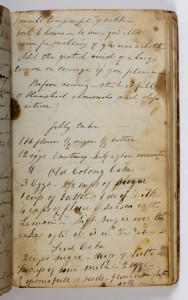
Syllabub recipe

Is it fair to assume that a time-traveling dessert could leave early America and end up right at home in our own kitchens? An experiment was in order.

The contenders: Two pound cake recipes (the cow was unavailable on such short notice).

From the 19th century: Sarah Josepha Hale, The Good Housekeeper, 1839.

pound_cake

From the 21st century: Pound Cake recipe in Martha Day, The Ultimate Book of Baking, 2005.

The Time Travelers: Diann Benti, Assistant Reference Librarian, and Jess Lepler, Hench Post-Dissertation fellow and assistant professor of History at the University of New Hampshire. One willing to beat batter for an hour, the other trying to embrace modernity with an ill-advised immersion blender.

The Scene: Mark Zanger writes in the American History Cookbook that, “As a technical note, Early American cakes are among the most difficult historical recipes to reproduce today because so many ingredients have changed” (58).  Flour held more moisture and had different protein contents than those found in grocery stores today. Eggs tended to be smaller and butter often had more salt (58-9). The 1839 recipe calls for loaf sugar and suggests using rose water, both unavailable in the AAS Test Kitchen. (We added a little bit of molasses to the 1839 cake to mimic the increased moisture of loaf sugar.)

In the end, after converting a measure of weight (the pound) to volume (cups), we were left  with 4 cups of flour, 2 ¼ cups  sugar, and 4 sticks of butter for two loaves in the Hale recipe—just about double the recipe of Day’s one-loaf cake. Using these same ingredients, the assembled cakes would go in the oven together and remain there until they each passed the toothpick test.

Ready to go in the oven, the 19th century cake is on the left.

The 19th century cake batter is on the left.

The Question: The details decided, the real battle between old and new emerged, pitting the arm against the chemical: Hale’s hour of batter beating versus Day’s one teaspoon of baking powder. What would the difference mean in taste and size?

The Taste Testers: The AAS fellows.  Known to gnaw on the books if left unsupervised in the evening hours, they were fair game against a pound of butter, a pound of sugar, and a pound of flour.

The Results: A blister and arm cramps at 3am that night.  Oh wait. You mean how did the cakes turn out?

Can you tell which cake is which?

Can you tell which cake is which?


The Verdict: The challenge rested on the lengths one would go to create a tasty dessert.  Desperate for lighter pound cake, a cook’s only real option in the 1830s was to beat air into it. So was all the labor worth it? Given the inherent biases of the testers (18th and 19th century Americanists, who as academics have been known to like it dense), Sarah Josepha Hale emerged victorious.  It was universally agreed by the taste testers that while the 19th century loaf was still dense, its flavor was much richer than its 21th century opponent, and tasted very much like shortbread.  Perhaps, as the modern cake mushroomed in its pan, the flavor diffused to meet the enlarged size.  Some suggested the Day cake needed a sauce and others detected a chemical taste.  If mixed only minimally, Hale’s cake might have had a second career as building material, but after an hour’s beating it was enjoyable and more than welcome on our table.

The Take Away: If you’re looking to recreate an 1839 dessert at your next get-together, please note that one tester characterized it as “strange,” “mealy,” and “good” all in the same sentence.  Zanger tells us that as technology (e.g. iceboxes) expanded the realm of possibility in home cooking the pound cake decreased in popularity.  But, pound cake remained a dessert staple in “pioneering zones and isolated areas such as Appalachia well into the twentieth century, the recipe is easy to remember and the cake works without refrigerators, yeast, or baking powder” (62).

In closing, we’ll give the last word to Mrs. Hale,

Never spread butter on cake; it is a sin against that economy and propriety which domestic rules should always exhibit; and besides, it renders the cake too rich for the stomach. The kinds of cake most apt to prove injurious are pound cake and rich plum cake.  (84-5)


Tags: , ,

Cookbooks and calf heads

October 8th, 2009, by Diann Benti

1

In 1952 the renowned chef Julia Child joined a book project to bring French cuisine into North American homes. As many movie-goers now know, she spent the next nine years working on the “dog-eared, note-filled, butter-and-food-stained manuscript” (My Life in France, 207) that would become the seminal Mastering the Art of French Cooking.

The wearisome demands of researching and testing grew out of a resolve to translate one culture’s food to another successfully. Child remembered “wailing” to her co-author Simone Beck, “Why did we ever decide to do this anyway?” when she realized her “beloved crème fraîche” was unavailable in most American grocery stores (207).

What Child understood, and applied in her books, is that any recipe of  value in a kitchen needs to center around available products.

Brer Rabbit trade card

Brer Rabbit trade card

A cookbook comprised of exotic ingredients only found halfway across the globe must be relegated to travel literature or wishful thinking.

By their nature, household cookbooks are created to be relevant, to rely on a common language, and to fit within their audience’s ways of life. Historian Susan Strasser cautions though that they “tell us neither more nor less about reality than…the latest edition of the Joy of Cooking” (Never Done, xv). If we accept, though, that historic cookbooks, especially in an era of limited consumerism, had an incentive to be useful, then we can draw on them to reveal a spectrum of realistic possibility.

Cookbooks of the past offer ingredients and instructions that may seem peculiar or horrifying on one page, and look a lot like tonight’s dinner on the next. Historic recipes invite us into a wonderful conversation, both familiar and foreign. In coming posts, Past is Present hopes to offer up some of the recipes from our substantial cookery collection. We know the fundamentals: to measure, to mix, to heat, and to dine, but the real communication is in the details, where we surely will find old friends as well as a few strangers ready to meet us.

But we shouldn’t take Strasser’s warning too lightly. In the interest of starting things off in the right direction, another Child offered the perfect example. First published in 1829, Lydia Maria Child’s The Frugal Housewife would go through more than thirty printings into the 1850s. With a “waste not, want not” mentality, she advised, among other things, that when boiling calf’s head, “it is better to leave the wind-pipe on, for if it hangs out of the pot while the head is cooking, all the froth will escape through it (46).”

calf_head

Here seems proof that the average American stomach of 2009 turns a bit more quickly than its 19th century counterpart! But apparently, calf’s wind-pipe could be offensive in 1829 too. Reviewing the book in the American Monthly Magazine, its editor Nathaniel P. Willis (and former suitor of Lydia Maria), while “begging pardon of our readers for any offence in facts or the language,” quoted the more graphic instructions and noted with a biting sarcasm and classist air that those seeking economy would enjoy reading of the “coarsest of their wants…what others might call the repugnant details of such matters.” Willis found fault with the discussion in refined company, not with the presumption of calf’s head availability, or even as a cooked dish on the dinner table.*

In other words it’s complicated. Trying to understand how Americans thought about food and cooking is  as difficult as trying to understand how American think about food and cooking today. But we’ve got one powerful tool on our side: our taste buds. Let’s hope this conversation about the past proves delicious.

*For a more in-depth discussion of the critical reception to The Frugal Housewife see Chapter 6 of Carolyn L. Karcher’s The First Woman in the Republic: A Cultural Biography of Lydia Maria Child.