The Acquisitions Table: Afternoon Tea

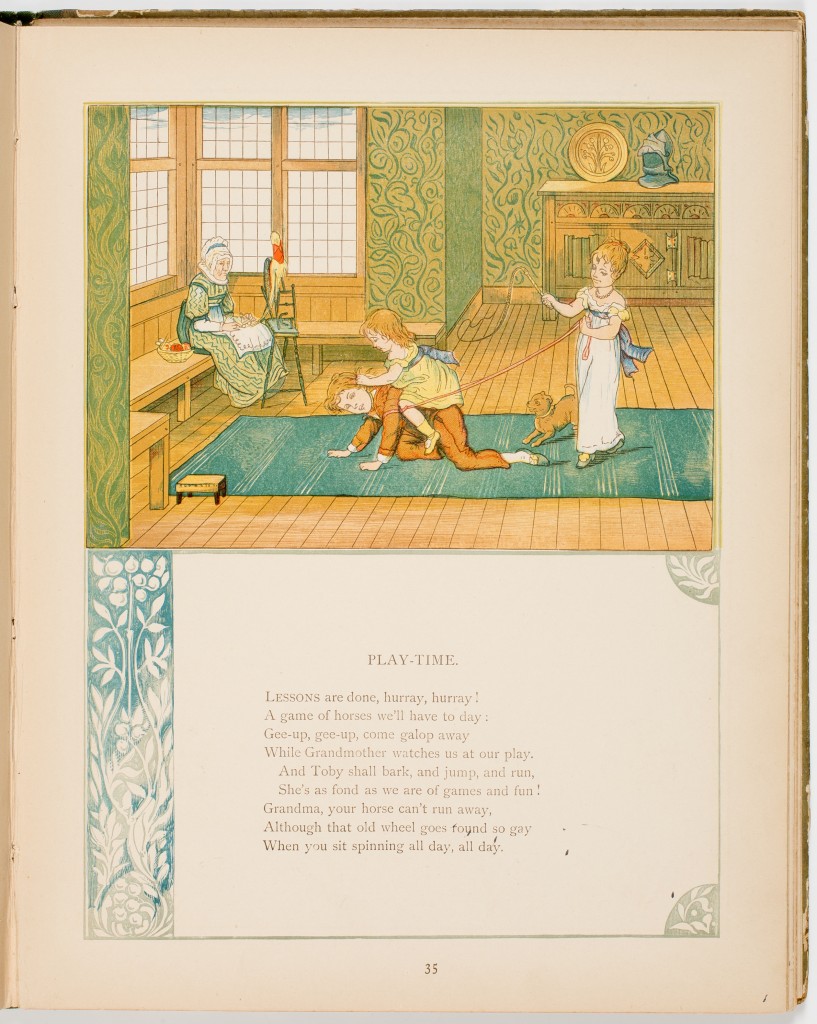
play-time

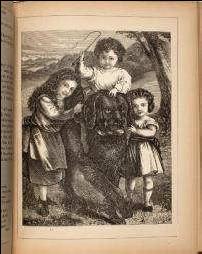
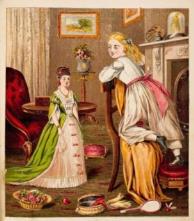
Afternoon Tea: Rhymes for Children. New York: Thomas Nelson and Sons; London: Frederick Warne and Co., ca. 1880. This delicate color-printed illustration of children at play is taken from a book of children’s poetry published jointly in New York and London by the England-based houses of Thomas Nelson and Sons and Frederick Warne.  Both publishers were ...

The Acquisitions Table: The Death and Burial of Poor Cock Robin

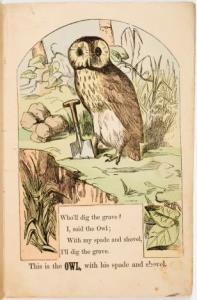
Poor Cock Robin

The Death and Burial of Poor Cock Robin.  Philadelphia: Davis, Porter & Coates, ca. 1866-1868. This poignantly humorous image of the owl digging departed Cock Robin’s grave is taken from an “indestructible” picture book that had its pages reinforced with cloth for the hard use of young and eager hands.  This hand-colored wood engraving is characteristic ...

Adopt-a-Book 2014

coveradoptabook

This year the American Antiquarian Society will be holding its 7th annual Adopt-a-Book event on Tuesday, May 6th, from 6:00 to 8:00pm.  This event has been an entertaining and successful fundraiser for the library’s continued acquisitions of historic material. The money raised helps curators buy more books, pamphlets, prints, newspapers, and manuscripts.  On May 6th, participants ...

A Young Reader’s Appreciation for Johnny Tremain

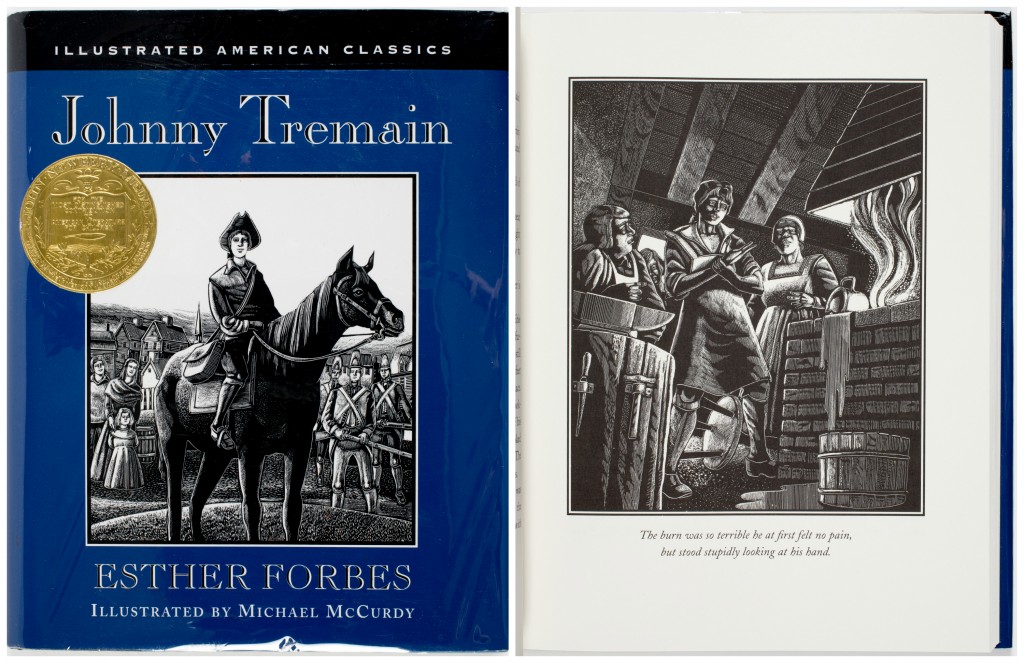
Tremain 1998

Editor’s note: In a twist that follows up on Jackie Penny’s account of reading pre-1900 fiction to her children, retired AAS director of book publication Caroline F. Sloat turned to her ten-year-old grandson for an enthusiastic recommendation of Esther Forbes’s Johnny Tremain. Our bags were packed and we were ready to leave for the airport ...

The Acquisitions Table: New Little Mittens

New Little Mittens

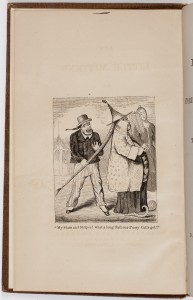
Barrow, Frances. New Little Mittens. New York & London: D. Appleton and Co., 1869. This wood-engraved frontispiece is a comic scene set in the culture clash between a Chinese gentleman going out for a stroll, and an ignorant American sailor who pulls his queue and says “My stars and stripes! What a long tail our pussy ...

The Acquisitions Table: Reynard the Fox

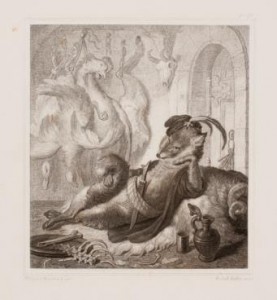
Reynard the Fox. After the German Version of Goethe by Thomas James Arnold. London: Trubner & Co.; New York: Theo. Stroeffer, 1870. This is a folio format edition of the celebrated animal adventurer Reynard the Fox. This luxurious metal engraving of Reynard reclining after a busy day of hunting prey was engraved by Rudolph Kahn after ...

Santa and the Christmas Tree in Nineteenth-Century American Children’s Books

464737_0001

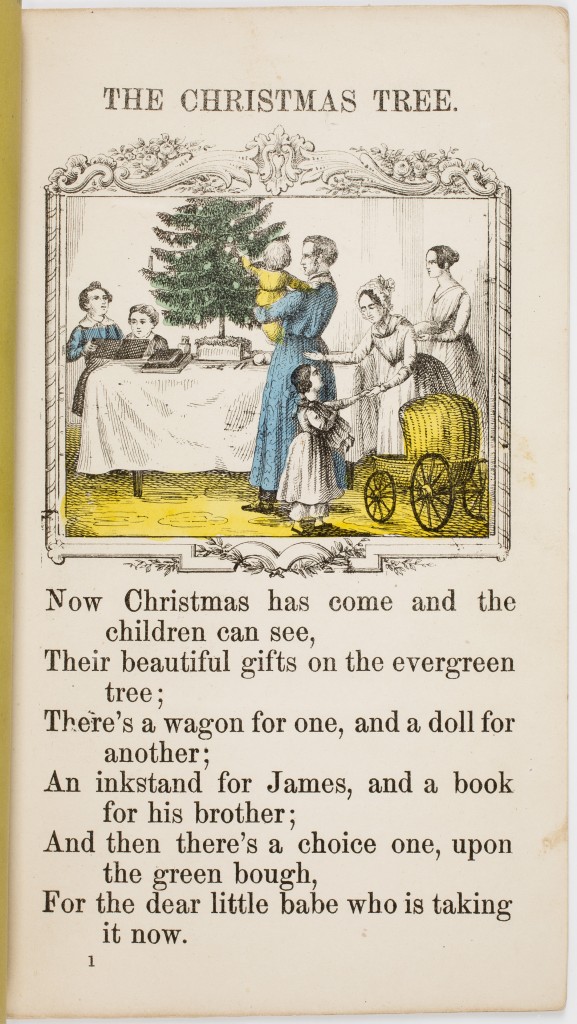
Although we might think of Santa and an evergreen Christmas tree as inevitably wedded in nineteenth-century children’s book illustration, that was not necessarily the case.  Until about 1840, New Year’s Day was favored over Christmas as the family-appropriate winter holiday in the young American Republic, particularly in New England, where the descendants of the Puritans ...

The Acquisitions Table: The Blind Child’s First Book

Howe, Samuel Gridley. The Blind Child’s First Book. Third edition. Boston: New England Institution for the Education of the Blind, 1852. This is a fairly early (and rare) example of printing for the blind using raised type known as Boston Line, developed by the book’s author Samuel Gridley Howe (1801-1876), who gained national fame as the ...

Curatorial Instinct: Or Flying Blind in Upstate New York

496837_0001

In the most recent issue of the Almanac, we had a feature article about the process of bringing new items into the collection. This got us thinking about some of the interesting ways in which these treasures are found. In the coming weeks, each curator will share one of their favorite stories about finding a ...

Recommended Reading: Marcy, the Blockade Runner

Cover of the author

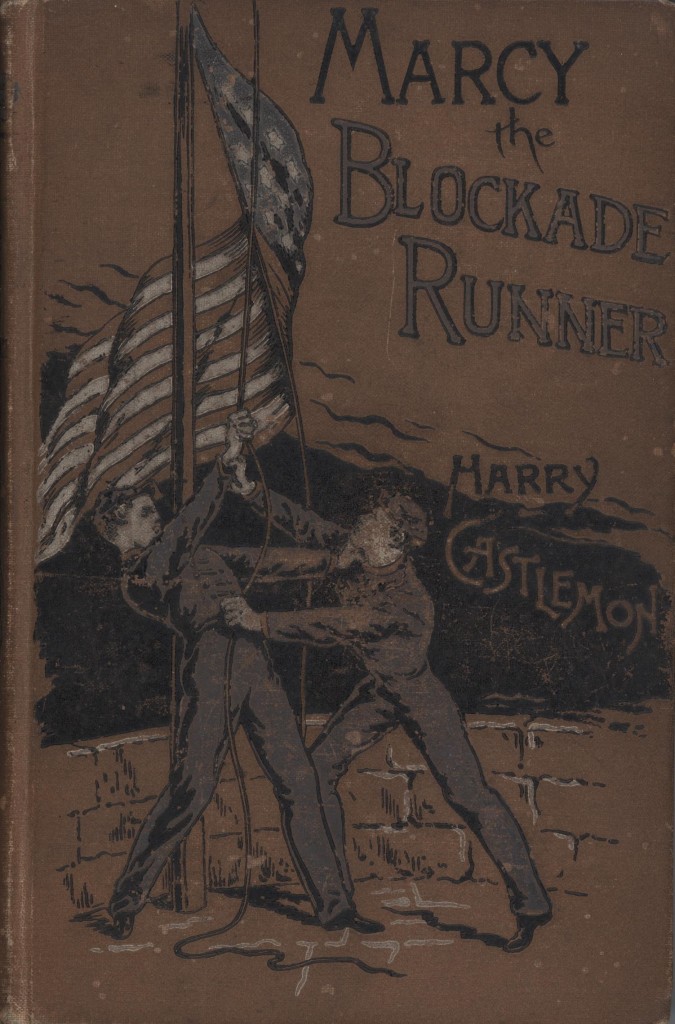
Editor's note: In this week's recommended reading for "fiction published before 1900," AAS member and Councilor Chuck Arning, park ranger and AV specialist at the Blackstone River Valley National Heritage Corridor, talks about a nineteenth-century book that was passed down through his family. Unlike all of the other books in this series (see Philip Gura's ...

Recommended Reading: Burnett’s A Little Princess

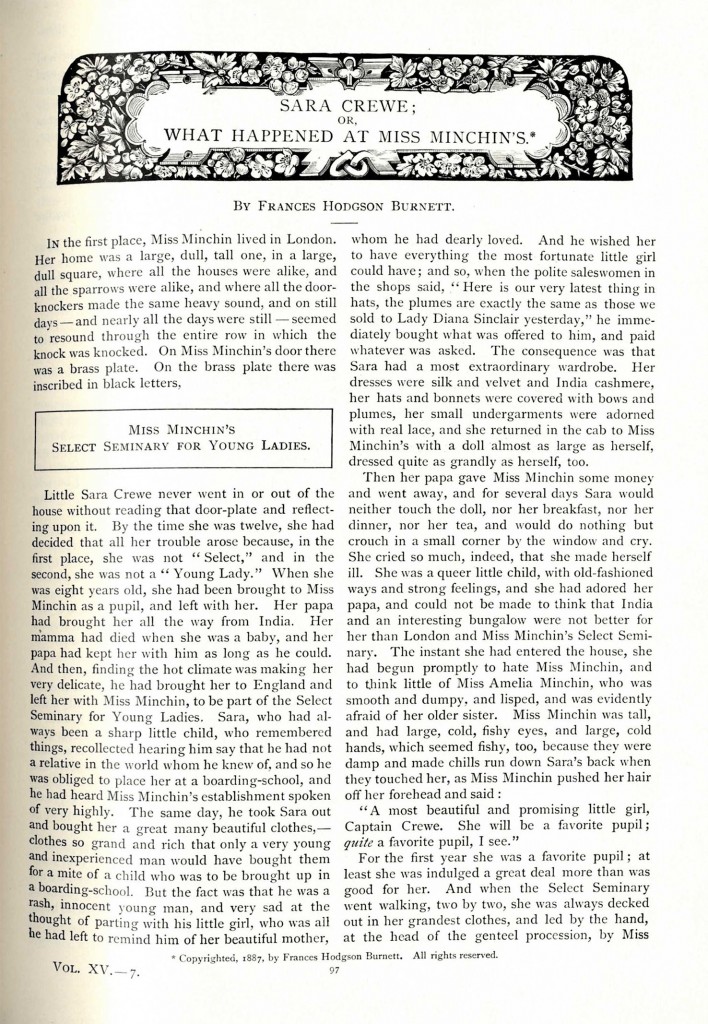
The first page in the serialized “Sara Crewe: or What Happened at Miss Minchin’s,” which started in the Volume XV, Number II (December 1887) issue of St. Nicholas: An Illustrated Magazine.

Editor's note: In the most recent issue of the Almanac, we asked members of the AAS community to give us their choice of recommended reading for "fiction published before 1900," a series we are continuing here on Past is Present. Last week we heard from AAS member Philip Gura. This week, Jackie Penny, AAS's image ...

The Acquisitions Table: The Adventures of Teasing Tom and Naughty Ned with a Spool of Clark’s O.N.T. Cotton

?The Adventures of Teasing Tom and Naughty Ned with a Spool of Clark’s O.N.T. Cotton. New York: F.B. Patterson, 1879. Books printed as advertisements were frequently directed at children, as is the case of this chapbook hawking Clark’s cotton thread. Not only do Tom and Ned play hooky from school, but they use a spool of ...

The Acquisitions Table: Children’s Book for Sabbath Hours

Bullard, Asa.  Children’s Book for Sabbath Hours.  Springfield, Mass. & Chicago: W.J. Holland & Co., 1873. With the secularization of American society after the Civil War, this book by minister Asa Bullard answered a need to give children something wholesome yet entertaining to read while keeping the Sabbath free from raucous play.  This is a selection ...

The Acquisitions Table: The Flower People

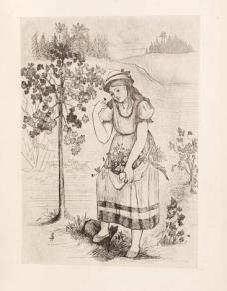
Mann, Mary Peabody.  The Flower People. Boston: James R. Osgood & Co., 1875. First published in the early 1840’s, Mary Peabody Mann’s The Flower People introduced the study of botany to children under the guise of conversations between a girl named Mary and various plants.  In this case, Mary is speaking to a leaf that she ...

The Acquisitions Table: The History of a Great Many Little Boys and Girls

Kilner, Dorothy.  The History of a Great Many Little Boys and Girls.Keene, N.H.: John Prentiss, 1807. English author Dorothy Kilner (1755-1836) targeted these stories specifically to young readers between the ages of four and five.  Although her audience is young, Kilner’s subjects are very serious: one young boy who refuses to wear clothes is beaten ...