Something Old, Something New: Updates on the Program in the History of the Book

In his October 1983 report to the Council, former AAS President Marcus A. McCorison outlined the founding of the Program in the History of the Book (PHBAC), an ambitious initiative that set out to unite four areas of the Society’s work: collections, scholarship, fellowships, and publications. 

In the same 1983 report, John Hench, then assistant director for research and publication, listed a wide scope of activities under the new program, including an annual lecture series, new workshops and seminars, and a host of publications. Among these publications, Hench described,  “A newsletter [that] will keep scholars informed of activities of the Program and of similar work elsewhere . . .”  This newsletter was soon titled, The Book.

Published from 1983 to 2008, The Book served as the chief means by which PHBAC communicated with its various constituencies about the Society’s annual summer seminars, the annual James Russell Wiggins Lecture, and the progress of the five-volume series A History of the Book in America. It also served as a venue for the publication of essay reviews and substantive pieces on research collections and on research in progress. The collection is not only an important marker in the Society’s institutional history, it is also a valuable resource for the development of the History of the Book as a field of study.

This spring, The Book newsletter was digitized in its entirety.  Each issue is now available online in two formats: as a web-based flipbook and as a downloadable PDF. 

This collection is available here: https://www.americanantiquarian.org/book-newsletter

Virtual Book Talks

One of the latest activities of PHBAC is the Virtual Book Talk. This series showcases authors of recently published scholarly monographs, digital-equivalents, and creative works broadly related to print history and culture. During each installment, an author speaks about a recently published work and responds to audience questions. Programs can include an informal lecture around major points of the work, discussions of the archival research or creation and publication process, and readings from published texts. Programs typically last 45 minutes to one hour long. At the present, they will be streamed live on the Web and recorded for posterity. These programs are free but require advanced registration. 

Our first guest is Derrick R. Spires, Associate Professor of English and affiliate faculty in American Studies, Visual Studies, and Media Studies at Cornell University. Spires specializes in early African American and American print culture, citizenship studies, and African American intellectual history.  His first book, The Practice of Citizenship: Black Politics and Print Culture in the Early United States (University of Pennsylvania Press, 2019), won the 2020 Bibliographical Society/St. Louis Mercantile Library Prize and the 2019 M/MLA Book Prize. He is a General Editor for the Broadview Anthology of American Literature and serves on the editorial boards of American Literature and Early American Literature.
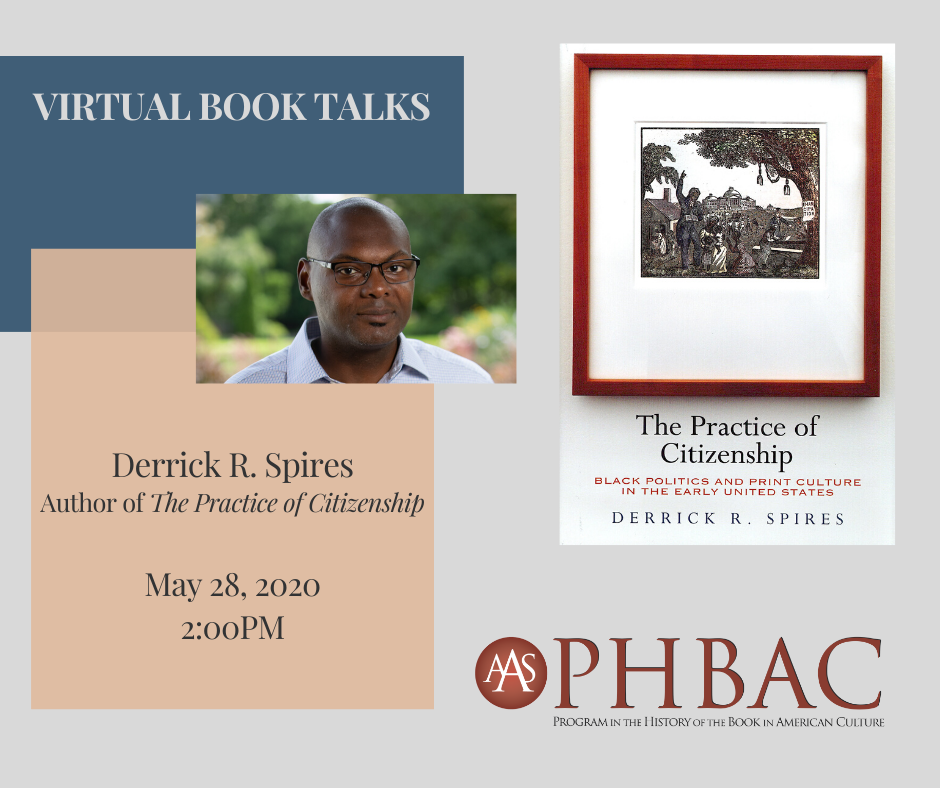
In The Practice of Citizenship, Spires examines the parallel development of early black print culture and legal and cultural understandings of U.S. citizenship, beginning in 1787, with the framing of the federal Constitution and the founding of the Free African Society by Absalom Jones and Richard Allen, and ending in 1861, with the onset of the Civil War. Reading black print culture as a space where citizenship was both theorized and practiced, Spires reveals the degree to which concepts of black citizenship emerged through a highly creative and diverse community of letters, not easily reducible to representative figures or genres.

Questions about the event may be directed to Kevin A. Wisniewski, Director of Book History and Digital Initiatives, at kwisniewski@mwa.org. To register for this event or to find out more about similar online programs, please visit: https://www.americanantiquarian.org/virtual-programs



Black Self-Publishing: A New AAS Research Project & Resource

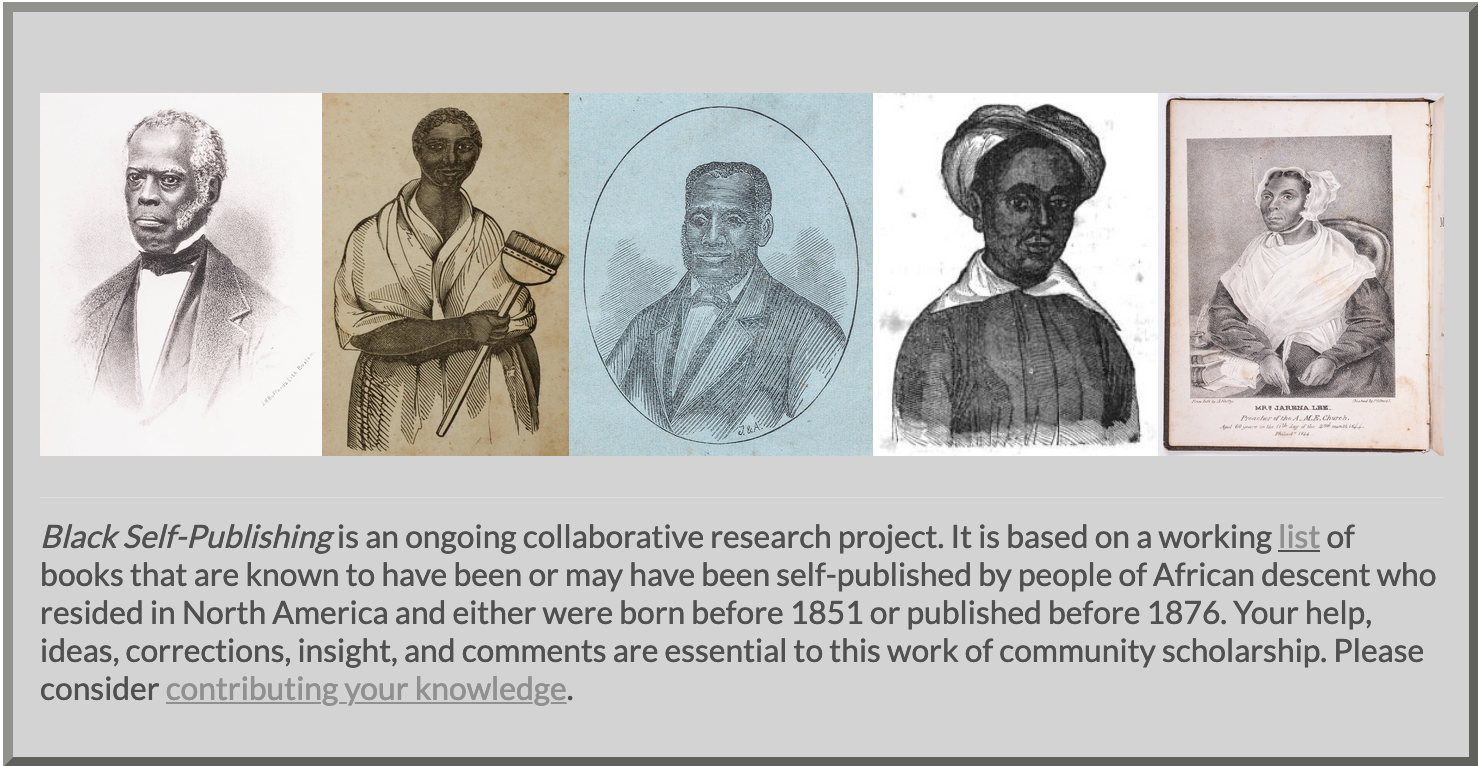
Black Self-Publishing is a new collaborative research project from the American Antiquarian Society. The core of this site consists of a list I developed of books self-published by black authors within the scope of the American Antiquarian Society’s collecting period (origins to 1876). Studying self-publishing, occasions when an author pays for the printing of his or her text, opened a window into the world of early African American print, revealing both a diversity of genres and authorial motivations for publishing. Although the narratives of Fredrick Douglass or Harriet Jacobs are probably the most popular to readers today, self-published texts by black creators compiled in this project encompass everything from a hotel-keeping manual to a speech on the “larceny of dogs.”

The project on self-published African American titles started as a spreadsheet and finished as an online exhibit using Omeka. By presenting this working list on a prototype site, AAS hopes to encourage new forms of collaboration among scholars, students, community members, bibliographers, teachers, and more. (Watch this video to see how you might engage with this project!)

Within my first few weeks at AAS, I received a crash course on the history of printing in America and was amazed at the complexity of the printing process: making paper, setting the type, inking and pressing sheets, and sewing together the pages. I began to learn how to analyze the materiality of a book.  During my internship, I examined chain lines (the prominent, wide-spaced, parallel lines in laid paper), gatherings (a group of folded sheets), and the slightest break in a letter on the page. At times, I felt like a slightly obsessive printing detective, solving historical mysteries while bending over books with a tape measure to compare the height of letters, excited about my type spacing discoveries.

AAS’s emphasis on the history of printing also contributed to my research. One of my greatest triumphs was uncovering the identity of the mysterious “Enterprising Publishing Company” listed on the imprint of several books on my list. Were they really a publishing company? I was determined to find out. After looking with no success in lists of newspapers, I made a breakthrough using Readex’s African American Newspaper database through the AAS website: I discovered that the Enterprise Publishing Company was the only black job printing office in Washington, D.C., from 1876 to 1881. Their claim that “that colored printers are the ‘boss’” remains one of the most memorable quotes from my summer.

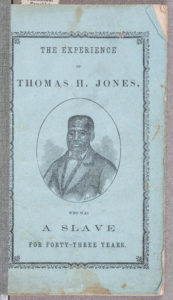
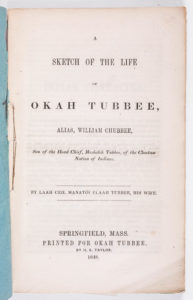
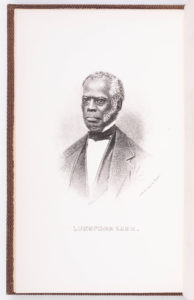
Other special finds (seen below) include The Experience of Rev. Thomas H. Jones, Who Was a Slave for Forty-Three Years (1868), A Sketch of the Life of Okah Tubbee (1848), and Lunsford Lane; Or, Another Helper from North Carolina (1863).

When my supervisor Elizabeth Pope and I journeyed over to the section in the reading room for bibliographies on Afro-Americana, I received a big shock. While Elizabeth showed me a bibliography for black writers related to the military, a bibliography of black New England writers, and a list of titles held by the Library Company of Philadelphia, I wondered why the bibliographies on Afro-Americana were so sparse and specific. (The methodology section of website lists the sources I consulted for the Black Self-Publishing site.) Although important work has been done on the topic, especially by black bibliographers in the early twentieth century, the deeper I researched into this project, the more I wished for a complete bibliography of Afro-Americana to guide my research. What I was able to pull together over one summer is nowhere near a complete bibliography, but I hope this project serves as another resource that leads towards a more complete and accurate account of books published by black authors. (A larger bibliographical project on all Black authors is now being undertaken by the Black Bibliography Project based at Rutgers and Yale.)

As I read more bibliographies and added their findings to my list, I became more familiar with the names of many early African American writers. I picked several to research further, and, after a short time, they began to feel like good friends. Looking into the stories of these authors was one of my favorite parts of the project; their stories were fascinating, and it felt like I was able to contribute to scholarly knowledge using the editions of their books at AAS. One author, the spiritualist medium Paschal Beverley Randolph, who prolifically self-published books for 20 years, started to feel like he was following me around.  Serendipitously, when I visited with a book dealer in Connecticut, Randolph’s book was the first I pulled off the shelf. And, even better, it was one AAS didn’t have in its collections!

The summer was full of exciting discoveries, from locating books to add to my list to closely working with the AAS collection. I’m excited to see how the black self-publishing project will be used in the future, and I’m so grateful for everything that my summer at AAS has taught me.


In the summer of 2018, Sadie Van Vranken was an intern at the American Antiquarian Society as part of the Princeton Internship in Civic Service (PICS) program from Princeton University. She created an Omeka website about self-publishing by early American black authors that incorporated her own research with that of others.

Reporting on the Battle of Lexington, 1775: Fake News and the Massachusetts Spy

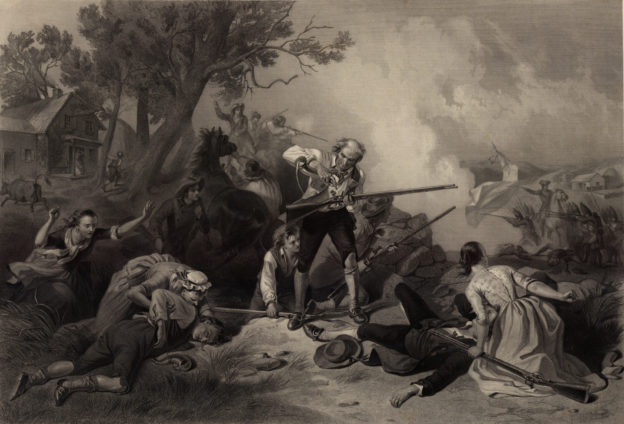
May 3rd is an important date for both the American Antiquarian Society and the community of Worcester. On that date in 1775, Isaiah created the first object printed in this community: his newspaper the Massachusetts Spy. In this issue, he described the Battles of Lexington and Concord. While Thomas was present at those battles, his account is far from an objective one and in this video, I examine and provide some context to this document.

This is also one of the few objects in our collection for which we have a life-size paper facsimile, and we have often used this in our K-12 programming. Both teachers and their students have enjoyed being able to touch and read it as one might have in the eighteenth century. The Society has a number of digital resources for educators both related to this item and to many other aspects of American history and culture before the twentieth century.

These can be accessed here: https://www.americanantiquarian.org/k-12-resources.

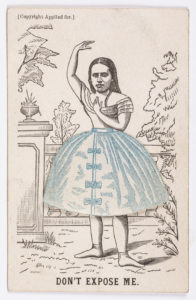
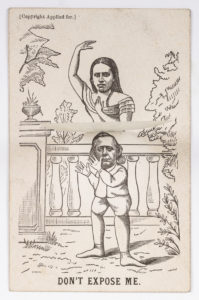
“Don’t Expose Me”: The Beecher-Tilton Scandal of New York

Maggie Panteli is pursuing a BA degree in History and is graduating May 2020 from Clark University. During the summer of 2019, she worked part-time as a Readers’ Services Page and as an assistant in the Graphic Arts Department cataloging stereographs. Her favorite cataloging job was working with the McLoughlin illustrations. Her time at AAS has strengthened her commitment research and learning.

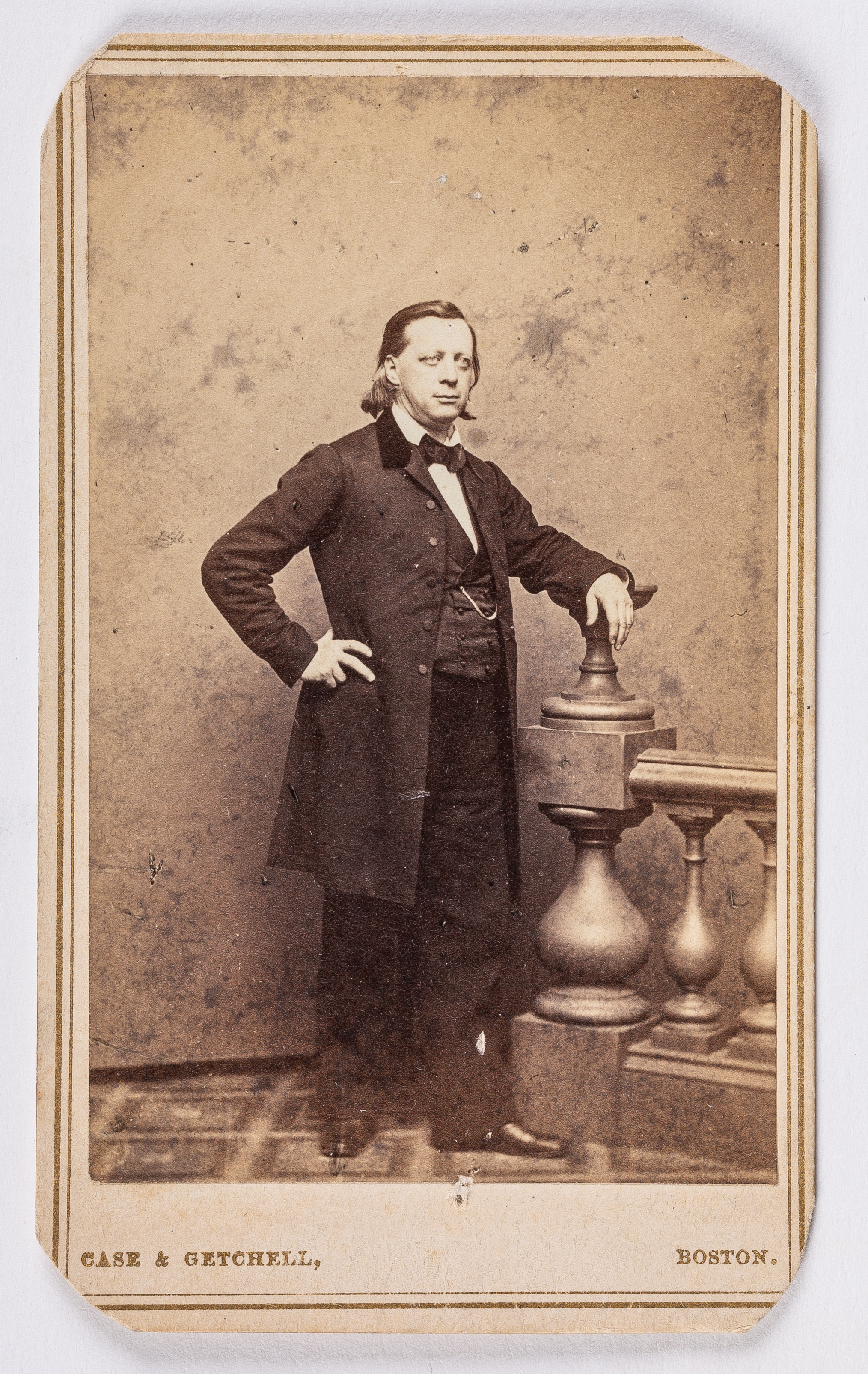
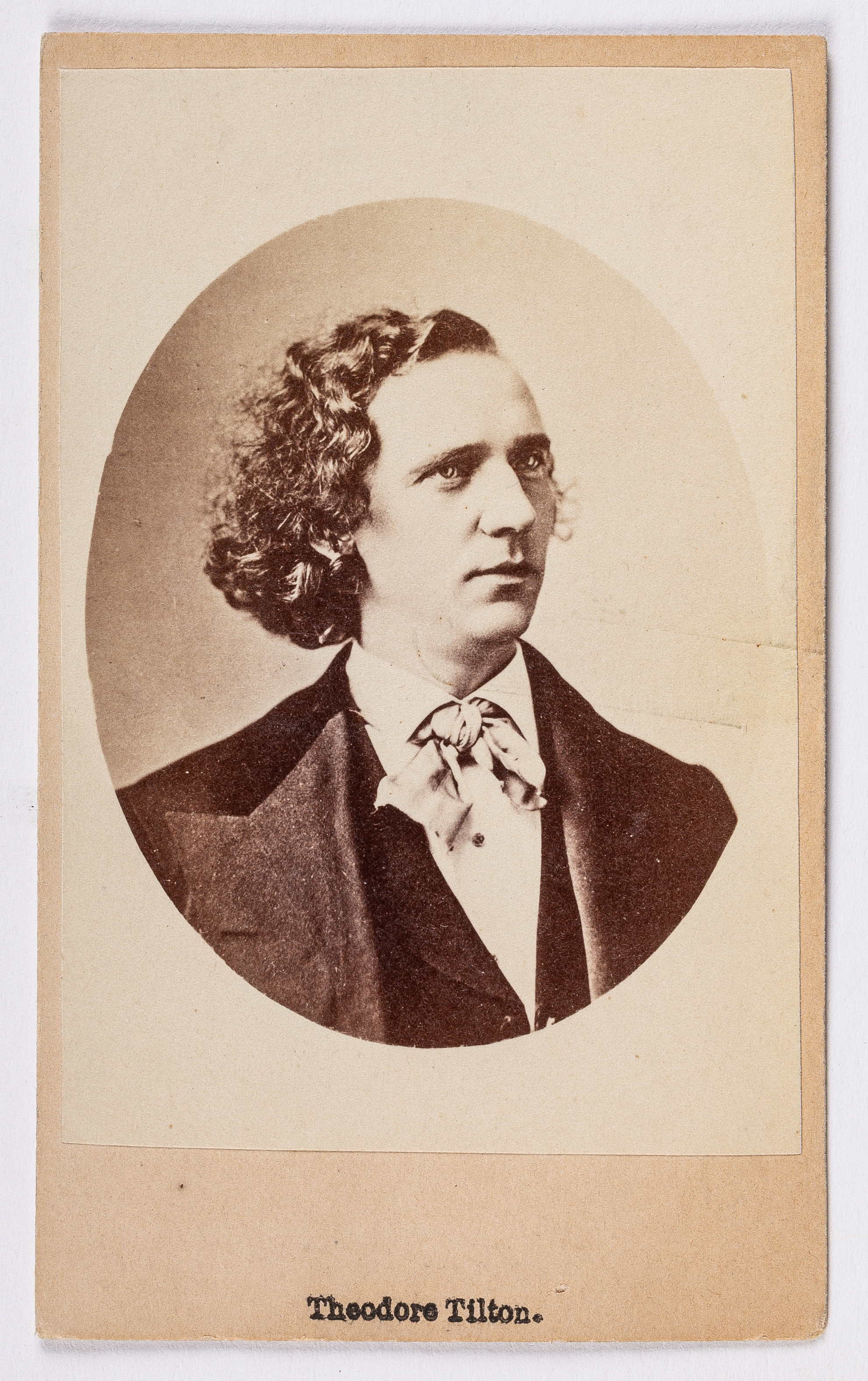
Traditional history classes can sometimes skip over some of the juiciest stories in American history. One of the most lurid and salacious stories of the nineteenth century is the Beecher-Tilton Scandal that rocked New York City in the 1870s. In 1870, Mrs. Elizabeth R. Tilton confessed to her husband, Theodore Tilton, an author and abolitionist, that she had been romantically involved with their church reverend and close family friend Henry Ward Beecher, brother of Harriet Beecher Stowe. The Tiltons separately joined Plymouth Church in Brooklyn Heights, New York, in the early 1850s and were married there in 1855 by Beecher. Beecher and Theodore Tilton became close friends in the late 1850s through their civil rights work and remained close until the early 1870s when the affair became public.

The trio initially agreed to keep the affair quiet, but in 1872 Ms. Victoria Wodhull, the infamous woman’s suffrage activist, published a sensational article in Woodhull & Claflin’s Weekly demonizing Beecher, mainly for his lack of morals and hypocrisy. Woodhull, who Beecher had criticized earlier for her “Free Love” advocacy and radical politics, is thought to have used the knowledge she gained from her friendship with Theodore Tilton to expose Beecher for his deceitful behavior. In her article, Woodhull proclaims, “[T]hey [those that make the rules] act upon the new doctrines while they profess obedience to the old . . . organized hypocrisy has become the tone of our modern society. Poltroon, cowardice, and deception rule the hour.”

Woodhull adds that letters had been sent about Tilton, and there were rumors that he had been violent throughout the marriage, possibly even causing his wife to have a miscarriage, and that he had kept her locked up in their house. Throughout the article, Woodhull refrains from speaking ill about Mrs. Tilton; however, she does boldly call out Beecher’s transgressions and hints to rumors she had heard, or made up for the sake of a sensational article.

At the time this article was published, Beecher and the Tiltons continued to keep as quiet as they could about the affair. However, in July 1874, Theodore Tilton publicly accused Beecher of seducing his wife and committing adultery. In response, Beecher set up a Plymouth Church investigation to look into the affair. The investigation found that Beecher was innocent, but public opinion and frustration led Theodore Tilton to sue Henry Ward Beecher for “criminal conversation” (adultery) and “alienation of [his wife’s] affections,”’ in late 1874.

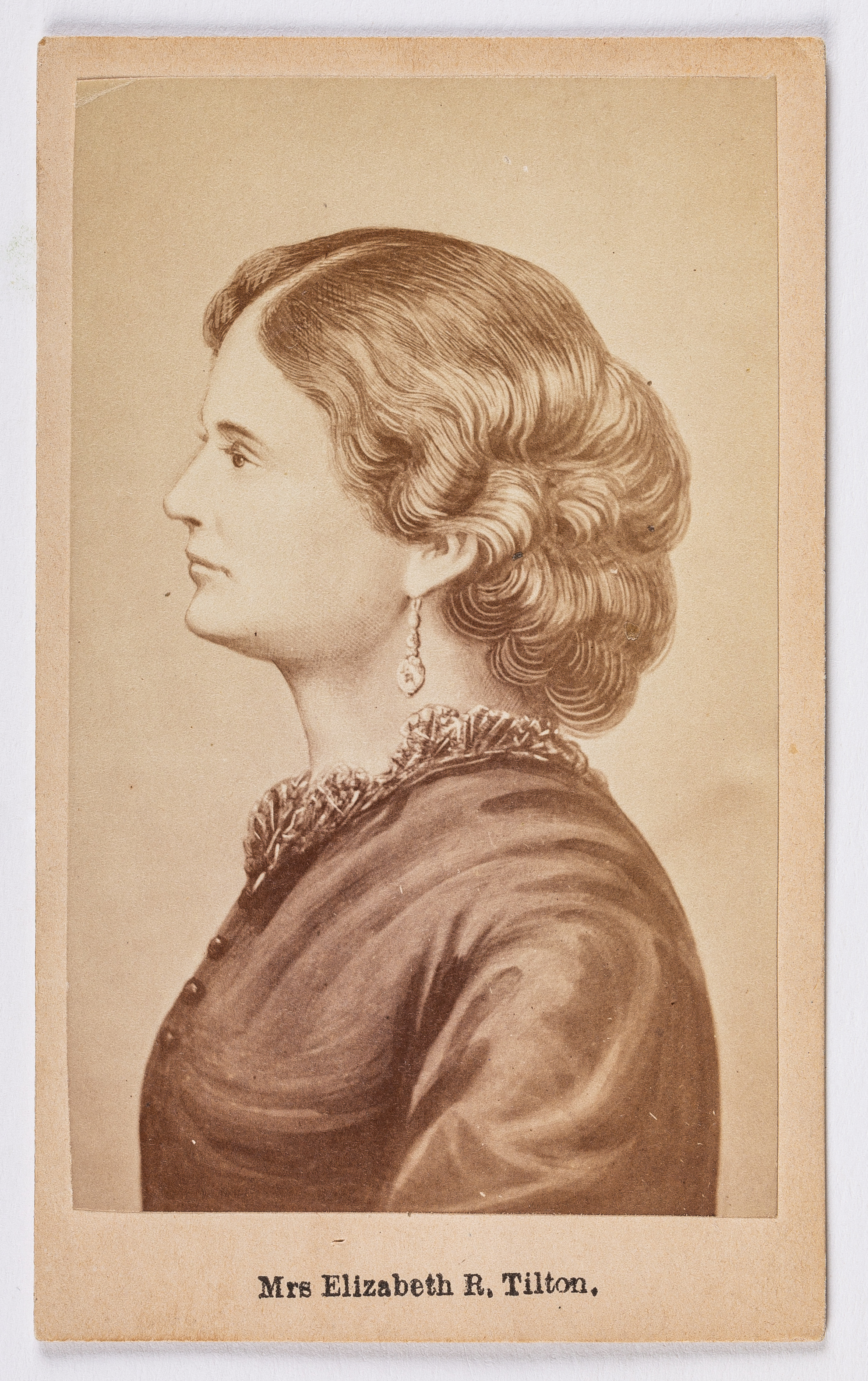
Mrs. Elizabeth R. Tilton, carte-de-visite, ca. 1875.

The civil case began in January 1875 and captivated the nation. While Beecher and Tilton both spoke at the trial, Elizabeth Tilton was unable to to do so because of spousal immunity. According to Richards Wightman Fox, in Trials of Intimacy, Elizabeth’s exclusion from the trial had little impact on the ruling because she was prone to changing her responses about the affair and was considered “untrustworthy”. At the end of a six month trial, the jury could not agree, and Beecher was finally acquitted. In 1878, Elizabeth Tilton issued her last confession that she did indeed have an affair with Henry Ward Beecher.  At the time, it was still interpreted as a rumor or untrue at the time.

While there is a large amount of information available about Henry Ward Beecher, Theodore Tilton, and Victoria C. Woodhull, Elizabeth seemingly vanished from the public eye after she passed away in 1897. Despite being publicly defamed and pushed to the sidelines, she maintained a starring role in a drama-filled court case. Nevertheless, historians have focused on the famous men involved in the case and overlooked its most mysterious and interesting character: Mrs. Elizabeth M. Richards Tilton. After the trial ended in 1875, Theodore Tilton moved to Paris, France, leaving behind his family and friends. Elizabeth was forced to move back in with her mother in Brooklyn with her two youngest children. Little else is known about her life in those years after the trial ended. Even the American Antiquarian Society, which boasts a wide variety of both cataloged and uncataloged artifacts directly related to scandal, possesses only a single, non-political cartoon image of Elizabeth Tilton.

Through my unique position this summer at the American Antiquarian Society, as both a reference page and a graphic arts cataloger, I was able to conduct research and create records for uncataloged artifacts in the vast graphic arts collection. This included the only “picture” (actually only an artist’s rendering) of Mrs. Tilton, as well as a number of carte de visite, political cartoons, and portraits of Mr. Tilton and Mr. Beecher. Additionally, I was able to catalog a portrait of Victoria C. Woodhull and a fabulous political cartoon flip card of Mr. Beecher and Mrs. Tilton.

The flip card is titled “Don’t Expose Me” and it has a printed image of Mrs. Tilton standing among a garden with her hands in a dance position. Her skirt is not completely glued to the paper, and, when it’s lifted, Mr. Beecher stands under the skirt with his arms lifted in surprise.

Handling objects like these and looking closely in an attempt to accurately describe them during the cataloging process provided an opportunity to experience how printing, photography, and cartooning was used during the trial, which is often described as the largest “he said, she said” argument of the late 19th century in America. Studying events such as the Beecher/Tilton scandal and using ephemera and published trial material (also available at AAS), can contribute to understanding the cultural norms of America during the late 19th century. Now that they are cataloged, all these artifacts are findable and available for research purposes to anyone who comes to the American Antiquarian Society or uses the General Catalog. Perhaps more information about the life of Elizabeth Tilton will be uncovered and written about in the future.

For Further Reading:

Fox, Richard Wightman. Trials of Intimacy: Love and Loss in the Beecher-Tilton Scandal. 1st ed., University of Chicago Press, 1999. Housed at the American Antiquarian Society.

Woodhull, Victoria C. “The Beecher-Tilton Scandal Case: The Detailed Statement of the Whole Matter by Mrs. Woodhull.” Woodhull & Claflin’s Weekly , 2 Nov. 1872, pp. 9–13. Housed at the American Antiquarian Society.

McDivitt, Campbell, & Co., Law Publishers, No. 79 Nassau Street. Theodore Tilton vs. Henry Ward Beecher, Action for Crim. Con. [I], [II], V, VII, and XVII-XVIII, 1875. Housed at the American Antiquarian Society.

It’s All in the Details: Broadsides in Theodore C. Wohlbrück’s Photography

Long-time readers of the AAS blog know we have posted frequently here about Worcester-area photographer, Theodore C. Wohlbrück (1879-1936). We’ve been writing about the Society’s holdings of this artist’s work since 2010. AAS has a large collection. of photographic prints and glass plate negatives taken by Wohlbrück between 1900 and ca. 1910, including regional landscapes, city views, and images of his family.

In 2012, we wrote about a set of 180 of these views, mostly of the city of Worcester. At that time, these images had recently been scanned from fragile glass plates and were part of our new digital asset system. Recently, they have been added to the online inventory of Wohlbrück’s images constructed by the Society’s Visual Materials Cataloger, Christine Graham, and are now easily available via our website. Each negative has been described, can be keyword searched, and can be freely downloaded for enlargement. Because the digital images were created from 3” x 5” high resolution negatives, the level of detail is amazing and will allow researchers and scholars to better understand the built environment of our home city.

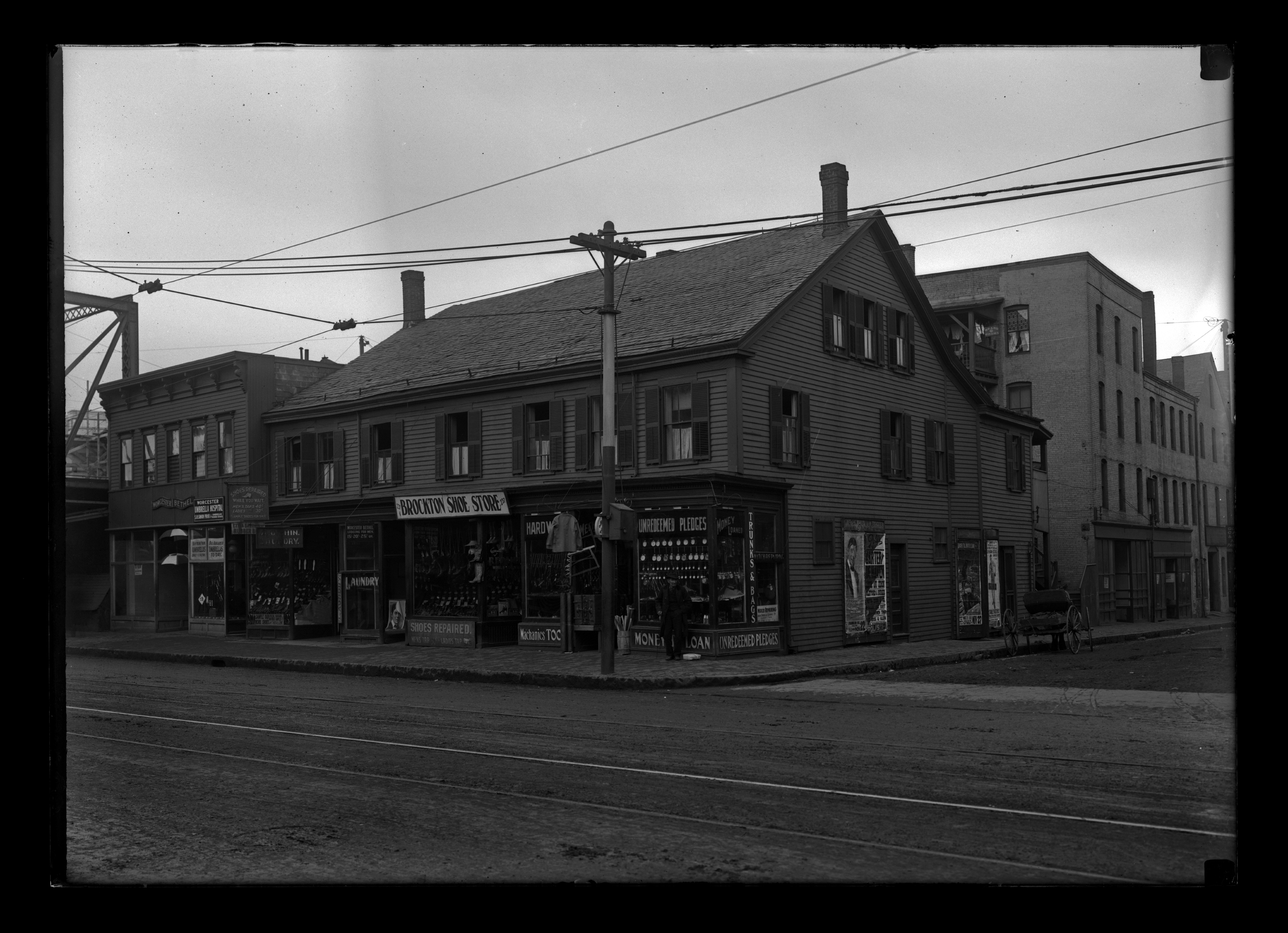
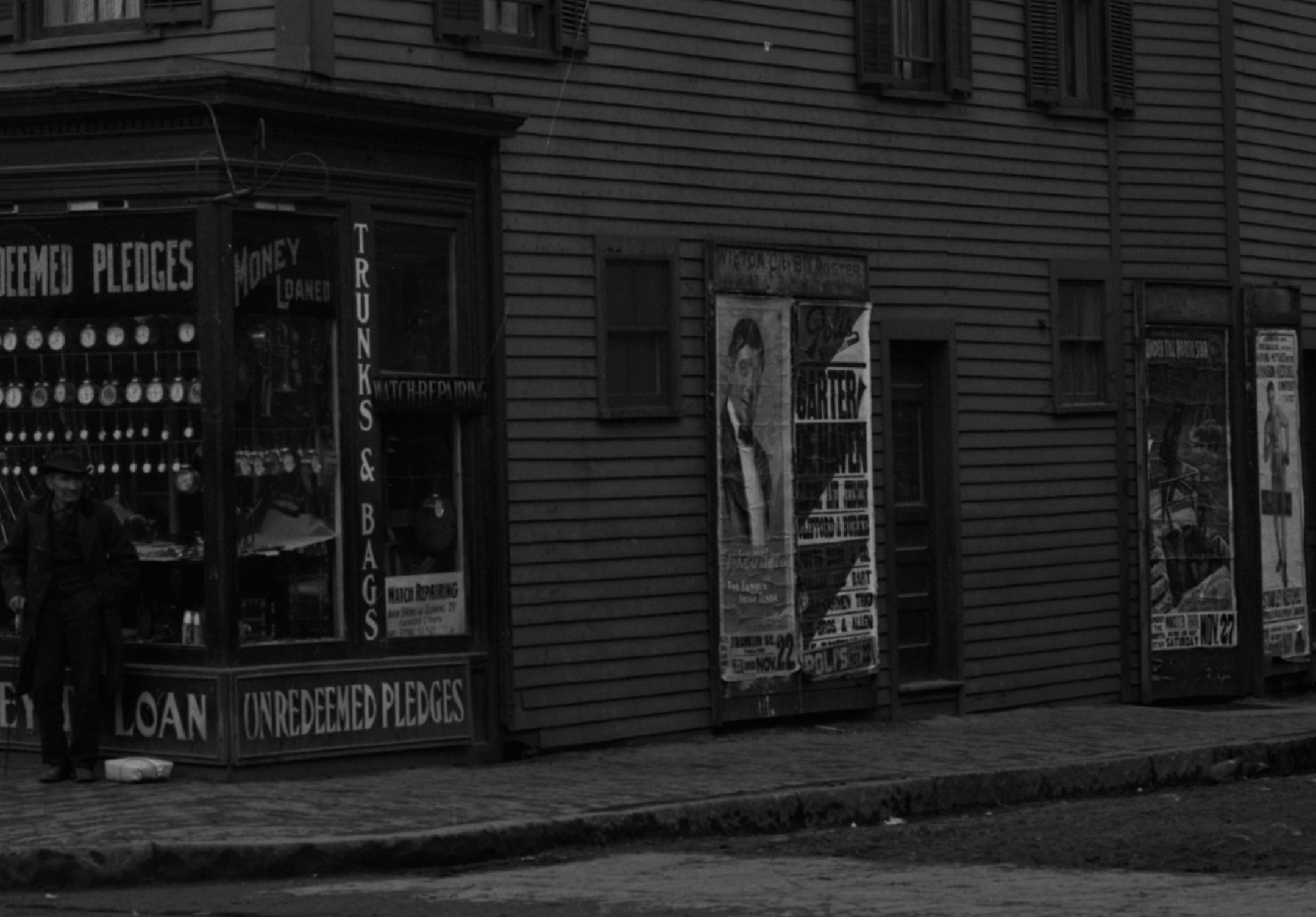
The graphic arts collection at AAS includes not only photographic collections like Wohlbrück’s, but it also houses outstanding examples of American broadsides. Broadsides are ephemeral printings that were posted in public places to announce events like auctions and entertainments, sell products, or promote political and social activity, etc. They were usually papered over, faded in the sun, or were damaged by weather and the great majority of them have been simply lost to time. While scanning through the new Wohlbrück resource, we found several excellent shots of broadsides in situ, like this image of the Brockton Shoe Store which includes four sections of advertising paper plastered on the side of the building.

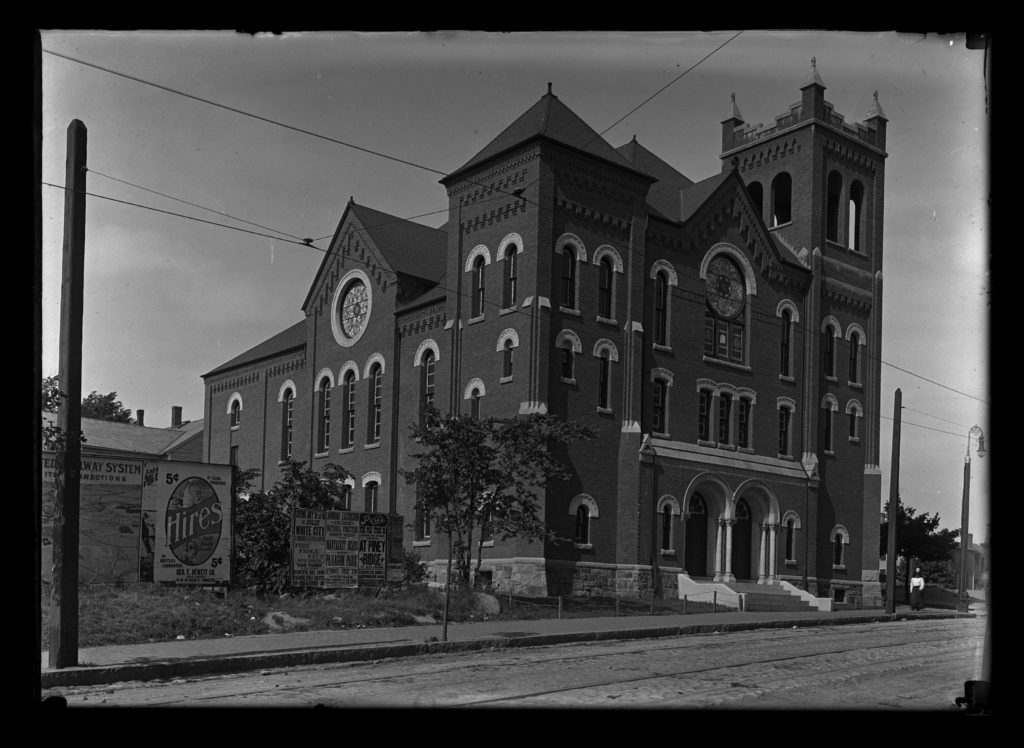
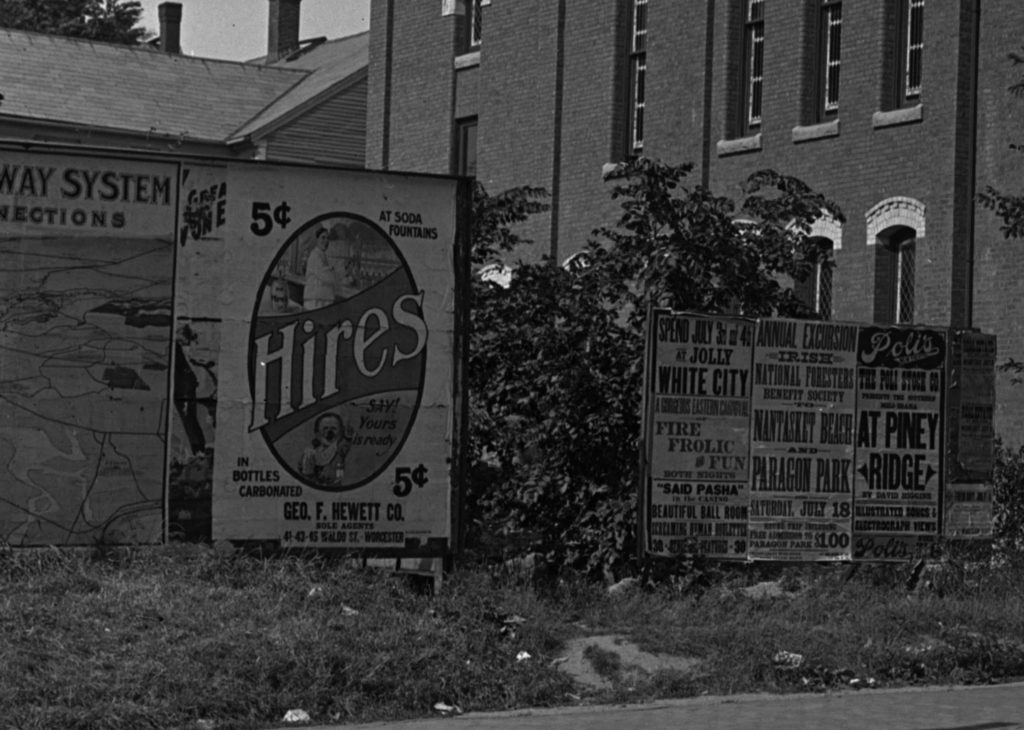
In some cases, users can zoom in and read the broadsides in their entirety as in the shot of the Baptist Church on Belmont Street. Here Wohlbrück’s composition included some overgrown fencing on a neighboring lot which sported ads for root beer, White City Amusement Park (in nearby Shrewsbury), and an excursion planned for the local chapter of the Irish National Foresters Benefit Society (an organization which supported Irish nationalism).

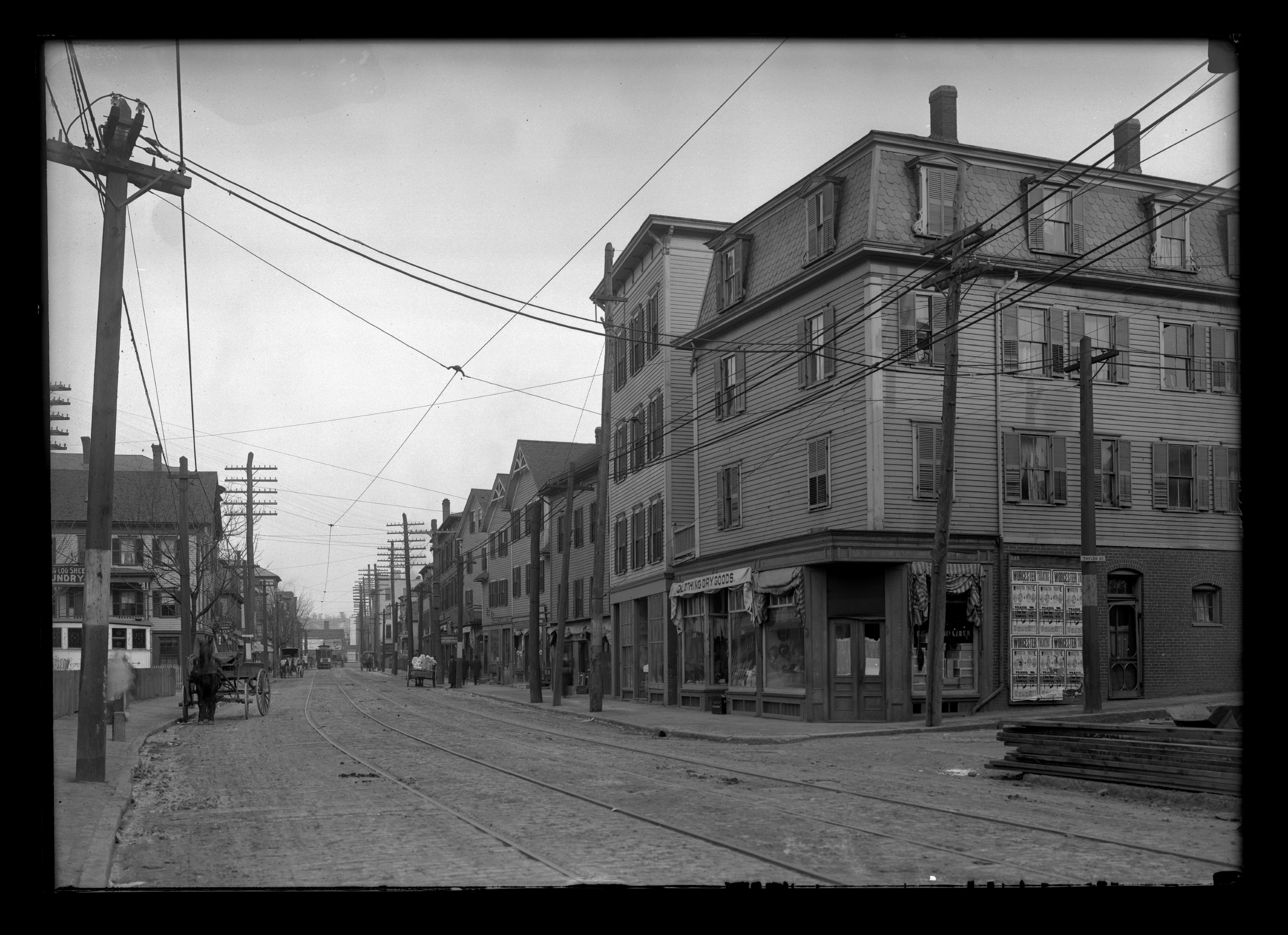
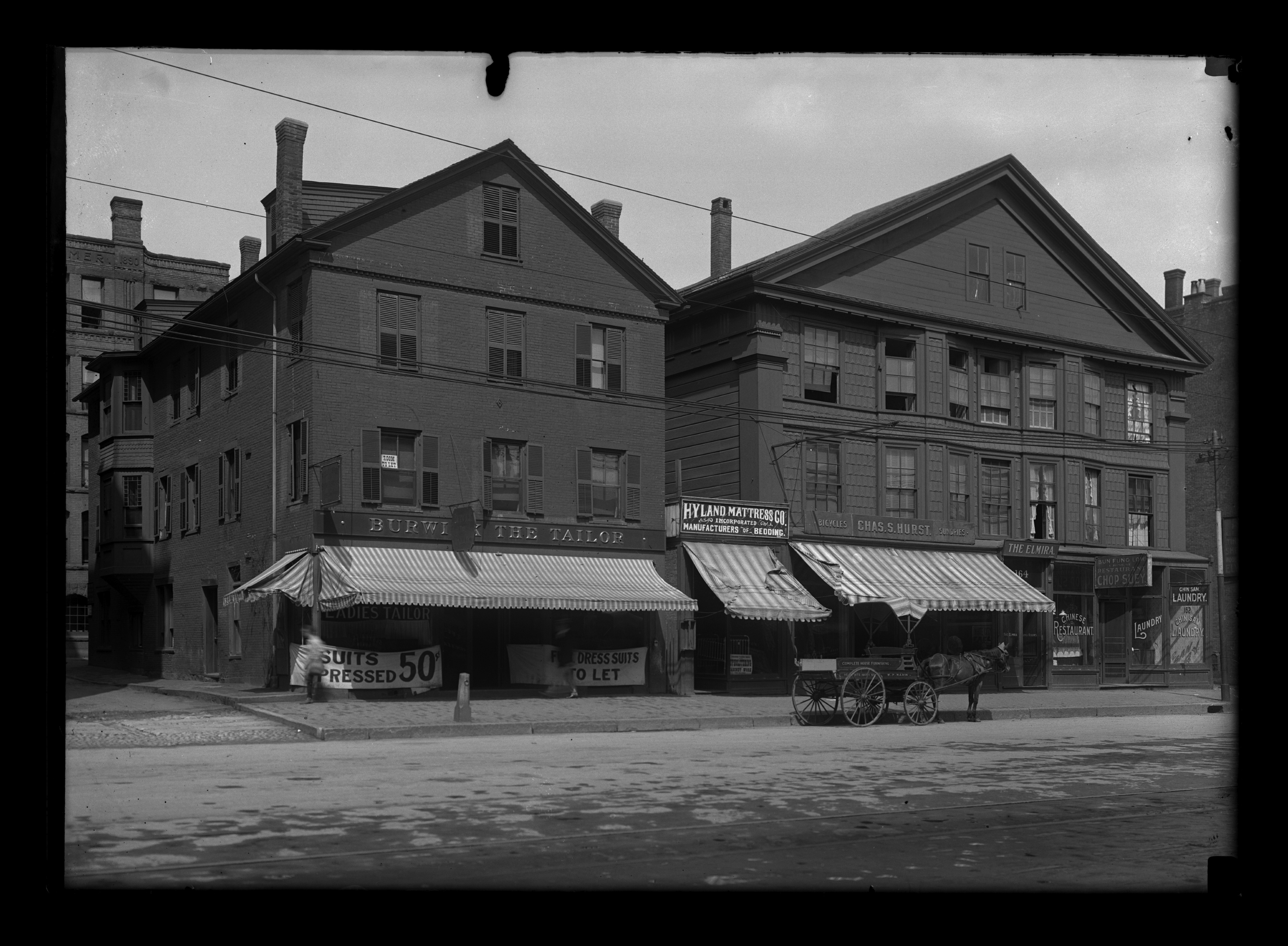
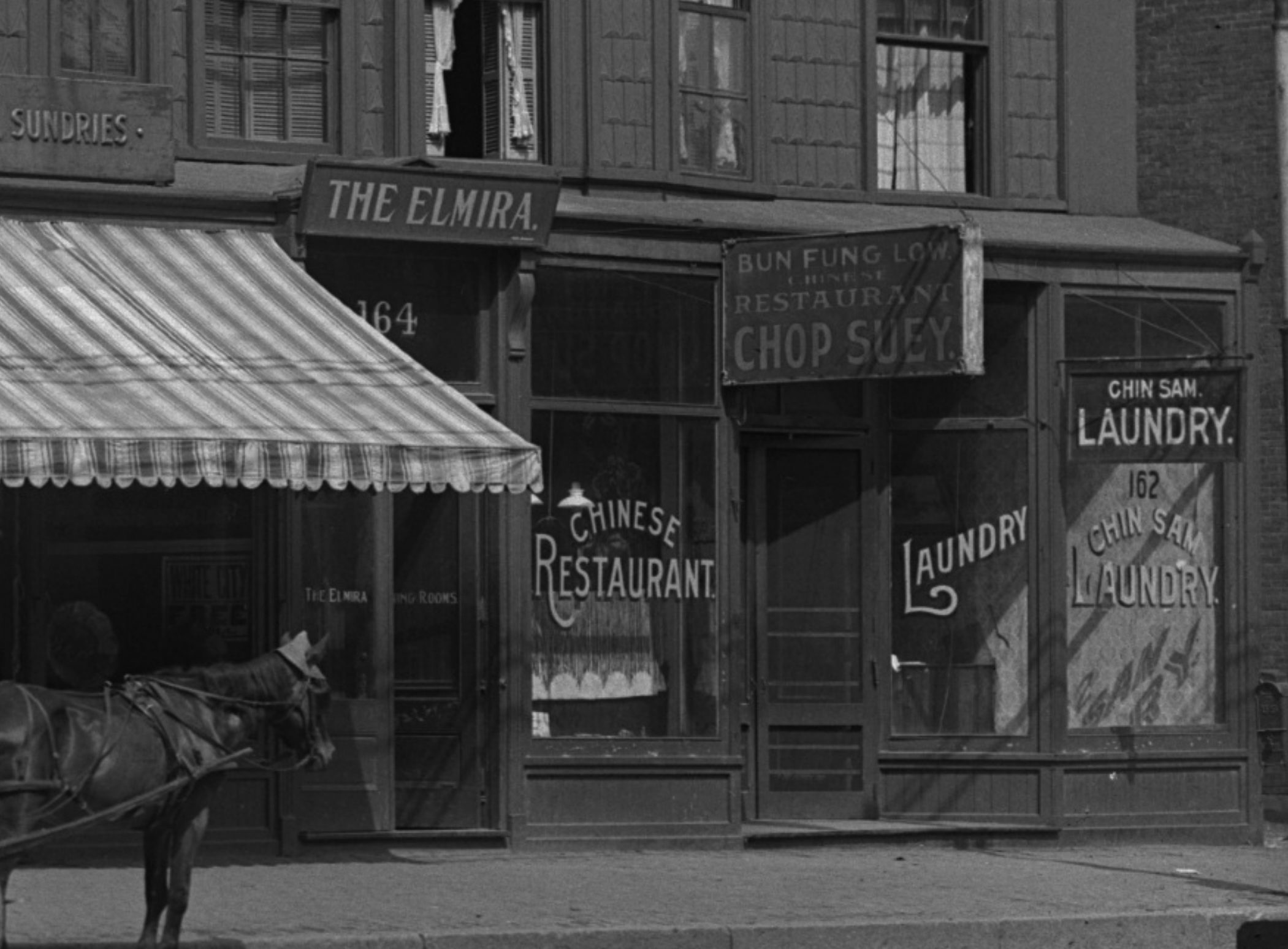
That last poster is not surprising, as the city had a large immigrant population at the turn of the century. Many Irish families had settled in the region in the 1870s and helped build the Blackstone Canal and railroads in the area. These resources then drove the industrial boom in the city in the early twentieth century when Wohlbrück was walking the streets with his camera. Central European immigrants, people from Scandinavia, and from Asia all moved to the city to work in the busy factories and manufacturing centers as the new century began. The broadsides posted on the side of a building in a view of the intersection of Millbury and Taylor Streets promoted a show at the Worcester Theater. Further research (and consultation with a language expert) revealed that the posters are printed in Yiddish and promote a Yiddish melodrama, “Satan in the Garden of Eden.” The play was written around 1905 by Joseph Lateiner, the first professional writer for the Yiddish theater in America, and was performed around the country by touring companies for Yiddish-speaking audiences, including residents of Worcester. Evidence of immigrant-owned businesses in the city can also be found in the window displays and signage in the commercial scenes Wohlbrück framed with his camera. For example, among the vendors he depicted along Main Street are Bun Fung Low’s Chinese Restaurant as well as a Chin Sam, a Chinese laundry.

While the focus of Wohlbrück’s camera was clearly on the prominent churches, hospitals and businesses in the city, zooming into the details of some of the images reveals layers of detail on costume and dress styles of the era, transportation methods (look for the endless wires for street trolleys), and advertising practices. The photographer’s negatives freeze moments in time. The digital versions now allow us to peek into shop windows, read “For Let” signs in apartments, see images of billboards on country roads, and peruse long-lost broadsides from more than 100 years ago.

Hidden Histories and the Digitization of New England’s Earliest Manuscript Church Records

Jeff Cooper serves as Director of New England’s Hidden Histories. He received his Ph.D. from the University of Connecticut and taught in the Department of History at Oklahoma State University. He is the author of Tenacious of Their Liberties: The Congregationalists in Colonial America (Oxford, 1999) and has edited, with Kenneth P. Minkema, The Sermon Notebook of Samuel Parris, 1689–1694 (1993), and The Colonial Church Records of the First Church of Reading and the First Church of Rumney Marsh (2006).

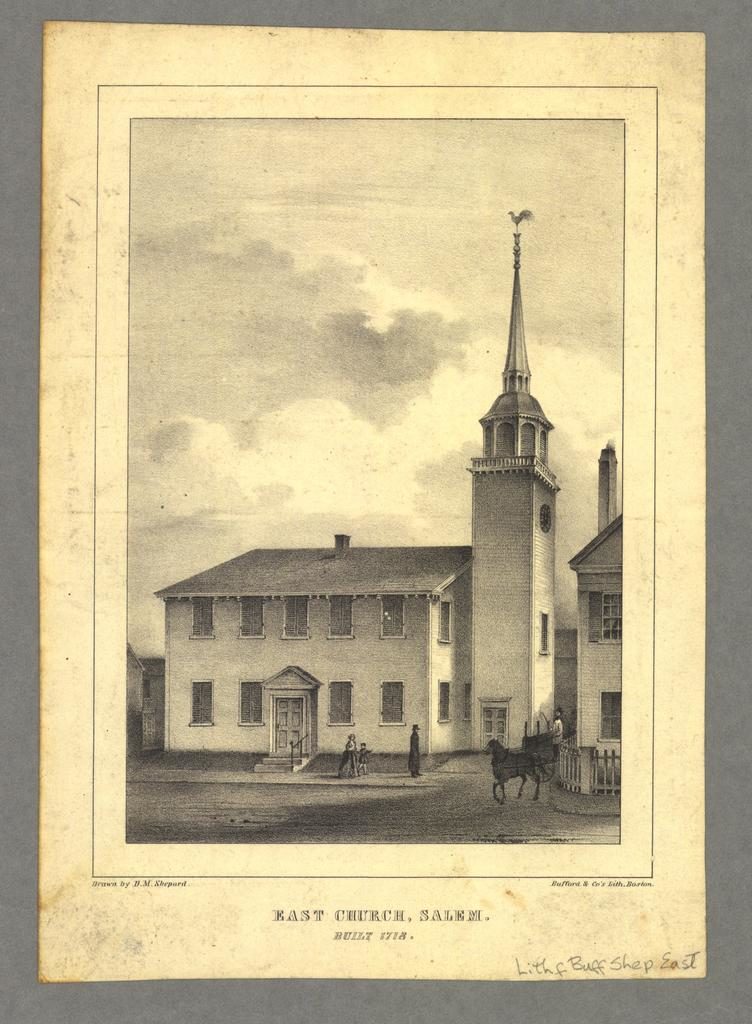
East Church, Salem. Built 1718. Drawn by D.M. Shepard. [ca. 1850]. From the collections of the American Antiquarian Society.

Few documents cast more light on early New England life than seventeenth- and eighteenth-century church records. Local churches stood at the center of community life in New England, and so almost everything that came to pass in the region’s villages eventually passed through the church doors. And ministers took note.

Vast amounts of information on a wide range of social, cultural, political, and religious topics can only be found in the broad range of documents that fall under the category of church records: ministerial diaries, letters, sermons, lay statements of faith and, especially, the leather bound ledgers in which ministers recorded not only birth, death, and membership lists, but the minutes of often rowdy church meetings and disciplinary hearings.


For the past fifteen years, New England’s Hidden Histories (NEHH), a project of the Congregational Library & Archives in Boston, has sought to locate, digitize, transcribe, and publish online New England’s earliest manuscript church records. The project, which was featured on the front page of the New York Times, has already made available documents from nearly one hundred local churches.

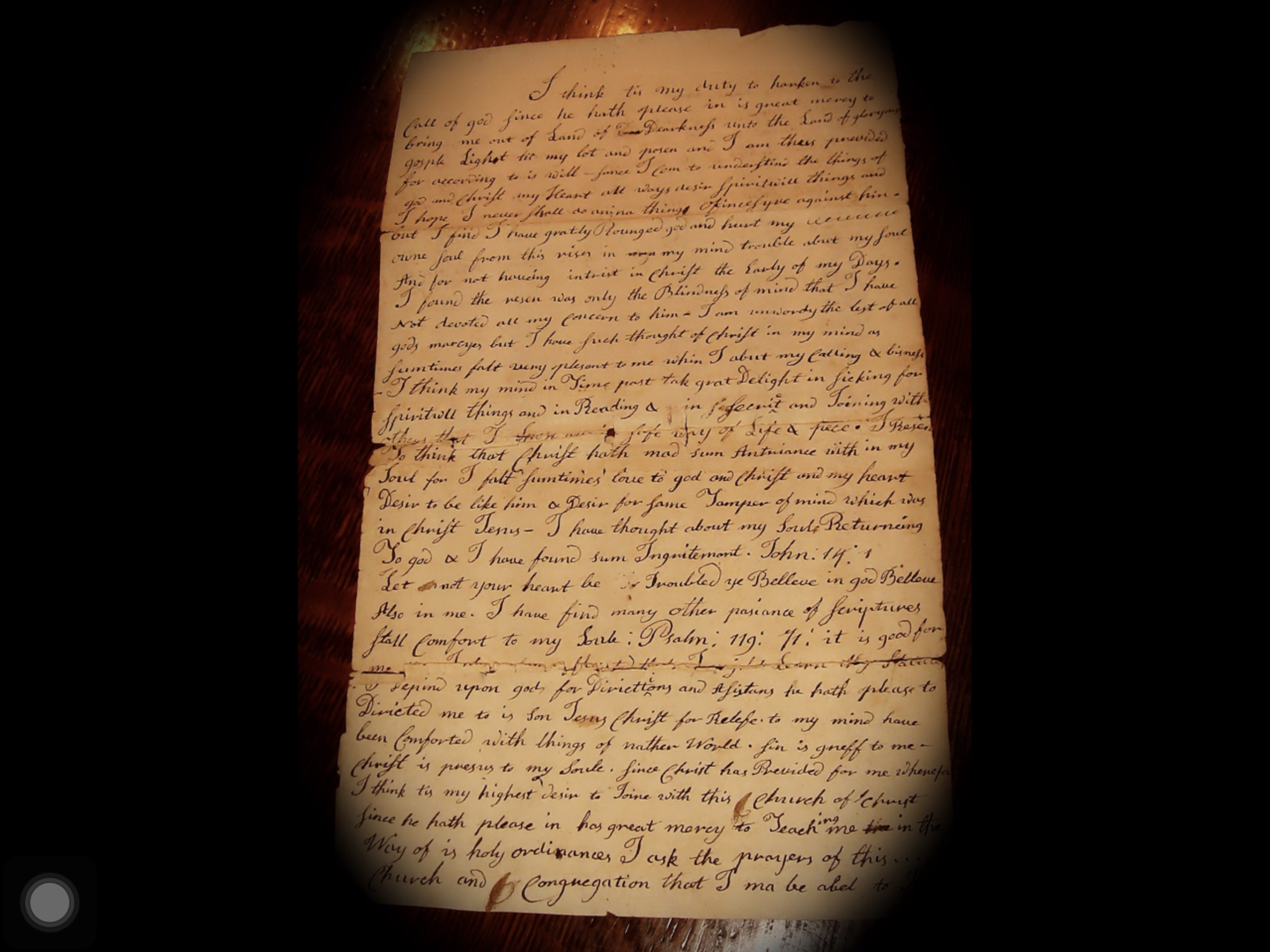
NEHH discovered the only “relation of faith” known to be written in the hand of a slave. Written by a slave named “Cuffee” in 1781, this spiritual testimony, along with hundreds of other similar documents, was found in the pastor’s coat closet in Middleboro, MA.

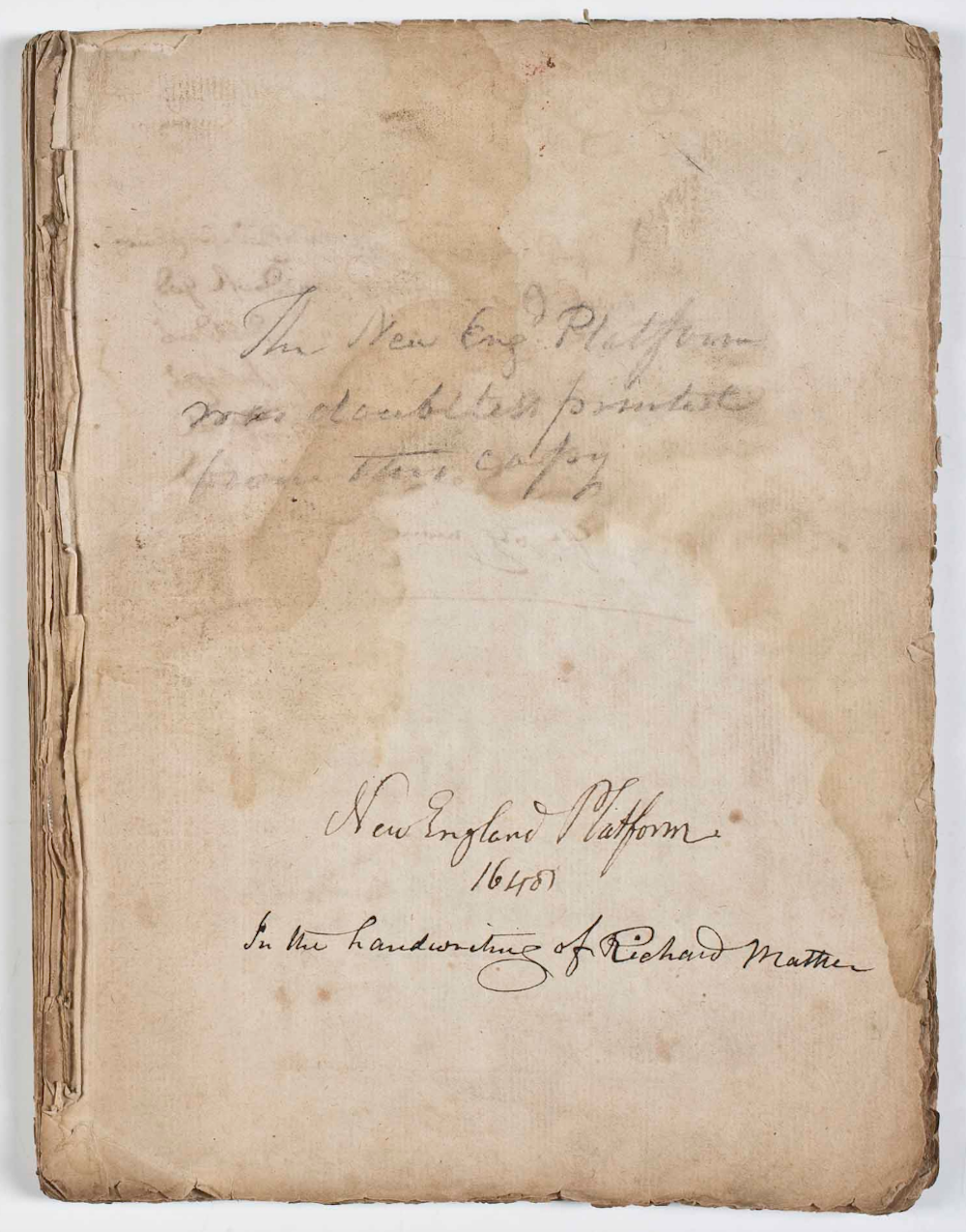
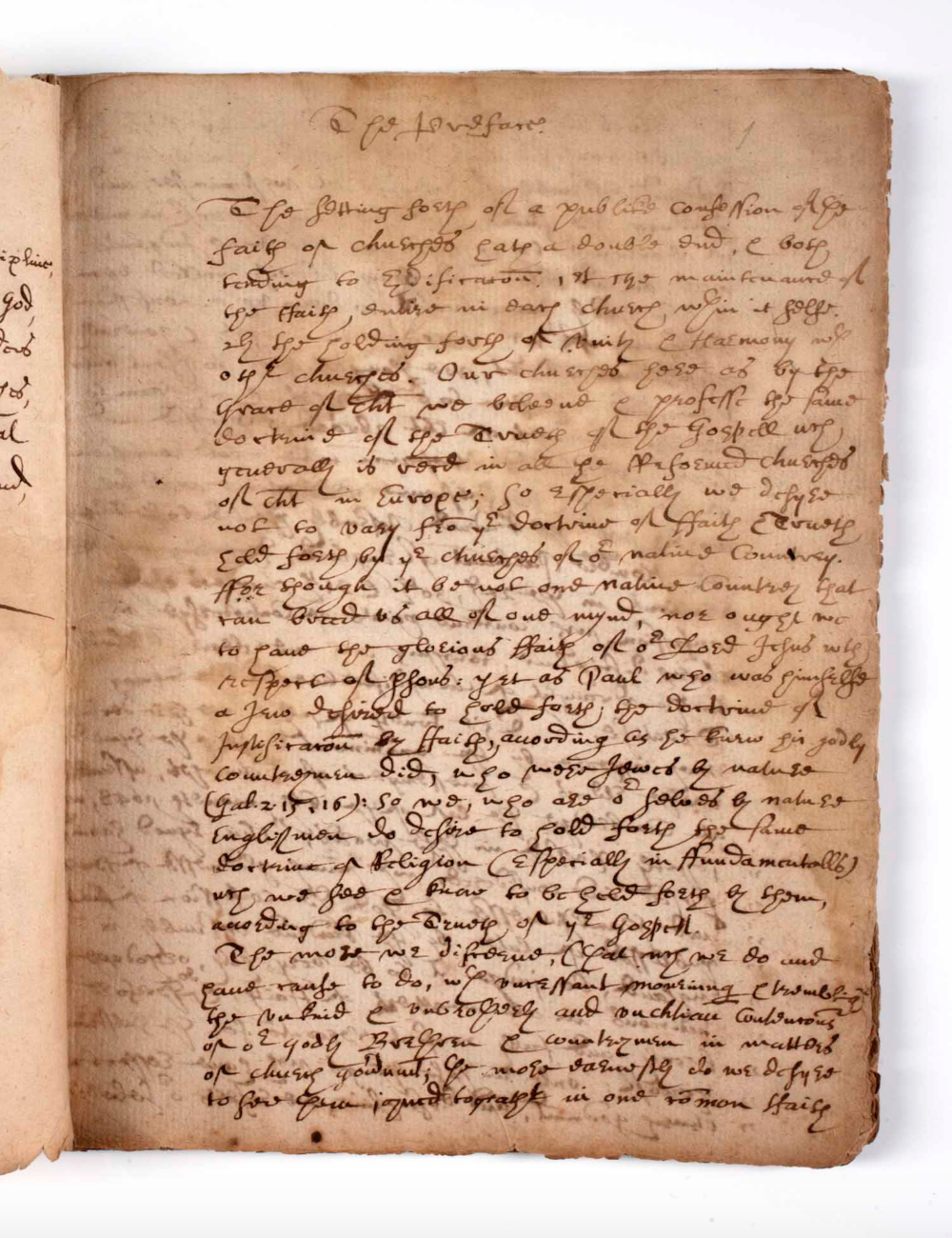
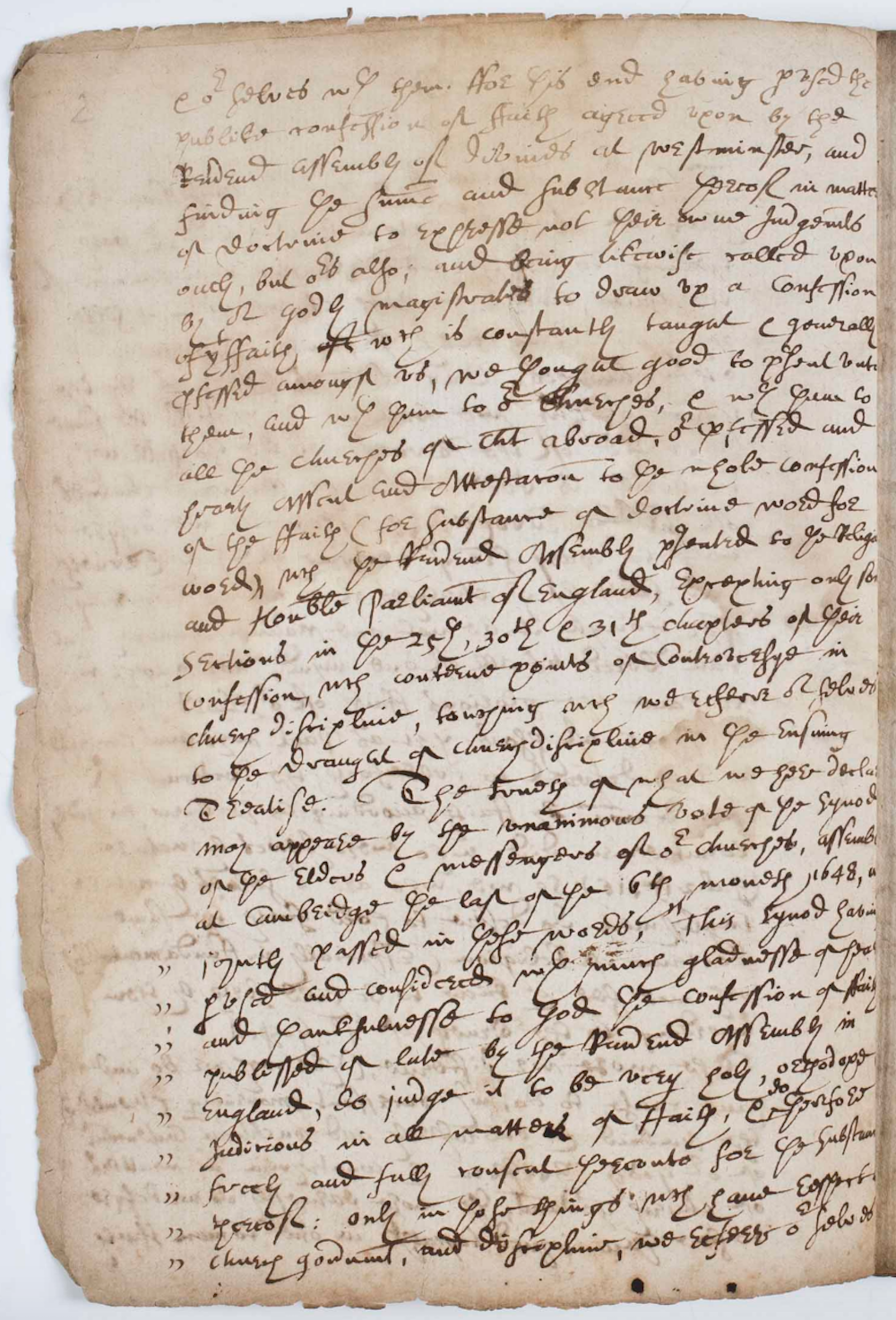
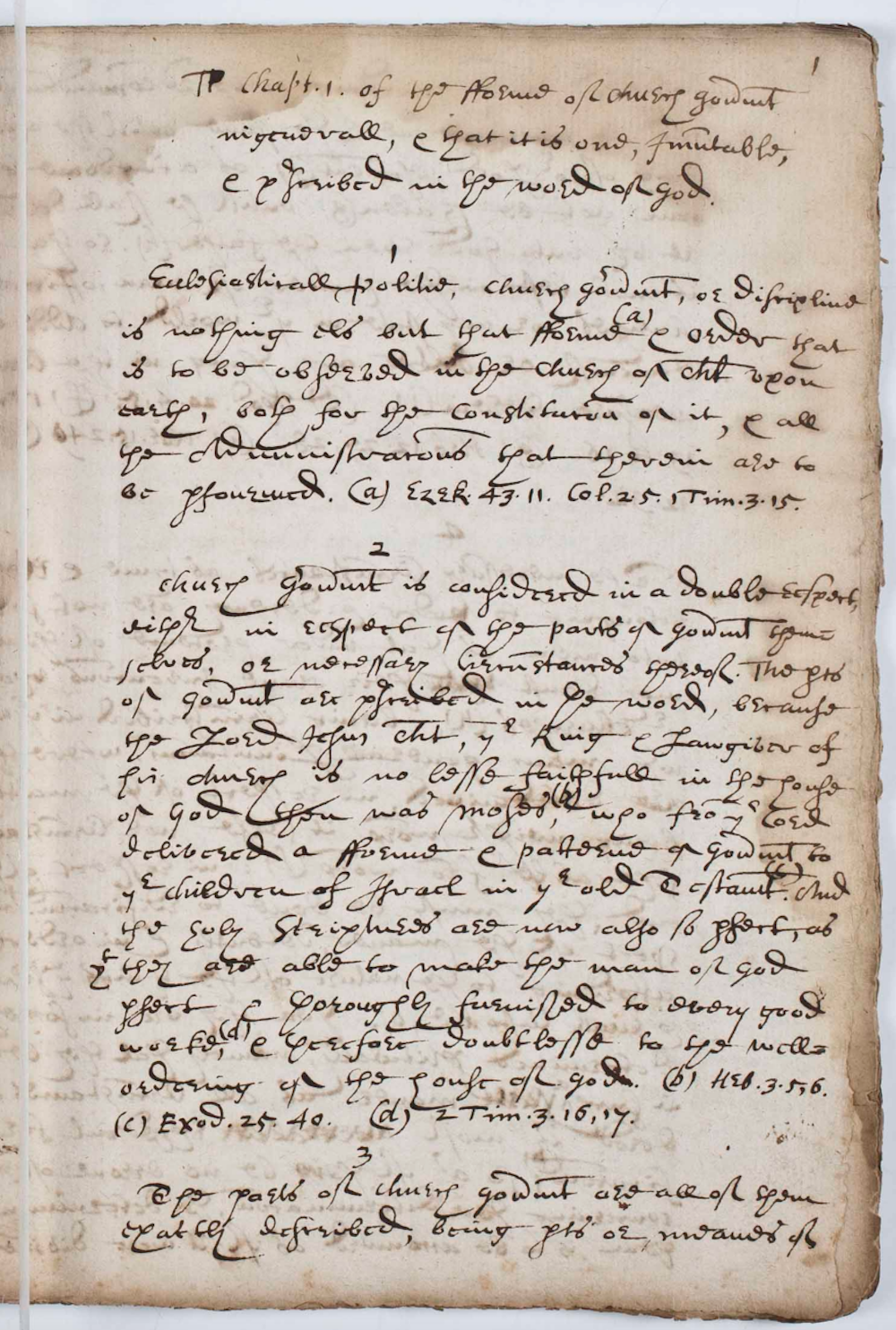
With support from the National Endowment for the Humanities (NEH), the American Antiquarian Society has partnered with Hidden Histories to digitize some of the most exciting and illuminating documents in the AAS’s vast manuscript collections. The current pandemic, which has forced virtually all research institutions in New England to close, underscores the importance of digital initiatives, and the online accessibility provided by these kinds of projects. Already the two institutions have collaboratively digitized and published online an early manuscript draft of Congregationalism’s foundational document, the 1649 Cambridge Platform, along with the church elders’ responses to lay objections to the document. Early New Englanders referred to the Platform as their “constitution” of church government.

Sample pages from “A Platform of Church Discipline” (1648).

The two institutions have also published a fascinating volume of manuscript notes of sermons preached in Cambridge during the Salem witchcraft controversy. Several ministers delivered sermons before audiences that likely included other clergymen, and certainly included future ministers. What did ministers have to say? What did they attempt to convey to their anxious listeners? 

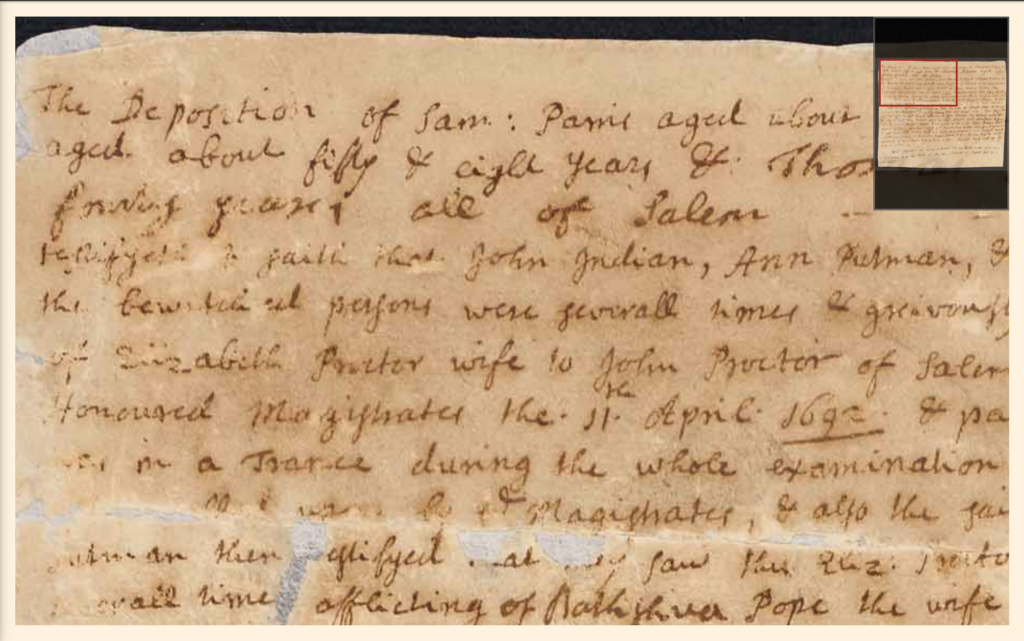
A Close-up of “The Deposition of Sam”, the testimony of Samuel Parrish against Elizabeth Proctor, accused of witchcraft (1692). Click here to read the full testimony and Elizabeth’s fate.

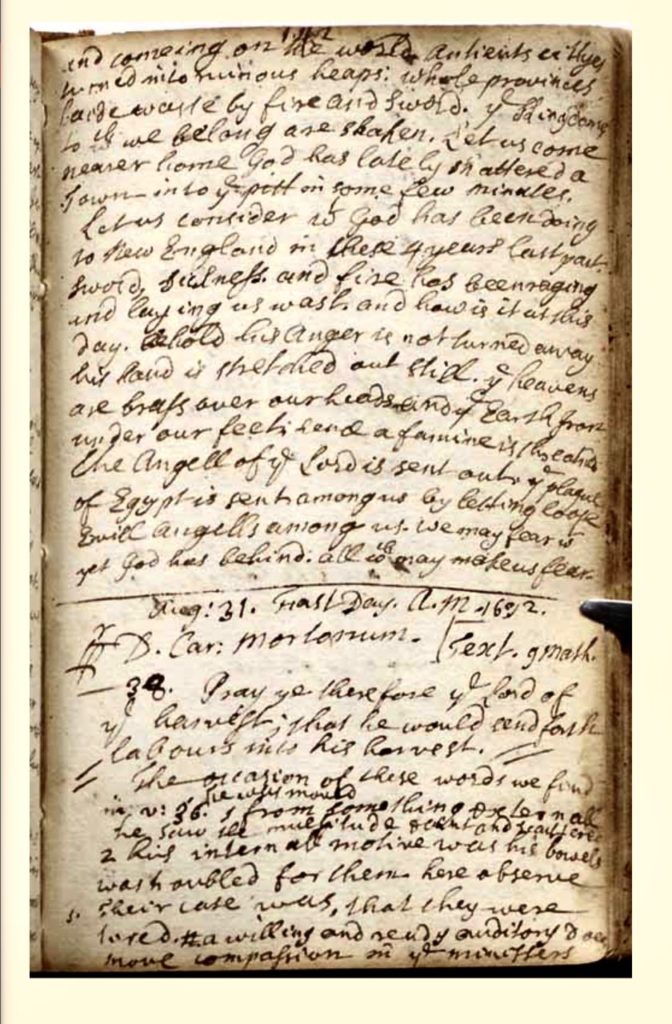
The answer, predictably, is complicated. Some chose not to mention the hysteria at all. Some spoke of it elliptically. But some were more blunt. Speaking just two days after five people were hanged, Increase Mather, who would serve as President of Harvard, and was arguably the most famous minister in New England, warned his Cambridge listeners that

“The plague of Egypt is sent among us by letting loose Evil Angells among us.
We may fear what yet God has behind. All which may make us fear.”

The AAS holds a notebook of sermons preached through the teeth of the infamous Salem witchcraft hysteria. “The Angell of the Lord is sent out,” Increase Mather warned, days after the first executions. The “plague of Egypt is sent among us by letting loose evill Angells among us.” This sermon notebook has been digitized, and will soon be transcribed by New England’s Hidden Histories.

A few weeks later, the eminent pastor Samuel Willard of Boston’s Old South Church pressed for religious reformation, reminding the congregation that “God has been opening the floodgates of his wrath” and has been “Pouring down his fury on us.”

“God has let loose Hell upon us,” Mather agreed, even after the calamity had begun to subside. “Evill’s angels have made Terrible havock among us.” Though the ministers did not speak with one voice, all agreed that New England faced a calamity of unprecedented proportions.

“We are at present under dark providences,” Willard lamented. “It is the most dark and cloudy day that ever was in the wilderness.”

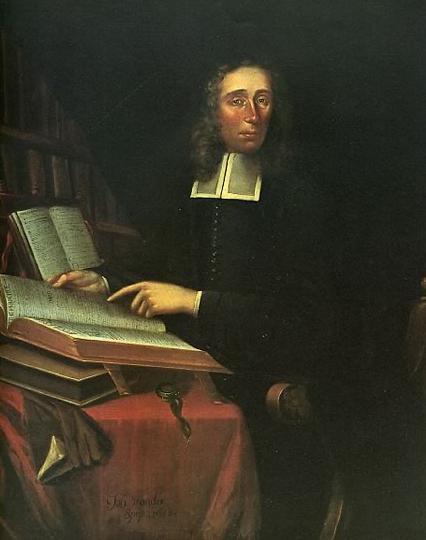
Portrait of Increase Mather, 1688. Public Domain.

Other significant documents slated for digitization include the papers of the Reverend Thomas Shepard, one of the key members of the founding generation, and the one thousand-page diary of Increase Mather. Collections of local church records scheduled for online publication include those of Worcester, Holden, Shrewsbury, and several others. Hidden Histories has transcribed many of the documents in its collections and is always looking for volunteers to assist.

The thousands of pages of historically significant documents to be published online by the AAS and New England’s Hidden Histories will provide scholars and the general public with an unprecedented opportunity to study seventeenth and eighteenth-century church and community life in the region.

New England’s Hidden Histories may be found at http://congregationallibrary.org/nehh/main.

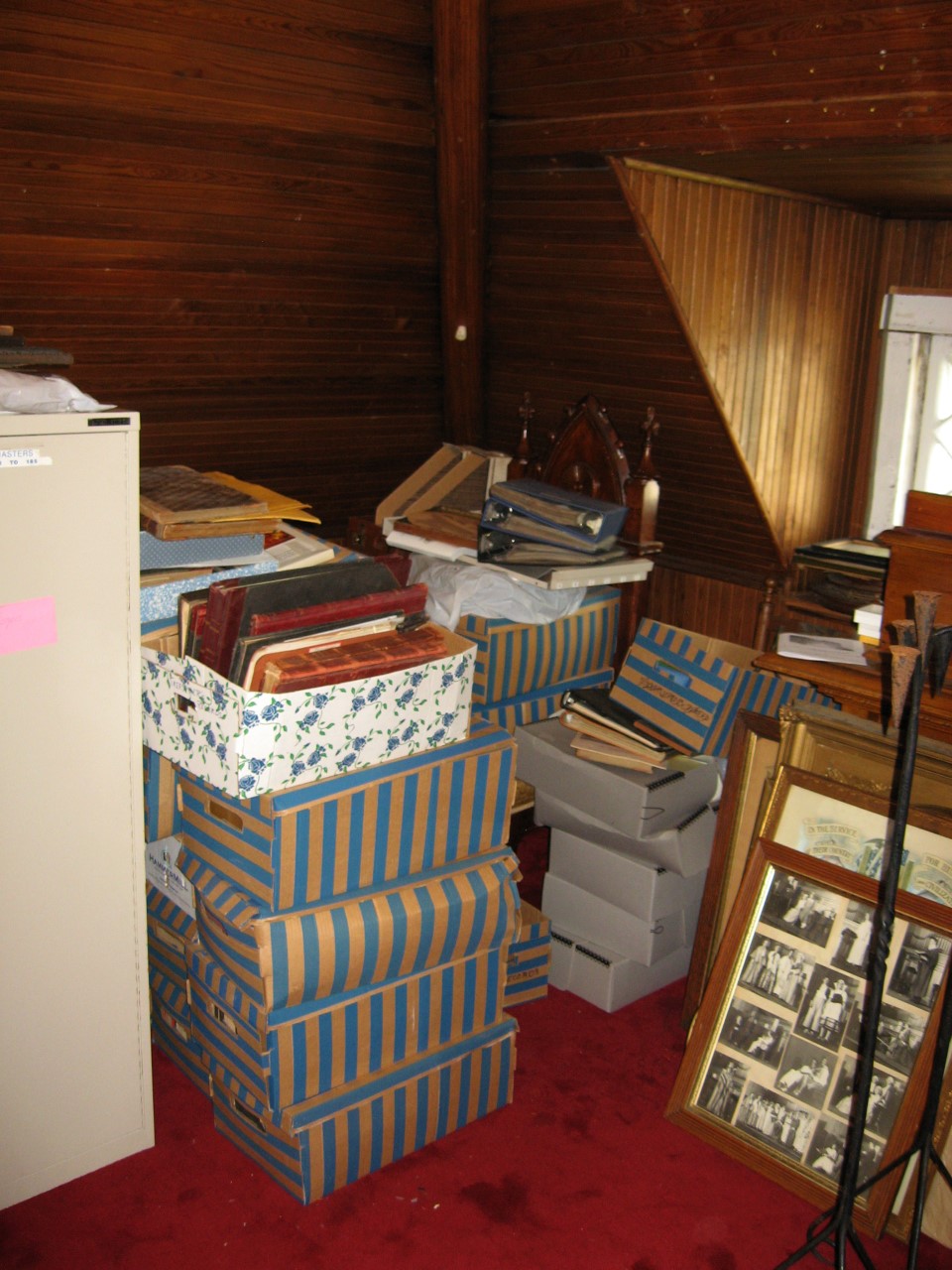
In addition to its work with prestigious institutions like AAS, New England’s Hidden Histories has rescued thousands of documents from basements, closets, and attics within New England’s local churches. Many of these documents are in danger of fire, theft, or simply getting lost.


*                      *                      *

New England’s Hidden Histories (NEHH) and its Director James Cooper wish to thank Ellen Dunlap, Thomas Knoles, Richard D. Brown, Ashley Cataldo, and Austin Alexander for their help in forging this partnership; the AAS has been instrumental in launching NEHH as a national initiative.


Mapping the World: Understanding Women’s Education through Geography

Emily Isakson is pursuing an MA in Decorative Arts, Material Culture, and Design History at Bard Graduate Center. She has been a Readers’ Services page for the past three summers. Emily has always been interested in what has shaped the society we know today. Her time at AAS has only furthered her curiosity about the world.

This past spring, I graduated from Mount Holyoke College in South Hadley, Massachusetts. Mount Holyoke is a historical women’s college, and through the years I have grown to understand and value the importance of women’s education. One of the classes that I took my senior year at MHC was “Mapping & Spatial Imaging,” a course that not only taught me the basics of reading a map but also a class in which I learned how to use GIS (geographic information system) software.

Arathusa Fisk’s map depicting Worcester County (ca. 1825-1835).

Coming back to the AAS for my third summer, I wanted to pick a blog post topic that not only interested me but was somehow related to my most recent mapping experiences. With some guidance from Lauren Hewes, the Curator of Graphic Arts, I soon found my answer in a collection of maps made by young girls.

As a recent women’s college graduate with a personal interest in geography, I want to give a voice to these young female students who painstakingly created maps of different locations in the United States, and, in one case, a map of the world. I instantly became curious about why these student maps were created, what purpose they served and what their legacies were. And even more importantly, who were the girls who made them?

The American Antiquarian Society is home to six maps known to be made by female students and three others made by male students. The six made by school girls map out Worcester County, various states, the U.S. as a whole; one student, Jacobina O. Tuzo even drew a world map with a globular projection — an impressive feat for anyone.

Why were these maps made? My first thought was for a drawing class, as drawing was a popular subject for young girls to learn in school or to take up as a personal hobby. However, geography was another course that slowly became integral to education curricula in the 1800s. Nonetheless, skill in drawing was a popular expertise for women to have, and the drawing of maps was most likely deemed a suitable activity for learning geography because of the emphasis placed on female artistic capabilities.

Townsend’s patent folding globe from 1869 depicts numbers that can be matched to a separate pamphlet for easy learning and easy access.

In the AAS collection, there are many examples of books that address the topic of drawing instruction and geography in education, particularly in our school books collections. The process of making and studying maps was a popular activity and form of education all-around. Whether it was through hand-drawn maps, embroidered maps, outline maps, and even map games in the form of pop-up globes and puzzles, learning geography was an essential way to understand the world. After looking at some of the geography books and resources and by taking a closer look at what kind of things that are recorded and detailed on the maps, I believe that student maps were mainly made for their cartographic qualities (although their artistic ones are quite amazing, as well).

One of the maps, made by Arathusa Fisk (1810-1880), depicts a map of Worcester County (ca. 1825-1835) with each town finely highlighted by a different color. A resident of Holden, Massachusetts, Fisk knew well the in-and-outs of her surroundings. Created with a fine attention to detail, her map includes rivers and ponds and displays an acute knowledge of the area and coordinate systems. As a Worcester native myself, the map feels familiar to me even almost 100 years later, and even certain places like Quinsigamond Pond, which I still see almost everyday!

A full view of Tuzo’s map detailing the world on a globular projection. Her care is evident when looking at the small details and fine artistic skills she showcased.

All of the maps are made with a high level of precision and artistic skill — with my personal favorite being the world map made by Jacobina O. Tuzo. Hers includes not only the creative skills needed to create such an image, but the understanding of map projections, which preserve either size, shape, or distance. There are many types of map projections, with some of the most popular being cylindrical, conic, and azimuthal projections.The particular globular projection used by Miss Tuzo was one that was widely used in atlases because it created a spherical shape reflective of the globe itself.

A detail of the map, mainly showing Tuzo’s handwritten title and the cross hatching required to make such a map.

Tuzo’s map, in its precision, was most likely a copy of another map with her own flourishes added, like the specific and meticulous cross shading on the globe. My favorite part of her map, however, are the small ships that she has nestled in tiny patches of blue water. The ships highlight famous expeditions around the globe, including the voyage of Captain James Weddell, for which the Weddell Sea near the Antarctic Circle is named. Jacobina, upon some further investigation, was later listed by census records as becoming an artist. I like to think that her map, vehemently and proudly claimed by her as “Drawn By Jacobina O. Tuzo,” helped to lay the groundwork for her artistic interests.

A final detail of Tuzo’s world map, showcasing her little expedition ships! These delicate ships dot the span of the globe and help give us viewers an insight into the purpose of her map. This particular ship stamps Capt. Weddell’s trip to the South Pole.

I wouldn’t be able to finish this post without mentioning Emma Willard, a pioneer in women’s education throughout the 19th century. One of the subjects that she felt strongly about including in female education was geography. Perhaps Willard inspired young girls like Arathusa Fisk and Jacobina O. Tuzo to do things that men were doing. In our manuscript collection, there is a geography book which belonged to a girl named Sarah Miller ca. 1820. The illustrations in her geography book were inspired by Emma Willard’s teaching of  geography. The 1800s, especially the mid-1800s, were a time when education opportunities exploded for women. Female educators and activists like Emma Willard pushed for female education to shift and grow. The number of Female institutions of higher education blossomed during this time (like my dear Mount Holyoke College in 1837!). The study of geography and map-mapping is only one indicator of this.

Women’s education has been changing, and growing, for thousands of years — these girls and I are evidence of that. I am lucky to be able to not only have the opportunity to take geography courses like them, but I’m even luckier to have learned how to use and manipulate mapping software, stuffed with data and information. Through their maps, we’re able to see their worlds, what they deemed of importance, and even their dreams. From Worcester, to the U.S., to the world, I have all of it laid out in front of me thanks to those who came before!


The Latest Issue of the Almanac Is Released

The fall edition of the AAS newsletter, the Almanac, is now up on the website and showcases some of the exciting things going on at AAS!

Some items featured include the opening of the Paul Revere exhibition at New-York Historical Society last month; a pictorial look at how we are utilizing our new Learning Lab and conservation spaces; an introduction to our new Director of Book History and Digital Initiatives, Kevin Wisniewski; and our 2019–20 long-term named fellows, Karen Sanchez-Eppler and Rachel Miller.

This issue also contains a photographic look at Antiquarian Hall through the lenses’ of Waldo Lincoln and Nate Fiske (over a century apart); our newest public program, which will engage the public with the staff curators; the lineup of the fall lecture series; a feature on the manuscript collection; staff news; member biographies; and so much more.

Finally, it was announced last month that AAS’s president, Ellen S. Dunlap, will be retiring in 2020; over the course of the next few issues of the Almanac we will be highlighting her invaluable legacy at the Society.

Check out the Almanac in print or digitally here!

A New AAS Illustrated Inventory: The Wohlbrück Collection

The American Antiquarian Society houses more than a thousand photographs and glass-plate negatives produced by photographer Theodore Clemens Wohlbrück (1879–1936) between 1900 and 1910. Since 2010, we have periodically highlighted different aspects of the collection on this blog, including information about Wohlbrück’s views of towns in Worcester County, his photographs of urban architecture, and a donation of negatives in 2014 from a Wohlbrück descendent.

Today, we are pleased to announce that all the negatives from the 2014 donation have been fully digitized and can be accessed via a new online resource compiled by the Society’s visual materials cataloger, Christine Graham-Ward. The resource, which is the twenty-second illustrated inventory to be produced based on AAS collections, is built on the Omeka platform and allows users to search the photographs by a variety of subjects.  

T. C. Wohlbrück moved to Worcester, Massachusetts, from New Jersey in 1900 and started his career as a photographer when he was twenty-two years old. He specialized in landscape and city views that were often turned into postcards. He opened a modest photo studio on Main Street and married a local girl in 1902.

The new resource includes studio photographs made by Wohlbrück of his family and friends, including many portraits of his first wife, Mabel Brown Wohlbrück Penneton (1879–1960), and their three young children, Virginia Wohlbrück Willard (1903–1994), Gretchen Wohlbrück Bath (1904–1995), and Theodore C. Wohlbrück Jr. (1906–1985). Wohlbrück also took photographs documenting the construction of the family’s home in North Worcester and recorded a family trip to Virginia.

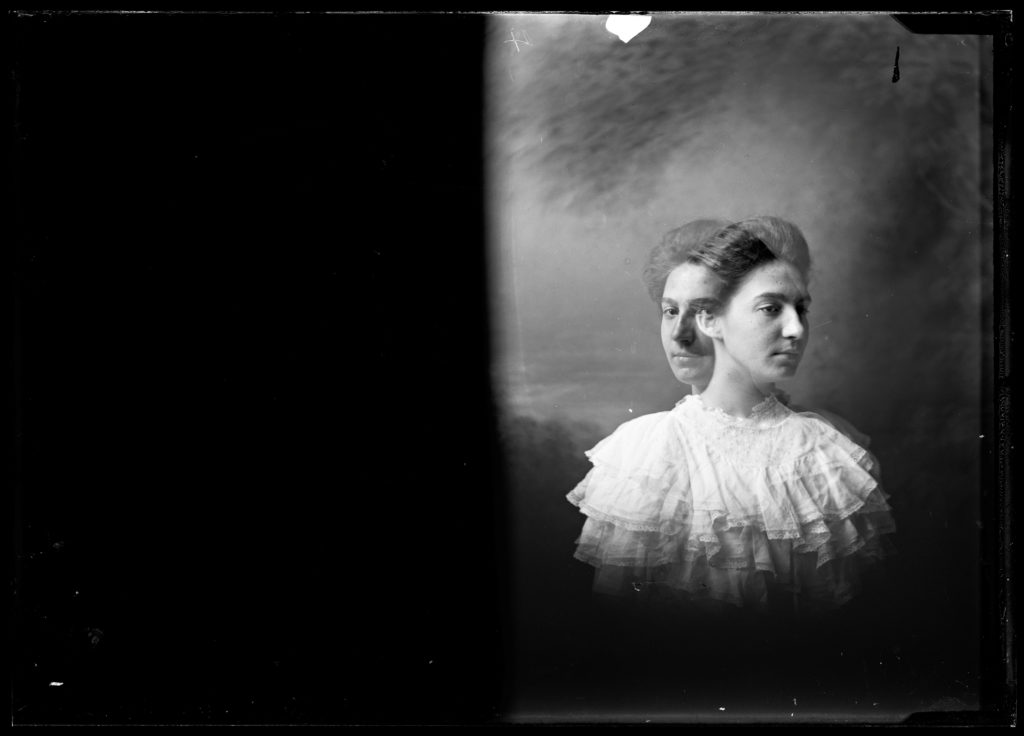
Examined as a group, the digital files of the negatives show the work of a young photographer finding his way technically (some are out of focus, poorly framed, or double exposed) and should be considered a prelude to the later professionally produced glass negatives and photographic prints by T. C. Wohlbrück already preserved at AAS and the artist’s Western work produced after he left Worcester for Nevada and California in 1910 .

“Double Portrait of a Woman,” Wohlbrück Collection, c. 1905-1910.

Chat with a Curator: Halloween 2019

This fall we’re introducing a new kind of public program—one that gets you in conversation with our curators about our collection material!

This Wednesday, October 30, from 5 to 7 p.m., we will host our first “Chat with a Curator” program, during which the public is invited to drop in anytime during that window to view a selection of collection materials about Halloween and talk about them with some of the AAS curators. The items will range from children’s books and postcards to “haunted” diaries and early illustrated editions of classic scary tales, from documents about the Salem Witch Trials to “ghost” stereocards—just the thing to get in a spooky mood!

While there is no charge for this program, a suggested donation of $5 is recommended. Please also note that curators will be available to talk about the collection material on view during the program, but discussions about other research topics and/or donations should be held at a separate time.

See the video below for a sneak peek of the program.  After you’ve watched, you can vote on which collection item you think is the scariest by clicking here! Voting will continue until the beginning of the event.

We hope to see you here at AAS!

Uncovering the Hidden Women of the AAS Catalog: Adeline Shepard Badger

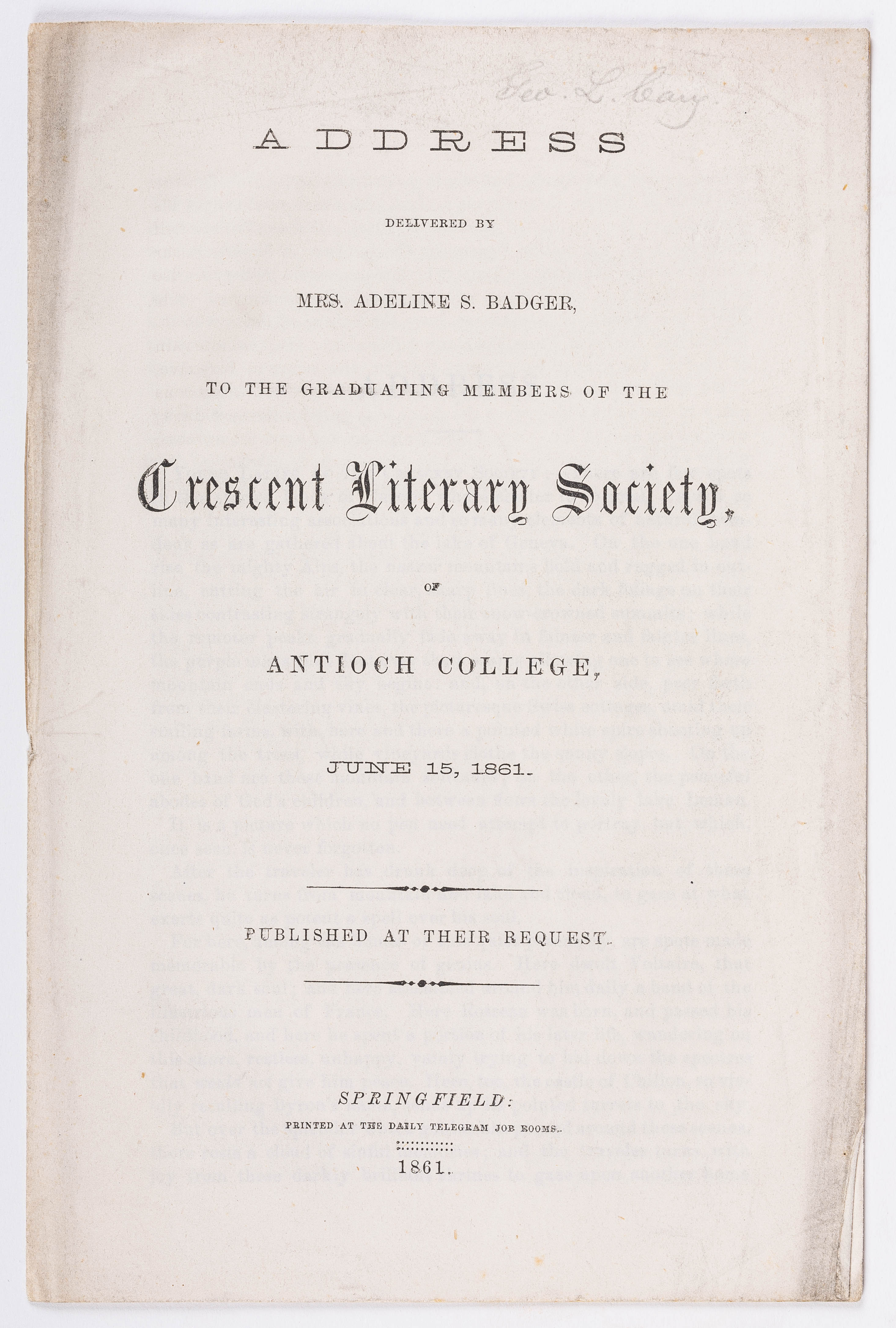
Title page of Badger’s address to the Crescent Literary society of Antioch College, an all-female society.

Over the past few years, the Cataloging Department has been actively working toward adding the subject heading “Women as authors” to all pre-1900 records in the AAS catalog with a woman author. This will enable researchers to easily identify and search for the women authors in our catalog. As cataloging assistant, I’ve been given the task of adding the heading and confirming that the people we’ve identified as women are, in fact, women. (This is not as simple as one might think. In addition to gender neutral names, men occasionally wrote under a female pseudonym and vice versa.) Through this process, I’ve stumbled across a lot of interesting women; many are familiar names whose contributions to history are well known, but there are many whose names are more obscure. I’d like to share the story of one of these lesser-known women here.

Ann Adeline Shepard was born into a transcendentalist family in 1835 in Dorchester, Massachusetts. After graduating from Antioch College in 1857, Adeline, known as Ada, became governess for Nathaniel Hawthorne’s three children. Ada traveled with the family throughout Europe, enhancing her teaching skills and knowledge of foreign languages. (Her sketchbooks and letters from this time are held by the Concord Free Public Library in Concord, Massachusetts.)

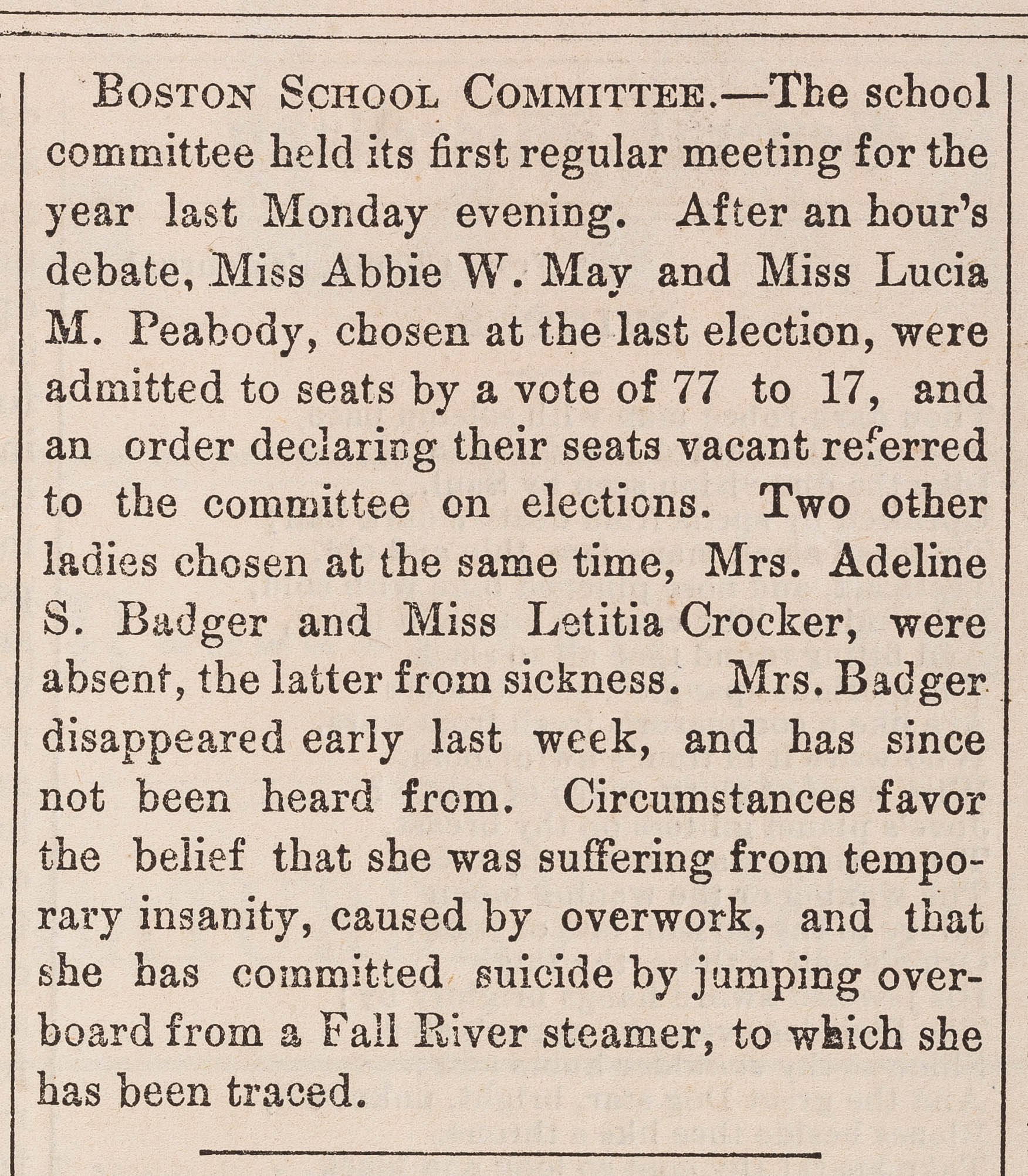
She returned to Antioch College in 1859 where she became Professor of Modern Languages and Literature and married Henry Clay Badger. In June 1861, Ada gave a speech to the graduating students of the Crescent Literary Society, apparently an all-female society at Antioch College. A copy of this address is held by AAS and is the only record of Ada in our catalog. In her speech, Ada encourages the graduating women to strive for greatness but also to “despair not, if your way should lead you among quiet scenes and your life’s mission be such as will bring you no worldly fame” (p. 8). Shortly after, Ada moved to Boston with her husband where she had four children and founded an all-girls school in Cambridge in 1867. In 1873, she became one of the first women on the Boston School Committee. Sadly, in 1874 Ada committed suicide when her youngest child was only 3 years old. It was reported that Ada was suffering from “temporary insanity, caused by overwork.” More than a decade earlier, in her speech at Antioch College, Ada had written “We all know mothers who walk quietly on in their homely round of duties, uncomplaining, self-sacrificing, with a cheering smile for everyone, but with an aching at the heart and a burden on the soul that only the deep, sad eye reveals” (p. 7); a sad foreshadowing of her own future.

Even by today’s standards, Ada lived an intriguing life. She graduated college, traveled with the family of a famous author, became a professor, and was active in her community. That she accomplished all this as a woman in the nineteenth century makes it all the more remarkable.

Type, Sally, Type! Inventorying AAS Bookplates

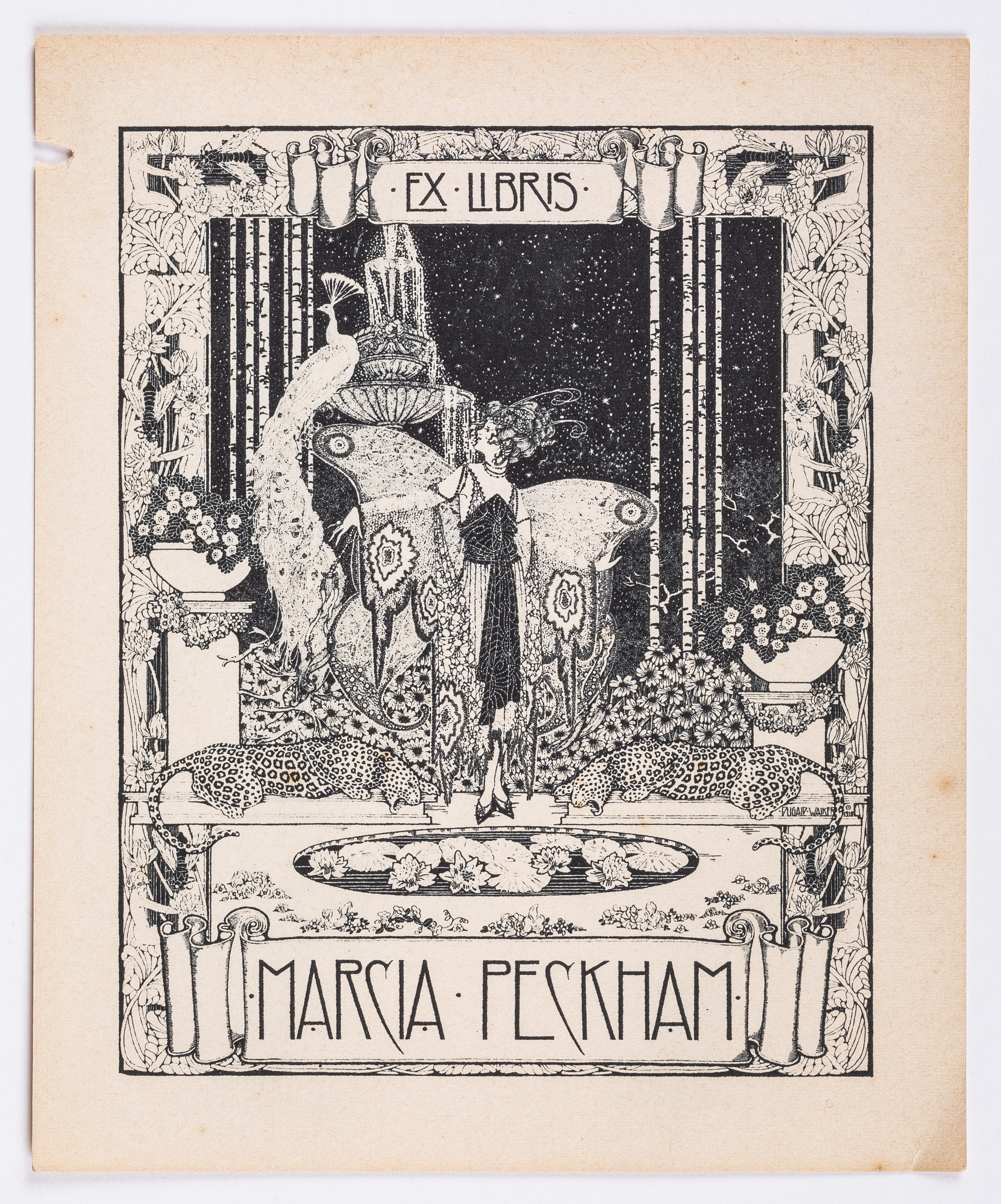
Dugald Stewart Walker, Bookplate for Marcia Peckham, ca. 1919.

In 2014, AAS receptionist Sally Talbot was looking for a project she could work on during slow periods on the front desk in the foyer of Antiquarian Hall. Creating a name list of the Society’s collection of loose American bookplates (not those tipped into books) was suggested by Curator of Books Elizabeth Pope. As the loose bookplates are housed in the Graphic Arts Department, I was brought in to discuss the possibility. The Society’s bookplate collection is one of the largest in the world and covers 300 years from the 1640s to the 1940s. Check out previous blog posts on our earliest bookplates and some fun Halloween-themed examples or read an overview of the collection in our newsletter, the Almanac, from Spring 2017 to learn more.  

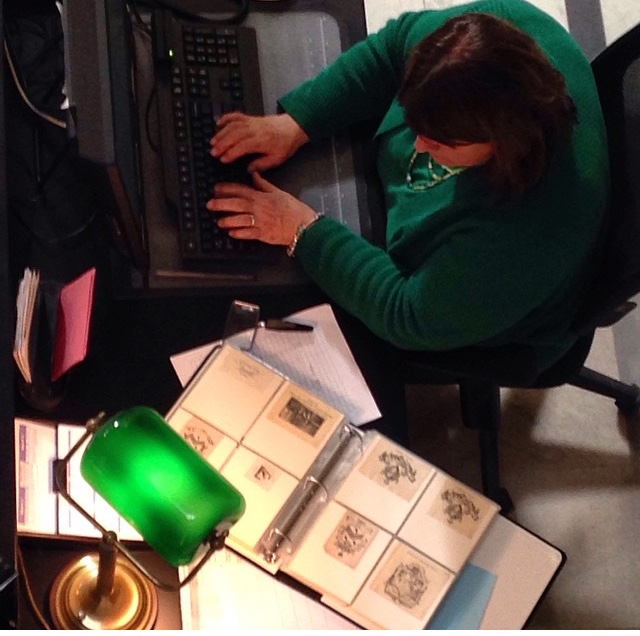
Sally Talbot at work on the inventory, 2015

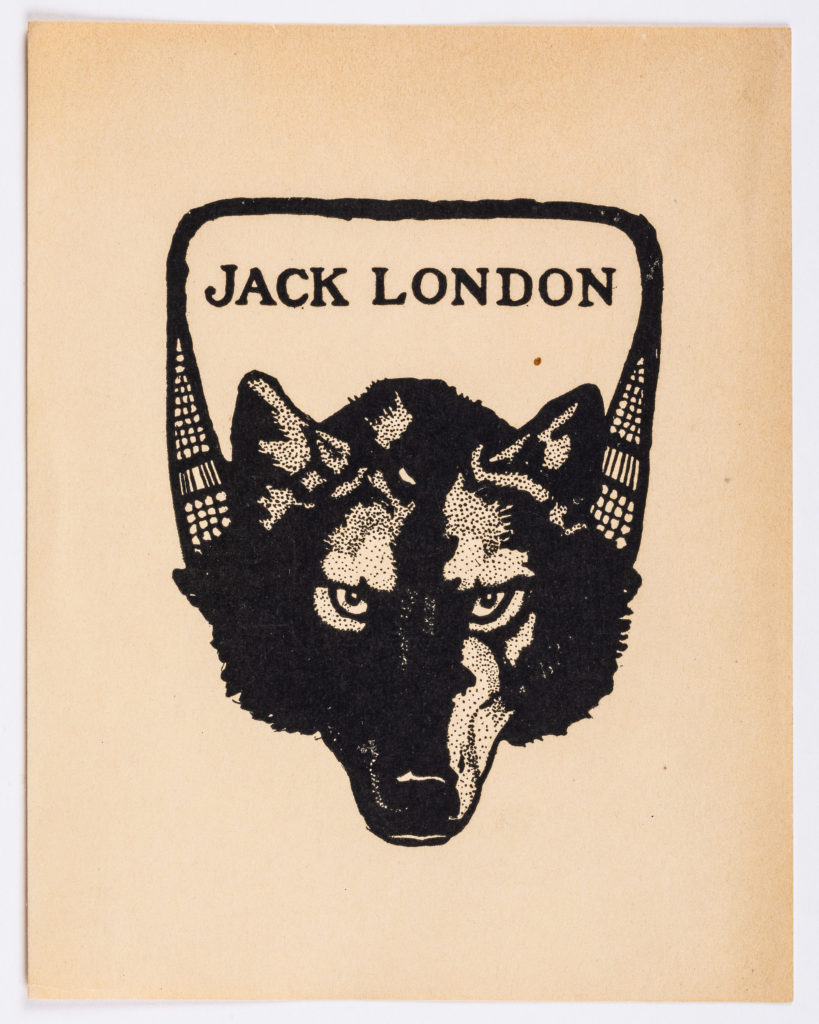
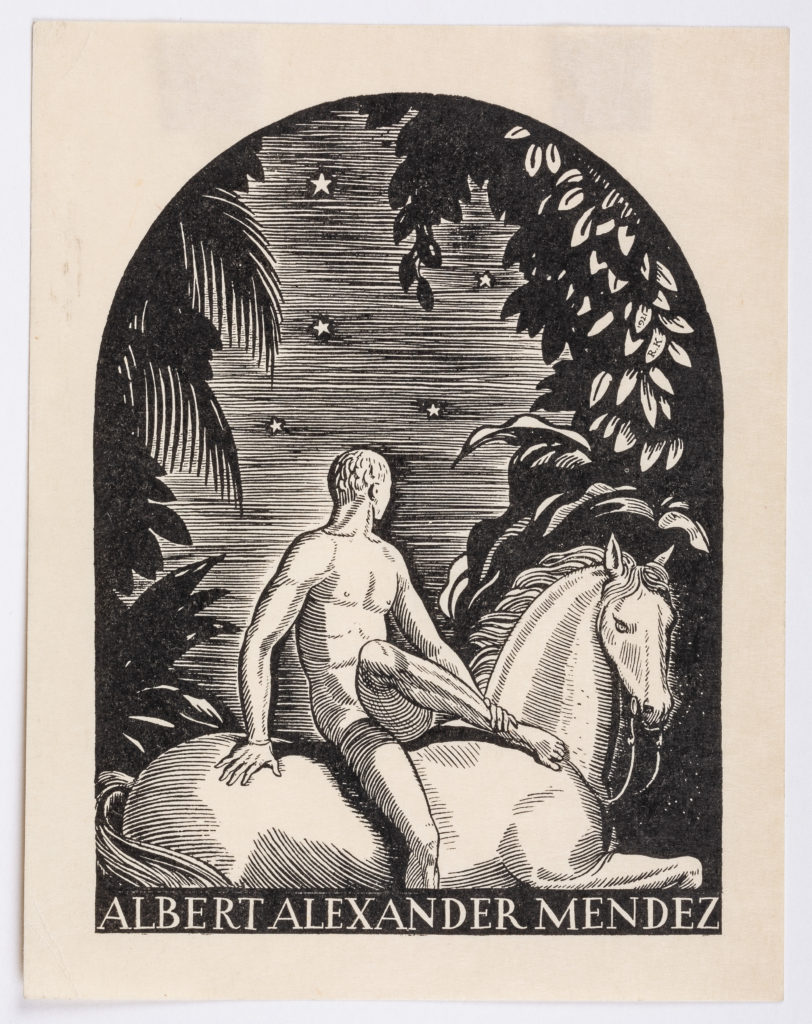
When I gave Sally a brief introduction to the 118 binders that hold the 40,000+ piece collection, she did not seem at all deterred by the scale of the undertaking. Our head of readers’ services, Kim Toney, helped Sally set up an Excel spreadsheet, and brought the first binder to the desk. The collection is arranged alphabetically by surname, and over the years that Sally worked on the project, I got into the habit of stopping by the desk to see what letter of the alphabet she was up to or to answer questions or help decipher a name. An open black binder of American ex libris became a feature on the desk during her shifts. When I posted an image of Sally working on the bookplate project on the Society’s Instagram account in the spring of 2015, some former readers commented about how amazing it was that Sally was still at it — chipping away at those binders full of tiny beautiful rectangles and squares. I recently asked Sally about her favorite plates and she recalled seeing Jack London’s ex libris and texting a picture of it to her husband who is a London fan. She also admired some of the Art Deco-influenced plates from the early twentieth century. Over the four years it took to complete the project, Sally sorted out lots of misfiling, cross-checked names to be sure she was spelling them correctly, and finally, in December of 2018, entered the 21,048th name, completing an inventory of the first sixty-eight binders, which contain the individual owner’s bookplates — fifty binders of corporate plates await Sally’s attention whenever she is ready!  

Ernest J Cross, Bookplate for Jack London, ca. 1910
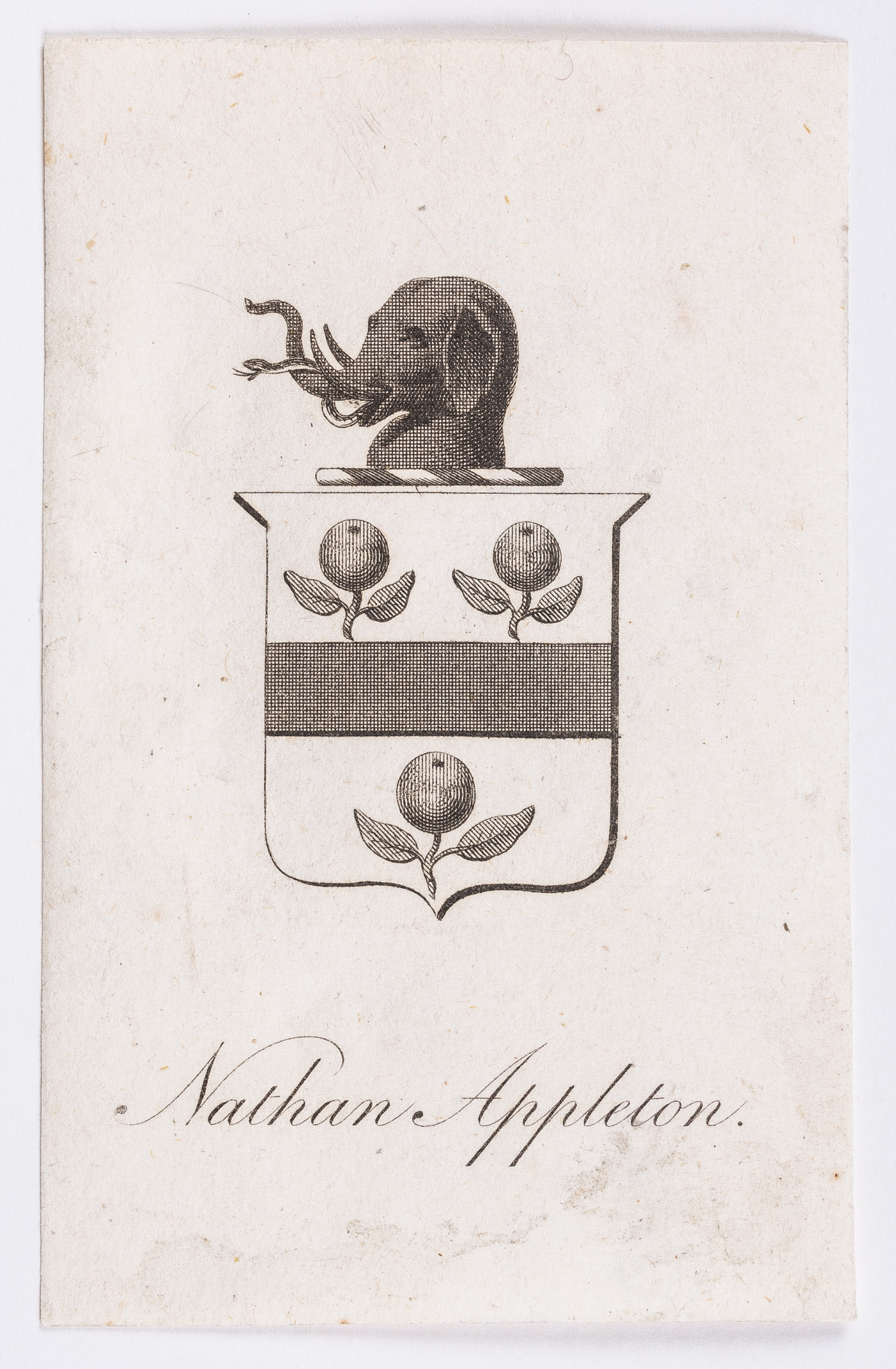
Artist unknown, Bookplate for Nathan Appleton, 1835-1845.

The inventory is now available online via the AAS website or through our General Catalog. Sally’s dedication and tireless efforts to successfully create access to a collection that was previously only available by physically visiting AAS in Worcester can be summed up with the old adage “When eating an elephant, take one bite at a time.” AAS staff, including curators, librarians, and catalogers, have tackled a lot of enormous projects over the years, all in a quest to help researchers find and use historic material. This includes our North American Imprints Project (NAIP) catalog; a newspaper index resource called Clarence; and A New Nation Votes, which tabulates early American election returns. Today, I often find myself mentally thanking the AAS employees who came before me. They wrote out title cards for 70,000 pieces of sheet music, typed up biographical information for thousands of early American printers, or tallied individual issues of hundreds of newspapers. Some may perceive this work as monotonous or tedious, but many, like Sally Talbot, know how rewarding and frankly fascinating it can be to “eat an elephant.”   

Rockwell Kent, Bookplate for Albert Alexander Mendez, 1921.

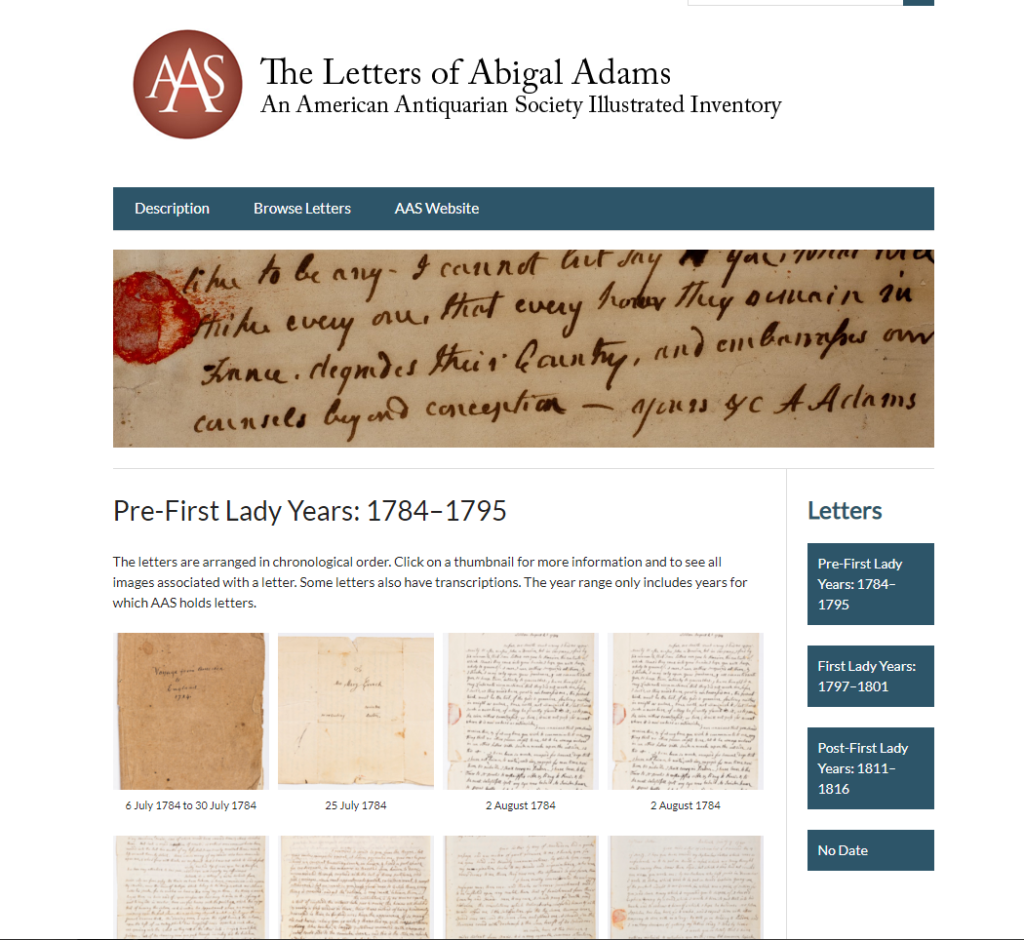
New Illustrated Inventory: “The Letters of Abigail Adams”

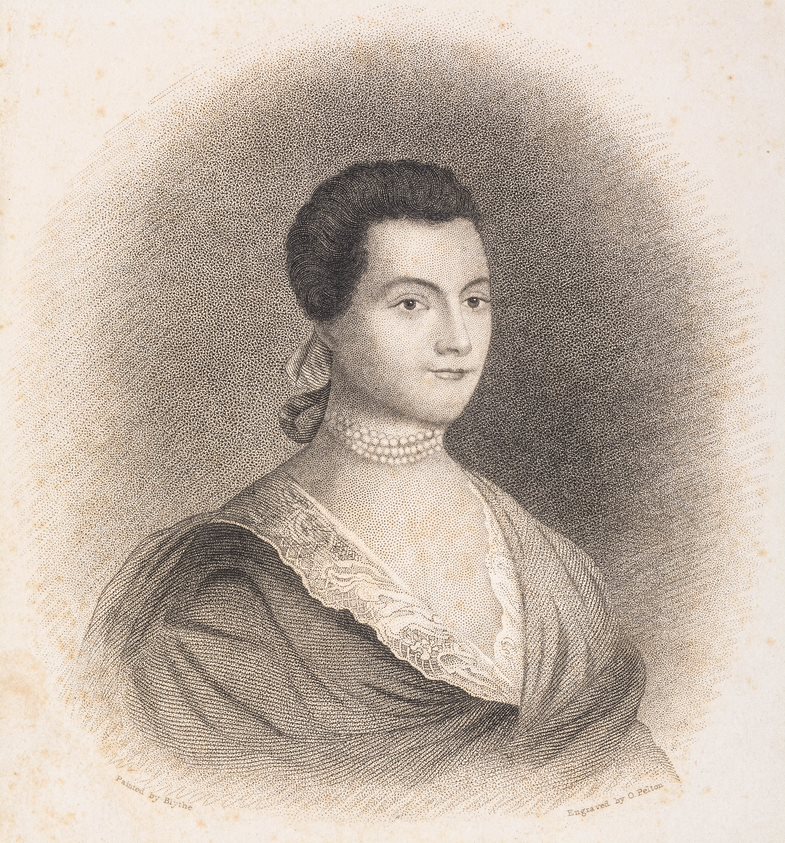
Everyone knows Abigail Adams’s famous request to her husband to “Remember the Ladies” as he participated in discussions to form the new United States government. But what of Abigail’s other correspondence? Was she always so witty and quotable? Did she often discuss politics and the place of women in society? What did she think about the first First Lady, the newest fashions, and living in the newly created federal capital?

All of these questions and more can be answered by browsing through Abigail’s letters, over two hundred of which reside in the Society’s collections and are now digitally available through our newest online inventory, “The Letters of Abigail Adams.” AAS purchased this cache of letters, which had been preserved by a great-grandchild of Abigail’s sister, Mary Smith Cranch (1741-1811), in 1942. They are addressed almost exclusively to Mary and Mary’s daughter, Lucy Cranch Greenleaf (1767-1846). In these very personal letters Abigail describes traveling to London, New York, Philadelphia, and Washington. She writes about her time in England in 1784, when John served as Minister to the Court of St. James, her life in Washington as First Lady, and her time in Quincy after John retired from the presidency in 1801.

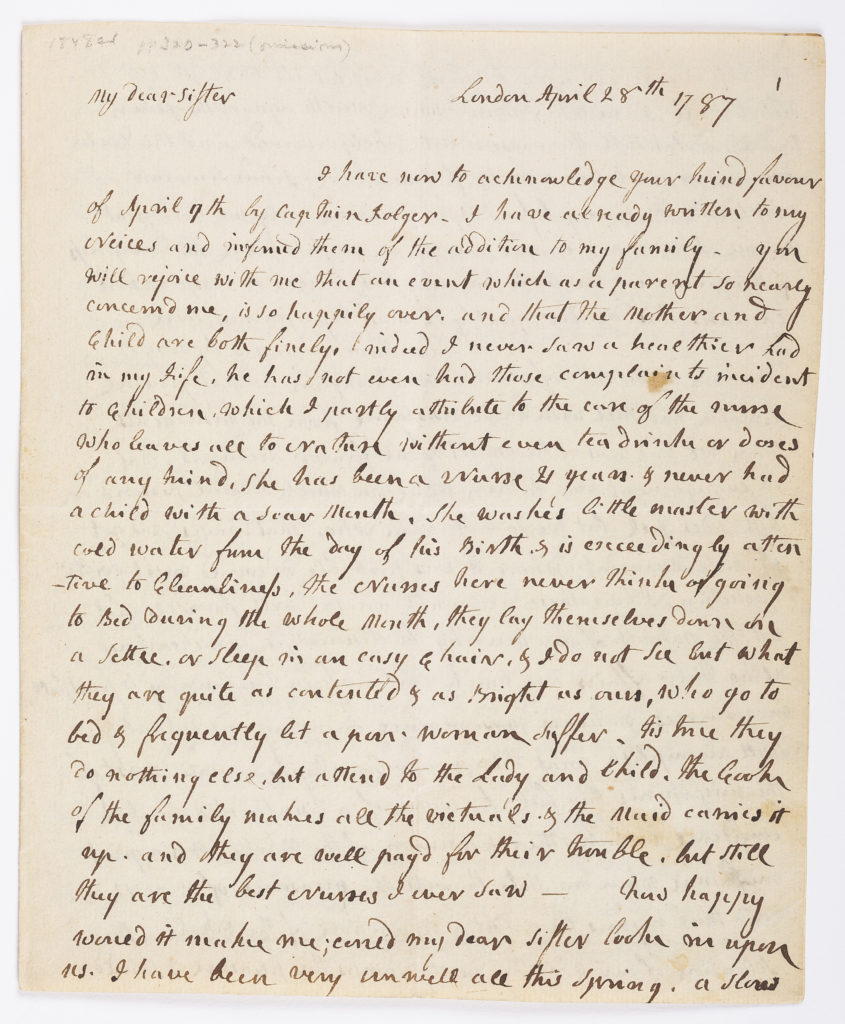
One letter that seems to exemplify the tone, depth, and acute insightfulness of Abigail’s correspondence is one written to her sister Mary from London on April 28, 1787. In the letter, she touches upon the birth of her daughter Nabby’s first child, English versus American nursing styles, her own health, news about Shays’ Rebellion, American loyalist refugees in England, and potential second marriages for her uncles. In perhaps the most entertaining and shrewd part of the letter, she muses upon why one Miss Mayhew, whom she believes would be a “good wife,” is still single. She “cannot help thinking that it argues cowardice in the gentlemen that she still remains single. she has a strength of mind, and an understanding, which will always ensure her respect, provided the heriditary talant which she has at Satire; is properly regulated.” In the end, Abigail concludes that “I have ever observed that it is a most Dangerous thing for a Female to be distinguishd for any quallification beyond the rest of her sex. Whatever may be her Deportment, she is sure to draw upon herself the jealousy of the men and the envy of the women, nor do I see any way to remedy this evil but by increasing the number of accomplished women, a monopoly of any kind is always envidious.”

In this new inventory, you can view digital images of each of the letters at AAS, many of which also have transcriptions and brief abstracts. Letters with transcriptions that also appear in the Massachusetts Historical Society’s Adams Papers Digital Edition include links out their locations in that resource, which includes more of Abigail’s letters and other correspondence from her husband, children, and grandchildren located at other institutions.
To entice you to take a closer look at some of Abigail’s letters, we’ve teamed up with the Massachusetts Historical Society (MHS) to bring you March Madness Abigail Adams-style. Beginning on Friday, March 22, we’ll be pitting thirty-two letters—sixteen from each institution’s collection—against each other in a bracket where users can vote on their favorite letters. For the first round of voting, the letters are grouped into eight categories: Education & Learning; Parenting & Family; Things Abigail Valued; Friends & Frenemies; Politics & Public Life; War; The World According to Abigail; and Women. The various rounds of “Abigail’s All-Stars” will run until March 31, the anniversary of her famous “Remember the Ladies” letter, and the winner will be announced on April 1. Keep an eye on Twitter and Facebook for updates on the competition and comment and follow along with the hashtags #AbigailsAllStars and #RememberAbigail.

In the meantime, take a dive into Abigail’s letters by browsing the new illustrated inventory. You may just be able to capture a little of the magic that happens when looking at the handwriting of an extraordinary woman who has inspired generations of historians, politicians, and women.

What’s the Difference Between a Watch Maker and a Jailer? Adventures in Amateur Newspapers (Part I)

If you’re like me and occasionally find yourself lying in bed endlessly scrolling though BuzzFeed quizzes and pop culture articles, then you are no stranger to the modern-day dad joke. For those of you unfamiliar with the term, I like to define a “dad joke” as a cheesy and often predictable pun told by (but not limited to) a middle-aged man. One of the most classic examples of a dad joke is when a son or daughter tells their father, “I’m hungry,” and he replies, “Hi hungry, I’m Dad. Nice to meet you!” Jokes such as this one have become such a staple amongst young Millennials and Gen Z’ers that it’s almost impossible not to come across one on Twitter, Facebook or any other online social platform. But what exactly do dad jokes posted on the internet have in common with the American Antiquarian Society and, more specifically, old newspapers?

The amateur newspaper collection at AAS.

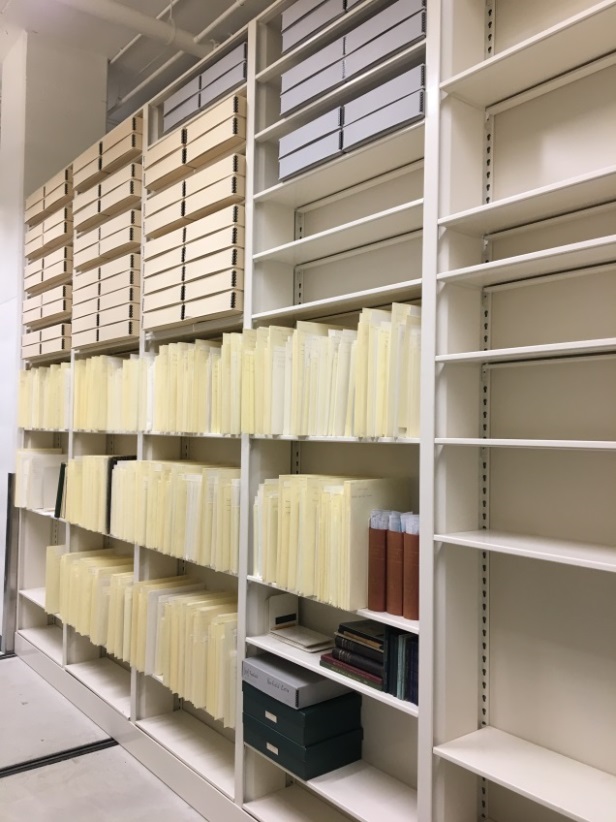
Over the past few months I have started the slow (but extremely entertaining) process of going through every amateur newspaper held at AAS to make sure the entire collection has been scanned and digitized. Most simply put, an amateur newspaper is a periodical that is written, edited, and published by teenagers or young adults. Arguably, most of these papers were created for the love of the craft and not for profit; consequently, many publications were small in size as well as short-lived. Although amateur journalism saw its heyday in America during the latter half of the nineteenth century, one of the earliest papers held at AAS dates from 1805.

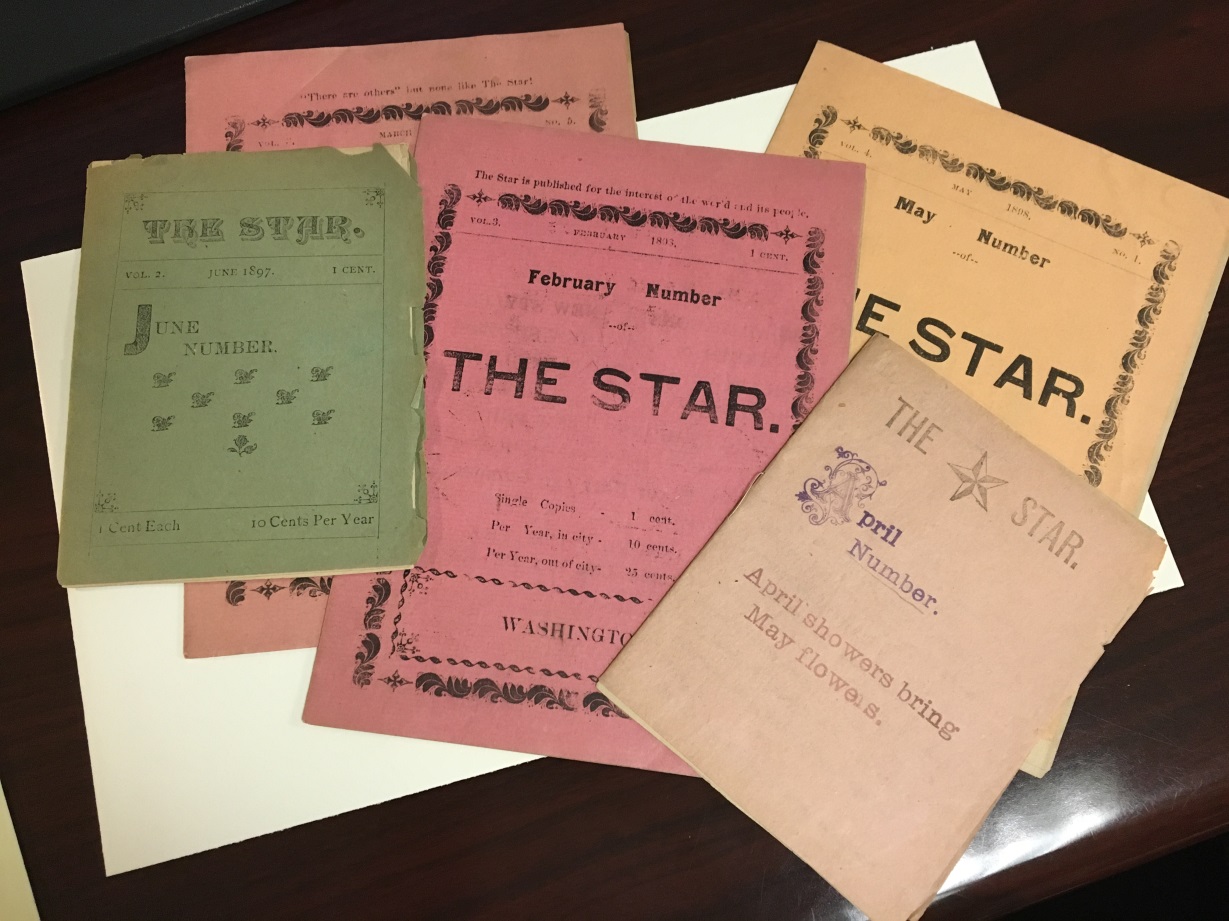
Multiple issues of The Star published in Des Moines, Iowa. Our collection contains issues from 1897 and 1898, many of which have brightly colored wrappers.
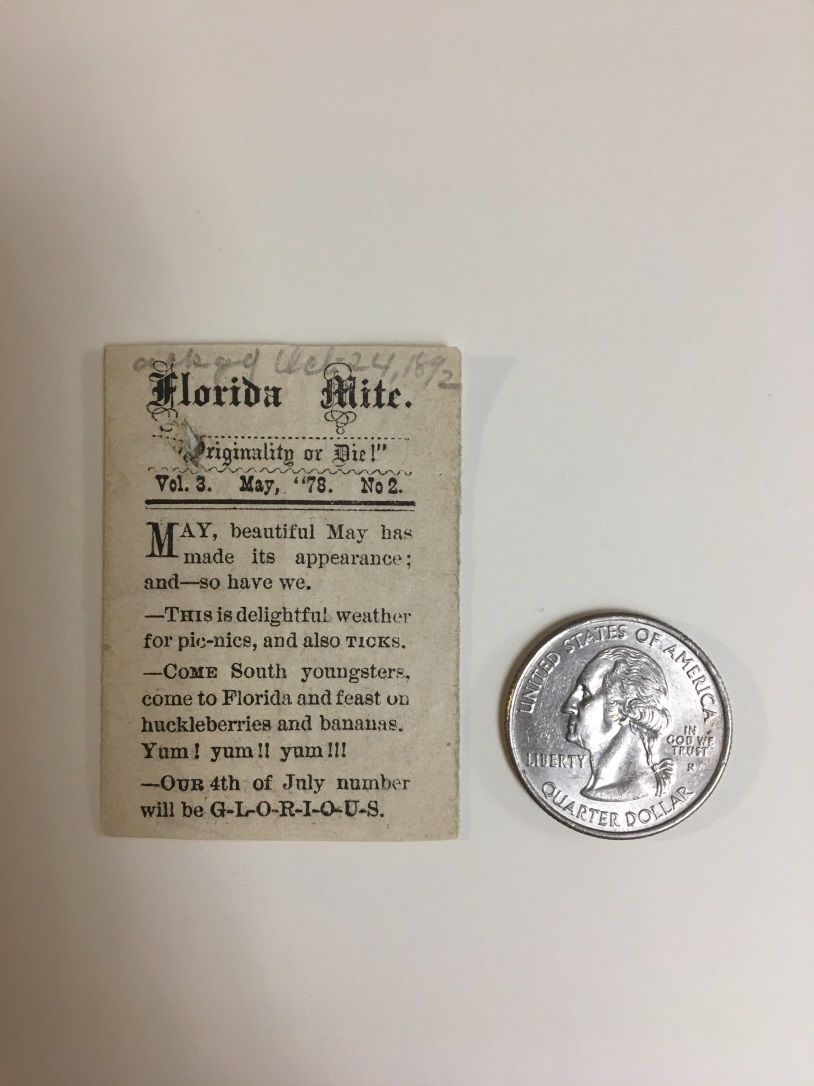
One of the many tiny amateur newspapers I’ve seen so far! Florida Mite (Orlando, FL), May 1878.

In total, our collection has over 3,900 titles from every state except Alaska and Hawaii, so I was a bit overwhelmed when first starting this project (so far I’ve made it through 550 titles and I am currently looking at amateur newspapers from Iowa). However, much to my delight, I’ve found that every paper has something fun and unique to add to the world of amateur journalism—one of these things being the nineteenth-century version of a dad joke! Although dad jokes are sweeping their way through the internet today, they are certainly not a new phenomenon. Even then, people my age and younger were drawn to the groan-worthy jokes of their fathers, and one of best ways to spread that cheer was through their version of the internet—amateur newspapers.

Here are some of my favorite nineteenth-century dad jokes!

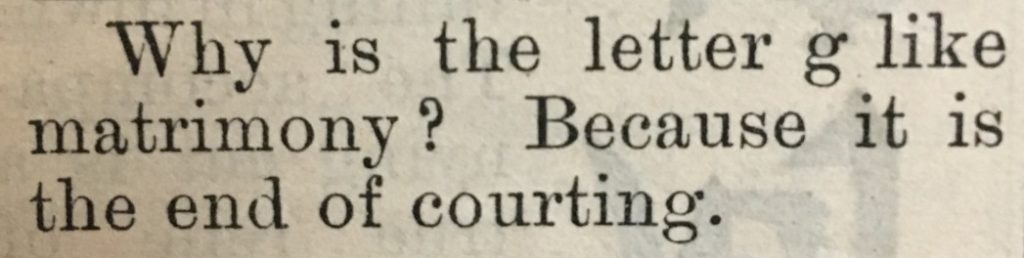
“Why is the Letter g Like Matrimony?” The Peanut (San Francisco, CA), 6 May 1878, p. 1.
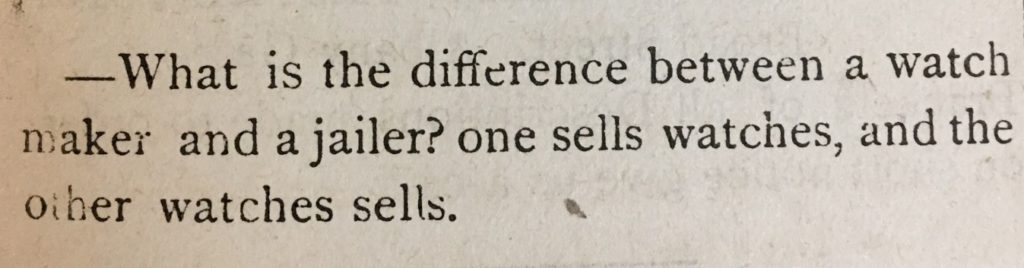
“Miscellaneous.” The Western Star (Rockford, IA), Oct. 1878, p. 2.
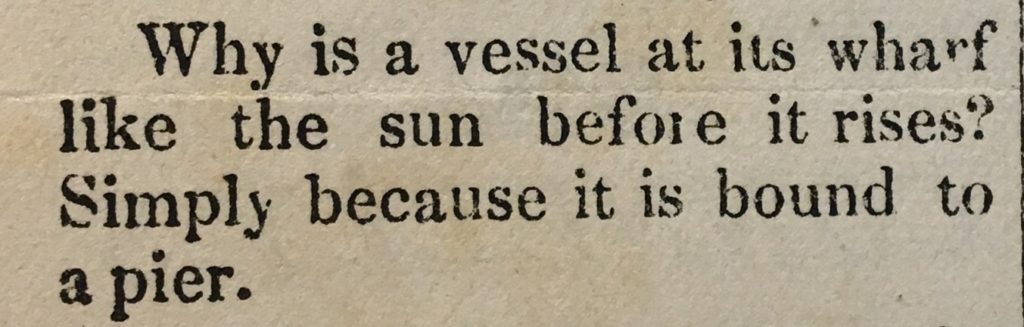
“Scraps.” Monthly Star (Albany, GA), Aug. 1885, p 3.
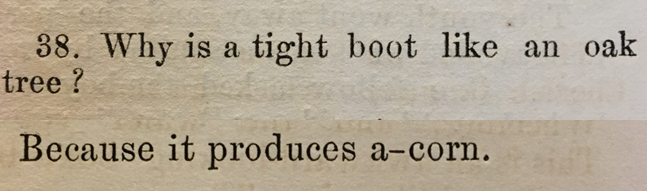
“Original Gems.” Gem of the West (Lansing, IA), Sept. 1878, p. 3.
“Tag Ends.” The Bohemian (Washington, DC), May 1879, p. 4.
“Conundrums.” Hail Columbia (Hartford, CT), July and Aug. 1867, p.2.

I hope that at least some of these puns gave you a light chuckle! I know that they’ve certainly provided me with much needed laughter during these cold winter months. I’ve barely scraped the surface of AAS’s vast collection and I already have several more topics that I’d love to share with you. But in the meantime, let me know if you have any questions about our collection or feel free to leave some of your best “antiquarian” dad jokes down in the reply section!

Coloring McLoughlin—in the annual report and into the new year!

“Young Artist Painting Book,” drawings by W. Bruton (New York: McLoughin Brothers. copyrighted 1882)

In past years of the AAS annual report, we have included in the back pages quotes about the institution over its two centuries, a traveling chess game and paper dolls (with pieces to be cut out!), an Instagram hashtag match-up, and in last year’s iteration, a rebus-palooza. This year’s “back fun pages” (as they have been dubbed in-house) serve as a nod to the countless hours of work put into the 2017 Grolier Club exhibition Radiant with Color & Art: McLoughlin Brothers and the Business of Picture Books, 1858–1920 by curators Lauren Hewes and Laura Wasowicz. In addition to many of the firm’s published works, AAS is also fortunate to have McLoughlin Brothers’ extensive art archive of its published materials, including some coloring, outline, and painting books! And since the McLoughlin Brothers were known as trailblazers for their experimentation with color printing and book formats, we thought we would use one of those painting books (pictured here) for a bit of fun.

Both the physical exhibition and printed catalog are highlighted in the annual report (just published!), but the concluding pages of the report (see below) hope to encourage readers to kick back, pull up a palette, and relax. After all, isn’t one of the many pros of the still-growing adult coloring book phenomenon near-instant stress relief (although for those keeping score, these aren’t relief prints at all, but chromolithographs!)? Although countless books in the McLoughlin archive could have been appropriate, it was the firm’s Young Artist Painting Book by William Bruton which really caught our eye (and begged reproduction as both the catalog’s frontispiece image and for these pages).

In “Try Your Own Brush with History” we’ve included a period color sample palette as well as excerpts from the (comprehensive) directions by the McLoughlin firm. In addition, the lithographed cover plate from 1882 and its black and white version for readers to color on their own were also reproduced. But if you feel compelled to color more than what we supplied in the annual report, we offer here as a PDF file the remainder of the book! This includes Bruton’s gorgeous uncolored images of children: “On the Sea Shore,” “Sailing the Yacht,” “In the Hay Field,” “In the Meadows,” “Off for a Sail,” London Bridge,” “The Skipping Rope,” “Four in Hand Team,” “The Swing,” “Tug of War,” “Picking Blackberries,” and “Gathering Blossoms.”

Color us scholarly, but we just can’t help providing facsimiles! Try your hand at it!