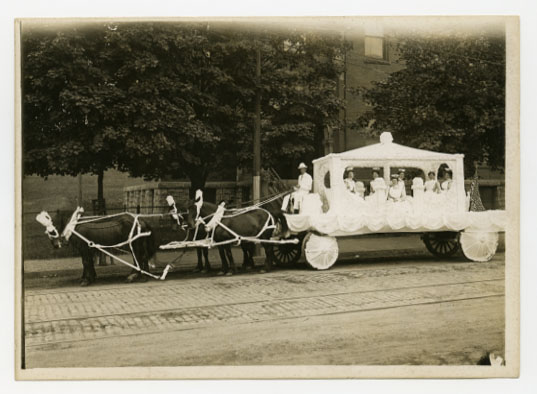
Here at AAS we have lots of small collections that are safely tucked away, accessible only due to the knowledge of the reference staff, catalogers, or curators who bump into them occasionally when searching for other things. As we work our way through our holdings we try to increase access to these “lost” collections by creating finding aids and box lists that can then be loaded onto our website or into our online catalog. Often we process these collections ourselves, but occasionally we use willing interns or volunteers. Float representing St. Vincent's Hospital, Charity Circus, Worcester, July 15, 1909. Now, as we all know, some people are just more successful at organizing than others (most of us will admit this, even if it is just to ourselves!). So, we are most fortunate, then, to currently have a volunteer who is so perfectly matched with a collection that the processing is a joy to watch. And everybody wins as another collection is made available for use!
First, a description of the collection at hand: The Society’s Graphic Arts collection includes a sampling of material by the photographer Theodor Clemens Wohlbrück (1879-1936), including glass plate negatives, postcards, and prints. As a young man, Wohlbrück settled in Worcester, Massachusetts, and set up a studio on Main Street where he operated successfully from the end of the nineteenth century until around 1911. Wohlbrück is best known for his images of the people and streets of Worcester as well as depictions of urban events such as parades and celebrations. Our collection of his work also includes a group of over 1,000 proof prints featuring landscape views of towns around Worcester County. Many were rough mounted and hand-tinted by the photographer. These prints have long been stored in heavy, red boxes and were only very generally sorted by town. Some unmounted images had slipped out of order and users were often frustrated when trying to access the collection. No one knew which towns were included in the collection and which were left out (there are no images of Worcester in this group, for example).
Now, enter the volunteer: Bill Mettey lives in Upton, Massachusetts, and has spent years in the county, hiking and exploring the landscape. He has previous experience as a videographer and is used to looking through camera lenses. He is also an organized sort of person and is willing to dedicate several hours of his time each week to the Society. Previously he has helped us to sort and folder our political cartoons, broadside advertisements, and Civil War era maps. For the Wohlbrück project, he has proved to be a perfect match. Often he is able to identify an image based on his own experience and knowledge of a town. Many of the prints were captioned by Wohlbrück and Bill has learned to decipher the photographer’s scrawling handwriting. While we are still processing the collection and hope to order materials for improved housing, Bill has already sorted and reboxed the prints and created a very useful box list of the collection, organized alphabetically by town. An itemized inventory listing each photograph is currently underway as Bill continues his work. Knox Giant driven by William Bourque in the Dead Horse Hill Climb, Worcester, June 12, 1909.
It is great when we can match a volunteer or intern task to a person’s interest. If you are interested in volunteering at the Society, please refer to our website for more information about volunteering. And, most importantly, thanks, Bill!
All the votes have been counted and the winner is…. Penny!
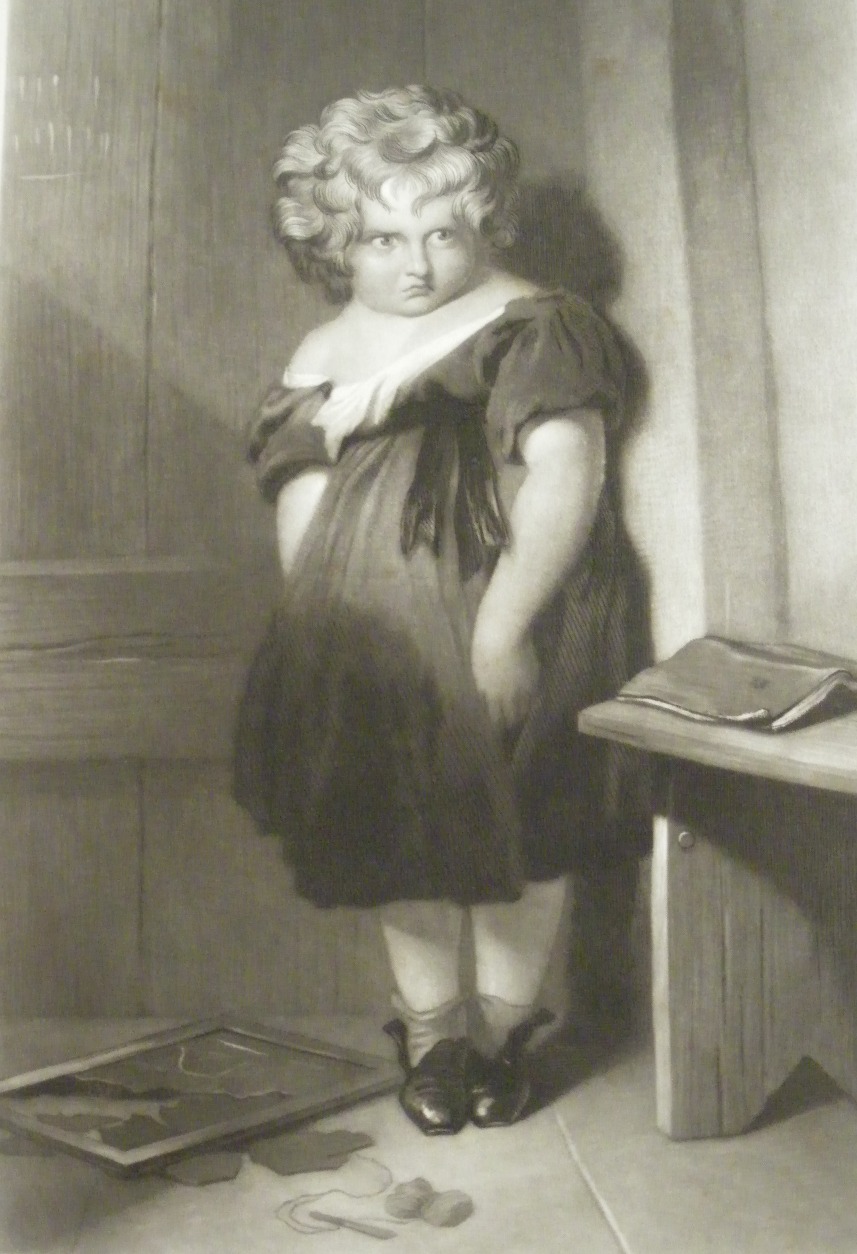
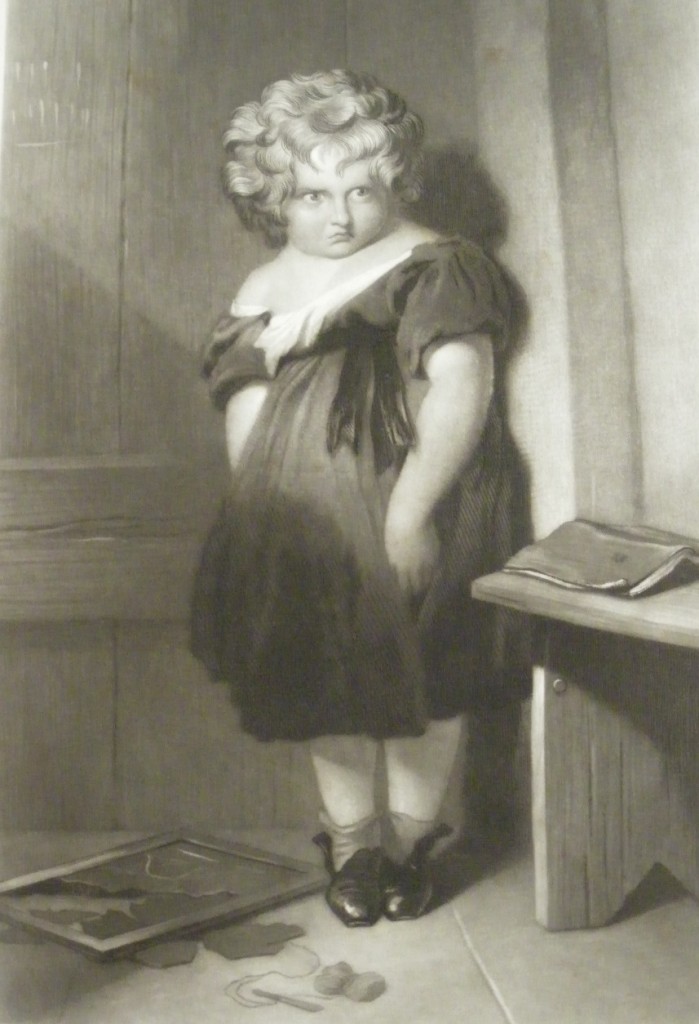
Penny’s caption won our hearts and received the most thumbs up in Past is Present‘s first humorous what-caption-would-you-write contest.
“Yes, I broke my slate, and I’ll break the next one too–I want an iPhone like all the other kids have!”
Her submission had the added bonus of connecting to the original post on Slate, before the hype by AAS’s curator of Graphic Arts, Lauren Hewes. Feel free to give your acceptance speech as a comment on this post, Penny!
Honorable mentions should go to our other nominees, especially Sharlene for “Little Lawrence finds out too late that although slate is rock, it will break when thrown to ground during a temper tantrum” and Ken Richardson (who posted the first comment) for “I don’t want to look like daddy!!” You can check out all the caption comments by clicking here.
On a related note, Past is Present has been giving away enough awards lately that we need to have a name for our prizes. Does anyone have an idea for a good name for our antiquarian-glory-only prizes? We can promise you in return your very own one of our name-to-be-determined awards in the category of neologisms. Here are a few further thoughts to spark your collective creative spirit.
Abbreviations are always a good source of award names. For example, a good friend of AAS created the Rellas, or Research Library Awards, which she awarded to various institutions on her blog, AuntieQuarian. We could go in a similar direction with something like the PiPs.
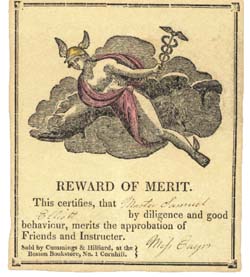
Awards tap in to the part of us all that likes to be recognized for our abilities. In the nineteenth-century, rewards of merit were the hot pedagogical teaching tool. If you search AAS’s online catalog for the genre rewards of merit you will find almost 2,000 examples, many of which are digitized in our digital partner Readex’s American Broadsides & Ephemera.
The awards you really wanted to get in early America, though, was a Premiums. That’s because Premiums meant money. They were most often awarded for agriculture, but in 1796 the American Philosophical Society announced they would award premiums “to the authors of the best performances, inventions, or improvements, relative to certain specific subjects of useful knowledge.” By 1806, the APS was laying out conditions for their Magellanic and extra-Magellanic Premiums. The Magellanic Premium was named in honor of the donor of the fund, Dr. John Hyacinth De Magellan of London, and the recipient of the second award apparently had to be extra-Magellanic. You would have to read their pamphlet of conditions to find out exactly what that would entail.
Sometimes an award has a boring name like the Academy Awards and so needs to be spiced up with a fun nickname like the Oscars. In our case, I guess our awards could be familiarly called the Isaiahs, in honor of AAS’s founder, Isaiah Thomas.
Here at Past is Present we can’t promise a parade of designer dresses like the Academy Awards, but we can promise to keep the awards coming. So send us all your best ideas for names and once again all the Past is Present readers can vote for their favorites. The voting will be open to all, which is more than the Oscars can say!
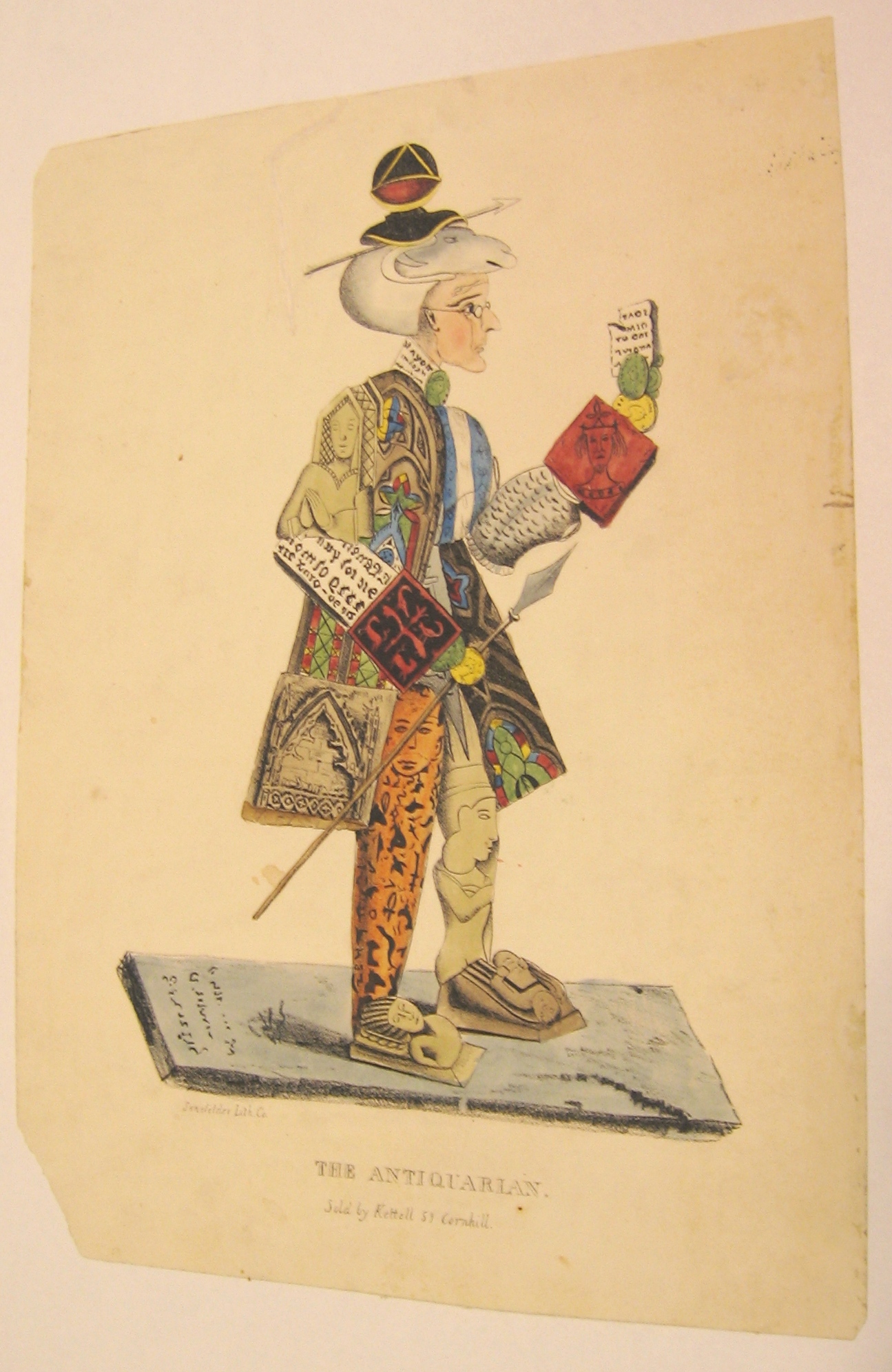
How about hoary, pigtaily, brontosaurian, rusty-dusty, mossy-backed, or square-toed? If so, then you belong with us! Each of these terms were once synonyms for Antiquarian, according to AAS’s recently acquired copy of the Historical Thesaurus of the Oxford English Dictionary. A recent New York Timesarticle described the historical thesaurus: “Archaism, it turns out, is the point of the H.T.O.E.D., which includes outmoded words as well as contemporary ones and indicates when words came into and fell out of use.” Now archaism is an area we Antiquarians know something about.
Putting aside the unfortunate acronym (which sounds like a close linguistic sibling to “square-toed”), the H.T.O.E.D. is like sticky candy for anyone interested in words and history. The nutritive value may be hazy, but once you tear into it you may get stuck. If you’re the kind of person who spends hours browsing through the original O.E.D., be forewarned: the historical thesaurus version is at least as addictive. Not only do you get the birth-dates of words we use today, this O.E.D. 2.0 includes extinct words and their exact death-date when known.
On one of our recent snowy days, when the reading room inside was as silent as the street outside, I opened the H.T.O.E.D. up. In the section on oldness/ancientness (or number 01.05.06.08.04.04, vol. 1, p. 706, if you’re following along in your H.T.O.E.D.) I found the listing for antiquarian (1610-): one who is interested in oldness/ancientness. Below are some of my favorite gleanings from this section.
Earlier term: antiquary (1586-)
Later terms: man of cabinets (1698), antiquist (1784-), archaist (1851)
An item that is “Antiquarian” could also be described as:
hoary (1609-)
superannuated (1633-)
trunk-hosed (1643-1647)
old-timey (1850-)
old-fangled (1842-)
brontosaurian (1909-1977)
pigtaily (1859)
retardataire (1958-)
rusty-dusty/rusty-fusty (1593; 1864)
A person who is an “Antiquarian” could also be referred to as:
mumpsimus (1575-1815)
fogramite (1823-1832)
grey-headed (1600-1753)
old-school (1886)
foozle (1860)
mossy-back (1878)
square-toed (1795)
mildewed (1605-)
wormy (1611)
fusty (1606-)
musty (1637-)
dead-handed (1928)
Rip-Van-Winkleish (1829-)
Between 1828-1864, in colloquial parlance you could antiquarianize, or act as a lover of antiquities. Also, an antiquarium (1881) was a repository that contained antiquities (and all this time, I thought people were just mispronouncing our name!).
What can we take from this lexicographical information? For one thing, at one point in history you could say with some hope of successful communication that: A mumpsimus fogramite antiquarianized his superannuated, pigtaily retardataire items and put them in an antiquarium (although I’m sure I got many parts of speech wrong in that sentence).
Not only can historical terms become nonsensical, they can also twist meanings in interesting and also humorous ways. When I first suggested starting an AAS Glossary, one of Past is Present‘s quick-witted readers posted a hillarious comment about an undergraduate student misinterpreting the term “intercourse” in its eighteenth-century context. She suggested others might have similar stories of historical terms gone awry in a modern context. If you have such stories, please share them.
But historical terminology is not just a funny footnote in history. Names are powerful.
Consider this post a manifesto calling for a whole-hearted embrace of the label Antiquarian in all its mossy-backed glory. It is a name that has stood the test of time. It says we know who we are. We are lovers of the past. We are going to collect it, to preserve it, and to make it accessible to the world. And we are proud of that fact, whether it is fashionable at the moment or not.
So the next time someone walks into the building and asks: “Where are the fish?,” or alternatively wonders what we have against sea life that makes us anti-aquarium, I will proudly explain the history of the term Antiquarian. I will antiquarianize with joy and I invite you to join with me.
After all, the American Rusty-Dusty Society just doesn’t have the same ring, does it?
This is for all the historical comedians out there …
Seeing the illustration above, titled “The Naughty Boy,” in Lauren’s post Slate, Before the Hype started me wondering what led up to this scene. There has to be a good story here. The sulky pout. The curls and the dress (which to modern eyes appear gender-bending). This scene cries out for creative description.
Wow us with your best tag lines and the readers of Past is Present will vote for their favorite (I’ve added a thumbs-up function to the comments section). Keep coming back to vote! Next week we’ll announce the winner of another of our antiquarian-glory-only prizes. And who knows? Maybe we’ll post a few other fun images that have come across our desks recently.
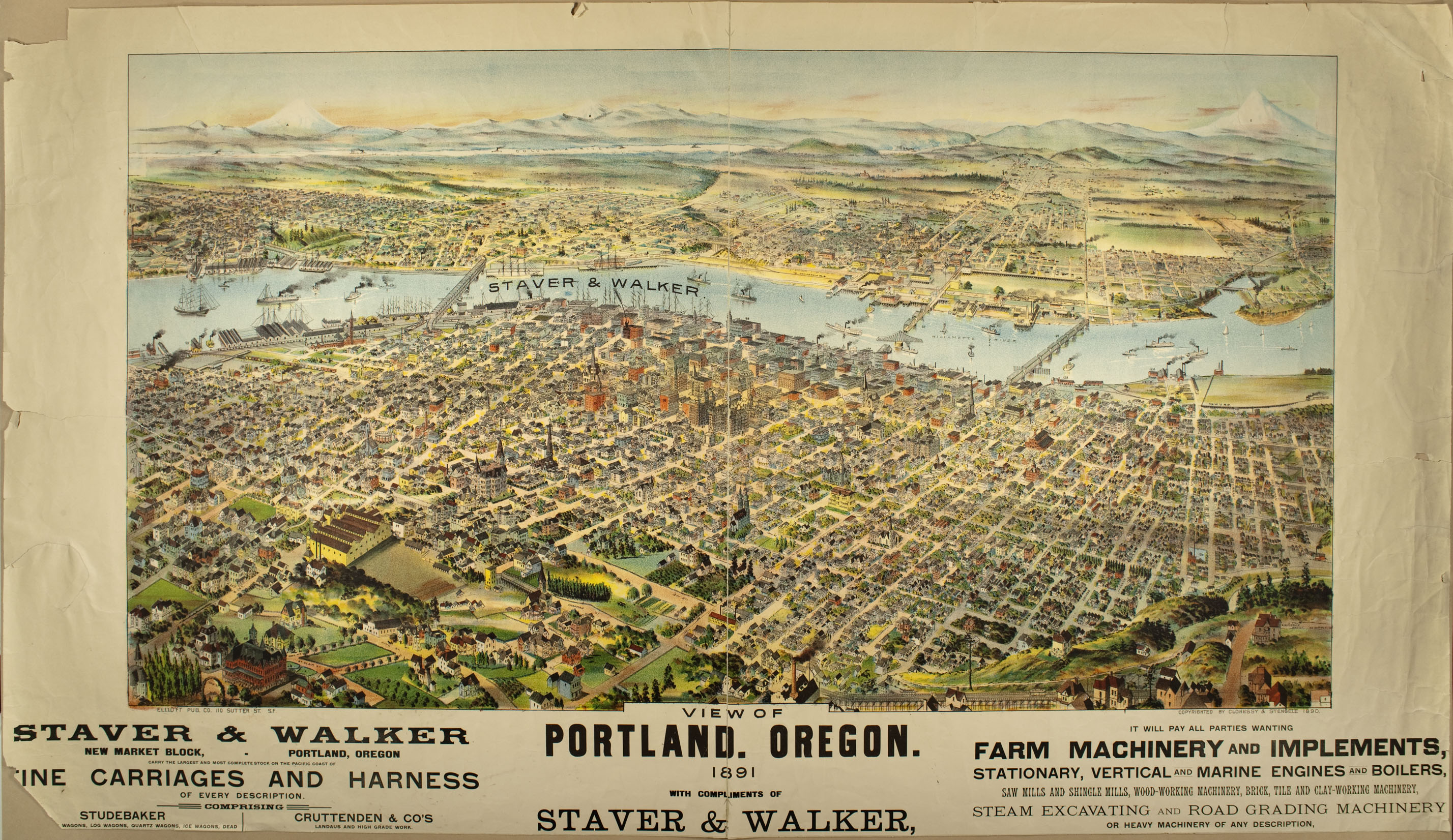
Like the other catalogers here at AAS, part of my job as the Graphic Arts cataloger is to figure out the artists, sitters, publishers and others who contributed to the works in the collection. So when I catalogued a large color lithograph view of Portland, Oregon from 1891, I noticed that the copyright holders were not listed in our catalog. And although I usually check the Library of Congress’s authority file to see if the firm is established, I went right to Google. When I found nothing solid there, I went to the newspapers. For the record, they are already established at LC, but it did prove an interesting distraction from cataloging. And it turns out the lithograph had a Worcester connection.
The Map of Portland, Oregon
The view of Portland was copyrighted by the firm of Clohessy & Stengele (i.e. Strengele). So I checked the names America’s Historical Newspapers database (a wonderful research tool containing full-text searchable, digital versions of many of the newspapers at AAS). I searched for Stengele and Clohessy in any paper and any publishing date. The first result that came up was from the September 17, 1894 issue of the Morning Olympian. The headline read:
Portland’s tragedy. A murder and suicide of prominent people. It was unrequited love. A civil engineer shoots a woman.
John W. Strengele was a thirty-something well known civil engineer from a wealthy family in Chicago, who had moved to Portland about 1889. He had been dating a woman, Mrs. Mabel Colvin of Worcester. Yes, Mrs. Pretty scandalous I thought. According to the first news report on September 17th, 1894, Mr. Strengele and Mrs. Colvin had been dating for some time and had decided to be married, once she obtained a divorce from her husband in Worcester. Even more insight into this tragedy was given in the reprint of Strengele’s suicide note addressed to his business parter:
Portland Hotel, September 16, 1894. My dear Clohessy: Could anyone overlook the fact that I am mad? I have done a lot of worrying, and you can now see why I am not well and why I do not eat and sleep as I used to. You know we were to be married as soon as Mabel got her divorce, and you know of our intimacy for the past year or more. I found to my sorrow after watching her that I was not the only man in the case. We had a row once before, but then I was not as positive as now, and we made up. You have proved the only friend I have ever had. I hope you will never make such a d— f— of yourself as I have made of myself. I cannot stand life any longer, although I have been fairly successful all along. There is enough money in my pocket to pay for burial, etc. I am not particular how I am put away. Mabel is the only woman I really love. I cannot live without her, and if you knew how I have been treated of late you would not blame me.
It is almost impossible for me to write I am so nervous. I realize what I am about to do perfectly, and I cannot for the life of me check myself. This desire to kill her and then myself came over me a few days ago. I cannot live any longer. Best wishes. Jack.
According to more newspaper reports from Portland and Worcester, Mabel Forehand Colvin was the daughter of Sullivan Colvin, owner of the Forehand Arms Company in Worcester. Mabel had married another prominent Worcesterite, Mr. C. Henry Colvin, a bookkeeper at the Colvin Iron Foundry, sometime around 1885. According to some reports, Mabel was an alcoholic and moved to Portland about 1892 to flee her unhappy marriage. Other reports stated that Mr. Colvin was at fault and had verbally abused and abandoned his wife. She left and moved in with her cousins, the Jewetts, on Yamhill Street in Portland. Her brother Charles also lived in Portland. Soon after, Mabel met and fell for John Strengele, a prominent civil engineer. They later became engaged and Mabel had filed for divorce just days before her death. In some reports, and in the suicide note, it seemed Mabel had cooled on the relationship and was seen with other men, which obviously upset Strengele. The account in Worcester’s Daily Spy of September 18, gives the gruesome account of exactly what happened on Sunday, September 16, 1894:
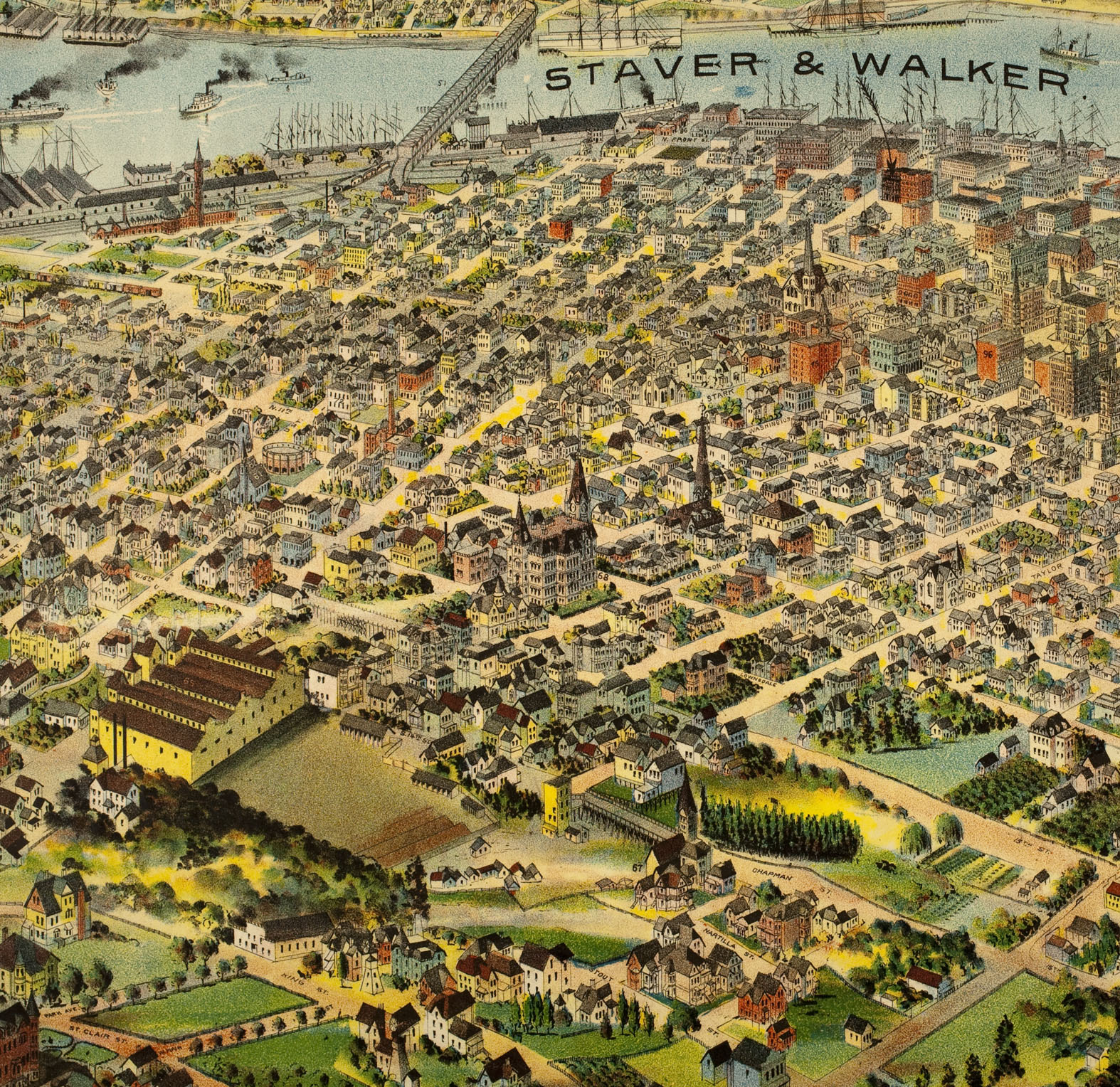
Detail of the area where the murder occurred
Sunday Mrs. Colvin attended church as usual and taught her class at the Unitarian Church. After Sunday school she took a walk with her brother, Chas. E. Forehand, who recently went to Oregon. After enjoying an hour’s pleasant chat with her brother, Mrs. Colvin boarded a streetcar to go to her home at 472 Yamhill Street [near Thirteenth Street], where she lived with her cousin, C.F. Jewett. From the car to Mr. Jewett’s house, the distance is not above 200 feet, and, after alighting from the car the unfortunate woman started to walk toward the home she was never destined to reach.
Stanegels [sic] was lying in wait for his victim. He rushed to her side, caught her by the arm and spoke excitedly and hurriedly. A man who stood on the opposite side of the street saw Stanegels and heard the excited tones of his voice but could not distinguish his words. Mrs. Colvin exclaimed sharply ‘Let go of me. I do not care to be molested by you; I will not go with you.’
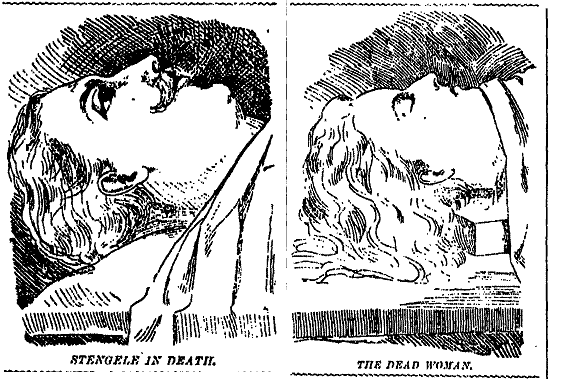
These were the last words she ever uttered, for Stanegels pulled out a revolver and fired. Mrs. Colvin fell to the ground with a moan and the crazed murderer, while the woman was lying prostrate on the street with the blood streaming from the wound caused by the first bullet crashing through the brain of Mrs. Colvin, the bullet entering the left temple and passing out through the right ear. Stanegels then looked closely at his victim, apparently to make sure that he had accomplished his murderous purpose, placed the pistol muzzle to his own right temple and sent a bullet through his own head, literally blowing out his brains. He fell dead to the ground within five feet of his victim.
Images of the deceased from the 9/17/1894 issue of the Morning Oregonian
Once Mabel’s Portland family learned of the murder, they sent the following telegram to her father, Sullivan Forehand, who had never heard of Mr. Strengele (Sullivan and his wife had visited her months before her death, and the vacation had been written about in the local paper):
Mabel accidentally killed. Will be prepared suitably for shipment. Details by mail. Wire me instructions.
Mabel was shipped back to Worcester, given a proper funeral, and is buried at the Rural Cemetery on Grove Street in Worcester. Her brother, Frederic, had a relationship with the American Antiquarian Society and donated and sold several manuscript collections to us in the 1920s. So, even though I should have checked the authority file first, I’m glad I didn’t, since establishing authorities is rarely as interesting as this story was. I’m just upset I didn’t get to include this information in their file!
March 1, 2010 marks the 200th anniversary of the birth of the pianist composer Frédéric François Chopin (1810-1849). Chopin was born near Warsaw and lived much of his short life in France so you may be asking yourself why on earth there is a post about him on the blog of the American Antiquarian Society. Last week, after hearing a NPR story about the concerts and events marking Chopin’s birth, how most of him is buried in Paris but his heart is in a shrine in Warsaw, how his music is closely associated with the Romantic movement, etc., etc., I initiated a discussion behind the reference desk over whether or not Chopin was as revered during his lifetime here in the United States as he was in Europe. There were several ways to find out, we decided, and so we split up to dig through the stacks and our on-line resources to see what we could find.
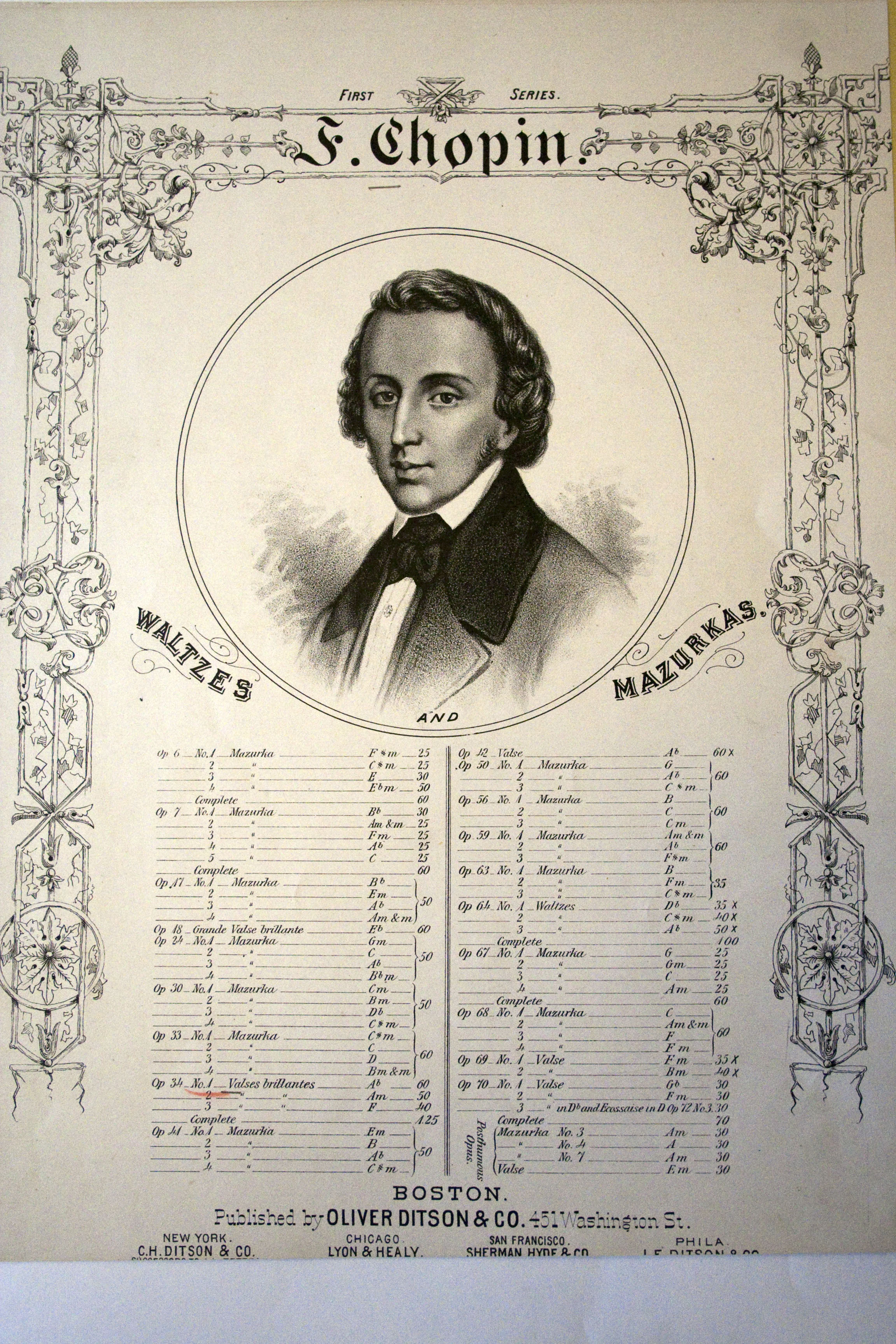
A search of the American sheet music collection turned up numerous examples of Chopin’s works, including some which, according to resident music expert Andrew Bourque, had been simplified for more amateur players. Most are lithographed scores and it is interesting to note that the composer began his career just as the sheet music industry was switching from engraving to lithography as the preferred mode of reproduction and distribution of music. All of the songs in our collection were printed in the United States, and most date from just after the composer’s death or later, so this evidence certainly supported the fact that Chopin had a following here in the latter portion of the century. But what about during his lifetime, when he was entertaining the elite of Europe?
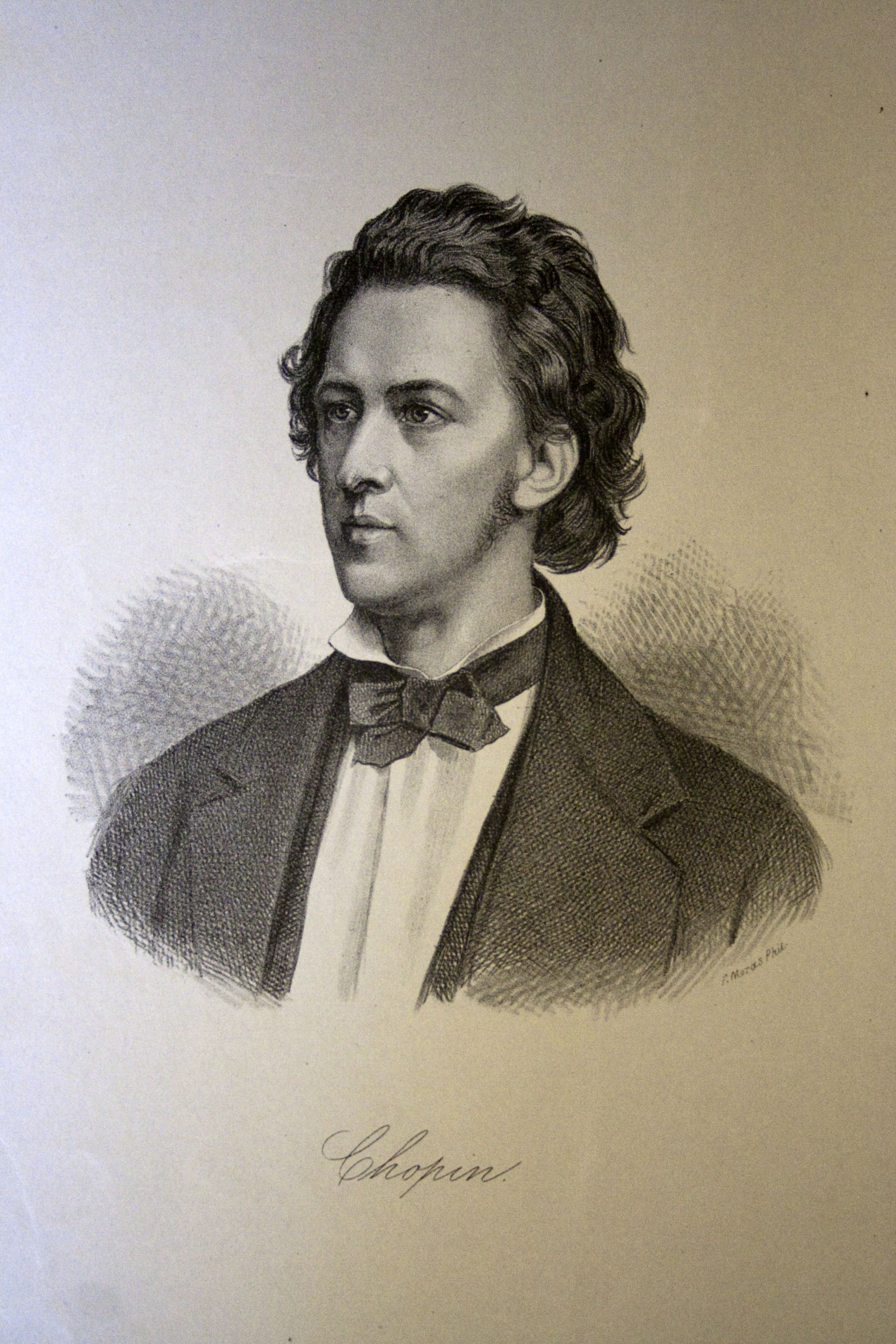
The print collection turned up two portraits of Chopin, both dating from after his death at the young age of thirty-nine. These images indicate that the lithographers of New York and Philadelphia thought there was a market for images of the Romantic musician, but it doesn’t tell us what the composer’s reception might have been here before 1849. A check of other institutional holdings of prints supports this – with most of the American images of Chopin dating from after 1850. A quick check of the nation’s painted and sculptural holdings indexed by the Smithsonian American Inventories Resource (http://sirismm.si.edu/siris/aboutari.htm) revealed only five busts of Chopin, all from after 1900. For comparison, Beethoven returned nearly forty results, many from the nineteenth century.
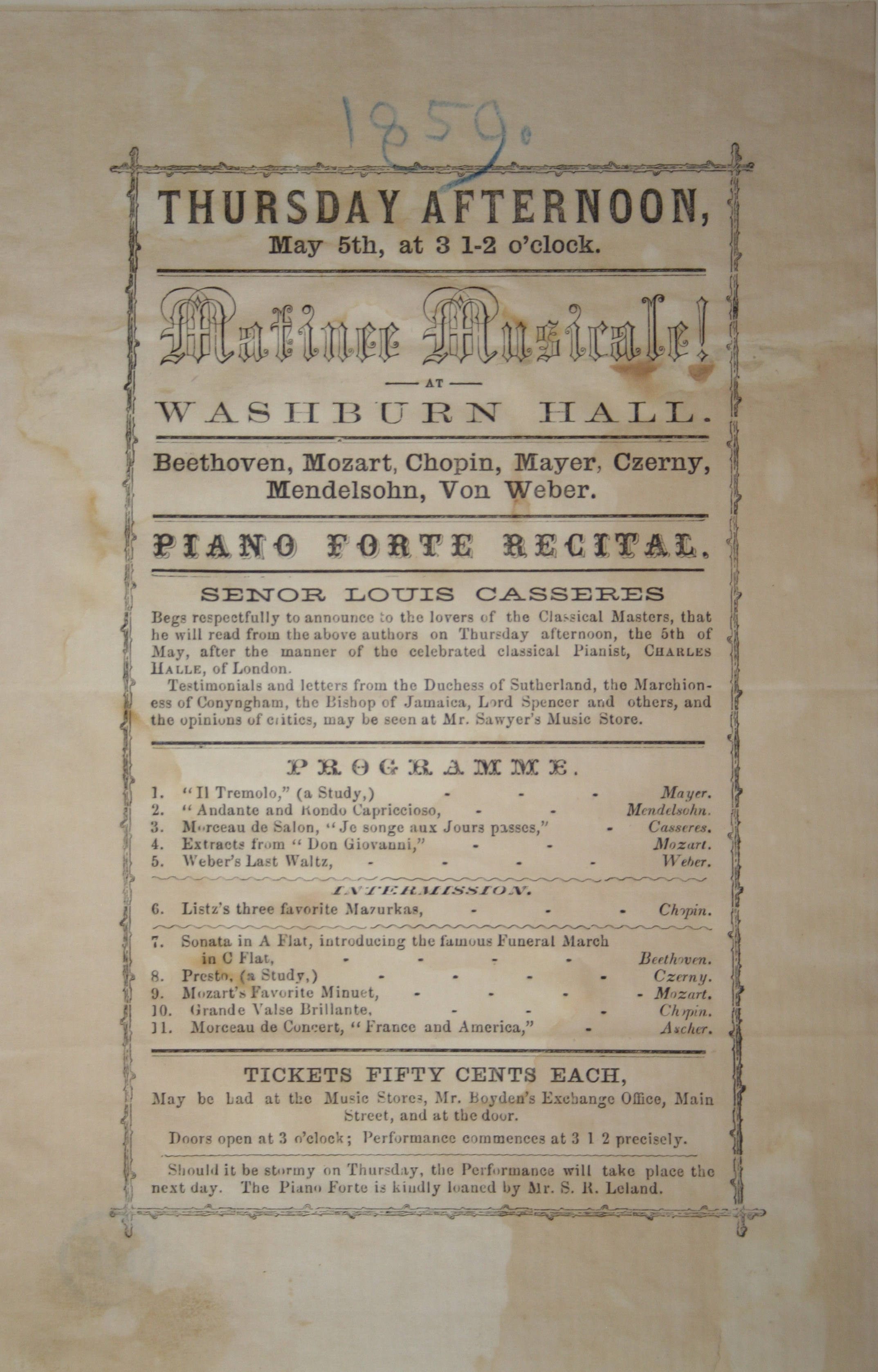
What else? The first biography of Chopin published in the United States was a translation of Liszt’s 1852 biography, printed in Boston and Philadelphia in the 1860s. Concert programs and broadsides in the Society’s holdings list performers playing his work in the 1850s (listing him third, after Beethoven and Mozart, not too shabby!). Andrew checked periodicals and turned up an article about Chopin published in April of 1850 in the New York periodical The eclectic magazine of foreign literature, science, and art. The article was reprinted from a London magazine, so the content has a very European slant, but the fact that the lengthy article found an audience here is still interesting.
Reference assistant Ashley Cataldo went digging in the on-line resources and found a wonderful 1988 article on the American transcendental critic Margaret Fuller (1810-1850) and her response to the music scene in Boston during the 1840s. Writing for the New-York Daily Tribune in January of 1846, Fuller commented on the upcoming U.S. debut concert of the European pianist Julian Fontana (1810-1869). She hoped that his playing would translate, “the fire and sweep of Liszt, the architectural majesty of Thalberg, and the tenderness and delicate fancy of Chopin” (Quoted in Ora Frishberg Saloman, “Margaret Fuller on Musical Life in Boston and New York, 1841-1846,” American Music, Vol. 6, No. 4 (Winter, 1988), pp. 428-441, p. 437). Ah, now we have something concrete. Chopin’s music was certainly being played and heard in America during his lifetime and, at least according to the worldly Fuller, he was a force on the level of Franz Liszt and Sigismond Thalberg.
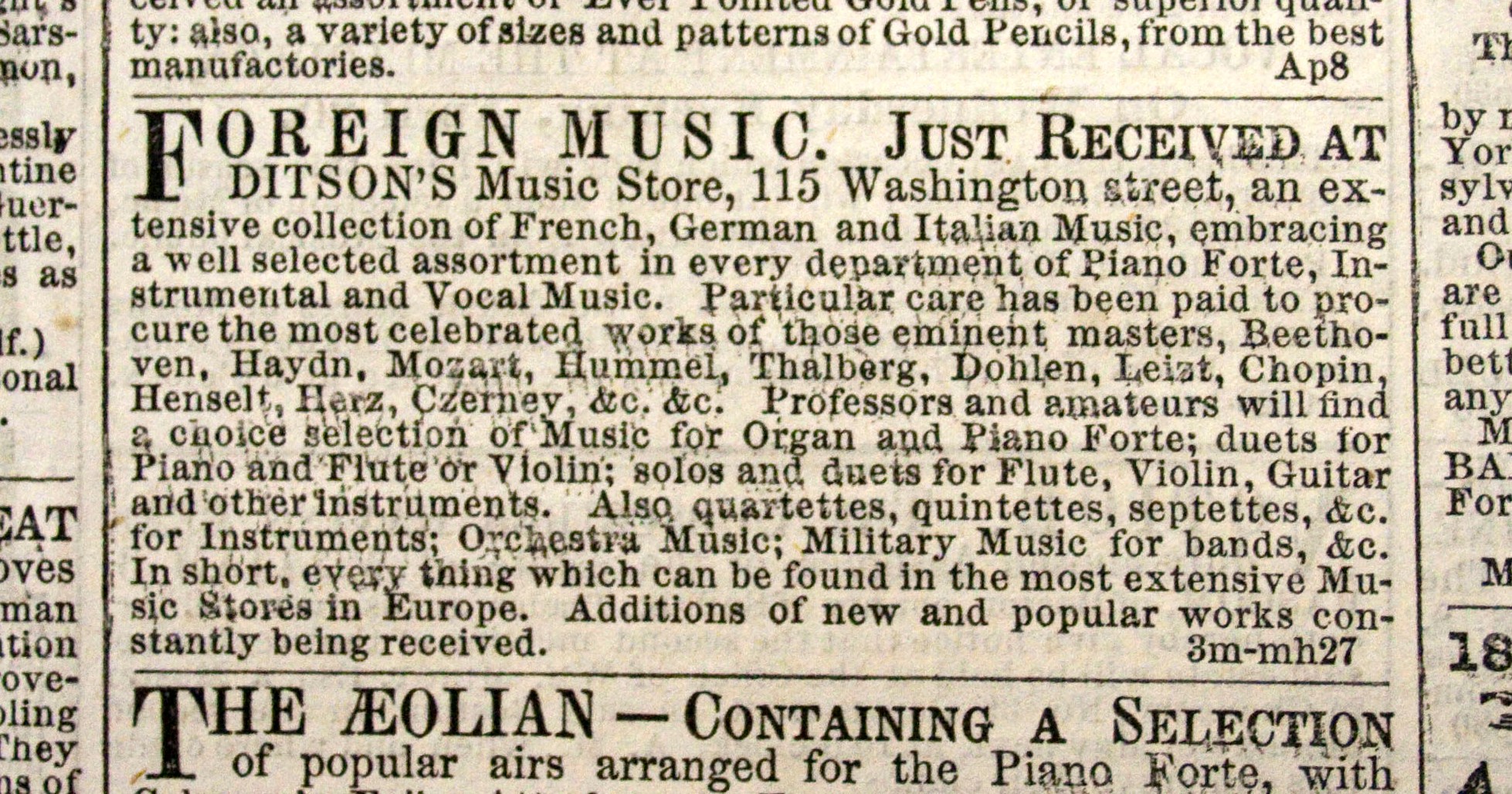
Additionally, Ashley located several 1845 advertisements in the Boston Daily Atlas for Oliver Ditson’s music shop in Boston which include references to Chopin’s songs being sold. A broadside published c. 1844 for competing music dealer John Ashton & Co., also of Boston, lists Chopin’s songs being sold with other “foreign” tunes. So Chopin’s music was available for sale before his death in multiple shops in Boston.
So what did we learn from our little exercise? Probably those in the know, like Fuller and the music store owners, were aware of Chopin and maybe even understood his dawning influence on piano music during this period. We know that after the young composer’s death his music became widely available and his image begins to circulate in this country. He was not, apparently, the “rock star” personality that he was in Europe, as his work is not mentioned in the wider press nor is there much information on his unconventional personal life (I’d love to be a fly on the wall with George Sands and Margaret Fuller in the same room — anyone else?). In contrast, the British and French press tracked the composer’s travels, commented frequently on his reclusive nature, and noted the scandals associated with Sands later novels and her relationship with Chopin. Americans were not so focused on Chopin until much later.
Here in the States, his work is just starting to be widely played in the late 1850s, right before the Civil War. And during the war, he pretty much disappears, understandably, until the 1870s. It is hard to imagine his soft, complex, romantic music competing with the blast of cannon fire and sometimes shrill patriotic tunes that were flooding the ears of Americans from 1858 to 1865. His nocturnes and etudes would have seemed very foreign and very far removed.
What do we think about when we think about the history of the book in the U.S. South (for those of us prone to think about such things, that is)? It is received wisdom that the South was much less industrialized than the North in the first half of the nineteenth century. And, if print was one of those areas of production that was subject to increasing industrialization, it must follow that there was less printed matter in the South: fewer books and newspapers, and consequently also fewer writers and readers.
Instead (so the story goes), the South was reliant on the expansion of distribution networks by northern publishing houses, particularly in Philadelphia and Cincinnati. The result is an image of a regional print culture that depended on a select set of texts produced in another region while it studiously shunned other texts (no abolitionist pamphlets, please—their prohibition was the goal of the 1835 Abolition Postal Campaign). The end result was a world of print that, by the time of the Civil War, was stunted in its growth. In fact, Southern newspaper publishers were spurred by the paper shortages caused by the war to resort to such outlandish solutions as printing newspapers on the back of patterned wallpaper, as in this May 1863 issue of the Weekly Junior Register of Franklin, Louisiana in the collection of the American Antiquarian Society.
But is this actually true? Or, put more broadly, what happens when we view the imagined community of U.S. print culture from the vantage point of the South? This is the animating question behind this year’s American Antiquarian Society Summer Seminar in the History of the Book in American Culture, “The Global American South and Early American Print Culture,” to be held from June 14-18 at the AAS. While AAS is often thought of as a northeastern archive, our holdings—which are national in scope—offer tremendously rich resources for the study of print culture in the global South, including not just materials from the United States, but also from the Caribbean and Latin America. The seminar will rely in particular on the Society’s Edward Larocque Tinker Collection of Louisiana Literature and History.
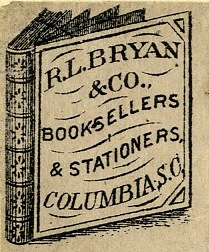
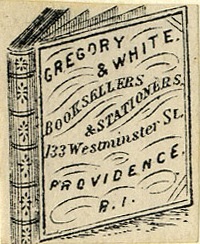
This year’s seminar will explore how a reoriented book history that looks at U.S. print culture from the south might challenge and inform emerging transatlantic, transnational, and cosmopolitan histories of the United States. How did a region that asserted its “American-ness” while insisting on a distinctive sectional identity appear in the world of print, and how did it engage with the wider world through the realm of print culture? How did book distribution, authorship, reading, censorship, and copyright work to shape lived experience in the South? Throughout the week, we hope to use the riches of the AAS collections to uncover some of the ways that print culture in the South was different from that in the North—wallpaper newspapers!—as well as some of the things that they had in common (as shown in the two booksellers’ ads below).
The seminar will be led by Jeannine DeLombard and Lloyd Pratt. DeLombard is Associate Professor of English and Acting Director of the Centre for the Study of the U.S. at the University of Toronto. Pratt is Assistant Professor of English and African-American Studies at Michigan State University. Advanced graduate students, college and university faculty, librarians, and independent scholars are encouraged to apply. The deadline for applications is March 12, 2010. Details and application forms are available here.
For those of you who were not going to be able to attend Ezra Greenspan’s lecture tonight, the good news is his talk on “Researching and Writing African American Biography: The Life of William Wells Brown” has been postponed to Thursday, April 22. And for those who were planning to come tonight, we hope you’ll be able to make this new date. Same time, same place, same compelling subject and speaker, you’ll just have more time to free up your calendars. We hope to see you then!
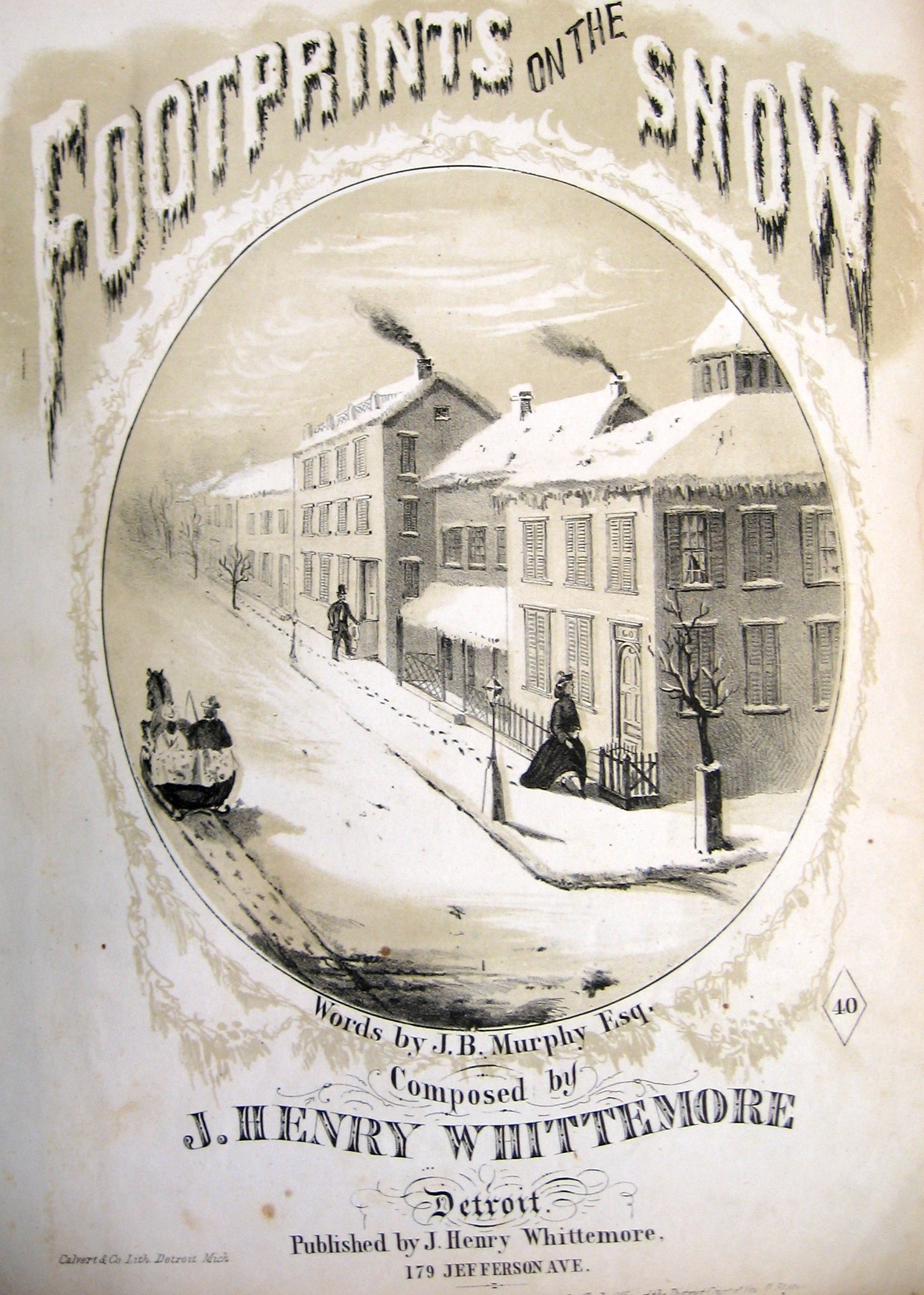
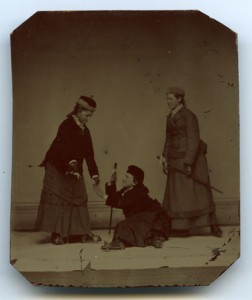
In the cold of a New England winter, it is easy to feel sorry for one’s self as the grey clouds of January barely dissipate in the low light of February’s early gloam. Some believe that the best way to tackle winter is to embrace it, and so the Graphic Arts department offers for your enjoyment selections from the collection that reflect how our ancestors dealt with the snow and ice of winter by singing, sleighing and skating. We chose optimistic images on purpose – leaving the broadsides and songs about blizzards and frostbite and lost cattle for another day!
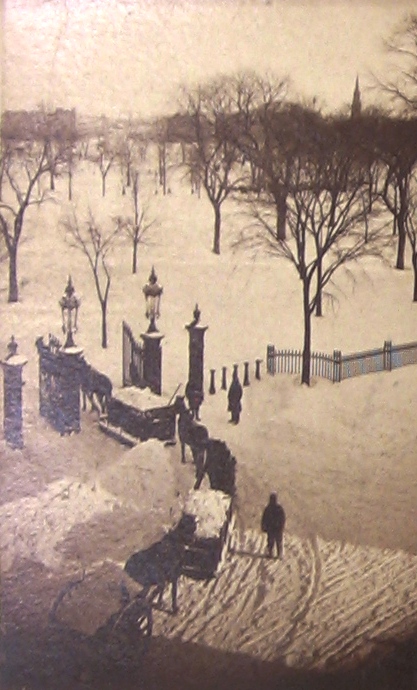
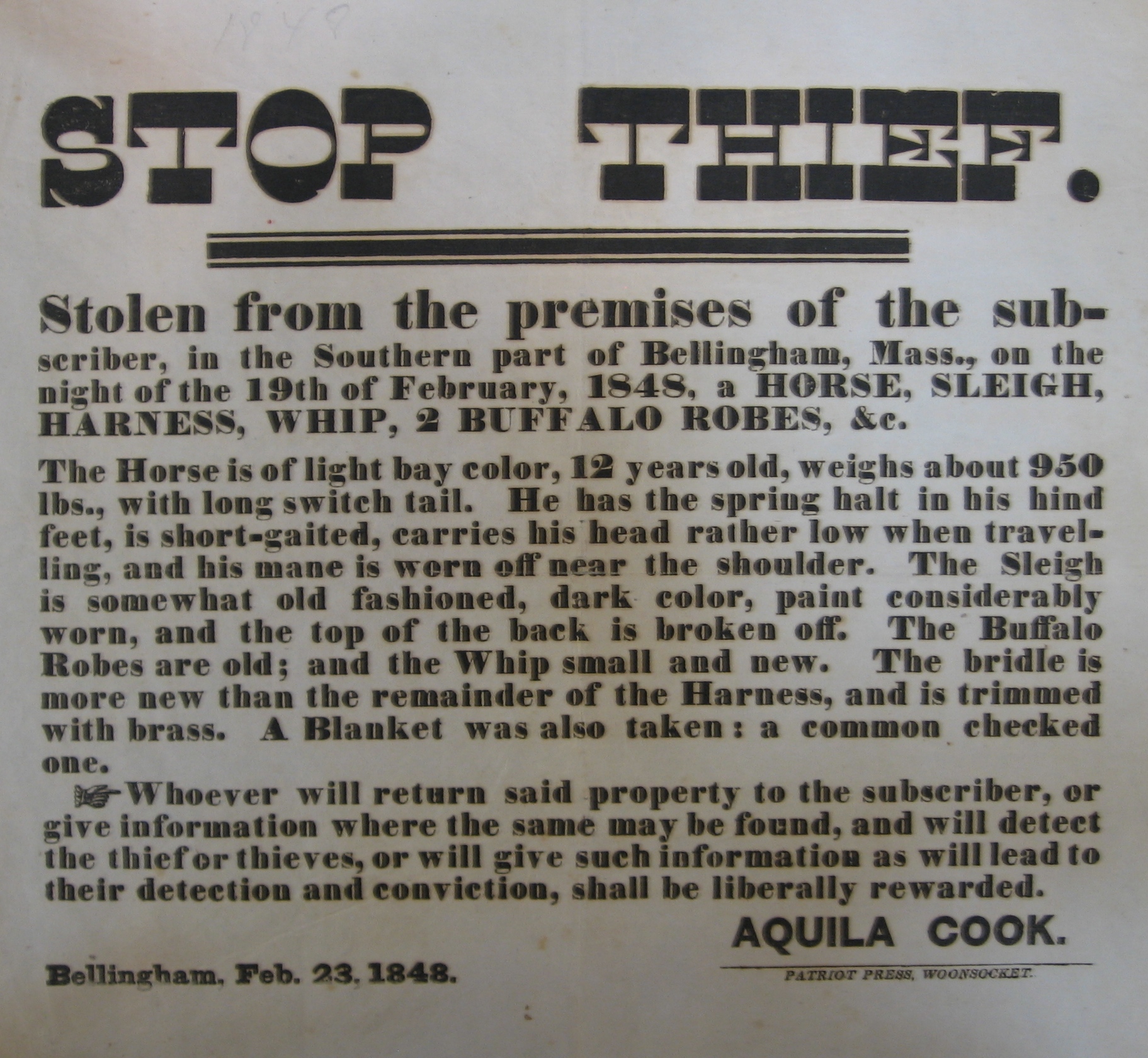
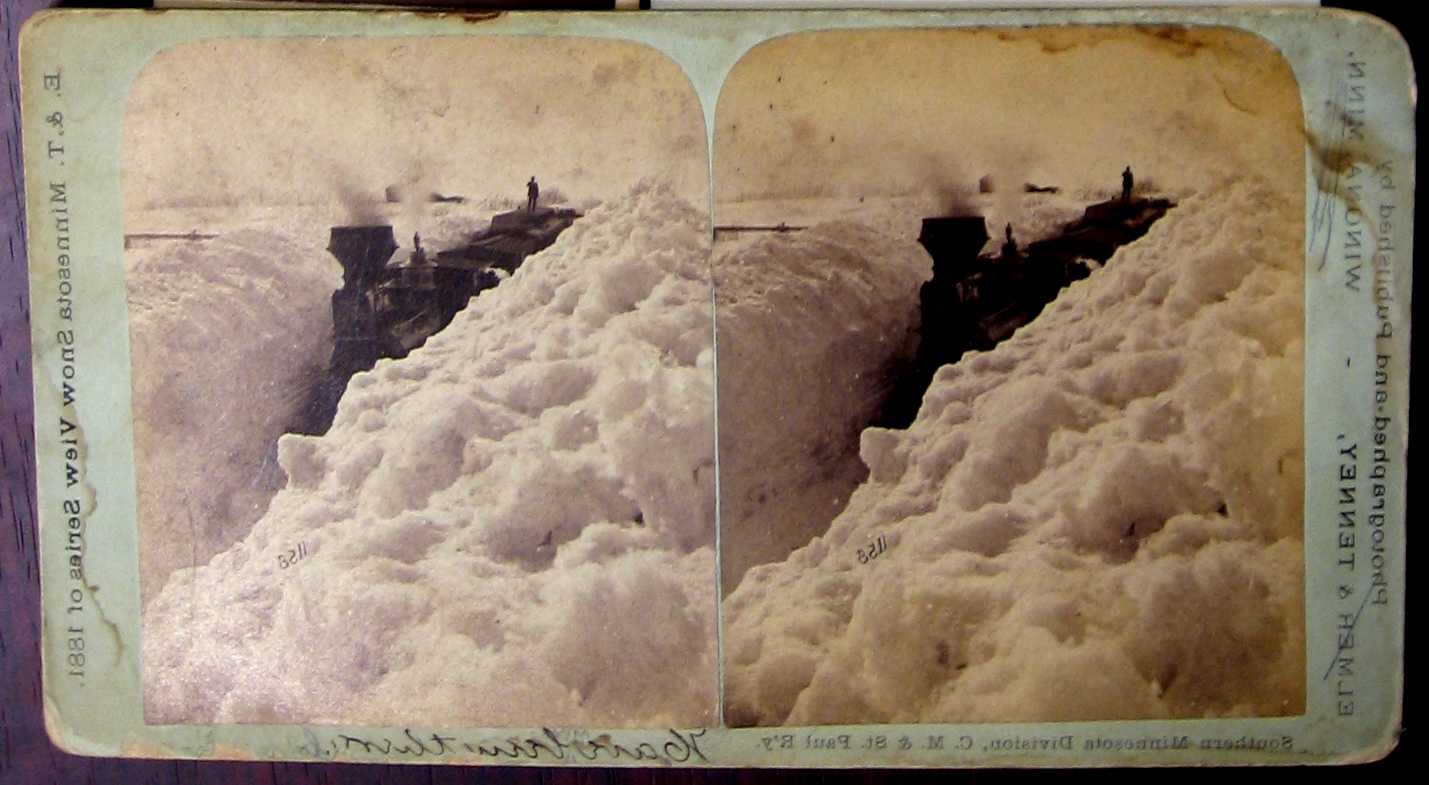
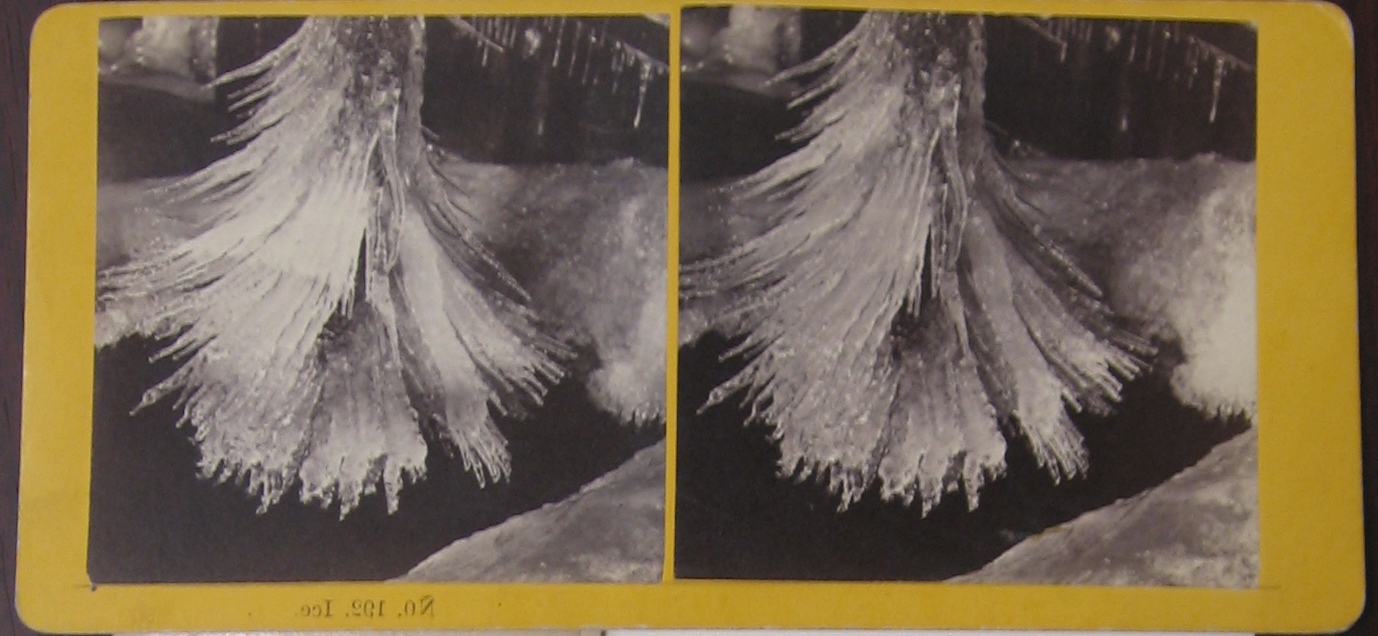
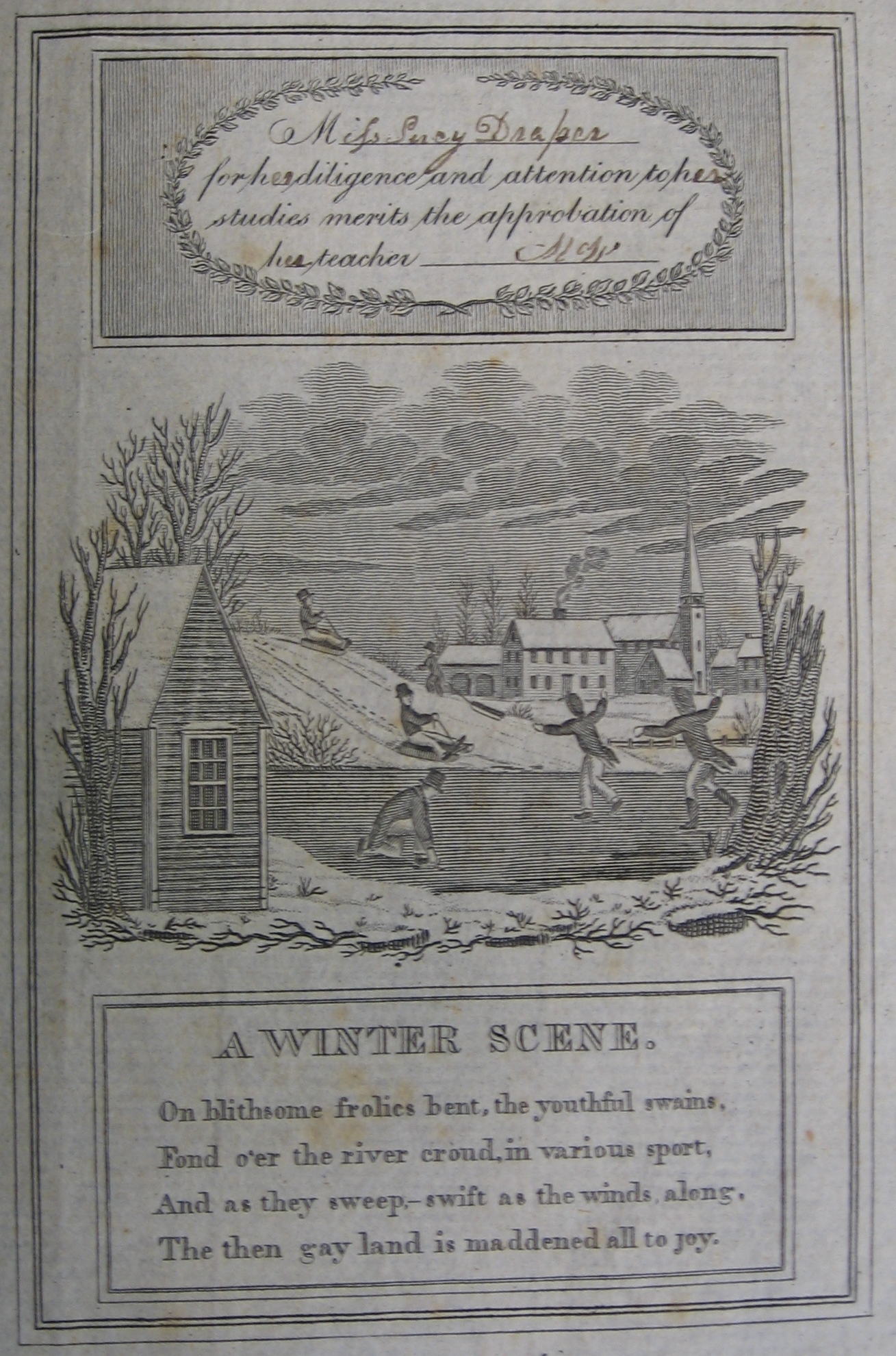
J.Henry Whittemore, composer, Footprints on the Snow, Detroit: Calvert & Co. Lithographers, 1866. The first stanza of this song records a young man stepping out after a snowfall and finding a woman’s footprints in the snow outside his door. Naturally, true love ensues! He sings: “I gazed with admiration on the trim and tiny marks, and felt within my bosom kindling love’s bewitching sparks,”Tintype of skaters, three unidentified women on ice skates in the studio, no photographer given, c. 1875. These three women thought an ice skating scene would make for an amusing photographic memento. Not so cold as shooting it outside on the real ice!Scene of Boston Commons in the snow, no photographer given, albumen on card, carte de visite, c. 1860. The city of Boston frequently trucked snow from the city streets to the Common. Here horses pull carts loaded with snow through the gates of the park.Stop Thief. For Aquila Cook of Bellingham, Massachusetts. Woonsocket, Rhode Island: Patriot Press, 1848. Question: Who would steal a sleigh, horse, harness and blankets in the middle of February? Answer: Someone with really bad cabin fever, perhaps!Locomotive in a drift, March 29, 1881, stereophotograph. Winona, Minnesota: Elmer & Tenney. The upper Mid-West trumps New England (or maybe this year we should say it trumps even the mid-Atlantic) when it comes to snow fall totals, but western-themed stereocards such as this one were very popular in New England homes. Schadenfreude, perhaps?Ice crystals, c. 1870, stereophotograph. Littleton, N.H.: Kilburn Brothers. Scientists used cameras to study ice, snow and frost patterns starting in the early 1850s.A Winter Scene, reward of merit for Miss Lucy Draper, engraving, c. 1840. This reward of merit was found in an 1837 grammar book.
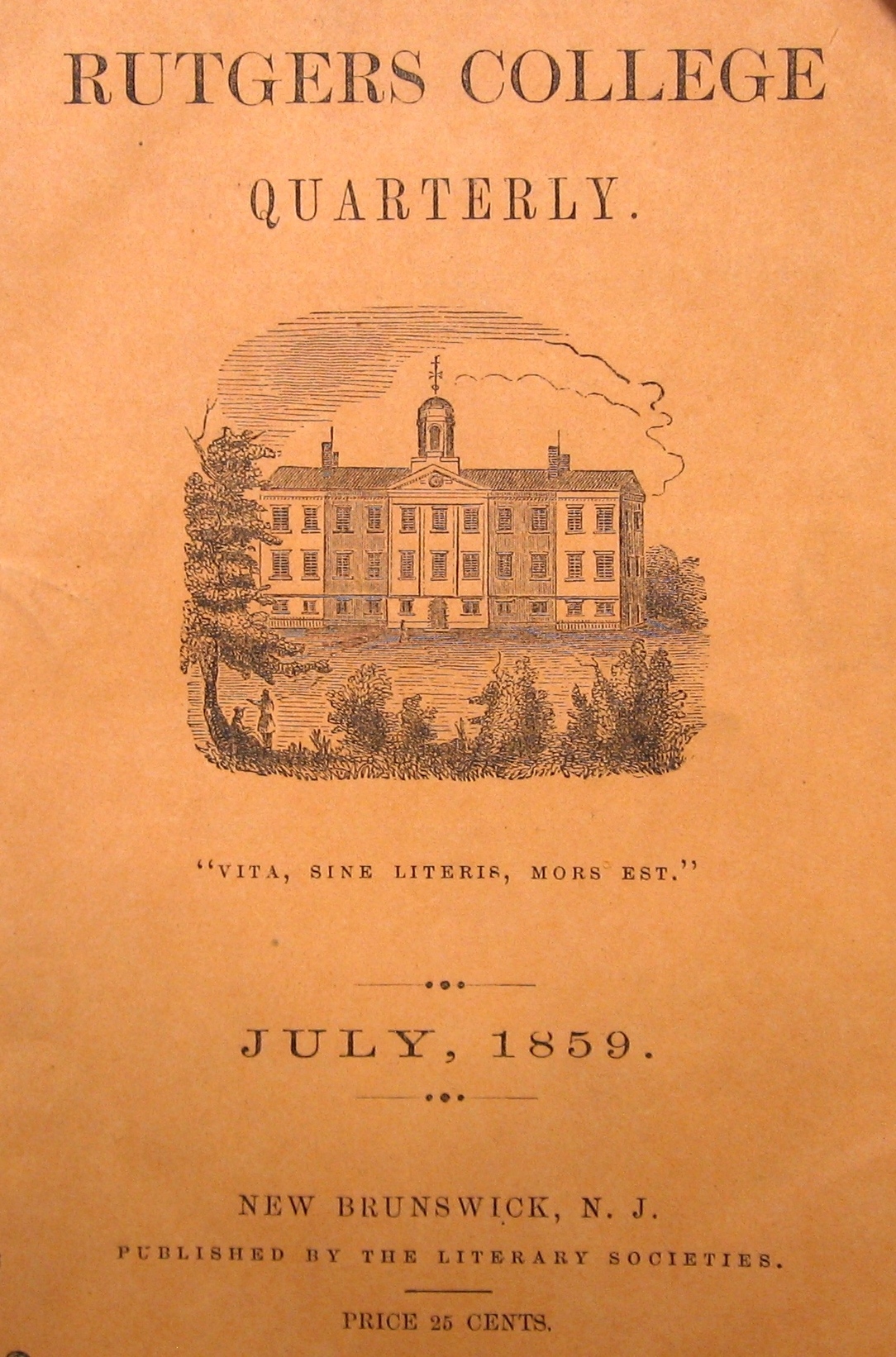
Today’s university may be in need of a revolution of its own, what with its failure to create true interdisciplinary conversation and its isolation from the wider public. The late eighteenth-century college did not exist in such isolation from the people, though few colleges became hotbeds of revolutionary activity during the war like Queen’s College (now Rutgers University). Queen’s alone attracted soldiers and aspiring legislators like James Schureman and Simeon DeWitt. It also brought to its doors printers like Abraham Blauvelt, whose newspapers became a voice for a unique type of independence, one that linked printing and university life, in the later years of the eighteenth century.
Blauvelt has a small, unexceptional entry in the printers’ file: publisher of the Brunswick Gazette from 1789-1792; publisher, with Shelly Arnett, of the Guardian, from 1792-1793; graduate of Queen’s in 1789 and recipient of the A.M. in 1792. These well-chosen facts of Avis Clarke’s, though, provide a window into the early American world of education and independence.
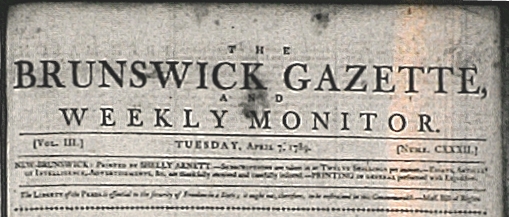
Every Wednesday, a notice for trustee meetings would appear in Blauvelt’s paper, The Brunswick Gazette. Not just a sign of loyalty from a Queen’s College alumnus, the notices are a sign of the change in allegiance on the part of trustees themselves. On June 5, 1781, the Legislature of New Jersey altered the charter for Queen’s by request of its own trustees, now fully in support of independence under their soon-to-be president Jacob Hardenbergh. Trustees would now take an oath of allegiance to the United States instead of to the board itself. More significantly, though, the new charter stipulated that notices for trustee meetings be published in a New York or New Jersey paper, not just a New York paper alone.
One of the last colonies to get its own paper was New Jersey. Because of its dependence on New York and Pennsylvania, New Jersey did not get its own major paper, the New-Jersey Journal, until 1779. Published by Sheppard Kollock, it was one of the first papers in support of independence in the state. In 1783, Kollock had published The Political Intelligencer and New Jersey Advertiser with Shelly Arnett, Blauvelt’s partner at the Guardian ten years later. Kollock published the first independent newspaper in New Jersey, and he Arnett printed the first newspaper with a college imprint. Blauvelt in turn printed one of the first papers to help establish independence both for the New Jersey press, Queen’s College trustees, and loyalty to a new United States.
Further reference: Demarest, William H.S. A History of Rutgers College, 1766-1924. New Brunswick: Rutgers, 1924. Hixson, Richard F. The Press in Revolutionary New Jersey. Trenton: New Jersey Historical Commission, 1975. McAnear, Beverly. “College Founding in the American Colonies, 1745-1775” Mississippi Valley Historical Review 42, no. 1 (1955): 24-44.
In my last post (“The Acquisitions Table: Matters Bibliopegistical“) I promised a curious story of synchronicity. Readers may recall Curator of Graphic Arts’ Lauren Hewes’s January 27 entry “Slate, before the hype” about writing slates in the AAS collections. (If you didn’t read it, go ahead and do so now. I’ll be here when you come back.)
(You’re back? Good. I’ll continue.) Lauren drafted her post on the 26th, and I read it late that afternoon. Less than two hours later, and before the post was put up, I got an e-mail from one of our bookseller friends, Ian Brabner, offering AAS this curious home-made slate.
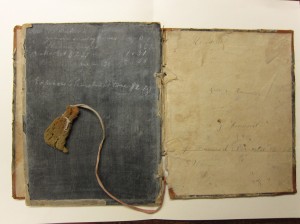
What we have here is a pair of covers and spine, probably from an old account book, to which someone has attached a piece of cardboard treated with a black coating. The covers bear the handwritten date 1811, but we think the piece of cardboard was probably manufactured a few decades later.
Of course we wanted it. What I like most about this item is that a small piece of sponge is attached to the book to serve as an eraser. Someone made this for personal use, or perhaps for the use of a child. I’ve never seen anything quite like it, but it offers an evocative glimpse into nineteenth century writing technology.
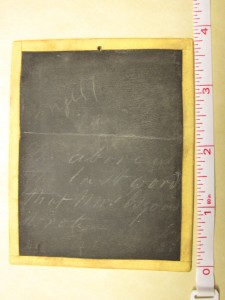
Since we’re on the subject of slates, here’s another one: This one, also made of treated cardboard, is much smaller and is in our manuscript collection of papers of the poet and editor Frances Sargent Locke Osgood (1811-1850). It came housed in a paper enclosure with this note: “The Slate on which Frances S. Osgood used to write after speech failed and the last word ‘Angell’ (which was addressed to her husband S[amuel] S[tillman] O.) is there as she wrote it.” Osgood’s last word is still visible on the upper part of the slate. What does it mean? I’m not sure. A religious sentiment? a near-death experience? a pet name for someone?
Thursday, February 25 – 7:30 p.m. at the American Antiquarian Society Researching and Writing African American Biography: The Life of William Wells Brown
by Ezra Greenspan
Prof. Greenspan’s illustrated talk combines two stories: a narrative of the life of the most prolific and pioneering African American writer of the nineteenth century, and an account of a biographer’s journey to present that life to a twenty-first-century public.
Brown personified the American Dream. Born into slavery and locked into illiteracy until his escape at age 19, he became an internationally renowned antislavery activist-writer who resided and traveled widely across the northern United States and the British Isles. Over the course of a life devoted to personal and collective reform, he wrote a series of remarkable books that includes the first African American novel, the first printed African American play, the first African American travelog, the first African American panorama displayed in Britain, and the first history of African American military service in the Civil War. This talk will present this remarkable life story via an account of a year-long, ongoing research journey to retrace the course of Brown’s life and gather material for a comprehensive biography.
Dogs. Some people love them, others hate them. Regardless, there is just no getting around the fact that the lives of humans and dogs have long been intertwined. Depictions of dogs were painted on cave walls by early man and just last week images of “First Dog” Bo (the Obama’s Portuguese water dog) playing in Washington D.C.’s record snow fall were sent around the world via the Associated Press.
This week, the city of New York hosts the 134th Westminster Dog Show, bringing together an international selection of canines and their breeders and handlers. Westminster started in 1877, just at the tail-end (sorry!) of the American Antiquarian Society’s collecting range. However, the presence of dogs in many pre-1877 graphic materials in our collection shows American interest in man’s best friend indisputably pre-dates the invention of the formal dog show.
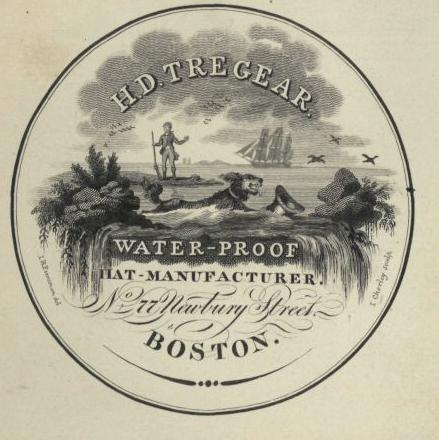
Dogs have long held symbolic meaning in prints, representing fidelity in wedding or patriotic images, or showing cowardice with tail between the legs in political cartoons. Once you start looking for them, you see them everywhere. Dogs deficate, urinate and vomit in dozens of political cartoons and social sartires ( such as David Claypool Johnston’s Panacea Mania — detail at right). Capitalizing on the cuteness or hero factor, they also often appear in advertising material, helping American merchants sell everything from sewing needles to hats (see the trade card at left for Boston hatter H.D. Tregear where a dog bravely attempts to rescue his owner’s chapeau).
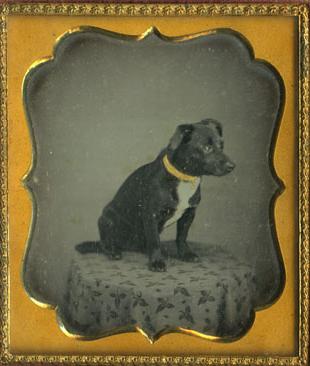
For this posting, however, we are looking at images of actual dogs, not the more common symbolic or fictional dogs. Therefore, for your viewing pleasure (or if you detest dogs – to your great dismay) and in honor of the biggest dog show in the world, we have selected a handful of photographs and drawings of actual pets from the Graphic Arts department, starting with a daguerreotype of Nero, a dog once owned by the Barton family. A mixed breed, Nero sits attentively on the photographer’s table, isolated from his human owners, but perhaps focused on them (or on a bit of chicken or liver like his counterparts in Madison Square Garden this week). Daguerreotype exposures could be lengthy, so the fact that Nero could hold the pose long enough to stay in focus is impressive. Additionally, the Bartons thought enough of the dog to pay extra to the photographer to have his collar hand-tinted with gold paint.
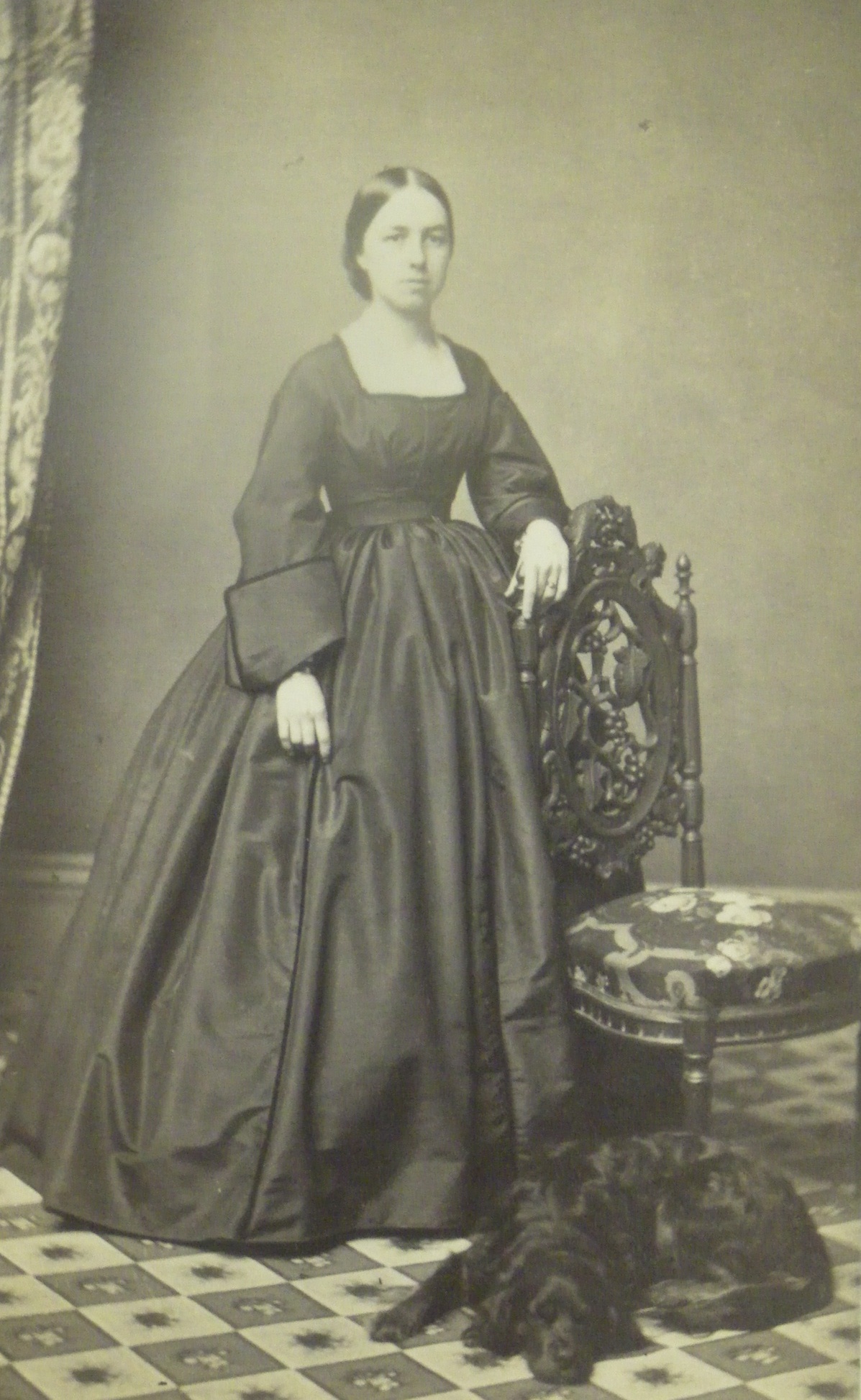
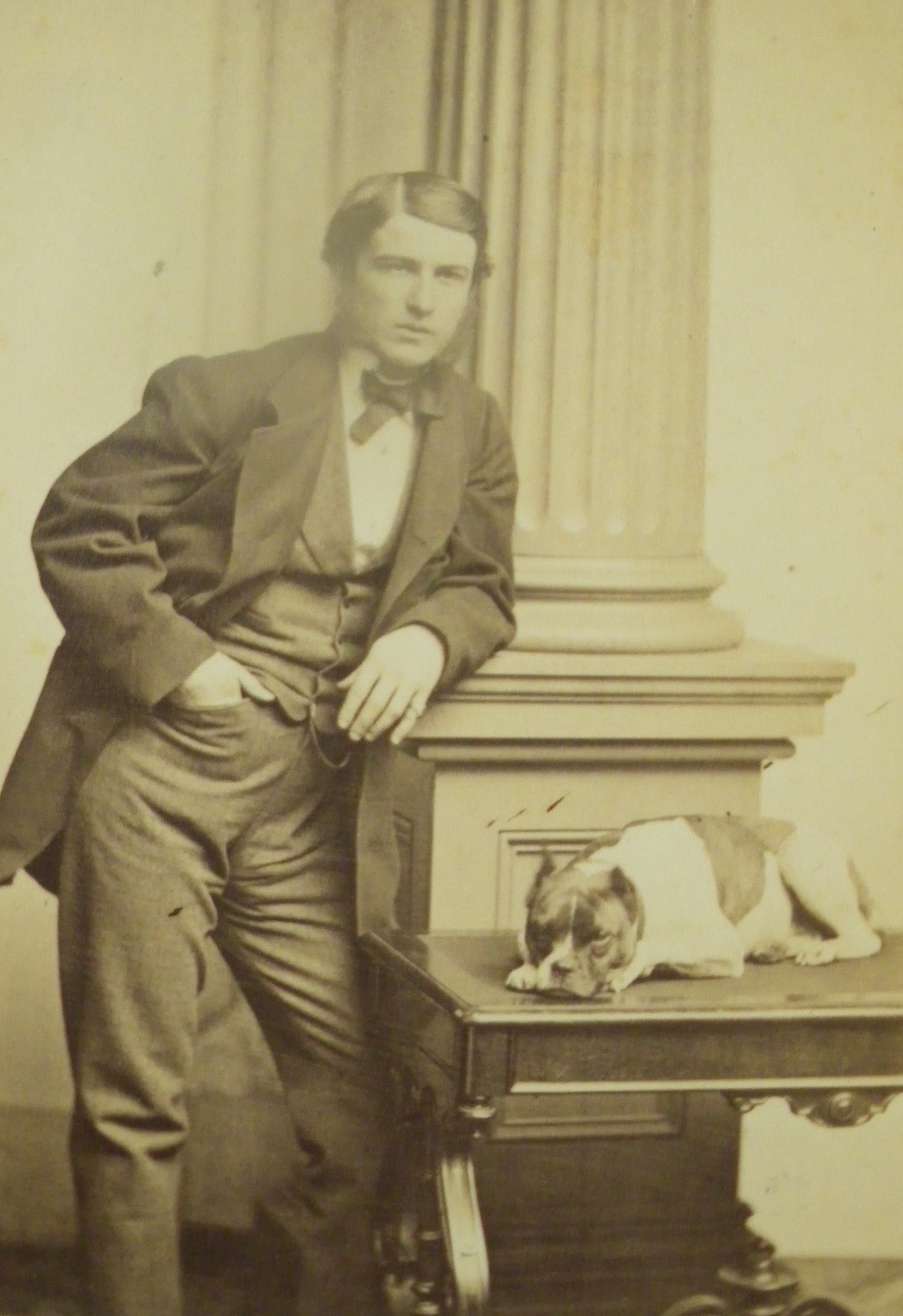
Carte-de-visite photographs became popular in the 1850s, and several in the Society’s large collection include dogs. A portrait by Boston photographer John Adams Whipple of Henry H. Sturgis features a terrier mix resting atop a table while his owner leans casually against a pillar. Miss Anna Ball of Worcester took her setter to the studio of Charles Claflin and the dog slept on the floor while Anna posed in an elegant dress (image at top of post). Neither of these photographs include the name of the dog, although the Sturgis card has been annotated to include the name of the human sitter’s future wife (I wonder if she and the dog got along!).
Drawings and paintings of specific pets are also found in the collection. The lithographers Louis Maurer and Charles Crehen as well as several members of the Johnston family often included dogs in their more generic hunting and farm scenes. In order to capture the dogginess of these fictional creatures, all of these artists made sketches of their own dogs which are now part of the AAS collection. Scattered across the Society’s drawing and artists collections, these images feature relaxed and tolerant beasts, all of which were probably used to being studied carefully by their owners.
Bringing a pet to a photo studio or making a drawing may not tell us all that much about their specific owners (“Those Bartons, they must have been real dog people!”), but given the visual record, both practices were widespread. This does say something about Americans and their dogs. Historical examination of pets is being undertaken by numerous scholars (see Katherine Grier’s Pets in America, a History, University of North Caroline Press, 2006; or recent papers on animals and children presented by Brett Mizelle of California State University at Long Beach). We’ll let the scholars discuss the social and historical ramifications of owning a dog in America before 1877 – for now, we are happy to mark the opening of the 2010 Westminster Dog Show with this blog post. And in the interest of full disclosure: I’ll be rooting for the poodles but we also have strong feelings about pugs, springers, and greyhounds here in the Graphic Arts department. May the best dog win!
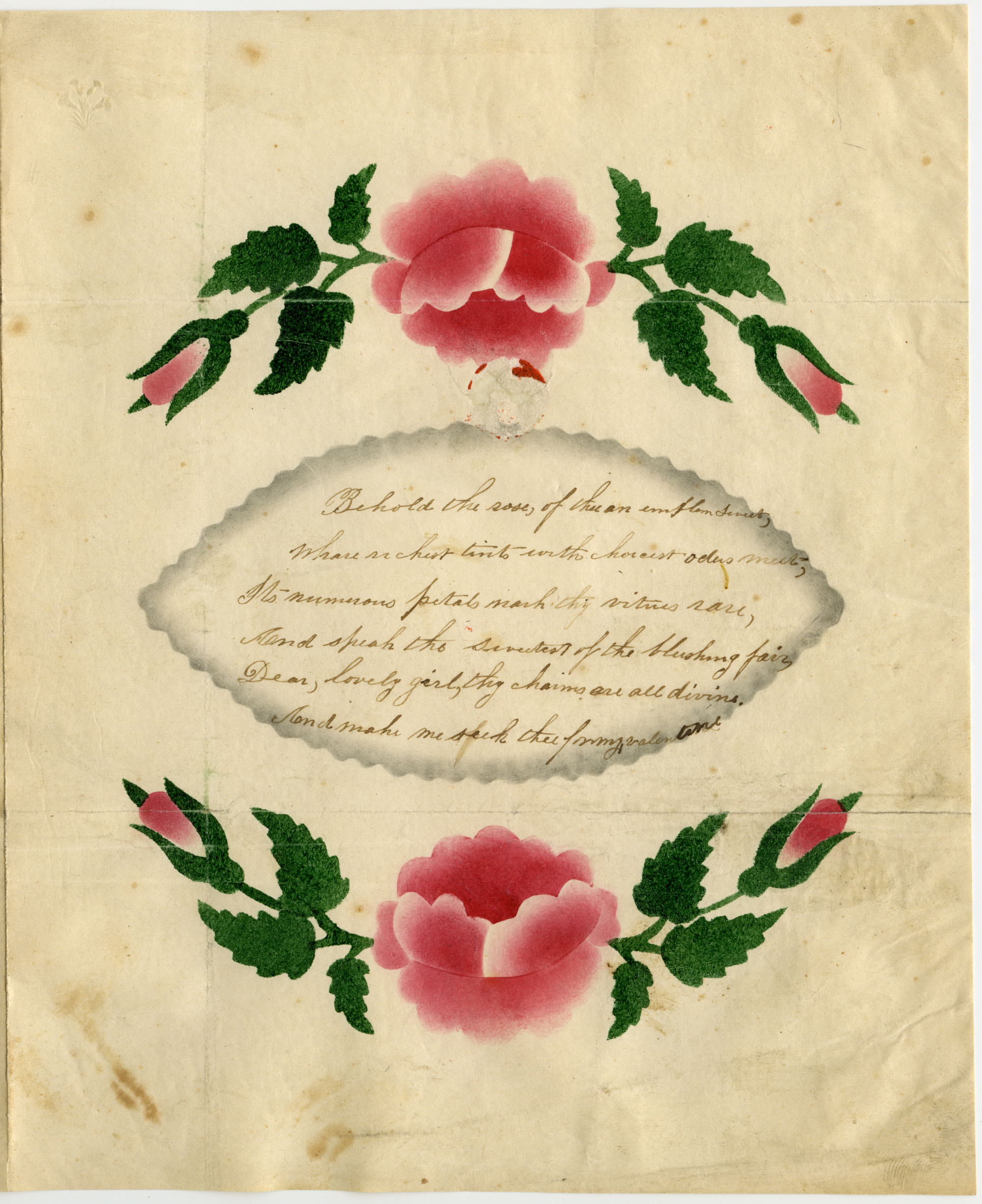
In 2010, the Graphic Arts department will be evaluating and re-housing its collection of nineteenth-century valentines. We have over 3,000 of these lacy, be-flowered paper objects and they are being sorted to provide better access for readers. Due to the high number and complexity of each object (some have moving parts, accompanying envelopes, etc., while others require elaborate folds) the project will be spread out over multiple calendar years. These items call out for individual blog entries, so expect a few!
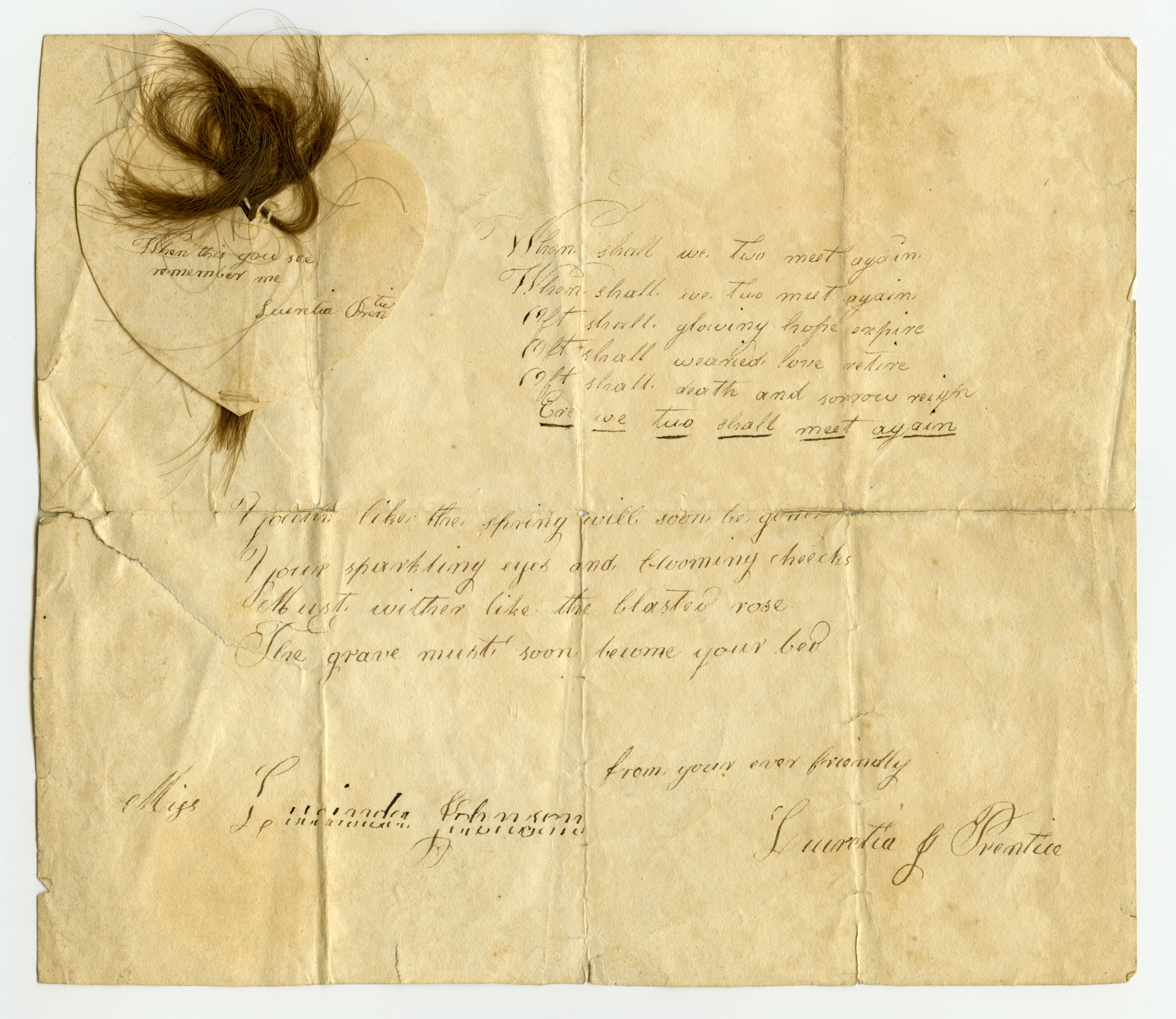
One area of the collection of particular importance is the manuscript valentines. These were handmade notes sent to a spouse, friend, or relative. They are often decorated with elaborate calligraphy, word puzzles, or watercolor drawings. The earliest dated manuscript valentine in the collection is a folded puzzle that was made in 1832. Other manuscript valentines in the collection, including a handwritten poem by Lucinda Prentice for her cousin (at left & dating from before 1825) pre-date this example, but, as their sender did not choose to include the date in their salutation, they are temporarily relegated to the “not dated” portion of the manuscript collection (let this be a lesson to us all – always date your correspondence!).
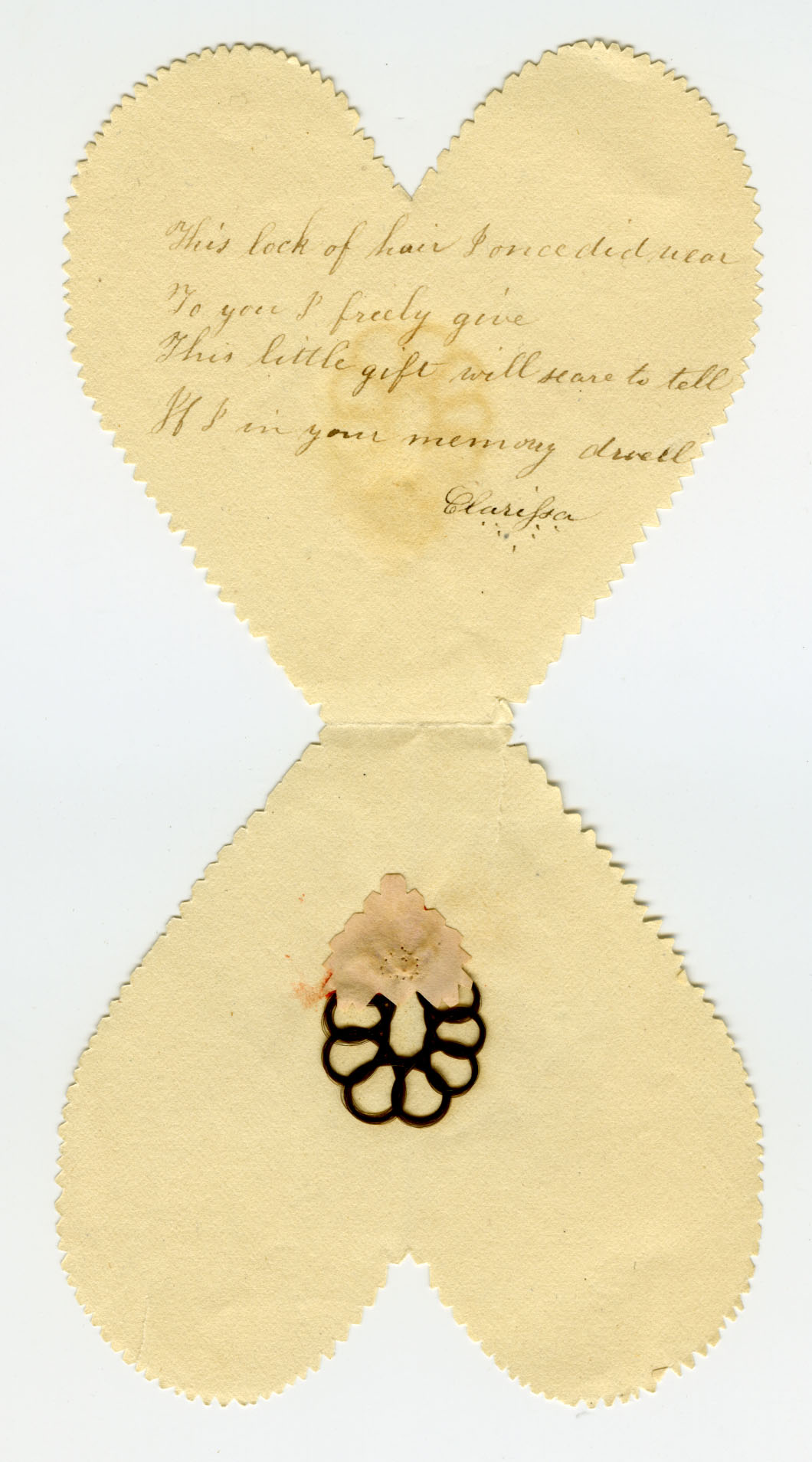
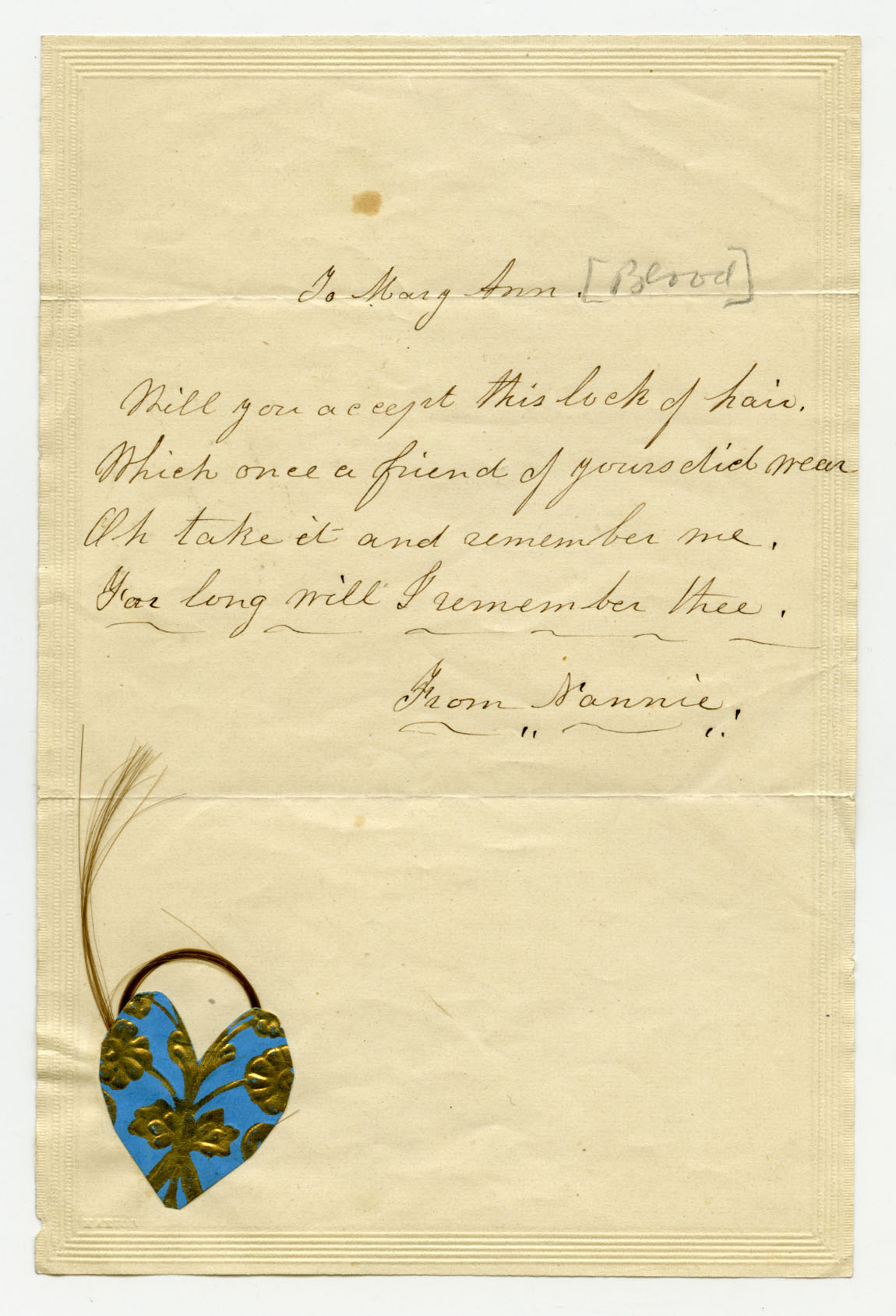
As I have been processing the manuscript valentines, examining and foldering each item, I am struck by how many missives include human hair. There are locks of hair, whole ringlets, and impossibly small looped braids of hair. Poetic verses such as: “Remember me when this lock you see,” and “This lock of hair I once did wear,” appear frequently with accompanying hair decorations glued, sewn and pasted down in all sorts of creative ways.
All of these “hairy Valentines” caused me to think about how the perception of human hair has shifted over the centuries. If I suggested to my eleven year old that she make a decoration out of her hair to send to her best friend or grandmother, I am fairly certain that the response would be, “Mom, that’s gross!” And I am not at all sure what my own reaction would be to opening a letter and having a curl fall into my lap – I imagine there might be shrieking involved.
But in the 1840s and 1850s, hair was used for all sorts of craft projects, with periodicals like Godey’s Ladies Book offering design suggestions for homemade jewelry, buttons, and even elaborate hair pictures for framing. The Society’s miniature collection features a likeness of Andrew Craigie, Jr. in a locket case backed by intricately woven hair. The daguerreotype collection includes several images of the Barton family (including the famous Clara at a young age) with scraggly lengths of hair pinned inside the cover of each case. Hair occasionally turns up in books, too, such as the curl pressed into an 1845 New England primer in the Society’s collection, which is accompanied by the inscription: “My youngest brother’s locks.” The business side of the hair market is documented elsewhere in the collection, including a c. 1806 trade card for a Salem jeweler who states, “Hairwork neatly executed,” and a 1870s broadside from New York with wholesale prices for “human hair and hair goods.”
In her 2007 publication Love Entwined: The Curious History of Hairwork in America, author Helen Sheumaker writes, “Revulsion, squeamishness, curiosity and sometimes a sentimental cooing: these have been the principal responses to hairwork that I have encounters in the years I have researched its history” (p. vii). The valentines are no exception, having elicited grimaces, gasps and questions from researchers and staffers as they pass by my work space where the valentines are spread out for examination. So, this coming Valentine’s day consider our ancestor’s acceptance of human hair as token of affection and make your own decision on what to include in a card for your Valentine. My family and friends will all hopefully stick with flowers and chocolate!
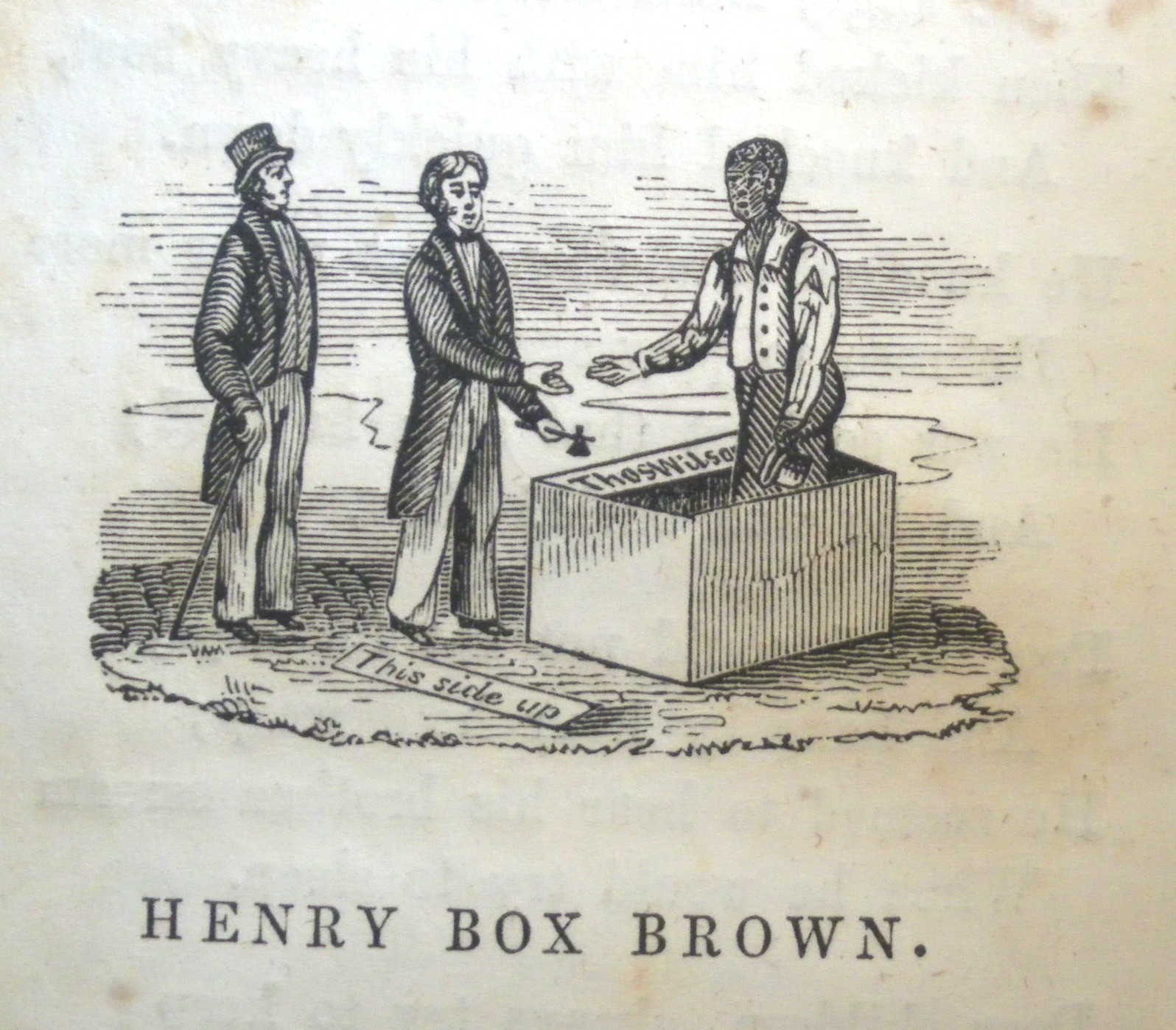
Henry Box Brown (b. 1816) escaped lifelong slavery in Virginia by shipping himself in a box (with the help of white and African-American abolitionists) to Philadelphia in 1849. One of the few primary sources detailing his breathtaking escape to freedom is the children’s book Cousin Ann’s Stories for Children. Written in 1849 by Quaker abolitionist and pioneer female physician Ann Preston (1813-1872), her account conveys in simple but deft language, Brown’s death-defying journey:
The box was three feet long, two feet eight inches deep, and twenty-three and a half inches wide. Then, he got a kind man to send word to a trusty friend in Philadelphia, that the box would be sent on the cars to Philadelphia on a certain day. On the top of the box was written in large black letters, ‘this side up with care.’ When it was nearly time for the cars to start, Henry took a bladder of water, some biscuit, and a large gimlet, and got into his box. Then a man nailed down the top, and porters took the box to the cars, thinking … that it was a box of goods. It was very hot in the box, and Henry could hardly breathe, there was so little air. But he made up his mind to die rather than make a noise … Part of the way he travelled by water, and when the box was put on the steamboat, it was placed so that Henry’s head and back were down … He lay in this way, while the boat went twenty miles, and it nearly killed him. He staid in his little box-house twenty-six hours; but could not eat any of his biscuit, and instead of drinking the water, he used it to bathe his hot face.
Thankfully, Henry survived, and he emerged out of his box at the home of an abolitionist. His jubilant emergence is captured in this wood-engraved illustration from Cousin Ann’s Stories, as well as in a political cartoon, and two broadsides held at AAS. Brown, himself, described his journey in the Narrative of Henry Box Brown, first published in Boston in 1849.
Ann Preston concludes her story about Henry Box Brown with a profound comment on the meaning of true heroism:
We call people heroes who do something that is brave and great, and Henry is a hero.
Henry Box Brown’s story has been told to a whole new generation of young readers by writer Ellen Levine and illustrator Kadir Nelson’s evocative picture book Henry’s Freedom Box (2007), which was named a Caldecott Honor Book. Levine and Nelson skillfully convey the sadness and hope of Henry’s story, and the book provides an incisive introduction to the historical understanding of American slavery for today’s children.
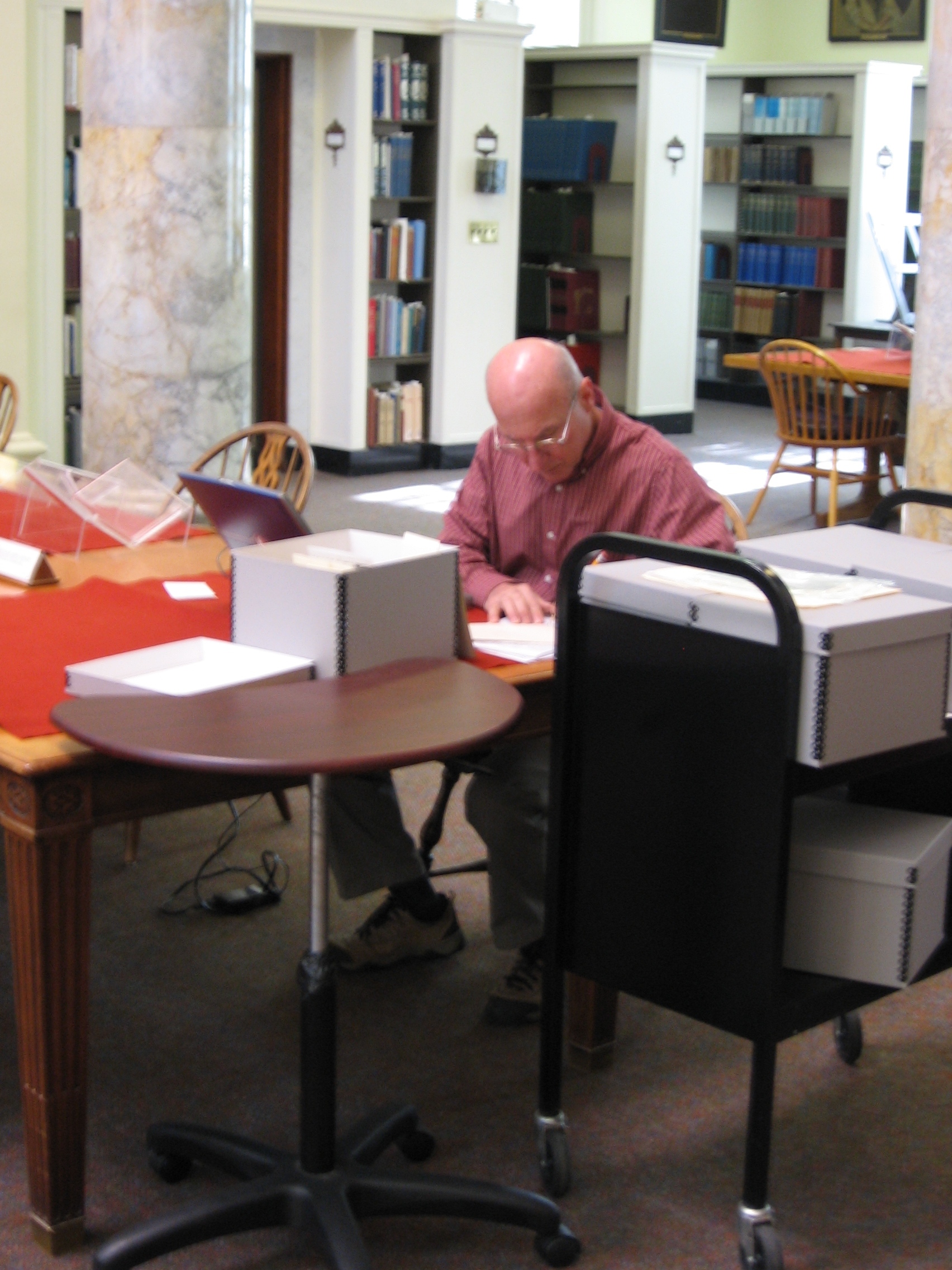 He is also an organized sort of person and is willing to dedicate several hours of his time each week to the Society. Previously he has helped us to sort and folder our political cartoons, broadside advertisements, and Civil War era maps. For the Wohlbrück project, he has proved to be a perfect match. Often he is able to identify an image based on his own experience and knowledge of a town. Many of the prints were captioned by Wohlbrück and Bill has learned to decipher the photographer’s scrawling handwriting. While we are still processing the collection and hope to order materials for improved housing, Bill has already sorted and reboxed the prints and created a very useful box list of the collection, organized alphabetically by town. An itemized inventory listing each photograph is currently underway as Bill continues his work.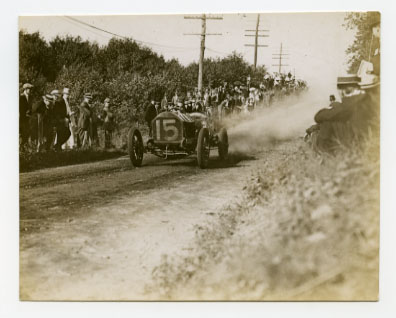
 What do we think about when we think about the history of the book in the U.S. South (for those of us prone to think about such things, that is)? It is received wisdom that the South was much less industrialized than the North in the first half of the nineteenth century. And, if print was one of those areas of production that was subject to increasing industrialization, it must follow that there was less printed matter in the South: fewer books and newspapers, and consequently also fewer writers and readers.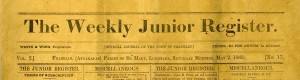



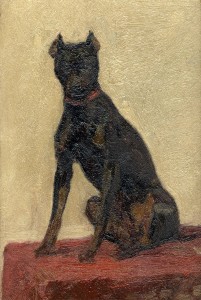 Louis Maurer