Finding Abraham Lincoln at AAS

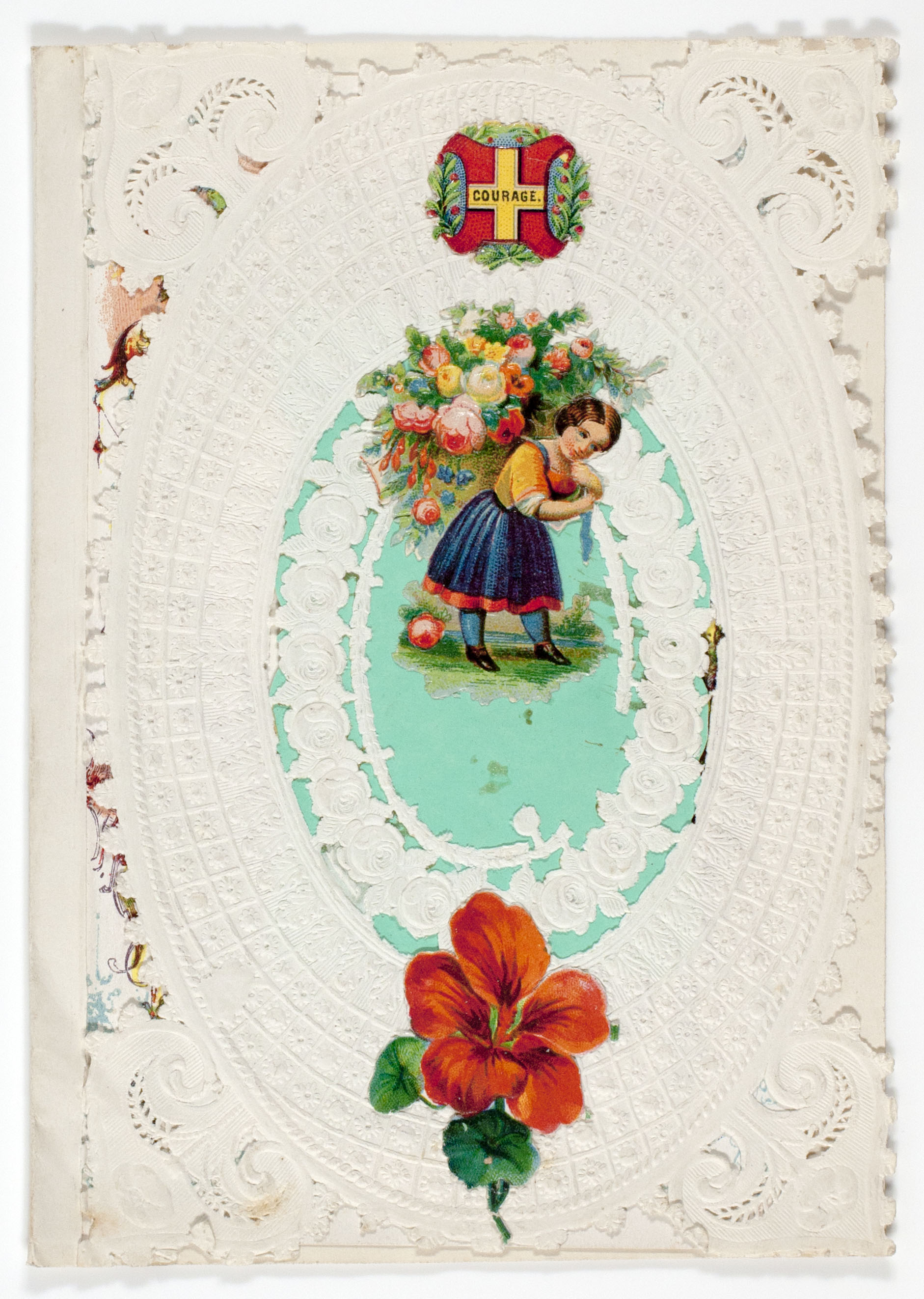
Lincoln Cartoon
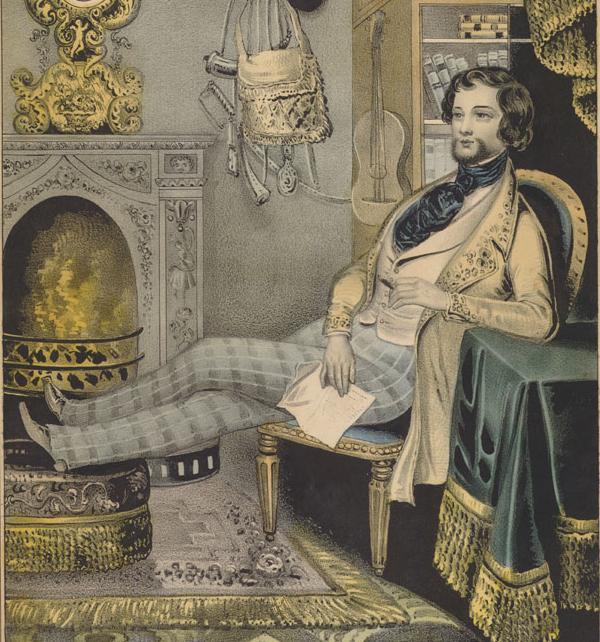
Detail from a political cartoon depicting an admirer of Lincoln. Click on the image to see the entire Currier & Ives print, The Republican Party Going to the Right House (1860)

Abraham Lincoln is a hot topic these days.  From renowned historians to local students, everyone is interested in learning more about the man who once declared: “I was born and have ever remained in the most humble walks of life.” While Lincoln has been a perennial favorite for researchers at AAS, recently interest in him has picked up even more due to a confluence of anniversaries. Two years ago, on February 12, 2009, we celebrated the bicentennial of Abraham Lincoln’s birth and this year marks the beginning of the sesquicentennial of the Civil War.  The Washington Post has even devoted an entire blog to the 150th anniversary of the Civil War, A House Divided, and in a recent post commented on how Lincoln (not surprisingly) remains an important part of that commemoration.

For our part, AAS will be hosting two free public lectures this May related to Lincoln and the Civil War. On Thursday, May 12, James O. and Lois E. Horton will present: “Liberty and Justice for All: The Civil War as Blacks’ Second American Revolution.” The Hortons are currently Mellon Distinguished Scholars in Residence at AAS and are in the reading room each day working primarily on a project titled: “A Documentary History of African Americans from 1619 to the Civil War.” Later in the month, on Tuesday, May 24th, David S. Reynolds will present: “Igniting the War: Harriet Beecher Stowe’s Uncle Tom’s Cabin, Antislavery Politics, and the Rise of Lincoln.” So be sure to mark your calendars or read more about these and other upcoming public programs here.

It is not only scholars who are excited about Lincoln. Currently at AAS we have a Worcester Polytechnic Institute student working on an online exhibition and inventory of the Lincoln portrait prints from our American Portrait Prints collection.  As part of a semester-long project for Professor Jim Cocola’s “Textual Engineering” course, Amber Truhanovitch is photographing, describing, and tracking down sources for the 116 prints of Lincoln in the collection.  Stay tuned for an update when her project is finished.  Her work will complement our growing collection of online finding aids that assist researchers in finding materials not yet in our online catalog.

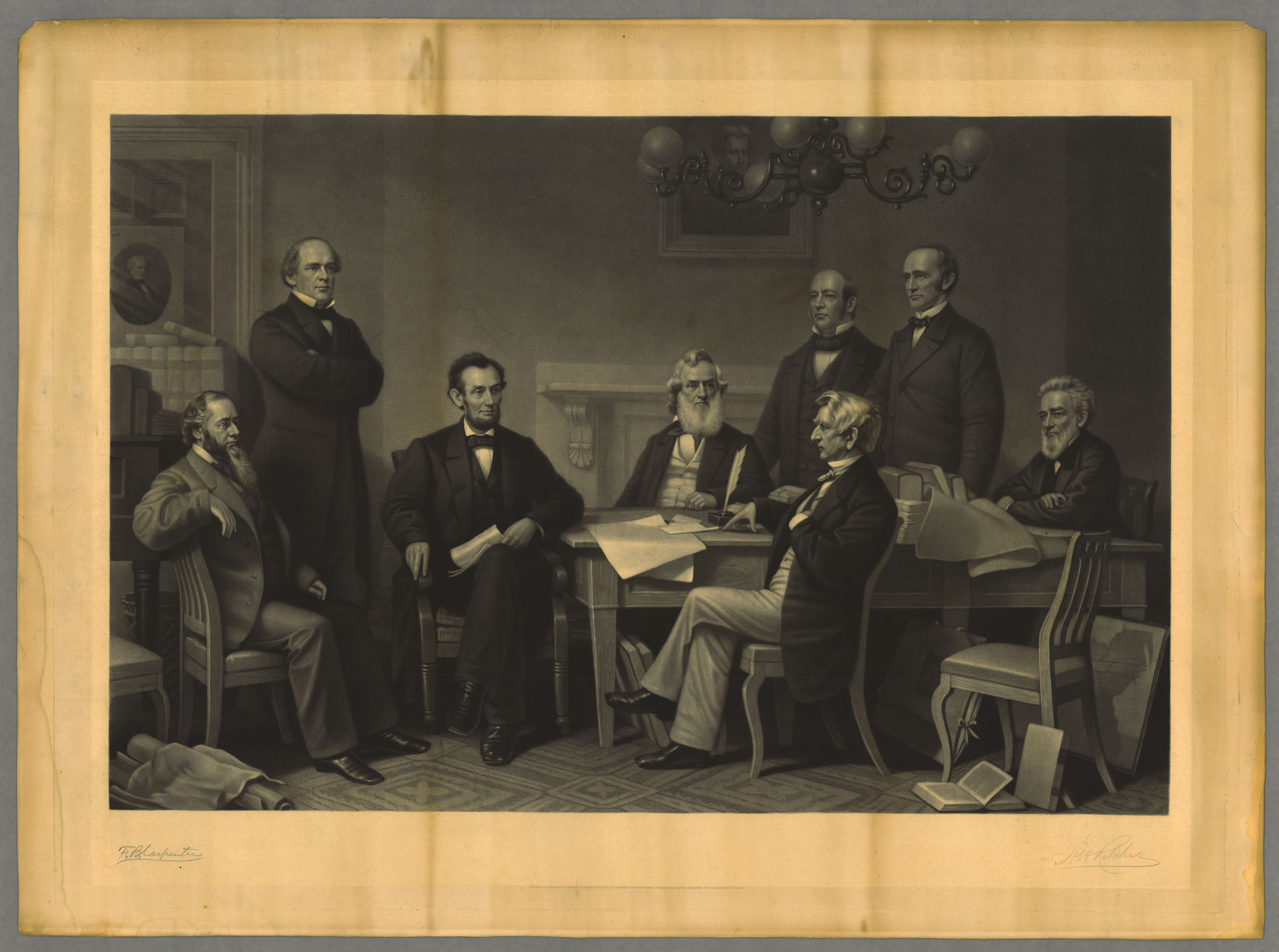
First Reading of the Emancipation Proclamation
The First Reading of the Emancipation Proclamation Before the Cabinet (1866). Click on the image to enlarge.

Indeed, the Graphic Arts collections generally at AAS are vital for any researcher hoping to understand Lincoln’s life and times.  When Bancroft-award-winning historian William Freehling gave the 2009 Baron lecture at AAS, he displayed one of our prized prints, The First Reading of the Emancipation Proclamation Before the Cabinet.  The Graphic Arts department houses not only the print, which was sold as a premium plate to New York Independent subscribers, but also the proof for the plate (click here to see the online catalog records for both).  AAS’s sizable collections of other graphics — including Civil War cartoons, Civil War envelopes, and cartes-de-visite — often feature Lincoln.

Additional AAS collections — including other prints, broadsides, political cartoons, songsters, ephemera, newspapers, and children’s literature — all supply the Lincoln scholar with endless sources for research and study. Most of these materials can be found by searching the AAS online catalog for “Abraham Lincoln” as a phrase. This search results in over 750 hits (click here to see for yourself), all of which goes to show just how easy it is to find Abraham Lincoln at AAS!

Portraits — Online and On The Acquisitions Table

Here is a fun anecdote from Graphic Arts curator Lauren Hewes that highlights both the value of AAS’s online illustrated inventories and how our online resources can help to put new items on The Acquisitions Table:

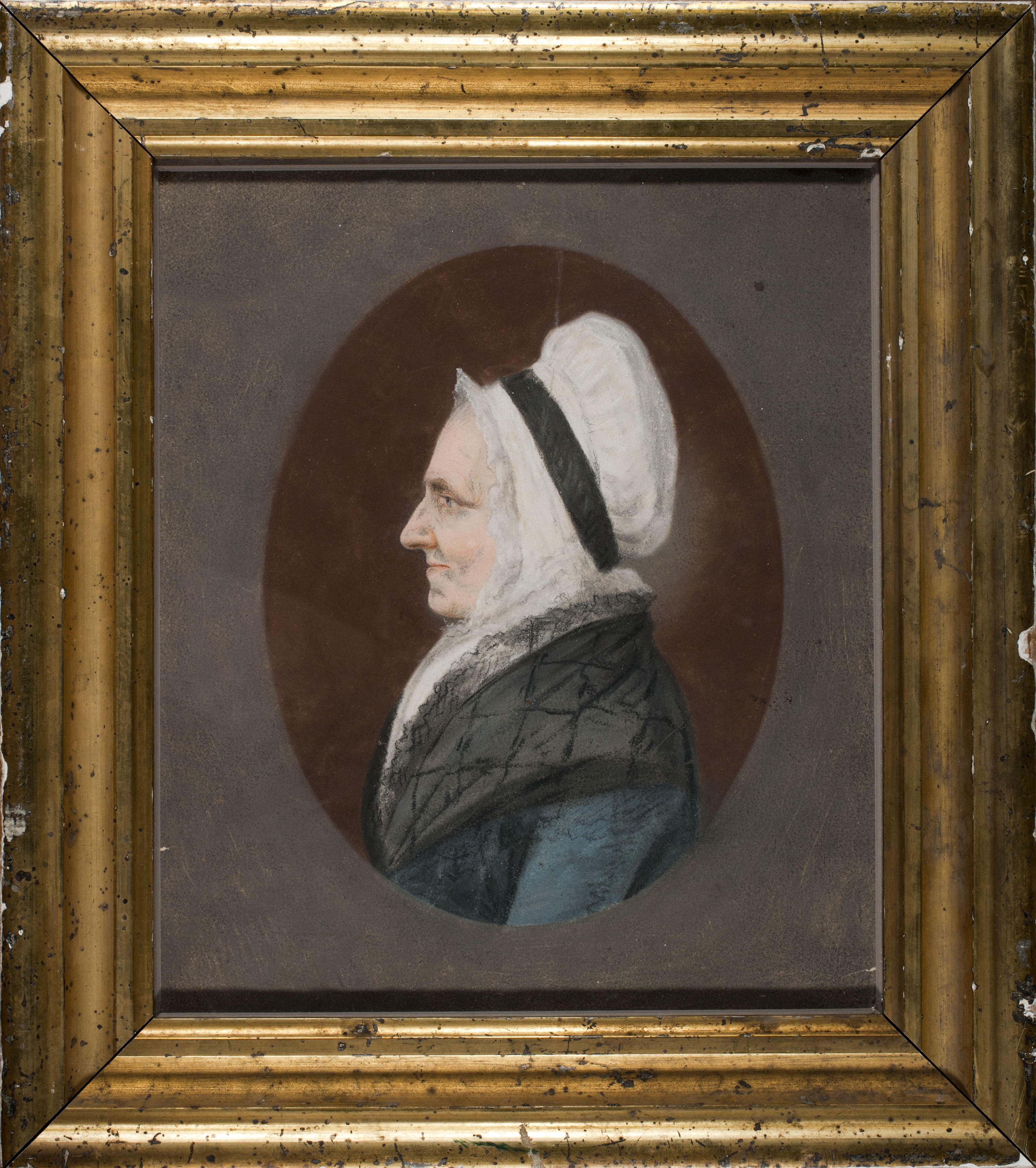
Pastel portrait of Hannah Church Weld by Gerritt Schipper, 1804

One day this past year a dentist in Alabama was on Google searching for more information about a pastel he had bought at a Louisiana auction in 2009. In his search he came across our AAS portraits online, including illustrations and text about all of our painted portraits.  He contacted me with questions about the artist Gerritt Schipper and we had a lovely correspondence, which resulted in the Society purchasing the pastel shown at right.

The profile portrait is of Hannah Church Weld (1733-1804), the wife of Edward Weld, a prosperous Boston merchant.  Her portrait was of interest to AAS for a number of reasons, but the one that tops the list is that Mrs. Weld was also the mother-in-law of Isaiah Thomas, Jr. and we are particularly interested in materials relating to the family of our founder.  The AAS portrait website contains images and information on the six pastels of the Thomas family made by Gerritt Schipper in 1804 (which is how our Googling dentist found us).  Schipper drew pastel portraits of two of her daughters during his travels in Boston, Salem, and Worcester in August and September of 1804. Hannah Church Weld died in September 14th, 1804, and so, if done from life, this could be the last likeness made of her, taken at the age of 71.  Alternatively, the pastel could have been completed posthumously.  The early ownership of the pastel is unknown, but based on an inscription on the verso, the piece came down through another line of the Weld family and was not owned by the Thomas’s.  Now it has found its way back to a permanent home with the other Thomas family portraits.

The online illustrated inventory of AAS portraits describes a fascinating collection that many people, even those who know AAS well, don’t know that we have.  Along with images of the oil paintings, busts, and miniatures, the website contains biographical portraits and catalog information from the book Portraits in the Collection of the American Antiquarian Society by Lauren Hewes (available for purchase from Oak Knoll).

In the online Introduction to the American Painted Portrait and Sculpture Collection, Georgia Barnhill and Caroline Stoffel highlight some of the unique features of AAS’s portraits collection. For instance:

Since many of the portraits came to AAS together with manuscript collections or were commissioned by the Society, we have extraordinary information about the circumstances of their production. There are occasional first-person accounts of the process of sitting for portraits as well as important documents revealing the costs of the paintings and even their frames. Newspaper advertisements found in the AAS collection provide documentation about itinerant artists who came to Worcester. In an effort to obtain commissions for one artist, Isaiah Thomas, Jr., placed an advertisement in the September 12, 1804, issue of the Worcester Spy saying that examples of Gerrit Schipper’s portraits could be seen in his home or office. Other early nineteenth-century Worcester residents, such as Edward D. Bangs and Isaiah Thomas, traveled to Boston to sit for oil portraits by artists established in Boston studios; later in the century, Stephen Salisbury II went to New York for sittings with Daniel Huntington.

Some special features of the AAS portraits online include:

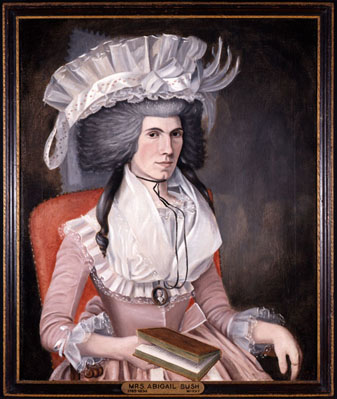
Hannah Ackley Bush (1767-1807), attributed to John Mackay or M’Kay, 1791

To highlight just one of the images, the striking Hannah Bush portrait pictured at right hangs over the card catalogs in AAS’s reading room and is a personal favorite of many visitors and staff alike. But could it actually be, as one reader suggested, a portrait of Daniel Day Lewis in drag? Click here for a picture of Daniel Day Lewis to compare to Hannah Bush’s portrait and decide for yourself.

Or just have fun browsing through the thumbnail gallery of portraits on your own — you never know which one may strike your fancy!

The Acquisitions Table: Sophia May Tuckerman Letters

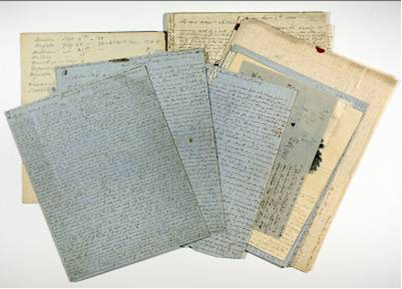
Tuckerman, Sophia May. Letters, 1841-1857.

Sophia May (1784-1870) was the daughter of Col. John May (whose jaunty portrait in military uniform hangs in the AAS reading room) and his wife Abigail, who was also his cousin. Sophia May married Edward Tuckerman (1775-1843). AAS has a business letterbook of Edward Tuckerman’s firm of Tuckerman and Rogers. Among their children was the botanist Edward Tuckerman (1817-1886), a large collection of whose correspondence is at AAS. Sophia May Tuckerman travelled abroad extensively and these letters were written during her travels. The earliest are from 1841, but most date to the period between 1849 and 1857, after Edward’s death. They are addressed to her children and other family members. We are always particularly happy to add manuscript material to the collections that is closely related to material already here. Gift of Thomas S. Michie.

Public Programs Reach an Even Wider Audience with Podcasts

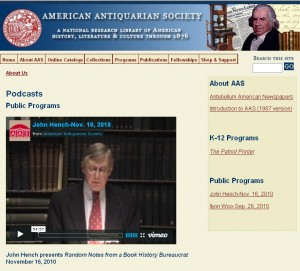
Every spring and fall AAS produces a series of public programs and offers them to the public at no charge. While we often see over a hundred people at these presentations, we are now expanding the audience for these programs by presenting recorded podcasts of them.  The web page Podcasts from the American Antiquarian Society currently has two of our latest programs by John Hench and Ilyon Woo. Additionally, the site contains other short films created by and about the Society including a promotional video featuring Walter Cronkite for the Society’s 175th anniversary celebration in 1987.  We hope to add additional video segments and to post podcasts of our lectures shortly after each is presented as part of our public program series.

John Hench delivered the twenty-seventh annual James Russell Wiggins lecture in the History of the Book in America on November 16, 2010. The podcast captures all the wit, wisdom, and reflection of John’s wonderful program.  John was formerly the senior vice president for collections and programs at the Society and worked here for thirty-three years before his retirement in 2006.  He was instrumental in conceiving and then administrating the Society’s seminal Program in the History of the Book in America and his talk recounts that important chapter in the Society’s history. John brilliantly describes his own fascination with books throughout his childhood, education, and professional career culminating in his latest scholarship on the role American publishers played in rebuilding post-World War II Europe.

Ilyon Woo conducted research at AAS for her recently published book The Great Divorce as a Kate and Hall J. Peterson fellow during the 2004-05 academic year.  The podcast of her lecture, delivered on September 28, 2010, details how Ilyon’s experience at AAS transformed her project both because of the key evidence she uncovered in the library and how her interactions with AAS staff and other fellows helped her to sharpen the narrative arch of her story about a woman named Eunice Chapman who fought her husband, the Shakers, and the conventions of American Society in the early 1800s to gain custody of her children.

Additionally, this webpage contains two other short films created as part of the Society’s services for pre-collegiate educators and their students.  AAS curator of newspapers, Vincent Golden is featured in one film describing the characteristics of antebellum newspapers. Vince shows us some temperance and anti-slavery newspapers as examples of those promoting a particular reform movement.  He also shares several journals published under the auspices of a political party.

Another short film entitled “The Patriot Printer” imagines Isaiah Thomas printing the May 3, 1775 issue of his paper The Massachusetts Spy, which contains Thomas’s account of the Battles of Lexington and Concord.  Thomas, as portrayed by actor Neil Gustafson, describes the characteristics of eighteenth-century newspapers as he hands his latest issue to post riders who will dispatch it to the rest of the colonies. He then stresses the importance to the nascent American rebellion of controlling the narrative of the first battles of the war.  Both of these videos are also on the Society’s website designed specifically for K-12 populations: www.teachushistory.org.

And finally, the podcast page features a historic film created as part of the Society’s 175 anniversary celebrations.  Narrated by former CBS-TV journalist Walter Cronkite, this program describes the Society’s collections and programs and offers us a fascinating time capsule of how we lived in 1987.  We are now in the process of creating a new film promoting the Society as part of our 200th anniversary in 2012.  When completed, it too will be added to this podcast page.

The Acquisitions Table: How ’tis done

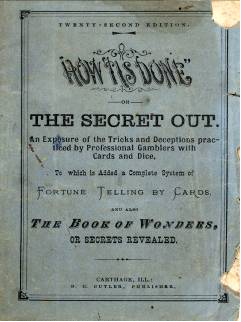
How ‘tis done; or The secret out. An exposure of the tricks and deceptions practiced by professional gamblers with cards and dice … 22nd ed. Carthage, IL: D. C. Cutler, [ca. 1869?]

From a small Illinois town 10 miles east of Keokuk and the mighty Mississippi, D. C. Cutler ran a mail-order business for cheap chapbooks, “splendid colored engravings,” and handy devices such as the “magic comb … [which] will color gray hair a permanent black or brown,” as listed in the 16-page catalog appended to this pamphlet. A few of these chapbooks Cutler published—or rather, reprinted—himself, complete with cheerfully disregarded copyright notice. The copyright for How ‘tis done, for example, was owned by Hunter & Co. of Hinsdale, NH, which published its own editions beginning in 1864. Only the first seven pages detail the card sharp’s tricks; the remaining pages discuss “cardiology” (i.e. “the science of foretelling events by cards”), and offer recipes for useful concoctions such as “imitation liquors.” The Cutler edition is unrecorded. Purchased from Ian Brabner. Harry G. Stoddard Memorial Fund.

Paper Rituals

It is perhaps not surprising that we can be a little obsessive about our paper here at AAS. However, a recent influx of interns reminded me how strange all the paper shuffling that goes on at the desk can appear to an outsider. People new to doing research at AAS, upon being asked to present their exit card or asked where their pink slip is, are often — not surprisingly — perplexed. After all, can you even be given a pink slip and get fired as a reader?

While the seemingly endless paper shifting may, at first glance, appear merely obsessive, it is absolutely essential in a closed-stack library. (To read about other seemingly odd terms at a research library, click here.) After all, every time an item leaves its home in our climate-controlled stacks there is a risk of it being mishandled or misplaced. To prevent any such disasters, a variety of pieces of paper create a sort of bread-crumb trail for each book or item. The paper trail for each item marks its way safely out of the stacks and then back again to its original spot, where it will remain secure until called for by the next reader.

So you see why the rituals of working at the reference desk rely heavily on moving pieces of paper from one spot to another. Each type of paper has different rules for its usage, where it should be kept and returned to, etc. Carefully choreographed movements specify exactly where each type of paper should go and signify a variety of messages to those “in the know.” Here’s the inside scoop on the paper rituals of Antiquarian Hall.

The Call Slip
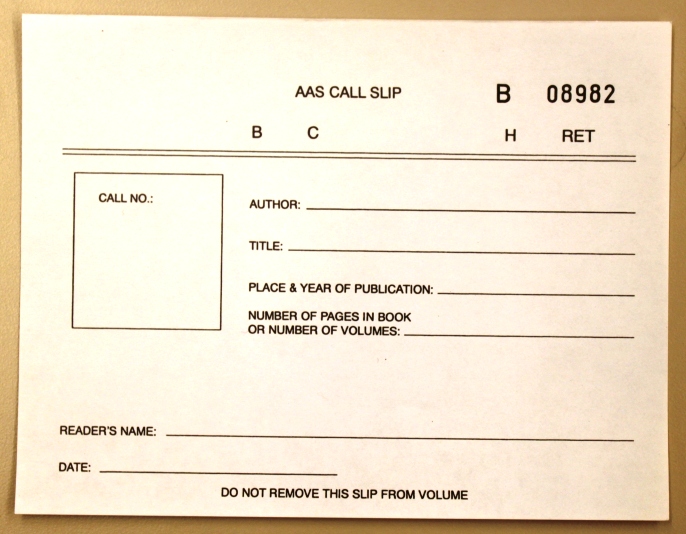
The call slip could be thought of as the “trinity” at the center of our paper rituals (although to do so may be rather sacrilegious). It contains three-parts-in-one and is absolutely essential to our paper rituals. Each call slip is numbered, and when readers write out the information about the materials they want on the top layer, it transfers to all the layers below. This way everything can be matched up exactly.

The White
The white is the top-most layer of the call slip and it becomes main player in our paper games. The white is filed in a box at the desk anytime an item goes out into the reading room so that we know to ask for it back at the end of the day. No one can go home until the box at the desk is cleared of white slips, because that means all the collection materials have been turned in.

The Pink Slip
Don’t panic! This pink slip is just the second part of the call slip. The pink slip must stay with the book or item at all times until it is returned to its proper home in the stacks. So I guess this makes a pink slip a good thing, and in fact a necessary thing, to have. Whew!

The Buff
If you hear us talking about “the buff” at the desk don’t worry: it has nothing to do with nudity. The buff is the last part of the call slip. It remains on the shelf in the stacks in back holding the place where the book (or other item) used to be.

Red Flags
Not for offensive technical fouls, these red flags are also technically not made of paper. Instead, the red flags are plastic sheaths that hold the buff so that it can sit nicely on the shelf in the stacks. This holds the place for the book and attracts attention with its bright fire-engine red. When it comes time to return everything and all the books on all the shelves start to look the same, these red flags make it easier to find the exact spot on the shelf where the book came from.

The Exit Card
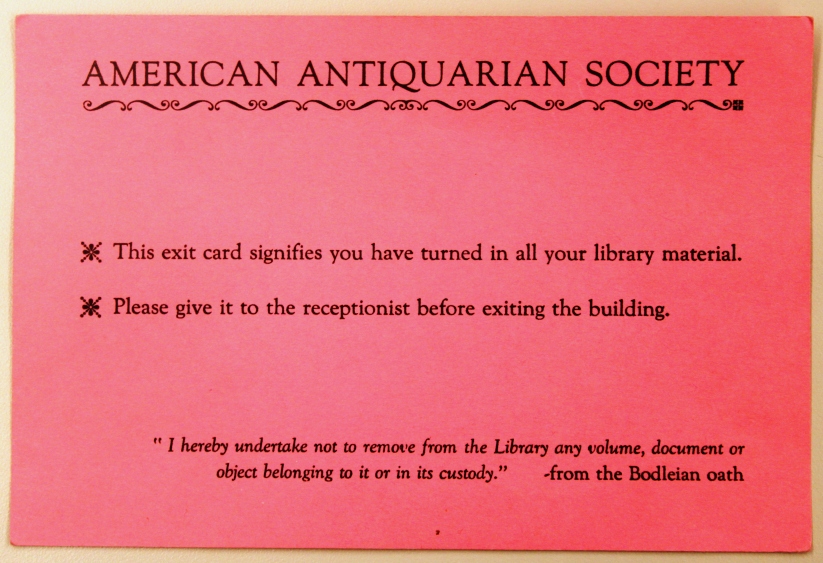
As a final check or security measure, we require that anytime readers want to leave the library building they must turn in all collection materials at the reference desk in the reading room and be issued an exit card. This card must be given to the receptionist before a reader will be allowed to leave the building. The exit card serves as our signal to the receptionist that readers have turned everything in and are free to go. Exit cards are sometimes known by other aliases at AAS, including “freedom pass” or “get-out-of-archive-free card.”

Tidbit You May Not Know: The AAS Exit Card got a makeover a couple of years ago by AAS’s own Jackie Penny and her husband. The current incarnation includes a part of the pledge users of the Bodleian Library in Oxford were required to sign, which reads (translated from the original Latin):

I hereby undertake not to remove from the Library, nor to mark, deface, or injure in any way, any volume, document or other object belonging to it or in its custody; not to bring into the Library, or kindle therein, any fire or flame, and not to smoke in the Library; and I promise to obey all rules of the Library.

We thought it better to leave out the part suggesting readers might even consider bringing in “any fire or flame.” Better not to plant the suggestion.

Now you know more than you ever wanted to about the paper rituals we engage in at the desk! So next time you see us moving all these little slips of paper around or someone asks you for your pink slip or exit card, you’ll know we’re not just making you play an obsessive game consisting of passing little pieces of paper around. Rather, you (and those little slips of paper) are vital participants a system to ensure access to and the safe return of AAS’s priceless collection material. And who wouldn’t want to be a part of that?

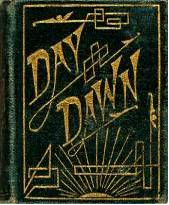
The Acquisitions Table: Day-Dawn

Day-Dawn. New York: American Tract Society, [ca. 1860]

Devotional books containing brief Bible passages for daily reading were frequently printed in two-inch miniature format so as to easily fit in a pocket. The American Tract Society was a major 19th-century publisher of these pocket devotionals. This title is new to AAS, and features a splendid gilt cover design of the rising sun. Purchased on eBay from Tracy Bradbury. Emma Forbes Waite Fund.

Hot Off the Press!

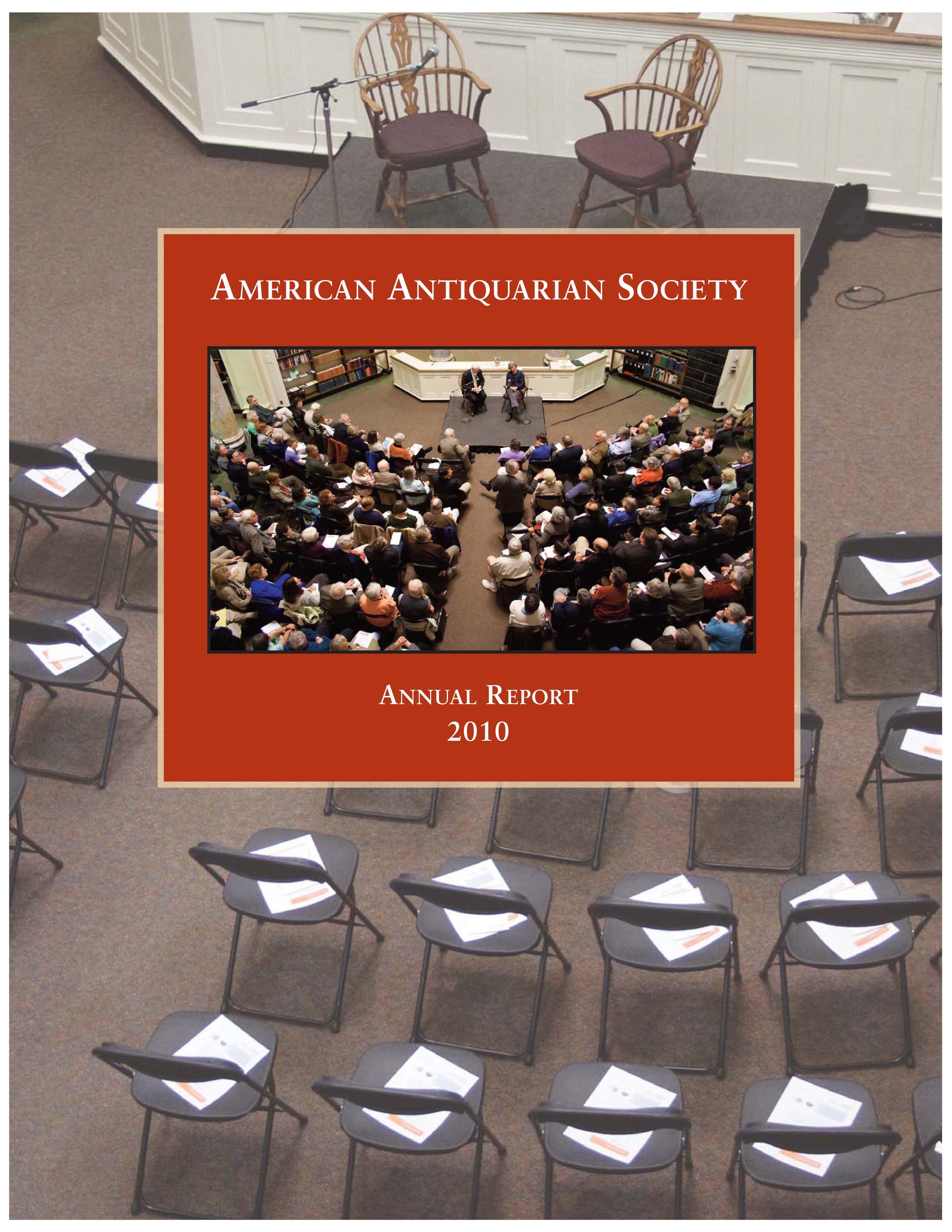
Our new 2010 annual report is available online! Click here to catch up on the past year at AAS with over 70 photographs of people, acquisitions, and some of the lively programs that were held here.

Our front and back cover photographs offer views seldom seen by visitors to Antiquarian Hall, since both were taken from the balcony overlooking the reading room. On the front cover, National Endowment for Humanities Chair Jim Leach and historian Jill Lepore take questions after their talk on incivility in American political discourse. Incivility – indeed, incendiary language and symbolism – continue to be a prominent national concern and we were happy to be the only Massachusetts venue for Jim Leach’s 50-state speaking tour.

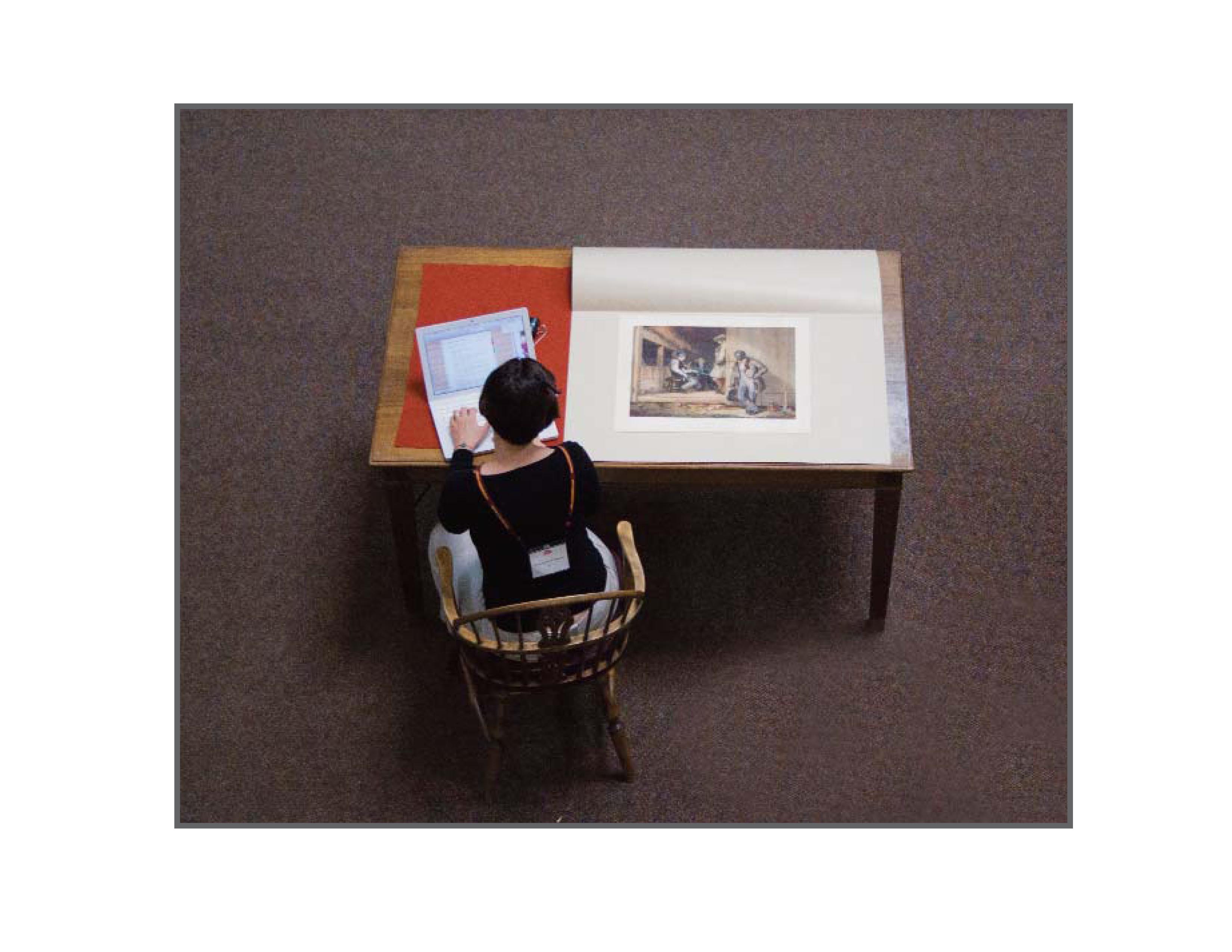
The serene photograph on the back shows an American Historical Print Collectors’ Society Fellow doing research. I was amused when Lauren Hewes, Andrew W. Mellon Curator of Graphic Arts, and Gigi Barnhill, director of our Center for Historic American Visual Culture, both identified the print as Alphonse Léon Noel’s “The Power of Music” (1848), a hand-colored lithograph after a painting by William Sidney Mount. An impressive ID from the second floor, and yes, they both know the Society’s collections well.

Enjoy the entertaining descriptions of recent acquisitions written by the curators, from instructions for playing the banjo, “an instrument which has ever been considered a mystery unknowable,” to a handbill describing how betting against Abraham Lincoln’s election led one man to walk from Boston to Washington, and keep walking. A separate post is promised on one of the more colorful collection items pictured: an 1871 issue of the National Police Gazette with its sensational coverage of crimes of passion.

Our free public programs ran the gamut last year from a brief history of thrift in America to a spellbinding series on John Brown, a hair-raising tale of witch hunts in Hartford, and a look at the causes of the Civil War.

Each week, researchers request an astonishing variety of items. On one summer afternoon when the circus posters came out, I marveled again at the sheer variety of our collections. These large-scale posters conjure up all the rumbling excitement of the circus rolling into town in the 1850s (see photo on p. 12). Leaf through AAS’s annual report to see other collection items and read about what it’s like to do research in Antiquarian Hall. And if you’re in the area, come to a public lecture or sign up for a seminar. There’s a lot going on at the American Antiquarian Society – please join us!

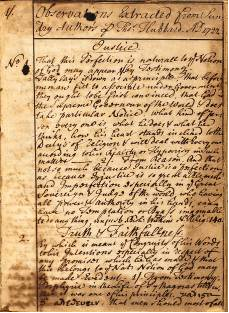
The Acquisitions Table: Thomas Hubbard’s Commonplace Book

Hubbard, Thomas. Commonplace book, 1722-1805.

Thomas Hubbard (1702-1773) was born in Boston, the Son of Joseph and Thankfull (Brown) Hubbard. He was a successful merchant in Boston, for a time the treasurer of Harvard and also the Commissary General of the province of Massachusetts. Hubbard began to compile this commonplace book in 1722, the year following his graduation from Harvard College. The notes include brief extracts from published works on subjects such as “Riches,” “Life it’s Shortness,” “Free Will,” and “Christ’s Descent into Hell.” The volume also contains the diary of an as-yet unidentified man who lived in or near Neeedham, MA. The entries, spanning the period from 1784 to 1792, consist mostly of records of his church attendance, although there are also some entries concerning his daily activities. Gift of Stephen Gronowski in memory of Kurt Gronowski.

Clerk and the City

This lithograph titled “Single” and published by James Baillie (New York, 1848) doesn’t actually depict our man about town, Nathan Beekley, but we feel it captures his spirit — and Beekley did play the violin).

We began the new year with a teaser post on “Love and the Library” that introduced our new line-a-day subject, Nathan Beekley. We are now proud to debut the site based on Beekley’s diary for 1849, Clerk and the City .  Beekley’s daily blog posts will appear in the sidebar on Past is Present, but you can read up on the first two weeks (including extensive extra illustrations and historical commentary on Beekley’s original entries) by visiting https://clerkandthecity.wordpress.com/.

The Clerk and the City blog is based on the hard work of two amazing interns at the American Antiquarian Society. Chelsea White transcribed the entire diary from the original in AAS’s manuscript collections and wrote last week’s post. Maury Bouchard has done a tremendous amount of additional research on our clerk in an iron factory, including actually mapping Nathan Beekley’s world.

To whet your appetite, here is an excerpt from the biographical sketch of Beekley written by our AAS intern, Maury Bouchard:

Nathan Beekley kept a diary for the whole of 1849 in which he describes an active social life including frequent calls upon young ladies whose names are obscured for propriety’s sake, and a thirst for knowledge. This is typical of young clerks working in the big city in the 1840s according to Brian P. Luskey, author of On the Make: Clerks and the Quest for Capital in Nineteenth-Century America (New York University Press, 2010). In one key area, however, Beekley does not fit Luskey’s model of a city clerk. Nathan, for one, does not appear to be very interested in financial advancement. At least he does not discuss his work very often in his diary. There is very occasional mention of being in the Counting House (of Reeves, Buck and Co, 45 N Water Street, manufacturers of nails and railroad iron) and one mention of asking for and receiving a raise to $500 per annum.

Young Mr. Beekley, though, has much to say on the cultural events of the day. We learn much about the plays, concerts, operas and other performances in his city. He is not reluctant to give his opinion of performances, good or bad. He attends church regularly, often two or three times on a Sunday. He appears to relish the sermons and he makes a point of attending lectures when the opportunity arises. He makes frequent trips to Norristown (six miles distant) where he lately worked in the “type-sticking business” and where he has many friends.

Mostly though, Beekley is looking for a wife. His diary is replete with references to young ladies he calls upon almost every day. Who are E____h S__d__n and F__y C___t and how do they feel about Nathan’s attentions? There are also the Misses West and MacKay and young female friends who pose as cousins to avoid raised eyebrows as they gain entrance to his lodgings. The life and loves of a mid-19th century iron clerk are not exactly Melrose Place-material, but remain fascinating none the less. [Continue reading]


We hope you will enjoy the fruit of our labors, and that you all have as much fun as we have getting to know this engaging young man on the make as he pursues love and culture on the streets of Philadelphia.

The Acquistions Table: Handbill featuring illustration by David Claypool Johnston

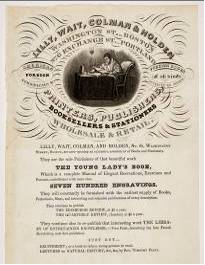
Lilly, Wait, Colman & Holden Printers, Publishers, Booksellers & Stationers. Handbill with illustration by David Claypool Johnston. Boston: Pendleton, 1833.

This small handbill advertising a new shop for a Boston book publisher arrived as part of a generous gift of David Claypool Johnston material from AAS member David Tatham. After checking the Society’s Johnston family archive, available online, Tatham suspected the handbill might duplicate an item in the trade card collection, but in fact it proved to be an earlier issue. The trade card is actually an 1834 bill head for the firm of Lilly, Wait, Colman & Holden, but Johnston’s name (engraved in very small letters just below the central image) has been effaced. The handbill dates from 1833, based on the two new publications announced therein.  D.C. Johnston did some other engraved work for Lilly, Wait, Colman & Holden in this period, including illustrations in an anti-slavery tract and a school geography text. We are very pleased to add this Johnston item, and the other material donated with it, to our holdings. Gift of David Tatham.

The Acquisitions Table: Ella Cameron

Ella Cameron, or The maid, wife & widow of a day. An extraordinary revelation, being a true picture of high life in Washington … By an ex-member of Congress. Philadelphia: Barclay & Co., 1861.

AAS owns nearly 80% of all pre-1877 titles listed in Lyle Wright’s bibliography of American fiction. Every quarter we add a few more—as well as various reprint editions of titles already here—but it is slow going. A fine copy in original wrappers of the anonymous novelette Ella Cameron recently fell into our dragnet. The daughter of an ex-governor of South Carolina, Ella is the toast of late 1850s Washington society, with Walter Moreland, “a young Texan of high birth but reduced fortune,” in hot pursuit. Stuffy old Colonel Leonard stands in the way, but Moreland strategically “wings” him in a duel, then replenishes the family fortune with $25,000 won at cards at “a magnificent gambling saloon” where “grave senators were seen in conversation with the well dressed roué and gambler.” Hastening off to New York’s dodgy Five Points district, Moreland hires a band of lowlifes to “kidnap” Leonard and his still-virginal bride, but the bumblers kill him instead. Crazed by greed, they demand Ella’s diamonds at gunpoint, but Moreland appears and now proves a surer shot. Still, both Ella and Moreland take bullets. “Their wounds were found to be quite serious but not necessarily mortal,” and following a respectable recuperation/courtship, they are finally wed. Purchased from Between the Covers. Henry F. DePuy Fund.

Fanny and Nathaniel: Love in the Library

Chelsea White, past AAS intern and present Simmons MLS student, has transcribed a diary from AAS’s collections that will become our newest Line-a-Day blog debuting with the new year.  Here is her introduction:

If you’ve enjoyed reading the A Day in the Life of a Blacksmith or the A Day in the Life of a Schoolmarm blog, then I think you’ll be excited to hear about AAS’s next blog project: Nathaniel Beekley’s Diary. Nathaniel Beekley was a young man who, in 1849, moved from his hometown of Norristown, Pennsylvania to Philadelphia to work as a bookkeeper for Reeves, Buck & Co., an iron manufacturer. He kept a diary during his first year in Philadelphia which illuminates the everyday life of a young clerk including social outings to the theater and exhibits at museums, courtships, trips back home to Norristown, and financial hardships.

One of the aspects that we at AAS are most interested in is Nathaniel’s romance with a librarian named Fanny C—t. After reading and transcribing the entire diary I have no illusions about Nathaniel being head over heals in love with Fanny exclusively, but he mentions her enough throughout his diary for the reader to infer that she may have held more of his affection than any of the other girls he courted. She is first mentioned in an entry dating 22 March 1849:

Delightful day—clear and fresh. In company with Miss F—y C. called on a young lady whom I had never met before—Miss L—a D—ds. Like most young ladies she was very talkative and exceedingly trifling and nonsensical, having but one idea—fun.

While he does not gush about Fanny’s good attributes, his negative comments on the other young lady he is with seem to be meant to contrast Fanny’s character. About a month later Nathaniel records that he “assisted [Fanny] in registering and numbering some books” in the Apprentices’ Library where she works. He assists her in cataloging again the next month.

Perhaps more telling than the accounts of Nathaniel’s actual meetings with Fanny is the frustration he records when he is unable to meet with her for some time. On 12 June he called on Fanny only to find that she was out. When this happens a second time on the 15th of the same month Nathaniel writes, “Called on Miss F—y C—t again but she was out as usual.”

Nathaniel’s final diary entry is sweet and sad. He records that he is “no nearer being married” than he was a year previously. We are not sure who Nathaniel ended up marrying, or even if he ever did marry, but his diary has entertained and amused us and we hope it will do the same for you in January.

Incidentally if you’re ever in Philadelphia visit the Free Quaker Meeting House, the building that housed the Apprentices’ Library in 1849 when Fanny and Nathaniel met. I visited it in June and met a very friendly historian who was interested to hear about the Beekley blog.

Quaker meetinghouse

Free Quaker Meeting House (home of the Apprentices’ Library)

A New Year’s Address

To mark the start of a new year, in the 18th and 19th centuries it was traditional for newspapers to issue new years’ addresses, or carrier’s addresses. (Click here to see AAS’s online catalog records for over 1,300 of these addresses.)  This extra supplement to the paper usually consisted of verses written in the voice of the newsboys who hawked their wares on street corners across America.  Here is an example of one which AAS recently acquired, as described by Lauren Hewes, curator of graphic arts:

New Year’s Address, of the Carrier Boys of the Bangor Daily Whig and Courier, January 1, 1858. Bangor, ME, 1857.
Purchased from James Arsenault. Harry G. Stoddard Memorial and Adopt-a-Book Funds.

This addition to our excellent holdings of carriers’ addresses comes from Bangor, and joins a second address for this paper from 1860 already in AAS’s broadside collection. At the time this address was printed, the Bangor Daily Whig and Courier was being edited by William H. Wheeler, who was born in Worcester, MA, in 1817 and had settled in Maine as a young man.  Well-known for his political writing, Wheeler was called the “strongest pen in the State” by his peers. As usual, the verse address tackles seminal news events from the previous year, in this case the Kansas question, international military conflicts, and the controversy over giving Native Americans the right to vote. The poet (presumably Wheeler) also addresses the financial panic of 1857, writing a stanza which could easily be reused by a newspaper editor to refer to recent years:

Not a word need I to utter
of the late financial crisis,
of the fearful crash of credit,
which, with force of a tornado
shook the land as with an earthquake,
whelming in its reckless ruin
thousands of our air-built castles
Lo!  Its wrecks are still all around us.
Let us not refuse the lessons
Which these sad reverses teach us.

Fortunately, things are looking up all around for our new year in 2011.  While we won’t break into verse, we do invite you to check back with us in the next few weeks.   Our blog will be debuting new features and undergoing a makeover to start the new year with a fresh new face.  In the meantime, please accept the best wishes of all of us at Past is Present and the American Antiquarian Society for a happy and healthy new year.

The Acquisitions Table: The Comical Boys

The Comical Boys. Philadelphia: J.B. Keller, [ca. 1852]

John B. Keller, like his New York counterparts Philip J. Cozans and Elton & Co., specialized in publishing cheap picture books with brashly hand-colored wood engravings. Comical Boys chronicles the misadventures of boys, as in the case of poor Christopher Crow, who ran into a pump handle. The back cover has advertisements for Keller’s picture books, Currier lithographs, and the “Colored ABC or Mile-End Alphabet, folding up in the form of a map, with stout fancy colors”—products that blur the lines between art, education, and fun. Purchased from Philadelphia Rare Books & Manuscripts Co. Harry G. Stoddard Memorial Fund.