The Acquisitions Table: Day-Dawn

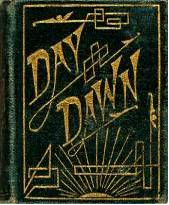
Day-Dawn. New York: American Tract Society, [ca. 1860] Devotional books containing brief Bible passages for daily reading were frequently printed in two-inch miniature format so as to easily fit in a pocket. The American Tract Society was a major 19th-century publisher of these pocket devotionals. This title is new to AAS, and features a splendid gilt ...
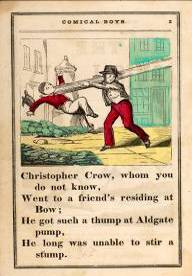
The Acquisitions Table: The Comical Boys

The Comical Boys. Philadelphia: J.B. Keller, [ca. 1852] John B. Keller, like his New York counterparts Philip J. Cozans and Elton & Co., specialized in publishing cheap picture books with brashly hand-colored wood engravings. Comical Boys chronicles the misadventures of boys, as in the case of poor Christopher Crow, who ran into a pump handle. The ...

A Small Masterpiece and Its Illustrator are Re-Discovered!

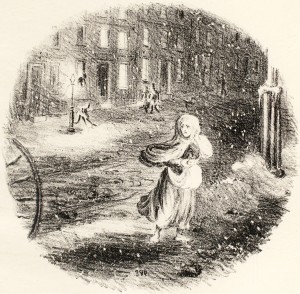
This haunting lithograph depicting Hans Christian Andersen’s Little Match-Girl is taken from the rare collection of Hans Andersen’s stories, Good Wishes for the Children, interpreted by A.A.B. and S.G.P., published by the famed Riverside Press in 1873. AAS acquired its copy from the illustrious bookman Benjamin Tighe in 1967, and up until now, the ...

The Acquisitions Table: Lessons for Children

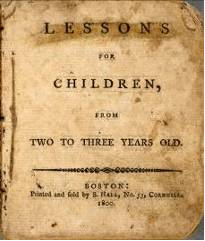
Barbauld, Anna Letitia. Lessons for Children, from Two to Three Years Old. Boston: S. Hall, 1800. This is an unrecorded title, drawn from English writer Anna Letitia Barbauld’s series of Lessons for Children written for youngsters between the ages of two and six. They are written as a series of dialogs between a child (frequently a ...

The Acquisitions Table: Children’s Book with Paper Dolls

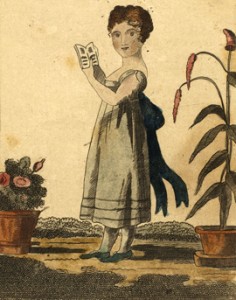
The History and Adventures of Little Eliza. Philadelphia: William Charles, 1811. This imprint is among the earliest American editions of a book first printed in London accompanied by a set of paper dolls. The celebrated Philadelphia engraver and publisher William Charles integrated the images with the text as a picture book, complete with his subtle background ...

The Children’s Henry Box Brown

henry_box_brown

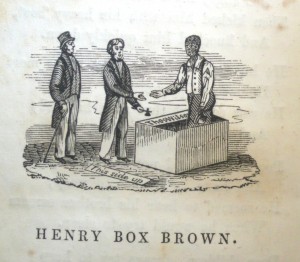
Henry Box Brown (b. 1816) escaped lifelong slavery in Virginia by shipping himself in a box (with the help of white and African-American abolitionists) to Philadelphia in 1849.  One of the few primary sources detailing his breathtaking escape to freedom is the children’s book Cousin Ann’s Stories for Children.  Written in 1849 by Quaker abolitionist ...