pastispresent.org
an online forum for early American discovery, discussion, and diversion from the American Antiquarian Society

March 9, 1870 Wednesday, In the Life of a Blacksmith: Blacksmithing again.  On our big wagon.  I drilled and bolted the wheels today.  In the eve I read [C-- C--] and then wrote a letter to Simon.

You say “Shah-vick,” I say “Chay-vick”: An Introduction to the Center for Historic American Visual Culture

December 4th, 2009, by Georgia Barnhill

1

Inadvertently, three graduate students were responsible for the creation of the Center for Historic American Visual Culture (CHAVic). Two appeared at AAS asking if we had 18th century prints or lithographs of wedding ceremonies.  Another spoke of the struggle to convince her dissertation committee that a history thesis could focus successfully on stereographs.  Between the printed word relied on by historians and the fine art prized by art historians lies a world of visual culture often misunderstood or overlooked in the study of America’s past.

heavenly_nine_croppedEstablished in 2005 by the AAS Council, CHAViC’s mission is to provide opportunities for educators to learn about American visual culture and resources, promote the awareness of AAS collections, and stimulate research and intellectual inquiry into American visual materials. The Center received major funding in the spring of 2008 that has enabled AAS to undertake some great initiatives.  To see the full panoply of activities from the first teacher workshop held in 2006 to the most recent conference held in October, visit the newest AAS website:  http://www.chavic.org.

For readers of this blog, perhaps the most visible aspect of CHAViC is the enhancement of access to collections previously available only in Antiquarian Hall.  Even within the library, many of the collections lacked finding aids and were accessible only on the suggestion of the curator of graphic arts or readers’ services staff. Now that AAS has staff to catalog separately published prints and to produce inventories, the situation has changed dramatically.  Searching on the phrase “American Art Union” in the online catalog for example, will bring up over 30 detailed catalog records for the prints in the collection.  In due course, images will be linked to these records.  There are also records of 385 gift book illustrations!  In the past three months over 650 engravings have been carefully described with funds from the National Endowment for the Humanities.

The most recent collection inventory to be created is European Political Prints.  There are now fully illustrated inventories of:

drawings_box9_folder14-Photograph Portraits of Native Americans

-Cased Photographs (Daguerreotypes, Ambrotypes, and Tintypes),

-the David Claypoole Johnston Collection

-Hawaiian Engravings

-Drawings

-Portrait Paintings and Miniatures

-Photographs of Seventeenth- and Eighteenth-Century Structures in Massachusetts taken by Harriette Merrifield Forbes.

Surf the AAS Collections Page for other tantalizing graphic arts collections!

For interpretative projects focusing on AAS collections, check out the online exhibitions portion of the CHAViC website.  AAS archives all of its exhibitions.

I hope you will enjoy the new CHAViC website and that we will hear from you if you have questions or want to submit proposals for conferences or fellowships.

Georgia Barnhill, Director

Center for Historic American Visual Culture

Gbarnhill (at) mwa.org


Tags: ,

Sensational Images

October 15th, 2009, by Elizabeth Watts Pope

2

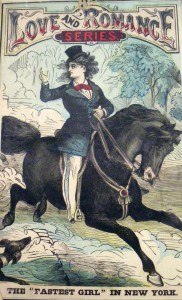
faster_girl_cover At parties, when people discover I work at the American Antiquarian Society, they often ask: what’s your favorite item in the collections? To my mind, this is akin to asking a parent to choose his or her favorite child. I’ve heard curators answer this impossible dilemma simply: whatever I received this morning is always my favorite. My own newly crowned favorite item first crossed my path a couple weeks ago when it was called for by one of our recent fellows, Spencer Keralis. The Fastest Girl in New York is a dime novel in the “Love and Romance” series that has been in AAS’s collections since 1970, although this is the first time we’ve met. Apparently I am not alone in my fascination with The Fastest Girl, as it is (self-)described as nothing less than “THE MOST BRILLIANT AND FASCINATING BOOK EVER PUBLISHED.” On the title page we learn that our heroine, Cleo, “rides a fast horse – captivates gay damsels – fascinates fast men – plays billiards like a grand master.” Now this sounds like a girl to know!

In one of the more gripping scenes, our cross-dressing heroine is depicted lounging, smoking, drinking, and idly whipping herself while being gazed at by, and gazing upon, the male audience gathering around her:

At one of the tables in the smoking room of the Mr. St. Vincents, sat Cleo, her feet upon the black walnut, her legs crossed, her hat at an angle of forty-five degrees, with the brim resting on her right ear. With all the nonchalance in the world, she sat there, gently whipping her right leg with her inseparable companion, her whip. A small bottle of Widow Clicquot stood at her right hand, the contents partially disposed of; a package of cigarettes lay on the table, and the blue smoke from one of these dainty things, she was expelling from her nostrils with all the gusto of the most inveterate cigarette smoker.

fastest_girl_inside
Twenty pair of eyes looked her over from head to foot, — not all at once, nor with long, rude gaze – her small feet seeming to attract more attention than any other part of her person, though it was evident that the remark of one gentleman, in a low tone, to a friend, to the effect that she was a fine young fellow of good parts and fine points, would have found echo in every breast. And she glanced from one to the other of the gentlemen present, with unabashed, though not bold and brazen gaze, and no doubt expressed herself mentally concerning their parts and points (41).

This week is the perfect time to mention my newest obsession with The Fastest Girl because we are having a free public lecture on a related subject at 6pm tomorrow night, Friday, October 16th. “Catching His Eye: The Sporting Male Pictorial Press in the Gilded Age” is this year’s Wiggins Lecture in the Program of the History of the Book in American Culture and will be given by Joshua Brown, the executive director of the American Social History Project at the Graduate Center of The City University of New York.

2009 CHAViC Conference

2009 CHAViC Conference

The fun continues all this weekend with the Center for Historic American Visual Culture (CHAViC) conference at AAS: “Destined for Men: Visual Materials for Male Audiences, 1750-1880”. The conference will include a visual cornucopia of material, such as mark medals, chamber pots, men’s fashion, drawings, photographs, and the Police Gazette. Should you wish to attend, there is still time to register and pay at the door on Friday.

If Cleo’s story sparked your interest, there are plenty more of these sensational and well-illustrated stories in the AAS stacks for you to explore. Dime novels like The Fastest Girl were cheap publications that became popular starting in the 1860s and initially sold for 10 cents (hence the name). AAS has many more dime novels than are listed in our online catalog, and there are checklists and bibliographies available in the reading room.

The Flash PressOther related collections include our racy newspapers (also called the sporting press or flash press). To learn more about these sources, you can check out a book published in association with AAS: The Flash Press: Sporting Male Weeklies in 1840s New York by Patricia Cohen, Timothy Gilfoyle and Helen Lefkowitz Horowitz (2008). You may also wish to examine our online bibliography of risque literature at AAS created by our president emeritus, Marcus A. McCorison.

More information about the free public lecture is available here or about the CHAViC conference here. We hope you will join us in enjoying these sensational images!


Tags: , ,